AI Overview Optimization: How to Rank, Get Cited, and Stay Visible in Google AI Search
Learn how AI Overview optimization works, what content gets cited, and how to improve visibility in Google AI-generated search summaries with SEO and AEO.
By WREMF Team · 2026-05-09
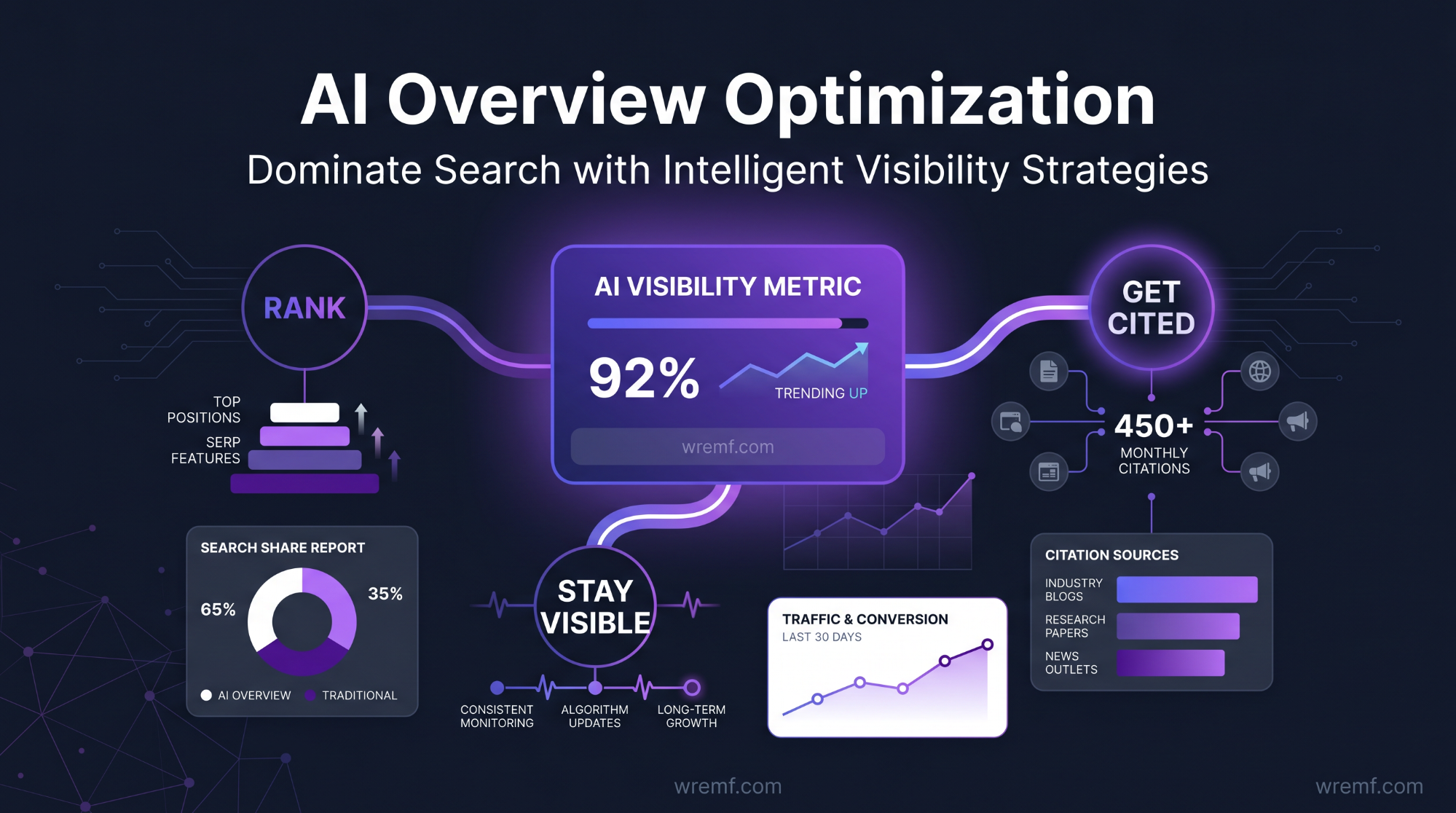
AI Overview optimization is the process of improving content, technical SEO, authority signals, and source consistency so Google can include your brand in AI-generated search summaries. AI Overviews are AI-generated summaries that appear in Google Search for selected queries and include supporting links. They use Google Search systems, generative AI, query interpretation, and retrieval-augmented generation to answer user queries. Content featured in AI Overviews is typically clear, useful, crawlable, snippet-eligible, and aligned with user search intent. Optimization requires answer-first content structure, direct definitions, comparison tables, evidence-backed claims, Schema markup, technical accessibility, internal linking, and source consistency. AI Overview optimization differs from SEO by focusing on citations and mentions inside AI summaries rather than traditional rankings alone. It combines elements of SEO, Answer Engine Optimization, and Generative Engine Optimization into a measurable workflow for Google's AI-generated search experience.
Key takeaways
- AI Overview optimization helps your brand become eligible, understandable, and cite-worthy inside Google's AI-generated search summaries, which appear in more than 120 countries and 11 languages.
- Google AI Overviews use search retrieval, query fan-out, retrieval-augmented generation, and supporting links, so success depends on content structure, authority signals, and source consistency, not just rankings.
- AI Overviews can reduce some informational clicks while increasing trust and brand recall for cited sources, requiring teams to measure citations, mentions, competitors, and traffic together.
- Content featured in AI Overviews is typically answer-first, uses direct definitions, includes comparison tables, cites authoritative sources, and matches user search intent with extractable information.
- Technical optimization for AI Overviews requires pages to be crawlable, indexable, snippet-eligible, fast, and semantically understandable through Schema markup, correct meta robots tags, and accessible rendering.
- AI Overview optimization combines SEO, Answer Engine Optimization, and Generative Engine Optimization into one repeatable workflow focused on Google's AI-generated search experience and citation probability.
AI Overview Optimization: How to Rank, Get Cited, and Stay Visible in Google AI Search
AI Overview optimization is the process of improving content, technical SEO, authority signals, and source consistency so Google can include your brand in AI-generated search summaries. Google Search Central explains that AI Overviews and AI Mode use Google Search systems to surface helpful responses and supporting links, so traditional SEO still matters, but it is no longer enough on its own. WREMF helps B2B teams track, improve, and prove visibility across Google AI Overviews, ChatGPT, Claude, Gemini, Perplexity, Copilot, DeepSeek, Grok, Meta AI, Mistral, and other AI discovery surfaces. This guide explains how AI Overviews work, what content gets cited, how AIO differs from SEO, AEO, and GEO, how to measure performance in Google Search Console, and how to build a repeatable AI Search workflow.
What Is AI Overview Optimization?
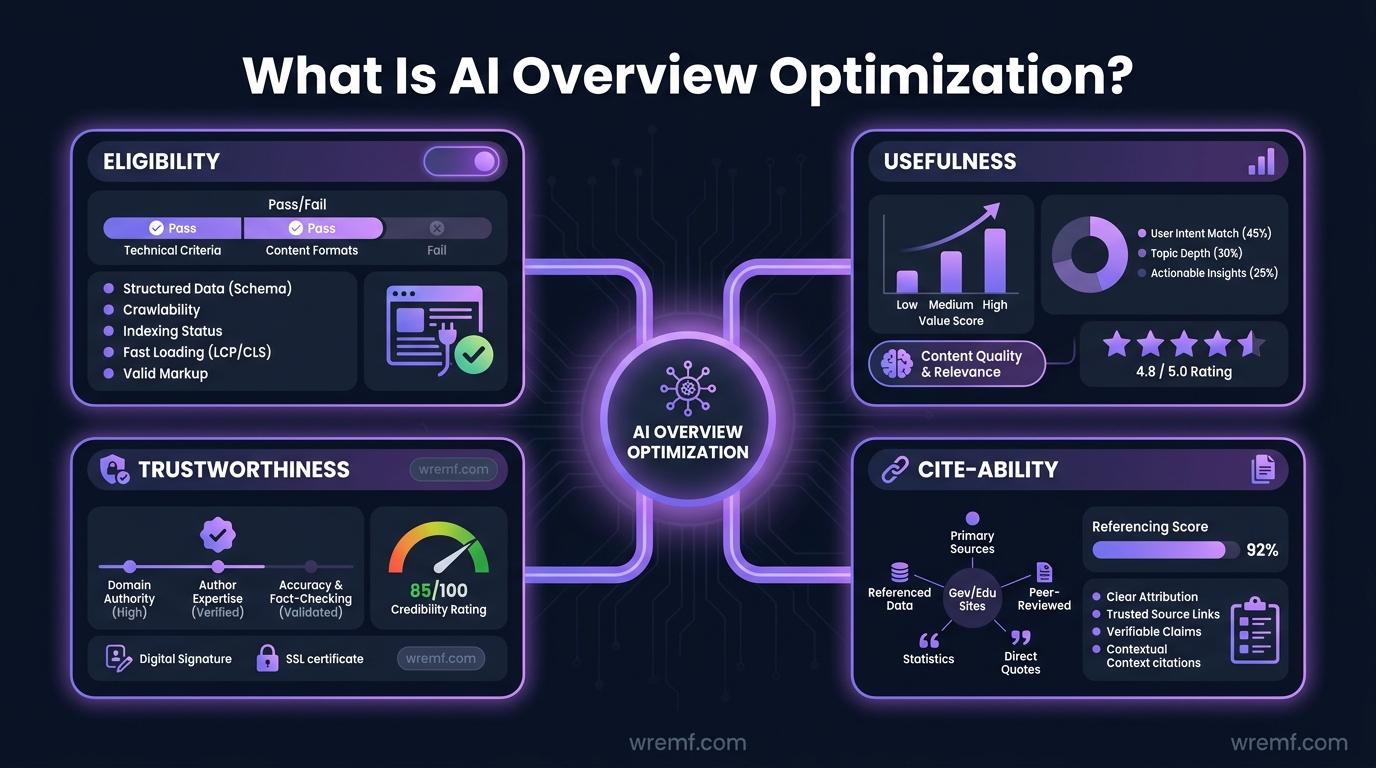
AI Overview optimization is the practice of making your content eligible, useful, trustworthy, and easy for Google AI systems to cite inside AI Overviews. The goal is to earn visibility in AI-generated answers, not only in traditional search results.
AI Overviews are AI-generated summaries that appear in Google Search for selected search queries. Google describes AI Overviews as snapshots of key information with links that help users explore more on the web through Google AI Overviews. (blog.google)
AI Overview optimization matters because the search landscape now includes ranked links, AI summaries, featured snippets, People Also Ask, videos, local pack results, ads, Google Maps ads, and other SERP features. A B2B brand can appear in classic organic rankings and still be absent from Google's AI-generated answer. A competitor can appear as a cited source, brand mention, or recommendation even when the classic ranking report does not show the full picture.
AI visibility is the measurable presence of a brand inside AI-generated answers, recommendations, citations, summaries, and comparisons. AI visibility matters because buyers increasingly use Google Search, AI Search, ChatGPT, Perplexity, Gemini, Claude, Copilot, Bing Copilot, and other search engines before they visit a website or speak to sales.
WREMF helps teams turn AI visibility from a guessing game into a measurable workflow through AI visibility tracking across major AI discovery surfaces. The platform connects prompt tracking, source citations, competitor visibility, AI share of voice, AI traffic attribution, GEO audits, content briefs, scheduled AI monitoring, API workflows, BYOK support, and white-label reporting.
AI Overview optimization is not a shortcut around quality. It is a structured way to make your best content easier for search engines, Large Language Models, and AI-driven results to understand. The work includes content structure, keyword research, technical optimization, Schema markup, entity clarity, content freshness, source consistency, and reporting.
DID YOU KNOW: Google says AI Overviews are available in more than 120 countries and territories and 11 languages, which makes Google AI visibility a global search priority rather than a narrow experiment. (blog.google)
KEY TAKEAWAY: AI Overview optimization helps your brand become eligible, understandable, and cite-worthy inside Google's AI-generated search summaries.
To improve AIO performance, you first need to understand how AI Overviews fit into Google Search.
What Are Google AI Overviews?
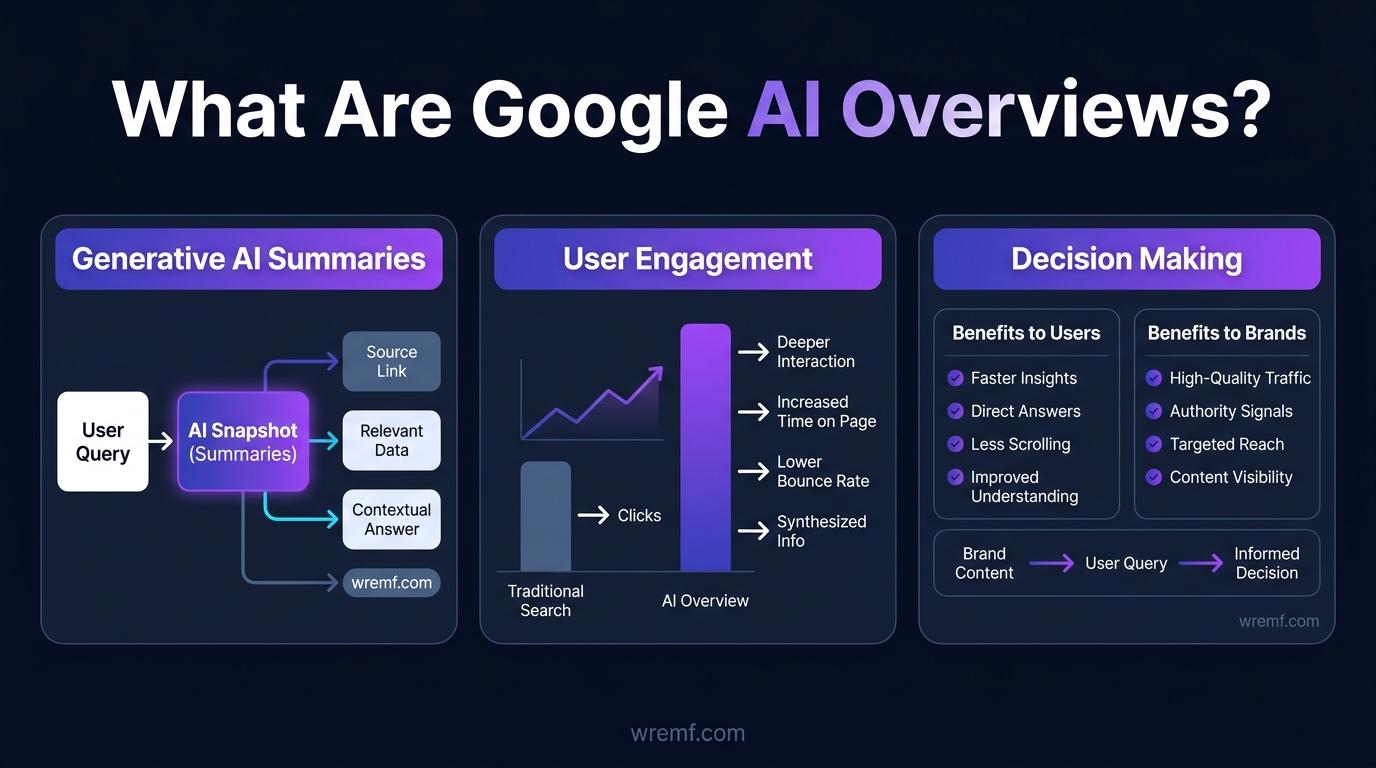
Google AI Overviews are generative AI summaries in Google Search that answer selected queries and include supporting links. They matter because users may read, compare, and make decisions directly from the Search Engine Results Page before clicking a website.
Google AI Overviews are not a separate search engine. They are part of Google Search. Google Search Central explains that AI features such as AI Overviews and AI Mode help users ask more complex questions, receive generated responses, and find links to relevant web content through AI features and your website. (Google for Developers)
Google's AI Overviews evolved from Search Generative Experience, often shortened to SGE. Search Generative Experience was Google's earlier experimental generative search interface that tested AI summaries, follow-up exploration, and cited web links. Google AI Overviews are the broader search feature that now appears for many users in regular Google Search.
Search Generative Experience is the earlier Google experiment that tested generative AI summaries inside search results. Search Generative Experience matters because many current AIO, AEO, and GEO practices started with SGE testing around query interpretation, source selection, and conversational search intent.
In real B2B buying journeys, a user may search "best compliance software for fintech," read an AI Overview, compare vendors in ChatGPT, ask Perplexity for sources, and return to Google Search before booking a demo. This means AI Overview optimization is not only about one Google result. It is part of a wider AI discovery path.
Google AI Overviews often affect informational keywords, comparison searches, product reviews, local SEO strategies, YMYL topics, ecommerce brands, and commercial discovery. They can appear beside ads, rich snippets, videos, People Also Ask, and classic organic links. This makes the search engine results page more competitive, but it also creates more ways for a brand to be seen.
AI discovery surfaces are the places where users ask AI systems for answers, comparisons, recommendations, summaries, or next steps. AI discovery surfaces matter because buyers no longer rely only on classic Google rankings when they research products, services, and vendors.
KEY TAKEAWAY: Google AI Overviews are part of Google Search, but they change how users discover, compare, and evaluate information before clicking.
The next step is understanding how Google decides what to summarise and cite.
How Do AI Overviews Work?
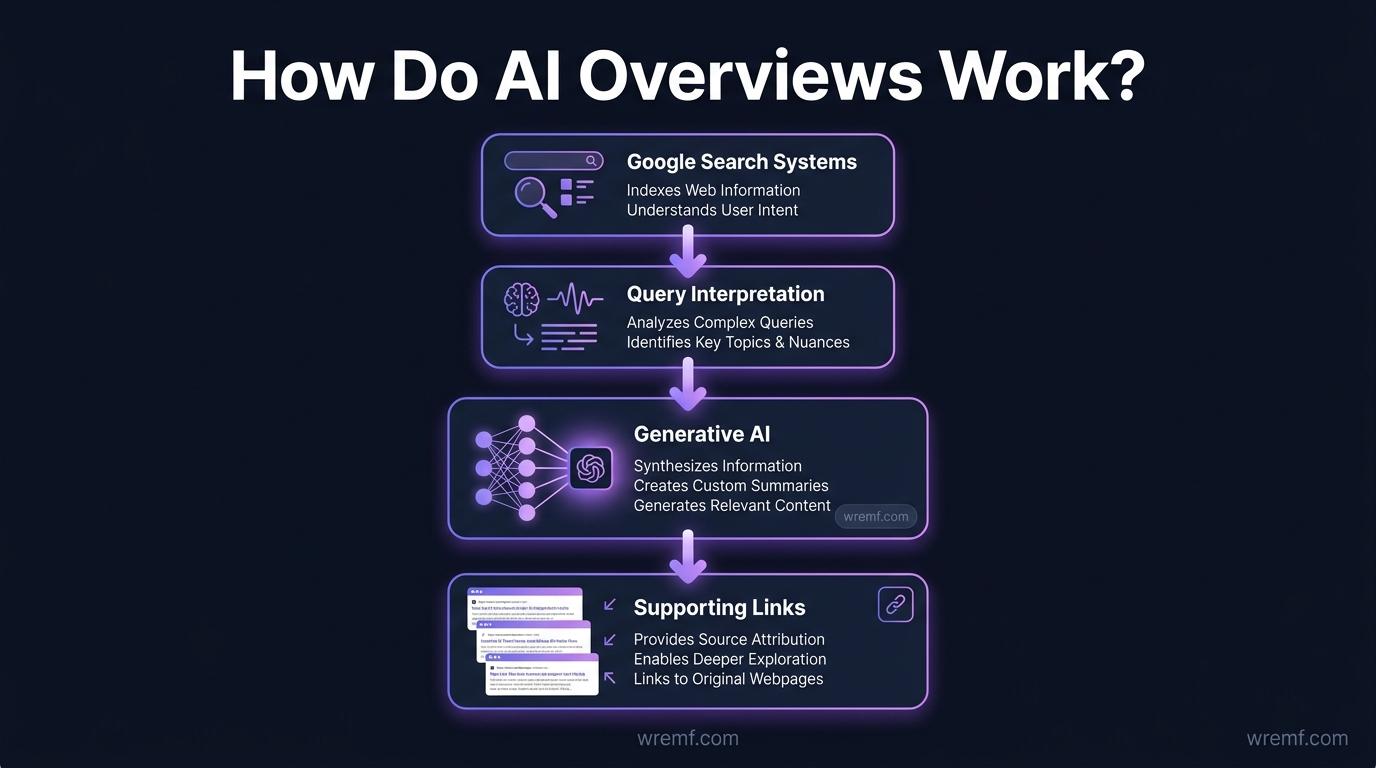
AI Overviews work by using Google Search systems, generative AI, query interpretation, and supporting web links to answer selected searches. Google decides when an AI-generated answer is useful and then surfaces sources that help support the response.
Generative AI is artificial intelligence that creates text, summaries, images, code, or other outputs based on patterns and instructions. Generative AI matters for AI Overview optimization because Google uses AI models to generate summaries from retrieved information and search systems.
Large Language Models are AI systems trained to process, understand, and generate natural language. Large Language Models matter because Google AI, Gemini, ChatGPT, Claude, Copilot, Perplexity, and other AI tools interpret entities, context, search intent, and source relationships in ways that go beyond exact-match keywords.
The Gemini language model is Google's family of AI models used across many Google AI products and experiences. The Gemini language model matters for AI Overview optimization because Google AI Search experiences rely on AI systems that interpret complex search queries, summarise information, and support follow-up exploration.
Query fan-out is a process where an AI search system breaks a user query into related subqueries to retrieve broader and more specific information. Query fan-out matters because one visible user query can trigger several hidden retrieval paths, which may surface sources that do not rank in the classic top 10.
Google Search Central explains that AI Mode can use a query fan-out technique, issuing multiple related searches across subtopics and data sources. This means AI-driven results may reflect topical coverage, source clarity, and entity relationships rather than one keyword ranking alone. (Google for Developers)
Retrieval-Augmented Generation is a method where an AI system retrieves information from external sources and uses that information to generate a response. Retrieval-Augmented Generation matters because AI citations, source links, and supporting documents influence how trustworthy the generated answer appears.
For marketers, the practical lesson is simple. Google AI Overviews are not just another search ranking snippet. They are generated answers supported by search retrieval, source selection, and AI interpretation. This is why content patterns, authority signals, source consistency, and technical optimization matter together.
A common implementation mistake is optimizing only one visible keyword. A single Google Search query can represent many hidden subtopics, follow-up questions, comparison paths, and search intent variations. That is why AIO content should answer the primary question, related user queries, comparison needs, and implementation questions on the same page where relevant.
KEY TAKEAWAY: AI Overviews work through search retrieval, AI summarisation, supporting links, and source selection, so AIO success depends on more than classic rankings.
Once the system is understood, the next question is what AIO changes for SEO performance.
How Do AI Overviews Affect SEO, Rankings, and Traffic?
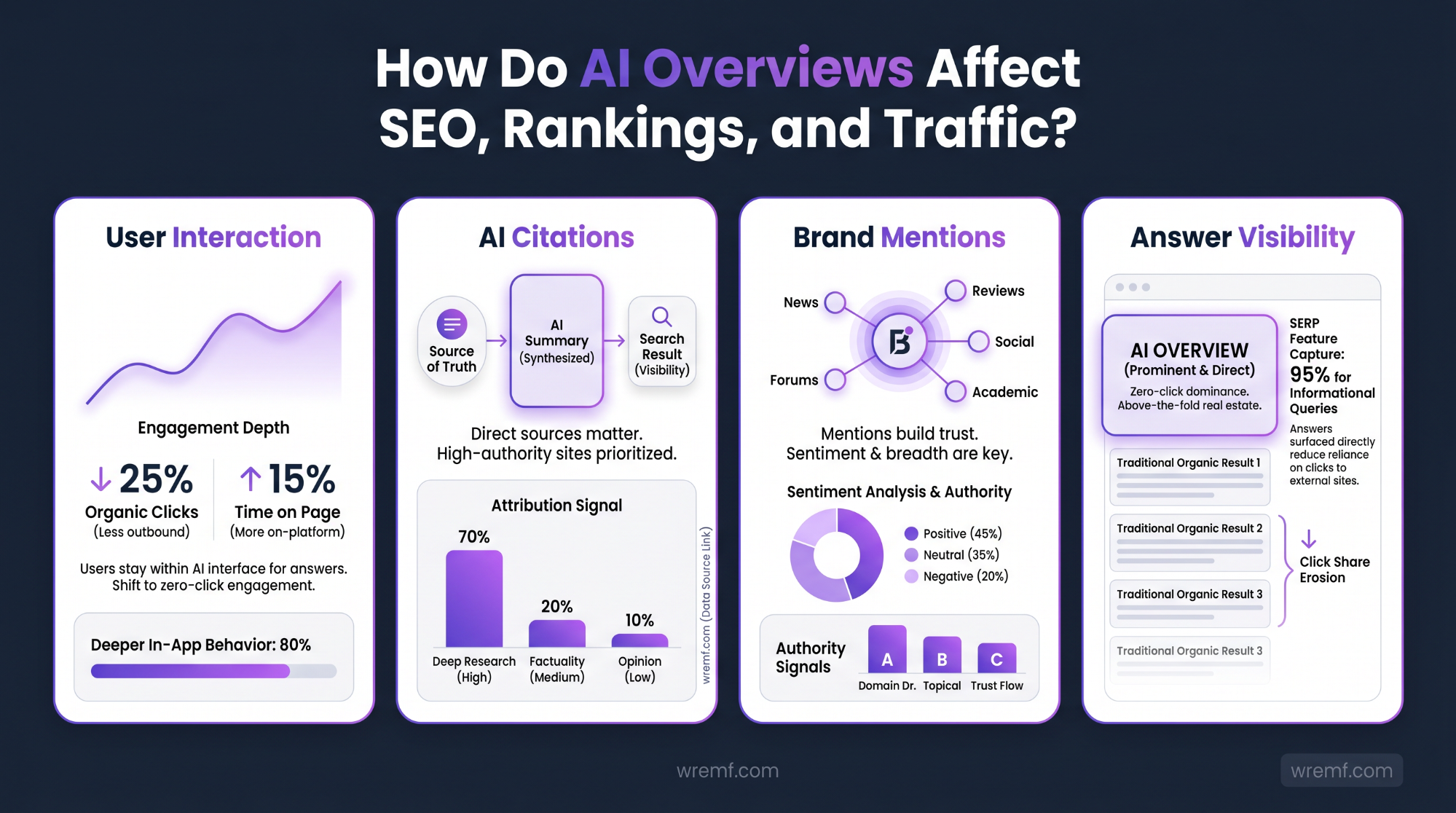
AI Overviews affect SEO by changing how users interact with search results, citations, and clicks. Rankings still matter, but AI citations, brand mentions, and answer visibility can influence discovery before a user visits your website.
Rankings are the positions where pages appear in organic search results. Rankings matter because Google Search still depends on crawlable, indexable, useful web content, but rankings alone do not prove whether your brand appears in AI Overviews.
Search results are the full set of items Google shows after a query, including organic listings, ads, AI Overviews, featured snippets, People Also Ask, videos, local results, and other SERP features. Search results matter because AI Overview optimization competes for attention inside a more complex Search Engine Results Page.
Click-through rates are the percentage of impressions that turn into clicks. Click-through rates matter because AI Overviews can answer parts of the query directly, which may reduce clicks for some informational searches while increasing trust for cited sources.
Pew Research Center found in a March 2025 analysis that users who encountered an AI summary clicked a traditional search result in 8 percent of visits, while users who did not encounter an AI summary clicked a search result in 15 percent of visits. Pew's data supports the practical concern that AI summaries can reduce some website clicks when answers are satisfied on the results page through Pew Research Center's AI summary click study. (The Guardian)
Semrush reported that AI Overviews appeared for around 16 percent of all tracked queries after rapid growth during 2025, based on an analysis of more than 10 million keywords in its Semrush AI Overviews study. (Semrush) This matters because AIO is not limited to a few novelty searches. It is a measurable part of the modern search landscape.
AIO impact is not always negative. Some pages may lose non-qualified informational clicks. Some cited pages may gain trust, brand recall, and more qualified visits. Some brands may receive visibility without immediate attribution. The problem is that standard SEO dashboards often do not show all of these effects clearly.
Google Search Console is Google's platform for measuring search performance, indexing, search queries, pages, click-through rates, and technical search issues. Google Search Console matters for AI Overview optimization because it shows query and page trends, even though it does not provide a full standalone AIO citation report.
Google Analytics is a web analytics platform for measuring users, sessions, engagement, conversions, and traffic sources. Google Analytics matters because teams need to connect AI visibility, organic search, branded search, and pipeline outcomes.
IMPORTANT: A drop in organic traffic after AI Overviews appear does not automatically mean SEO failed. It may mean the search experience changed, the query became more zero-click, competitors were cited, or your content did not match the AI summary's source needs.
KEY TAKEAWAY: AI Overviews can change rankings, traffic, and click-through rates, so SEO teams must measure citations, mentions, competitors, and traffic together.
To respond properly, you need to separate SEO, AEO, GEO, and AIO instead of treating them as the same thing.
AI Overview Optimization vs SEO vs AEO vs GEO
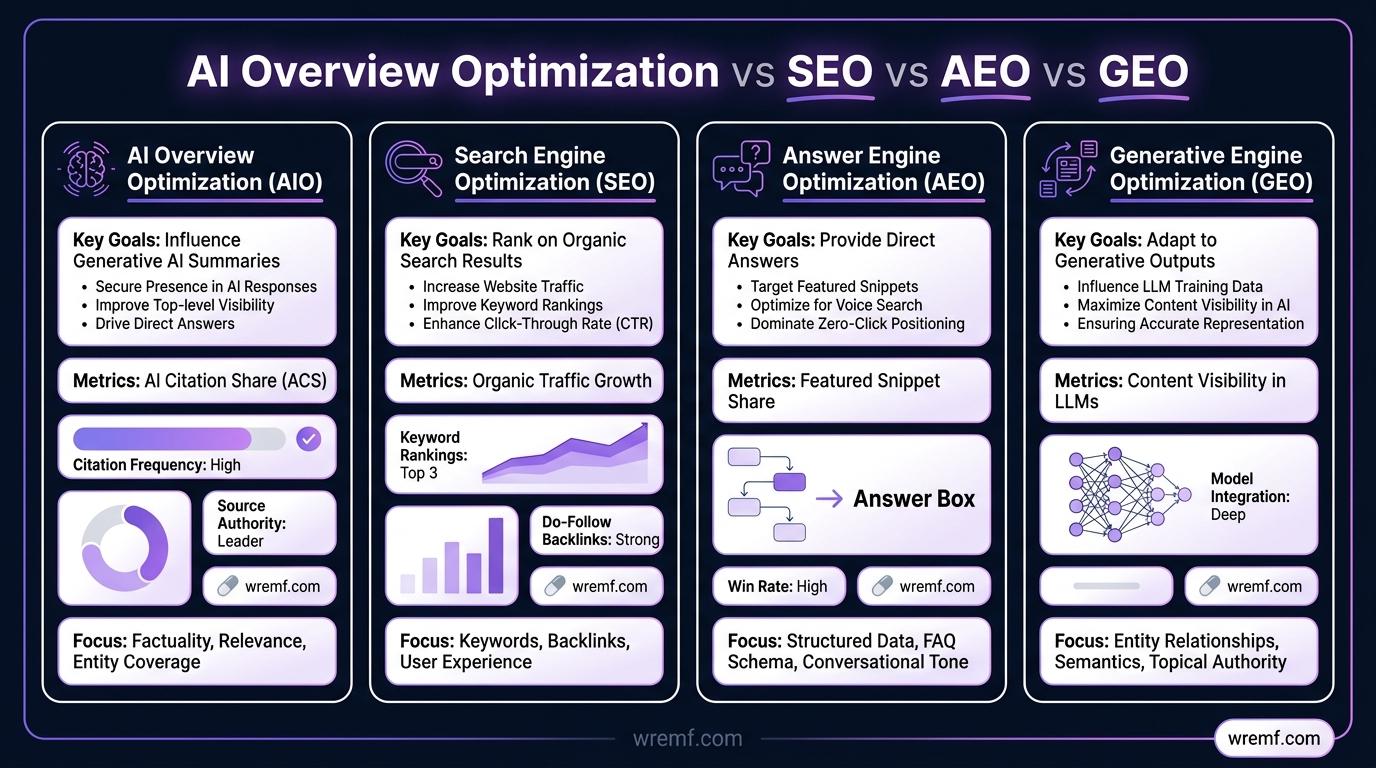
AI Overview optimization overlaps with SEO, Answer Engine Optimization, and Generative Engine Optimization, but each discipline has a different goal. SEO targets search rankings, AEO targets direct answers, GEO targets generative AI visibility, and AIO targets Google's AI-generated search summaries.
SEO is the practice of improving website visibility in search engines through technical access, content quality, relevance, authority, internal links, and user experience. SEO matters because AI Overviews still depend on web content that Google can crawl, index, and understand.
Answer Engine Optimization is the practice of structuring content so it can answer direct questions in search engines, voice assistants, featured snippets, People Also Ask, and AI answer systems. Answer Engine Optimization matters because AI Overviews often need concise, extractable answers.
Generative Engine Optimization is the practice of improving how a brand, page, or entity appears inside generative AI systems. Generative Engine Optimization matters because ChatGPT, Gemini, Claude, Perplexity, Copilot, Bing Copilot, DeepSeek, Grok, Meta AI, and Mistral can summarise, compare, recommend, or cite brands outside the traditional Google ranking path.
AI Search is the broader category of search experiences where AI systems generate, summarise, rank, or recommend answers. AI Search matters because buyers can now discover vendors through Google AI, ChatGPT, Perplexity, Gemini, Copilot, and other AI tools before they reach your website.
| Discipline | Primary Goal | What It Measures | What It Misses | Best For |
|---|---|---|---|---|
| SEO | Rank and earn organic traffic in search engines | Rankings, clicks, impressions, CTR, backlinks, technical health | AI citations, prompt visibility, source consistency, brand recommendations | Search performance and technical visibility |
| AEO | Answer direct questions clearly | Featured snippets, FAQ visibility, People Also Ask, answer blocks | Multi-engine LLM visibility and competitor recommendations | Definitions, FAQs, support content, educational content |
| GEO | Become visible in generative AI answers | AI citations, brand mentions, prompt coverage, source references | Some traditional keyword and traffic data | AI Search, LLM visibility, and answer engines |
| AIO | Earn visibility in Google's AI-generated summaries | AI Overviews, cited sources, brand mentions, AIO query coverage | Full visibility across non-Google AI tools unless tracked separately | Google AI Overviews and AI Mode |
| Traditional rank tracking | Monitor keyword positions | Position, URL ranking, keyword movement | AI-generated citations, competitor mentions, AI share of voice | Legacy SEO reporting |
The key difference between SEO and GEO is that SEO focuses on making pages visible in search engine results, while GEO focuses on making brands and sources retrievable inside generative AI answers. AI Overview optimization sits between both because Google AI Overviews are part of Google Search, but the answer layer behaves more like generative AI.
AI Overview optimization also requires stronger source thinking. A page can be technically optimized and still fail to appear if third-party sources describe the brand inconsistently, competitors have clearer category authority, or the content does not answer the specific query fan-out path.
WREMF's AI visibility methodology connects prompts, citations, competitors, source consistency, AI share of voice, and attribution into one repeatable system. This helps teams evaluate the search landscape beyond standard ranking reports.
KEY TAKEAWAY: AI Overview optimization does not replace SEO, AEO, or GEO. It combines them into a measurable workflow for Google's AI-generated search experience.
The overlap is useful, but the real advantage comes from knowing which content and source signals influence citation probability.
What Kind of Content Gets Featured in AI Overviews?
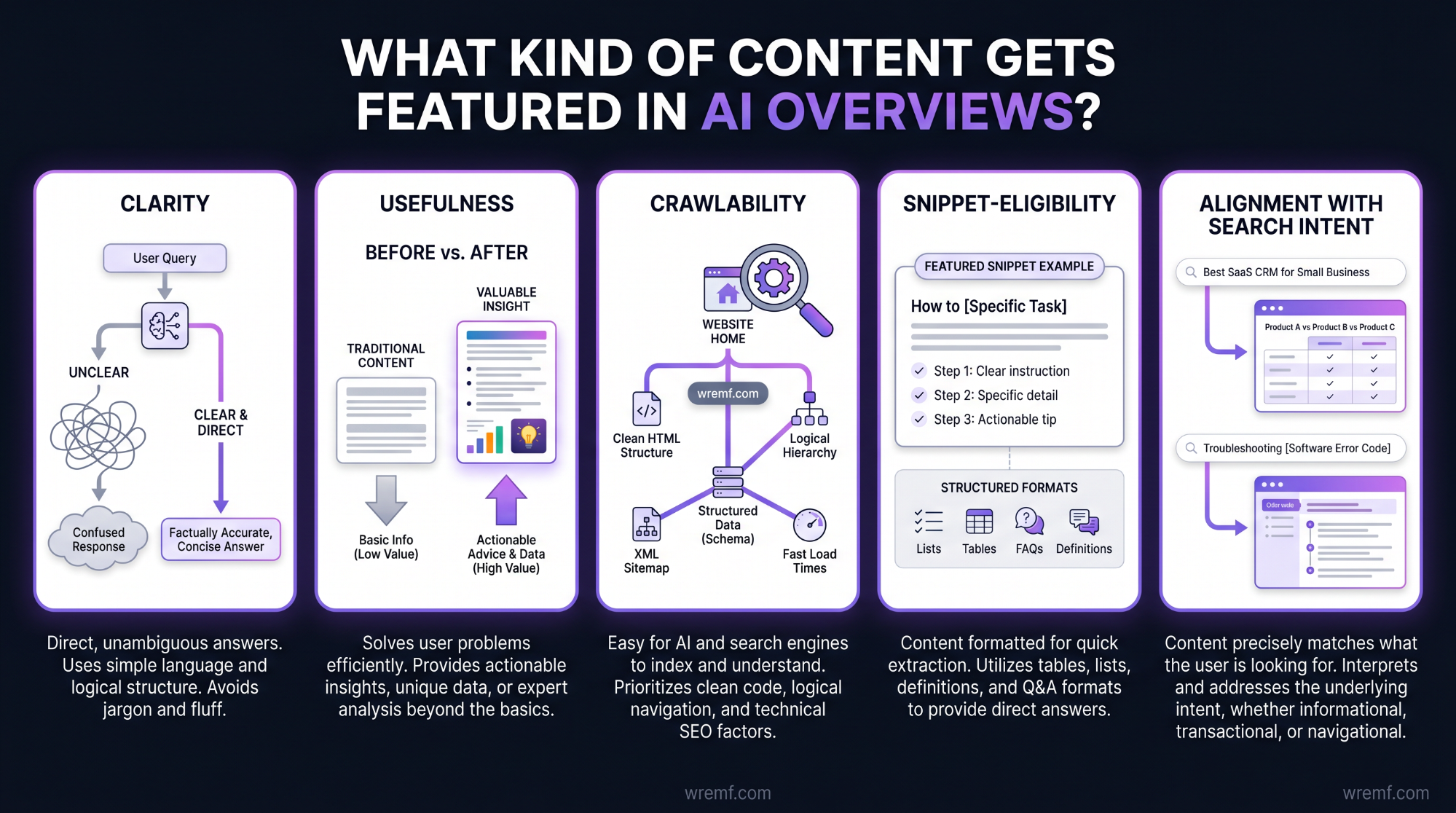
Content featured in AI Overviews is usually clear, useful, crawlable, snippet-eligible, and aligned with the user's search intent. Google says the same core SEO best practices apply, including helpful content, crawl access, internal links, page experience, textual content, and structured data that matches the visible page.
Google Search Central explains that pages must be indexed and eligible for snippets to be shown as supporting links in AI Overviews or AI Mode. Google also says there are no additional technical requirements for AI features beyond Google Search eligibility. (Google for Developers)
Search intent is the underlying task, question, or decision behind a search query. Search intent matters for AI Overview optimization because Google's AI systems try to answer the complete user need, not just match a short keyword.
Content structure is the organisation of headings, definitions, summaries, examples, tables, and supporting details on a page. Content structure matters because AI-driven results need extractable answers, not only long blocks of prose.
Content patterns are repeatable formats that help users and search engines understand information quickly. Content patterns matter because AI Overviews often need direct answers, definitions, comparisons, step-by-step instructions, and evidence-backed summaries.
The strongest AI Overview content usually includes these patterns:
| Content Pattern | Why It Helps AI Overviews | Example |
|---|---|---|
| Answer-first introduction | Gives Google AI a direct summary to extract | "AI Overview optimization is..." |
| Direct H2 opener | Answers the section question immediately | "AI Overviews work by..." |
| Definition block | Clarifies entities and concepts | "AI citations are..." |
| Comparison table | Helps with decision and comparison search queries | SEO vs AEO vs GEO |
| Evidence-backed claim | Adds trust signals and brand credibility | "Google Search Central explains..." |
| Implementation workflow | Supports how-to queries | "Step 1. Audit priority queries" |
| FAQ answers | Matches natural language prompts | "How do I optimize for Google AI Overviews?" |
| Fresh references | Supports content freshness | AI Mode, Google AI, Gemini, Google Search Console |
Content citations are references to authoritative sources used to support claims, definitions, data, or recommendations. Content citations matter because AI Overview optimization depends on trust, evidence, and source clarity.
E-E-A-T signals are indicators of experience, expertise, authoritativeness, and trustworthiness. E-E-A-T signals matter for AI Overview optimization because YMYL topics, technical topics, SaaS comparisons, legal topics, finance topics, healthcare topics, and product reviews require stronger evidence and clearer source attribution.
YMYL topics are topics that can affect a person's health, finances, safety, legal situation, or major decisions. YMYL topics matter because Google applies higher quality expectations where inaccurate content can cause harm.
Trust signals are cues that help users and search systems evaluate whether content is reliable. Trust signals include clear authorship, evidence, citations, accurate dates, original experience, transparent methodology, secure infrastructure, and consistent entity information.
Brand credibility is the degree to which users, search engines, and AI systems can trust a brand's claims, expertise, and source record. Brand credibility matters because Google AI Overviews may cite sources that appear clearer, safer, and more reliable for the query.
TIP: Build pages that answer the main question, define important entities, compare options, cite authoritative sources, and explain next steps without forcing users to decode vague marketing language.
KEY TAKEAWAY: Content featured in AI Overviews is usually useful, extractable, technically eligible, and strong enough to be trusted as a supporting source.
The best content still needs technical access, structured data, and crawlable page architecture.
Technical Optimization for AI Overviews
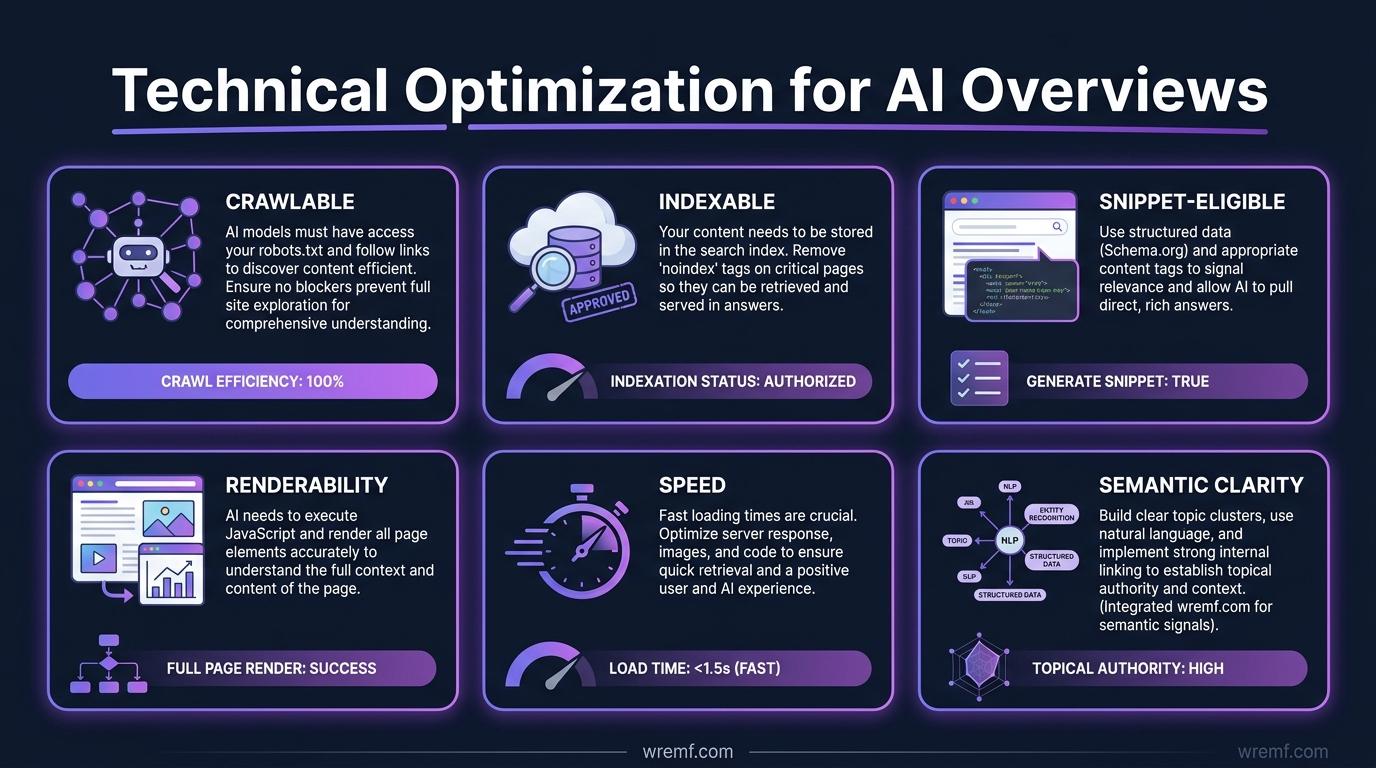
Technical optimization for AI Overviews means making your content crawlable, indexable, snippet-eligible, renderable, fast, and semantically understandable. If Google cannot access or interpret the content, Google AI cannot reliably use it as a supporting source.
Technical optimization is the process of making a page accessible, fast, indexable, and understandable to search engines. Technical optimization matters because a page cannot become a useful AI Overview source if crawlers cannot access or interpret the important content.
Schema markup is structured data that helps search engines understand the meaning of visible page content. Schema markup matters because it can reinforce entities, page types, products, reviews, FAQs, organisations, authors, events, and other structured facts when it accurately matches the visible page.
Rich snippets are enhanced search result displays generated from structured data and other page signals. Rich snippets matter because structured information can help search engines understand what a page contains, even when the final AI Overview display is different from classic rich results.
Meta tags are HTML elements that provide search engines with page-level information such as titles, descriptions, robots directives, and indexing instructions. Meta tags matter because incorrect robots directives can block snippets, indexing, or search visibility.
Meta robots tags are page-level directives that tell search engines how to index, display, or restrict content. Meta robots tags matter because nosnippet, noindex, and restrictive snippet settings can affect whether Google can show or use content in AI features.
Google's robots meta tag documentation explains that nosnippet, data-nosnippet, and max-snippet controls can affect how content appears in Google Search results, including AI Overviews and AI Mode through Google robots meta tag specifications. (Google for Developers)
Page architecture is the way a website organises URLs, internal links, navigation, content hubs, and entity relationships. Page architecture matters because AI Overview optimization depends on clear topical coverage, not isolated pages.
Page speed is the speed at which a web page loads and becomes usable. Page speed matters because slow or unstable pages can harm user experience, crawling efficiency, and conversion performance.
Use this technical checklist for AI Overview optimization:
| Technical Area | What to Check | Why It Matters |
|---|---|---|
| Indexability | Page is indexable and not blocked by noindex | Google needs indexed content to show supporting links |
| Snippet eligibility | Avoid unnecessary nosnippet or restrictive max-snippet rules | Google AI features need usable text snippets |
| Robots access | Important sections are not blocked in robots.txt | Crawlers need access to content |
| Rendering | Main content is visible in rendered HTML | AI systems need accessible text |
| Internal links | Related pages link to each other clearly | Helps entity and topic discovery |
| Schema markup | Structured data matches visible content | Reinforces meaning and page type |
| Meta tags | Titles and descriptions match page intent | Supports search relevance |
| Canonicals | Canonical tags point to the right URL | Prevents confusion across duplicates |
| Page speed | Core pages load quickly and reliably | Supports user experience and crawling |
| Security rules | CDN or firewall does not block legitimate crawlers | Prevents accidental crawl failures |
Security and infrastructure issues can quietly damage AI visibility. A security service, CDN, or firewall may block crawlers if rules are too aggressive. Cloudflare Ray ID messages, online attacks warnings, SQL command filters, malformed data rules, or site owner security pages can prevent Google from seeing normal content if misconfigured.
Bing Webmaster Tools can also help teams diagnose crawl, indexation, and technical issues for Bing Copilot and Microsoft search surfaces. Bing Webmaster Tools matters because AI search visibility is not limited to Google AI Overviews.
The Rich Results Test helps validate whether Google can read supported structured data on a page. The Schema Markup Validator helps test broader structured data syntax. Both are useful, but neither guarantees AI Overview inclusion.
KEY TAKEAWAY: Technical AIO work is about access, snippets, structure, rendering, speed, and security, not secret AI tags or hidden shortcuts.
Once technical access is stable, the next step is building content that matches how people ask AI-driven questions.
How to Optimize Content for Google AI Overviews
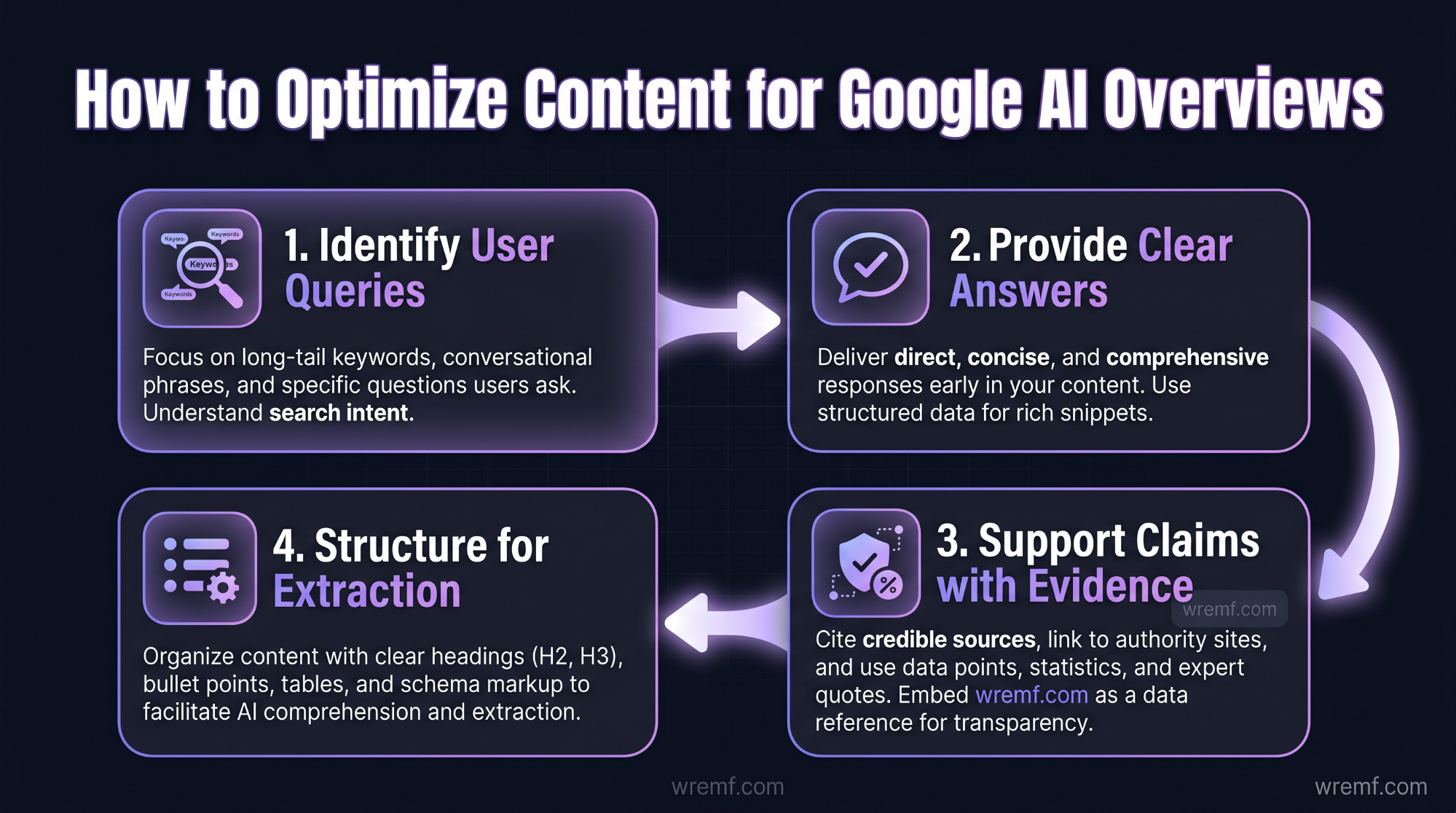
The most effective way to optimize content for Google AI Overviews is to answer real user queries clearly, support claims with evidence, and structure pages for extraction. Content should be useful to people first and machine-readable second.
Keyword Research is the process of identifying the words, phrases, and questions users search for. Keyword Research matters for AI Overview optimization because one head keyword may represent many conversational user queries, follow-up questions, comparison prompts, and voice assistant searches.
User queries in AI Search are often longer, more specific, and more context-rich than old keyword searches. Google Search Central says AI Mode is designed for complex, multi-part questions that may otherwise require multiple searches, which makes conversational prompt mapping important for AI Overview optimization. (Google for Developers)
Semantic Clarity is the practice of making the meaning of a page explicit through consistent terms, definitions, examples, and entity relationships. Semantic Clarity matters because AI systems need to understand what a page is about, who it is for, and which questions it answers.
Entity Linking is the practice of connecting related people, brands, products, categories, topics, and sources through clear references and internal links. Entity Linking matters because AI Overview optimization depends on relationships between concepts, not isolated keywords.
Content Engineering is the structured design of content for humans, search engines, and AI retrieval systems. Content Engineering matters because AI Overview pages need definitions, citations, comparisons, FAQs, and supporting evidence in predictable patterns.
To optimize content for AI Overviews, build each page around an answer map:
| Content Element | What to Include | Why It Matters |
|---|---|---|
| Primary answer | A direct 1 to 2 sentence answer near the top | Helps AI systems and users extract the main point |
| Entity definition | Clear definition under 60 words | Helps Large Language Models classify the topic |
| Search intent coverage | Informational, comparison, commercial, and implementation angles | Matches query fan-out and follow-up questions |
| Evidence | Authoritative sources, data, examples, or methodology | Builds trust signals |
| Content formats | Tables, steps, lists, definitions, and FAQs | Supports different retrieval and answer patterns |
| Internal links | Links to relevant supporting pages | Reinforces topical architecture |
| Freshness update | Current dates, product names, feature changes, and guidance | Keeps content accurate |
| Next action | Audit, report, demo, pricing, or workflow | Supports conversion without overpromotion |
Content freshness is the practice of keeping content accurate, current, and aligned with the latest market facts. Content freshness matters because Google AI Overviews, AI Mode, AI tools, search algorithms, and generative search behaviour are changing quickly.
AI Overview content should also include natural language questions. Examples include "What are AI Overviews?", "How do AI Overviews work?", "Can I track AIO clicks in Google Search Console?", "How do AI Overviews affect SEO?", and "What kind of content gets featured in AI Overviews?" These queries match how users search in Google, ChatGPT, Gemini, Perplexity, and voice assistants.
Avoid content creation that repeats the same generic claims across many pages. Google's guidance on AI-generated content in Search says automation can be useful when it creates helpful content, but using automation to generate scaled content primarily to manipulate rankings can violate spam policies. (ALM Corp)
WREMF's AI-ready content brief workflow helps teams convert prompt data, competitor gaps, source citations, and search intent into briefs that support SEO, AEO, GEO, and AI Overview optimization.
KEY TAKEAWAY: AI Overview content should be answer-first, evidence-backed, semantically clear, fresh, and mapped to real user queries across the full buying journey.
Content quality helps, but source ecosystems and citations decide whether your brand becomes part of the answer.
Why Citations, Brand Mentions, and Source Consistency Matter
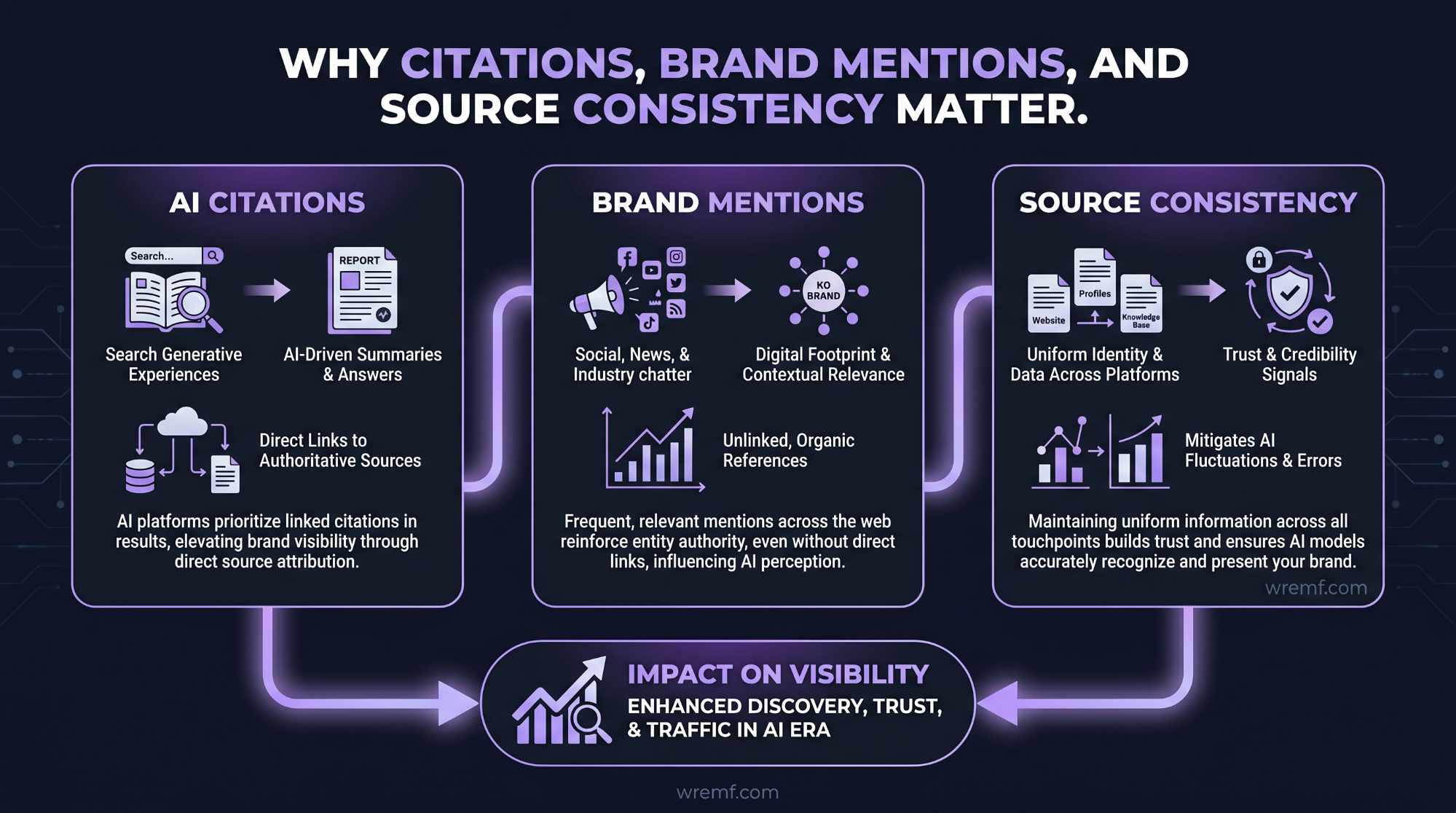
AI citations matter because they show which sources Google AI and other AI systems rely on to support generated answers. A brand can rank in search results and still lose AI visibility if the cited source ecosystem favours competitors.
AI citations are links, references, or source mentions used by AI-generated answers to support a claim. AI citations matter because they indicate which sources AI systems trust enough to include in an answer experience.
Source citations are the domains, URLs, documents, or references surfaced inside an AI answer. Source citations matter because they show the source ecosystem influencing your brand's visibility.
Brand mentions are references to a brand inside an AI answer, with or without a link. Brand mentions matter because AI systems can recommend, compare, or summarise a brand even when the user does not immediately click.
Source consistency is the alignment of facts about your brand across your website, third-party profiles, review sites, directories, partner pages, social media, documentation, and public references. Source consistency matters because AI systems may compare multiple sources before generating a summary.
In practical AI visibility audits, SEO teams frequently discover that their website says one thing, review sites say another, old directory profiles show outdated pricing, and partner pages describe a legacy category. This creates confusion for AI systems and weakens brand credibility.
AI visibility is both a measurement problem and a source ecosystem problem. AI visibility is a measurement problem because teams need prompt tracking, citation tracking, competitor visibility, and AI share of voice. AI visibility is a source ecosystem problem because AI systems often learn from multiple public sources, not only your website.
A strong source consistency cleanup includes:
Updating brand descriptions across your website, profiles, directories, and review pages
Aligning product categories and use cases across all public pages
Removing outdated pricing, old positioning, and discontinued feature claims where possible
Building clear comparison content for high-intent queries
Strengthening author, company, and topic authority signals
Improving internal links between core product, feature, and methodology pages
Tracking cited third-party sources that repeatedly influence AI answers
WREMF's source citation tracking helps teams identify which sources appear in AI answers, where the brand is absent, and which source gaps may need content, PR, directory, or authority work.
KEY TAKEAWAY: AI Overview optimization depends on being the clearest and most consistent source, not only the page with the highest keyword density.
After the source layer is clear, teams need a measurement system that proves what is changing.
How to Track AI Overview Visibility and AIO Clicks
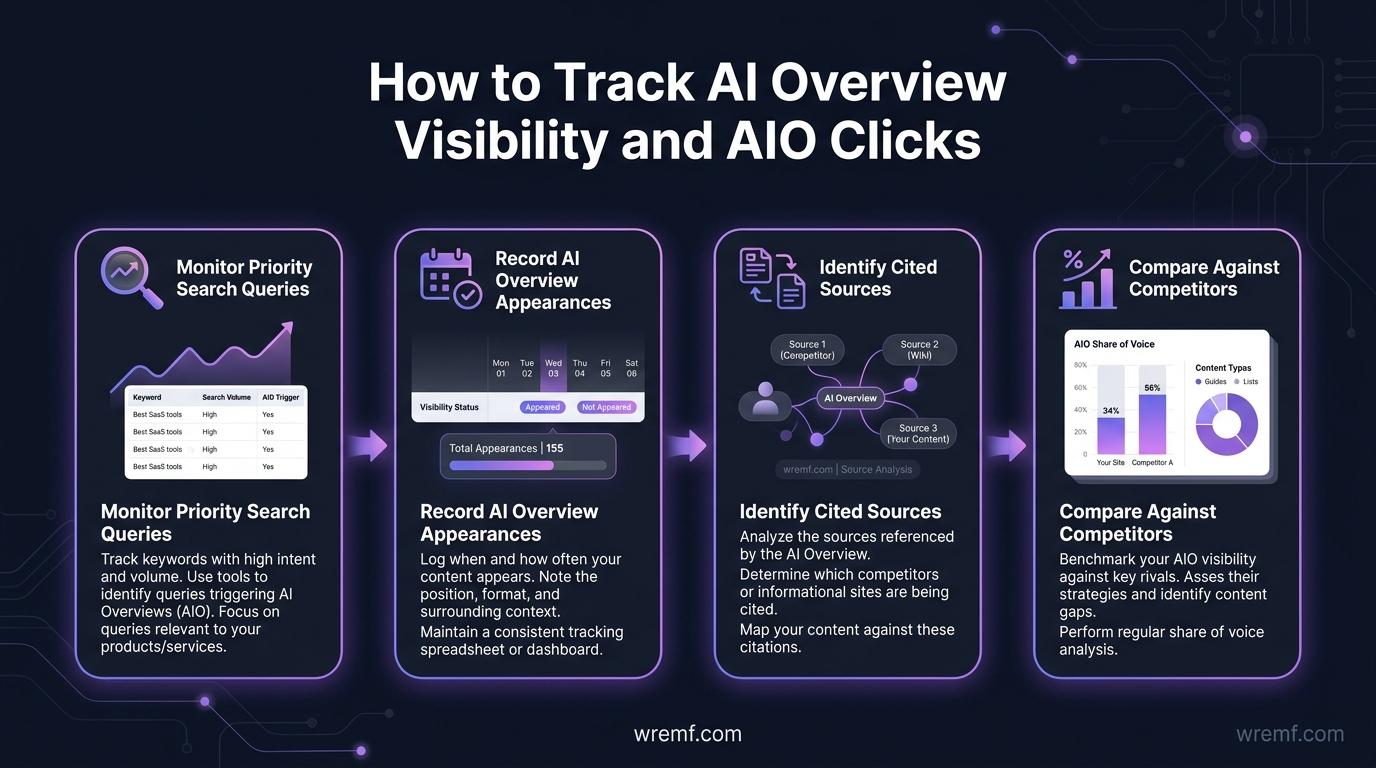
You track AI Overview visibility by monitoring priority search queries, recording whether AI Overviews appear, identifying cited sources, and comparing your brand against competitors. Google Search Console helps with traffic trends, but prompt and citation tracking are needed for full AIO measurement.
Prompt tracking is the process of monitoring how AI systems respond to specific questions over time. Prompt tracking matters because AI visibility is prompt-dependent, engine-dependent, location-sensitive, and variable.
AI share of voice is the percentage of tracked AI answers where your brand appears compared with competitors. AI share of voice matters because leadership teams need a comparable visibility metric when classic rankings do not explain the full AI Search journey.
AI traffic attribution connects AI visibility, referral traffic, organic search changes, and business outcomes. AI traffic attribution matters because teams need to know whether AI Search visibility is influencing engagement, conversions, pipeline, or sales conversations.
Google Search Central says sites appearing in AI features are included in overall Search traffic in Google Search Console under the Web search type. This means Google Search Console is useful, but it does not provide a complete standalone report for every AI Overview citation, impression, or source appearance. (Google for Developers)
A basic AIO tracking workflow includes:
Choose 50 to 200 priority search queries across informational, commercial, comparison, local, and brand terms.
Record whether AI Overviews appear for each query.
Capture the sources cited in the overview.
Note whether your brand is mentioned, cited, recommended, or absent.
Compare competitor visibility for the same search queries.
Track Google Search Console clicks, impressions, CTR, and average position for the same query groups.
Review Google Analytics engagement, conversions, and source quality.
Repeat weekly or monthly to identify meaningful changes.
A strong AIO dashboard should include both search performance and AI visibility metrics:
| Metric | What It Shows | Why It Matters |
|---|---|---|
| AIO presence rate | How often AI Overviews appear for tracked search queries | Shows exposure to AI-driven results |
| Citation rate | How often your domain is cited | Shows source selection strength |
| Brand mention rate | How often your brand appears in answers | Shows recommendation visibility |
| Competitor share of voice | How often competitors appear | Shows market visibility gaps |
| Source overlap | Which third-party sources influence answers | Shows citation improvement targets |
| Google Search Console CTR | Click-through rates before and after AIO appearance | Shows traffic impact |
| Google Analytics engagement | Session quality after organic visits | Shows whether visibility creates useful traffic |
| Pipeline attribution | Assisted conversions or sales activity | Shows business value |
If there are 100 tracked AI Overviews for your priority search queries and your brand is cited in 20 of them, your citation share for that tracked set is 20 percent. This simple mathematical value is useful because it makes AI visibility easier to explain to leadership.
WREMF's prompt intelligence, source citation tracking, and competitive landscape analysis help teams move from manual screenshots to scheduled AI monitoring across Google AI Overviews and other AI discovery surfaces.
If you want to see how AI engines currently describe a brand, review a sample AI visibility report before building your own measurement workflow.
KEY TAKEAWAY: AI Overview tracking should measure prompts, citations, brand mentions, competitor visibility, source overlap, Google Search Console trends, and Google Analytics outcomes together.
Measurement reveals the gaps, but improving visibility requires a repeatable action plan.
How to Improve AI Overview Visibility Step by Step
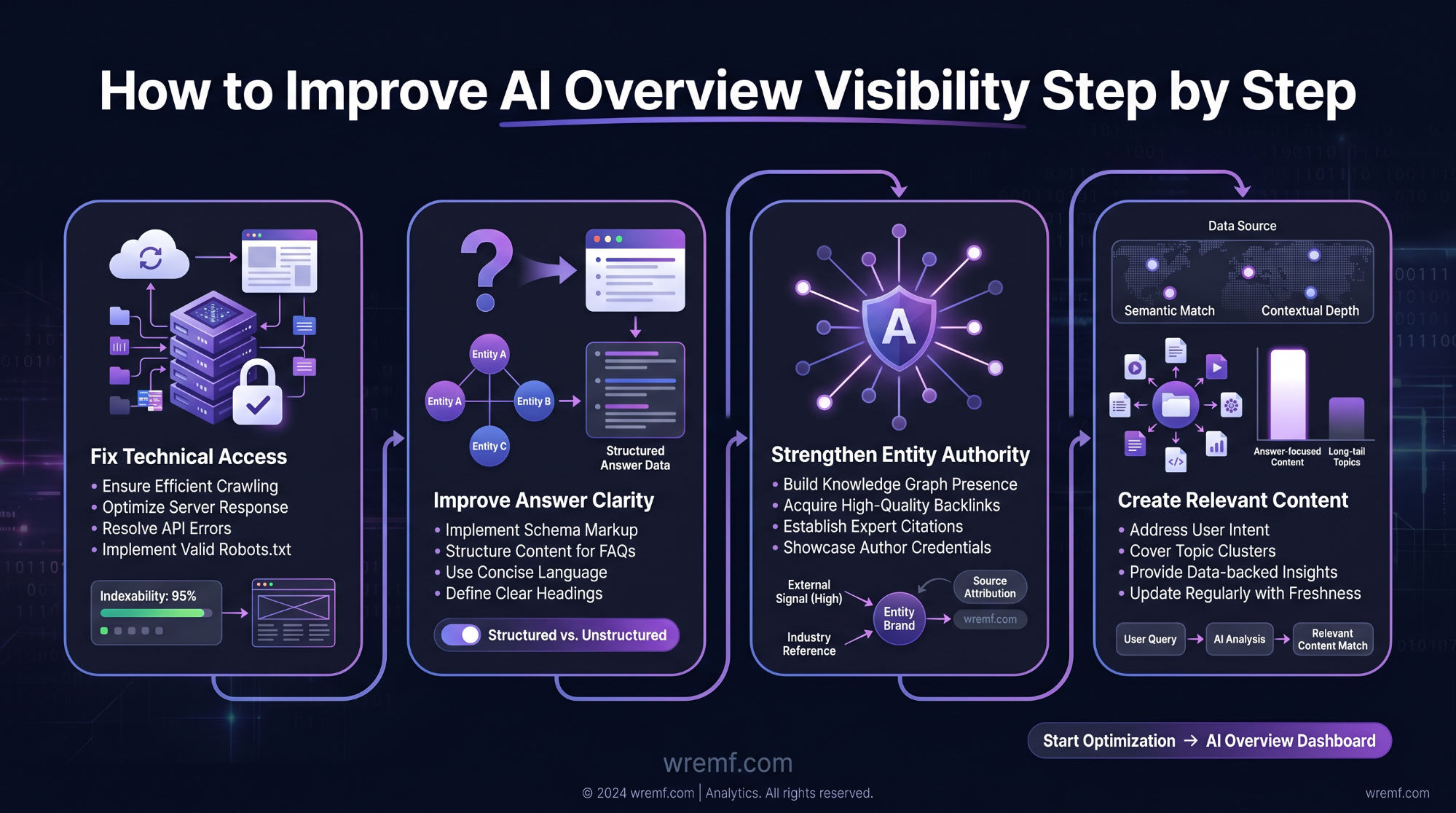
You improve AI Overview visibility by fixing technical access, improving answer clarity, strengthening entity authority, and creating content that matches real AI-driven questions. The process should be tracked as an ongoing workflow, not a one-time content edit.
A GEO audit is a structured review of how well a site can be crawled, understood, cited, and recommended by generative AI systems. A GEO audit matters because AI Overview optimization depends on the relationship between content quality, technical access, source consistency, and external authority.
Use this step-by-step workflow:
Audit priority search queries
Start with the search queries that matter to revenue, pipeline, education, and brand perception. Include informational keywords, comparison queries, product questions, local queries, branded prompts, and long-tail user queries.
Identify AI Overview triggers
Check which queries generate AI Overviews, which show featured snippets, which show People Also Ask, which show videos, and which show classic search results. This helps you decide where AIO work is worth the effort.
Map cited sources
Record every cited source in Google AI Overviews. Look for recurring domains, review sites, documentation pages, articles, community threads, videos, social media pages, Boral Agency style service pages, SE Ranking Blog style SEO guides, and comparison pages.
Compare competitor visibility
Track whether competitors are cited, mentioned, recommended, or excluded. Competitor visibility matters because AI Overview optimization is often a source ecosystem problem, not only a content problem.
Improve the target page
Update the page with a clear answer, definitions, examples, comparison tables, citations, FAQs, internal links, and accurate structured data. Avoid keyword stuffing and unsupported claims.
Strengthen source consistency
Make sure your brand name, product categories, pricing language, use cases, and core claims are consistent across your website, documentation, profiles, review pages, partner pages, and public descriptions.
Validate technical access
Check robots.txt, Meta robots tags, canonical tags, renderability, page speed, internal links, Schema markup, Rich Results Test results, Schema Markup Validator results, and snippet eligibility. Use Google Search Console and Bing Webmaster Tools to confirm access.
Monitor change over time
Track AIO presence, source citations, AI share of voice, clicks, impressions, click-through rates, content freshness, and conversion quality. Use recurring reports rather than one-time screenshots.
For teams that need a structured review, the WREMF GEO audit helps identify technical, content, prompt, citation, competitor, and source consistency gaps that affect AI visibility.
KEY TAKEAWAY: Improving AI Overview visibility requires a repeatable workflow across queries, content, citations, competitors, source consistency, and technical access.
The workflow becomes more useful when it is adapted to your business model and search intent.
AI Overview Optimization for B2B SaaS, Ecommerce, Local SEO, and Publishers
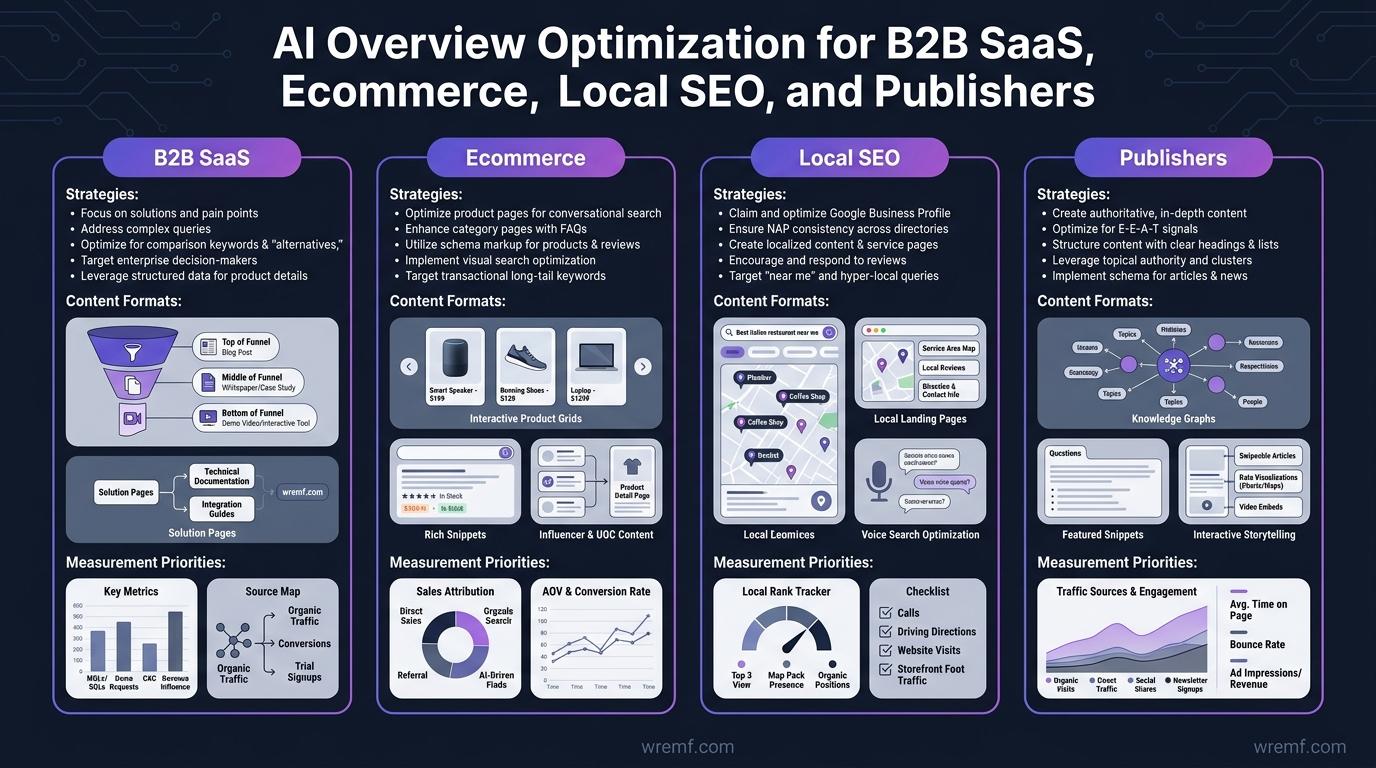
AI Overview optimization should be adapted to the type of search journey your audience follows. B2B SaaS, ecommerce brands, local businesses, and publishers need different content formats, trust signals, and measurement priorities.
For B2B SaaS, AI Overview optimization should focus on definitions, comparisons, alternatives, use cases, pricing context, integrations, security, implementation, and proof. In real B2B buying journeys, decision-makers often ask AI tools for vendor shortlists, category explanations, and buying criteria before they search a brand directly.
B2B SaaS pages should include:
Category definitions
Use-case pages
Product comparison pages
Integration pages
Security and compliance pages
Pricing explainers
Implementation timelines
Customer proof where accurate and permitted
Methodology pages
FAQ sections for buying-stage questions
For ecommerce brands, AI Overview optimization should focus on product reviews, product category guides, comparisons, sizing, materials, availability, shipping, returns, and trust. Ecommerce brands also need clean product structured data, accurate product reviews, and content that helps users compare alternatives.
For local SEO strategies, AI Overview optimization should focus on location relevance, service coverage, reviews, Google Business Profile completeness, local landing pages, and consistent business information. Google Maps ads, local pack results, and AI Overviews can all influence discovery for local-intent search queries.
For publishers, AI Overview optimization is more complex because some informational queries may become more zero-click. Publishers should focus on original reporting, expert analysis, distinctive data, clear authorship, content citations, and content formats that AI summaries cannot fully replace. Pew and publisher complaints reported by Reuters show that AI summaries have created real concerns about traffic and content use. (The Guardian)
| Business Type | AIO Priority | Best Content Formats | Main Risk | Recommended Measurement |
|---|---|---|---|---|
| B2B SaaS | Vendor discovery and category authority | Comparisons, definitions, use cases, methodology, FAQs | Being absent from AI vendor shortlists | Brand mentions, competitor visibility, demo-assisted queries |
| Ecommerce brands | Product and category decision support | Product reviews, comparisons, guides, FAQs | Losing clicks on generic product questions | Product query citations, CTR, conversion quality |
| Local businesses | Local relevance and trust | Service pages, local pages, reviews, Google Business Profile support | Inconsistent local information | Local query visibility, reviews, calls, bookings |
| Publishers | Originality and authority | Reporting, analysis, expert commentary, data | Zero-click summaries reducing traffic | AIO presence, traffic quality, subscription or newsletter actions |
| Agencies | Multi-client reporting and execution | Audits, dashboards, recommendations, content briefs | Manual reporting that does not scale | White-label reports, prompt tracking, source overlap |
AI Overview optimization works best when the page format matches the user's task. A definition query needs a concise answer. A buying query needs comparison criteria. A local query needs location trust. A product query needs specific evidence. A publisher query needs originality.
KEY TAKEAWAY: AIO strategy should match the business model, query type, and decision stage rather than applying one generic content template to every page.
The business model also affects whether software, agency support, or a hybrid workflow is the right choice.
AI Overview Optimization Tools, Services, and Operating Models
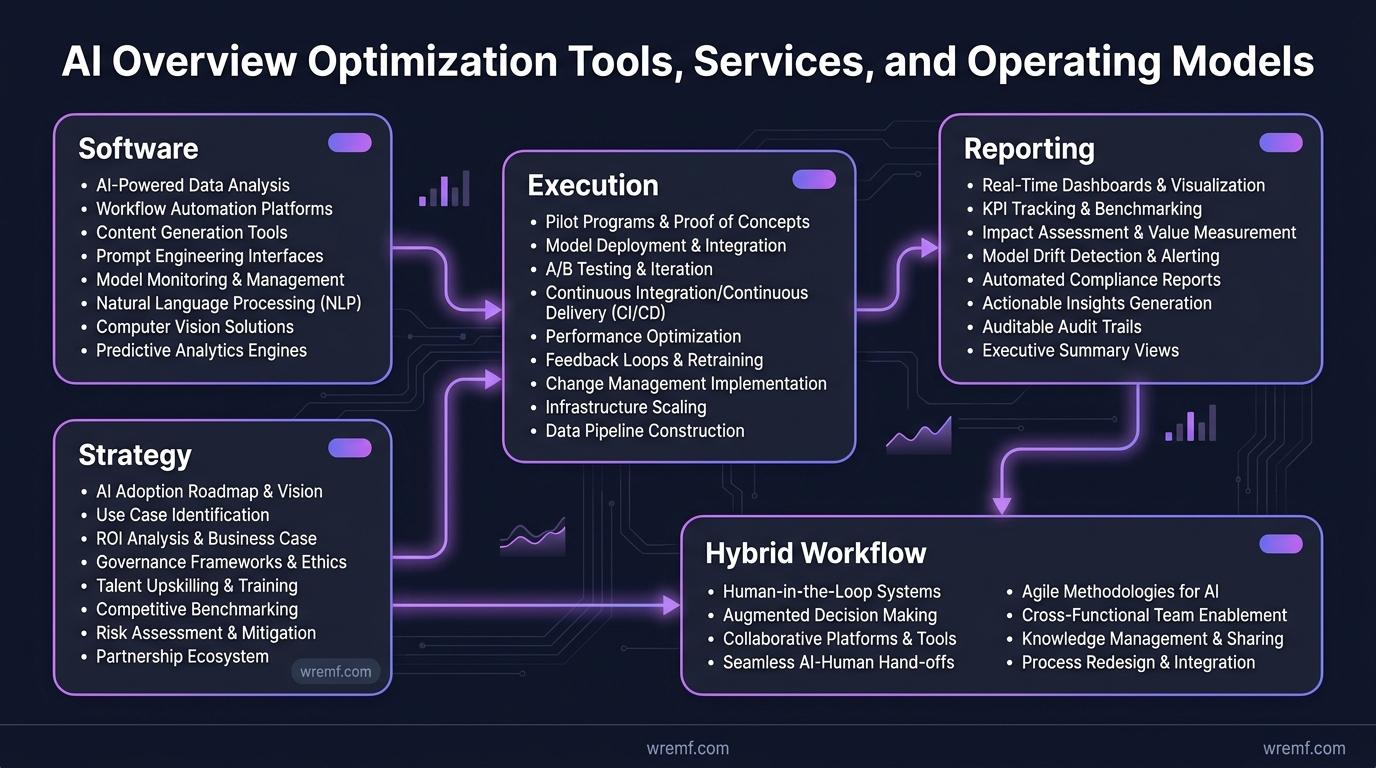
The right AI Overview optimization model depends on whether you need software, strategy, execution, reporting, or all of them together. Most B2B teams need a hybrid workflow that combines tracking, analysis, content improvement, and executive reporting.
AI tools for AI Overview optimization usually fall into three categories: SEO platforms, AI visibility platforms, and manual research workflows. SEO platforms are useful for rankings and technical SEO. AI visibility platforms are useful for prompt tracking, source citations, competitor visibility, and AI share of voice. Manual research is useful for early discovery but hard to scale.
AI tools are software systems that help teams research, create, measure, automate, or report marketing and search workflows. AI tools matter for AI Overview optimization because manual prompt checks, screenshots, and one-off searches cannot reliably show multi-engine visibility over time.
| Option | Best For | What It Measures | What It Misses | Recommended When |
|---|---|---|---|---|
| Traditional SEO tools | Rankings, links, keywords, technical SEO | Keywords, backlinks, SERP features, site health | Prompt-level AI citations, multi-engine brand mentions, AI share of voice | You need core SEO measurement |
| Manual AI Overview checks | Small tests and quick screenshots | Visible AIO examples for selected search queries | Scale, history, consistency, reporting, attribution | You are validating a new opportunity |
| AI visibility software | Prompt tracking, citations, competitors, AI visibility | Brand mentions, citations, prompts, share of voice, source overlap | Execution unless paired with content and SEO work | You need repeatable measurement |
| Agency service | Strategy and implementation | Audits, content fixes, authority work, reporting | Internal product access unless included | You lack time or specialist capacity |
| Hybrid software plus agency | Tracking and execution together | Measurement, recommendations, implementation, reporting | Requires clear ownership and prioritisation | You want visibility improvement and proof |
Agencies managing multiple clients often need white-label reporting, client portals, repeatable dashboards, and clean methodology. In-house brands often need leadership-ready reporting, source gap analysis, content briefs, technical recommendations, and attribution links to organic performance.
WREMF supports software, agency service, and hybrid execution. The platform helps teams track AI Overview optimization metrics, while the WREMF agency team can support managed AEO, GEO, content optimisation, citation improvement, source consistency cleanup, technical AI visibility foundations, and monthly reporting.
For technical teams, the WREMF API and MCP integrations support workflows where AI visibility data needs to connect with dashboards, CRM systems, reporting tools, client portals, or internal analytics.
WREMF pricing is useful when teams want predictable software access. Starter is €39 per month for 1 website, unlimited prompt tracking, BYOK, 10 AI engines, all features and tools, white-label reports, 1 seat, and email support. Growth is €89 per month for 5 websites, priority email support with 24h SLA, content brief generator, and SEO A/B testing. Enterprise supports unlimited websites, unlimited seats, dedicated support with 4h SLA, and custom branded portals.
KEY TAKEAWAY: The best AI Overview optimization model combines reliable tracking with the operational ability to improve content, sources, and technical foundations.
Before investing in tools or services, teams should understand the risks and limitations.
Risks, Limitations, and Common Mistakes in AI Overview Optimization
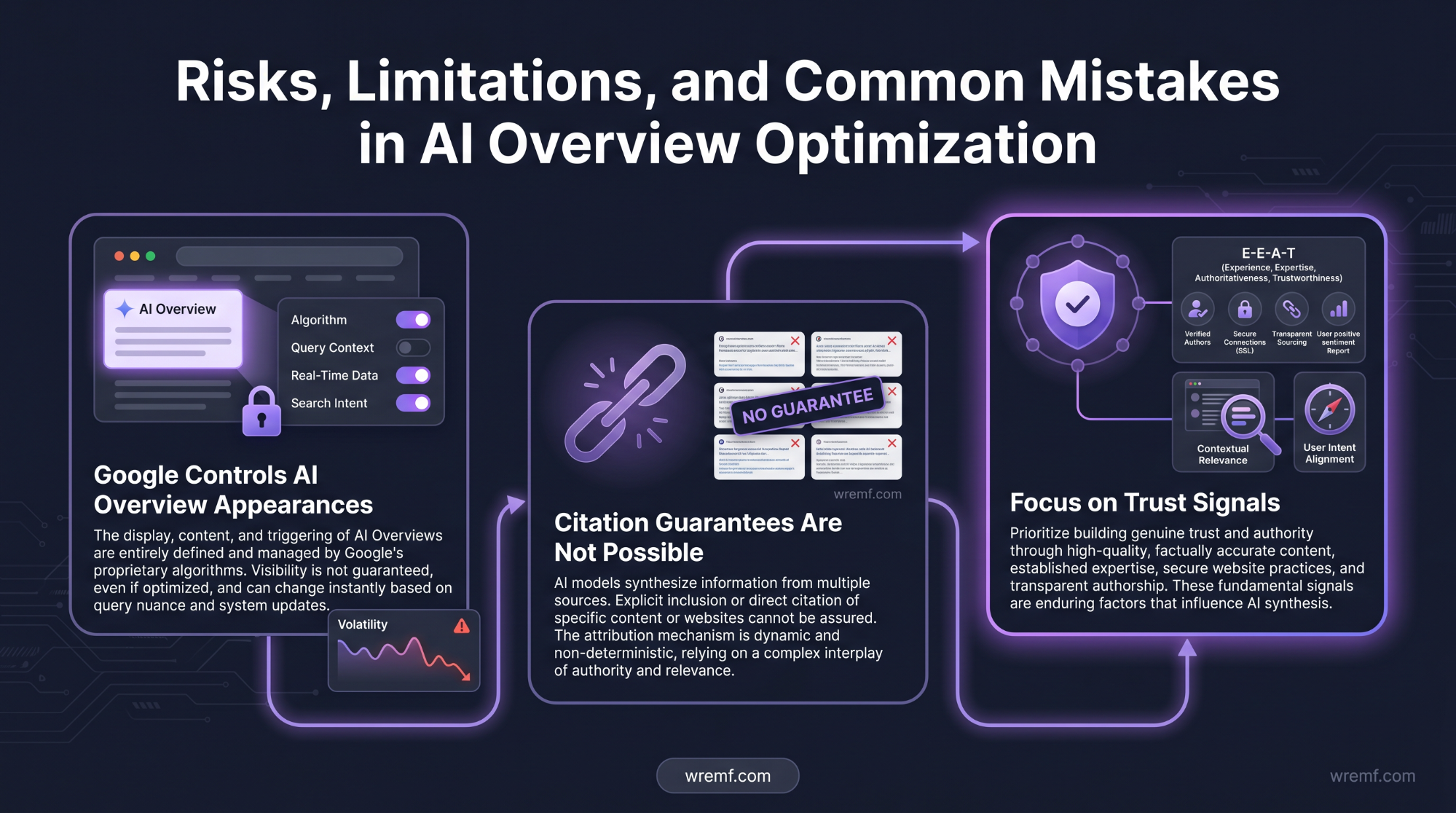
AI Overview optimization has limits because Google controls when AI Overviews appear, which sources are cited, and how answers change over time. The safest strategy is to improve measurable eligibility and trust signals without claiming guaranteed citations.
A common implementation mistake is treating AI Overview optimization like a single keyword placement task. AI Overviews are variable. They can change by query phrasing, search location, device, time, search context, and Google AI model behaviour.
Another mistake is blocking useful snippet access while expecting Google AI to cite the page. Google's robots meta documentation states that snippet controls such as max-snippet, nosnippet, and data-nosnippet affect how content can appear in Google Search and AI features. (Google for Developers)
Teams usually struggle when they only track rankings. Rankings show where a page appears in classic Google Search. AI Overview optimization also needs citation rate, brand mention rate, source consistency, competitor inclusion, AI share of voice, and AI traffic attribution.
The main risks are:
Overclaiming: No platform or agency can guarantee AI Overview citations.
Overblocking: Restrictive robots or snippet rules can reduce eligibility.
Overwriting useful content: Thin AI-generated content can reduce trust.
Overfocusing on keywords: AI systems also need entities, sources, and relationships.
Overlooking source ecosystems: Third-party pages may influence AI answers about your brand.
Overlooking attribution: AI visibility may affect branded search, direct visits, assisted conversions, and sales conversations indirectly.
Overlooking content freshness: Outdated claims can weaken credibility in fast-changing AI Search topics.
Overlooking YMYL standards: Health, legal, finance, and safety topics need stronger evidence and review.
AI traffic attribution connects AI visibility, referral traffic, organic search changes, and business outcomes. AI traffic attribution matters because leadership teams need to know whether AI Search visibility is influencing pipeline, not only impressions.
Google AI Overviews should be treated as a measurable channel influence, not a guaranteed traffic source. Some queries may drive fewer clicks. Some citations may increase trust. Some mentions may support brand discovery without immediate attribution.
KEY TAKEAWAY: AI Overview optimization reduces risk when teams measure visibility honestly, avoid guarantees, and improve the signals Google AI can actually use.
These limitations also explain why many popular assumptions about AIO are misleading.
Common Myths About AI Visibility Debunked
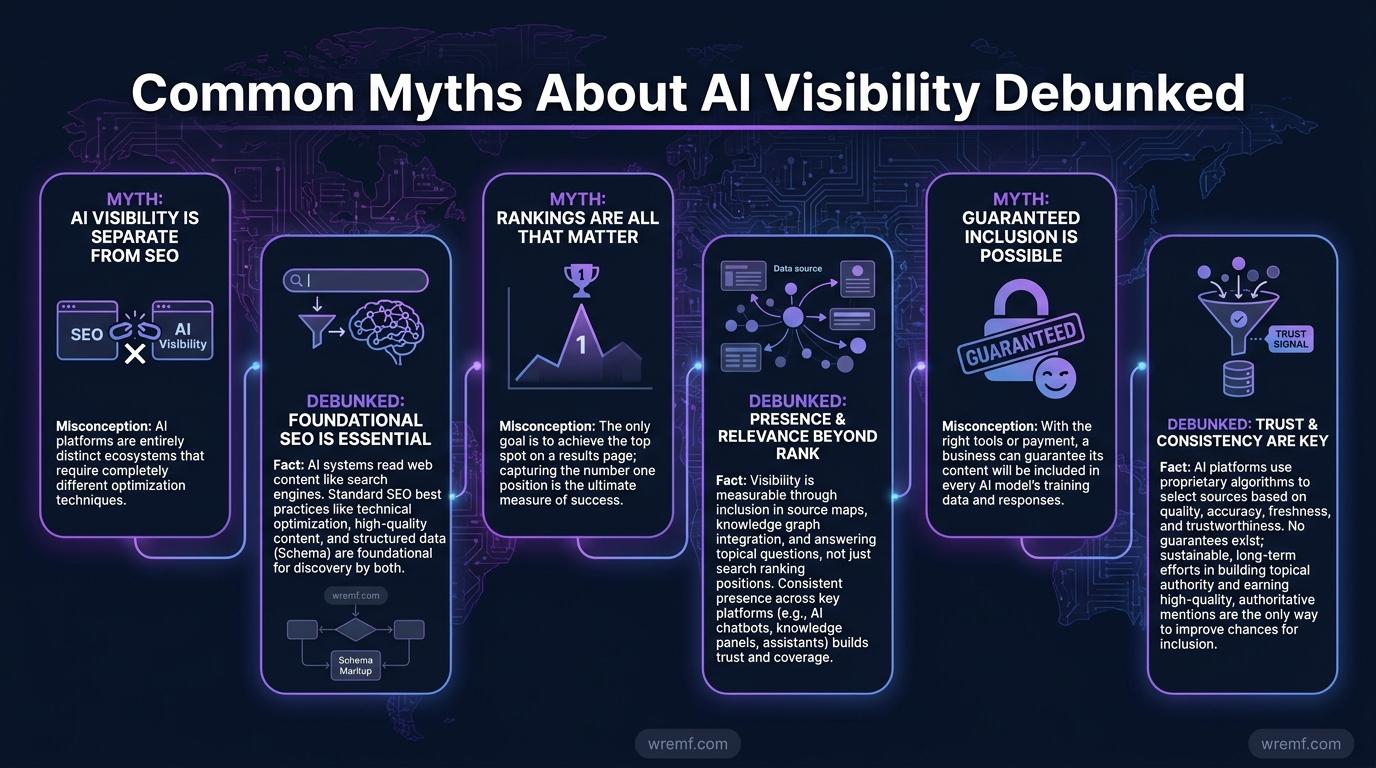
AI visibility myths usually come from applying old ranking logic to new AI answer systems. The reality is that AI Overview optimization overlaps with SEO, but it also requires citation tracking, source consistency, and prompt-level measurement.
MYTH: AI Overview optimization is separate from SEO.
FACT: AI Overview optimization builds on SEO. Google Search Central says the same foundational SEO best practices remain relevant for AI Overviews and AI Mode, with no special technical requirements beyond eligibility for Google Search and snippets. The difference is that AIO also measures citations, mentions, prompts, competitors, and source overlap. (Google for Developers)
MYTH: AI visibility is impossible to measure.
FACT: AI visibility is measurable, but it requires different metrics. You can track prompt visibility, AI citations, brand mentions, competitor share of voice, source citations, Google Search Console trends, and Google Analytics outcomes. The measurement is not perfect, but it is far better than relying on manual guesses.
MYTH: Rankings are enough to win AI Overviews.
FACT: Rankings still matter, but they are not the whole picture. AI Overviews may use query fan-out, supporting links, and different AI models or techniques, which means the cited sources can vary from classic search results. A ranking report alone cannot show whether your brand was mentioned, cited, or recommended.
MYTH: Generative AI content automatically improves AIO performance.
FACT: Generative AI can help with research, outlines, and content creation, but Google warns that scaled content without added user value may violate spam policies. AI Overview optimization depends on accuracy, quality, relevance, and original usefulness, not automated volume. (ALM Corp)
MYTH: You can guarantee inclusion in Google AI Overviews.
FACT: No agency, AI tools provider, or SEO consultant can guarantee Google AI Overview citations. You can improve eligibility, clarity, authority, and source consistency, but Google decides when AI Overviews appear and which sources support them.
KEY TAKEAWAY: AI Overview optimization is measurable and practical, but it works best when teams combine SEO fundamentals with AI-specific citation, prompt, and source tracking.
With the myths clarified, the final questions are usually about implementation, measurement, and buying decisions.
Frequently Asked Questions
What are Google AI Overviews?
Google AI Overviews are AI-generated summaries that appear in Google Search for selected queries. They summarise information and include supporting links so users can explore sources on the web. AI Overviews are part of Google Search, not a separate search engine. They matter for SEO because users may read an answer, compare sources, and make decisions before clicking. For brands, this means visibility should be measured through rankings, citations, brand mentions, competitor visibility, and search traffic together.
What is AI Overview optimization?
AI Overview optimization is the process of improving content, technical SEO, entity clarity, and authority signals so a page can appear as a useful source in Google AI Overviews. It combines SEO, Answer Engine Optimization, and Generative Engine Optimization. The goal is not only to rank in Google Search but also to become visible inside AI-generated answers, citations, and summaries. WREMF helps teams track this by monitoring prompts, citations, brand mentions, competitors, and AI share of voice across Google AI Overviews and other AI discovery surfaces.
How do I optimize for Google AI Overviews?
To optimize for Google AI Overviews, start with pages that already match important search queries. Make sure the page is crawlable, indexable, eligible for snippets, and supported by clear internal links. Then rewrite the content with answer-first headings, concise definitions, evidence-backed claims, comparison tables, FAQs, and accurate Schema markup where relevant. Use Google Search Console to monitor clicks, impressions, click-through rates, and query changes. Use AI visibility tracking to monitor whether your brand is cited, mentioned, recommended, or excluded from AI Overviews.
Does AI Overview optimization hurt organic traffic?
AI Overview optimization does not inherently hurt organic traffic, but AI Overviews can change how users click. Some informational searches may receive fewer clicks because the summary answers part of the query directly. Other searches may create qualified visits when users click cited sources to verify details, compare options, or continue research. The practical approach is to measure both Google Search Console performance and AI citation visibility. Teams should track rankings, click-through rates, citations, engagement, and conversions together instead of treating traffic alone as the only success metric.
Can I track AI Overview clicks in Google Search Console?
Google Search Console includes traffic from AI features such as AI Overviews and AI Mode in overall Search traffic under the Web search type, according to Google Search Central. However, Google Search Console does not provide a complete dedicated AI Overview citation dashboard. That means you can use Google Search Console to monitor query, page, click, impression, CTR, and position trends, but you need additional AI visibility tracking to know whether your brand was cited, mentioned, recommended, or absent from specific AI Overviews.
How often does Google update AI Overviews?
Google does not publish a fixed update schedule for every AI Overview. AI Overviews can change when Google updates AI systems, search rankings, source retrieval, content freshness, or the indexed pages available for a query. In practice, teams should monitor important AI Overview queries weekly or monthly. Fast-moving industries such as AI tools, SaaS, healthcare, finance, legal, and ecommerce may need more frequent tracking because content freshness, competitor activity, and source citations can change quickly.
What kind of content gets featured in AI Overviews?
Content cited in AI Overviews is usually crawlable, indexable, useful, clear, and aligned with the search query. Strong pages answer the main question directly, define important entities, support claims with evidence, and provide enough context for users to continue learning. Google says there are no special technical requirements beyond eligibility for Google Search and snippets. In practice, pages with strong content structure, accurate structured data, clear authorship, source-backed claims, and strong internal linking are easier for AI systems to interpret.
What is the difference between AI Overviews and AI Mode?
AI Overviews are AI-generated summaries that appear in Google Search when Google determines they add value to the classic results experience. AI Mode is a more exploratory AI-powered search experience that supports follow-up questions, deeper reasoning, and complex comparisons. Both are part of Google AI Search, and both can surface links to supporting websites. For marketers, the difference matters because AI Mode and AI Overviews may use different models, techniques, and supporting links, so visibility should be tracked separately where possible.
Is AI Overview optimization the same as Generative Engine Optimization?
AI Overview optimization and Generative Engine Optimization overlap, but they are not identical. AI Overview optimization focuses specifically on Google's AI-generated summaries inside Google Search. Generative Engine Optimization is broader and covers visibility across generative AI systems such as ChatGPT, Claude, Gemini, Perplexity, Copilot, Grok, DeepSeek, Meta AI, and Mistral. A strong GEO strategy includes Google AI Overviews, but it also tracks prompts, citations, brand mentions, and recommendations across multiple AI discovery surfaces.
How does optimizing for an AI-generated summary differ from traditional SEO?
Traditional SEO focuses on crawlability, relevance, rankings, links, and organic traffic. Optimizing for an AI-generated summary also requires answer-first writing, entity clarity, source consistency, citation tracking, prompt coverage, and competitor visibility inside AI answers. The page still needs strong SEO foundations, but AI systems also need clear definitions, evidence, structured comparisons, and consistent brand information. This is why AI Overview optimization should be measured through citations, mentions, AI share of voice, and traffic impact, not rankings alone.
Can I opt out of AI Overviews?
You cannot use a simple dedicated "AI Overview opt-out" that preserves all normal search presentation exactly as before. Google provides search display controls such as nosnippet, data-nosnippet, and max-snippet, but those controls may affect how your content appears in Google Search more broadly. This creates a tradeoff. If your business depends on organic search visibility, blocking snippets may reduce eligibility for useful search features. Most brands should improve content control, citation quality, and measurement before using restrictive snippet rules.
What tools do I need for AI Overview optimization?
You need Google Search Console for query and page performance, Google Analytics for engagement and conversion analysis, technical SEO tools for crawl and structured data checks, and AI visibility software for prompt, citation, competitor, and source tracking. WREMF combines prompt tracking, source citation analysis, competitor visibility, AI share of voice, and reporting workflows. Teams that need execution can also use WREMF's managed agency services for GEO audits, content optimisation, source consistency cleanup, and monthly AI visibility reporting.
Can WREMF help agencies report AI Overview performance to clients?
Yes. WREMF is useful for agencies that need to report AI visibility, AI share of voice, source citations, competitor mentions, and prompt-level changes to clients. Agencies can use WREMF for white-label reporting, scheduled AI monitoring, client portals, and repeatable visibility workflows. This helps agencies move beyond screenshot-based AI Overview reporting and show how prompts, citations, competitors, content gaps, and source consistency change over time. WREMF can be used as software, an agency service, or a hybrid execution model.
How do I get my business mentioned in Google's AI Overview?
To get your business mentioned in Google's AI Overview, build clear, trustworthy, and consistent information about your brand across your website and relevant public sources. Create pages that answer real customer questions, explain use cases, compare options, cite reliable sources, and align with search intent. Strengthen technical SEO, structured data, internal links, reviews, and source consistency. Then track whether your brand appears in AI Overviews for target search queries. No one can guarantee inclusion, but these steps improve eligibility and clarity.
Should I optimize for AI Overviews, ChatGPT, and Perplexity together?
Yes, but the workflow should separate measurement by engine. Google AI Overviews are part of Google Search, while ChatGPT, Perplexity, Claude, Gemini, Copilot, and other AI tools use different retrieval, browsing, citation, and answer systems. The same foundations help across engines: clear content, entity consistency, authoritative sources, and strong topical coverage. The reporting should be engine-specific because a brand may appear in Google AI Overviews but be absent from Perplexity or ChatGPT answers for the same buying prompt.
Conclusion
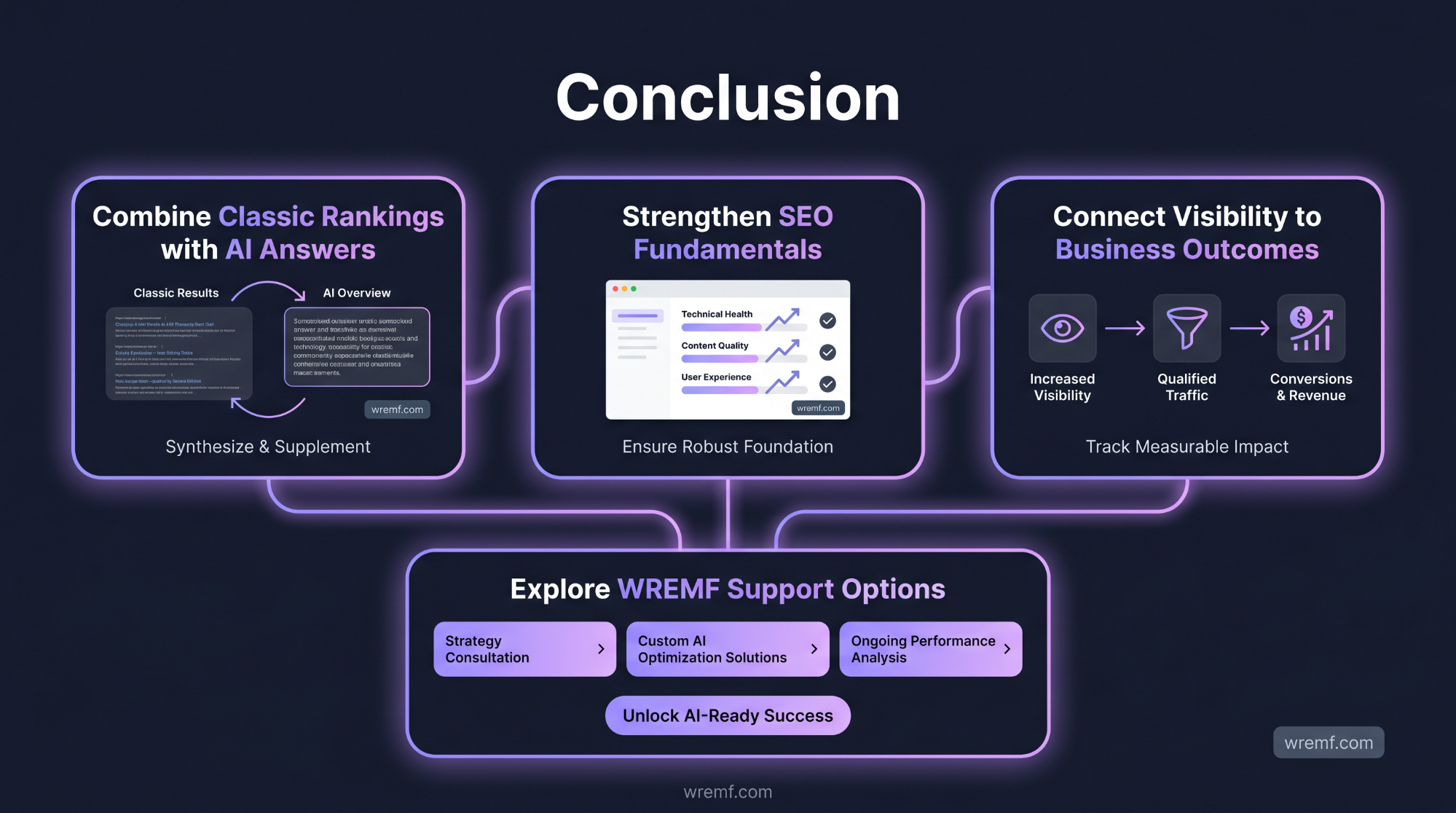
AI Overview optimization is becoming a core part of search strategy because Google Search now combines classic rankings with AI-generated answers, citations, and recommendations. The practical path is clear: keep SEO fundamentals strong, make content answer-first, improve entity clarity, monitor citations, compare competitors, and connect visibility to traffic and business outcomes. WREMF helps teams turn this work into a measurable system across Google AI Overviews and other AI discovery surfaces. To move from manual checks to repeatable AI visibility tracking, explore the WREMF platform suite or get support from the WREMF agency team.
Related Generative Engine Optimization Guides
- Answer Engine Optimization The Complete Guide to AEO, AI Search Visibility, and Answer-First Content
- AI Overview SEO How to Optimize for Google AI Overviews, AI Mode, and AI Search Visibility
- Best Answer Engine Optimization for Enhancing AI Visibility
- Large Language Model Optimization Services The Complete Guide to LLMO, AI Search Visibility, AEO, GEO, RAG, and LLM Performance
- Answer Engine Optimization Services The Complete Guide to AI Search Visibility
- Enterprise Answer Engine Optimization Platforms Complete Guide for AI Visibility, AEO, and GEO
- LLM SEO Services The Complete 2026 Guide to AI Search Visibility, AEO, GEO, and LLM Optimization
- How AI Search Optimization Tools Increase Organic Traffic
- AI Search Engine Optimization Tools The Complete 2026 Guide for AI Search, SEO, AEO, and GEO
- How Do AI Search Optimization Tools Improve SERP Rankings
- LLM SEO Agency The Complete Guide to Choosing an Agency for AI Search Visibility
- AI Search Engine Optimization The Complete Guide for B2B Brands
- AI Mention Tracking The Complete Guide to Monitoring Brand Mentions, AI Answers, Citations, and Share of Voice in 2026
- AI SEO Services The Complete Guide to Search Visibility in the AI Era
- AI SEO Tools The Complete Guide for SEO, AEO, GEO, and AI Search Visibility
- Generative AI Optimization Services The Complete Guide to GEO, AEO, LLM Optimization, and AI Visibility
- AI Search Engine Optimization Services The Complete Guide for B2B Brands
- 12 Best AI Search Optimization Tools
- AI Brand Monitoring The Complete Guide to Tracking Brand Visibility Across AI Search, LLMs, and Generative Engines
- AI SEO Agency How to Choose the Right Partner for AI Search Visibility
Related reading
- Best Answer Engine Optimization for Enhancing AI Visibility
- Answer Engine Optimization: The Complete Guide to AEO, AI Search Visibility, and Answer-First Content
- AI Overview SEO: How to Optimize for Google AI Overviews, AI Mode, and AI Search Visibility
- Perplexity AI Optimization: The Complete Guide to AI Search Visibility in 2026