Enterprise AI Search Monitoring: The Complete Guide for AI Visibility, Enterprise Search, and LLM Performance
Learn to monitor enterprise AI search for improved brand visibility and decision-making.
By WREMF Team · 2026-08-31
Enterprise AI search monitoring measures how AI systems interact with enterprise data by retrieving, generating, citing, and recommending information. It focuses on internal enterprise search and external AI visibility, ensuring AI retrieves correct data and represents brands accurately. This discipline includes governance, security, and metrics like answer accuracy and AI visibility. Effective monitoring connects internal data use to external brand depiction, crucial for maintaining control over brand perception and decision-making.
Key takeaways
- Enterprise AI search monitoring tracks AI interactions with enterprise data and brand visibility.
- Internal monitoring ensures accurate information retrieval from enterprise systems.
- External monitoring assesses AI platforms' brand mentions, citations, and visibility.
- AI-generated responses influence employee productivity and market perception.
- Monitoring frameworks connect internal knowledge management with external AI visibility.
Enterprise AI Search Monitoring: The Complete Guide for AI Visibility, Enterprise Search, and LLM Performance

Enterprise AI search monitoring is the process of tracking how AI systems retrieve, cite, describe, and recommend enterprise information. Gartner predicts traditional search engine volume will drop 25% by 2026 as AI chatbots and virtual agents change discovery behavior, which makes AI monitoring a business visibility issue, not only an SEO issue. This guide covers internal enterprise search, external AI visibility, LLM monitoring, citations, security, governance, tools, analytics, prompts, competitors, content optimization, and implementation. WREMF helps B2B teams track, improve, and prove AI visibility across ChatGPT, Claude, Gemini, Perplexity, Google AI Overviews, Copilot, DeepSeek, Grok, Meta AI, and Mistral. Use this guide to build a practical enterprise monitoring framework.
What Is Enterprise AI Search Monitoring?
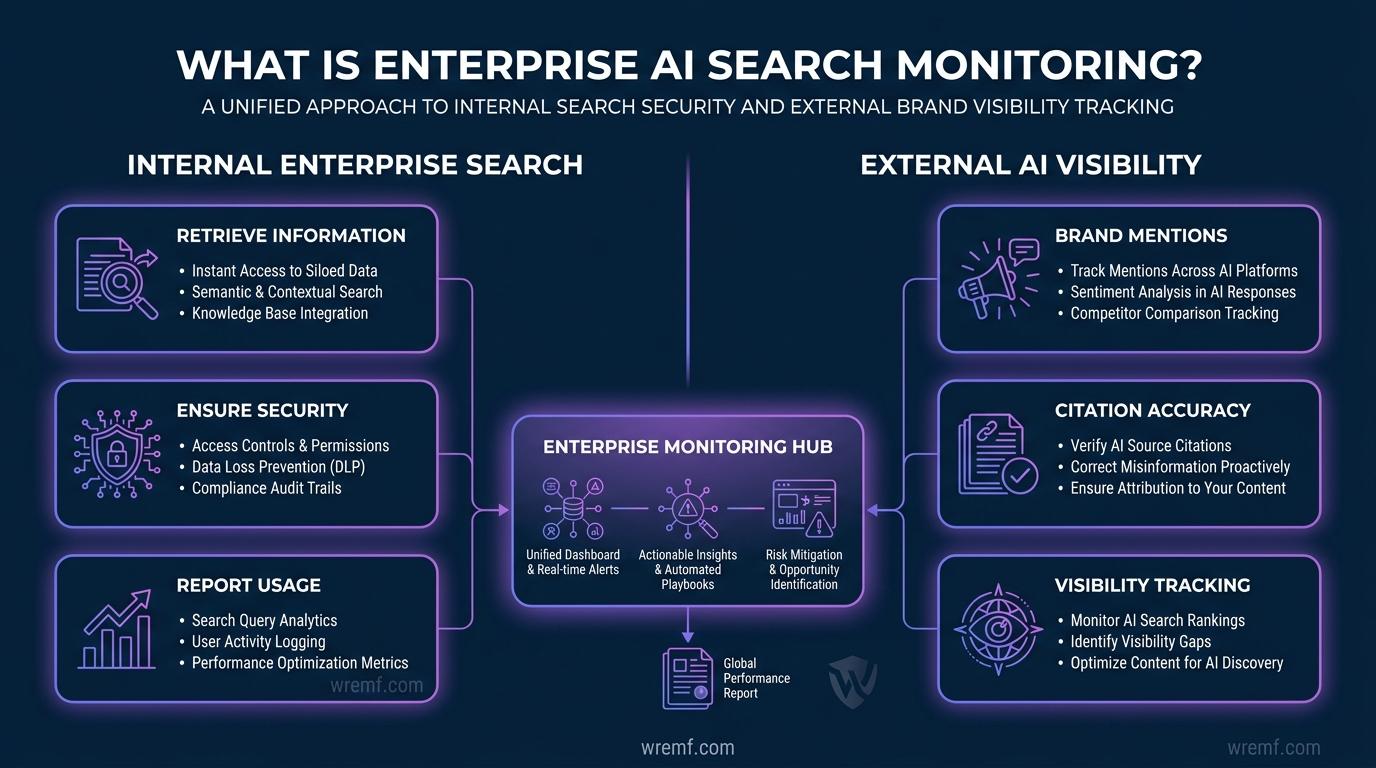
Enterprise AI search monitoring is the discipline of measuring how AI systems retrieve, generate, cite, rank, secure, and report information. It applies to both internal enterprise search and external AI visibility.
AI search is the use of artificial intelligence to answer natural-language questions, retrieve source documents, summarize information, and recommend next steps. AI search matters because employees, buyers, analysts, and executives increasingly expect direct answers rather than a list of links.
Enterprise AI search monitoring has two major pillars. The first pillar is internal monitoring, which tracks how employees use AI-powered enterprise search across company knowledge sources. The second pillar is external monitoring, which tracks how public AI platforms mention, cite, compare, and recommend a brand.
| Pillar | What It Monitors | Main Users | Example Metrics |
|---|---|---|---|
| Internal enterprise search | Search quality, answer accuracy, user permissions, source retrieval, workflow adoption | IT, knowledge teams, operations, legal, support, finance | Accuracy, latency, permission compliance, adoption, feedback |
| External AI visibility | Brand mentions, AI citations, share of voice, competitor visibility, AI traffic attribution | SEO, content, growth, PR, agencies, leadership | AI visibility, citations, sentiment, recommendation rate, traffic |
| Governance layer | Security controls, audit trails, compliance, validation process, human verification | Security, compliance, legal, enterprise architects | Audit trails, access logs, compliance checks, hallucination rate |
Enterprise search is the process of helping employees retrieve information from company systems such as Google Drive, SharePoint, Slack, Jira, Teams, Excel, PDFs, wikis, network drives, and databases. Enterprise search matters because teams lose time and make mistakes when knowledge is scattered across collaboration platforms.
AI visibility is the measurable presence of a brand inside AI-generated responses, citations, summaries, comparisons, and recommendations. AI visibility matters because a prospect can ask ChatGPT, Claude, Gemini, Perplexity, Google AI Overviews, or Copilot for vendor recommendations before visiting your website.
The WREMF platform suite helps teams monitor the external AI visibility layer by tracking prompts, source citations, competitors, brand mentions, share of voice, and AI traffic attribution across major AI platforms.
DID YOU KNOW: Gartner predicts that traditional search engine volume will drop 25% by 2026 as search marketing loses market share to AI chatbots and virtual agents.
KEY TAKEAWAY: Enterprise AI search monitoring connects internal knowledge performance with external AI visibility so teams can measure what AI systems retrieve, cite, and recommend.
The next section explains why this shift has become urgent for enterprise teams in 2026.
Why Enterprise AI Search Monitoring Matters in 2026
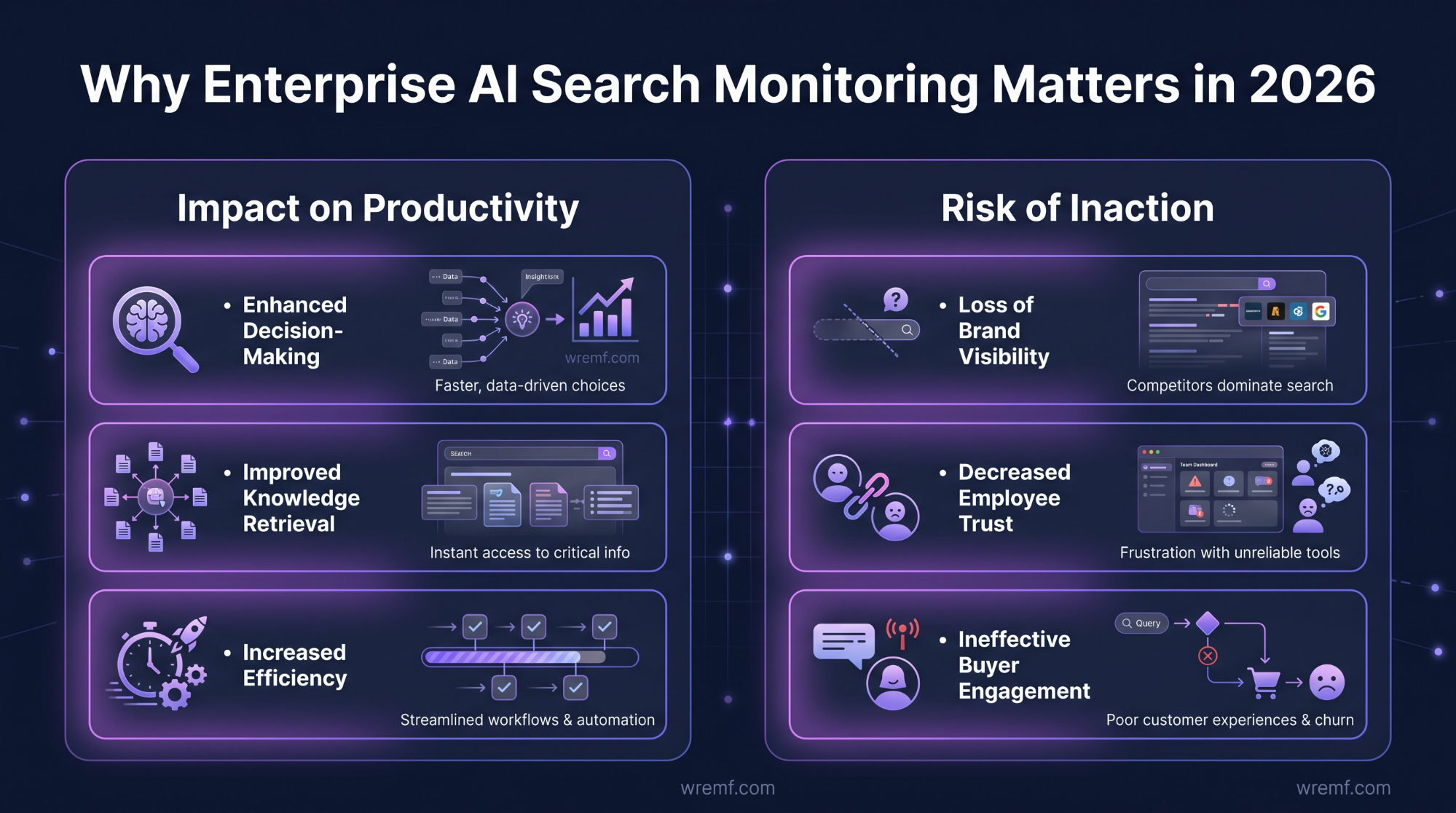
Enterprise AI search monitoring matters because AI-generated responses now influence employee productivity, buyer research, brand visibility, and decision-making. Teams that do not monitor AI search risk losing control of both internal knowledge and external market perception.
The shift from keyword search to generative responses changes how people find information. Traditional search results gave users a ranked list of pages. AI-generated responses combine summaries, source citations, recommendations, comparisons, and contextual reasoning inside one answer.
Google explains that AI Overviews provide AI-generated snapshots with key information and links to explore more on the web. OpenAI says ChatGPT search provides fast, timely answers with links to relevant web sources. Anthropic states that Claude’s web search tool gives Claude access to real-time web content and includes citations for sources drawn from search results.
AI-generated responses are answers created by Large Language Models, retrieval systems, generative AI, or AI agents from a mix of model knowledge, retrieved source documents, web results, and user context. AI-generated responses matter because the answer itself can shape trust before the user clicks a website, opens a document, or speaks to sales.
Large Language Models are AI systems trained to understand and generate text based on patterns in large datasets. Large Language Models matter for enterprise search because they can synthesize information from many sources, but they also require monitoring for accuracy, source quality, and hallucinations.
In real B2B buying journeys, prospects ask natural-language questions such as “best enterprise AI search monitoring tools,” “which vendor monitors AI visibility across ChatGPT and Perplexity,” or “how does GEO differ from SEO.” These are not simple keyword rankings. These are decision prompts that can trigger brand mentions, source citations, competitor comparisons, and recommendations.
Slack’s State of Work 2023 report found that employees who adopted AI at work were 90% more likely to report high productivity, while only 27% of companies were investing in AI to drive those results. This productivity gap shows why internal AI-powered enterprise search needs monitoring, not only deployment.
IMPORTANT: Enterprise AI search monitoring is not only a marketing workflow. It is also a productivity, security, knowledge management, analytics, and governance workflow.
KEY TAKEAWAY: Enterprise AI search monitoring matters because AI answers now influence how employees work and how buyers discover, compare, and trust brands.
To build a complete monitoring system, teams first need to separate internal enterprise search from external AI visibility.
Internal Enterprise Search vs External AI Visibility
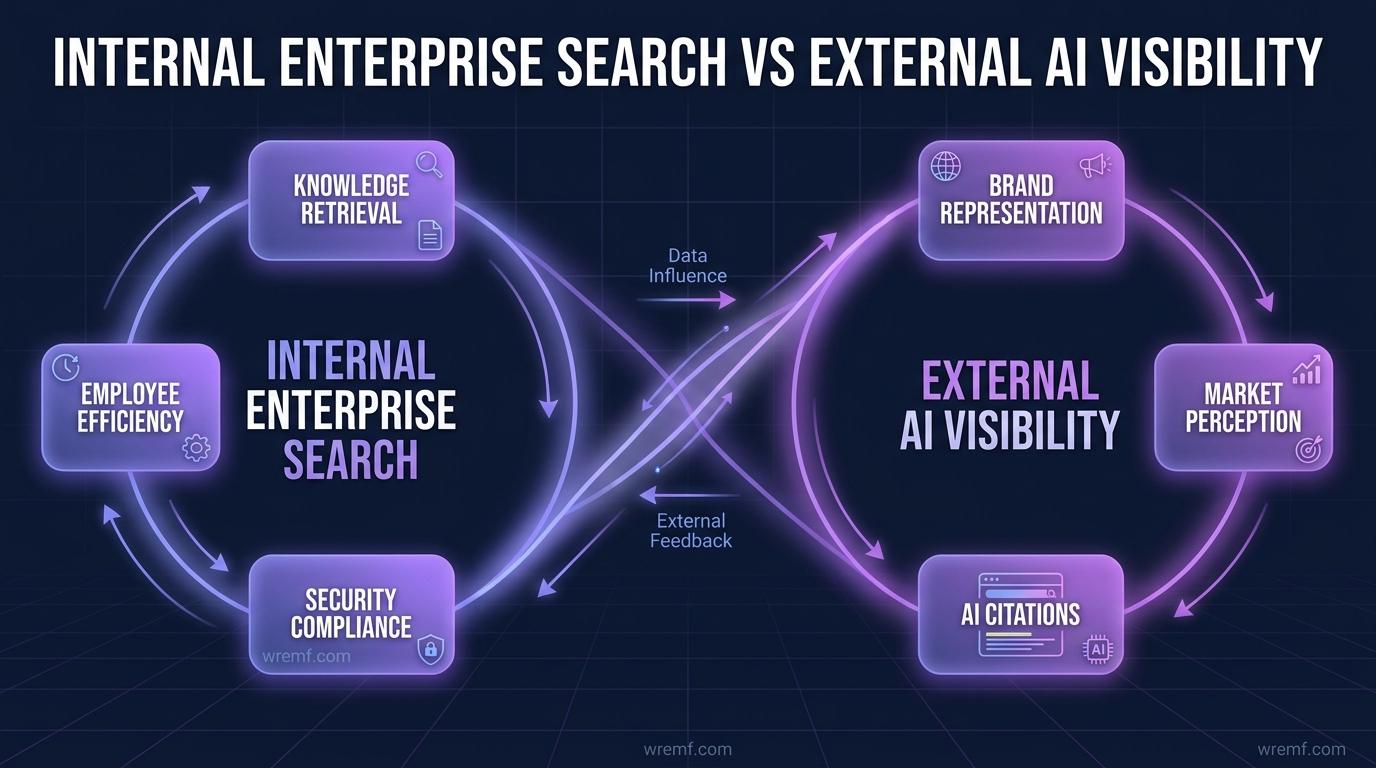
Internal enterprise search and external AI visibility are different but connected disciplines. Internal systems help employees retrieve company knowledge, while external AI visibility shows how AI platforms describe your brand to the market.
AI-powered enterprise search is enterprise search enhanced with generative AI, semantic search, vector search, machine learning, natural language processing, and answer generation. AI-powered enterprise search matters because employees can ask natural-language questions and receive synthesized answers from multiple internal source documents.
External AI visibility is the measurement of how AI platforms mention, cite, summarize, compare, and recommend a brand in public AI search results. External AI visibility matters because AI platforms can influence brand perception without sending a traditional website click.
| Comparison Area | Internal Enterprise Search | External AI Visibility |
|---|---|---|
| Core question | Can employees find accurate company knowledge? | Can prospects find and trust your brand in AI answers? |
| Main data sources | Google Drive, SharePoint, Slack, Jira, Teams, Excel, PDFs, network drives, internal databases | Website pages, documentation, reviews, media, directories, third-party sources, search results |
| Main technology | Enterprise search platforms, vector database infrastructure, AI Assistant tools, retrieval-augmented generation | AI visibility monitoring tools, prompt tracking, source citation tracking, SEO tools, analytics |
| Main risk | Wrong internal answer or unauthorized access | Missing brand visibility, inaccurate brand mentions, weak citations, competitor dominance |
| Typical owner | IT, enterprise architecture, operations, knowledge management | SEO, content, growth, PR, sales, agencies |
| Example tools | Glean, Glean Assistant, Hebbia, Guru, Algolia, Elastic, IBM Watson Discovery, Google Vertex AI Search, Microsoft 365 Copilot | WREMF, Profound AI, Peec AI, Otterly AI, Scrunch AI, Semrush |
The two pillars often affect each other. If internal documentation is unclear, sales and support teams may create inconsistent public answers. If public website content is outdated, AI platforms may cite the wrong source documents. If third-party sources describe the brand differently from official content, source consistency problems appear.
Source consistency is the alignment of facts across owned content, third-party sources, documentation, profiles, review pages, comparison pages, and knowledge bases. Source consistency matters because AI platforms synthesize answers from multiple sources and can repeat inconsistencies at scale.
WREMF focuses on the external visibility pillar. The platform helps teams track AI visibility, brand mentions, source citations, competitor visibility, prompt research, AI share of voice, and AI traffic attribution across major AI platforms.
AI visibility is the measurable presence of a brand inside AI-generated answers, citations, comparisons, and recommendations. AI visibility matters because prospects can evaluate a company inside AI search platforms before visiting traditional search results.
KEY TAKEAWAY: Internal enterprise search improves employee knowledge retrieval, while external AI visibility improves how AI platforms describe, cite, and recommend your brand.
The next section explains how to monitor the internal side before connecting it to brand visibility.
How to Monitor Internal Enterprise AI Search Performance
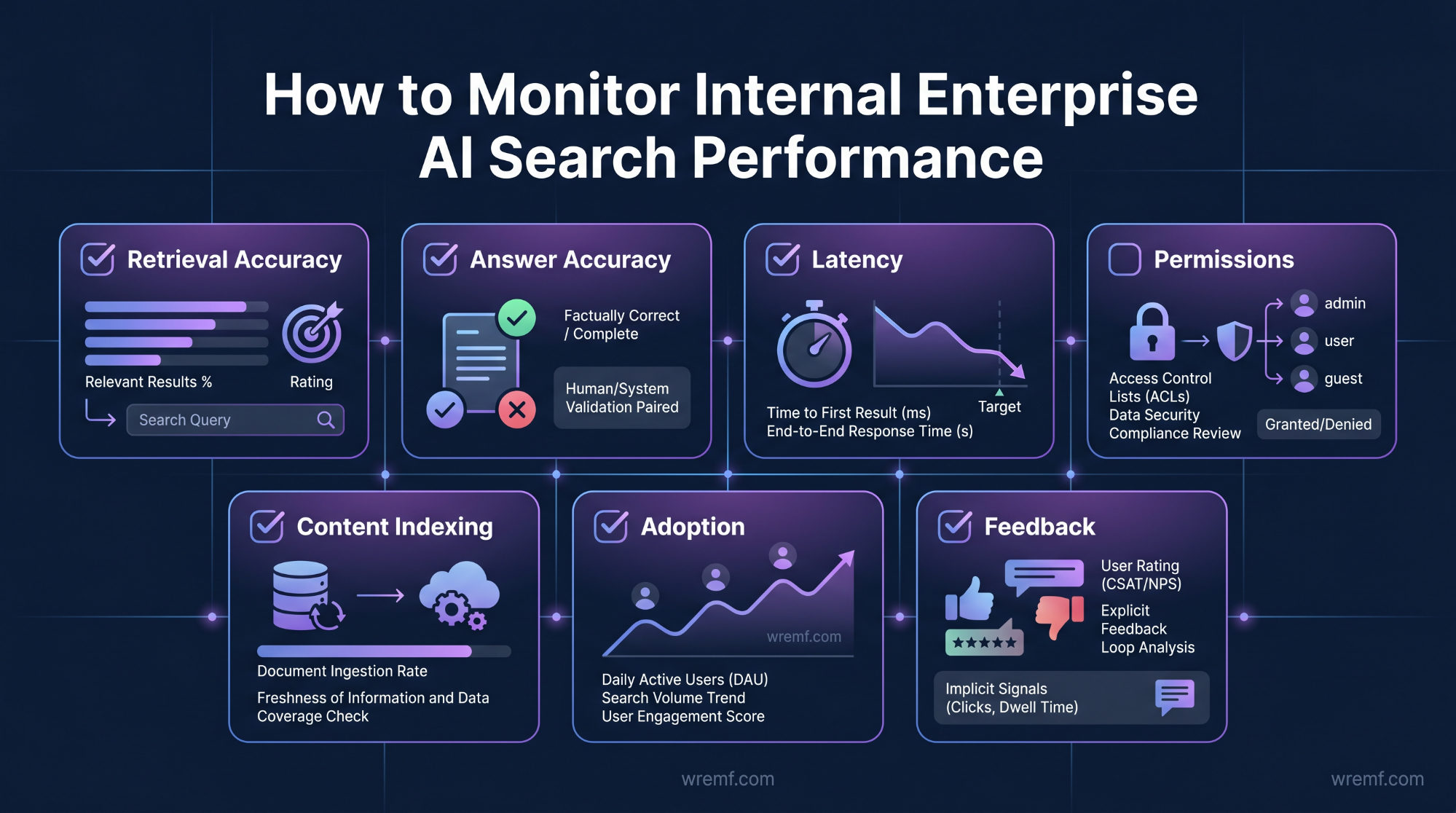
Internal enterprise AI search performance should be monitored through retrieval accuracy, answer accuracy, latency, permissions, content indexing, adoption, and feedback. These metrics show whether employees can trust AI-powered enterprise search in real workflows.
Semantic search is search that matches meaning rather than exact keywords. Semantic search matters because employees usually ask natural-language questions that do not match the exact wording inside source documents.
Vector search is the process of retrieving information based on mathematical representations of meaning called embeddings. Vector search matters because AI-powered enterprise search often depends on semantic similarity before an AI Assistant generates an answer.
A vector database stores embeddings and helps systems retrieve semantically similar information. A vector database matters because tools such as Pinecone and other infrastructure layers can support retrieval across large volumes of unstructured data.
Unstructured data is information that does not follow a fixed database format, such as PDFs, Slack threads, meeting notes, scanned PDFs, emails, tickets, and documents. Unstructured data matters because enterprise knowledge is often useful but difficult for AI search platforms to index cleanly.
Internal monitoring should include these core metrics:
| Metric | What It Measures | Why It Matters |
|---|---|---|
| Retrieval accuracy | Whether the right source documents appear for a query | Poor retrieval produces weak AI-powered results |
| Answer accuracy | Whether the AI-generated response matches approved facts | Inaccurate answers create operational risk |
| Latency | Time from query to answer | Slow answers reduce adoption |
| Permission compliance | Whether user permissions are respected | Weak access control can expose sensitive information |
| Content indexing | Whether Google Drive, SharePoint, Jira, Slack, Teams, Excel, PDFs, and databases are indexed | Missing content creates incomplete answers |
| Adoption | Active users, repeat users, query volume, workflow usage | Low adoption signals poor fit |
| Feedback quality | User ratings, corrections, escalations, human verification outcomes | Feedback improves validation and tuning |
Real-time permissions are permission checks that ensure users can only access content they are authorized to view at the time of the query. Real-time permissions matter because enterprise AI search can connect to sensitive financial applications, customer data, HR records, contracts, and legal documents.
Microsoft states that Microsoft 365 Copilot only surfaces organizational data to which individual users have at least view permissions and that existing permission models such as SharePoint permissions should be used to control access. This is important because monitoring must verify that user permissions, security controls, and information barriers remain intact after AI agents and custom plugins are added.
Information barriers are policies that restrict communication or access between users, groups, departments, or regions. Information barriers matter because enterprises may need to prevent conflicts of interest, protect regulated data, or separate teams for compliance reasons.
Optical character recognition is the process of converting scanned documents into machine-readable text. Optical character recognition matters because scanned PDFs and image-based documents can be invisible to AI search unless they are processed correctly.
A common implementation mistake is assuming that a secure connection means the search experience is secure. Secure connection checks matter, but they do not replace user permissions, validation processes, audit trails, data residency controls, or human verification.
KEY TAKEAWAY: Internal enterprise AI search monitoring proves whether employees receive accurate, fast, permission-safe answers from the right company knowledge.
Once internal search quality is measurable, enterprises can monitor how AI platforms represent the brand externally.
How to Monitor External AI Visibility Across AI Platforms
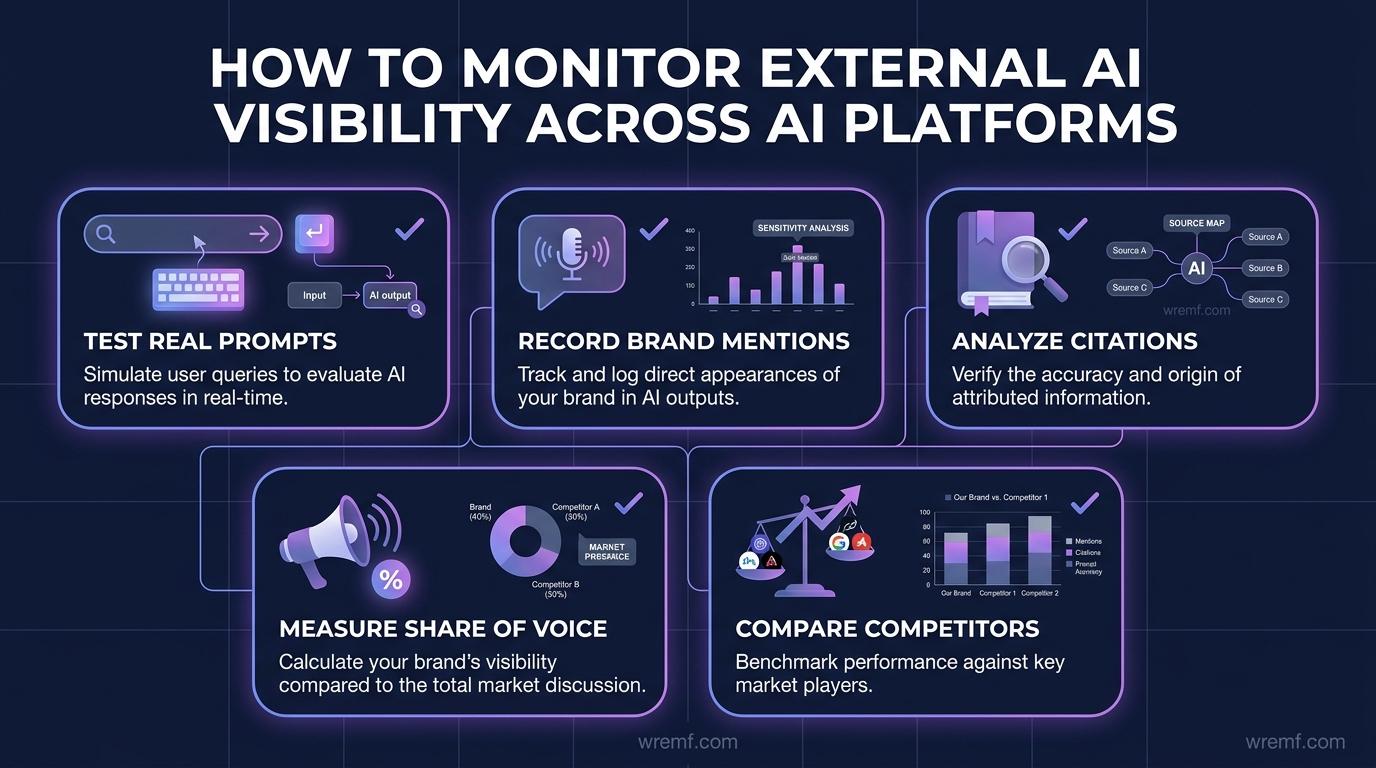
External AI visibility should be monitored by testing real prompts across AI platforms, recording brand mentions, analyzing citations, measuring share of voice, and comparing competitors. This shows whether AI search results include your brand in buying-stage answers.
AI platforms are systems that use artificial intelligence to generate, retrieve, summarize, rank, or recommend information. AI platforms matter because ChatGPT, Claude, Google Gemini, Perplexity, Google AI Overviews, Copilot, DeepSeek, Grok, Meta AI, and Mistral can influence buyer research before a website visit.
Prompt tracking is the process of testing and monitoring natural-language questions across AI engines over time. Prompt tracking matters because AI search visibility depends on questions, user intent, and answer context, not only traditional keyword rankings.
Prompt research is the process of finding the real questions buyers, employees, analysts, and decision-makers ask AI systems. Prompt research matters because enterprise AI search monitoring should be based on real search behavior, not only keyword lists.
Brand mentions are references to a brand inside AI-generated responses, even when the brand is not linked or cited. Brand mentions matter because an AI Assistant can recommend or describe a company without creating referral traffic.
AI citations are links or source references used by AI platforms to support an answer. AI citations matter because they show which sources influence an AI-generated response and whether the evidence layer is credible.
External AI visibility monitoring should answer these questions:
Is your brand mentioned for high-intent prompts?
Is your brand cited or only mentioned without supporting sources?
Which sources do AI platforms use to describe your brand?
Which competitors appear when your brand is missing?
Are AI-generated responses accurate, outdated, neutral, positive, or negative?
Do Google AI Overviews cite your content, competitor content, or third-party sources?
Does Google Gemini describe your products consistently with your website?
Does Perplexity cite source documents that strengthen or weaken your positioning?
Does ChatGPT search return timely answers with accurate brand facts?
Does Claude cite authoritative sources for your category and use cases?
Google AI Overviews are AI-generated snapshots inside Google Search that summarize key information and provide links to explore more. Google AI Overviews matter because they can answer a query before a user clicks a traditional search result.
OpenAI describes ChatGPT search as a way to get fast, timely answers with links to relevant web sources. Anthropic says Claude’s web search tool includes citations for sources drawn from search results. Perplexity describes itself as an answer engine that searches the web, identifies trusted sources, and synthesizes information into clear responses.
WREMF helps teams monitor external AI visibility through prompt intelligence, source citation tracking, competitive landscape monitoring, AI visibility scoring, AI traffic attribution, and source consistency analysis. This turns AI visibility from scattered screenshots into a repeatable workflow.
TIP: Start with 25 to 50 prompts across discovery, comparison, implementation, pricing, risk, and alternative queries before expanding into larger prompt sets.
KEY TAKEAWAY: External AI visibility monitoring shows whether your brand appears, gets cited, and competes effectively inside AI-generated responses.
The next section defines the metrics that make AI search monitoring useful for reporting.
The AI Search Monitoring Metrics Enterprises Should Track
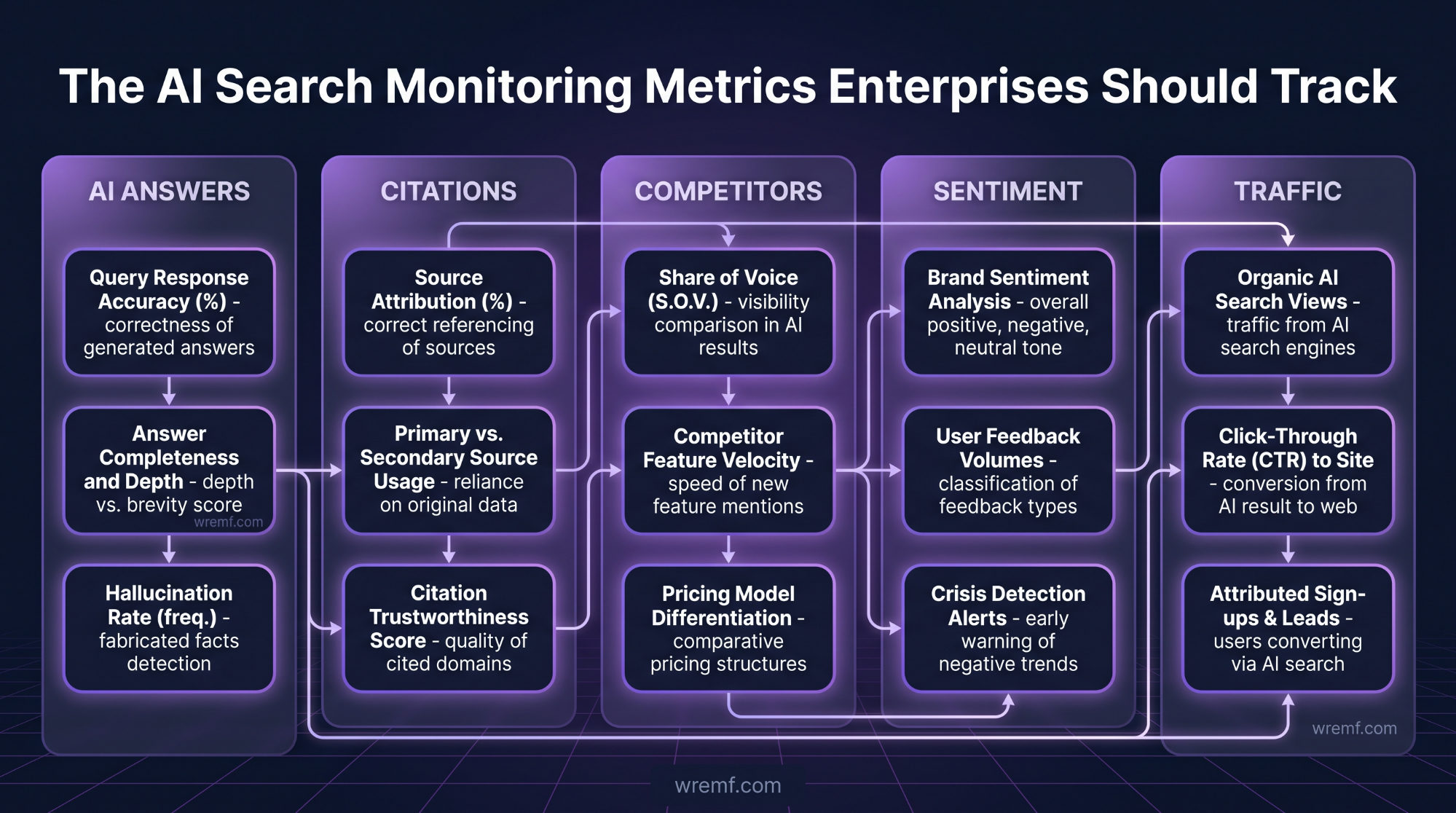
Enterprise AI search monitoring needs a blended metric model because AI answers, citations, competitors, sentiment, and traffic all explain different parts of performance. No single metric can prove AI search performance alone.
AI share of voice is the percentage of relevant AI-generated answers where your brand appears compared with competitors. AI share of voice matters because it shows brand visibility across prompts and AI platforms, not only traffic.
Share of model is a practical term for measuring how often a brand appears inside AI model responses for a defined prompt set. Share of model matters because teams need a way to compare presence across LLMs, AI agents, answer engines, and generative search platforms.
AI traffic attribution connects website sessions, users, conversions, or pipeline activity to AI sources such as ChatGPT, Perplexity, Gemini, Copilot, and other AI discovery surfaces. AI traffic attribution matters because AI visibility must eventually connect to analytics and business outcomes.
Citation-level sentiment analysis is the process of evaluating whether cited sources and AI-generated responses describe a brand positively, neutrally, negatively, or inaccurately. Citation-level sentiment analysis matters because a citation can increase trust or amplify a weak narrative.
| Metric | What It Shows | Example Use |
|---|---|---|
| AI visibility score | Overall presence across AI platforms and prompts | Track month-over-month progress |
| Mention frequency | How often the brand appears in AI-generated responses | Find brand visibility gaps |
| Citation frequency | How often the brand or supporting sources are cited | Measure source authority |
| Source diversity | Which domains AI platforms rely on | Reduce dependence on weak sources |
| Competitor share of voice | How often competitors appear compared with your brand | Prioritize competitive content optimization |
| Recommendation rate | How often AI platforms actively recommend the brand | Measure buying-stage visibility |
| Prompt coverage | Which topics and prompts return accurate answers | Expand prompt research |
| Citation-level sentiment analysis | Whether citations and answers are positive, neutral, negative, or inaccurate | Detect brand risk |
| AI referral traffic | Traffic from AI platforms | Connect visibility to analytics |
| Accuracy rate | Whether responses match approved facts | Reduce hallucination risk |
| Search engine tracking | Traditional search engine visibility and rankings | Compare Google rankings with AI visibility |
| Market share context | Commercial position in the market | Compare real market position with AI presence |
Mention frequency is the count or percentage of AI-generated responses that include a brand for a defined prompt set. Mention frequency matters because a company may have strong traditional SEO but low AI visibility if AI platforms recommend competitors more often.
Market share and AI share of voice are related but not identical. Market share measures commercial position. AI share of voice measures presence inside AI-generated responses. A company can have strong market share and weak AI visibility if AI platforms cite competitors, outdated third-party sources, or clearer competing content.
In practical AI visibility audits, teams often discover that keyword rankings and AI search visibility do not match. A page may rank in Google search results but fail to appear in ChatGPT, Claude, Gemini, Perplexity, or Google AI Overviews. Another page may receive AI citations because it provides clearer definitions, stronger comparisons, or better source documents.
If you want to see how these metrics can be organized for leadership or client reporting, review a WREMF sample AI visibility report before building your own reporting format.
KEY TAKEAWAY: Enterprise AI search monitoring should combine AI visibility, mentions, citations, source quality, competitors, sentiment, traffic, and accuracy.
Those metrics become clearer when teams understand how SEO, AEO, and Generative Engine Optimization work together.
SEO vs AEO vs Generative Engine Optimization for Enterprise AI Search Monitoring
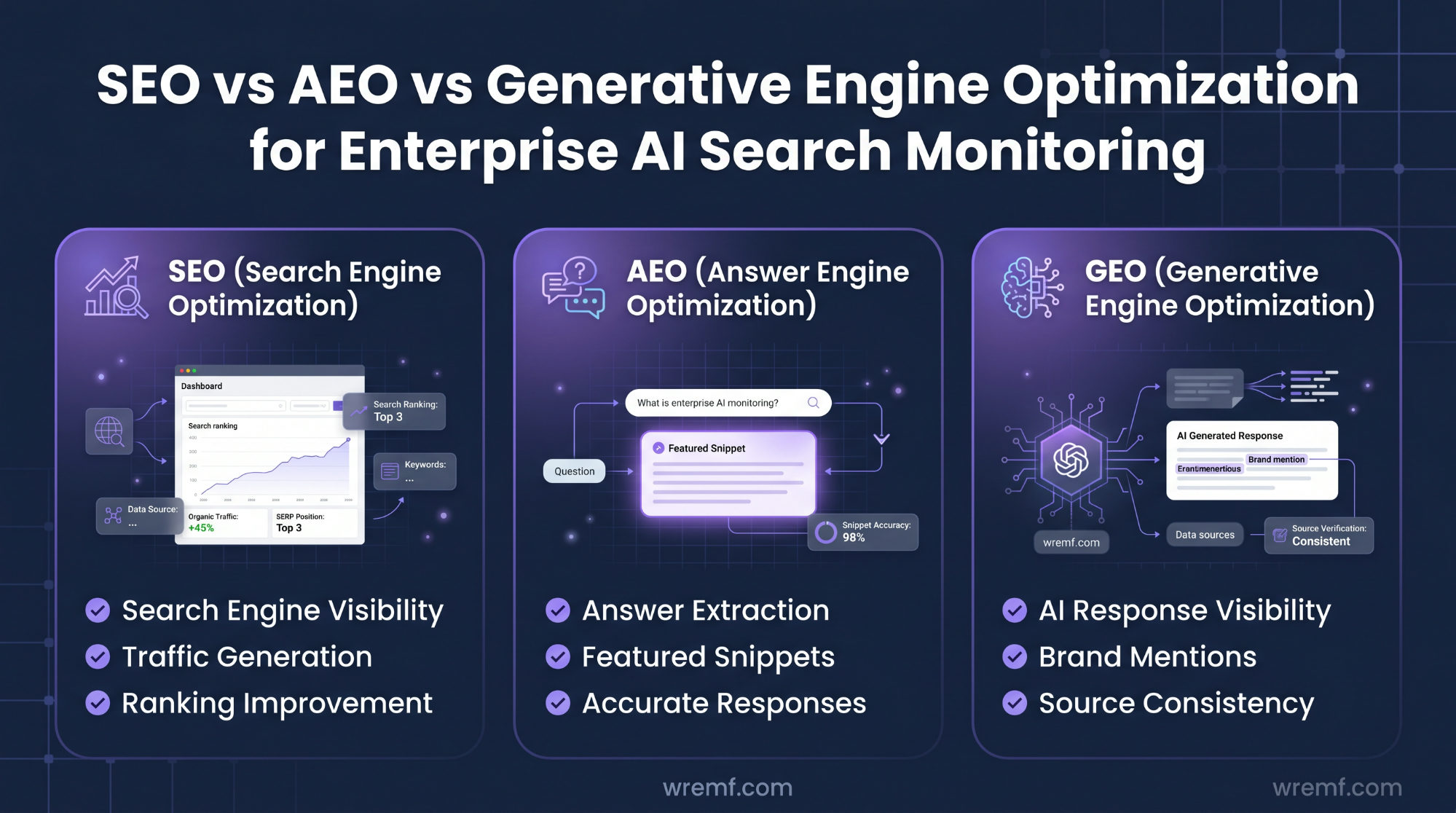
SEO, AEO, and Generative Engine Optimization support different parts of enterprise AI search monitoring. SEO improves search engine visibility, AEO improves answer extraction, and GEO improves visibility inside AI-generated responses.
SEO is search engine optimization for crawling, indexing, ranking, and traffic from search platforms such as Google and Bing. SEO matters because traditional search results, website authority, and crawlability still influence AI discovery.
Answer Engine Optimization is the process of structuring content so answer engines can extract accurate, concise responses. Answer Engine Optimization matters because AI Assistants and search platforms need definitions, summaries, FAQs, comparisons, and source-backed explanations.
Generative Engine Optimization is the process of improving how brands appear inside AI-generated responses from Large Language Models and AI search platforms. Generative Engine Optimization matters because AI platforms synthesize recommendations, citations, and summaries instead of only ranking pages.
| Discipline | Main Goal | What It Optimizes | Example Metrics | What It Misses Alone |
|---|---|---|---|---|
| SEO | Rank and drive traffic from search engines | Crawlability, indexing, keyword rankings, technical SEO, helpful content | Rankings, clicks, impressions, CTR, backlinks | Brand mentions and citations inside AI-generated responses |
| AEO | Be selected for direct answers | Definitions, answer-first content, FAQs, structured summaries | Featured snippets, answer inclusion, extractability | Competitor share of voice across LLMs |
| Generative Engine Optimization | Improve visibility in AI-generated responses | Prompts, citations, source consistency, entity clarity, AI recommendations | AI visibility, citations, brand mentions, share of voice | Traditional technical SEO if used alone |
| Enterprise AI search monitoring | Measure and govern AI search performance | Internal retrieval, external AI visibility, governance, analytics | Accuracy, permissions, citations, traffic attribution | Execution unless connected to workflows |
The key difference between SEO and GEO is the output being optimized. SEO aims to improve rankings and search traffic. GEO aims to influence AI-generated responses, source citations, brand mentions, and recommendations across AI platforms.
Content optimization for AI search should combine all three disciplines. A strong AI-ready page should be crawlable for search platforms, answer-first for AEO, and source-consistent for GEO. The best content often includes definitions, comparison tables, FAQs, methodology explanations, citation-worthy facts, and clear internal links.
Google Search Central explains that Google’s ranking systems are designed to prioritize helpful, reliable, people-first content. That guidance matters because AI search platforms also benefit from clear, trustworthy, source-backed content that answers real user questions.
WREMF’s methodology connects prompt research, source citations, competitors, AI visibility, source consistency, and attribution into one repeatable system. Teams can use the WREMF methodology to turn SEO, AEO, and GEO from separate workstreams into a measurable AI visibility process.
KEY TAKEAWAY: SEO, AEO, and Generative Engine Optimization should work together because enterprise AI search monitoring depends on rankings, answers, citations, prompts, and source consistency.
The next section explains why keyword rankings alone no longer show the full picture.
Why Keyword Rankings Alone Are Not Enough for AI Search Monitoring
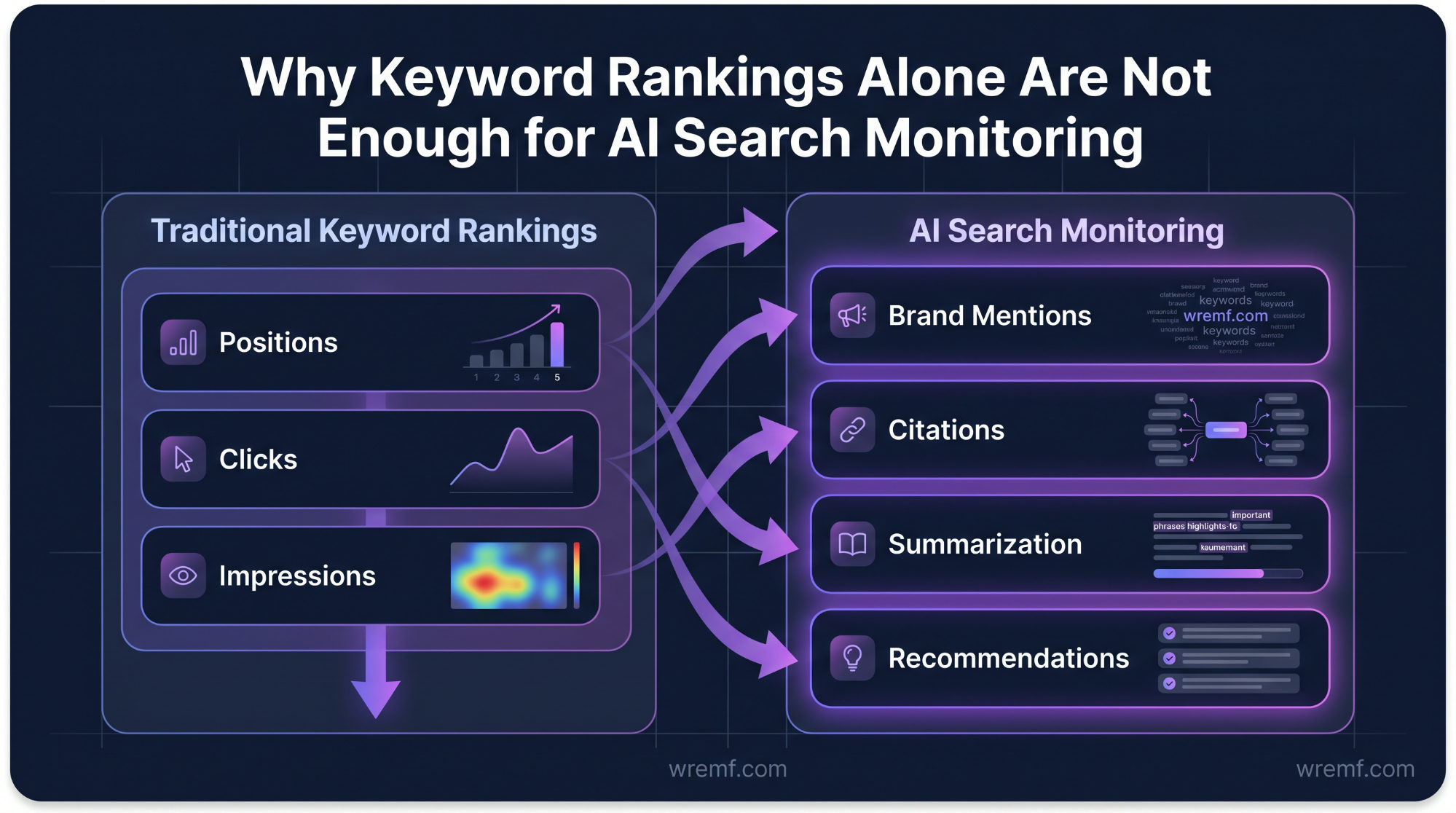
Keyword rankings are not enough because AI search results can mention, cite, summarize, or recommend brands without following traditional search result order. Enterprise AI search monitoring must inspect the answer itself.
Keyword rankings are positions that pages hold for specific queries in traditional search results. Keyword rankings matter because Google search traffic still drives discovery, but keyword rankings do not show whether AI platforms recommend your brand.
Search engine tracking measures performance in traditional search platforms through rankings, impressions, clicks, CTR, and SERP features. Search engine tracking matters because SEO remains important, but it cannot fully measure AI-generated responses, brand mentions, or citation-level influence.
AI-powered results are search or assistant responses generated with artificial intelligence rather than only ranked links. AI-powered results matter because a user may rely on the generated answer instead of clicking through multiple sources.
| Factor | Traditional Search Monitoring | AI Search Monitoring |
|---|---|---|
| Unit of measurement | Keyword and URL | Prompt, answer, citation, brand, competitor |
| Main output | Search results | AI-generated responses and citations |
| Visibility signal | Ranking position, impressions, clicks | Brand mentions, source citations, recommendations, sentiment |
| Competitive context | Pages ranking in the SERP | Brands included or excluded from AI answers |
| Reporting challenge | Traffic attribution from search engines | AI referral traffic and no-click influence |
| Main blind spot | What AI platforms say inside the answer | Technical SEO and crawl issues if ignored |
AI platforms can cite owned pages, third-party articles, review pages, documentation, Reddit threads, directories, comparison pages, and partner content. This means brand visibility depends on both owned content and the wider source ecosystem.
AI citations matter because they reveal which sources AI platforms trust for a specific answer. If an AI platform cites a competitor comparison, outdated directory, or weak review page, the brand may be visible but poorly represented.
AI visibility works by combining prompt interpretation, retrieval, source selection, entity recognition, citation generation, answer synthesis, and user context. AI visibility improves when a brand has clear owned content, consistent source documents, strong topic coverage, accurate entity signals, and credible third-party references.
A common enterprise mistake is reporting only keyword rankings to leadership while ignoring AI search results. This creates a measurement gap. Leadership may see stable Google rankings while AI platforms increasingly recommend competitors for buying-stage prompts.
KEY TAKEAWAY: Keyword rankings remain useful, but enterprise AI search monitoring must also measure prompts, answers, citations, brand mentions, competitors, and source consistency.
The next section shows how enterprises can mature from basic checks to governed AI search intelligence.
The AI Search Monitoring Maturity Model
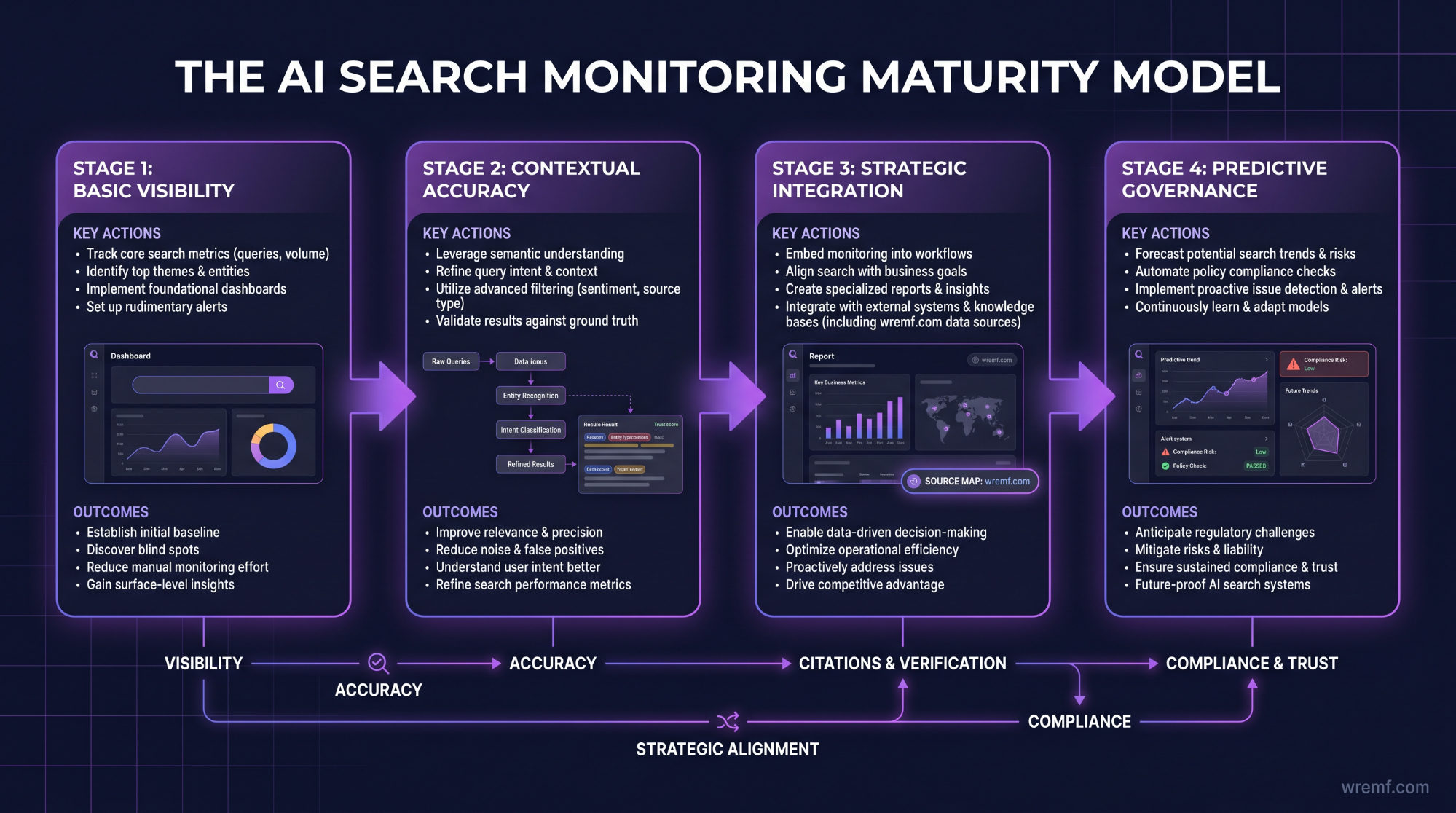
The AI search monitoring maturity model helps enterprises move from ad hoc AI testing to governed AI intelligence. Mature teams connect visibility, accuracy, citations, competitors, content strategy, analytics, and compliance.
A maturity model is a staged framework that shows how a capability develops over time. A maturity model matters because enterprise AI search monitoring can become fragmented without a clear path from measurement to action.
Stage 1: Basic visibility
Stage 1 answers the question, “Are we being mentioned and indexed?” Teams manually test prompts in ChatGPT, Claude, Gemini, Perplexity, Google AI Overviews, Copilot, and other AI platforms. The output is a basic list of brand mentions, missing prompts, competitor mentions, and obvious inaccuracies.
Use this stage when:
You are new to AI visibility monitoring tools
You need a first baseline for brand visibility
Leadership wants to know whether the brand appears at all
You are comparing screenshots, manual tests, and early findings
Stage 2: Contextual accuracy
Stage 2 answers the question, “Are citations and responses factually correct?” Teams compare AI-generated responses against approved facts, product pages, documentation, pricing, regulatory language, customer story pages, and positioning. This stage identifies hallucinations, outdated sources, and inaccurate brand descriptions.
Use this stage when:
Your brand is mentioned but described incorrectly
AI platforms cite weak or outdated sources
Product, legal, or leadership teams need factual confidence
Compliance violations could create business risk
Stage 3: Strategic integration
Stage 3 connects AI search monitoring to content optimization, GEO audits, prompt research, SEO testing, internal linking, source consistency cleanup, and reporting. Teams stop treating AI visibility as a screenshot exercise and start using recurring workflows.
Use this stage when:
SEO teams need AI-ready content briefs
Agencies need white-label reporting for multiple clients
Growth teams need competitor visibility and share of voice
Content teams need evidence for prioritization
Stage 4: Predictive governance
Stage 4 uses scheduled monitoring, alerting, anomaly detection, audit trails, human verification, and compliance checks. Teams monitor answer drift, source drift, competitor drift, and accuracy drift over time.
Use this stage when:
AI visibility affects enterprise risk
Multiple markets, products, or regions require monitoring
Regulated teams need audit trails and validation processes
Enterprise architects need AI search governance
| Maturity Stage | Main Question | Primary Output | Best Next Step |
|---|---|---|---|
| Stage 1: Basic visibility | Are we mentioned? | Prompt baseline | Track recurring prompts |
| Stage 2: Contextual accuracy | Are answers correct? | Accuracy and citation review | Fix source consistency |
| Stage 3: Strategic integration | Are insights driving action? | Content, GEO, and reporting workflows | Build recurring optimization |
| Stage 4: Predictive governance | Can we detect risk early? | Alerts, audit trails, compliance checks | Automate monitoring and validation |
WREMF supports this maturity path by combining AI visibility tracking, prompt intelligence, source citations, competitive landscape analysis, GEO audits, content briefs, SEO testing, reporting, APIs, MCP integrations, and managed execution.
KEY TAKEAWAY: Enterprise AI search monitoring maturity moves from basic brand checks to governed, repeatable, and actionable AI visibility intelligence.
The next section explains how to close the reliability gap that makes many teams hesitate.
Solving the Reliability Gap: Governance, Compliance, and Accuracy
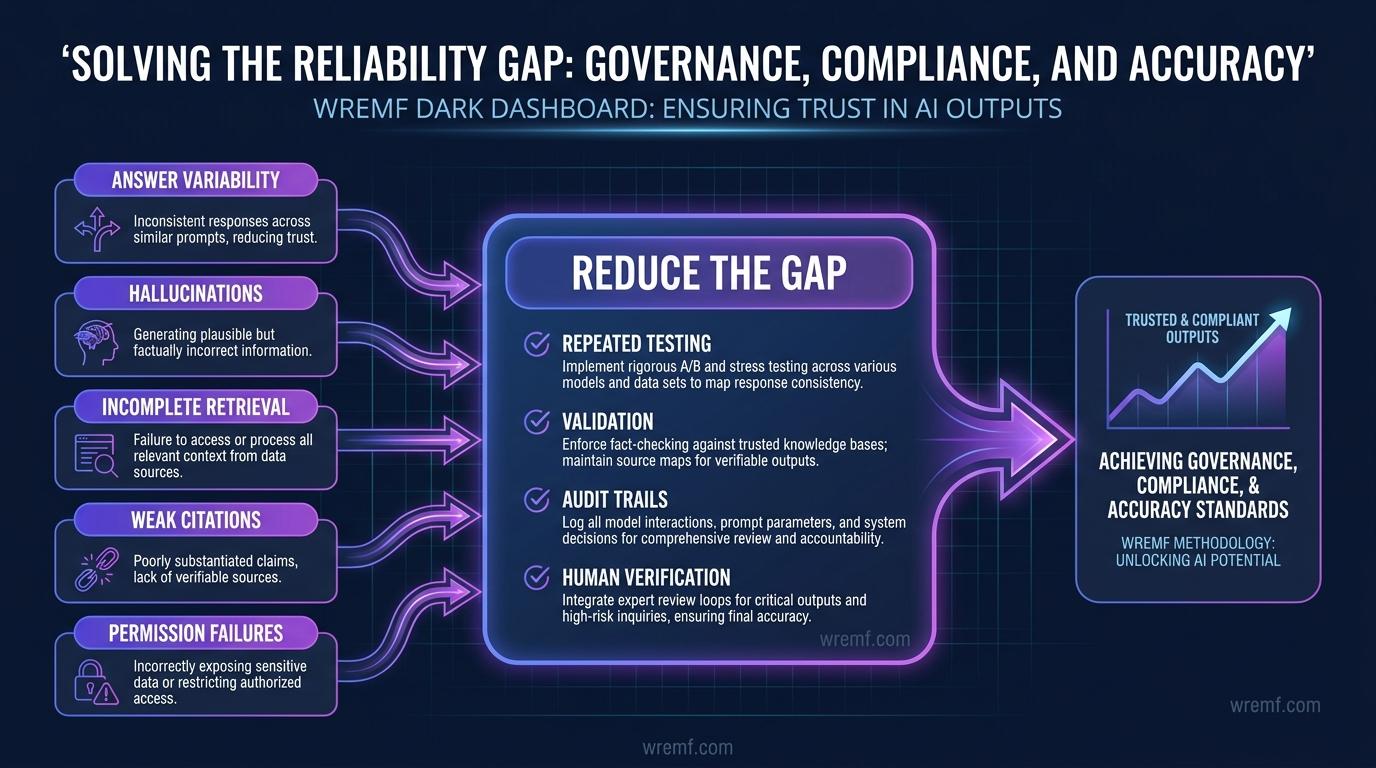
The reliability gap in AI search monitoring comes from answer variability, hallucinations, incomplete retrieval, weak citations, and permission failures. Enterprises reduce this gap through repeated testing, validation, audit trails, and human verification.
Hallucinations are AI-generated statements that appear confident but are unsupported, incorrect, or fabricated. Hallucinations matter because enterprise users may act on false information if answers are not grounded in source documents.
Audit trails are records of prompts, answers, sources, timestamps, users, model outputs, validation decisions, and changes over time. Audit trails matter because enterprise teams need evidence for governance, compliance, reporting, and troubleshooting.
Human-in-the-loop verification is a workflow where humans review, approve, correct, or escalate AI-generated outputs. Human-in-the-loop verification matters because AI agents can assist workflows, but sensitive decisions often require human accountability.
| Reliability Risk | Example | Monitoring Response |
|---|---|---|
| Answer drift | The same prompt returns different responses over time | Save answer snapshots and compare changes |
| Source drift | AI platforms change which sources they cite | Track source citations by prompt and platform |
| Competitor drift | A competitor starts appearing more often | Monitor share of voice and recommendation changes |
| Accuracy drift | AI answers include outdated facts | Validate against approved source documents |
| Permission drift | Users see content they should not access | Audit user permissions and access controls |
| Compliance drift | Responses conflict with regulatory requirements | Add human verification and audit trails |
AI monitoring metrics can be reliable even when answers change. The goal is not to freeze one answer forever. The goal is to measure patterns across prompts, AI platforms, source citations, competitors, time windows, and accuracy checks.
Data residency is the requirement that data is stored or processed in specific regions or jurisdictions. Data residency matters because global enterprises may need to control where prompts, company knowledge, source documents, and AI-generated responses are processed.
Regulatory requirements are rules that govern how organizations handle sensitive information, records, access, reporting, and risk. Regulatory requirements matter because financial, healthcare, legal, HR, and public sector teams may need stronger controls than standard marketing workflows.
Security controls are technical and administrative safeguards that protect data, access, systems, and workflows. Security controls matter because enterprise AI search can connect AI agents to sensitive knowledge, collaboration platforms, and source documents.
The validation process should include automatic checks and human review. Automatic checks can detect missing citations, changed answers, new competitors, source changes, and inconsistent facts. Human verification should review high-risk claims, compliance language, regulated content, and customer-facing recommendations.
IMPORTANT: AI search monitoring should treat hallucination detection, user permissions, audit trails, and security controls as operating requirements, not optional enterprise features.
KEY TAKEAWAY: Reliable AI search monitoring depends on repeated measurement, source tracking, permission checks, audit trails, and human verification.
Once reliability is managed, teams can build a double-loop system between internal knowledge and external visibility.
The Double-Loop Strategy for Internal Knowledge and External AI Visibility
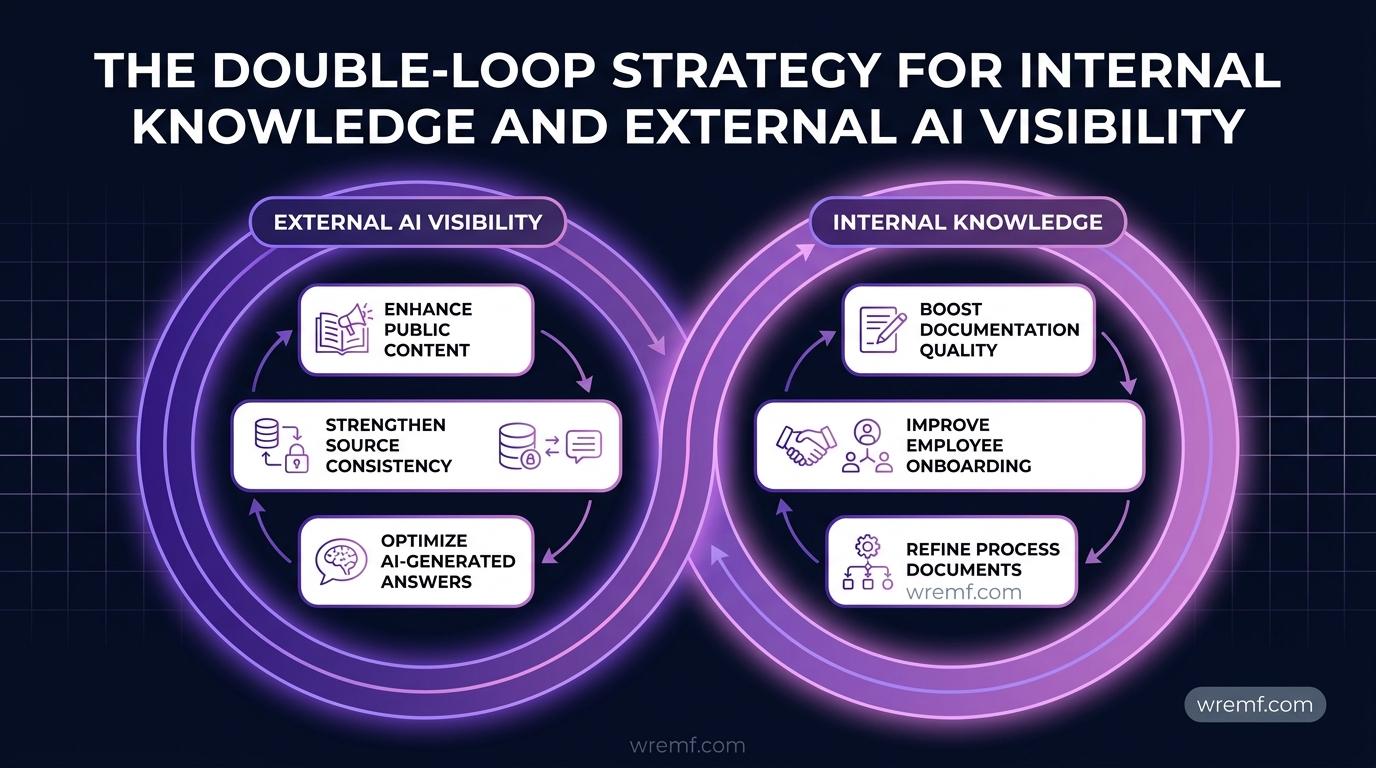
The double-loop strategy uses external AI visibility insights to improve public content and internal AI search insights to improve company knowledge. This creates one learning system across marketing, sales, product, support, and operations.
A knowledge graph is a structured representation of entities, facts, attributes, and relationships. A knowledge graph matters because AI search systems need clear relationships between products, industries, use cases, documentation, competitors, people, customers, and source documents.
The first loop is external. External AI visibility monitoring shows what ChatGPT, Claude, Gemini, Perplexity, Google AI Overviews, Copilot, DeepSeek, Grok, Meta AI, and Mistral say about your brand. Marketing and SEO teams use this data to improve owned pages, source citations, comparison content, FAQs, entity clarity, and content briefs.
The second loop is internal. Internal enterprise search monitoring shows what employees cannot find, trust, or use. Product, support, sales, operations, and enablement teams use this data to improve documentation, knowledge bases, onboarding content, process documents, and AI Assistant responses.
| Asset | External AI Visibility Use | Internal Enterprise Search Use |
|---|---|---|
| Product pages | Help AI platforms understand positioning | Help sales and support explain the product |
| Documentation | Provide source-backed technical clarity | Help employees answer implementation questions |
| FAQs | Improve answer extraction | Reduce repeated internal questions |
| Comparison pages | Improve competitive context | Help sales handle objections |
| Customer story pages | Support credibility and use cases | Help teams understand proof points |
| Pricing pages | Clarify buying-stage answers | Help customer-facing teams avoid mistakes |
| Methodology pages | Explain the process behind claims | Standardize internal workflows |
| Support content | Answer detailed questions from users | Reduce escalation volume |
In real-world reporting, the strongest insights often appear when external and internal information disagree. If AI platforms describe your product differently from your sales documentation, the problem is not only AI visibility. It is source consistency.
For example, a public page may say a product is for agencies, while sales enablement says it is for enterprise brands, and a third-party directory says it is for small businesses. AI platforms may synthesize all three and produce a confusing answer. Monitoring should identify the conflict and assign the fix.
WREMF helps with the external loop by showing which prompts, citations, competitors, and sources influence AI visibility. Teams can then use WREMF’s content briefs, GEO audits, and source citation analysis to improve content optimization and source consistency.
KEY TAKEAWAY: The double-loop strategy turns AI search monitoring into a shared intelligence system for content, documentation, sales, support, and governance.
The next section compares the enterprise technology stack and where each tool category fits.
Evaluating Enterprise AI Monitoring Tools, Search Platforms, and Infrastructure
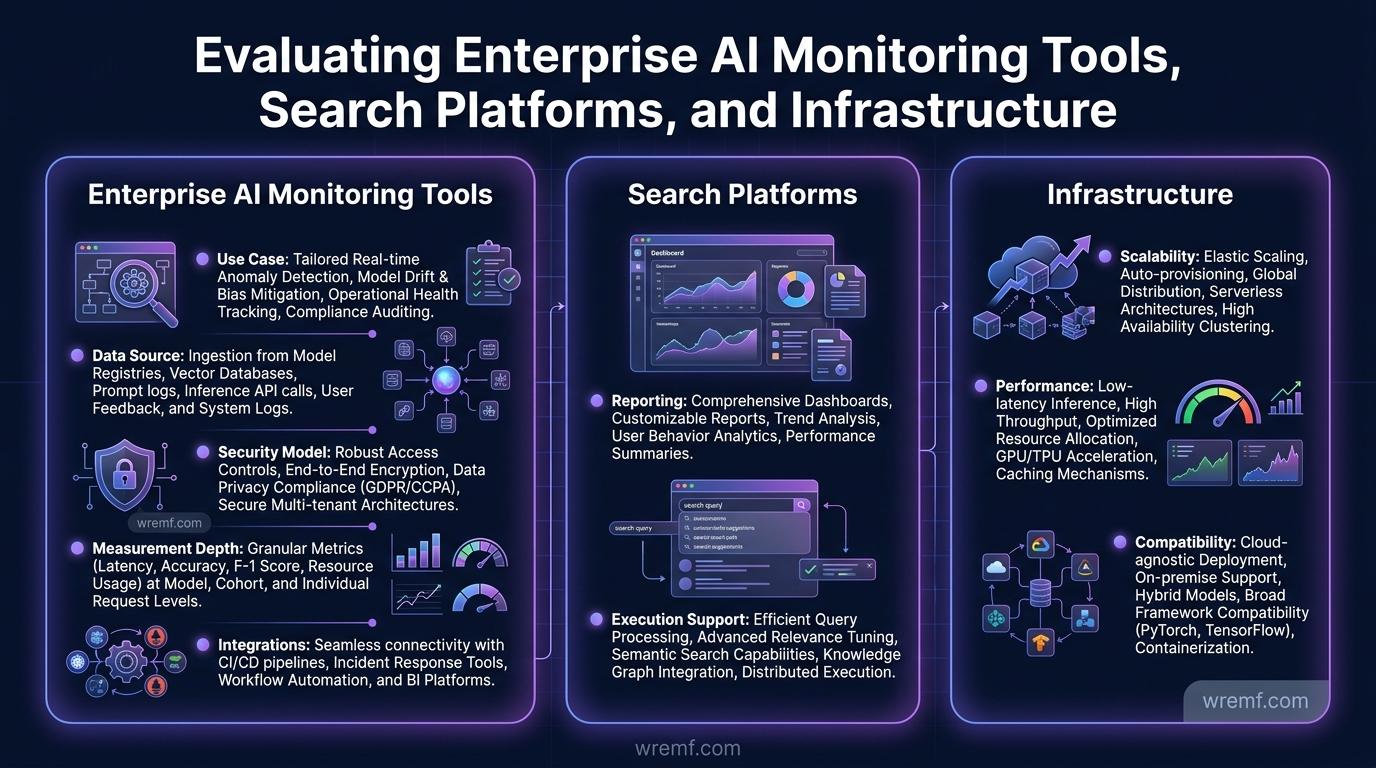
Enterprise AI monitoring tools should be evaluated by use case, data source, security model, measurement depth, integrations, reporting, and execution support. Internal search platforms and external AI visibility monitoring tools are not interchangeable.
Search platforms are systems that retrieve information from indexed content, source documents, applications, websites, or databases. Search platforms matter because AI-powered results depend on the quality of retrieval before generation.
AI visibility monitoring tools measure how brands appear across AI platforms, prompts, citations, competitors, and AI-generated responses. AI visibility monitoring tools matter because traditional SEO tools do not fully measure brand mentions, AI citations, source sentiment, or LLM visibility.
AI agents are software systems that can use tools, retrieve information, take steps, and complete tasks with some autonomy. AI agents matter because enterprise AI search monitoring may need to inspect how agents retrieve source documents, call APIs, use custom plugins, and respect user permissions.
| Tool Category | Examples | Best For | What It Measures | What It Misses |
|---|---|---|---|---|
| Vector database infrastructure | Pinecone and similar vector database tools | Custom semantic retrieval and AI search infrastructure | Embeddings, vector search, similarity retrieval, latency | Brand visibility, citations, marketing reporting |
| Enterprise search platforms | Algolia, Elastic, IBM Watson Discovery, Google Vertex AI Search | App search, site search, workplace search, search platforms | Indexing, relevance, retrieval, search results, search quality | External AI brand visibility |
| Internal AI Assistant platforms | Glean, Glean Assistant, Hebbia, Guru, Microsoft 365 Copilot | Employee productivity and company knowledge retrieval | Internal answers, source documents, workflow adoption | Public AI visibility and competitor share of voice |
| Traditional SEO tools | Semrush, Ahrefs, Moz Pro | Google search performance and SEO tracking | Keyword rankings, backlinks, search engine tracking, traffic | AI-generated recommendations and citations |
| External AI visibility tools | WREMF, Profound AI, Peec AI, Otterly AI, Scrunch AI, Knowatoa AI | AI visibility, brand mentions, citations, competitors | Prompt tracking, source citations, share of voice, AI search visibility | Internal permission controls unless integrated |
| Analytics and BI tools | GA4, Search Console, data warehouses, dashboards | Reporting and attribution | Traffic, conversions, referral sources, trends | AI answer content and citation context |
The best category depends on the problem. If employees cannot find the right source documents, evaluate enterprise search and AI Assistant platforms. If prospects cannot find your brand in AI-generated responses, evaluate AI visibility monitoring tools. If traditional Google search is still a major channel, keep SEO tools in the stack.
Awards and category labels can help with vendor discovery, but they should not replace technical evaluation. Mentions such as Gartner®, Emerging Leader, Fast Company’s 2025 lists, customer story pages, or analyst recognition may indicate market traction, but enterprise buyers should still validate data quality, source transparency, API access, security model, and reporting workflow.
Integration capabilities matter at enterprise scale. APIs, SDKs, custom plugins, CSV exports, webhooks, MCP integrations, SSO, SAML, client portals, and data retention controls can determine whether monitoring becomes part of daily operations or remains a standalone dashboard.
WREMF is useful when teams need external AI visibility tracking across 10 AI engines, white-label reports, BYOK support, client portals, API and MCP integrations, competitor monitoring, prompt tracking, source citation analysis, and optional agency execution. Agencies can also use WREMF for multi-client reporting through the WREMF agencies page.
KEY TAKEAWAY: Choose enterprise search platforms for internal retrieval, AI visibility monitoring tools for external brand presence, and SEO tools for traditional search performance.
The next section turns tool selection into an implementation roadmap.
Implementing an Enterprise AI Search Monitoring Framework
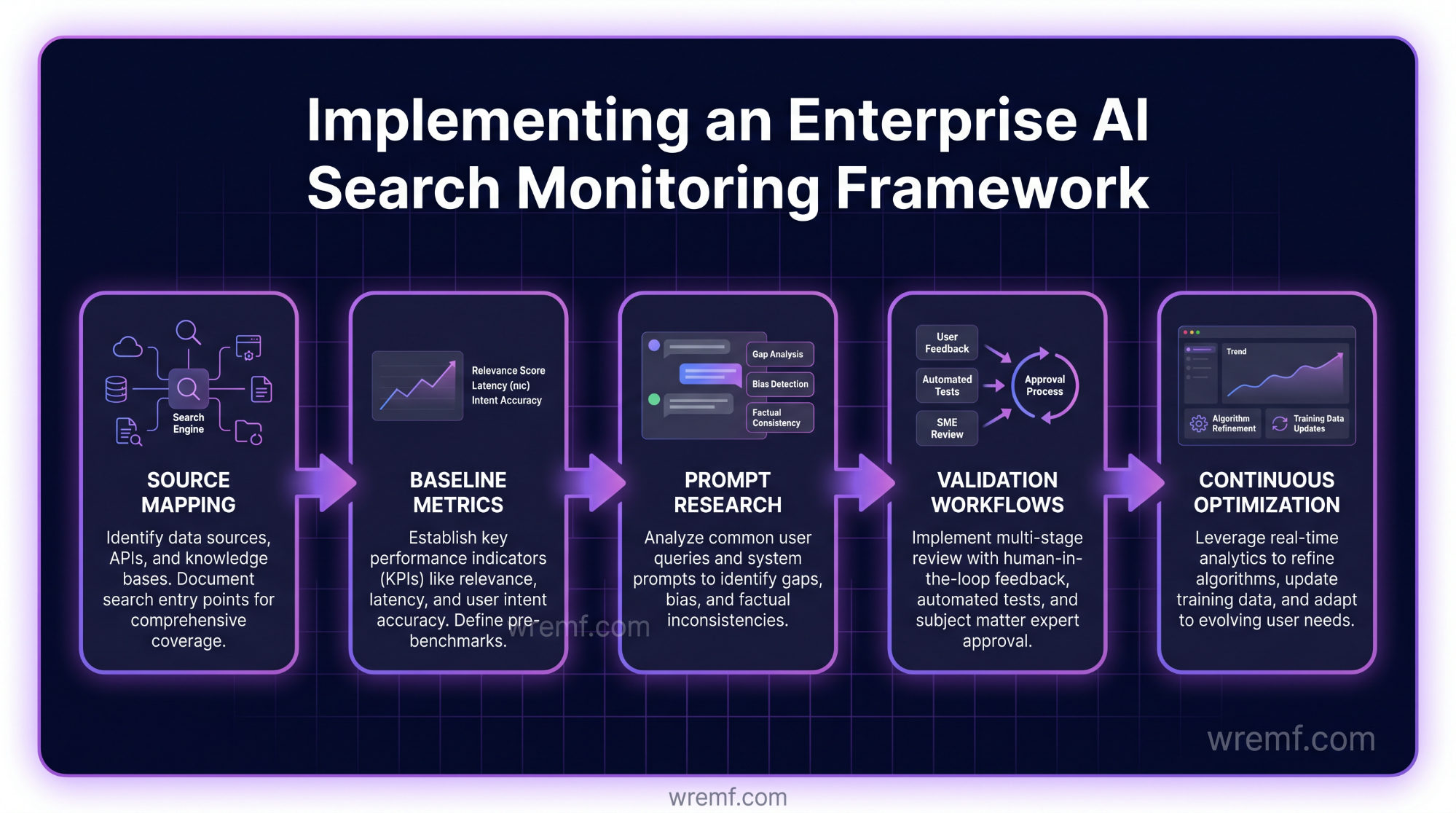
An enterprise AI search monitoring framework should start with source mapping, baseline metrics, prompt research, validation workflows, and continuous optimization. This prevents teams from collecting AI data without knowing how to act on it.
A monitoring framework is a repeatable process for collecting, validating, analyzing, reporting, and improving AI search data. A monitoring framework matters because enterprise teams need consistency across teams, platforms, prompts, sources, and time periods.
Step 1: Map the knowledge graph and content sources
Start by listing the source documents and platforms that matter. Internal sources may include Google Drive, SharePoint, Jira, Slack, Teams, Excel files, PDFs, scanned PDFs, network drives, documentation, CRM records, support tickets, and data warehouses. External sources may include your website, documentation, pricing pages, product pages, comparison pages, review platforms, directories, partner pages, media mentions, and analyst references.
The goal is to identify which sources are authoritative, outdated, duplicated, incomplete, inaccessible, or inconsistent. This source map becomes the foundation for internal search quality and external AI visibility.
Step 2: Establish baseline performance metrics
Create separate baselines for internal search and external AI visibility. Internal baselines should include retrieval accuracy, answer accuracy, latency, permission compliance, content indexing quality, workflow adoption, and feedback. External baselines should include AI visibility, brand mentions, citations, competitors, sentiment, share of voice, recommendation rate, and AI traffic attribution.
For external AI visibility, start with a prompt set that reflects real buyer behavior. Include problem prompts, category prompts, competitor prompts, pricing prompts, alternative prompts, risk prompts, integration prompts, and implementation prompts.
Step 3: Automate the validation process and security audits
Automation should record prompts, AI-generated responses, source citations, timestamps, AI platforms, model versions where available, competitors, and changes over time. Internal monitoring should also check real-time permissions, user permissions, information barriers, secure connection requirements, data residency, audit trails, and compliance violations.
Human verification should remain part of the process for regulated, sensitive, or high-impact workflows. AI agents can assist validation, but humans should review hallucination risks, customer-facing claims, legal language, and strategic positioning.
Step 4: Optimize content, sources, and workflows continuously
Continuous optimization turns monitoring data into content briefs, GEO audits, source consistency cleanup, internal links, schema and entity markup guidance, crawl and rendering checks, and competitive content updates. Most B2B teams should review AI visibility at least monthly. Enterprise brands in fast-moving markets may need weekly monitoring.
WREMF’s GEO audit feature, content brief generator, source citations workflow, competitive landscape monitoring, and SEO testing feature help teams move from diagnosis to action. Teams that need execution can also work with the WREMF agency team for AEO, GEO, authority building, technical AI visibility foundations, and monthly reporting.
KEY TAKEAWAY: A strong enterprise AI search monitoring framework maps sources, sets baselines, validates risk, and turns AI visibility data into repeatable optimization work.
The next section explains how WREMF fits into the enterprise monitoring workflow.
How WREMF Helps With Enterprise AI Search Monitoring
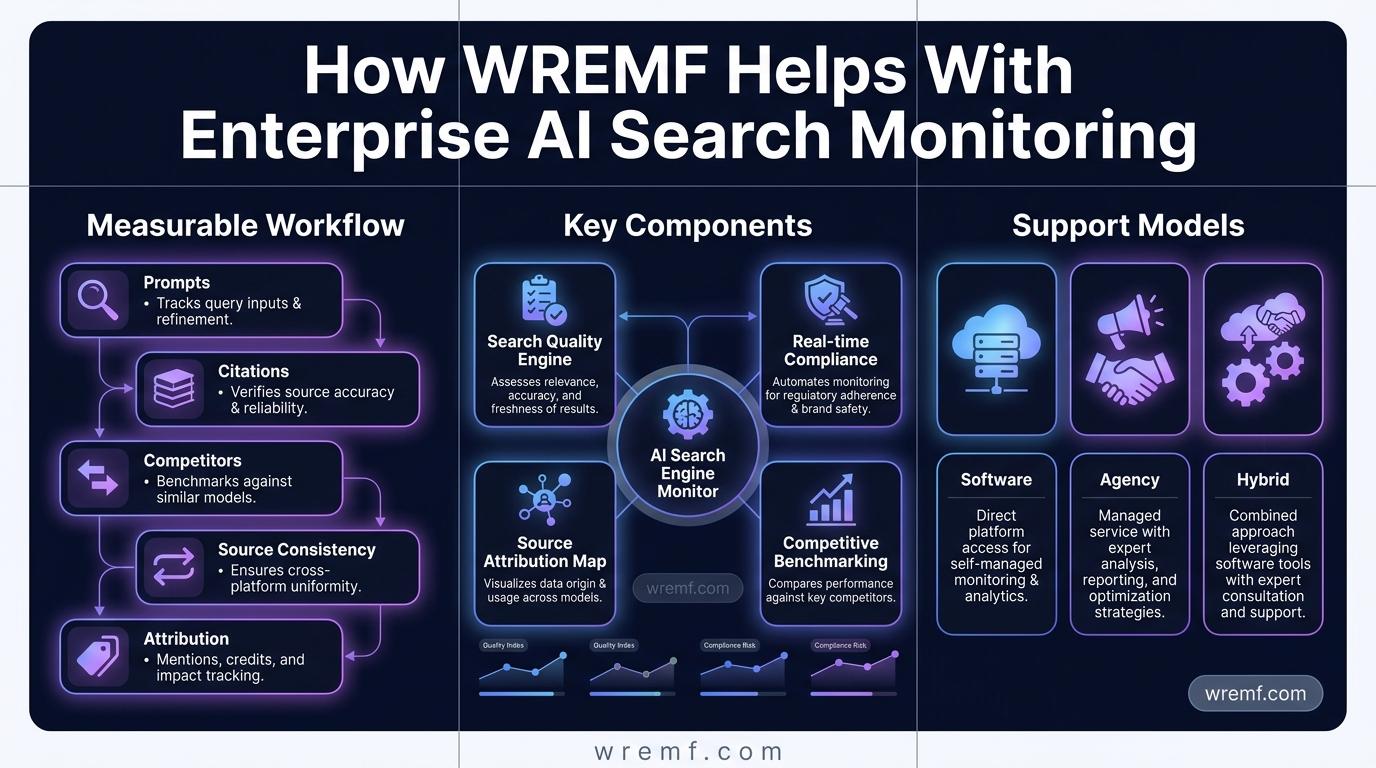
WREMF helps with enterprise AI search monitoring by turning external AI visibility into a measurable workflow across prompts, citations, competitors, source consistency, and attribution. It supports software, agency, and hybrid operating models.
WREMF helps teams track, improve, and prove AI visibility across ChatGPT, Claude, Gemini, Perplexity, Google AI Overviews, Copilot, DeepSeek, Grok, Meta AI, Mistral, and other AI discovery surfaces. The platform focuses on what AI platforms say, cite, and recommend, not only where pages rank.
WREMF combines several workflows:
AI visibility tracking for brand presence across AI platforms
Prompt intelligence for high-intent natural-language questions
Source citation tracking for cited domains and source documents
Competitor visibility for brand comparisons and AI share of voice
GEO audits for content, source, and AI retrieval gaps
AI-ready content briefs for content optimization
SEO testing for measuring search impact
AI traffic attribution for analytics and reporting
Visibility scoring for leadership summaries
Scheduled AI monitoring for recurring checks
White-label client reporting for agencies
API and MCP integrations for technical workflows
BYOK support for teams that want provider control
Client portals for enterprise and agency reporting
Source consistency analysis for factual alignment
BYOK means bring your own key. BYOK matters because enterprise teams and agencies may want to use their own AI provider keys for cost control, governance, usage monitoring, or operational consistency.
White-label reporting is reporting that can be branded for an agency, consultant, or client-facing team. White-label reporting matters because agencies managing multiple clients need repeatable client reports without rebuilding dashboards manually.
WREMF is useful for three common operating models:
| Operating Model | Best For | How WREMF Fits |
|---|---|---|
| Software only | In-house SEO, content, growth, and analytics teams | Use WREMF to monitor prompts, citations, competitors, and AI visibility |
| Agency service | Teams that need strategy and execution | Use the WREMF agency team for GEO, AEO, content optimization, source consistency, and reporting |
| Hybrid model | Teams that want software plus managed support | Use WREMF as the measurement layer and agency execution for priority fixes |
WREMF pricing supports different stages. Starter is €39 per month for 1 website, unlimited prompt tracking, BYOK, 10 AI engines, all features and tools, white-label reports, 1 seat, and email support. Growth is €89 per month for 5 websites, priority email support with a 24-hour SLA, content brief generator, and SEO A/B testing. Enterprise uses custom pricing for unlimited websites, unlimited prompt tracking, unlimited seats, dedicated support with a 4-hour SLA, and custom branded portals.
Teams that want to compare options can view WREMF pricing, evaluate the WREMF platform suite, or use the WREMF API for technical AI visibility workflows.
KEY TAKEAWAY: WREMF operationalizes enterprise AI search monitoring through prompt tracking, citation analysis, competitor visibility, AI visibility scoring, reporting, and optional managed execution.
The next section addresses the misconceptions that commonly slow enterprise adoption.
Common Myths About AI Visibility Debunked
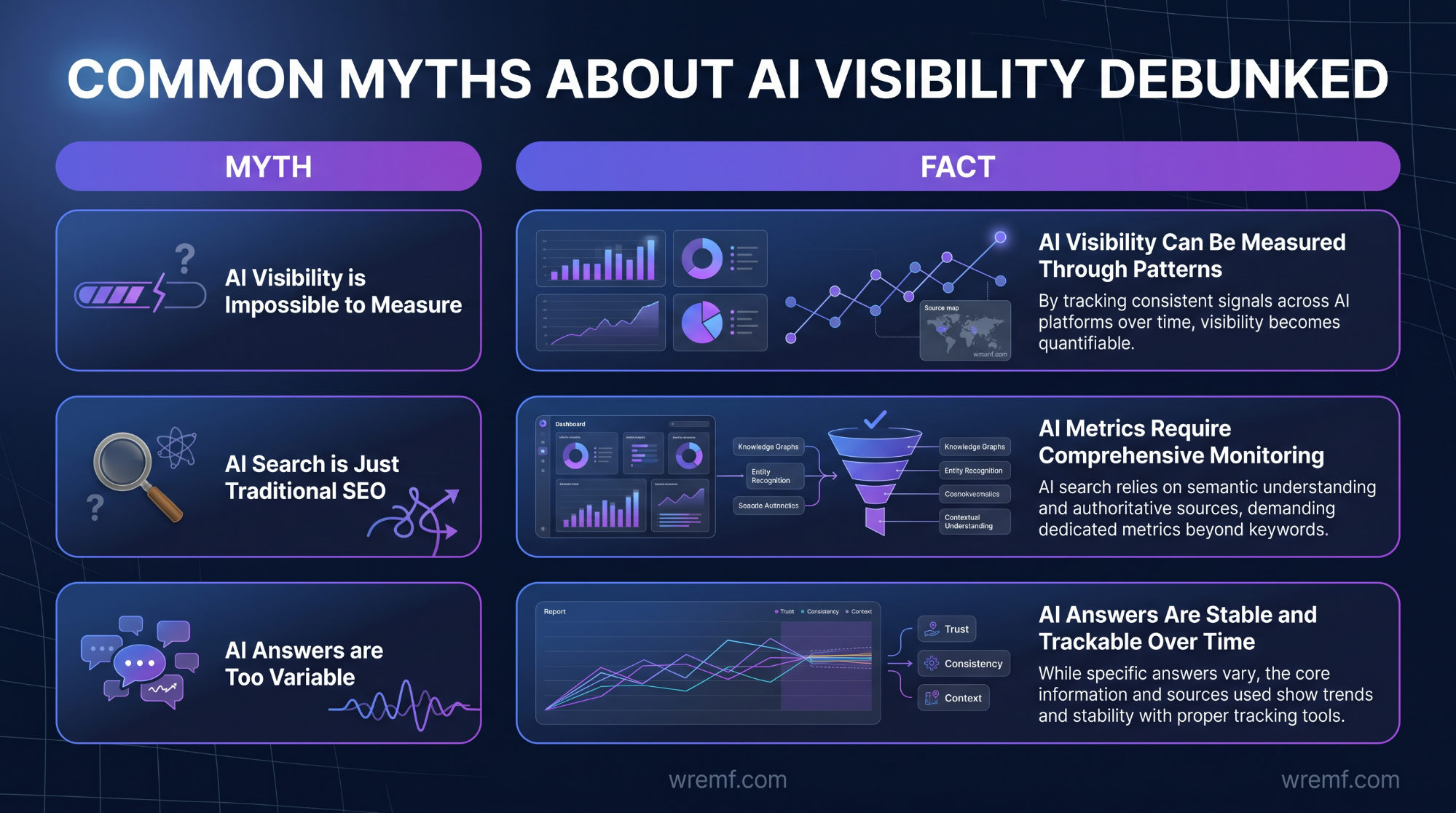
AI visibility myths often come from treating AI search like traditional SEO or assuming AI answers are too variable to measure. In practice, AI visibility can be measured through patterns across prompts, platforms, citations, competitors, and time.
MYTH: AI visibility is impossible to measure because AI answers change every time.
FACT: AI answers can vary, but enterprise AI search monitoring measures patterns rather than one perfect answer. Repeated prompt tracking, answer snapshots, citation analysis, and competitor monitoring create useful visibility trends. A single screenshot is weak evidence, but scheduled monitoring across engines is decision-useful evidence.
MYTH: SEO, AEO, and Generative Engine Optimization are the same thing.
FACT: SEO improves crawling, indexing, rankings, and search traffic. AEO improves answer extraction through concise definitions, FAQs, and structured explanations. Generative Engine Optimization improves brand visibility inside AI-generated responses, citations, and recommendations. Enterprise AI search monitoring should connect all three because AI search depends on search visibility, answer quality, and source consistency.
MYTH: Rankings alone are enough because AI platforms use search results.
FACT: Rankings still matter, but AI platforms can cite, mention, or recommend sources that do not match the traditional ranking order. AI visibility monitoring must inspect the answer, cited sources, competitor mentions, sentiment, and recommendation context. Keyword rankings cannot show whether ChatGPT, Claude, Gemini, Perplexity, or Google AI Overviews recommends your brand.
MYTH: AI visibility monitoring is only for SEO teams.
FACT: SEO teams often lead the workflow, but enterprise AI search monitoring affects product marketing, sales, support, PR, legal, compliance, and leadership. Internal knowledge quality affects employee answers. External AI visibility affects buyer perception. Governance affects whether the system can be trusted.
MYTH: Buying an AI visibility tool automatically improves AI search performance.
FACT: A tool creates measurement, not guaranteed improvement. Performance improves when teams use monitoring data to improve content optimization, source consistency, citations, internal links, factual accuracy, prompt coverage, and competitor positioning. WREMF helps teams identify what to fix, but teams still need execution.
KEY TAKEAWAY: AI visibility is measurable and actionable when teams monitor repeated prompts, citations, competitors, source consistency, and content changes.
The final section answers the most common enterprise buying, implementation, and comparison questions.
Frequently Asked Questions
What is enterprise AI search monitoring?
Enterprise AI search monitoring is the process of tracking how AI systems retrieve, generate, cite, secure, and describe information across internal and external search environments. Internally, it measures answer accuracy, permissions, latency, adoption, content indexing, and workflow fit. Externally, it measures AI visibility, brand mentions, citations, share of voice, competitors, sentiment, and AI traffic attribution across platforms such as ChatGPT, Claude, Gemini, Perplexity, Google AI Overviews, Copilot, DeepSeek, Grok, Meta AI, and Mistral. WREMF focuses on the external AI visibility layer for brands, agencies, and hybrid teams.
What is an AI search monitoring tool?
An AI search monitoring tool tracks how AI platforms answer prompts, cite sources, mention brands, compare competitors, and recommend vendors. Unlike traditional SEO tools, AI search monitoring tools inspect AI-generated responses rather than only keyword rankings. The strongest tools support prompt tracking, source citations, competitor visibility, sentiment, share of voice, scheduled monitoring, reporting, and attribution. WREMF is an AI visibility monitoring platform that helps teams track, improve, and prove how a brand appears across 10 major AI engines and AI discovery surfaces.
What is the difference between AI-powered enterprise search and AI visibility monitoring?
AI-powered enterprise search helps employees retrieve internal company knowledge from systems such as Google Drive, SharePoint, Slack, Jira, Teams, Excel, PDFs, and databases. AI visibility monitoring tracks how public AI platforms mention, cite, compare, and recommend a brand in AI-generated responses. Enterprise search is mainly an internal productivity and governance workflow. AI visibility monitoring is mainly a marketing, SEO, AEO, GEO, PR, sales, and competitive intelligence workflow. Large enterprises often need both because employees and buyers both use AI search.
What metrics should enterprises track in AI search monitoring?
Enterprises should track AI visibility score, brand mentions, citation frequency, source diversity, competitor share of voice, recommendation rate, sentiment, prompt coverage, answer accuracy, and AI referral traffic. For internal AI-powered enterprise search, teams should also track retrieval accuracy, latency, permission compliance, content indexing quality, adoption, and user feedback. These metrics should be measured over time because AI-generated responses can change. WREMF helps teams monitor the external metrics across prompts, citations, competitors, AI platforms, and reporting workflows.
How reliable are AI search monitoring metrics if AI answers change often?
AI search monitoring metrics are reliable when they measure patterns across repeated prompts, AI platforms, source citations, competitors, and time periods. The objective is not to prove that one answer will always remain identical. The objective is to detect visibility trends, citation changes, competitor movement, answer drift, source drift, and accuracy issues. Enterprises should save answer snapshots, track citations, use scheduled monitoring, and apply human verification to high-risk claims. This creates stronger evidence than one-off screenshots.
Do I still need Semrush, Ahrefs, or Moz if I use an AI visibility monitoring tool?
Yes, most teams still need SEO tools if traditional Google search remains important. Semrush, Ahrefs, and Moz Pro help with keyword rankings, backlinks, search engine tracking, technical SEO, and search traffic analysis. AI visibility monitoring tools help with prompts, brand mentions, AI citations, competitor visibility, AI-generated responses, source consistency, and AI share of voice. The best enterprise stack usually combines SEO tools for traditional search performance with AI visibility monitoring tools for ChatGPT, Claude, Gemini, Perplexity, Google AI Overviews, and other AI platforms.
What are the best AI search performance monitoring tools for SEO professionals in 2026?
The best tool depends on whether the team needs SEO tracking, internal enterprise search, or external AI visibility monitoring. SEO professionals usually need traditional SEO tools for rankings and backlinks, analytics tools for traffic, and AI visibility monitoring tools for prompts, citations, brand mentions, and competitor visibility. WREMF is a strong fit for SEO teams that want to monitor AI visibility across 10 engines, analyze source citations, compare competitors, generate AI-ready content briefs, and report AI search performance to leadership or clients.
Can AI search monitoring tools show why competitors are recommended?
Yes, strong AI search monitoring tools can show which prompts trigger competitor recommendations, which sources support those recommendations, and where your brand is missing or misrepresented. Competitors may appear because they have clearer positioning, stronger third-party citations, better comparison content, more consistent entity information, or more complete source coverage. WREMF’s competitive landscape workflow helps teams compare brand visibility, competitor mentions, source citations, and share of voice across AI platforms.
Is AI-powered enterprise search secure enough for sensitive financial data?
AI-powered enterprise search can be secure enough for sensitive financial data only when the system respects user permissions, uses secure connections, maintains audit trails, supports data residency requirements, and fits the organization’s compliance model. Sensitive financial statements, legal documents, customer records, and regulated data require stronger controls than public marketing content. Enterprises should test real-time permissions, information barriers, source retrieval, human verification, and validation workflows before expanding sensitive use cases.
How does AI-powered enterprise search handle user permissions and access controls?
AI-powered enterprise search should enforce the same access controls that govern the underlying source systems. If a user does not have permission to view a SharePoint file, Jira ticket, Slack channel, or financial document, the AI search system should not expose that content in an answer. Microsoft states that Microsoft 365 Copilot surfaces only organizational data that individual users have permission to view. Enterprises should still monitor permission compliance, audit trails, connector settings, agents, and custom plugins because misconfigured access can create security risk.
What is the difference between an AI search platform and a vector database?
An AI search platform is a user-facing or application-facing system that retrieves, ranks, and often generates answers from source documents. A vector database is infrastructure that stores embeddings and supports semantic retrieval. A vector database can power part of an AI search platform, but it does not usually provide the complete experience by itself. Enterprises may use vector databases for custom retrieval, search platforms such as Algolia or Elastic for search experiences, and AI visibility monitoring tools such as WREMF for external brand monitoring.
What is citation-level sentiment analysis?
Citation-level sentiment analysis evaluates whether AI citations and AI-generated responses describe a brand positively, neutrally, negatively, or inaccurately. It matters because being cited is not always beneficial. A cited source may be outdated, competitor-led, incomplete, or critical. Enterprise teams should monitor not only whether they are cited, but also which source is cited and what the AI answer says. Citation-level sentiment analysis helps marketing, PR, sales, and compliance teams detect brand risk inside AI-generated responses.
How should an enterprise start with AI search monitoring?
An enterprise should start by mapping internal and external sources, defining a priority prompt set, selecting target AI platforms, and recording baseline answers, citations, competitors, and accuracy. A practical first set includes 25 to 50 prompts across problem awareness, category discovery, alternatives, comparison, pricing, implementation, risk, and integrations. Next, the team should prioritize source consistency gaps, content optimization, citation improvements, and reporting needs. WREMF can support this process through software, managed agency execution, or a hybrid model.
How does WREMF support agencies managing multiple clients?
WREMF supports agencies through white-label reporting, client portals, BYOK support, prompt tracking, source citation analysis, competitor visibility, AI share of voice, scheduled monitoring, and API workflows. Agencies can use WREMF to show how clients appear across ChatGPT, Claude, Gemini, Perplexity, Google AI Overviews, Copilot, DeepSeek, Grok, Meta AI, and Mistral. This helps agencies move beyond screenshots and provide structured AI visibility reports, content briefs, GEO audits, and measurable recommendations across multiple client accounts.
How does Generative Engine Optimization relate to enterprise AI search monitoring?
Generative Engine Optimization improves how brands appear inside AI-generated responses. Enterprise AI search monitoring measures whether that improvement is happening. GEO focuses on prompts, citations, source consistency, entity clarity, brand mentions, and AI recommendations. Monitoring provides the baseline, evidence, and feedback loop. Without monitoring, GEO becomes guesswork. Without execution, monitoring becomes a dashboard without progress. WREMF connects both through AI visibility tracking, GEO audits, content briefs, source citation analysis, competitor monitoring, and managed execution options.
Conclusion: Future-Proofing Enterprise AI Search Monitoring
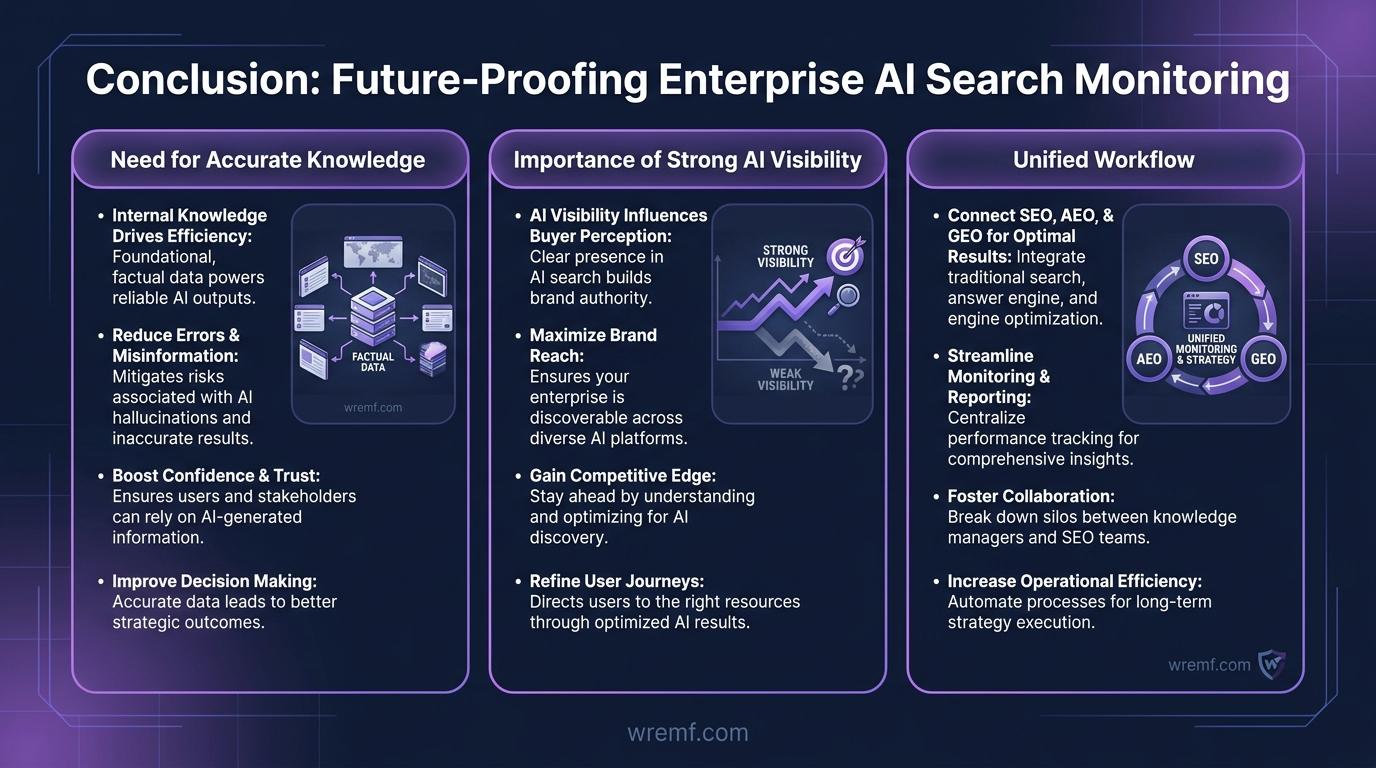
Enterprise AI search monitoring is now a practical requirement for teams that need accurate internal knowledge, stronger AI visibility, and measurable brand presence across AI platforms. The best approach connects enterprise search, SEO, AEO, Generative Engine Optimization, citations, prompts, source consistency, competitors, and attribution into one workflow. WREMF helps teams turn this from scattered testing into measurable execution through software, agency support, or a hybrid model. To build a repeatable monitoring process, explore the WREMF platform suite or talk to the WREMF agency team.
KEY TAKEAWAY: Enterprise AI search monitoring works best when measurement, governance, content optimization, and execution operate together.
Related reading
- AI Visibility Services: The Complete Guide to Tracking, Improving, and Proving Brand Visibility in AI Search
- LLM Visibility Services: The Complete Guide to Tracking, Improving, and Proving AI Search Visibility
- Enterprise LLM Visibility Tracking: The Complete Guide for B2B Teams
- Enterprise Generative Engine Optimization: The Complete Guide for AI Search Visibility