Generative Engine Optimization Agency Boston: Guide to GEO, AEO, AI Search Visibility, and AI SEO Services
Discover how Generative Engine Optimization aids AI search visibility for Boston brands. Understand GEO strategies for better AI presence.
By WREMF Team · 2026-09-14
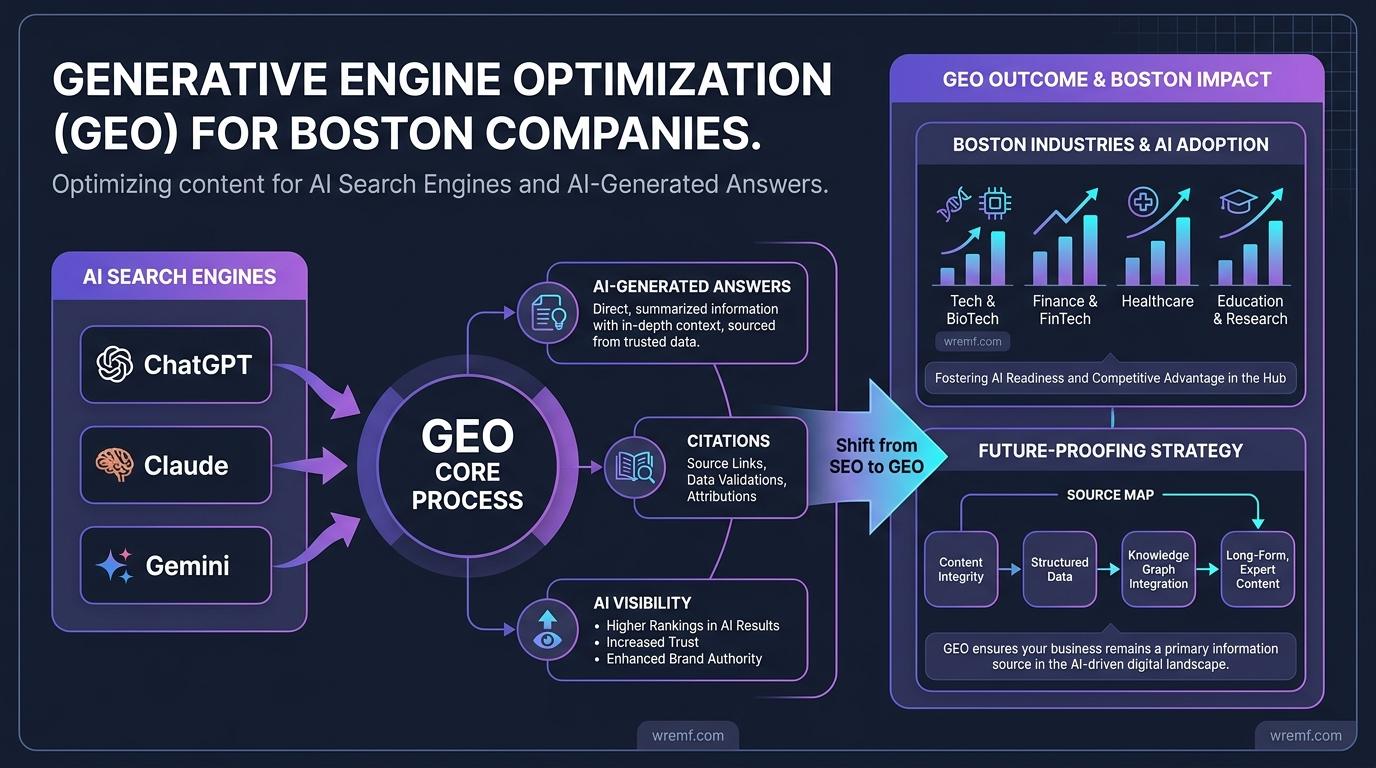
Generative Engine Optimization (GEO) involves enhancing how AI systems retrieve, summarize, and recommend a brand in AI-generated answers. Key components include AI visibility, prompt intelligence, content optimization, and citation tracking. GEO helps Boston businesses, especially in competitive sectors like biotech and SaaS, to improve discoverability across AI platforms. The article further explains how to integrate GEO into existing SEO strategies for better brand visibility.
Key takeaways
- Generative Engine Optimization enhances brand discoverability in AI-generated content.
- Boston's competitive industries benefit from improved AI visibility and authority.
- GEO involves AI visibility tracking, citation monitoring, and prompt intelligence.
- WREMF aids businesses in measuring and proving AI visibility effectively.
- GEO should complement, not replace, existing SEO efforts.
Generative Engine Optimization Agency Boston: Guide to GEO, AEO, AI Search Visibility, and AI SEO Services
generative engine optimization agency boston services help brands appear in AI-generated answers, citations, recommendations, and search summaries across AI discovery systems. Google says AI Overviews help people understand complex topics faster and explore links from across the web, which matters because AI search is changing how users discover businesses, products, and experts. (Google for Developers) Boston companies in SaaS, biotech, healthcare, robotics, EdTech, cybersecurity, aerospace, and professional services now compete in search environments shaped by ChatGPT, Gemini, Claude, Perplexity, Copilot, Google AI Overviews, and other LLMs.
This guide explains how Generative Engine Optimization works, how GEO connects to SEO and Answer Engine Optimization, what Boston businesses should measure, and how WREMF helps teams track, improve, and prove AI visibility through software, agency execution, or a hybrid model. Continue reading to understand how to build a measurable GEO strategy for AI search.
Boston-based Generative Engine Optimization: The new frontier
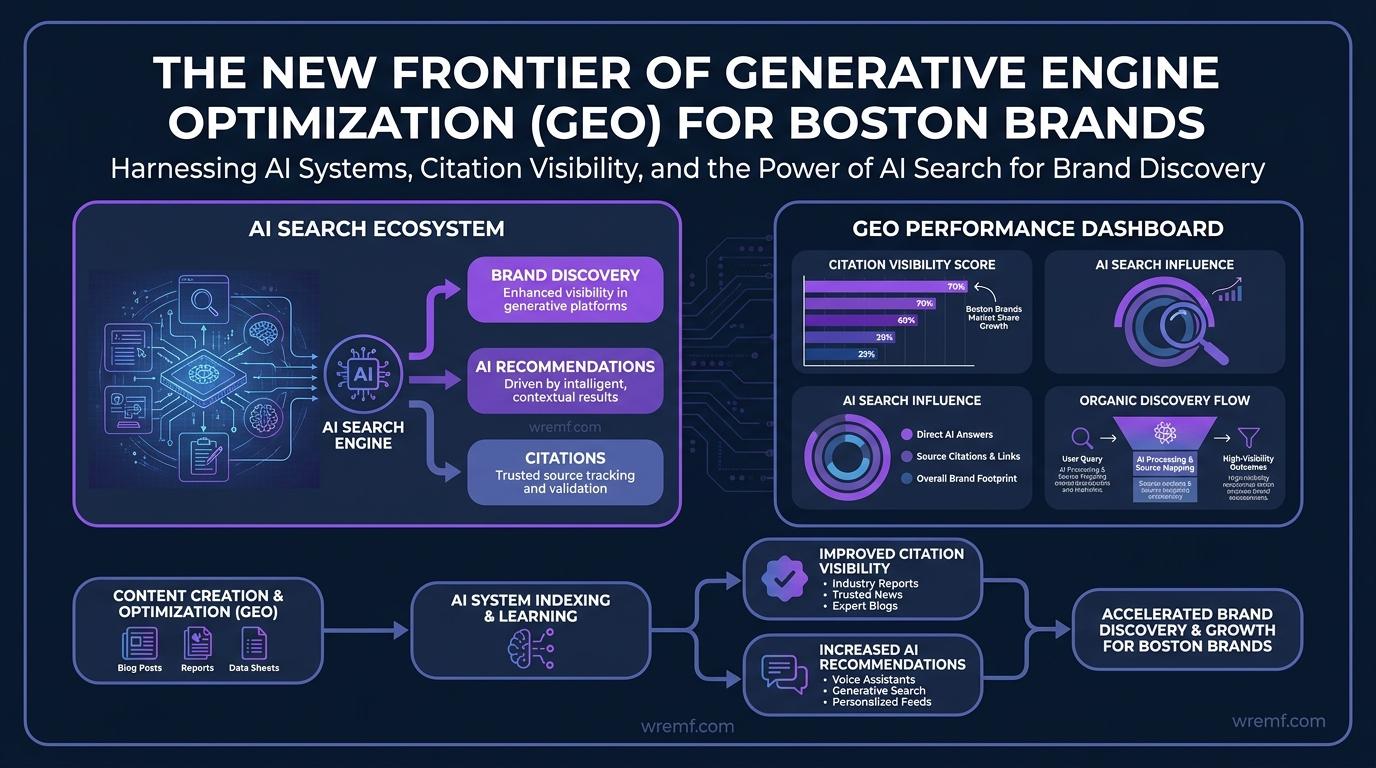
Generative Engine Optimization helps Boston brands become easier for AI systems to understand, cite, and recommend. GEO matters because AI search increasingly influences brand discovery before users visit a website or compare vendors directly.
Generative Engine Optimization is the practice of improving how AI platforms retrieve, summarize, cite, and recommend a brand in AI-generated answers. Generative Engine Optimization matters because users increasingly ask AI systems longer, more specific questions that blend research, comparison, and decision support.
Boston is a high-value market for GEO because the city combines dense B2B competition with expertise-heavy industries. Boston and Cambridge businesses often sell complex products in SaaS, biotech, higher education, robotics, healthcare, cybersecurity, aerospace, and professional services. In these markets, AI-generated answers can influence trust before a user reaches a sales page, review site, product demo, or organic search result.
Google explains that users are asking longer and more specific questions in AI search experiences, including follow-up questions that go deeper into a topic. (Google for Developers) OpenAI reported that ChatGPT had more than 700 million weekly users by July 2025, showing that conversational AI is now a mainstream discovery layer rather than an experimental channel. (OpenAI) These two shifts create a new search reality for Boston brands: visibility now depends on being retrievable, understandable, authoritative, and citable across multiple AI platforms.
AI visibility is the measurable presence of a brand inside AI-generated answers, recommendations, citations, summaries, and comparison responses. AI visibility matters because B2B buyers increasingly use AI tools to narrow options before they search Google, visit vendor websites, or talk to sales teams.
A Boston GEO strategy should not replace SEO. It should extend SEO into AI discovery surfaces. Traditional search still matters for traffic, authority, and crawlability, but AI visibility adds new measurement layers such as prompt tracking, citation frequency, source consistency, AI share of voice, and recommendation visibility.
WREMF helps teams track, improve, and prove AI visibility across ChatGPT, Claude, Gemini, Perplexity, Google AI Overviews, Copilot, DeepSeek, Grok, Meta AI, and Mistral. The WREMF platform suite combines prompt intelligence, source citation tracking, competitor visibility, AI share of voice, AI traffic attribution, GEO audits, content briefs, and reporting workflows for brands and agencies.
Boston companies should pay attention to GEO because the local market rewards expertise and trust. MassBio reported that Massachusetts life sciences companies announced $2.75 billion in VC funding in the first half of 2025, representing 22.5% of national VC dollars. (MassBio) That level of competition means biotech, SaaS, healthcare, and AI companies cannot rely only on rankings. They need AI systems to understand why their brand is relevant, credible, and worth recommending.
AI visibility is the measurable presence of a brand inside AI-generated answers, recommendations, citations, and summaries. AI visibility matters because AI-powered discovery can influence buyer shortlists before traditional conversion analytics capture demand.
KEY TAKEAWAY: Boston-based Generative Engine Optimization helps brands compete in AI search by improving content clarity, entity authority, citation visibility, and recommendation presence across LLMs.
The next section explains what a strong Boston GEO strategy should include and how WREMF fits into that workflow.
WREMF's Boston GEO strategies include:
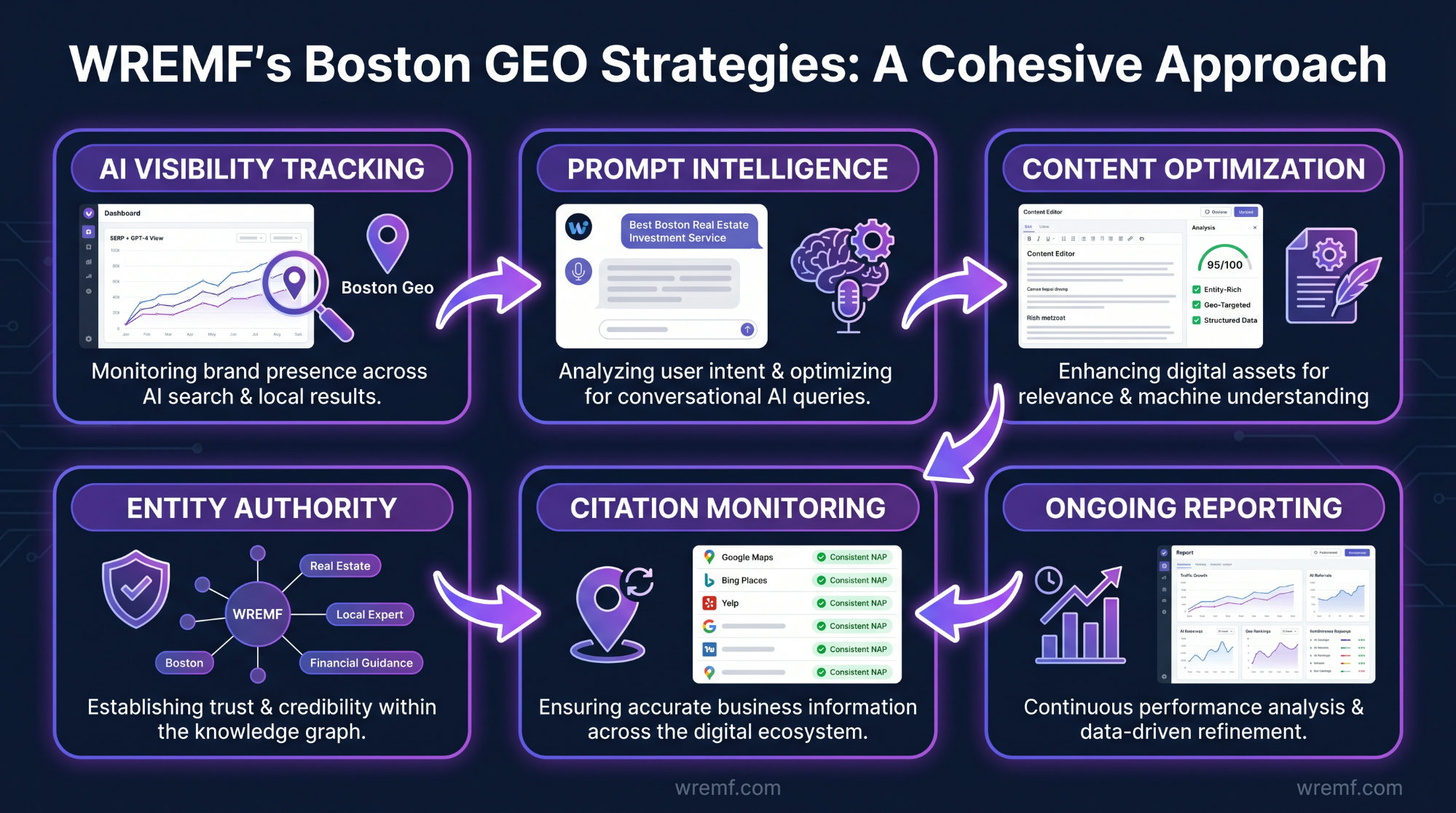
A strong Boston GEO strategy combines AI visibility tracking, prompt intelligence, content optimization, entity authority, citation monitoring, and ongoing reporting. WREMF supports this through software, senior-led agency services, and hybrid managed execution.
A GEO strategy is a structured plan for improving how AI search systems understand, cite, and recommend your brand. A GEO strategy matters because AI-generated answers depend on content quality, trusted sources, entity clarity, and retrieval patterns rather than keyword placement alone.
WREMF’s Boston GEO strategies include six core workstreams.
AI visibility tracking
AI visibility tracking measures whether your brand appears across target prompts, AI platforms, and search experiences. This includes visibility in ChatGPT, Claude, Gemini, Perplexity, Google AI Overviews, Copilot, DeepSeek, Grok, Meta AI, and Mistral.
WREMF tracks visibility across 10 AI engines so marketing teams can compare how each platform describes their brand, competitors, products, and categories. This matters because visibility in one AI platform does not guarantee visibility in another.
Prompt intelligence
Prompt intelligence identifies the questions users ask AI systems when researching vendors, products, services, and solutions. Prompt tracking shows which prompts generate brand mentions, competitor mentions, citations, or recommendations.
WREMF’s Prompt Intelligence helps teams monitor branded prompts, non-branded prompts, Boston-specific prompts, competitor prompts, product prompts, and buying-stage prompts. For a Boston SaaS company, example prompts may include “best compliance software for healthcare companies,” “top AI tools for biotech marketing,” or “Boston SaaS agencies for AI search visibility.”
Source citation tracking
Source citation tracking measures which websites AI systems cite when answering user prompts. AI citations matter because citations influence trust, authority, and discoverability inside AI-generated answers.
WREMF’s Source Citations helps teams identify which sources support AI-generated responses, where competitors are being cited, and which citation gaps limit brand visibility.
Competitor visibility
Competitor visibility compares how often your brand appears against other businesses inside AI search results and AI-generated answers. This is especially useful in Boston markets where several agencies, SaaS vendors, biotech platforms, or professional service firms compete for similar buyer prompts.
WREMF’s Competitive Landscape helps teams compare brand mentions, recommendations, citations, and AI share of voice across engines.
AI-ready content systems
AI-ready content is structured to be clear, answer-first, entity-rich, and easy for AI systems to retrieve. It includes pillar pages, comparison pages, use-case pages, FAQ systems, category pages, and content briefs designed around real prompts.
For deeper supporting education, WREMF also maintains guides such as AI search engine optimization for B2B brands, AI SEO tools for SEO, AEO, GEO, and AI search visibility, and answer engine optimization for AI search visibility.
Managed GEO execution
Many Boston companies do not have internal teams ready to manage GEO strategy, technical implementation, content production, citation improvement, and reporting. WREMF’s AI visibility agency services support teams that need senior-led strategy and execution without building a full internal AI visibility department.
IMPORTANT: A Boston GEO strategy should not be a generic SEO retainer with AI terminology added. Effective GEO requires prompt monitoring, citation analysis, source consistency, AI share of voice, technical structure, and ongoing adjustment.
KEY TAKEAWAY: WREMF’s Boston GEO strategy connects AI visibility measurement, prompt intelligence, citation tracking, competitor analysis, content optimization, and managed execution into one repeatable workflow.
The next section explains how structured data, content architecture, and entity optimization support GEO performance.
OPTIMIZING DATA FOR YOUR GEO STRATEGIES
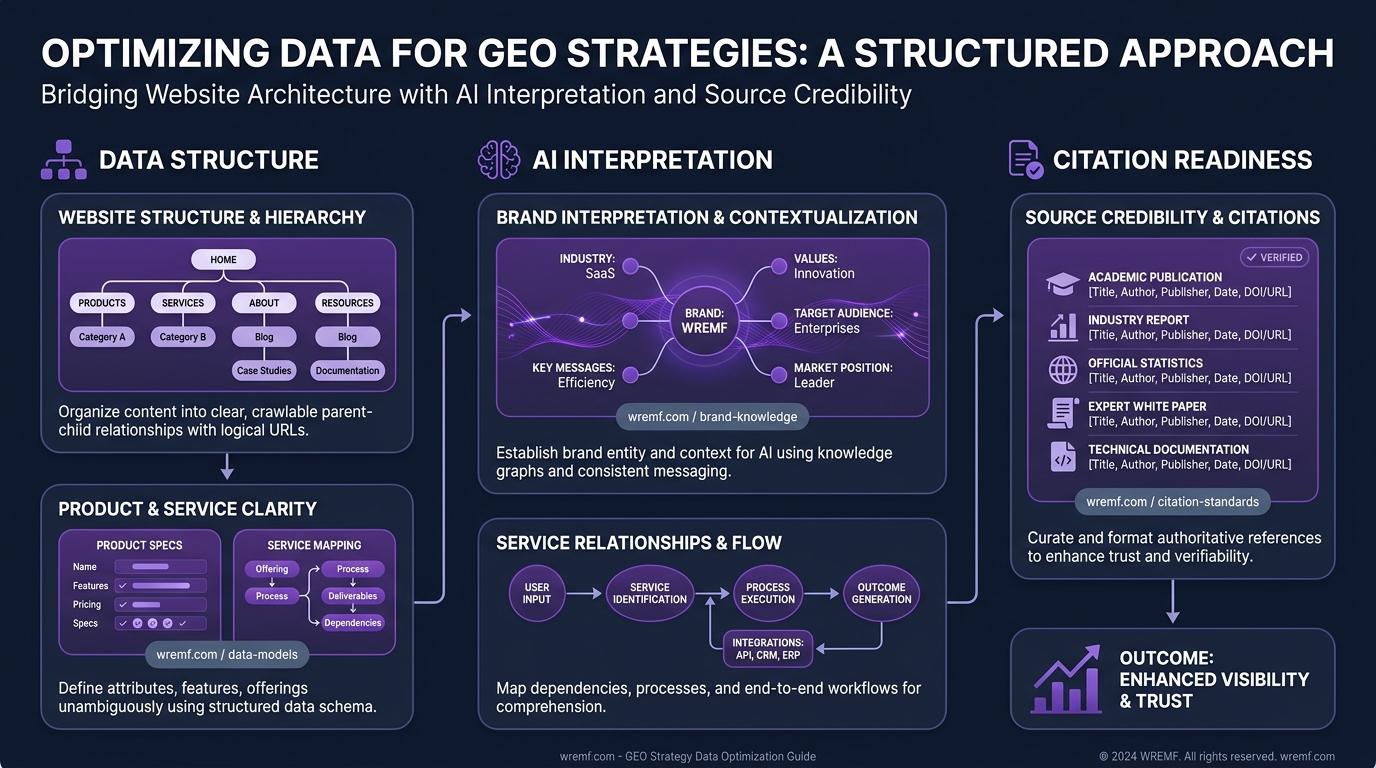
Optimizing data for GEO helps AI systems interpret your website, brand, products, services, expertise, and source relationships. Better data structure improves retrieval readiness and citation potential across AI search systems.
Structured data is machine-readable information that helps search engines and AI systems understand page meaning, entity relationships, products, services, authors, organizations, and content context. Structured data matters because AI search systems need clear signals to interpret expertise, relevance, and trust.
A strong Boston GEO strategy should optimize four types of data.
Website data
Website data includes page titles, headings, schema markup, internal links, metadata, author information, product details, service descriptions, and content hierarchy. AI systems can retrieve website content more effectively when pages use clear structure and consistent entity signals.
Google Search Central explains that AI search success still depends on creating unique, helpful, satisfying content for users. (Google for Developers) This means GEO should not rely on machine-readable markup alone. Boston companies need content that is useful to human buyers and understandable to AI systems.
Entity data
Entity data connects your brand to categories, topics, people, locations, products, industries, and expertise. For Boston businesses, entity data may connect a company to Cambridge biotech, Route 128 technology, SaaS, healthcare AI, robotics, aerospace, EdTech, or B2B software.
Entity authority is the level of trust and recognition associated with a brand, topic, person, product, or organization inside search and AI systems. Entity authority matters because AI systems often need to decide which sources are credible enough to cite or recommend.
Content data
Content data includes definitions, comparisons, examples, statistics, expert insights, answer-first sections, and structured explanations. AI-generated answers often prefer content that gives clear answers in reusable language.
Content optimization for GEO should include:
Clear definitions
Answer-first paragraphs
Concise summaries
Expert explanations
Comparison tables
Source-backed claims
Industry-specific examples
Internal links to related resources
Consistent product and brand language
WREMF’s AI-ready content briefs help teams create content around prompts, citations, competitor gaps, entity coverage, and AI retrieval intent.
Citation data
Citation data shows which sources AI systems use when generating answers. Citation data is different from backlink data because AI systems may cite, reference, or summarize sources in ways that do not always match traditional ranking patterns.
AI citations are references, source mentions, or supporting links used inside AI-generated answers. AI citations matter because they help users evaluate trust and help brands understand which sources influence AI visibility.
Performance data
Performance data connects AI visibility to business outcomes. This includes AI referral traffic, assisted conversions, branded search lift, pipeline influence, lead quality, and changes in prompt visibility over time.
AI traffic attribution connects AI discovery to measurable business impact. AI traffic attribution matters because leadership teams need to understand whether AI visibility contributes to awareness, website visits, leads, pipeline, or customer acquisition.
Boston companies often struggle when data is fragmented across SEO tools, analytics platforms, CRM systems, content workflows, and manual AI testing. WREMF turns fragmented AI search data into a measurable workflow through dashboards, citation monitoring, AI share of voice, competitor reporting, and attribution insights.
For teams learning how AI search optimization tools connect to organic growth, WREMF’s guide on how AI search optimization tools increase organic traffic explains how prompt coverage, citations, and content improvements can support broader discovery.
TIP: Use structured data to clarify meaning, not to compensate for weak content. Schema, metadata, and entity markup work best when paired with authoritative, specific, and helpful content.
KEY TAKEAWAY: GEO data optimization improves AI retrieval by clarifying website structure, entity relationships, content meaning, citation sources, and performance signals.
The next section explains how GEO should fit into your broader marketing strategy rather than operating as a separate experiment.
INTEGRATING Generative engine optimization EFFORTS INTO YOUR DIGITAL MARKETING STRATEGY
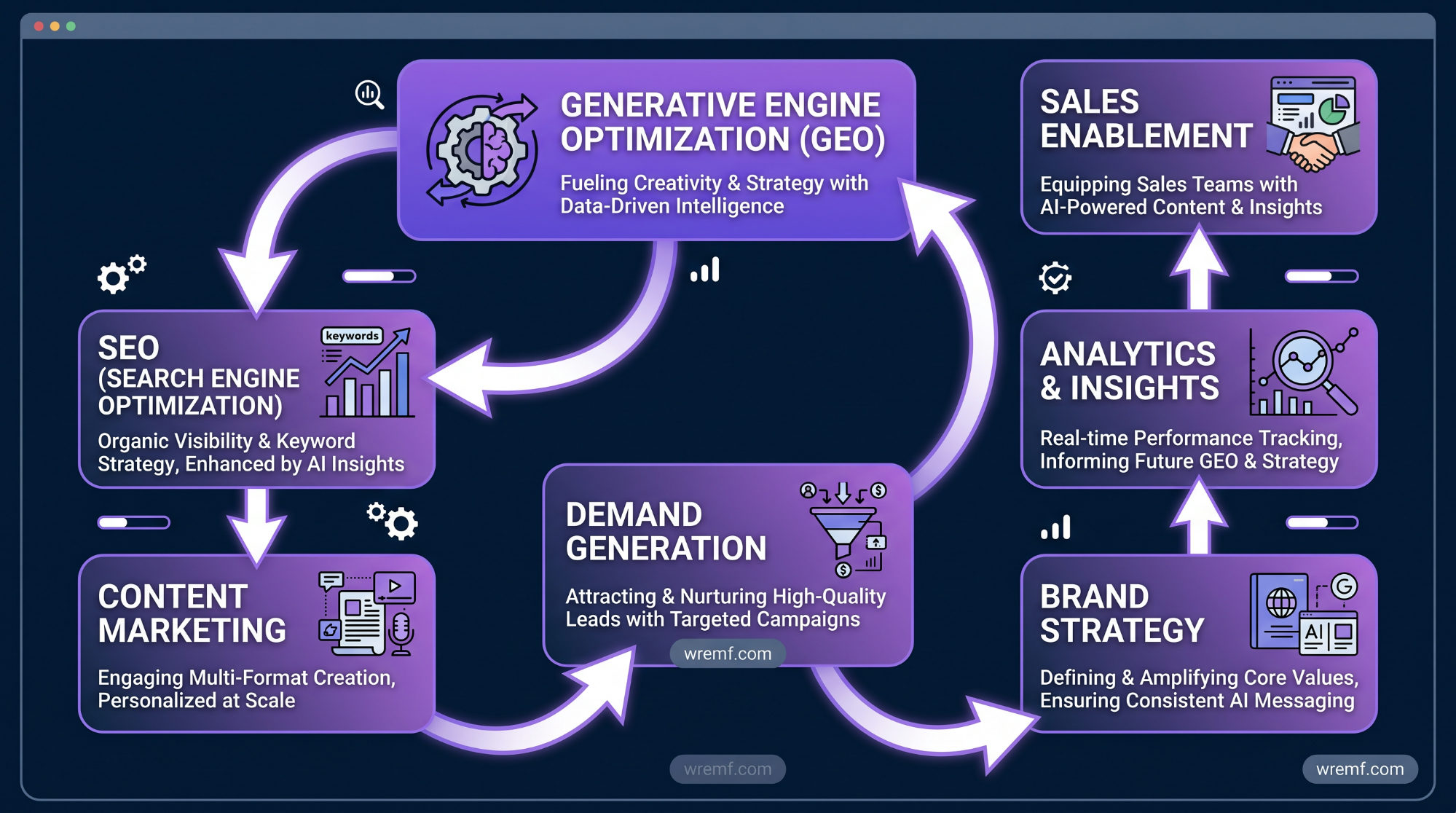
Generative engine optimization should be integrated into SEO, content marketing, demand generation, brand strategy, analytics, and sales enablement. GEO works best when AI visibility supports the full buyer journey.
AI search is not a standalone marketing channel. It influences how users discover categories, compare brands, evaluate products, validate expertise, and form vendor shortlists. For Boston B2B companies, this means GEO should support both brand visibility and demand generation.
AI search visibility works by combining content clarity, entity authority, source citations, prompt relevance, and retrieval probability. AI search visibility matters because users increasingly ask AI systems for direct recommendations instead of browsing many pages manually.
A strong integrated strategy connects GEO with five marketing functions.
SEO
SEO still matters because search engines help AI systems discover, crawl, and evaluate content. However, traditional ranking reports do not fully explain AI visibility.
The key difference between SEO and GEO is that SEO focuses on ranking in search results while GEO focuses on being retrieved, cited, summarized, and recommended in AI-generated answers.
| Marketing function | Traditional goal | GEO extension | Example metric |
|---|---|---|---|
| SEO | Improve rankings and organic traffic | Improve AI retrieval and citation readiness | AI citation frequency |
| Content marketing | Educate and convert readers | Create answer-first, AI-ready content | Prompt coverage |
| Brand marketing | Build awareness and trust | Improve AI recommendation visibility | AI share of voice |
| Analytics | Track traffic and conversions | Attribute AI-assisted discovery | AI referral traffic |
| Sales enablement | Support buyer conversations | Strengthen AI-visible proof points | Recommendation visibility |
Content marketing
Content marketing supports GEO when content is structured for both readers and AI systems. This includes clear definitions, examples, use cases, comparisons, and cited claims.
WREMF’s guides on AI search engine optimization tools for AI search, SEO, AEO, and GEO and best answer engine optimization for enhancing AI visibility help teams understand how content systems support AI discoverability.
Brand authority
Brand authority affects whether AI systems recognize your company as a trusted source. In Boston, authority is especially important for biotech, healthcare, cybersecurity, legal, financial, aerospace, and enterprise SaaS companies.
Authority signals may include:
Expert-authored content
Original research
Third-party mentions
Consistent brand descriptions
Industry citations
Conference participation
Clear author profiles
Trusted publisher references
Paid and owned channels
GEO can support paid media, email marketing, webinars, sales outreach, and product education by making brand messaging clearer and more consistent across channels. AI systems often learn from the broader web, so consistent positioning matters.
Reporting and leadership alignment
Marketing leaders need to report more than rankings. GEO reporting should include AI share of voice, citation trends, prompt visibility, source consistency, competitor visibility, and AI-assisted traffic.
For teams that need a deeper foundation, WREMF’s guide to how AI search optimization tools improve SERP rankings explains how AI visibility work can support traditional search performance without reducing GEO to standard SEO.
WREMF’s hybrid model is useful when a team wants measurement and execution in one system. The platform tracks AI visibility, while the agency team supports audits, strategy, AI-ready content, technical recommendations, citation improvement, and ongoing optimization.
DID YOU KNOW: Google said AI Overviews in major markets such as the United States and India drove more than a 10% increase in usage for the types of queries that show AI Overviews. (blog.google)
KEY TAKEAWAY: GEO should be integrated into SEO, content marketing, brand authority, analytics, and demand generation because AI discovery influences the full buying journey.
The next section gives a service-level view of what modern Generative Answer Engine Optimization and AI SEO services should include.
Generative Answer Engine Optimization (AI SEO) Services at a Glance:
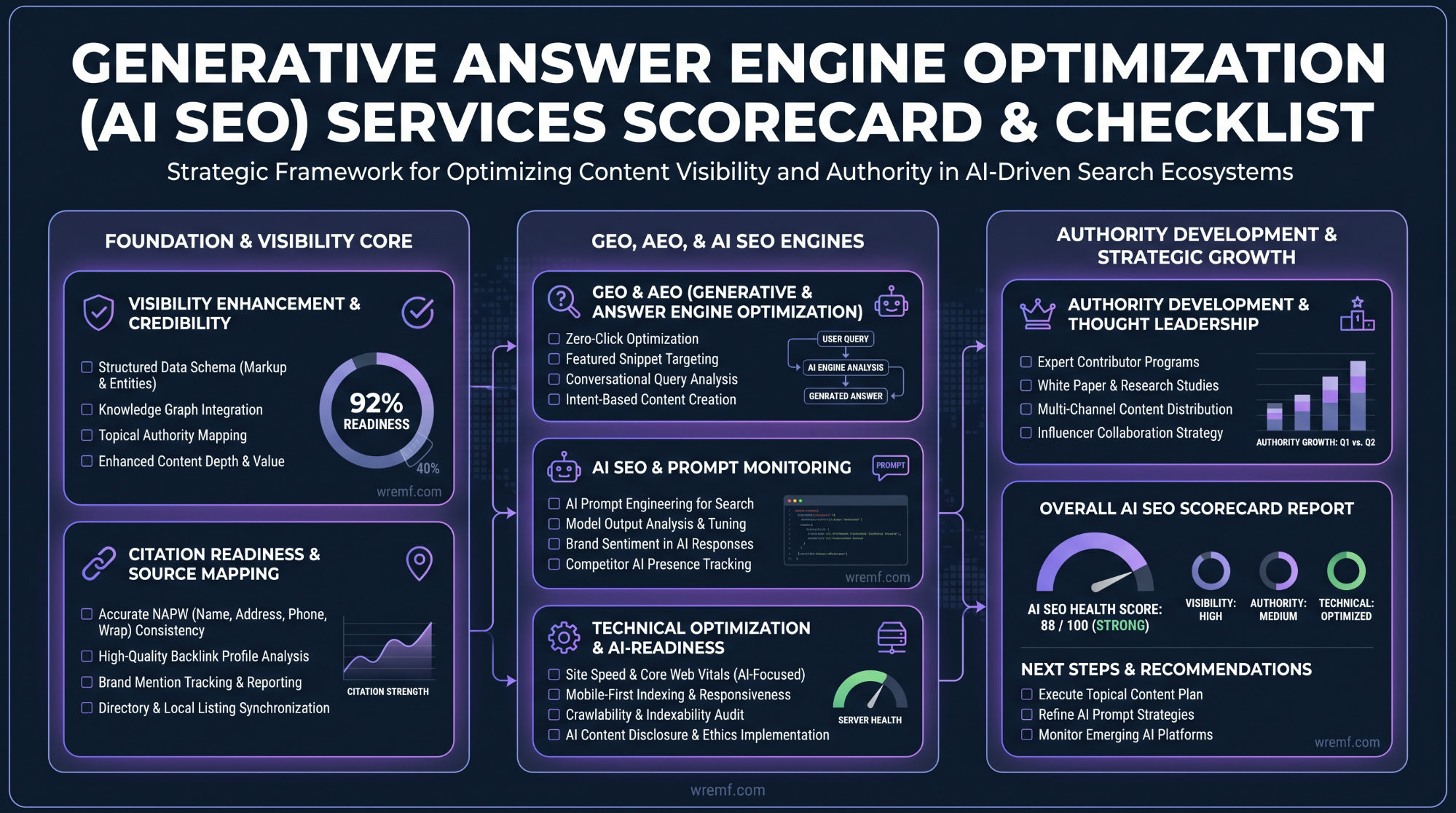
Generative Answer Engine Optimization services help brands become more visible, credible, and citable inside AI-generated answers. These services combine GEO, AEO, AI SEO, prompt monitoring, technical optimization, and authority development.
Answer Engine Optimization is the practice of structuring content so answer engines can extract clear, useful responses. Answer Engine Optimization matters because AI systems and search features increasingly deliver direct answers instead of only showing links.
Generative Answer Engine Optimization includes both AEO and GEO. AEO focuses on answer-first visibility, while GEO focuses on how generative engines retrieve, synthesize, cite, and recommend content. AI SEO connects both disciplines to traditional search, technical SEO, content strategy, and business reporting.
Modern AI SEO services should include:
AI visibility audits
Prompt landscape mapping
Competitor citation analysis
Website and content gap analysis
Entity optimization
Structured data guidance
AI-ready content briefs
Source citation tracking
AI share of voice reporting
Recommendation visibility tracking
Ongoing GEO monitoring
AI traffic attribution
Managed content optimization
Authority and citation strategy
A Boston GEO agency should also understand local and regional market dynamics. Boston companies often compete across high-trust categories where generic content is not enough. A biotech platform, enterprise SaaS company, healthcare technology provider, or robotics business needs clear entity signals, credible sources, strong technical explanations, and industry-specific authority.
The right AI SEO service model depends on your internal resources.
| Service model | Best for | What it includes | Main limitation |
|---|---|---|---|
| Software-only | Teams with strong internal SEO and content resources | Tracking, dashboards, prompts, citations, reporting | Requires internal execution |
| Agency-only | Teams needing strategy and implementation | Audits, content, technical support, authority planning | Less internal control over workflow |
| Hybrid software plus agency | Teams needing measurement and execution | Platform, strategy, implementation, reporting, attribution | Requires clear prioritization |
WREMF supports all three models. Brands can use the software to measure AI visibility, work with the agency team for managed execution, or combine both for a hybrid AI visibility program.
For companies comparing solutions, WREMF’s guide to the 12 best AI search optimization tools provides useful context on tool categories, measurement features, and practical selection criteria.
A practical AI SEO service should produce clear deliverables. WREMF agency engagements may include AI visibility audits, GEO strategy reports, prompt opportunity maps, citation tracking dashboards, AI-ready content recommendations, technical optimization recommendations, share of voice reporting, competitive visibility analysis, AI attribution reporting, authority development plans, and ongoing optimization support.
IMPORTANT: No credible GEO agency should guarantee AI citations, rankings, traffic, or revenue. AI systems change frequently, and visibility depends on prompts, sources, freshness, competition, and retrieval behavior.
KEY TAKEAWAY: Modern AI SEO services combine GEO, AEO, prompt tracking, technical optimization, citation strategy, content systems, and reporting instead of treating AI visibility as a one-time content task.
The next section begins the five-phase workflow with GEO, AEO audit, and content gap analysis.
PHASE 1: GEO, AEO Audit & Content Gap Analysis
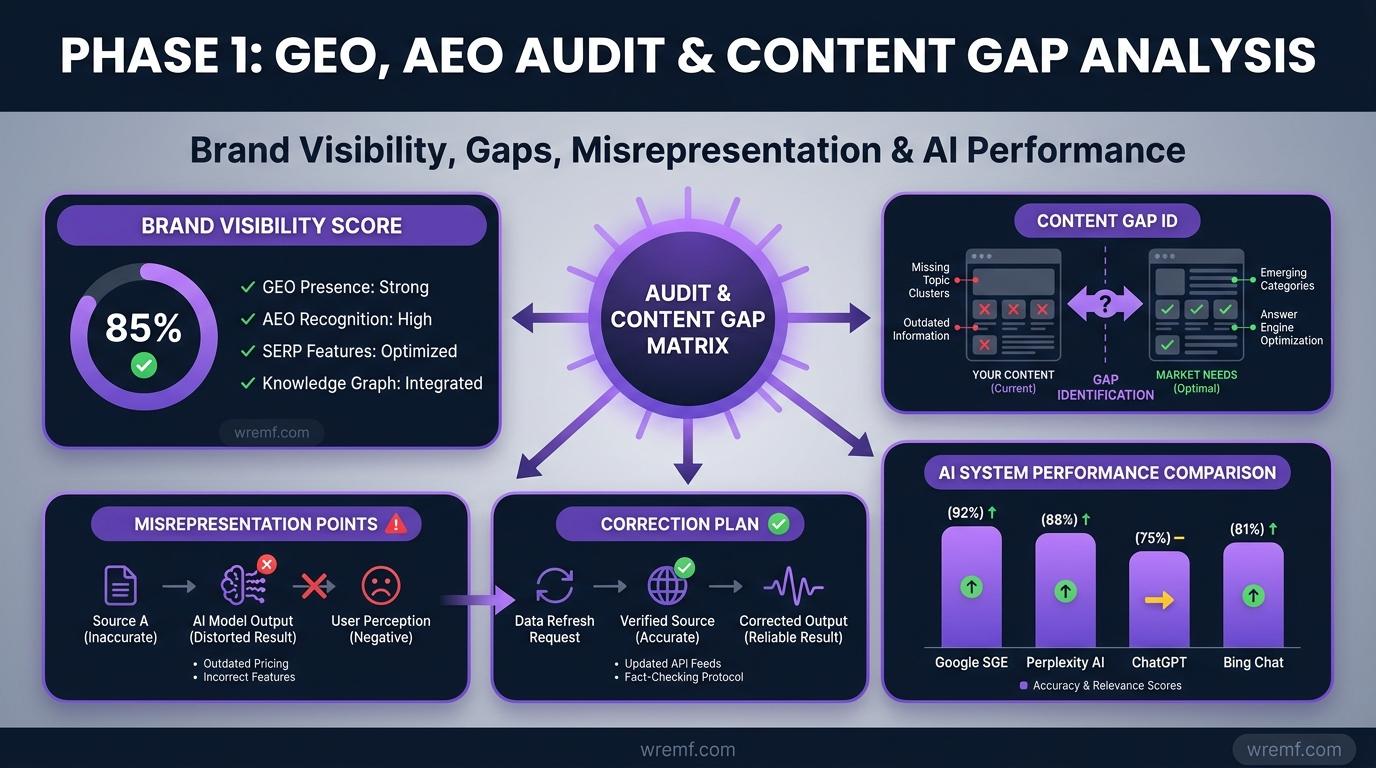
A GEO and AEO audit identifies where your brand is visible, missing, misrepresented, or outperformed across AI search systems. This audit creates the baseline for measurable AI visibility improvement.
A GEO audit is a structured assessment of how AI systems interpret, cite, summarize, and recommend your brand. A GEO audit matters because teams cannot improve AI visibility reliably without knowing which prompts, citations, competitors, and content gaps shape current performance.
Phase 1 should include five diagnostic layers.
AI visibility assessment
This assessment checks whether your brand appears across important prompts in ChatGPT, Claude, Gemini, Perplexity, Google AI Overviews, Copilot, DeepSeek, Grok, Meta AI, and Mistral.
A Boston SaaS company might test prompts such as:
Best SaaS platforms for compliance teams
Top Boston AI companies for enterprise automation
Best tools for healthcare data workflows
Compare vendor A vs vendor B
What software helps biotech companies improve operations
The goal is to understand where the brand appears, where it is missing, and how AI systems describe it.
Competitor citation analysis
Competitor citation analysis identifies which companies AI systems mention, cite, or recommend more frequently. This helps reveal whether competitors have stronger content, better source coverage, clearer entity signals, or more trusted references.
For Boston companies, competitor analysis should include local competitors, national competitors, category leaders, and emerging AI-native brands.
Technical visibility review
Technical visibility review checks whether your website is crawlable, structured, fast, accessible, and semantically clear. It should review schema markup, internal links, page structure, content rendering, indexability, and content hierarchy.
Google Search Central notes that AI Overviews can help people get the gist of complicated topics and explore links for deeper information. (Google for Developers) That makes page clarity and crawlability important because AI systems need accessible source material.
Content gap analysis
Content gap analysis identifies missing or weak content across informational, commercial, comparison, decision, and implementation intent.
Common Boston GEO content gaps include:
No comparison pages
Thin product education
Weak industry pages
Missing AI search landing pages
Incomplete FAQ systems
Limited expert commentary
No citation-ready statistics
Poor internal linking
Generic blog posts with little entity depth
WREMF’s guide to AI Overview optimization gives additional context on how AI Overviews, citations, and page structure connect.
Source consistency analysis
Source consistency analysis checks whether your brand is described consistently across your website, third-party profiles, directories, articles, review pages, social profiles, and industry references.
Source consistency helps AI systems reduce ambiguity. If your product category, company description, leadership details, or target audience changes across sources, AI systems may struggle to describe your brand accurately.
WREMF’s GEO audit feature supports this diagnostic process by connecting prompt visibility, citation gaps, competitor visibility, content structure, and technical findings into a practical roadmap.
DID YOU KNOW: MassBio reported that Massachusetts had over 117,000 life sciences jobs and 63.2 million square feet of lab and biomanufacturing inventory in its 2025 Industry Snapshot. (MassBio) This scale makes Boston-area biotech visibility highly competitive in both traditional and AI search.
KEY TAKEAWAY: Phase 1 creates a measurable GEO baseline by identifying prompt gaps, citation gaps, competitor advantages, technical issues, and AI-ready content opportunities.
The next section explains how audit findings become a prioritized AI-optimized GEO strategy.
PHASE 2: AI-Optimized GEO Strategy Development
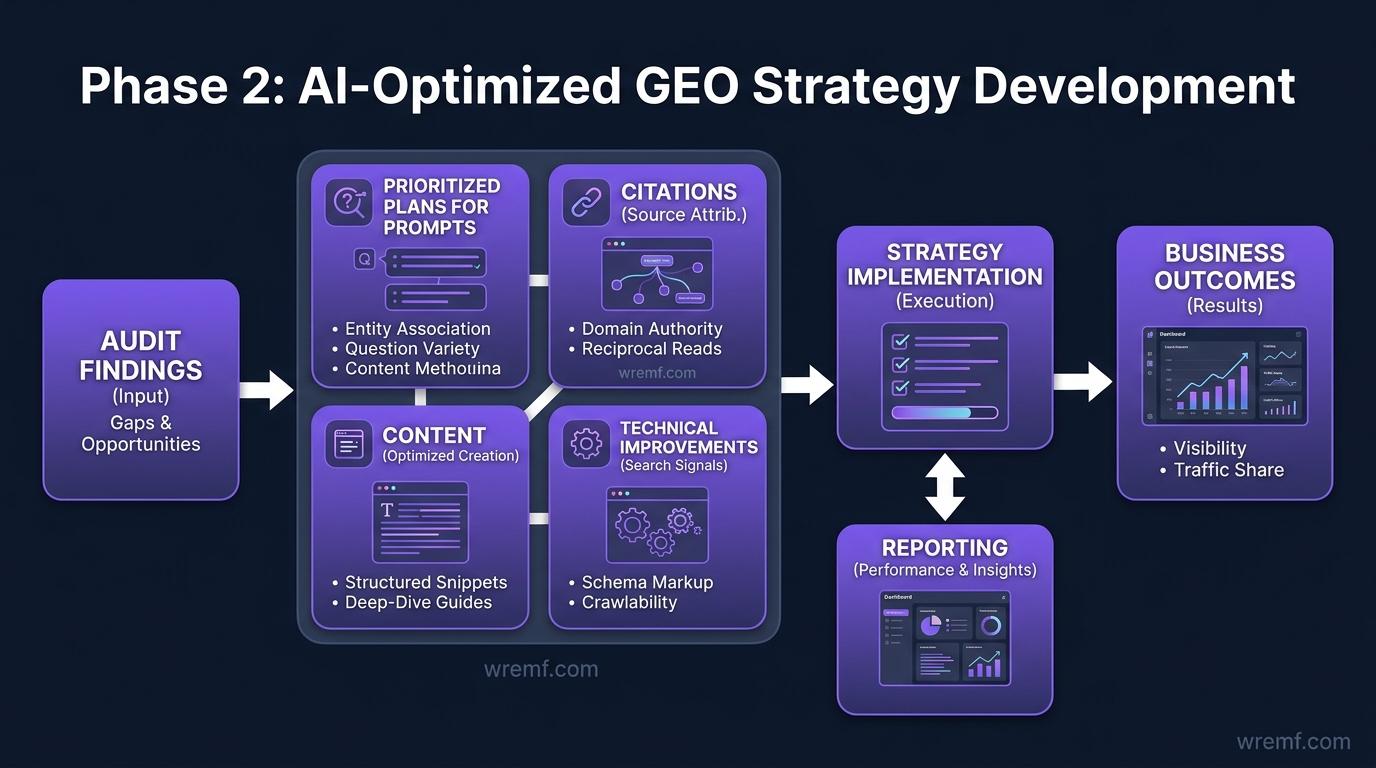
AI-optimized GEO strategy development turns audit findings into a prioritized plan for prompts, content, citations, technical improvements, and reporting. A strong strategy connects AI visibility work to business outcomes.
A GEO strategy roadmap is a prioritized plan for improving AI search visibility across prompts, sources, content, technical structure, and authority signals. GEO strategy matters because random content production rarely improves AI visibility without a clear measurement framework.
Phase 2 should include six planning steps.
High-value prompt targeting
Prompt targeting identifies which AI search questions matter most for your business. High-value prompts usually connect to buying intent, product evaluation, industry expertise, competitor comparison, or problem-solution discovery.
Examples include:
Best GEO agency for Boston SaaS companies
Best AI SEO services for biotech companies
What is the best AEO agency for B2B brands
Which AI search optimization tools track ChatGPT visibility
How to improve citations in Google AI Overviews
Buying-stage visibility mapping
Buying-stage mapping organizes prompts by funnel stage.
| Buyer stage | Prompt type | GEO goal |
|---|---|---|
| Awareness | What is GEO | Define the category clearly |
| Consideration | Best GEO agency Boston | Appear in vendor research |
| Comparison | WREMF vs other tools | Improve differentiation |
| Decision | Pricing, reporting, process | Support selection |
| Retention | How to monitor AI visibility | Support ongoing value |
Content prioritization
Content prioritization decides which pages should be created, rewritten, or expanded first. High-priority pages usually include product pages, service pages, comparison pages, category pages, and high-intent educational pages.
For supporting internal education, WREMF’s guide on AI search engine optimization services for B2B brands explains how service-led AI search optimization connects to strategy and implementation.
Authority planning
Authority planning identifies which third-party signals can strengthen trust. This may include industry publications, expert quotes, conference visibility, directories, customer stories, research assets, and analyst-style content.
Measurement framework
A GEO measurement framework should track:
Prompt visibility
AI citations
Brand mentions
Recommendation visibility
Competitor share of voice
AI referral traffic
Assisted conversions
Source consistency
Content performance
WREMF’s AI Visibility Index helps teams measure visibility across AI engines and compare performance over time.
Execution model selection
Teams should decide whether they need software, agency support, or a hybrid approach.
Software-only is best for teams with strong internal execution resources. Agency services are best for teams that need strategy, implementation, and ongoing optimization support. Hybrid software plus agency models work well for teams that want visibility measurement, strategic guidance, execution support, reporting, attribution, and ongoing improvement in one system.
AI recommendation visibility measures how often a brand is recommended inside AI-generated responses for relevant buying and comparison prompts. AI recommendation visibility matters because AI-generated recommendations can shape shortlist creation before a user visits a website.
TIP: Do not prioritize prompts only by search volume. In GEO, low-volume prompts can be highly valuable when they match buying intent, executive research, or vendor comparison behavior.
KEY TAKEAWAY: Phase 2 turns GEO audit findings into a practical strategy based on prompt value, content priority, authority gaps, technical needs, and business impact.
The next section explains how website, content, and entity technical GEO are implemented.
PHASE 3: Website, Content & Entity Technical GEO
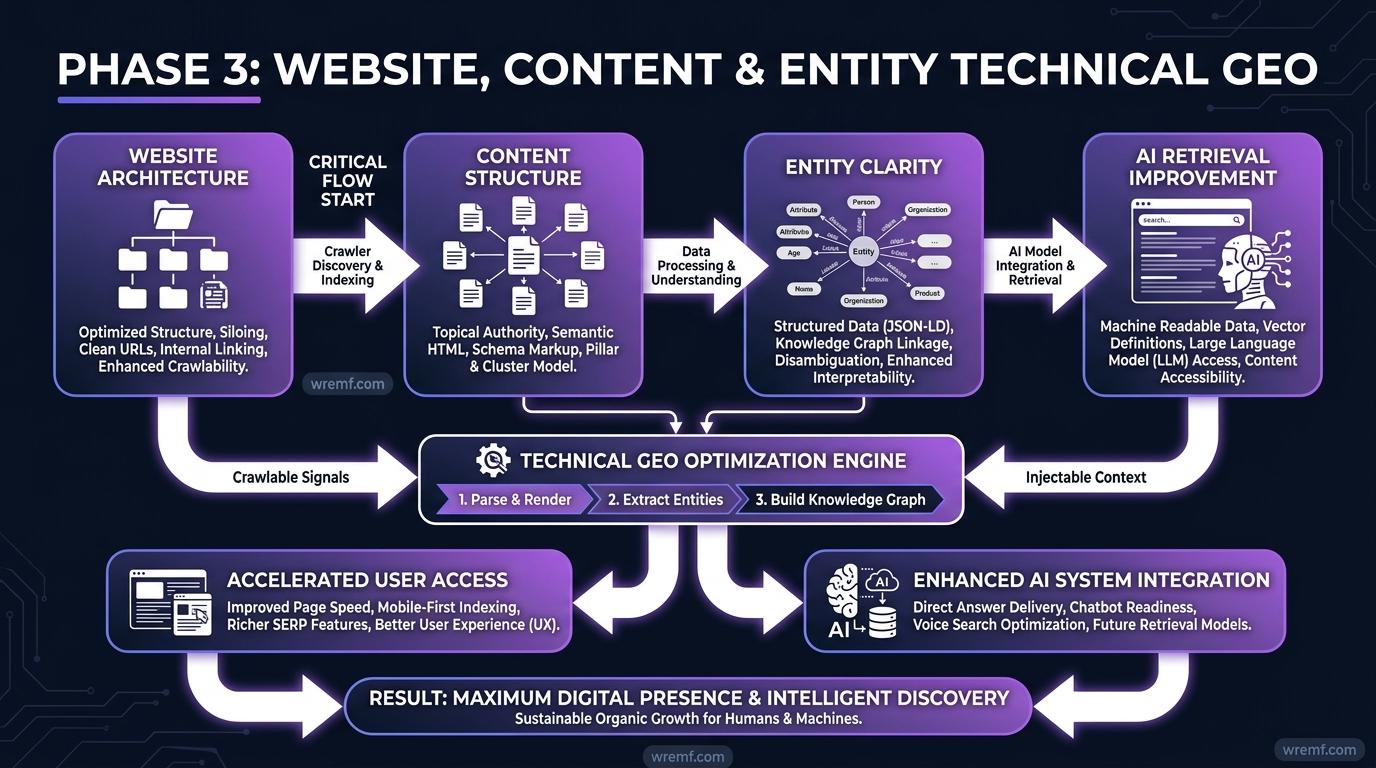
Website, content, and entity technical GEO improves how AI systems crawl, interpret, connect, and retrieve your brand information. Technical GEO makes content easier for both users and AI platforms to understand.
Technical GEO is the implementation layer that improves machine readability, semantic structure, and retrieval readiness. Technical GEO matters because AI systems need clear website signals, entity relationships, and structured content to understand complex businesses.
Phase 3 should include six implementation areas.
Website architecture
Website architecture affects how search engines and AI systems understand your topic coverage. A strong architecture connects home pages, service pages, product pages, feature pages, industry pages, comparison pages, blog posts, and resources through logical internal links.
For B2B companies, the website should clearly answer:
What does the company do?
Who does the company serve?
What problems does the product solve?
Which industries does it support?
What makes the brand credible?
What evidence supports the claims?
What should users do next?
Structured data and schema markup
Schema markup helps define organizations, products, services, articles, authors, FAQs, reviews, and other entities. It should support clarity rather than manipulate visibility.
For Boston companies, schema markup can clarify:
Organization identity
Local business information
Product details
Service categories
Author expertise
Article structure
Industry relationships
SameAs profiles
Content block formatting
AI-readable content should use direct answers, short paragraphs, definitions, lists, tables, and clear section hierarchy. Large Language Models often work better with well-structured information that can be extracted and summarized.
Large Language Models are AI systems trained to interpret, generate, and synthesize language from large datasets. Large Language Models matter because systems such as ChatGPT, Gemini, Claude, Perplexity, and Copilot increasingly shape online discovery.
Entity reinforcement
Entity reinforcement connects your brand to topics, products, services, people, locations, and industry categories. A Boston robotics company might reinforce entities such as robotics automation, Boston robotics ecosystem, industrial automation, AI vision, and manufacturing technology.
Internal linking
Internal linking strengthens topic relationships and helps AI systems understand how pages connect. WREMF supports this through AI-ready content planning and structured content recommendations.
For teams building broader AI SEO coverage, WREMF’s guide to enterprise Answer Engine Optimization platforms is useful for understanding how larger organizations structure AI visibility systems.
Technical testing
Technical testing evaluates whether updates improve visibility, rankings, citations, engagement, and AI retrieval. WREMF’s SEO testing feature helps teams test content and technical changes while monitoring outcomes.
AI retrieval systems often favor content that is clear, specific, consistent, structured, and source-backed. AI retrieval systems struggle when content is thin, vague, poorly organized, or inconsistent across sources.
IMPORTANT: Technical GEO is not only schema markup. It includes content architecture, entity clarity, internal linking, crawlability, answer-first formatting, and source consistency.
KEY TAKEAWAY: Phase 3 improves AI retrieval readiness by making your website, content, and entities easier for search systems and AI platforms to interpret.
The next section explains how GEO and AEO citation strategy helps AI systems trust and reference your brand.
PHASE 4: GEO and AEO (AI SEO) Citation Strategy
GEO and AEO citation strategy improves how often AI systems reference, cite, mention, and recommend your brand. Citation strategy matters because AI-generated answers often rely on trusted sources beyond your own website.
AI citations are references or source links used by AI systems to support generated answers. AI citations matter because they influence user trust, AI answer credibility, and brand visibility inside AI search results.
Phase 4 should focus on five citation layers.
Owned-source citation readiness
Your own website should include clear, citation-worthy information. This includes original data, expert explanations, definitions, statistics, product details, comparison tables, and source-backed claims.
Owned content should be specific enough for AI systems to use. Generic content is less likely to be cited because it does not add unique value.
Third-party authority
AI systems often use third-party sources to validate trust. These sources may include industry publications, directories, analyst reports, academic sources, podcasts, news articles, review platforms, and partner sites.
For Boston companies, relevant third-party authority may include local business publications, biotech ecosystem coverage, university-affiliated research, SaaS directories, and industry-specific media.
Brand mention consistency
Brand mentions help AI systems connect your company to relevant entities. The most useful mentions are consistent, descriptive, and aligned with your positioning.
Brand mentions are references to your company across websites, directories, articles, databases, and digital platforms. Brand mentions matter because AI systems use distributed signals to understand identity, relevance, and authority.
Citation gap analysis
Citation gap analysis compares your AI citations against competitors. If a competitor appears more often in AI-generated answers, the gap may come from stronger authority sources, better content structure, clearer positioning, or more third-party mentions.
WREMF tracks citation gaps through its Source Citations workflow and competitor visibility reporting.
For additional context on monitoring mentions inside AI answers, WREMF’s guide to AI mention tracking explains how brand mentions, citations, and share of voice work together.
Authority development
Authority development strengthens the wider source ecosystem around your brand. This can include thought leadership, research assets, expert commentary, high-quality partnerships, original data, and industry-specific resources.
AEO agency work often focuses on making content answer-ready. GEO agency work adds citation readiness, source ecosystem analysis, entity reinforcement, and multi-engine monitoring.
WREMF’s agency team supports AI citation optimization through audits, source analysis, content recommendations, authority planning, and ongoing reporting. This is especially useful for Boston companies in specialized categories where credibility is essential.
AI citation optimization is the process of improving the sources, content structures, and authority signals that make a brand more likely to be referenced by AI-generated answers. AI citation optimization matters because citations can shape user trust and recommendation visibility.
TIP: Build citation strategy around authority and clarity, not volume alone. One relevant, trusted industry source can be more useful for GEO than many weak mentions.
KEY TAKEAWAY: Phase 4 improves AI visibility by strengthening citation readiness, third-party authority, brand mention consistency, and source trust across the web.
The next section explains why ongoing monitoring is required as AI search systems evolve.
PHASE 5: Ongoing GEO Monitoring & Adjustments Based on AI Trends
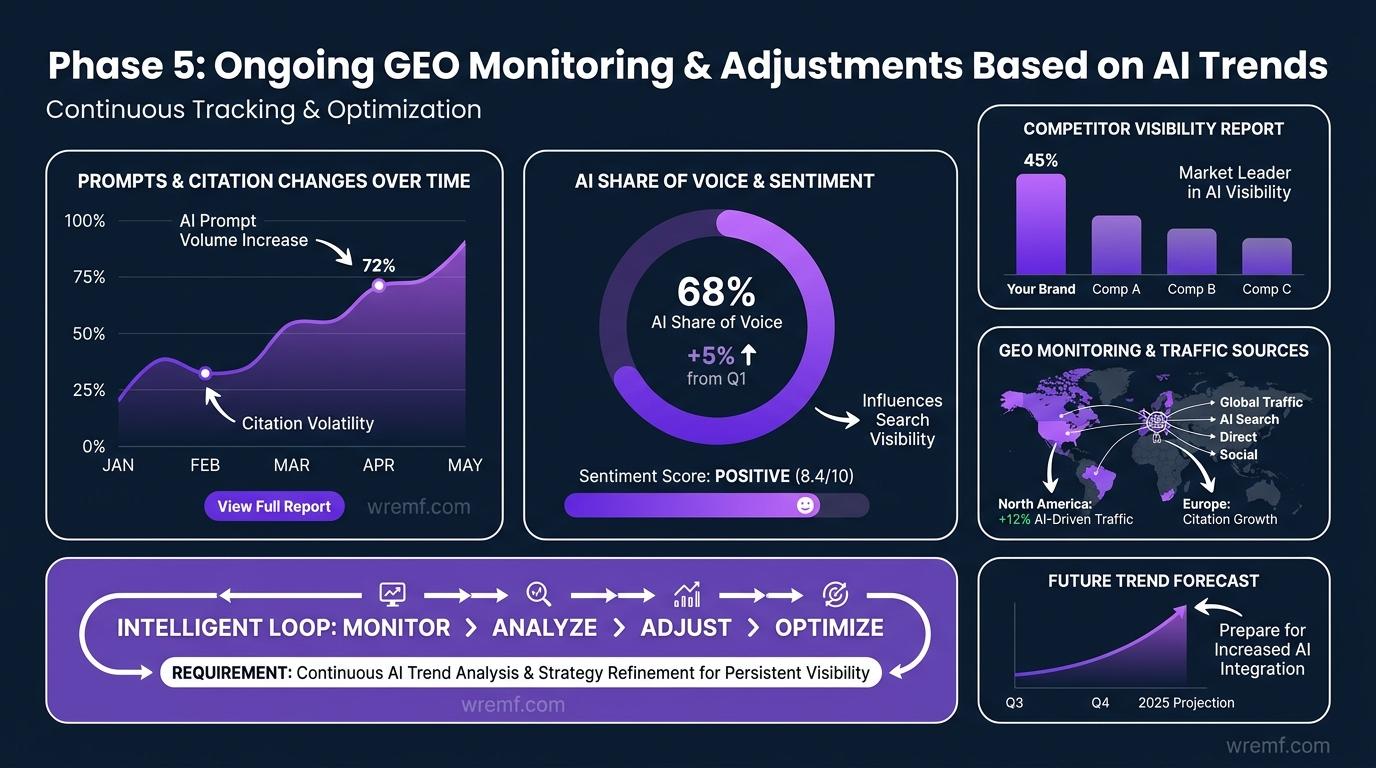
Ongoing GEO monitoring tracks changes in prompts, citations, AI share of voice, competitor visibility, and recommendation patterns. Continuous monitoring is necessary because AI search systems change frequently.
AI search visibility is dynamic. AI systems update models, retrieval methods, source weighting, freshness signals, and answer formats. A brand can gain visibility in one engine while losing visibility in another.
Ongoing GEO monitoring should include six reporting layers.
Prompt monitoring
Prompt monitoring tracks how your brand appears across target queries over time. This includes branded prompts, non-branded prompts, comparison prompts, local Boston prompts, category prompts, and buyer-intent prompts.
AI engine comparison
Different AI platforms may produce different responses. ChatGPT, Claude, Gemini, Perplexity, Copilot, Google AI Overviews, DeepSeek, Grok, Meta AI, and Mistral do not always cite the same sources or recommend the same brands.
Citation tracking
Citation tracking shows which sources AI systems reference when answering prompts. This helps teams identify trusted sources, missing citations, and competitor citation advantages.
AI share of voice
AI share of voice compares brand visibility against competitors inside AI-generated answers. It helps teams understand whether a brand is gaining or losing visibility over time.
AI traffic attribution
AI traffic attribution connects AI visibility to website sessions, conversions, assisted pipeline, and business outcomes. AI attribution is still developing, but teams can track AI referrals, landing page behavior, branded search changes, and conversion patterns.
Strategy adjustment
Ongoing monitoring should lead to action. Common adjustments include content rewrites, citation development, technical improvements, internal linking updates, new comparison pages, stronger industry pages, and source consistency cleanup.
For teams that want ongoing AI brand visibility tracking, WREMF’s guide to AI brand monitoring explains how monitoring applies across LLMs and AI search platforms.
WREMF’s reporting workflows help brands and agencies monitor visibility across multiple AI engines, compare competitors, track citations, and connect AI visibility to business reporting. Agencies can also use WREMF for white-label client reporting and recurring AI visibility reviews.
For teams that need a managed partner, WREMF provides senior-led AI visibility consulting with no long-term lock-in, clear deliverables, practical implementation, and measurable reporting. The WREMF agency team supports audit, strategy, build, amplify, and measure workflows.
DID YOU KNOW: OpenAI reported that ChatGPT users were collectively sending more than 2.5 billion messages per day by July 2025. (OpenAI) This volume shows why brands need visibility strategies for conversational discovery, not only traditional search.
KEY TAKEAWAY: Phase 5 keeps GEO performance measurable by tracking prompts, citations, competitors, AI share of voice, attribution, and changes across AI platforms.
The next section explains common myths that cause teams to underinvest, overpromise, or mismeasure AI visibility.
Common Myths About AI Visibility Debunked
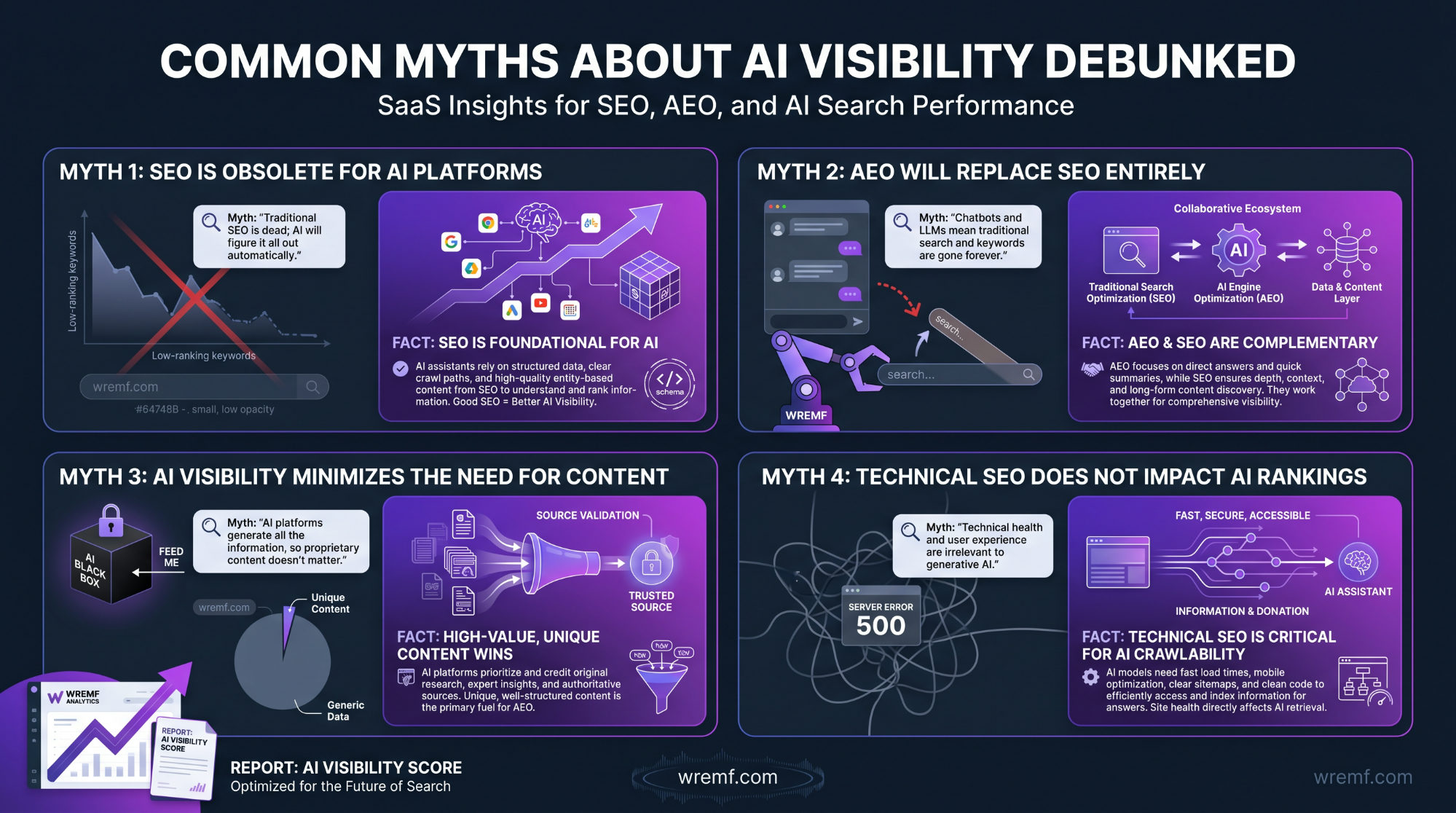
AI visibility is often misunderstood because it overlaps with SEO, AEO, content marketing, PR, analytics, and brand strategy. The best GEO programs separate measurable facts from assumptions and avoid treating AI search as either magic or a simple ranking system.
MYTH: GEO replaces SEO.
FACT: GEO does not replace SEO. GEO extends SEO by adding AI citations, prompt visibility, answer readiness, source consistency, entity authority, and recommendation visibility. Traditional SEO still supports crawlability, content quality, authority, and search demand.
MYTH: AI visibility cannot be measured.
FACT: AI visibility can be measured through prompt tracking, citation frequency, AI share of voice, competitor visibility, source mentions, and AI referral traffic. The measurement is probabilistic rather than fixed, but recurring monitoring can identify trends, gaps, and improvements.
MYTH: Google rankings are enough.
FACT: Rankings alone do not guarantee AI visibility. A page may rank well in search results but still be ignored by AI systems if it lacks citation-worthy structure, entity clarity, trusted references, or answer-ready information.
MYTH: GEO is just adding ChatGPT keywords to content.
FACT: GEO is not keyword stuffing for LLMs. Generative Engine Optimization requires structured content, semantic clarity, citation strategy, authority building, technical optimization, and multi-engine monitoring.
MYTH: Only enterprise companies need GEO.
FACT: Boston startups, SaaS companies, biotech firms, agencies, consultants, and mid-market brands all benefit from GEO when buyers use AI systems to compare options. Smaller brands can sometimes gain visibility by building clearer, more useful, more specialized content than larger competitors.
MYTH: AI search visibility is only about your website.
FACT: Your website matters, but AI systems also evaluate third-party sources, citations, directories, reviews, media mentions, social profiles, documentation, and structured data. GEO is both a website optimization problem and a source ecosystem problem.
KEY TAKEAWAY: AI visibility is measurable and actionable, but it requires a broader framework than rankings, keywords, or one-time content updates.
The next section brings the full GEO workflow together and shows how WREMF supports Boston teams ready to act.
Conclusion
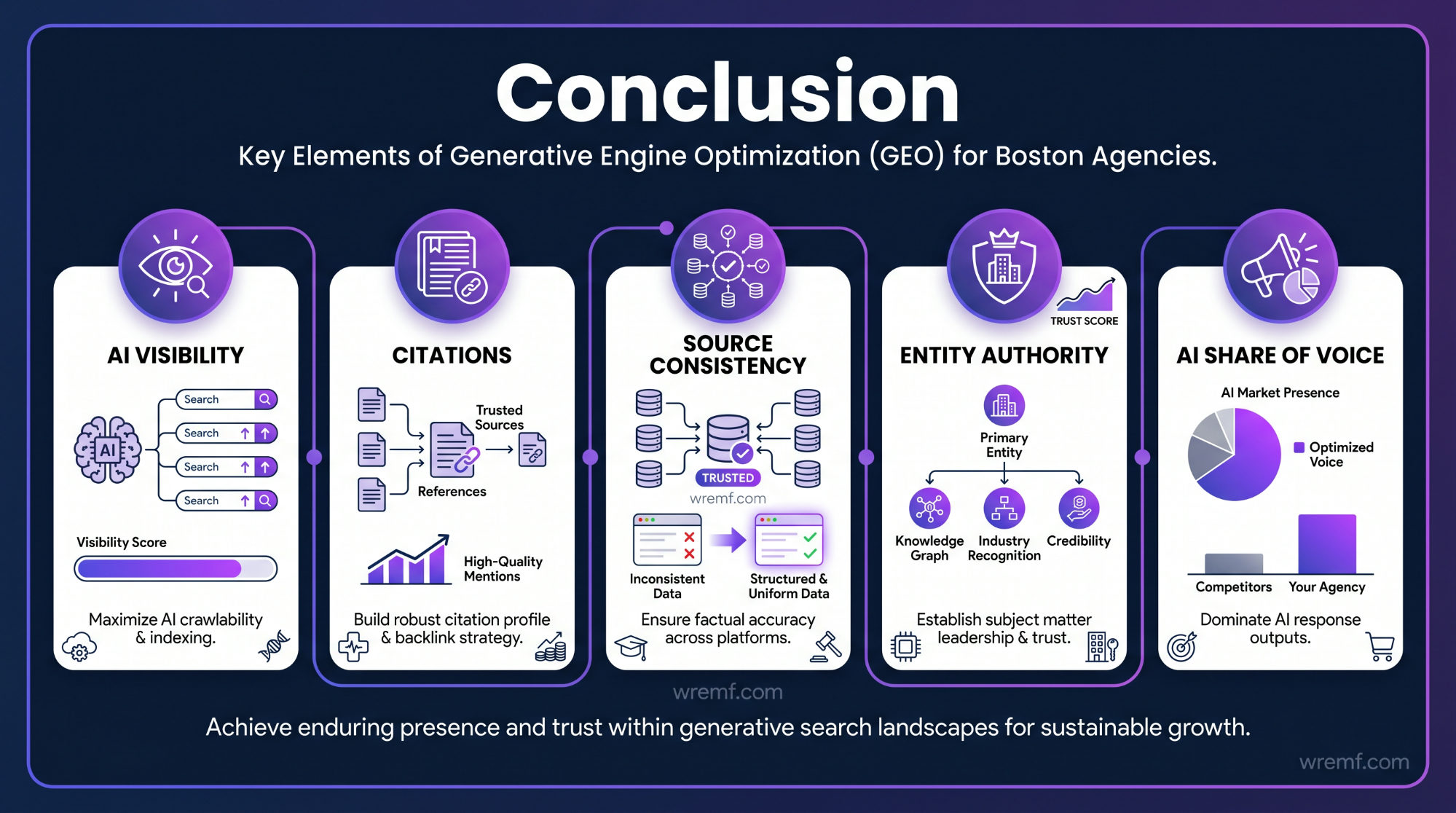
Generative engine optimization agency Boston services help brands compete in a search environment shaped by AI-generated answers, LLMs, Google AI Overviews, ChatGPT, Gemini, Claude, Perplexity, Copilot, and other AI platforms. Boston companies in SaaS, biotech, healthcare, robotics, aerospace, EdTech, cybersecurity, and professional services need more than traditional ranking reports. They need prompt visibility, AI citations, source consistency, entity authority, AI share of voice, and attribution.
WREMF helps teams track, improve, and prove AI visibility through software, agency services, or a hybrid model. To turn GEO from a guessing game into a measurable workflow, explore the WREMF platform suite, request a GEO audit, or talk to the WREMF agency team.
Frequently Asked Questions About Generative Engine Optimization Agency Boston
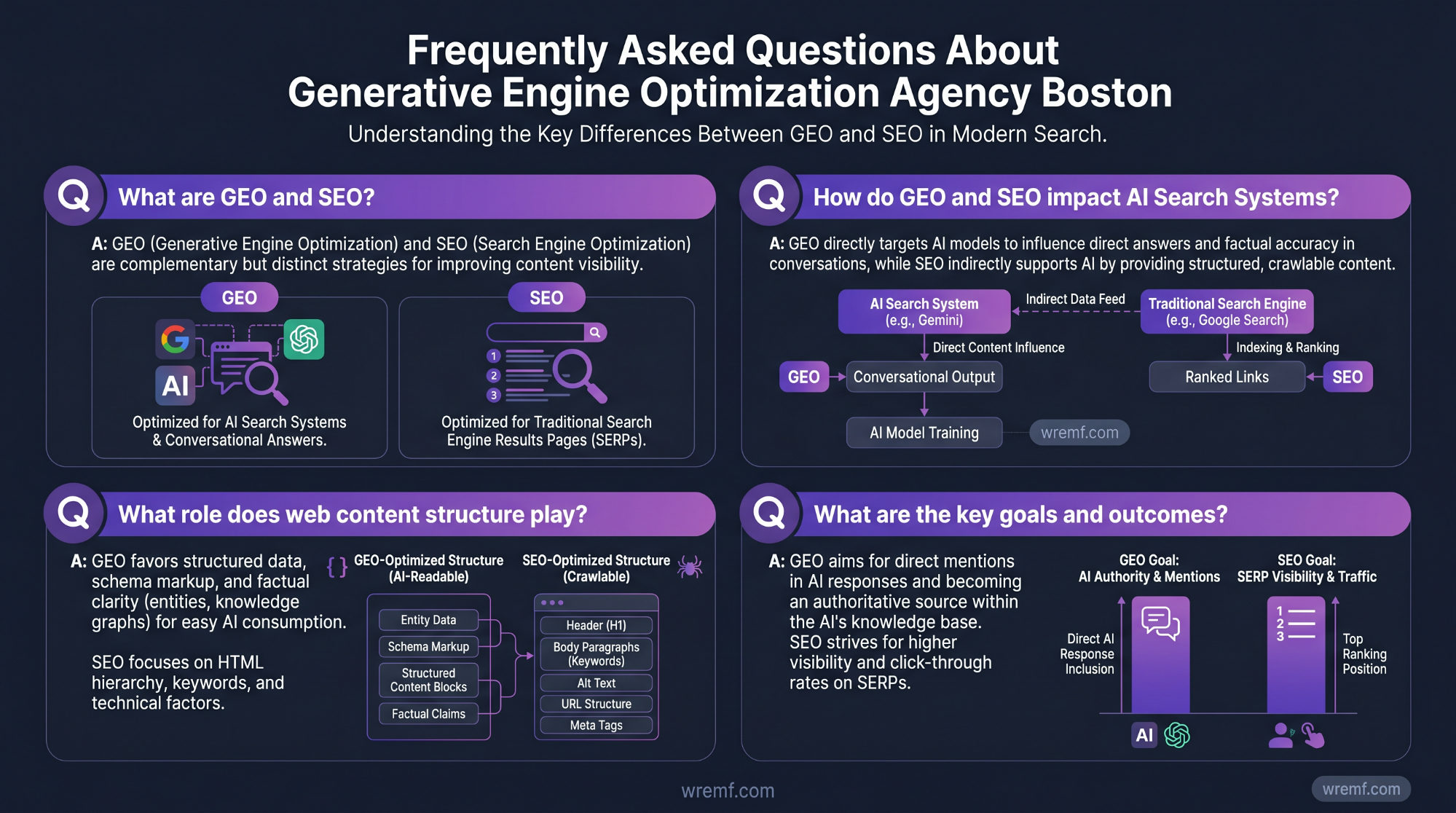
What is Generative Engine Optimization (GEO) and how does it relate to SEO?
Generative Engine Optimization (GEO) is the practice of optimizing a website, content, brand entities, and authority signals so AI search systems can mention, cite, and recommend the brand in AI-generated answers. SEO focuses on visibility in traditional search results, while GEO focuses on visibility inside generative search responses from tools such as ChatGPT, Gemini, Claude, Perplexity, Copilot, and Google AI Overviews. The two disciplines work together because AI systems often rely on crawlable, authoritative, well-structured web content. The Princeton research paper on Generative Engine Optimization describes GEO as a framework for improving visibility in generative engine responses.
What is GEO?
GEO stands for Generative Engine Optimization. It helps brands improve how they appear in AI-generated answers, AI citations, conversational search results, and recommendation-style responses across LLMs and AI platforms.
For Boston businesses, GEO is especially useful when buyers use AI search to compare vendors, agencies, software products, biotech providers, SaaS platforms, healthcare companies, or professional services. A strong GEO strategy combines content optimization, structured data, entity authority, citation consistency, technical SEO, prompt tracking, and ongoing AI visibility measurement.
What is a Generative Engine Optimization agency?
A Generative Engine Optimization agency helps companies improve visibility across AI search engines, answer engines, and LLM-driven discovery platforms. A GEO agency usually works on content structure, entity optimization, citation strategy, technical SEO, schema markup, AI-ready content systems, and prompt-level measurement.
A strong GEO agency should not only write content. It should audit how AI platforms currently describe the brand, identify missing citations, compare competitor visibility, improve source consistency, and measure whether the brand appears in relevant AI-generated answers. WREMF supports this through its senior-led AI visibility agency and platform-based reporting workflow.
What is the difference between SEO and GEO?
SEO helps a page rank in traditional search results, while GEO helps a brand appear in AI-generated answers and recommendation summaries. SEO usually measures rankings, impressions, clicks, backlinks, and organic traffic. GEO measures AI citations, brand mentions, prompt visibility, AI share of voice, source consistency, and recommendation presence.
Traditional SEO is still important because AI systems often use indexed, authoritative, well-structured sources. GEO adds another layer by making content easier for LLMs and AI search engines to understand, retrieve, summarize, and cite. A modern strategy should combine both SEO and GEO rather than treating them as separate channels.
Is GEO replacing SEO?
GEO is not replacing SEO. GEO is expanding SEO for AI-driven discovery.
Google search results, organic rankings, crawlability, backlinks, technical SEO, and high-quality content still matter. However, AI Overviews, ChatGPT search, Perplexity, Gemini, Claude, and Copilot are changing how users discover answers. Buyers may receive summarized recommendations before they visit a traditional search results page. This means brands need SEO for search visibility and GEO for AI answer visibility. The most practical approach is to strengthen SEO foundations while adding GEO measurement, citation tracking, structured content, and AI search optimization.
Why does GEO matter for Boston businesses?
GEO matters for Boston businesses because buyers in competitive industries increasingly use AI search to research companies, compare options, and shortlist vendors. Boston has dense competition across SaaS, biotech, healthcare, robotics, higher education, cybersecurity, fintech, and professional services. In these markets, visibility in AI-generated answers can influence early discovery and brand trust.
A Boston company that is visible in Google search but absent from ChatGPT, Perplexity, Gemini, Claude, or Google AI Overviews may miss high-intent research moments. GEO helps connect content strategy, authority signals, and AI visibility measurement so the brand can compete in both traditional search and AI search.
Why should Boston companies work with a GEO agency?
Boston companies should work with a GEO agency when they need strategy, technical execution, content optimization, citation improvement, and ongoing AI visibility measurement. GEO is not only a writing task. It requires prompt landscape mapping, competitor analysis, source citation tracking, structured content improvements, entity reinforcement, technical SEO, and reporting.
A company with a strong internal SEO team may use software alone. A company without internal execution capacity may need an agency. A hybrid model works best when the team wants measurement, recommendations, and implementation support in one system. WREMF provides both software and managed execution for teams that want a practical GEO workflow.
How should a GEO agency approach AI search optimization?
A GEO agency should start with an audit, then build a strategy, optimize content and technical foundations, strengthen citations, and measure visibility over time. The process should be based on evidence rather than assumptions.
A practical GEO workflow includes prompt research, competitor citation analysis, AI visibility benchmarking, content gap analysis, structured data review, entity optimization, internal linking improvements, and authority development. The agency should then monitor AI-generated answers across tools such as ChatGPT, Gemini, Claude, Perplexity, Copilot, and Google AI Overviews. WREMF’s AI visibility methodology connects prompts, citations, competitors, source consistency, and attribution into one repeatable system.
What role does content play in Generative Engine Optimization?
Content plays a central role in Generative Engine Optimization because AI systems need clear, authoritative, well-structured information to retrieve and summarize. Strong GEO content answers specific questions directly, defines important entities, uses logical headings, supports claims with evidence, and connects related topics through internal links.
For Boston businesses, this often means creating pages for services, use cases, comparisons, industries, FAQs, and buying-stage questions. Content should also reflect real expertise, not generic AI-written summaries. Google Search Central’s people-first content guidance explains that helpful, reliable content should be created for users, not only for search engines.
What kind of content works best for GEO?
The best GEO content is answer-first, structured, specific, and supported by clear authority signals. It usually includes direct definitions, comparison sections, FAQ blocks, use-case pages, industry pages, product explanations, expert commentary, original insights, and well-organized internal links.
AI search systems often need content that clearly explains who the company serves, what it does, why it is credible, and how it differs from alternatives. Thin blog posts, vague service pages, keyword-stuffed copy, and unsupported claims are less useful for GEO. WREMF’s AI-ready content brief tools help teams turn prompt, citation, and competitor insights into structured content recommendations.
What are the key principles of GEO?
The key principles of GEO are clarity, authority, structure, consistency, and measurement. A brand needs clear entity signals, useful content, technically accessible pages, credible citations, consistent brand information, and ongoing AI visibility tracking.
A practical GEO strategy should include:
Prompt-intent mapping
Answer-first content
Structured data and schema markup
Entity optimization
Internal linking
Source citation tracking
Competitor visibility analysis
Third-party authority building
AI share of voice measurement
AI traffic attribution
These principles help AI systems understand the brand and help marketers measure whether visibility is improving.
What are the benefits of Generative Engine Optimization?
The benefits of Generative Engine Optimization include stronger AI search visibility, better brand discoverability, improved citation potential, clearer entity authority, and more complete reporting across AI discovery surfaces. GEO can help a business understand where it appears, where competitors appear, and which prompts influence buyer research.
GEO also helps content teams move beyond keyword rankings alone. Instead of asking only whether a page ranks in Google, teams can ask whether the brand is mentioned in ChatGPT, cited in Perplexity, included in Gemini answers, or visible in Google AI Overviews. WREMF helps teams track these signals through its AI visibility platform.
How do AI search engines present a brand today?
AI search engines may present a brand as a cited source, a mentioned option, a recommended vendor, a comparison candidate, or a summarized entity. They may also omit the brand, describe it inaccurately, or cite a competitor instead.
A brand should review how it appears across multiple prompts and AI engines because each platform can produce different answers. Important checks include whether the brand is named, whether the description is accurate, whether the website is cited, whether competitors are favored, and whether the answer reflects current positioning. WREMF’s prompt intelligence feature helps teams monitor these variations across major AI discovery surfaces.
How do you measure AI Search or GEO visibility?
AI Search visibility is measured by tracking how often a brand appears, is cited, is recommended, or is compared across relevant AI prompts and engines. Traditional rankings alone are not enough because AI-generated answers do not always behave like search result pages.
Useful GEO metrics include prompt visibility, citation frequency, AI share of voice, competitor mentions, recommendation presence, source consistency, AI referral traffic, and prompt-level changes over time. Reporting should also separate brand mentions from cited sources because a brand can be mentioned without receiving a source citation. WREMF’s sample AI visibility report shows how AI visibility data can be organized for teams, leaders, and clients.
What are AI citations in GEO?
AI citations are references, links, or source mentions that appear inside AI-generated answers. They matter because they show which sources an AI system used or surfaced when answering a user query.
In GEO, citation tracking helps teams understand which pages, publishers, competitors, and third-party sources influence AI-generated answers. A brand may need to improve its own content, strengthen off-site mentions, or fix inconsistent information if AI platforms cite outdated or weaker sources. WREMF’s source citation tracking helps teams monitor which sources are being used across AI engines.
What is the difference between brand mentions and AI citations?
Brand mentions occur when an AI answer names a company, while AI citations occur when the AI answer links to or references a source. A brand mention can create visibility, but a citation can create stronger evidence that the brand or its content influenced the answer.
Both signals matter. Mentions show whether the brand is part of the AI-generated conversation. Citations show which sources are shaping that conversation. A complete GEO strategy should track both because a company can be recommended without being cited, cited without being positioned strongly, or omitted while competitors receive both mentions and citations.
What does success in an AI-first search world look like?
Success in an AI-first search world means the brand is accurately represented, frequently mentioned, properly cited, and competitively positioned across relevant AI discovery surfaces. It also means the company can connect AI visibility to marketing outcomes such as qualified traffic, sales conversations, pipeline influence, or client reporting.
Success should not be defined by one prompt or one AI tool. A strong measurement model looks across ChatGPT, Gemini, Claude, Perplexity, Copilot, Google AI Overviews, DeepSeek, Grok, Meta AI, and Mistral. The goal is not guaranteed placement. The goal is measurable improvement in visibility, accuracy, citation quality, and competitive presence over time.
Is being cited in Google AI Overviews part of GEO?
Yes, being cited in Google AI Overviews is part of GEO because AI Overviews are AI-generated search experiences that summarize answers and include links for deeper exploration. Google’s AI features guidance for website owners explains how AI features in Search relate to website visibility.
However, GEO should not focus only on Google AI Overviews. Buyers also use ChatGPT, Perplexity, Gemini, Claude, Copilot, and other AI platforms. A complete GEO strategy monitors multiple engines because each platform can rely on different sources, produce different answers, and surface different competitors.
How does ChatGPT optimization fit into GEO?
ChatGPT optimization is one part of GEO focused on how a brand appears in ChatGPT responses, especially for discovery, comparison, recommendation, and research prompts. It involves improving content clarity, entity signals, third-party references, source consistency, and answer relevance.
OpenAI’s announcement of ChatGPT search explains that search-enabled chats can include links to sources. For marketers, this means ChatGPT visibility may involve both brand mentions and cited sources. WREMF helps teams track ChatGPT alongside other AI engines so they do not optimize for one platform in isolation.
How does Perplexity optimization fit into GEO?
Perplexity optimization fits into GEO because Perplexity is a citation-heavy AI answer engine that often displays sources alongside generated responses. Brands that want visibility in Perplexity need strong source quality, useful content, clear page structure, and credible third-party mentions.
Perplexity visibility should be measured at the prompt level. A company may appear for branded prompts but not for category, comparison, or buying-intent prompts. GEO teams should test multiple query types, review cited pages, compare competitor visibility, and identify missing source opportunities. This makes Perplexity an important part of multi-engine AI visibility monitoring.
What is included in a GEO service?
A GEO service usually includes an AI visibility audit, prompt research, competitor analysis, content gap analysis, citation review, technical SEO review, entity optimization, structured data recommendations, content briefs, and ongoing reporting.
More advanced GEO services may also include authority development, third-party citation strategy, AI-ready page creation, internal linking improvements, schema markup guidance, and attribution reporting. WREMF agency engagements may include GEO strategy reports, prompt opportunity maps, AI-ready content recommendations, competitive visibility analysis, citation dashboards, and ongoing optimization support through a software plus managed execution model.
What should be included in a Boston GEO agency service?
A Boston GEO agency service should include local market understanding, industry-specific content strategy, AI visibility measurement, and technical optimization for AI search. Boston businesses often compete in specialized markets such as SaaS, biotech, healthcare, robotics, EdTech, cybersecurity, and professional services, so generic SEO content is usually not enough.
A strong service should include prompt landscape mapping, competitor citation analysis, structured content recommendations, entity authority improvements, schema markup guidance, and ongoing AI monitoring. The agency should also explain how GEO supports broader marketing strategy, lead generation, brand authority, and sales enablement.
How does a GEO audit work?
A GEO audit identifies how a brand currently appears across AI search systems and what prevents stronger visibility. It usually reviews prompt visibility, AI citations, competitor mentions, content gaps, source consistency, website structure, technical SEO, schema markup, and entity clarity.
The audit should answer practical questions: Which prompts mention the brand? Which competitors appear instead? Which sources are being cited? Is the brand described accurately? Which content is missing? Which technical issues block retrieval? WREMF offers a GEO audit and AI visibility assessment for teams that want a structured starting point.
What happens in Phase 1 of a GEO, AEO audit and content gap analysis?
Phase 1 identifies the current state of AI visibility and the biggest gaps in content, citations, and technical readiness. The agency reviews how the brand appears across AI engines, which prompts matter, which competitors are cited, and which pages or sources influence AI-generated answers.
This phase usually includes prompt landscape analysis, competitor citation review, technical visibility checks, entity evaluation, and content gap mapping. The output should be a prioritized roadmap, not a generic SEO checklist. For Boston businesses, this phase should also consider local industry competitors, regional authority signals, and vertical-specific buying journeys.
What happens in Phase 2 of AI-optimized GEO strategy development?
Phase 2 turns audit findings into a practical GEO strategy. The team selects high-value prompts, maps buyer-intent questions, prioritizes content opportunities, defines citation gaps, and decides which technical improvements should happen first.
A good strategy should connect AI visibility work to business goals. For example, a Boston SaaS company may prioritize comparison prompts, use-case pages, and product-led content. A biotech or healthcare company may prioritize expertise signals, evidence-backed content, and entity consistency. The strategy should also define how progress will be measured through citations, mentions, AI share of voice, and qualified traffic.
What happens in Phase 3 of website, content, and entity technical GEO?
Phase 3 improves the website and content so AI systems can better understand, retrieve, and cite the brand. This often includes content restructuring, answer-first formatting, internal linking, structured data, schema markup, page hierarchy improvements, crawlability checks, and entity reinforcement.
The goal is to make the website easier for search engines, LLMs, and AI platforms to interpret. Google Search Central’s structured data guidelines explain that structured data can make pages eligible for search features, but it does not guarantee visibility. GEO uses schema as one support signal within a broader optimization system.
What happens in Phase 4 of GEO and AEO citation strategy?
Phase 4 focuses on improving the sources and references that AI systems may use when generating answers. This includes strengthening on-site content, improving third-party mentions, fixing inconsistent brand information, building topical authority, and identifying citation gaps where competitors are being referenced instead.
Citation strategy is important because AI-generated answers often rely on external signals, not only a company’s own website. A Boston GEO agency should evaluate industry publications, partner pages, review sites, directories, research pages, and authoritative media mentions. The goal is to improve source consistency and credibility without relying on manipulative link schemes or unsupported claims.
What happens in Phase 5 of ongoing GEO monitoring and adjustments?
Phase 5 tracks changes in AI visibility over time and adjusts the strategy based on new prompts, new competitors, content performance, and AI platform behavior. GEO is not a one-time project because AI search results can shift as models, indexes, user behavior, and source availability change.
Ongoing monitoring should include prompt tracking, citation tracking, competitor visibility, AI share of voice, traffic attribution, and content performance reviews. WREMF supports scheduled AI monitoring and reporting so teams can identify changes, prioritize updates, and explain progress to leadership or clients.
How do GEO and AEO fit into a digital marketing strategy?
GEO and AEO fit into digital marketing by extending SEO, content marketing, PR, and demand generation into AI search environments. They help brands appear where buyers ask conversational questions, compare vendors, and look for trusted recommendations.
A practical digital marketing strategy should connect traditional search rankings, AI-generated answers, content hubs, comparison pages, social proof, technical SEO, schema markup, and authority development. GEO should not sit in a silo. It should inform content planning, sales enablement, brand messaging, product positioning, and reporting. WREMF helps connect these workflows through AI visibility tracking, content briefs, citation analysis, and attribution.
What is the role of structured data in GEO?
Structured data helps search engines and AI systems understand page meaning, entities, relationships, products, services, authors, reviews, and FAQs. It is not a shortcut to AI visibility, but it improves machine readability when used accurately.
For GEO, structured data should support clear content rather than replace it. A Boston business may use Organization, LocalBusiness, Product, Service, Article, FAQ, Review, or Person schema where appropriate. The most important rule is accuracy. Misleading or hidden structured data can create quality problems. Schema markup works best when paired with strong content, authority signals, and clean technical SEO.
Can GEO help my company rank in ChatGPT and other LLMs?
GEO can improve the likelihood that a company appears in ChatGPT and other LLM-driven answers, but no agency can guarantee placement. LLM visibility depends on many factors, including source availability, content quality, entity clarity, authority, citations, freshness, and the way each AI platform retrieves information.
The practical goal is to improve visibility across important prompts and engines over time. That means testing category prompts, comparison prompts, problem-aware prompts, location-specific prompts, and buying-stage prompts. WREMF helps teams monitor these prompts across 10 AI engines and identify where content, citations, or authority signals need improvement.
Can a GEO agency guarantee Google page one or AI citations?
No, a credible GEO agency should not guarantee Google page one rankings or AI citations. Search engines and AI systems use complex ranking, retrieval, and citation mechanisms that agencies do not control.
Guarantee-based marketing can be misleading because it may encourage short-term tactics that do not build durable authority. A trustworthy agency should focus on measurable work: audits, content improvements, technical fixes, citation strategy, prompt monitoring, and transparent reporting. The right question is not “Can you guarantee placement?” The better question is “How will you measure visibility, identify gaps, and improve the probability of being cited and recommended?”
What makes a great GEO agency?
A great GEO agency combines SEO knowledge, AI search expertise, technical implementation, content strategy, authority development, and measurement. It should understand how LLMs, AI Overviews, answer engines, and traditional search interact.
The agency should provide clear deliverables, practical recommendations, transparent reporting, and ongoing optimization. It should be able to explain the difference between rankings, mentions, citations, recommendations, AI share of voice, and traffic attribution. WREMF’s agency model is designed around senior-led AI visibility strategy and execution, with no long-term lock-in and clear deliverables for B2B SaaS, growth-stage brands, SEO teams, and agencies.
What should I look for when choosing a GEO agency in Boston?
When choosing a GEO agency in Boston, look for AI visibility measurement, technical SEO expertise, content strategy, citation analysis, structured data knowledge, and experience with complex B2B markets. Boston companies often need more than generic local SEO because many compete in specialized sectors such as SaaS, biotech, robotics, healthcare, and education technology.
A strong agency should show how it audits AI visibility, tracks prompts, monitors competitors, improves content, strengthens authority, and reports progress. It should also explain whether it offers software, managed services, or a hybrid model. Teams comparing options can review WREMF’s AI visibility tools guide.
What is the difference between a GEO agency and an AI SEO agency?
A GEO agency focuses on visibility in generative engines and AI-generated answers, while an AI SEO agency may focus more broadly on using AI to improve SEO workflows. The two can overlap, but they are not identical.
A GEO agency should measure AI citations, prompt visibility, AI share of voice, source consistency, and recommendation presence. An AI SEO agency may use AI for keyword research, content creation, technical analysis, or workflow automation. The strongest partners combine both: they understand traditional SEO, AI-assisted workflows, and AI search visibility. WREMF positions GEO, AEO, and AI SEO as connected parts of one AI visibility system.
What is the difference between AEO, GEO, and AI SEO?
AEO focuses on optimizing content for direct answers. GEO focuses on optimizing content and authority signals for generative engines and AI-generated responses. AI SEO is a broader term that can refer to SEO in the AI era or the use of AI tools for SEO work.
In practice, the three disciplines overlap. A strong strategy uses AEO for answer-first content, GEO for AI citation and recommendation visibility, and SEO for crawlability, rankings, authority, and organic traffic. WREMF combines these concepts through prompt tracking, source citation analysis, competitor visibility, AI-ready content briefs, and managed optimization support.
What is the difference between a software-only GEO platform and a managed GEO agency?
A software-only GEO platform gives teams tools to track prompts, citations, competitors, and visibility. A managed GEO agency provides strategy, implementation, content recommendations, technical guidance, and ongoing optimization support.
Software-only is best for teams with internal SEO, content, and technical resources. Managed services are better for teams that need execution capacity or senior guidance. A hybrid model combines both, giving teams measurement and implementation support in one workflow. WREMF can be used as software, as an agency service, or as a hybrid platform plus managed execution solution.
When should a company choose a hybrid software plus agency GEO model?
A company should choose a hybrid GEO model when it needs both visibility data and execution support. This is common when a team can see AI visibility gaps but does not have enough internal time, technical expertise, or content capacity to fix them.
A hybrid model helps connect measurement to action. The platform tracks prompts, citations, competitors, AI share of voice, and attribution. The agency helps interpret the data, prioritize opportunities, optimize content, improve technical foundations, and strengthen citation signals. WREMF’s hybrid model is designed for teams that want tracking, strategy, execution, reporting, and ongoing optimization in one system.
What should early-stage companies do first for GEO?
Early-stage companies should first clarify their positioning, target prompts, buyer questions, and category language before investing heavily in large-scale content. GEO works best when the brand has clear messaging, a crawlable website, accurate entity information, and focused content around high-intent questions.
A practical starting point includes a homepage audit, core service or product page improvements, FAQ content, comparison content, founder or expert credibility signals, and consistent profiles across trusted third-party sites. Early-stage teams should prioritize quality and clarity over content volume. WREMF can help identify which prompts and citations matter before the team scales content production.
How can agencies scale GEO services for multiple clients?
Agencies can scale GEO services by using repeatable audit frameworks, prompt monitoring, citation dashboards, white-label reporting, standardized content briefs, and client-specific visibility scoring. Manual AI testing is too inconsistent for multi-client reporting.
WREMF supports agencies with white-label reports, client portals, scheduled AI monitoring, BYOK support, prompt tracking, competitor visibility, source citation tracking, API access, and MCP integrations. Agencies that want to package AI visibility services for clients can use WREMF’s agency-focused AI visibility tools to manage reporting and execution more efficiently.
Should a Boston company use a local GEO agency or a specialist AI visibility agency?
A Boston company should choose the partner that best understands AI visibility, measurement, content strategy, technical SEO, and the company’s business model. Local market familiarity is useful, but GEO expertise matters more than geography alone.
For Boston companies in SaaS, biotech, healthcare, robotics, and B2B services, the right agency should understand complex buyer journeys and AI-driven discovery. A specialist AI visibility agency can often provide stronger prompt tracking, citation analysis, and multi-engine reporting than a traditional local SEO agency. The best choice is the partner that can prove its methodology and connect recommendations to measurable visibility improvements.
Why do some Boston agencies dominate search while legacy agencies struggle?
Some Boston agencies dominate search because they invest consistently in technical SEO, authoritative content, topical depth, brand authority, backlinks, structured pages, and clear positioning. Legacy agencies often struggle when they rely on older SEO tactics, thin service pages, inconsistent content, or weak technical foundations.
AI search adds another challenge. Agencies now need to be visible not only in Google rankings but also in AI-generated answers, AI Overviews, ChatGPT, Perplexity, Gemini, Claude, and Copilot. The agencies that adapt fastest usually connect SEO, GEO, AEO, content strategy, and authority building into one modern visibility system.
Is my brand ready for AI search?
Your brand is ready for AI search if your website clearly explains what you do, who you serve, why you are credible, and how you compare to alternatives. It also needs crawlable pages, structured content, accurate entity signals, strong authority sources, and consistent information across the web.
If AI tools describe your company incorrectly, omit your brand, cite competitors, or rely on outdated sources, you likely need GEO work. A practical readiness check should test prompts across multiple AI engines, review cited sources, analyze competitors, and identify content gaps. WREMF helps teams turn this readiness check into a measurable AI visibility roadmap.
How can I see if my brand is showing up in AI search?
You can see if your brand is showing up in AI search by testing relevant prompts across ChatGPT, Gemini, Claude, Perplexity, Copilot, Google AI Overviews, and other AI engines. The prompts should include category searches, buying-intent questions, comparison prompts, problem-based searches, and location-specific searches.
Manual testing can provide a quick snapshot, but it is difficult to scale and repeat accurately. A more reliable workflow tracks prompts over time, records citations, compares competitors, and monitors answer changes. WREMF turns this process into scheduled AI visibility monitoring with prompt-level reporting and citation tracking.
How can I improve my chances of showing up in AI search?
You can improve your chances of showing up in AI search by creating clear, useful, well-structured content and strengthening the sources that validate your brand. Start with answer-first content, service pages, comparison pages, FAQ sections, structured data, internal links, author credibility, and consistent brand information.
Then review which sources AI engines cite for your target prompts. If competitors are cited more often, analyze what their pages, mentions, and authority signals provide that yours do not. GEO is usually a combination of on-site optimization, off-site authority, technical accessibility, and ongoing measurement.
How long does GEO take to work?
GEO timelines vary because AI visibility depends on website quality, content depth, source authority, crawlability, competition, and AI platform behavior. Some technical and content improvements can be implemented quickly, but citation consistency and authority building usually take longer.
A realistic GEO program should measure progress over weeks and months, not days. Early work often focuses on audits, prompt mapping, content fixes, technical improvements, and citation gap analysis. Ongoing work focuses on publishing, authority development, monitoring, and refinement. No agency should promise instant visibility across AI engines.
How much do GEO services cost?
GEO service costs depend on audit depth, number of websites, content volume, technical complexity, reporting needs, and whether the client needs software, agency execution, or both. A small team may need platform access and a focused audit, while an enterprise team may need multi-engine monitoring, content operations, technical implementation, attribution, and custom reporting.
WREMF software pricing starts at €39/month for Starter and €89/month for Growth, with custom Enterprise pricing for larger teams. Teams comparing platform and service options can view WREMF pricing.
What is included in WREMF’s GEO and AI visibility support?
WREMF helps teams track, improve, and prove AI visibility across major AI discovery surfaces. The platform includes prompt intelligence, source citation tracking, competitor visibility, AI share of voice, AI traffic attribution, GEO audits, content briefs, SEO testing, visibility scoring, white-label reports, BYOK support, API access, MCP integrations, and scheduled monitoring.
WREMF also offers managed AI visibility agency services for teams that need strategy, implementation, technical guidance, and ongoing optimization. This makes it useful for brands that want software, agencies that need reporting, and companies that want a hybrid software plus managed execution model.
How does WREMF help Boston companies with GEO?
WREMF helps Boston companies understand where they appear in AI search, why competitors are being cited, and what actions can improve visibility. The platform tracks prompts, citations, competitors, source consistency, AI share of voice, and attribution across 10 AI engines.
For Boston SaaS, biotech, healthcare, robotics, EdTech, and B2B companies, WREMF can support GEO audits, AI-ready content systems, citation optimization, technical recommendations, and ongoing reporting. For teams that need implementation support, WREMF also provides managed AEO, GEO, and AI visibility services through its agency model.
How does WREMF compare with traditional SEO tools?
WREMF differs from traditional SEO tools because it focuses on AI visibility, prompt intelligence, AI citations, competitor visibility in AI answers, source consistency, and AI share of voice. Traditional SEO tools usually focus on keywords, backlinks, rankings, audits, and organic traffic.
Both tool types are useful, but they answer different questions. Traditional SEO tools show how a page performs in search results. WREMF shows how a brand appears across AI discovery surfaces such as ChatGPT, Claude, Gemini, Perplexity, Google AI Overviews, Copilot, DeepSeek, Grok, Meta AI, and Mistral.
Do GEO agencies offer paid media or CRO?
Some GEO agencies offer paid media or conversion rate optimization, but these services are not the core of GEO. GEO mainly focuses on AI search visibility, citations, content structure, entity authority, technical SEO, and AI-generated answer visibility.
Paid media can support demand generation, and CRO can improve landing page conversion, but neither replaces GEO. A company should ask whether the agency has dedicated measurement for AI visibility, prompt tracking, citation analysis, and competitor monitoring. These capabilities are more important for GEO than broad claims about digital marketing services.
Should a GEO agency offer both strategy and implementation?
Yes, a GEO agency should ideally offer both strategy and implementation, or clearly explain where its responsibilities end. Strategy without implementation often leaves teams with a roadmap they cannot execute. Implementation without strategy can create content that does not target the right prompts, buyers, or AI visibility gaps.
A strong GEO partner should connect audit findings to prioritized actions. This includes content recommendations, technical fixes, internal linking, structured data, citation strategy, authority development, and measurement. WREMF’s agency model is built for practical implementation, clear deliverables, and ongoing optimization rather than dashboard-only reporting.
Should a GEO agency have a dedicated measurement team?
A GEO agency should have a dedicated measurement process, even if it does not call it a separate measurement team. GEO requires repeatable tracking because manual spot checks in AI tools can be inconsistent.
The measurement process should track prompts, citations, competitors, AI share of voice, source consistency, and traffic attribution. It should also separate visibility changes by AI engine because ChatGPT, Perplexity, Gemini, Claude, Copilot, and Google AI Overviews can produce different results. Without measurement, a GEO program becomes guesswork.
What questions should I ask before hiring a GEO agency?
Before hiring a GEO agency, ask how it measures AI visibility, which AI engines it tracks, how it identifies citation gaps, how it handles technical SEO, and how it turns insights into execution. Also ask whether it provides prompt-level reporting, competitor analysis, content briefs, structured data guidance, and ongoing monitoring.
Useful questions include:
Which prompts will you monitor?
How will you track citations?
How will you compare competitors?
What deliverables are included?
How will you report progress?
Do you offer software, agency execution, or both?
The answers should be specific, measurable, and tied to business goals.
What are the risks of ignoring GEO?
The main risk of ignoring GEO is that buyers may discover competitors through AI search while your brand remains invisible or misrepresented. A company may still rank in traditional search but fail to appear in AI-generated answers, comparison prompts, or recommendation responses.
Other risks include inaccurate AI descriptions, outdated citations, weak entity recognition, lost authority signals, and poor visibility in emerging discovery journeys. GEO helps reduce these risks by monitoring how AI systems describe the brand, identifying source gaps, improving content structure, and strengthening signals that support accurate AI retrieval.
Can GEO increase sales and qualified demand?
GEO can support sales and qualified demand by improving visibility during AI-assisted research, but it should not be presented as a guaranteed sales engine. The strongest impact usually happens when GEO connects to content strategy, sales enablement, conversion pages, analytics, and attribution.
For example, a B2B buyer may use AI search to compare vendors before visiting websites. If a brand is cited, accurately described, and positioned as relevant, it may gain more qualified attention. WREMF helps teams track AI visibility and connect it to downstream signals such as AI referral traffic, reporting, and pipeline attribution.
How can I take the next step with GEO?
The best next step with GEO is to audit how your brand currently appears across AI engines and identify which prompts, citations, competitors, and content gaps matter most. This gives you a baseline before investing in content or technical changes.
A practical next step is to test high-intent prompts, review cited sources, compare competitor visibility, and prioritize fixes by business value. Teams that want software, managed services, or a hybrid model can talk to the WREMF agency team to build a custom AI visibility roadmap.
Related reading
- AI Search Visibility Agency: The Complete Guide to Choosing the Right Partner in 2026
- LLM Visibility Services: The Complete Guide to Tracking, Improving, and Proving AI Search Visibility
- LLM Visibility Agency: The Complete Guide to Choosing the Right Partner for AI Search Visibility
- AI Citation Optimization Services: The Complete B2B Guide to Getting Cited in AI Search