The Complete Guide to Competitive Intelligence Services for B2B Strategy and AI Visibility
Learn about competitive intelligence services for B2B strategy, including AI visibility and research methods to enhance decision-making.
By WREMF Team · 2026-09-16
Competitive intelligence services systematically gather and analyze information about competitors, markets, customers, and industries to inform strategic decisions. These services include competitor analysis, market research, and AI visibility tracking across platforms like ChatGPT and Google AI Overviews. They employ methodologies such as primary and secondary research, OSINT, and win-loss interviews to support product development and market strategies. Legal and ethical concerns must be addressed in these programs.
Key takeaways
- Competitive intelligence includes competitor analysis, market research, and ongoing monitoring.
- Primary and secondary research are essential, with each offering unique insights.
- AI visibility is crucial, requiring tracking across engines like ChatGPT and Google AI Overviews.
- WREMF enhances competitive intelligence by monitoring AI share of voice and source citations.
- Address legal and ethical concerns in competitive intelligence programs, especially with OSINT and mystery shopping.
The Complete Guide to Competitive Intelligence Services for B2B Strategy and AI Visibility
Competitive intelligence services are structured programs that help organisations gather, analyse, and act on information about competitors, markets, customers, and industry environments to make faster and better-informed strategic decisions. For B2B teams operating in complex, fast-moving markets, raw data is rarely the problem. The challenge is turning competitive information into trusted, timely and actionable insight that drives product development, pricing strategies, go-to-market strategy, and sales enablement. This guide is written for B2B founders, marketing leaders, SEO and growth teams, analysts, and agencies who want to understand what competitive intelligence services include, how to select the right methodology, how to avoid common mistakes, and how AI visibility now forms a critical layer of modern competitive analysis. It covers the full scope from primary research to AI-era monitoring, including how platforms such as WREMF extend competitive intelligence into AI search.
QUICK ANSWER:
Competitive intelligence services help businesses systematically collect and analyse information about competitors, market dynamics, customer preferences, and industry trends to support strategic decisions. These services range from one-off competitor analysis projects to ongoing competitive monitoring programs. They use primary research, secondary research, OSINT, win-loss interviews, and data analytics to produce actionable intelligence that supports business development, product decisions, pricing strategies, and go-to-market execution.
KEY TAKEAWAYS:
- Competitive intelligence services include competitor analysis, market research, win-loss interviews, Mystery Shopping, benchmarking, and ongoing Competitive Monitoring and Tracking Programs
- Primary research and secondary research serve different purposes and most effective programs use both in combination
- AI visibility is now a distinct competitive intelligence dimension, requiring prompt tracking and citation monitoring across AI engines such as ChatGPT, Gemini, Perplexity, and Google AI Overviews
- WREMF extends competitive intelligence into AI search by tracking AI share of voice, competitor movements in AI answers, and source citations across 10 AI engines
- Legal and ethical concerns must be addressed before any competitive intelligence program is launched, particularly when using OSINT, B2B mystery shopping, or discreet primary intelligence gathering
What Competitive Intelligence Services Actually Include
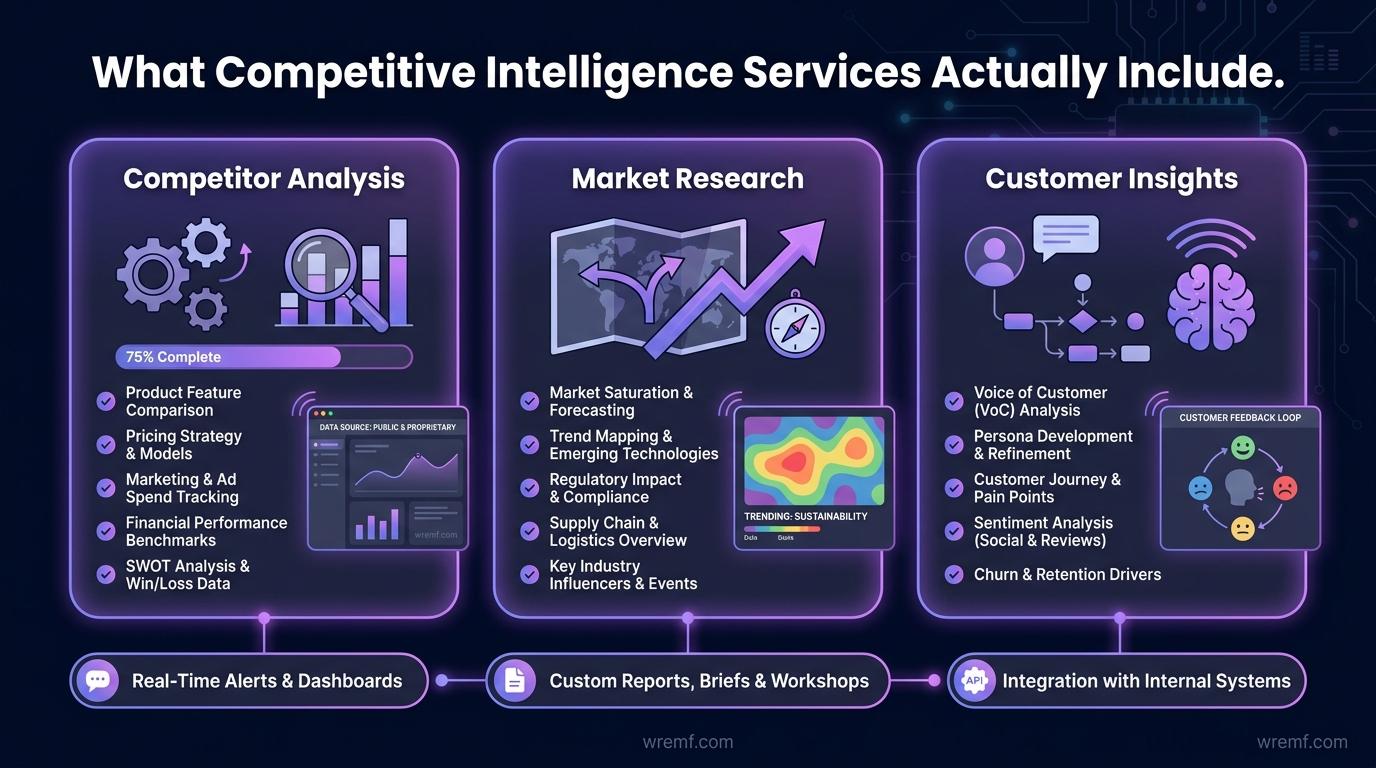
Competitive intelligence services cover a broad set of structured research and analysis activities designed to give organisations a clear, evidence-based picture of their competitive landscapes. The term is often used narrowly to mean competitor tracking, but the full scope of professional CI programs is significantly wider.
A complete competitive intelligence program typically includes several interconnected service lines. Competitor analysis examines rivals across dimensions including product capabilities, pricing strategies, marketing positioning, go-to-market strategy, hiring patterns, customer sentiments, and financial performance where available. Industry analysis maps the broader business environment including market participants, market dynamics, regulatory conditions, and emerging trends. Market research covers customer preferences, customer needs, consumer behavior, and market signals that indicate where demand is moving. Customer Research provides direct insight into why buyers choose one vendor over another, including Customer Experience feedback and Customer feedback gathered through structured interviews or surveys.
Beyond these foundational areas, specialised service lines include Value Chain Analysis to understand cost and margin structures across the industry, Business Model Analysis to evaluate how competitors create and capture value, Cost and Profitability Analysis to benchmark financial performance, and Market Opportunity Analysis to identify underserved segments or whitespace for Market expansion. Deep dive evaluations go beyond surface monitoring to deliver comprehensive intelligence on specific competitor strategies, intellectual property activity, or market entry moves.
For B2B organisations, competitive intelligence services also frequently include competitive enablement functions that prepare sales teams, product teams, and marketing teams to respond effectively to competitor activity. This includes Training and Enablement programs, sales battlecards, and pipeline landscapes that help teams understand the competitive context of active deals. Teams looking for a practical starting point can review resources on how competitive intelligence connects to AI search engine optimization as part of a broader visibility strategy.
Competitive intelligence is distinct from market research in that it is specifically oriented toward understanding competitive dynamics and informing decisions that affect competitive positioning. Market research tends to focus on customers and market size. Competitive intelligence focuses on the actions, capabilities, and intentions of other players in the business environment.
KEY TAKEAWAY: Competitive intelligence services extend well beyond basic competitor tracking to include market research, customer research, industry analysis, sales enablement, and specialised evaluations such as Value Chain Analysis and Market Opportunity Analysis.
Primary Research vs Secondary Research in Competitive Intelligence
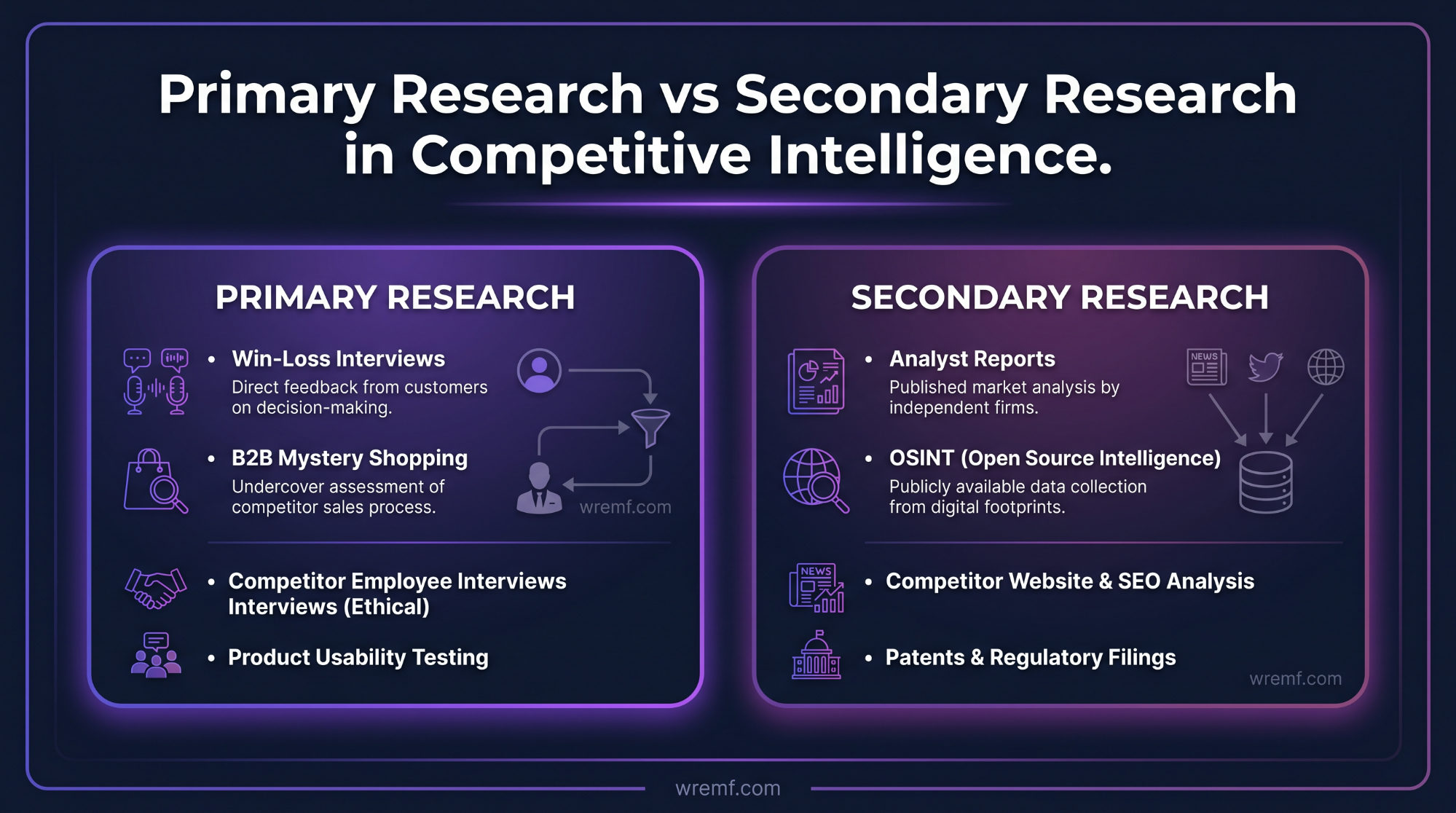
Primary research and secondary research are the two foundational data collection approaches in competitive intelligence, and understanding when to use each is critical to building programs that produce reliable, actionable intelligence.
Primary research involves direct data collection from original sources. In competitive intelligence contexts, this includes win-loss interviews with buyers who recently made vendor decisions, stakeholder interviews with internal teams, B2B mystery shopping exercises that test competitor sales and onboarding processes firsthand, Competitive Confidence Surveys that assess how confident sales teams feel against specific rivals, and primary intelligence gathering through structured interviews with industry experts, channel partners, or former employees where legally and ethically appropriate. Qualitative Research methods such as in-depth interviews and focus groups surface nuanced insights about customer needs, decision criteria, and competitor perception that secondary sources cannot provide. Quantitative Research methods including surveys and structured data collection produce statistically meaningful findings about market trends, pricing sensitivity, and customer preferences.
Secondary research draws on existing published and available information. This includes analyst reports from firms such as Gartner, press releases, competitor websites, job postings, online presence audits, social media monitoring, Glassdoor reviews, patent databases, regulatory filings, ad spend data, and OSINT sources. OSINT, which stands for open-source intelligence, refers to the systematic collection and analysis of information from open sources and is a foundational method in professional competitive intelligence programs. Secondary research is faster and lower cost than primary research but carries the limitation that the same information is available to every competitor.
The most effective competitive intelligence programs combine both approaches. Secondary research provides the breadth needed to monitor competitor movements continuously. Primary intelligence gathering provides the depth needed to understand motivations, validate hypotheses, and surface intelligence that is not available in public sources. CRM data, call recordings from conversational intelligence software, and internal messaging channels are valuable internal sources that sit alongside external intel to create a complete intelligence picture.
Evidence-based research is the standard that distinguishes professional competitive intelligence services from informal competitor monitoring. Programs built on rigorous data collection, documented methodology, and transparent sourcing produce intelligence that can withstand scrutiny and support confident client decision-making. As discussed in resources covering answer engine optimization services | https://wremf.com/blog/answer-engine-optimization-services-the-complete-guide-to-ai-search-visibility, the same evidence-based discipline now applies to measuring how brands appear in AI-generated answers.
DID YOU KNOW:
Competitive Intelligence Services (CIS) was established in 1992 and has over 20 years of experience providing evidence-based research solutions to clients globally, illustrating how long-standing firms combine primary intelligence gathering with secondary research to serve B2B clients across multiple industries.
KEY TAKEAWAY: Primary research provides unique, non-public intelligence through interviews, Mystery Shopping, and surveys, while secondary research covers public signals through OSINT, analyst reports, and Web monitoring. The strongest programs use both in combination.
The Core Methods Used in Professional Competitive Intelligence Services
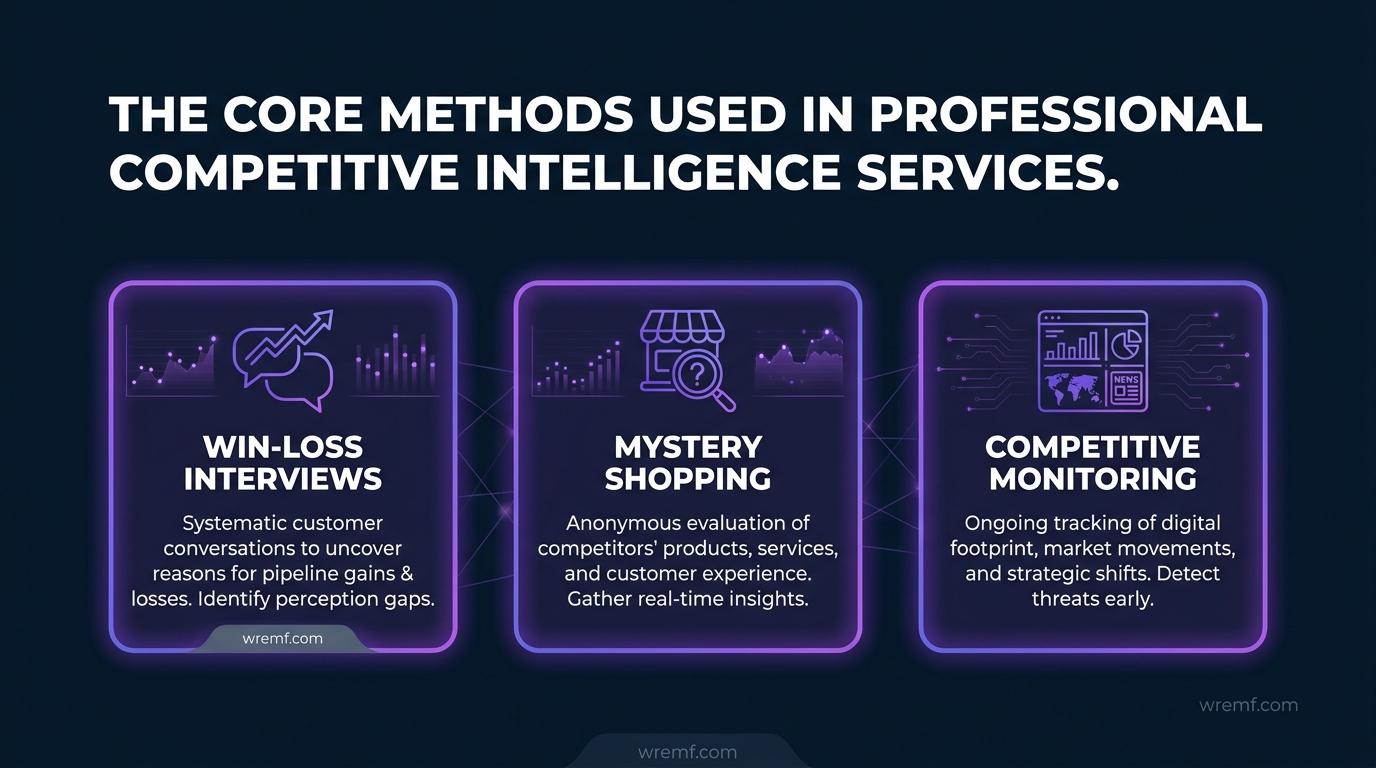
Professional competitive intelligence services apply a structured set of methods that go beyond Google searches and news alerts. Each method serves a specific intelligence purpose and produces a different type of output.
Win-loss interviews are among the most valuable primary research methods available to B2B teams. These are structured conversations with buyers who recently evaluated and chose or rejected your product in favour of a competitor. Win-loss interviews surface the real decision criteria, competitor strengths, pricing perceptions, and customer needs that internal teams rarely hear directly. Firms such as Proactive Worldwide have built service lines around this method, recognising that pipeline landscapes and deal outcomes contain intelligence that no secondary source can replicate.
Mystery Shopping in competitive intelligence refers to structured exercises in which trained researchers pose as potential buyers to evaluate competitor sales processes, product demonstrations, pricing conversations, and Customer Experience touchpoints. B2B mystery shopping is particularly valuable for understanding how competitors sell, what messaging they lead with, and where their process creates friction. This method requires careful attention to Legal and ethical concerns and should always be designed and executed within applicable legal frameworks.
Competitive Monitoring and Tracking Programs provide continuous intelligence rather than point-in-time snapshots. These programs use Web monitoring, social media monitoring, press releases tracking, job posting analysis, and Glassdoor reviews to detect competitor movements as they happen. AI-enabled tools and machine learning now allow competitive monitoring programs to process far larger volumes of competitor and industry sources than was previously possible, reducing Data overload through relevance filtering and automated dashboards.
Benchmarking and Best Practice Comparison is a systematic method for measuring your organisation's performance, processes, or capabilities against competitors or industry leaders. This method is used across product development, operations, Marketing, pricing, and Customer Experience to identify gaps and opportunities. Competitive Confidence Surveys complement benchmarking by revealing how internal teams perceive competitive strength across specific deal types or market segments.
Industry analysis provides a structured assessment of the wider business environment, including market participants, competitive landscapes, regulatory pressures, emerging trends, and market threats. This level of analysis is essential for strategic planning, investment decisions, and Market expansion. Specialist firms including Norstella bring deep domain expertise to industry environments such as life sciences, where FDA approval processes, clinical trial activity, and licensing strategies create highly specialised competitive intelligence requirements.
Firms such as Octopus Intelligence and FJ Intelligence have demonstrated that competitive intelligence services can be designed for specific industry sectors and complexity levels, from early-stage competitive monitoring to sophisticated Business-to-Business intelligence programs serving global organisations. The Empower methodology, applied by several competitive intelligence companies, prioritises actionable intelligence delivery over raw data volume, recognising that decision-makers need clarity rather than more information.
KEY TAKEAWAY: Professional competitive intelligence methods include win-loss interviews, Mystery Shopping, Competitive Monitoring and Tracking Programs, benchmarking, and Industry analysis, each producing different intelligence outputs that combine to support comprehensive competitive analysis.
How to Structure a Competitive Intelligence Program
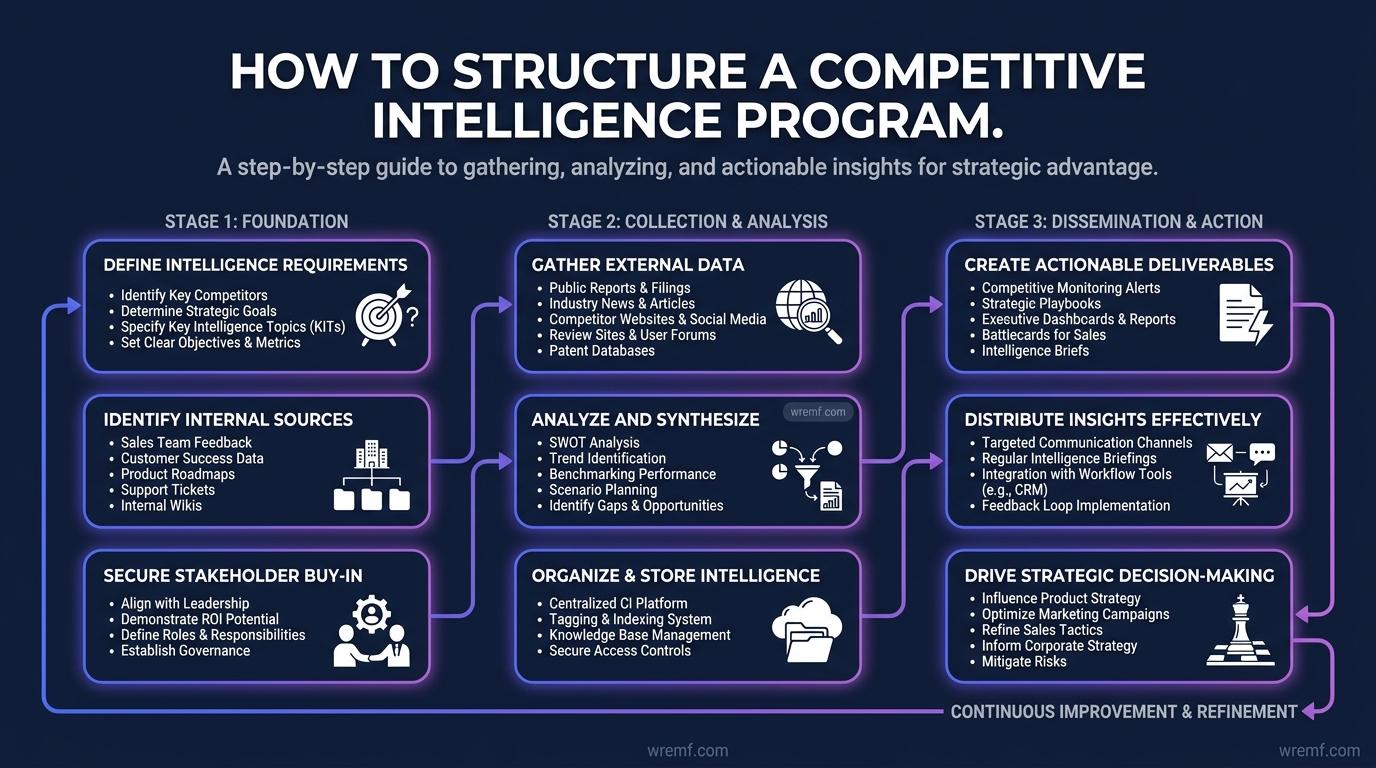
A structured approach to competitive intelligence is what separates programs that generate strategic advantage from collections of competitor information that no one acts on. The process below reflects how professional competitive intelligence services are designed and executed.
Step 1: Define the intelligence requirements
Before collecting a single data point, clarify what decisions the intelligence needs to support. Is the goal to improve pricing strategies? Prepare for a specific competitive deal? Evaluate a Market expansion opportunity? Define the questions that need to be answered, who will use the intelligence, and what actions it will enable.
Step 2: Identify internal sources
Internal sources are frequently underused in competitive intelligence programs. Review CRM data and deal notes for competitive context, pull insights from call recordings and conversational intelligence software, interview stakeholders across sales, product, and customer success, and audit internal messaging channels for informal competitive intelligence that surfaces in day-to-day conversations.
Step 3: Map and prioritise external intel sources
External intel sources include analyst reports, competitor websites, social media monitoring, press releases, OSINT databases, Glassdoor reviews, ad spend data, and patent databases. Prioritise sources based on relevance to the specific intelligence requirements identified in Step 1, not on volume.
Step 4: Design and execute primary intelligence gathering
Where secondary research is insufficient, design primary research activities. This may include win-loss interviews, stakeholder interviews with industry experts, Competitive Confidence Surveys, or B2B mystery shopping exercises. Ensure all primary intelligence gathering complies with Legal and ethical concerns, including applicable privacy regulations and industry-specific compliance requirements.
Step 5: Analyse and synthesise
Apply data analysis methodologies appropriate to the research type. Qualitative Research outputs require thematic analysis. Quantitative Research data requires statistical analysis. The goal at this stage is to move from raw information to evidence-based intelligence that answers the questions defined in Step 1. Forecasting models may be applied where market signals support forward-looking analysis.
Step 6: Build intelligence deliverables
Translate intelligence into formats that support client decision-making. Professional deliverables may include dashboards, briefing documents, competitive battlecards, risk assessments, or Market Feasibility Studies. Custom dashboards that surface key competitive signals in real time are increasingly standard for ongoing programs. Teams can complement their intelligence deliverables by tracking AI-era competitive visibility using the WREMF AI visibility platform
Step 7: Activate and distribute intelligence
Intelligence that stays in a shared drive delivers no competitive edge. Distribute actionable intelligence to the teams who need it, in formats they can act on, at the point in their workflow where it is most relevant. This is the core principle behind competitive enablement and Training and Enablement programs.
Step 8: Establish ongoing monitoring
Set up Competitive Monitoring and Tracking Programs to ensure the intelligence picture is continuously refreshed. Scheduled alerts, automated Web monitoring, and regular primary research cycles prevent programs from becoming stale.
KEY TAKEAWAY: A structured competitive intelligence program begins with clear intelligence requirements, draws on both internal sources and external intel, applies rigorous analysis, and delivers actionable intelligence in formats that teams can act on immediately.
Strategic Applications of Competitive Intelligence
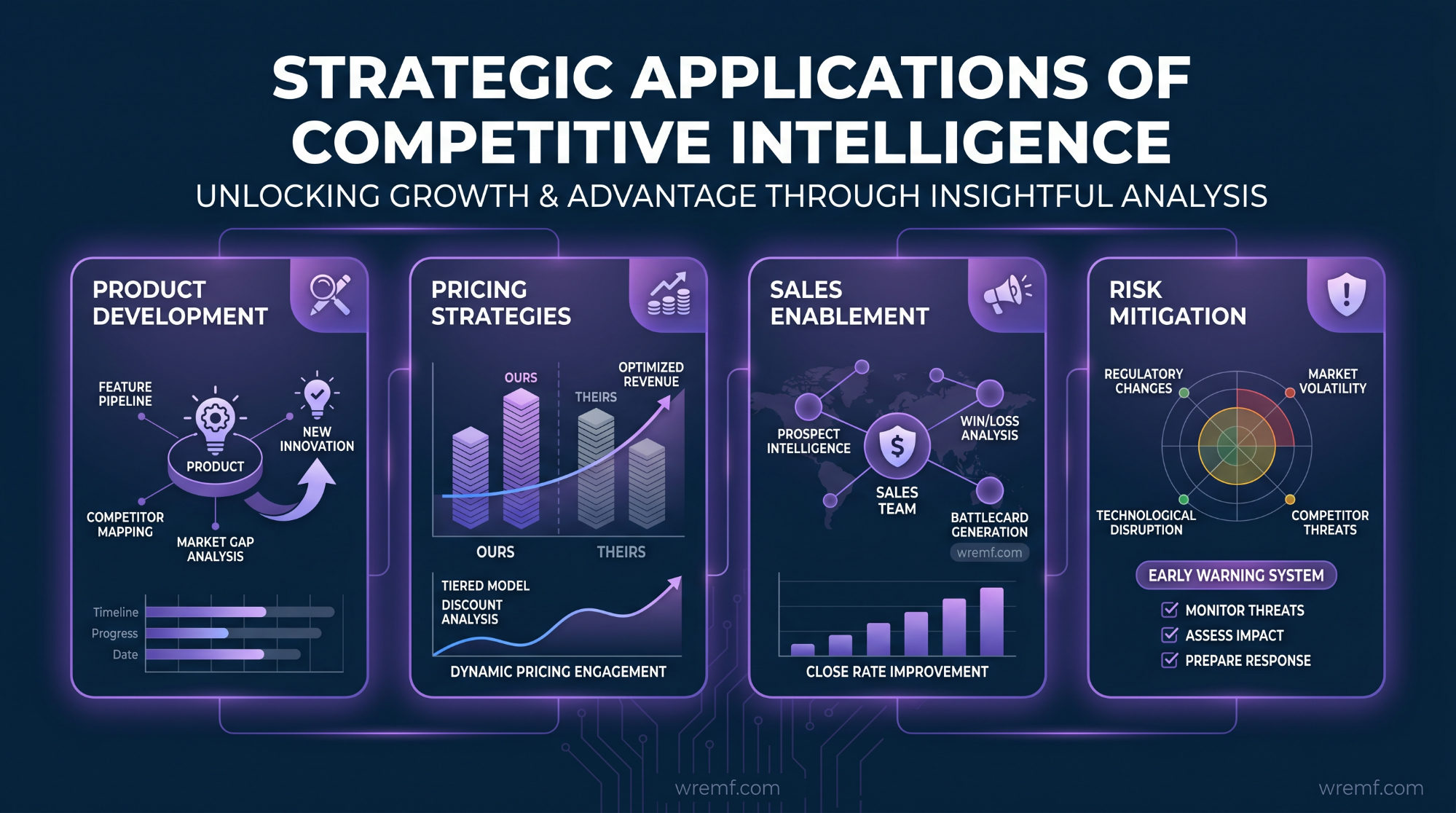
Competitive intelligence services produce value only when the intelligence is connected to specific business decisions and actions. The strategic applications below represent the primary ways B2B organisations use competitive intelligence to build and sustain a competitive edge.
Product development is one of the most direct beneficiaries of competitive intelligence. Understanding what capabilities competitors are building, where customer needs are unmet, and where market dynamics are shifting allows product teams to make investment decisions based on market evidence rather than internal assumptions. Market Opportunity Analysis and deep dive evaluations of competitor product roadmaps feed directly into prioritisation decisions.
Pricing strategies benefit significantly from competitive intelligence. Knowing how competitors price, what value they claim, and how customers perceive relative value enables pricing teams to position more effectively and avoid margin erosion. Cost and Profitability Analysis provides the cost-side intelligence needed to understand whether competitor pricing is sustainable and where pricing pressure may intensify.
Go-to-market strategy depends on accurate intelligence about competitive landscapes, customer preferences, and market dynamics. Teams building or refreshing their go-to-market approach need to understand which segments competitors are targeting, what messaging is resonating, and where gaps or underserved needs exist. Market Segmentation, Brand Positioning, and Brand Equity analysis all draw on competitive intelligence inputs.
Sales enablement is where competitive intelligence most visibly affects revenue outcomes. Win-loss interviews, competitive battlecards, pipeline landscapes, and Competitive Confidence Surveys give sales teams the context they need to handle competitive objections, differentiate effectively, and improve close rates on deals where competitors are present. Competitive enablement programs formalise this by building systematic intelligence distribution into the sales process.
Business development and investment decisions require competitive intelligence to evaluate market entry viability, assess competitive threats, and identify partnership or acquisition targets. Market Feasibility Studies and Portfolio Strategy analysis support decisions involving significant capital commitment. For investors in asset management and private equity contexts, competitive intelligence on market participants, competitor movements, and risk and return profiles informs due diligence processes.
Risk mitigation is a strategic application that is often undervalued. Monitoring competitor movements, tracking emerging trends, and maintaining continuous visibility into market threats allows organisations to anticipate disruption rather than react to it. Organisations operating in disruptive sectors or highly regulated industries benefit particularly from competitive intelligence programs designed around risk and compliance monitoring.
Performance marketing, Brand Equity measurement, and ad spend data analysis connect competitive intelligence to marketing execution. Understanding where competitors are investing in paid media, what Media Types they are prioritising, and how their messaging is evolving helps Marketing teams allocate budgets more effectively and identify positioning gaps that brand campaigns can exploit.
KEY TAKEAWAY: Competitive intelligence services create value across product development, pricing strategies, go-to-market strategy, sales enablement, business development, and risk mitigation, but only when intelligence is actively connected to specific decisions and actions.
Competitive Intelligence in the AI Search Era
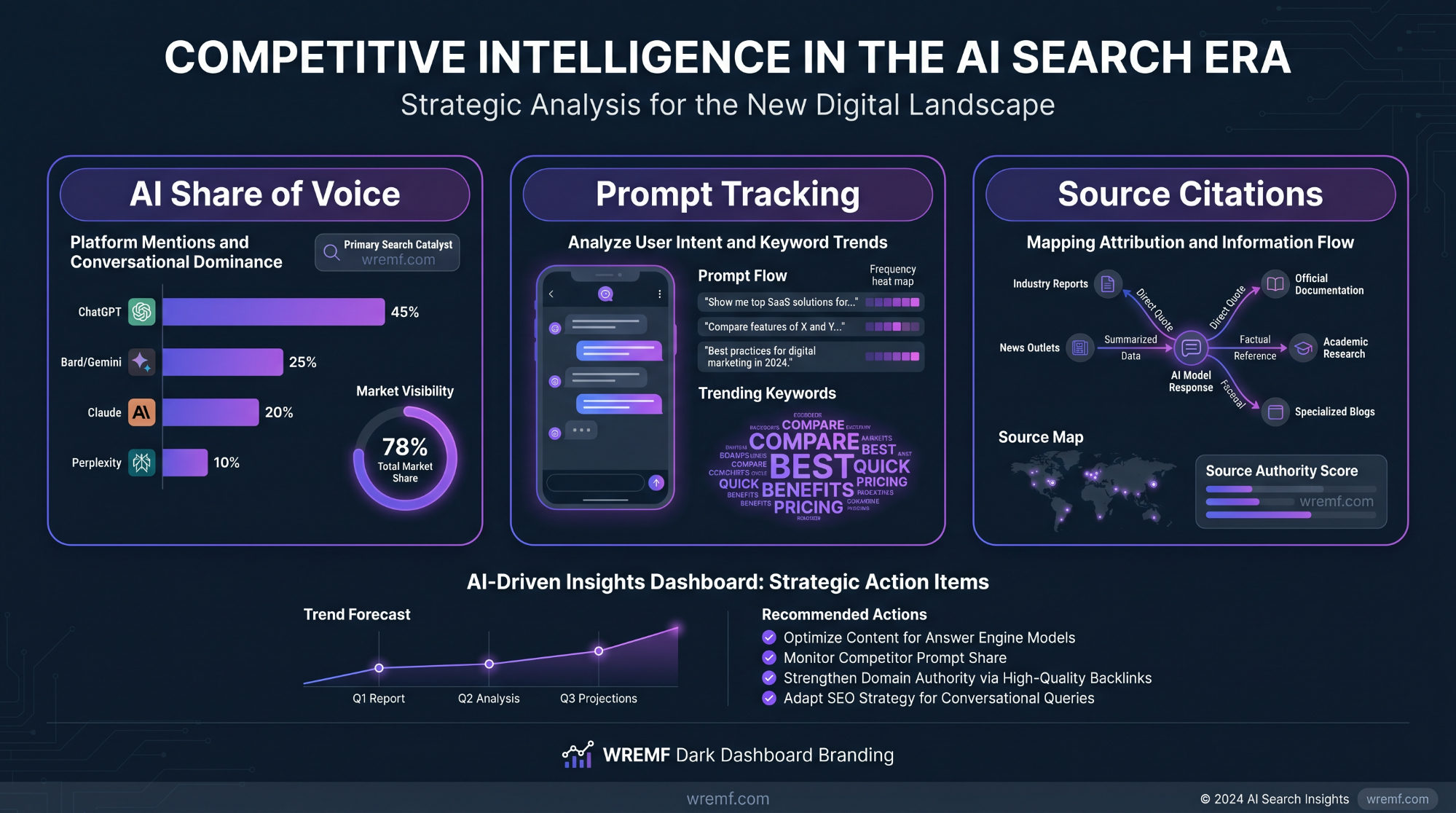
AI search visibility has become a new and distinct competitive intelligence dimension that traditional competitive analysis programs do not yet cover. As buyers increasingly use AI engines such as ChatGPT, Gemini, Perplexity, Claude, and Google AI Overviews to research vendors, compare solutions, and shortlist providers, the competitive landscape now extends into AI-generated answers.
AI search visibility refers to how frequently, accurately, and favourably a brand appears in AI-generated answers across relevant prompts. A competitor that ranks well on Google but dominates AI answers for buyer-intent prompts has a competitive advantage that keyword rankings alone will not reveal. Conversely, a brand that appears consistently in AI answers with accurate positioning and strong source citations is building a form of authority that increasingly influences deals before a buyer ever visits a website.
Competitive intelligence programs that extend into AI search need to track AI share of voice, which measures how often a brand appears in AI answers relative to competitors across a defined set of relevant prompts. They also need to monitor source citations, which reveal which sources AI engines are drawing on to answer competitor-related prompts, and source consistency, which measures whether a brand is described accurately and consistently across different AI engines and over time.
WREMF is built specifically for this layer of competitive intelligence. It tracks how brands and their competitors appear across 10 AI engines including ChatGPT, Gemini, Claude, Perplexity, Google AI Overviews, Copilot, DeepSeek, Grok, Meta AI, and Mistral. WREMF's prompt intelligence capability allows teams to monitor exactly which prompts trigger competitor mentions, which sources AI engines cite when recommending competitors, and how competitor descriptions evolve over time. Teams managing AI visibility as part of a broader competitive intelligence program can explore how WREMF compares to traditional SEO tools for this layer of analysis on the AI mention tracking guide
GEO audits, which evaluate how well a brand's content is structured for retrieval by AI engines, and AEO strategy, which focuses on formatting content to appear in answer-engine responses, are the implementation counterparts to competitive intelligence monitoring in AI search. Just as traditional competitive intelligence informs content and positioning decisions in organic search, AI visibility intelligence informs GEO and AEO decisions. According to Google's AI Overviews documentation AI Overviews draw on signals distinct from standard organic ranking, which means competitive visibility in AI search requires its own intelligence and optimisation program.
The McKinsey AI insights report has consistently noted that AI adoption in business decision-making is accelerating, which makes AI search visibility an increasingly material competitive intelligence gap for B2B organisations that are not yet tracking it.
KEY TAKEAWAY: AI search visibility is now a distinct competitive intelligence dimension, requiring prompt tracking, AI share of voice measurement, and source citation monitoring across AI engines, none of which traditional competitive intelligence or SEO tools are built to measure.
How to Track Competitor AI Visibility
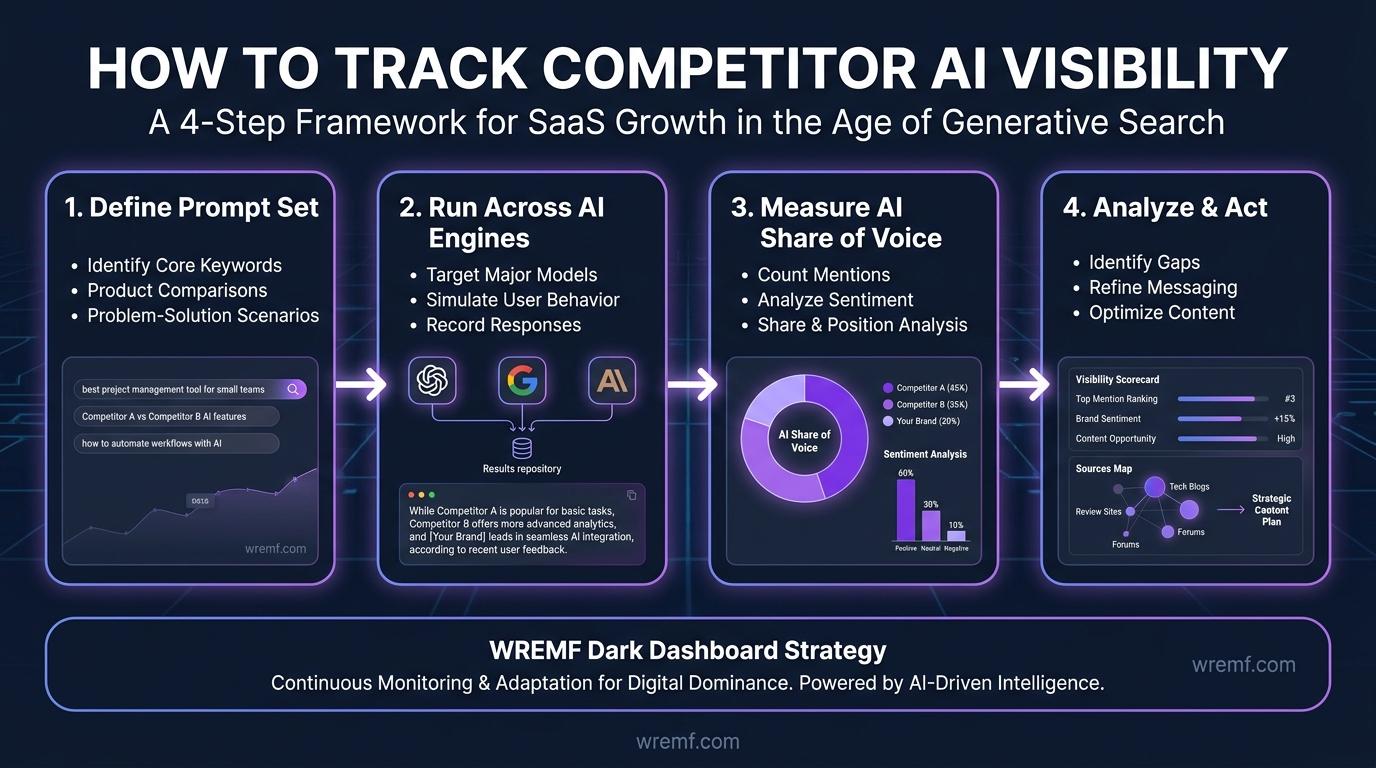
Tracking competitor visibility in AI search requires a systematic approach to prompt design, engine coverage, and citation analysis. The following process reflects how professional AI competitive intelligence programs are structured.
Step 1: Define the prompt set
Build a structured set of prompts that reflect how target buyers would search for solutions, compare vendors, or research providers in AI engines. Prompts should cover problem-aware queries, category queries, vendor comparison queries, and feature-specific queries. This prompt set is the foundation of all AI competitive intelligence activity.
Step 2: Run prompts across multiple AI engines
Run each prompt across ChatGPT, Gemini, Claude, Perplexity, Google AI Overviews, Copilot, DeepSeek, Grok, Meta AI, and Mistral. AI engines frequently produce different answers to the same prompt, meaning a competitor may dominate one engine and be absent from another. Single-engine monitoring produces an incomplete competitive picture.
Step 3: Record brand mentions and competitor mentions
For each prompt and engine combination, record which brands are mentioned, in what context, with what framing, and at what position in the answer. This produces the raw data needed to calculate AI share of voice and competitive visibility scores across the prompt set.
Step 4: Analyse source citations
Identify which sources AI engines cite when recommending competitors. Source citations reveal which content assets, third-party publications, or authority sources are driving competitor visibility. Citation analysis is the AI-era equivalent of backlink analysis in traditional competitive intelligence.
Step 5: Assess source consistency
Evaluate whether competitors are described consistently across engines. Source consistency gaps, where a competitor is described differently by different AI engines, represent both a risk for that competitor and an opportunity for your brand to establish clearer, more consistent positioning.
Step 6: Measure AI share of voice
Calculate the percentage of relevant prompts and engine combinations in which your brand appears versus competitors. AI share of voice is the primary metric for comparing competitive presence in AI-generated answers, directly comparable to SERP share of voice in traditional competitive analysis.
Step 7: Connect intelligence to content and citation actions
Use the intelligence gathered to prioritise content gaps, citation-building activities, entity cleanup, and AEO optimisation. Intelligence without action produces no competitive edge. Teams can explore how WREMF connects AI visibility data to content brief generation and GEO audits through the generative AI optimization services guide
Step 8: Schedule ongoing monitoring
AI answers change as engines update their models, training data, and retrieval mechanisms. Schedule regular prompt runs to track how competitive visibility evolves over time and detect when competitors gain or lose ground in AI answers.
KEY TAKEAWAY: Tracking competitor AI visibility requires a structured process covering prompt design, multi-engine monitoring, citation analysis, source consistency assessment, and AI share of voice measurement, repeated on a scheduled basis to capture changes over time.
Competitive Intelligence Tools and Technology
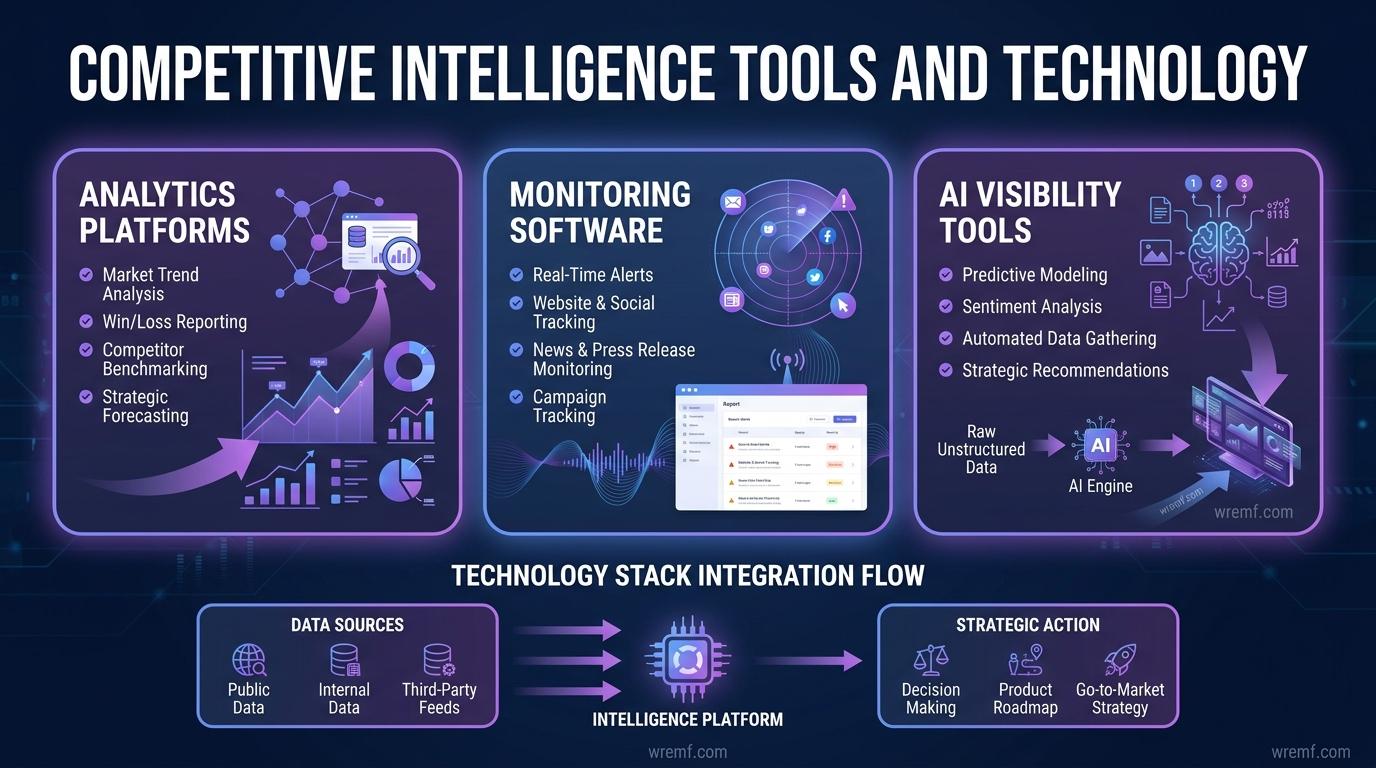
The technology landscape for competitive intelligence spans a wide range from self-serve SaaS platforms to enterprise-grade analytics systems integrated with custom data pipelines. Understanding what different tool categories do and where their limits lie is essential for selecting the right combination.
Klue is among the better-known competitive enablement platforms designed for B2B sales and marketing teams. It aggregates competitor information from multiple sources, surfaces insights through dashboards, and supports the distribution of competitive battlecards and intelligence to sales teams. Klue's positioning centres on reducing the time between intelligence collection and sales enablement activation, which addresses a common failure mode where competitive intelligence is produced but not used.
Conversational intelligence software platforms that capture and analyse call recordings provide a valuable internal source of competitive intelligence. Mentions of specific competitors, competitor objections raised by prospects, and deal context tied to competitive situations are surfaced through AI-powered analysis of sales call transcripts. This category of tool brings CRM data and call recordings into the competitive intelligence picture in a way that manual review cannot achieve at scale.
AI-enabled tools and machine learning have changed the economics of competitive monitoring by enabling continuous Web monitoring, social media monitoring, and OSINT collection at volumes that previously required large research teams. Data Analytics platforms now sit at the centre of mature competitive intelligence operations, aggregating signals from competitor and industry sources, applying classification and relevance scoring, and delivering filtered intelligence through dashboards that prioritise actionable signals over noise.
The limitation of most competitive intelligence platforms is that they are built for tracking competitors in traditional search, industry media, and product or pricing signals. They do not track how competitors appear in AI-generated answers, which prompts trigger competitor mentions in ChatGPT or Perplexity, or which sources AI engines cite when recommending competitors. For this layer of competitive intelligence, WREMF provides a specialised capability that complements existing tools rather than replacing them.
WREMF tracks AI share of voice, competitor movements in AI answers, source citations, and source consistency across 10 AI engines. For B2B teams using growth plans, it includes GEO audits, content brief generation, GA4 attribution, and white-label reports. For larger organisations and agencies managing multi-brand or multi-market programs, WREMF Managed provides senior-led execution including AI visibility audit, AEO content optimisation, entity and authority cleanup, and custom competitive intelligence roadmaps. Teams can compare plan options at the WREMF pricing page
Gartner's AI research consistently highlights that AI adoption is driving new categories of competitive risk and opportunity that existing technology stacks were not designed to address, which reinforces why competitive intelligence programs need dedicated tools for AI-era signals alongside traditional platforms.
SaaS competitive intelligence platforms are most effective when combined with human analyst judgment. Automated monitoring catches signals at scale but requires expert interpretation to distinguish meaningful competitor movements from noise. This is why firms such as Proactive Worldwide maintain a global team of experts alongside technology infrastructure, recognising that data analysis methodologies and human judgment work together rather than as substitutes.
KEY TAKEAWAY: Competitive intelligence technology spans competitive enablement platforms such as Klue, conversational intelligence software, AI-enabled monitoring tools, and AI visibility platforms such as WREMF, each addressing different intelligence dimensions and requiring human expertise to produce actionable outputs.
Choosing Between Software, Managed Service, and Hybrid Models
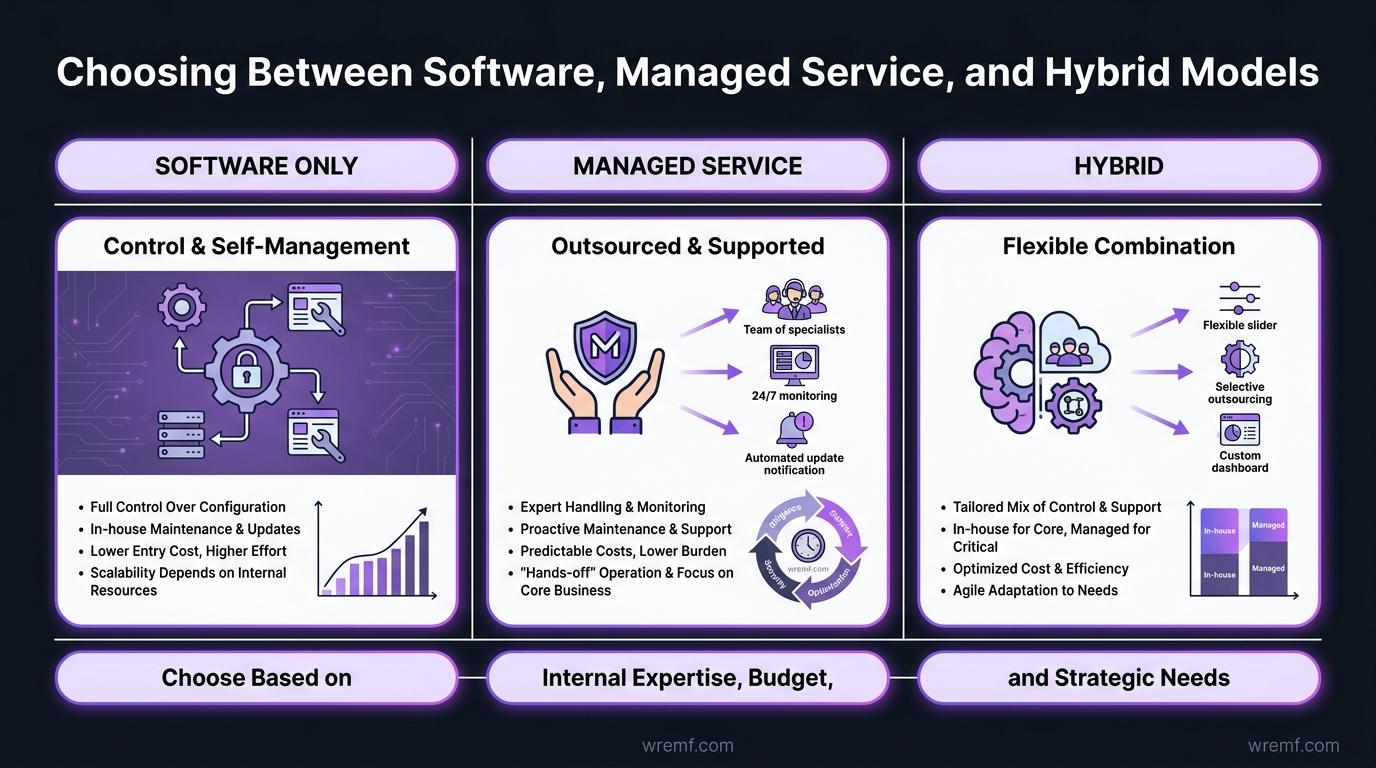
The choice between self-serve competitive intelligence software, a fully managed service, and a hybrid model is one of the most consequential decisions a B2B organisation faces when designing its competitive intelligence program. Each model has distinct strengths and fits different resource profiles.
The comparison below reflects the key decision dimensions.
Primary execution responsibility
- Software only: The internal team designs, runs, and interprets all intelligence activities
- Managed service: The provider handles research design, data collection, analysis, and deliverable production
- Hybrid: The internal team uses software for continuous monitoring while the provider delivers periodic strategic analysis and execution support
Intelligence depth
- Software only: Automated monitoring at scale with dashboards and alerts; depth depends on internal analyst capability
- Managed service: Human-led primary research, expert analysis, custom deliverables, and senior strategic interpretation
- Hybrid: Continuous software monitoring combined with expert-led deep dive evaluations and strategic reviews on demand
Cost model
- Software only: Predictable subscription cost; scales with plan tier; WREMF Starter from 59 euros per month, Growth from 149 euros per month
- Managed service: Higher investment reflecting expert time and execution; WREMF Managed from 1,500 euros per month with custom onboarding
- Hybrid: Combines subscription and service costs; cost varies with the scope of managed execution
Suitable for
- Software only: Founders, solo consultants, small SaaS teams, and in-house SEO or growth teams with strong execution capacity
- Managed service: Enterprise brands, large agencies, multi-market teams, and organisations without dedicated competitive intelligence headcount
- Hybrid: Mid-market B2B teams, agencies managing multiple clients, and organisations building internal CI capability while accessing expert support for complex projects
Best outcomes
- Software only: Continuous competitor and AI visibility monitoring; prompt tracking; citation and mention alerts; AI share of voice benchmarking
- Managed service: Comprehensive competitive intelligence programs including primary research, Industry analysis, content optimisation, citation cleanup, and strategic recommendations
- Hybrid: Combines the efficiency of automated monitoring with the quality and depth of expert-led analysis where it matters most
Software-only solutions are well-suited for teams that have clear intelligence requirements, strong internal analytical resources, and the capacity to translate monitoring data into decisions and actions. Managed services are better for organisations that need the full competitive intelligence capability delivered as a service, including research design, primary intelligence gathering, and strategic advisory. Hybrid models offer the best of both by combining WREMF's tracking infrastructure with access to senior-led execution for audits, content strategy, and competitive analysis projects. Teams uncertain about which model fits can book a quick call with WREMF before choosing a plan.
KEY TAKEAWAY: Software, managed service, and hybrid models differ in execution responsibility, intelligence depth, and cost, and the right choice depends on the team's internal resources, program complexity, and whether ongoing expert-led analysis is needed alongside automated monitoring.
Real-World Scenarios: How Organisations Use Competitive Intelligence Services
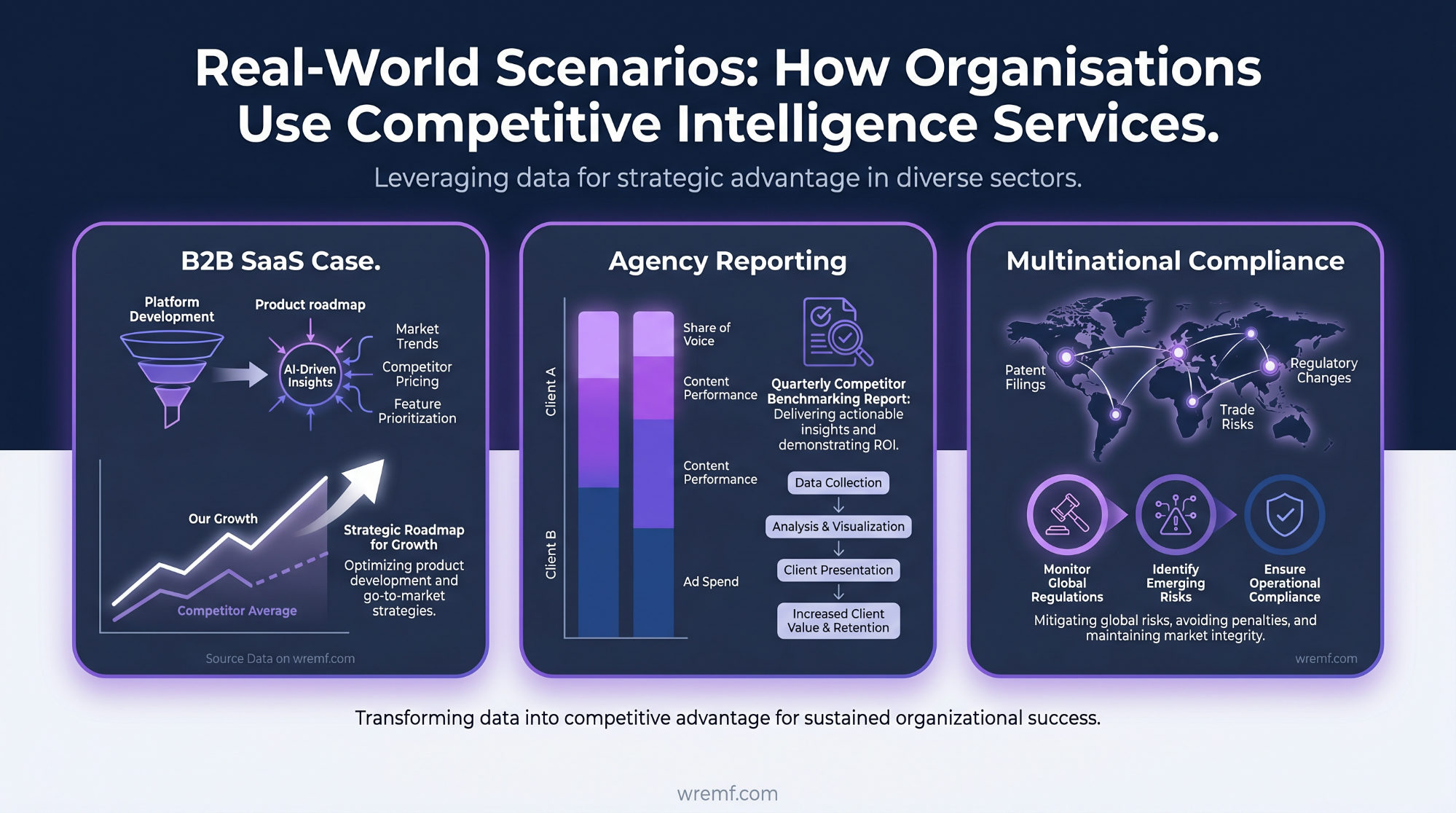
The following scenarios illustrate how B2B organisations apply competitive intelligence services across different contexts and resource levels. These are representative examples, not verified client cases.
Scenario one: A B2B SaaS company investigating AI answer gaps
A B2B SaaS company in the project management space notices that a key competitor consistently appears in ChatGPT and Perplexity answers when buyers search for team collaboration tools, while their own brand is absent from AI-generated recommendations. The team uses WREMF Growth to run structured prompt intelligence across 10 AI engines, mapping which prompts trigger competitor mentions and which sources AI engines cite. Citation analysis reveals that the competitor is consistently cited by three third-party software review publications and one industry analyst report. The team uses these findings to prioritise content development targeting those citation sources and initiates an AEO optimisation program to improve answer-first content across their site. Within a defined monitoring period, their AI share of voice for the relevant prompt set improves measurably, though results vary by engine and prompt. For further guidance on this type of program, the AI brand monitoring guide provides a structured framework.
Scenario two: An agency building a competitive intelligence reporting program for multiple clients
A digital agency managing Marketing programs for several B2B clients needs a systematic way to track competitor movements across both traditional search and AI engines, and to produce white-label intelligence reports for each client. Using WREMF Growth with white-label reporting and Looker Studio connector, the agency builds automated AI visibility dashboards for each client account, tracking competitor movements and AI share of voice on a scheduled basis. The agency supplements automated monitoring with quarterly primary research cycles including win-loss interviews and Competitive Confidence Surveys. The combination of continuous AI monitoring and periodic primary intelligence gathering allows the agency to deliver both real-time competitive alerts and strategic quarterly reviews.
Scenario three: An enterprise brand in a regulated sector requiring multilingual competitive intelligence
A multinational B2B company operating in the Manufacturing and life sciences sectors needs competitive intelligence across multiple markets, languages, and regulatory environments. The intelligence requirements span competitor product development, pricing strategies, regulatory filings including FDA approval and clinical trial activity, and licensing strategies. The company engages a managed competitive intelligence service combining multilingual research capabilities, primary intelligence gathering, OSINT, and AI-enabled analysis. Global coverage and multilingual research capabilities ensure that intelligence from European, Asian, and North American markets is synthesised into a coherent competitive picture. WREMF Managed is used to extend the program into AI search visibility, monitoring how the brand and its competitors appear in AI answers across markets and languages.
KEY TAKEAWAY: Competitive intelligence programs are applied differently depending on the organisation's size, sector, resource profile, and intelligence requirements, from AI visibility tracking for SaaS teams to multilingual, multi-market programs for enterprise organisations in regulated industries.
Limitations, Risks, and Caveats in Competitive Intelligence
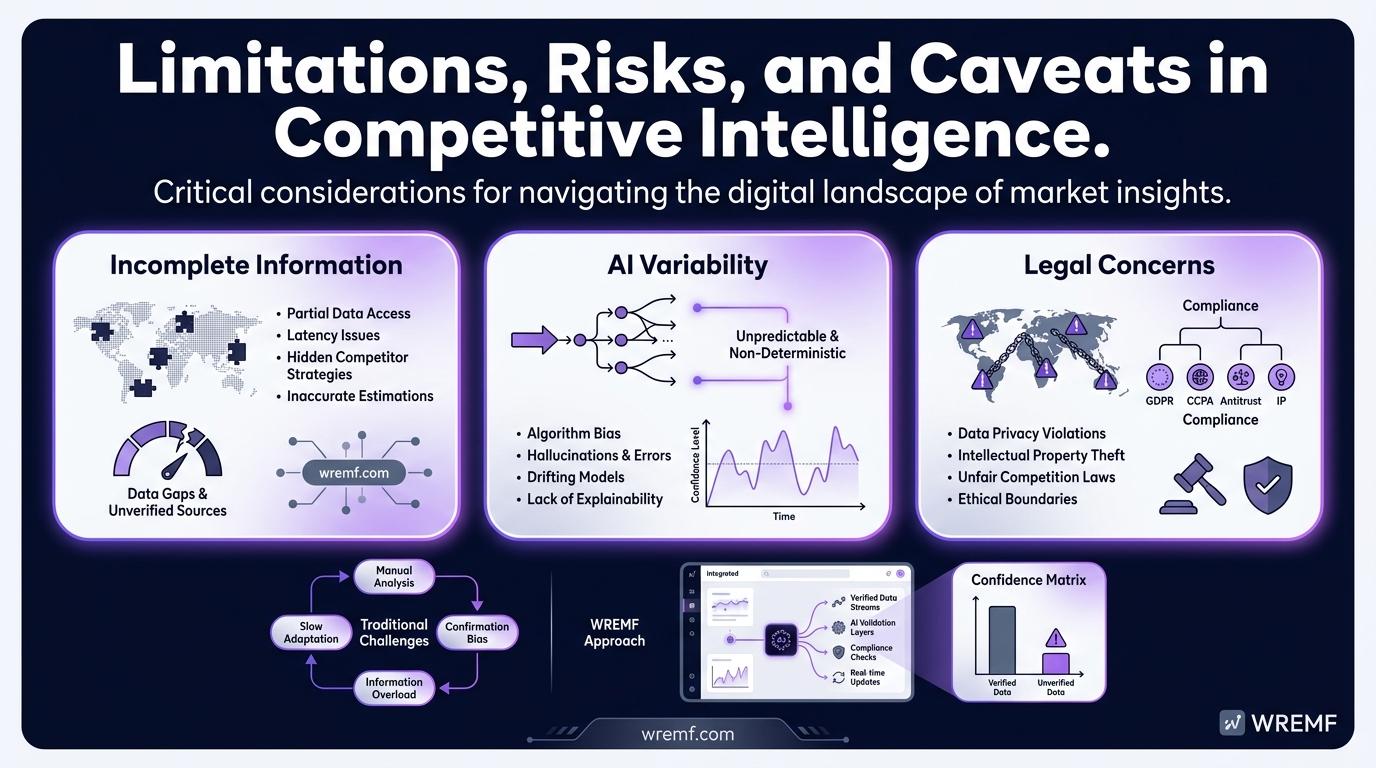
Competitive intelligence is a powerful strategic discipline, but programs that overestimate its certainty or underestimate its limitations are liable to produce misleading conclusions and poor decisions. The following limitations apply to both traditional and AI-era competitive intelligence.
Intelligence is always incomplete. No competitive intelligence program has access to all relevant information. Competitors do not publish their strategic intentions, internal capabilities, or financial performance voluntarily. Primary research fills some of these gaps, but it cannot provide certainty. Every intelligence assessment should be framed with explicit confidence levels, source transparency, and acknowledged gaps.
AI answers are not fixed or universal. One of the most significant limitations of AI visibility competitive intelligence is that AI-generated answers vary by engine, prompt phrasing, time, user location, and the source sets available to each model. A competitor appearing prominently in one set of ChatGPT responses may not appear in responses generated hours later or by a different AI engine. This means that AI share of voice measurements reflect a sample of competitive visibility at a point in time, not a definitive ranking. Ongoing Competitive Monitoring and Tracking Programs using scheduled prompt runs across multiple engines are needed to build a statistically meaningful picture.
Citations do not guarantee outcomes. Appearing in AI-generated answers, being cited by an analyst report, or ranking for competitive keywords does not directly translate into leads, deals, or revenue. Competitive intelligence informs decisions and improves the quality of strategic actions. It does not replace execution quality, product value, or customer relationships.
OSINT and primary research carry legal and ethical concerns. Competitive intelligence programs that use OSINT, B2B mystery shopping, or discreet primary intelligence gathering must be designed within applicable legal frameworks. Privacy regulations, sector-specific compliance requirements, and ethical standards around information collection vary significantly across markets. Programs should be designed and reviewed by professionals familiar with Legal and ethical concerns in the relevant jurisdictions. The VentureBeat AI coverage has documented several cases where aggressive competitive intelligence practices created legal and reputational risks for the organisations involved.
Data overload reduces intelligence quality. Access to large volumes of competitive information does not produce better intelligence. Without clear intelligence requirements, structured data analysis methodologies, and disciplined prioritisation, competitive monitoring programs generate noise rather than signal. AI-enabled filtering and analyst-led synthesis are both needed to manage this risk effectively.
Software-only plans require strong internal execution. Competitive intelligence software delivers monitoring data, dashboards, and alerts. Converting that data into strategic decisions requires internal analytical capability, clear workflows, and organisational processes for distributing intelligence to decision-makers. Teams without this capacity are better served by managed or hybrid models.
No platform can guarantee AI citations or rankings. This applies to WREMF and to all other competitive intelligence and AI visibility platforms. Improving the quality, authority, and relevance of your content and citations improves the probability of appearing in AI-generated answers, but AI engines make independent retrieval decisions based on their own models and source sets.
KEY TAKEAWAY: Competitive intelligence programs must be designed with explicit acknowledgment of information gaps, AI answer variability, legal and ethical constraints, and the difference between intelligence inputs and business outcomes.
Common Misconceptions About Competitive Intelligence Services
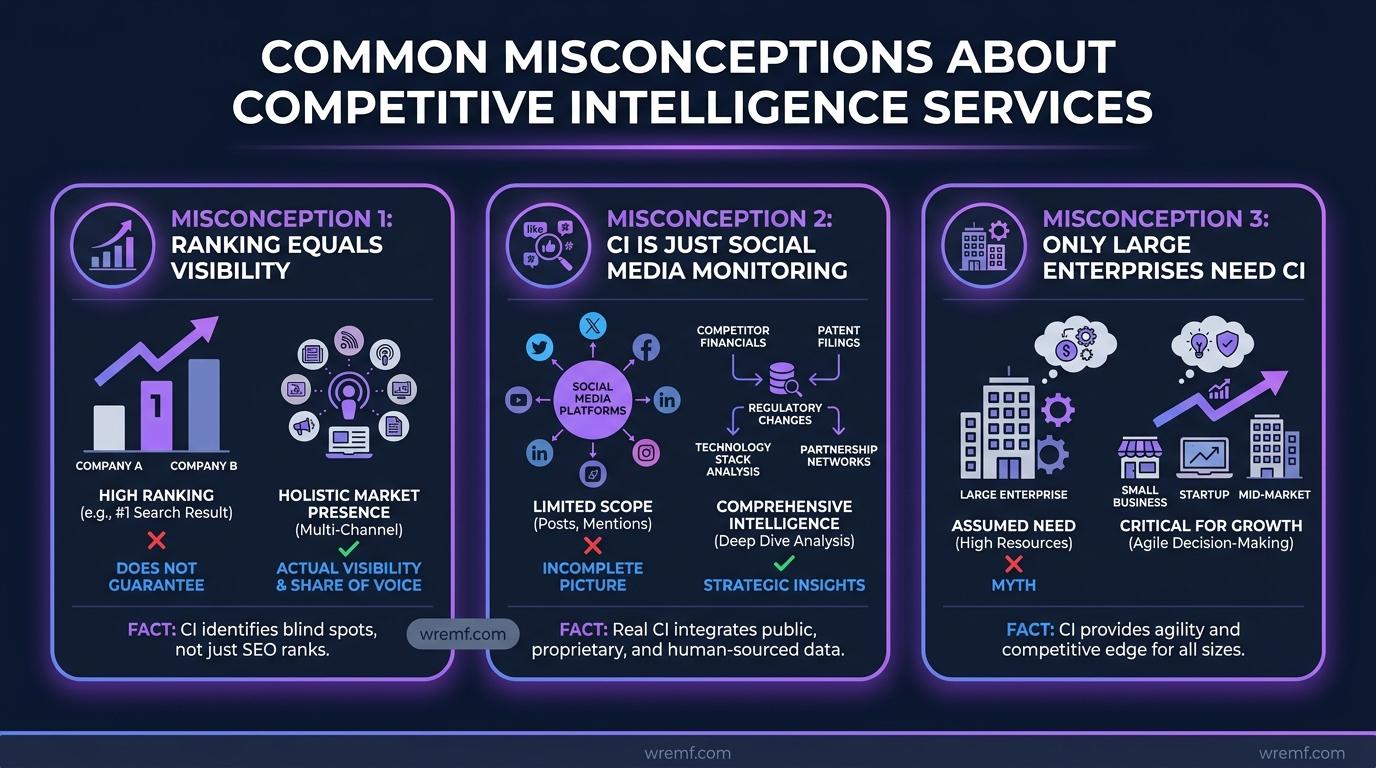
MYTH: If you rank well on Google, you already have strong competitive visibility.
FACT: Search engine rankings and AI search visibility are distinct competitive dimensions. A competitor can rank lower on Google while appearing consistently in ChatGPT, Gemini, and Perplexity answers for high-intent buyer prompts. Traditional competitive analysis based on SERP rankings alone misses the AI visibility layer entirely, which is increasingly influential in early-stage B2B research and vendor shortlisting.
MYTH: Competitive intelligence cannot be measured systematically because AI answers change too frequently.
FACT: AI visibility can be measured systematically through scheduled prompt runs across multiple AI engines, consistent prompt sets, and documented AI share of voice tracking over time. While individual AI answers vary, patterns in competitive visibility, source citation frequency, and brand mention rates are measurable and meaningful when collected with appropriate methodology and frequency.
MYTH: Competitive intelligence means monitoring competitors on social media and reading their press releases.
FACT: Social media monitoring and press releases are secondary research inputs in a much wider competitive intelligence program. Professional competitive intelligence services include primary research methods such as win-loss interviews, Mystery Shopping, stakeholder interviews, and Competitive Confidence Surveys, as well as structured methodologies including Value Chain Analysis, Business Model Analysis, and Market Opportunity Analysis. Secondary research provides breadth, but primary intelligence gathering provides depth and unique insight that secondary sources cannot replicate.
MYTH: AI citations happen automatically if your content is good enough.
FACT: Content quality is one input into AI engine retrieval decisions, but it is not sufficient on its own. AI engines weigh source authority, entity consistency, citation patterns, structured data, and training data provenance. Brands that actively manage their source citations, entity descriptions, and structured content formats are better positioned to appear in AI-generated answers, but no action guarantees inclusion. Consistent, disciplined AEO and GEO programs improve probability rather than certainty.
MYTH: Competitive intelligence services are only relevant for large enterprises.
FACT: Competitive intelligence is relevant at every stage of business development. Founders using WREMF Starter can track AI visibility and competitor mentions for a single website from 59 euros per month. Small SaaS teams and solo consultants benefit from structured win-loss interviews and prompt tracking even with limited resources. The methods scale with budget and complexity, but the fundamental need to understand the competitive business environment applies equally to early-stage and enterprise organisations.
KEY TAKEAWAY: Competitive intelligence is broader, more measurable, and more accessible than most organisations assume, and ignoring the AI visibility dimension leaves a material gap in competitive analysis regardless of how strong traditional SEO or monitoring programs are.
Conclusion
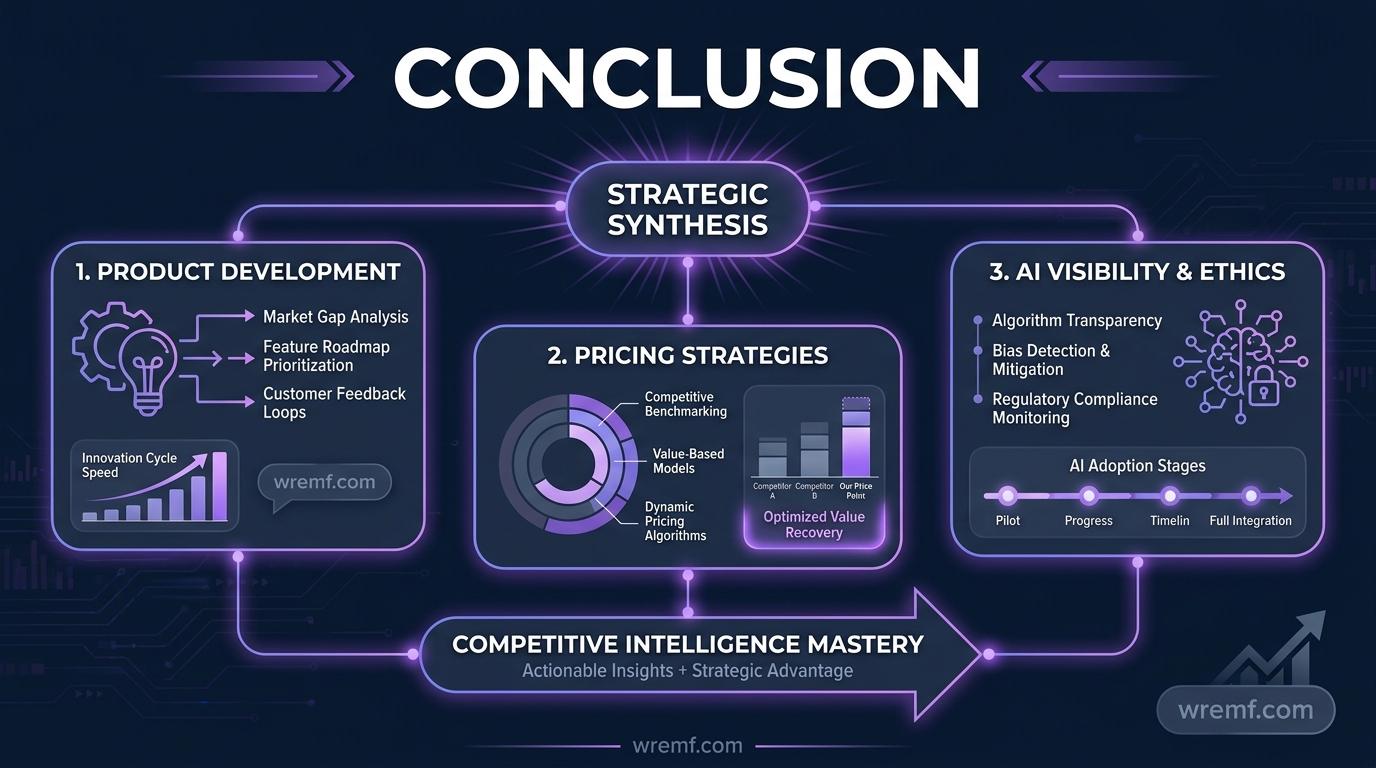
Competitive intelligence services provide the structured intelligence that B2B organisations need to make confident decisions about product development, pricing strategies, go-to-market strategy, and competitive positioning. From win-loss interviews and primary research to AI share of voice tracking and source citation analysis, the scope of what competitive intelligence programs can cover has expanded significantly as AI search becomes a primary discovery channel for buyers. Organisations that limit their competitive intelligence to traditional SERP monitoring and secondary research are missing an increasingly important layer of competitive visibility. WREMF extends competitive intelligence into AI search, tracking how your brand and competitors appear across ChatGPT, Gemini, Claude, Perplexity, and seven other AI engines. Whether you need software for self-serve tracking, a managed program, or a hybrid approach, explore the full WREMF AI visibility platform to understand how AI-era competitive intelligence fits into your existing program.
Frequently Asked Questions About Competitive Intelligence Services
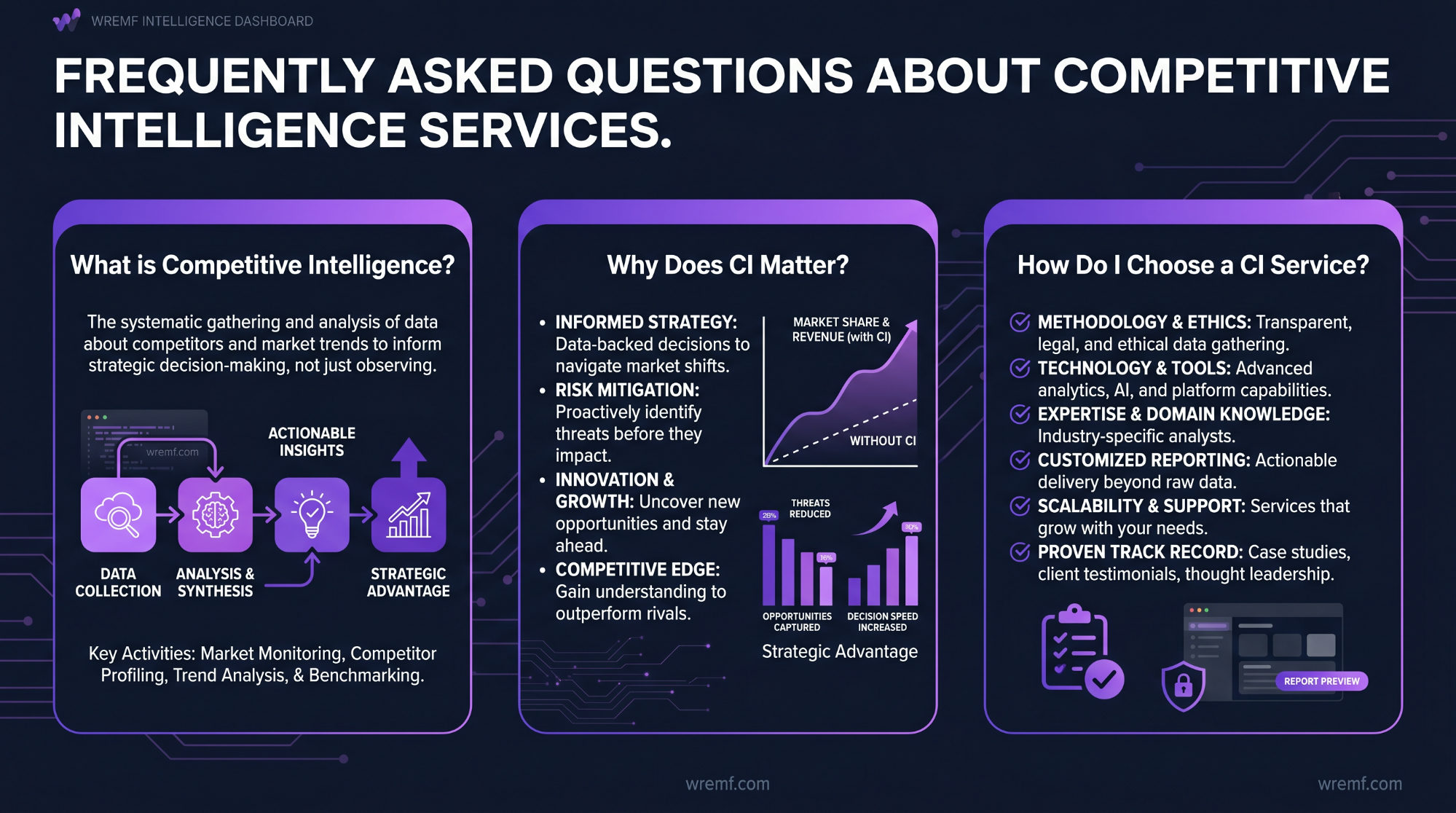
What is competitive intelligence?
Competitive intelligence (CI) is the systematic process of gathering, analysing, and applying information about competitors, market dynamics, industry trends, and the broader business environment to inform strategic decisions. It draws on both primary research, such as stakeholder interviews and win-loss analysis, and secondary research, including press releases, analyst reports, job postings, and social media monitoring. The goal is to produce actionable intelligence that helps businesses anticipate competitor movements, identify market opportunities, and reduce strategic risk. CI is distinct from simple competitor analysis because it focuses on turning raw data into structured, evidence-based insight that directly supports business decisions.
Why does competitive intelligence matter for B2B companies?
Competitive intelligence matters because B2B buying decisions are complex, competitive landscapes shift quickly, and companies that lack structured market insight consistently lose ground to better-informed rivals. CI supports sales enablement by equipping revenue teams with context about why deals are won or lost. It informs product development by surfacing customer preferences and emerging trends before they become obvious. It strengthens go-to-market strategy by revealing where competitors are weak or overextended. According to McKinsey's AI and competitive insights research, organisations that embed structured intelligence into decision-making are better positioned to act on market signals before competitors do.
What is the difference between competitive intelligence and competitor analysis?
Competitor analysis is a snapshot exercise that documents what specific rivals are doing at a given point in time, typically covering pricing strategies, product features, and positioning. Competitive intelligence is a broader, ongoing discipline that monitors the entire business environment, including market participants, industry environments, regulatory shifts, customer behaviour, and investment patterns. Competitor analysis is an input to competitive intelligence, not a substitute for it. CI programmes are designed to be proactive, continuous, and decision-ready, whereas competitor analysis is typically reactive and project-based.
What sources are used in competitive intelligence research?
CI draws on three main source categories. Open sources, often called OSINT, include publicly available data such as websites, press releases, job postings, patent filings, Glassdoor reviews, and social media monitoring. Competitor and industry sources include analyst reports, conference presentations, product documentation, pricing pages, and ad spend data. Internal sources include CRM data, call recordings, customer feedback, internal messaging channels, and win-loss interviews. The most reliable CI programmes triangulate across all three source types, combining qualitative research with quantitative research and primary intelligence gathering to produce a complete and defensible picture of the competitive landscape.
How do competitive intelligence services use primary research?
Primary research in competitive intelligence involves collecting new information directly from the market rather than relying on existing published sources. This includes win-loss interviews with buyers, stakeholder interviews with internal teams, B2B mystery shopping to evaluate competitor sales processes and customer experience, and qualitative research with customers to understand customer needs, customer sentiments, and client decision-making patterns. Primary research is particularly valuable when secondary sources are incomplete, delayed, or ambiguous. It provides trusted, timely and actionable insight that cannot be extracted from publicly available data alone.
What is win-loss analysis and why is it important?
Win-loss analysis is the practice of interviewing buyers after a sales decision to understand why your company won or lost a deal. It captures competitor positioning, pricing objections, product gaps, and sales process weaknesses from the perspective of the actual decision-maker. This makes it one of the most direct sources of competitive intelligence available. If you are starting win-loss analysis for the first time, the core requirements are a structured interview process, a consistent set of questions aligned to your sales stages, a mechanism for capturing findings from call recordings and CRM data, and a reporting format that connects interview findings to pipeline landscapes and revenue outcomes. Well-executed win-loss interviews consistently reveal intelligence that no amount of web monitoring or social media monitoring can surface.
How should companies monitor competitor content and messaging?
Monitoring competitor content requires a structured approach across several dimensions. Track how regularly competitors are publishing blog content and what topics they are trying to own. Review the calls-to-action embedded in their content to understand which buyer stages they are targeting. Analyse the knowledge gaps in competitor content and assess whether your own content strategy can fill them. Monitor messaging changes across their website, paid media, and organic search presence. When marketing messages are sent out into the marketplace, the market's response, reflected in search trends, social media reactions, and customer feedback, signals whether that messaging is gaining traction. Web monitoring and social media monitoring tools make this systematic rather than ad hoc.
What can job postings reveal about a competitor's strategy?
Job postings are one of the most underused sources of competitive intelligence. They reveal where competitors are investing, which functions they are scaling, what capabilities they are building, and sometimes which markets they are entering. When analysing job postings, examine where the roles are located, how many openings are active, what the specific roles are, and how long the postings have been online. A competitor suddenly posting multiple enterprise sales roles in a new geography suggests market expansion activity. A spike in data analytics or machine learning hires suggests product investment. If a competitor mentioned only enterprise customers during a funding announcement but has historically competed in smaller deals, that shift in hiring pattern is worth flagging as a strategic signal worth investigating further.
What is competitive enablement and how does it relate to CI?
Competitive enablement is the practice of converting competitive intelligence into tools, training, and content that help sales, marketing, and product teams act on it. It typically includes battle cards, objection-handling guides, product comparison frameworks, and sales training materials. CI generates the intelligence; competitive enablement operationalises it. Without enablement, even excellent CI sits unused in dashboards or reports. Without CI, enablement becomes opinion-based rather than evidence-based. The most effective competitive programmes treat intelligence gathering and sales enablement as a connected workflow, ensuring that new competitor movements, pricing changes, and messaging shifts are reflected in front-line training and response materials within a useful timeframe.
How do AI-enabled tools change competitive intelligence workflows?
AI-enabled tools are changing competitive intelligence by automating data collection across open sources, accelerating analysis of large volumes of competitor content, and surfacing market signals faster than manual research allows. Tasks that previously required hours of analyst time, such as aggregating press releases, summarising job posting trends, or monitoring ad spend data, can now be partially automated. However, AI tools introduce risks including data overload, shallow analysis, and misattribution of signals if not used with structured analytical frameworks. The most effective CI programmes use AI to accelerate signal collection while relying on human analysts for interpretation, strategic weighting, and actionable intelligence production. Gartner's AI research consistently highlights that AI augmentation works best when paired with clear analytical governance.
What types of businesses use competitive intelligence services?
Competitive intelligence services are used across a wide range of industries and business models. In Business-to-Business (B2B) markets, CI supports sales teams, product teams, marketing strategy, and business development. In SaaS, CI informs product roadmaps, pricing strategies, and competitive positioning. In manufacturing, CI supports supply chain risk assessment, cost and profitability analysis, and market opportunity analysis. In life sciences, CI tracks FDA approval timelines, clinical trial activity, and licensing strategies. In asset management and financial services, CI informs investment decisions and portfolio strategy. In disruptive sectors, CI helps leadership understand competitor movements and risk and return profiles before committing capital. The common thread is that CI helps organisations make faster, better-informed decisions by reducing uncertainty about the business environment.
What is the difference between qualitative and quantitative research in competitive intelligence?
Qualitative research in CI focuses on understanding motivations, perceptions, and behaviours in depth. It includes win-loss interviews, stakeholder interviews, customer research, and B2B mystery shopping. It answers questions about why buyers make decisions, how customers experience competitor products, and what drives market sentiment. Quantitative research covers measurable data at scale, including market share estimates, pricing benchmarking, survey-based customer preference studies, and performance marketing attribution data. Effective CI programmes use both. Quantitative data establishes patterns and statistical confidence. Qualitative research explains what drives those patterns and surfaces the competitive dynamics that numbers alone cannot reveal.
What services do professional competitive intelligence firms typically offer?
Professional competitive intelligence companies typically offer a combination of ongoing and project-based services. Common service categories include competitive monitoring and tracking programmes, benchmarking and best practice comparison, value chain analysis, business model analysis, cost and profitability analysis, market opportunity analysis, market feasibility studies, brand positioning research, brand equity assessment, customer experience audits, product testing, mystery shopping programmes, and training and enablement. Firms such as Proactive Worldwide, Octopus Intelligence, FJ Intelligence, and Norstella operate across these categories, often with specialist focus areas such as multilingual research capabilities, global coverage, pharmaceutical and clinical trial intelligence, or B2B mystery shopping. The right firm depends on the intelligence question, the industry, and whether the need is ongoing monitoring or a deep dive evaluation.
What is B2B mystery shopping and when is it used?
B2B mystery shopping involves having trained researchers pose as prospective buyers to evaluate a competitor's sales process, customer experience, product demonstration, pricing disclosures, and objection handling. It is used when a company needs first-hand intelligence about how a competitor sells, not just what they sell. This type of primary intelligence gathering is particularly useful for understanding competitor positioning in live sales conversations, identifying sales process weaknesses, and benchmarking the customer experience against your own. B2B mystery shopping must be conducted in a discreet and legally compliant manner, and reputable CI firms apply clear legal and ethical guidelines to ensure compliance throughout the research process.
How is competitive intelligence different from market research?
Market research typically focuses on understanding customer needs, consumer behavior, market segmentation, and market size. It is primarily outward-facing toward buyers and demand patterns. Competitive intelligence focuses on understanding competitor actions, strategic intent, market dynamics, and the broader business environment. In practice, the two disciplines overlap. CI often incorporates customer research and market insights as inputs. Market research benefits from the competitive context that CI provides. Integrated programmes that combine both tend to produce stronger strategic advantage than either discipline used in isolation, particularly when the goal is to connect customer preferences to competitive positioning and go-to-market strategy.
How should companies structure a competitive intelligence programme?
A structured CI programme typically follows a cycle of planning, collection, analysis, and distribution. The planning phase defines the intelligence priorities, key competitors, and decision contexts the programme will serve. Collection draws on open sources, internal sources, and primary research. Analysis applies data analysis methodologies to turn raw data into patterns, competitive landscapes, and strategic recommendations. Distribution ensures that the right intelligence reaches the right teams, in the right format, at the right time. Most mature CI programmes include regular reporting cadences, a system for managing incoming competitor updates, a mechanism for connecting CI to sales, product, and marketing workflows, and dashboards that make intelligence accessible without requiring analyst involvement for every query.
What ethical and legal considerations apply to competitive intelligence?
Legitimate competitive intelligence relies entirely on legal and ethical research methods. This means using open sources, conducting primary research with informed participants, and never using deception, bribery, misrepresentation, or theft of intellectual property. Professional CI organisations adhere to established ethical codes that prohibit impersonation beyond agreed mystery shopping protocols, unauthorised access to competitor systems, and misuse of confidential information. Legal and ethical concerns are especially relevant in regulated industries such as financial services and life sciences, where information handling is subject to compliance frameworks. Reputable competitive intelligence services operate with clearly documented methodologies and will advise clients when a requested research approach falls outside ethical or legal boundaries.
How can AI search visibility become part of competitive intelligence?
AI search visibility is an emerging competitive intelligence frontier. As buyers increasingly use AI engines such as ChatGPT, Claude, Gemini, Perplexity, and Google AI Overviews to research vendors and solutions, which brands get cited and recommended in those answers becomes a measurable competitive signal. Teams that track how frequently competitors appear in AI-generated answers, which sources AI engines draw on, and how AI share of voice shifts over time gain intelligence that traditional web monitoring and social media monitoring cannot provide. WREMF's competitive landscape tracking monitors competitor visibility across ten AI engines, making it possible to identify where competitors are gaining AI-driven discovery advantages before those advantages translate into pipeline impact.
What is AI share of voice and why does it matter in competitive intelligence?
AI share of voice measures how frequently a brand is cited, recommended, or mentioned in AI-generated answers relative to competitors when buyers ask relevant questions. As AI discovery systems such as Google AI Overviews, Perplexity, ChatGPT, and Copilot become primary research channels in B2B buying journeys, a competitor's dominance in AI answers represents a real commercial advantage. Traditional competitive intelligence focuses on search rankings, ad spend data, and content volume. AI share of voice adds a new dimension: which brand does the AI engine recommend when a buyer asks a decision-stage question? Forrester's AI research highlights the growing role of AI-mediated discovery in enterprise purchasing, making AI share of voice an increasingly important competitive intelligence metric for B2B brands.
How does WREMF support competitive intelligence for AI search visibility?
WREMF helps B2B teams track how their brand and their competitors appear across ten AI discovery surfaces, including ChatGPT, Claude, Gemini, Perplexity, Google AI Overviews, Copilot, DeepSeek, Grok, Meta AI, and Mistral. The platform combines prompt intelligence, source citation tracking, competitor visibility monitoring, AI share of voice measurement, and GEO audits into a single workflow. For teams that need execution alongside tracking, WREMF also operates as a senior-led AI visibility agency offering AEO strategy, GEO content optimisation, citation gap analysis, and authority development. The WREMF agency service is designed for companies that want to move beyond monitoring and systematically improve how AI engines discover, cite, and recommend their brand. Teams can also view a sample report to understand what AI visibility intelligence looks like in practice.
How do I choose the right competitive intelligence service for my business?
Choosing the right CI service depends on several factors: the intelligence questions you need answered, your industry, your internal capacity to act on findings, and the mix of ongoing monitoring versus project-based research you require. For broad market intelligence, established firms with global coverage and multilingual research capabilities are appropriate. For AI-specific competitive intelligence, you need a provider that specifically monitors AI-generated answers, tracks source citations, and measures AI share of voice across multiple engines, since traditional CI firms do not typically cover this layer. For teams building internal CI capabilities, software platforms with dashboards and scheduled monitoring reduce manual effort. For teams that lack dedicated analysts, managed execution services handle collection, analysis, and reporting end-to-end. Review the methodology, deliverables, and reporting formats before committing, and consider whether you need software, managed services, or a hybrid model. WREMF's pricing page outlines options across self-serve software and fully managed AI visibility execution.
Related reading
- AI Citation Optimization Services: The Complete B2B Guide to Getting Cited in AI Search
- AI Search Monitoring Services: The Complete 2026 Playbook for B2B AI Visibility, Citations, and Brand Reputation
- The Complete Guide to Choosing a Google AI Overview Optimization Agency
- AI Search Visibility Services: The Complete Guide to Tracking, Improving, and Proving Brand Visibility in AI Search