AI Overviews Tracker: The Complete Guide to Monitoring Google AI Overviews, Citations, and AI Search Visibility
Understand AI Overviews trackers and discover how to monitor Google AI Overviews, track citations, and improve search visibility.
By WREMF Team · 2026-08-28
An AI Overviews tracker is a tool that monitors the appearance of Google AI Overviews for specific keywords, the sources cited, and brand visibility in AI-generated answer blocks. It differs from standard rank trackers by focusing on AI Overview presence, citation patterns, and visibility shifts. This tool is crucial for detecting citation gaps, understanding competitor exposure, and linking AI Overview presence to traffic changes and click-through rates. Tracking involves combining Search Console data, GA4 attribution, and specific AI Overviews metrics to gain a unified view of brand performance.
Key takeaways
- AI Overviews trackers monitor when Google AI Overviews appear, cited sources, and pattern shifts.
- Dedicated AI Overview tracking differs from standard rank tracking due to separate citation sources.
- Citations in AI Overviews can increase brand search volume even without direct clicks.
- Tracking AI Overview citations requires combining dedicated tracker data with Search Console and GA4.
- WREMF's platform supports AI Overview tracking across multiple AI engines for unified visibility.
- SEO strategies focused only on organic rankings may miss critical data from AI Overviews.
AI Overviews Tracker: The Complete Guide to Monitoring Google AI Overviews, Citations, and AI Search Visibility
An AI Overviews tracker is a tool or platform that monitors when and how Google AI Overviews appear for specific keywords, which sources get cited, and how brands are represented in AI-generated answer blocks. As Google's AI Overviews reshape how search results are displayed, brands that rely on rankings and clicks alone are missing a critical layer of visibility. This guide is written for B2B SaaS teams, SEO professionals, agencies, and growth leaders who need to understand, measure, and act on AI Overview performance. It covers how AI Overviews trackers work, what to measure, how to connect AI Overview data to traffic attribution, and how WREMF supports teams through software, managed execution, or a hybrid model. If your brand appears in Google Search but you cannot confirm whether it appears in AI Overviews, this guide explains exactly how to close that gap.
QUICK ANSWER:
An AI Overviews tracker monitors whether Google AI Overviews appear for target keywords, which sources and URLs get cited inside those AI-generated answers, and how brand visibility shifts over time. Teams use AI Overviews trackers to identify citation gaps, benchmark competitors in AI search results, and connect AI Overview presence to traffic and click-through rate changes. WREMF tracks AI Overview visibility alongside nine other AI engines from a single platform.
KEY TAKEAWAYS:
- An AI Overviews tracker records when Google AI Overviews appear for specific queries, which domains are cited, and how citation patterns shift over time.
- Google AI Overviews draw on a distinct set of sources that do not always match the top organic rankings, making dedicated AI Overview tracking separate from standard rank tracking.
- Citation presence inside AI Overviews is associated with measurable increases in brand search volume even when users do not click through to the cited domain.
- Tracking AI Overview citations requires combining Google Search Console data, GA4 attribution, and a dedicated AI Overviews tracker, because no single source captures the full picture.
- WREMF tracks AI Overview citations alongside visibility across ChatGPT, Perplexity, Gemini, Claude, Copilot, and other AI engines, giving teams a unified view of AI search visibility.
- SEO teams that track only keyword rankings cannot see whether their content is being cited in AI-generated answers, creating a blind spot in competitive analysis and content strategy.
What Is an AI Overviews Tracker and Why SEO Teams Need One
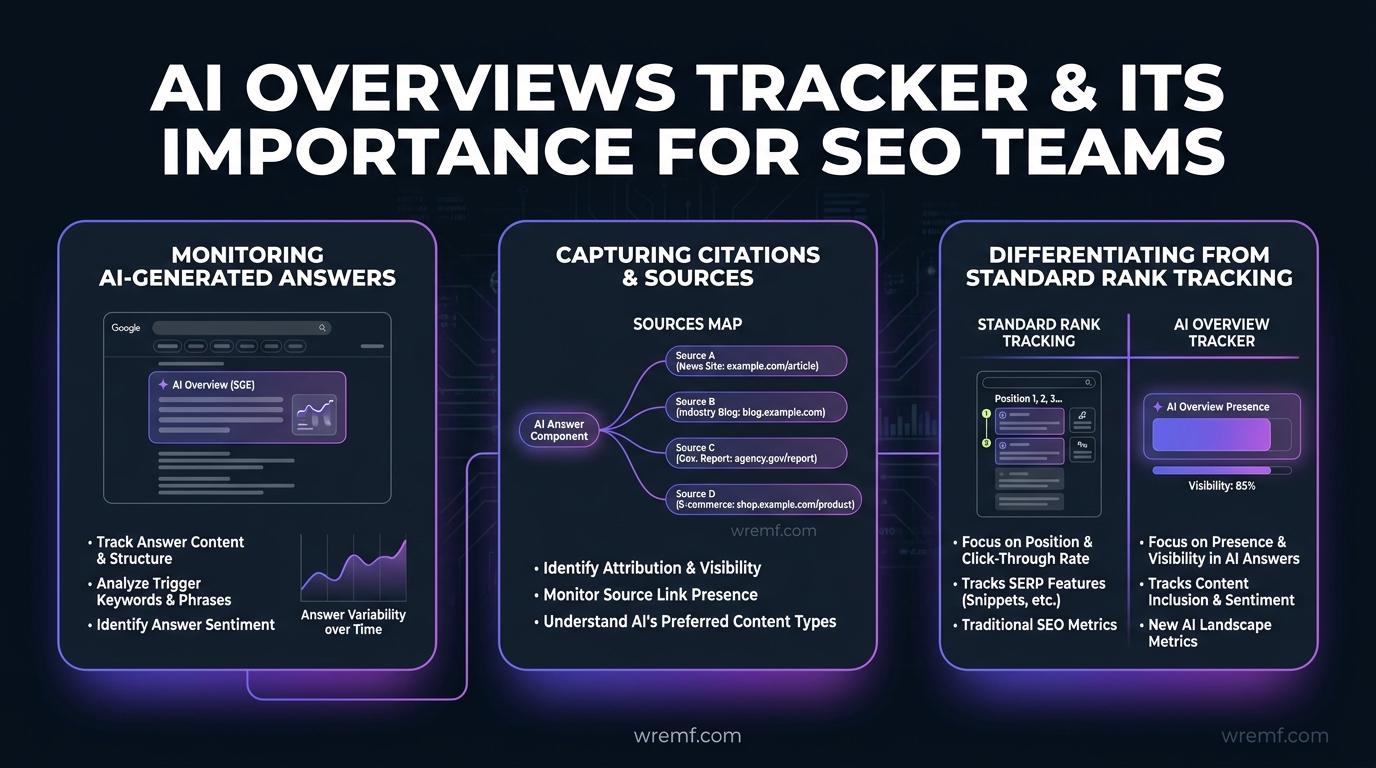
An AI Overviews tracker is a monitoring tool that detects when Google AI Overviews appear for a given keyword, captures the full AI-generated answer, records which sources and cited URLs appear inside it, and tracks how those patterns change over time. Unlike a standard rank tracker, which measures where a page appears in the ten blue links, an AI Overviews tracker measures a fundamentally different signal: whether a brand's content is being selected as a trusted source for AI-generated answer blocks at the top of Google Search.
Google AI Overviews, originally called Search Generative Experience during testing, now appear for a significant portion of commercial and informational queries. According to Google's AI Overviews documentation AI Overviews are designed to help users get a quick overview of a topic, with links to relevant sources. The practical effect for SEO teams is that a brand can rank in position one for a keyword and still receive reduced clicks if an AI Overview answers the query above the organic results without citing that brand's content.
This distinction matters because click behavior changes when AI answers appear. When a query triggers an AI-generated answer block, many users read the AI Overview and either click on a cited source inside the overview or abandon the search entirely. Brands that are not cited inside the AI Overview lose visibility at the moment of highest user engagement, regardless of their organic rank.
An AI Overviews tracker closes this gap by answering four questions that rank trackers cannot: Does an AI Overview appear for this keyword? What does the AI-generated answer say? Which domains are cited as sources? And is my brand mentioned or cited within the answer?
For SEO teams managing large keyword portfolios, tracking AI Overview appearance rates across query clusters is also a useful signal for identifying which topic areas have been substantially disrupted by AI search. A query cluster with high AI Overview frequency will behave differently in terms of traffic, impressions, and click-through rates compared to one where AI Overviews rarely appear.
KEY TAKEAWAY: An AI Overviews tracker measures whether a brand is cited inside Google's AI-generated answers, a signal that standard rank trackers cannot capture and that directly affects traffic, impressions, and click-through performance.
How Google AI Overviews Select Sources and What Gets Cited
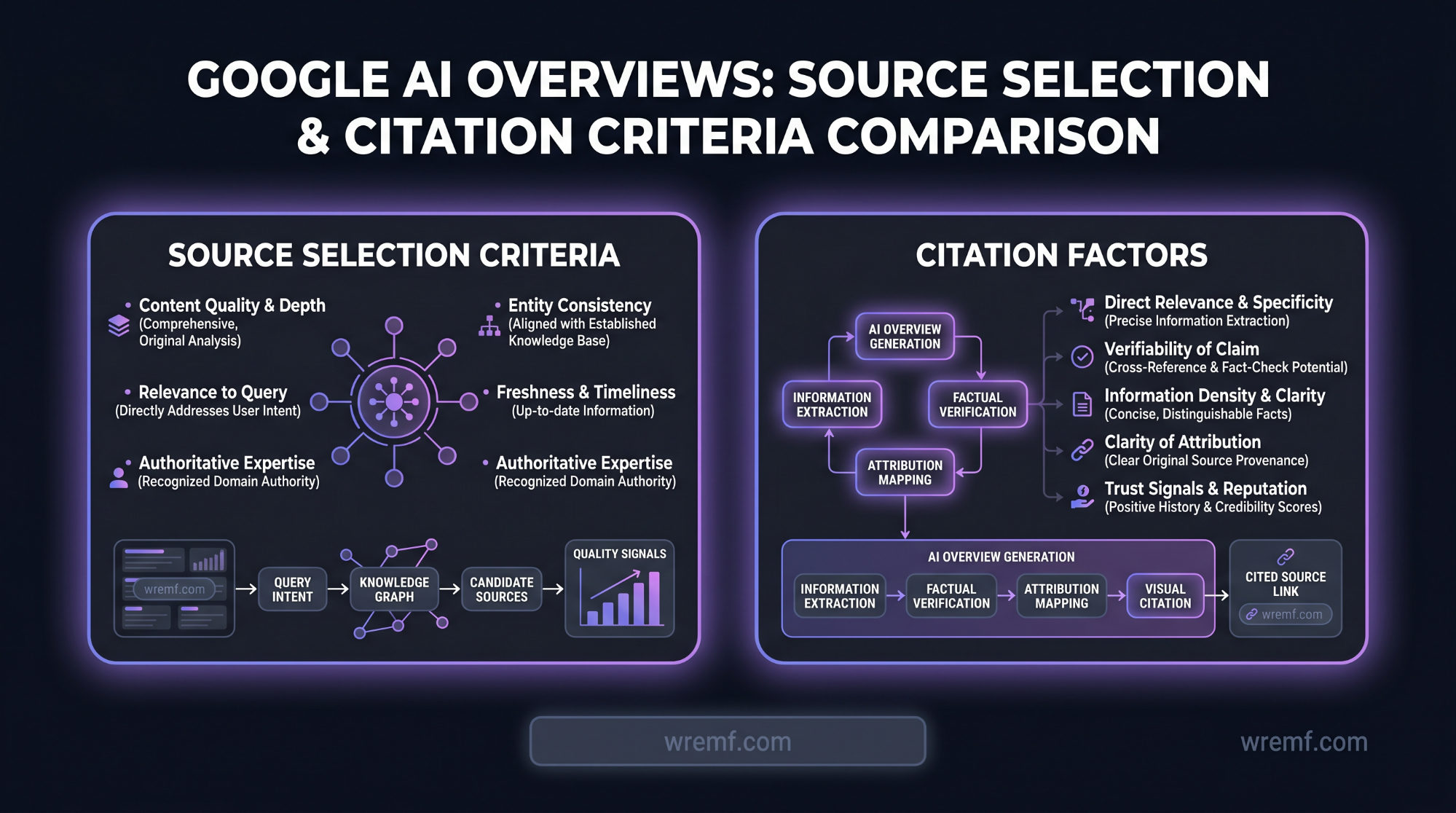
Google AI Overviews draw on content that Google's systems assess as credible, relevant, and well-structured for a given query, but the selection mechanism is not identical to organic ranking. A page can rank highly in Google Search and still not be cited in a related AI Overview. Conversely, pages ranking outside the top ten are sometimes pulled into AI Overviews because they contain well-structured, directly relevant content that addresses the specific question being asked.
Understanding how source selection works matters because it changes where SEO strategies should focus. Google's AI systems evaluate content quality signals including topical authority, structured data, schema markup, entity consistency, clarity of explanation, and how well a page answers the specific question behind a query. Pages that rank for broad head terms may not be the same pages selected for AI Overviews on related long-tail questions.
Several factors appear consistently across pages that are frequently cited in AI Overviews. These include clear, well-defined explanations of key concepts, content structured around the user's question rather than the brand's preferred framing, consistent entity authority across the domain, and technical signals such as structured data that help Google's systems understand the content's scope and credibility.
Source Links within AI Overviews are visible as cited URLs inside the AI-generated answer block. Teams using an AI Overviews tracker can see exactly which domains are being selected, how often a specific domain is cited, and whether citation patterns are consistent or variable across similar queries. This citation tracking data is essential for two reasons: it reveals which content is performing as a trusted source in AI Search, and it identifies which competitors are gaining AI visibility even when they may rank lower in standard search results.
Structured data and schema markup contribute to how clearly Google can interpret and categorise a page's content, which can influence whether that content is considered a suitable source for an AI-generated answer. While schema alone does not guarantee citation, its absence can create ambiguity about a page's subject, type, and authority that makes source selection less likely.
The relationship between knowledge graphs and AI Overviews is also relevant. Google builds entity associations from structured content across the web. Brands and topics that appear consistently in trusted sources, with consistent naming, descriptions, and relationships, are more likely to be represented accurately inside AI-generated answers. This is why entity authority and source consistency are meaningful signals, not just technical details.
DID YOU KNOW:
Websites cited in AI Overviews are associated with an average 34% increase in brand search volume within 90 days, even when users do not click through to the cited domain.
KEY TAKEAWAY: Citation in Google AI Overviews is driven by content quality, entity consistency, structured data, and topical relevance, not ranking position alone, which means SEO strategies focused only on rankings can miss the signals that determine AI Overview source selection.
Key Metrics an AI Overviews Tracker Should Measure
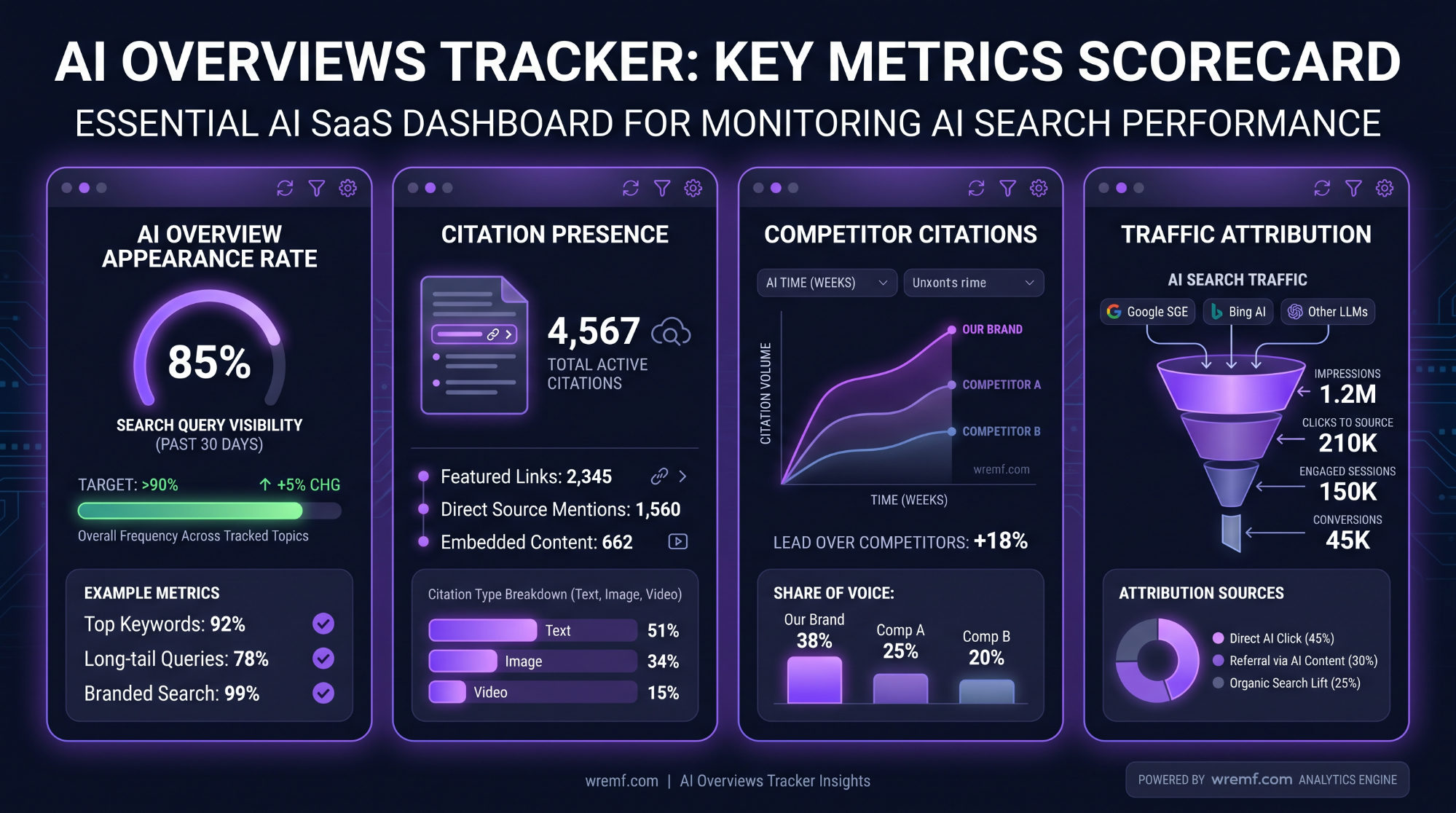
The value of an AI Overviews tracker depends entirely on which metrics it captures and how actionable those metrics are. Monitoring only whether an AI Overview exists for a keyword is the minimum. Effective AI Overview tracking requires a richer set of measurements that connect AI Overview presence to brand visibility, competitor performance, citation patterns, and traffic attribution.
The core metrics that a competent AI Overviews tracker should cover include the following.
AI Overview appearance rate measures how frequently an AI Overview appears for a tracked keyword across a defined time window. Not every search for a keyword will trigger an AI Overview, and the rate can vary by location, device, query phrasing, and time. Tracking appearance rates across a keyword portfolio helps teams identify which query clusters are most affected by AI search.
Citation presence and cited URLs track whether a brand's domain or a specific page is mentioned or linked inside an AI Overview. This is the most commercially relevant metric because it connects directly to brand visibility and the potential for traffic. Teams should track not just whether they are cited but how consistently they are cited, and which pages are most frequently selected.
Competitor citation tracking shows which competitor domains are being cited for the same keywords. This is the AI equivalent of SERP competitor analysis and reveals the competitive landscape inside AI-generated answers, which can differ substantially from the organic SERP. Competitive visibility inside AIOs is a direct measure of AI share of voice.
Snippet text and answer content capture the actual text of AI-generated answer blocks. Reading the AI responses helps teams understand how their brand, products, or services are being described by Google's AI, and whether that description aligns with how the brand wants to be positioned.
Visibility scores and ranking patterns over time show whether citation presence is increasing, stable, or declining. Changes in visibility scores correlate with content updates, competitor movements, and changes to Google's AI systems. Tracking these patterns supports strategic decisions about content creation and content audits.
Impressions and click-through rates from Google Search Console provide the measurement layer that connects AI Overview presence to actual traffic shifts. When an AI Overview begins appearing for a keyword, impressions may remain stable while clicks decline, because users are reading the AI answer rather than clicking through. This traffic shift pattern is a diagnostic signal that something has changed in how that keyword behaves in Google Search.
AI traffic attribution through GA4 allows teams to see whether visits originating from Google AI-related surfaces are being captured and categorised correctly. According to Google Analytics Help direct and organic sessions attributed to AI-surface referrals require specific configuration to be isolated accurately. Teams using the WREMF Growth plan can connect AI Overview tracking data to GA4 attribution for a more complete view of how AI Search affects traffic.
KEY TAKEAWAY: Effective AI Overview tracking requires measuring appearance rates, citation presence, competitor citations, answer content, visibility scores, and traffic attribution together, because no single metric tells the full story of how AI Overviews are affecting brand performance.
How to Track AI Overviews: A Practical Step-by-Step Workflow
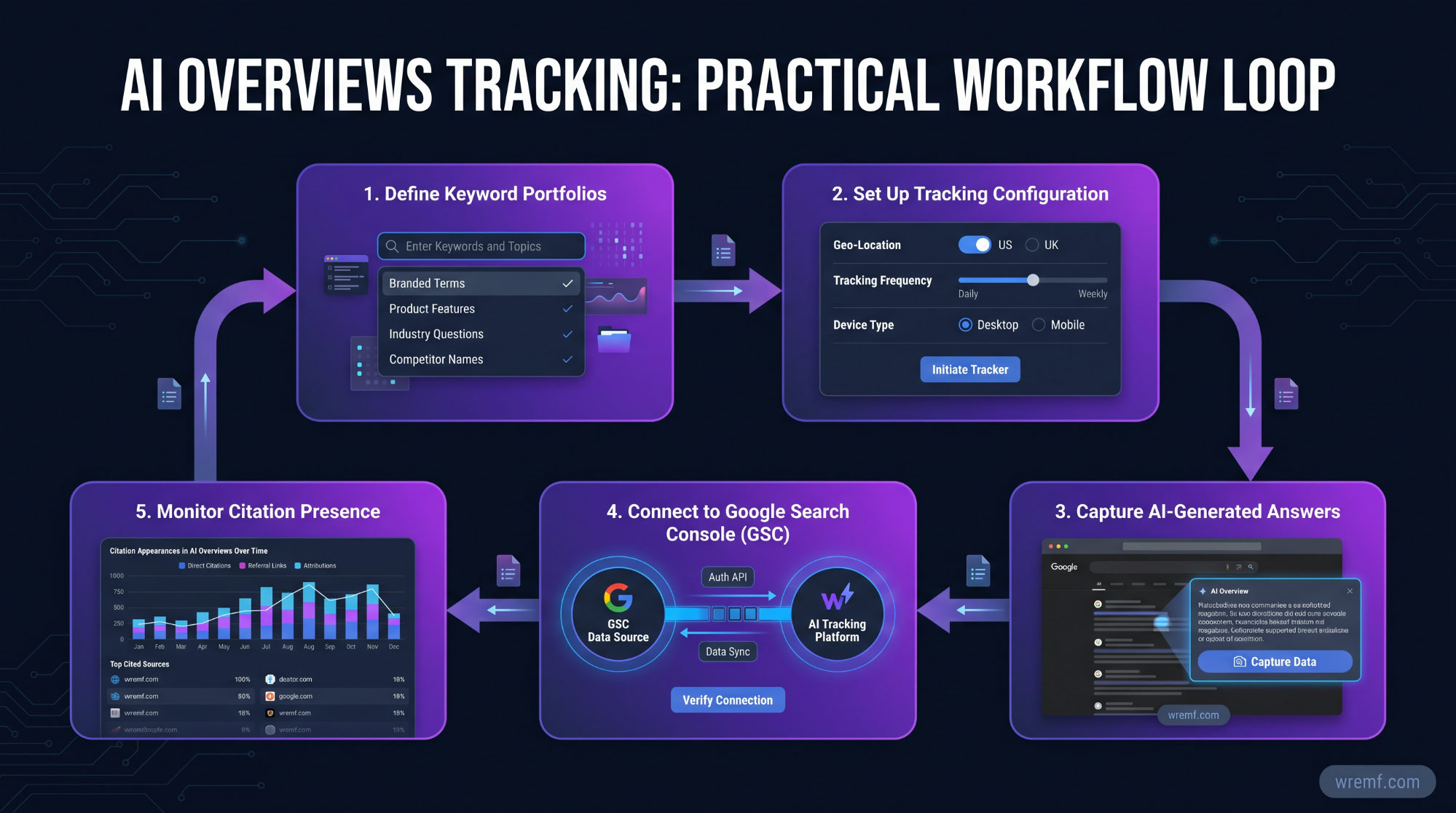
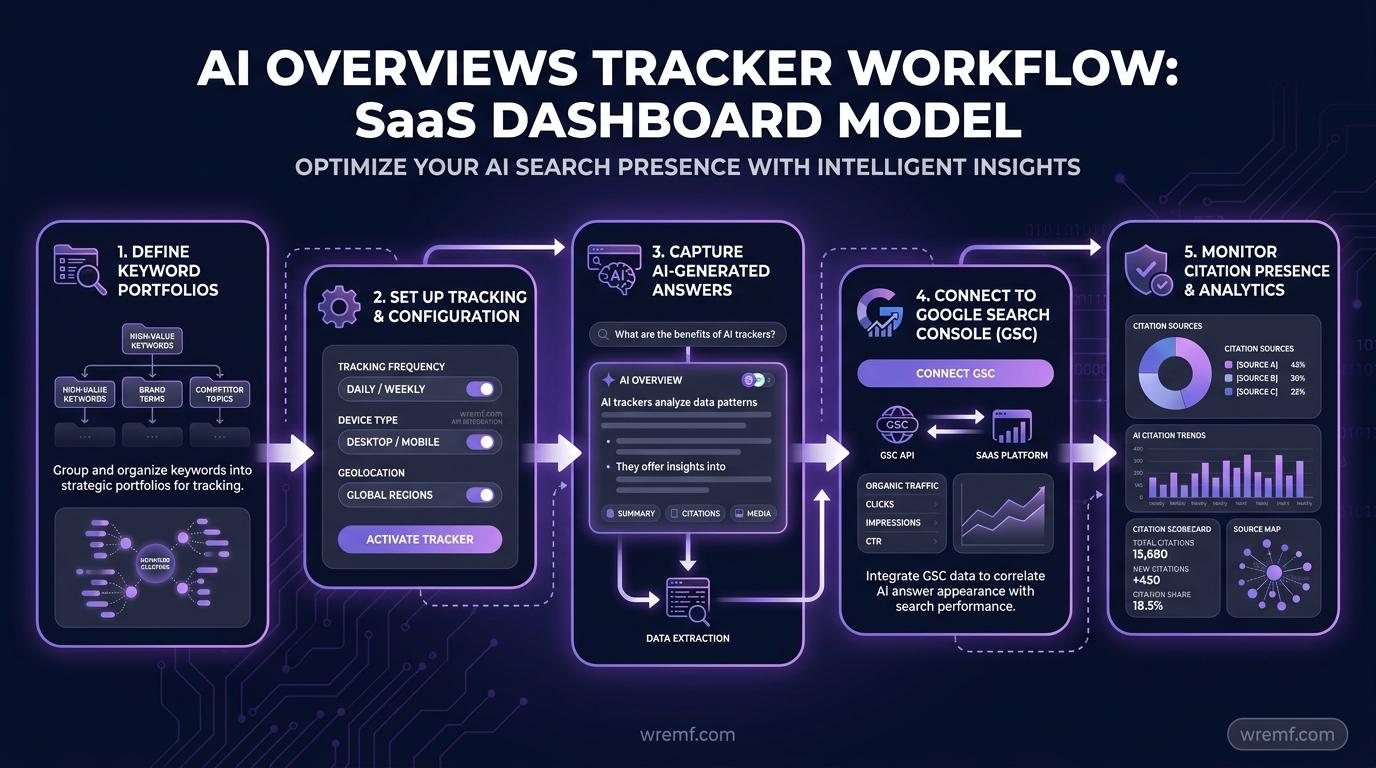
Tracking Google AI Overviews effectively requires combining a dedicated AI Overviews tracker with Google Search Console, GA4, and a systematic review process. The workflow below applies to in-house SEO teams, agencies, and growth teams managing AI visibility across a keyword portfolio.
Step 1: Define the keyword portfolio and query clusters
Identify the keywords and questions most relevant to your brand, products, and customer journey. Group keywords into query clusters based on topic and intent. AI Overviews behave differently across informational, commercial, and navigational queries, so segmenting by intent from the start makes analysis more useful.
Step 2: Set up an AI Overviews tracker for your domain and competitors
Configure a dedicated AI Overviews tracker such as WREMF to monitor AI Overview appearance rates and citation presence for your keyword portfolio. Include your top three to fifteen competitors so that competitive visibility data is captured from the beginning. WREMF's Growth plan supports between ten and fifteen competitors alongside AI Overview tracking, source citation tracking, and AI share of voice measurement across ten AI engines.
Step 3: Capture AI-generated answer content and cited sources
For each keyword, capture the full AI-generated answer block including snippet text, cited URLs, and source links. Record this data consistently so changes in content and source selection can be identified over time. Pay attention to which domains appear most frequently as cited sources for your priority query clusters.
Step 4: Connect Google Search Console data to AI Overview patterns
Export impression and click data from Google Search Console for the keywords being tracked. Compare click-through rates before and after AI Overviews began appearing for each keyword. A keyword with stable impressions but declining clicks is a signal that an AI Overview has absorbed the click that previously went to organic results.
Step 5: Configure GA4 attribution for AI referral traffic analysis
Set up GA4 to identify and segment sessions that originate from AI-related surfaces. This requires creating segments or annotations that separate AI referral traffic from standard organic traffic. The goal is to understand whether citation inside an AI Overview is driving any measurable traffic and whether that traffic behaves differently from standard organic visits.
Step 6: Identify citation gaps and content opportunities
Compare your citation presence against competitor citation data. Where competitors are consistently cited and your domain is not, identify the specific content gaps. Review the snippet text used in AI Overviews to understand what kind of explanation, structure, and detail the AI system is selecting. Use this to inform content briefs and content audits.
Step 7: Run a GEO audit on underperforming content
For pages that rank well but are not being cited in AI Overviews, run a Generative Engine Optimization audit. This means reviewing content quality signals including structure, entity consistency, schema markup, clarity of explanation, and whether the page directly addresses the question driving the query. WREMF's Managed plan includes GEO audits and AEO content optimisation as part of the managed execution service.
Step 8: Monitor, report, and iterate
Set a consistent reporting cadence for AI Overview tracking. Weekly monitoring is appropriate for high-priority keywords. Monthly reporting works for broader portfolio reviews. For agencies managing multiple clients, white-label reports and client portals make AI Overview data shareable without requiring manual export and formatting each cycle.
KEY TAKEAWAY: An effective AI Overview tracking workflow combines a dedicated tracker with Search Console, GA4, competitor benchmarking, and regular content audits, creating a measurement system that connects AI Overview presence to traffic, citations, and strategic decisions.
AI Overviews Trackers Compared: Features, Gaps, and What to Look For
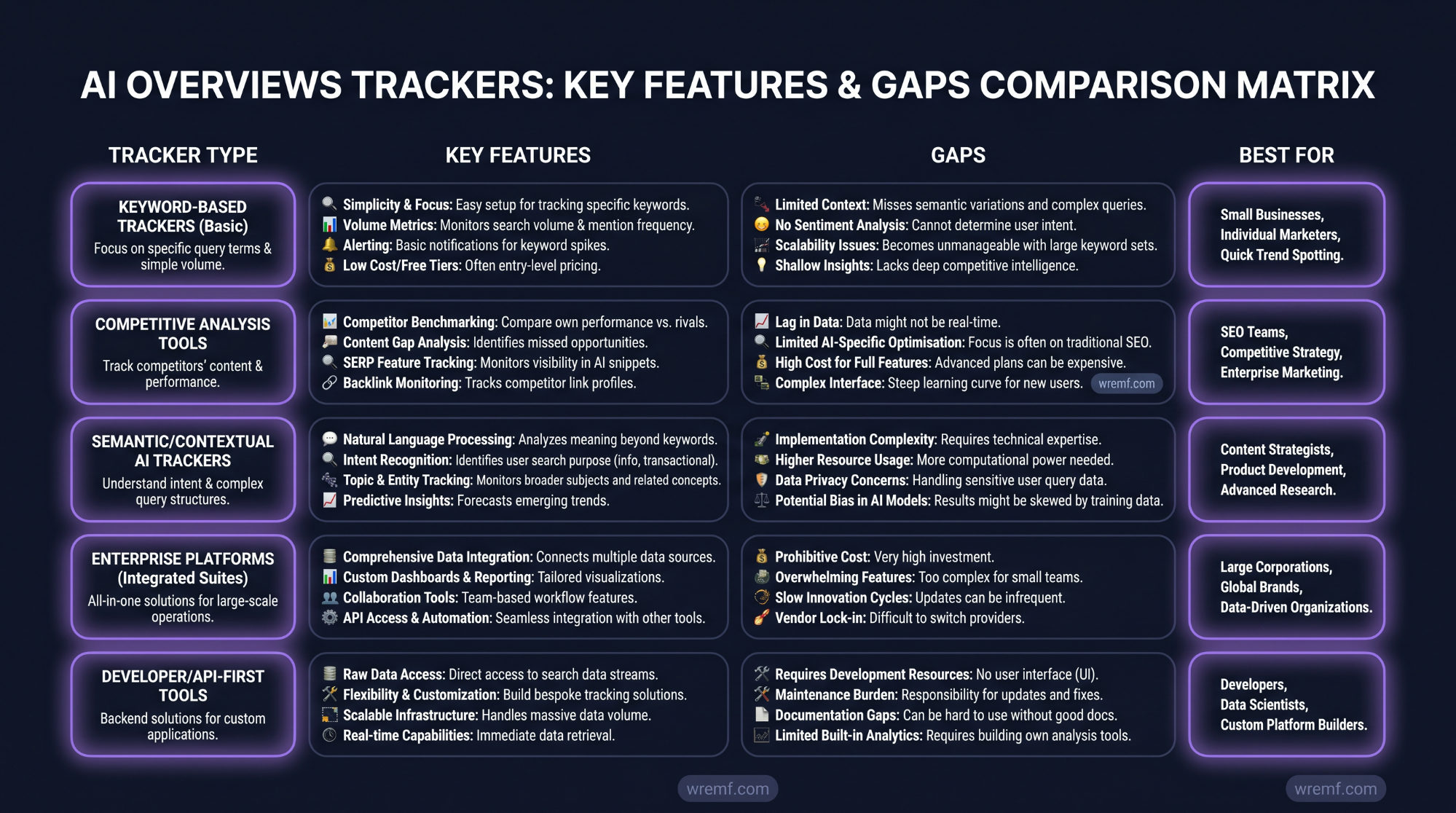
Several tools have been built specifically to track Google AI Overviews, and each takes a different approach to what it measures and how it presents data. Teams choosing an AI Overviews tracker should evaluate tools against the metrics that matter most for their specific use case, whether that is citation tracking, competitor benchmarking, traffic attribution, or multi-engine AI visibility.
The following comparison covers the key dimensions that differentiate AI Overviews trackers.
Primary tracking focus
- Dedicated AI Overview trackers: Capture AI Overview appearance rates, cited URLs, snippet text, and source links for a defined keyword portfolio.
- Traditional rank trackers with AI Overview add-ons: Tools such as SE Ranking, Ahrefs, and Seobility have added AI Overview tracking features alongside their standard rank tracking capabilities. These are useful for teams that want AI Overview data alongside classical SEO metrics within one platform.
- AI visibility platforms: Tools such as WREMF, OtterlyAI, Peec AI, Morningscore, and seoClarity go beyond Google AI Overviews to track AI visibility across multiple AI engines including ChatGPT, Perplexity, Gemini, and Copilot.
- Specialist trackers: Rankscale AI, Click Insights, and Brand Radar offer more focused monitoring with varying levels of depth in citation analysis, brand visibility scoring, and competitive benchmarking.
Competitor visibility
Some AI Overviews trackers show only whether your domain is cited and not what competitors are doing. For teams where competitive analysis is a priority, the ability to benchmark competitor citation rates, compare AI share of voice, and identify which competitor pages are consistently selected as sources is a non-negotiable feature.
Multi-engine coverage
Google AI Overviews are one surface in a broader AI search landscape. Buyers now ask questions across ChatGPT, Perplexity, Gemini, Copilot, Claude, DeepSeek, Grok, Meta AI, and Mistral. A tool that tracks only Google AI Overviews misses the majority of AI search interactions. WREMF tracks across ten AI engines, connecting Google AI Overviews data with citation tracking across the broader AI search ecosystem.
Attribution and reporting
The most common gap in dedicated AI Overview trackers is traffic attribution. Knowing which keywords trigger AI Overviews and whether your brand is cited is useful, but connecting that data to actual traffic, impressions, and click-through rate changes requires integration with Google Search Console and GA4. WREMF's Growth plan includes a Looker Studio connector and GA4 attribution, which closes this gap for reporting-focused teams and agencies.
Pricing and plan structure
Tools vary significantly in how they price AI Overview tracking. Some charge per keyword or per AI engine query, which creates unpredictable costs at scale. WREMF includes unlimited prompt tracking across all plans with no per-prompt markups, and offers BYOK support on every plan, which gives teams with existing API access more cost predictability.
Agency and white-label capability
Agencies managing AI Overview tracking for multiple clients need features that solo-brand tools often lack: white-label reports, client portals, multi-brand dashboards, and scalable competitor tracking. Tools built for single-brand use can become impractical at agency scale. WREMF's Growth plan includes white-label reports and an Agency Dashboard, while the Managed plan supports custom workflows for large agencies and enterprise brands.
For a broader view of how AI search optimisation tools compare on features relevant to GEO, AEO, and multi-engine visibility, the guide to the best AI search optimization tools covers options across multiple use cases.
KEY TAKEAWAY: When evaluating AI Overviews trackers, the most important differentiators are multi-engine coverage, competitor citation benchmarking, traffic attribution integration, pricing predictability, and whether the tool supports agency-scale workflows.
AI Overviews Tracker vs Standard Rank Tracker: Understanding the Difference
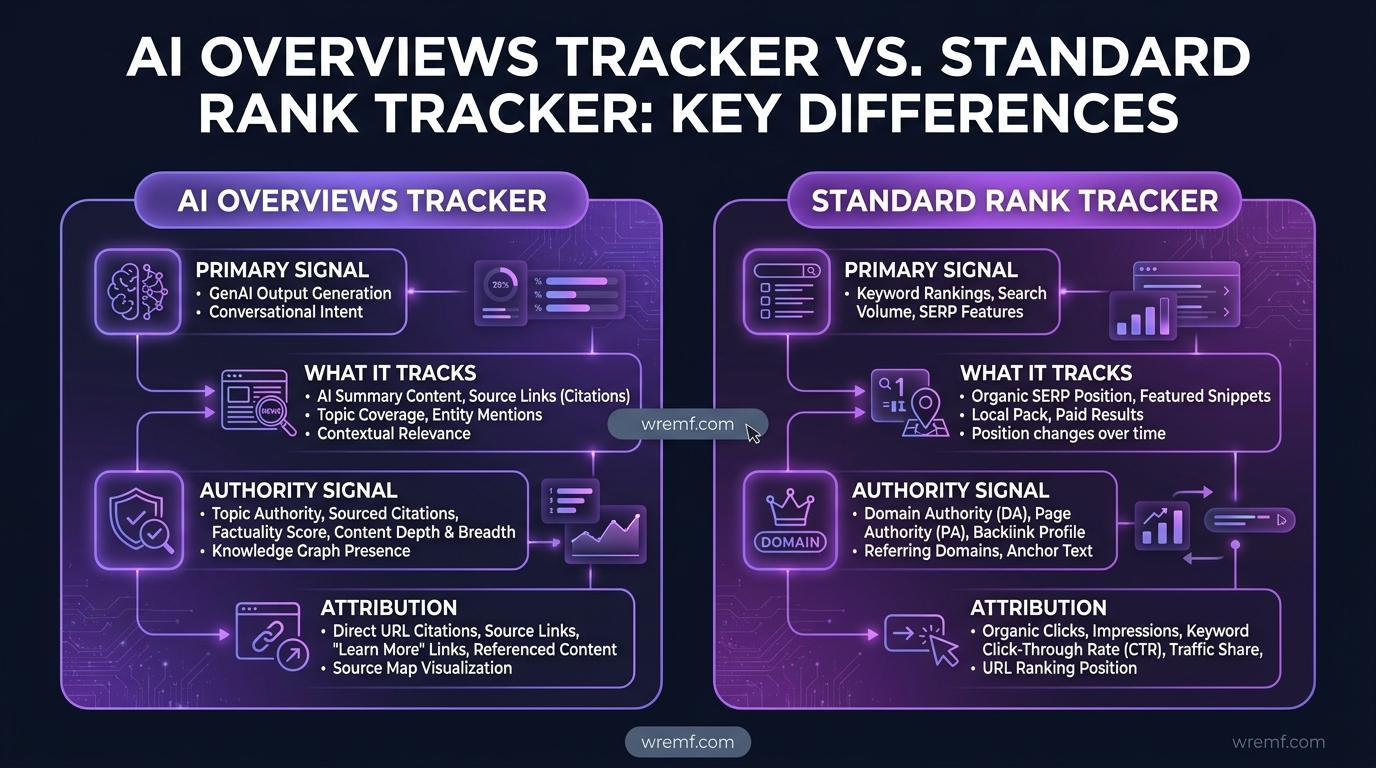
A rank tracker and an AI Overviews tracker measure different things, and treating them as interchangeable creates significant blind spots in how SEO performance is understood and reported. The distinction is not technical, it is strategic.
Standard rank trackers are built around keyword ranking positions in the organic SERP. They answer the question: where does my page appear when a user searches for this keyword? Rank tracking remains essential for understanding keyword visibility, tracking ranking patterns, measuring organic rank against competitors, and identifying which pages are gaining or losing search visibility over time. Tools such as SE Ranking, Ahrefs Site Explorer, Morningscore, and Seobility are well-established for this purpose.
An AI Overviews tracker answers a different question: does an AI-generated answer appear for this keyword, and is my brand cited inside it? These are independent signals. A brand can hold a top-three ranking for a keyword and still not appear in the AI Overview for that keyword. The AI-generated answer block may cite pages that rank in positions four through twelve, or may cite pages from domains that do not appear on the first page of the organic SERP at all.
This matters for traffic because Google's AI Overviews appear above the organic results for many queries. If users are reading the AI answer and clicking on cited sources within it, the click behavior shifts from the ten blue links toward the cited URLs inside the AI Overview. A brand ranking in position one but not cited in the AI Overview may see declining clicks without any change in its organic rank. This is one of the most common causes of unexplained traffic shifts that teams see in Google Search Console and GA4.
The following comparison illustrates the practical difference.
Primary signal
- Standard rank tracker: Keyword ranking position in the organic SERP
- AI Overviews tracker: AI Overview presence and citation status for the keyword
What it tracks
- Standard rank tracker: Page position across organic search results
- AI Overviews tracker: Whether an AI-generated answer appears and which domains are cited inside it
Authority signal
- Standard rank tracker: Backlinks and domain authority
- AI Overviews tracker: Source citations in AI-generated answers and content quality signals
Competitive view
- Standard rank tracker: SERP overlap and ranking comparison
- AI Overviews tracker: AI share of voice and competitor citation benchmarking
Attribution
- Standard rank tracker: Organic sessions by keyword
- AI Overviews tracker: AI referral traffic and traffic shifts related to AI Overview appearance
Source consistency
- Standard rank tracker: Not measured
- AI Overviews tracker: Tracked across AI engines and query clusters
The recommended approach is to use both. Traditional rank trackers remain essential for measuring keyword visibility, tracking search rankings, managing SEO work, and monitoring organic performance. An AI Overviews tracker adds the AI visibility layer by capturing what happens above the organic results, inside the AI-generated answer block. WREMF adds this layer without replacing existing SEO tools, as explained in the overview of how AI search optimization tools increase organic traffic
KEY TAKEAWAY: Standard rank trackers measure where pages appear in organic results, while AI Overviews trackers measure whether AI-generated answers appear for those keywords and which sources are cited inside them. Both are needed because the signals they capture are independent.
Protecting Organic Traffic from the AI Overview Effect
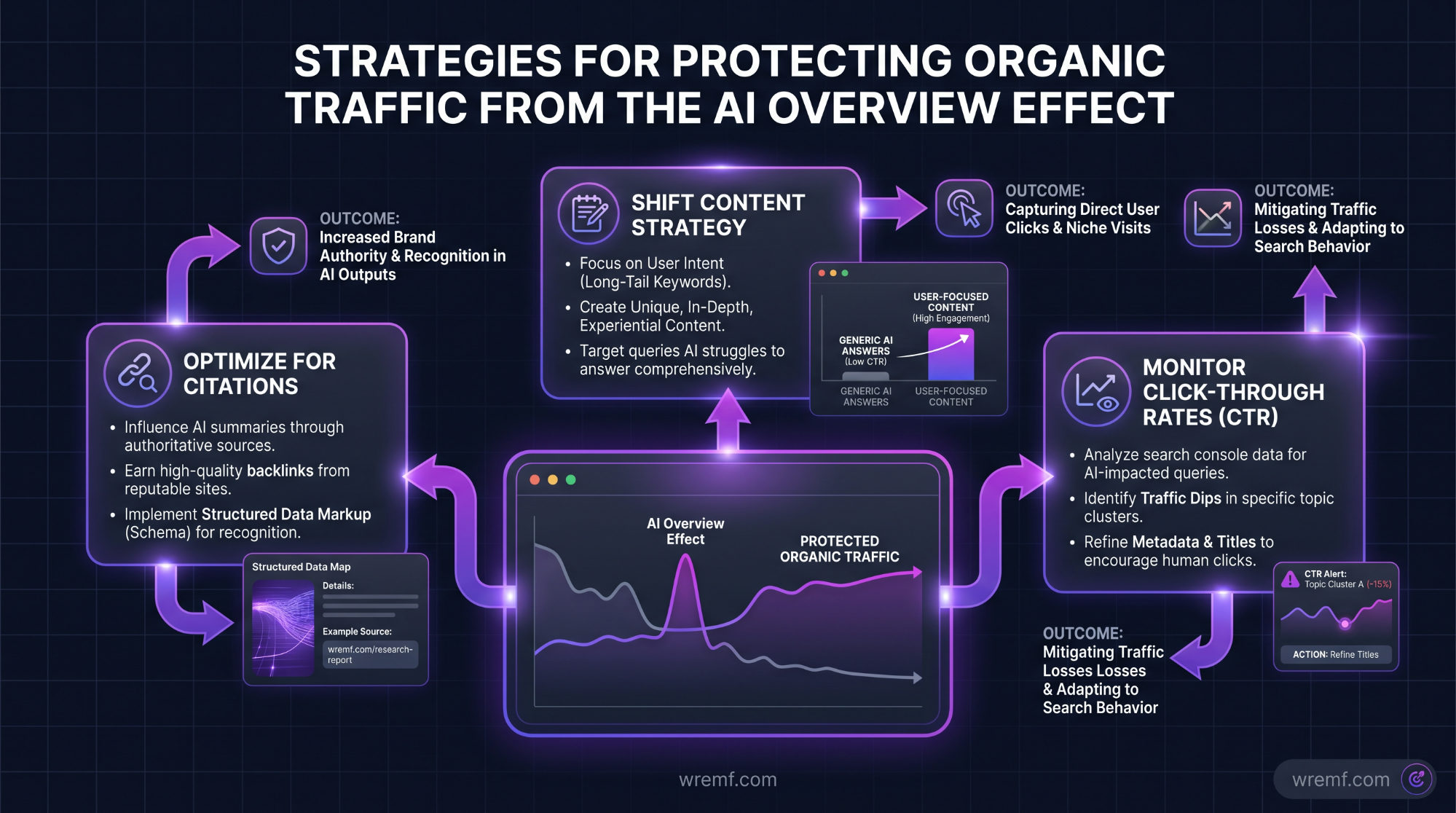
AI Overviews do not automatically reduce organic traffic for every keyword, but for queries where an AI-generated answer fully resolves the user's question, click-through rates to organic results can decline. Understanding which keywords are most exposed to this effect and which are not is one of the most practical applications of an AI Overviews tracker.
The traffic impact of AI Overviews is not uniform across query types. Informational queries that can be answered in two to three sentences are more exposed than commercial queries where users need to compare vendors, review pricing, or evaluate a specific product. Navigational queries and transactional queries are generally less affected because the user's intent requires them to visit a specific website rather than read a summary answer.
For informational queries, the AI Overview effect is most significant when the AI-generated answer completely resolves the question without requiring the user to click through. In these cases, impressions may remain stable in Google Search Console while clicks and click-through rates decline. This pattern is the clearest diagnostic signal that an AI Overview is absorbing traffic that previously flowed to organic results.
There are practical responses to this pattern. One is to ensure that the brand's content is cited inside the AI Overview, because cited sources do receive a portion of the clicks generated by users who want to read more. Being cited does not guarantee traffic recovery, but it is significantly better than being invisible inside the AI-generated answer block while a competitor's content is cited.
A second response is to assess whether the content strategy for that keyword should shift from broad informational coverage toward more specific, use-case-driven, or decision-stage content that AI Overviews are less likely to fully resolve. Content that helps users compare options, evaluate vendors, or make decisions is harder for AI systems to compress into a short summary answer.
A third response is to use the snippet text from AI Overview monitoring to understand how the topic is being framed, and to ensure that content on the site addresses not just the broad question but the follow-on questions that users ask next. This connects to the broader strategy of answering the full query journey rather than optimising for a single keyword.
For teams that want to understand how the AI Overview effect connects to AEO and GEO strategy, the answer engine optimization guide covers the content and structural approaches that support citation in AI-generated answers.
KEY TAKEAWAY: Organic traffic exposure to AI Overviews is highest for informational queries where AI answers fully resolve the question. The most effective response is a combination of citation optimisation, content strategy adjustment, and consistent monitoring of click-through rate patterns by query type.
Using Google Search Console, GA4, and an AI Overviews Tracker Together
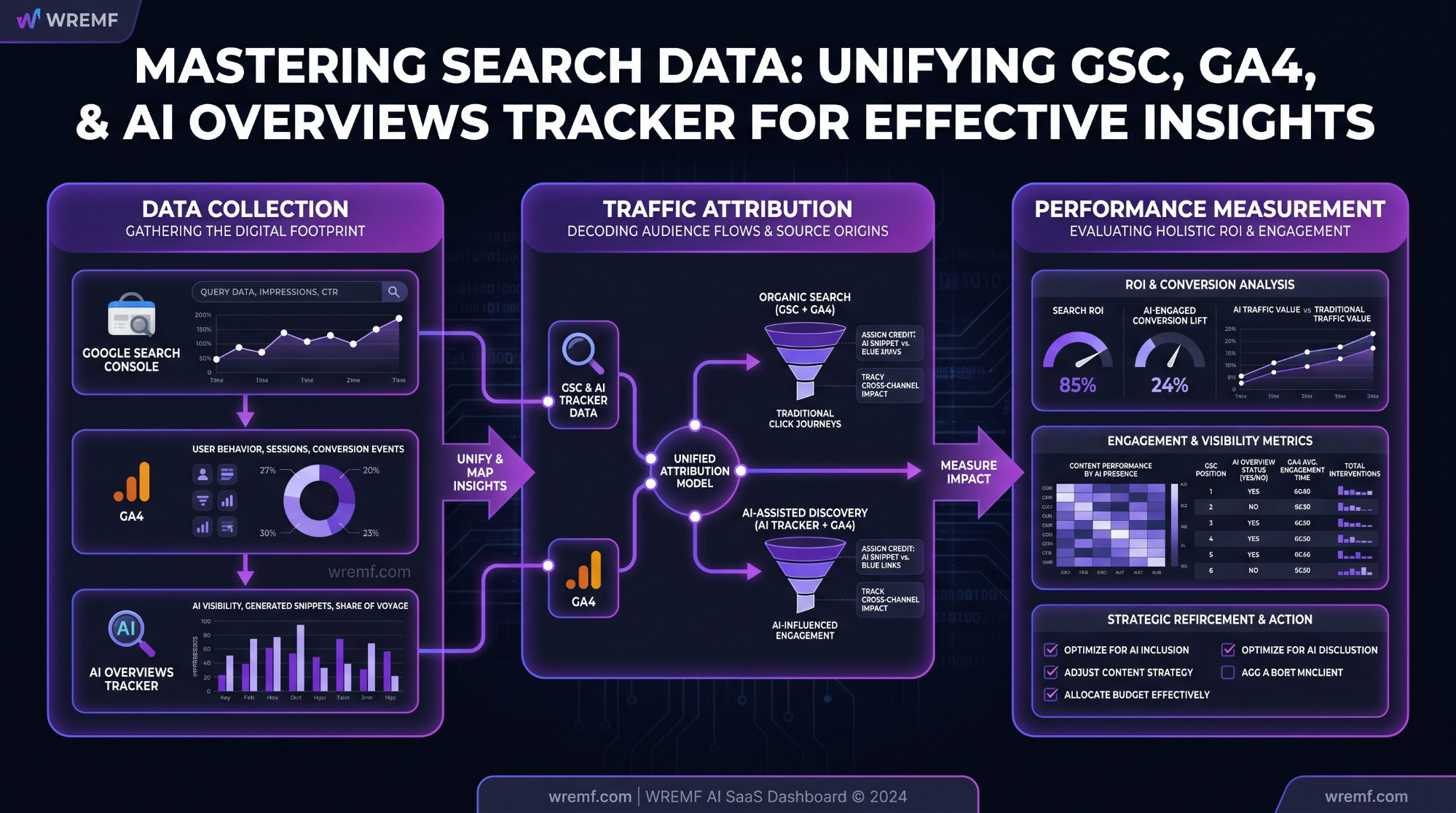
No single tool fully captures the impact of Google AI Overviews on search performance. The most accurate picture requires combining data from Google Search Console, GA4, and a dedicated AI Overviews tracker, each of which contributes a different layer of measurement.
Google Search Console provides impression and click data at the keyword level. For AI Overview impact assessment, the most useful analysis is comparing click-through rates before and after an AI Overview began appearing for a given keyword. A keyword with stable or growing impressions alongside declining clicks is a strong signal that an AI Overview is present and affecting click behavior. Google Search Console does not show whether an AI Overview appeared for a specific query session, so it is a lagging indicator rather than a real-time signal.
GA4 provides session-level attribution data. Configuring GA4 to segment AI referral traffic requires setting up custom channel groups or annotations that separate sessions arriving from AI-surface referrals from standard organic sessions. This configuration is not automatic. According to Google Analytics Help teams need to define source and medium combinations that correspond to known AI referral patterns. Once configured, GA4 can show whether AI Overview citation is contributing measurable traffic and how that traffic behaves in terms of engagement, pages visited, and conversion.
An AI Overviews tracker fills the gap that neither Search Console nor GA4 covers: it shows directly whether an AI Overview appeared for a specific keyword at a specific time, which domains were cited, what the AI-generated answer said, and how those patterns are changing. Combined with Search Console data, teams can correlate AI Overview appearance rates with click-through rate changes to identify which keywords are most affected. Combined with GA4 data, teams can see whether being cited inside an AI Overview translates into measurable sessions.
The practical workflow for combining these three sources is described in the step-by-step tracking section above. For agencies and teams that need to present this data in client reports or leadership dashboards, WREMF's Growth plan includes a Looker Studio connector that allows AI Overview tracking data, citation presence, and competitor benchmarking to be surfaced alongside GA4 and Search Console metrics in a single reporting environment.
KEY TAKEAWAY: Combining Google Search Console, GA4, and an AI Overviews tracker gives teams a complete measurement layer: Search Console shows click impact, GA4 shows traffic attribution, and the AI Overviews tracker shows exactly when AI-generated answers appear and which sources are cited inside them.
AI Overviews and the Broader AI Search Visibility Picture
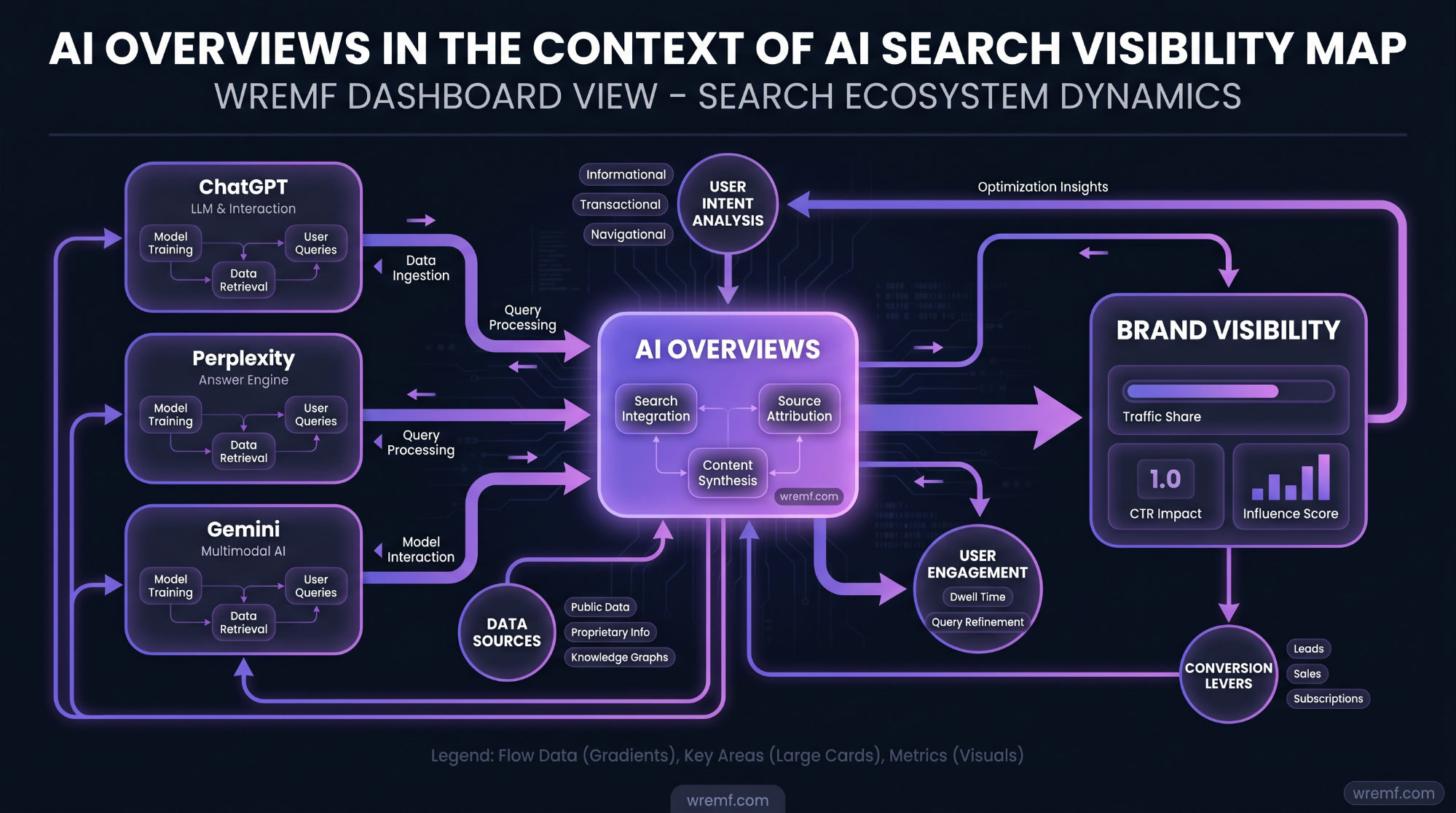
Google AI Overviews are one of several AI-powered answer surfaces that now influence how users discover brands, evaluate options, and make decisions. Tracking only Google AI Overviews while ignoring how a brand appears in ChatGPT, Perplexity, Gemini, Copilot, Claude, and other large language models creates an incomplete picture of AI search visibility.
AI search visibility is the broader measure of how a brand is mentioned, cited, compared, and recommended across AI engines and generative search surfaces. It encompasses Google AI Overviews, AI Mode, and standard Google Search, but also extends to prompt-based discovery in ChatGPT, Perplexity, Gemini, Copilot, Claude, DeepSeek, Grok, Meta AI, and Mistral. According to research covered in McKinsey's AI insights AI-assisted discovery and recommendation is now a meaningful part of how buyers in technology and B2B markets research vendors and solutions.
The distinction between Google AI Overviews and broader AI search engines matters for strategy. Google AI Overviews appear within Google Search and are triggered by specific keyword queries. Other AI platforms such as ChatGPT and Perplexity operate through conversational prompts, where users ask questions in natural language and receive synthesised answers from a set of sources selected by the AI model. The source selection logic in large language models differs from Google's AI Overview source selection, meaning a brand can be well-cited in Google AI Overviews and poorly cited in ChatGPT responses, or vice versa.
Prompt tracking is the mechanism for monitoring AI visibility in conversational AI engines. It involves sending predefined prompts to AI platforms and recording whether a brand is mentioned, cited, or recommended in the AI's response. Prompt tracking is how teams measure citation presence in ChatGPT, Perplexity, Gemini, and other LLMs in the same way an AI Overviews tracker measures citation presence in Google AI Overviews.
Source consistency is another important concept. It describes whether a brand is cited and described consistently across different AI engines for the same or similar queries. A brand that is cited in Google AI Overviews but described inconsistently in Perplexity or Gemini has a source consistency gap that affects how the brand is represented in AI-generated answers across the discovery journey.
WREMF addresses this by tracking AI Overview citations alongside prompt-level visibility across ten AI engines, measuring source consistency, and identifying where citation presence, brand descriptions, or competitor comparisons differ across platforms. For teams that want to understand how this connects to the broader landscape, the complete guide to AI search engine optimization explains the strategic relationship between GEO, AEO, and multi-engine AI visibility.
Compare WREMF pricing plans to see which option fits your team's AI visibility tracking needs.
KEY TAKEAWAY: Google AI Overviews are one surface within a larger AI search ecosystem. Teams that limit tracking to Google AI Overviews miss how their brand is cited and represented in ChatGPT, Perplexity, Gemini, Copilot, and other AI engines that increasingly influence buyer discovery and vendor shortlisting.
Real-World Scenarios: How Teams Use AI Overviews Trackers in Practice
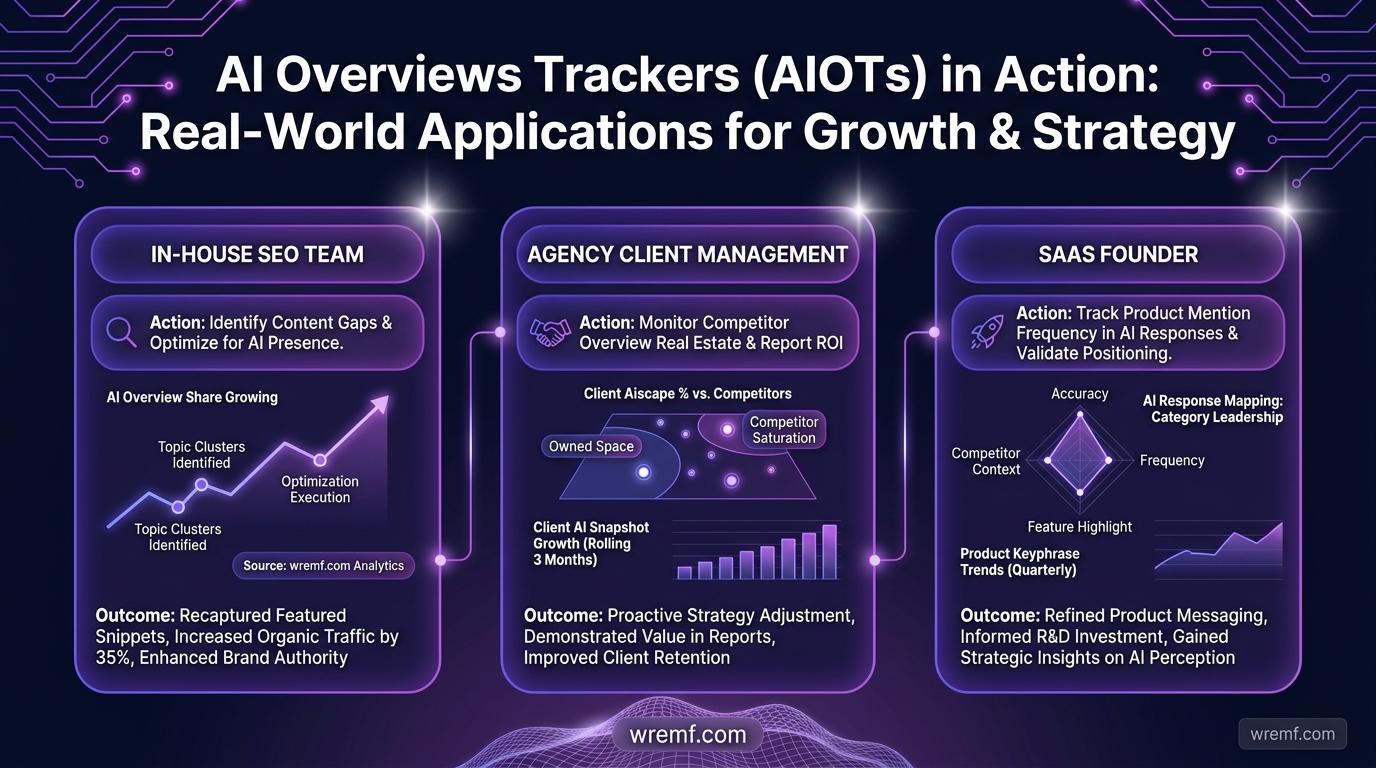
The practical value of an AI Overviews tracker becomes clearest when applied to specific team situations. The following scenarios illustrate how different types of teams use AI Overview tracking data and what decisions it supports.
Scenario one: In-house B2B SaaS SEO team investigating a traffic decline
A B2B SaaS company with a well-established content library notices a gradual decline in organic clicks for a cluster of informational keywords over a three-month period. Rankings have not changed significantly in Google Search, but Google Search Console shows impressions holding steady while click-through rates have dropped. The team sets up AI Overview tracking for the affected keyword cluster and discovers that AI Overviews are now appearing for a significant portion of those queries, and the cited sources inside those AI Overviews are primarily competitor domains and third-party review sites rather than their own content.
Armed with this data, the team can prioritise a content audit of the underperforming pages, restructure explanations to better match what the AI-generated answer is selecting as snippet text, improve schema markup and entity signals, and request that the relevant pages be reviewed for citation in the AI Overview source set. Without the AI Overviews tracker, the team would have continued attributing the traffic shift to seasonal patterns or ranking fluctuations rather than identifying the real cause.
Scenario two: Agency managing AI visibility for multiple clients
A digital marketing agency managing SEO work for ten B2B clients wants to add AI visibility reporting to its monthly deliverables. Using the WREMF Growth plan, the agency sets up AI Overview tracking and competitor citation benchmarking for each client's keyword portfolio. White-label reports allow the agency to deliver branded AI visibility reports to clients showing citation presence, AI share of voice against named competitors, and GA4 attribution data for AI referral traffic.
The agency identifies that two clients have strong organic rankings but low citation presence in AI Overviews and almost no visibility in Perplexity or ChatGPT. For these clients, the agency proposes an AEO content optimisation sprint to improve answer-first content structure, entity authority, and source consistency across AI platforms. This service layer, supported by WREMF software, becomes a differentiating capability that the agency can offer across its client portfolio.
Scenario three: Founder using a starter AI tracking setup
A SaaS founder who also manages SEO for the company wants to understand whether their brand appears in AI Overviews and ChatGPT answers for their primary keywords. Using the WREMF Starter plan at €59 per month, they set up tracking for their domain, monitor three competitors, and begin capturing AI Overview appearance rates and citation presence for their priority keywords.
Within the first month, the founder discovers that the company's primary competitor is cited in Google AI Overviews for three of the five highest-priority commercial keywords. Their own domain is cited for none of them. This single insight changes the content and SEO strategy: instead of continuing to optimise for ranking position, the team now prioritises restructuring content to match what AI Overviews are selecting as cited sources. The BYOK support on the Starter plan keeps running costs predictable as prompt volumes grow.
KEY TAKEAWAY: AI Overviews trackers provide practical value across team types, from in-house SEO teams diagnosing traffic drops to agencies building AI visibility reporting services, because the data connects citation patterns to strategic decisions that rankings alone cannot support.
Limitations and Caveats of AI Overview Tracking
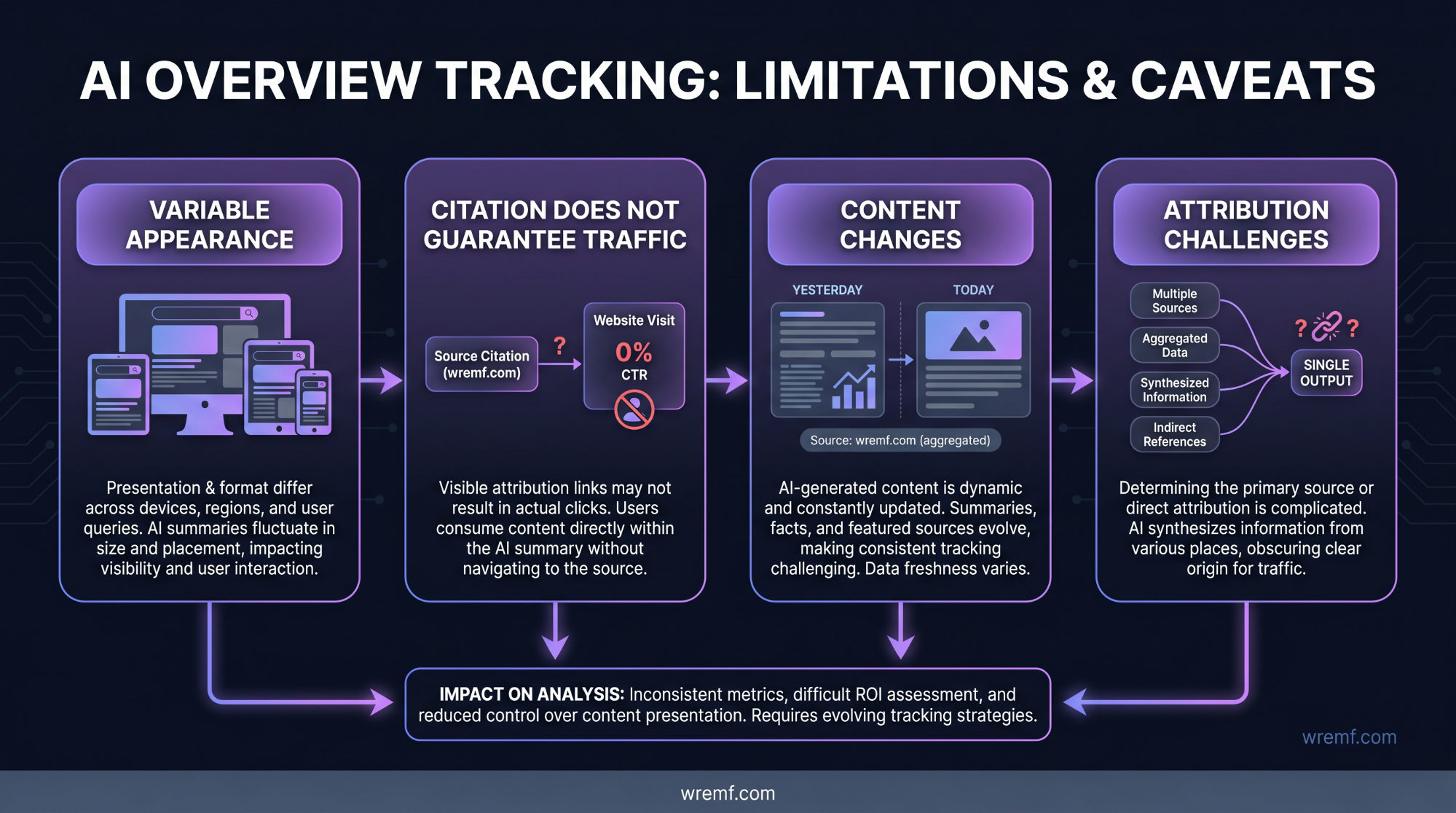
AI Overview tracking is a genuinely useful measurement capability, but it operates within real constraints that teams should understand before drawing conclusions or building strategies on the data.
AI Overview appearance is not deterministic. The same keyword can trigger an AI Overview in one search session and not in another, depending on query phrasing, user location, device, personalisation signals, and time of day. AI Overviews trackers capture the presence or absence of AI-generated answers at the time of each query run, which means appearance rate data represents a probability distribution rather than a fixed state. Teams should track queries consistently over time and across multiple sessions before drawing conclusions about whether an AI Overview reliably appears for a given keyword.
Citation in AI Overviews does not guarantee traffic. Being cited inside an AI Overview is associated with brand search volume increases and some direct click traffic, but there is no fixed relationship between citation frequency and traffic volume. Click behavior inside AI Overviews varies by query intent, the completeness of the AI-generated answer, and whether the user perceives the cited source as worth visiting. Teams should track citation presence alongside click-through rate data from Google Search Console rather than treating citation alone as a traffic metric.
AI Overview content changes without notice. The sources cited inside an AI Overview for a specific keyword can change from one week to the next as Google updates its AI systems, as new content is published or indexed, and as user signals shift. A brand that is cited today may not be cited next month, and a brand that is not cited today may appear after a content update. This variability means monitoring needs to be ongoing and not a one-time audit.
No tool can guarantee citation in AI Overviews. Optimising content for AI Overview citation is a legitimate strategy and the guidance in this article reflects current best practice for content structure, entity consistency, and schema markup. However, Google's AI systems make source selection decisions that are not fully transparent, and no platform including WREMF can guarantee that a specific page will be selected as a cited source in an AI Overview.
AI referral traffic attribution remains incomplete. Sessions that arrive from AI-surface referrals are not always correctly classified by GA4 without custom configuration. Teams should treat AI attribution data as a useful directional signal rather than a precise count of AI-driven sessions.
Software-only tracking requires internal execution capacity. AI Overviews trackers provide the data, but acting on that data requires content strategy, editorial execution, technical SEO capability, and ongoing optimisation. Teams using software-only plans such as WREMF Starter or Growth need internal resources to translate citation gap analysis into content briefs, audits, and implementation. Teams without that capacity should consider WREMF's Managed plan or the hybrid model, where WREMF software is combined with senior-led execution support.
For a full explanation of where AI Overview tracking fits within GEO, AEO, and broader AI visibility strategy, the guide to generative AI optimization services covers the strategic and execution dimensions in detail.
KEY TAKEAWAY: AI Overview tracking is a powerful measurement capability with real limitations: appearance is variable, citations change without notice, attribution is imperfect, and no platform can guarantee citation outcomes. Teams should treat tracking data as a decision-support tool rather than a predictive guarantee.
Making AI Overview Tracking Actionable: Content, Citations, and GEO
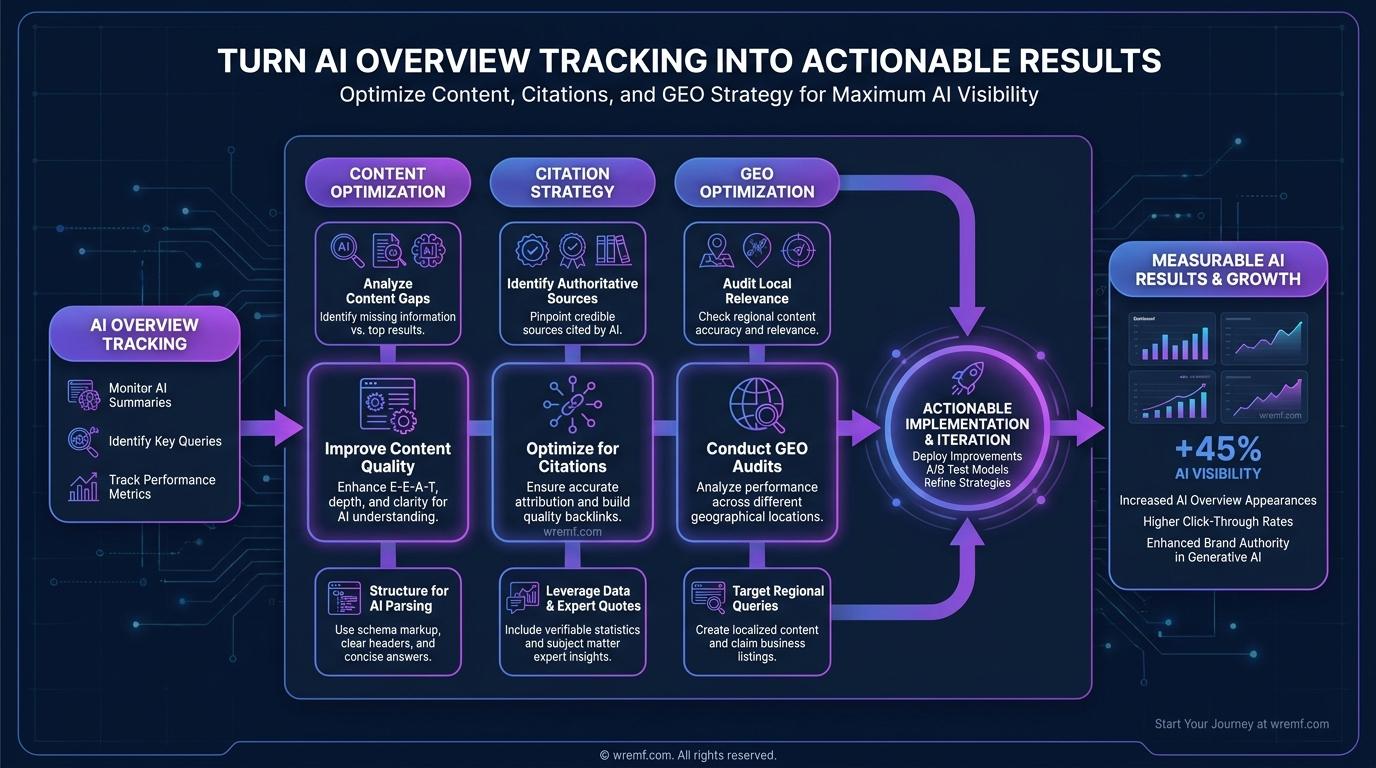
Collecting AI Overview data is only useful if it leads to decisions and actions. The gap between having citation data and improving citation presence is where most teams lose value from their AI Overviews tracker.
The first action priority is content quality and structure. AI Overviews select sources that explain topics clearly, directly, and in a format that allows AI systems to extract specific answers. Content that buries the key point in a long introduction, uses vague language, or fails to define key terms precisely is less likely to be selected as a cited source. Reviewing content against what the AI-generated answer is actually saying and which snippet text is being used provides a direct signal for what to improve.
Content briefs built around AI Overview data should specify not just the keywords and topics to cover but the specific questions that AI Overviews are answering and the format and depth of explanation that the cited sources use. This is a more precise form of content creation than keyword-focused briefs alone, because it is calibrated to the actual selection criteria being applied by AI systems. WREMF's Growth plan includes a content brief generator that supports this kind of AI-informed content planning.
Citation tracking reveals which domains are consistently selected as sources across a query cluster. When a competitor domain appears in AI Overviews for multiple related keywords, it is worth analysing that content in detail to understand what structural, topical, or entity signals are contributing to consistent citation. This is competitive intelligence that keyword rank comparison cannot provide.
Generative Engine Optimization is the practice of optimising content and technical signals specifically for citation in AI-generated answers. It encompasses content clarity and structure, entity authority, schema markup and structured data, source consistency, internal linking, and the topical depth needed to be considered authoritative on a subject. GEO audits run on underperforming content can identify which specific signals are missing and prioritise improvements based on which changes are most likely to improve citation presence.
AEO, or answer engine optimisation, focuses on structuring content to directly answer the questions that AI engines and featured snippets extract. The relationship between AEO and AI Overview citation is direct: content that answers questions concisely, uses clear definitions, and follows a logical structure aligned with user questions is the type of content most frequently cited in AI Overviews. For teams that need support building and executing an AEO strategy, the answer engine optimization services guide explains the service dimensions involved.
Entity authority and brand mentions across trusted referring domains contribute to how reliably a brand is represented in AI-generated answers. A brand that is mentioned accurately and consistently across high-authority domains, industry publications, and structured content sources is more likely to have a stable, consistent presence in AI Overviews and other AI engines. Building entity authority is a longer-term programme that combines content creation, citation cleanup, and strategic publication across relevant domains.
KEY TAKEAWAY: Turning AI Overview tracking data into improved citation presence requires content quality improvements aligned with AI-generated answer selection criteria, GEO and AEO optimisation, entity authority building, and ongoing content audits calibrated to what AI systems are actually selecting as sources.
Common Misconceptions About AI Overviews Trackers and AI Search Visibility
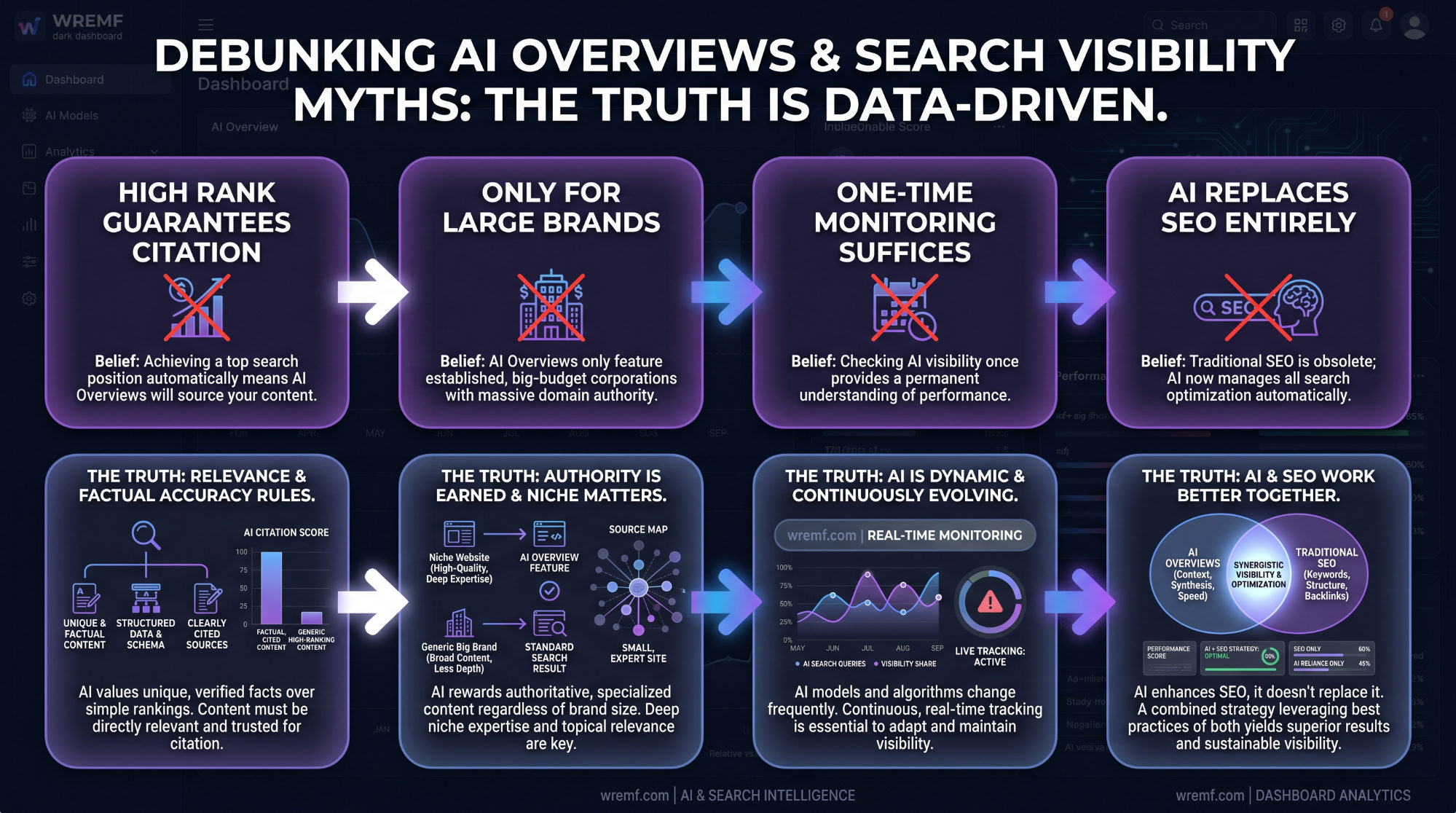
MYTH: If a page ranks in the top three positions on Google, it will be cited in the AI Overview for that keyword.
FACT: Google AI Overviews select sources based on content quality signals, entity consistency, structured data, and how directly the content addresses the specific question, not ranking position alone. Pages ranking outside the top ten are sometimes cited in AI Overviews while top-ranked pages are not. Tracking citation presence requires a dedicated AI Overviews tracker, not just a rank tracker.
MYTH: AI Overview tracking is only relevant for large enterprise brands with big content teams.
FACT: AI Overview tracking is equally relevant for SaaS founders, small SEO teams, and consultants, because citation presence in AI-generated answers affects brand visibility and traffic regardless of company size. WREMF's Starter plan at €59 per month gives solo marketers and founders access to AI Overview citation tracking, competitor monitoring, and core prompt intelligence without enterprise-level investment.
MYTH: Once you are cited in a Google AI Overview, that citation is stable and does not need ongoing monitoring.
FACT: AI Overview source selection changes over time as Google updates its AI systems, as new content is published, and as competitor pages are optimised. A brand cited today may not be cited next month. Consistent monitoring using an AI Overviews tracker is necessary to detect citation losses before they translate into traffic shifts.
MYTH: Traditional SEO tools are sufficient to track the impact of AI Overviews on organic performance.
FACT: Standard SEO tools such as Ahrefs, Seobility, Morningscore, and SE Ranking measure keyword rankings and organic position, which do not capture whether an AI Overview appeared or which sources were cited inside it. Ranking data alone cannot explain traffic shifts caused by AI Overviews. A dedicated AI Overviews tracker combined with Google Search Console and GA4 is required to diagnose and respond to AI Overview effects on traffic.
MYTH: Optimising for AI Overview citation means abandoning SEO strategy and starting from scratch.
FACT: AI Overview optimisation builds on existing SEO foundations rather than replacing them. Technical SEO, structured data, entity authority, and content quality signals all contribute to both organic rankings and AI Overview citation. The additional focus required for AI Overview citation is on answer-first content structure, precise definitions, schema markup, and source consistency, not an entirely separate strategy.
KEY TAKEAWAY: The most damaging misconceptions about AI Overviews trackers are the belief that rankings predict citation, that monitoring can be done infrequently, and that existing SEO tools cover the measurement gap. Each of these assumptions leads to blind spots that dedicated AI Overview tracking is specifically designed to close.
Conclusion
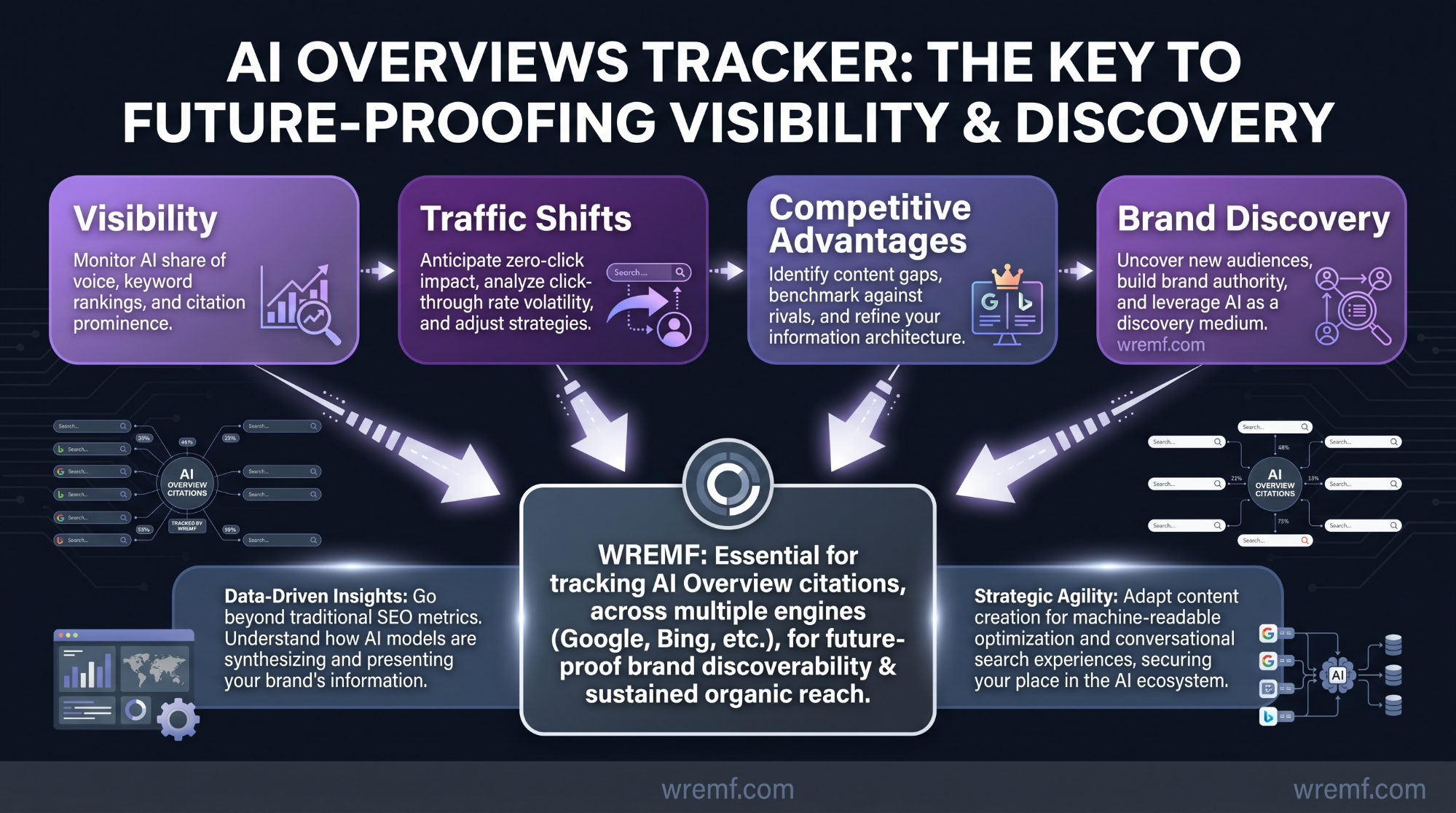
An AI Overviews tracker is now a practical necessity for any team that relies on Google Search for visibility, traffic, and brand discovery. Rankings tell you where pages appear in organic results. An AI Overviews tracker tells you whether AI-generated answers appear above those results, which sources are cited inside them, and whether your brand is present or invisible at the moment users are most engaged. The gap between ranking well and being cited in AI Overviews is where traffic shifts, competitive advantages, and brand visibility decisions are now made. WREMF tracks AI Overview citations alongside visibility across ten AI engines, connecting citation data to competitor benchmarking, source consistency analysis, GA4 attribution, and white-label reporting. Whether your team needs self-serve software, senior-led managed execution, or a hybrid of both, explore WREMF agency services and AI visibility solutions to find the right starting point.
Frequently Asked Questions About AI Overviews Tracker
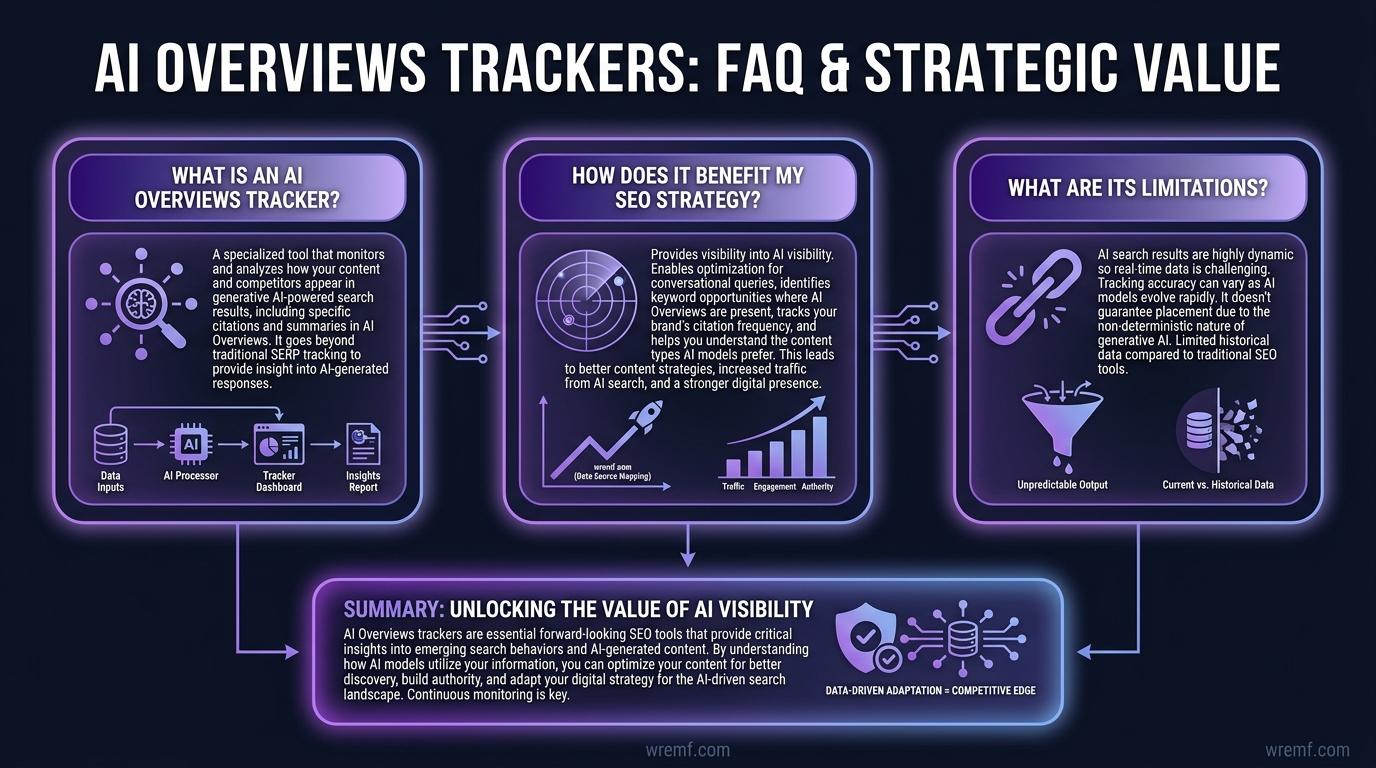
What is an AI Overviews tracker?
An AI Overviews tracker is a tool that monitors whether specific keywords trigger Google AI Overviews in search results, tracks which sources and domains are cited within those AI-generated answer blocks, and measures how your brand appears across those responses over time. Unlike traditional rank trackers that record a URL position in organic results, an AI Overviews tracker captures the presence, content, and citation structure of the AI-generated summary that now appears above standard blue links for many queries. Teams use these tools to understand where their content is being surfaced, where competitors are being cited instead, and how AI-generated answers are influencing click behaviour.
What are Google AI Overviews and why do they matter for SEO?
Google AI Overviews are AI-generated answer blocks that appear at the top of Google search results for many queries, summarising information and citing selected sources directly within the response. According to Google's AI Overviews documentation, these summaries are generated dynamically and are separate from standard organic rankings. They matter for SEO because they sit above organic results, capture attention before a user reaches the first blue link, and directly influence whether users click through to your site at all. Appearing as a cited source within an AI Overview can drive qualified traffic; being absent while competitors are cited represents a measurable visibility gap.
Do AI Overviews appear for every Google search?
No. AI Overviews do not trigger for every query. They appear most frequently for informational, research-style, and how-to queries where a synthesised answer adds value. Commercial, transactional, navigational, and highly brand-specific queries are less likely to trigger AI Overviews. Prevalence also varies by market, language, device type, and whether the user is logged in. This is why systematic AI Overviews tracking across your keyword portfolio is more reliable than manual checking, since any individual search may produce different results depending on personalisation, location, and query context.
How do AI Overviews affect organic click-through rates?
AI Overviews can reduce click-through rates for queries where a user's question is answered directly within the AI-generated block, removing the need to visit a source page. The scale of impact depends on query type, industry, and whether your brand is cited within the Overview itself. Cited sources tend to receive more qualified traffic than uncited pages that previously held high organic rankings for the same query. Traffic impact is not uniform, and some categories see more displacement than others. Tracking impressions, clicks, and citation frequency side by side in Google Search Console alongside an AI Overviews tracker gives a clearer picture of actual traffic shifts rather than relying on estimates.
How can I tell whether traffic loss is caused by AI Overviews or regular organic ranking changes?
Separating AI Overview impact from standard ranking fluctuations requires layering multiple data signals. In Google Search Console, you can filter sessions by the `google_ai_overview` session source segment to identify traffic attributed to AI Overviews interactions, though keyword-level filtering remains limited. Comparing impression trends against click trends for specific queries helps identify cases where visibility has remained stable but click-through rates have fallen, which is a common pattern when AI Overviews are absorbing intent without sending users to source pages. Tracking citation status at the keyword level alongside rank data provides the clearest diagnosis of what is driving any observed traffic shift.
How often should I monitor AI Overviews?
AI Overview content is volatile. Research into AI Overview behaviour suggests that the content within individual AI Overviews changes significantly over time, with cited sources and response structure updating frequently. For competitive keywords, weekly monitoring captures meaningful changes. For broader informational query sets, biweekly or monthly monitoring is often sufficient to identify trends. The priority is consistency, since a single snapshot rarely reflects the full picture. Setting up scheduled monitoring rather than manual checks ensures you capture shifts in citation status, source rotation, and topic coverage without gaps.
How does an AI Overview tracker work?
An AI Overviews tracker runs automated searches for a defined set of keywords, detects whether an AI-generated answer block appears in the results, extracts the content and cited source links from that block, and records the data over time. More capable platforms cross-reference cited URLs against your own domain and competitor domains, score visibility across keyword sets, and flag changes in citation status between monitoring cycles. Some tools also analyse the text within AI Overviews for brand mentions separately from hyperlinked citations, since your brand or content may be referenced in an answer even without a direct source link.
What is the difference between tracking brand mentions and tracking citations in AI Overviews?
Brand mentions and citations are two distinct signals within AI Overviews. A brand mention occurs when the AI-generated answer references your company, product, or content by name within the text of the response, even without linking to your site. A citation occurs when Google includes a direct source link to a specific page on your domain within the AI Overview panel. Both matter, but for different reasons. Mentions affect brand perception and recognition without necessarily driving traffic. Citations indicate that Google is treating your content as a trusted source and are more likely to generate clicks. Tracking both signals separately gives a more complete picture of your AI Overviews visibility.
Can I track competitor mentions and citations in AI Overviews?
Yes. Competitor visibility tracking is one of the most actionable uses of an AI Overviews tracker. By running the same keyword queries that are relevant to your category, you can identify which competitor domains are being cited most frequently, which topics your competitors own in AI-generated answers, and which queries represent citation gaps where neither you nor a direct competitor currently dominates. This competitive intelligence helps prioritise content investment and identifies where adjusting structure, authority signals, or topic coverage could improve your own citation frequency. WREMF's competitive landscape tracking covers this across multiple AI engines beyond Google alone.
How is AI Overview tracking different from featured snippet tracking?
Featured snippets are a single extracted passage from one webpage, displayed in a defined box above organic results. AI Overviews are dynamically generated summaries synthesised from multiple sources, with multiple cited links and no single extracted passage. Featured snippet tracking records whether your page holds the snippet for a given query. AI Overview tracking captures whether your domain is cited as a source within a multi-source AI-generated answer, what the answer says, how often your domain appears versus competitors, and whether your brand is mentioned within the answer text. The two features coexist in some SERPs, but they behave differently and require different measurement approaches.
Do all keywords trigger AI Overviews?
No. Query type is the primary factor. Informational queries such as how-to, what-is, comparison, and research questions trigger AI Overviews far more frequently than transactional or navigational queries. Sensitive topics including medical, legal, and financial queries are handled more cautiously by Google, with AI Overviews appearing less consistently in those categories. Prevalence also varies by market and device. Starting with a tracked keyword set weighted toward informational and mid-funnel queries gives the most useful early data on where AI Overviews are active within your topic area.
How many keywords should I track when getting started?
Starting with 50 to 100 informational and research-focused queries gives enough coverage to identify patterns without creating noise. Prioritise keywords that represent your core topic clusters, buying-stage questions, and comparison queries where AI Overviews are most likely to appear. After two weeks you will have early directional signals. After a month you will have enough consistent data to understand which queries reliably trigger AI Overviews, which sources are being cited most frequently, and where your domain has citation opportunities. Expand your tracked keyword set once these initial patterns are clear.
How long does it take to see meaningful trends in AI Overview tracking?
Two weeks of consistent monitoring is enough to identify early patterns in AI Overview presence and citation frequency. One month of data produces more reliable trend analysis, including which queries trigger AI Overviews consistently, how often cited sources rotate, and how your domain's citation rate compares to competitors. Volatility is high in the short term, so single-day snapshots are often misleading. Building a time-series dataset through scheduled monitoring is more useful than periodic manual checks, particularly for identifying the impact of content changes or authority improvements on citation frequency over time.
Can I track AI Overviews across multiple countries and markets?
Yes. AI Overview behaviour varies significantly by market, language, and regional Google index. Queries that trigger AI Overviews in the United States may not trigger them in the United Kingdom, Germany, or other markets, and cited sources can differ between regions for the same query. For multi-market B2B brands, creating separate tracking projects per country ensures that regional citation gaps and visibility differences are captured accurately rather than averaged out in a single global view.
What is the difference between an AI Overviews tracker and an AI visibility tracker?
An AI Overviews tracker is focused specifically on Google's AI-generated answer feature within Google Search. An AI visibility tracker is a broader category of tool that monitors brand mentions, citations, and recommendations across multiple AI platforms simultaneously, including ChatGPT, Claude, Gemini, Perplexity, Copilot, and others, in addition to Google AI Overviews. For brands where AI-driven discovery is happening across several platforms, an AI visibility tracker captures a fuller picture of where and how the brand appears. WREMF tracks AI visibility across ten AI engines, covering both Google AI Overviews and conversational AI platforms in one workflow.
Will AI crawl and cite my content automatically if my site ranks well?
Ranking well in traditional organic search does not guarantee citation in AI Overviews or other AI-generated answers. AI systems evaluate content based on several factors beyond organic position, including structured clarity, factual density, entity consistency, source authority, and how directly a piece of content addresses specific query intent. Google's guidance on AI Overviews makes clear that cited sources are selected based on relevance and quality signals that do not always align with traditional ranking positions. Content that is well-structured, answer-first, and supported by consistent authority signals is more likely to be cited than content that ranks highly for keyword density alone.
Does structured data or schema markup guarantee a citation in AI Overviews?
No. Structured data and schema markup improve content clarity and help AI systems interpret the entities, relationships, and topics within your pages, but they do not guarantee citation. Schema.org documentation describes markup as a way to communicate meaning to search engines, not as a citation trigger. The value of schema for AI Overviews lies in making your content easier for AI systems to interpret accurately and consistently, which may improve the likelihood of citation over time when combined with strong content quality, entity authority, and topical relevance.
How do AI Overviews interact with Google AI Mode?
Google AI Mode is a more conversational, multi-turn search experience within Google Search that extends AI-generated responses beyond the single-query AI Overview format. AI Overviews appear in standard search results as a summary block above organic listings. AI Mode enables extended conversational queries with follow-up questions and more detailed synthesised responses. Both features draw on similar underlying AI systems and citation logic, but they operate in different contexts within the Google Search interface. Tracking both requires monitoring tools that capture AI-generated answer presence across different result formats rather than only standard SERP snapshots.
How do AI Overviews differ from the earlier Search Generative Experience?
Search Generative Experience, commonly referred to as SGE, was Google's experimental AI search feature that ran in Google Search Labs before the broader rollout. AI Overviews is the production version of that feature, now integrated into standard Google Search results globally across eligible markets and queries. The core mechanics are similar, but AI Overviews represents the current live implementation that affects real traffic. SGE trackers built during the experimental phase have largely been replaced or updated to track AI Overviews directly. References to SGE in older tools or documentation now generally map to the current AI Overviews feature.
What sources do AI engines typically trust, and how do I get my site included?
AI engines tend to cite sources that demonstrate topical authority, consistent entity presence, factual accuracy, clear content structure, and strong third-party recognition. Being referenced by credible publications, appearing in industry directories, having consistent brand information across the web, and producing content that directly and clearly answers the questions your audience is asking all contribute to citation likelihood. There is no single factor that guarantees inclusion. Teams that systematically audit their citation gaps, improve content structure, strengthen off-site authority signals, and monitor citation frequency over time tend to see the most consistent improvement. WREMF's source citation tracking helps identify which pages are being cited and which are being overlooked.
Is it possible to track brand mentions in AI search beyond Google?
Yes. Brand mentions in AI search extend well beyond Google AI Overviews. ChatGPT, Claude, Gemini, Perplexity, Copilot, DeepSeek, Grok, Meta AI, and Mistral all generate responses that mention brands, recommend products, and cite sources to varying degrees. Each platform has different citation behaviour, update frequencies, and content preferences. Tracking brand mentions across this full landscape requires a platform designed to query multiple AI engines systematically with your target prompts and record how often your brand appears, in what context, and compared to which competitors. Tools that monitor only Google provide an incomplete picture of total AI-driven brand visibility.
What is AI share of voice in the context of AI Overviews tracking?
AI share of voice measures how often your brand is mentioned or cited in AI-generated answers across a defined set of queries, expressed as a proportion relative to total AI responses and competitor visibility for the same queries. In the context of AI Overviews tracking, it quantifies how prominently your domain and brand appear in Google's AI-generated summaries versus competing domains. A rising AI share of voice for high-intent queries indicates that your content and authority signals are being recognised by AI systems at a growing rate. Tracking this metric over time connects content and optimisation efforts to measurable visibility outcomes.
How does AI Overview tracking connect to traffic attribution?
Connecting AI Overview tracking to traffic attribution requires combining data from your AI Overviews tracker with Google Search Console session data. Search Console segments traffic from AI Overviews interactions separately from standard organic clicks, which makes it possible to compare query-level impression and click data against citation status in your tracker. When a keyword shows consistent AI Overview presence but declining organic clicks, the citation data from your tracker helps determine whether you are being cited within the AI Overview or whether a competitor is absorbing the visibility. Linking these data sources creates an attribution workflow that connects AI visibility changes to measurable traffic impact.
How can agencies use AI Overview tracking for client reporting?
Agencies managing multiple clients benefit most from AI Overviews tracking platforms that support multi-domain monitoring, white-label reporting, and competitive visibility comparison in one workflow. The most useful agency use cases include tracking which client keywords are triggering AI Overviews, identifying citation gaps versus competitors, monitoring citation consistency across time, and packaging these insights into client-ready reports that connect AI visibility to business metrics. WREMF's agency tools are designed for this workflow, supporting white-label reporting, multi-client dashboards, and competitive share of voice tracking across AI engines beyond Google.
When should a team use software, an agency, or a combined approach for AI Overviews optimisation?
Software-only AI Overviews tracking is best suited for teams with strong internal SEO and content resources who need data and diagnostics but can execute optimisation independently. An agency approach is more appropriate when a team lacks the time, expertise, or bandwidth to translate AI visibility data into content, authority, and technical improvements. A combined model, where software provides continuous tracking and an agency provides strategic execution, is most effective for brands that want both ongoing measurement and systematic improvement without building an internal AI visibility specialism from scratch. WREMF offers all three models, from the Starter plan at €59 per month through to fully managed AI visibility execution starting from €1,500 per month.
What does a GEO audit reveal about AI Overviews visibility?
A Generative Engine Optimization audit evaluates how well your content, site structure, entity presence, and authority signals support citation across AI-generated answer systems including Google AI Overviews. It typically reveals which pages are technically visible to AI crawlers, which content lacks the structure and clarity needed for AI systems to extract and cite, where entity information is inconsistent across the web, and which competitor domains are outperforming yours in AI-generated responses for your priority queries. The output is an actionable gap analysis that connects current visibility status to specific content, technical, and authority improvements. WREMF's GEO audit feature supports this diagnostic process for both in-house teams and agency clients.
Does personalisation affect what appears in AI Overviews?
Yes. Logged-in Google users may see personalised variations of AI Overviews based on their search history, location, and account settings. This means that a manual check of a query in a signed-in browser may not reflect what a target audience segment sees. For consistent tracking, it is recommended to use a neutral browser session with location settings fixed to the target market and no active Google account. Automated tracking tools that run queries in controlled, consistent environments reduce this variability and produce more reliable data for trend analysis than manual spot-checking.
What is the difference between LLM monitoring and AI search monitoring?
LLM monitoring tracks how large language models such as ChatGPT, Claude, and Gemini respond to prompts in conversational AI interfaces, measuring brand mentions, recommendation frequency, sentiment, and citation patterns within direct AI conversations. AI search monitoring is broader and includes AI-generated answer features within search engines, such as Google AI Overviews, Perplexity's AI answers, and Microsoft Copilot in Bing, where AI responses are generated in the context of a search query rather than a standalone conversation. In practice, both categories overlap significantly. Platforms that monitor both conversational LLM responses and AI search results provide a more complete view of where and how a brand appears across the full AI discovery landscape.
How do I get my brand mentioned and cited more often in AI answers?
Improving citation frequency in AI-generated answers requires action across several areas simultaneously. Content should directly and clearly answer the specific questions your audience is asking, using structured formats that AI systems can parse accurately. Entity consistency matters, meaning your brand, product names, and key claims should be described consistently across your own site and third-party sources. Off-site authority signals including mentions in credible publications, industry directories, and trusted reference sources increase the likelihood that AI systems treat your brand as a reliable source. Technical factors including crawlability, page speed, and structured markup affect whether your content is accessible to AI retrieval systems in the first place. For teams that want strategic execution across all of these areas, WREMF's agency team offers managed AEO and GEO services designed specifically for improving AI citation outcomes.
What are the most important metrics to track in an AI Overview visibility report?
The most useful metrics in an AI Overviews visibility report are: AI Overview presence rate (the percentage of tracked keywords that trigger an AI Overview), citation rate (how often your domain is linked within those AI Overviews), brand mention rate (how often your brand name appears in AI Overview text regardless of citation), competitor citation frequency for the same query set, changes in citation status over time, and traffic attributed to AI Overviews interactions via Search Console. Together these metrics connect content and authority signals to measurable visibility outcomes and allow teams to track progress against specific optimisation actions rather than relying on general organic traffic trends.
Will tracking AI Overviews replace traditional rank tracking?
No. AI Overview tracking complements traditional rank tracking rather than replacing it. Traditional rank tracking records where your pages appear in standard organic results, which remain a significant source of search traffic. AI Overview tracking captures a separate layer of visibility that exists above organic results and operates according to different citation logic. Both data sets are necessary for a complete picture of search visibility in 2025 and 2026. Teams that drop traditional rank tracking in favour of AI Overview monitoring alone lose sight of their foundational organic performance. The most effective approach combines both, alongside monitoring across conversational AI platforms where brand discovery is increasingly happening outside of Google Search entirely.
How does WREMF help with AI Overviews tracking and broader AI visibility?
WREMF tracks brand mentions, citations, competitor visibility, and recommendation frequency across ten AI engines including Google AI Overviews, ChatGPT, Claude, Gemini, Perplexity, Copilot, DeepSeek, Grok, Meta AI, and Mistral. The platform combines prompt intelligence, source citation tracking, competitive share of voice analysis, and AI visibility scoring in one workflow. For teams that need execution alongside tracking, WREMF's agency service provides managed AEO strategy, GEO audits, content optimisation, and authority development. Whether a team needs software alone, agency support, or a combined model, WREMF is designed to help B2B brands become the brand AI search recommends. See a sample report or view pricing to understand which option fits your situation.
Related reading
- The Complete Guide to Search Engine Marketing Software for B2B Teams and Agencies
- AI Search Engine Optimization Tools: The Complete 2026 Guide for AI Search, SEO, AEO, and GEO
- The Complete Guide to Backlink Monitoring for SEO, Link Building, and AI Search Visibility
- AI Search Tracker: The Complete Guide to Monitoring Brand Visibility Across AI Engines
- The Complete Guide to AI Rank Tracker Tools for B2B Search Visibility
- The Complete Guide to Marketing Intelligence Tools for B2B and Enterprise Teams