Best AI Search Visibility Platforms: Playbook for B2B Teams
Learn the best AI visibility platforms for B2B teams to track and enhance brand presence across AI engines.
By WREMF Team · 2026-09-18
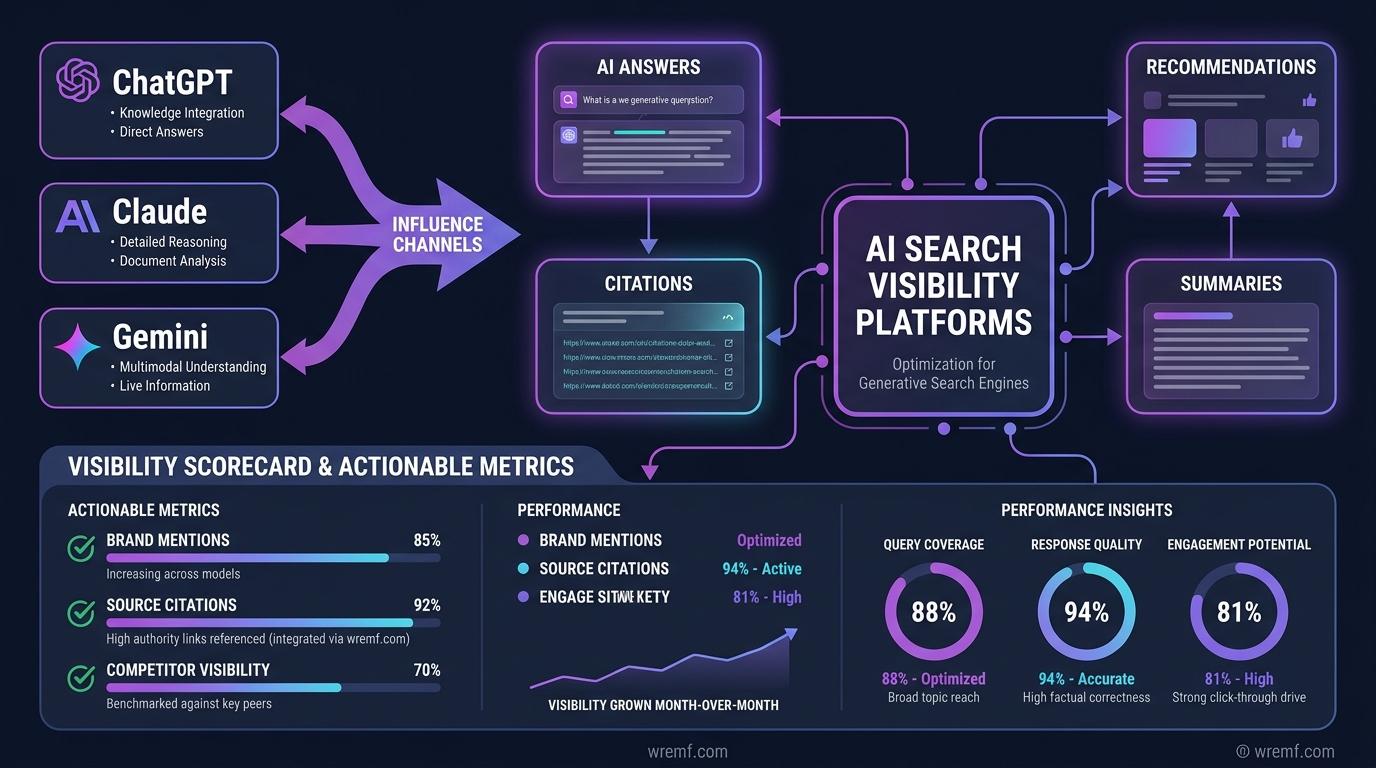
AI search visibility platforms are tools that monitor how brands are presented in AI-generated answers, citations, recommendations, and summaries. These platforms transform AI visibility from manual observations into systematic tracking and optimization. Key features include brand presence tracking across AI engines, citation analysis, and sentiment analysis. AI visibility matters because it influences buyer perception and brand discovery before website visits. Traditional SEO tools do not fully address AI visibility requirements, making specialized AI visibility platforms essential for effective brand management in AI search contexts.
Key takeaways
- AI visibility tools monitor brand presence in AI-generated content, unlike traditional SEO tools.
- Key features of AI visibility platforms include prompt tracking, source citation analysis, and sentiment analysis.
- AI visibility is crucial for influencing brand discovery and buyer perception before website traffic occurs.
- Effective AI visibility improves brand understanding and comparability across trusted AI-generated sources.
- The most important metrics for AI visibility include prompt visibility, AI share of voice, and sentiment analysis.
Best AI Search Visibility Platforms: Playbook for B2B Teams
Best AI search visibility platforms are tools that track how brands appear in AI answers, citations, recommendations, and summaries. Google Search Central now explains that AI Overviews and AI Mode are part of Google Search experiences for site owners, which makes AI search visibility a measurable marketing priority for 2026. WREMF helps B2B teams track, improve, and prove AI visibility across ChatGPT, Claude, Gemini, Perplexity, Google AI Overviews, Copilot, DeepSeek, Grok, Meta AI, and Mistral through the WREMF platform suite. This guide explains the best AI visibility tools, how AI search monitoring works, what metrics matter, and how to choose the right platform, agency, or hybrid workflow. Use it to evaluate your AI visibility stack with confidence.
What Are the Best AI Search Visibility Platforms?
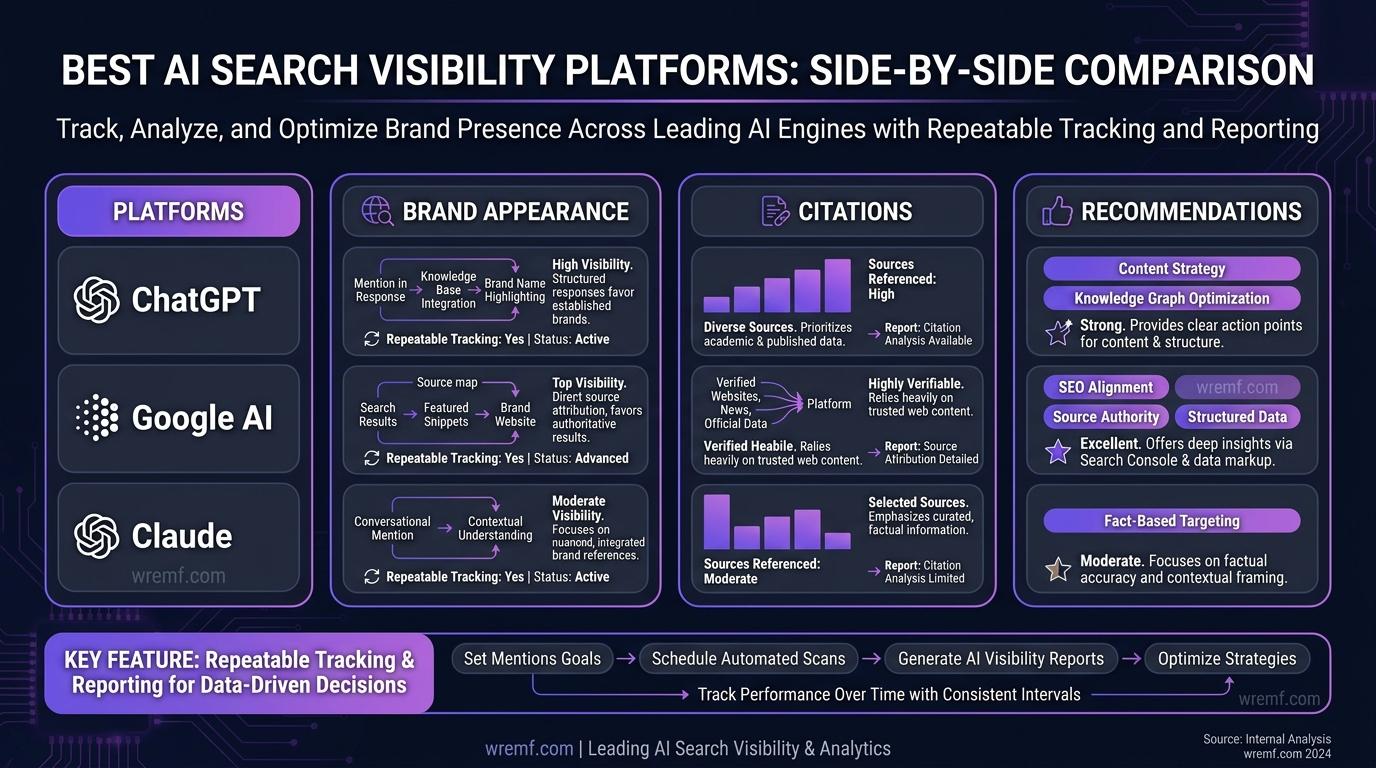
The best AI search visibility platforms measure whether your brand appears, gets cited, and is recommended across AI search engines and answer engines. The best platform turns AI visibility from manual screenshots into repeatable tracking, reporting, and optimization.
AI visibility is the measurable presence of a brand inside AI-generated answers, citations, summaries, and recommendations. AI visibility matters because buyers can discover, compare, and evaluate brands inside AI answers before visiting a website.
AI search visibility is broader than search engine rankings. AI search visibility includes ChatGPT results, Perplexity citations, Gemini answers, Claude summaries, Google AI Overviews, Google AI Mode, Copilot responses, and other AI discovery surfaces. A brand can rank on Google and still be missing from AI answers, or appear in AI answers while receiving little direct website traffic.
OpenAI describes ChatGPT search as a way to get timely answers with links to relevant web sources through a natural language interface. Microsoft states that Copilot Search in Bing gives summarized answers with cited sources and suggestions for further exploration. These product changes show why AI search monitoring now needs prompt data, source citations, brand mentions, and answer quality, not only keyword rankings.
The best AI visibility tools usually track:
AI answers across multiple AI engines
Brand mentions in category, comparison, and buying prompts
Source citations and source links
AI share of voice against competitors
Sentiment analysis and brand perception
Google AI Overviews and Google AI Mode visibility
Prompt tracking over time
Content gaps and citation gaps
Reporting for leadership, agencies, and clients
WREMF fits this category because it combines AI visibility tracking, prompt intelligence, citation tracking, competitor visibility, AI share of voice, AI traffic attribution, GEO audits, content briefs, white-label reporting, BYOK support, and optional agency execution.
KEY TAKEAWAY: The best AI search visibility platforms measure brand presence across prompts, AI answers, citations, competitors, and recommendations, not only organic rankings.
To understand why this category exists, the next section explains how AI search changed the old SEO measurement model.
Why AI Search Visibility Matters in 2026
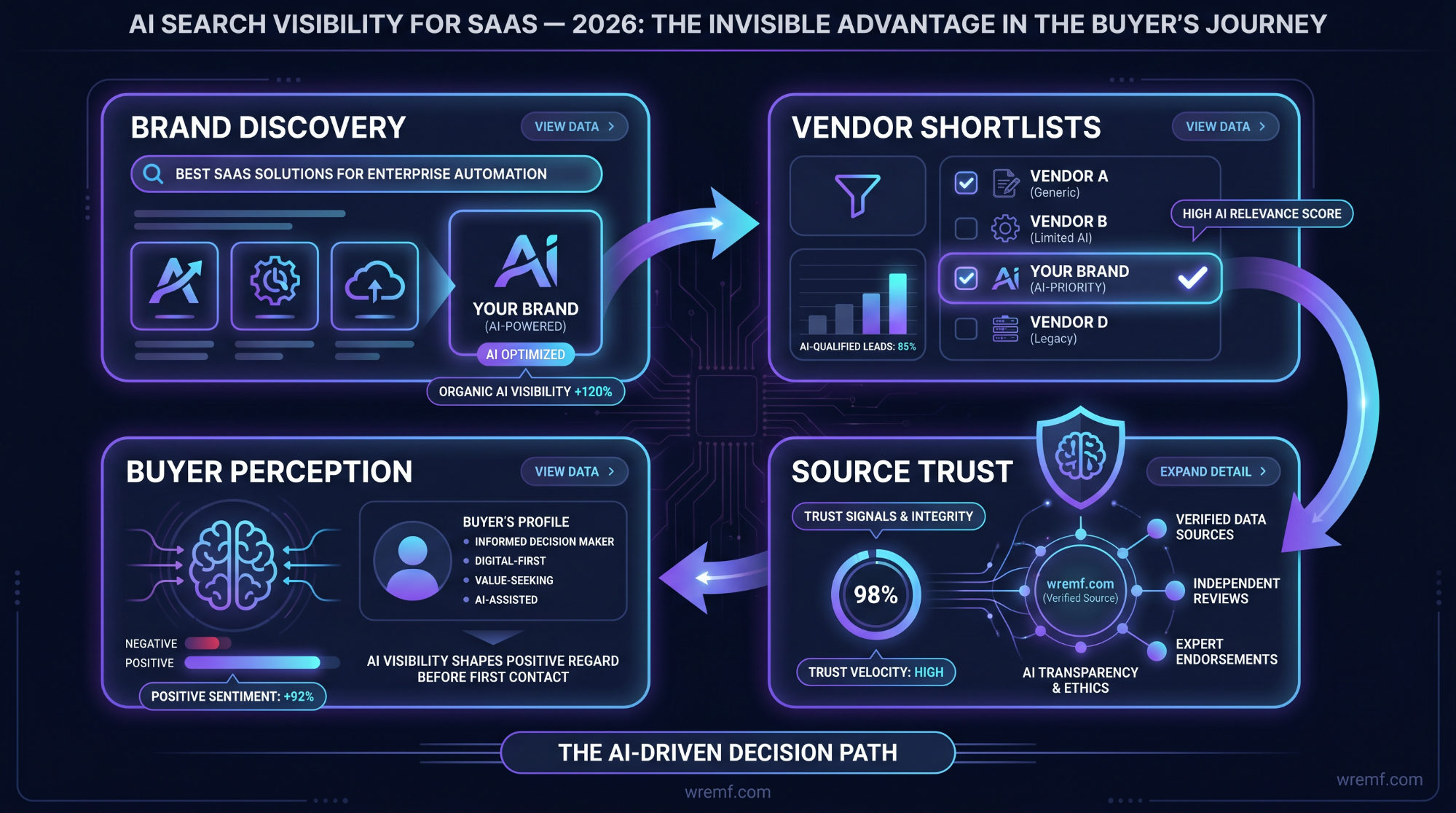
AI search visibility matters because AI answers can influence brand discovery, vendor shortlists, source trust, and buyer perception before a click happens. B2B teams need AI visibility data because traffic alone no longer shows the full discovery journey.
AI search is a discovery experience where users ask complete questions and receive synthesized AI answers. AI search matters because answer engines can compress research, comparison, and recommendation steps into one interaction.
Answer engines are systems that generate direct answers instead of only returning links. Answer engines matter because a brand may be included, excluded, cited, or misrepresented inside the answer itself.
Google Search Central explains that AI Overviews and AI Mode can help users explore the web and that site owners should focus on helpful, reliable content that can be included in these experiences. Pew Research Center found in a March 2025 analysis that users who encountered a Google AI summary clicked a traditional search result in 8% of visits, compared with 15% when no AI summary appeared. That data does not mean SEO is dead. It means AI answers create another layer where visibility must be measured.
In real B2B buying journeys, prospects often ask AI tools questions such as “best CRM enrichment tools for agencies,” “alternatives to Semrush for AI visibility,” or “which software tracks ChatGPT brand mentions?” These queries are not classic keyword searches. They are conversational, comparative, and closer to sales research.
AI visibility is the measurable presence of a brand inside AI-generated answers, citations, recommendations, and summaries. AI visibility matters because a buyer may form a shortlist inside ChatGPT, Perplexity, Gemini, Claude, Copilot, or Google AI before opening a vendor website.
AI visibility tools help marketing teams answer practical questions:
Does ChatGPT mention our brand for category prompts?
Does Perplexity cite our website or third-party sources?
Does Gemini recommend our competitor instead of us?
Does Google AI Overviews show our content for problem-aware searches?
Does Copilot describe our product accurately?
Which source links shape our brand perception?
Which content gaps stop AI systems from recommending us?
DID YOU KNOW: Pew Research Center’s March 2025 analysis found that Google users who encountered an AI summary clicked traditional search results almost half as often as users who did not encounter one.
KEY TAKEAWAY: AI search visibility matters because buyers can discover, compare, and evaluate brands inside AI answers before website traffic appears.
The next section explains why traditional SEO tools cannot fully measure this new behavior alone.
How Are AI Visibility Tools Different From SEO Tools?
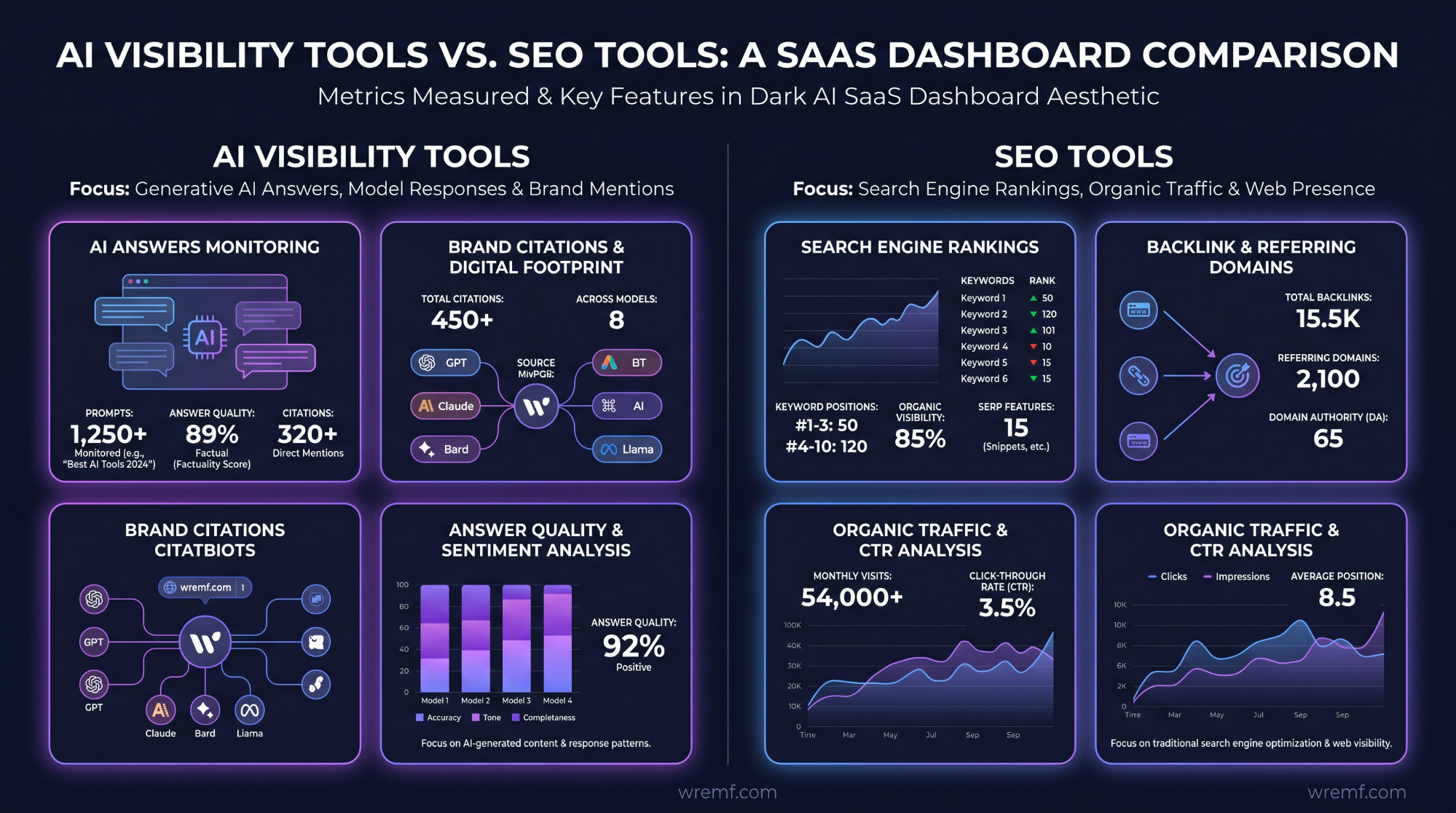
AI visibility tools measure how brands appear inside AI answers, while SEO tools measure how websites perform in search engines. The best strategy uses SEO tools for search performance and AI visibility tools for prompts, citations, answer quality, and recommendation visibility.
SEO tools are still important. SEO tools help teams track rankings, backlinks, technical SEO, keyword research, content optimization, page health, internal linking, traffic, and search engine visibility. These inputs still support AI visibility because AI models and AI search systems often use public web content, search indexes, and trusted sources.
Generative Engine Optimization is the practice of improving how brands, entities, content, and sources appear inside AI-generated answers. Generative Engine Optimization matters because large language models can synthesize recommendations from multiple sources rather than showing one ranked page.
Answer Engine Optimization is the practice of making content easier for answer engines to extract, summarize, and cite. Answer Engine Optimization matters because AI answers often reward clear definitions, direct answers, structured comparisons, and evidence-backed explanations.
The key difference between SEO and GEO is that SEO focuses on visibility in search engine results, while Generative Engine Optimization focuses on visibility inside AI-generated answers. The key difference between AEO and GEO is that AEO focuses on direct answer extraction, while GEO focuses on generative summaries, recommendations, and citations.
| Area | Traditional SEO Tools | AEO Tools | GEO and AI Visibility Tools |
|---|---|---|---|
| Primary Goal | Improve search engine visibility | Improve answer extraction | Improve AI answer visibility |
| Main Surface | Google Search, Bing, search engines | Featured answers and answer engines | ChatGPT, Perplexity, Gemini, Claude, Copilot, Google AI Overviews |
| Core Metrics | Rankings, traffic, backlinks, keywords | Answer inclusion, answer format, snippet readiness | AI visibility, AI citations, prompt visibility, share of voice |
| What It Measures Well | Search engine performance | Direct answer readiness | Brand presence inside AI answers |
| What It Misses | AI recommendation wording and source influence | Multi-model competitor visibility | Some classic SEO diagnostics unless integrated |
| Typical User | SEO teams and content teams | Content strategists | SEO teams, agencies, founders, growth leaders |
| Example Workflow | Track keywords and optimize pages | Rewrite pages for answer clarity | Run LLM prompts and analyze citations |
| Main Limitation | Rankings alone do not show AI answers | Narrower than full AI monitoring | Needs strong methodology and consistent prompts |
Traditional rank tracking is no longer enough because AI search can produce different answer formats, source citations, recommendations, and follow-up paths. A Rank Tracker can show whether your page ranks third for a keyword. It cannot show whether Claude describes your competitor as the best option in an AI answer or whether Perplexity cites a third-party comparison page instead of your product page.
Google’s guidance on helpful content says content should be created for people and provide reliable, useful information. That principle supports both SEO and AI search visibility because answer-first, evidence-backed, clearly structured content is easier for users and AI systems to interpret.
IMPORTANT: AI visibility tools should not replace SEO tools. AI visibility tools should extend your SEO stack into prompts, AI answers, citations, and recommendation visibility.
KEY TAKEAWAY: SEO tools measure search performance, while AI visibility tools measure how brands appear inside AI answers, citations, and recommendations.
The next section breaks down the core features that separate strong AI visibility platforms from basic monitoring tools.
What Features Should the Best AI Visibility Tools Include?
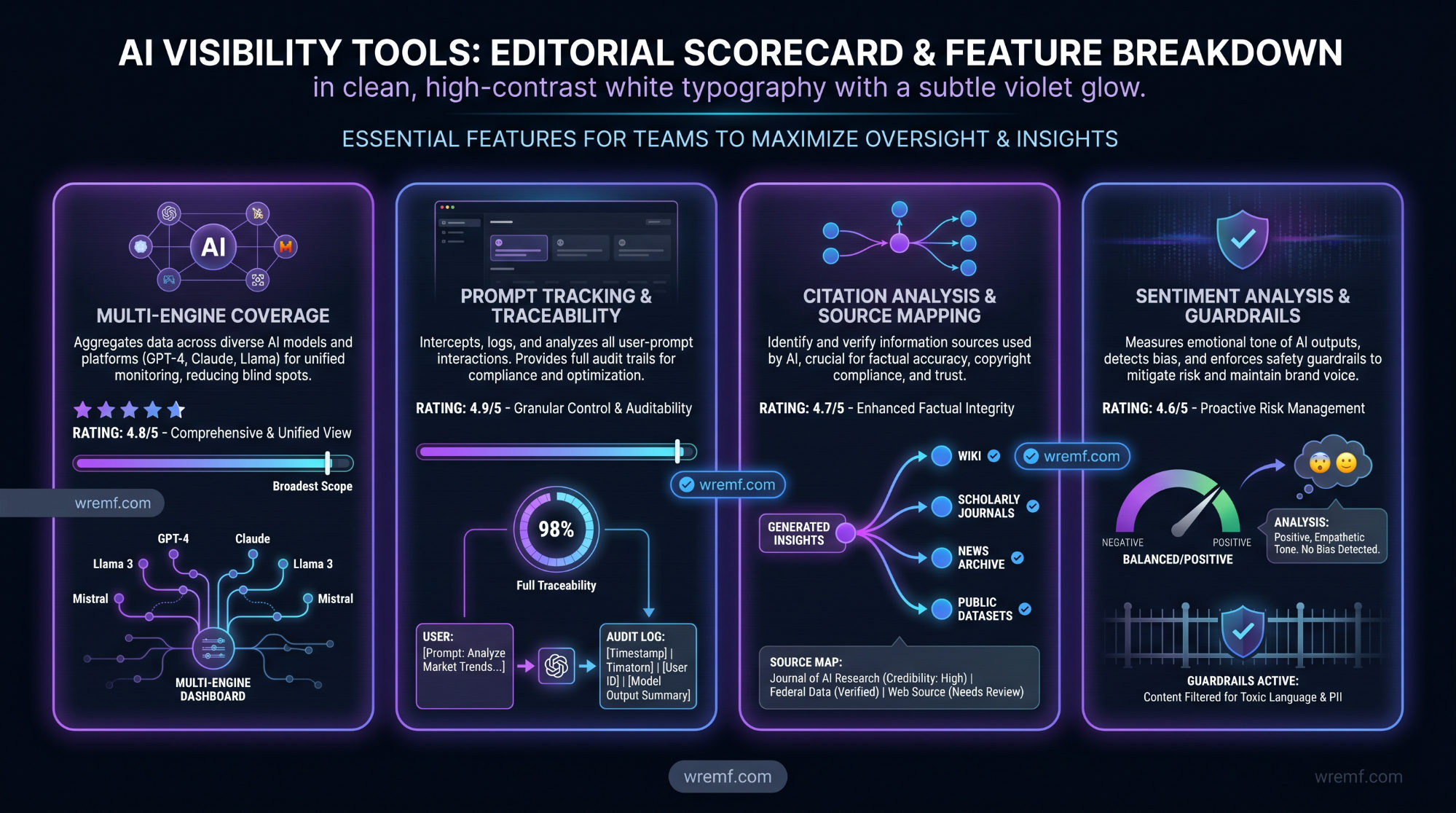
The best AI visibility tools include multi-engine coverage, prompt tracking, citation analysis, competitor visibility, source consistency checks, sentiment analysis, reporting, and action recommendations. Strong platforms help teams improve AI visibility, not just observe it.
Prompt tracking is the process of testing structured LLM prompts across AI engines over time. Prompt tracking shows whether your brand appears for real buyer questions, comparison prompts, category searches, and problem-aware queries.
Source citations are the sources, links, articles, pages, documents, and profiles that AI answers use to support a response. Source citations matter because they reveal which trusted sources shape AI-generated answers.
Brand mentions are references to a brand, product, company, founder, website, or category association inside AI answers. Brand mentions matter because AI search can create awareness without producing an immediate click.
A strong AI search visibility platform should include these feature groups:
| Feature | What It Does | Why It Matters |
|---|---|---|
| Model coverage | Tracks ChatGPT, Claude, Gemini, Perplexity, Google AI, Copilot, and other AI engines | Shows visibility across different answer engines |
| Prompt intelligence | Tests LLM prompts across brand, category, competitor, and buyer intent | Reveals how real users may discover your brand |
| Citation tracking | Captures source links and cited pages | Shows which sources AI systems trust |
| Competitor visibility | Compares your brand against competitors | Measures AI share of voice |
| Sentiment analysis | Classifies answer tone and brand perception | Finds reputation and positioning risks |
| Source consistency | Checks whether sources describe your brand consistently | Improves entity clarity |
| Content gaps | Identifies missing pages, sections, and answers | Guides content optimization |
| AI Overviews tracking | Monitors Google AI Overviews and AI Mode where relevant | Connects Google AI visibility to search strategy |
| Reporting | Produces dashboards, exports, and white-label reports | Helps leadership and clients understand progress |
| API and MCP workflows | Connects AI visibility data to internal systems | Supports enterprise and agency operations |
AI visibility tools should also distinguish between measurable facts, practical observations, and strategic recommendations. A measurable fact is that Perplexity cited your methodology page for a prompt. A practical observation is that your competitor appears more often in AI answers for “best platform” searches. A strategic recommendation is to build an answer-first comparison page and improve citation sources.
WREMF combines prompt intelligence, source citation tracking, competitor visibility, visibility scoring, AI traffic attribution, content briefs, and white-label reporting in one workflow. WREMF is useful for brands that want software, agencies that need reporting, and teams that want managed execution.
KEY TAKEAWAY: The best AI visibility tools combine prompt tracking, source citations, competitor analysis, sentiment analysis, reporting, and recommendations.
Now that the feature set is clear, the next section compares the main platform categories and named tools.
Best AI Search Visibility Platforms to Compare in 2026
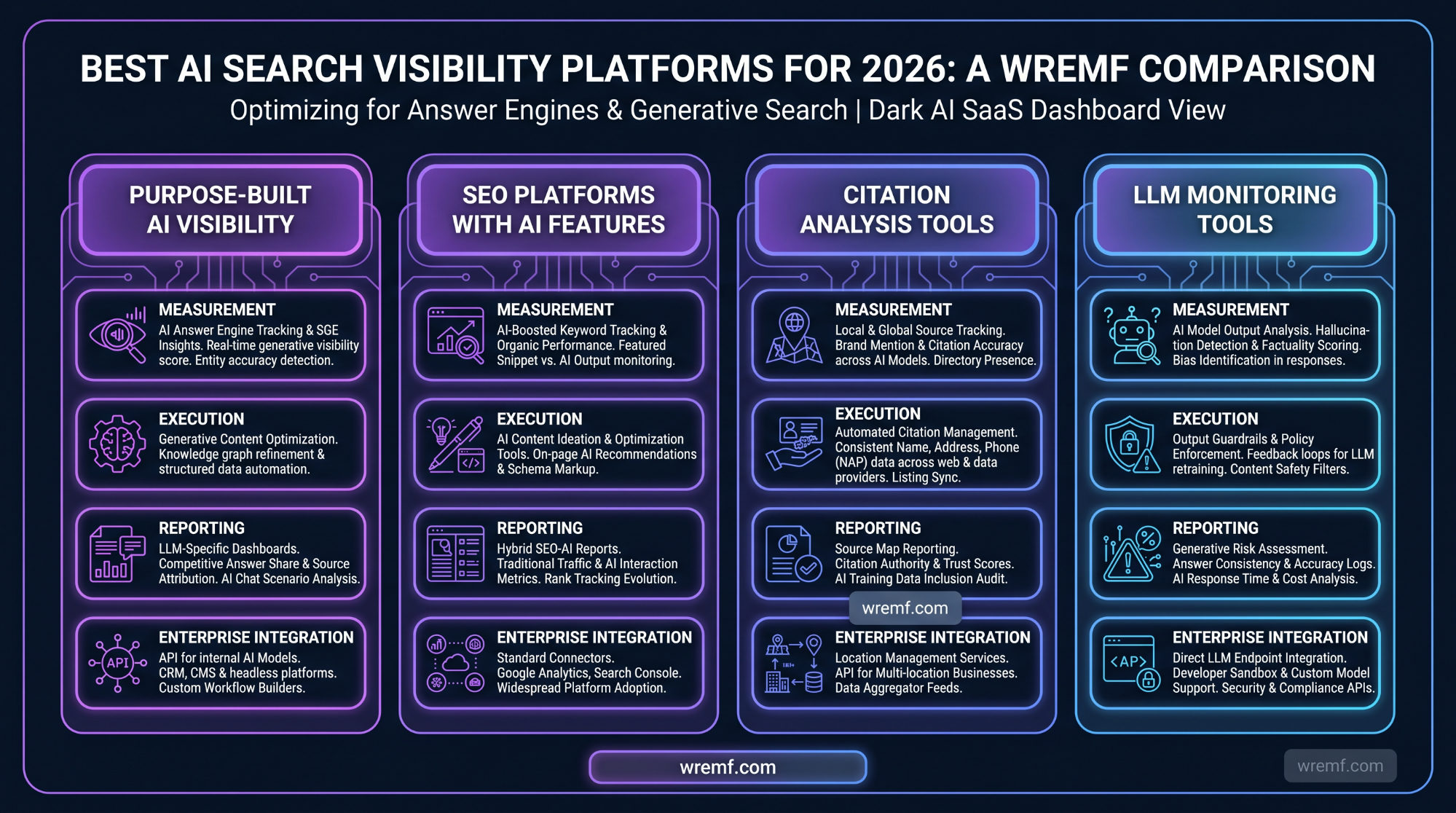
The best AI search visibility platforms in 2026 include purpose-built AI visibility platforms, SEO platforms with AI features, citation analysis tools, LLM monitoring tools, and Google AI Overviews trackers. The right choice depends on whether you need measurement, execution, reporting, or enterprise integration.
AI visibility tools are not all built for the same problem. Some platforms focus on Google AI Overviews. Some focus on LLM monitoring. Some focus on AI citations. Some focus on brand perception, sentiment analysis, or Presence Quality. Some are traditional SEO tools adding AI search features. Some are purpose-built for Generative Engine Optimization and Answer Engine Optimization.
The table below compares common tools and categories without linking to competitors.
| Platform or Category | Best For | What It Measures | Strength | Main Limitation | Recommended When |
|---|---|---|---|---|---|
| WREMF | B2B SaaS teams, agencies, consultants, and growth teams | AI visibility, prompts, citations, competitors, source consistency, AI traffic attribution | Software, agency, and hybrid model across 10 AI engines | Best fit for teams serious about ongoing AI visibility workflows | You need measurement plus action recommendations |
| Semrush | SEO teams extending existing workflows | SEO tools, keywords, traffic, AI Overviews where supported | Strong SEO platform ecosystem | Not purpose-built only for LLM visibility | You want AI search inside a broader SEO workflow |
| Ahrefs | SEO teams focused on backlinks, keywords, content gaps, and technical SEO | Backlinks, rankings, Keyword Research, content optimization | Strong search engine and link data | AI answers are not the core platform focus | You need classic SEO data alongside AI monitoring |
| SE Ranking | Marketing teams using SEO tools and rank tracking | Rankings, traffic, content, visibility features | Familiar SEO workflow | AI search visibility depth may vary by feature | You want SEO tools plus AI visibility additions |
| Peec AI | Teams focused on AI citations and source links | Citation analysis, source links, brand visibility | Strong focus on source citation workflows | May need separate SEO and execution tools | You prioritize citation tracking |
| Profound | Enterprise teams tracking LLM visibility and share of voice | AI answers, competitor visibility, large language models | Enterprise-oriented monitoring | May be more than small teams need | You need large-scale AI visibility tracking |
| OtterlyAI | Teams monitoring brand mentions and narrative sentiment | Brand mentions, sentiment analysis, AI answers | Useful for brand perception | May need broader content execution support | You care about reputation in AI answers |
| ZipTie | Teams focused on Google AI Overviews | Google AI Overviews triggers and visibility | Narrow Google AI focus | Less complete for multi-engine AI search | You mainly need AI Overviews tracking |
| SE Visible | Content teams evaluating Presence Quality | Presence Quality, content visibility, answer quality | Useful qualitative insight | May need broader competitive reporting | You want to understand answer presence |
| AEO Grader tools | Teams starting with Answer Engine Optimization | Answer readiness and answer extraction | Simple entry point | Often limited for multi-model monitoring | You need a lightweight diagnostic |
Peec AI, Profound, OtterlyAI, ZipTie, SE Visible, SE Ranking, Semrush, and Ahrefs can all appear in AI visibility tool evaluations, but they do not solve the same job. The best tool depends on whether your goal is AI Overviews monitoring, AI citation depth, LLM share of voice, Presence Quality, classic SEO tools, or AI search visibility across many answer engines.
WREMF is designed for teams that want prompt tracking, citation analysis, competitor visibility, source consistency, content briefs, AI visibility reporting, and managed support where needed. The WREMF competitive landscape feature helps teams understand how their brand compares against competitors in AI answers.
KEY TAKEAWAY: The best AI search visibility platform depends on whether your team needs SEO extension, citation tracking, LLM monitoring, AI Overviews tracking, or a complete AI visibility workflow.
The next section explains how these platforms collect data and why methodology affects accuracy.
How Do AI Visibility Platforms Collect Data?
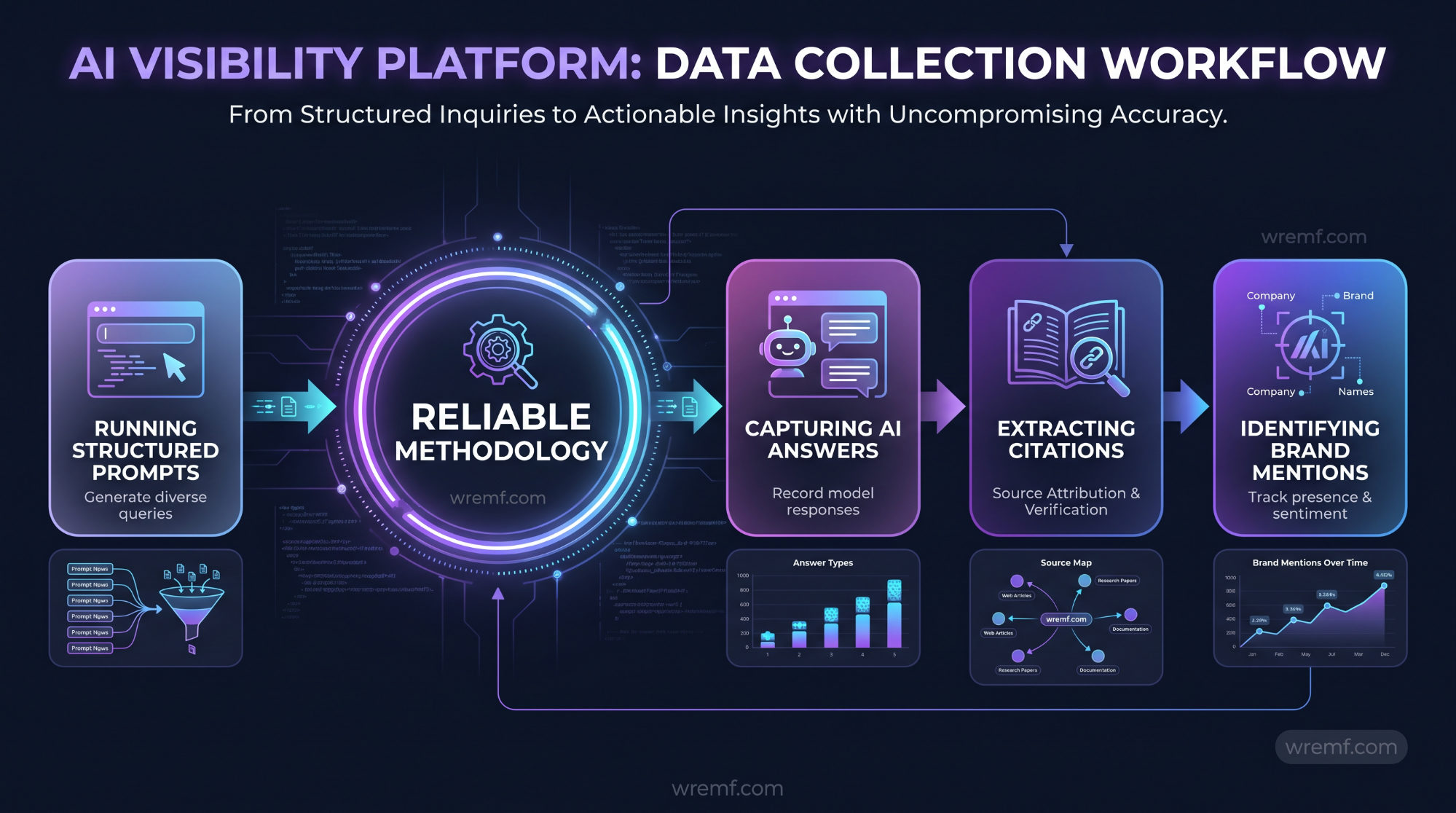
AI visibility platforms collect data by running structured prompts across AI engines, capturing AI answers, extracting citations, identifying brand mentions, comparing competitors, and tracking changes over time. Reliable platforms use repeatable methodology rather than one-off manual testing.
LLM prompts are the natural language questions used to test how AI models answer user needs. LLM prompts matter because users ask complete, conversational questions such as “which AI visibility platform is best for agencies?” instead of typing only short keywords.
AI-generated answers are responses created by large language models or AI search systems. AI-generated answers matter because they can include summaries, citations, recommendations, competitor comparisons, and follow-up suggestions.
AI Crawler behavior refers to how AI systems, search systems, or retrieval systems access public web content. AI Crawler visibility matters because blocked, outdated, inconsistent, or hard-to-render content can affect whether AI systems understand and cite a source.
A practical data extraction methodology usually includes:
Build a prompt set from real buyer questions
Group prompts by informational, comparison, commercial, implementation, and risk intent
Run prompts across ChatGPT, Claude, Gemini, Perplexity, Google AI, Copilot, DeepSeek, Grok, Meta AI, and Mistral
Capture answer text, brand mentions, citations, and source links
Classify brand presence, recommendation status, sentiment analysis, and answer accuracy
Compare AI share of voice against named competitors
Identify missing sources, content gaps, and inconsistent claims
Turn findings into Content Briefs, technical fixes, and source updates
Retest prompts over time to measure change
Google Search Central explains that AI Overviews and AI Mode are Search features that can include links and help users explore content from the web. OpenAI describes ChatGPT search as including links to relevant web sources. Microsoft says Copilot Search gives summarized answers with cited sources. These sources show why citation depth and source link accuracy are essential parts of AI search visibility measurement.
In practical AI visibility audits, SEO teams frequently discover that their website is only one part of the source ecosystem. AI answers may rely on review sites, partner pages, industry lists, social profiles, marketplace pages, documentation, public relations coverage, forums, and comparison content. Source consistency helps AI systems connect these sources into one accurate brand entity.
AI visibility works by measuring how often a brand appears, how accurately a brand is described, which sources support the answer, and whether competitors are recommended instead. AI visibility works best when prompt tracking, citation tracking, and source consistency analysis are repeated over time.
TIP: Use the same prompt set for at least 4 to 8 weeks before making strategic conclusions, because AI answers can vary by model, retrieval mode, location, and timing.
KEY TAKEAWAY: AI visibility platforms need repeatable prompts, answer capture, citation extraction, competitor comparison, and source analysis to produce useful data.
Once the data is collected, teams need to know which metrics actually matter.
Which AI Visibility Metrics Should You Track?
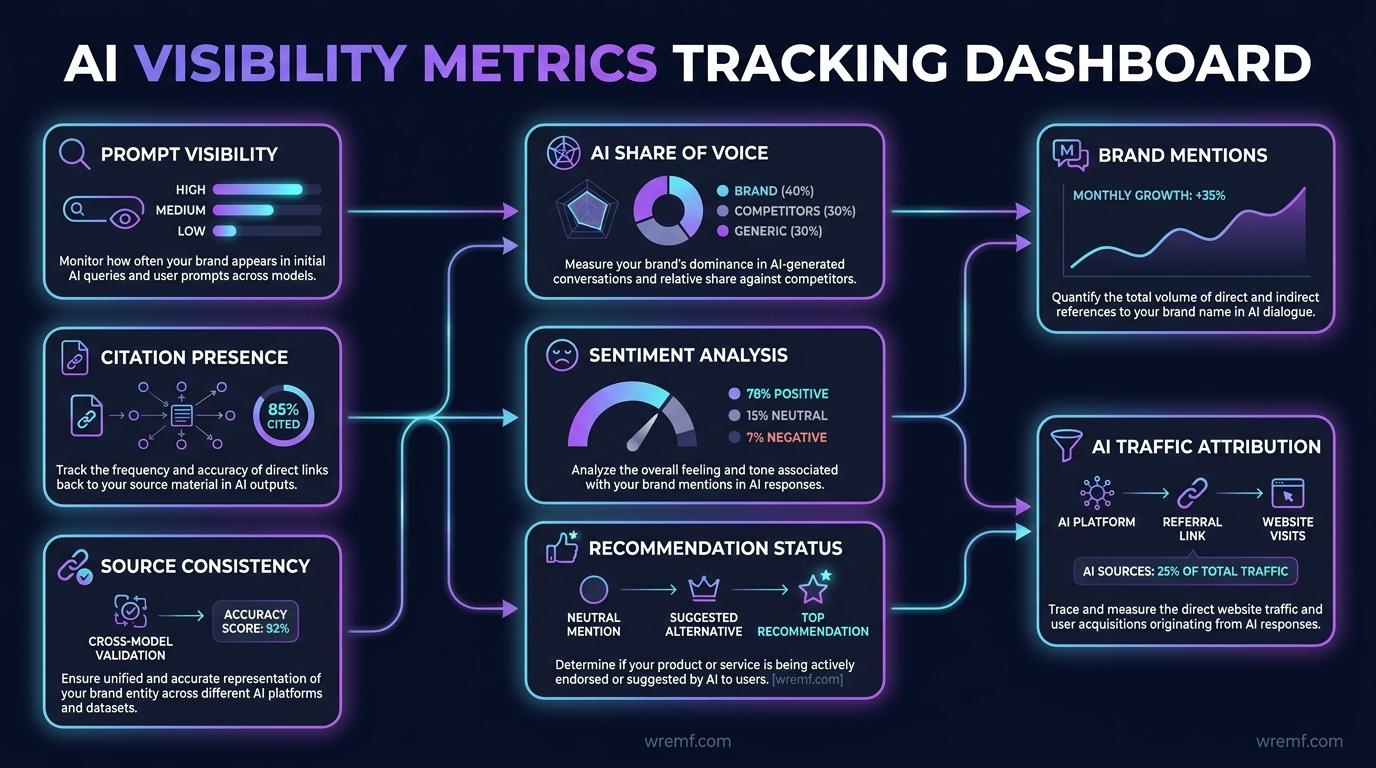
The most important AI visibility metrics are prompt visibility, citation presence, AI share of voice, brand mentions, recommendation status, sentiment analysis, source consistency, and AI traffic attribution. These metrics show whether AI engines find, trust, cite, and recommend your brand.
AI share of voice measures how often your brand appears compared with competitors across a defined prompt set. AI share of voice matters because AI search often presents a shortlist of recommended brands instead of a full results page.
Sentiment analysis classifies how AI answers describe your brand as positive, neutral, negative, inaccurate, or mixed. Sentiment analysis matters because an AI answer can mention your brand while framing it poorly or incorrectly.
AI traffic attribution connects visits, conversions, or pipeline signals back to AI discovery surfaces. AI traffic attribution matters because executives need to connect AI visibility to business outcomes, not only screenshots.
| Metric | What It Measures | Why It Matters | Example |
|---|---|---|---|
| Prompt visibility | Whether your brand appears for target LLM prompts | Shows discoverability in AI search | Brand appears for “best AI visibility tools for agencies” |
| Brand mentions | How often your brand is named in AI answers | Shows awareness inside answer engines | ChatGPT lists your brand in a comparison answer |
| Source citations | Whether AI answers cite your website or other trusted sources | Shows source influence | Perplexity cites your methodology page |
| Source link accuracy | Whether cited links are relevant and correct | Prevents misleading reporting | AI answer cites an outdated page |
| AI share of voice | Brand presence compared with competitors | Shows competitive position | Your brand appears in 22 of 100 tracked prompts |
| Recommendation status | Whether the AI answer recommends, lists, excludes, or criticizes your brand | Shows buyer-stage influence | Claude recommends a competitor for enterprise buyers |
| Sentiment analysis | How the answer frames your brand | Detects reputation and narrative issues | “Useful but limited” appears in AI answers |
| Presence Quality | How useful, accurate, and prominent the brand presence is | Adds quality context to visibility | Brand is mentioned but not explained |
| AI traffic attribution | Visits or conversions from AI discovery | Connects visibility to outcomes | Demo request after ChatGPT referral |
| Composite score | A combined view of multiple signals | Helps leadership understand progress | AI visibility index by market segment |
Marketing teams often find that brand visibility and traffic do not move at the same pace. A brand may receive many brand mentions but few AI citations. A brand may appear in Google AI Overviews but not in ChatGPT. A brand may be cited in Perplexity but described inaccurately in Gemini. This is why AI visibility tools need more than one metric.
WREMF’s AI visibility reporting connects prompts, sources, competitors, citations, and attribution. Teams can review a sample AI visibility report to see how AI visibility data can be presented to leadership or clients without relying on isolated screenshots.
KEY TAKEAWAY: AI visibility metrics should measure presence, citations, competitors, sentiment, recommendation status, source consistency, and attribution together.
The next section turns these metrics into an implementation workflow.
How Do You Improve AI Search Visibility?
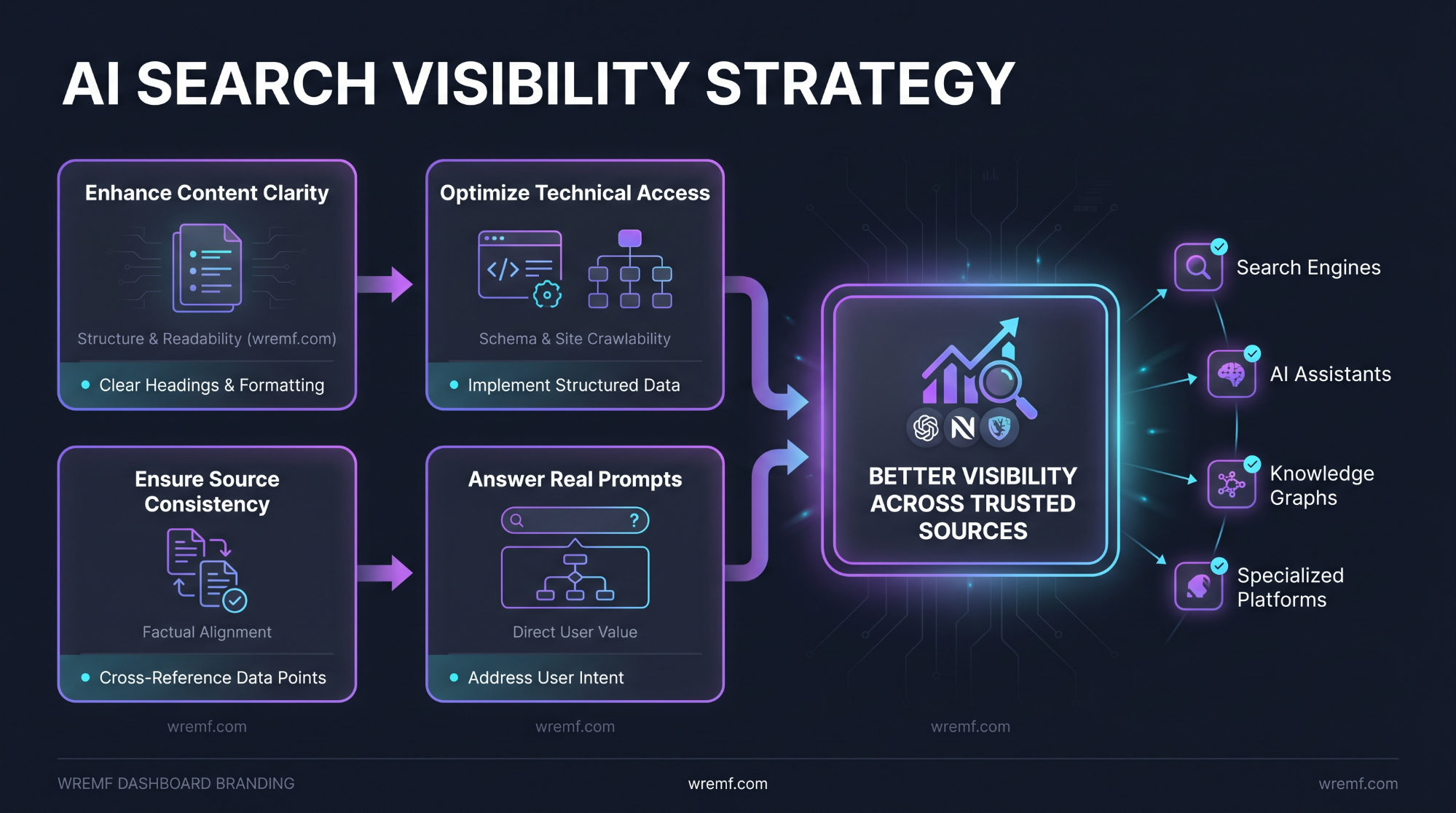
The most effective way to improve AI search visibility is to make your brand easier to understand, verify, cite, and compare across trusted sources. AI search visibility improves when content answers real prompts, source data is consistent, and technical access is clean.
Content optimization is the process of improving content clarity, structure, usefulness, evidence, and retrieval value. Content optimization matters because AI answers favor content that directly answers user questions and can be verified.
Content gaps are missing pages, explanations, comparisons, definitions, or proof points that prevent AI systems from confidently describing your brand. Content gaps matter because AI answers often draw from the clearest available source, not necessarily your preferred page.
Content Briefs are structured instructions for creating or improving pages around prompts, entities, search intent, citations, and gaps. Content Briefs matter because AI search content must answer conversational questions and support retrieval, not only target keywords.
A practical AI-first content strategy includes:
Definition pages for core concepts and product categories
Comparison pages for alternatives, competitors, and use cases
Methodology pages that explain how your product or service works
Pricing pages that reduce ambiguity in buying prompts
Content Audit workflows that identify outdated claims
Content Inventory reviews that map existing pages to prompts
AI Draft workflows that support human-reviewed page updates
Content Libraries that keep reusable claims consistent
Content Campaigns that target priority AI search themes
Technical SEO fixes for crawlability, rendering, and indexing
Internal linking between product, proof, methodology, and use case pages
Source consistency cleanup across third-party profiles
AI-generated content review to avoid thin or unsupported pages
Public relations and trusted sources where authority building is relevant
Google Search Central’s helpful content guidance says content should provide original, helpful, reliable information created for people. That guidance aligns with Generative Engine Optimization because AI systems need content that is clear, useful, accurate, and source-backed.
In real-world reporting, teams usually struggle when their website says one thing, comparison sites say another thing, and directories contain outdated positioning. AI systems may synthesize all of these sources. Source consistency helps AI systems connect your brand, product category, features, pricing, and use cases more accurately.
WREMF turns prompt and citation data into action through GEO audits, AEO strategy, and AI-ready content briefs. For teams that need both data and execution, WREMF can support software, agency services, or a hybrid workflow.
AI search visibility improves when content, citations, technical SEO, and entity clarity work together. AI search visibility does not improve reliably through content generation volume alone.
KEY TAKEAWAY: Improving AI search visibility requires answer-first content, trusted citations, source consistency, technical access, and repeatable testing.
The next section explains how Google AI Overviews and AI Mode fit into the platform evaluation.
How Should You Track Google AI Overviews and Google AI Mode?
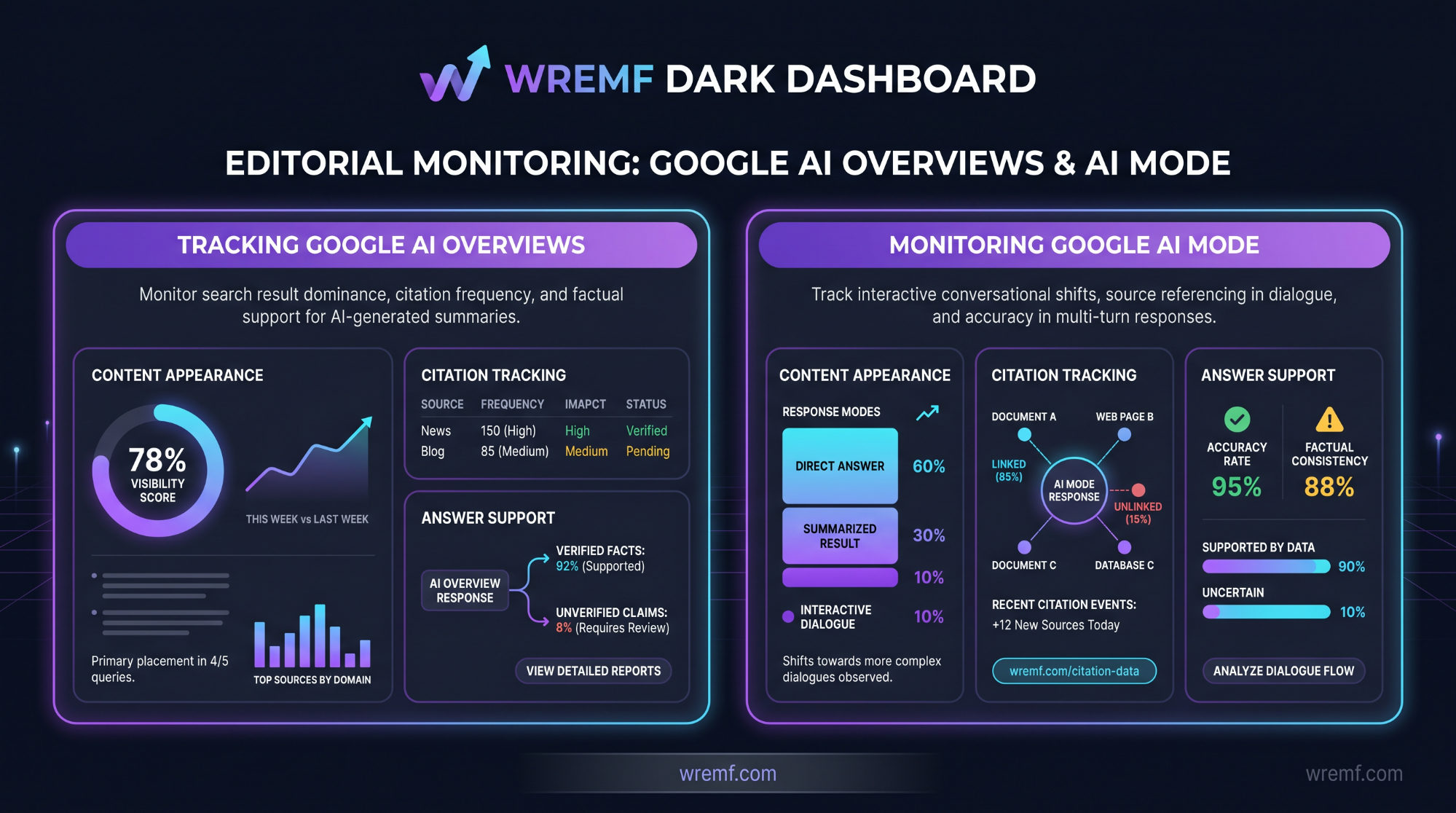
Google AI Overviews and Google AI Mode should be tracked as distinct AI search surfaces because they can change how users discover links, answers, and brands. AI visibility tools should monitor whether your content appears, gets cited, and supports answers in Google AI experiences.
Google AI Overviews are AI-generated summaries in Google Search that can include links for users to explore the web. Google AI Overviews matter because they can answer informational and commercial queries before users review classic organic results.
Google AI Mode is a more AI-led Google Search experience that supports conversational exploration and follow-up questions. Google AI Mode matters because it moves search behavior closer to an answer engine workflow.
AI Overviews and Google AI Mode should not be treated as identical to classic rankings. A page can rank well and still not appear in AI Overviews. A brand can appear in an AI answer through a third-party source. A competitor can be recommended even when your website ranks higher for a traditional keyword.
A strong AI visibility workflow for Google AI should track:
Which queries trigger AI Overviews
Whether your brand appears in the AI answer
Whether your pages are cited
Which third-party sources are cited
Whether competitors are mentioned
Whether answer sentiment is accurate
Whether Google AI Mode produces different recommendations
Which content gaps appear in answer summaries
Whether technical fixes improve source eligibility over time
Google Search Central explains that site owners do not need special markup just for AI features beyond following Search fundamentals, making content accessible, and controlling previews with existing mechanisms. This means Technical SEO, helpful content, structured content, and source authority still matter.
Technical fixes can include crawlability checks, indexability improvements, rendering cleanup, internal linking, canonical review, schema consistency, and page performance improvements. These technical SEO foundations help search engines and AI discovery systems access and interpret content more reliably.
KEY TAKEAWAY: Google AI Overviews and Google AI Mode require separate tracking because they combine AI answers, source links, classic search signals, and conversational discovery.
The next section explains how AI visibility connects to business results and ROI.
How Do You Measure ROI From AI Visibility Platforms?
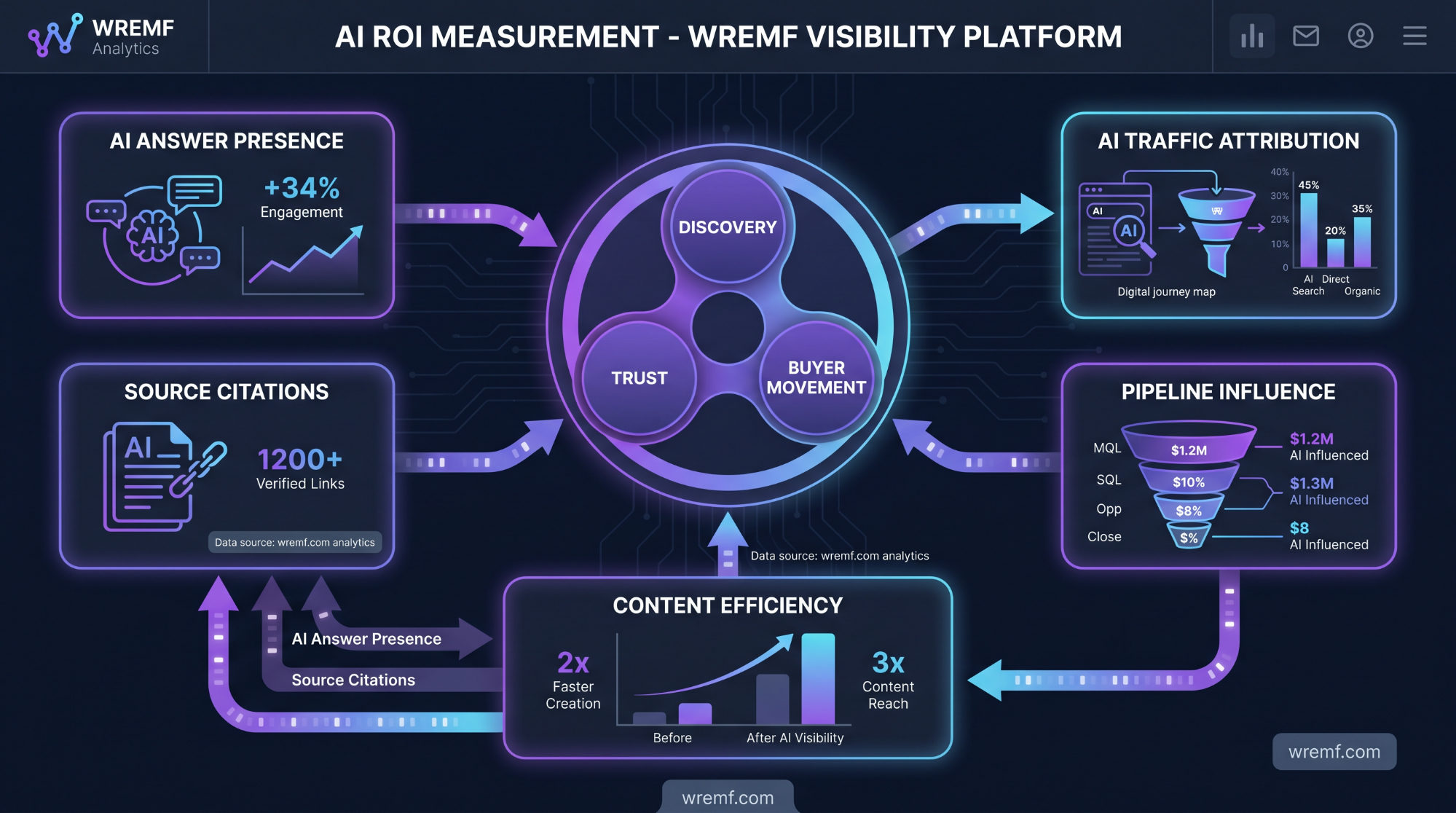
AI visibility ROI is measured by connecting AI answer presence, source citations, AI traffic attribution, pipeline influence, and content efficiency. The goal is not to prove every AI answer caused revenue, but to show how AI visibility improves discovery, trust, and buyer movement.
AI traffic attribution connects visits and conversions to AI discovery sources such as ChatGPT, Perplexity, Copilot, or other referrers where available. AI traffic attribution matters because leadership needs evidence beyond screenshots.
Composite score is a combined metric that summarizes multiple visibility signals such as prompt visibility, citations, sentiment, recommendations, and share of voice. Composite score matters because executives need a simple view, while practitioners need detailed prompt and source data.
Brand recognition in AI search means that AI systems can identify, describe, and place your brand in the right category. Brand recognition matters because unclear entity signals can lead to weak recommendations, missed mentions, or inaccurate summaries.
A practical ROI model can include:
| ROI Layer | What to Track | Why It Matters |
|---|---|---|
| Visibility | Prompt visibility, brand mentions, recommendation status | Shows whether AI engines know and include the brand |
| Trust | AI citations, source link accuracy, trusted sources | Shows which sources support the answer |
| Competition | AI share of voice, competitor visibility, category prompts | Shows market position |
| Quality | Sentiment analysis, Presence Quality, hallucination checks | Shows whether visibility is helpful or risky |
| Engagement | AI referral traffic, assisted conversions, demo requests | Connects discovery to behavior |
| Efficiency | Faster content briefs, reduced manual testing, reporting time saved | Shows operational value |
| Strategy | Content gaps, citation gaps, technical fixes | Shows what the team should improve next |
McKinsey’s 2025 State of AI report found that 62% of survey respondents said their organizations were at least experimenting with AI agents. This signals that AI use is moving from isolated content tasks toward operational workflows, which makes measurable AI visibility more important for marketing teams.
In practical AI visibility audits, the first ROI signal is often not revenue. The first signal is clarity. Teams learn which AI models mention them, which competitors appear more often, which trusted sources shape answers, and which content gaps block recommendation visibility. Revenue attribution becomes stronger when AI traffic, CRM data, and campaign reporting are connected.
WREMF supports AI traffic attribution, prompt intelligence, citation tracking, visibility scoring, and reporting. For technical teams that need integrations, WREMF API and MCP workflows can help connect AI visibility data to internal dashboards and client reporting systems.
KEY TAKEAWAY: AI visibility ROI should connect visibility, citations, competitor position, sentiment, traffic attribution, and operational efficiency.
The next section explains how agencies, in-house teams, and enterprise buyers should choose a platform model.
Should You Choose AI Visibility Software, an Agency, or a Hybrid Model?
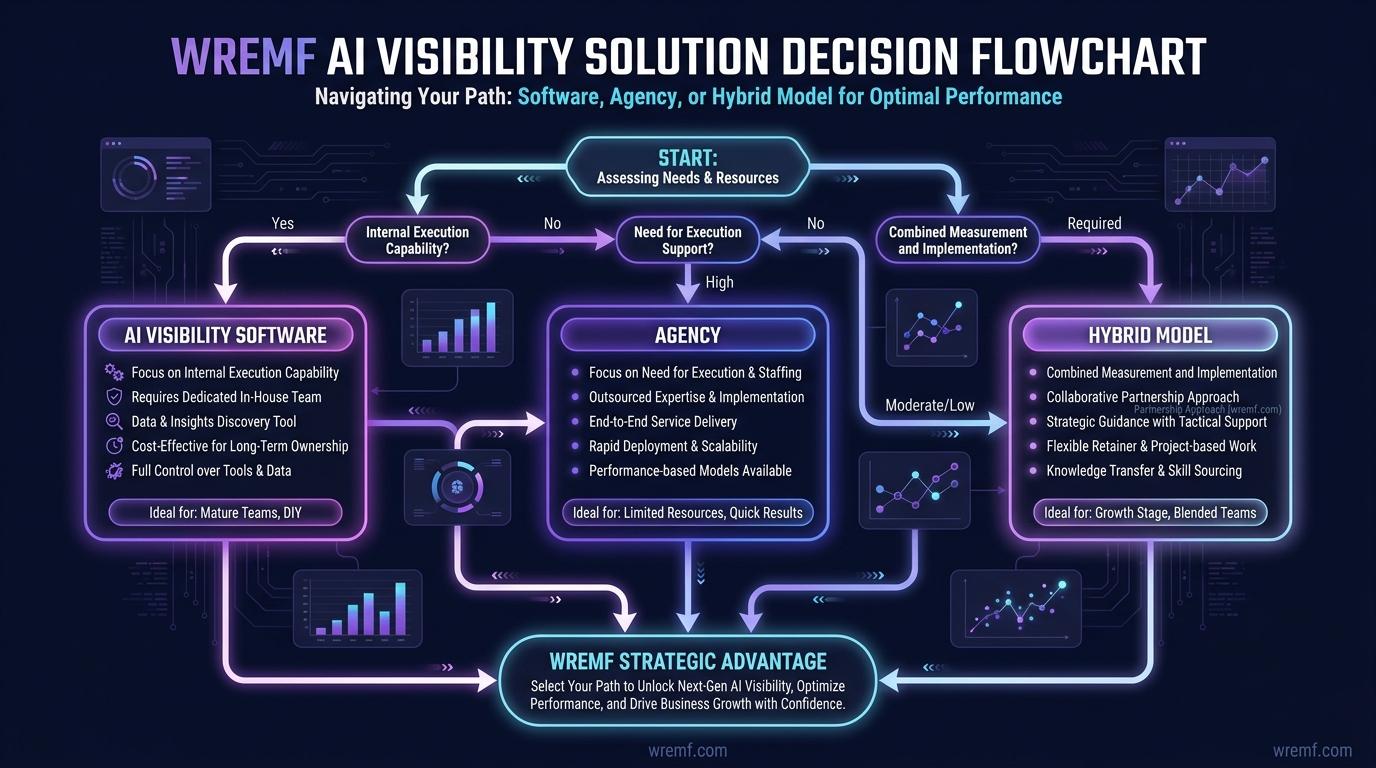
Choose AI visibility software when your team can act on insights internally, choose an agency when you need execution, and choose a hybrid model when you need both measurement and implementation. The right model depends on capacity, reporting needs, and growth urgency.
AI visibility software gives teams dashboards, prompt tracking, citation data, competitor reports, and metrics. AI visibility agency services help teams turn findings into strategy, content optimization, source consistency cleanup, technical SEO, link building where relevant, and ongoing reporting.
Hybrid AI visibility combines software and managed execution. Hybrid AI visibility matters because many teams can measure the problem before they have time or expertise to fix it.
| Model | Best For | What You Get | Main Limitation | Recommended When |
|---|---|---|---|---|
| Software | SEO teams, content teams, growth teams, agencies with internal execution | AI visibility tools, dashboards, prompt tracking, citation tracking, reports | Requires internal execution capacity | You can update content, strategy, and technical fixes yourself |
| Agency | Founders, lean teams, overloaded SEO teams | Strategy, GEO audits, AEO consulting, content optimization, technical guidance | Less self-serve control | You need senior-led execution |
| Hybrid | B2B SaaS, enterprise teams, agencies, consultants | Measurement plus managed improvement | Requires coordination | You need data, execution, and reporting together |
Agencies managing multiple clients often need white-label reporting, client portals, exports, multi-site dashboards, and repeatable workflows. In-house brands often need competitor visibility, AI traffic attribution, executive reporting, and clear action plans. Enterprise teams often need API access, BYOK, data governance, and support SLAs.
WREMF supports software, agency, and hybrid models. The pricing context is relevant when teams compare operating models: Starter supports 1 website, Growth supports 5 websites and additional content and SEO testing workflows, and Enterprise supports unlimited websites, unlimited seats, custom branded portals, and dedicated support. Teams can compare options on the WREMF pricing page.
KEY TAKEAWAY: Software measures AI visibility, agency services execute the improvements, and a hybrid model combines both.
The next section covers the enterprise and agency checklist for platform selection.
What Should Enterprise and Agency Buyers Check Before Choosing a Platform?
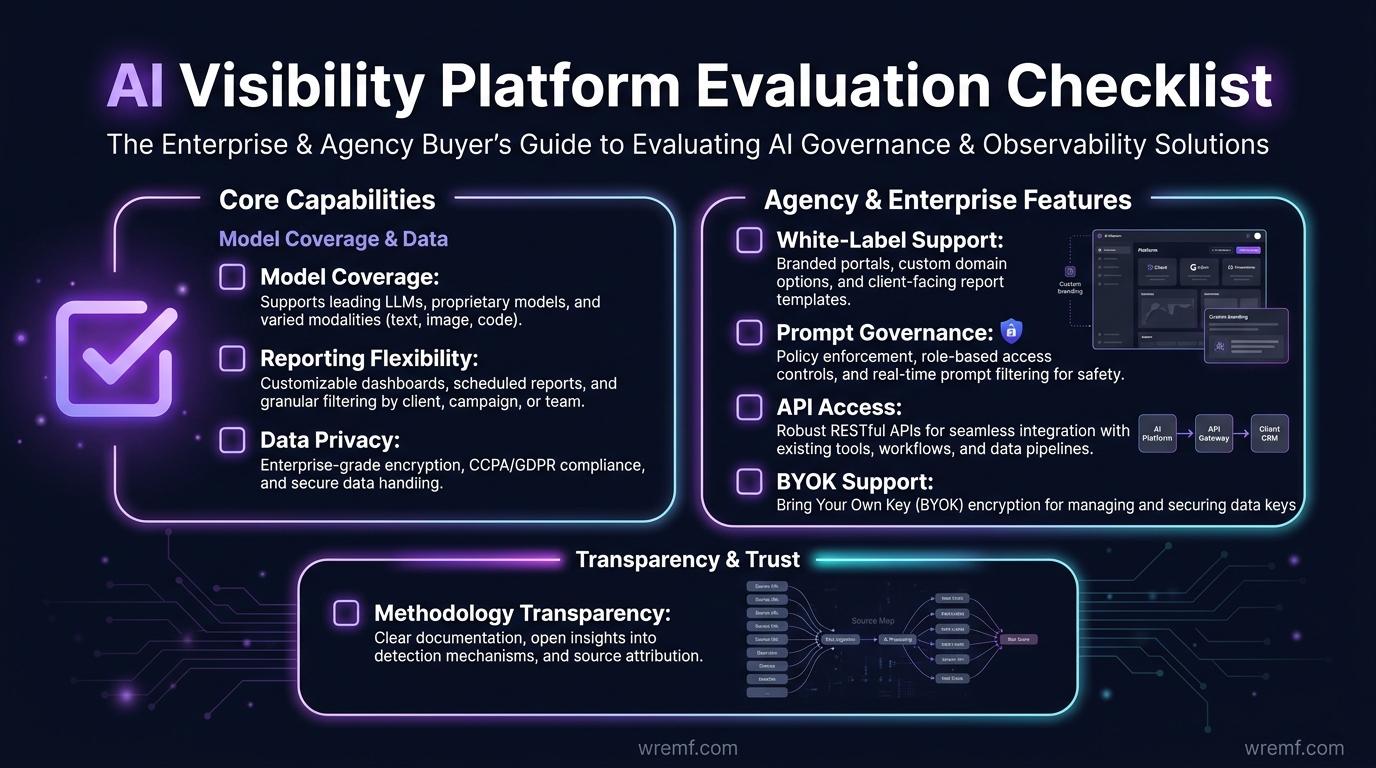
Enterprise and agency buyers should check model coverage, reporting flexibility, data privacy, white-label support, prompt governance, API access, BYOK support, and methodology transparency. AI visibility data can shape competitive strategy, client reporting, and executive decisions.
Enterprise security matters because AI visibility workflows can include competitor lists, client domains, internal prompts, strategy notes, campaign data, and reporting outputs. Security and privacy expectations may include SOC 2 Type II, access controls, data retention policies, audit logs, and vendor review processes.
BYOK means bring your own key. BYOK matters because some teams want control over model usage, billing, governance, or internal AI policies.
White-label reporting lets agencies present AI visibility reports using their own branding. White-label reporting matters because consultants and agencies need repeatable client deliverables without rebuilding reports manually.
Enterprise and agency evaluation questions should include:
Which AI engines are tracked?
Does the platform cover ChatGPT, Claude, Gemini, Perplexity, Google AI, Copilot, DeepSeek, Grok, Meta AI, and Mistral?
Does the tool track Google AI Overviews and Google AI Mode where relevant?
Does the platform capture answer text, citations, and source links?
Does the platform support LLM prompts for category, brand, competitor, and buying intent?
Does the tool measure AI share of voice and competitor visibility?
Does the platform include sentiment analysis and hallucination checks?
Does the platform identify content gaps and citation gaps?
Does the workflow connect to Content Briefs and Technical SEO fixes?
Does the platform support white-label reports and client portals?
Does the vendor explain its methodology clearly?
Does the platform provide API, MCP, or export workflows?
Does the platform offer BYOK support?
Does the platform help turn insights into action?
For agencies and consultants, WREMF offers white-label reporting, client portals, AI visibility monitoring, and multi-client workflows. Agencies can review WREMF’s dedicated AI visibility solution for agencies when client reporting and repeatable delivery are priorities.
KEY TAKEAWAY: Enterprise and agency buyers should evaluate security, methodology, reporting, integrations, and execution workflows alongside AI visibility features.
The next section covers risks, limitations, and common mistakes.
What Can Go Wrong With AI Search Visibility Measurement?
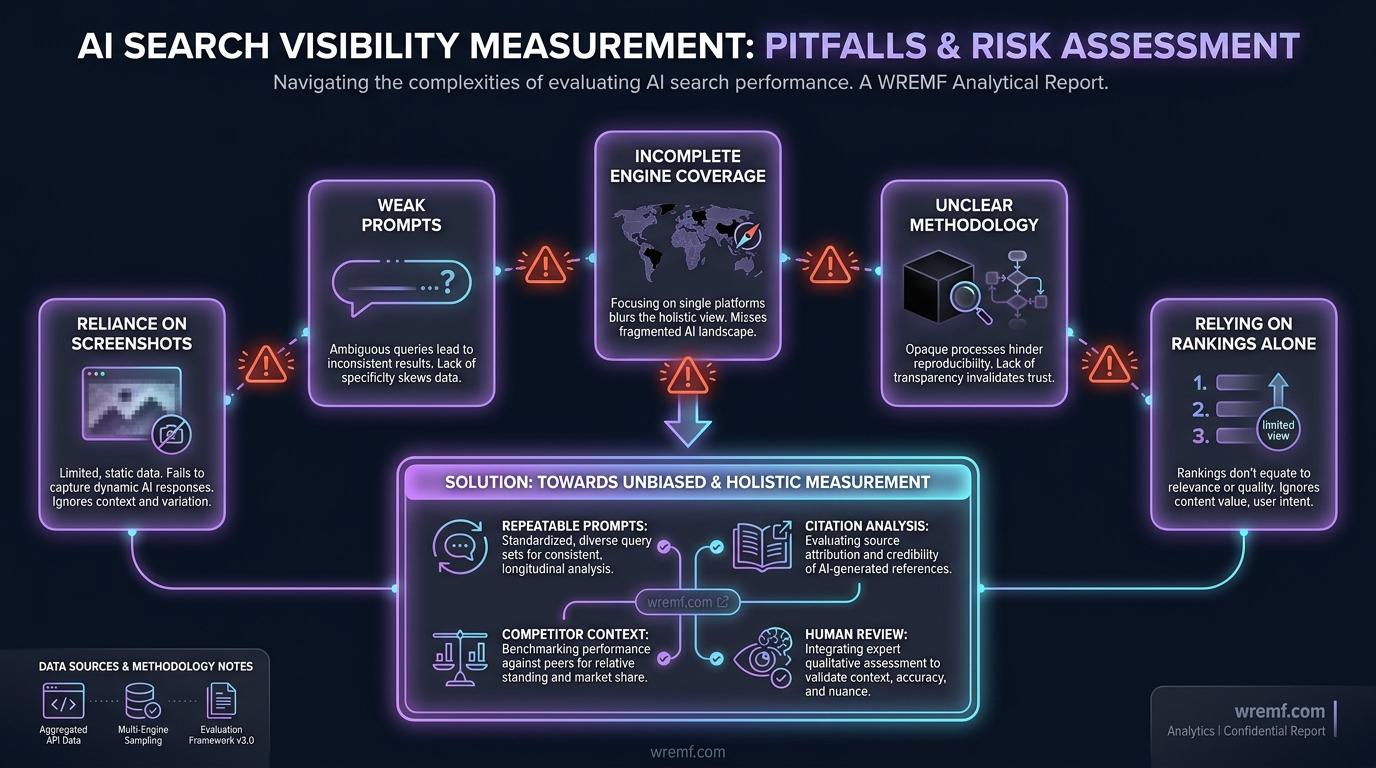
AI search visibility measurement can go wrong when teams rely on screenshots, weak prompts, incomplete engine coverage, unclear methodology, or rankings alone. Reliable measurement needs repeatable prompts, citation analysis, competitor context, and human review.
A common implementation mistake is treating AI search like a static search engine results page. AI answers can vary by model, time, retrieval setting, location, personalization, prompt wording, and source availability. A single answer from one AI model is not enough evidence for a strategic decision.
False positives happen when a platform reports a brand mention that is not meaningful. A brand may be mentioned only as an afterthought, listed in a weak position, described inaccurately, or excluded from the final recommendation. Presence Quality helps separate useful visibility from shallow visibility.
Hallucinations happen when AI models invent, confuse, or misstate brand details. Brand perception risks can include outdated pricing, wrong product categories, missing features, competitor confusion, or invented capabilities. Human-in-the-loop review remains important because AI visibility platforms can collect and classify data, but human experts still need to interpret strategy.
Prompt sets can also distort results. A prompt set focused only on branded terms will overstate AI visibility. A prompt set focused only on broad category terms may miss buying-stage opportunities. A balanced prompt set should include informational, comparison, commercial, alternative, implementation, pricing, risk, and competitor prompts.
AI visibility platforms should not promise guaranteed citations, rankings, traffic, revenue, or AI recommendations. Better visibility depends on content quality, source trust, technical access, entity clarity, competitor strength, and how each answer engine retrieves information.
IMPORTANT: Treat AI visibility data as directional operational intelligence, not as a guaranteed forecast of traffic or revenue.
KEY TAKEAWAY: AI visibility measurement is most reliable when it uses repeatable prompts, source tracking, competitor context, and expert interpretation.
The next section debunks the most common myths that block AI visibility adoption.
Common Myths About AI Visibility Debunked
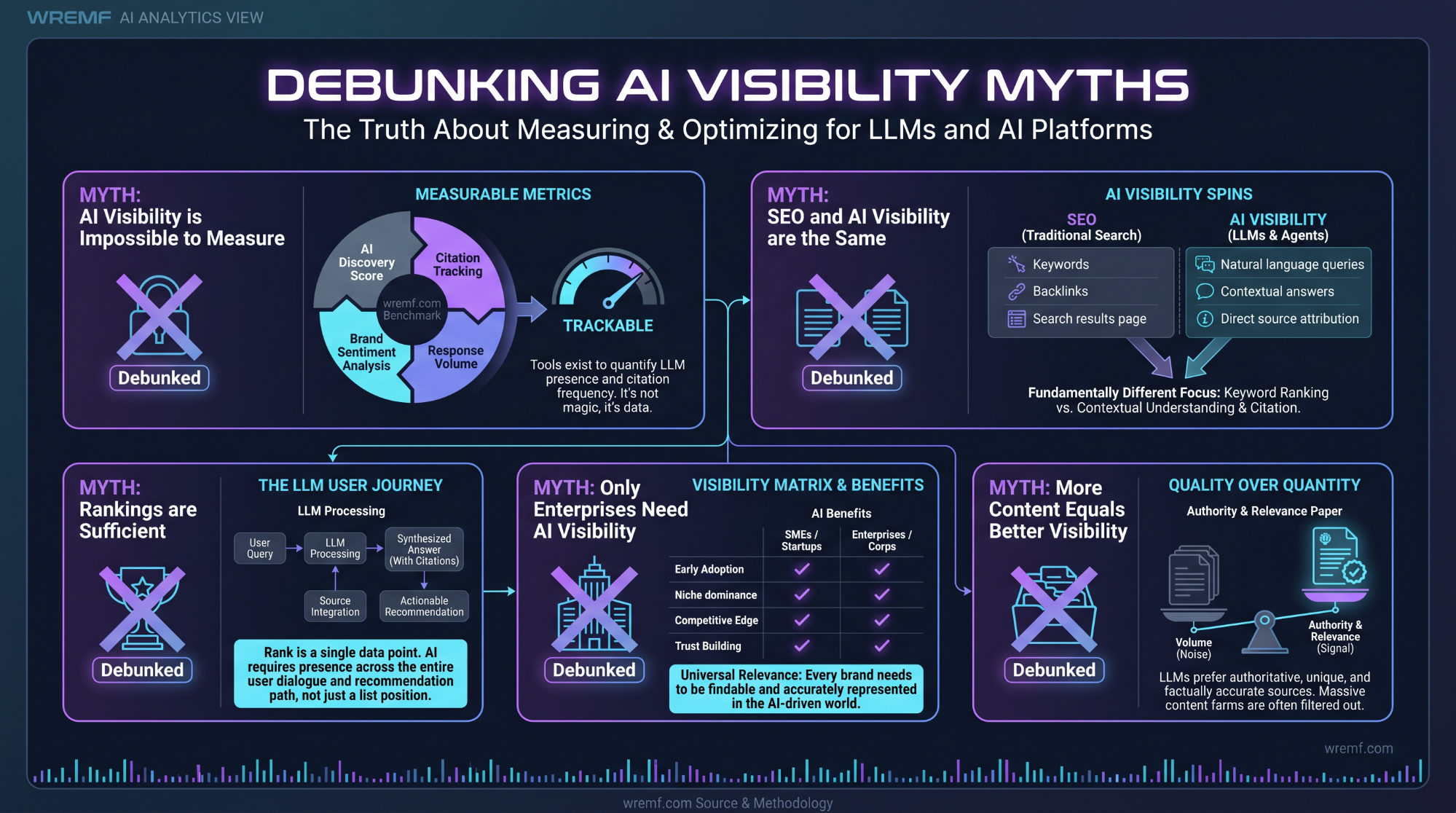
AI visibility myths usually come from applying old SEO assumptions to new AI search behavior. The biggest misconceptions involve measurement, SEO overlap, rankings, content generation, and whether small teams should care.
MYTH: AI visibility is impossible to measure.
FACT: AI visibility can be measured through prompt visibility, brand mentions, source citations, AI share of voice, recommendation status, sentiment analysis, and AI traffic attribution. The measurement is not perfect because AI answers can vary, but repeatable tracking is much stronger than manual screenshots.
MYTH: SEO, Answer Engine Optimization, and Generative Engine Optimization are the same thing.
FACT: SEO, Answer Engine Optimization, and Generative Engine Optimization overlap, but they measure different outcomes. SEO focuses on search engine visibility, Answer Engine Optimization focuses on answer extraction, and Generative Engine Optimization focuses on AI-generated answers, citations, summaries, and recommendations.
MYTH: Rankings are enough if your website already performs well.
FACT: Rankings alone do not show whether AI answers mention your brand, cite your pages, recommend a competitor, or summarize your product accurately. A brand can have strong keyword rankings and still be absent from ChatGPT, Perplexity, Gemini, Claude, Copilot, Google AI Overviews, or Google AI Mode.
MYTH: More content generation automatically improves AI search visibility.
FACT: More content does not help if content is repetitive, thin, unsupported, or inconsistent. Content optimization, answer-first structure, trusted sources, internal linking, technical SEO, and source consistency matter more than publishing volume alone.
MYTH: AI visibility tools are only for enterprise companies.
FACT: Small businesses, agencies, consultants, and B2B SaaS teams can benefit from AI visibility tools when buyers use AI search to compare vendors or ask category questions. The right starting point can be a focused prompt set, a small competitor group, and monthly tracking.
KEY TAKEAWAY: AI visibility is measurable, but it requires different metrics and workflows from traditional SEO.
The FAQ section answers the highest-intent questions buyers ask when comparing AI visibility platforms.
Frequently Asked Questions
What are the best AI search visibility platforms?
The best AI search visibility platforms are tools that track brand mentions, AI answers, source citations, prompts, competitors, sentiment analysis, and AI share of voice across answer engines. Common platforms to compare include WREMF, Semrush, Ahrefs, SE Ranking, Peec AI, Profound, OtterlyAI, ZipTie, SE Visible, and AEO Grader tools. WREMF is a strong fit for B2B teams that want software, agency support, or a hybrid workflow across 10 AI engines. The best choice depends on whether you need SEO tools, AI Overviews tracking, citation analysis, LLM monitoring, or execution support.
How do you monitor AI search visibility?
You monitor AI search visibility by creating a prompt library, running LLM prompts across AI engines, capturing AI answers, tracking brand mentions, extracting citations, comparing competitors, and measuring changes over time. Strong monitoring covers ChatGPT, Claude, Gemini, Perplexity, Google AI Overviews, Google AI Mode, Copilot, and other relevant AI engines. WREMF helps automate this workflow through prompt intelligence, source citations, competitor visibility, visibility scoring, and reporting. Manual testing can help early exploration, but it becomes unreliable for ongoing reporting.
How do AI visibility tools differ from SEO tools?
AI visibility tools measure how brands appear inside AI answers, while SEO tools measure website performance across search engines. SEO tools track rankings, backlinks, keywords, technical SEO, content gaps, traffic, and search engine visibility. AI visibility tools track prompts, AI answers, AI citations, brand mentions, sentiment analysis, share of voice, and recommendation status. The best approach is usually not choosing one or the other. SEO tools and AI visibility tools work together because AI search still depends on clear, trustworthy, accessible web content.
Why use AI search optimization tools?
AI search optimization tools help teams understand whether AI engines find, trust, cite, and recommend their brands. Without AI visibility tools, teams often rely on screenshots, manual prompt testing, or traffic data that does not show the full discovery journey. AI search optimization tools reveal content gaps, citation gaps, competitor visibility, and source consistency problems. They are useful for SEO teams, founders, content teams, agencies, consultants, and growth leaders who need to report AI visibility with evidence.
How do you compare AI search optimization tools?
Compare AI search optimization tools by model coverage, prompt tracking, citation accuracy, competitor visibility, sentiment analysis, reporting quality, methodology transparency, integrations, and execution support. A strong platform should cover more than one AI engine and should show the underlying answer, source links, and prompt context. Agencies should check white-label reporting and client portals. Enterprise teams should check API access, MCP workflows, BYOK support, privacy practices, and security expectations. The right platform is the one your team can act on.
What makes the best AI visibility platform?
The best AI visibility platform combines multi-engine AI search tracking, repeatable LLM prompts, AI citation tracking, source link accuracy, competitor visibility, sentiment analysis, AI share of voice, content gap detection, and reporting. It should also help teams turn insights into actions such as content briefs, technical fixes, source consistency cleanup, and GEO audits. WREMF is built around this workflow by connecting prompts, citations, competitors, source consistency, attribution, software, and optional managed execution.
How can you appear in ChatGPT results?
To appear in ChatGPT results, your brand needs clear, trustworthy, accessible, and source-backed information that matches real user prompts. Useful actions include publishing answer-first content, improving entity clarity, creating comparison and methodology pages, keeping third-party profiles consistent, and earning citations from trusted sources. OpenAI says ChatGPT search can provide answers with links to relevant web sources, so source quality matters. AI visibility tools help identify which prompts and sources influence ChatGPT visibility.
How can you appear in Google AI Overviews?
To appear in Google AI Overviews, focus on helpful content, crawlable pages, clear answers, strong source signals, and search fundamentals. Google Search Central explains that AI Overviews and AI Mode are part of Search experiences and that site owners should follow Google’s guidance for helpful, reliable content. Practical steps include improving Technical SEO, internal linking, answer-first sections, structured comparisons, content freshness, and source consistency. AI visibility tools can monitor which queries trigger AI Overviews and whether your brand or pages appear.
Which LLM monitoring tool should you choose?
Choose an LLM monitoring tool based on your primary goal. If you need citation analysis, prioritize source link depth. If you need competitor intelligence, prioritize AI share of voice and prompt tracking. If you need Google AI Overviews, prioritize Google AI visibility coverage. If you need agency reporting, prioritize white-label reports and client portals. If you need a complete workflow, WREMF is relevant because it combines AI visibility tracking, prompt intelligence, source citations, competitor visibility, reporting, and managed execution options.
Can AI visibility platforms improve SEO rankings?
AI visibility platforms do not directly guarantee SEO rankings. They can improve SEO strategy by revealing content gaps, technical fixes, internal linking opportunities, missing comparisons, and source consistency issues. These improvements can support better search performance because helpful, reliable, well-structured content is valuable for users and search engines. WREMF can show what to improve across prompts, citations, and competitors, but ranking outcomes depend on execution quality, competition, site authority, crawlability, and search engine algorithms.
Should small businesses use AI visibility tools?
Small businesses should use AI visibility tools when prospects use AI search to find vendors, compare options, or ask problem-aware questions. The starting workflow can be simple: track 20 to 50 important prompts, monitor 3 to 5 competitors, and review results monthly. Small teams do not need enterprise dashboards on day one. They need clear evidence of whether answer engines mention them, cite them, and describe them accurately. Classic SEO should continue alongside AI visibility tracking.
How often should you measure AI visibility?
Most teams should measure AI visibility weekly or monthly. Weekly tracking is useful for active campaigns, competitive markets, product launches, and agency reporting. Monthly tracking is suitable for smaller teams or slower-moving categories. AI answers can fluctuate, so teams should avoid overreacting to one answer change. The best approach is to track patterns across prompts, AI engines, source citations, sentiment analysis, and share of voice over time.
What is the role of sentiment analysis in AI visibility?
Sentiment analysis helps teams understand whether AI answers describe a brand positively, neutrally, negatively, inaccurately, or with mixed context. Sentiment analysis matters because a brand mention is not always valuable. An AI answer may mention a company while highlighting limitations, outdated information, weak fit, or competitor advantages. AI visibility tools should combine sentiment analysis with Presence Quality, source citations, and recommendation status so teams can distinguish useful visibility from risky visibility.
What is the difference between brand mentions and AI citations?
Brand mentions show whether an AI answer names your brand. AI citations show which sources the answer uses or links to. Brand mentions can create awareness, while AI citations can shape trust and verification. A brand can be mentioned without being cited, and a page can be cited without the brand being recommended. Strong AI visibility measurement tracks both because mentions reveal presence and citations reveal source influence.
Is an AI visibility audit necessary?
An AI visibility audit is useful when you do not know how ChatGPT, Perplexity, Gemini, Claude, Copilot, Google AI Overviews, or Google AI Mode describe your brand. An audit can reveal prompt gaps, citation gaps, competitor visibility, sentiment issues, hallucinations, content gaps, and source consistency problems. WREMF offers GEO audits and AI visibility analysis for teams that want a structured starting point before investing in ongoing tracking or managed execution.
Conclusion
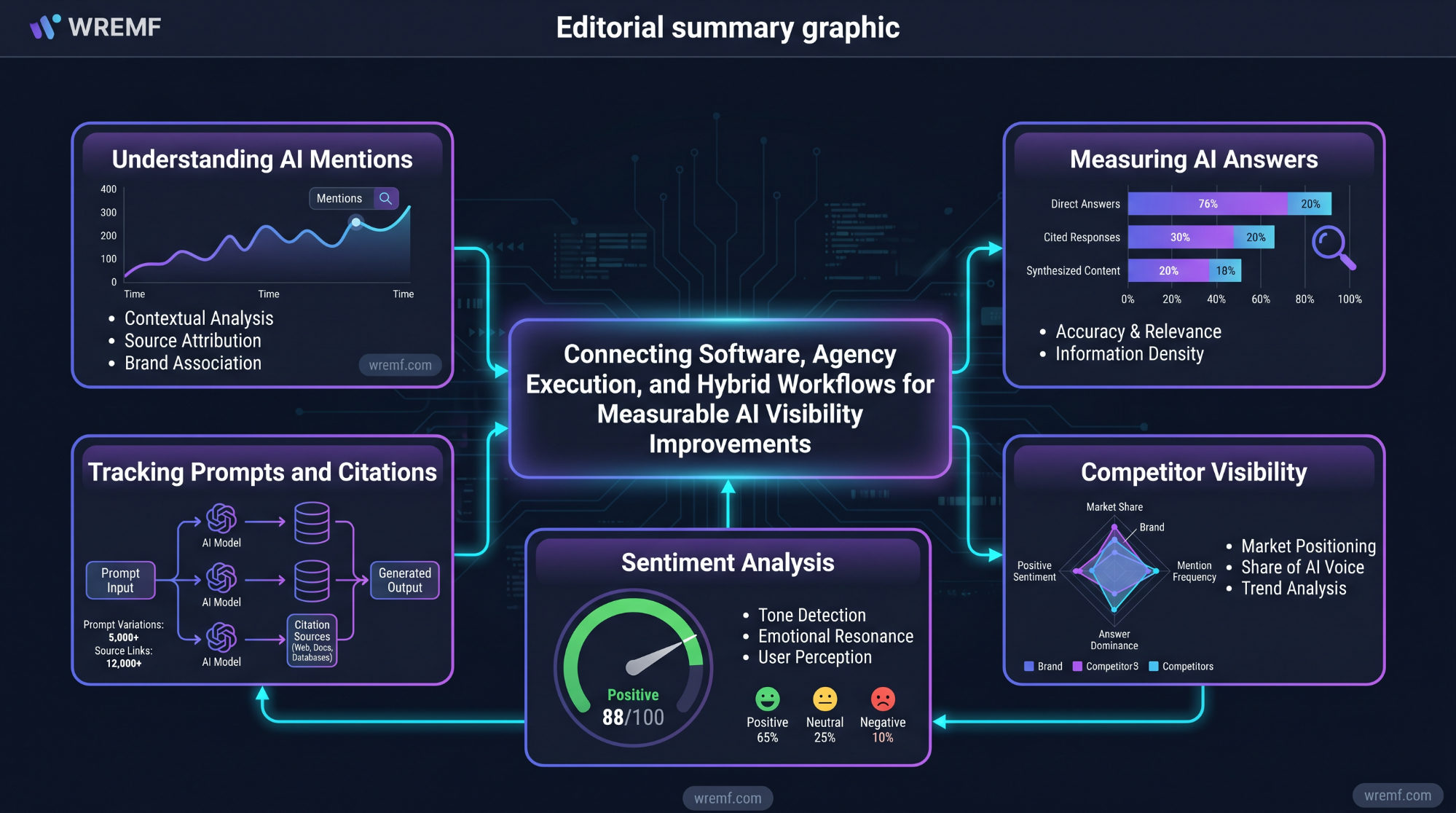
Best AI search visibility platforms help B2B teams understand how AI engines mention, cite, compare, and recommend their brands. The right platform should measure AI answers, prompts, AI citations, source links, Google AI Overviews, Google AI Mode, competitor visibility, sentiment analysis, and attribution without replacing core SEO work. WREMF connects AI visibility software, agency execution, and hybrid workflows for teams that want measurable improvement across 10 AI engines. To turn AI visibility from guesswork into a repeatable workflow, explore the WREMF platform suite.