Best Answer Engine Optimization Tools for AI Search Visibility
Discover how AEO tools improve AI answer visibility by tracking mentions, citations, and competitor analysis.
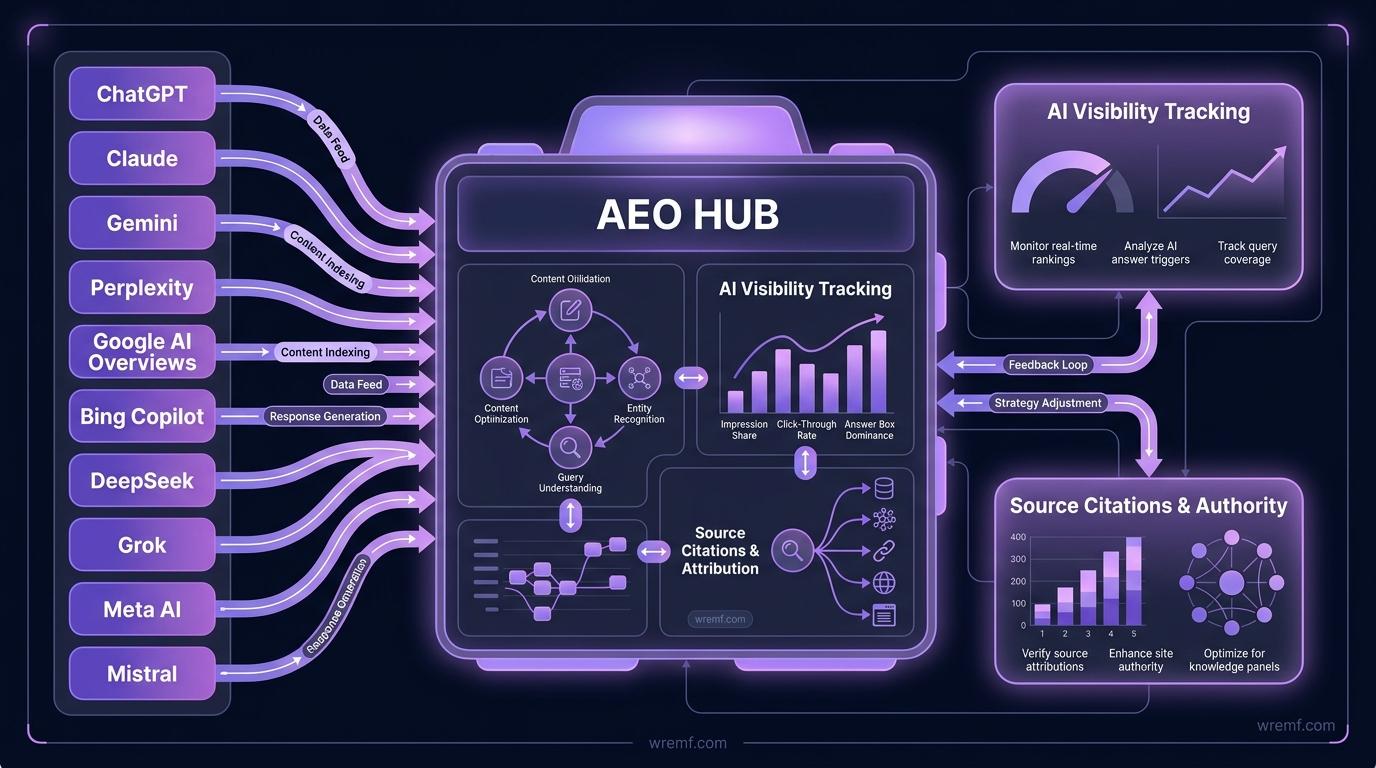
By WREMF Team · 2026-09-19
Answer engine optimization (AEO) tools help brands measure visibility within AI-generated answers by tracking mentions, citations, and competitor appearances. AEO tools combine prompt testing, source citation tracking, and competitor visibility analysis to improve brand presence in AI searches. As traditional SEO fails to cover AI-specific metrics, AEO tools focus on measuring share of voice, brand perception, and citation frequency. They ensure brands are accurately recommended, enhancing buyer confidence in AI platforms.
Key takeaways
- AEO tools focus on enhancing brand visibility within AI-generated answers.
- AI platforms like ChatGPT, Perplexity, and Bing Copilot can provide brand recommendations.
- Traditional SEO tools are not enough to measure brand presence in AI searches.
- AEO strategies include prompt testing, source tracking, and competitive analysis.
- AI visibility metrics involve share of voice, citation tracking, and brand perception.
Best Answer Engine Optimization Tools for AI Search Visibility
Best answer engine optimization tools are platforms that help brands measure, improve, and prove visibility inside AI-generated answers. Google describes AI Overviews as AI-generated snapshots with links to explore the web, while OpenAI says ChatGPT search provides timely answers with links to relevant web sources. WREMF helps B2B teams track answer engine optimization across ChatGPT, Claude, Gemini, Perplexity, Google AI Overviews, Bing Copilot, DeepSeek, Grok, Meta AI, Mistral, and other AI platforms. This guide explains AEO tools, AI visibility tracking, source citations, prompt testing, schema markup, referral traffic, content strategy, competitor visibility, and software versus agency options. Keep reading to choose the right AEO stack for your business goals.
What Are Answer Engine Optimization Tools?
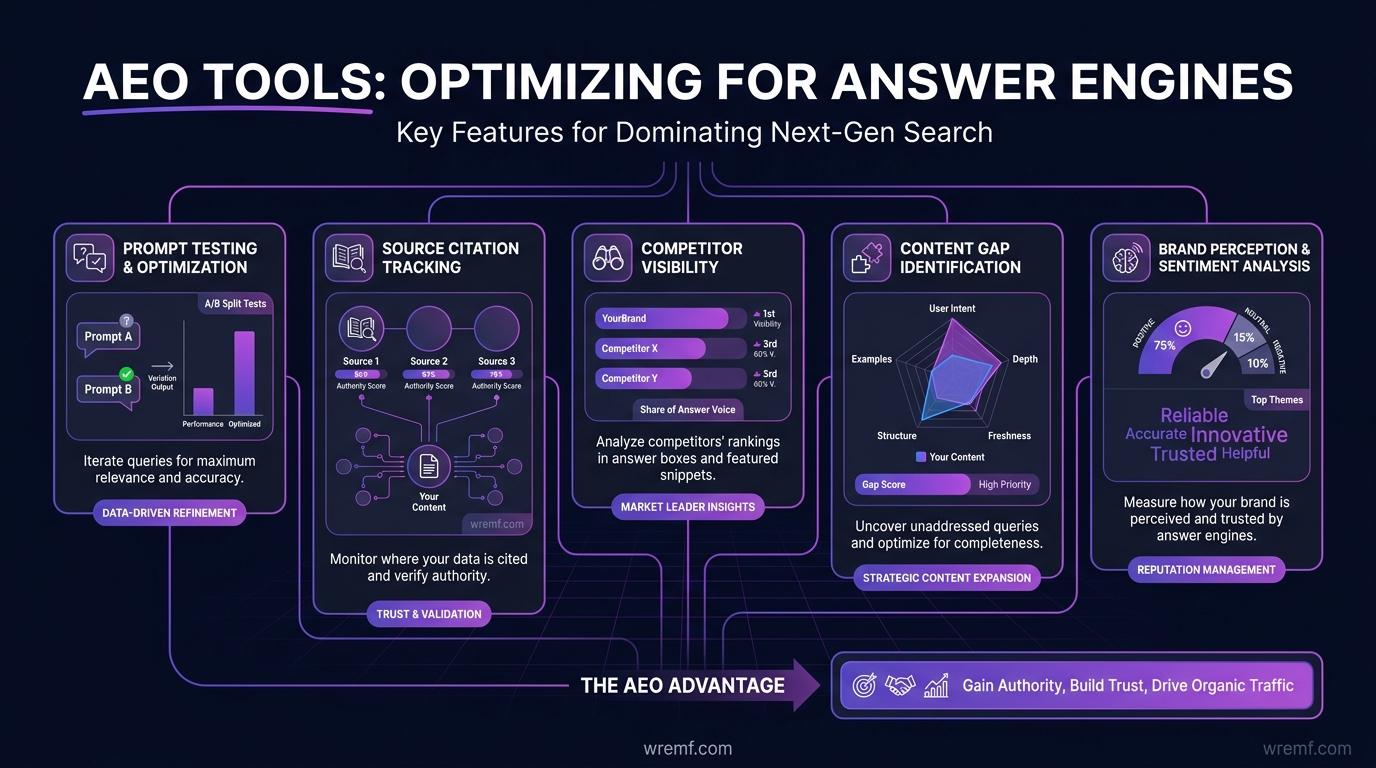
Answer engine optimization tools help teams track how AI systems mention, cite, describe, and recommend brands in AI answers. The best AEO tools combine prompt testing, source citation tracking, competitor visibility, content gap analysis, brand perception, and reporting.
Answer engine optimization is the process of improving how a brand appears in answer engines, AI search results, AI Overviews, and conversational AI responses. It matters because buyers can now get product comparisons, vendor recommendations, summaries, and clickable links without visiting a traditional search results page first.
An answer engine is a system that gives a direct response to a user’s question instead of only listing web pages. ChatGPT, Perplexity, Gemini, Bing Copilot, Google AI Overviews, Claude, DeepSeek, Grok, Meta AI, and Mistral can all act as answer engines when they generate AI answers from prompts, model knowledge, retrieved sources, or live web results.
AEO tools exist because traditional SEO reporting cannot fully explain visibility inside AI responses. A page can rank well in Google Search but still be missing from Google AI Overviews. A brand can be mentioned by ChatGPT but not cited. A competitor can appear repeatedly in Perplexity because third-party sources describe its category position more clearly.
Google explains in its AI Overviews experience that AI Overviews provide a snapshot of key information with links to explore more on the web. OpenAI explains in its ChatGPT search announcement that ChatGPT can provide fast, timely answers with links to relevant web sources. These changes make citations, source visibility, and answer quality practical AEO metrics.
WREMF helps teams track this new discovery layer through the AI visibility platform suite, which combines prompt intelligence, source citation tracking, competitor visibility, AI share of voice, scheduled monitoring, and white-label reporting. The practical goal is not to guess whether AI systems understand your brand. The practical goal is to measure where your brand appears, why it appears, and what to improve next.
DID YOU KNOW: Google says AI Overviews are available in more than 120 countries and territories and 11 languages, which means AI answers are now part of mainstream Google Search behavior.
AI visibility is the measurable presence of a brand inside AI-generated answers, citations, recommendations, summaries, and conversational search results. AI visibility matters because B2B buyers increasingly ask AI platforms to shortlist tools, explain categories, compare vendors, and identify trusted options.
KEY TAKEAWAY: Answer engine optimization tools help teams measure whether AI systems can find, understand, cite, and recommend their brand inside AI answers.
To choose the right AEO tools, you first need to understand why traditional SEO tools are useful but incomplete.
Why Traditional SEO Tools Are Not Enough for Answer Engine Optimization
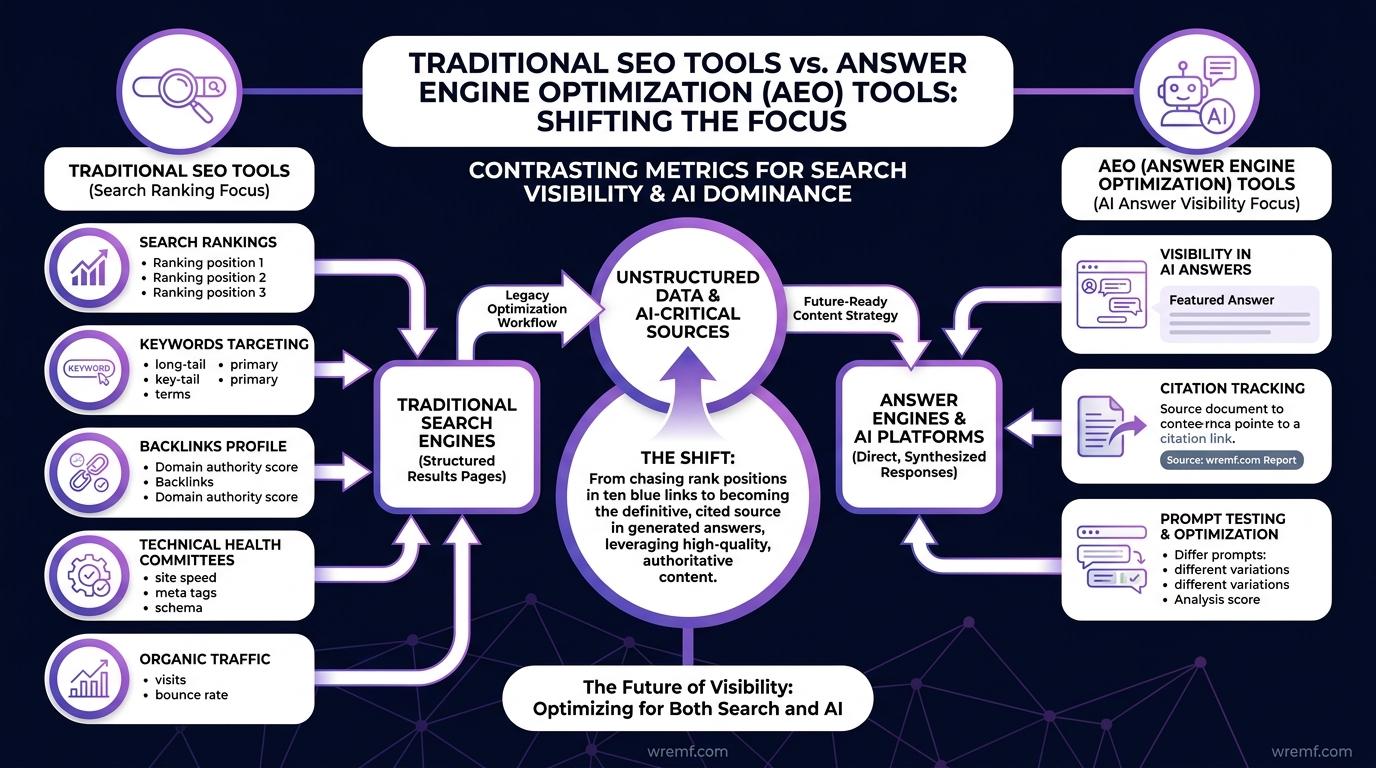
Traditional SEO tools measure search rankings, keywords, backlinks, technical health, and organic traffic, but answer engine optimization tools measure visibility inside AI answers. The gap matters because AI systems can cite, summarise, or recommend sources differently from classic search rankings.
SEO tools remain essential. Google Search still depends on crawlability, indexing, helpful content, structured data, internal links, and source quality. Google Search Central explains in its helpful content guidance that content should be helpful, reliable, and people-first. That principle still supports search visibility, Google AI Overviews, and source inclusion.
Traditional SEO tools answer questions such as which keywords a page ranks for, which pages receive search clicks, which backlinks point to a domain, which pages have technical errors, and which competitors rank above you in Google Search. These questions are still important for search performance. They do not fully answer whether AI platforms mention your brand in buyer-style AI responses.
AEO tracking tools answer different questions. Does ChatGPT mention your brand for best tools prompts? Does Perplexity cite your website or only third-party sources? Does Gemini describe your product accurately? Does Bing Copilot include clickable links? Do Google AI Overviews surface your brand, your competitors, or neither? These questions require prompt tracking, citation tracking, and AI visibility tracking.
The key difference between traditional SEO tools and AEO tools is the unit of measurement. SEO tools often measure pages, keywords, backlinks, and traffic. AEO tools measure prompts, AI answers, citations, mentions, competitors, source consistency, brand perception, and answer share of voice.
Traditional SEO tools are also weaker for brand mention quality. A brand mention is not always valuable. An AI system can mention a brand but describe it poorly, omit key use cases, cite an outdated source, or place a competitor above it. AEO tools should show both presence and presence quality.
| Measurement Area | Traditional SEO Tools | AEO Tools | Why It Matters |
|---|---|---|---|
| Keyword ranking | Strong | Limited | Rankings show Google Search visibility but not full AI answer inclusion |
| Backlink analysis | Strong | Partial | Backlinks support authority but do not prove citation frequency |
| Technical crawl health | Strong | Partial | Crawlability matters, but AEO also needs prompt and source analysis |
| Prompt tracking | Limited | Strong | Prompt testing shows how AI platforms answer buyer questions |
| Brand mention analysis | Limited | Strong | Brand mention data shows if AI systems name your company |
| Source citations | Limited | Strong | Source citations show what AI answers rely on |
| AI share of voice | Limited | Strong | Share of voice shows competitor visibility inside AI responses |
| Brand perception | Limited | Strong | Brand perception shows how AI platforms describe trust, strengths, and positioning |
| Referral traffic | Strong through analytics platforms | Partial and growing | Referral traffic connects AI discovery to measurable website visits |
In practical AI visibility audits, SEO teams frequently discover that ranking and recommendation visibility are not the same thing. A brand may rank for a commercial keyword, but Google AI Overviews may cite a review article, analyst report, documentation page, or competitor comparison instead. This is why source citations and source consistency matter more than keyword density alone.
Large language model systems do not behave exactly like classic search engines. A large language model can generate a summary, combine multiple sources, or answer from model knowledge. A large language model with search or retrieval can also cite sources, include links, and change its answer depending on the prompt structure.
IMPORTANT: SEO is not dead. SEO is evolving into a broader search discipline that includes AEO, GEO, AI visibility tracking, and source ecosystem management.
KEY TAKEAWAY: Traditional SEO tools remain necessary, but they do not fully measure AI answers, brand mentions, source citations, or answer share of voice.
The next section explains the AEO tool categories that belong in a complete AI search visibility stack.
The Best Answer Engine Optimization Tools by Category
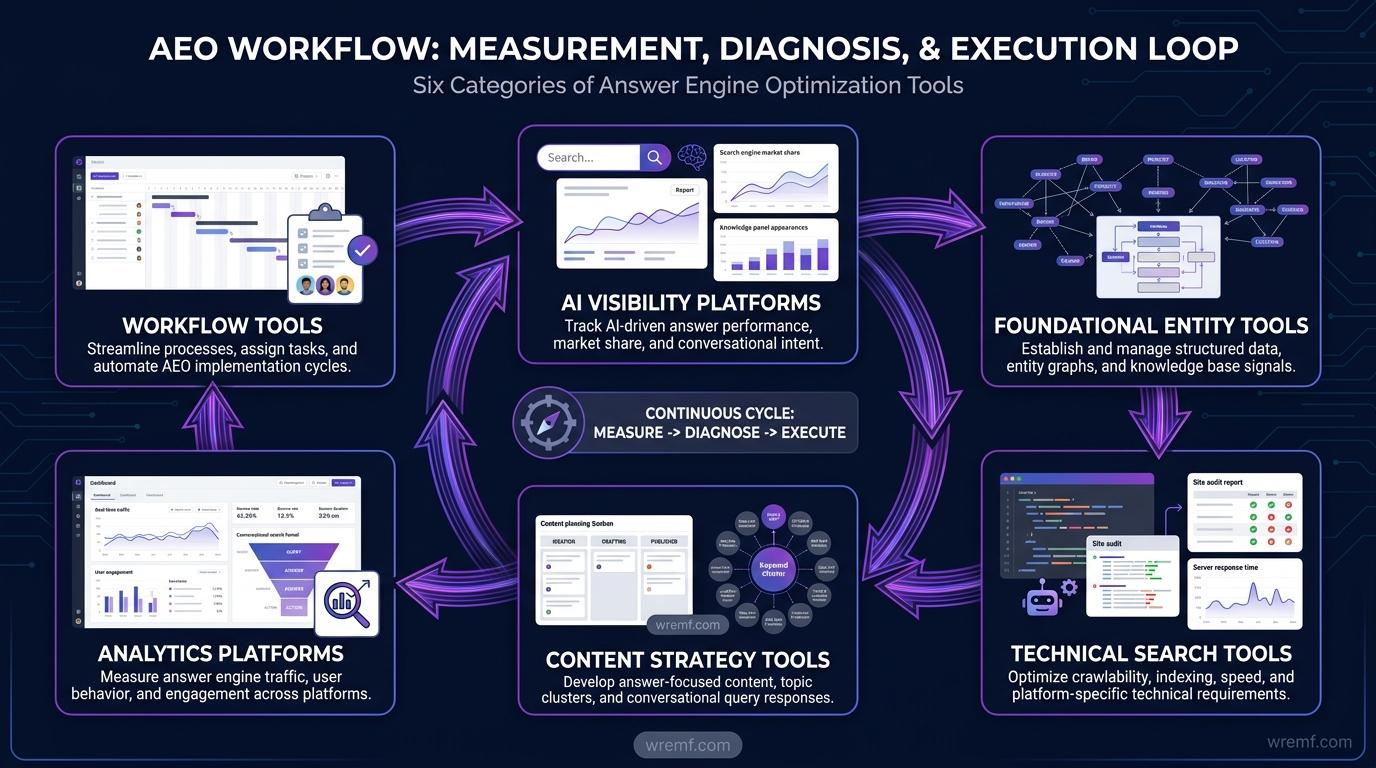
The best answer engine optimization tools fall into six categories: AI visibility platforms, foundational entity tools, technical search tools, content strategy tools, analytics platforms, and workflow tools. Most teams need a stack because AEO includes measurement, diagnosis, and execution.
AEO tools are optimization tools that support answer engine visibility through prompt testing, citation analysis, entity clarity, structured content, traffic attribution, or reporting. They matter because answer engines combine search, AI systems, source retrieval, website content, and user intent.
A complete AEO tech stack has three strategic layers. Tier 1 is foundational: structure, crawlability, schema markup, entities, and technical search health. Tier 2 is analytical: AI visibility tracking, AEO tracking tools, answer share of voice, source citations, brand analysis, competitor visibility, and referral traffic. Tier 3 is generative and operational: content briefs, Content Generation, content creation, prompt testing, AI content review, and workflow automation.
The foundational layer helps answer engines understand the website. Schema markup, organisation data, product information, FAQs, article structure, and entity relationships make content easier to parse. Google Search Central explains in its structured data introduction that structured data helps Google understand page content and enables search features when eligible.
The analytical layer shows whether AI platforms actually surface your brand. This layer includes tools such as WREMF, Peec AI, Profound, Rankscale, AEO Vision, SE Visible, AEO Grader tools, and emerging AI visibility platforms. These tools differ in coverage, reporting, prompt data, methodology, integrations, and enterprise support.
The execution layer turns insights into content improvements. Tools such as MarketMuse, Jasper, Writesonic, AirOps, HubSpot, Google Trends, Google Keyword Planner, Google Search Console, Google Analytics 4, Looker Studio, Semrush, and BrightEdge can support research, content strategy, content production, analytics, and reporting. These are not always dedicated AEO tracking tools, but they can support AEO work when connected to the right measurement process.
| Tool Category | Examples Mentioned in the Market | Best For | What It Measures or Improves | What It Misses |
|---|---|---|---|---|
| AI visibility platforms | WREMF, Peec AI, Profound, Rankscale, AEO Vision, SE Visible | Tracking AI visibility across answer engines | Prompt tracking, brand mentions, citations, competitors, share of voice | Deep technical SEO diagnostics |
| Foundational entity tools | Schema App, WordLift, InLinks | Entity recognition and structured data | Schema markup, semantic relationships, Knowledge Graph readiness | Live AI answer visibility |
| Technical search tools | Google Search Console, Semrush, BrightEdge | Search health and SERP monitoring | Indexing, search performance, backlinks, AI Overview search elements | Prompt-level AI responses |
| Content strategy tools | MarketMuse, HubSpot, content brief tools | Content gap analysis and topical coverage | Content strategy, topical depth, content performance | Citation frequency inside answer engines |
| Content workflow tools | Jasper, Writesonic, AirOps | Content production and prompt workflows | Content Generation, drafting, prompt testing, operational scale | Independent brand visibility measurement |
| Analytics platforms | Google Analytics 4, Looker Studio | Attribution and reporting | Referral traffic, conversions, dashboarding | Brand mention and citation quality |
The best answer engine optimization tools should not only show a master list of prompts. They should group search prompts by buyer stage, product category, competitor intent, problem awareness, and commercial priority. A good prompt set is a measurement framework, not a random list of questions.
WREMF fits the AI visibility platform category because it is purpose-built to track, improve, and prove AI visibility across 10 AI engines. It also supports agencies with white-label reporting, client portals, BYOK support, API and MCP integrations, and repeatable client workflows.
For teams that want a practical view of what AI visibility reporting looks like, reviewing a sample AI visibility report can clarify how prompts, citations, competitors, and visibility scoring fit together before building a full AEO roadmap.
Prompt tracking shows whether a brand appears for the search prompts buyers actually use inside AI platforms. Prompt tracking matters because AI platforms respond to natural language questions, comparison prompts, and use-case prompts rather than only keyword strings.
TIP: Start with 25 to 50 high-intent prompts before scaling into hundreds. A smaller prompt set tied to buyer decisions is more useful than a large master list filled with vague queries.
KEY TAKEAWAY: The best AEO stack combines foundational structure, AI visibility tracking, content strategy, analytics, and execution workflows.
Once the stack is clear, the next step is knowing which metrics should define AEO success.
What Metrics Should AEO Tools Track?
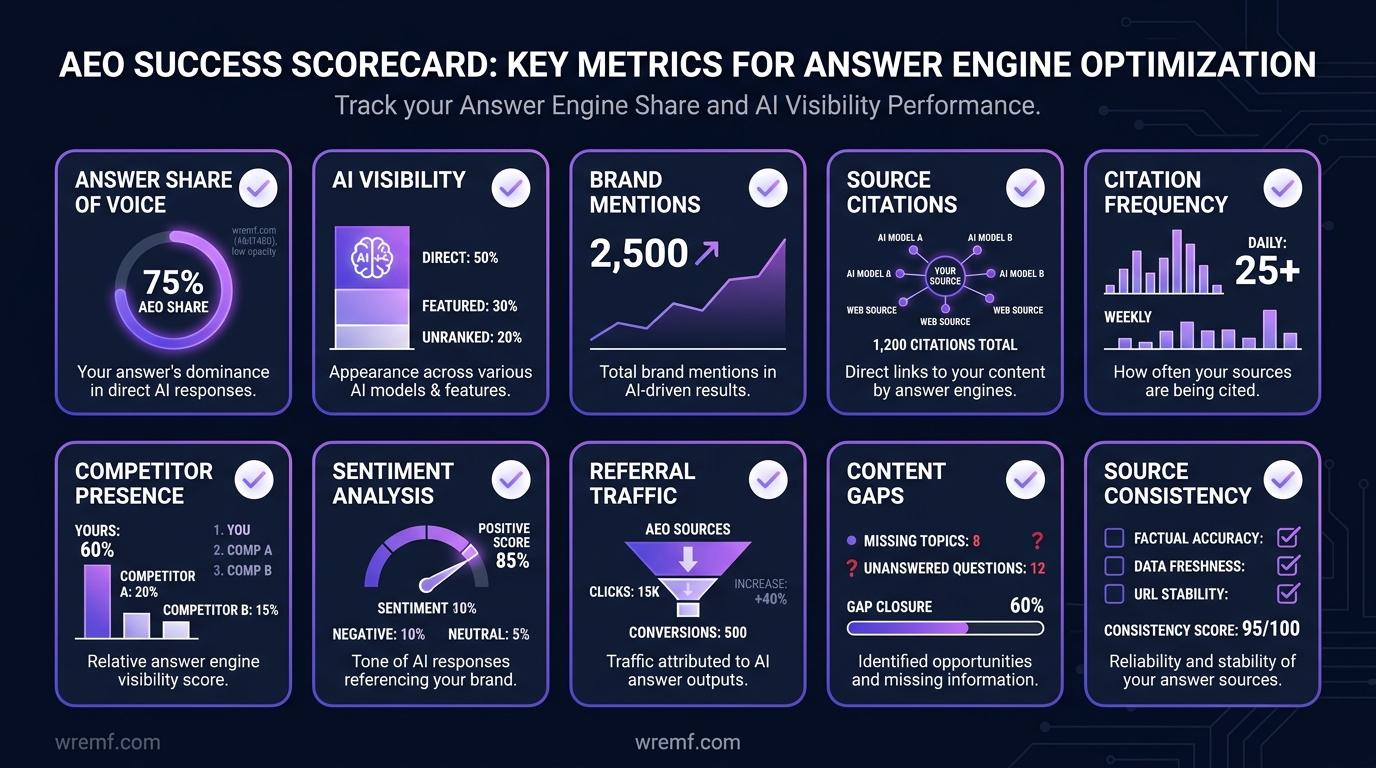
AEO tools should track answer share of voice, AI visibility, brand mentions, source citations, citation frequency, competitor presence, sentiment analysis, referral traffic, content gaps, and source consistency. These metrics show whether AI systems understand, trust, and surface your brand.
Answer Share of Voice is the percentage of relevant AI responses where a brand appears compared with competitors. Answer Share of Voice matters because AI answers often present only a few options, so inclusion quality can matter more than a traditional ranking position.
A brand mention is any instance where an AI system names your company in an AI response. Brand mention tracking matters because brand visibility begins with being named, but a brand mention should still be evaluated for accuracy, context, sentiment, and citation support.
Source citations are the pages, websites, documents, or knowledge sources cited inside AI answers. Source citations matter because they show which sources influence AI systems and whether your owned pages or third-party references support your brand authority.
Source consistency is the alignment of brand facts across owned content, third-party profiles, review sites, documentation, media coverage, comparison pages, and public data sources. Source consistency helps AI systems connect your brand to the right category, product, market, and use cases.
Microsoft explains in its Copilot Studio knowledge source documentation that knowledge sources can help generative answers use enterprise data, websites, and external systems. This supports an important AEO principle: AI answers depend on accessible and relevant knowledge sources.
AEO metrics should be grouped into four categories. Visibility metrics show whether the brand appears. Citation metrics show what evidence supports the answer. Quality metrics show how the brand is described. Impact metrics connect AI discovery to referral traffic, conversions, or pipeline influence.
| AEO Metric | What It Measures | Example Question | Reporting Value |
|---|---|---|---|
| AI visibility score | Overall presence across AI platforms | How visible is the brand across ChatGPT, Gemini, Perplexity, and Google AI? | Executive summary |
| Prompt coverage | Visibility across target search prompts | Which prompts trigger our brand? | Content planning |
| Brand mention frequency | How often the brand appears | Are AI systems naming us for commercial prompts? | Brand visibility |
| Source citation frequency | How often sources are cited | Which pages or third-party sources support answers? | Source strategy |
| Answer share of voice | Visibility versus competitors | Which competitor appears most often? | Market competition reporting |
| Sentiment analysis | Tone and brand perception | Is the brand described positively, neutrally, or inaccurately? | Positioning and reputation |
| Brand recognition | Whether AI systems connect brand to category | Does the AI know what we do? | Entity authority |
| Brand authority | Perceived credibility in AI responses | Does the AI cite trusted evidence for the brand? | Trust and category leadership |
| AI referral traffic | Website traffic from AI platforms | Are ChatGPT, Perplexity, or Bing Copilot sending sessions? | Attribution |
| Content gap analysis | Missing pages, topics, or source support | Which content gaps block citations? | Execution planning |
| Composite score | Weighted performance across metrics | Are we improving month over month? | Leadership reporting |
AI traffic attribution connects AI visibility to measurable outcomes such as referral traffic, engagement, conversions, and pipeline influence. AI traffic attribution matters because leadership teams need to know whether conversational AI visibility produces business value beyond brand screenshots.
A large language model may generate different AI responses for similar prompts depending on context, wording, freshness, retrieval, location, and system behavior. This means AEO tracking tools should focus on trend measurement, prompt groups, repeatable methodology, and source evidence rather than one-off manual tests.
WREMF’s AI visibility methodology connects prompts, citations, competitors, source consistency, and attribution into one repeatable system. This helps teams distinguish measurable findings from strategic recommendations.
DID YOU KNOW: OpenAI’s ChatGPT search documentation says ChatGPT can provide answers with links to relevant web sources, which makes citation visibility and source attribution measurable parts of answer engine optimization.
KEY TAKEAWAY: AEO success should be measured through visibility, citations, competitors, brand perception, source consistency, and attribution rather than rankings alone.
The next section explains how AEO, SEO, and GEO fit together instead of competing with each other.
AEO vs SEO vs GEO: What Is the Difference?
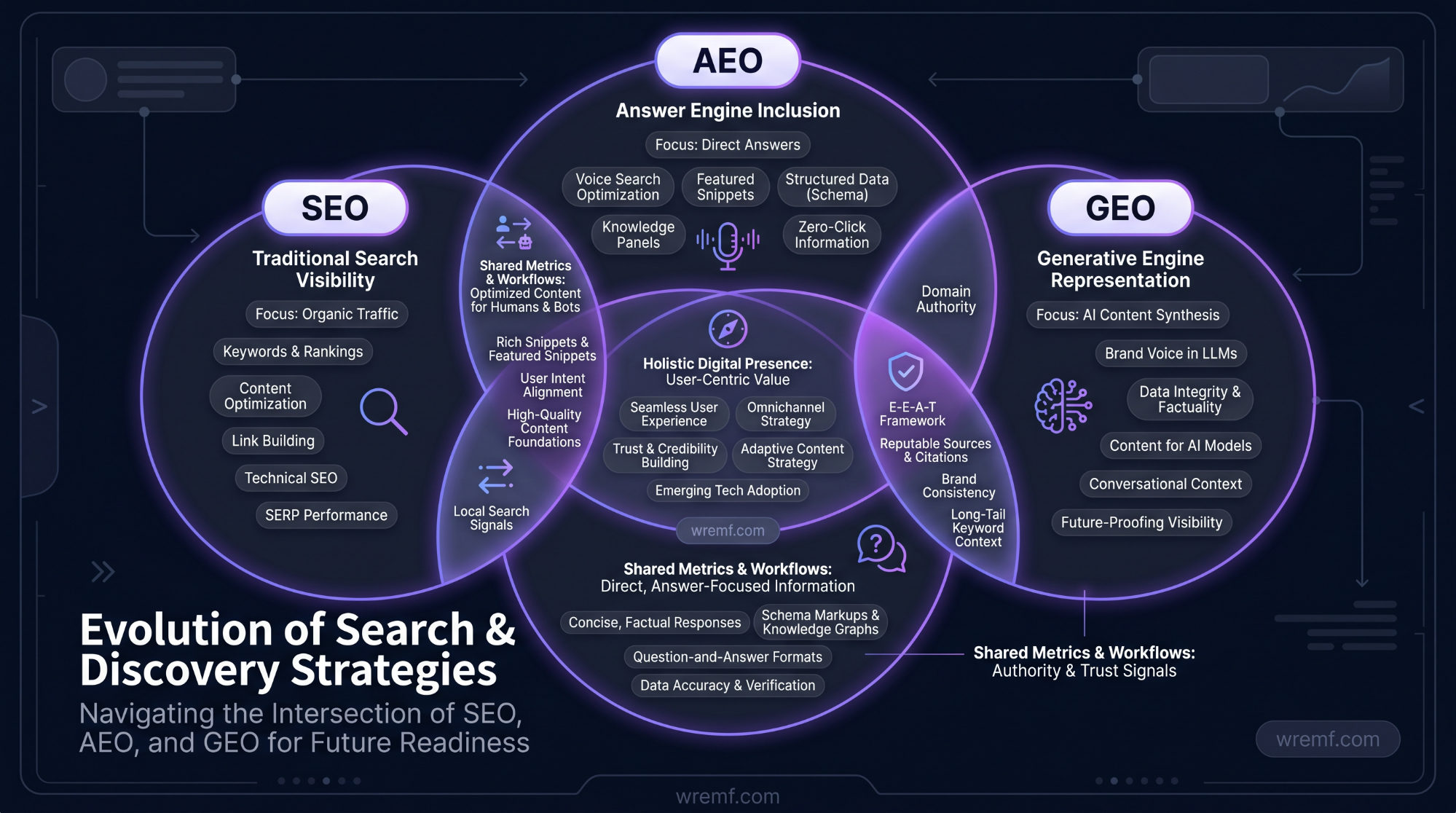
SEO improves visibility in traditional search results, AEO improves inclusion in answer engines, and GEO improves representation inside generative engines. The three disciplines overlap, but they use different workflows and success metrics.
SEO is search engine optimization for crawlable pages, rankings, technical health, backlinks, and organic search traffic. SEO remains relevant because answer engines still depend on accessible, useful, and authoritative web content.
AEO is answer engine optimization for AI answers, featured snippets, voice assistants, Google AI Overviews, Bing Copilot, Perplexity, ChatGPT, and conversational AI. AEO focuses on becoming the answer, recommendation, citation, or trusted source for a user’s question.
GEO is generative engine optimization for large language model systems and generative engines that produce summaries, comparisons, recommendations, and synthesized answers. Generative engine optimization focuses on retrievability, source clarity, entity authority, answer-first content, and citation readiness.
The key difference between SEO and GEO is that SEO focuses on ranking pages in search results, while GEO focuses on improving how generative engines retrieve, summarise, and represent information. The key difference between SEO and AEO is that AEO targets direct answer inclusion, not only search result visibility.
| Discipline | Primary Goal | Main Surface | Example Metric | Best For | Main Limitation |
|---|---|---|---|---|---|
| SEO | Rank and earn organic traffic | Google Search and Bing Search | Keyword rankings, clicks, backlinks | Search visibility and traffic | Does not fully measure AI answers |
| AEO | Become the answer or cited recommendation | Answer engines, AI answers, voice assistants | Answer share of voice, brand mentions, citation frequency | Direct answer visibility | Requires prompt and citation tracking |
| GEO | Improve representation in generated responses | Generative engines and large language model systems | Source consistency, AI citations, entity clarity | AI summaries and recommendations | Measurement varies by platform |
Google AI Overviews are a key overlap point. Google AI Overviews combine Google Search, AI systems, website links, search elements, and AI responses in one interface. That means a brand can be affected by traditional SEO signals, content quality, structured data, and answer-focused source selection at the same time.
Bing Copilot is another overlap point. Bing Copilot can combine search, conversational AI, and generated answers. Winning citations in Perplexity and Bing Copilot usually requires clear content, strong sources, retrievable pages, and consistent brand facts.
Voice assistants and smart speakers add another layer. Voice assistants often compress answers into a small number of spoken results, so answer clarity and entity confidence become important. AEO for voice assistants should prioritise concise definitions, local or product facts where relevant, structured content, and accurate source data.
The Nielsen Norman Group explains in its analysis of AI and search behavior that generative AI is changing search habits while many established search behaviors continue. This supports the practical view that SEO is evolving rather than disappearing.
AI visibility is the measurable output of SEO, AEO, GEO, brand authority, source consistency, and content strategy across AI platforms. AI visibility is not a single ranking number. AI visibility is a multi-signal view of how answer engines understand and present a brand.
IMPORTANT: Rankings alone are not enough because a large language model can summarise a category, mention competitors, cite third-party sources, and omit the highest-ranking page from an AI answer.
KEY TAKEAWAY: SEO, AEO, and GEO work together, but answer engine optimization requires new metrics for prompts, AI answers, citations, and brand visibility.
Now that the disciplines are clear, the next step is evaluating what makes a good AEO tracking tool in 2026.
What Makes a Good AEO Tracking Tool in 2026?
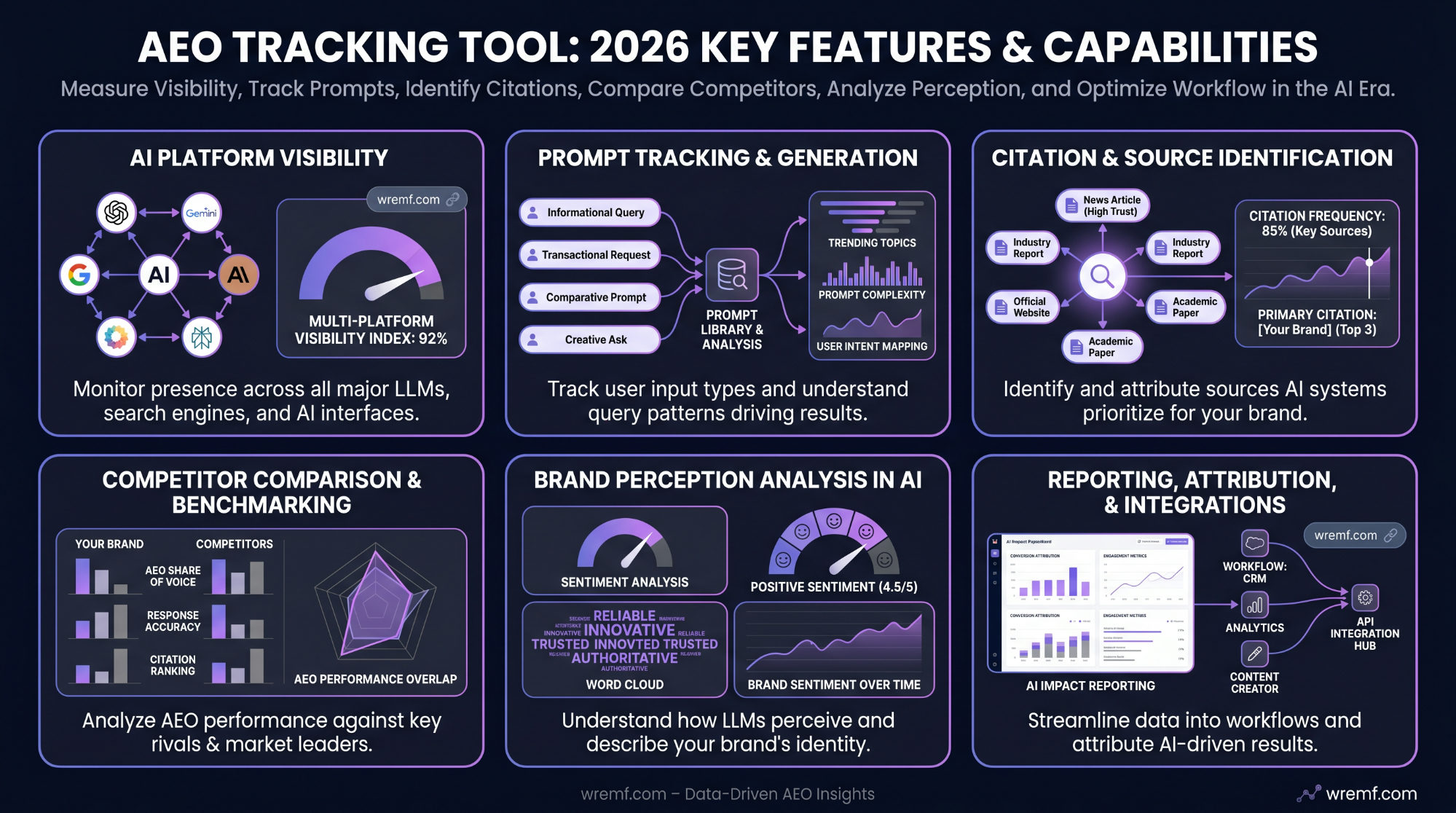
A good AEO tracking tool measures visibility across multiple AI platforms, tracks prompts, identifies citations, compares competitors, analyses brand perception, and turns findings into actions. The strongest tools also support reporting, attribution, and workflow integrations.
AEO tracking tools are platforms that monitor how answer engines and AI systems respond to target search prompts over time. AEO tracking tools matter because manual testing is inconsistent, difficult to repeat, and hard to report to stakeholders.
A good tool should show the raw AI response, not only the score. Raw responses help teams understand whether the brand was mentioned, how it was described, whether the answer included citations, and which competitors appeared. This is essential for trust and auditability.
A strong AEO tracking tool should include multi-engine coverage. Buyers do not only use one AI platform. A B2B buyer may use ChatGPT for vendor shortlists, Perplexity for research citations, Google AI Overviews for quick search summaries, Gemini for Google-connected research, Claude for analysis, and Bing Copilot for Microsoft-connected workflows.
A good tool should also include prompt grouping. Search prompts should be grouped by funnel stage, persona, product category, competitor, pain point, and buying intent. AEO work is weaker when every prompt is treated equally because a high-intent comparison prompt is often more valuable than a broad informational prompt.
| Evaluation Criteria | Why It Matters | What to Look For |
|---|---|---|
| Multi-engine coverage | Buyers use different AI platforms | ChatGPT, Claude, Gemini, Perplexity, Google AI Overviews, Bing Copilot, and more |
| Prompt intelligence | AI search is conversational | Prompt groups by persona, funnel stage, category, competitor, and intent |
| Raw response logs | Teams need auditability | Full AI responses, dates, engines, and prompt history |
| Source citation tracking | Citations reveal source influence | Cited URLs, citation frequency, clickable links, source gaps |
| Competitor visibility | AI answers compare brands | Competitor mentions, market competition, share of voice |
| Brand perception | AI answers shape trust | Sentiment analysis, positioning accuracy, brand recognition |
| Content recommendations | Tracking alone does not improve performance | Content briefs, content gap analysis, entity gaps, source recommendations |
| Reporting | Teams need proof | Scheduled reports, Looker Studio support, exports, white-label options |
| Attribution | Leadership needs outcomes | Referral traffic, conversion context, pipeline influence |
| Integrations | Scaling needs workflow fit | API, MCP, CRM, analytics, dashboards, BYOK support |
| Methodology transparency | Data must be trusted | Clear scoring logic, prompt samples, source handling |
AEO Grader tools can be useful for a quick baseline. They are less useful when they only produce a score without showing prompts, citations, sources, competitors, and recommended actions. A composite score should summarise performance, not replace diagnostic data.
SE Visible, AEO Vision, Peec AI, Profound, Rankscale, and other AI visibility platforms show that the market is moving toward measurement across AI platforms. The right choice depends on whether you need enterprise governance, agency reporting, startup affordability, engine coverage, source citation depth, or managed execution.
WREMF combines source citation tracking, prompt intelligence, competitive landscape analysis, AI visibility scoring, scheduled monitoring, and white-label reports. This makes it useful for brands that want software, agencies that need client reporting, and teams that want software plus managed AEO execution.
TIP: Before buying AEO software, ask for three proof points: raw prompt results, cited source lists, and competitor comparison data. These reveal whether the tool can support real optimisation work.
KEY TAKEAWAY: A good AEO tracking tool should show not only whether your brand appears in AI answers, but why it appears and what to improve next.
The next section turns evaluation criteria into a practical tool selection framework.
How to Choose the Best AEO Tools for Your Business
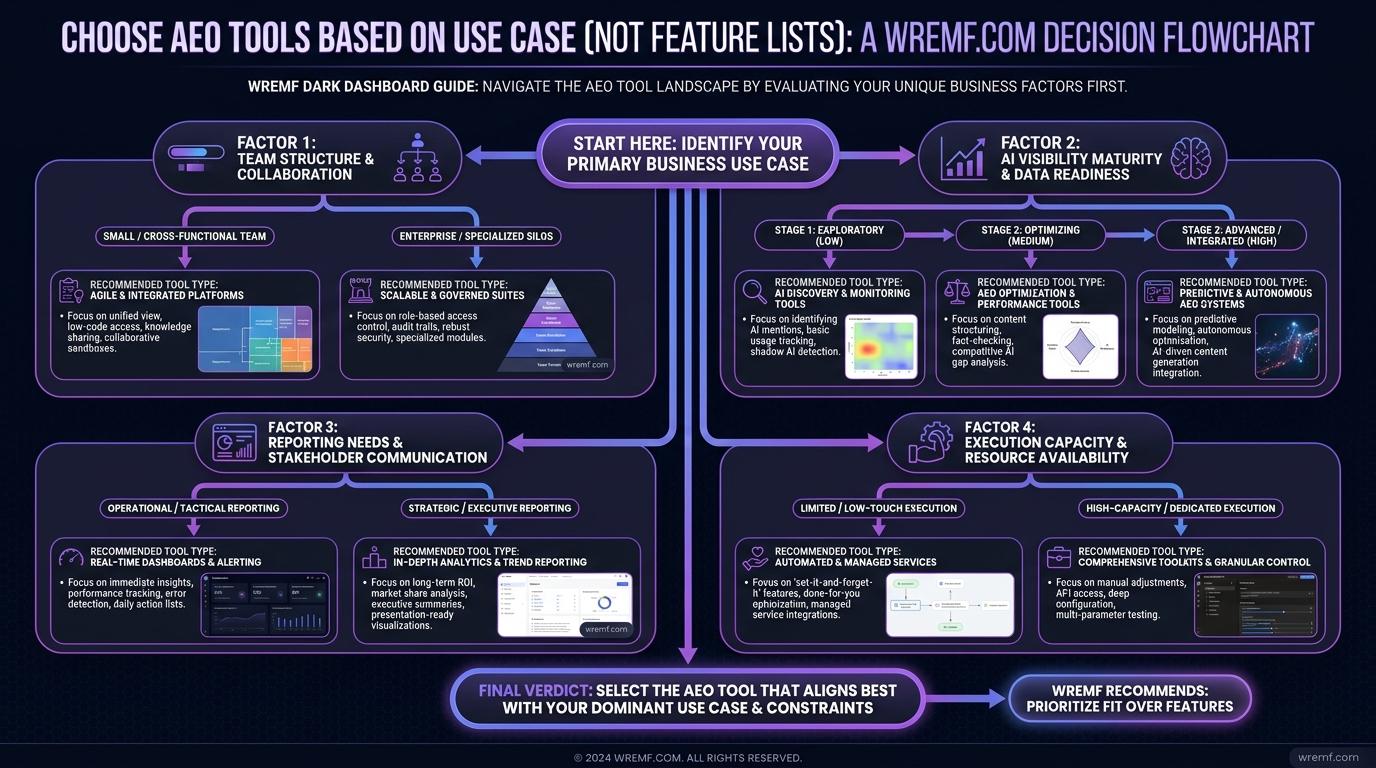
The best AEO tool for your business depends on your team structure, AI visibility maturity, reporting needs, and execution capacity. Choose based on use case, not only feature lists.
AEO tool selection should start with the business question. If you need to know whether your brand appears in ChatGPT, Perplexity, Gemini, Google AI Overviews, and Bing Copilot, choose an AI visibility tracking tool. If you need to improve structured content, choose content strategy and schema markup tools. If you need to connect AI discovery to revenue, include analytics platforms and attribution workflows.
A startup usually needs a lean stack. The first stack can include Google Search Console, Google Analytics 4, Google Trends, a structured data testing process, manual prompt testing, and a dedicated AI visibility platform when commercial AI search becomes important. This keeps the focus on essential measurement and fast execution.
A scaling B2B SaaS company needs stronger tracking. The stack should include AEO tracking tools, source citation analysis, competitor visibility, content briefs, referral traffic reporting, and executive summaries. This is where WREMF can help connect AI visibility data to practical AEO work.
An enterprise team usually needs governance. The stack may require multi-brand reporting, API access, MCP workflows, SSO or access controls, dedicated support, custom branded portals, white-label reporting, advanced analytics, and clear methodology. Enterprise teams should also care about data ownership, BYOK support, and repeatable internal processes.
An agency needs a client-ready workflow. Agencies managing multiple clients often need shared prompt templates, white-label dashboards, client portals, scheduled reports, source citation exports, competitor comparisons, and clear prioritisation. Without that workflow, AEO work becomes too manual to scale profitably.
| Business Type | Best Tool Mix | Main Priority | Recommended WREMF Fit |
|---|---|---|---|
| Early-stage startup | Search Console, GA4, Google Trends, light prompt testing, AI visibility baseline | Find category visibility gaps | Starter plan for one website |
| Scaling B2B SaaS | AI visibility tracking, content briefs, source citations, competitor tracking, attribution | Improve visibility and prove progress | Growth plan for multiple websites and content workflows |
| Enterprise brand | AI visibility platform, API, custom reporting, agency support, governance | Standardise measurement across teams | Enterprise plan with custom portals and dedicated support |
| SEO agency | White-label reports, client portals, scheduled monitoring, prompt templates | Report and improve client AI visibility | Agency-oriented workflow with white-label reporting |
| In-house marketing team | Platform plus managed support | Turn insights into execution | Hybrid software plus agency model |
A common mistake is buying traditional SEO tools and assuming they will automatically cover AI visibility. Traditional SEO tools may add Google AI Overviews tracking or SERP feature monitoring, but that is not the same as measuring ChatGPT, Perplexity, Claude, Gemini, Bing Copilot, DeepSeek, Grok, Meta AI, and Mistral.
Another common mistake is choosing the tool with the largest prompt count. A large master list can create noise. Better AEO work starts with prompts tied to buyer intent, competitor comparison, category education, and commercial decision-making.
If budget matters, review plans carefully. WREMF pricing starts at €39 per month for Starter, €89 per month for Growth, and custom pricing for Enterprise. The WREMF pricing page is the best place to compare websites, seats, support levels, white-label reporting, content briefs, SEO testing, and Enterprise options.
DID YOU KNOW: McKinsey reports in its AI search analysis that half of surveyed consumers intentionally seek out AI-powered search engines, which makes AI discovery a strategic visibility issue rather than a niche experiment.
KEY TAKEAWAY: Choose AEO tools based on the business decision you need to support: measurement, content improvement, technical foundations, reporting, or managed execution.
After choosing the right type of tool, the next section explains how to optimize for answer engine optimization.
How Do You Optimize for Answer Engine Optimization?
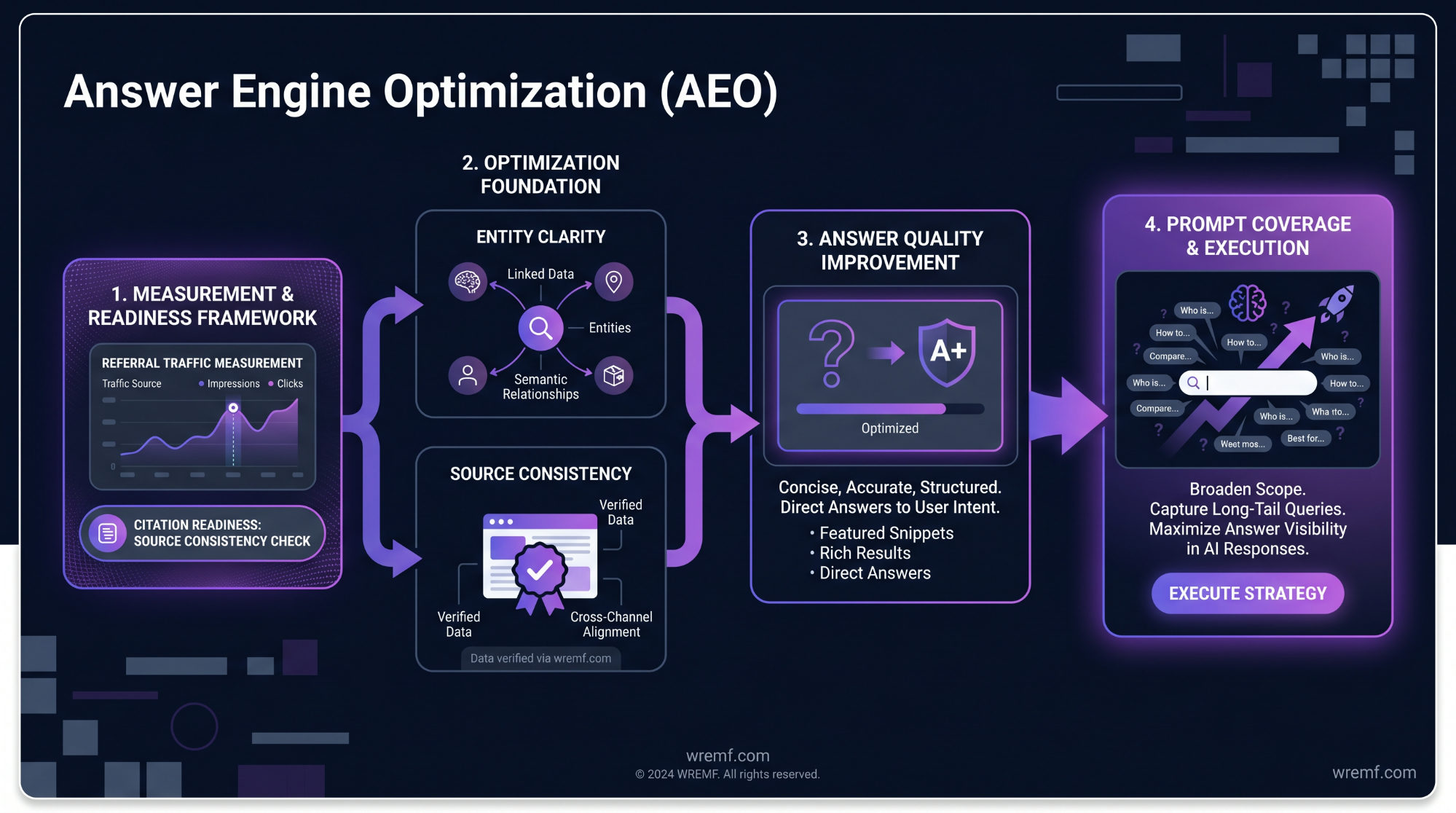
The most effective way to optimize for answer engine optimization is to improve prompt coverage, entity clarity, answer quality, source consistency, citation readiness, and referral traffic measurement. AEO work should begin with measurement and then move into execution.
Answer engine optimization works by making a brand easier for AI systems to understand, retrieve, verify, and cite. A large language model can produce AI answers from learned patterns, retrieved sources, search results, enterprise knowledge sources, or a mix of these inputs. This is why source consistency and content clarity matter.
Start with prompt research. Build a prompt list from real buyer questions, not only keyword tools. Include prompts such as “best answer engine optimization tools,” “best AEO tools for B2B SaaS,” “WREMF alternatives,” “ChatGPT visibility tracking tools,” “how to optimize for Google AI Overviews,” “answer engine optimization services,” and “SEO vs AEO vs GEO.”
Next, run baseline AI visibility tracking. Test the same prompts across ChatGPT, Perplexity, Gemini, Claude, Google AI Overviews, Bing Copilot, and other relevant AI platforms. Record whether the brand appears, whether competitors appear, whether citations are included, and whether the brand description is accurate.
Then audit sources. Source citations can include owned pages, comparison pages, documentation, customer review platforms, industry articles, marketplace profiles, analyst-style content, and structured data. If AI systems cite competitor-friendly sources but not your website, the AEO roadmap should include citation gap analysis.
Next, improve content. Answer-first content should include concise definitions, comparison tables, direct answers, FAQs, source-backed claims, structured content drafting, and clear product descriptions. The goal is not to create generic AI content. The goal is to create useful, accurate, source-backed content that humans and AI systems can understand.
Then improve technical foundations. Schema markup, crawlability, internal linking, page speed, canonical tags, indexability, and clear site architecture still matter. Google Search Central’s AI features and website guidance explains AI features from a site owner perspective, reinforcing that website quality and search eligibility remain relevant.
Finally, report progress. AEO reporting should include AI visibility, answer share of voice, brand mentions, citations, source gaps, AI referral traffic, content changes, and competitor movement. This gives leadership a fuller picture than rankings alone.
Use this AEO workflow:
Build a search prompt set by buyer stage and intent
Run baseline AI visibility tracking
Analyse brand mentions, competitor mentions, and AI responses
Map cited sources and clickable links
Audit entity clarity and source consistency
Identify content gaps and citation gaps
Build AI-ready content briefs
Improve structured content and schema markup where relevant
Test changes with SEO testing and AEO monitoring
Connect referral traffic and conversions through analytics platforms
Report monthly changes in visibility, citations, and share of voice
WREMF supports this workflow with GEO audit capabilities, prompt intelligence, citation tracking, competitive visibility, content briefs, and optional managed execution. This is useful for teams that want software, an agency service, or a hybrid operating model.
AI citations matter because AI systems often use cited sources to support generated answers. AI citations can influence trust, clickable links, referral traffic, and the perceived authority of a brand inside AI responses.
IMPORTANT: Do not treat answer engine optimization as content creation alone. AEO is a measurement problem, a source ecosystem problem, and an execution problem.
KEY TAKEAWAY: AEO optimisation works best when teams connect prompts, entities, content, citations, competitors, technical foundations, and attribution into one repeatable workflow.
The next section explains how content strategy and Content Generation fit into AEO without lowering quality.
What Content Strategy Works Best for AEO?
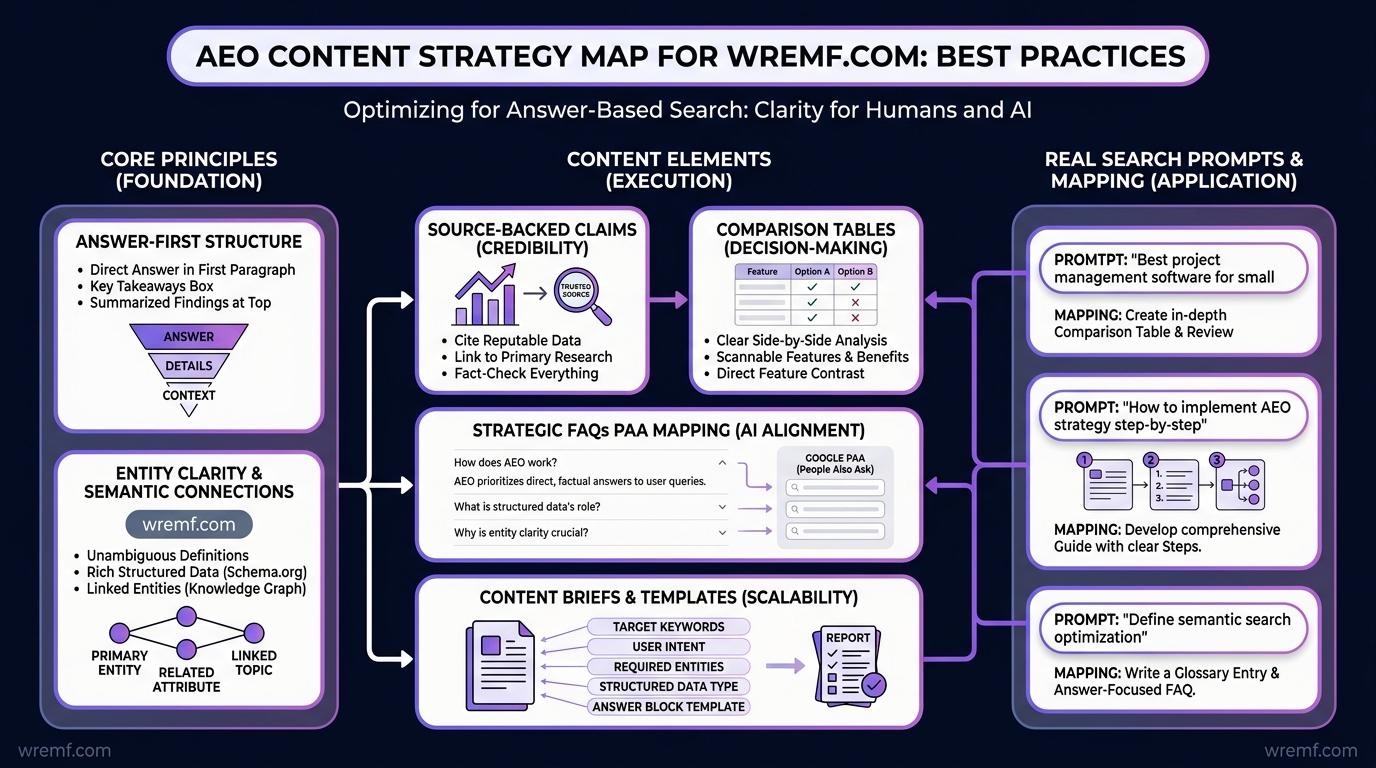
The best AEO content strategy uses answer-first structure, entity clarity, source-backed claims, comparison tables, FAQs, and content briefs mapped to real search prompts. AEO content should help both humans and AI systems understand the answer quickly.
Content strategy for AEO is the planning process that decides which pages, topics, entities, prompts, and sources should support AI visibility. It matters because answer engines need clear, retrievable, and trustworthy information before they can confidently cite or recommend a brand.
AEO content should not be built around keyword density alone. Keyword usage still helps topical relevance, but large language model systems also need clear context, consistent entities, useful explanations, and credible sources. A page that repeats “answer engine optimization” many times without useful definitions, comparisons, or evidence is unlikely to become a trusted source.
Answer-first content is content that begins sections with direct, extractable answers before adding detail. This structure is useful for featured snippets, Google AI Overviews, ChatGPT search, Perplexity answers, and Bing Copilot summaries because it gives AI systems clean answer candidates.
Structured content drafting is the process of writing content with clear headings, short definitions, comparison tables, bullets, FAQs, and source-backed statements. Structured content drafting matters because it reduces ambiguity and makes content easier to retrieve, summarise, and cite.
Content gap analysis for AEO should compare your website against AI responses, not only Google rankings. If AI platforms recommend competitors for “best AEO tools,” your content gap may include missing comparison pages, weak product positioning, unclear pricing, absent use cases, or insufficient third-party source support.
Entity and topical coverage audits help identify whether a brand is clearly connected to the right concepts. For WREMF, relevant entities include answer engine optimization, AI visibility, GEO, AEO, source citations, prompt tracking, AI share of voice, Google AI Overviews, ChatGPT, Perplexity, Gemini, Claude, Bing Copilot, and B2B SaaS.
Content Generation can support AEO, but it should not replace expert review. AI content can help draft outlines, FAQs, comparison tables, and content briefs. Human review is still needed for accuracy, source quality, brand positioning, E-E-A-T signals, and practical experience.
A practical AEO content strategy includes:
Definition pages for core entities
Comparison pages for commercial intent
Tool and platform pages for buying-stage searches
FAQ sections for natural language questions
Case-free practical examples where data is unavailable
Source-backed claims from authoritative references
Internal links to product, methodology, pricing, and reports
Schema markup where appropriate
Content briefs mapped to search prompts and AI answer gaps
Regular reviews of AI responses and citation changes
WREMF’s AI-ready content briefs help teams turn AI visibility gaps into content actions. This connects prompt intelligence and citation analysis to the editorial workflow rather than leaving AEO insights in a dashboard.
TIP: Write for the buyer question first, then refine for search engines and AI retrieval. Pages built only around keyword matching often miss the answer quality that AEO requires.
KEY TAKEAWAY: AEO content strategy should combine answer-first writing, entity coverage, source-backed claims, structured content, and prompt-led content briefs.
The next section covers the technical foundation, including schema markup, AI crawlers, and structured data.
What Technical Foundations Support AEO?
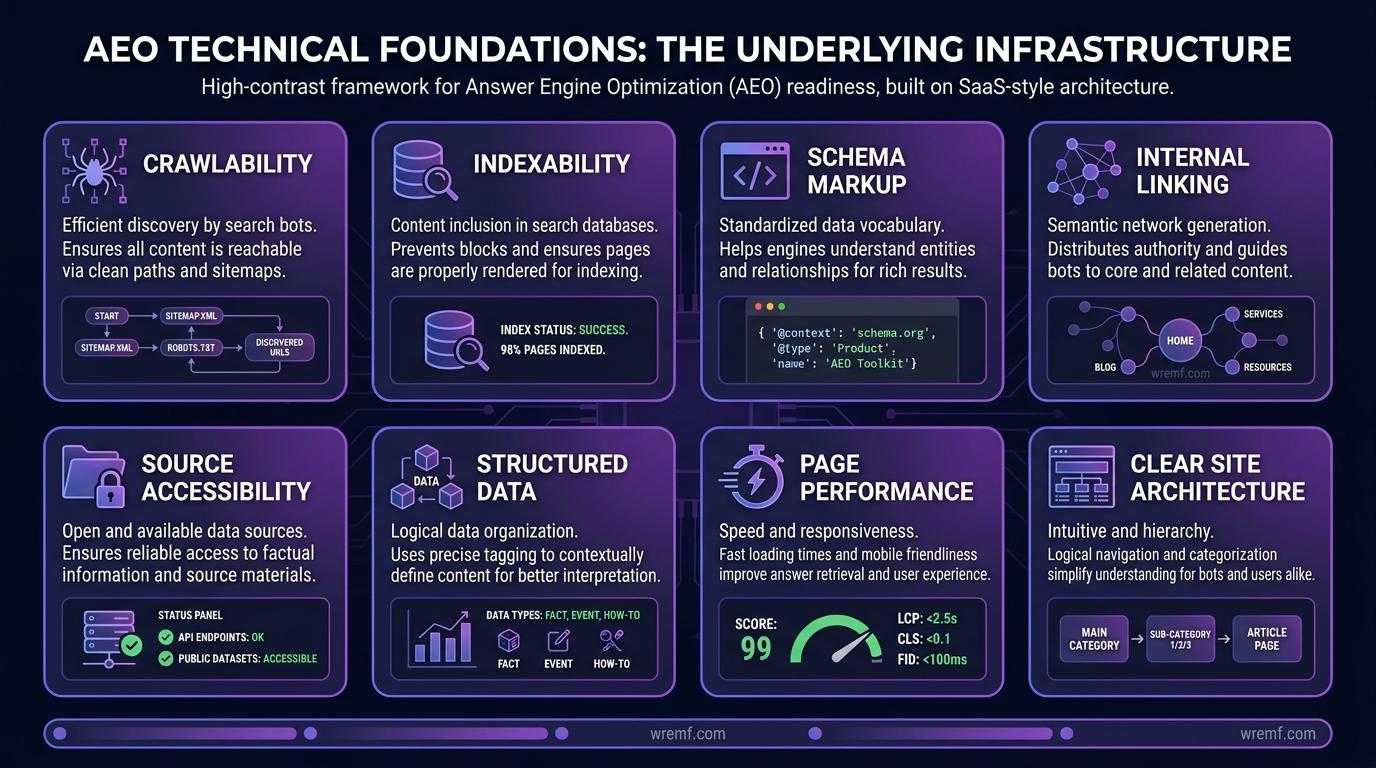
Technical AEO foundations include crawlability, indexability, schema markup, internal linking, source accessibility, structured data, page performance, and clear site architecture. These foundations help AI systems and search engines discover, parse, and trust your content.
Schema markup is structured data added to a page to help search engines understand entities, properties, and relationships. Schema markup matters for AEO because clearer structured information can support search features, entity understanding, and content interpretation.
Google Search Central says structured data helps Google understand page content and that Google uses the Search Central documentation as the definitive reference for Google Search behavior. This matters because schema.org vocabulary is broad, but Google Search support depends on Google’s documented eligibility and requirements.
Important schema markup types for B2B SaaS and answer engine optimization may include Organization, Article, FAQPage where appropriate, Product where applicable, SoftwareApplication where suitable, BreadcrumbList, and WebSite. The goal is not to add every schema tag possible. The goal is to make important brand, product, author, and content information clear.
Crawlability remains critical. If Googlebot, Bingbot, or other crawlers cannot access important pages, those pages are less likely to support search visibility or AI features. Google’s crawler documentation explains that Google crawlers discover and scan websites for Google products, including Search.
AI Crawler access is becoming part of technical governance. An AI Crawler is a bot or retrieval system that accesses website content for AI search, AI assistants, model-connected browsing, or answer generation. AI Crawler strategy should balance visibility goals, content control, publisher rights, and business risk.
Technical AEO should also consider clickable links. AI answers can include clickable links, cited webpages, or source cards depending on the platform. Content that is blocked, poorly structured, thin, duplicated, or unclear may be harder to cite even if it exists.
A practical technical AEO checklist includes:
Ensure important pages are crawlable and indexable
Use clean URL structures and canonical tags
Add relevant schema markup and test it
Improve internal links to important AEO pages
Make product and category positioning clear
Consolidate duplicate or conflicting brand facts
Keep author, company, pricing, and product information current
Monitor Google Search Console for indexing and performance issues
Track AI referral traffic in analytics platforms
Review robots.txt decisions for search and AI crawler access
Maintain fast, usable pages that support human trust
Technical AEO is not only about schema markup. AEO depends on the combination of technical accessibility, structured content, source credibility, and answer quality. A large language model system cannot cite what it cannot access, and it may misunderstand content that is inconsistent or unclear.
WREMF supports technical and content diagnosis through GEO audits, source consistency analysis, prompt tracking, and recommendations. For teams that already use technical SEO tools, WREMF adds the AI visibility layer that connects technical foundations to answer engine outcomes.
DID YOU KNOW: Google Search Central’s AI features guidance explains that AI Overviews and AI Mode are part of Google Search from a site owner perspective, so classic search foundations still matter for AI search visibility.
KEY TAKEAWAY: Technical AEO starts with crawlable, structured, accessible, and consistent content that answer engines can understand and cite.
The next section compares the practical ways to measure AEO with software, analytics, and manual testing.
Can Free Tools Like Google Analytics 4 Track AEO?
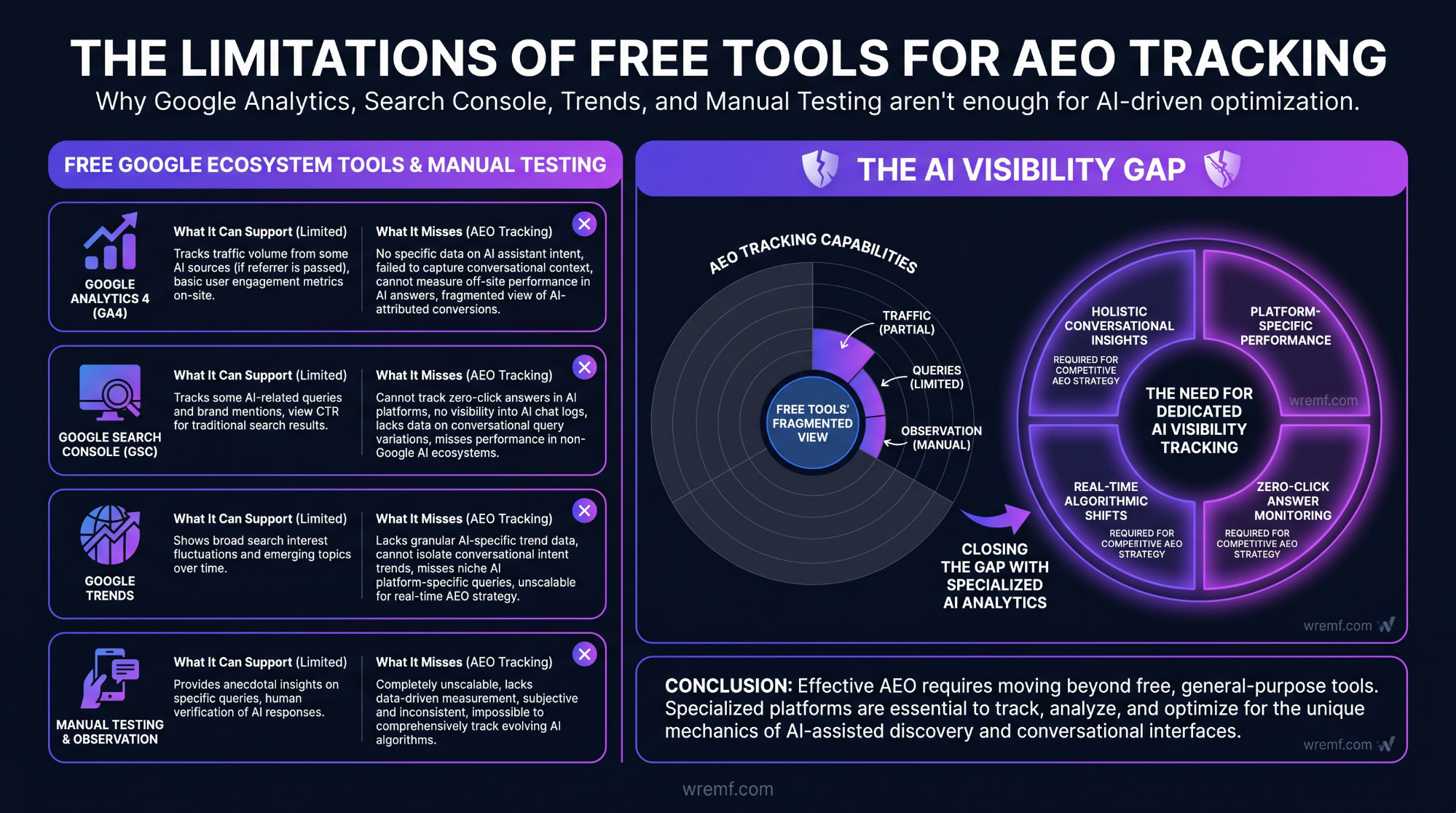
Free tools can support AEO tracking, but they cannot fully measure answer engine optimization. Google Analytics 4, Google Search Console, Google Trends, and manual testing are useful inputs, but they do not replace dedicated AI visibility tracking.
Google Analytics 4 can help identify referral traffic from AI platforms when referral data is available. For example, teams may see traffic from domains associated with ChatGPT, Perplexity, Bing, or other AI platforms. This is useful for attribution, but it does not show whether the brand appeared in AI answers without a click.
Google Search Console can help track Google Search performance, queries, clicks, impressions, and pages. It can support analysis around Google AI Overviews indirectly, but it does not provide a complete prompt-level view across ChatGPT, Claude, Gemini, Perplexity, Bing Copilot, DeepSeek, Grok, Meta AI, and Mistral.
Google Trends and Google Keyword Planner can help identify demand and conversational search patterns. They can inspire search prompts and topic clusters, but they do not show live AI responses or citation frequency.
Manual testing can reveal directional issues. A marketer can ask ChatGPT, Perplexity, Gemini, or Bing Copilot questions and record results. The problem is that manual testing is not scalable, consistent, or reliable for monthly reporting. Responses can vary by location, timing, model behavior, browsing mode, and prompt wording.
| Tracking Method | What It Helps With | What It Misses | Best Use |
|---|---|---|---|
| Google Analytics 4 | Referral traffic and conversions | Prompt visibility, brand mention quality, citations | Attribution |
| Google Search Console | Search performance and indexing | Multi-engine AI responses | SEO foundation |
| Google Trends | Demand patterns | Actual AI answer inclusion | Prompt inspiration |
| Google Keyword Planner | Search volume direction | Conversational AI behavior | Keyword and prompt research |
| Looker Studio | Dashboard reporting | Data collection by itself | Executive reporting |
| Manual prompt testing | Quick qualitative checks | Repeatability, scale, historical trend data | Early baseline |
| AEO tracking tools | AI visibility, citations, competitors, prompts | Requires setup and interpretation | Ongoing measurement |
Analytics platforms are strongest when connected to dedicated AEO tools. AEO tools show whether the brand appears in AI responses. Analytics platforms show whether AI platforms send referral traffic and whether that traffic converts. Together, the two create a stronger reporting system.
A common reporting mistake is treating referral traffic as the only AEO metric. Many AI answers influence decisions without sending immediate clicks. A buyer may see a recommendation in ChatGPT, search the brand later, visit through direct traffic, or ask a colleague before converting. This is why AEO reporting should include both visibility metrics and traffic metrics.
WREMF helps connect AI visibility tracking with reporting by showing prompts, citations, competitors, and visibility trends. Growth teams can then connect this data with analytics platforms to understand referral traffic, assisted discovery, and content performance.
IMPORTANT: Google Analytics 4 can help measure AI referral traffic, but it cannot tell you how often AI systems recommended your brand when users did not click.
KEY TAKEAWAY: Free tools support AEO measurement, but dedicated AEO tracking tools are needed for prompt-level visibility, citations, and competitor analysis.
The next section explains whether software, an agency, or a hybrid model is the right fit.
Should You Use AEO Software, an Agency, or a Hybrid Model?
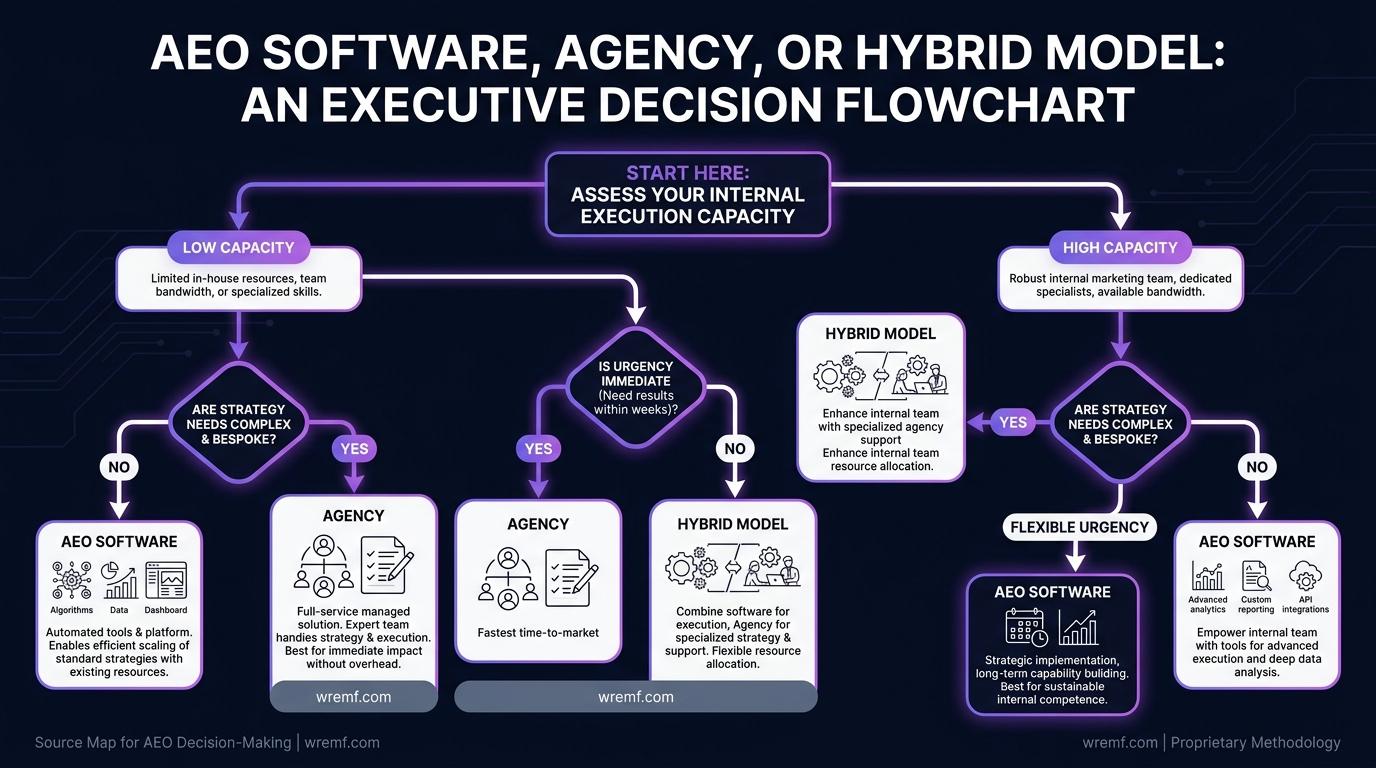
Use AEO software when you have internal execution capacity, an agency when you need strategy and implementation, and a hybrid model when you need both measurement and managed execution. The right choice depends on resources, urgency, and reporting needs.
AEO software is best for teams that can act on insights internally. These teams usually have SEO, content, analytics, and technical resources. Software gives them dashboards, prompt tracking, source citations, competitor visibility, and historical measurement.
AEO agency services are best for teams that need expert help with strategy and execution. Services can include AI visibility strategy, GEO consulting, AEO consulting, content optimisation, entity authority building, source consistency cleanup, citation improvement, AI-ready content briefs, schema markup guidance, crawl checks, internal linking logic, monthly reporting, and pipeline attribution.
A hybrid model is often best for B2B SaaS teams that want proof and action. The platform measures AI visibility, while managed execution turns findings into page updates, content briefs, technical recommendations, citation improvements, and reporting.
| Model | Best For | What You Get | Main Limitation | Recommended When |
|---|---|---|---|---|
| Software only | Teams with internal SEO and content resources | Tracking, dashboards, prompt data, citations, reports | Execution depends on your team | You need control and ongoing measurement |
| Agency only | Teams without internal AEO capacity | Strategy, audits, implementation, reporting | Less day-to-day platform ownership | You need expert delivery |
| Hybrid | Scaling brands and agencies | Software, managed execution, reporting, strategic support | Requires coordination | You need measurement and implementation |
| Manual only | Very early exploration | Low-cost learning | Not scalable or reliable | You need a short initial baseline |
For agencies, the operating model matters as much as the data. Agencies managing multiple clients often need white-label reports, client portals, repeatable search prompts, scheduled monitoring, and exportable findings. AEO work becomes difficult to scale if every client report depends on screenshots and manual testing.
For in-house brands, the key issue is adoption. Marketing leaders need a clear view of AI visibility, competitor movement, content gaps, and business impact. SEO teams need source-level recommendations. Content teams need briefs. Executives need a simple view of progress.
WREMF supports all three models. The platform can be used as software, as a managed agency service, or as a hybrid solution. Teams that need execution can work with the WREMF agency team for AEO, GEO, authority building, content optimisation, and monthly reporting.
TIP: If your team already has strong SEO execution, start with software. If your team lacks capacity, start with managed support. If leadership needs proof and speed, use a hybrid model.
KEY TAKEAWAY: AEO software measures the opportunity, agency services execute the work, and a hybrid model combines both for faster learning and clearer accountability.
The next section explains how WREMF helps teams turn AEO from a concept into a repeatable workflow.
How WREMF Helps With Answer Engine Optimization
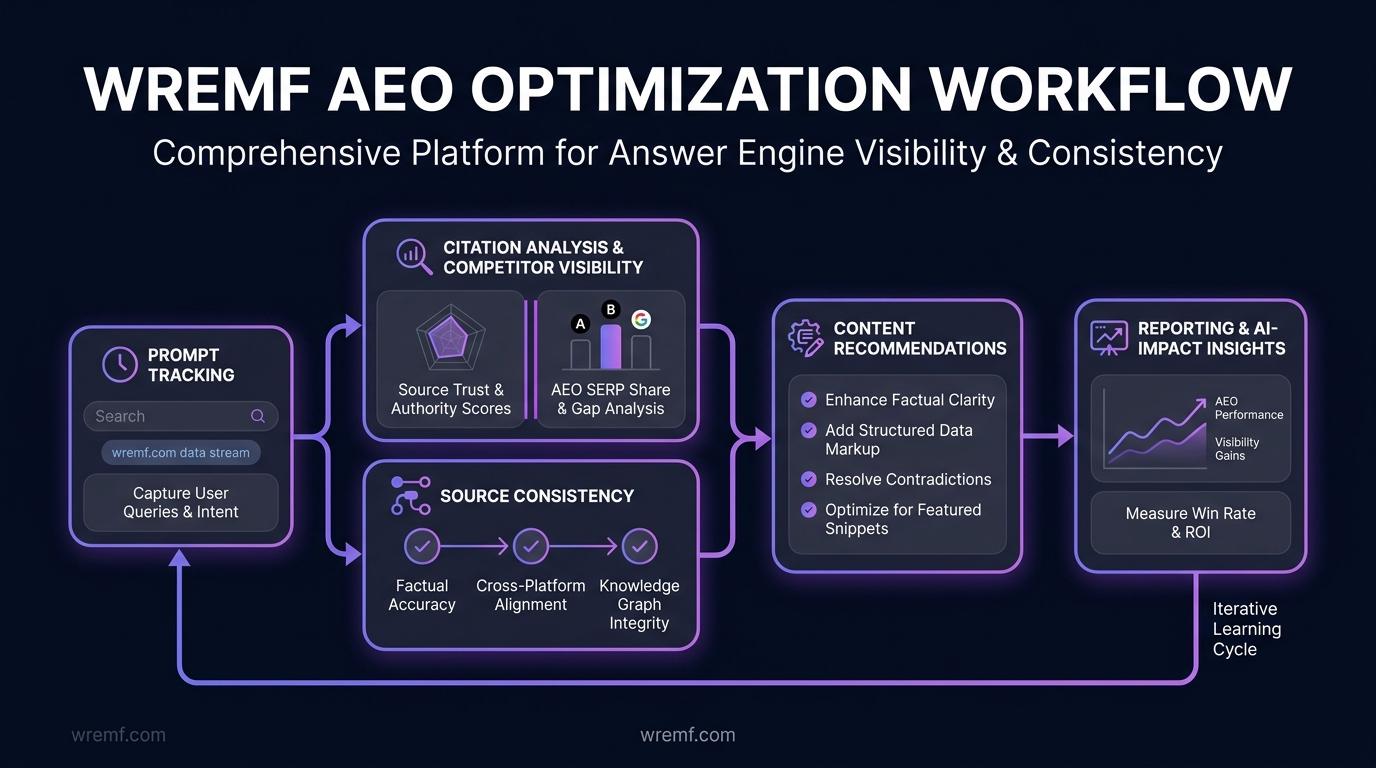
WREMF helps teams track, improve, and prove answer engine optimization across major AI discovery surfaces. It connects prompt tracking, citation analysis, competitor visibility, source consistency, content recommendations, and reporting in one workflow.
WREMF is an AI visibility platform and optional agency partner for B2B teams. WREMF matters because AEO requires repeatable measurement across AI platforms, not occasional manual checks inside one answer engine.
WREMF tracks visibility across ChatGPT, Claude, Gemini, Perplexity, Google AI Overviews, Bing Copilot, DeepSeek, Grok, Meta AI, and Mistral. This coverage helps teams understand how different AI platforms respond to the same search prompts and where competitors appear more often.
WREMF’s prompt intelligence helps teams organise search prompts by funnel stage, persona, product category, competitor intent, and commercial priority. This matters because a large language model response to “best AEO tools for agencies” can be more commercially valuable than a broad informational response to “what is AEO.”
WREMF’s source citation tracking helps teams see which sources support AI answers. This includes owned pages, third-party pages, competitor sources, industry resources, and cited URLs. Source citation tracking helps teams identify citation gaps, outdated sources, and pages that need stronger answer-first content.
WREMF’s competitive landscape analysis helps teams compare brand visibility against competitors in AI responses. This supports market competition analysis, share of voice reporting, and brand authority tracking across answer engines.
WREMF’s content and audit workflows help turn tracking into execution. Teams can use GEO audits, AI-ready content briefs, SEO testing, and source consistency analysis to improve pages, answer quality, and citation readiness. Agencies can use white-label reports, client portals, BYOK support, and API workflows to scale client delivery.
Use WREMF when:
You want to track AI visibility across 10 AI engines
You need prompt tracking for commercial search prompts
You need source citation tracking and clickable link analysis
You want competitor visibility across AI responses
You need AI share of voice and brand analysis
You want content briefs based on AI visibility gaps
You need reporting for leadership or clients
You want a software, agency, or hybrid AEO model
You need API, MCP, BYOK, or white-label workflows
You want to connect AI visibility to referral traffic and business outcomes
WREMF does not guarantee rankings, citations, traffic, revenue, or AI recommendations. No credible answer engine optimization tool should make that promise. WREMF helps teams measure the current state, identify gaps, prioritise improvements, and track progress over time.
For agencies and consultants, WREMF provides a dedicated path through AI visibility workflows for agencies. For in-house teams, WREMF supports brand-side AI visibility through AI visibility workflows for brands.
IMPORTANT: WREMF should be viewed as a measurement and execution system, not a magic citation switch. The value comes from consistent monitoring, clearer content, stronger sources, and better reporting.
KEY TAKEAWAY: WREMF turns answer engine optimization from manual testing into a structured workflow for tracking, improving, and reporting AI visibility.
The next section covers common myths that cause teams to misread AEO, SEO, and AI visibility.
Common Myths About AI Visibility Debunked
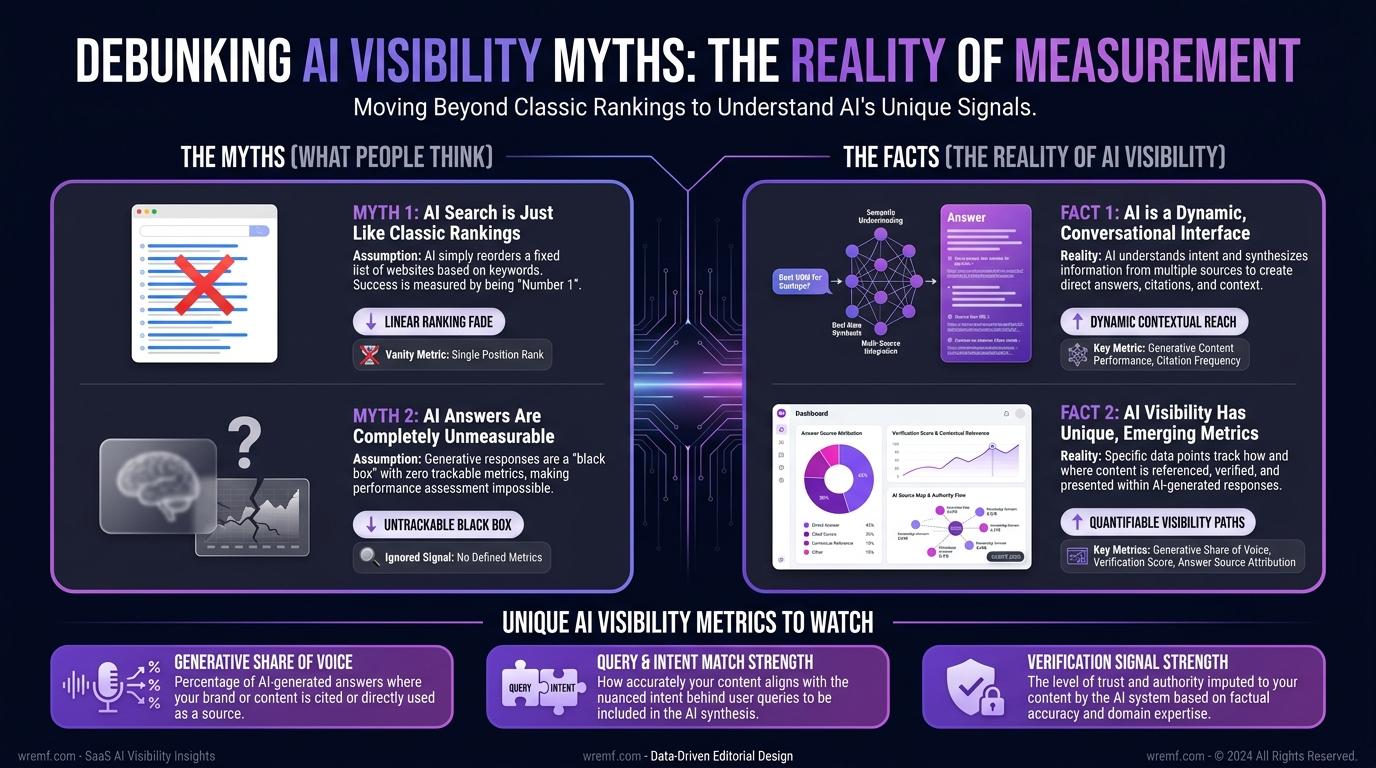
AI visibility myths usually come from treating AI search like classic rankings or assuming AI answers cannot be measured. The reality is that AI visibility is measurable, but it requires different metrics from traditional SEO.
MYTH: SEO is dead because answer engines are replacing search.
FACT: SEO is evolving, not disappearing. Google Search, Bing Search, crawlability, helpful content, backlinks, schema markup, and technical SEO still support discoverability. AEO and GEO add new layers for answer engines, AI responses, source citations, and large language model visibility.
MYTH: AI visibility is impossible to measure.
FACT: AI visibility can be measured through prompt tracking, brand mentions, source citations, answer share of voice, sentiment analysis, competitor visibility, and AI referral traffic. The measurement is not identical to rank tracking because AI systems can vary responses. Consistent prompt sets and scheduled monitoring still create useful trend data.
MYTH: Rankings alone are enough for AI visibility.
FACT: Rankings help, but rankings do not prove AI answer inclusion. AI platforms can cite third-party sources, summarise competitors, mention a brand without linking, or omit a high-ranking page. AEO tools are needed to measure brand mention quality, citation frequency, and competitor presence inside AI answers.
MYTH: Schema markup alone is answer engine optimization.
FACT: Schema markup is useful, but it is only one foundation. Answer engine optimization also requires entity clarity, helpful content, source consistency, citation readiness, prompt coverage, and brand authority. Schema tags can help clarify information, but they cannot replace a weak content strategy.
MYTH: More AI content automatically improves AEO performance.
FACT: AI content can support content production, but low-quality AI content can create repetition, weak claims, and poor source quality. Google’s helpful content guidance prioritises reliable, people-first content. Content Generation should support expert-led content strategy, not replace it.
KEY TAKEAWAY: AI visibility is measurable, SEO still matters, and rankings alone are not enough to understand answer engine performance.
The next section looks ahead to AI agents, smart speakers, AI crawlers, and the next generation of AEO tools.
What Is the Future of AEO Tools?
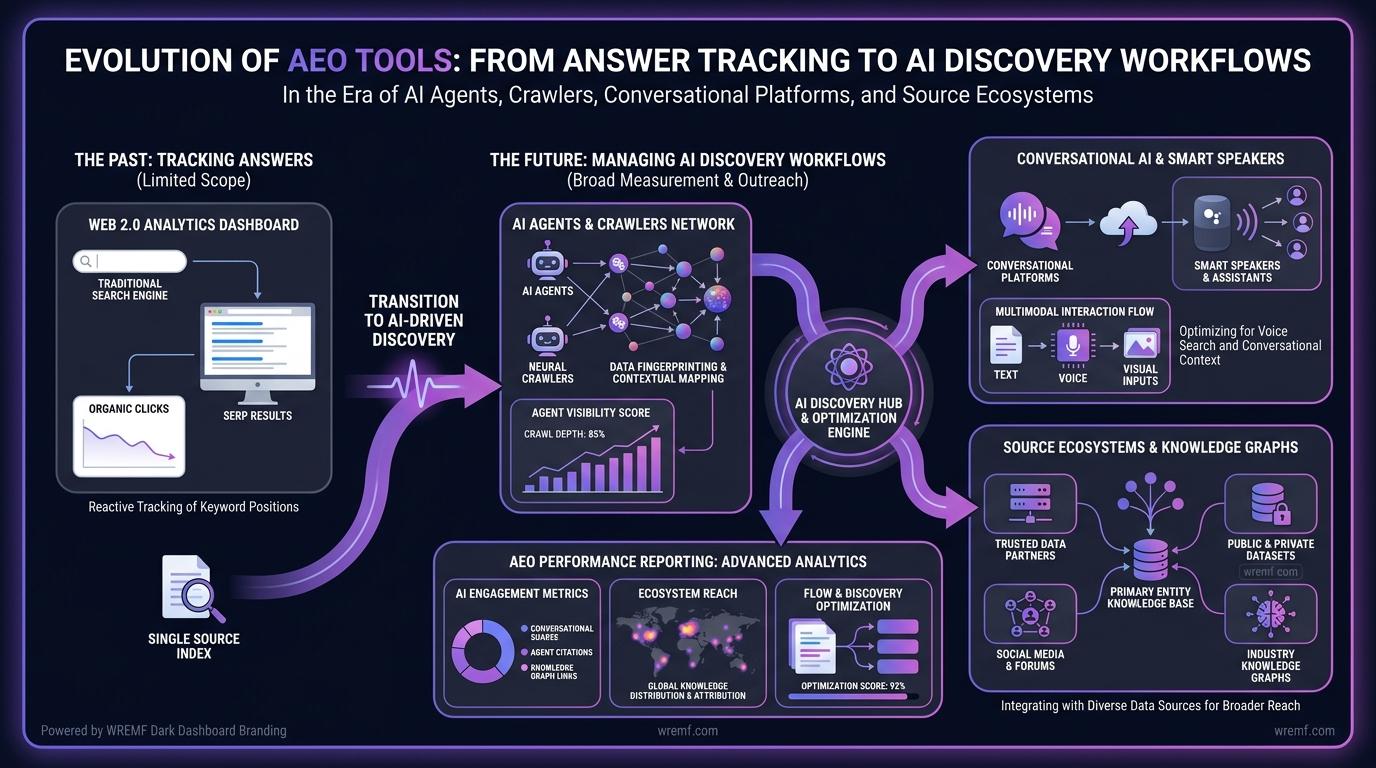
The future of AEO tools is broader measurement across AI agents, AI crawlers, smart speakers, conversational platforms, and source ecosystems. AEO tools will move from tracking answers to managing AI discovery workflows.
An AI Agent is a system that can reason, retrieve information, and complete tasks with less manual instruction than a standard search experience. AI Agent visibility matters because future buyers may ask agents to shortlist vendors, compare pricing, gather reviews, or prepare procurement recommendations.
AI answer engines will also become more multimodal and workflow-oriented. Search may include AI Overviews, AI Mode, generated summaries, conversational follow-ups, maps, product information, clickable links, source cards, and task execution. This will make answer engine optimization more connected to content quality, technical access, brand trust, and structured data.
AI Crawler management will become more important. AI crawlers can discover, retrieve, or process website content for AI search, AI assistants, model-connected browsing, or answer generation. Brands will need to decide how to balance content access, visibility, publisher rights, and business risk.
Conversational platforms will expand AEO beyond standard search. Voice assistants, smart speakers, mobile AI assistants, workplace copilots, and AI browsers can all influence brand discovery. For some queries, users may receive one answer instead of ten blue links, making source authority and answer clarity even more important.
McKinsey calls AI-powered search a new front door to the internet in its AI search analysis and reports that 50 percent of surveyed consumers intentionally seek out AI-powered search engines. This signals a shift from search results as the only discovery layer to AI-mediated recommendations and answers.
Future AEO tools will likely improve in several areas:
Broader AI visibility tracking across AI platforms
More accurate attribution for AI referral traffic
Better source citation mapping across owned and third-party content
Stronger sentiment analysis and brand perception reporting
Deeper integrations with analytics platforms, CRMs, APIs, and MCP workflows
Better AI crawler and source access monitoring
More advanced prompt testing and prompt generation
More useful content brief and execution recommendations
The practical recommendation is to build an AEO roadmap now. Start with measurement, then improve source consistency, then strengthen content, then connect visibility to traffic and business outcomes. This staged approach prevents teams from chasing every AI platform without a clear system.
A large language model is not a static search index. A large language model can generate different responses as models, retrieval systems, sources, and interfaces change. AEO tools will become more important as brands need continuous monitoring rather than one-time optimisation.
KEY TAKEAWAY: AEO tools are moving toward full AI discovery management across answer engines, generative engines, AI agents, AI crawlers, and conversational platforms.
The FAQs below answer the most common questions buyers, SEO teams, agencies, and growth leaders ask before choosing AEO tools.
Frequently Asked Questions
What are the best tools for answer engine optimization?
The best tools for answer engine optimization are platforms that track AI visibility, prompt coverage, source citations, brand mentions, competitors, and share of voice across AI platforms. WREMF is built for this workflow because it combines prompt intelligence, source citation tracking, competitor visibility, AI visibility scoring, and reporting across 10 AI engines. Teams may also use Google Search Console, Google Analytics 4, schema markup tools, content strategy tools, and workflow platforms. The best stack depends on whether you need measurement, execution, reporting, or a hybrid model.
What is Answer Engine Optimization?
Answer Engine Optimization is the process of improving how a brand appears in direct answers from AI platforms, search features, voice assistants, and answer engines. AEO focuses on being mentioned, cited, recommended, or accurately summarised when users ask natural language questions. It differs from traditional SEO because the goal is not only ranking on a search results page. The goal is to become a useful and trusted answer inside AI responses, Google AI Overviews, Bing Copilot, Perplexity, ChatGPT, Gemini, and other AI platforms.
What is the difference between SEO and AEO tools?
SEO tools measure rankings, keywords, backlinks, indexing, technical issues, and organic traffic. AEO tools measure AI visibility, prompt tracking, brand mentions, source citations, competitor visibility, sentiment analysis, and answer share of voice. SEO tools help your website perform in Google Search and Bing Search. AEO tools help you understand how answer engines and AI systems present your brand. The best approach is to use both because SEO supports discoverability, while AEO measures answer inclusion and citation visibility.
Can I use free tools like Google Analytics 4 for AEO tracking?
Google Analytics 4 can support AEO tracking by showing referral traffic from some AI platforms when referral data is passed. It cannot show how often your brand appeared in AI answers when users did not click. Google Search Console, Google Trends, and Google Keyword Planner can also support AEO research, but they do not provide complete prompt-level AI visibility. Dedicated AEO tracking tools are still needed for brand mentions, source citations, competitor visibility, AI responses, and answer share of voice.
Is SEO dead or evolving in 2026?
SEO is evolving in 2026, not dead. Search engines still crawl, index, and rank web content, and technical SEO still supports visibility. What has changed is the discovery journey. Buyers now use ChatGPT, Perplexity, Gemini, Claude, Google AI Overviews, Bing Copilot, and other AI platforms to ask direct questions. SEO remains the foundation, while AEO and generative engine optimization extend visibility into AI answers, citations, recommendations, and large language model responses.
How do you optimize for answer engine optimization?
You optimize for answer engine optimization by mapping buyer prompts, tracking current AI visibility, improving answer-first content, clarifying entities, strengthening source consistency, adding schema markup where useful, and monitoring citations over time. Start with prompts that reflect real buyer questions, including best tools, alternatives, pricing, use cases, and comparisons. Then audit whether AI systems mention your brand, cite your pages, or cite third-party sources. WREMF helps connect this process through prompt tracking, GEO audits, content briefs, and source citation analysis.
What metrics are used to measure AEO success?
AEO success is measured with AI visibility score, prompt coverage, brand mention frequency, citation frequency, answer share of voice, sentiment analysis, competitor visibility, source consistency, and AI referral traffic. Rankings can support the analysis, but rankings alone are not enough. AEO metrics should show whether AI systems understand the brand, whether the brand is cited, how competitors appear, and whether AI platforms influence referral traffic or business outcomes. Strong AEO reports combine visibility, source evidence, and impact.
What makes a good AEO tracking tool?
A good AEO tracking tool supports multi-engine monitoring, prompt intelligence, raw response logs, source citation tracking, competitor visibility, sentiment analysis, reporting, attribution, and clear recommendations. The tool should show the actual AI responses behind the score so teams can audit brand mentions, citations, and competitor appearances. Agencies should look for white-label reporting, client portals, scheduled monitoring, and repeatable prompt groups. In-house teams should prioritise dashboards, source consistency analysis, content recommendations, and leadership reporting.
Are answer engine optimization services worth it?
Answer engine optimization services are worth it when your team lacks time, expertise, or execution capacity. AEO requires prompt research, AI visibility tracking, source analysis, content optimisation, technical search foundations, schema markup decisions, and ongoing reporting. Software can identify the gaps, but services help implement improvements. WREMF offers both software and managed AEO, GEO, and AI visibility services, which is useful for teams that want measurement plus execution. Services are most valuable when deliverables and methodology are clear.
Should I prioritize AEO over traditional SEO?
You should not prioritize AEO over traditional SEO if your search foundations are weak. AEO works best when SEO foundations are already in place, including crawlability, useful content, internal linking, schema markup where relevant, and authoritative sources. Prioritise AEO alongside SEO when buyers use AI platforms to compare vendors, ask category questions, or request recommendations. For most B2B SaaS brands, the right approach is SEO plus AEO plus GEO rather than one discipline replacing the others.
What is the 80/20 rule in SEO and AEO?
The 80/20 rule in SEO and AEO means a small number of improvements often create most of the visibility impact. In SEO, that may mean improving high-intent pages, fixing crawl issues, and strengthening internal links. In AEO, that usually means focusing on the prompts, sources, and content gaps most likely to influence buyer decisions. Instead of testing thousands of vague prompts, start with the 20 percent of commercial and comparison prompts that reveal whether AI systems recommend your brand or competitors.
What content works best for AI search engines?
The content that works best for AI search engines is clear, answer-first, well-structured, source-backed, and entity-rich. Strong AEO content includes concise definitions, comparison tables, FAQs, specific product details, credible sources, and internal links to relevant pages. Content should answer buyer questions directly before adding detail. AI content can help with drafting, but expert review is needed for accuracy, source quality, and brand positioning. Content strategy should be based on prompt gaps, citation gaps, and competitor visibility data.
How do I start optimizing my business website for AI-driven search tools like ChatGPT and Perplexity?
Start by identifying the prompts buyers would ask ChatGPT, Perplexity, Gemini, Google AI Overviews, and Bing Copilot about your category. Test whether your brand appears, whether competitors appear, and which sources are cited. Then improve pages that should answer those prompts with clearer definitions, comparison tables, product explanations, source-backed claims, and schema markup where relevant. Track brand mentions, citations, and referral traffic over time. WREMF can help by turning prompt testing and citation analysis into a repeatable AI visibility workflow.
What is the difference between a brand mention and a citation in AI answers?
A brand mention happens when an AI system names your company in an answer. A citation happens when the AI system links to or references a source that supports the answer. Both matter, but they measure different things. A brand mention shows visibility, while a citation shows source support and potential clickable link value. A brand can be mentioned without being cited, and a third-party page can be cited instead of your website. Strong AEO reporting should track both.
How often should teams monitor AEO performance?
Most teams should monitor AEO performance monthly, with more frequent checks for launches, rebrands, major content updates, or competitive campaigns. Weekly monitoring can help agencies, fast-growing SaaS teams, and enterprise brands that need tighter reporting. Daily monitoring is usually only needed for volatile topics, news-sensitive brands, or high-stakes campaigns. The key is consistency. AEO tracking should use stable prompt sets, comparable engines, and clear reporting periods so teams can see real trends instead of random answer variation.
What is the role of schema markup in answer engine optimization?
Schema markup helps search engines understand structured information about a page, organisation, product, article, FAQ, or website. In answer engine optimization, schema markup can support entity clarity and search eligibility, but it does not guarantee AI citations or AI answers. Schema markup should be used alongside helpful content, clear headings, source-backed claims, internal linking, and source consistency. Treat schema markup as a technical foundation, not a complete AEO strategy.
Conclusion
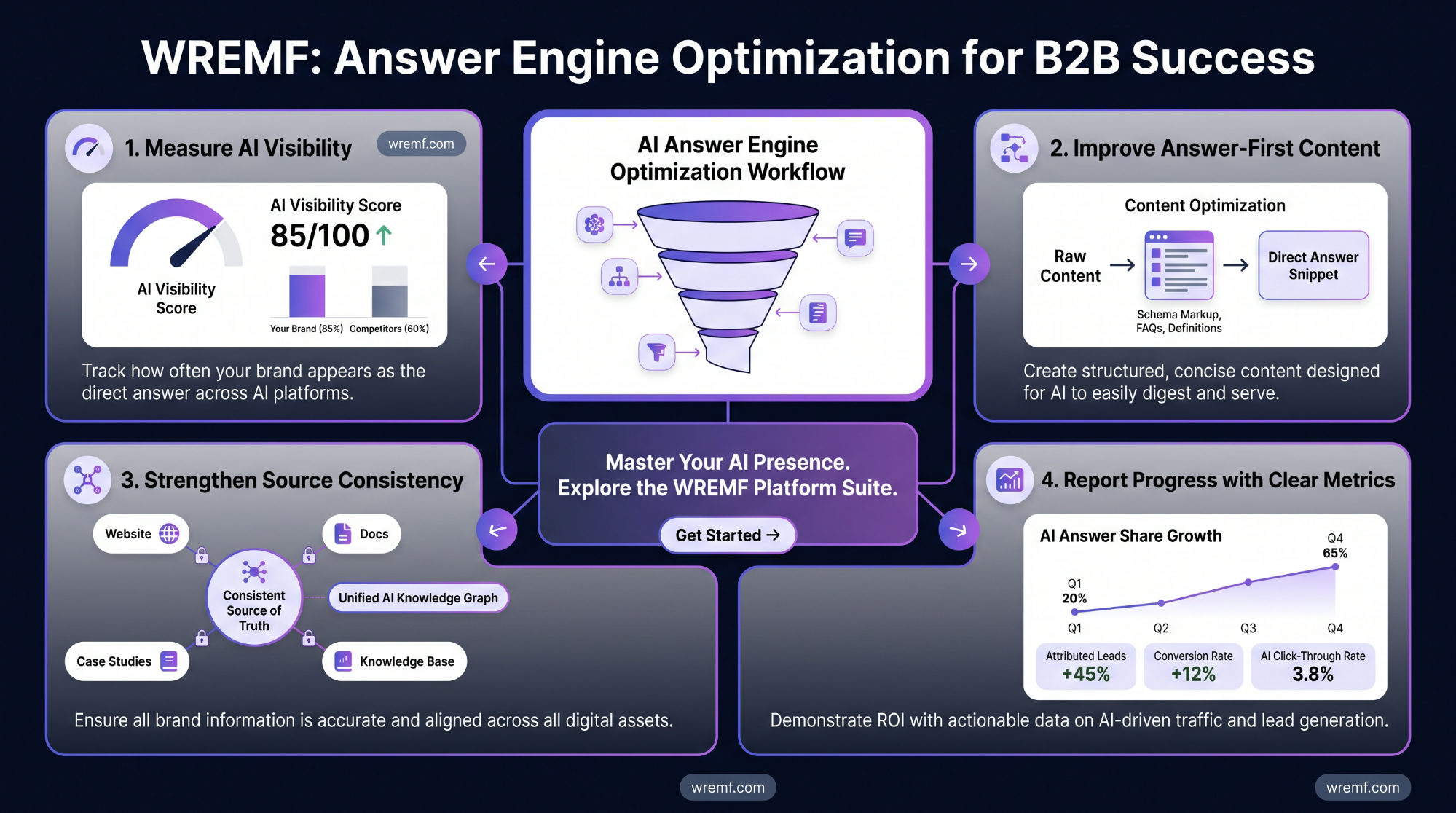
Best answer engine optimization tools help B2B teams measure how AI systems find, cite, describe, and recommend brands across modern discovery surfaces. Traditional SEO still matters, but rankings alone cannot explain AI answers, source citations, brand mentions, competitor visibility, referral traffic, or large language model perception. The practical path is to measure AI visibility, improve answer-first content, strengthen source consistency, and report progress with clear metrics. WREMF helps teams turn answer engine optimization into a repeatable software, agency, or hybrid workflow. To start tracking and improving AI visibility, explore the WREMF platform suite.
Related reading
- AI Search Engine Optimization Tools: The Complete 2026 Guide for AI Search, SEO, AEO, and GEO
- Best AI Search Visibility Platforms: Playbook for B2B Teams
- Best AI Visibility Tools: Playbook to AI Search Visibility Platforms
- Best AI Search Optimization Platforms: The Complete Guide to AI Visibility Tools, GEO, AEO, and Answer Engine Growth