Best AI Search Optimization Platforms: The Complete Guide to AI Visibility Tools, GEO, AEO, and Answer Engine Growth
Learn how AI search optimization platforms improve brand visibility in AI-generated answers and engines.
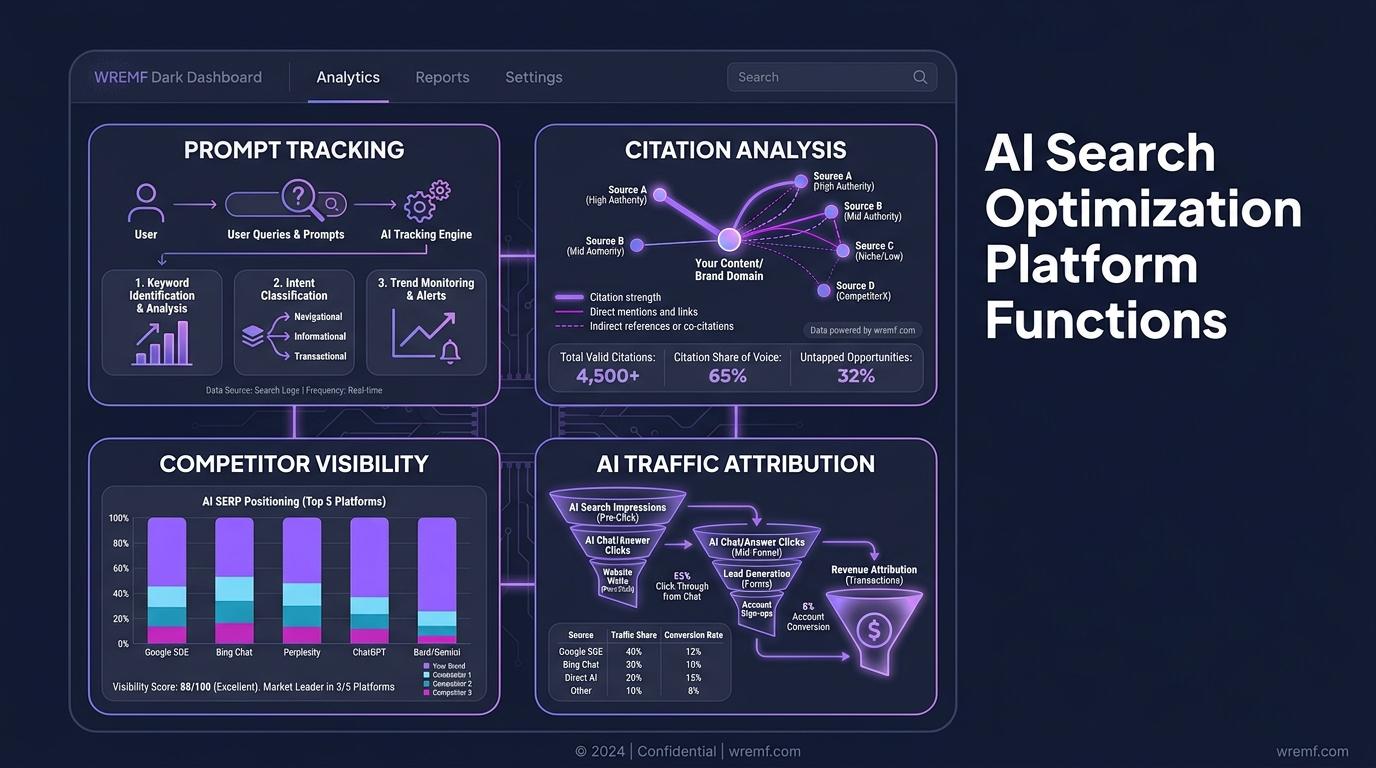
By WREMF Team · 2026-09-17
AI search optimization platforms are solutions that enhance a brand's visibility in AI-generated answers and search engines. Key components include tracking AI answers, prompt visibility, citations, and competitor analysis. They measure metrics like AI share of voice and traffic attribution. Traditional SEO tools don't capture the depth of AI interaction, leading to the necessity for specialized platforms in 2026. These platforms support strategies in SEO, AEO, GEO, and AI SEO, enabling brands to understand and improve their presence in evolving AI discovery environments.
Key takeaways
- AI visibility is crucial for brand presence in AI-generated content, including chatbots and answer engines.
- Platforms measure prompts, citations, recommendations, competitors, and AI traffic attribution.
- AI search platforms differ from traditional SEO tools by addressing AI-driven discovery metrics.
- Understanding and optimizing across SEO, AEO, GEO, and AI SEO workflows is vital.
- AI search optimization requires prompt tracking, citation analysis, and competitive visibility.
Best AI Search Optimization Platforms: The Complete Guide to AI Visibility Tools, GEO, AEO, and Answer Engine Growth
Best AI search optimization platforms 2026 are software, agency, or hybrid solutions that help brands measure and improve visibility inside AI answers. Google now documents AI Overviews and AI Mode as AI features in Search, while OpenAI, Perplexity, Anthropic, and Microsoft all describe web-connected AI systems that can use sources, citations, or current web information. This guide explains how AI search optimization platforms work, which features matter, how AI SEO differs from SEO tools, and how to compare platforms for B2B SaaS, agencies, consultants, and growth teams. You will learn how to track prompts, citations, competitors, source consistency, content optimization, AI traffic attribution, and Share of Model. WREMF helps teams track, improve, and prove AI visibility across major AI discovery surfaces.
What Are AI Search Optimization Platforms?
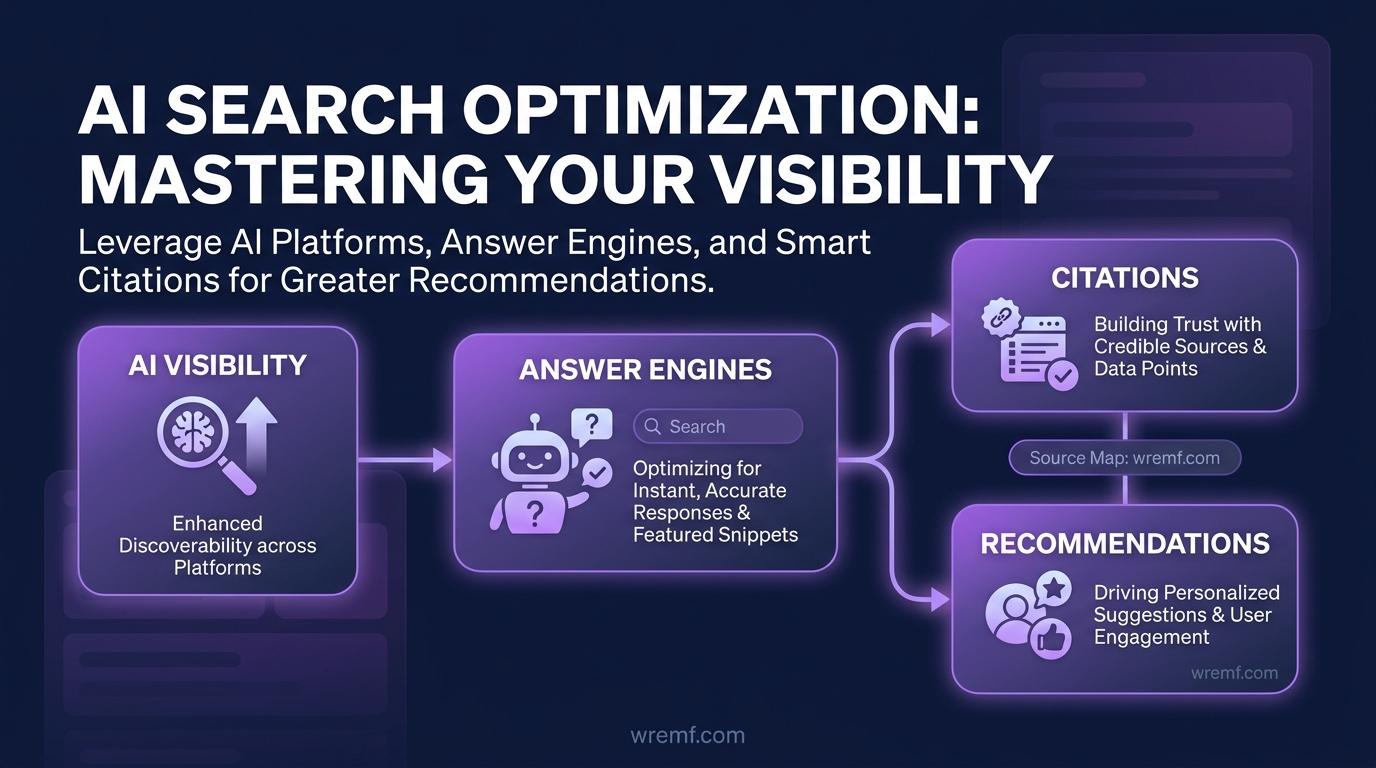
AI search optimization platforms help brands understand where they appear in AI search, answer engines, AI Overviews, LLM responses, citations, and recommendations. The best platforms turn AI visibility from manual testing into a measurable workflow for search, content, and growth teams.
AI search optimization is the process of improving how a brand, product, website, or expert source appears inside AI-generated answers. AI search optimization matters because buyers increasingly use AI chatbots, answer engines, and AI search engines to compare vendors, evaluate solutions, and summarize market options.
AI visibility is the measurable presence of a brand inside AI answers, recommendations, summaries, citations, and source-backed search experiences. AI visibility matters because a brand can rank in Google Search but still be absent from ChatGPT, Perplexity, Gemini, Claude, Copilot, or Google AI Overviews.
AI search optimization platforms usually measure six things:
Whether AI answers mention your brand
Whether AI answer engines recommend your brand
Which prompts trigger your brand or competitors
Which sources AI systems cite
How competitors appear across AI search engines
Whether AI visibility connects to traffic, content gaps, or pipeline
According to Google Search Central’s AI features documentation, AI Overviews and AI Mode are part of Google Search experiences that site owners should understand from an inclusion and content perspective. This matters because AI search optimization is not separate from search visibility, but it adds new layers of measurement around answers, citations, and source selection. (Google for Developers)
WREMF helps B2B teams track, improve, and prove AI visibility across ChatGPT, Claude, Gemini, Perplexity, Google AI Overviews, Copilot, DeepSeek, Grok, Meta AI, Mistral, and other AI discovery surfaces. Teams can use the WREMF platform suite to connect prompt intelligence, source citations, competitor visibility, GEO audits, SEO testing, and reporting in one workflow.
AI visibility is the measurable presence of a brand inside AI-generated answers, recommendations, citations, and summaries. AI visibility matters because B2B buyers increasingly use AI assistants to compare vendors before visiting websites, reviewing paid ads, or speaking to sales teams.
KEY TAKEAWAY: AI search optimization platforms measure AI answers, prompts, citations, recommendations, competitors, and source signals that traditional SEO tools do not fully capture.
The next step is understanding why these platforms matter more in 2026 than they did in earlier search environments.
Why AI Search Optimization Matters in 2026
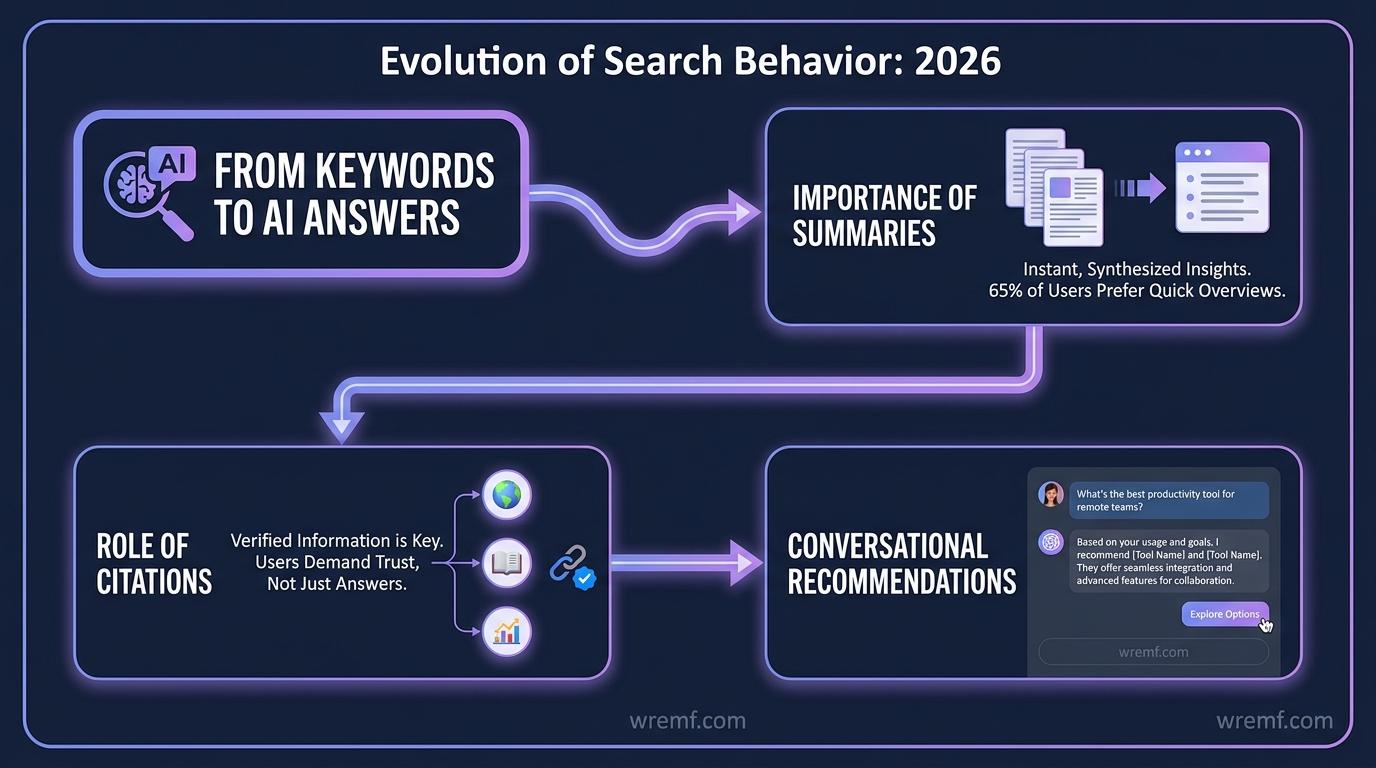
AI search optimization matters in 2026 because search behavior is moving from keyword lists and blue links toward generated answers, summaries, citations, and conversational recommendations. Brands now need to know whether AI systems can find, understand, cite, and recommend them.
The search engine landscape is no longer only about ranking pages. Google Search still matters, but AI Overviews, Google Search AI Mode, ChatGPT search, Perplexity, Google Gemini, Claude, Copilot, DeepSeek, Grok, Meta AI, Mistral, and DuckDuckGo AI Chat are changing how people discover information.
Answer engines are systems that generate direct responses to user questions instead of only listing web pages. Answer engines matter because users often ask full questions such as “what are the best AI search optimization platforms for SaaS?” or “which tool tracks AI visibility across ChatGPT and Perplexity?”
AI answer engines are answer engines powered by large language models, retrieval systems, or search-connected AI workflows. AI answer engines matter because they can summarize multiple sources, compare options, and present recommendations before a user clicks through to a website.
OpenAI says ChatGPT search can provide timely answers with links to relevant web sources, blending a natural language interface with web information. That source-backed search behavior makes citations, source authority, and answer representation important for AI SEO and Generative Engine Optimization. (OpenAI)
Perplexity explains that each answer includes numbered citations linking to original sources so users can verify information or explore further. This shows why AI citations and source citations are now core metrics for AI search optimization platforms. (Perplexity AI)
DID YOU KNOW: Semrush reported that AI Overviews appeared for 6.49% of tracked keywords in January 2025, rose to nearly 25% in July 2025, then shifted again later in 2025, which shows why AI Overviews monitoring needs ongoing tracking rather than one-time checks.
In practical AI visibility audits, teams often find that the brand is visible for branded prompts but absent from high-intent category prompts. That gap matters because unbranded prompts such as “best software for AI visibility tracking” or “top Generative Engine Optimization tools” often happen earlier in the buying journey.
KEY TAKEAWAY: AI search optimization matters because buyers now use AI search engines and answer engines to discover, compare, and shortlist brands before they reach your website.
Because AI search changes the discovery layer, teams need a clear distinction between SEO, AEO, GEO, and AI SEO.
SEO vs AEO vs GEO vs AI SEO
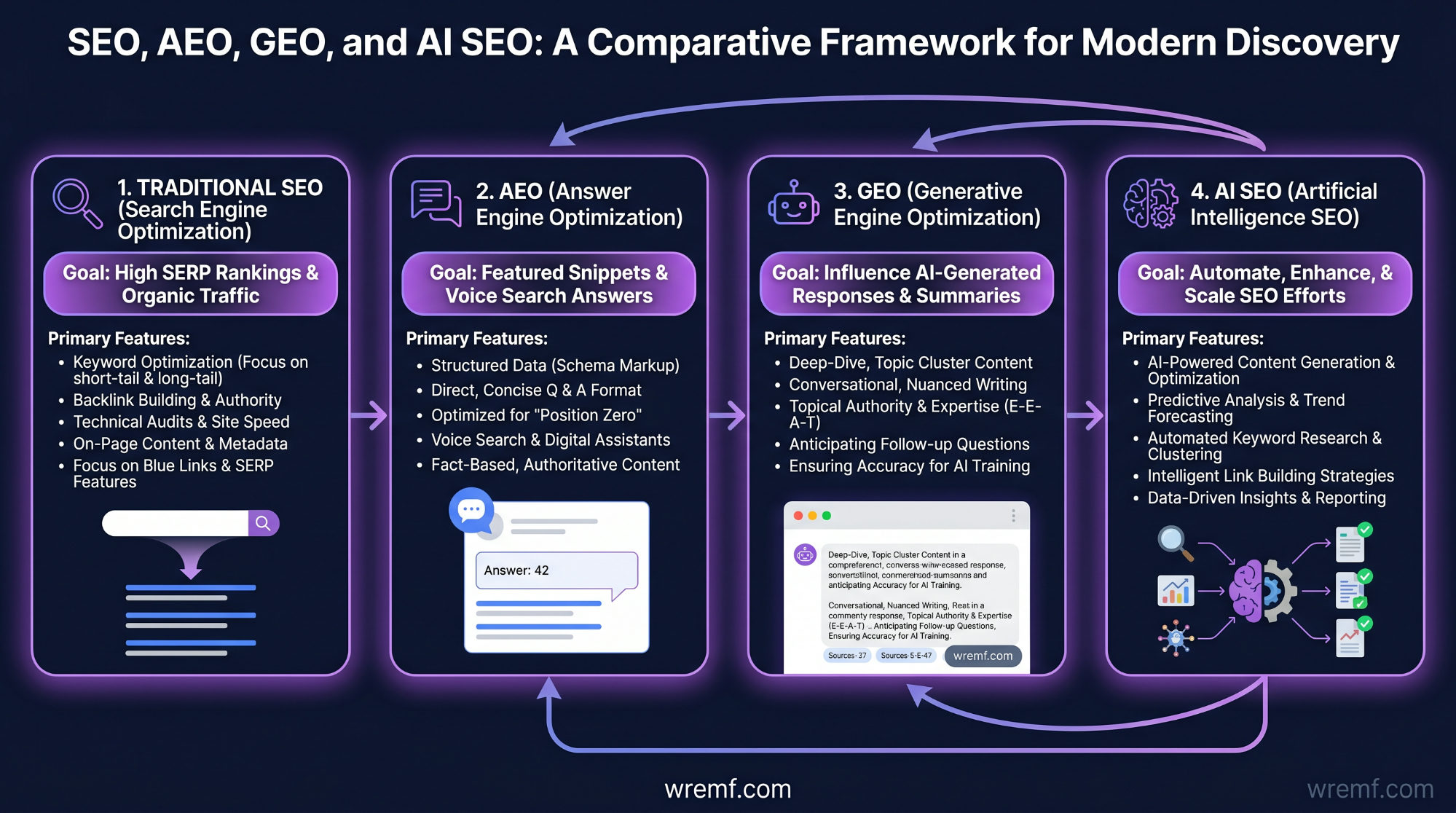
SEO improves visibility in search engine results, AEO improves extractable answers, GEO improves representation inside generative AI responses, and AI SEO connects these workflows across search, content, and AI answer systems. The best AI search strategy uses all four together.
Search engine optimization is the process of improving a website so search engines can crawl, understand, rank, and display its pages for relevant queries. SEO still matters because Google Search, Bing, technical audits, backlinks, keyword research, and search results remain core discovery channels.
Answer Engine Optimization is the practice of structuring content so search engines and answer engines can extract direct answers. AEO matters because featured snippets, AI Overviews, voice assistants, AI chatbots, and answer engines favor clear definitions, concise summaries, structured sections, and reliable source signals.
Generative Engine Optimization is the practice of improving how generative AI systems describe, cite, and recommend a brand. GEO matters because LLMs and AI answer engines synthesize information from prompts, retrieved sources, structured content, brand entities, and source ecosystems.
AI SEO is the broader operating model that combines SEO tools, content optimization, AI writing governance, answer-first content, AI search visibility, and AI traffic attribution. AI SEO matters because teams need to optimize for both classic search engines and AI discovery surfaces.
| Discipline | Primary Goal | What It Optimizes | Example Metric | Main Limitation |
|---|---|---|---|---|
| SEO | Rank in search results | Keywords, pages, backlinks, technical SEO, internal linking | Ranking position, clicks, impressions | Does not fully show AI answer visibility |
| AEO | Win direct answers | Definitions, FAQs, snippets, structured answers | Featured snippet or answer inclusion | Can miss broader LLM visibility |
| GEO | Improve generative AI representation | Entity clarity, citations, source consistency, prompt coverage | AI citations, mentions, recommendations | Requires prompt and source tracking |
| AI SEO | Connect search and AI workflows | AI search, SEO tools, content optimization, attribution | AI visibility score plus organic performance | Needs cross-functional execution |
The key difference between SEO and GEO is the output being optimized. SEO targets search engine results pages, while GEO targets AI answers, citations, summaries, and recommendations generated by large language models and answer engines.
Schema markup is structured data added to a page to help search engines understand entities, content types, and page relationships. Schema markup matters for SEO and AI readiness because structured information can support clarity, although schema alone does not guarantee AI citations.
Structured Data is machine-readable information that helps systems understand content meaning and relationships. Structured Data matters because clear entity signals can support search engines, answer engines, and AI systems when they interpret a page.
IMPORTANT: GEO does not replace SEO. GEO extends SEO by adding prompt tracking, AI citations, source consistency, AI answer monitoring, and competitive visibility across answer engines.
KEY TAKEAWAY: SEO, AEO, GEO, and AI SEO are related but distinct workflows, and the best AI search optimization platforms connect them instead of treating them as separate silos.
Once the definitions are clear, the next question is what a platform must actually measure.
What the Best AI Search Optimization Platforms Should Measure
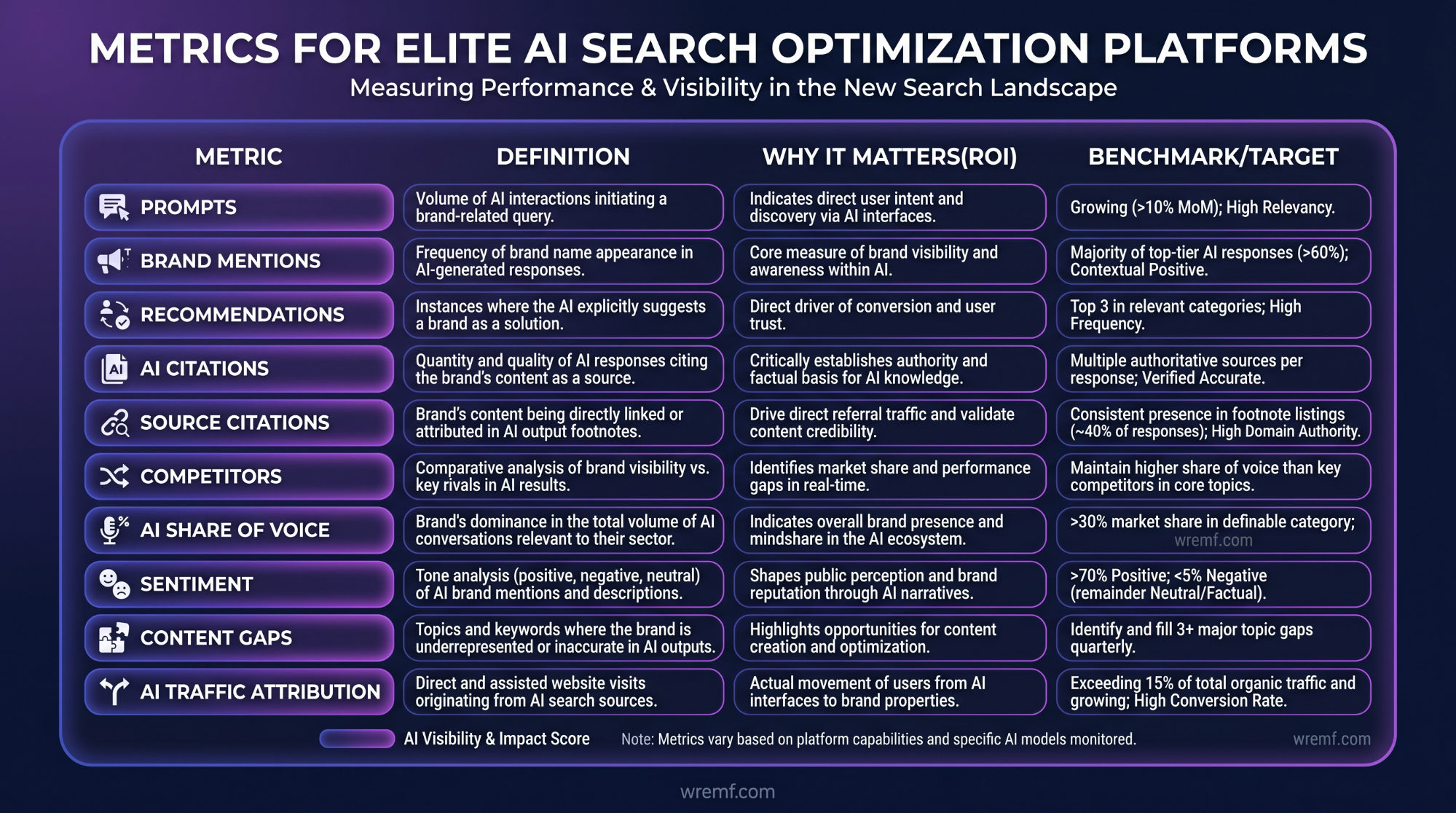
The best AI search optimization platforms should measure prompts, brand mentions, recommendations, AI citations, source citations, competitors, AI share of voice, sentiment, content gaps, and AI traffic attribution. These metrics reveal whether AI systems can find, understand, trust, and recommend your brand.
Prompt tracking shows how AI systems respond to the questions buyers actually ask. Prompt tracking matters because users do not only type short keywords into AI chatbots. They ask detailed questions such as “what are the best AI visibility tools for B2B SaaS?” or “how do I monitor AI search visibility across ChatGPT and Perplexity?”
Brand mentions are instances where AI answers name your brand. Brand mentions matter because they show recognition, but they are weaker than citations or recommendations.
AI citations are source references used or displayed by AI systems when answering a question. AI citations matter because cited sources can influence trust, user verification, and how answer engines explain your category.
Source citations are the owned pages, third-party articles, directories, reports, documentation, reviews, or profiles that AI systems cite or use to support an answer. Source citations matter because brands often need to improve the wider source ecosystem, not only their own website.
AI share of voice is the percentage of relevant AI answers where your brand appears compared with competitors. AI share of voice matters because AI visibility is often competitive, especially for buying-stage prompts.
AI traffic attribution connects AI discovery surfaces to website sessions, conversions, or pipeline signals. AI traffic attribution matters because marketing leaders need to understand whether AI visibility influences measurable demand.
| Metric | What It Measures | Why It Matters | Example Question |
|---|---|---|---|
| Prompt Visibility | Whether your brand appears for target prompts | Shows discovery across user questions | Does ChatGPT mention us for category prompts? |
| Brand Mentions | Whether AI answers name your brand | Shows awareness inside AI answers | Are we included in vendor lists? |
| AI Recommendations | Whether AI systems suggest your brand | Shows stronger buying-stage visibility | Are we recommended for a use case? |
| AI Citations | Whether AI systems cite your content or sources | Shows source authority and verification value | Which pages are cited? |
| Source Citation Coverage | Which domains influence answers | Shows source ecosystem strength | Are competitors cited by better sources? |
| Competitor Visibility | Which competitors appear more often | Shows market position in AI answers | Who wins comparison prompts? |
| AI Share of Voice | Your visibility versus competitors | Shows relative answer presence | What share of model do we own? |
| Sentiment and Accuracy | How AI systems describe your brand | Shows positioning risk | Are answers accurate or outdated? |
| AI Traffic Attribution | Sessions from AI discovery surfaces | Shows business impact | Are AI referrals growing? |
Share of Model is the percentage of AI responses in a defined prompt set where a brand appears, is cited, or is recommended compared with competitors. Share of Model matters because it gives teams a practical visibility metric for AI answer engines.
In real-world reporting, rankings alone are not enough. A page may rank in Google Search, but if AI answer engines cite competitors, omit your brand, or describe your positioning incorrectly, the brand still has an AI visibility problem.
KEY TAKEAWAY: AI visibility measurement should combine prompt-level tracking, citations, recommendations, competitor comparisons, answer quality, and traffic attribution.
These measurements become more useful when grouped into clear platform categories.
Top Categories of AI Search Optimization Platforms in 2026
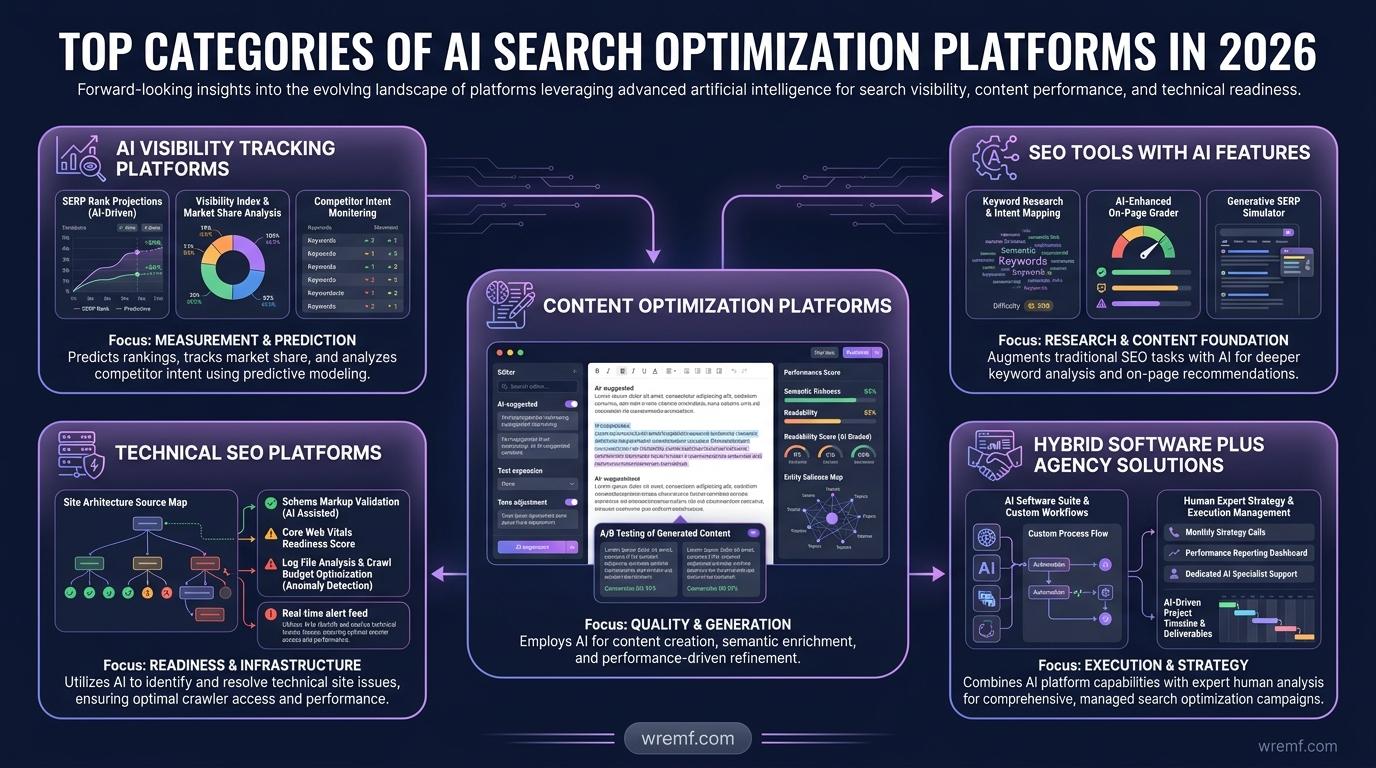
AI search optimization platforms fall into five main categories: AI visibility tracking platforms, SEO tools with AI features, content optimization platforms, technical SEO platforms, and hybrid software plus agency solutions. The right category depends on whether your priority is measurement, content, technical readiness, reporting, or execution.
AI visibility tracking platforms are purpose-built to monitor brand visibility across AI answer engines. These platforms are best for prompt tracking, AI citations, source citations, competitor visibility, Share of Model, brand visibility, and AI answer reporting.
SEO tools with AI features are traditional SEO software platforms that add AI workflows. Semrush, Ahrefs, SE Ranking, and similar SEO software often support keyword research, competitor analysis, backlink analysis, technical audits, site audit workflows, position tracking, search volume estimates, and content optimization. These tools remain useful, but not all of them fully track AI answers across LLMs.
Content optimization platforms help teams build content briefs, content workflows, topic clusters, Content Editor workflows, Content Manager processes, and AI writing systems. Surfer SEO, Clearscope, MarketMuse, Frase, Jasper, and similar AI tools can help with content creation and semantic coverage, but teams still need AI visibility tracking to know whether answer engines cite or recommend the brand.
Technical SEO platforms help teams improve crawlability, internal linking, Schema markup, site audit issues, LLM explorers, structured content, rendering, and indexing. Technical readiness is important because AI systems and search engines need accessible, understandable content.
Hybrid software plus agency solutions combine AI visibility software with managed execution. This model is useful when teams need both measurement and action, including GEO principles, AEO strategy, content optimization, source consistency cleanup, citation improvement, and monthly reporting.
| Platform Category | Best For | What It Measures | What It Misses | Recommended When |
|---|---|---|---|---|
| AI Visibility Tracking Platforms | AI search visibility and Share of Model | Prompts, mentions, AI answers, citations, competitors | May need SEO integrations for classic search depth | You need AI answer visibility reporting |
| SEO Tools With AI Features | Search engine optimization and keyword research | Rankings, keywords, backlinks, technical audits, search results | May not fully track LLM visibility | Google Search is still the main workflow |
| Content Optimization Platforms | Content creation and content workflows | Topic coverage, Content Briefs, terms, content scores | May not prove AI citations or recommendations | Content production is the main bottleneck |
| Technical SEO Platforms | Crawlability and site health | Site audit issues, internal linking, structured data, indexing | May not track AI answer visibility | Technical readiness needs improvement |
| Hybrid Software Plus Agency | Measurement plus execution | AI visibility, sources, competitors, content gaps, attribution | Requires clear ownership and priorities | You need tracking and managed improvement |
For most B2B SaaS teams, the strongest setup is a hybrid AI visibility stack that connects search data, AI answer tracking, source analysis, and content execution. WREMF supports this through software, managed services, or a combined model.
Teams can use WREMF AI visibility tracking to monitor visibility scores, then connect findings to prompt intelligence, citation tracking, competitive analysis, GEO audits, and content briefs.
KEY TAKEAWAY: The best platform category depends on whether your team needs AI visibility measurement, SEO data, content optimization, technical audits, or managed execution.
After choosing the category, you need a feature checklist that separates complete platforms from partial tools.
Features to Look For in the Best AI Search Optimization Platforms 2026
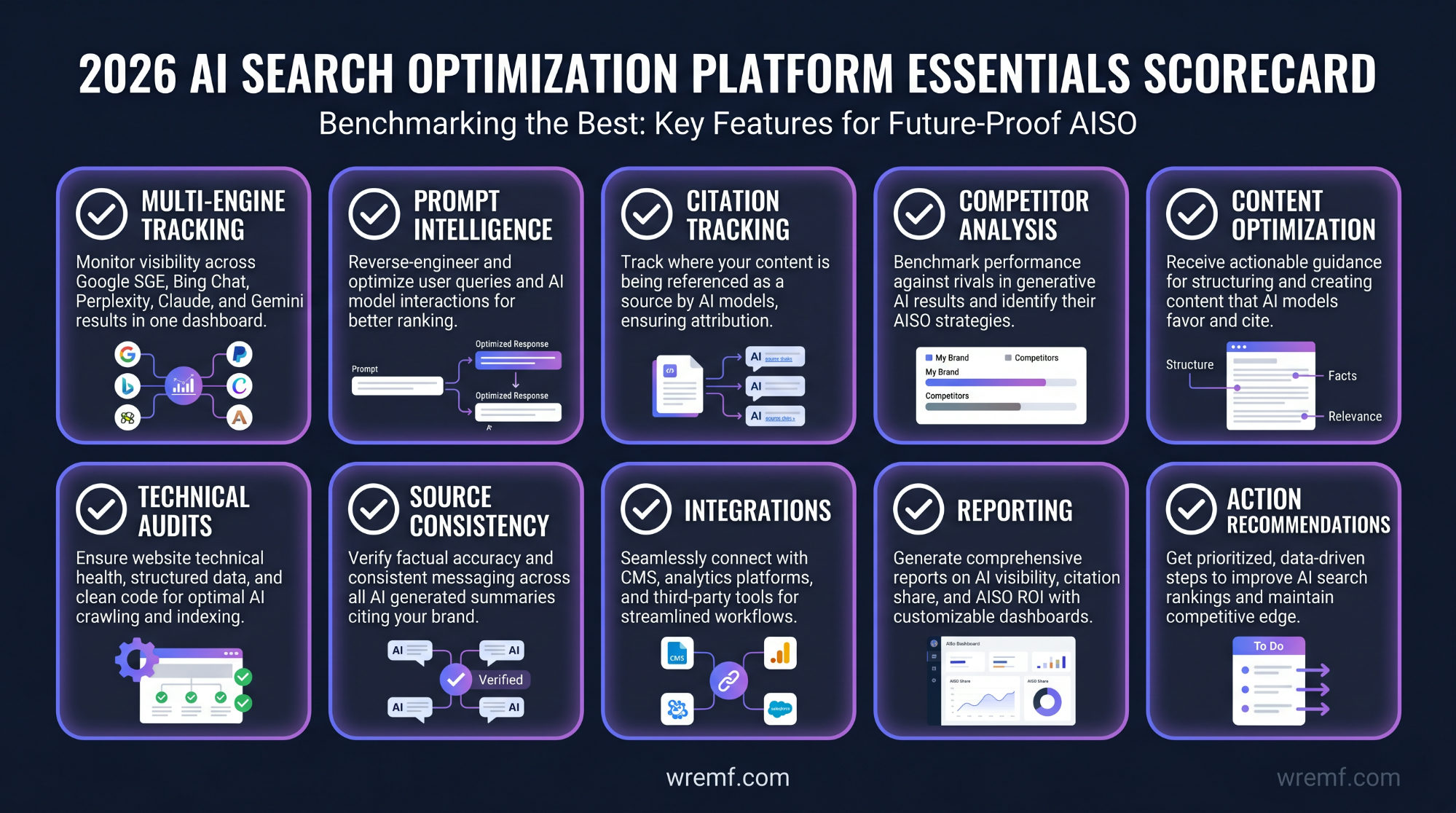
The best AI search optimization platforms in 2026 should include multi-engine tracking, prompt intelligence, citation tracking, competitor analysis, content optimization, technical audits, source consistency, integrations, reporting, and action recommendations. A platform should show what changed, why it changed, and what to do next.
Multi-engine tracking matters because AI search is fragmented. A platform that tracks only one AI chatbot cannot show visibility across ChatGPT, Claude, Gemini, Perplexity, AI Overviews, Copilot, DeepSeek, Grok, Meta AI, Mistral, Google Gemini, AI Mode, DuckDuckGo AI Chat, and other AI discovery surfaces.
Prompt intelligence matters because prompt quality determines measurement quality. A useful AI Visibility Toolkit should include branded prompts, non-branded prompts, competitor prompts, category prompts, comparison prompts, pricing prompts, implementation prompts, and problem-aware prompts.
Citation tracking matters because source visibility often drives AI answers. If Perplexity, ChatGPT search, Google AI Overviews, or Claude web search relies on sources that mention competitors but not your brand, your content and source ecosystem need work.
Anthropic explains that Claude’s web search tool gives Claude access to real-time web content and can include citations for sources drawn from search results. That makes source tracking and citation authority important for AI search visibility, especially in technical, B2B, and research-heavy categories. (Claude Platform)
The feature checklist should include:
AI search tracking across 10 or more engines where possible
Prompt tracking for branded, non-branded, competitor, and commercial prompts
AI Overviews and Google Search AI Mode visibility monitoring
AI citations and source citation tracking
Competitor visibility across prompts and answer engines
Share of Model and brand visibility scoring
Content Briefs and AI-ready content recommendations
Keyword clustering and intent mapping
Technical audits for crawlability, internal linking, Schema markup, and structured content
Source consistency analysis across owned and third-party sources
AI traffic attribution from analytics and referral data
White-label reporting for agencies
API, MCP, and BYOK support
Client portals for agencies and consultants
Workflow recommendations that prioritize action
WREMF combines prompt intelligence, source citation tracking, competitive landscape monitoring, GEO audits, content briefs, SEO testing, reporting, BYOK, and API support. You can review WREMF prompt intelligence and WREMF source citation tracking to see how prompt and citation data work together.
KEY TAKEAWAY: A complete AI search optimization platform must measure AI visibility and help teams act on prompt, citation, competitor, content, and technical gaps.
The next step is learning how to compare platforms without relying on vague feature claims.
How to Compare AI Search Optimization Tools
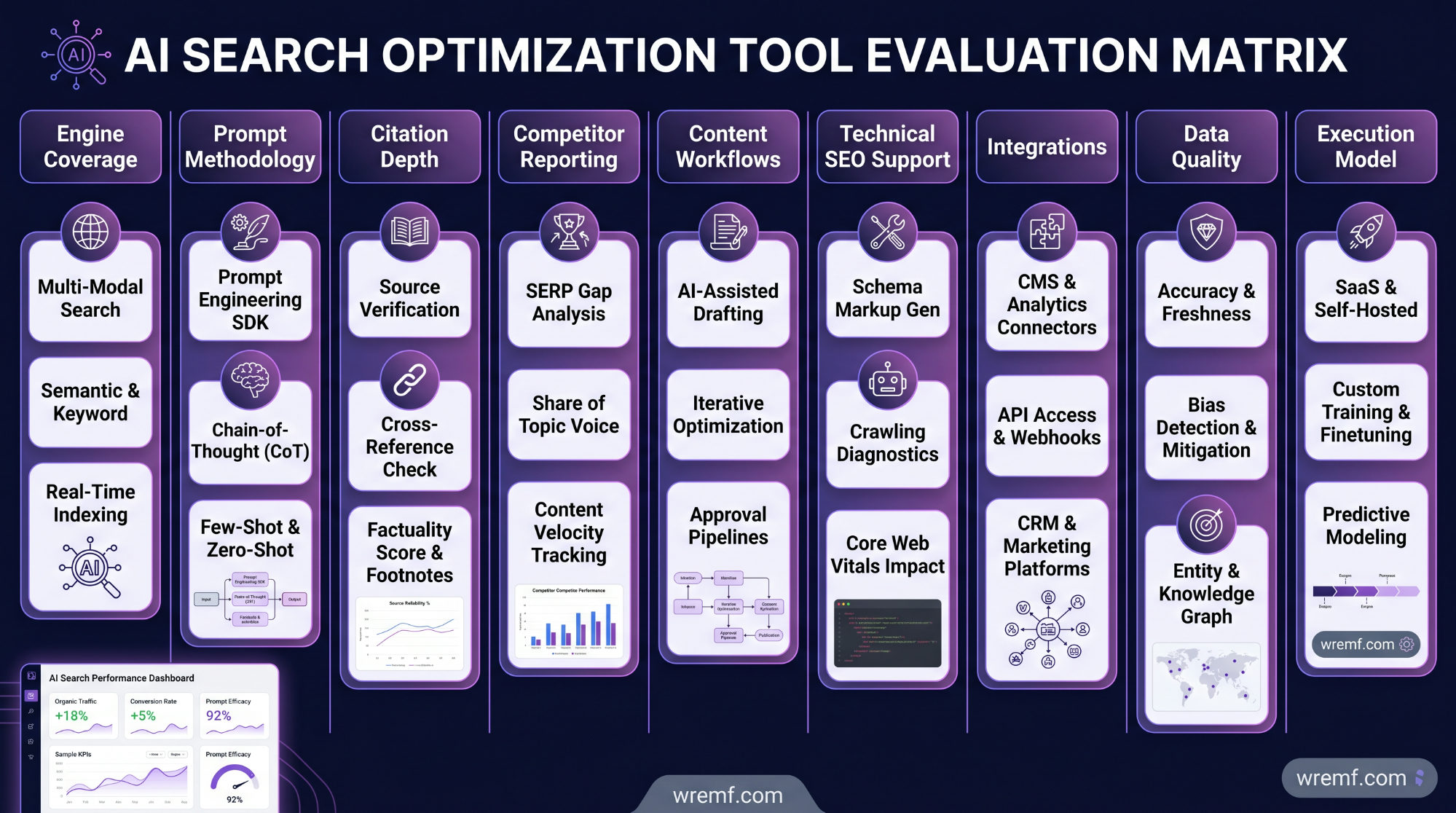
Compare AI search optimization tools by engine coverage, prompt methodology, citation depth, competitor reporting, content workflows, technical SEO support, integrations, data quality, and execution model. A strong comparison should focus on decision value, not only feature volume.
Engine coverage should be the first filter. If your buyers use ChatGPT, Perplexity, Gemini, Claude, Copilot, and Google AI Overviews, then your AI SEO tool should monitor more than one search engine or AI chatbot.
Prompt methodology should be the second filter. A platform that tracks random prompts will produce weak insights. A strong platform maps prompts to search intent, buyer stage, content cluster, competitor set, and business outcome.
Citation depth should be the third filter. The platform should show which pages, domains, reports, directories, blogs, reviews, documentation pages, or third-party publications appear as source citations. This is where AI search optimization becomes a source ecosystem problem, not just a content problem.
Content workflow support should be the fourth filter. AI visibility findings need to become content briefs, page updates, internal linking improvements, structured answers, and source consistency actions.
| Evaluation Factor | Strong Platform | Weak Platform | Why It Matters |
|---|---|---|---|
| Engine Coverage | Tracks many AI search engines and answer engines | Tracks one chatbot or manual checks only | Buyers use multiple AI discovery surfaces |
| Prompt Methodology | Uses branded, category, comparison, and buying prompts | Uses generic or random prompts | Better prompts create better measurement |
| Citation Tracking | Shows source citations and source gaps | Only shows brand mentions | Sources shape AI answers |
| Competitor Analysis | Tracks competitors by prompt, topic, and engine | Only tracks your brand | AI visibility is comparative |
| Content Optimization | Turns findings into Content Briefs and page actions | Provides dashboards only | Teams need execution |
| Technical Audits | Checks crawlability, rendering, internal linking, structured content | Ignores technical readiness | AI systems need accessible information |
| Reporting | Offers trend reports, scorecards, exports, and client-ready views | Provides screenshots or isolated outputs | Leadership needs proof |
| Integrations | Supports API, MCP, BYOK, analytics, and workflows | Keeps data siloed | AI visibility should connect to operations |
| Execution Support | Offers software, agency, or hybrid support | Leaves all work to the user | Many teams need help acting on findings |
A common implementation mistake is comparing an AI writing tool with an AI visibility platform as if both solve the same job. AI writing tools can support content creation, but AI visibility platforms show whether AI answer engines actually mention, cite, or recommend the brand.
If you want to compare AI visibility reporting outputs before selecting a platform, review a sample AI visibility report and use it as a benchmark for your own evaluation.
KEY TAKEAWAY: The best AI search optimization tool comparison focuses on engine coverage, prompt design, citations, competitors, action recommendations, integrations, and reporting quality.
A useful comparison also needs to include how these tools affect content strategy.
Content Optimization for AI Search Engines
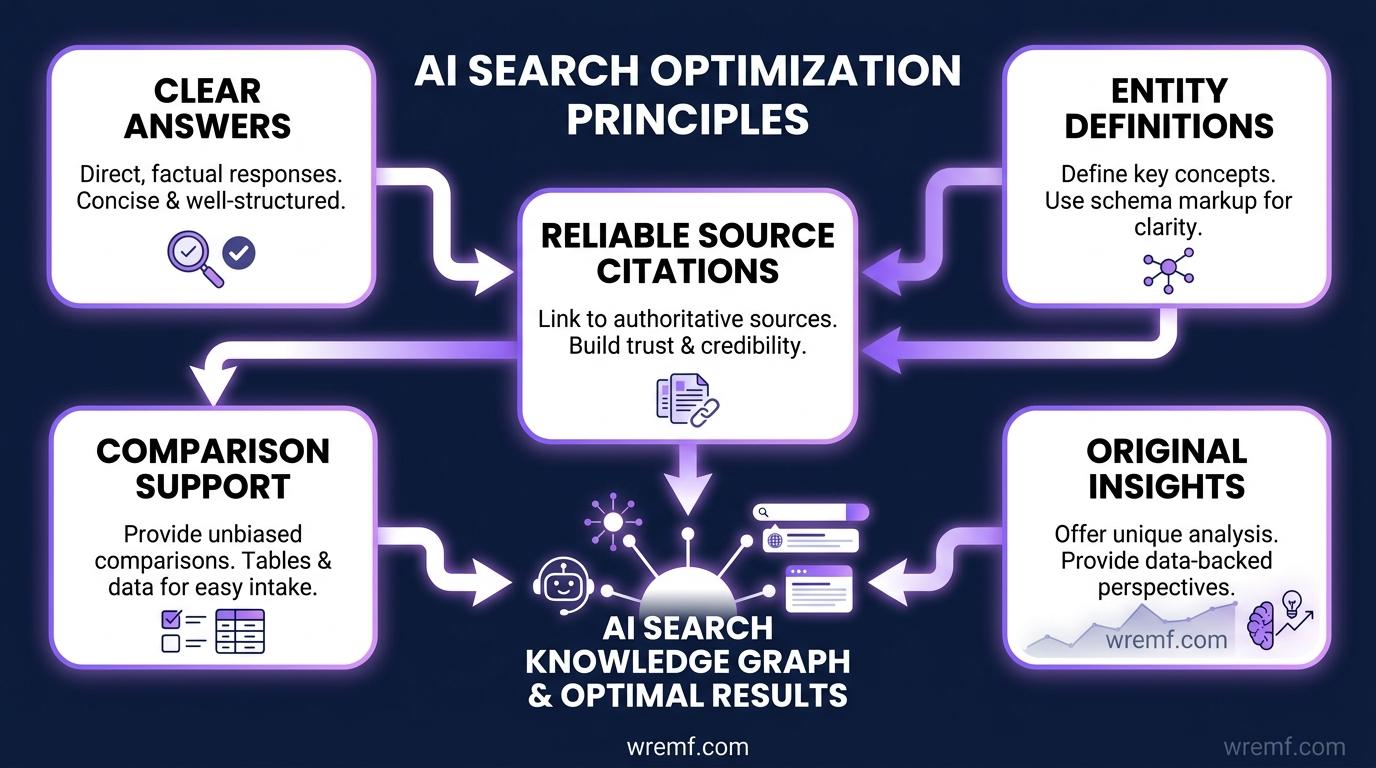
Content optimization for AI search engines means creating pages that answer real prompts clearly, define entities, cite reliable sources, support comparison decisions, and provide original insight. The goal is not more AI content, but better extractable and trustworthy content.
Content optimization is the process of improving content so users, search engines, and AI systems can understand and use it. Content optimization matters because AI search engines need clear answers, relevant context, source-backed claims, and structured information.
AI content is content created or assisted by artificial intelligence. AI content matters when it improves efficiency, but it becomes risky when it creates generic, unsupported, repetitive, or low-value pages.
AI writing is the use of AI tools to draft, rewrite, summarize, or structure content. AI writing matters because it can speed up content workflows, but human editing and original expertise are still needed for trust, accuracy, and differentiation.
Google’s helpful, reliable, people-first content guidance states that Google’s automated ranking systems are designed to prioritize helpful and reliable information created to benefit people, not content made primarily to manipulate search rankings. This guidance applies directly to AI search readiness because answer engines also need clear, useful, trustworthy information. (Google for Developers)
The strongest AI search content workflows include:
Answer-first introductions
Definitions under 60 words for major concepts
Clear H2 sections that match real prompts
FAQ answers that are self-contained
Comparison tables for decision-stage queries
Original insights, examples, data, and practical experience
Internal linking that connects content clusters
Schema markup guidance where relevant
Source citations near factual claims
Content briefs that map prompts to page sections
Content Briefs are structured instructions that guide writers on topics, entities, prompts, questions, internal links, external sources, and page goals. Content Briefs matter because they help teams create AI-ready content without drifting into generic AI Slop.
AI Slop is low-value AI-generated content that is repetitive, vague, unsupported, or written mainly for volume. AI Slop hurts brand visibility because it gives AI answer engines fewer reasons to cite, trust, or recommend your pages.
Entity Authority is the strength and clarity of a brand, product, person, or topic as understood across reliable sources. Entity Authority matters because AI systems need consistent facts to connect your brand with the right category, audience, features, and use cases.
WREMF helps teams turn AI visibility gaps into AI-ready content workflows through AI-ready content briefs. This is useful when prompt tracking shows that buyers ask questions your website does not yet answer well.
KEY TAKEAWAY: AI search content optimization works when content is clear, structured, source-backed, experience-led, and mapped to real AI prompts.
Content quality depends not only on page copy, but also on technical foundations.
Technical SEO, Structured Data, and LLM Explorer Readiness
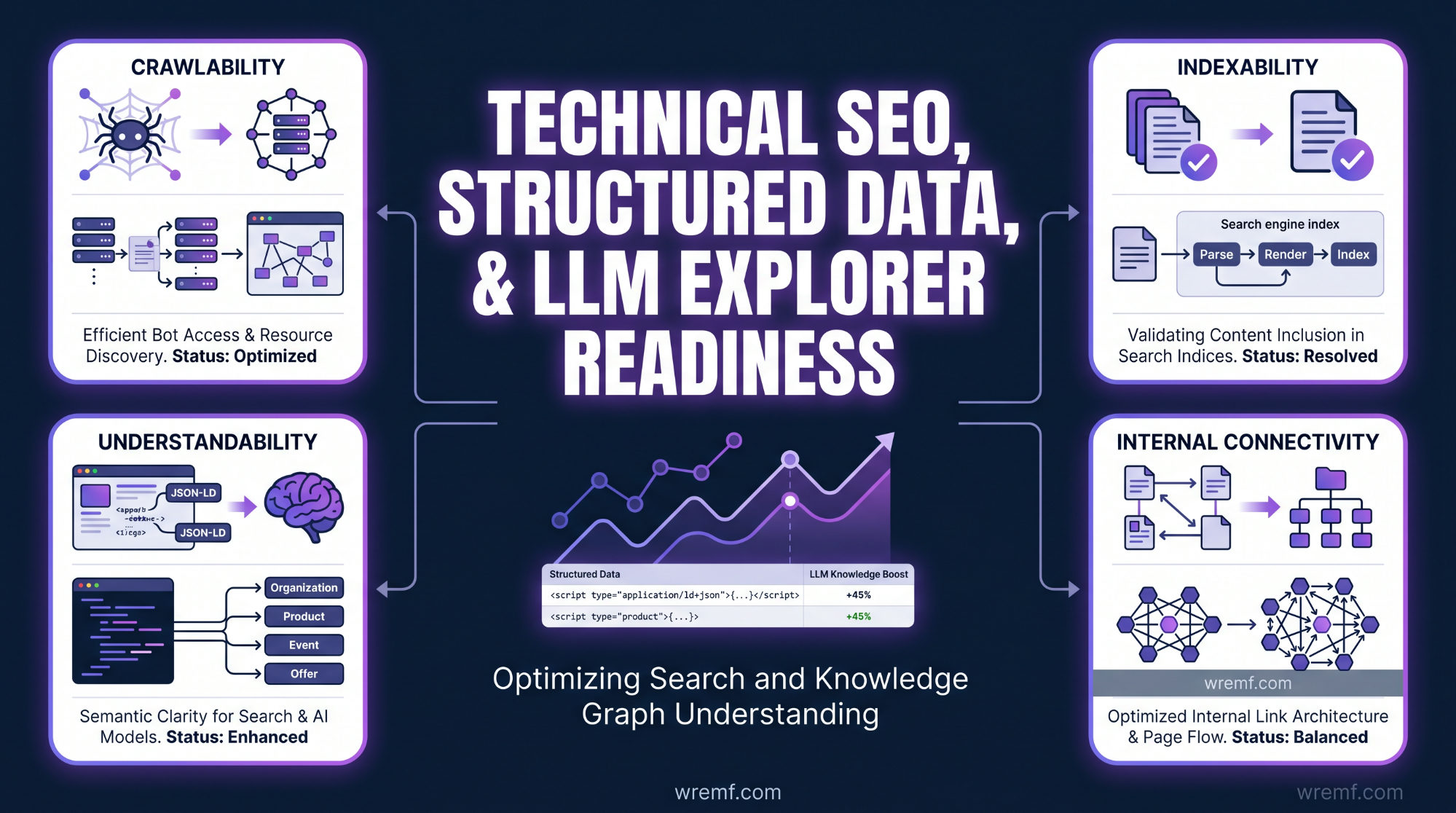
Technical SEO supports AI search visibility by making content crawlable, indexable, understandable, and internally connected. AI search optimization platforms should include technical audits because AI systems and search engines cannot use content they cannot access or interpret.
Technical audits identify issues that affect crawlability, rendering, indexing, structured data, internal linking, page performance, and content accessibility. Technical audits matter because weak foundations can prevent useful content from being discovered by search engines, AI agents, LLM explorers, and answer engines.
LLM explorers are crawlers, retrieval systems, or web access tools that help AI systems discover and process public web content. LLM explorers matter because AI search visibility can depend on whether your content is accessible, structured, and easy to interpret.
Agentic Search is a search experience where AI agents can interpret tasks, gather information, compare options, and help users take action. Agentic Search matters because future discovery may depend on whether your content is structured enough for AI agents to understand products, pricing, documentation, and next steps.
Technical AI search readiness should include:
Crawlable pages that are not blocked unintentionally
Clean internal linking across content clusters
Descriptive headings and answer-first sections
Structured Data where it accurately represents the page
Fast, accessible pages that render important content
Clear canonical pages for important topics
Consistent brand, product, and category descriptions
Updated metadata and meta descriptions
FAQ sections for high-intent questions
Clear pricing, product, comparison, and methodology pages
Robots and crawler policies reviewed against AI visibility goals
Internal linking is the practice of connecting related pages on your own website. Internal linking matters for AI search because it helps search engines, LLM explorers, and users understand topic clusters, entity relationships, and page importance.
Content clusters are groups of related pages that cover a topic from multiple angles. Content clusters matter because AI answer engines often need complete topical context before treating a brand as a credible source.
Schema markup should not be treated as a magic AI visibility switch. Schema markup helps communicate structure, but the underlying content still needs clear answers, reliable evidence, and useful detail.
TIP: Use technical audits to confirm that your best AI-ready content is crawlable, internally linked, and aligned with the entities you want AI answer engines to understand.
KEY TAKEAWAY: Technical SEO and structured content make AI visibility work possible by helping search engines, answer engines, and LLM explorers access and interpret your pages.
Once your content and technical base are sound, the next challenge is winning citations.
How to Win AI Citations and Source Visibility
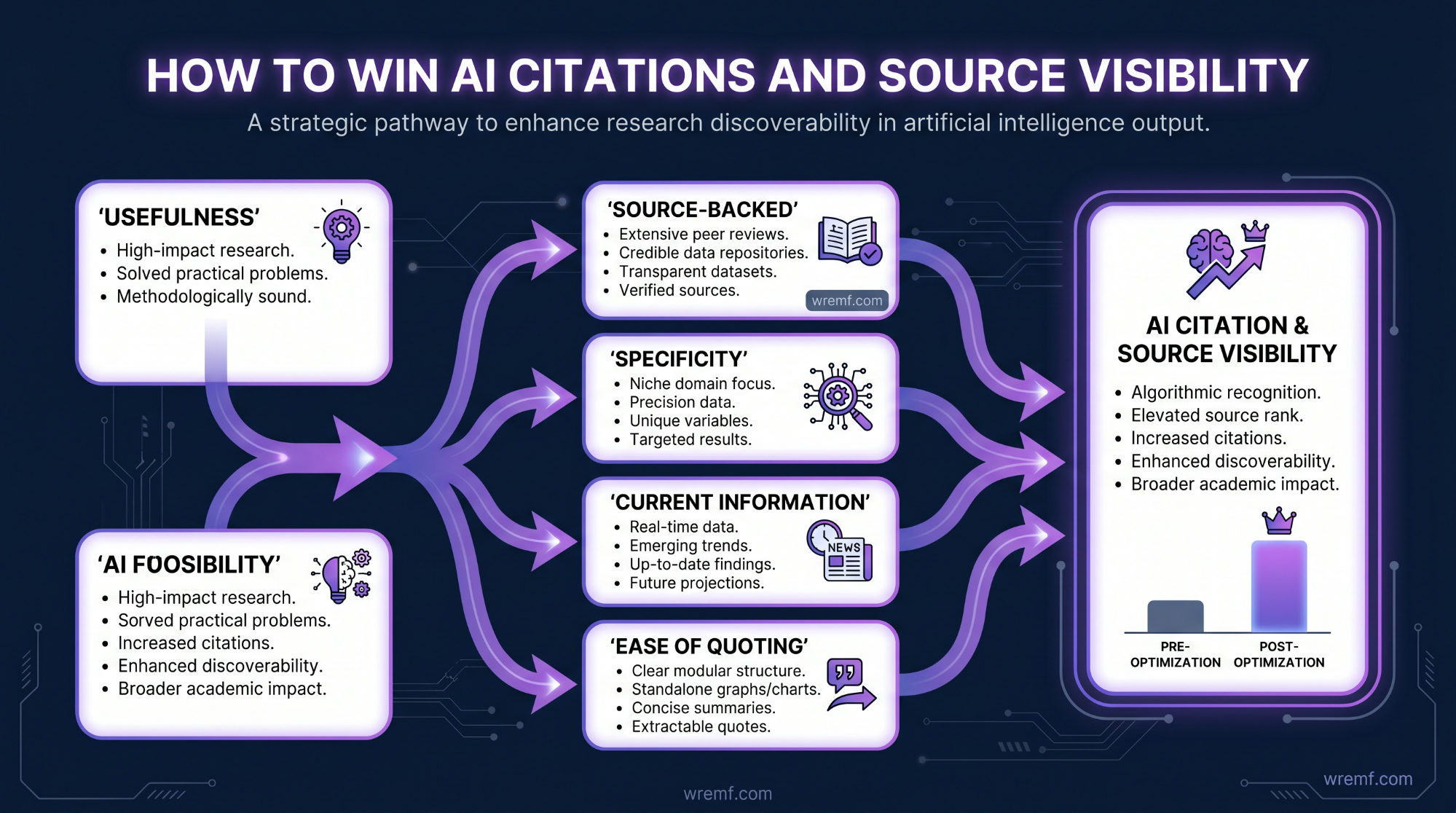
AI citations are more likely when content is useful, source-backed, specific, current, and easy to quote. The most effective way to improve AI citations is to become a clearer and more reliable source of truth for your category.
Citation Authority is the perceived reliability and usefulness of a source for AI-generated answers. Citation Authority matters because AI systems often prefer sources that are clear, current, specific, and supported by evidence.
Source of truth content is content that provides definitive explanations, accurate facts, clear methodology, and decision-useful information about a topic. Source of truth content matters because AI answer engines need reliable inputs when summarizing categories or comparing options.
Perplexity’s help center explains that answers include numbered citations linking to original sources, allowing users to verify information or explore further. This creates a practical incentive for brands to make pages easier to cite and verify. (Perplexity AI)
To improve citation probability, create pages that include:
Direct definitions for major terms
Clear answer-first sections
Comparison tables for decision queries
Original data or first-hand observations where available
Specific product, pricing, methodology, and feature details
Named sources close to factual claims
Fresh updates for fast-changing topics
Consistent entity descriptions across pages
Clear authorship, editorial standards, and experience signals
Internal links to related topic clusters
Authentic user-generated content can also support source ecosystems when it adds real experience, reviews, questions, and practical language. Authentic user-generated content matters because AI search often values human perspective for evaluation-heavy topics, especially where users want comparisons, tradeoffs, or experience-based answers.
Verified Human Experience is evidence that content reflects real testing, real expertise, practical implementation, or first-hand knowledge. Verified Human Experience matters because generic AI summaries are easier to replace than original insight.
Model Collapse is the risk that repeated synthetic content reduces the diversity and usefulness of information ecosystems. Model Collapse matters for SEO and AI search because original insights, unique data, expert review, and real examples become stronger differentiators.
WREMF helps teams identify which sources AI engines cite, where competitors win citations, and which owned or third-party pages need improvement. The WREMF competitive landscape tool helps teams compare competitor footprints across AI answers.
KEY TAKEAWAY: AI citations depend on source quality, clarity, evidence, freshness, entity consistency, and the broader source ecosystem around your brand.
Citation work becomes more powerful when connected to competitive visibility.
Competitor Analysis and Brand Visibility in AI Search
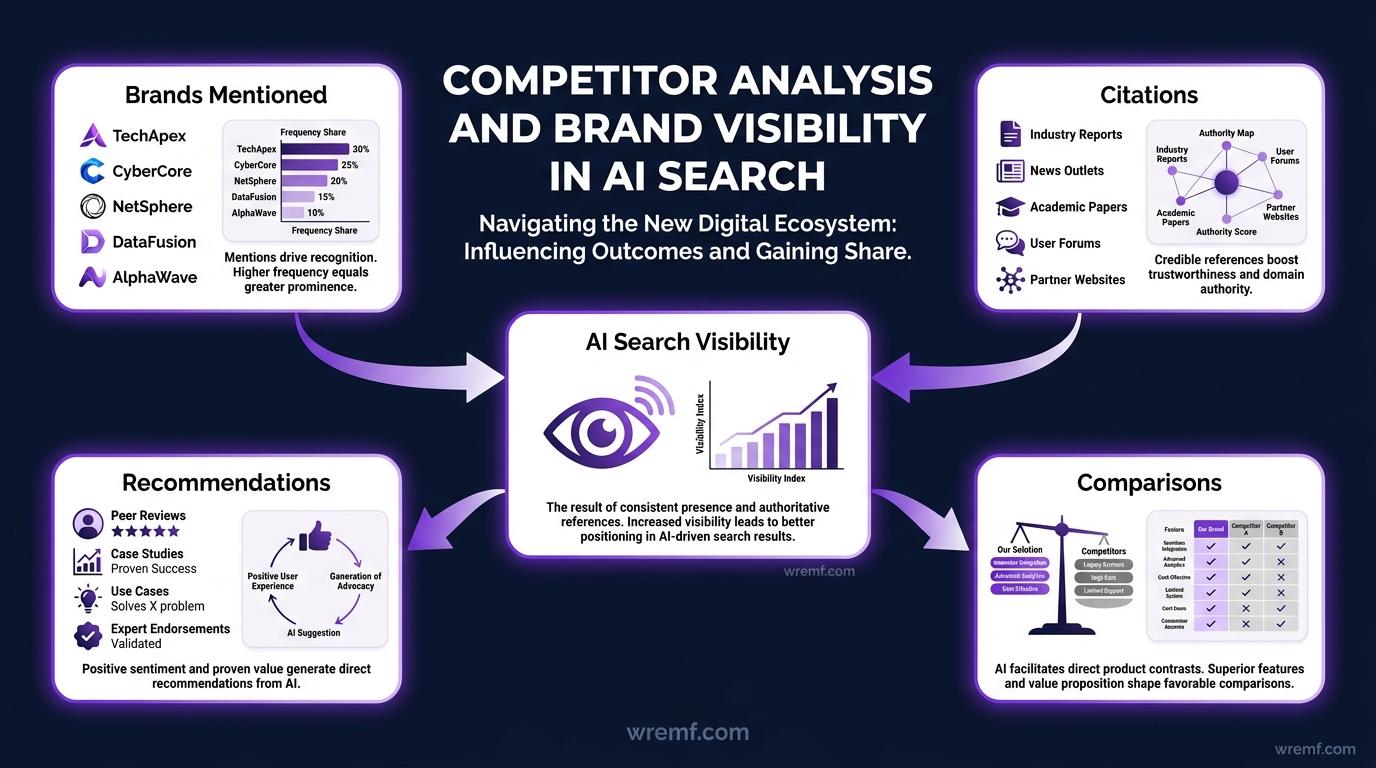
Competitor analysis in AI search shows which brands AI systems mention, cite, recommend, or compare for the prompts that matter to your buyers. This matters because AI answers often position brands against alternatives before users visit any website.
Competitor visibility is the degree to which competing brands appear in AI answers, source citations, recommendations, and comparison prompts. Competitor visibility matters because AI search is often a shortlist engine, not just an information engine.
Brand visibility is the presence, accuracy, and strength of a brand across search engines, AI answers, citations, summaries, and recommendations. Brand visibility matters because a brand that is invisible in AI discovery may lose consideration before a buyer reaches the website.
AI search competitor analysis should answer:
Which competitors appear for category prompts?
Which competitors appear for “best” prompts?
Which competitors appear for alternative or comparison prompts?
Which competitors are cited by AI Overviews, Perplexity, or ChatGPT search?
Which sources support competitor visibility?
Which features or positioning points do AI answers associate with each competitor?
Which prompts produce inaccurate or outdated competitor comparisons?
Which content clusters are competitors using to win citations?
In practical AI visibility audits, SEO teams frequently discover that a competitor with weaker Google rankings may still appear more often in AI answers because third-party sources describe the competitor more clearly. This is why AI visibility is both a measurement problem and a source ecosystem problem.
AI search competitor reporting should not only show who appears. It should show why they appear, which sources influence the answer, and what actions can close the gap.
WREMF supports competitor visibility analysis by tracking competitor appearances, recommendations, citations, and Share of Model across target prompts. This helps brands identify whether the next action should be content optimization, source consistency cleanup, authority building, or technical improvement.
KEY TAKEAWAY: AI competitor analysis shows which brands AI answer engines trust, cite, and recommend for buyer-relevant prompts.
Competitive visibility should also be connected to traffic and business reporting.
AI Traffic Attribution and Reporting
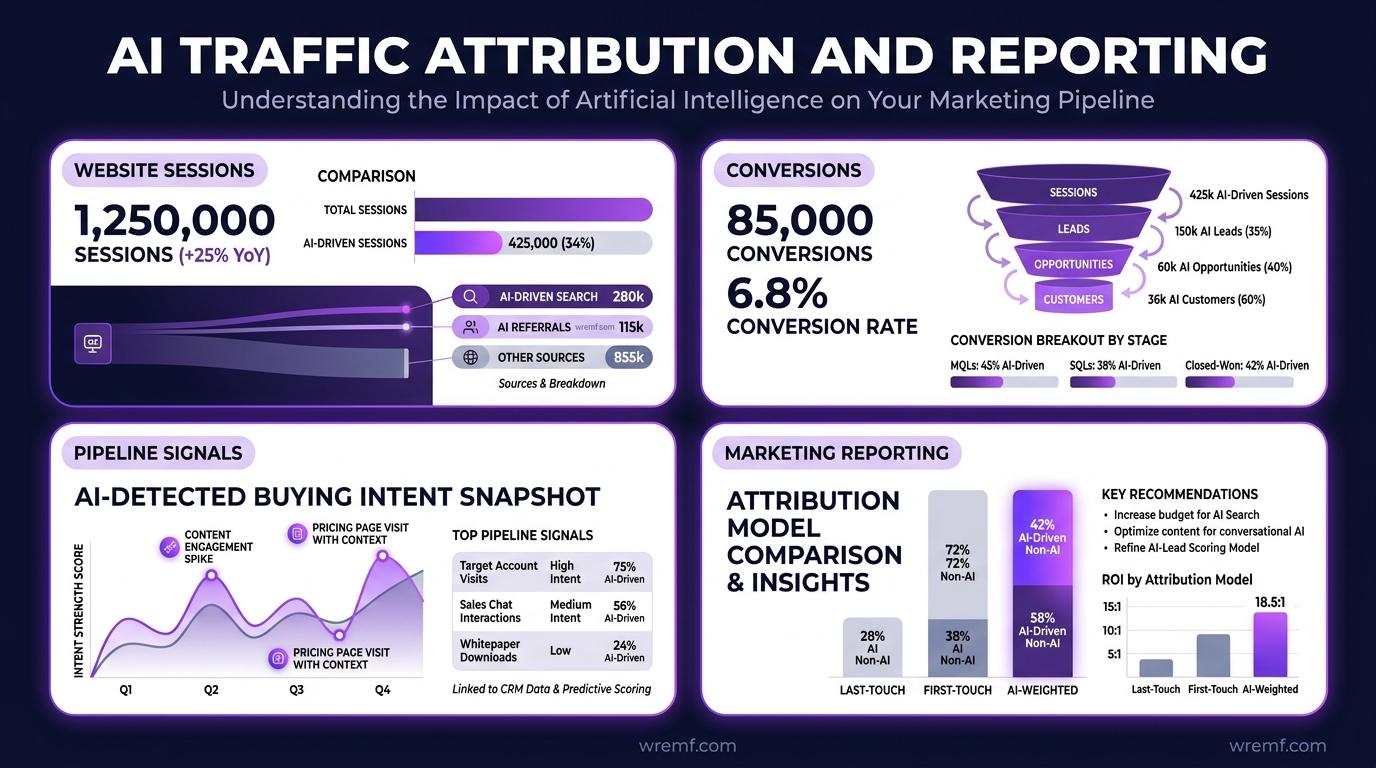
AI traffic attribution connects AI search visibility to website sessions, conversions, pipeline signals, and marketing reporting. The goal is to understand whether visibility in AI discovery surfaces is influencing measurable demand.
AI traffic attribution is the process of identifying visits, conversions, or pipeline activity that originate from AI tools, AI search engines, answer engines, or AI-assisted discovery. AI traffic attribution matters because leadership teams need proof beyond screenshots of AI answers.
AI traffic attribution is imperfect. Some AI referrals appear clearly in analytics, while others may be masked, grouped into direct traffic, or happen without a click. A buyer may ask ChatGPT for options, remember a brand, and visit directly later.
That limitation does not make attribution useless. It means teams should combine AI referral data, brand search trends, direct traffic patterns, prompt visibility, citation tracking, and sales feedback. AI visibility reporting should show both measurable clicks and upstream discovery signals.
A useful AI visibility report should include:
AI visibility score by engine
Prompt-level brand mentions
AI citations and source citations
Competitor visibility and Share of Model
AI Overviews and AI Mode appearances
Sentiment and answer accuracy
Source consistency issues
Content and technical recommendations
AI referral traffic where available
Before-and-after SEO testing data
Client or leadership-ready summary
Google Search Console remains important for search clicks, impressions, CTR, and average position. Google Search Console does not fully show whether ChatGPT, Claude, Gemini, Perplexity, or Copilot mention your brand in AI answers, so it should be paired with AI search optimization data.
Microsoft explains that Copilot Chat and Agents can use web search to improve response quality by referencing latest publicly available information, especially when prompts go beyond work content. This is another reason reporting needs to track AI search surfaces that operate outside classic analytics dashboards. (Microsoft Support)
WREMF supports AI traffic attribution and reporting by connecting visibility data with prompts, citations, competitors, and source consistency. Agencies can also use white-label reporting and client portals to make AI visibility understandable for stakeholders.
KEY TAKEAWAY: AI traffic attribution should combine measurable AI referrals with prompt visibility, citations, Share of Model, and source analysis.
The next practical decision is whether your team should use software, an agency, or a hybrid model.
Software vs Agency vs Hybrid AI Search Optimization
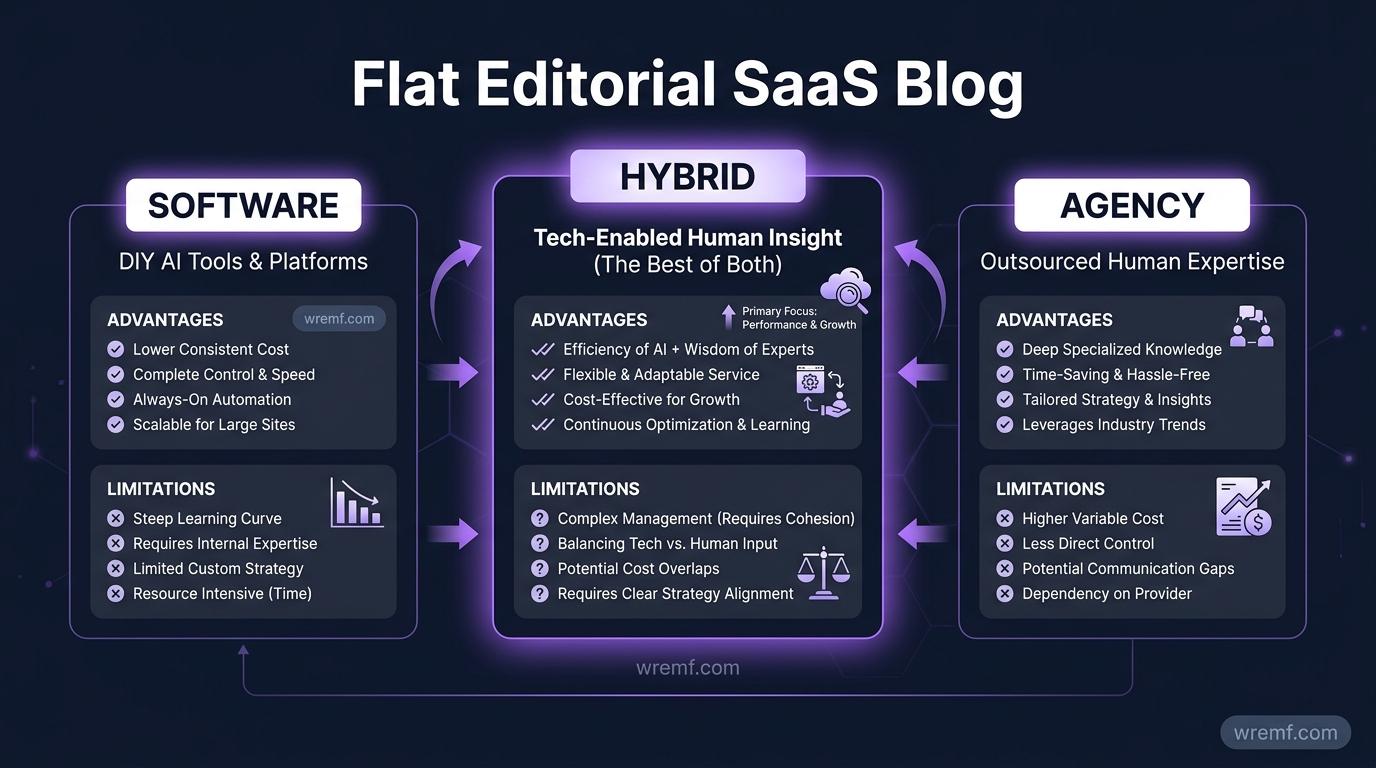
Software is best when your team can execute recommendations internally, agency support is best when you need expert implementation, and hybrid is best when you need both measurement and execution. The right model depends on team capacity, technical complexity, and reporting needs.
AI search optimization software gives teams dashboards, prompt tracking, citation analysis, competitor reporting, content briefs, and visibility scoring. Software works well when your SEO, content, product marketing, or growth team can turn insights into action.
Agency support helps teams execute AI visibility strategy, GEO consulting, AEO consulting, content optimization, entity and authority building, source consistency cleanup, citation improvement, technical AI visibility foundations, internal linking logic, crawl checks, and monthly reporting.
Hybrid support combines software with managed execution. Hybrid is useful for B2B SaaS teams that need visibility tracking and implementation, and for agencies that need repeatable white-label reporting across clients.
| Model | Best For | Strength | Limitation | Recommended When |
|---|---|---|---|---|
| Software Only | In-house SEO and content teams | Control, dashboards, speed, repeatability | Requires internal execution | You have team capacity |
| Agency Only | Teams needing done-for-you support | Strategy, prioritization, implementation | Less self-serve visibility | You lack specialist resources |
| Hybrid Software Plus Agency | B2B SaaS, agencies, consultants, growth teams | Measurement plus execution | Requires clear ownership | You need both proof and action |
WREMF can be used as software, an agency service, or a combined software plus managed execution solution. For teams that need execution support, the WREMF agency team helps with AI visibility strategy, GEO and AEO consulting, content optimization, citation improvement, source consistency cleanup, and reporting.
Agencies managing multiple clients often need white-label reports, client portals, repeatable scoring, and clear deliverables. WREMF supports this through AI visibility tools for agencies, while in-house teams can use WREMF for brands to connect AI search optimization to marketing strategy.
KEY TAKEAWAY: Choose software for internal control, agency support for expert execution, and hybrid support when you need both measurable reporting and managed improvement.
Once the operating model is clear, pricing becomes easier to evaluate.
How Much Do AI Search Optimization Platforms Cost?
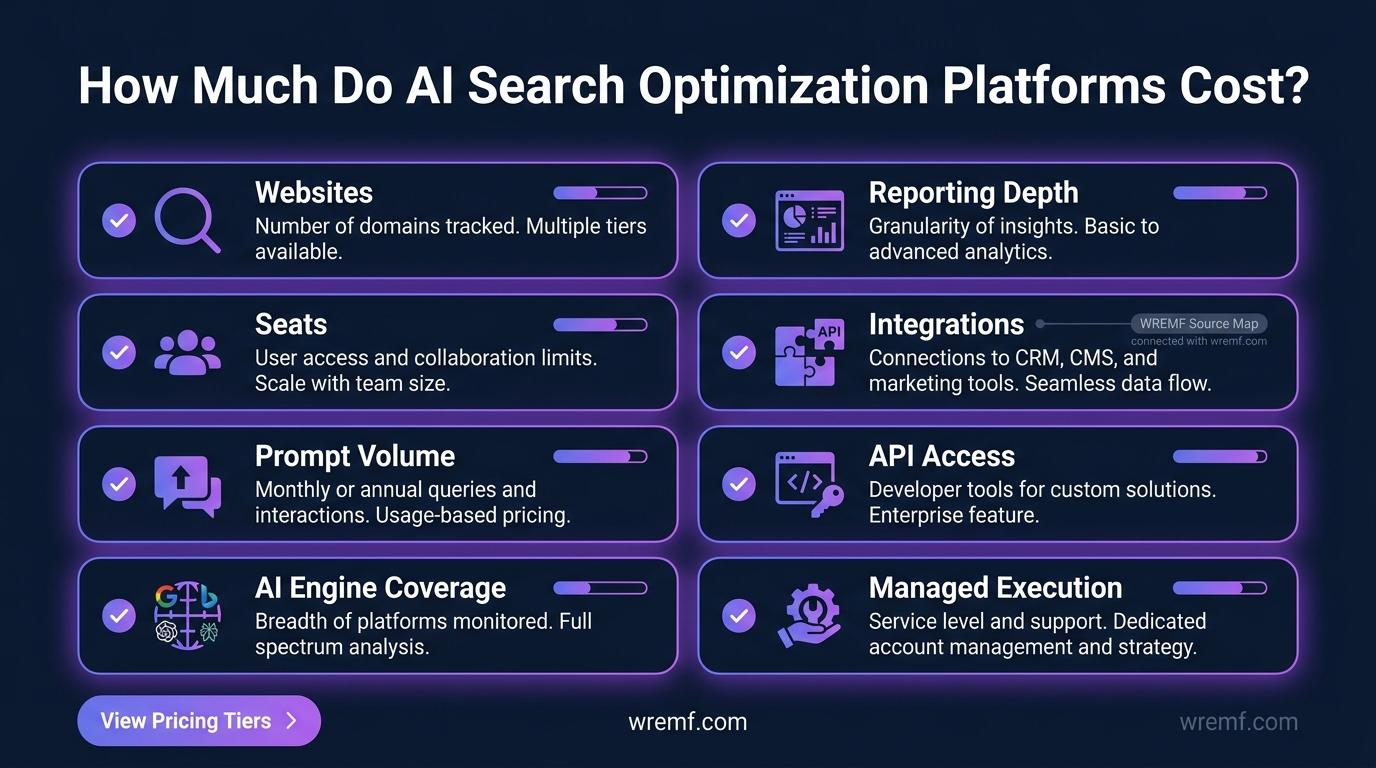
AI search optimization platform pricing usually depends on websites, seats, prompt volume, AI engine coverage, reporting depth, integrations, API access, and managed execution. The best pricing model scales with the visibility workflow you actually need.
AI SEO tool pricing varies widely because the category includes SEO tools, content optimization tools, rank tracking platforms, AI writing tools, and AI visibility platforms. Some tools charge by keywords, some by projects, some by seats, some by content credits, and some by tracked prompts or websites.
The most important buying question is not only “what does it cost?” The better question is “what does the plan allow us to measure, improve, and report every month?”
For AI search optimization, pricing should be evaluated against:
Number of websites or clients
Number of AI search engines tracked
Prompt limits or unlimited prompt tracking
Citation and source tracking depth
Competitor monitoring
Content Briefs and content workflows
SEO testing or before-and-after measurement
White-label reporting
BYOK support
API and MCP integration support
Client portals
Managed agency execution
WREMF pricing is designed around websites and broad feature access. Starter is €39 per month for 1 website, unlimited prompt tracking, BYOK, 10 AI engines, all features and tools, white-label reports, 1 seat, and email support. Growth is €89 per month for 5 websites, unlimited prompt tracking, BYOK, 10 AI engines, all features and tools, white-label reports, priority email support with 24h SLA, content brief generator, and SEO A/B testing. Enterprise offers custom pricing for unlimited websites, unlimited prompt tracking, BYOK, 10 AI engines, all features and tools, white-label reports, unlimited seats, dedicated support with 4h SLA, and custom branded portals.
For buying-stage evaluation, review WREMF pricing and compare the plan against the number of websites, clients, prompts, reports, and integrations you need.
KEY TAKEAWAY: AI search optimization pricing should be judged by engine coverage, prompt flexibility, reporting value, execution support, and how easily the platform scales across websites or clients.
Pricing only matters if the platform can be implemented in a clear workflow.
How to Implement an AI Search Optimization Platform
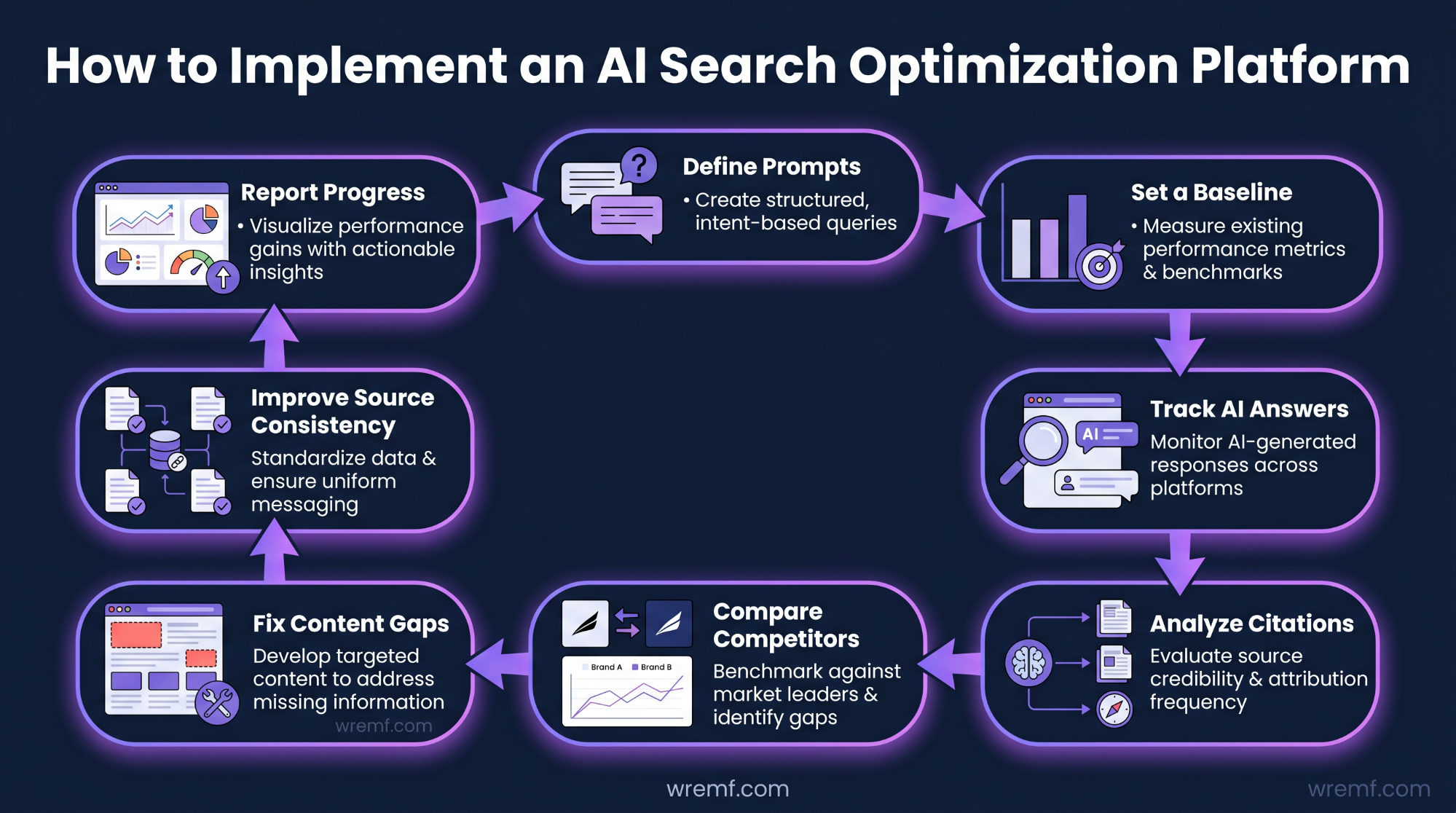
Implement an AI search optimization platform by defining prompts, setting a baseline, tracking AI answers, analyzing citations, comparing competitors, fixing content gaps, improving source consistency, and reporting progress over time. The process should run as a repeatable monthly workflow.
Start with prompt matching. Build a prompt set that reflects how real users ask questions in ChatGPT, Perplexity, Google, Gemini, Claude, Copilot, voice assistants, and AI answer engines.
A strong prompt set should include:
Definition prompts such as “what is AI visibility?”
Category prompts such as “best AI search optimization platforms 2026”
Comparison prompts such as “AI SEO tools vs traditional SEO tools”
Buying prompts such as “which AI visibility tool is best for agencies?”
Problem prompts such as “how do I track my performance in AI search engines?”
Risk prompts such as “should I block AI bots from crawling my site?”
Implementation prompts such as “how do I optimize content for AI search?”
Competitor prompts such as “best alternatives to [competitor]”
Technical prompts such as “how does Schema markup help AI search?”
Reporting prompts such as “how do I measure Share of Model?”
Next, run a baseline across AI search engines. Record whether your brand appears, whether it is recommended, whether sources are cited, whether competitors appear, and whether the answer is accurate.
Then translate the baseline into action. Create content briefs for missing prompt coverage. Improve pages with weak definitions or thin comparisons. Fix inconsistent brand facts. Strengthen internal linking. Add structured content where appropriate. Review crawlability and rendering. Track changes over time.
| Phase | Action | Output |
|---|---|---|
| Week 1 | Define prompts, engines, competitors, and topics | Baseline measurement plan |
| Week 2 | Track AI answers, citations, and competitor visibility | AI visibility baseline |
| Week 3 | Identify content, source, and technical gaps | Prioritized action plan |
| Week 4 | Publish updates and report changes | Measurement and execution workflow |
| Month 2 onward | Monitor, test, update, and report | Repeatable AI visibility system |
WREMF supports this workflow through GEO audits, AI visibility tracking, source citations, competitive landscape monitoring, content briefs, SEO testing, and reporting.
KEY TAKEAWAY: AI search optimization implementation works best as a repeatable cycle of prompt tracking, source analysis, content improvement, technical cleanup, and reporting.
A strong workflow should also include a clear view of what can go wrong.
Common Mistakes When Choosing AI SEO Tools
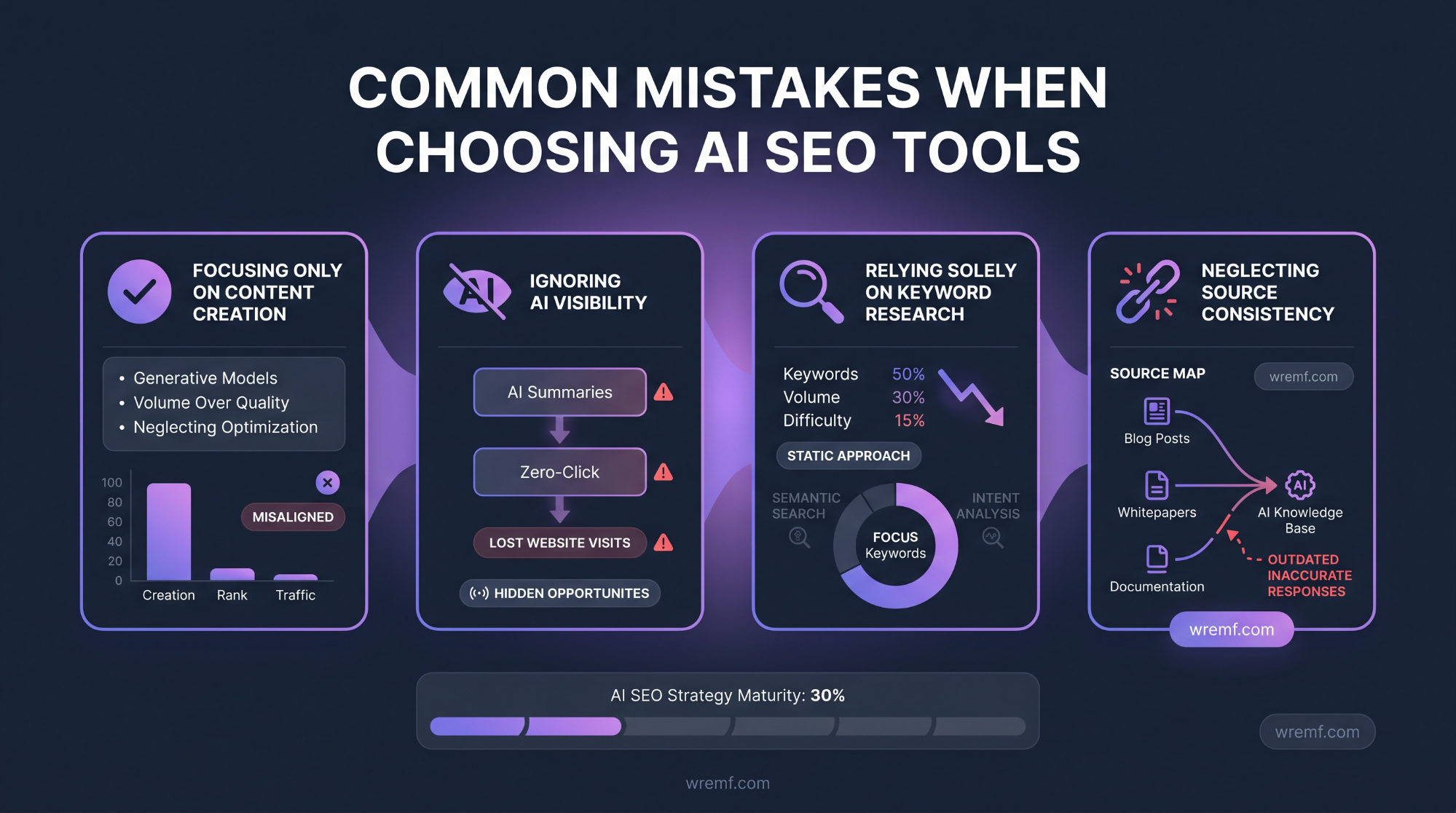
The most common mistake is choosing an AI SEO tool that creates content but does not measure AI visibility. AI writing and content optimization are useful, but they do not prove whether AI answer engines mention, cite, or recommend your brand.
A second mistake is relying only on keyword research. Keyword research still matters, but AI search often starts with natural language prompts, comparison questions, problem statements, and decision-stage queries. Keyword analysis should be paired with prompt intelligence and intent mapping.
A third mistake is treating rank tracking as AI visibility tracking. Rank tracking shows search engine positions. AI visibility tracking shows whether AI answers mention your brand, cite your sources, recommend you, or compare you against competitors.
A fourth mistake is ignoring source consistency. If your website, directories, profiles, review pages, partner pages, and third-party mentions describe your brand differently, AI systems may generate incomplete or inaccurate answers.
A fifth mistake is scaling AI content without human review. AI writing can accelerate drafts, but unchecked AI content can create vague pages, repeated sections, unsupported claims, thin examples, and AI Slop.
A sixth mistake is assuming that technical SEO no longer matters. Crawlability, internal linking, structured content, page accessibility, and site audit fundamentals remain important because AI systems and search engines still need accessible information.
TIP: Before buying any AI SEO tool, ask whether it can show your brand’s prompt visibility, source citations, competitor footprint, source consistency gaps, and next recommended actions.
KEY TAKEAWAY: Avoid tools that only generate content or track rankings when your real goal is measurable AI visibility across answers, citations, competitors, and prompts.
These mistakes often come from myths about how AI search works.
Common Myths About AI Visibility Debunked
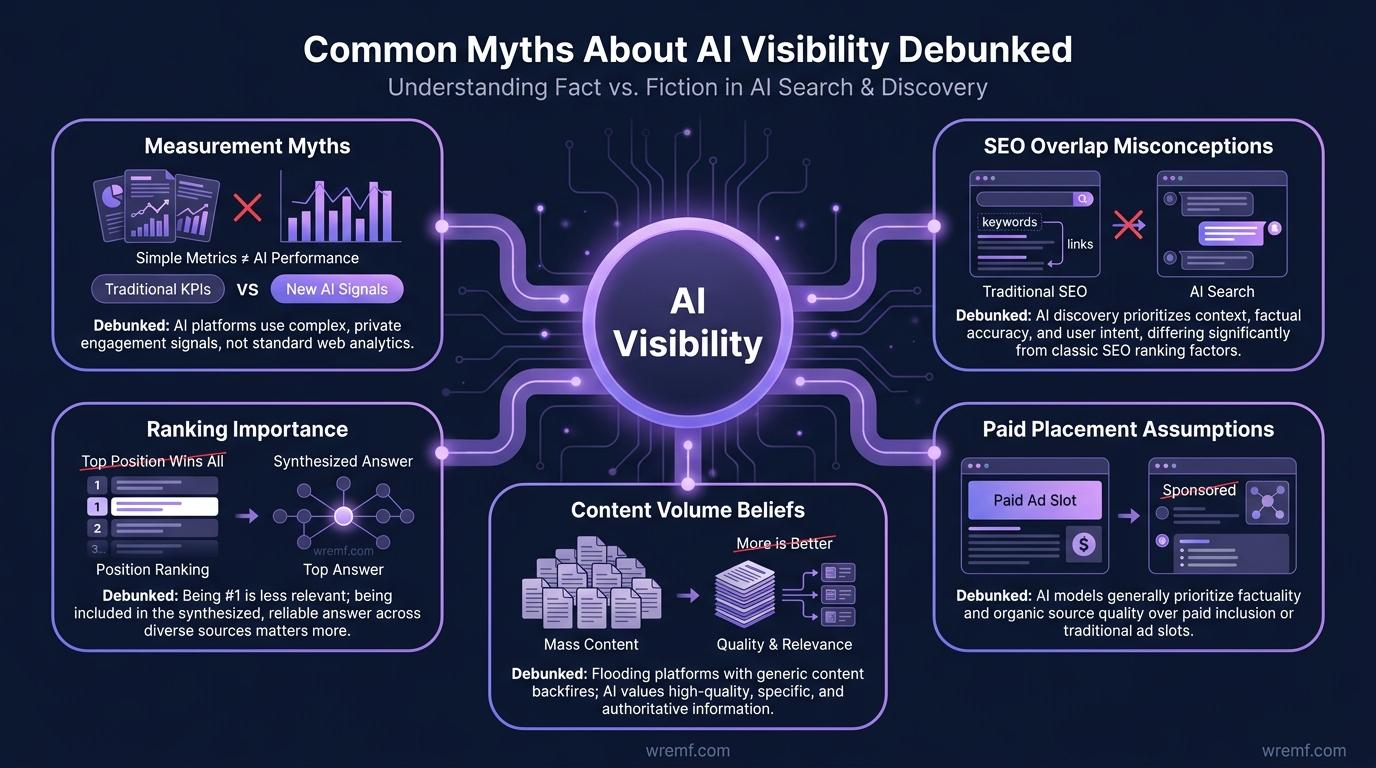
AI visibility is often misunderstood because teams apply old ranking logic to AI answer systems. The biggest myths involve measurement, SEO overlap, rankings, paid placement, and content volume.
MYTH: AI visibility is impossible to measure.
FACT: AI visibility is measurable when teams define prompts, engines, competitors, citations, mentions, and reporting intervals. The data is probabilistic because AI answers can vary, but it is still useful for trends, comparisons, and prioritization.
MYTH: GEO is just SEO with a new name.
FACT: SEO, AEO, and Generative Engine Optimization overlap, but they are not identical. SEO focuses on search results, AEO focuses on extractable answers, and GEO focuses on brand representation inside generated AI answers.
MYTH: Rankings alone are enough.
FACT: Rankings do not show whether AI answer engines mention, cite, or recommend your brand. A brand can perform well in Google Search but still lose visibility inside ChatGPT, Perplexity, Gemini, Claude, Copilot, or AI Overviews.
MYTH: More AI content automatically improves AI search visibility.
FACT: More content only helps when it answers real prompts better than existing sources. Generic AI content can weaken trust if it lacks original insight, evidence, experience, and clear structure.
MYTH: You can pay to rank organically in ChatGPT or Perplexity.
FACT: Organic AI answers are not the same as paid search ads. Sustainable AI visibility depends on relevance, source quality, citations, entity clarity, content usefulness, and how AI systems retrieve or synthesize information.
KEY TAKEAWAY: AI visibility is measurable, but it requires prompt-level tracking, citation analysis, source consistency, and a broader view than rankings alone.
The final decision is choosing the right platform for your team type.
Final Recommendations for Choosing the Best AI Search Optimization Platform
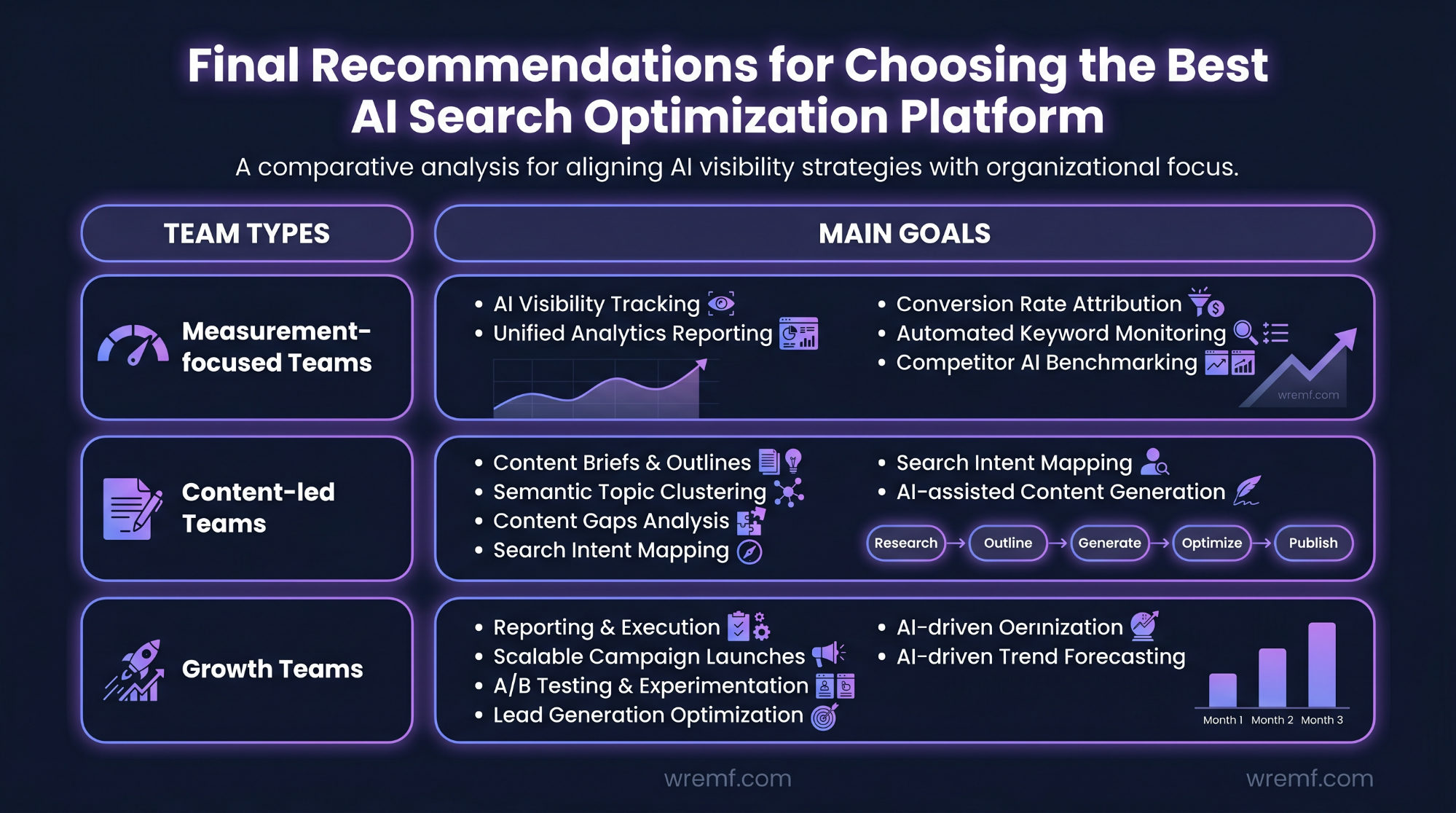
Choose the best AI search optimization platform by matching your team’s main goal to the platform’s strongest capability. Measurement-focused teams need AI visibility tracking, content-led teams need briefs and optimization workflows, and growth teams need reporting plus execution.
For B2B SaaS brands, the best default is a platform that tracks multiple AI search engines, monitors prompts, identifies AI citations, compares competitors, and turns insights into content and technical actions. This matters because B2B buyers often use AI search for vendor discovery, shortlist building, pricing research, and competitor comparisons.
For agencies, the best default is a platform with white-label reporting, client portals, repeatable methodology, flexible prompt tracking, and multi-client workflows. Agencies need to explain not only what changed, but why it matters and what actions come next.
For technical teams, the best default is a platform with API access, MCP support, BYOK, exportable data, and workflow flexibility. AI visibility data becomes more valuable when it connects to dashboards, analytics, content systems, CRM workflows, and client reporting.
| Team Type | Best Platform Fit | Most Important Features | Recommended Focus |
|---|---|---|---|
| B2B SaaS Founder | Hybrid AI visibility platform | Prompt tracking, competitor visibility, reports | Prove brand visibility in AI answers |
| Head of Marketing | Platform plus reporting | AI share of voice, citations, attribution | Connect visibility to growth |
| SEO Team | SEO plus GEO workflow | Technical audits, AI Overviews, content briefs | Expand from rankings to AI answers |
| Content Team | Content optimization plus AI visibility | Content Briefs, topic clusters, prompt gaps | Create answer-first content |
| Agency | White-label AI visibility platform | Client portals, reports, multi-site tracking | Scale AI visibility services |
| Consultant | Flexible software plus exports | Prompt sets, citations, competitor data | Deliver audits and strategy |
| Enterprise Team | API-enabled platform | BYOK, MCP, integrations, governance | Connect AI visibility to operations |
WREMF is useful for brands that want software, agencies that need white-label reporting, and teams that want managed execution. WREMF combines AI visibility tracking, prompt intelligence, source citations, competitive landscape monitoring, GEO audits, content briefs, SEO testing, scheduled monitoring, BYOK, API support, and optional agency services.
KEY TAKEAWAY: The best AI search optimization platform is the one that connects measurement, source analysis, content action, competitor visibility, integrations, and reporting in a workflow your team can sustain.
Frequently Asked Questions
What are the best AI search optimization platforms available in 2026?
The best AI search optimization platforms in 2026 are platforms that track brand visibility across AI search engines, answer engines, AI Overviews, AI chatbots, and LLM-powered discovery surfaces. A strong platform should monitor prompts, citations, brand mentions, competitor visibility, AI share of voice, source consistency, and reporting over time. For B2B teams, WREMF is built as software, an agency service, or a hybrid model that combines AI visibility tracking with managed GEO and AEO execution.
What are AI SEO tools?
AI SEO tools are tools that use artificial intelligence to support SEO workflows such as keyword research, content creation, content optimization, keyword clustering, competitor analysis, technical audits, and rank tracking. Some AI SEO tools focus mainly on AI writing or content briefs, while AI search optimization platforms focus on visibility inside AI answers. The best workflow combines SEO tools for search engine performance with AI visibility tools for prompts, citations, recommendations, and answer engine monitoring.
Why do AI search optimization tools matter?
AI search optimization tools matter because AI search engines and answer engines can shape brand discovery before users click a website. Buyers may ask ChatGPT, Perplexity, Gemini, Claude, Copilot, or Google AI Overviews for vendor recommendations, product comparisons, or category explanations. Without AI visibility tracking, teams cannot see whether their brand appears, which competitors appear instead, which sources are cited, or whether AI answers describe the brand accurately.
How do I track my performance in AI search engines?
Track performance in AI search engines by creating a defined prompt set, running those prompts across multiple AI engines, recording brand mentions, recommendations, citations, competitors, sentiment, and answer accuracy, then repeating the process over time. You should include branded prompts, non-branded category prompts, comparison prompts, buying prompts, and risk prompts. WREMF helps teams manage this workflow through prompt intelligence, source citation tracking, AI share of voice, competitor visibility, and scheduled reporting.
Is GEO just a buzzword?
GEO is not just a buzzword when it is tied to measurable prompts, citations, source consistency, and AI answer visibility. Generative Engine Optimization focuses on how AI systems describe, cite, and recommend brands inside generated responses. It overlaps with SEO and AEO, but it adds new measurement layers such as Share of Model, AI citations, prompt visibility, and answer sentiment. GEO becomes valuable when teams use it as a practical measurement and execution workflow.
Should I block AI bots from crawling my site?
You should not block AI bots without reviewing the tradeoffs. Blocking may support content control, copyright, or legal goals, but it can also reduce discoverability in AI systems that rely on web access. For most B2B marketing teams, the better first step is to audit which pages should be accessible, how important content is structured, whether source facts are consistent, and whether crawler policies align with AI visibility goals. Legal, technical, and marketing teams should decide together.
Can I pay to rank in ChatGPT or Perplexity?
You generally cannot buy organic placement inside ChatGPT or Perplexity the way you buy paid search ads. AI answer visibility depends on relevance, source quality, retrieval, citations, entity clarity, and how useful the answer is for the prompt. Some AI search products may include paid placements, ads, or commercial partnerships, but organic AI visibility should be treated as earned visibility. Brands should focus on useful content, source consistency, citation authority, and clear entity positioning.
How do AI search optimization platforms improve search results?
AI search optimization platforms improve search results by identifying where a brand is missing from AI answers, which sources influence those answers, and what content or technical gaps need to be fixed. They help teams prioritize prompt gaps, citation gaps, competitor gaps, source consistency issues, and content optimization opportunities. The platform itself does not guarantee visibility, but it gives teams the data and workflow needed to improve AI search readiness over time.
What features should I look for in the best AI search optimization platform?
Look for multi-engine tracking, prompt intelligence, AI citation tracking, source citation analysis, competitor visibility, AI share of voice, content briefs, GEO audits, technical audits, AI traffic attribution, white-label reporting, BYOK, API support, and MCP integrations. The platform should show not only where your brand appears, but why it appears, which sources influence the answer, which competitors win, and what your team should improve next.
How do top AI search optimization platforms compare with traditional SEO tools?
Traditional SEO tools focus on search engine rankings, keyword research, backlinks, technical audits, search volume, and Google Search performance. AI search optimization platforms focus on AI answers, prompt visibility, citations, recommendations, competitors, and Share of Model. The two categories are complementary. SEO tools help you improve classic search performance, while AI visibility platforms show whether AI answer engines understand, cite, and recommend your brand.
Are AI SEO tools worth the investment in 2026?
AI SEO tools are worth the investment when they save time, improve content quality, support keyword research, or help teams monitor visibility across search and AI discovery surfaces. The highest value comes when the tool connects analysis to action. A content-only tool may be useful for production, but a complete AI search optimization platform should also measure prompts, citations, competitors, source consistency, and reporting. B2B teams should choose based on workflow, not feature hype.
How should agencies use AI search optimization platforms?
Agencies should use AI search optimization platforms to deliver repeatable AI visibility audits, white-label reports, prompt tracking, citation analysis, competitor monitoring, content briefs, and monthly execution plans. Agencies need a consistent methodology because AI answers vary by prompt, engine, source availability, and time. WREMF supports agencies with white-label reporting, client portals, AI visibility tracking, citation analysis, competitor visibility, and optional managed execution for AEO and GEO services.
Conclusion
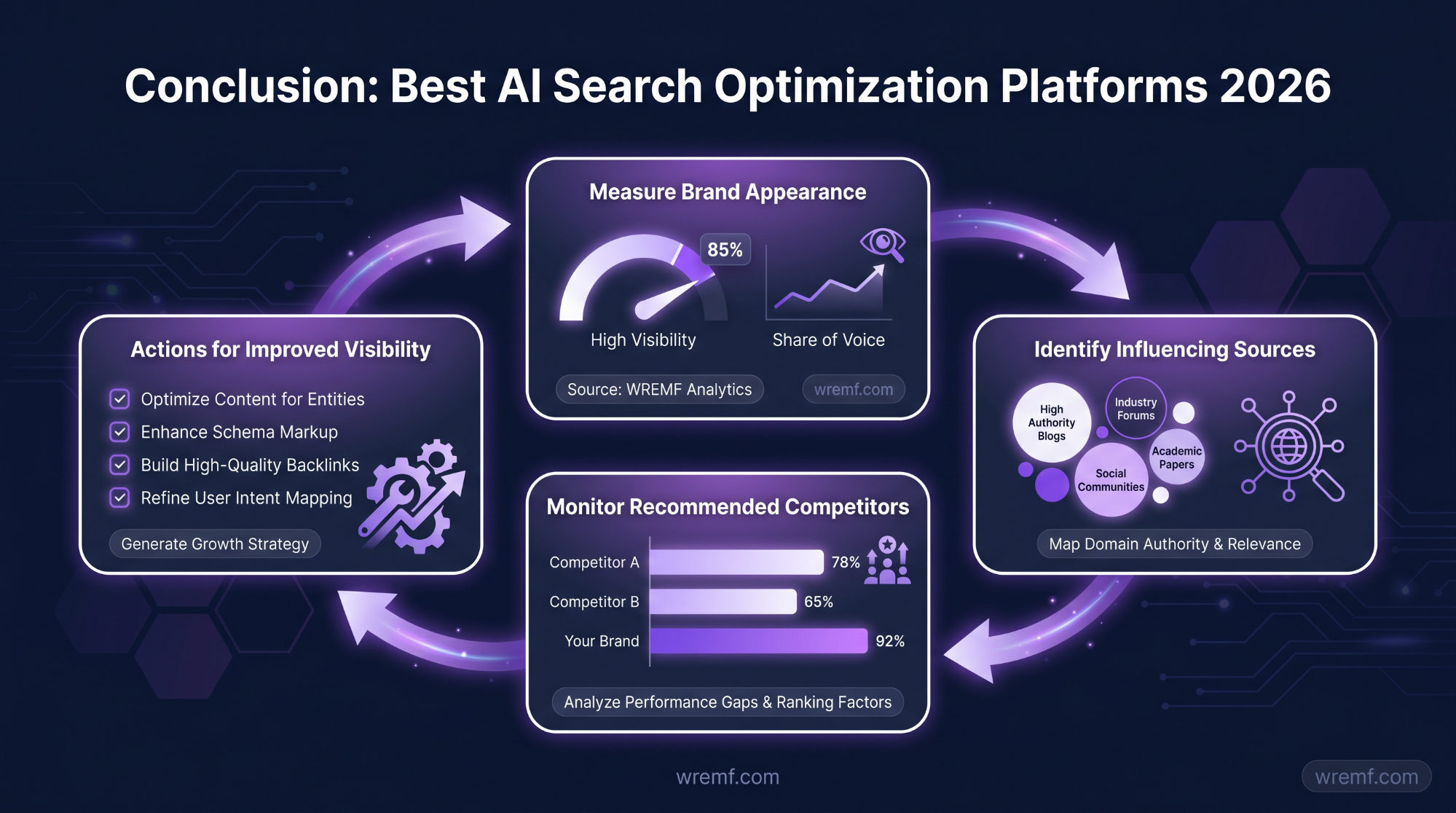
Best AI search optimization platforms 2026 should help you measure where your brand appears, which sources shape AI answers, which competitors are recommended, and what actions can improve visibility over time. SEO still matters, but AI search adds new metrics for prompts, citations, source consistency, recommendations, Share of Model, and AI traffic attribution. WREMF helps B2B teams turn AI visibility from a guessing game into a measurable workflow across software, agency, or hybrid execution. To build a repeatable AI visibility system, explore the WREMF platform suite or talk to the WREMF agency team.
Related reading
- AI Search Engine Optimization Tools: The Complete 2026 Guide for AI Search, SEO, AEO, and GEO
- Best Answer Engine Optimization for Enhancing AI Visibility
- Generative AI Optimization Services: The Complete Guide to GEO, AEO, LLM Optimization, and AI Visibility
- Enterprise AI Visibility Platform: The Complete Guide for B2B Brands
- Large Language Model Optimization Services: The Complete Guide to LLMO, AI Search Visibility, AEO, GEO, RAG, and LLM Performance
- Best AI Visibility Tools: Playbook to AI Search Visibility Platforms