Best AI Visibility Tools: Playbook to AI Search Visibility Platforms
Learn about AI visibility tools and how they measure brand presence across AI-generated content.
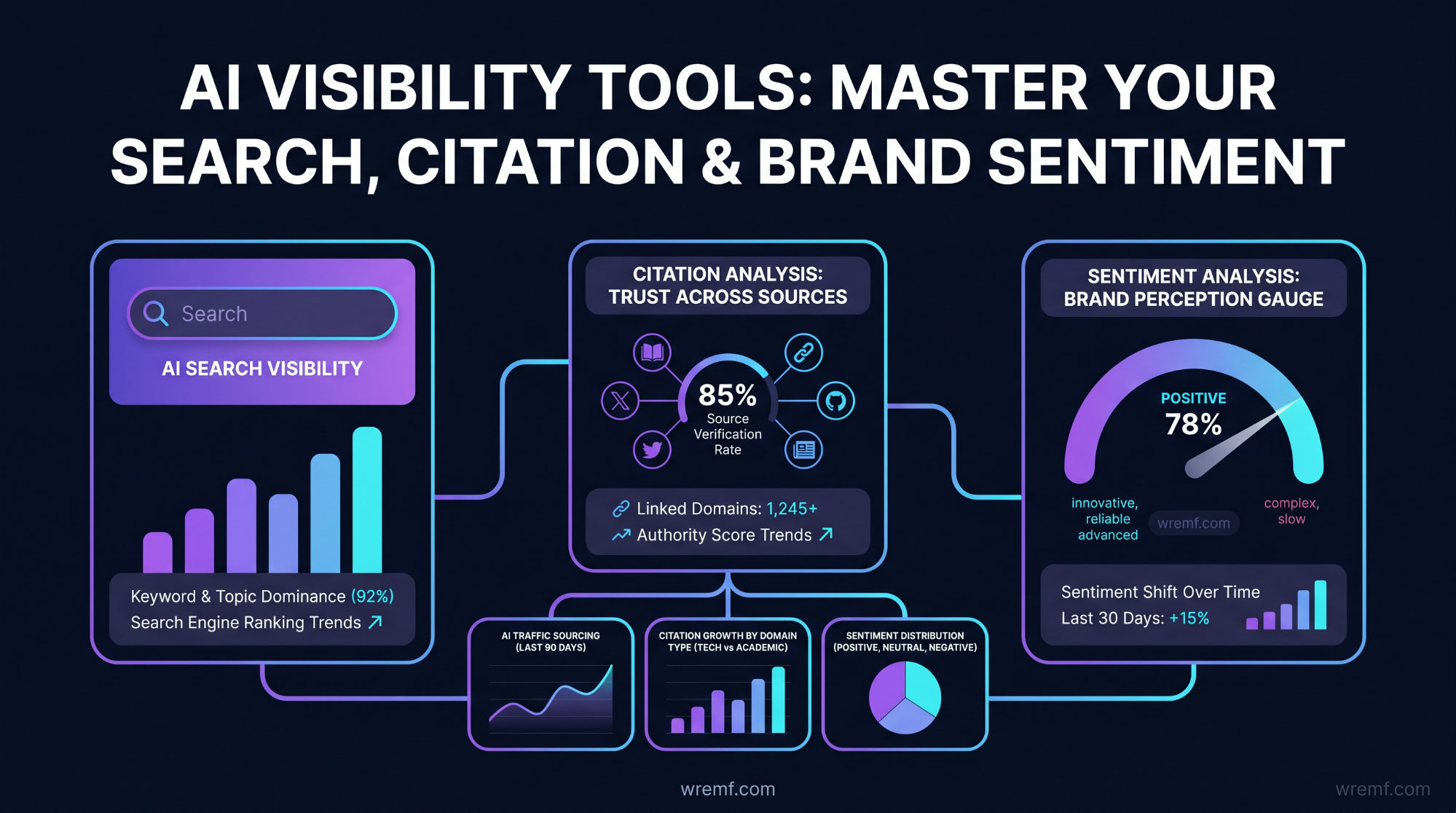
By WREMF Team · 2026-09-18
AI visibility tools track brand presence in AI-generated answers, recommendations, citations, and summaries. These tools are essential as AI systems shape brand perception before traditional analytics show traffic. They measure prompts, AI responses, brand mentions, citations, share of voice, sentiment analysis, and presence quality. They reveal if AI systems trust and recommend a brand. Efficient AI visibility tools require tracking across platforms like ChatGPT and Google AI Mode while providing insights for content optimization and strategy.
Key takeaways
- AI visibility tracks brand presence across AI platforms and influences discovery.
- AI search demands tools beyond traditional SEO dashboards for measuring brand mentions.
- Best AI visibility tools measure prompts, mentions, citations, and sentiment.
- Content optimization and technical fixes enhance AI search visibility.
- Effective AI visibility tools require cross-platform tracking adjustments.
Best AI Visibility Tools: Playbook to AI Search Visibility Platforms
Best AI visibility tools are platforms that track how your brand appears in AI answers, citations, recommendations, and summaries. Gartner predicts traditional search engine volume will drop 25% by 2026 as search marketing loses share to AI chatbots and virtual agents, making AI visibility a core growth metric for B2B teams. Gartner reports this AI-driven search shift in its 2024 prediction on search volume decline. (Gartner) This guide explains AI visibility, AI Search, Google AI Overviews, Google AI Mode, AI citations, share of voice, sentiment analysis, tool categories, technical fixes, and buying criteria. WREMF helps teams track, improve, and prove visibility across ChatGPT, Claude, Gemini, Perplexity, Google AI Overviews, Copilot, DeepSeek, Grok, Meta AI, and Mistral through the WREMF AI visibility platform suite. Use this guide to choose the right platform, workflow, and maturity path.
Why AI Visibility Is the New SEO Frontier
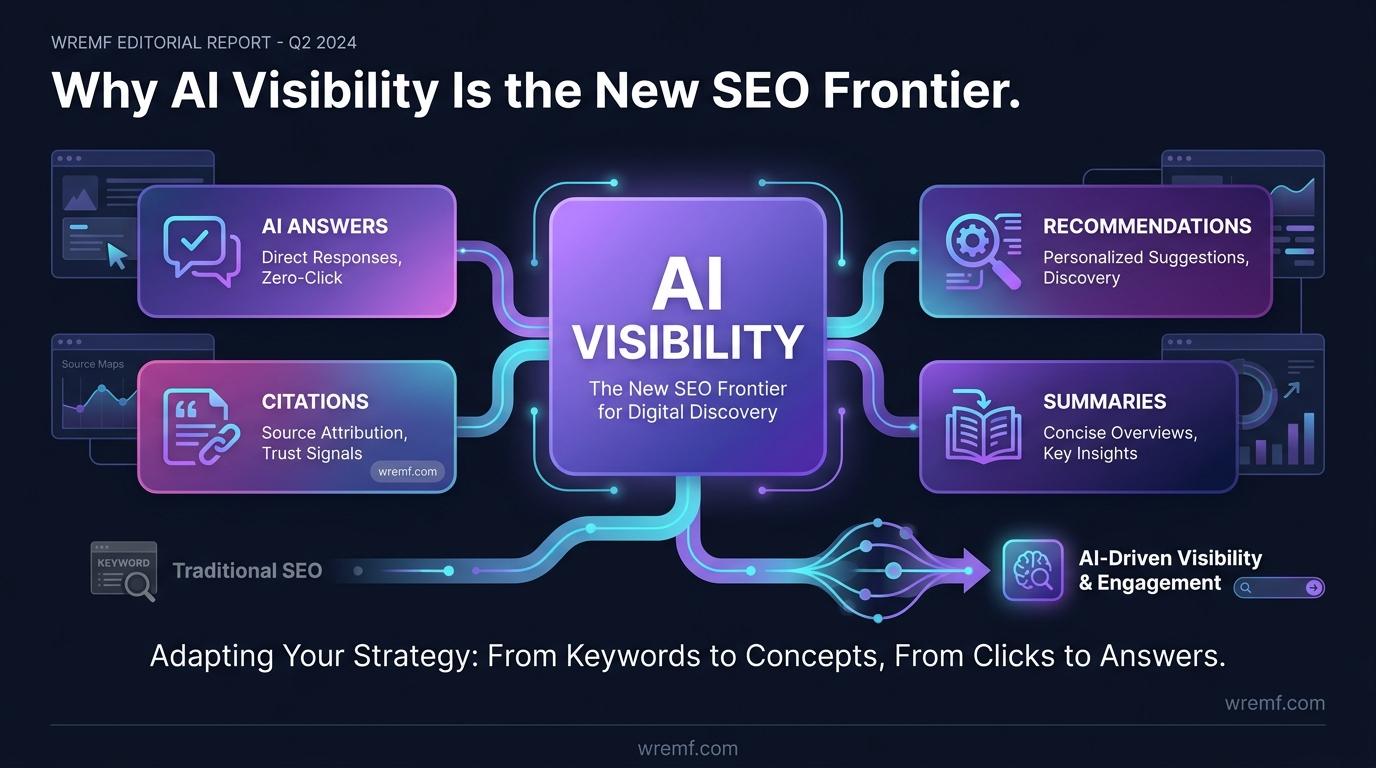
AI visibility is the measurable presence of a brand inside AI answers, recommendations, citations, and summaries. AI visibility matters because buyers now use AI platforms to compare options before they visit websites, review ads, or speak with sales teams.
AI visibility is the practice of measuring how often and how accurately a brand appears across AI platforms, AI Search Engines, answer engines, and generative engines. AI visibility matters because AI answers can shape brand recognition, brand perception, and buying consideration before traditional traffic appears in analytics.
Google AI Overviews, Google AI Mode, ChatGPT, Perplexity, Claude, Gemini, Copilot, DeepSeek, Grok, Meta AI, and Mistral are changing how people discover information. A buyer can ask, “What are the best AI visibility tools for B2B agencies?” and receive a synthesized answer that names a few vendors, cites Source Links, and summarizes advantages. That user may trust the AI response before opening a search result.
Google Search Central explains that AI Overviews help people understand complex topics quickly and provide links to explore further. Google Search Central explains how AI features and websites interact in Search. (Google for Developers) OpenAI says ChatGPT search can provide fast, timely answers with links to relevant web sources. OpenAI describes ChatGPT search as combining natural-language answers with web sources. (OpenAI) These official signals show why AI search visibility is not a trend to ignore.
In real B2B buying journeys, users ask AI systems questions that look different from classic search keywords. They ask for vendor comparisons, pricing alternatives, implementation risks, category definitions, and tools that fit a specific team size. AI visibility tools help you understand whether your brand is present when those prompts matter.
WREMF turns AI visibility from scattered manual checks into a measurable workflow. The WREMF methodology connects prompts, citations, competitors, source consistency, and attribution into one repeatable system for B2B brands, SEO teams, content teams, and agencies.
DID YOU KNOW: Gartner predicted that traditional search engine volume will drop 25% by 2026 as AI chatbots and virtual agents gain share from conventional search. (Gartner)
AI visibility is the measurable presence of a brand inside AI-generated answers, recommendations, citations, and summaries. AI visibility matters because buyers increasingly use AI assistants to compare vendors before visiting websites, reviewing ads, or contacting sales teams.
KEY TAKEAWAY: AI visibility is the new SEO frontier because AI answers now influence discovery, comparison, trust, and demand before classic search traffic appears.
To choose the best AI visibility tools, you first need to understand why traditional SEO dashboards cannot measure the full AI Search journey.
Why Traditional SEO Dashboards Are Not Enough for AI Search
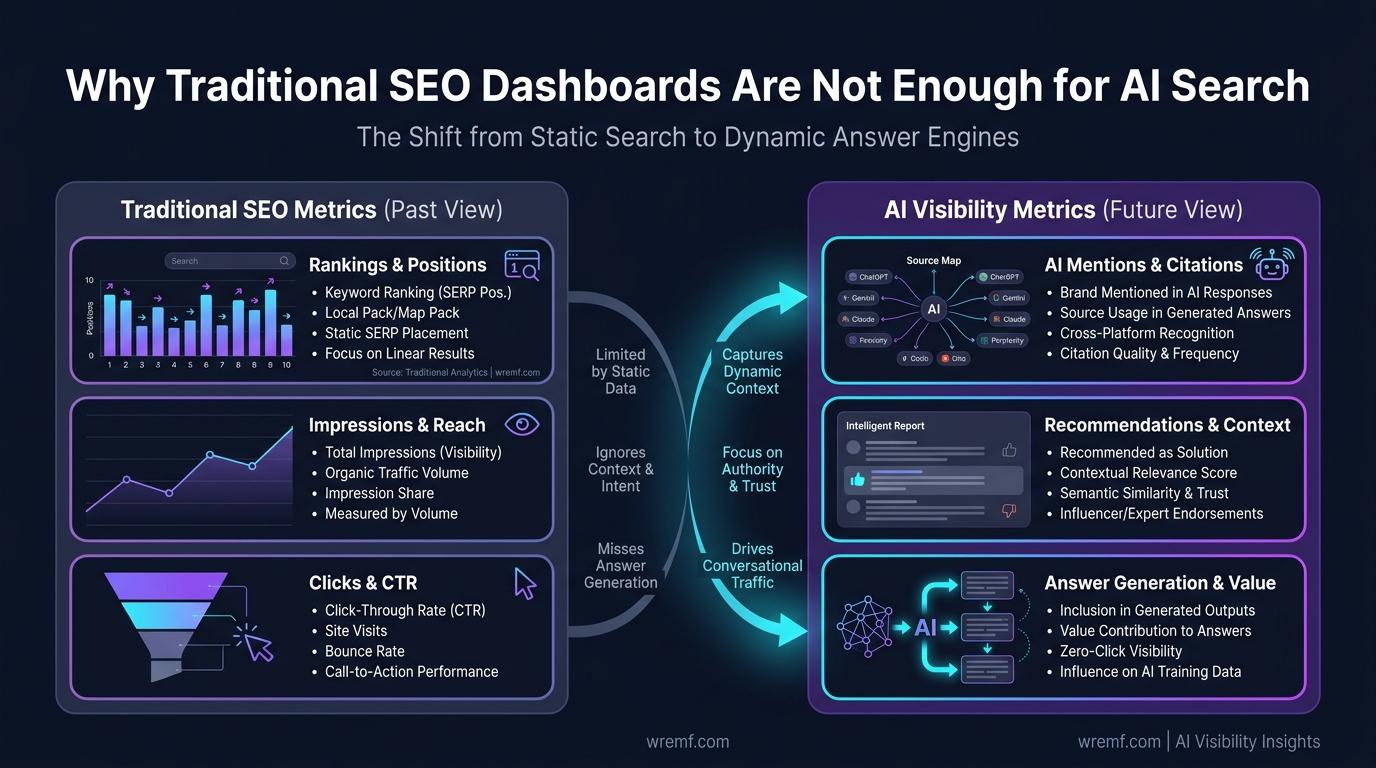
Traditional SEO dashboards are not enough for AI Search because rankings, impressions, backlinks, and clicks do not show whether AI engines mention, cite, recommend, or misrepresent your brand. AI visibility tools measure the answer layer that classic SEO tools miss.
AI Search is the use of AI systems to retrieve, synthesize, summarize, and recommend information in response to natural-language questions. AI Search matters because users often receive direct AI answers instead of a simple list of links.
SEO tools still matter. Keyword Research, technical audits, backlinks, content optimization, internal linking, and Content Audit workflows remain useful for search performance. The gap is that SEO tools were built to measure search engine results pages, not AI responses across large language models and answer engines.
AI search responses behave differently from ranked web pages. An AI response may mention your competitor, cite a review site, summarize an outdated product description, or ignore your brand entirely even when your website ranks well. AI platforms may also use a mix of live web results, model knowledge, citations, Source Links, structured content, and third-party references.
| Measurement Area | Traditional SEO Tools | AI Visibility Tools | Why It Matters |
|---|---|---|---|
| Search rankings | Keyword positions and SERP features | Prompt-level visibility across AI engines | AI answers do not always follow ranking order |
| Organic demand | Impressions, clicks, CTR, traffic | AI traffic attribution and assisted discovery | AI platforms may influence buyers before a click |
| Authority | Backlinks, domain strength, page authority | AI citations, Source Links, cited domains | AI systems often rely on cited and repeated sources |
| Competitors | SERP competitors | Competitors mentioned inside AI responses | AI recommendations may include different competitors |
| Content quality | Keyword use and content score | Presence Quality, answer accuracy, content gaps | AI responses can omit, distort, or simplify brand facts |
| Reporting | SEO dashboard | AI Visibility Dashboard and composite score | Leaders need a cross-engine AI visibility view |
Answer Engine Optimization is the process of structuring content so answer engines can extract clear, reliable answers. Answer Engine Optimization matters because AI answers often reward clarity, source support, and direct response formatting.
Generative Engine Optimization is the process of improving how generative engines understand, retrieve, cite, and describe a brand or topic. Generative Engine Optimization matters because AI models synthesize information instead of simply ranking pages.
The key difference between SEO and GEO is measurement. SEO tracks how pages perform in search results. Generative Engine Optimization tracks how generative engines represent entities, sources, and recommendations inside AI responses. Answer Engine Optimization focuses on becoming the best answer for a specific query or prompt.
Google Search Central explains that Google’s ranking systems are designed to prioritize helpful, reliable, people-first content, not content made primarily to manipulate search rankings. Google Search Central provides guidance on creating helpful, reliable, people-first content. (Google for Developers) This matters because AI visibility also depends on clear, useful, reliable, and source-backed content.
IMPORTANT: Do not replace SEO with AI visibility. Add AI visibility data to your SEO workflow so rankings, AI citations, brand mentions, share of voice, and AI traffic attribution can be interpreted together.
KEY TAKEAWAY: SEO dashboards show how pages perform in search results, while AI visibility tools show how brands appear inside AI answers.
The next step is knowing exactly what the best AI visibility tools should measure.
What Should the Best AI Visibility Tools Actually Measure?
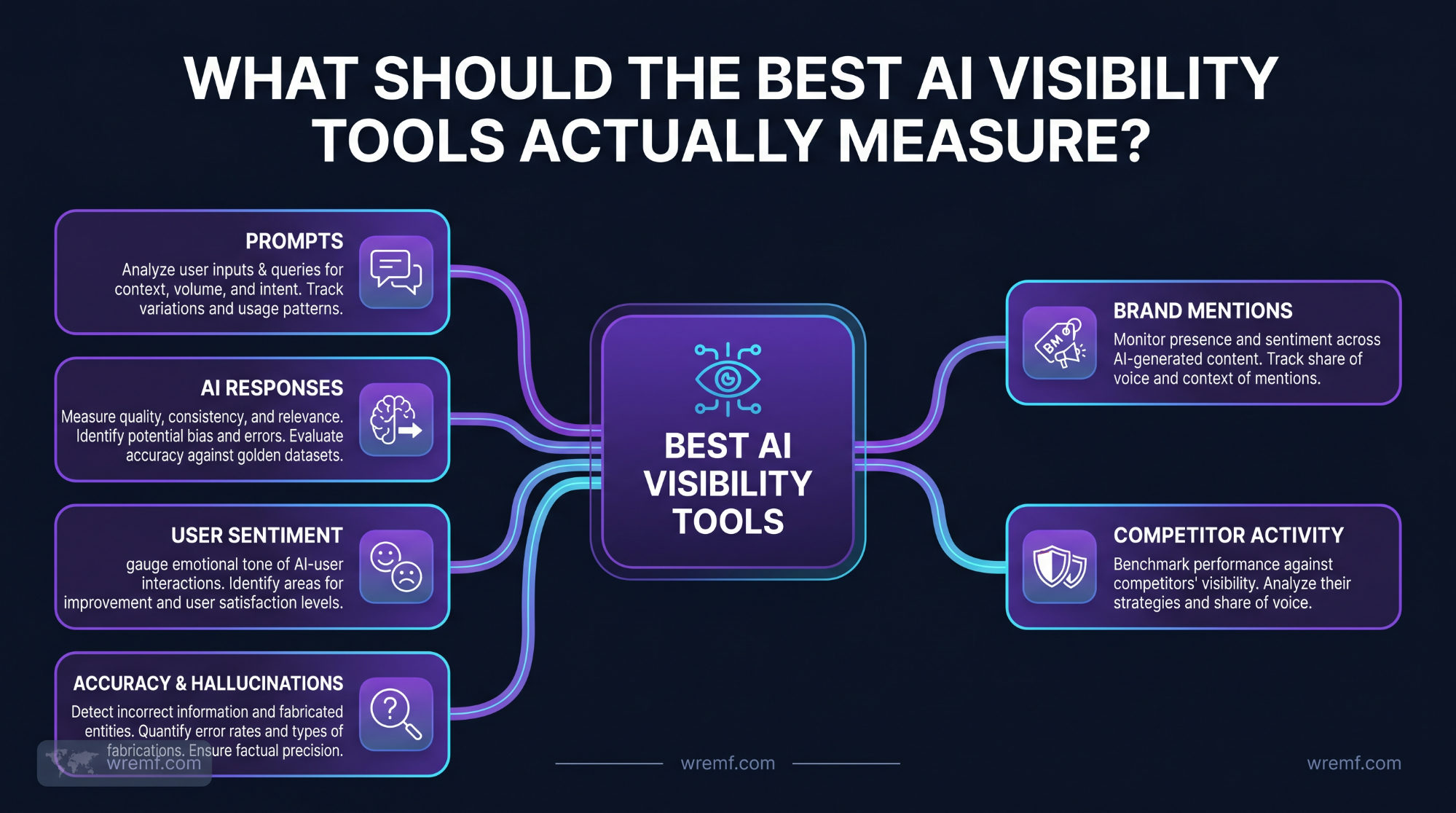
The best AI visibility tools should measure prompts, AI responses, Brand mentions, AI citations, Source Links, AI Visibility Score, share of voice, sentiment analysis, Presence Quality, competitor visibility, and AI traffic attribution. These metrics show whether AI platforms understand, trust, and recommend your brand.
Prompt tracking is the process of testing repeatable user questions across AI engines and recording the resulting AI responses. Prompt tracking matters because buyers ask large language models natural-language questions, not only short keywords.
AI citations are source references, links, or cited pages that AI engines use to support generated answers. AI citations matter because cited sources can influence how AI platforms describe brands, categories, competitors, and recommendations.
A strong AI visibility platform should measure at least these core areas:
Prompt coverage: What industry, product, comparison, pricing, and implementation prompts are being tracked.
AI responses: What each AI platform says in response to each prompt.
Brand mentions: Whether your brand appears in the answer.
Brand mention tracking: How often your brand appears over time.
AI citations: Which pages, domains, and Source Links support the answer.
Source Links: Which sources AI systems expose or reference.
Share of voice: How your visibility compares with competitors.
Sentiment analysis: Whether AI responses describe your brand positively, neutrally, or negatively.
Presence Quality: Whether the answer is accurate, complete, current, and useful.
Brand perception: How AI platforms frame your strengths, weaknesses, pricing, use cases, and positioning.
Competitor visibility: Which competitors appear more often for commercial prompts.
Content gaps: Which topics, pages, FAQs, comparisons, and Content Briefs are missing.
AI traffic attribution: Whether traffic from AI platforms contributes to engagement, conversions, and pipeline.
AI Visibility Dashboard: Whether teams can interpret findings quickly.
Composite score: Whether the platform summarizes performance without hiding the underlying data.
Share of voice is the percentage of relevant AI responses where your brand appears compared with competitors. Share of voice matters because AI answers often compress a market into a few recommended vendors.
Presence Quality is the quality of how a brand appears in AI responses, including accuracy, completeness, sentiment, and usefulness. Presence Quality matters because a mention is not valuable if the AI answer is wrong, vague, outdated, or positioned poorly against competitors.
In practical AI visibility audits, teams often find that their best-ranking SEO pages are not the sources cited by AI engines. AI platforms may cite comparison articles, documentation, review sites, partner pages, forums, analyst mentions, directories, and media coverage. This is why AI visibility data should connect content optimization, source consistency, and digital PR instead of treating prompt rankings as the only output.
WREMF’s source citation tracking helps teams identify which sources and cited pages influence AI search visibility across major AI engines. This is useful when you need to know whether AI systems trust your own site, third-party sources, or competitor-heavy pages.
TIP: Treat AI Visibility Score as a summary, not the full diagnosis. Always inspect prompts, citations, AI responses, competitors, sentiment analysis, and Source Links behind the score.
KEY TAKEAWAY: The best AI visibility tools measure the full AI answer ecosystem, including prompts, mentions, citations, competitors, sentiment, sources, content gaps, and attribution.
After defining the metrics, you can compare the main AI visibility tool categories in the market.
Best AI Visibility Tools and Platform Categories to Compare
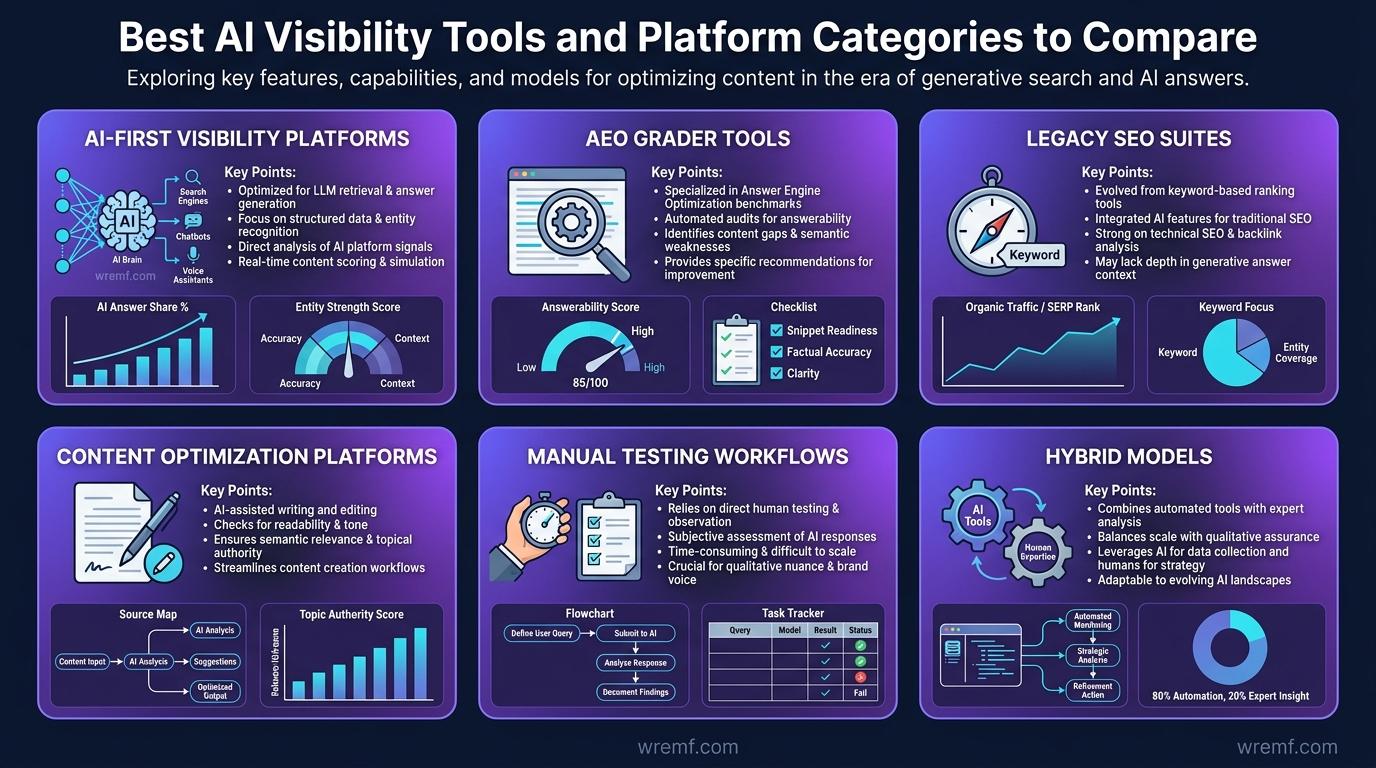
Best AI visibility tools fall into several categories: AI-first visibility platforms, AEO Grader tools, legacy SEO suites with AI modules, content optimization platforms, manual testing workflows, and hybrid software plus agency models. The right choice depends on your goals, reporting needs, execution capacity, and AI Search maturity.
AI visibility tools are software platforms that monitor how brands appear across AI platforms, AI search platforms, answer engines, and generative engines. AI visibility tools matter because manual testing cannot reliably track many prompts across multiple AI engines over time.
AEO Grader tools are diagnostic tools that identify quick Answer Engine Optimization gaps. AEO Grader tools matter because they help teams find simple fixes, but they may not provide deep AI Visibility Tracking, industry benchmarks, or recurring reporting.
AI Visibility Tracking is the repeated monitoring of prompts, AI responses, citations, Brand mentions, share of voice, and competitors across AI engines. AI Visibility Tracking matters because one-off checks do not reveal trend changes, model variation, or competitor movement.
| Tool Category | Best For | What It Measures | What It Misses | Typical User | Main Limitation |
|---|---|---|---|---|---|
| AI-first visibility platforms | Ongoing AI search visibility monitoring | Prompts, AI citations, Brand mentions, share of voice, competitors, sentiment analysis | May still need execution support | B2B brands, SEO teams, content teams, agencies | Category is still maturing |
| AEO Grader tools | Fast diagnostics and quick wins | Answer Engine gaps, content clarity, page-level issues | Deep multi-engine tracking and reporting | Consultants, founders, small teams | Limited trend monitoring |
| Legacy SEO suites with AI modules | Teams extending current SEO workflows | Keywords, Google AI Overviews, Google AI Mode, Content Audit data | Broader LLM visibility outside Google AI | Enterprise SEO teams | AI visibility may be an add-on |
| Content optimization platforms | Content briefs and page improvements | Content optimization, Keyword Research, Topic clusters, content gaps | Brand mentions, Source Links, sentiment analysis | Content teams | Often content-focused, not visibility-focused |
| Manual testing workflows | Early exploration | Custom prompts and visible AI answers | Scale, consistency, historical data, reporting | Founders, early-stage teams | Hard to repeat accurately |
| Hybrid software plus agency | Data plus execution | AI visibility data, content gaps, technical fixes, digital PR, reporting | Requires coordination | Growth teams and B2B agencies | More involved than software alone |
Named tools and categories often discussed in the AI visibility market include Profound, Otterly.AI, AEO Grader, Agent Analytics, Semrush, SE Ranking, SurferSEO, SE Visible, and dedicated AI Visibility Toolkit solutions. These tools vary widely. Some focus on brand visibility and AI responses, some focus on Google AI Overviews, some focus on Content creation and Content optimization, and some focus on classic SEO with generative search modules.
For most B2B teams, the best starting point is not a single score. The best starting point is a repeatable workflow that tracks real prompts, identifies AI citations, compares competitors, and turns findings into content briefs, source consistency fixes, and reporting.
If you want to see how a finished AI Visibility Dashboard can communicate prompts, citations, share of voice, and recommendations, review a sample AI visibility report before building your own reporting workflow.
KEY TAKEAWAY: The best AI visibility tools combine repeatable tracking, reliable citation analysis, competitor comparison, useful reporting, and action recommendations.
Once you understand the tool categories, you need to compare how visibility differs across major AI search platforms.
Comparing Visibility Across Major AI Search Platforms
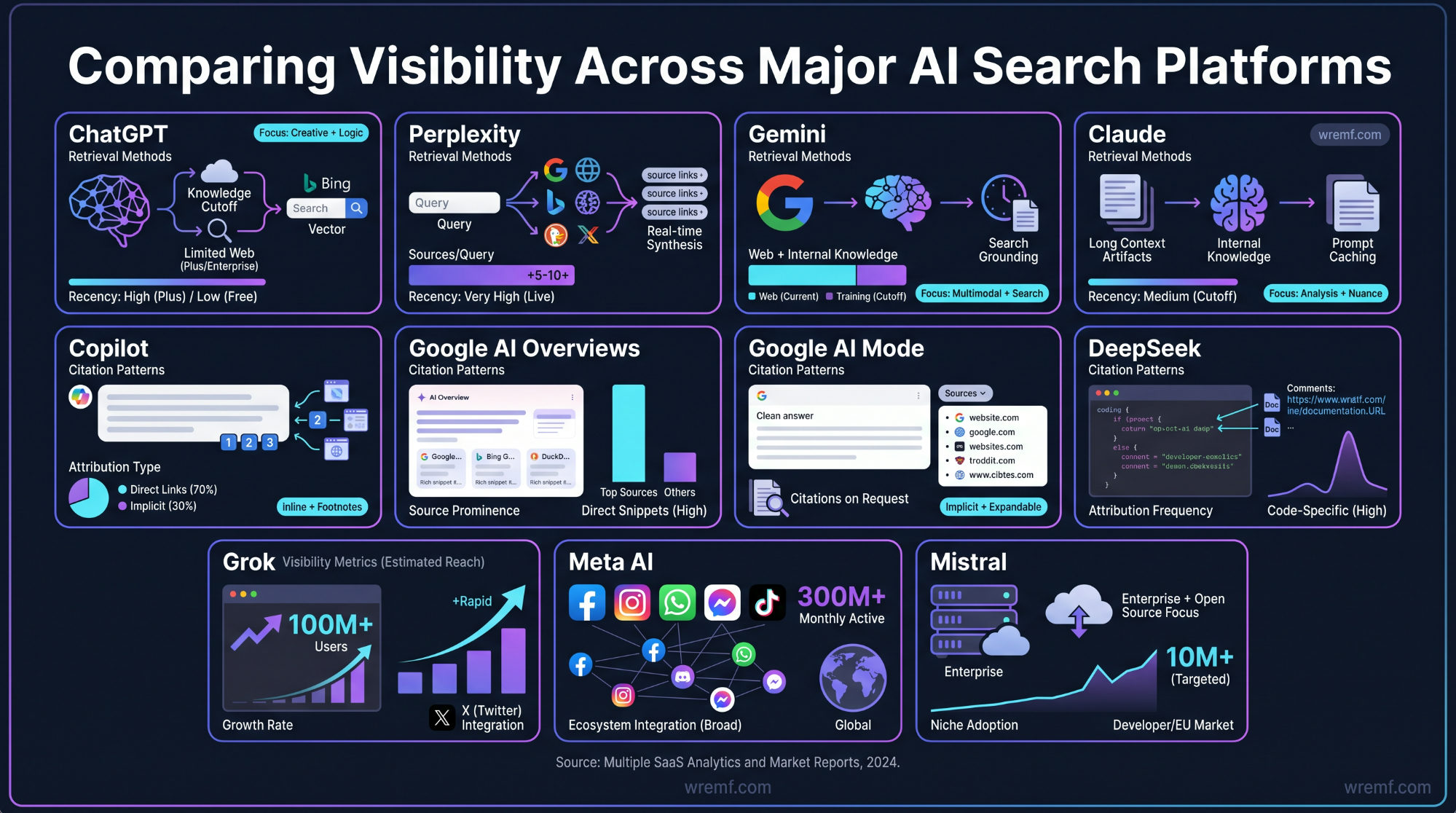
Visibility differs across ChatGPT, Perplexity, Gemini, Claude, Copilot, Google AI Overviews, Google AI Mode, DeepSeek, Grok, Meta AI, and Mistral because each AI platform uses different retrieval, grounding, interface, model, and citation patterns. A reliable AI visibility tool must track model-specific variations.
AI platforms are the AI systems where users ask questions, compare vendors, summarize topics, and receive AI answers. AI platforms matter because a brand can be visible in one answer engine and absent in another.
ChatGPT is a conversational AI platform where users ask research, comparison, and buying questions. OpenAI says ChatGPT search can provide timely answers with links to relevant web sources, which makes cited source visibility important for brand discovery. OpenAI explains ChatGPT search and web source links. (OpenAI)
Perplexity is commonly used as an answer engine for research-style queries. Perplexity documentation describes search capabilities that return ranked web results from a continuously refreshed index, which makes Source Links and AI citations central to visibility analysis. Perplexity documentation explains its search API and real-time web results. (Perplexity AI)
Google AI Overviews and Google AI Mode are part of Google AI Search experiences. Google AI Overviews can provide AI-generated snapshots with links to explore further, while Google AI Mode gives users a more AI-led Search experience. Google AI visibility matters because many teams still depend heavily on Google for discovery, demand capture, and traffic.
Claude is used for research, summarization, writing, and analysis. Anthropic documentation states that Claude’s web search tool can access real-time web content and include citations from search results, which makes source accuracy and citation monitoring important. Anthropic documentation explains Claude web search and citations. (Anthropic)
| AI Search Platform | Common Visibility Pattern | What to Track | Practical Risk |
|---|---|---|---|
| ChatGPT | Conversational answers and recommendations | Brand mentions, AI citations, answer accuracy, competitors | Brand may be summarized without a click |
| Perplexity | Research-style AI answers with citations | Source Links, cited domains, share of voice | Competitors may win through stronger cited sources |
| Google AI Overviews | AI-generated Search summaries | Google AI Overviews inclusion, cited pages, query types | Ranking well may not equal AI Overview inclusion |
| Google AI Mode | AI-led Search with follow-up exploration | Google AI Mode prompts, links, recommendations | Classic SEO dashboards may miss AI Mode behavior |
| Gemini | Google AI ecosystem responses | Google AI responses, entity clarity, brand perception | Visibility may vary across Google AI experiences |
| Claude | Cited answers when web search is used | Source citations, accuracy, claim quality | Weak or inconsistent sources can reduce trust |
| Copilot | Work and web-grounded responses | References, current information, category mentions | Enterprise users may see mixed internal and web context |
| DeepSeek | Model-specific answers and summaries | Brand mentions, answer accuracy, competitor references | Coverage may vary by prompt and region |
| Grok | Real-time and social-context responses | Brand mentions, sentiment analysis, topic associations | Brand reputation can be shaped by social signals |
| Meta AI | Consumer-facing AI responses | Broad brand recognition and AI responses | Visibility may be more consumer-context dependent |
| Mistral | Model-specific responses and enterprise use cases | Entity clarity, answer accuracy, citations where available | B2B visibility may vary by deployment context |
AI search visibility is not one universal score. AI search visibility is a cross-platform measurement problem where the same brand, prompt, and source set can produce different AI responses depending on the model, interface, retrieval method, and user context.
KEY TAKEAWAY: AI visibility tools must track multiple AI engines because ChatGPT, Perplexity, Gemini, Claude, Copilot, Google AI Overviews, and Google AI Mode do not behave the same way.
After platform coverage, the most important question is how to turn AI visibility data into action.
A Workflow-First Approach to AI Visibility Data
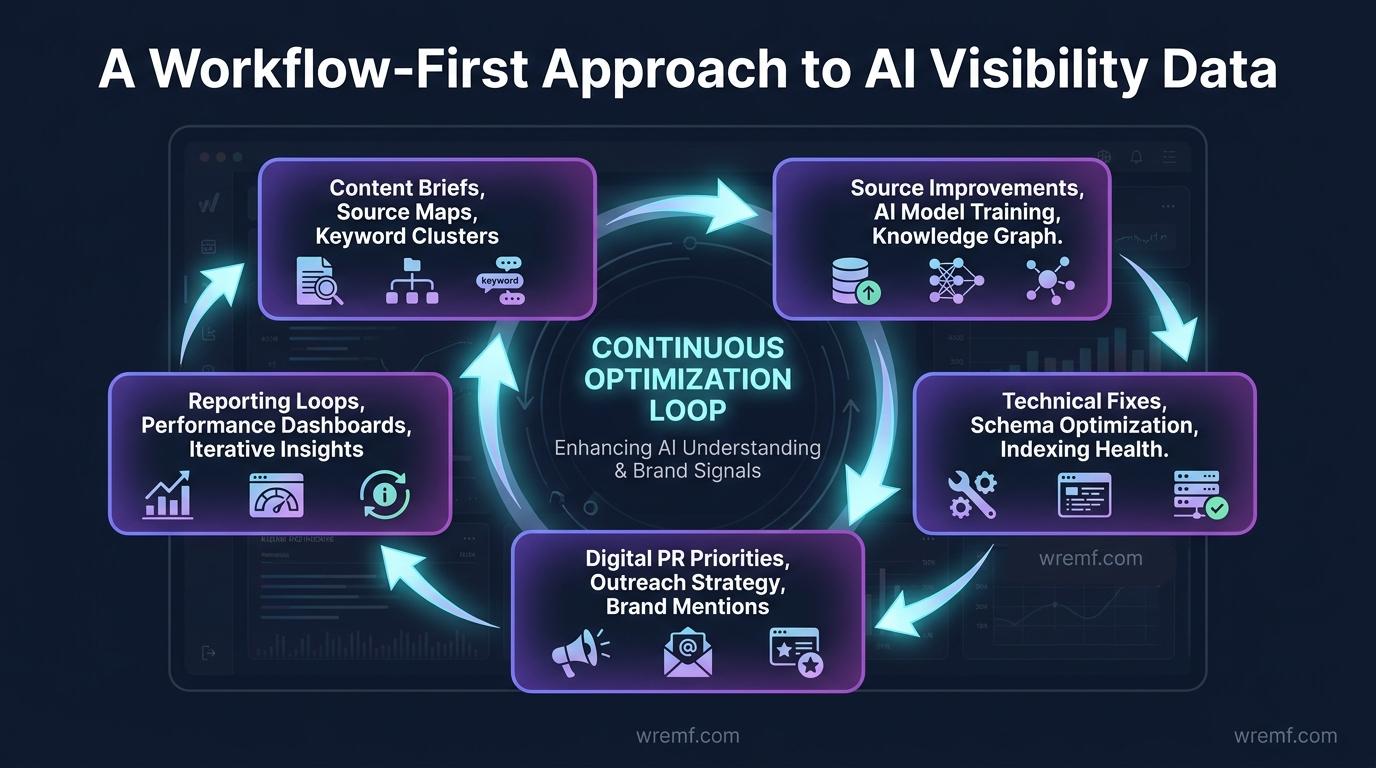
The most effective way to improve AI search visibility is to convert AI visibility data into content briefs, source improvements, technical fixes, digital PR priorities, and reporting loops. Tracking alone is not enough if teams do not act on content gaps and citation gaps.
AI visibility data is the structured record of prompts, AI responses, Brand mentions, AI citations, Source Links, sentiment analysis, share of voice, and competitor references. AI visibility data matters because it shows where your brand is present, absent, misunderstood, or outranked inside AI answers.
A workflow-first approach has 8 steps:
Define prompt groups by search intent: Include informational, commercial, comparison, pricing, implementation, risk, and support prompts.
Track prompts across AI engines: Test ChatGPT, Perplexity, Gemini, Claude, Copilot, Google AI Overviews, Google AI Mode, and other AI platforms.
Capture AI responses: Store the full answer, Brand mentions, citations, sentiment analysis, and Presence Quality.
Benchmark competitors: Compare share of voice, recommendation frequency, competitor claims, and category positioning.
Identify content gaps: Find missing pages, weak explanations, thin comparisons, incomplete FAQs, and missing Topic clusters.
Create Content Briefs: Turn prompts into AI-ready content briefs with answer-first structure and source support.
Fix technical and source issues: Improve schema markup, internal linking, crawlability, AI Crawler access, and source consistency.
Report outcomes: Connect AI Visibility Score, AI traffic attribution, cited sources, and recommendations to leadership or client reports.
Content optimization is the process of improving page structure, coverage, source support, clarity, and answer quality so content better satisfies users and AI retrieval systems. Content optimization matters because AI responses often depend on clear, source-backed, extractable information.
Content Briefs are structured instructions for creating or updating content based on prompts, search intent, entities, citations, and gaps. Content Briefs matter because they turn AI visibility data into content creation and content optimization actions.
In practical AI visibility audits, marketing teams often find that AI platforms cite sources the company does not control. That creates a source ecosystem problem. Improving only your own website may not be enough if comparison pages, review pages, directories, and market articles define your brand more strongly than your owned content.
WREMF helps teams use AI-ready content briefs to convert prompt intelligence, citations, and content gaps into practical writing and optimization tasks. WREMF also helps connect AI visibility data with competitor visibility, source consistency, and reporting.
KEY TAKEAWAY: AI visibility data becomes valuable when it drives content optimization, Content Briefs, technical fixes, source consistency, and reporting.
A strong workflow also needs technical foundations that make your content accessible and understandable to AI systems.
Technical Fixes for AI Search Visibility
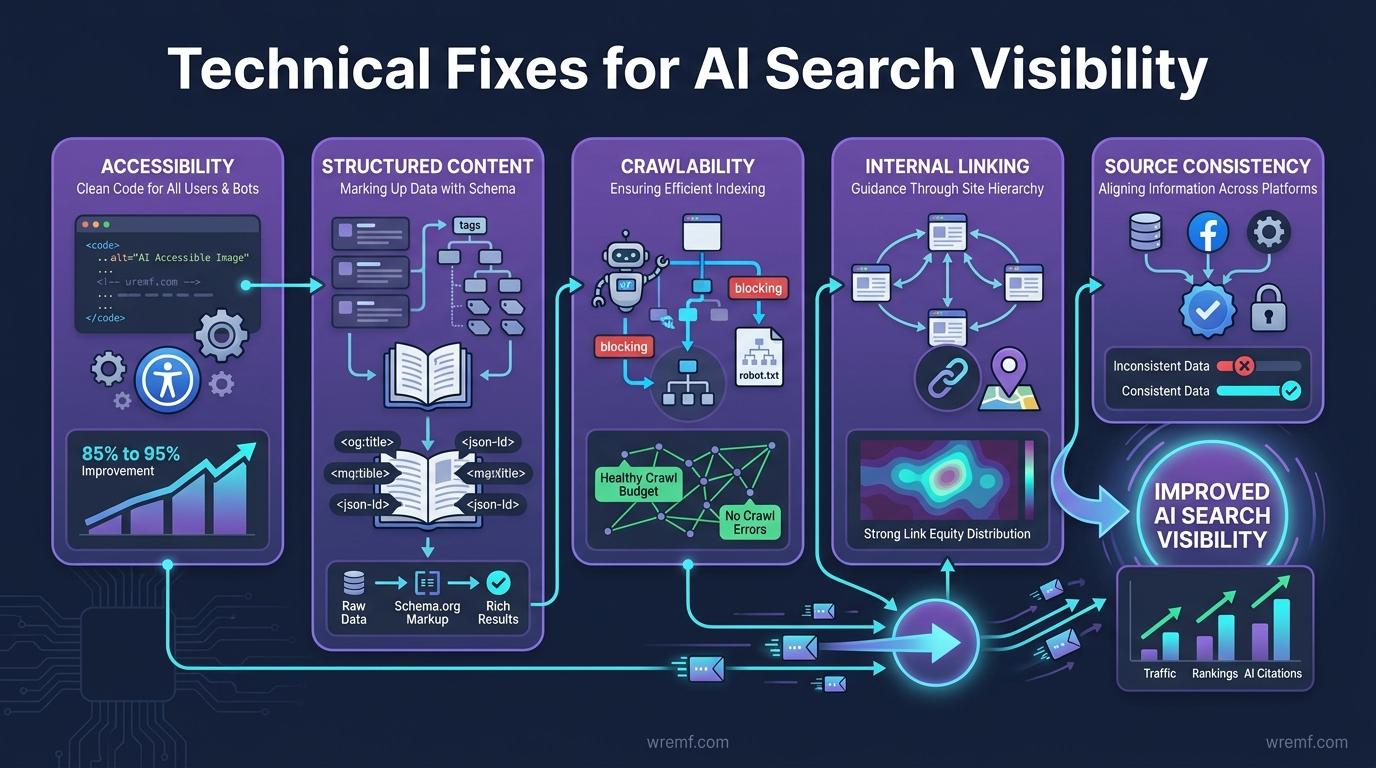
Technical fixes improve AI search visibility by making content accessible, structured, crawlable, internally connected, and consistent across sources. AI visibility tools should identify technical blockers before teams scale content generation or digital PR campaigns.
AI Crawler refers to crawlers used by AI systems, search systems, or AI platforms to access content for retrieval, grounding, search, or model-related workflows. AI Crawler management matters because blocked or poorly rendered content can limit discoverability.
Technical fixes for AI visibility include:
Robots.txt review: Check whether important search and AI crawler access is blocked.
Crawlability checks: Confirm that core product, pricing, comparison, documentation, and topic pages are reachable.
Rendering checks: Make sure key content appears in accessible HTML.
Schema markup: Use structured data for Organization, Article, FAQ, Product, Breadcrumb, and review-related contexts where appropriate.
Internal linking: Connect pillar pages, feature pages, comparison pages, and Content Libraries.
Structured content: Use answer-first headings, concise definitions, tables, and FAQ blocks.
Source consistency cleanup: Align company facts across your site, directories, review platforms, partner pages, and media.
Content freshness: Update outdated pricing, claims, statistics, product features, and examples.
AI-generated content review: Remove thin, duplicate, unsupported, or low-quality AI-generated content.
Enterprise controls: Review BYOK, API access, SOC 2 Type II needs, and data governance requirements.
Structured data is machine-readable information that helps search systems understand page entities, relationships, and content types. Structured data matters because it gives systems clearer context, although schema markup alone does not guarantee inclusion in Google AI Overviews, AI Mode, or AI answers.
A common implementation mistake is assuming schema markup can compensate for weak content. Schema markup can clarify what a page is about, but answer engines still need useful explanations, accurate claims, entity consistency, and strong Source Links.
Technical AI visibility also includes internal linking logic. If your product suite, features, pricing, methodology, and comparison pages are isolated, AI systems and users may struggle to understand how your brand fits the category. Strong internal linking helps connect entities, Topic clusters, and buyer questions.
For teams that need deeper technical diagnosis, WREMF’s GEO audit workflow helps identify gaps across crawlability, content structure, AI citations, prompt visibility, and source consistency.
TIP: Fix technical access and content structure before scaling content generation. More pages will not solve AI search visibility if AI engines cannot access, interpret, or trust the content.
KEY TAKEAWAY: Technical AI visibility work should make content accessible, structured, internally connected, consistent, and trustworthy.
With the technical layer in place, teams can compare software, agency, and hybrid operating models.
Software vs Agency vs Hybrid AI Visibility Models
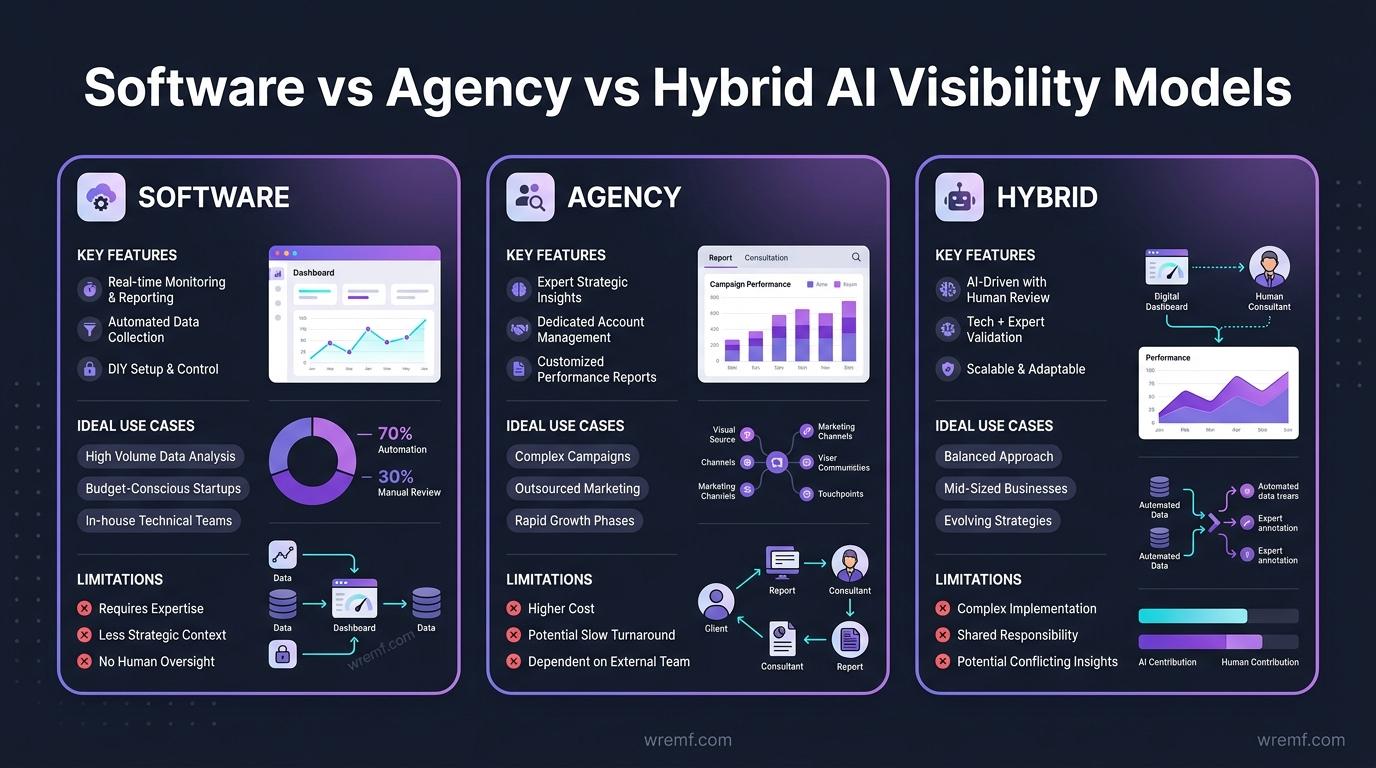
The right AI visibility operating model depends on whether your team needs software, execution, or both. Software is best for teams with in-house capacity, agency support is best for teams needing strategy and implementation, and hybrid models work best when measurement and execution must stay connected.
AI Visibility Toolkit refers to the tools, dashboards, workflows, prompts, reports, and processes used to monitor and improve AI visibility. An AI Visibility Toolkit matters because AI search visibility requires measurement, diagnosis, execution, and reporting.
There are 3 common operating models:
| Model | Best For | What It Includes | Main Limitation | Recommended When |
|---|---|---|---|---|
| Software-only | Teams with internal SEO and content resources | AI Visibility Dashboard, prompt tracking, citations, competitors, reporting | Execution depends on your team | You can act on insights internally |
| Agency-only | Teams without time or expertise | Strategy, GEO audits, AEO consulting, content optimization, technical fixes | Less self-serve control | You need senior-led execution |
| Hybrid software plus agency | Teams needing data and action | Platform tracking plus managed implementation | Requires coordination | You want measurable workflows and execution support |
In real-world reporting, software-only teams often move faster when they already have content teams, SEO teams, and developers available. Agency-led teams often perform better when they lack internal AI Search expertise or need an outside team to translate AI visibility data into Content Campaigns, Content Libraries, digital PR, and technical fixes.
B2B agencies have a different requirement. B2B agencies often need white-label reporting, multiple client workspaces, recurring exports, client portals, industry benchmarks, and repeatable prompt frameworks. A simple AI Visibility Score is not enough when client reporting requires context, trend data, and recommended next actions.
WREMF supports all 3 models. Teams can use the platform as software, work with the WREMF agency team for managed AEO, GEO, and AI visibility services, or combine both into a hybrid model.
KEY TAKEAWAY: Choose software, agency, or hybrid AI visibility support based on your team’s ability to turn visibility data into action.
After choosing an operating model, the next decision is which metrics should guide maturity and prioritization.
The AI Visibility Maturity Matrix
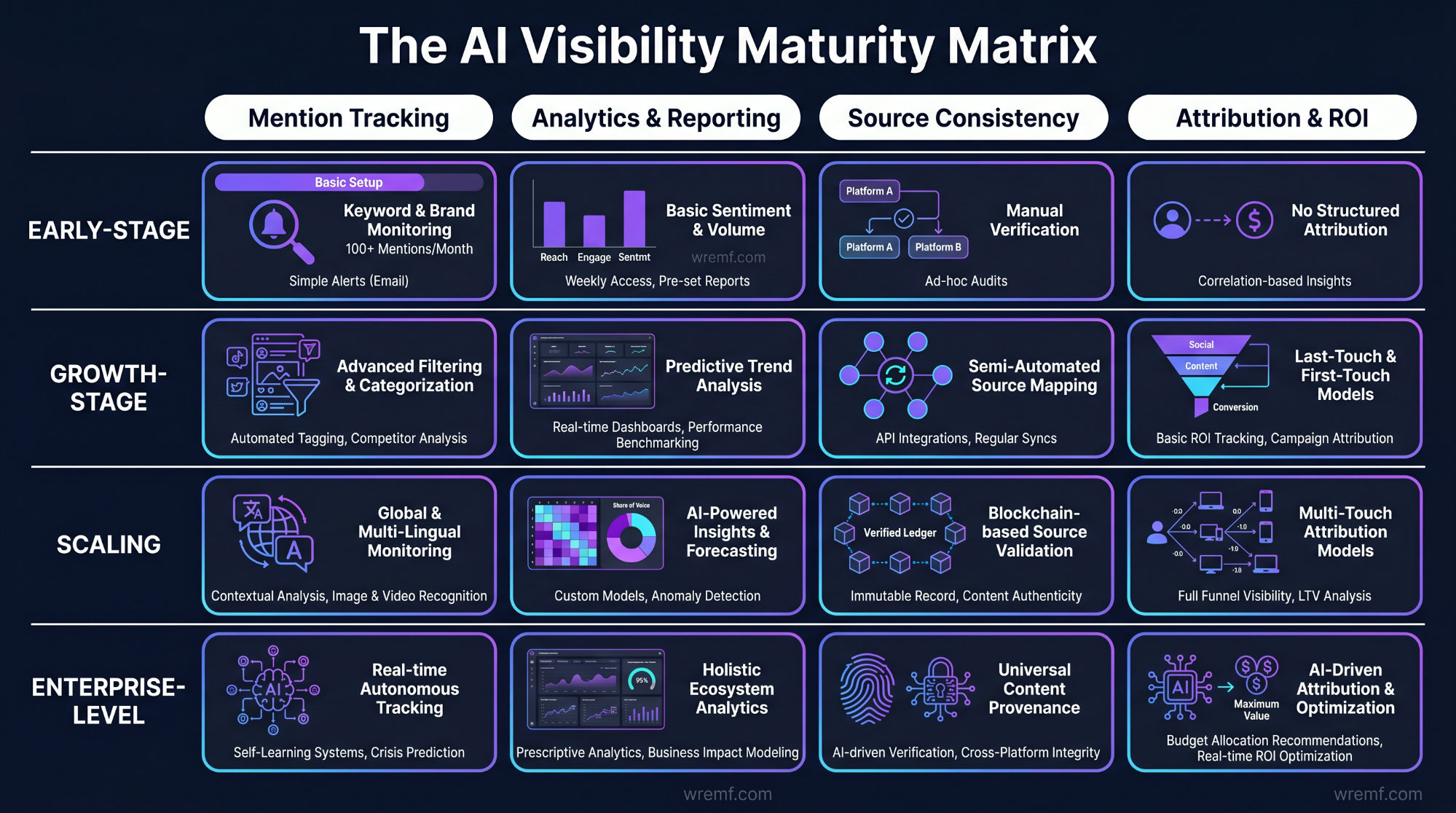
The AI Visibility Maturity Matrix helps teams choose the right tool depth based on current visibility, team capacity, reporting needs, and competitive pressure. Early-stage brands need mention tracking, while mature teams need multi-engine analytics, source consistency workflows, and attribution.
AI Visibility Score is a composite score that summarizes brand presence, citations, share of voice, sentiment analysis, and answer quality across selected prompts and AI engines. AI Visibility Score matters because it gives teams a trend line, but the underlying prompts and citations should always be reviewed.
| Maturity Stage | Best Starting Point | Must-Have Metrics | Workflow Priority | Typical Risk |
|---|---|---|---|---|
| Stage 1: Awareness | Manual checks and basic Brand mention tracking | Brand mentions, AI answers, obvious competitors | Learn which prompts matter | Overreacting to one-off AI responses |
| Stage 2: Tracking | AI Visibility Tracking across priority prompts | AI Visibility Score, citations, share of voice, Presence Quality | Build monthly trend reporting | Tracking without action |
| Stage 3: Optimization | Content gaps and Source Links | Content Briefs, content gaps, AI citations, sentiment analysis | Update pages and build Topic clusters | Creating content without source strategy |
| Stage 4: Competitive benchmarking | Competitor visibility and Market Competition | Share of voice, competitor mentions, industry benchmarks | Defend and expand category presence | Ignoring competitor source ecosystems |
| Stage 5: Attribution and governance | AI traffic attribution and enterprise workflows | API, BYOK, SOC 2 Type II review, reporting tools | Connect AI visibility to business outcomes | Measuring too much without prioritization |
Early-stage brands should focus on brand recognition, Brand mentions, and category prompts. Growth-stage SaaS teams should prioritize competitor visibility, AI citations, Content Briefs, and Google AI Overviews. Enterprise organizations should add governance, API access, BYOK, reporting controls, and AI traffic attribution.
McKinsey’s 2025 State of AI research reported that many organizations are using AI while still facing issues related to risk, inaccuracy, and operating model change. McKinsey’s State of AI report discusses adoption, risk, and organizational change. (McKinsey & Company) That context matters because AI visibility is not only a marketing dashboard. It is part of how companies manage brand accuracy and decision influence across AI systems.
WREMF is useful for brands that want software, agencies that need white-label reporting, and teams that want managed execution. Agencies and consultants can use WREMF for agencies when they need repeatable reporting across multiple clients.
KEY TAKEAWAY: AI visibility maturity should progress from mention tracking to optimization, competitive benchmarking, attribution, and governance.
The next section explains how AI visibility metrics connect to content strategy and market positioning.
Using AI Visibility Data for Content Strategy and Topic Clusters
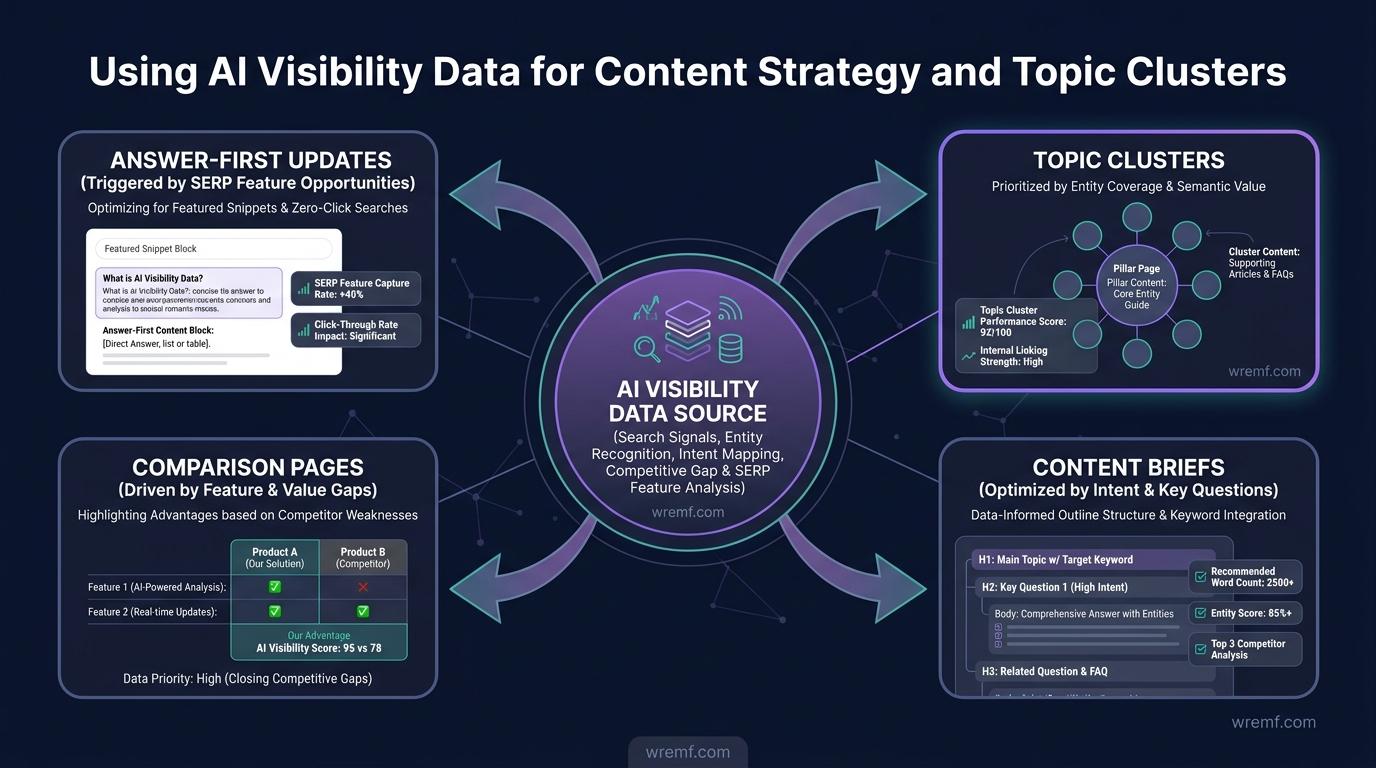
AI visibility data improves content strategy by showing which prompts, entities, citations, competitors, and content gaps influence AI responses. Content teams can use this data to prioritize Topic clusters, content briefs, comparison pages, and answer-first updates.
Topic clusters are groups of related pages that cover a subject from multiple angles and connect through internal linking. Topic clusters matter because AI systems and search engines need clear relationships between concepts, entities, use cases, and buyer questions.
AI visibility data can shape content strategy in 6 ways:
Prompt-to-page mapping: Match high-intent AI prompts to existing pages or new pages.
Content gaps: Identify missing definitions, comparisons, FAQs, and implementation guides.
Topic clusters: Build clusters around buyer problems, category terms, tools, alternatives, and use cases.
Content creation: Create new pages only when prompts show unmet demand.
Content optimization: Update pages that are cited poorly, described incorrectly, or missing key entities.
Content Libraries: Maintain structured collections of briefs, reports, FAQs, comparison pages, and product explanations.
Content creation is the process of producing new pages, articles, guides, FAQs, and resources for users and search systems. Content creation matters only when it is tied to real search intent, prompt demand, and evidence-backed gaps.
A strong AI search content strategy does not chase every keyword. It answers real buyer questions such as “Which LLM monitoring tool should you choose?”, “What sources do AI engines trust?”, “Will AI actually crawl and cite my content?”, and “Is AI recommending us or our competitors?” These questions connect AI visibility, Answer Engine Optimization, Generative Engine Optimization, and SEO.
AI visibility works by connecting prompts to sources, sources to answers, answers to competitors, and competitors to content gaps. AI visibility data helps teams decide whether to improve owned content, strengthen third-party citations, fix technical blockers, or build new comparison pages.
For in-house teams, WREMF helps connect prompt intelligence with content optimization and visibility reporting. B2B brands can use WREMF for in-house brands to structure AI visibility tracking around real buying questions.
KEY TAKEAWAY: AI visibility data should guide content strategy by showing which prompts, entities, citations, and content gaps actually affect AI responses.
Content strategy is only part of the problem, because AI visibility also depends on trust signals and source ecosystems.
Why Citations, Source Consistency, and Entity Clarity Matter More Than Keyword Density
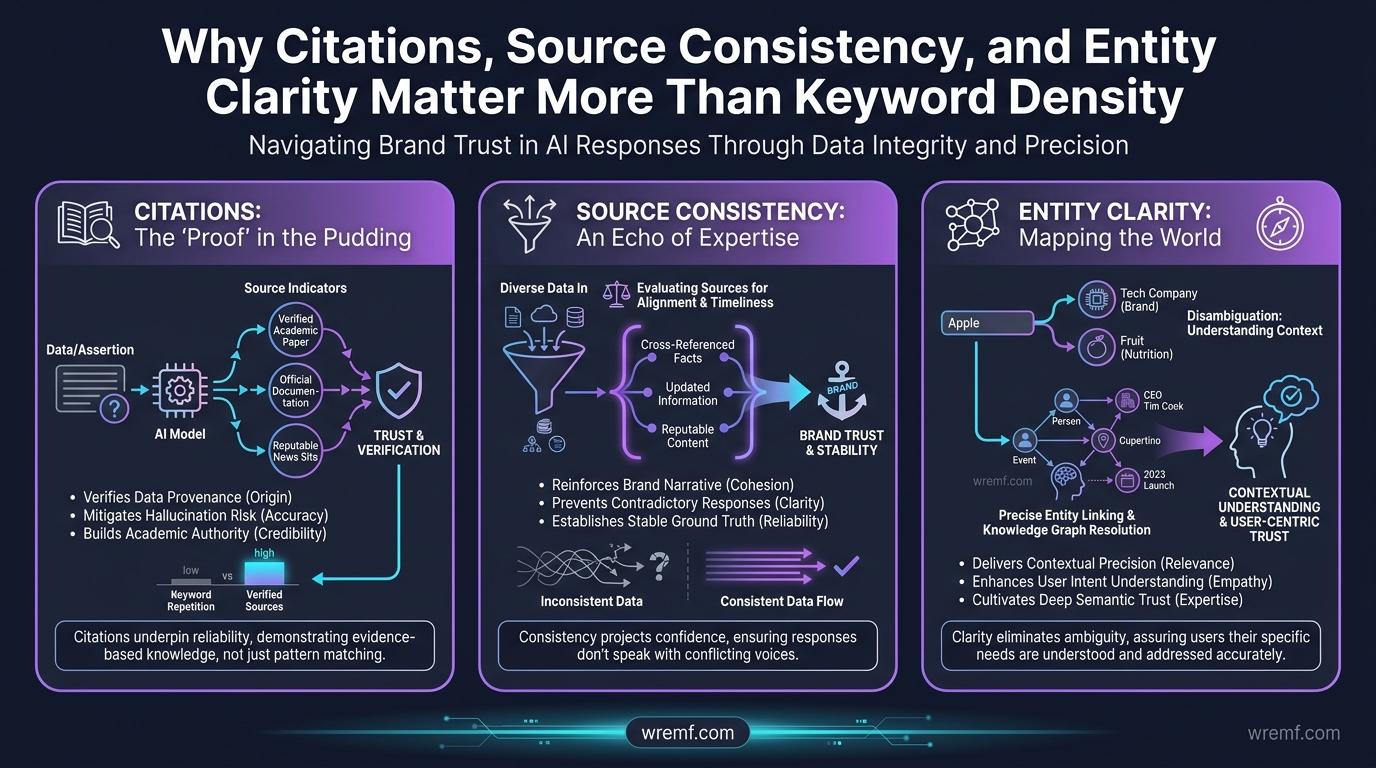
Citations, source consistency, and entity clarity matter more than keyword density because AI systems synthesize information from multiple sources and need reliable signals to describe a brand accurately. Keyword repetition alone does not build trust inside AI responses.
Entity authority is the strength and clarity of how a brand, person, product, or topic is understood across trusted sources. Entity authority matters because AI models and search systems need stable facts to connect a brand with its category, features, use cases, and competitors.
Source consistency is the alignment of facts across your website, review profiles, directories, partner pages, media mentions, documentation, and third-party content. Source consistency matters because conflicting information can cause AI responses to omit, distort, or weaken your brand positioning.
AI citations matter because they reveal which sources influence AI answers. If Perplexity, ChatGPT, Claude, or Google AI Overviews cite third-party pages that describe your product inaccurately, your brand perception can suffer even if your own website is clear.
In practical AI visibility audits, SEO teams frequently discover these issues:
The company description differs across directories and review sites.
Pricing pages and third-party profiles show outdated plan information.
Product pages do not clearly define the ideal customer.
Comparison pages are missing or too vague.
Content Libraries lack answer-first definitions.
Source Links cite competitor-heavy listicles.
Google AI Overviews cite pages that only partially explain the topic.
AI responses confuse similar tools or categories.
Keyword density is still a weak proxy for relevance. AI Search depends more on clear answers, consistent entity signals, source-backed claims, citations, structured data, and helpful content. This is the expert nuance generic SEO content often misses.
Brand recommendation visibility measures how often AI platforms recommend your brand for relevant use cases, not only whether the brand is mentioned. Brand recommendation visibility matters because a neutral mention is less valuable than being recommended as a suitable option for a specific buyer need.
KEY TAKEAWAY: AI visibility improves when trusted sources, consistent facts, entity clarity, and useful answers support the same brand narrative.
This source ecosystem view helps explain why many AI visibility myths lead teams in the wrong direction.
Common Myths About AI Visibility Debunked
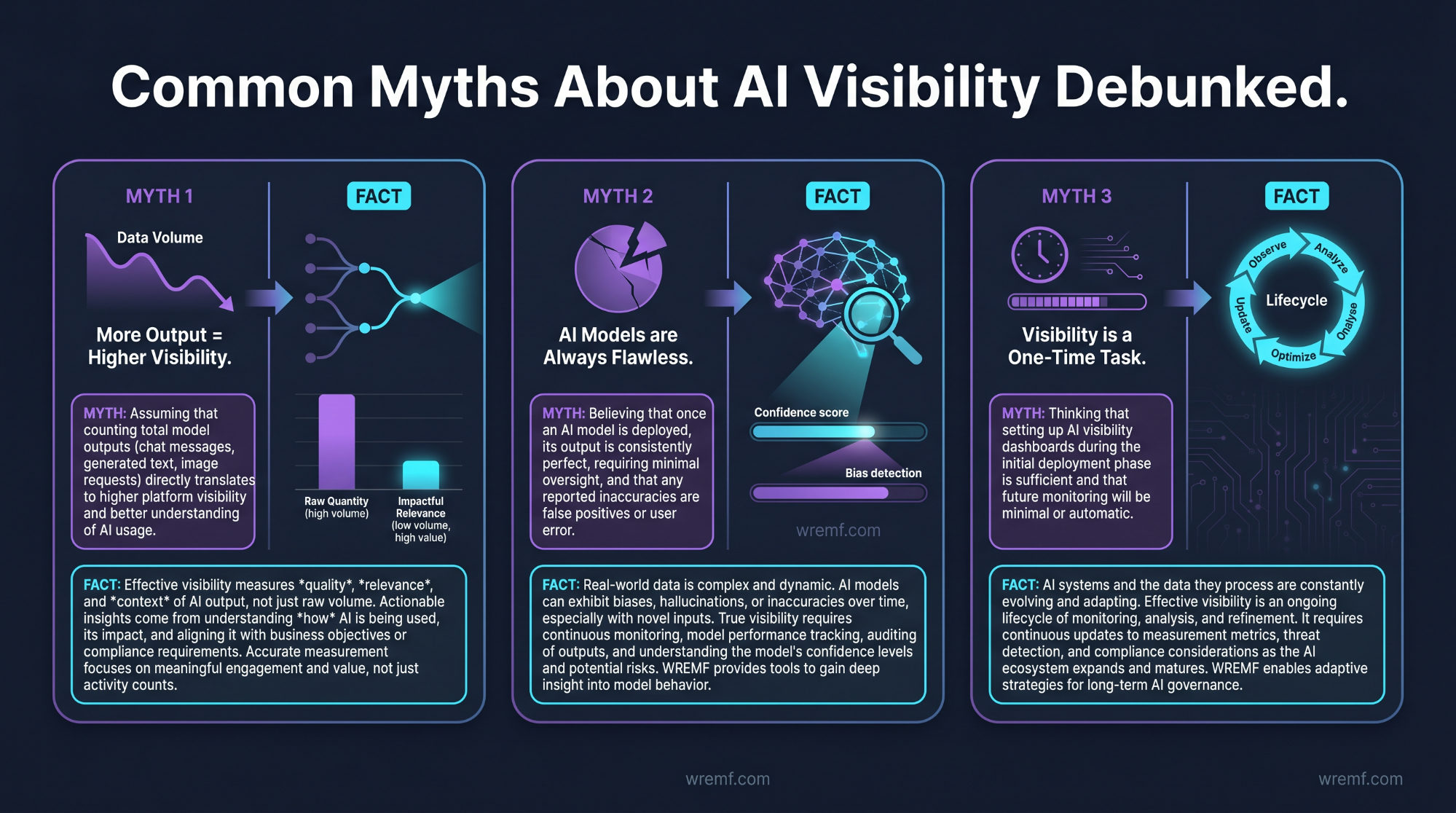
AI visibility myths usually come from applying old SEO assumptions to new AI search behavior. The best AI visibility tools help teams separate measurable signals from speculation, shortcuts, and dashboard vanity metrics.
MYTH: AI visibility is impossible to measure.
FACT: AI visibility is measurable when prompts, AI responses, Brand mentions, AI citations, Source Links, share of voice, sentiment analysis, and Presence Quality are tracked consistently. Measurement is not perfect because AI models can vary by time, interface, location, and context, but repeatable prompt sets create useful trend data.
MYTH: Rankings alone are enough.
FACT: Rankings are not enough because Google AI Overviews, Google AI Mode, ChatGPT, Perplexity, Claude, Gemini, and Copilot can synthesize answers without following classic ranking order. A page can rank well and still be absent from AI answers, while a third-party source may influence AI responses more than your own page.
MYTH: SEO, AEO, and GEO are completely separate disciplines.
FACT: SEO, Answer Engine Optimization, and Generative Engine Optimization overlap through helpful content, crawlability, structured content, entities, authority, and internal linking. The difference is the measurement layer. SEO measures search results, AEO measures answer readiness, and GEO measures how generative engines synthesize and cite information.
MYTH: AI visibility tools can guarantee citations.
FACT: No AI visibility provider can guarantee AI citations, AI responses, rankings, revenue, or traffic. AI systems decide what to retrieve, summarize, and cite based on changing model, source, and interface factors. A credible provider should show evidence, gaps, and recommendations without overpromising outcomes.
MYTH: Content generation alone improves AI search visibility.
FACT: Content generation only helps when it closes real content gaps, improves entity clarity, strengthens Topic clusters, and adds useful source-backed answers. Low-quality AI-generated content can create duplicate pages, thin explanations, and confusing signals that hurt trust.
KEY TAKEAWAY: AI visibility is measurable and improvable, but it requires better metrics than rankings and stronger signals than keyword density.
With the myths cleared, buyers can evaluate AI visibility providers more confidently.
How to Evaluate an AI Visibility Provider Before You Buy
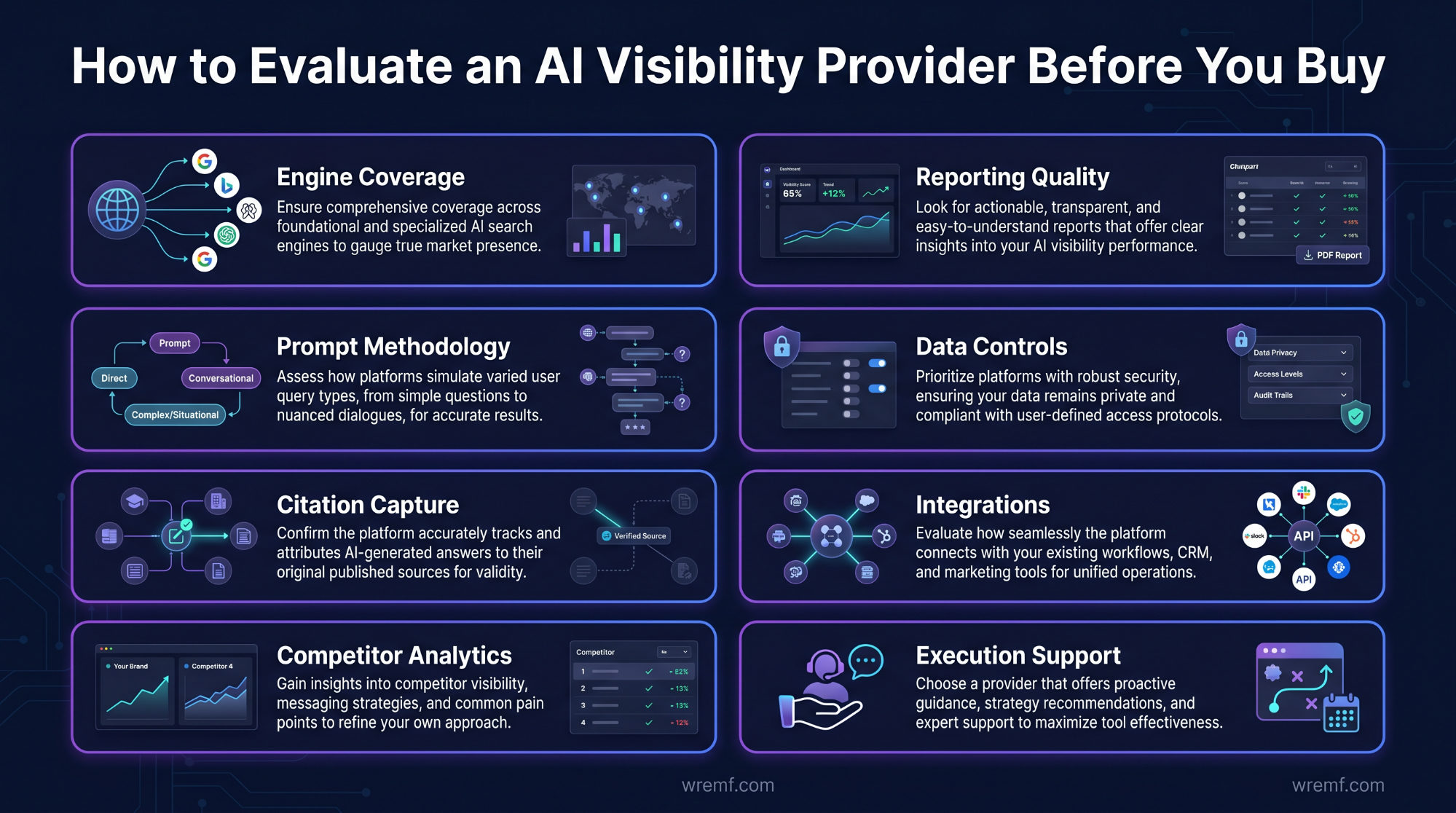
You should evaluate an AI visibility provider by checking engine coverage, prompt methodology, citation capture, competitor analytics, reporting quality, data controls, integrations, and execution support. The best provider gives repeatable evidence and recommendations, not just an attractive dashboard.
An AI Visibility Dashboard is a reporting interface that summarizes prompts, AI responses, Brand mentions, citations, share of voice, sentiment analysis, Presence Quality, and competitor movement. An AI Visibility Dashboard matters because teams need fast interpretation of complex AI visibility data.
Use this provider checklist:
Engine coverage: Does the platform monitor ChatGPT, Claude, Gemini, Perplexity, Google AI Overviews, Google AI Mode, Copilot, DeepSeek, Grok, Meta AI, and Mistral?
Prompt methodology: Are prompts mapped to real buyer questions, search intent, industry terms, and objections?
Citation capture: Does the platform record Source Links, domains, URLs, and citation frequency?
Competitive benchmarking: Can the tool measure Market Competition, share of voice, and competitor positioning?
Sentiment analysis: Does the tool evaluate brand perception, Presence Quality, and accuracy?
Content workflow: Does the tool connect insights to Content Briefs, Content Audit tasks, Content Libraries, and content optimization?
Technical workflow: Does the tool identify AI Crawler issues, schema markup gaps, crawlability problems, and internal linking opportunities?
Reporting: Does the tool support exports, white-label reports, client portals, and executive summaries?
Integrations: Does the tool connect with analytics, reporting tools, API workflows, and MCP workflows?
Data security: Does the provider support BYOK, access controls, and enterprise requirements where needed?
Execution model: Does the provider offer software, agency support, or a hybrid model?
AI visibility tools should also answer buying-stage questions such as “Which AI visibility provider should you choose?”, “What makes the best AI visibility platform?”, “Which LLM monitoring tool should you choose?”, and “What additional features should you consider in AI visibility tools?” These questions are more useful than asking whether a brand appears once in one response.
For technical teams, API access and MCP integrations can matter. WREMF supports technical workflows through the WREMF API and integration layer, which helps teams connect AI visibility data to internal reporting and operational systems.
IMPORTANT: Ask every vendor how prompts are selected, how often results are refreshed, which AI engines are covered, how citations are captured, and how recommendations are generated.
KEY TAKEAWAY: The right AI visibility provider should explain what is measured, why it matters, how recommendations are created, and how teams can act on the findings.
The final buying decision depends on company stage, budget, and whether you need software, services, or both.
Choosing the Right AI Visibility Tool for Your Team
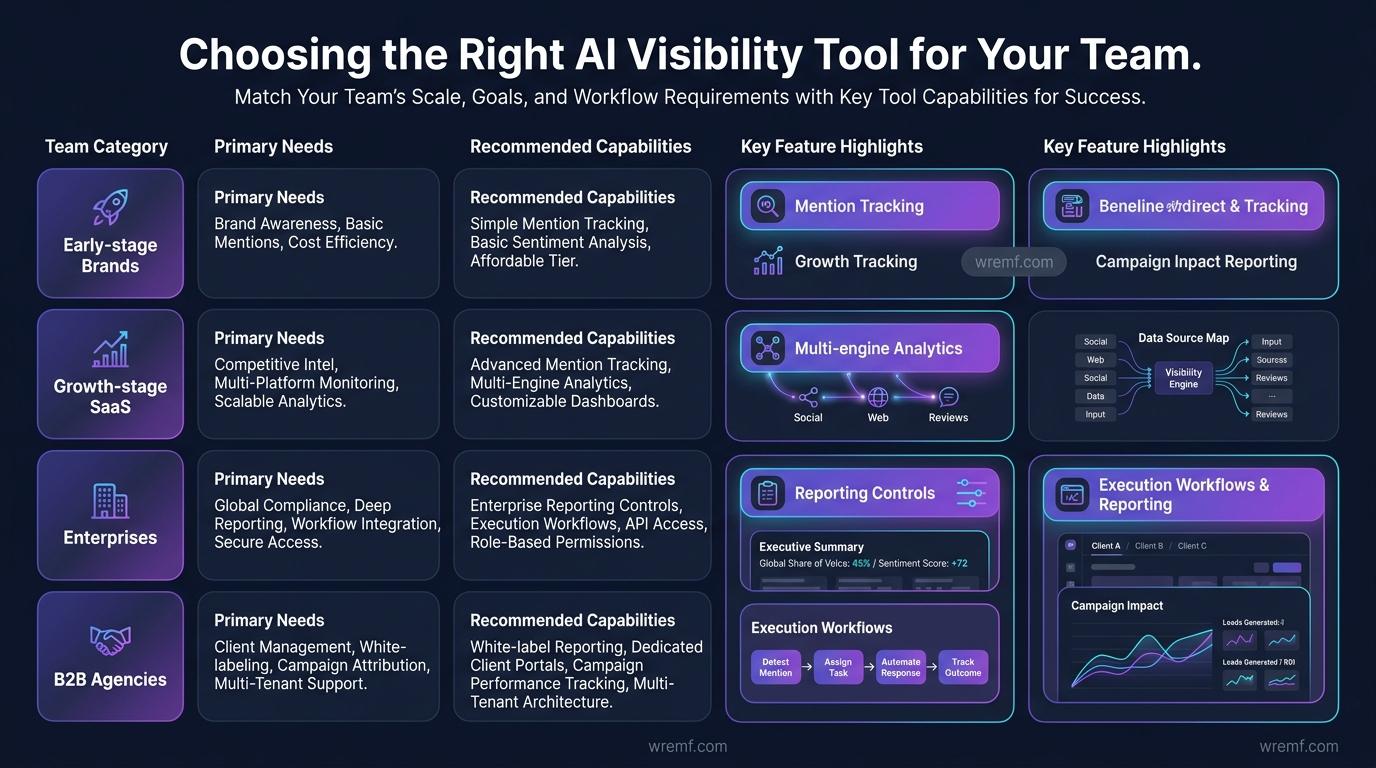
The right AI visibility tool depends on your team size, AI Search maturity, content capacity, reporting needs, and competitive pressure. Early-stage brands should start with mention tracking, while agencies and enterprises need multi-engine analytics, reporting controls, and execution workflows.
Brand visibility is the degree to which a brand appears, is recognized, and is correctly understood across discovery channels. Brand visibility matters because AI platforms can influence brand recognition and brand reputation before buyers reach your website.
Use this decision framework:
| Team Type | Primary Need | Best-Fit Tool Capabilities | Recommended Focus |
|---|---|---|---|
| Early-stage brand | Learn if AI mentions the brand | Brand mention tracking, AI responses, basic prompt sets | Track 25 to 50 priority prompts |
| Growth-stage SaaS | Improve category visibility | Share of voice, AI citations, content gaps, competitor visibility | Build Topic clusters and Content Briefs |
| Enterprise marketing team | Manage risk and reporting | AI Visibility Score, governance, API, BYOK, attribution, dashboards | Connect AI visibility to reporting and operations |
| B2B agency | Manage multiple clients | White-label reporting, client portals, industry benchmarks | Standardize audits and monthly reporting |
| Technical SEO team | Fix discoverability issues | AI Crawler checks, schema markup, crawlability, internal linking | Improve access, structure, and entity clarity |
| Content team | Create better pages | Content optimization, Content Briefs, prompts, source analysis | Build answer-first content and update weak pages |
| Leadership team | Understand market position | Share of voice, competitors, Presence Quality, AI traffic attribution | Track business-level visibility trends |
Pricing should be evaluated against workflow depth, not only monthly cost. A low-cost AI Visibility Toolkit may be enough for simple monitoring, but a B2B agency, enterprise organization, or fast-growing SaaS team usually needs better reporting, repeatability, and recommendations.
WREMF pricing is relevant for teams comparing software options. Starter is €39 per month for 1 website, unlimited prompt tracking, BYOK, 10 AI engines, all features and tools, white-label reports, 1 seat, and email support. Growth is €89 per month for 5 websites, unlimited prompt tracking, BYOK, 10 AI engines, all features and tools, white-label reports, priority email support with 24h SLA, content brief generator, and SEO A/B testing. Enterprise offers custom pricing for unlimited websites, unlimited seats, dedicated support with 4h SLA, and custom branded portals.
WREMF is useful for brands that want software, B2B agencies that need white-label reports, and teams that want hybrid managed execution. Teams comparing package fit can view WREMF pricing to match websites, seats, support, reporting, and execution needs.
KEY TAKEAWAY: Choose AI visibility tools based on engine coverage, reporting needs, execution capacity, technical requirements, and team maturity.
Once you choose a tool, the most important outcome is building a sustainable AI visibility strategy instead of chasing one-off mentions.
Building a Sustainable AI Visibility Strategy
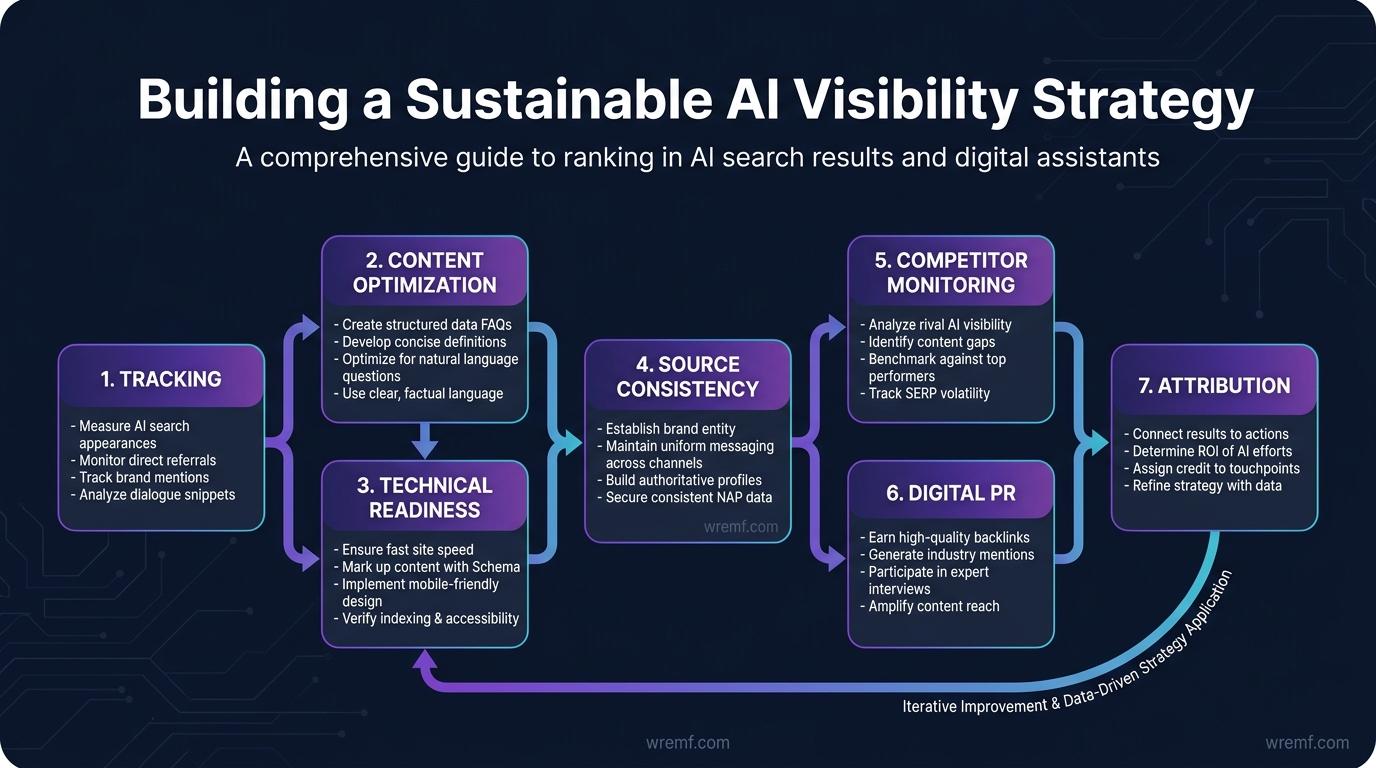
A sustainable AI visibility strategy combines tracking, content optimization, technical readiness, source consistency, competitor monitoring, digital PR, and attribution. The goal is to improve how AI systems understand and represent your brand over time.
AI traffic attribution connects visits, conversions, and assisted demand from AI platforms to business outcomes. AI traffic attribution matters because leadership needs to understand whether AI search visibility contributes to pipeline, engagement, or qualified discovery.
A sustainable strategy has 6 ongoing workstreams:
Measurement: Track prompts, AI responses, AI citations, Brand mentions, share of voice, and sentiment analysis.
Content: Build answer-first pages, Topic clusters, FAQs, comparison pages, Content Briefs, and Content Libraries.
Technical: Improve crawlability, schema markup, AI Crawler access, internal linking, and page rendering.
Source ecosystem: Strengthen Source Links, third-party references, directories, review profiles, and partner pages.
Competitors: Monitor competitor mentions, Market Competition, positioning, and Presence Quality.
Reporting: Use dashboards, exports, client reports, and leadership summaries to guide decisions.
In real-world execution, the best AI visibility strategy is not about manipulating AI models. The best AI visibility strategy is about becoming easier to understand, easier to cite, and easier to recommend for the right category prompts. That requires consistent facts, useful content, trusted sources, and ongoing measurement.
AI visibility also has limits. Results can vary by model, interface, location, time, and prompt wording. AI platforms can change how they retrieve sources, display citations, or summarize answers. This is why recurring tracking is more useful than a single audit.
WREMF combines prompt tracking, AI citations, competitor visibility, AI share of voice, content recommendations, and reporting into one workflow. For teams that need execution, WREMF also provides managed AEO, GEO, and AI visibility services with no long-term lock-in, clear deliverables, and senior-led execution.
KEY TAKEAWAY: Sustainable AI visibility comes from repeatable measurement, strong content, technical readiness, consistent sources, competitor monitoring, and practical reporting.
The FAQ section answers the common questions buyers ask before selecting AI visibility tools.
Frequently Asked Questions
What are the best AI visibility tools?
The best AI visibility tools are platforms that track Brand mentions, AI citations, Source Links, share of voice, sentiment analysis, AI responses, competitors, and AI Visibility Score across AI platforms. Strong tools should monitor ChatGPT, Perplexity, Gemini, Claude, Copilot, Google AI Overviews, Google AI Mode, DeepSeek, Grok, Meta AI, and Mistral. The best choice depends on your team. Early-stage brands may need Brand mention tracking, while B2B agencies and enterprise teams need white-label reporting, client portals, API workflows, and recurring AI Visibility Tracking.
What features should I look for in AI visibility tools?
Look for prompt tracking, AI responses, Brand mentions, Brand mention tracking, AI citations, Source Links, share of voice, sentiment analysis, Presence Quality, competitor visibility, content gaps, AI traffic attribution, and an AI Visibility Dashboard. Strong platforms should also support Google AI Overviews, Google AI Mode, ChatGPT, Perplexity, Gemini, Claude, Copilot, and other AI engines. For workflow depth, check for Content Briefs, Content Audit support, Content Libraries, API access, BYOK, white-label reports, and clear methodology.
Are AI visibility tools actually helpful?
AI visibility tools are helpful when they turn AI visibility data into decisions about content optimization, source consistency, competitor positioning, and reporting. They are less helpful when they only provide a one-off score without prompt methodology, citation evidence, or recommended actions. In practical AI visibility audits, teams often find that AI responses mention competitors, cite third-party sources, or describe the brand inaccurately. A good tool makes those gaps visible so SEO teams, content teams, agencies, and leadership can prioritize fixes.
How do AI visibility tools differ from traditional SEO tools?
AI visibility tools differ from SEO tools because they measure presence inside AI answers, not only performance in search results. SEO tools track rankings, backlinks, keywords, traffic, technical SEO, and content optimization. AI visibility tools track prompts, AI responses, Brand mentions, AI citations, Source Links, share of voice, sentiment analysis, competitor recommendations, and AI traffic attribution. SEO still matters because AI systems rely on accessible, useful, source-backed web content. The missing layer is AI search visibility across large language models and answer engines.
Should small businesses bother with AI visibility yet?
Small businesses should start with lightweight AI visibility tracking if customers already use AI platforms for local recommendations, product comparisons, vendor discovery, or buying advice. A small business does not need an enterprise AI Visibility Toolkit on day one. A practical starting point is tracking 25 to 50 high-intent prompts, checking Brand mentions, reviewing AI citations, and identifying obvious content gaps. Small businesses should keep investing in classic SEO while adding AI visibility monitoring for answer engines and AI search responses.
How do I get mentioned and cited more often in AI answers?
To get mentioned and cited more often in AI answers, improve entity clarity, publish answer-first content, cover comparison and buying questions, strengthen source consistency, and earn credible third-party mentions. AI citations matter because AI engines often rely on source-backed content when generating AI responses. Use schema markup where appropriate, keep product and company facts consistent, update outdated pages, and create content briefs from real prompts. WREMF can help identify which prompts, sources, and competitors are shaping AI search visibility.
Which AI visibility provider should B2B agencies choose?
B2B agencies should choose an AI visibility provider with multi-client tracking, white-label reporting, repeatable prompt sets, competitor visibility, Source Links, client portals, industry benchmarks, and clear exports. Agencies also need reporting that explains share of voice, sentiment analysis, AI Visibility Score, Presence Quality, and recommended actions without overwhelming clients. WREMF is useful for agencies because it supports white-label reports, AI Visibility Tracking, citation analysis, competitor visibility, and managed execution options. Agencies should prioritize workflow reliability over a simple AEO Grader score.
Can AI visibility tools track Google AI Overviews and Google AI Mode?
Yes, some AI visibility tools can track Google AI Overviews and Google AI Mode, but coverage varies by provider. Google AI Overviews appear inside Search and can include links that help users explore sources. Google AI Mode is a more AI-led Search experience with deeper follow-up exploration. A useful platform should separate Google AI Overviews, AI Mode, and broader Google AI responses instead of combining them into one vague metric. Teams should compare Google AI visibility with ChatGPT, Perplexity, Claude, Gemini, and Copilot results.
What is the difference between Answer Engine Optimization and Generative Engine Optimization?
Answer Engine Optimization focuses on making content clear, direct, and useful for answer engines that respond to specific questions. Generative Engine Optimization focuses on how generative engines retrieve, synthesize, cite, and describe information. SEO, Answer Engine Optimization, and Generative Engine Optimization overlap through helpful content, technical accessibility, structured data, internal linking, and entity authority. The difference is the measurement layer. SEO measures search results, AEO measures answer readiness, and GEO measures representation inside AI responses and generative engines.
What sources do AI engines trust?
AI engines may rely on a mix of owned content, third-party sources, search results, citations, documentation, structured content, review pages, directories, and authoritative publications. Trust patterns vary by AI platform, prompt, model, and retrieval method. The practical question is not only whether your website exists. The practical question is whether AI systems find consistent, accurate, source-backed information about your brand across the sources they use. AI visibility tools help identify which Source Links and domains influence your category prompts.
How often should I track AI visibility?
Most B2B teams should track AI visibility monthly at minimum, and weekly for competitive categories, product launches, rebrands, or active content campaigns. Daily tracking may be useful for fast-moving markets, but it can create noise if prompts and reporting are not structured. A good cadence includes recurring prompt tracking, AI citations, share of voice, sentiment analysis, content gaps, and competitor visibility. The goal is trend analysis, not panic over one AI response. Consistent tracking creates better decisions than one-off manual testing.
Is AI visibility important for business growth right now?
AI visibility is important for business growth when buyers use AI platforms to research vendors, compare tools, ask category questions, or validate purchase decisions. AI visibility does not replace SEO, paid search, content marketing, or sales. It adds a new measurement layer for AI answers and AI search responses. If AI platforms recommend competitors, cite competitor-friendly sources, or describe your brand inaccurately, your brand visibility and demand capture can suffer. The best approach is to start tracking, then prioritize the prompts and sources that matter commercially.
Conclusion
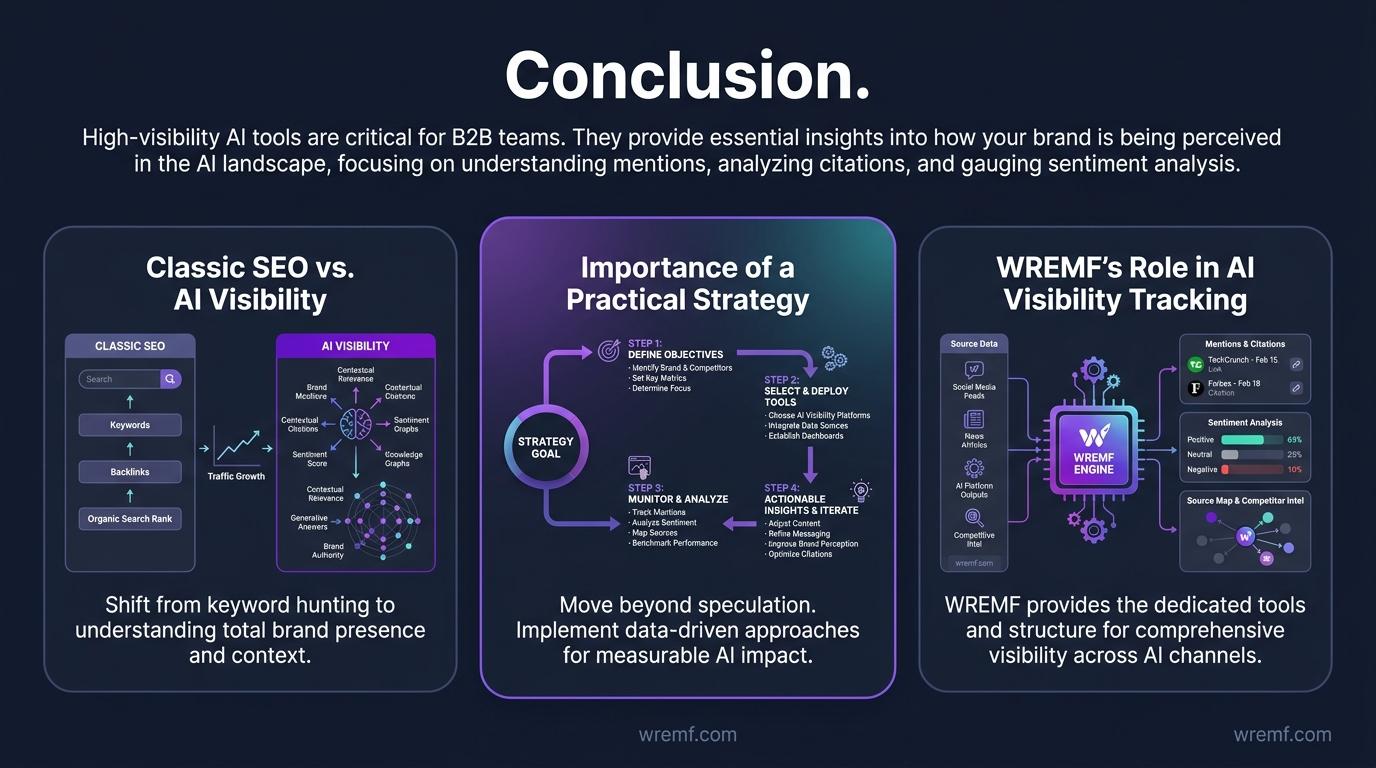
Best AI visibility tools help B2B teams understand how AI platforms mention, cite, compare, and recommend their brands. Classic SEO remains important, but rankings alone cannot show Brand mentions, AI citations, share of voice, sentiment analysis, Presence Quality, or Source Links inside AI responses. A practical strategy combines AI Visibility Tracking, content optimization, technical fixes, source consistency, competitor monitoring, and reporting. WREMF turns AI visibility from scattered manual testing into a repeatable workflow across major AI engines. To build a measurable AI Search program, explore the WREMF AI visibility platform suite or talk to the WREMF agency team.
Related reading
- AI Search Engine Optimization Tools: The Complete 2026 Guide for AI Search, SEO, AEO, and GEO
- Best Answer Engine Optimization for Enhancing AI Visibility
- Best AI Search Optimization Platforms: The Complete Guide to AI Visibility Tools, GEO, AEO, and Answer Engine Growth
- Best AI Search Visibility Platforms: Playbook for B2B Teams
- The Complete Guide to AI Rank Tracker Tools for B2B Search Visibility