How to Compare AI Search Optimization Tools
Discover how to compare AI search optimization tools, evaluating metrics to enhance AI visibility. Learn to use a weighted scorecard for better selection.
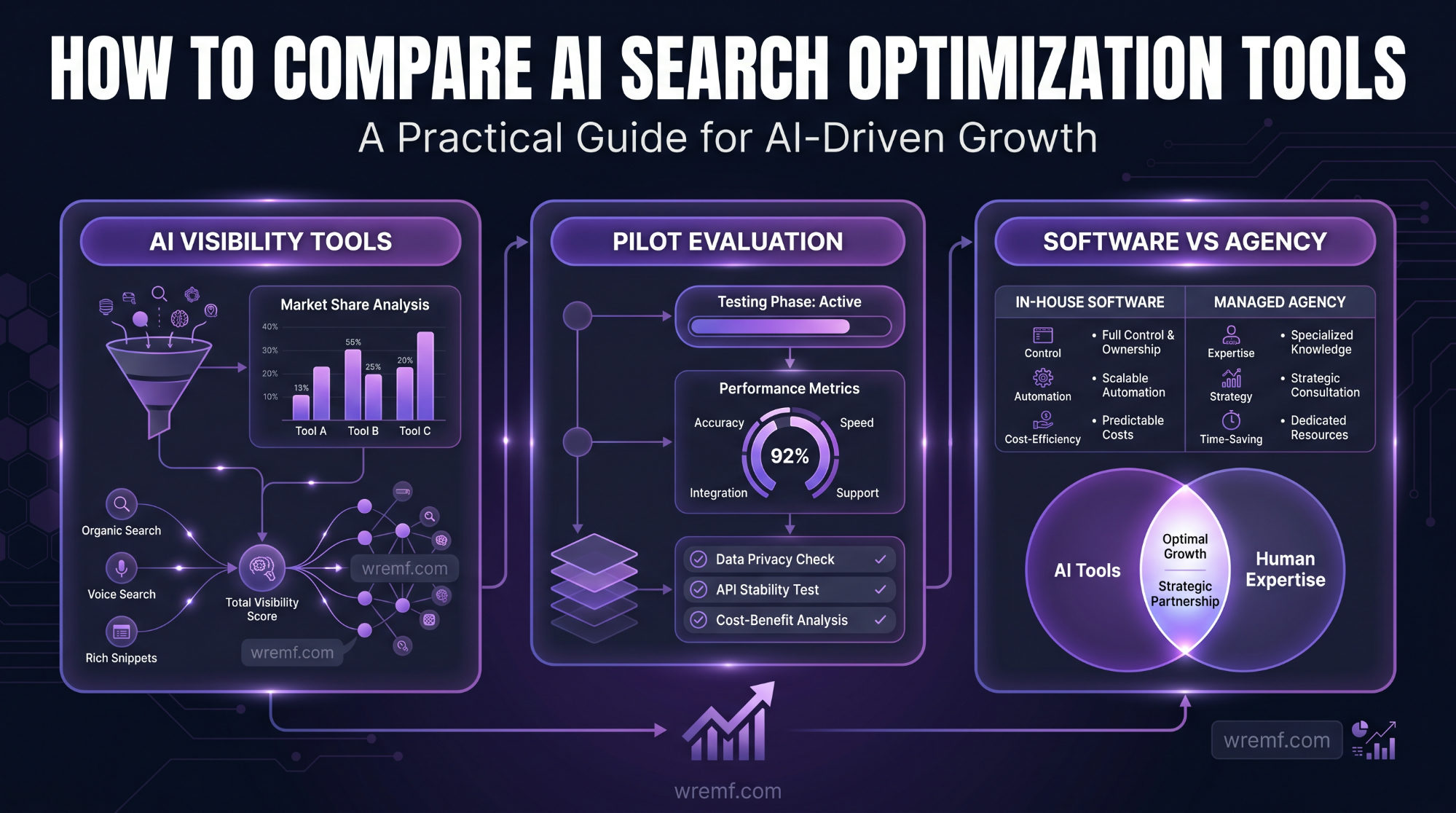
By WREMF Team · 2026-09-17
AI search optimization tools are platforms used to assess and enhance how brands and content appear in AI-generated search results. They focus on monitoring brand mentions, citations, AI answers, and recommendations. Key components include AI visibility metrics, pilot testing, citation evaluation, and the decision between using software, agency support, or hybrid models. Outcomes include improved brand visibility in AI surfaces like ChatGPT and Google AI, while constraints involve the need for comprehensive AI engine coverage. Implications include the evolving nature of search visibility measurements in marketing.
Key takeaways
- AI search optimization tools measure brand visibility across AI-generated answers.
- Traditional SEO metrics are insufficient for AI search optimization.
- Tools differ by category; choose with a weighted scorecard.
- Evaluate LLM coverage to ensure comprehensive AI visibility.
- Consider content optimization features for actionable insights.
How to Compare AI Search Optimization Tools
How to compare AI search optimization tools is the process of evaluating software that measures, improves, and reports brand visibility across AI answers. Gartner predicts traditional search engine volume will drop 25% by 2026 as users shift toward AI chatbots and virtual agents, which makes AI visibility a practical marketing measurement problem, not a future trend. This guide explains how to compare AI visibility tools, traditional SEO tools, content optimization platforms, technical GEO software, and AI-powered SEO workflows. You will learn which metrics matter, how to run a 14-day pilot, how to evaluate citations, and how to decide between software, agency support, or a hybrid model. WREMF helps B2B teams track, improve, and prove visibility across ChatGPT, Claude, Gemini, Perplexity, Google AI Overviews, Copilot, DeepSeek, Grok, Meta AI, and Mistral.
Why Traditional SEO Metrics Are Not Enough for AI Search
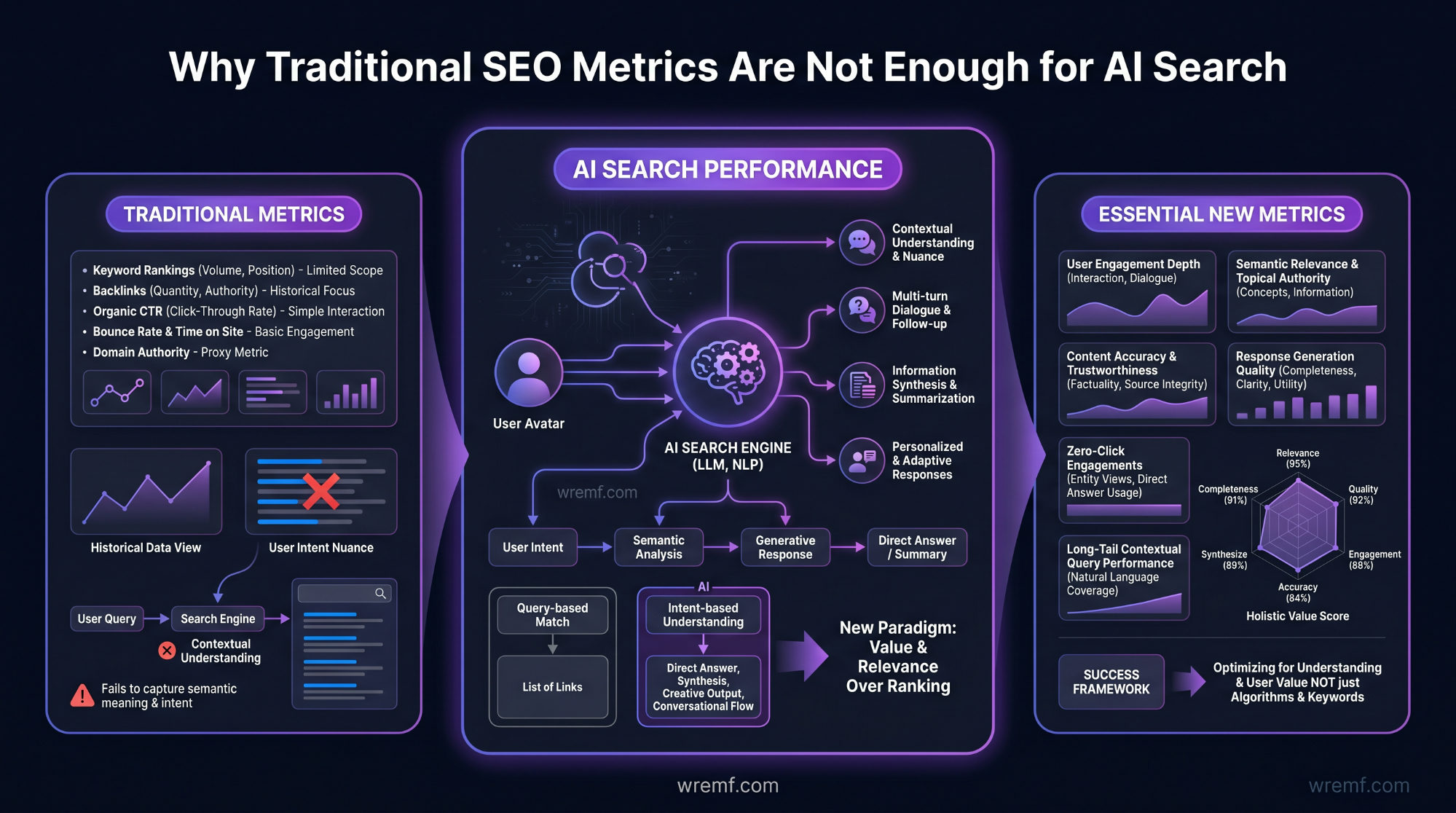
Traditional SEO metrics still matter, but they do not fully explain AI search performance. AI search optimization tools must measure brand mentions, citations, recommendations, source consistency, and AI answers, not only search rankings.
AI search is the process of finding information through AI-generated answers, summaries, recommendations, and conversational search experiences. AI search matters because buyers can compare vendors inside ChatGPT, Perplexity, Gemini, Claude, Copilot, Google AI Overviews, and Google AI Mode before visiting a website.
Search Engine Optimization is the practice of improving organic visibility in search engines through technical quality, useful content, authority, and user experience. Search Engine Optimization still matters because Google Search, Bing, and other search engines continue to shape the source ecosystem that AI answer engines often summarize, cite, or retrieve from.
The limitation is that classic SEO metrics answer only part of the visibility question. Keyword research, rank tracking, backlink analysis, Technical SEO, site audit checks, and Google Search Console performance can show how a page performs in search results. They do not always show whether an answer engine mentions your brand, cites your page, recommends a competitor, or uses outdated third-party information.
Google Search Central explains that helpful, reliable, people-first content is more likely to perform well in Google Search, and this matters because AI search systems also need clear and trustworthy content signals to retrieve and summarize useful information. Use the Google Search Central guidance on helpful content as a baseline for quality expectations. (Google)
AI visibility is the measurable presence of a brand inside AI answers, citations, summaries, recommendations, and comparison responses. AI visibility matters because B2B buyers may ask AI assistants for product shortlists, alternatives, category leaders, and implementation advice before they ever click a blue link.
In practical AI visibility audits, teams frequently discover a mismatch between Google rankings and AI answers. A page may rank for a keyword but fail to appear in Google AI Overviews. A competitor may be recommended in ChatGPT because third-party review pages describe that competitor more clearly. A brand may be cited by Perplexity for one prompt but ignored by Gemini for a similar prompt.
Traditional SEO tools answer questions such as:
Which keywords rank in a search engine?
Which pages receive organic traffic?
Which backlinks point to the website?
Which pages have Technical SEO issues?
Which queries generate clicks in Google Search Console?
Which Meta descriptions or titles need improvement?
AI visibility tools answer different questions:
Does ChatGPT mention your brand for buying-stage prompts?
Does Perplexity cite your website or a third-party source?
Does Google AI Overviews include your page in AI-generated answers?
Do AI answer engines recommend competitors more often than your brand?
Which sources influence AI answers in your category?
Are your brand facts consistent across AI search platforms?
WREMF helps teams track these new visibility signals through the AI visibility platform suite. The platform connects prompt tracking, source citations, competitor visibility, AI share of voice, and reporting so teams can compare AI search performance alongside traditional SEO data.
KEY TAKEAWAY: Traditional SEO metrics show how pages perform in search engines, while AI visibility metrics show how brands appear inside AI answers, citations, and recommendations.
The next step is to understand the different categories of AI search optimization tools before comparing vendors.
What Are AI Search Optimization Tools?
AI search optimization tools are platforms that help teams monitor, improve, and report how brands and content appear across AI search results. The strongest tools combine AI visibility monitoring, content optimization, citation tracking, technical GEO checks, and workflow reporting.
AI search optimization software is software built to help teams improve visibility across AI answer engines, traditional search engines, and AI discovery surfaces. AI search optimization software matters because manual testing across multiple AI models is inconsistent, slow, and difficult to report.
Answer engine optimization is the practice of improving how a brand appears in direct answers from AI systems, search features, voice assistants, and answer engines. Answer engine optimization matters because answer engines often summarize the decision instead of sending users through a list of links.
Generative engine optimization is the practice of improving visibility inside generative AI outputs by strengthening entity clarity, source citations, structured content, and retrieval signals. Generative engine optimization matters because AI models synthesize answers from many sources rather than simply ranking one page.
The AI search tool landscape includes several overlapping categories. AI visibility tools focus on LLM visibility, prompt tracking, brand mentions, AI answers, AI citations, and competitor visibility. Traditional SEO tools focus on keyword research, search rankings, SERP data, backlinks, Technical SEO, and site audit checks. Content optimization tools focus on semantic keywords, keyword clustering, Content Briefs, Content Editor workflows, and content gaps. AI writing tools focus on Content Generation, AI Draft workflows, AI Writer outputs, and Meta descriptions. Technical GEO tools focus on AI Crawler checks, schema markup, AI bots, internal linking suggestions, crawlability, and rendering.
| Tool Category | Best For | What It Measures | What It Often Misses | Typical User |
|---|---|---|---|---|
| AI visibility tools | LLM visibility and AI answers | Mentions, citations, prompts, competitors, AI share of voice | Deep backlink data or full Technical SEO in some cases | SEO leaders, growth teams, agencies |
| Traditional SEO tools | Search engine performance | Keyword research, rank tracking, backlinks, site audit issues, Google Search Console context | Brand visibility inside AI-generated answers | SEO teams and digital marketing teams |
| Content optimization tools | Content strategy and page improvement | Semantic keywords, content gaps, keyword clustering, Content Briefs | Prompt-level AI visibility and source citation tracking | Content teams and editors |
| AI writing tools | Faster content creation | AI Drafts, AI content, Content Generation, Meta descriptions | Original experience, accuracy, source credibility | Content creation teams |
| Technical GEO tools | Crawlability and machine understanding | AI Crawler checks, schema markup, internal links, rendering | Brand recommendation visibility and AI share of voice | Technical SEO teams |
Semrush, Ahrefs, SE Ranking, Clearscope, Jasper, MarketMuse, Frase, ZipTie, and similar tools can support parts of this workflow. Semrush and Ahrefs are strong for keyword research, backlink profiles, competitor keywords, SERP data, and traditional SEO tools. SE Ranking supports rank tracking, keyword research, and site audit workflows. Clearscope, MarketMuse, and Frase help content teams with semantic keywords, Content Briefs, and content optimization. Jasper and other AI Writer platforms help with AI writing and content creation. Dedicated AI visibility tools are needed when the core question is how a brand appears in ChatGPT, Claude, Gemini, Perplexity, Google AI Overviews, Copilot, and other AI search platforms.
AI answer engines are systems that generate direct answers to user questions using AI models, search indexes, retrieval systems, knowledge sources, or web citations. AI answer engines matter because they can influence brand discovery before a user opens a search result.
DID YOU KNOW: McKinsey estimates that generative AI could add $2.6 trillion to $4.4 trillion in annual value across 63 use cases, which explains why AI-powered tools are becoming part of marketing, sales, and content workflows. See the McKinsey report on generative AI’s economic potential. (McKinsey & Company)
WREMF is positioned as a practical option when the core need is AI visibility rather than generic AI-powered SEO. The WREMF methodology connects prompts, citations, competitors, source consistency, AI traffic attribution, and action recommendations into a repeatable process.
KEY TAKEAWAY: AI search optimization tools should be compared by category because AI visibility platforms, SEO suites, content tools, AI Writer tools, and technical GEO tools solve different problems.
Once the categories are clear, the most useful next step is to compare tools with a weighted evaluation framework.
How to Compare AI Search Optimization Tools With a Weighted Scorecard
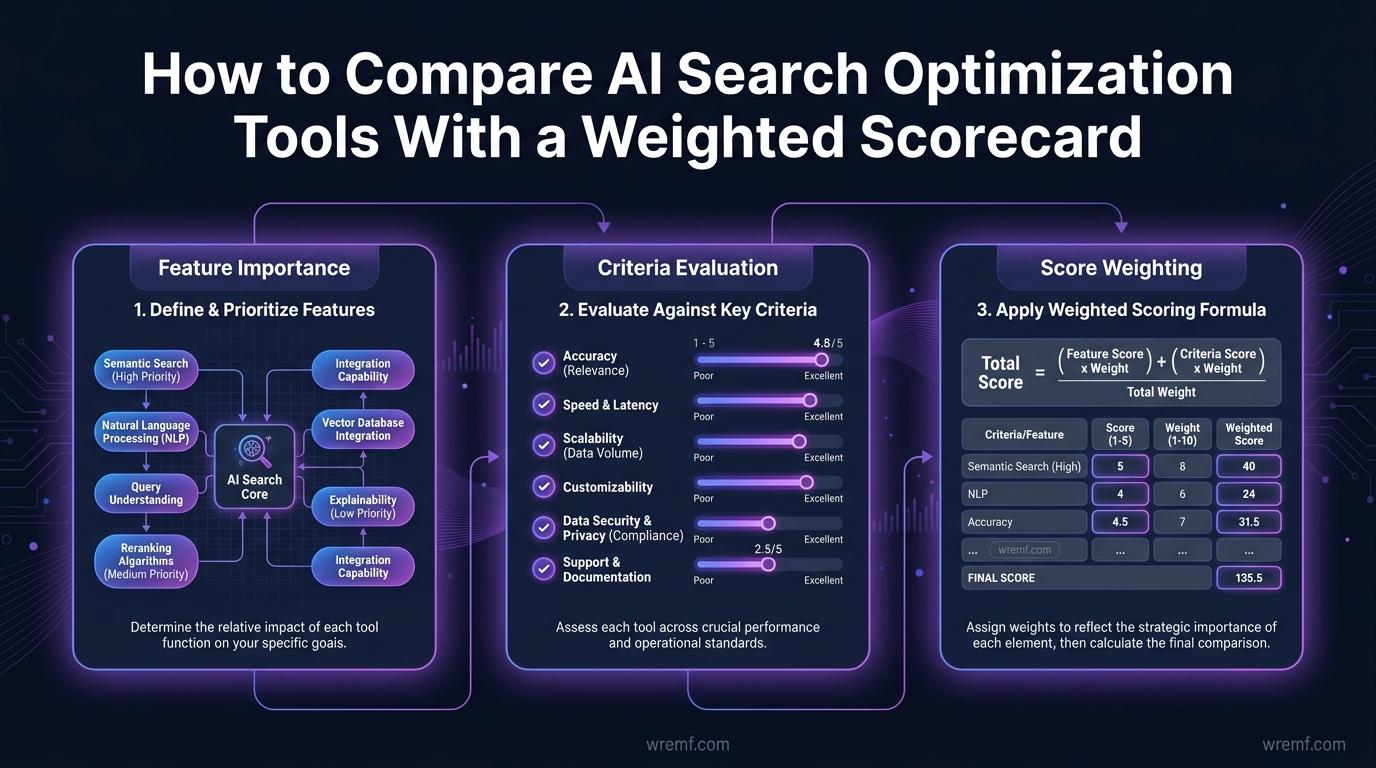
The best way to compare AI search optimization tools is to use a weighted scorecard. A scorecard prevents teams from choosing software based on feature volume, demo polish, or generic AI content claims.
A weighted scorecard is a decision framework that assigns importance to each evaluation criterion. A weighted scorecard matters because AI search tools vary widely in AI model coverage, accuracy, reporting, integrations, actionability, and support.
For most B2B SaaS teams, agencies, consultants, and growth leaders, the comparison should include six evaluation criteria. The weights can be adjusted, but the structure should remain consistent across vendors.
| Evaluation Criterion | Suggested Weight | Why It Matters | What To Check |
|---|---|---|---|
| AI engine and LLM coverage | 20% | AI visibility varies across ChatGPT, Claude, Gemini, Perplexity, Google AI Overviews, Copilot, DeepSeek, Grok, Meta AI, and Mistral | Supported engines, prompt scheduling, language options, location options |
| Citation and source tracking | 20% | AI citations show which sources shape AI-generated answers | Source URLs, citation frequency, source quality, source consistency |
| Accuracy and repeatability | 20% | AI answers can vary, so data collection must be consistent | Prompt controls, snapshots, historical data, scoring transparency |
| Content and GEO actionability | 15% | Insights must become content briefs, entity fixes, internal links, or schema markup guidance | Content gaps, Content Brief Generator, keyword clustering, GEO capabilities |
| Integrations and reporting | 15% | Teams need dashboards, exports, API access, and client-ready reports | Google Search Console, GA4, API, MCP, visualization and reporting |
| Commercial fit and support | 10% | Value depends on cost, support, usage limits, and implementation help | Pricing, BYOK, white-label reporting, agency support |
Prompt tracking is the process of repeatedly testing defined LLM prompts across AI search platforms and recording the answers. Prompt tracking matters because AI answers can change by engine, date, region, phrasing, and retrieval source.
AI citations are links, references, or source mentions used by AI-generated answers to support claims. AI citations matter because a brand can be visible through its own website, review sites, partner pages, documentation, forums, media coverage, or comparison articles.
Use the same prompt set across every tool during evaluation. Include definition prompts, commercial prompts, comparison prompts, category prompts, local prompts if relevant, and implementation prompts. A practical pilot should start with 25 to 50 prompts for one market or product category. This gives enough coverage to reveal recurring patterns without creating a noisy dataset.
Example prompt categories include:
Definition: “What is AI visibility?”
Comparison: “What is the difference between SEO, AEO, and GEO?”
Commercial: “What are the best AI visibility tools for B2B SaaS?”
Alternative: “What are alternatives to Profound or Peec AI?”
Implementation: “How do I optimize for Google AI Overviews?”
Measurement: “How do I monitor AI search visibility?”
Agency intent: “Should I hire a GEO agency or use AI search optimization software?”
The scorecard should reflect the team’s real use case. Agencies may give more weight to white-label reports, client portals, exports, and multi-client management. In-house brands may give more weight to Google Search Console integration, content strategy, competitor visibility, and AI traffic attribution. Technical SEO teams may increase the weight for schema markup, site audit coverage, AI bots, crawlability, and rendering checks.
If you want to inspect what an AI visibility workflow looks like before building a pilot, review a sample AI visibility report and compare it with your own reporting requirements.
KEY TAKEAWAY: A weighted scorecard helps teams compare AI search optimization tools by measurable decision criteria instead of software demos or feature lists.
After the scorecard is set, the next evaluation area is AI engine coverage and data source variety.
Compare LLM Coverage and AI Search Data Sources
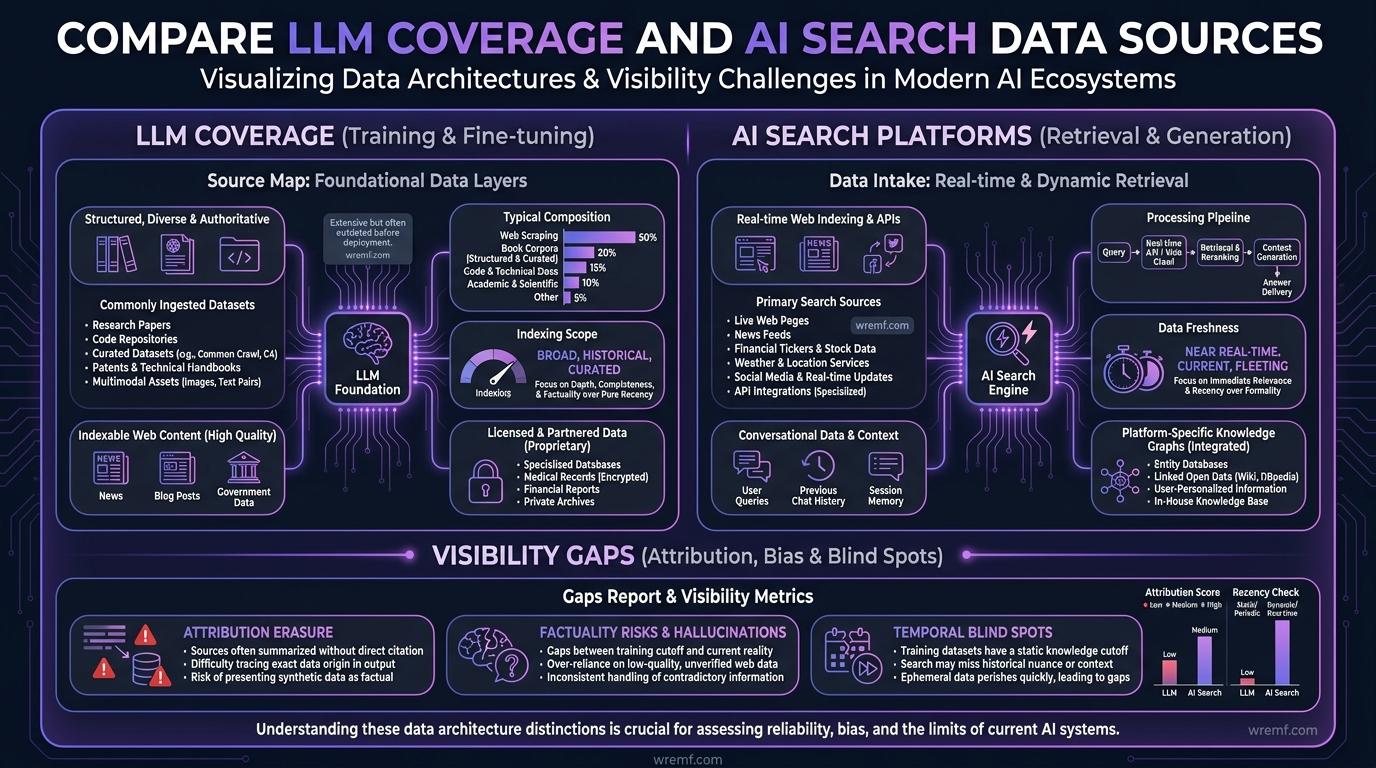
LLM coverage matters because AI visibility is not consistent across every answer engine. A tool that monitors only one or two AI search platforms cannot show the full search visibility picture.
LLM visibility is the measurable presence of a brand inside large language model outputs, including AI answers, summaries, recommendations, citations, and comparison responses. LLM visibility matters because B2B buyers may ask different AI assistants the same vendor-selection question and receive different results.
ChatGPT, Claude, Gemini, Perplexity, Google AI Overviews, Google AI Mode, Copilot, DeepSeek, Grok, Meta AI, and Mistral do not behave like one shared search engine. Some rely more heavily on web search. Some show citations. Some summarize sources. Some are embedded inside search engines, browsers, productivity software, or mobile assistants. This means AI search visibility must be monitored across multiple AI search platforms.
Google says AI features such as AI Overviews and AI Mode are part of Google Search experiences for site owners, and Google’s Search Central documentation explains how website content can be included in these AI experiences. Use the Google Search Central guide to AI features and your website when evaluating Google AI visibility requirements. (Google for Developers)
OpenAI says ChatGPT search can provide timely answers with links to relevant web sources, and OpenAI’s help documentation explains that responses using search may include inline citations. Use the OpenAI documentation on ChatGPT search to understand how cited sources may appear in ChatGPT. (OpenAI Help Center)
Anthropic states that Claude’s web search tool gives Claude access to real-time web content and includes citations for sources drawn from search results. Use the Anthropic documentation on Claude web search to evaluate how source citations work in Claude-powered workflows. (Claude Platform)
When comparing AI visibility tools, ask these questions:
Which AI answer engines are supported?
Are ChatGPT, Claude, Gemini, Perplexity, Google AI Overviews, Google AI Mode, Copilot, DeepSeek, Grok, Meta AI, and Mistral included?
Does the tool capture AI answers, brand mentions, citations, competitors, and recommendations?
Does the tool store historical data for trend analysis?
Can prompts be scheduled daily, weekly, or monthly?
Can the tool distinguish a neutral mention from a recommendation?
Can the tool separate a citation from a brand mention?
Does the tool support region, language, and market-specific monitoring?
Does the tool identify which sources influence AI-generated answers?
AI discovery surfaces are the places where users discover brands through AI-generated answers, recommendations, summaries, search snapshots, or assistant responses. AI discovery surfaces matter because discovery now happens across search engines, AI assistants, browsers, productivity tools, and answer engines.
WREMF tracks 10 AI engines, which makes it useful for teams that need broader coverage than single-engine monitoring tools. The AI Visibility Index helps teams understand brand presence, competitor visibility, AI share of voice, and LLM visibility across major AI discovery surfaces.
KEY TAKEAWAY: AI search optimization tools should cover multiple AI engines because brand visibility differs across ChatGPT, Claude, Gemini, Perplexity, Google AI Overviews, Copilot, and other AI answer engines.
Coverage is useful only if the tool’s scores, citations, and answer records are accurate enough to support decisions.
Evaluate Accuracy, AI Visibility Scores, and Citation Tracking
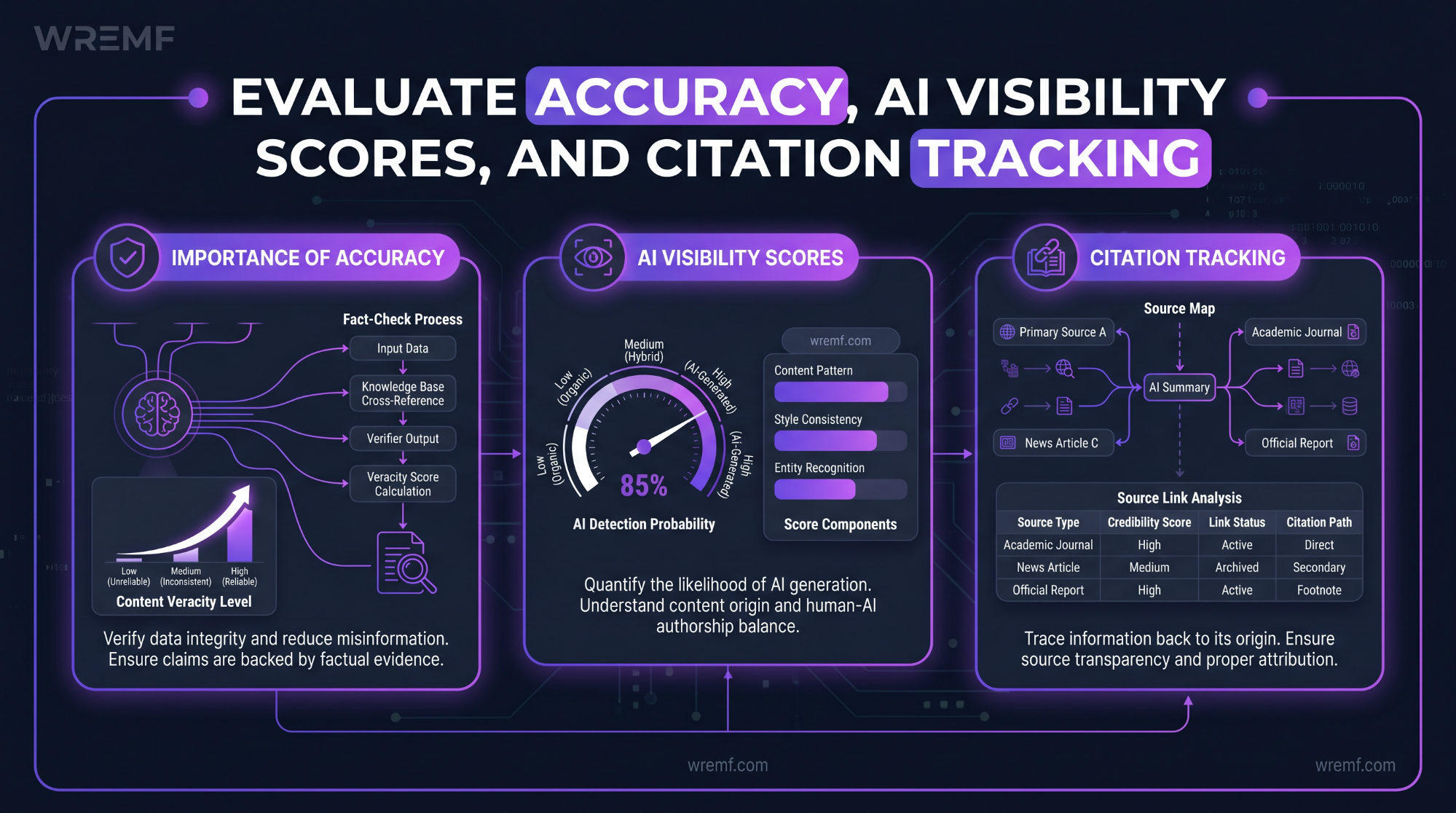
Accuracy is the most important quality test for AI search optimization tools. If a platform cannot produce repeatable AI visibility scores, prompt records, source citations, and competitor data, the reporting will not be trusted.
An AI Visibility Score is a composite metric that summarizes how often and how strongly a brand appears across selected AI answers, prompts, engines, citations, and comparison contexts. An AI Visibility Score matters because leadership teams need a simple number, while SEO teams still need prompt-level evidence.
AI answers vary because generative systems respond to prompt wording, model behavior, location, timing, retrieval results, and source availability. That does not make AI visibility impossible to measure. It means the tool must use repeatable data collection. Strong tools store the prompt, engine, date, answer text, cited sources, brand mentions, competitor mentions, and scoring logic.
Source citations are the websites, pages, articles, documentation, community discussions, and third-party sources that AI answers reference or use as support. Source citations matter because they show which sources influence answer engine visibility.
Use this accuracy checklist when testing tools:
| Accuracy Check | Passing Signal | Warning Signal |
|---|---|---|
| Brand mention detection | Correctly identifies exact and close brand references | Confuses similar company names |
| Citation capture | Stores source URLs and citation context | Shows sources without answer-level evidence |
| Competitor visibility | Identifies competitors appearing in the same AI answers | Misses competitors unless manually added |
| Recommendation detection | Separates neutral mentions from recommended brands | Counts every mention as a recommendation |
| Historical snapshots | Shows answer changes over time | Overwrites old answers without snapshots |
| Prompt repeatability | Uses stable prompt sets and prompt versions | Changes prompts without tracking versions |
| Data export | Allows review outside the dashboard | Locks evidence inside charts only |
In real-world reporting, the best AI visibility tools show the answer behind the score. A dashboard that says your AI visibility increased by 12% is less useful than a dashboard that explains which prompts changed, which citations appeared, which competitors gained visibility, and which AI answers shifted.
IMPORTANT: Treat an AI Visibility Score as a directional measurement, not an absolute truth. The score is useful only when it is backed by visible prompts, captured AI answers, source citations, and repeatable methodology.
A practical accuracy test should include manual verification. Choose 30 prompts, run them across at least three AI search platforms, and record whether your brand appears, whether competitors appear, whether citations exist, and which sources are used. Compare your manual results with each tool. If the tool repeatedly misses citations, mislabels AI answers, or inflates weak mentions, reduce its score.
KEY TAKEAWAY: AI visibility scores are useful only when they are supported by transparent prompts, captured AI answers, source citations, historical snapshots, and repeatable scoring.
After accuracy, the next question is whether the tool helps teams turn visibility gaps into content and technical improvements.
Compare Content Optimization, Content Briefs, and AI Content Workflows
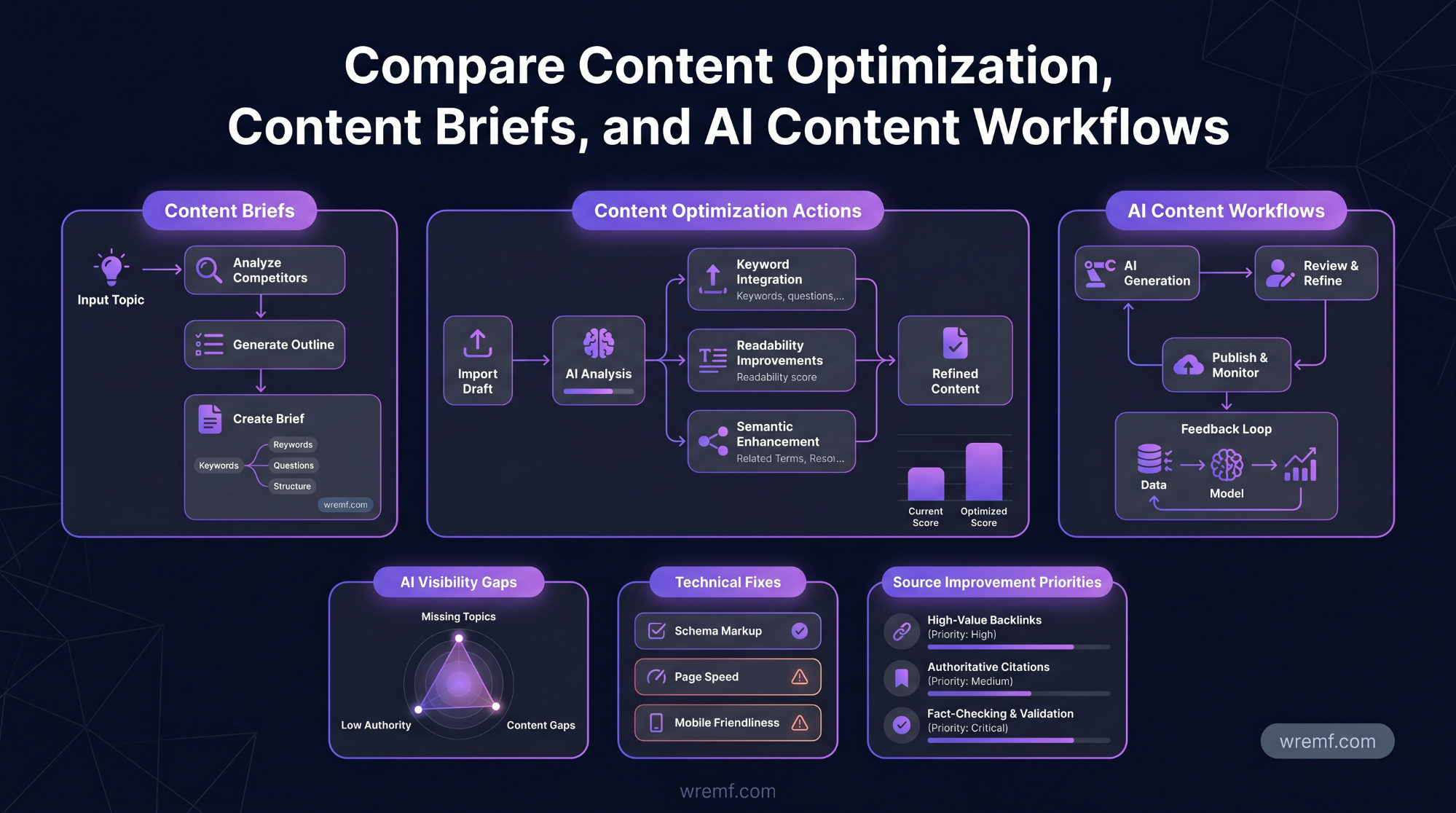
AI search optimization tools should not stop at monitoring. A useful tool must turn AI visibility gaps into content briefs, content optimization actions, technical fixes, and source improvement priorities.
Content optimization is the process of improving page structure, topical coverage, entity clarity, internal links, source support, and user intent alignment. Content optimization matters because AI answer engines need clear, complete, and reliable content to retrieve, summarize, or cite.
Content strategy connects business goals, search demand, buyer questions, source opportunities, and content assets into a repeatable plan. Content strategy matters because AI search rewards clear entity coverage, answer-first writing, credible support, and consistent brand descriptions.
Content teams should compare whether the platform supports:
Content gaps analysis across AI answers and search results
Semantic keywords and keyword clustering
Content Briefs based on prompts and citations
Content Editor recommendations
Content Inventory review
Meta descriptions and title suggestions
Internal linking suggestions
AI Draft and AI Writer workflows
Human review before publishing
Source attribution and credibility checks
E-E-A-T signals and author experience prompts
AI content is content created, assisted, or optimized with Artificial Intelligence tools. AI content matters when it improves research, structure, and speed, but it still needs human review, source validation, original experience, and editorial judgment.
Content Generation can help teams create first drafts, outlines, summaries, and Meta descriptions faster. The risk is that generic AI content can repeat common advice, overuse keywords, miss practical experience, or include unsupported claims. Google’s guidance on generative AI content explains that generative AI can be useful for research and structure, but using generative AI tools to create many pages without adding user value may violate spam policies. Use the Google Search guidance on generative AI content when designing AI content workflows. (Google for Developers)
The best tools help content teams answer three questions:
| Content Question | What The Tool Should Show | Why It Matters |
|---|---|---|
| What are AI answers saying? | Prompt-level AI answers and recurring themes | Shows current answer engine framing |
| What sources are being cited? | Citation URLs, source types, and citation frequency | Shows source influence |
| What content should be improved? | Content gaps, entity gaps, brief recommendations, internal links | Turns monitoring into action |
Content Briefs are structured instructions for creating or updating content based on search intent, entities, keywords, source evidence, and target outcomes. Content Briefs matter because they turn AI search insights into specific content tasks for writers, editors, and SEO teams.
A strong AI search content brief should include:
Target prompts and natural-language questions
Primary keyword and secondary keywords
Semantic keywords and related entities
Competitor coverage
Missing subtopics
Source citation opportunities
Internal linking recommendations
Schema markup considerations
Suggested answer-first definitions
E-E-A-T proof points
Measurement plan after publishing
WREMF’s AI-ready content briefs connect prompts, AI answers, citations, competitors, and content gaps. This makes the brief more useful than a generic keyword research document because the recommendations reflect what AI answer engines already say.
KEY TAKEAWAY: The strongest AI search optimization tools connect monitoring to content strategy, Content Briefs, content optimization, source evidence, and human-in-the-loop review.
Once content workflows are clear, technical GEO capabilities should be evaluated separately.
Evaluate Technical GEO Capabilities, Schema Markup, and AI Bot Readiness
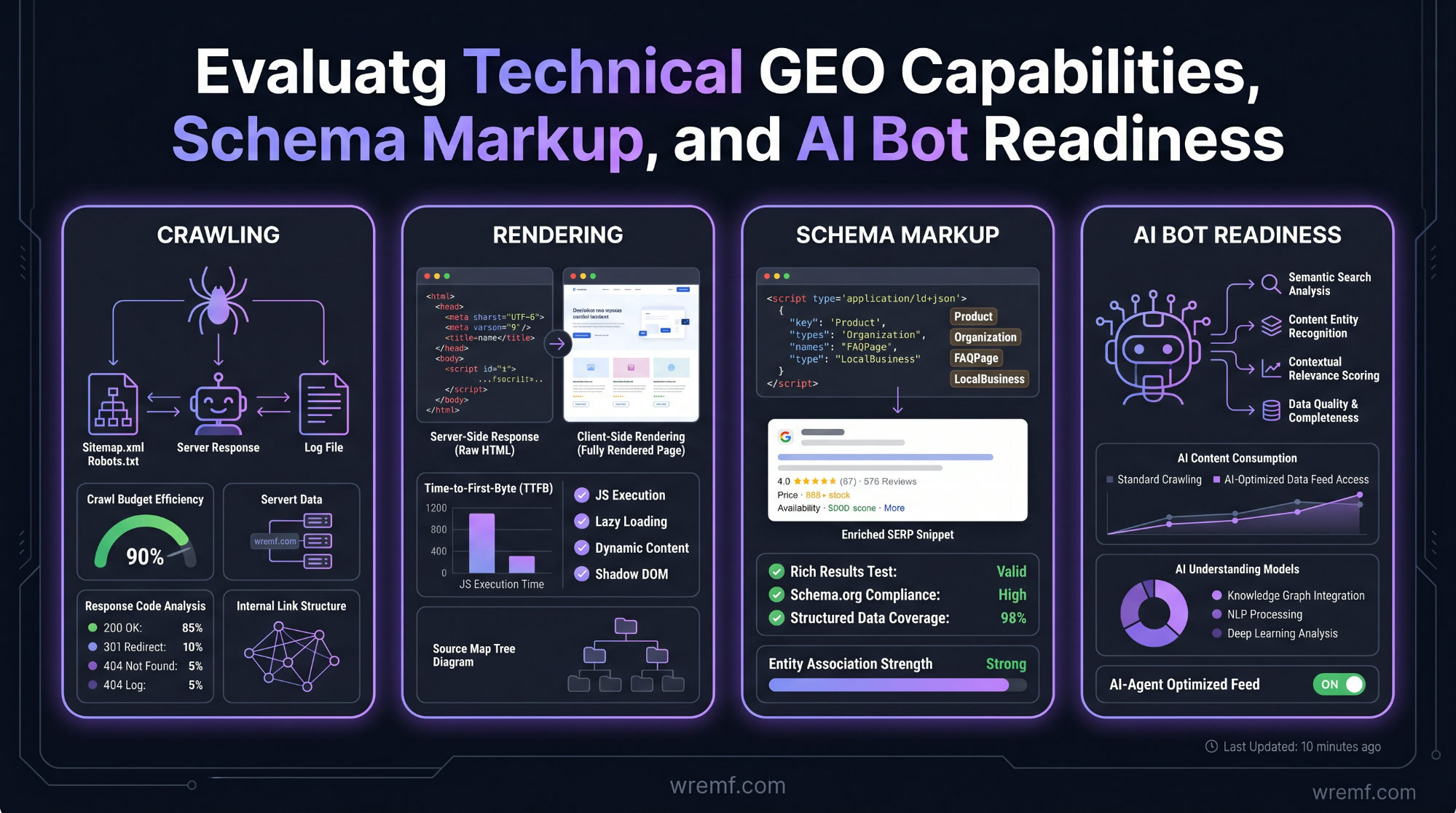
Technical GEO capabilities show whether your website can be crawled, rendered, understood, and retrieved by search engines, AI bots, and AI answer engines. A tool without technical checks may identify AI visibility gaps but fail to explain why content is not discoverable.
Technical SEO is the practice of improving crawlability, indexability, rendering, structured data, site architecture, and page quality. Technical SEO matters because AI search still depends on accessible, understandable, and trustworthy web content.
GEO capabilities are features that help teams improve visibility inside generative AI experiences through entity clarity, structured content, source consistency, crawlability, and answer-ready page architecture. GEO capabilities matter because generative engine optimization requires more than AI writing or keyword density.
Schema markup is structured data added to webpages to help search systems understand entities, attributes, and relationships. Schema markup matters because it can reinforce meaning and machine readability, although it does not guarantee search rankings, rich results, or AI citations.
When comparing technical GEO tools, check whether each platform reviews:
Crawlability of important pages
Rendered HTML versus raw HTML
robots.txt and meta robots rules
Canonical tags and duplicate content issues
Schema markup and structured data errors
Organization, Article, FAQ, Product, Review, and SoftwareApplication signals where relevant
Internal linking suggestions
Broken links and orphan pages
AI Crawler behavior
AI bots access rules
Content extraction quality
Entity clarity for brand, product, category, founder, and use case pages
AI Crawler analysis is the process of checking whether AI bots, search crawlers, and retrieval systems can access and understand website content. AI Crawler analysis matters because blocked, hidden, thin, or poorly rendered content is harder for AI search platforms to retrieve.
A common implementation mistake is treating schema markup as a magic fix. Schema markup helps systems understand content, but it cannot replace helpful pages, source-backed claims, consistent brand information, strong internal links, credible third-party references, and clear entity descriptions.
| Technical GEO Feature | Why It Matters | Strong Tool Signal | Weak Tool Signal |
|---|---|---|---|
| Rendered content analysis | AI systems may not see script-dependent content | Shows raw and rendered differences | Only checks source HTML |
| Schema markup review | Helps search systems understand entities | Flags missing, invalid, or inconsistent structured data | Gives generic schema advice |
| Internal linking suggestions | Helps crawlers find priority pages | Recommends contextual links by topic and entity | Lists links without strategic logic |
| AI bots and crawler checks | Shows access issues for AI discovery | Reviews robots rules and crawl paths | Ignores AI-specific access |
| Entity mapping | Connects brand, products, categories, and people | Shows entity gaps and inconsistencies | Focuses only on keywords |
| Source consistency | Reduces contradictory brand facts | Flags conflicting descriptions across sources | Audits only your own pages |
Internal linking suggestions are recommendations for connecting related pages with descriptive anchor text. Internal linking suggestions matter because search engines, AI bots, and users need clear paths between brand, product, category, methodology, comparison, and proof pages.
WREMF’s GEO audit feature is useful when teams need to connect technical AI visibility foundations with content and citation improvement. The goal is not only to fix site audit issues, but to make brand information easier for AI systems to retrieve, verify, and summarize.
KEY TAKEAWAY: Technical GEO evaluation should cover crawlability, rendering, schema markup, internal links, AI bots, AI Crawler behavior, source consistency, and entity clarity.
Technical readiness matters, but tool selection also depends on how the platform fits into your existing workflow.
Compare Integrations, Reporting, and Workflow Fit
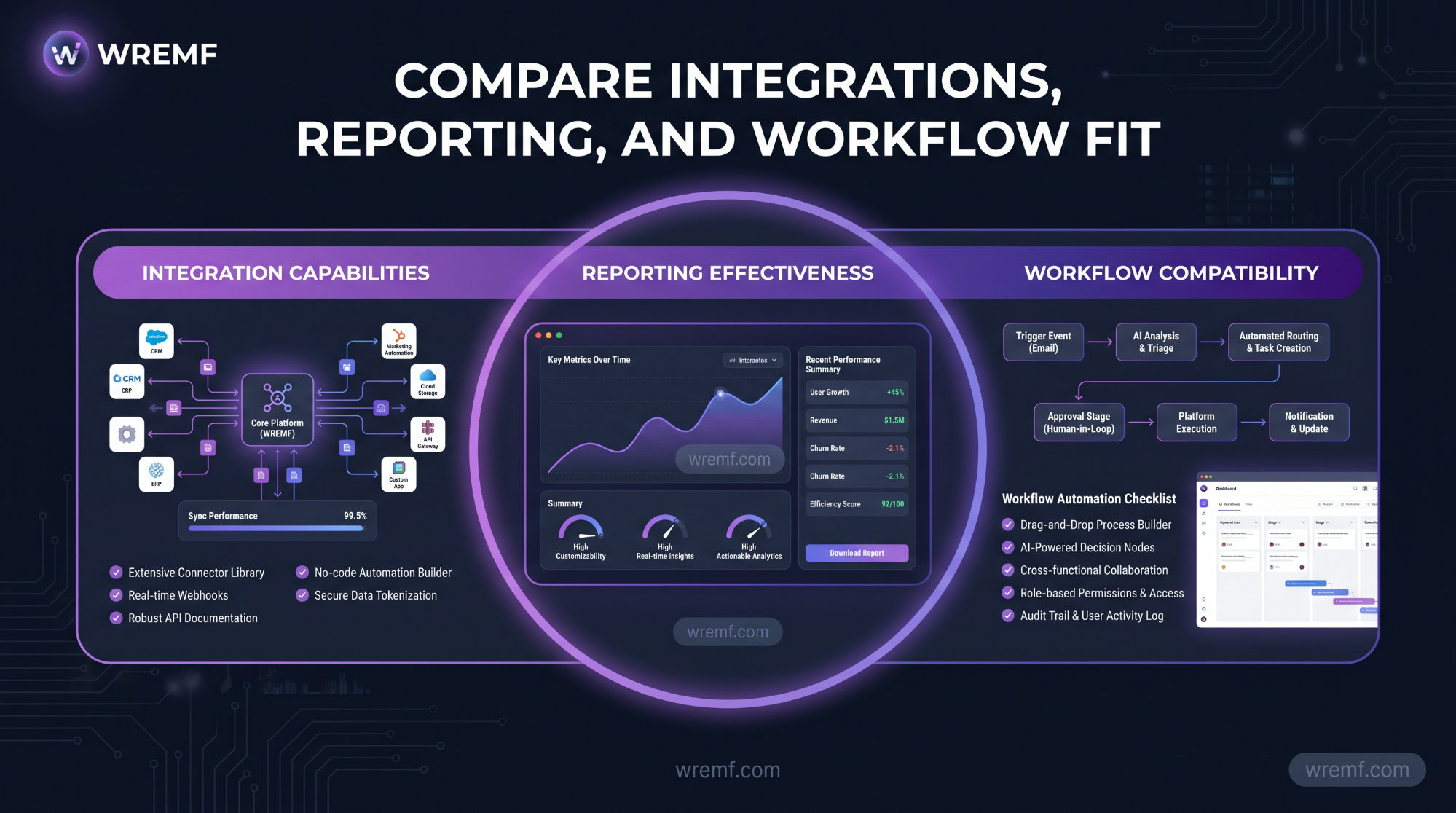
AI search optimization tools must fit the systems your team already uses. A tool with strong insights but weak workflow integration often becomes another dashboard that does not change content, SEO, or revenue decisions.
AI traffic attribution connects AI discovery surfaces to website visits, conversions, pipeline, or assisted demand signals. AI traffic attribution matters because leadership teams need to understand whether AI visibility is connected to measurable business outcomes.
Google Search Console is a first-party Google tool that reports search queries, clicks, impressions, average position, indexing status, and page-level search performance. Google Search Console matters because it gives SEO teams a source of truth for Google Search performance that can be compared with AI visibility trends.
A strong AI search platform should connect AI visibility data with Google Search Console, GA4, rank tracking, dashboards, exports, client reports, and content workflows. For technical teams, API and MCP access can make AI search data available inside internal dashboards, data warehouses, reporting systems, and automated workflows.
Workflow fit differs by team type:
| Team Type | Most Important Workflow Need | Recommended Tool Fit |
|---|---|---|
| B2B SaaS marketing team | AI visibility, competitor visibility, content priorities, attribution | AI visibility platform with GSC and reporting context |
| SEO team | Keyword research, rank tracking, Technical SEO, Google AI Overviews analysis | Hybrid SEO plus AI visibility workflow |
| Content team | Content gaps, Content Briefs, semantic keywords, Content Editor support | Content optimization plus prompt insights |
| Agency | White-label reporting, client portals, multi-site tracking, exports | AI visibility platform built for agencies |
| Technical team | API, MCP, data collection, AI Crawler checks, dashboards | Platform with API and structured data access |
Visualization and reporting should show what changed, why it changed, and what action comes next. A report that says AI visibility improved is not enough. A strong report should explain which prompts changed, which competitors appeared, which citations were gained or lost, which content gaps matter, and which source consistency issues need fixing.
Agencies managing multiple clients often need white-label reporting, scheduled monitoring, client portals, and repeatable exports. In-house brands often need leadership summaries, content briefs, attribution context, and prioritization. Technical teams often need data collection, API connectivity, and structured exports.
WREMF supports API and MCP integrations, which is useful for teams that want AI search data inside internal dashboards, client portals, automated reporting systems, and technical workflows. WREMF also supports BYOK, which helps teams control provider usage when monitoring AI search platforms at scale.
KEY TAKEAWAY: Workflow fit matters because AI search optimization creates value only when insights connect to reporting, content updates, technical fixes, and business measurement.
The next decision is whether your team needs software, an agency partner, or a hybrid model.
Should You Choose Software, an Agency, or a Hybrid AI Search Optimization Model?
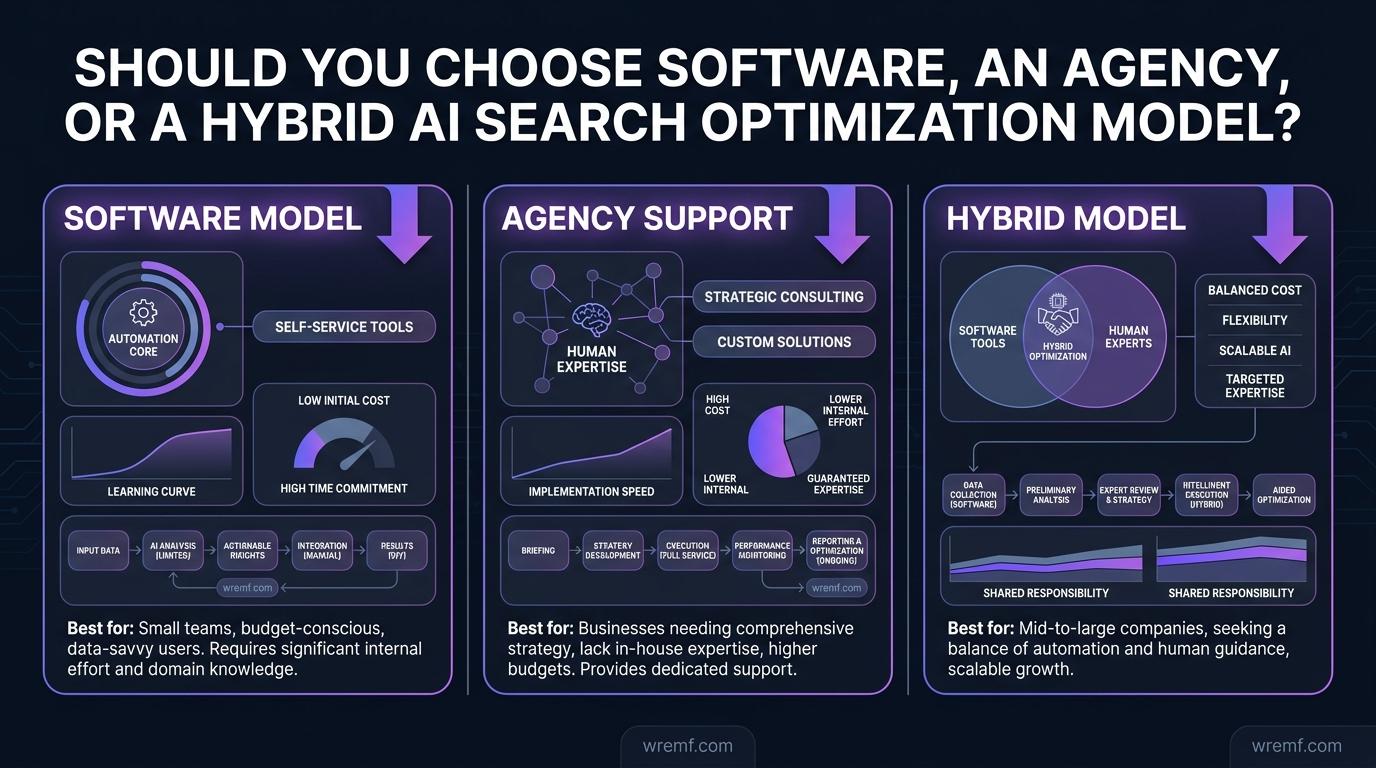
Choose software when your team can act on the data, choose agency support when you need execution, and choose a hybrid model when you need both measurement and managed improvement. The right model depends on skills, time, reporting needs, and implementation speed.
AI visibility tools provide monitoring, prompt tracking, source citation analysis, competitor visibility, and reporting. Agency services provide strategy, content optimization, authority building, citation improvement, technical guidance, source consistency cleanup, and monthly execution. A hybrid model combines software data with expert implementation.
In real B2B buying journeys, teams often underestimate the execution layer. A dashboard can show that your brand is absent from AI answers, but it cannot automatically fix unclear positioning, weak comparison pages, outdated third-party profiles, poor internal links, missing schema markup, thin content, or inconsistent source descriptions.
Use this decision table:
| Option | Best For | What You Get | Main Limitation | Recommended When |
|---|---|---|---|---|
| Software only | Teams with internal SEO and content capacity | Prompt tracking, dashboards, citations, reports | Requires internal execution | You have a team ready to act |
| Agency only | Teams needing strategy and execution | Consulting, audits, content optimization, reporting | Less self-serve control | You lack time or specialist skills |
| Hybrid model | Teams needing data plus execution | Software visibility plus managed AEO and GEO support | Requires clear prioritization | You need measurement and implementation |
WREMF supports all three models. Brands can use WREMF for brands to track and improve AI visibility in-house. Agencies can use WREMF for agencies for white-label reporting, client portals, and multi-site tracking. Teams that need execution can work with the WREMF agency team for AEO, GEO, citation improvement, content optimization, technical AI visibility foundations, and monthly reporting.
Pricing should also match workflow needs. WREMF’s Starter plan is €39 per month for 1 website, unlimited prompt tracking, BYOK, 10 AI engines, all features and tools, white-label reports, 1 seat, and email support. Growth is €89 per month for 5 websites, unlimited prompt tracking, BYOK, 10 AI engines, all features and tools, white-label reports, priority email support with a 24-hour SLA, content brief generation, and SEO A/B testing. Enterprise supports unlimited websites, unlimited prompt tracking, BYOK, 10 AI engines, all features and tools, white-label reports, unlimited seats, dedicated support with a 4-hour SLA, and custom branded portals. You can compare plans on the WREMF pricing page.
KEY TAKEAWAY: Software is best for teams that can execute, agency support is best for teams that need expert implementation, and a hybrid model is best when measurement and execution must work together.
After choosing the operating model, run a structured pilot before buying or switching platforms.
The 14-Day Stress Test for Comparing AI Search Optimization Tools
A 14-day stress test is the safest way to compare AI search optimization tools before procurement. The pilot should test real prompts, competitors, sources, content gaps, technical issues, reporting needs, and workflow fit.
A pilot framework is a short structured test used to compare tools under practical conditions. A pilot framework matters because AI search tools often look similar in demos but behave differently with your own website, prompts, competitors, and data.
Use this 14-day framework:
| Day Range | Test Step | What To Evaluate | Output |
|---|---|---|---|
| Days 1 to 2 | Baseline current visibility | Brand mentions in ChatGPT, Claude, Gemini, Perplexity, and Google AI Overviews | Prompt benchmark |
| Days 3 to 4 | Compare competitor visibility | Which competitors appear in AI answers | Competitive landscape |
| Days 5 to 6 | Analyze source citations | Which sources are cited and whether your website appears | Source citation map |
| Days 7 to 8 | Identify content gaps | Missing topics, entity gaps, semantic keywords, weak pages | Content gaps list |
| Days 9 to 10 | Test technical GEO features | AI Crawler issues, schema markup, internal linking suggestions, site audit findings | Technical action list |
| Days 11 to 12 | Review reporting and exports | Dashboards, visualization and reporting, client-ready summaries | Report sample |
| Days 13 to 14 | Make the decision | Accuracy, workflow fit, support, pricing, implementation effort | Procurement recommendation |
Start with 25 to 50 prompts. Include prompts such as:
“What are the best AI visibility tools for B2B SaaS?”
“How do I monitor AI search visibility?”
“What tools track GEO performance accurately?”
“How do I rank in AI search engines like ChatGPT, Perplexity, and Google AI Overviews?”
“What is the difference between SEO, AEO, and GEO?”
“Should I use AI SEO tools or hire an agency?”
“Which AI search optimization tools are best for improving brand visibility?”
“How do I optimize content for AI-generated answers?”
LLM prompts should reflect how real users ask questions, not only how SEO teams write keywords. Good LLM prompts include complete natural-language questions, buyer context, industry qualifiers, and comparison intent. Weak prompts are too short, too broad, or disconnected from actual search behavior.
During the pilot, compare tool output with manual testing. Look for missing citations, inconsistent AI Visibility Score changes, weak competitor detection, unclear Content Briefs, generic recommendations, slow data collection, or weak report exports. If the tool cannot explain why a score changed, it may be hard to defend the data internally.
KEY TAKEAWAY: A 14-day pilot reveals whether an AI search optimization tool can produce accurate, actionable, and reportable insights using your real brand, prompts, competitors, sources, and workflows.
Once the pilot is complete, the final comparison should focus on ROI and business value.
How to Prove ROI From AI Search Optimization Tools
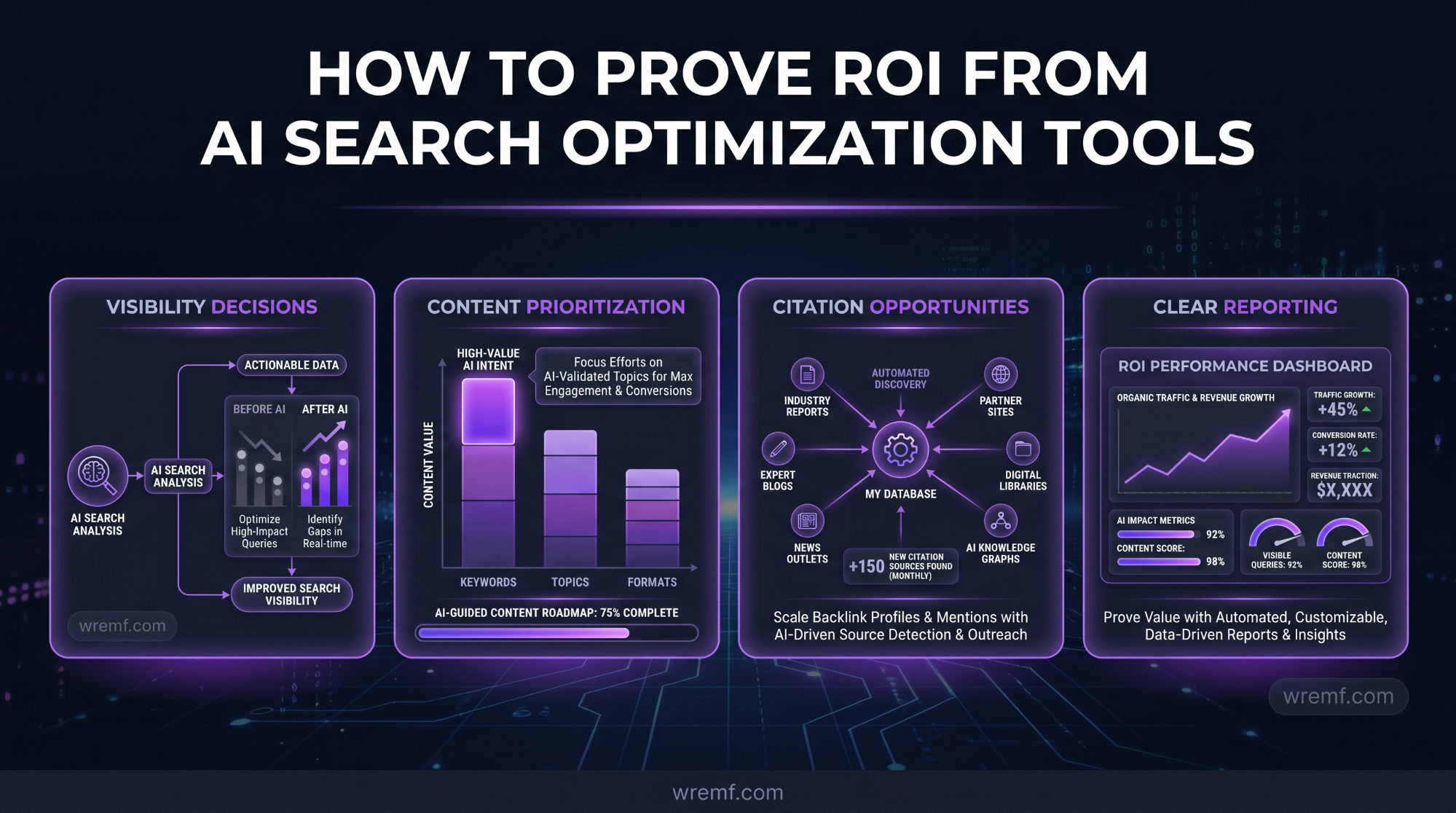
The ROI of AI search optimization tools comes from better visibility decisions, faster content prioritization, stronger citation opportunities, and clearer reporting. ROI should not be measured only by traffic volume because AI search can influence buyers before a click happens.
AI share of voice is the percentage of relevant AI answers, recommendations, or mentions in which your brand appears compared with competitors. AI share of voice matters because it measures visibility inside answer engine recommendations, not only website traffic.
Brand mentions are references to your company inside AI answers, even when no link is included. Brand mentions matter because buyers may form vendor shortlists from AI answers before visiting search results, ads, or sales pages.
Rank tracking measures where a URL appears in traditional search rankings. Rank tracking matters for classic SEO, but AI search optimization also requires citation tracking, AI answers analysis, source consistency, and recommendation visibility.
Use this ROI table:
| ROI Input | How To Measure | Why It Matters |
|---|---|---|
| AI visibility baseline | Brand mentions, AI citations, recommendations | Shows starting point |
| Competitor displacement | Prompts where competitors appear and you do not | Shows lost visibility |
| Content production efficiency | Cost per optimized asset or brief | Shows workflow savings |
| Citation improvement | Better source mentions and stronger source consistency | Shows trust ecosystem progress |
| AI referral traffic | GA4 referral sessions from AI sources where available | Shows measurable demand |
| Reporting time saved | Hours saved on manual prompt checks and reporting | Shows operational ROI |
| Client retention support | White-label reports and proof of work | Shows agency value |
AI results can influence buyers before analytics tools fully attribute the visit. A user may ask an AI assistant for vendor recommendations, read an AI-generated comparison, and later visit your site through direct, branded search, referral, paid search, or a sales conversation. This means ROI should include leading indicators such as AI visibility, brand recommendation visibility, source citations, content performance, and AI share of voice.
In practical AI visibility audits, marketing teams often find that competitor visibility is not caused only by better homepage SEO. It is often caused by stronger third-party citations, clearer category positioning, better comparison content, stronger documentation, better Backlink profiles, richer review presence, or more consistent brand descriptions across credible sources.
A useful AI search optimization tool should help calculate:
Cost per optimized asset
Prompts improved per month
Citation gaps closed
Competitor mentions displaced
Content briefs produced
AI traffic signals influenced
Reporting hours saved
Source consistency issues resolved
WREMF helps connect AI visibility monitoring with attribution workflows so teams can compare prompts, citations, competitors, source consistency, and traffic signals. This does not guarantee revenue, traffic, rankings, or AI citations, but it gives teams a more complete measurement system than traffic-only reporting.
KEY TAKEAWAY: AI search optimization ROI should combine traffic, AI visibility, citation quality, competitor displacement, content efficiency, reporting value, and source consistency improvements.
Before purchasing any platform, evaluate the most common red flags and procurement pitfalls.
Red Flags and Common Pitfalls When Comparing AI Search Optimization Tools
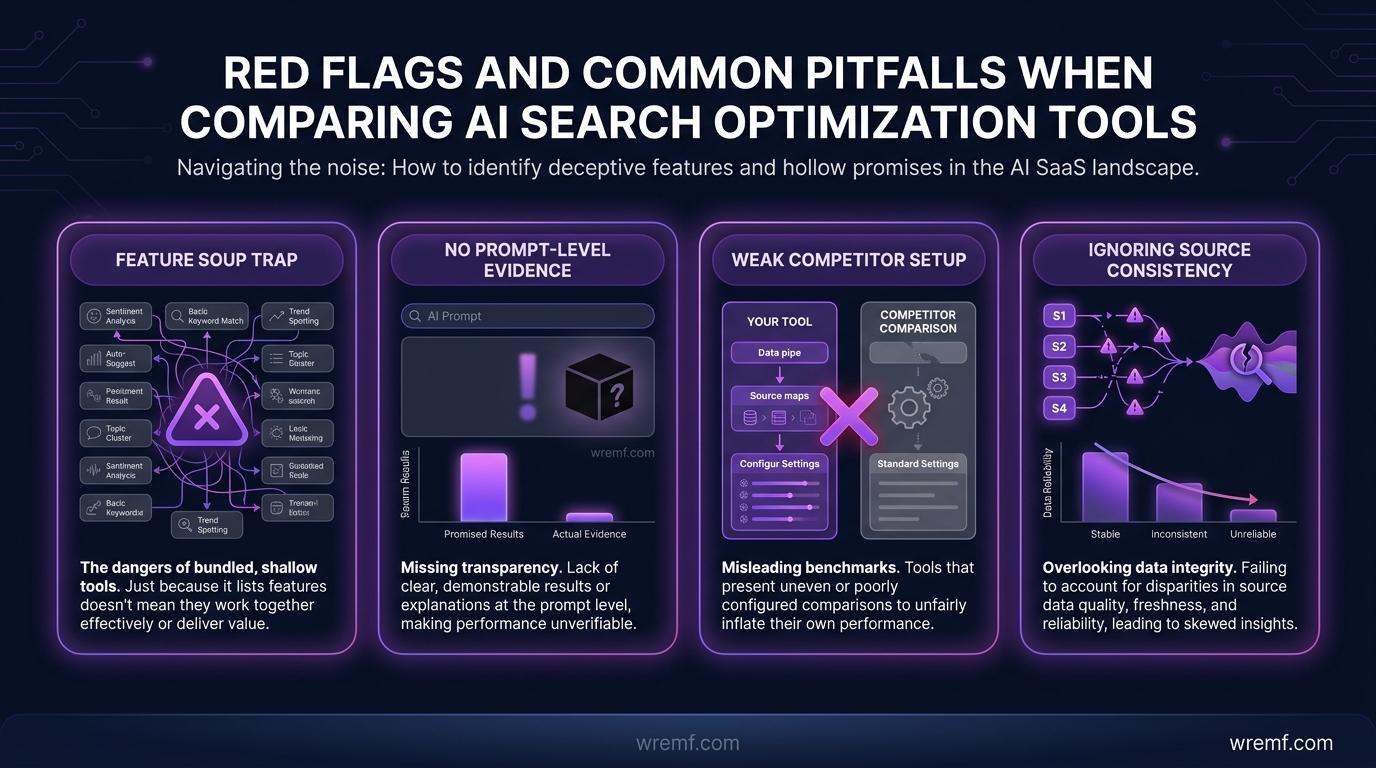
The biggest mistake is buying an AI search optimization tool because it has the longest feature list. The better choice is the tool that gives accurate data, clear priorities, and workflows your team can act on.
The feature soup trap happens when a platform bundles AI writing, keyword research, Content Generation, rank tracking, site audit checks, AI visibility, backlink data, predictive analytics, and reporting without depth in the areas you actually need. Feature soup matters because more features can create more confusion if the tool does not answer your core question.
Watch for these red flags:
| Red Flag | Why It Is Risky | What To Ask Instead |
|---|---|---|
| No prompt-level evidence | Scores cannot be audited | Can I inspect the AI answers behind the score? |
| No citation tracking | Source influence is invisible | Can I see cited URLs and citation frequency? |
| Weak competitor setup | Competitive visibility is incomplete | Can I track named and discovered competitors? |
| Generic AI content output | Content may be thin or repetitive | Does the tool create source-informed Content Briefs? |
| No historical snapshots | Trends cannot be trusted | Does the tool store previous AI answers? |
| No workflow export | Reports stay trapped in the platform | Can I export, share, or access API data? |
| No source consistency checks | Conflicting brand facts remain unresolved | Can the tool flag inconsistent descriptions? |
| Rankings treated as AI visibility | AI answers are not measured directly | Does the tool track mentions, citations, and recommendations? |
Over-reliance on hallucinatory AI data is another risk. AI-powered tools can misread sources, summarize weakly, or produce recommendations without enough evidence. The tool should show its work. If a vendor cannot explain how AI visibility, citations, prompts, competitors, and sources are measured, treat the score as a black box.
Ignoring Reddit, forums, reviews, and third-party sources can also weaken AI search strategy. AI answer engines may use a wider source ecosystem than your own website. The goal is not to manipulate communities or manufacture fake authority. The goal is to understand which credible sources shape AI-generated answers and where your brand information is incomplete, outdated, or absent.
IMPORTANT: Rankings alone are not enough. A brand can rank in Google Search and still lose visibility inside AI-generated answers if AI answer engines cite other sources, recommend competitors, or misunderstand the brand.
KEY TAKEAWAY: Avoid tools that hide prompt evidence, skip citation tracking, overpromise AI content, or treat rank tracking as a substitute for AI visibility measurement.
The next section clarifies how SEO, AEO, and GEO fit together so your tool comparison does not mix different metrics.
SEO vs AEO vs GEO: What Should Your Tool Actually Measure?
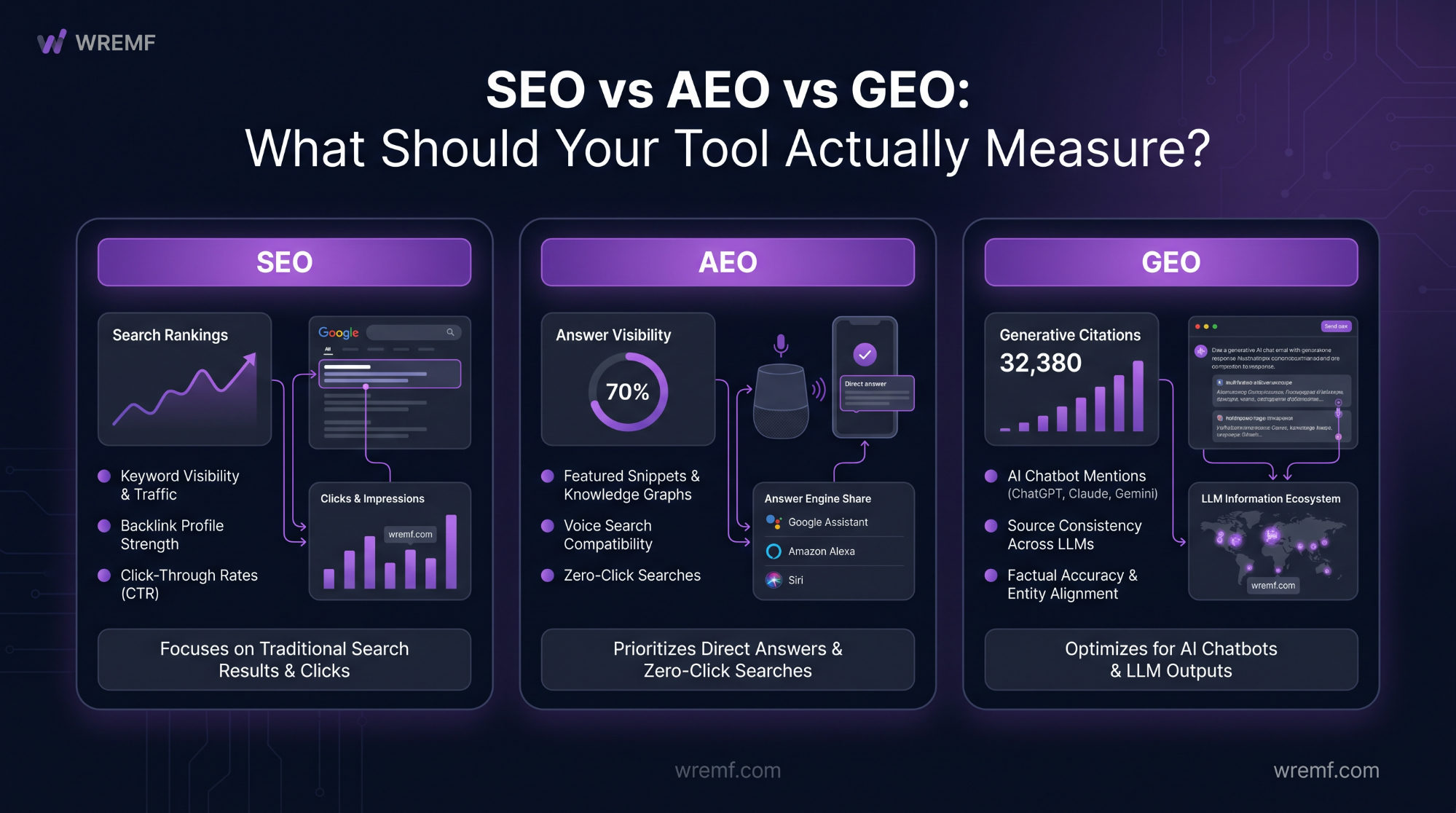
SEO, AEO, and GEO overlap, but they are not the same discipline. A complete AI search optimization tool should measure search rankings, answer visibility, generative citations, source consistency, and the source ecosystem behind AI answers.
SEO improves visibility in search engines such as Google Search and Bing. AEO improves inclusion in direct answers from answer engines, voice assistants, snippets, and AI answers. GEO improves visibility inside generative AI outputs from systems such as ChatGPT, Claude, Gemini, Perplexity, Copilot, Google AI Overviews, and Google AI Mode.
The key difference between SEO and GEO is that SEO optimizes for search engine discovery and ranking, while GEO optimizes for how generative AI systems understand, synthesize, cite, and recommend information. Both depend on clear content, credible sources, technical accessibility, and user intent alignment.
| Discipline | Primary Goal | Main Surface | Example Metric | What It Misses Alone |
|---|---|---|---|---|
| SEO | Rank and earn traffic from search engines | Google Search, Bing, search results | Rankings, clicks, impressions, backlinks | AI answers, citations, recommendation visibility |
| AEO | Appear in direct answers and answer engines | Featured snippets, voice, answer boxes, AI answers | Answer inclusion, concise answer coverage | Broader generative synthesis and source influence |
| GEO | Improve visibility in generative AI outputs | ChatGPT, Claude, Gemini, Perplexity, Google AI Overviews | AI citations, AI mentions, prompt visibility | Classic traffic and Technical SEO context |
| AI search optimization | Track, improve, and prove visibility across AI and search | AI answer engines plus search engines | AI Visibility Score, AI share of voice, citations, attribution | Requires cross-functional implementation |
AI visibility is both a measurement problem and a source ecosystem problem. Measurement shows where your brand appears. Source ecosystem work explains why AI models trust certain pages, publications, reviews, documentation, backlinks, community discussions, or comparison content. A strong tool must support both.
Answer Engines can reward clarity, repetition of accurate entity facts, and credible supporting sources. Search engines can reward helpful content, technical accessibility, backlinks, and user satisfaction. AI search platforms can combine both patterns. This is why a strong AI-powered SEO workflow should not replace SEO with GEO. It should connect SEO, AEO, GEO, and AI visibility into one measurement and action system.
KEY TAKEAWAY: The best AI search optimization tools measure SEO, AEO, and GEO together while keeping each metric separate enough to guide action.
With that distinction clear, the common myths around AI visibility become easier to debunk.
Common Myths About AI Visibility Debunked
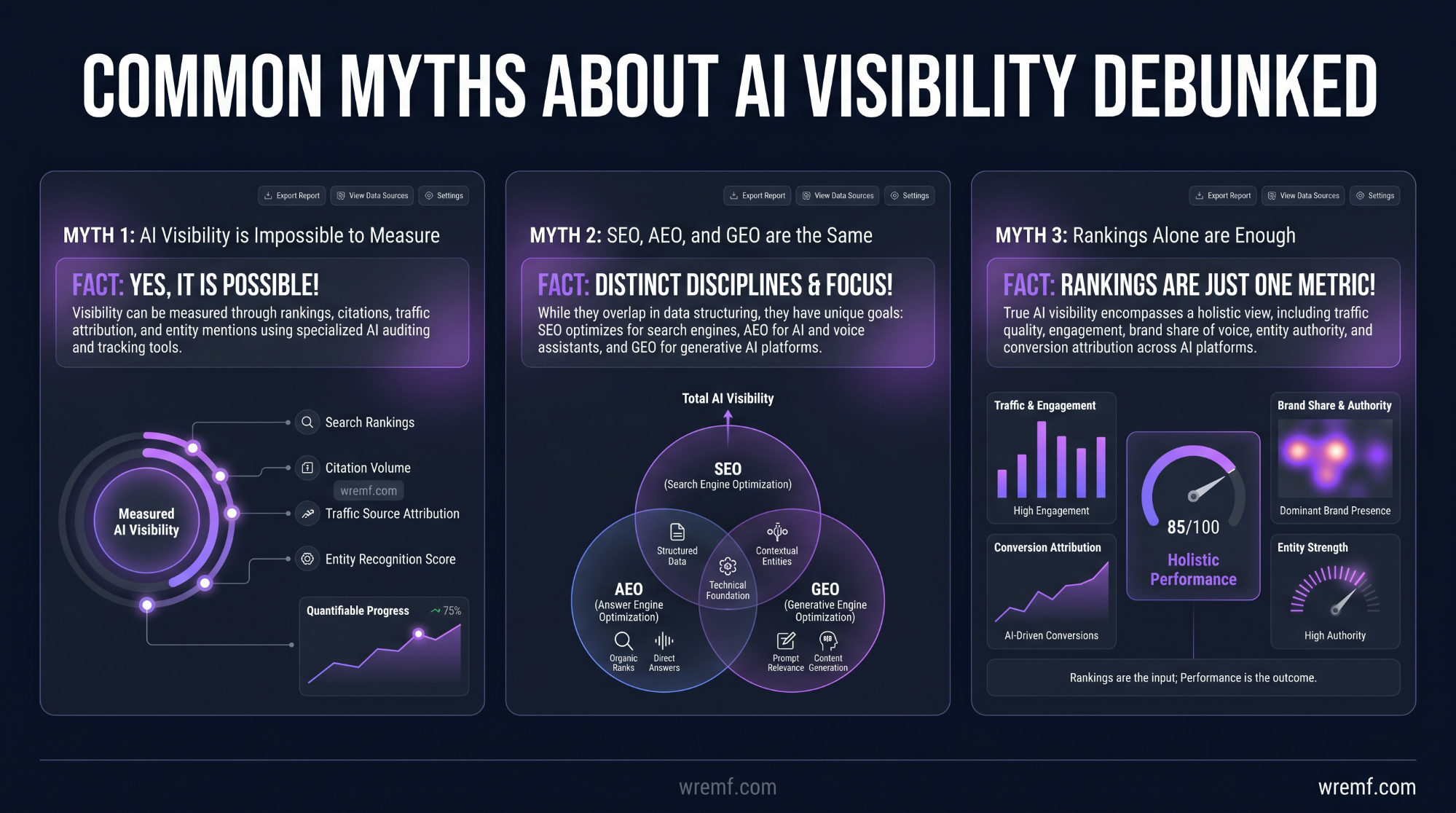
AI visibility is measurable, improvable, and connected to SEO, AEO, and GEO, but it is not a guaranteed ranking system. The best teams treat AI search optimization as an evidence-led workflow, not a shortcut.
MYTH: AI visibility is impossible to measure.
FACT: AI visibility can be measured with prompt tracking, AI answers, brand mentions, AI citations, competitor visibility, AI share of voice, and historical snapshots. The measurement is probabilistic because AI answers vary, but repeatable prompt sets and transparent records make trends useful for decision-making.
MYTH: SEO, AEO, and GEO are just different names for the same thing.
FACT: SEO focuses on search engine visibility, AEO focuses on direct answer inclusion, and GEO focuses on generative AI answers. The disciplines overlap because all three depend on helpful content, technical accessibility, entity clarity, and credible sources, but each requires different metrics.
MYTH: Rankings alone are enough for AI search optimization.
FACT: Rankings help, but they do not prove AI visibility. A page may rank well in Google Search while AI Overviews, ChatGPT, Claude, or Perplexity cite other sources, recommend competitors, or omit the brand from AI-generated answers.
MYTH: AI writing tools can solve AI search visibility by producing more content.
FACT: AI writing can support content creation, but content volume alone does not create credibility. Strong AI visibility usually requires better entity clarity, source-backed claims, content gaps analysis, source consistency, structured content, and human review.
MYTH: Schema markup guarantees visibility in AI answers.
FACT: Schema markup helps search systems understand content, but it does not guarantee inclusion in AI-generated answers. Technical GEO requires structured data, crawlability, useful content, credible sources, internal links, and consistent brand information.
KEY TAKEAWAY: AI visibility is not magic, but it requires different measurement, content, citation, and technical workflows than traditional rank tracking.
The final section answers the common buying, comparison, and implementation questions teams ask before selecting a tool.
Frequently Asked Questions
What are AI SEO tools?
AI SEO tools are platforms that use Artificial Intelligence to support SEO workflows such as keyword research, content optimization, Content Generation, rank tracking, site audit analysis, internal linking suggestions, and reporting. Some AI-powered SEO tools focus on traditional search engine performance, while AI visibility tools focus on how brands appear in AI answers, Google AI Overviews, ChatGPT, Perplexity, Gemini, Claude, and other answer engines. The best choice depends on whether you need faster content creation, stronger Technical SEO, better keyword clustering, or measurable AI search visibility.
Why use AI search optimization tools?
Use AI search optimization tools because traditional SEO tools do not fully show how your brand appears inside AI-generated answers, citations, summaries, and recommendations. AI search tools help you monitor AI visibility, detect competitor mentions, track source citations, identify content gaps, and compare performance across AI answer engines. For B2B teams, this matters because buyers may ask AI assistants for vendor recommendations before visiting websites. WREMF helps teams turn AI search visibility into a measurable workflow across 10 AI engines.
How do I compare AI search optimization tools?
Compare AI search optimization tools with a weighted scorecard covering AI engine coverage, citation tracking, accuracy, content actionability, technical GEO capabilities, integrations, reporting, support, and pricing. Do not rely only on feature lists or polished dashboards. Run a 14-day pilot with your own prompts, competitors, pages, and reporting needs. The strongest tool should show prompt-level AI answers, brand mentions, citations, competitor visibility, historical data, and clear next actions for content teams, SEO teams, agencies, and leadership reporting.
What features should an AI visibility tool include?
An AI visibility tool should include prompt tracking, AI answer capture, brand mentions, competitor visibility, citation tracking, source consistency analysis, AI share of voice, historical snapshots, reporting, and action recommendations. Stronger platforms also include Content Briefs, GEO audits, Google Search Console context, AI traffic attribution, white-label reporting, API access, and MCP integrations. WREMF combines these workflows so teams can track, improve, and prove AI visibility instead of manually checking AI answers one prompt at a time.
Are traditional SEO tools still useful for AI search?
Traditional SEO tools are still useful because AI search depends partly on crawlable, well-structured, helpful web content. Keyword research, backlink analysis, Technical SEO, site audit data, search rankings, and Google Search Console performance still matter. The limitation is that traditional SEO tools usually do not show whether ChatGPT, Claude, Gemini, Perplexity, Copilot, or Google AI Overviews mention, cite, or recommend your brand. The best workflow combines traditional SEO metrics with AI visibility, AI citations, and prompt tracking.
What is the difference between SEO, AEO, and GEO?
SEO improves visibility in search engines such as Google Search. AEO improves inclusion in direct answers from answer engines, voice assistants, snippets, and AI answers. GEO, or generative engine optimization, improves visibility inside generative AI outputs from systems such as ChatGPT, Claude, Gemini, Perplexity, and Google AI Overviews. The three disciplines overlap because they all rely on helpful content, technical accessibility, entity clarity, and credible sources. They differ in measurement, surfaces, and optimization priorities.
Can AI tools help optimize for Google AI Overviews?
AI tools can help optimize for Google AI Overviews by identifying which prompts trigger AI Overviews, which sources are cited, which competitors are mentioned, and which content gaps prevent inclusion. They can also support content optimization, schema markup review, internal linking suggestions, source consistency work, and Technical SEO checks. No tool can guarantee inclusion in Google AI Overviews. A reliable tool should help you improve the underlying signals that make content clearer, more useful, and easier for AI systems to understand.
Are AI tools useful for local SEO?
AI tools can support local SEO when they track location-specific prompts, local competitors, business descriptions, reviews, service pages, and local search visibility. The tool should test prompts that include city, neighborhood, service category, and buyer intent. Local AI visibility also depends on consistent business information, strong service pages, credible local citations, reviews, and structured content. If a tool cannot test localized AI answers or compare local competitors, it may be weak for local SEO and location-based AI search.
Can I rely on AI SEO tools to follow SEO best practices automatically?
You should not rely on AI SEO tools to follow SEO best practices automatically. AI-powered tools can assist with keyword research, content briefs, Content Generation, Meta descriptions, keyword clustering, and site audit checks, but human review is still required. The risk is that automated recommendations can conflict with your brand positioning, Google Search Console data, source evidence, or user intent. A strong workflow uses AI tools for speed and pattern detection, then uses expert review for accuracy, E-E-A-T, and publishing decisions.
Should I choose AI visibility software or hire an agency?
Choose AI visibility software if your team has the time and skills to act on prompt, citation, competitor, and content data. Hire an agency if you need strategy, implementation, content optimization, source consistency cleanup, technical guidance, and monthly execution. Choose a hybrid model if you need both software and managed support. WREMF supports software, agency services, and hybrid workflows, which makes it useful for brands, agencies, and teams that want execution alongside measurement.
How much should AI search optimization software cost?
AI search optimization software pricing depends on websites, prompt volume, AI engine coverage, seats, reporting, support, and managed services. WREMF pricing starts at €39 per month for Starter, €89 per month for Growth, and custom pricing for Enterprise. The key is not only monthly cost. Compare cost against engine coverage, unlimited prompt tracking, BYOK, reporting, support, content briefs, SEO testing, API access, white-label reporting, and whether the tool reduces manual monitoring and reporting time.
What is the biggest mistake when buying AI search optimization tools?
The biggest mistake is choosing a tool because it has many AI-powered features instead of choosing one that solves your actual visibility problem. Many tools combine AI writing, keyword research, content creation, site audit checks, and rank tracking, but do not provide reliable AI visibility data. A better approach is to test whether the tool captures real AI answers, citations, competitors, source consistency issues, and actionable content or technical recommendations for your website.
Conclusion
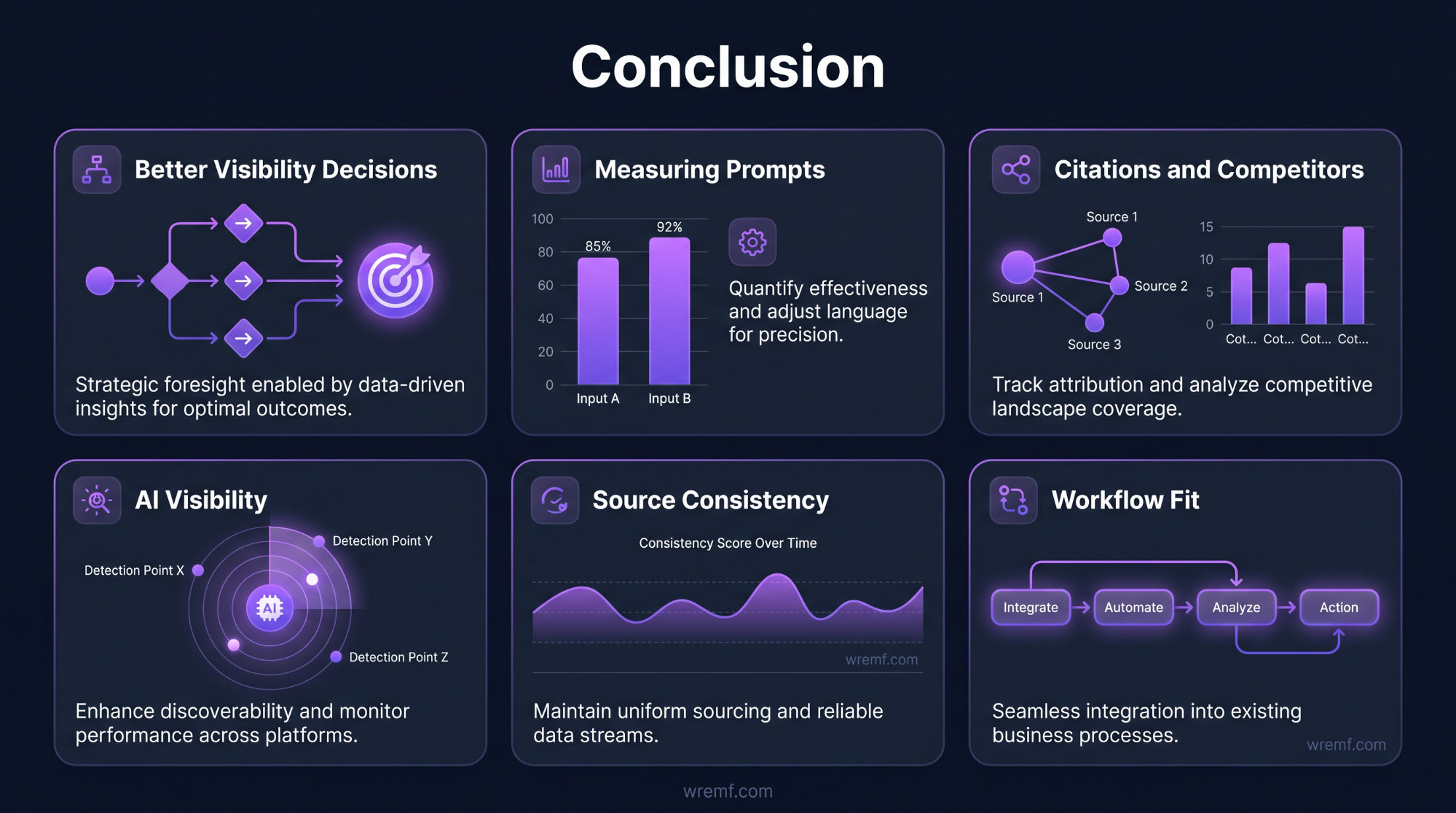
How to compare AI search optimization tools comes down to one practical question: which platform helps you make better visibility decisions across search engines and AI answers? The right tool should measure prompts, citations, competitors, AI visibility, source consistency, technical readiness, content gaps, workflow fit, and reporting value. Traditional SEO tools still matter, but they are not enough on their own. WREMF turns AI visibility from manual checking into a measurable workflow for brands, agencies, and teams that need software, managed execution, or both. To compare the workflow in practice, explore the WREMF platform suite or request support from the WREMF agency team.
Related reading
- AI Search Engine Optimization Tools: The Complete 2026 Guide for AI Search, SEO, AEO, and GEO
- Why Use AI Search Optimization Tools for Your Business
- AI Overviews Tracker: The Complete Guide to Monitoring Google AI Overviews, Citations, and AI Search Visibility
- The Complete Guide to AI Rank Tracker Tools for B2B Search Visibility