Top AI Search Optimization Tools for Content Creators
Learn about AI search optimization tools helping content creators enhance visibility across AI and traditional platforms.
By WREMF Team · 2026-09-16
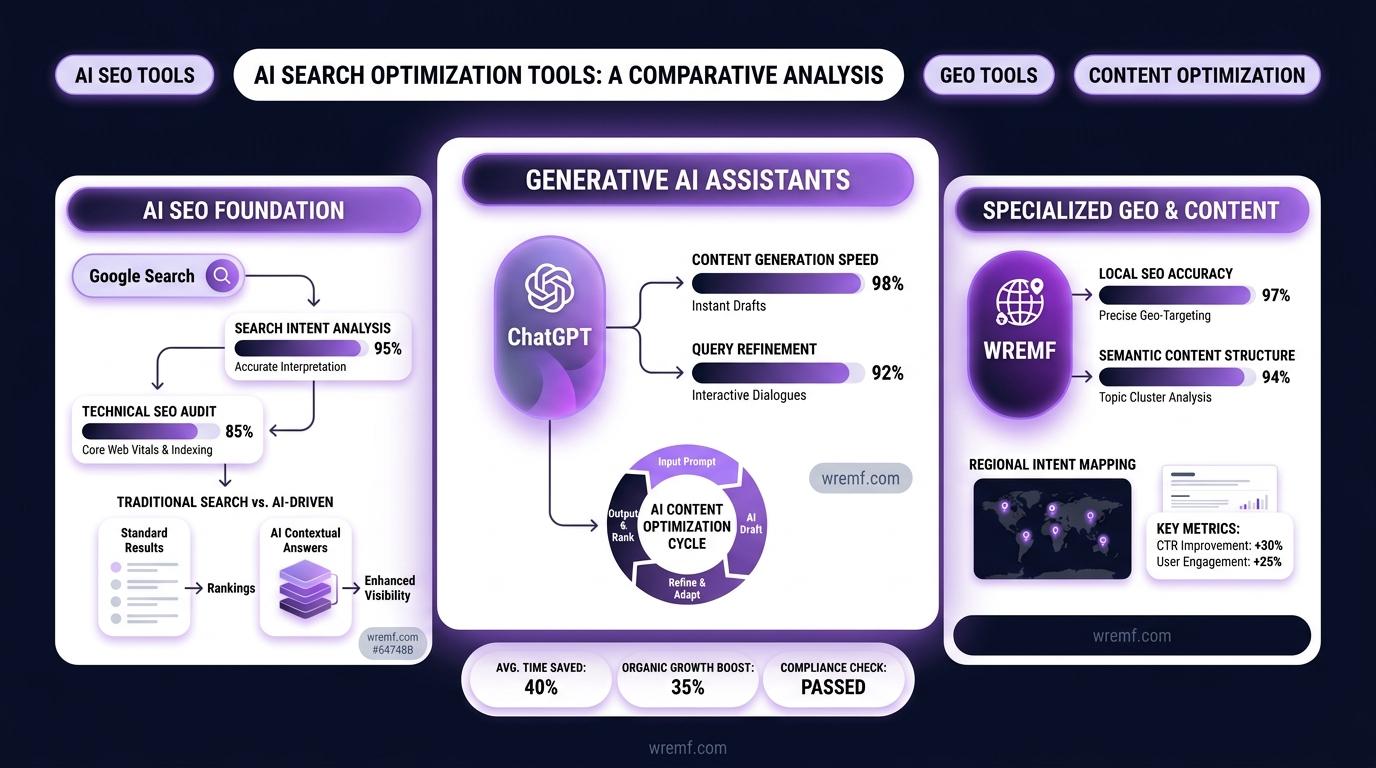
AI search optimization tools help content creators improve how their content appears in search engines and AI-generated answers, citations, and summaries. The practice involves making content discoverable, understandable, citable, and useful across platforms like Google Search, ChatGPT, and Gemini. AI search optimization matters as users now expect direct answers rather than just ranked links. Tools speed up and enhance the accuracy of content planning, optimization, and performance measurement, moving towards a broader visibility system beyond keywords.
Key takeaways
- AI search optimization tools extend content visibility beyond traditional SEO by incorporating AI answer readiness.
- Search visibility now includes curated AI-generated answers, making Answer Engine Optimization (AEO) essential.
- Generative Engine Optimization (GEO) measures how AI systems use your content, leveraging platforms like ChatGPT and Google AI Overviews.
- Content creation should align with AI features for extracts, summaries, citations, and recommendations.
- Structured, answer-ready content is vital for engaging both search engines and AI platforms.
Top AI Search Optimization Tools for Content Creators
AI search optimization tools for content creators help creators plan, optimize, monitor, and prove content visibility across Google Search, Google AI Overviews, Google AI Mode, ChatGPT, Perplexity, Gemini, Claude, Copilot, and other AI answer engines. Similarweb reports that generative AI platforms reached about 7 billion average monthly web visits in 2025, with 76% year-over-year growth, which shows why AI discovery can no longer be treated as a side channel. This guide covers AI SEO tools, GEO tools, AEO workflows, content optimization platforms, AI writing assistants, technical SEO tools, citation monitoring, reporting, pricing considerations, and practical stacks for freelancers, agencies, and B2B content teams. WREMF helps teams track, improve, and prove AI visibility across major AI discovery surfaces. Use this guide to choose the right tools without creating an expensive, duplicated tool stack.
What Are AI Search Optimization Tools, and Why Do Content Creators Need Them in 2026?
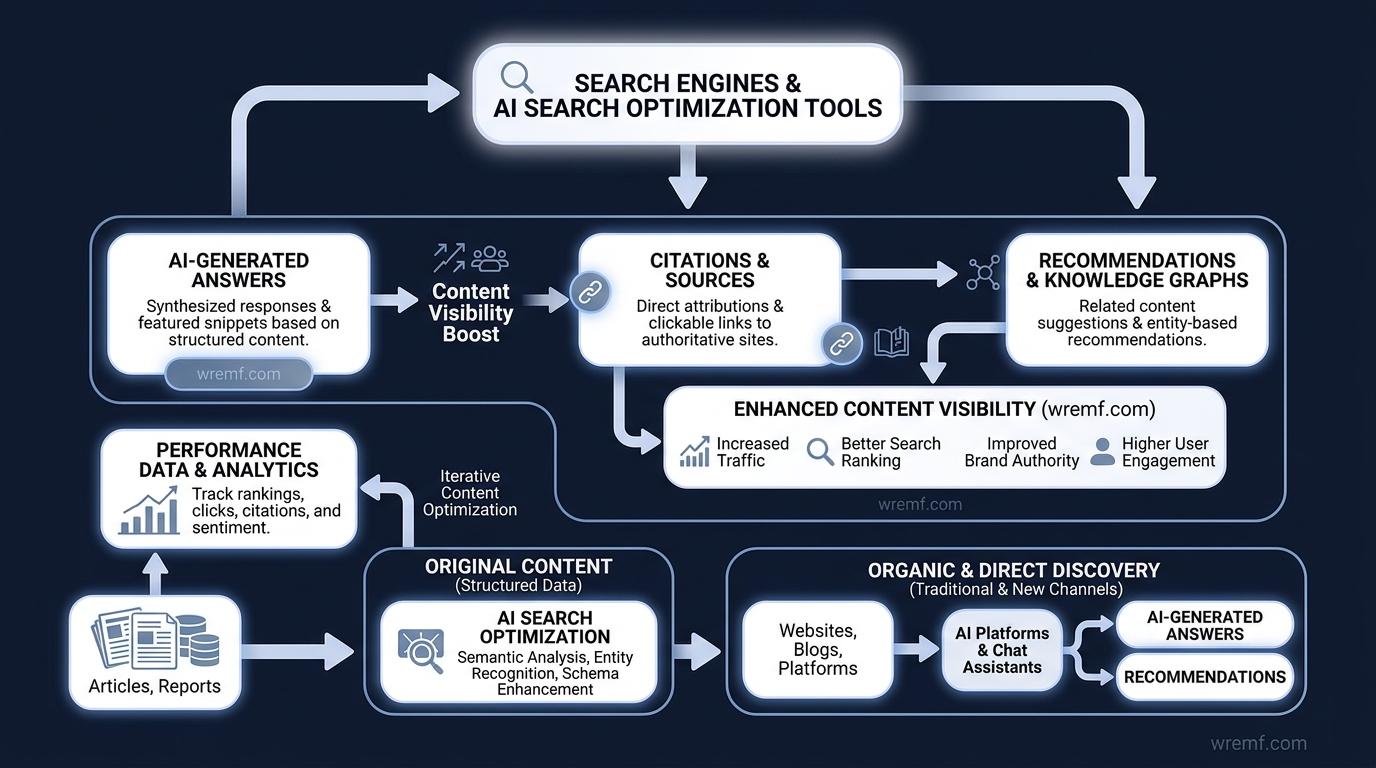
AI search optimization tools help content creators improve how content appears in search engines, AI-generated answers, citations, summaries, and recommendations. Content creators need them because discovery now happens across search results, AI Overviews, answer engines, AI assistants, and multimodal content platforms.
AI search optimization is the practice of making content discoverable, understandable, citable, and useful across search engines and AI answer engines. AI search optimization matters because users increasingly ask natural-language questions and expect direct answers, not only ranked links.
AI SEO tools are software platforms that use artificial intelligence, search data, language models, or automation to improve content planning, writing, optimization, monitoring, and reporting. AI SEO tools matter because they help creators move faster, but the strongest tools also improve accuracy, structure, and measurable performance.
For content creators, the biggest change is that search visibility is no longer limited to keyword rankings. A post can rank on Google, appear in Google AI Overviews, get cited by Perplexity, be summarized by ChatGPT search, appear in Gemini responses, and be ignored by another AI engine. Each surface can influence awareness, trust, clicks, and buying decisions differently.
Google Search Central explains that AI features in Search are part of Google Search and that site owners should focus on helpful, reliable, people-first content and standard Search controls. OpenAI describes ChatGPT search as a way to get timely answers with links to relevant web sources. These official statements show that content creators need both traditional search readiness and AI answer readiness. (Google for Developers)
WREMF helps content teams track, improve, and prove AI visibility across ChatGPT, Claude, Gemini, Perplexity, Google AI Overviews, Copilot, DeepSeek, Grok, Meta AI, and Mistral. The WREMF platform suite combines prompt intelligence, source citations, competitor visibility, AI share of voice, and action recommendations in one workflow.
AI visibility is the measurable presence of a brand, creator, product, website, or content asset inside AI-generated answers, recommendations, citations, and summaries. AI visibility matters because AI assistants can influence user decisions before a user visits a website.
DID YOU KNOW: Similarweb’s 2025 Generative AI Landscape report says generative AI average monthly visits grew 76% year over year, app downloads grew 319% year over year, and AI platforms generated more than 1.1 billion referral visits in June 2025. (Similarweb Ltd.)
KEY TAKEAWAY: AI search optimization tools help content creators move from keyword-only SEO to a broader visibility system built around search results, AI answers, citations, prompts, competitors, and attribution.
The next step is understanding how AI search changed the content optimization landscape.
How Search Changed From Traditional SEO to AI Search and GEO
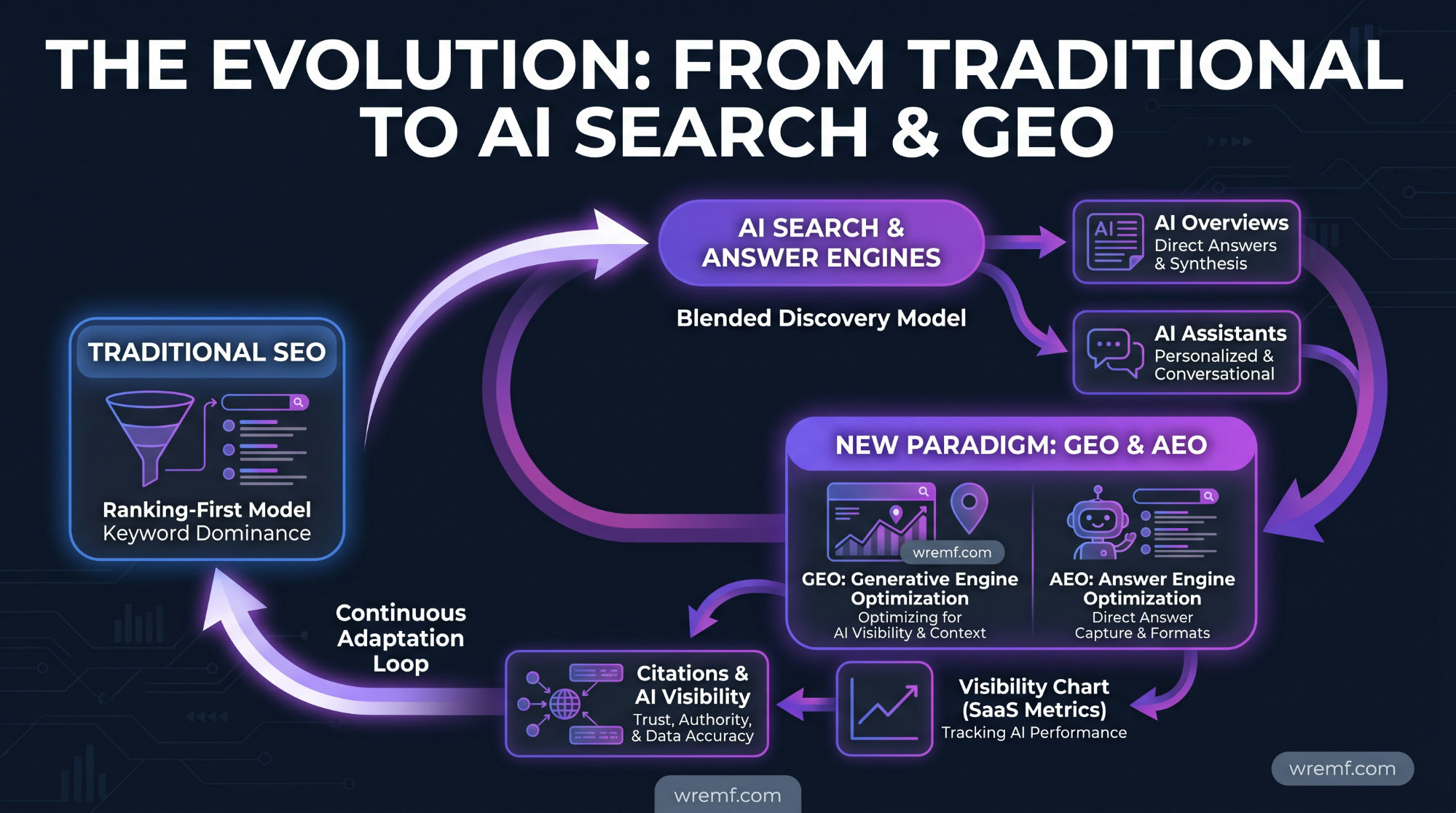
Search changed from a ranking-first model into a blended discovery model where search engines, AI Overviews, answer engines, AI assistants, and agentic tools summarize information before users click. This shift makes GEO, AEO, citations, source consistency, and AI visibility essential parts of content strategy.
Traditional SEO focuses on search engine visibility. It improves crawlability, relevance, technical health, backlinks, search intent alignment, rankings, clicks, impressions, and organic traffic.
Answer Engine Optimization is the process of structuring content so answer systems can extract direct, useful, and accurate responses. AEO matters because users ask complete questions and expect clear answers in featured snippets, AI Overviews, voice assistants, and conversational search.
Generative Engine Optimization is the process of improving how generative AI systems retrieve, summarize, cite, and recommend a brand or content source. GEO matters because tools such as ChatGPT, Perplexity, Gemini, Claude, Copilot, and Google AI Mode can produce answers that combine multiple sources into one response.
AI discovery surfaces are platforms and interfaces where users discover answers through AI-generated responses, summaries, citations, recommendations, agents, or conversational search. AI discovery surfaces matter because they can shape user awareness without producing a normal search click.
| Approach | Primary Goal | Best For | What It Measures | What It Misses |
|---|---|---|---|---|
| SEO | Improve search rankings and organic traffic | Google Search, Bing, traditional search engines | Rankings, impressions, clicks, CTR, backlinks, technical health | AI answer mentions, citations, recommendations |
| AEO | Make content answer-ready | Featured snippets, voice assistants, answer boxes, direct responses | Question coverage, concise definitions, answer structure | Cross-engine AI visibility and citation patterns |
| GEO | Improve visibility in AI-generated answers | ChatGPT, Perplexity, Gemini, Claude, Copilot, Google AI Overviews | Prompts, AI mentions, source citations, competitors, share of voice | Some traffic impact when zero-click answers occur |
| AI visibility tracking | Prove presence across AI discovery surfaces | B2B brands, agencies, SaaS teams, creators with commercial content | Mentions, citations, recommendations, competitors, sentiment, source consistency | Full private AI usage and all hidden model behavior |
The key difference between SEO and GEO is that SEO optimizes for ranked retrieval pages, while GEO optimizes for generated answers that may cite, summarize, compare, or recommend sources. The two disciplines overlap because AI systems still depend on accessible, trustworthy, and well-structured content.
Google AI Overviews are AI-generated search snapshots that summarize information and provide links for users to explore deeper. Google AI Overviews matter because they can answer a user’s question before the user chooses a traditional organic result.
Google AI Mode is a more conversational AI search experience within Google Search. Google AI Mode matters because it moves search behavior closer to multi-turn AI assistance, where users refine a question instead of opening many pages.
In practical AI visibility audits, SEO teams frequently discover that high-ranking pages do not always appear in AI answers. AI systems may cite third-party lists, documentation, review pages, knowledge bases, news articles, and category pages instead of the company’s own content. That means visibility depends on the content page and the broader source ecosystem.
IMPORTANT: SEO, AEO, and GEO are not replacements for one another. SEO creates discoverability, AEO creates extractability, and GEO measures how generative engines use your content and surrounding sources.
KEY TAKEAWAY: Search has evolved from rankings alone to a wider AI discovery system where content creators must optimize for rankings, answers, citations, prompts, and source trust.
Once the landscape is clear, the next question is which tool categories belong in the stack.
The Main Categories of AI Search Optimization Tools for Content Creators
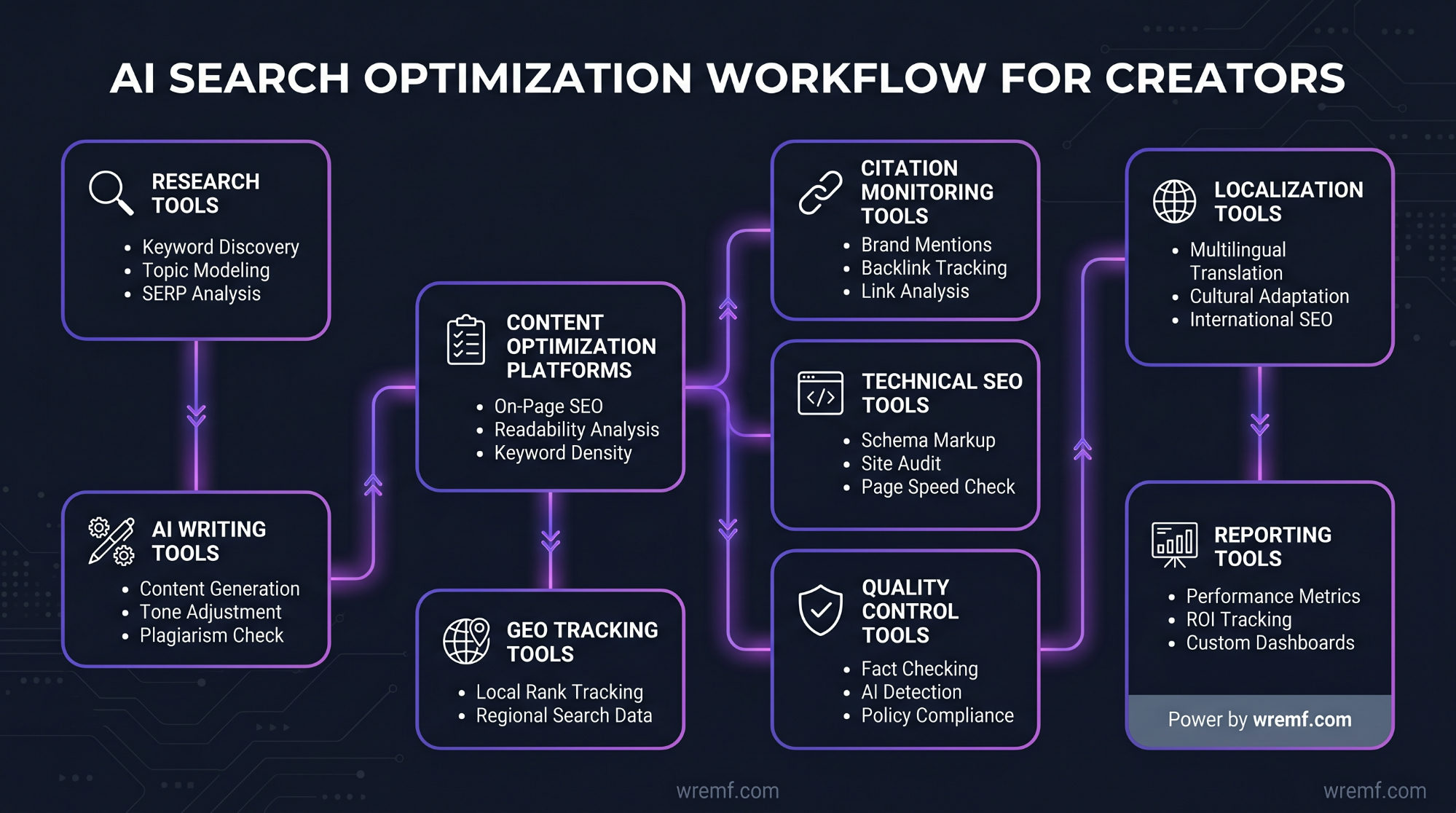
The main AI search optimization tool categories are research tools, AI writing tools, content optimization platforms, GEO tracking tools, citation monitoring tools, technical SEO tools, quality control tools, localization tools, and reporting tools. Each category solves a different part of the content visibility workflow.
AI tools are software systems that use artificial intelligence to assist with research, writing, analysis, automation, search optimization, or decision support. AI tools matter because they speed up work, but they do not remove the need for strategy, fact-checking, and human review.
AI content tools help creators generate, edit, summarize, repurpose, and optimize text, video, audio, or visual content. AI content tools matter because content production now includes blog posts, landing pages, social posts, YouTube scripts, podcasts, webinars, newsletters, product pages, and short-form video.
AI writing tools help creators draft, rewrite, summarize, translate, and adapt written content. AI writing tools matter because they can reduce production time, but they must be paired with editorial judgment and source validation.
The core categories are:
Keyword research and market research tools
SERP analysis tools
Content strategy and topic cluster tools
AI writing and content generation tools
AI content optimization tools
AI visibility and GEO tracking platforms
Citation analysis and brand monitoring tools
Technical SEO and site audit tools
AI crawler readiness tools
Content integrity and fact-checking tools
AI localization and transcription tools
Reporting, attribution, and client dashboard tools
| Tool Category | Example Tools | Best For | What It Improves | Main Limitation |
|---|---|---|---|---|
| Keyword research | Semrush, Ahrefs, SE Ranking, AnswerThePublic | Search demand and topic ideas | Keywords, volume, difficulty, questions | Does not measure AI answers directly |
| SERP analysis | Frase, Surfer SEO, Rankability, Semrush | Search result gap analysis | Search intent, headings, content gaps | Can overfit content to current SERPs |
| Content strategy | MarketMuse, Clearscope, Content Harmony | Topic clusters and authority | Semantic coverage, briefs, internal logic | Requires editorial judgment |
| AI writing | ChatGPT, Claude, Gemini, Jasper, Copy.ai | Drafting and ideation | Speed, outlines, variations, summaries | Can create generic or inaccurate content |
| Content production | Descript, InVideo, Synthesia, Murf, Contentpen | Video, audio, voice, scripts, social content | Multiformat creation | Does not guarantee search visibility |
| GEO tracking | WREMF, Profound, OtterlyAI, AthenaHQ | AI search visibility monitoring | Prompts, mentions, citations, competitors | Needs recurring prompt design |
| Technical SEO | Screaming Frog, Sitebulb, Semrush Site Audit | Crawlability and indexation | Site health, internal links, metadata | Does not measure AI recommendations |
| AI crawler readiness | Indexly, llms.txt tools, log analysis | Content accessibility and discovery | Crawl access, important page discovery | Standards are still emerging |
| Quality control | Grammarly, Originality.ai, fact-checking workflows | Accuracy and trust | Readability, originality, risk reduction | Cannot replace expert review |
| Reporting | GA4, GSC, WREMF reports, Looker Studio | Proof and decision-making | Traffic, visibility, share of voice, client reporting | Attribution can be incomplete |
Content creators should not buy every tool in every category. A practical stack includes one keyword research source, one content optimization layer, one AI writing assistant, one technical validation tool, one AI visibility tracker, and one reporting workflow.
AI answers are generated responses produced by AI systems using model knowledge, retrieved web sources, private knowledge bases, or a combination of those inputs. AI answers matter because they can summarize a topic, compare options, cite sources, and recommend brands without the user scrolling through search results.
AI answer engines are systems that generate direct answers instead of only returning ranked links. AI answer engines matter because creators must optimize content for extraction, citation, and recommendation, not only blue-link rankings.
KEY TAKEAWAY: AI search optimization tools work best when each tool has a clear job across research, creation, optimization, technical readiness, AI visibility, and reporting.
The most useful way to evaluate tools is by the workflow stage they support.
Top AI-Powered Research and Content Strategy Tools
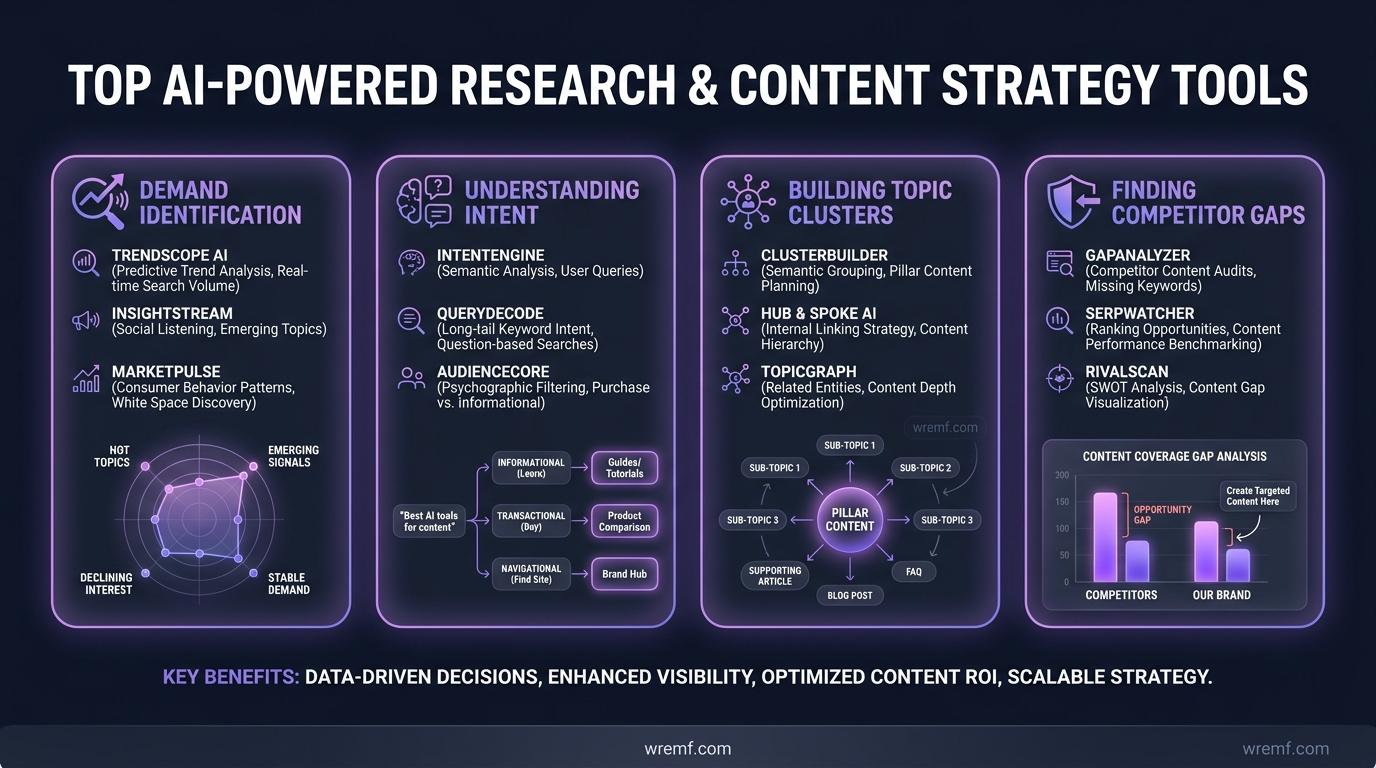
The best AI-powered research and content strategy tools help creators identify demand, understand intent, build topic clusters, find competitor gaps, and plan content that can perform in both search results and AI answers. These tools should guide strategy before any AI writing begins.
Keyword research is the process of identifying the search terms, questions, topics, and language that users enter into search engines and AI systems. Keyword research matters because it connects content production to real user demand instead of internal guesswork.
Content strategy is the system that connects audience needs, search demand, business goals, topic clusters, formats, publishing priorities, and performance measurement. Content strategy matters because random AI content production rarely builds authority or demand.
Semrush and Semrush Copilot are useful for keyword research, competitor analysis, organic performance, backlink research, content opportunities, and AI-assisted SEO insights. Semrush is strongest when creators need search demand, competitive intelligence, SERP data, and domain-level SEO performance.
MarketMuse is useful for topic modeling, semantic authority, content gaps, and strategic planning. MarketMuse fits larger content teams that need to understand topical depth across many pages rather than optimize only one article.
AnswerThePublic helps creators find question-based search behavior, which is useful for AEO and FAQ planning. Perplexity can be used as a research assistant to see how an answer engine summarizes a topic and which sources it surfaces, but its outputs should be verified against primary sources.
Frase helps creators convert SERP analysis into briefs, headings, questions, and topic gaps. It is useful for freelancers and teams that need faster research before writing.
Rankability helps writers and teams build content briefs and optimize around topic relevance, SERP patterns, and competitive content structure. It fits creators who want a practical bridge between keyword research and page-level optimization.
| Tool | Best For | Typical User | AI Search Use Case | Main Limitation |
|---|---|---|---|---|
| Semrush | Keyword research, competitor SEO, backlinks, site audit | SEO teams, agencies, SaaS marketers | Find topics and competitor pages that may influence AI answers | Not a dedicated AI citation tracker |
| Semrush Copilot | AI-assisted SEO alerts and recommendations | SEO managers | Surface SEO issues and opportunities faster | Still depends on underlying SEO data |
| MarketMuse | Topic authority and content planning | Larger content teams | Build complete topic clusters for AI retrieval | Higher learning curve |
| AnswerThePublic | Question discovery | Creators, bloggers, freelancers | Find natural-language prompts and FAQ ideas | Not enough for full content scoring |
| Perplexity | Source discovery and answer exploration | Researchers, creators | See cited answer patterns and source types | Needs manual verification |
| Frase | Briefs and SERP gaps | Freelancers, agencies, editors | Build answer-ready outlines from SERPs | Can mirror competitors too closely |
| Rankability | Content briefs and relevance scoring | SEO writers, agencies | Improve topic coverage and on-page depth | Requires editorial decisions |
The best research workflow starts with search demand, then expands into AI prompt demand. For example, a creator targeting “AI SEO tools” should also test prompts such as “what AI tools help content get cited in Google AI Overviews,” “which tools track ChatGPT citations,” and “how do GEO tools differ from SEO tools.”
Prompt tracking is the process of monitoring how AI systems respond to repeated prompts over time. Prompt tracking matters because AI visibility depends on what users ask, how engines answer, which sources appear, and which competitors are recommended.
TIP: Build every content brief from three inputs: search keywords, AI-style prompts, and cited source patterns.
KEY TAKEAWAY: Research tools help creators choose the right topics, but AI search optimization requires turning keyword data into prompt clusters, answer structures, and citation opportunities.
After research, creators need tools that improve writing and content production without weakening quality.
Leading AI Content Writing and Content Generation Tools
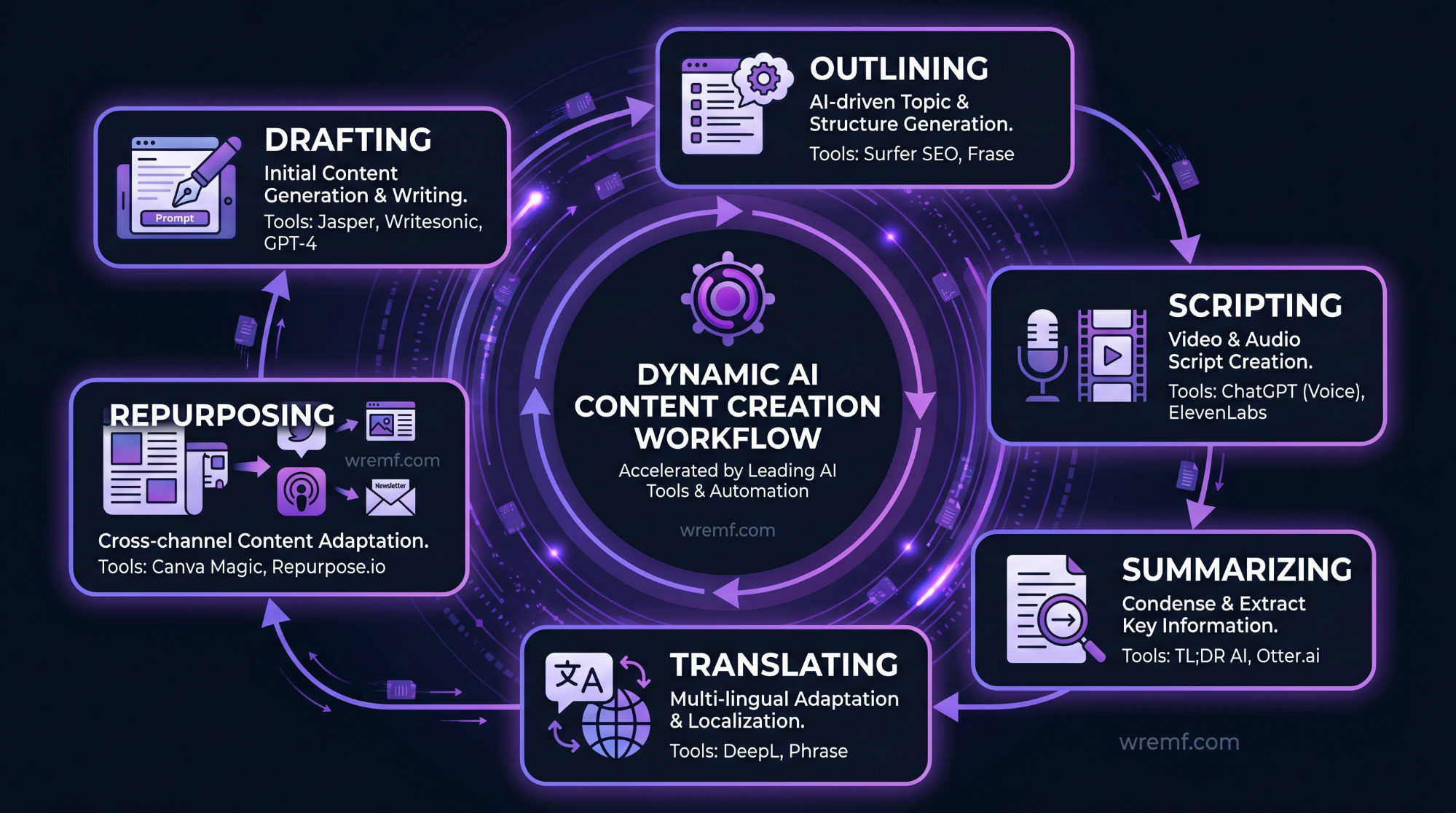
AI content writing and generation tools help creators produce drafts, outlines, scripts, summaries, translations, social posts, videos, audio, and repurposed assets faster. The best use is human-led production where AI accelerates the first draft, not a fully automated publishing machine.
Content Generation is the process of creating text, video, audio, scripts, outlines, social posts, or other assets from prompts, inputs, or source material. Content Generation matters because creators must publish across multiple channels, but quality control is still essential.
ChatGPT is useful for ideation, outlines, summaries, rewrites, content briefs, content repurposing, and prompt-based research. Claude is useful for long-form drafting, document analysis, tone refinement, and brand-voice consistency. Gemini is useful for Google ecosystem workflows, brainstorming, summarization, and multimodal content tasks.
AI Writer tools such as Jasper, Copy.ai, Contentpen, and similar platforms help creators generate marketing copy, blog sections, social captions, email drafts, and landing page variations. These tools can save time, but the final content still needs original examples, source verification, and editorial shaping.
Video and audio content tools also matter for search optimization because content discovery is not limited to blog posts. InVideo supports video creation. Descript supports editing, transcription, clips, and podcast workflows. Synthesia supports AI avatar video production. Murf supports AI voiceover generation. BLEND Voice and AI localization tools help teams adapt content for multiple markets and languages.
AI Localization is the process of adapting content across languages, regions, culture, search behavior, and local terminology. AI Localization matters because search intent, AI answers, and preferred sources can vary by market.
Transcription is the process of converting audio or video into written text. Transcription matters because transcripts can become searchable assets, summaries, captions, article drafts, and source material for AI content briefs.
| Tool Type | Example Tools | Best For | Search Optimization Value | Quality Risk |
|---|---|---|---|---|
| General AI assistants | ChatGPT, Claude, Gemini | Outlines, drafts, summaries, rewrites | Speeds up ideation and production | Hallucinated claims or generic sections |
| AI copywriting platforms | Jasper, Copy.ai, Contentpen | Marketing copy and repeatable templates | Faster content production | Thin or repetitive pages |
| Video tools | InVideo, Synthesia | Video creation and explainers | Supports video SEO and content repurposing | Low differentiation if templated |
| Audio tools | Murf, Descript | Voiceovers, podcasts, transcription | Creates transcripts and clips for search | Voice or transcript quality issues |
| Localization tools | BLEND Voice, AI translation tools | Multimarket content | Helps adapt content for markets | Literal translation without local intent |
| Editorial tools | Grammarly, Originality.ai | Readability, originality, risk checks | Improves trust and quality control | Cannot verify every factual claim |
Google Search Central says using generative AI is not automatically against Search guidelines, but using generative AI to create many pages without adding value may violate scaled content abuse policies. This means content creators should use AI to improve research, structure, and workflow, not to publish low-value pages at scale. (Google for Developers)
A practical AI writing workflow has four layers. Use AI for ideation and structure. Add expert input, examples, and source-backed claims. Use optimization tools for clarity and completeness. Use human review before publishing.
Human-in-the-loop editing is the practice of keeping people responsible for content strategy, accuracy, source review, brand voice, and final approval. Human-in-the-loop editing matters because AI tools can assist production, but they do not understand your audience, compliance needs, customer objections, or business model as well as your team.
IMPORTANT: AI writing is a production assistant, not a search strategy. Content still needs intent alignment, evidence, originality, structure, technical accessibility, and ongoing measurement.
KEY TAKEAWAY: AI writing and content generation tools create the most value when they speed up expert-led content, not when they replace research, judgment, source review, or editorial quality.
Once content is drafted, creators need optimization tools that improve search performance and answer readiness.
Best AI Content Optimization Tools for Search Engines and AI Answers
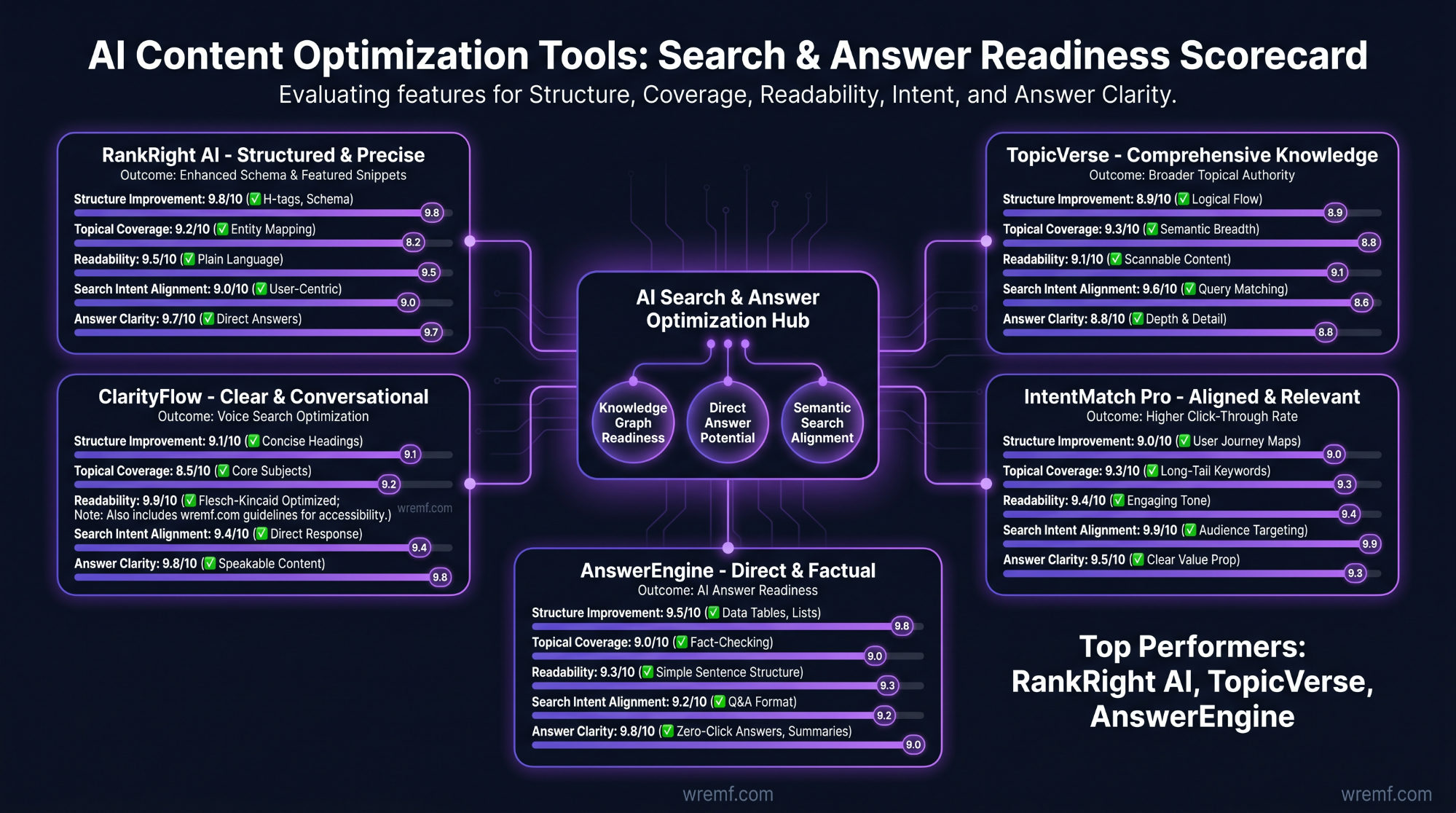
AI content optimization tools help creators improve structure, topical coverage, readability, search intent alignment, and answer clarity. The strongest tools support human decisions by showing gaps, not by forcing writers to copy competitors or stuff terms.
Content optimization is the process of improving content so it better satisfies user intent, search engine expectations, and AI answer extraction. Content optimization matters because clear, complete, accurate content is easier for users and AI systems to understand.
Surfer SEO is useful for real-time SERP-based optimization, content scoring, topical term suggestions, and AI-assisted writing workflows. It works well for creators who want guidance based on competing pages in search results.
Clearscope is useful for editorial content optimization, relevant term coverage, readability, and content quality workflows. It works well for teams that want a clean writing and editing process.
Frase is useful for SERP gap analysis, content briefs, questions, competitor outlines, and draft support. It works well for freelance writers, small teams, and agencies that need efficient research.
MarketMuse is useful for semantic authority, topic clusters, content inventory analysis, and strategic content planning. It works well for brands that publish many pages and need a clear authority map.
Rankability is useful for content briefs, keyword relevance, page-level optimization, and practical SEO writing workflows. It works well for teams that want actionable guidance without building a complex enterprise content system.
| Tool | Best For | What It Helps Optimize | Recommended When | Main Caution |
|---|---|---|---|---|
| Surfer SEO | SERP-based optimization | Terms, headings, structure, content score | You need fast page-level SEO guidance | Avoid writing only to the score |
| Clearscope | Editorial relevance | Topic coverage and readability | You need consistent content quality | Add original expertise beyond term coverage |
| Frase | Briefs and SERP gaps | Questions, outlines, competitor patterns | You need faster briefs and research | Do not copy competitor structures blindly |
| MarketMuse | Semantic authority | Topic clusters and content gaps | You manage a large content library | Requires strategy and prioritization |
| Rankability | Practical SEO content briefs | Relevance and on-page depth | You need repeatable SEO writing workflows | Needs human review and source validation |
AI content optimization should include both search optimization and answer optimization. Search optimization checks whether a page can compete in search results. Answer optimization checks whether the page gives concise, extractable, source-backed answers that an AI system can quote or summarize.
Answer-first content is content that opens sections with a direct response before expanding into detail. Answer-first content matters because readers, search engines, and AI systems can quickly identify the main claim.
Structured content is content organized with descriptive headings, concise definitions, tables, bullets, internal links, and clear evidence. Structured content matters because AI systems and search engines can parse relationships between entities, questions, sources, and recommendations more easily.
Meta descriptions are short HTML page summaries that can appear in search results. Meta descriptions matter because they clarify relevance for users and search systems, even when search engines rewrite snippets.
AI content optimization tools should not be used as calculators for keyword density. The better question is whether the content answers the query better than competing pages, uses trustworthy sources, explains tradeoffs, supports claims, and leads users to a useful next step.
KEY TAKEAWAY: Content optimization tools improve search readiness and answer readiness, but creators still need human judgment, source-backed claims, and original insight to build durable visibility.
Optimization improves the page, but GEO tools are needed to monitor whether AI engines actually mention or cite it.
Specialized GEO and AI Visibility Tracking Tools
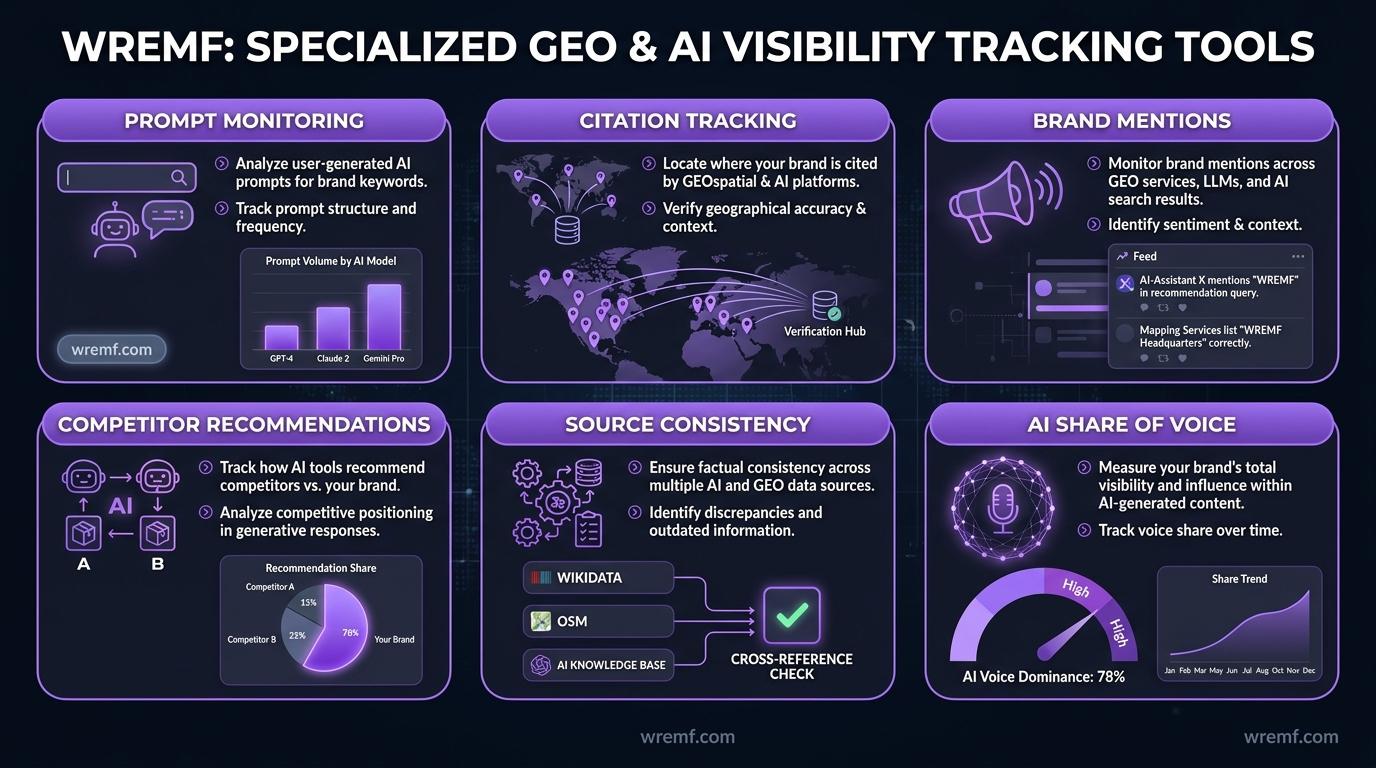
Specialized GEO and AI visibility tracking tools monitor how brands, creators, products, and pages appear across AI-generated answers. These tools are essential when the goal is to measure prompts, citations, brand mentions, competitor recommendations, source consistency, and AI share of voice.
GEO tracking is the process of monitoring visibility across generative AI engines and AI discovery surfaces. GEO tracking matters because AI answers can influence research, comparison, and buying decisions even when they do not create a normal search click.
Citation Analysis is the process of identifying which sources AI systems cite, reference, or rely on when answering a prompt. Citation Analysis matters because cited sources shape trust, answer framing, and user paths.
Source citations are the pages, websites, documents, or references included in AI-generated answers. Source citations matter because they reveal which sources AI systems trust for a given topic.
WREMF is designed for AI visibility tracking across 10 AI engines, including ChatGPT, Claude, Gemini, Perplexity, Google AI Overviews, Copilot, DeepSeek, Grok, Meta AI, and Mistral. WREMF helps teams monitor prompt performance, source citations, competitor visibility, AI share of voice, source consistency, visibility scoring, and reporting. The WREMF source citations feature helps teams understand which sources influence AI answers and where citation gaps exist.
Profound is often discussed as an enterprise AI visibility and answer engine monitoring platform. OtterlyAI is often discussed for monitoring brand mentions, citations, and sentiment across AI answers. AthenaHQ is often discussed in the GEO tracking space for AI search visibility and brand presence monitoring. Indexly is often discussed around indexing, crawler access, and faster discovery of new content.
The most important buying question is not “which GEO tool is best overall?” The better question is “which tool tracks the engines, prompts, sources, competitors, reports, and workflows that matter for my content strategy?”
| GEO Tool Category | Examples | Best For | What It Tracks | Main Decision Criterion |
|---|---|---|---|---|
| AI visibility platform | WREMF | Brands, agencies, SaaS teams, consultants | Prompts, citations, competitors, AI share of voice, source consistency, attribution | Best when you need software, reporting, and optional execution |
| Enterprise answer monitoring | Profound | Larger teams and enterprise programs | AI answer presence and market visibility | Best when enterprise reporting is the main need |
| Brand citation monitoring | OtterlyAI | Teams tracking mentions and sentiment | Brand mentions, citations, sentiment | Best when lightweight monitoring is the priority |
| GEO intelligence platform | AthenaHQ | AI visibility teams and consultants | AI search visibility signals | Best when GEO tracking is the central workflow |
| Crawler and index support | Indexly | Technical SEO teams and publishers | Indexing, crawl discovery, new content access | Best when discovery speed is a key concern |
AI share of voice is the share of relevant AI answers or recommendation sets in which your brand appears compared with competitors. AI share of voice matters because it turns AI mentions into a competitive visibility metric.
Competitor visibility is the measurement of which competitors appear, get cited, or get recommended in search results and AI-generated answers. Competitor visibility matters because AI answer engines often present a shortlist of options, not a neutral directory.
Brand mentions are references to your brand inside AI answers, search results, citations, summaries, or recommendations. Brand mentions matter because a brand can influence a user’s decision without receiving an immediate click.
The WREMF competitive landscape workflow helps content creators see which competitors appear across tracked prompts and engines. This is useful for content planning because missing from AI answers often reveals missing comparison pages, weak category pages, unclear positioning, or weak third-party source consistency.
KEY TAKEAWAY: GEO tools are necessary because traditional SEO tools do not fully measure how AI systems mention, cite, compare, or recommend your content.
Once visibility is being tracked, technical readiness determines whether content can be accessed and understood.
Technical Optimization for AI Crawlers, Google Search, and AI Answer Engines
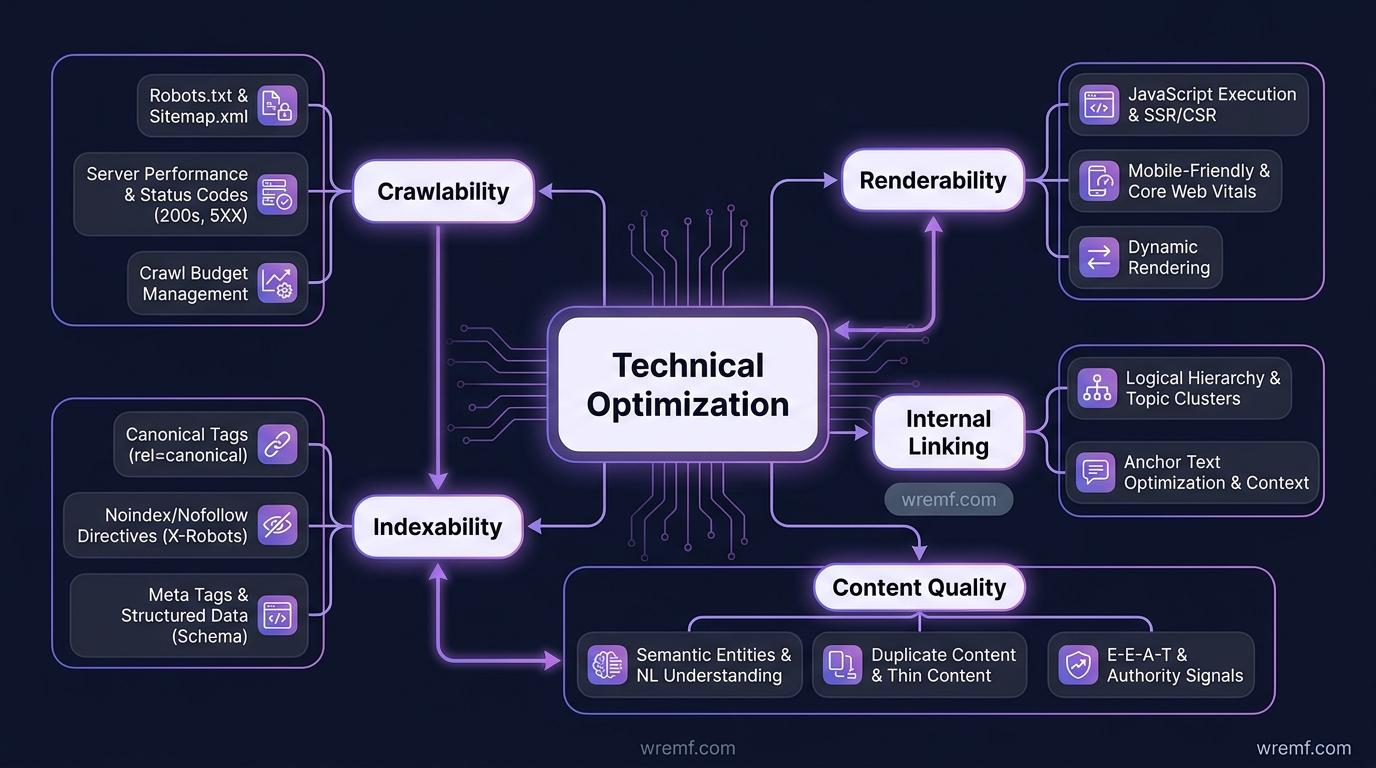
Technical optimization helps AI search visibility by making content crawlable, indexable, renderable, internally connected, and easy for systems to understand. AI search tools cannot fix content visibility if important pages are blocked, thin, duplicated, poorly linked, or unavailable to crawlers.
AI Crawler is a crawler or retrieval process used by an AI system, search engine, or AI-powered agent to discover and access web content. AI Crawler access matters because inaccessible pages are less likely to be retrieved, summarized, cited, or recommended.
Site audit is the process of checking a website for technical issues that affect crawling, indexing, page experience, search performance, and content discoverability. Site audit matters because technical problems can limit content performance even when the content itself is strong.
Internal links are links between pages on the same website. Internal links matter because they help users, search engines, and AI retrieval systems understand topic relationships, page importance, and site structure.
Schema is structured data that helps search engines understand page entities, content types, and relationships. Schema matters because it can clarify articles, products, organizations, FAQs, events, breadcrumbs, and other structured elements, although schema does not guarantee AI citations.
The technical checklist for AI search optimization includes:
Keep important pages indexable
Avoid accidental noindex tags
Use accurate canonical tags
Submit clean XML sitemaps
Keep robots.txt aligned with business goals
Ensure rendered HTML contains the main content
Use descriptive title tags and meta descriptions
Add internal links from relevant hub pages
Use schema where it accurately describes the content
Keep author, organization, product, and brand information consistent
Check whether JavaScript hides important content
Monitor crawl errors in Google Search Console
Review server logs when crawler access matters
Avoid thin AI-generated pages at scale
The llms.txt file is a proposed standard that uses a markdown file to provide information that may help LLMs use a website at inference time. llms.txt matters because it reflects a growing need to provide AI systems with concise website context, although it is still a proposal and should not replace technical SEO basics. (llms-txt)
LLMS.txt configuration should be treated as an experimental supporting layer. A practical llms.txt file may point to important documentation, product pages, pricing pages, API docs, methodology pages, and high-quality evergreen resources. It should not be used as a substitute for clean site architecture, robots.txt, XML sitemaps, accessible HTML, schema, and internal links.
The WREMF GEO audit feature helps teams review technical AI visibility foundations such as crawlability, rendering, entity clarity, content structure, internal linking, and source consistency. This is especially useful when a page looks good to a human but is hard for search systems or AI answer engines to parse.
IMPORTANT: Technical SEO does not guarantee AI visibility, but weak technical foundations can prevent strong content from being found, understood, or cited.
KEY TAKEAWAY: Technical optimization supports AI search visibility by making important content accessible, structured, internally connected, and easier for AI systems to interpret.
Technical readiness is only part of the picture because content integrity determines whether AI-assisted content is trustworthy.
Content Integrity, Fact-Checking, and Human Review
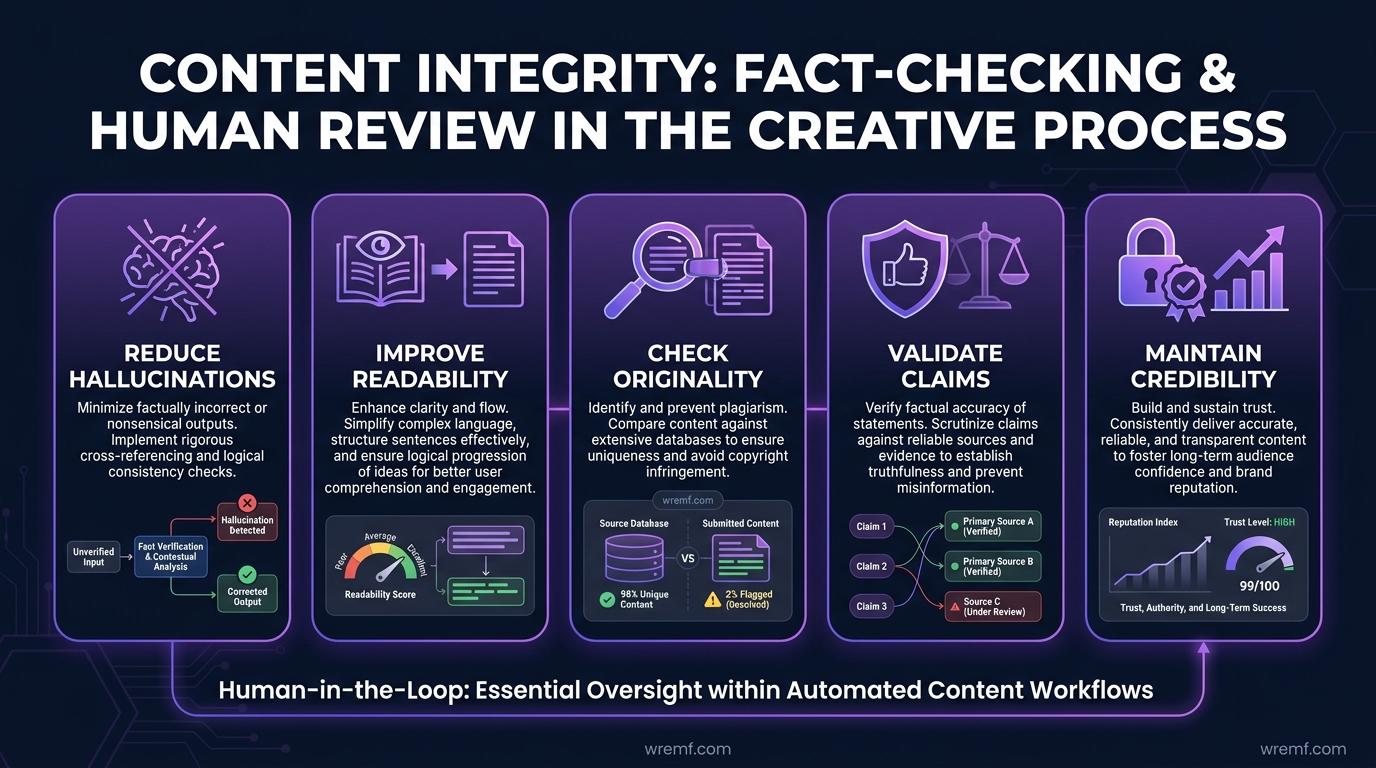
Content integrity tools help creators reduce hallucinations, improve readability, check originality, validate claims, and maintain credibility. They are essential because AI-generated drafts can sound confident while still containing unsupported claims, outdated facts, or weak reasoning.
Content integrity is the practice of ensuring content is accurate, original, useful, source-backed, and aligned with editorial standards. Content integrity matters because search engines, AI systems, readers, and buyers all need trustworthy information.
Fact-checking is the process of verifying claims against reliable sources before publication. Fact-checking matters because AI tools can produce plausible but incorrect statements, invented statistics, or unclear source attributions.
Grammarly helps with grammar, clarity, tone, and readability. Originality.ai helps with originality checks, AI detection workflows, and plagiarism risk review. Human editors and subject-matter experts remain the most important layer for factual validation, customer insight, and strategic differentiation.
Google Search Central explains that Google’s ranking systems aim to prioritize helpful, reliable information created for people rather than content made to manipulate rankings. This matters because AI-assisted content should still demonstrate usefulness, clarity, and trustworthiness. (Google for Developers)
A reliable content integrity workflow includes:
Check factual claims against primary or authoritative sources
Remove unsupported numbers
Avoid invented case studies
Add named sources close to claims
Review content for search intent fit
Add real examples from your own experience where appropriate
Use AI only after giving it strong source material
Review tone, structure, and clarity manually
Confirm that every recommendation is actionable
Update content when tools, pricing, or features change
In real-world reporting, teams often discover that AI-assisted content fails because the draft is too generic. It may include a definition, a list of tools, and a conclusion, but no expert comparison, no clear decision framework, no methodology, no source citations, and no next-step workflow. That type of content is unlikely to build trust.
McKinsey’s 2025 State of AI report says AI high performers are more likely to use defined processes for when model outputs need human validation. For content teams, the implication is clear: the value comes from workflow design, not from handing the entire content process to a model. (McKinsey & Company)
Human-in-the-loop review is the practice of keeping people responsible for final decisions, source validation, factual accuracy, brand voice, and judgment. Human-in-the-loop review matters because AI can accelerate execution, but accountability remains with the creator or brand.
KEY TAKEAWAY: AI-assisted content needs human review, factual validation, source attribution, and editorial judgment to become trustworthy enough for search and AI visibility.
After quality is protected, the next step is measuring performance beyond traffic alone.
How to Measure AI Search Optimization Performance
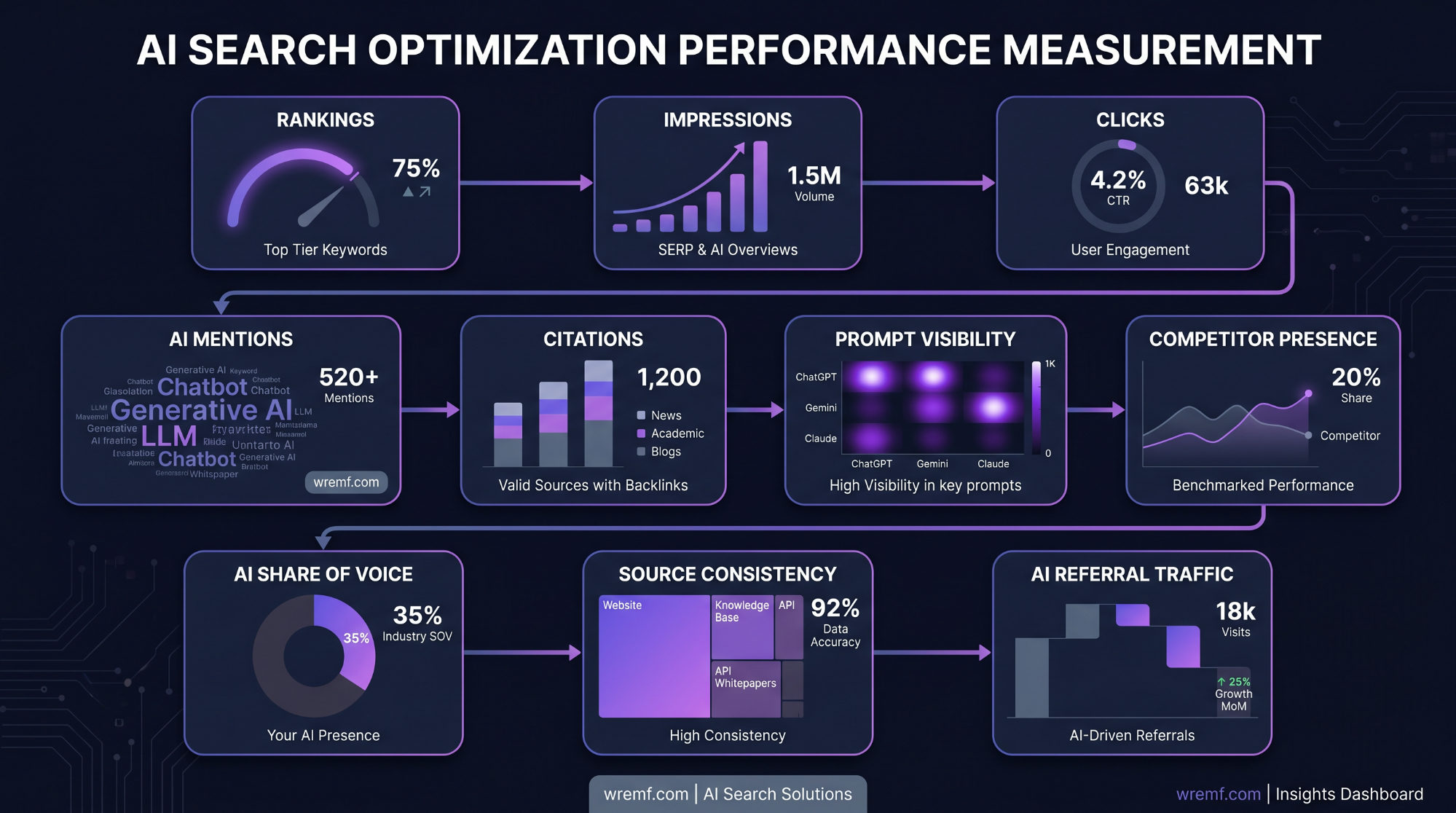
AI search optimization performance should be measured with a mix of rankings, impressions, clicks, AI mentions, citations, prompt visibility, competitor presence, AI share of voice, source consistency, and AI referral traffic. Rankings matter, but they no longer show the full discovery journey.
AI traffic attribution connects visits, referrals, conversions, and business outcomes to AI discovery surfaces where possible. AI traffic attribution matters because leadership and clients need evidence that AI visibility contributes to measurable outcomes.
Search engine performance is typically measured through impressions, clicks, CTR, average position, indexed pages, crawl issues, and conversions. AI answer performance is measured through prompts, brand mentions, citations, recommendation visibility, competitors, sentiment, and share of voice.
The measurement challenge is that AI discovery can be partly zero-click. A user may ask an AI assistant for the best tools, compare vendors, read the answer, and later visit a site directly, through Google, or through a colleague. That journey may not appear as a clean AI referral in analytics.
| Metric | Channel | What It Shows | Why It Matters | Tool Type |
|---|---|---|---|---|
| Impressions | Google Search | How often pages appear in search | Shows search demand and visibility | Google Search Console |
| Clicks | Google Search | How many users visit from search | Shows traffic impact | Google Search Console |
| Average position | Google Search | Ranking trend | Shows search competitiveness | Rank tracker or GSC |
| Prompt visibility | AI engines | Whether the brand appears in AI answers | Shows AI answer presence | WREMF or GEO tool |
| Source citations | AI engines | Which sources are cited | Shows trust and source influence | WREMF or citation tracker |
| AI share of voice | AI engines | Visibility versus competitors | Shows competitive AI presence | WREMF or GEO tool |
| AI referral traffic | Analytics | Visits from AI platforms | Shows measurable downstream traffic | GA4 and reporting tools |
| Source consistency | Web ecosystem | Whether sources describe the brand accurately | Reduces entity confusion | WREMF and manual review |
| Content updates | Workflow | Which improvements were made | Supports testing and reporting | SEO testing system |
The WREMF methodology connects prompts, citations, competitors, source consistency, and attribution into one repeatable measurement framework. This helps teams avoid presenting AI visibility as a collection of screenshots and instead report it as a monitored system.
The WREMF AI Visibility Index helps teams summarize AI visibility trends across tracked prompts and engines. This is useful for agencies that need recurring client reports and for in-house teams that need to show leadership how visibility changes over time.
If you want to review how prompt visibility, source citations, competitor mentions, and recommendations can be presented, use the WREMF sample report as a reference before building your own reporting workflow.
DID YOU KNOW: OpenAI says ChatGPT search can provide timely answers with links to relevant web sources, which means linked source visibility is now part of the AI discovery and reporting conversation. (OpenAI)
KEY TAKEAWAY: AI search optimization performance should be measured across search rankings, AI answer presence, citations, competitors, source consistency, and attribution, not rankings alone.
Measurement becomes easier when the tool stack matches the creator’s business model.
The Best AI Search Optimization Stack for Freelancers, Agencies, and B2B Content Teams
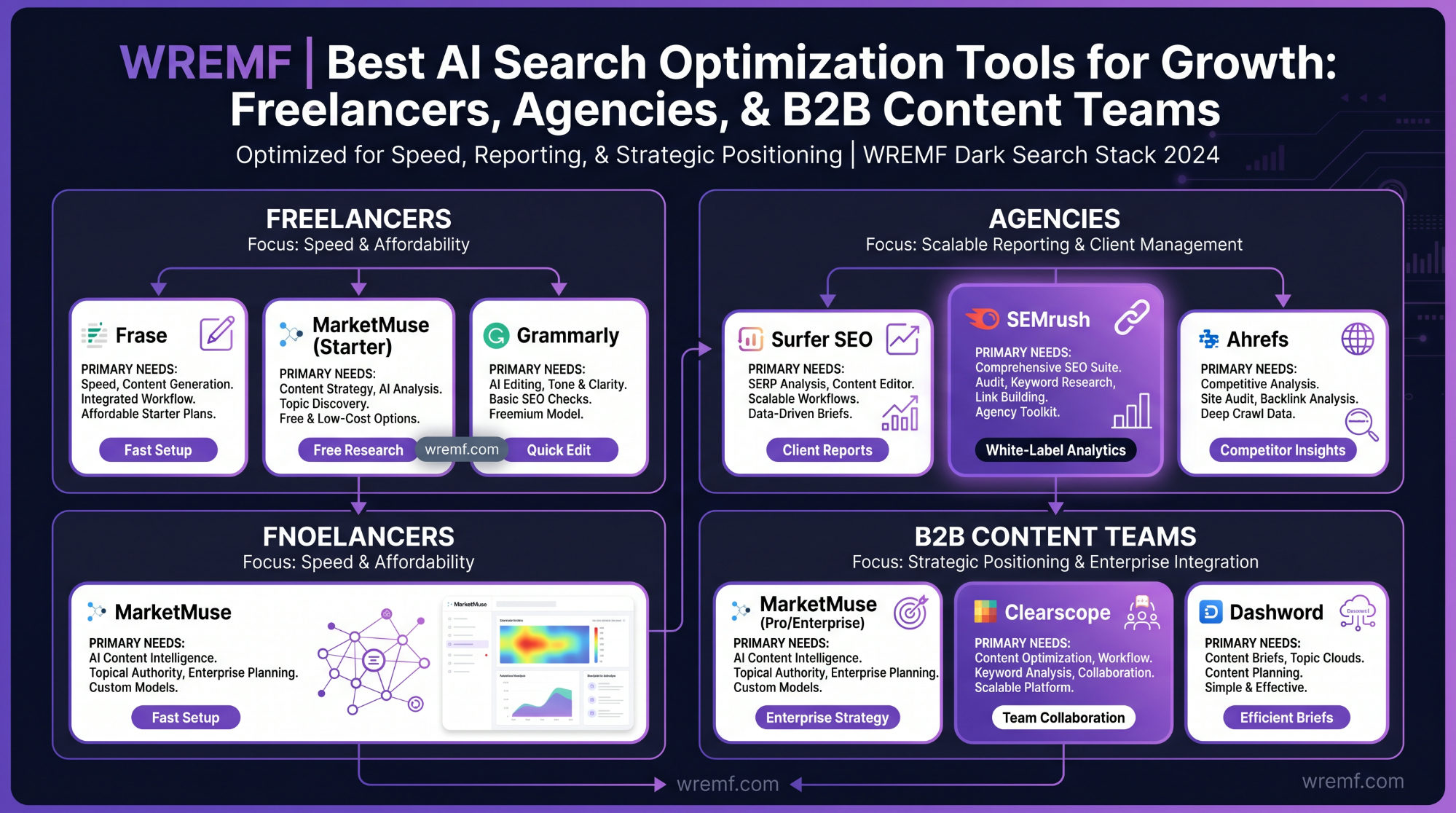
The best AI search optimization stack depends on publishing volume, budget, reporting needs, team skills, and business model. Freelancers need speed and affordability, agencies need scalable reporting, and B2B teams need visibility tied to pipeline and strategic positioning.
Content creators include bloggers, newsletter writers, YouTube creators, podcasters, SaaS marketers, freelance writers, SEO consultants, agencies, and in-house content teams. Content creators need different stacks because a solo creator and a multi-client agency do not have the same workflow or reporting burden.
For freelancers, the best stack is lightweight and practical. Use Google Search Console for performance, Semrush or SE Ranking for keyword research, Frase or Surfer SEO for briefs and content optimization, ChatGPT or Claude for drafting support, Grammarly for editing, and WREMF Starter when AI visibility reporting matters.
For agencies, the best stack should support repeatable workflows and client reporting. Use Semrush or Ahrefs for keyword and competitor research, Screaming Frog or Sitebulb for technical audits, Surfer SEO, Clearscope, Frase, or MarketMuse for content optimization, WREMF for AI visibility tracking and white-label reporting, and GA4 with Google Search Console for validation.
For B2B SaaS content teams, the best stack should connect content to buying journeys. Use keyword research for demand, MarketMuse or Clearscope for topic strategy, WREMF for prompt tracking, source citations, competitor visibility, and AI share of voice, GA4 for traffic, and CRM reporting where attribution is available.
For enterprise teams, the best stack should support governance, API access, multi-site reporting, custom portals, permissions, and source consistency. Enterprise teams often need WREMF Enterprise for unlimited websites, unlimited seats, dedicated support, BYOK, and custom branded portals.
| Team Type | Best Stack Focus | Suggested Tools | WREMF Fit | Main Risk |
|---|---|---|---|---|
| Freelancer | Speed, briefs, low cost | GSC, Semrush or SE Ranking, Frase, ChatGPT, Grammarly | Starter at €39/mo for one website and AI visibility tracking | Buying too many overlapping tools |
| Small content team | Publishing consistency | Semrush, Surfer SEO, Clearscope, ChatGPT, GA4, WREMF | Growth at €89/mo for five websites and content briefs | Optimizing drafts without tracking AI answers |
| Agency | Client reporting and repeatability | Semrush, Screaming Frog, Frase, Clearscope, GA4, WREMF | Growth or Enterprise with white-label reporting | Reporting only rankings while clients ask about AI visibility |
| B2B SaaS team | Buyer prompts and competitors | Semrush, MarketMuse, WREMF, GA4, GSC, CRM | Growth or Enterprise depending on sites and seats | Ignoring AI comparison and recommendation prompts |
| Enterprise | Governance and integration | Enterprise SEO stack, technical crawlers, WREMF API, BI tools | Enterprise with custom portals, API, MCP, and dedicated support | Fragmented reporting across teams and markets |
WREMF pricing is relevant when teams want unlimited prompt tracking, BYOK, 10 AI engines, all features and tools, and white-label reports across plans. Starter is €39 per month for one website. Growth is €89 per month for five websites and includes priority email support, content brief generation, and SEO A/B testing. Enterprise supports unlimited websites, unlimited seats, custom branded portals, and dedicated support through WREMF pricing.
BYOK means bring your own key, where a platform allows users to connect their own AI provider API keys. BYOK matters because agencies and technical teams may want cost control, privacy control, provider flexibility, and usage ownership.
White-label reporting is reporting that can be branded for an agency or consultant instead of the software vendor. White-label reporting matters because agencies need professional client-facing deliverables without rebuilding reports manually.
KEY TAKEAWAY: The best AI search optimization stack is the one that matches your publishing volume, reporting needs, budget, and ability to act on the data.
A stack only creates value when teams use it inside a repeatable workflow.
How to Integrate AI Search Optimization Tools Into a Content Workflow
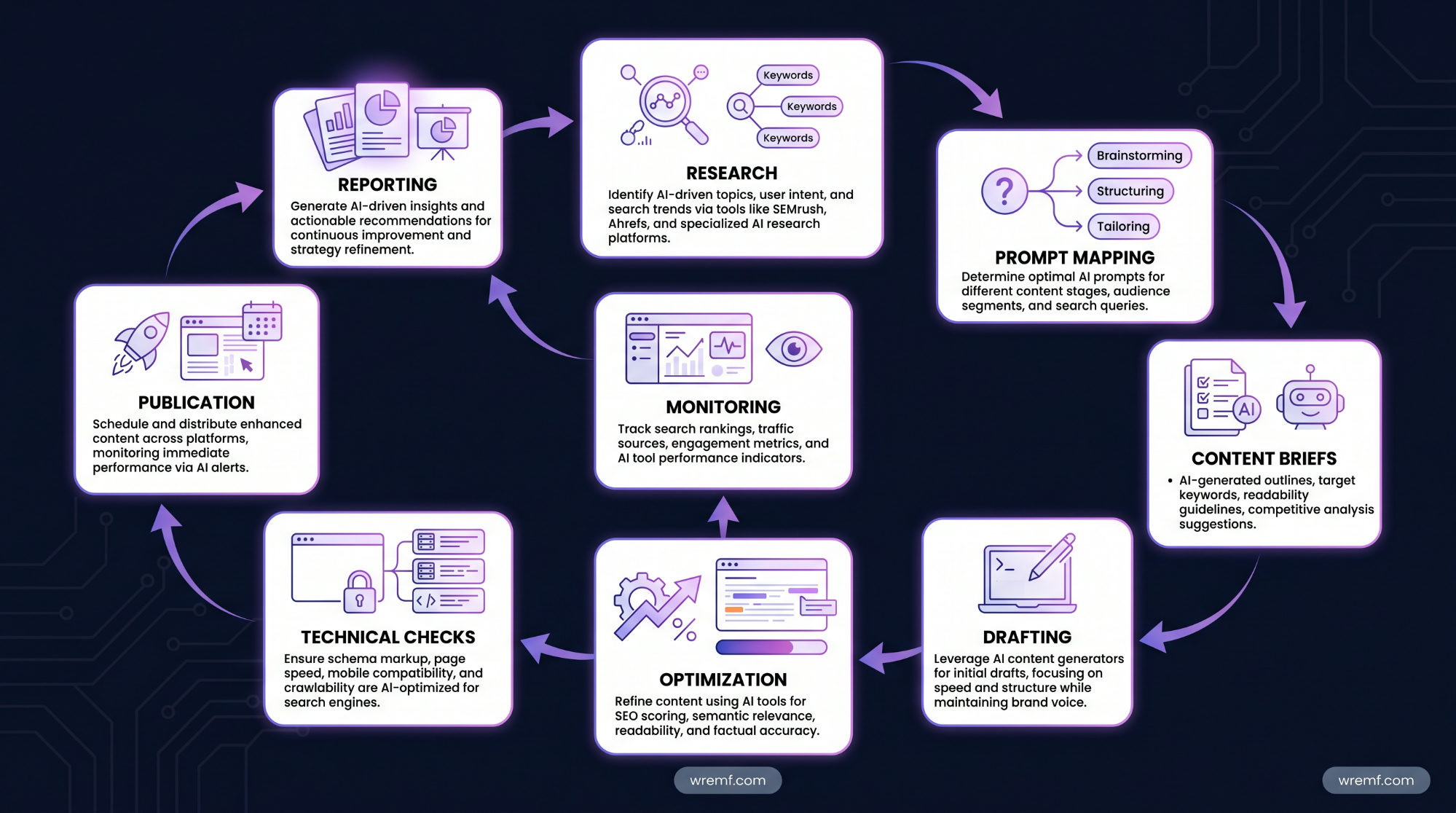
The best way to integrate AI search optimization tools is to connect research, prompt mapping, content briefs, drafting, optimization, technical checks, publication, monitoring, and reporting into one repeatable workflow. Tools should support the workflow, not replace it.
A content workflow is the repeatable process used to plan, create, review, publish, optimize, and measure content. A content workflow matters because AI tools create speed only when roles, inputs, and review steps are clear.
Step 1: Start with search intent and prompt intent.
Search intent is the reason behind a user’s query, such as learning, comparing, buying, troubleshooting, or implementing. Prompt intent is the reason behind a user’s AI question. Both matter because a person may type “best AI SEO tools” into Google and ask ChatGPT “which AI SEO tools should a small agency use?”
Step 2: Build a prompt set before writing.
A prompt set should include definition prompts, comparison prompts, buying prompts, implementation prompts, risk prompts, and competitor prompts. For this topic, examples include “what are the top AI search optimization tools for content creators,” “how do GEO tools differ from SEO tools,” and “which tools track citations in AI answers?”
Step 3: Create an AI-ready content brief.
AI-ready content briefs include the primary keyword, secondary keywords, user prompts, required entities, headings, definitions, internal links, external source requirements, FAQ questions, comparison tables, and evidence needs. The WREMF content briefs feature helps teams convert visibility gaps into structured content actions.
Step 4: Draft with AI support, then edit with expertise.
Use ChatGPT, Claude, Gemini, Jasper, or another AI writing tool to accelerate outlines, summaries, examples, and rewrites. Then add subject-matter expertise, real product knowledge, source-backed evidence, original analysis, and final editorial review.
Step 5: Optimize the page for search and AI answer extraction.
Use Surfer SEO, Clearscope, Frase, MarketMuse, or Rankability to improve topical depth and on-page relevance. Then manually improve answer-first structure, definitions, tables, internal links, citations, examples, and comparison sections.
Step 6: Check technical accessibility.
Use technical SEO tools to review indexability, metadata, internal links, schema, canonical tags, rendering, crawl status, and mobile performance. Confirm that the main content is visible in HTML and accessible to search systems.
Step 7: Monitor and improve after publishing.
Track Google Search Console data, rankings, AI answer presence, source citations, competitor visibility, AI share of voice, AI referral traffic, and content changes. The WREMF SEO testing feature helps teams connect content changes to measurable before-and-after performance.
TIP: Use a 30-day review cycle for new strategic pages and a 90-day refresh cycle for evergreen pages that target high-intent prompts.
KEY TAKEAWAY: AI search optimization works best as a repeatable workflow that connects prompts, briefs, drafting, optimization, technical checks, monitoring, and reporting.
The workflow should also include a clear decision framework for choosing tools without creating tool bloat.
How to Choose the Best AI Search Optimization Tool
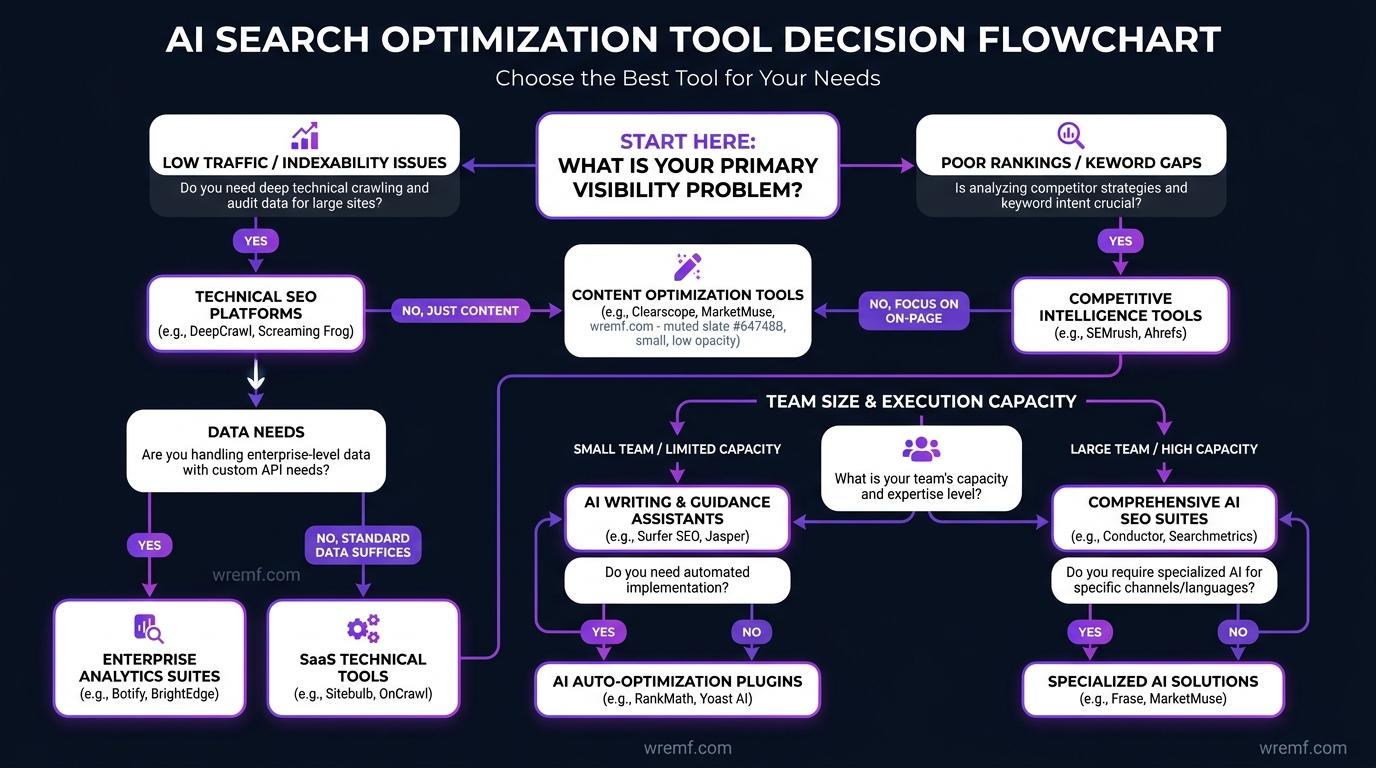
Choose the best AI search optimization tool by matching the tool to your main visibility problem, data needs, team size, and execution capacity. The right tool should answer a specific question and lead to a clear action.
AI Search Visibility Optimization is the process of improving how content, brands, and sources appear across AI search experiences and answer engines. AI Search Visibility Optimization matters because users now discover answers through prompts, citations, recommendations, and summaries.
Use this decision framework:
| Decision Need | Choose This Tool Type | Strong Fit | Recommended When |
|---|---|---|---|
| You need keyword demand and competitor SEO data | Traditional SEO tool | Semrush, Ahrefs, SE Ranking | You are planning topics and keyword clusters |
| You need SERP gaps and content briefs | Briefing and optimization tool | Frase, Surfer SEO, Rankability | You are writing or updating pages |
| You need semantic authority planning | Content strategy platform | MarketMuse, Clearscope | You manage many related pages |
| You need faster drafting | AI writing assistant | ChatGPT, Claude, Gemini, Jasper | You need outlines, drafts, rewrites, and summaries |
| You need video, audio, or transcription support | Content production tool | Descript, InVideo, Synthesia, Murf | You create multimedia content |
| You need AI answer visibility | GEO tracking platform | WREMF, Profound, OtterlyAI, AthenaHQ | You need mentions, citations, prompts, and competitors |
| You need technical readiness | Technical SEO tool | Screaming Frog, Sitebulb, Indexly | You need crawlability, indexability, and access checks |
| You need client-ready reporting | AI visibility reporting platform | WREMF | You need white-label reports and recurring monitoring |
| You need managed execution | Agency or hybrid solution | WREMF agency | You want strategy and implementation support |
| You need integrations | API and MCP workflow | WREMF API | You want data in internal tools or portals |
The best overall choice for content creators who care about AI search visibility is usually a combined stack. Use one SEO data tool, one content optimization tool, one AI assistant, one technical check, and one AI visibility platform.
For teams that need AI visibility measurement specifically, WREMF is a strong fit because it tracks 10 AI engines, supports BYOK, provides white-label reporting, and combines software with optional agency execution. The WREMF API and MCP integrations are useful when agencies or technical teams want AI visibility data connected to reporting systems, client portals, or internal workflows.
Content Recommendations are suggested actions for creating, updating, pruning, linking, or restructuring content. Content Recommendations matter because measurement only creates value when it leads to better content decisions.
IMPORTANT: Do not choose an AI SEO tool only because it has an AI writer. Writing speed is useful, but AI visibility depends on source quality, prompt coverage, citation patterns, technical accessibility, and competitor context.
KEY TAKEAWAY: The best AI search optimization tool is the one that connects data to action and fits the workflow your team can actually maintain.
Choosing the wrong tool often happens because of common myths about AI visibility and SEO.
Common Myths About AI Visibility Debunked
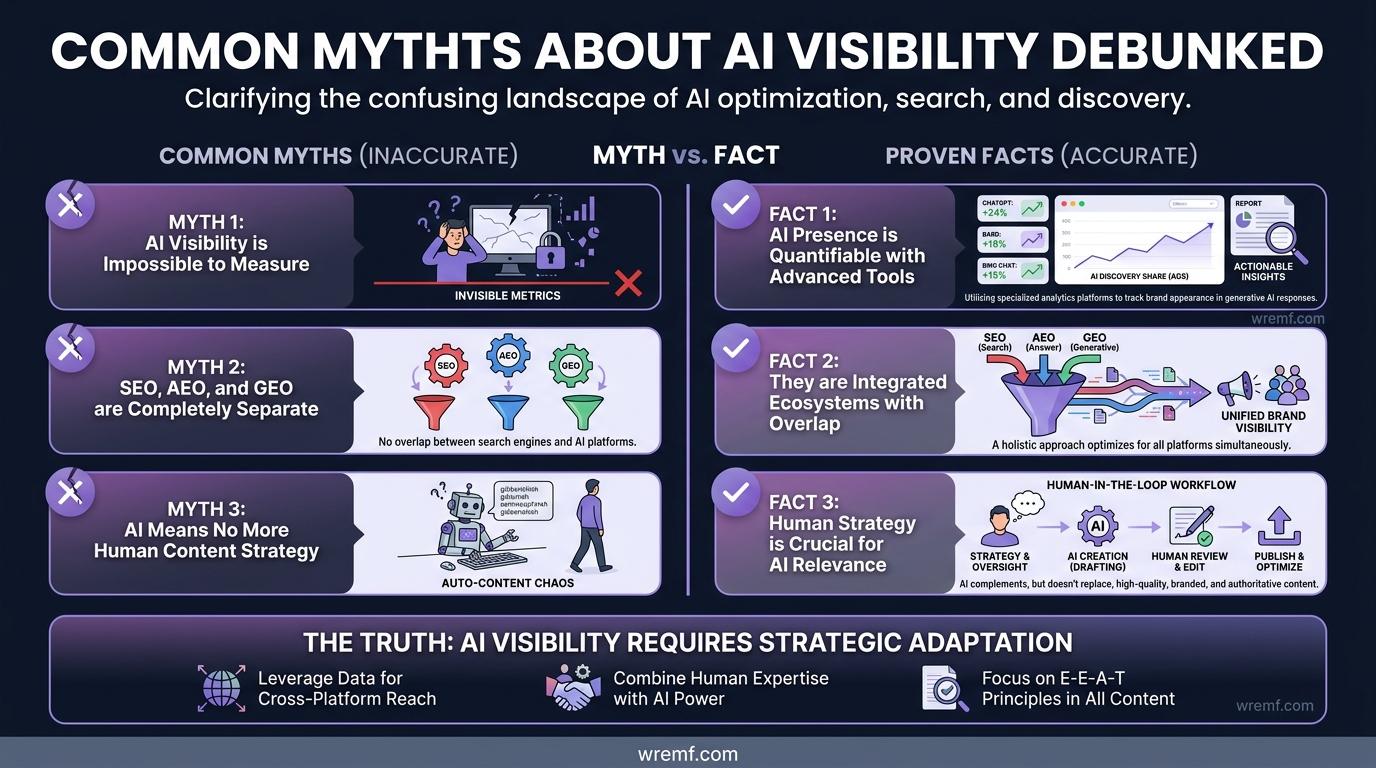
AI visibility is often misunderstood because teams try to measure AI discovery with traditional SEO assumptions. The most common myths involve rankings, measurement, AI writing, SEO versus GEO, and whether citations can be controlled.
MYTH: AI visibility is impossible to measure.
FACT: AI visibility can be measured through prompt tracking, brand mentions, source citations, competitor presence, recommendation visibility, AI share of voice, source consistency, and AI referral traffic. The measurement is not perfect because AI answers vary, but recurring prompt sets and consistent monitoring produce useful directional data.
MYTH: SEO, AEO, and GEO are completely separate strategies.
FACT: SEO, AEO, and GEO overlap. SEO supports crawlability and search demand, AEO supports extractable answers, and GEO supports visibility in AI-generated responses. Content creators need all three because AI systems often rely on searchable, structured, trusted sources.
MYTH: Rankings are enough to prove search visibility.
FACT: Rankings show where a page appears in search results, but rankings do not show whether ChatGPT, Perplexity, Gemini, Claude, Copilot, Google AI Overviews, or Google AI Mode mention, cite, or recommend your content. Rankings are one signal inside a wider discovery system.
MYTH: AI writing tools automatically improve SEO.
FACT: AI writing tools can speed up drafts, outlines, summaries, and content variations, but they do not automatically create helpful, reliable, people-first content. Google Search Central’s guidance focuses on usefulness and quality, not simply whether AI was used.
MYTH: Once an AI engine cites a page, the visibility problem is solved.
FACT: AI citations can change by engine, prompt, location, date, source availability, and competitor activity. A single citation is useful evidence, but durable visibility requires recurring monitoring, content updates, technical access, and source consistency.
KEY TAKEAWAY: AI visibility is measurable, but it requires new metrics and workflows that go beyond rankings, keyword density, and one-time content production.
With the myths addressed, the last step is understanding how WREMF fits into the practical workflow.
How WREMF Helps Content Creators Track, Improve, and Prove AI Visibility
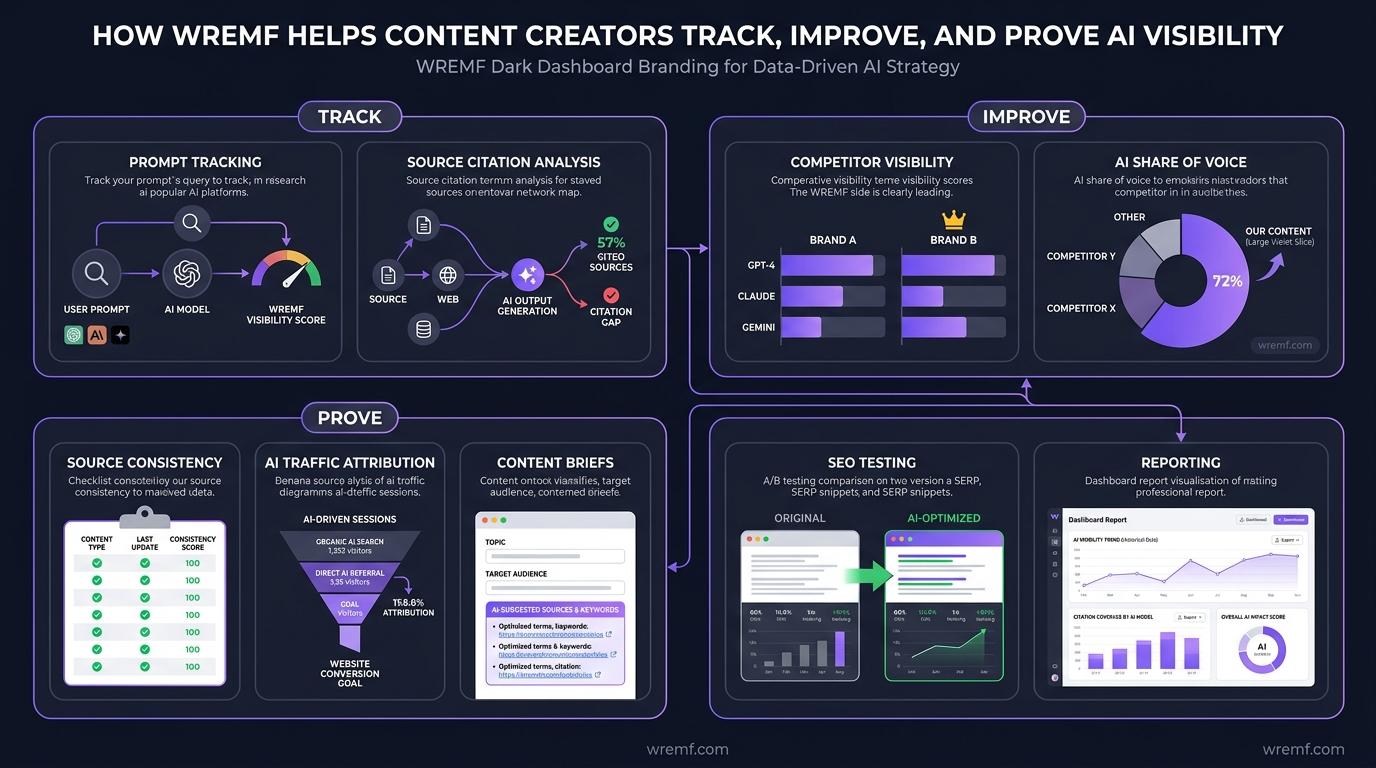
WREMF helps content creators track, improve, and prove AI visibility by combining prompt tracking, source citation analysis, competitor visibility, AI share of voice, source consistency, AI traffic attribution, content briefs, SEO testing, and reporting. It is built for brands, agencies, and teams that need AI visibility to become measurable.
WREMF is an AI visibility platform and optional agency partner for teams that want to understand how AI engines describe, cite, compare, and recommend their brand or content. WREMF matters because manual AI spot-checking is inconsistent, difficult to report, and hard to turn into repeatable action.
WREMF supports:
AI visibility tracking across 10 AI engines
Prompt intelligence for buyer and research questions
Source citation tracking
Competitor visibility analysis
AI share of voice measurement
AI traffic attribution workflows
GEO audits
AEO strategy
AI-ready content briefs
SEO testing
Scheduled AI monitoring
White-label client reporting
API and MCP integrations
BYOK support
Client portals
Source consistency analysis
The WREMF methodology connects prompts, citations, competitors, source consistency, and attribution into one repeatable system. This matters because AI visibility is not just a content problem. AI visibility is also a measurement problem, a source ecosystem problem, and a reporting problem.
For teams that need software, WREMF provides the platform. For teams that need execution, the WREMF agency service supports AI visibility strategy, GEO and AEO consulting, content optimization, entity and authority building, citation improvement, technical AI visibility foundations, and monthly reporting. For teams that need both, WREMF can be used as a hybrid software plus managed execution solution.
For agencies, WREMF for agencies supports white-label reporting and multi-client workflows. For in-house teams, WREMF for brands supports internal visibility tracking, source analysis, and stakeholder reporting.
KEY TAKEAWAY: WREMF helps content creators turn AI visibility from manual guessing into a measurable workflow across prompts, citations, competitors, source consistency, and reports.
The final questions below address the common searches content creators use before choosing their tools.
Frequently Asked Questions
What are the top AI search optimization tools for content creators?
The top AI search optimization tools for content creators include WREMF for AI visibility tracking, Semrush for keyword research, Surfer SEO for SERP-based optimization, Clearscope for editorial relevance, Frase for briefs and SERP gaps, MarketMuse for topic strategy, ChatGPT, Claude, and Gemini for AI writing support, Screaming Frog or Sitebulb for technical SEO, and Grammarly or Originality.ai for content quality checks. The best stack depends on the goal. Use traditional SEO tools for search rankings, content optimization tools for on-page improvement, and WREMF when you need prompt tracking, citations, competitor visibility, and AI share of voice.
What are AI SEO tools?
AI SEO tools are platforms that use artificial intelligence, machine learning, language models, or automation to support keyword research, content briefs, writing, optimization, technical audits, competitive analysis, and performance reporting. AI SEO tools can speed up content strategy and production, but they do not replace search expertise. A useful AI SEO workflow still needs human review, factual validation, search intent analysis, and performance measurement. For AI search visibility, creators should add GEO tools that track AI answers, brand mentions, citations, prompts, and competitor recommendations.
Why do AI search optimization tools matter in 2026?
AI search optimization tools matter in 2026 because users now discover content through traditional search engines, Google AI Overviews, Google AI Mode, ChatGPT search, Perplexity, Gemini, Claude, Copilot, and other AI assistants. A creator can no longer measure visibility only with keyword rankings. AI tools help creators understand search demand, create stronger content, make pages answer-ready, monitor AI citations, and identify competitors that appear in AI-generated answers. This broader visibility view is especially important for B2B SaaS, agencies, consultants, and creators who rely on high-intent discovery.
Can AI replace SEO experts?
AI can assist SEO experts, but it cannot fully replace them. SEO experts still make decisions about search intent, site structure, content quality, technical priorities, internal linking, business value, competitive positioning, and measurement. AI tools can generate outlines, cluster keywords, analyze drafts, summarize SERPs, and speed up reporting. Human experts must still validate facts, interpret data, judge quality, and connect content decisions to business outcomes. The strongest workflow combines AI speed with human strategy, subject-matter expertise, and editorial accountability.
What is the best AI SEO tool overall?
There is no single best AI SEO tool for every content creator because tools solve different problems. Semrush is strong for keyword research and competitor SEO. Surfer SEO, Clearscope, Frase, MarketMuse, and Rankability are strong for content optimization and briefs. ChatGPT, Claude, and Gemini are strong for writing support. WREMF is a strong fit when the goal is AI visibility tracking, prompt intelligence, source citations, competitor visibility, AI share of voice, white-label reporting, and managed GEO or AEO support. The best overall stack usually combines one tool from each major workflow category.
How do GEO tools differ from traditional SEO tools?
GEO tools track how brands and content appear in generative AI answers, while traditional SEO tools track search engine performance. A traditional SEO tool may show rankings, backlinks, keyword volume, traffic estimates, and site audit issues. A GEO tool may show whether ChatGPT, Perplexity, Gemini, Claude, Copilot, Google AI Overviews, or Google AI Mode mention your brand, cite your sources, recommend competitors, or describe your offer accurately. WREMF is designed for this GEO layer because it combines prompts, citations, competitors, source consistency, and reporting.
What features should I prioritize when choosing a GEO tool?
Prioritize AI engine coverage, prompt tracking, source citation tracking, competitor visibility, AI share of voice, source consistency, scheduled monitoring, reporting, and action recommendations. Agencies should also prioritize white-label reporting and client portals. B2B brands should prioritize competitor analysis, attribution workflows, and content recommendations. Technical teams should look for API, MCP, and BYOK support. A GEO tool should not only show that your brand is missing from AI answers. It should also help explain which prompts, sources, competitors, and content gaps are causing the issue.
Which AI platforms do GEO tools typically support for visibility tracking?
GEO tools typically support a mix of major AI discovery surfaces such as ChatGPT, Claude, Gemini, Perplexity, Google AI Overviews, Copilot, DeepSeek, Grok, Meta AI, Mistral, and sometimes Google AI Mode or other AI search interfaces. Coverage varies by tool, so teams should check which engines matter most for their audience. WREMF is built to track 10 AI engines, which makes it useful for teams that want a wider view of AI search visibility instead of checking only one or two platforms manually.
How can businesses of different sizes benefit from GEO tools?
Freelancers can use GEO tools to prove AI visibility value to clients. Agencies can use GEO tools for white-label reporting, prompt monitoring, and competitor insights across multiple accounts. B2B SaaS teams can use GEO tools to understand which vendors AI engines recommend during buying journeys. Enterprise teams can use GEO tools to monitor multiple brands, markets, products, and source consistency issues. WREMF supports these use cases through software, agency execution, and hybrid support depending on the team’s capacity and reporting needs.
What are the best AI tools for content creation?
The best AI tools for content creation depend on the content format. ChatGPT, Claude, and Gemini are useful for ideation, outlines, summaries, rewrites, and long-form drafting. Descript is useful for transcription, podcasts, and video editing. InVideo and Synthesia are useful for video creation. Murf is useful for AI voiceovers. Grammarly and Originality.ai support editing and quality checks. These tools improve production speed, but creators still need SEO research, content optimization, AI visibility tracking, and human review to make content discoverable and trustworthy.
How can content creators optimize for Google AI Overviews?
Content creators can optimize for Google AI Overviews by creating helpful, reliable, well-structured content that answers clear user questions and is accessible to Google Search systems. Use concise definitions, answer-first sections, descriptive headings, useful tables, accurate schema where appropriate, strong internal links, and named sources close to factual claims. Google AI Overviews can include links for users to dig deeper, so creators should make pages easy to crawl, understand, and cite. Track performance through search data and AI visibility monitoring rather than assuming one page update is enough.
What is llms.txt, and should content creators use it?
llms.txt is a proposed markdown-based file that gives LLMs guidance about important website content. Content creators can use it to point AI systems toward useful pages, documentation, product information, or high-quality resources. However, llms.txt is still a proposal and should not replace standard technical SEO. Creators should first fix crawlability, indexability, internal links, schema, sitemaps, robots.txt, page quality, and content structure. Treat llms.txt as a supporting experiment, not as a guaranteed AI visibility solution.
How often should AI visibility be monitored?
AI visibility should be monitored regularly because AI answers can change by engine, prompt, location, date, source availability, and competitor activity. Monthly monitoring is a practical baseline for most content teams. Weekly or biweekly monitoring is useful for high-value buyer prompts, competitive categories, product launches, and agency reporting. A one-time manual check is not enough because AI answer visibility is dynamic. WREMF supports scheduled AI monitoring so teams can track changes over time and report patterns instead of screenshots.
Should agencies use AI search optimization tools differently from solo creators?
Agencies should use AI search optimization tools with a stronger focus on repeatability, client reporting, competitor tracking, white-label dashboards, and action recommendations. Solo creators often need affordable research, writing, and optimization support. Agencies need systems that can compare multiple clients, monitor prompt visibility over time, identify citation gaps, and explain what changed. WREMF is useful for agencies because it supports white-label reports, multi-client visibility workflows, prompt intelligence, source citations, competitor visibility, and optional managed execution for AEO and GEO services.
Can AI search optimization tools help identify trending topics?
AI search optimization tools can help identify trending topics when they combine keyword research, question discovery, competitor monitoring, SERP analysis, and AI prompt tracking. Traditional SEO tools can show search demand and ranking changes. AI assistants can help cluster questions and generate content angles. GEO tools can reveal which prompts are becoming important in AI answers and which competitors are being recommended. Content creators should validate trends with reliable data before publishing, because AI-generated topic ideas can be plausible without showing real demand.
What common challenges do content creators face when using AI SEO tools?
Common challenges include tool overlap, unreliable AI-generated claims, keyword stuffing, generic drafts, weak technical SEO, poor source attribution, unclear ownership, and reporting that focuses only on rankings. Many creators also struggle to connect AI content production with measurable outcomes. The best solution is to define the role of each tool before buying it. Use one tool for keyword research, one for optimization, one for writing support, one for technical checks, one for AI visibility, and one reporting workflow that connects content changes to results.
Conclusion
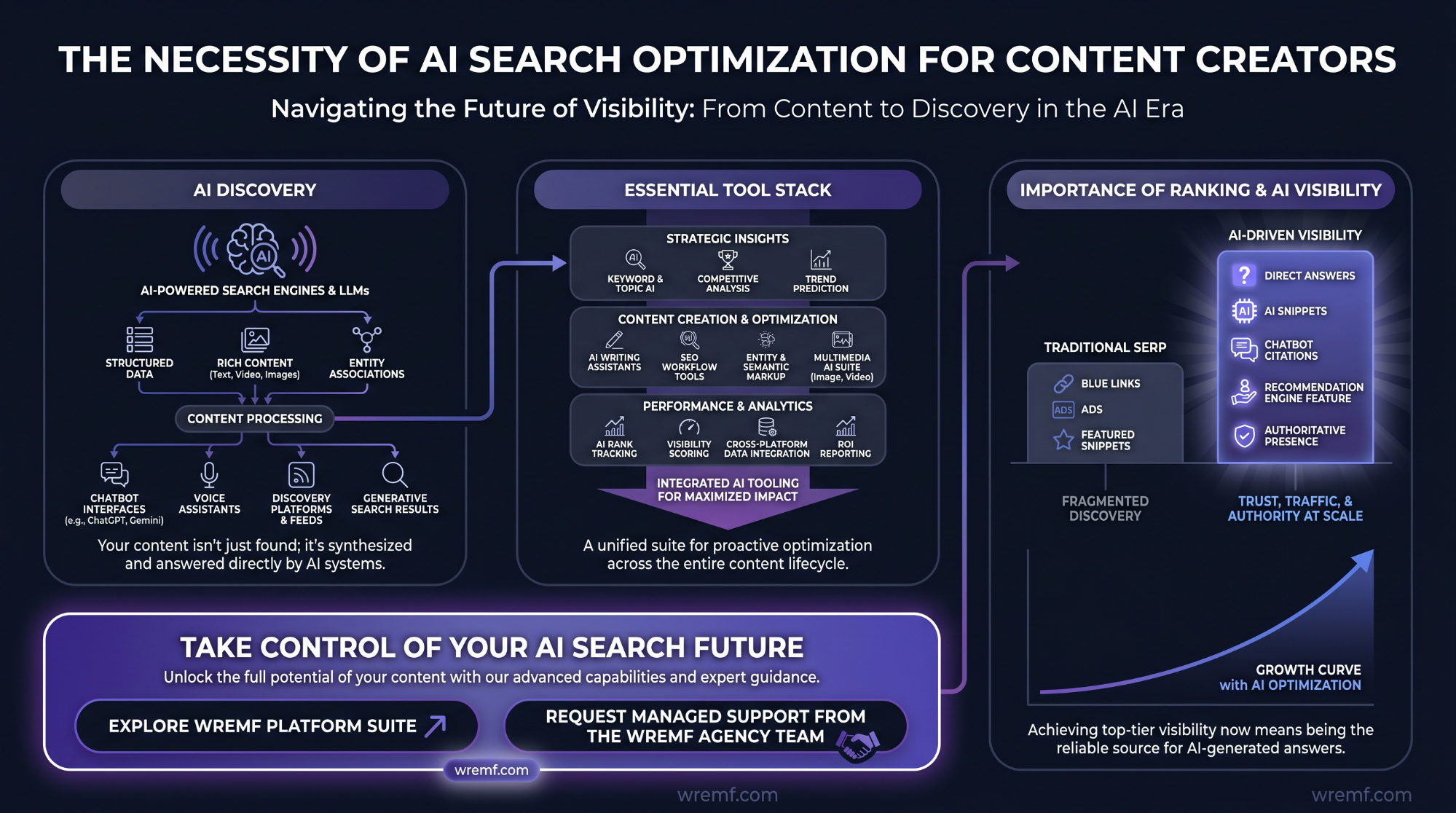
AI search optimization tools for content creators are now necessary because discovery spans search engines, AI Overviews, Google AI Mode, ChatGPT, Perplexity, Gemini, Claude, Copilot, and other AI answer engines. The right stack combines keyword research, content optimization, AI writing support, technical SEO, content integrity, GEO tracking, citation analysis, and reporting. Rankings still matter, but AI visibility also depends on prompts, citations, competitors, source consistency, and attribution. To turn AI visibility into a measurable workflow, explore the WREMF platform suite or request managed support from the WREMF agency team.
Related reading
- AI Search Engine Optimization Tools: The Complete 2026 Guide for AI Search, SEO, AEO, and GEO
- The Complete Guide to Keyword Monitoring for SEO, Brand Visibility, and AI Search
- AI SEO Tools: The Complete Guide for SEO, AEO, GEO, and AI Search Visibility
- AI Overviews Tracker: The Complete Guide to Monitoring Google AI Overviews, Citations, and AI Search Visibility