Why Use AI Search Optimization Tools for Your Business
Learn how AI search optimization tools can boost your business visibility in AI-generated results, enhancing brand trust and lead generation.
By WREMF Team · 2026-09-16
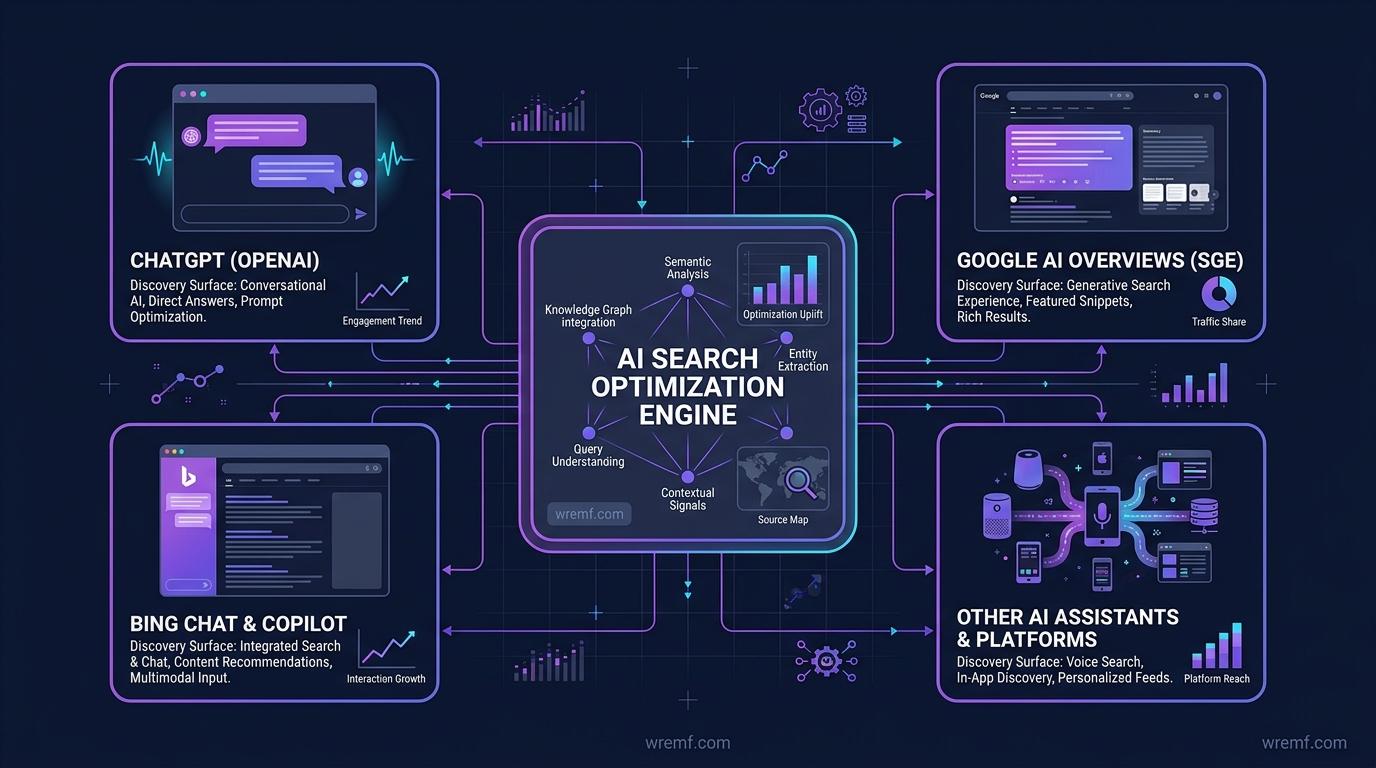
AI search optimization improves brand visibility in AI-generated answers, citations, and search results. It differs from traditional SEO by focusing on AI platforms, large language models, and answer engines. Key components include prompt tracking, citation analysis, competitor visibility, and AI share of voice. The outcome is enhanced brand presence without relying on web clicks. Businesses must adapt to this shift to influence discovery and lead generation effectively.
Key takeaways
- AI search optimization enhances brand visibility in AI-generated answers.
- It moves beyond SEO to include prompt tracking and citation analysis.
- Zero-click searches make AI visibility crucial for measuring influence.
- Content strategy must integrate semantic relevance and factual accuracy.
- Technical SEO supports AI search by ensuring accessible web content.
Why Use AI Search Optimization Tools for Your Business
AI search optimization tools help businesses improve how their brand appears in AI-generated answers, citations, summaries, recommendations, and search results. According to Google Search Central, AI features in Search still rely on crawlable, indexable, helpful content and links to supporting websites. WREMF helps B2B teams track, improve, and prove AI visibility across ChatGPT, Claude, Gemini, Perplexity, Google AI Overviews, Copilot, DeepSeek, Grok, Meta AI, Mistral, and other AI discovery surfaces. This page explains why AI search optimization matters, how it differs from SEO, what AI tools actually do, which KPIs to measure, how to select the right stack, and how to build a practical roadmap for business growth.
The New Search Reality: From Blue Links to AI Answers
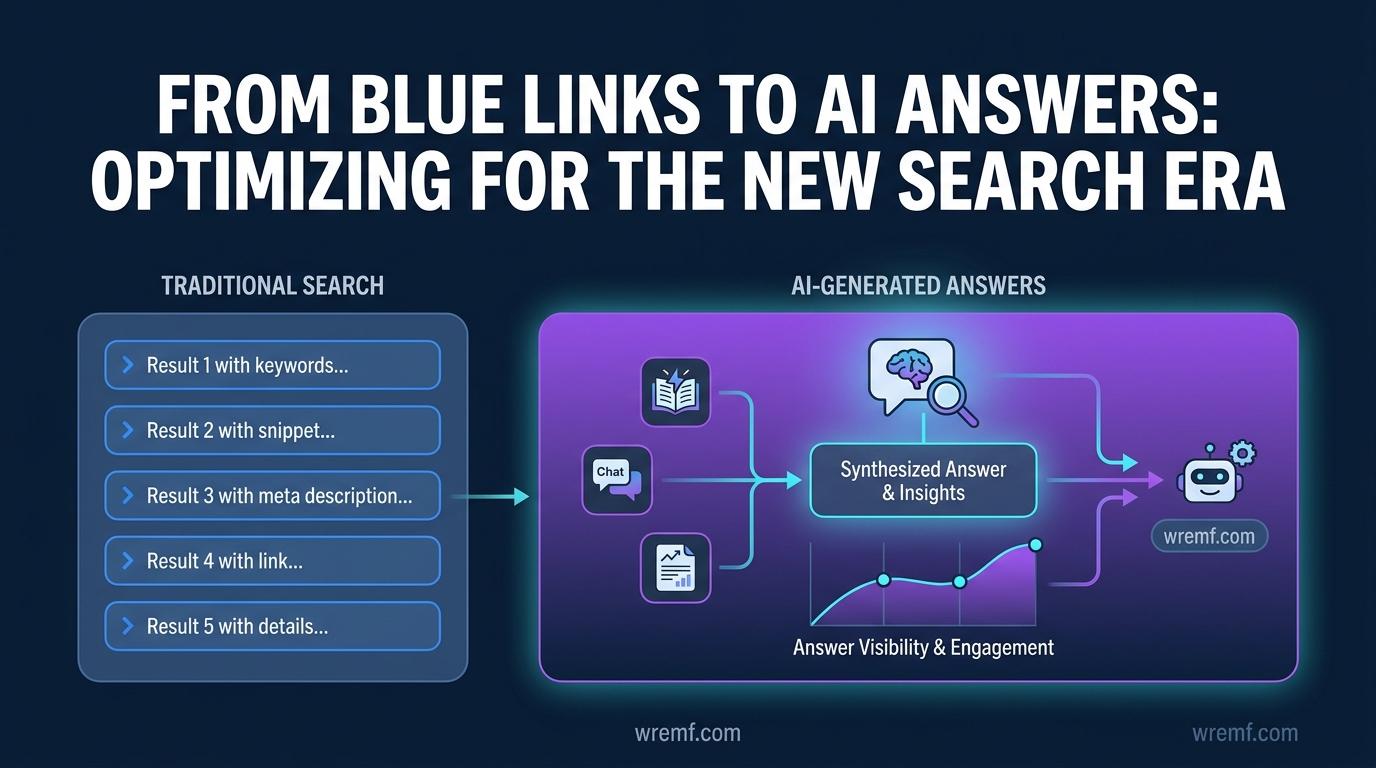
Search is shifting from ranked blue links to AI-generated answers across search engines, answer engines, and AI search platforms. Businesses need AI search optimization because buyers now discover, compare, and evaluate companies through AI answers before they click a website.
AI search is the process of using AI systems to answer search queries with generated summaries, recommendations, citations, and links. AI search matters because a prospect may form an opinion about your business before visiting your site, reading your sales page, or speaking to your team.
The old search model was simple. A user typed a query into a search engine, scanned the search engine results page, clicked a page, and evaluated the result. That model still exists, but it now sits beside ChatGPT browsing results, Google AI Overviews, Perplexity answers, Bing Copilot, Gemini summaries, voice assistants, and other AI search platforms.
Google says AI Overviews are now available in more than 200 countries and territories and more than 40 languages. This matters because AI-generated search experiences are no longer experimental for a small audience. AI search platforms are becoming part of normal search behavior for consumers, professionals, and B2B buyers.
In real B2B buying journeys, a prospect may ask ChatGPT for “best AI visibility tools for agencies,” ask Perplexity to compare vendors, search Google for a methodology page, and use LinkedIn or social media to validate credibility. That journey does not always produce a simple organic search click, but it still influences demand, lead generation, and brand trust.
AI discovery surfaces are the platforms, search engines, answer engines, and assistants where buyers can encounter your brand through generated responses. AI discovery surfaces matter because your digital presence now depends on whether AI systems can retrieve, understand, cite, and recommend your business.
WREMF helps teams monitor this new search reality through the WREMF platform suite, which combines prompt tracking, source citation analysis, competitor visibility, AI share of voice, scheduled monitoring, and AI traffic attribution.
DID YOU KNOW: Google explains that AI features in Search can use a query fan-out technique, where AI systems issue multiple related searches across subtopics and data sources to build a more complete response.
KEY TAKEAWAY: AI search optimization tools help businesses stay visible when buyers rely on AI-generated answers, not only traditional search engine results.
To understand why these tools matter, you first need to define AI search optimization clearly.
What Is AI Search Optimization?
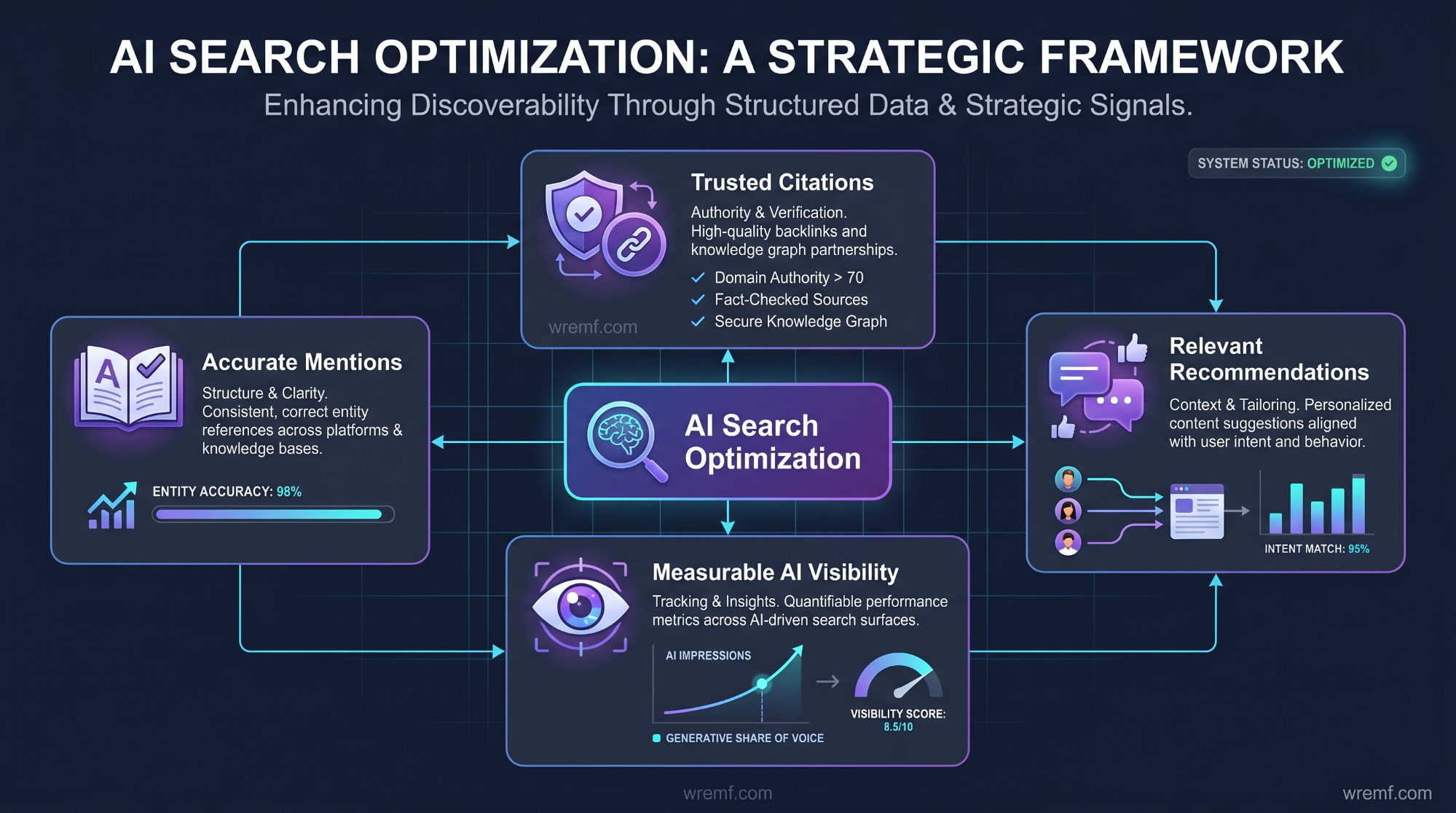
AI search optimization is the practice of improving how a business appears across AI search platforms, answer engines, large language models, and search engines. It helps teams increase accurate mentions, trusted citations, relevant recommendations, and measurable AI visibility.
AI search optimization is not only AI SEO. It is a broader workflow that connects Search Engine Optimization, Answer Engine Optimization, Generative Engine Optimization, content strategy, Technical SEO, structured content, entity relevance, source consistency, and analytics.
AI search optimization is the process of making business information easier for AI systems to discover, interpret, retrieve, cite, and summarize. AI search optimization matters because AI systems can influence vendor discovery even when a buyer never clicks a traditional search result.
AI Visibility is the measurable presence of a brand inside AI answers, citations, summaries, comparisons, and recommendations. AI Visibility matters because it shows whether AI systems understand your business and present it accurately for buyer search queries.
Answer Engine Optimization is the practice of structuring content so answer engines can extract direct, reliable responses. Answer Engine Optimization matters because AI chatbots, voice assistants, AI Overviews, and rich featured results often reward content that answers user intent clearly.
Generative Engine Optimization is the practice of improving how generative AI systems retrieve, synthesize, and cite brand information. Generative Engine Optimization matters because AI systems often combine multiple sources instead of showing a simple list of ranked pages.
Large language models are AI systems designed to process and generate natural language. Large language models matter for businesses because they can summarize product information, compare vendors, explain market categories, and shape buyer perception.
The key difference between SEO and GEO is that SEO focuses on visibility in search engines, while GEO focuses on visibility inside generated AI answers. SEO asks, “Can search engines find and rank the page?” GEO asks, “Can AI systems understand, cite, and recommend the brand?”
| Discipline | Primary Goal | Main Search Surface | What It Measures | Business Use |
|---|---|---|---|---|
| SEO | Improve organic search performance | Search engines | Rankings, impressions, clicks, click-through rates, organic search traffic | Capture demand from traditional search |
| AEO | Win direct answers | Answer engines, snippets, voice assistants | Answer extractability, FAQ coverage, content structure | Answer specific search queries clearly |
| GEO | Improve generated answer visibility | AI search platforms and large language models | Mentions, citations, recommendations, source coverage | Influence AI-generated discovery |
| AI search optimization | Track and improve AI visibility across surfaces | Search engines, AI Overviews, ChatGPT, Perplexity, Gemini, Copilot | Prompt visibility, citations, competitors, source consistency, AI share of voice | Build measurable visibility in modern search |
SEO, AEO, and GEO should work together. SEO makes pages crawlable and authoritative. AEO makes answers clear and extractable. GEO makes brand information easier for AI search platforms to retrieve, synthesize, and cite.
KEY TAKEAWAY: AI search optimization connects SEO, AEO, GEO, prompt tracking, citations, competitors, source consistency, and attribution into one measurable visibility system.
Once the definition is clear, the business case becomes easier to evaluate.
Why Businesses Should Use AI Search Optimization Tools
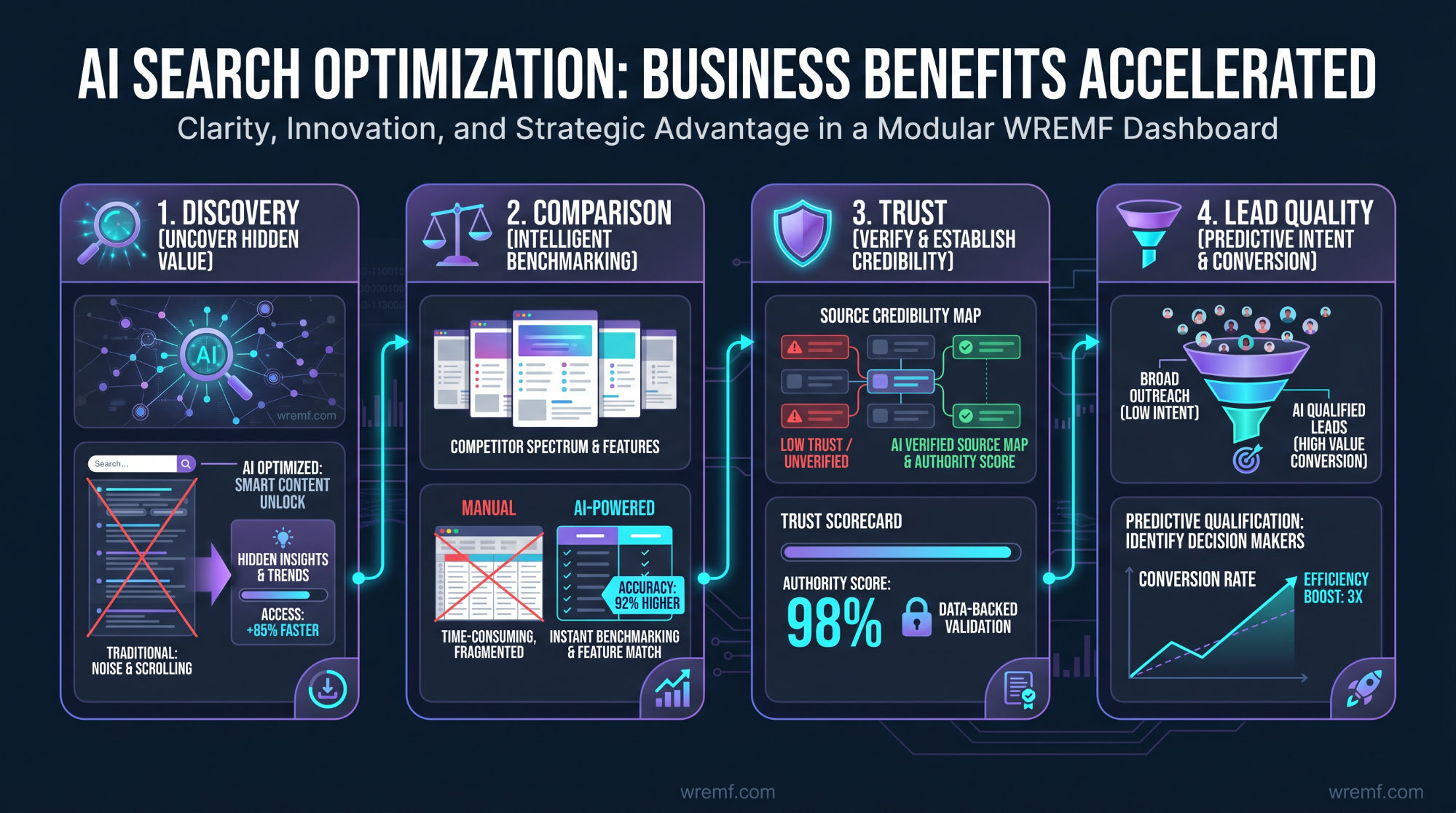
Businesses should use AI search optimization tools because AI systems now influence discovery, comparison, trust, and lead quality. These tools help teams understand where they are visible, where competitors appear, and which content or sources need improvement.
AI tools make search strategy more measurable. Instead of manually checking a few ChatGPT prompts or guessing how AI search platforms describe your company, you can track prompt groups, citation patterns, competitor mentions, source gaps, and changes over time.
Bain & Company reports that 60 percent of searches now terminate without users clicking through to another website. That does not mean websites are irrelevant. It means digital marketing teams need to measure visibility before the click, not only after the click.
The business benefits of AI search optimization tools include:
Faster keyword research and topic discovery
Better mapping of user intent across search queries
Stronger content strategy for AI search platforms
More scalable content creation and content optimization
Better detection of competitor visibility
Clearer monitoring of AI citations and source citations
More useful reporting for leadership and clients
Better protection of digital presence in zero-click searches
Stronger connection between AI visibility and lead generation quality
Keyword research is still important, but AI search optimization changes how keyword research is used. Teams need to move from isolated keywords to prompt clusters, content clusters, semantic relevance, entity-driven strategies, and answer-first content.
Content creation is also changing. AI tools can help teams identify content gaps, structure content, generate content briefs, and compare coverage across topics. Human expertise is still required to validate facts, add original insight, preserve brand voice, and avoid generic AI-generated content.
For small businesses, AI search optimization tools can reduce manual effort. A small team can track the 20 to 50 search queries that matter most, monitor whether AI systems mention the business, and prioritize the pages that need improvement first.
For larger B2B teams, AI search optimization tools support strategic visibility. Marketing teams can monitor AI search platforms, identify competitor gaps, connect content updates to AI Visibility, and report progress to leadership with evidence rather than screenshots.
KEY TAKEAWAY: AI search optimization tools help businesses turn AI search from a hidden influence channel into a measurable marketing workflow.
The next step is understanding how AI search optimization tools compare with traditional SEO tools.
How AI Search Optimization Tools Compare With Traditional SEO Tools
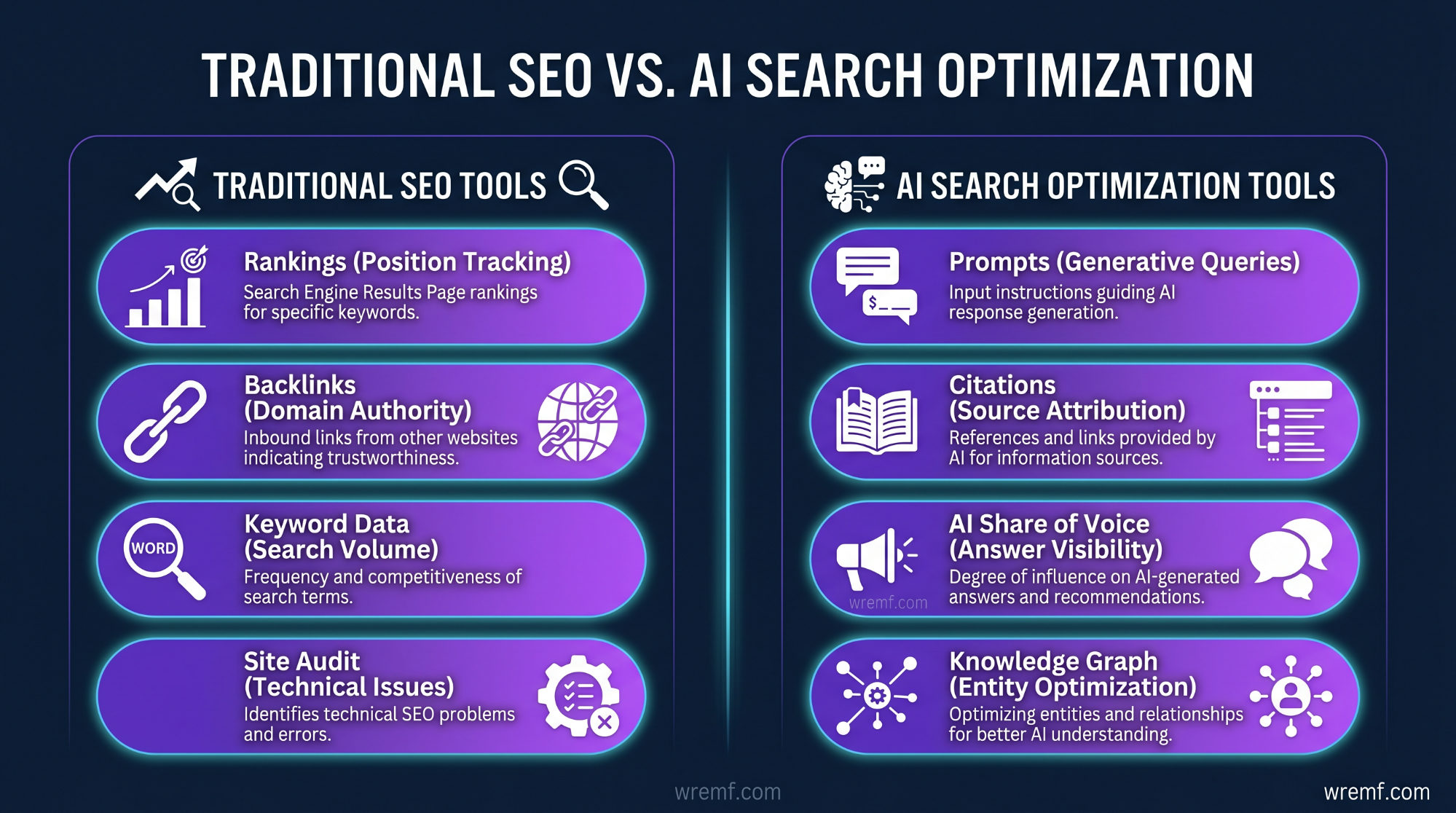
Traditional SEO tools measure rankings, backlinks, keyword data, Technical SEO, and organic search performance. AI search optimization tools measure prompts, citations, mentions, competitor visibility, AI share of voice, and how AI search platforms describe a brand.
Traditional SEO tools still matter. Search Console, Google Analytics, Ahrefs, Semrush, SE Ranking, Surfer SEO, MarketMuse, keyword research tools, and SERP feature monitoring platforms help teams improve organic search. They support keyword research, link building, content optimization, Technical SEO, and website traffic analysis.
AI search optimization tools solve a different problem. They show whether AI systems mention your brand, cite your website, use third-party sources, recommend competitors, or summarize your positioning accurately. This is especially important when buyers use ChatGPT, Perplexity, Gemini, Bing Copilot, Google AI Overview results, and other AI search platforms for vendor discovery.
AI tools for SEO are not all the same. Some AI tools support content creation. Some AI tools help with keyword research. Some AI tools analyze a search engine results page. AI search optimization tools specifically focus on visibility across AI search platforms and large language models.
| Tool Category | Best For | What It Measures | What It Misses | Recommended When |
|---|---|---|---|---|
| Traditional SEO tools | Search engines and organic search | Rankings, backlinks, keyword research, SERP feature monitoring, Technical SEO | AI citations, AI recommendations, prompt visibility | You need classic SEO performance improvement |
| Content optimization tools | Page-level content creation and content optimization | Terms, headings, semantic relevance, content structure | Multi-engine AI visibility and source citations | You need better briefs and content updates |
| Manual AI testing | Quick prompt checks | Individual answers from ChatGPT, Perplexity, Gemini, or Copilot | Scale, history, reporting, consistency | You need a quick early read |
| AI search optimization tools | AI search platforms and answer engines | Mentions, citations, prompt tracking, competitor visibility, AI share of voice | Full execution unless paired with strategy | You need repeatable AI visibility measurement |
| Hybrid software plus agency | Measurement plus execution | AI Visibility, citations, content gaps, technical issues, source consistency | Requires coordination and budget | You need strategy, execution, and reporting |
The best choice depends on the workflow. Use traditional SEO tools when your main problem is organic search rankings. Use content optimization tools when your main problem is page quality. Use AI search optimization tools when your main problem is visibility inside AI-generated answers.
WREMF is built for teams that need AI visibility measurement, not only generic AI SEO suggestions. The WREMF methodology connects prompts, citations, competitors, source consistency, visibility scoring, and attribution into a repeatable system.
KEY TAKEAWAY: Traditional SEO tools explain how pages perform in search engines, while AI search optimization tools explain how brands appear inside AI-generated answers.
The difference matters because modern search success depends on more than traffic.
Core Business Benefits of AI Search Optimization Tools
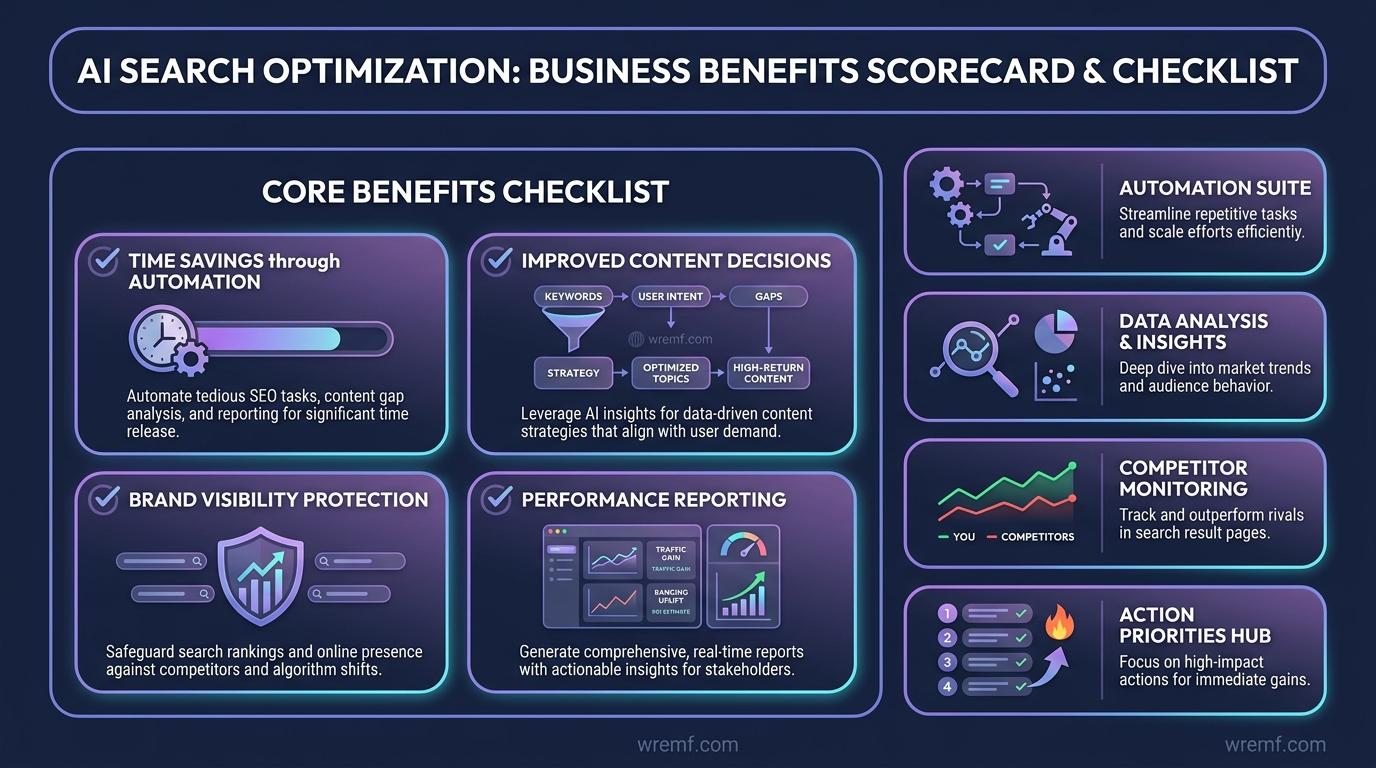
AI search optimization tools help businesses save time, improve content decisions, protect brand visibility, and report performance across modern search behavior. The biggest benefits come from automation, better data analysis, competitor monitoring, and clearer action priorities.
The first benefit is faster keyword research. AI tools can analyze keyword data, search queries, semantic relevance, user intent, search behavior, and content clusters faster than manual spreadsheet workflows. This helps teams find not only what users search, but how users phrase questions inside AI search platforms.
The second benefit is better content strategy. Content strategy is the plan for creating, organizing, updating, and measuring content around business goals. Content strategy matters because AI systems need clear, complete, and reliable content to answer questions accurately.
The third benefit is scalable content creation. AI tools can support content briefs, outlines, content structure, FAQ lists, answer-first summaries, and content optimization. The goal is not to publish low-quality AI content at scale. The goal is to combine artificial intelligence with human expertise so content creation becomes faster, more accurate, and more useful.
The fourth benefit is competitive visibility. AI search optimization tools can show whether competitors appear in AI Overviews, ChatGPT browsing results, Perplexity answers, Gemini summaries, Bing Copilot, or other AI search platforms. That matters because a competitor can win buyer trust inside an AI answer before a user reaches your website.
The fifth benefit is reporting. In real-world reporting, leadership often wants to know whether digital marketing work is creating visibility, pipeline influence, and lead generation quality. AI search optimization tools help teams report mentions, citations, recommendations, AI share of voice, and AI traffic attribution alongside Google Analytics and Search Console data.
DID YOU KNOW: McKinsey estimates that generative AI could contribute up to $4.4 trillion in annual global productivity, with marketing and sales among the functions expected to capture a large share of that value.
WREMF supports these business benefits through prompt intelligence, source citations, AI Visibility scoring, AI-ready content briefs, SEO testing, competitor visibility, scheduled AI monitoring, white-label client reporting, and client portals.
KEY TAKEAWAY: AI search optimization tools create value by improving research, content creation, competitor insight, measurement, and reporting across AI-driven search behavior.
These benefits matter most in the zero-click era.
Protecting Your Digital Presence in the Zero-Click Era
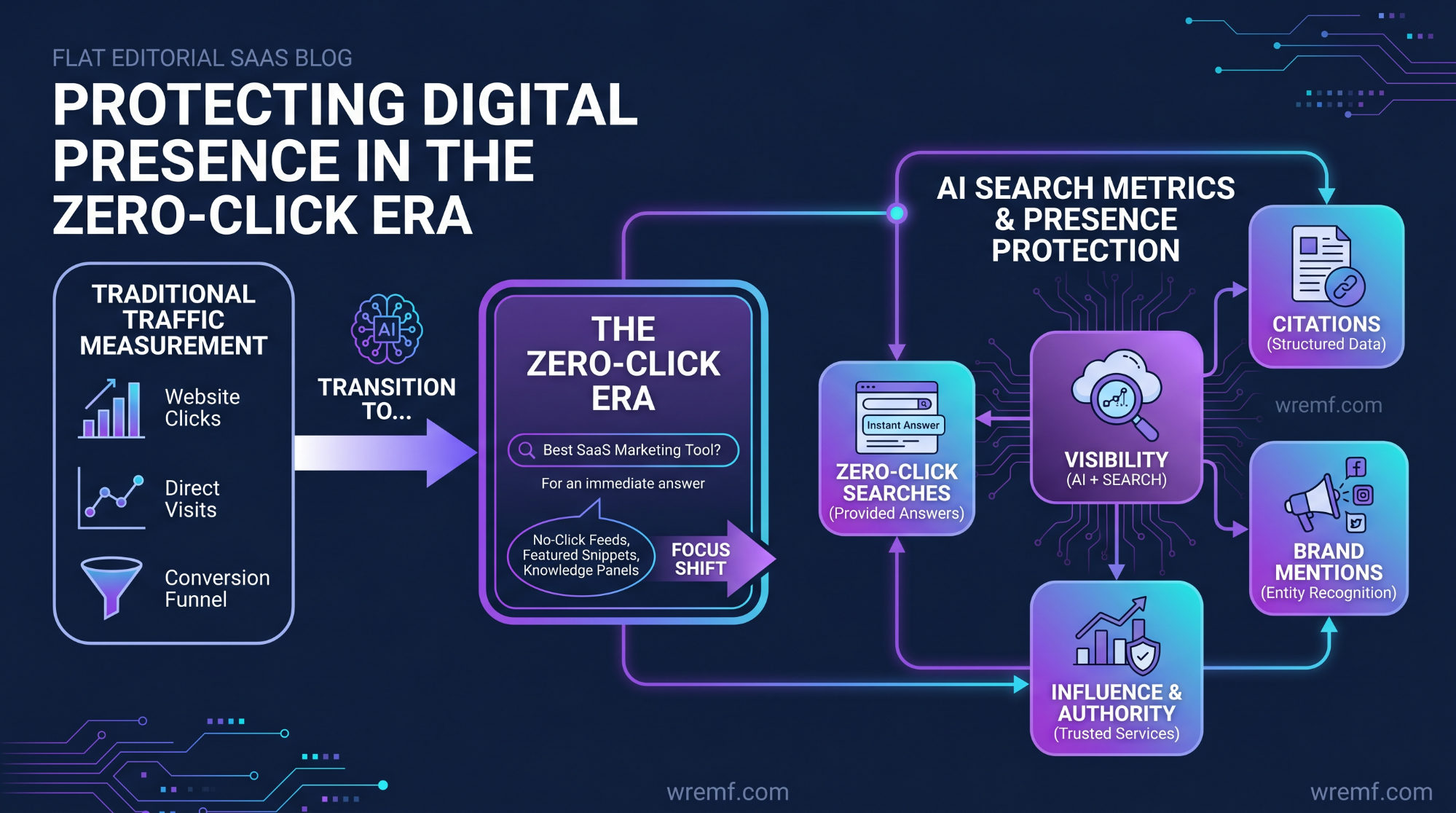
AI search optimization tools help protect digital presence when users get answers without clicking. In the zero-click era, businesses need to measure visibility, citations, and brand mentions, not only website traffic.
Zero-click searches are searches where users get enough information without clicking through to another website. Zero-click searches matter because a business can influence demand, trust, and brand recall even when analytics tools do not record a session.
Bain & Company reports that 60 percent of searches now end without users clicking through to another website. This does not make organic search irrelevant. It changes the measurement problem. Teams need to ask whether the brand appeared in the answer, whether the answer cited a source, whether the answer recommended a competitor, and whether the answer was accurate.
Click-through rates are still useful, but click-through rates no longer capture the full search journey. A user might see a Google AI Overview, read an answer from Perplexity, ask a follow-up question in ChatGPT, and visit a vendor later through direct traffic or branded search. That journey can influence lead generation without appearing as a simple search engine referral.
Google AI Overview visibility is one part of this shift. Google AI Overview results can include generated summaries and supporting links. Google AI features still rely on Search fundamentals, but AI Overviews change how users consume information from the search engine results page.
Brand mentions also become more important. Brand mentions are references to your business inside AI answers, citations, summaries, comparisons, or recommendations. Brand mentions matter because they show whether AI systems associate your business with relevant categories and search queries.
If you want to see what this looks like in practice, review a sample AI visibility report before building your own measurement workflow.
KEY TAKEAWAY: Zero-click searches make AI visibility, citations, and brand mentions essential metrics because traffic alone cannot show the full influence of search.
Once teams accept the zero-click reality, they need to understand the technical foundation that helps AI systems interpret a website.
Technical Advantages: Bridging the Gap Between Business Websites and LLMs
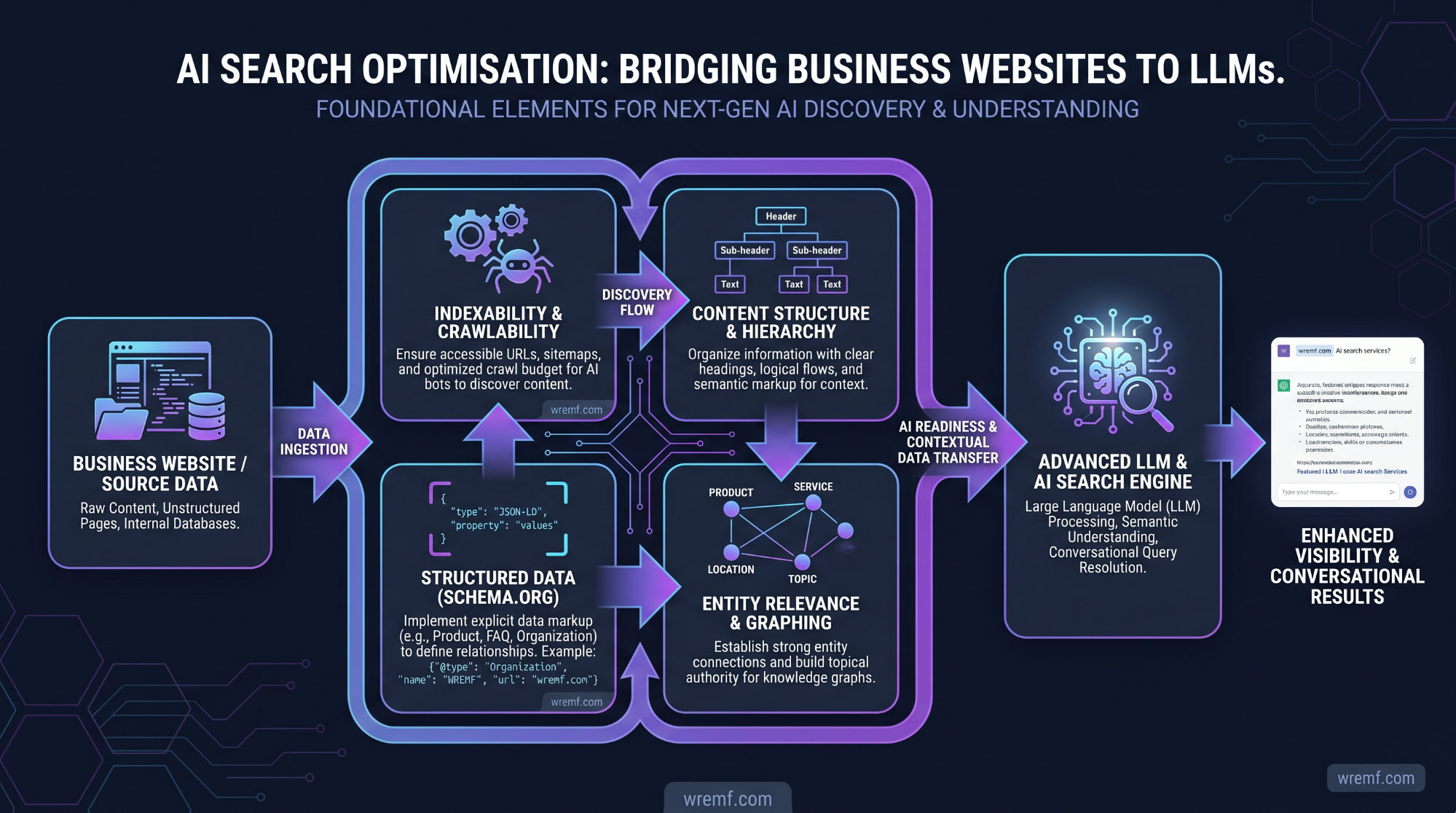
Technical AI search optimization helps AI systems crawl, parse, understand, and retrieve accurate business information. The foundation includes indexability, content structure, structured data, schema markup, internal links, entity relevance, and factual consistency.
Technical SEO is the process of making a website accessible, crawlable, indexable, fast, and understandable for search engines. Technical SEO matters for AI search because Google AI features, search engines, and many AI search platforms still depend on accessible web content.
Google Search Central explains that no special schema.org structured data is required to appear in AI Overviews or AI Mode, but structured data should match visible page content. This matters because schema markup can clarify information, but it cannot compensate for thin content, inaccessible pages, or weak source quality.
Structured Data is machine-readable information that helps search engines understand page content. Structured Data matters because it can clarify organizations, products, services, authors, FAQs, reviews, events, and relationships between entities.
Schema markup is a vocabulary used to label entities and content types in structured data. Schema markup matters because it helps search engines interpret visible content, but it should support the page rather than replace clear writing.
A knowledge graph is a structured map of entities and relationships. A knowledge graph matters because AI systems and search engines use entity relationships to understand people, companies, products, categories, places, and topics.
Entity relevance is the degree to which your brand is clearly connected to the topics, products, services, and categories you want to be known for. Entity relevance matters because AI systems need to understand what your business is, who it serves, and why it is relevant.
Technical gaps often block AI search visibility. Marketing teams frequently discover that key product information is hidden in JavaScript, service pages lack clear definitions, FAQ lists do not answer buyer questions, internal links do not connect content clusters, and third-party profiles describe the business inconsistently.
A GEO audit helps teams evaluate whether pages are crawlable, readable, structured, and aligned with the prompts that matter for AI search optimization.
KEY TAKEAWAY: Technical SEO, structured data, schema markup, entity relevance, and content architecture help AI systems understand and retrieve your business information accurately.
Technical foundations work best when paired with AI-ready content strategy.
Content Strategy Updates That Work Best for AI Search
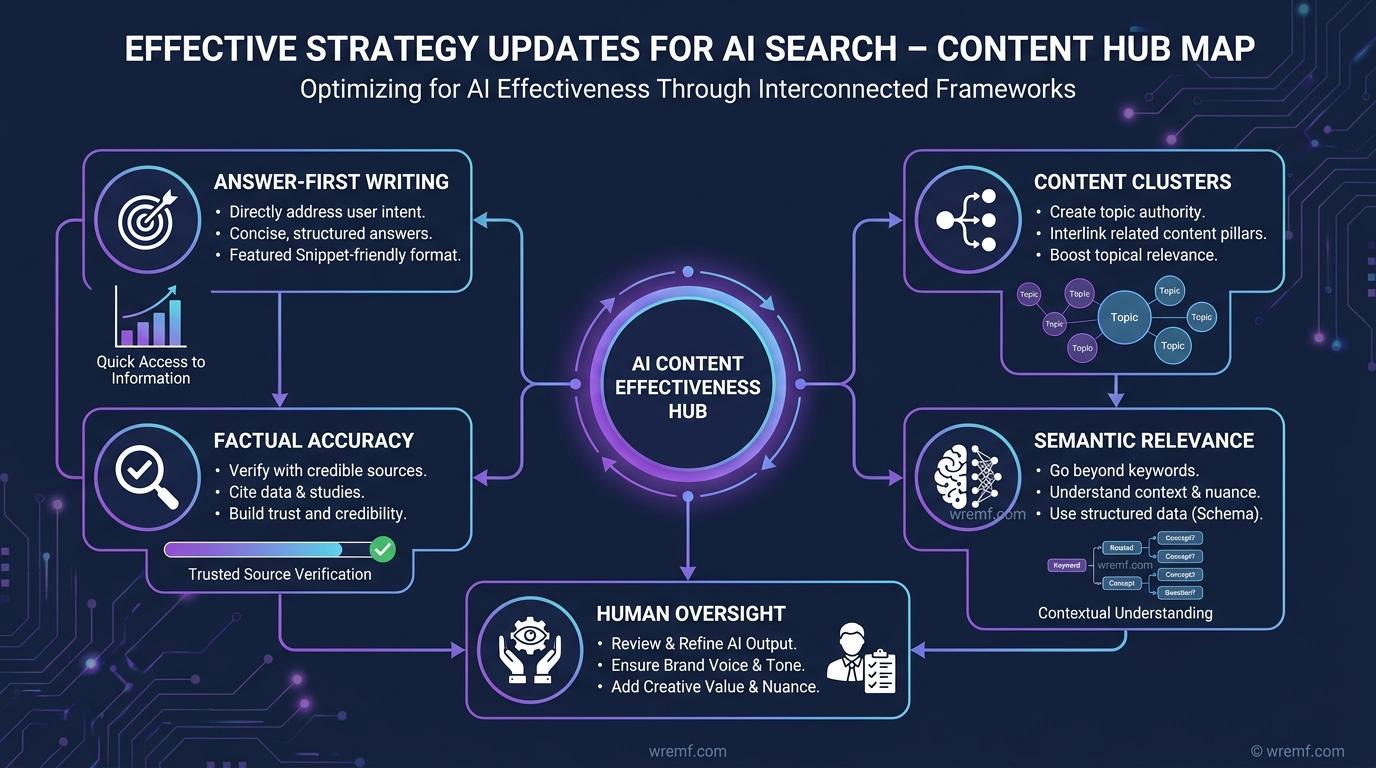
The best content strategy for AI search uses answer-first writing, content clusters, semantic relevance, factual accuracy, and human oversight. AI search platforms need content that is easy to extract, verify, cite, and summarize.
Content architecture is the way a website organizes topics, pages, internal links, categories, and supporting content. Content architecture matters because AI systems need clear relationships between core pages, educational pages, comparison pages, product pages, methodology pages, and proof pages.
A content cluster is a group of related pages that cover a topic from multiple search intents. A content cluster matters because it helps search engines and AI systems understand topical depth, entity relevance, and business authority.
Semantic relevance is the relationship between words, entities, concepts, and user intent. Semantic relevance matters because AI systems process meaning, not only exact-match keywords.
For AI search platforms, content should answer real questions in clear chunks. A good chunk includes one direct answer, one supporting explanation, and one implication. This helps large language models and search engines extract useful passages.
The strongest AI search content strategy includes:
Definition pages for major concepts
Comparison pages for decision-stage buyers
Product and feature pages with clear positioning
Content hubs that establish topical authority
FAQ lists based on natural search queries
Methodology pages that explain how claims are measured
Source-backed articles with clear attribution
Case-free practical examples that do not invent results
Content briefs that connect search behavior to user intent
SEO testing to validate changes over time
Content creation should not be fully automated. AI tools can help with drafts, outlines, content structure, Natural Language Processing ideas, semantic coverage, and FAQ lists. Human reviewers must check factual accuracy, brand claims, examples, differentiation, and user experience.
Google Search Central says helpful content should be created for people, not primarily to manipulate search engine rankings. That guidance applies directly to AI search optimization because low-quality AI content can weaken trust, reduce clarity, and create reputation risk.
WREMF supports AI-ready content creation through content briefs that connect prompts, citations, competitors, missing topics, source gaps, and content structure.
KEY TAKEAWAY: AI search content strategy works best when answer-first structure, content clusters, semantic relevance, factual accuracy, and expert review work together.
Strong content also needs E-E-A-T, authority signals, and source consistency.
Establishing Trust With E-E-A-T and Authority Signals
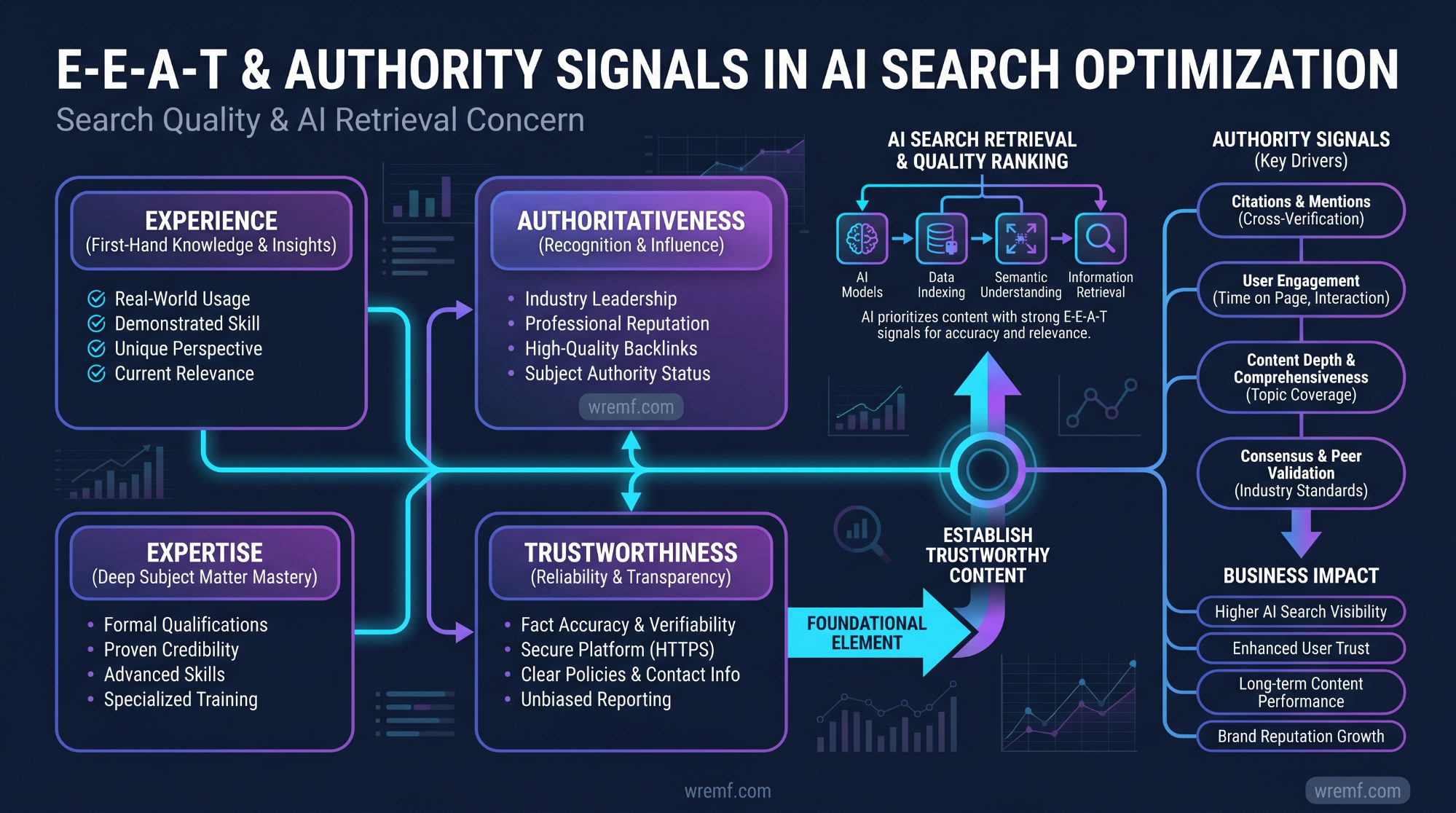
E-E-A-T matters for AI search optimization because AI systems depend on reliable, accurate, and trustworthy source material. Businesses should treat E-E-A-T signals as both a search quality issue and an AI retrieval issue.
E-E-A-T signals are indicators of experience, expertise, authoritativeness, and trustworthiness. E-E-A-T signals matter because search engines and AI systems need confidence that content is accurate, useful, and credible.
Authority signals are trust indicators that support credibility. Authority signals can include expert authorship, clear company information, transparent methodology, source attribution, relevant backlinks, consistent profiles, customer proof, product documentation, and accurate third-party mentions.
Source consistency is the alignment of business facts across owned and third-party sources. Source consistency helps AI systems reduce confusion when summarizing company descriptions, pricing, product categories, leadership, locations, services, and claims.
Factual accuracy is the degree to which content reflects true, current, and verifiable information. Factual accuracy matters because AI systems can repeat incorrect information when sources are outdated, inconsistent, or unclear.
Marketing teams often find source consistency problems during AI visibility audits. A company may describe itself as an AI search optimization platform on its website, an SEO agency on a directory, a content marketing tool on a marketplace, and a digital marketing consultancy on social media. AI systems can merge these signals and produce weak or confusing answers.
E-E-A-T is not only an article-level issue. It applies to product pages, pricing pages, comparison pages, methodology pages, author pages, help docs, knowledge panels, business profiles, partner pages, and social media. AI search platforms can retrieve or reference many different sources.
For teams that need managed execution, WREMF offers AI visibility agency services covering AEO, GEO, content optimisation, entity and authority building, source consistency cleanup, citation improvement, schema and entity markup guidance, internal linking logic, crawl checks, rendering checks, and monthly reporting.
KEY TAKEAWAY: E-E-A-T signals, authority signals, factual accuracy, and source consistency improve the likelihood that AI systems can describe your business clearly and credibly.
After trust signals are in place, teams can use AI tools for competitive intelligence.
The Competitive Edge: Using AI Tools as Predictive Intelligence
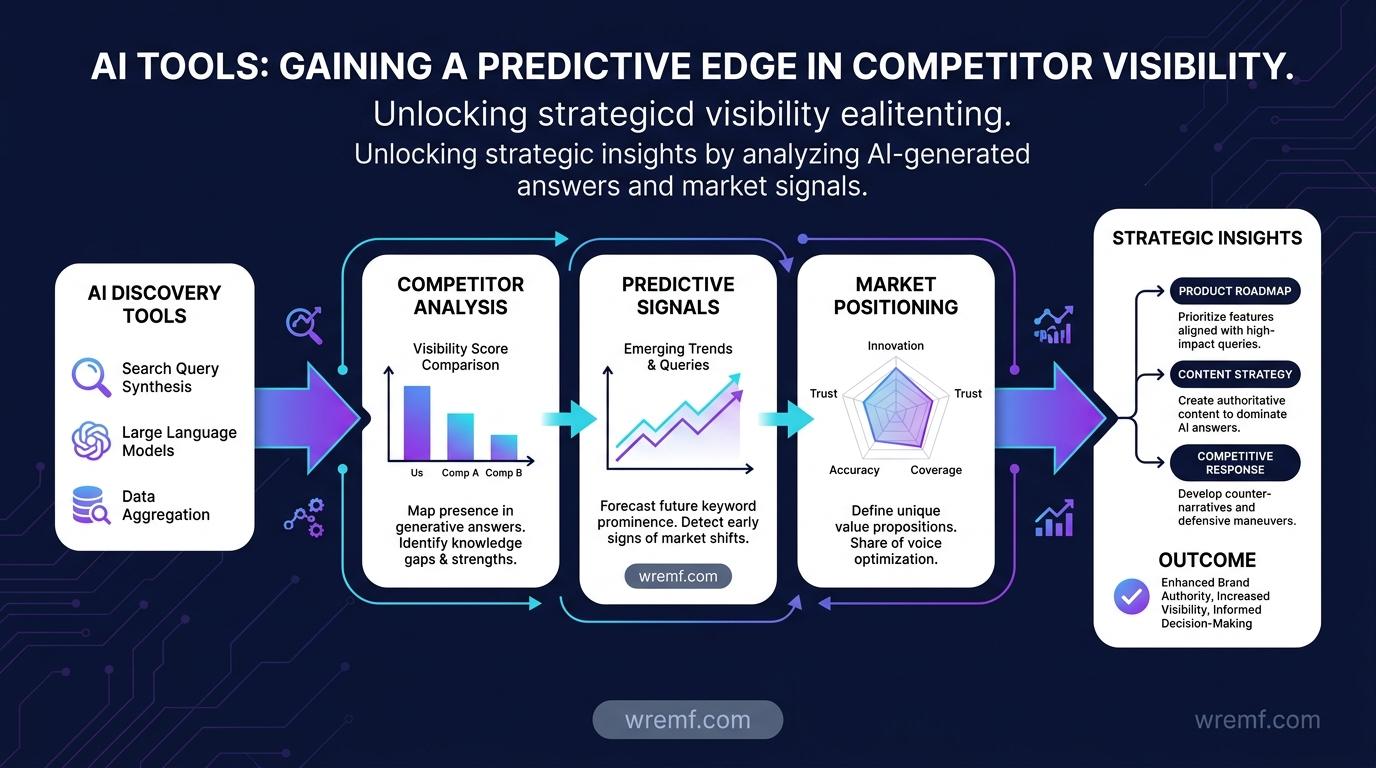
AI search optimization tools give businesses a competitive edge by showing which competitors appear in AI answers before traffic data reveals the impact. This makes AI visibility a predictive signal for search strategy and market positioning.
Competitive benchmarking is the process of comparing your business against competitors across prompts, citations, recommendations, source mentions, and AI share of voice. Competitive benchmarking matters because AI systems often present shortlists rather than long search engine results.
A business can rank well in organic search and still lose visibility in AI search platforms. For example, a competitor may be recommended in Perplexity, cited by Google AI Overviews, described favorably in ChatGPT browsing results, or included in Bing Copilot answers for a buyer comparison query.
AI tools help teams answer competitive questions such as:
Which competitors appear most often in AI search platforms?
Which competitors are cited as sources?
Which search queries trigger competitor recommendations?
Which pages or sources influence AI answers?
Which content clusters are competitors using to build authority?
Which AI systems mention your brand accurately?
Which AI systems ignore your brand completely?
Which sources need correction because they contain outdated information?
Pull-through content is content designed to move a user from early education into product evaluation. Pull-through content matters because AI search platforms often answer broad questions first, then guide users toward brands, features, tools, or categories.
SERP feature monitoring still matters here. SERP feature monitoring shows whether your content appears in featured snippets, People Also Ask, local results, video results, AI Overviews, and other search engine results page features. AI search optimization adds another layer by showing whether AI systems include your brand in generated answers.
WREMF’s competitive landscape analysis helps teams compare brand mentions, source citations, AI share of voice, recommendation visibility, and competitor movement across AI discovery surfaces.
KEY TAKEAWAY: AI search optimization tools help businesses detect competitor visibility, citation gaps, and market shifts before those changes become obvious in traffic reports.
Competitive intelligence is useful only when teams choose the right AI optimization stack.
A Business Selection Framework: Choosing the Right AI Optimization Stack
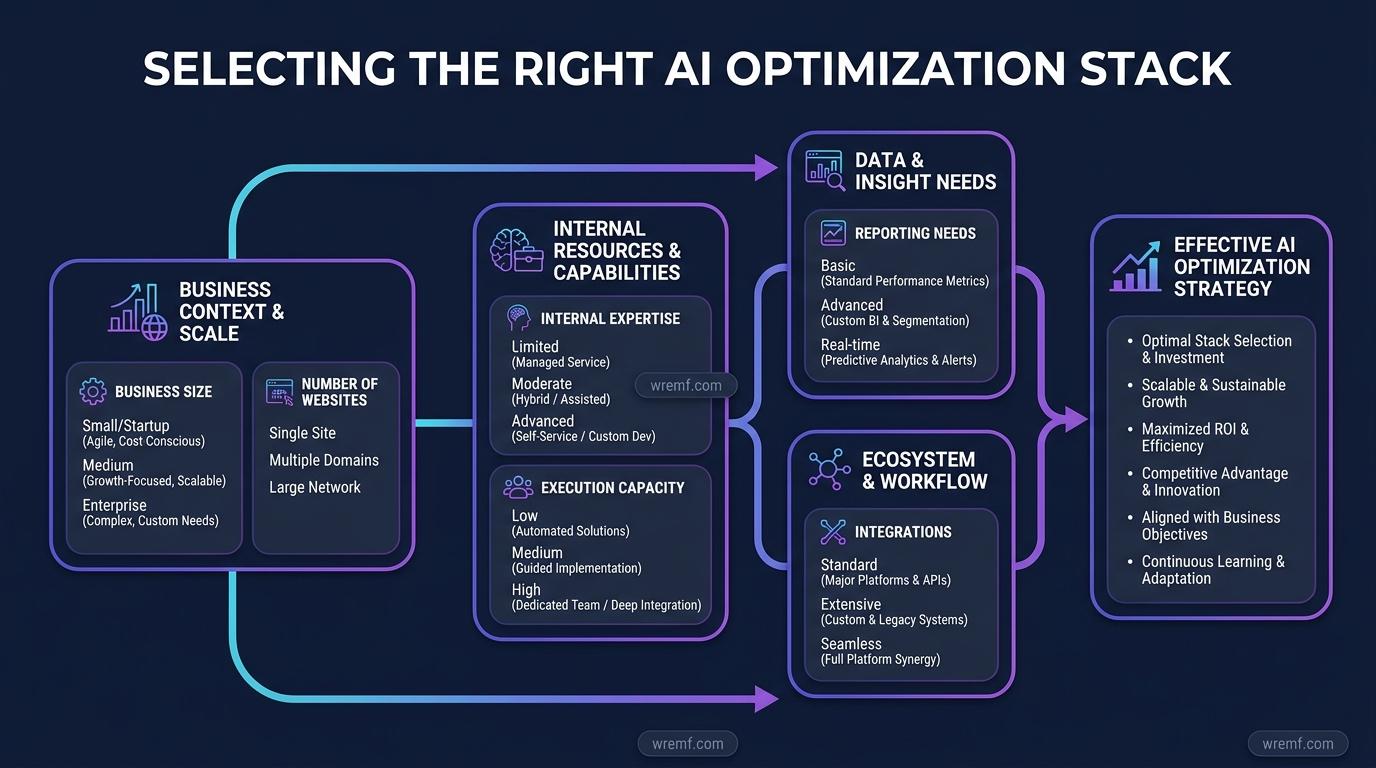
The right AI optimization stack depends on business size, number of websites, internal expertise, reporting needs, integrations, and execution capacity. The best stack connects AI visibility data to practical actions.
AI tools should be evaluated by workflow, not hype. A business should ask whether the tool can track important search queries, monitor AI search platforms, compare competitors, analyze citations, support content creation, integrate with analytics, and produce reports stakeholders can understand.
All-in-one SEO platforms are useful for keyword research, backlinks, organic search, Technical SEO, SERP feature monitoring, and website traffic analysis. Specialized tools such as Surfer SEO and MarketMuse can support content creation, content structure, and semantic relevance. AI search optimization tools are needed when the business wants visibility data from AI systems, answer engines, and generative results.
| Business Need | Best Tool Type | Key Capabilities | Main Limitation | Recommended WREMF Fit |
|---|---|---|---|---|
| Improve organic search | SEO platform | Keyword research, backlinks, rankings, Technical SEO | Limited AI visibility data | Use alongside WREMF |
| Improve content creation | Content optimization platform | Briefs, semantic relevance, content structure | May miss AI citations and competitor mentions | Pair with WREMF content briefs |
| Track AI answers | AI search optimization platform | Prompt tracking, mentions, citations, AI share of voice | Requires strategic interpretation | WREMF software |
| Serve multiple clients | White-label AI visibility platform | Client portals, scheduled reports, multi-site tracking | Needs repeatable client process | WREMF for agencies |
| Execute strategy | Agency or hybrid model | Audits, content updates, citation improvement, source cleanup | Requires budget and collaboration | WREMF agency or hybrid |
| Build custom workflows | API-enabled platform | API, MCP, data export, integrations | Requires technical resources | WREMF API |
Business size also matters. A small business may only need prompt tracking for one website, basic reports, and focused content updates. A B2B SaaS team may need AI citations, competitor visibility, Google Analytics, Search Console, SEO testing, and content briefs. An agency may need white-label reports, client portals, shared dashboards, and repeatable workflows.
WREMF pricing reflects these needs. Starter is €39 per month for 1 website, unlimited prompt tracking, BYOK, 10 AI engines, all features and tools, white-label reports, 1 seat, and email support. Growth is €89 per month for 5 websites, unlimited prompt tracking, BYOK, 10 AI engines, all features and tools, white-label reports, priority email support with a 24h SLA, content brief generator, and SEO A/B testing. Enterprise supports unlimited websites, unlimited prompt tracking, BYOK, 10 AI engines, all features and tools, white-label reports, unlimited seats, dedicated support with a 4h SLA, and custom branded portals.
Teams that need technical workflows can use the WREMF API and MCP integrations to connect AI visibility data with internal reporting, dashboards, client systems, or automation workflows.
KEY TAKEAWAY: The right AI optimization stack should match your business size, reporting needs, execution capacity, integration requirements, and AI visibility goals.
After selecting the stack, the next step is implementation.
How to Start Using AI Search Optimization Tools
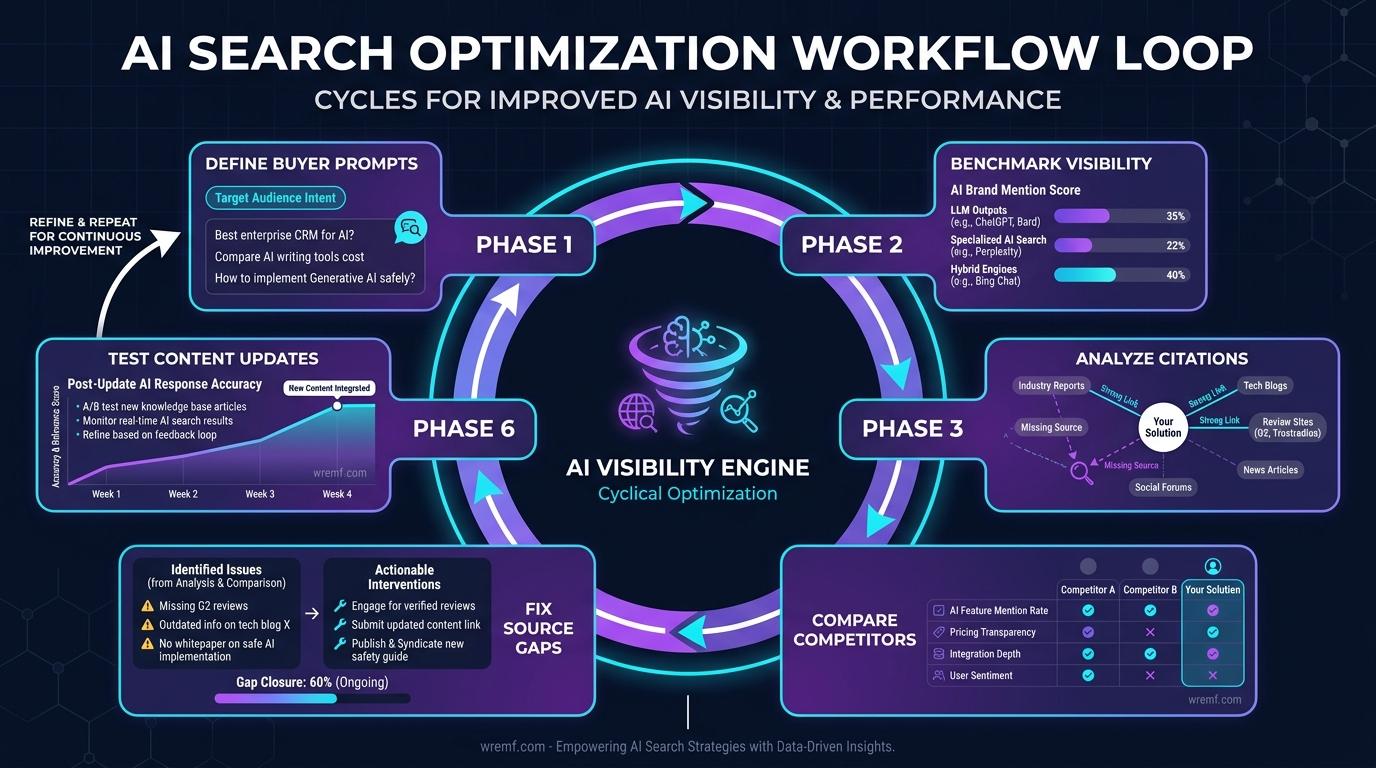
The best way to start using AI search optimization tools is to define buyer prompts, benchmark visibility, analyze citations, compare competitors, fix source gaps, and test content updates. This turns AI visibility into a repeatable improvement cycle.
Start with prompts, not dashboards. A prompt set should reflect how real buyers ask questions across AI search platforms. Include definition queries, comparison queries, tool queries, service queries, pricing queries, implementation queries, risk queries, and alternative vendor queries.
Prompt tracking is the process of monitoring how AI systems respond to specific prompts over time. Prompt tracking matters because AI answers vary by platform, wording, source availability, and user intent.
A practical implementation workflow looks like this:
Define 20 to 50 high-intent prompts for your business
Group prompts by funnel stage, product category, and user intent
Test prompts across ChatGPT, Perplexity, Gemini, Copilot, Google AI Overviews, and other relevant AI search platforms
Record brand mentions, competitor mentions, citations, links, recommendations, and answer sentiment
Identify missing content, weak source citations, and inconsistent brand facts
Update content architecture, FAQ lists, internal links, product pages, comparison pages, and methodology pages
Add structured data and schema markup where it accurately reflects visible content
Review Google Analytics and Search Console for related search behavior and traffic signals
Track changes weekly or monthly
Report AI Visibility, citation frequency, source consistency, and AI traffic attribution
A common implementation mistake is tracking only broad educational prompts. Broad prompts are useful, but buying-stage prompts often reveal more business value. Examples include “best software for AI visibility tracking,” “AI search optimization tools for agencies,” and “how to measure brand visibility in ChatGPT and Perplexity.”
Another common mistake is treating content creation as the full strategy. Content is important, but AI search optimization also requires source consistency, entity clarity, Technical SEO, internal links, authority signals, and measurement.
WREMF helps teams run this workflow through prompt intelligence, source citation tracking, competitor visibility, scheduled monitoring, AI Visibility scoring, AI-ready content briefs, and reporting.
KEY TAKEAWAY: AI search optimization should start with real buyer prompts, then move into citation analysis, competitor comparison, source cleanup, content updates, and scheduled monitoring.
Implementation becomes more reliable when teams track the right KPIs.
Measuring Success: New KPIs for the AI Search Era
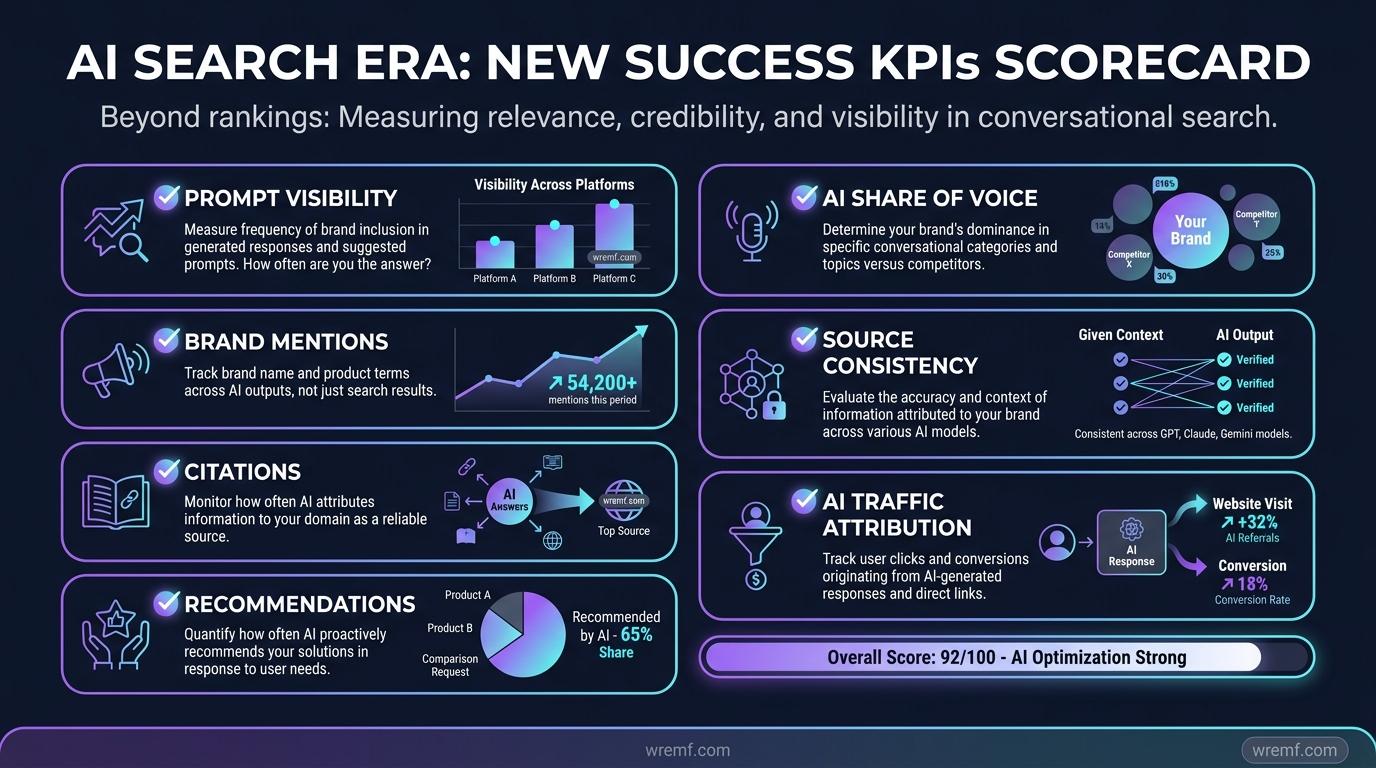
AI search success should be measured with prompt visibility, brand mentions, citations, recommendations, AI share of voice, source consistency, and AI traffic attribution. Rankings alone cannot explain how AI systems represent your business.
Prompt visibility shows whether your brand appears for target prompts across AI search platforms. Prompt visibility matters because your business may appear for one type of search query and disappear for another.
Citation analysis is the process of identifying which sources AI systems reference, link to, or rely on when answering prompts. Citation analysis matters because source citations can shape what AI systems say about your category, product, competitors, and brand.
AI share of voice is the percentage of relevant AI answers where your brand appears compared with competitors. AI share of voice matters because AI search platforms often compress discovery into shortlists, summaries, and recommendations.
AI traffic attribution connects AI visibility to visits, sessions, conversions, or assisted outcomes from AI sources. AI traffic attribution matters because visibility should eventually be connected to business impact, even when some AI-influenced journeys remain zero-click.
| KPI | What It Measures | Example Metric | Why It Matters |
|---|---|---|---|
| Prompt visibility | Whether your brand appears for tracked prompts | Brand appears in 18 of 50 priority prompts | Shows AI discovery coverage |
| Brand mentions | How often AI systems mention your company | Mentioned by ChatGPT, Perplexity, and Gemini for category prompts | Shows recognition |
| Citation frequency | How often your sources are cited | Website cited 12 times across AI search platforms | Shows source authority |
| Source citations | Which pages or third-party sources support AI answers | Product page, methodology page, review site, directory | Shows influence sources |
| Competitor visibility | Which competitors appear instead of you | Competitor appears in 62 percent of comparison prompts | Shows market risk |
| AI share of voice | Brand presence versus competitors | 24 percent of relevant AI recommendations | Shows category position |
| Source consistency | Whether facts match across sources | Pricing, positioning, company description, product names align | Reduces misinformation risk |
| AI traffic attribution | Traffic from AI sources | Sessions from ChatGPT, Perplexity, Copilot, Gemini referrals | Connects visibility to analytics |
| Lead generation quality | Quality of AI-influenced leads | Higher-fit demo requests from AI-informed visitors | Shows commercial relevance |
Google Analytics and Search Console remain important. Google Analytics can show referral traffic, engagement, and conversions. Search Console can show impressions, clicks, average position, click-through rates, search queries, and organic search trends. AI search optimization adds visibility data that classic analytics tools do not fully capture.
WREMF’s source citation tracking helps teams see which sources AI systems cite, while SEO testing helps teams evaluate whether content and technical changes improve measurable outcomes over time.
KEY TAKEAWAY: AI search measurement should combine prompt visibility, citations, competitors, source consistency, analytics, and business outcomes.
Good measurement also reveals what can go wrong.
Risks, Limitations, and What Can Go Wrong
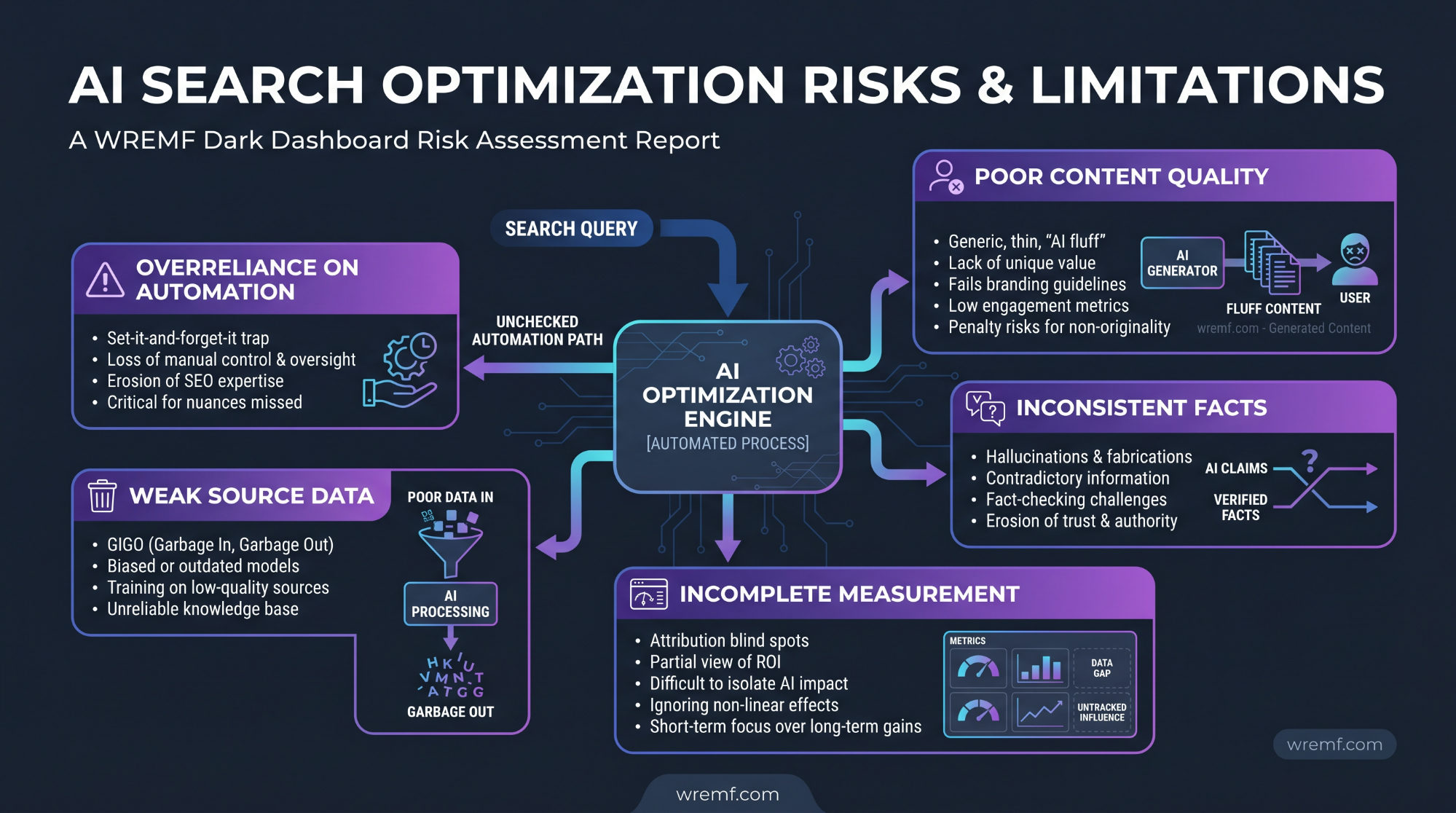
AI search optimization tools are useful, but they cannot guarantee rankings, citations, traffic, leads, or revenue. The main risks are overreliance on automation, weak source data, poor content quality, inconsistent facts, and incomplete measurement.
AI systems can make mistakes. OpenAI explains that ChatGPT search can provide timely answers with links to web sources, while Perplexity says every answer includes citations linking to original sources. Source links improve transparency, but they do not remove the need to verify accuracy.
AI hallucinations are incorrect or unsupported outputs generated by AI systems. AI hallucinations matter because inaccurate AI answers can damage trust, misstate product features, or repeat outdated company information.
A business can also misread AI visibility data. One prompt result is not a strategy. One AI citation is not proof of category authority. One competitor mention does not prove market loss. The useful pattern comes from tracking prompts, sources, competitors, and changes over time.
Common risks include:
Tracking too few prompts
Ignoring buyer-intent search queries
Measuring only traffic and not mentions
Treating rankings as the only success metric
Publishing AI-generated content without expert review
Adding schema markup that does not match visible content
Ignoring user experience and page quality
Failing to correct third-party source inconsistencies
Overusing AI tools for content creation without editorial control
Assuming all AI search platforms process content the same way
AI search platforms differ. ChatGPT, Claude, Gemini, Perplexity, Copilot, DeepSeek, Grok, Meta AI, Mistral, Google AI Overviews, and voice assistants may retrieve information differently, cite sources differently, and answer search queries differently. This is why multi-engine monitoring is important.
IMPORTANT: AI search optimization should be treated as evidence-led improvement, not a guaranteed shortcut.
KEY TAKEAWAY: AI search optimization works best when teams combine measurement, expert review, source consistency, technical foundations, and realistic expectations.
Those risks explain why many teams need either software, services, or a hybrid model.
Software, Agency, or Hybrid: Which AI Search Optimization Model Fits Your Business?
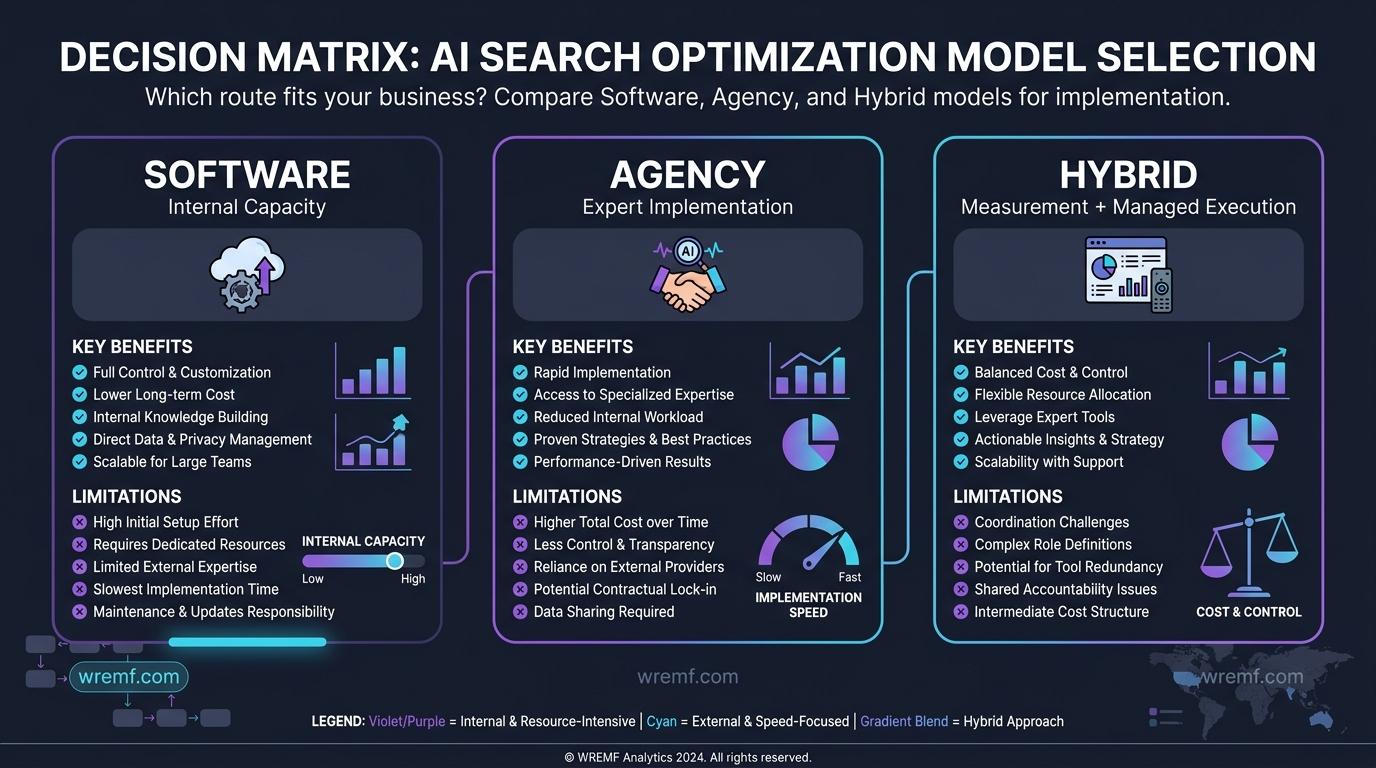
The right model depends on whether your team needs data, execution, or both. Software fits teams with internal capacity, agency services fit teams that need expert implementation, and hybrid support fits teams that want measurement plus managed execution.
Software is best when your team can act on insights. If you already have SEO, content, analytics, and development resources, AI search optimization software can help you track prompts, citations, AI search platforms, competitors, reports, and content opportunities.
Agency services are best when your team lacks time or expertise. AI visibility agency support can help with GEO audits, AEO strategy, content optimisation, entity and authority building, citation improvement, source consistency cleanup, technical AI visibility foundations, internal linking logic, schema and entity markup guidance, and reporting.
A hybrid model is best when you need both visibility data and action. This is common for B2B SaaS teams, agencies, consultants, and growth teams that want dashboards, reports, content briefs, experiments, and expert prioritization.
| Model | Best For | What You Get | Main Limitation | WREMF Fit |
|---|---|---|---|---|
| Software | Teams with in-house execution | Tracking, dashboards, prompt monitoring, citation analysis, reports | Requires internal action | WREMF platform |
| Agency | Teams needing execution | Strategy, audits, content updates, source cleanup, authority building | Requires service budget | WREMF agency |
| Hybrid | Teams needing measurement and action | Software plus managed execution | Requires coordination | WREMF software plus agency |
| DIY manual testing | Very early exploration | Quick checks in AI tools | No scale, history, or reporting | Useful before platform adoption |
Agencies managing multiple clients often need white-label reports, client portals, repeatable prompt sets, scheduled AI monitoring, and proof of work. Brands often need simpler executive reporting that explains where visibility improved, where competitors still win, and which actions come next.
WREMF is useful for brands that want software, agencies that need white-label reporting, and teams that want managed execution. The WREMF page for agencies explains how agencies can use AI visibility tracking and reporting across multiple clients, while the WREMF page for brands focuses on in-house visibility and growth workflows.
KEY TAKEAWAY: Software, agency, and hybrid models can all work, but the right choice depends on internal capacity, execution needs, and reporting expectations.
Before choosing a model, it helps to separate facts from common myths.
Common Myths About AI Visibility Debunked
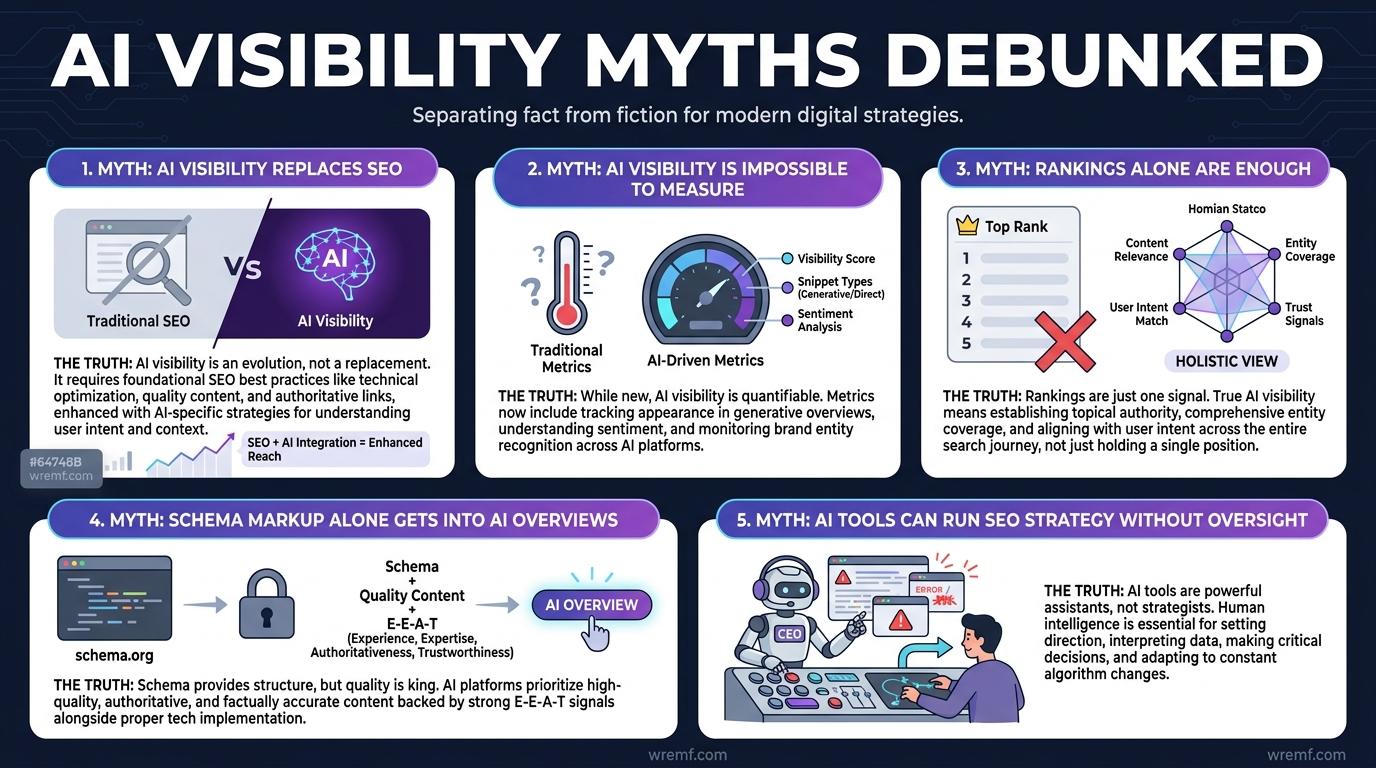
AI visibility is often misunderstood because it overlaps with SEO, AEO, GEO, content creation, and analytics. The most common myths cause teams to ignore AI search or measure it with the wrong metrics.
MYTH: AI search optimization replaces SEO.
FACT: AI search optimization does not replace SEO. Google Search Central explains that AI features in Search still depend on existing search fundamentals, including crawlable, indexable, helpful content. AI search optimization builds on SEO by adding prompt tracking, AI citations, competitor visibility, source consistency, and AI share of voice.
MYTH: AI visibility is impossible to measure.
FACT: AI visibility is measurable when teams define prompts, track brand mentions, monitor source citations, compare competitors, and review changes over time. It is not measured exactly like traditional SEO rankings, but it can be measured with repeatable prompt sets and structured reporting.
MYTH: Rankings alone are enough.
FACT: Rankings are useful, but rankings do not show whether AI systems recommend your brand, cite your sources, or summarize your business accurately. A business can rank in search engines while competitors win recommendations inside AI search platforms.
MYTH: Schema markup alone gets a business into AI Overviews.
FACT: Schema markup can help search engines understand visible content, but Google says no special schema.org structured data is required for AI Overviews or AI Mode. Structured data should be accurate, but AI search optimization also requires helpful content, crawlability, entity clarity, source consistency, and authority signals.
MYTH: AI tools can run SEO strategy without human oversight.
FACT: AI tools can support keyword research, content creation, data analysis, and reporting, but human oversight is still required. Strategy, factual accuracy, brand voice, user experience, and business prioritization cannot be delegated fully to automation.
KEY TAKEAWAY: AI visibility is measurable, SEO still matters, rankings are not enough, and AI tools need human strategy to create reliable business value.
The final section answers the questions buyers and teams most often ask before investing.
Frequently Asked Questions
What are AI search optimization tools?
AI search optimization tools are platforms that help businesses measure and improve how they appear inside AI-generated answers, citations, summaries, comparisons, and recommendations. These tools track prompts, brand mentions, source citations, competitor visibility, AI share of voice, and AI traffic attribution. Traditional SEO tools focus on rankings, backlinks, keyword research, organic search, and Technical SEO. AI search optimization tools focus on AI search platforms such as ChatGPT, Perplexity, Gemini, Copilot, Google AI Overviews, Claude, DeepSeek, Grok, Meta AI, and Mistral.
Why should businesses use AI search optimization tools?
Businesses should use AI search optimization tools because AI systems now influence how prospects discover, compare, and trust brands. A buyer may ask ChatGPT for vendor recommendations, use Perplexity to compare tools, see a Google AI Overview, and then visit a website later. Without AI visibility tracking, that influence is hard to measure. These tools help businesses identify where they appear, which competitors are recommended, which sources are cited, and which content or source gaps need action.
How does AI search optimization relate to traditional SEO?
AI search optimization builds on traditional SEO but adds new measurement layers. SEO improves visibility in search engines through crawlability, helpful content, links, relevance, Technical SEO, and user experience. AI search optimization adds prompt tracking, source citations, AI share of voice, competitor visibility, brand mentions, and source consistency. The two disciplines should work together. Strong SEO helps AI systems find reliable content, while AEO and GEO help AI systems extract, summarize, and cite that content.
Does E-E-A-T matter for AI search optimization?
Yes, E-E-A-T matters for AI search optimization because AI systems rely on trustworthy source material. Experience, expertise, authoritativeness, and trustworthiness help search engines and AI systems evaluate whether content is useful and credible. Businesses should support E-E-A-T with clear authorship, accurate company information, reliable sources, transparent methodology, current product details, strong content architecture, and consistent third-party profiles. E-E-A-T signals are especially important for B2B SaaS, financial, legal, health, technical, and high-consideration buying topics.
How do different AI search platforms process content?
Different AI search platforms process content through different combinations of search retrieval, model knowledge, citations, context, and user prompts. Perplexity emphasizes citations to original sources. ChatGPT search can provide timely answers with links to web sources. Google AI Overviews are part of Google Search and depend on Google’s search systems. Gemini, Copilot, Claude, DeepSeek, Grok, Meta AI, and Mistral may retrieve, summarize, and cite information differently. This is why multi-engine AI visibility tracking is more reliable than checking one platform manually.
How do you optimize website content for AI search?
You optimize website content for AI search by making pages crawlable, clear, structured, factual, and answer-first. Start with user intent and search queries, then create content clusters that define key topics. Use concise definitions, FAQ lists, comparison tables, source-backed claims, internal links, structured data, schema markup, and clear product descriptions. Avoid vague claims and thin AI-generated content. WREMF helps teams identify prompt gaps, citation gaps, competitor gaps, and AI-ready content opportunities through its platform and content brief workflow.
What content strategy updates work best for AI search?
The best content strategy updates for AI search include answer-first introductions, content chunks, entity-driven strategies, semantic relevance, content hubs, comparison pages, methodology pages, and high-value FAQ lists. Teams should create content that directly answers buyer questions and supports follow-up questions. AI search platforms prefer content that is easy to understand, verify, and cite. Content creation should combine AI tools with human expertise so the final content is accurate, useful, differentiated, and aligned with brand positioning.
How do you track AI search visibility?
You track AI search visibility by defining prompts, testing them across AI search platforms, recording brand mentions, monitoring source citations, comparing competitors, and reviewing changes over time. Useful prompt groups include category prompts, comparison prompts, service prompts, pricing prompts, risk prompts, and implementation prompts. WREMF helps automate this process through prompt intelligence, source citation tracking, competitor visibility, AI Visibility scoring, scheduled monitoring, white-label reports, and AI traffic attribution.
What are the benefits of AI SEO tools for small businesses?
AI SEO tools can help small businesses save time, prioritize content updates, improve keyword research, and understand search behavior. For AI search specifically, small businesses can use AI search optimization tools to see whether AI systems understand their services, cite their website, mention competitors, or repeat outdated information. A small business can start with 20 to 50 important prompts and focus on the pages that influence real leads, calls, bookings, demos, or purchases.
Are AI tools good for content creation?
AI tools are useful for content creation when they support research, structure, content briefs, semantic coverage, FAQ lists, and draft development. They are risky when used to publish generic, unchecked, or inaccurate content at scale. Human review is essential for factual accuracy, user experience, brand voice, examples, product details, and strategic judgment. The best workflow uses AI tools to speed up content creation while keeping expert oversight in the final editorial process.
Should I hire an SEO agency or use AI search optimization software?
Use AI search optimization software when your team can review insights and execute updates internally. Hire an agency when you need strategy, GEO audits, AEO consulting, content optimisation, source consistency cleanup, citation improvement, Technical SEO support, and monthly execution. Use a hybrid model when you want measurement and managed action together. WREMF supports all three options: software, agency services, and combined software plus execution.
Which businesses benefit most from AI search optimization tools?
B2B SaaS companies, agencies, consultants, professional services firms, ecommerce brands, local service businesses, and content-led companies can benefit from AI search optimization tools. The strongest fit is any business where buyers compare options, ask detailed questions, evaluate trust, and rely on search before contacting sales. Agencies also benefit because they need scalable reporting across clients. WREMF is especially useful for brands and agencies that need prompt tracking, citations, competitor visibility, and white-label reports.
Is SEO still worth it with AI search and Google AI Overviews?
Yes, SEO is still worth it because AI search still depends heavily on accessible, helpful, authoritative, and relevant content. Google AI Overviews are part of Google Search, and Google states that sites need to follow Search essentials to be eligible for AI features. SEO remains the foundation for crawlability, content quality, links, technical access, and organic search. AI search optimization expands SEO by adding prompt visibility, AI citations, source consistency, and AI share of voice.
How long does AI search optimization take?
AI search optimization is an ongoing process. A baseline audit can identify prompt gaps, citation gaps, competitor visibility, and source inconsistencies quickly, but improvements take time because search engines, AI systems, content updates, and third-party sources do not update instantly. Most teams should monitor AI visibility weekly or monthly. The goal is not one-time optimization. The goal is a repeatable system for tracking, improving, testing, and reporting AI search visibility.
What is the difference between brand mentions, citations, and recommendations?
Brand mentions are references to your business inside AI answers. Citations are the sources AI systems link to or reference when supporting an answer. Recommendations are cases where AI systems actively suggest your business as an option for a user’s need. All three matter. Mentions show recognition, citations show source influence, and recommendations show commercial relevance. AI search optimization tools help teams track each signal separately.
How does WREMF help with AI search optimization?
WREMF helps teams track, improve, and prove AI visibility across major AI discovery surfaces. The platform tracks prompts, source citations, competitor visibility, AI share of voice, AI Visibility scores, scheduled monitoring, content briefs, SEO testing, and reporting. WREMF can be used as software, as an agency service, or as a hybrid software plus managed execution solution. It is useful for B2B brands, SEO teams, content teams, agencies, consultants, and growth leaders.
Conclusion
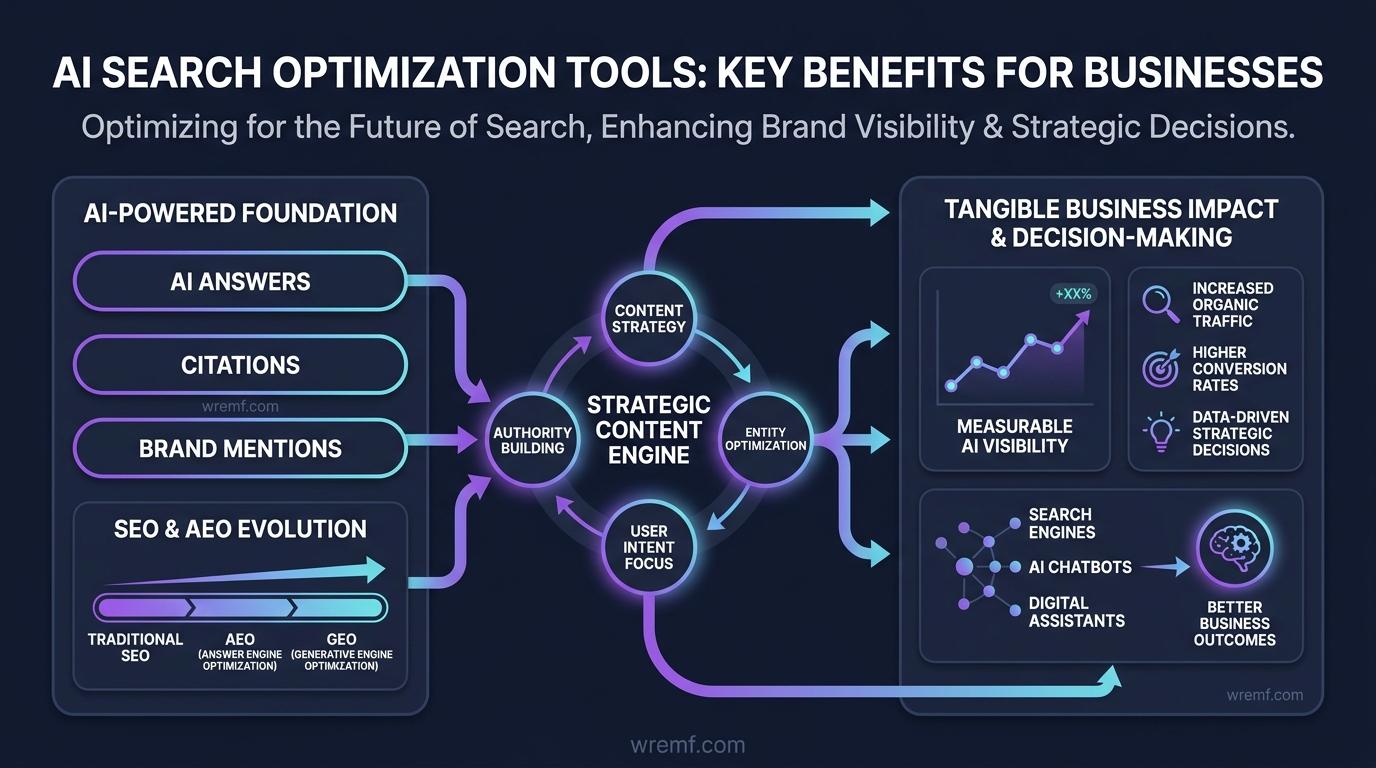
AI search optimization tools help businesses compete in a search environment where AI answers, citations, brand mentions, and recommendations influence buyer decisions before a click happens. The strongest approach combines SEO, AEO, GEO, content strategy, Technical SEO, source consistency, E-E-A-T signals, and measurable AI Visibility. WREMF helps teams turn AI search optimization from manual guesswork into a repeatable workflow across prompts, citations, competitors, content briefs, testing, and reporting. To start measuring and improving your AI visibility, explore the WREMF platform suite, review WREMF pricing, or talk to the WREMF agency team.