AI SEO Tools: The Complete Guide for SEO, AEO, GEO, and AI Search Visibility
Learn how AI SEO tools improve visibility across Google Search, AI Overviews, and AI answer engines. Compare tool types and build a practical stack.
By WREMF Team · 2026-05-09
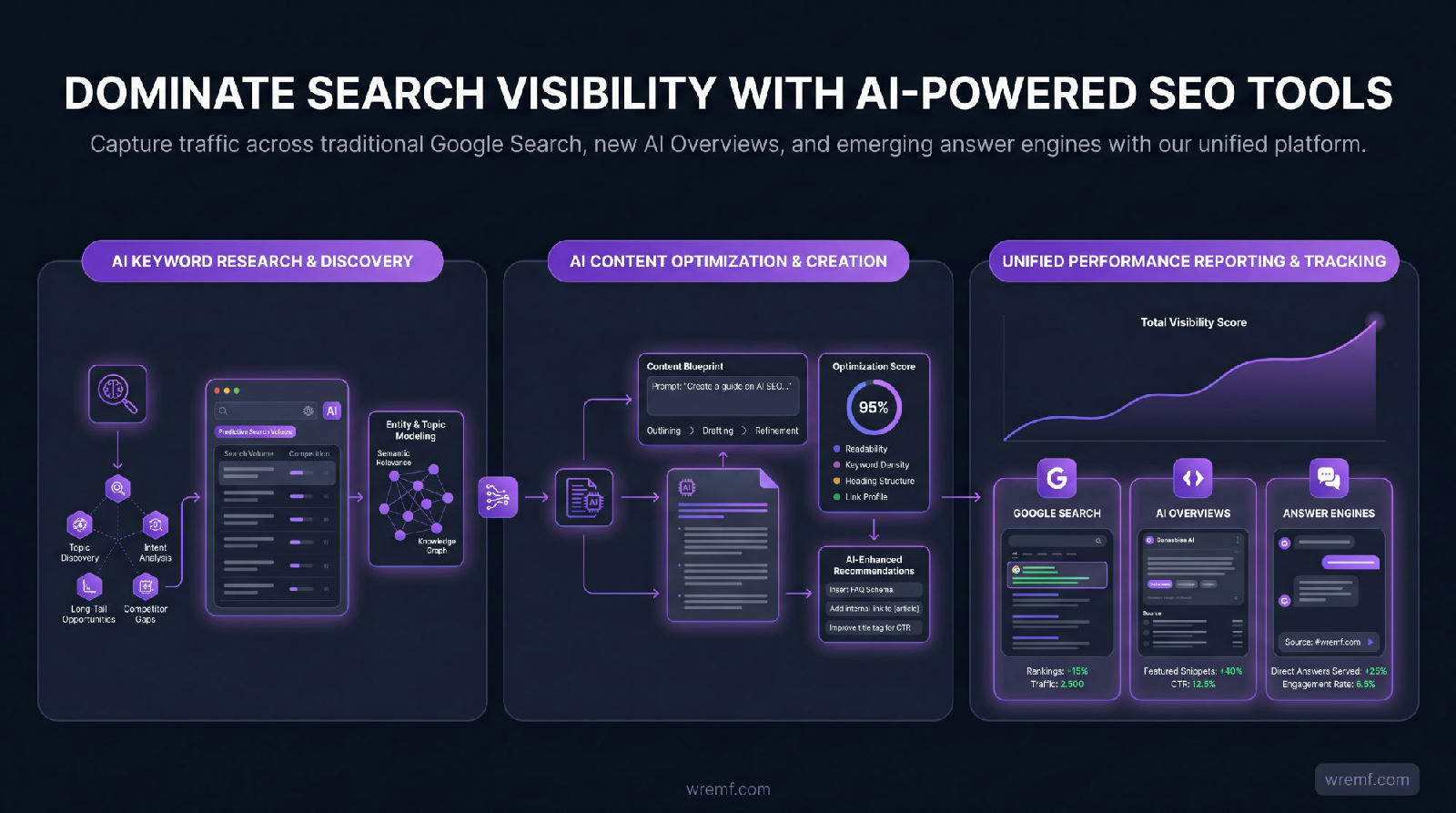
AI SEO tools are software platforms that use artificial intelligence, machine learning, natural language processing, automation, or large language models to improve search visibility across traditional search engines and AI answer engines. These tools support keyword research, content creation, content optimization, technical SEO audits, rank tracking, AI visibility measurement, and performance reporting. AI visibility is the measurable presence of a brand inside AI-generated answers, citations, summaries, recommendations, and comparisons across platforms like ChatGPT, Claude, Gemini, Perplexity, Copilot, and Google AI Overviews. A practical AI SEO stack includes five layers: search intelligence tools for keyword research and competitor analysis, execution tools for content creation and optimization, technical SEO tools for site audits and indexing, AI visibility tools for tracking prompts and citations, and reporting tools that connect Google Search Console, Google Analytics, and workflow automation systems.
Key takeaways
- AI SEO tools optimize for both traditional search engines and AI answer engines by combining keyword research, content optimization, technical health monitoring, citation tracking, and AI visibility measurement.
- Modern search visibility depends on rankings, answers, citations, entity clarity, and source trust across Google Search, AI Overviews, and AI answer engines like ChatGPT, Perplexity, Claude, Gemini, and Copilot.
- A practical AI SEO stack includes search intelligence tools, content execution tools, technical SEO platforms, AI visibility trackers, and reporting systems that each handle specific jobs without duplication.
- AI writing tools accelerate content production but require human expertise for accuracy, source attribution, editorial quality, and brand voice to avoid generic or weak AI content.
- Technical SEO remains essential because pages must be crawlable, indexable, and structured before search engines or AI systems can reliably access and understand them.
- WREMF connects prompts, citations, competitors, source consistency, AI traffic attribution, and recommendations into a repeatable workflow for measuring and improving AI visibility.
AI SEO Tools: The Complete Guide for SEO, AEO, GEO, and AI Search Visibility
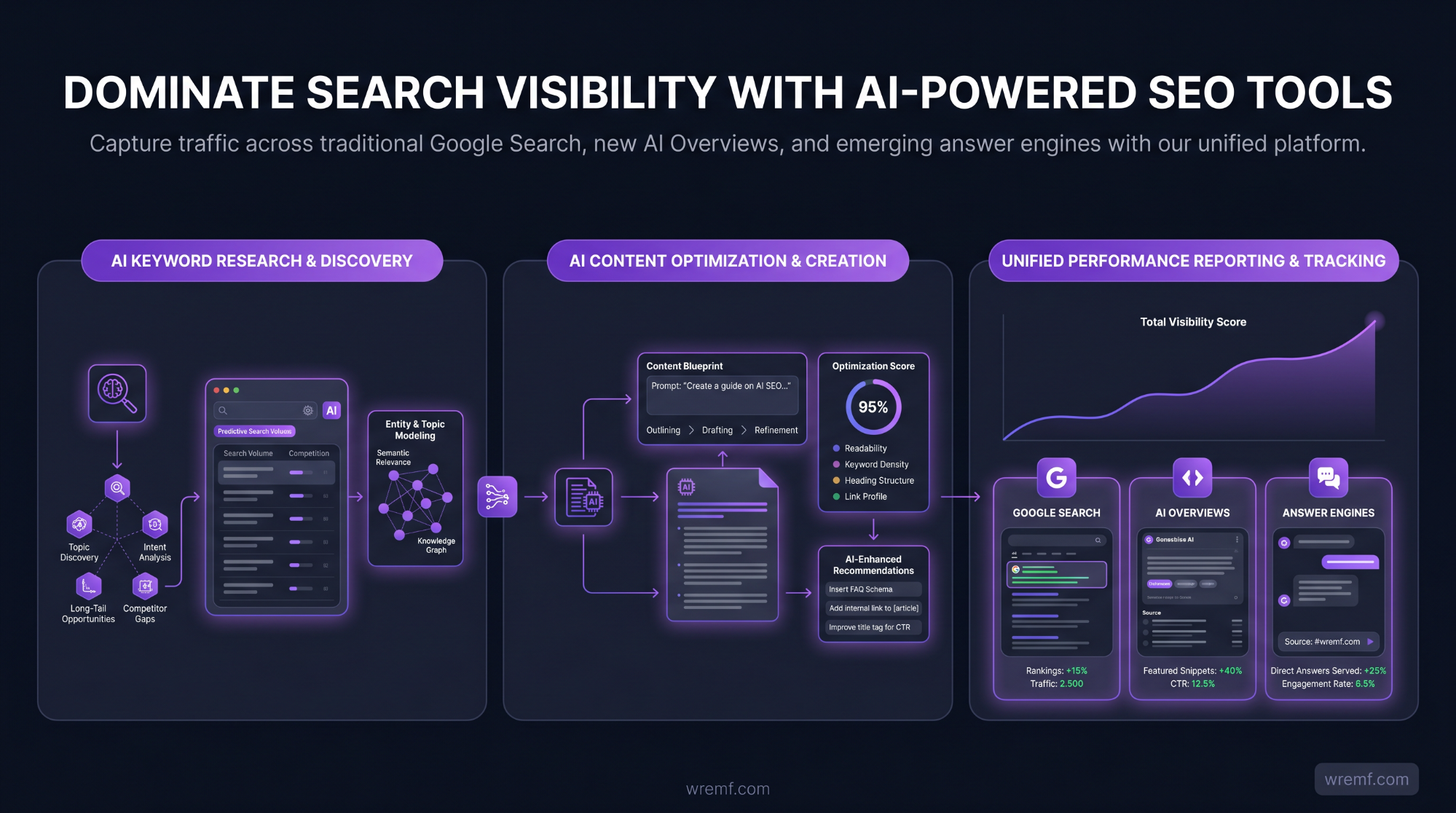
AI SEO tools are software platforms that help teams improve visibility across Google Search, AI Overviews, and AI answer engines. Google Search Central explains that helpful, reliable, people-first content remains the foundation of sustainable search performance. These tools now support keyword research, content creation, content optimization, technical SEO, rank tracking, AI visibility, prompt tracking, and reporting. This guide explains how AI SEO tools work, which tool categories matter, how SEO differs from AEO and GEO, and how WREMF helps teams track, improve, and prove AI visibility. Use this guide to build a practical AI SEO stack without wasting budget on overlapping tools.
What Are AI SEO Tools?
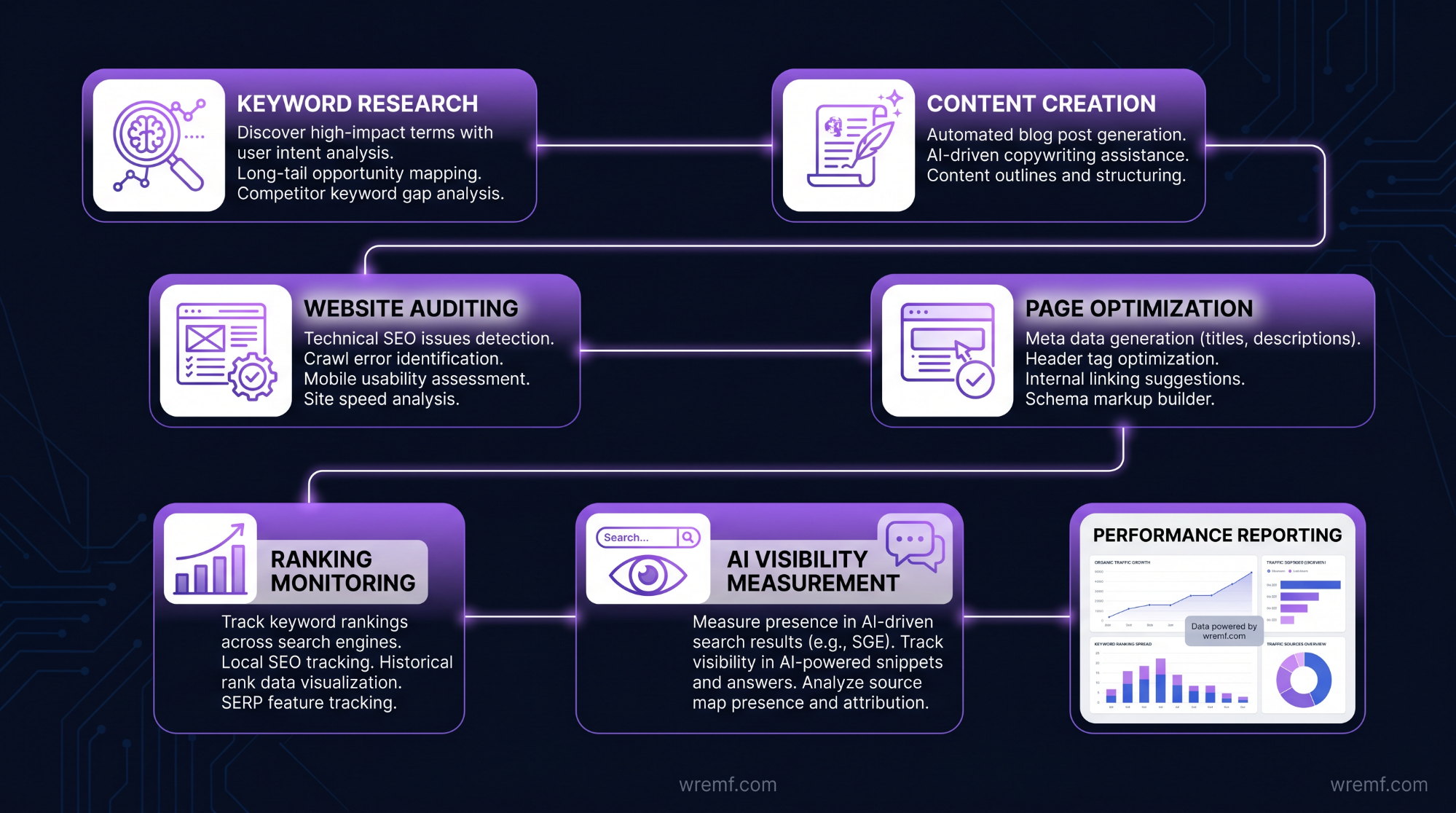
AI SEO tools are platforms that use artificial intelligence, machine learning, natural language processing, automation, or large language models to improve search visibility. AI SEO tools help teams research keywords, create content, optimise pages, audit websites, monitor rankings, measure AI visibility, and report performance.
AI SEO tools are not limited to AI writing or content generation. The category includes keyword research platforms, AI Writer tools, Content Editor platforms, technical SEO audit tools, backlink analysis platforms, rank tracking tools, AI Visibility Toolkit platforms, AI Agent workflows, and reporting systems that connect Google Search Console, Google Analytics, Google Sheets, and Google Docs.
AI visibility is the measurable presence of a brand inside AI-generated answers, citations, summaries, recommendations, and comparisons. AI visibility matters because buyers increasingly ask ChatGPT, Claude, Gemini, Perplexity, Copilot, Google AI Overviews, and other AI answer engines for vendor shortlists, product comparisons, and buying advice.
AI search is the discovery process where users ask natural language questions and receive answers, summaries, links, citations, or recommendations from AI systems. AI search matters because search behaviour is shifting from short keyword queries to conversational prompts, multi-step research, and answer-first results.
Traditional SEO tools still matter, but they do not cover the whole discovery journey. A search engine ranking can show whether a page appears in Google Search. AI visibility shows whether a brand appears in AI answers, gets cited by answer engines, and is compared against competitors.
WREMF helps teams track, improve, and prove AI visibility across major AI discovery surfaces. The WREMF platform suite combines prompt intelligence, source citation tracking, competitor visibility, AI share of voice, GEO audits, content briefs, SEO testing, scheduled monitoring, and white-label reports.
| AI SEO tool type | Main purpose | Example workflow | What it misses if used alone |
|---|---|---|---|
| Core SEO platforms | Keyword research, site audit, backlink data, competitor analysis | Find keyword opportunities and technical issues | AI answers, AI citations, prompt visibility |
| AI writing tools | Draft outlines, titles, content sections, meta descriptions | Speed up content creation | Expert validation, source quality, brand voice |
| Content optimization tools | Improve content depth, intent match, entities, and structure | Optimise a page against search results | AI search visibility and source citations |
| Technical SEO tools | Audit crawlability, indexing, schema markup, metadata, and site health | Fix technical SEO issues | Brand mentions and AI recommendations |
| Rank tracking tools | Track positions in search results | Monitor keyword rankings | AI-generated answers and AI share of voice |
| AI visibility tools | Track prompts, citations, AI answers, competitors, and source consistency | Measure brand presence in AI search | Full technical SEO unless integrated |
| Workflow automation tools | Connect reports, AI agents, Google Sheets, Google Docs, and dashboards | Automate reporting and briefs | Strategic judgement without human review |
AI SEO tools work best when they are mapped to specific business problems. A team that needs content production should not buy only a rank tracking tool. A team that is invisible in ChatGPT or Perplexity should not rely only on traditional SEO tools.
AI SEO tools are useful for B2B SaaS founders, heads of marketing, SEO teams, content teams, agencies, consultants, and growth leaders. The common goal is not just more automation. The goal is better search visibility, clearer content strategy, stronger source authority, and measurable presence across search engines and AI answer engines.
KEY TAKEAWAY: AI SEO tools help teams optimise for both traditional search engines and AI answer engines, but the strongest stack combines research, content, technical health, citations, competitors, and AI visibility measurement.
The next step is understanding why AI SEO tools became essential as search moved from rankings to answers, entities, and AI-generated summaries.
Why AI SEO Tools Matter in the Evolving Search Landscape
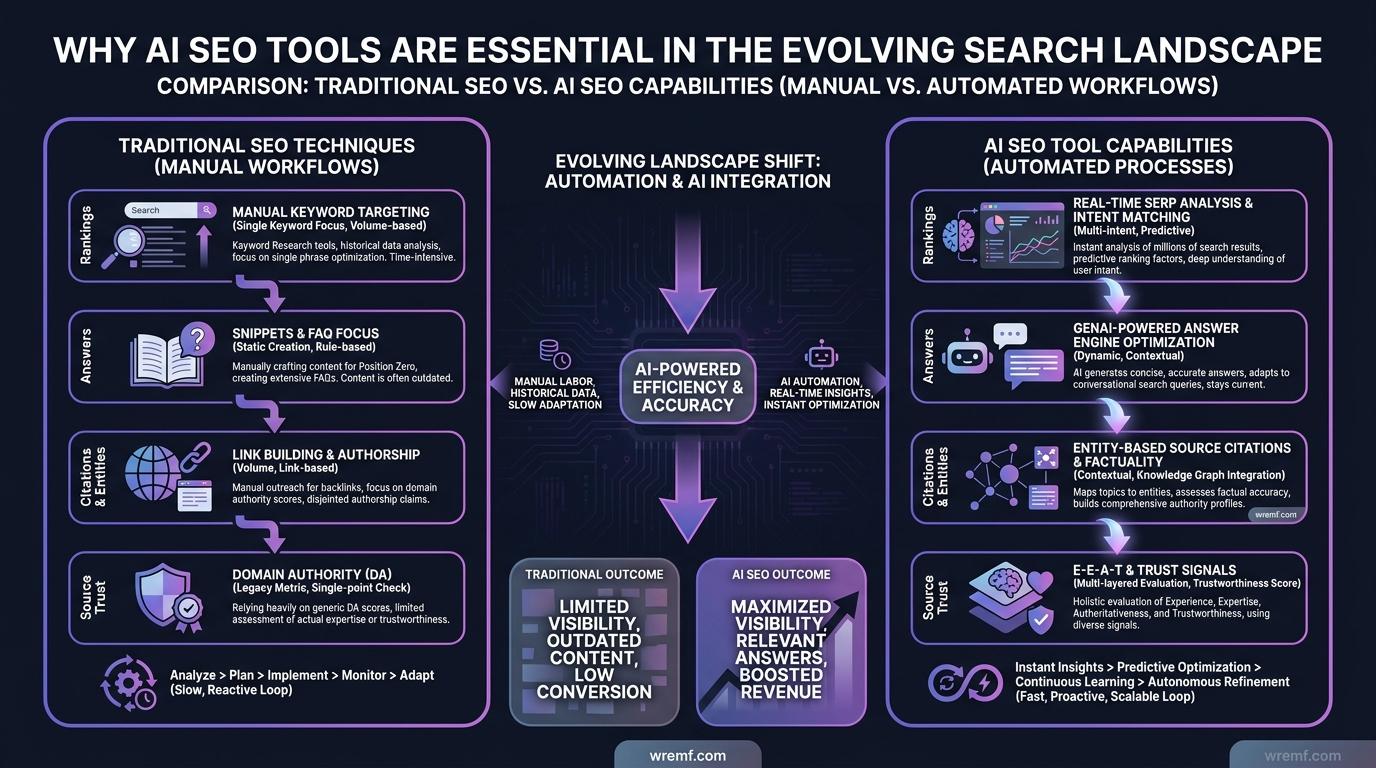
AI SEO tools matter because search visibility now depends on rankings, answers, citations, entities, and source trust. Manual SEO workflows are too slow for teams that need to manage Google Search, AI Overviews, AI answer engines, content production, and competitor visibility together.
Google Search Central explains that search systems are designed to reward helpful, reliable, people-first content. This matters because AI-powered search does not remove the need for quality content. It increases the need for clear, structured, accurate, and useful content that can be understood by both search engines and answer engines.
AI Overviews are Google Search features that generate AI-powered summaries for some queries and provide links for further exploration. Google stated in 2024 that AI Overviews would reach hundreds of millions of users in the United States first and more than one billion people by the end of 2024 through global expansion. The Google AI Overviews announcement shows why AI search is now part of mainstream search behaviour.
Search engines are systems that crawl, index, rank, and present information in response to user queries. Search engines matter because Google Search, Bing, and other discovery platforms still influence traffic, authority, and buyer research.
AI answer engines are systems that generate direct answers, summaries, comparisons, or recommendations from model knowledge, retrieved sources, or connected data. AI answer engines matter because they compress research journeys and can influence vendor selection before a user clicks a website.
The shift from keywords to entities and intent is central to AI-powered SEO. Keyword research still matters, but keywords alone are not enough. AI systems need clear entities, relationships, facts, sources, and answer structures that help them understand who a brand is, what it offers, when it is relevant, and why it should be trusted.
In real B2B buying journeys, users often move across several discovery surfaces. A buyer may start with Google Search, compare tools in Google AI Overviews, ask ChatGPT for alternatives, use Perplexity to verify sources, and then visit vendor websites. This journey makes rank tracking useful but incomplete.
AI SEO tools help teams manage this complexity in four ways:
They reduce manual research by clustering keywords, prompts, entities, and content gaps
They improve content creation through briefs, outlines, AI Writer workflows, and Content Editor guidance
They protect technical foundations through site audit monitoring, schema markup checks, metadata review, and indexing workflows
They measure AI search visibility through prompts, AI answers, citations, brand mentions, competitors, and AI share of voice
DID YOU KNOW: OpenAI describes ChatGPT search as a way to get timely answers with links to relevant web sources, which shows how AI assistants are becoming search interfaces rather than only chat tools. See OpenAI’s ChatGPT search announcement.
AI visibility is both a measurement problem and a source ecosystem problem. The measurement problem is knowing where your brand appears, which prompts trigger mentions, which competitors appear, and which sources are cited. The source ecosystem problem is making sure your website, profiles, documentation, third-party listings, reviews, and authority signals tell a consistent story.
WREMF’s approach is useful because it connects these layers. The WREMF methodology links prompts, citations, competitors, source consistency, AI traffic attribution, and recommendations into a repeatable workflow.
KEY TAKEAWAY: AI SEO tools matter because modern visibility depends on rankings, answers, citations, entity clarity, and source trust across both search engines and AI discovery surfaces.
To choose the right tools, you need a strategic framework that separates intelligence, execution, technical health, AI visibility, and reporting.
How to Build an AI SEO Tools Stack Without Decision Fatigue
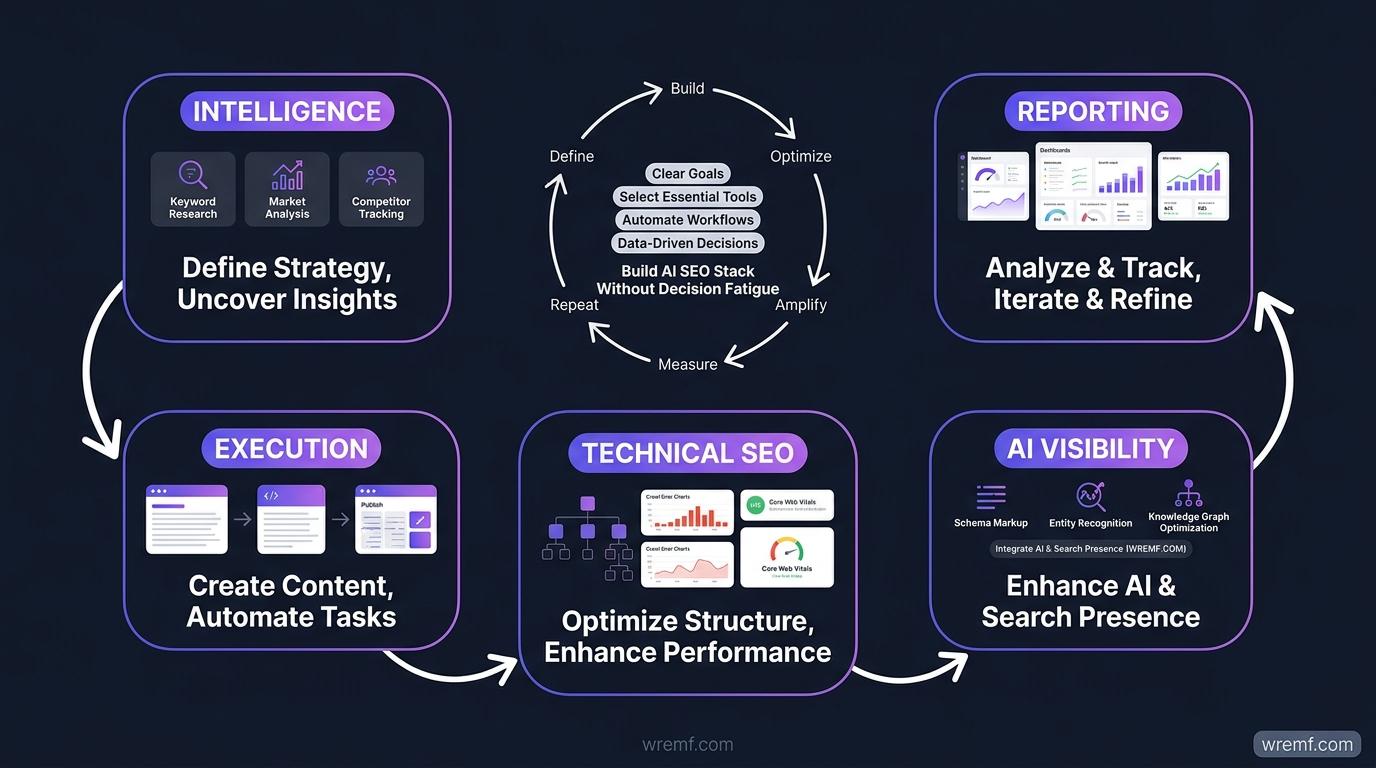
The best AI SEO tools stack starts with the job you need done, not the longest feature list. Choose tools by separating intelligence, execution, technical SEO, AI visibility, and reporting.
Decision fatigue happens when teams compare too many SEO tools without defining what each tool must do. A small business, a B2B SaaS company, an SEO agency, and an enterprise content team need different combinations of software. The right stack depends on website size, publishing velocity, technical complexity, team skill, budget, and reporting expectations.
A practical AI SEO stack has five layers. Search intelligence tools handle keyword research, SERP analysis, competitor analysis, search volume, content gaps, and keyword opportunities. Execution tools support content creation, AI writing, content briefs, content optimization, meta descriptions, and internal linking suggestions. Technical SEO tools handle site audit workflows, indexing issues, schema markup, metadata, JavaScript rendering, and crawl health. AI visibility tools track prompts, AI-generated answers, source citations, AI share of voice, and competitor visibility. Reporting tools connect Google Search Console, Google Analytics, Google Sheets, Google Docs, dashboards, and AI Agent workflows.
Search results are the pages, links, snippets, summaries, and answer elements returned by a search engine for a query. Search results matter because traditional rankings still influence discovery, but AI-generated summaries now change how users interpret those results.
A strong stack should not duplicate the same function across five subscriptions. For example, a team using Semrush or Ahrefs for keyword research may not need another keyword database immediately. That same team may need an AI visibility platform if leadership is asking whether the brand appears in ChatGPT, Perplexity, Gemini, Claude, Copilot, or AI Overviews.
| Business type | Recommended starting stack | Best first priority | Common mistake |
|---|---|---|---|
| Small business | Google Search Console, basic keyword research, AI Writer, site audit | Fix fundamentals and publish useful pages | Publishing AI content without expertise |
| B2B SaaS | Core SEO platform, content briefs, AI visibility, Google Analytics | Connect content strategy to pipeline and AI search | Measuring only rankings |
| SEO agency | SEO tools, AI Visibility Toolkit, white-label reports, workflow automation | Standardise reporting and prompt tracking | Manual reporting across too many clients |
| Enterprise | Technical SEO, API workflows, governance, AI visibility, attribution | Standardise measurement across teams | Buying software without process ownership |
| Content team | Content Editor, Content Brief Generator, AI assistants, internal links | Improve content production quality | Treating AI writing as final content |
| Founder-led team | Keyword research, Content Generation, Google Search Console, AI visibility snapshot | Prioritise highest-intent pages | Chasing tools before positioning is clear |
The tool matchmaker approach works better than searching for one universal winner. Use SEO tools when you need search data. Use content optimization tools when pages need better coverage and structure. Use AI assistants when drafts, outlines, or meta descriptions slow the team down. Use AI visibility tools when the question is “Is your brand invisible to AI?”
AI visibility is the measurable presence of a brand across AI answers, mentions, recommendations, citations, and summaries. AI visibility matters because it shows whether your brand is included in AI-assisted buying journeys.
For WREMF users, this stack can be software-only, agency-led, or hybrid. Software-only works when your team can act on recommendations. Agency support works when you need strategy and execution. A hybrid model works when you want measurable AI visibility plus managed AEO, GEO, and content improvements.
KEY TAKEAWAY: The right AI SEO tools stack assigns each tool a clear job across intelligence, execution, technical SEO, AI visibility, and reporting.
Once the stack is clear, keyword research and topic modeling become the first high-impact use case.
How AI SEO Tools Improve Keyword Research and Topic Modeling
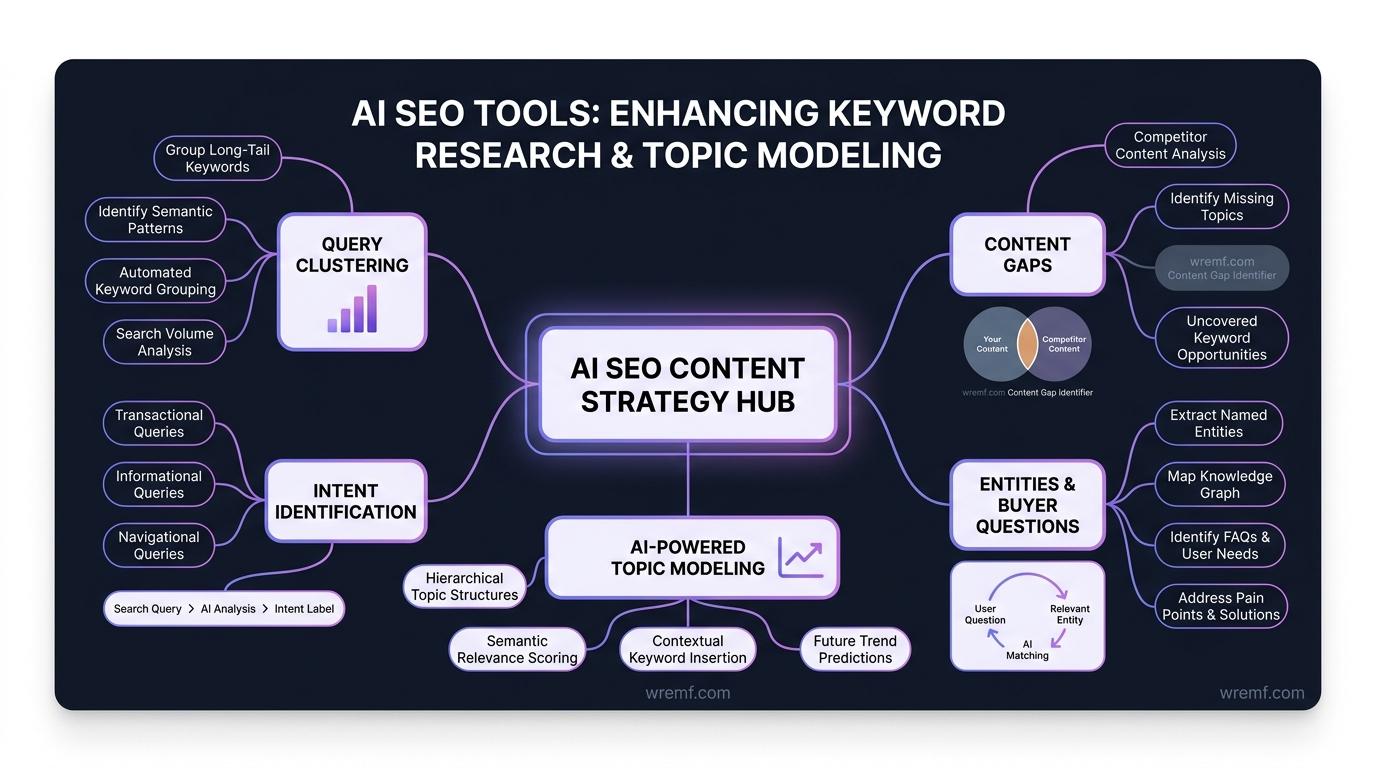
AI SEO tools improve keyword research by clustering queries, identifying intent, finding content gaps, and connecting keywords to entities, prompts, topics, and buyer questions. This makes content strategy more complete than manual keyword lists.
Keyword research is the process of finding the terms, questions, topics, and intent patterns that users search for in search engines or ask inside AI answer engines. Keyword research matters because it determines what content you create, which pages you prioritise, and which buyer questions your website can answer.
Traditional keyword research focuses on search volume, ranking difficulty, current rankings, and competitor pages. AI-powered SEO tools expand that process with machine learning, natural language processing, intent classification, semantic keywords, and topic clustering. This helps content teams move from isolated keywords to structured content trees.
Keyword clustering is the process of grouping related search terms by shared intent, semantic meaning, or similar search results. Keyword clustering matters because a single strong page can often satisfy a topic cluster better than many thin pages targeting near-identical terms.
Content gaps are missing topics, facts, comparisons, questions, entities, or proof points that prevent a page from fully satisfying search intent. Content gaps matter because both search engines and AI answer engines often prefer complete, well-structured sources.
Semrush, Ahrefs, SE Ranking, DataForSEO, Google Search Console, and similar traditional SEO tools help teams find keyword opportunities, competitor rankings, backlink data, SERP data, search volume, and search results trends. AI SEO tools then help turn that data into briefs, outlines, clusters, recommendations, and workflows.
Google Search Console is a free Google tool that reports organic search performance, including clicks, impressions, click-through rate, and average position. Google Search Console matters because it remains a primary source of truth for Google Search performance, even though it does not show how AI answer engines describe your brand.
A practical AI keyword research workflow usually includes:
Export queries and pages from Google Search Console
Pull keyword research data from an SEO platform
Cluster keywords by topic, intent, and funnel stage
Compare search results and SERP analysis for each cluster
Identify content gaps, content decay, and keyword opportunities
Map each cluster to a content brief, update, landing page, or FAQ
Translate high-intent clusters into LLM prompts for AI search tracking
Monitor whether AI answer engines cite, mention, or ignore the brand
Large language models are AI systems that process and generate language. Large language models matter for SEO because they can classify search intent, summarise search results, generate content briefs, and simulate buyer questions when guided by accurate data.
LLM prompts are natural language instructions or questions given to AI systems. LLM prompts matter because B2B buyers often ask AI systems questions that do not look like traditional keywords, such as “Which AI SEO tools are best for SaaS teams?” or “What are the best alternatives to traditional SEO tools for AI search visibility?”
TIP: Build keyword clusters and prompt clusters together. Keywords show how users search in Google. Prompts show how users ask AI assistants for recommendations, comparisons, and explanations.
WREMF’s prompt intelligence feature helps teams monitor the natural language questions buyers ask across AI engines. This connects keyword research to AI search visibility instead of treating them as separate workflows.
KEY TAKEAWAY: AI SEO tools make keyword research stronger when they connect keywords, prompts, entities, search intent, competitors, content gaps, and content strategy.
After research comes content production, where AI can accelerate work without replacing expertise.
How AI SEO Tools Support Content Creation and Content Optimization
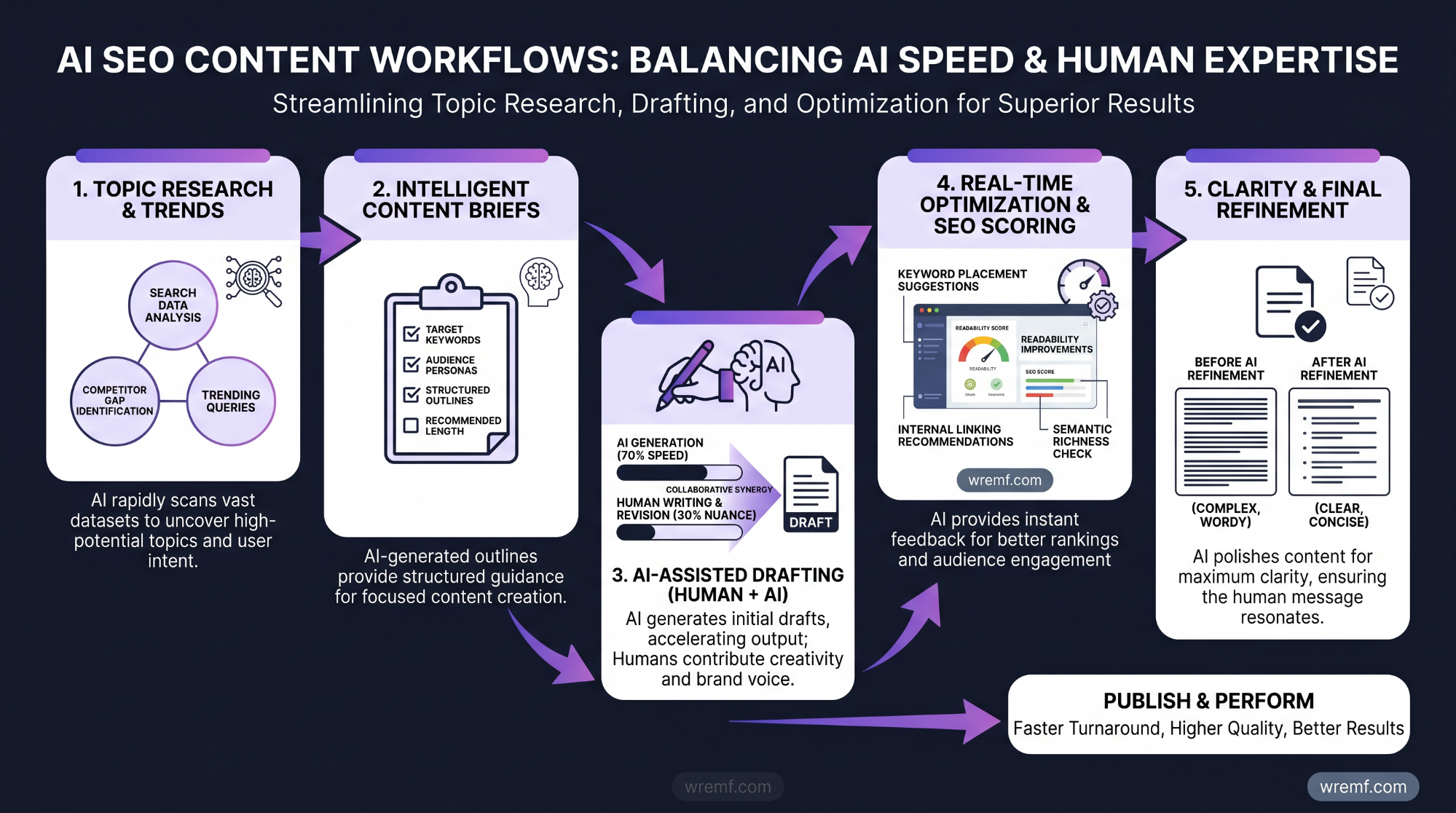
AI SEO tools support content creation by helping teams research topics, generate content briefs, draft sections, optimise structure, and improve clarity. The best workflow uses AI for speed while keeping humans responsible for expertise, accuracy, and final judgement.
Content creation is the process of planning, drafting, editing, and publishing pages that satisfy user intent. Content creation matters because search engines and AI answer engines need clear, useful, trustworthy material to rank, cite, summarise, or recommend.
Content Generation is the use of tools or processes to produce written, visual, or structured content. Content Generation matters because AI can speed up production, but production speed does not equal content quality.
AI writing is the use of AI assistants to plan, draft, rewrite, summarise, or improve text. AI writing matters because it saves time on outlines, meta descriptions, FAQs, title variations, content briefs, and first drafts.
An AI Writer is a tool that uses artificial intelligence to generate or improve text. An AI Writer matters because it can reduce drafting time, but it still needs human review for facts, sources, brand voice, positioning, examples, and originality.
Google Search Central explains that using generative AI tools can be useful for research and structure, but using generative AI to create many pages without adding value may violate Google’s spam policies. The key issue is not whether AI helped create the page. The key issue is whether the page is helpful, reliable, and people-first, as explained in Google Search Central guidance on helpful content.
AI content is content created or assisted by artificial intelligence systems. AI content matters because it can support SEO workflows, but weak AI content can create generic text, factual errors, duplicated ideas, and poor user experience.
A human-in-the-loop content workflow is the safest approach. AI assistants can help with research summaries, content brief drafts, heading ideas, answer-first introductions, meta descriptions, FAQs, title testing, and internal linking suggestions. Human editors should add subject matter expertise, source attribution, product details, customer insights, examples, and final quality control.
Content optimization is the process of improving a page so it better satisfies search intent, covers relevant entities, answers user questions, and provides a clear structure. Content optimization matters because search systems and AI answer engines need extractable, well-supported information.
A Content Editor is a tool that helps writers improve a draft against target topics, entities, semantic keywords, heading structure, readability, and competitor coverage. A Content Editor matters because it makes content optimization more consistent across content teams.
Content Briefs are structured instructions that tell writers what a page must cover, including audience, intent, headings, keywords, entities, questions, examples, sources, internal links, and CTAs. Content Briefs matter because they convert research into repeatable execution.
Content Brief Generator tools help teams turn keyword research, SERP analysis, competitor pages, and prompt data into writer-ready briefs. Content Brief Generator tools matter because they reduce guesswork and make content teams faster.
Surfer SEO, Clearscope, Frase, MarketMuse, Rankability, Ahrefs AI Content Helper, AI Content Helper tools, and similar AI SEO content optimization tools can help teams compare pages against search results, identify missing topics, improve semantic coverage, and organise content production.
Surfer SEO is a content optimization platform commonly used to compare drafts against top-ranking pages and recommend content improvements. Surfer SEO matters because it helps teams align content with search results, although it should not replace editorial judgement.
The fluff trap happens when teams use AI Writer tools to produce long pages with weak insight. Avoiding the fluff trap requires answer-first structure, specific examples, source attribution, original analysis, and clear recommendations. AI assistants should enhance expertise, not replace it.
Meta descriptions are HTML summaries that describe a page for search engines and users. Meta descriptions matter because they can influence click behaviour in search results, even though they do not guarantee rankings.
WREMF’s content briefs feature helps teams create AI-ready briefs that connect search intent, AI prompts, entities, internal links, and citation opportunities. This is useful when content teams want pages that perform in search results and are easier for AI answer engines to interpret.
KEY TAKEAWAY: AI SEO tools can accelerate content creation and content optimization, but durable performance requires human expertise, source-backed claims, clear structure, and editorial control.
Content quality works best when the technical foundation allows search engines and AI systems to access and understand the page.
Where Technical SEO and Agentic Tools Fit in AI SEO
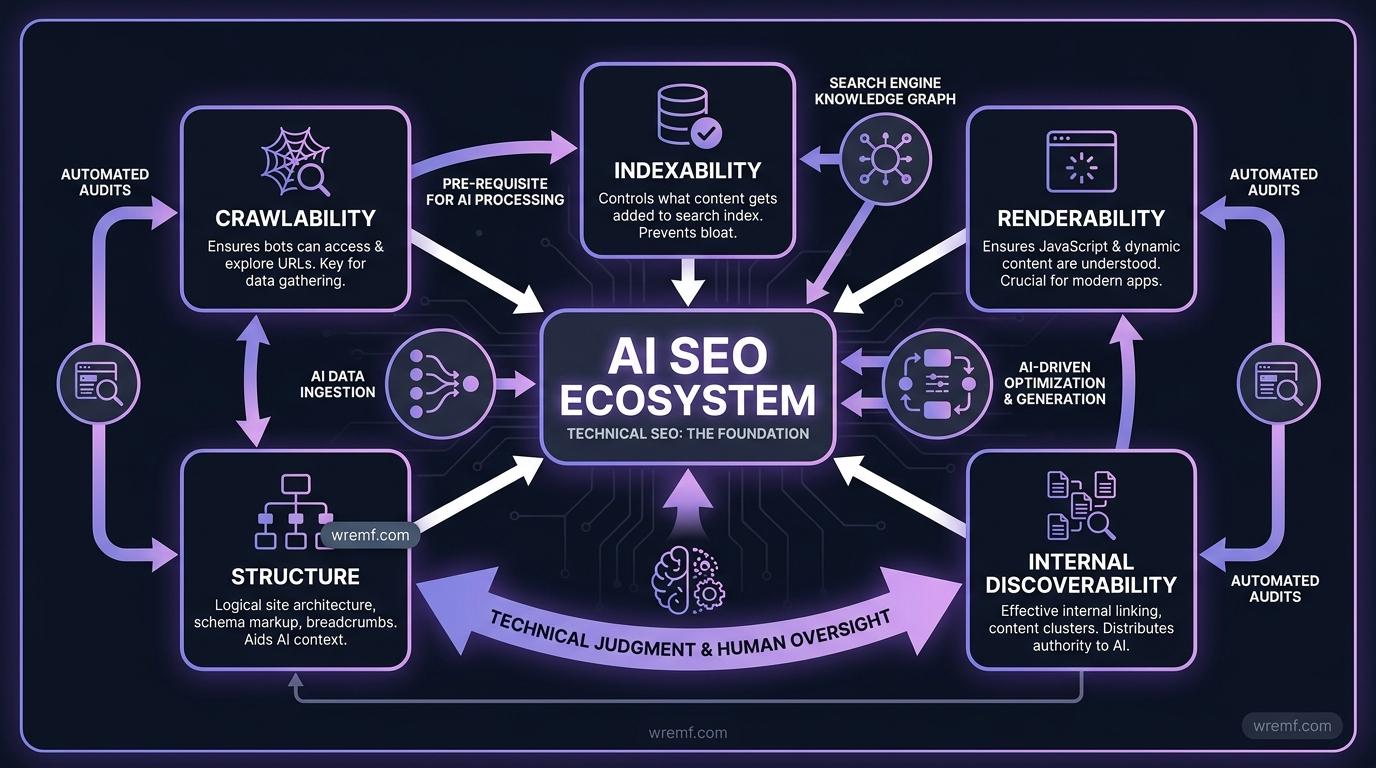
Technical SEO fits in AI SEO because pages must be crawlable, indexable, renderable, structured, and internally discoverable before search engines or AI systems can reliably use them. AI tools can automate audits, but technical judgement is still required.
Technical SEO is the practice of improving website crawlability, indexability, rendering, structured data, performance, metadata, internal links, and site architecture. Technical SEO matters because even strong content can fail if search engines cannot access, understand, or index the page.
A site audit is a technical review that identifies crawl errors, broken links, redirect issues, duplicate metadata, missing titles, indexation problems, schema markup gaps, performance issues, and internal linking problems. A site audit matters because it turns hidden technical risk into a prioritised fix list.
AI-powered technical SEO tools can help with:
Automated site audit monitoring
Technical audits for large websites
AI-powered schema markup suggestions
Metadata and meta descriptions at scale
Internal linking suggestions
Indexing issue detection
JavaScript rendering checks
Crawl depth and orphan page analysis
Log file analysis
Search engine bot monitoring
XML sitemap review
Page template diagnostics
Schema markup is structured data added to a page to help search systems understand entities, page types, products, reviews, events, organisations, FAQs, and other structured information. Schema markup matters because it supports clearer interpretation, although it does not guarantee rankings, AI citations, or AI recommendations.
Internal linking suggestions are recommendations for linking related pages together using relevant anchor text. Internal linking suggestions matter because internal links help users, search engines, and AI retrieval systems understand page relationships and topical authority.
Indexly, Screaming Frog, Sitebulb, Semrush Site Audit, Ahrefs Site Audit, SE Ranking, and other technical SEO tools can help teams find crawl and indexation problems. AI Agent workflows can also create tickets, summarise errors, generate metadata drafts, or update Google Sheets, but automated fixes should be reviewed before deployment.
AI Agent workflows are automated or semi-automated processes where AI systems complete tasks across tools, documents, spreadsheets, or websites. AI Agent workflows matter because they can reduce repetitive SEO work, but they can also create errors if permissions, validation, or review steps are weak.
A common implementation mistake is allowing AI agents to change metadata, internal links, or schema markup without review. Technical SEO errors can affect hundreds or thousands of pages. Automation should start with recommendations, then move to controlled updates after testing.
Google Search uses crawled and indexed web pages to build search results. AI features in Google Search also depend on web content and site owner controls. Google’s AI features and your website documentation explains how site owners should think about inclusion, previews, and controls for AI features.
WREMF’s GEO audit feature helps teams evaluate whether pages are ready for AI retrieval, answer extraction, entity clarity, and source usefulness. This complements traditional technical SEO rather than replacing it.
KEY TAKEAWAY: Technical SEO remains the foundation of AI SEO because search engines and AI systems need accessible, structured, and understandable pages before they can rank, cite, or recommend them.
Once technical foundations are stable, teams can measure whether their brand appears inside AI answers and AI Overviews.
How AI SEO Tools Measure AI Search Visibility and GEO Performance
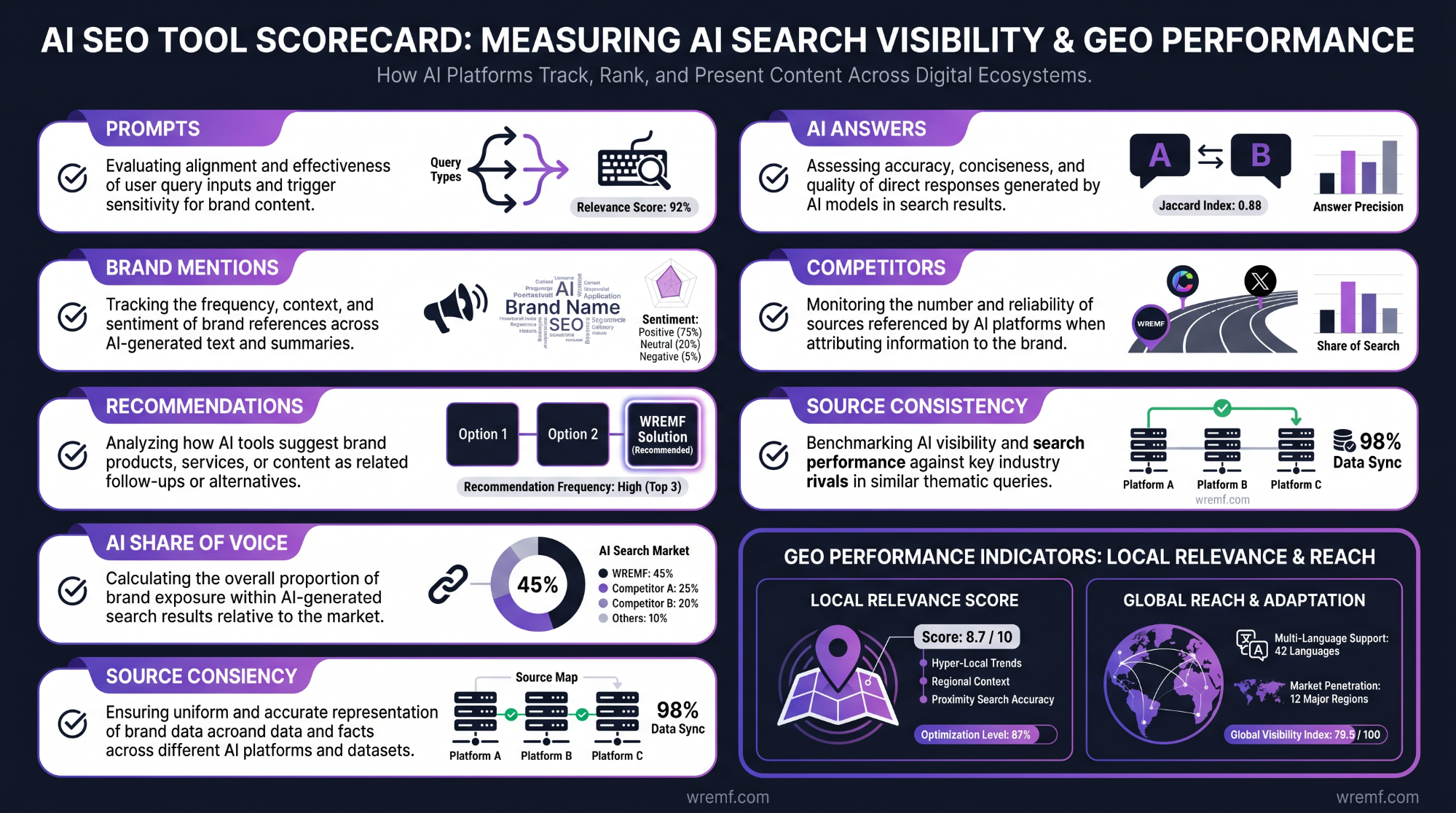
AI SEO tools measure AI search visibility by tracking prompts, AI answers, brand mentions, citations, recommendations, competitors, AI share of voice, and source consistency. GEO performance depends on whether AI systems can find, trust, and use your brand information.
Generative Engine Optimization is the practice of improving how a brand, product, service, or website appears inside generative AI answers. Generative Engine Optimization matters because users increasingly ask AI systems for recommendations, comparisons, summaries, definitions, and buying advice.
Answer engine optimisation is the practice of structuring content so answer engines can extract clear, direct, and trustworthy answers. Answer engine optimisation matters because search experiences now include AI answers, featured snippets, voice results, chat responses, and AI-generated summaries.
Answer engines are systems that respond to user questions with direct answers, source-backed summaries, recommendations, or comparisons. Answer engines matter because they can shape buyer consideration before a user visits a vendor website.
AI answers are responses generated by AI systems in response to user prompts. AI answers matter because they can mention, cite, compare, recommend, or ignore your brand.
AI-generated answers are machine-generated responses created from model knowledge, retrieved sources, connected data, or a combination of these. AI-generated answers matter because they influence perception at the exact moment users are researching a topic.
Perplexity describes itself as an AI-powered search engine that searches the web and provides conversational answers backed by verifiable sources. The Perplexity Help Center explains that answers include citations and links to original sources so users can verify information.
Microsoft describes Bing generative search as a layout that provides an AI-powered summary followed by links and clearly labeled sources. The Bing generative search page shows why citations and source validation are becoming part of mainstream search experiences.
Anthropic’s Claude web search documentation explains that web search can augment Claude with real-time web data and is useful when accurate source citation is needed. This reinforces the importance of source quality and citation readiness in AI search.
AI citations are references, links, or source mentions used by AI systems to support answers. AI citations matter because they reveal which sources influence AI-generated answers and which pages help shape buyer perception.
Source citations are the pages, domains, documents, or third-party sources that AI systems cite, quote, or link when answering a prompt. Source citations matter because they show the source ecosystem behind AI search visibility.
AI Visibility Score is a summary metric that reflects how often and how strongly a brand appears across selected prompts, engines, citations, recommendations, and competitors. AI Visibility Score matters because leadership teams need a simple way to monitor progress.
AI visibility measurement should include at least eight signals:
| Signal | What it measures | Why it matters | Example metric |
|---|---|---|---|
| Brand mentions | Whether the brand appears in AI answers | Shows basic presence | Mention rate |
| Recommendations | Whether the brand is suggested as an option | Shows commercial influence | Recommendation rate |
| Source citations | Which pages or domains AI engines cite | Shows source ecosystem strength | Citation frequency |
| Competitor visibility | Which competitors appear and how often | Shows relative market presence | Competitor share |
| Prompt coverage | Which questions include your brand | Shows intent and topic gaps | Prompt inclusion rate |
| AI share of voice | Brand visibility versus competitors | Shows relative visibility | Share of AI answers |
| Source consistency | Whether brand facts match across sources | Reduces confusion and misrepresentation | Consistency score |
| AI traffic attribution | Visits from AI discovery surfaces | Connects visibility to website activity | AI referral sessions |
Brand mentions are instances where an AI system, search result, article, profile, or third-party source names a brand. Brand mentions matter because a brand can influence buyer perception even when the user does not click immediately.
Competitor visibility is the measurement of which competitors appear in AI answers, how often they appear, and how they are described. Competitor visibility matters because buyers often ask AI systems for alternatives, comparisons, and shortlists.
AI share of voice is the relative share of AI answer presence a brand earns compared with competitors across selected prompts and engines. AI share of voice matters because AI search is often comparative and recommendation-led.
If you want to see how these signals appear in a real report structure, review a sample AI visibility report before building your own measurement workflow.
WREMF’s source citation tracking helps teams see which URLs, domains, articles, documentation pages, and third-party sources influence AI answers. This turns GEO from guesswork into a measurable workflow.
KEY TAKEAWAY: AI visibility measurement requires prompts, citations, mentions, competitors, source consistency, AI share of voice, and attribution rather than rankings alone.
The next distinction is how SEO, AEO, GEO, and AI visibility relate to each other.
SEO vs AEO vs GEO vs AI Visibility: What Is the Difference?
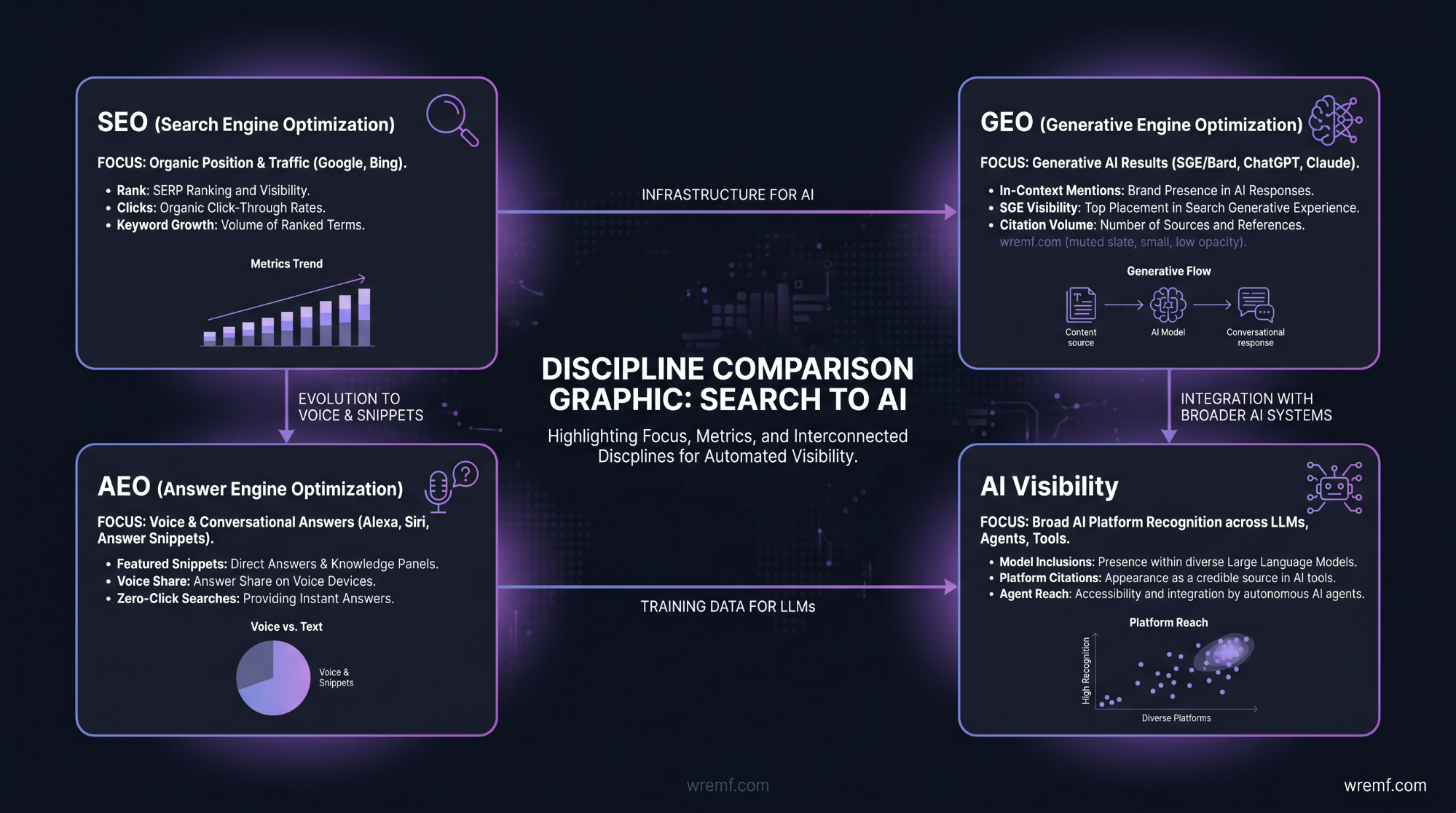
SEO improves visibility in search engines, AEO improves answer extraction, GEO improves presence in generative AI answers, and AI visibility measures brand presence across AI discovery surfaces. These disciplines overlap, but they are not the same.
Search Engine Optimization is the practice of improving website visibility in organic search results. Search Engine Optimization matters because Google Search, Bing, and other search engines remain major discovery channels for B2B buyers, software research, and demand generation.
AEO is Answer Engine Optimization. AEO focuses on making content clear, structured, answer-first, and easy for answer systems to extract. AEO matters because users want direct answers, not only links.
GEO is Generative Engine Optimization. GEO focuses on improving how generative AI systems describe, cite, compare, and recommend a brand. GEO matters because AI assistants increasingly influence research, evaluation, and vendor discovery.
LLM visibility is the presence of a brand, product, source, or expert content inside large language model answers. LLM visibility matters because users ask tools such as ChatGPT, Claude, Gemini, Perplexity, Copilot, DeepSeek, Grok, Meta AI, and Mistral for answers that can influence decisions.
Rank tracking is the process of monitoring keyword positions in search results over time. Rank tracking matters because it shows Google Search movement, but it does not show whether AI assistants mention, cite, or recommend a brand.
| Discipline | Best for | What it measures | What it misses | Example metric |
|---|---|---|---|---|
| SEO | Organic search visibility | Rankings, clicks, impressions, CTR, backlinks, technical health | AI recommendations and citations | Google Search Console clicks |
| AEO | Direct answer extraction | Answer clarity, snippet readiness, FAQ structure, answer-first formatting | Broader AI recommendation patterns | Answer inclusion |
| GEO | Generative AI visibility | AI answers, citations, prompts, entity clarity, source influence | Full Google Search performance | AI citation rate |
| Rank tracking | Search engine position monitoring | Keyword rankings over time | Brand mentions, AI answers, source citations | Rank Tracker position |
| AI visibility | Cross-engine brand presence | Mentions, recommendations, citations, competitors, AI share of voice | Technical SEO unless integrated | AI Visibility Score |
The key difference between SEO and GEO is that SEO optimises for search engine visibility, while GEO optimises for generative answer visibility. The best strategy uses both because AI answer engines often rely on the same web ecosystem that search engines crawl and rank.
Google Search remains important because AI search does not replace every search behaviour. Users still inspect search results, visit vendor websites, read documentation, compare pricing, check reviews, and validate claims. AI answer engines add another discovery layer where users ask broader and more conversational questions.
Source consistency helps AI systems understand a brand more reliably. Source consistency is the degree to which important brand facts match across a website, profiles, databases, articles, reviews, documentation, and third-party references. Source consistency matters because conflicting information can weaken trust and create inaccurate AI answers.
AI visibility is the measurable presence of a brand inside AI-generated answers, recommendations, citations, and summaries. AI visibility matters because ranking on Google is no longer the only way buyers discover and evaluate brands.
WREMF’s competitive landscape feature helps teams compare brand visibility against competitors across AI prompts and engines. This is useful when leadership wants to know which competitors AI systems recommend and why.
KEY TAKEAWAY: SEO, AEO, GEO, and AI visibility work together, but each measures a different layer of modern discovery.
With the definitions clear, the next step is choosing the right AI SEO tool categories for your team.
The Best AI SEO Tool Categories to Consider in 2026
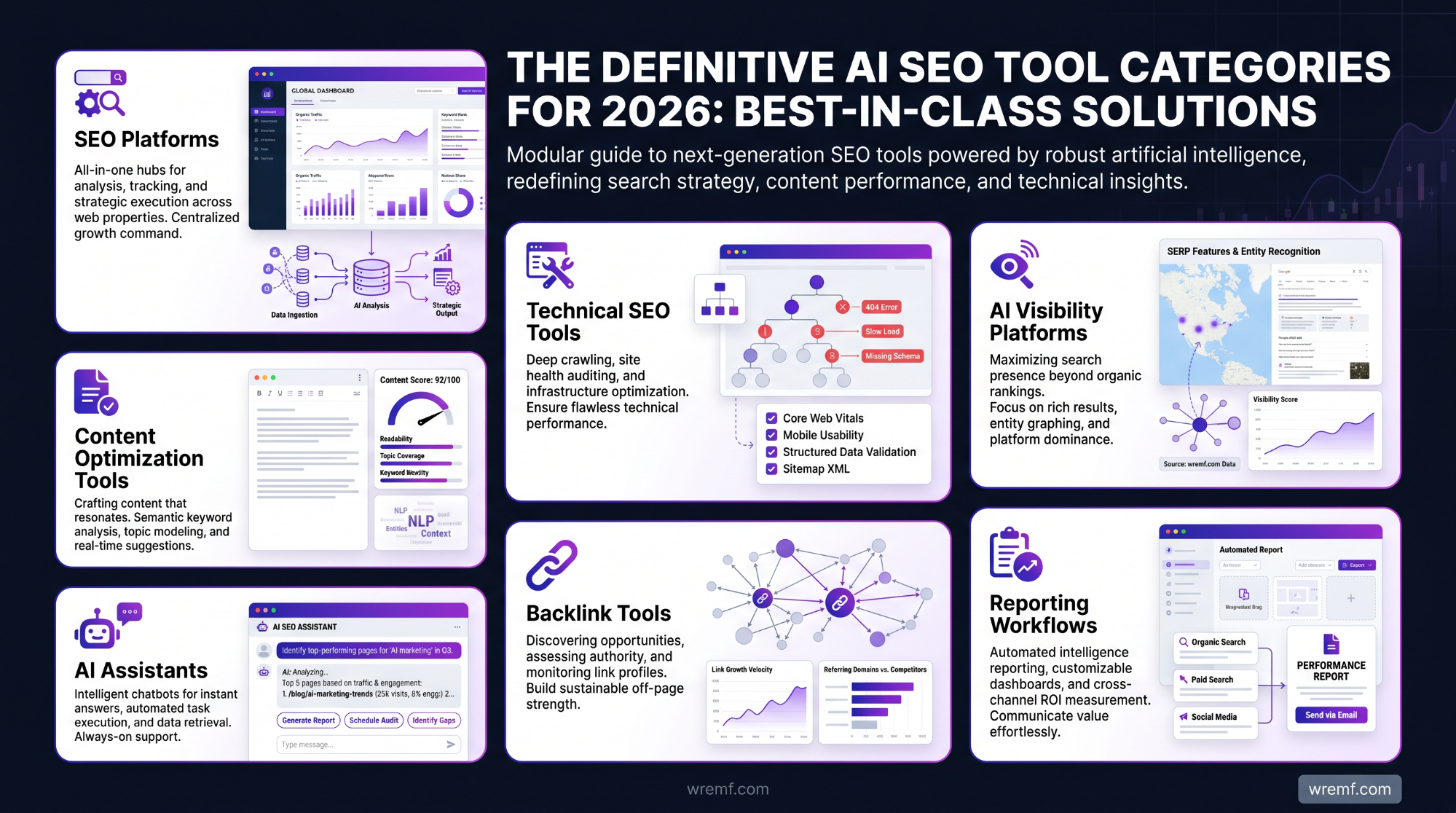
The best AI SEO tools in 2026 fall into categories rather than one universal winner. Most teams need a mix of SEO platforms, content optimization tools, AI assistants, technical SEO tools, backlink tools, AI visibility platforms, and reporting workflows.
There is no single best AI SEO tool for every business. A local business may need Google Business Profile support, basic keyword research, and content creation. A B2B SaaS company may need content strategy, AI search visibility, attribution, and competitor analysis. An SEO agency may need white-label reporting, client portals, AI visibility tracking, and workflow automation.
SEO tools are software platforms that help teams improve search engine performance through keyword research, competitor analysis, rank tracking, site audit workflows, backlink analysis, and reporting. SEO tools matter because search engine visibility remains the foundation for many AI discovery workflows.
Traditional SEO tools include platforms such as Semrush, Ahrefs, SE Ranking, DataForSEO, Google Search Console, and Rank Tracker tools. Traditional SEO tools matter because they provide the search data that content teams, technical SEO teams, and agencies still need.
Semrush One, Ahrefs Site Explorer, SE Ranking, DataForSEO, and similar platforms are useful for search volume, keyword opportunities, competitor analysis, backlink data, Site Explorer workflows, Rank Tracker monitoring, and SERP data. They are often the starting point for SEO teams that need broad search intelligence.
Backlink analysis is the process of reviewing external links, referring domains, anchor text, authority, relevance, and risk. Backlink analysis matters because backlink profiles can influence authority, discovery, and trust.
Backlink profiles are the collection of external links pointing to a website. Backlink profiles matter because AI systems and search engines may use authority, source reputation, and third-party references as part of the broader discovery ecosystem.
Link building is the process of earning or acquiring links from other websites. Link building matters when it improves authority and source relevance, but low-quality link farms can create risk instead of trust.
Pitchbox, backlink outreach tools, Ranking Raccoon, Semrush, Ahrefs, and similar platforms can help with outreach, link prospecting, and backlink data. The goal should be genuine link opportunities, not volume for its own sake.
SERP analysis is the process of reviewing search engine results pages to understand ranking patterns, formats, intent, competitors, and content expectations. SERP analysis matters because top search results reveal what users and search systems currently reward.
Content Reports and Content Manager workflows help teams monitor content quality, decay, performance, and updates. These workflows matter because AI SEO is not a one-time publishing process. Pages need updates as search results, AI answers, competitors, and user behavior change.
| Category | Example tools or workflows | Best for | What it measures or improves | Main limitation |
|---|---|---|---|---|
| Core SEO platforms | Semrush, Ahrefs, SE Ranking, DataForSEO | Keyword research, competitor analysis, site audit, backlink data | Rankings, keywords, search volume, links, technical health | Limited AI answer visibility |
| Content optimization tools | Surfer SEO, Clearscope, Frase, MarketMuse, Rankability | Content briefs, Content Editor workflows, content optimization | Topic coverage, semantic keywords, intent alignment | Can over-focus on surface-level content scores |
| AI writing tools | ChatGPT, Claude, Gemini, AI Writer platforms | Drafts, outlines, meta descriptions, content generation | Drafting speed and ideation | Needs expert review |
| Technical SEO tools | Screaming Frog, Sitebulb, Indexly, Semrush Site Audit | Technical audits, crawl health, indexing | Site health and technical SEO issues | Does not measure AI recommendations |
| Backlink tools | Ahrefs, Semrush, Pitchbox, outreach tools | Backlink analysis, backlink profiles, link building | Links, authority, outreach opportunities | Can encourage low-quality outreach if misused |
| AI visibility tools | WREMF, AI Visibility Toolkit platforms | AI answers, prompts, source citations, competitor visibility | AI visibility, AI share of voice, source consistency | Needs prompt strategy |
| Workflow tools | Google Sheets, Google Docs, AI Agent workflows, n8n | Reporting, automation, data pipelines | Repeatable workflows and reporting speed | Can be fragile without governance |
Content trees are structured groups of related pages that support a broader topic cluster. Content trees matter because AI search and Google Search both benefit from clear topic relationships, internal links, and complete coverage.
Semantic keywords are related terms, entities, attributes, and phrases that help explain a topic. Semantic keywords matter because they support topic clarity and reduce reliance on exact-match keyword repetition.
Natural language processing helps AI SEO tools classify intent, extract entities, cluster keywords, and evaluate content. Natural language processing matters because it helps teams understand language patterns at scale.
The best category for your team depends on the bottleneck. Use core SEO platforms if you lack search data. Use content optimization tools if content quality is inconsistent. Use AI assistants if drafting is slow. Use technical SEO tools if pages are not being indexed. Use AI visibility tools if your brand is invisible in AI-generated answers.
KEY TAKEAWAY: The best AI SEO tools are category-specific, so your stack should match the exact workflow problem you need to solve.
After selecting categories, teams need a workflow that connects AI tools to everyday SEO operations.
How to Integrate AI SEO Tools Into Your Existing Workflow
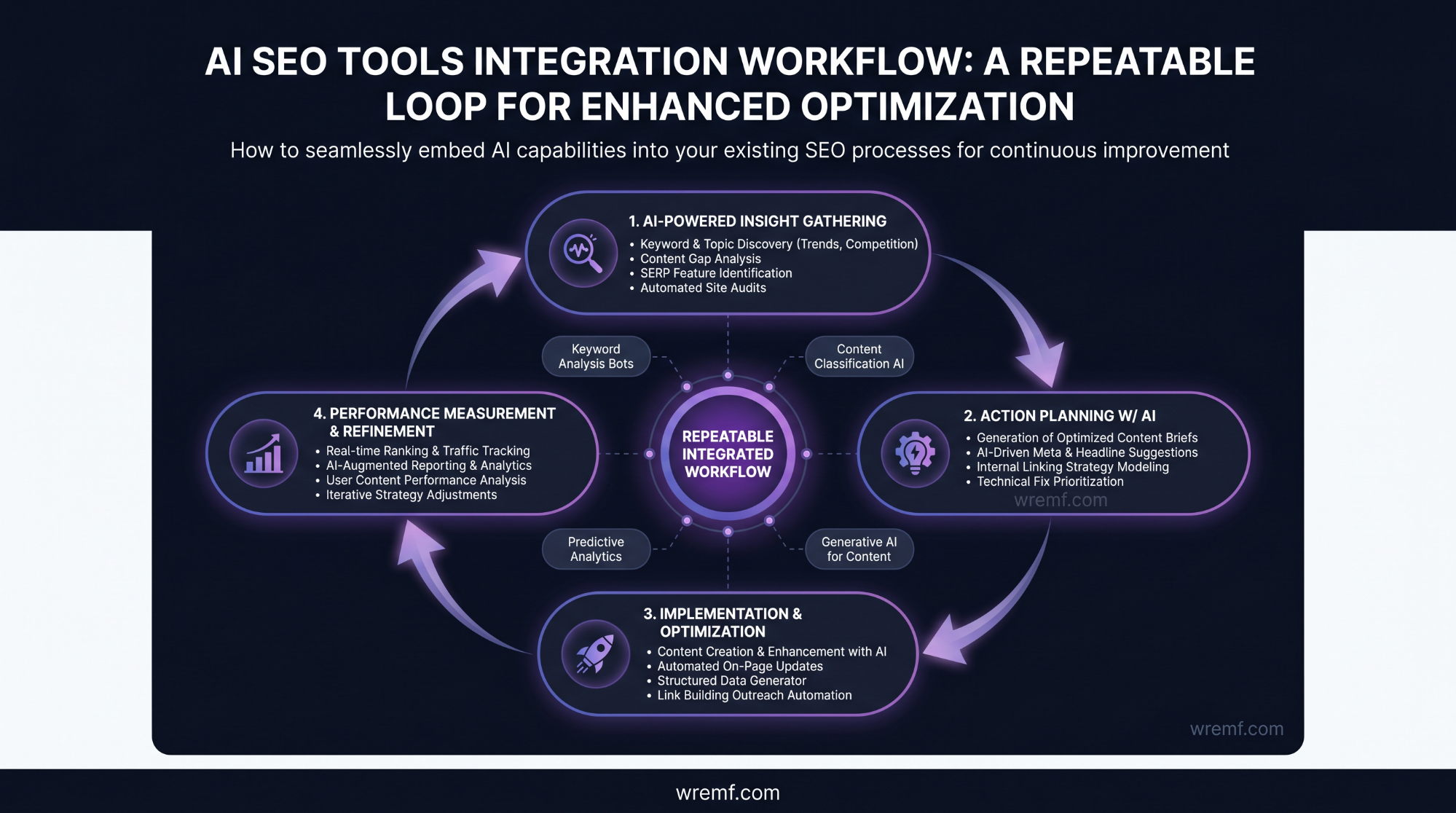
AI SEO tools work best when they are integrated into existing SEO, content, analytics, and reporting workflows. The goal is not to add more dashboards, but to create a repeatable process from insight to action to measurement.
Most teams already have a workflow that includes Google Search Console, Google Analytics, keyword research, Google Docs, Google Sheets, content briefs, publishing tools, and reporting. AI SEO tools should improve those steps rather than create disconnected tasks.
Google Analytics is a web analytics platform that helps teams measure traffic, user behavior, conversions, and acquisition channels. Google Analytics matters because AI visibility should eventually connect to website activity, even when AI-assisted discovery does not always produce an immediate click.
Google Sheets is a spreadsheet tool commonly used for SEO data exports, content planning, audits, and reporting. Google Sheets matters because many SEO teams use it as the operational layer between tools, writers, developers, and leadership.
Google Docs is a document editor commonly used for content briefs, drafts, reviews, and editorial workflows. Google Docs matters because content teams often need AI SEO insights to become writer-ready briefs, not just dashboard observations.
A practical AI SEO workflow looks like this:
Pull search data from Google Search Console and SEO tools
Identify keyword opportunities, content gaps, and technical issues
Use AI assistants to classify intent and organise topics
Create Content Briefs for high-priority pages
Draft or update content with human-in-the-loop review
Use a Content Editor for content optimization and structure checks
Run a technical SEO site audit before publishing major updates
Track search results, rank tracking, clicks, impressions, and CTR
Track AI answers, AI citations, brand mentions, and competitor visibility
Report progress through dashboards, Google Sheets, or client reports
Run SEO testing where changes need validation
SEO testing is the process of measuring whether a page, template, content update, internal link change, or technical change improves performance. SEO testing matters because it helps teams separate useful changes from random movement.
A common B2B workflow mistake is measuring only publishing output. Content teams report how many pages they created, but not whether those pages improved Google Search performance, AI search visibility, source citations, or pipeline. AI-powered SEO workflows should connect activity to outcomes.
WREMF’s SEO testing feature helps teams evaluate whether content and SEO changes produce measurable performance movement. This is useful for teams that need to prove which updates influenced search visibility.
Agencies managing multiple clients often need repeatable workflows more than isolated AI features. White-label reports, scheduled monitoring, client portals, and API access reduce manual work and make AI visibility easier to explain.
WREMF supports technical teams through API and MCP integrations. This is useful when teams want to connect AI visibility data to internal dashboards, client portals, data warehouses, workflows, or custom reporting systems.
KEY TAKEAWAY: AI SEO tools create the most value when they connect research, content, technical SEO, AI visibility, testing, and reporting into one workflow.
A connected workflow also helps teams choose between software, agency support, or a hybrid model.
Should You Use AI SEO Software, an Agency, or a Hybrid Model?
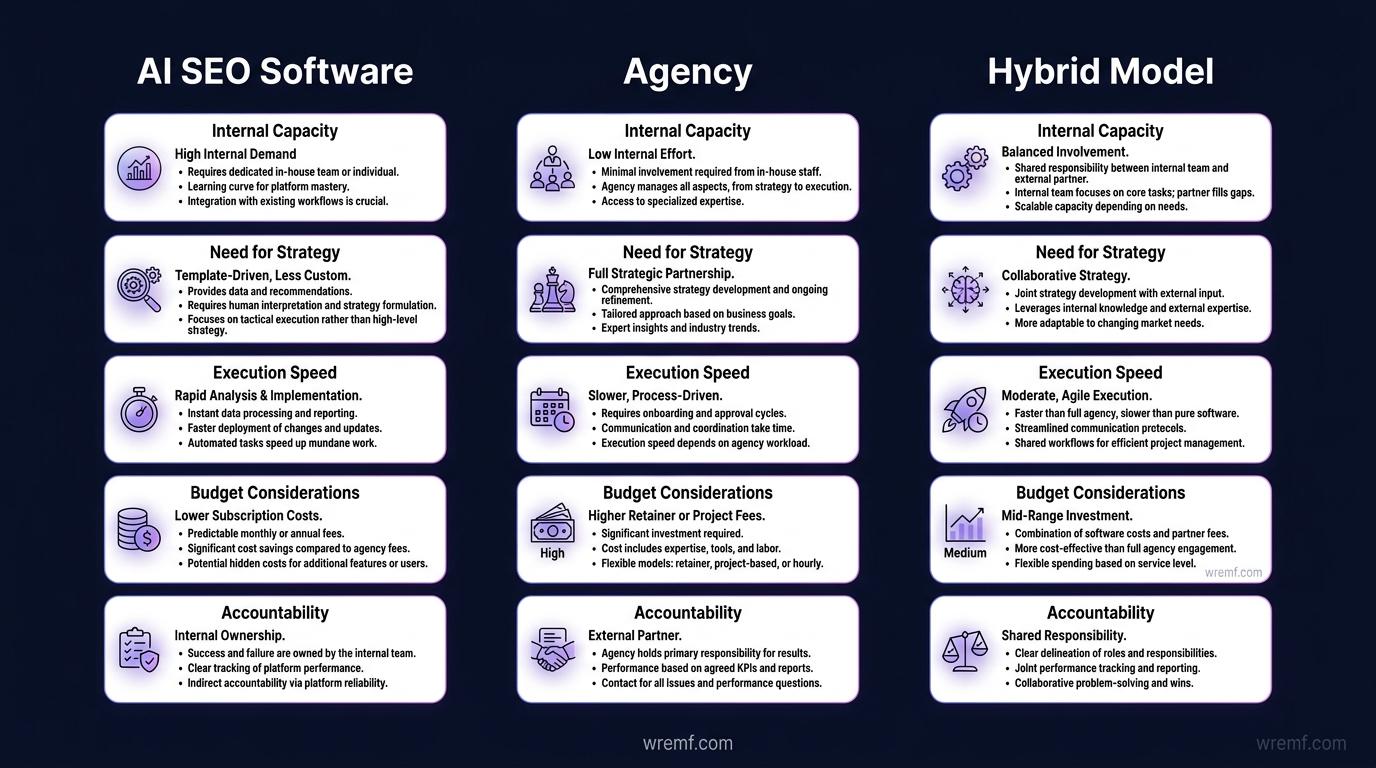
Use AI SEO software when you have internal execution capacity, use an agency when you need expert strategy and implementation, and use a hybrid model when you want software visibility plus managed execution. The right choice depends on team skill, speed, budget, and accountability.
AI-powered SEO is not only a tooling problem. Teams still need strategy, prioritisation, editorial standards, technical fixes, source consistency cleanup, content strategy, analytics, and reporting. A dashboard can show a gap, but someone must decide what to fix and how.
Software is best when your team can act on recommendations. In-house SEO and content teams often prefer software because they already own publishing, analytics, development tickets, editorial workflows, and reporting. Software also supports repeatable monitoring across keywords, prompts, search results, AI answers, and competitors.
Agency support is best when the team lacks time, expertise, or internal bandwidth. WREMF agency services support GEO, AEO, content optimisation, entity and authority building, source consistency cleanup, citation improvement, technical AI visibility foundations, schema and entity markup guidance, internal linking logic, crawl checks, rendering checks, share of voice tracking, and monthly reporting.
Hybrid support is best when a brand needs measurement and execution. This is common for B2B SaaS companies, agencies, consultants, and growth teams that want clear visibility data plus help turning recommendations into implemented changes.
| Option | Best for | Execution required | Reporting value | Recommended when |
|---|---|---|---|---|
| Software only | Teams with SEO and content capacity | High | High | You can act on insights internally |
| Agency only | Teams needing strategy and execution | Low internally | Medium to high | You lack time or specialist expertise |
| Hybrid model | Teams needing measurement and action | Shared | Very high | You want visibility data and implementation support |
| Manual workflow | Very small sites or early validation | Very high | Low | You are testing before buying tools |
For pricing context, WREMF offers Starter at €39 per month for 1 website, Growth at €89 per month for 5 websites, and custom Enterprise pricing for unlimited websites, unlimited seats, and custom branded portals. All plans include unlimited prompt tracking, BYOK, 10 AI engines, all features and tools, and white-label reports. Teams comparing cost, plans, and buying options can review WREMF pricing.
BYOK means bring your own key. BYOK matters because teams can connect their own AI provider keys for cost control, governance, provider flexibility, and workflow ownership.
White-label reporting is reporting that can be branded for an agency or client-facing team. White-label reporting matters because agencies and consultants need professional client reports without rebuilding dashboards manually.
The WREMF agency team is relevant for teams that want managed AEO, GEO, AI visibility strategy, content optimisation, source consistency cleanup, citation improvement, and reporting. WREMF’s agency positioning is clear deliverables, senior-led execution, and no long-term lock-in.
KEY TAKEAWAY: Software gives control, agency support gives execution, and a hybrid model gives teams the strongest balance of measurement, action, and accountability.
The next section explains how WREMF connects the full AI SEO workflow into one system.
How WREMF Helps Teams Track, Improve, and Prove AI Visibility
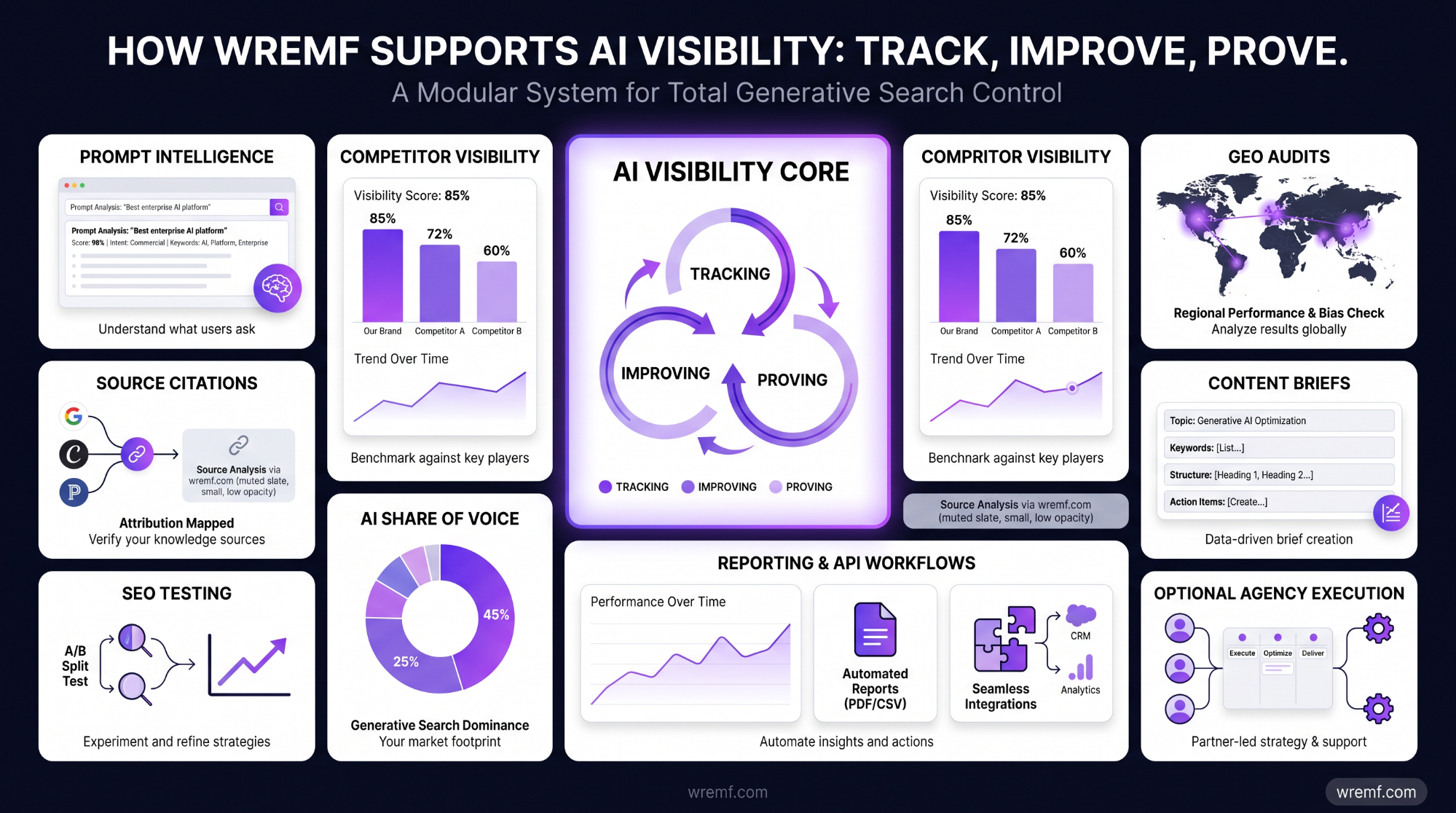
WREMF helps teams track, improve, and prove AI visibility by combining prompt intelligence, source citations, competitor visibility, AI share of voice, GEO audits, content briefs, SEO testing, reporting, API workflows, and optional agency execution. WREMF turns AI visibility into a measurable workflow.
WREMF is an AI visibility platform for B2B brands, agencies, consultants, and growth teams. WREMF matters because it connects AI search measurement with action recommendations, reporting, and execution support.
The WREMF methodology connects prompts, citations, competitors, source consistency, visibility scoring, and attribution into one repeatable system. This helps teams move from “we think AI search matters” to “we know where we appear, where competitors appear, which sources matter, and what to improve next.”
WREMF helps teams with:
AI visibility tracking across 10 AI engines
Prompt intelligence for buyer questions and comparison prompts
Source citation tracking across URLs and domains
Competitor visibility and AI share of voice
AI traffic attribution and reporting
GEO audits for page-level AI retrieval readiness
AEO strategy and answer-first content improvements
AI-ready content briefs and content optimization workflows
SEO testing and visibility scoring
Scheduled AI monitoring and alerting
White-label client reporting for agencies
API and MCP integrations for technical teams
BYOK support for cost control and provider flexibility
Client portals for agencies and multi-brand teams
Source consistency analysis across the brand ecosystem
WREMF is useful for brands that want software, agencies that need white-label reporting, and teams that want managed execution. It can be used as software, an agency service, or a combined software plus managed execution solution.
The WREMF AI Visibility Index helps teams evaluate visibility across AI engines, prompts, citations, and competitors. This is useful when leadership wants a high-level score but SEO teams also need the underlying data.
The WREMF source citations feature helps teams identify which websites, pages, articles, profiles, and documentation influence AI-generated answers. This matters because AI citations often reveal the source ecosystem behind brand recommendations.
The WREMF competitive landscape feature helps teams understand which competitors appear in AI answers and how they are described. This matters because AI answer engines often answer buying-stage prompts with comparative recommendations.
For agencies, WREMF supports client portals, white-label reporting, multi-website tracking, scheduled monitoring, and repeatable AI visibility workflows. Agencies can explore WREMF for agencies when client reporting and multi-account management are priorities.
For in-house teams, WREMF supports brand monitoring, competitor visibility, AI search reporting, GEO audits, content briefs, and attribution workflows. In-house marketers can explore WREMF for brands when they need to connect AI visibility to brand and growth priorities.
WREMF does not guarantee rankings, AI citations, traffic, revenue, or AI recommendations. WREMF helps teams measure what AI engines say, identify what is missing, prioritise improvements, and report progress in a structured way.
KEY TAKEAWAY: WREMF helps teams operationalise AI SEO by connecting prompts, citations, competitors, source consistency, content actions, testing, and reporting.
Even with the right platform, teams need to understand the risks and limitations of AI SEO tools before scaling them.
What Are the Risks and Limitations of AI SEO Tools?
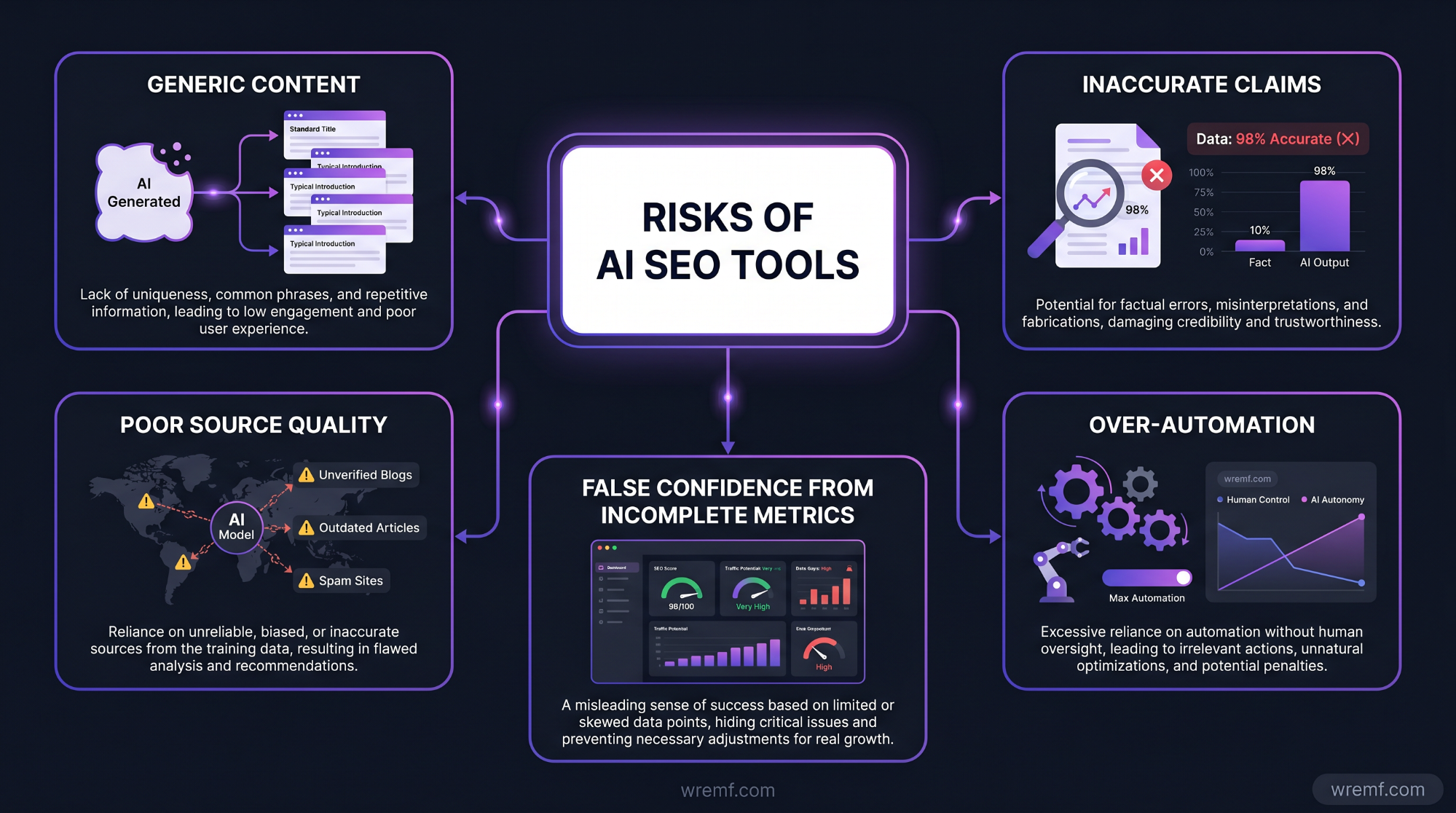
AI SEO tools create risk when teams use them without human review, source validation, brand governance, or measurement discipline. The biggest risks are generic content, inaccurate claims, poor source quality, over-automation, and false confidence from incomplete metrics.
AI SEO tools do not automatically follow SEO best practices. They can suggest keywords, generate content, produce metadata, cluster topics, identify content gaps, and automate reporting. They can also misread intent, hallucinate facts, recommend irrelevant internal links, overuse keywords, create duplicated ideas, or optimise for competitors that do not match your audience.
Machine learning is a branch of artificial intelligence where systems identify patterns from data and improve predictions or classifications. Machine learning matters for SEO because it can support keyword clustering, anomaly detection, content scoring, rank tracking analysis, and predictive trend analysis.
User behavior is the way visitors interact with search results, pages, websites, tools, and content. User behavior matters because clicks, engagement, conversions, scroll depth, and assisted discovery reveal whether visibility is useful or only visible.
The ethics and risks of AI-generated content include accuracy, originality, bias, copyright, disclosure, compliance, and brand voice. Google’s guidance focuses on helpful content rather than whether AI assisted the process, but teams remain responsible for publishing useful, accurate, and reliable information.
Common AI SEO risks include:
Publishing AI content without expert review
Treating Content Editor scores as quality guarantees
Using AI Writer tools to create thin pages at scale
Ignoring Google Search Console after adopting AI tools
Measuring only rank tracking while ignoring AI citations
Optimising for keywords without entity clarity
Building links without checking relevance and risk
Automating meta descriptions without accuracy checks
Treating AI Visibility Score as a complete business outcome
Ignoring user behavior after content updates
Letting AI agents make technical changes without review
Using generic prompts for complex content audits
Protecting neither brand voice nor factual consistency
A common implementation mistake is confusing automation with strategy. AI assistants can classify keywords, draft briefs, generate content, and summarise search results. They do not automatically know your ICP, positioning, product roadmap, sales objections, customer proof, compliance requirements, or brand voice.
IMPORTANT: AI SEO tools should support strategy, not replace it. The SEO professional is becoming an AI orchestrator who coordinates search data, prompts, content, sources, automation, and human expertise.
In practical AI visibility audits, teams frequently discover that source consistency is the weak point. The website says one thing, third-party profiles say another, documentation is outdated, and comparison pages use old positioning. AI systems can reproduce that confusion.
Source consistency is the degree to which important brand facts are accurate and aligned across your website, profiles, reviews, databases, documentation, and third-party sources. Source consistency matters because conflicting information can weaken trust and create inaccurate AI-generated answers.
KEY TAKEAWAY: AI SEO tools are powerful when governed well, but they create risk when teams automate content, reporting, technical changes, or optimisation without expert validation.
These risks are closely connected to common myths about AI visibility and modern SEO.
Common Myths About AI Visibility Debunked
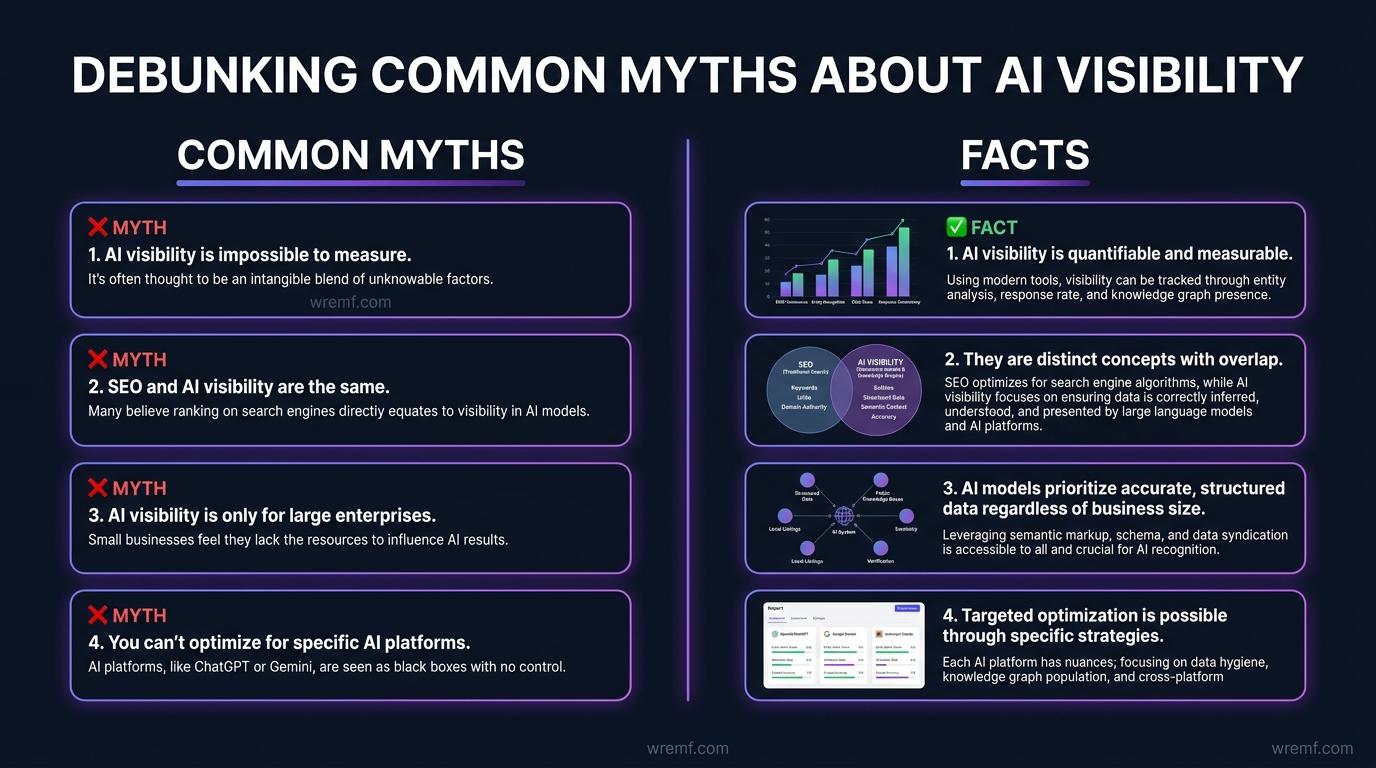
AI visibility is measurable and improvable, but it is not measured the same way as traditional rankings. The most common myths come from treating AI search as either impossible to influence or identical to SEO.
MYTH: AI visibility is impossible to measure.
FACT: AI visibility can be measured through prompt tracking, brand mentions, source citations, competitor visibility, AI share of voice, and AI traffic attribution. The measurement is probabilistic because AI answers can vary, but scheduled monitoring and consistent prompt sets reveal useful trends.
MYTH: SEO, AEO, and GEO are completely separate strategies.
FACT: SEO, AEO, and GEO overlap because AI answer engines still depend on accessible content, trusted sources, clear entities, and user intent. The difference is the measurement layer. SEO tracks search engine visibility, AEO improves answer extraction, and GEO improves presence inside generative answers.
MYTH: Rankings alone are enough.
FACT: Rankings remain important, but rankings do not show whether ChatGPT, Claude, Gemini, Perplexity, Copilot, or Google AI Overviews mention, cite, or recommend your brand. A page can rank in Google Search while a competitor dominates AI-generated answers.
MYTH: AI SEO tools automatically produce high-quality SEO content.
FACT: AI SEO tools can speed up content creation, but quality still depends on expertise, accuracy, usefulness, sources, examples, and editorial review. AI-generated drafts often need human examples, product knowledge, stronger source attribution, and clearer recommendations before publishing.
MYTH: Only large brands can appear in AI answers.
FACT: Large brands often have stronger authority signals, but niche brands can improve AI visibility by creating clear entity information, useful answer-first content, consistent profiles, strong documentation, and credible third-party source coverage. AI visibility is a source ecosystem problem, not only a brand size problem.
KEY TAKEAWAY: AI visibility is measurable and improvable, but teams must look beyond rankings to prompts, citations, competitors, source consistency, and AI share of voice.
The final step is answering the questions buyers, marketers, agencies, and SEO teams ask before choosing AI SEO tools.
Frequently Asked Questions
What are AI SEO tools?
AI SEO tools are software platforms that use artificial intelligence, machine learning, automation, or large language models to improve search visibility. They help with keyword research, content creation, content optimization, technical SEO, rank tracking, backlink analysis, AI visibility, and reporting. The best AI SEO tools do not replace SEO strategy. They help teams find better opportunities, create clearer content, monitor search results, measure AI answers, and report performance across Google Search, AI Overviews, ChatGPT, Claude, Gemini, Perplexity, Copilot, and other answer engines.
Why do AI SEO tools matter?
AI SEO tools matter because search visibility now includes rankings, AI Overviews, AI-generated answers, citations, recommendations, and brand mentions. Manual SEO workflows are often too slow for teams that need to manage content strategy, technical SEO, keyword research, content production, search engine performance, and AI search visibility together. AI SEO tools help teams process more data, find content gaps, generate better briefs, monitor competitors, and measure whether their brand appears in AI answer engines.
What is the best AI SEO tool for beginners?
The best AI SEO tool for beginners depends on the main problem. If you need basic search performance data, start with Google Search Console and a simple SEO platform. If you need content creation, use an AI Writer with human review. If you need content optimization, use a Content Editor or Content Brief Generator. If you need AI search visibility, use WREMF to track prompts, AI answers, source citations, competitors, and AI share of voice. Beginners should avoid buying too many tools at once.
How do AI SEO tools differ from traditional SEO tools?
Traditional SEO tools focus on search engines, keyword research, search results, rank tracking, backlink analysis, site audit data, and Google Search performance. AI SEO tools add AI writing, content optimization, prompt tracking, source citation tracking, intent classification, AI-generated answer analysis, AI share of voice, and workflow automation. The main difference is scope. Traditional SEO tools help you understand search engine performance, while AI SEO tools help you understand both search engine visibility and AI answer visibility.
Can AI tools help me optimise for AI search results?
Yes, AI tools can help optimise for AI search results when they track prompts, AI answers, brand mentions, source citations, competitor visibility, and content gaps. The practical workflow is to identify high-value prompts, analyse which sources AI engines cite, improve answer-first content, fix source inconsistencies, and monitor progress over time. WREMF helps teams track this workflow across major AI engines, including ChatGPT, Claude, Gemini, Perplexity, Copilot, Google AI Overviews, DeepSeek, Grok, Meta AI, and Mistral.
Can AI content rank on the first page of Google?
AI content can rank when it is helpful, accurate, original, reliable, and created for users rather than search manipulation. Google Search Central focuses on helpful, people-first content rather than banning AI assistance. AI content performs poorly when it is thin, generic, duplicated, inaccurate, or lacking expertise. Use AI writing for outlines, drafts, meta descriptions, FAQs, and content briefs, but add expert review, source attribution, examples, product knowledge, and clear answers before publishing.
Is Generative Engine Optimization different from SEO?
Generative Engine Optimization is different from SEO, but the two overlap. SEO improves visibility in search engines such as Google Search. Generative Engine Optimization improves how brands appear inside AI-generated answers from systems such as ChatGPT, Claude, Gemini, Perplexity, Copilot, and Google AI Overviews. SEO often measures rankings, clicks, impressions, and backlinks. GEO measures prompts, brand mentions, citations, recommendations, competitors, source consistency, and AI share of voice.
Are AI SEO tools useful for local SEO?
AI SEO tools can support local SEO by helping with local keyword research, Google Business Profile content, service page briefs, review analysis, schema markup, metadata, and local content creation. However, local SEO still depends on accurate business information, proximity, reviews, local citations, location relevance, and Google Search visibility. AI tools are useful for scaling research and content, but they should not replace manual review of address consistency, service areas, business categories, local landing pages, and customer trust signals.
Can I rely on AI SEO tools to follow SEO best practices automatically?
No, you should not rely on AI SEO tools to follow SEO best practices automatically. AI SEO tools can suggest actions, but they can also recommend irrelevant keywords, inaccurate facts, generic content, weak links, or over-optimised structure. Human review is required for strategy, accuracy, compliance, brand voice, and prioritisation. The safest workflow uses AI tools for speed and pattern detection, then uses SEO expertise to decide what should be published, changed, tested, or ignored.
Are AI tools useful for building long-term SEO strategies?
AI tools are useful for long-term SEO strategies when they are connected to clear goals, reliable data, and human decision-making. They can help with keyword clustering, topic modeling, content gaps, competitor analysis, content briefs, technical SEO monitoring, rank tracking, and AI visibility measurement. Long-term strategy still requires positioning, original expertise, source quality, user understanding, internal links, technical foundations, and measurement. AI tools support the strategy, but they should not define the strategy alone.
What are the best AI SEO content optimization tools right now?
The best AI SEO content optimization tools depend on the workflow. Surfer SEO, Clearscope, Frase, MarketMuse, Rankability, and Ahrefs AI Content Helper are commonly used for content briefs, Content Editor workflows, semantic keywords, and content optimization. ChatGPT, Claude, and Gemini can support AI writing, content audits, and outline generation. WREMF is relevant when content optimization needs to connect with AI visibility, prompt tracking, source citations, and GEO audits rather than only traditional search results.
Which AI SEO tools are worth the investment in 2026?
AI SEO tools are worth the investment when they solve a measurable workflow problem. Core SEO platforms are worth it for keyword research, competitor analysis, backlink data, and site audit work. Content optimization tools are worth it when content teams publish regularly. AI visibility tools are worth it when buyers use AI search to compare vendors. WREMF is relevant for teams that need prompt tracking, source citations, competitor visibility, AI share of voice, white-label reporting, and optional managed execution.
Should I hire an SEO virtual assistant or use AI SEO tools?
Use AI SEO tools when you need data, automation, content briefs, audits, prompt tracking, or reporting. Hire an SEO virtual assistant when you need recurring operational help such as uploading content, preparing reports, formatting Google Docs, updating Google Sheets, checking pages, or managing simple tasks. Many teams use both. AI SEO tools provide intelligence and automation, while a trained assistant can handle repeatable execution. Strategic decisions should still be owned by an SEO lead, content strategist, or experienced agency partner.
How should agencies use AI SEO tools?
Agencies should use AI SEO tools to standardise keyword research, automate reporting, create better content briefs, monitor technical issues, and prove client visibility across search engines and AI answer engines. Agencies often need white-label reports, client portals, prompt tracking, competitor visibility, and repeatable workflows. WREMF supports agencies through AI visibility monitoring, source citation tracking, scheduled AI monitoring, white-label reporting, and managed GEO or AEO execution. The best agency workflow combines software visibility with senior-led strategy and clear client deliverables.
Conclusion
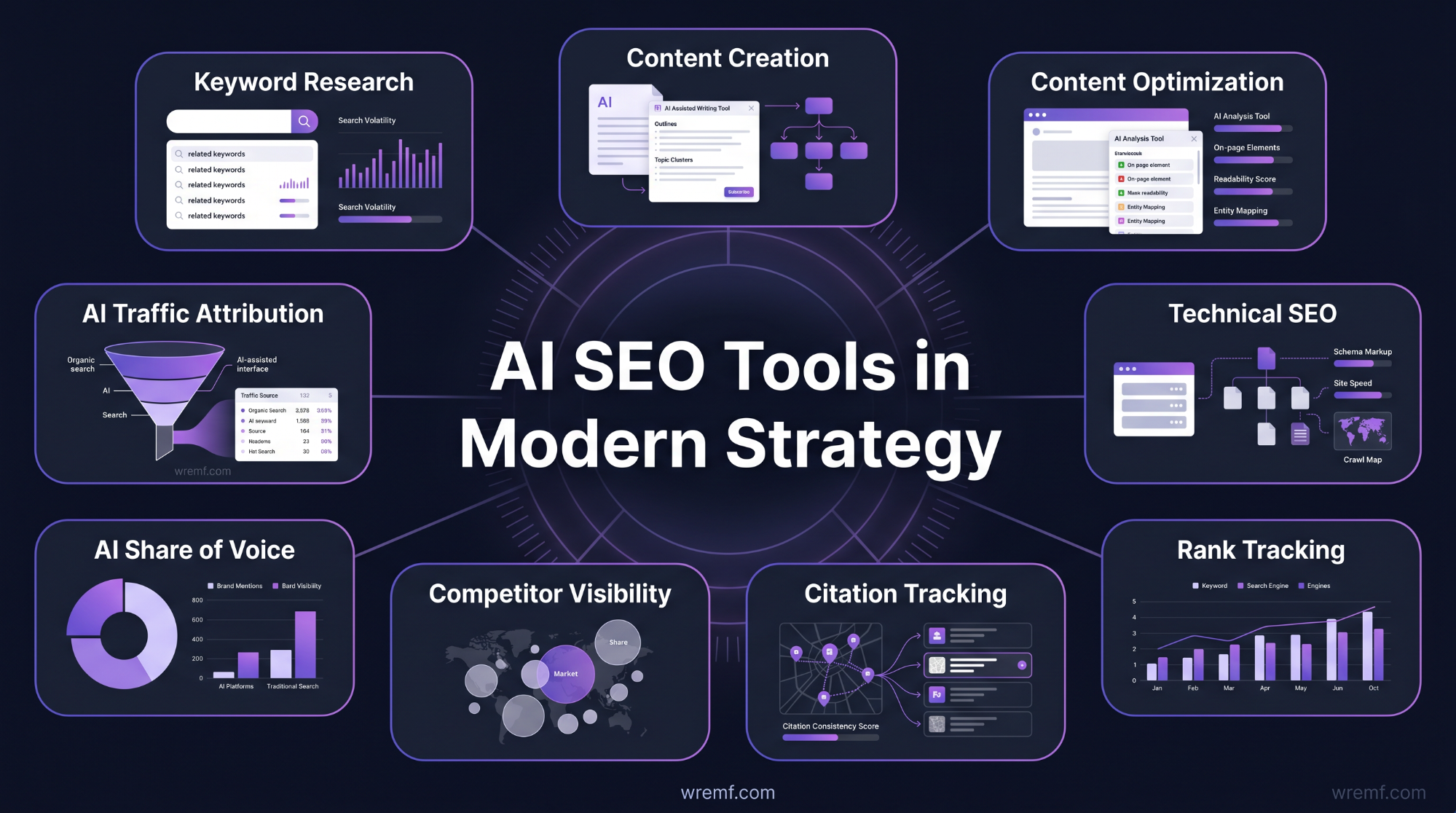
AI SEO tools are now part of modern search strategy because discovery spans Google Search, AI Overviews, ChatGPT, Claude, Gemini, Perplexity, Copilot, and other AI answer engines. The strongest approach combines keyword research, content creation, content optimization, technical SEO, rank tracking, citation tracking, competitor visibility, AI share of voice, and AI traffic attribution. AI SEO tools should not replace strategy, but they can make strategy faster, clearer, and more measurable. To turn AI search visibility into a repeatable workflow, explore the WREMF platform suite or speak with the WREMF agency team.
Related Generative Engine Optimization Guides
- AI Search Engine Optimization Tools The Complete 2026 Guide for AI Search, SEO, AEO, and GEO
- AI Search Engine Optimization The Complete Guide for B2B Brands
- 12 Best AI Search Optimization Tools
- How AI Search Optimization Tools Increase Organic Traffic
- How Do AI Search Optimization Tools Improve SERP Rankings
- Answer Engine Optimization The Complete Guide to AEO, AI Search Visibility, and Answer-First Content
- Enterprise Answer Engine Optimization Platforms Complete Guide for AI Visibility, AEO, and GEO
- LLM SEO Services The Complete 2026 Guide to AI Search Visibility, AEO, GEO, and LLM Optimization
- AI Search Engine Optimization Services The Complete Guide for B2B Brands
- AI SEO Services The Complete Guide to Search Visibility in the AI Era
- LLM SEO Agency The Complete Guide to Choosing an Agency for AI Search Visibility
- Answer Engine Optimization Services The Complete Guide to AI Search Visibility
- Generative AI Optimization Services The Complete Guide to GEO, AEO, LLM Optimization, and AI Visibility
- AI Overview SEO How to Optimize for Google AI Overviews, AI Mode, and AI Search Visibility
- AI Brand Monitoring The Complete Guide to Tracking Brand Visibility Across AI Search, LLMs, and Generative Engines
- Large Language Model Optimization Services The Complete Guide to LLMO, AI Search Visibility, AEO, GEO, RAG, and LLM Performance
- AI Overview Optimization How to Rank, Get Cited, and Stay Visible in Google AI Search
- AI SEO Agency How to Choose the Right Partner for AI Search Visibility
- AI Mention Tracking The Complete Guide to Monitoring Brand Mentions, AI Answers, Citations, and Share of Voice in 2026
- Best Answer Engine Optimization for Enhancing AI Visibility
Related reading
- How AI Search Optimization Tools Increase Organic Traffic
- Enterprise Answer Engine Optimization Platforms: Complete Guide for AI Visibility, AEO, and GEO
- AI Search Engine Optimization: The Complete Guide for B2B Brands
- AI Search Engine Optimization Tools: The Complete 2026 Guide for AI Search, SEO, AEO, and GEO
- How Do AI Search Optimization Tools Improve SERP Rankings?