Generative AI Optimization Services: The Complete Guide to GEO, AEO, LLM Optimization, and AI Visibility
Learn how generative AI optimization services improve brand visibility across ChatGPT, Perplexity, Gemini, Claude, Copilot, and Google AI Overviews.
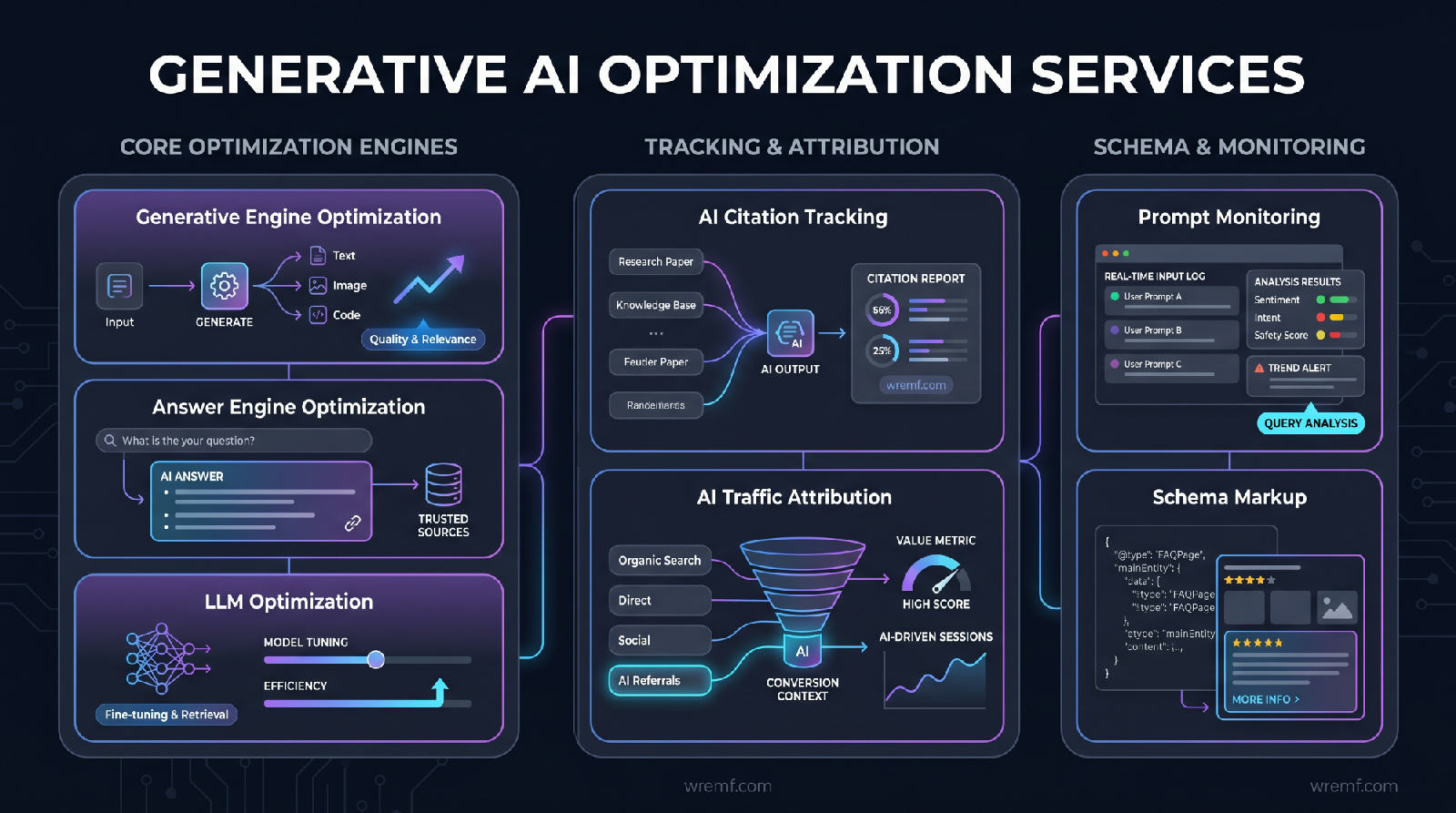
By WREMF Team · 2026-05-09
Generative AI optimization services improve how a brand appears in AI-generated answers, citations, summaries, comparisons, and recommendations across generative engines and AI platforms. These services combine Generative Engine Optimization, Answer Engine Optimization, LLM Optimization, citation engineering, semantic optimization, schema markup guidance, content optimization, prompt tracking, competitive visibility analysis, and reporting. Generative Engine Optimization is the process of improving how a brand, website, product, or expert source is retrieved, interpreted, cited, and recommended by generative search systems. AI visibility is the measurable presence of a brand inside AI-generated responses, source citations, brand mentions, and recommendation lists. Complete services answer whether the brand appears in relevant AI searches, which AI platforms mention or cite the brand, which competitors appear more often, which sources support AI responses, and which content or entity gaps should be fixed first.
Key takeaways
- Generative AI optimization services help brands become easier for AI systems to understand, retrieve, cite, compare, and recommend across ChatGPT, Perplexity, Gemini, Claude, Copilot, and Google AI Overviews.
- SEO targets search engines, AEO targets answer extraction, GEO targets generative engines, and LLM Optimization targets how language models understand and retrieve information. The best strategy layers all four disciplines.
- Generative engines reward clear, retrievable, consistent, and credible information. Source consistency across owned and third-party sources helps AI systems connect the same brand to the same facts.
- GEO-optimized content architecture uses answer-first sections, clear entities, source-backed claims, structured data, and comparison-ready formatting to make content easier for AI systems to retrieve and cite.
- Citation-worthy content is earned through clarity, usefulness, evidence, source consistency, and retrievable structure. Original research, practical frameworks, and expert explanations increase citation likelihood.
- Each AI platform uses different retrieval patterns and citation behaviors. Measurement should track prompt visibility, source citations, brand mentions, competitor presence, and AI share of voice across platforms separately.
Generative AI Optimization Services: The Complete Guide to GEO, AEO, LLM Optimization, and AI Visibility
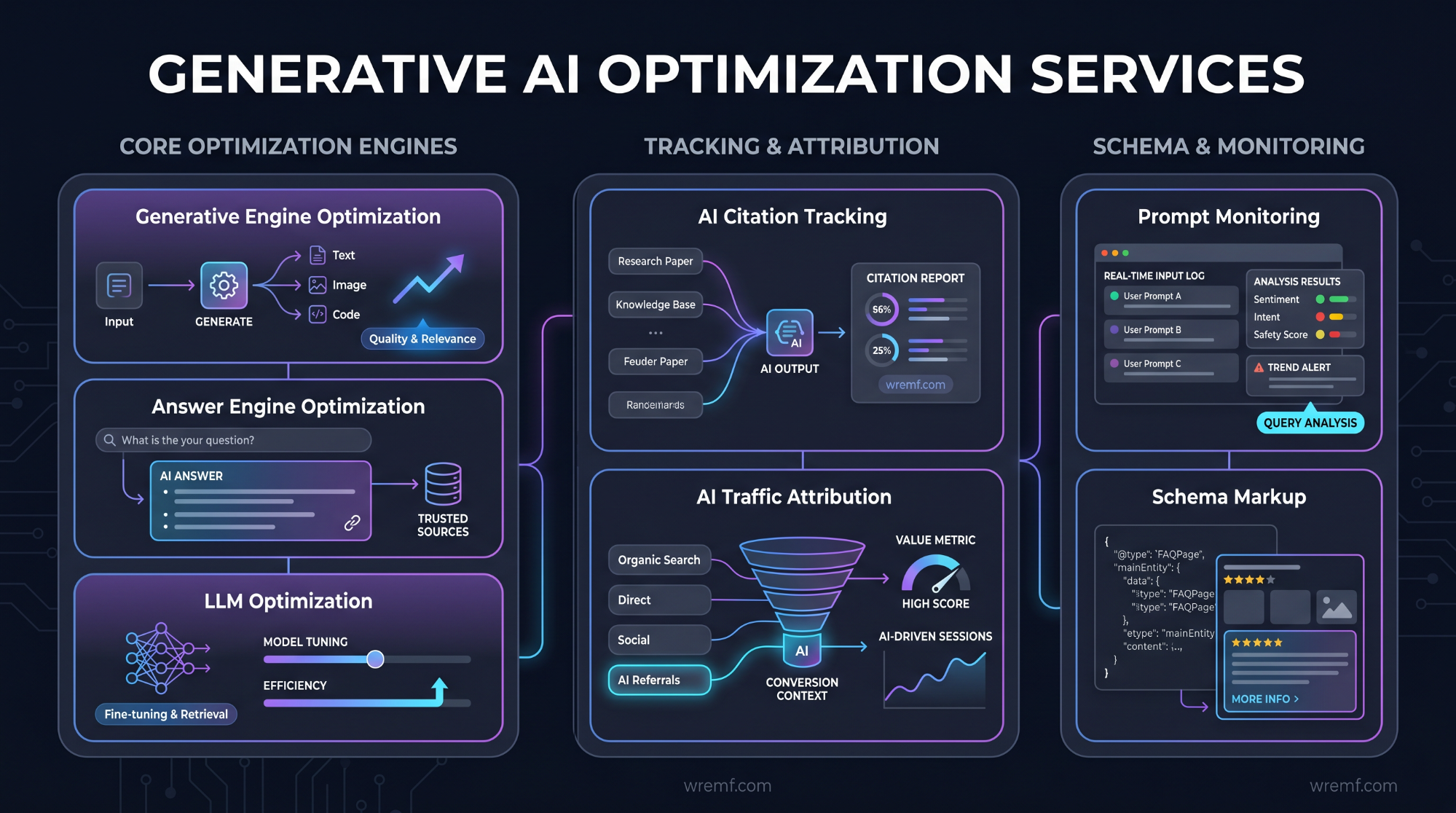
Generative AI optimization services help brands become visible, cited, and recommended inside AI-generated answers across AI search platforms. McKinsey describes AI search as a “new front door to the internet” and states that half of consumers already use AI-powered search, which means digital marketing teams now need visibility beyond classic search results through AI search strategy research from McKinsey. This guide explains Generative Engine Optimization, Answer Engine Optimization, LLM Optimization, AI citation tracking, prompt monitoring, schema markup, structured data, entity authority, and AI traffic attribution. It also explains how WREMF helps B2B teams track, improve, and prove AI visibility across ChatGPT, Claude, Gemini, Perplexity, Google AI Overviews, Copilot, DeepSeek, Grok, Meta AI, and Mistral. Use this guide to understand what GEO services should actually include before choosing software, a GEO agency, or a hybrid execution model.
What Are Generative AI Optimization Services?
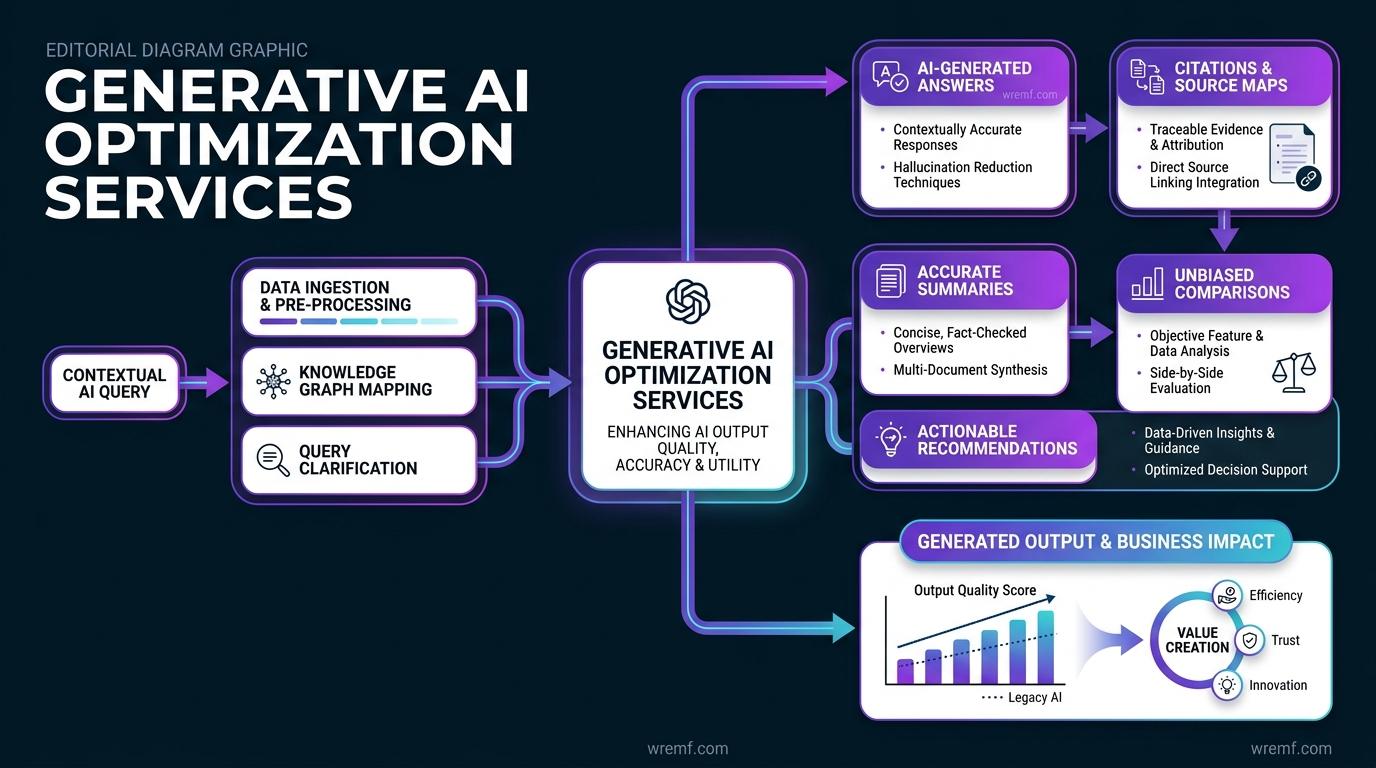
Generative AI optimization services improve how a brand appears in AI-generated answers, citations, summaries, comparisons, and recommendations. These services help teams influence digital visibility across generative engines, AI platforms, AI-powered search engines, and traditional search engines.
Generative Engine Optimization is the process of improving how a brand, website, product, or expert source is retrieved, interpreted, cited, and recommended by generative search systems. Generative Engine Optimization matters because AI searches can answer user intent before a person clicks a traditional search result.
AI visibility is the measurable presence of a brand inside AI-generated responses, source citations, brand mentions, and recommendation lists. AI visibility matters because buyers can form an opinion about a company before visiting its website.
Generative AI optimization services usually combine GEO Optimization, Answer Engine Optimization, LLM Optimization, citation engineering, semantic optimization, schema markup guidance, content optimization, prompt tracking, competitive visibility, and reporting. In practical AI visibility audits, teams often discover that the problem is not only missing content. The larger problem is that language models cannot confidently connect the brand to the right category, use case, proof points, and trusted sources.
A complete GEO service should answer five practical questions:
Does the brand appear when buyers ask relevant AI searches?
Which AI platforms mention, cite, or ignore the brand?
Which competitors appear more often in AI-generated answers?
Which sources are used to support AI-generated responses?
Which content, schema, source, or entity gaps should be fixed first?
WREMF helps teams answer these questions through the WREMF platform suite, which combines prompt intelligence, source citation tracking, competitive landscape analysis, GEO audits, content briefs, SEO testing, and AI visibility reporting. WREMF can be used as software, as an agency service, or as a hybrid software plus managed execution solution.
| Service area | What it improves | What it measures | Example output |
|---|---|---|---|
| Generative Engine Optimization | Visibility across generative engines | Prompt visibility, citations, mentions | GEO Audit and action plan |
| Answer Engine Optimization | Direct answer readiness | Definitions, FAQs, snippets, answer blocks | Answer-first content briefs |
| LLM Optimization | Brand understanding by language models | Entity clarity, source consistency, semantic signals | LLM visibility recommendations |
| Citation engineering | Source inclusion in AI-generated responses | AI citation frequency and cited sources | Source citation report |
| AI visibility tracking | Brand presence across AI platforms | AI share of voice and competitor visibility | Executive dashboard |
| AI traffic attribution | Business impact from AI discovery | AI referral sessions and conversion paths | AI attribution report |
Generative AI optimization services are not a replacement for SEO. They extend search engine optimization into generative search, where retrieval mechanisms, language models, source trust, structured content, and AI-generated responses influence how buyers discover brands.
KEY TAKEAWAY: Generative AI optimization services help brands become easier for AI systems to understand, retrieve, cite, compare, and recommend.
The next section explains why this shift matters now and why traditional search visibility is only part of the modern digital marketing picture.
Why Generative AI Optimization Services Matter Now
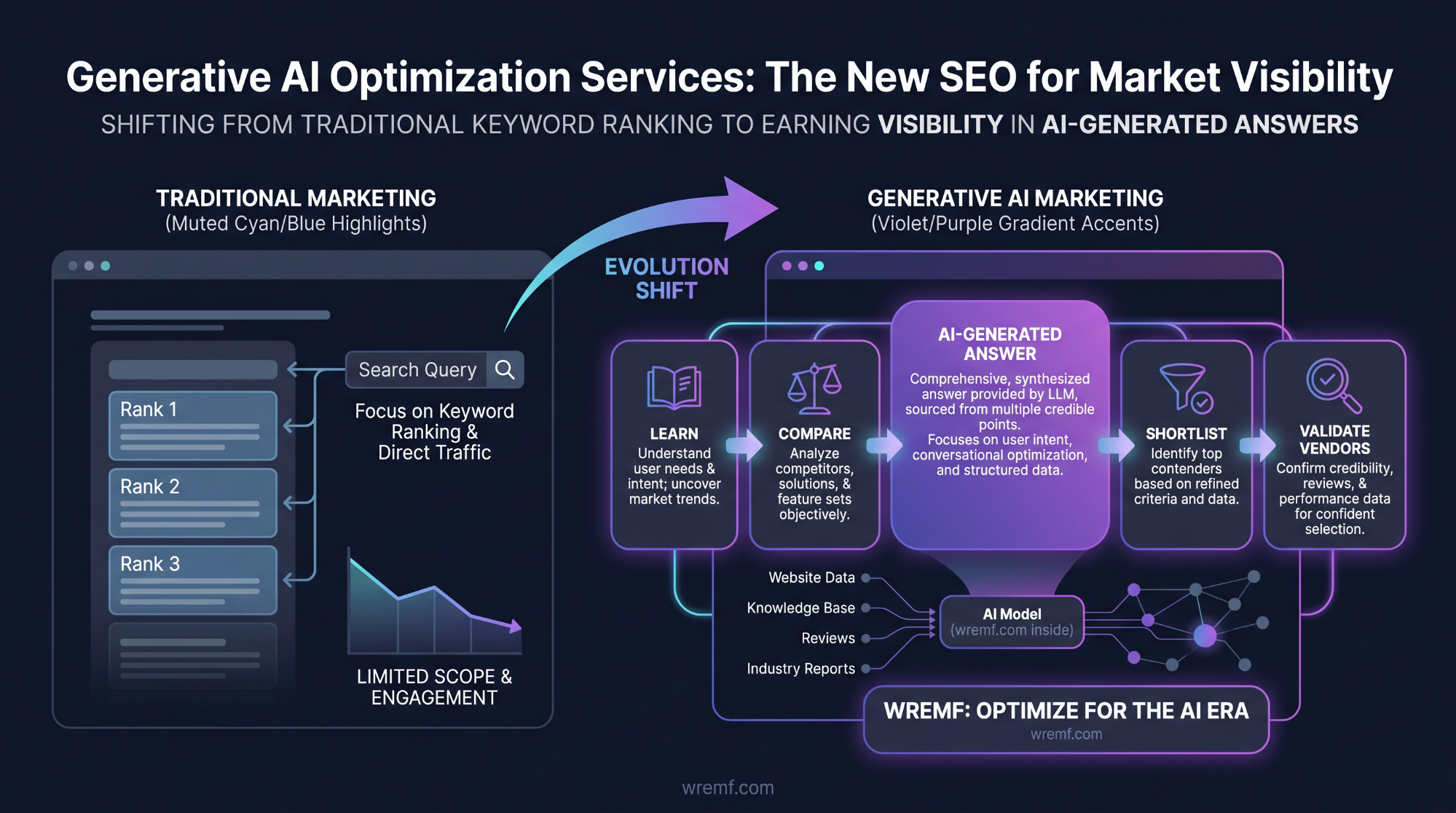
Generative AI optimization services matter now because buyers increasingly use AI searches to learn, compare, shortlist, and validate vendors. This changes digital marketing from ranking for keywords alone to earning visibility inside AI-generated answers.
AI searches are natural-language search interactions performed inside AI platforms, generative engines, or AI-powered search experiences. AI searches matter because they often combine discovery, education, comparison, and recommendation in a single response.
Generative search is a search experience where an AI system synthesizes an answer instead of only returning a list of links. Generative search matters because the user may see a summary, source links, cited references, and vendor recommendations before viewing traditional search results.
OpenAI describes ChatGPT search as a way to provide fast answers with links to relevant web sources in its ChatGPT search announcement. Microsoft says Copilot Search displays sources and links used to generate answers in its Copilot Search documentation. Google Search Central explains how AI Overviews and AI Mode work from a site owner perspective in its AI features guidance. These official sources show that AI-powered search experiences are now part of search behavior, not a side experiment.
In real B2B buying journeys, users ask prompts such as:
What are the best generative AI optimization services?
Which GEO agencies help B2B SaaS companies?
What are the best tools for Generative Engine Optimization?
Is traditional SEO still enough for AI search visibility?
Which companies are mentioned most often in ChatGPT and Perplexity?
How do I optimize my website for Google AI Overviews?
How do I get my brand cited in AI-generated responses?
These prompts are not simple keywords. They express user intent, buying stage, comparison needs, category understanding, and trust requirements. A ranking tracker may show good search results, while ChatGPT, Claude, Gemini, Perplexity, Copilot, or Google's AI Overviews may still ignore the brand.
DID YOU KNOW: McKinsey states that half of consumers use AI-powered search today and estimates that AI search could influence $750 billion in revenue by 2028, which makes AI visibility a strategic issue for marketing and growth teams.
Generative AI optimization services help teams move from casual testing to structured measurement. Instead of asking ChatGPT one question and guessing what happened, teams can track prompt sets, citations, brand mentions, competitors, source consistency, and AI traffic attribution over time.
KEY TAKEAWAY: Generative search changes visibility because AI platforms can summarize, cite, compare, and recommend brands before users click a website.
To build the right strategy, you need to understand how GEO, AEO, SEO, and LLM Optimization differ.
Generative Engine Optimization vs SEO vs AEO vs LLM Optimization
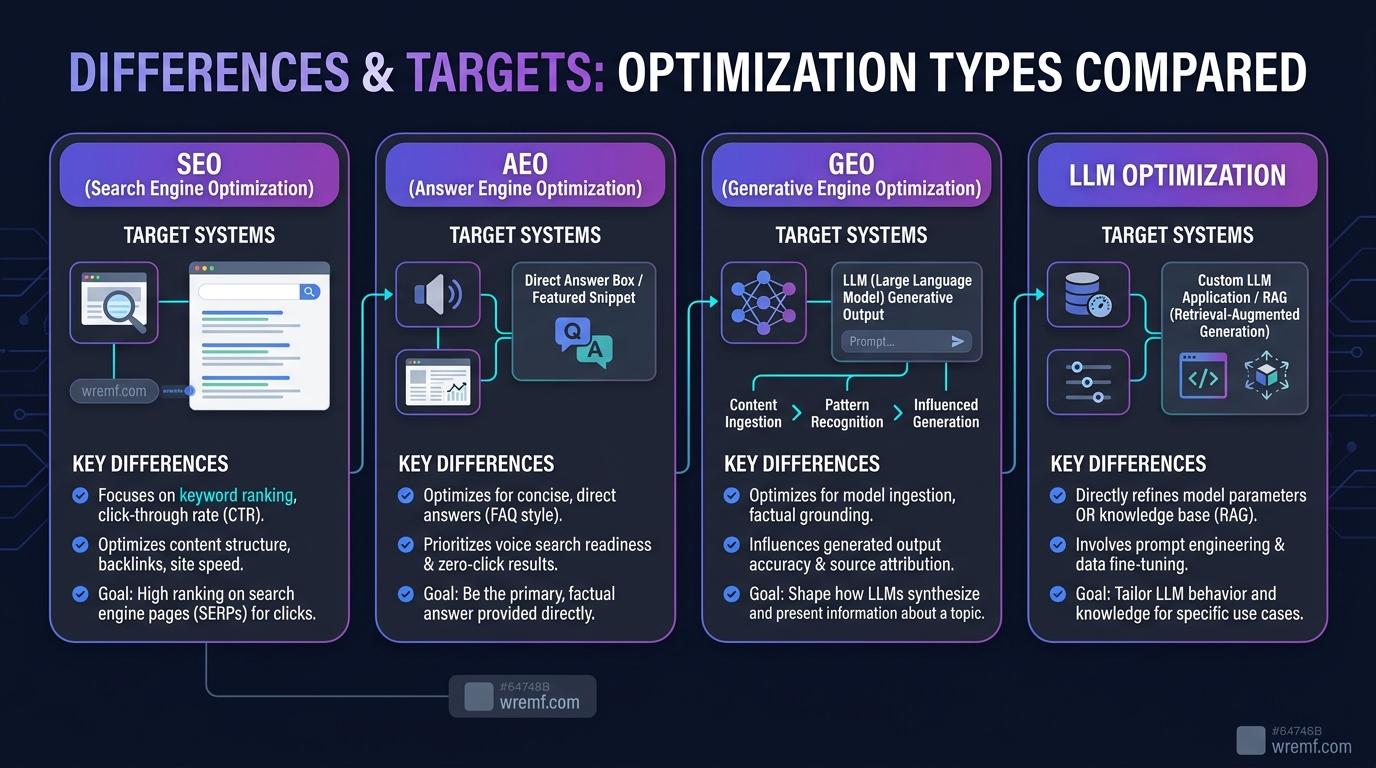
The key difference between SEO, AEO, GEO, and LLM Optimization is the system being optimized. SEO targets search engines, AEO targets answer extraction, GEO targets generative engines, and LLM Optimization targets how language models understand and retrieve information.
Search engine optimization is the practice of improving visibility in search engines such as Google and Bing. Search engine optimization matters because rankings, crawlability, links, search impressions, structured data, and content relevance still shape discoverability.
Answer Engine Optimization is the practice of structuring content so answer engines can extract clear, direct, and reliable responses. Answer Engine Optimization matters because AI-generated answers, voice searches, featured snippets, and zero-click environments reward concise and complete answers.
LLM Optimization is the practice of improving how a Large Language Model understands a brand, topic, product, source, or entity. LLM Optimization matters because language models rely on patterns, context, semantic relationships, training data, retrieval systems, and source evidence to generate responses.
Generative Engine Optimization is the practice of improving visibility across generative engines such as ChatGPT, Perplexity, Gemini, Claude, Copilot, Google AI, DeepSeek, Grok, Meta AI, and Mistral. Generative Engine Optimization matters because generative engines can produce AI-generated responses that replace, summarize, or reshape traditional search journeys.
| Discipline | Main goal | What it measures | What it misses alone | Best use case |
|---|---|---|---|---|
| SEO | Rank in traditional search engines | Rankings, clicks, impressions, links | AI-generated answers and AI citations | Organic search growth |
| AEO | Win direct answers | Answer quality, definitions, FAQ extraction | Multi-platform AI share of voice | Snippets, FAQs, voice searches |
| GEO | Appear in generative engines | Prompt visibility, AI citation, brand mentions | Some classic SEO diagnostics | ChatGPT, Perplexity, Gemini, Claude, Copilot |
| LLM Optimization | Improve model understanding | Entity relationships, semantic signals, source consistency | Traffic attribution unless tracked | Brand and topic clarity |
| AI visibility | Prove presence across AI platforms | Mentions, citations, share of voice, competitors | Detailed page fixes unless audited | Executive reporting |
The best strategy is not SEO versus AEO versus GEO. The best strategy layers all four. SEO makes content crawlable and authoritative. AEO makes content answer-ready. GEO makes content visible in generative search. LLM Optimization strengthens entity relationships and semantic understanding.
A common mistake is treating GEO Optimization as keyword research with a new label. Keyword research still matters, but generative AI search engine optimization agencies also need prompt tracking, citation analysis, AI response pattern analysis, semantic content audit, entity optimization, content structuring, and source consistency analysis.
KEY TAKEAWAY: SEO, AEO, GEO, and LLM Optimization overlap, but each solves a different visibility problem across search engines, answer engines, generative engines, and language models.
Once the differences are clear, the next step is understanding how generative engines actually choose sources and recommendations.
How Generative Engines Choose Sources, Citations, and Recommendations
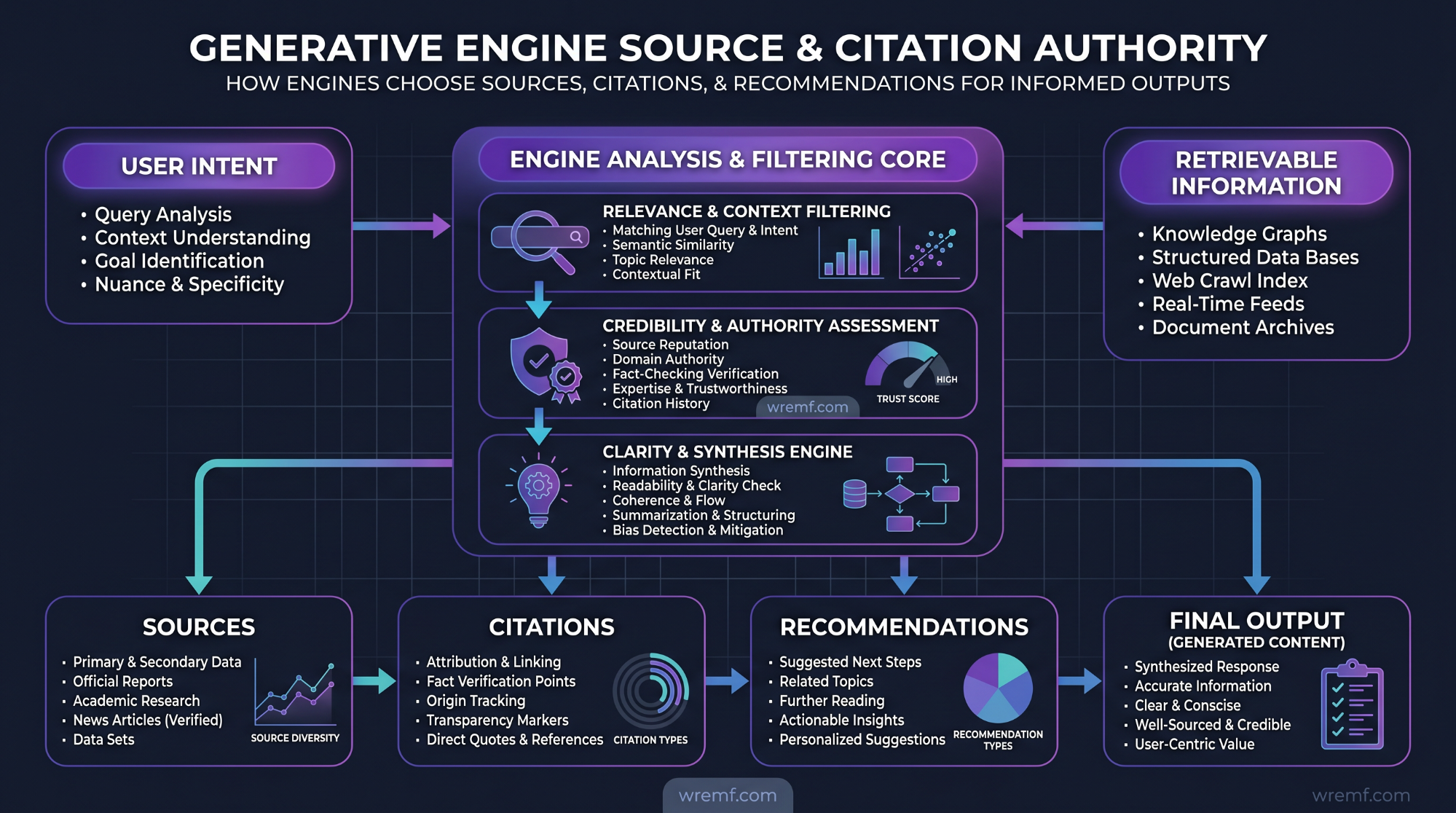
Generative engines choose sources by matching user intent with retrievable, relevant, credible, and well-structured information. AI-generated responses are more likely to include brands that are clear, consistent, source-backed, and easy to understand.
AI citation is a reference, link, or source mention used inside an AI-generated answer. AI citation matters because a cited brand or page can gain trust and visibility even when the user does not click a traditional search result.
AI retrieval systems are systems that find, select, and provide information for AI-generated responses. AI retrieval systems matter because generative engines need relevant source material before they can summarize, compare, or recommend.
Retrieval mechanisms are the processes that decide which information should be pulled into an AI answer. Retrieval mechanisms matter because weak, unclear, outdated, or conflicting sources may reduce the chance that a brand appears in AI-generated responses.
Large Language Model systems do not all work the same way. ChatGPT, Claude, Gemini, Perplexity, Copilot, DeepSeek, Grok, Meta AI, and Mistral may differ in browsing behavior, retrieval sources, citation presentation, recency, personalization, and answer formatting. Google AI Overviews are part of Google Search. Perplexity is more citation-forward. Copilot Search emphasizes sources and summarized answers. ChatGPT search can provide links to sources when web information is used.
Source consistency helps AI systems connect the same brand to the same facts across the web. If a website says one thing, a pricing page says another, a directory uses outdated language, social media profiles describe a different category, and third-party pages mention old products, AI systems may produce weak or incorrect summaries.
Source consistency is the alignment of brand facts across owned and third-party sources. Source consistency matters because language models need repeated, compatible signals to describe a brand accurately.
In practical GEO audits, teams review:
Whether the website is crawlable and renderable
Whether clean HTML optimization supports extraction
Whether schema markup and structured data match visible content
Whether the brand category is clearly defined
Whether entity relationships are explicit
Whether content answers high-intent conversational questions
Whether Google AI Overviews, ChatGPT, Perplexity, Gemini, Claude, and Copilot cite relevant sources
Whether competitor content is more citation-worthy
Whether AI response pattern analysis reveals missing facts, comparisons, or use cases
WREMF’s source citation tracking helps teams identify which sources AI platforms use when answering prompts about a brand, competitor, topic, or buying decision. This matters because citations reveal the source ecosystem behind AI visibility.
KEY TAKEAWAY: Generative engines reward clear, retrievable, consistent, and credible information more than keyword density alone.
The next section turns this into a practical service framework.
Core Pillars of Generative AI Optimization Services
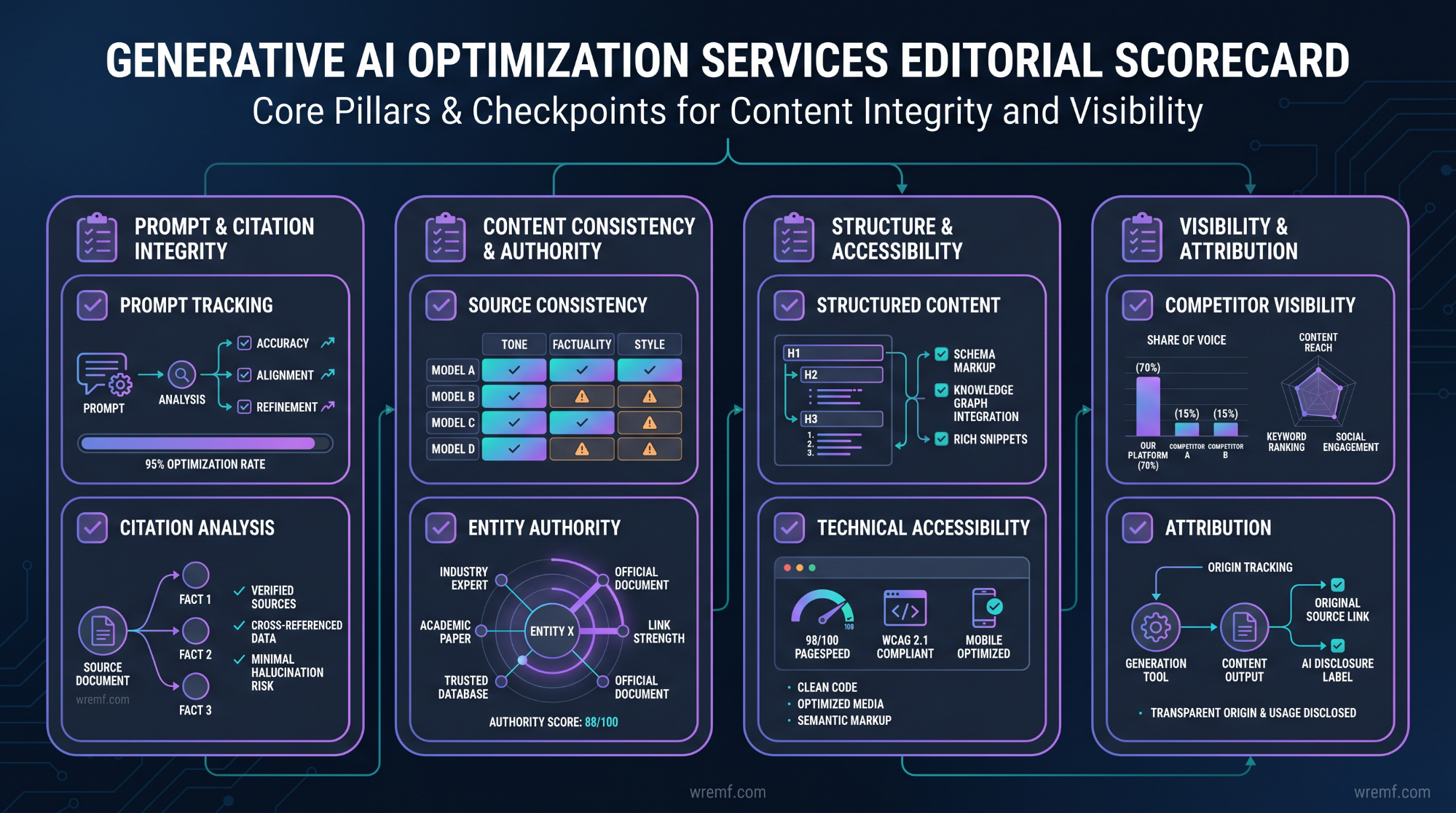
The core pillars of generative AI optimization services are prompt tracking, citation analysis, source consistency, entity authority, structured content, technical accessibility, competitor visibility, and attribution. These pillars turn GEO from theory into an operating workflow.
Prompt tracking is the process of monitoring how AI platforms answer specific questions about a brand, product, category, or competitor. Prompt tracking matters because it reveals whether AI-generated responses mention, cite, recommend, or ignore your brand.
Source citations are the sources, pages, links, or references AI systems use to support their answers. Source citations matter because AI visibility depends on what your website says and what external sources confirm.
AI share of voice is the percentage of relevant AI-generated responses where your brand appears compared with competitors. AI share of voice matters because B2B buyers often compare vendors before booking demos or contacting sales.
Brand mentions are references to a brand inside AI-generated answers, even when no link is included. Brand mentions matter because AI platforms can shape perception without sending immediate traffic.
| Pillar | What it checks | Why it matters | Useful WREMF page |
|---|---|---|---|
| Prompt intelligence | Which prompts trigger your brand | Shows demand, category, and visibility gaps | Prompt intelligence |
| Source citation tracking | Which sources AI engines cite | Reveals trusted source patterns | Source citations |
| Competitive landscape | Which competitors appear more often | Shows lost recommendation visibility | Competitive landscape |
| GEO Audit | What LLMs can see and use | Finds technical and content blockers | GEO Audit |
| Content briefs | What to create or improve | Converts insights into execution | AI-ready content briefs |
| SEO testing | Which changes improve performance | Helps validate impact over time | SEO testing |
Entity authority is the strength and clarity of the relationship between a brand, its category, its products, its people, its proof points, and trusted sources. Entity authority matters because language models need consistent context to associate a brand with the right topics.
Semantic optimization is the process of improving meaning, relationships, entities, and topical coverage within content. Semantic optimization matters because generative AI systems need context, not just exact-match keywords.
Structured content is content organized with clear headings, concise definitions, tables, FAQs, examples, and answer-first summaries. Structured content matters because AI-generated answers are easier to produce from pages that separate claims, evidence, entities, and conclusions.
TIP: A strong GEO service should not only say whether your brand appears in AI searches. It should explain why the brand appears or disappears, which sources are used, and what should be changed next.
KEY TAKEAWAY: Generative AI optimization services work best when measurement, content, citations, competitors, technical foundations, and execution are connected.
After the pillars are defined, the next step is creating content architecture that AI systems can interpret and cite.
How to Build GEO-Optimized Content Architecture
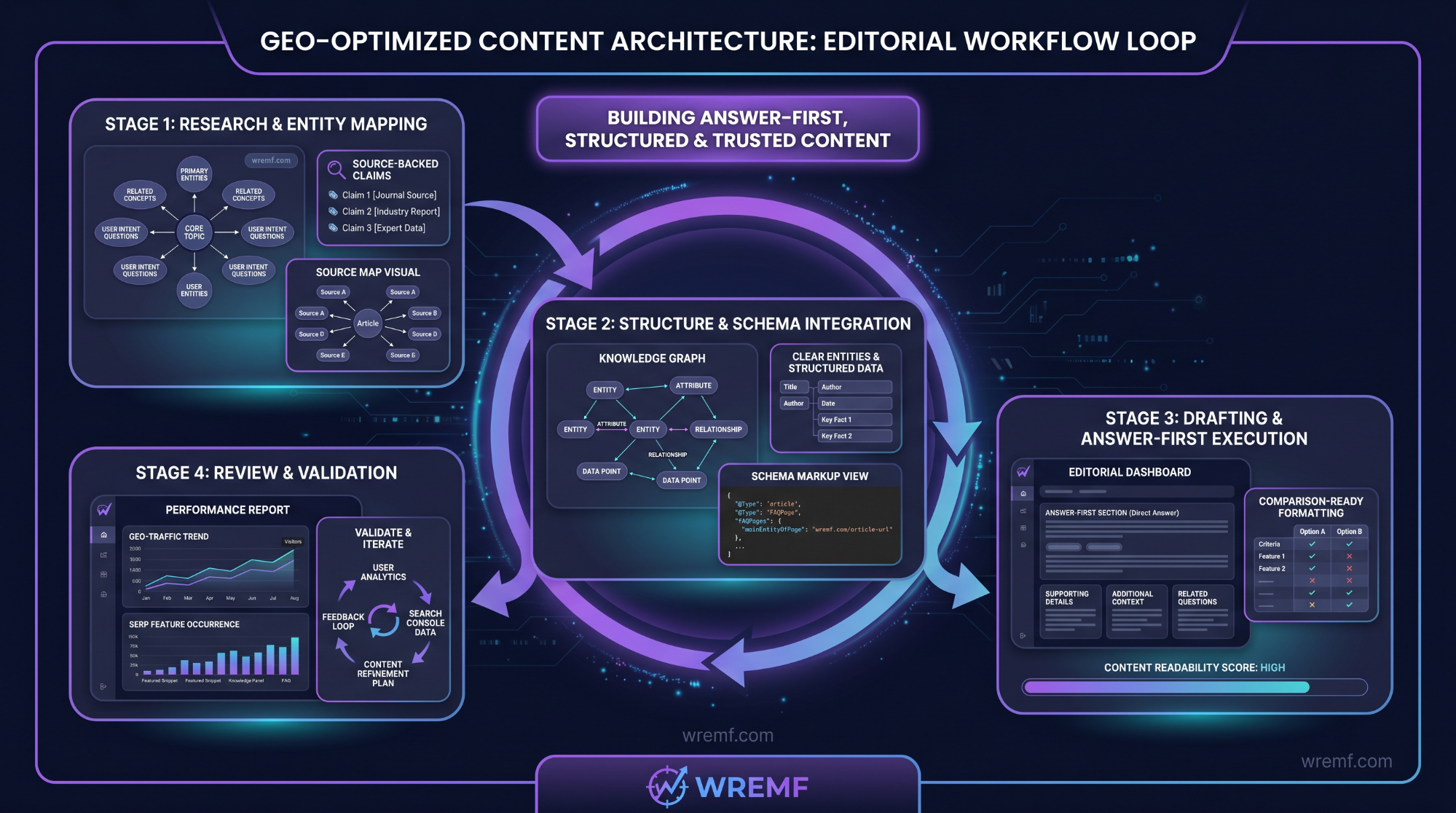
GEO-optimized content architecture makes content easier for people, search engines, and generative engines to understand. The strongest structure uses answer-first sections, clear entities, source-backed claims, structured data, and comparison-ready formatting.
GEO-optimized content architecture is a content structure designed for retrieval, summarization, citation, and comparison by generative engines. GEO-optimized content architecture matters because AI-generated answers need clear source material.
Answer-first content is content that begins a section with a direct answer before expanding with details. Answer-first content matters because users and AI retrieval systems can quickly identify the main point.
AI-Optimized Content Structure is the organization of content around direct answers, entities, definitions, evidence, examples, and next steps. AI-Optimized Content Structure matters because it supports both human readability and machine interpretation.
A strong GEO content page usually includes:
A direct definition near the top
Clear relationships between SEO, AEO, GEO, and LLM Optimization
Short answer blocks under major headings
Comparison tables for decision intent
FAQs written as real search queries
Internal links to relevant service, platform, methodology, and report pages
Named sources close to factual claims
Original research, expert insight, or practical examples where possible
Clean HTML optimization and accessible page structure
Schema markup guidance that matches visible page content
Google Search Central says helpful, reliable, people-first content is more likely to perform well in Search through its helpful content guidance. For GEO Optimization, the practical implication is clear: create content that helps buyers first, then structure it so AI systems can extract accurate answers.
Schema markup is structured code that helps search engines understand page entities, content types, and relationships. Schema markup matters because it can support interpretation, but it does not replace clear, useful, trustworthy content.
Structured data is machine-readable information that describes content, organisations, articles, FAQs, products, reviews, and other entities. Structured data matters because it can reinforce semantic understanding when it matches visible page content.
A semantic content audit should review whether a page covers user intent, adjacent questions, entity relationships, category language, comparison needs, limitations, and decision criteria. SEO teams frequently discover that pages rank for keywords but fail to answer the conversational prompts people use inside AI platforms.
KEY TAKEAWAY: GEO-optimized content architecture makes important facts, entities, comparisons, and answers easier for AI systems to retrieve, summarize, and cite.
Once content architecture is in place, you need to build content that deserves to be cited.
What Makes Content Citation-Worthy for AI-Generated Responses?
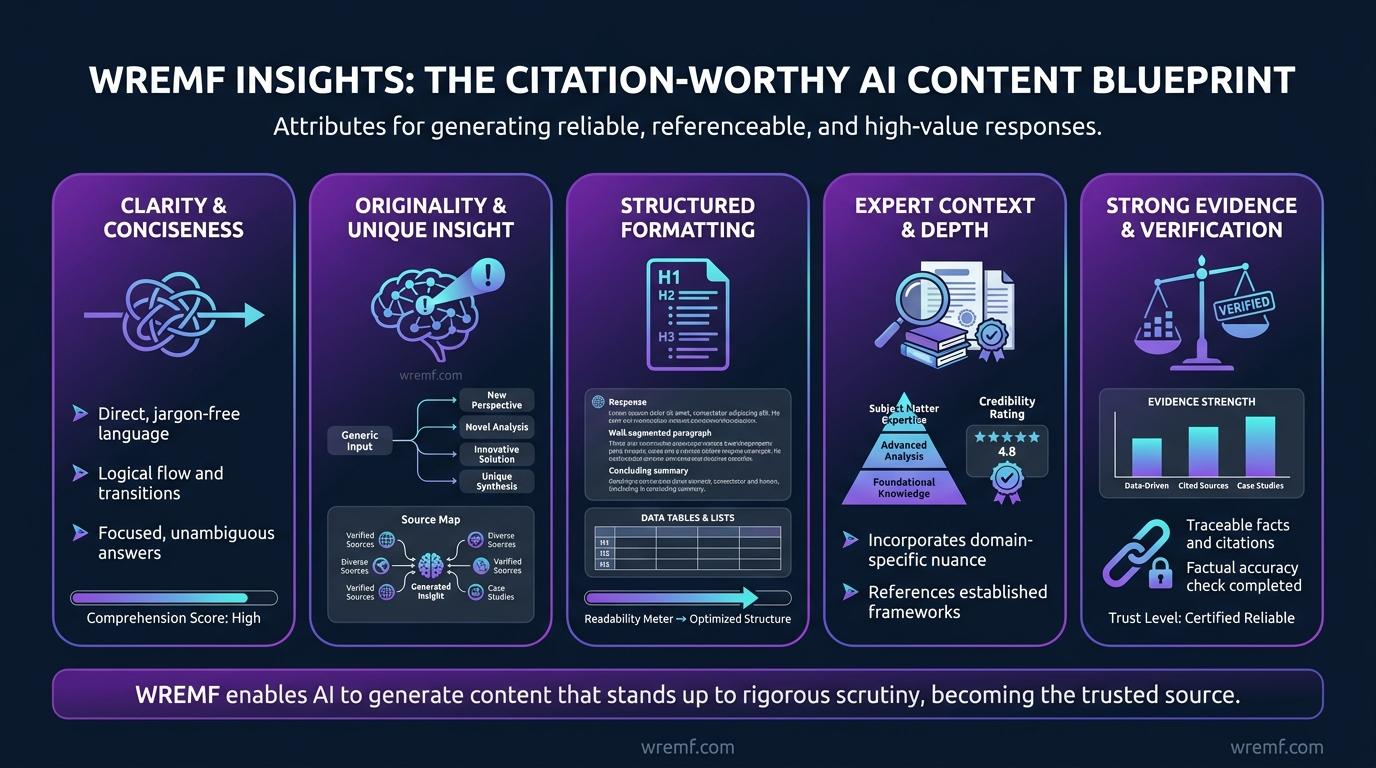
Citation-worthy content gives AI systems clear, useful, specific, and source-backed information that can support an answer. The most effective content combines originality, clarity, structured formatting, expert context, and evidence.
Citation engineering is the practice of improving the likelihood that a source is used or referenced in AI-generated responses. Citation engineering matters because AI citation can influence trust, authority, and visibility even when traffic is not immediate.
Citation-worthy content creation is the process of publishing content that is useful enough to be referenced by search engines, generative engines, journalists, analysts, buyers, and AI platforms. Citation-worthy content creation matters because generic content is easier to ignore.
Strong citation-worthy content often includes:
Original research or benchmark data
Clear definitions of complex terms
Practical frameworks and decision tables
Expert explanations based on real workflow experience
Comparisons between tools, services, strategies, or methods
Step-by-step processes that solve specific problems
Transparent methodology
Current and source-backed claims
Clear authorship and trust signals
Internal links to deeper supporting pages
In B2B SaaS, citation-worthy content usually answers a practical buying or implementation question. For example, a page explaining “how to measure AI share of voice across ChatGPT, Perplexity, and Google AI Overviews” is more useful than a generic article saying “AI search is changing marketing.”
EEAT signals are indicators of experience, expertise, authoritativeness, and trustworthiness. EEAT signals matter because buyers and search systems both need to understand why a source should be trusted.
Content relevance is the fit between a page and the user intent behind a query or prompt. Content relevance matters because AI-generated responses need sources that directly answer the question being asked.
IMPORTANT: Do not confuse content volume with citation quality. Publishing many shallow pages can create noise, while a smaller set of clear, evidence-led resources can be more useful for AI retrieval systems.
If you want to see how a citation-ready report can be structured for leadership, review a sample AI visibility report and compare it with your current search or SEO reporting format.
KEY TAKEAWAY: AI citation is earned through clarity, usefulness, evidence, source consistency, and retrievable structure, not through content volume alone.
The next section explains how to optimize for the major AI platforms without assuming they all behave the same way.
How to Optimize for ChatGPT, Perplexity, Gemini, Claude, Copilot, and Google AI Overviews
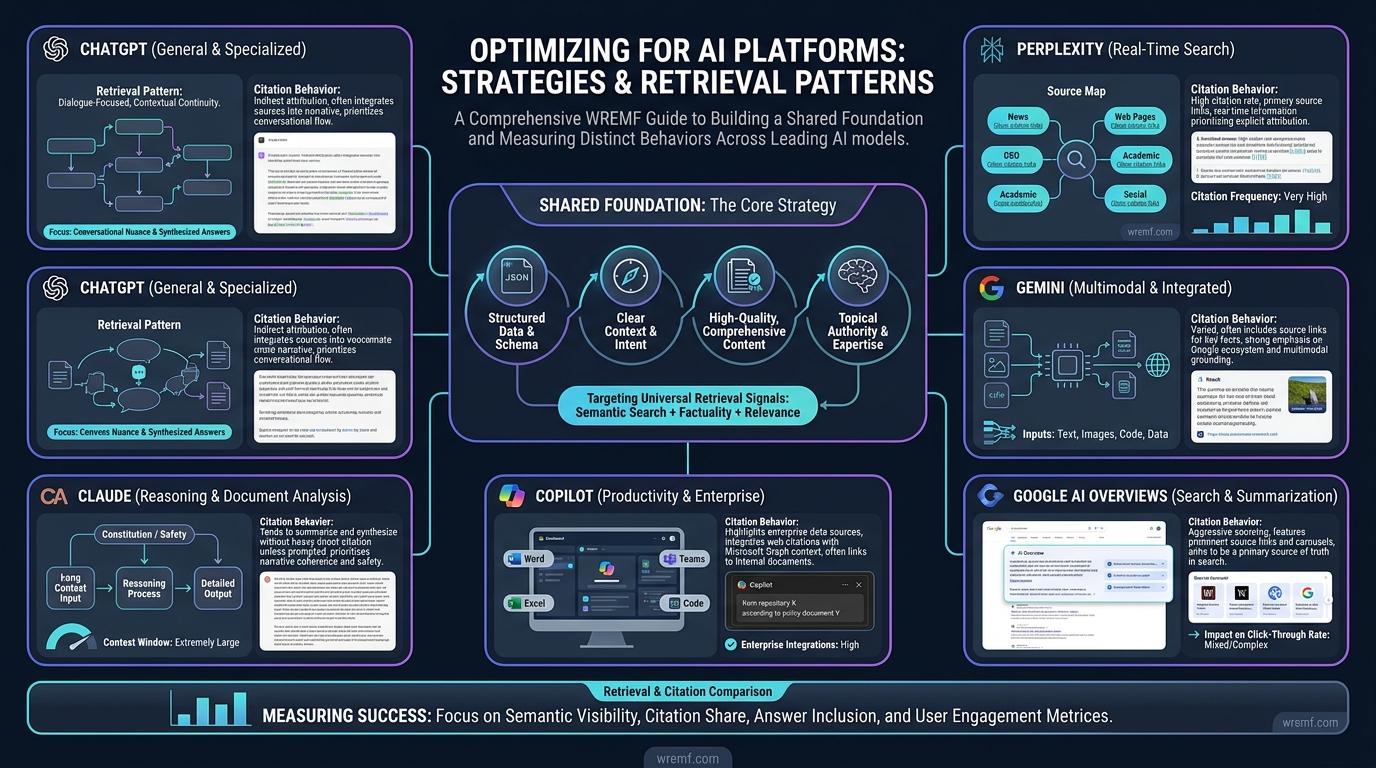
The best way to optimize for AI platforms is to build a shared foundation, then measure each platform separately. ChatGPT, Perplexity, Gemini, Claude, Copilot, and Google AI Overviews use different interfaces, retrieval patterns, and citation behaviors.
ChatGPT is an AI assistant that can answer questions, browse or search in supported contexts, and provide source links when web search is used. ChatGPT matters because many users now use generative chat for research, comparison, and decision support.
Perplexity is an AI-powered answer engine that emphasizes sourced answers and citations. Perplexity matters because users often treat it as a research tool for direct answers, vendor comparisons, and topic exploration.
Google Gemini is Google’s AI assistant and model ecosystem. Google Gemini matters because Google AI is connected to a broader search, productivity, and Android ecosystem.
Claude is Anthropic’s AI assistant family. Claude matters because users often use it for research, summarization, analysis, and business workflows.
Copilot is Microsoft’s AI assistant and AI search experience across Bing, Microsoft 365, Edge, and Windows contexts. Copilot matters because Microsoft integrates AI-powered search experiences into workplace and search surfaces.
Google's AI Overviews are AI-generated summaries that can appear in Google Search results. Google's AI Overviews matter because they sit directly inside traditional search journeys and can change click behavior, visibility, and source discovery.
| Platform | Typical user behavior | What to optimize | What to measure |
|---|---|---|---|
| ChatGPT | Conversational research and vendor comparison | Brand clarity, citations, current sources, clear category pages | Mentions, recommendations, source links |
| Perplexity | Research-first AI searches | Citation-worthy content and source credibility | Citation frequency and cited URLs |
| Google AI Overviews | Search-integrated summaries | Helpful content, SEO fundamentals, structured answers | AI Overview inclusion and source visibility |
| Gemini | Google AI ecosystem use | Entity clarity, topical authority, useful content | Mentions and answer quality |
| Claude | Analysis and research workflows | Clear explanations, authoritative sources, consistent facts | Brand descriptions and comparisons |
| Copilot | Search and productivity workflows | Source-backed content and Microsoft search visibility | Citations and summarized answers |
| DeepSeek, Grok, Meta AI, Mistral | Emerging AI discovery surfaces | Consistent source ecosystem and topic authority | Prompt visibility and response patterns |
Google SGE, also called Google's Search Generative Experience, was an earlier generative search experiment that helped define how AI-generated summaries could appear in search. Google AI Overviews are the more current search feature that site owners usually need to monitor.
Bing Chat is an earlier name many users still associate with Microsoft’s AI search experience. Bing AI and Copilot Search now sit within Microsoft’s broader AI search ecosystem.
AI-powered search experiences do not create one universal ranking report. A brand may appear in Perplexity, be ignored by ChatGPT, be cited in Copilot, and fail to appear in Google AI Overviews for the same topic. This is why prompt tracking and platform segmentation matter.
KEY TAKEAWAY: Optimize for shared fundamentals, but measure each AI platform separately because generative engines do not behave identically.
After platform coverage, the next question is how to measure whether GEO is working.
How to Measure AI Visibility, GEO Performance, and AI Traffic Attribution
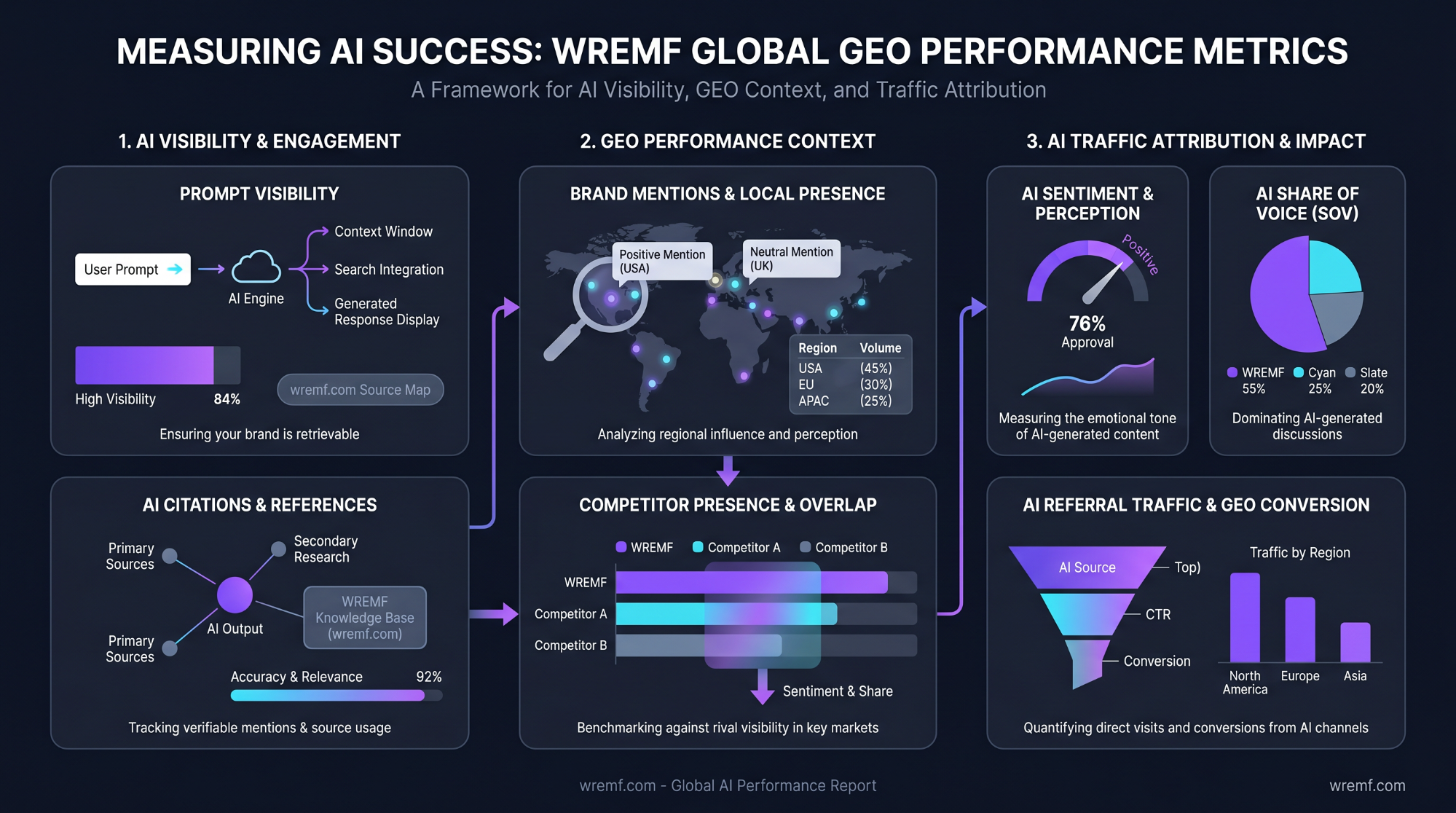
AI visibility is measured by tracking prompt visibility, AI citations, brand mentions, competitor presence, sentiment, AI share of voice, and AI referral traffic. GEO performance cannot be measured by search rankings alone.
AI traffic attribution connects AI discovery surfaces to website sessions, conversions, demo requests, pipeline, or revenue signals. AI traffic attribution matters because leadership needs to understand whether AI visibility contributes to business outcomes.
Search impressions are the number of times a page appears in search results. Search impressions matter because they show traditional search visibility, but they do not prove that a brand appears in AI-generated answers.
Digital visibility is the combined visibility of a brand across search engines, generative engines, answer engines, social media, directories, comparison pages, and other discovery surfaces. Digital visibility matters because buyers no longer rely on one channel.
| Measurement layer | Example metric | What it proves | Main limitation |
|---|---|---|---|
| Prompt visibility | Brand appears in 38 of 100 tracked prompts | AI platforms recognize the brand | Prompt selection must be consistent |
| AI citation frequency | Brand cited in 14 source-backed answers | Sources are being used | Citations vary by platform and time |
| Brand mentions | Brand appears without a link | Awareness exists in AI-generated responses | Mentions may not equal trust |
| AI share of voice | Brand appears more or less than competitors | Competitive visibility | Needs a stable competitor set |
| Sentiment and accuracy | AI answer describes brand correctly | Message quality | Requires qualitative review |
| AI traffic attribution | Sessions from ChatGPT, Perplexity, Copilot, or Gemini | Business impact | Referral data may be incomplete |
| Search impressions | GSC impressions for AI-ready pages | Classic search visibility | Does not show AI answer inclusion |
Zero-click environments are search or AI experiences where users get enough information without clicking a website. Zero-click environments matter because brand visibility, AI citation, and recommendation presence can have value even when traffic is delayed or reduced.
In real-world reporting, teams usually need two narratives. The SEO narrative explains clicks, impressions, rankings, and links. The AI visibility narrative explains prompts, citations, source usage, competitors, AI-generated responses, and recommendation visibility.
WREMF connects prompt tracking, source citations, competitor visibility, AI share of voice, GEO Audit findings, and AI traffic attribution into one reporting workflow. For technical teams, the WREMF API supports integrations, API workflows, MCP use cases, and custom reporting pipelines.
KEY TAKEAWAY: GEO performance should be measured through prompts, citations, competitors, source consistency, AI share of voice, and attribution, not rankings alone.
Measurement gives you the benchmark, but improvement requires a repeatable workflow.
How to Start a Generative AI Optimization Workflow
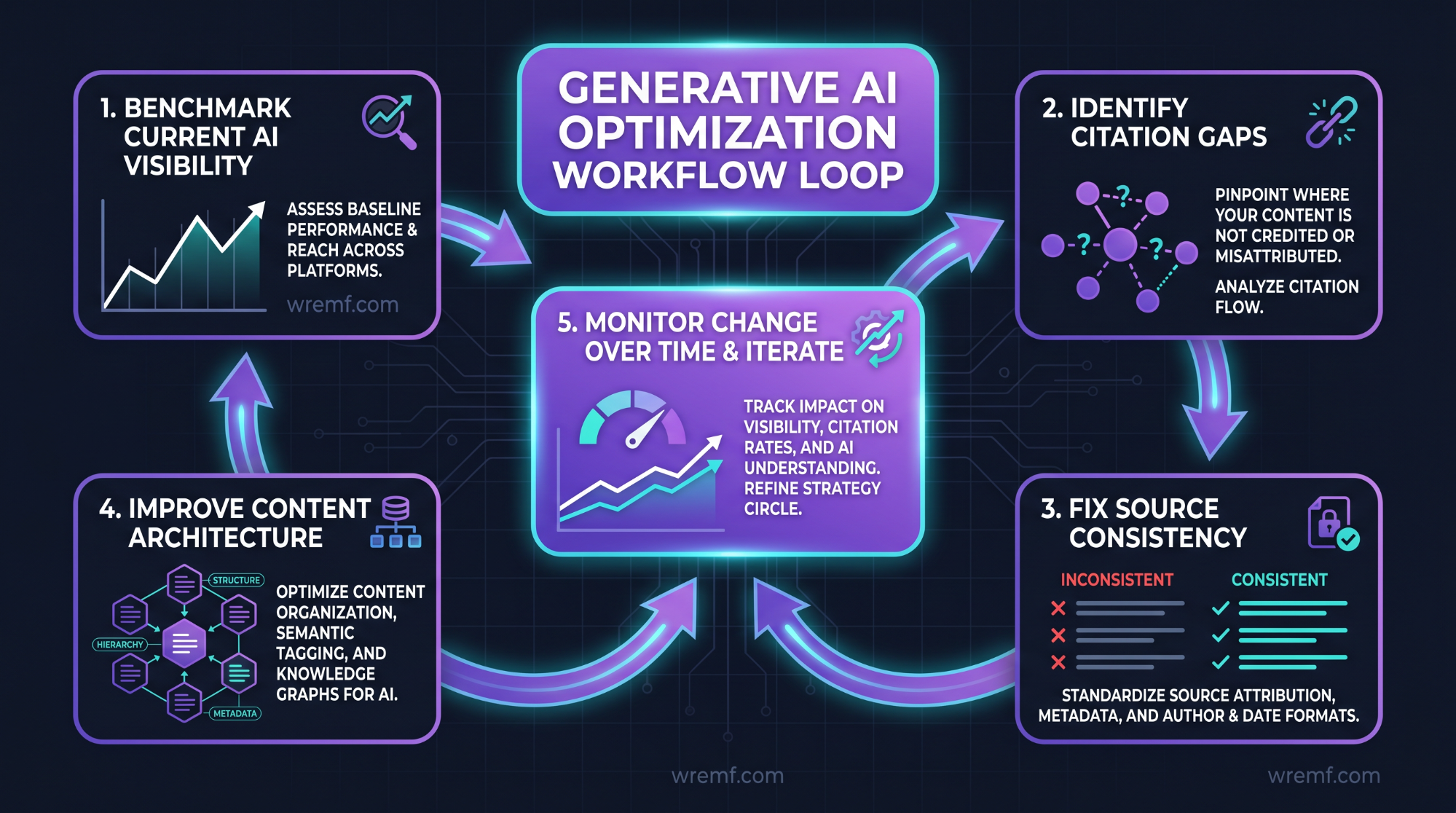
The best way to start a generative AI optimization workflow is to benchmark current AI visibility, identify citation gaps, fix source consistency, improve content architecture, and monitor change over time. This creates a practical path from audit to execution.
A GEO Audit is a structured review of how AI platforms see, describe, cite, and recommend a brand or website. A GEO Audit matters because it separates evidence from guessing.
Content gap identification is the process of finding missing topics, prompts, comparisons, definitions, proof points, and answer formats that prevent visibility. Content gap identification matters because generative search rewards complete and useful answers.
A practical workflow includes nine steps:
Define your priority prompts Start with prompts that reflect real user intent, buying questions, comparison searches, and category exploration. Examples include “best generative AI optimization services,” “GEO agency for B2B SaaS,” and “how to optimize for ChatGPT and Perplexity.”
Segment prompts by funnel stage Separate informational, comparison, commercial, implementation, and risk prompts. This helps you understand whether you are missing awareness visibility, buying-stage visibility, or trust-stage visibility.
Test across multiple AI platforms Run the same prompt set across ChatGPT, Claude, Gemini, Perplexity, Google AI, Copilot, DeepSeek, Grok, Meta AI, and Mistral. AI platforms behave differently, so one test is not enough.
Capture AI-generated responses Record whether the brand appears, where it appears, how it is described, whether it is recommended, and whether the response is accurate.
Analyse citations and source patterns Identify which sources AI systems use. These may include your website, blogs, comparison pages, directories, partner pages, docs, social media profiles, review platforms, news articles, or third-party content.
Benchmark competitors Compare your brand against direct competitors, category leaders, and adjacent tools. Competitor visibility often explains why your brand is missing from AI-generated responses.
Fix source consistency Update owned pages, directories, profiles, partner descriptions, and public references so they describe your brand consistently.
Create or improve AI-ready content Use content briefs to add definitions, answer-first sections, comparison tables, FAQs, structured content, citations, and internal links.
Report change monthly Track prompt visibility, AI citation frequency, brand mentions, search impressions, competitor share, and AI traffic attribution over time.
For teams that need execution support, WREMF’s agency services help with AI visibility strategy, GEO consulting, AEO execution, content optimization, source consistency cleanup, technical foundations, schema guidance, internal linking, monthly reporting, and managed implementation.
KEY TAKEAWAY: A strong GEO workflow starts with prompt and citation evidence, then turns findings into content, technical, source, and reporting improvements.
The next decision is whether to manage the workflow with software, an agency, or both.
GEO Software vs GEO Agencies vs Hybrid Services
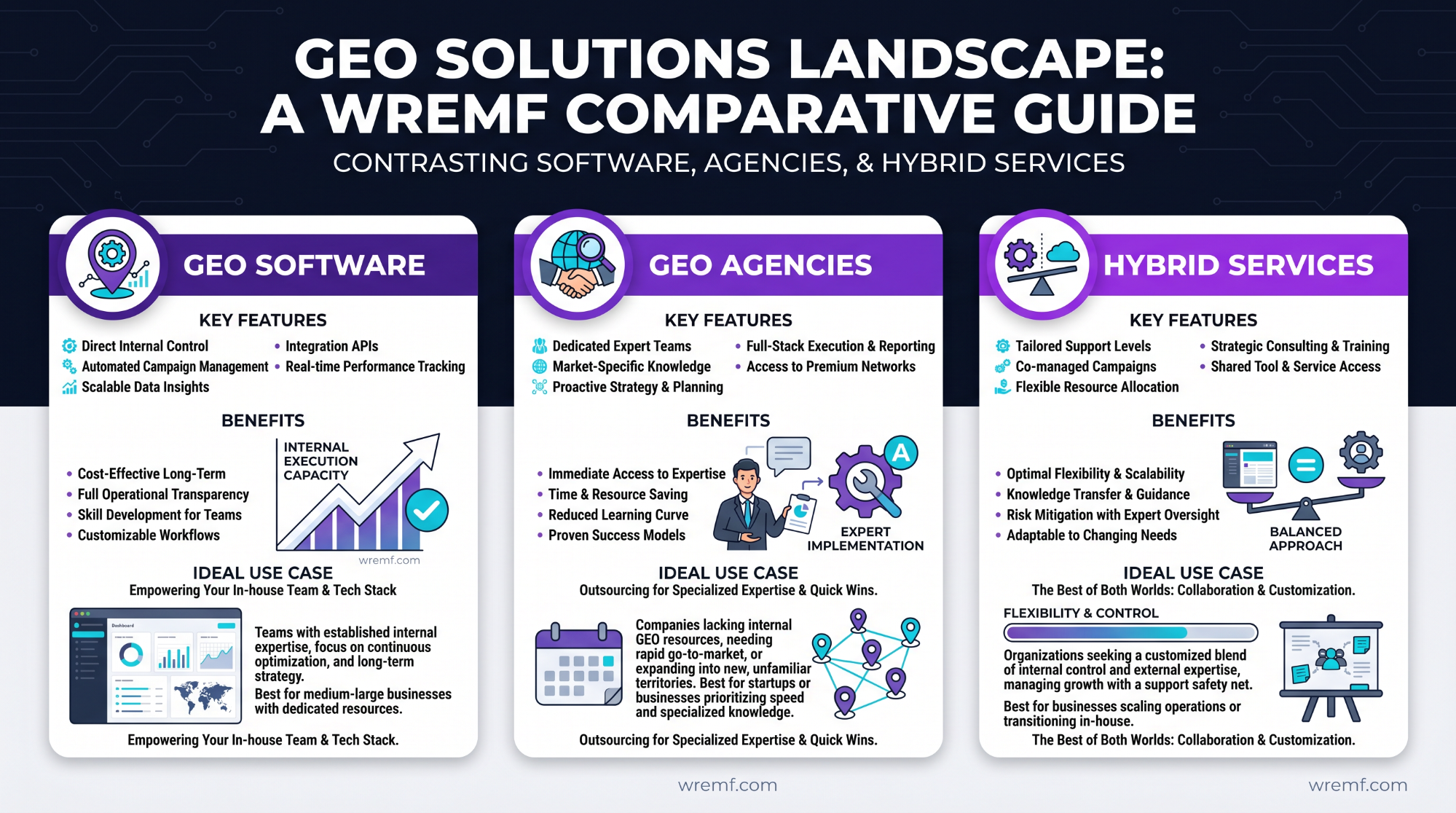
You should choose GEO software if you have internal execution capacity, a GEO agency if you need expert implementation, and a hybrid model if you need both measurement and action. The right choice depends on team size, urgency, budget, and reporting needs.
GEO agencies are service providers that help brands improve visibility across generative engines, AI searches, AI-powered search experiences, and AI-generated responses. GEO agencies matter because many teams need strategy, content, authority development, reporting, and execution support.
LLM tools are software products that help teams monitor, test, or improve visibility across language models and AI platforms. LLM tools matter because manual AI testing is too inconsistent for serious reporting.
| Option | Best for | What it includes | Main limitation | Recommended when |
|---|---|---|---|---|
| GEO software | SEO teams, growth teams, agencies | Prompt tracking, citations, competitors, reporting | Requires internal execution | You have a team that can act |
| GEO agency | Founders, lean teams, B2B SaaS companies | Strategy, audits, content, source cleanup, reporting | More service-dependent | You need senior-led execution |
| Hybrid model | Scaling teams and agencies | Software plus managed AEO, GEO, and reporting | Requires clear ownership | You need measurement and implementation |
| Manual testing | Very early teams | Basic prompt checks | Not scalable or repeatable | You need a quick starting signal |
| Legacy SEO tool only | SEO-focused teams | Rankings, backlinks, keyword research | Misses AI-generated responses | You only need classic SEO reporting |
A specialized GEO agency should not only produce content. It should explain how prompts, citations, brand mentions, source consistency, semantic signals, entity relationships, and AI-generated responses are being measured. If a provider only reports keyword rankings, it is not delivering a complete GEO service.
First Page Sage, SEO Discovery, Zozimus, Victorious, Black Propeller, Perrill, and other agencies appear in market discussions around GEO agencies or AI search optimization services. The important buying criterion is not the name alone. The important criterion is whether the provider can show a repeatable methodology, clear reporting, realistic timelines, and execution quality.
WREMF is built for brands that want software, agencies that need white-label reporting, and teams that want managed execution. The WREMF pricing page includes Starter, Growth, and Enterprise plans with BYOK, 10 AI engines, unlimited prompt tracking, all features and tools, and white-label reporting included across plans.
KEY TAKEAWAY: Choose GEO software for control, a GEO agency for execution, and a hybrid model when you need both measurement and implementation.
After selecting the operating model, you need to know what professional GEO services should actually deliver.
What Should a Professional GEO Service Include?
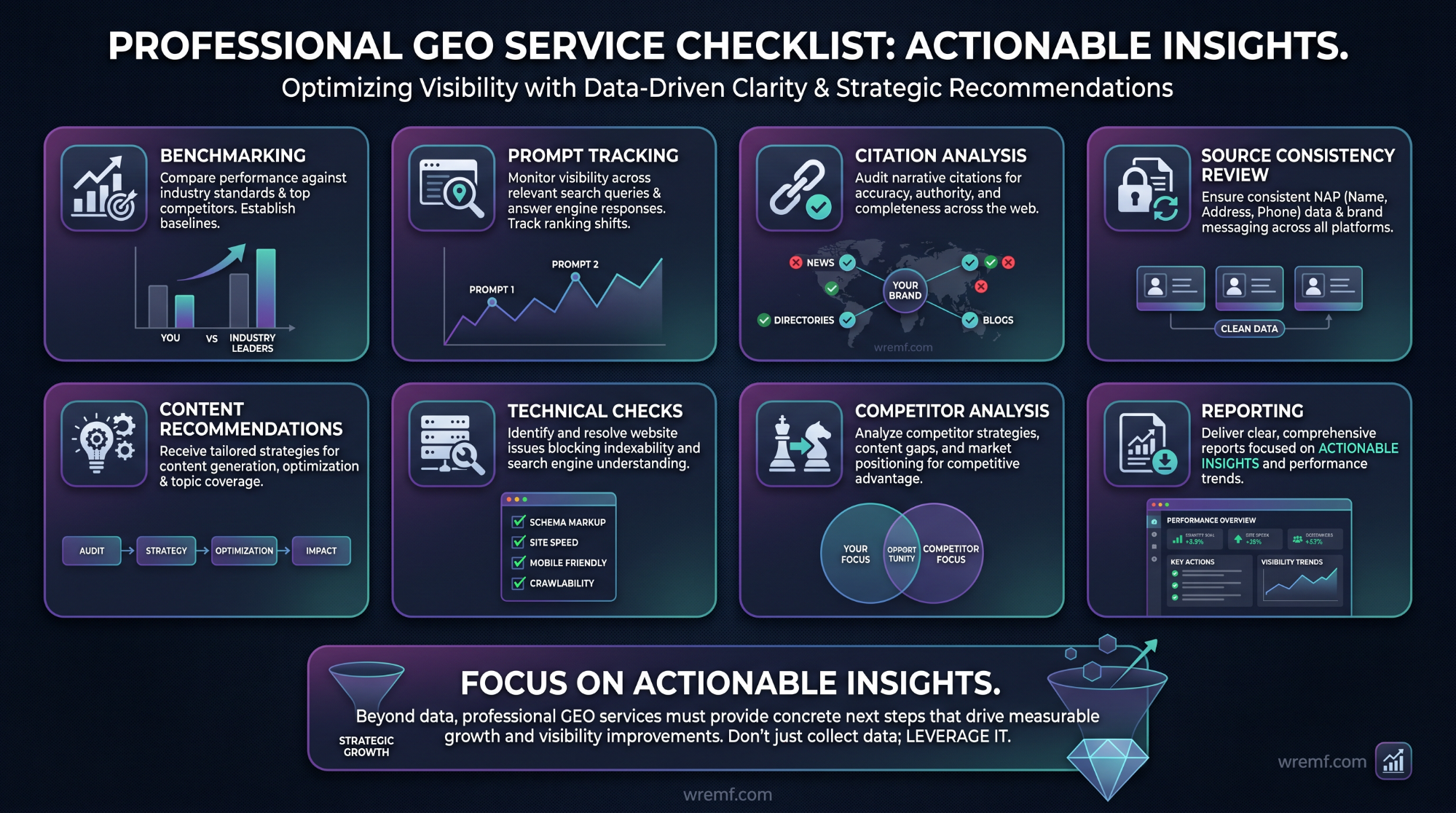
A professional GEO service should include benchmarking, prompt tracking, citation analysis, source consistency review, content recommendations, technical checks, competitor analysis, and reporting. The service should produce clear actions, not only dashboards.
A professional GEO service starts with discovery. The team should understand your category, competitors, ICP, target geographies, buying questions, product positioning, current SEO footprint, and existing content system. Without that context, prompt tracking can become too generic.
The service should then create a prompt universe. This includes informational prompts, comparison prompts, buying prompts, implementation prompts, risk prompts, and support prompts. For B2B SaaS, prompt sets should reflect how buyers actually search across ChatGPT, Perplexity, Gemini, Claude, Copilot, Google AI Overviews, and traditional search.
A full GEO service should include:
AI visibility benchmark
Prompt tracking across multiple AI platforms
AI citation and source citation analysis
AI-generated response quality review
Competitor visibility comparison
AI share of voice reporting
Semantic content audit
Entity optimization recommendations
Schema markup and structured data guidance
HTML optimization and crawl checks
Source consistency cleanup
Citation-worthy content recommendations
AI-ready content briefs
SEO testing and performance validation
AI traffic attribution and reporting
AI response pattern analysis is the process of reviewing repeated patterns in AI-generated answers across prompts, platforms, and competitors. AI response pattern analysis matters because it reveals why AI systems choose certain sources, categories, and brands.
Response quality optimization is the process of improving the accuracy, completeness, and usefulness of how AI systems describe a brand. Response quality optimization matters because visibility is not enough if the answer is wrong, weak, or outdated.
IMPORTANT: A GEO service that cannot show prompts, source evidence, competitor comparisons, and action recommendations is difficult to evaluate.
WREMF’s GEO Audit feature is designed to show what LLMs see, what is missing for AEO and GEO, which tracked prompts a URL can win, and what actions should be prioritized. This makes GEO more practical for teams that need implementation clarity.
KEY TAKEAWAY: Professional GEO services should produce benchmark data, source evidence, prioritized recommendations, and measurable reporting.
The next section covers pricing and investment decisions without treating every business the same.
How Much Do Generative AI Optimization Services Cost?
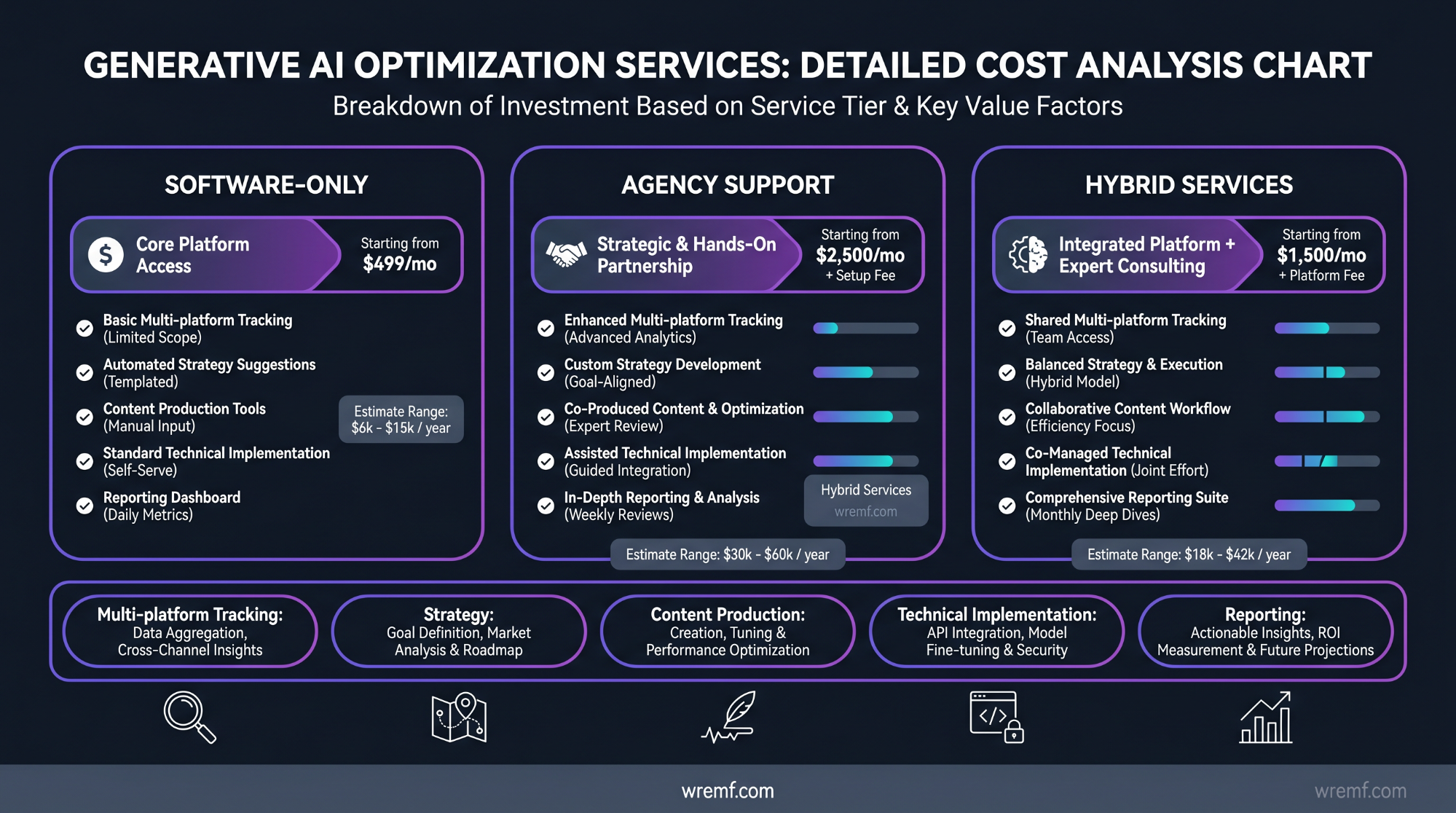
Generative AI optimization services cost more when they include multi-platform tracking, strategy, content production, technical implementation, reporting, and managed execution. Software is usually cheaper than agency support, while hybrid services combine platform cost with expert work.
Cost depends on scope. A small brand may need prompt tracking, a GEO Audit, and a few content briefs. A larger B2B SaaS company may need multi-brand reporting, API workflows, competitor monitoring, white-label reports, AI traffic attribution, content production, schema guidance, and monthly consulting.
| Pricing factor | Lower-scope need | Higher-scope need |
|---|---|---|
| Number of websites | 1 website | 5 or unlimited websites |
| AI platforms tracked | 2 to 3 platforms | 10 AI engines |
| Prompt volume | Small prompt set | Unlimited prompt tracking |
| Execution | Internal team handles fixes | Agency team manages execution |
| Reporting | Basic monthly summary | White-label dashboards and client portals |
| Technical integration | Manual exports | API and MCP workflows |
| Content needs | Few briefs | Ongoing AI-ready content system |
WREMF’s software pricing starts with Starter at €39 per month for 1 website, unlimited prompt tracking, BYOK, 10 AI engines, all features and tools, white-label reports, 1 seat, and email support. Growth is €89 per month for 5 websites, unlimited prompt tracking, BYOK, 10 AI engines, all features and tools, white-label reports, priority email support with 24h SLA, content brief generator, and SEO A/B testing. Enterprise is custom pricing for unlimited websites, unlimited prompt tracking, BYOK, 10 AI engines, all features and tools, white-label reports, unlimited seats, dedicated support with 4h SLA, and custom branded portals.
BYOK means Bring Your Own Key. BYOK matters because teams can use their own AI provider keys for supported workflows, which supports control, transparency, and predictable usage management.
White-label reporting is reporting that can be branded for agencies or client-facing teams. White-label reporting matters because agencies managing multiple clients need scalable reporting without rebuilding dashboards manually.
KEY TAKEAWAY: GEO cost depends on whether you need software, execution, technical integrations, reporting, or a hybrid model.
Cost is only useful if you understand what can go wrong and what limitations to expect.
Risks, Limitations, and Common Mistakes in GEO
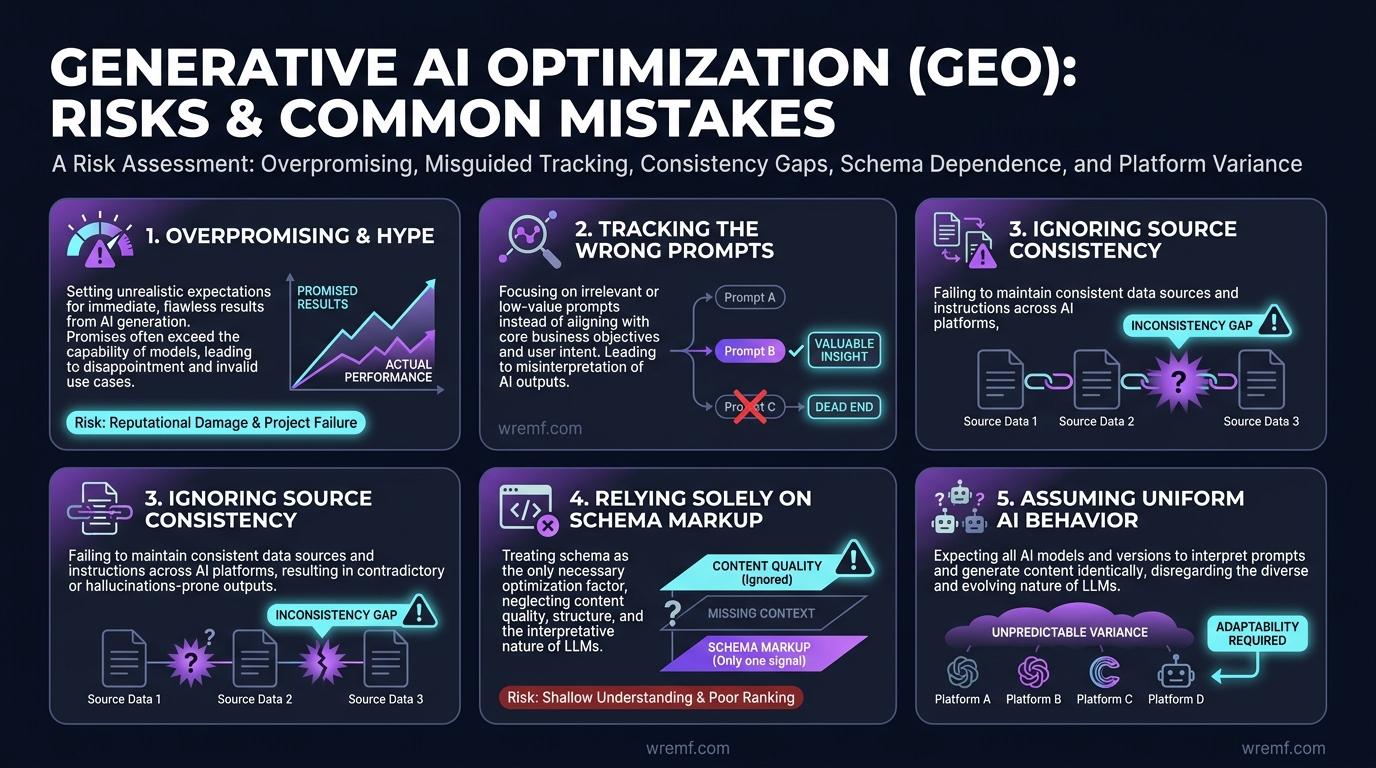
The main risks in GEO are overpromising, tracking the wrong prompts, ignoring source consistency, relying only on schema markup, and assuming AI platforms behave the same way. GEO is measurable, but it is not fully controllable.
Algorithm adaptation is the ongoing change in how search engines, generative engines, and AI platforms retrieve, rank, summarize, and cite information. Algorithm adaptation matters because AI visibility can change even when your website stays the same.
Reputation management is the process of monitoring and improving how a brand is described across public sources. Reputation management matters in GEO because AI-generated responses may summarize third-party sources, reviews, articles, directories, and social media references.
Review management is the process of monitoring and improving public customer reviews and review-site accuracy. Review management matters because some AI-generated responses may rely on review signals or third-party sentiment when answering buying prompts.
Common mistakes include:
Tracking only one AI platform
Tracking only branded prompts
Ignoring non-click visibility
Treating brand mentions and AI citations as the same metric
Publishing generic content without expert insight
Relying on schema markup alone
Ignoring source consistency across third-party pages
Reporting rankings while ignoring AI-generated answers
Failing to connect AI visibility with lead generation or pipeline
Expecting guaranteed results from GEO agencies
Lead generation is the process of attracting and converting potential buyers into contacts, opportunities, or pipeline. Lead generation matters because GEO should eventually support business outcomes, even when the first measurable signal is visibility.
A realistic GEO strategy should avoid guarantees. No provider should promise that a brand will appear in every AI-generated response or that an AI citation will immediately create revenue. The better promise is process quality: better measurement, clearer content, stronger source consistency, and better decision-making.
TIP: Track both visibility and accuracy. A brand that appears often but is described incorrectly still has a GEO problem.
KEY TAKEAWAY: GEO works best when teams treat it as a measurement and source ecosystem problem, not a shortcut to guaranteed traffic.
These risks often create myths that stop teams from making good decisions.
Common Myths About AI Visibility Debunked
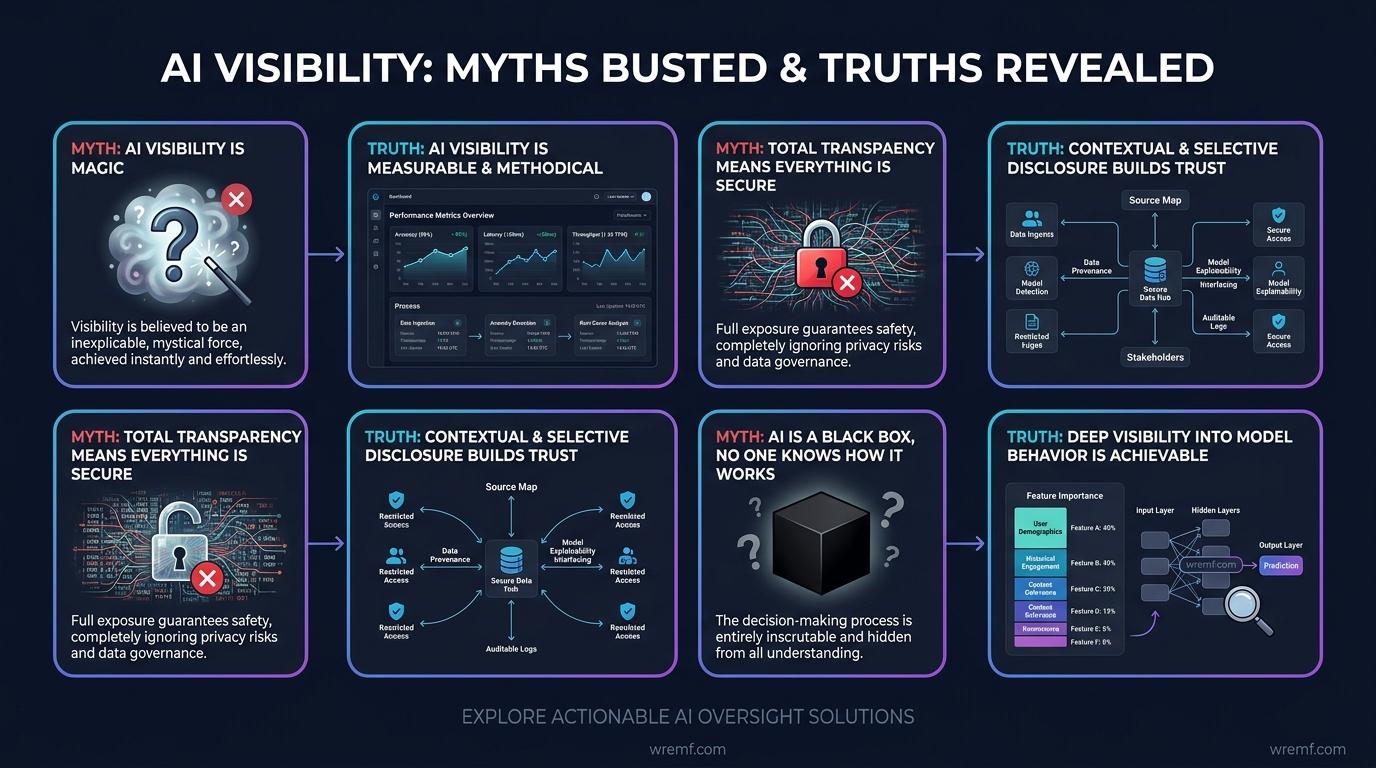
AI visibility myths usually come from treating generative search as either magic or traditional SEO with a new label. The truth is more practical: AI visibility is measurable, influenceable, and dependent on source quality.
MYTH: SEO, AEO, and GEO are the same thing.
FACT: SEO, Answer Engine Optimization, and Generative Engine Optimization overlap, but they are not the same. SEO improves visibility in search engines, AEO improves answer extraction, and GEO improves visibility in generative engines and AI-generated responses. A strong strategy connects all three.
MYTH: AI visibility is impossible to measure.
FACT: AI visibility can be measured through prompt tracking, AI citations, brand mentions, AI share of voice, competitor presence, sentiment, and AI traffic attribution. The measurement is less mature than classic rank tracking, but it is not guesswork when prompts and platforms are tracked consistently.
MYTH: Rankings alone are enough.
FACT: Rankings still matter, but rankings do not show whether ChatGPT, Claude, Gemini, Perplexity, Copilot, or Google's AI Overviews mention your brand. A website can rank in traditional search results while being absent from AI-generated answers. AI visibility adds a separate reporting layer.
MYTH: Schema markup guarantees AI citation.
FACT: Schema markup can support structured data and semantic understanding, but it does not guarantee AI citation. AI citation depends on relevance, retrieval, trust, source consistency, content quality, and platform-specific behavior.
MYTH: GEO is only for large brands.
FACT: GEO is useful for any brand that buyers compare through AI searches. Smaller B2B companies can benefit when clear positioning, answer-first content, entity authority, and consistent source signals make their expertise easier to retrieve.
KEY TAKEAWAY: AI visibility is not magic and not a replacement for SEO. It is a measurable extension of search, content, entity, citation, and source strategy.
The FAQ section answers the specific questions buyers, marketers, and founders ask before investing in GEO.
Frequently Asked Questions
What are generative AI optimization services and how do they work?
Generative AI optimization services help brands improve how they appear in AI-generated answers, source citations, summaries, comparisons, and recommendations. They work by tracking prompts across AI platforms, analysing AI-generated responses, identifying cited sources, comparing competitors, fixing source consistency, and improving content architecture. A complete service usually includes Generative Engine Optimization, Answer Engine Optimization, LLM Optimization, semantic content audit, schema markup guidance, AI citation analysis, and reporting. The goal is to make your brand easier for generative engines to understand, retrieve, cite, and recommend.
What is Generative Engine Optimization?
Generative Engine Optimization is the practice of improving visibility across generative engines such as ChatGPT, Perplexity, Gemini, Claude, Copilot, Google AI Overviews, DeepSeek, Grok, Meta AI, and Mistral. Generative Engine Optimization focuses on prompts, AI-generated responses, citations, brand mentions, competitor presence, and source consistency. It differs from traditional SEO because it measures how AI platforms answer questions, not only where pages rank in search results. GEO Optimization is most useful when buyers use AI searches to compare vendors, products, services, or expert sources.
How is GEO different from Answer Engine Optimization?
GEO improves visibility in generative engines, while Answer Engine Optimization improves how content is extracted into direct answers. AEO is useful for FAQs, definitions, featured snippets, voice searches, and answer-first content. GEO is broader because it includes AI-generated responses, multi-platform prompt tracking, AI citation analysis, competitor visibility, and AI share of voice. The two should work together. AEO makes content easier to quote, while GEO measures whether AI platforms actually use, cite, or recommend the brand.
Do I still need SEO if I invest in GEO?
Yes, most teams still need SEO if they invest in GEO. Search engine optimization supports crawlability, content quality, internal linking, authority, structured data, and search impressions. These foundations can also help AI retrieval systems understand and access your content. GEO adds prompt tracking, AI citation analysis, source consistency, LLM Optimization, and AI visibility reporting. The strongest approach is not to replace SEO with GEO. The strongest approach is to connect SEO, AEO, GEO, and LLM Optimization into one search visibility system.
Are GEO agencies legitimate?
GEO agencies can be legitimate when they use transparent measurement, realistic claims, and clear deliverables. A credible GEO agency should show which prompts are tracked, which AI platforms are tested, which sources are cited, which competitors appear, and what changes should be made. Be cautious with GEO agencies that guarantee AI citations, promise instant results, or only rename keyword research as GEO. WREMF offers managed AEO, GEO, AI visibility strategy, content optimization, source consistency cleanup, and reporting for teams that need execution support.
What are the best tools for Generative Engine Optimization?
The best tools for Generative Engine Optimization track prompt visibility, AI-generated responses, source citations, brand mentions, competitors, AI share of voice, and AI traffic attribution across multiple AI platforms. Traditional SEO tools still help with keyword research, backlinks, technical SEO, and search impressions, but they do not fully measure AI visibility. WREMF combines prompt intelligence, source citation tracking, competitive landscape analysis, GEO audits, content briefs, SEO testing, BYOK support, white-label reporting, and API workflows for teams that need a dedicated AI visibility system.
How do I optimize my website for ChatGPT and Perplexity?
Start by testing high-intent prompts in ChatGPT and Perplexity, then document whether your brand appears, which competitors appear, and which sources are cited. Next, improve your website with clear category definitions, answer-first sections, structured content, schema markup, internal links, comparison tables, FAQs, and source-backed claims. Then review third-party sources such as directories, partner pages, social media profiles, and review platforms for consistency. Use prompt tracking and citation tracking over time instead of relying on one manual test.
How much do generative AI optimization services cost?
Generative AI optimization services vary based on scope, number of websites, number of AI platforms, prompt volume, reporting needs, and whether execution is included. Software is usually more affordable than managed services, while hybrid models include both measurement and expert implementation. WREMF software starts at €39 per month for Starter and €89 per month for Growth, with custom Enterprise pricing for larger teams. Agency or hybrid services usually cost more because they include strategy, content, audits, source cleanup, technical recommendations, and reporting.
How quickly can I see results from a GEO campaign?
A GEO campaign can produce benchmark insights during the first audit cycle, but visibility improvements usually take longer. Early results may include finding missing prompts, inaccurate AI-generated responses, weak citation sources, competitor gaps, and source consistency problems. Improvements in AI visibility depend on platform behavior, content updates, source freshness, indexing, competitor authority, and model changes. A practical reporting cadence is monthly, with prompt visibility, AI citation frequency, brand mentions, AI share of voice, search impressions, and AI traffic attribution monitored over time.
Can GEO improve lead generation?
GEO can support lead generation by improving how a brand appears when buyers use AI searches to research problems, compare vendors, and shortlist solutions. It should not be sold as a guaranteed lead generation shortcut. The stronger value is improving discoverability, recommendation visibility, source trust, and answer accuracy across AI platforms. When combined with strong landing pages, clear CTAs, attribution tracking, and sales follow-up, GEO can become part of a broader demand generation and digital marketing system.
Is GEO suitable for every industry?
GEO is most useful for industries where buyers research, compare, and validate options before converting. B2B SaaS, consulting, agencies, cybersecurity, healthcare, finance, legal services, education, ecommerce, and high-consideration services can benefit from Generative Engine Optimization. Very small local businesses may still benefit, but the scope should match the opportunity. The more your customers use ChatGPT, Perplexity, Google AI Overviews, Gemini, Claude, or Copilot to compare options, the more important AI visibility becomes.
What is the difference between brand mentions and AI citations?
Brand mentions are references to your brand inside AI-generated answers, even when no source link appears. AI citations are links, references, or source mentions used to support an answer. Both matter, but they mean different things. A brand mention shows that the AI platform recognizes your brand in a context. An AI citation shows that a source connected to your brand was used as evidence. A complete AI visibility report should track both metrics separately.
What is source consistency in GEO?
Source consistency means your brand is described accurately and consistently across your website, directories, partner pages, social media profiles, review platforms, comparison pages, documentation, and public references. Source consistency matters because AI systems may use multiple sources to describe your company. If those sources conflict, AI-generated responses may become vague, outdated, or inaccurate. Source consistency cleanup is often one of the highest-value parts of generative AI optimization services because it improves machine understanding and buyer trust.
Can schema markup improve AI visibility?
Schema markup can support AI visibility by helping search engines understand entities, page types, products, FAQs, articles, reviews, and organisation information. However, schema markup alone does not guarantee AI citation or inclusion in AI-generated responses. It should match visible content and support a broader strategy that includes helpful content, clear entities, source-backed claims, internal linking, technical accessibility, and source consistency. Treat schema markup as a signal anchor, not a complete GEO strategy.
What should I ask a GEO agency before hiring them?
Ask a GEO agency which AI platforms it tracks, how prompts are selected, how citations are measured, how competitors are benchmarked, how source consistency is reviewed, and how recommendations are prioritized. You should also ask whether the agency provides content briefs, technical guidance, schema recommendations, reporting, and implementation support. Avoid any agency that guarantees AI citations or refuses to show methodology. A strong GEO agency should explain what is measurable, what is influenceable, and what remains platform-dependent.
How does WREMF help with generative AI optimization services?
WREMF helps teams track, improve, and prove AI visibility across ChatGPT, Claude, Gemini, Perplexity, Google AI Overviews, Copilot, DeepSeek, Grok, Meta AI, Mistral, and other AI discovery surfaces. WREMF combines prompt tracking, source citation analysis, competitor visibility, AI share of voice, GEO audits, AI-ready content briefs, SEO testing, reporting, BYOK support, white-label reports, API workflows, and optional agency execution. WREMF is useful for brands, agencies, consultants, and growth teams that want software, managed services, or a hybrid model.
Conclusion
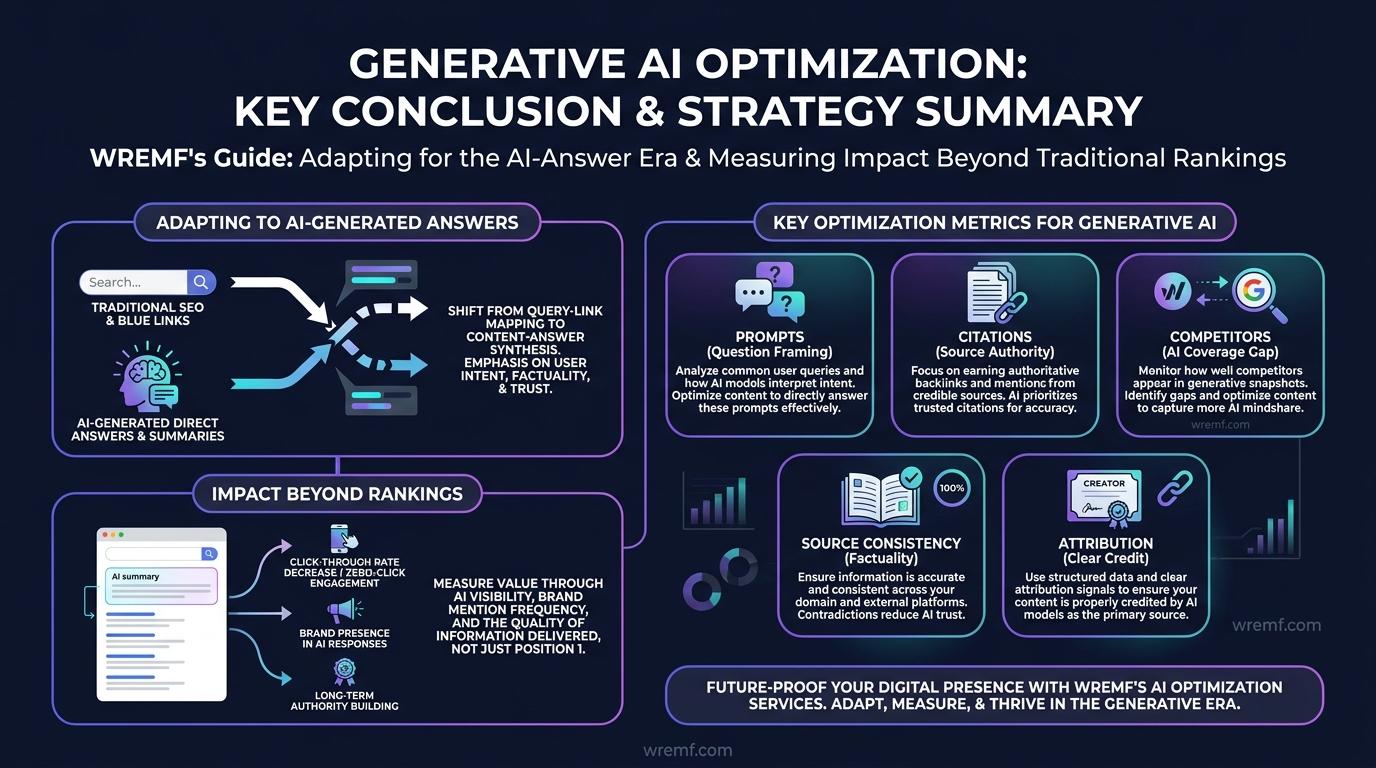
Generative AI optimization services help brands adapt to a search environment where AI-generated answers, citations, recommendations, and zero-click experiences influence buying decisions. SEO still matters, but rankings alone do not show whether ChatGPT, Claude, Gemini, Perplexity, Copilot, Google's AI Overviews, or other generative engines understand, cite, or recommend your brand. The practical path is to measure prompts, citations, competitors, source consistency, and attribution, then improve the content and source ecosystem that AI systems rely on. To turn GEO from a guessing game into a measurable workflow, explore the WREMF platform suite or talk to the WREMF agency team.
Related Generative Engine Optimization Guides
- LLM SEO Services The Complete 2026 Guide to AI Search Visibility, AEO, GEO, and LLM Optimization
- Large Language Model Optimization Services The Complete Guide to LLMO, AI Search Visibility, AEO, GEO, RAG, and LLM Performance
- LLM SEO Agency The Complete Guide to Choosing an Agency for AI Search Visibility
- AI SEO Services The Complete Guide to Search Visibility in the AI Era
- AI Search Engine Optimization Services The Complete Guide for B2B Brands
- Answer Engine Optimization Services The Complete Guide to AI Search Visibility
- AI SEO Agency How to Choose the Right Partner for AI Search Visibility
- AI Mention Tracking The Complete Guide to Monitoring Brand Mentions, AI Answers, Citations, and Share of Voice in 2026
- AI Brand Monitoring The Complete Guide to Tracking Brand Visibility Across AI Search, LLMs, and Generative Engines
- Answer Engine Optimization The Complete Guide to AEO, AI Search Visibility, and Answer-First Content
- How AI Search Optimization Tools Increase Organic Traffic
- AI Search Engine Optimization Tools The Complete 2026 Guide for AI Search, SEO, AEO, and GEO
- Enterprise Answer Engine Optimization Platforms Complete Guide for AI Visibility, AEO, and GEO
- AI Search Engine Optimization The Complete Guide for B2B Brands
- AI Overview SEO How to Optimize for Google AI Overviews, AI Mode, and AI Search Visibility
- 12 Best AI Search Optimization Tools
- AI Overview Optimization How to Rank, Get Cited, and Stay Visible in Google AI Search
- AI SEO Tools The Complete Guide for SEO, AEO, GEO, and AI Search Visibility
- How Do AI Search Optimization Tools Improve SERP Rankings
- Best Answer Engine Optimization for Enhancing AI Visibility
Related reading
- Best Answer Engine Optimization for Enhancing AI Visibility
- AI SEO Agency: How to Choose the Right Partner for AI Search Visibility
- AI Citation Optimization Services: The Complete B2B Guide to Getting Cited in AI Search
- AI Overview SEO: How to Optimize for Google AI Overviews, AI Mode, and AI Search Visibility
- LLM SEO Services: The Complete 2026 Guide to AI Search Visibility, AEO, GEO, and LLM Optimization
- Large Language Model Optimization Services: The Complete Guide to LLMO, AI Search Visibility, AEO, GEO, RAG, and LLM Performance