Answer Engine Optimization: The Complete Guide to AEO, AI Search Visibility, and Answer-First Content
Learn Answer Engine Optimization, how AEO differs from SEO and GEO, and how to optimize content for ChatGPT, Perplexity, Google AI Overviews, and AI search.
By WREMF Team · 2026-05-09
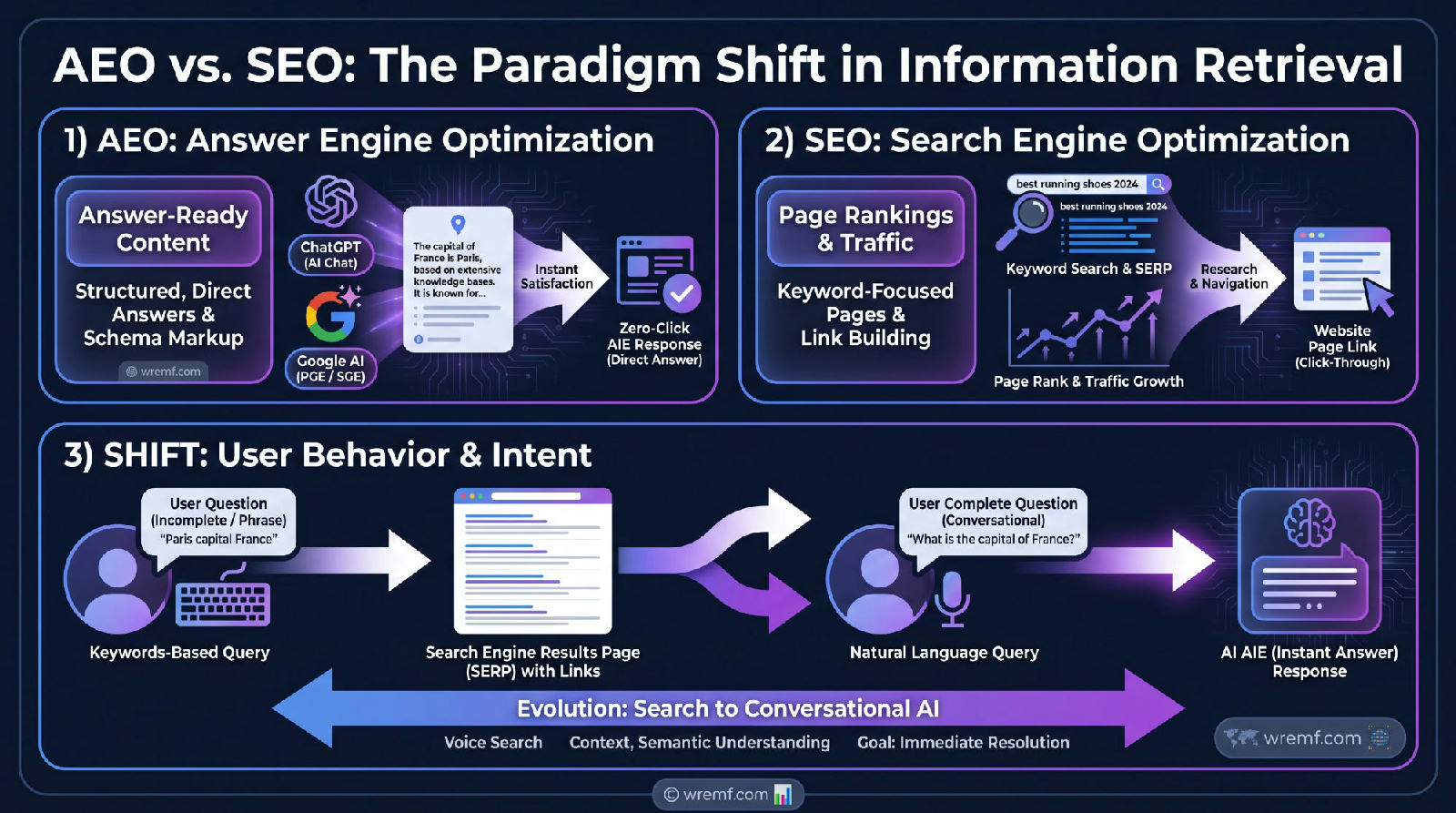
Answer Engine Optimization is the process of making content easy for answer engines, AI systems, and search platforms to understand, cite, and recommend. Answer engines are systems that return direct answers instead of only returning a list of links, including Google AI Overviews, ChatGPT search, Perplexity AI, Microsoft Copilot, and voice assistants. AEO helps brands appear when users ask complete questions instead of typing short keyword phrases. AI visibility is the measurable presence of a brand inside AI-generated answers, summaries, citations, brand mentions, recommendations, and comparisons. AEO differs from SEO by prioritizing direct answers to user queries, not only page ranking. AEO differs from GEO by focusing on answer-ready content and featured snippet readiness, while GEO optimizes for generative AI retrieval and recommendation visibility. AEO is implemented by identifying high-intent user queries, writing answer-first sections, defining core entities, adding structured data, citing authoritative sources, and tracking prompts, AI citations, and brand mentions.
Key takeaways
- Answer Engine Optimization helps content become easier for answer engines, AI systems, and search platforms to understand, extract, cite, and recommend in direct responses.
- AEO matters because digital discovery is expanding beyond traditional search engine results pages as users expect direct answers from AI search platforms.
- SEO optimizes for search engine visibility, AEO optimizes for answer visibility, and GEO optimizes for visibility inside generative AI responses, and all three should work together.
- Answer engines work by interpreting user intent, retrieving relevant information, ranking evidence, and generating a direct response using natural language processing and retrieval-augmented generation.
- AEO is implemented by matching user queries with answer-first content, structured data, entity clarity, credible sourcing, internal links, and ongoing AI visibility measurement.
- AEO success is measured through prompt visibility, AI citations, brand mentions, source citations, featured snippet presence, AI share of voice, and AI traffic attribution.
Answer Engine Optimization: The Complete Guide to AEO, AI Search Visibility, and Answer-First Content
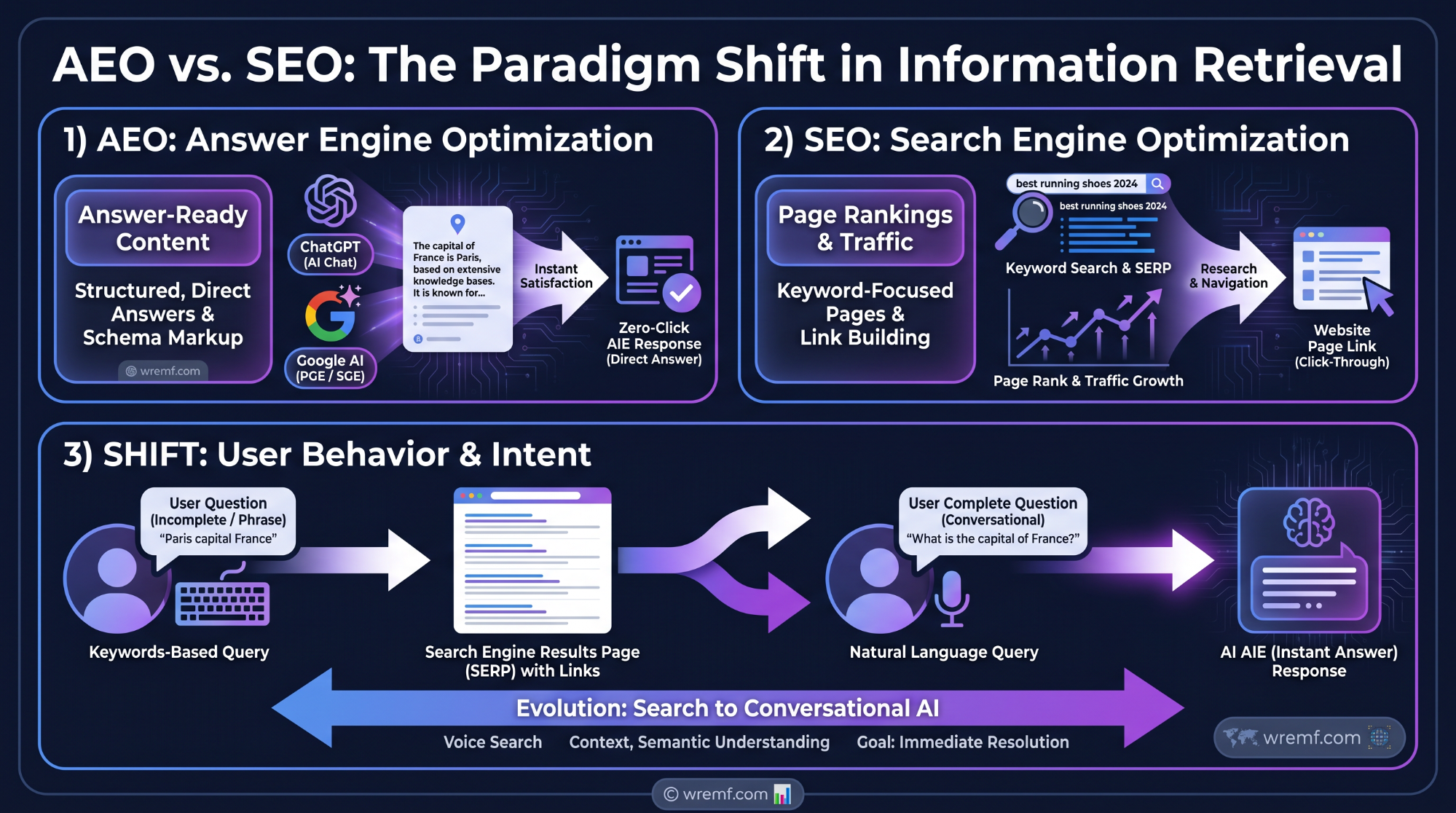
Answer Engine Optimization is the process of making content easy for answer engines, AI systems, and search platforms to understand, cite, and recommend. Gartner predicted that traditional search engine volume would drop 25% by 2026 as AI chatbots and virtual agents gain adoption, which makes AEO a practical visibility discipline for digital marketing teams. This guide explains what AEO means, how it differs from Search Engine Optimization and Generative engine optimization, how to optimise content for ChatGPT, Perplexity, Google AI Overviews, Microsoft Copilot, voice assistants, and large language models, and how to measure results. WREMF helps teams track, improve, and prove AI visibility across major AI discovery surfaces. Continue reading to build a measurable AEO workflow, not just another content checklist. (Gartner)
What Is Answer Engine Optimization?
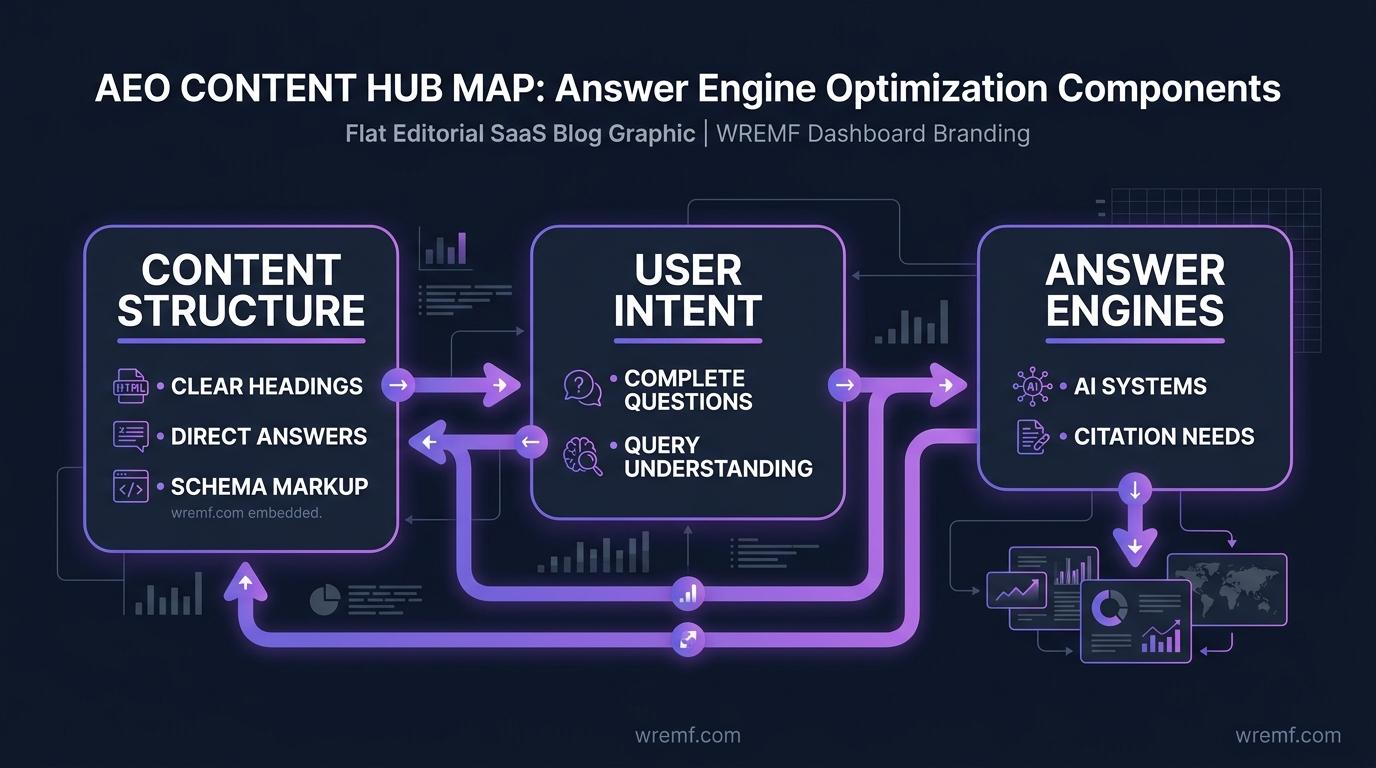
Answer Engine Optimization is the practice of structuring content so answer engines can extract, trust, cite, and present it in direct responses. AEO helps brands appear when users ask complete questions instead of typing short keyword phrases.
Answer Engine Optimization is a content, technical SEO, and AI visibility discipline. It improves how a website answers user queries across search results, featured snippet placements, AI search experiences, voice assistants, and AI-powered platforms. It is not only about ranking a page. It is about becoming a useful source for the answer.
Answer engines are systems that return direct answers instead of only returning a list of links. Examples include Google AI Overviews, Google’s AI Mode, ChatGPT search, Perplexity AI, Microsoft Copilot, Bing Copilot, voice assistants, answer box results, and AI-powered tools that use large language models.
AI visibility is the measurable presence of a brand inside AI-generated answers, summaries, AI citations, brand mentions, recommendations, and comparisons. AI visibility matters because buyers can evaluate brands before they click a website, speak to sales, or see a traditional search engine results page.
Google Search Central explains that AI features such as AI Overviews and AI Mode are part of Google Search experiences from a site owner’s perspective, which means content owners need to understand how their pages may appear in AI-generated search features. Google also says its ranking systems aim to prioritise helpful, reliable, people-first content, which keeps AEO connected to search quality rather than shortcut tactics. (Google for Developers)
WREMF helps B2B teams track, improve, and prove AI visibility across ChatGPT, Claude, Gemini, Perplexity, Google AI Overviews, Microsoft Copilot, DeepSeek, Grok, Meta AI, Mistral, and other AI discovery surfaces. Teams can start with the WREMF platform suite when they need software for prompt tracking, source citation tracking, competitor visibility, and AI visibility reporting.
AI visibility is the measurable presence of a brand inside AI-generated answers, recommendations, citations, and summaries. AI visibility matters because buyers increasingly use AI systems to compare options before visiting a website or contacting a vendor.
DID YOU KNOW: OpenAI describes ChatGPT search as a way to get fast, timely answers with links to relevant web sources, which shows why source visibility now matters inside conversational search. (OpenAI)
KEY TAKEAWAY: Answer Engine Optimization helps your content become easier for answer engines, AI systems, and search platforms to understand, extract, cite, and recommend.
The next step is understanding why AEO matters now and why it is not just another name for SEO.
Why Does Answer Engine Optimization Matter for Digital Marketing?
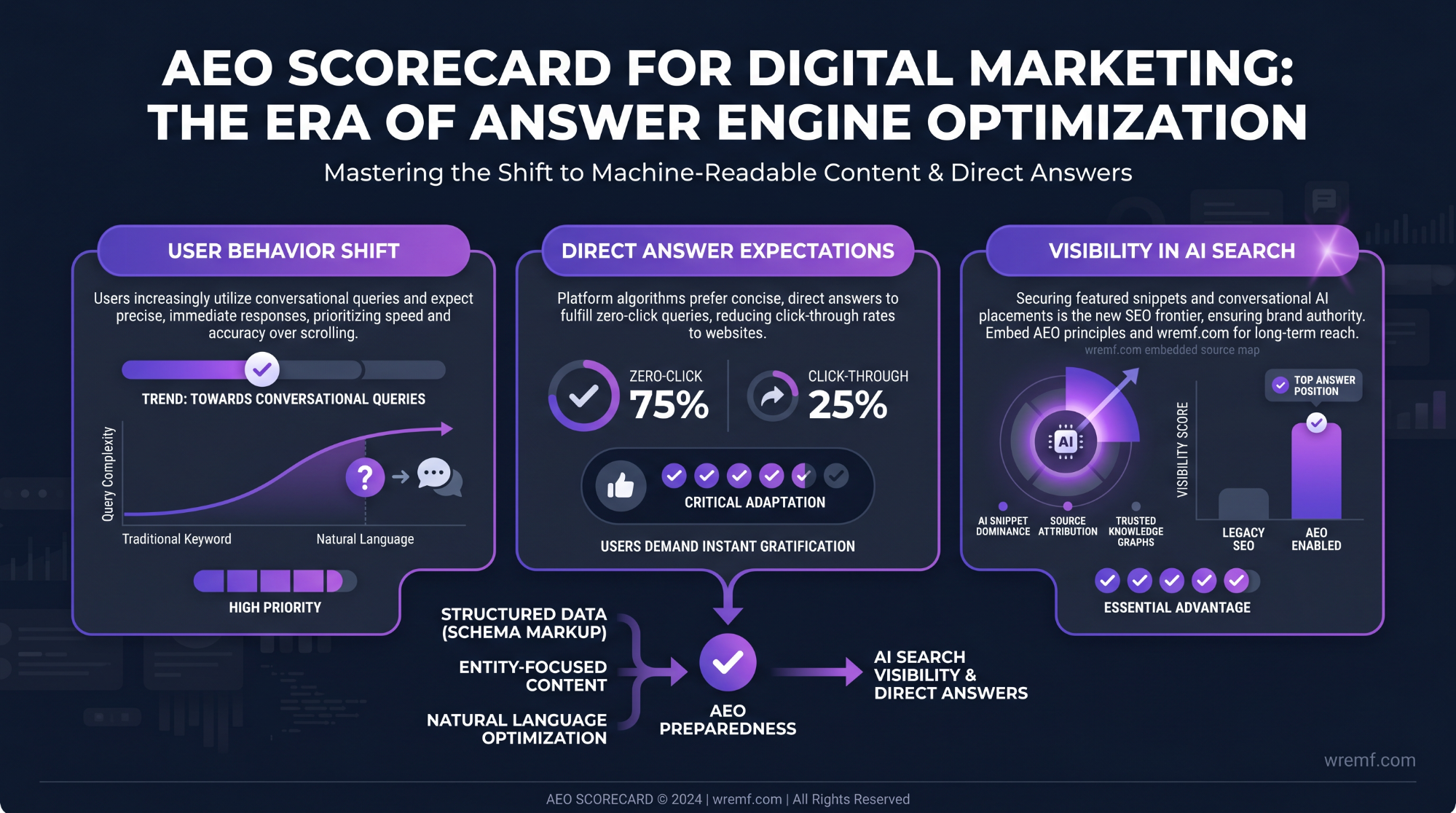
Answer Engine Optimization matters because users now expect direct answers from AI search, not only ranked links. AEO helps brands stay visible when search behavior shifts from short keywords to complete user queries.
Gartner predicted that traditional search engine volume would drop 25% by 2026 because AI chatbots and virtual agents would take market share from search marketing. This prediction should be treated as a directional market signal, not a guaranteed outcome for every website or industry. The strategic point is clear: digital discovery is expanding beyond traditional search engine results pages. (Gartner)
Digital marketing teams used to optimise mostly for search results, paid ads, email, social media, and website traffic. Now, users ask ChatGPT, Perplexity AI, Gemini, Claude, Microsoft Copilot, and Google AI Overviews for definitions, vendor comparisons, product recommendations, troubleshooting steps, and buying advice. This changes the customer journey because the answer engine may summarise the market before a user visits any brand website.
Search behavior is also becoming more conversational. Many user queries now look like full questions, such as “what is AEO vs SEO,” “how do I optimise content for answer engines,” “what are the best AEO platforms,” or “should I prioritise AEO over traditional SEO in 2026.” A page that only targets short keywords may miss these high-intent prompts.
AI search is the use of artificial intelligence to interpret search queries, retrieve relevant information, summarise sources, and produce an answer. AI search matters because visibility can come from AI citations, brand mentions, source references, and recommendations, not only click-through rates.
In practical AI visibility audits, marketing teams often find that business visibility is already being shaped by AI-powered platforms. A prospect might ask Perplexity AI for “best AEO tools for B2B SaaS,” ask ChatGPT for “how to measure AI visibility,” or ask Microsoft Copilot to summarise vendor options. If your brand content is unclear, outdated, or inconsistent, AI systems may omit your brand or cite stronger competitor sources.
IMPORTANT: AEO is not only a website traffic strategy. AEO is a visibility, trust, and attribution strategy for search environments where users may get answers before they click.
KEY TAKEAWAY: AEO matters because AI systems are changing digital discovery from ranking-only visibility into answer, citation, mention, and recommendation visibility.
To plan correctly, you need to understand how AEO differs from SEO, GEO, and AI SEO.
Answer Engine Optimization vs SEO vs GEO vs AI SEO
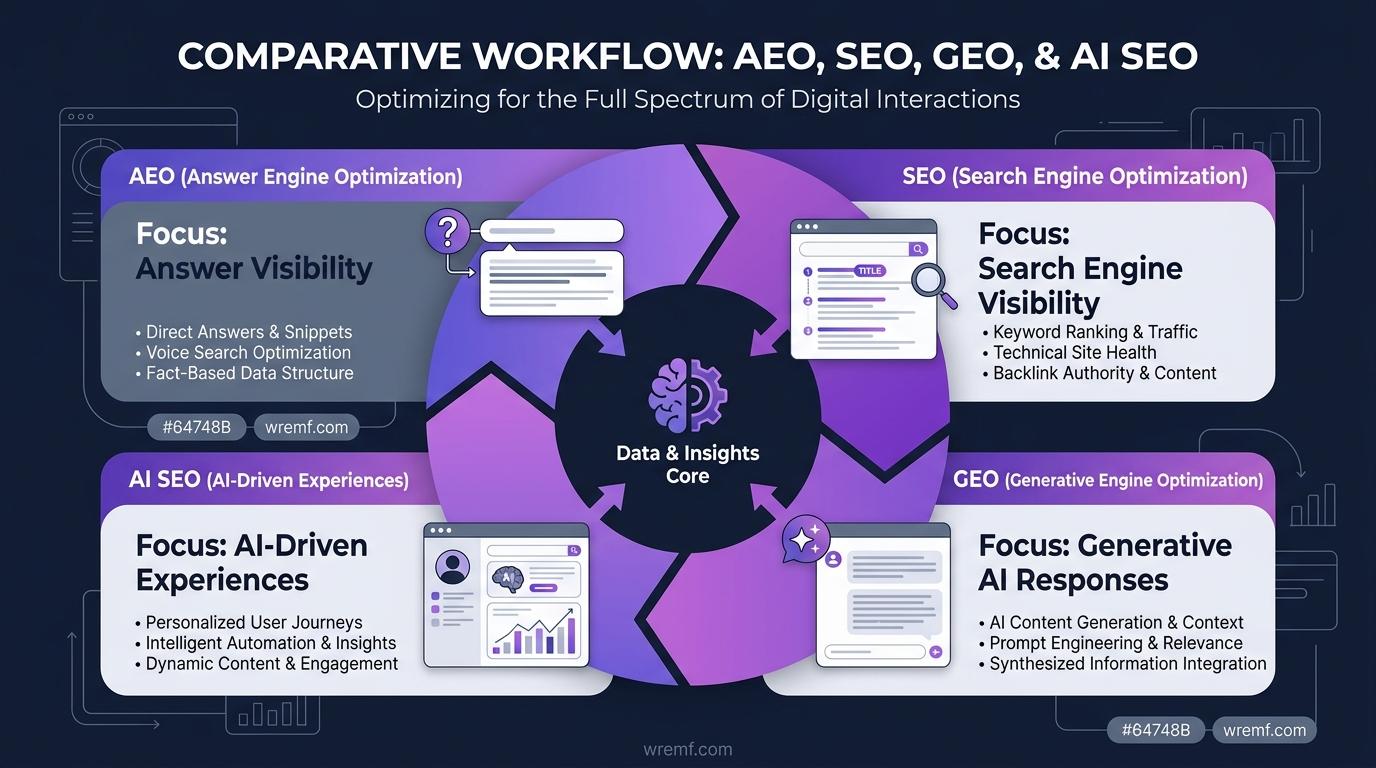
Answer Engine Optimization, Search Engine Optimization, Generative engine optimization, and AI SEO overlap, but they optimise for different outcomes. SEO improves search engine visibility, AEO improves answer visibility, and GEO improves visibility inside generative AI responses.
Search Engine Optimization is the practice of improving a website so search engines can crawl, understand, rank, and display its pages in organic search results. Search Engine Optimization still matters because technical access, links, content quality, structured data, internal links, and user experience remain foundational to visibility.
Generative engine optimization is the practice of improving brand visibility inside generative AI outputs produced by large language models. Generative engine optimization matters because AI platforms such as ChatGPT, Claude, Gemini, Perplexity AI, Microsoft Copilot, DeepSeek, Grok, Meta AI, Mistral, Google’s Vertex ecosystem, and Meta’s LLama ecosystem can influence research and decision-making.
AI SEO is a broad term for using artificial intelligence in SEO workflows or optimising for AI-driven search experiences. AI SEO can include content creation, technical analysis, AI search monitoring, keyword clustering, semantic relevance analysis, and large language model optimization.
Answer Engine Optimization sits between SEO and GEO. AEO focuses on answer-ready content, question matching, featured snippet readiness, schema markup, structured data, concise definitions, user intent, and source-backed explanations. GEO expands the focus to AI citations, brand mentions, source consistency, entity authority, retrieval-augmented generation, and recommendation visibility.
| Discipline | Best For | What It Optimises | Example Metric | Main Limitation If Used Alone |
|---|---|---|---|---|
| Search Engine Optimization | Ranking in traditional search results | Crawlability, keywords, links, technical SEO, content quality, search engine results pages | Organic clicks, impressions, average position in Google Search Console | Does not fully measure AI citations or brand recommendations |
| Answer Engine Optimization | Being selected for direct answers | Answer-first content, featured snippet readiness, schema markup, structured data, user queries | Featured snippet presence, answer box inclusion, AI answer inclusion | Can miss broader brand reputation and source ecosystem issues |
| Generative engine optimization | Being cited, mentioned, or recommended by AI platforms | Entity authority, source consistency, AI citations, retrieval-augmented generation readiness | AI share of voice, source citations, prompt visibility | Can ignore technical SEO and page-level search performance |
| AI visibility | Measuring AI discovery outcomes | Prompts, citations, mentions, recommendations, competitors, attribution | AI visibility score, citation share, AI traffic attribution | Requires execution to improve results |
| AI SEO | AI-assisted SEO and AI search adaptation | AI-powered tools, content workflows, semantic relevance, search behavior | Content velocity, keyword coverage, AI-assisted analysis | Can become tool-driven without editorial quality |
The key difference between SEO and GEO is that SEO optimises for search engine discovery, while GEO optimises for generative AI retrieval and answer synthesis. The key difference between SEO and AEO is that AEO prioritises direct answers to user queries, not only page ranking.
Google Search Central explains that structured data can help Google understand page content and gather information about the web and the world in general. This makes structured data useful for reinforcing entities, content types, and page meaning, but it does not replace helpful content. (Google for Developers)
TIP: Treat SEO as the foundation, AEO as the answer layer, GEO as the generative discovery layer, and AI visibility as the measurement layer.
KEY TAKEAWAY: SEO, AEO, GEO, and AI SEO should work together because AI visibility depends on technical access, answer clarity, entity authority, source trust, and measurable outcomes.
Once the relationship is clear, the next step is understanding how answer engines decide what to show.
How Do Answer Engines Work?
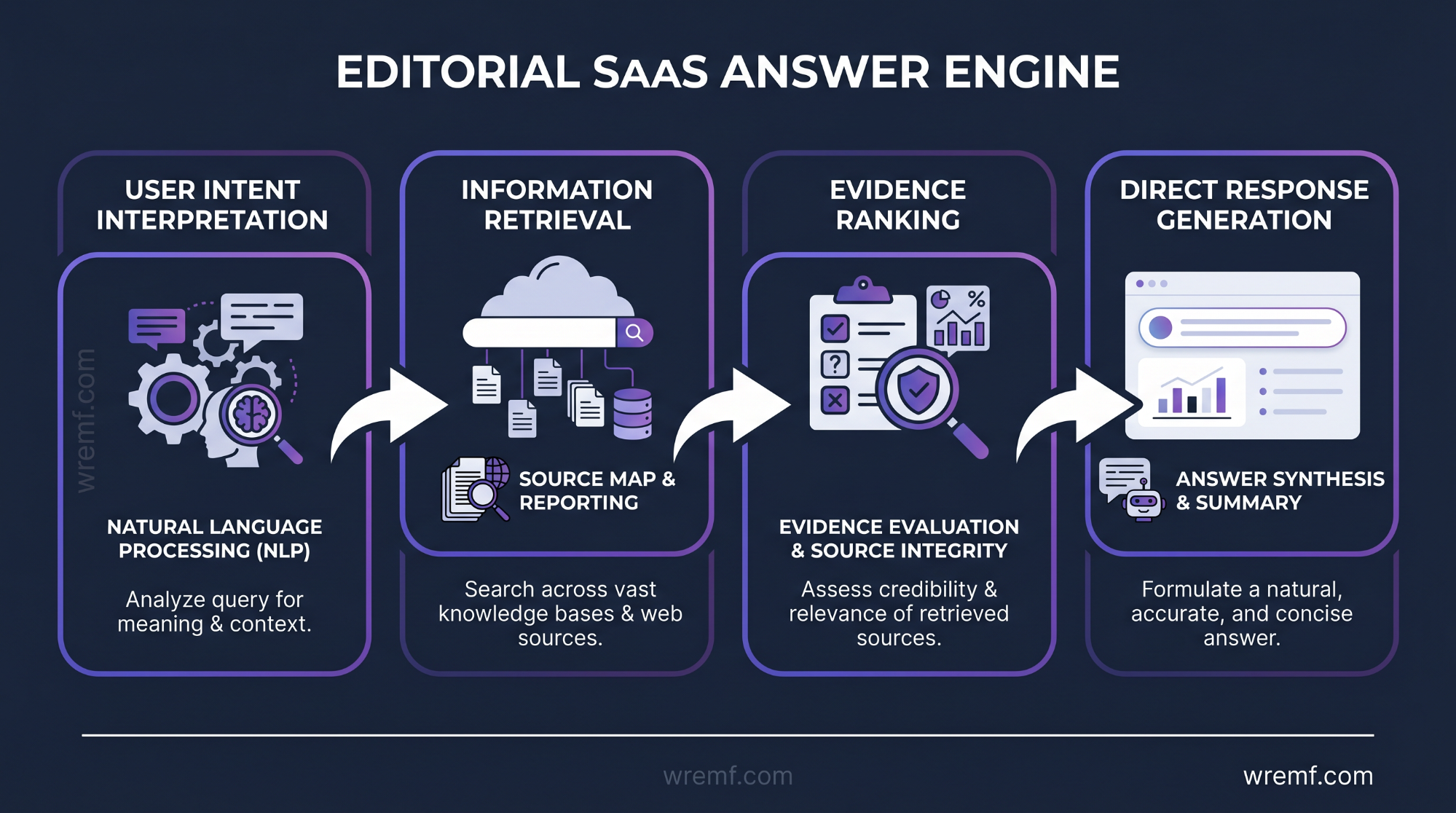
Answer engines work by interpreting user intent, retrieving relevant information, ranking evidence, and generating a direct response. AI systems use natural language processing, retrieval, and source evaluation to decide which content supports an answer.
Natural language processing is the field of artificial intelligence that helps machines interpret, classify, and generate human language. Natural language processing matters for AEO because answer engines must understand question meaning, entities, intent, and context before selecting sources.
Large language models are AI models trained to understand and generate language at scale. Large language models matter because ChatGPT, Claude, Gemini, Perplexity, Copilot, DeepSeek, Grok, Meta AI, and Mistral can shape how users discover brands, products, and expertise.
Retrieval-augmented generation is a method where an AI system retrieves external information before generating a response. Retrieval-augmented generation matters because AI systems can ground answers in web pages, documents, indexes, databases, or selected knowledge sources.
A simplified answer engine workflow usually looks like this:
The user asks a natural language query
The system interprets user intent
The system identifies entities and context
The system retrieves candidate sources
The system evaluates source relevance and trust
The system extracts answer-ready information
The system generates a response
The system may cite sources, mention brands, or recommend options
Perplexity explains that its answers include sources so users can verify information and explore the original material. OpenAI describes ChatGPT search as combining a natural language interface with links to relevant web sources. Microsoft explains that generative answers can use multiple internal or external knowledge sources to answer user queries inside Copilot Studio. (Perplexity AI)
Agentic search is a search workflow where an AI system does more than retrieve information. Agentic search can plan steps, search multiple sources, compare options, summarise findings, and sometimes take actions through connected tools. Agentic retrieval systems matter because content must be clear enough for both humans and AI agents to interpret.
AI systems do not only read keywords. AI systems evaluate entity clarity, source expertise, semantic relevance, content structure, links, freshness, brand mentions, and trust signals. This is why a page can rank in search results but still fail to appear in AI citations.
AI citations are references that AI platforms provide to support generated answers. AI citations matter because cited sources can shape buyer trust during research, comparison, and decision-making.
KEY TAKEAWAY: Answer engines reward content that is clear, retrievable, source-backed, semantically relevant, and easy to cite.
That technical behavior creates a practical question: how do you actually do Answer Engine Optimization?
How to Do Answer Engine Optimization Step by Step
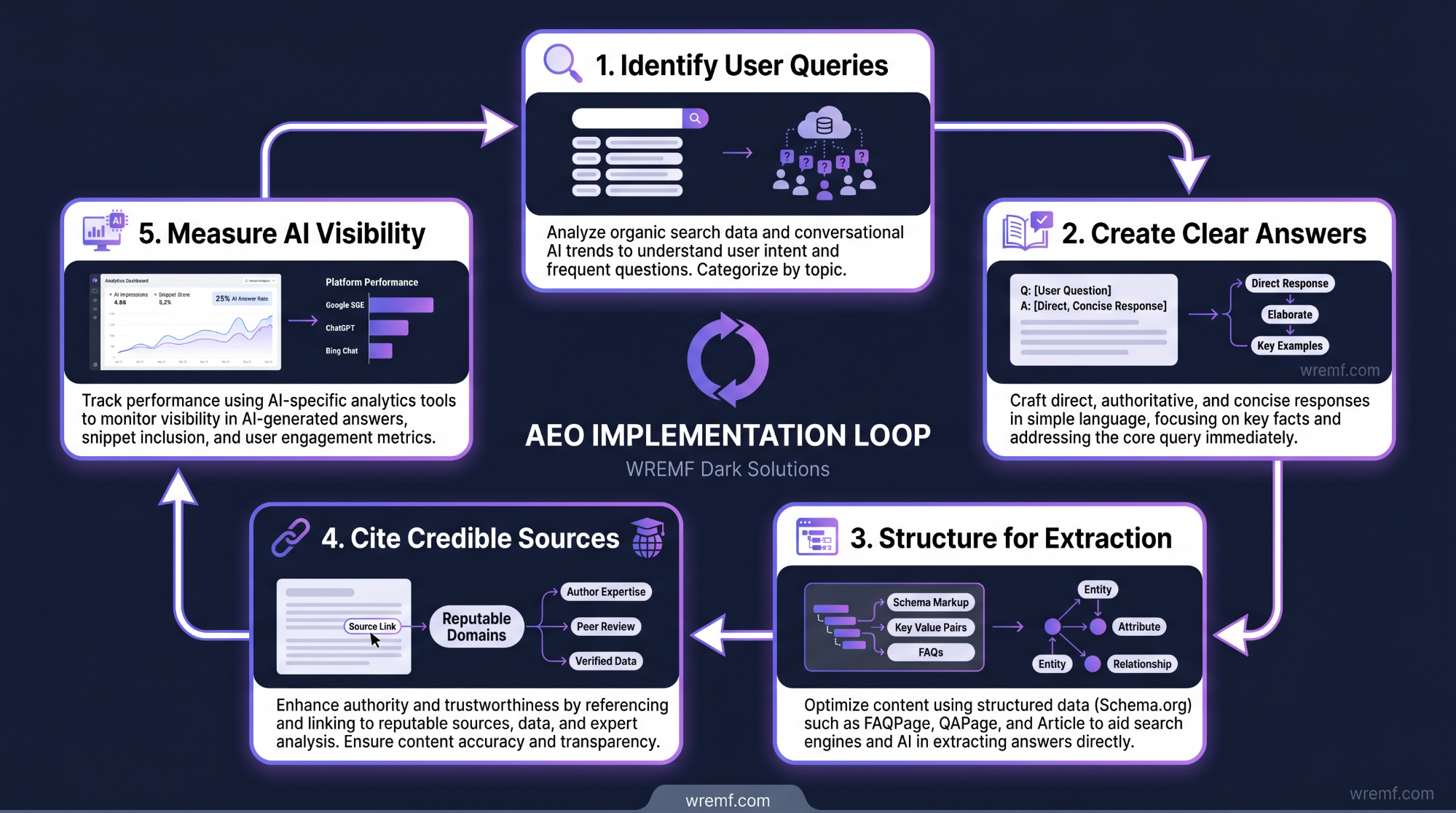
The most effective way to do Answer Engine Optimization is to answer real user queries clearly, structure content for extraction, support claims with credible sources, and measure AI visibility directly. AEO works best when content, technical SEO, structured data, and reporting are connected.
AEO starts with user intent. User intent is the reason behind a search query, prompt, or voice request. User intent matters because answer engines do not only match words. Answer engines try to understand what the user wants to know, compare, buy, fix, or decide.
Use this workflow to implement AEO:
Identify high-intent user queries and search queries
Group those queries into topic clusters
Write answer-first sections for each query
Define core entities in short, extractable blocks
Add structured data and schema markup where appropriate
Use internal links to connect related pages
Cite authoritative sources close to factual claims
Improve page experience and crawlability
Refresh content when facts, tools, or platform behavior changes
Track prompts, AI citations, brand mentions, competitors, and AI traffic attribution
Topic clusters are groups of related pages and subtopics that support one broader subject. Topic clusters matter because answer engines and search engines both need evidence that a website covers a topic in depth, not just in isolated pages.
For an AEO page about answer engine optimization, relevant prompt groups include:
Definition prompts, such as “what does answer engine optimization mean”
Comparison prompts, such as “what is AEO vs SEO”
Implementation prompts, such as “how do I optimise content for answer engines”
Tool prompts, such as “best tools for Answer Engine Optimization”
Service prompts, such as “are answer engine optimization services worth it”
Measurement prompts, such as “how do I measure AEO success”
Risk prompts, such as “will AEO replace SEO”
Strategy prompts, such as “should I prioritise AEO over traditional SEO in 2026”
Structured content is content organised so humans, search engines, and AI systems can understand it quickly. Structured content matters because answer engines need concise definitions, clear headings, tables, lists, and source-backed explanations.
The CASH framework is a practical AEO planning model that can stand for Clarity, Authority, Structure, and Helpfulness. Clarity means direct answers. Authority means credible sourcing and expertise. Structure means headings, schema markup, tables, and internal links. Helpfulness means solving the user’s real task instead of repeating keywords.
If you want to see how an answer-focused reporting workflow can be structured, review a sample AI visibility report before building your own AEO measurement system.
KEY TAKEAWAY: AEO is done by matching user queries with answer-first content, structured data, entity clarity, credible sourcing, internal links, and ongoing AI visibility measurement.
After the workflow is set, the next step is knowing which page elements answer engines can extract most easily.
What Content Elements Matter Most for AEO?
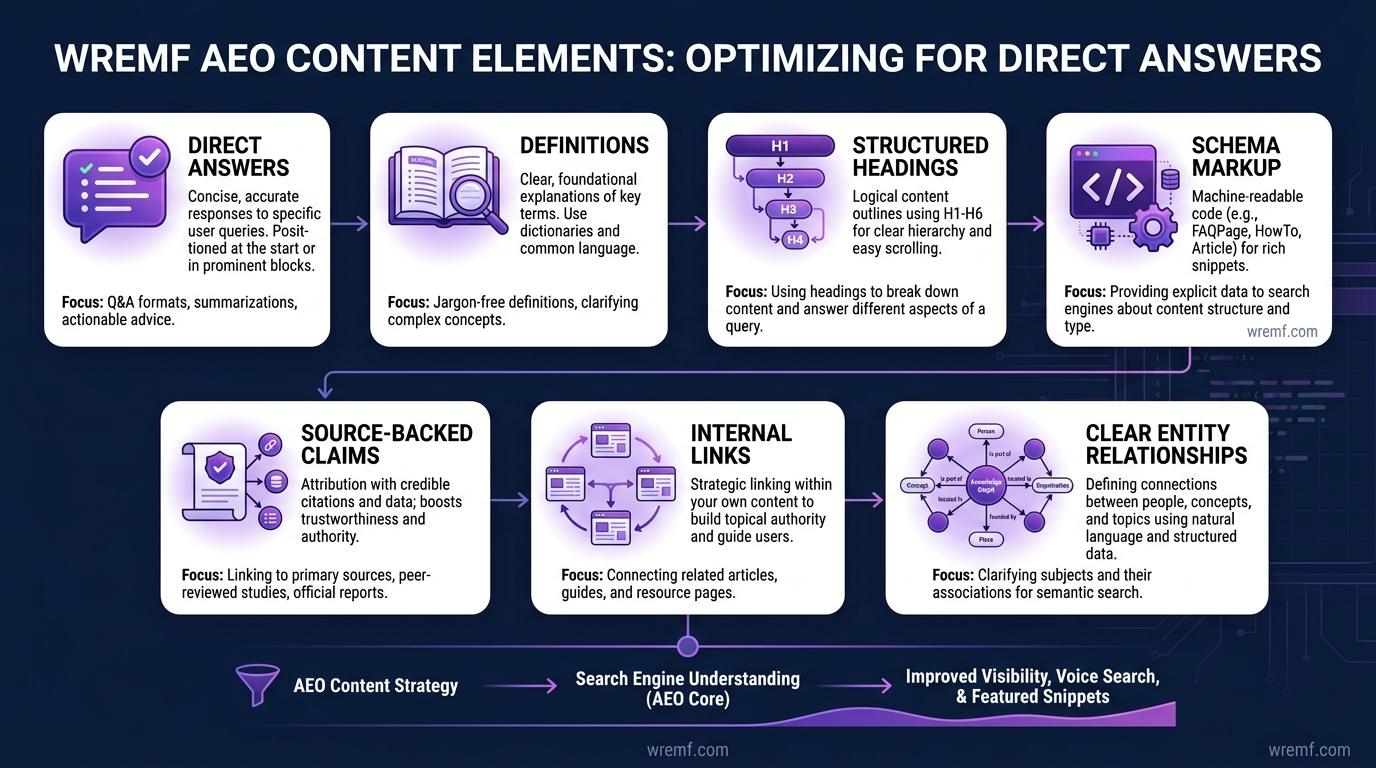
The most important AEO content elements are direct answers, definitions, structured headings, schema markup, source-backed claims, internal links, and clear entity relationships. These elements help answer engines extract useful information without guessing.
A featured snippet is a selected search result that appears as a direct answer on a search engine results page. A featured snippet matters for AEO because the same concise, answer-first formatting often helps AI systems identify useful passages.
An answer box is a search result feature that gives a direct response to a query. An answer box matters because it trains content teams to write short, complete answers that can stand alone.
A strong AEO page should include:
A direct answer near the top of each major section
A concise definition for every major concept
Clear H2 headings that match user queries
Tables when comparing 3 or more options
Short lists for steps, criteria, mistakes, and workflows
Named external sources for factual claims
Internal links to relevant supporting pages
Updated information where recency matters
Author, brand, or methodology expertise signals
Consistent terminology across the page
Schema markup is a vocabulary used to add structured data to web pages. Schema markup matters for AEO because it helps search engines understand content types, entities, relationships, and eligibility for rich results.
Structured data is machine-readable information that helps search engines interpret page content. Structured data matters because Google says it uses structured data to understand page content and gather information about entities such as people, books, and companies. (Google for Developers)
Content structure should support both search engines and AI systems. This means writing answer-first introductions, using descriptive headings, defining acronyms, linking related resources, and avoiding vague claims. The goal is not to create robotic content. The goal is to make expert content easier to verify and reuse.
Semantic relevance is the degree to which content covers the concepts, entities, questions, and relationships expected for a topic. Semantic relevance matters because AI systems can recognise whether a page deeply addresses “Answer Engine Optimization,” “AI citations,” “structured data,” “user intent,” and “Google AI Overviews,” or only repeats the main keyword.
Trust signals are cues that help users and systems evaluate reliability. Trust signals include cited sources, transparent methodology, update dates, author expertise, clear examples, original data, user experience, and consistency across brand content.
TIP: Do not add schema markup to weak content and expect AEO results. Improve the answer, source support, and content structure first.
KEY TAKEAWAY: AEO content must be structured for readers, search engines, and AI systems at the same time.
The next layer is technical because answer-ready content still needs to be crawlable, indexable, and understandable.
What Technical SEO and Structured Data Support AEO?
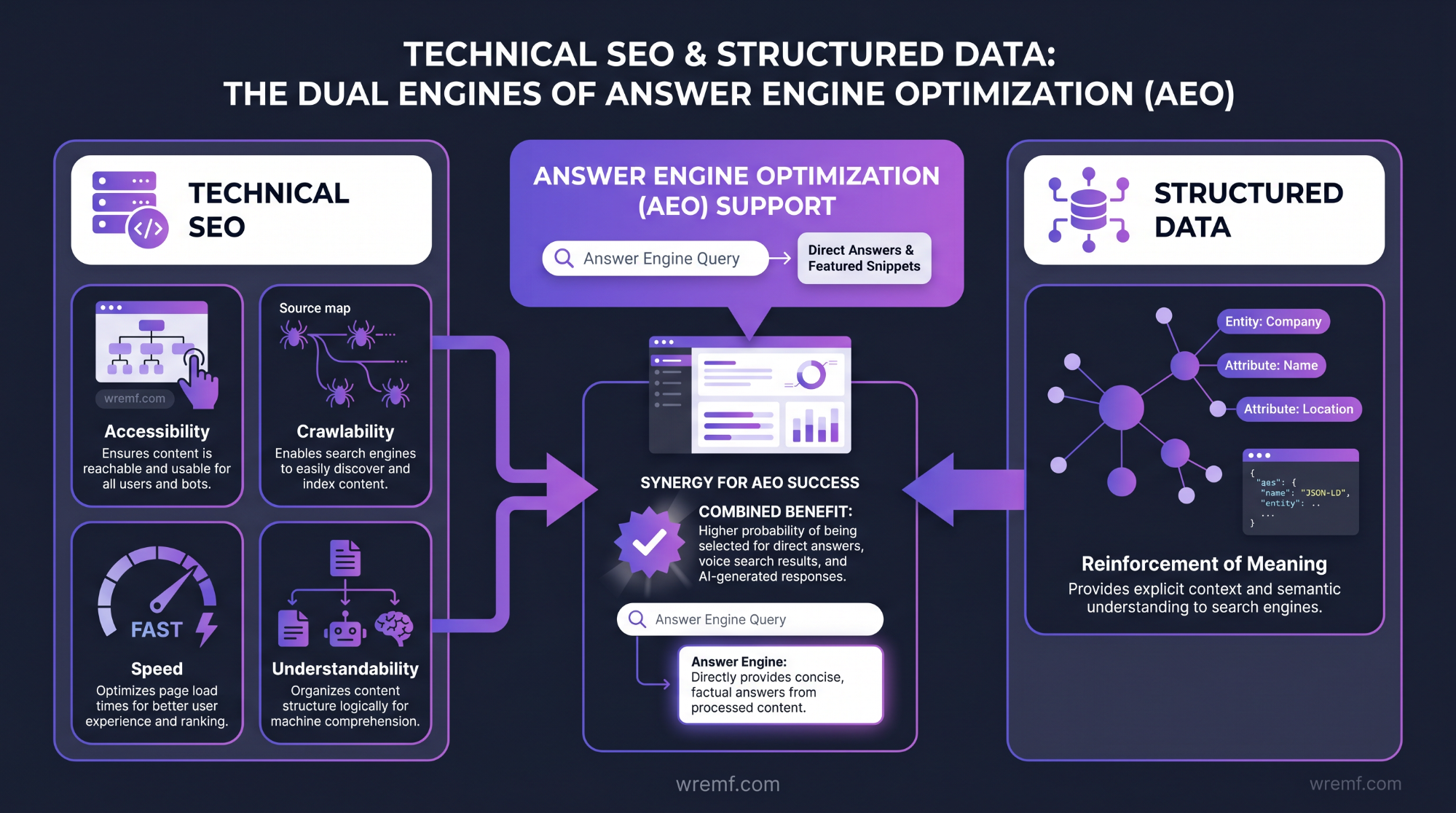
Technical SEO supports AEO by making content accessible, crawlable, fast, and understandable for search engines and AI systems. Structured data reinforces meaning, but technical quality and visible content must come first.
Technical SEO is the process of improving how search engines crawl, render, index, and understand a website. Technical SEO matters for AEO because answer engines often depend on accessible web content, clean HTML, internal links, and reliable page signals.
Content structuring is the practice of organising information into clear sections, headings, definitions, lists, tables, and summaries. Content structuring matters because AI systems need extractable chunks that answer specific questions.
Key technical AEO checks include:
Is the page crawlable by search engines?
Is the main content available in rendered HTML?
Is JavaScript hiding important content?
Are headings clear and hierarchical?
Is structured data valid and aligned with visible page content?
Are internal links helping users and crawlers understand topic relationships?
Are canonical tags, robots rules, and sitemap entries correct?
Is the page experience strong on mobile?
Are important claims supported by sources?
Is the content updated when facts change?
Google’s structured data documentation explains that Google can use structured data to understand page content and enable richer appearances in search results. Google’s Rich Results Test can test publicly accessible pages to see which rich results may be generated by structured data. (Google for Developers)
Schema markup can support article pages, FAQ-style pages, software pages, product pages, organisation details, reviews, breadcrumbs, datasets, events, and other content types. The visible page content must match the structured data. Misaligned structured data can weaken trust because it tells machines one thing while users see another.
Internal links matter because they connect related concepts. A page about Answer Engine Optimization should link naturally to AI visibility methodology, source citation tracking, prompt intelligence, GEO audits, content briefs, SEO testing, and platform reporting. For example, WREMF’s GEO audit workflow helps identify technical and content issues that may reduce AI search visibility.
Multimedia elements can help users understand content, but the article itself must remain useful without relying on visuals. For AEO, the text layer should define concepts, answer questions, and explain relationships clearly.
KEY TAKEAWAY: Technical SEO and structured data help AEO when they make clear, helpful content easier to crawl, understand, and validate.
Once the technical foundation is in place, measurement determines whether AEO work is improving visibility.
How Do You Measure AEO Success?
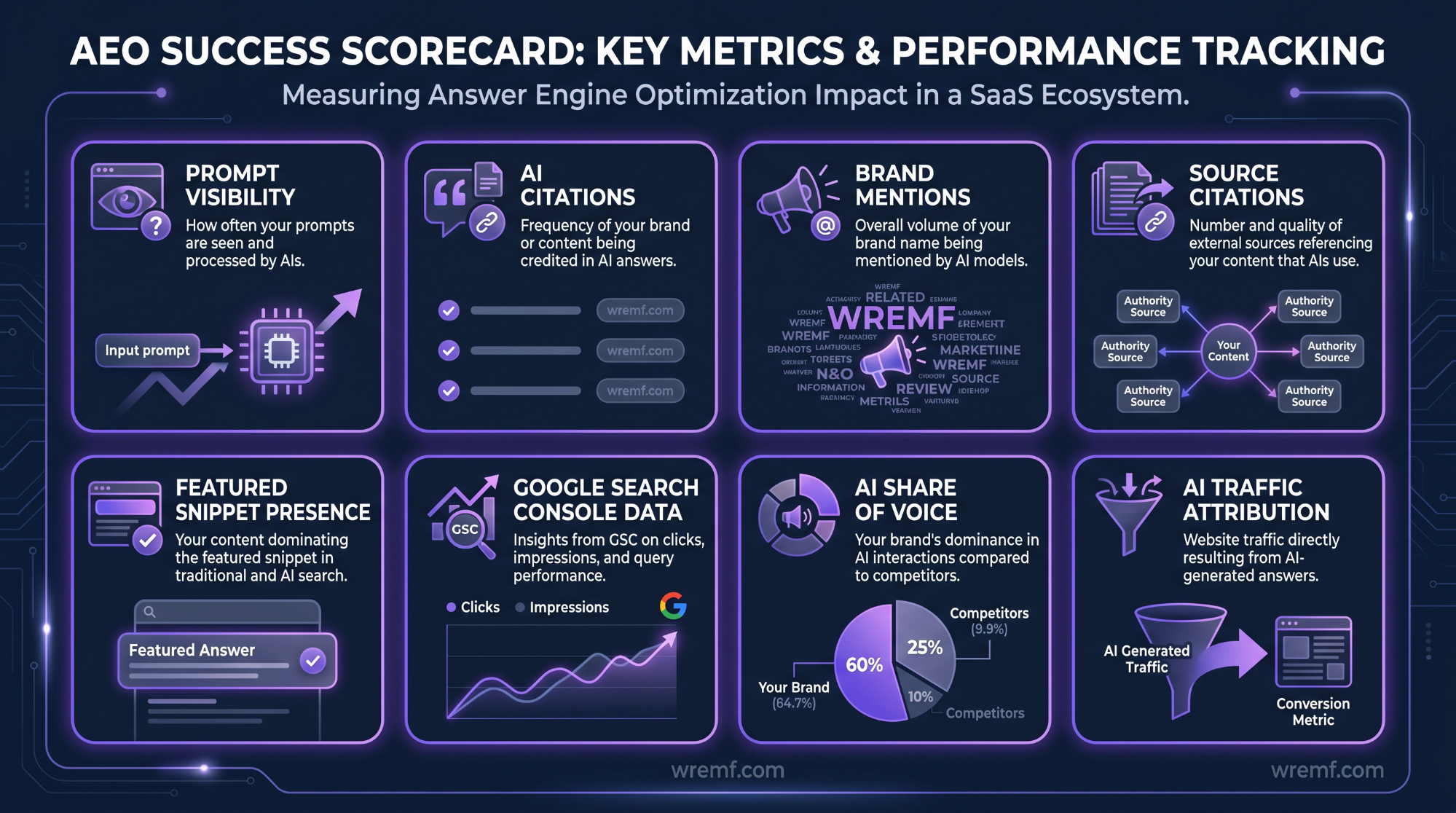
AEO success is measured through prompt visibility, AI citations, brand mentions, source citations, featured snippet presence, Google Search Console data, AI share of voice, and AI traffic attribution. Rankings alone are not enough to measure Answer Engine Optimization.
Prompt tracking is the process of monitoring how AI platforms answer specific prompts over time. Prompt tracking matters because ChatGPT, Claude, Gemini, Perplexity AI, Microsoft Copilot, Google AI Overviews, DeepSeek, Grok, Meta AI, and Mistral may answer the same query differently.
Source citations are the pages, domains, or documents that AI systems cite when generating answers. Source citations matter because they show which sources influence AI-generated answers in your category.
AI share of voice is the percentage of relevant AI answers where your brand appears compared with competitors. AI share of voice matters because it measures market share in AI answers, not only market share in traffic.
AI traffic attribution connects visits from AI platforms to website sessions, conversions, pipeline signals, or revenue. AI traffic attribution matters because leadership teams need to know whether AI visibility contributes to business outcomes.
Google Search Console remains important because Google Search Console shows clicks, impressions, average position, pages, and search queries from Google Search. Google Search Console should not be treated as a complete AI visibility tool, but it remains essential for understanding traditional search demand and page-level performance.
A practical AEO scorecard can include:
| Metric | What It Shows | Useful Data Source | Why It Matters |
|---|---|---|---|
| Prompt visibility | Whether your brand appears in AI answers | Prompt intelligence tools | Measures answer inclusion |
| AI citations | Which pages are cited by AI platforms | Source citation tracking | Reveals source trust |
| Brand mentions | How often your brand appears without a link | AI visibility monitoring | Captures zero-click discovery |
| Brand citations | Where your brand is connected to source evidence | Citation analysis | Shows authority signals |
| AI share of voice | Your visibility compared with competitors | Competitive landscape tracking | Measures category presence |
| Featured snippet presence | Whether Google extracts your answer | SERP monitoring | Supports answer box visibility |
| Google Search Console clicks | Organic search traffic from Google | Google Search Console | Tracks traditional SEO outcomes |
| Google Search Console impressions | Search demand and exposure | Google Search Console | Shows query-level visibility |
| AI referral traffic | Sessions from AI platforms | Analytics and attribution tools | Connects AI discovery to traffic |
| Content update impact | Performance before and after optimisation | Google Search Console and AI visibility reports | Shows whether changes helped |
WREMF combines prompt intelligence, source citation tracking, and competitive landscape monitoring so teams can track how answer engines describe a brand and compare it with competitors.
AI visibility is a measurement problem and a source ecosystem problem. AI visibility requires tracking what AI systems say, which sources they cite, which competitors they recommend, and whether your owned and third-party sources provide consistent information.
IMPORTANT: Google Search Console does not show every AI answer, AI citation, or recommendation. Use Google Search Console with AI visibility tracking, not as the only AEO measurement source.
KEY TAKEAWAY: AEO measurement requires prompts, citations, brand mentions, competitor visibility, Google Search Console data, and AI traffic attribution.
Measurement helps you decide what to improve, but AI citations and source consistency determine whether answer engines have trustworthy evidence to use.
How to Improve AI Citations, Brand Mentions, and Source Consistency
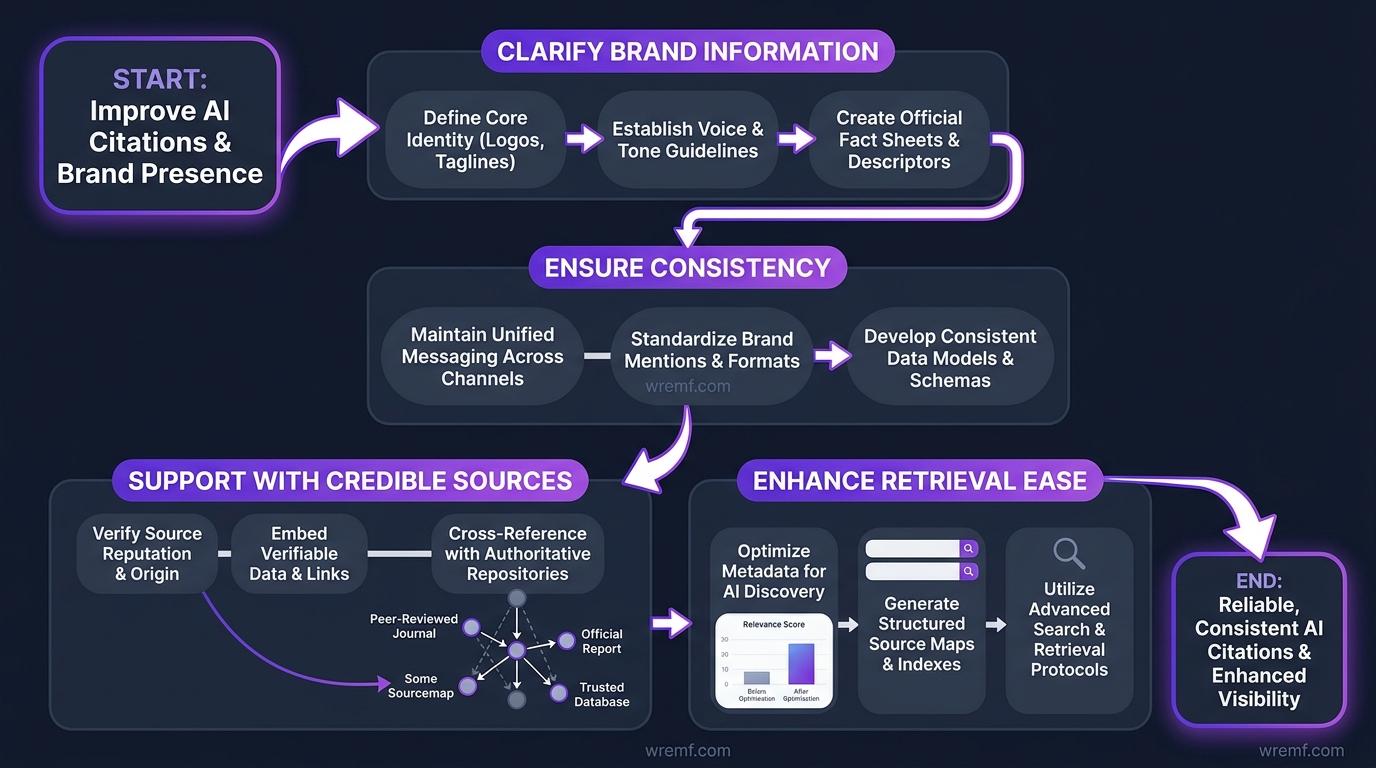
The best way to improve AI citations is to make your brand information clear, consistent, source-backed, and easy to retrieve across owned and trusted third-party sources. AI citations depend on source quality, answer relevance, and entity clarity.
Brand mentions are references to your company, product, service, or category position inside AI-generated answers. Brand mentions matter because AI systems may recommend or describe a company without linking to its website.
Brand citations are references that connect a brand to a source, page, article, directory, review, documentation page, or comparison result. Brand citations matter because they can influence how answer engines understand relevance, trust, and authority.
Source consistency is the alignment of facts about your brand across your website, public profiles, directories, documentation, review platforms, press mentions, partner pages, and trusted content sources. Source consistency helps AI systems reduce ambiguity when generating answers.
In real-world AI visibility audits, teams often find source inconsistencies such as:
Different product descriptions across pages
Old pricing information on third-party profiles
Conflicting category labels
Missing founder, location, or company facts
Outdated comparison claims
Thin feature pages with no direct definitions
Inconsistent terminology across the website
Weak internal links between related topic clusters
Review pages that describe old features
Partner pages that use outdated positioning
AI citations matter because answer engines often use cited sources as evidence. If your owned content is unclear and third-party sources describe competitors more clearly, AI systems may select competitor content even when your product is relevant.
AEO improvement should include owned content, technical foundations, and external source cleanup. Owned content includes landing pages, documentation, FAQs, comparison pages, content briefs, product pages, and help pages. Technical foundations include schema markup, crawlability, JavaScript rendering checks, internal links, structured data, and page speed. External source cleanup includes profiles, directories, review pages, press pages, partner pages, and citations.
The WREMF AI Visibility Index helps teams understand how visible a brand is across AI discovery surfaces. The index is useful when leadership needs a clearer way to discuss AI visibility beyond rankings and website traffic.
KEY TAKEAWAY: AI citations and brand mentions improve when answer engines can retrieve consistent, source-backed, entity-rich information about your brand.
After improving sources, teams need to create content that directly matches real prompts and buyer questions.
How to Build an AEO Content Strategy Around User Queries
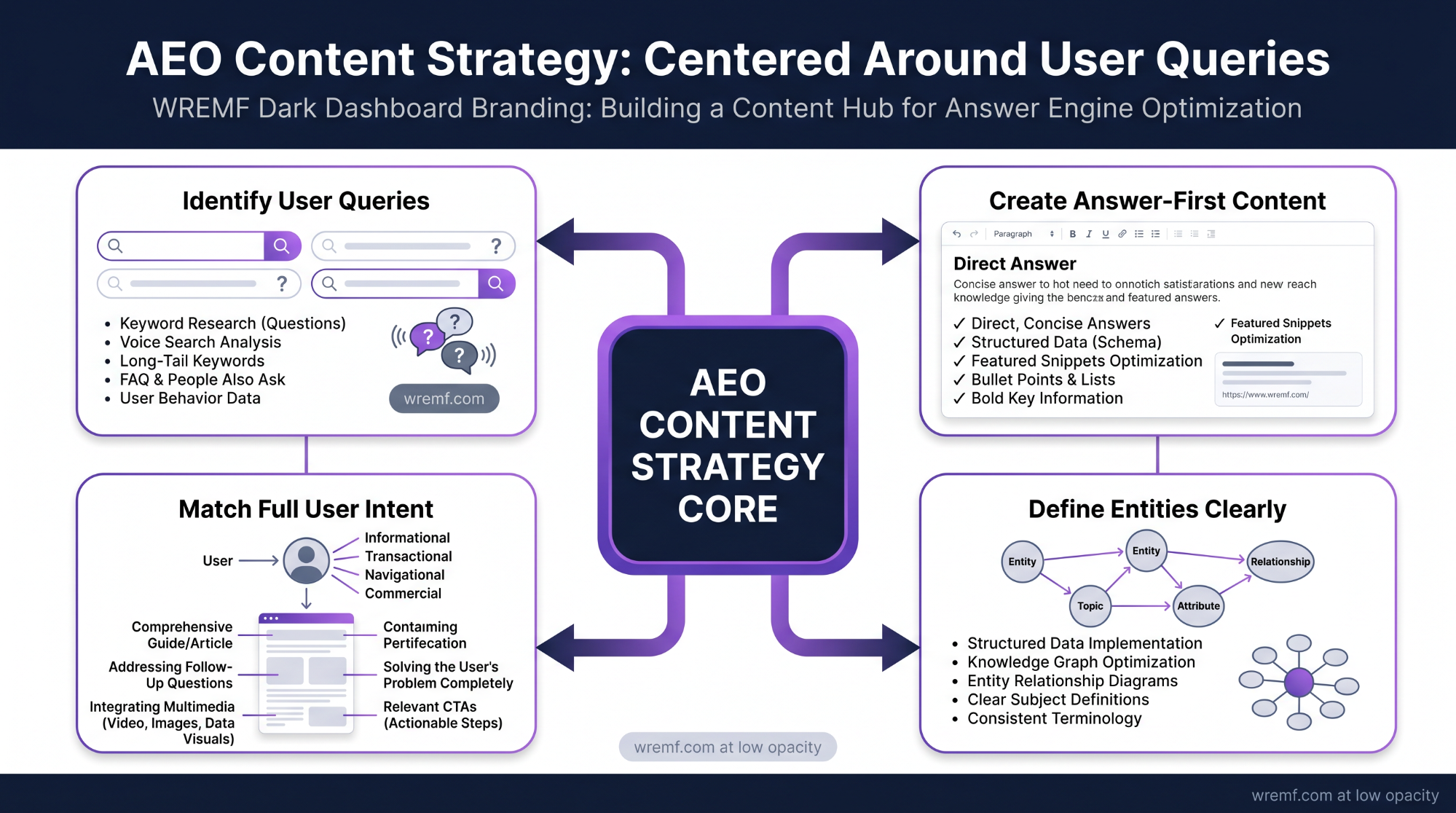
An AEO content strategy should start with user queries, not only keywords. Answer engines respond best to pages that match real questions, define entities, and satisfy the full intent behind the query.
Search queries are the words or phrases users enter into a search engine. Search queries matter because they reveal demand, language, and intent patterns. User queries are broader because they include prompts typed into ChatGPT, Perplexity AI, Gemini, Claude, voice assistants, and AI-powered tools.
A strong AEO content strategy should cover these query types:
| Query Type | Example Query | Best Content Format | AEO Goal |
|---|---|---|---|
| Definition | What is answer engine optimization? | Direct definition plus explainer | Earn answer inclusion |
| Comparison | What is AEO vs SEO? | Comparison table | Clarify category differences |
| How-to | How do I optimize content for answer engines? | Step-by-step workflow | Support implementation |
| Tool | What are the best AEO tools? | Decision framework | Capture commercial intent |
| Service | Are answer engine optimization services worth it? | Use-case comparison | Support buying decisions |
| Measurement | How do I measure AEO success? | Metrics table | Prove impact |
| Risk | Will AEO replace SEO? | Myth vs fact answer | Reduce uncertainty |
| Future | Is SEO dead or evolving in 2026? | Trend analysis | Address market concern |
Content cluster planning should connect one pillar page to supporting pages. For WREMF, an AEO cluster could include AI visibility tracking, prompt intelligence, source citations, competitive landscape analysis, GEO audits, content briefs, SEO testing, and AI traffic attribution.
Answer-first content is content that gives the direct answer before the explanation. Answer-first content matters because AI systems and users both benefit from fast clarity.
A strong answer-first section usually includes:
One sentence that directly answers the question
One short definition if a concept is introduced
One supporting source or practical explanation
One example or implication
One clear takeaway
Content marketers often overbuild introductions and underbuild answers. In AEO, the first paragraph under a heading should be extractable. If that paragraph cannot answer the section’s core question on its own, it is not answer-first enough.
WREMF’s AI-ready content briefs help teams convert prompt data, semantic relevance gaps, source gaps, and competitor visibility findings into content outlines that writers can execute.
KEY TAKEAWAY: AEO content strategy should map real user queries to answer-first pages, supporting topic clusters, and measurable AI visibility outcomes.
Once content strategy is mapped, the next decision is which tools, services, or workflows fit your team.
What Are the Best Tools and Services for Answer Engine Optimization?
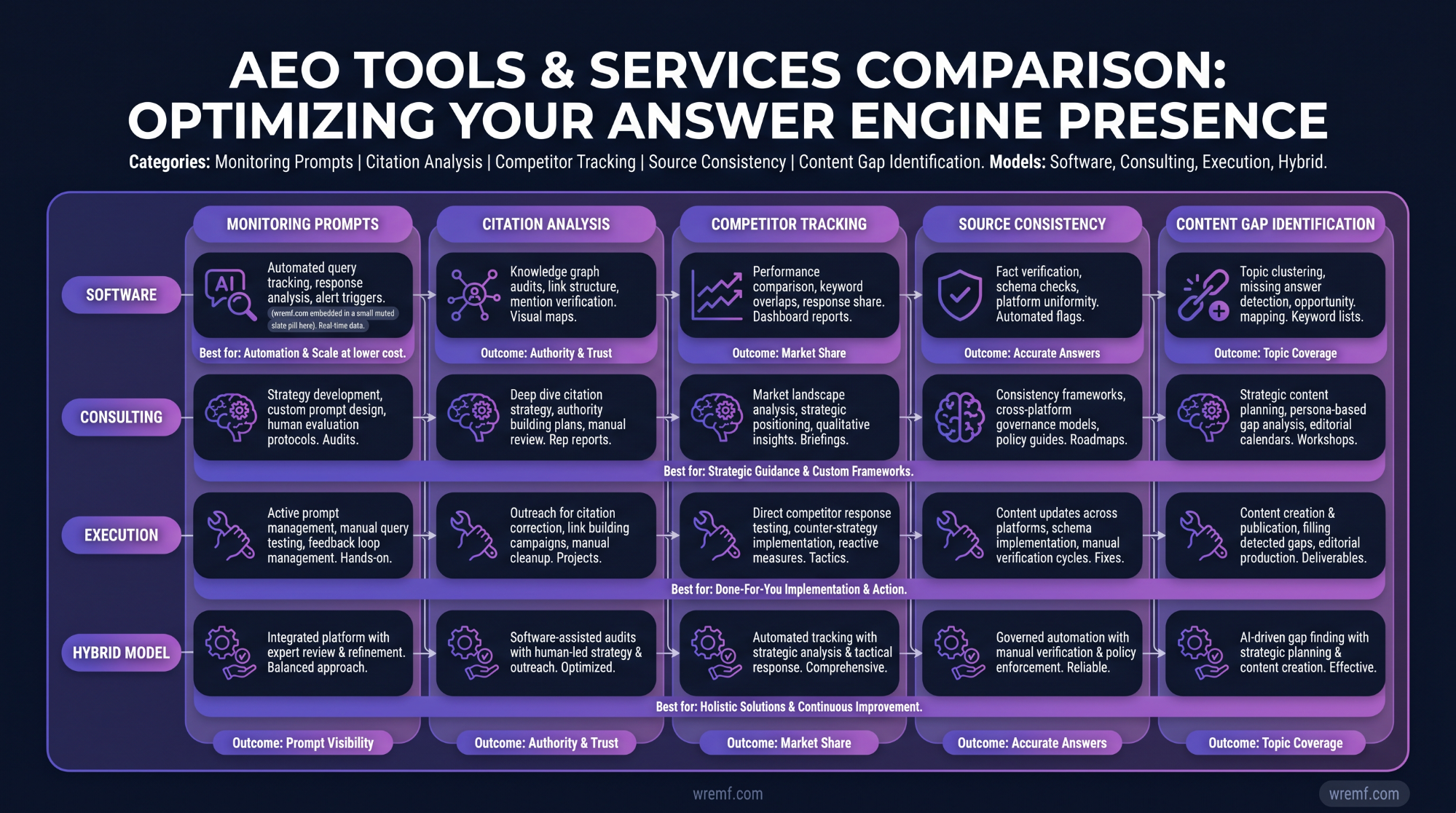
The best AEO tools help teams monitor prompts, citations, competitors, source consistency, content gaps, and AI visibility across multiple AI platforms. The right option depends on whether you need software, consulting, execution, or a hybrid model.
AI-powered tools for AEO should do more than generate content. AI-powered tools should show how your brand appears in answer engines, which sources are cited, which competitors are recommended, and what actions can improve visibility.
AEO tools and services usually fall into five categories:
| Option | Best For | What It Measures | What It Misses | Recommended When |
|---|---|---|---|---|
| Manual testing | Early exploration | Individual answers in ChatGPT, Perplexity AI, Google AI Overviews, or Microsoft Copilot | Scale, history, consistency, reporting | You are validating a small set of prompts |
| Traditional SEO tools | Existing search programs | Rankings, keywords, links, technical SEO, Google Search Console performance | AI citations, answer mentions, AI share of voice | You need SEO foundations and query research |
| AEO software | Ongoing answer visibility | Prompts, citations, brand mentions, competitors, AI visibility | Done-for-you execution unless included | You need repeatable monitoring |
| AEO agency services | Strategy and implementation | Audits, content optimisation, authority building, reporting | Internal ownership if not documented | You need expert execution |
| Hybrid software plus agency | Teams that need measurement and execution | Visibility, citations, source gaps, recommendations, outcomes | Requires budget and operational alignment | You want one workflow from diagnosis to action |
WREMF is useful for brands that want software, agencies that need white-label reporting, and teams that want managed execution. The WREMF methodology connects prompts, citations, competitors, source consistency, and attribution into one repeatable system.
For teams that need implementation help, the WREMF agency team supports AEO consulting, GEO audits, content optimisation, entity authority building, source consistency cleanup, citation improvement, technical AI visibility foundations, internal linking logic, and monthly reporting.
Agencies managing multiple clients often need white-label client reporting, scheduled monitoring, client portals, prompt groups, and consistent visibility scoring. In-house brands often need executive reporting, content briefs, Google Search Console context, AI traffic attribution, and clear prioritisation.
KEY TAKEAWAY: The best AEO workflow combines AI visibility software, SEO foundations, content execution, citation analysis, and reporting that leadership or clients can understand.
The next decision is whether to manage AEO with software, services, or both.
Should You Use AEO Software, an Agency, or a Hybrid Model?
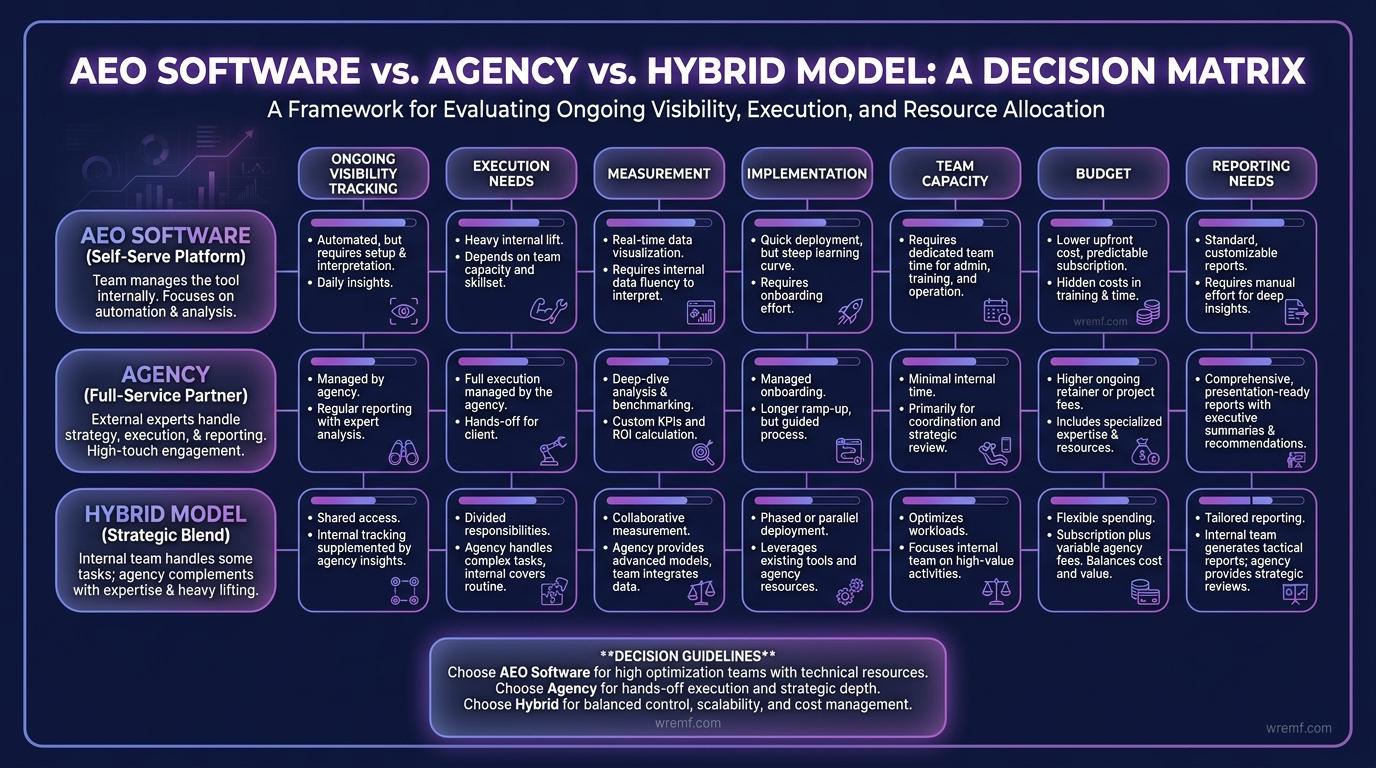
You should use AEO software when you need ongoing visibility tracking, an agency when you need execution, and a hybrid model when you need both measurement and implementation. The best choice depends on team capacity, budget, and reporting needs.
Software is best when your team already has SEO, content, analytics, and technical resources. Software gives you prompt tracking, AI citations, competitor visibility, scheduled monitoring, dashboards, and action recommendations.
Agency services are best when your team lacks time, expertise, or execution capacity. AEO services can cover content optimisation, structured content, schema markup guidance, entity authority building, AI-ready content briefs, internal links, source consistency cleanup, and monthly reporting.
A hybrid model is best for teams that need both transparency and momentum. The software shows what is changing across ChatGPT, Claude, Gemini, Perplexity, Google AI Overviews, Microsoft Copilot, DeepSeek, Grok, Meta AI, and Mistral. The agency team turns insights into content, technical improvements, and reporting.
| Model | Best For | Typical User | Execution Required | Reporting Value | Main Limitation |
|---|---|---|---|---|---|
| Software | Teams with internal SEO and content capacity | In-house SEO, content, growth, product marketing | Internal team executes | Strong if dashboards are used consistently | Requires internal ownership |
| Agency | Teams that need expert delivery | Founders, marketing leaders, lean teams | Agency executes | Strong if deliverables are clear | Less useful without measurement access |
| Hybrid | Teams that need tracking and action | B2B SaaS teams, agencies, growth teams | Shared execution | Strongest for accountability | Requires alignment on priorities |
For software buyers, WREMF’s Starter plan is €39 per month for 1 website, unlimited prompt tracking, BYOK, 10 AI engines, all features and tools, white-label reports, 1 seat, and email support. Growth is €89 per month for 5 websites, unlimited prompt tracking, BYOK, 10 AI engines, all features and tools, white-label reports, priority email support with a 24h SLA, content brief generator, and SEO A/B testing. Enterprise supports custom pricing, unlimited websites, unlimited seats, dedicated support with a 4h SLA, and custom branded portals.
BYOK means bring your own key. BYOK matters because teams can connect their own AI provider keys for cost control, governance, and technical flexibility.
White-label reporting is reporting that can be branded for an agency or client-facing workflow. White-label reporting matters because agencies and consultants often need to present AI visibility results without exposing tool complexity.
You can view WREMF pricing if your decision is budget-led, or review the WREMF page for brands if you are building an in-house AI visibility workflow.
KEY TAKEAWAY: Software, agency, and hybrid AEO models all work, but the right choice depends on whether your biggest gap is visibility data, execution, or accountability.
Even with the right model, common mistakes can reduce results if teams treat AEO as a shortcut.
Common AEO Mistakes That Reduce AI Visibility
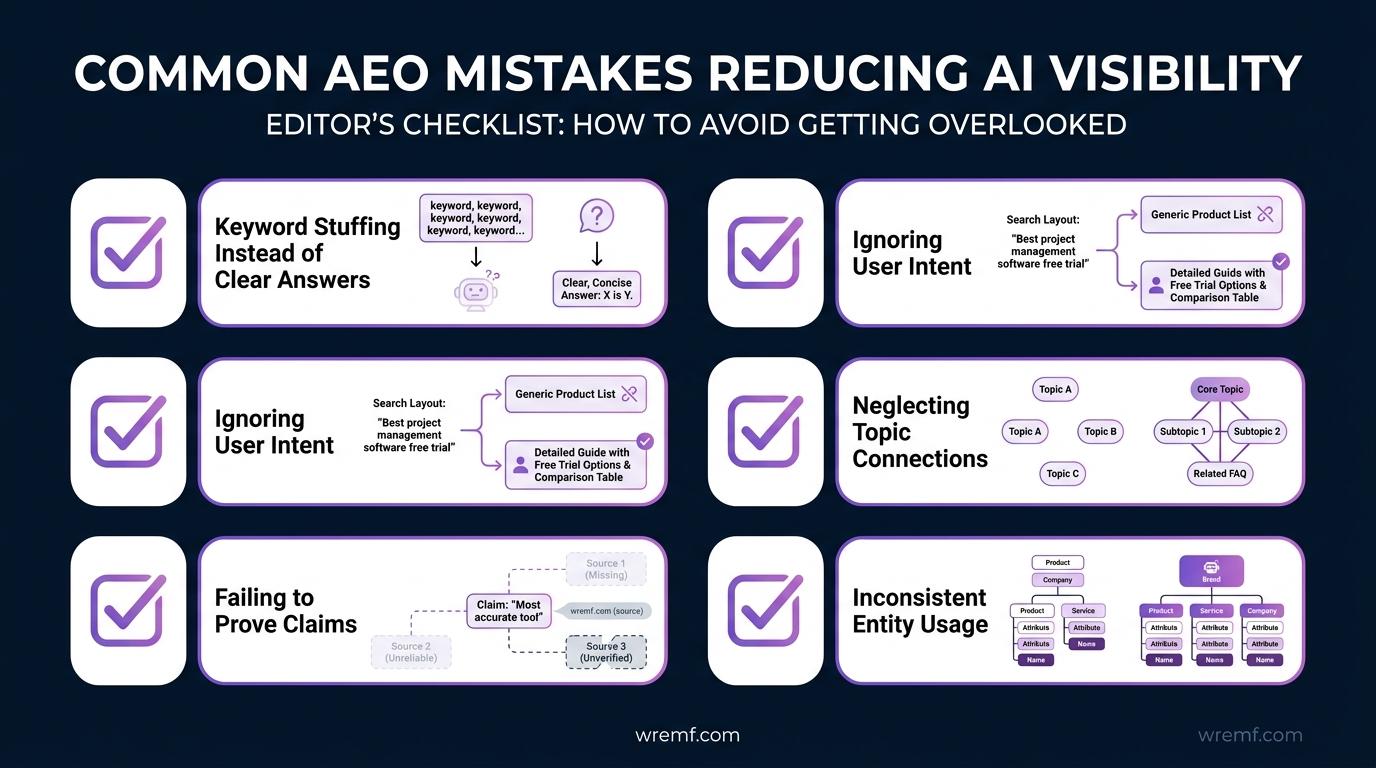
The most common AEO mistake is treating answer engine optimization as keyword stuffing for AI systems. AEO works when content answers user intent clearly, proves claims, supports retrieval, and connects topics with consistent entities.
A common implementation mistake is writing for AI before writing for users. Google Search Central’s people-first content guidance remains relevant because AI systems and search engines both depend on useful, reliable information created for people. (Google for Developers)
Another mistake is relying on one AI platform. ChatGPT, Claude, Gemini, Perplexity AI, Google AI Overviews, Microsoft Copilot, DeepSeek, Grok, Meta AI, and Mistral can produce different answers for the same prompt. Measuring only one platform gives a partial view of AI visibility.
Teams also fail when they ignore source consistency. AEO is not only a page-level content task. AEO is also a source ecosystem problem involving your website, third-party profiles, review platforms, public data, media mentions, comparison pages, and industry content.
Common AEO mistakes include:
Writing long introductions before answering the query
Using vague headings that do not match search queries
Publishing content without source attribution
Adding schema markup without improving content quality
Tracking rankings but not AI citations
Ignoring Google Search Console query data
Ignoring Google Search Console page-level performance
Ignoring Google Search Console changes after content updates
Optimising only for short keywords instead of semantically similar prompts
Treating AI-powered tools as a substitute for editorial judgment
Optimising only for ChatGPT and ignoring Perplexity AI, Google AI Overviews, and Microsoft Copilot
Creating content volume without topical depth
Forgetting internal links between related pages
Leaving outdated brand facts across the web
Using content creation workflows without quality review
Click-through rates can also become misleading if teams ignore zero-click interactions. A page may influence buyers through an answer engine summary even when a user does not click immediately. This does not mean clicks are unimportant. It means clicks, citations, mentions, and recommendations should be measured together.
TIP: Use Google Search Console for query and page evidence, then use AI visibility tracking to see whether those same topics appear in answer engines.
KEY TAKEAWAY: AEO fails when teams chase shortcuts instead of building answer-first content, structured data, source consistency, and measurable AI visibility.
Misunderstandings also create strategic risk, so the next section debunks the most common myths.
Common Myths About AI Visibility Debunked
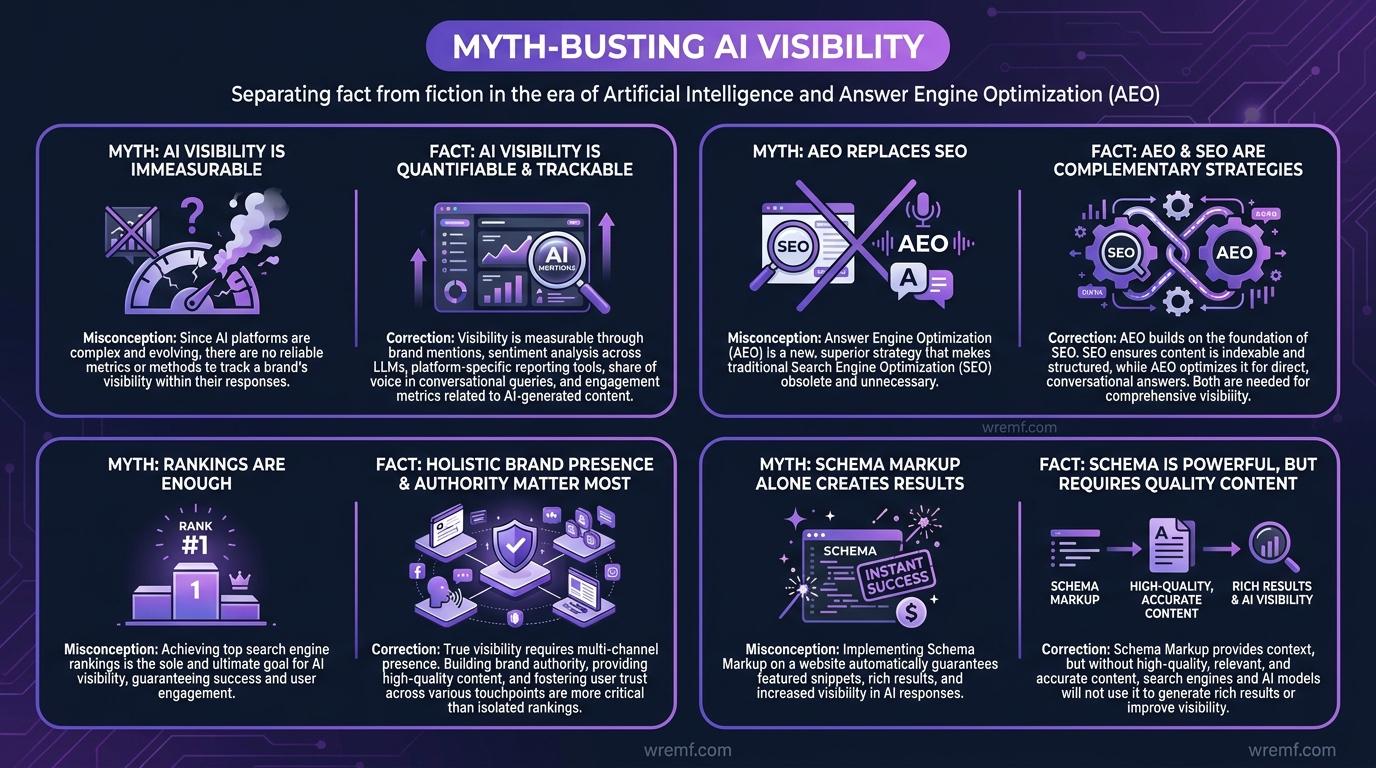
AI visibility is measurable, but it must be measured differently from traditional rankings. The biggest myths come from treating AEO, SEO, and GEO as separate silos instead of connected discovery layers.
MYTH: SEO is dead, so AEO replaces Search Engine Optimization.
FACT: SEO is evolving, not disappearing. Search Engine Optimization still supports crawlability, technical health, structured data, user experience, content quality, links, and Google Search Console performance. AEO builds on SEO by making content easier for answer engines and AI systems to extract and cite.
MYTH: AI visibility is impossible to measure.
FACT: AI visibility can be measured through prompt tracking, AI citations, brand mentions, source citations, AI share of voice, competitor visibility, and AI traffic attribution. The measurement is less stable than rank tracking because AI answers can vary by platform, prompt wording, location, model, and date, but it is not guesswork.
MYTH: Rankings are enough to win in answer engines.
FACT: Rankings help, but rankings alone are not enough. A page can rank in search results yet fail to appear in ChatGPT, Perplexity AI, Google AI Overviews, or Microsoft Copilot because AI systems evaluate answer clarity, source trust, entity relevance, and retrieval fit. Measure citations directly.
MYTH: Schema markup alone creates AEO results.
FACT: Schema markup helps search engines understand content, but it does not fix weak content. AEO needs structured data, answer-first writing, source attribution, semantic relevance, internal links, and clear entity relationships. Schema markup should reinforce strong content, not replace it.
MYTH: AEO is only for large brands.
FACT: Smaller B2B companies can compete when their content is specific, useful, well-structured, and supported by credible sources. Hyper-specific content can perform well when it answers semantically similar prompts better than generic brand content from larger competitors.
KEY TAKEAWAY: AI visibility is not magic, and AEO is not a replacement for SEO. AEO is a measurable discipline built on search fundamentals, answer clarity, and source trust.
With the myths removed, the final practical question is how WREMF turns AEO into a repeatable operating system.
How WREMF Helps Teams Track, Improve, and Prove AEO
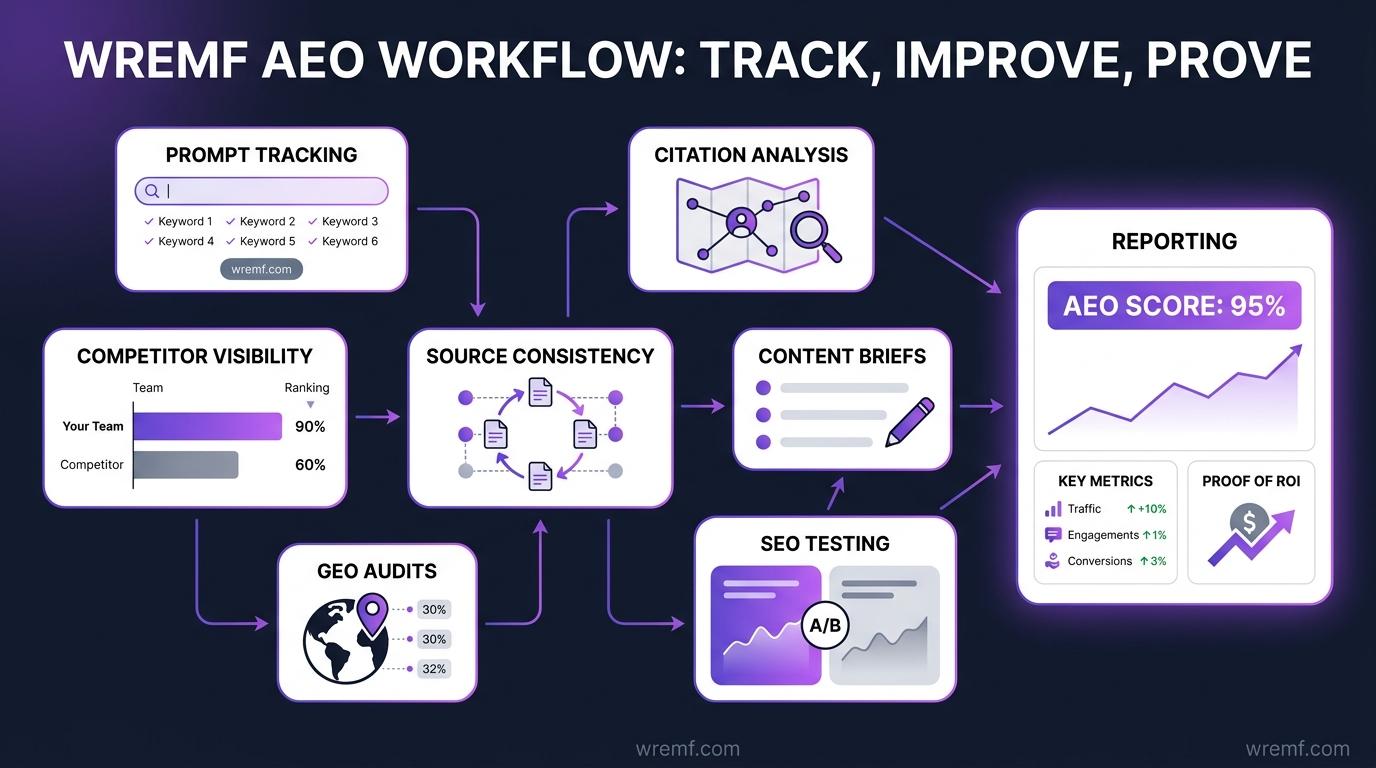
WREMF helps teams turn Answer Engine Optimization from manual testing into a measurable workflow. The platform connects prompt tracking, citation analysis, competitor visibility, source consistency, content briefs, GEO audits, SEO testing, and reporting.
WREMF tracks how brands appear across ChatGPT, Claude, Gemini, Perplexity, Google AI Overviews, Microsoft Copilot, DeepSeek, Grok, Meta AI, Mistral, and other AI discovery surfaces. This matters because AEO performance changes by platform, prompt, source set, and date.
The WREMF workflow focuses on five connected areas:
Track prompts that match real user queries and buyer’s journeys
Identify AI citations and source citations that influence answers
Compare brand visibility against competitors
Find content, entity, schema markup, and source consistency gaps
Report AI visibility, AI traffic attribution, and recommended actions
Citation analysis is the process of reviewing which sources AI systems use to support their answers. Citation analysis matters because it shows whether AI systems trust your owned pages, third-party sources, competitor pages, or neutral industry content.
WREMF also supports AI-ready content briefs through content brief workflows. These briefs help teams turn prompt data, content structure, user intent, semantic relevance, and source gaps into publishable content recommendations.
For technical and reporting teams, WREMF supports API and MCP integrations, BYOK workflows, client portals, white-label reporting, scheduled monitoring, and repeatable client delivery. Model Context Protocols matter because they can connect AI workflows, tools, and data systems in a more structured way.
For teams testing content changes, WREMF also connects AI visibility work with SEO testing workflows. This helps teams compare content updates, Google Search Console changes, AI referral traffic, and visibility movement over time.
WREMF is useful for brands that want software, agencies that need white-label reporting, and teams that want managed execution. It can be used as software, an agency service, or a combined software plus managed execution solution.
KEY TAKEAWAY: WREMF helps teams measure AEO across prompts, citations, competitors, content gaps, and attribution instead of relying on manual AI searches.
The same measurement mindset applies to the questions buyers ask before adopting AEO.
Frequently Asked Questions
What is answer engine optimization?
Answer engine optimization is the process of making content easy for answer engines to understand, extract, cite, and present in direct answers. It applies to Google AI Overviews, featured snippet results, ChatGPT search, Perplexity AI, Microsoft Copilot, voice assistants, and other AI-powered tools. AEO focuses on user intent, direct answers, structured data, schema markup, source attribution, semantic relevance, and trust signals. The goal is not only to rank in search results, but to become a useful source inside the answer.
What does answer engine optimization mean?
Answer engine optimization means improving content so answer engines can use it as a reliable source for answers. AEO includes answer-first writing, clear definitions, structured content, schema markup, AI citations, source consistency, and measurement across AI platforms. In simple terms, AEO helps your website answer questions in a way that search engines, AI systems, and users can understand. It is especially useful for B2B teams that want visibility across both traditional search and AI search experiences.
How do you actually do Answer Engine Optimization?
You do Answer Engine Optimization by mapping real user queries, writing answer-first content, defining entities clearly, adding structured data where appropriate, citing credible sources, improving internal links, and measuring AI visibility. A practical workflow starts with high-intent search queries and AI prompts, then builds sections that answer each question directly. After publishing, track prompt visibility, brand mentions, AI citations, source citations, Google Search Console performance, and AI traffic attribution. WREMF helps automate this workflow across 10 AI engines.
What is AEO vs SEO?
AEO focuses on helping answer engines extract and present direct answers, while SEO focuses on helping search engines crawl, rank, and display web pages in organic search results. SEO covers technical health, content quality, links, keywords, user experience, and Google Search Console performance. AEO adds answer-first writing, featured snippet readiness, AI citations, source consistency, and structured content for AI systems. The two disciplines should work together because answer engines often depend on search-accessible, useful, and trusted content.
What is the difference between AEO and Generative engine optimization?
AEO focuses on direct answers in answer engines, search features, AI Overviews, featured snippets, voice assistants, and conversational search. Generative engine optimization focuses more broadly on how large language models and AI platforms mention, cite, summarise, and recommend brands. AEO is usually more content-structure focused, while GEO includes entity authority, source consistency, brand mentions, retrieval-augmented generation, and AI share of voice. In practice, strong AI visibility needs both AEO and GEO.
Is SEO dead or evolving in 2026?
SEO is evolving, not dead. Search Engine Optimization still matters because search engines and AI systems need crawlable websites, reliable content, structured data, links, and clear user experience signals. What has changed is the visibility surface. Brands now need to appear in search engine results pages, Google AI Overviews, ChatGPT-style experiences, Perplexity AI answers, Microsoft Copilot responses, and other AI platforms. In 2026, SEO is the foundation, while AEO and GEO extend visibility into answer and generative discovery environments.
Should I prioritise AEO over traditional SEO in 2026?
You should not prioritise AEO instead of traditional SEO. You should combine them. Traditional SEO helps your site become crawlable, indexable, authoritative, and visible in search results. AEO helps your content become answer-ready for featured snippets, AI Overviews, answer engines, voice assistants, and AI-powered tools. If your technical SEO and content quality are weak, AEO work will have a weaker foundation. If your SEO is strong but your content is not answer-first, you may miss AI visibility opportunities.
Do backlinks still matter in AEO?
Backlinks still matter in AEO because links can support authority, discovery, and trust, but backlinks are not the only factor. Answer engines also evaluate content clarity, entity relevance, source expertise, structured data, citations, freshness, and whether the page answers the user query directly. A strong backlink profile may help a page become discoverable, but weak content can still fail to earn AI citations. AEO requires both authority signals and answer-ready content structure.
How do I measure AEO success?
Measure AEO success with prompt visibility, AI citations, brand mentions, source citations, featured snippet presence, AI share of voice, competitor visibility, Google Search Console data, and AI traffic attribution. Rankings alone are not enough because AI systems can answer user queries without sending a click. WREMF helps teams monitor prompts, cited sources, competitors, and AI visibility across major answer engines. Google Search Console remains useful for traditional search demand, query performance, page visibility, and post-update analysis.
What are answer engines?
Answer engines are systems that return direct answers to user questions instead of only showing a list of links. Examples include Google AI Overviews, ChatGPT search, Perplexity AI, Microsoft Copilot, Bing Copilot, voice assistants, featured snippet results, and AI-powered platforms that use large language models. Answer engines use natural language processing, retrieval, ranking, and source evaluation to generate responses. AEO helps your content become easier for these systems to understand and use.
What are the best tools for Answer Engine Optimization?
The best AEO tools are tools that track prompts, citations, brand mentions, competitors, source consistency, content gaps, and AI traffic attribution. Traditional SEO tools remain useful for keyword data, technical SEO, backlinks, and Google Search Console analysis, but they do not fully measure AI visibility. WREMF is designed for teams that need AI visibility tracking, prompt intelligence, source citation tracking, competitive landscape monitoring, GEO audits, content briefs, white-label reporting, BYOK, and API or MCP integrations.
Are answer engine optimization services worth it?
Answer engine optimization services are worth it when your team lacks time, expertise, or execution capacity to audit, improve, and report AI visibility. AEO services are especially useful for B2B SaaS teams, agencies, consultants, and growth teams that need content optimisation, source consistency cleanup, schema markup guidance, entity authority building, and monthly reporting. The best service model should include clear deliverables, measurable prompts, transparent methodology, and no unrealistic guarantees. WREMF offers software, agency execution, and hybrid support.
Can AEO help e-commerce stores?
AEO can help e-commerce stores when product, category, and support content answer buyer questions clearly. E-commerce stores can use structured data, product schema markup, comparison content, FAQs, buying guides, customer journey content, and trust signals to improve answer visibility. AEO can also support questions about pricing, fit, use cases, shipping, returns, alternatives, and product comparisons. The goal is not only to rank product pages, but to become a trusted source in AI-powered buying journeys.
How does voice search connect to AEO?
Voice search connects to AEO because voice assistants usually return one direct answer or a small set of spoken responses. This makes concise, answer-first content especially important. Voice assistants rely on natural language processing, structured content, local relevance, entity clarity, and direct answers to satisfy spoken user queries. To optimise for voice assistants, write natural question-based headings, define terms clearly, answer common questions in 1 to 2 sentences, and support claims with structured data where appropriate.
How long does it take to see AEO results?
AEO timelines vary by website authority, content quality, crawl frequency, source consistency, competitive difficulty, and the AI platforms being monitored. Some improvements, such as clearer answer blocks or better schema markup, can be implemented quickly. Visibility changes across answer engines may take longer because AI systems update, retrieve, and cite sources on different schedules. A realistic AEO program should monitor prompts weekly or monthly, compare citation changes over time, and connect improvements to Google Search Console, analytics, and AI visibility reports.
Will AEO replace SEO?
AEO will not fully replace SEO because answer engines still rely on accessible, useful, trusted, and well-structured web content. AEO changes the goal from only ranking pages to being selected, cited, and recommended in answers. SEO helps search engines find and evaluate your content. AEO helps answer engines extract and use your content. GEO helps generative AI platforms understand and recommend your brand. The strongest strategy combines SEO, AEO, and GEO into one AI visibility system.
What mistakes should I avoid when optimizing for answer engines?
Avoid treating AEO as keyword stuffing, schema markup only, or manual ChatGPT checking. Common mistakes include weak answer-first paragraphs, vague headings, unsupported claims, outdated brand facts, poor internal links, ignoring Google Search Console, and tracking rankings without tracking AI citations. Also avoid using AI-powered tools without human review. AEO works best when content creation, structured data, source consistency, semantic relevance, and measurement are handled together.
Conclusion
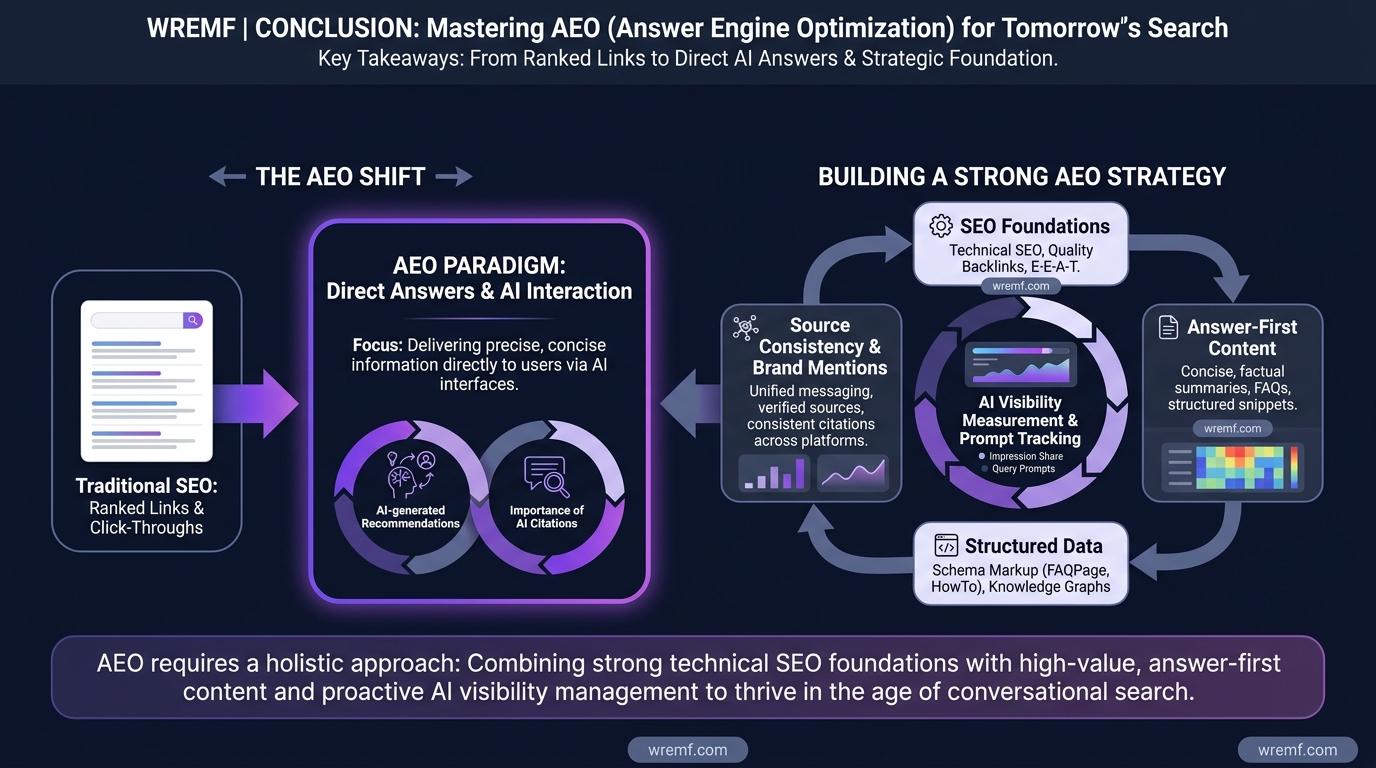
Answer Engine Optimization is a practical response to the shift from ranked links to direct answers, AI citations, brand mentions, and AI-generated recommendations. The strongest AEO strategy keeps SEO foundations intact while adding answer-first content, structured data, source consistency, prompt tracking, and AI visibility measurement. WREMF helps B2B teams track, improve, and prove Answer Engine Optimization across major AI discovery surfaces without treating AI visibility as guesswork. To turn AEO into a measurable workflow, explore the WREMF platform suite or request support from the WREMF agency team.
Related Generative Engine Optimization Guides
- AI Overview Optimization How to Rank, Get Cited, and Stay Visible in Google AI Search
- Best Answer Engine Optimization for Enhancing AI Visibility
- Answer Engine Optimization Services The Complete Guide to AI Search Visibility
- How AI Search Optimization Tools Increase Organic Traffic
- LLM SEO Agency The Complete Guide to Choosing an Agency for AI Search Visibility
- AI Search Engine Optimization Tools The Complete 2026 Guide for AI Search, SEO, AEO, and GEO
- AI Overview SEO How to Optimize for Google AI Overviews, AI Mode, and AI Search Visibility
- Enterprise Answer Engine Optimization Platforms Complete Guide for AI Visibility, AEO, and GEO
- How Do AI Search Optimization Tools Improve SERP Rankings
- AI Search Engine Optimization The Complete Guide for B2B Brands
- LLM SEO Services The Complete 2026 Guide to AI Search Visibility, AEO, GEO, and LLM Optimization
- 12 Best AI Search Optimization Tools
- AI Search Engine Optimization Services The Complete Guide for B2B Brands
- AI SEO Services The Complete Guide to Search Visibility in the AI Era
- AI SEO Tools The Complete Guide for SEO, AEO, GEO, and AI Search Visibility
- Large Language Model Optimization Services The Complete Guide to LLMO, AI Search Visibility, AEO, GEO, RAG, and LLM Performance
- Generative AI Optimization Services The Complete Guide to GEO, AEO, LLM Optimization, and AI Visibility
- AI Mention Tracking The Complete Guide to Monitoring Brand Mentions, AI Answers, Citations, and Share of Voice in 2026
- AI SEO Agency How to Choose the Right Partner for AI Search Visibility
- AI Brand Monitoring The Complete Guide to Tracking Brand Visibility Across AI Search, LLMs, and Generative Engines
Related reading
- AI Overview Optimization: How to Rank, Get Cited, and Stay Visible in Google AI Search
- Best Answer Engine Optimization for Enhancing AI Visibility
- AI Search Engine Optimization: The Complete Guide for B2B Brands
- How to Optimize for AI Search Engines
- Perplexity AI Optimization: The Complete Guide to AI Search Visibility in 2026