AI SEO Services: The Complete Guide to Search Visibility in the AI Era
Learn what AI SEO services include, how they differ from traditional SEO, and how to measure visibility across Google AI Overviews, ChatGPT, and AI engines.
By WREMF Team · 2026-05-09
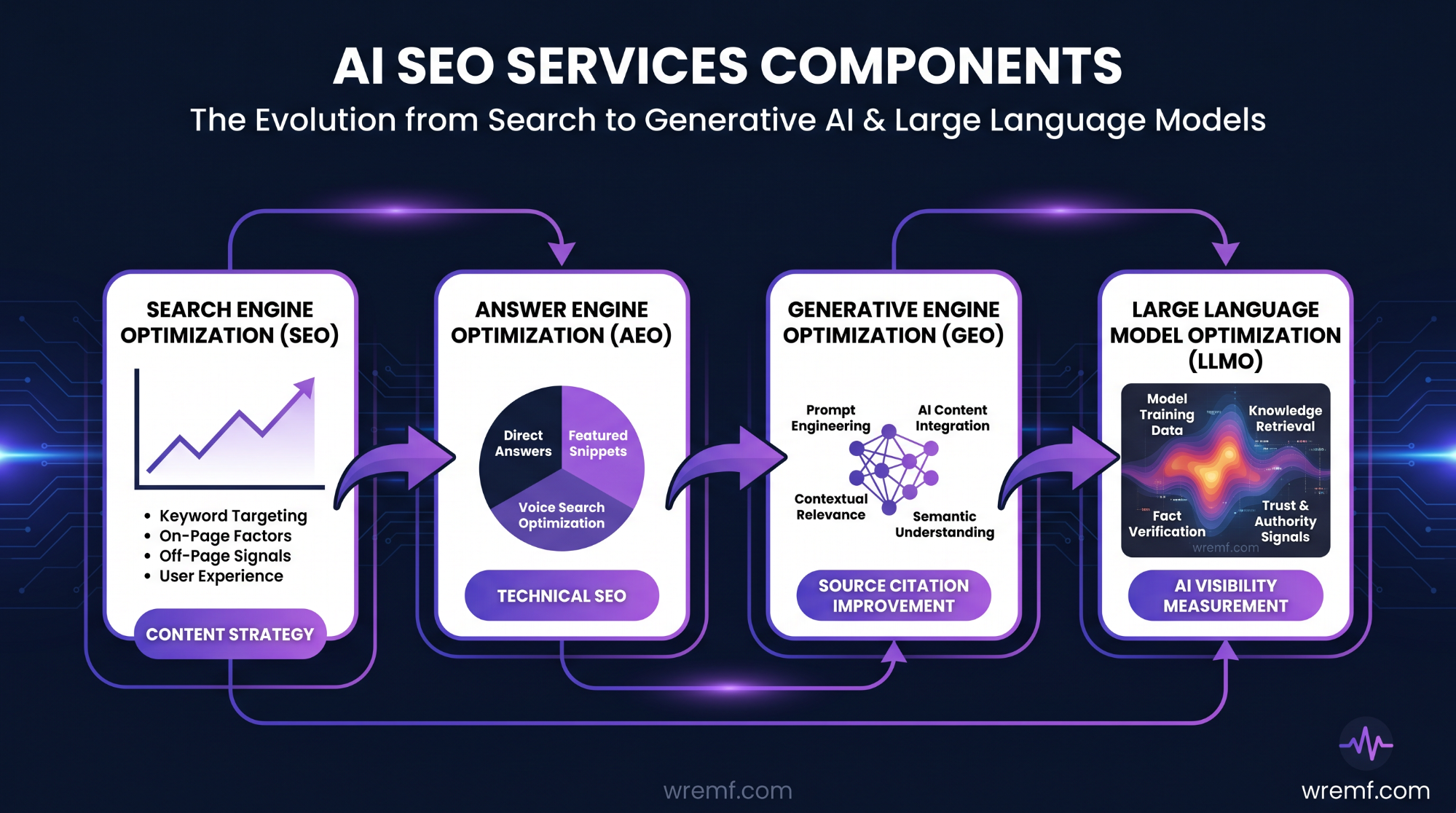
AI SEO services are software, strategy, and execution services that improve how a brand appears in traditional search engines, Google AI Overviews, answer engines, and generative AI tools such as ChatGPT, Claude, Gemini, Perplexity, and Copilot. These services combine search engine optimization, Answer Engine Optimization, Generative Engine Optimization, Large Language Model Optimization, content strategy, technical SEO, source citation improvement, and AI visibility measurement. AI SEO services typically include AI visibility audits, prompt tracking, Content Optimization, keyword optimization, entity signal optimization, Brand Mentions analysis, source citation tracking, Google AI Overviews monitoring, competitor visibility tracking, AI traffic attribution, and reporting. AI visibility matters because buyers now use both search engines and AI assistants to research, compare, and shortlist vendors, often encountering brands inside AI-generated answers before visiting websites or speaking with sales teams.
Key takeaways
- AI SEO services combine traditional SEO with AI visibility tracking, AEO, GEO, LLMO, citations, Brand Mentions, and measurable reporting across multiple AI platforms.
- Traditional SEO remains essential but no longer covers the full discovery journey because AI search adds generated answers, cited summaries, conversational follow-ups, and direct vendor comparisons.
- SEO targets search rankings, Answer Engine Optimization targets direct answers, Generative Engine Optimization targets AI-generated responses, and Large Language Model Optimization targets how language models understand and retrieve brand information.
- The most important AI search visibility signals are content clarity, source quality, entity consistency, Brand Mentions, technical accessibility, and evidence-backed authority.
- AI SEO success is measured through prompt visibility, citation count, Brand Mentions, sentiment, competitor overlap, source consistency, AI referral traffic, and conversion quality.
- Choose AI SEO software for internal execution and ongoing tracking, an agency for strategy and implementation, or a hybrid model for measurement plus done-for-you execution.
AI SEO Services: The Complete Guide to Search Visibility in the AI Era
AI SEO services help brands improve visibility across Google, Google AI Overviews, ChatGPT, Claude, Gemini, Perplexity, Copilot, and other AI discovery surfaces. Google Search Central explains that AI features such as AI Overviews and AI Mode are now part of how site owners should think about content inclusion in Search. AI SEO services combine search engine optimization, Answer Engine Optimization, Generative Engine Optimization, Large Language Model Optimization, content strategy, technical SEO, source citation improvement, and AI visibility measurement. This guide explains what AI SEO services include, how they work, how to measure them, how they differ from traditional SEO, and how to choose the right provider. WREMF helps teams track, improve, and prove AI visibility through AI visibility software and managed execution. Keep reading to build a practical AI SEO strategy that fits modern B2B buying journeys.
What Are AI SEO Services?
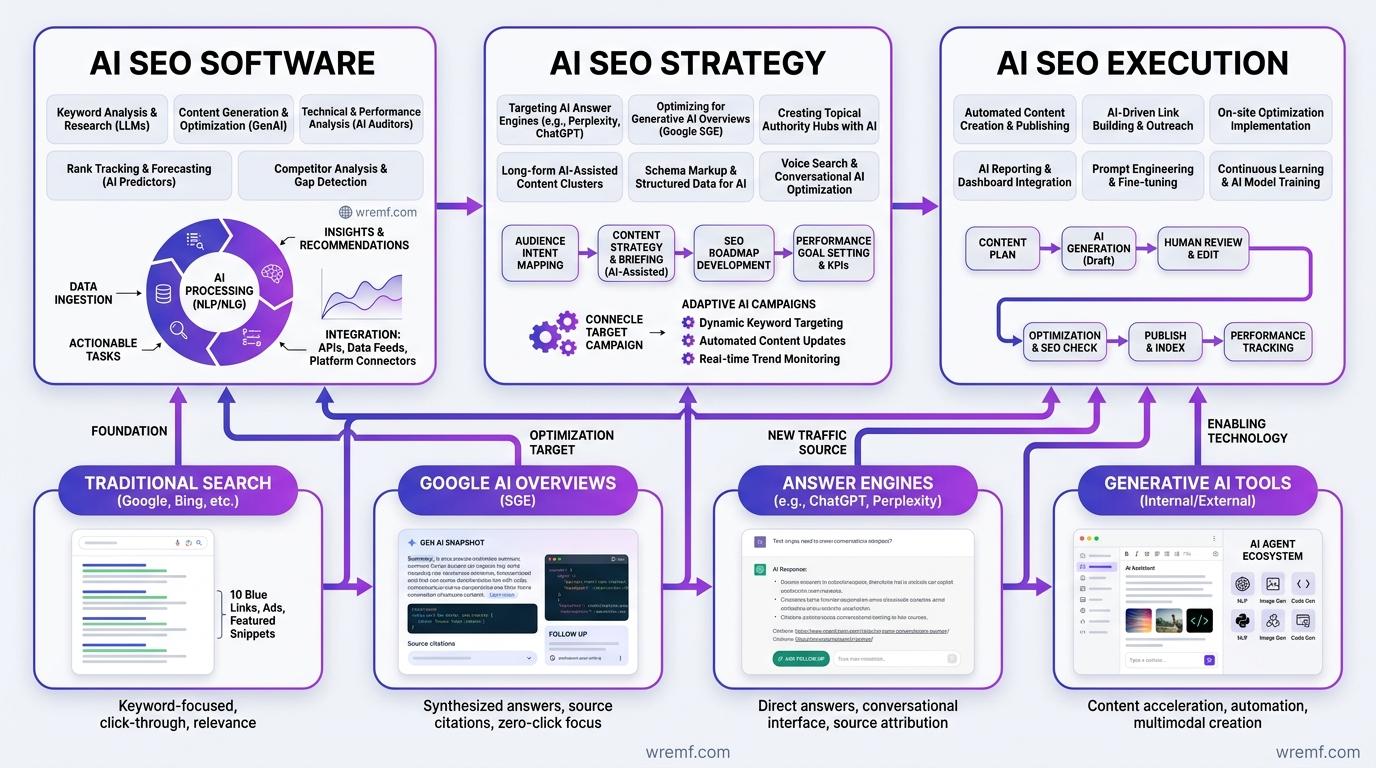
AI SEO services are software, strategy, and execution services that improve how a brand appears in traditional search, Google AI Overviews, answer engines, and generative AI tools. AI SEO services matter because buyers now use both search engines and AI assistants to research, compare, and shortlist vendors.
AI visibility is the measurable presence of a brand inside AI-generated answers, recommendations, citations, comparisons, and summaries. AI visibility matters because a brand can influence a buyer before that buyer visits the brand website, clicks a search result, or speaks with sales.
AI SEO Services usually include:
AI visibility audits
Prompt tracking
Content Optimization
keyword optimization
entity signal optimization
Brand Mentions analysis
source citation tracking
Google AI Overviews monitoring
Google SGE readiness
competitor visibility tracking
brand visibility reporting
AI traffic attribution
technical SEO for AI crawlers and search engines
positive brand sentiment analysis
conversion-focused content recommendations
Search engine optimization remains the foundation. AI SEO services extend search engine optimization by measuring whether a brand is visible when users ask AI systems natural-language questions such as “What is the best AI visibility platform for B2B SaaS?” or “Which agency can help with Generative Engine Optimization?”
Google Search Central says Google’s automated ranking systems are designed to prioritize helpful, reliable, people-first content, which matters because AI search systems also depend on clear, trustworthy, accessible information. See Google’s official guidance on creating helpful, reliable, people-first content.
WREMF helps teams track AI visibility across ChatGPT, Claude, Gemini, Perplexity, Google AI Overviews, Copilot, DeepSeek, Grok, Meta AI, and Mistral. The WREMF methodology connects prompts, citations, competitors, source consistency, and attribution into one repeatable measurement system.
KEY TAKEAWAY: AI SEO services combine classic SEO with AI visibility tracking, AEO, GEO, LLMO, citations, Brand Mentions, and measurable reporting.
The next step is understanding why classic SEO alone no longer covers the full discovery journey.
Why Traditional SEO Is No Longer Enough for AI Search
Traditional SEO is still essential, but it no longer explains every way buyers find and compare brands. AI search adds generated answers, cited summaries, conversational follow-ups, brand recommendations, and direct vendor comparisons.
Search engine optimization is the practice of improving a website so search engines can crawl, understand, rank, and present its pages. Search engine optimization still matters because organic search remains a major source of demand, trust, and discovery.
The problem is that AI search changes the result format. In Google AI Overviews, ChatGPT search, Perplexity, Claude, Gemini, and Copilot, the user may see a synthesized answer rather than a list of ten blue links. That means the brand’s visibility depends on mentions, citations, source quality, entity clarity, and answer inclusion, not only rankings.
Google explains that AI features and your website should be approached through the same core Search fundamentals, including crawlable, indexable, helpful content. OpenAI says ChatGPT search can provide fast, timely answers with links to relevant web sources through ChatGPT search. These official descriptions show why visibility now spans search results and answer surfaces.
AI search creates new questions for marketing teams:
Does the brand appear in Google AI Overviews?
Does the brand appear in ChatGPT, Claude, Gemini, Perplexity, and Copilot?
Which competitors are recommended instead?
Which sources are cited when the brand appears?
Are brand descriptions accurate?
Are Brand Mentions positive, neutral, or negative?
Does AI traffic show up in analytics?
Which prompts influence B2B buying decisions?
Google AI Overviews are important because they provide AI-generated summaries with links to learn more. Google SGE, the earlier Search Generative Experience, helped introduce marketers to this shift, but Google AI Overviews and AI Mode are now the practical surfaces teams need to monitor.
DID YOU KNOW: Google has stated in official AI Overviews materials that more than 1.5 billion users use AI Overviews globally, which makes Google AI a major visibility surface for brands.
In real B2B buying journeys, users do not only search for short keywords. Users ask detailed questions such as “Which AI SEO services are worth it for a small B2B SaaS company?” or “What is the difference between SEO, GEO, and AEO?” These prompts often contain buying intent, comparison intent, and risk evaluation in one query.
KEY TAKEAWAY: Traditional SEO remains the foundation, but AI search requires new measurement across prompts, answers, citations, Brand Mentions, and AI-generated recommendations.
To build the right strategy, you need to separate SEO, AEO, GEO, and LLMO without treating them as competing disciplines.
What Is the Difference Between SEO, AEO, GEO, and LLMO?
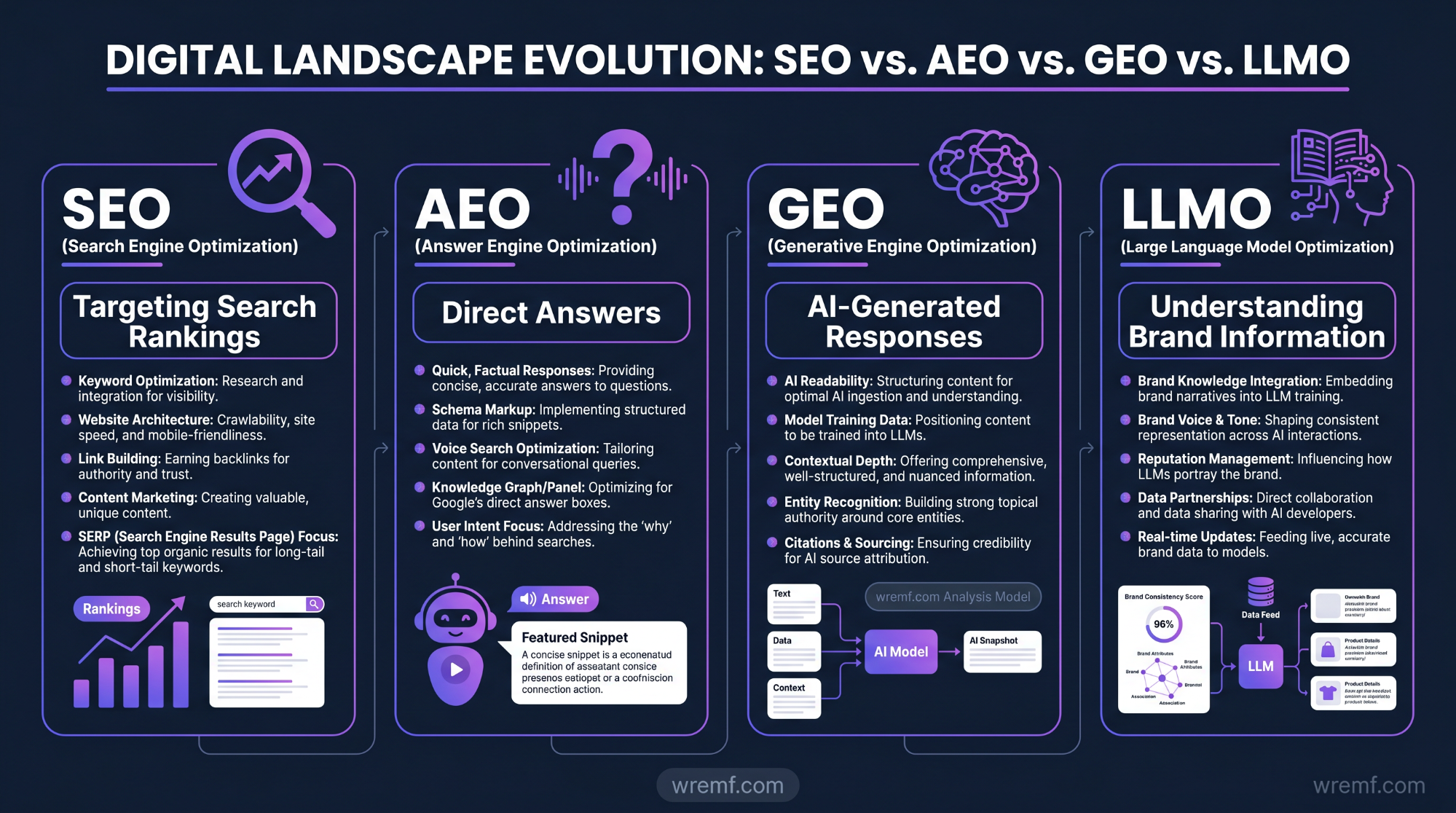
The key difference between SEO, AEO, GEO, and LLMO is the visibility surface being optimized. SEO targets search rankings, Answer Engine Optimization targets direct answers, Generative Engine Optimization targets AI-generated responses, and Large Language Model Optimization targets how language models understand and retrieve brand information.
Answer Engine Optimization is the practice of structuring content so answer engines can extract clear, direct responses. Answer Engine Optimization matters because Google AI Overviews, voice assistants, featured snippets, and conversational tools reward concise, evidence-backed answers.
Generative Engine Optimization is the practice of improving how a brand appears in generative AI outputs. Generative Engine Optimization matters because tools such as ChatGPT, Perplexity, Gemini, Claude, Copilot, DeepSeek, Grok, Meta AI, and Mistral can summarize, compare, and recommend vendors.
Large Language Model Optimization is the practice of improving how large language models understand, retrieve, and represent a brand. Large Language Model Optimization matters because LLMs depend on entity clarity, source quality, citations, and consistent public information.
| Discipline | Best For | What It Measures | What It Misses | Example Metric |
|---|---|---|---|---|
| SEO | Traditional Google and Bing visibility | Rankings, impressions, clicks, CTR, backlinks | Brand visibility inside AI answers | Google Search Console clicks |
| Answer Engine Optimization | Direct answers and extractable responses | Answer inclusion, definition quality, FAQ coverage | Wider generative recommendation behavior | Answer coverage by topic |
| Generative Engine Optimization | AI-generated recommendations and comparisons | Mentions, citations, competitors, AI share of voice | Classic keyword rank movement | Prompt visibility score |
| Large Language Model Optimization | Entity understanding and retrieval accuracy | Entity consistency, source quality, citation patterns | Paid media and SERP ranking performance | Source consistency score |
The best strategy is not SEO versus Generative Engine Optimization. The best strategy is SEO plus Answer Engine Optimization plus Generative Engine Optimization plus Large Language Model Optimization.
A common mistake is treating AI SEO as prompt engineering. Prompt testing helps, but prompt testing without Content Optimization, technical SEO, source citations, entity signal optimization, and source consistency gives an incomplete picture.
TIP: Use SEO to build the crawlable foundation, Answer Engine Optimization to make answers extractable, Generative Engine Optimization to improve AI recommendations, and Large Language Model Optimization to strengthen entity understanding.
WREMF supports this combined workflow through prompt intelligence, source citation tracking, competitor visibility, and AI visibility scoring.
KEY TAKEAWAY: SEO, AEO, GEO, and LLMO work together because AI visibility depends on rankings, answers, citations, entity signals, and source trust.
Once the disciplines are clear, the next question is what modern AI SEO services should actually include.
What Do AI SEO Services Typically Include?
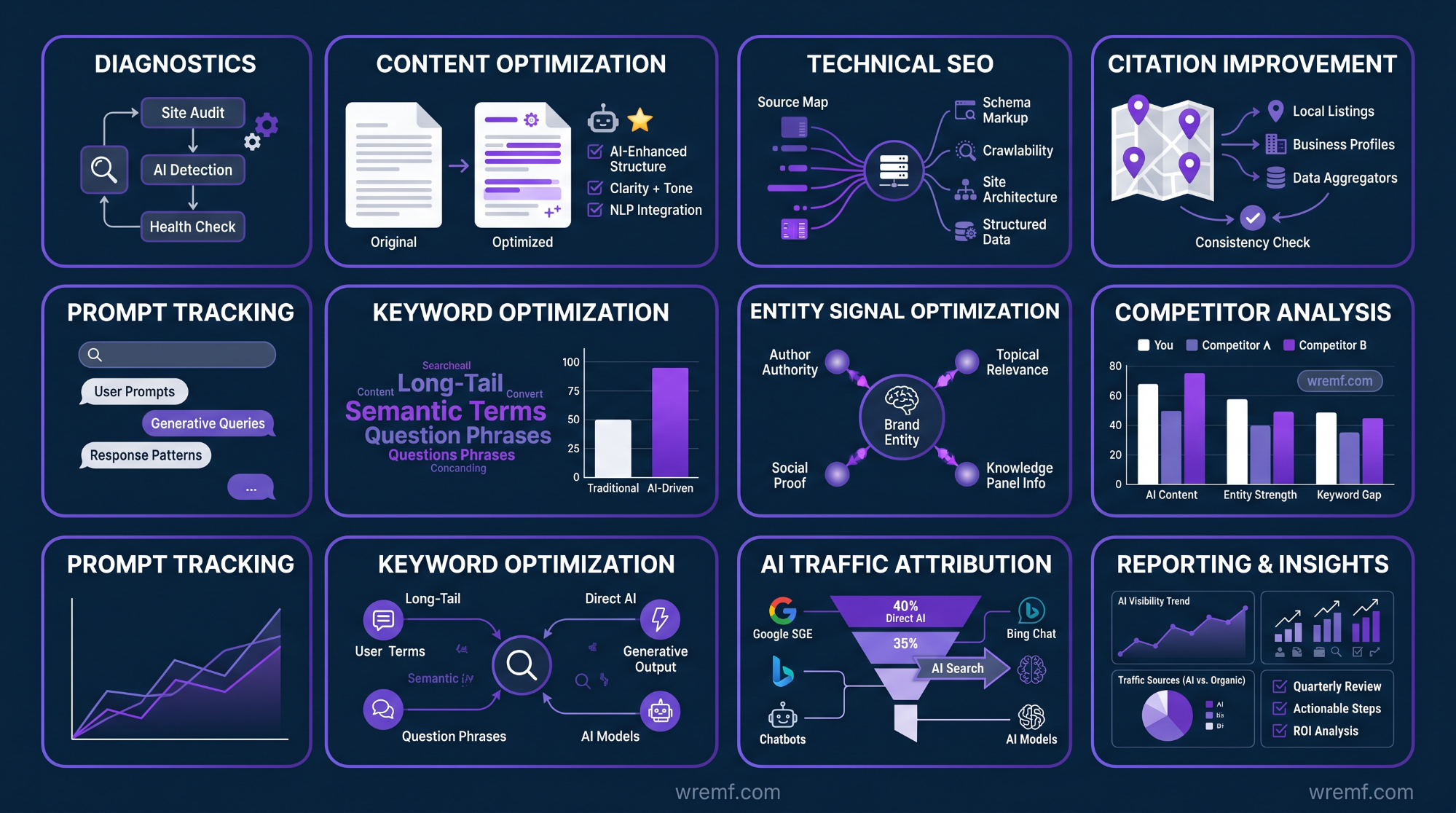
AI SEO services typically include diagnostics, prompt tracking, Content Optimization, keyword optimization, technical SEO, entity signal optimization, citation improvement, competitor analysis, AI traffic attribution, and reporting. A serious provider should show what is measured, what is improved, and what remains uncertain.
Prompt tracking is the process of monitoring how AI engines answer specific buyer questions. Prompt tracking shows whether a brand appears, how often a brand appears, which competitors appear, and whether the answer is positive, neutral, negative, or inaccurate.
AI citations are source links or cited references used to support AI-generated answers. AI citations matter because they show which pages, publishers, directories, review sites, documentation, and articles influence how AI systems describe a brand.
Brand Mentions are references to a brand inside AI answers, web pages, reviews, articles, directories, and comparison content. Brand Mentions matter because they help establish brand presence, brand visibility, category relevance, and market association.
A modern AI SEO service should include these core offerings:
| Service Area | What It Does | Why It Matters |
|---|---|---|
| AI visibility audit | Checks how your brand appears across AI engines | Establishes the baseline |
| Prompt tracking | Monitors buyer questions across AI tools | Shows real answer presence |
| Source citation tracking | Identifies sources cited in AI answers | Reveals authority gaps |
| Content Optimization | Improves pages for answer extraction and semantic relevance | Supports SEO, AEO, GEO, and LLMO |
| keyword optimization | Aligns content with search demand and buyer language | Keeps SEO demand connected to AI prompts |
| Entity signal optimization | Clarifies brand, category, products, people, and use cases | Helps AI systems understand the brand |
| Brand Mentions analysis | Reviews where and how the brand is referenced | Supports reputation and source consistency |
| Competitor visibility | Compares your presence against alternatives | Shows share of voice gaps |
| AI traffic attribution | Connects AI referrals to analytics | Helps prove business impact |
| Reporting | Converts visibility into leadership-ready insights | Supports budget decisions |
Content Optimization should not mean adding keywords to generic articles. Strong Content Optimization includes direct answers, definitions, comparison tables, product or service clarity, FAQs, evidence, internal links, and original insights.
Entity signal optimization is the process of making a brand’s identity, category, products, leadership, locations, and authority signals consistent across owned and third-party sources. Entity signal optimization matters because inconsistent information can confuse AI systems and weaken answer confidence.
IMPORTANT: AI SEO services should not rely on 100 percent AI-generated content at scale. Google’s Search Central guidance warns against content created primarily to manipulate search rankings rather than help people.
KEY TAKEAWAY: AI SEO services should include measurement, technical foundations, Content Optimization, citations, Brand Mentions, entity clarity, and reporting instead of relying on AI content generation alone.
The service mix becomes easier to evaluate when you understand how an AI SEO campaign works in practice.
How Does an AI SEO Campaign Work?
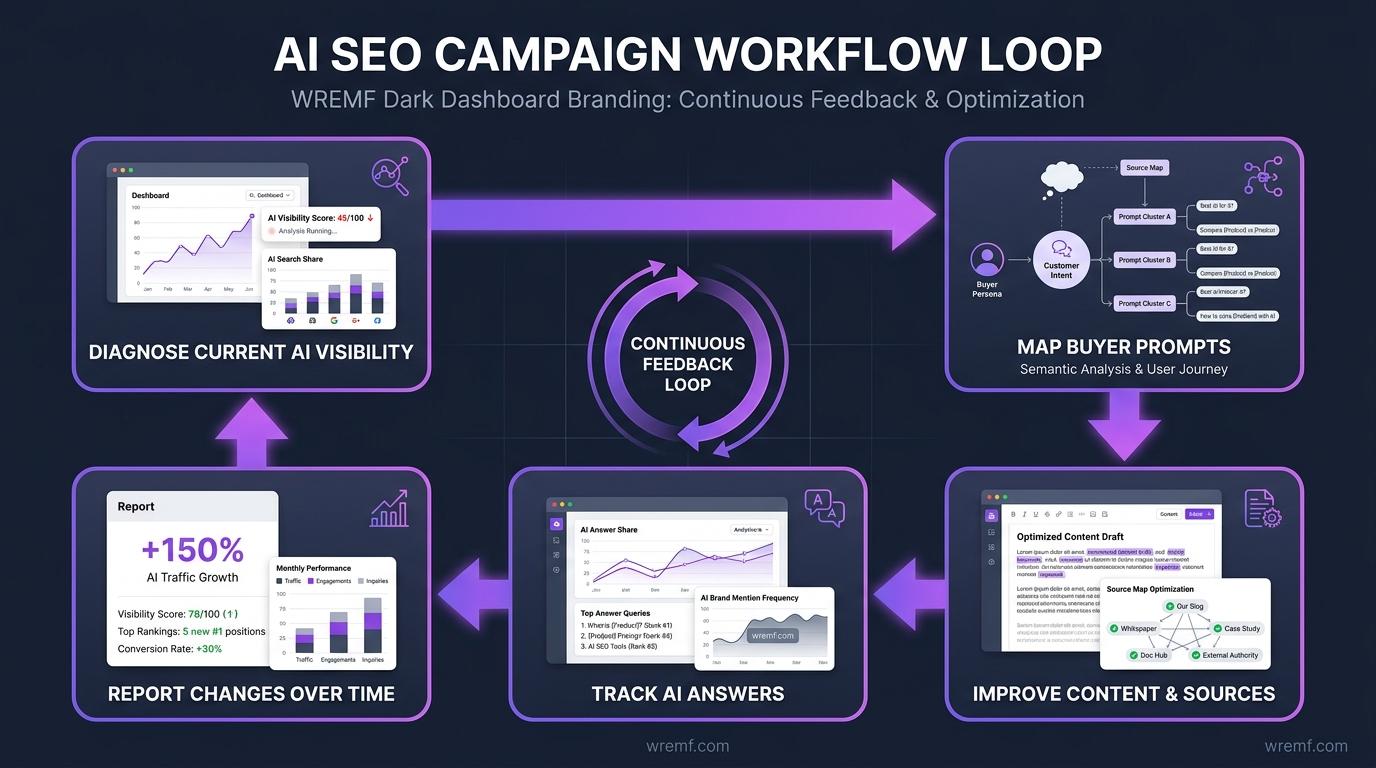
An AI SEO campaign works by diagnosing current AI visibility, mapping buyer prompts, improving content and sources, tracking AI answers, and reporting changes over time. The strongest campaigns use a continuous feedback loop instead of one-time optimization.
A practical AI SEO campaign usually has four phases.
| Phase | Main Goal | Typical Output | Timeline Signal |
|---|---|---|---|
| Phase 1 | Diagnose current visibility | AI visibility baseline, prompt map, source gaps | Week 1 to 2 |
| Phase 2 | Improve owned assets | Content briefs, page updates, schema guidance | Week 2 to 6 |
| Phase 3 | Improve source ecosystem | Citation targets, Brand Mentions cleanup, authority priorities | Month 2 onward |
| Phase 4 | Test and report | Prompt tracking, AI citations, share of voice, AI referrals | Weekly or monthly |
Phase 1 starts with an AI-first diagnostic. SEO teams frequently discover that their brand ranks for useful keywords but does not appear in generative comparison prompts. For example, a SaaS brand may rank for a core keyword but be absent when a user asks, “Which platforms are best for enterprise teams that need white-label reporting?”
Phase 2 focuses on owned content. This includes Content Optimization, answer-first summaries, comparison pages, product pages, documentation, FAQs, internal links, and evidence-backed explanations. keyword optimization still matters, but the page must also answer decision-stage prompts clearly.
Phase 3 focuses on the source ecosystem. AI systems can use official websites, third-party articles, directories, reviews, documentation, trusted publishers, community discussions, and knowledge sources. Source consistency helps AI systems reduce ambiguity when summarizing a brand.
Phase 4 creates the feedback loop. Teams track prompts, AI citations, Brand Mentions, competitors, Google AI Overviews presence, Google AI visibility, AI referral traffic, and answer quality.
WREMF supports this workflow through source citation tracking, competitor visibility, and scheduled AI monitoring. If you want to see how AI engines currently describe a brand, review a sample AI visibility report before building your own measurement workflow.
KEY TAKEAWAY: AI SEO campaigns work best as a measurement and improvement loop across prompts, content, citations, Brand Mentions, competitors, and attribution.
The next layer is understanding which signals influence whether AI systems trust and recommend your brand.
Which Signals Matter Most for AI Search Visibility?
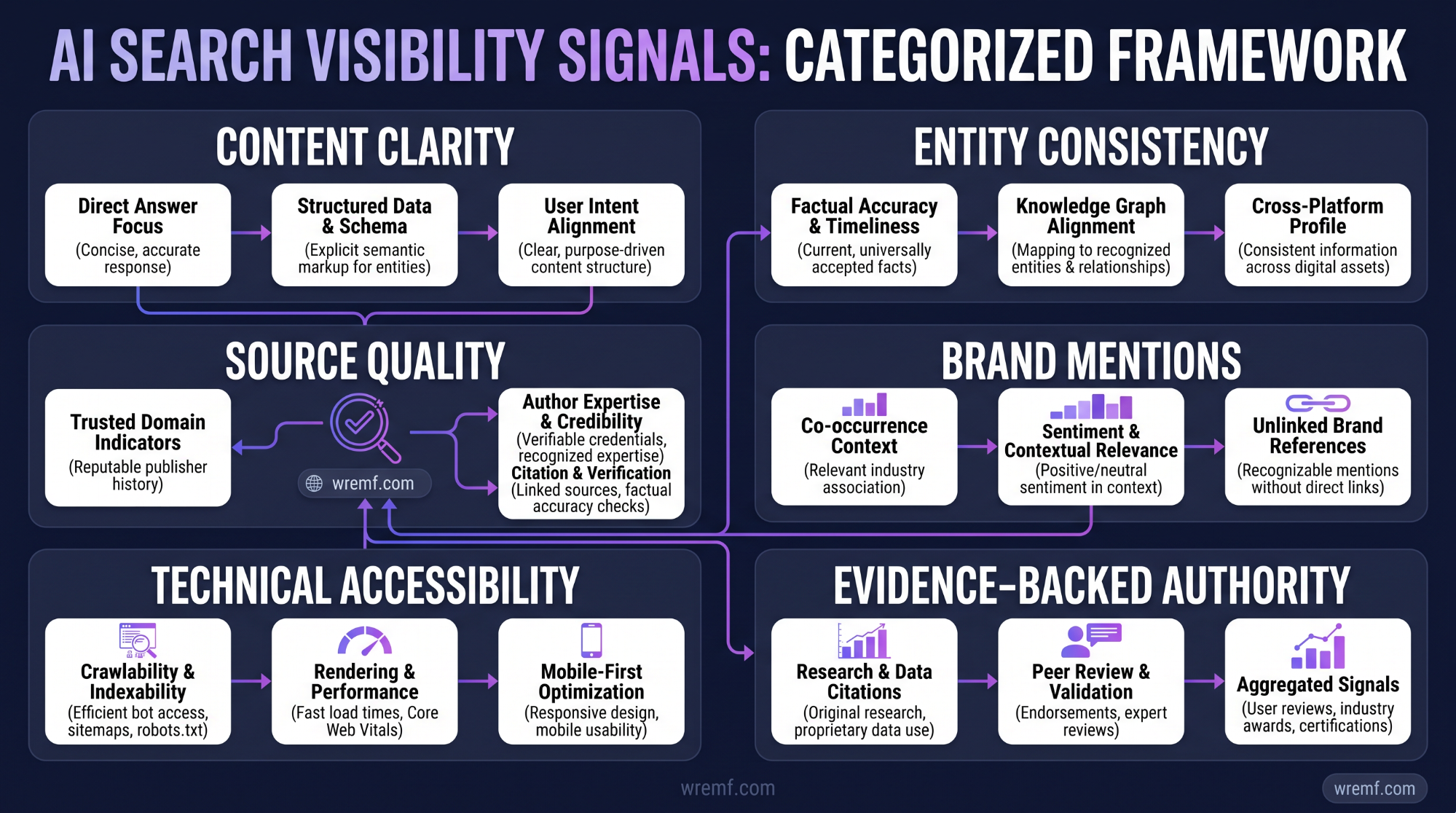
The most important AI search visibility signals are content clarity, source quality, entity consistency, Brand Mentions, technical accessibility, and evidence-backed authority. AI systems need clear information and trustworthy sources before they can represent a brand accurately.
Source consistency is the degree to which your brand information stays aligned across your website, profiles, documentation, directories, reviews, and third-party references. Source consistency helps AI systems because conflicting names, categories, pricing, features, or locations can weaken answer confidence.
Brand visibility is the measurable presence of a brand across search results, Google AI Overviews, AI answers, citations, recommendations, and relevant third-party sources. Brand visibility matters because buyers may encounter a brand before they ever visit its website.
The most important signal categories are:
Clear entity identity: brand name, category, products, audience, and use cases
Crawlable owned content: pages that search engines and AI-linked systems can access
Evidence-backed content: data, examples, product facts, methodology, and documentation
AI citations: sources that appear in answers across ChatGPT, Perplexity, Google AI Overviews, Claude, Gemini, and Copilot
Brand Mentions: relevant mentions across trusted pages, reviews, media, directories, and community sources
positive brand sentiment: favorable, credible language around the brand
Competitor context: how the brand compares to alternatives in AI-generated answers
OpenAI’s documentation says web search allows models to access up-to-date information and provide answers with sourced citations through its web search tool. Anthropic explains that Claude’s web search tool gives Claude direct access to real-time web content and includes citations for sources drawn from search results in the Claude web search documentation.
positive brand sentiment is not a simple ranking factor you can control with a few testimonials. positive brand sentiment is a pattern of credible, favorable, consistent language across sources that buyers and AI systems can observe.
In practical AI visibility audits, teams often find three gaps. The brand may be absent from important prompts. The brand may appear without a strong citation. The brand may appear with an outdated or incomplete description. Each gap needs a different fix.
KEY TAKEAWAY: AI visibility depends on clear owned content, consistent entity signals, credible sources, Brand Mentions, positive brand sentiment, and measurable citations.
After the core signals are in place, you need to connect AI SEO to the wider marketing mix.
How Do AI SEO Services Connect With Google AI, Paid Media, PPC, ASO, and CRO?
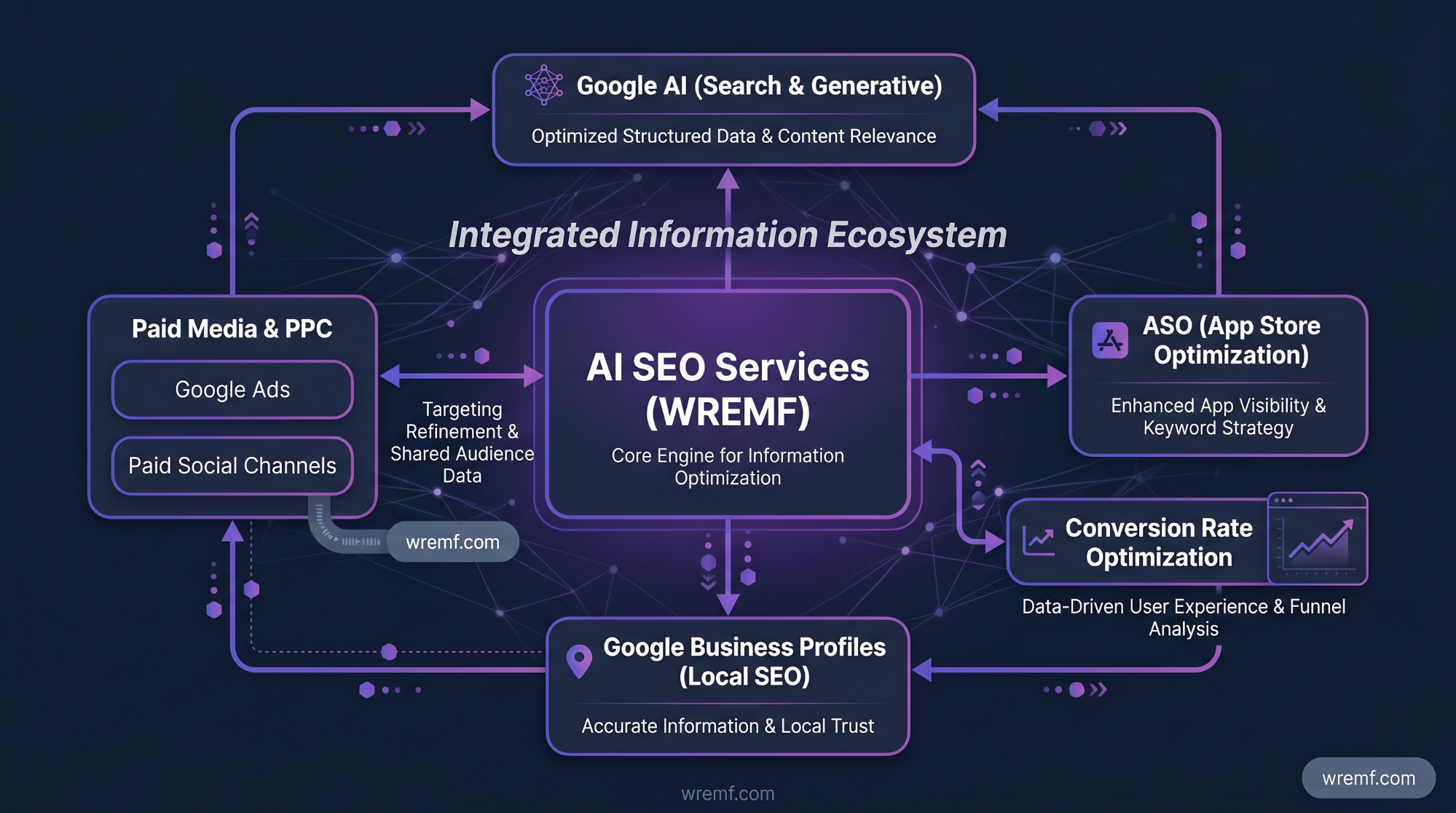
AI SEO services connect with Google AI, Paid media services, PPC services, App Store Optimization, Google Business Profiles, Google Ads, and Conversion Rate Optimization by improving the information ecosystem around the brand. AI SEO works best when organic content, paid campaigns, app listings, local profiles, and conversion pages all reinforce the same entity signals.
Google AI is the set of AI-powered experiences that Google uses across Search, AI Overviews, AI Mode, and related products. Google AI matters for marketers because Google remains a dominant discovery channel while adding AI-generated summaries and conversational search behavior.
Google Business Profiles are business listings that help Google understand local entities, locations, services, reviews, and contact details. Google Business Profiles matter because local AI discovery often depends on accurate business data, reviews, proximity, and service relevance.
AI SEO and Google Ads can work together. Google Ads can create demand and visibility for high-intent queries, while AI SEO improves the organic and AI-answer ecosystem that users may consult before or after clicking an ad. Paid media services can also reveal messaging that converts, which can improve Content Optimization and landing page clarity.
PPC services are paid search and paid media services that manage campaigns, bids, creative, landing pages, and conversion tracking. PPC services matter in an AI SEO strategy because paid campaigns can test positioning faster than organic content cycles.
Conversion Rate Optimization is the practice of improving pages so more visitors take desired actions. Conversion Rate Optimization matters because AI SEO can increase visibility, but poor page clarity, weak proof, confusing CTAs, or slow pages can reduce business impact.
App Store Optimization is the practice of improving app listings for app store visibility, relevance, and conversion. App Store Optimization matters in AI-integrated mobile discovery because users may ask AI assistants for app recommendations, feature comparisons, and category options.
| Channel | AI SEO Connection | Example Use Case |
|---|---|---|
| Google AI Overviews | Improve answer-ready content and source quality | Appear in AI-generated topic summaries |
| Google Ads | Test positioning and high-intent messaging | Validate category language before content rollout |
| Paid media services | Support brand presence across channels | Reinforce campaign themes across search and AI prompts |
| PPC services | Capture demand while organic visibility grows | Protect high-intent commercial queries |
| Google Business Profiles | Strengthen local entity signals | Improve local AI discovery for service brands |
| App Store Optimization | Improve app category and feature clarity | Support AI-driven mobile app recommendations |
| Conversion Rate Optimization | Turn AI-driven visits into actions | Improve demo, audit, or signup conversion |
The strategic point is consistency. If paid ads describe one category, website pages describe another category, and third-party sources describe an outdated product, AI systems may struggle to summarize the brand accurately.
TIP: Use paid media services and Google Ads to test language, then use the winning language to improve Content Optimization, landing pages, FAQs, and AI-ready content briefs.
KEY TAKEAWAY: AI SEO performs better when Google AI visibility, paid media services, PPC services, Google Business Profiles, App Store Optimization, and Conversion Rate Optimization reinforce the same brand story.
The next question is how to measure success when classic rankings are not enough.
How Do You Measure Success for AI SEO Services?
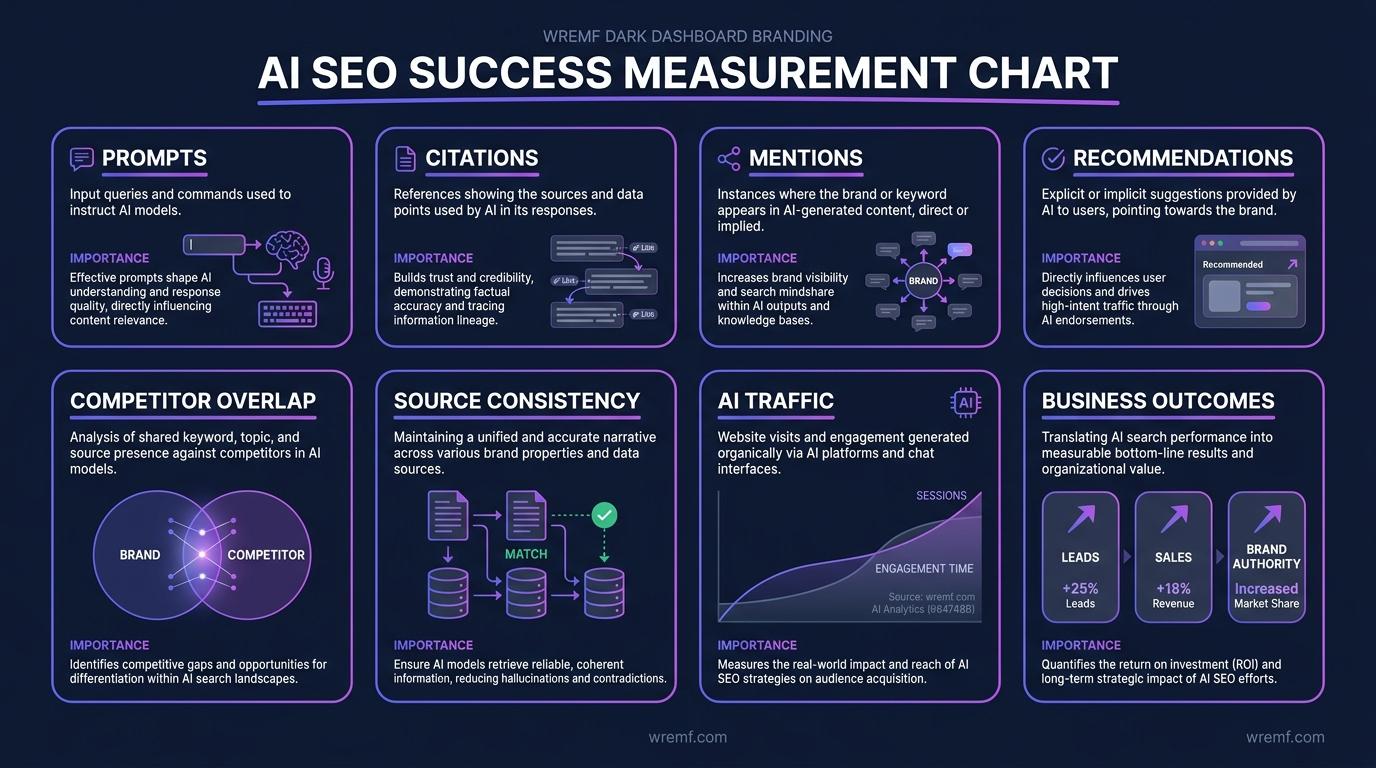
AI SEO success is measured through prompts, citations, mentions, recommendations, competitor overlap, source consistency, AI traffic, and business outcomes. Rankings still matter, but rankings alone cannot explain brand visibility inside AI-generated answers.
AI share of voice is the percentage of relevant AI answers where a brand appears compared with competitors. AI share of voice matters because it shows whether a brand is part of the conversation when buyers ask category, comparison, and recommendation questions.
AI traffic attribution is the process of connecting visits from AI platforms to analytics, conversions, pipeline, or revenue. AI traffic attribution matters because leadership needs to understand whether AI visibility is becoming a measurable acquisition channel.
A useful AI SEO measurement framework includes:
| KPI | What It Measures | Why It Matters |
|---|---|---|
| Prompt visibility | Whether your brand appears for tracked prompts | Shows answer presence |
| Citation count | How often your pages or third-party sources are cited | Shows source influence |
| Brand Mentions | How often your brand is referenced | Shows brand presence |
| Sentiment | Whether AI descriptions are positive, neutral, or negative | Shows reputation risk |
| Competitor overlap | Which competitors appear with or above your brand | Shows market position |
| Recommendation visibility | Whether AI systems recommend your brand | Shows buying-stage influence |
| Source consistency | Whether key facts are aligned across sources | Shows entity clarity |
| AI referral traffic | Visits from AI platforms | Shows traffic impact |
| Conversion quality | Leads, signups, audits, or demos from AI traffic | Shows business value |
Perplexity explains that each answer includes numbered citations linking to original sources in its Perplexity help documentation. Microsoft explains that knowledge sources can enhance generative answers in Copilot Studio by integrating enterprise data, websites, and external systems in its Copilot Studio knowledge sources documentation. These examples show why citations and knowledge sources are central to AI visibility measurement.
In real-world reporting, teams usually struggle when they try to report AI SEO using only rank tracking. Rank tracking can show where a URL sits in classic search results, but it cannot show whether Claude recommends a competitor, whether Perplexity cites a third-party list, or whether Google AI Overviews summarize your brand accurately.
WREMF’s AI Visibility Index helps teams convert prompt-level and engine-level visibility into a clearer reporting layer. This makes AI SEO easier to discuss with founders, CMOs, clients, and agency stakeholders.
KEY TAKEAWAY: AI SEO success requires prompt visibility, citations, Brand Mentions, competitor overlap, source consistency, AI traffic attribution, and conversion reporting.
Measurement is only useful when it leads to better decisions, so the next section explains how to choose the right AI SEO service model.
Should You Choose AI SEO Software, an Agency, or a Hybrid Model?
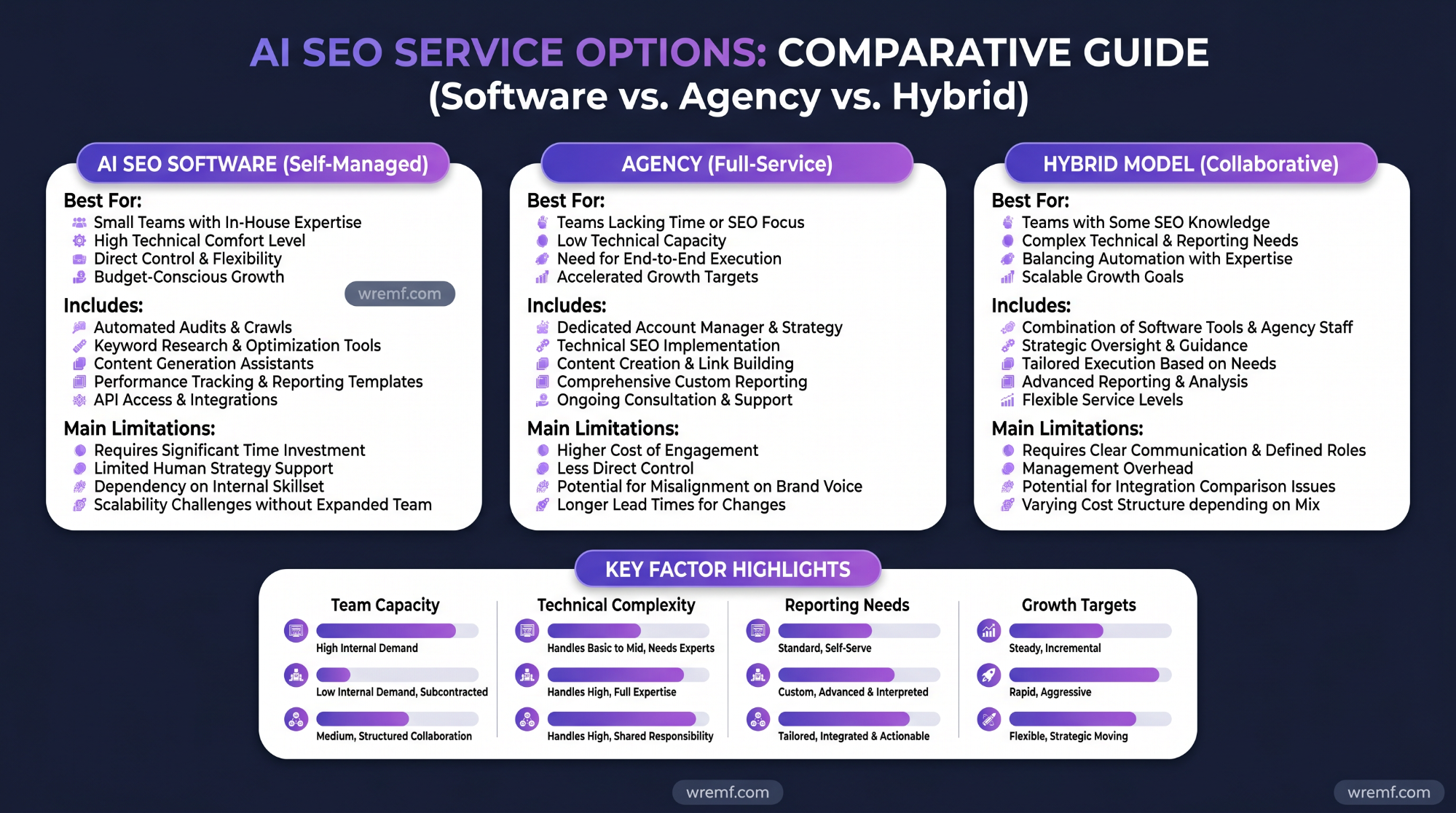
You should choose AI SEO software if your team can execute internally, an agency if you need strategy and implementation, and a hybrid model if you need both measurement and done-for-you execution. The right choice depends on team capacity, technical complexity, reporting needs, and growth targets.
AI SEO software is best for teams that want ongoing visibility tracking. Software helps monitor prompts, citations, competitors, Brand Mentions, and AI share of voice without waiting for a manual audit each month.
Managed AI SEO services are best for teams that need senior execution. Managed services can include strategy, Content Optimization, technical fixes, citation improvement, entity signal optimization, internal linking, schema guidance, reporting, and monthly execution.
A hybrid model is best when a team wants the transparency of software and the speed of expert execution. A hybrid model works well for B2B SaaS teams, agencies, consultants, and growth teams that need to prove progress while improving content and source quality.
| Option | Best For | What It Includes | Main Limitation | Recommended When |
|---|---|---|---|---|
| AI SEO software | Teams with internal SEO or content capacity | Tracking, dashboards, prompts, citations, reports | Requires internal execution | You need measurement and workflows |
| AI SEO agency | Teams needing strategy and implementation | Audits, content, technical fixes, authority work, reporting | Less self-serve control | You need senior-led execution |
| Hybrid model | Teams needing software plus execution | Platform, reporting, strategy, managed improvements | Requires clear prioritization | You need measurement and done-for-you support |
WREMF can be used as software, an agency service, or a combined software plus managed execution solution. For teams that need execution, WREMF offers managed AEO, Generative Engine Optimization, AI visibility, content, citation, and source consistency services through the WREMF agency team.
For agencies and consultants, white-label reporting matters. WREMF supports white-label reports, client portals, BYOK, and multi-client workflows through AI visibility tools for agencies.
IMPORTANT: A provider that only sells AI-generated articles or prompt tricks is not offering a complete AI SEO service. Ask for measurement, source analysis, implementation priorities, and reporting.
KEY TAKEAWAY: Software is best for measurement, agencies are best for execution, and hybrid AI SEO services are best when teams need both visibility tracking and managed improvement.
After choosing the model, the next step is evaluating providers and avoiding weak offers.
How Do You Choose the Right AI SEO Service Provider?
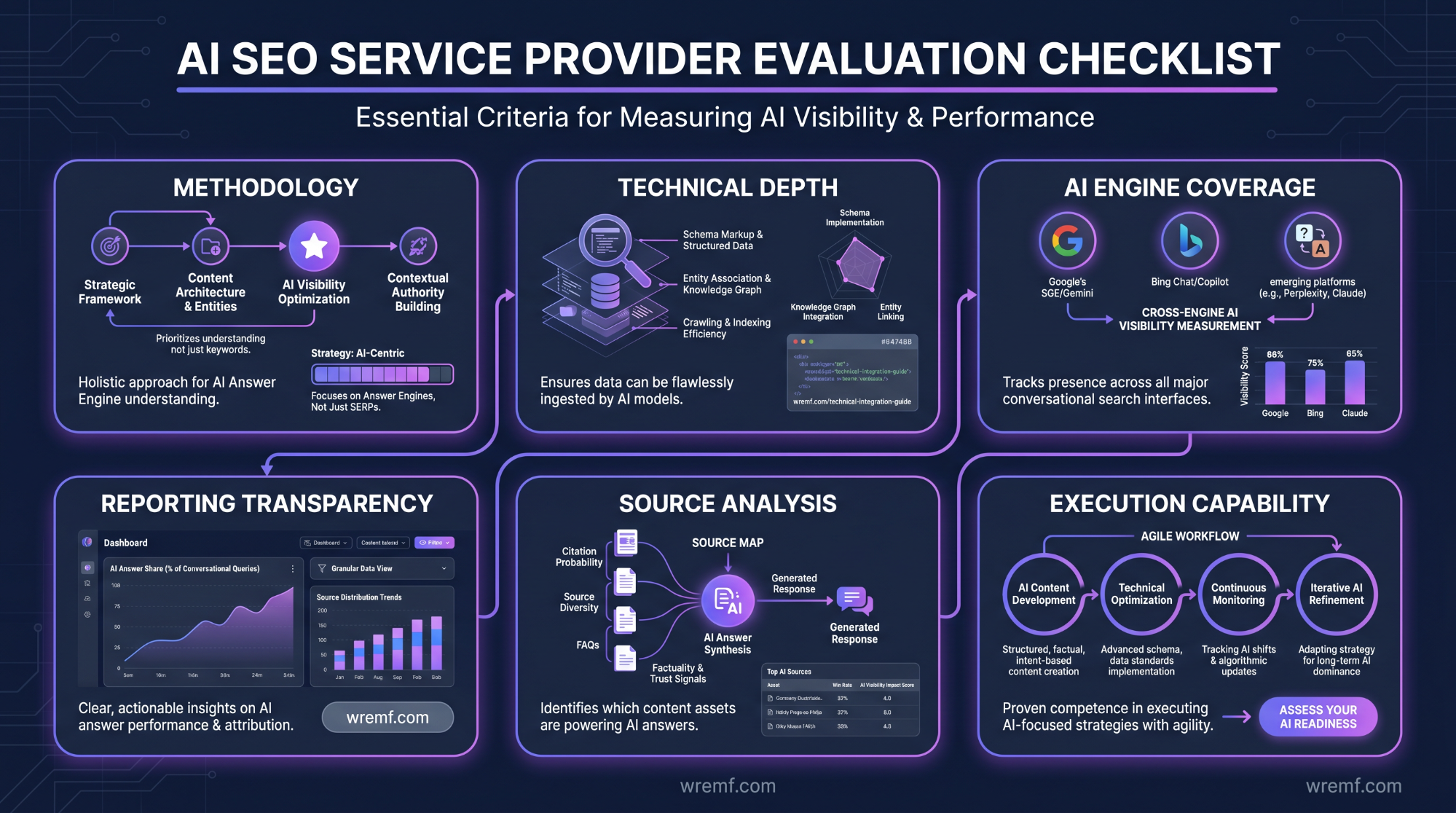
Choose an AI SEO service provider by evaluating methodology, technical depth, AI engine coverage, reporting transparency, source analysis, and execution capability. The best provider should explain how AI visibility is measured before promising improvements.
A credible provider should answer these questions clearly:
Which AI engines are monitored?
Which prompts are tracked?
How are prompts selected?
How are Google AI Overviews, ChatGPT, Claude, Gemini, Perplexity, and Copilot monitored?
How are Brand Mentions classified?
How are citations and sources tracked?
How is competitor visibility measured?
How are SEO, Answer Engine Optimization, Generative Engine Optimization, and Large Language Model Optimization connected?
How are recommendations prioritized?
How is AI traffic attribution handled?
How are results reported to leadership or clients?
Red flags include:
Promising guaranteed AI citations
Selling AI content volume as the main strategy
Ignoring technical SEO
Ignoring Google AI Overviews
Ignoring source citations
Reporting only classic keyword rankings
Treating Generative Engine Optimization as prompt engineering only
Claiming SEO is dead
Offering no explanation of methodology
Providing no sample report
A strong provider should explain tradeoffs. AI answers can vary by engine, user location, freshness, source access, prompt wording, personalization, and retrieval behavior. A serious provider will measure patterns over time rather than cherry-pick one favorable answer.
| Evaluation Criteria | Strong Signal | Weak Signal |
|---|---|---|
| Methodology | Clear scoring, prompt groups, source tracking | Vague “AI visibility boost” claims |
| Engine coverage | Multiple AI engines monitored | One manual ChatGPT check |
| Reporting | Prompt, citation, competitor, and attribution views | Screenshots only |
| Execution | Content, technical, entity, source, and reporting work | AI articles only |
| Transparency | Clear limitations and sample outputs | Guaranteed outcomes |
| B2B fit | Buying-stage prompts and sales context | Generic blog traffic focus |
WREMF provides a practical way to evaluate AI visibility through software, managed services, and reporting. Teams can also compare use cases and pricing through WREMF pricing when deciding whether to start with one website, multiple websites, or an enterprise setup.
KEY TAKEAWAY: The right AI SEO provider should offer transparent measurement, multi-engine visibility, source analysis, content strategy, technical depth, and honest reporting.
A strong provider also needs to explain how AI SEO changes content strategy.
How Should Content Optimization Change for AI SEO?
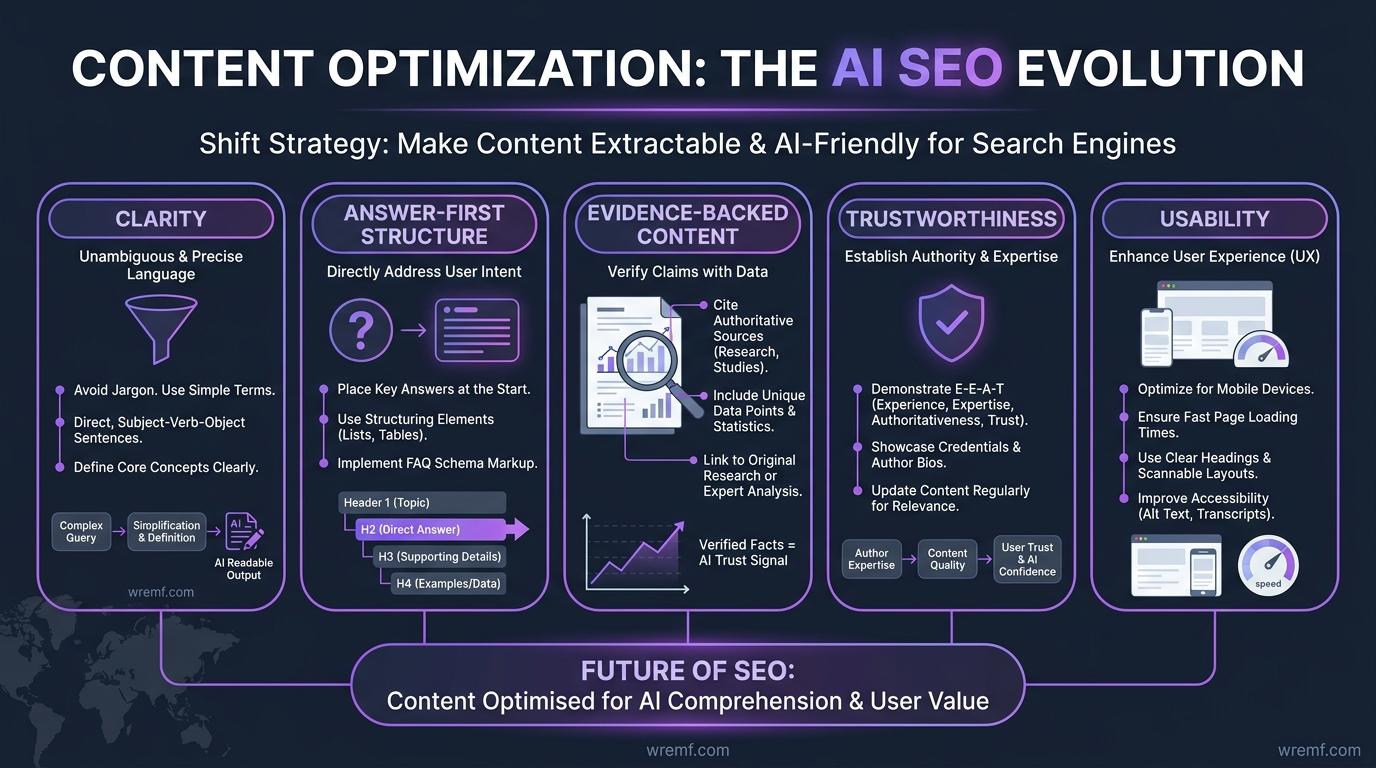
Content Optimization for AI SEO should make content clear, answer-first, evidence-backed, structured, and easy for both search engines and AI systems to understand. The goal is not to stuff keywords, but to make every page useful, extractable, and trustworthy.
Content Optimization is the process of improving content so it satisfies user intent, search engine requirements, and AI retrieval needs. Content Optimization matters because AI systems need concise answers, clear entities, supporting evidence, and source-friendly structure.
keyword optimization still matters because user language reveals demand. However, keyword optimization must be paired with prompt matching, topic clusters, entity signal optimization, Brand Mentions, and answer formatting.
For AI SEO, a strong content brief should include:
Primary keyword and secondary keywords
Buyer prompts and natural-language questions
Answer-first introduction
Clear definitions under 60 words
Comparison tables where users compare options
H2 sections aligned to search intent
FAQ answers that stand alone
Internal links to relevant pages
Source attribution for factual claims
Examples from real buying workflows
Clear CTAs tied to intent
AI-ready content should answer the actual prompt. For example, a user asking “What do AI SEO services include?” needs a list of service areas, expected deliverables, measurement methods, timelines, and red flags. A generic blog about “AI changing SEO” is not enough.
WREMF’s AI-ready content briefs help teams turn prompt, citation, competitor, and keyword data into structured content recommendations. This connects content production to measurable AI visibility gaps.
TIP: Build content around prompts, not only keywords. A prompt can reveal the buyer’s problem, comparison set, risk concern, and decision stage in one sentence.
KEY TAKEAWAY: AI SEO Content Optimization should combine keywords, prompts, entities, citations, evidence, answer-first structure, and internal links.
Content alone is not enough, because AI systems also need technical access and source consistency.
What Technical SEO Foundations Matter for AI SEO Services?
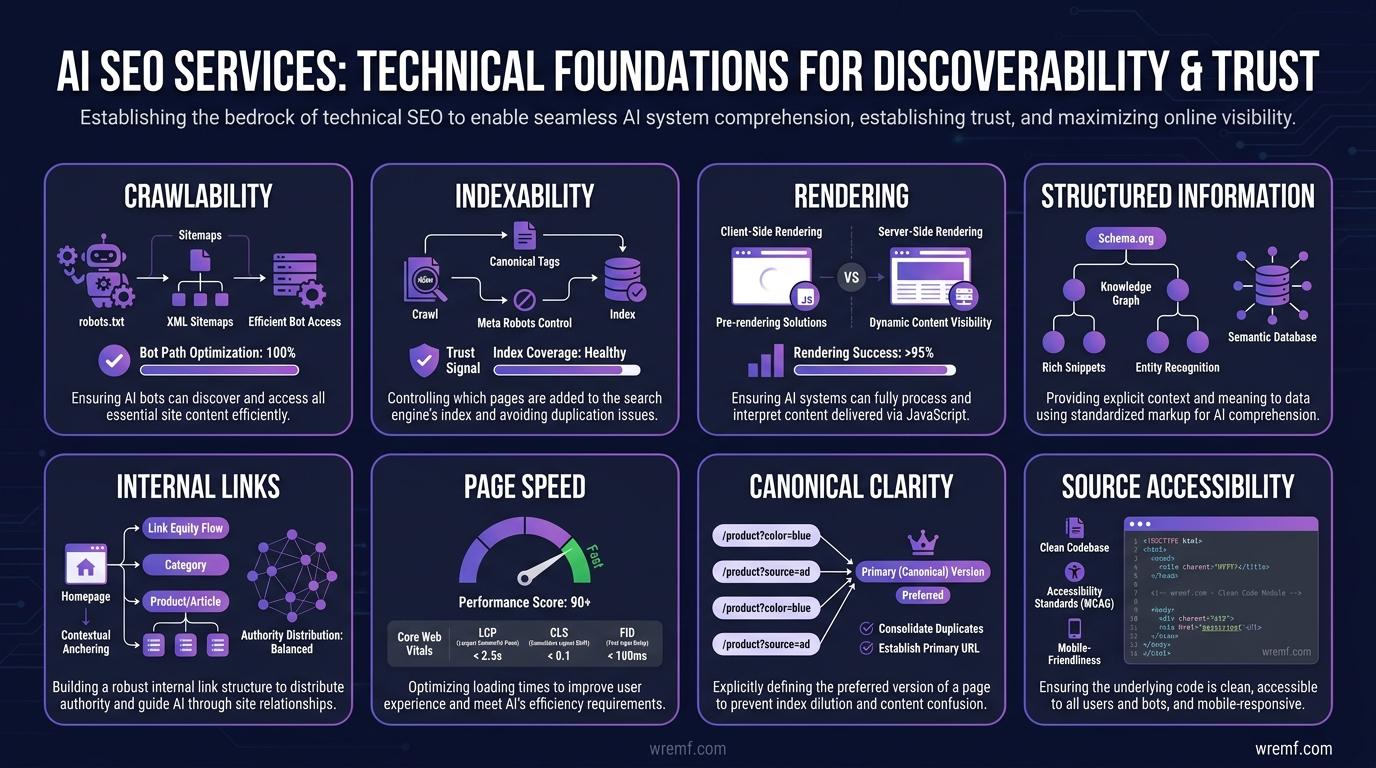
Technical SEO for AI SEO services focuses on crawlability, indexability, rendering, structured information, internal links, page speed, canonical clarity, and source accessibility. AI systems and search engines cannot use content they cannot discover, parse, or trust.
Technical SEO is the discipline of improving website infrastructure so search engines can crawl, render, index, and understand pages. Technical SEO matters for AI SEO because AI visibility often depends on content that is accessible through search indexes, linked sources, or retrieval systems.
Important technical foundations include:
Crawlable HTML content
Correct canonical tags
Clean robots.txt rules
Accurate sitemaps
Fast page loading
Mobile-friendly pages
Stable URLs
Descriptive title tags and meta descriptions
Internal links between related topics
Schema markup guidance where appropriate
Clean rendering for JavaScript-heavy pages
Clear author, reviewer, date, and source signals
Google AI Overviews do not require a special technical trick. Google’s guidance for AI features points site owners back to Search fundamentals. That means the basics still matter, but the consequences are wider because crawlability can affect classic search, Google AI Overviews, and other AI discovery surfaces.
A practical AI SEO audit should test what search engines and AI-linked systems can see. For JavaScript-heavy websites, teams should check server-rendered HTML, bot-visible content, metadata, headings, internal links, and structured page elements.
WREMF’s GEO audit feature helps teams identify AI visibility gaps across technical, content, and source-level factors. This is useful when pages are published but not visible, answer-ready, or citation-friendly.
IMPORTANT: Do not treat technical SEO as separate from AI SEO. Technical access is the foundation that lets content, citations, and entity signals work.
KEY TAKEAWAY: Technical SEO supports AI SEO by making content crawlable, indexable, parseable, internally connected, and reliable enough to support AI retrieval.
Once technical access is stable, brands need to manage their presence beyond the website.
How Do Brand Mentions, Sentiment, and Entity Signals Influence AI Recommendations?
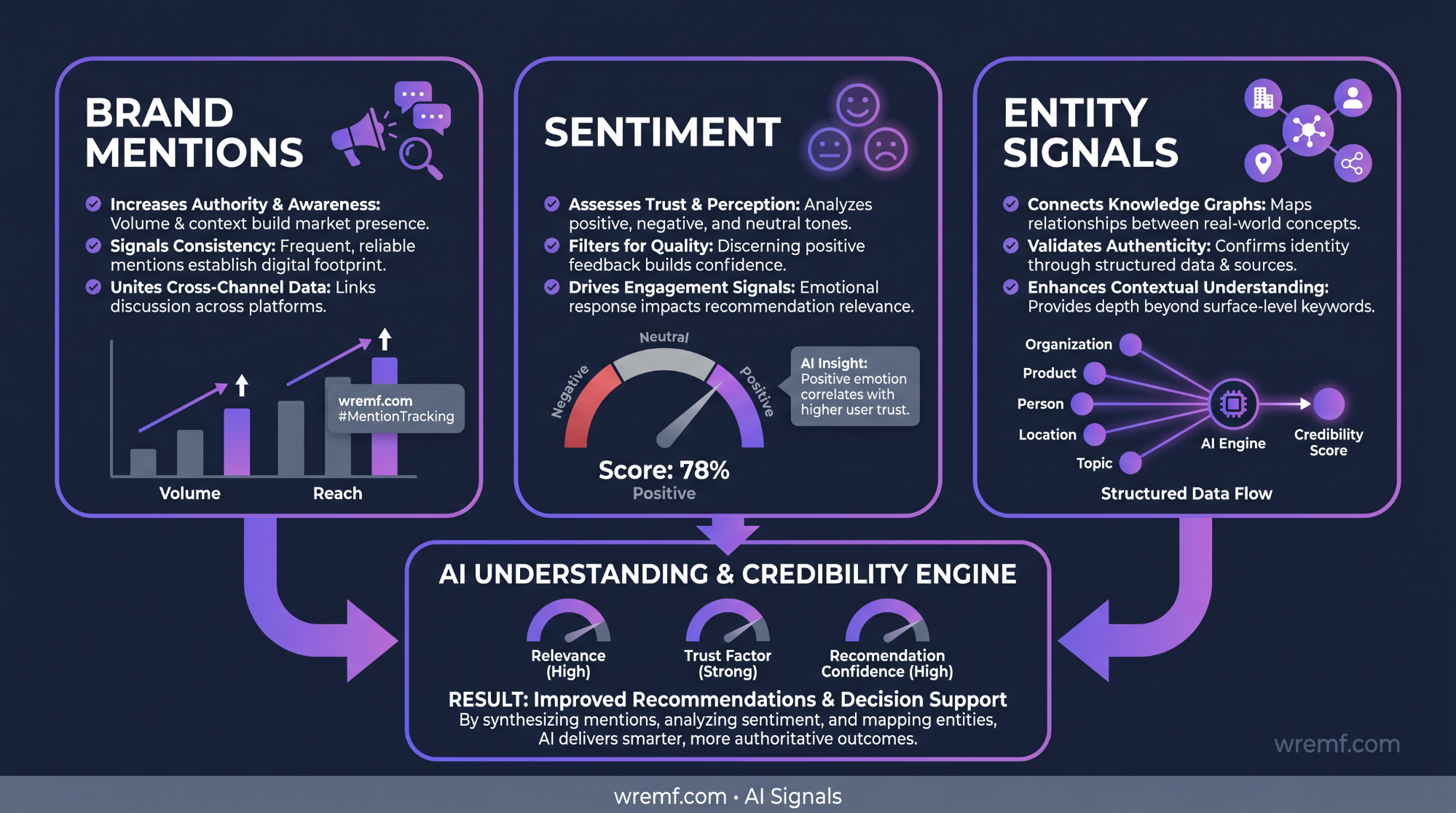
Brand Mentions, sentiment, and entity signals influence AI recommendations by helping AI systems understand what a brand is, where it fits, and whether sources describe it consistently. AI recommendations become stronger when credible sources reinforce the same category, use cases, and proof points.
Brand presence is the combined visibility of a brand across owned channels, third-party websites, search results, AI answers, reviews, directories, social profiles, and community discussions. Brand presence matters because AI systems may synthesize answers from many sources, not only the brand website.
Entity signal optimization helps AI systems connect the brand to the right category. For example, WREMF should be associated with AI visibility tracking, AEO, GEO, prompt intelligence, source citation tracking, and AI search visibility. If sources describe the same company in inconsistent ways, AI systems may produce incomplete or outdated summaries.
Brand Mentions can influence AI search visibility in several ways:
They associate the brand with a category
They reinforce product and service descriptions
They show third-party relevance
They create comparison context
They reveal positive brand sentiment or reputation risk
They expose outdated or inaccurate descriptions
They help identify citation opportunities
positive brand sentiment should be earned through product quality, clear messaging, transparent proof, useful content, customer evidence, and credible third-party references. It should not be manufactured through fake reviews, spam, or low-quality link schemes.
Agencies managing multiple clients often need source consistency cleanup. This includes checking directory descriptions, review profiles, author bios, comparison pages, product pages, social profiles, and knowledge panels for conflicting information.
KEY TAKEAWAY: Brand Mentions, positive brand sentiment, entity signal optimization, and source consistency help AI systems understand and describe a brand more accurately.
These signals matter most when buyers ask AI systems to compare options.
How Do AI SEO Services Influence B2B Buying Decisions?
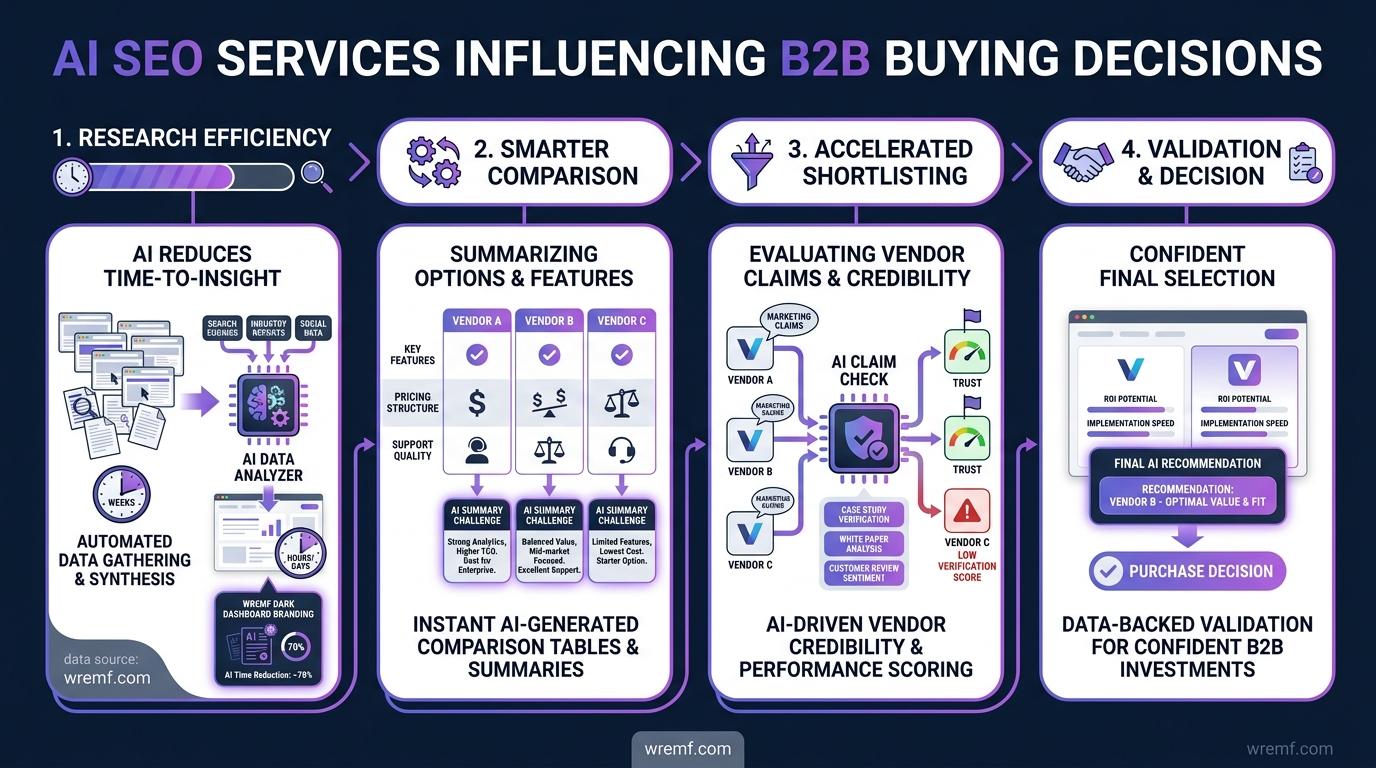
AI SEO services influence B2B buying decisions by improving whether a brand appears in AI-assisted research, comparison, shortlist, and validation prompts. B2B buyers use AI tools to reduce research time, summarize options, and sense-check vendor claims.
In real B2B buying journeys, a buyer may use Google, Google AI Overviews, ChatGPT, Perplexity, Claude, Gemini, Copilot, review sites, vendor websites, and analyst-style content before booking a demo. Each surface can shape the shortlist.
Brand recommendation visibility measures whether AI systems recommend a brand for relevant buying prompts. Brand recommendation visibility matters because a buyer may ask for “best tools,” “top agencies,” “alternatives,” “pricing,” “risks,” or “implementation steps” before speaking to sales.
Examples of buying-stage AI prompts include:
“What are the best AI SEO services for B2B SaaS?”
“Which Generative Engine Optimization agency should I choose?”
“What is the difference between AI SEO services and traditional SEO?”
“Is AI SEO worth it for an early-stage B2B company?”
“What should an AI visibility audit include?”
“Which platforms track Google AI Overviews and ChatGPT visibility?”
“How much should AI SEO services cost?”
“Which AI SEO provider offers software and managed execution?”
AI SEO services can improve these moments by aligning content, sources, citations, Brand Mentions, and reporting with real buyer questions. This is why AI SEO is both a measurement problem and a source ecosystem problem.
For in-house teams, WREMF supports AI visibility workflows for brands that need measurable AI search visibility. For agencies, WREMF supports white-label reporting and multi-client workflows.
DID YOU KNOW: In AI-assisted journeys, the first brand interaction may happen inside an answer, not on a landing page.
KEY TAKEAWAY: AI SEO services influence B2B buying by improving brand visibility, citations, comparisons, and recommendations across AI-assisted research journeys.
The next practical question is how long AI SEO takes and what results are realistic.
How Long Does AI SEO Take to Work?
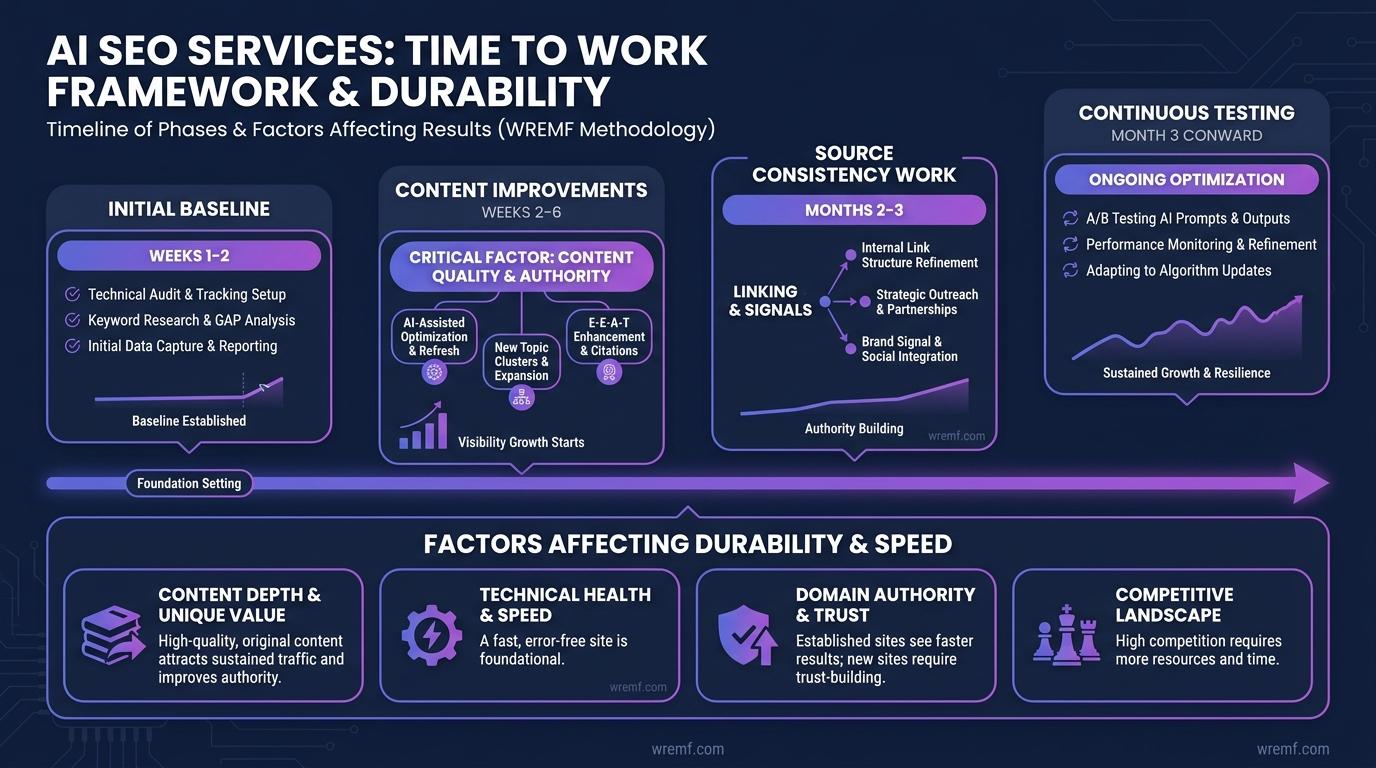
AI SEO services usually require weeks to build a reliable baseline and months to improve visibility patterns. Fast changes can happen when technical issues or missing content are fixed, but durable AI visibility depends on content quality, source consistency, citations, Brand Mentions, and authority.
AI SEO is not instant because AI systems depend on crawled content, source freshness, search indexes, retrieval behavior, third-party signals, and model behavior. A single page update may help, but broader visibility often requires repeated improvements.
A practical timeline looks like this:
| Timeframe | What Usually Happens | What To Measure |
|---|---|---|
| Week 1 to 2 | Baseline audit and prompt map | Current mentions, citations, competitors |
| Week 2 to 6 | Technical and content improvements | Crawlability, content coverage, answer quality |
| Month 2 to 3 | Source and citation work | Brand Mentions, citations, source consistency |
| Month 3 onward | Continuous testing and reporting | AI share of voice, AI referrals, conversions |
Early-stage B2B companies should not ignore AI SEO. Smaller companies may not need a large retainer, but they should still know whether AI systems understand the brand, recommend competitors, or cite outdated sources.
The realistic goal is not guaranteed AI citations. The realistic goal is to improve the probability that AI systems can understand, retrieve, cite, and describe the brand accurately when users ask relevant questions.
KEY TAKEAWAY: AI SEO takes time because durable visibility depends on prompts, content, citations, Brand Mentions, technical access, and source consistency.
Knowing the timeline helps you set expectations, but pricing also matters when choosing a provider.
How Much Do AI SEO Services Cost?
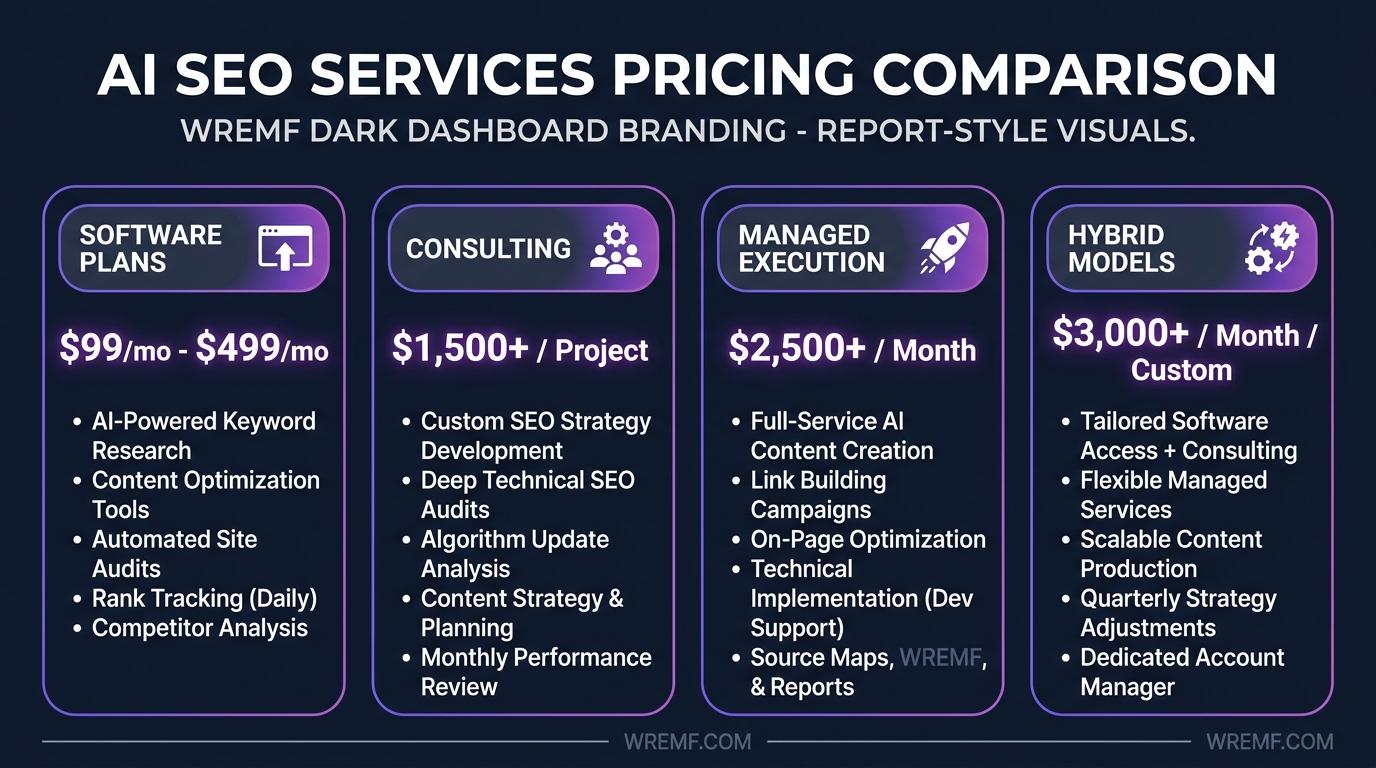
AI SEO services can range from low-cost software plans to custom enterprise retainers depending on the number of websites, AI engines tracked, reporting needs, and execution scope. Pricing should reflect whether you are buying software, consulting, managed execution, or a hybrid model.
Cost depends on:
Number of websites
Number of tracked prompts
Number of AI engines
Reporting frequency
Content volume
Technical complexity
Source citation work
Competitor monitoring
Agency execution
Client portal and white-label needs
API and MCP integration needs
WREMF pricing is designed around transparent software access. The Starter plan is €39 per month for 1 website, unlimited prompt tracking, BYOK, 10 AI engines, all features and tools, white-label reports, 1 seat, and email support. The Growth plan is €89 per month for 5 websites, unlimited prompt tracking, BYOK, 10 AI engines, all features and tools, white-label reports, priority email support with a 24-hour SLA, content brief generator, and SEO A/B testing.
Enterprise plans are custom and include unlimited websites, unlimited prompt tracking, BYOK, 10 AI engines, all features and tools, white-label reports, unlimited seats, dedicated support with a 4-hour SLA, and custom branded portals.
For service work, pricing depends on scope. A simple AI visibility audit costs less than monthly managed Generative Engine Optimization, content, citation, and technical execution. Teams should compare the cost of software against the internal time needed to interpret data and make improvements.
TIP: If your team can execute, start with software. If your team lacks time or AI SEO experience, use a managed or hybrid model.
KEY TAKEAWAY: AI SEO pricing should match the level of tracking, reporting, technical work, content execution, citation improvement, and agency support required.
Cost matters, but the bigger risk is buying the wrong service.
Common Myths About AI Visibility Debunked
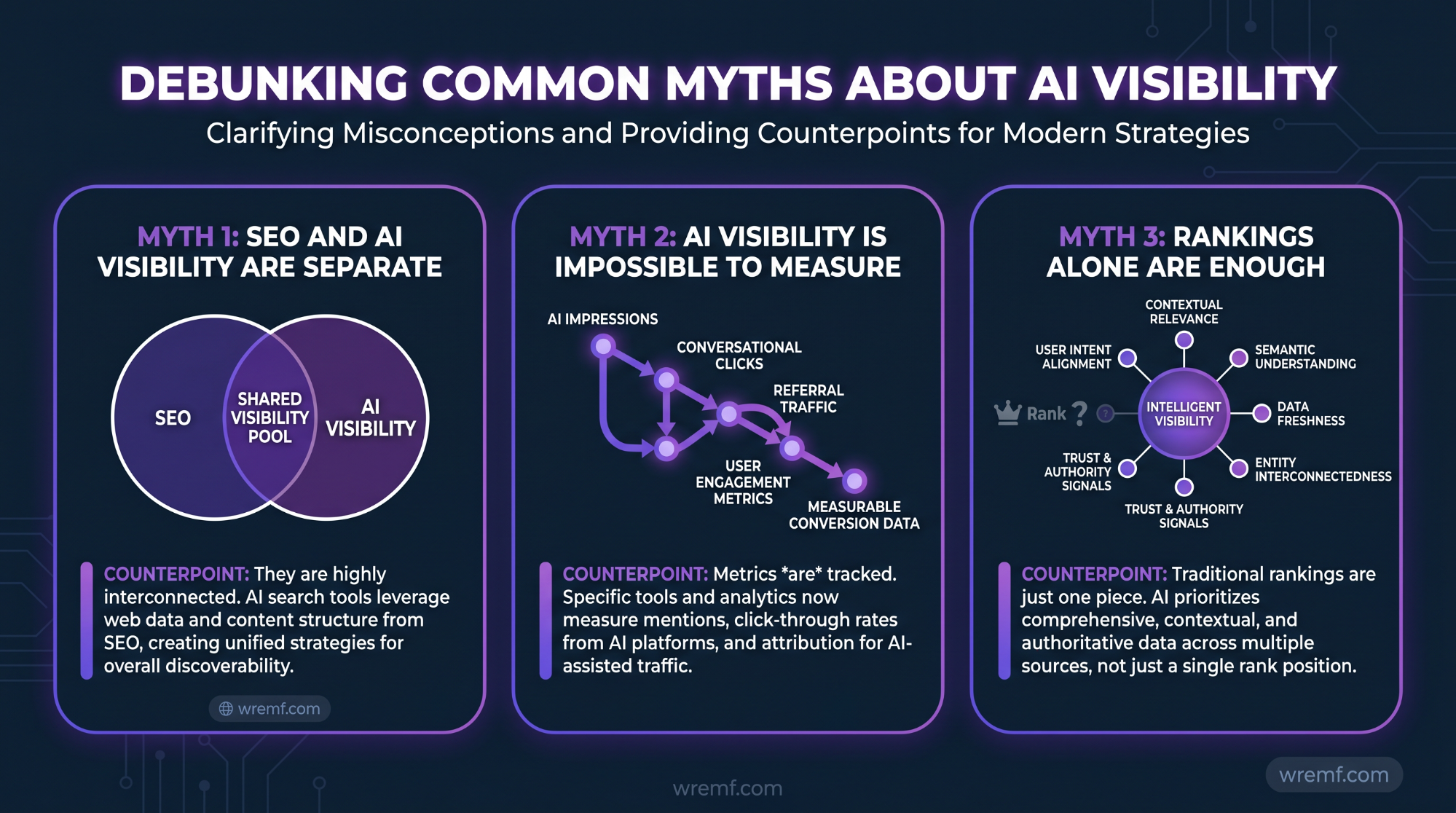
AI visibility is often misunderstood because it sits between SEO, content, brand, analytics, and AI systems. The most common myths lead teams to underinvest, overpromise, or measure the wrong things.
MYTH: SEO, AEO, and GEO are completely separate strategies.
FACT: SEO, Answer Engine Optimization, and Generative Engine Optimization overlap. SEO provides crawlable and authoritative content, Answer Engine Optimization makes content answer-ready, and Generative Engine Optimization improves visibility in AI-generated summaries and recommendations. Treating them separately creates duplicated work and weaker reporting.
MYTH: AI visibility is impossible to measure.
FACT: AI visibility is not measured exactly like classic rankings, but it can be measured through prompts, AI citations, Brand Mentions, recommendations, sentiment, competitor overlap, source consistency, and AI referral traffic. The key is tracking patterns across engines and time rather than relying on one manual query.
MYTH: Rankings alone are enough.
FACT: Rankings are important, but rankings do not show whether Google AI Overviews, ChatGPT, Claude, Gemini, Perplexity, or Copilot mention your brand. A page can rank while the brand remains absent from AI-generated recommendations. AI SEO services must measure both search visibility and answer visibility.
MYTH: AI SEO is just publishing more AI-generated content.
FACT: AI SEO depends on helpful content, source trust, entity clarity, technical access, and credible Brand Mentions. Generic AI-generated content can weaken differentiation if it lacks experience, evidence, or original value. Quality matters more than volume.
MYTH: GEO is replacing SEO.
FACT: Generative Engine Optimization is not replacing search engine optimization. Generative Engine Optimization extends SEO into AI-generated answers, citations, and recommendations. Strong SEO foundations still support AI visibility because many AI systems rely on accessible, reliable, and well-structured web content.
KEY TAKEAWAY: AI visibility is measurable, but it requires broader signals than rankings, including prompts, citations, Brand Mentions, source consistency, and AI-generated recommendations.
With the myths cleared, the final step is knowing where WREMF fits in the AI SEO workflow.
How WREMF Helps With AI SEO Services
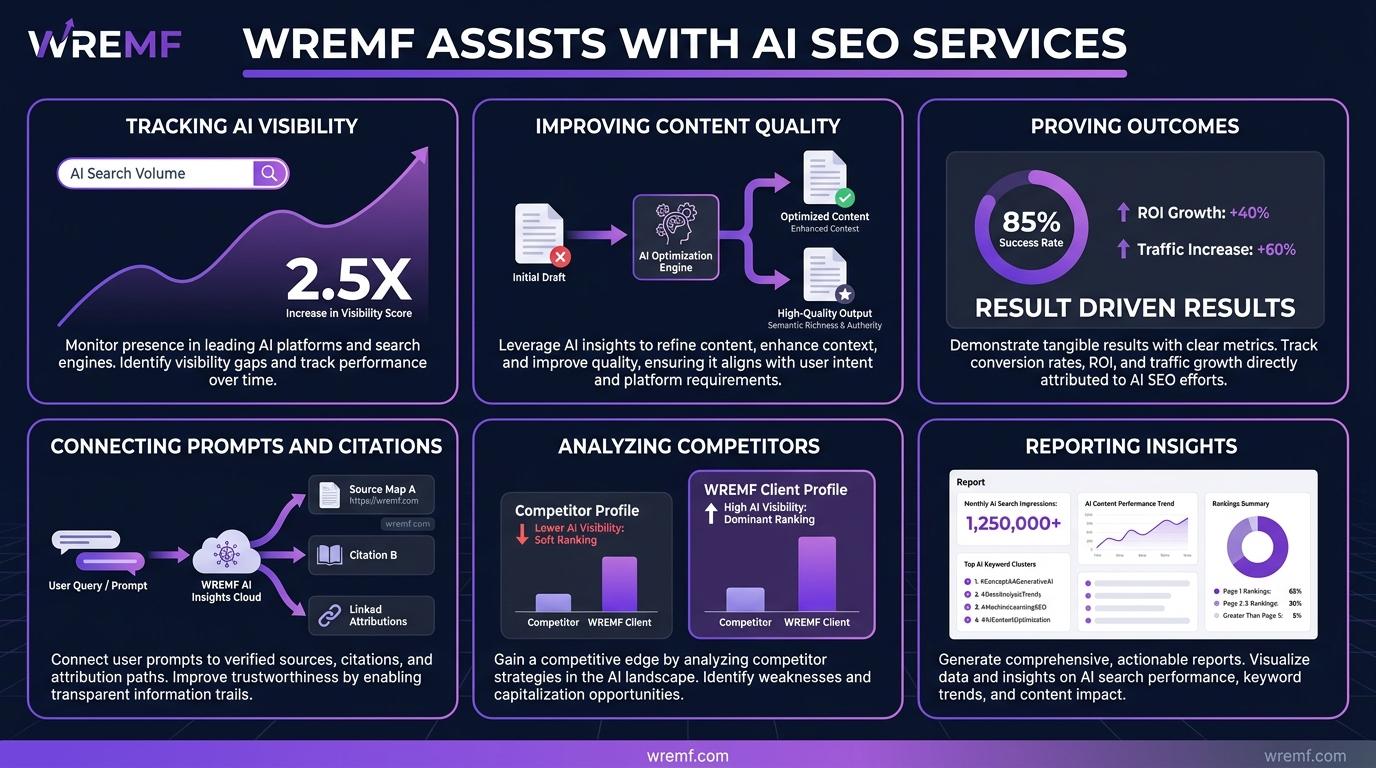
WREMF helps teams track, improve, and prove AI visibility across major AI discovery surfaces. WREMF turns AI SEO from a guessing game into a measurable workflow by connecting prompts, citations, competitors, content gaps, source consistency, and reporting.
WREMF is useful for brands that want software, agencies that need white-label reporting, and teams that want managed execution. The platform is purpose-built for AI search visibility rather than classic rank tracking alone.
WREMF helps with:
AI visibility tracking across 10 AI engines
Google AI Overviews monitoring
Prompt intelligence
Source citation tracking
Competitor visibility
AI share of voice
AI traffic attribution
GEO audits
AEO strategy
AI-ready content briefs
SEO testing
Visibility scoring
Scheduled AI monitoring
White-label client reporting
API and MCP integrations
BYOK support
Client portals
Source consistency analysis
WREMF can be used in three ways:
| Model | Best For | WREMF Fit |
|---|---|---|
| Software | Teams that can execute internally | Track prompts, citations, competitors, and reports |
| Agency service | Teams that need senior execution | Get AI visibility strategy, AEO, GEO, content, and reporting support |
| Hybrid model | Teams that need software plus execution | Combine platform visibility with managed improvement |
The WREMF product suite is designed for repeatable AI SEO workflows. Teams can use competitive landscape tracking to compare brand visibility against competitors, SEO testing to evaluate content changes, and the WREMF API for technical workflows, MCP integrations, and custom reporting.
WREMF does not guarantee rankings, citations, revenue, or traffic. WREMF helps teams measure AI visibility, identify improvement opportunities, and execute a structured process for increasing the probability of accurate and relevant AI discovery.
KEY TAKEAWAY: WREMF combines AI visibility software, agency execution, and hybrid workflows for teams that want to track, improve, and prove AI SEO performance.
The remaining questions are the ones buyers most often ask before starting.
Frequently Asked Questions
What are AI SEO services?
AI SEO services help brands improve visibility across search engines, Google AI Overviews, ChatGPT, Claude, Gemini, Perplexity, Copilot, and other AI discovery surfaces. They usually include search engine optimization, Answer Engine Optimization, Generative Engine Optimization, Large Language Model Optimization, Content Optimization, prompt tracking, AI citations, Brand Mentions analysis, entity signal optimization, competitor visibility, and reporting. The goal is to help AI systems understand, retrieve, cite, and describe the brand accurately when users ask relevant questions.
What is AI SEO or Generative Engine Optimization?
AI SEO is the broader practice of improving visibility across search engines and AI-powered answer systems. Generative Engine Optimization is a specific part of AI SEO that focuses on how a brand appears in generative AI answers, summaries, recommendations, and comparisons. Generative Engine Optimization is important because users now ask tools such as ChatGPT, Perplexity, Gemini, Claude, and Copilot for vendor shortlists, product comparisons, and strategy advice.
What is the difference between SEO, GEO, and AEO?
SEO improves visibility in traditional search results. Generative Engine Optimization improves visibility in AI-generated answers, recommendations, and summaries. Answer Engine Optimization improves the chance that content can be extracted as a direct answer. The three disciplines overlap because AI systems often depend on crawlable, helpful, structured, and authoritative web content. A strong AI SEO strategy uses all three rather than replacing SEO with GEO or AEO.
How do traditional SEO and SEO for AI search work together?
Traditional SEO gives AI search a crawlable and authoritative foundation. AI search optimization adds prompt tracking, AI citations, Brand Mentions, entity clarity, source consistency, and AI answer analysis. For example, a page may rank in Google but still fail to appear in Google AI Overviews or ChatGPT recommendations. The best approach is to use SEO for technical and content foundations, then use AI visibility tracking to measure answer-level presence.
What do AI SEO services typically include?
AI SEO services typically include an AI visibility audit, prompt tracking, Google AI Overviews monitoring, Content Optimization, keyword optimization, technical SEO, entity signal optimization, Brand Mentions analysis, source citation tracking, competitor visibility, AI share of voice, AI traffic attribution, and reporting. More advanced services also include AI-ready content briefs, source consistency cleanup, schema guidance, internal linking logic, and monthly managed execution.
Is GEO replacing SEO?
GEO is not replacing SEO. Generative Engine Optimization extends SEO into AI-generated answers and recommendations, but search engine optimization remains necessary for crawlability, indexing, technical health, content quality, and organic demand capture. AI systems often rely on accessible web content, search indexes, third-party sources, and structured information. SEO builds the foundation. GEO improves visibility across AI discovery surfaces.
How do I know if my brand is already showing up in AI-generated answers?
You can check brand visibility by tracking prompts across ChatGPT, Claude, Gemini, Perplexity, Google AI Overviews, Copilot, DeepSeek, Grok, Meta AI, and Mistral. The key is to test buyer questions, comparison prompts, category prompts, alternative prompts, and problem-aware prompts. WREMF helps teams measure this through prompt tracking, source citation analysis, Brand Mentions, competitor visibility, and AI visibility scoring.
What does success look like for AI SEO if there are no rankings to track?
AI SEO success includes prompt visibility, AI citations, Brand Mentions, recommendation visibility, competitor overlap, source consistency, positive brand sentiment, AI referral traffic, and conversion quality. Rankings still matter, but they are only one part of the measurement system. A strong AI SEO report should show whether the brand appears, how it is described, which sources are cited, and which competitors appear in the same answers.
How long does it realistically take to see results from GEO or AI SEO?
AI SEO can produce useful diagnostic insights in the first 1 to 2 weeks, but durable visibility improvements usually take months. Content changes, technical fixes, source consistency cleanup, and citation improvement need time to be crawled, indexed, retrieved, and reflected across AI systems. A realistic program should track baseline visibility first, then monitor improvements across prompts, citations, Brand Mentions, and AI traffic over time.
Is AI SEO worth it for smaller or earlier-stage B2B companies?
AI SEO is worth considering for smaller B2B companies if buyers already use AI tools to research the category. Early-stage teams do not need an enterprise retainer, but they should know whether AI systems understand the brand, recommend competitors, or cite outdated sources. A lightweight AI visibility audit, focused Content Optimization, and clear entity signal optimization can help a smaller company build a stronger foundation.
How much should AI SEO services cost?
AI SEO cost depends on whether you need software, consulting, managed execution, or a hybrid model. Software can be lower-cost when your team can execute internally. Managed services cost more because they include strategy, technical work, content, citation improvement, and reporting. WREMF offers transparent software pricing starting at €39 per month for Starter and €89 per month for Growth, with custom Enterprise plans for larger teams.
How does WREMF help with AI SEO services?
WREMF helps teams track, improve, and prove AI visibility across major AI engines. WREMF combines prompt intelligence, source citation tracking, competitor visibility, AI share of voice, AI traffic attribution, GEO audits, AI-ready content briefs, SEO testing, white-label reports, BYOK support, and managed agency execution. WREMF is useful for brands, agencies, consultants, and B2B teams that want software, execution, or a hybrid AI SEO workflow.
Conclusion
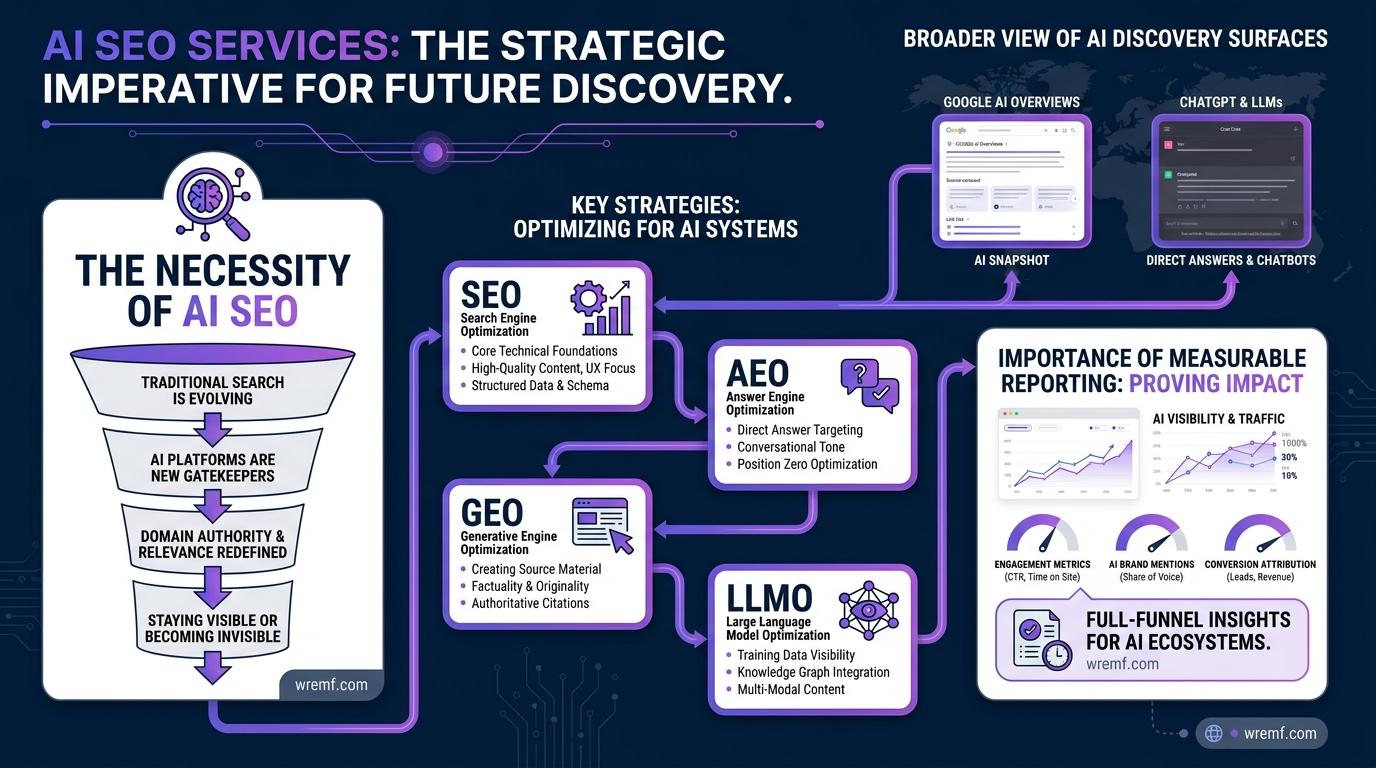
AI SEO services are becoming necessary because buyers now discover, compare, and validate brands across search engines, Google AI Overviews, ChatGPT, Claude, Gemini, Perplexity, Copilot, and other AI discovery surfaces. The strongest strategy combines search engine optimization, Answer Engine Optimization, Generative Engine Optimization, Large Language Model Optimization, Content Optimization, Brand Mentions, citations, entity clarity, and measurable reporting. Rankings still matter, but they are no longer the only visibility signal. To turn AI search visibility into a repeatable workflow, explore the WREMF platform suite or talk to the WREMF agency team.
Related Generative Engine Optimization Guides
- LLM SEO Services The Complete 2026 Guide to AI Search Visibility, AEO, GEO, and LLM Optimization
- LLM SEO Agency The Complete Guide to Choosing an Agency for AI Search Visibility
- AI Search Engine Optimization Services The Complete Guide for B2B Brands
- Answer Engine Optimization Services The Complete Guide to AI Search Visibility
- AI SEO Agency How to Choose the Right Partner for AI Search Visibility
- Large Language Model Optimization Services The Complete Guide to LLMO, AI Search Visibility, AEO, GEO, RAG, and LLM Performance
- Generative AI Optimization Services The Complete Guide to GEO, AEO, LLM Optimization, and AI Visibility
- AI Mention Tracking The Complete Guide to Monitoring Brand Mentions, AI Answers, Citations, and Share of Voice in 2026
- AI Brand Monitoring The Complete Guide to Tracking Brand Visibility Across AI Search, LLMs, and Generative Engines
- How AI Search Optimization Tools Increase Organic Traffic
- AI Search Engine Optimization Tools The Complete 2026 Guide for AI Search, SEO, AEO, and GEO
- Answer Engine Optimization The Complete Guide to AEO, AI Search Visibility, and Answer-First Content
- AI Overview SEO How to Optimize for Google AI Overviews, AI Mode, and AI Search Visibility
- AI Search Engine Optimization The Complete Guide for B2B Brands
- 12 Best AI Search Optimization Tools
- AI SEO Tools The Complete Guide for SEO, AEO, GEO, and AI Search Visibility
- Enterprise Answer Engine Optimization Platforms Complete Guide for AI Visibility, AEO, and GEO
- How Do AI Search Optimization Tools Improve SERP Rankings
- Best Answer Engine Optimization for Enhancing AI Visibility
- AI Overview Optimization How to Rank, Get Cited, and Stay Visible in Google AI Search
Related reading
- AI Visibility Services: The Complete Guide to Tracking, Improving, and Proving Brand Visibility in AI Search
- LLM SEO Agency: The Complete Guide to Choosing an Agency for AI Search Visibility
- LLM SEO Services: The Complete 2026 Guide to AI Search Visibility, AEO, GEO, and LLM Optimization
- Large Language Model Optimization Services: The Complete Guide to LLMO, AI Search Visibility, AEO, GEO, RAG, and LLM Performance