How AI Search Optimization Tools Increase Organic Traffic
Learn how AI search optimization tools increase organic traffic through keyword research, intent mapping, content quality, technical SEO, and AI visibility tracking.
By WREMF Team · 2026-05-09
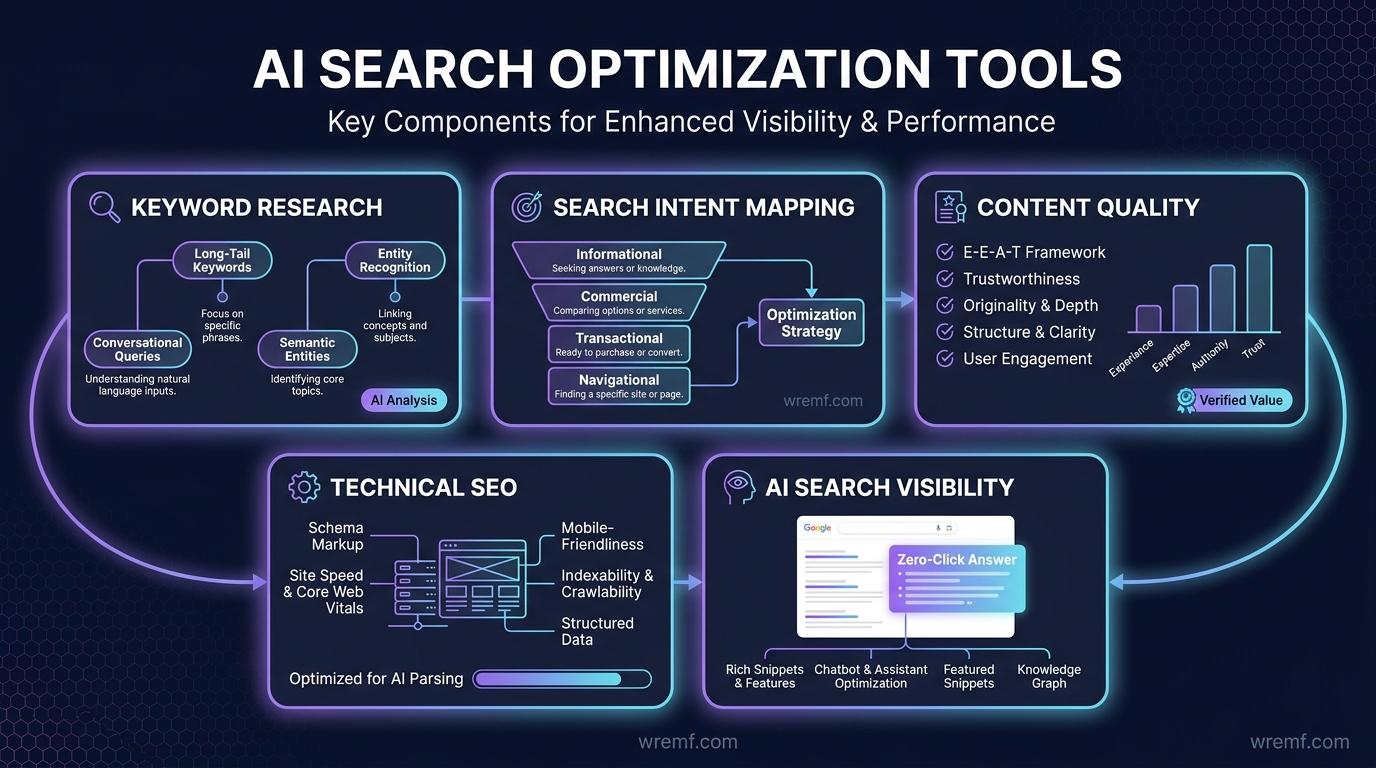
AI search optimization tools are software platforms that help websites increase organic traffic by using artificial intelligence, machine learning, search data, and content analysis to improve keyword research, search intent mapping, content quality, technical SEO, and AI search visibility. These tools process large datasets from search engines, AI systems, competitors, and website analytics to identify keyword opportunities, content gaps, user intent, technical issues, and AI visibility patterns. They increase organic traffic by finding better keyword opportunities, mapping user intent, improving content quality, fixing technical SEO issues, and measuring brand presence across AI discovery surfaces including ChatGPT, Claude, Gemini, Perplexity, Google AI Overviews, Copilot, and other large language models. The traffic gain comes from better prioritization and execution, not automation alone. AI tools turn SEO from a manual checklist into a faster, evidence-led workflow that combines search rankings, answer extraction, and generative AI visibility.
Key takeaways
- AI search optimization tools increase organic traffic by combining search data, AI visibility data, technical diagnostics, content strategy, and human expertise to identify what to fix, publish, update, and measure.
- Organic visibility now depends on search rankings, AI Overviews, answer engines, large language models, featured snippets, citations, and conversational queries across multiple discovery surfaces.
- SEO, AEO, and GEO work together as connected layers: SEO builds the foundation for crawlability and rankings, AEO improves answer extraction, and GEO improves generative AI visibility and source citations.
- Precision intent mapping turns keyword research into conversion-focused content strategy by grouping keywords, conversational queries, and buyer questions into useful intent clusters that match real user needs.
- AI-powered content optimization improves rankings and AI citations by making pages clearer, more complete, more useful, and easier for search engines and AI systems to interpret and extract.
- Technical SEO remains essential because AI search optimization cannot work if search engines and AI systems cannot access, render, or understand the website through crawlability, structured data, and machine-readable signals.
How AI Search Optimization Tools Increase Organic Traffic
AI search optimization tools are software platforms that help websites earn more organic traffic by improving keyword research, search intent mapping, content quality, technical SEO, and AI search visibility. Bain & Company reports that AI-generated and zero-click search experiences can reduce organic web traffic by an estimated 15% to 25%, which makes optimization across search engines and AI systems a measurable business priority. (Bain) WREMF helps B2B teams track, improve, and prove how their brand appears across ChatGPT, Claude, Gemini, Perplexity, Google AI Overviews, Copilot, DeepSeek, Grok, Meta AI, Mistral, and other AI discovery surfaces. This guide explains how AI tools increase organic traffic through data processing, content strategy, technical SEO, AEO, GEO, source citations, and ROI measurement. It also shows how to build a practical 30-60-90 day workflow.
What Are AI Search Optimization Tools?
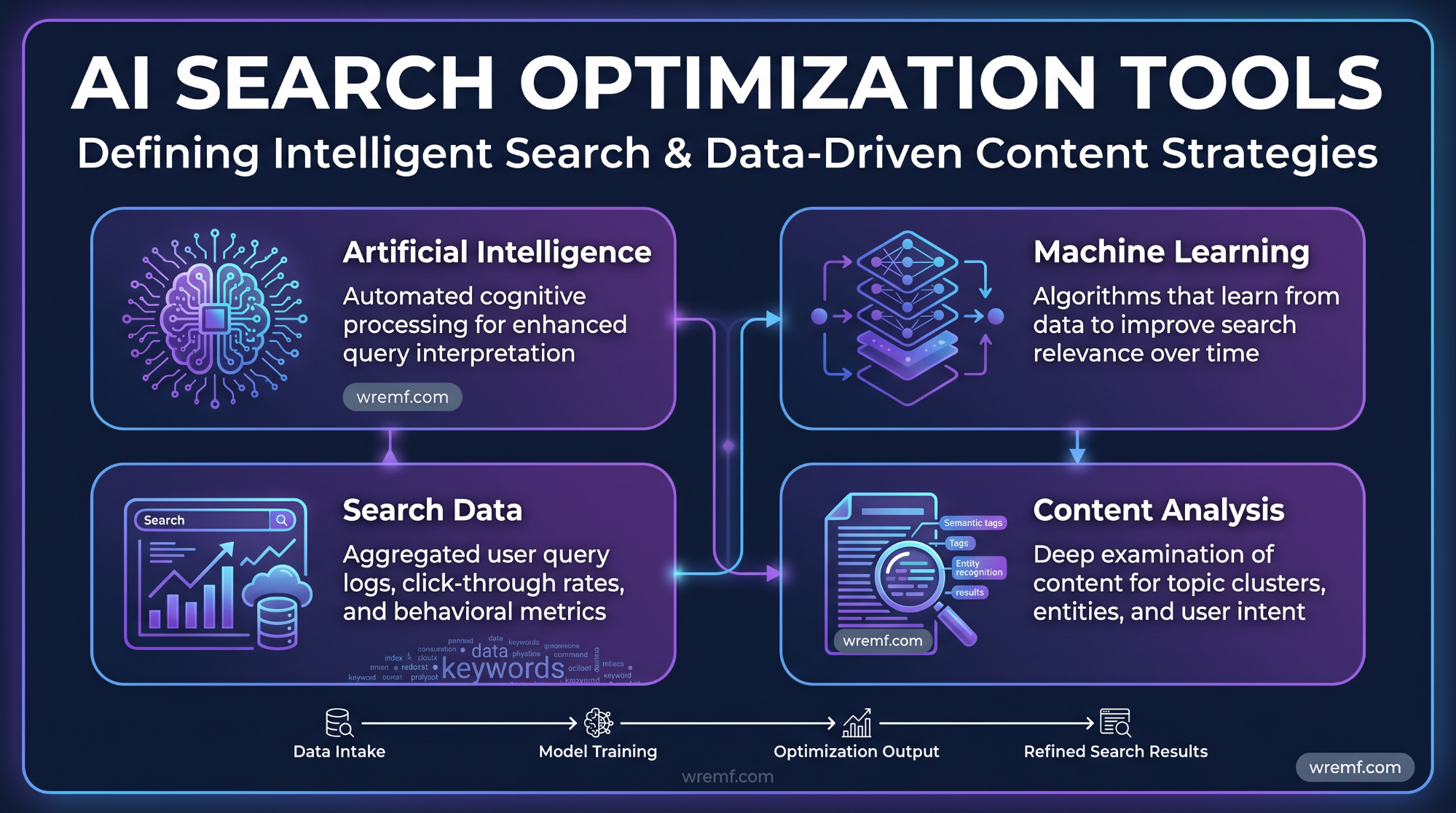
AI search optimization tools help websites improve organic traffic by using artificial intelligence, machine learning, search data, and content analysis to identify what to fix, publish, update, and measure. They turn SEO from a manual checklist into a faster, evidence-led workflow.
AI search optimization tools are platforms that analyze search engines, AI systems, keywords, content gaps, user intent, technical issues, competitors, and website traffic. They matter because organic search is no longer only about ranking pages in search engine results. Organic growth now depends on how your content appears in search results, AI Overviews, answer engines, large language models, featured snippets, citations, and conversational queries.
Traditional SEO software usually focuses on keyword research, backlinks, rank tracking, site audits, and organic search performance. AI tools add pattern recognition, automated keyword discovery, predictive SEO, content brief generation, AI visibility tracking, source citation analysis, and competitor visibility across AI search. That extra layer matters because B2B buyers now ask complex questions across Google, ChatGPT, Perplexity, Gemini, Claude, Copilot, and voice assistants before they visit a website.
WREMF fits this category as a purpose-built AI visibility platform. The WREMF platform suite helps teams track prompts, citations, competitors, source consistency, content opportunities, SEO tests, and AI visibility scores across 10 AI engines.
| Capability | What it analyzes | How it can increase organic traffic |
|---|---|---|
| Keyword research | Search queries, keyword volume, long-tail keywords, search trends | Finds topics with demand and realistic ranking potential |
| Search intent mapping | User intent, buyer intent, conversational queries | Helps content match what users actually want |
| Content gaps | Missing sections, weak answers, missing topic clusters | Captures search demand competitors are already serving |
| Content optimization | Headings, entities, structure, FAQs, source support | Improves relevance, clarity, and AI citation readiness |
| Technical SEO | Broken links, Core Web Vitals, XML sitemaps, schema markup, crawl issues | Removes barriers that block search engine visibility |
| AI visibility tracking | Prompts, brand mentions, citations, recommendations | Shows how AI systems describe and compare your brand |
| Attribution | Organic search, LLM referrals, user engagement, conversions | Connects visibility to website traffic and business outcomes |
According to Google Search Central’s helpful content guidance, Google’s ranking systems aim to reward helpful, reliable, people-first content. That means AI tools increase traffic only when they help improve usefulness, clarity, technical accessibility, and trust, not when they simply create more pages. (Google for Developers)
KEY TAKEAWAY: AI search optimization tools increase organic traffic when they combine search data, AI visibility data, technical diagnostics, content strategy, and human expertise.
The next step is understanding why organic search changed from a rankings game into a multi-surface discovery system.
How AI Changed Organic Search and Website Traffic
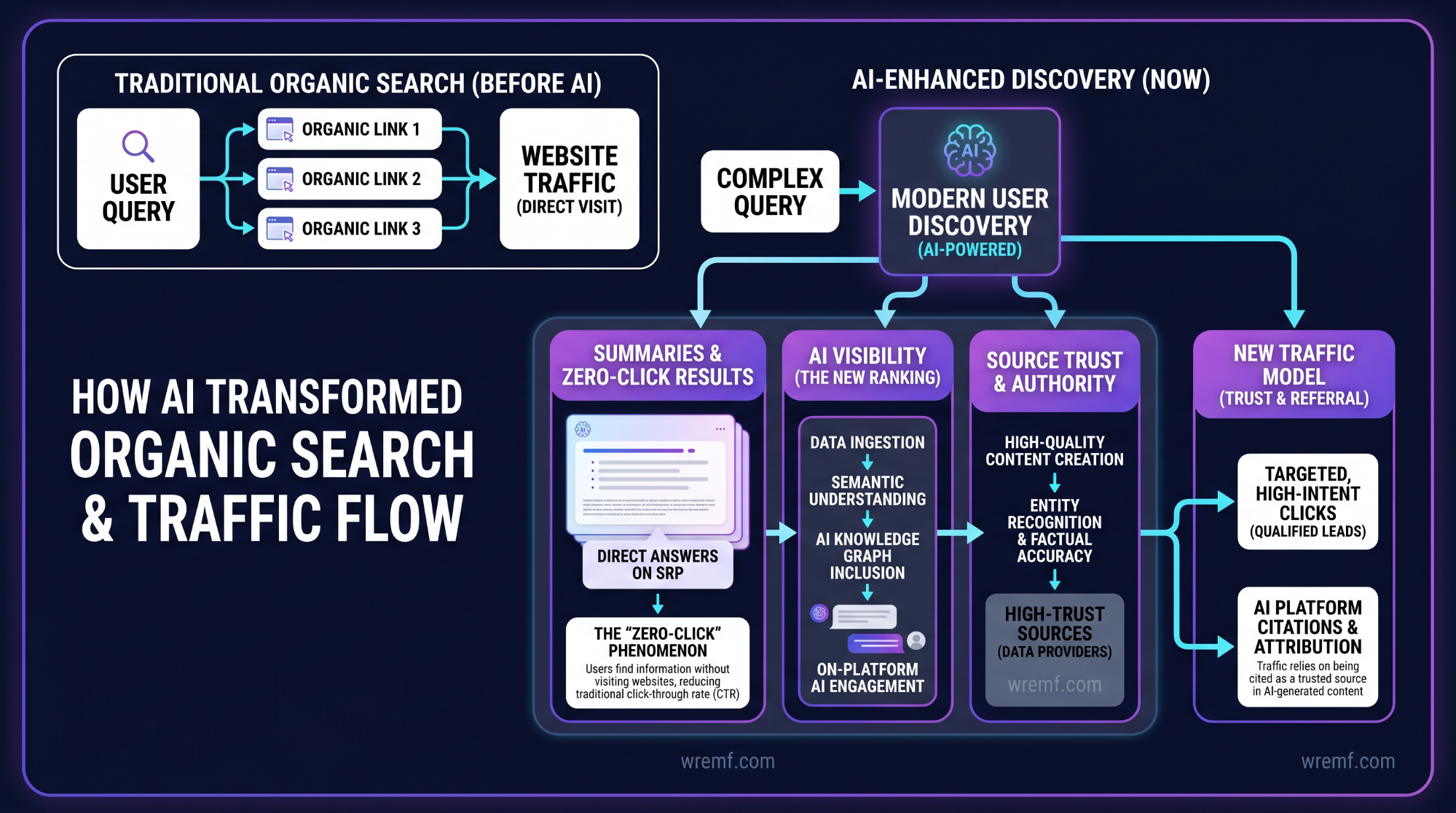
AI changed organic search by moving user discovery from blue links toward summaries, answers, citations, recommendations, and zero-click results. Organic traffic now depends on search rankings, AI visibility, source trust, and whether users still need to click.
Organic traffic is unpaid website traffic from search engines and discovery surfaces. Organic traffic matters because it can compound over time when a website earns visibility for relevant search intent, helpful content, strong technical foundations, and trusted source signals.
AI search is the use of artificial intelligence to interpret queries, summarize information, answer questions, and guide users toward sources or decisions. AI search matters because users increasingly search in full questions, compare vendors conversationally, and ask AI systems for recommendations.
Google AI Overviews are AI-generated summaries inside Google Search that answer some queries and link to supporting sources. Google states that AI Overviews are now available in more than 200 countries and territories and more than 40 languages, which makes AI-assisted search a mainstream discovery surface rather than a limited experiment. (blog.google)
The zero-click search shift is one of the biggest reasons AI tools matter. Bain & Company reports that about 80% of consumers rely on AI-written results for at least 40% of their searches, reducing organic web traffic by an estimated 15% to 25%. (Bain) For B2B marketers, this means traffic can decline even when brand exposure is increasing inside search results or AI answers.
AI does not make SEO dead. It changes the job of SEO. Search Engine Optimization still matters for crawlability, indexability, content quality, internal links, link building, Core Web Vitals, schema markup, and user experience. AEO and GEO add another layer by optimizing for answer extraction, AI citations, LLM visibility, source consistency, and brand recommendation visibility.
In real B2B buying journeys, a prospect may start with Google, scan an AI Overview, ask ChatGPT for options, compare vendors in Perplexity, read Reddit or review pages, and then visit a brand website. Organic traffic is now influenced by each of those discovery moments. AI search optimization tools help teams see those moments instead of relying only on rankings and clicks.
KEY TAKEAWAY: AI changed organic search by making visibility depend on rankings, answers, citations, summaries, brand mentions, and source trust across multiple discovery surfaces.
That shift makes it essential to understand the relationship between SEO, AEO, GEO, and AI search optimization.
SEO vs AEO vs GEO: How Do They Work Together?
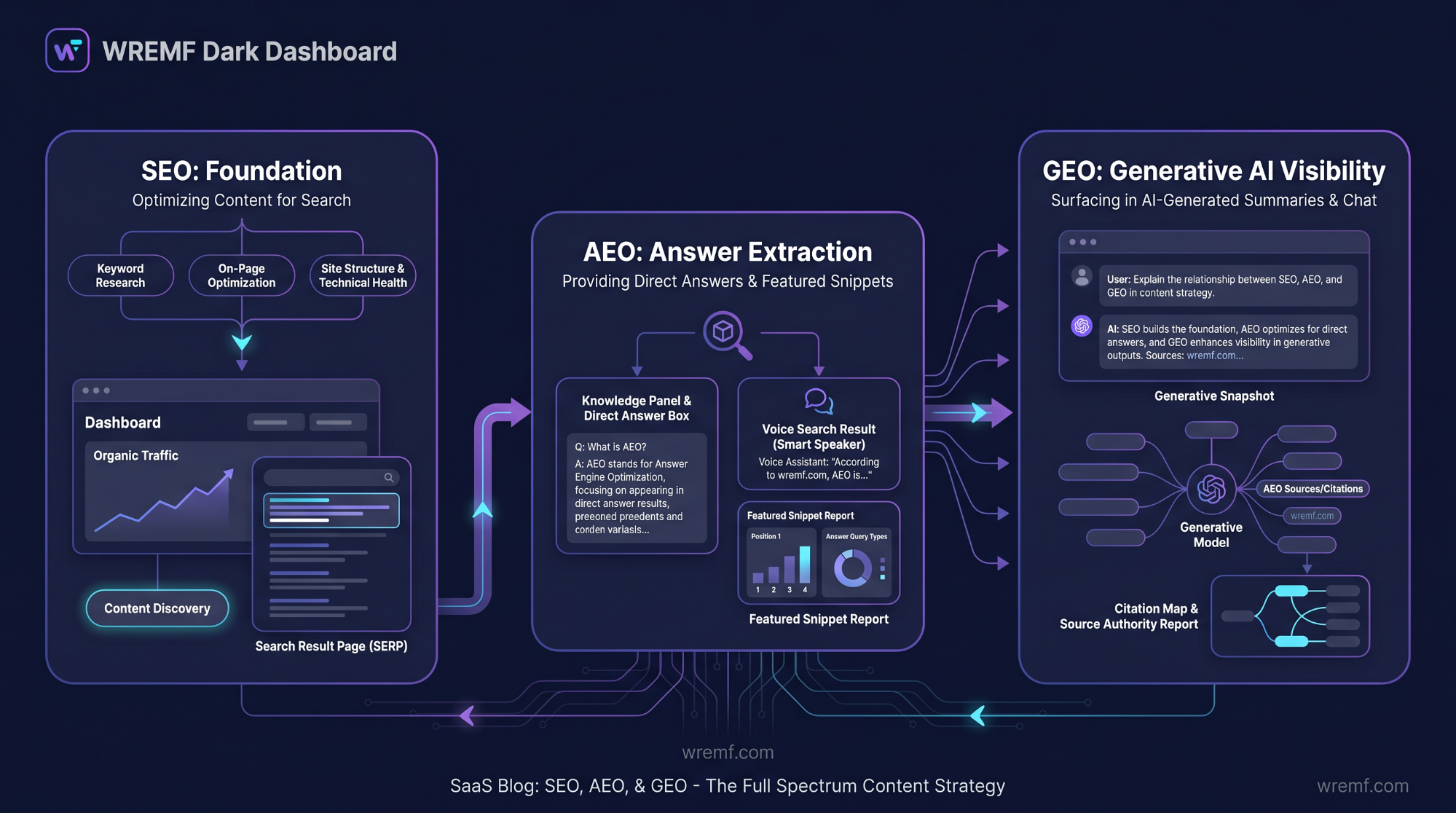
SEO, AEO, and GEO work together by improving how content is found, answered, and cited across search engines and AI systems. SEO builds the foundation, AEO improves answer extraction, and GEO improves generative AI visibility.
Search Engine Optimization is the practice of improving a website so search engines can crawl, understand, rank, and display its pages for relevant search queries. SEO matters because search engines remain the main source of organic search discovery for most websites.
Answer Engine Optimization is the practice of structuring content so answer engines can extract direct, accurate, and useful responses. AEO matters because featured snippets, voice search, AI Overviews, and conversational assistants often prefer concise answer-first content.
Generative Engine Optimization is the practice of improving how a brand, entity, product, or website appears inside generative AI responses. GEO matters because large language models can mention, cite, compare, summarize, or recommend brands without showing classic search engine rankings.
Large Language Model Optimization is the practice of improving brand visibility, source clarity, and content retrievability for large language models. Large Language Model Optimization matters because ChatGPT, Claude, Gemini, Perplexity, Copilot, DeepSeek, Grok, Meta AI, and Mistral can influence vendor shortlists before users reach a website.
| Discipline | Primary goal | Example metric | What it improves | What it misses if used alone |
|---|---|---|---|---|
| SEO | Rank and earn clicks in search engines | Rankings, clicks, impressions, CTR | Search engine visibility and organic traffic | AI mentions, citations, and prompt visibility |
| AEO | Win answers and snippets | Featured snippets, FAQ visibility, voice search answers | Direct answer extraction | Competitive AI recommendation visibility |
| GEO | Appear in generative AI answers | AI citations, brand mentions, prompt coverage | LLM visibility and AI search presence | Classic rank tracking if disconnected from SEO |
| AI visibility tracking | Measure brand presence across AI systems | AI share of voice, cited sources, competitor mentions | Reporting and optimization priorities | Traffic quality unless connected to analytics |
The key difference between SEO and GEO is that SEO optimizes pages for search engine discovery, while GEO optimizes entities and sources for generative AI retrieval. SEO asks whether a page can rank. GEO asks whether an AI system can understand, trust, mention, cite, or recommend the brand.
The overlap matters. AI systems often rely on web content, trusted sources, structured information, and entity consistency. A brand with weak SEO foundations, thin content, poor source consistency, and unclear positioning will struggle in AI search even if it runs prompt tests manually.
KEY TAKEAWAY: SEO, AEO, and GEO are connected layers of modern organic discovery, not separate replacement strategies.
Once the relationship is clear, the next question is how AI tools directly increase organic traffic.
How AI Search Optimization Tools Increase Organic Traffic
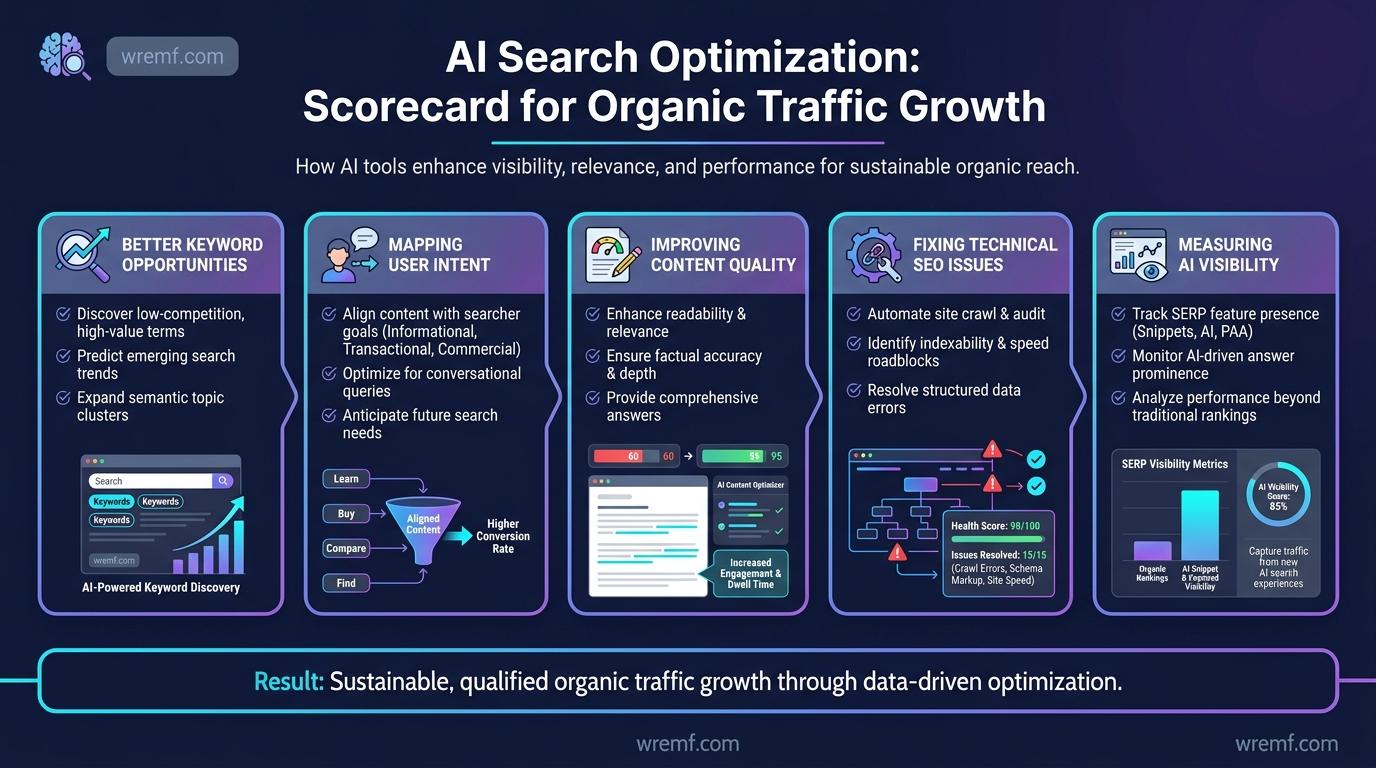
AI search optimization tools increase organic traffic by finding better keyword opportunities, mapping user intent, improving content quality, fixing technical SEO issues, and measuring AI visibility. The traffic gain comes from better prioritization and execution, not automation alone.
Machine learning is the use of algorithms that identify patterns in data and improve predictions or classifications over time. Machine learning matters in SEO because search behavior, ranking patterns, content performance, and SERP patterns change faster than manual analysis can track.
Machine learning algorithms can process large datasets from keywords, competitors, backlinks, search trends, rankings, user engagement, Search Console, Google Analytics, and AI prompts. This helps marketers identify trends and opportunities earlier. For example, AI-powered tools can cluster long-tail keywords, detect content decay, flag technical issues, predict emerging topics, and show which content briefs are most likely to support organic growth.
AI tools increase traffic through five practical mechanisms:
| Mechanism | What AI tools do | Why it matters for organic traffic |
|---|---|---|
| Opportunity discovery | Find keyword opportunities, content gaps, trending topics, and SERP patterns | Helps teams target demand before competitors do |
| Intent precision | Decode search intent, user intent, and buyer intent | Improves relevance and conversion rates |
| Content improvement | Suggest missing sections, FAQs, entities, examples, and structure | Makes pages more complete and useful |
| Technical prioritization | Detect broken links, page speed issues, schema markup gaps, and crawl barriers | Helps search engines access and understand pages |
| AI visibility measurement | Track prompts, citations, competitors, and LLM referrals | Shows how organic discovery extends beyond Google clicks |
The best AI tools do not simply say “write more content.” They identify which pages are losing traffic, which keyword clusters are underserved, which technical issues are blocking performance, and which search queries show high buying intent. That precision helps teams spend time on actions likely to improve website traffic.
WREMF helps teams connect these mechanisms into one workflow. Its AI visibility index measures brand visibility across AI discovery surfaces, while its prompt, citation, competitor, and reporting features help teams understand what to improve next.
KEY TAKEAWAY: AI search optimization tools increase organic traffic by turning large datasets into ranked decisions about content, keywords, technical fixes, and AI visibility.
A major part of that ranking system is precision intent mapping.
Precision Intent Mapping: Beyond Basic Keyword Research
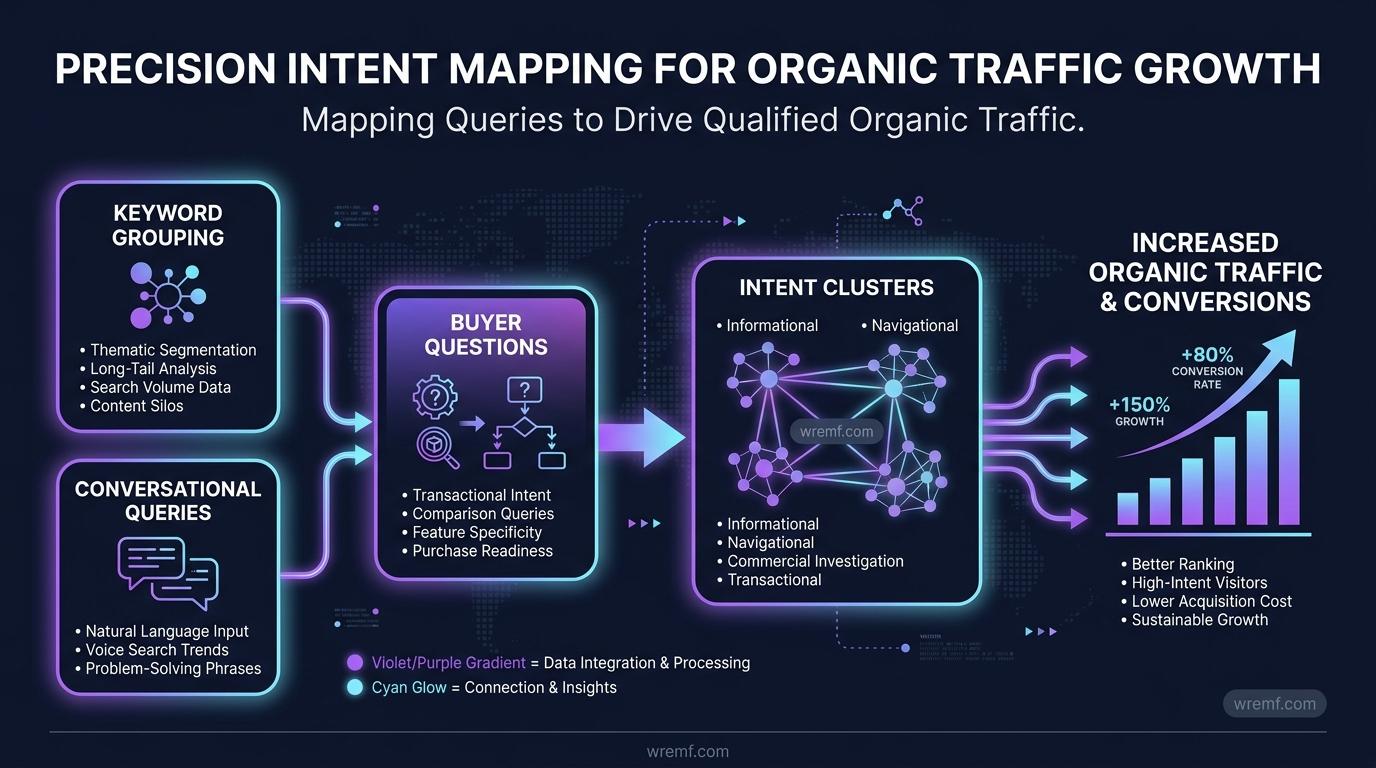
Precision intent mapping increases organic traffic by matching pages to the real reason behind each search query. AI tools improve this process by grouping keywords, conversational queries, and buyer questions into useful intent clusters.
Keyword research is the process of finding the words and phrases users type into search engines. Keyword research matters because it identifies demand, but it does not automatically explain what users expect from a page.
Search intent is the purpose behind a search query, such as learning, comparing, buying, troubleshooting, or finding a specific website. Search intent matters because search engines and AI systems reward content that satisfies the user’s actual need.
User intent is the broader goal behind a person’s search behavior across multiple steps. User intent matters because a buyer may ask several related questions before converting.
Traditional keyword research often starts with keyword volume. AI-driven keyword discovery goes further by grouping keywords by topic, funnel stage, SERP pattern, question type, and buyer intent. This is especially useful for long-tail keywords because long-tail queries often reveal specific needs that generic keyword volume tools miss.
For example, the query “how do I rank my website in AI search engines like ChatGPT Perplexity and Google AI Overview” includes implementation intent, AI search intent, platform intent, and organic growth intent. A basic keyword tool may split this into unrelated terms. An AI search optimization tool can turn it into a content brief, FAQ cluster, GEO audit requirement, and prompt tracking opportunity.
| Intent type | Example query | Best content format | Traffic value |
|---|---|---|---|
| Informational | What is AI search optimization? | Definition guide or pillar page | Builds awareness and topical authority |
| Implementation | How do I optimize website content for AI search? | How-to guide or checklist | Attracts practitioners ready to act |
| Commercial | Best AI SEO tools for organic traffic | Comparison page or buying guide | Captures tool evaluation demand |
| Decision | Should I use AI SEO software or an agency? | Decision framework or service page | Supports conversion |
| Risk | Is AI-generated traffic replacing classic SEO? | Myth vs fact or analysis page | Handles objections |
| Local | How can I increase local business website traffic? | Local SEO and Google Business Profile guide | Captures local keyword clusters |
AI tools also help identify buyer-intent keywords. These queries often include terms like “best,” “pricing,” “alternatives,” “comparison,” “software,” “agency,” “services,” “for SaaS,” “for B2B,” or “ROI.” They may have lower keyword volume than broad topics, but they often produce better conversion rates because the user is closer to action.
TIP: Build content around intent clusters before writing individual articles. This prevents isolated posts and creates a stronger content ecosystem.
KEY TAKEAWAY: Precision intent mapping turns keyword research into a conversion-focused content strategy built around real user intent.
Once intent is mapped, the next growth driver is content strategy.
How AI Tools Improve Content Strategy and Topic Clusters
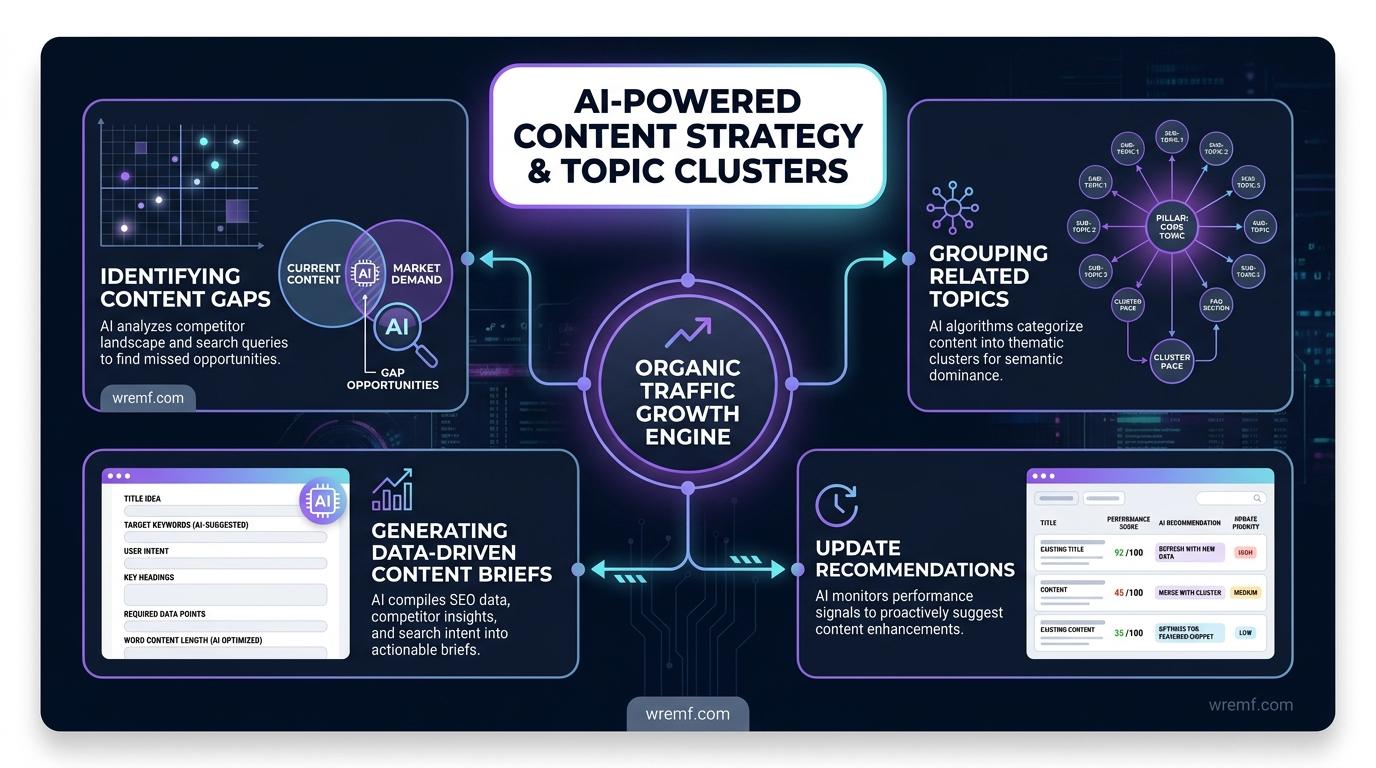
AI tools improve content strategy by identifying content gaps, grouping related topics, generating data-driven content briefs, and showing which pages need updates. Organic traffic grows when a website covers a topic deeply, clearly, and consistently.
Content strategy is the planning system that decides what content to create, update, consolidate, or remove based on audience needs, search demand, and business goals. Content strategy matters because publishing more pages does not help if those pages do not satisfy search intent.
Content gaps are missing topics, sections, keywords, examples, sources, or answers that prevent a page from competing. Content gaps matter because search engines and AI systems often prefer complete resources that answer related follow-up questions.
Topic clusters are groups of related pages that cover a subject from multiple angles and connect through internal links. Topic clusters matter because they help search engines and AI systems understand topical authority, entity relationships, and content depth.
A strong content ecosystem includes pillar pages, comparison pages, glossary pages, product pages, case-style examples, technical guides, FAQs, and service pages. AI tools help decide where each topic belongs. For example, “how AI search optimization tools increase organic traffic” can connect to supporting pages about AI visibility tools, prompt tracking, GEO audits, content briefs, SEO testing, AI citations, and AI traffic attribution.
WREMF supports this workflow with AI-ready content briefs that connect search intent, prompt intelligence, competitor visibility, citations, and content gaps. This helps content teams create pages designed for both search engines and AI discovery surfaces.
| Content strategy task | Manual workflow | AI-assisted workflow |
|---|---|---|
| Find gaps | Review competitor pages one by one | Compare SERP patterns, prompts, entities, and missing questions |
| Build topic clusters | Brainstorm related posts | Cluster search queries and AI prompts by intent |
| Create content briefs | Write generic outlines | Generate data-driven briefs with headings, entities, questions, and links |
| Update old pages | Guess which pages need refreshes | Identify content decay, missing sections, and outdated claims |
| Improve internal links | Add links manually | Map related pages and anchor text opportunities |
| Report performance | Show rankings and clicks | Connect content updates to search visibility, AI visibility, and conversions |
Content creation is still a human-in-the-loop process. AI tools can accelerate outlines, briefs, drafts, and optimization ideas. Human expertise is needed to add experience, factual accuracy, brand voice, original examples, source selection, and judgment.
According to Google’s guidance on AI-generated content, appropriate use of AI or automation is not against Google’s guidelines, but content should be helpful, reliable, and people-first. This supports a practical rule: use AI for research, structure, and scale, but use human review for trust. (Google for Developers)
KEY TAKEAWAY: AI tools improve content strategy when they help teams build complete topic clusters, close content gaps, and publish useful content with expert review.
After strategy comes the page-level work of content optimization.
How AI-Powered Content Optimization Improves Rankings and AI Citations
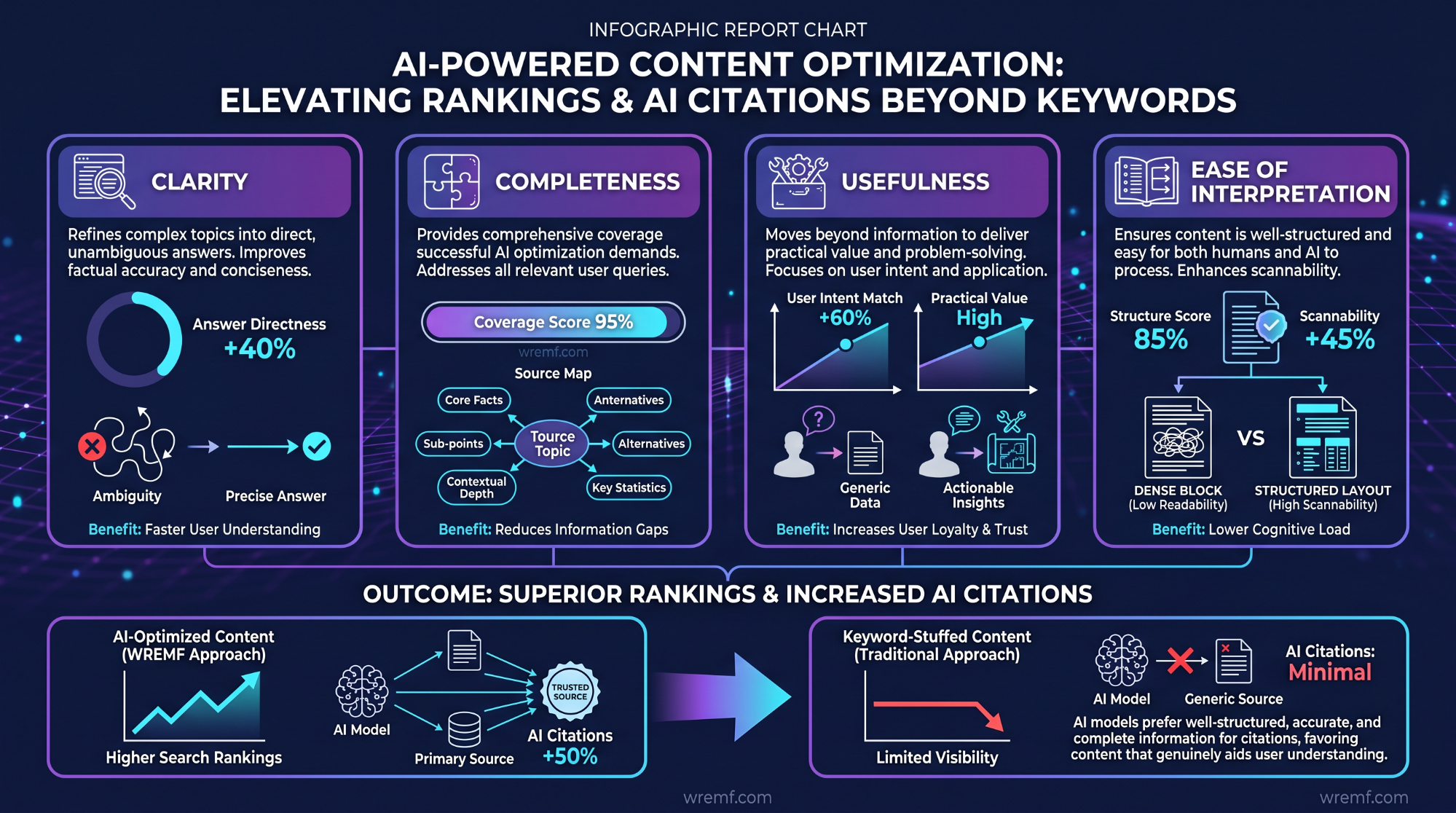
AI-powered content optimization improves rankings and AI citations by making pages clearer, more complete, more useful, and easier for search engines and AI systems to interpret. It increases organic traffic when optimization improves the user’s answer, not just keyword density.
Content optimization is the process of improving a page so it better satisfies user intent, search engine requirements, and business goals. Content optimization matters because even well-written pages can underperform if they miss key entities, questions, examples, or structure.
AI citations are references, links, or source mentions included in AI-generated answers. AI citations matter because cited sources can shape trust, AI referrals, and brand visibility.
Source citations are the pages or documents AI systems use to support an answer. Source citations matter because they reveal which sources influence how AI systems explain a topic, brand, product, or market.
AI tools can compare a page against search engine results pages, AI-generated answers, competitor pages, and prompt responses. They may identify missing definitions, weak headings, thin FAQs, poor internal links, outdated statistics, missing schema markup, weak examples, or unclear entity relationships. These improvements can make content more useful for readers and more extractable for AI systems.
A strong content optimization workflow includes:
Start with the primary search intent
Add an answer-first introduction
Define major terms in under 60 words
Use short, descriptive headings
Cover related People Also Ask questions
Add comparison tables where users evaluate options
Include source attribution close to claims
Add internal links to relevant product, service, and methodology pages
Improve readability and user experience
Update facts, examples, and statistics regularly
WREMF helps teams track source citations so they can see which sources AI engines cite for relevant prompts. This is useful because a brand may need to improve its own page, earn mentions on third-party sources, or correct inconsistent information across the source ecosystem.
AI search visibility is the measurable presence of a brand inside AI-generated answers, citations, recommendations, comparisons, and summaries. AI search visibility matters because buyers may evaluate vendors through AI systems before visiting a website.
KEY TAKEAWAY: AI-powered content optimization increases traffic when it improves clarity, completeness, citation readiness, and trust at the page level.
Content quality helps, but a website still needs strong technical foundations.
Technical SEO and the Machine-Readable Website
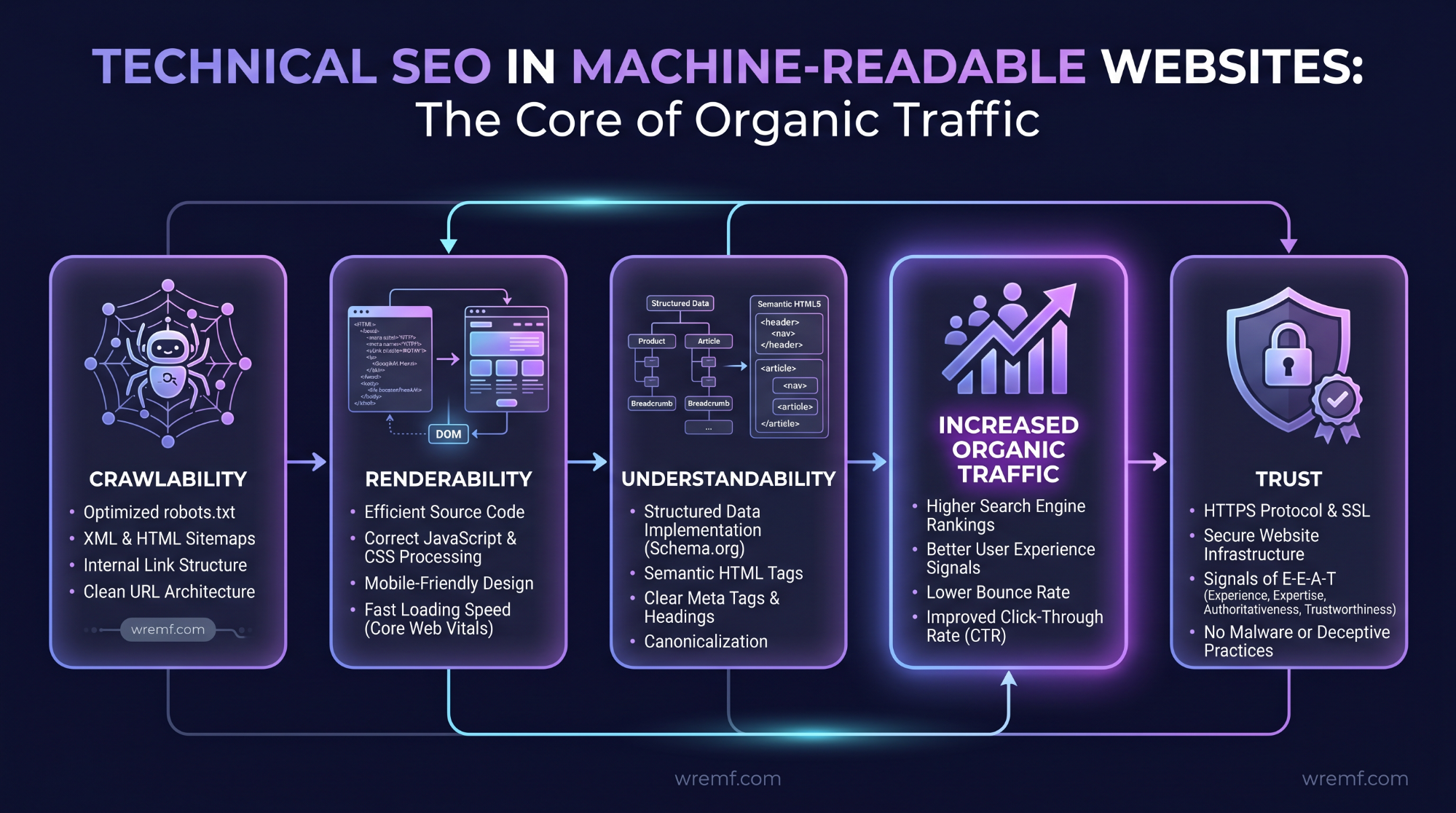
Technical SEO increases organic traffic by making a website easier for search engines and AI systems to crawl, render, understand, and trust. AI tools help by finding technical issues at scale and prioritizing the fixes that affect visibility.
Technical SEO is the practice of improving crawlability, indexability, site speed, structured data, internal linking, page experience, XML sitemaps, and technical accessibility. Technical SEO matters because strong content cannot perform well if search engines cannot access or interpret it.
A machine-readable website is a website with clear HTML, accessible content, internal links, structured data, clean rendering, descriptive URLs, and reliable performance. Machine readability matters because AI systems and search engines need clear signals to understand what a page is about.
Core Web Vitals are Google metrics that measure loading performance, interactivity, and visual stability. Google Search Central explains that Core Web Vitals can help site owners measure real-world user experience, which matters because user experience can influence search performance and conversion quality.
Schema markup is structured data that helps search engines understand entities, attributes, and relationships on a page. Google Search Central’s structured data documentation explains that structured data helps Google understand page content and may enable enhanced search result features. (Google for Developers)
AI-powered technical audits can identify:
Broken links that damage crawl paths and user experience
XML sitemaps with redirected, blocked, or low-value URLs
Missing or invalid schema markup
Slow templates that hurt Core Web Vitals
JavaScript rendering problems that hide key content
Duplicate content that weakens topic authority
Thin pages that should be consolidated
Orphan pages without internal links
Missing canonical tags
Technical issues that repeat across templates
Broken links deserve special attention because they create dead ends for users and search engine crawlers. AI tools can detect broken links across large websites faster than manual checks. They can also group broken links by template, priority page, traffic potential, or internal link importance.
Technical SEO also supports AI visibility. If important product information, pricing, FAQs, comparison content, or entity details are hidden behind scripts or missing from rendered HTML, AI systems may not interpret the brand correctly. This is why GEO audits often include crawl checks, rendering checks, schema review, internal link review, and page structure analysis.
KEY TAKEAWAY: Technical SEO remains essential because AI search optimization cannot work if search engines and AI systems cannot access, render, or understand the website.
Once the technical foundation is strong, teams can optimize for answer engines and generative AI systems.
Optimizing for AI Search, AEO, GEO, Voice Search, and LLM Referrals
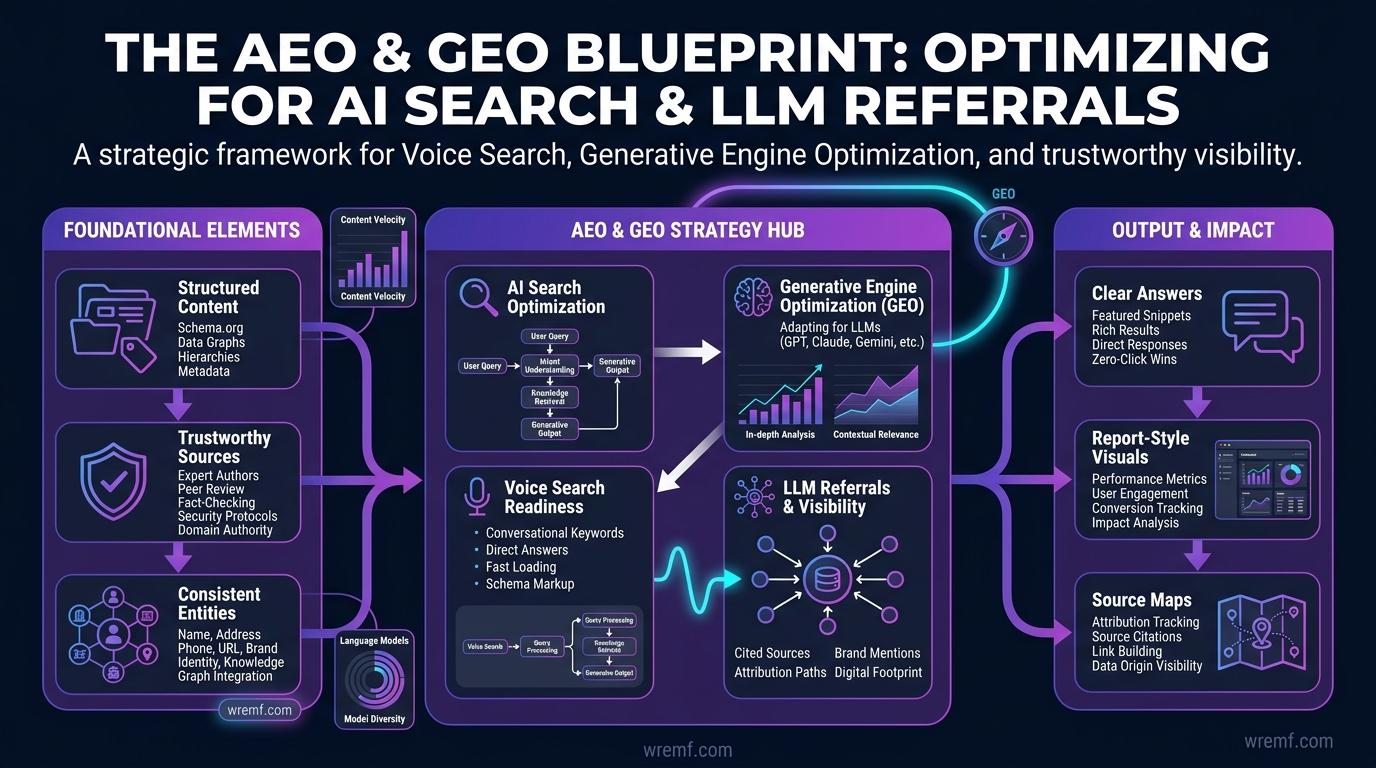
Optimizing for AI search means creating content that can be retrieved, understood, cited, and recommended by AI systems. AEO, GEO, voice search, and LLM referrals all reward clear answers, structured content, trustworthy sources, and consistent entities.
Large language models are AI systems trained to understand and generate language based on patterns in large datasets. Large language models matter for organic traffic because users now ask them questions that used to happen only in search engines.
LLM visibility is the degree to which a brand, product, website, or source appears in large language model answers. LLM visibility matters because AI systems can influence brand discovery before a user clicks through to a website.
LLM referrals are visits from AI assistants, answer engines, and generative AI platforms. LLM referrals matter because they represent a growing layer of organic discovery, even though tracking can be incomplete when referrals are masked or users do not click.
Voice search optimization is the process of improving content for spoken, natural language queries. Voice search matters because users often ask longer, conversational questions that overlap with AI search prompts.
Perplexity describes itself as an AI-powered answer engine that provides accurate, trusted, and real-time answers. This reinforces the importance of source freshness, clear citations, and content that can answer questions directly. (Perplexity AI)
AEO and GEO both reward answer-first content. The best pages usually include concise definitions, source-backed claims, comparison tables, FAQs, product details, service explanations, and clear next steps. They also avoid unsupported statistics, vague claims, and generic content that does not add original value.
To improve AI search visibility, optimize for these elements:
Clear entity descriptions for your company, product, category, and audience
Direct answers to common search queries and conversational queries
Source-backed facts with named external sources
Internal links that explain relationships between topics
Fresh pages for fast-changing topics
Structured content that can be mapped to Article, FAQPage, Product, Service, or SoftwareApplication
Consistent brand facts across owned and third-party sources
Strong author, company, and methodology signals
Technical accessibility for crawlers and rendered HTML
If you want to see how AI engines currently describe your brand, review a sample AI visibility report before building your own measurement workflow.
KEY TAKEAWAY: AI search optimization works when content is clear enough for users, structured enough for search engines, and trustworthy enough for AI systems to cite or recommend.
The next layer is local search, social signals, and authority building.
Local Search, Link Building, and Authority Signals in the AI Search Era
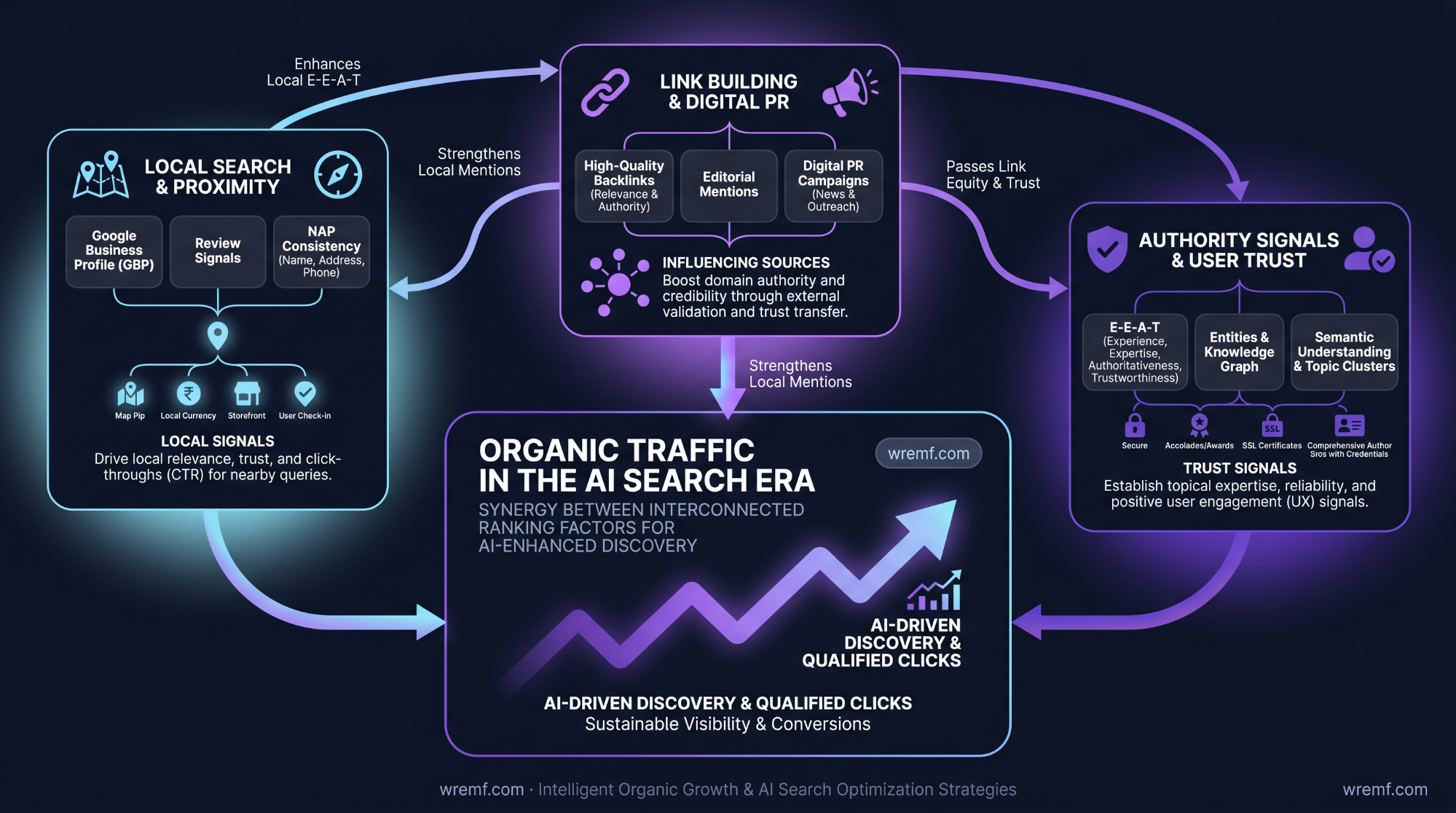
Local search, link building, and authority signals still increase organic traffic because search engines and AI systems need trust signals beyond on-page content. AI tools help identify which sources, links, mentions, and local signals influence discovery.
Link building is the process of earning links from other websites to improve authority, referral traffic, and search visibility. Link building matters because trusted links can help search engines discover, evaluate, and rank content.
Google Business Profiles are business listings that help organizations appear in Google Search and Maps for local queries. Google Business Profiles matter for local keyword clusters because users often search for services, locations, reviews, directions, and nearby options.
Authority signals include backlinks, brand mentions, expert references, reviews, citations, source consistency, and high-quality third-party coverage. Authority signals matter because AI systems often synthesize information from multiple sources, not only from a brand’s website.
AI tools can support authority building by identifying:
Competitor backlinks and link gaps
Broken links that can be reclaimed
Unlinked brand mentions
Third-party sources that AI systems cite
Review sites that shape AI recommendations
Local keyword clusters tied to Google Business Profiles
Social media mentions that reveal demand and questions
Content marketing assets that deserve outreach
Earned media marketing opportunities
Industry directories and partner pages that improve source consistency
This does not mean every team should chase links blindly. The priority is relevance. A small number of high-quality industry links, credible citations, expert mentions, and consistent company profiles can be more valuable than low-quality links from irrelevant websites.
In AI visibility work, source consistency often matters as much as link volume. If your website says one thing, LinkedIn says another, review sites say another, and outdated profiles mention old positioning, AI systems may generate unclear answers about your brand. WREMF helps teams analyze source consistency as part of AI visibility and citation workflows.
KEY TAKEAWAY: Link building, local search signals, and authority sources still matter because AI systems and search engines need trustworthy evidence beyond your own website.
After building authority, teams need to measure whether the work is producing business value.
Measuring ROI From AI Tools, Organic Search, and AI Visibility
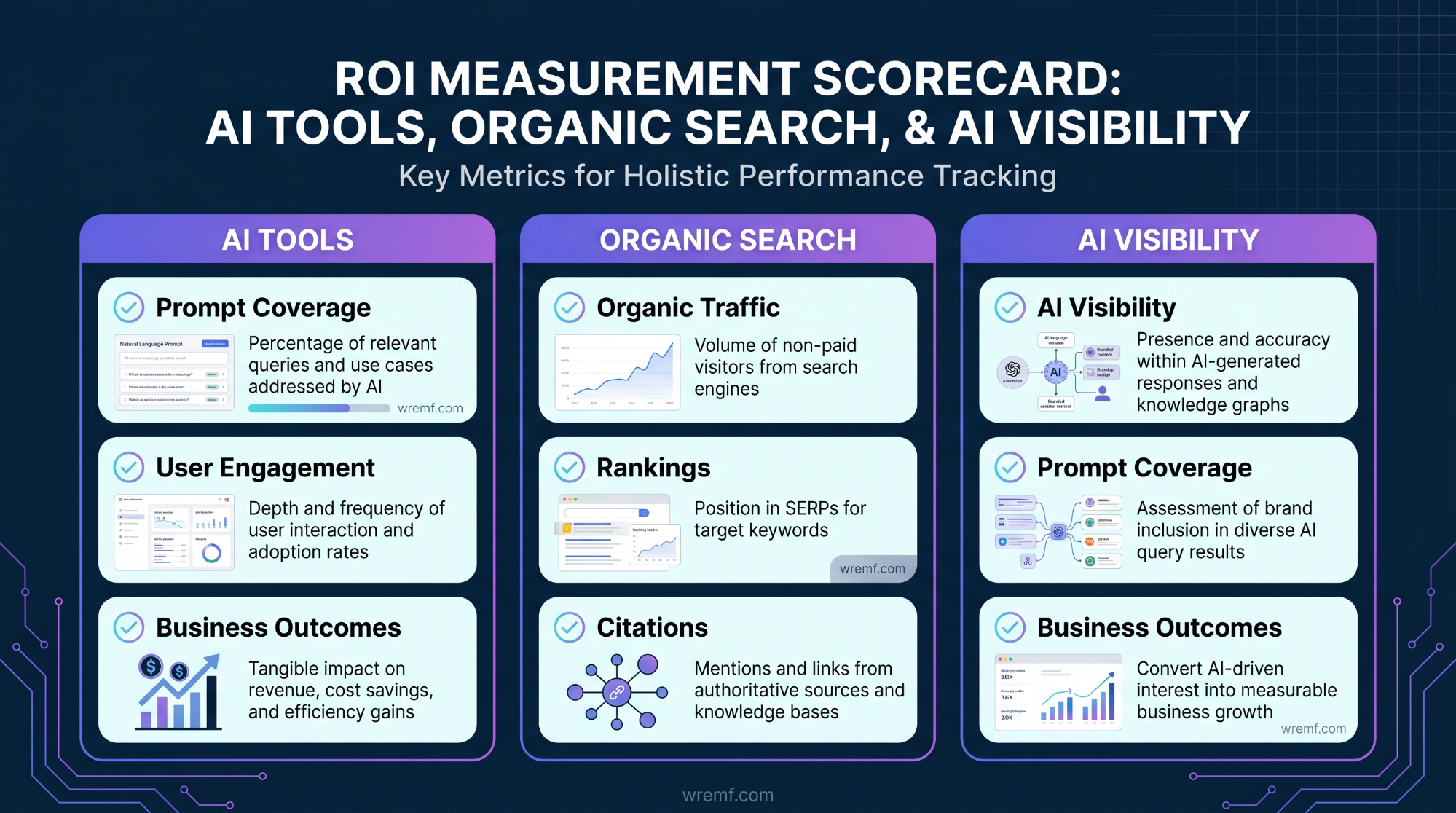
Measuring ROI from AI tools requires connecting organic traffic, rankings, AI visibility, citations, prompt coverage, user engagement, and business outcomes. Traffic alone is not enough if the visitors are not qualified or converting.
AI traffic attribution connects visits, leads, pipeline, or revenue influence to AI search sources such as ChatGPT, Perplexity, Gemini, Copilot, and Google AI Overviews where tracking is available. AI traffic attribution matters because leadership needs to see whether AI visibility supports real growth.
AI share of voice is the percentage of relevant AI answers where a brand appears compared with competitors. AI share of voice matters because it shows whether the brand is visible in the AI-generated conversations that shape buyer decisions.
Prompt tracking is the process of monitoring how a brand appears for specific AI prompts across AI systems. Prompt tracking matters because AI visibility changes by query wording, platform, topic, location, source set, and time.
Brand mentions are references to a company, product, service, or expert across search results, AI answers, social media, forums, review sites, and third-party content. Brand mentions matter because they can influence both human trust and AI-generated summaries.
A complete reporting model should include:
| Measurement layer | Example metrics | What it proves |
|---|---|---|
| Organic search | Impressions, clicks, CTR, average position, keyword rankings | Whether search engines are showing and sending traffic |
| Content performance | Engagement, conversions, bounce rate, assisted conversions | Whether users find the content useful |
| AI visibility | Prompt coverage, brand mentions, AI citations, competitor mentions | Whether AI systems include the brand |
| Technical health | Broken links, Core Web Vitals, schema markup, index coverage | Whether technical barriers are improving |
| Business outcomes | Leads, pipeline, revenue influence, sales-qualified accounts | Whether visibility supports growth |
Google Analytics helps analyze user engagement, conversion paths, traffic sources, and referral patterns. Google Search Console helps analyze organic search queries, impressions, clicks, average position, and click-through rates. AI visibility tools add the missing layer by showing prompts, citations, competitors, and LLM visibility.
WREMF connects these signals through its methodology, which combines prompts, citations, competitors, source consistency, and attribution into a repeatable measurement process. This helps teams explain not only what changed, but why it changed and what to do next.
A common reporting mistake is treating AI visibility as a vanity metric. A useful report should show which prompts matter, which competitors appear, which sources are cited, which pages need updates, and whether organic search or AI referrals are influencing conversions.
KEY TAKEAWAY: ROI measurement should connect AI visibility, organic search performance, technical health, content quality, and business outcomes in one reporting workflow.
The right workflow also depends on whether a team needs software, agency support, or a hybrid model.
AI Search Optimization Software vs Agency vs Hybrid Model
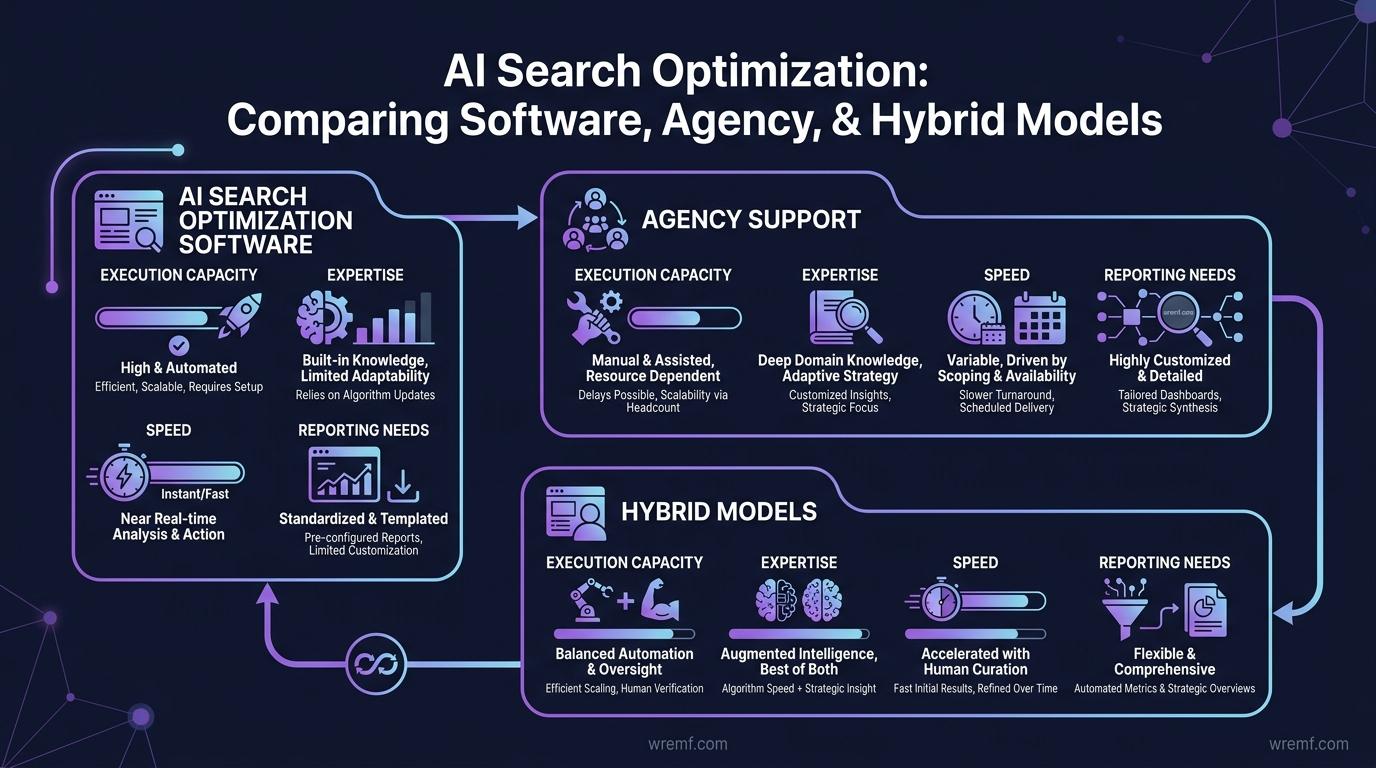
The best AI search optimization model depends on your team’s capacity, expertise, speed, and reporting needs. Software works for teams that can execute internally, agency support works for teams that need expert implementation, and hybrid support works when teams need both.
AI search optimization software provides dashboards, audits, keyword research, prompt tracking, citation analysis, competitor visibility, content briefs, and reporting. Software matters because it gives teams repeatable data and visibility workflows.
An AI visibility agency provides strategy, consulting, content optimisation, GEO audits, AEO execution, source consistency cleanup, entity authority building, technical recommendations, and reporting support. Agency support matters because tools identify problems, but people still need to prioritize and implement fixes.
A hybrid model combines software with managed execution. Hybrid support matters because many teams need both the measurement system and the hands-on work required to improve organic traffic.
| Option | Best for | What it measures | Execution required | Main limitation | Recommended when |
|---|---|---|---|---|---|
| Software | SEO teams, content teams, agencies with internal capacity | Prompts, citations, keywords, competitors, content gaps, reports | Internal team executes | Requires time and expertise | You already have people ready to act |
| Agency service | Founders, lean B2B teams, teams without GEO experience | Strategy, audits, content actions, technical guidance, reporting | Agency executes with approval | Less hands-on control | You need senior guidance and speed |
| Hybrid model | Growth teams and agencies managing multiple clients | Software data plus managed actions | Shared execution | Requires clear ownership | You need tracking and implementation |
| Manual testing | Early teams or one-off checks | Limited prompts and basic observations | Fully manual | Not scalable or repeatable | You need a temporary starting point |
WREMF can be used as software, an agency service, or a combined software plus managed execution solution. Brands can use WREMF for brands to track visibility and prioritize growth work. Agencies can use WREMF for agencies for white-label reporting, client portals, and multi-client AI visibility workflows.
WREMF pricing starts with Starter at €39 per month for 1 website, Growth at €89 per month for 5 websites, and Enterprise for unlimited websites, unlimited seats, dedicated support, and custom branded portals. Teams can review WREMF pricing when they are ready to compare software, agency, and hybrid options.
KEY TAKEAWAY: Software gives you measurement, agency support gives you execution, and a hybrid model gives you both in one workflow.
After choosing a model, teams need a clear implementation plan.
A 30-60-90 Day Roadmap to Increase Organic Traffic With AI Tools
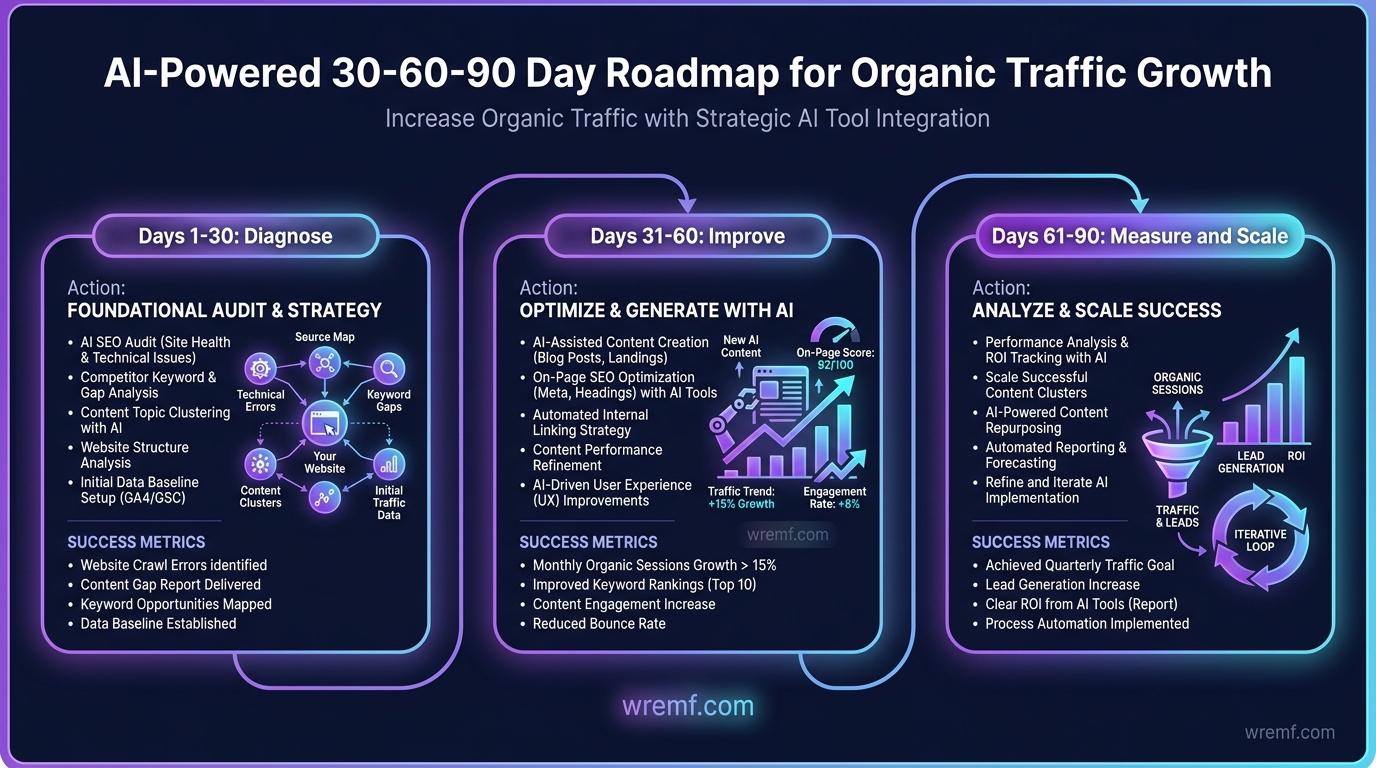
A 30-60-90 day roadmap helps teams use AI tools to diagnose visibility gaps, improve priority pages, and measure organic growth. The best roadmap starts with baseline data, then turns insights into content, technical, and AI visibility actions.
Predictive SEO is the use of data, search trends, and machine learning to identify topics, ranking patterns, and opportunities before they peak. Predictive SEO matters because content often needs to be published or updated before demand becomes obvious.
Predictive analytics is the use of data patterns to estimate future performance or likely outcomes. Predictive analytics matters because teams need to prioritize pages and keyword opportunities before competitors win the SERP.
During the first 30 days, focus on diagnosis. Audit keyword opportunities, content gaps, AI prompts, source citations, broken links, schema markup, XML sitemaps, Core Web Vitals, Google Analytics, Search Console, and competitor visibility. Build a baseline report so future changes can be measured.
During days 31 to 60, focus on improvements. Update high-value pages, create AI-ready content briefs, fix technical issues, improve internal links, expand topic clusters, optimize answer-first sections, and add source-backed statistics. Prioritize pages that already have impressions, rankings, or buyer intent because they often improve faster than brand-new content.
During days 61 to 90, focus on measurement and scaling. Compare pre-update and post-update performance, track prompt visibility, review AI citations, analyze user engagement, monitor LLM referrals, and identify which workflows should repeat monthly. This is where SEO testing becomes useful.
WREMF supports SEO testing so teams can compare changes over time and connect content or technical updates to measurable outcomes.
| Timeline | Main goal | Actions | Success metrics |
|---|---|---|---|
| Days 1 to 30 | Diagnose | Audit prompts, citations, rankings, technical issues, content gaps, competitors | Baseline report, priority pages, issue list |
| Days 31 to 60 | Improve | Update content, build topic clusters, fix technical issues, improve internal links | Better coverage, resolved issues, improved visibility |
| Days 61 to 90 | Measure and scale | Track rankings, organic traffic, AI visibility, LLM referrals, conversions | Stronger reporting, repeatable workflow, clearer ROI |
A common mistake is starting with content creation before measurement. Teams often publish new articles while older pages lose traffic due to technical issues, outdated answers, or changing SERP patterns. AI tools help prevent this by showing whether the priority should be creating, updating, consolidating, or fixing.
KEY TAKEAWAY: A 30-60-90 day roadmap turns AI tools into a practical organic growth process instead of a scattered list of recommendations.
Even with a strong roadmap, teams need to understand what AI tools cannot do.
Risks, Limitations, and What AI Tools Cannot Do Alone
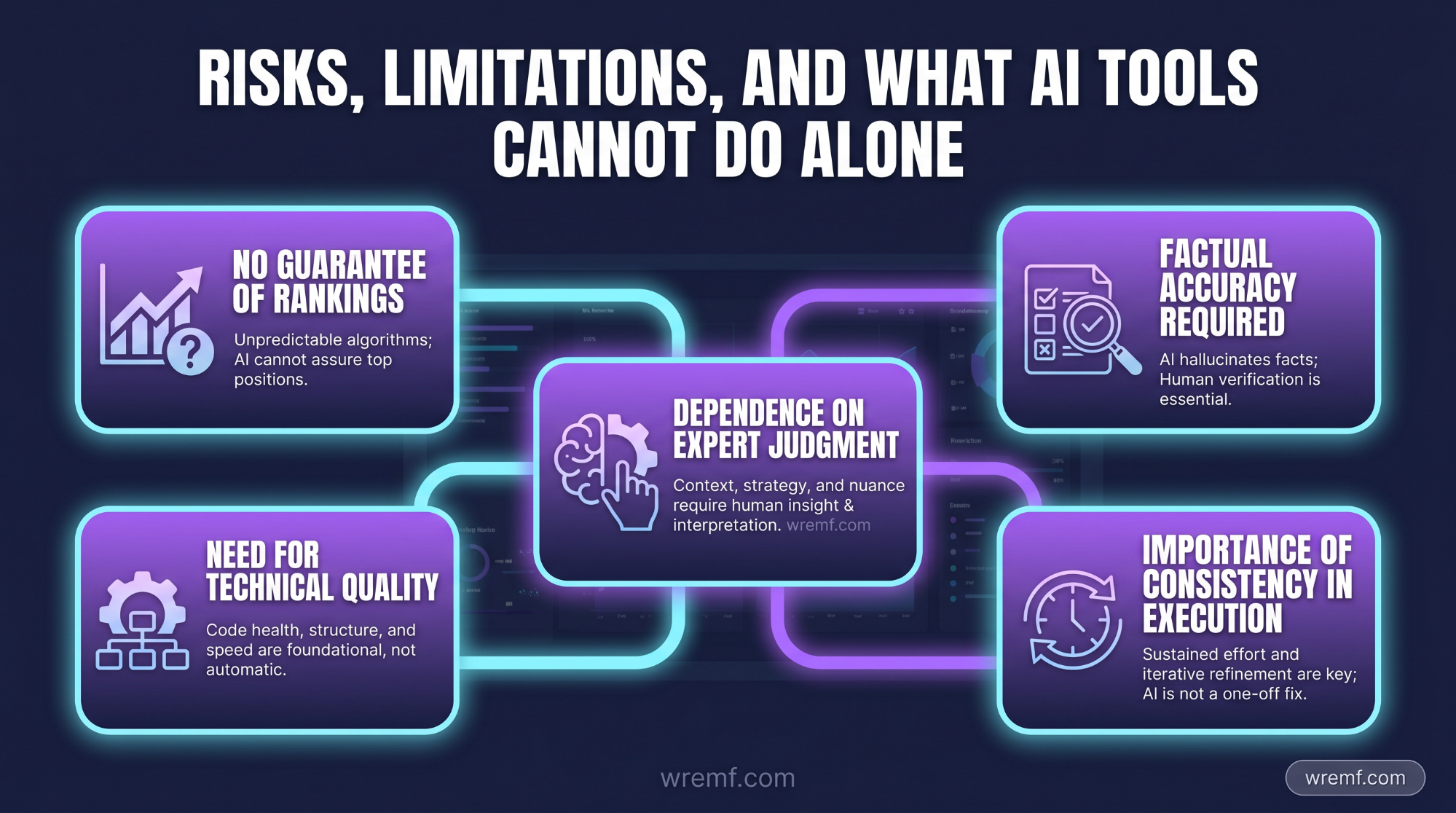
AI tools cannot guarantee rankings, organic traffic, AI citations, or revenue. They work best when they support expert judgment, factual accuracy, technical quality, and consistent execution.
Factual accuracy is the degree to which content reflects verifiable, current, and source-backed information. Factual accuracy matters because AI-generated drafts can include errors, outdated claims, or unsupported statistics if humans do not review them.
Search algorithms are automated systems that evaluate content, links, technical signals, user experience, relevance, and many other factors. Search algorithms matter because AI tools can guide strategy, but they do not control ranking models.
The main risks of AI tools include:
Publishing generic content generators without original value
Treating keyword volume as more important than search intent
Ignoring human expertise and factual review
Optimizing for AI systems while neglecting human readers
Using unsupported statistics or fake examples
Ignoring Technical SEO because content appears complete
Measuring AI mentions without business outcomes
Relying on one-time prompt checks instead of repeatable monitoring
Ignoring source consistency across third-party websites
Google’s current guidance on generative AI content says generative AI can help with research and structure, but using it to generate many pages without adding user value may violate spam policies. (Google for Developers) This means AI tools should support original, useful, and reviewed content rather than scaled low-value publishing.
In practical AI visibility audits, source consistency is often under-covered. A brand may describe itself one way on its website, another way on LinkedIn, another way on review sites, and another way in old press mentions. AI systems may synthesize inconsistent information, which weakens brand clarity.
Source consistency is the alignment of brand facts, product descriptions, pricing, positioning, and entity details across owned and third-party sources. Source consistency matters because repeated, accurate information reduces ambiguity for search engines and AI systems.
IMPORTANT: Use AI tools as decision accelerators, not as replacements for SEO strategy, editorial judgment, technical QA, or source verification.
KEY TAKEAWAY: AI tools are powerful for analysis and prioritization, but organic traffic growth still depends on expert strategy and execution quality.
These limits explain why many myths about AI visibility lead to poor decisions.
Common Myths About AI Visibility Debunked
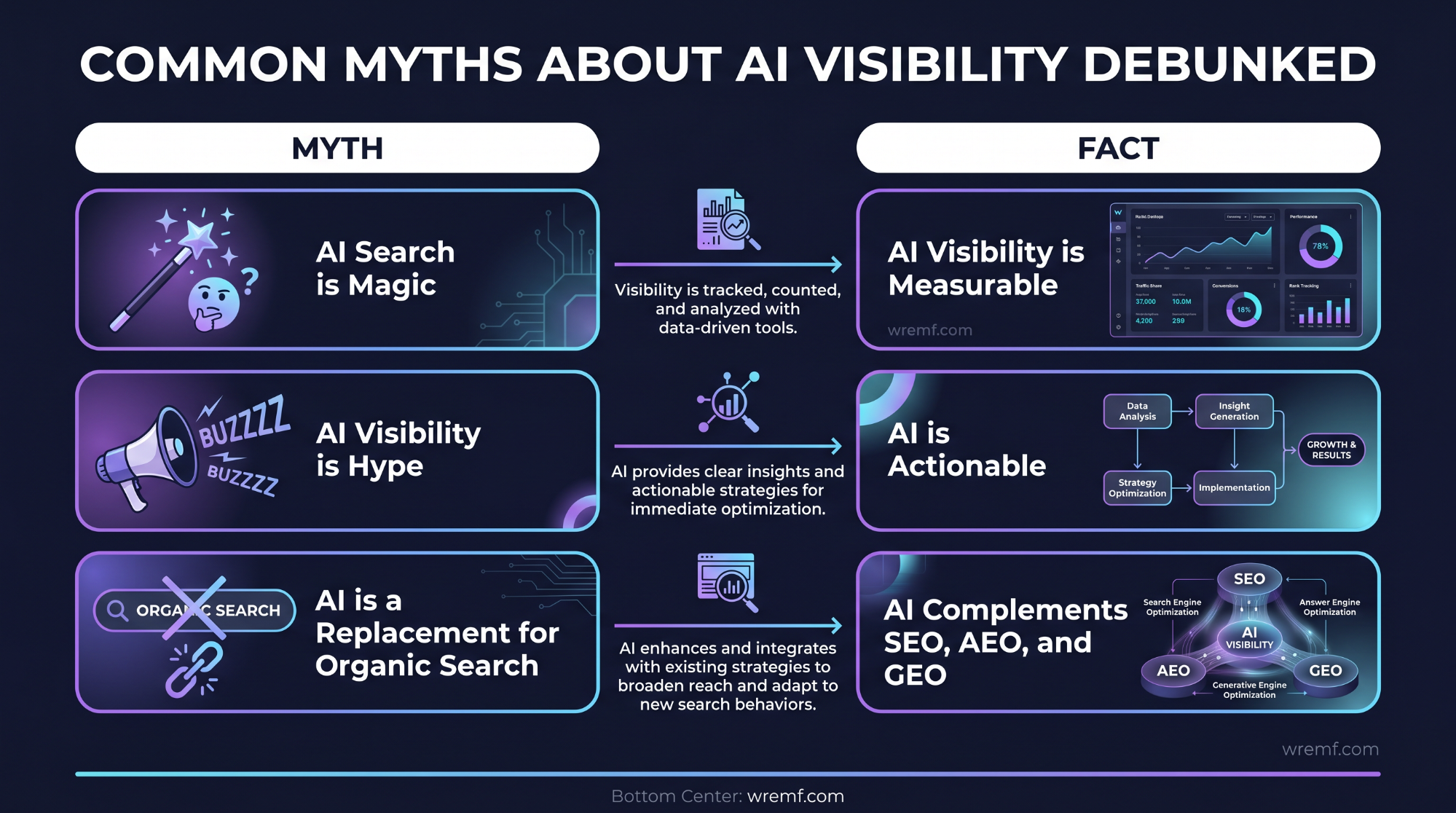
AI visibility is measurable, actionable, and connected to SEO, AEO, and GEO, but it is often misunderstood. The biggest mistakes come from treating AI search as magic, hype, or a total replacement for organic search.
MYTH: AI visibility is impossible to measure.
FACT: AI visibility can be measured through prompt tracking, brand mentions, source citations, competitor visibility, AI share of voice, and LLM referrals. Measurement is not perfect because AI answers vary by prompt, platform, source freshness, and context. A repeatable methodology still gives teams useful trend data.
MYTH: SEO, AEO, and GEO are separate strategies.
FACT: SEO, AEO, and GEO overlap because all three depend on helpful content, technical accessibility, entity clarity, and trust. SEO supports search engine discovery. AEO supports answer extraction. GEO supports generative AI visibility. The strongest strategy connects all three.
MYTH: Rankings alone are enough to increase organic traffic.
FACT: Rankings still matter, but they no longer explain the full discovery journey. Zero-click search, AI Overviews, ChatGPT, Perplexity, Gemini, Copilot, and voice search can influence users before a click happens. Teams need rankings, citations, mentions, prompt visibility, and attribution together.
MYTH: AI tools can replace human SEO experts.
FACT: AI tools can process large datasets, identify content gaps, cluster keywords, detect broken links, and create content briefs quickly. Human expertise is still required for strategy, prioritization, factual accuracy, brand voice, examples, and final decisions. The best workflow is human-in-the-loop.
MYTH: AI-generated content automatically hurts SEO.
FACT: Google’s guidance focuses on helpful, reliable, people-first content rather than whether AI assisted the production process. AI-assisted content can perform when it is accurate, useful, original, and reviewed. Thin or manipulative content can fail regardless of how it was produced.
KEY TAKEAWAY: AI visibility is not a replacement for SEO, but a broader measurement and optimization layer for modern organic discovery.
The practical question is how WREMF helps teams operationalize the workflow.
How WREMF Helps Teams Track, Improve, and Prove AI Search Visibility
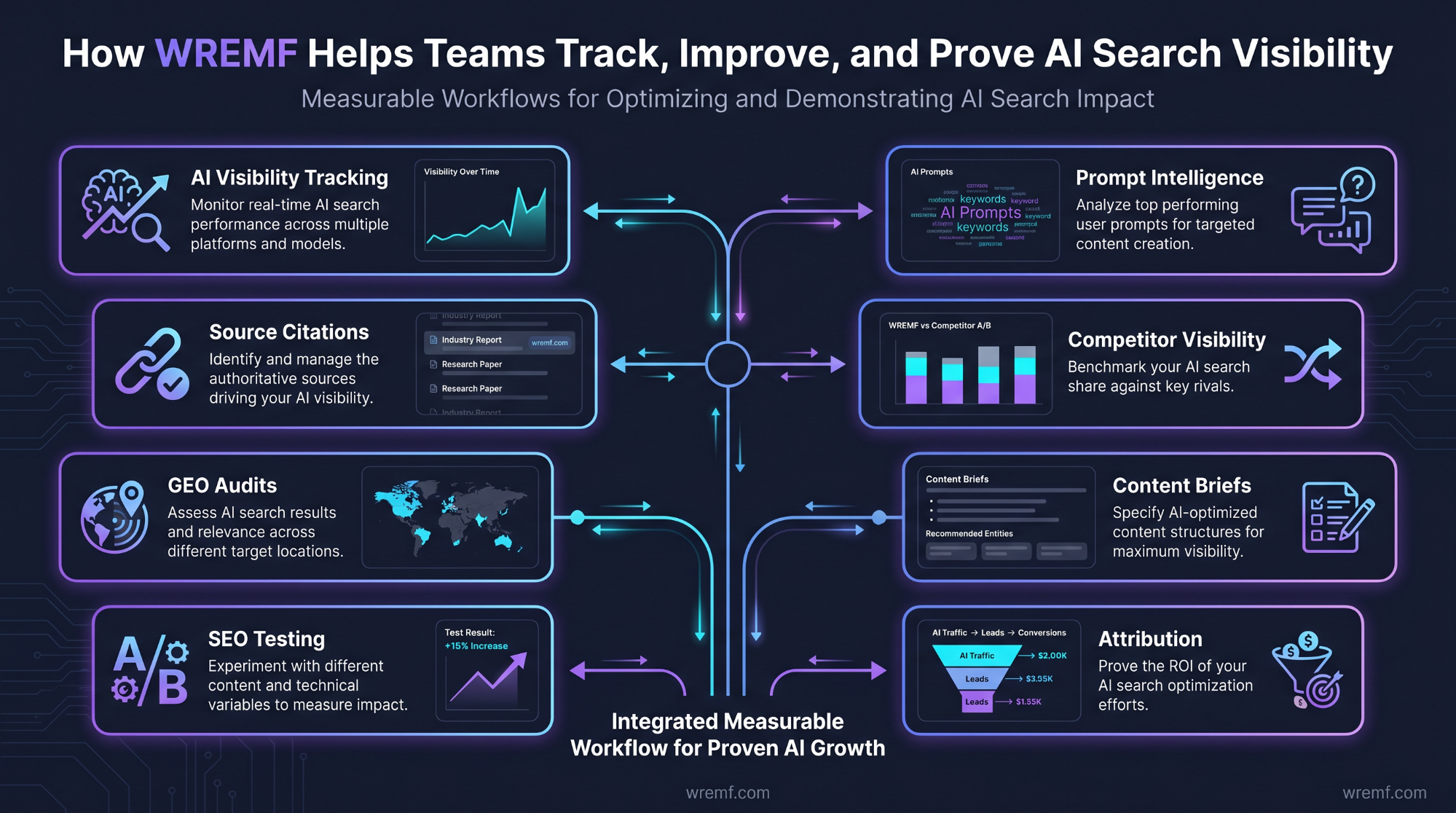
WREMF helps teams increase organic traffic by connecting AI visibility tracking, prompt intelligence, source citations, competitor visibility, GEO audits, content briefs, SEO testing, and attribution. It turns AI search optimization from manual guessing into a measurable workflow.
WREMF is an AI visibility platform and optional agency partner for B2B teams that want to understand how their brand appears across AI discovery surfaces. WREMF matters because organic growth now depends on what AI systems cite, summarize, compare, and recommend.
Prompt intelligence is the process of tracking high-value questions buyers ask across AI systems. Prompt intelligence matters because every AI answer depends on the wording, intent, and context of the prompt.
Competitor visibility is the measurement of how often competing brands appear in search results, AI answers, citations, and recommendations. Competitor visibility matters because organic traffic can shift when AI systems recommend competitors more often than your brand.
WREMF helps teams with:
AI visibility tracking across 10 AI engines
Prompt intelligence for informational, comparison, and buying-stage queries
Source citation tracking for cited URLs and source ecosystems
Competitive landscape analysis for competitor visibility and AI share of voice
GEO audits for technical, content, and entity readiness
AI-ready content briefs for content strategy and content creation
SEO testing for before-and-after measurement
White-label reporting for agencies
Client portals for multi-stakeholder reporting
BYOK support for teams that want control over AI keys
API and MCP workflows through the WREMF API
The software model is useful for SEO teams, content teams, and agencies that can execute internally. The agency model is useful for teams that need AI visibility strategy, GEO consulting, AEO execution, source consistency cleanup, citation improvement, content optimisation, and monthly reporting. The hybrid model is useful when teams want both dashboards and senior-led action.
WREMF does not guarantee rankings, citations, traffic, or revenue. It provides the measurement system, recommendations, and execution support needed to make better decisions. That is the right framing for AI search optimization because the outcome depends on website quality, market competition, source trust, technical health, and execution.
KEY TAKEAWAY: WREMF helps teams connect AI visibility data with practical SEO, AEO, GEO, reporting, and execution workflows.
The final section answers the questions buyers, marketers, SEO teams, and agencies ask most often.
Frequently Asked Questions
How do AI search optimization tools increase organic traffic?
AI search optimization tools increase organic traffic by improving keyword research, search intent mapping, content optimization, Technical SEO, and AI visibility tracking. They help teams find content gaps, build topic clusters, fix broken links, improve schema markup, and update pages based on search engine results pages and AI answer patterns. The best tools also track AI citations, brand mentions, prompt visibility, competitor visibility, and LLM referrals. Traffic improves when those insights lead to better pages, stronger technical foundations, and clearer answers for users.
How does AI affect organic search?
AI affects organic search by changing how users find and evaluate information. Search engines now show AI Overviews, featured snippets, summaries, and answer-style results that can reduce clicks for simple queries. At the same time, AI search creates new visibility opportunities through citations, source mentions, brand recommendations, and LLM referrals. SEO is still important, but it now needs to work with AEO and GEO. Teams should measure rankings, organic traffic, AI visibility, citations, and source consistency together.
How can I increase organic search traffic in the AI era?
You can increase organic search traffic in the AI era by combining keyword research, intent mapping, content updates, technical SEO, internal links, schema markup, source-backed answers, and AI visibility tracking. Start by identifying pages with impressions but weak clicks, pages losing traffic, and topics where competitors appear in AI answers. Then update content with direct answers, better structure, stronger examples, and clearer entities. WREMF helps teams track prompts, citations, and competitor visibility so improvements are based on evidence.
How does AI improve website traffic?
AI improves website traffic by helping teams analyze large datasets, detect patterns, prioritize fixes, and create better content briefs. AI tools can identify content gaps, broken links, long-tail keywords, search trends, technical issues, and user intent faster than manual analysis. They can also monitor how a brand appears in ChatGPT, Perplexity, Gemini, Claude, Copilot, and Google AI Overviews. AI improves traffic only when teams turn those insights into better content, stronger technical SEO, and clearer user experiences.
Is SEO dead or evolving in 2026?
SEO is evolving in 2026, not dead. Search engines still need crawlable websites, helpful content, internal links, schema markup, good user experience, and credible sources. What changed is that organic visibility now includes AI Overviews, zero-click search, voice search, and large language models. Traditional SEO metrics such as rankings and clicks still matter, but they are incomplete on their own. Teams should combine SEO with AEO, GEO, prompt tracking, citation tracking, and AI traffic attribution.
What is AI search optimization?
AI search optimization is the process of improving how a brand, website, or product appears across search engines and AI systems. It includes SEO, AEO, GEO, prompt tracking, content optimization, source citation analysis, technical SEO, and competitor visibility. AI search optimization matters because users now ask full questions across Google, ChatGPT, Perplexity, Gemini, Claude, Copilot, and voice assistants. The goal is to make content findable, understandable, useful, and trustworthy across both classic search and AI-generated answers.
What is the difference between AI search optimization and traditional SEO?
Traditional SEO focuses on improving visibility in search engines through keywords, content, links, technical health, rankings, and organic traffic. AI search optimization expands that work to include AI systems, prompt visibility, source citations, brand mentions, AI share of voice, and LLM referrals. Traditional SEO asks whether a page can rank and earn clicks. AI search optimization asks whether AI systems can understand, cite, summarize, compare, and recommend the brand. The strongest strategy uses both.
Does E-E-A-T matter for AI search optimization?
E-E-A-T matters for AI search optimization because experience, expertise, authoritativeness, and trust help users and search systems evaluate content quality. AI tools can suggest structure and content gaps, but they cannot replace real expertise, source verification, and factual accuracy. Strong E-E-A-T signals include clear authorship, accurate claims, named sources, original examples, useful methodology, transparent product information, and consistent brand facts. For B2B SaaS, E-E-A-T also supports trust during long buying journeys.
How do different AI platforms process content?
Different AI platforms process content through their own retrieval systems, model behavior, source access, ranking logic, and answer formats. ChatGPT, Claude, Gemini, Perplexity, Copilot, Google AI Overviews, DeepSeek, Grok, Meta AI, and Mistral may produce different answers for the same prompt. Some systems emphasize web sources, some emphasize conversation context, and some vary by freshness or available connectors. This is why prompt tracking across multiple AI engines is more reliable than testing one platform manually.
How do I optimize website content for AI search?
Optimize website content for AI search by writing direct answers, defining key terms, using descriptive headings, adding comparison tables, answering related questions, citing trusted sources, improving internal links, and keeping brand information consistent. Make sure important content is visible in rendered HTML and supported by schema markup where appropriate. Use AI tools to find content gaps and prompt opportunities, then use human expertise to improve accuracy and usefulness. WREMF can help monitor whether those updates improve AI visibility.
Are AI SEO tools worth the investment in 2026?
AI SEO tools are worth the investment in 2026 when a company has enough content, search demand, competition, or reporting complexity to benefit from better prioritization. They are especially useful for B2B SaaS teams, agencies, content teams, and growth leaders managing many pages or competitors. The return depends on execution. Tools reveal opportunities, but organic traffic improves when teams update content, fix technical issues, improve source consistency, and measure outcomes over time.
Should I hire an SEO agency or use AI tools?
Use AI tools if your team has the capacity to act on recommendations internally. Hire an agency if you need strategy, technical review, content optimization, GEO consulting, AEO execution, or monthly reporting support. Use a hybrid model if you need both measurement and hands-on implementation. WREMF supports software, agency services, and combined execution. That makes it useful for teams that want dashboards, white-label reports, AI visibility audits, content briefs, and senior-led improvement work.
How can I track my brand in AI search results?
You can track your brand in AI search results by monitoring prompts, brand mentions, citations, competitor appearances, answer sentiment, source references, and LLM referrals. Manual testing is useful for early checks, but it is not scalable because AI answers vary by prompt, platform, time, and source freshness. A repeatable platform like WREMF helps teams track AI visibility across multiple engines, compare competitors, identify cited sources, and report changes over time.
Is AI-generated traffic replacing classic SEO traffic?
AI-generated traffic is not fully replacing classic SEO traffic, but it is changing how users discover and evaluate information. Classic SEO still drives website visits through search engines, while AI search can influence users through summaries, citations, recommendations, and conversational answers. Some searches may produce fewer clicks because users get answers directly. Other searches may create higher-intent visits because users arrive after AI-assisted research. Teams should track both classic organic traffic and AI visibility.
What are the best practices for integrating AI tools into an existing SEO strategy?
The best way to integrate AI tools into an existing SEO strategy is to start with measurement, not content generation. Build a baseline of rankings, traffic, prompt visibility, citations, competitors, technical issues, and content gaps. Then prioritize updates based on business value, search intent, and feasibility. Use AI for clustering, briefs, audits, and monitoring. Use human expertise for strategy, source verification, editing, and final decisions. Review results monthly and adjust the roadmap.
Conclusion
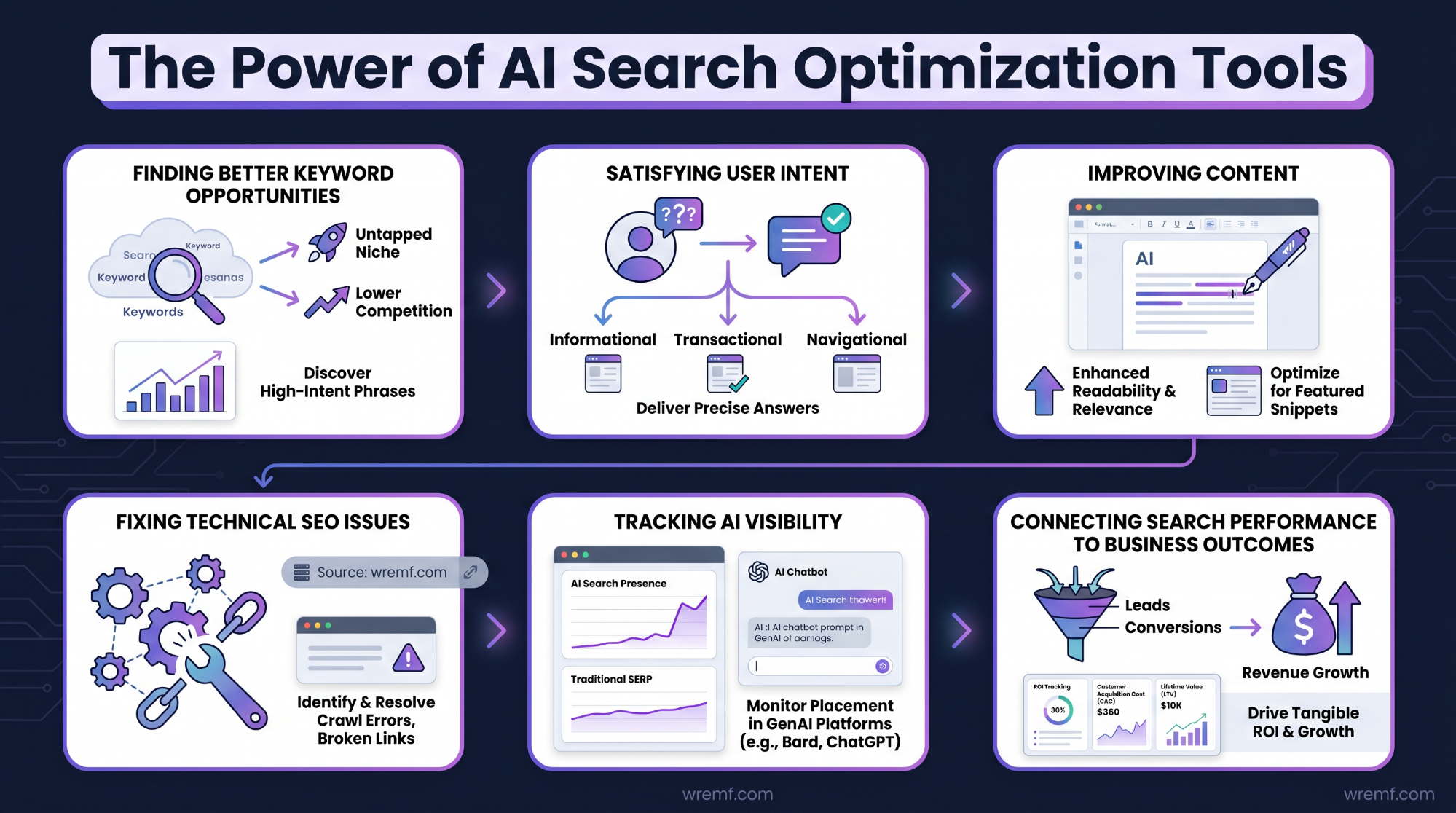
AI search optimization tools increase organic traffic by helping teams find better keyword opportunities, satisfy user intent, improve content, fix Technical SEO issues, track AI visibility, and connect search performance to business outcomes. The strongest approach combines SEO, AEO, GEO, human expertise, source consistency, and repeatable measurement. WREMF helps B2B teams turn AI visibility into a practical workflow across prompts, citations, competitors, content briefs, audits, and attribution. To move from guessing to measurable action, explore the WREMF platform suite or talk to the WREMF agency team.
Related Generative Engine Optimization Guides
- AI Search Engine Optimization Tools The Complete 2026 Guide for AI Search, SEO, AEO, and GEO
- 12 Best AI Search Optimization Tools
- How Do AI Search Optimization Tools Improve SERP Rankings
- Answer Engine Optimization Services The Complete Guide to AI Search Visibility
- Answer Engine Optimization The Complete Guide to AEO, AI Search Visibility, and Answer-First Content
- LLM SEO Agency The Complete Guide to Choosing an Agency for AI Search Visibility
- Enterprise Answer Engine Optimization Platforms Complete Guide for AI Visibility, AEO, and GEO
- LLM SEO Services The Complete 2026 Guide to AI Search Visibility, AEO, GEO, and LLM Optimization
- AI SEO Tools The Complete Guide for SEO, AEO, GEO, and AI Search Visibility
- AI Search Engine Optimization The Complete Guide for B2B Brands
- AI SEO Services The Complete Guide to Search Visibility in the AI Era
- AI Search Engine Optimization Services The Complete Guide for B2B Brands
- Large Language Model Optimization Services The Complete Guide to LLMO, AI Search Visibility, AEO, GEO, RAG, and LLM Performance
- AI Overview SEO How to Optimize for Google AI Overviews, AI Mode, and AI Search Visibility
- Generative AI Optimization Services The Complete Guide to GEO, AEO, LLM Optimization, and AI Visibility
- AI SEO Agency How to Choose the Right Partner for AI Search Visibility
- AI Overview Optimization How to Rank, Get Cited, and Stay Visible in Google AI Search
- Best Answer Engine Optimization for Enhancing AI Visibility
- AI Mention Tracking The Complete Guide to Monitoring Brand Mentions, AI Answers, Citations, and Share of Voice in 2026
- AI Brand Monitoring The Complete Guide to Tracking Brand Visibility Across AI Search, LLMs, and Generative Engines