AI Search Engine Optimization Services: The Complete Guide for B2B Brands
Learn what AI search engine optimization services include, how they differ from traditional SEO, and how to optimize for ChatGPT, Perplexity, and Google AI.
By WREMF Team · 2026-05-09
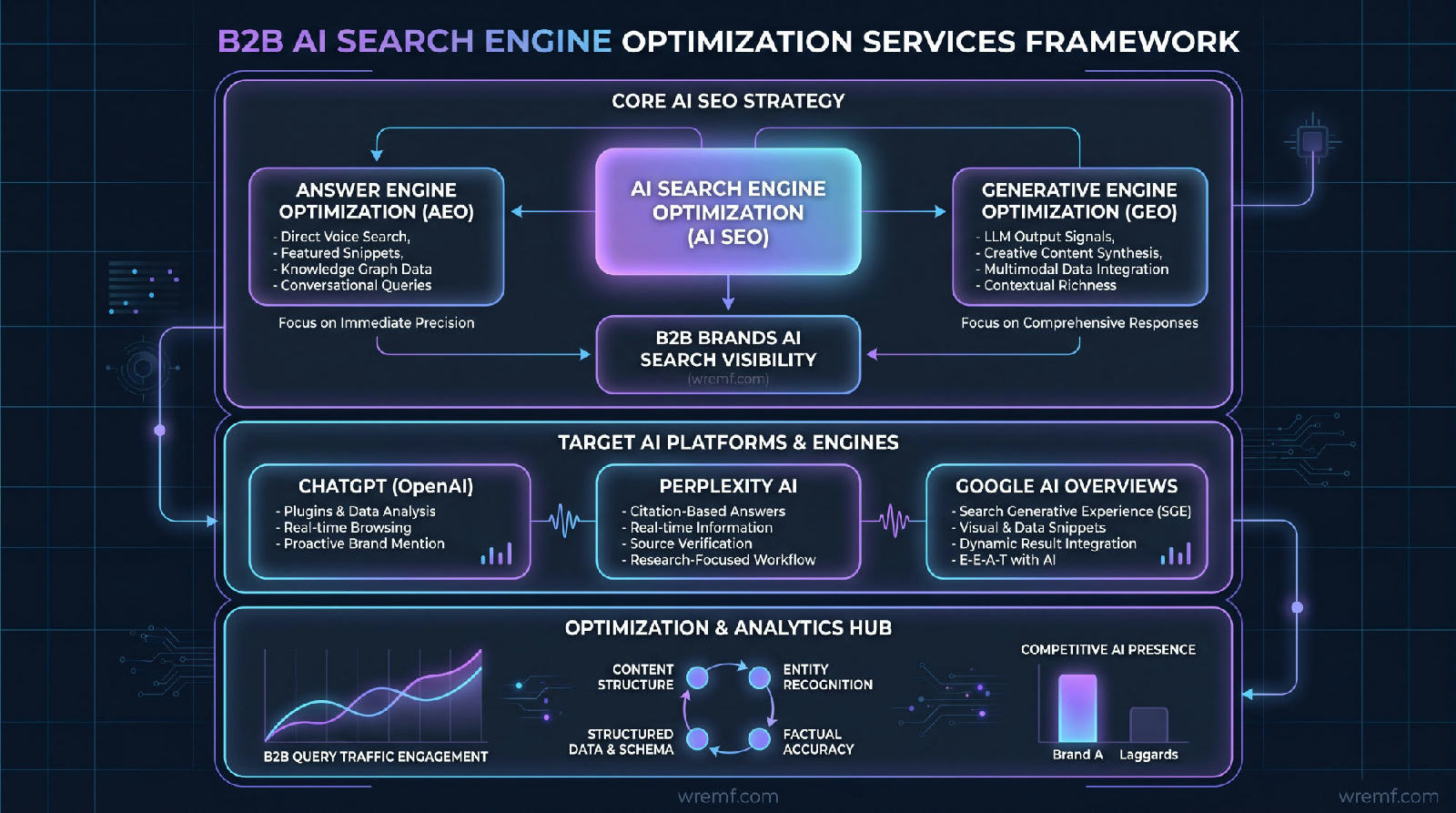
AI search engine optimization services are strategy, content, technical, and measurement services that improve how a brand appears in AI search engines. These services help teams influence AI-generated answers, AI citations, brand mentions, source citations, recommendations, and referral traffic across AI platforms. AI SEO services combine traditional SEO principles with prompt tracking, AI citation analysis, LLM visibility, source consistency, competitor analysis, AI share of voice, and AI traffic attribution. Unlike traditional SEO which focuses on rankings and organic traffic, AI SEO targets conversational search, AI Overviews, and cited summaries across platforms like ChatGPT, Perplexity AI, Google AI Overviews, Gemini, Claude, and Copilot. Professional AI SEO services include AI visibility audits, prompt intelligence, citation tracking, content optimization, technical SEO, competitor visibility, source consistency cleanup, and white-label reporting.
Key takeaways
- AI search engine optimization services turn AI visibility from manual checking into a measurable workflow across prompts, citations, content, competitors, and traffic.
- AI SEO services matter because 45% of B2B buyers used AI during a recent purchase according to Gartner's March 2026 survey, showing AI search already shapes buying behavior.
- Professional AI SEO services should include prompt tracking, AI citation tracking, source citation analysis, technical SEO, content optimization, competitor visibility, source consistency, reporting, and attribution.
- SEO, Answer Engine Optimization, Generative Engine Optimization, and Large Language Model Optimization work best as one integrated AI SEO strategy rather than separate channels.
- AI citations depend on relevance, retrievability, source trust, entity clarity, content quality, and consistency across the source ecosystem including third-party trusted sources.
- Technical SEO for AI visibility ensures search engines, AI agents, and retrieval systems can access, render, understand, and trust your content through proper crawlability, indexation, structured data, and internal linking.
AI Search Engine Optimization Services: The Complete Guide for B2B Brands
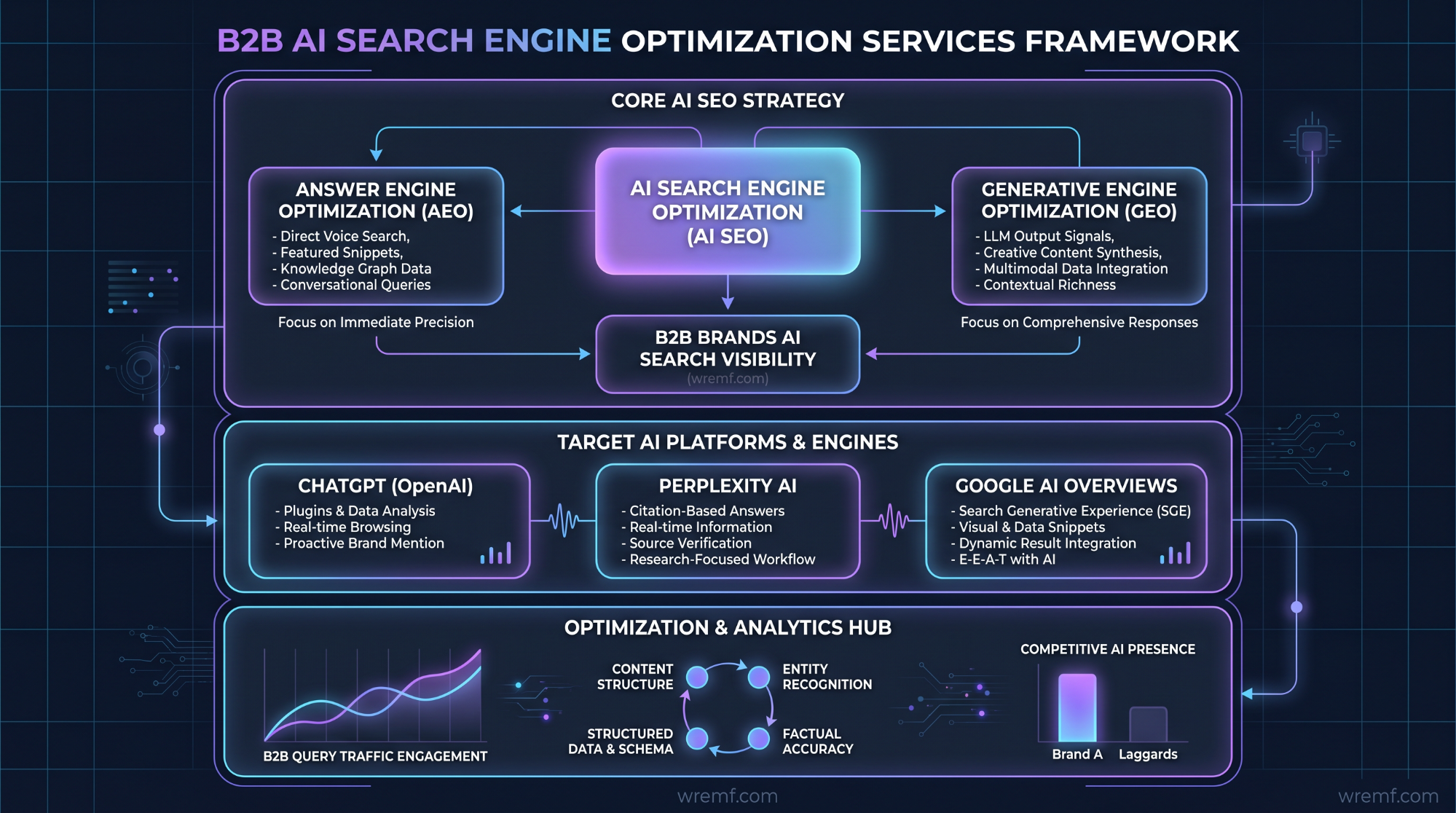
AI search engine optimization services help brands become visible in AI-generated answers, citations, recommendations, and conversational search results. Gartner reported in March 2026 that 45% of B2B buyers used AI during a recent purchase, which shows that AI search is already shaping buying behavior. This guide explains AI SEO, Answer Engine Optimization, Generative Engine Optimization, Google AI Overviews, ChatGPT search, Perplexity AI, Gemini, Claude, Copilot, content optimization, technical SEO, measurement, agency selection, and AI visibility reporting. It also explains how WREMF helps B2B teams track, improve, and prove AI visibility across major AI platforms. Use this guide to understand what modern AI SEO Services should include and how to choose the right partner.
What Are AI Search Engine Optimization Services?
AI search engine optimization services are strategy, content, technical, and measurement services that improve how a brand appears in AI search engines. AI SEO Services help teams influence AI-generated answers, AI citations, brand mentions, source citations, recommendations, and referral traffic across AI platforms.
AI visibility is the measurable presence of a brand inside AI-generated answers, citations, summaries, recommendations, and AI chats. AI visibility matters because buyers can form an opinion about your brand before they visit your website, speak to sales, or click an ad.
AI search visibility is broader than traditional search engine optimization because AI-driven search does not always show a standard search engine results page. Google Search can now include AI Overviews and AI Mode, while OpenAI says ChatGPT search can provide fast answers with links to relevant web sources. (Google for Developers)
Traditional search engine optimization focuses on rankings, organic traffic, backlinks, technical SEO, search traffic, and content quality. AI search engine optimization services add prompt tracking, AI citation analysis, LLM visibility, source consistency, brand visibility, competitor analysis, AI share of voice, and AI traffic attribution.
WREMF helps teams track, improve, and prove AI visibility through the WREMF platform suite. The platform connects prompt intelligence, source citations, competitor visibility, AI visibility scoring, scheduled AI monitoring, white-label reporting, and action recommendations across 10 AI engines.
| Service Component | What It Does | Why It Matters |
|---|---|---|
| Prompt tracking | Tests realistic prompts across AI platforms | Shows whether your brand appears for real buyer questions |
| AI citation tracking | Finds which sources AI systems cite | Shows which pages and trusted sources influence AI-generated answers |
| Content Optimization | Improves answer-first and structured content | Helps users, search engines, and AI assistants understand your expertise |
| Technical SEO | Fixes crawl, render, and indexation barriers | Helps AI agents, SEO crawlers, and search engines access important pages |
| Competitor visibility | Compares your brand with competitors in AI-generated answers | Shows who owns category conversations in AI search |
| AI traffic attribution | Connects AI platforms to referral traffic and business outcomes | Helps teams prove whether AI search is influencing demand |
AI search engine optimization services are not only AI tools for writing blog content. The best AI SEO Services combine SEO principles, Answer Engine Optimization, Generative Engine Optimization, Large Language Model Optimization, content strategy, technical infrastructure, trusted sources, and reporting.
KEY TAKEAWAY: AI search engine optimization services turn AI visibility from manual checking into a measurable workflow across prompts, citations, content, competitors, and traffic.
The next step is understanding why AI SEO Services matter now, rather than after AI search becomes fully mature.
Why AI SEO Services Matter in 2026
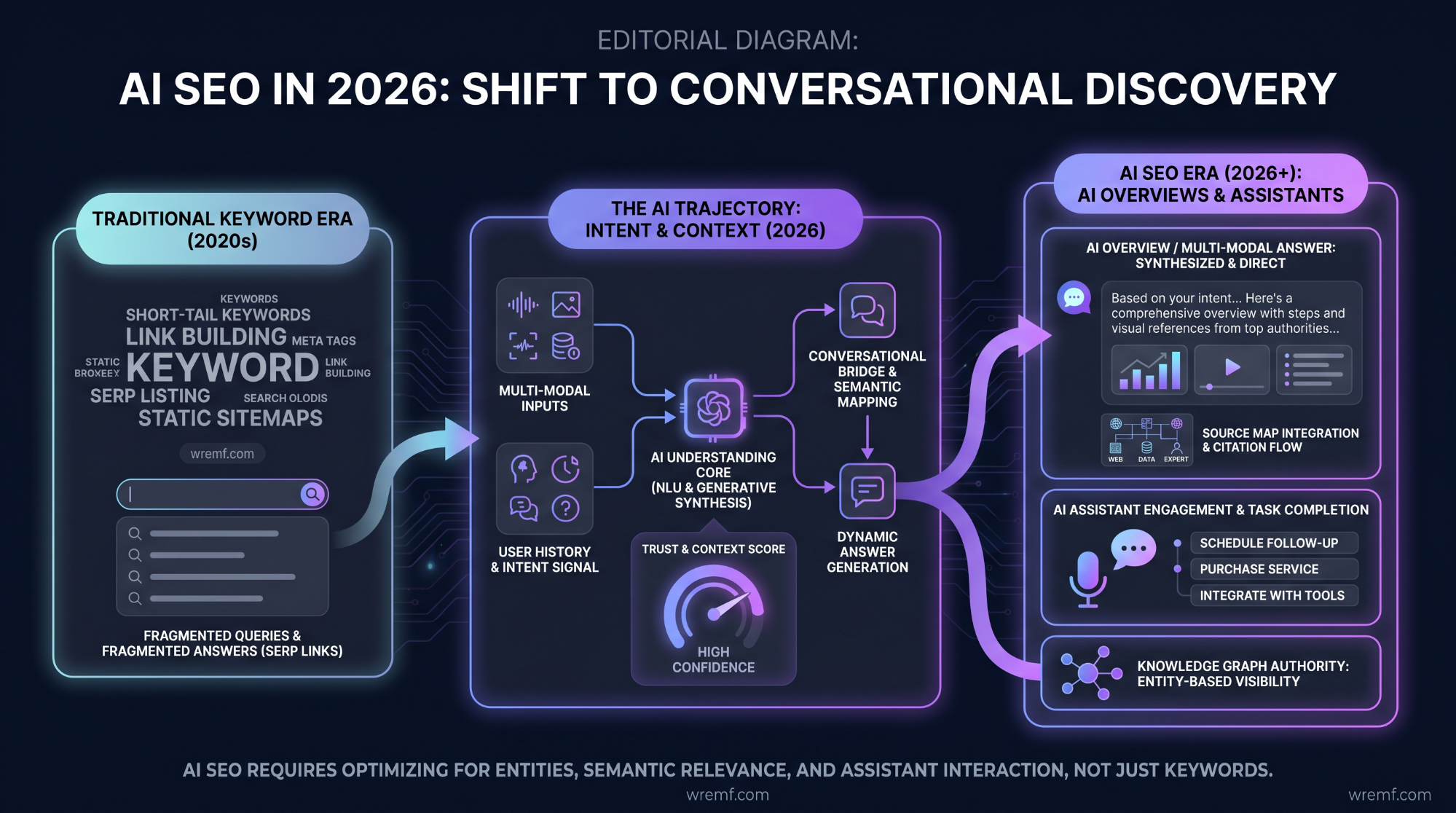
AI SEO Services matter because search behavior is moving from keyword searches to conversational answers, AI Overviews, AI assistants, and cited summaries. Brands that ignore AI search can lose visibility even when Google rankings and organic traffic look stable.
AI search is the use of artificial intelligence to answer, summarize, compare, cite, and recommend information in response to a user query. AI search matters because users increasingly expect direct answers rather than a list of links.
Google AI Overviews are AI-generated summaries that can appear in Google Search results with links for further exploration. Google announced in May 2025 that AI Overviews were available in more than 200 countries and territories and more than 40 languages, making Google AI Overviews a global search feature rather than a small test. (blog.google)
AI assistants are tools that use Generative AI to answer questions, summarize information, complete tasks, and help users make decisions. AI assistants matter because they are becoming research companions for buyers, marketers, founders, SEOs, and content teams.
Gartner’s March 2026 sales survey of 646 B2B buyers found that 45% used AI during a recent purchase. Gartner also reported that 67% of B2B buyers prefer a rep-free experience, which matters because AI-driven search supports more self-directed buying journeys. (Gartner)
In real B2B buying journeys, a buyer may ask ChatGPT for vendor recommendations, use Perplexity AI for cited research, search Google AI Overviews for category education, use Bing Copilot for summarized answers, and ask Claude to compare complex options. AI visibility must therefore be measured across multiple AI platforms.
DID YOU KNOW: Google’s AI Overviews are available in more than 200 countries and territories and more than 40 languages, according to Google’s May 2025 Search announcement.
AI-generated answers are synthesized responses produced by AI systems from model knowledge, web search, source documents, or retrieval systems. AI-generated answers matter because they can influence brand perception before your website, Google Ads, Google Business Profiles, or sales team enter the journey.
KEY TAKEAWAY: AI SEO Services matter because B2B buyers now use AI-generated answers, AI platforms, and conversational search during research and vendor evaluation.
To respond to that shift, teams need to understand how SEO, Answer Engine Optimization, and Generative Engine Optimization fit together.
SEO vs Answer Engine Optimization vs Generative Engine Optimization
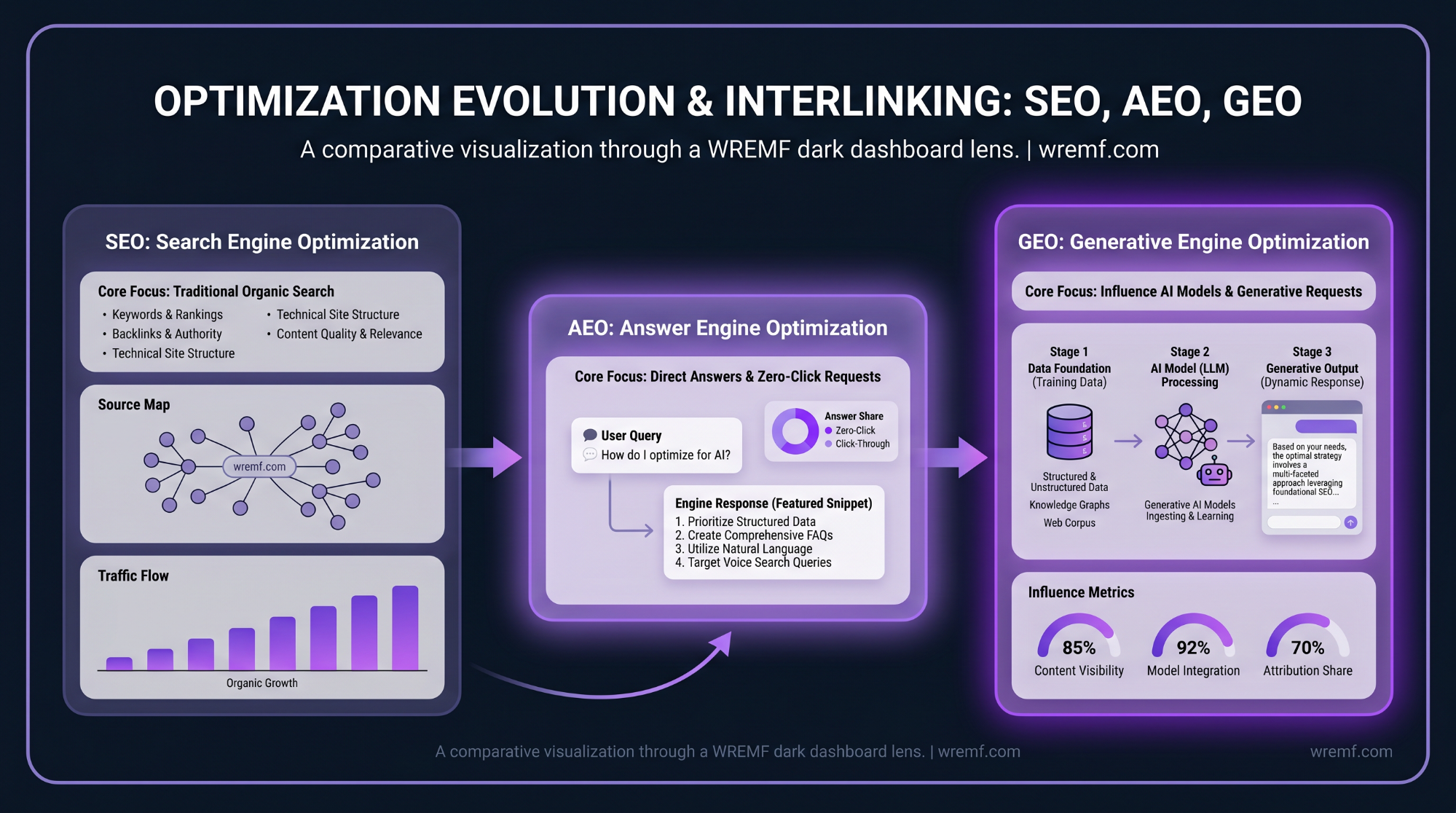
SEO improves visibility in search engines, Answer Engine Optimization improves direct answer visibility, and Generative Engine Optimization improves brand representation in generative AI outputs. The best AI SEO strategy connects all three instead of treating them as separate channels.
Search engine optimization is the practice of improving pages so search engines can crawl, understand, rank, and display them for relevant queries. Search engine optimization matters because organic search still drives discovery, demand, search traffic, and organic traffic.
Answer Engine Optimization is the practice of structuring content so answer engines can extract clear, direct, reliable answers. Answer Engine Optimization matters because AI Overviews, featured snippets, voice assistants, voice search, and AI assistants often use concise answers to satisfy user intent.
Generative Engine Optimization is the practice of improving how brands, entities, and content appear inside generative AI answers. Generative Engine Optimization matters because Large Language Models and AI-powered search systems may synthesize answers from multiple trusted sources instead of ranking one page first.
Large Language Model Optimization is the broader practice of making brand information easier for Large Language Models to retrieve, interpret, summarize, and cite. Large Language Model Optimization overlaps with Generative Engine Optimization, Answer Engine Optimization, technical SEO, content quality, and entity authority.
| Discipline | Primary Goal | What It Measures | What It Misses If Used Alone | Best For |
|---|---|---|---|---|
| SEO | Rank in search engines | Rankings, impressions, clicks, organic search, organic traffic | AI chats, citations, recommendation visibility | Building durable search traffic |
| Answer Engine Optimization | Win direct answers | Featured snippets, FAQ sections, Q&A formats, AI Overviews | Broader LLM visibility and sentiment | Improving extractability |
| Generative Engine Optimization | Improve AI-generated brand presence | AI citations, brand mentions, source citations, share of model | Traditional keyword rankings | Becoming visible in AI-generated answers |
| Large Language Model Optimization | Improve retrieval and representation in LLMs | Entity clarity, source consistency, prompt performance | Google-only search performance | Cross-platform AI visibility |
| AI SEO Services | Connect SEO, AEO, GEO, and measurement | Prompts, citations, competitors, traffic, content gaps | Nothing if the methodology is complete | B2B brands and agencies that need measurable AI visibility |
SEO principles still matter. Google Search Central explains that Google’s ranking systems are designed to prioritize helpful, reliable information created to benefit people, not content made only to manipulate rankings. (Google for Developers)
The key difference between SEO and GEO is the output you are trying to influence. SEO targets search engine rankings and organic traffic. Generative Engine Optimization targets AI-generated answers, AI citations, cited response patterns, brand mentions, and source consistency.
TIP: Treat SEO as the foundation, Answer Engine Optimization as the answer structure, and Generative Engine Optimization as the AI visibility layer.
KEY TAKEAWAY: SEO, Answer Engine Optimization, Generative Engine Optimization, and Large Language Model Optimization work best as one integrated AI SEO strategy.
Once the relationship is clear, the next question is how AI search engines find, summarize, and cite brand information.
How Do AI Search Engines Find and Cite Brand Information?
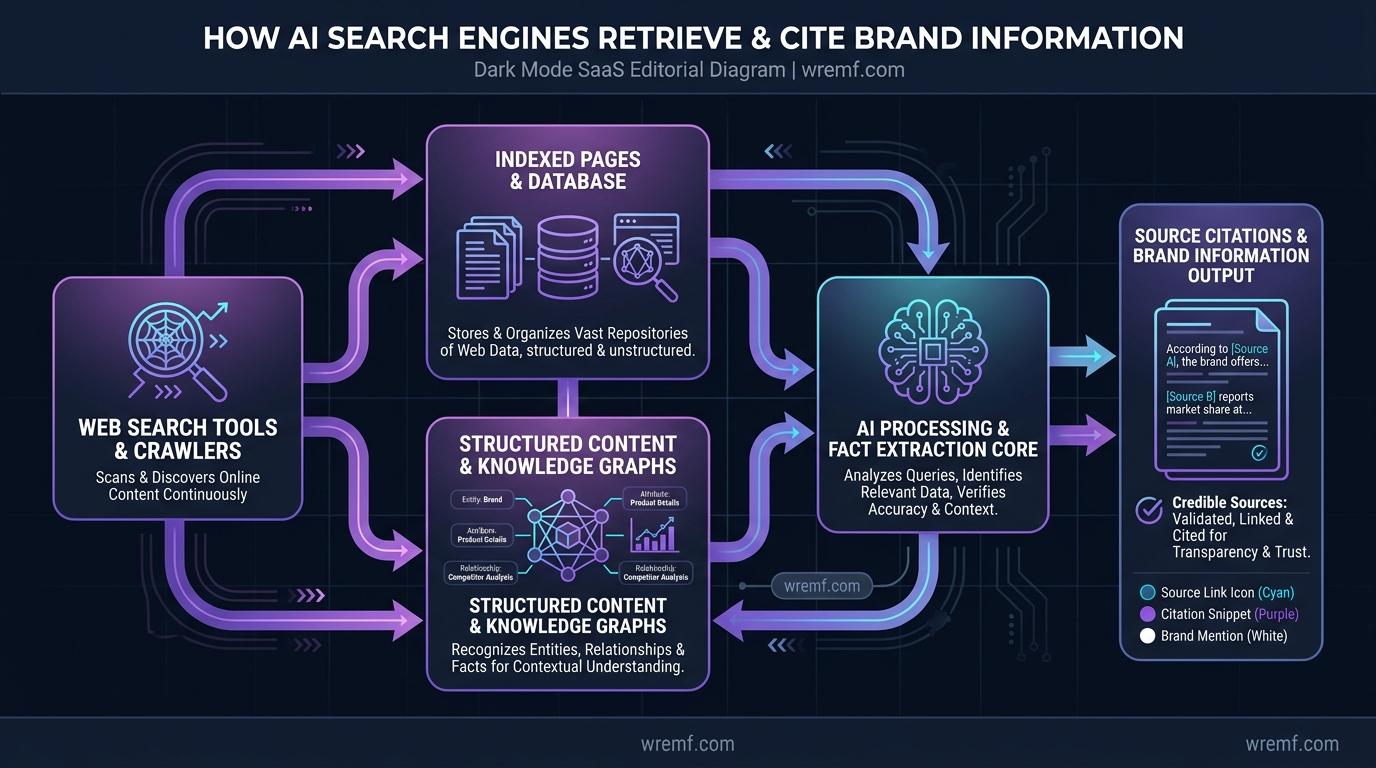
AI search engines find brand information through indexed pages, source citations, web search tools, knowledge sources, structured content, trusted sources, and retrieval systems. AI citations usually appear when an AI platform can connect a user prompt to a relevant, accessible, and credible source.
Large Language Models are AI systems trained to understand and generate language from large-scale text patterns and, in some cases, retrieved information. Large Language Models matter because LLM visibility can affect how buyers learn about products, services, risks, and alternatives.
AI citations are links, references, or source attributions shown inside AI-generated answers. AI citations matter because they help users verify information, explore sources, and trust the answer.
Source citations are the pages, publishers, documents, and references that AI platforms display or use when generating answers. Source citations matter because AI visibility is often won through the wider source ecosystem, not only your own website.
Different AI platforms handle citations differently. OpenAI says ChatGPT search can provide timely answers with links to relevant web sources. Anthropic says Claude’s web search tool gives Claude access to real-time web content and includes citations for sources drawn from search results. Microsoft says Copilot Search displays sources and links used to generate answers. Perplexity says each answer includes numbered citations linking to original sources. (OpenAI)
In practical AI visibility audits, marketing teams often find that AI systems cite review pages, listicles, category articles, documentation, public profiles, partner pages, research pages, and media sources more often than brand homepages. This is why AI search engine optimization services must analyze both owned content and third-party trusted sources.
Trusted sources are sources that AI platforms and users can reasonably use to verify a claim. Trusted sources matter because AI-powered search systems are more likely to rely on clear, credible, accessible, and relevant material when producing AI-generated answers.
Source consistency helps AI systems connect the same brand, product, audience, category, pricing, and claims across the web. If one source says your product is for agencies, another says it is for enterprise brands, and a third lists outdated pricing, AI-generated answers may become inconsistent.
AI visibility is the measurable presence of a brand inside AI-generated answers, recommendations, citations, and summaries. AI visibility matters because AI platforms can shape buyer perception before a buyer reaches a website, ad, or sales call.
KEY TAKEAWAY: AI citations depend on relevance, retrievability, source trust, entity clarity, content quality, and consistency across the source ecosystem.
After understanding citations, the next step is knowing what professional AI SEO Services should actually include.
Core Components of Professional AI SEO Services
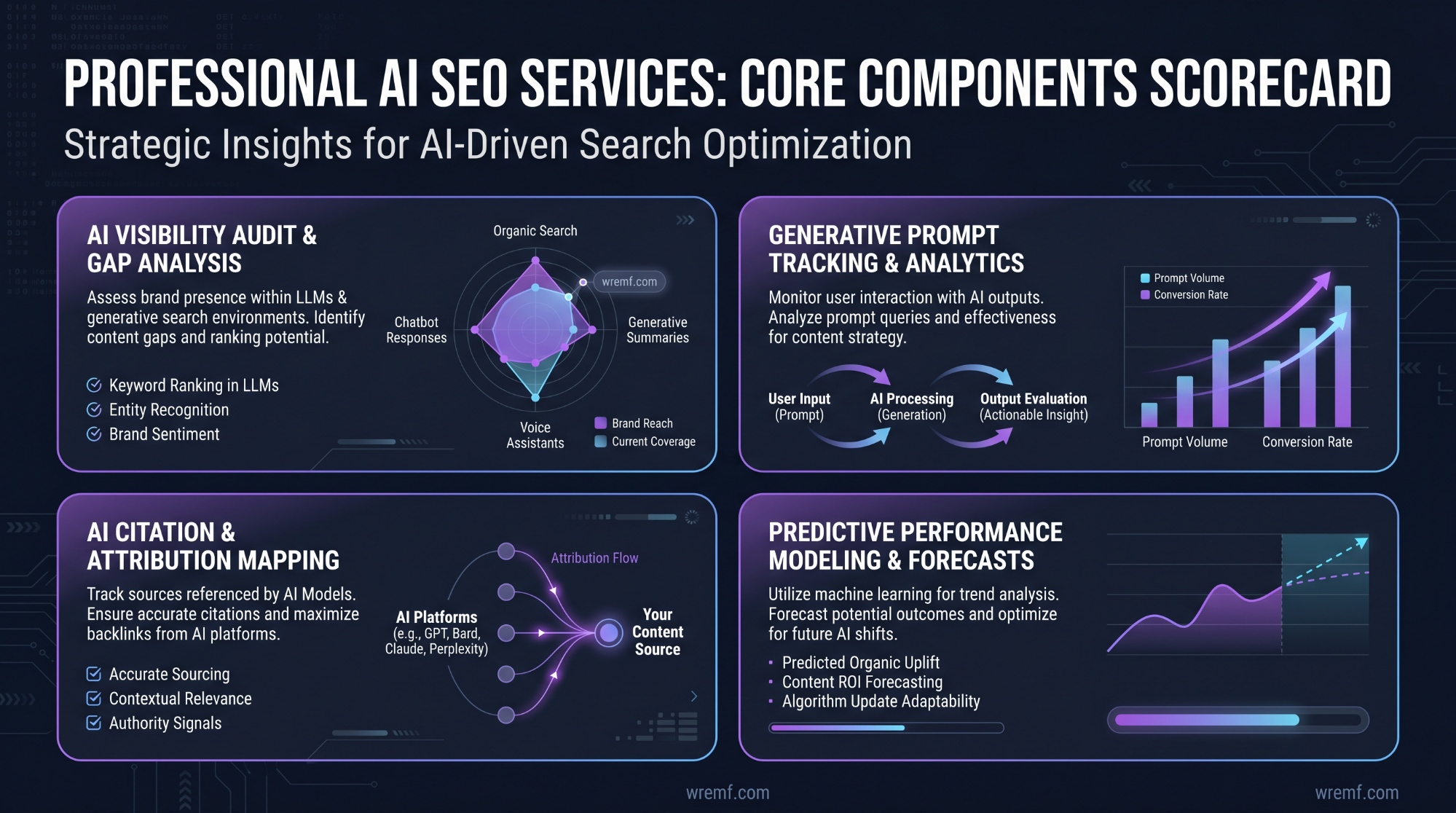
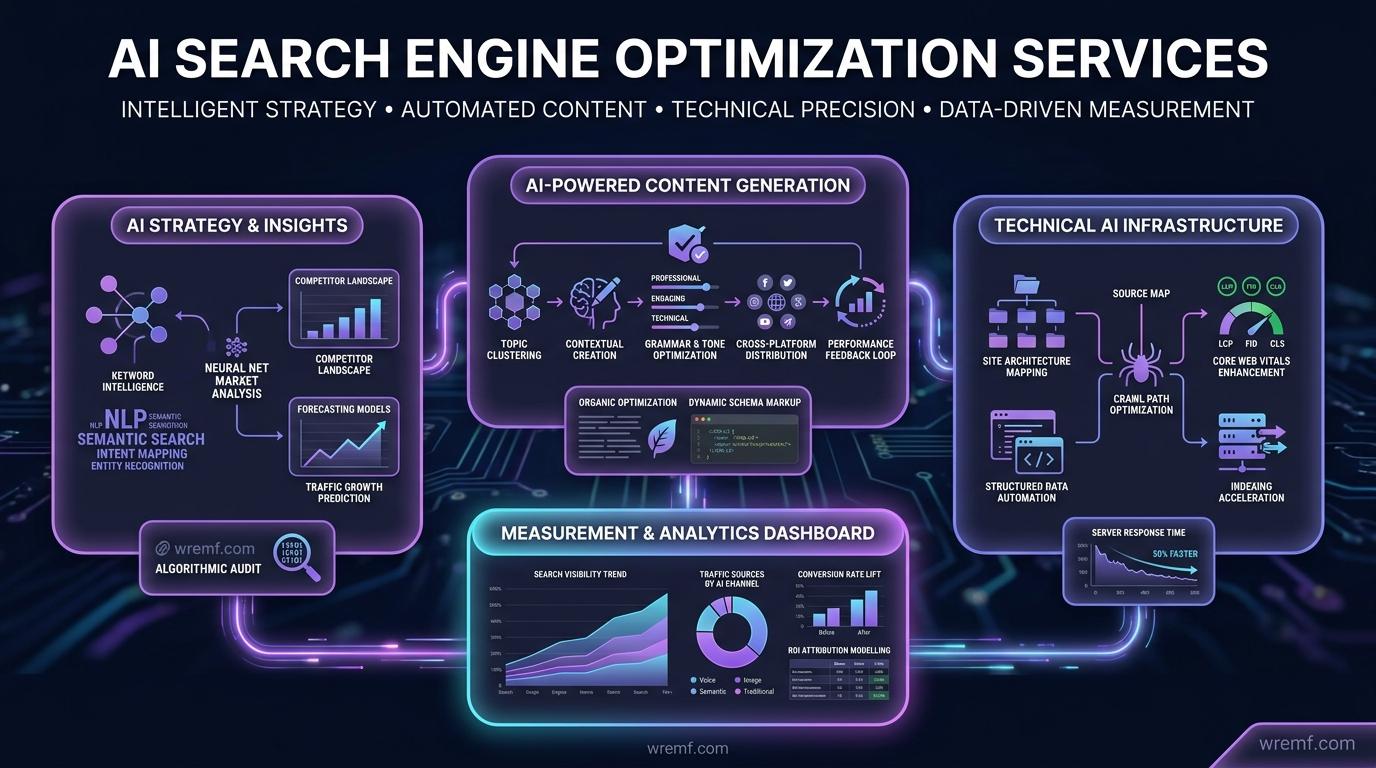
Professional AI SEO Services should include AI visibility audits, prompt tracking, AI citation tracking, source citation analysis, technical SEO, content optimization, competitor visibility, source consistency, reporting, and attribution. A complete service should show what is happening, why it is happening, and what to improve next.
Prompt tracking shows how a brand appears when users ask realistic questions across AI platforms. Prompt tracking matters because AI search is conversational, and one keyword can produce many buying-stage prompts.
Prompt intelligence is the process of identifying, grouping, testing, and monitoring prompts that matter to a brand. Prompt intelligence matters because B2B buyers use natural language prompts such as “best AI SEO agency for B2B SaaS,” “compare GEO platforms,” or “how do I rank in ChatGPT and Perplexity.”
WREMF’s prompt intelligence workflow helps teams monitor prompts across ChatGPT, Claude, Gemini, Perplexity, Google AI Overviews, Copilot, DeepSeek, Grok, Meta AI, and Mistral. This turns AI search from anecdotal manual checking into scheduled AI monitoring.
AI citation tracking identifies where AI systems cite your brand, your competitors, or third-party trusted sources. WREMF’s source citation tracking helps teams see which sources influence AI-generated answers and where citation gaps exist.
Content Optimization is the process of improving content so users, search engines, and AI systems can understand, extract, and trust it. Content Optimization matters because AI-driven search often rewards clear structure, direct answers, semantic coverage, and verifiable claims.
A complete AI SEO Services engagement should include:
AI visibility baseline across major AI platforms
Prompt library development by funnel stage, persona, and topic
Brand mention tracking across AI-generated answers
AI citation and source citation analysis
Competitor visibility and share of voice tracking
Technical SEO checks for crawl, render, and indexation barriers
Content Optimization for answer-first pages
Structured data, schema markup, and Rich schema guidance
Internal linking and internal links analysis
Semantic clusters and content gaps
Source consistency cleanup
AI traffic attribution and referral traffic review
Leadership-ready or white-label reporting
Agencies managing multiple clients often need repeatable scoring, white-label reports, client portals, and consistent methodology. In-house content teams often need dashboards, prioritized recommendations, content briefs, and proof that AI visibility work connects to business outcomes.
KEY TAKEAWAY: Professional AI SEO Services connect prompt tracking, citation analysis, content optimization, technical SEO, competitor visibility, and reporting into one measurable system.
With the service components defined, the next step is understanding the technical foundations that make AI visibility possible.
Technical SEO Foundations for AI Search Visibility
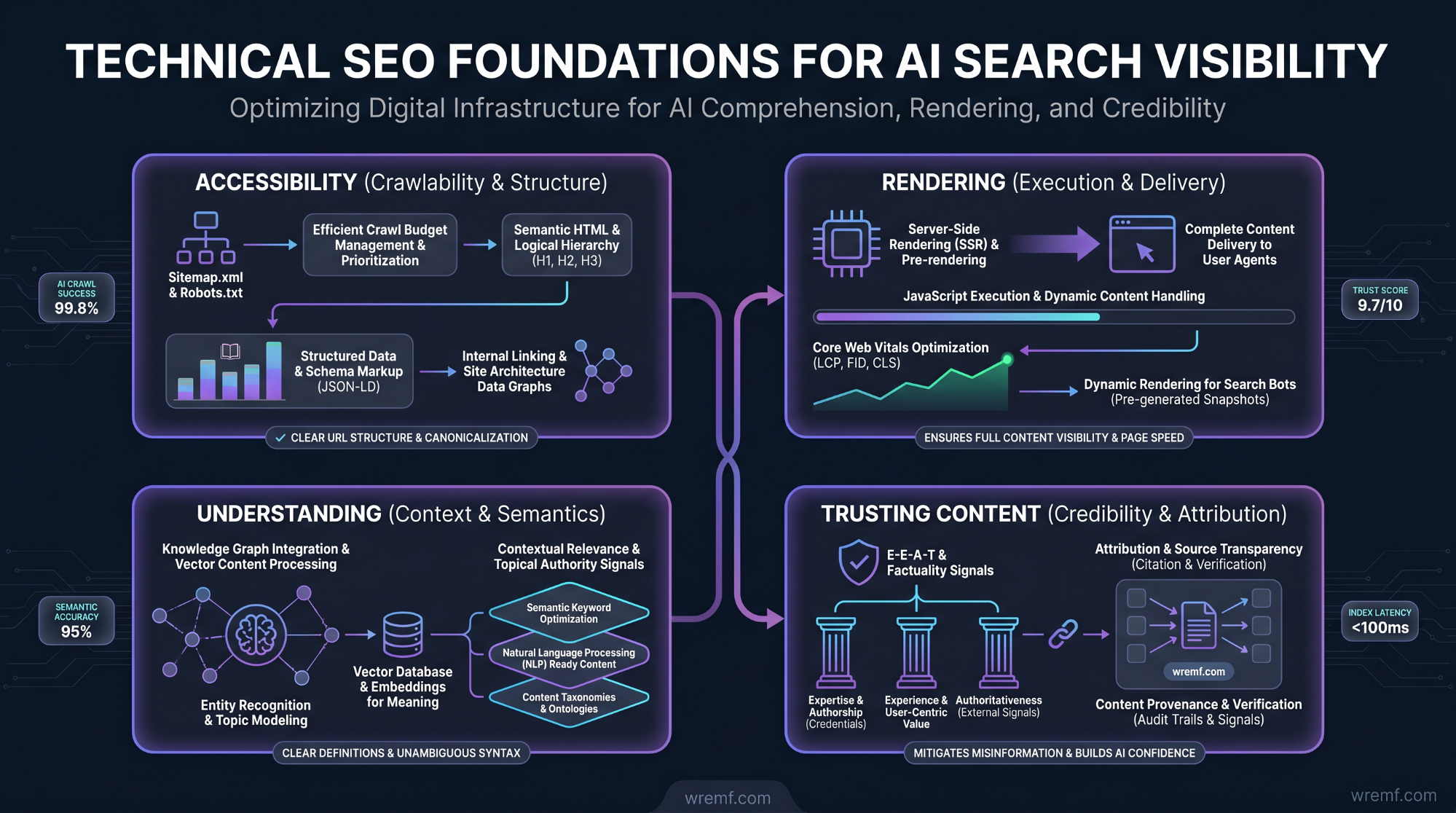
Technical SEO for AI search visibility ensures that search engines, AI agents, SEO crawlers, and retrieval systems can access, render, understand, and trust your content. Without technical accessibility, even high-quality content can fail to appear in AI-generated answers.
Technical SEO is the process of improving crawlability, indexation, rendering, structured data, site architecture, speed, and accessibility. Technical SEO matters because AI search engines still depend on accessible web content, search infrastructure, and reliable source material.
Crawl, render, and indexation barriers can block AI visibility. JavaScript-heavy sites may hide important content from SEO crawlers and AI agents. Robots.txt rules may restrict important bots. Poor internal linking may isolate valuable pages. Thin product pages may fail to explain what the brand actually does.
Structured data is machine-readable information that helps search engines understand page entities, content types, and relationships. Structured data matters because it reinforces clarity, although it does not guarantee featured snippets, AI Overviews, AI citations, or rankings.
Schema markup is a structured data format used to describe entities, articles, products, services, FAQs, reviews, events, videos, and organizations. Schema markup matters because it supports a cleaner structured data ecosystem for Google Search and AI-powered search.
Rich schema is enhanced structured data that can help eligible content qualify for richer search results when it follows search engine guidelines. Rich schema matters because it can improve machine understanding, but it must match visible page content and should not be treated as a shortcut.
Internal linking connects related pages with descriptive anchor text. Internal linking matters because it helps users, search engines, and AI systems understand topical relationships, page importance, and semantic clusters.
In practical GEO audits, SEO teams frequently discover that blog content explains a topic better than product pages. A blog post may define AI visibility clearly, while a product page may use vague claims. For AI search engine optimization services, both content types need entity clarity, structured content, Q&A formats, and source-backed claims.
WREMF’s GEO audit feature helps teams review content structure, source clarity, entity signals, technical AI visibility foundations, and practical improvement opportunities.
IMPORTANT: Do not block search crawlers, AI agents, or AI platform crawlers without understanding the tradeoff between privacy, content control, competitive risk, and AI discovery.
KEY TAKEAWAY: Technical SEO for AI visibility is about making important content accessible, structured, crawlable, indexable, and consistent across search engines and AI discovery surfaces.
Technical access alone is not enough, so the next section explains how content strategy must evolve for AI-driven search.
Content Optimization and Content Strategy for AI-Generated Answers
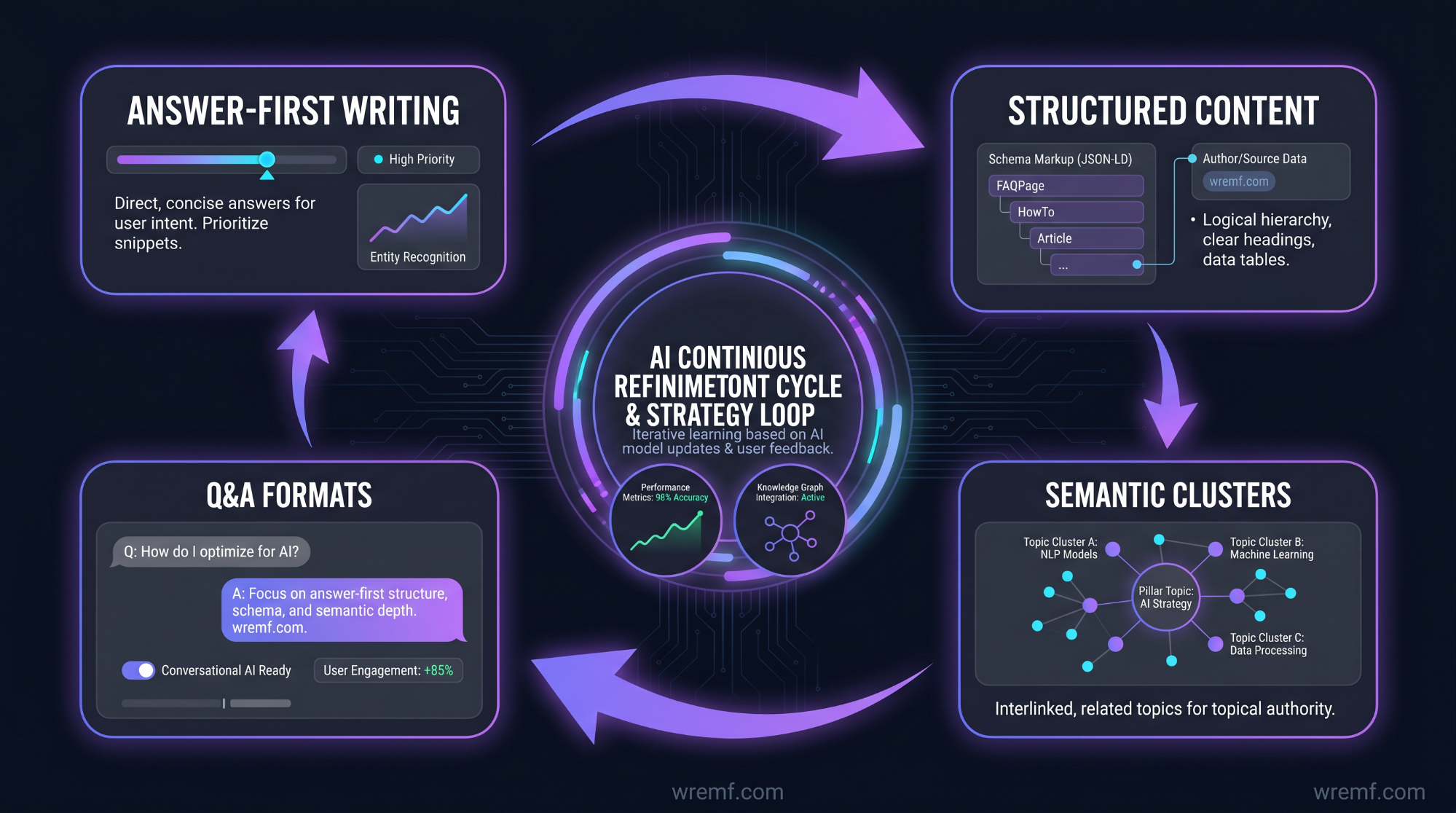
Content Optimization for AI-generated answers focuses on answer-first writing, structured content, semantic clusters, trusted sources, Q&A formats, and clear entity relationships. AI-driven search rewards content that answers real user intent with clarity, evidence, and structure.
Structured content is content organized with clear headings, concise definitions, summary paragraphs, tables, lists, and logical relationships. Structured content matters because AI assistants and search engines can more easily extract useful answers from well-organized pages.
Semantic clusters are groups of related pages that build depth around a core topic. Semantic clusters matter because AI platforms need enough context to understand your expertise across definitions, comparisons, implementation, risks, and buying decisions.
A strong AI SEO strategy should include content for each stage of user intent.
| Intent | Example Prompt | Content Type | Success Signal |
|---|---|---|---|
| Definition | What are AI SEO Services? | Pillar page or glossary | Clear AI-generated definition |
| Comparison | SEO vs AEO vs GEO | Comparison section or guide | Brand cited as a useful explanation |
| Commercial | Best AI visibility tools for agencies | Buying guide | Brand mentioned or recommended |
| Implementation | How do I optimize for ChatGPT search? | Workflow guide | AI citation and prompt visibility |
| Measurement | How do I measure AI visibility? | Methodology page | Report-ready metrics |
| Risk | Is Generative Engine Optimization hype? | Myth vs Fact content | Reduced buyer confusion |
| Local discovery | How do I optimize Google Business Profiles for AI search? | Local AI SEO guide | More consistent local entity data |
| Multimedia search | Can YouTube videos help AI search visibility? | Video and transcript strategy | More source material for AI platforms |
Q&A formats are structured question and answer blocks that match natural language prompts. Q&A formats matter because users ask AI assistants full questions, and AI systems often retrieve direct answer blocks.
FAQ sections help answer adjacent questions that may not deserve full standalone sections. FAQ sections matter because they support featured snippets, voice search, voice assistants, AI Overviews, and conversational AI retrieval.
Content quality is the usefulness, accuracy, clarity, originality, and trustworthiness of content. Content quality matters because generic AI-generated content, shallow AI Humanizer output, or low-value Content Editor rewrites can fail users and weaken brand trust.
AI tools can support content teams, but they should not replace editorial judgment. A Content Planner can identify topics, a Content Editor can help organize drafts, a SERP Analyzer can support SERP analysis, and a Content Score can reveal coverage gaps. The final work still needs expert review, evidence, examples, source attribution, and clear writing.
If you want to see how prompts, citations, competitors, AI visibility scores, and recommendations appear in a real reporting workflow, review a sample AI visibility report before building your own system.
KEY TAKEAWAY: AI-ready content strategy combines answer-first writing, semantic clusters, Q&A sections, structured content, trusted sources, internal links, and expert review.
Once content is structured correctly, the next challenge is optimizing for the major AI platforms.
How to Optimize for ChatGPT, Perplexity AI, Gemini, Claude, Copilot, and Google AI Overviews
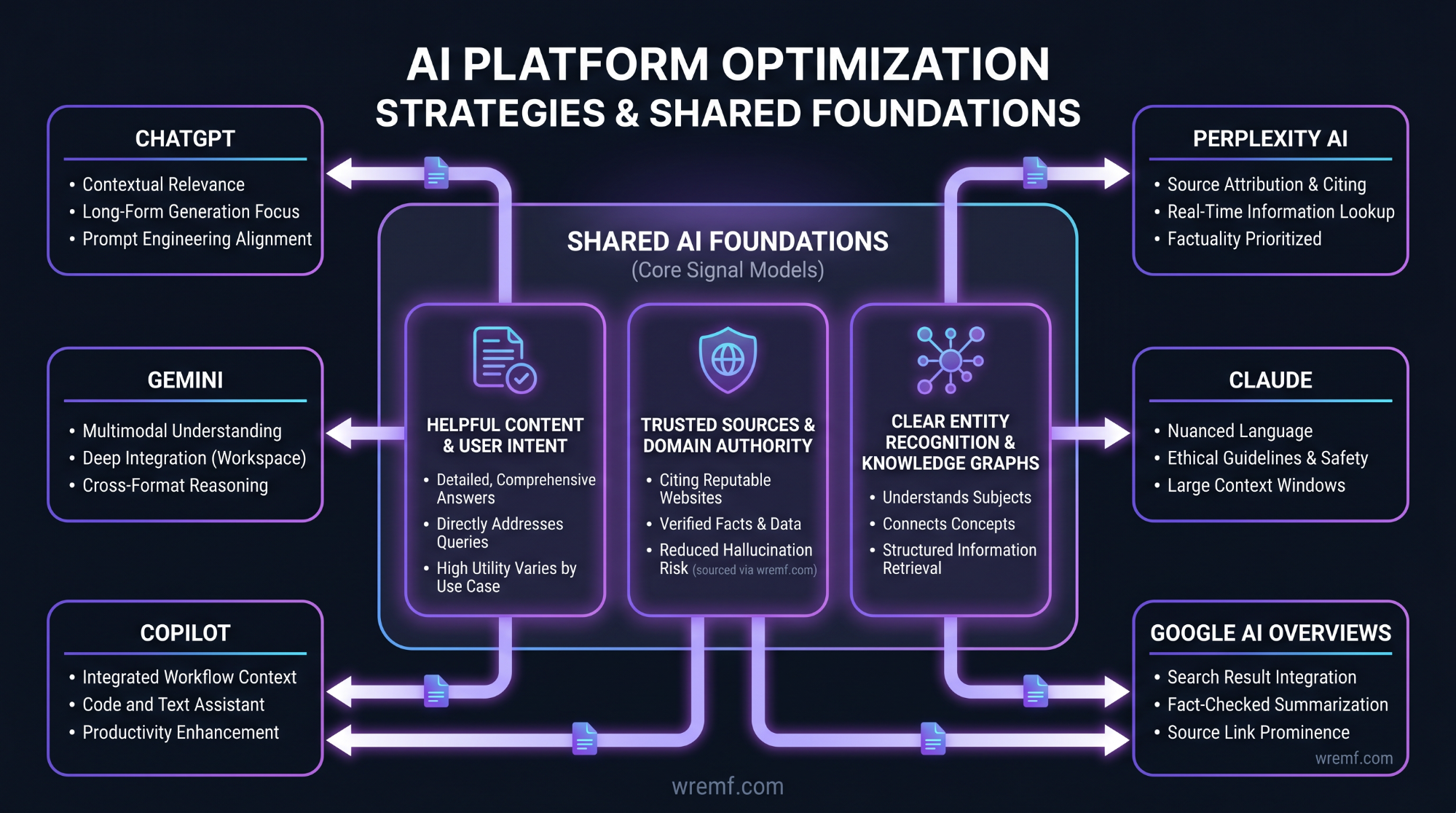
Optimizing for major AI platforms requires platform-specific monitoring plus shared foundations like helpful content, trusted sources, clear entities, and technical accessibility. The same brand can perform differently across ChatGPT search, Perplexity AI, Gemini, Claude, Copilot, and Google AI Overviews.
ChatGPT search blends conversational answers with web source links when search is used. ChatGPT search matters because users ask natural buying questions, vendor comparison prompts, implementation prompts, and follow-up questions inside a conversational interface.
Perplexity AI emphasizes real-time answers with citations. Perplexity AI matters because numbered citations are central to the experience, making source quality, freshness, and direct answer structure especially important.
Google AI Overviews appear inside Google Search and summarize information with links for further exploration. Google AI Overviews matter because they sit inside Google Search and can affect search behavior, organic traffic, featured snippets, and click patterns.
Google AI is the broader set of AI systems, products, and search experiences powered by Google’s AI models and infrastructure. Google AI matters because Gemini, AI Overviews, AI Mode, Google Search, Android, Workspace, and other Google surfaces can influence discovery.
AI Mode is Google’s conversational AI search experience that allows more exploratory, follow-up style search behavior. AI Mode matters because it moves Google Search closer to an answer engine and action engine experience.
Bing Copilot and Copilot Search connect summarized answers with sources inside Microsoft’s search and productivity ecosystem. Bing Copilot matters because Microsoft integrates AI-powered search into Bing, Edge, Microsoft 365, and enterprise workflows.
Claude is often used for research, analysis, technical topics, and professional workflows. Claude matters because Anthropic’s web search can include citations, making source quality and balanced language important for technical and academic audiences.
Gemini is Google’s AI assistant and model family used across multiple Google AI experiences. Gemini matters because Google AI Overviews, AI Mode, and Google-connected AI experiences can shape how brands are discovered and explained.
| AI Platform | What to Optimize For | Strongest Content Fit | Measurement Approach |
|---|---|---|---|
| ChatGPT search | Conversational prompts and web source links | Comparisons, definitions, guides, product pages | Prompt tracking, mentions, source citations |
| Perplexity AI | Cited response quality | Source-backed explainers, recent research, structured content | AI citation frequency and referral traffic |
| Google AI Overviews | Search intent and answer clarity | Helpful, reliable, people-first content | AI Overview presence, organic search, source links |
| Google AI Mode | Exploratory and conversational search | Multi-step guides, entity-rich answers, follow-up coverage | AI Mode prompt testing and source visibility |
| Bing Copilot | Summarized answers with cited sources | Concise explainers and trusted references | Copilot prompts and referral traffic |
| Claude | Balanced, verifiable, technical content | Documentation, research, nuanced guides | Claude prompt testing and citation review |
| Gemini | Google-connected AI discovery | Structured content, schema markup, entity clarity | Gemini prompts and Google AI visibility |
The key difference between AI platforms is not only the model. The key difference is the retrieval environment, citation behavior, source pool, user interface, and user intent. AI platforms can surface different competitors for the same prompt.
KEY TAKEAWAY: Cross-platform AI visibility requires testing each AI platform separately while improving shared foundations like source consistency, structured content, entity authority, and technical accessibility.
After platform optimization, teams need measurement systems that show whether AI SEO is working.
How Do You Measure Success in AI SEO?
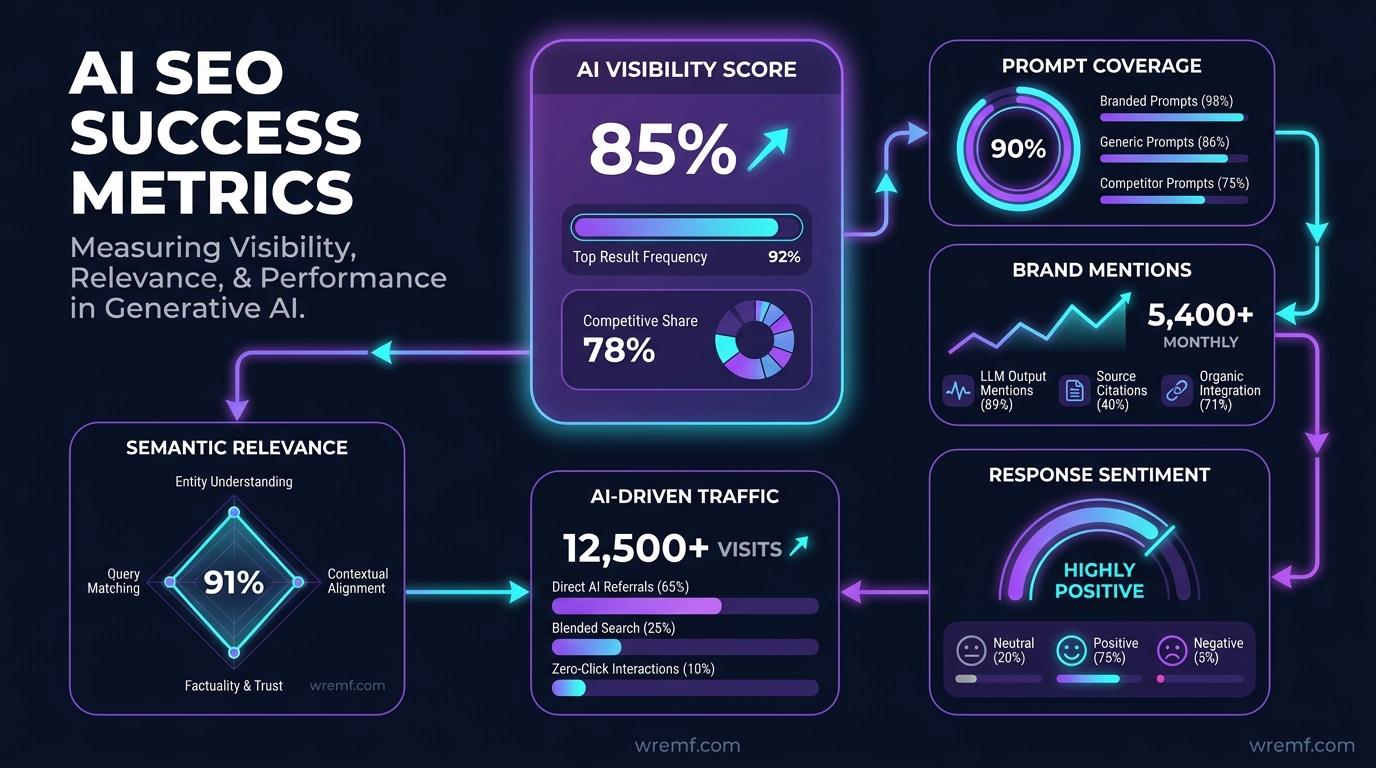
AI SEO success is measured through AI visibility scores, prompt coverage, brand mentions, AI citations, source citations, share of voice, referral traffic, sentiment, and competitor visibility. Rankings alone are not enough because AI-generated answers may mention, cite, or recommend brands without a traditional click.
AI share of voice is the percentage of relevant AI-generated answers where your brand appears compared with competitors. AI share of voice matters because it shows category presence across prompts, AI platforms, and buying stages.
Brand mentions are references to your brand inside AI-generated answers, whether or not the answer links to your website. Brand mentions matter because AI search can influence awareness and vendor consideration without sending measurable traffic.
Brand citations are source-backed references to your brand in AI-generated answers or cited response outputs. Brand citations matter because citations can increase trust, source visibility, and referral traffic.
AI traffic attribution connects visits from AI platforms to analytics, pages, campaigns, and business outcomes. AI traffic attribution matters because leadership needs to understand whether AI visibility creates measurable demand signals.
Referral traffic from AI platforms is useful but incomplete. Some AI-generated answers influence decisions without a click. Some AI chats do not pass clean referral data. Some users copy brand names and later arrive through Google Search, organic search, Google Ads, or direct navigation.
This is why AI search engine optimization services should report both visibility metrics and traffic metrics.
| Metric | What It Shows | What It Does Not Show |
|---|---|---|
| AI visibility score | Overall presence across prompts and AI platforms | Exact revenue impact by itself |
| Prompt coverage | Which prompts mention or omit the brand | Whether users clicked |
| AI citations | Which sources are cited in answers | Whether all uncited sources influenced the answer |
| Brand mentions | Whether the brand appears in AI chats | Whether the mention was positive |
| Share of model | Relative visibility against competitors | Why a competitor was preferred |
| Sentiment | Tone of AI-generated brand descriptions | Whether users trusted the answer |
| Referral traffic | Clicks from AI platforms | Zero-click influence |
| Organic traffic | Search traffic from search engines | AI recommendation visibility |
| Organic search rankings | Google Search position | ChatGPT, Perplexity, Claude, Gemini, or Copilot visibility |
In real-world reporting, teams usually struggle when they try to prove AI SEO with one metric. A better approach is to connect prompts, AI citations, competitors, source consistency, referral traffic, organic traffic, and action recommendations.
The WREMF methodology connects AI visibility measurement with prompt intelligence, source citations, competitor analysis, source consistency, and attribution. This helps teams explain what changed, why it changed, and what to do next.
AI visibility is a measurement problem and a source ecosystem problem. AI visibility improves when a brand becomes easier to find, easier to verify, easier to cite, and easier to recommend across AI platforms.
KEY TAKEAWAY: AI SEO measurement must combine visibility, citations, competitors, sentiment, and traffic attribution because AI search does not behave like a standard search engine results page.
Measurement creates the baseline, but improvement requires a repeatable workflow.
How to Build an AI SEO Services Workflow
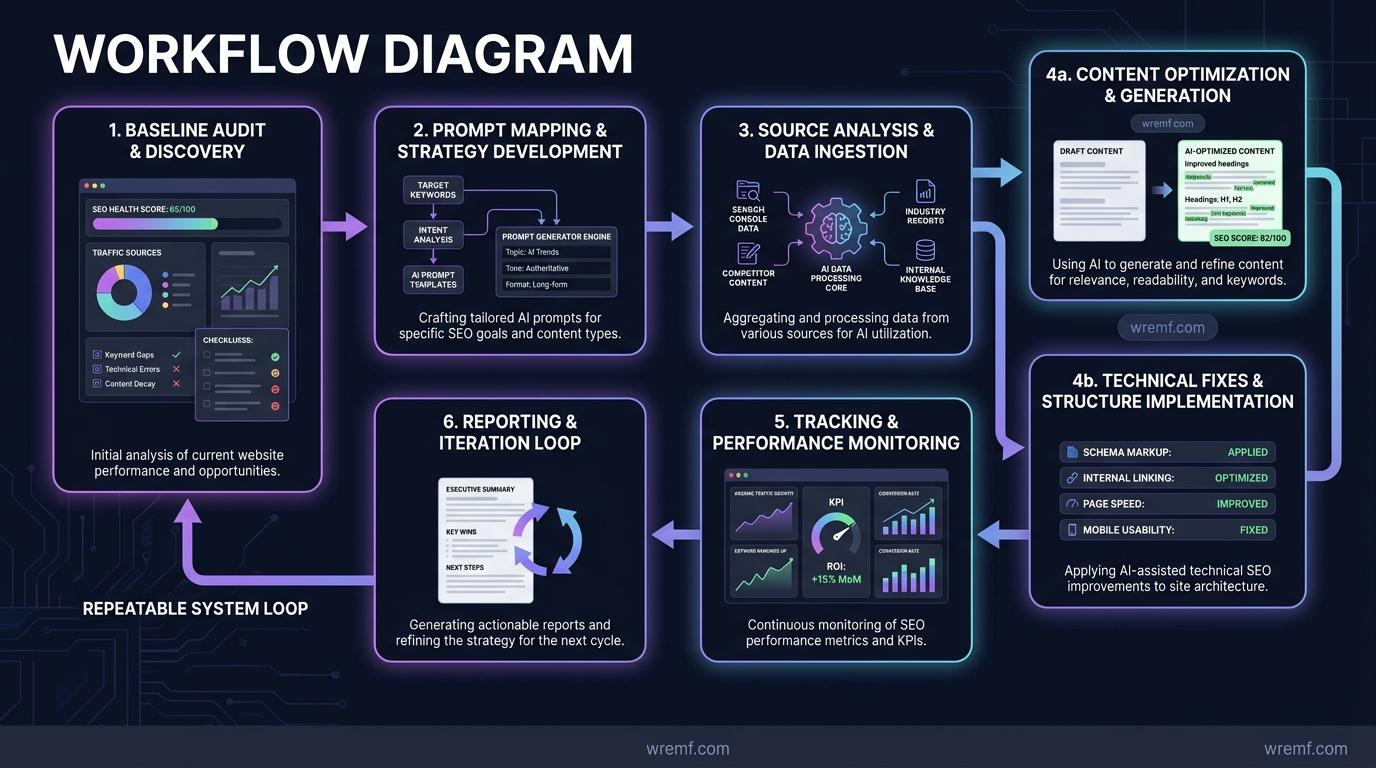
An AI SEO Services workflow should start with a baseline audit, then move into prompt mapping, source analysis, content optimization, technical fixes, tracking, and reporting. The goal is to create a repeatable system rather than one-time manual testing.
A cross-platform AI visibility methodology is a repeatable process for measuring and improving brand visibility across multiple AI platforms. A cross-platform AI visibility methodology matters because ChatGPT, Google AI Overviews, Perplexity AI, Claude, Copilot, Gemini, and AI Mode can produce different answers.
Start with a prompt library. Group prompts by persona, funnel stage, product category, problem, comparison, location, risk, and buying intent. Include definition prompts, comparison prompts, “best tools” prompts, “how to” prompts, and service evaluation prompts.
Next, establish a visibility baseline. Test prompts across AI platforms and record brand mentions, competitors, AI citations, source citations, sentiment, answer position, and missing entities. This creates the baseline for AI visibility, LLM visibility, and Large Language Model Optimization.
Then analyze source citations. Identify the pages and trusted sources AI systems cite. Separate owned sources, third-party sources, review sites, documentation, product pages, category pages, YouTube videos, news articles, and partner pages.
After that, fix technical and content barriers. Resolve crawl, render, and indexation barriers. Improve structured data, schema markup, Rich schema where relevant, internal linking, Q&A formats, FAQ sections, and answer-first paragraphs.
Then build or update content assets. Create content briefs for missing topics, blog content, comparison pages, product pages, service pages, glossary entries, FAQ sections, and implementation guides. WREMF’s AI-ready content briefs help teams turn AI visibility gaps into structured content plans.
Finally, monitor competitors and report progress. WREMF’s competitive landscape analysis helps teams compare mentions, recommendations, source citations, AI citations, and prompt-level visibility against competitors.
AI visibility works by connecting questions, sources, answers, competitors, and user actions. AI visibility improves when a brand becomes more understandable, more consistent, more source-backed, and more useful across AI search engines.
KEY TAKEAWAY: A strong AI SEO Services workflow turns AI visibility into an operating system for prompts, citations, content, technical fixes, competitors, and reporting.
This workflow can be delivered through software, an agency service, or a hybrid model.
Software vs Agency vs Hybrid AI SEO Services
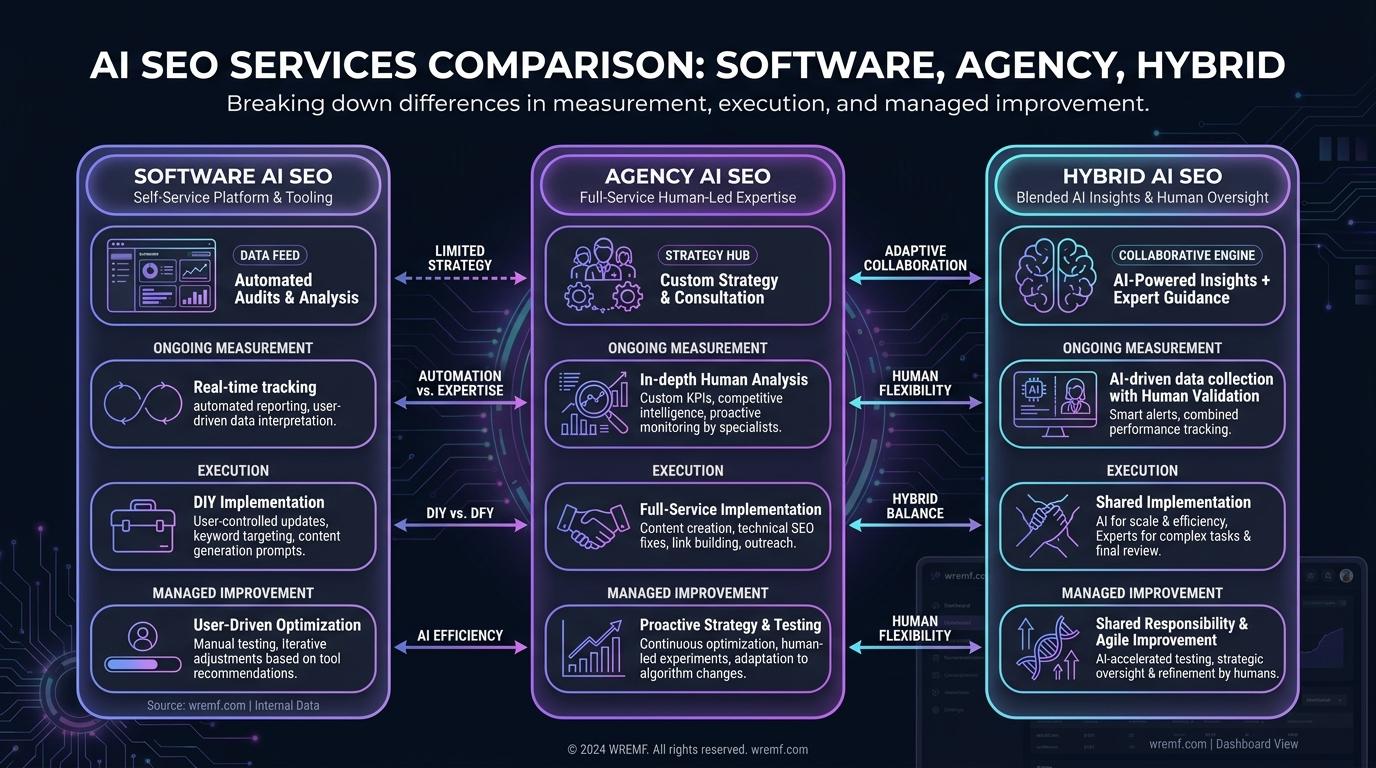
Software is best for teams that want ongoing measurement, an agency is best for teams that need execution, and a hybrid model is best for teams that need both visibility tracking and managed improvement. The right choice depends on capacity, speed, budget, and internal expertise.
AI SEO software helps teams monitor prompts, citations, competitors, AI platforms, content gaps, and reporting. Software matters because manual AI testing becomes inconsistent as prompt sets, search engines, AI platforms, and client portfolios expand.
An AI SEO agency helps teams define strategy, execute Content Optimization, fix technical issues, build authority, clean up source consistency, and report outcomes. An AI SEO agency matters when internal teams do not have enough time or specialized expertise.
A hybrid AI SEO model combines software and managed execution. A hybrid model matters because measurement alone does not improve visibility unless someone turns insights into technical fixes, content briefs, source consistency cleanup, and authority-building actions.
| Option | Best For | What It Measures | Execution Required | Main Limitation | Recommended When |
|---|---|---|---|---|---|
| Software | SEO teams, content teams, agencies | Prompts, AI citations, competitors, AI visibility | Internal team executes | Requires in-house capacity | You need scalable monitoring |
| Agency | Founders, lean teams, busy marketing teams | Depends on reporting setup | Agency executes | Less control if methodology is weak | You need strategy and delivery |
| Hybrid | B2B brands and agencies with growth goals | Full measurement plus execution tracking | Shared execution | Requires clear ownership | You need software plus done-for-you support |
WREMF supports all three models. Brands can use software to track AI visibility, agencies can use white-label reporting through WREMF for agencies, and teams that need execution can work with the WREMF agency team for managed AEO, GEO, and AI visibility services.
WREMF pricing is structured around websites rather than limiting prompt tracking. Starter is €39 per month for 1 website, Growth is €89 per month for 5 websites, and Enterprise supports unlimited websites, unlimited seats, dedicated support, and custom branded portals. The WREMF pricing page is useful when you need to compare software cost against agency retainers or internal build costs.
KEY TAKEAWAY: Choose software for measurement, agency services for execution, and a hybrid model when your team needs both AI visibility data and managed improvement.
The decision also depends on whether a traditional SEO agency can handle AI SEO.
Can a Traditional SEO Agency Handle AI SEO?
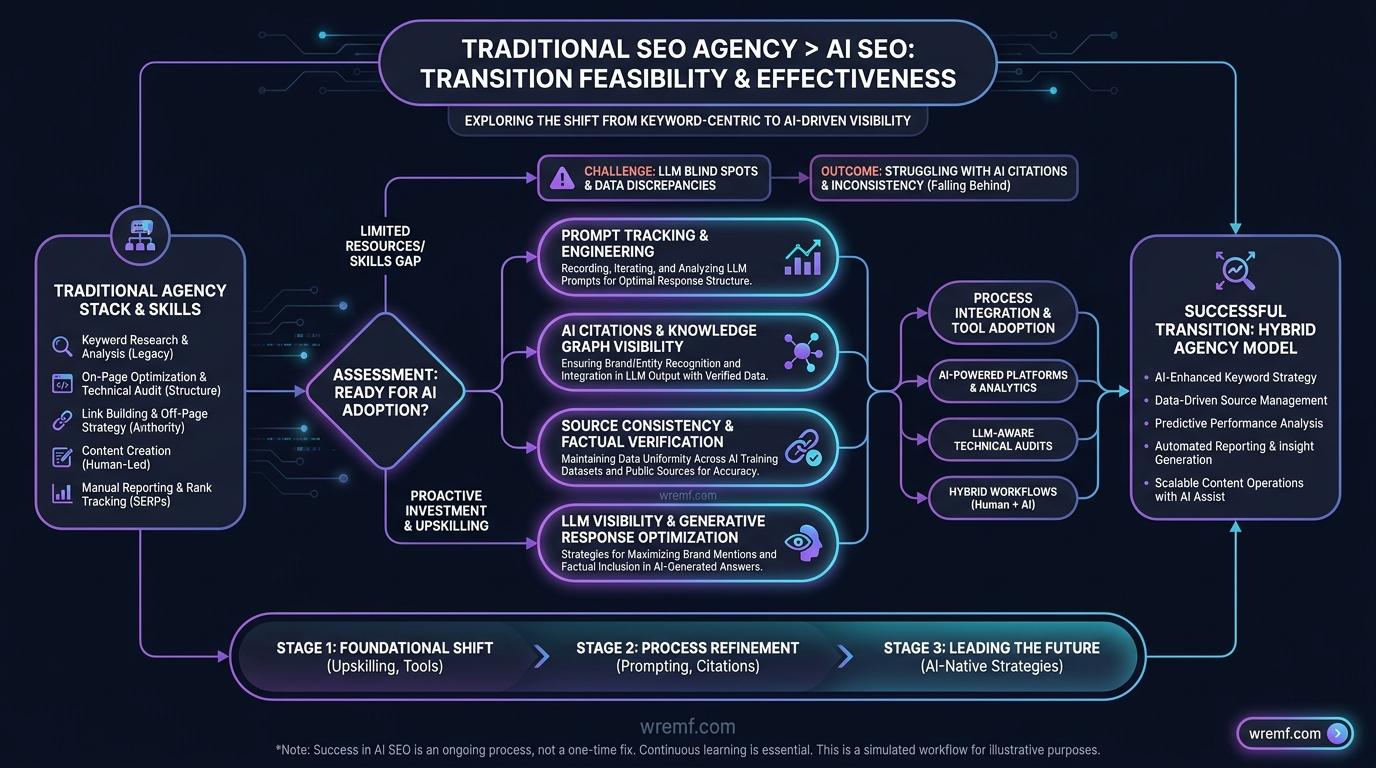
A traditional SEO agency can handle AI SEO if it understands prompt tracking, AI citations, source consistency, LLM visibility, AI platforms, and cross-platform measurement. Traditional SEO alone is not enough when the agency only reports rankings, backlinks, and organic traffic.
SEO principles still matter. Helpful content, technical accessibility, internal links, schema markup, organic search performance, Google Business Profiles, Google Ads alignment, and trusted sources remain important. The problem is that many traditional agencies stop measuring at the search engine results page.
AI SEO requires new questions:
Does the brand appear in AI-generated answers for buying prompts?
Which AI platforms mention the brand?
Which competitors appear more often?
Which sources are cited?
Are brand descriptions consistent across ChatGPT, Claude, Gemini, Perplexity, Copilot, AI Mode, and Google AI Overviews?
Does referral traffic from AI platforms appear in analytics?
Which prompts create positive, neutral, or negative sentiment?
Which content gaps prevent the brand from being cited?
Which technical SEO issues prevent AI agents or SEO crawlers from accessing key content?
Why do some traditional SEO agencies struggle with AI SEO? Traditional agencies struggle when they treat AI-driven search as another keyword ranking report. AI-generated answers depend on prompts, entities, source trust, citations, content structure, search behavior, and retrieval behavior that standard rank tracking does not fully capture.
When AI SEO is the smarter choice, the brand usually faces one of three problems: buyers are asking AI assistants for recommendations, competitors are appearing in AI-generated answers, or leadership wants proof that AI search is influencing demand. In those cases, AI SEO Services should become part of the growth plan.
For agencies, the practical opportunity is to add AI visibility tracking, AI citation analysis, Content Optimization, cross-platform reporting, and AI SEO strategy to existing SEO services. WREMF supports this with white-label reports, client portals, BYOK, and API workflows through the WREMF API and MCP integrations.
KEY TAKEAWAY: A traditional SEO agency can handle AI SEO only if it adds AI-specific measurement, citation tracking, prompt testing, and source ecosystem analysis.
The next section explains advanced technical and content strategies that separate generic AI SEO from serious implementation.
Advanced Strategies for AI Visibility, Citations, and Source Consistency
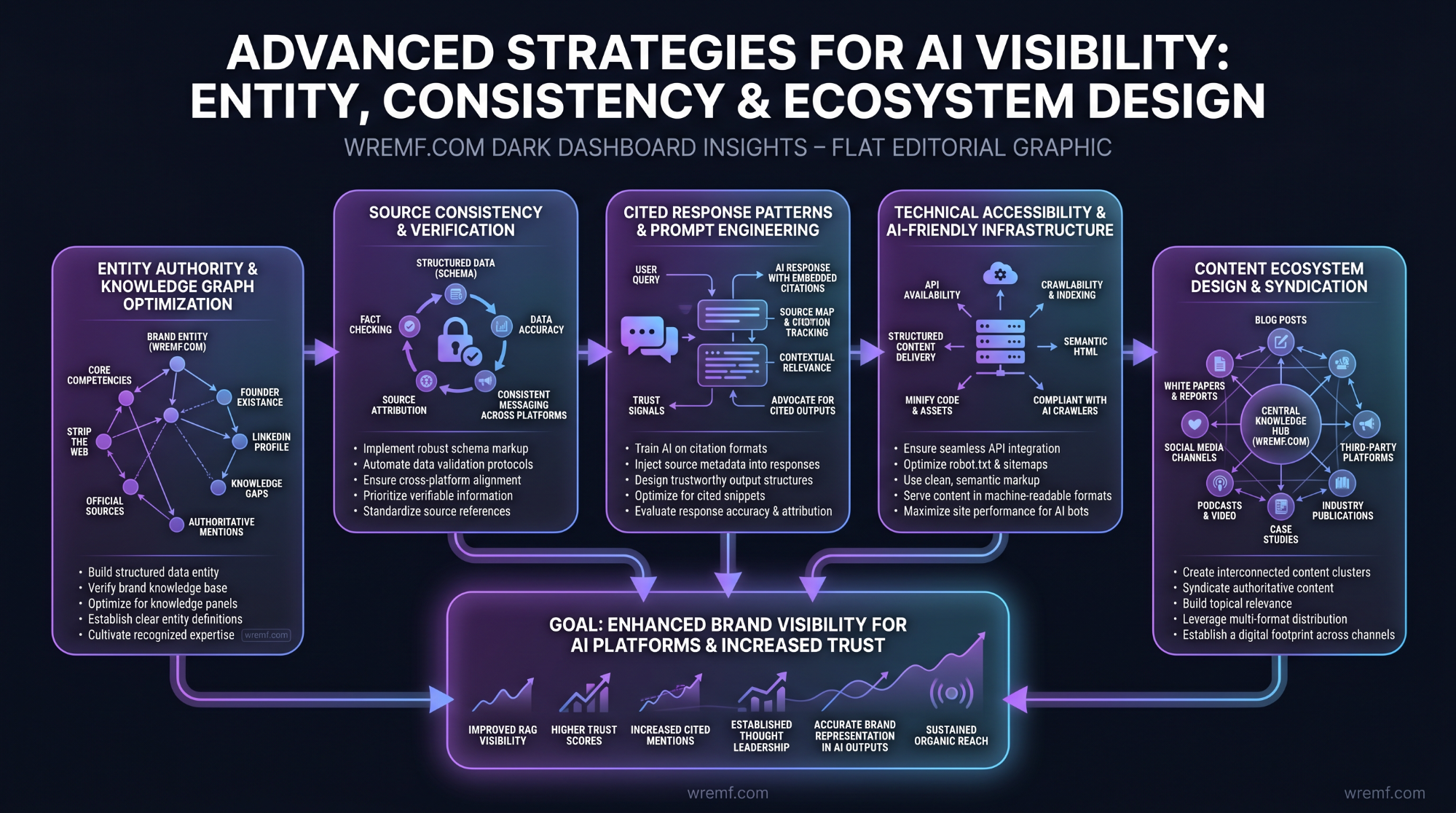
Advanced AI visibility strategy focuses on entity authority, source consistency, cited response patterns, technical accessibility, and content ecosystem design. The goal is to make your brand easier for AI platforms to understand, verify, cite, and recommend.
Entity recognition is the ability of search engines and AI systems to identify a brand, product, person, place, or concept as a distinct entity. Entity recognition matters because unclear entities can lead to weak AI-generated answers, confused competitors, or missing brand mentions.
Entity recognition scores are internal or platform-specific ways to assess how clearly a brand or topic is understood across sources. Entity recognition scores matter because stronger entity clarity can support better brand visibility in search engines and AI platforms.
Content ecosystem design is the process of building connected pages, sources, formats, and references around a topic. Content ecosystem design matters because AI search engines do not evaluate one page in isolation when they can retrieve and compare many sources.
Digital PR supports AI visibility when it helps a brand appear in trusted sources that AI platforms may cite. Digital PR matters because AI citations often come from third-party sources, not only owned websites.
AI citation improvement usually requires both owned content and external source work. Owned content should explain the brand clearly, answer buyer questions, and include structured content. External sources should reinforce accurate descriptions, categories, differentiators, leadership details, funding details, integrations, use cases, and pricing where appropriate.
Content creation for AI search must avoid thin automation. AI-generated content can help with drafts, outlines, and research organization, but human review is needed for accuracy, examples, source attribution, product truth, and E-E-A-T. An AI Detector or AI Humanizer cannot replace expertise, editing, fact-checking, or content quality.
Voice search and voice assistants also benefit from answer-first structure. Voice assistants often need concise answers, clear entities, and direct explanations. The same Q&A formats that help Answer Engine Optimization can also support voice search and AI assistant responses.
YouTube videos can support AI visibility when transcripts, titles, descriptions, and supporting pages reinforce the same entity and topic signals. YouTube videos should not replace written pages, but they can expand the content ecosystem and give AI platforms more source material.
KEY TAKEAWAY: Advanced AI visibility comes from entity clarity, source consistency, content ecosystem design, trusted sources, and technical accessibility, not keyword density alone.
The next section addresses the common myths that cause teams to delay or misjudge AI search optimization.
Common Myths About AI Visibility Debunked
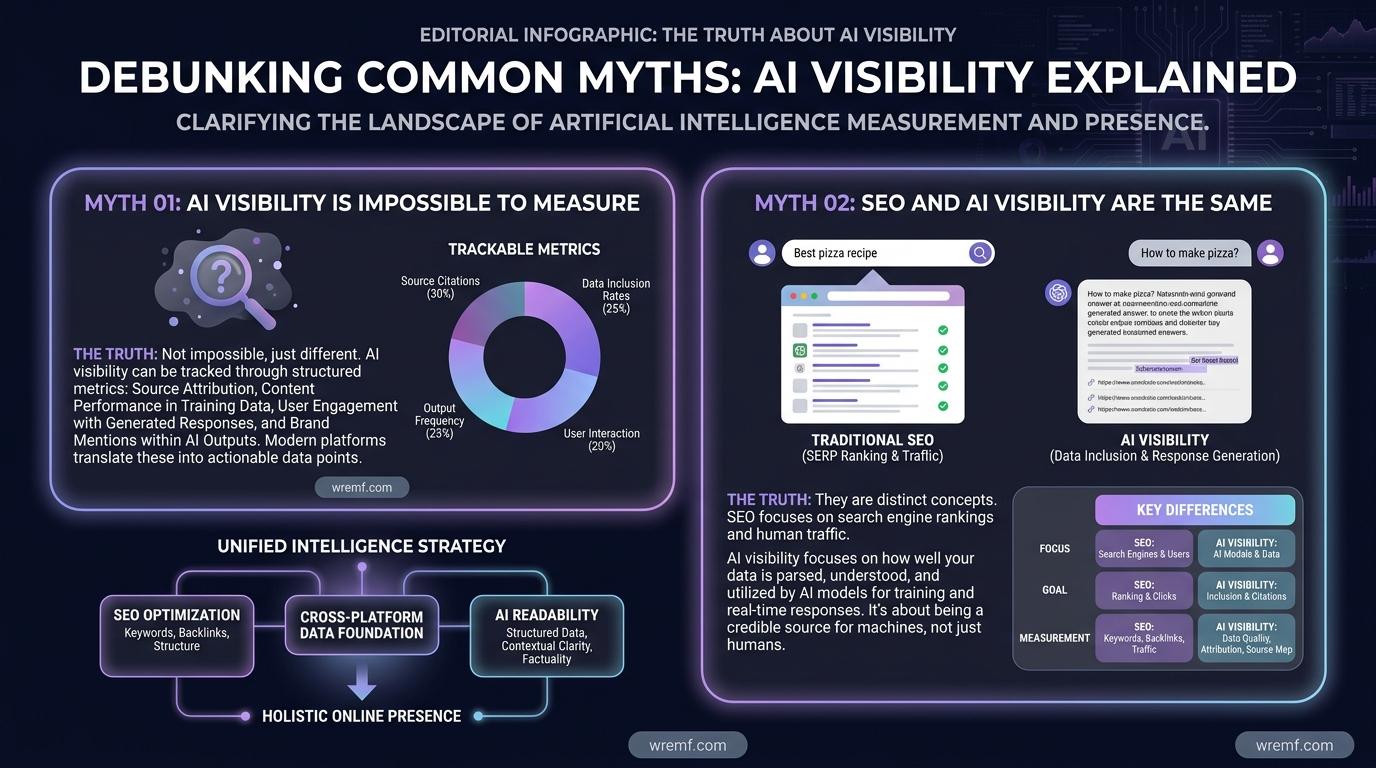
AI visibility is often misunderstood because it sits between SEO, content strategy, technical search, brand authority, and AI platform behavior. The biggest mistakes come from treating AI search as either pure hype or pure rank tracking.
MYTH: AI visibility is impossible to measure.
FACT: AI visibility is measurable when you track prompts, AI platforms, brand mentions, competitors, AI citations, source citations, sentiment, and referral traffic over time. Measurement is not perfect because some AI chats do not create clicks, but imperfect attribution is not the same as no measurement.
MYTH: SEO, Answer Engine Optimization, and Generative Engine Optimization are separate strategies.
FACT: SEO, Answer Engine Optimization, and Generative Engine Optimization overlap. SEO builds the technical and authority foundation, Answer Engine Optimization improves extractable answers, and Generative Engine Optimization improves how brands appear in AI-generated answers.
MYTH: Google rankings are enough.
FACT: Rankings are still important, but rankings alone do not show whether ChatGPT, Claude, Gemini, Perplexity AI, Copilot, AI Mode, or Google AI Overviews mention or cite your brand. AI search visibility adds a new measurement layer on top of organic search.
MYTH: AI SEO is just using AI tools to write more content.
FACT: AI SEO is not only Content creation. AI SEO includes prompt tracking, entity clarity, content quality, structured data, technical SEO, competitor analysis, source citations, brand citations, and cross-platform reporting.
MYTH: AI search optimization guarantees citations.
FACT: No responsible provider can guarantee AI citations, rankings, traffic, or revenue. AI search engine optimization services can improve the conditions that make citations and recommendations more likely, such as source quality, clarity, consistency, and retrievability.
KEY TAKEAWAY: AI visibility is measurable and actionable, but it requires different metrics from traditional ranking reports.
With the myths cleared up, the final decision is how to choose the right AI search engine optimization services partner.
How to Choose the Right AI Search Engine Optimization Services Partner
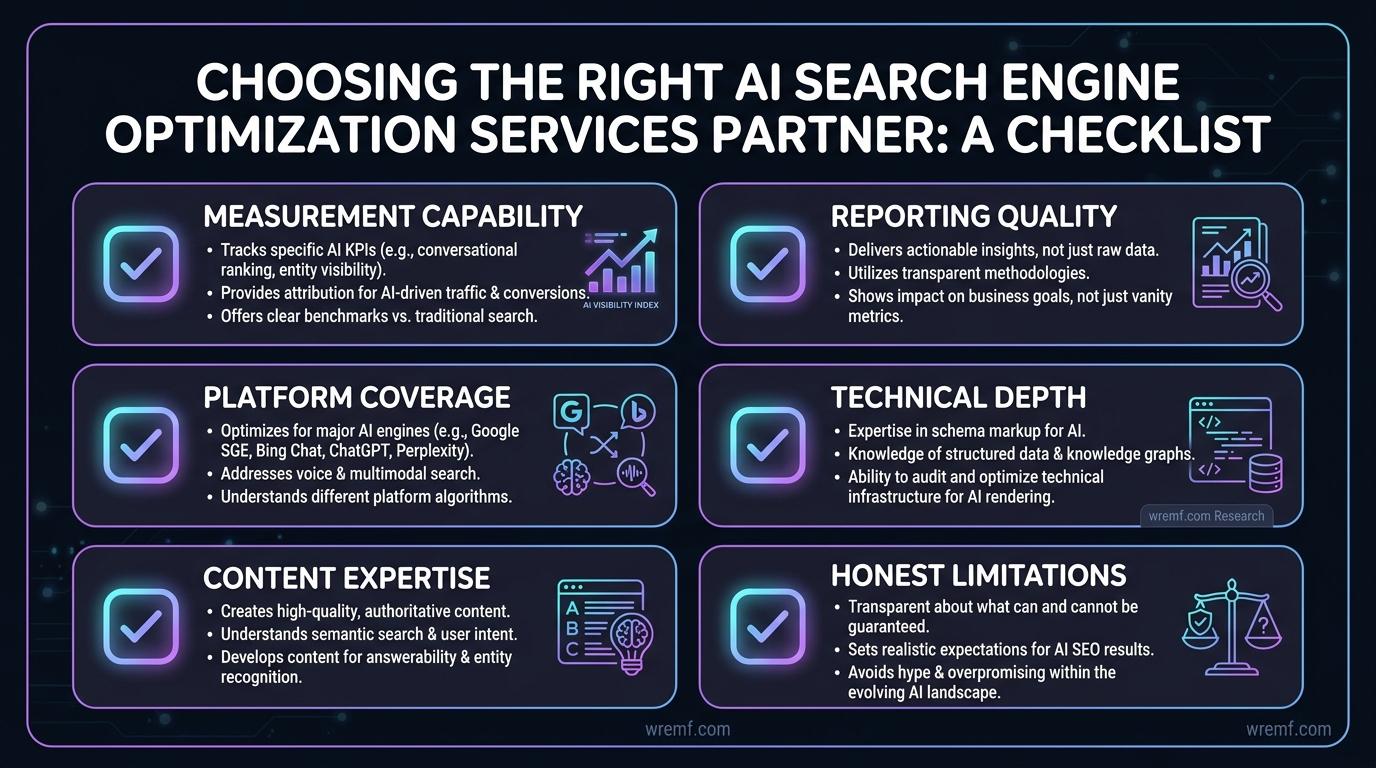
The right AI search engine optimization services partner should prove that it can measure, explain, and improve visibility across AI platforms. Look for methodology, reporting quality, platform coverage, technical depth, content expertise, and honest limitations.
Start with platform coverage. A provider should not measure only one AI platform if your buyers use several. For most B2B teams, useful coverage includes ChatGPT, Claude, Gemini, Perplexity AI, Google AI Overviews, Copilot, DeepSeek, Grok, Meta AI, Mistral, and AI Mode.
Next, review methodology. Ask how the provider builds prompt libraries, classifies user intent, tracks AI citations, monitors competitors, analyzes source consistency, and connects AI visibility to traffic. A strong provider should explain the difference between measurable facts, practical observations, and strategic recommendations.
Then evaluate reporting. A useful AI SEO report should show prompt-level visibility, brand mentions, AI citations, competitors, source gaps, content gaps, technical issues, and recommended actions. It should not only show screenshots without trend data.
Finally, assess execution. If you only need monitoring, software may be enough. If you need content updates, technical fixes, entity cleanup, internal linking, schema markup guidance, digital PR, and monthly execution, you need agency support or a hybrid model.
| Selection Criterion | Good Sign | Warning Sign |
|---|---|---|
| Platform coverage | Tracks multiple AI platforms | Tracks only one chatbot manually |
| Methodology | Explains prompts, citations, competitors, and attribution | Uses vague “AI ranking” language |
| Reporting | Shows changes, causes, and recommendations | Shows screenshots without trend data |
| Content strategy | Builds answer-first, source-backed content | Produces generic AI-generated content |
| Technical depth | Checks crawl, render, indexation, structured data, and internal linking | Ignores technical SEO |
| Agency support | Clear deliverables and senior-led execution | Guarantees rankings or citations |
| Pricing | Transparent scope and reporting | Unclear retainers and no measurable baseline |
For B2B brands, the most common best fit is a hybrid model: use software for ongoing AI visibility tracking and agency execution for strategy, content, and technical improvements. WREMF is built for that model, with software for monitoring and optional agency support for teams that want implementation help.
KEY TAKEAWAY: Choose an AI SEO partner based on measurement quality, platform coverage, methodology, execution capability, and honest reporting rather than broad claims about AI search dominance.
The same evaluation logic applies to the common questions buyers ask before investing.
Frequently Asked Questions
What are AI search engine optimization services?
AI search engine optimization services help brands improve visibility across AI search engines, answer engines, and AI-generated answers. These services usually include AI visibility audits, prompt tracking, AI citation analysis, Content Optimization, technical SEO, structured content, competitor analysis, source consistency, and reporting. The goal is not only to rank in Google Search, but also to appear accurately in ChatGPT, Perplexity AI, Gemini, Claude, Copilot, Google AI Overviews, AI Mode, and other AI platforms.
What is AI SEO or Generative Engine Optimization?
AI SEO is the practice of improving how a brand appears across AI-powered search experiences, AI-generated answers, and traditional search engines. Generative Engine Optimization is a related discipline focused on visibility inside generative AI responses. Both rely on SEO principles, Answer Engine Optimization, structured content, source citations, entity clarity, and trusted sources. The practical goal is to make your brand easier for AI platforms to understand, verify, cite, and recommend.
What is the difference between AI SEO and traditional search engine optimization?
Traditional search engine optimization focuses on rankings, organic traffic, technical SEO, backlinks, content relevance, and search engine results pages. AI SEO adds prompt tracking, brand mentions, AI citations, source citations, share of voice, sentiment, and cross-platform AI visibility. AI SEO still depends on SEO principles, but it measures how brands appear inside AI-generated answers rather than only how pages rank in search engines.
Are AI SEO Services worth it for B2B companies?
AI SEO Services are worth considering when your buyers use AI assistants for research, vendor comparisons, product discovery, or category education. B2B companies benefit most when they have high-consideration products, competitive markets, complex buying journeys, or strong content teams that need better measurement. AI SEO is not a replacement for SEO, but it can reveal visibility gaps that rankings and organic traffic reports do not show.
Can my regular SEO agency handle AI SEO?
Your regular SEO agency can handle AI SEO if it can measure prompts, citations, competitors, AI platforms, source consistency, and AI traffic attribution. If the agency only reports rankings, backlinks, organic traffic, and basic Content Optimization, it may not be enough. AI search engine optimization services require additional workflows for ChatGPT search, Google AI Overviews, Perplexity AI, Claude, Gemini, Copilot, AI Mode, and other AI discovery surfaces.
How do you measure AI visibility?
AI visibility is measured by tracking brand mentions, prompt coverage, AI citations, source citations, competitor visibility, share of voice, sentiment, and referral traffic from AI platforms. A strong measurement system tests realistic prompts across multiple AI platforms over time. WREMF helps teams measure AI visibility by connecting prompt intelligence, source citation tracking, competitor visibility, AI visibility scoring, and reporting in one workflow.
Will optimizing for AI search engines also help Google rankings?
Optimizing for AI search engines can support Google rankings when the work improves helpful content, technical SEO, structured data, internal linking, content quality, and source trust. However, AI visibility and Google rankings are not identical. Google rankings measure organic search performance, while AI visibility measures appearances, citations, and recommendations across AI-generated answers. The best approach is to improve both together.
What strategies do AI SEO agencies use differently?
AI SEO agencies use prompt mapping, AI citation tracking, entity recognition, source consistency cleanup, answer-first content, structured content, technical crawl checks, and competitor monitoring across AI platforms. Traditional agencies often focus on keywords and rankings, while AI SEO agencies also analyze how AI-generated answers describe a brand. WREMF’s agency services support this work through AI visibility strategy, GEO audits, content briefs, technical guidance, and monthly reporting.
How much do AI SEO Services cost?
AI SEO Services can vary widely depending on whether you buy software, consulting, managed execution, or a hybrid model. Software is usually more predictable, while agency services depend on scope, content volume, technical complexity, and reporting needs. WREMF’s software pricing starts at €39 per month for Starter and €89 per month for Growth, while Enterprise and managed agency support depend on scale, websites, seats, and execution requirements.
How do I start optimizing my website for ChatGPT and Perplexity?
Start by testing realistic prompts in ChatGPT search and Perplexity AI, then record whether your brand appears, which competitors appear, and which sources are cited. Next, improve answer-first content, structured content, source-backed claims, internal links, schema markup, and technical accessibility. Finally, monitor results over time instead of relying on one manual check. WREMF can help automate prompt tracking and citation analysis across multiple AI platforms.
Is Generative Engine Optimization replacing SEO?
Generative Engine Optimization is not replacing SEO. Generative Engine Optimization extends SEO into AI-generated answers, conversational search, source citations, and AI recommendations. SEO still matters because AI platforms and search engines rely on accessible, useful, trusted, and well-structured content. The practical future is combined SEO, Answer Engine Optimization, Generative Engine Optimization, and Large Language Model Optimization rather than one discipline replacing the others.
What happens if a company ignores AI search visibility?
A company that ignores AI search visibility may lose early-stage awareness, vendor consideration, and category authority inside AI-generated answers. The risk is not only lost referral traffic. The larger risk is that competitors, outdated sources, or third-party pages define the brand for buyers. AI visibility monitoring helps teams find these gaps before they become harder to correct.
Conclusion
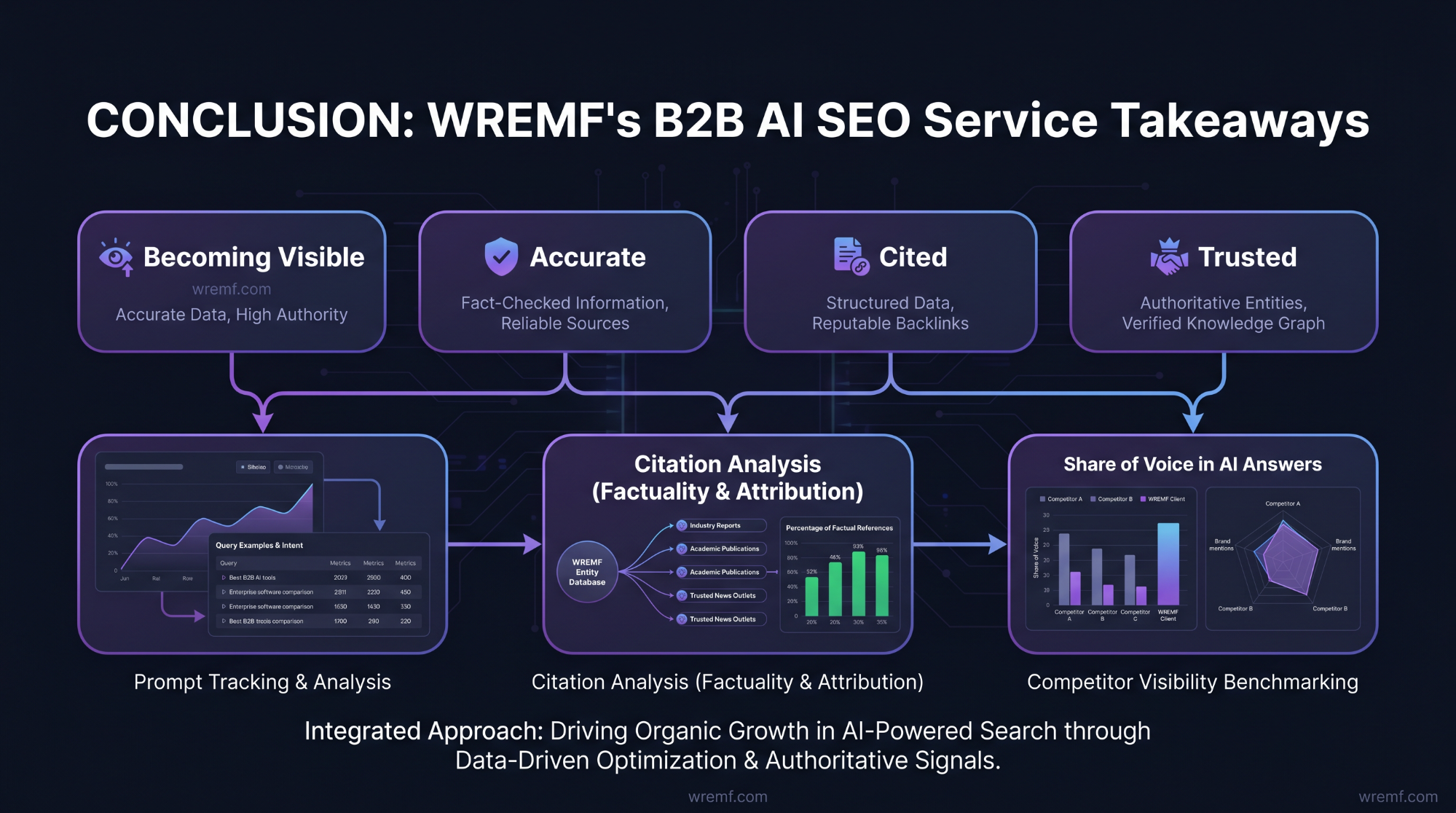
AI search engine optimization services help B2B brands compete in a search landscape shaped by Google AI Overviews, AI Mode, ChatGPT search, Perplexity AI, Gemini, Claude, Copilot, and other AI platforms. The core task is not chasing a single ranking. The core task is becoming visible, accurate, cited, and trusted across AI-generated answers and traditional search. WREMF helps teams turn that challenge into a measurable workflow through prompt tracking, citation analysis, competitor visibility, GEO audits, reporting, and optional managed execution. To start building measurable AI visibility, explore the WREMF platform suite or talk to the WREMF agency team.
Related Generative Engine Optimization Guides
- LLM SEO Services The Complete 2026 Guide to AI Search Visibility, AEO, GEO, and LLM Optimization
- LLM SEO Agency The Complete Guide to Choosing an Agency for AI Search Visibility
- AI SEO Services The Complete Guide to Search Visibility in the AI Era
- Answer Engine Optimization Services The Complete Guide to AI Search Visibility
- Large Language Model Optimization Services The Complete Guide to LLMO, AI Search Visibility, AEO, GEO, RAG, and LLM Performance
- Generative AI Optimization Services The Complete Guide to GEO, AEO, LLM Optimization, and AI Visibility
- AI SEO Agency How to Choose the Right Partner for AI Search Visibility
- AI Search Engine Optimization The Complete Guide for B2B Brands
- Answer Engine Optimization The Complete Guide to AEO, AI Search Visibility, and Answer-First Content
- AI Mention Tracking The Complete Guide to Monitoring Brand Mentions, AI Answers, Citations, and Share of Voice in 2026
- How AI Search Optimization Tools Increase Organic Traffic
- AI Overview SEO How to Optimize for Google AI Overviews, AI Mode, and AI Search Visibility
- AI Search Engine Optimization Tools The Complete 2026 Guide for AI Search, SEO, AEO, and GEO
- AI Brand Monitoring The Complete Guide to Tracking Brand Visibility Across AI Search, LLMs, and Generative Engines
- AI SEO Tools The Complete Guide for SEO, AEO, GEO, and AI Search Visibility
- 12 Best AI Search Optimization Tools
- How Do AI Search Optimization Tools Improve SERP Rankings
- Enterprise Answer Engine Optimization Platforms Complete Guide for AI Visibility, AEO, and GEO
- AI Overview Optimization How to Rank, Get Cited, and Stay Visible in Google AI Search
- Best Answer Engine Optimization for Enhancing AI Visibility
Related reading
- Generative AI Optimization Services: The Complete Guide to GEO, AEO, LLM Optimization, and AI Visibility
- Large Language Model Optimization Services: The Complete Guide to LLMO, AI Search Visibility, AEO, GEO, RAG, and LLM Performance
- LLM SEO Services: The Complete 2026 Guide to AI Search Visibility, AEO, GEO, and LLM Optimization
- AI Visibility Services: The Complete Guide to Tracking, Improving, and Proving Brand Visibility in AI Search