Answer Engine Optimization Services: The Complete Guide to AI Search Visibility
Learn what answer engine optimization services include, how AEO differs from SEO and GEO, and how to improve AI visibility across ChatGPT and Perplexity.
By WREMF Team · 2026-05-09
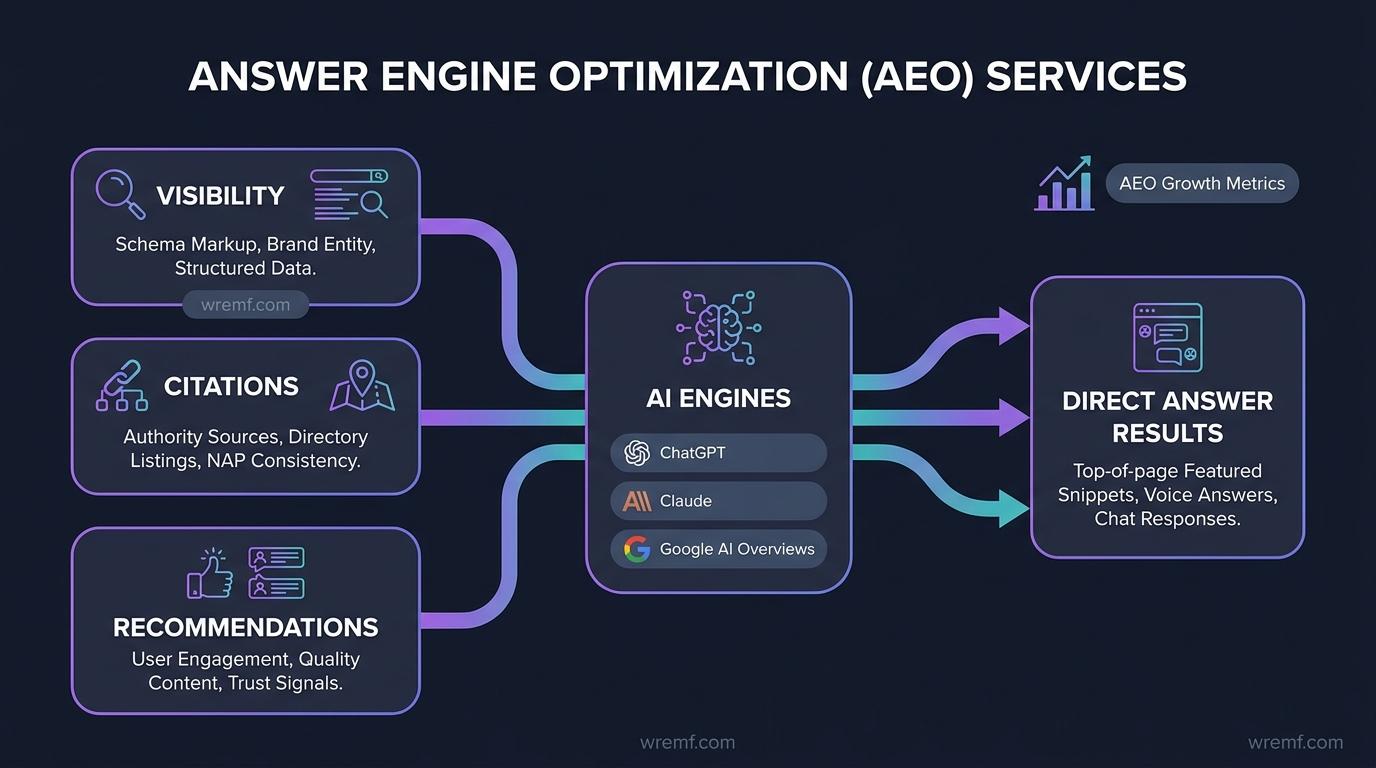
Answer engine optimization services help businesses appear in AI-generated answers, citations, summaries, and recommendations instead of only competing for search result rankings. AEO connects content strategy, technical SEO, structured data, citation building, and AI visibility measurement. Services typically include AI visibility audits, prompt tracking, content optimization, structured data implementation, citation analysis, authority signal building, competitor monitoring, and reporting. AEO differs from SEO because it optimizes for direct answers and AI citations rather than search engine rankings. It differs from generative engine optimization in that AEO focuses on answer inclusion while GEO targets broader generative retrieval and recommendation. Effective AEO requires mapping buyer prompts, testing AI visibility, identifying citation gaps, improving content structure, strengthening source trust, and measuring changes over time across platforms like ChatGPT, Perplexity, Google AI Overviews, Gemini, and Microsoft Copilot.
Key takeaways
- Answer engine optimization services help brands become discoverable inside direct AI answers, not just visible in traditional search results.
- SEO, AEO, and GEO work best together because AI visibility depends on rankings, retrieval, citations, and source trust.
- Answer engine optimization services should combine audit, measurement, content, technical, citation, and reporting workflows.
- AEO works best when teams start with prompts and evidence before changing content or chasing citations.
- AI-ready content uses direct answers, structured explanations, and evidence-led formatting so answer engines can retrieve and cite it accurately.
- AI citations and authority signals help answer engines decide which brands and sources are trustworthy enough to cite or recommend.
Answer Engine Optimization Services: The Complete Guide to AI Search Visibility
Answer engine optimization services help brands become visible, cited, and recommended inside AI-generated answers across search engines, answer engines, and AI platforms. Gartner predicted that traditional search engine volume would drop 25% by 2026 as AI chatbots and virtual agents gain adoption, which makes AEO a practical visibility priority rather than a trend to monitor later. (Gartner) WREMF helps B2B teams track, improve, and prove AI visibility across ChatGPT, Claude, Gemini, Perplexity, Google AI Overviews, Microsoft Copilot, DeepSeek, Grok, Meta AI, and Mistral. This guide explains what answer engine optimization is, how it differs from SEO and generative engine optimization, what services include, how to measure results, and when to use software, an agency, or a hybrid model.
What Are Answer Engine Optimization Services?
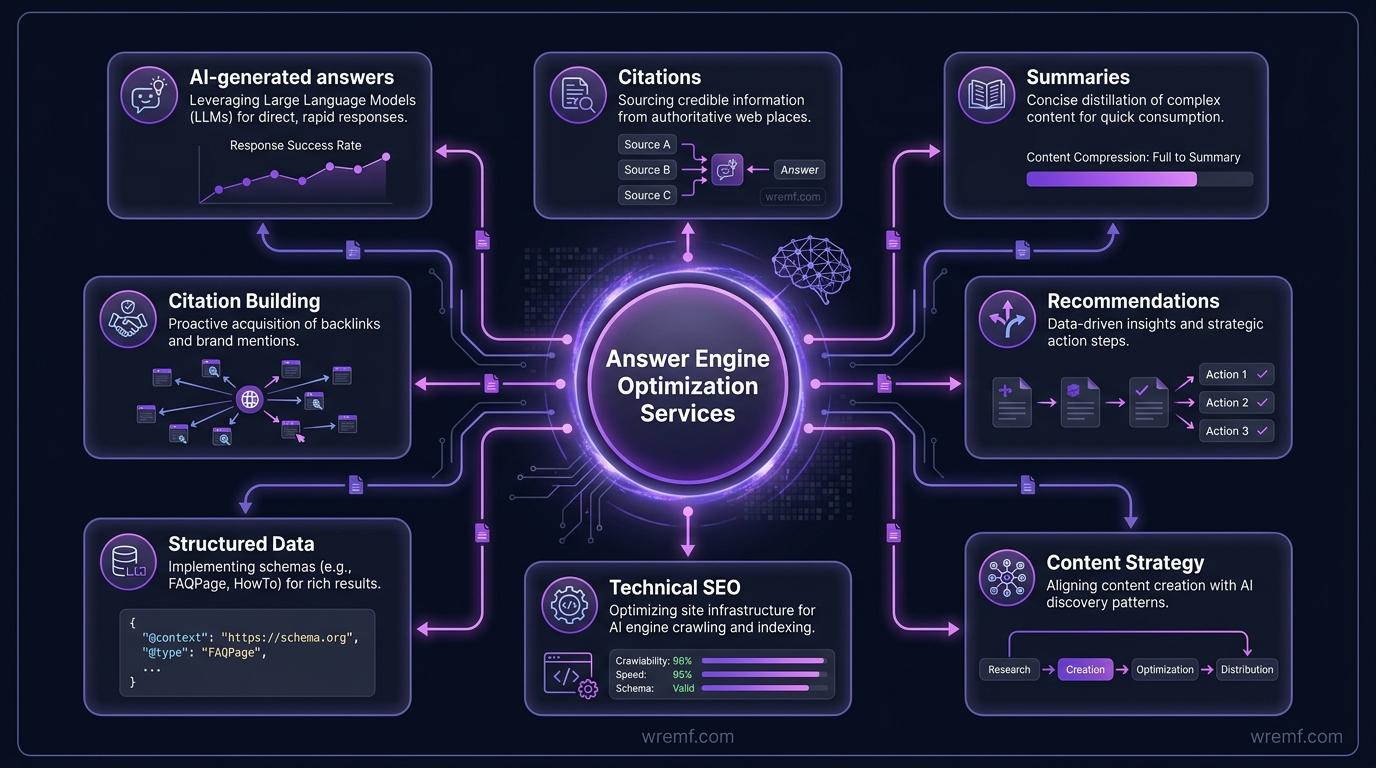
Answer engine optimization services help businesses appear in AI-generated answers, citations, summaries, and recommendations instead of only competing for search results rankings. Answer engine optimization connects content strategy, technical SEO, structured data, citation building, and AI visibility measurement.
Answer engine optimization is the practice of making a brand easier for answer engines and AI systems to understand, retrieve, cite, and recommend. Answer engine optimization matters because users increasingly ask complete questions inside AI platforms instead of scanning multiple search engine result pages.
An Answer Engine Optimization Service usually includes strategy, content optimization, technical SEO, schema markup, prompt tracking, source analysis, AI citations, competitor monitoring, and reporting. The service should help your website become a clearer source for AI-generated answers and a stronger candidate for AI search visibility.
Answer engines are systems that generate direct answers instead of only showing ranked links. Answer engines include AI-powered answer engines such as ChatGPT search, Perplexity AI, Google AI Overviews, Google Gemini, Microsoft Copilot, and Claude with web search. OpenAI explains that ChatGPT search can provide fast answers with links to relevant web sources, which shows why cited source visibility has become a measurable marketing concern. (OpenAI)
AI visibility is the measurable presence of a brand inside AI-generated answers, citations, comparisons, recommendations, and summaries. AI visibility matters because a buyer may form an opinion about your company before visiting your website, filling out a form, or speaking with sales.
WREMF helps teams turn answer engine optimization from manual testing into a measurable workflow through the WREMF platform suite, which combines prompt tracking, source citation tracking, competitor visibility, AI share of voice, and action recommendations.
DID YOU KNOW: G2 reported in its 2025 Buyer Behavior research that AI chatbots became the top source influencing vendor shortlists, based on survey data from more than 1,900 B2B software buyers. (research.g2.com)
KEY TAKEAWAY: Answer engine optimization services help brands become discoverable inside direct AI answers, not just visible in traditional search results.
To choose the right AEO strategy, you first need to understand how answer engine optimization differs from SEO and GEO.
How Is Answer Engine Optimization Different From SEO and GEO?
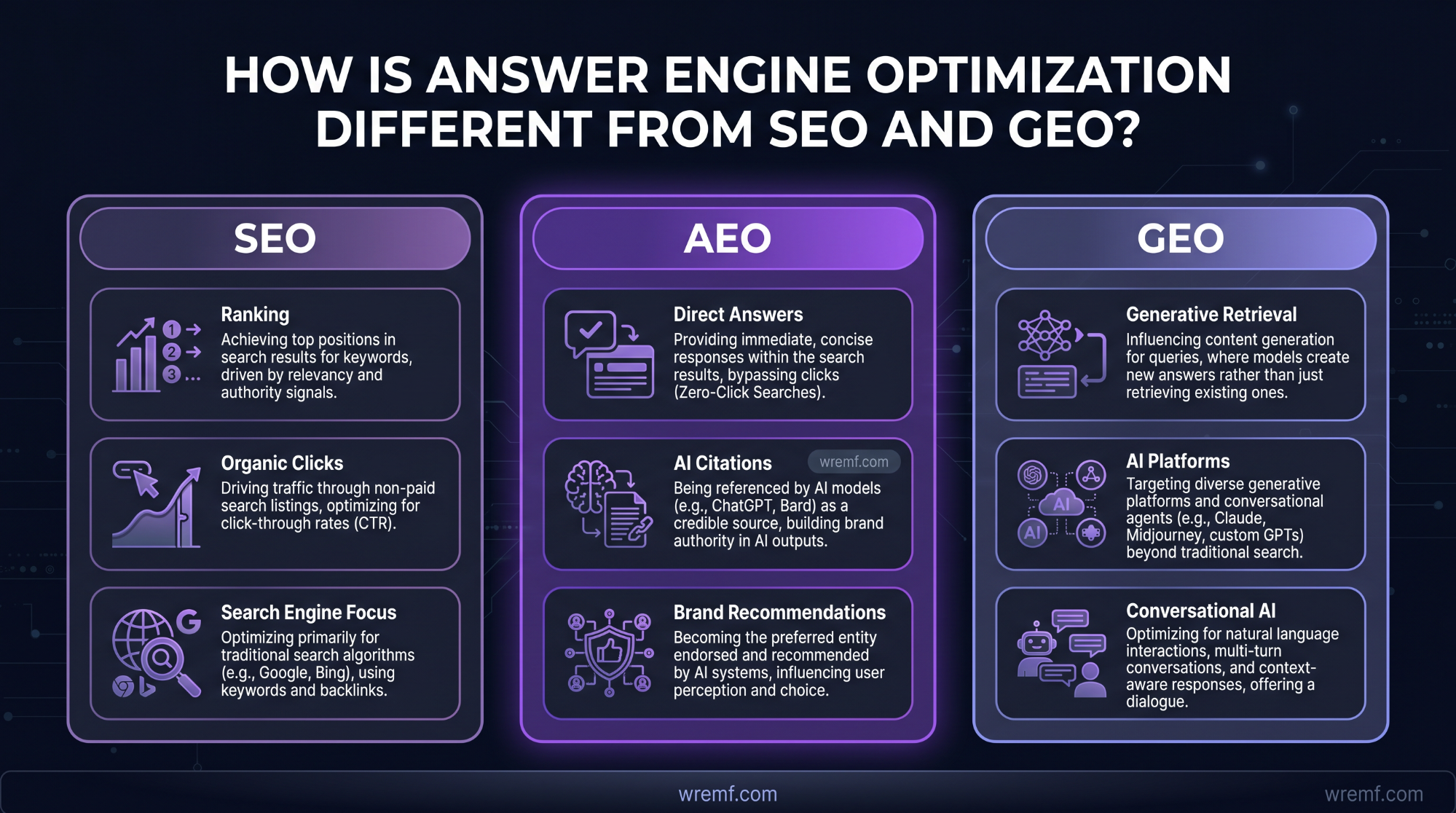
Answer engine optimization differs from SEO because AEO optimizes for direct answers, AI citations, and brand recommendations, while SEO optimizes mainly for search engine rankings and organic clicks. Generative engine optimization expands that work into AI-generated search and conversational AI platforms.
Search engine optimization is the practice of improving website visibility in traditional search engine results. Search engine optimization matters because Google, Bing, and other search engines still provide crawl, indexing, ranking, and traffic foundations for digital discovery.
Generative engine optimization is the practice of improving visibility inside AI-generated answers produced by Large Language Models and AI search systems. Generative engine optimization matters because AI platforms synthesize information from multiple sources and may recommend brands without using classic ranking pages.
AEO, SEO, and generative engine optimization should not be treated as separate silos. In real B2B buying journeys, a buyer may ask ChatGPT for vendor recommendations, verify a source through Google, compare alternatives in Perplexity, and then visit a pricing page. That journey requires search visibility, answer visibility, citation trust, and brand consistency.
| Comparison Area | SEO | AEO | GEO |
|---|---|---|---|
| Main goal | Rank in search results | Become the direct answer | Become retrievable in AI-generated experiences |
| Main surface | Search engine result pages | Answer engines and AI search modes | AI platforms and Large Language Models |
| Example platforms | Google Search, Bing | Google AI Overviews, Perplexity, ChatGPT search | ChatGPT, Claude, Gemini, Copilot, Mistral |
| Core metric | Rankings, clicks, impressions | AI citations, answer inclusion, featured snippet presence | AI visibility, recommendation visibility, share of voice |
| Content focus | Keywords, links, relevance | Answer-first content and structured answers | Entity clarity, source consistency, retrieval quality |
| Technical focus | Crawlability and indexing | Structured data and extractability | AI retrieval, source validation, crawler requirements |
| Main limitation | Rankings do not guarantee AI citations | Answers may not produce clicks | Attribution can be incomplete |
| Best use case | Capturing search demand | Winning direct answers | Influencing AI-mediated research |
The key difference between SEO and GEO is that SEO targets search engine ranking systems, while GEO targets AI systems that generate answers from retrieved sources. The key difference between AEO and GEO is that AEO focuses on answer inclusion, while GEO focuses more broadly on generative retrieval, recommendation, and source synthesis.
Google Search Central explains that site owners should continue creating helpful, reliable, people-first content for Search, including AI features. That guidance reinforces the overlap between SEO foundations and AI search optimization, but it does not mean rankings alone are enough. (Google for Developers)
For B2B SaaS teams, the practical decision is simple. SEO helps you get discovered in search results. Answer engine optimization helps you become part of AI-generated answers. Generative engine optimization helps your brand become understandable, retrievable, and recommendable across AI systems.
KEY TAKEAWAY: SEO, AEO, and GEO work best together because AI visibility depends on rankings, retrieval, citations, and source trust.
Once the differences are clear, the next step is understanding what answer engine optimization services actually include.
What Do Answer Engine Optimization Services Include?
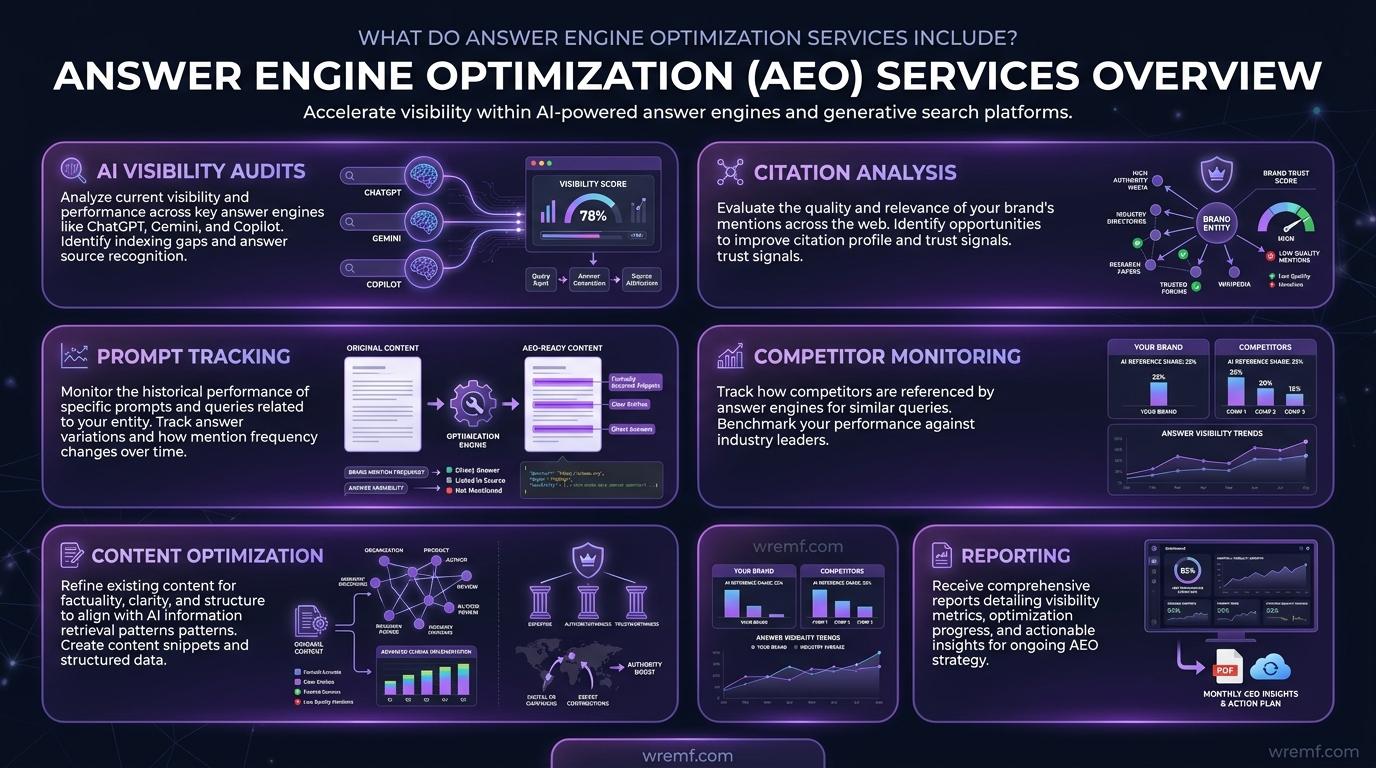
Answer engine optimization services usually include AI visibility audits, prompt tracking, content optimization, structured data, citation analysis, authority signals, competitor monitoring, and reporting. A strong service connects strategy with measurable AI search visibility outcomes.
AI visibility audits are structured reviews of how a brand appears across AI-generated answers, citations, and recommendations. AI visibility audits matter because they reveal what AI systems already know, misunderstand, ignore, or cite about your brand.
LLM visibility audits are similar but focus specifically on Large Language Models such as ChatGPT, Claude, Gemini, Mistral, and Meta AI. LLM visibility audits matter because each model may retrieve different sources, summarize your brand differently, and recommend different competitors.
A complete Answer Engine Optimization Service should include these service areas:
| Service Area | What It Does | Why It Matters |
|---|---|---|
| AI visibility audit | Tests prompts across AI engines | Shows where your brand appears or is missing |
| Prompt tracking | Monitors real user queries | Reveals visibility by question, topic, and intent |
| Citation analysis | Reviews cited sources | Shows which sources AI systems trust |
| Content optimization | Improves answer-first structure | Helps AI-generated answers extract clear claims |
| Technical SEO | Improves crawl and retrieval access | Prevents visibility loss from technical barriers |
| Structured data | Clarifies entities and relationships | Helps search systems understand your website |
| Schema markup | Adds machine-readable meaning | Supports eligible search features and entity clarity |
| Digital PR | Builds trusted third-party mentions | Improves authority signals and citation building |
| Competitive tracking | Compares brand visibility | Shows who AI platforms recommend instead |
| Reporting | Connects visibility to action | Helps teams prove progress and prioritize work |
Prompt tracking is the process of monitoring how a brand appears across repeated user queries in AI platforms. Prompt tracking matters because a company can be visible for one prompt and absent for another prompt that has stronger buying intent.
Citation analysis is the process of identifying which sources AI systems cite when answering user queries. Citation analysis matters because AI citations reveal the sources that influence AI-generated answers and brand recommendations.
Source types matter because AI systems may rely on your own website, review sites, directories, documentation, news coverage, community posts, comparison pages, and trusted third-party citations. Content types matter because product pages, guides, FAQs, documentation, case studies, glossary pages, and comparison pages can each support different user intent.
WREMF supports these workflows through Prompt Intelligence, Source Citations, and Competitive Landscape, giving teams a practical way to monitor AI search optimization instead of relying on one-off manual tests.
KEY TAKEAWAY: Answer engine optimization services should combine audit, measurement, content, technical, citation, and reporting workflows.
The strongest AEO programs then turn those service areas into a repeatable implementation process.
How Do You Actually Do Answer Engine Optimization?
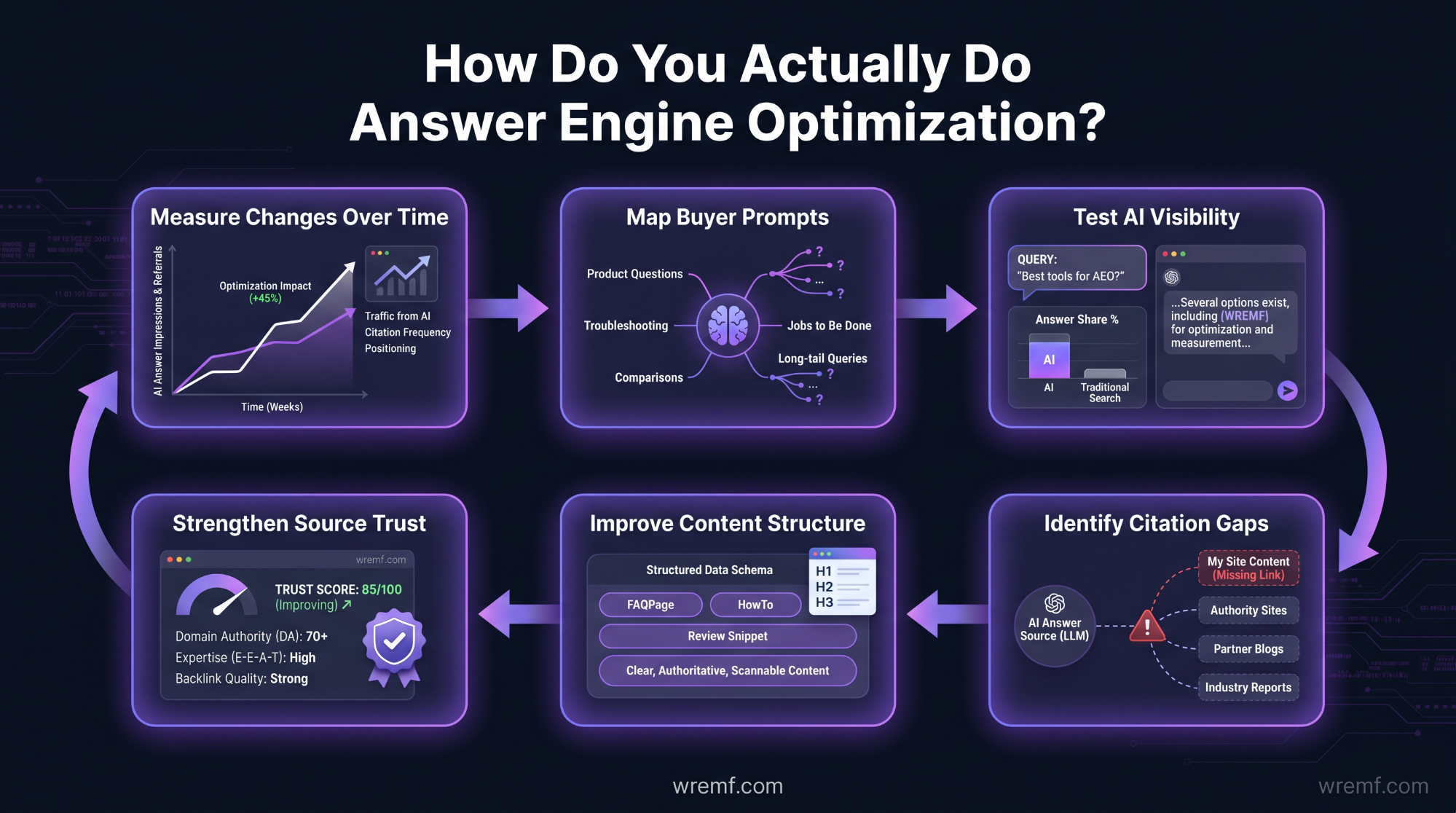
The most effective way to do answer engine optimization is to map buyer prompts, test AI visibility, identify citation gaps, improve content structure, strengthen source trust, and measure changes over time. AEO is a workflow, not a one-time content edit.
A practical answer engine optimization workflow usually starts with user queries. These are the questions real buyers ask inside AI assistants, voice assistants, Google AI Overviews, Perplexity, ChatGPT, Gemini, and Microsoft Copilot.
Search queries and AI prompts are different. Search queries are often short, such as “best CRM for startups.” AI prompts are longer and more specific, such as “What CRM should a 20-person B2B SaaS startup use if it needs HubSpot integration and simple reporting?”
Use this implementation sequence:
| Step | Action | Output |
|---|---|---|
| 1 | Define audience and buying intent | Prompt map |
| 2 | Test current AI visibility | Baseline report |
| 3 | Identify cited sources | Source influence map |
| 4 | Compare competitors | AI share of voice benchmark |
| 5 | Audit content structure | Retrieval improvement plan |
| 6 | Add structured data and schema markup | Stronger entity clarity |
| 7 | Improve citations and authority signals | Better source ecosystem |
| 8 | Track changes monthly | Proof of progress |
User intent is the goal behind a query or prompt. User intent matters because AI systems prioritize answers that match the specific task, not just pages that repeat matching keywords.
Content structure is the way information is organized on a page through headings, answer blocks, definitions, lists, tables, and internal links. Content structure matters because AI systems need extractable, well-organized information to produce accurate summaries.
A common implementation mistake is starting with content creation before measuring current AI visibility. Without a baseline, teams do not know whether the issue is content quality, technical SEO, source authority, missing citations, or weak brand visibility.
In practical AI visibility audits, teams often find three problems:
AI systems describe the company using outdated business information.
AI-generated answers mention competitors but not the brand.
AI citations come from third-party sources that do not explain the brand accurately.
The WREMF methodology connects prompts, citations, competitors, source consistency, and attribution into one repeatable system. Teams can review the WREMF methodology to understand how AI visibility scoring can be connected to practical optimization work.
KEY TAKEAWAY: AEO works best when teams start with prompts and evidence before changing content or chasing citations.
The next layer is content optimization, where many AEO gains become visible.
How Should Content Be Optimized for AI-Generated Answers?
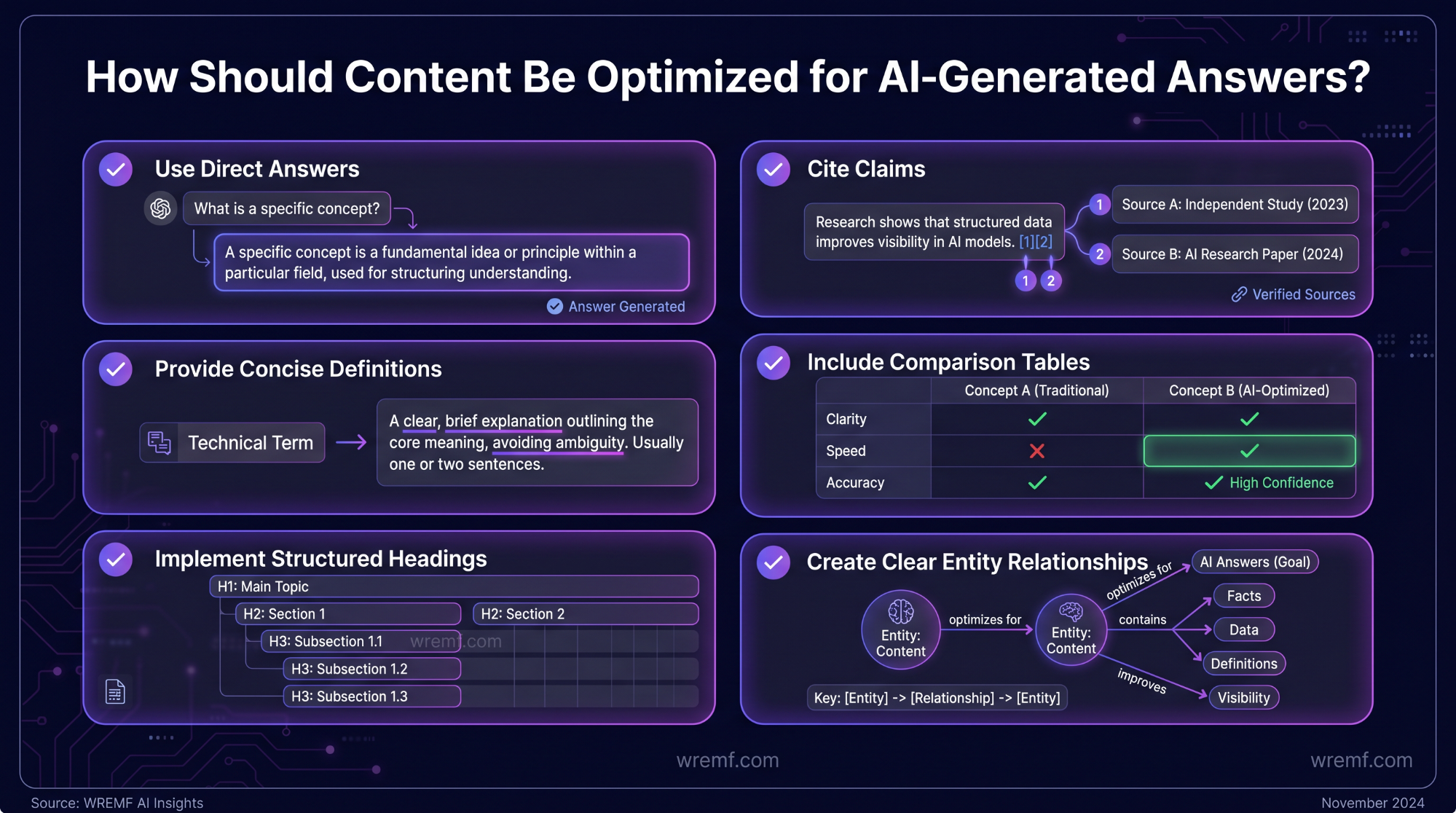
Content should be optimized for AI-generated answers by using direct answers, concise definitions, structured headings, cited claims, comparison tables, and clear entity relationships. AI systems prefer content that is easy to retrieve, verify, summarize, and cite.
AI-generated answers are synthesized responses created by AI systems from model knowledge, retrieved sources, or a mix of both. AI-generated answers matter because users may treat the generated answer as the primary result instead of clicking through multiple websites.
Content optimization for AEO should not mean stuffing keywords into pages. It should mean making the page more useful, more structured, more factual, and easier for answer engines to parse.
Strong AI-ready content usually includes:
a direct answer near the top of each section
a concise definition for each major concept
comparison tables for decision queries
FAQ answers that stand alone
internal links to related topical pages
source attribution close to factual claims
consistent brand and product language
structured data where relevant
schema markup that matches page type
clear content clusters around related questions
Featured snippet optimization still matters because featured snippets train teams to write concise, extractable answers. A featured snippet is a short answer selected by a search engine to answer a query directly on the results page. Featured snippet structure matters because the same clarity also helps AI search systems interpret content.
Google AI Overviews are AI-generated summaries that appear in Google Search for some queries. Google explains that AI features in Search rely on Google’s existing Search systems and gives site owners guidance on content inclusion in AI experiences. (Google for Developers)
Answer-first content is content that starts with the direct answer before adding context, examples, and nuance. Answer-first content matters because it helps both readers and AI systems identify the main claim quickly.
Content marketing for AEO should also include brand content, user-generated content, industry-specific trends, comparison assets, and evidence-led explanations. For B2B SaaS, effective content clusters often include:
| Content Cluster | Best Use | AEO Value |
|---|---|---|
| Definition pages | Informational queries | Helps answer “what is” prompts |
| Comparison pages | Buying-stage queries | Helps AI systems compare vendors |
| Methodology pages | Trust and credibility | Explains how claims are measured |
| Product pages | Solution queries | Clarifies use cases and features |
| FAQ pages | Conversational queries | Matches voice assistants and AI prompts |
| Research pages | Citation building | Supports trusted AI citations |
| Case study pages | Proof queries | Adds evidence and social proof |
| Glossary pages | Entity clarity | Strengthens topic relationships |
Answer engine optimization content should be written for humans first, but structured so AI systems can identify the answer, entity, evidence, and next step. The goal is not to trick AI systems. The goal is to make your expertise easier to verify and cite.
For teams that need repeatable AI-ready content planning, WREMF offers AI-ready content briefs that connect prompts, entities, citations, competitors, and page structure.
KEY TAKEAWAY: AI-ready content uses direct answers, structured explanations, and evidence-led formatting so answer engines can retrieve and cite it accurately.
Content quality needs technical support, especially when AI crawlers and search systems cannot interpret the page cleanly.
What Technical SEO and Structured Data Matter for AEO?
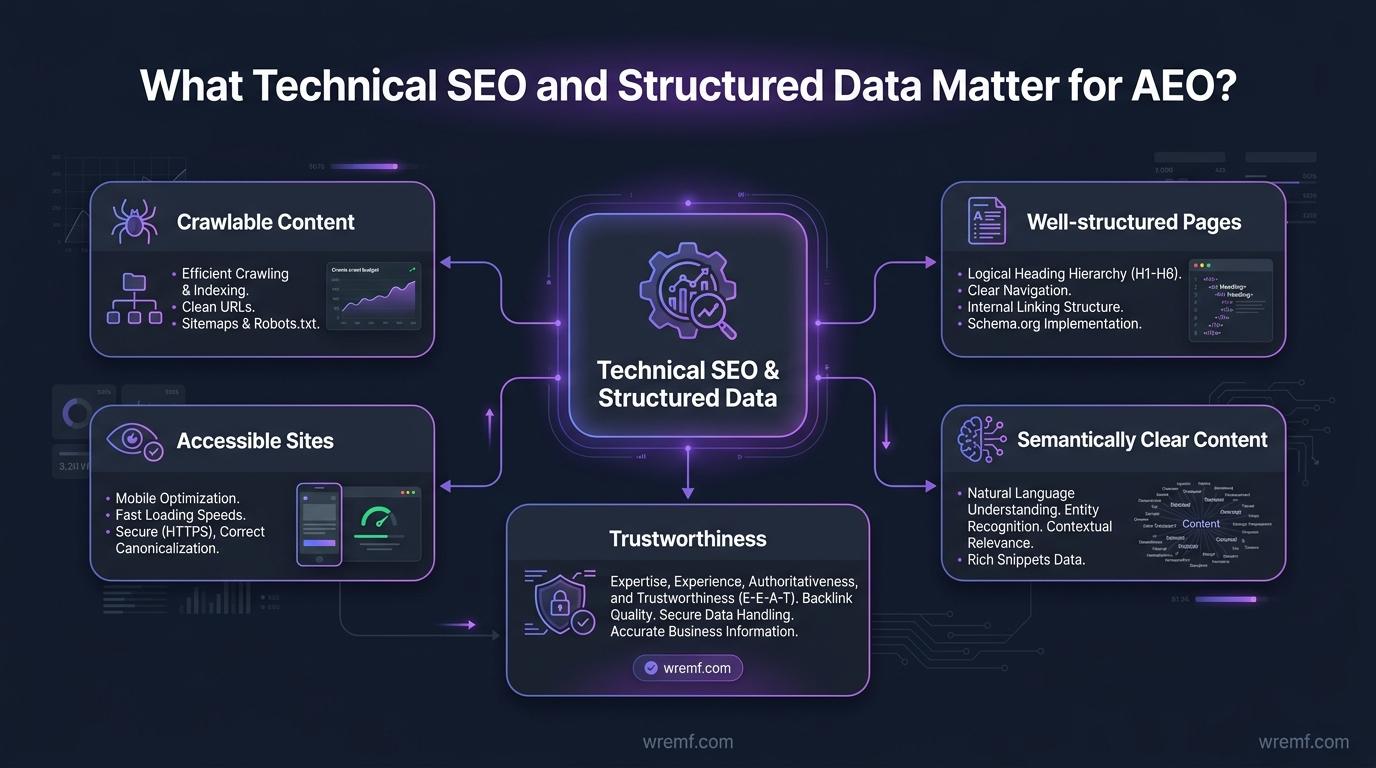
Technical SEO and structured data matter for AEO because AI systems need crawlable, accessible, well-structured, and semantically clear content. If a page cannot be parsed or trusted, answer engines are less likely to use it as a source.
Technical SEO is the process of improving a website’s crawlability, indexability, performance, and structure for search systems. Technical SEO matters for AI visibility because many AI search experiences still depend on web indexes, search engine infrastructure, and retrievable HTML.
Structured data is machine-readable information that helps search systems understand page entities, relationships, and content types. Structured data matters because it gives search systems clearer signals about organizations, products, reviews, authors, articles, FAQs, and other entities.
Schema markup is a structured data vocabulary implementation that can help search systems interpret content. Google Search Central explains that Google Search structured data uses schema.org vocabulary, while Google’s own documentation is the definitive source for Google Search behavior. (Google for Developers)
For answer engine optimization services, the most important technical checks include:
| Technical Element | Why It Matters | Common Issue |
|---|---|---|
| Crawl access | Allows search systems to reach content | Important pages blocked |
| Rendered HTML | Shows what crawlers can see | Content hidden behind scripts |
| Heading hierarchy | Helps extraction and summarization | Disorganized headings |
| Internal linking | Shows topical relationships | Orphaned pages |
| Structured data/schema | Clarifies entities and content type | Missing or invalid markup |
| Organization markup | Reinforces brand identity | Inconsistent business information |
| Canonicals | Clarifies preferred URLs | Duplicate pages confuse systems |
| Page speed | Improves user experience | Slow pages reduce engagement |
| Content freshness | Supports current answers | Outdated pages lose trust |
| Accessibility | Improves machine and human usability | Poor semantic HTML |
Crawler requirements vary by search engine, AI platforms, and AI-powered tools. Some AI systems use search indices. Some use web search tools. Some rely on licensed data, partner content, public websites, or enterprise knowledge sources.
Microsoft Copilot Studio documentation explains that public websites can be used as knowledge sources and that grounding with Bing Search can return information from the web. This matters because business information on public websites can influence generative answers in enterprise and public AI contexts. (Microsoft Learn)
Relevance engineering is the practice of improving how systems match user intent with the most useful information. Relevance engineering matters because AEO is not only about publishing content. It is also about making content easier for systems to retrieve for the right question.
A technical AEO audit should review:
HTML quality
structured data
schema markup
crawler requirements
internal linking
content structure
page templates
indexation
canonical signals
source consistency
AI crawler accessibility where relevant
WREMF’s GEO audit workflow helps teams identify retrieval, structure, source, and content gaps that can limit AI visibility.
KEY TAKEAWAY: Technical SEO, structured data, and schema markup give answer engines clearer access to your content and entities.
Even strong content and clean technical SEO need external trust signals to become citation-worthy.
Why Do AI Citations, Brand Mentions, and Authority Signals Matter?
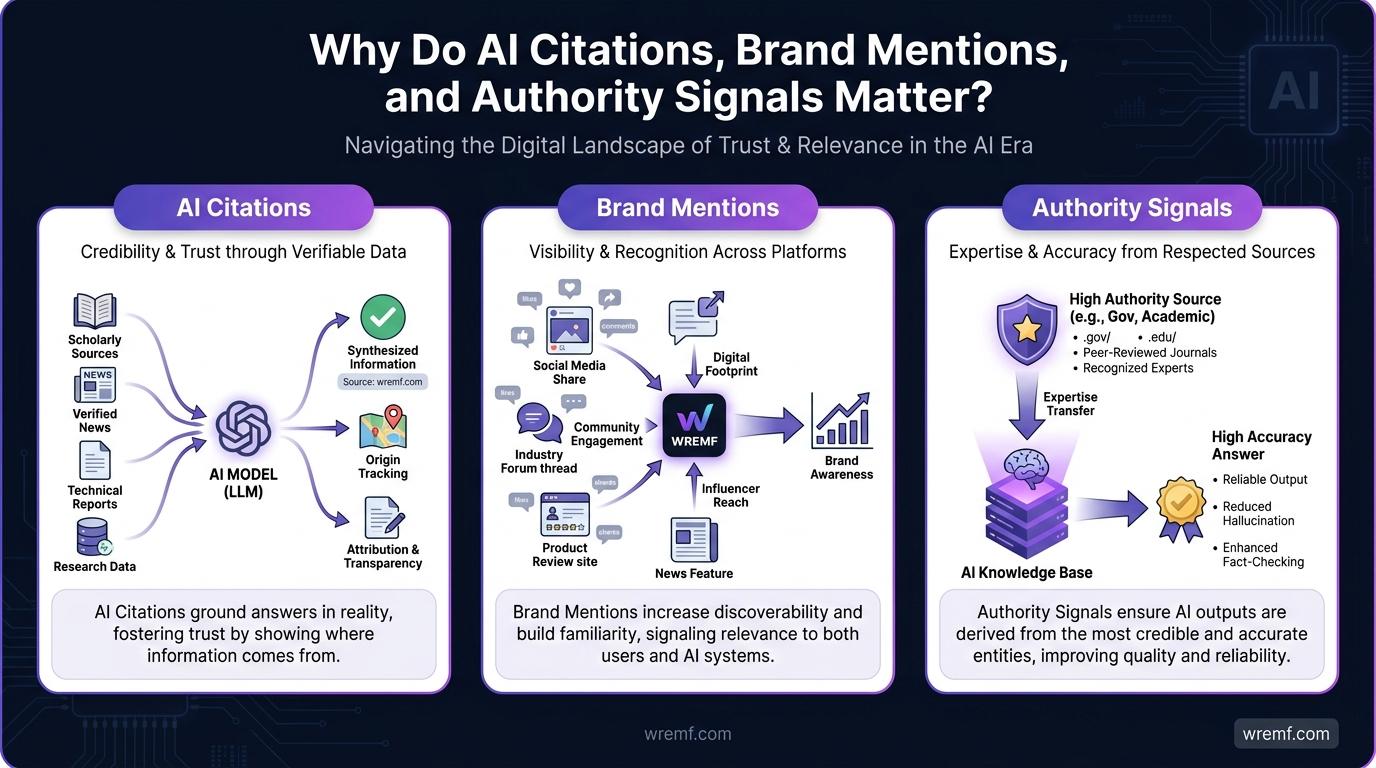
AI citations, brand mentions, and authority signals matter because answer engines use sources to support, validate, and explain AI-generated answers. A brand that lacks trusted citations can be understood by AI systems but still fail to appear in recommendations.
AI citations are source references included in AI-generated answers. AI citations matter because they show which pages, publishers, and data sources influence the answer a user sees.
Brand mentions are references to a company, product, person, or service across the web, whether linked or unlinked. Brand mentions matter because they help AI systems connect an entity to a category, use case, market, or reputation signal.
Authority signals are credibility indicators that help search systems and AI systems evaluate whether a source should be trusted. Authority signals can include expert authorship, reputable backlinks, third-party citations, Digital PR, reviews, documentation quality, mentions in credible sources, and consistent entity information.
Digital PR is the practice of earning media coverage, third-party mentions, and authoritative references. Digital PR matters for AEO because trusted third-party citations can influence how AI systems understand and validate a brand.
Citation building for answer engine optimization usually includes:
| Citation Source | Example Use | AEO Benefit |
|---|---|---|
| Review platforms | B2B software validation | Supports vendor shortlist queries |
| Industry publications | Category authority | Supports expert and trend queries |
| Partner pages | Ecosystem trust | Connects brand to integrations |
| Documentation | Product clarity | Supports feature and technical queries |
| Data studies | Evidence-based claims | Increases citation probability |
| Comparison content | Buying intent | Supports alternative and best-tool prompts |
| Customer stories | Social proof | Supports trust and proof queries |
| Community discussions | User-generated content | Adds real-world language and concerns |
Trusted third-party citations are references from external sources that validate a brand, product, claim, or category association. Trusted third-party citations matter because AI systems often need corroboration beyond a company’s own website.
Cross-platform consistency means your business information, positioning, product names, pricing, category, and descriptions are aligned across your website and third-party sources. Cross-platform consistency matters because conflicting information can reduce confidence in AI-generated answers.
A practical example is a SaaS company that describes itself as an AI visibility platform on its website, while review sites list it as an SEO reporting tool and older PR says it is a content analytics dashboard. AI systems may summarize the company inconsistently because the source ecosystem is inconsistent.
AI visibility is the measurable presence of a brand inside answers. Brand visibility is broader and includes awareness across search, social, reviews, media, communities, and AI platforms. Share of voice measures how often your brand appears compared with competitors across a defined set of prompts, topics, or sources.
KEY TAKEAWAY: AI citations and authority signals help answer engines decide which brands and sources are trustworthy enough to cite or recommend.
The next challenge is proving whether those citations and visibility gains are improving over time.
How Do You Measure Answer Engine Optimization Performance?
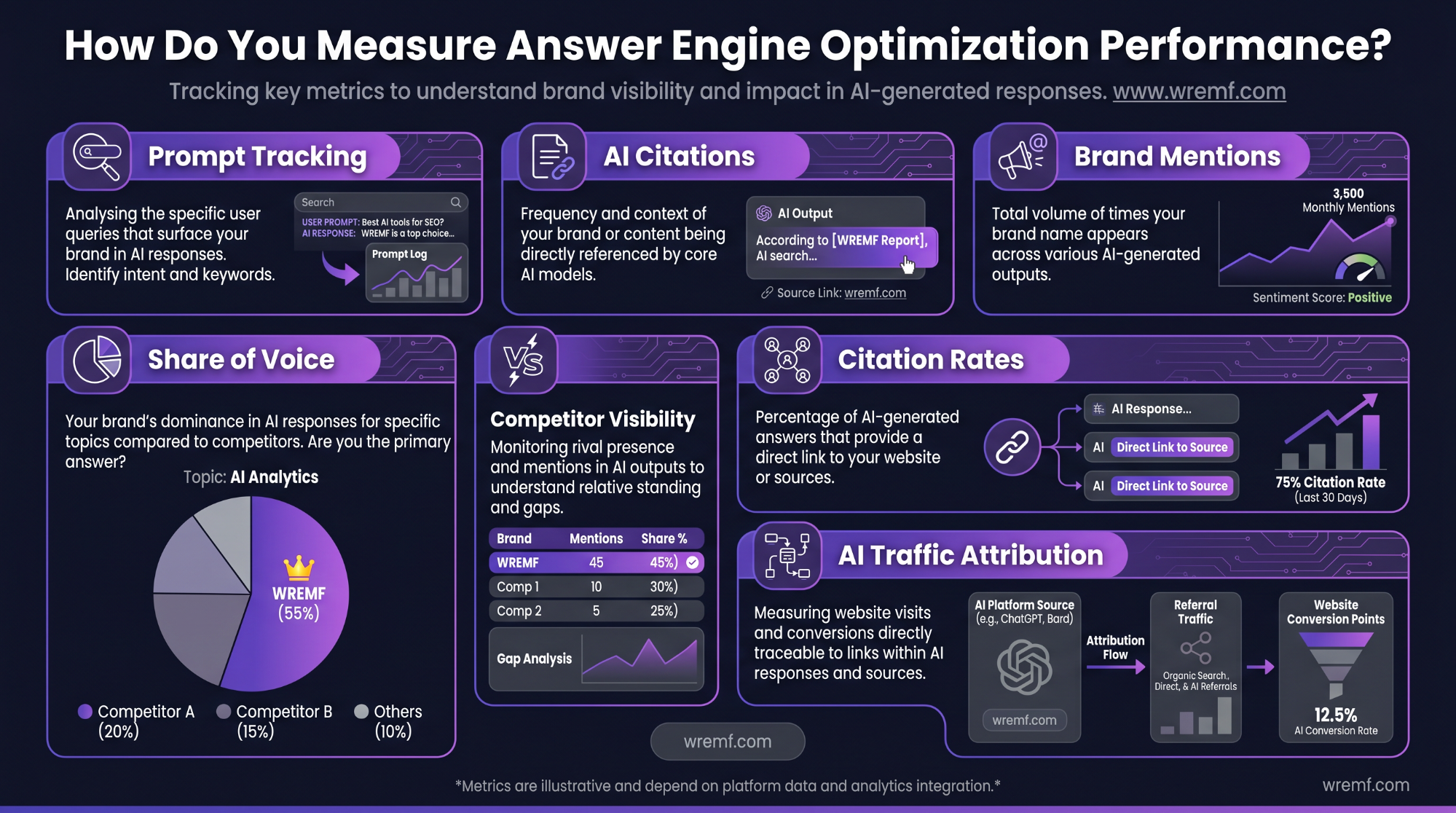
Answer engine optimization performance should be measured through prompt tracking, AI citations, brand mentions, share of voice, citation rates, competitor visibility, and AI traffic attribution. Rankings alone cannot prove AI visibility because many AI interactions do not produce website clicks.
Prompt tracking measures how often and how accurately a brand appears for target prompts across AI engines. Prompt tracking matters because AI visibility changes by platform, prompt wording, geography, freshness, and source availability.
AI traffic attribution connects traffic from ChatGPT-style experiences, Perplexity, Copilot, Gemini, and other AI assistants to website visits and conversions where tracking is possible. AI traffic attribution matters because leadership needs to understand whether AI visibility is influencing pipeline, even when many AI interactions remain zero-click interactions.
Zero-click interactions happen when users receive an answer without visiting a website. Zero-click interactions matter because AEO value may appear as brand inclusion, citation, or recommendation visibility before it appears as traffic.
The most useful AEO metrics include:
| Metric | What It Measures | Why It Matters |
|---|---|---|
| AI visibility score | Overall brand presence across AI platforms | Shows directional progress |
| Prompt coverage | Number of prompts where the brand appears | Shows discoverability |
| Citation rate | Frequency of AI citations | Shows source trust |
| Recommendation rate | Frequency of brand recommendation | Shows shortlist presence |
| Share of voice | Brand presence versus competitors | Shows competitive strength |
| Source consistency | Accuracy across cited sources | Reduces misinformation risk |
| Sentiment | Positive, neutral, or negative framing | Shows perception quality |
| AI referral traffic | Visits from AI platforms | Connects visibility to behavior |
| Conversion assisted by AI traffic | Pipeline influence | Helps justify investment |
| Competitor displacement | Prompts where rivals appear instead | Prioritizes content and citation gaps |
Citation rates are the frequency with which a brand, page, or source is cited by AI systems across a defined prompt set. Citation rates matter because they show whether AI systems treat your content or third-party references as useful sources.
AI search modes make measurement more complex because platforms may personalize, refresh, or alter answers. That is why repeated testing, scheduled monitoring, and prompt groups are more reliable than one-off screenshots.
In real-world reporting, teams should separate three levels of evidence:
| Evidence Level | Example | Reliability |
|---|---|---|
| Visibility evidence | Brand appears in ChatGPT for 18 of 50 prompts | Strong for awareness |
| Citation evidence | Brand page cited in 9 answers | Strong for source trust |
| Business evidence | AI referral traffic converts into trials | Strong for commercial impact |
The WREMF AI Visibility Index helps teams monitor visibility scoring, prompt coverage, competitor visibility, source citations, and recommendation presence across major AI engines.
For leadership and client reporting, teams can use sample AI visibility reporting to understand how prompt-level performance, citations, and action recommendations can be packaged into a practical dashboard.
KEY TAKEAWAY: AEO measurement requires visibility, citation, competitor, and attribution metrics because AI search value is not captured by rankings alone.
After measurement is in place, teams need to decide whether to manage AEO internally, hire an agency, or combine software with managed execution.
Are Answer Engine Optimization Services Worth It?
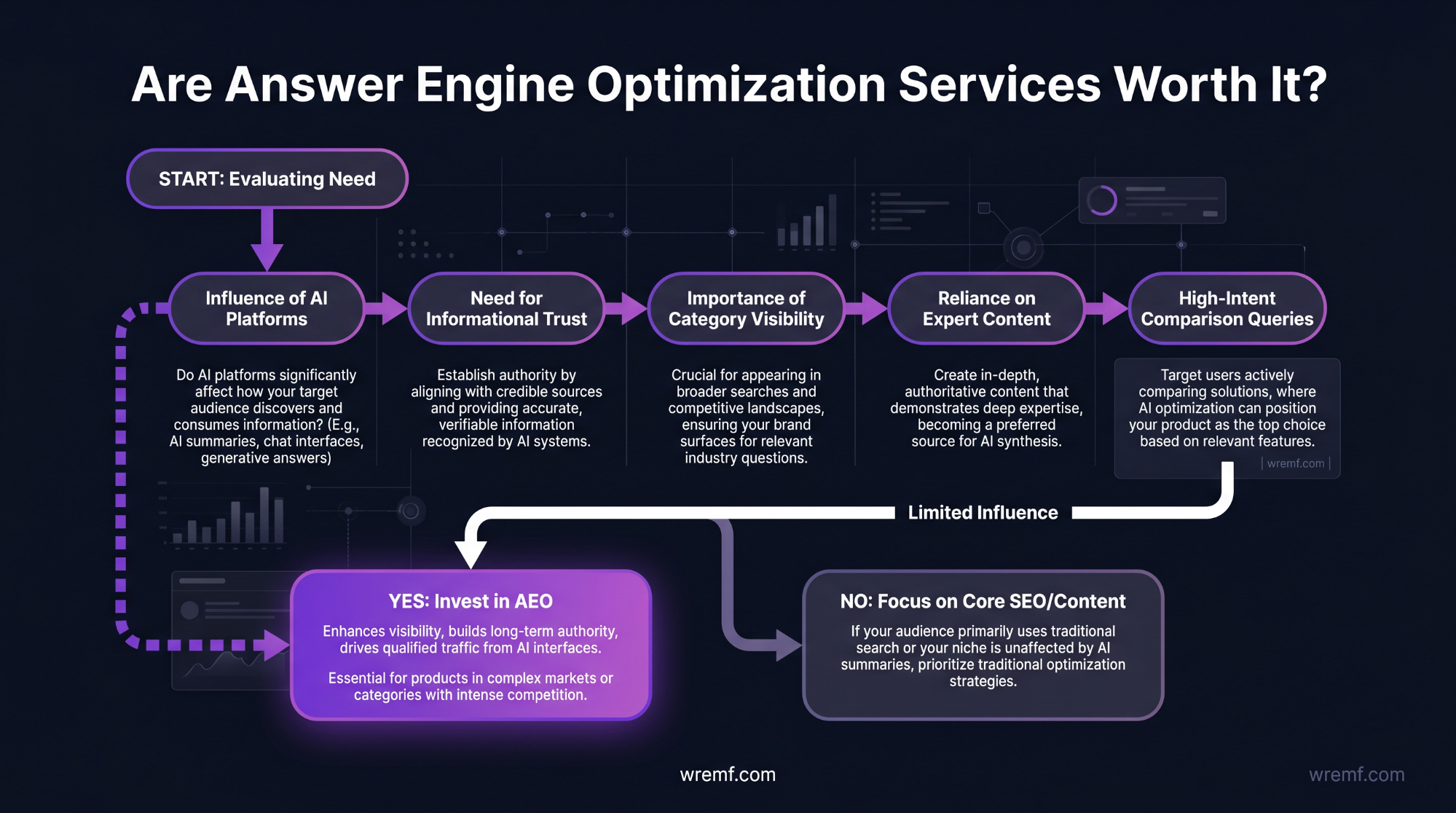
Answer engine optimization services are worth considering when AI platforms influence how your buyers research, compare, and shortlist vendors. AEO is most valuable for brands that depend on informational trust, category visibility, expert content, or high-intent comparison queries.
The business case for answer engine optimization is strongest when your buyers ask questions before they search for your brand. This is common in B2B SaaS, professional services, healthcare, finance, education, travel, enterprise software, legal services, agencies, and high-consideration ecommerce.
AEO is especially useful for industries where users ask AI assistants to:
compare vendors
explain complex topics
recommend tools
summarize alternatives
validate pricing
evaluate trust
create shortlists
choose a service provider
Which industries benefit most from AEO services? Industries with complex buying journeys, long consideration cycles, regulated information needs, or high-value decisions benefit most from AEO services. B2B SaaS, fintech, cybersecurity, health technology, legal services, education, agencies, and enterprise software are strong examples.
The value of AEO depends on your current situation:
| Situation | AEO Value | Recommended Action |
|---|---|---|
| Your brand is absent from AI answers | High | Start with AI visibility audits |
| Competitors appear more often | High | Track share of voice and source gaps |
| AI systems describe you incorrectly | High | Fix source consistency |
| Your SEO traffic is strong but AI mentions are weak | Medium to high | Add prompt tracking and citation analysis |
| Your content is thin or outdated | Medium | Improve answer-first content |
| Your brand has little authority | Medium | Invest in Digital PR and trusted citations |
| Your buyers rarely use AI tools | Lower | Monitor, but prioritize SEO foundations |
AEO is not a replacement for search engine optimization. AEO works best when technical SEO, content marketing, authority building, and structured data already have a solid foundation.
Is it worth paying someone to do SEO or AEO? It is worth paying for support when the opportunity cost of learning, auditing, testing, optimizing, and reporting internally is higher than the service cost. It is less useful when a provider cannot show a clear methodology, transparent reporting, or practical deliverables.
IMPORTANT: Avoid providers that promise guaranteed AI citations, guaranteed rankings, or instant AI recommendations. AI systems change frequently, and responsible AEO focuses on measurable improvement rather than guarantees.
KEY TAKEAWAY: AEO services are worth it when AI systems influence your buying journey and when the provider can measure prompts, citations, competitors, and source consistency.
Cost is the next decision point because AEO pricing varies by software, services, and execution depth.
How Much Do Answer Engine Optimization Services Cost?
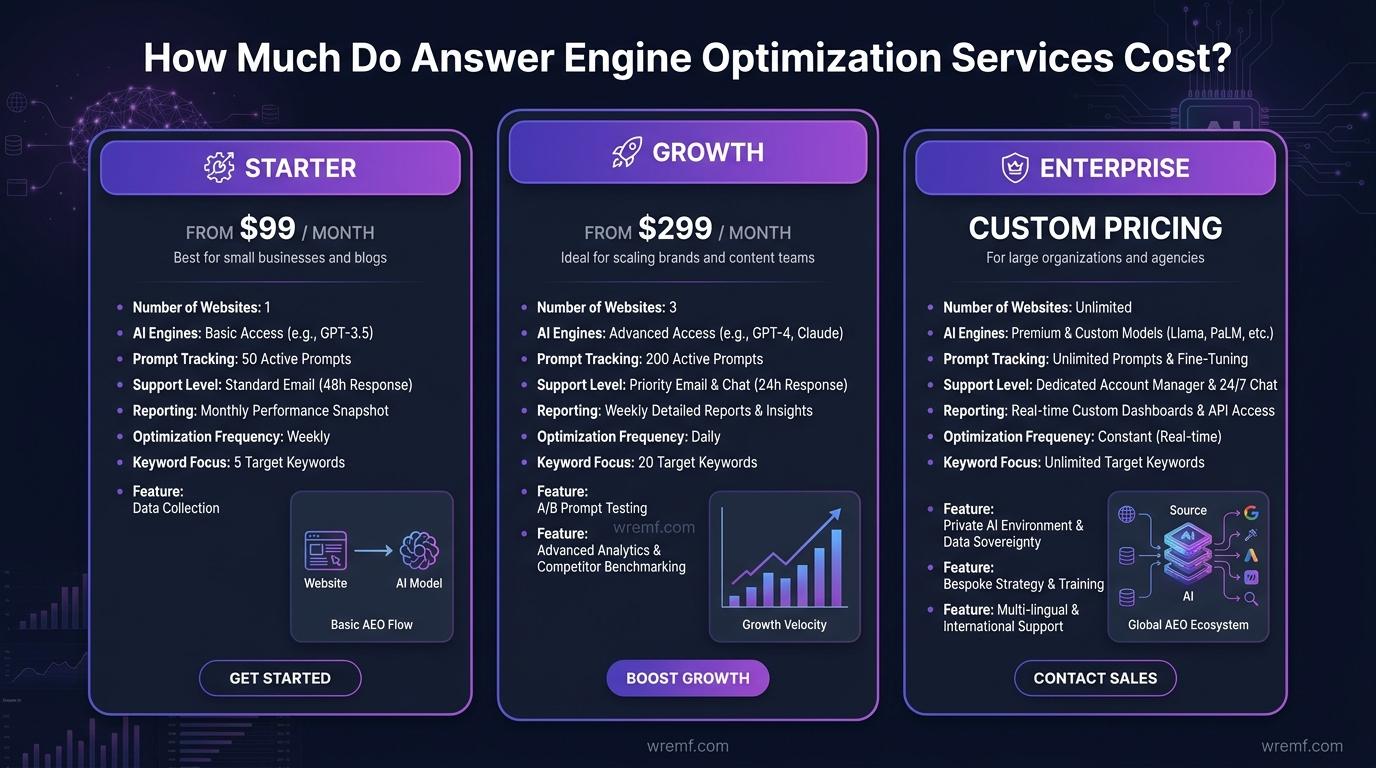
Answer engine optimization services can cost from low monthly software subscriptions to custom enterprise retainers, depending on the number of websites, AI engines, prompts, reports, content needs, and managed execution scope. Pricing should match measurement depth and execution responsibility.
How much does answer engine optimization cost? AEO software can start under €100 per month for smaller teams, while managed AEO or hybrid software plus agency execution often costs more because it includes strategy, content, technical work, reporting, and authority building.
WREMF pricing is structured around websites, seats, reporting needs, and support level:
| Plan | Price | Best For | Included |
|---|---|---|---|
| Starter | €39/mo | One website and lean teams | 1 website, unlimited prompt tracking, BYOK, 10 AI engines, all features, white-label reports, 1 seat, email support |
| Growth | €89/mo | Growing teams and agencies | 5 websites, unlimited prompt tracking, BYOK, 10 AI engines, all features, white-label reports, priority email support, content brief generator, SEO A/B testing |
| Enterprise | Custom | Larger brands and agencies | Unlimited websites, unlimited seats, dedicated support, custom branded portals, 4h SLA, all features |
BYOK means bring your own key. BYOK matters because teams can connect their own AI provider credentials for control, cost management, and governance.
White-label reporting means reports can be branded for clients or internal stakeholders. White-label reporting matters for agencies and consultants that need professional reporting without rebuilding dashboards manually.
The cost of managed AEO services depends on deliverables such as:
AI visibility strategy
GEO audits
AEO consulting
technical SEO reviews
schema markup guidance
content optimization
AI-ready content briefs
source consistency cleanup
citation improvement
Digital PR support
internal linking logic
monthly reporting
pipeline attribution analysis
For teams comparing software and services, the best starting point is to decide whether the primary need is visibility measurement, execution support, or both. You can review WREMF’s current plans on the WREMF pricing page.
KEY TAKEAWAY: AEO pricing should be evaluated against the number of websites, prompts, AI platforms, reporting needs, and execution requirements.
The next decision is selecting the right type of provider for your team.
How Should You Choose an AEO Agency or AI Visibility Platform?
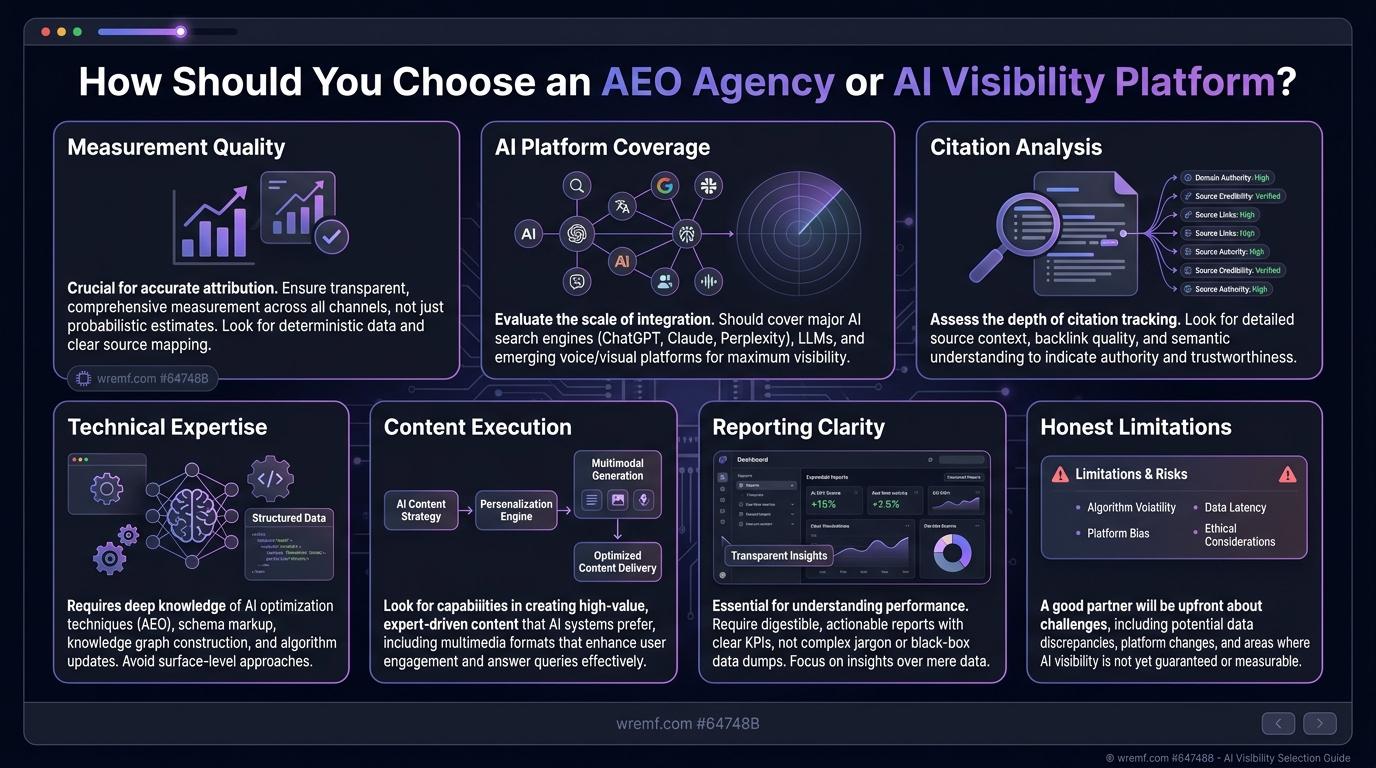
You should choose an AEO provider based on measurement quality, AI platform coverage, citation analysis, technical expertise, content execution, reporting clarity, and honest limitations. The right provider should show how visibility is tracked, improved, and proved.
An AI visibility platform is software that monitors how brands appear across AI-generated answers, citations, competitors, and prompts. An AI visibility platform matters because manual testing is too inconsistent for ongoing reporting.
AI platforms include systems such as ChatGPT, Claude, Gemini, Perplexity, Google AI Overviews, Microsoft Copilot, DeepSeek, Grok, Meta AI, and Mistral. AI platforms matter because buyers may use several tools during the same research journey.
When choosing a provider, ask these questions:
| Evaluation Question | Why It Matters |
|---|---|
| Which AI engines are monitored? | Coverage affects visibility accuracy |
| Are prompts tracked over time? | One-time testing is not enough |
| Are citations and sources captured? | Citations explain why answers appear |
| Is competitor visibility measured? | AEO is a competitive visibility problem |
| Are recommendations actionable? | Dashboards alone do not improve outcomes |
| Is technical SEO included? | Retrieval gaps can block visibility |
| Is structured data reviewed? | Entity clarity supports AI understanding |
| Are content briefs included? | Teams need execution-ready outputs |
| Is reporting white-label? | Agencies need client-ready proof |
| Are limitations explained honestly? | AI visibility cannot be guaranteed |
AI-powered tools can help with monitoring, but tools alone do not fix positioning, source quality, authority signals, or content gaps. Agencies can help with execution, but agencies without data may rely too much on opinion.
The strongest model for many B2B teams is hybrid. Hybrid AEO combines AI visibility software with managed execution, so the same workflow identifies the problem, recommends the fix, and tracks the outcome.
WREMF supports three operating models:
| Model | Best For | How WREMF Fits |
|---|---|---|
| Software | In-house SEO and marketing teams | Track prompts, citations, competitors, and AI visibility |
| Agency service | Teams needing execution | Get AEO, GEO, content, citation, and reporting support |
| Hybrid | Brands needing both | Combine platform data with managed execution |
For teams that want senior-led execution, the WREMF agency team supports AI visibility strategy, content optimization, entity and authority building, source consistency cleanup, technical AI visibility foundations, and monthly reporting.
KEY TAKEAWAY: Choose an AEO provider that connects AI visibility data with practical execution instead of selling rankings or generic content packages.
A strong provider should also explain what can go wrong, because AEO has real limits.
What Are the Risks and Limitations of AEO?
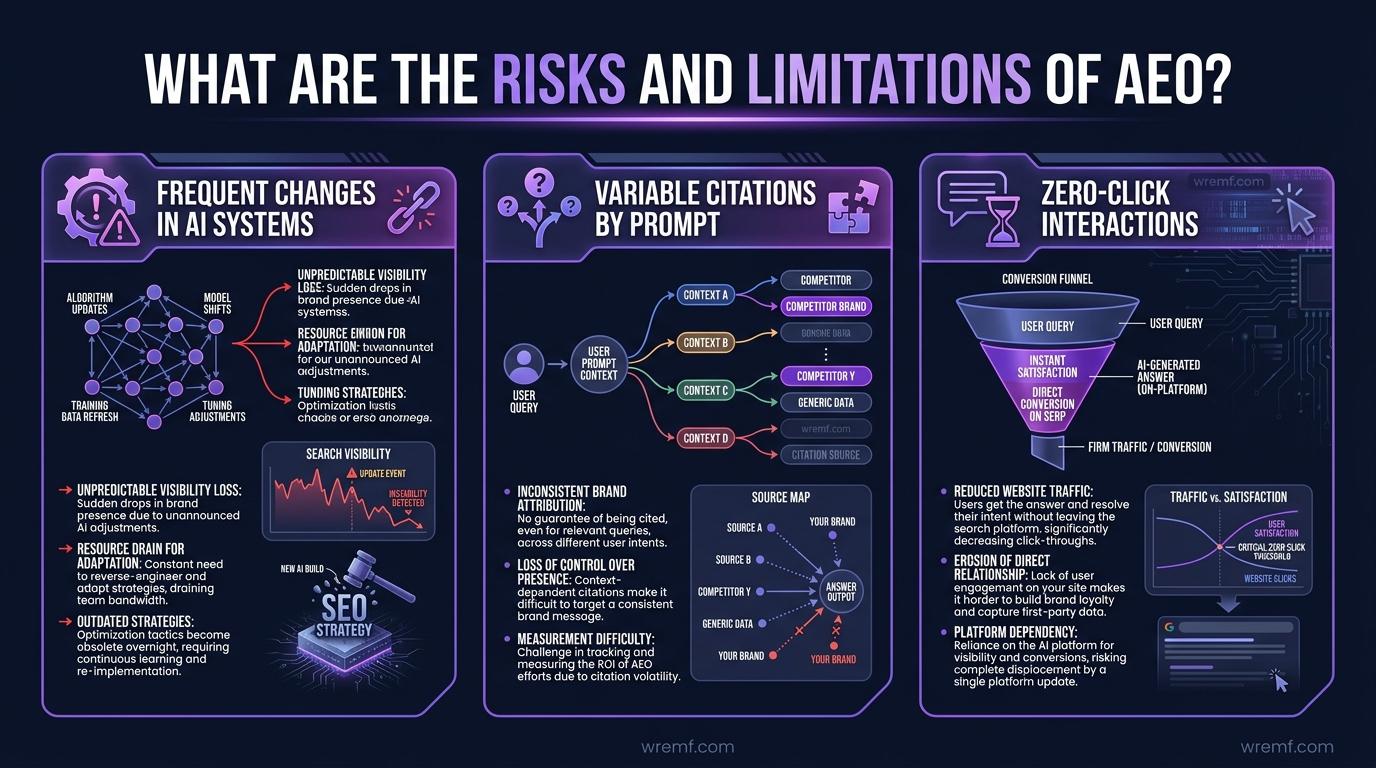
AEO has limitations because AI systems change frequently, citations vary by prompt, and many AI interactions happen without measurable clicks. The goal is to improve visibility probability and source trust, not to guarantee AI recommendations.
The biggest risk in answer engine optimization is treating AI visibility like a simple ranking problem. AI-generated answers are dynamic. They can vary by platform, location, time, prompt wording, source access, and model behavior.
Common risks include:
| Risk | What Happens | How to Reduce It |
|---|---|---|
| Ranking-only thinking | Teams ignore AI citations | Track prompts and sources |
| Thin AI content | Content lacks trust | Use evidence and expert review |
| Inconsistent brand data | AI systems summarize incorrectly | Fix cross-platform consistency |
| Poor technical access | Content is not retrievable | Audit crawl and rendering |
| Weak third-party authority | AI systems cite competitors | Build trusted citations |
| Overpromising providers | Expectations become unrealistic | Demand methodology and reporting |
| Zero-click blind spots | Value is underreported | Track visibility and attribution separately |
| Platform volatility | Results fluctuate | Monitor trends, not single tests |
Search behavior is changing, but SEO is not dead. SEO is evolving into a broader discipline that includes search engine optimization, answer engine optimization, generative engine optimization, AI search optimization, content marketing, technical SEO, and authority building.
AI systems can also be wrong. Google AI Overviews, AI chatbots, and other answer engines can generate incomplete or inaccurate answers. That is why source consistency, accurate business information, and clear correction workflows matter.
A responsible AEO strategy should distinguish between:
measurable facts
practical observations
source-backed recommendations
strategic assumptions
unproven claims
For example, an AI visibility report can measure whether your brand appears in 40 tracked prompts across 10 AI engines. It cannot prove that every buyer saw the same answer. That distinction matters for credible reporting.
KEY TAKEAWAY: AEO improves measurable visibility signals, but it cannot guarantee citations, rankings, traffic, revenue, or recommendations.
Many objections to AEO come from misunderstanding how SEO, AEO, and GEO work together.
Common Myths About AI Visibility Debunked
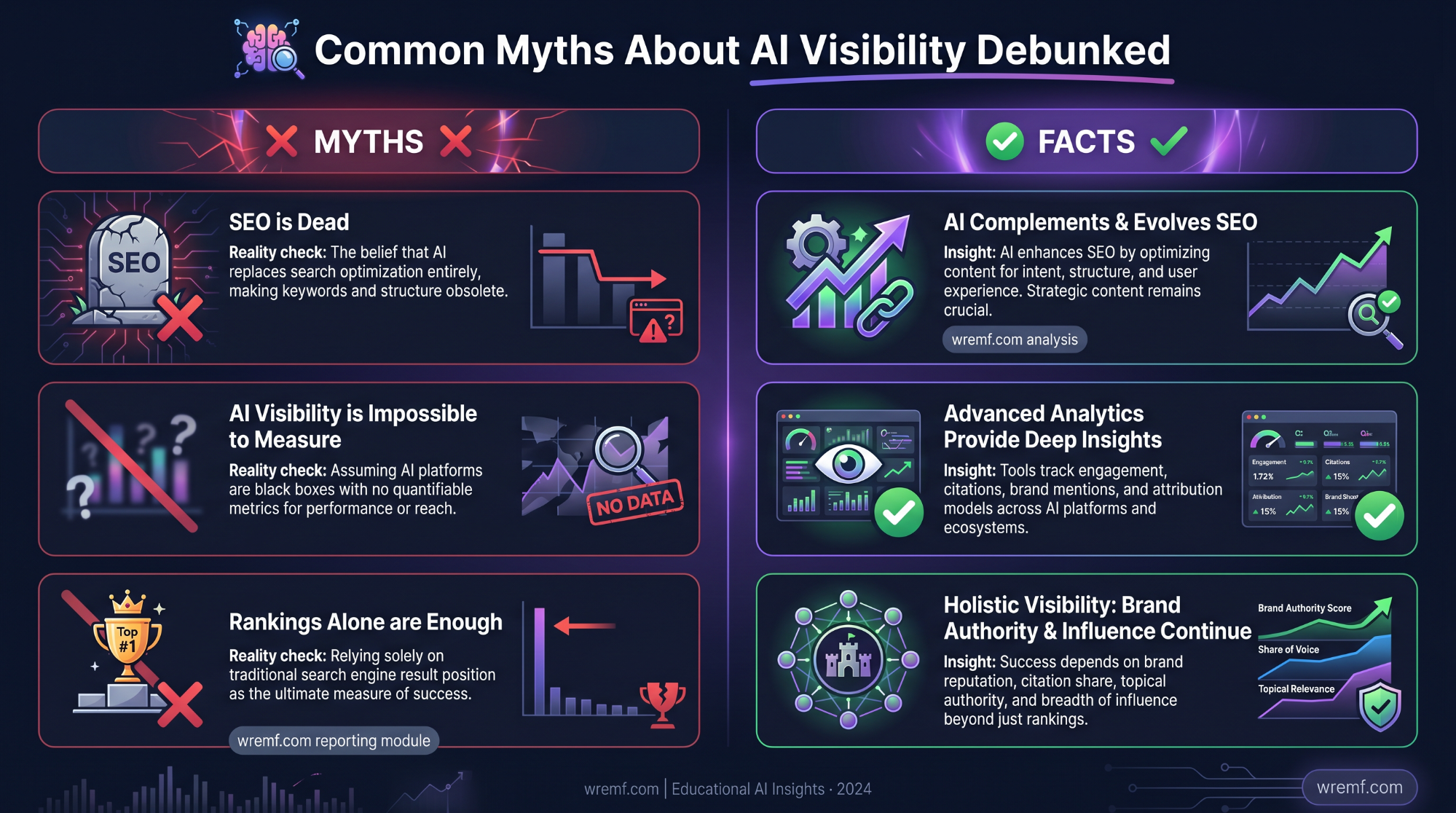
AI visibility is measurable, but it is not measured the same way as traditional SEO. The most common myths come from treating AI answers like static rankings or assuming AI discovery replaces every existing marketing channel.
MYTH: SEO is dead because answer engines are replacing search.
FACT: SEO is evolving, not disappearing. Search engine optimization still supports crawlability, indexing, authority, and content quality. AEO and generative engine optimization build on SEO foundations by adding prompt tracking, AI citations, source consistency, and answer-first content.
MYTH: AI visibility is impossible to measure.
FACT: AI visibility can be measured through prompt tracking, citation analysis, share of voice, brand mentions, source consistency, recommendation visibility, and AI traffic attribution. Measurement is less exact than traditional rank tracking, but repeated testing across prompts and AI platforms creates useful directional evidence.
MYTH: Rankings alone are enough for AEO.
FACT: Rankings help, but they do not guarantee AI citations or recommendations. A page can rank in search results and still be ignored by AI systems if the content structure is weak, sources conflict, or competitors have stronger authority signals.
MYTH: Schema markup alone will make a brand appear in AI-generated answers.
FACT: Schema markup helps clarify entities and relationships, but it is not a complete AEO strategy. AI visibility also depends on content quality, source trust, brand mentions, citations, technical SEO, and prompt relevance.
MYTH: AEO is only for large enterprise brands.
FACT: AEO can help smaller brands when buyers ask AI systems category, comparison, local, or problem-led questions. Smaller teams should start with focused prompts, clear content clusters, structured data, and source consistency instead of trying to monitor every possible query.
KEY TAKEAWAY: AI visibility is measurable and improvable, but it requires different metrics and workflows than traditional rank tracking.
With the myths cleared up, the final body section shows how WREMF supports the full AEO workflow.
How WREMF Helps With Answer Engine Optimization Services
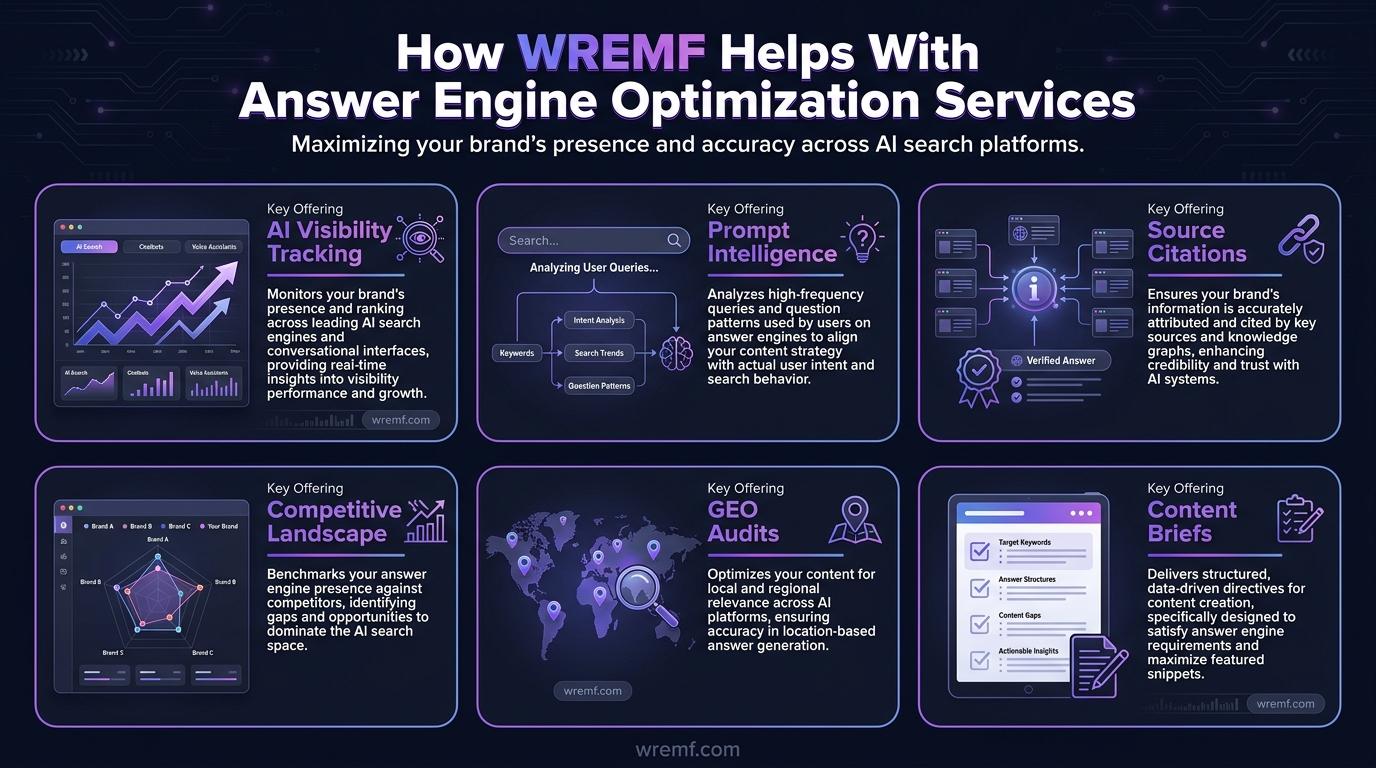
WREMF helps teams track, improve, and prove AI visibility across major AI discovery surfaces through software, agency services, and hybrid execution. WREMF turns answer engine optimization into a measurable workflow that connects prompts, citations, competitors, source consistency, and attribution.
WREMF is built for teams that need more than a dashboard. The platform helps B2B brands and agencies identify where they appear, where competitors appear, which sources are cited, and what actions can improve AI search visibility over time.
The WREMF workflow covers:
| WREMF Capability | What It Helps With | Best Fit |
|---|---|---|
| AI visibility tracking | Measures brand presence across AI engines | Brands and agencies |
| Prompt intelligence | Tracks user prompts and buying questions | SEO and content teams |
| Source citations | Shows which sources AI systems cite | Authority and PR teams |
| Competitive landscape | Compares AI share of voice | Growth leaders |
| GEO audits | Finds retrieval and content gaps | Technical SEO teams |
| Content briefs | Turns insights into pages | Content teams |
| SEO testing | Measures content and SEO changes | Experimentation teams |
| White-label reports | Packages results for clients | Agencies and consultants |
| API and MCP integrations | Connects data to workflows | Technical teams |
| Agency execution | Provides managed AEO and GEO support | Lean or scaling teams |
Model Context Protocols are integration standards that help AI tools connect with external systems and data sources. Model Context Protocols matter because AI visibility data becomes more useful when it can flow into reporting, CRM, content, analytics, or internal workflow systems.
For agencies, WREMF supports white-label client reporting, multiple websites, prompt monitoring, source analysis, and client portals through WREMF for agencies.
For in-house teams, WREMF helps brands connect AI visibility to content strategy, competitor analysis, source consistency, and business reporting through WREMF for brands.
For technical teams, the WREMF API supports integrations, reporting workflows, MCP use cases, and internal AI visibility systems.
WREMF is useful when you want to know:
how ChatGPT describes your brand
whether Google AI Overviews cite your content
which competitors Perplexity recommends
whether Gemini understands your category
which sources influence Microsoft Copilot answers
where citation gaps exist
which prompts should become content briefs
how AI visibility changes month over month
WREMF does not guarantee AI citations or rankings. Instead, WREMF helps teams build a repeatable measurement and improvement system for answer engine optimization, AI visibility, and generative engine optimization.
KEY TAKEAWAY: WREMF helps brands and agencies operationalize AEO through measurement, source analysis, competitor visibility, content workflows, and managed execution.
The FAQ section below answers the most common buying, implementation, and comparison questions about answer engine optimization services.
Frequently Asked Questions
What does answer engine optimization mean?
Answer engine optimization means improving your content, website structure, authority signals, and source consistency so answer engines can use your brand in direct answers. Answer engine optimization focuses on AI-generated answers, featured snippet visibility, AI citations, voice assistants, Google AI Overviews, ChatGPT search, Perplexity, Gemini, Claude, and Microsoft Copilot. It does not replace SEO. It extends SEO by optimizing for retrieval, citation, and recommendation across AI systems.
How is AEO different from SEO?
AEO is different from SEO because SEO focuses on ranking in search results, while AEO focuses on being included in direct answers, AI-generated summaries, citations, and recommendations. SEO usually measures rankings, clicks, impressions, and backlinks. AEO measures prompt visibility, AI citations, brand mentions, source consistency, citation rates, and share of voice across AI platforms. The strongest strategy combines both because answer engines still rely on crawlable, authoritative, and structured web content.
Is SEO dead or evolving in 2026?
SEO is evolving in 2026. Traditional search engine optimization still matters because search engines provide crawl, indexing, ranking, and authority foundations. What has changed is the discovery journey. Buyers now use AI chatbots, Google AI Overviews, Perplexity, ChatGPT, Gemini, and Microsoft Copilot for research and comparison. Modern SEO teams need AEO, GEO, technical SEO, structured data, content marketing, and AI visibility measurement to stay visible across the full search ecosystem.
How much do answer engine optimization services cost?
Answer engine optimization services vary by scope. Software can start at a low monthly subscription, while agency or hybrid execution costs more because it includes audits, content optimization, technical SEO, citation building, Digital PR, reporting, and ongoing strategy. WREMF plans start at €39/mo for Starter and €89/mo for Growth, with custom Enterprise pricing for larger teams. The right budget depends on websites, prompts, AI platforms, reporting needs, and execution support.
Are answer engine optimization services worth it?
Answer engine optimization services are worth it when AI platforms influence how buyers discover, compare, or shortlist vendors in your category. AEO is especially valuable for B2B SaaS, agencies, consultants, fintech, cybersecurity, health technology, education, legal services, and other high-consideration markets. AEO is less valuable when buyers rarely use AI for research or when a website lacks basic SEO foundations. The best starting point is an AI visibility audit before committing to large execution budgets.
What are the best tools for Answer Engine Optimization?
The best AEO tools should track prompts, citations, competitors, AI visibility, source consistency, brand mentions, and reporting across multiple AI platforms. WREMF is built for this workflow because it monitors 10 AI engines, supports BYOK, includes white-label reporting, and connects software with optional agency execution. Other traditional SEO tools can still support keyword research, backlinks, and technical SEO, but AEO requires AI-specific visibility, citation, and prompt intelligence data.
What should businesses look for when choosing an AEO service provider?
Businesses should look for clear methodology, prompt tracking, citation analysis, competitor visibility, technical SEO knowledge, structured data expertise, content optimization, and honest reporting. A strong provider should explain what can be measured, what cannot be guaranteed, and which actions will be prioritized. Avoid providers that promise instant AI citations, guaranteed rankings, or guaranteed revenue. Choose a provider that can show baseline visibility, source gaps, action recommendations, and progress over time.
How long does it take to see results from AEO efforts?
AEO results usually appear in stages. Technical fixes and content structure improvements can be implemented quickly, but AI visibility changes often require repeated crawls, updated source interpretation, stronger citations, and consistent monitoring. Many teams should evaluate progress over monthly cycles rather than expecting immediate changes from one page update. Useful early signals include improved prompt coverage, cleaner brand summaries, stronger citation rates, and reduced competitor-only answers.
Which industries benefit most from AEO services?
Industries with complex decisions, high research intent, and long buying cycles benefit most from AEO services. B2B SaaS, cybersecurity, fintech, health technology, education, legal services, consulting, enterprise software, and agencies are strong examples. These categories often involve comparison queries, trust evaluation, pricing research, feature analysis, and vendor shortlists. AEO helps brands appear when users ask AI systems for explanations, recommendations, alternatives, and buying guidance.
How can companies make AI search visibility optimization actionable?
Companies can make AI search visibility optimization actionable by turning AI visibility data into a prioritized workflow. Start with tracked prompts, identify where competitors appear, review which sources AI systems cite, audit content structure, fix source consistency, and create answer-first content briefs. WREMF helps teams operationalize this process by connecting prompt intelligence, source citations, competitor visibility, GEO audits, content briefs, and reporting into one AI visibility workflow.
Conclusion
Answer engine optimization services help B2B brands adapt to a search environment where buyers use AI platforms, answer engines, and search engines together. The core task is not only to rank, but to become understandable, retrievable, cited, and recommended across AI-generated answers. Strong AEO combines technical SEO, structured data, content marketing, schema markup, AI citations, brand mentions, source consistency, and measurable AI visibility reporting. To turn answer engine optimization services into a repeatable workflow, explore the WREMF platform suite or talk to the WREMF agency team.
Related Generative Engine Optimization Guides
- LLM SEO Agency The Complete Guide to Choosing an Agency for AI Search Visibility
- LLM SEO Services The Complete 2026 Guide to AI Search Visibility, AEO, GEO, and LLM Optimization
- AI Search Engine Optimization Services The Complete Guide for B2B Brands
- AI SEO Services The Complete Guide to Search Visibility in the AI Era
- Generative AI Optimization Services The Complete Guide to GEO, AEO, LLM Optimization, and AI Visibility
- AI Search Engine Optimization Tools The Complete 2026 Guide for AI Search, SEO, AEO, and GEO
- AI Mention Tracking The Complete Guide to Monitoring Brand Mentions, AI Answers, Citations, and Share of Voice in 2026
- AI SEO Agency How to Choose the Right Partner for AI Search Visibility
- Large Language Model Optimization Services The Complete Guide to LLMO, AI Search Visibility, AEO, GEO, RAG, and LLM Performance
- Answer Engine Optimization The Complete Guide to AEO, AI Search Visibility, and Answer-First Content
- How AI Search Optimization Tools Increase Organic Traffic
- 12 Best AI Search Optimization Tools
- AI Overview SEO How to Optimize for Google AI Overviews, AI Mode, and AI Search Visibility
- Enterprise Answer Engine Optimization Platforms Complete Guide for AI Visibility, AEO, and GEO
- How Do AI Search Optimization Tools Improve SERP Rankings
- Best Answer Engine Optimization for Enhancing AI Visibility
- AI Brand Monitoring The Complete Guide to Tracking Brand Visibility Across AI Search, LLMs, and Generative Engines
- AI Search Engine Optimization The Complete Guide for B2B Brands
- AI Overview Optimization How to Rank, Get Cited, and Stay Visible in Google AI Search
- AI SEO Tools The Complete Guide for SEO, AEO, GEO, and AI Search Visibility
Related reading
- Generative AI Optimization Services: The Complete Guide to GEO, AEO, LLM Optimization, and AI Visibility
- Best Answer Engine Optimization for Enhancing AI Visibility
- LLM SEO Agency: The Complete Guide to Choosing an Agency for AI Search Visibility
- LLM SEO Services: The Complete 2026 Guide to AI Search Visibility, AEO, GEO, and LLM Optimization