AI Mention Tracking: The Complete Guide to Monitoring Brand Mentions, AI Answers, Citations, and Share of Voice in 2026
Learn how to track brand mentions, citations, and share of voice in AI-generated answers across ChatGPT, Perplexity, Google AI Overviews, and more.
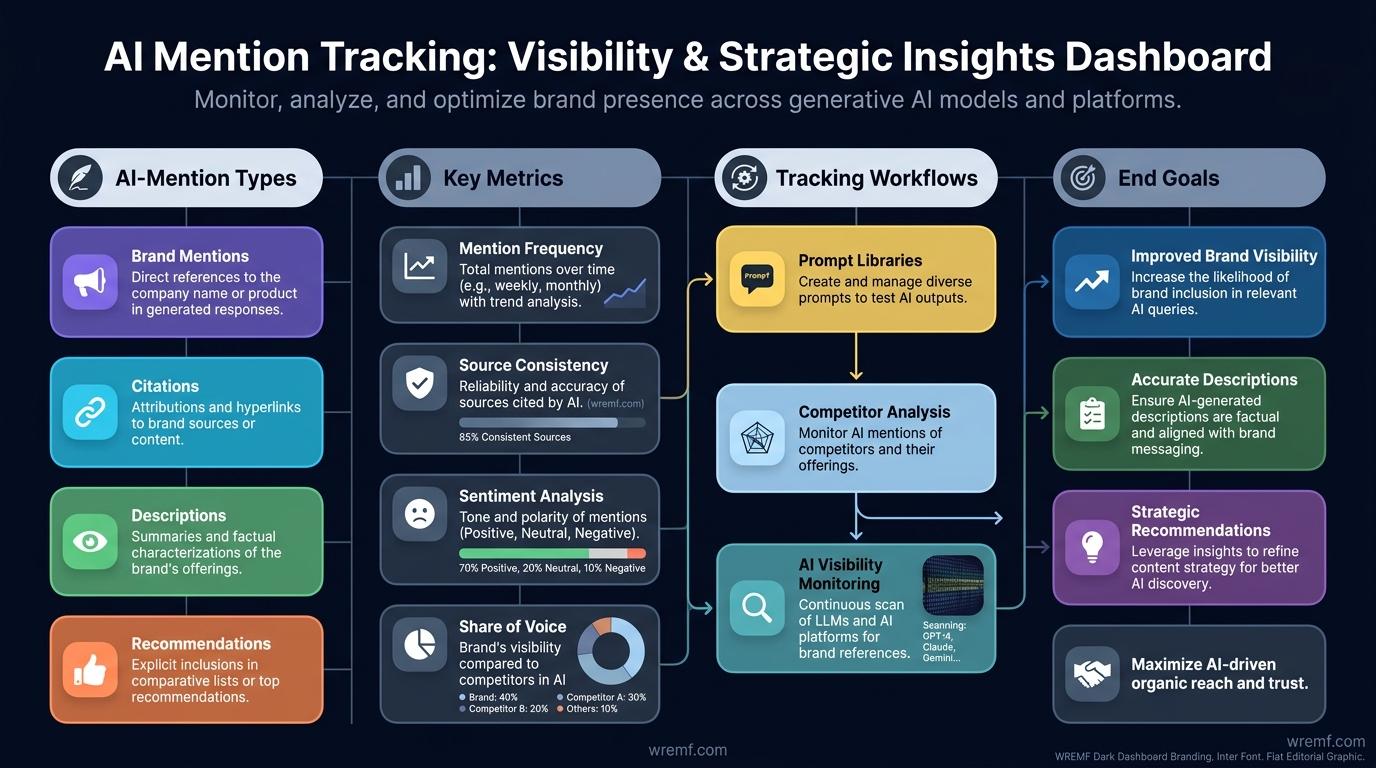
By WREMF Team · 2026-05-09
AI mention tracking is the process of monitoring how AI systems mention, cite, describe, and recommend your brand in AI-generated answers. It measures when, where, how, and why AI models include your brand across platforms like ChatGPT, Claude, Gemini, Perplexity, Google AI Overviews, and Copilot. AI mention tracking differs from traditional brand monitoring by focusing on AI-generated responses rather than only news, backlinks, forums, and social media. It tracks brand mentions, citations, source links, sentiment analysis, recommendation visibility, and competitor presence. The practice matters because B2B buyers increasingly use AI assistants to research vendors and validate claims before engaging with sales. AI models process brand mentions by combining learned patterns, retrieved sources, citations, entity recognition, and prompt context. Effective tracking uses a three-layer framework: presence measures whether your brand appears, perception measures what AI says about your brand, and influence measures whether your brand is recommended.
Key takeaways
- AI mention tracking measures brand visibility in AI-generated answers across ChatGPT, Claude, Gemini, Perplexity, Google AI Overviews, and other AI platforms, tracking mentions, citations, sentiment, and recommendations.
- Traditional brand monitoring does not cover AI-generated answers, which can shape buyer perception without creating normal website visits or appearing in standard analytics.
- The three-layer framework for AI mention tracking measures presence (whether your brand appears), perception (how it is described), and influence (whether it is recommended).
- A strong prompt library includes branded, category, comparison, problem, buying, and alternative prompts that reflect real buyer questions rather than only SEO keywords.
- Source consistency across your website, profiles, directories, and third-party sources helps AI models understand and cite your brand more reliably.
- Key metrics include mention frequency, citation frequency, share of voice, competitor visibility, sentiment analysis, prompt coverage, and AI traffic attribution.
AI Mention Tracking: The Complete Guide to Monitoring Brand Mentions, AI Answers, Citations, and Share of Voice in 2026
AI mention tracking is the process of monitoring how AI systems mention, cite, describe, and recommend your brand in AI-generated answers. Gartner predicts traditional search engine volume will drop 25% by 2026 as AI chatbots and virtual agents absorb more discovery journeys. This guide explains how AI Search changes brand monitoring, how AI models process brand information, how to measure AI visibility, and how to choose the right tracking workflow. It covers prompt libraries, citations, sentiment analysis, competitor analysis, share of voice, AI traffic attribution, social listening, and content strategy. WREMF helps B2B teams track, improve, and prove AI visibility through AI visibility software, managed execution, or a hybrid model. (Gartner)
What Is AI Mention Tracking?
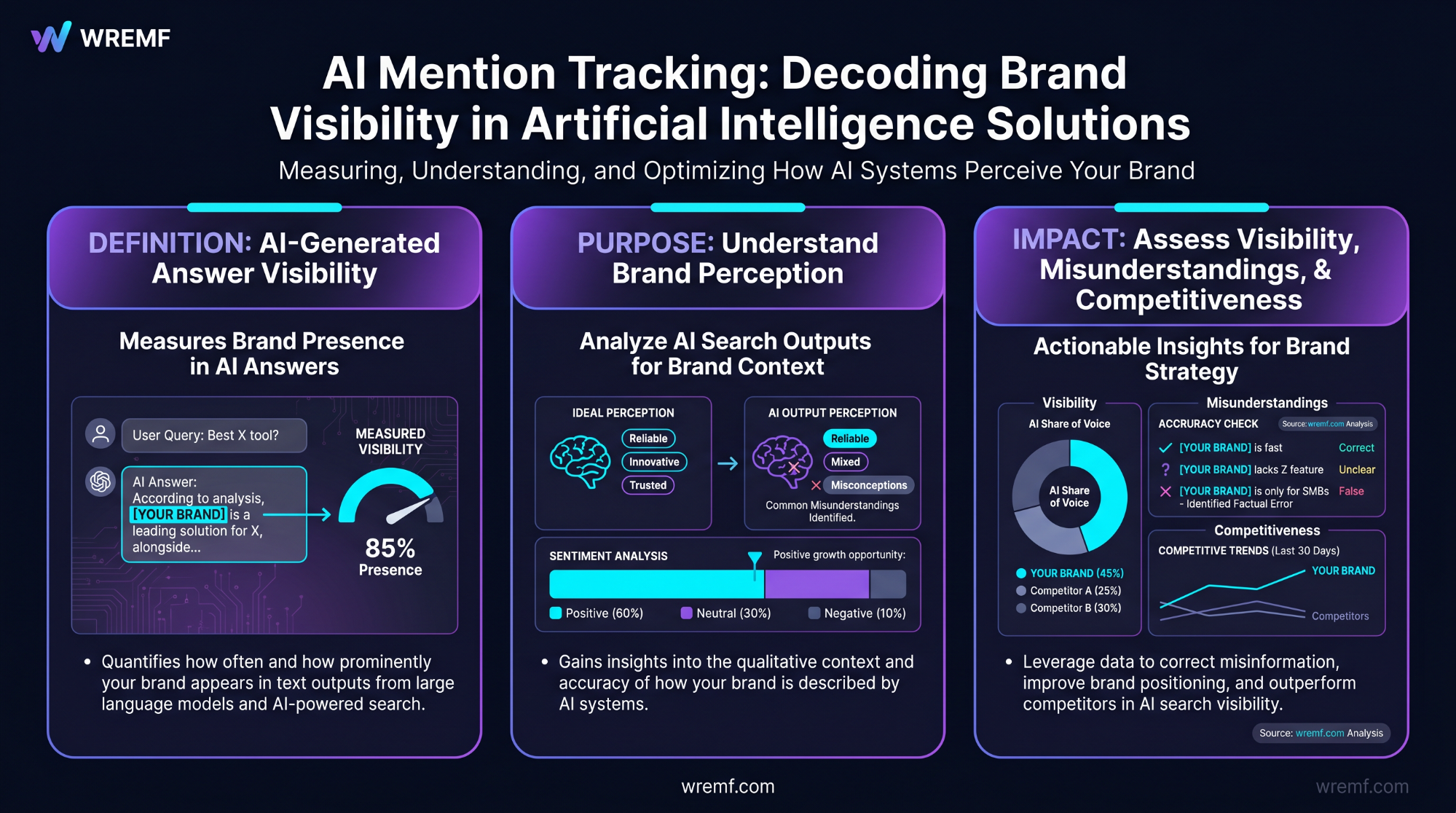
AI mention tracking measures when, where, how, and why AI models mention your brand in AI-generated answers. It helps teams understand whether AI Search is making their brand more visible, invisible, misunderstood, or less competitive.
AI mention tracking is brand monitoring for AI-generated responses. It tracks brand mentions, citations, source links, sentiment analysis, recommendation visibility, and competitor presence across ChatGPT, Claude, Gemini, Perplexity, Google AI Overviews, Copilot, DeepSeek, Grok, Meta AI, Mistral, and other AI discovery surfaces.
AI visibility is the measurable presence of a brand inside AI answers, AI-generated responses, citations, summaries, comparisons, and recommendations. AI visibility matters because B2B buyers increasingly use AI assistants to research vendors, compare options, and validate claims before speaking to sales.
AI Search is the discovery experience where users receive generated answers, summaries, source links, and recommendations instead of only a list of ranked webpages. AI Search changes marketing because a brand can be visible in the answer even when the user never clicks a traditional search result.
Traditional brand monitoring usually looks at news, backlinks, forums, reviews, and social media. AI mention tracking adds a newer layer: what AI assistants say after summarising many sources into one answer. That answer can shape brand reputation before a prospect visits your website.
WREMF approaches AI mention tracking as a measurable workflow, not a one-time manual check. The WREMF platform suite connects prompts, source citations, competitor visibility, AI share of voice, source consistency, and attribution so teams can see where they appear and what needs to improve.
DID YOU KNOW: Google says AI Overviews reached more than 1.5 billion users across 200 countries and territories, which shows that AI-generated answers are already a mainstream discovery surface. (blog.google)
KEY TAKEAWAY: AI mention tracking shows whether AI systems mention, cite, recommend, or misrepresent your brand inside AI-generated answers.
The next step is understanding why traditional brand monitoring no longer covers the full discovery journey.
Why Traditional Brand Monitoring Is No Longer Enough
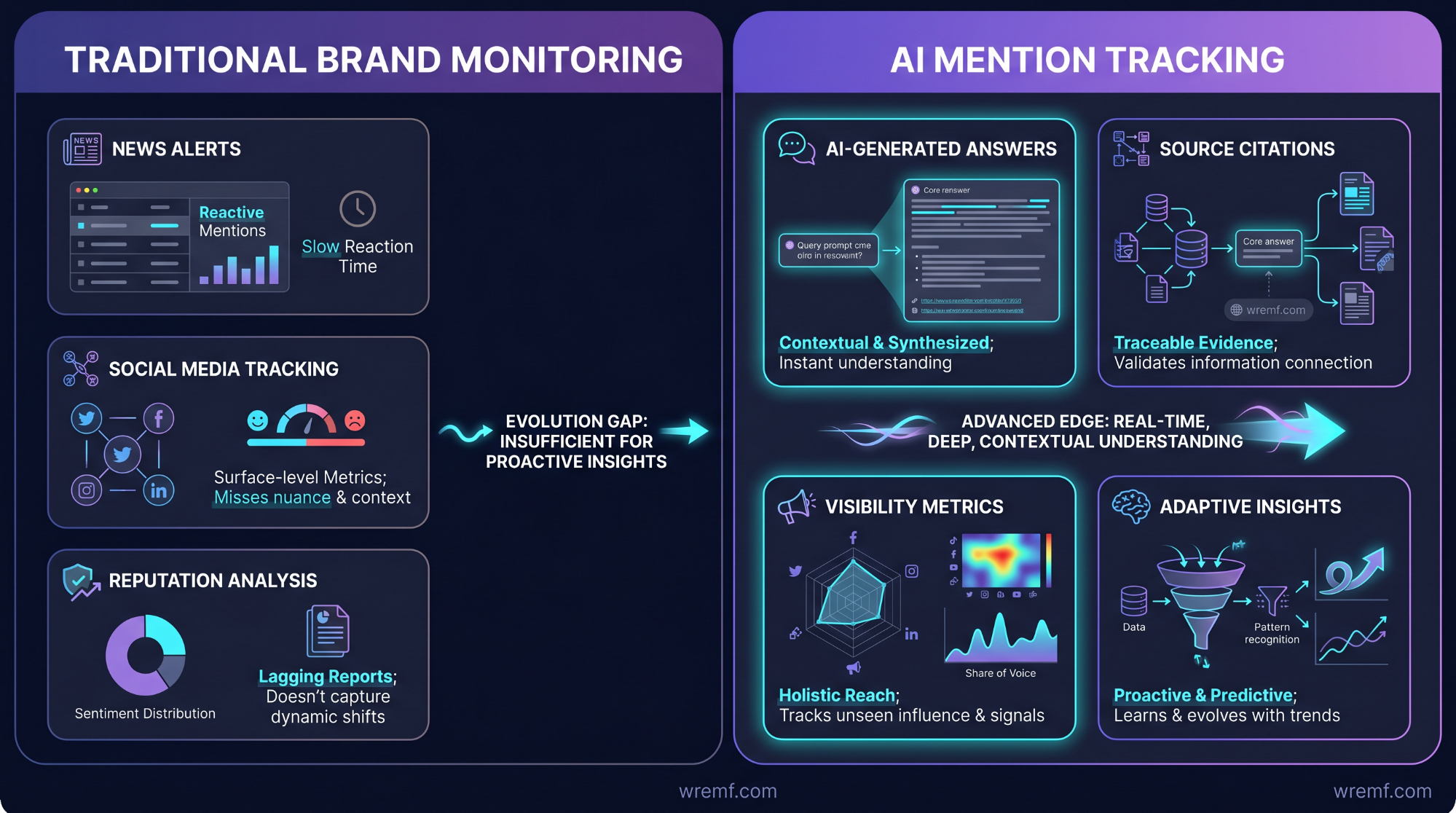
Traditional brand monitoring is no longer enough because AI-generated answers compress many sources into one response that can shape buyer perception without creating a normal website visit. AI mention tracking closes this gap by measuring AI Search visibility, source citations, and brand recommendation visibility.
Brand mention tracking is the process of finding references to a company, product, executive, domain, or branded term across digital channels. In AI Search, brand mention tracking must also include exact mentions, brand name variants, product names, semantic context, citations, sentiment, and recommendations.
Brand mention tools were built for web mentions, social listening, social media monitoring, PR alerts, backlinks, and reputation monitoring. These tools remain useful, but they do not fully explain how AI models interpret your entity, which sources they trust, or why competitors appear in AI answers ahead of you.
Brand reputation management is the practice of monitoring and improving how a brand is described across public and private information sources. In AI-generated answers, brand reputation management becomes more technical because AI models may summarise outdated profiles, review sites, comparison pages, documentation, Reddit threads, social platforms, and third-party directories.
In real B2B buying journeys, a prospect may ask ChatGPT for the best vendors, Perplexity for a sourced comparison, Gemini for product alternatives, Copilot for market research, and Google AI Overviews for a quick summary. Each AI platform may produce a different narrative because each engine has different retrieval systems, source access, grounding behaviour, and citation formats.
AI-generated answers are responses created by AI models using trained knowledge, retrieved web sources, connected indexes, or a mix of those signals. AI-generated answers matter because users often treat the answer as a recommendation, not just a search result.
| Monitoring area | Traditional brand monitoring | AI mention tracking |
|---|---|---|
| Main surface | News, blogs, forums, backlinks, social media, social networks | ChatGPT, Claude, Gemini, Perplexity, Google AI Overviews, Copilot, AI answer engines |
| Core metric | Mention volume | Mention frequency, citations, sentiment analysis, share of voice, recommendation visibility |
| Common output | Alerts, media lists, social listening dashboards | Prompt results, AI answers, source citations, competitor visibility, AI visibility score |
| Main limitation | Does not show AI-generated responses | Can vary by prompt, AI model, location, and time |
| Best use | PR, social media monitoring, brand sentiment | AI Search Optimization, Generative Engine Optimization, AEO, LLM visibility |
The most common mistake is treating AI results as ordinary rankings. Search engines return ranked documents. AI answer engines summarise entities, cite sources, compare vendors, and decide which brands are relevant to natural language prompts.
KEY TAKEAWAY: Traditional monitoring still matters, but AI mention tracking is needed to understand how AI assistants turn sources into brand narratives.
To measure that narrative, teams need to understand how AI models process brand information.
How AI Models Process Brand Mentions in AI Search
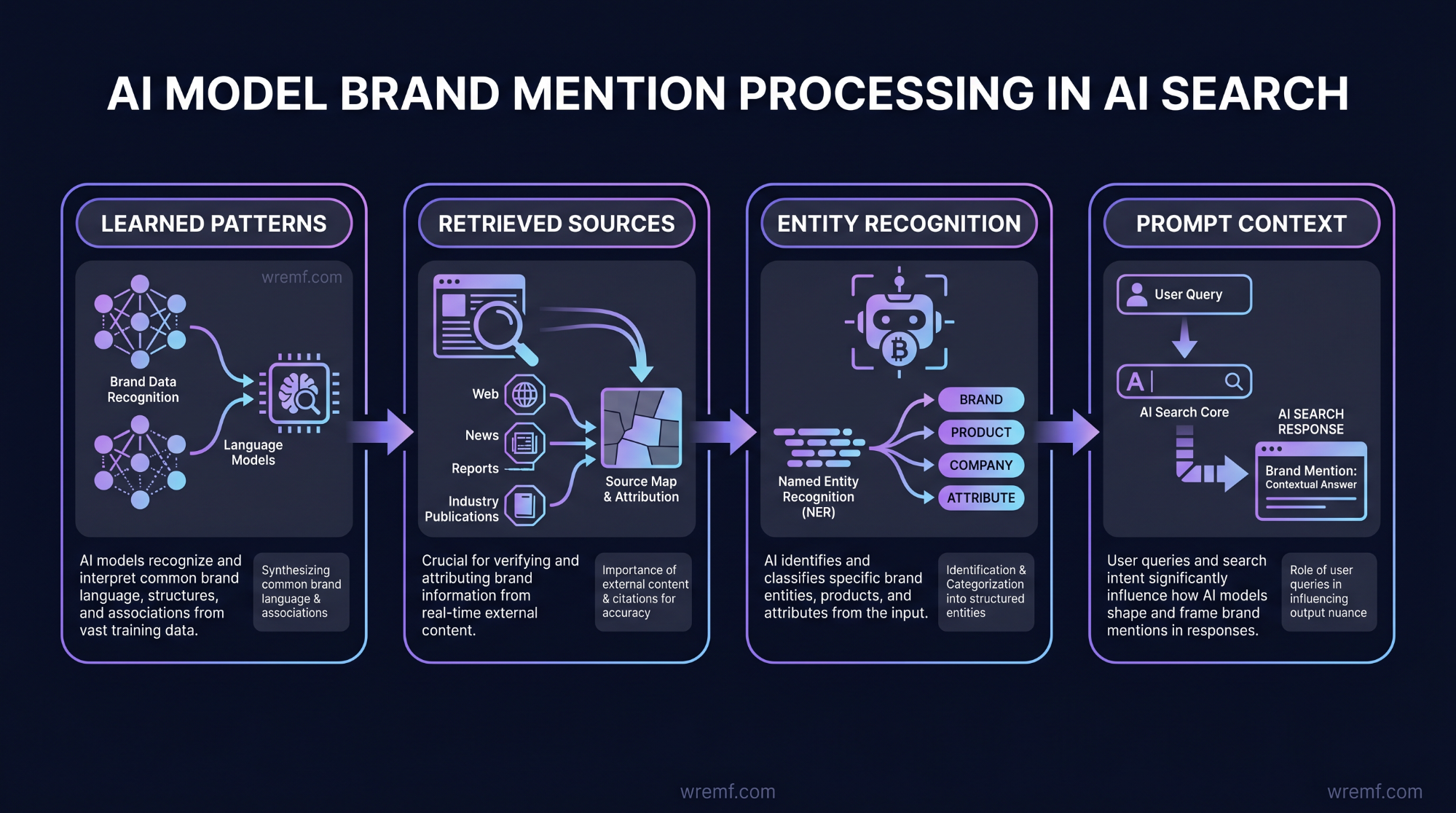
AI models process brand mentions by combining learned patterns, retrieved sources, citations, entity recognition, and prompt context. This means AI Search visibility depends on both your owned content and the external sources that describe your brand.
AI models are systems that generate, classify, summarise, retrieve, or reason over information using artificial intelligence. AI models matter for brand tracking because they can describe your company even when your website is not the only source being used.
Large language models are AI systems trained to generate text, answer questions, summarise content, and follow instructions. Large language models matter because they can produce AI-generated responses that include brand mentions, product comparisons, recommendations, and source links.
AI answer engines are AI platforms that generate direct answers instead of only returning ranked links. AI answer engines matter because they can compress the buying journey into one response that includes a few brands, a few citations, and a short recommendation.
OpenAI explains that ChatGPT Search can provide fast, timely answers with links to relevant web sources. Google Search Central explains that AI features such as AI Overviews and AI Mode are part of Google Search and gives site owners guidance on how content may be included in these experiences. Anthropic states that Claude’s web search tool can answer with up-to-date information beyond its knowledge cutoff and includes citations from search results. (OpenAI)
AI citations are source references used by AI platforms to support, ground, or explain an answer. AI citations matter because they show which pages, publishers, profiles, directories, reviews, or knowledge sources influence AI-generated answers.
Source links are cited URLs, linked references, or visible sources shown inside AI-generated responses. Source links matter because they reveal part of the evidence layer behind an AI answer, especially in Perplexity, ChatGPT Search, Claude with web search, Copilot, and Google AI Overviews.
Perplexity describes itself as an AI-powered answer engine, and its Help Center explains that each answer includes numbered citations linking to original sources. This is why Perplexity is often central to AI mention tracking, citation tracking, and AI Search Optimization workflows. (Perplexity AI)
Entity disambiguation is the process of helping systems understand which brand, product, person, or organisation is being discussed. Entity disambiguation matters because brand name variants, similar company names, old domains, and inconsistent descriptions can cause inaccurate AI results.
For example, a B2B SaaS company with a generic name may be confused with a consumer app, a local service provider, or an old acquisition. In practical AI visibility audits, teams often find that AI models describe the wrong category, cite outdated profiles, or recommend competitors because source consistency is weak.
IMPORTANT: AI mention tracking should not only count mentions. It should inspect the sources, wording, competitors, sentiment analysis, recommendation context, and citation patterns behind each AI-generated answer.
KEY TAKEAWAY: AI models process brand mentions through a mix of entity understanding, source retrieval, prompt context, and citation behaviour.
Once the mechanics are clear, the next step is deciding what to measure.
The 3-Layer Framework for AI Mention Tracking
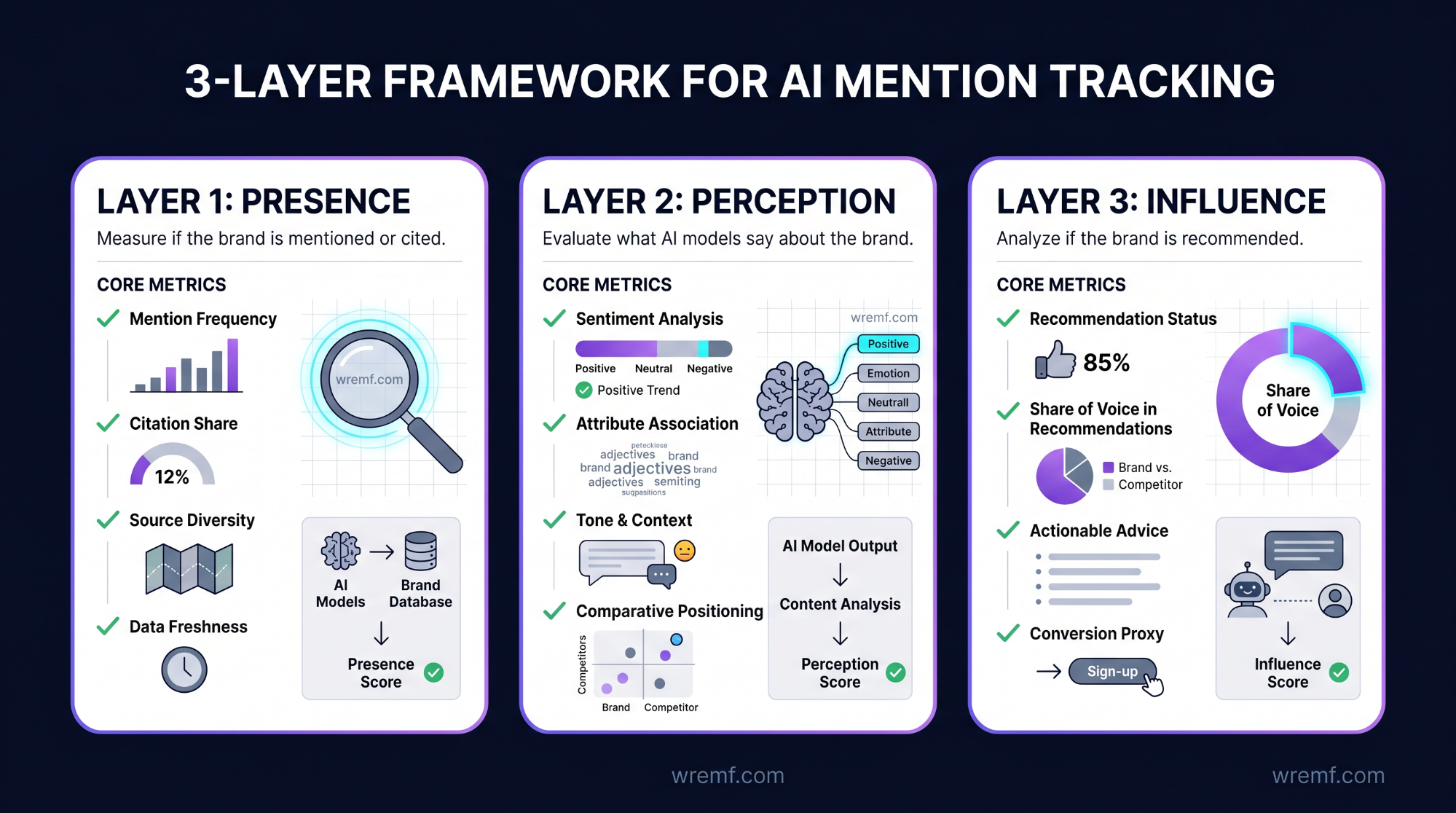
The best AI mention tracking framework has three layers: presence, perception, and influence. This structure helps teams move beyond simple mention counts and measure whether AI answers actually support brand discovery.
Presence measures whether your brand appears in AI-generated answers. Presence includes direct brand mentions, product mentions, source citations, brand name variants, domain citations, and whether your website appears as a cited source.
Perception measures what AI models say about your brand. Perception includes sentiment analysis, accuracy, category positioning, strengths, weaknesses, pricing claims, competitor comparisons, outdated information, and hallucinations.
Influence measures whether your brand is recommended, cited, or selected as a relevant choice for high-intent prompts. Influence includes share of voice, share of answer, recommendation frequency, competitor visibility, and visibility inside commercial AI results.
Mention frequency is the number of times your brand appears across a defined set of prompts, AI engines, and test runs. Mention frequency matters because one manual prompt is not enough to understand AI visibility across changing AI-generated responses.
Share of voice is the percentage of visibility your brand receives compared with competitors across a defined prompt set. Share of voice matters because AI Search is often comparative. A brand may be mentioned but still lose influence if competitors are recommended more often.
Share of answer is the proportion of AI-generated answer space, recommendations, citations, or shortlist placements your brand receives compared with competitors. Share of answer is useful when an answer includes multiple vendors, product categories, or recommended solutions.
| Layer | Question answered | Example metric | What it reveals |
|---|---|---|---|
| Presence | Is the brand mentioned or cited? | Mention frequency, citation count, AI results coverage | Basic AI visibility |
| Perception | How is the brand described? | Sentiment analysis, accuracy score, narrative consistency | Brand reputation and entity clarity |
| Influence | Is the brand recommended? | Share of voice, share of answer, competitor visibility | Commercial impact and buying journey influence |
In real-world reporting, presence without perception can be misleading. A brand may appear often but be described inaccurately. A brand may receive citations but never appear as the recommended choice. A brand may have strong Google rankings but weak AI Search visibility because AI assistants cite different sources.
If you want to see how these layers appear in practice, review a sample AI visibility report before building your own measurement workflow.
KEY TAKEAWAY: AI mention tracking should measure presence, perception, and influence rather than treating every brand mention as equal.
These layers become useful when they are translated into specific dashboard metrics.
Key Metrics for Measuring AI Search Visibility
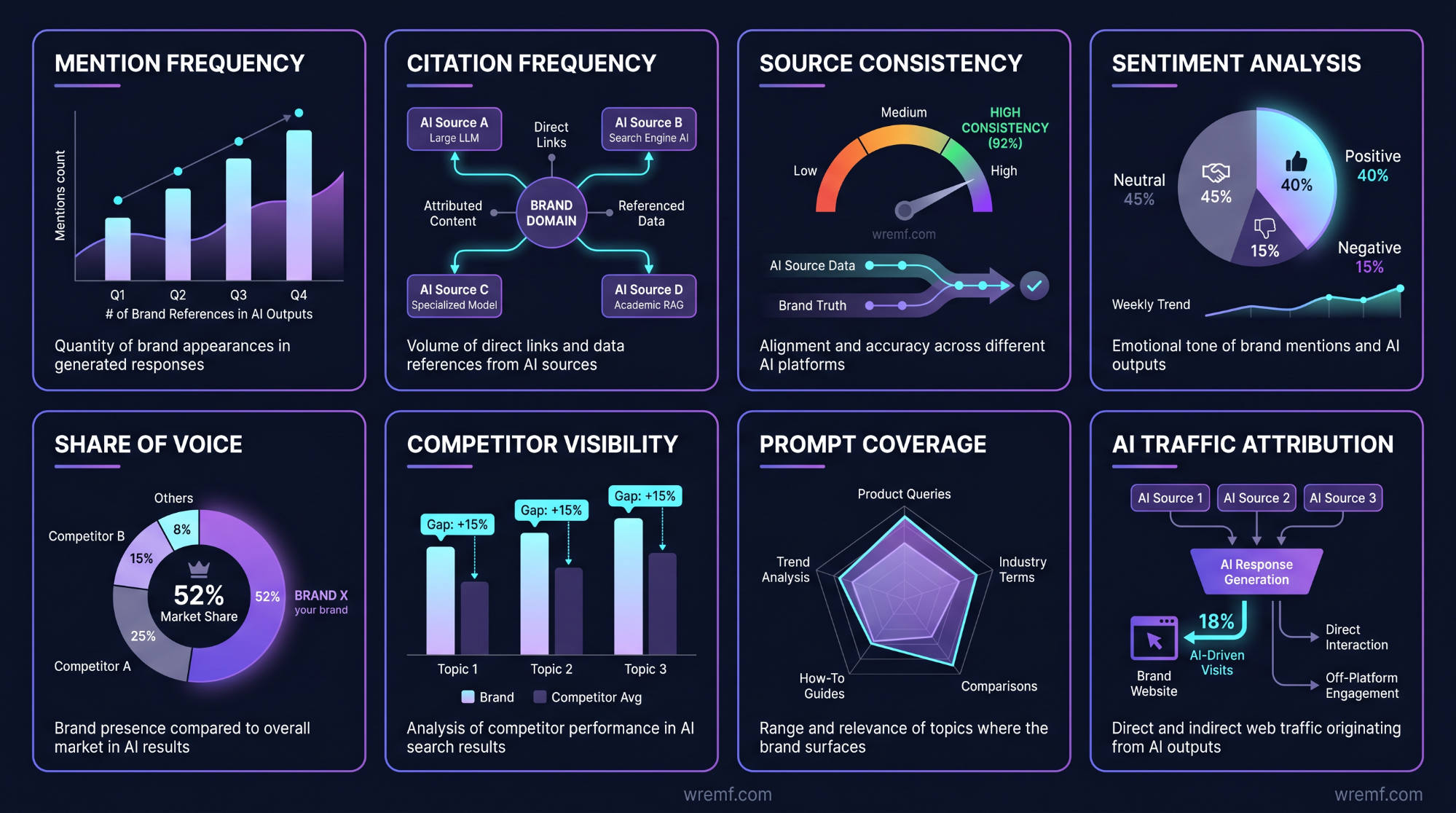
The most useful AI Search visibility metrics are mention frequency, citation frequency, source consistency, sentiment analysis, share of voice, competitor visibility, prompt coverage, and AI traffic attribution. These metrics show whether AI answers include, trust, and recommend your brand.
AI Search visibility is broader than ranking. Ranking asks where a URL appears. AI Search visibility asks whether an AI assistant mentions the brand, cites the brand, recommends the brand, describes the brand accurately, and sends measurable traffic.
Prompt tracking is the process of testing repeatable user questions across AI engines to monitor visibility changes over time. Prompt tracking matters because AI-generated responses can change by wording, model, location, freshness, and retrieval behaviour.
Competitor visibility measures how often competing brands appear, get cited, or get recommended for the same prompts. Competitor visibility matters because AI answer engines often give shortlists, comparisons, alternatives, and “best for” recommendations.
AI traffic attribution connects AI visibility to visits, sessions, conversions, or pipeline influence from AI-related referral sources. AI traffic attribution matters because leadership needs to know whether AI Search visibility is only reputational or also connected to business outcomes.
A strong AI mention tracking dashboard should include these metrics:
Mention frequency by AI engine
AI answers containing brand mentions
AI-generated responses containing competitors
Source citations by domain and URL
Share of voice across prompt categories
Share of answer for high-intent comparison prompts
Sentiment analysis by engine and prompt type
Brand name variants detected in AI results
Hallucinations or inaccurate claims
AI traffic attribution from analytics tools
Content gaps linked to missing or weak answers
Recommendation visibility for commercial prompts
Email alerts for sudden visibility or brand sentiment changes
Export options for CSV, API, and client reporting
Google AI Overviews are AI-generated snapshots in Google Search that can include links for users to explore more. Google Search Central explains that AI Overviews and AI Mode are AI features in Google Search, which matters because AI-generated answers now sit directly inside a major search engine. (Google for Developers)
AI Mode is Google’s AI-powered Search experience for more conversational, multi-step exploration. AI Mode matters because AI Search is moving from keyword queries toward longer, task-based prompts.
AI results are generated answers, summaries, citations, links, or recommendations returned by AI platforms. AI results matter because brand visibility can happen without a normal ranking position or a standard click path.
Search Console is Google’s tool for monitoring search performance, queries, pages, and indexing signals. Search Console still matters because traditional search engines remain a major discovery source, and query data can help shape AI prompt libraries.
Google Trends is a tool for comparing search interest across terms, regions, and time. Google Trends can help content teams identify changing language around AI Search, brand categories, competitors, and buyer questions.
TIP: Build your first prompt library around 20 to 50 high-intent prompts, split across branded, category, comparison, problem-aware, and buying-stage questions.
KEY TAKEAWAY: AI Search visibility should be measured with prompt, citation, competitor, sentiment, and attribution metrics together.
Metrics are only useful when the prompt library is designed correctly.
How to Build a Prompt Library for AI Mention Tracking
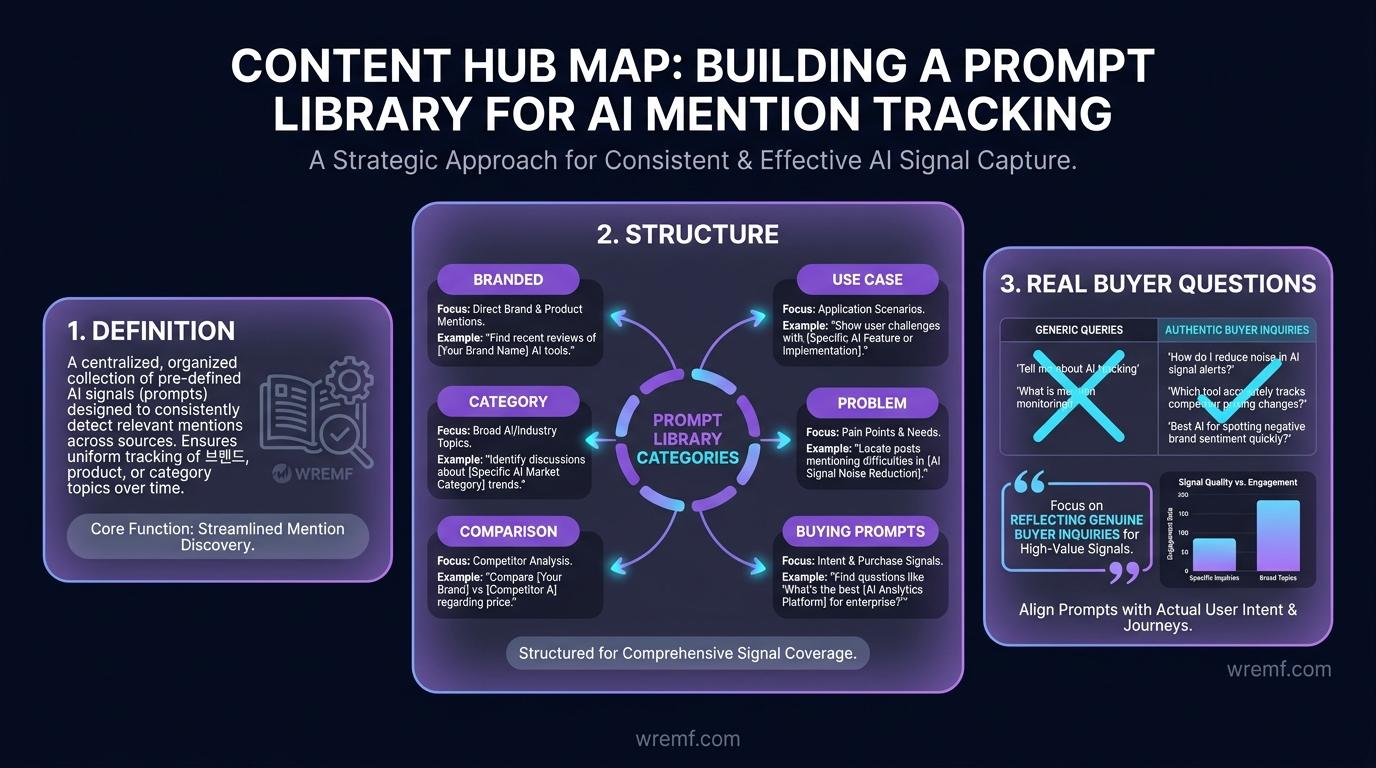
A prompt library is a structured set of repeatable questions used to test AI visibility across AI models and AI platforms. A strong prompt library reflects real buyer questions, not only SEO keywords.
Prompt library design is the foundation of reliable AI mention tracking. It controls what you test, how often you test it, which AI engines you compare, and which business intents you measure.
AI Search Optimization is the practice of improving brand visibility inside AI Search platforms, AI answer engines, and AI-generated responses. AI Search Optimization matters because content teams now need to shape how AI systems interpret entities, sources, comparisons, and recommendations.
Start by grouping prompts into intent categories. Branded prompts test whether AI models understand your company. Category prompts test whether you appear in relevant solution shortlists. Comparison prompts test whether you are positioned against competitors. Problem prompts test whether AI assistants connect your brand to customer pain points.
A practical AI mention tracking prompt library should include:
Branded prompts: “What is [brand]?”
Category prompts: “What are the best tools for [category]?”
Comparison prompts: “[Brand] vs [competitor]: which is better?”
Use case prompts: “What tools help B2B SaaS teams track AI visibility?”
Problem prompts: “How can I monitor brand mentions in ChatGPT and Perplexity?”
Buying prompts: “Which AI visibility monitoring tools are best for agencies?”
Source prompts: “Which sources mention [brand] as a provider in [category]?”
Risk prompts: “What are the limitations of [brand]?”
Alternative prompts: “What are alternatives to [competitor]?”
Voice-style prompts: “What tool should I use to see if AI assistants mention my company?”
Brand name variants are alternate spellings, product names, abbreviations, old names, domain names, or common misspellings associated with a brand. Brand name variants matter because AI models may mention or confuse different versions of the same entity.
A prompt library should also include competitor analysis prompts. Competitor analysis helps you understand which companies are being recommended, which sources support them, and which content gaps prevent your brand from appearing in AI-generated answers.
Search Console can help identify real search queries that should become prompt candidates. Google Trends can help identify rising language patterns. CRM notes, sales calls, support tickets, review sites, Reddit threads, Quora questions, LinkedIn discussions, and social platforms can reveal natural language prompts that buyers use before they convert.
WREMF’s prompt intelligence workflow helps teams organise prompt categories, monitor results across AI engines, and connect prompt performance to source citations and competitor visibility.
KEY TAKEAWAY: A prompt library turns AI mention tracking from random manual testing into a repeatable AI visibility measurement system.
After prompts are defined, the next challenge is interpreting citations, sources, and entity signals.
Why AI Citations and Source Consistency Matter
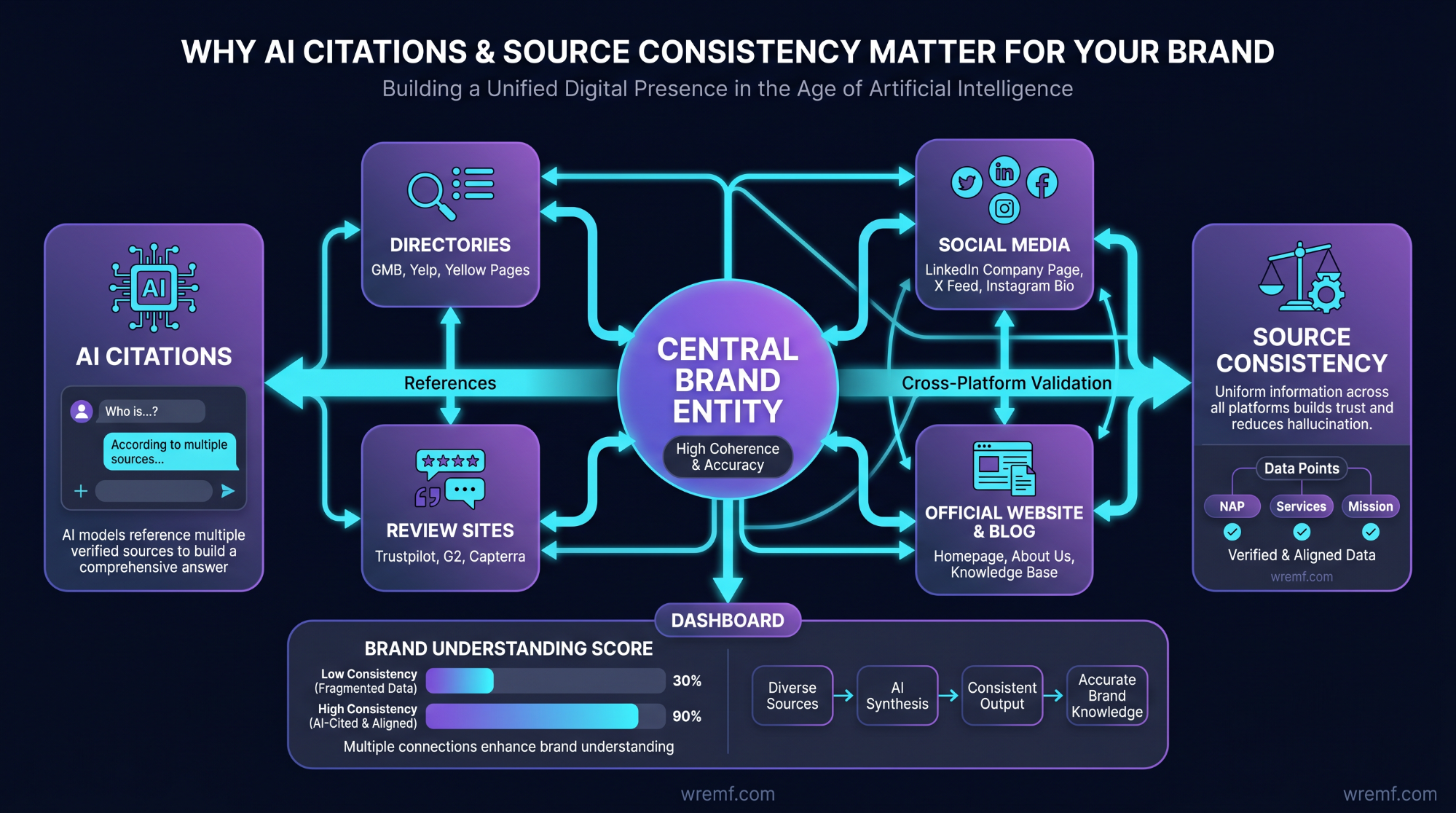
AI citations matter because they show which sources AI platforms use to support, summarise, or justify brand-related answers. Source consistency matters because AI models can more easily understand a brand when multiple trusted sources describe it clearly and consistently.
Source consistency is the alignment of brand facts across your website, profiles, directories, review sites, media mentions, documentation, and third-party sources. Source consistency helps AI systems connect the same entity across multiple AI-generated responses.
Generative Engine Optimization is the practice of improving how a brand appears in generative AI answers, summaries, citations, and recommendations. Generative Engine Optimization matters because AI Search depends on the sources and entity signals that AI engines can retrieve, interpret, and cite.
Answer Engine Optimisation is the practice of structuring content so answer engines can understand, extract, and use it in direct answers. AEO matters because AI answer engines prefer clear definitions, concise explanations, entity relationships, and trustworthy evidence.
Content optimization for AI Search is not keyword stuffing. Content optimization means making facts clear, defining entities, answering specific prompts, using structured content, creating Content Briefs, improving internal linking, and aligning sources around the same narrative.
Google Search Central says Google’s automated ranking systems are designed to prioritise helpful, reliable information created to benefit people. That matters for AI Search Optimization because clear, useful, people-first content is easier for both search systems and AI retrieval systems to interpret. (Google for Developers)
Schema markup is structured data that helps search systems understand entities, pages, products, organisations, reviews, and other page types. Schema markup matters for AI Search because clear technical signals can support entity understanding, although schema alone does not guarantee AI citations.
AI bots are crawlers or user agents used by AI companies, search systems, or retrieval platforms to access web content. AI bots matter because crawlability, robots settings, rendering, and content accessibility can affect whether AI discovery surfaces can use your pages.
In practical AI visibility audits, SEO teams frequently discover that the brand’s own website says one thing, review sites say another, old directory profiles use outdated positioning, and competitor comparison pages define the category better than the brand does. That inconsistency can reduce AI visibility even when the brand has good organic rankings.
The WREMF source citation workflow helps teams identify which domains and URLs AI engines cite, which sources competitors own, and where content gaps or source consistency issues may be hurting AI visibility.
KEY TAKEAWAY: AI citations and source consistency show which sources shape AI answers and whether your brand entity is clear enough to be trusted.
Once sources are understood, teams need to compare the available tools and workflows.
What Are the Best AI Mention Tracking Tools and Workflows?
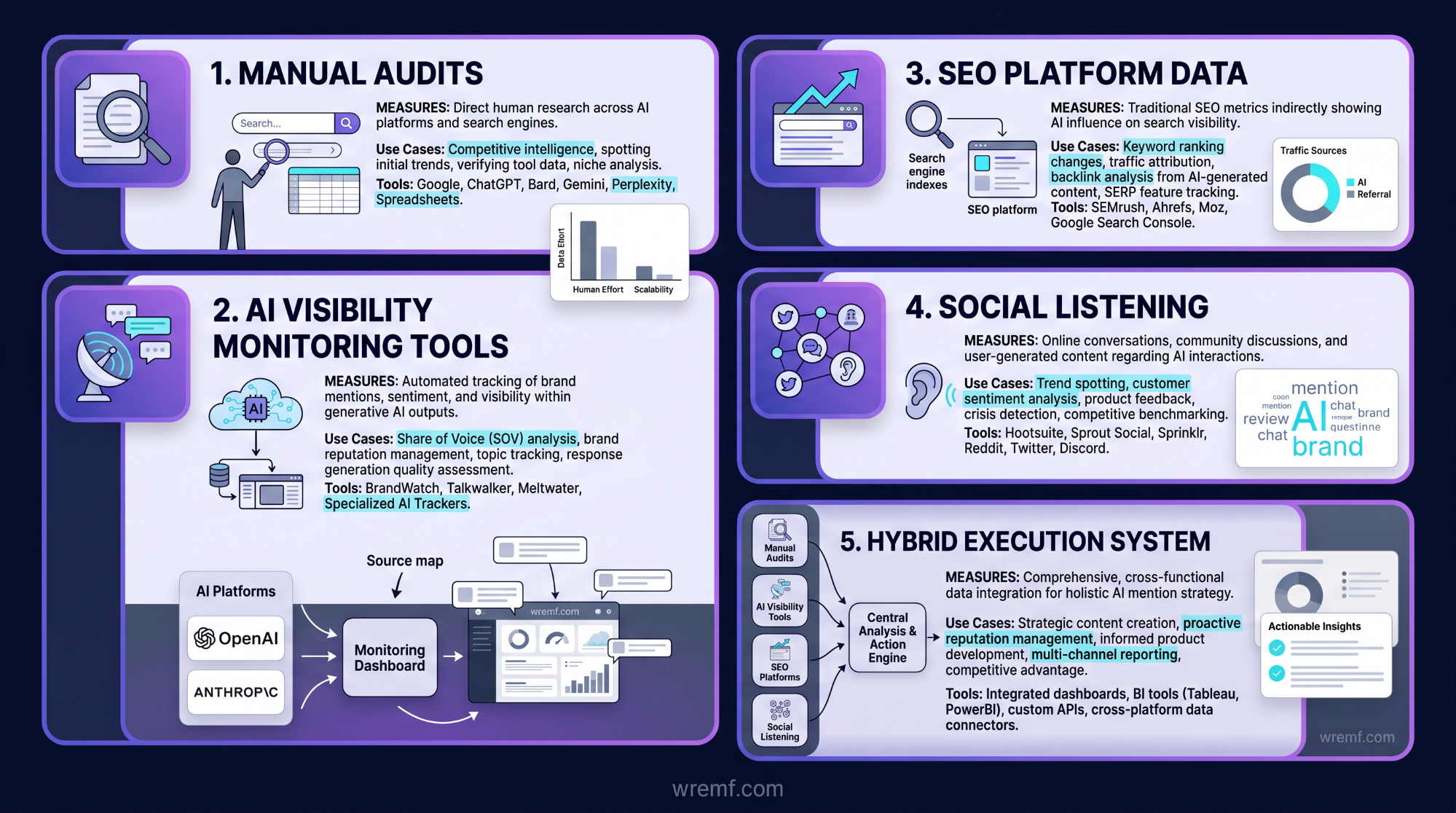
The best AI mention tracking workflow depends on whether you need manual audits, AI visibility monitoring tools, SEO platform data, social listening, or a hybrid execution system. Most B2B teams need dedicated AI Search monitoring plus traditional SEO and analytics data.
AI visibility monitoring tools track brand mentions, citations, competitors, prompts, and AI-generated responses across AI engines. AI visibility monitoring tools matter because manual checks cannot reliably cover many prompts, engines, dates, locations, brand name variants, and competitors.
Search visibility tools such as Semrush, Ahrefs, Moz Pro, BrightEdge, Conductor, and Botify remain useful for traditional search engines. These tools help with keyword rankings, backlinks, content gaps, Content Audit workflows, technical SEO, Search Console analysis, traffic metrics, and market share. They do not fully replace AI mention tracking because AI Search platforms produce generated answers rather than only ranked URLs.
Social listening tools such as Brandwatch, Talkwalker, Sprout Social, and similar platforms help track social media, social networks, social platforms, and brand sentiment. They are useful for brand reputation management, but they do not show how ChatGPT, Claude, Gemini, Perplexity, Copilot, or Google AI Overviews generate AI answers.
Brand mention tools can detect online references, but AI-powered tools are needed when the goal is to monitor AI-generated responses, share of answer, citation gaps, prompt-level visibility, and competitor recommendations. Google Alerts can still help with basic web mention alerts, but Google Alerts does not track AI answer engines.
| Option | Best for | What it measures | What it misses | Recommended when |
|---|---|---|---|---|
| Manual AI brand audit | Early exploration | A small sample of AI-generated responses | Scale, history, automation, email alerts | You are validating whether AI mention tracking matters |
| Dedicated AI visibility tools | Ongoing AI Search tracking | Prompts, citations, mentions, competitors, share of voice | Broader SEO diagnostics unless integrated | You need repeatable AI visibility reporting |
| SEO platforms | Traditional search visibility | Rankings, backlinks, Search Console data, traffic metrics, content gaps | AI-generated answer wording and citations | You still rely heavily on search engines |
| Social listening platforms | Brand reputation | Social media, social networks, brand sentiment | AI answer engines and prompt-level visibility | You need reputation monitoring across public channels |
| Hybrid software plus agency | Strategy and execution | AI mentions, citations, recommendations, actions | Requires clear ownership and budget | You need both measurement and implementation |
Peec AI, Profound, OtterlyAI, Scrunch AI, Brand Radar, and other AI-powered tools reflect a growing category of AI visibility software. Some focus on prompt tracking, some on brand monitoring, some on analytics, and some on enterprise reporting. The right choice depends on AI engines covered, prompt library controls, citations, exports, alerts, data retention, team permissions, and whether your team needs execution support.
For scaleups and agencies, additional features to consider include role-based access, data retention, SSO or SAML, CSV exports, API exports, email alerts, client portals, and Kanban-style workflow management. These features matter when AI visibility moves from research into recurring reporting and execution.
WREMF is designed for teams that want multi-engine coverage across 10 AI engines, unlimited prompt tracking, BYOK support, white-label reporting, content recommendations, and optional managed execution. Agencies can use WREMF for white-label AI visibility reporting, while in-house teams can use WREMF for brand AI Search visibility.
KEY TAKEAWAY: AI mention tracking tools should be chosen by coverage, citation visibility, competitor analysis, workflow fit, and reporting value rather than dashboard design alone.
Tool selection becomes easier when software, agency, and hybrid models are compared directly.
Software vs Agency vs Hybrid AI Mention Tracking
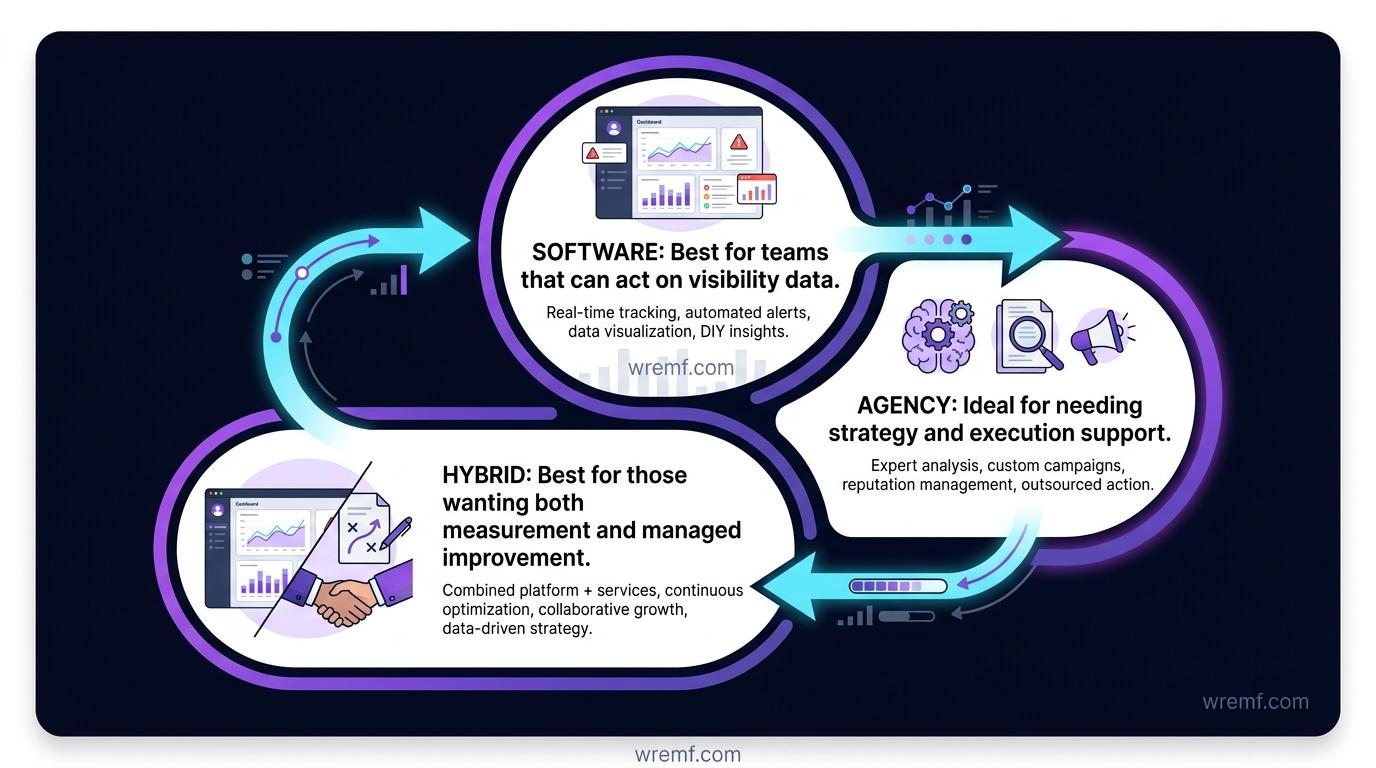
Software is best when your team can act on AI visibility data internally. Agency support is best when you need strategy, content optimization, source consistency cleanup, and execution. A hybrid model works when teams want measurement and managed improvement together.
AI-powered tools can collect AI results faster than manual testing. However, tools alone do not fix inaccurate brand narratives, weak content, poor source consistency, missing Content Briefs, or technical crawl issues. Teams usually struggle when dashboards reveal problems but no one owns the implementation.
An agency model helps when you need AI visibility strategy, Generative Engine Optimization, content strategy, Content Audit workflows, technical AI visibility foundations, internal linking logic, schema markup guidance, and monthly reporting. This is especially useful for lean marketing teams, agencies managing multiple clients, and B2B companies entering a competitive AI Search category.
A hybrid model combines software with managed execution. This gives teams access to prompt tracking, citation analysis, competitor analysis, share of voice reporting, email alerts, and recommendations while also getting help with content creation, content gaps, content performance tracking, source consistency, and technical SEO.
| Model | Best for | Strength | Main limitation | Example use case |
|---|---|---|---|---|
| Software | Teams with internal SEO and content teams | Scalable tracking and reporting | Requires internal execution | Weekly AI visibility monitoring |
| Agency | Teams needing expert execution | Strategy, content optimization, governance | Less self-serve control | Fixing weak AI citations and brand reputation issues |
| Hybrid | Teams wanting tracking plus action | Data and execution in one workflow | Needs clear priorities | Improving AI mentions across prompts and engines |
WREMF can be used as software, an agency service, or a combined software plus managed execution solution. The WREMF agency team supports AI visibility strategy, GEO consulting, AEO execution, citation improvement, source consistency cleanup, AI-ready content briefs, and monthly reporting without long-term lock-in.
KEY TAKEAWAY: The right AI mention tracking model depends on whether your team needs only visibility data or also the execution required to improve it.
Before investing in a full workflow, many teams should start with a focused manual audit.
How to Conduct a Manual AI Brand Audit
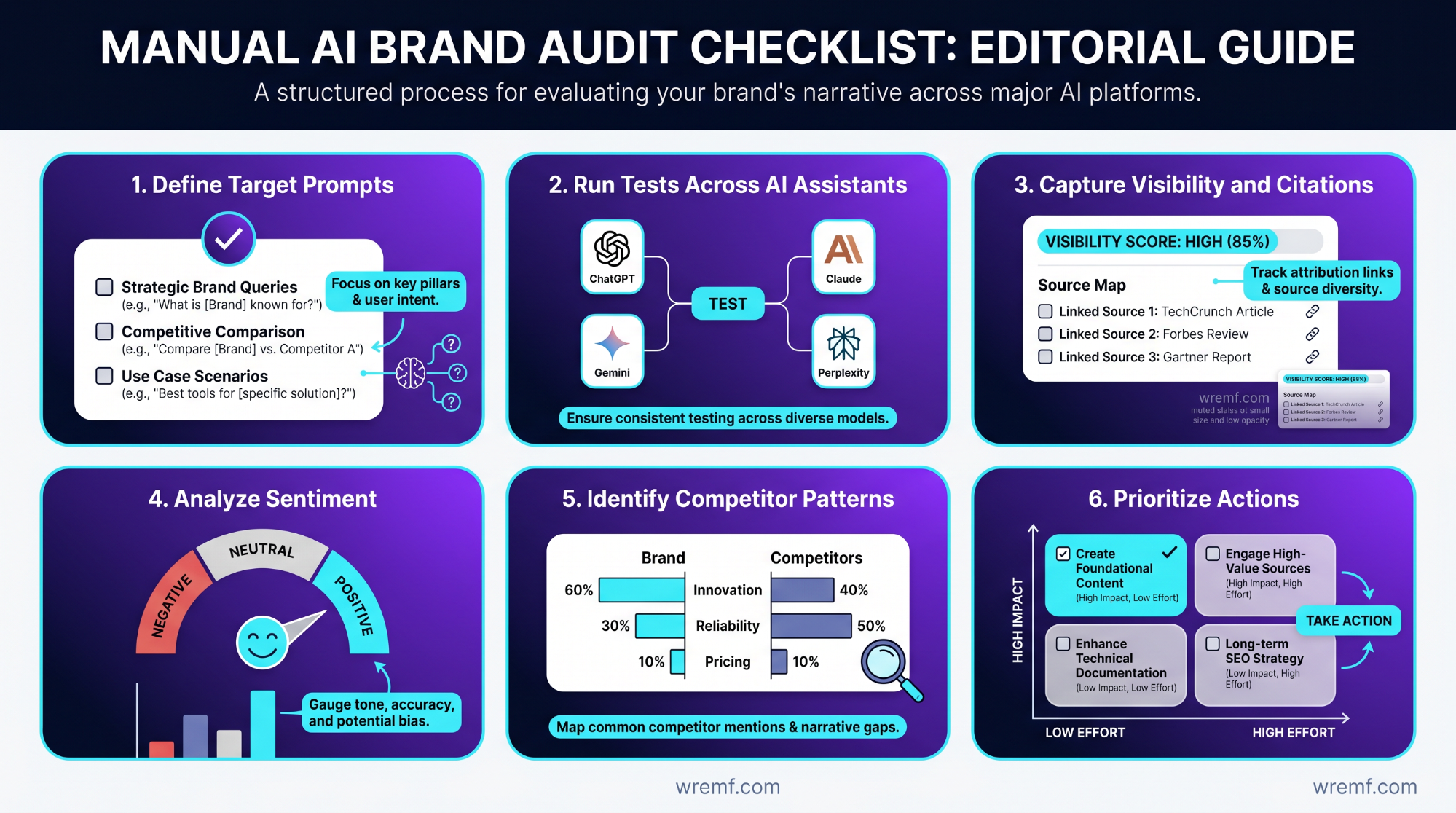
A manual AI brand audit tests a focused set of prompts across AI assistants to find early visibility, citation, sentiment, and competitor patterns. It is useful before buying software or building a full AI Search monitoring program.
An AI brand audit is a structured review of how AI platforms describe, cite, compare, and recommend a brand. An AI brand audit matters because it reveals hallucinations, missing sources, weak category association, and competitor advantages before they become recurring reporting problems.
Start with 10 to 20 prompts. Include branded, category, competitor, use case, risk, and buying-intent prompts. Run each prompt in ChatGPT, Claude, Google Gemini, Perplexity, Copilot, Google AI Overviews where available, and other relevant AI search engines. Save each response, source link, brand mention, citation, competitor, and recommendation.
Then score each result using a simple rubric:
Mentioned: yes or no
Cited: yes or no
Recommended: yes or no
Accurate: accurate, partly accurate, inaccurate
Sentiment: positive, neutral, negative
Competitors included: none, some, many
Source quality: owned, earned, directory, review, social, unknown
Action required: content update, citation gap, source cleanup, technical check, monitoring only
Blind tests are useful because they reduce bias. Ask the prompt without mentioning your brand, then compare whether your brand appears naturally. A blind test shows whether AI models associate your company with the category rather than only responding when directly asked.
Hallucinations are incorrect or unsupported claims produced by AI-generated responses. Hallucinations matter for brand reputation because AI assistants can describe old pricing, wrong features, outdated positioning, invented limitations, or inaccurate comparisons.
A common implementation mistake is testing only one AI model once and treating the answer as truth. AI-generated responses can vary by prompt wording, retrieval state, engine, model version, location, and date. Manual audits should be treated as directional, not complete.
TIP: Save the exact prompt, engine, date, response, sources, and screenshot or export for every test so future comparisons are possible.
KEY TAKEAWAY: A manual AI brand audit helps you find visibility problems quickly, but ongoing tracking is needed for reliable trend analysis.
Once the audit reveals issues, teams need a governance process for acting on the data.
What Should You Do With AI Mention Tracking Data?
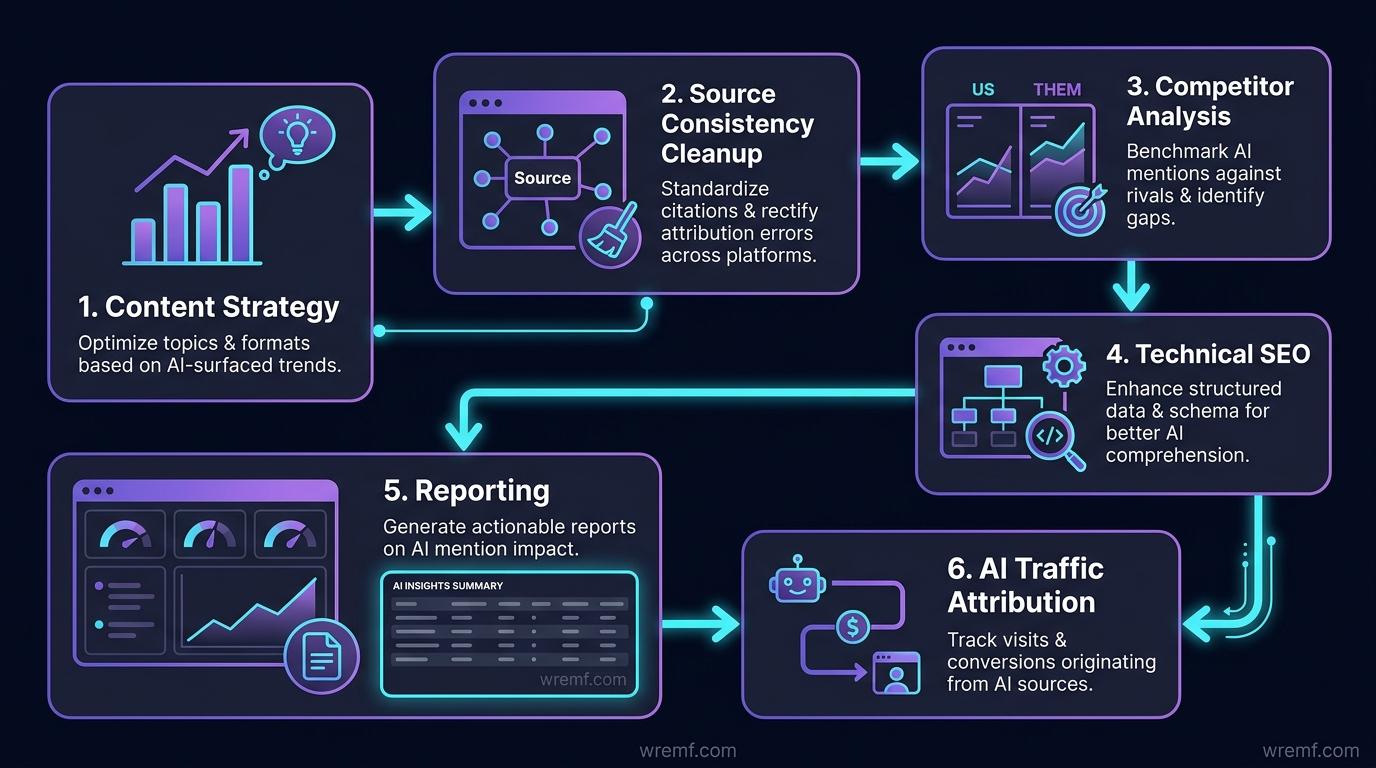
AI mention tracking data should feed content strategy, source consistency cleanup, competitor analysis, technical SEO, reporting, and AI traffic attribution. The goal is to turn AI visibility signals into actions, not just screenshots.
Content strategy is the plan for creating, updating, and organising content to satisfy user intent and business goals. In AI Search Optimization, content strategy must also answer natural language prompts, define entities clearly, fill content gaps, and create citation-worthy sources.
Content gaps are missing or weak content areas that prevent a brand from being mentioned, cited, or recommended for relevant AI Search prompts. Content gaps matter because AI answer engines cannot easily recommend what they cannot understand, retrieve, or verify.
Content Briefs are structured instructions for creating content that satisfies user intent, search demand, AI retrieval patterns, entity coverage, and conversion goals. Content Briefs matter because content teams need repeatable guidance, not vague recommendations like “write more GEO content.”
After collecting AI results, classify actions into four groups:
Fix accuracy problems: update outdated descriptions, pricing claims, feature lists, and category definitions
Improve source consistency: align your website, profiles, directories, review sites, and third-party references
Fill content gaps: create answer-first pages, comparison pages, product explainers, FAQs, and use case content
Strengthen reporting: connect prompt tracking, share of voice, citations, Search Console, GA4, CRM, and pipeline data
AI traffic attribution should use analytics data carefully. AI referrals may appear from ChatGPT, Perplexity, Copilot, Gemini, or other sources, but not every AI-influenced journey produces a visible referral. In real-world reporting, AI mention tracking should be combined with traffic metrics, assisted conversions, branded search lifts, and sales feedback.
Microsoft states that Copilot Answers may include references and information from external sources, including web sources, which reinforces why source analysis and citation tracking are now part of brand reputation management. (Microsoft Learn)
WREMF’s GEO audit workflow helps identify technical, content, entity, and source issues that may limit AI visibility. Teams can then use AI-ready content briefs and SEO testing workflows to prioritise improvements and measure impact.
KEY TAKEAWAY: AI mention tracking becomes valuable when it drives content, citation, source, competitor, and attribution actions.
This is where expert nuance matters because AI visibility is both a measurement problem and a source ecosystem problem.
Why AI Visibility Is Both a Measurement Problem and a Source Ecosystem Problem
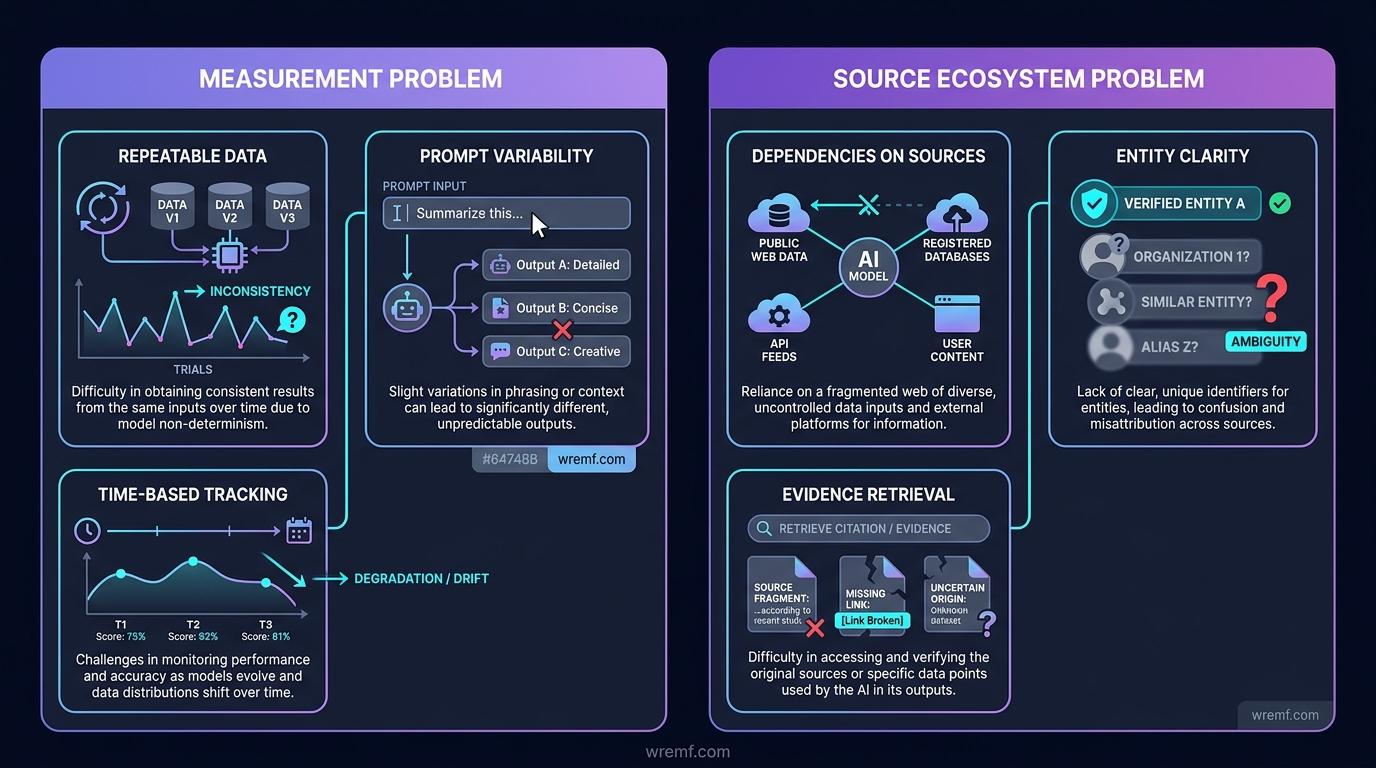
AI visibility is a measurement problem because brands need repeatable data across prompts, AI platforms, and time. AI visibility is also a source ecosystem problem because AI answers depend on the sources, entities, and evidence available to AI models.
Many teams assume AI Search visibility can be fixed by publishing more content. Content creation helps, but content alone is not enough if AI models trust other sources more, if social platforms contain stronger narratives, or if external directories describe the brand inaccurately.
Brand reputation management in AI Search requires technical SEO precision. Crawlability, rendering, schema markup, internal linking, content structure, source links, entity signals, and consistent naming all influence how AI bots and search systems can understand a brand.
Entity signals are clues that help search engines and AI models understand what an organisation is, what it offers, who it serves, and how it relates to other entities. Entity signals matter because AI-generated answers often summarise relationships rather than list webpages.
AI answer engines reward clarity. A page that defines a category, explains use cases, answers common questions, cites sources, and links to relevant product pages is easier to retrieve and summarise than a page filled with vague marketing claims.
AI visibility is the measurable presence of a brand inside AI-generated answers, recommendations, citations, and summaries. AI visibility improves when brand facts are consistent, content answers real prompts, sources are credible, and competitors are tracked across the same AI engines.
AI Search is not replacing SEO completely. AI Search, SEO, AEO, and Generative Engine Optimization overlap. SEO improves discoverability in search engines. AEO improves direct answer extraction. GEO improves visibility in generative AI answers. AI mention tracking measures whether those efforts are visible in AI-generated responses.
IMPORTANT: Rankings alone do not explain whether AI assistants recommend your brand, cite your sources, describe your positioning accurately, or send qualified AI-influenced traffic.
KEY TAKEAWAY: AI visibility depends on measurement discipline and source ecosystem quality, not only rankings or content volume.
Because the field is new, teams should also understand common myths before investing.
Common Myths About AI Visibility Debunked
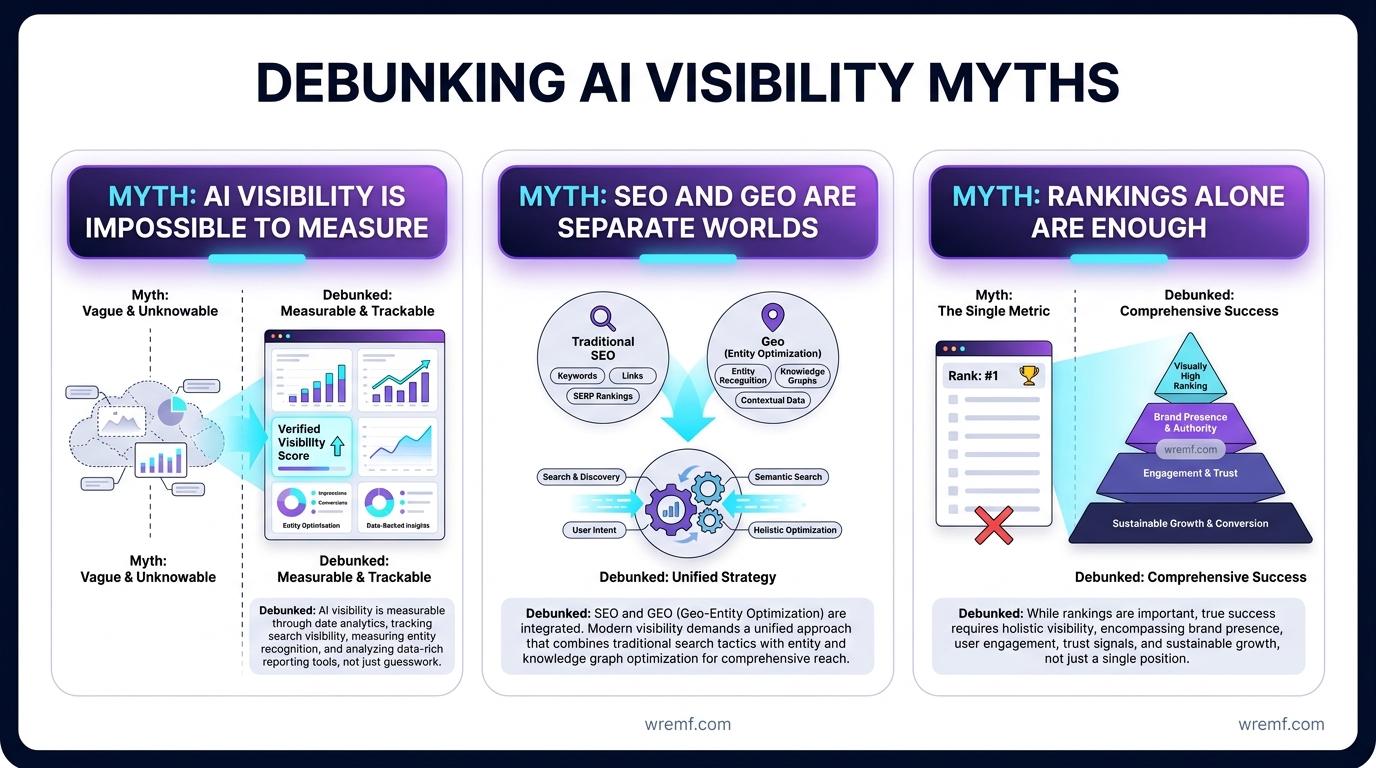
AI visibility myths often come from applying old ranking logic to AI-generated answers. The biggest errors are assuming AI visibility is impossible to measure, SEO and GEO are separate worlds, or rankings alone are enough.
MYTH: AI visibility is impossible to measure because AI answers change every time.
FACT: AI-generated responses can vary, but repeatable prompt tracking still produces useful patterns across engines, dates, prompt categories, and competitors. The goal is not to freeze one answer forever. The goal is to measure mention frequency, citations, share of voice, sentiment analysis, and trend movement over time.
MYTH: SEO, AEO, and GEO are completely separate strategies.
FACT: SEO, AEO, and Generative Engine Optimization overlap because all three depend on clear content, trusted sources, entity understanding, and technical accessibility. The key difference is the output being measured. SEO focuses on search visibility, AEO focuses on answer extraction, and GEO focuses on AI-generated answers and recommendations.
MYTH: Google rankings are enough to understand AI Search visibility.
FACT: Rankings matter, but AI answer engines can cite, summarise, or recommend sources that do not match classic ranking reports. A brand can rank well in search engines and still lose share of voice inside ChatGPT, Perplexity, Gemini, Claude, Copilot, or Google AI Overviews.
MYTH: Social listening already covers AI mention tracking.
FACT: Social listening tracks social media, social networks, social platforms, and brand sentiment. AI mention tracking tracks what AI assistants generate from many sources. Both help brand reputation management, but they answer different questions.
MYTH: AI mention tracking is only useful for large enterprises.
FACT: Smaller B2B brands can benefit because AI answer engines often recommend category specialists, niche tools, and clear use case pages. A focused prompt library, consistent sources, and AI-ready content can help smaller teams understand where they are visible and where competitors dominate.
KEY TAKEAWAY: AI visibility can be measured, improved, and reported when teams track prompts, citations, competitors, sentiment, and source consistency together.
The final step is knowing how WREMF fits into an operational workflow.
How WREMF Helps Teams Track, Improve, and Prove AI Mentions
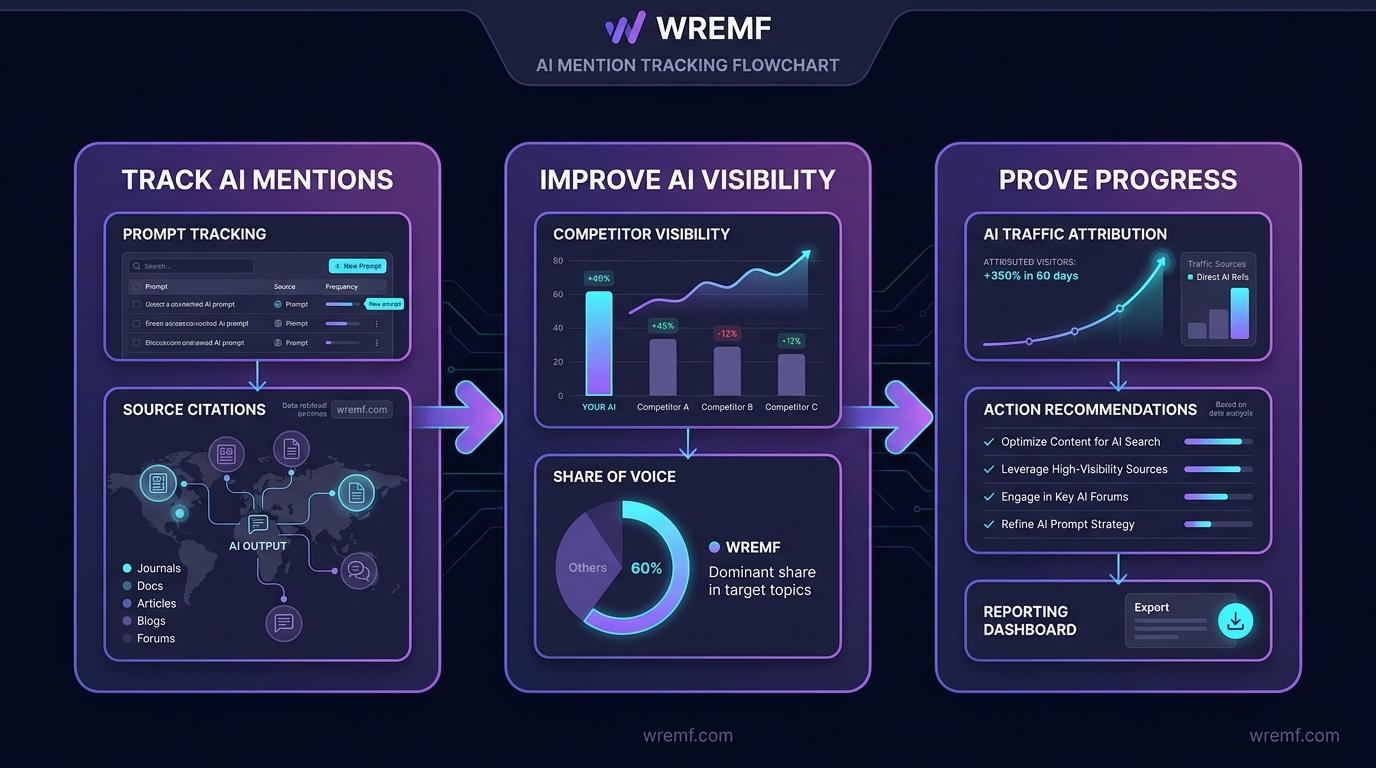
WREMF helps teams track AI mentions, improve AI visibility, and prove progress across major AI engines. The platform combines prompt tracking, source citations, competitor visibility, share of voice, AI traffic attribution, and action recommendations.
WREMF is useful for brands that want software, agencies that need white-label reporting, and teams that want managed execution. WREMF tracks 10 AI engines, including ChatGPT, Claude, Gemini, Perplexity, Google AI Overviews, Copilot, DeepSeek, Grok, Meta AI, and Mistral.
The WREMF methodology connects prompts, citations, competitors, source consistency, and attribution into one repeatable system. This matters because AI mention tracking is not only about finding mentions. It is about understanding which prompts matter, which sources influence answers, which competitors are winning, and which actions can improve visibility.
WREMF supports AI visibility workflows such as:
Tracking brand mentions across AI models and AI platforms
Monitoring AI answers and AI-generated responses over time
Measuring share of voice against competitors
Finding source citations and citation gaps
Detecting inaccurate brand reputation signals
Creating content briefs for AI Search Optimization
Running GEO audits and technical checks
Reporting AI visibility to leadership or clients
Connecting AI traffic attribution to analytics workflows
Supporting agencies with white-label reports and client portals
Supporting technical teams through API and MCP integrations
WREMF pricing is designed around website scale rather than restricting core features. Starter is €39 per month for 1 website. Growth is €89 per month for 5 websites and includes content brief generation and SEO A/B testing. Enterprise supports unlimited websites, unlimited seats, dedicated support, and custom branded portals. Teams can review current packages on the WREMF pricing page.
KEY TAKEAWAY: WREMF turns AI mention tracking into a repeatable workflow for monitoring, improving, and reporting AI Search visibility.
Before acting, teams should decide which use cases matter most to their stage.
How to Start AI Mention Tracking in 30 Days
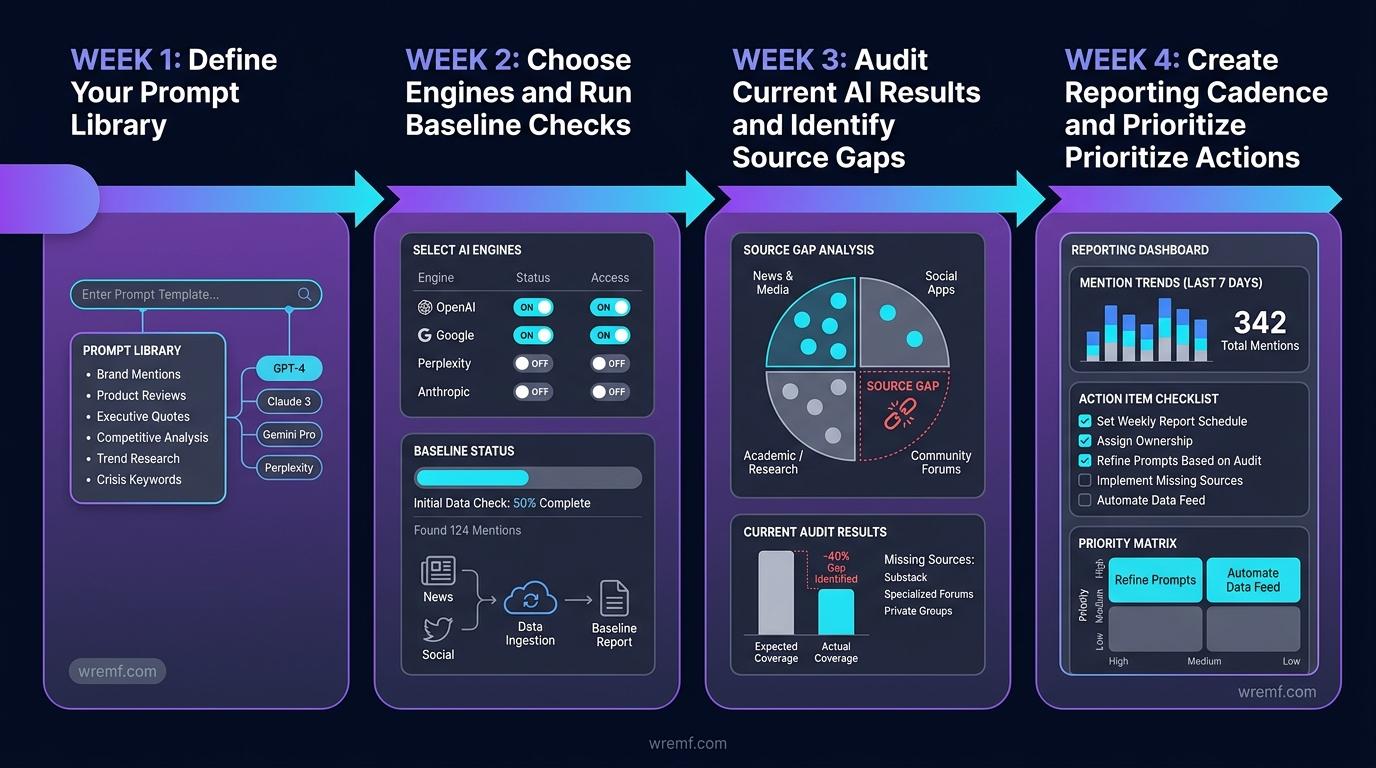
The best way to start AI mention tracking is to define your prompt library, choose engines, audit current AI results, identify source gaps, and create a reporting cadence. A 30-day plan keeps the work focused and measurable.
A 30-day AI mention tracking plan should not try to fix every prompt, page, and source at once. The first goal is to create a baseline. The second goal is to identify the highest-value visibility gaps. The third goal is to turn those gaps into content, citation, and source consistency actions.
Start with your most important commercial category. Choose prompts that match how real buyers ask questions in ChatGPT, Gemini, Claude, Perplexity, Copilot, and Google AI Overviews. Include competitor prompts and blind tests so you can measure visibility without forcing the brand name into every query.
A practical 30-day workflow looks like this:
| Timeline | Action | Output | Success signal |
|---|---|---|---|
| Days 1 to 3 | Define target categories, competitors, and brand name variants | Tracking scope | Clear list of entities and competitors |
| Days 4 to 7 | Build a prompt library | 20 to 50 prompts | Prompts mapped to buyer intent |
| Days 8 to 12 | Run baseline checks across AI engines | AI results export | Mentions, citations, sentiment, competitors captured |
| Days 13 to 18 | Analyse source citations and content gaps | Source map | High-value citation and content opportunities |
| Days 19 to 24 | Prioritise fixes | Action backlog | Accuracy, content, technical, and source tasks ranked |
| Days 25 to 30 | Create reporting cadence | Dashboard or sample report | Weekly or monthly tracking process agreed |
Content teams should focus on pages that answer real prompts. SEO teams should check crawlability, metadata, internal links, schema markup, and Search Console signals. Brand teams should review reputation, positioning, and sentiment analysis. Growth teams should connect AI visibility to traffic metrics and lead quality where possible.
Agencies managing multiple clients often need repeatable templates, client portals, role-based access, white-label exports, and email alerts. In-house teams often need clearer leadership reporting, prompt ownership, and a workflow that turns AI results into content actions.
KEY TAKEAWAY: The first 30 days of AI mention tracking should create a baseline, identify gaps, and establish a repeatable reporting rhythm.
The remaining question is how AI mention tracking will change as AI agents become more common.
The Future of AI Mention Tracking and Agentic AI
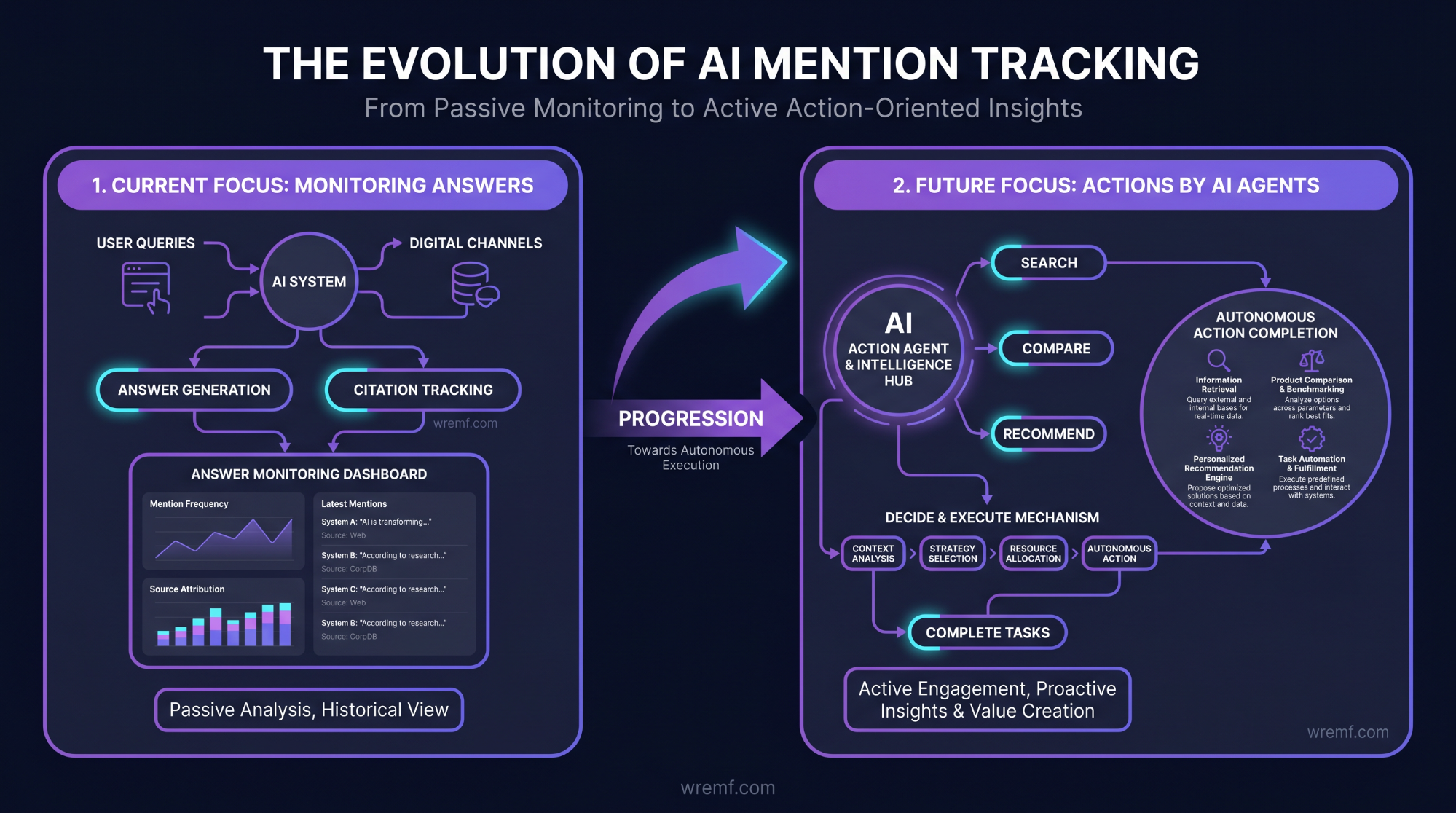
The future of AI mention tracking will move beyond answers into actions. As AI agents search, compare, recommend, and complete tasks, brands will need to monitor whether agents understand, trust, and select their products or services.
AI agents are AI systems that can plan, retrieve information, use tools, and take multi-step actions on behalf of users. AI agents matter for brand visibility because future discovery may include product research, vendor shortlisting, form completion, shopping, booking, and procurement workflows.
AI search platforms are already shifting from simple question answering toward deeper task completion. This means AI mention tracking will need to cover not only whether a brand appears in an answer, but also whether the brand is selected as an option, cited as a trusted source, or excluded from a recommendation set.
Content teams should prepare by making product information clear, structured, current, and easy to verify. Technical teams should make important pages crawlable and accessible. Marketing teams should maintain source consistency across directories, reviews, profiles, comparison pages, and owned pages.
The future AI mention tracking stack will likely include:
Multi-engine prompt tracking
Brand mention tracking across AI assistants
AI-generated answer monitoring
Citation and source link tracking
Brand sentiment and reputation monitoring
Agent visibility testing
Competitor recommendation tracking
AI traffic attribution
CRM and pipeline attribution
API and MCP integrations
Email alerts for major visibility shifts
In practical terms, the brands that benefit most will be the brands that treat AI visibility as an operating system. They will measure prompts, improve sources, update content, monitor competitors, correct inaccurate narratives, and report outcomes regularly.
KEY TAKEAWAY: AI mention tracking will expand from monitoring answers to monitoring how AI agents discover, compare, and recommend brands.
That makes the FAQ section important for answering high-intent questions directly.
Frequently Asked Questions
What is AI mention tracking?
AI mention tracking is the process of monitoring when and how AI systems mention, cite, describe, or recommend your brand in AI-generated answers. It usually covers ChatGPT, Claude, Gemini, Perplexity, Google AI Overviews, Copilot, and other AI platforms. The goal is to measure AI visibility, mention frequency, sentiment analysis, source citations, share of voice, competitor visibility, and AI traffic attribution. WREMF helps teams track these signals across 10 AI engines and turn the results into reporting and improvement workflows.
What is an AI search monitoring tool?
An AI search monitoring tool tracks how a brand appears inside AI Search platforms and AI answer engines. It usually monitors prompts, AI-generated responses, brand mentions, source links, citations, competitors, share of voice, and sentiment. A good AI search monitoring tool should support repeatable prompt libraries, multi-engine coverage, historical trends, email alerts, exports, and reporting. Traditional SEO tools remain useful, but AI visibility monitoring tools are better suited for measuring AI answers rather than only rankings.
How reliable are AI monitoring metrics if AI answers change?
AI monitoring metrics are reliable when they are measured across repeatable prompts, multiple AI engines, defined time periods, and consistent scoring rules. One AI-generated answer can vary, but patterns become useful when you track mention frequency, citations, sentiment analysis, share of voice, and competitor visibility over time. The goal is not to prove that every answer is identical. The goal is to identify stable visibility trends, recurring source patterns, and priority gaps.
Can AI mention tracking show why competitors are recommended?
AI mention tracking can help show why competitors are recommended by analysing source citations, answer wording, category fit, content gaps, and repeated recommendation patterns. For example, a competitor may appear more often because AI engines cite review sites, comparison pages, documentation, or third-party profiles that describe them more clearly. WREMF’s competitive landscape workflow helps teams compare competitor visibility across prompts, sources, and AI engines.
Do I still need Semrush, Ahrefs, or Moz if I use AI mention tracking?
You may still need Semrush, Ahrefs, Moz Pro, Search Console, or similar SEO tools because traditional search engines still drive important traffic and keyword demand. AI mention tracking does not replace technical SEO, backlink analysis, content audits, or search performance tracking. The stronger workflow combines SEO data with AI Search visibility data. SEO tools show how pages perform in search results. AI mention tracking shows how AI assistants mention, cite, and recommend your brand.
What is the difference between brand mentions and AI citations?
Brand mentions are references to your company, product, domain, or brand name variants inside AI-generated responses. AI citations are source links or references used to support the answer. A brand can be mentioned without being cited, and a page can be cited without the brand being recommended. Strong AI mention tracking should measure both because mentions show visibility, while citations show which sources influence AI-generated answers.
How do AI visibility tools collect results?
AI visibility tools usually collect results by running structured prompt libraries across selected AI engines. The tool saves the AI-generated responses, brand mentions, citations, source links, sentiment, competitors, and recommendation patterns. Some tools also connect to analytics, Search Console, APIs, or reporting exports. Prompt-based collection is different from keyword rank tracking because AI-generated answers respond to natural language questions, not only fixed search terms.
How can businesses use AI mention tracking for content strategy?
Businesses can use AI mention tracking to find content gaps, weak category associations, inaccurate brand descriptions, missing comparisons, and poor source consistency. Content teams can then create answer-first pages, FAQs, product explainers, comparison content, and AI-ready Content Briefs that answer real buyer prompts. This improves content strategy because every content task is connected to a prompt, AI answer, citation gap, or competitor visibility issue.
Is AI mention tracking useful for social media and social listening?
AI mention tracking is useful alongside social media monitoring, but it is not the same as social listening. Social listening tracks brand sentiment, conversations, and mentions across social platforms and social networks. AI mention tracking monitors what AI assistants generate after processing many sources, which may include social media, forums, review sites, articles, directories, and owned content. Brands need both when reputation and AI visibility matter.
What features should I look for in AI visibility monitoring tools?
Look for multi-engine coverage, prompt library controls, citation tracking, competitor analysis, share of voice, sentiment analysis, brand name variants, email alerts, exports, historical data, client reporting, API access, and clear recommendations. Agencies may also need white-label reporting, role-based access, client portals, and multi-site management. WREMF supports software, agency, and hybrid use cases for teams that want to track, improve, and prove AI visibility.
How often should I track AI mentions?
Most B2B teams should track AI mentions weekly or monthly, depending on competition, content velocity, and reporting needs. High-growth SaaS companies, agencies, and brands in fast-moving categories may need weekly checks with email alerts for major shifts. Slower categories can start monthly. The key is consistency. Use the same prompt library, AI engines, competitors, and scoring framework so trends are comparable.
What is the best way to start AI mention tracking?
The best way to start AI mention tracking is to run a focused audit with 20 to 50 prompts across your main AI engines. Include branded, category, comparison, problem-aware, and buying-stage prompts. Capture brand mentions, competitors, citations, sentiment, and inaccurate claims. Then prioritise actions across content, source consistency, technical SEO, and reporting. Teams that want a structured workflow can start with a WREMF AI visibility audit.
Conclusion
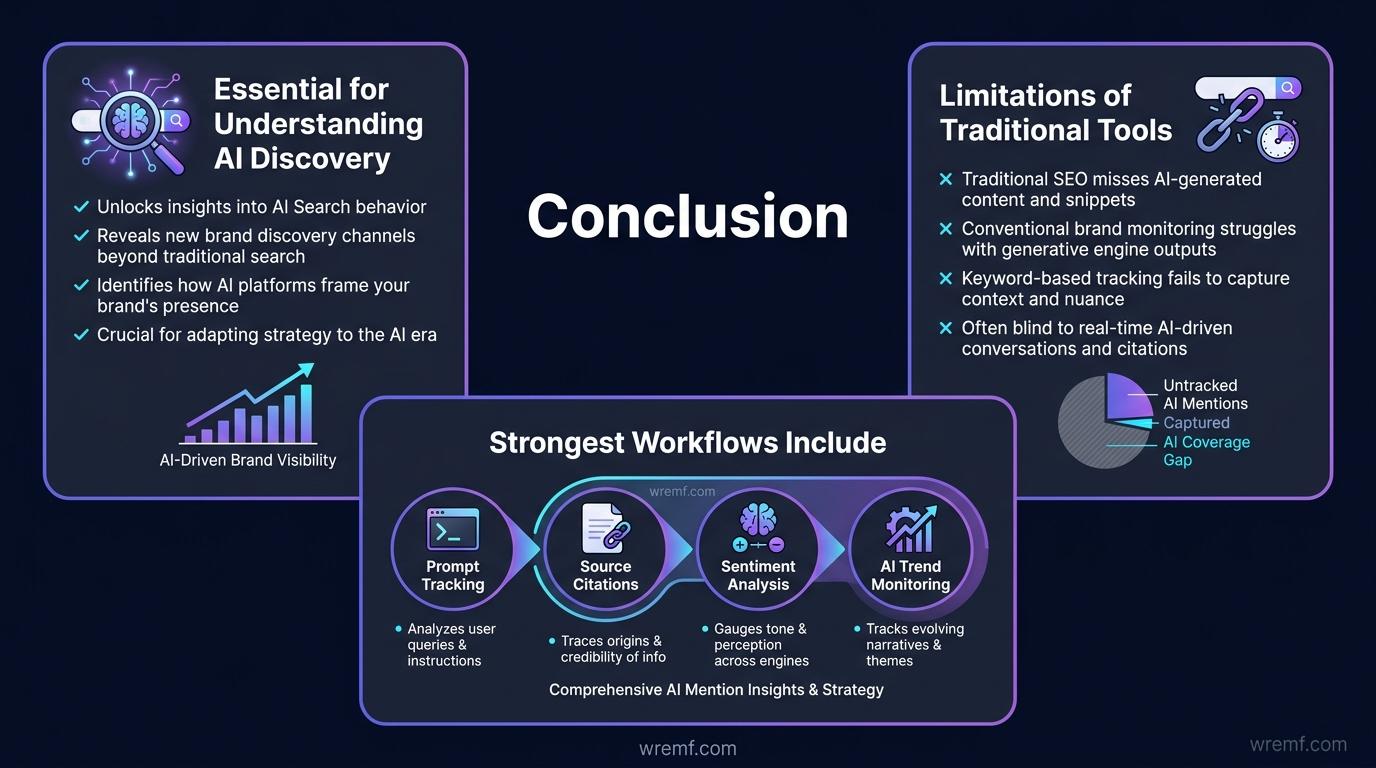
AI mention tracking is now essential for understanding how AI Search, AI answer engines, and AI assistants shape brand discovery. Traditional SEO and brand monitoring still matter, but they do not fully show whether AI-generated answers mention, cite, recommend, or misrepresent your brand. The strongest workflow combines prompt tracking, source citations, sentiment analysis, share of voice, competitor analysis, source consistency, and attribution. To turn AI visibility from a guessing game into a measurable system, explore the WREMF platform suite or talk to the WREMF agency team.
Related Generative Engine Optimization Guides
- Answer Engine Optimization Services The Complete Guide to AI Search Visibility
- LLM SEO Agency The Complete Guide to Choosing an Agency for AI Search Visibility
- LLM SEO Services The Complete 2026 Guide to AI Search Visibility, AEO, GEO, and LLM Optimization
- AI SEO Services The Complete Guide to Search Visibility in the AI Era
- Generative AI Optimization Services The Complete Guide to GEO, AEO, LLM Optimization, and AI Visibility
- Large Language Model Optimization Services The Complete Guide to LLMO, AI Search Visibility, AEO, GEO, RAG, and LLM Performance
- AI Search Engine Optimization Services The Complete Guide for B2B Brands
- AI Search Engine Optimization Tools The Complete 2026 Guide for AI Search, SEO, AEO, and GEO
- AI Brand Monitoring The Complete Guide to Tracking Brand Visibility Across AI Search, LLMs, and Generative Engines
- AI SEO Agency How to Choose the Right Partner for AI Search Visibility
- Enterprise Answer Engine Optimization Platforms Complete Guide for AI Visibility, AEO, and GEO
- 12 Best AI Search Optimization Tools
- How AI Search Optimization Tools Increase Organic Traffic
- AI Overview SEO How to Optimize for Google AI Overviews, AI Mode, and AI Search Visibility
- Answer Engine Optimization The Complete Guide to AEO, AI Search Visibility, and Answer-First Content
- AI Overview Optimization How to Rank, Get Cited, and Stay Visible in Google AI Search
- AI Search Engine Optimization The Complete Guide for B2B Brands
- How Do AI Search Optimization Tools Improve SERP Rankings
- Best Answer Engine Optimization for Enhancing AI Visibility
- AI SEO Tools The Complete Guide for SEO, AEO, GEO, and AI Search Visibility
Related reading
- AI Brand Monitoring: The Complete Guide to Tracking Brand Visibility Across AI Search, LLMs, and Generative Engines
- AI SEO Services: The Complete Guide to Search Visibility in the AI Era
- LLM SEO Agency: The Complete Guide to Choosing an Agency for AI Search Visibility
- LLM SEO Services: The Complete 2026 Guide to AI Search Visibility, AEO, GEO, and LLM Optimization