LLM SEO Agency: The Complete Guide to Choosing an Agency for AI Search Visibility
Learn how to choose an LLM SEO agency using prompt tracking, citation data, AI share of voice, Technical SEO, and measurable KPIs for AI search visibility.
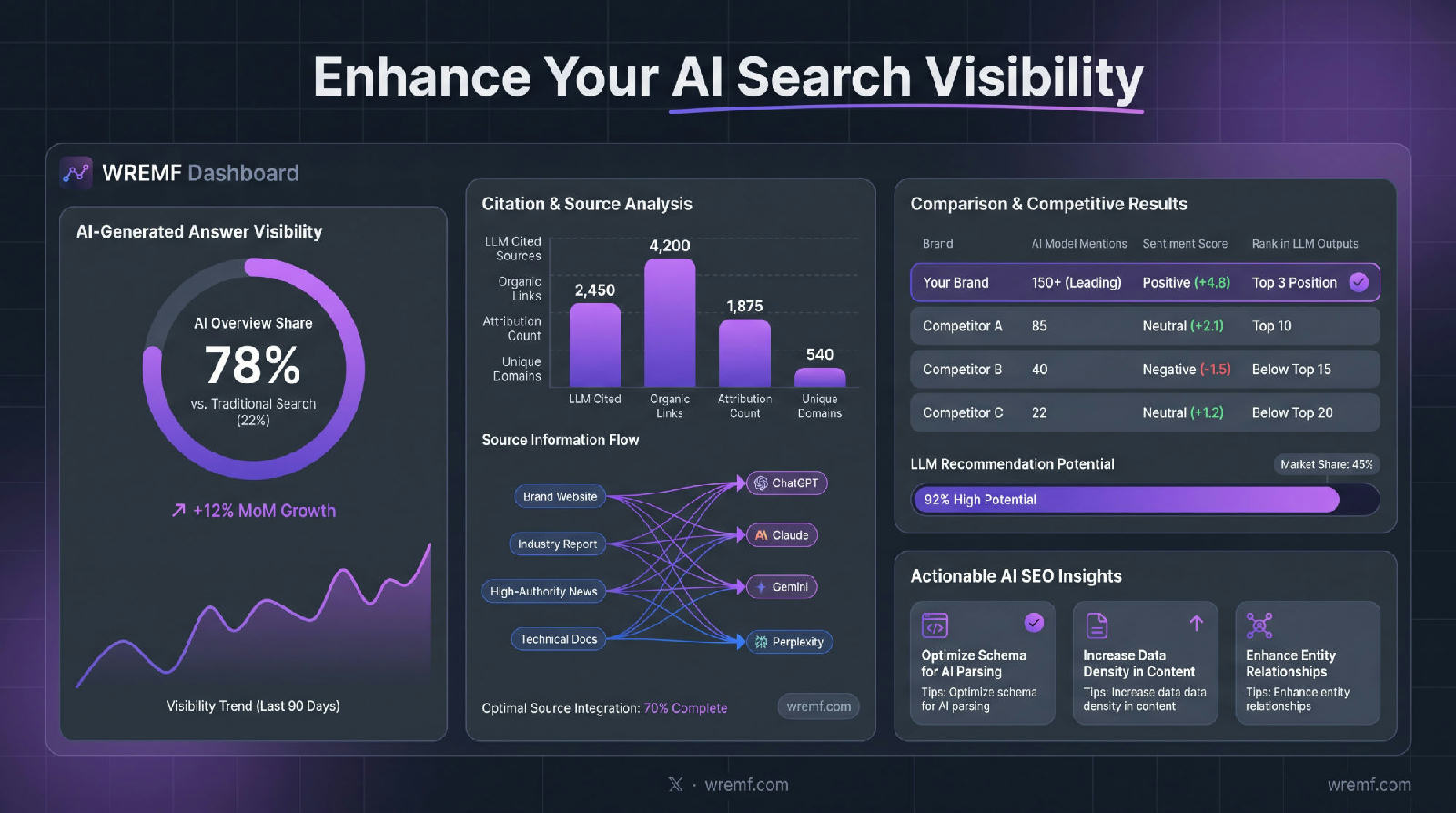
By WREMF Team · 2026-05-05
An LLM SEO agency helps brands improve visibility inside AI-generated answers, citations, recommendations, and AI-powered search results across platforms like ChatGPT, Claude, Gemini, Perplexity, Google AI Overviews, and Copilot. LLM SEO is the practice of optimizing a brand, website, content, entity profile, and third-party sources for Large Language Model discovery. It extends traditional SEO by measuring prompt coverage, citation data, AI share of voice, Brand Mentions, and competitor visibility across AI platforms. A legitimate agency combines Technical SEO, structured data, answer-first content, semantic content clusters, Citation Engineering, Digital PR, and source consistency to make brands easier for AI models to understand, retrieve, compare, and cite. The work should be measurable, human-led, and connected to business outcomes like demo requests and revenue attribution where possible.
Key takeaways
- LLM SEO agencies optimize brands for visibility inside AI-generated answers, citations, and recommendations across AI platforms, not just traditional search engine rankings.
- LLM SEO extends traditional SEO by adding prompt tracking, citation tracking, AI share of voice, competitor visibility, and source consistency measurement across AI models.
- Effective LLM SEO tactics include answer-first content, semantic content clusters, structured data, Technical SEO, Citation Engineering, Knowledge Base Articles, and Digital PR.
- A legitimate LLM SEO agency tracks KPIs like prompt coverage, citation share, Brand Mentions, AI-referred conversion rate, competitor recommendation rate, and source consistency alongside organic clicks.
- Red flags include guaranteed AI rankings, keyword-only content packages, no citation data, fully automated content with no human review, and inability to explain methodology or limitations.
- Choose LLM SEO software when your team can execute internally, an agency when you need strategy and implementation, and a hybrid model when you need both measurement and execution capacity.
LLM SEO Agency: The Complete Guide to Choosing an Agency for AI Search Visibility

LLM SEO agency services help brands improve visibility inside AI-generated answers, citations, recommendations, and comparison results. Gartner predicts traditional search engine volume will drop 25% by 2026 as AI chatbots and virtual agents change how people discover information. (Gartner) This guide explains how LLM SEO works, how it differs from traditional SEO, Answer Engine Optimization, and generative engine optimization, what tactics matter, which KPIs to track, and how to evaluate SEO agencies for AI search. WREMF helps B2B teams track, improve, and prove AI visibility across ChatGPT, Claude, Gemini, Perplexity, Google AI Overviews, Copilot, DeepSeek, Grok, Meta AI, Mistral, and other AI discovery surfaces. Use this guide to choose an agency with evidence, not hype.
What Is an LLM SEO Agency?
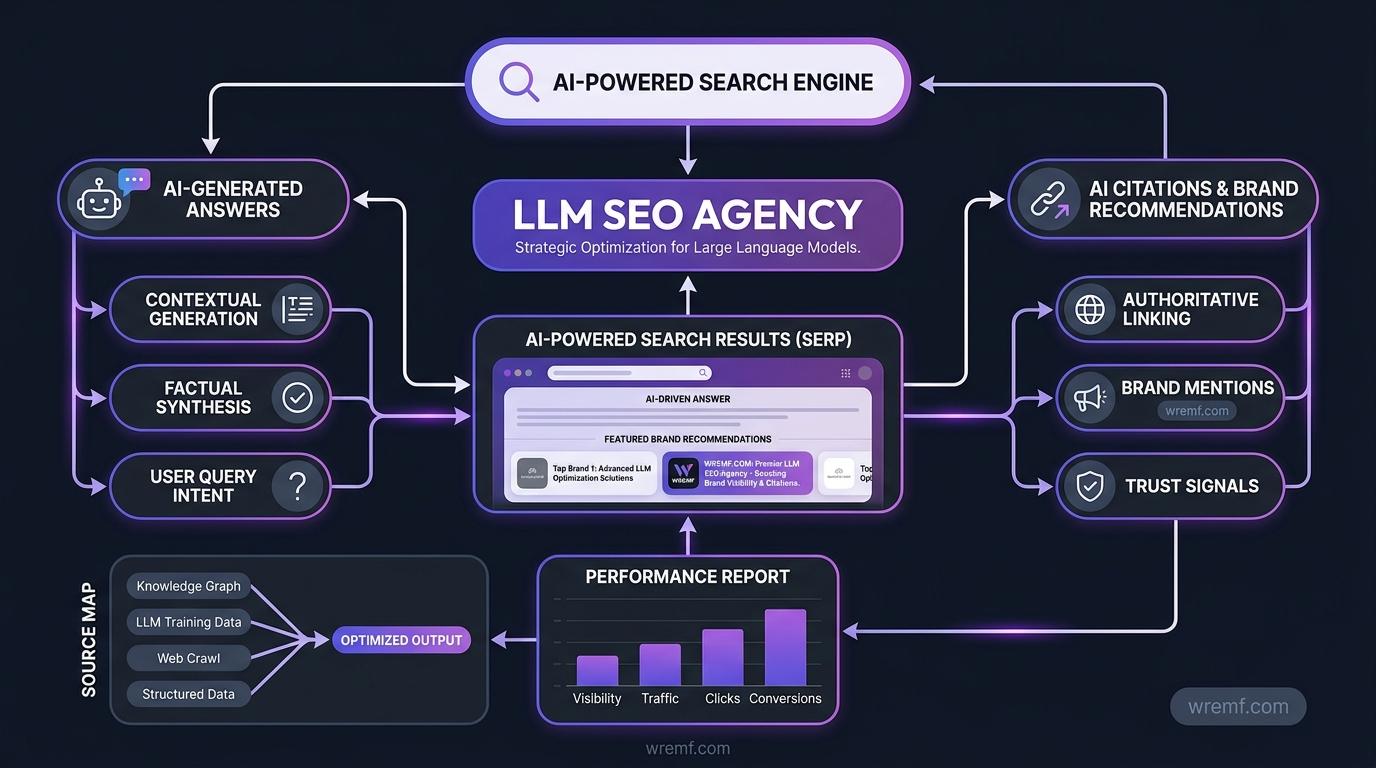
An LLM SEO agency helps a brand appear more accurately and more often inside AI-generated answers, AI citations, brand recommendations, and AI-powered Search results. The outcome is better search visibility across AI platforms, not only higher search rankings.
LLM SEO is the practice of optimizing a brand, website, content, entity profile, and third-party sources for Large Language Model discovery. A Large Language Model is an AI system that can understand and generate language from prompts, retrieved sources, training data, and connected search systems. LLM SEO matters because buyers now ask AI assistants to compare vendors, explain solutions, shortlist tools, and summarize trusted sources before they visit a website.
An LLM SEO agency usually combines traditional SEO, Technical SEO, content strategy, Answer Engine Optimization, generative engine optimization, entity optimization, structured data, citation tracking, and AI visibility tracking. This work helps AI models understand what your brand does, when it should be recommended, which sources support that recommendation, and how your brand compares with competitors.
AI search visibility is the measurable presence of a brand inside AI-generated answers, recommendations, summaries, citations, and source lists. AI search visibility matters because AI assistants can influence buyer perception before a click, form submission, demo request, or sales conversation happens.
In real B2B buying journeys, a user may ask ChatGPT for “best LLM SEO agency for SaaS,” ask Perplexity to compare AI visibility tools, ask Google's Gemini how to future proof SEO, and see Google AI Overviews summarize the topic inside Google Search. A traditional SEO report may show rankings and organic clicks, but it may not show whether AI models mention your brand, cite your content, or recommend competitors.
WREMF helps teams turn LLM SEO from manual prompt testing into a measurable workflow. The WREMF platform suite connects prompt intelligence, citation tracking, competitor visibility, GEO audits, AI share of voice, AI-ready content briefs, SEO testing, and reporting.
KEY TAKEAWAY: An LLM SEO agency improves how a brand is understood, cited, mentioned, and recommended across AI search, not only how pages rank in search engines.
To choose the right agency, you first need to understand how LLM SEO relates to SEO, AEO, and GEO.
LLM SEO vs Traditional SEO vs AEO vs GEO
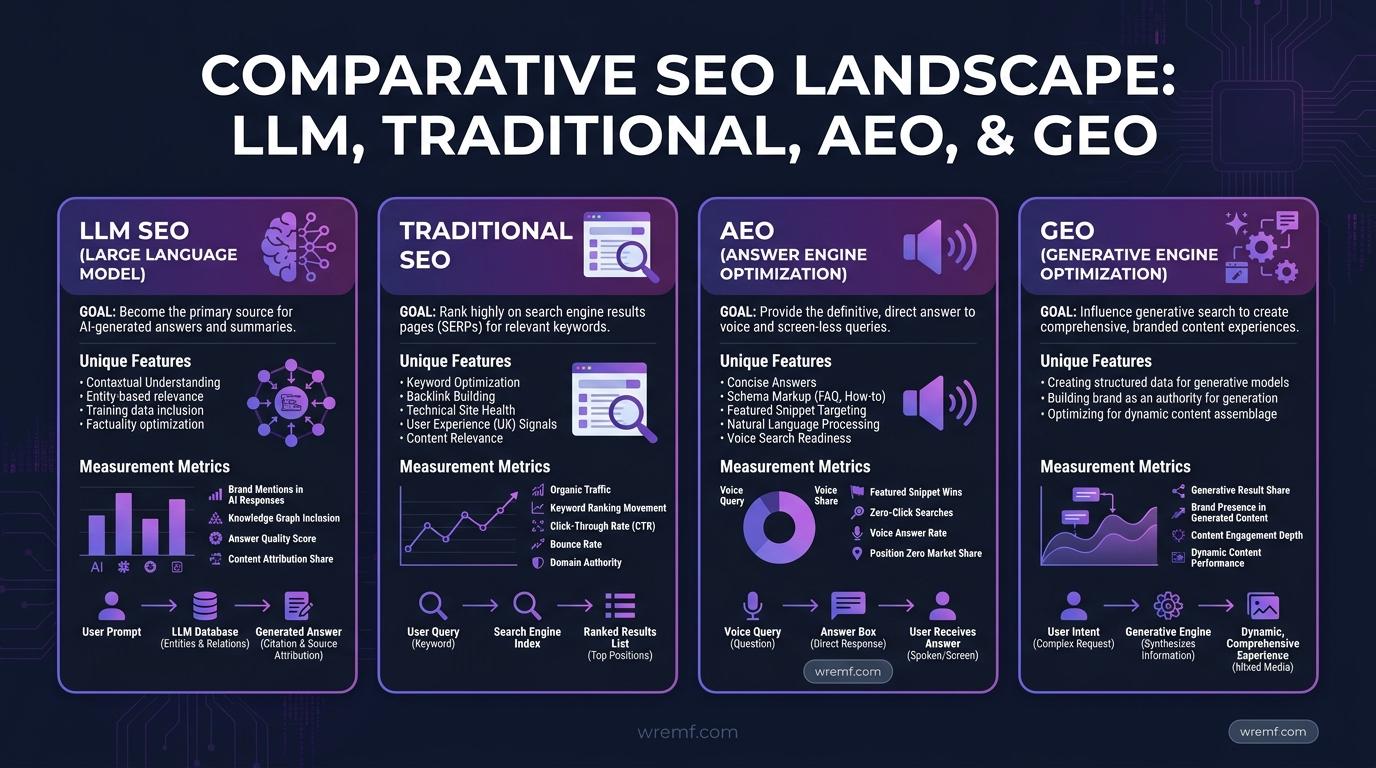
LLM SEO extends traditional SEO by optimizing for AI-generated answers, citations, recommendations, and source-based responses. Traditional SEO still matters, but AI search visibility requires additional measurement across prompts, AI models, and source ecosystems.
Traditional SEO is search engine optimization for improving crawlability, indexability, rankings, search visibility, organic clicks, and user experience across search engines. Traditional SEO matters because Google, Bing, and other search systems still influence what AI-powered Search tools can retrieve, summarize, and cite.
Answer Engine Optimization is the process of structuring content so answer engines can extract direct, accurate, and useful answers. Answer Engine Optimization matters because AI-generated answers need clear definitions, concise explanations, and source-backed claims.
Generative engine optimization is the process of improving how a brand appears inside AI-generated responses from Large Language Model systems and AI-powered Search interfaces. Generative engine optimization matters because AI assistants often summarize, compare, and recommend brands without sending every user to a website.
| Discipline | Main Goal | What It Measures | What It Misses | Best Fit |
|---|---|---|---|---|
| Traditional SEO | Improve visibility in search engines | Search rankings, impressions, clicks, CTR, Core Web Vitals, indexation | AI mentions, AI citations, AI recommendations, model results | Teams focused on Google traffic |
| Answer Engine Optimization | Make answers extractable | Direct answers, FAQ coverage, structured content, answer quality | Full competitor visibility across AI platforms | Teams targeting snippets, FAQs, and answer surfaces |
| Generative engine optimization | Improve AI-generated responses | AI-generated answers, citations, brand mentions, prompt visibility | Some classic Technical SEO problems | Teams targeting ChatGPT, Perplexity, Claude, Gemini, and Copilot |
| LLM SEO | Improve visibility across LLMs and AI search | Prompt tracking, citation data, AI share of voice, source consistency, competitors | Offline brand influence and private model logic | B2B teams that need measurable AI visibility |
The key difference between SEO and generative engine optimization is the measurement layer. SEO usually measures search rankings, organic clicks, and search engine visibility. Generative engine optimization measures whether AI-generated responses mention, cite, recommend, compare, and accurately describe a brand.
Google Search Central explains that Google’s systems are designed to prioritize helpful, reliable, people-first content, not content made mainly to manipulate search rankings. (Google for Developers) This matters for LLM optimization because content quality, source clarity, and usefulness also affect how AI search systems interpret and summarize web content.
The overlap between traditional SEO, Answer Engine Optimization, and generative engine optimization is where most LLM SEO agency work happens. Technical SEO makes content accessible. Structured data reduces ambiguity. Content strategy answers buyer prompts. Entity optimization helps AI models understand relationships. Citation tracking shows which sources influence AI-generated answers.
DID YOU KNOW: OpenAI says ChatGPT Search can provide timely answers with links to relevant web sources, which means AI search visibility is now connected to source visibility and citation eligibility. (OpenAI)
KEY TAKEAWAY: LLM SEO is not a replacement for traditional SEO. It is an expanded search visibility discipline that combines SEO, AEO, generative engine optimization, citations, prompts, sources, and attribution.
Once the disciplines are clear, the next step is understanding what an agency should actually do.
What Does an LLM SEO Agency Actually Do?
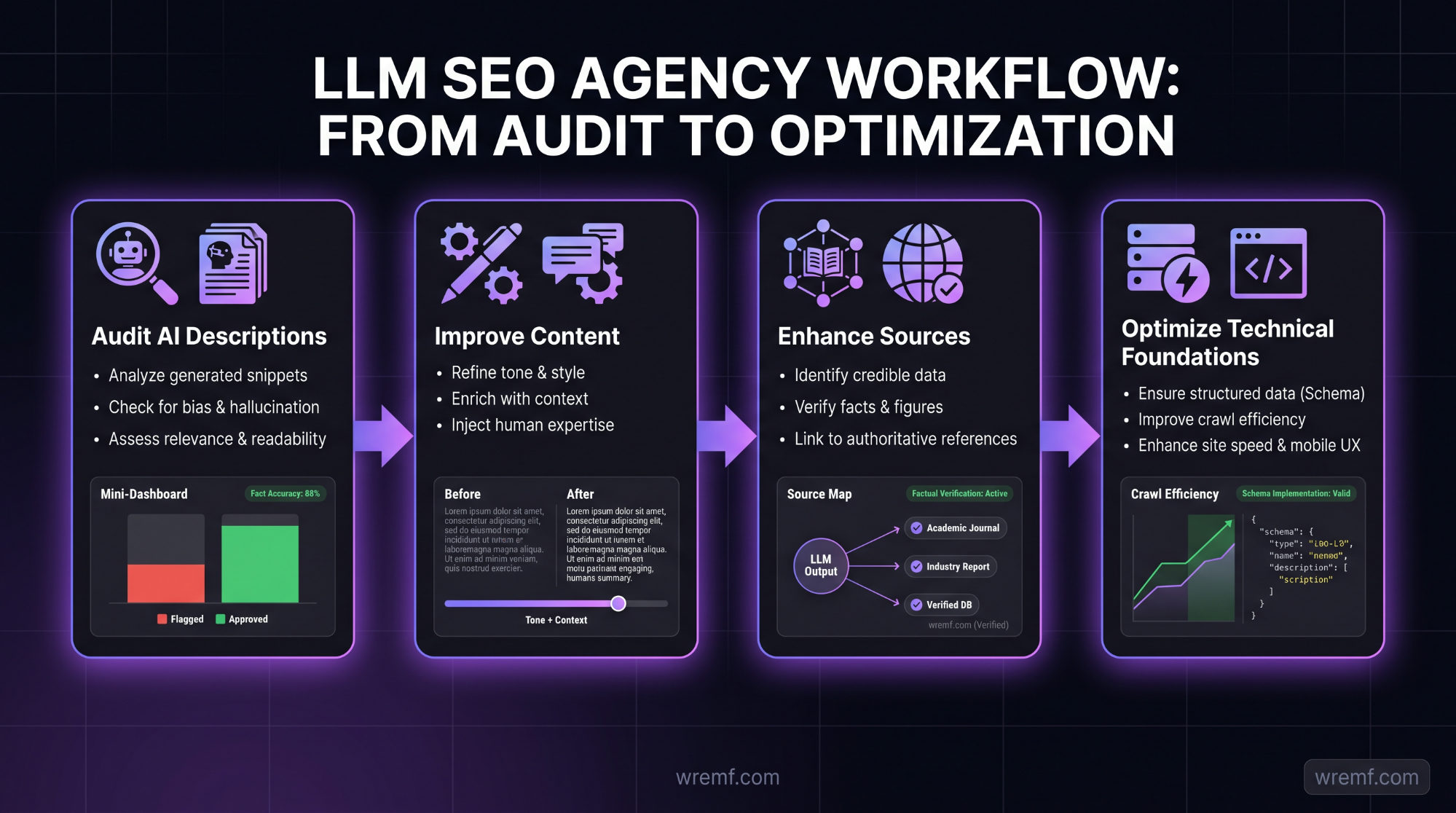
An LLM SEO agency audits how AI systems describe, cite, compare, and recommend your brand, then improves the content, sources, technical foundations, and reporting workflow behind that visibility. The best agencies turn AI search into a repeatable growth process.
An effective LLM SEO agency should not only write blog posts. It should understand AI search, AI-powered Search behavior, Technical SEO, structured data, content quality, entity authority, Brand Mentions, Digital PR, citation data, and competitor visibility.
The core work usually includes these service areas.
| Service Area | What It Includes | Why It Matters |
|---|---|---|
| AI visibility audits | Prompt tests, model results, competitor mentions, citation checks, source gaps | Shows where the brand appears or disappears across AI platforms |
| Prompt tracking | Buyer prompts, category prompts, comparison prompts, local prompts, support prompts | Reveals how real users ask AI assistants about your market |
| Citation tracking | Assistant citations, source citations, citation data, third-party sources | Shows which sources AI-generated answers rely on |
| Content strategy | Semantic content clusters, answer-first pages, Knowledge Base Articles, content briefs | Builds content that AI retrieval systems can understand |
| Technical SEO | Crawlability, rendering, structured data, Core Web Vitals, internal linking | Makes pages accessible to search engines and AI retrieval |
| Entity optimization | Brand facts, product relationships, knowledge graph signals, structured schema | Helps AI models connect the brand to the right topics |
| Competitor visibility | AI share of voice, competitor recommendations, model results, prompt gaps | Shows who AI systems recommend instead |
| Reporting | AI visibility tracking, revenue attribution, AI-referred conversion rate, demo requests | Connects visibility work to business outcomes |
Prompt tracking shows which real prompts trigger your brand, competitors, citations, or no recommendation. Prompt tracking matters because AI users do not always type keyword phrases. They ask natural language questions such as “What is the best AI SEO agency for SaaS companies?” or “How can I train my content to be suggested on LLM tools?”
Citation tracking is the process of monitoring which sources AI systems cite in AI-generated responses. Citation tracking matters because AI citations can shape trust, traffic, and the external sources buyers read after receiving an AI answer.
Source consistency is the alignment of brand facts across your website, directories, reviews, documentation, third-party sources, profiles, and earned media. Source consistency matters because inconsistent facts can lead to weak, outdated, or inaccurate AI-generated answers.
For example, if your homepage says you serve B2B SaaS companies, your LinkedIn profile says you are a content marketing agency, your directory profiles say you are a Technical SEO vendor, and third-party sources describe you as a paid media services firm, AI models may struggle to classify your brand. An LLM SEO agency should identify and correct those inconsistencies.
WREMF’s source citation tracking helps teams understand which sources appear in AI-generated answers, which sources cite competitors, and which source gaps should be prioritized for improvement.
KEY TAKEAWAY: A strong LLM SEO agency does not only create content. It measures prompts, citations, competitors, content gaps, Technical SEO, source consistency, and business impact.
The next section explains which tactics actually improve AI search visibility.
Which LLM SEO Tactics Actually Improve AI Search Visibility?
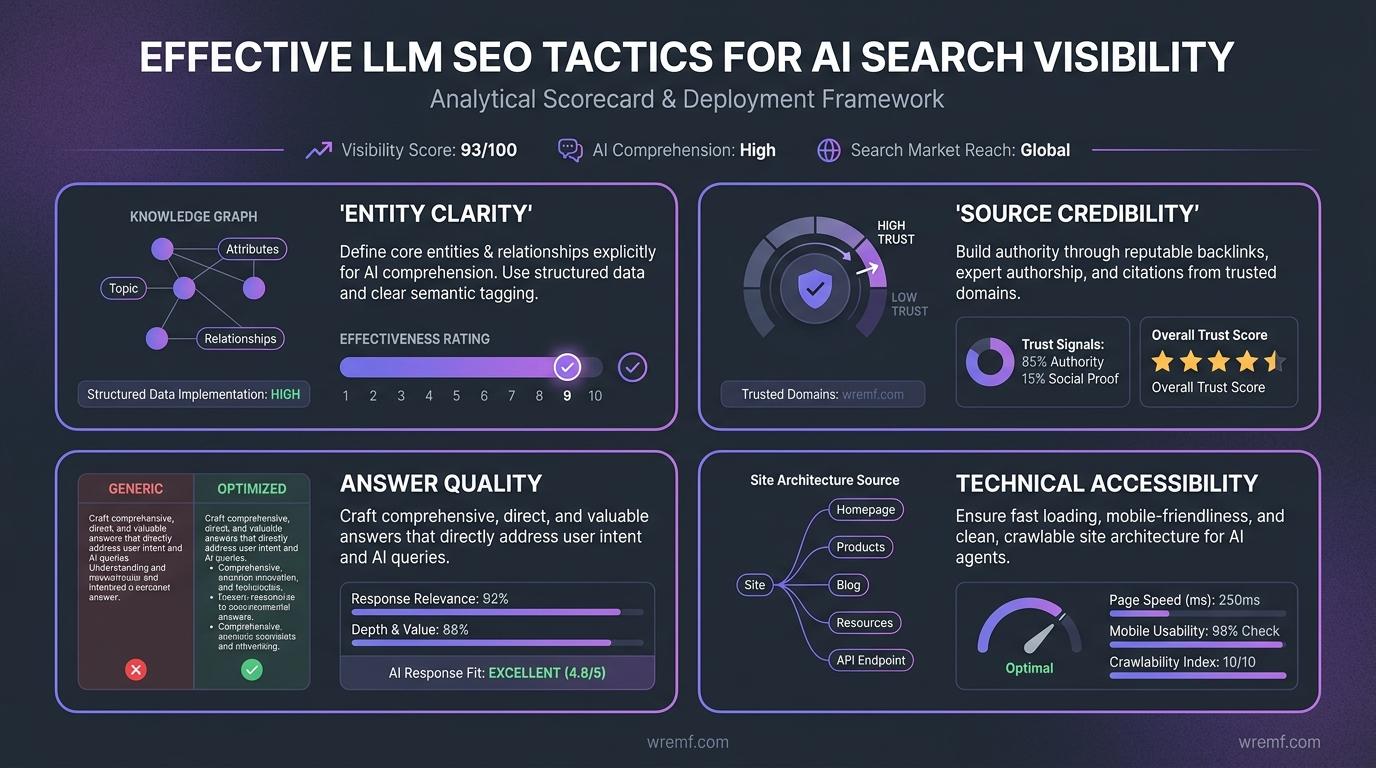
The strongest LLM SEO tactics improve entity clarity, source credibility, answer quality, technical accessibility, citation eligibility, and content usefulness. Keyword repetition alone is not a serious LLM optimization strategy.
LLM optimization works by making your brand easier for AI models and search systems to understand, retrieve, compare, summarize, and cite. This requires useful content, consistent facts, structured data, strong internal linking, and credible third-party sources.
The tactics that matter most are listed below.
| Tactic | What It Improves | Best For | Common Mistake |
|---|---|---|---|
| Answer-first content | AI extraction and direct answers | Definitions, comparisons, FAQs, service pages | Writing long intros before answering |
| Semantic content clusters | Topical authority and context | SaaS companies, B2B services, education topics | Publishing isolated posts with no internal linking |
| Structured data | Entity clarity and page understanding | Products, organizations, articles, FAQs, services | Treating schema as a guarantee |
| Technical SEO | Crawlability and rendering | JavaScript sites, large websites, SaaS apps | Ignoring JavaScript rendering and blocked content |
| Citation Engineering | Source influence and assistant citations | Brands in competitive categories | Chasing low-quality citations |
| Digital PR | Brand authority and third-party validation | Expert-led brands and category creators | Getting mentions from irrelevant websites |
| Knowledge Base Articles | Clear product and support answers | SaaS and technical products | Hiding answers behind login pages |
| AI visibility tracking | Measurement across AI platforms | Leadership reporting and agency workflows | Relying on manual screenshots |
Answer-first content is content that gives a direct answer before adding explanation, nuance, evidence, and examples. Answer-first content matters because AI retrieval systems and readers both benefit from short, extractable explanations.
Semantic content clusters are connected groups of pages that explain related entities, questions, and use cases. Semantic content clusters matter because AI search systems evaluate relationships between concepts such as LLM SEO, generative engine optimization, Answer Engine Optimization, AI citations, structured data, Technical SEO, Brand Mentions, and source consistency.
Citation Engineering is the practice of improving the quality, consistency, and discoverability of sources that AI systems may reference. Citation Engineering matters because AI-generated answers often cite trusted web sources, documentation, reviews, data pages, and editorial references.
Citation Magnetizing is the process of making content more likely to attract references by being clear, factual, well-structured, and useful to both people and AI retrieval systems. Citation Magnetizing is not a shortcut or guaranteed tactic. It is a quality system for creating pages that deserve to be cited.
Citation outreach is the process of improving third-party references through relevant partnerships, Digital PR, directories, expert contributions, and brand mention outreach. Citation outreach matters because an AI answer may cite sources outside your own website.
Knowledge Base Articles are structured support or educational pages that answer product, industry, and implementation questions in a clear format. Knowledge Base Articles matter for LLM SEO because AI assistants often retrieve concise support-style content when users ask how a product works. Strong Knowledge Base Articles can support AI-generated answers, reduce ambiguity, improve content quality, and strengthen entity-based architecture. For SaaS companies, Knowledge Base Articles should explain integrations, pricing logic, use cases, API behavior, setup steps, troubleshooting, and product definitions. Knowledge Base Articles should also connect to broader content strategy through internal linking. Weak Knowledge Base Articles often fail because they are too thin, hidden from crawlers, or disconnected from the main website. Better Knowledge Base Articles use short answers, examples, structured schema where relevant, and clear semantic relationships.
Google’s AI features documentation explains how site owners can approach inclusion in AI features such as AI Overviews and AI Mode. (Google for Developers) This reinforces a practical point: LLM SEO tactics should not be disconnected from Google Search fundamentals, helpful content, or Technical SEO.
TIP: Start with prompts and sources before creating content. The prompt tells you what buyers ask. The source data tells you what AI systems already trust.
WREMF’s AI-ready content briefs help turn prompt data, citation gaps, competitor responses, semantic relationships, and content strategy into execution-ready briefs.
KEY TAKEAWAY: The most effective LLM SEO tactics combine answer-first content, Technical SEO, structured data, source consistency, citation improvement, and prompt-based content strategy.
The next step is knowing which KPIs prove whether those tactics are working.
What KPIs Should an LLM SEO Agency Track?
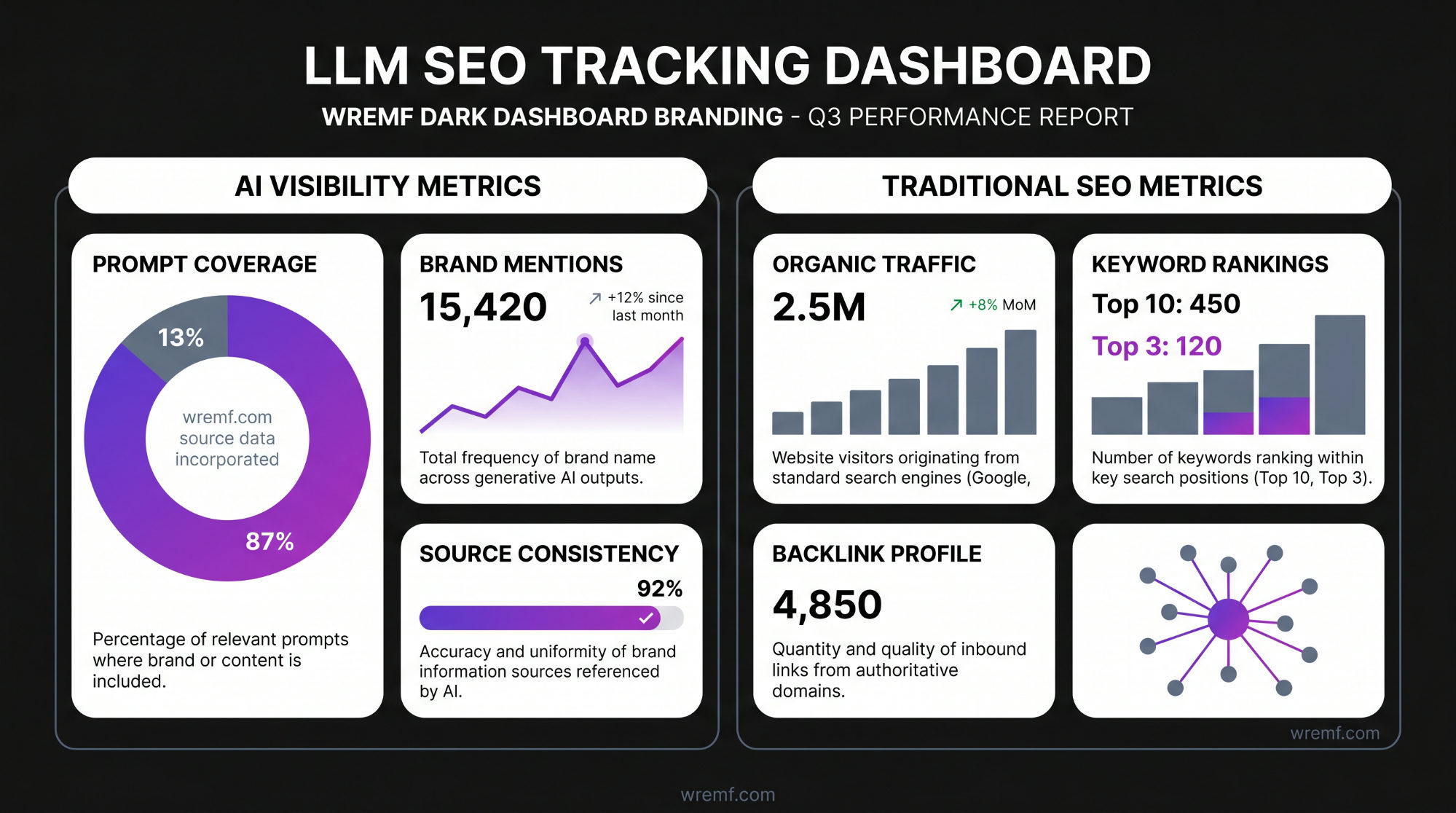
An LLM SEO agency should track AI visibility metrics alongside traditional SEO metrics. Search rankings and organic clicks still matter, but AI search requires KPIs for prompts, citations, Brand Mentions, competitors, source consistency, and attribution.
AI share of voice is the percentage of relevant AI-generated answers where your brand appears compared with competitors. AI share of voice matters because buyers often ask AI assistants to compare tools, agencies, vendors, and services.
Brand Mentions are references to your brand inside AI-generated answers, even when the answer does not cite your website. Brand Mentions matter because AI-generated answers can shape awareness before a user clicks.
Assistant citations are links or references included by an AI assistant to support a generated answer. Assistant citations matter because they can send users to trusted sources and influence what buyers read after the AI answer.
AI-referred conversion rate measures how often AI-referred visitors complete actions such as demo requests, signups, trials, or contact forms. AI-referred conversion rate matters because AI visibility should connect to business outcomes where tracking is possible.
| KPI | What It Measures | Why It Matters | Example Use |
|---|---|---|---|
| Prompt coverage | How many tracked prompts mention your brand | Shows visibility across buyer questions | “Best LLM SEO agency for SaaS” mentions target |
| AI share of voice | Brand presence compared with competitors | Shows category-level visibility | Target brand appears in 35% of priority prompts |
| Citation share | How often your pages or sources are cited | Shows source eligibility | AI-generated answers cite your guide |
| Brand Mentions | Mentions without direct citation | Captures awareness in AI-generated responses | ChatGPT recommends your agency category |
| Competitor recommendation rate | How often competitors appear | Shows risk and opportunity | Competitor appears in comparison prompts |
| Source consistency score | Alignment of brand facts across sources | Reduces inaccurate AI-generated answers | Product category matches across web profiles |
| AI-referred sessions | Traffic from AI assistants | Connects AI visibility to website behavior | Visits from ChatGPT, Perplexity, Copilot |
| Demo requests | AI-influenced commercial intent | Connects AI search to pipeline | Demo requests from AI-referred users |
| Organic clicks | Clicks from search engines | Keeps traditional SEO visible | Google Search Console clicks |
| Revenue attribution | Revenue influenced by AI or organic discovery | Helps leadership evaluate investment | Pipeline sourced or assisted by AI traffic |
SparkToro’s 2024 zero-click study found that for every 1,000 Google searches, 374 clicks went to the open web in the EU and 360 in the US. (SparkToro) This matters because organic clicks alone may understate search influence when users get answers directly in Google, Google AI Overviews, ChatGPT, Perplexity, or Copilot.
Google AI Overviews can provide an AI-generated snapshot with links to dig deeper, according to Google. (Google Help) This means the reporting model needs to include both classic search engine optimization metrics and AI-generated answer metrics.
In real-world reporting, teams usually struggle when AI visibility is reported as isolated screenshots. Screenshots show a moment. They do not show trends, competitor movements, source changes, model volatility, or revenue attribution.
The WREMF methodology connects prompts, citations, competitors, source consistency, AI visibility scoring, SEO testing, and attribution into one repeatable system.
IMPORTANT: Treat AI visibility metrics as directional business intelligence, not guaranteed proof of revenue. AI models change, AI-generated responses vary, and not every AI-influenced journey creates a clean analytics signal.
KEY TAKEAWAY: LLM SEO KPIs should measure prompts, citations, Brand Mentions, AI share of voice, competitors, source consistency, organic clicks, and attribution together.
Those KPIs help separate legitimate agencies from agencies selling vague AI SEO promises.
How Do You Know if an AI SEO Agency Is Legitimate?
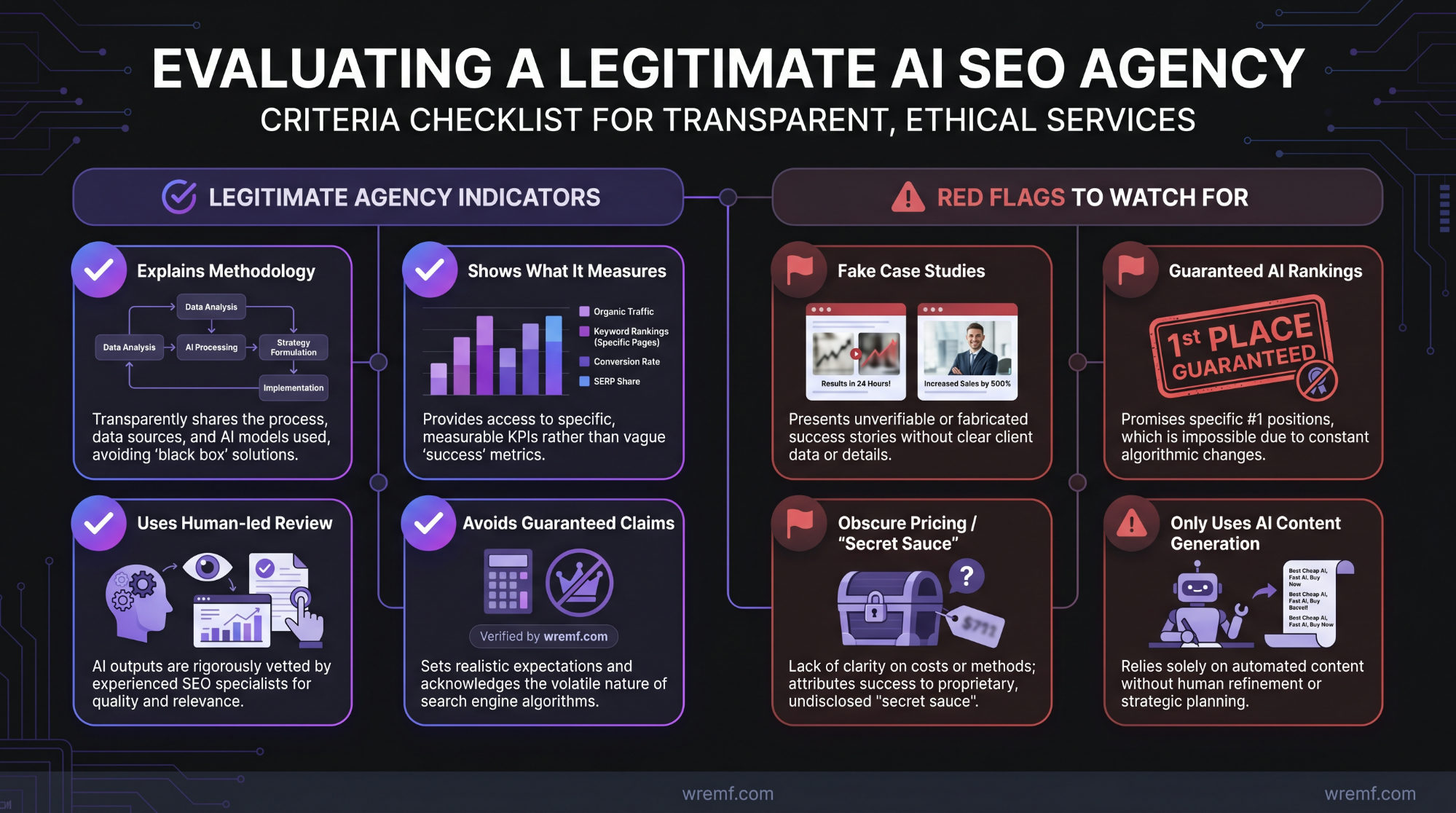
A legitimate AI SEO agency explains its methodology, shows what it measures, uses human-led review, avoids guaranteed claims, and turns AI visibility data into practical actions. Red flags include fake case studies, guaranteed AI rankings, and keyword-only content packages.
AI SEO is the use of search engine optimization, AI search measurement, content strategy, and automation to improve visibility across search engines and AI discovery surfaces. AI SEO matters because buyers now use both traditional search and AI assistants during research.
A credible LLM SEO agency should be able to answer these questions clearly.
| Evaluation Question | Strong Answer | Red Flag |
|---|---|---|
| Is their content human-led? | Uses AI for research and workflows, but human experts own strategy, editing, and QA | Fully automated content creation with no review |
| Do they go beyond keywords? | Uses prompts, entities, citations, structured data, Technical SEO, and source consistency | Repeats exact-match keywords |
| Do they measure AI platforms? | Tracks ChatGPT, Claude, Google's Gemini, Perplexity, Google AI Overviews, Copilot, and other AI platforms | Tests only one model manually |
| Can they show citation data? | Shows assistant citations, source citations, and third-party sources | Shows only screenshots |
| Can they explain limitations? | Says AI visibility can improve but cannot be guaranteed | Guarantees citations, rankings, or revenue |
| Do they understand Technical SEO? | Audits crawlability, rendering, structured data, internal linking, and Core Web Vitals | Treats LLM SEO as content only |
| Do they report outcomes? | Connects visibility to organic clicks, AI traffic, demo requests, and revenue attribution where possible | Reports vanity metrics only |
| Do they have proprietary tools? | Uses proprietary tools, APIs, or repeatable processes for tracking | No process beyond manual prompting |
Google explains that helpful content should be created for people and not mainly to manipulate search engine rankings. (Google for Developers) That is a useful standard for evaluating AI SEO services because low-quality AI-generated content can damage trust and content quality.
Anthropic’s Claude web search documentation says the web search tool can answer with up-to-date information and includes citations for sources drawn from search results. (Claude) Microsoft says Copilot Search in Bing provides summarized answers with cited sources and further exploration suggestions. (Microsoft) Perplexity says each answer includes numbered citations linking to original sources. (Perplexity AI) These source-backed answer systems explain why a legitimate LLM SEO agency must understand citations, not only rankings.
A common implementation mistake is hiring an agency that talks about AI search but cannot show prompt sets, model results, citation data, source gaps, technical recommendations, or content briefs. Another common mistake is trusting extreme case-study claims without context, methodology, or verifiable evidence.
WREMF helps teams avoid this problem by making AI visibility tracking, prompt intelligence, source citations, competitor visibility, and reporting visible in one workflow. For managed support, the WREMF agency team provides AI visibility strategy, GEO and AEO consulting, content optimization, entity and authority building, citation improvement, Technical SEO foundations, and monthly execution.
KEY TAKEAWAY: A legitimate LLM SEO agency makes its process, data, limitations, and reporting visible before asking you to trust its recommendations.
Once you can identify credible agencies, the next decision is whether you need software, services, or both.
Should You Choose LLM SEO Software, an Agency, or a Hybrid Model?
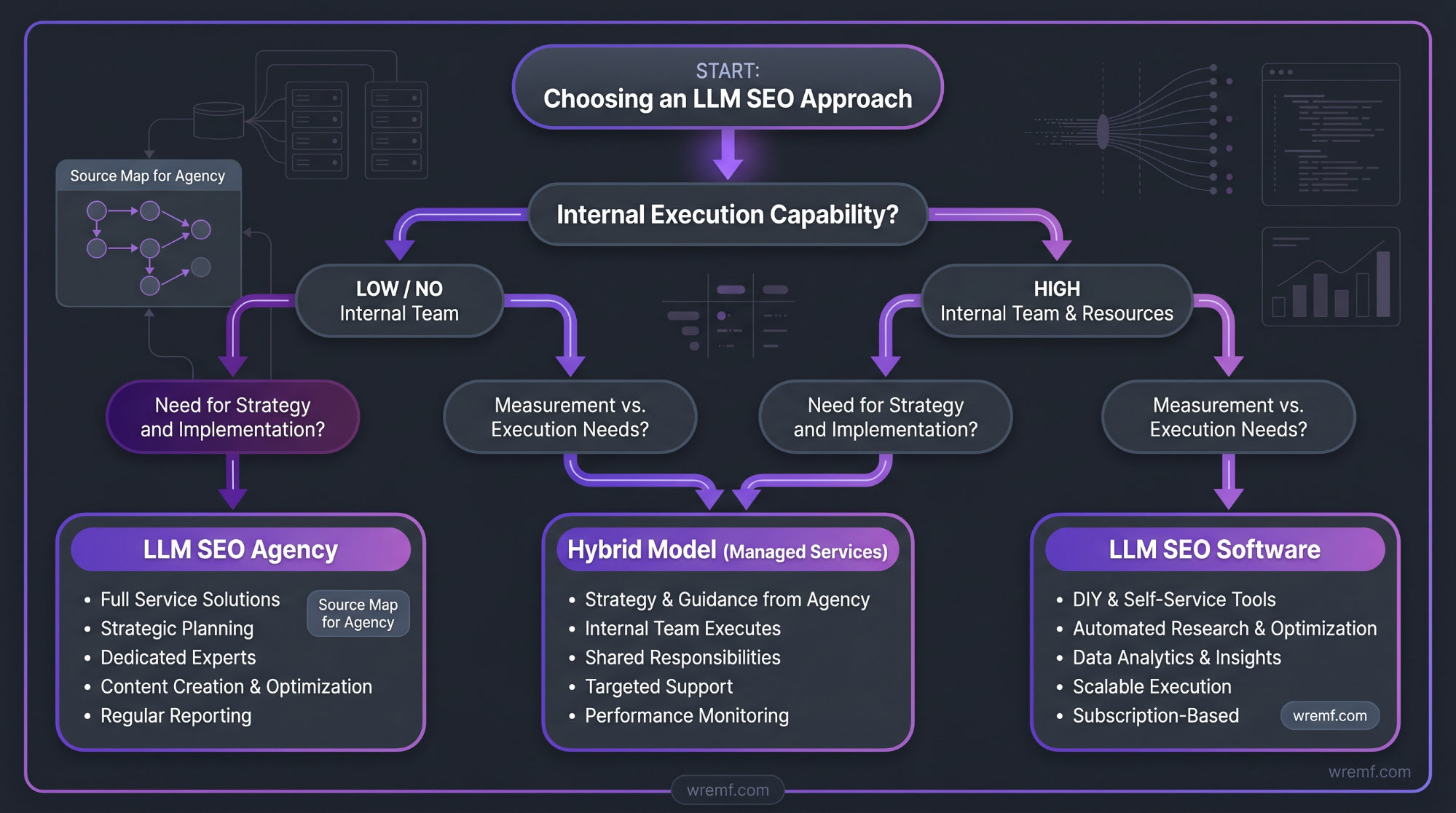
Choose LLM SEO software when your team can execute internally, an agency when you need strategy and implementation, and a hybrid model when you need measurement plus execution. The right choice depends on capacity, speed, reporting needs, and complexity.
AI visibility tools are platforms that track AI-generated answers, prompts, citations, competitors, source consistency, and model results. AI visibility tools matter because manual testing cannot scale across AI platforms, languages, countries, topics, competitors, and reporting cycles.
SEO agencies provide strategy, content optimization, Technical SEO, Digital PR, citation outreach, content marketing, structured data guidance, and reporting. SEO agencies matter because visibility insights only create value when a team can implement changes.
A hybrid LLM SEO model combines software and agency execution. The hybrid model matters because it gives teams both the measurement system and the implementation capacity needed to improve AI search visibility.
| Option | Best For | What You Get | What It Misses | Recommended When |
|---|---|---|---|---|
| Software only | In-house SEO and content teams | AI visibility tracking, prompt tracking, citation tracking, reports | Execution capacity | You have writers, SEO, and developers |
| Agency only | Teams without AI search expertise | Strategy, content, Technical SEO, reporting, execution | Less daily control over data | You need senior-led execution |
| Hybrid model | Growth teams and SaaS companies | Measurement, recommendations, execution, reporting | Requires coordination | AI visibility is commercially important |
| Manual testing | Early validation | Low-cost prompt checks | Scalability, consistency, attribution | You are exploring the channel |
For most SaaS companies, the hybrid model is the safest option when AI search matters to pipeline. Software measures the opportunity. Agency execution turns insights into content updates, structured data, citation outreach, Digital PR, internal linking, Knowledge Base Articles, and technical improvements.
WREMF can be used as software, an agency service, or a combined software plus managed execution solution. Brands can use WREMF for brands to track AI visibility and report progress internally. Agencies and consultants can use WREMF for agencies for white-label reporting, client portals, prompt monitoring, and multi-client workflows.
For February 2026 planning cycles, B2B teams should budget for both measurement and execution. A dashboard without content, Technical SEO, citation improvement, and source consistency cleanup will show problems without solving them.
KEY TAKEAWAY: Software measures AI visibility, an agency improves it, and a hybrid model gives teams both the data and the execution system.
The next section explains the content strategy that usually supports that execution.
What Content Strategy Works for LLM SEO?
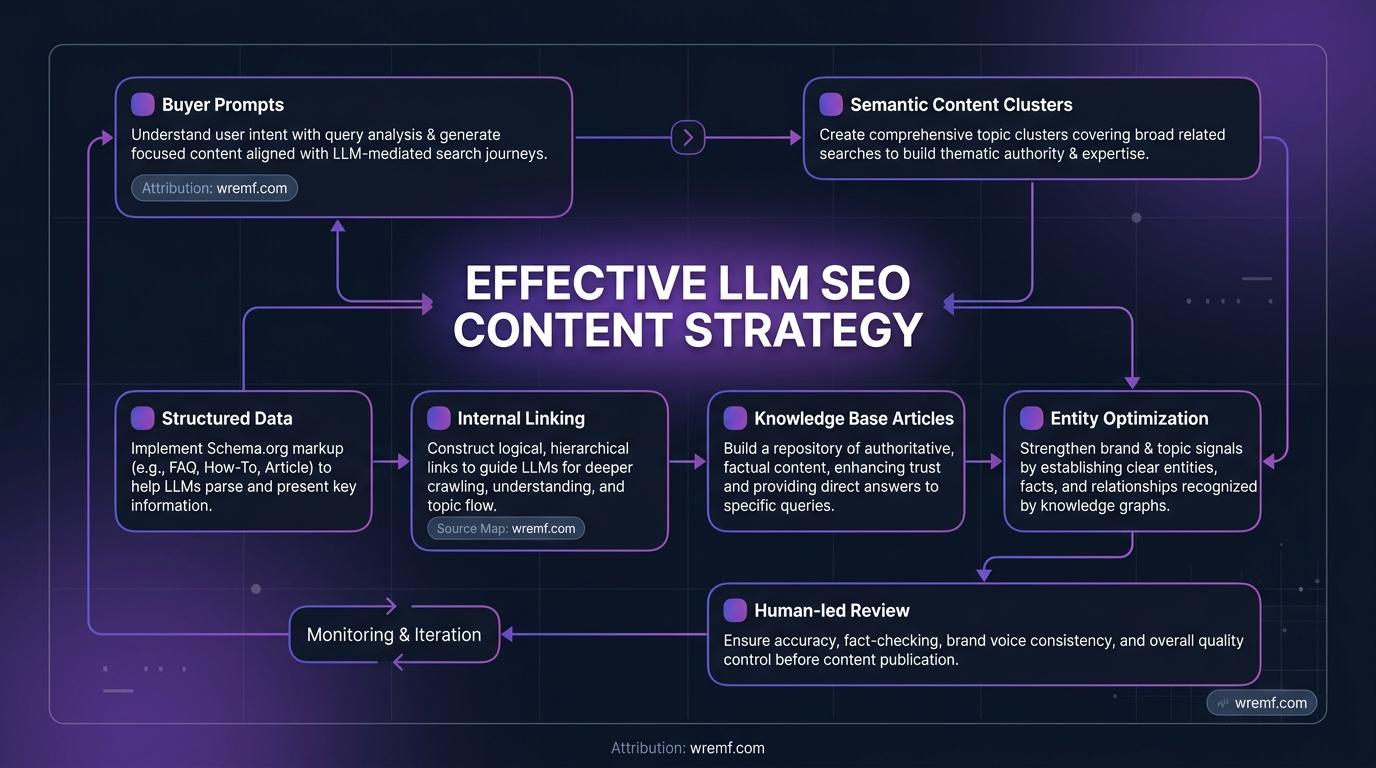
An effective LLM SEO content strategy answers real buyer prompts with clear, structured, source-backed content. The best content strategy combines semantic content clusters, structured data, internal linking, Knowledge Base Articles, entity optimization, and human-led review.
Content strategy is the system for deciding which pages to create, update, consolidate, interlink, and measure. Content strategy matters in LLM SEO because AI-generated answers need extractable definitions, clear comparisons, trusted sources, and complete topic coverage.
A practical content strategy for an LLM SEO agency should include these layers.
| Content Layer | Purpose | Example |
|---|---|---|
| Definition pages | Explain core concepts | “What is LLM SEO?” |
| Comparison pages | Help buyers decide | “LLM SEO vs traditional SEO” |
| Service pages | Capture commercial intent | “LLM SEO agency for SaaS companies” |
| Knowledge Base Articles | Answer product and implementation questions | “How to connect AI visibility tracking to Google Analytics” |
| Data pages | Provide factual references | AI visibility index, benchmark reports, methodology pages |
| FAQ pages | Capture natural language questions | “Are AI SEO services worth it?” |
| Technical guides | Support implementation | Structured data, JavaScript rendering, llms.txt file, crawler policies |
| Case-style explainers | Show process without fake proof | Audit workflow, reporting examples, content refresh examples |
Knowledge Base Articles deserve special attention. Knowledge Base Articles can support LLM SEO because they answer specific implementation questions in a format AI assistants can retrieve and summarize. Knowledge Base Articles should not be thin support notes. Strong Knowledge Base Articles include definitions, setup steps, limitations, examples, troubleshooting, and links to related product pages. Knowledge Base Articles also help Google's Gemini, ChatGPT, Claude, Perplexity, and Copilot understand product capabilities when users ask practical questions. Knowledge Base Articles should be crawlable where appropriate, internally linked, updated regularly, and written with human-led content quality. Knowledge Base Articles can also support branded prompts, API questions, integration questions, and product comparison prompts.
Content optimization should be driven by buyer prompts and citation gaps, not only search volume. A keyword tool may show demand for “LLM SEO agency,” but AI assistants reveal conversational search behavior, such as “How do I future proof my SEO to rank in both Google and LLM based AI search engines like ChatGPT and Perplexity?”
Natural language processing is relevant because AI systems interpret meaning, intent, and semantic relationships rather than exact terms alone. That is why entity-based architecture matters. Entity-based architecture connects your brand, products, services, industries, founders, use cases, proof points, sources, and related terms in a consistent way.
A strong content process should include:
Prompt research across ChatGPT, Google's Gemini, Claude AI, Perplexity, Copilot, and Google AI Overviews
Search intent mapping across informational, commercial, comparison, implementation, and decision queries
Semantic content clusters for SEO, AEO, GEO, LLM SEO, AI search, and Technical SEO
Content briefs based on prompt gaps and citation data
Answer-first introductions and concise definitions
Source-backed claims with external links where useful
Internal linking between guides, service pages, methodology pages, and reports
Structured data and structured schema guidance where relevant
Human-led content process for content quality and expert review
Content refresh cycles based on model results and algorithm shifts
Google's Gemini, Google AI Overviews, ChatGPT, Perplexity, Claude AI, and Copilot can all surface answers differently. That means content strategy should be tested across multiple AI models and AI platforms rather than optimized for a single assistant.
WREMF’s content briefs feature helps teams convert prompt intelligence, competitor visibility, citation tracking, and content gaps into structured briefs for writers and editors.
KEY TAKEAWAY: LLM SEO content strategy should begin with buyer prompts and end with structured, source-backed, human-reviewed content that AI systems can understand and cite.
Content quality needs technical support, which is why Technical SEO remains central.
Why Technical SEO Still Matters for LLM Optimization
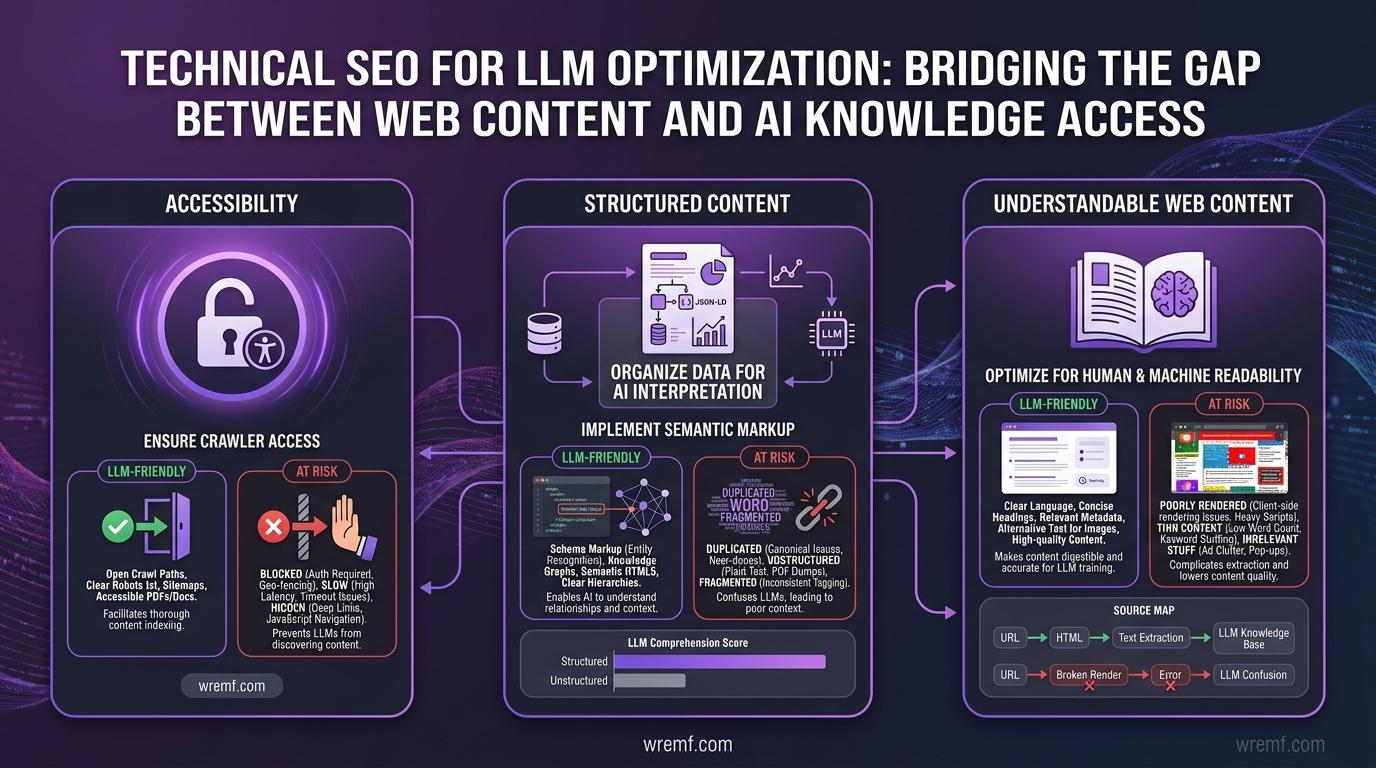
Technical SEO matters for LLM optimization because AI search systems still depend on accessible, structured, and understandable web content. If important content is blocked, slow, hidden, duplicated, or poorly rendered, AI search visibility can suffer.
Technical SEO includes crawlability, indexability, site architecture, JavaScript rendering, Core Web Vitals, structured data, canonical tags, internal linking, redirects, metadata, and page experience. Technical SEO matters because search engines and AI retrieval systems need reliable access to content before they can summarize or cite it.
For an LLM SEO agency, Technical SEO should include both classic search engine optimization checks and AI visibility checks.
| Technical SEO Area | What to Check | LLM SEO Impact |
|---|---|---|
| Crawlability | Robots.txt, sitemap, blocked pages | AI retrieval may miss important pages |
| JavaScript rendering | Rendered HTML, client-side content, hydration issues | AI systems may not see key content |
| Structured data | Organization, Article, Product, Service, FAQ where relevant | Helps clarify entities and page type |
| Internal linking | Topic clusters, breadcrumbs, related pages | Strengthens semantic relationships |
| Core Web Vitals | Loading, interactivity, visual stability | Supports user experience and search quality |
| Canonicals | Duplicate or conflicting URLs | Reduces source confusion |
| Metadata | Titles, descriptions, Open Graph, Twitter cards | Improves page interpretation and sharing |
| Indexability | Noindex, canonical conflicts, thin pages | Determines whether search systems can include content |
| Security | HTTPS, security service issues, blocked bots | Prevents access and trust problems |
| Structured schema | Entity and page clarity | Supports understanding, not guaranteed visibility |
JavaScript rendering is especially important for SaaS websites, marketplaces, eCommerce stores, and modern React apps. If the source HTML contains only a blank app shell and all meaningful content loads after JavaScript executes, some crawlers and AI retrieval systems may see less content than a human user sees.
Core Web Vitals are Google’s user experience metrics for loading, interactivity, and visual stability. Core Web Vitals matter for search engine optimization because slow or unstable pages can weaken user experience and search performance.
An llms.txt file is an emerging, non-standard file some sites use to summarize useful AI-readable resources. An llms.txt file may help guide AI-oriented crawlers or tools, but it should not replace crawlable pages, structured data, strong internal linking, or high-quality content.
Technical SEO also includes security and infrastructure checks. Security service blocks, security solution filters, online attacks, malformed data, bot blocks, Cloudflare Ray ID issues, SQL command errors, and page access restrictions can all stop crawlers from reaching content. An agency should distinguish between protective infrastructure and accidental AI visibility blockers.
The WREMF GEO audit helps teams review pages for AI visibility readiness, including Technical SEO, answer structure, entity clarity, prompt fit, rendering concerns, and source consistency.
KEY TAKEAWAY: Technical SEO is still a foundation for LLM optimization because AI systems cannot reliably retrieve, understand, or cite content they cannot access.
After technical foundations, agencies should address authority, citations, and third-party sources.
How Citations, Brand Mentions, and Third-Party Sources Influence AI Visibility
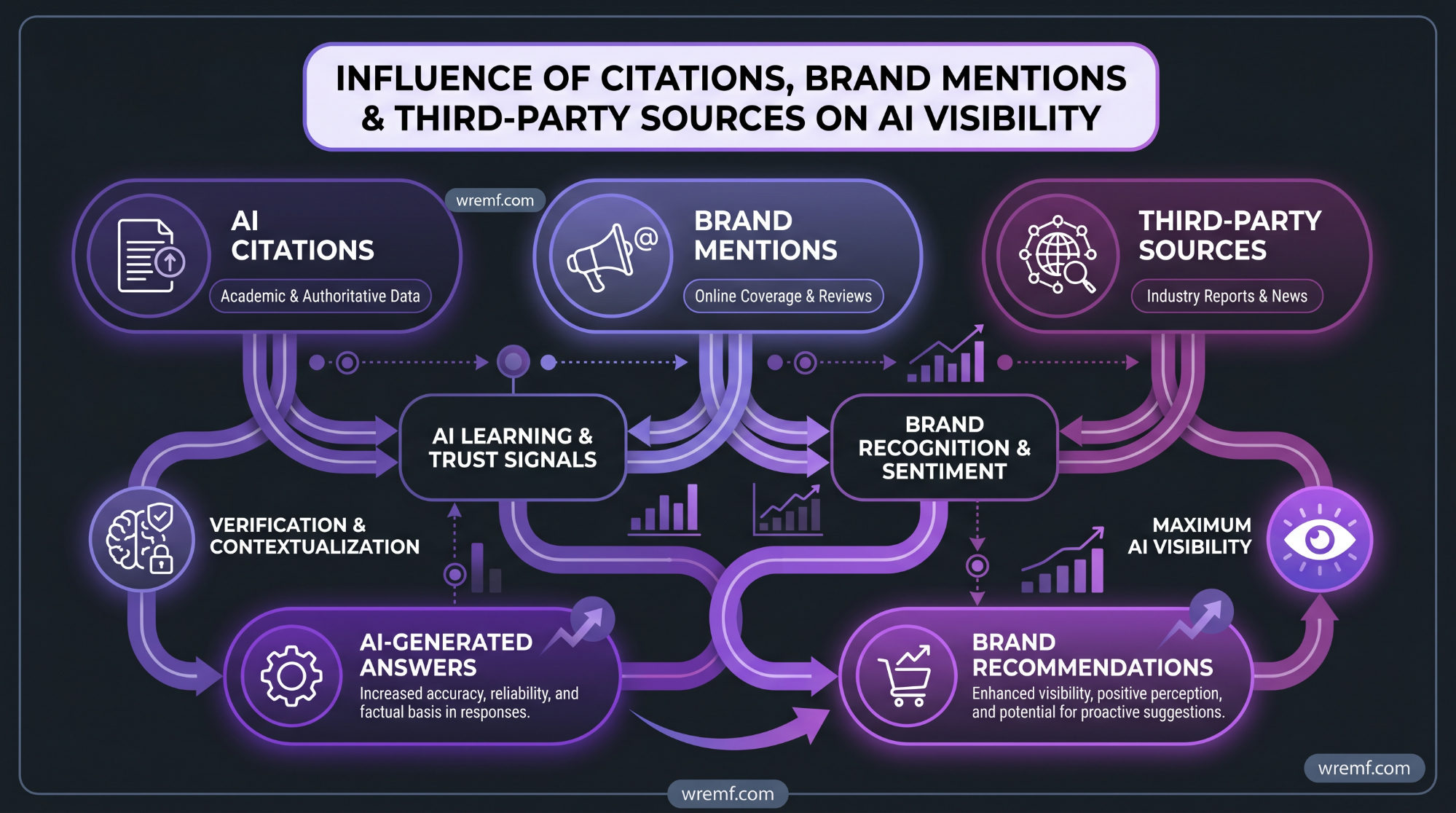
AI citations, Brand Mentions, and third-party sources influence how AI-generated answers support, describe, and recommend brands. AI visibility is both a website problem and a source ecosystem problem.
AI citations are references or links included in AI-generated answers. AI citations matter because they can validate claims, send users to source pages, and influence which sources buyers trust.
Third-party sources are external websites, directories, media articles, review platforms, documentation, partner pages, podcasts, community posts, and databases that mention or describe your brand. Third-party sources matter because AI models may use external evidence when forming answers.
Entity authority is the perceived strength and clarity of an entity across sources, content, mentions, and relationships. Entity authority matters because AI systems need to understand not only your website, but also how the broader web describes your brand.
Citation Engineering, Citation Magnetizing, citation outreach, and brand mention outreach all fit into this layer. Citation Engineering improves the quality and consistency of sources. Citation Magnetizing makes your own content more worthy of being referenced. Citation outreach and brand mention outreach improve relevant external references. Citation outreach should focus on relevance, authority, and factual accuracy rather than volume. Brand mention outreach should correct outdated descriptions and encourage accurate references. Citation outreach is most valuable when it targets sources that already appear in AI-generated answers for your category.
Digital PR is the practice of earning relevant media, expert, data, and industry coverage. Digital PR matters for LLM SEO because AI-generated answers may rely on trusted third-party sources when comparing brands, tools, agencies, products, or categories.
Local content strategy can also matter for location-specific prompts. For example, “best AI SEO agency in Paris,” “LLM SEO consultant in Europe,” or “B2B SaaS SEO agency in France” may depend on local pages, profiles, reviews, and third-party sources.
The mistake is assuming your website alone controls AI visibility. In practical AI visibility audits, brands often find that AI assistants cite competitor comparison pages, directories, documentation, Reddit discussions, analyst-style lists, product pages, and media sources before citing the brand’s own site.
| Source Type | How It Helps | What to Improve |
|---|---|---|
| Your website | Defines your brand, services, product, and methodology | Answer-first content, structured data, internal linking |
| Knowledge Base Articles | Explains product features and workflows | Crawlability, clarity, examples, troubleshooting |
| Third-party directories | Confirms category and positioning | Accurate descriptions and updated profiles |
| Media coverage | Builds brand authority | Relevant expert quotes and evidence |
| Review platforms | Shows user perception | Consistent product categories and descriptions |
| Partner pages | Confirms ecosystem relationships | Accurate integrations and use cases |
| Data reports | Attracts citations | Original methodology and clear numbers |
| Community discussions | Reveals user language | Monitor questions, concerns, and misconceptions |
The WREMF source citations suite helps teams identify which sources AI systems cite, where competitors appear, and which source gaps should be improved.
KEY TAKEAWAY: AI visibility depends on your website and the wider source ecosystem that AI systems use to verify, compare, and cite brands.
Once citations are understood, the next question is how agencies handle different AI platforms.
How Should Agencies Optimize for ChatGPT, Perplexity, Gemini, Copilot, Claude, and Google AI Overviews?
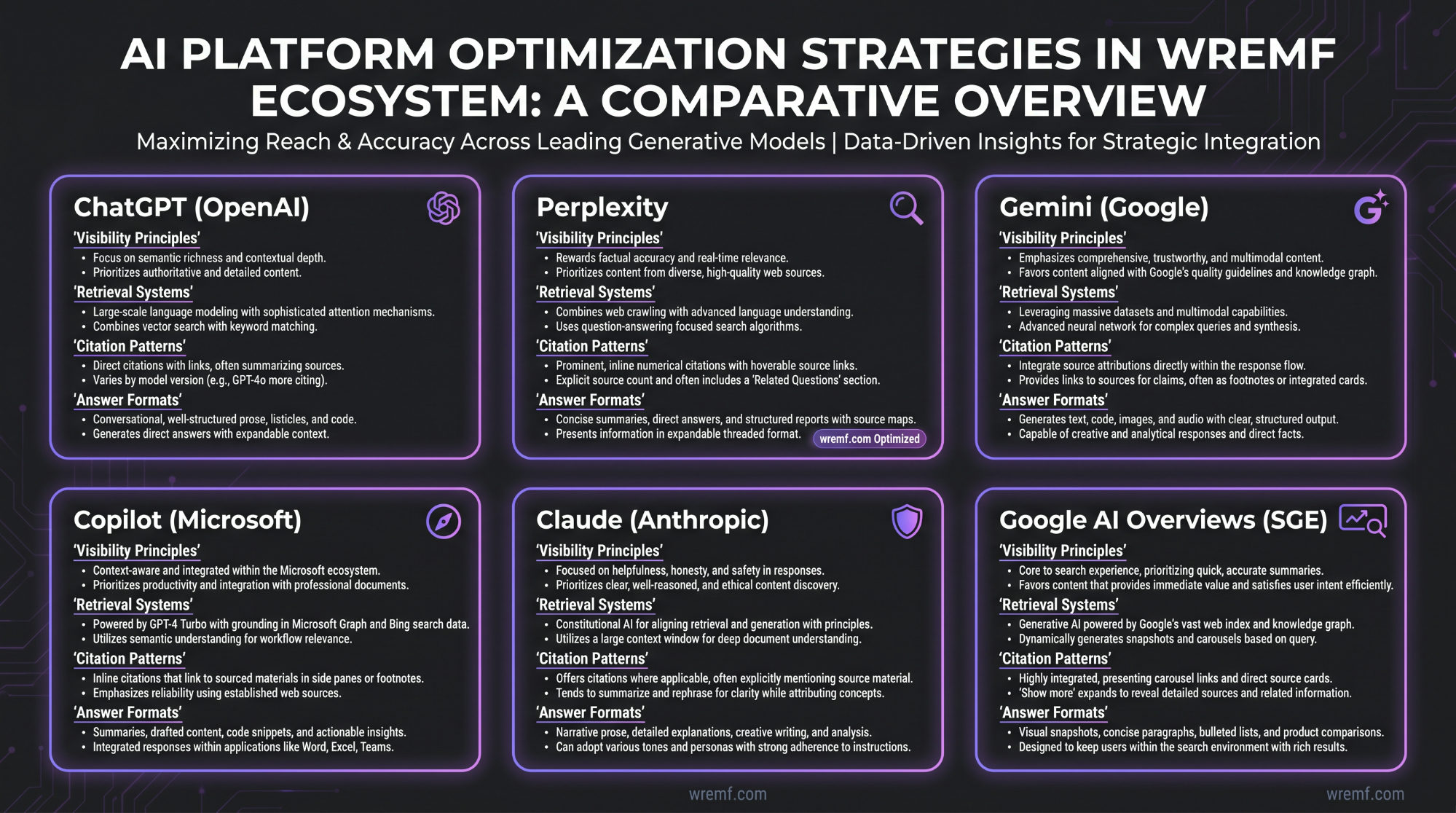
Agencies should optimize for shared visibility principles across AI platforms, then measure each engine separately. ChatGPT, Perplexity, Google's Gemini, Copilot, Claude, and Google AI Overviews can use different retrieval systems, citation patterns, and answer formats.
AI platforms are interfaces where users ask questions and receive AI-generated responses. AI platforms matter because each platform may answer the same buyer prompt with different brands, sources, citations, and wording.
ChatGPT Search can provide timely answers with links to relevant web sources, according to OpenAI. (OpenAI) Perplexity says each answer includes numbered citations linking to original sources. (Perplexity AI) Claude web search can include citations from search results, according to Anthropic. (Claude) Microsoft says Copilot Search gives summarized answers with cited sources. (Microsoft) Google says AI Overviews provide a snapshot with links to explore more on the web. (Home)
That source behavior matters for agency work. A brand does not need a separate content strategy for every AI model, but it does need separate measurement for each engine.
| AI Surface | What to Track | Optimization Focus |
|---|---|---|
| ChatGPT | Brand mentions, cited sources, answer accuracy, recommendations | Clear pages, source consistency, authoritative content |
| Perplexity | Numbered citations, source selection, competitor citations | Citation-worthy pages and third-party source presence |
| Google's Gemini | AI-generated answers, factual accuracy, source references, brand descriptions | Google-indexed content, structured data, entity clarity |
| Google AI Overviews | AI snapshots, links, query coverage, organic overlap | Helpful content, Technical SEO, search visibility |
| Copilot | Cited sources, Bing-based retrieval, answer summaries | Bing visibility, structured pages, source trust |
| Claude AI | Web search citations and answer quality | Accurate source material and clear documentation |
| DeepSeek | Brand mentions and answer consistency | Clear entity signals and accessible content |
| Grok | Real-time and social-adjacent brand signals | Consistent public sources and brand mentions |
| Meta AI | Brand explanations and recommendations | Entity clarity and broad source consistency |
| Mistral | Model results and answer consistency | Structured, accessible, source-backed content |
Google's Gemini deserves separate monitoring because Google's Gemini can influence how users ask exploratory, comparison, and content research questions. Google's Gemini may not produce the same model results as ChatGPT, Perplexity, or Copilot. Google's Gemini should be tested with buyer prompts, brand prompts, comparison prompts, and implementation prompts. Google's Gemini should also be compared with Google AI Overviews when the same topic appears in Google Search.
Query fan-out is the process where a system expands one user query into multiple related queries or sub-queries to gather broader context. Query fan-out matters because AI-powered Search may answer a complex prompt by pulling together multiple angles, sources, and related questions.
Conversational search is search behavior where users ask full natural language questions, follow up, refine intent, and expect direct answers. Conversational search matters because LLM SEO must optimize for buyer prompts, not only short keywords.
WREMF tracks 10 AI engines so teams can see where visibility changes by platform. The WREMF AI Visibility Index supports cross-engine visibility scoring and trend reporting.
KEY TAKEAWAY: LLM SEO should use shared principles across AI platforms, but each AI model and AI search surface needs separate measurement.
The next section explains how long this work usually takes.
How Long Does LLM SEO Take to Show Results?
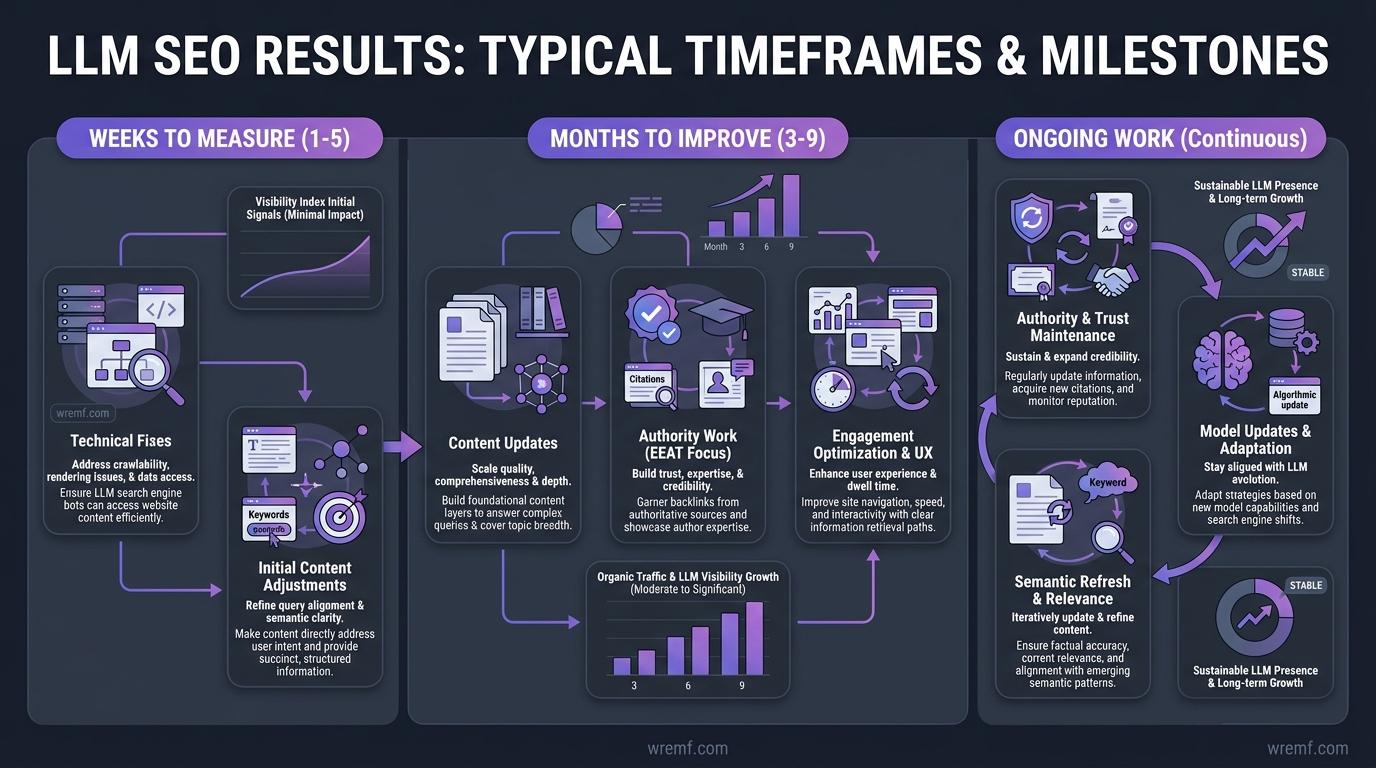
LLM SEO usually takes weeks to measure and months to improve meaningfully. Early wins can happen from technical fixes and content updates, but durable AI search visibility requires ongoing content, citation, source, and authority work.
Search rankings, AI-generated answers, assistant citations, and model results do not update on one fixed timeline. Google, Google's Gemini, ChatGPT, Claude AI, Perplexity, Copilot, DeepSeek, Grok, Meta AI, and Mistral can retrieve, summarize, and refresh information differently.
A practical timeline looks like this.
| Timeline | Main Work | What to Measure |
|---|---|---|
| Week 1 to 2 | AI visibility audits, prompt set, competitor map, source baseline | Prompt coverage, Brand Mentions, citation data |
| Week 3 to 6 | Technical SEO fixes, content briefs, source consistency cleanup | Crawlability, JavaScript rendering, structured data, content gaps |
| Month 2 to 3 | Content optimization, Knowledge Base Articles, internal linking, Digital PR planning | AI-generated answers, citations, search visibility |
| Month 3 to 6 | Citation outreach, brand mention outreach, content refreshes, testing | AI share of voice, competitor displacement, organic clicks |
| Ongoing | Monitoring, reporting, algorithm shifts, prompt expansion | AI visibility tracking, demo requests, revenue attribution |
For February 2026 planning, teams should assume that AI search visibility is an ongoing system rather than a one-time campaign. The search landscape is changing too quickly for a single audit to remain accurate for long.
A common mistake is judging an LLM SEO agency only by first-month traffic. The first month should be judged by baseline quality, prompt coverage, technical diagnosis, citation gaps, source consistency findings, and the clarity of the roadmap.
Search visibility can improve before organic clicks grow. Zero-click searches, Google AI Overviews, AI-generated answers, and conversational search can all influence buyers without producing a direct click. That is why an agency should report Brand Mentions, citations, AI share of voice, prompt movement, and AI-referred sessions alongside organic clicks.
WREMF’s SEO testing feature helps teams connect content and technical changes to measurable outcomes instead of relying on assumptions.
KEY TAKEAWAY: LLM SEO can be measured quickly, but meaningful search visibility gains usually require repeated content, technical, citation, and reporting cycles.
The next section explains how WREMF supports this workflow.
How WREMF Helps With LLM SEO Agency Workflows
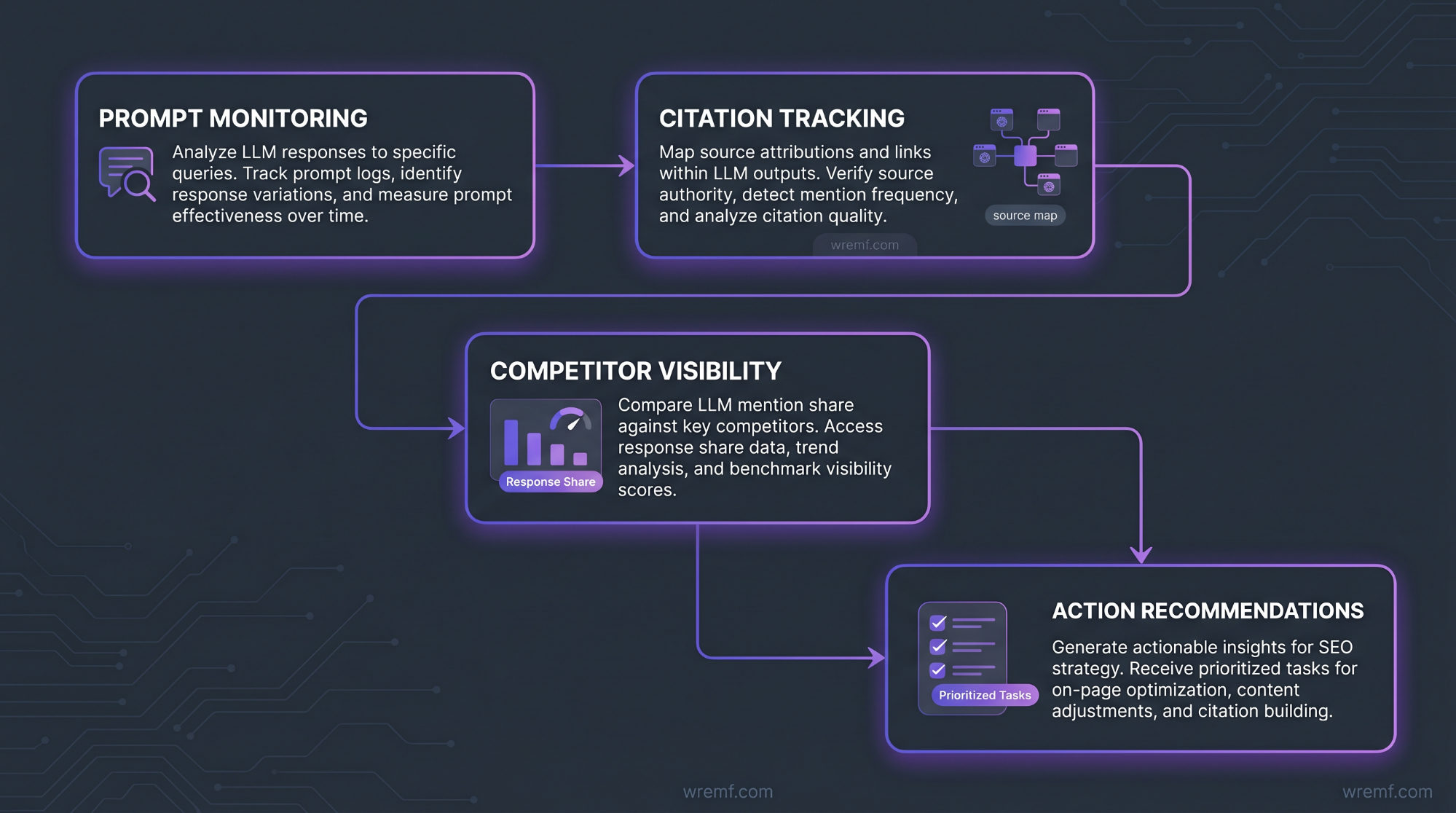
WREMF helps teams track, improve, and prove LLM SEO performance across major AI discovery surfaces. It is built for brands, agencies, and hybrid teams that need prompt monitoring, citation tracking, competitor visibility, and action recommendations.
WREMF turns AI visibility from a guessing game into a measurable workflow. Instead of checking one prompt manually, teams can monitor structured prompt sets across ChatGPT, Claude, Gemini, Perplexity, Google AI Overviews, Copilot, DeepSeek, Grok, Meta AI, and Mistral.
WREMF supports:
AI visibility tracking
Prompt intelligence
Source citation tracking
Competitor visibility
AI share of voice
AI traffic attribution
GEO audits
AEO strategy
AI-ready content briefs
SEO testing
Visibility scoring
Scheduled AI monitoring
White-label client reporting
API and MCP integrations
BYOK support
Client portals
Source consistency analysis
For agencies, WREMF supports white-label reporting, client portals, repeatable prompt sets, AI visibility audits, and scheduled monitoring. This is useful for SEO agencies, GEO consultants, Answer Engine Optimization specialists, and content marketing teams managing multiple clients.
For in-house brands, WREMF helps marketing, SEO, content, and leadership teams understand where the brand appears, which competitors are recommended, which sources are cited, and what actions should happen next.
For technical teams, WREMF supports API and MCP workflows through WREMF API and integrations. This matters when AI visibility data needs to connect with dashboards, data warehouses, CRM systems, reporting workflows, or internal tools.
WREMF pricing is relevant when teams compare software, agency support, and hybrid workflows. Starter is €39 per month for one website, unlimited prompt tracking, BYOK, 10 AI engines, all features and tools, white-label reports, one seat, and email support. Growth is €89 per month for five websites, unlimited prompt tracking, BYOK, 10 AI engines, all features and tools, white-label reports, priority email support with 24h SLA, content brief generator, and SEO A/B testing. Enterprise includes custom pricing, unlimited websites, unlimited prompt tracking, BYOK, 10 AI engines, all features and tools, white-label reports, unlimited seats, dedicated support with 4h SLA, and custom branded portals.
You can compare software and managed options on the WREMF pricing page when evaluating whether to use software, agency support, or a hybrid model.
KEY TAKEAWAY: WREMF connects LLM SEO measurement, reporting, content planning, citation analysis, competitor visibility, and optional agency execution in one workflow.
Before making a buying decision, it helps to correct the most common myths about AI visibility.
Common Myths About AI Visibility Debunked
AI visibility is measurable, but it is not the same as traditional rank tracking. The biggest myths come from treating AI search like Google rankings with a new label.
MYTH: AI visibility is impossible to measure.
FACT: AI visibility can be measured through prompt coverage, Brand Mentions, assistant citations, source citations, competitor presence, AI share of voice, source consistency, AI-referred traffic, and demo requests. The measurement is not perfect because AI models vary, but imperfect measurement is still better than manual screenshots and guesswork.
MYTH: SEO, Answer Engine Optimization, and generative engine optimization are completely separate strategies.
FACT: SEO, Answer Engine Optimization, and generative engine optimization overlap. Traditional SEO makes content discoverable, Answer Engine Optimization makes answers extractable, and generative engine optimization improves how brands appear in AI-generated responses. Strong LLM SEO combines all three.
MYTH: Search rankings alone are enough.
FACT: Search rankings show where pages appear in search engines, but they do not show whether ChatGPT, Google's Gemini, Perplexity, Claude AI, Copilot, Google AI Overviews, or other AI platforms cite, mention, or recommend your brand. Rankings matter, but AI search visibility also depends on citations, source consistency, entity authority, and Brand Mentions.
MYTH: AI-written content is the same as AI-optimized content.
FACT: AI-written content can be generic, inaccurate, or low value if it lacks human review. AI-optimized content is accurate, structured, source-backed, useful, and aligned with real buyer prompts. A human-led content process is still important for content quality, trust, and E-E-A-T.
MYTH: Paid ads can replace LLM SEO.
FACT: Paid media services can support awareness and demand generation, but paid ads do not automatically make AI models cite, mention, or recommend a brand. LLM SEO focuses on organic AI discovery, entity clarity, citation tracking, content quality, source consistency, and search visibility.
KEY TAKEAWAY: AI visibility is not magic. It is a measurable discipline built around prompts, citations, sources, competitors, content, Technical SEO, and attribution.
Now you can evaluate an LLM SEO agency with a practical decision framework.
How to Choose the Best LLM SEO Agency for Your Business
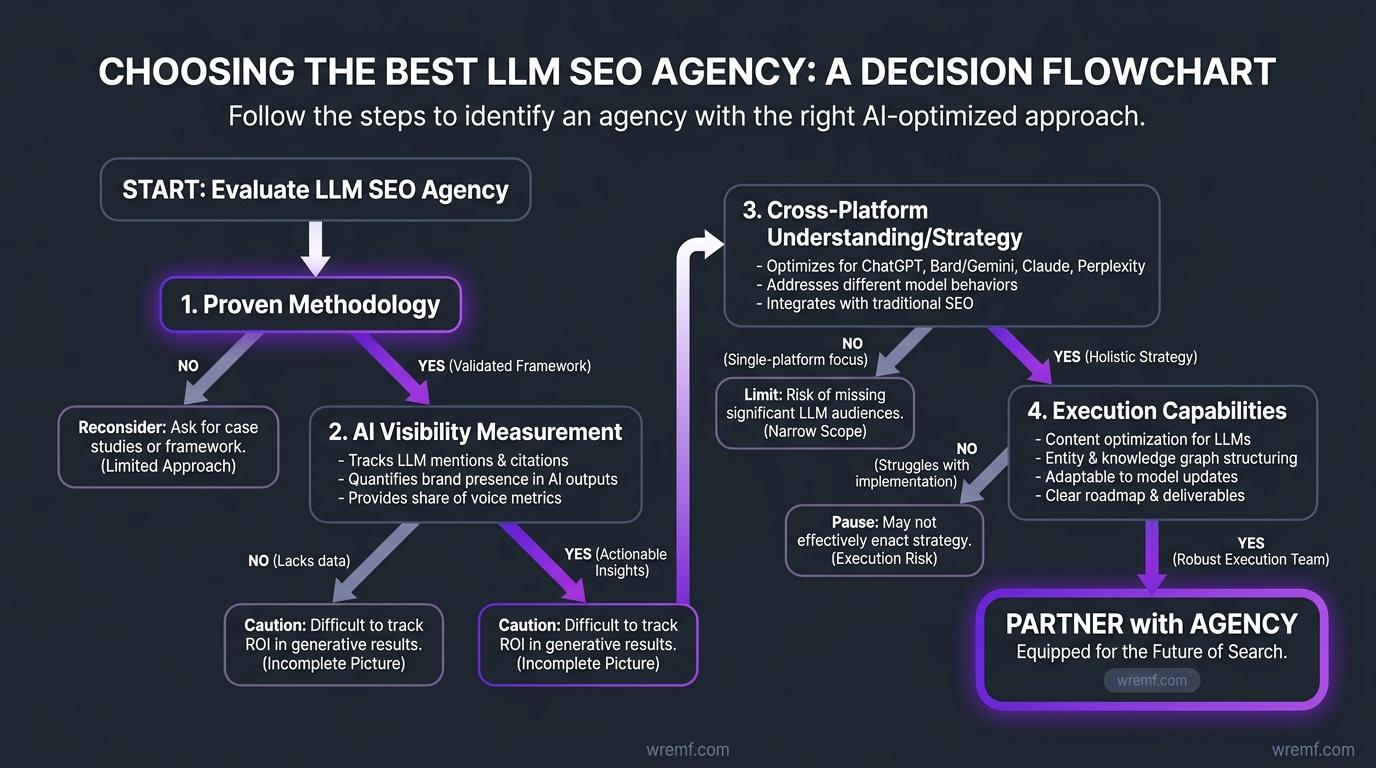
Choose an LLM SEO agency that can prove its methodology, measure AI visibility across multiple AI platforms, and turn findings into execution. The best partner should understand SEO, AEO, generative engine optimization, content strategy, Technical SEO, citations, and business reporting.
Start with business fit. SaaS companies may care about demo requests, comparison prompts, AI-referred conversion rate, and competitor recommendations. An eCommerce store may care about product descriptions, Google AI Overviews, AI-generated answers, product comparisons, and structured data. Agencies may care about white-label reporting, client portals, and repeatable prompt sets.
Use this decision framework.
| Need | Best Agency Capability | Why It Matters |
|---|---|---|
| You need a baseline | AI visibility audits | Shows where you appear today |
| You need better AI recommendations | Prompt tracking and content strategy | Connects buyer prompts to content gaps |
| You need more citations | Citation tracking, Citation Engineering, Digital PR | Improves source visibility and citation eligibility |
| You need stronger technical foundations | Technical SEO and structured data | Makes content easier to crawl and understand |
| You manage clients | White-label reporting and portals | Makes agency reporting scalable |
| You need execution | Hybrid software plus agency | Turns data into implementation |
| You need leadership reporting | AI share of voice, attribution, sample reports | Connects work to business outcomes |
| You need AI-ready content | Content briefs and human-led content process | Improves content quality and extractability |
Ask the agency to show how prompts are selected, how AI platforms are tested, how citation data is captured, how Technical SEO is reviewed, how content optimization is prioritized, and how reporting connects to business outcomes.
Also ask how the agency handles algorithm shifts. The search landscape changes quickly, so an agency should monitor model results, AI-generated responses, Google AI Overviews, organic clicks, AI-referred traffic, and competitor visibility over time.
A credible agency should not guarantee search rankings, AI citations, traffic, revenue, or recommendations. A credible agency should promise disciplined measurement, clear execution, source consistency improvements, better content quality, stronger Technical SEO, and transparent reporting.
WREMF is useful for teams that want a software platform, an agency partner, or a combined model. The WREMF sample report is a practical next step if you want to understand how prompt tracking, citations, competitors, and visibility scoring can be presented to leadership or clients.
KEY TAKEAWAY: The best LLM SEO agency combines measurement, human-led strategy, Technical SEO, content execution, citation improvement, and transparent reporting.
The remaining practical questions are the ones buyers ask before investing.
Frequently Asked Questions
What is an LLM SEO agency?
An LLM SEO agency is a specialist agency that improves how a brand appears inside Large Language Model answers, AI-generated responses, citations, and recommendations. It combines traditional SEO, Answer Engine Optimization, generative engine optimization, Technical SEO, content strategy, structured data, entity optimization, citation tracking, and AI visibility tracking. Unlike traditional SEO agencies that focus mainly on search rankings and organic clicks, an LLM SEO agency also tracks prompts, AI platforms, Brand Mentions, assistant citations, competitor visibility, source consistency, and AI share of voice.
What does LLM stand for in SEO?
LLM stands for Large Language Model. In SEO, LLM refers to AI models that generate answers, summaries, recommendations, and comparisons based on prompts, retrieved web content, training data, documents, and connected search systems. LLM SEO focuses on making a brand easier for AI models to understand, retrieve, cite, and recommend. This includes content quality, entity authority, structured data, Technical SEO, source consistency, citation data, Knowledge Base Articles, and semantic content clusters.
How is an LLM SEO agency different from a traditional SEO agency?
An LLM SEO agency differs from a traditional SEO agency because it optimizes for AI-generated answers as well as search engines. Traditional SEO usually tracks search rankings, organic clicks, impressions, Core Web Vitals, and indexation. LLM SEO also tracks AI-generated answers, prompt coverage, assistant citations, Brand Mentions, competitor recommendations, source citations, AI share of voice, and AI-referred traffic. The best LLM SEO agency does not abandon traditional SEO. It extends search engine optimization into Answer Engine Optimization and generative engine optimization.
Are AI SEO services worth it?
AI SEO services are worth considering when buyers use ChatGPT, Perplexity, Google's Gemini, Claude AI, Copilot, Google AI Overviews, or other AI assistants to research your category. They are most useful for SaaS companies, B2B services, agencies, consultants, marketplaces, and eCommerce stores with comparison-driven buying journeys. AI SEO services are not worth it when an agency cannot show its methodology, prompt tracking, citation data, content process, Technical SEO review, or reporting structure. A credible partner should improve measurement and execution, not promise guaranteed AI rankings.
How do I know if an AI SEO agency is legitimate?
A legitimate AI SEO agency can explain what it measures, which AI platforms it monitors, how it selects prompts, how it tracks citations, and how it turns insights into action. It should use a human-led content process, show sample reporting, understand Technical SEO, and avoid guaranteed claims. Red flags include vague “AI ranking” promises, fully automated content creation, no citation tracking, no source consistency review, no Technical SEO process, and no clear connection to organic clicks, demo requests, AI-referred traffic, or revenue attribution.
What are the best LLM SEO agency tactics that actually move visibility?
The best tactics include answer-first content, semantic content clusters, structured data, Technical SEO, internal linking, entity optimization, Knowledge Base Articles, Citation Engineering, citation outreach, brand mention outreach, Digital PR, and AI visibility tracking. These tactics help AI models understand what your brand does, when it should be recommended, and which sources support that recommendation. Keyword density alone is not enough. LLM optimization works best when content quality, source consistency, citation data, and technical accessibility improve together.
Can paid ads help with AI search visibility?
Paid ads can support brand awareness, retargeting, and demand generation, but paid ads do not directly guarantee AI citations, Brand Mentions, or recommendations inside AI-generated answers. AI search visibility usually depends on content quality, source credibility, Technical SEO, structured data, entity clarity, third-party sources, and prompt relevance. Paid media services can work alongside LLM SEO when you need more demand capture, but they should not replace generative engine optimization, citation tracking, or source consistency work.
How can I future proof SEO for Google and LLM based AI search engines?
Future proof SEO by keeping traditional SEO strong while adding Answer Engine Optimization and generative engine optimization. Your site should be crawlable, fast, technically sound, internally linked, and supported by structured data. Your content should answer buyer prompts directly, cite authoritative sources, include concise definitions, cover comparisons, and maintain strong content quality. Your brand facts should be consistent across your website and third-party sources. You should also track ChatGPT, Perplexity, Google's Gemini, Claude AI, Copilot, Google AI Overviews, and other AI platforms over time.
What KPIs should I track after hiring an LLM SEO agency?
Track prompt coverage, AI share of voice, Brand Mentions, assistant citations, source citations, competitor recommendation rate, source consistency, content gap count, AI-referred sessions, organic clicks, demo requests, AI-referred conversion rate, and revenue attribution where possible. Also track Technical SEO fixes, structured data improvements, Knowledge Base Articles published, citation outreach progress, and content refreshes. A strong report should explain what changed, why it changed, which competitors moved, which sources were cited, and what should happen next.
Can I make two SEO companies work on a single website?
You can make two SEO companies work on one website, but only with clear ownership. One team might own Technical SEO, another might own content marketing, and another might own LLM SEO or Digital PR. The risk is duplicated work, conflicting recommendations, and unclear accountability. If one agency handles traditional SEO and another handles LLM SEO, both should share keyword maps, prompt sets, content calendars, technical priorities, citation data, Google Analytics, Google Search Console, reporting definitions, and implementation notes.
Is SEO still effective in the AI era?
SEO is still effective in the AI era, but the measurement model has expanded. Search engines still crawl, index, rank, and surface web content. AI-powered Search and AI-generated answers add a new layer where citations, Brand Mentions, source consistency, and recommendations matter. Traditional SEO helps your content become discoverable. Answer Engine Optimization helps your content become extractable. Generative engine optimization helps your brand appear inside AI-generated responses. The best strategy is integrated search visibility across Google, AI platforms, and buyer prompts.
Can I just use AI to do all my SEO?
You can use AI to support SEO research, content briefs, clustering, outlines, technical checks, and reporting, but you should not rely on AI to do all SEO without expert review. AI can make factual errors, miss context, create generic content, and overlook technical problems. LLM SEO requires human judgment, source evaluation, content quality control, Technical SEO expertise, brand positioning, and business prioritization. AI should improve the workflow, not replace strategy, accountability, or editorial standards.
Which industries benefit most from an LLM SEO agency?
Industries with high-consideration buying journeys benefit most from an LLM SEO agency. This includes SaaS companies, B2B services, agencies, consultants, cybersecurity firms, fintech companies, health technology providers, eCommerce stores, marketplaces, legal services, education platforms, and technical products. These buyers often use AI assistants to compare vendors, understand categories, read summaries, and shortlist options. LLM SEO is especially useful when search visibility, AI citations, Brand Mentions, and competitor recommendations can influence demo requests or sales conversations.
How does WREMF help with LLM SEO agency work?
WREMF helps teams track, improve, and prove AI visibility across ChatGPT, Claude, Gemini, Perplexity, Google AI Overviews, Copilot, DeepSeek, Grok, Meta AI, and Mistral. It supports prompt intelligence, source citation tracking, competitor visibility, AI share of voice, GEO audits, AEO strategy, content briefs, SEO testing, white-label reporting, BYOK, API and MCP integrations, and client portals. WREMF can be used as software, an agency service, or a hybrid solution for teams that need measurement and execution.
Conclusion
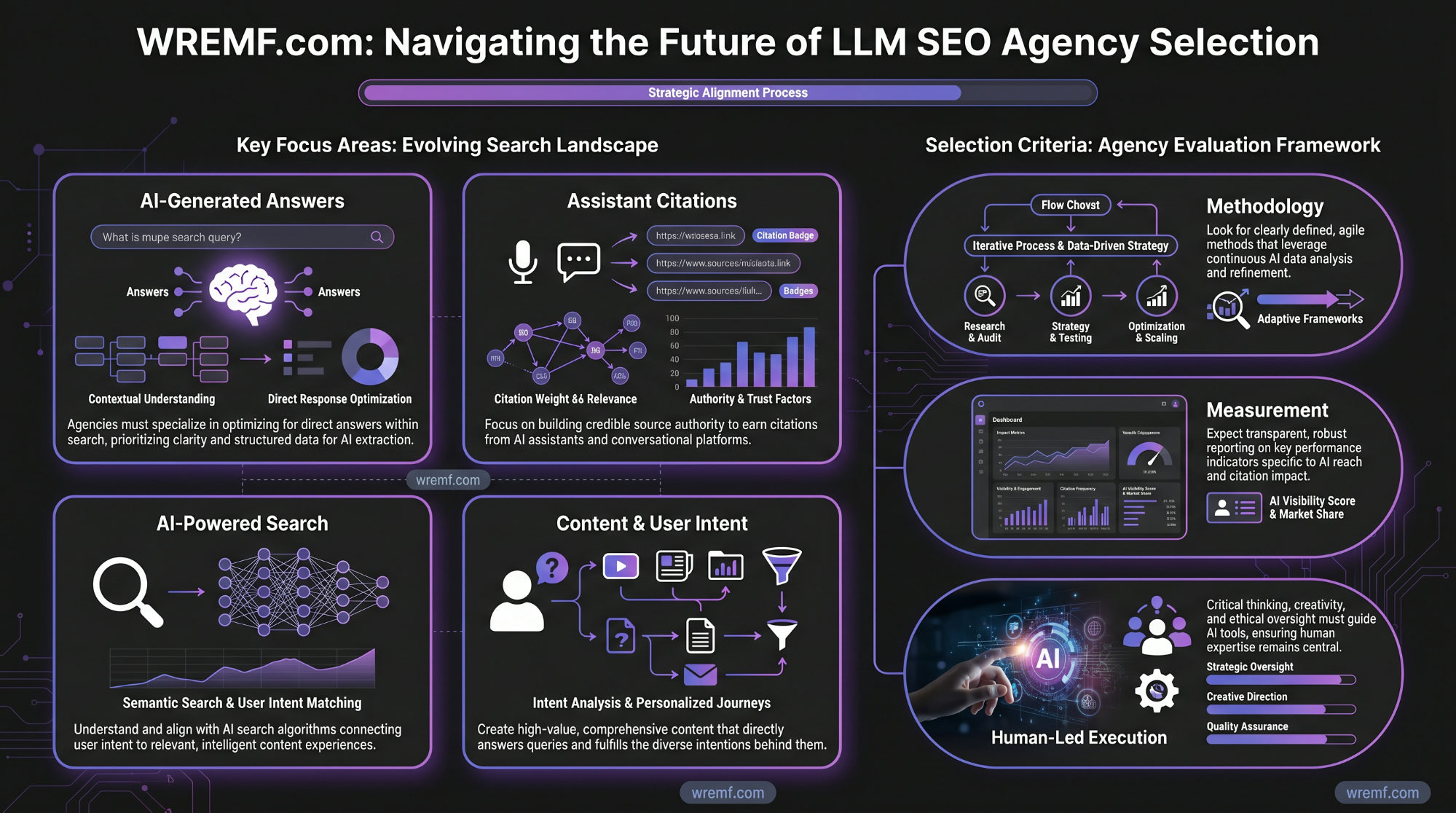
An LLM SEO agency helps your brand compete where search is moving: AI-generated answers, assistant citations, AI-powered Search, brand recommendations, and source-backed summaries. The right partner should combine traditional SEO, Answer Engine Optimization, generative engine optimization, Technical SEO, structured data, content strategy, citation improvement, and transparent reporting. LLM SEO agency selection should be based on methodology, measurement, human-led execution, and honest limitations, not vague AI promises. To turn AI visibility into a measurable workflow, explore the WREMF platform suite or request support from the WREMF agency team.
Related Generative Engine Optimization Guides
- Answer Engine Optimization Services The Complete Guide to AI Search Visibility
- LLM SEO Services The Complete 2026 Guide to AI Search Visibility, AEO, GEO, and LLM Optimization
- AI SEO Services The Complete Guide to Search Visibility in the AI Era
- AI Search Engine Optimization Services The Complete Guide for B2B Brands
- Large Language Model Optimization Services The Complete Guide to LLMO, AI Search Visibility, AEO, GEO, RAG, and LLM Performance
- Generative AI Optimization Services The Complete Guide to GEO, AEO, LLM Optimization, and AI Visibility
- AI SEO Agency How to Choose the Right Partner for AI Search Visibility
- AI Mention Tracking The Complete Guide to Monitoring Brand Mentions, AI Answers, Citations, and Share of Voice in 2026
- Answer Engine Optimization The Complete Guide to AEO, AI Search Visibility, and Answer-First Content
- AI Search Engine Optimization Tools The Complete 2026 Guide for AI Search, SEO, AEO, and GEO
- How AI Search Optimization Tools Increase Organic Traffic
- AI Overview SEO How to Optimize for Google AI Overviews, AI Mode, and AI Search Visibility
- 12 Best AI Search Optimization Tools
- AI Brand Monitoring The Complete Guide to Tracking Brand Visibility Across AI Search, LLMs, and Generative Engines
- AI Search Engine Optimization The Complete Guide for B2B Brands
- How Do AI Search Optimization Tools Improve SERP Rankings
- Enterprise Answer Engine Optimization Platforms Complete Guide for AI Visibility, AEO, and GEO
- AI SEO Tools The Complete Guide for SEO, AEO, GEO, and AI Search Visibility
- Best Answer Engine Optimization for Enhancing AI Visibility
- AI Overview Optimization How to Rank, Get Cited, and Stay Visible in Google AI Search
Related reading
- AI SEO Services: The Complete Guide to Search Visibility in the AI Era
- Generative AI Optimization Services: The Complete Guide to GEO, AEO, LLM Optimization, and AI Visibility
- LLM SEO Services: The Complete 2026 Guide to AI Search Visibility, AEO, GEO, and LLM Optimization
- Large Language Model Optimization Services: The Complete Guide to LLMO, AI Search Visibility, AEO, GEO, RAG, and LLM Performance