AI SEO Agency: How to Choose the Right Partner for AI Search Visibility
Learn how to choose the right AI SEO agency. Compare services, measurement, platforms, and models to improve visibility across search engines and AI platforms.
By WREMF Team · 2026-05-09
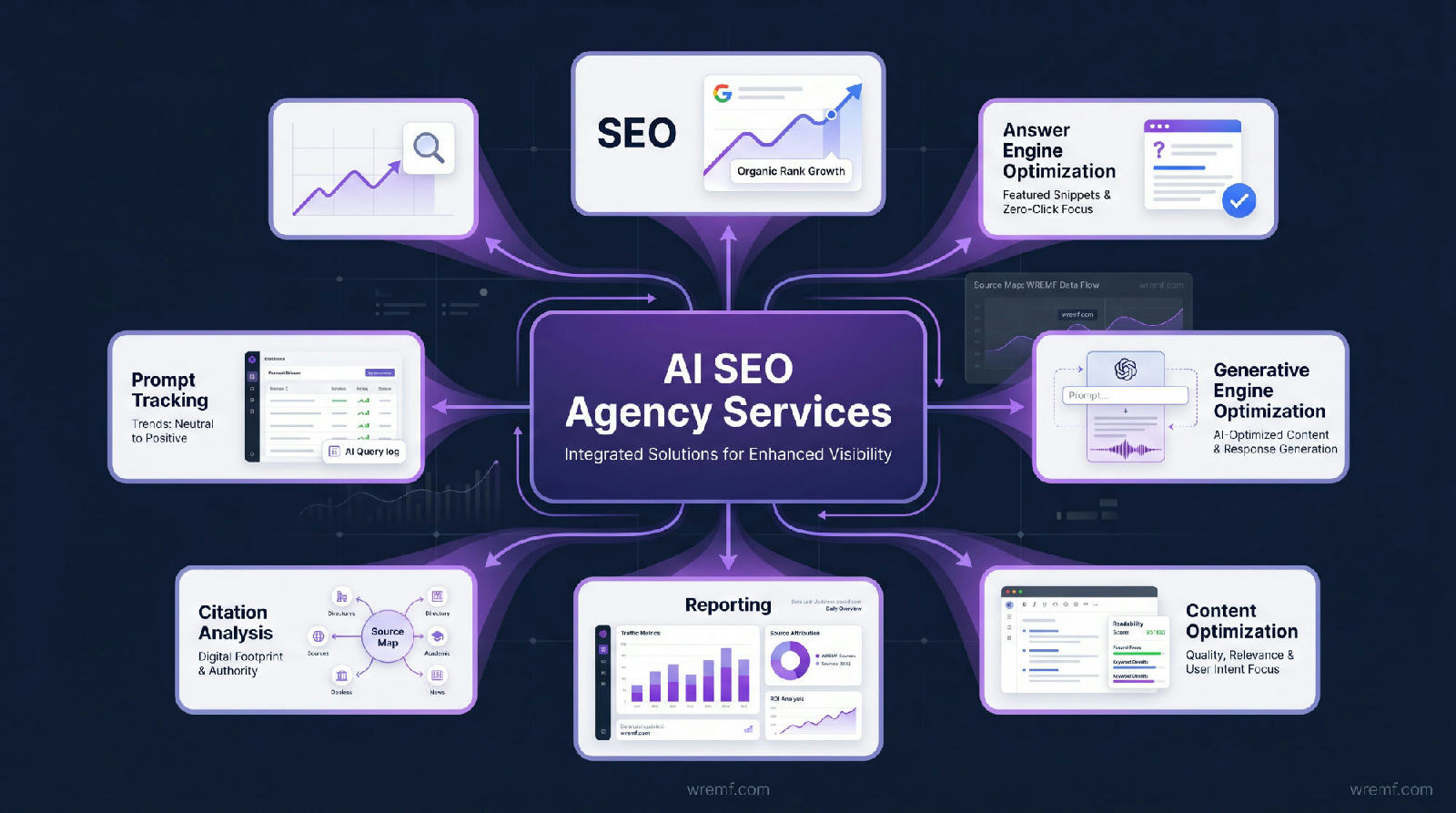
An AI SEO agency is a specialist partner that helps brands improve visibility across Google Search, AI search engines, answer engines, and large language models. Unlike traditional SEO agencies that focus on rankings and organic traffic, AI SEO agencies combine search engine optimization with Answer Engine Optimization, Generative Engine Optimization, content optimization, prompt tracking, citation analysis, and AI visibility reporting. They optimize how brands appear in Google AI Overviews, ChatGPT, Claude, Gemini, Perplexity, Copilot, DeepSeek, Grok, Meta AI, and Mistral. The best AI SEO agencies measure success through rankings, AI visibility, prompt coverage, source citations, brand mentions, competitor visibility, sentiment, and AI traffic attribution. They provide services including AI visibility audits, technical SEO, content optimization, source citation tracking, competitor analysis, and executive reporting. Choosing the right partner requires evaluating methodology, platform coverage, content quality controls, technical expertise, and transparent reporting.
Key takeaways
- AI SEO agencies combine traditional SEO with Answer Engine Optimization, Generative Engine Optimization, prompt tracking, citation analysis, and AI visibility measurement across multiple platforms.
- Traditional SEO reporting cannot show whether ChatGPT, Claude, Perplexity, Gemini, or other AI platforms mentioned your brand, making AI visibility tracking essential for modern search strategies.
- AI SEO success is measured through rankings, prompt coverage, source citations, brand mentions, competitor visibility, sentiment, and AI traffic attribution, not just organic traffic.
- The best AI SEO agencies prove their methodology, track multiple AI platforms, use human editorial oversight for content quality, and connect recommendations to business outcomes.
- Hybrid models that combine AI visibility software with agency execution provide both measurement and implementation, offering transparency and accountability for B2B teams.
- An effective AI SEO audit includes prompt inventory, engine coverage across major AI platforms, citation tracking, competitor visibility analysis, technical SEO assessment, and prioritized action plans.
AI SEO Agency: How to Choose the Right Partner for AI Search Visibility
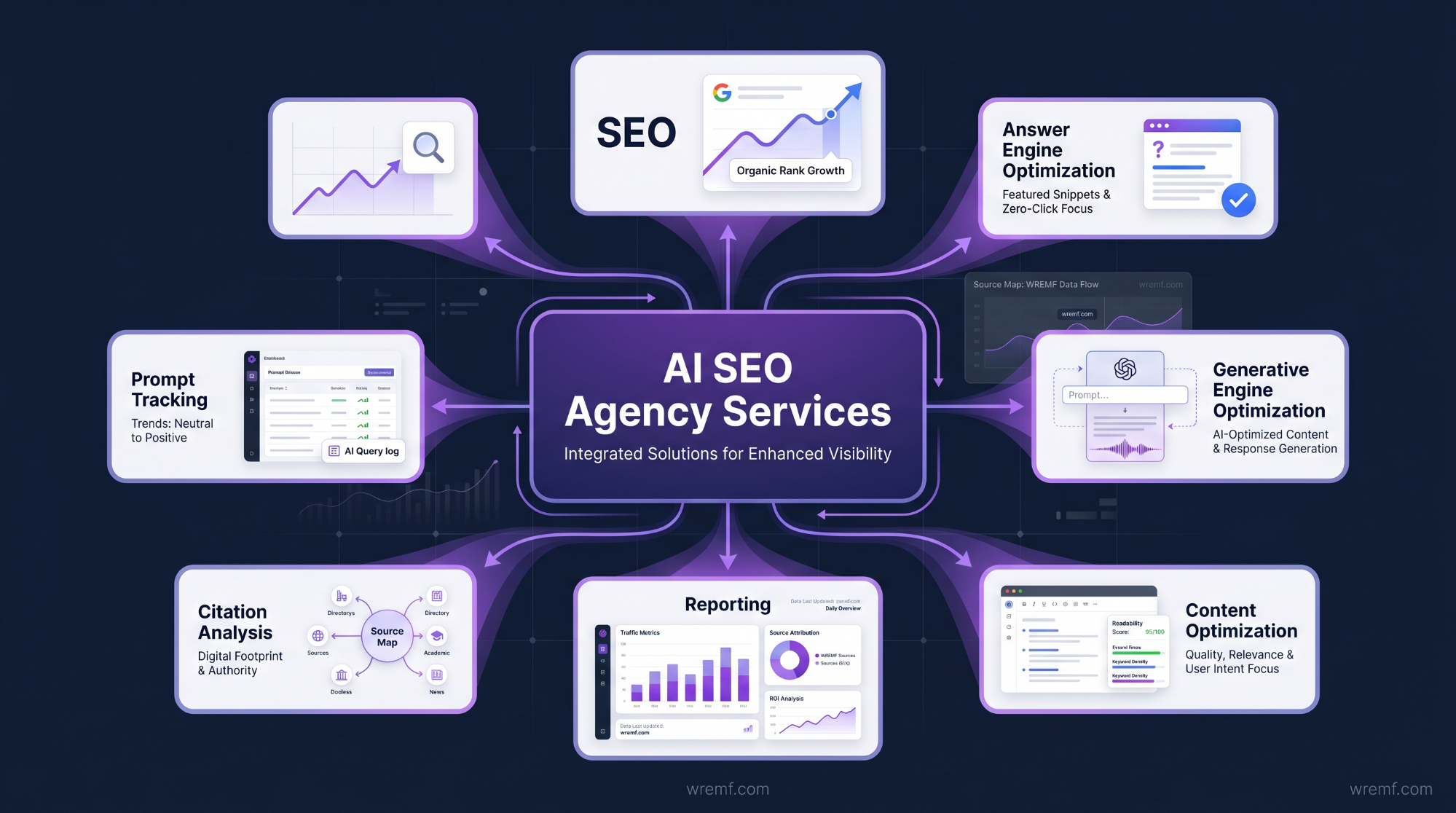
AI SEO agency is a specialist partner that helps brands improve visibility across Google Search, AI search engines, and large language models. Google now explains AI features such as AI Overviews from a site owner perspective, while OpenAI says ChatGPT search can provide timely answers with links to relevant web sources. An AI SEO agency helps you adapt to this shift by combining SEO, Answer Engine Optimization, Generative Engine Optimization, content optimization, prompt tracking, citation analysis, and reporting. This guide explains what AI SEO agencies do, how they differ from traditional SEO agencies, what services matter, how success is measured, and how to choose the right partner. WREMF helps B2B teams track, improve, and prove AI visibility across 10 AI discovery surfaces through AI visibility software and reporting.
What Is an AI SEO Agency?
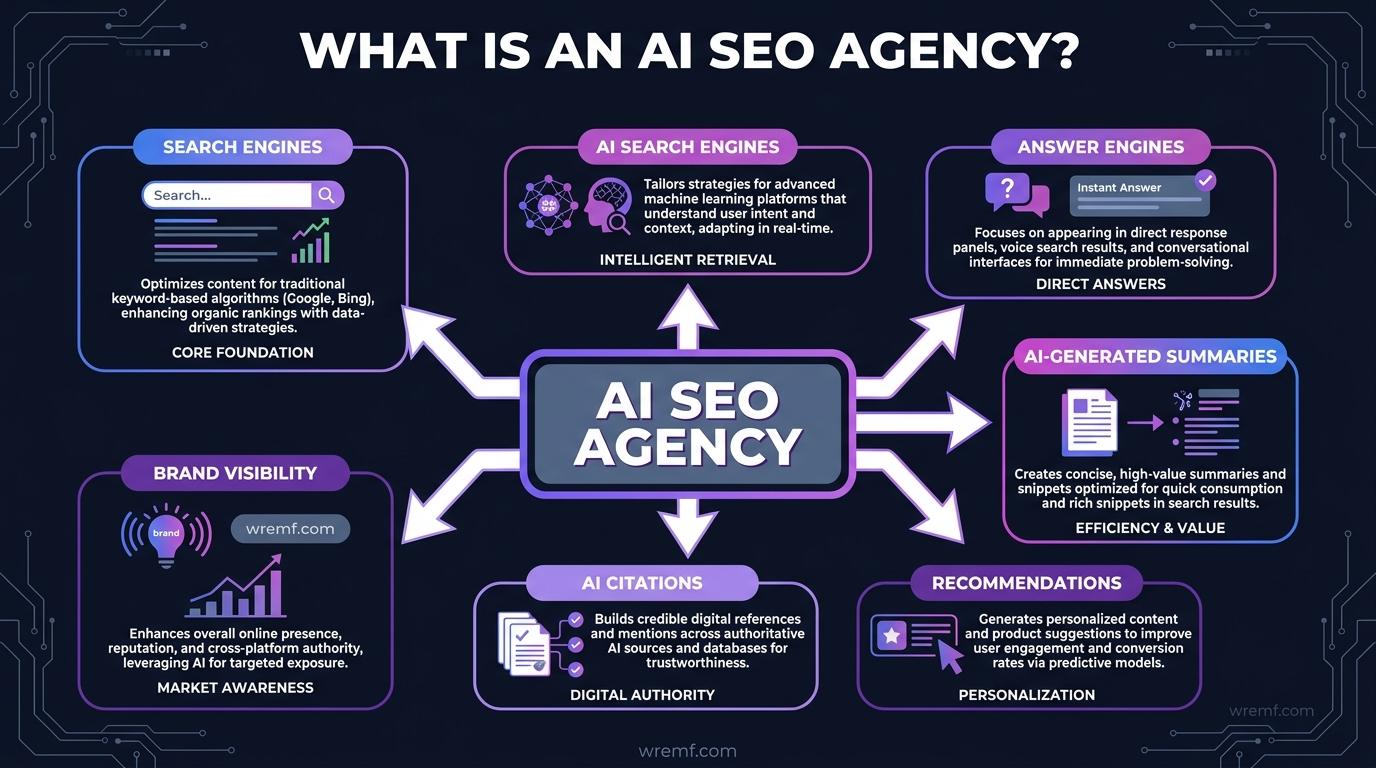
An AI SEO agency helps brands improve how they appear across search engines, AI search engines, answer engines, and large language models. The goal is to win visibility in rankings, AI citations, brand mentions, recommendations, and AI-generated summaries.
An AI SEO agency is a specialist SEO partner that combines search engine optimization, Answer Engine Optimization, Generative Engine Optimization, technical SEO, content optimization, AI visibility tracking, and human editorial strategy. It helps your brand become easier for Google Search, Google AI Overviews, ChatGPT, Claude, Gemini, Perplexity, Copilot, DeepSeek, Grok, Meta AI, Mistral, and other AI platforms to understand, retrieve, cite, and recommend.
AI SEO is the practice of improving how a brand, product, page, or source appears in both traditional search and AI-assisted discovery. AI SEO matters because buyers increasingly ask conversational questions, compare providers inside AI platforms, and make shortlist decisions before they visit a website.
AI visibility is the measurable presence of a brand inside AI-generated answers, summaries, recommendations, citations, and comparison responses. AI visibility matters because your brand can influence demand even when the user does not click a traditional organic result.
A traditional SEO agency usually focuses on search engines, rankings, technical SEO, backlinks, content, and organic traffic. An AI SEO agency still needs those SEO principles, but it also needs to understand large language models, AI search, source citations, structured content, brand mentions, prompt tracking, AI share of voice, and source consistency.
| Agency type | Best for | What it measures | What it often misses | Recommended when |
|---|---|---|---|---|
| Traditional SEO agency | Google Search and organic traffic | Rankings, clicks, impressions, backlinks, technical SEO | AI citations, prompt tracking, LLM visibility, source consistency | You mainly need classic SEO growth |
| AI SEO agency | Search plus AI discovery | Rankings, AI visibility, citations, brand mentions, prompts, competitors | May vary in technical depth if immature | You need visibility in Google and AI platforms |
| AI automation agency | Workflow automation and AI agents | Process speed, content creation volume, campaign creation | Search intent, source trust, authority, editorial quality | You need operational automation, not full SEO strategy |
| Hybrid AI visibility partner | Strategy, software, and execution | AI visibility, source citations, competitors, attribution, content gaps | Requires clear ownership and scope | You need measurable AI SEO Services plus implementation |
The best AI SEO agency is not simply the agency using the most AI-driven tools. The best AI SEO agency is the partner that can explain how AI platforms find sources, how content earns trust, how brand mentions influence visibility, and how reporting connects AI discovery to business outcomes.
WREMF fits this workflow by combining software, agency support, and hybrid execution. The WREMF methodology connects prompts, source citations, competitors, source consistency, AI visibility scoring, and attribution into one repeatable system.
KEY TAKEAWAY: An AI SEO agency should improve search visibility, AI visibility, citations, brand mentions, and measurable brand presence across both search engines and AI platforms.
The next section explains why traditional SEO alone no longer covers the full discovery journey.
Why Traditional SEO Is Not Enough Anymore
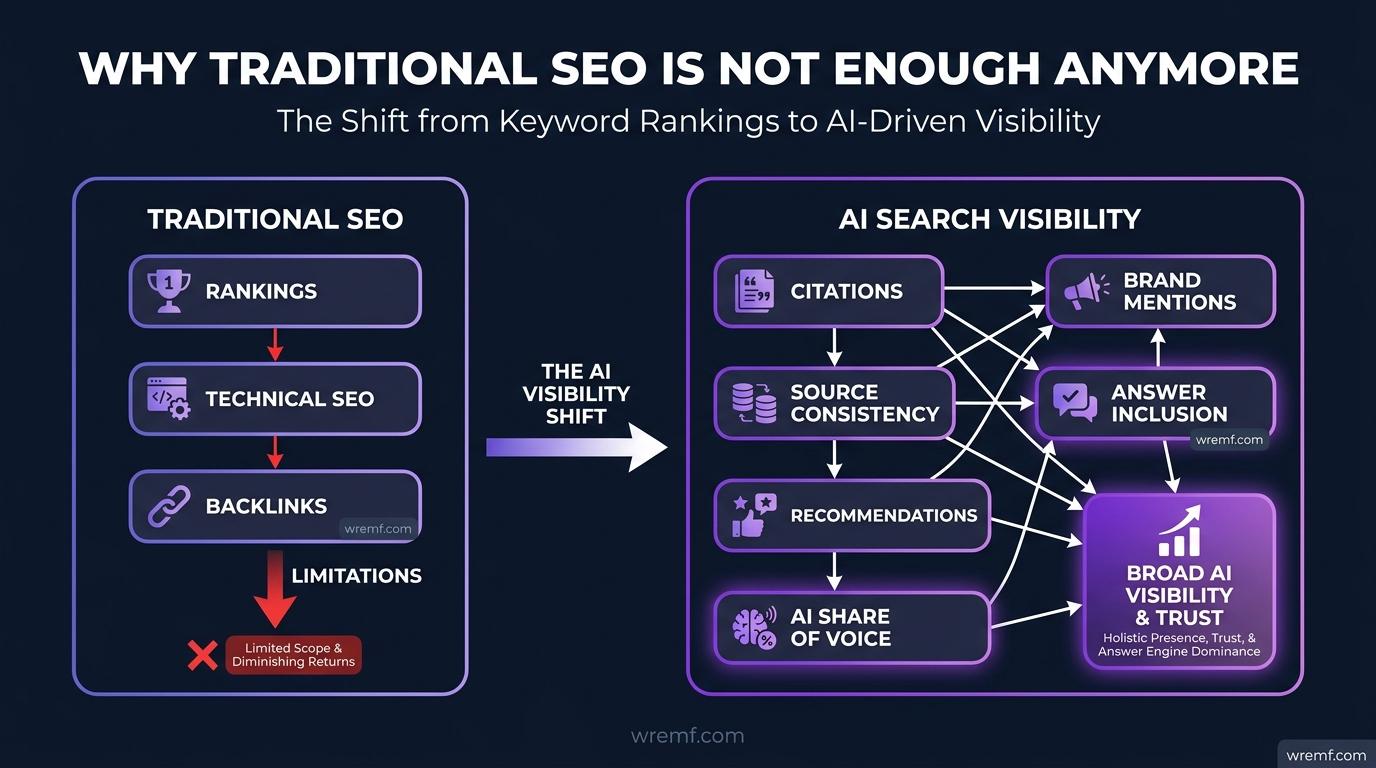
Traditional SEO is still essential, but it does not fully measure how brands appear inside AI-generated answers. AI search adds new visibility layers, including citations, brand mentions, source consistency, answer inclusion, recommendations, and AI share of voice.
Search has shifted from short keyword strings to conversational user intent. In real B2B buying journeys, a prospect may ask ChatGPT for vendor options, use Perplexity to compare cited sources, ask Gemini to summarise alternatives, check Google AI Overviews, and then visit Google Search before booking a demo. That journey is broader than ranking for one keyword.
Google Search Central explains that SEO is about helping search engines understand content and helping users find a site through search. That foundation still matters, but AI-driven search adds a new question: can AI platforms understand and represent your brand correctly when users ask natural language questions?
AI search visibility is the measurable presence of a brand inside AI answers, citations, recommendations, and summaries. AI search visibility matters because buyers can form an opinion about your company before seeing your homepage, your ads, or your sales material.
The limitation of traditional SEO reporting is that Google Search Console cannot tell you whether ChatGPT, Claude, Perplexity, Gemini, Copilot, DeepSeek, Grok, Meta AI, or Mistral mentioned your brand in an answer. It also cannot tell you whether a competitor replaced your brand in a recommendation prompt or whether an AI platform cited an outdated source.
AI visibility is both a measurement problem and a source ecosystem problem. The measurement problem is knowing where your brand appears. The source ecosystem problem is making sure owned pages, third-party mentions, reviews, directories, documentation, and comparison pages all describe your brand consistently.
Google’s guidance on helpful, reliable, people-first content remains a useful quality benchmark because AI search also depends on clear, reliable, useful information. Content written only for manipulation creates risk. Content built to answer buyer questions, cite sources, and clarify entities supports both SEO and AI discovery.
DID YOU KNOW: Google announced that AI Overviews became available in more than 200 countries and territories and more than 40 languages, showing how AI-generated search experiences have moved beyond a small test environment.
KEY TAKEAWAY: Traditional SEO remains the foundation, but AI SEO adds measurement across prompts, citations, sources, competitors, and AI-generated recommendations.
Once the visibility gap is clear, the next question is what AI SEO agencies actually do.
What AI SEO Services Should an Agency Provide?
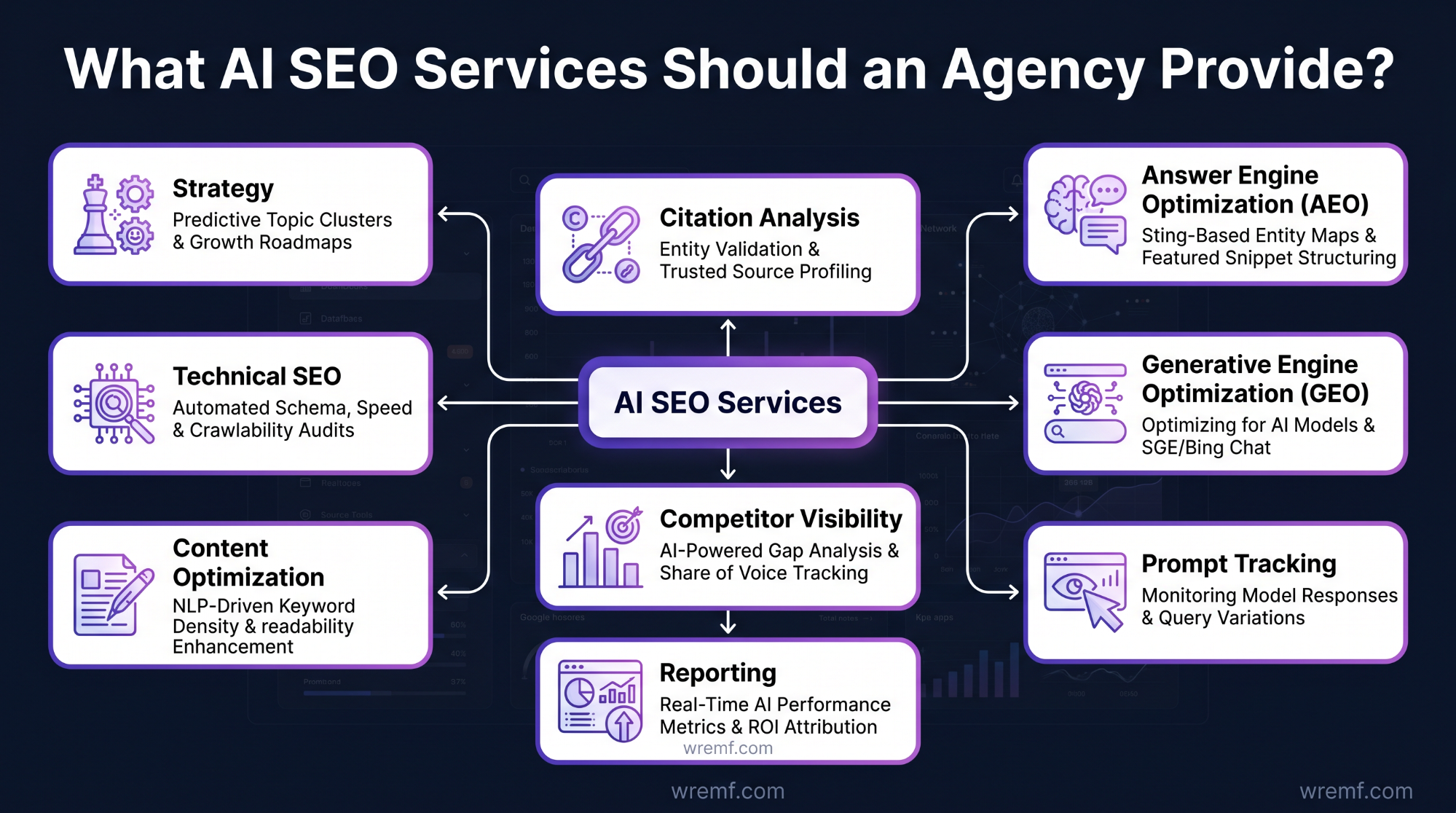
AI SEO Services should combine strategy, technical SEO, content optimization, AEO, GEO, prompt tracking, citation analysis, competitor visibility, and reporting. The strongest agencies use AI to improve decisions, not to publish low-quality content at scale.
AI SEO Services are services designed to improve discoverability across search engines, AI platforms, answer engines, and large language models. AI SEO Services matter because modern search visibility depends on rankings, answer inclusion, source trust, entity clarity, and AI-generated recommendations.
A strong AI SEO agency should provide these core services:
AI visibility audits across Google AI Overviews, ChatGPT, Claude, Gemini, Perplexity, Copilot, DeepSeek, Grok, Meta AI, Mistral, and other relevant AI platforms
Prompt tracking for commercial, informational, comparison, brand, and category queries
Advanced keyword research that maps keywords to semantic clusters, search behavior, user intent, and prompt patterns
Content Optimization for answer-first headings, content structure, FAQ sections, featured snippets, rich snippets, and AI-ready explanations
Technical SEO checks for crawlability, rendering, canonical URLs, structured data, schema markup, internal linking, sitemap logic, and site architecture
Source citation tracking to identify which pages, publications, directories, and trusted sources influence AI answers
Competitor visibility analysis to compare brand mentions, citations, recommendations, and AI share of voice
AI traffic attribution to connect AI search engines and conversational platforms to measurable website sessions where referral data is available
Content briefs for blog content, landing Page improvements, product descriptions, knowledge base content, comparison pages, and service pages
Reporting for executives, agencies, consultants, and in-house teams
Generative Engine Optimization is the process of improving how a brand is represented in generative AI answers. Generative Engine Optimization matters because large language models can summarise, compare, and recommend brands without showing a traditional list of ranked links.
Answer Engine Optimization is the process of structuring content so it can answer specific questions clearly, directly, and credibly. Answer Engine Optimization matters because Google AI Overviews, Perplexity, ChatGPT search, voice assistants, and featured snippets all reward content that can be extracted into a useful answer.
Large Language Model Optimization is the process of improving how LLMs understand and describe a brand, topic, product, or entity. Large Language Model Optimization matters because large language models depend on retrievable, consistent, source-backed information.
A practical AI SEO strategy connects keyword research, semantic clusters, content creation, internal links, source consistency, schema markup, competitor visibility, and reporting. The agency should be able to explain how every action supports discoverability, citation probability, answer quality, or business measurement.
TIP: Ask any AI SEO agency to show one sample workflow from prompt discovery to content brief to citation tracking to reporting. If the agency cannot explain the workflow, it may be selling AI content volume rather than AI SEO strategy.
KEY TAKEAWAY: AI SEO Services should cover strategy, technical foundations, content optimization, AEO, GEO, prompt tracking, citation tracking, competitor analysis, and reporting.
The next section explains how agencies optimize for the specific AI platforms shaping search behavior.
How Do Agencies Optimize for Google AI Overviews, ChatGPT, Claude, Gemini, Perplexity, and Copilot?
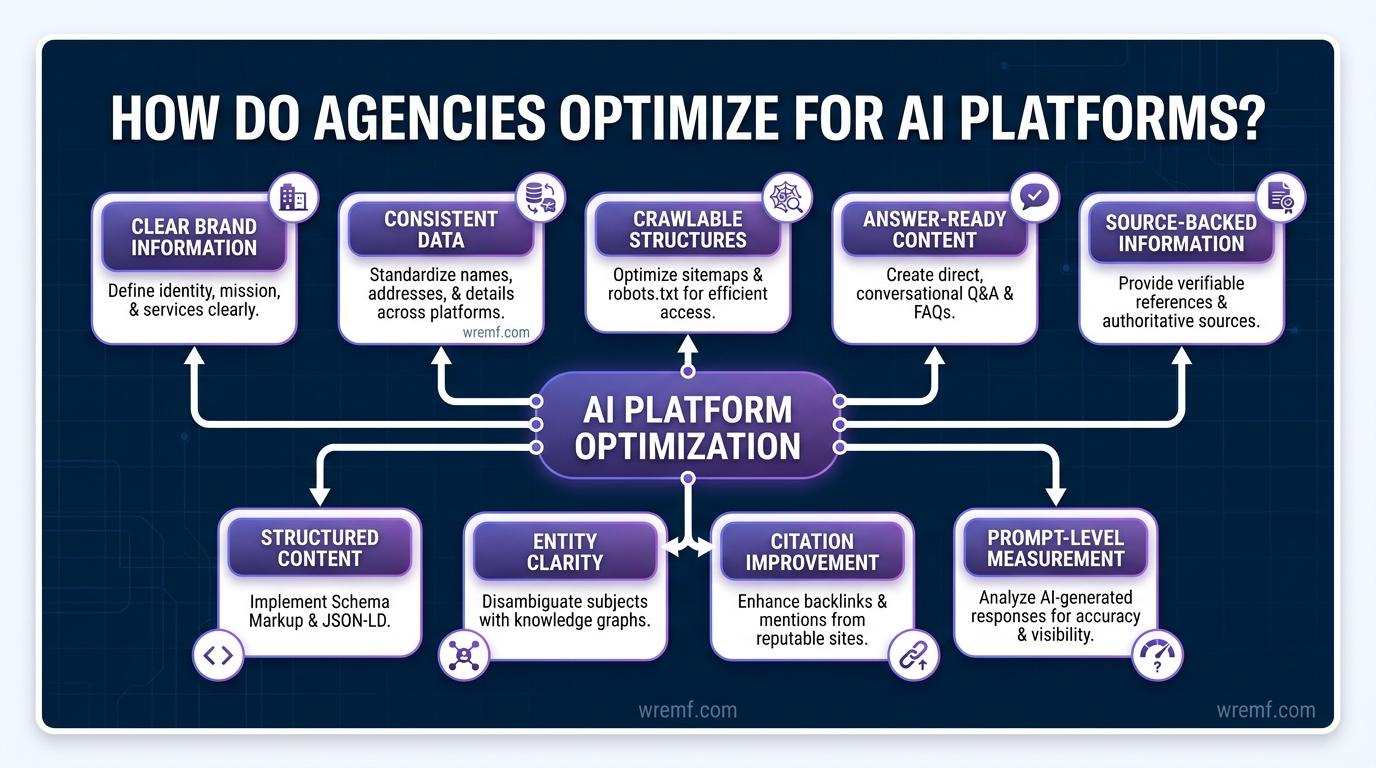
Agencies optimize for AI platforms by making brand information clear, consistent, crawlable, answer-ready, and source-backed. The work combines technical SEO, structured content, entity clarity, citation improvement, and prompt-level measurement.
Google AI Overviews are AI-generated summaries in Google Search that help users understand a topic and explore supporting sources. Google’s own AI features and your website documentation explains how site owners should think about inclusion in AI features, which makes AI Overviews a direct SEO and AI visibility concern.
ChatGPT search is OpenAI’s search experience that can return timely answers with links to relevant web sources. OpenAI describes ChatGPT search as combining a natural language interface with up-to-date information, which means brand discovery can happen through conversational prompts rather than classic result pages.
Claude web search gives Claude access to real-time web content and can include citations for sources drawn from search results, according to Anthropic’s web search tool documentation. Claude matters for AI SEO because cited answers depend on the quality, freshness, and clarity of retrievable sources.
Perplexity describes itself as an AI-powered search engine that gives conversational answers backed by verifiable sources. Perplexity’s official help documentation says each response includes citations and links to original sources, which makes source visibility easier to audit than in many uncited AI experiences.
Gemini matters because Google uses Gemini across many AI experiences, including Google AI products and search-related AI features. Copilot matters because Microsoft’s ecosystem connects AI assistance with web grounding, enterprise workflows, productivity tools, and Bing-connected discovery experiences.
AI platforms do not all retrieve the same sources. ChatGPT, Claude, Gemini, Perplexity, Copilot, DeepSeek, Grok, Meta AI, and Mistral can produce different answers for the same prompt. That is why an AI SEO agency should test multiple AI platforms instead of assuming one answer represents the full market.
AI citations are source references used by AI platforms to support an answer. AI citations matter because they reveal which pages, publishers, documentation, directories, and comparison sources influence AI-generated responses.
Source citations are the specific URLs, documents, or source names that appear inside AI answers. Source citations matter because they show whether AI platforms are relying on your website, competitor pages, outdated directories, industry articles, or third-party reviews.
The most effective way to improve AI search visibility is to build a stronger source ecosystem. That means improving owned pages, publishing structured content, updating third-party profiles, earning relevant mentions, cleaning inconsistent descriptions, and making product facts easy to retrieve.
KEY TAKEAWAY: AI SEO optimization works by making brand information easier for AI platforms to retrieve, verify, cite, summarise, and compare.
Platform optimization only matters if your team can measure what changed, which is the focus of the next section.
How Do You Measure Success in AI SEO?
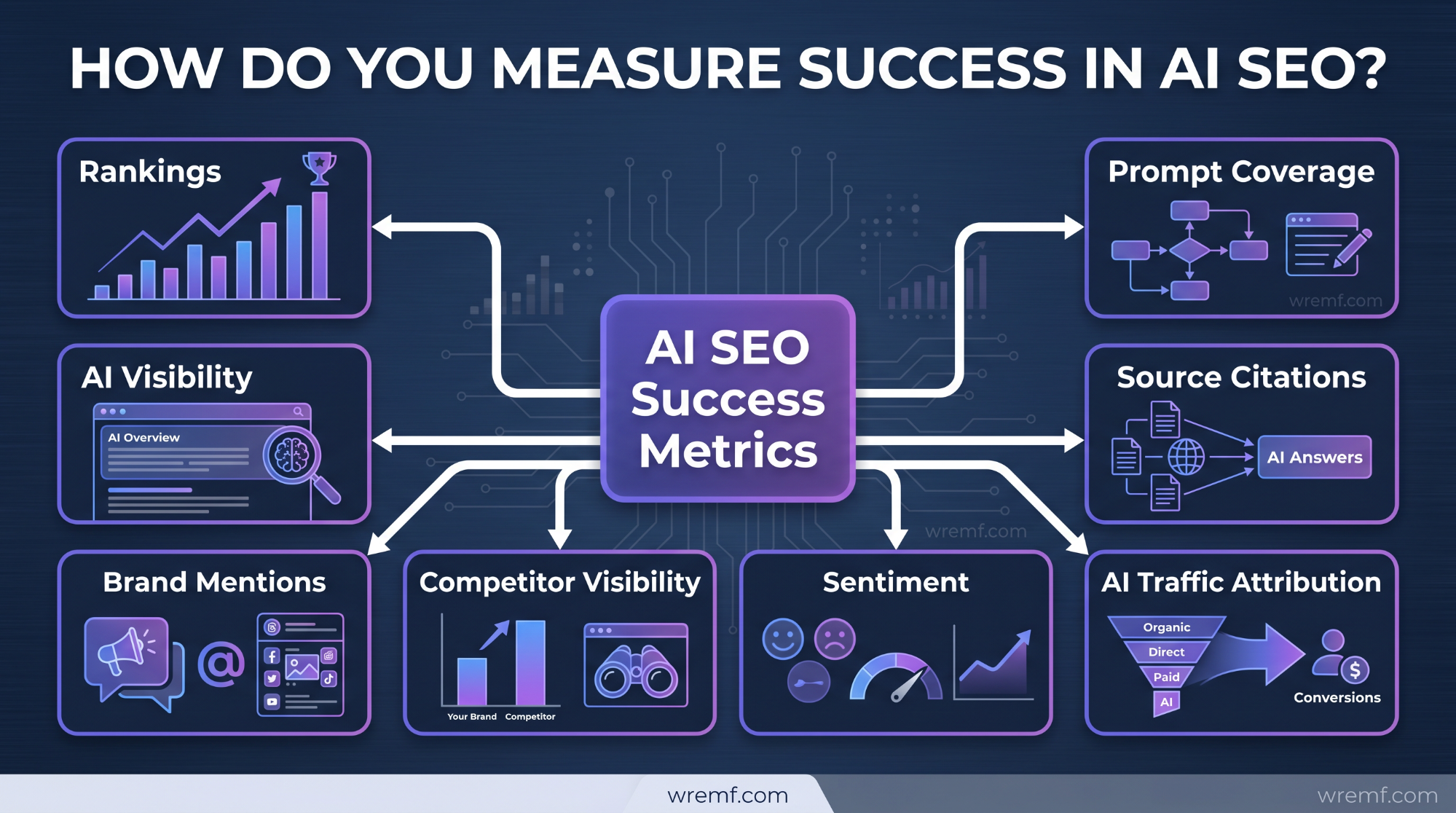
AI SEO success is measured through rankings, AI visibility, prompt coverage, source citations, brand mentions, competitor visibility, sentiment, and AI traffic attribution. Rankings alone are not enough because AI platforms can influence buyers without sending a click.
Prompt tracking shows whether your brand appears for specific natural language questions across AI platforms. Prompt tracking matters because buyers ask questions like “What is the best AI SEO agency for B2B SaaS?” or “Can my regular SEO agency handle AI SEO?” rather than only typing short keywords.
AI share of voice is the percentage of relevant prompts, answers, or category comparisons where your brand appears compared with competitors. AI share of voice matters because it turns brand visibility inside AI platforms into a comparative metric that executives and agencies can track over time.
Brand mentions are references to your company, product, service, or category association inside AI answers. Brand mentions matter because a brand can appear in an AI answer without being cited, recommended, or linked.
AI traffic attribution connects visits from AI platforms to analytics, leads, demos, pipeline, and revenue where referral data is available. AI traffic attribution matters because some AI visibility creates measurable visits, while other AI visibility influences buyers without a direct click.
A strong AI SEO agency should report both visibility and action. For example, a useful report should show that your brand appeared in 12 of 50 tracked prompts, that Perplexity cited two competitor pages, that Google AI Overviews surfaced an outdated third-party source, and that your next content briefs should target missing comparison prompts.
If you want to see what leadership-ready reporting can look like, review a sample AI visibility report before building your own measurement workflow.
| Metric | What it measures | Why it matters | Example action |
|---|---|---|---|
| Google rankings | Organic positions in search engines | Shows classic SEO performance | Improve technical SEO and content quality |
| Google Search Console clicks | Search traffic from Google Search | Shows organic traffic impact | Improve CTR, rankings, and content fit |
| AI visibility score | Presence across AI platforms | Shows answer inclusion beyond blue links | Prioritise missing prompts and topics |
| Prompt coverage | Brand appearance for tracked prompts | Shows buyer question coverage | Add AI-ready content briefs |
| AI citation count | Sources cited in AI answers | Shows source influence | Improve cited pages and trusted sources |
| Brand mentions | Mentions with or without links | Shows awareness in AI answers | Strengthen entity clarity and authority |
| Competitor visibility | Competitor presence in AI answers | Shows share of voice risk | Build comparison and differentiation content |
| Sentiment | How AI platforms describe your brand | Shows positioning accuracy | Correct unclear or outdated source language |
| AI traffic attribution | Visits from AI platforms | Shows measurable referral value | Connect analytics to reporting |
In real-world reporting, teams usually struggle when AI visibility is treated as a screenshot exercise. Screenshots can document examples, but scheduled monitoring, repeat prompt sets, source tracking, and competitor benchmarks are needed for useful measurement.
WREMF helps teams track AI visibility across major AI discovery surfaces through AI Visibility Index reporting, prompt monitoring, source citations, competitor visibility, and attribution workflows.
KEY TAKEAWAY: AI SEO measurement should include rankings, prompt visibility, citations, brand mentions, competitor share, sentiment, and attribution, not only organic traffic.
Once measurement is clear, the next decision is whether you need software, an agency, or both.
Should You Choose AI SEO Software, an Agency, or a Hybrid Model?
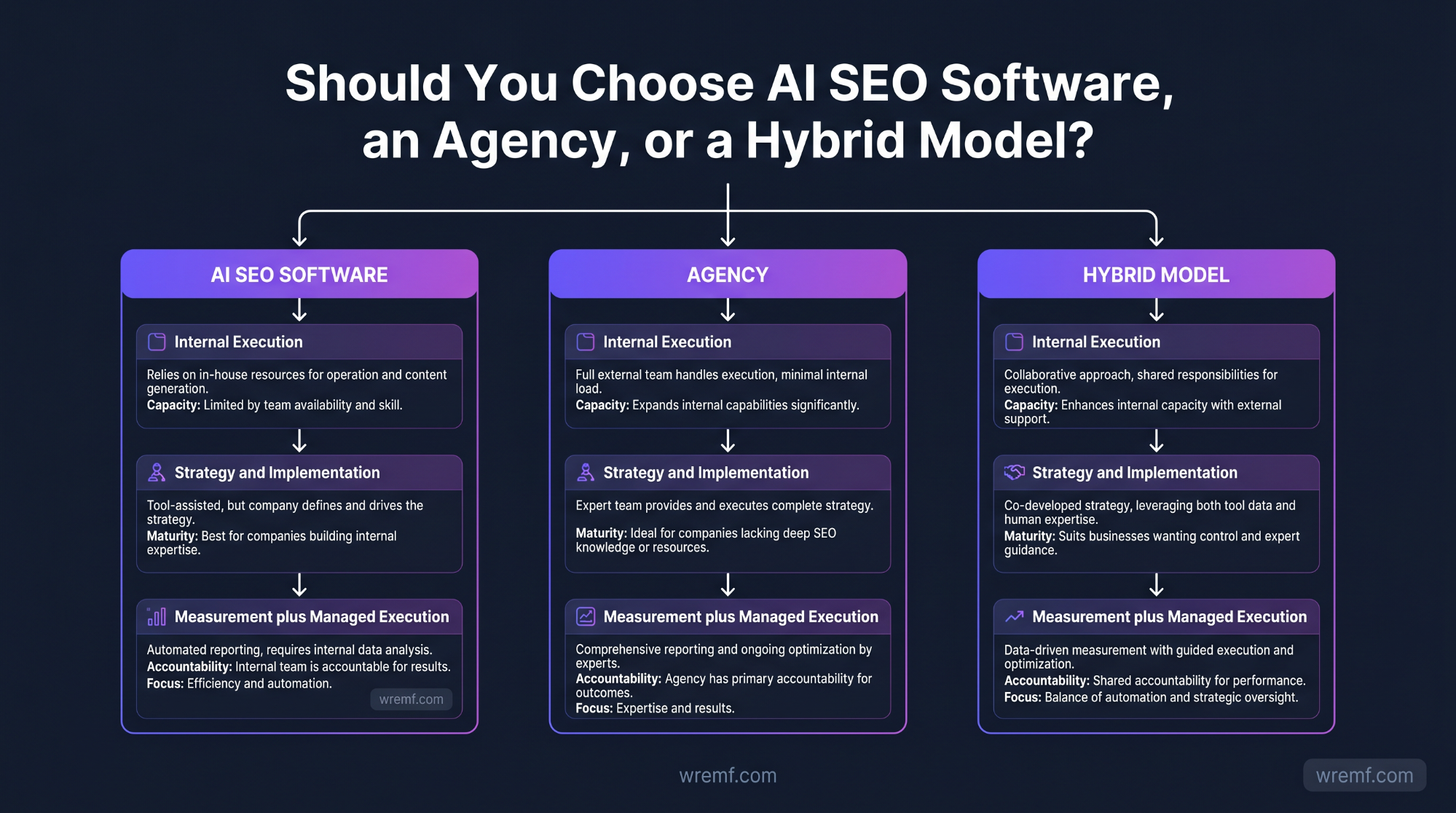
Choose AI SEO software when you have internal execution, choose an agency when you need strategy and implementation, and choose a hybrid model when you need measurement plus managed execution. The right model depends on capacity, maturity, and accountability.
AI SEO software is best for in-house teams that want to monitor prompts, track AI visibility, analyse source citations, compare competitors, and produce reports internally. Software gives control and repeatability, but it still requires someone to act on recommendations.
An AI SEO agency is best for teams that need strategy, content optimization, entity work, technical SEO guidance, and monthly execution. The agency model is useful when internal teams lack time or specialised expertise, but it should still include transparent reporting and clear deliverables.
A hybrid model combines software and agency execution. This is often the strongest option for B2B SaaS companies, agencies, consultants, and growth teams because the same system can track visibility, identify gaps, prioritise actions, and prove progress.
| Option | Best for | Main strength | Main limitation | Recommended when |
|---|---|---|---|---|
| AI SEO software | In-house SEO and content teams | Repeatable tracking and dashboards | Requires internal execution | You have people to act on insights |
| AI SEO agency | Teams without specialist bandwidth | Strategy and implementation | Can be opaque without clear reporting | You need done-for-you execution |
| Hybrid software plus agency | B2B teams that need proof and action | Measurement plus execution | Requires clear ownership | You need visibility, recommendations, and implementation |
| Manual AI testing | Early-stage teams validating demand | Low cost and fast learning | Not scalable or consistent | You are testing a small prompt set |
| Traditional SEO tools | Teams focused on Google rankings | Strong classic SEO data | Limited AI visibility data | You mainly need organic search reporting |
WREMF supports software, managed services, and hybrid workflows. You can use the platform for tracking and reporting, work with the WREMF agency team for managed AEO and GEO execution, or combine both when you need strategy and implementation.
Agencies managing multiple clients often need white-label reporting, client portals, repeatable prompt sets, and consistent methodology. In-house brands often need executive reporting, priority recommendations, and clear links between AI visibility and demand generation. The same AI SEO data can support both use cases when it is structured correctly.
IMPORTANT: Do not choose an AI SEO agency only because it uses generative AI tools. Choose a partner that can explain methodology, human review, source tracking, reporting logic, and how work connects to business goals.
KEY TAKEAWAY: The best model depends on whether you need data, execution, or both, but AI SEO should always connect measurement to action.
After selecting a model, you need a decision framework for evaluating the agency itself.
How to Choose the Best AI SEO Agency for Your Business
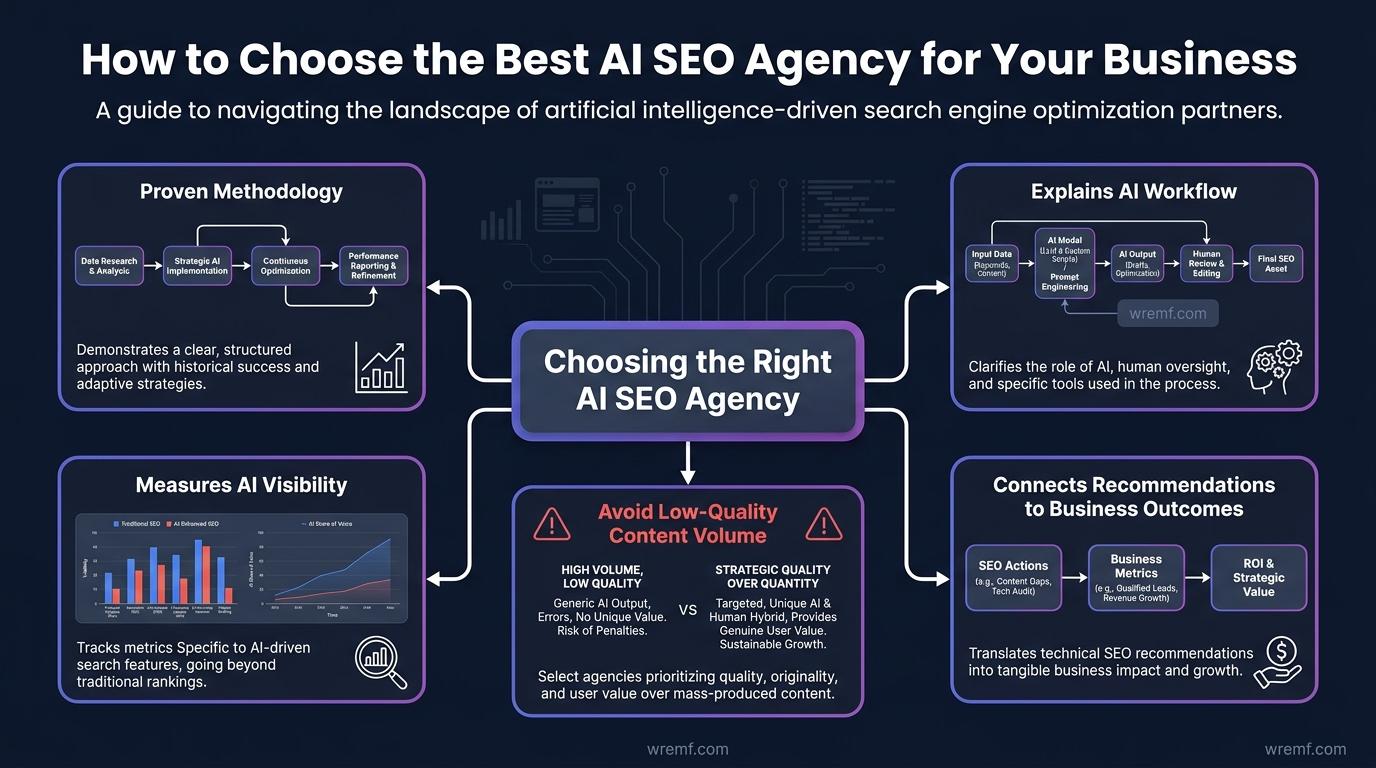
The best AI SEO agency is the one that can prove its methodology, explain its AI workflow, measure visibility across AI platforms, and connect recommendations to business outcomes. Avoid agencies that sell AI content volume without quality controls.
Start by asking whether the agency understands SEO, AEO, GEO, and Large Language Model Optimization as related but distinct disciplines. SEO improves visibility in search engines. Answer Engine Optimization improves answerability. Generative Engine Optimization improves representation in generative AI outputs. Large Language Model Optimization improves how large language models understand and describe your entity.
Then ask which AI platforms the agency tracks. A mature AI SEO agency should cover more than Google AI Overviews. At minimum, ask about ChatGPT, Claude, Gemini, Perplexity, Copilot, and the platforms that matter in your market. WREMF tracks 10 AI engines: ChatGPT, Claude, Gemini, Perplexity, Google AI Overviews, Copilot, DeepSeek, Grok, Meta AI, and Mistral.
Ask how the agency handles quality content. AI-powered content creation can support research, outlines, content briefs, content structure, blog content, landing Page improvements, product descriptions, social media post ideas, and internal linking. But human editorial oversight is non-negotiable because hallucinations, generic claims, and duplicated content can damage brand trust.
A good agency should also explain how it uses Google Search Console, analytics, rank tracking, prompt tracking, citation tracking, competitor visibility, and AI traffic attribution together. AI SEO strategy should not replace classic SEO measurement. AI SEO strategy should extend it.
Use this decision framework when evaluating providers:
| Evaluation area | What to ask | Strong answer | Weak answer |
|---|---|---|---|
| Platform coverage | Which AI platforms do you track? | Multiple engines, scheduled monitoring, clear prompt sets | “We test ChatGPT sometimes” |
| Methodology | How do you measure AI visibility? | Prompts, citations, competitors, sentiment, attribution | “We use AI tools for SEO” |
| Content quality | How do you review AI-assisted content? | Human review, source checks, brand voice, accuracy controls | Fully automated publishing |
| Technical SEO | Do you audit crawlability and structure? | Rendering, canonicals, schema markup, internal linking, sitemap checks | Only content generation |
| Source strategy | How do you improve citations? | Source analysis, source consistency, third-party cleanup | More keyword usage |
| Reporting | What will leadership see? | Visibility trends, source gaps, actions, outcomes | Static screenshots |
| Commercial fit | Who is your best-fit client? | Clear use cases by stage and capacity | Generic “all businesses” answer |
For B2B teams that want platform-backed workflows, WREMF prompt intelligence, source citation tracking, and competitive landscape analysis provide the core measurement layer agencies need to work transparently.
KEY TAKEAWAY: The right AI SEO agency should prove how it measures, improves, reviews, and reports AI search visibility.
Once the agency is selected, the work should begin with an audit rather than random content production.
What Should an AI SEO Audit Include?
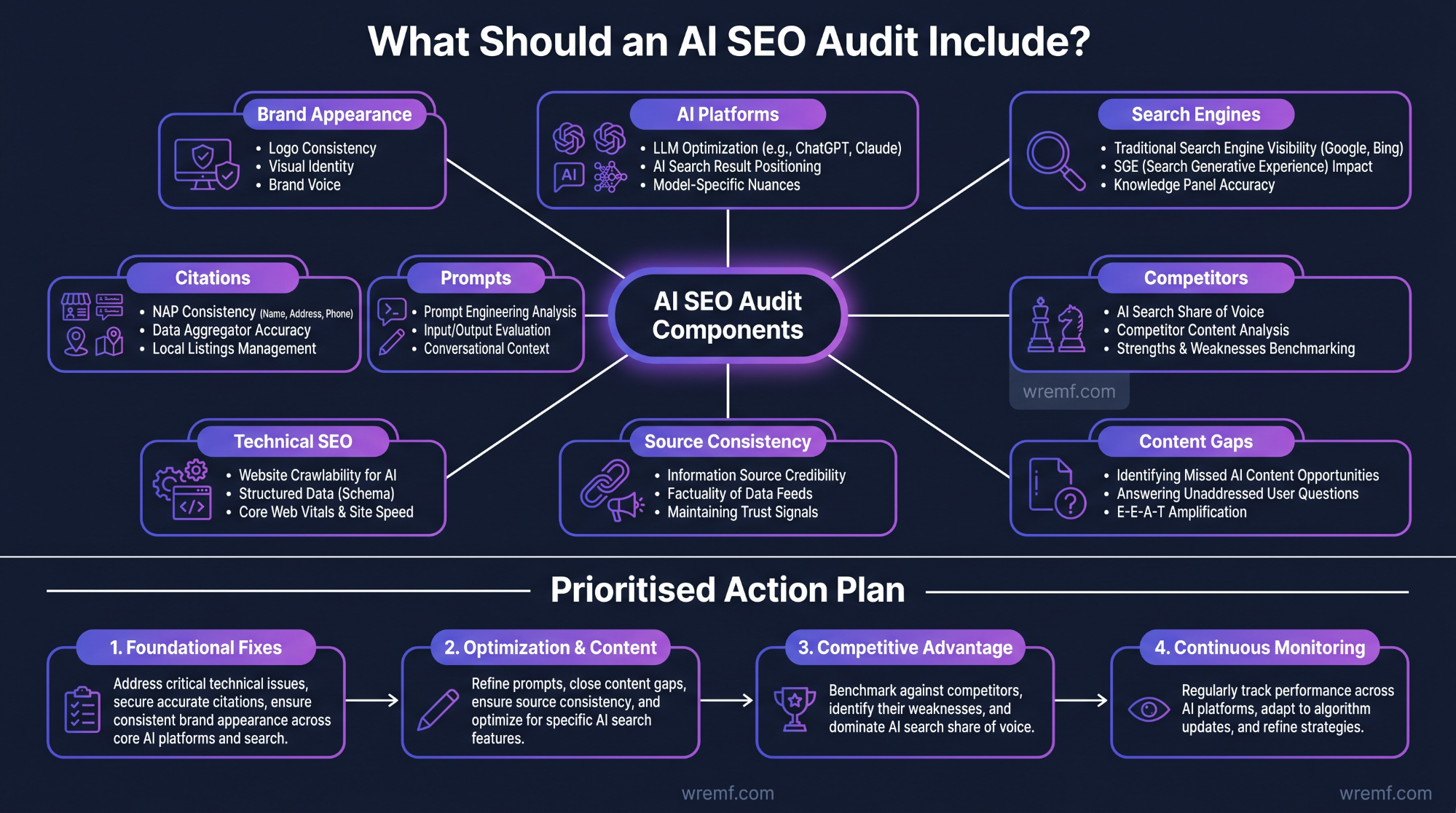
An AI SEO audit should assess how your brand appears across AI platforms, search engines, citations, prompts, competitors, technical SEO, source consistency, and content gaps. A useful audit ends with a prioritised action plan.
An AI visibility audit is a structured review of how a brand appears in AI-generated answers, citations, summaries, and recommendations. An AI visibility audit matters because it shows where your brand is visible, absent, misrepresented, or weaker than competitors.
A practical AI SEO audit should include these components:
Prompt inventory The audit should identify commercial, informational, comparison, problem-aware, and brand prompts. Examples include “best AI SEO agency for SaaS,” “AI SEO Services for B2B companies,” “how to optimize for Google AI Overviews,” and “SEO vs AEO vs GEO.”
Engine coverage The audit should test major AI platforms, including Google AI, ChatGPT, Claude, Gemini, Perplexity, Copilot, DeepSeek, Grok, Meta AI, and Mistral. Testing one platform is not enough because each engine may retrieve and summarise different sources.
Citation and source analysis The audit should identify which sources are cited, which sources are missing, and whether cited sources describe your brand accurately. AI citation gaps often reveal weak comparison pages, outdated directories, thin documentation, missing reviews, or unclear authority signals.
Content structure review The audit should assess answer-first headings, structured content, FAQ sections, Q&A sections, content pages, content quality, internal links, and content pipelines. Structured content helps both readers and AI systems understand what each page is about.
Technical foundation review The audit should check crawlability, rendering, canonical URLs, structured data, schema markup, Rich schema opportunities, sitemap logic, internal linking, and page performance. Technical SEO still matters because AI search often depends on discoverable web content.
Competitor benchmark The audit should compare your visibility against competitors for the same prompts. This reveals whether competitors are winning through better content, stronger third-party mentions, clearer positioning, or more consistent sources.
Reporting and action plan The audit should translate findings into content briefs, source cleanup tasks, citation improvement work, technical fixes, internal linking updates, and reporting priorities.
WREMF’s GEO audit feature is designed for this workflow, especially when teams need to connect AI discovery issues to technical SEO, content optimization, and action recommendations.
KEY TAKEAWAY: A useful AI SEO audit identifies prompt gaps, citation gaps, source issues, competitor risks, technical problems, and priority actions.
The audit should then feed into a content system built for both people and AI retrieval.
What Content Strategies Work Best for AI SEO?
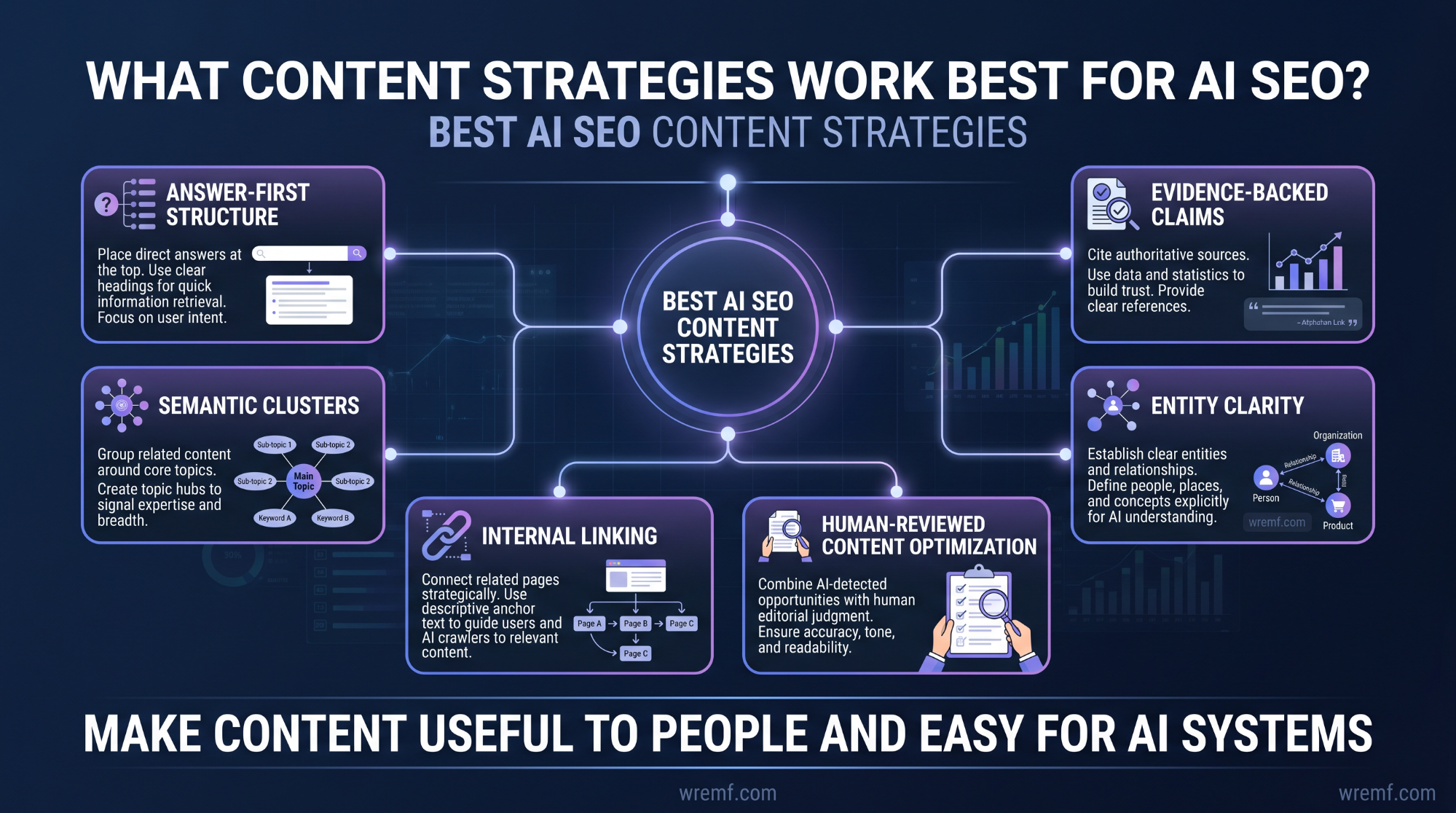
The best AI SEO content strategy uses answer-first structure, semantic clusters, evidence-backed claims, entity clarity, internal linking, and human-reviewed content optimization. The goal is to make content useful to people and easy for AI systems to understand.
Content Optimization is the process of improving content so it better matches user intent, search behavior, AI retrieval, and business goals. Content Optimization matters because AI search engines need clear answers, reliable sources, and structured explanations to summarise a topic accurately.
In practical AI visibility audits, teams often find that content exists but does not answer the way buyers ask. A blog post may target “AI SEO,” but the buyer prompt may be “Can my regular SEO agency handle AI SEO, or do I need specialists?” AI search rewards pages that answer real prompts directly.
Strong AI SEO content usually includes:
Definition blocks that explain key terms in 1 to 2 sentences
Answer-first H2 sections that can stand alone
Comparison tables for decision-stage queries
FAQ sections for natural language questions
Content briefs that map prompts to sections
Internal links that connect topic clusters
Evidence-backed claims with named sources
Clear product, service, and audience positioning
Human review for accuracy, tone, and brand control
Structured Data is machine-readable information that helps search engines understand page entities and relationships. Structured Data matters because it can support eligibility for rich results and clarify content meaning, although schema markup alone does not guarantee AI citations or rankings.
Structured content is content organised with clear headings, direct answers, definitions, tables, and logical sections. Structured content matters because AI platforms and search engines can more easily extract meaning from well-organised pages.
A common implementation mistake is using AI-driven tools to create many generic pages without strong editorial review. That can increase content creation volume but weaken content quality, brand voice, and trust. AI SEO agencies should use AI for research, clustering, briefs, content optimization, and workflow speed, while humans validate accuracy and strategy.
For teams that need repeatable briefs, WREMF AI-ready content briefs help connect prompts, citations, competitors, and content gaps before writers start production.
KEY TAKEAWAY: AI SEO content should answer real prompts clearly, support claims with credible sources, and connect related pages through structured topic clusters.
Content quality improves visibility, but citations and source consistency determine whether AI systems trust the brand story.
Why Citations, Brand Mentions, and Source Consistency Matter
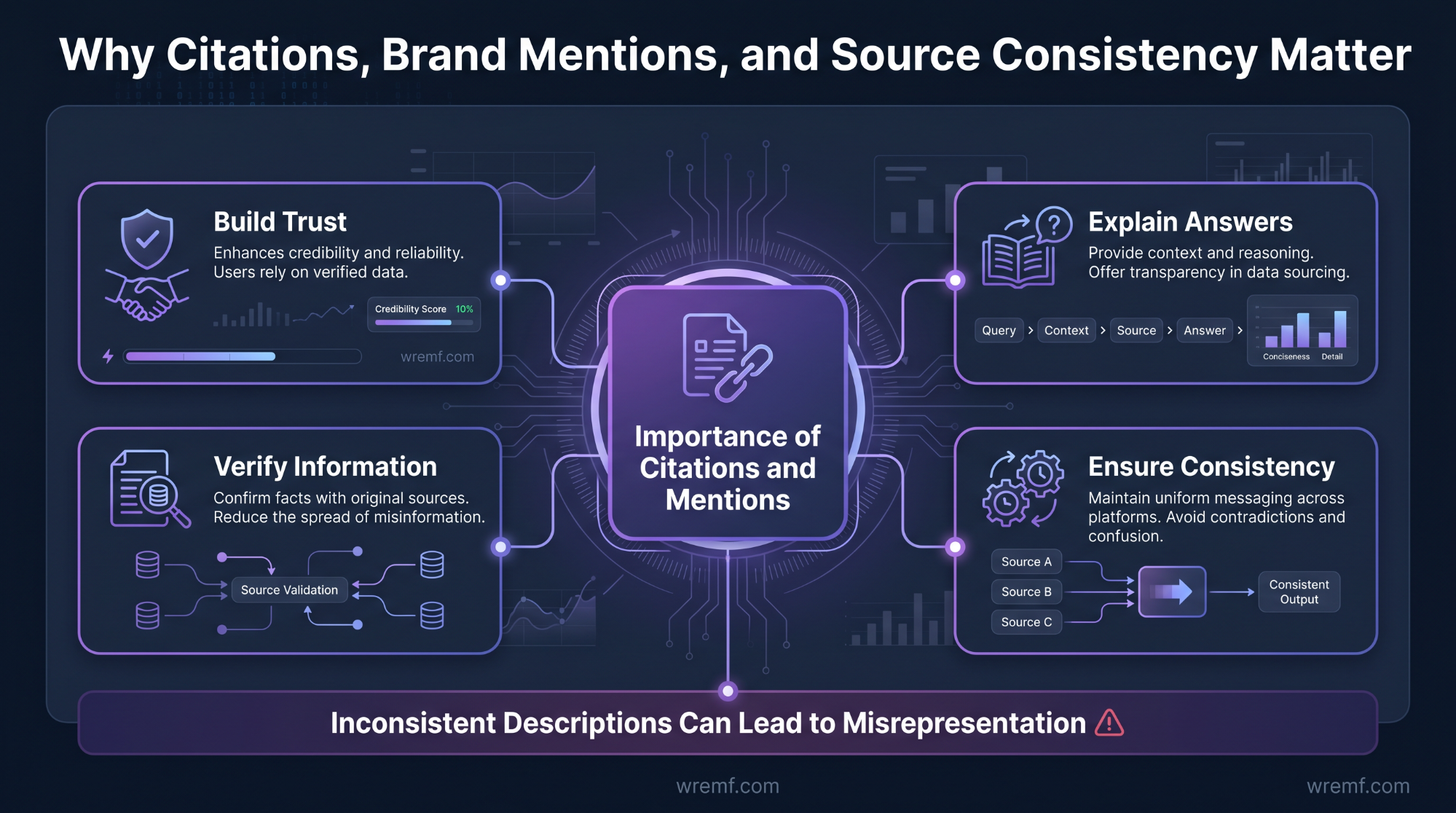
Citations, brand mentions, and source consistency matter because AI platforms use sources to build, verify, and explain answers. If the web describes your brand inconsistently, AI systems may omit, misclassify, or misrepresent your company.
Source consistency is the alignment of brand facts across owned pages, third-party profiles, directories, reviews, articles, documentation, and comparison pages. Source consistency matters because AI systems need stable facts about your company name, category, product, audience, pricing, integrations, and use cases.
Brand Mentions are references to a brand across owned and third-party sources. Brand Mentions matter because repeated and consistent mentions help AI systems understand what a brand does, who it serves, and how it compares with alternatives.
Brand citations are source-backed references that connect your brand to a topic, category, or answer. Brand citations matter because they can influence whether AI platforms mention your brand as a relevant option, cite your website, or cite a third-party source that describes your brand.
This is where AI SEO differs from keyword density. Adding the phrase “AI SEO agency” many times is less useful than building a reliable source ecosystem where your website, trusted sources, directory profiles, documentation, reviews, and comparison pages all describe your brand consistently.
In real-world reporting, teams often discover that competitors win AI answers because AI platforms cite comparison pages, review pages, blog content, or documentation that mention those competitors more clearly. The missing piece is not always content creation. Sometimes the missing piece is source cleanup.
A strong source consistency workflow checks:
Company name and category
Product descriptions
Audience and use cases
Pricing and plan facts
Feature names
Integrations and API support
Founder or leadership descriptions where relevant
Review and directory consistency
Comparison page accuracy
Outdated claims on third-party pages
Knowledge base accuracy
Product descriptions across content pages
The WREMF source citations suite helps teams identify which sources AI platforms cite and where source gaps or inconsistencies may affect AI visibility.
KEY TAKEAWAY: AI citations and source consistency help AI systems understand whether your brand is relevant, trustworthy, and accurately represented.
Strong sources also reduce risk, which is why human oversight matters in every AI SEO workflow.
What Are the Risks of AI SEO and AI-Generated Content?
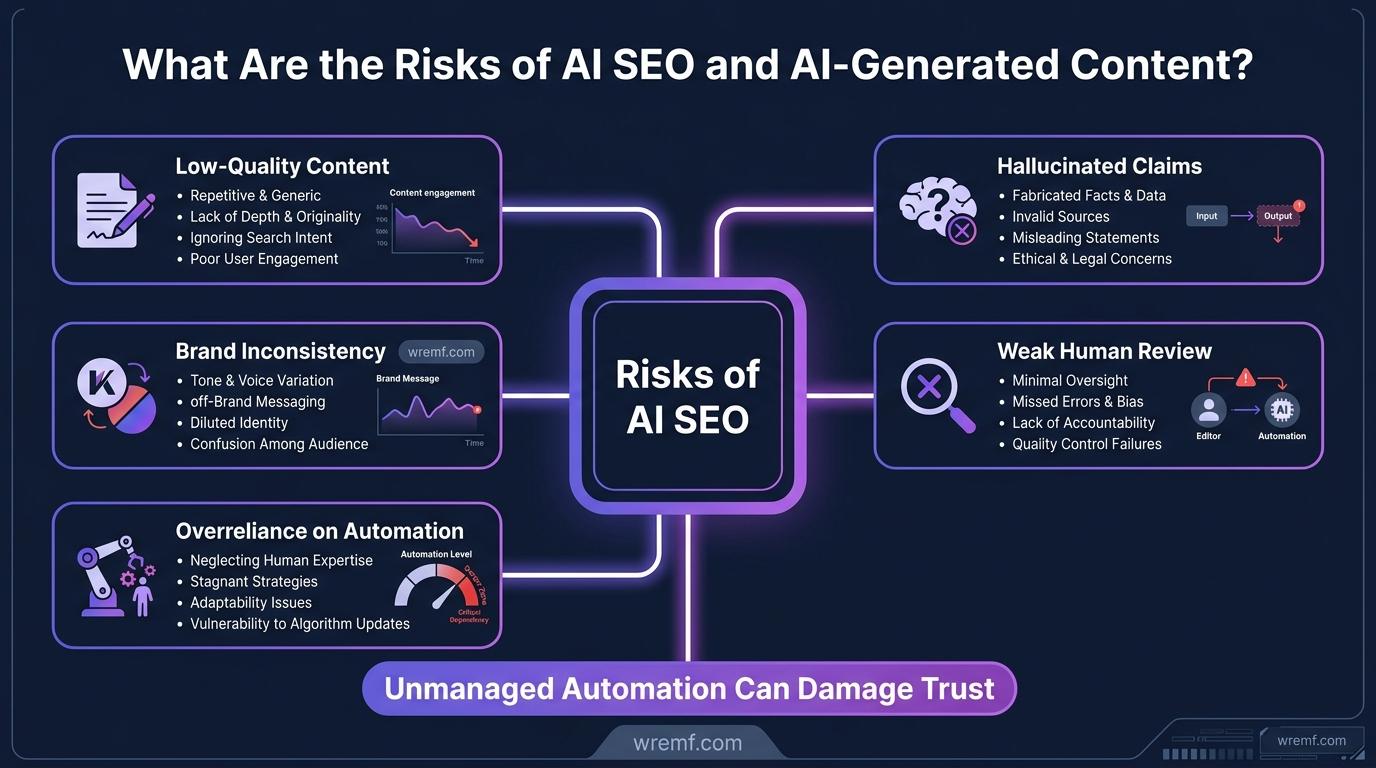
The main risks of AI SEO are low-quality content, hallucinated claims, brand inconsistency, weak human review, and overreliance on automation. AI can improve SEO workflows, but unmanaged automation can damage trust.
AI-generated content is content produced with the assistance of generative AI tools. AI-generated content matters in SEO because it can speed up keyword research, outlines, content briefs, content creation, content structure, and optimization, but it still needs expert review.
Google Search Central’s helpful content guidance focuses on whether content is helpful, reliable, and created for people. That means an AI SEO agency should have editorial standards, source checks, expert review, and brand voice controls, rather than relying only on automated output.
Hallucinations are false or unsupported statements generated by AI systems. Hallucinations matter because an agency that publishes unchecked content can introduce fake statistics, incorrect product claims, wrong pricing, unsupported comparisons, or legal and compliance risks.
The human-in-the-loop model is the practice of keeping trained people involved in AI-assisted workflows. Human-in-the-loop review matters because AI tools can support research and production, but humans must validate accuracy, relevance, originality, and brand fit.
AI SEO agencies should be transparent about how they use AI-driven tools such as Jasper Platform, Gemini, ChatGPT, Claude, or proprietary systems. Tool access is not a strategy. The real strategy is how the agency selects prompts, verifies sources, builds content structure, reviews claims, measures visibility, and reports progress.
IMPORTANT: Be cautious of any AI SEO agency that promises guaranteed AI citations, guaranteed Google AI Overviews inclusion, guaranteed organic traffic growth, or guaranteed revenue growth. AI search visibility can be improved, measured, and influenced, but it cannot be guaranteed.
KEY TAKEAWAY: AI SEO works best when AI improves research, analysis, and workflows while human experts control strategy, accuracy, and brand trust.
The risk conversation leads directly into how SEO, AEO, GEO, and LLM visibility work together.
SEO vs AEO vs GEO: What Is the Difference?
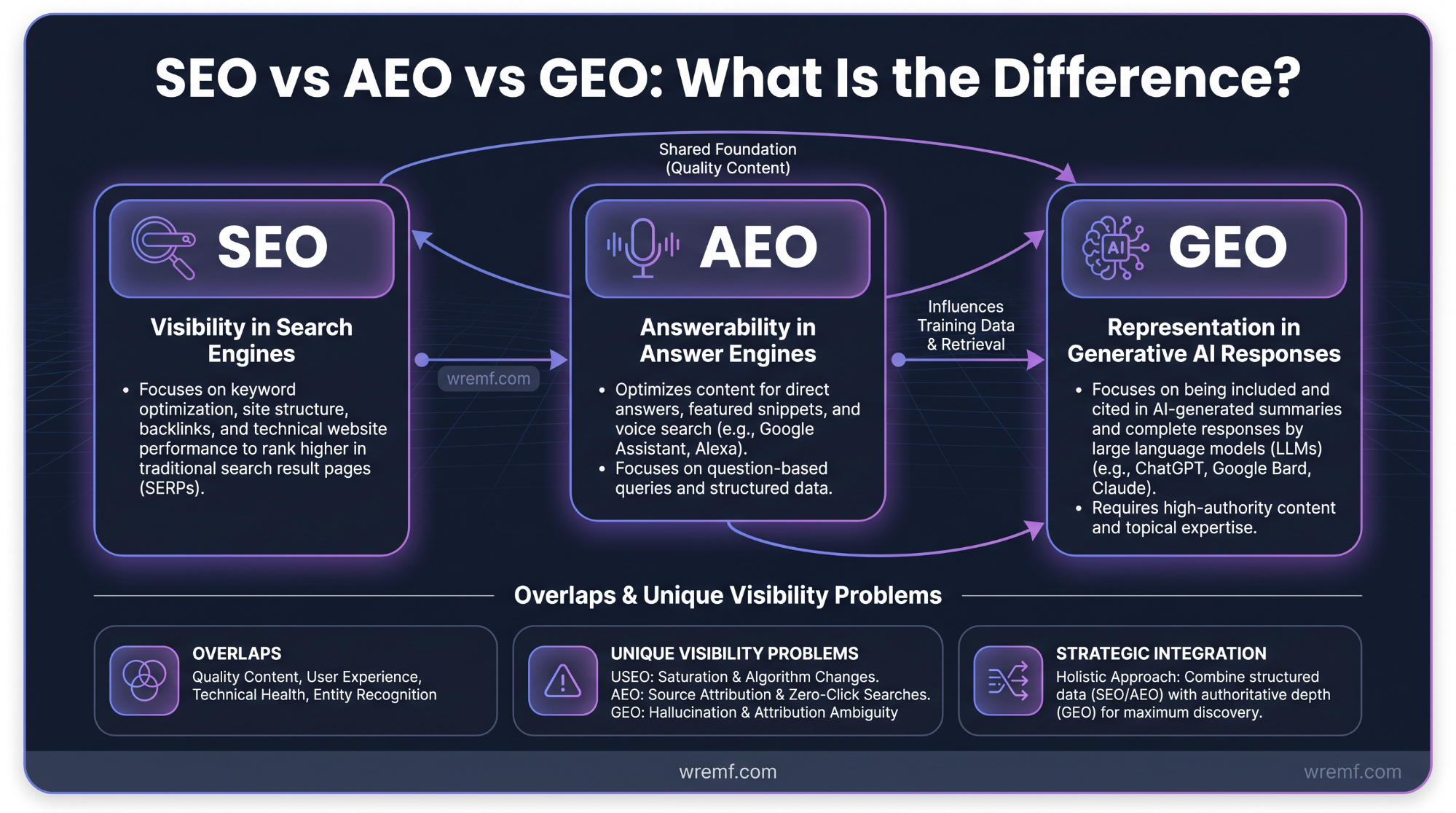
SEO improves visibility in search engines, AEO improves answerability in answer engines, and GEO improves representation in generative AI responses. The three disciplines overlap, but each solves a different visibility problem.
SEO, or search engine optimization, is the process of improving website visibility in search engines such as Google Search and Bing. SEO matters because organic search traffic still drives discovery, demand, and conversions.
AEO, or Answer Engine Optimization, is the process of structuring content to answer specific questions clearly and directly. AEO matters because featured snippets, rich snippets, Google AI Overviews, voice assistants, and answer engines need concise responses.
GEO, or Generative Engine Optimization, is the process of improving how a brand appears in generative AI outputs. GEO matters because large language models and AI search engines can summarise, compare, and recommend brands without showing a traditional ranking page.
LLM visibility is the degree to which large language models mention, cite, describe, or recommend a brand for relevant prompts. LLM visibility matters because ChatGPT, Claude, Gemini, Perplexity, Copilot, DeepSeek, Grok, Meta AI, and Mistral can influence buyer perception before a website visit.
| Discipline | Primary goal | Main surface | Example metric | Best content format |
|---|---|---|---|---|
| SEO | Rank and earn organic traffic | Google Search and search engines | Rankings, clicks, impressions | Search-focused pages, blog content, landing Page content |
| AEO | Be selected as a direct answer | AI Overviews, featured snippets, voice assistants | Answer inclusion, snippet capture, FAQ coverage | Answer-first sections, FAQ sections, Q&A formats |
| GEO | Be represented in generative answers | ChatGPT, Gemini, Claude, Perplexity, Copilot, Mistral | AI visibility, citations, brand mentions, share of model | Structured content, source-backed pages, comparison content |
| LLM visibility | Be understood by large language models | LLMs and AI platforms | Prompt coverage, sentiment, citation frequency | Entity-rich pages, consistent brand facts, knowledge base content |
The key difference between SEO and GEO is the output format. SEO often competes for ranked links. GEO competes for inclusion, citation, and recommendation inside generated answers. AEO sits between them because it focuses on answer extraction.
For most teams, the right approach is not SEO or AEO or GEO. The right approach is a combined system that uses SEO foundations, AEO formatting, GEO source strategy, and AI visibility measurement.
KEY TAKEAWAY: SEO, AEO, and GEO work together, but AI SEO agencies must measure each discipline with different metrics.
This distinction helps explain why agency maturity matters more than tool access.
What Does the Technical Stack of a Modern AI SEO Agency Include?
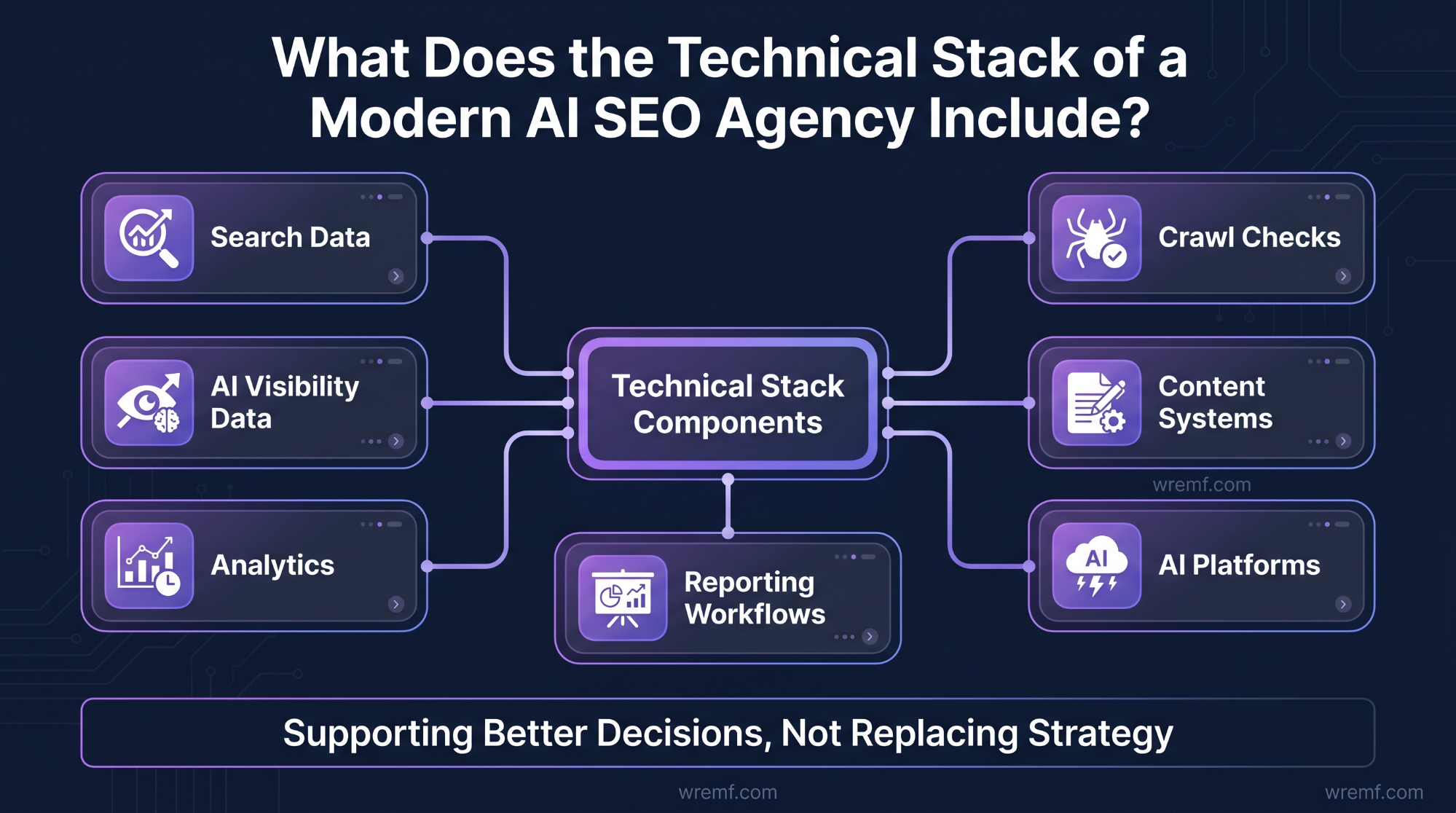
A modern AI SEO agency uses search data, AI visibility data, analytics, crawl checks, content systems, AI platforms, and reporting workflows. The stack should support better decisions, not replace strategy.
A technical AI SEO stack is the combination of tools, data sources, workflows, and review processes used to plan, execute, and measure AI SEO. A technical AI SEO stack matters because AI search requires more than keyword rankings and blog publishing.
A mature stack usually includes:
Google Search Console for clicks, impressions, CTR, average position, query data, and page performance
Analytics platforms for traffic, conversions, user behavior, and AI referral tracking
Rank tracking for traditional search engines and organic search visibility
Prompt tracking across ChatGPT, Claude, Gemini, Perplexity, Google AI, Copilot, DeepSeek, Grok, Meta AI, and Mistral
Citation tracking for AI source analysis
Crawling tools for technical SEO, canonical URLs, redirects, metadata, internal links, and structured data
Content optimization tools for semantic clusters, content structure, entity coverage, and blog content improvement
AI tools for research, briefs, clustering, summaries, and quality assistance
Editorial workflows for human review, fact checking, and brand control
Reporting dashboards for leadership, clients, and agencies
AI agents can help with research, data extraction, monitoring, and repetitive workflows. AI agents matter because they can reduce manual workload, but they should not make strategic decisions without review.
BYOK, or bring your own key, means customers can use their own API keys for AI or data providers. BYOK matters for teams that want cost control, governance, and flexibility across AI platforms.
WREMF supports BYOK, white-label reporting, API access, MCP workflows, and client portals. Teams that need technical integrations can review the WREMF API and MCP options.
KEY TAKEAWAY: A modern AI SEO agency should combine search data, AI visibility data, technical SEO checks, content workflows, human review, and reporting infrastructure.
Technology is important, but strategy determines whether the tools produce business value.
How Should AI SEO Connect With Broader Marketing?
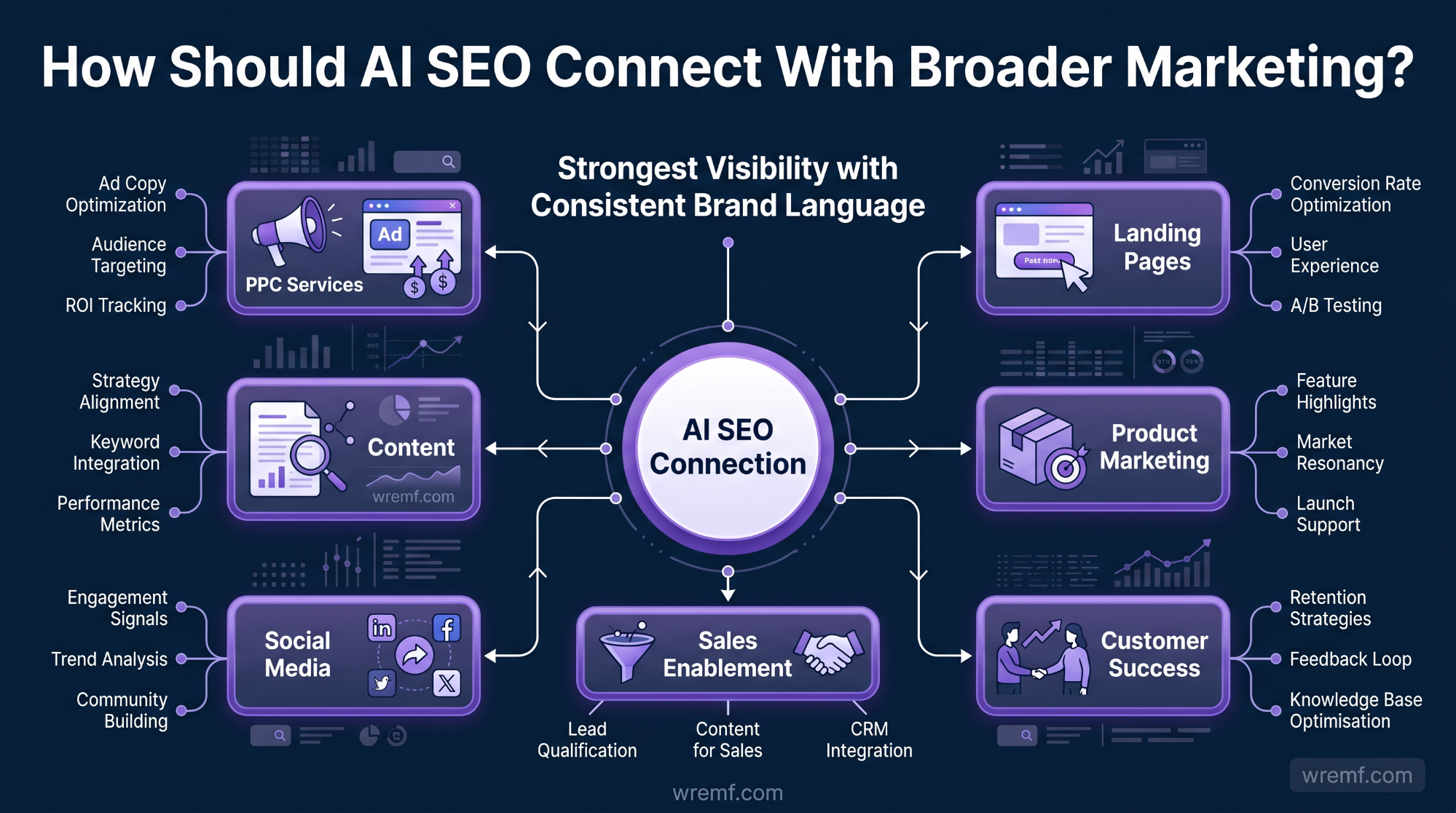
AI SEO should connect search insights to content, product marketing, social media, PPC services, landing pages, customer success, and sales enablement. AI search visibility is strongest when the whole marketing ecosystem uses consistent brand language.
Search data reveals what buyers ask. AI visibility data reveals how AI platforms answer. Together, these insights can improve landing Page copy, product descriptions, blog post planning, Google Ads messaging, social media campaign ideas, YouTube videos, and sales enablement material.
For example, if AI platforms repeatedly describe your product using outdated language, the issue may affect more than AI search. The same inconsistency may appear on review sites, partner pages, sales decks, customer success documentation, and paid search landing pages.
AI SEO should inform:
Content creation for blog content, guides, reports, and comparison pages
Landing Page positioning for demand capture
Product descriptions for clearer category fit
Google Ads messaging and PPC services
Social media post themes based on buyer questions
YouTube videos that answer high-intent prompts
Google Business Profiles and local campaigns where local SEO matters
Customer Success team documentation and support content
Knowledge base articles that explain product use cases
Sales enablement materials for competitive questions
AI search works best when your brand story is consistent across channels. If your website says one thing, your review profiles say another, and your sales material uses different language, AI systems may struggle to identify the clearest version of your positioning.
KEY TAKEAWAY: AI SEO should not sit in isolation. It should connect search behavior, AI answers, content, paid media, social media, product marketing, and sales messaging.
This ecosystem view is especially important because AI search is still evolving.
What Is the Future of AI SEO Agencies?
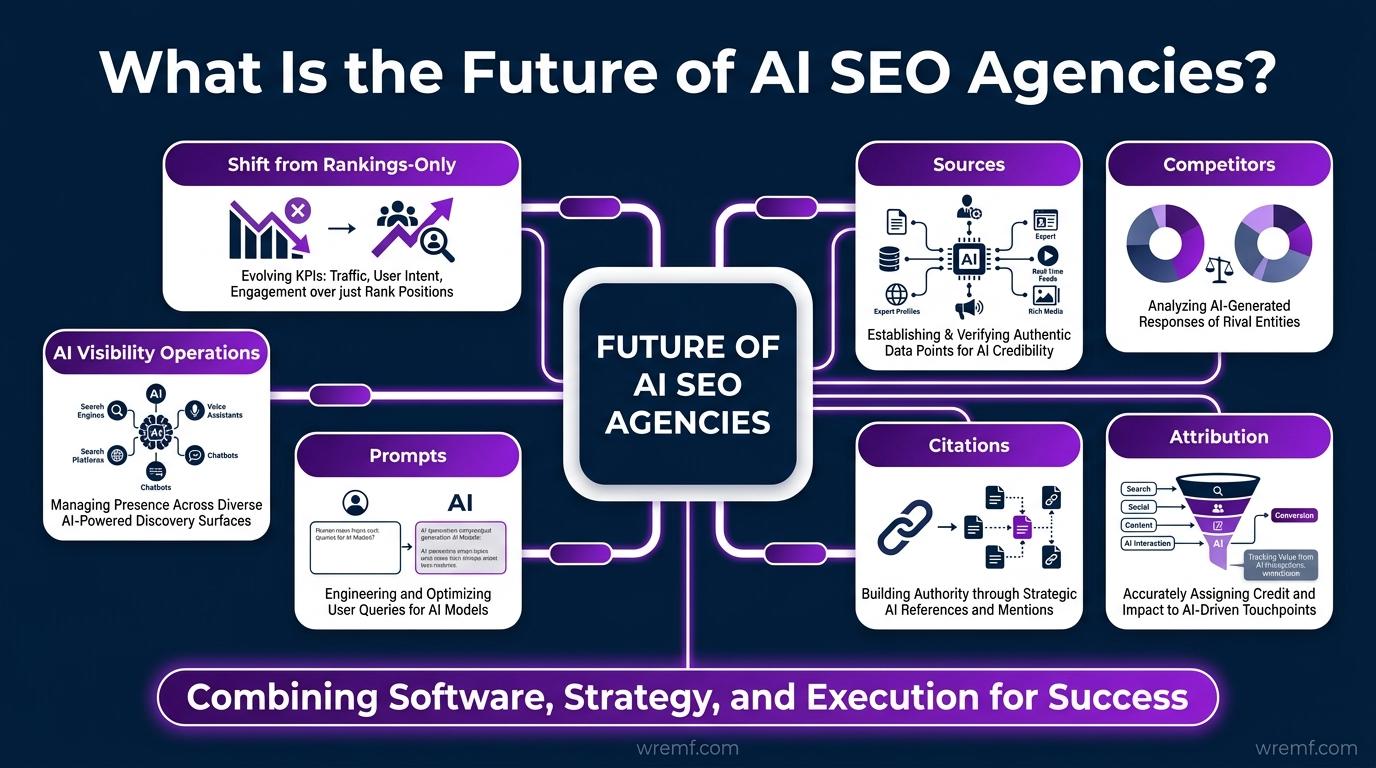
The future of AI SEO agencies is a shift from rankings-only reporting to AI visibility operations across prompts, sources, competitors, citations, and attribution. Agencies that combine software, strategy, and execution will be better positioned than agencies selling content volume alone.
The next phase of search will include more personalization, more AI agents, more conversational interfaces, and more agent-to-agent search. Buyers may ask AI assistants to research tools, compare pricing, summarise reviews, shortlist vendors, or prepare purchasing recommendations.
AI-driven search will also create more zero-click and low-click journeys. That does not mean content is less valuable. It means content must influence the answer even when the click does not happen immediately.
Early adoption of AI SEO principles can create a long-term competitive moat. Brands that build structured content, clean source consistency, improve citations, track prompts, and monitor competitors will understand their AI visibility before the market becomes more crowded.
AI visibility is the measurable presence of a brand inside AI-generated answers, recommendations, citations, and summaries. AI visibility matters because AI platforms increasingly shape how buyers discover categories, compare vendors, and decide which companies deserve attention.
Brand recommendation visibility measures whether AI platforms recommend a brand for relevant commercial prompts. Brand recommendation visibility matters because being mentioned is useful, but being recommended for the right use case is more valuable.
WREMF helps teams track this shift through software, agency execution, and hybrid support. Brands can use WREMF for brands, while consultants and agencies can use WREMF for agencies to manage client reporting and white-label workflows.
KEY TAKEAWAY: The future of AI SEO belongs to teams that measure prompts, citations, sources, competitors, and business outcomes together.
Before making a buying decision, it is important to separate real AI visibility work from common misconceptions.
Common Myths About AI Visibility Debunked
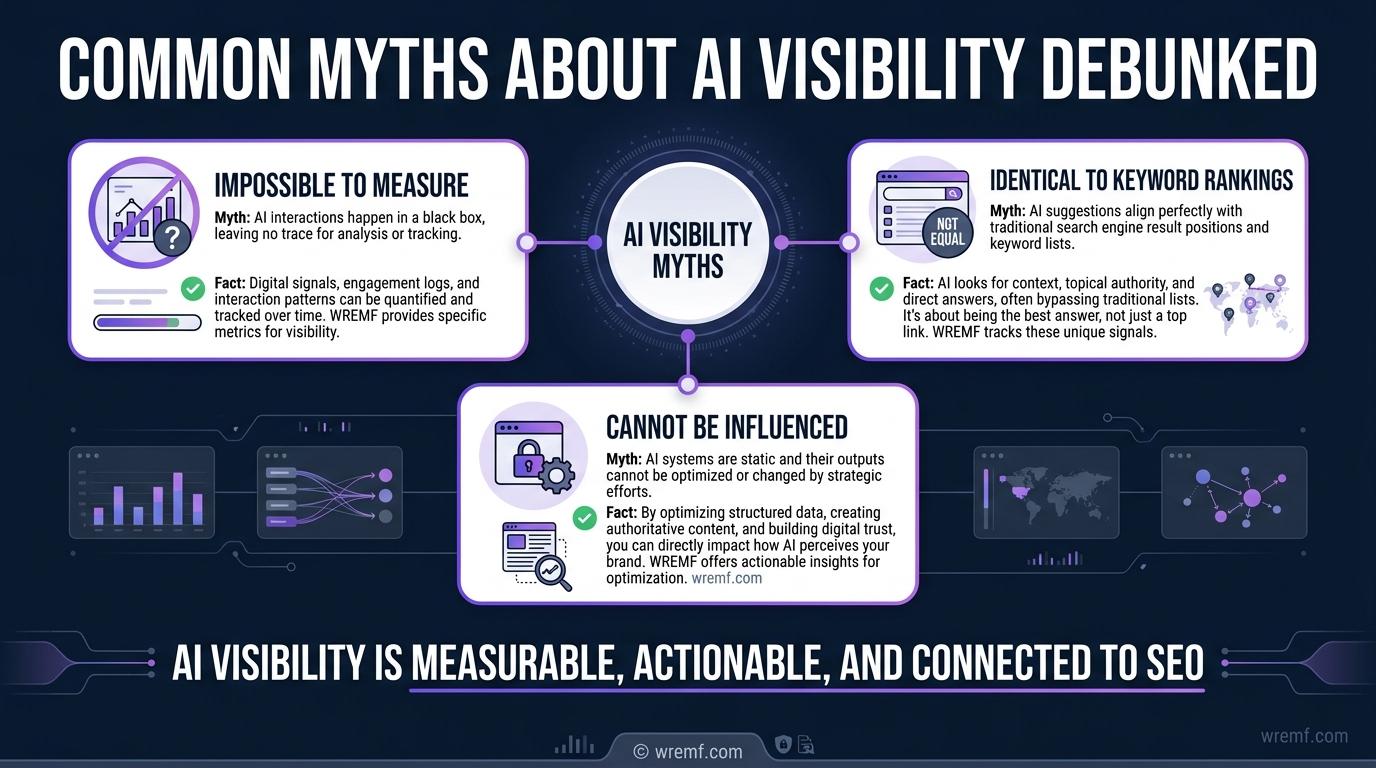
AI visibility is measurable, actionable, and connected to SEO, but it is not the same as keyword rankings. The biggest mistake is treating AI search as either impossible to influence or identical to traditional SEO.
MYTH: AI visibility is impossible to measure.
FACT: AI visibility can be measured through prompt tracking, brand mentions, citation tracking, competitor comparisons, AI share of voice, sentiment, and AI traffic attribution. Measurement is not perfect because AI answers can vary, but repeatable prompt sets and scheduled monitoring make trends visible.
MYTH: SEO, AEO, and GEO are completely separate strategies.
FACT: SEO, Answer Engine Optimization, and Generative Engine Optimization overlap. Technical SEO, content quality, internal linking, structured content, and trusted sources support all three, but each discipline needs different reporting.
MYTH: Rankings are enough to win AI search.
FACT: Rankings help, but AI platforms may cite sources, directories, articles, reviews, documentation, or competitor pages that are not your highest-ranking pages. AI visibility requires tracking citations, brand mentions, source consistency, and recommendation presence.
MYTH: AI SEO means publishing more AI-generated blog posts.
FACT: AI SEO is not content volume alone. Effective AI SEO strategy includes prompt research, content structure, technical SEO, citation analysis, source cleanup, competitor tracking, and human editorial review.
MYTH: Only enterprise brands can benefit from AI SEO.
FACT: Startups, agencies, consultants, and mid-market B2B companies can benefit by targeting specific prompts, building structured content, improving source consistency, and tracking competitor visibility before the category becomes saturated.
KEY TAKEAWAY: AI visibility is not magic, and it is not only rankings. It is a measurable system of prompts, citations, sources, competitors, content, and attribution.
The final step is turning that system into a practical starting plan.
How to Start Working With an AI SEO Agency
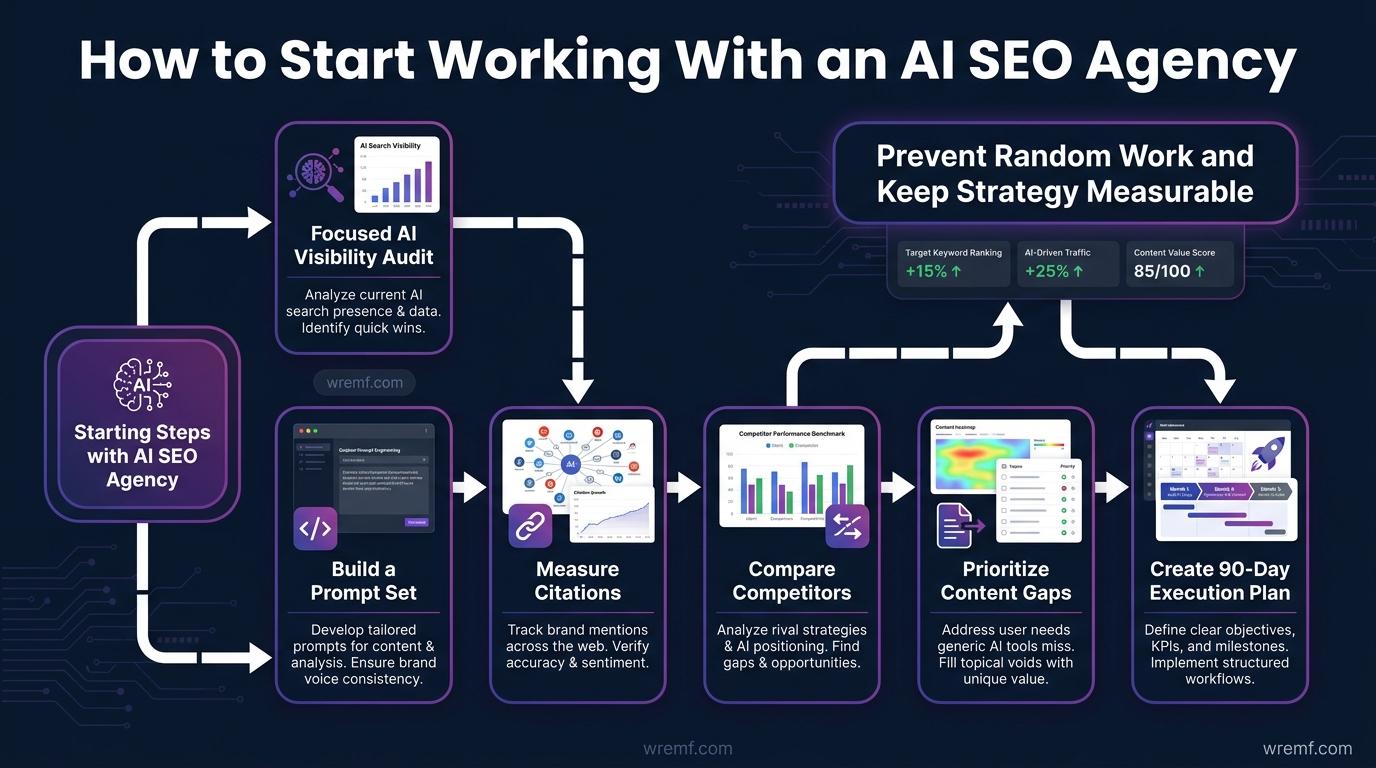
Start with a focused AI visibility audit, then build a prompt set, measure citations, compare competitors, prioritise content gaps, and create a 90-day execution plan. This sequence prevents random AI SEO work and keeps strategy measurable.
A 90-day AI SEO plan should begin with a baseline. Your agency should identify priority prompts, test AI platforms, benchmark competitors, review source citations, check technical SEO, and identify content gaps. The first 30 days should answer one question: where are you visible, absent, or misrepresented?
The next 30 days should focus on implementation. That may include updating core pages, creating answer-first blog content, improving internal linking, cleaning source consistency, adding FAQ sections, strengthening product descriptions, and creating comparison pages. If technical SEO issues exist, the agency should fix crawlability, rendering, canonical URLs, schema markup, and sitemap problems before scaling content.
The final 30 days should focus on proof. The agency should compare prompt visibility, citation changes, organic search traffic, Google Search Console performance, AI platform referrals, and competitor movement against the baseline. Not every improvement will create immediate traffic, but every serious agency should show what changed and what to do next.
| First 90 days | Main goal | Example work | Output |
|---|---|---|---|
| Days 1 to 30 | Baseline | Prompt tracking, citation review, competitor benchmark, technical audit | AI visibility audit and action plan |
| Days 31 to 60 | Implementation | Content briefs, source cleanup, internal links, schema markup, page updates | Improved content and technical foundations |
| Days 61 to 90 | Measurement | Retest prompts, compare citations, review traffic, report changes | Visibility report and next priorities |
For teams that prefer direct tracking, WREMF offers software. For teams that need implementation, WREMF offers managed AEO, GEO, and AI visibility services. For teams that need both, WREMF can support a hybrid model with platform reporting and senior-led execution.
KEY TAKEAWAY: Start AI SEO with a measured baseline, not random content production, then connect every action to prompts, citations, competitors, and outcomes.
The FAQ below answers the buying, implementation, and comparison questions teams ask before choosing an AI SEO agency.
Frequently Asked Questions
What is an AI SEO agency?
An AI SEO agency is a specialist partner that improves how a brand appears across search engines, AI search engines, Google AI Overviews, ChatGPT, Claude, Gemini, Perplexity, Copilot, and other AI platforms. It combines search engine optimization, Answer Engine Optimization, Generative Engine Optimization, technical SEO, content optimization, prompt tracking, citation analysis, and reporting. A strong AI SEO agency does not only create content. It measures AI visibility, identifies source gaps, compares competitors, and turns findings into actions.
What is the best AI SEO agency?
The best AI SEO agency is the one that fits your goals, budget, team capacity, and reporting needs. For B2B teams, the strongest choice is usually a partner that can track AI visibility across multiple AI platforms, explain its methodology, improve content quality, monitor citations, and connect work to business outcomes. WREMF is designed for teams that want software, managed execution, or a hybrid model for AI visibility tracking, AEO, GEO, and reporting.
Can SEO be done with AI?
Yes, SEO can be done with AI, but AI should support strategy rather than replace expert judgment. AI-driven tools can help with keyword research, semantic clusters, content briefs, content creation, internal linking, technical checks, and reporting. Human review is still required for accuracy, brand voice, source quality, and commercial judgment. The safest approach is to use AI for scale and analysis while keeping experienced SEO specialists responsible for strategy and final approval.
Is SEO dead or evolving in 2026?
SEO is evolving, not dead. Search engines still matter, but buyers now use Google AI Overviews, ChatGPT, Gemini, Claude, Perplexity, Copilot, voice assistants, and other AI search surfaces to discover and compare brands. That means SEO must expand into AEO, GEO, AI visibility tracking, source citation analysis, and competitor visibility. Traditional rankings and organic traffic remain useful, but they no longer capture the full discovery journey.
How is an AI SEO agency different from a traditional SEO agency?
A traditional SEO agency usually focuses on rankings, technical SEO, backlinks, content, and organic traffic from search engines. An AI SEO agency adds AI visibility, prompt tracking, AI citations, brand mentions, source consistency, large language models, AI platforms, and share of voice. The best AI SEO agencies still understand SEO principles, but they also measure whether your brand appears, is cited, and is recommended inside AI-generated answers.
Are AI SEO Services worth it?
AI SEO Services are worth considering when your buyers use AI platforms to research vendors, compare products, or ask category questions. They are especially valuable for B2B SaaS, agencies, consultants, and high-consideration markets where brand shortlisting happens before a demo request. The value depends on execution quality. Avoid services that only sell AI-generated blog content. Prioritise agencies that measure prompts, citations, competitors, technical SEO, content quality, and business outcomes.
Will optimizing for AI search also help Google rankings?
Optimizing for AI search can support Google rankings when the work improves helpful content, technical SEO, structured content, internal links, source quality, and user intent coverage. However, AI visibility and Google rankings are not identical. A page can rank well and still fail to appear in ChatGPT, Perplexity, Claude, or Gemini answers. The best approach is to build content and source systems that support both search engines and AI platforms.
How much does AI SEO software cost?
AI SEO software pricing varies by number of websites, prompts, users, engines, and reporting features. WREMF pricing starts at €39/mo for Starter with 1 website, unlimited prompt tracking, BYOK, 10 AI engines, all features and tools, white-label reports, 1 seat, and email support. Growth is €89/mo for 5 websites with priority support, content brief generation, and SEO A/B testing. Enterprise pricing is custom for unlimited websites, seats, branded portals, and dedicated support. You can review the WREMF pricing page for plan details.
How long does AI SEO take to show results?
AI SEO should start with a baseline in the first month, implementation in the second month, and early visibility comparison in the third month. Some changes, such as content structure updates or source cleanup, can be measured quickly through prompt tracking. Traffic, citations, and AI recommendation shifts may take longer because AI platforms use changing retrieval systems and source sets. A realistic agency should report progress without guaranteeing rankings, citations, revenue, or traffic.
Do I need an AI SEO agency if I already have an SEO team?
You may not need a full agency if your SEO team has time, tools, and AI visibility expertise. You may need specialist support if your team cannot track prompts across AI platforms, analyse source citations, compare competitors inside AI answers, or build AEO and GEO workflows. Many teams use WREMF as software for internal execution, while others use the WREMF agency team when they need managed strategy and implementation.
What strategies do AI SEO agencies use differently?
AI SEO agencies use prompt research, source citation tracking, entity clarity, structured content, AI visibility scoring, competitor visibility, and source consistency workflows alongside traditional SEO. Instead of only asking “What keyword should this page rank for?” they also ask “What prompt should this page answer?” and “Which sources does the AI platform cite?” This changes the workflow from rankings-only optimization to answer, citation, and recommendation optimization.
Should businesses invest in AI-focused SEO now, or is it too early?
Businesses should invest in AI-focused SEO now if buyers use AI platforms to research categories, compare vendors, or ask advice before purchasing. It is not too early to build the foundations: structured content, clean source consistency, prompt tracking, citation analysis, and AI visibility reporting. The goal is not to abandon SEO. The goal is to make your SEO program ready for Google Search, AI Overviews, ChatGPT, Perplexity, Gemini, Claude, Copilot, and future AI agents.
Conclusion
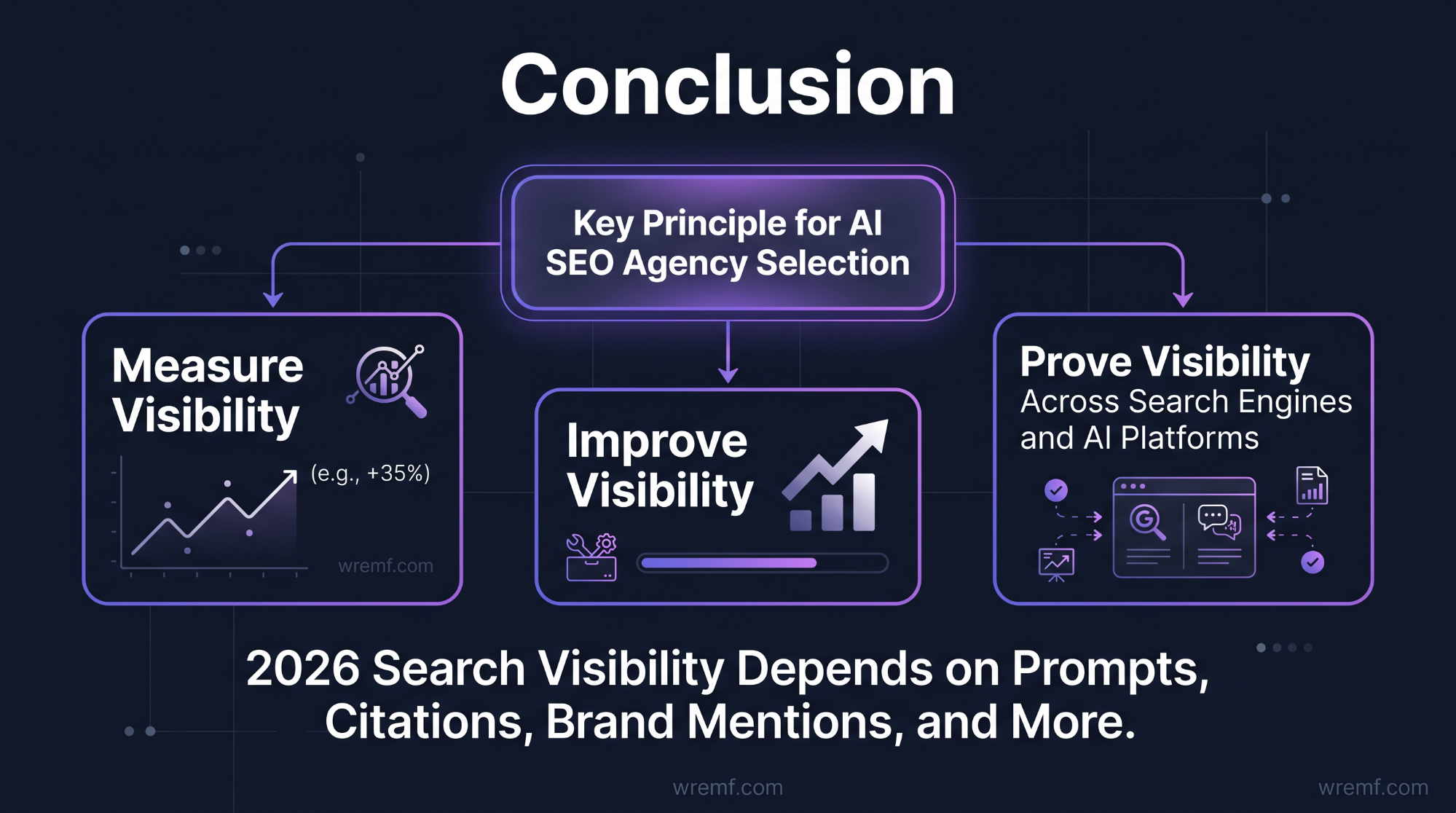
AI SEO agency selection should start with one clear principle: choose the partner that can measure, improve, and prove visibility across both search engines and AI platforms. Rankings still matter, but 2026 search visibility also depends on prompts, citations, brand mentions, source consistency, AI share of voice, and attribution. WREMF helps B2B teams turn AI search from a guessing game into a repeatable workflow through software, agency support, or a hybrid model. To start with measurable AI visibility across 10 AI engines, explore the WREMF platform suite or talk to the WREMF agency team.
Related Generative Engine Optimization Guides
- LLM SEO Services The Complete 2026 Guide to AI Search Visibility, AEO, GEO, and LLM Optimization
- AI SEO Services The Complete Guide to Search Visibility in the AI Era
- LLM SEO Agency The Complete Guide to Choosing an Agency for AI Search Visibility
- AI Search Engine Optimization Services The Complete Guide for B2B Brands
- Answer Engine Optimization Services The Complete Guide to AI Search Visibility
- Large Language Model Optimization Services The Complete Guide to LLMO, AI Search Visibility, AEO, GEO, RAG, and LLM Performance
- Generative AI Optimization Services The Complete Guide to GEO, AEO, LLM Optimization, and AI Visibility
- AI Mention Tracking The Complete Guide to Monitoring Brand Mentions, AI Answers, Citations, and Share of Voice in 2026
- How AI Search Optimization Tools Increase Organic Traffic
- AI Search Engine Optimization Tools The Complete 2026 Guide for AI Search, SEO, AEO, and GEO
- Answer Engine Optimization The Complete Guide to AEO, AI Search Visibility, and Answer-First Content
- AI Overview SEO How to Optimize for Google AI Overviews, AI Mode, and AI Search Visibility
- AI Brand Monitoring The Complete Guide to Tracking Brand Visibility Across AI Search, LLMs, and Generative Engines
- AI Search Engine Optimization The Complete Guide for B2B Brands
- 12 Best AI Search Optimization Tools
- AI SEO Tools The Complete Guide for SEO, AEO, GEO, and AI Search Visibility
- How Do AI Search Optimization Tools Improve SERP Rankings
- Enterprise Answer Engine Optimization Platforms Complete Guide for AI Visibility, AEO, and GEO
- AI Overview Optimization How to Rank, Get Cited, and Stay Visible in Google AI Search
- Best Answer Engine Optimization for Enhancing AI Visibility
Related reading
- Generative AI Optimization Services: The Complete Guide to GEO, AEO, LLM Optimization, and AI Visibility
- AI Visibility Agency Amsterdam: B2B Pipeline Playbook for Search, AEO, GEO, and LLM Visibility
- AI Search Visibility Agency: The Complete Guide to Choosing the Right Partner in 2026
- Large Language Model Optimization Services: The Complete Guide to LLMO, AI Search Visibility, AEO, GEO, RAG, and LLM Performance