AI Visibility Agency Amsterdam: B2B Pipeline Playbook for Search, AEO, GEO, and LLM Visibility
Discover how Amsterdam's AI visibility agencies enhance B2B pipelines through SEO, AEO, and LLM strategies.
By WREMF Team · 2026-09-13
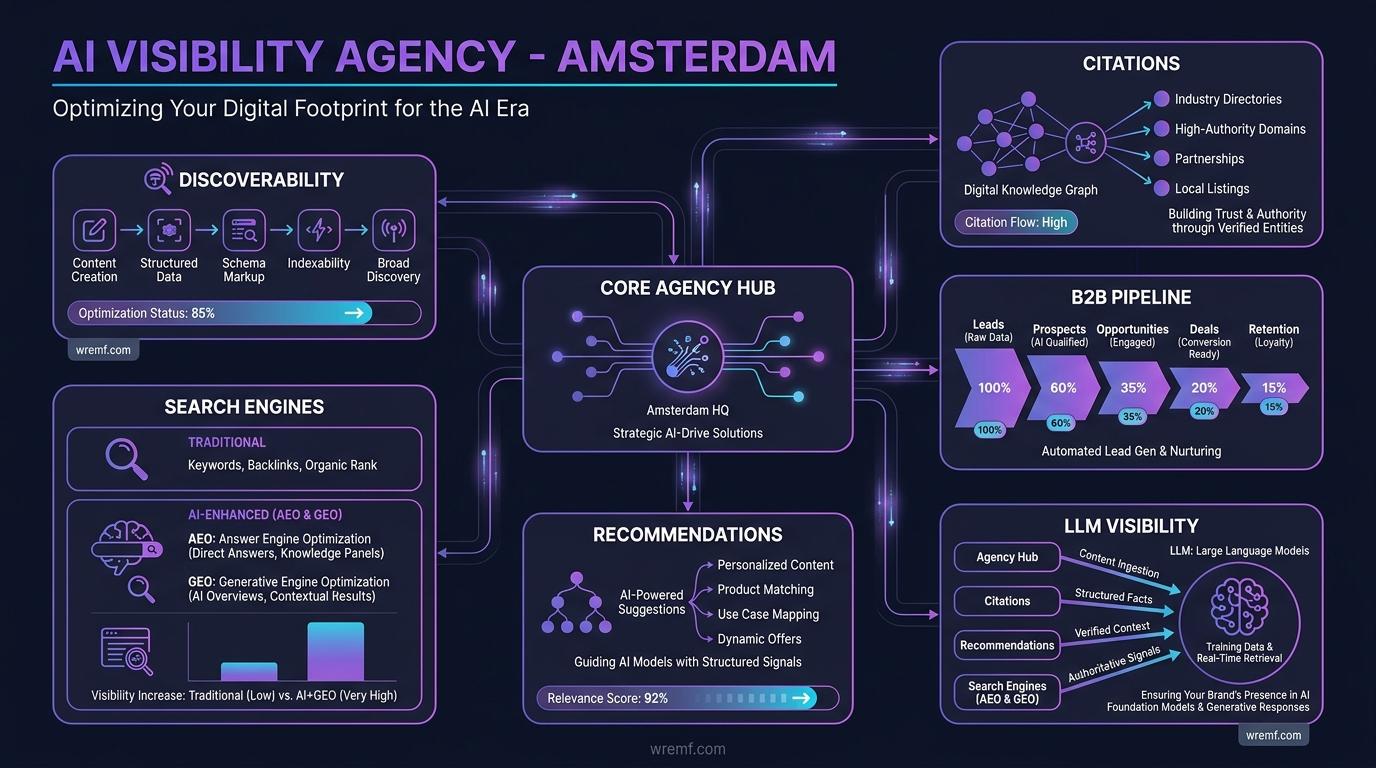
AI visibility agency services in Amsterdam focus on making B2B brands discoverable across AI and search platforms. Key components include search visibility, AI citations, and large language model (LLM) visibility. These systems help track AI visibility on platforms like Google, ChatGPT, and Perplexity, aiming to integrate SEO, AEO, and GEO into a consistent operating system. This approach supports predictable pipelines by showing how brand discovery shifts from search-only to multi-engine visibility. Challenges include citation consistency and robust content structure to ensure brand prominence in AI-generated answers.
Key takeaways
- AI visibility makes B2B pipelines predictable by integrating SEO with AI systems.
- Brands need AI citations and LLM visibility to appear in AI-generated content.
- Challenges include achieving source consistency and clear content structure.
- AI visibility audits reveal missing links in search and decision content.
- Effective AI visibility connects prompts, outcomes, and source citations.
AI Visibility Agency Amsterdam: B2B Pipeline Playbook for Search, AEO, GEO, and LLM Visibility
AI visibility agency Amsterdam is a specialist service that helps B2B brands become discoverable, cited, and recommended across search engines and AI systems. Google Search Central explains that Google’s ranking systems are designed to prioritize helpful, reliable, people-first content, while Google’s AI features documentation explains how AI Overviews and AI Mode can use web content in AI-powered search experiences. (Google for Developers) This page explains how Amsterdam businesses can build predictable pipeline with AI Visibility, ranking SEO, answer engine optimisation, generative engine optimisation, AI citation tracking, source consistency, and LLM visibility. WREMF helps B2B teams track, improve, and prove AI Visibility across ChatGPT, Claude, Gemini, Perplexity, Google AI Overviews, Copilot, DeepSeek, Grok, Meta AI, Mistral, and other AI discovery surfaces. The goal is simple: become the brand AI search recommends.
B2B pipeline, made predictable with Search plus AI visibility.
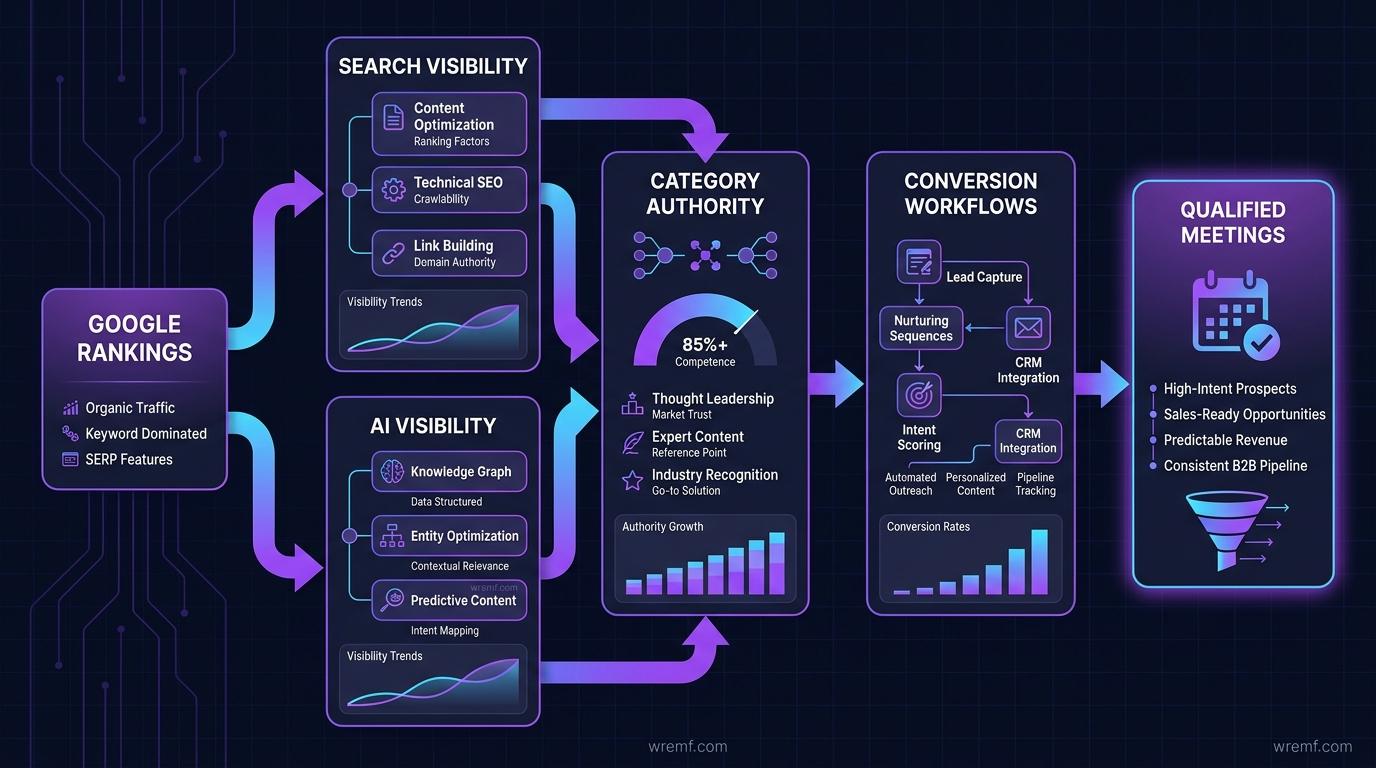
B2B pipeline becomes predictable when search visibility, AI Visibility, category authority, and conversion workflows operate as one system. An AI visibility agency Amsterdam strategy should connect Google rankings, ChatGPT mentions, Perplexity citations, Claude summaries, AI Overviews visibility, and qualified meetings into one measurable operating system.
AI Visibility is the measurable presence of a brand inside AI-generated answers, recommendations, citations, summaries, and comparison responses. AI Visibility matters because buyers increasingly use AI assistants to research vendors, shortlist solutions, compare categories, and validate claims before speaking to sales.
In Amsterdam, this matters because many B2B Services companies sell beyond one local market. Amsterdam businesses often target the Netherlands, Europe, the United States, the United Kingdom, and global buyers from one website. A prospect might search Google for “AI visibility agency Amsterdam,” ask ChatGPT for “best AI SEO agency for B2B SaaS,” compare agencies in Perplexity, and then validate the shortlist through AI Overviews. Traditional SEO still supports ranking and traffic, but it no longer explains the full discovery journey.
OpenAI describes ChatGPT search as giving fast, timely answers with links to relevant web sources, which shows why source visibility now affects how buyers discover information outside standard search engines. (OpenAI) Perplexity is built around answer retrieval and web research, which makes citations, source quality, and answer structure commercially important for brands competing in AI search environments. (Ferventers)
AI visibility works by connecting four layers: prompts, answers, sources, and outcomes. Prompt tracking shows what buyers ask. Source citation tracking shows which pages and third-party sources AI systems reference. Competitor visibility shows who appears when your brand does not. Attribution connects AI visibility to traffic, pipeline, qualified meetings, and revenue influence.
WREMF helps teams turn this into a practical workflow through the AI visibility platform suite, which combines prompt intelligence, source citation tracking, AI share of voice, competitor visibility, AI traffic attribution, scheduled AI monitoring, white-label reporting, API workflows, and AI-ready recommendations. For teams that need execution, WREMF also works as a senior-led AI visibility agency with AEO strategy, GEO execution, AI citation optimization, technical implementation, and content systems.
AI Visibility is the measurable presence of a brand across AI answers, citations, recommendations, and summaries. AI Visibility matters because B2B buyers may trust an AI-generated shortlist before they visit your website, review your ads, or speak to your sales team. AI Visibility turns brand discovery from a search-only problem into a multi-engine visibility problem.
The strongest pipeline systems include SEO, AEO, GEO, Branding, Content Marketing, Digital Marketing, and Marketing Automation. SEO strategies help pages rank in search engines. AEO helps pages answer questions directly. GEO helps pages become more useful to generative engines and Large Language Models. Marketing Automation connects captured demand to follow-up. Branding and Brand Authority make the recommendation more credible.
Amsterdam companies also need to consider multilingual and multi-market behavior. A buyer may search in English but compare local providers in Dutch. Another buyer may ask ChatGPT for European providers but expect proof in English. A governed AI visibility agency Amsterdam strategy should map these query patterns instead of assuming one keyword list represents the full market.
For further depth on how AI search tools support organic growth, WREMF’s guide to how AI search optimization tools increase organic traffic explains the connection between AI visibility signals and search-led demand. WREMF’s guide to AI search engine optimization for B2B brands expands the strategy for teams that need a broader SEO, AEO, and GEO foundation.
KEY TAKEAWAY: Predictable B2B pipeline now depends on combining Google ranking, AI Visibility, AI citation tracking, source consistency, and conversion reporting into one operating system.
The next section explains what happens when businesses rely on disconnected campaigns instead of a governed visibility system.
The Consequence
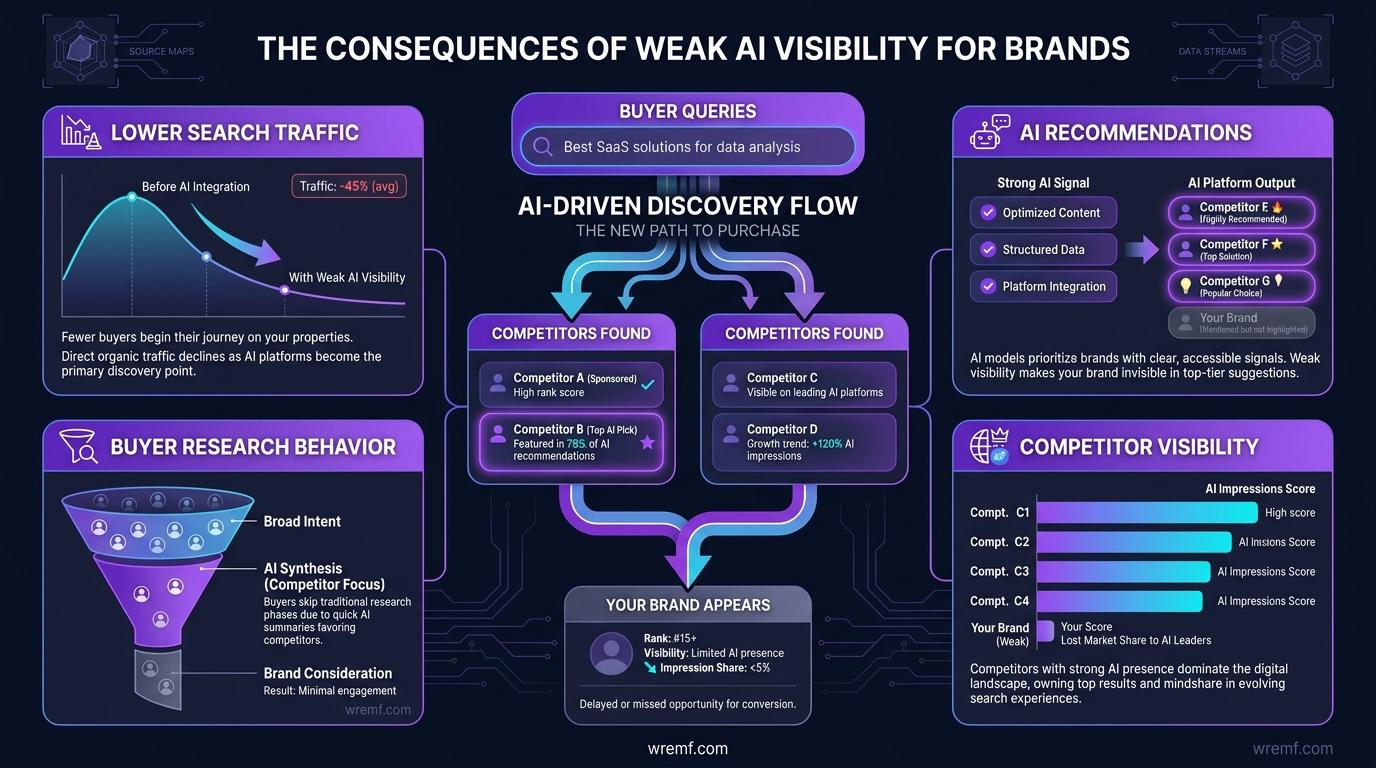
The consequence of weak AI Visibility is not only lower search traffic. The bigger problem is that buyers may ask AI systems for recommendations and find competitors before your brand appears.
In practical AI visibility audits, teams usually discover three problems. First, Google ranking visibility is too narrow because the site targets informational searches but misses decision pages and comparison searches. Second, LLM visibility is weak because ChatGPT, Claude, Gemini, Perplexity, Copilot, and other AI assistants do not mention the brand for high-intent prompts. Third, source citation visibility is inconsistent because AI systems cite competitors, directories, review platforms, publishers, or outdated pages instead of the brand’s strongest sources.
AI citation is a reference, mention, or source connection used by AI systems when generating answers, summaries, or recommendations. AI citation matters because cited sources influence what the buyer sees, trusts, and explores next.
Traditional SEO can create rankings without AI recommendation visibility. A brand may rank for a blog topic but fail to appear when a buyer asks, “Which AI visibility agency in Amsterdam should I hire?” A brand may get traffic from Google but remain absent from Perplexity citations. A brand may publish many campaigns but fail to create the entity clarity that AI systems need to connect the business with the right category.
Google Search Central’s guidance on helpful content is important because it emphasizes content created for people rather than content created only to manipulate search engine ranking. (Google for Developers) This aligns with AI search best practice because AI systems need clear, reliable, well-structured information to summarize. Weak content structure, vague claims, thin proof, and inconsistent entity signals make the brand harder to retrieve.
For Amsterdam businesses, the consequence can appear in several ways:
A buyer asks ChatGPT for the best AI Marketing agency in Amsterdam and your company is not mentioned.
A prospect asks Perplexity for B2B Services providers in the Netherlands and a competitor receives the AI citation.
A decision-maker searches Google and AI Overviews summarize competitor categories before your brand appears.
An Ecommerce team runs campaigns but lacks category authority across search engines and AI systems.
A sales team receives fewer qualified meetings because the brand is not visible in the comparison stage.
LLMs are Large Language Models that generate, summarize, classify, and retrieve language-based information. LLMs matter for marketing because tools like ChatGPT, Claude, Gemini, Copilot, and Perplexity can shape how buyers understand categories and vendors.
A common implementation mistake is assuming AI Visibility is only Branding. Branding, Brand Reputations, Halo effects, and PR Strategies matter, but they need measurable reinforcement through content, citations, structured data, internal linking, and source consistency. Without that structure, brand awareness may not become AI search visibility.
Another mistake is treating AI Search Optimization as a plugin or one-time technical fix. WP SEO AI tools, WordPress plugins, schema generators, and Content creation systems can support the workflow, but they do not replace Customer research, prompt mapping, citation gap analysis, technical visibility review, or governed Content Strategy.
WREMF helps teams identify these gaps by tracking prompts, citations, competitors, AI share of voice, and traffic attribution. Teams that want to understand ranking changes alongside AI search visibility can use WREMF resources on how AI search optimization tools improve SERP rankings, AI SEO tools, and AI Overview SEO.
IMPORTANT: Rankings alone are not enough because AI systems can mention, cite, compare, and recommend brands differently from traditional search engines.
KEY TAKEAWAY: Weak AI Visibility makes pipeline less predictable because buyers can discover and trust competitors before your brand enters the conversation.
The next section explains the operating components that WREMF installs to make AI visibility measurable and improvable.
What We Install
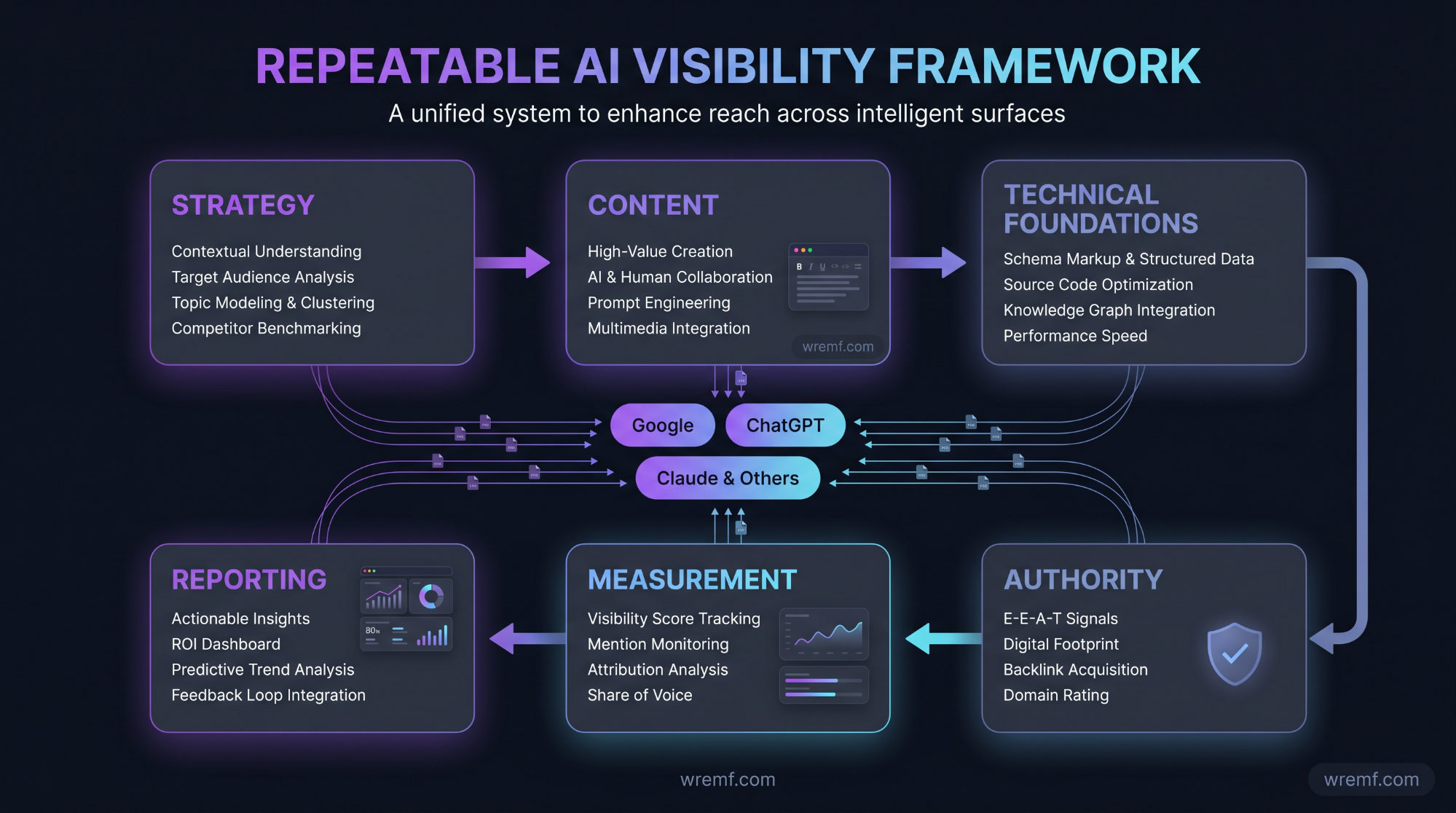
An AI visibility agency should install a repeatable system for tracking, improving, and proving visibility across Google, ChatGPT, Claude, Gemini, Perplexity, AI Overviews, Copilot, and other generative engines. The system should include measurement, strategy, content, technical foundations, authority, and reporting.
Generative engine optimisation, or GEO, is the practice of improving how brands, pages, and entities appear inside generative AI answers. GEO matters because generative engines synthesize answers from multiple sources and may recommend brands without sending users through a traditional search result page.
Answer engine optimisation, or AEO, is the practice of structuring content so answer engines can extract clear, direct, trustworthy responses. AEO matters because AI assistants, AI Overviews, and search features often reward concise answers, credible sources, and well-organized topic coverage.
WREMF installs six core modules for AI search visibility services.
| Module | What It Does | Example Output | Business Value |
|---|---|---|---|
| Prompt intelligence | Tracks how buyers ask questions in AI systems | Prompt maps, visibility snapshots, engine comparisons | Shows where your brand appears or disappears |
| Source citations | Tracks which pages and sources AI systems cite | Citation reports, source gaps, source consistency analysis | Shows which sources influence answers |
| Competitive landscape | Compares your brand against competitors in AI answers | AI share of voice, competitor prompt rankings | Shows who wins attention in AI search |
| Content system | Turns visibility gaps into pages and briefs | Pillars, decision pages, comparison pages, content briefs | Creates assets that AI systems can retrieve |
| Technical foundations | Improves crawlability, schema, internal linking, and page clarity | Technical recommendations, Structured data guidance | Makes the site easier to understand |
| Reporting and attribution | Connects AI Visibility to traffic, meetings, and pipeline | Dashboards, executive reports, attribution views | Makes performance visible to leadership |
Source citations are references or supporting sources used by AI systems when forming an answer. Source citations matter because buyers often trust cited answers more than uncited claims, especially in high-consideration B2B buying journeys.
WREMF’s source citation tracking helps teams identify whether AI systems cite owned pages, third-party sources, review platforms, competitors, or irrelevant content. WREMF’s prompt intelligence helps teams understand which prompts matter by market, category, funnel stage, and buyer intent. WREMF’s competitive landscape tools help teams see whether competitors are winning mentions, citations, or recommendation visibility.
In real-world reporting, teams need more than a dashboard. A dashboard shows what happened. A strategy explains why it happened. Agency execution fixes the pages, source gaps, and content structure behind the result. This is why WREMF offers software, managed agency services, and a hybrid model.
The WREMF agency workflow follows five steps:
| Step | Agency Action | Deliverables |
|---|---|---|
| Audit | Assess AI visibility, competitors, citations, prompts, technical structure, and entity authority | AI visibility audit, prompt landscape analysis, citation gap report |
| Strategy | Define high-value prompts, buying-stage visibility, content priorities, and authority plan | GEO strategy report, opportunity map, roadmap |
| Build | Create and optimize AI-ready content, decision pages, schema guidance, internal linking, and structured formatting | Content briefs, page recommendations, technical tasks |
| Amplify | Strengthen source consistency, third-party visibility, authority signals, and citation support | Authority development plan, source consistency work |
| Measure | Track AI share of voice, AI citations, visibility scores, traffic attribution, and pipeline impact | Dashboards, reports, executive insights |
Teams using WordPress can use WP SEO AI plugins and schema tools for basic implementation, but the operating system should not depend only on automation. Content optimisation requires Customer language, proof modules, comparison logic, and human editorial judgment. AI systems can help accelerate Content creation, but generic AI-generated pages can weaken authority if they lack evidence, experience, or structure.
For a deeper software comparison, WREMF’s guide to the 12 best AI search optimization tools explains how tool selection differs from classic rank tracking. Teams comparing broader enterprise options can also review WREMF’s guide to enterprise answer engine optimization platforms.
Mid-page CTA: If your team wants to see how AI engines describe your brand, which sources they cite, and where competitors appear, review a sample AI visibility report before building your own measurement workflow.
KEY TAKEAWAY: WREMF installs a measurable AI visibility operating system that connects prompts, citations, competitors, content, technical foundations, agency execution, and attribution.
The next section explains what a responsible guarantee can and cannot mean in AI visibility work.
The Guarantee
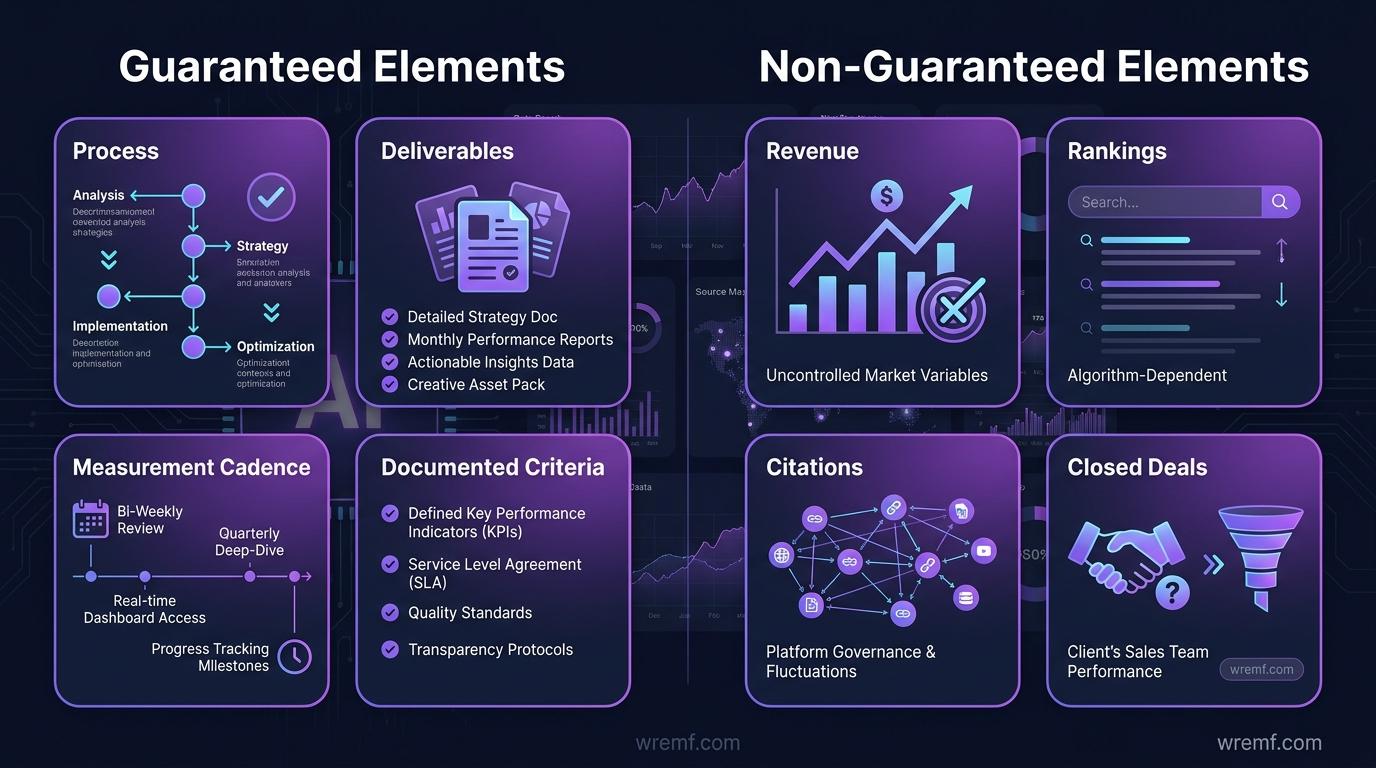
A responsible AI visibility agency can guarantee process, deliverables, measurement cadence, and documented criteria, but it should not guarantee revenue, rankings, citations, or closed deals. AI systems, search engines, and buyer behavior remain external variables that no agency fully controls.
The guarantee should be an operating guarantee. An agency can define how many prompts are audited, how many source citations are reviewed, how many content briefs are created, how often reports are delivered, what technical recommendations are provided, and how qualified meetings are defined when pipeline support is included. An agency should not claim that it can force Google, ChatGPT, Claude, Gemini, Perplexity, Copilot, or AI Overviews to rank, cite, or recommend a brand on command.
AI traffic attribution connects AI search visibility to website visits, assisted conversions, qualified meetings, pipeline influence, and revenue context. AI traffic attribution matters because leadership needs to understand whether AI discovery creates measurable business impact.
The guarantee framework should include:
Scope: which search engines, AI systems, regions, prompts, and pages are included.
Baseline: current ranking, AI Visibility, citations, competitor visibility, traffic, and conversion data.
Eligibility: analytics access, site access, sales follow-up, content approvals, implementation speed, and data quality.
Deliverables: audits, strategy reports, prompt maps, content briefs, technical recommendations, dashboards, and monthly reporting.
Cadence: weekly, monthly, or quarterly reviews.
Limits: no guaranteed rankings, no guaranteed AI citations, no guaranteed revenue, and no guaranteed closed deals.
In B2B buying journeys, the safest promise is transparency. Teams should know exactly what will be shipped, what will be measured, what counts as a qualified meeting, and what depends on the client. If a campaign depends on sales follow-up, product-market fit, offer clarity, or CRM hygiene, those conditions should be documented.
McKinsey’s 2025 State of AI research reports that 88 percent of organizations are using AI in at least one business function, which shows that AI adoption is now mainstream rather than experimental. (McKinsey & Company) For marketing leaders, this means AI Visibility should be treated as a governed channel with measurement and accountability, not as a vague innovation project.
WREMF supports this accountability through visibility scoring, prompt monitoring, citation tracking, competitor reporting, and agency deliverables. The WREMF methodology explains how prompts, citations, competitors, source consistency, and attribution connect into a repeatable improvement cycle.
For Amsterdam businesses, a guarantee should also define market and language scope. A local campaign for Amsterdam businesses is different from a European B2B SaaS campaign, a multilingual Ecommerce campaign, or an international B2B Services expansion strategy. Strong governance prevents teams from measuring everything and learning nothing.
DID YOU KNOW: McKinsey’s 2025 AI research reports that 23 percent of surveyed organizations are scaling agentic AI systems, while another 39 percent are experimenting with them, which suggests AI-driven workflows are expanding across enterprise functions. (McKinsey & Company)
KEY TAKEAWAY: A serious AI visibility guarantee should focus on measurable work, clear deliverables, reporting, and accountability rather than impossible promises about platform-controlled outcomes.
The next section explains the first engine needed to make pipeline less random.
Engine 1: Pipeline Foundation OS
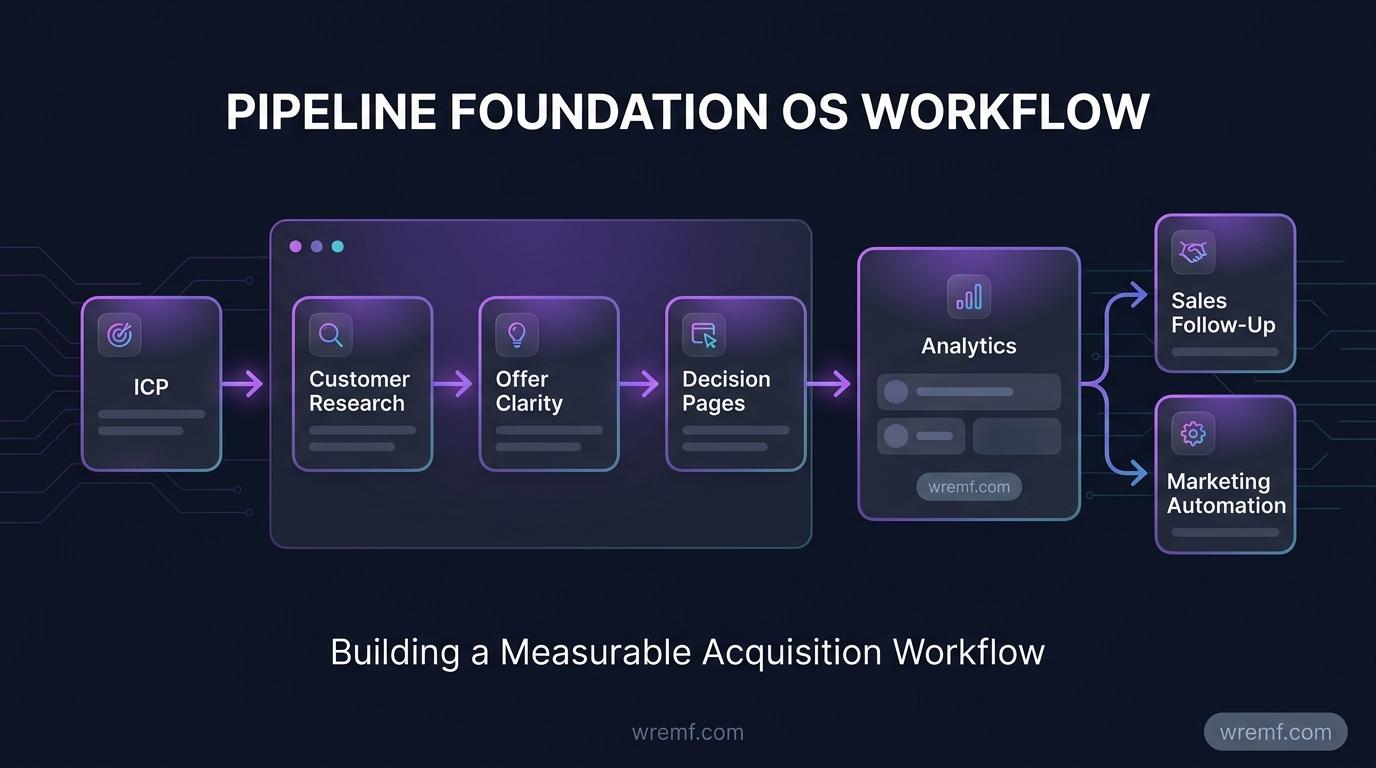
Pipeline Foundation OS is the operating system that connects ICP, Customer research, offer clarity, decision pages, analytics, sales follow-up, and Marketing Automation into one measurable acquisition workflow. Without this foundation, AI Visibility and SEO strategies can create traffic without predictable pipeline.
An operating system is a repeatable set of workflows, rules, assets, data, and reporting modules that guide execution. An operating system matters because pipeline becomes unpredictable when every campaign, page, report, and sales motion is managed separately.
The Pipeline Foundation OS starts with Customer clarity. Amsterdam companies often sell to multiple segments from one website: local buyers, European buyers, English-speaking international buyers, enterprise buyers, startup buyers, agencies, consultants, and technical teams. Each segment asks different questions in Google, ChatGPT, Claude, Gemini, and Perplexity.
The foundation should include six assets.
| Asset | Purpose | Example |
|---|---|---|
| ICP map | Defines the buyers that matter | B2B SaaS founders, growth leaders, SEO teams, agencies |
| Prompt map | Shows how buyers ask AI systems | “Best AI SEO agency Amsterdam” or “GEO agency for B2B SaaS” |
| Search map | Connects Google demand to content | Category pages, comparison pages, decision pages |
| Proof modules | Builds trust through evidence | Reports, methodology, case patterns, quantified benchmarks |
| Conversion system | Turns demand into action | Forms, booking flows, qualified meeting definitions |
| Attribution layer | Connects visibility to outcomes | AI traffic, organic traffic, qualified meetings, pipeline influence |
Decision pages are pages that help buyers evaluate fit, process, pricing, proof, alternatives, and next steps. Decision pages matter because buyers and AI systems both need clear information when comparing providers.
In practical AI visibility audits, teams frequently find that blog traffic is not the main issue. The bigger problem is missing decision-stage content. The site may have Content Marketing articles but lack comparison pages, service pages, use-case pages, pricing explanations, or proof modules. AI systems may mention competitors because competitors have clearer category pages and stronger third-party references.
WREMF helps teams build this foundation through prompt maps, citation reports, content recommendations, and agency execution. WREMF’s GEO audit feature is designed to identify gaps in prompts, citations, source consistency, competitor visibility, and content readiness. Teams that need managed implementation can work with the WREMF AI visibility agency for strategy, content systems, technical foundations, and ongoing optimization.
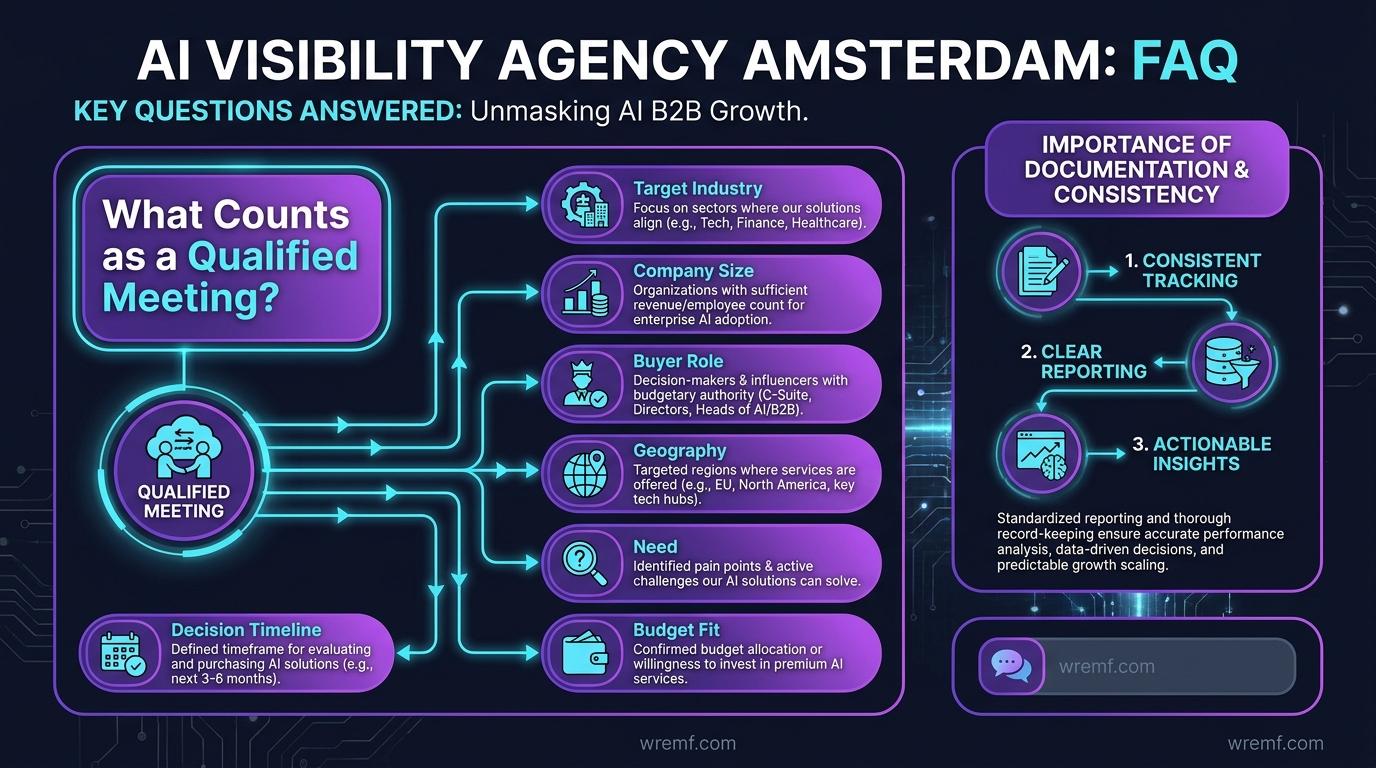
The Pipeline Foundation OS should also include qualified meeting definitions when pipeline impact is measured. A qualified meeting might depend on company size, role, geography, budget fit, need, timeline, and sales acceptance. This definition should be documented before launch. Otherwise, Marketing and Sales may disagree on what the system is supposed to produce.
For teams that already have a sales team, AI Visibility should support sales rather than replace it. Search and AI discovery create awareness and preference before a call. Sales turns that interest into conversation, qualification, and deal progression. Marketing Automation helps connect the two through routing, nurture, scoring, and reporting.
WREMF’s guide to AI search engine optimization services for B2B brands explains how service-led execution differs from pure tool adoption. WREMF’s guide to AI SEO services provides additional context for teams comparing managed support.
KEY TAKEAWAY: Pipeline Foundation OS turns AI Visibility from a reporting metric into a governed acquisition workflow with ICP clarity, prompt maps, decision pages, proof, attribution, and sales alignment.
The next section explains how ranking SEO and LLM visibility work together rather than competing for attention.
Engine 2: Ranking SEO + LLM Visibility
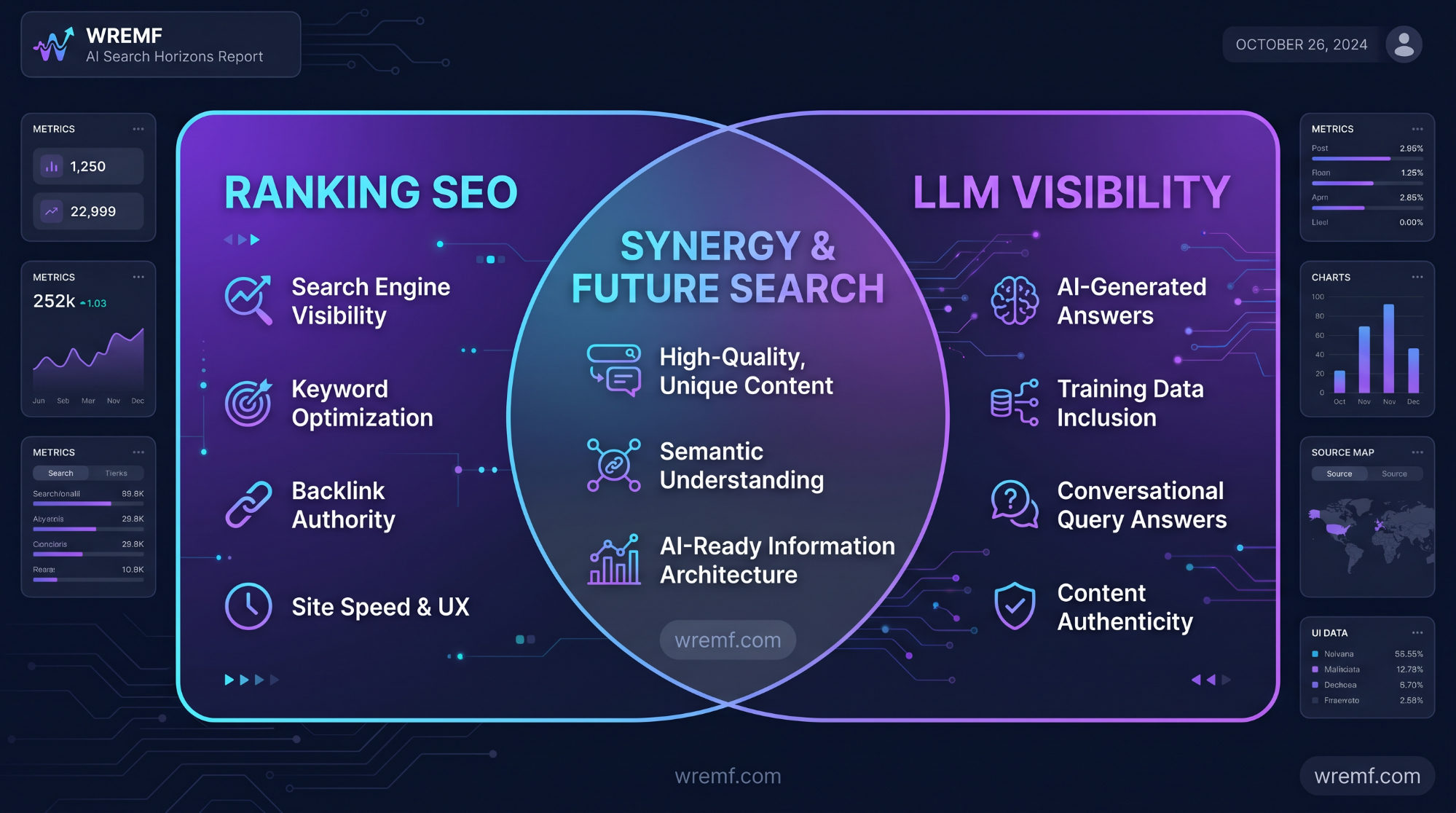
Ranking SEO and LLM visibility work best when they are treated as connected engines. Traditional SEO helps pages earn visibility in search engines, while LLM visibility helps brands appear in AI-generated answers, AI citation sets, summaries, and recommendations.
LLM visibility is the measurable presence of a brand inside answers generated by Large Language Models. LLM visibility matters because buyers can ask AI assistants for vendor recommendations, category explanations, comparison lists, pricing context, and implementation advice without visiting a traditional search results page first.
The key difference between SEO and GEO is the output. SEO focuses on search engine ranking, organic clicks, technical crawlability, and traffic. GEO focuses on inclusion, summarization, citations, and recommendations inside generative engines. AEO focuses on answer clarity, direct response quality, and structured extraction.
| Discipline | Best For | What It Measures | What It Misses | Typical User | Main Limitation |
|---|---|---|---|---|---|
| SEO | Google visibility and organic traffic | Rankings, impressions, clicks, backlinks | AI mentions, AI citations, LLM summaries | SEO teams and growth teams | Can miss AI-generated discovery |
| AEO | Direct answers and answer extraction | Answer clarity, featured snippets, structured responses | Broader source ecosystem and AI share of voice | Content teams and UX teams | Can become narrow if separated from authority |
| GEO | Generative engines and AI recommendations | AI citations, brand mentions, prompt visibility, recommendation visibility | Classic ranking diagnostics if isolated | AI visibility teams and agencies | Requires multi-engine monitoring |
| LLM SEO | Large Language Models and AI assistants | ChatGPT mentions, Claude summaries, Perplexity citations, Gemini answers | Technical ranking issues if not paired with SEO | AI search teams and B2B marketers | Still evolving across platforms |
Google’s structured data documentation explains that structured data helps Google understand page content, but eligibility for search features is not guaranteed. (Google for Developers) This is a useful principle for AI visibility too. Schema, Structured data, and technical SEO help with clarity, but they do not replace helpful content, authority, source consistency, and entity reinforcement.
AI systems need retrievable structure. Clear headings, answer-first definitions, concise paragraphs, comparison tables, evidence-based claims, and consistent terminology help AI assistants understand what the page is about. The goal is not keyword stuffing. The goal is to make your expertise easier to parse, trust, and cite.
AI Search Optimization should include:
Ranking pages for Google search engines.
Answer-first blocks for AI assistants and answer engines.
GEO-ready content for generative engines.
Schema and Structured data where relevant.
Internal linking between pillars, clusters, decision pages, and proof modules.
AI citation tracking across ChatGPT, Claude, Gemini, Perplexity, AI Overviews, and Copilot.
Competitor visibility analysis.
AI traffic attribution and pipeline reporting.
AI citations matter because AI systems often use cited or source-backed information to support answers. AI citations also help buyers move from an answer to a source, which can create discovery, trust, and traffic.
WREMF supports this through prompt intelligence, citation analysis, competitor visibility, and reporting. Teams focused on Google AI search can read WREMF’s guide to AI Overview optimization. Teams focused on AEO can read WREMF’s guide to answer engine optimization. Teams focused on GEO can read WREMF’s guide to generative AI optimization services.
For technical teams, this engine also includes RAG systems, OpenAI API workflows, Azure OpenAI implementations, vector databases, and internal knowledge systems. RAG, or Retrieval-Augmented Generation, is a method that connects generative AI to external information sources before generating an answer. RAG matters because enterprise AI systems often depend on source quality, retrieval structure, and content consistency.
TIP: Treat your strongest Google ranking pages as source assets for AI systems, not only as traffic pages.
KEY TAKEAWAY: Ranking SEO and LLM visibility work together when pages are built for search demand, answer extraction, AI citation, source consistency, and measurable business impact.
The next section applies the operating-system logic to hospitality and category visibility.
Pipeline unpredictability in hospitality starts with weak category visibility. Toucan Insights installed a governed content and SEO system, aligned to how guests search for accommodation at scale. Within a year, organic traffic exceeded 410,000 monthly visitors, a 100% increase, turning search into a predictable acquisition channel.
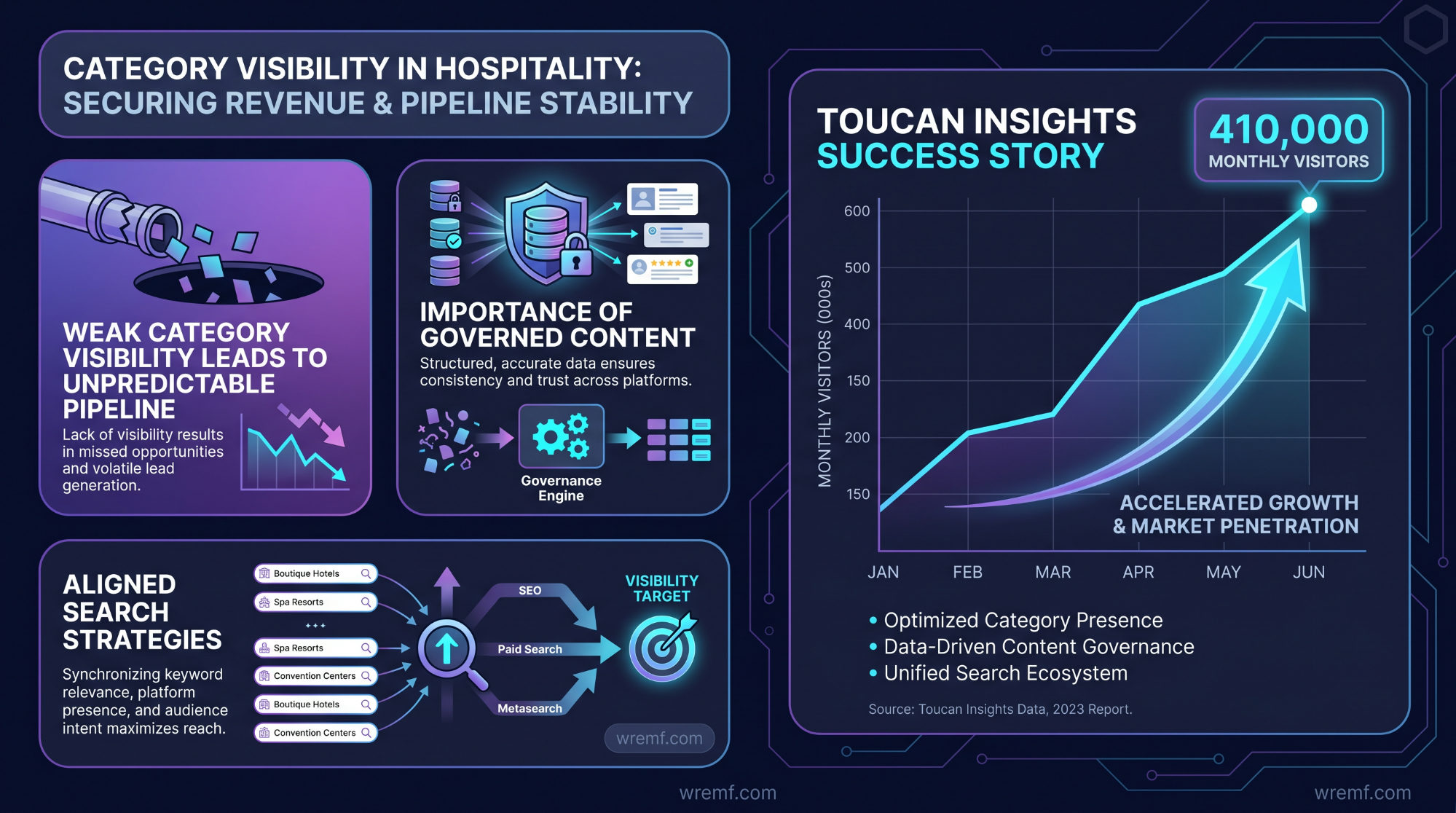
Pipeline unpredictability in hospitality often starts when category visibility is weak across search engines, AI systems, review platforms, and destination content. The lesson for an AI visibility agency Amsterdam strategy is that growth requires governed category visibility, not random publishing.
Hospitality buyers search with high variation. A user may search Google for accommodation by city, ask ChatGPT for boutique hotels, compare neighborhoods in Perplexity, review AI Overviews, and validate options through third-party platforms. This means hospitality visibility depends on local intent pages, category pages, review signals, structured data, source consistency, and content that answers practical decision questions.
The brief’s competitor research includes a hospitality benchmark where a governed content and SEO system reportedly helped organic traffic exceed 410,000 monthly visitors within a year, representing a 100 percent increase. This should be treated as a case pattern from the research brief, not a guaranteed outcome. The transferable lesson is that category visibility becomes more predictable when content, SEO governance, and Customer behavior are aligned.
For Amsterdam hospitality, travel, Food & Beverage, and experience brands, the principle is clear. Weak category visibility limits discovery before buyers compare options. Strong category visibility makes the brand easier to find, understand, and cite across Google, AI Overviews, ChatGPT, Perplexity, and other generative AI platforms.
A governed hospitality system should include:
Category pages aligned to how guests search.
Location pages that answer practical intent.
Comparison content that explains fit by audience.
Structured data for business and local details where relevant.
Internal linking between destination, category, and proof pages.
Source consistency across third-party listings and review surfaces.
AI prompt monitoring for accommodation, neighborhood, and experience queries.
Source consistency helps AI systems connect the same brand, location, offer, and category across multiple sources. Source consistency matters because inconsistent business descriptions, outdated listings, or conflicting third-party pages can weaken AI confidence.
In practical audits, hospitality brands often find that third-party sources dominate citations. Travel platforms, city guides, review sites, local publications, and directories can influence what AI systems summarize. A brand’s own site must therefore be accurate, structured, and reinforced by credible off-site references.
This is where WREMF’s software plus agency model becomes useful. The software tracks AI mentions, source citations, competitors, and share of voice. The agency helps prioritize category pages, structured rewrites, technical foundations, entity reinforcement, and source consistency. For brands that need AI-ready production, WREMF’s content briefs feature helps translate prompt gaps into practical content briefs.
AI visibility is both a measurement problem and a source ecosystem problem. AI visibility is a measurement problem because teams need to track prompts, engines, citations, and competitors. AI visibility is a source ecosystem problem because AI answers depend on owned pages, third-party mentions, structured content, and entity consistency.
KEY TAKEAWAY: Hospitality pipeline becomes more predictable when category visibility is governed across search, AI answers, citations, local intent, and proof sources.
The next section explains how the same system applies when Ecommerce and retail growth slows.
When retail slowed, Neon Buddha needed a system, not more activity. Toucan Insights restructured their digital presence through customer research, SEO governance, and eCommerce optimization. Within six months, website traffic grew by 100%, and eCommerce became a primary revenue channel across the U.S. and Canada.
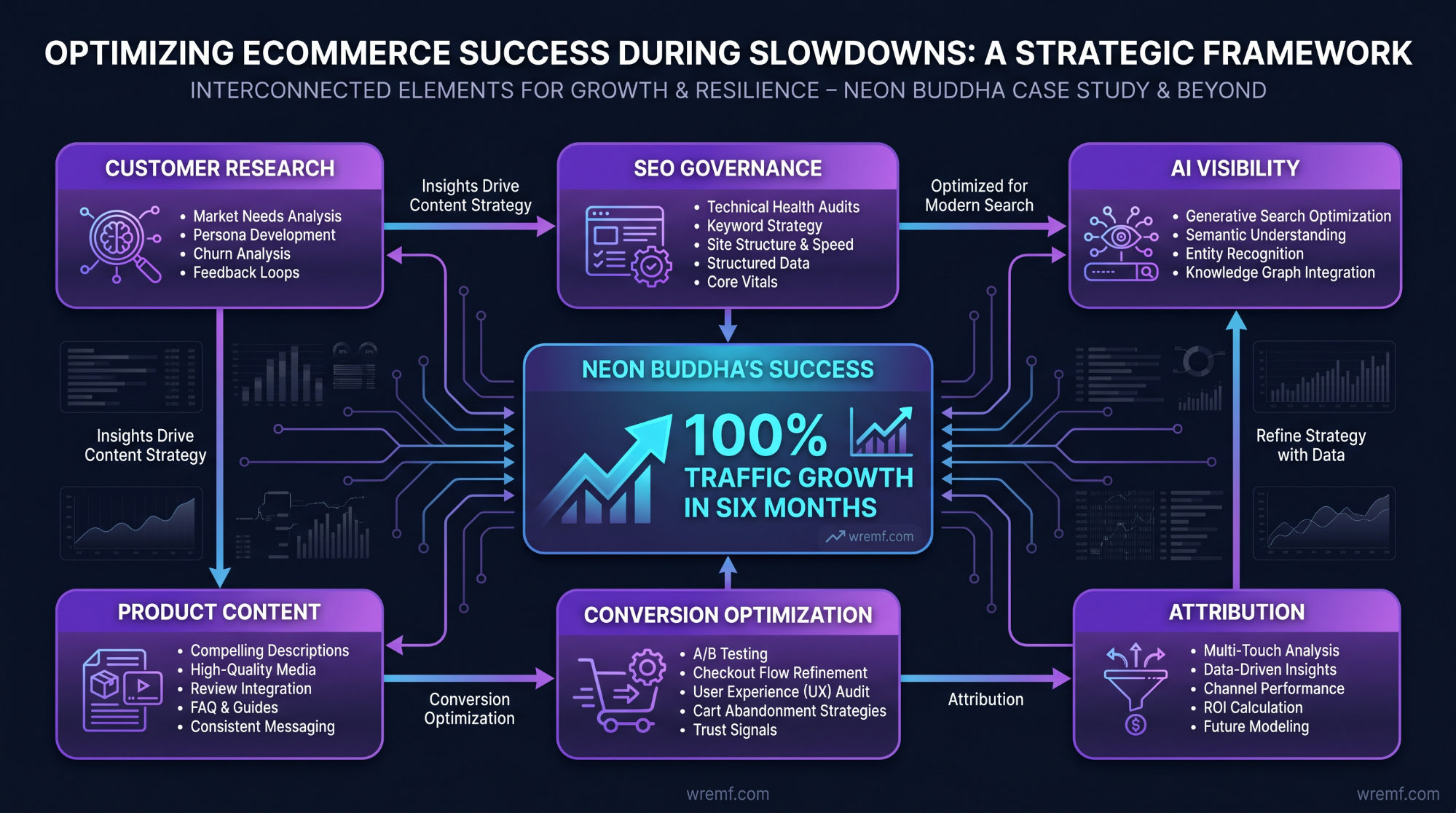
Retail slowdowns are often system problems, not only campaign problems. Ecommerce brands need Customer research, SEO governance, AI Visibility, product content, conversion optimization, and attribution to work together.
Ecommerce brands face a different AI search challenge from B2B Services brands. Buyers ask AI assistants for product comparisons, brand recommendations, sizing advice, alternatives, gift ideas, store trust signals, and reviews. Search engines still drive demand, but AI systems increasingly influence which brands buyers consider before landing on product pages.
The brief’s competitor research includes a retail benchmark where Customer research, SEO governance, and Ecommerce optimization reportedly helped website traffic grow by 100 percent within six months. This should be treated as a case pattern, not a guaranteed result. The transferable lesson is that more activity is not the same as better governance.
Customer research matters because Ecommerce content must match how buyers describe products, objections, materials, use cases, shipping concerns, return concerns, and trust signals. Traditional SEO might target collection keywords. AI Search Optimization also needs answer-ready descriptions, comparison logic, structured product details, brand reputation signals, and source consistency.
An Ecommerce AI visibility system should include:
Category architecture based on Customer demand.
Product and collection content that answers decision criteria.
Structured data for products, reviews, pricing, and availability where applicable.
Internal linking between educational, category, and product pages.
AI prompt monitoring for product alternatives and category recommendations.
Brand Authority signals across owned and third-party sources.
Attribution that connects AI-influenced discovery to Ecommerce behavior.
Brand recommendation visibility measures whether AI systems suggest your brand when buyers ask for options. Brand recommendation visibility matters because AI-generated shortlists can influence buyer confidence before the buyer visits your store.
For Amsterdam Ecommerce companies, competition is not limited to local stores. Fashion & Retail, FMCG, Food & Beverage, specialty consumer brands, and B2B Ecommerce companies compete inside Google, AI Overviews, ChatGPT, Perplexity, marketplaces, social media, and review ecosystems. Social Media Marketing and campaigns can create demand, but the website still needs AI-ready content and source-backed authority.
This is where Branding, Content Marketing, and AI Marketing intersect. Branding creates recognition. Content Marketing explains the product and category. AI Visibility makes the brand easier to retrieve in AI answers. Schema and Structured data clarify product details for search engines. Source consistency reinforces trust across third-party references.
WREMF helps retail and Ecommerce teams monitor how AI systems describe their brand, whether competitors appear more often, which sources are cited, and where new content briefs should be created. WREMF’s guide to best answer engine optimization for enhancing AI visibility explains how answer-first content can support AI discovery. WREMF’s guide to AI brand monitoring explains how brands can track reputation, mentions, and visibility across AI systems.
For teams running WordPress, WooCommerce, Shopify, or custom Ecommerce stacks, the technical layer should include page speed, crawl clarity, product schema, canonical logic, internal linking, and structured category copy. WP SEO AI tools may help create drafts or metadata, but the final system still needs human review, Customer insight, and proof.
KEY TAKEAWAY: Ecommerce growth becomes more resilient when Customer research, SEO governance, AI Visibility, product content, source consistency, and conversion tracking operate as one system.
The next section explains how regulated and multi-market B2B companies need even stronger governance.
Scaling a B2B pipeline across regulated markets requires structural discipline, not intuition. Toucan Insights built a governed digital expansion strategy for WA Technology across Europe, Latin America, and Africa — analyzing buyer behavior and defining category authority by market. Following implementation, player acquisition grew by over 200%.
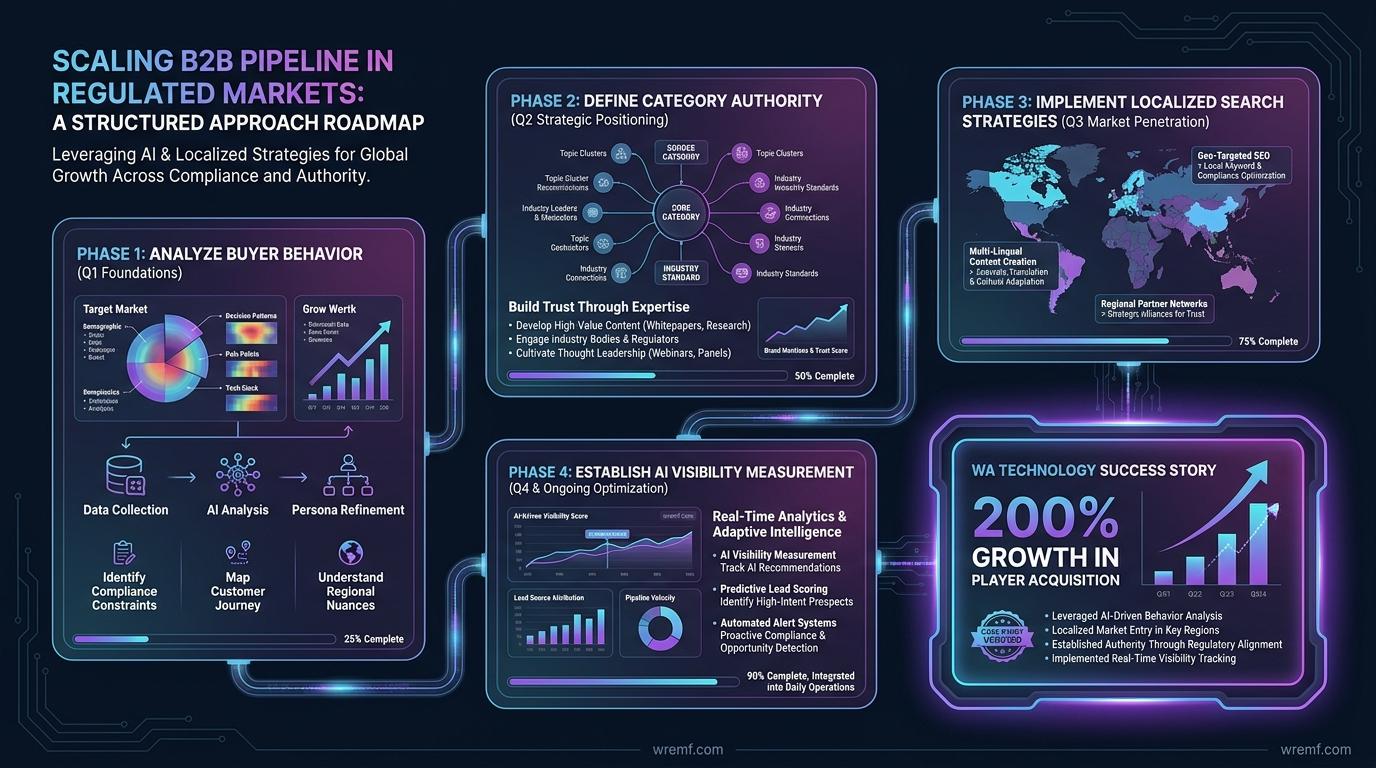
Scaling B2B pipeline across regulated markets requires structured category authority, localized search strategy, and disciplined AI visibility measurement. In regulated or multi-market environments, intuition is risky because buyer behavior, compliance language, and source trust vary by market.
The brief’s competitor research includes a multi-market benchmark where a governed digital expansion strategy reportedly helped player acquisition grow by over 200 percent after implementation. This should be treated as a case pattern from the brief, not a guaranteed outcome. The transferable principle is structural discipline across markets, prompts, sources, and authority.
For Amsterdam companies expanding across Europe, Latin America, Africa, North America, or global B2B markets, this is especially relevant. Amsterdam is often a base for B2B SaaS, fintech, logistics, Gaming, Ecommerce, AI Marketing, creative technology, and consulting companies that sell beyond the Netherlands. A single English website may not be enough to win visibility in every market.
A governed expansion strategy should define:
Which regions matter first.
Which Google rankings support demand by market.
Which AI systems are most relevant to buyers.
Which prompts differ by geography, language, industry, and buying stage.
Which source citations appear in ChatGPT, Claude, Gemini, Perplexity, Copilot, and AI Overviews.
Which decision pages are needed by market, industry, and use case.
Which compliance, trust, and Brand Reputations signals must be reinforced.
Entity authority is the degree to which a brand is consistently understood as credible for a specific category, market, or problem. Entity authority matters because search engines and AI systems need consistent signals to connect your brand with the right recommendations.
Large Language Models summarize patterns from available sources. If the web describes your company inconsistently across regions, AI systems may misunderstand your category, market fit, or authority. If different pages use different terms for the same offer, the brand may lose clarity. If third-party sources are outdated, AI systems may repeat outdated positioning.
In regulated markets, content must be careful. Claims need evidence. Pricing and performance claims need context. Guarantees need limits. Compliance language should be reviewed. AI systems can summarize vague or outdated content in ways that create buyer confusion.
WREMF’s agency workflow helps structure this work across five steps: Audit, Strategy, Build, Amplify, and Measure. Audit covers AI visibility assessment, competitor citation analysis, technical review, prompt landscape analysis, and entity authority evaluation. Strategy defines high-value prompt targeting, buying-stage visibility, content prioritization, and authority planning. Build improves content, technical implementation, internal linking, and structured formatting. Amplify strengthens third-party visibility and source consistency. Measure tracks share of voice, citations, traffic attribution, and pipeline impact.
For technical teams, WREMF also supports API, MCP, and advanced reporting workflows through the WREMF API. This helps agencies, consultants, and in-house teams connect AI visibility data to dashboards, client portals, internal analytics, and Marketing Automation workflows.
For teams that need deeper LLM strategy, WREMF’s guide to large language model optimization services explains how LLMO, RAG, AEO, GEO, and AI search visibility connect. Teams comparing agency partners can also review WREMF’s guide to choosing an LLM SEO agency.
KEY TAKEAWAY: Multi-market B2B growth needs governed AI visibility, category authority, source consistency, localized prompts, and market-specific measurement instead of intuition-led expansion.
The next section helps you choose the right operating system for your team.
Choose Your Operating System
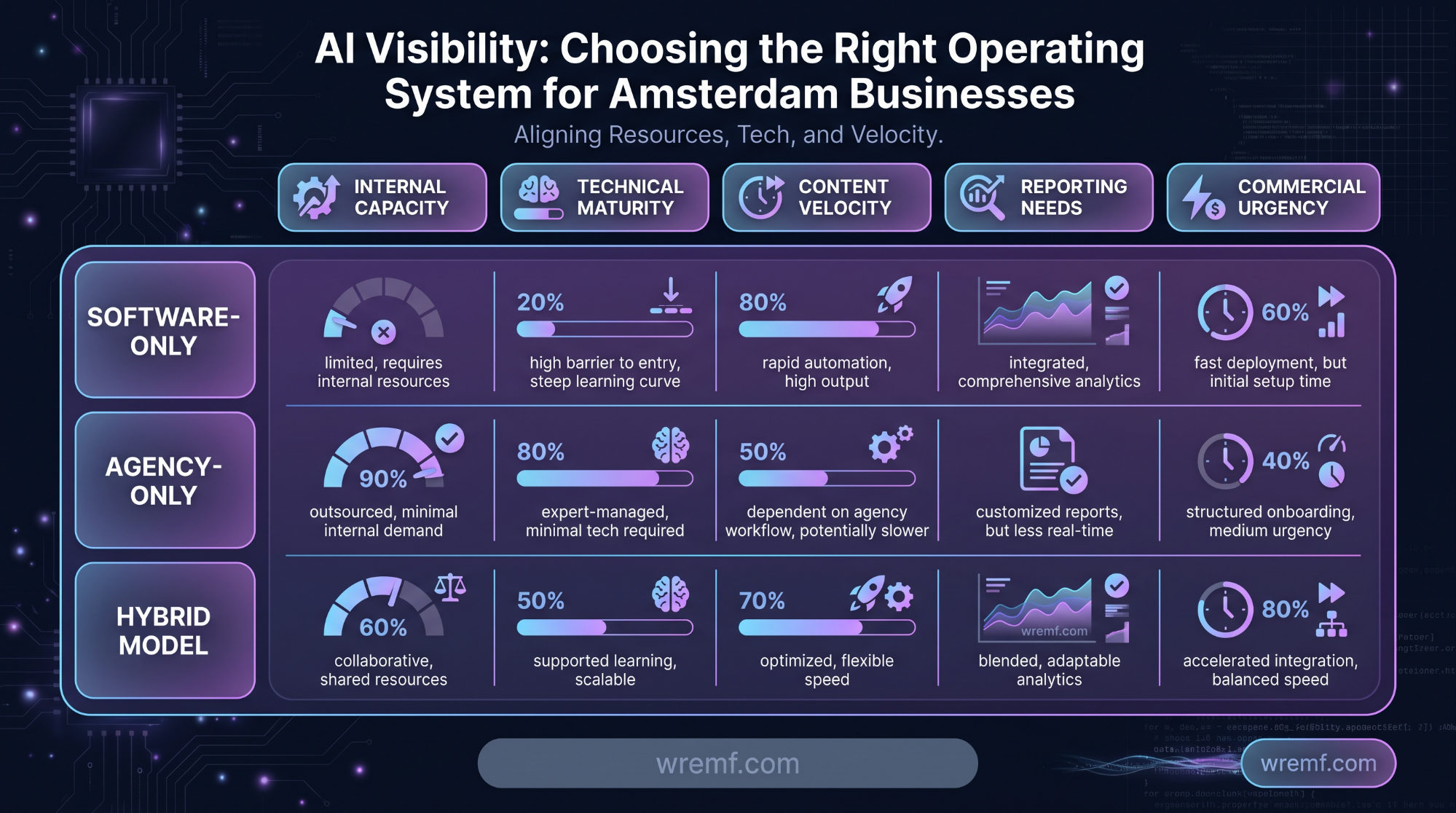
The right operating system depends on whether your team needs software, agency execution, or a hybrid model. Most Amsterdam businesses should choose based on internal capacity, technical maturity, content velocity, reporting needs, and commercial urgency.
Software-only AI visibility platforms are best for teams with strong internal execution resources. Managed AI visibility agencies are best for teams that need strategy, implementation, and ongoing optimization support. Hybrid software plus agency models combine visibility tracking, strategic guidance, execution support, reporting, and attribution into one system.
| Option | Best For | What It Includes | What It Misses | Recommended When | Reporting Value |
|---|---|---|---|---|---|
| Software-only | Teams with in-house SEO, content, and analytics capacity | Prompt tracking, citation monitoring, dashboards, competitor visibility | Hands-on implementation and strategic prioritization | You can execute quickly internally | Strong for visibility measurement |
| Agency-only | Teams needing senior strategy and execution | Audits, strategy, content, technical guidance, optimization, reporting | May lack always-on product access if no platform is included | You need expert execution and practical implementation | Strong when reporting is tied to deliverables |
| Hybrid software plus agency | Teams needing measurement, execution, and leadership reporting | Platform data, managed AEO, GEO, content, source analysis, attribution | Requires coordination between client and agency | You want one system for tracking, improving, and proving AI Visibility | Strongest for ongoing governance |
For most B2B SaaS companies, growth-stage brands, and agencies, the hybrid model is the most practical. It gives internal teams visibility data while providing outside expertise for strategy, technical implementation, AI-ready content systems, and authority development. This is especially useful when the team is already stretched across SEO, Content Marketing, campaigns, sales enablement, and Marketing Automation.
A simple decision framework works well:
Choose software-only if your team can interpret the data and ship improvements.
Choose agency support if your team needs senior-led AI visibility consulting and execution.
Choose hybrid if your team needs measurement, strategy, execution, reporting, and attribution in one system.
WREMF fits all three models. Brands can use WREMF as software for prompt tracking, source citations, competitor visibility, AI share of voice, AI traffic attribution, and scheduled monitoring. Teams can work with WREMF as an AI visibility agency for AEO strategy, GEO execution, AI citation optimization, technical foundations, source consistency, and content systems. Agencies can use WREMF for white-label reporting, client portals, BYOK support, and multi-client workflows through WREMF for agencies.
Pricing should also match your operating model. WREMF pricing starts with Starter at €39 per month for one website, unlimited prompt tracking, BYOK, 10 AI engines, all features and tools, white-label reports, one seat, and email support. Growth is €89 per month for five websites, unlimited prompt tracking, BYOK, 10 AI engines, white-label reports, priority email support with 24-hour SLA, content brief generator, and SEO A/B testing. Enterprise is custom for unlimited websites, unlimited prompt tracking, unlimited seats, dedicated support with 4-hour SLA, and custom branded portals. Current plan details are available on WREMF pricing.
If you are comparing service providers, review WREMF’s guide to choosing an AI SEO agency, WREMF’s guide to LLM SEO services, and WREMF’s guide to answer engine optimization services.
For in-house brands, the best operating system is one that improves visibility without creating dependency. WREMF’s solution for in-house brands supports teams that want to measure AI search performance, prioritize content, monitor competitors, and prove progress to leadership.
KEY TAKEAWAY: Choose software for measurement, agency for execution, and hybrid for governed AI visibility growth across strategy, implementation, reporting, and attribution.
The next section debunks common myths that cause teams to underinvest, overpromise, or measure the wrong things.
Common Myths About AI Visibility Debunked
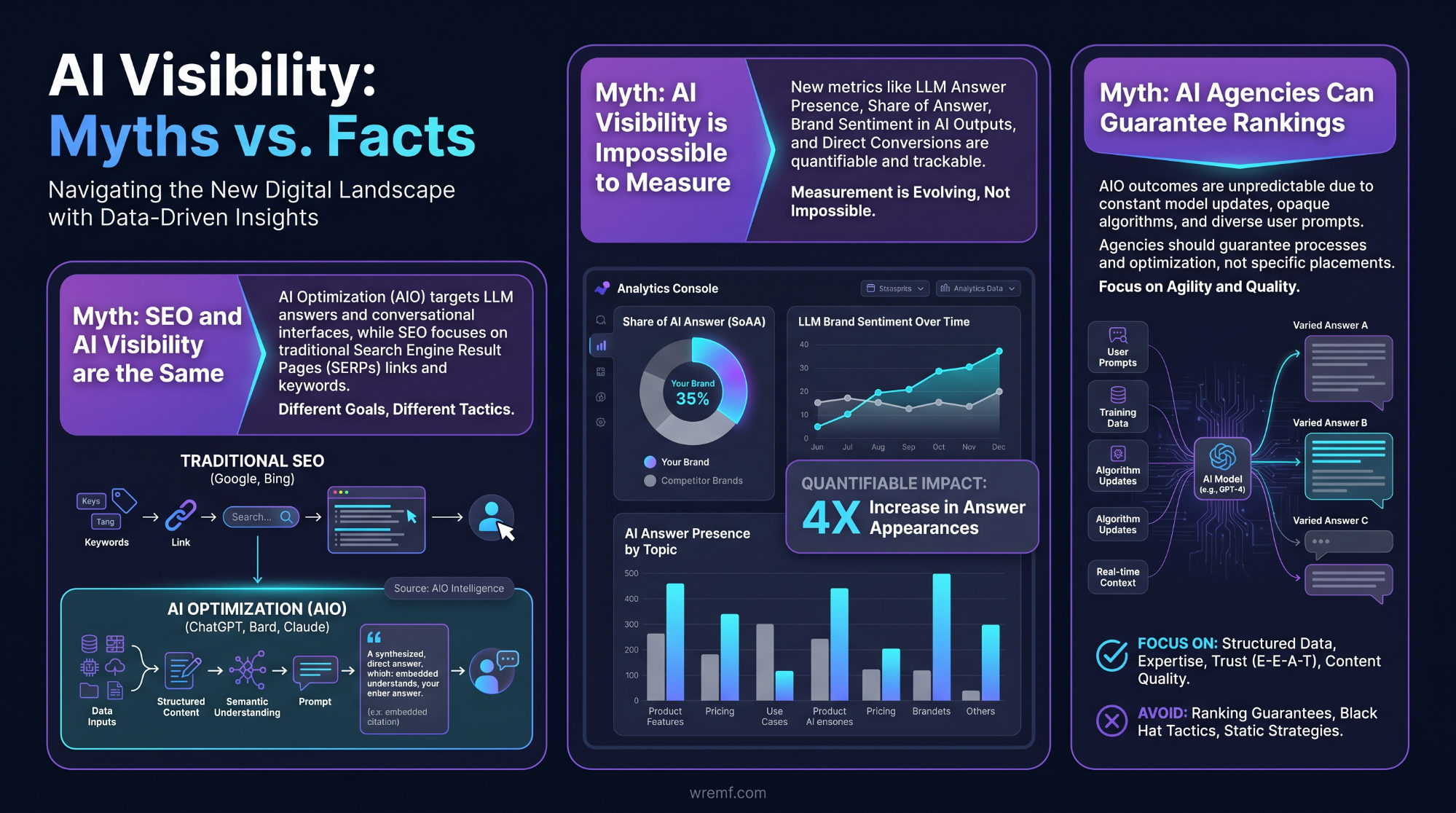
AI Visibility is often misunderstood because it overlaps with SEO, AEO, GEO, PR, Branding, Digital Marketing, and analytics. The clearest way to avoid bad decisions is to separate what AI visibility can measure from what no agency can control.
MYTH: SEO, AEO, and GEO are the same thing.
FACT: SEO focuses on search engine visibility, ranking, crawlability, and organic traffic. AEO focuses on answer extraction and direct response quality. GEO focuses on visibility, citations, summaries, and recommendations inside generative engines and LLMs. These disciplines overlap, but they measure different outputs.
MYTH: AI visibility is impossible to measure.
FACT: AI Visibility is not perfectly deterministic, but it is measurable through prompt tracking, brand mentions, citation tracking, source analysis, competitor visibility, AI share of voice, and attribution. The measurement must account for engine differences, prompt wording, location, personalization, and time. WREMF turns these signals into repeatable monitoring workflows.
MYTH: Google rankings are enough.
FACT: Google rankings still matter, but rankings alone do not show whether ChatGPT, Claude, Gemini, Perplexity, Copilot, or AI Overviews mention, cite, or recommend your brand. Buyers may use AI assistants before they search Google or after they find your site. AI search visibility adds a new measurement layer to traditional SEO.
MYTH: AI Search Optimization is just content generation.
FACT: Content creation is only one part of AI Search Optimization. The full system includes entity clarity, source consistency, technical foundations, schema, internal linking, third-party citations, prompt monitoring, and reporting. Generic AI-generated content can weaken quality if it does not add evidence, structure, or expertise.
MYTH: An AI visibility agency can guarantee AI citations.
FACT: No agency controls Google, OpenAI, Anthropic, Microsoft, Perplexity, Meta AI, Mistral, DeepSeek, or Grok. A serious AI visibility agency can improve the inputs that make citations more likely, such as content clarity, source accessibility, authority signals, and consistency. The promise should be disciplined execution, not guaranteed platform behavior.
MYTH: AI visibility only matters for technology companies.
FACT: AI Visibility matters anywhere buyers use AI assistants to compare options, understand categories, or validate decisions. Amsterdam Ecommerce, hospitality, B2B Services, Gaming, Food & Beverage, FMCG, Fashion & Retail, UX Design, and professional services companies can all be affected by AI-generated recommendations.
KEY TAKEAWAY: AI Visibility is measurable and improvable, but it requires the right distinction between rankings, answers, citations, recommendations, and business outcomes.
The conclusion connects the operating model back to the practical next step for Amsterdam businesses.
Conclusion
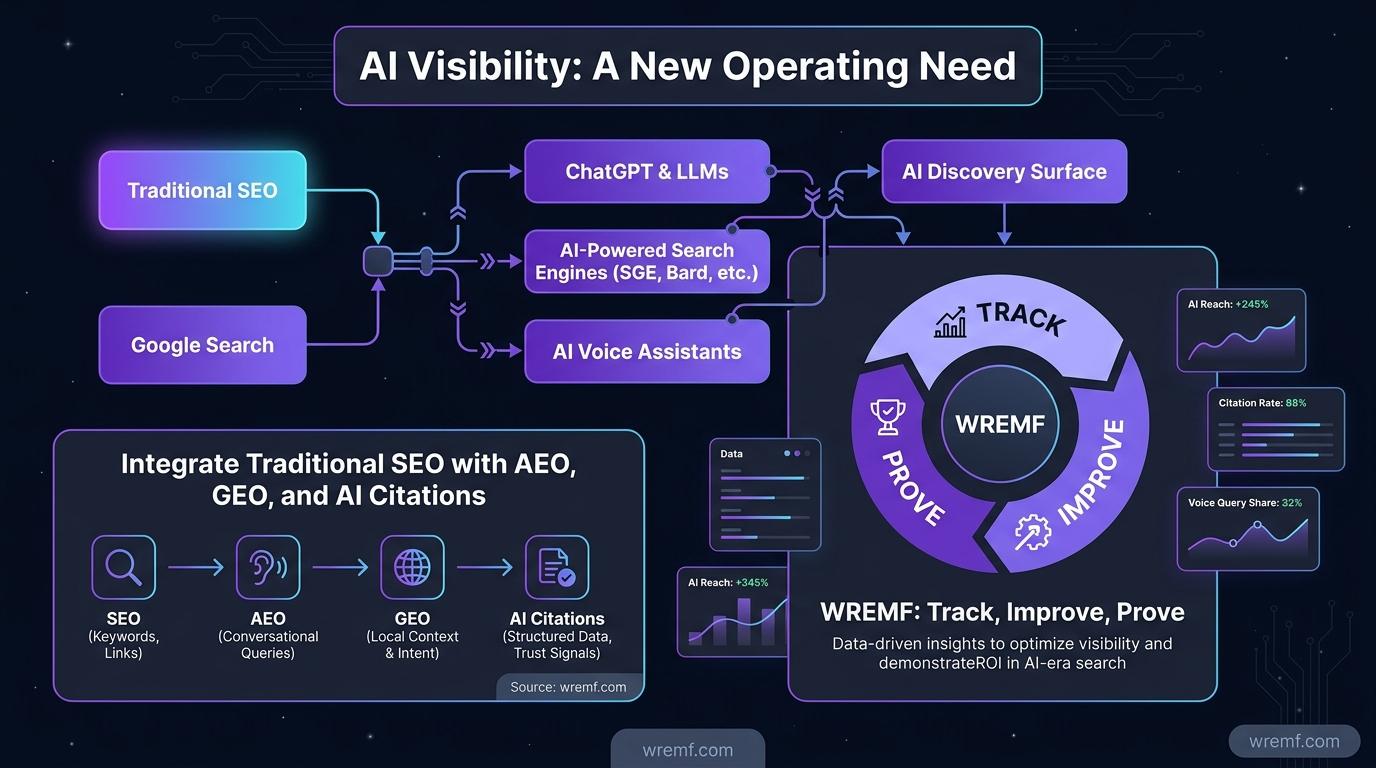
AI visibility agency Amsterdam is no longer just a local agency search term. It describes a new operating need for B2B companies that want pipeline from Google, ChatGPT, Claude, Gemini, Perplexity, AI Overviews, Copilot, and other AI discovery surfaces. Traditional SEO still matters, but it must now work with AEO, GEO, AI citation optimization, source consistency, prompt tracking, and attribution. WREMF helps teams track, improve, and prove AI Visibility through software, agency execution, or a hybrid model. To turn AI search from a guessing game into a measurable workflow, explore the WREMF platform suite or talk to the WREMF agency team.
Frequently Asked Questions About AI Visibility Agency Amsterdam
What counts as a qualified meeting?
A qualified meeting is a scheduled conversation that matches the eligibility criteria agreed before launch. For an AI visibility agency Amsterdam campaign, those criteria may include target industry, company size, buyer role, geography, need, budget fit, and decision timeline. A 30-minute meeting only counts if the prospect matches the signed definition, not just because the meeting happened. The terms should be documented in writing, reviewed before campaigns begin, and reported consistently each month. This protects both the client and the agency from vague pipeline claims.
Do you guarantee revenue or closed deals?
No responsible AI visibility agency should guarantee revenue or closed deals because sales outcomes depend on product fit, offer quality, pricing, conversion rate, sales follow-up, and market timing. An agency can define measurable inputs and outputs, such as AI Visibility, AI citation growth, ranking improvements, qualified meetings, source citations, content delivery, and reporting cadence. WREMF focuses on measurable AI search visibility, prompt tracking, competitor visibility, and attribution signals, but it does not claim guaranteed revenue, guaranteed rankings, guaranteed citations, or guaranteed AI recommendations.
What happens after we start with an AI visibility agency?
After you start, the agency should establish a baseline, audit your current AI Visibility, analyze competitors, review your website, map priority prompts, and identify citation gaps. The first phase usually includes prompt landscape analysis across ChatGPT, Claude, Gemini, Perplexity, Google AI Overviews, and other AI systems. The next phase turns findings into SEO strategies, AI-ready content, schema guidance, internal linking, decision pages, and authority-building work. WREMF follows a structured AI visibility methodology that connects prompts, citations, competitors, source consistency, and attribution into one repeatable workflow.
What do you need from us for the system to work?
An AI visibility system needs clear inputs from the client, including target Customer profiles, priority services, markets, competitors, sales definitions, website access, analytics access, and approval workflows. The agency also needs accurate information about positioning, case studies, proof modules, Ecommerce data, B2B Services, and existing campaigns. If technical implementation is required, access to WordPress, schema settings, Google Search Console, analytics, or CMS workflows may be needed. Without timely feedback and implementation support, even strong AI Search Optimization recommendations can remain theoretical rather than operational.
Who is this not for?
AI visibility agency support is not for businesses that expect instant ranking, guaranteed revenue, or automatic ChatGPT recommendations without improving content, authority, and technical foundations. It is also not ideal for companies with no defined offer, no target audience, no sales process, or no willingness to implement recommendations. AI visibility works best when a business treats search engines, LLMs, AI systems, Content Strategy, Branding, and pipeline as connected parts of one operating system. If a team only wants one-off content creation, a managed AI visibility program may be too advanced.
What if we already have a sales team?
If you already have a sales team, AI visibility should support sales by improving discoverability, buyer education, and trust before prospects enter the pipeline. Sales teams benefit when AI systems accurately mention the brand, explain its expertise, and cite credible sources during buyer research. AI visibility can also help create stronger decision pages, comparison pages, proof modules, and category authority signals. WREMF helps connect sales and marketing by tracking prompt visibility, competitor presence, AI citations, source consistency, and AI share of voice across major AI discovery surfaces.
How do I choose an AI marketing agency in Amsterdam?
Choose an AI marketing agency in Amsterdam by checking whether it can measure AI Visibility, improve citations, strengthen SEO fundamentals, and connect visibility to pipeline outcomes. A strong agency should understand Google, ChatGPT, Perplexity, Claude, AI Overviews, schema, internal linking, Content Marketing, Brand Authority, and buyer-intent workflows. Avoid agencies that only promise campaigns, ranking, or Social Media Marketing without explaining how they track AI answers. WREMF offers AI visibility agency services for teams that need strategy, execution, reporting, and AI search visibility services.
How can I measure my current LLM visibility in Amsterdam?
You can measure your current LLM visibility in Amsterdam by testing buyer-style prompts across multiple AI systems and recording whether your brand appears, how it is described, and which sources are cited. Start with prompts such as “best AI visibility agency in Amsterdam,” “best [your industry] companies in Amsterdam,” and “top [service] providers in the Netherlands.” Then compare results across ChatGPT, Claude, Gemini, Perplexity, Copilot, and Google AI Overviews. Manual tests are useful, but WREMF’s prompt intelligence platform makes this tracking repeatable.
Should I ask ChatGPT “What are the best companies in my industry in Amsterdam?”
Yes, asking ChatGPT “What are the best companies in my industry in Amsterdam?” is a useful practical test, but it should not be your only visibility measure. Check whether your business appears, whether competitors appear, whether the answer mentions your category authority, and whether your site or third-party sources support the recommendation. Repeat the prompt with variations such as “top,” “recommended,” “trusted,” “agency,” “platform,” and “for B2B companies.” A single answer is a signal, while repeated prompt testing creates a more reliable AI visibility benchmark.
What is AI SEO or AI Search Engine Optimisation?
AI SEO, or AI Search Engine Optimisation, is the practice of improving how a brand appears in AI-generated answers, AI search results, and traditional search engines. It combines traditional SEO, structured content, entity authority, AI citation optimization, and answer-first formatting. Google Search Central explains that AI features in Search depend on website content and site eligibility, so crawlability, helpful content, and technical SEO still matter. (Google for Developers) For Amsterdam businesses, AI SEO helps connect Google ranking, ChatGPT visibility, Perplexity citations, and pipeline-focused content.
What is AIO or Artificial Intelligence Optimisation?
AIO, or Artificial Intelligence Optimisation, is the practice of making your brand, content, website, and source ecosystem easier for AI systems to understand and reference. AIO overlaps with SEO, AEO, GEO, LLM SEO, AI Search Optimization, schema, Content Strategy, and Brand Authority. The goal is not to manipulate AI systems, but to make accurate information about your expertise available in structured, credible, and retrievable formats. For Amsterdam businesses, AIO is especially useful when buyers compare agencies, Ecommerce providers, B2B Services, or specialist consultants through AI assistants.
What is GEO or Generative Engine Optimisation?
GEO, or Generative Engine Optimisation, is the process of improving how a brand appears in generative engines that produce AI answers instead of only listing webpages. GEO focuses on AI citation, source mentions, answer structure, entity clarity, prompt coverage, and content that LLMs can retrieve or summarize. It does not replace traditional SEO because search engines, technical infrastructure, and content authority still matter. WREMF supports GEO through AI visibility audits, prompt mapping, citation analysis, content recommendations, and managed AI search optimization services.
What is LLM SEO or Large Language Model SEO?
LLM SEO is the practice of improving how Large Language Models mention, describe, cite, and recommend a brand. It focuses on systems such as ChatGPT, Claude, Gemini, Perplexity, Copilot, DeepSeek, Grok, Meta AI, and Mistral. OpenAI explains that ChatGPT search can provide timely answers with links to relevant web sources, which connects web visibility with AI answer visibility. (OpenAI) LLM SEO is important because buyers may discover vendors through AI assistants before they ever visit Google or a company website.
What is RAG or Retrieval-Augmented Generation?
RAG, or Retrieval-Augmented Generation, is a method where an AI system retrieves information from external sources before generating an answer. In AI visibility work, RAG matters because AI systems may rely on webpages, documentation, search results, databases, vector databases, and source citations when answering buyer questions. If your brand information is missing, inconsistent, or hard to parse, RAG systems may overlook it or describe competitors more clearly. This is why AI visibility work includes structured content, schema, source consistency, authority building, and citation optimization.
Do younger users blindly trust AI answers?
No FAQ should claim that younger users blindly trust AI answers without reliable evidence. A safer and more accurate point is that many users increasingly rely on AI assistants and search engines for quick answers, but trust varies by user, task, source quality, and perceived risk. For B2B buying, the practical issue is not blind trust. The issue is whether AI systems present your brand accurately when prospects research options. That makes AI Visibility, source consistency, Brand Reputations, AI citations, and clear answer-first content important for Amsterdam businesses.
What does an AI optimisation service or AI SEO service include?
An AI optimisation service usually includes AI visibility audits, prompt landscape mapping, citation analysis, SEO strategies, technical review, schema guidance, AI-ready content briefs, decision pages, internal linking, competitor analysis, and reporting. A complete service should cover both Google ranking signals and LLM visibility signals across ChatGPT, Claude, Perplexity, Gemini, Copilot, and AI Overviews. WREMF combines software and agency execution through prompt monitoring, citation tracking, competitor visibility, content briefs, SEO testing, and managed AEO and GEO support through the WREMF AI visibility suite.
What if we are already running content marketing or SEO?
If you are already running Content Marketing or SEO, AI visibility work should build on that foundation rather than replace it. Existing blog pages, decision pages, comparison pages, WordPress content, schema, internal linking, and campaigns can often be improved for answer-first structure, entity clarity, AI citation potential, and GEO coverage. A common mistake is treating AI visibility as a separate channel with no connection to traditional SEO. The stronger approach is to identify which pages already rank, which pages AI systems cite, and which gaps block category authority.
What can you expect from AI visibility work?
You can expect AI visibility work to improve measurement, content clarity, citation readiness, competitor understanding, and strategic prioritization. You should not expect instant rankings, guaranteed AI citations, or automatic revenue. In practical audits, teams often discover gaps in prompt coverage, weak decision pages, unclear service positioning, missing schema, inconsistent third-party mentions, or competitor dominance in AI answers. WREMF helps turn those findings into a workflow that includes AI visibility tracking, source citation analysis, content briefs, technical recommendations, and reporting for leadership or clients.
Can AI visibility improve conversions from a new and growing channel?
AI visibility can support conversions by helping buyers discover, understand, and trust your brand earlier in their research journey. It does not create conversions on its own. The website, offer, proof, sales process, and Customer experience still matter. The practical goal is more relevant visibility across Google, ChatGPT, Perplexity, Claude, Gemini, and other AI systems, followed by stronger decision pages and clearer calls to action. WREMF helps teams connect visibility signals to traffic attribution, prompt-level reporting, AI share of voice, and pipeline analysis.
Is your brand explicitly mentioned as the expert in an AI answer?
Your brand is explicitly mentioned as the expert in an AI answer only when the AI system names your company and connects it to the service, topic, category, or market being searched. A weak mention simply lists the brand. A stronger mention explains why the brand is relevant, what it does, and which sources support that answer. For an AI visibility agency Amsterdam page, the goal is to be associated with AI Visibility, GEO, AEO, AI SEO, citation optimization, and Amsterdam market expertise. WREMF tracks these patterns through source citation tracking.
Is your site in the footnotes of Bing or Perplexity?
Your site is in AI search footnotes only when the answer engine uses your page as a cited source or supporting reference. This matters because citations can influence trust, verification, referral traffic, and brand authority. Perplexity describes itself as an answer engine that searches the web, identifies trusted sources, and synthesizes information into responses. (Perplexity AI) If competitors are cited and your site is not, the cause may be weak content structure, poor authority signals, missing source clarity, technical accessibility issues, or insufficient third-party validation.
Is traditional SEO different from AI visibility?
Yes, traditional SEO is different from AI visibility, although the two are connected. Traditional SEO focuses on ranking, crawlability, keywords, backlinks, and traffic from search engines. AI visibility focuses on mentions, recommendations, citations, source consistency, prompt coverage, and how AI systems describe your brand. Google says AI Overviews provide snapshots with links for users to explore more on the web, which shows that web content still supports AI search experiences. (Home) The strongest strategy combines traditional SEO, AEO, GEO, structured data, and AI citation optimization.
How long does it take to improve AI visibility?
Improving AI visibility usually takes weeks to months because AI systems rely on content quality, source availability, crawlability, entity clarity, and authority signals. Some improvements, such as clearer answer-first content, internal linking, schema cleanup, and service page restructuring, can be implemented quickly. Broader gains in AI citations, Brand Authority, and recommendation visibility usually take longer because they depend on trusted sources and repeated evidence. WREMF helps teams monitor progress through scheduled AI visibility tracking, AI citation analysis, competitor visibility, and AI share of voice reporting.
What size does a business need to be for AI visibility services?
A business does not need to be large to benefit from AI visibility services, but it should have a clear offer, target market, website, and buyer intent to track. AI visibility is most useful for B2B Services, Ecommerce brands, SaaS teams, agencies, and Amsterdam businesses that depend on search-driven discovery or qualified meetings. Smaller companies may first need positioning and content foundations. Growth-stage and enterprise teams often need a hybrid model because they require workflows, reporting modules, technical implementation, content operations, and ongoing optimization across multiple AI systems.
What is the cost of hiring an AI visibility agency?
The cost of hiring an AI visibility agency depends on scope, number of markets, content volume, technical complexity, reporting needs, and whether you need software, managed execution, or both. WREMF software pricing starts with Starter at €39 per month and Growth at €89 per month, while Enterprise and managed agency support are scoped based on requirements. Buyers should compare more than price. Important factors include prompt coverage, citation tracking, competitor visibility, white-label reporting, BYOK support, SEO testing, content briefs, and execution support. See WREMF pricing for current plan details.
How often should you hire an AI visibility agency?
You should work with an AI visibility agency continuously if AI search, Google ranking, and pipeline visibility are core acquisition channels. A one-time audit can identify prompt gaps, citation gaps, technical issues, content weaknesses, and competitor opportunities. Ongoing support is better when you need implementation, authority building, reporting, and optimization across changing AI systems. For Amsterdam businesses in competitive categories, quarterly strategy reviews plus monthly execution can be practical. The right cadence depends on competition, website maturity, campaigns, content velocity, and how quickly your market changes.
Are you a digital agency?
WREMF is not a general digital agency. WREMF is an AI visibility software platform and senior-led AI visibility agency focused on AI search visibility, AEO, GEO, LLM SEO, prompt monitoring, source citations, competitor visibility, entity authority, and attribution. A traditional Digital Marketing agency may offer Branding, Social Media Marketing, Google Ads, campaigns, UX Design, and broad content creation. WREMF is narrower and more AI-native. It helps B2B brands and agencies track, improve, and prove how they appear across AI discovery surfaces and search engines.
Why partner with an AI visibility agency instead of only using internal resources?
Partner with an AI visibility agency when your internal team lacks time, specialist knowledge, or execution capacity for AI search optimization. Internal teams often understand the brand best, but they may not have repeatable workflows for ChatGPT testing, AI citation analysis, source consistency, prompt intelligence, technical AI visibility, or multi-engine reporting. An agency can install the operating system, prioritize work, and support implementation. WREMF is useful when teams want software for measurement and agency support for AEO strategy, GEO execution, AI-ready content systems, and reporting.
What are GenAI solutions, and how do they help clients?
GenAI solutions are tools, workflows, or applications that use generative AI to create, summarize, retrieve, analyze, or optimize information. In AI visibility work, GenAI solutions may include prompt monitoring, content brief generation, citation analysis, competitor research, reporting modules, RAG workflows, and AI-assisted Content Strategy. These solutions help clients move faster, but they still need human review, factual accuracy, and brand governance. For Amsterdam businesses, GenAI solutions are most useful when connected to search visibility, AI discoverability, pipeline reporting, and Customer behavior rather than isolated content generation.
What is Generative AI, and how can it help my business?
Generative AI is technology that can create or synthesize text, images, code, summaries, and recommendations based on patterns learned from data and retrieved context. For business, generative AI can support content creation, research, customer support, Marketing Automation, reporting, product education, and sales enablement. In AI visibility, its biggest impact is changing how buyers discover and compare companies. If prospects ask ChatGPT, Claude, Gemini, Perplexity, or Copilot for recommendations, your brand needs clear content, credible sources, and consistent authority signals that AI systems can understand.
What types of GenAI solutions do agencies build?
Agencies build GenAI solutions such as AI assistants, content workflows, prompt libraries, RAG systems, automated reporting, customer support bots, research tools, SEO content briefs, and Marketing Automation modules. For AI visibility, the most valuable solutions are tied to discoverability and reporting. These include prompt-level monitoring, AI citation dashboards, competitor visibility analysis, decision-page recommendations, and structured content systems. WREMF focuses on AI visibility workflows rather than generic AI automation, helping teams understand where they appear, why they appear, which sources influence answers, and what to improve next.
Which GenAI technologies and platforms matter for AI visibility?
The most relevant GenAI technologies for AI visibility include ChatGPT, Claude, Gemini, Perplexity, Copilot, DeepSeek, Grok, Meta AI, Mistral, Large Language Models, RAG systems, vector databases, OpenAI, and Azure OpenAI. The platform mix matters because each AI system may retrieve, summarize, cite, and rank information differently. A company may be visible in Google but absent in ChatGPT, or cited in Perplexity but not recommended by Claude. WREMF tracks 10 AI engines so teams can compare visibility across multiple generative AI platforms.
How do you fine-tune or customize large language models?
Large language models can be customized through prompt engineering, retrieval systems, fine-tuning, structured data, knowledge bases, vector databases, and workflow design. For AI visibility, most businesses do not need to fine-tune a model to improve public discoverability. They usually need better content structure, clearer entity signals, stronger source citations, schema, and consistent third-party mentions. Fine-tuning is more relevant for private AI assistants, internal workflows, or product-specific GenAI solutions. Public AI visibility depends more on what AI systems can retrieve and verify about the brand.
Is Generative AI safe and ethical to use commercially?
Generative AI can be safe and ethical commercially when teams use human review, data protection, source verification, clear governance, and transparent workflows. The main risks include inaccurate answers, outdated information, privacy issues, bias, and unsupported claims. For AI visibility work, ethical use means avoiding fake reviews, misleading schema, fake expertise, fabricated statistics, and manipulative content. Google’s structured data guidelines explain that structured data must follow Google Search policies to remain eligible for rich result appearance, which reinforces the need for accurate and compliant implementation. (Google for Developers)
Can GenAI improve productivity in my team?
GenAI can improve productivity when it supports repeatable workflows such as research, content briefs, prompt testing, topic clustering, schema planning, reporting, customer insights, and campaign analysis. It works best when humans still control strategy, accuracy, brand positioning, compliance, and final approval. For Amsterdam businesses, GenAI can help teams produce clearer decision pages, compare competitors faster, and identify gaps across Google, ChatGPT, Claude, Gemini, and Perplexity. The productivity benefit is strongest when AI tools are part of a governed operating system rather than random content creation shortcuts.
What AI visibility services are right for my business?
The right AI visibility services depend on your biggest gap: measurement, strategy, content, technical SEO, authority, reporting, or execution. If you do not know where your brand appears in AI answers, start with an audit. If you have data but no capacity, choose managed execution. If you manage multiple clients, prioritize white-label reports, API workflows, and repeatable dashboards. WREMF supports in-house brands with AI visibility tracking, audits, content recommendations, citation analysis, competitor visibility, and optional agency execution.
How can WREMF help Amsterdam businesses improve AI Visibility?
WREMF helps Amsterdam businesses improve AI Visibility by tracking prompts, citations, competitors, source consistency, AI share of voice, and attribution across major AI discovery surfaces. The platform shows where a brand appears, where competitors appear, which sources influence answers, and which content gaps need attention. The agency side helps with AEO strategy, GEO execution, AI-ready content systems, technical visibility foundations, authority development, and reporting. Teams can review a sample AI visibility report to see how measurement can become a practical optimization roadmap.
Ready to grow in the Amsterdam market?
To grow in the Amsterdam market, start by understanding how buyers discover companies across Google, ChatGPT, Perplexity, Claude, Gemini, AI Overviews, and traditional search engines. Amsterdam businesses should identify their priority prompts, category competitors, citation gaps, and decision-page weaknesses before investing in more campaigns. AI visibility work is most effective when it connects Branding, Content Marketing, technical SEO, AI citation optimization, and pipeline reporting. WREMF can support this through software, agency services, or a hybrid model for teams that want both measurement and execution.
Ready to grow your Amsterdam business?
To grow your Amsterdam business with AI visibility, focus on being discoverable, citable, and clearly positioned across search engines and AI systems. Start with a baseline audit, then prioritize content structure, category authority, source consistency, internal linking, schema, and high-intent decision pages. For Ecommerce, B2B Services, Food & Beverage, FMCG, UX Design, and professional services, the goal is to match how customers search, compare, and ask AI assistants for recommendations. WREMF helps teams turn AI visibility from a guessing game into a measurable workflow.
Related reading
- AI SEO Agency: How to Choose the Right Partner for AI Search Visibility
- AI Citation Optimization Services: The Complete B2B Guide to Getting Cited in AI Search
- Generative AI Optimization Services: The Complete Guide to GEO, AEO, LLM Optimization, and AI Visibility
- Large Language Model Optimization Services: The Complete Guide to LLMO, AI Search Visibility, AEO, GEO, RAG, and LLM Performance