AI Overview SEO: How to Optimize for Google AI Overviews, AI Mode, and AI Search Visibility
Learn how to optimize for Google AI Overviews and AI Search visibility with strategies for content, technical SEO, entity authority, and source consistency.
By WREMF Team · 2026-05-09
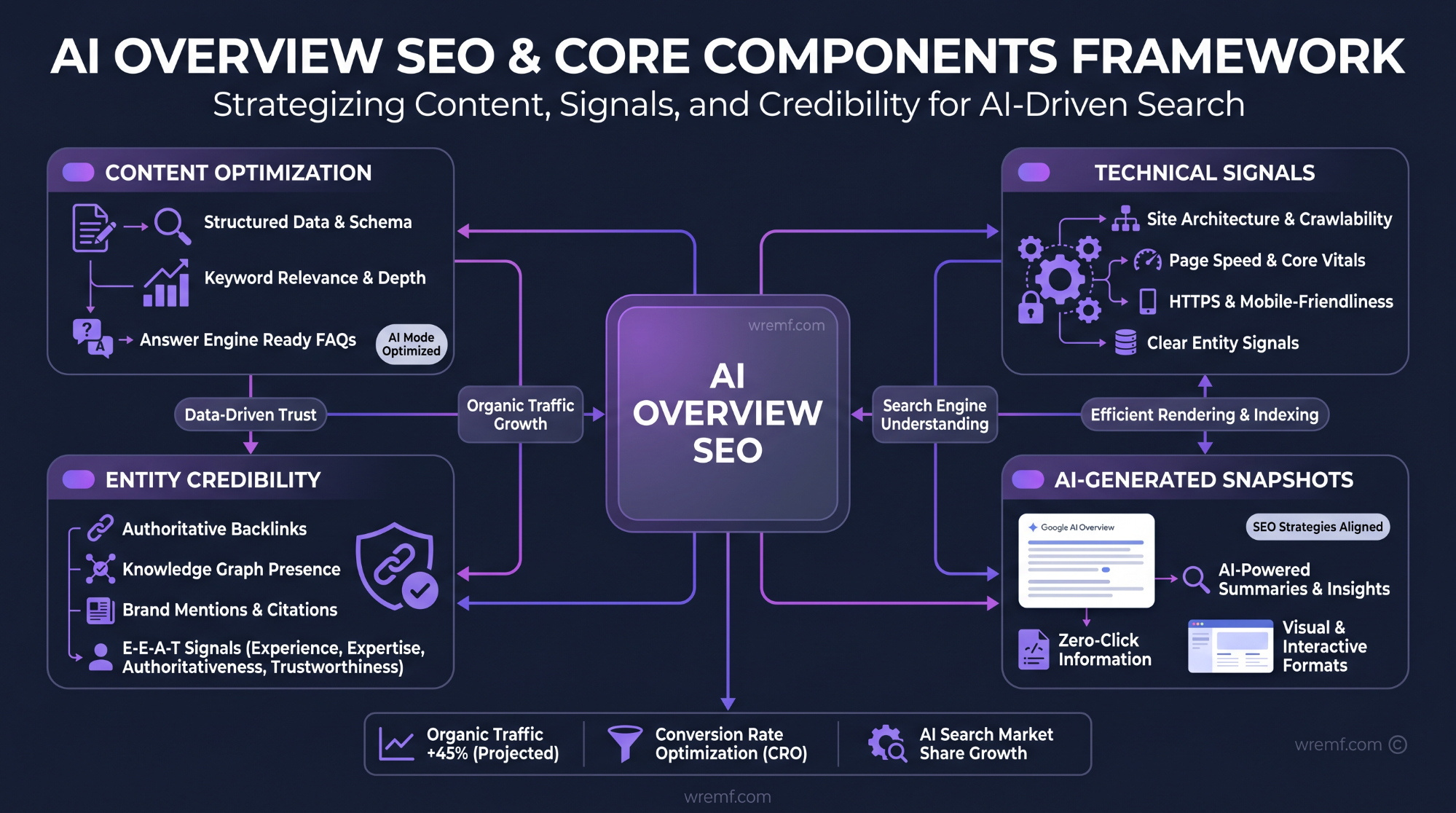
AI Overview SEO is the practice of optimizing content, technical signals, entities, and source credibility so a brand can appear in Google AI Overviews and AI Search. Google AI Overviews provide AI-generated snapshots with links that help users explore the web. AI Overview SEO builds on technical SEO, content marketing, internal linking, schema markup, and entity authority. The goal is to become a trusted source inside AI-generated summaries and AI responses. AI visibility is the measurable presence of a brand inside AI-generated summaries, recommendations, citations, and source links. Google AI Overviews use generative AI, search systems, and query fan-out to synthesize answers from relevant web sources. AI Overviews can reduce clicks for some queries but create new visibility through citations and brand mentions. Strong AI Overview SEO combines SEO fundamentals, AEO answer structure, and GEO measurement into one workflow.
Key takeaways
- AI Overview SEO expands search engine optimization from rankings and clicks to citations, mentions, source consistency, and measurable AI visibility across multiple AI platforms.
- Google AI Overviews use generative AI, search systems, and query fan-out to produce AI-generated summaries from relevant sources, changing how users interact with search results.
- AI Overviews can reduce clicks for informational queries but create new brand exposure when a company is cited, mentioned, or recommended in AI responses.
- Content that supports AI Overview SEO is answer-first, structured, useful, entity-rich, and complete enough to answer the main query plus the next logical question.
- Technical optimization including structured data, schema markup, and rich results validation helps search systems interpret content and support AI Overview visibility.
- Entity authority and source consistency help AI systems represent brands accurately across Google AI Overviews, AI Mode, and broader AI discovery surfaces.
AI Overview SEO: How to Optimize for Google AI Overviews, AI Mode, and AI Search Visibility
AI Overview SEO is the practice of optimizing content, technical signals, entities, and source credibility so a brand can appear in Google AI Overviews and AI Search. Google explains that AI Overviews provide AI-generated snapshots with links that help users explore the web through Google AI Overviews in Search. This guide explains how Google’s AI Overviews work, how Search Generative Experience evolved into AI Mode, how AI-generated summaries affect organic traffic, and how to measure AI visibility beyond rankings. It also covers content creation, structured data, schema markup, Google Search Console, click-through rates, query fan-out, Featured Snippets, Product Carousels, rich results, source links, and practical SEO strategies. WREMF helps teams track, improve, and prove AI visibility across Google AI Overview, ChatGPT, Claude, Gemini, Perplexity, Copilot, DeepSeek, Grok, Meta AI, and Mistral.
What Is AI Overview SEO?
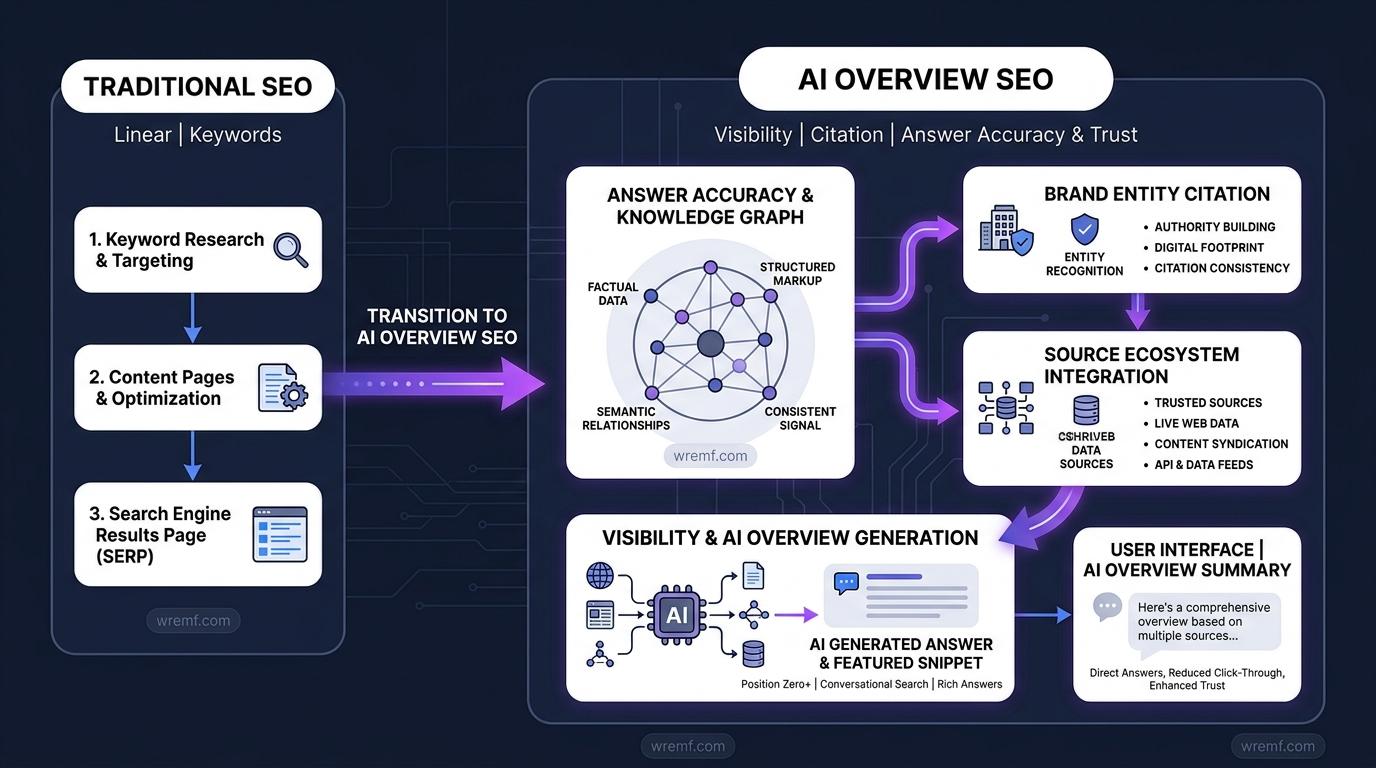
AI Overview SEO is the process of making your pages, brand entities, and source ecosystem eligible for visibility inside Google AI Overviews. It turns search engine optimization from a ranking-only practice into a visibility, citation, and answer accuracy workflow.
AI Overviews are AI-generated summaries that appear in Google Search when Google decides a generated answer can help users understand a query faster. Google Search explains that AI Overviews provide a snapshot of key information with links so users can explore more on the web through the official Google AI Overviews page.
AI Overview SEO is not separate from SEO fundamentals. It builds on technical SEO, content marketing, internal linking, helpful content, schema markup, source links, and entity authority. The difference is that your goal is not only to rank in search results. Your goal is to become a trusted source inside AI-generated summaries, AI responses, and AI-driven search experiences.
AI visibility is the measurable presence of a brand inside AI-generated summaries, recommendations, citations, source links, and comparison answers. AI visibility matters because users may form opinions about vendors, products, services, and brands before they click through to a website.
Google’s AI Overviews also change how marketers think about the Search Engine Results Page. Traditional search engine results show rankings, snippets, ads, Featured Snippets, People Also Ask, rich results, videos, and other SERP features. Google AI Overview adds synthesized AI responses above or around those search results, which can change attention, click-through rates, and brand discovery.
For B2B teams, AI Overview SEO means tracking how your brand appears across Google Search, Google AI Overview, AI Mode, ChatGPT, Claude, Gemini, Perplexity, Copilot, DeepSeek, Grok, Meta AI, Mistral, and other AI discovery surfaces. WREMF helps teams manage this through the AI visibility platform suite, where prompt tracking, source citations, competitor visibility, and reporting connect into one workflow.
KEY TAKEAWAY: AI Overview SEO expands search engine optimization from rankings and clicks to citations, mentions, source consistency, and measurable AI visibility.
To optimize effectively, you first need to understand how Google’s AI Overviews, AI Mode, and Search Generative Experience are connected.
How Do Google AI Overviews Work?
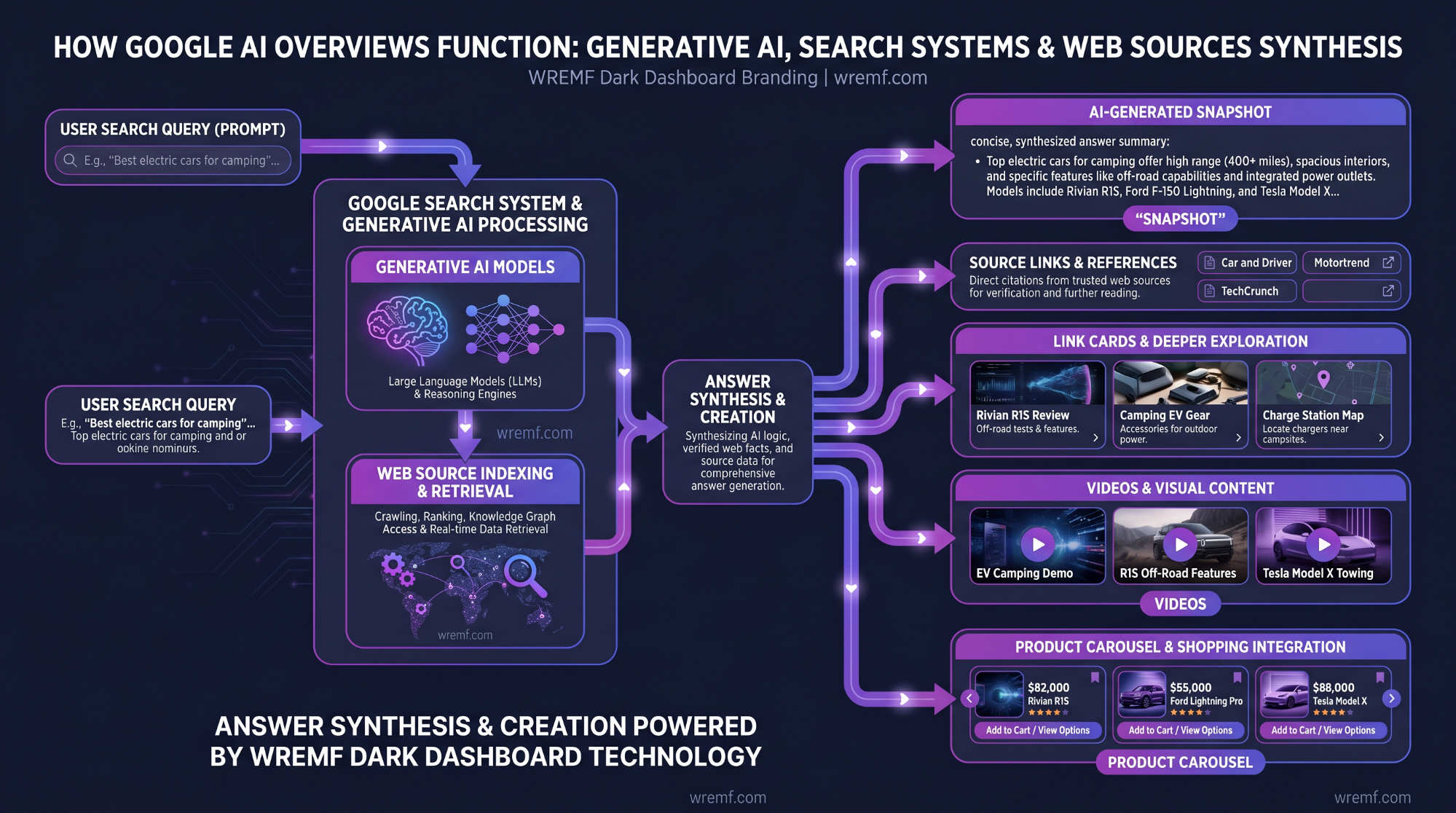
Google AI Overviews work by using generative AI, search systems, and relevant web sources to synthesize answers for complex or useful search queries. The output is an AI-generated snapshot that may include source links, link cards, videos, Product Carousels, and other SERP features.
Google’s AI Overviews came after Search Generative Experience, the Search Labs experiment that tested generative AI inside Google Search. Search Generative Experience introduced many of the patterns marketers now associate with AI Search, including AI summaries, source links, follow-up questions, and conversational AI paths.
Search Generative Experience is the experimental Google Search experience that tested generative AI summaries before the broader Google AI Overview rollout. Search Generative Experience matters because SEO teams still use SGE, AI Overviews, AI Mode, and AI Search when discussing the same shift from classic search results to AI-generated summaries.
AI Mode is Google’s more conversational AI Search experience. Google says AI Mode uses query fan-out, which breaks a question into subtopics and issues multiple related searches at the same time, as explained in Google’s AI Mode query fan-out announcement.
Query fan-out is the process of breaking one complex search query into several related sub-queries. Query fan-out matters because a single user question can generate many hidden search queries, which means your AI Overview SEO strategy must cover subtopics, related entities, and follow-up questions.
Large Language Models are AI systems that process, understand, and generate natural language. Large Language Models matter for AI Overview SEO because they interpret topics, context, entity relationships, source consistency, and answer quality rather than relying only on exact-match keywords.
Google AI Overviews do not replace the web. They reorganize parts of the web into synthesized AI responses. Google Search Central explains that site owners should follow Google Search essentials and make content accessible for AI features through AI features and your website.
KEY TAKEAWAY: Google AI Overviews use generative AI, Search systems, Large Language Models, and query fan-out to produce AI-generated summaries from relevant sources.
Once the mechanics are clear, the next issue is how AI Overviews affect rankings, clicks, and organic traffic.
How Do AI Overviews Affect SEO, Rankings, and Organic Traffic?
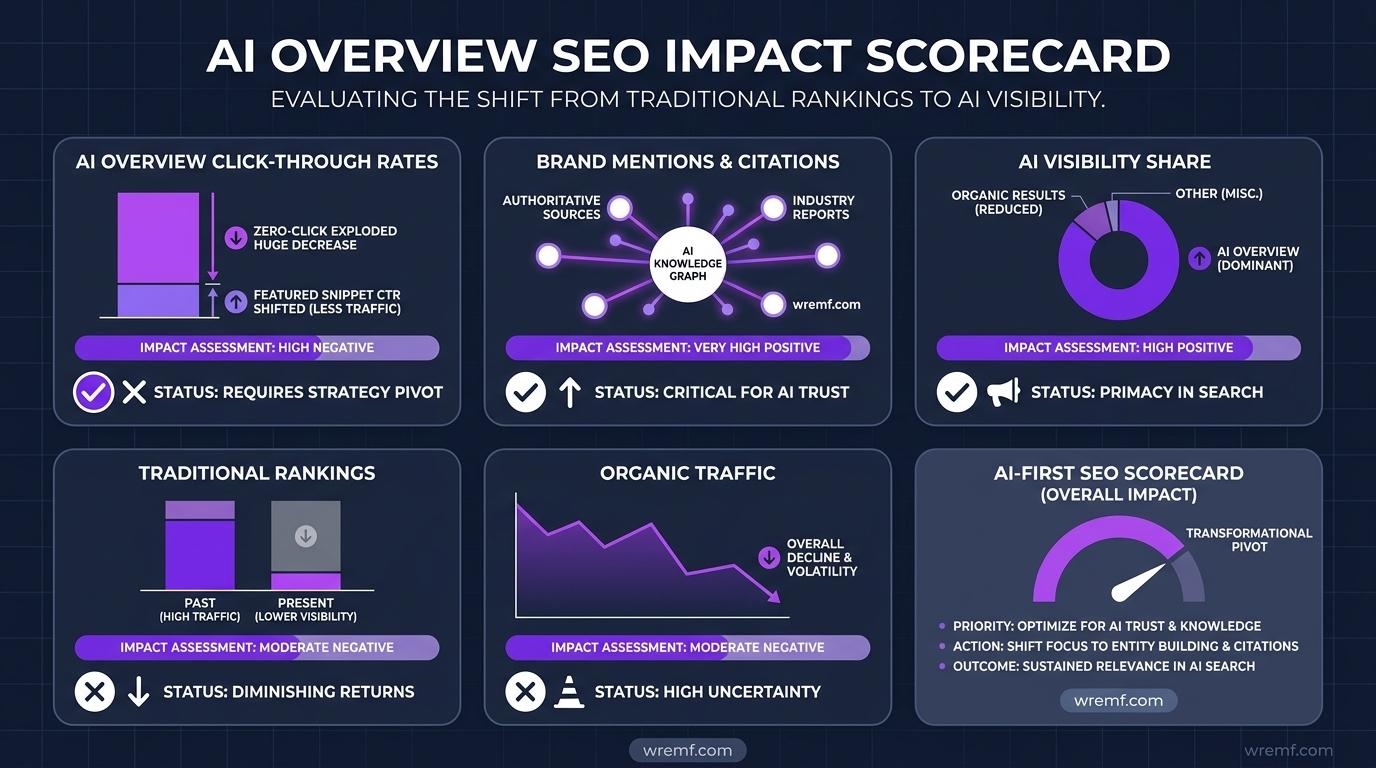
AI Overviews affect SEO by changing how users interact with search results, source links, and AI-generated summaries. Rankings still matter, but click-through rates, brand mentions, citations, and AI visibility now matter alongside organic traffic.
Organic traffic is the unpaid traffic a website receives from search engines. Organic traffic matters because AI Overviews can satisfy some informational search queries directly on Google Search, which may reduce clicks even when a brand remains visible.
Click-through rates are the percentage of searchers who click a result after seeing it in search results. Click-through rates matter because Google AI Overview can answer a question before the user clicks a traditional organic listing.
Pew Research Center found in a March 2025 analysis that users who encountered an AI summary clicked a traditional search result in 8 percent of visits, compared with 15 percent of visits when no AI summary appeared, according to Pew Research Center’s AI summary click study. This matters because AI-generated summaries can create more zero-click searches for informational queries.
Zero-click searches are searches where the user gets enough information on the search results page and does not click another website. Zero-click searches matter because AI Overview SEO must measure visibility even when traffic does not increase.
AI-generated summaries can reduce direct clicks for some queries, but they can also create brand exposure when a company is cited, mentioned, or recommended. In B2B search behavior, this is especially important because buyers often use AI responses for vendor shortlisting, product comparison, and early research.
Google Search Console is still essential for measuring impressions, clicks, average position, and search queries. But Google Search Console does not fully show whether your brand was cited in Google AI Overview, included in a Source Panel, or mentioned in AI responses from ChatGPT, Gemini, Claude, Perplexity, Copilot, DeepSeek, Grok, Meta AI, or Mistral.
KEY TAKEAWAY: AI Overviews can reduce clicks for some search queries, but they also create new visibility signals such as citations, brand mentions, source links, and AI share of voice.
The practical response is not to abandon SEO. The right response is to connect SEO, AEO, and GEO into one operating model.
SEO vs AEO vs GEO: What Is the Difference?
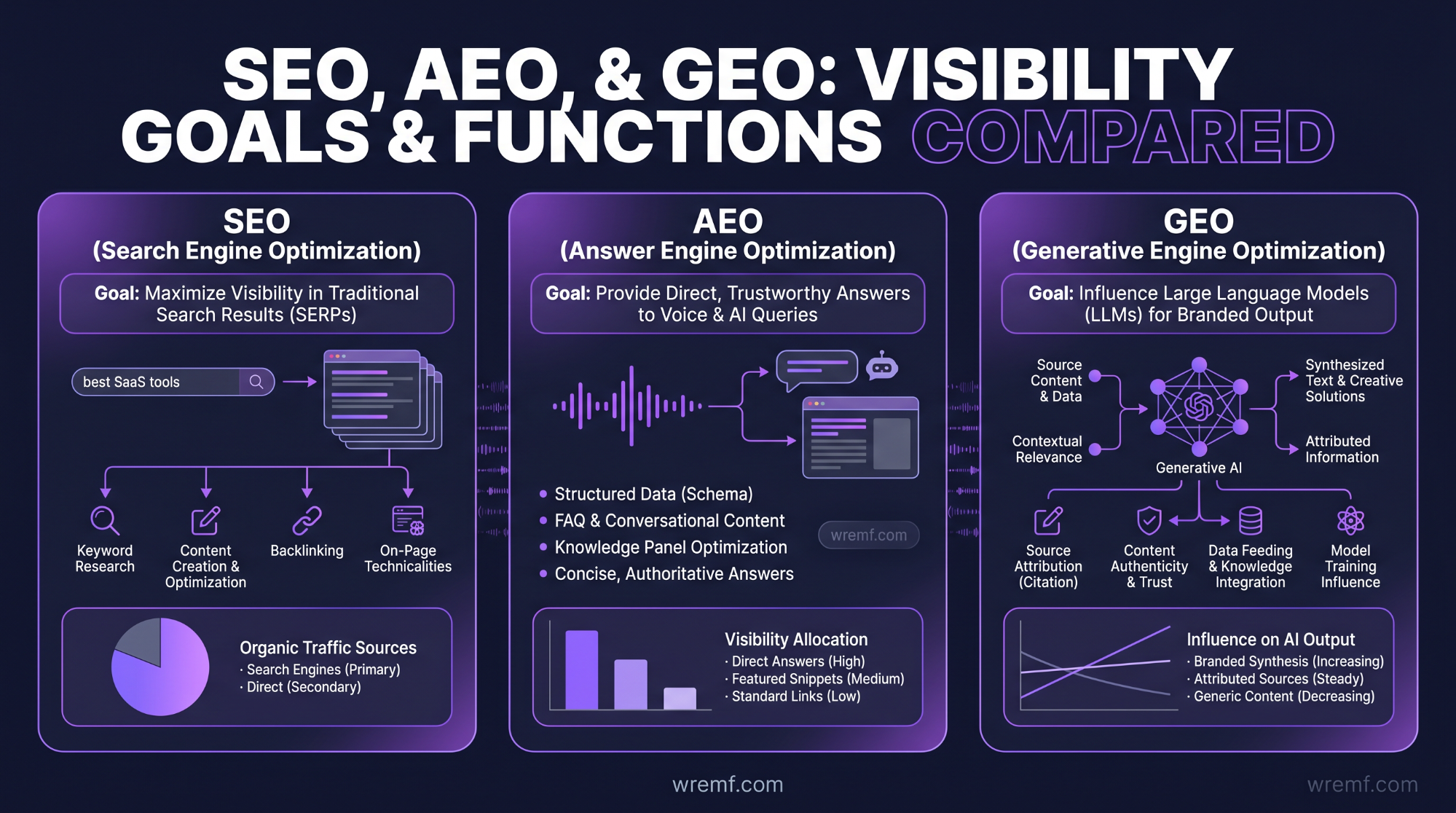
SEO, AEO, and GEO are connected disciplines with different visibility goals. SEO improves search engine results, AEO improves direct answer eligibility, and GEO improves brand visibility inside generative AI responses.
Search engine optimization is the practice of improving how pages appear in search engine results pages. Search engine optimization matters because Google Search, Bing, and other search engines still provide crawlability, indexation, ranking signals, and user demand.
Answer engine optimisation is the practice of structuring content so search engines, answer engines, and voice search systems can extract direct answers. Answer engine optimisation matters because Featured Snippets, People Also Ask, voice search, and AI summaries depend on clear answer blocks.
Generative engine optimisation is the practice of improving how brands, pages, and sources appear inside generative AI responses. Generative engine optimisation matters because Google AI Overview, AI Mode, ChatGPT, Perplexity, Gemini, Claude, and Copilot can summarize information without showing a traditional list of rankings.
AI Search is the broader category of search experiences that use generative AI, conversational AI, Large Language Models, and synthesized AI responses. AI Search matters because the search landscape is moving from lists of links to answer-led discovery journeys.
| Discipline | Primary Goal | What It Measures | What It Misses | Best For |
|---|---|---|---|---|
| SEO | Rank in search engine results | Rankings, impressions, clicks, technical health, backlinks | AI response visibility and source inclusion | Organic traffic and search engine results |
| AEO | Win answer-style visibility | Featured Snippets, Answer Box results, People Also Ask, direct answers | Multi-source generative synthesis | Definitions, FAQs, how-to content, voice search |
| GEO | Improve generative AI visibility | AI citations, brand mentions, recommendations, source links | Full classic ranking performance | Google AI Overview, AI Mode, ChatGPT, Perplexity |
| AI visibility tracking | Prove presence across AI discovery surfaces | Prompt visibility, AI share of voice, source citations, competitor visibility | Full technical crawl detail | Leadership reporting, agency reporting, client portals |
The key difference between SEO and GEO is that SEO starts with search engine results pages, while GEO starts with AI-generated summaries and AI responses. A strong AI Overview SEO strategy uses SEO fundamentals, AEO answer structure, and GEO measurement together.
SEO fundamentals still matter. Search Essential guidance, crawlability, internal linking, structured content, and page quality remain foundational. But AI Overview SEO adds a new layer: you also need to know whether Google AI Overview and other AI systems cite your sources, mention your brand, and describe your positioning correctly.
KEY TAKEAWAY: SEO, AEO, and GEO are not replacements for one another. They are layers of one AI search visibility strategy.
The next step is knowing which content patterns are most likely to support Google AI Overview visibility.
What Kind of Content Gets Featured in AI Overviews?
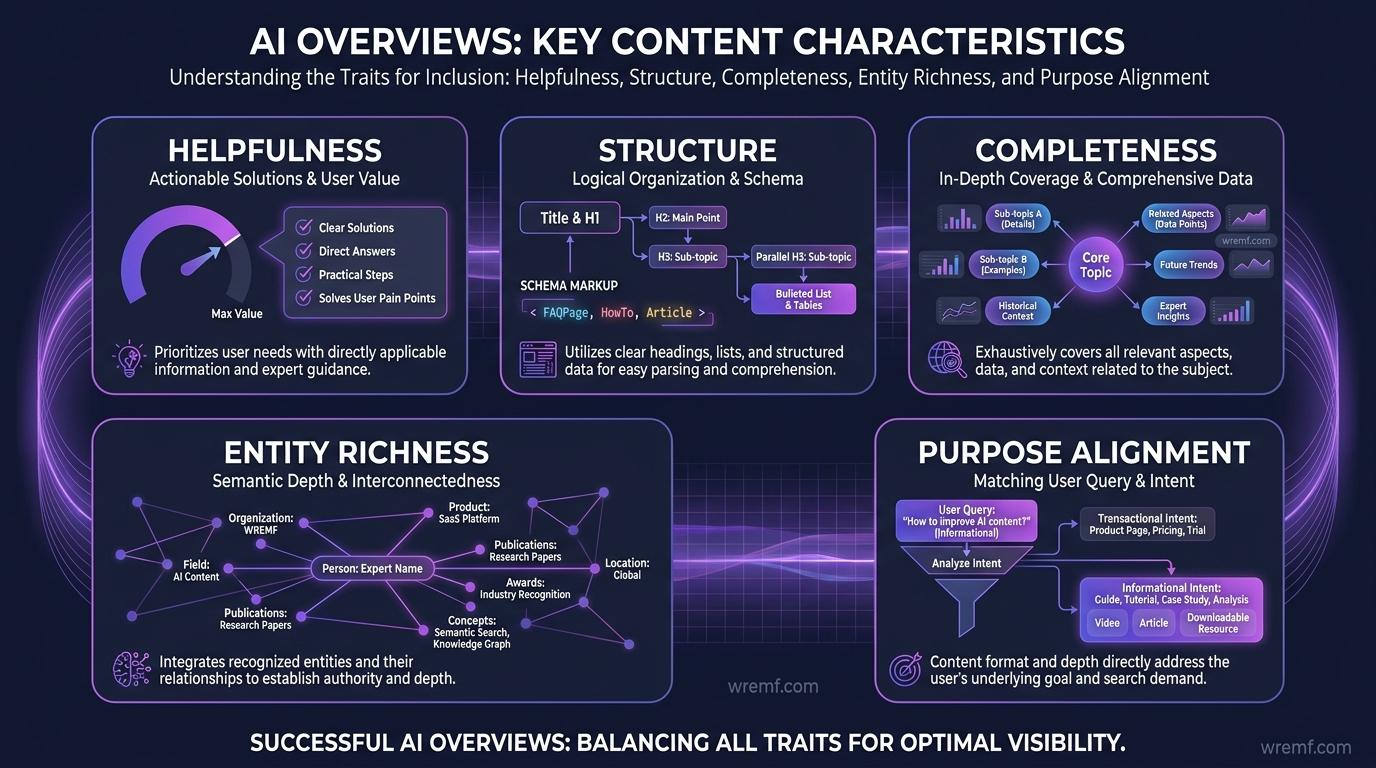
Content that gets featured in AI Overviews is usually helpful, structured, complete, entity-rich, and aligned with user intent. Google does not publish a guaranteed inclusion formula, but strong content quality and search fundamentals remain the foundation.
Google Search Central says Google’s automated ranking systems are designed to prioritize helpful, reliable, people-first content through its helpful content guidance. This matters because AI Overview SEO depends on content that search systems can understand, trust, and use to answer real questions.
Helpful content is content created primarily to satisfy users rather than manipulate search rankings. Helpful content matters because AI Overviews need accurate, clear, and useful source material to generate reliable AI summaries.
User Intent is the purpose behind a search query. User Intent matters because Google AI Overview and AI Mode often respond to the task behind the query, not only the literal words in the search box.
Content that performs well for AI Overview SEO usually has these traits:
It answers the main question in the first few sentences
It defines important entities clearly
It uses headings that match natural language search queries
It covers the next logical question
It includes examples, data, or practical experience
It separates facts, opinions, and recommendations
It uses structured content such as tables, lists, and FAQs
It links related pages through descriptive internal linking
It avoids vague claims and unsupported statistics
It includes fresh information when the topic changes quickly
Structured content is content organized with headings, definitions, bullets, tables, and logical sections. Structured content matters because search engines and Large Language Models can parse it more reliably than long, vague prose.
Featured Snippets are direct answer results that Google may show above standard organic results. Featured Snippets matter because answer-first formatting that helps snippets can also make content easier for AI-generated summaries to quote.
Search Generative Experience, AI Overviews, AI Mode, and Featured Snippets all reward clarity, but they do not work exactly the same way. Featured Snippets often extract from a single page. AI Overviews can synthesize information from several source links, rich results, Product Carousels, videos, and other SERP features.
KEY TAKEAWAY: Content that supports AI Overview SEO is answer-first, structured, useful, entity-rich, and complete enough to answer the main query plus the next logical question.
Strong content structure is the foundation. The next layer is the technical setup that helps search systems process that content.
Technical Optimization for AI Overviews, Structured Data, and Rich Results
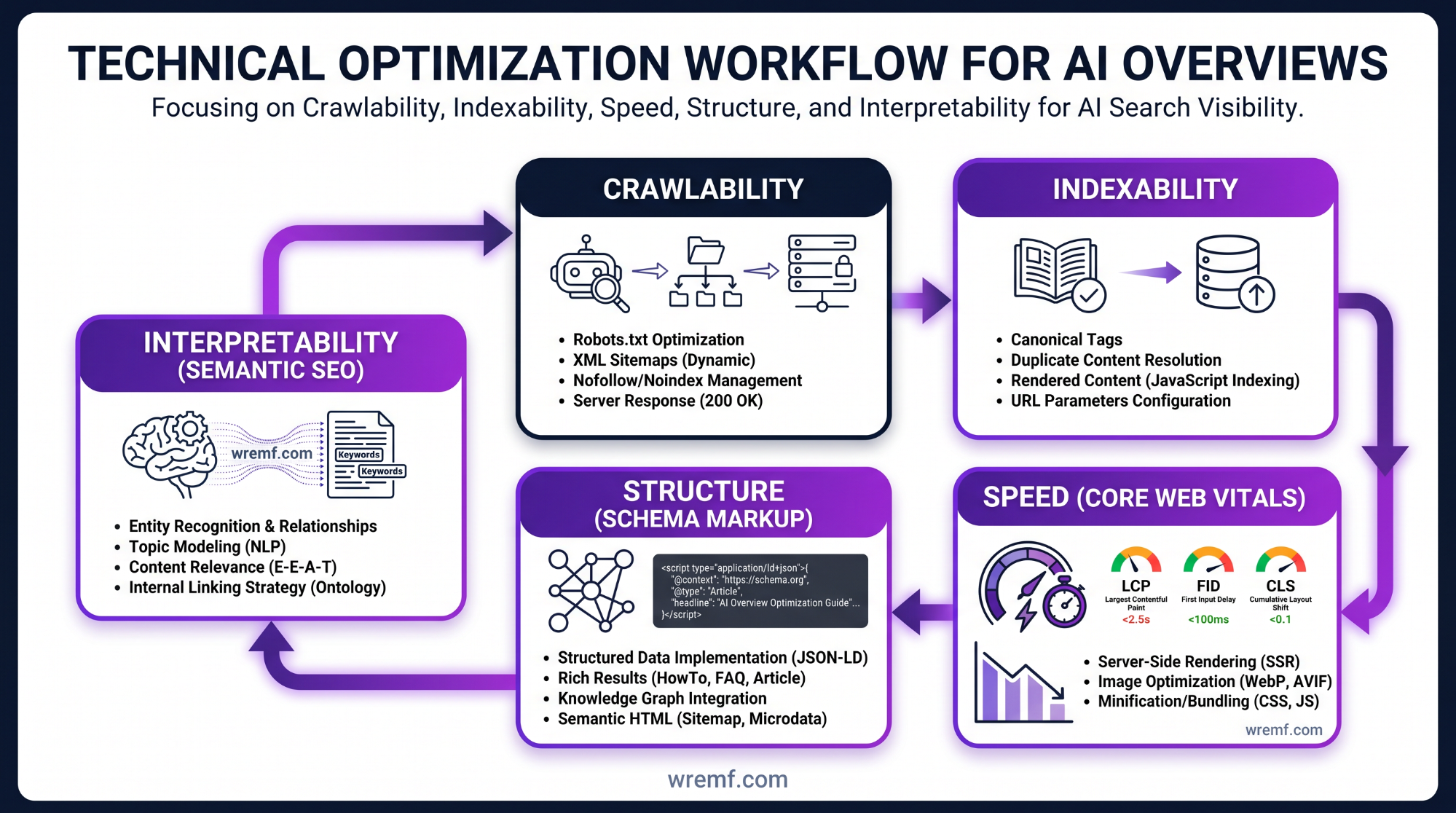
Technical optimization for AI Overviews means making pages crawlable, indexable, fast, well-structured, and easy for search systems to interpret. Technical health does not guarantee inclusion, but weak technical foundations can block strong content from being understood.
Structured data is machine-readable markup that helps search engines understand entities, content types, and page relationships. Structured data matters because Google uses structured data to understand eligible content and support rich results through the Google structured data documentation.
Schema markup is a vocabulary used to describe entities such as articles, products, organizations, FAQs, reviews, videos, events, and local businesses. Schema markup matters because it gives search engines explicit context about what a page contains.
Rich results are enhanced Google Search results that go beyond a standard title, URL, and description. Rich results matter because they can improve search results visibility through additional details, Product Carousels, videos, review details, breadcrumbs, FAQ-style displays, and other SERP features.
AI Overview SEO technical checks should include:
Crawlable HTML content
Valid indexation settings
Clean heading hierarchy
Descriptive title tags
Useful meta descriptions
Correct canonical tags
Internal links with descriptive anchors
Structured data validation
Schema markup for relevant page types
Fast page loading
Core Web Vitals monitoring
Google Search Console indexing checks
Rich results validation
Rendered HTML checks for JavaScript-heavy websites
Clear organization and author information
No accidental blocking of important content
Meta tags are HTML elements that describe page information such as title, description, robots instructions, and social previews. Meta tags matter because they help search engines understand page purpose and control how content can appear in search results.
Meta descriptions are short page summaries that may appear in search results. Meta descriptions matter because clear descriptions help users understand relevance even when AI-generated summaries reshape the Search Engine Results Page.
Rich results do not automatically produce AI Overview visibility. However, the same technical clarity that supports rich results also supports better content interpretation. Product Carousels, source links, link cards, videos, and other SERP features are easier to support when page data, structured content, and schema markup are accurate.
KEY TAKEAWAY: Technical optimization supports AI Overview SEO by making content accessible, interpretable, eligible for rich results, and easier for search systems to evaluate.
Technical clarity helps your own pages. Source selection depends on how Google and AI systems evaluate the broader source ecosystem.
How Google Selects Sources, Links, and Citations for AI Summaries
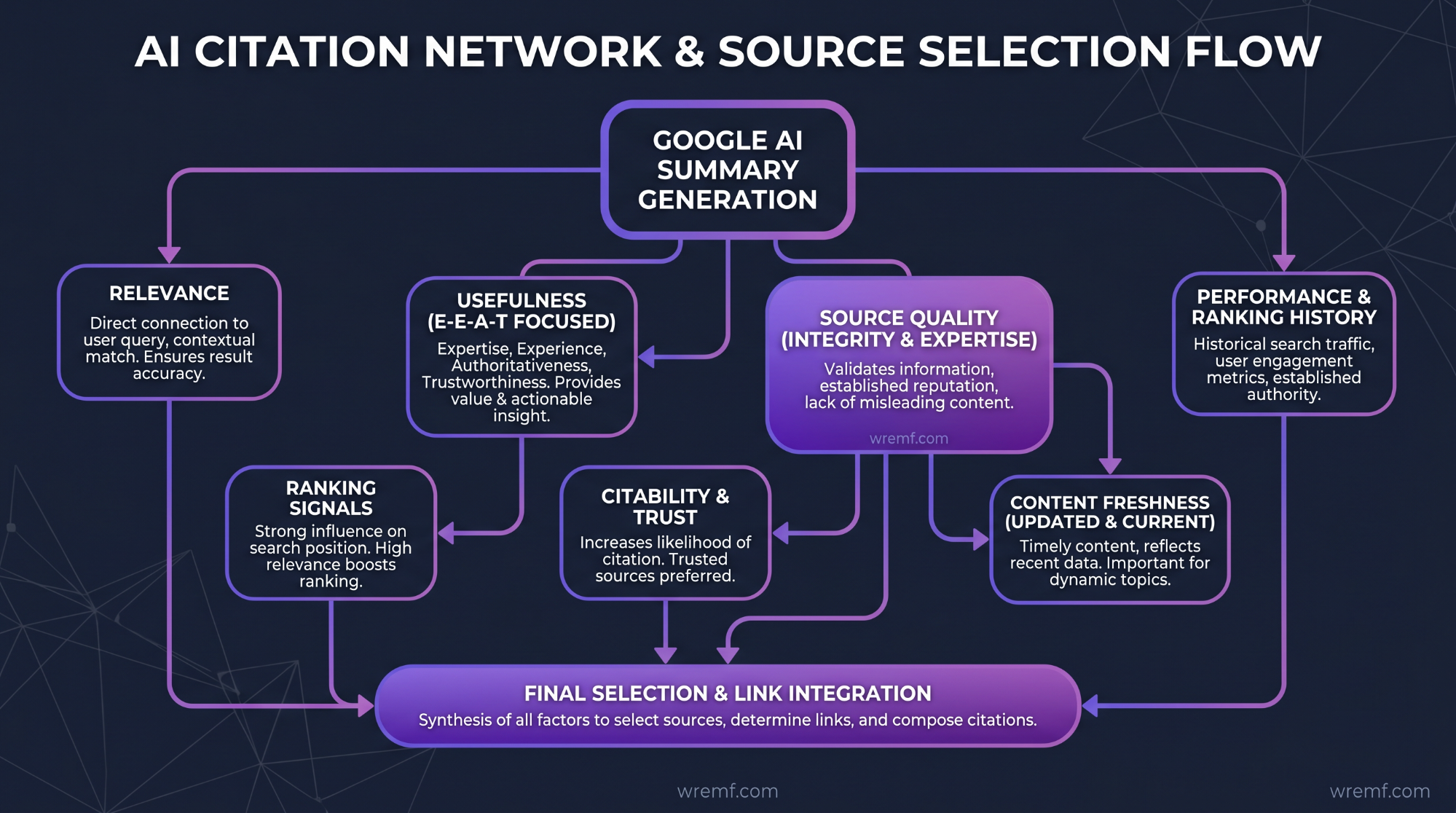
Google selects sources for AI summaries based on relevance, usefulness, search systems, source quality, and how well a source helps answer the query. AI Overview citations are related to rankings, but they are not identical to rankings.
AI citations are links or references used inside AI-generated summaries. AI citations matter because they can influence trust, referral traffic, brand recall, and whether users associate your brand with a topic.
Source citations are the specific pages, domains, and source links that AI systems use to support AI responses. Source citations matter because a brand can be cited, mentioned, recommended, ignored, or contradicted depending on which sources the AI system trusts.
Source links are links shown inside or near AI-generated summaries. Source links matter because they are one of the clearest visible signs that a page contributed to an AI response.
Ahrefs analyzed 863,000 SERPs and 4 million AI Overview URLs in 2026 and found that 38 percent of pages cited in AI Overviews also ranked in the top 10 for the same query, according to the Ahrefs AI Overview citation study. This matters because AI Overview SEO is not purely a page-one ranking game.
That finding does not mean rankings are irrelevant. It means that rankings, authority, source relevance, page structure, topical depth, and source consistency all matter. AI Overviews can cite pages from the top 10, pages from positions 11 to 100, and sometimes pages outside the visible top 100.
A Source Panel is the visible area where an AI search experience shows supporting sources, citations, or related references. A Source Panel matters because users can inspect which sources support an AI-generated answer. Source Panel visibility is different from ranking visibility because a page can appear as a source even when it is not the top organic result.
Link cards are visual or structured source units that point users from an AI-generated answer to a web source. Link cards matter because they can become the new clickable unit inside AI Search, replacing or supplementing classic organic listings.
Brand credibility also influences source selection. In practical AI visibility audits, teams often find that AI systems cite high-authority third-party pages, documentation, comparison pages, community discussions, videos, and review platforms alongside brand-owned content.
KEY TAKEAWAY: Google AI Overview citations depend on rankings, relevance, source usefulness, and ecosystem authority, so teams must measure citations separately from organic positions.
That is why entity authority, source consistency, and E-E-A-T are now central to AI Overview SEO.
Why Entity Authority, E-E-A-T, and Source Consistency Matter
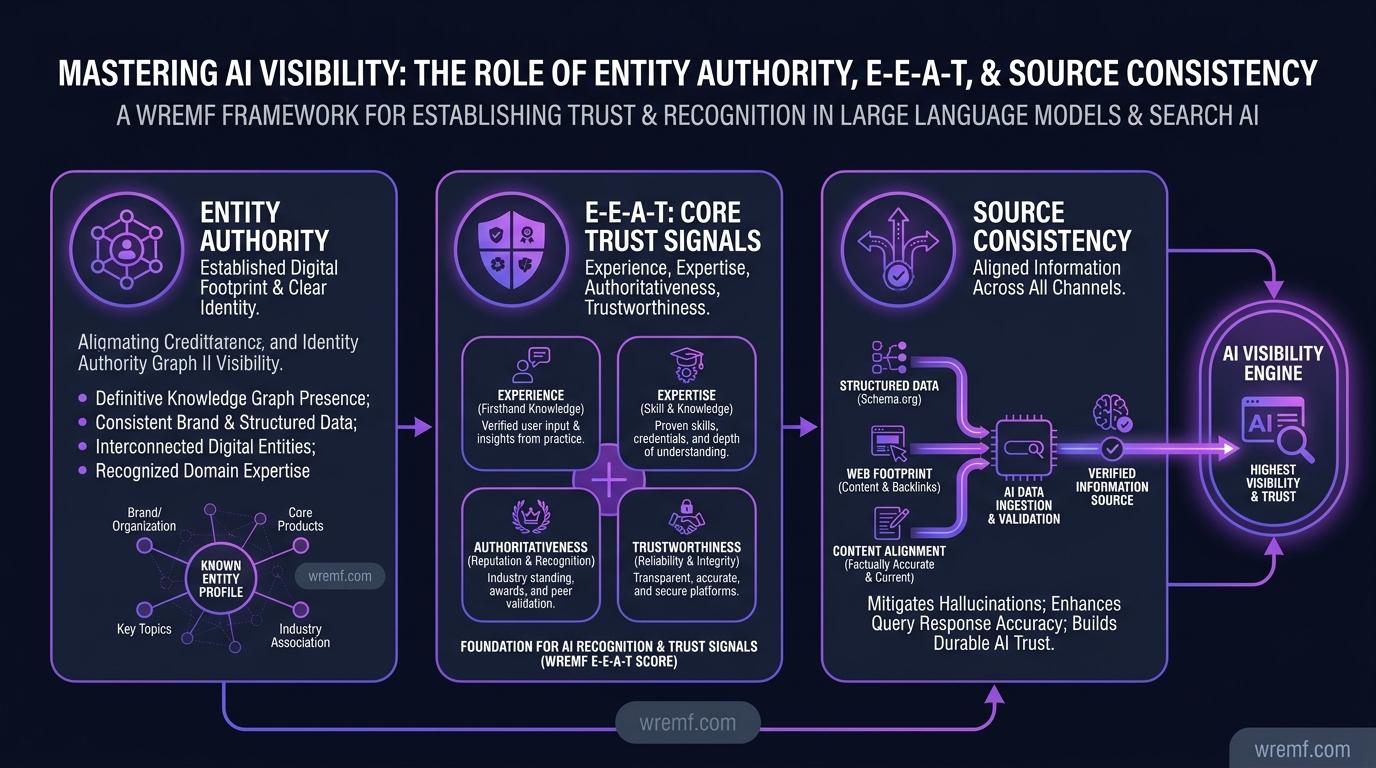
Entity authority matters because AI systems need to understand who you are, what you do, and why your source is reliable. Strong entity clarity reduces confusion across Google AI Overview, AI Mode, and other AI responses.
Entity authority is the strength and clarity of a brand, person, product, organization, or topic as a recognized entity. Entity authority matters because AI Search depends on connecting entities to facts, categories, sources, and user intent.
E-E-A-T stands for Experience, Expertise, Authoritativeness, and Trustworthiness. E-E-A-T matters because Google’s search quality approach emphasizes helpful, reliable, people-first information, especially for topics where accuracy affects important decisions.
Knowledge Graph is Google’s system for understanding entities and relationships. Knowledge Graph matters because AI-generated summaries depend on entity recognition, relationships, and context across the web.
Source consistency is the degree to which your website, profiles, directories, reviews, documentation, social channels, and third-party mentions describe your brand accurately. Source consistency matters because Large Language Models and AI Search systems may synthesize information from multiple sources.
In real B2B buying journeys, source consistency often breaks before the brand notices. The website says one positioning statement, review sites use an older category, directories list the wrong product description, and AI responses blend all of it into an incomplete answer. This can weaken brand visibility and reduce recommendation accuracy.
Brand mentions are references to a brand inside AI responses, source links, search results, articles, directories, reviews, or community discussions. Brand mentions matter because repeated, consistent mentions help AI systems connect a brand with categories, use cases, and problems.
Brand recommendation visibility measures whether AI systems recommend a brand for relevant high-intent prompts. Brand recommendation visibility matters because users often ask AI tools for shortlists such as “best AI visibility tools,” “best GEO platform,” or “which software tracks Google AI Overviews.”
WREMF helps teams identify these issues through the WREMF methodology, which connects prompts, citations, competitors, source consistency, and attribution into a repeatable measurement system.
KEY TAKEAWAY: Entity authority and source consistency help AI systems represent your brand accurately across Google AI Overviews, AI Mode, and broader AI discovery surfaces.
Once the brand entity is clear, the next priority is building content that answers both current and future search behavior.
Content Strategy for the Generative AI Search Era
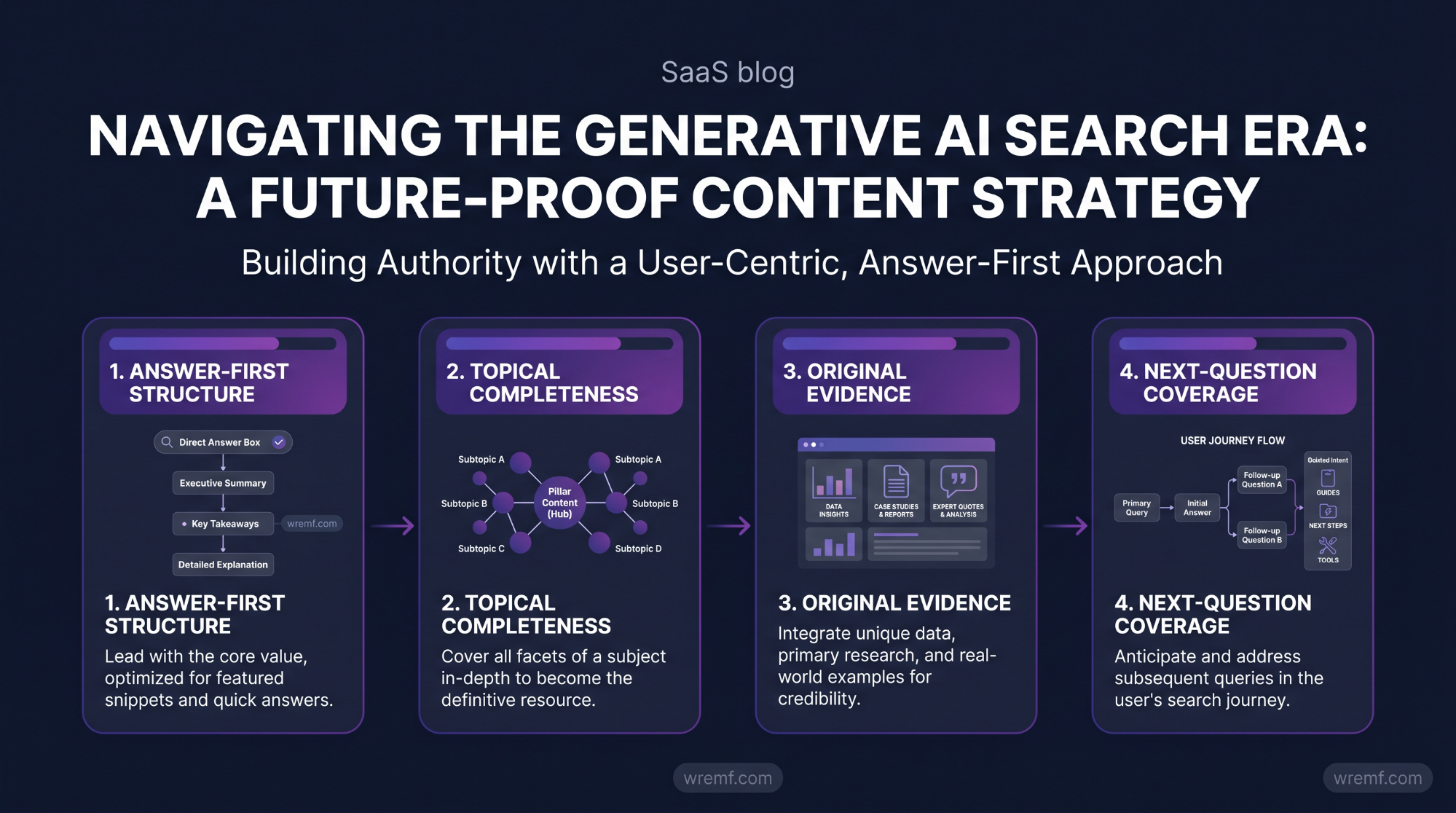
Content strategy for AI Overview SEO should focus on answer-first structure, topical completeness, original evidence, and next-question coverage. Generic content creation is weaker than content that directly solves search queries and supports AI-generated summaries.
Content creation is the process of planning, writing, publishing, and updating content for a target audience. Content creation matters in AI Overview SEO because Large Language Models need clear, useful, and well-structured source material.
Content marketing is the practice of using content to attract, educate, and convert target audiences. Content marketing matters because AI search visibility often begins before a buyer visits a website or fills out a form.
The strongest AI Overview SEO content usually follows an anticipatory content model. It answers the first question, then covers the next logical question, then helps the reader make a decision. This structure matches how Search Generative Experience, AI Mode, conversational AI, and voice search handle follow-up intent.
Use this model for major pages:
Define the topic in the first paragraph
Explain why the topic matters now
Show how the system works
Compare related concepts
Explain implementation steps
Identify risks and limitations
Add examples or practical experience
Include relevant data and source attribution
Answer high-intent FAQs
Link to supporting internal pages
Keyword Research still matters, but the role of Keyword Research has changed. Instead of only targeting exact-match keywords, use Keyword Research to map search queries, entity relationships, pain points, commercial intent, and follow-up questions. A single AI Overview can be triggered by broad questions, long-tail queries, and multi-step tasks.
The Anticipatory Content Model works because Google AI Overview and AI Mode can combine several subtopics into one answer. A page about AI Overview SEO should not only define AI Overviews. It should also cover Google Search Console, click-through rates, rich results, AI Mode, Search Generative Experience, source links, Google AI, schema markup, Product Carousels, local SEO, voice search, and measurement.
WREMF supports this workflow through AI-ready content briefs, which help teams turn prompt gaps, source gaps, and competitor visibility gaps into structured content plans.
KEY TAKEAWAY: Content strategy for AI Overview SEO should answer the primary query, the follow-up query, and the buying-stage query in one structured content system.
Content strategy becomes stronger when it accounts for SERP features beyond text.
SERP Features, Rich Results, Videos, and Product Carousels in AI Search
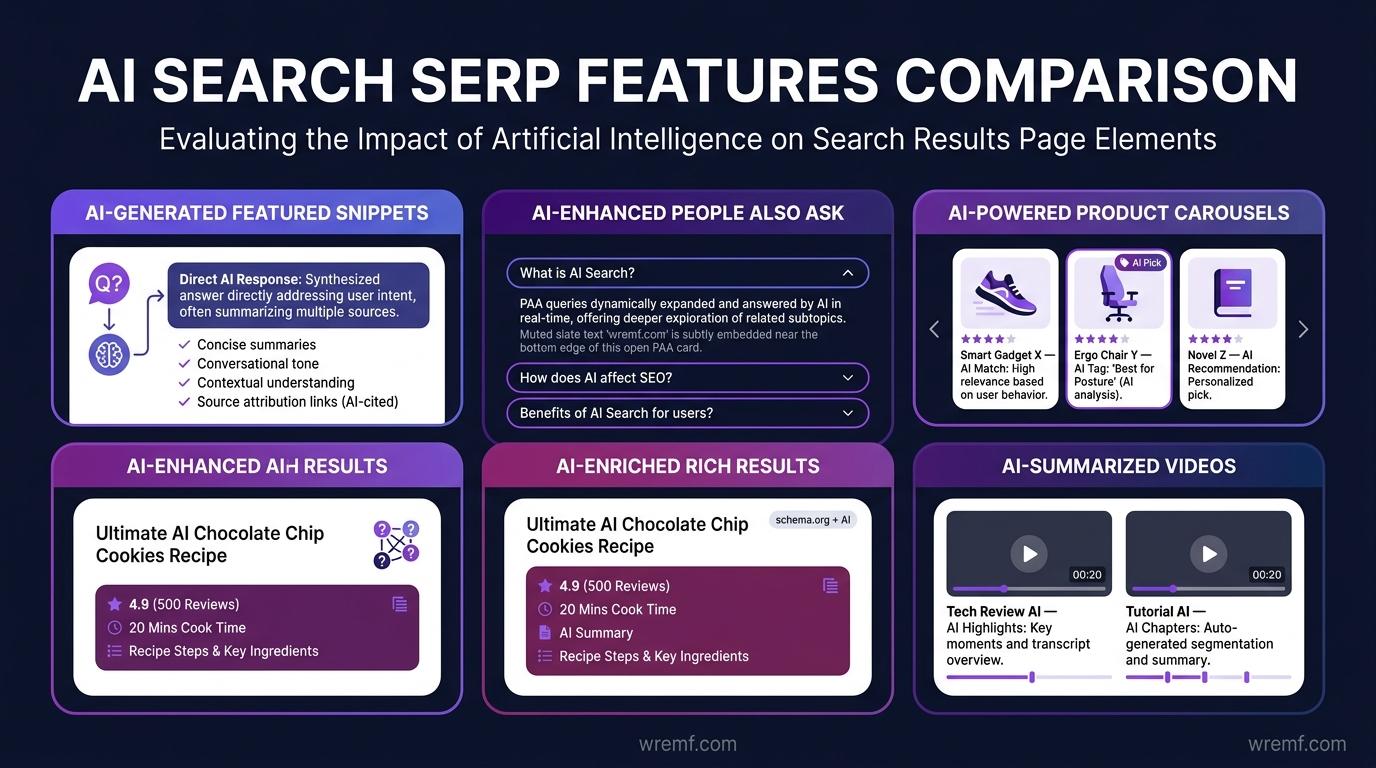
SERP features matter for AI Overview SEO because Google AI Overview can coexist with rich results, videos, Featured Snippets, Product Carousels, People Also Ask, and other search elements. AI visibility is not limited to plain text rankings.
SERP features are enhanced elements on a search engine results page beyond standard organic listings. SERP features matter because they influence attention, clicks, source selection, and the way users interpret search results.
Search Engine Results Page is the page where Google or another search engine displays results for a query. The Search Engine Results Page matters because AI Overviews change how users interact with rankings, ads, rich results, link cards, and source links.
Product Carousels are search result features that show multiple products for shopping or product-led queries. Product Carousels matter because Google AI Overview can appear in commercial search journeys where users compare products, categories, and recommendations.
Rich results can include product details, review details, FAQ-style displays, breadcrumbs, videos, recipes, events, local business information, and other structured outputs. Rich results matter because they can increase visibility and make a page easier for Google Search to interpret.
Videos can support AI Overview SEO when they answer search queries clearly and connect to the same topic cluster as the page. Videos matter because some AI Overviews and AI Search results include video sources, especially for demonstrations, tutorials, and visual explanations.
The practical SEO strategies for SERP feature visibility include:
Use structured data where eligible
Create clear page titles and meta descriptions
Use concise answer blocks near the top of pages
Structure product pages with attributes, reviews, pricing context, and availability where relevant
Create video pages with clear summaries and transcripts
Use internal linking to connect related search queries
Track which SERP features appear for your target keywords
Monitor whether AI Overviews appear with Featured Snippets, Product Carousels, link cards, or rich results
People Also Ask results are expandable question results in Google Search. People Also Ask matters because it reveals adjacent questions that users ask after the primary query.
Feature snippets, Featured Snippets, Answer Box results, and AI-generated summaries all show that search is moving toward answer-led layouts. The difference is that AI-generated summaries synthesize more context and can include several source links or link cards.
KEY TAKEAWAY: AI Overview SEO should account for the full SERP, including Featured Snippets, rich results, Product Carousels, videos, source links, and link cards.
SERP visibility matters, but teams also need local and brand-specific AI visibility for real buying journeys.
Local SEO, Google Business Profile, and AI Overviews
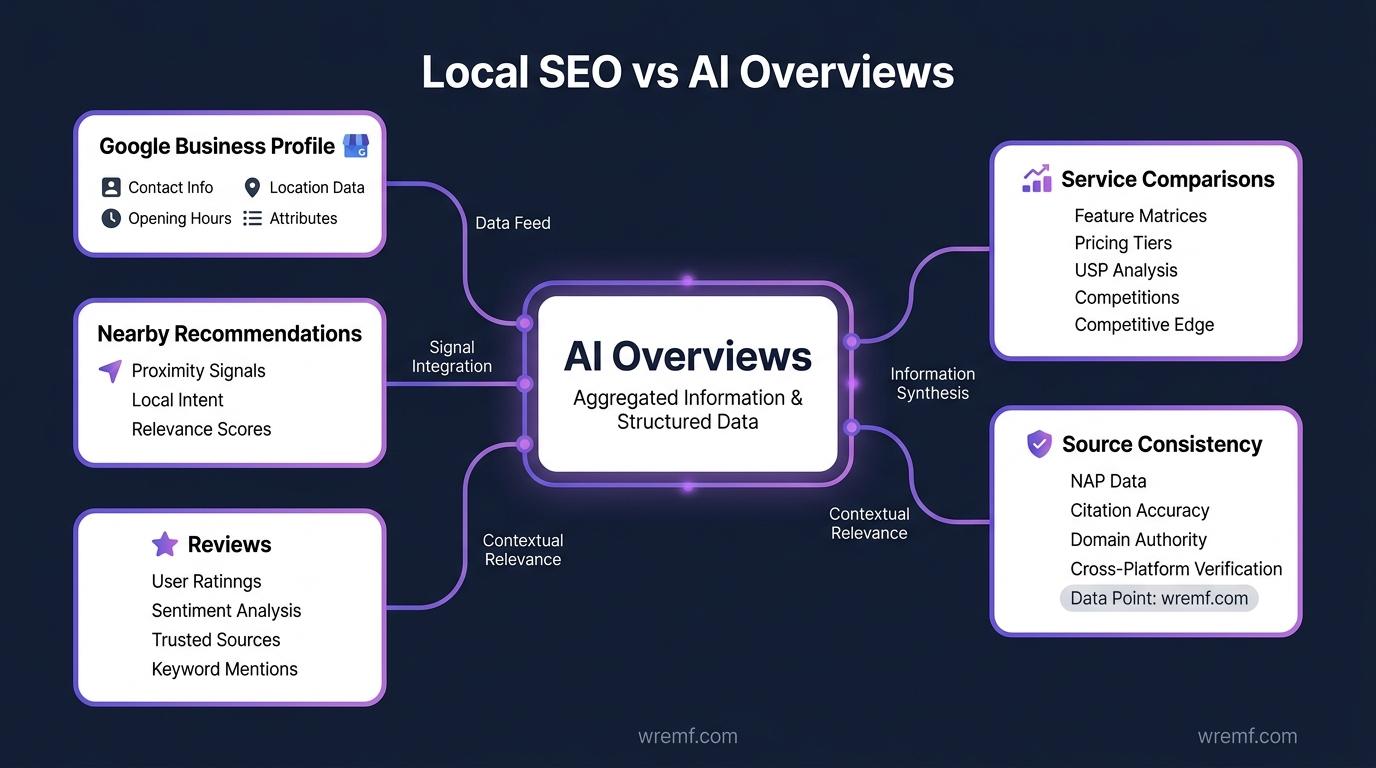
Local SEO matters for AI Overview SEO because users ask Google Search and AI Search for nearby recommendations, service comparisons, reviews, and local business options. Local AI visibility depends on business data, reviews, location relevance, and source consistency.
Local SEO is the practice of improving visibility for location-based search queries. Local SEO matters because AI-generated summaries can reference local businesses, reviews, maps data, Google Business Profile details, and nearby service intent.
Google Business Profile is Google’s business listing system for local companies. Google Business Profile matters because it can influence local search results, Google Maps visibility, reviews, opening hours, categories, and business details.
Local AI Overview SEO should focus on:
Accurate Google Business Profile details
Consistent name, address, phone, and website information
Strong service category selection
Clear service pages for each location
Local reviews and review responses
Location-specific FAQs
Local structured data where relevant
Clear internal links between service and location pages
Consistent citations on reputable directories
Monitoring local brand mentions in AI responses
Citations in local SEO are mentions of a business name, address, phone number, or website across directories and local sources. Citations matter because inconsistent local data can confuse search engines and AI summaries.
Reviews matter because AI systems can summarize sentiment, strengths, weaknesses, and common customer themes. For local businesses, brand credibility can be shaped by Google reviews, third-party reviews, local articles, business profiles, and website content.
AI Overview SEO for local companies should not focus only on rankings. It should also track whether Google AI Overview, AI Mode, and other AI responses recommend the business for prompts such as “best service provider near me,” “top-rated agency in Paris,” or “best local software consultants for B2B brands.”
KEY TAKEAWAY: Local AI visibility depends on accurate business data, consistent citations, reviews, local content, and clear service relevance.
Local visibility is one part of the measurement challenge. The broader issue is proving AI visibility across platforms.
How to Measure AI Overview SEO and AI Visibility
You measure AI Overview SEO by tracking rankings, impressions, clicks, AI citations, source links, prompt visibility, brand mentions, competitor presence, AI share of voice, and AI traffic attribution. No single metric captures the full search landscape.
Prompt tracking is the process of monitoring how AI engines answer specific prompts over time. Prompt tracking matters because AI visibility depends on the exact search queries, buying questions, and conversational prompts that users ask.
AI share of voice is the percentage of relevant AI responses where a brand appears compared with competitors. AI share of voice matters because B2B buyers often compare vendors inside AI responses before visiting product pages.
AI traffic attribution connects AI search visibility to sessions, assisted conversions, pipeline, or other business outcomes. AI traffic attribution matters because leadership needs proof that AI visibility supports measurable growth.
Use this measurement table:
| Measurement Layer | Example Metric | Primary Tool or Data Source | What It Proves |
|---|---|---|---|
| Classic SEO | Rankings, impressions, clicks, average position | Google Search Console | Whether search engine results visibility is growing |
| Query demand | Search queries, keyword clusters, intent groups | Google Search Console and SEO tools | Which questions users already ask |
| AI Overview visibility | Source links, citation inclusion, Source Panel presence | AI visibility tracking | Whether Google AI Overview includes the brand or page |
| Prompt visibility | Prompt rank, answer inclusion, sentiment, recommendation status | WREMF prompt intelligence | How AI responses describe the brand |
| Citation visibility | Source citations, link cards, cited domains | WREMF source citations | Which sources influence AI-generated summaries |
| Competitive visibility | Competitor mentions, comparison presence, AI share of voice | WREMF competitive landscape | Which competitors win AI-generated shortlists |
| Attribution | AI referral sessions, assisted conversions, pipeline influence | Google Analytics and reporting workflows | Whether AI visibility contributes to business outcomes |
Google Search Console is necessary, but it cannot fully show how AI Mode, Google AI Overview, ChatGPT, Claude, Gemini, Perplexity, Copilot, DeepSeek, Grok, Meta AI, and Mistral describe your brand. That requires scheduled AI monitoring and prompt-level data.
WREMF helps teams track prompt visibility through prompt intelligence, source inclusion through source citation tracking, and competitor visibility through the competitive landscape.
KEY TAKEAWAY: AI Overview SEO measurement requires rankings, citations, prompts, source links, competitors, share of voice, and attribution because clicks alone no longer show the full value of search visibility.
Once measurement is in place, teams need a repeatable implementation workflow.
A Practical AI Overview SEO Workflow
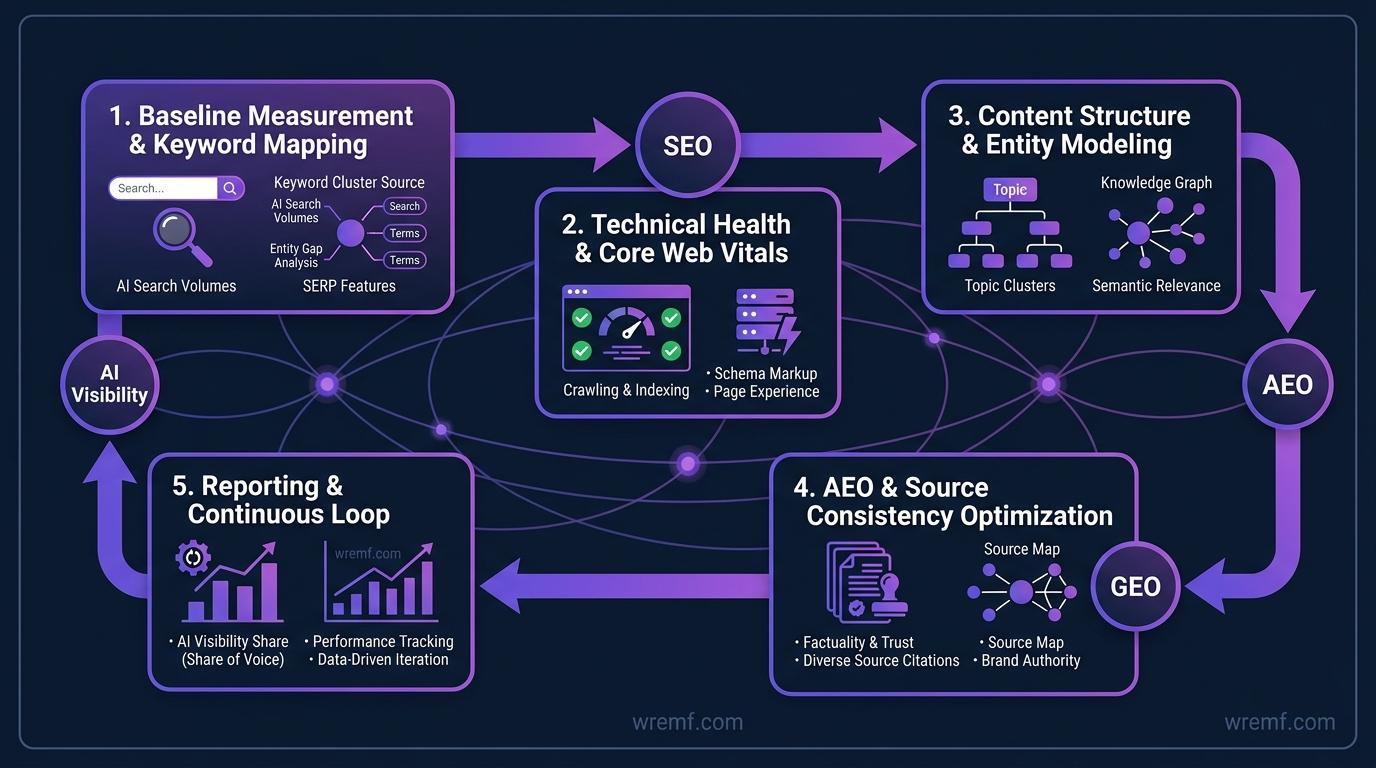
A practical AI Overview SEO workflow starts with baseline measurement, then improves technical health, content structure, source consistency, and reporting. The workflow should connect search engine optimization, AEO, GEO, and AI visibility into one system.
Use this 10-step workflow:
Build a prompt set Create 50 to 200 prompts that reflect customer questions, comparison searches, product research, pain points, alternatives, and implementation needs.
Map search queries Use Google Search Console to identify existing search queries, rankings, impressions, and pages with visibility.
Check AI Overview presence Track whether Google AI Overview appears for important queries and whether your brand or sources are included.
Audit source links Review source links, Source Panel references, link cards, competitor citations, and third-party pages influencing AI responses.
Fix technical issues Improve crawlability, indexation, page speed, rendered HTML, structured data, schema markup, and rich results eligibility.
Rewrite priority content Add direct answers, definitions, examples, tables, FAQs, source attribution, and next-question coverage.
Strengthen entity authority Update organization pages, product pages, author bios, directory listings, review profiles, and brand descriptions.
Improve source consistency Make sure your website, third-party profiles, documentation, and public descriptions explain your brand consistently.
Run SEO tests Compare page changes against impressions, clicks, click-through rates, rankings, AI citations, and prompt visibility.
Report monthly Track changes in AI visibility, organic traffic, competitor mentions, source citations, and attribution.
In practical AI visibility audits, marketing teams often find that the biggest gap is not one missing keyword. The bigger gap is usually missing answer structure, weak source consistency, outdated third-party descriptions, or no prompt monitoring.
WREMF supports this workflow with GEO audits, SEO testing, AI visibility scoring, scheduled monitoring, and white-label reporting for agencies.
KEY TAKEAWAY: AI Overview SEO works best as a repeatable workflow that connects prompts, search queries, source citations, content updates, and reporting.
The right workflow also depends on whether you need software, agency execution, or a hybrid model.
AI Overview SEO Tools, Services, and Platform Options
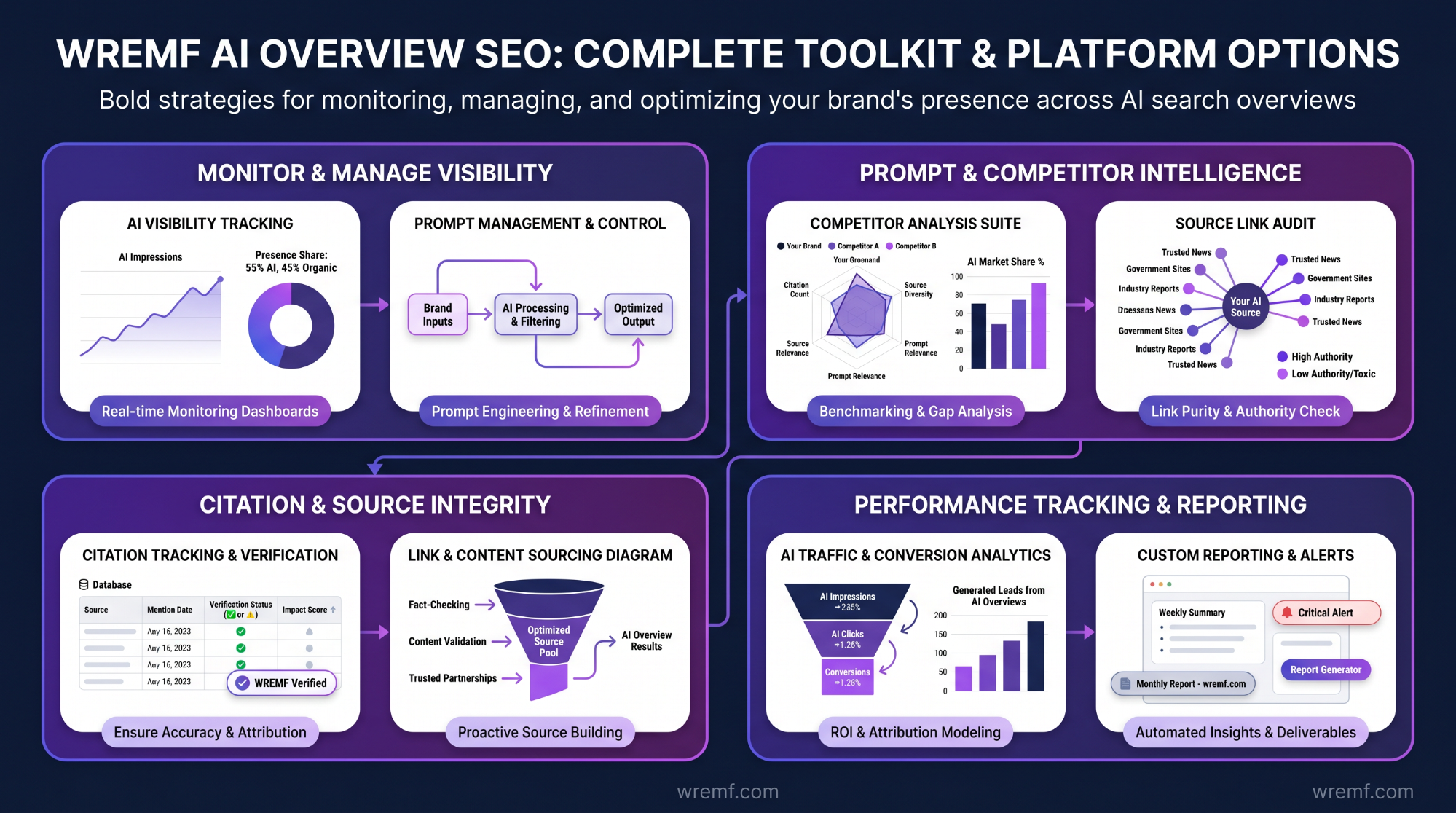
AI Overview SEO tools help teams monitor AI visibility, prompts, citations, competitors, and source links. Services help teams turn that data into content updates, technical fixes, source cleanup, and reporting.
AI tools for SEO can support Keyword Research, content creation, technical audits, search intelligence, and reporting. AI tools matter because AI-driven search changes faster than manual checks can track.
Traditional SEO tools are still useful for rankings, backlinks, technical optimization, search queries, and Google Search Console analysis. But traditional tools may not show whether AI responses cite your page, recommend your brand, or mention competitors inside Google AI Overview, ChatGPT, Perplexity, Gemini, Claude, Copilot, DeepSeek, Grok, Meta AI, and Mistral.
| Option | Best For | What It Measures | What It Misses | Recommended When |
|---|---|---|---|---|
| Traditional SEO tools | SEO teams managing rankings | Rankings, backlinks, technical SEO, keyword data | AI responses, source links, AI share of voice | You need classic SEO visibility |
| Manual AI testing | Small teams testing a few prompts | Sample AI responses | Scale, history, reporting, consistency | You are validating early assumptions |
| AI visibility software | Brands and agencies tracking AI surfaces | Prompts, citations, mentions, competitors, share of voice | Execution unless team acts on insights | You need repeatable measurement |
| AI visibility agency | Teams needing execution | Strategy, content fixes, audits, reporting | Self-serve platform control | You lack internal GEO capacity |
| Hybrid software plus agency | Growth teams and agencies needing proof and action | Visibility, citations, competitors, attribution, recommendations | Requires ownership and process | You want software plus managed execution |
WREMF is useful for brands that want software, agencies that need white-label reporting, and teams that want managed execution. It combines prompt tracking, citation analysis, competitor visibility, AI traffic attribution, content briefs, GEO audits, SEO testing, API access, BYOK support, client portals, and scheduled monitoring.
For cost-conscious teams, WREMF pricing starts at Starter for €39 per month with 1 website, unlimited prompt tracking, BYOK, 10 AI engines, all features and tools, white-label reports, 1 seat, and email support. Growth is €89 per month for 5 websites with priority email support, content brief generation, and SEO A/B testing. Enterprise supports unlimited websites, unlimited seats, dedicated support, and custom branded portals through WREMF pricing.
For technical workflows, WREMF also supports integrations through the WREMF API and MCP workflows, which can connect AI visibility data into internal dashboards, automation systems, and client portals.
KEY TAKEAWAY: The right AI Overview SEO option depends on whether your team needs measurement, execution, reporting, integrations, or all four.
Tools help you measure. Strategy helps you decide what to do when AI Overviews reduce clicks.
How to Manage Zero-Click Content and Protect Search Value
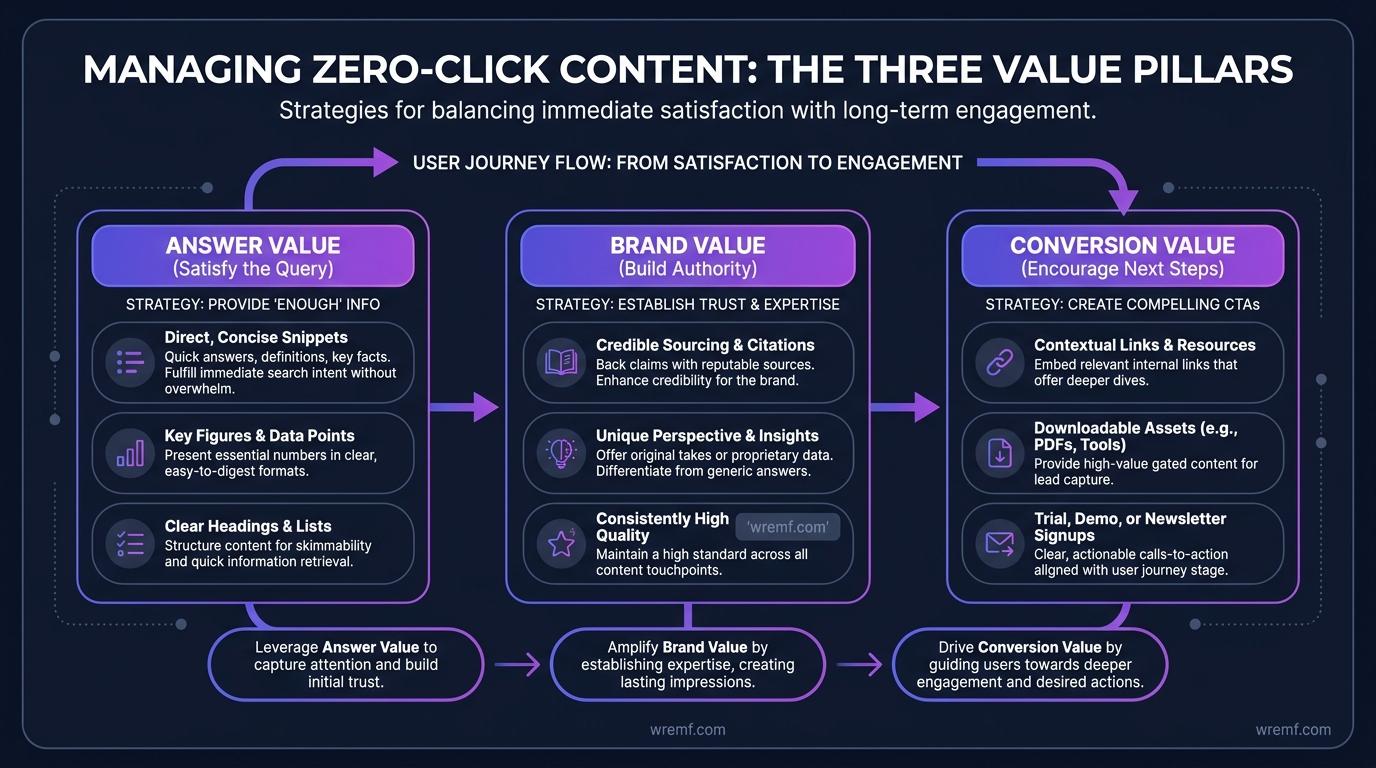
Zero-click content should be managed by separating answer value, brand value, and conversion value. The goal is to give enough information to earn visibility while creating reasons for qualified users to continue deeper.
Zero-click content is content that answers a query so completely on the search results page that users may not click. Zero-click content matters because AI Overviews, Featured Snippets, Answer Box results, and People Also Ask can all satisfy simple informational queries.
The wrong response is to hide all useful information. If your content is not useful enough to be cited, it may not win visibility at all. The better response is to structure content so simple answers are clear, while deeper insights, tools, data, templates, comparisons, and decision support create click value.
Use this model:
Give the direct answer upfront
Add proprietary detail below the answer
Include comparison tables that help decision making
Use examples from practical experience
Add data that cannot be easily summarized without attribution
Offer tools, reports, templates, or calculators where relevant
Build internal links from informational pages to commercial pages
Track assisted conversions, not only last-click organic traffic
For AI Overview SEO, content should be summary-ready but not shallow. A definition page can earn awareness. A comparison page can support vendor shortlisting. A methodology page can build trust. A sample report can convert high-intent readers.
If you want to see what AI visibility reporting can look like before building your own workflow, review a sample AI visibility report.
KEY TAKEAWAY: Zero-click content is not a reason to stop publishing. It is a reason to combine direct answers with deeper value, internal links, and AI visibility measurement.
Zero-click risk also explains why brands need to monitor sentiment, hallucinations, and source accuracy.
Risks, Limitations, and Mistakes to Avoid
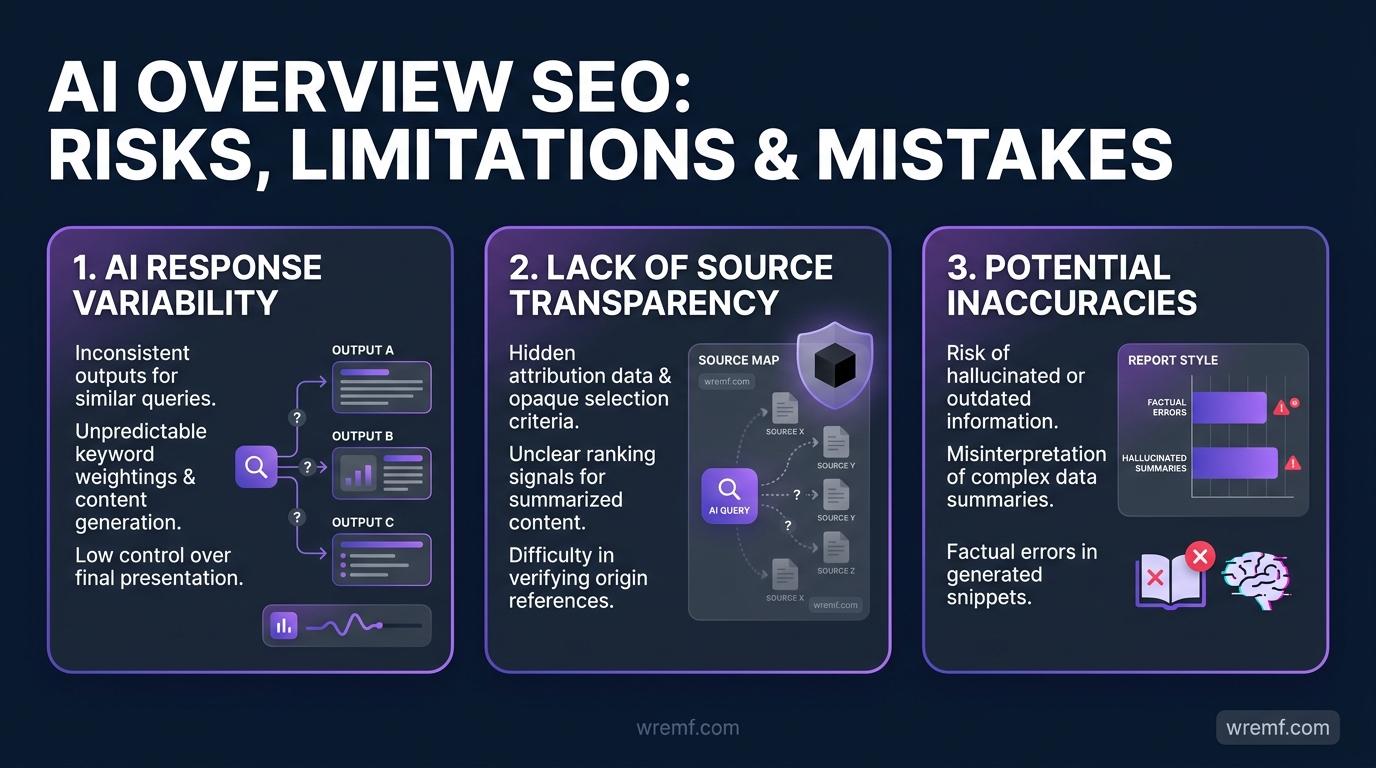
AI Overview SEO has real limitations because AI responses can change, source selection is not fully transparent, and AI-generated summaries can be incomplete or wrong. Teams should optimize for visibility and accuracy without expecting guaranteed citations, rankings, traffic, or revenue.
A common mistake is treating AI Overview SEO as a schema markup checklist. Schema markup helps search engines understand content, but schema markup does not replace helpful content, source credibility, technical accessibility, or entity authority.
Another mistake is measuring only rankings. Rankings remain important, but AI Overview SEO also requires citation tracking, source links, Source Panel monitoring, link cards, brand mentions, AI share of voice, and competitor visibility.
A third mistake is publishing low-quality AI-generated content at scale. Google Search Central explains that ranking systems are designed to prioritize helpful, reliable, people-first content through its helpful content guidance. That means content quality matters more than whether an AI tool helped draft the page.
YMYL topics are topics that can affect health, finance, safety, or major life decisions. YMYL topics matter because users and search systems expect stronger accuracy, expertise, and trust signals.
Avoid these AI Overview SEO mistakes:
Assuming rankings alone guarantee AI citations
Ignoring Search Generative Experience and AI Mode patterns
Ignoring Google Search Console query data
Ignoring click-through rates and zero-click searches
Publishing generic content creation outputs without human review
Forgetting source links and third-party references
Using schema markup without helpful content
Ignoring rich results, Product Carousels, videos, and SERP features
Treating AI visibility as a one-time screenshot
Blocking important content without understanding the tradeoff
Ignoring local SEO and Google Business Profile accuracy
Ignoring voice search and conversational AI queries
Forgetting brand credibility and source consistency
AI responses can hallucinate or summarize a brand incorrectly. Managing hallucinations requires consistent source data, clear website copy, accurate third-party profiles, regular monitoring, and correction workflows.
KEY TAKEAWAY: The biggest AI Overview SEO mistake is treating generative visibility as a one-time ranking trick instead of an ongoing measurement and source ecosystem problem.
These mistakes lead directly to the common myths that prevent teams from adapting.
Common Myths About AI Visibility Debunked
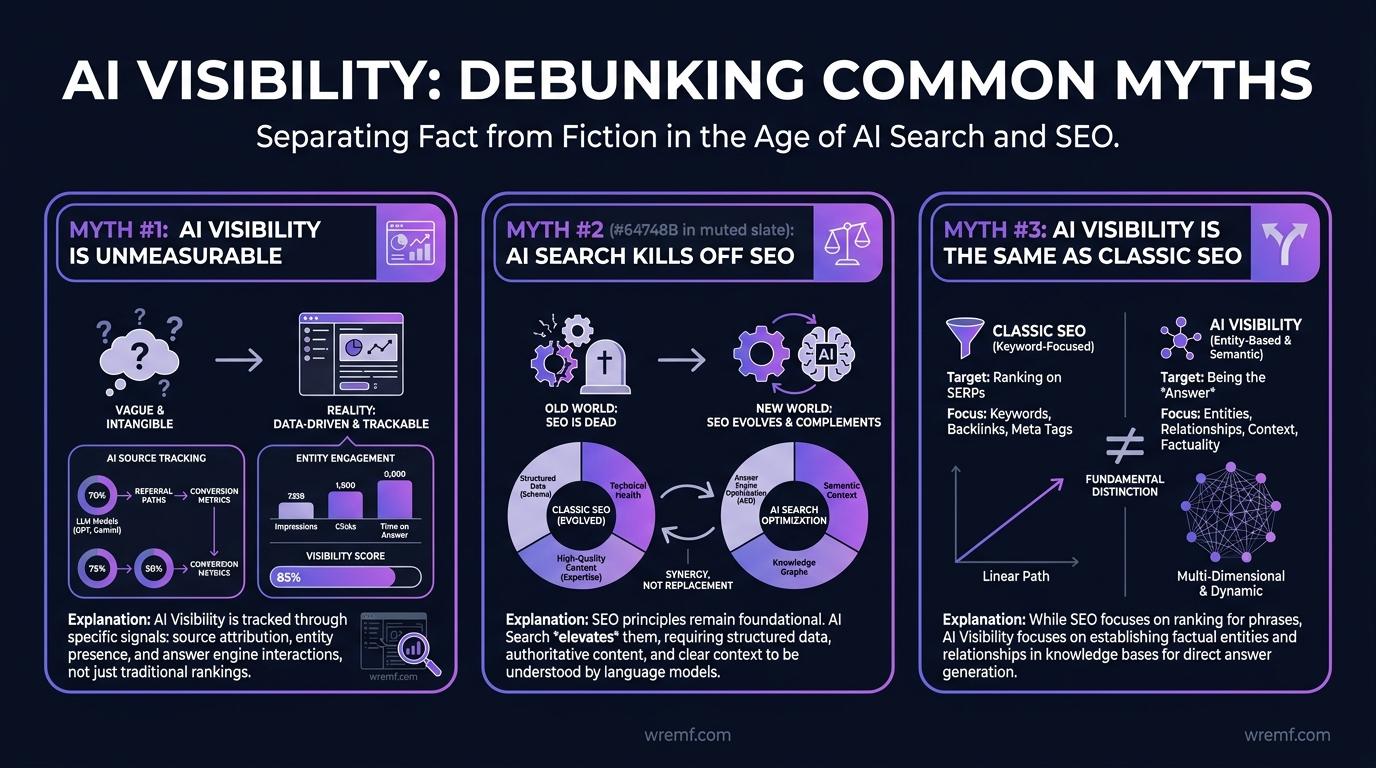
AI visibility is measurable and improvable, but it is not measured the same way as classic SEO. The biggest myths come from treating AI Overviews like normal rankings or assuming AI Search makes SEO irrelevant.
MYTH: AI visibility is impossible to measure.
FACT: AI visibility can be measured through prompt tracking, source citations, brand mentions, AI share of voice, sentiment, competitor visibility, and attribution. The measurement is probabilistic because AI responses can vary, but scheduled monitoring reveals trends and gaps.
MYTH: SEO, AEO, and GEO are separate strategies.
FACT: SEO, AEO, and GEO overlap. SEO creates crawlability and authority, AEO creates answer-ready structure, and GEO improves representation inside generative AI responses. AI Overview SEO needs all three.
MYTH: Rankings are enough to win Google AI Overview visibility.
FACT: Rankings still matter, but they are not enough. Ahrefs found that 38 percent of AI Overview cited pages also ranked in the top 10 for the same query in its 2026 study, which means many citations came from outside page one. The practical response is to track rankings and citations separately.
MYTH: Blogging is dead because AI Overviews answer informational queries.
FACT: Blogging is changing, not dead. Generic content may lose clicks, but original research, structured content, comparison pages, expert workflows, and source-backed guides can still support organic traffic, brand credibility, and AI visibility.
MYTH: Schema markup alone can get a page into AI Overviews.
FACT: Schema markup helps search engines understand content, but it does not guarantee AI Overview inclusion. Helpful content, source usefulness, technical SEO, entity clarity, and source consistency still matter.
KEY TAKEAWAY: AI visibility is measurable, but it requires broader tracking than rankings and broader optimization than keyword density or schema markup alone.
The final step is answering the most common practical questions teams ask before investing in AI Overview SEO.
Frequently Asked Questions
What is AI Overview SEO?
AI Overview SEO is the practice of optimizing content, technical SEO, entity authority, source consistency, and citations so a brand can appear inside Google AI Overviews and related AI Search experiences. It includes search engine optimization, answer engine optimisation, generative engine optimisation, structured data, schema markup, prompt tracking, and AI visibility reporting. The goal is not only to rank in search results, but also to become a useful source inside AI-generated summaries.
What are Google AI Overviews?
Google AI Overviews are AI-generated summaries that appear in Google Search for selected queries. Google explains that AI Overviews provide a snapshot of key information with links so users can explore more on the web. They evolved after Search Generative Experience and now sit alongside traditional search results, Featured Snippets, rich results, source links, Product Carousels, videos, and other SERP features.
How do Google AI Overviews work?
Google AI Overviews work by using generative AI, Google Search systems, Large Language Models, and relevant source material to synthesize answers. For AI Mode, Google says it uses query fan-out, which breaks a question into subtopics and issues multiple related searches. This means AI Overview SEO must cover the primary search query, related search queries, source links, entity context, and follow-up questions.
How do AI Overviews affect organic traffic?
AI Overviews can reduce organic traffic for some informational search queries because users may get enough information directly from AI-generated summaries. Pew Research Center found that users who encountered an AI summary clicked traditional search results less often than users who did not. However, organic traffic is only one metric. Brands should also measure AI citations, source links, brand mentions, AI share of voice, and assisted conversions.
How do I optimize content for Google AI Overview?
To optimize content for Google AI Overview, write a direct answer first, define entities clearly, use structured headings, add useful tables, include FAQs, support claims with named sources, and cover the next logical question. Then improve technical SEO, structured data, schema markup, internal linking, page speed, and Google Search Console performance. WREMF can help by turning prompt gaps and source citation gaps into AI-ready content briefs.
Is SEO still worth it with AI Overviews and AI Mode?
SEO is still worth it because AI Overviews and AI Mode depend on search systems, accessible content, source quality, and user intent. What changes is the measurement model. You should still monitor rankings, impressions, clicks, click-through rates, and Google Search Console data, but you should also monitor AI responses, source citations, brand mentions, competitor visibility, and AI share of voice.
What is the difference between Search Generative Experience and AI Overviews?
Search Generative Experience was Google’s experimental generative AI search experience inside Search Labs. AI Overviews are the broader AI-generated summaries that Google displays in Search results for selected queries. Search Generative Experience helped test AI summaries, source links, and conversational follow-up behavior. AI Overviews and AI Mode are the current terms most SEO teams track when measuring Google AI visibility.
What is the difference between Featured Snippets and AI Overviews?
Featured Snippets usually extract a direct answer from one source and show it near the top of search results. AI Overviews synthesize information from multiple sources and can include source links, link cards, rich results, Product Carousels, videos, and follow-up paths. Featured Snippets reward concise answers. AI Overviews require answer clarity, topical depth, source credibility, and broader entity understanding.
Can schema markup help with AI Overview SEO?
Schema markup can help AI Overview SEO by making page entities, content types, and relationships easier for search engines to understand. It can also support rich results when a page is eligible. Schema markup does not guarantee Google AI Overview inclusion. It should support helpful content, technical accessibility, structured content, internal linking, source credibility, and clear entity signals.
Should I block AI Overviews from using my content?
Most brands should not block useful content from Google if they rely on search visibility, AI citations, and source links. Google provides preview controls such as nosnippet, data-nosnippet, max-snippet, and noindex, but those controls can limit visibility in search features. Blocking should be a strategic decision based on content value, business model, legal concerns, and visibility goals.
How can I measure whether my brand appears in AI Overviews?
You can measure AI Overview visibility by tracking target search queries, checking whether Google AI Overview appears, recording source links, monitoring brand mentions, comparing competitor mentions, and tracking AI share of voice over time. Google Search Console helps with clicks and impressions, but it does not fully show AI responses. WREMF helps teams monitor prompts, citations, competitors, and source consistency across 10 AI engines.
Is blogging still worth doing after AI Overviews?
Blogging is still worth doing when the content is original, structured, helpful, and connected to business outcomes. Thin posts that repeat common answers may lose clicks to AI-generated summaries. Strong posts that include definitions, examples, data, comparisons, FAQs, and next-step guidance can still earn rankings, source citations, brand mentions, and AI visibility. The goal is to publish better knowledge assets, not more generic posts.
How does AI Overview SEO affect keyword research?
AI Overview SEO changes keyword research by shifting attention from exact-match keywords to search queries, user intent, query fan-out, and topic clusters. Keyword Research should identify the primary query, related subtopics, follow-up questions, SERP features, Featured Snippets, Product Carousels, rich results, and competitor visibility. This helps content match how AI Mode and AI Overviews synthesize information.
What tools do I need for AI Overview SEO?
You need Google Search Console for search performance, technical SEO tools for crawl and site health, analytics tools for attribution, and AI visibility tools for prompt tracking, source citations, competitor visibility, and AI share of voice. Traditional SEO tools remain useful, but they do not fully measure AI responses. WREMF combines prompt intelligence, source citations, competitive landscape tracking, GEO audits, content briefs, and white-label reporting.
Is WREMF software, an agency service, or both?
WREMF can be used as software, an agency service, or a hybrid software plus managed execution solution. The software helps teams track AI visibility, prompt intelligence, source citations, competitor visibility, AI share of voice, and AI traffic attribution. The agency team supports GEO audits, AEO strategy, content optimization, source consistency cleanup, technical foundations, and monthly reporting through the WREMF agency team.
Conclusion
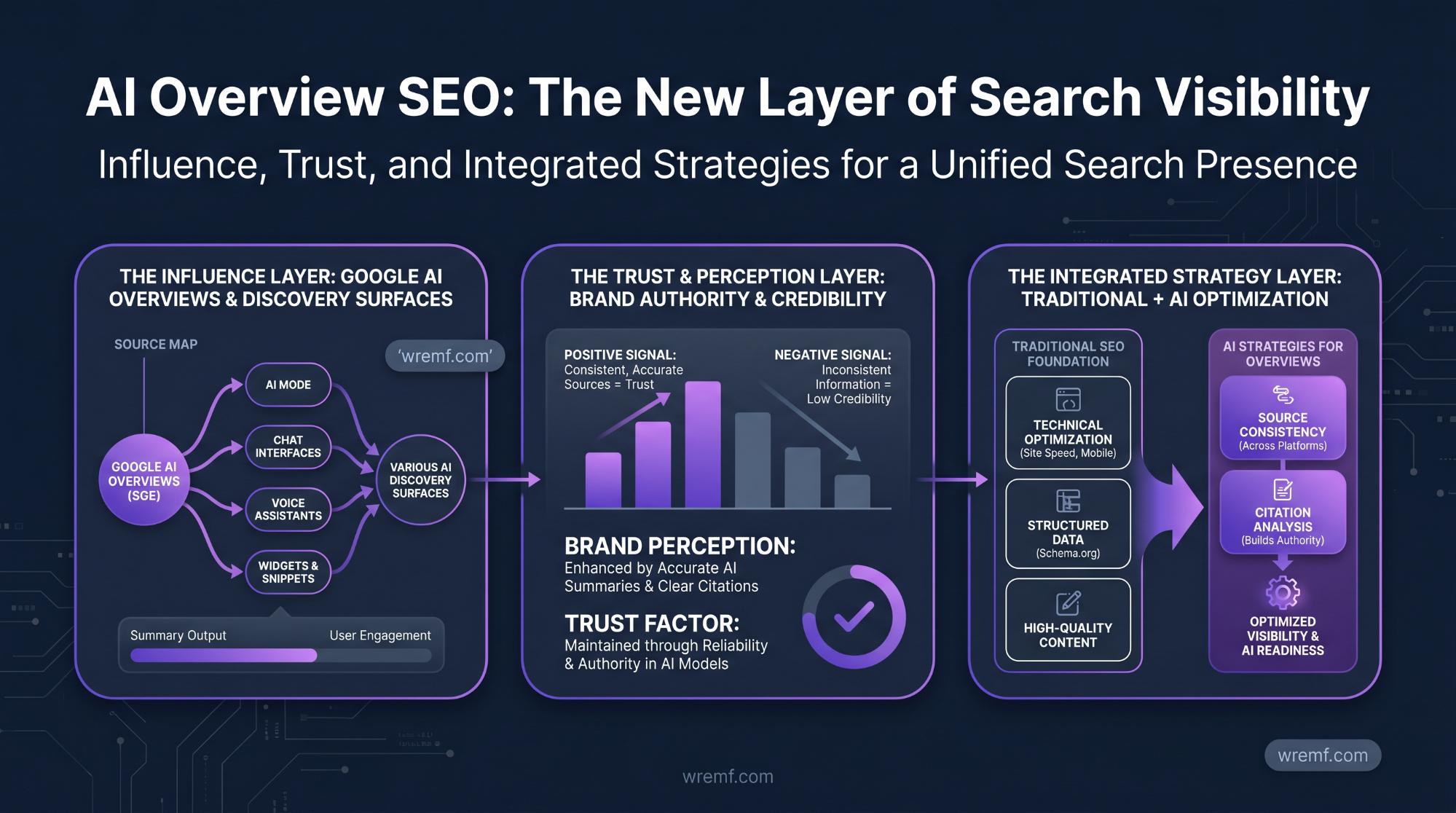
AI Overview SEO is the new operating layer for search visibility because Google AI Overviews, AI Mode, Search Generative Experience, ChatGPT, Perplexity, Claude, Gemini, Copilot, and other AI discovery surfaces now influence how buyers find, compare, and trust brands. Traditional search engine optimization still matters, but rankings alone do not show whether your brand is cited, mentioned, recommended, or described accurately. The practical path is to combine helpful content, technical SEO, structured data, schema markup, source consistency, prompt tracking, citation analysis, and attribution. To turn AI Overview SEO into a measurable workflow, explore the WREMF platform suite or request support from the WREMF agency team.
Related Generative Engine Optimization Guides
- Answer Engine Optimization The Complete Guide to AEO, AI Search Visibility, and Answer-First Content
- Answer Engine Optimization Services The Complete Guide to AI Search Visibility
- LLM SEO Agency The Complete Guide to Choosing an Agency for AI Search Visibility
- LLM SEO Services The Complete 2026 Guide to AI Search Visibility, AEO, GEO, and LLM Optimization
- AI Search Engine Optimization Services The Complete Guide for B2B Brands
- AI SEO Services The Complete Guide to Search Visibility in the AI Era
- How AI Search Optimization Tools Increase Organic Traffic
- AI Overview Optimization How to Rank, Get Cited, and Stay Visible in Google AI Search
- AI Search Engine Optimization Tools The Complete 2026 Guide for AI Search, SEO, AEO, and GEO
- How Do AI Search Optimization Tools Improve SERP Rankings
- Large Language Model Optimization Services The Complete Guide to LLMO, AI Search Visibility, AEO, GEO, RAG, and LLM Performance
- Generative AI Optimization Services The Complete Guide to GEO, AEO, LLM Optimization, and AI Visibility
- Enterprise Answer Engine Optimization Platforms Complete Guide for AI Visibility, AEO, and GEO
- AI Search Engine Optimization The Complete Guide for B2B Brands
- AI SEO Agency How to Choose the Right Partner for AI Search Visibility
- AI Mention Tracking The Complete Guide to Monitoring Brand Mentions, AI Answers, Citations, and Share of Voice in 2026
- AI SEO Tools The Complete Guide for SEO, AEO, GEO, and AI Search Visibility
- 12 Best AI Search Optimization Tools
- Best Answer Engine Optimization for Enhancing AI Visibility
- AI Brand Monitoring The Complete Guide to Tracking Brand Visibility Across AI Search, LLMs, and Generative Engines
Related reading
- Generative AI Optimization Services: The Complete Guide to GEO, AEO, LLM Optimization, and AI Visibility
- AI Search Engine Optimization: The Complete Guide for B2B Brands
- AI Search Engine Optimization Services: The Complete Guide for B2B Brands
- LLM SEO Services: The Complete 2026 Guide to AI Search Visibility, AEO, GEO, and LLM Optimization