LLM SEO Services: The Complete 2026 Guide to AI Search Visibility, AEO, GEO, and LLM Optimization
Learn how LLM SEO services improve brand visibility across ChatGPT, Claude, Gemini, Perplexity, and Google AI Overviews through prompt tracking and citations.
By WREMF Team · 2026-05-09
LLM SEO services help brands become visible in AI-generated answers, citations, recommendations, and summaries across large language models and AI search engines. These services combine SEO, Answer Engine Optimization, Generative Engine Optimization, and AI visibility tracking into one measurable workflow. Complete LLM SEO services include prompt tracking across ChatGPT, Claude, Gemini, Perplexity, Google AI Overviews, Copilot, DeepSeek, Grok, Meta AI, and Mistral. They also include AI citation tracking, competitor visibility analysis, source consistency cleanup, Technical SEO review, entity optimization, content strategy, and AI traffic attribution. Success is measured through AI visibility, prompt coverage, brand mentions, recommendation rate, AI share of voice, citation rate, and source consistency. LLM SEO services improve AI visibility by making brand information easier for large language models to retrieve, understand, verify, cite, and recommend through Technical SEO, entity clarity, answer-first content, structured data, and source citations.
Key takeaways
- LLM SEO services help brands measure and improve visibility inside large language models, AI search engines, AI Overviews, and answer-led discovery surfaces.
- Complete LLM SEO services must combine prompt tracking, AI citation analysis, Technical SEO, content strategy, entity optimization, competitor visibility, and reporting.
- LLM SEO services should track multiple AI platforms because AI visibility is engine-specific, prompt-specific, citation-specific, and source-dependent.
- Success is measured through AI visibility, prompt coverage, AI citations, brand mentions, recommendation rate, competitor share of voice, source consistency, and AI traffic attribution instead of relying only on rankings or organic search traffic.
- LLM SEO services improve AI visibility by aligning Technical SEO, entity clarity, structured content, source citations, competitor analysis, and repeated measurement.
- Choose LLM SEO software if you have internal execution capacity, an agency if you need strategy and implementation, and a hybrid service if you need measurement plus managed execution.
LLM SEO Services: The Complete 2026 Guide to AI Search Visibility, AEO, GEO, and LLM Optimization
LLM SEO services help brands appear inside AI-generated answers, citations, recommendations, and summaries across large language models. Gartner predicts traditional search engine volume will drop 25% by 2026 as AI chatbots and virtual agents reshape search behavior, which makes AI visibility a measurable marketing priority. This guide explains how LLM SEO services work, how they differ from traditional SEO services, Answer Engine Optimization, Generative Engine Optimization, and AI SEO, and how teams should measure prompts, AI citation gaps, competitor visibility, brand mentions, source consistency, and AI traffic attribution. WREMF helps B2B teams track, improve, and prove AI visibility across ChatGPT, Claude, Gemini, Perplexity, Google AI Overviews, Copilot, DeepSeek, Grok, Meta AI, Mistral, and other AI discovery surfaces. Use this guide to choose the right service model and build a workflow that can be measured. (Gartner)
What Are LLM SEO Services?
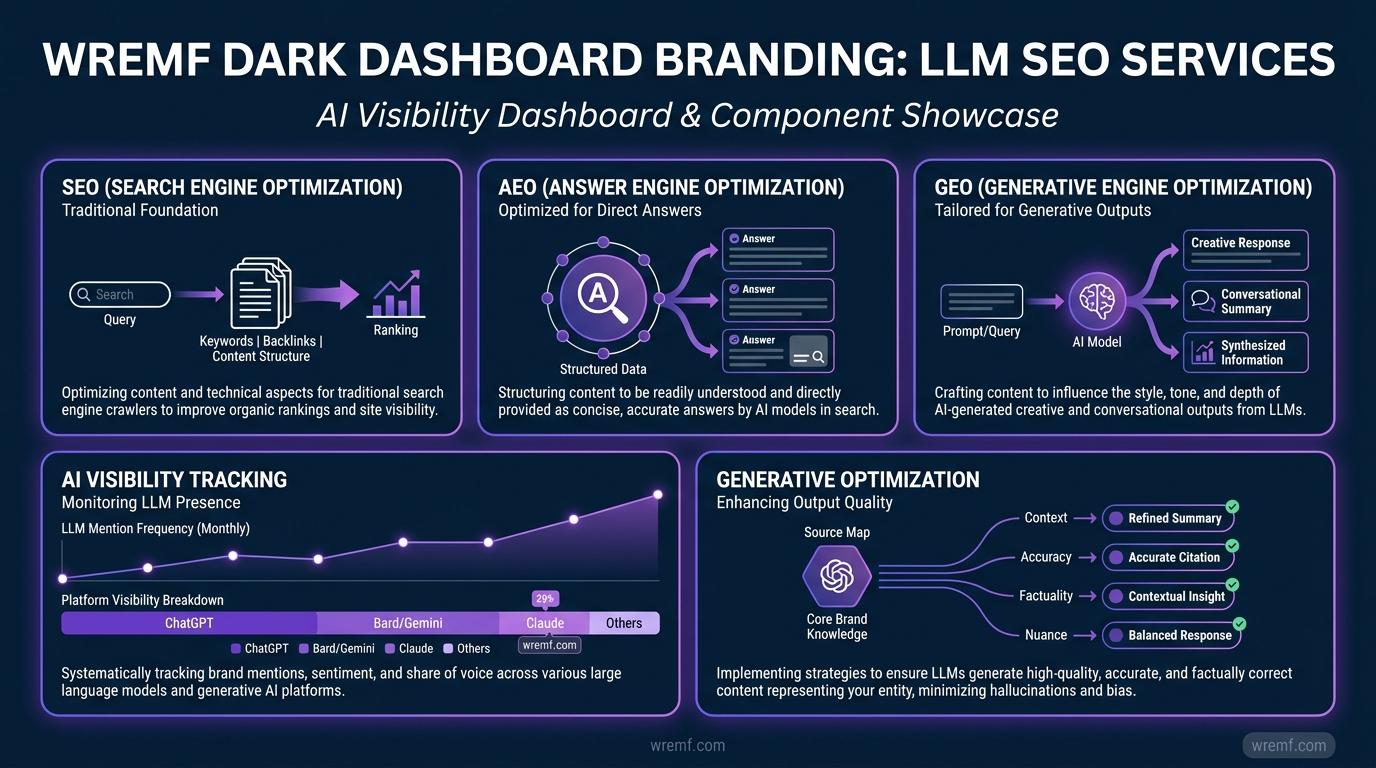
LLM SEO services help your brand become visible in AI search answers, cited responses, recommendations, and summaries generated by large language models. LLM SEO services connect SEO, Answer Engine Optimization, Generative Engine Optimization, and AI visibility tracking into one measurable workflow.
LLM SEO is the practice of improving how a brand, product, website, or expert source appears inside large language models and AI search engines. It includes content strategy, Technical SEO, entity optimization, structured content, source citation tracking, prompt tracking, brand visibility analysis, and AI traffic attribution.
Large language models are AI systems that process and generate natural language answers. In search and discovery, large language models may use trained knowledge, search indexes, real-time web retrieval, RAG retrieval, citations, and source ranking signals to create answers. Large language models matter for SEO because buyers now ask AI platforms to compare tools, recommend vendors, explain concepts, summarize markets, and evaluate products before they visit a website.
AI visibility is the measurable presence of a brand inside AI-generated answers, citations, recommendations, and summaries. AI visibility matters because a buyer can discover, trust, or ignore a brand before reaching a traditional search result, ad, or landing page.
Traditional SEO services focus on Google Search rankings, organic search traffic, technical fixes, backlinks, content quality, and conversions. LLM SEO services add a new layer: prompt visibility, AI citation tracking, competitor share of voice, source consistency, AI Overviews monitoring, AI-driven search testing, and reporting across AI platforms.
WREMF helps teams turn LLM SEO services into a measurable workflow through AI visibility tracking software, prompt intelligence, source citation tracking, competitor visibility, GEO audits, and optional managed execution.
DID YOU KNOW: Gartner predicts traditional search engine volume will drop 25% by 2026 because AI chatbots and virtual agents are changing how users search, compare, and discover information. (Gartner)
KEY TAKEAWAY: LLM SEO services help brands measure and improve visibility inside large language models, AI search engines, AI Overviews, and answer-led discovery surfaces.
To understand why this matters, you need to separate LLM SEO from SEO, AEO, GEO, and AI SEO.
How Do LLM SEO, SEO, AEO, GEO, and AI SEO Differ?
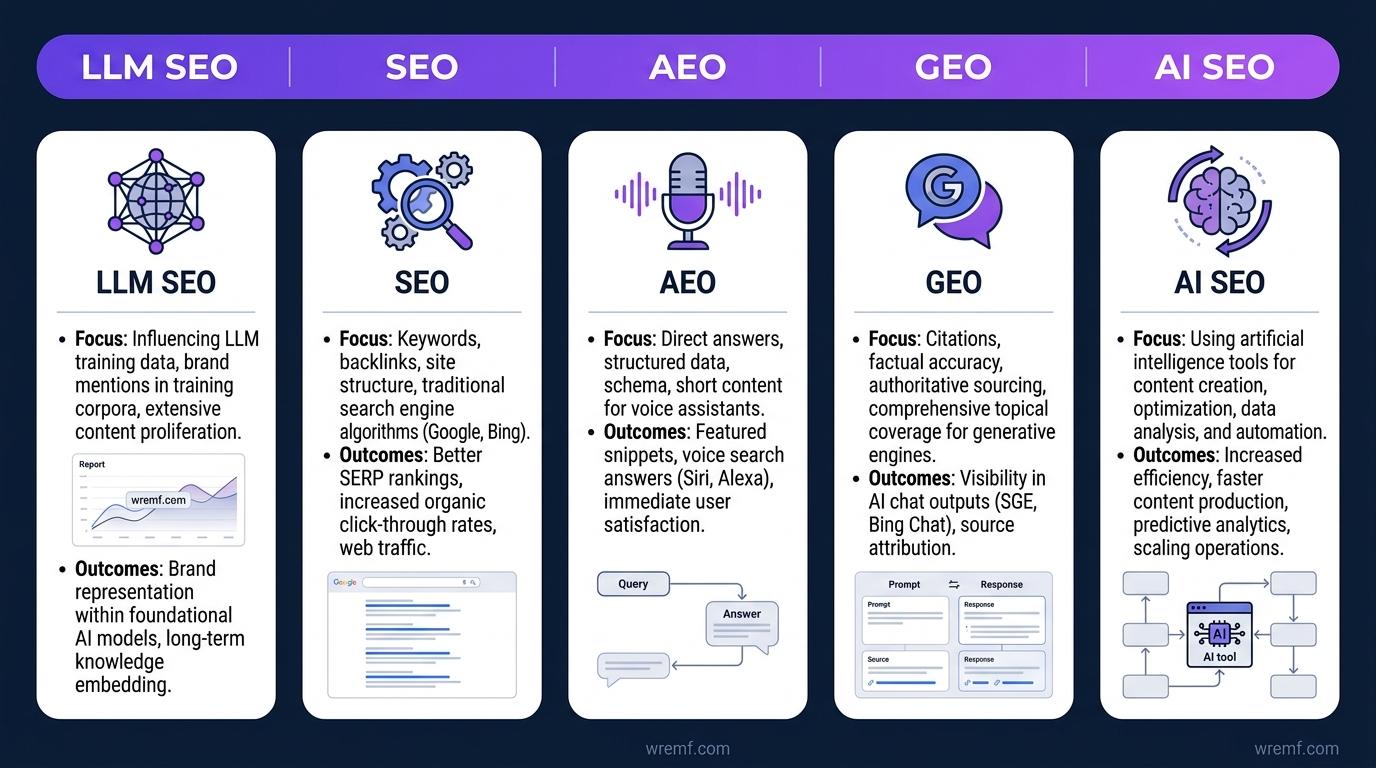
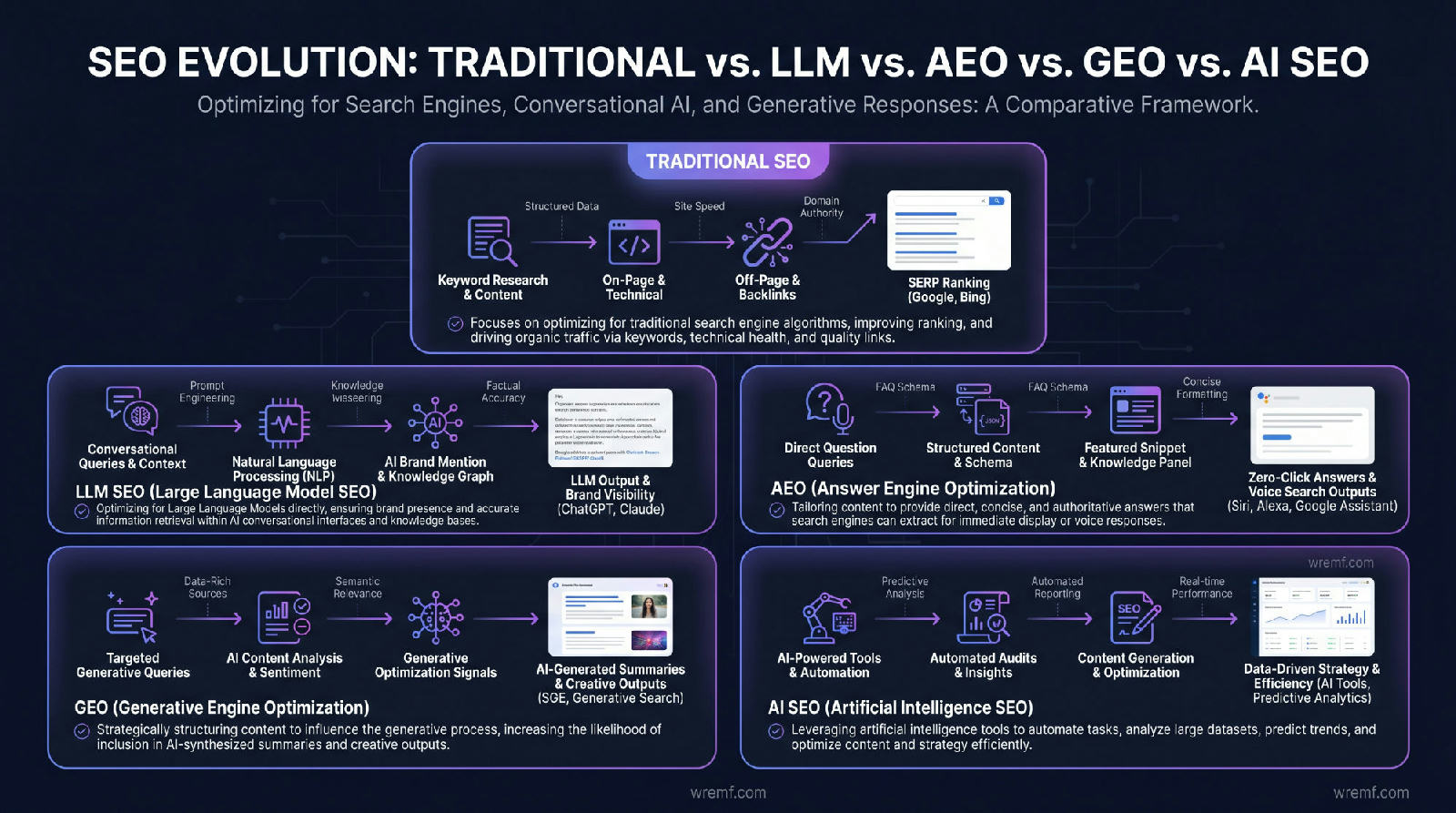
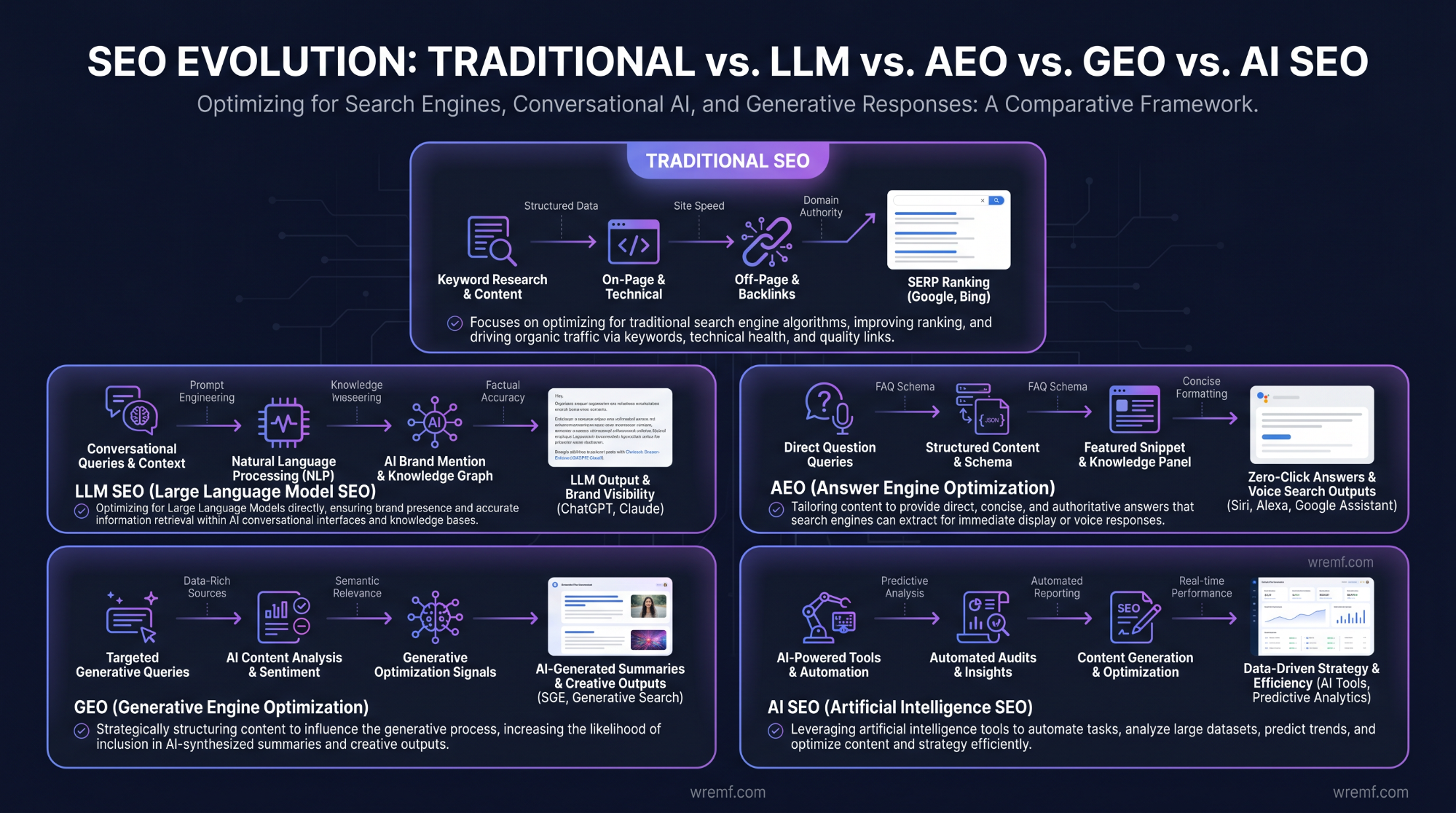
LLM SEO, SEO, Answer Engine Optimization, Generative Engine Optimization, and AI SEO overlap, but they do not measure the same outcome. SEO improves search engine visibility, AEO improves answer eligibility, GEO improves generative answer inclusion, and LLM SEO measures visibility across large language models.
Search engine optimization is the practice of making a website easier for search engines to crawl, index, understand, rank, and display. Google Search Central says its SEO Starter Guide helps site owners make content easier for search engines to crawl, index, and understand, which remains the foundation for organic search and AI-powered Search. (Google for Developers)
Answer Engine Optimization is the practice of structuring content so it answers specific questions clearly, directly, and accurately. Answer Engine Optimization matters because AI assistants, voice assistants, featured snippets, FAQ sections, and Google AI Overviews need extractable answer blocks. Answer Engine Optimization also helps users who want a direct answer instead of a long page.
Generative Engine Optimization is the practice of improving how content, brands, and entities appear inside generative AI answers. Generative Engine Optimization matters because generative engines synthesize answers from multiple sources instead of showing only ranked links. Generative Engine Optimization is especially relevant for ChatGPT, Claude, Gemini, Perplexity, Copilot, Mistral, Meta AI, DeepSeek, Grok, and Google AI Overviews.
AI SEO is the broader use of SEO, content strategy, Technical SEO, AI visibility tracking, and AI-assisted workflows to improve discoverability in AI-driven search. AI SEO includes LLM Optimization, Answer Engine Optimization, Generative Engine Optimization, content creation, content clustering, and AI Search Analytics.
LLM Optimization is the process of making your brand information easier for large language models to retrieve, understand, verify, cite, and recommend. LLM Optimization matters because large language models need clear entities, consistent sources, reliable content, and structured answers before they can confidently include a brand.
| Discipline | Main Goal | What It Measures | What It Misses | Best For |
|---|---|---|---|---|
| SEO | Improve search engine rankings and organic search visibility | Rankings, clicks, impressions, CTR, organic traffic | AI citations, AI recommendations, prompt visibility | Search growth and organic acquisition |
| Answer Engine Optimization | Make content answer specific questions clearly | Featured snippets, Q&A sections, FAQ sections, answer quality | Cross-engine AI visibility and source influence | Definitions, guides, explainers, support content |
| Generative Engine Optimization | Improve inclusion in generative AI answers | AI citations, generated answer presence, source overlap | Traditional rank position and keyword-level traffic | AI Overviews, ChatGPT, Perplexity, Claude, Gemini |
| AI SEO | Adapt SEO strategy to AI-powered Search | Content quality, AI search visibility, technical foundations, AI workflows | Deep source citation analysis if not measured | Teams modernizing SEO for AI search |
| LLM SEO | Improve brand visibility across large language models | Prompts, citations, brand mentions, competitors, AI share of voice, attribution | Offline influence unless connected to CRM or pipeline data | B2B SaaS, agencies, consultants, and growth teams |
AI-powered Search is search behavior where AI systems summarize, generate, or recommend answers using search indexes, sources, and language models. AI-powered Search matters because it changes the user journey from clicking ranked links to receiving direct recommendations.
Google AI Overviews are AI-generated summaries in Google Search that provide a snapshot of key information and links for deeper exploration. Google explains that AI Overviews help people get to the gist of complex topics more quickly and provide links to learn more, which makes source eligibility and content clarity important. (Google for Developers)
IMPORTANT: LLM SEO does not replace SEO fundamentals. LLM SEO adds AI visibility, AI citation, prompt tracking, source consistency, and competitor recommendation data to the traditional SEO measurement layer.
KEY TAKEAWAY: SEO, Answer Engine Optimization, Generative Engine Optimization, AI SEO, and LLM SEO are connected, but LLM SEO is the most complete framework for measuring brand presence across large language models and AI search engines.
Once the definitions are clear, the next step is knowing what a complete service should include.
What Should LLM SEO Services Include?
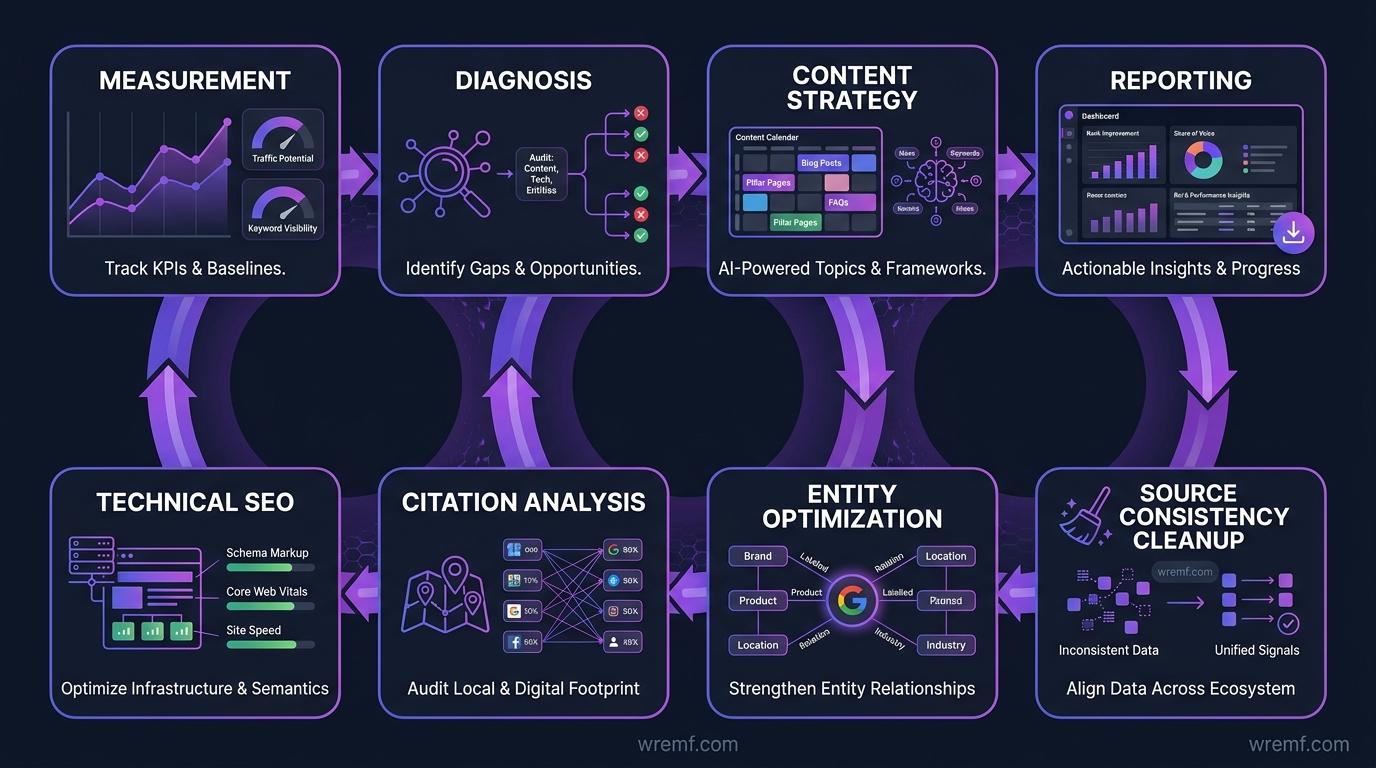
Complete LLM SEO services should include measurement, diagnosis, content strategy, Technical SEO, citation analysis, entity optimization, source consistency cleanup, and reporting. A service that only creates AI-written content is not a complete LLM SEO service.
An effective LLM SEO service should start with a visibility baseline. The provider should test prompts across ChatGPT, Claude, Gemini, Perplexity, Google AI Overviews, Copilot, DeepSeek, Grok, Meta AI, and Mistral. The baseline should show where your brand appears, where competitors appear, which sources are cited, whether the answer is accurate, and whether your brand is recommended.
Prompt tracking is the process of monitoring how AI platforms answer repeated questions about a brand, category, problem, product, or competitor. Prompt tracking matters because AI visibility changes by user intent, model, retrieval source, geography, language, and answer format.
AI citation tracking is the process of identifying which sources are cited or referenced inside AI-generated answers. AI citation tracking matters because cited sources often shape which brands are trusted, compared, and recommended inside AI search.
Source citations are the links, references, or supporting sources that AI platforms show inside a generated answer. Source citations matter because AI systems often rely on third-party domains, documentation, comparison pages, review sites, news sources, knowledge pages, and authoritative explainers to support answers.
A complete LLM SEO services package should include:
AI visibility tracking across major AI platforms
Prompt tracking for branded, non-branded, comparison, problem, solution, and buying-stage questions
Google AI Overviews monitoring for category, informational, and commercial queries
Source citation tracking and AI citation gap analysis
Competitor visibility and competitor recommendation tracking
Brand mention monitoring and answer accuracy checks
Technical SEO review for crawlability, indexation, JavaScript rendering, Core Web Vitals, structured data, schema markup, canonical tags, and internal linking
Content strategy for semantic clusters, content clusters, content library expansion, FAQ sections, Q&A sections, product descriptions, comparison pages, and blog post refreshes
Content marketing guidance for answer-first pages, quality content, local content strategy, YouTube videos, and supporting assets
Entity optimization and entity modeling for consistent brand understanding
Citation outreach, brand mention outreach, and brand citations cleanup
AI traffic attribution through analytics and referral source analysis
Reporting that connects prompts, citations, competitors, actions, and outcomes
Content quality is the usefulness, accuracy, originality, clarity, and trustworthiness of content for a real user. Content quality matters because AI search engines and search engines need reliable source material before they can summarize, cite, or recommend a brand.
Google Search Central explains that Google’s ranking systems are designed to prioritize helpful, reliable, people-first content, not content created mainly to manipulate search engine rankings. That matters for LLM SEO services because large language models also need useful, clear, and source-backed information to generate reliable answers. (Google for Developers)
WREMF combines prompt intelligence, source citation tracking, and competitive AI visibility analysis so teams can connect prompts, citations, competitors, and recommendations in one workflow.
DID YOU KNOW: Perplexity says each answer includes numbered citations linking to original sources, which makes citation tracking especially important for brands that want visibility in AI search. (Perplexity AI)
KEY TAKEAWAY: Complete LLM SEO services must combine prompt tracking, AI citation analysis, Technical SEO, content strategy, entity optimization, competitor visibility, and reporting.
The next step is understanding which AI platforms and search engines should be measured.
Which AI Platforms and Search Engines Should LLM SEO Services Track?
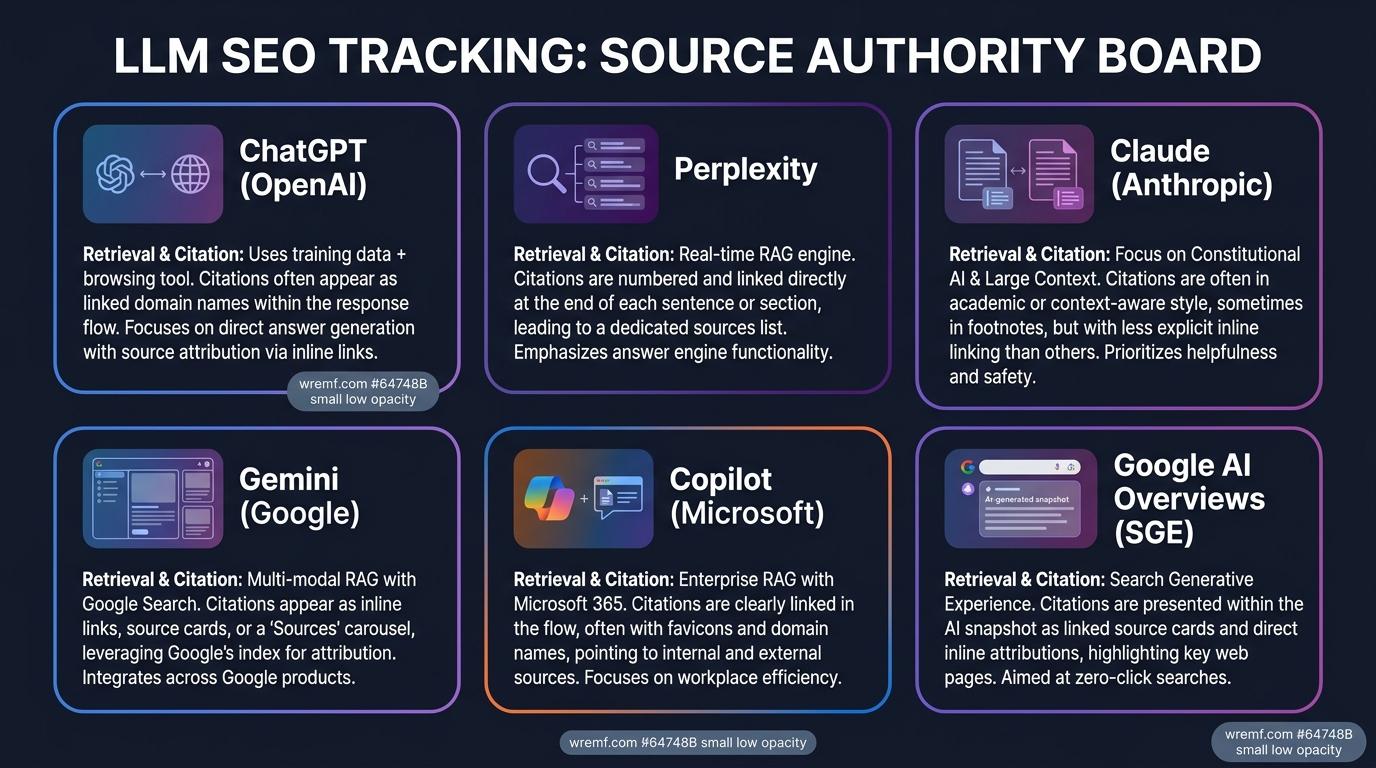
LLM SEO services should track multiple AI platforms because every AI search engine retrieves, cites, summarizes, and recommends information differently. A brand can be visible in ChatGPT and still be absent from Perplexity, Claude, Gemini, Copilot, or Google AI Overviews.
AI platforms are discovery surfaces where users ask questions and receive AI-generated answers, summaries, citations, comparisons, or recommendations. AI platforms matter because they influence brand visibility before the user visits a website.
AI discovery surfaces are the places where users discover products, services, brands, and information through AI-generated responses. AI discovery surfaces include ChatGPT, Claude, Gemini, Perplexity, Google AI Overviews, Copilot, DeepSeek, Grok, Meta AI, Mistral, voice assistants, AI Mode, Google Discover, and AI-powered Search experiences.
A practical LLM SEO service should track at least these surfaces:
| AI Platform or Search Surface | Why It Matters | What to Track | Common Visibility Risk |
|---|---|---|---|
| ChatGPT | Users ask category, vendor, product, and workflow questions | Brand mentions, recommendations, cited sources, answer accuracy | Brand is omitted, outdated, or mispositioned |
| Google AI Overviews | Appears inside Google Search for many informational and commercial queries | Source citations, cited response quality, AI Overviews presence, organic search impact | A page ranks but is not cited in AI Overviews |
| Perplexity | Citation-led AI search experience | Numbered citations, competitor mentions, source overlap | Competitors dominate trusted citations |
| Claude | Used for analysis, research, and B2B workflows | Web citations, answer accuracy, source quality | Content lacks evidence and answer clarity |
| Gemini | Connected to Google AI and AI-powered Search behavior | Brand mentions, summaries, query variations | Weak entity clarity or limited source coverage |
| Copilot | Used across Microsoft and workplace contexts | References, citations, enterprise and web sources | Weak Bing, Microsoft, or source ecosystem visibility |
| DeepSeek, Grok, Meta AI, Mistral | Emerging AI platforms with different answer behavior | Mentions, recommendations, source consistency | Brand facts differ across engines |
| Voice assistants | Natural language discovery and answer-led search | Direct answers, local content strategy, concise answers | Content is not answer-first or structured |
OpenAI describes ChatGPT search as providing fast, timely answers with links to relevant web sources. Anthropic states that Claude’s web search tool gives Claude access to real-time web content and includes citations for sources drawn from search results. These official descriptions show why LLM SEO services need source tracking, not only rank tracking. (OpenAI)
Google Search is still central to AI search because Google AI Overviews, AI Mode, and traditional search results coexist. Google AI features can influence organic search clicks, impressions, and discovery patterns. That means LLM SEO services should monitor Google Search Console, Google Search rankings, Google AI Overviews, and AI citation overlap together.
Search engines are systems that crawl, index, rank, and present information in response to user queries. Search engines matter in LLM SEO because many AI-driven search experiences depend on search indexes, web sources, knowledge signals, and retrievable content.
In practical AI visibility audits, teams often find uneven visibility. A brand may appear in ChatGPT for branded prompts, fail to appear in Google AI Overviews for category prompts, be cited by Perplexity only through outdated sources, and lose recommendation visibility to competitors in Copilot or Claude. Multi-platform tracking prevents this blind spot.
WREMF tracks 10 AI engines through the AI Visibility Index, helping teams see how visibility changes across AI platforms, prompts, competitors, citations, and source clusters.
KEY TAKEAWAY: LLM SEO services should track multiple AI platforms because AI visibility is engine-specific, prompt-specific, citation-specific, and source-dependent.
After platform coverage, the most important question is how to measure success.
How Do You Measure Success in LLM SEO Services?
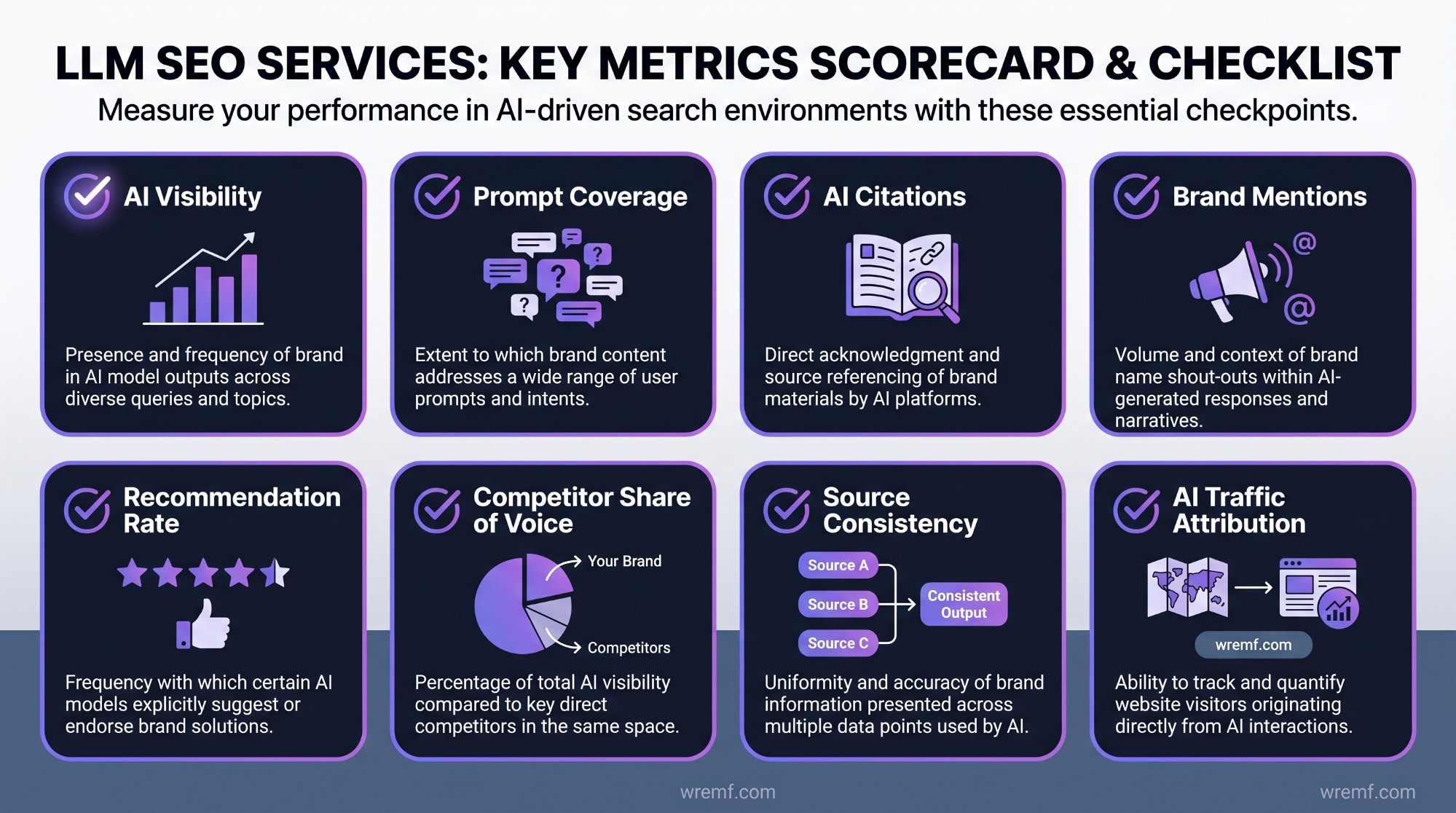
LLM SEO success is measured through AI visibility, prompt coverage, AI citations, brand mentions, recommendation rate, competitor share of voice, source consistency, and AI traffic attribution. Search rankings and organic traffic are useful, but they are not enough.
AI share of voice is the percentage of relevant AI answers where your brand appears compared with competitors. AI share of voice matters because it shows whether your brand is winning or losing visibility inside the answers buyers use to make decisions.
Brand mentions are references to your company, product, website, or category position inside AI-generated answers. Brand mentions matter because AI platforms may recommend or describe a brand without citing the website or sending traffic.
Brand recommendation visibility measures how often AI platforms recommend your brand for buying-stage prompts. Brand recommendation visibility matters because a brand mention in a neutral definition is less valuable than a recommendation in a high-intent vendor comparison.
AI traffic attribution is the process of connecting identifiable visits, conversions, or pipeline to AI platforms such as ChatGPT, Perplexity, Copilot, Gemini, Claude, or other AI search engines. AI traffic attribution matters because some AI discovery produces clicks, while many AI interactions remain zero-click or unattributed.
The most useful LLM SEO services KPIs include:
Prompt visibility rate: the percentage of tracked prompts where your brand appears
Recommendation rate: the percentage of buying-stage prompts where your brand is recommended
Citation rate: the percentage of prompts where your website or target sources are cited
AI citation quality: whether citations come from authoritative, relevant, and accurate sources
Citation overlap: how often competitor-cited sources exclude your brand
Competitor AI share of voice: your brand visibility compared with competitors
Factual accuracy rate: how often AI platforms describe your brand correctly
Sentiment and positioning quality: whether the answer frames your brand accurately
Google AI Overviews presence: whether your brand or sources appear in AI Overviews
AI referral sessions: identifiable traffic from AI platforms
Assisted conversions: conversions influenced by AI referral sessions or AI-discovery landing pages
Content gap count: missing definitions, comparisons, FAQ sections, product descriptions, or content clusters
Source consistency score: alignment of brand facts across your website and third-party sources
Prompt tracking shows how AI platforms respond to real buyer questions. Source citation tracking shows which sources influence AI answers. AI traffic attribution connects AI discovery to measurable website behavior.
A common mistake is measuring only traffic. AI search can influence buying decisions without producing a click. A buyer may ask ChatGPT for “best LLM SEO services,” compare brands in Perplexity, validate a vendor through Google AI Overviews, and only later visit the website through direct traffic or branded search.
If you want to see how prompts, citations, competitors, recommendations, and actions can be reported together, review a sample AI visibility report before building your own measurement workflow.
AI Search Analytics is the reporting layer that shows how a brand performs across AI search engines and AI discovery surfaces. AI Search Analytics matters because leadership needs trend data, competitor comparisons, and recommended actions instead of isolated prompt screenshots.
KEY TAKEAWAY: LLM SEO services should measure AI visibility, AI citations, prompts, competitors, recommendations, source consistency, and attribution instead of relying only on rankings or organic search traffic.
Measurement identifies the gaps, but improvement requires a structured execution model.
How Do LLM SEO Services Improve AI Visibility?
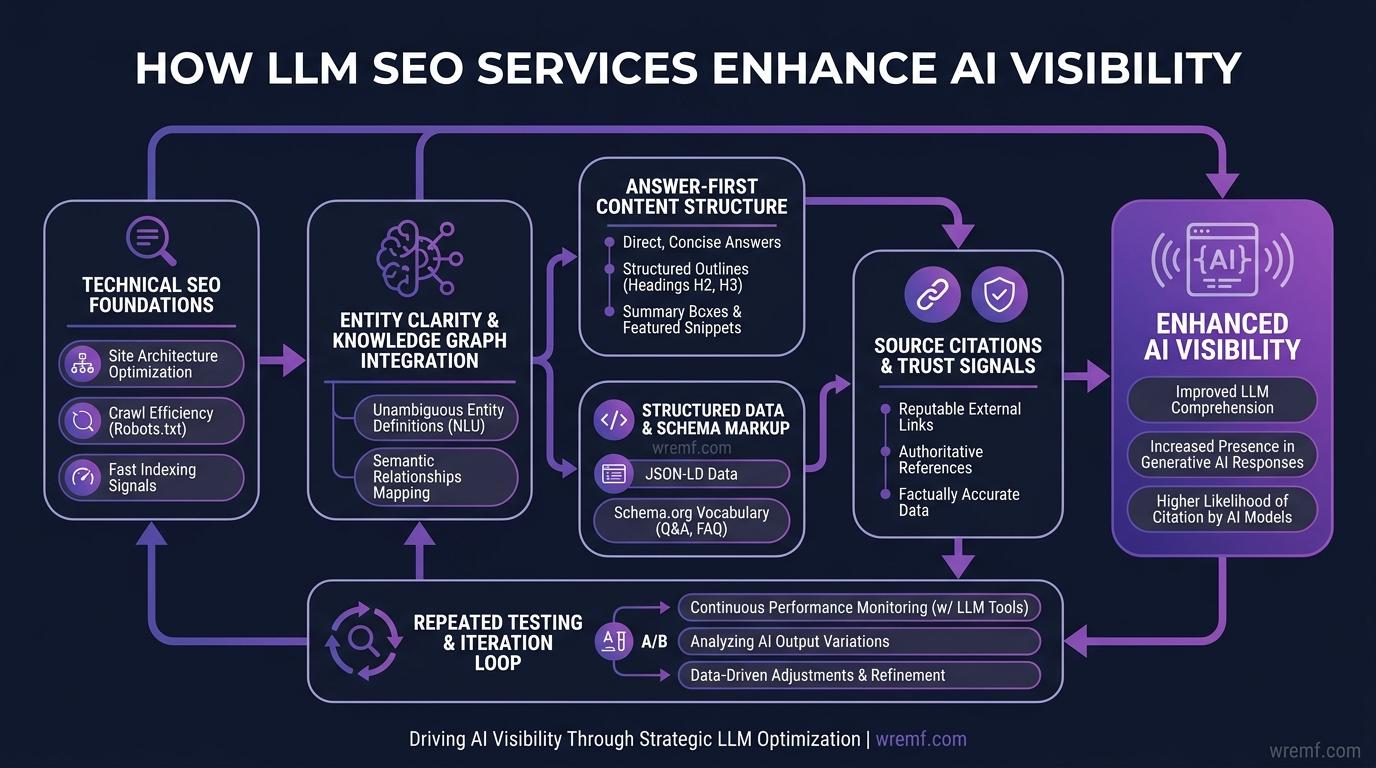
LLM SEO services improve AI visibility by making your brand easier for large language models to retrieve, understand, verify, cite, and recommend. The strongest services combine Technical SEO, entity clarity, answer-first content, structured data, source citations, and repeated testing.
Entity optimization is the process of making a brand, product, person, or organization clearly identifiable across content and trusted sources. Entity optimization matters because large language models need consistent facts to understand what a brand does, who it serves, and why it should appear in an answer.
Entity modeling is the process of defining the relationships between your brand, products, categories, audiences, competitors, features, locations, and trusted sources. Entity modeling matters because AI search engines need context, not only keywords.
Structured content is content organized with clear headings, definitions, tables, lists, FAQ sections, Q&A sections, comparison blocks, and concise summaries. Structured content matters because large language models can retrieve and summarize well-structured passages more reliably.
The most effective way to improve AI search visibility is to work through six layers:
| Layer | What It Improves | Example Work | Why It Matters |
|---|---|---|---|
| Technical SEO | Crawlability and accessibility | Fix indexation, JavaScript rendering, Core Web Vitals, canonicals, internal linking | Search engines and AI retrieval systems need accessible content |
| Entity clarity | Brand understanding | Align company descriptions, product categories, audiences, and use cases | Large language models need consistent facts |
| Answer-first content | Extractable answers | Add definitions, FAQ sections, comparison tables, and concise summaries | AI platforms need direct, quotable content |
| Source citations | Trust and evidence | Improve documentation, third-party profiles, citations, and brand mention outreach | AI citations often shape recommendations |
| Competitor analysis | Market context | Compare answer inclusion, source overlap, and brand ranking outcomes | Visibility is relative to competitors |
| Testing and reporting | Continuous improvement | Track prompts, AI Overviews, traffic, and source changes | AI visibility changes over time |
Technical SEO remains important because AI-powered Search still depends on crawlable and understandable web content. Google’s JavaScript SEO documentation explains that Google Search processes JavaScript and provides best practices for improving JavaScript web apps for Google Search, which matters for React, Vite, SPA, and JavaScript-heavy websites. (Google for Developers)
Structured data is machine-readable information that helps search engines understand page content. Schema markup is a common vocabulary for structured data. Structured data and schema markup matter because they can clarify entities, products, articles, FAQs, organizations, reviews, and page relationships.
AI citation improvement requires more than adding schema. It also requires credible source ecosystems. Brand citations, citation outreach, brand mention outreach, content marketing, documentation, comparison pages, product descriptions, and relevant third-party mentions can all influence what AI platforms retrieve.
A common implementation mistake is producing a content library full of generic blog post content without mapping each page to prompts, entities, citations, competitors, and internal linking. Another mistake is creating local content strategy pages, product descriptions, or content clusters that repeat keywords but do not answer real questions.
WREMF’s GEO audit workflow helps identify content, citation, technical, source consistency, and AI visibility gaps. For teams that need execution, the WREMF agency team supports AEO, GEO, AI visibility strategy, content optimization, citation improvement, schema and entity markup guidance, internal linking logic, crawl checks, and monthly reporting.
TIP: Start with prompts where buyers compare vendors, ask for recommendations, or ask “what is the best tool for this problem.” These prompts usually reveal the most valuable AI visibility gaps.
KEY TAKEAWAY: LLM SEO services improve AI visibility by aligning Technical SEO, entity clarity, structured content, source citations, competitor analysis, and repeated measurement.
The next decision is whether your team needs software, an agency, or a hybrid model.
Should You Choose LLM SEO Software, an Agency, or a Hybrid Service?
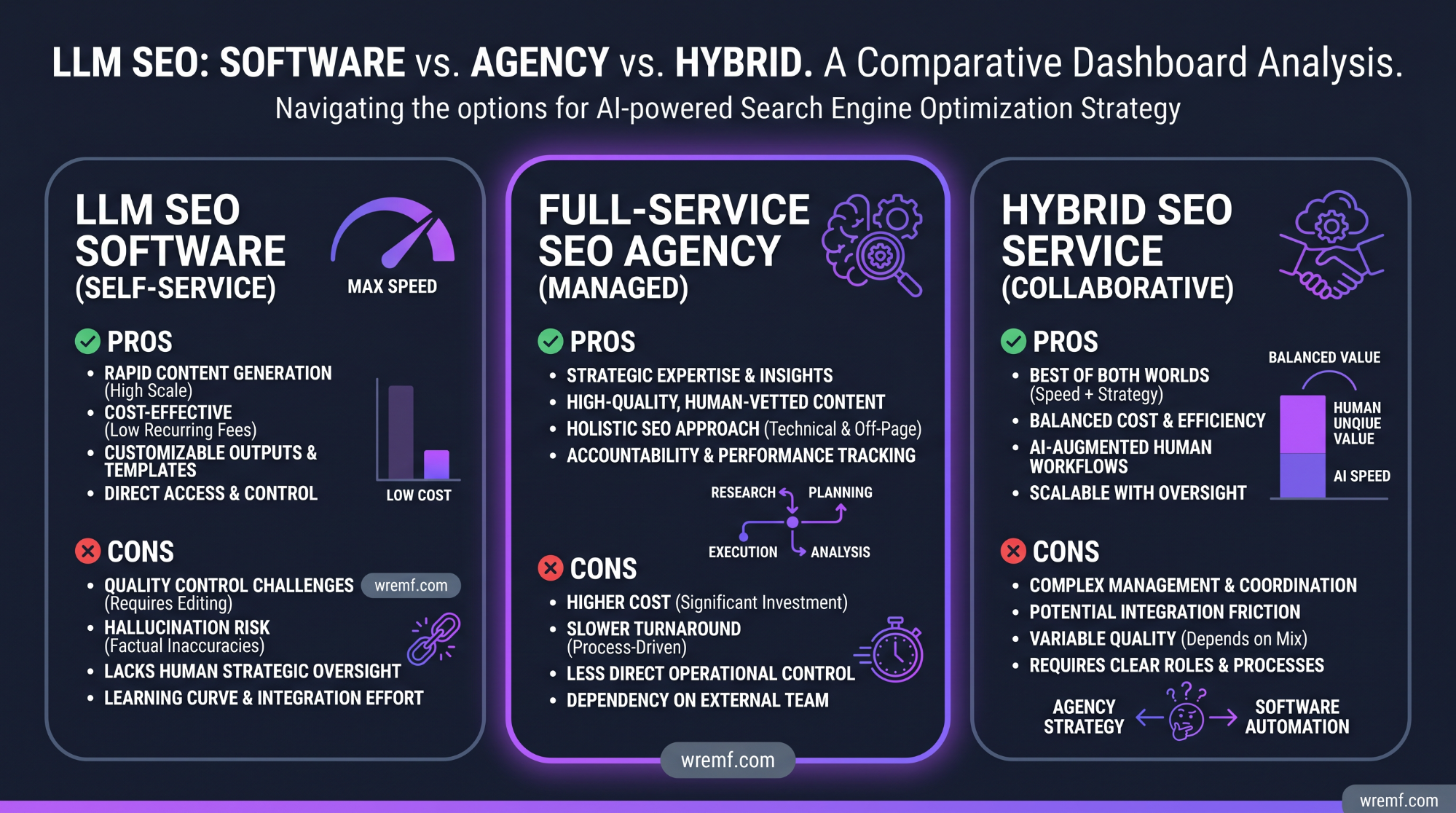
Choose LLM SEO software if you have internal execution capacity, an agency if you need strategy and implementation, and a hybrid service if you need measurement plus managed execution. The right model depends on team size, expertise, budget, and reporting needs.
LLM SEO software gives teams AI visibility tracking, LLM SEO Tracker workflows, prompt intelligence, source citation monitoring, competitor visibility, AI Search Analytics, dashboards, and reports. Software is best when your team can update content, fix technical issues, manage internal linking, improve structured content, and act on recommendations.
LLM SEO agencies provide strategy, audits, content optimisation, Technical SEO, citation improvement, source consistency cleanup, content creation, content marketing, authority building, and reporting. AI SEO agencies are best when your team lacks time, technical skill, or experience with AI-driven search.
A hybrid service combines software-level measurement with managed execution. Hybrid LLM SEO services are often the best fit for B2B SaaS teams, growth teams, and agencies because they connect AI visibility tracking to content briefs, source fixes, competitor insights, SEO testing, and monthly delivery.
| Option | Best For | What It Measures | Execution Included | Reporting Value | Main Limitation |
|---|---|---|---|---|---|
| LLM SEO software | In-house SEO, content, and growth teams | Prompts, AI visibility, AI citations, competitors, source gaps | No, unless paired with services | High if dashboards are clear | Requires internal action |
| AI SEO agency | Teams needing strategy and implementation | Depends on agency methodology and proprietary tools | Yes | Medium to high if evidence is included | Can become opaque without platform data |
| Hybrid software plus agency | B2B brands and agencies needing measurement plus execution | Prompts, citations, competitors, source consistency, traffic attribution | Yes | High because actions connect to data | Requires clear prioritization |
| Manual AI testing | Early validation or one-off research | Screenshots and ad hoc answers | No | Low because it is not repeatable | Not scalable or reliable |
Proprietary tools can be useful when they provide source-level evidence. Proprietary AI search tracking should monitor repeated prompts, AI platforms, citations, competitors, source overlap, and answer changes. A generic visibility score without prompt evidence is not enough for decision-making.
Agencies managing multiple clients often need white-label reports, reusable prompt sets, API access, client portals, and consistent scoring. In-house brands often need executive reporting, source consistency cleanup, content briefs, and attribution. The buying decision should follow the workflow gap, not the trend.
WREMF supports software, agency, and hybrid models. The platform works for brands that want tracking, agencies that need white-label reporting, and teams that want managed AEO, GEO, and AI visibility execution. Teams comparing cost and scope can review WREMF pricing, including Starter at €39 per month, Growth at €89 per month, and custom Enterprise pricing.
KEY TAKEAWAY: LLM SEO software measures the problem, agency services execute the work, and a hybrid model connects AI visibility data to action.
To choose a provider well, you also need to know what AI SEO agencies do differently from traditional SEO agencies.
What Strategies Do AI SEO Agencies Use Differently?
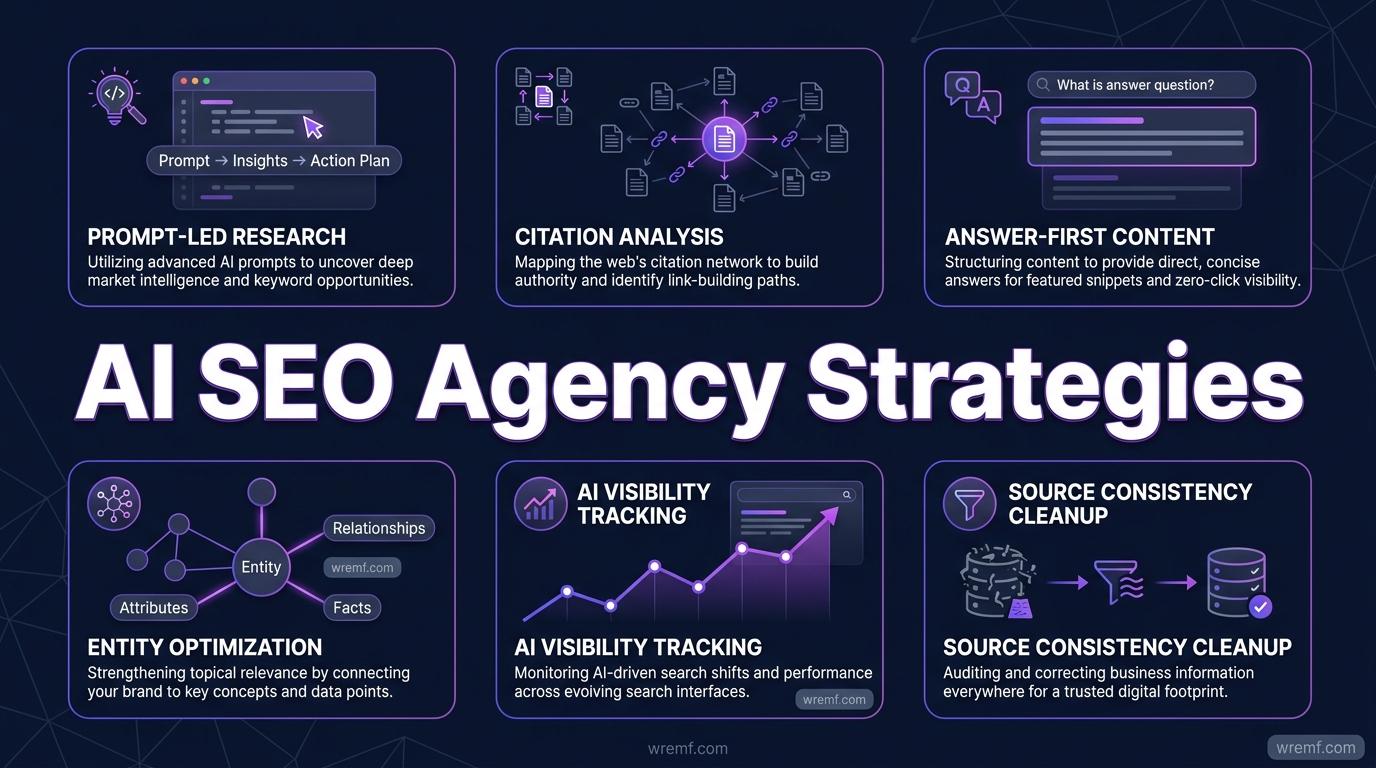
AI SEO agencies use prompt-led research, citation analysis, answer-first content, entity optimization, AI visibility tracking, and source consistency cleanup instead of relying only on keyword rankings. The main shift is from ranking pages to influencing generated answers.
AI SEO is the application of search engine optimization, content strategy, Technical SEO, content quality, AI-assisted workflows, and AI visibility tracking to AI-powered Search and AI-driven search. AI SEO matters because search results are changing from ranked links into summaries, cited answers, recommendations, and conversational results.
Traditional SEO agencies often begin with keywords, search volume, rankings, backlinks, and page optimisation. AI SEO agencies begin with prompts, AI-generated answer patterns, source citations, competitor recommendations, entity clarity, and source consistency. Both approaches matter, but the starting point changes.
AI SEO agencies often use these strategies:
Prompt-led market research for buyer questions
AI search testing across ChatGPT, Claude, Gemini, Perplexity, Google AI Overviews, Copilot, DeepSeek, Grok, Meta AI, and Mistral
Citation gap analysis to find sources AI platforms trust
Content structure improvements for answer-first retrieval
Content clusters around semantic clusters and buyer intent
Content creation guided by expert review, not raw automation
Content marketing that supports authority and source diversity
Product descriptions that explain use cases, features, limitations, and fit
FAQ sections and Q&A sections for direct answers
Local content strategy where geography affects recommendations
Technical SEO for JavaScript rendering, Core Web Vitals, structured data, schema markup, and internal linking
Citation outreach and brand mention outreach
SEO testing to validate whether changes improve visibility
AI traffic attribution and AI referral monitoring
Semantic clusters are groups of related topics, entities, questions, and subtopics that help search engines and AI platforms understand topical depth. Semantic clusters matter because LLM SEO depends on complete answer ecosystems, not isolated keyword pages.
Fan-out queries are the related subqueries an AI system may use to answer a complex user question. Fan-out queries matter because a single user prompt can trigger multiple hidden research paths, source checks, and comparison angles.
AI citation strategy differs from link building. Link building focuses on authority and referral signals. AI citation strategy focuses on whether trusted sources describe your brand clearly enough for AI systems to retrieve and cite them in relevant answers. Brand citations, citation overlap, and source consistency become part of the visibility system.
WREMF’s AI-ready content briefs help teams convert prompt gaps, citation gaps, competitor answer patterns, content quality issues, and source gaps into practical writing and optimization instructions. WREMF’s SEO testing workflows help teams validate content and technical changes over time.
KEY TAKEAWAY: AI SEO agencies differ from traditional SEO agencies because they optimize for prompts, citations, answer quality, source influence, and generated recommendations as well as search rankings.
This explains why some traditional SEO agencies struggle with LLM SEO services.
Why Do Some Traditional SEO Agencies Struggle With AI SEO?
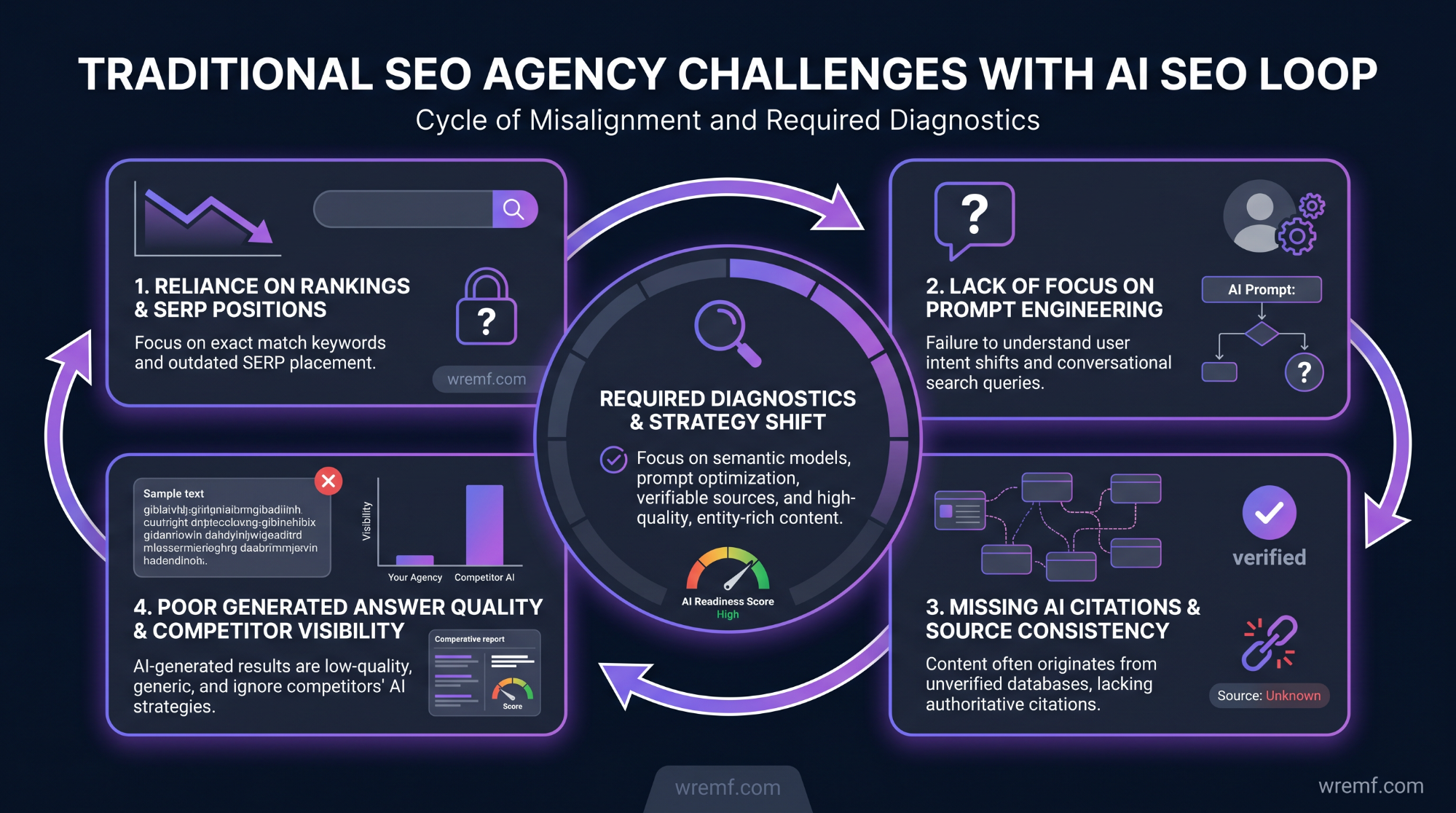
Some traditional SEO agencies struggle with AI SEO because they report rankings and organic search traffic while ignoring prompts, AI citations, source consistency, generated answer quality, and competitor recommendation visibility. AI-driven search requires new diagnostics.
The issue is not that SEO fundamentals are obsolete. The issue is that search engine optimization alone does not show whether large language models mention, cite, summarize, or recommend your brand. A page can rank in Google Search and still fail to appear in Google AI Overviews. A brand can receive organic traffic and still be invisible in ChatGPT vendor recommendations.
Traditional SEO agencies often struggle when they:
Treat LLM SEO as AI content generation only
Focus on keyword density instead of answer-first content
Ignore AI citation gaps and cited response quality
Do not test prompts across multiple AI platforms
Do not monitor Google AI Overviews separately from rankings
Overlook JavaScript rendering and crawlability barriers
Fail to align brand facts across website, profiles, directories, and third-party mentions
Report only rankings, clicks, and search traffic
Ignore AI share of voice and competitor recommendations
Lack a repeatable methodology for AI visibility tracking
Google Search Central says helpful, reliable, people-first content should be created to benefit people rather than manipulate search engine rankings. This matters because content quality, usefulness, clarity, and trust are also important for AI search engines that synthesize answers from sources. (Google for Developers)
A practical AI visibility audit often reveals that content exists but is not retrieval-ready. The website may have a blog post about the topic, but the page does not directly answer “best LLM SEO services,” “what are AI SEO services,” “what is Answer Engine Optimization,” “how do AI citations work,” or “which provider should I choose.”
Another issue is weak source consistency. If the homepage says one thing, LinkedIn says another, review sites use outdated categories, and third-party listicles omit key product facts, large language models may summarize the brand incorrectly. Source consistency helps reduce this ambiguity.
IMPORTANT: Traditional SEO agencies can handle AI SEO if they add prompt tracking, citation tracking, GEO analysis, source consistency, and AI visibility reporting to their SEO fundamentals.
KEY TAKEAWAY: Traditional SEO agencies struggle with AI SEO when they optimize for rankings only and fail to measure how AI platforms generate, cite, and recommend answers.
To avoid that problem, evaluate providers with a clear checklist.
How Should You Evaluate LLM SEO Service Providers?
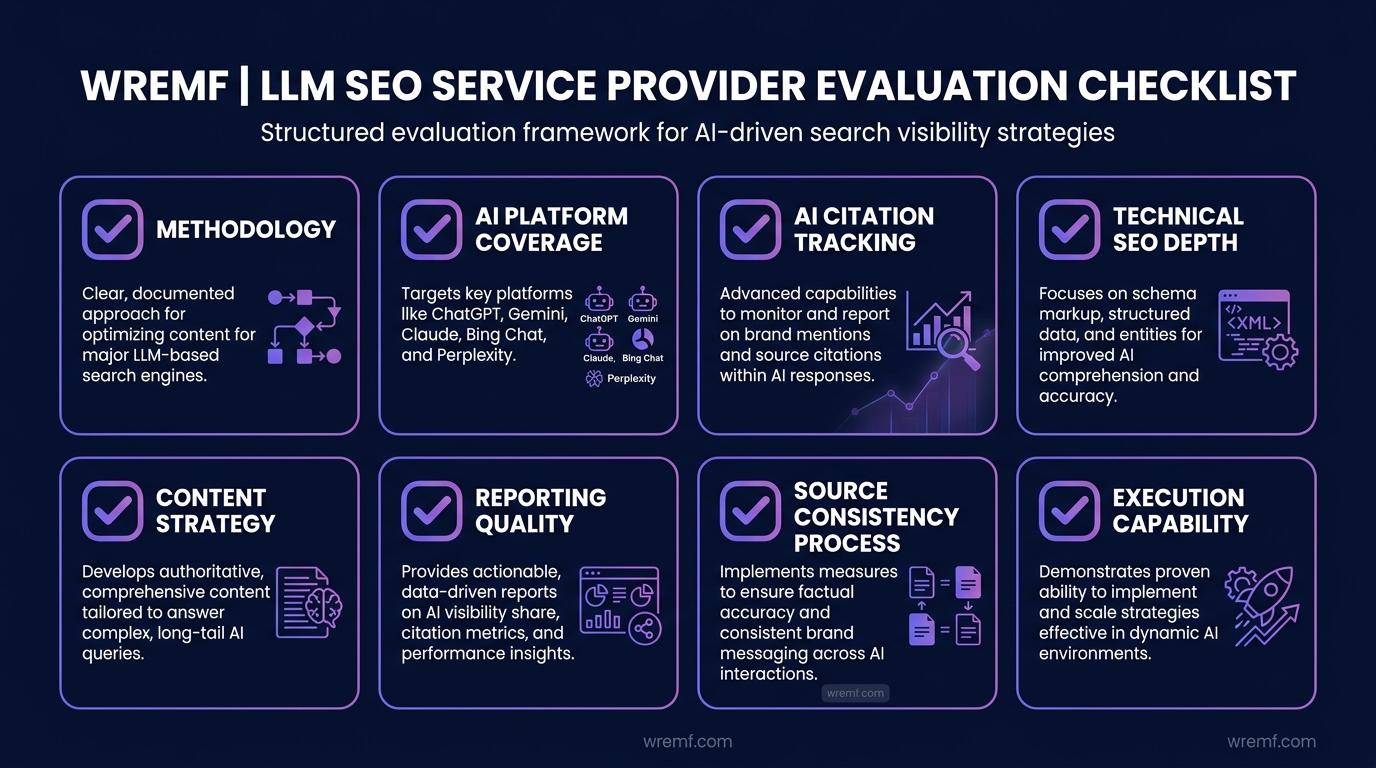
Evaluate LLM SEO service providers by their methodology, AI platform coverage, AI citation tracking, Technical SEO depth, content strategy, reporting quality, source consistency process, and execution capability. A credible provider should explain what will be measured, improved, and reported.
An LLM SEO Tracker is a system that monitors how large language models answer selected prompts over time. An LLM SEO Tracker matters because AI answers change across engines, prompts, sources, locations, and model updates.
When evaluating LLM SEO services, ask these questions:
Which AI platforms do you track?
Do you monitor ChatGPT, Claude, Gemini, Perplexity, Google AI Overviews, Copilot, DeepSeek, Grok, Meta AI, and Mistral?
Do you track AI visibility, AI citations, brand mentions, recommendations, and competitors?
Do you identify which sources influence AI answers?
Do you provide prompt-level evidence instead of only aggregate scores?
Do you track AI Overviews separately from Google Search rankings?
Do you review Technical SEO, JavaScript rendering, schema markup, structured data, internal linking, and crawlability?
Do you create content briefs based on prompt gaps, source gaps, and competitor answer patterns?
Do you handle citation outreach, brand mention outreach, and brand citations?
Do you support AI traffic attribution?
Do you offer software, agency execution, or a hybrid model?
Do you support white-label reporting for agencies?
Do you support API access, MCP workflows, BYOK, or custom reporting?
Do you avoid guaranteed ranking, traffic, citation, or revenue claims?
API access lets teams connect AI visibility data to internal systems, dashboards, reporting tools, and automation workflows. API access matters because agencies, enterprise teams, and technical marketers often need AI visibility data outside one dashboard.
BYOK means bring your own key. BYOK matters because teams may want control over AI provider usage, costs, privacy preferences, and internal governance.
A credible provider should show methodology. The methodology should connect prompts, large language models, cited sources, competitors, content gaps, technical barriers, action recommendations, and reporting. The WREMF methodology connects these elements into a repeatable system for brands and agencies.
For agencies and consultants, evaluation should also include client workflow. Agencies need white-label reporting, reusable templates, client portals, multi-client dashboards, and client-friendly summaries. WREMF’s agency tools for AI visibility reporting support agencies that manage multiple brands or client accounts.
KEY TAKEAWAY: The best LLM SEO service provider should measure prompts, citations, competitors, technical foundations, source consistency, attribution, and next actions with a clear methodology.
Once the provider is selected, implementation should start with measurement before content creation.
How Do You Start With LLM SEO Services?
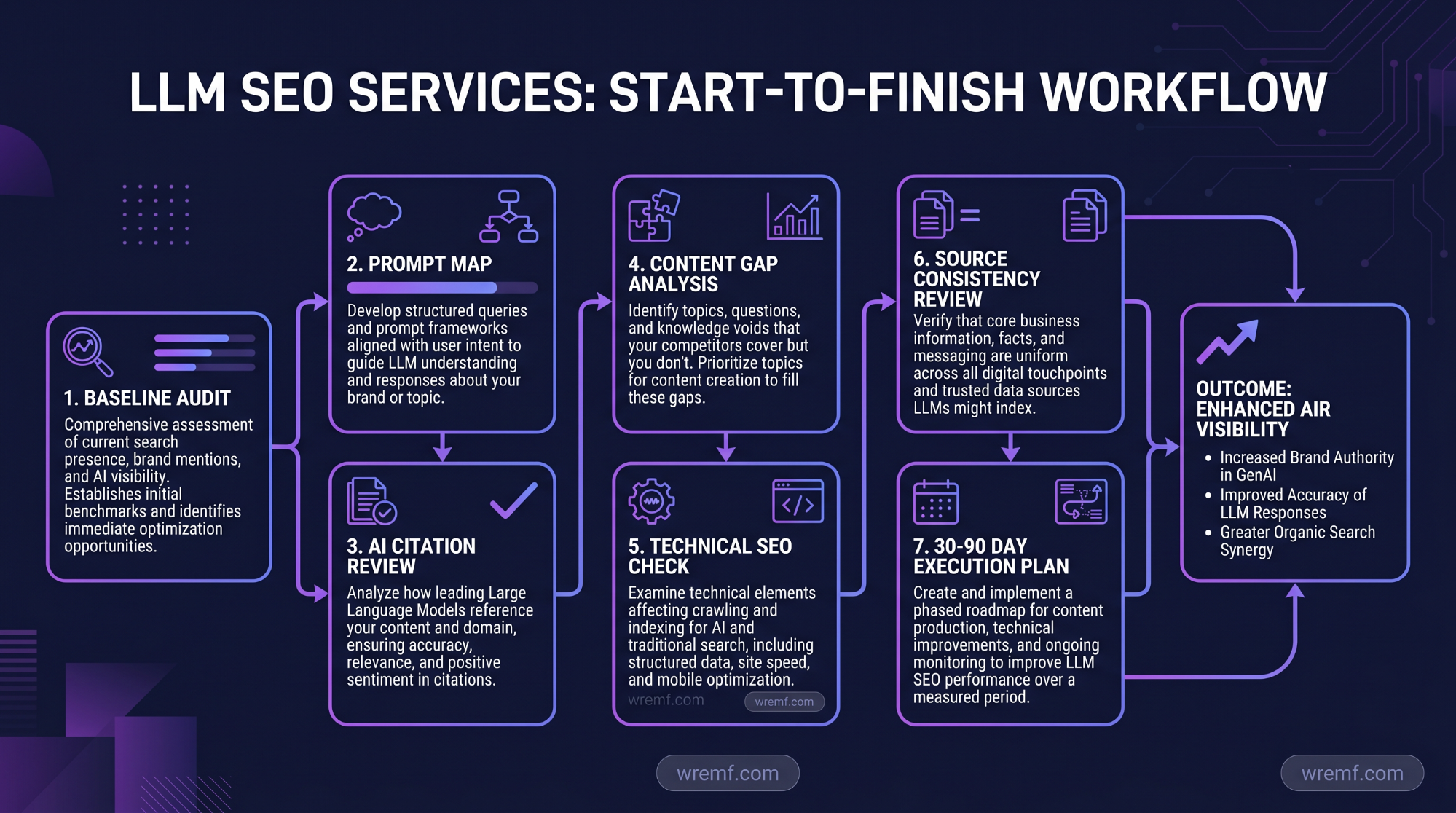
Start LLM SEO services with a baseline audit, prompt map, AI citation review, Technical SEO check, content gap analysis, source consistency review, and 30 to 90 day execution plan. This sequence turns AI visibility from manual testing into a repeatable workflow.
A GEO audit is an evaluation of how well a brand, website, content library, and source ecosystem are prepared for generative AI visibility. A GEO audit matters because it identifies the technical, content, citation, and entity gaps that block visibility in generative engines.
A practical implementation plan looks like this:
| Step | Action | Output | Recommended Timeline |
|---|---|---|---|
| 1 | Define target prompts | Branded, category, comparison, pain point, local, and buying-stage prompts | Week 1 |
| 2 | Run AI visibility baseline | Engine-level visibility, mentions, citations, competitors, source gaps | Week 1 |
| 3 | Audit cited sources | AI citation gaps, citation overlap, brand citations, competitor source advantage | Week 1 to 2 |
| 4 | Review Technical SEO | Crawlability, JavaScript rendering, Core Web Vitals, structured data, schema markup, indexation | Week 2 |
| 5 | Map content gaps | Missing definitions, comparison pages, FAQ sections, content clusters, product descriptions | Week 2 to 3 |
| 6 | Build content briefs | Answer-first briefs with prompts, entities, internal linking, and source needs | Week 3 |
| 7 | Improve source consistency | Brand facts, directories, profiles, partner pages, review pages, author pages | Month 1 to 2 |
| 8 | Publish and test | Content updates, internal linking, SEO testing, AI Overviews monitoring | Month 2 to 3 |
| 9 | Report outcomes | AI visibility trend, citations, share of voice, AI referrals, next actions | Monthly |
AI-driven search is search behavior where AI systems generate answers, recommendations, or summaries instead of showing only a ranked list of links. AI-driven search matters because users may form opinions before visiting a website.
Generative engines are AI systems that create natural language answers from model knowledge, retrieved content, citations, and source data. Generative engines matter because they can summarize your brand, compare competitors, or recommend alternatives in a single answer.
Teams usually struggle when they start with content creation before measurement. Without prompt tracking, the team does not know which buyer questions matter. Without AI citation tracking, the team does not know which sources influence answers. Without competitor visibility, the team cannot separate a content gap from an authority gap.
For in-house teams, WREMF’s brand-focused AI visibility platform helps track how AI platforms describe the brand, where competitors appear, which sources are cited, and which actions should be prioritized.
KEY TAKEAWAY: Start LLM SEO services with measurement, prompts, citations, technical checks, and source consistency before scaling content production.
A strong plan must also include content strategy, because AI visibility depends on answer quality and topic coverage.
What Content Strategy Works Best for LLM SEO Services?
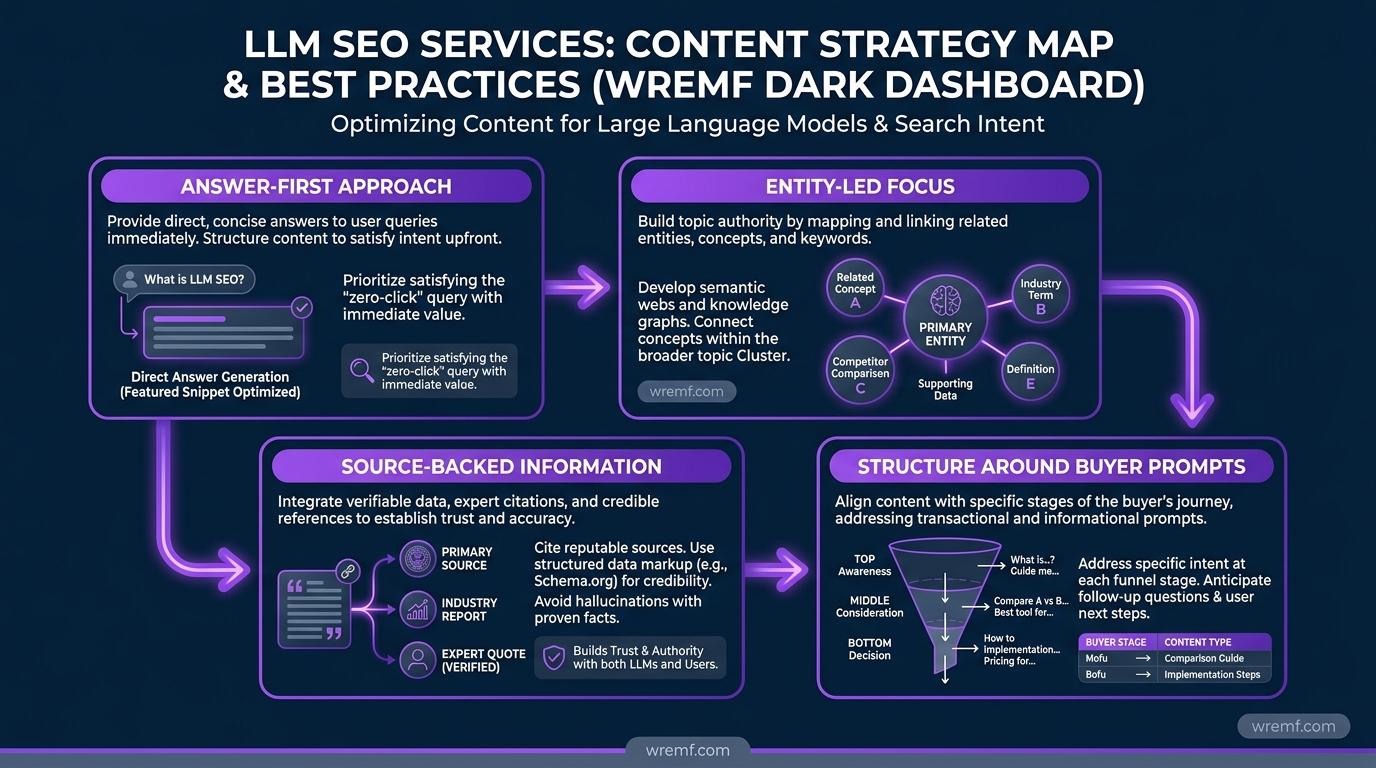
The best content strategy for LLM SEO services is answer-first, entity-led, source-backed, and structured around buyer prompts. LLM SEO content must satisfy users, search engines, and large language models at the same time.
Content strategy is the planning system that defines what content to create, update, structure, connect, and measure. Content strategy matters because LLM SEO services need content that answers real prompts, supports source citations, clarifies entities, and improves search traffic.
Content creation for LLM SEO should not mean publishing generic AI-generated articles. Content creation should produce quality content that answers specific questions, explains tradeoffs, supports claims with credible sources, and links to related pages. Human-led review is essential because large language models can produce fluent but unsupported content.
Strong LLM SEO content includes:
Clear definitions under 60 words for major terms
Answer-first introductions
H2 sections that begin with direct answers
FAQ sections and Q&A sections that answer real prompts
Comparison tables for SEO vs AEO vs GEO, tools, services, and workflows
Product descriptions that explain use cases and limitations
Content clusters around semantic clusters
Internal linking that connects related concepts and next steps
External links to authoritative sources when claims need support
Structured data and schema markup where appropriate on the page template
Content quality review for accuracy, usefulness, originality, and trust
Content clusters are groups of related pages that cover a topic from multiple angles. Content clusters matter because AI search engines and search engines need topical depth across definitions, comparisons, tools, services, problems, and decision-stage pages.
A strong content library for LLM SEO services might include pages on LLM SEO, Answer Engine Optimization, Generative Engine Optimization, AI Overviews, AI citation tracking, prompt tracking, AI visibility tools, AI SEO services, competitor visibility, and source consistency. Each page should have a clear job instead of repeating the same generic claims.
In real B2B buying journeys, bottom-funnel content is especially important. Buyers ask questions like “best LLM SEO services,” “LLM SEO agency vs software,” “AI SEO services pricing,” “what tools track AI visibility,” and “how do I appear in ChatGPT recommendations.” These questions need direct answers, not broad thought leadership.
WREMF’s content brief workflow helps convert AI visibility gaps into answer-first briefs using AI-ready content brief tools. This supports content teams that need clear prompts, entities, internal links, citation needs, and measurement logic.
KEY TAKEAWAY: LLM SEO content strategy should be prompt-led, entity-led, answer-first, source-backed, and structured for both search engines and large language models.
Content is only one part of the system, so the next section covers technical foundations and source operations.
What Technical SEO, Schema, and Source Work Matter for LLM SEO?
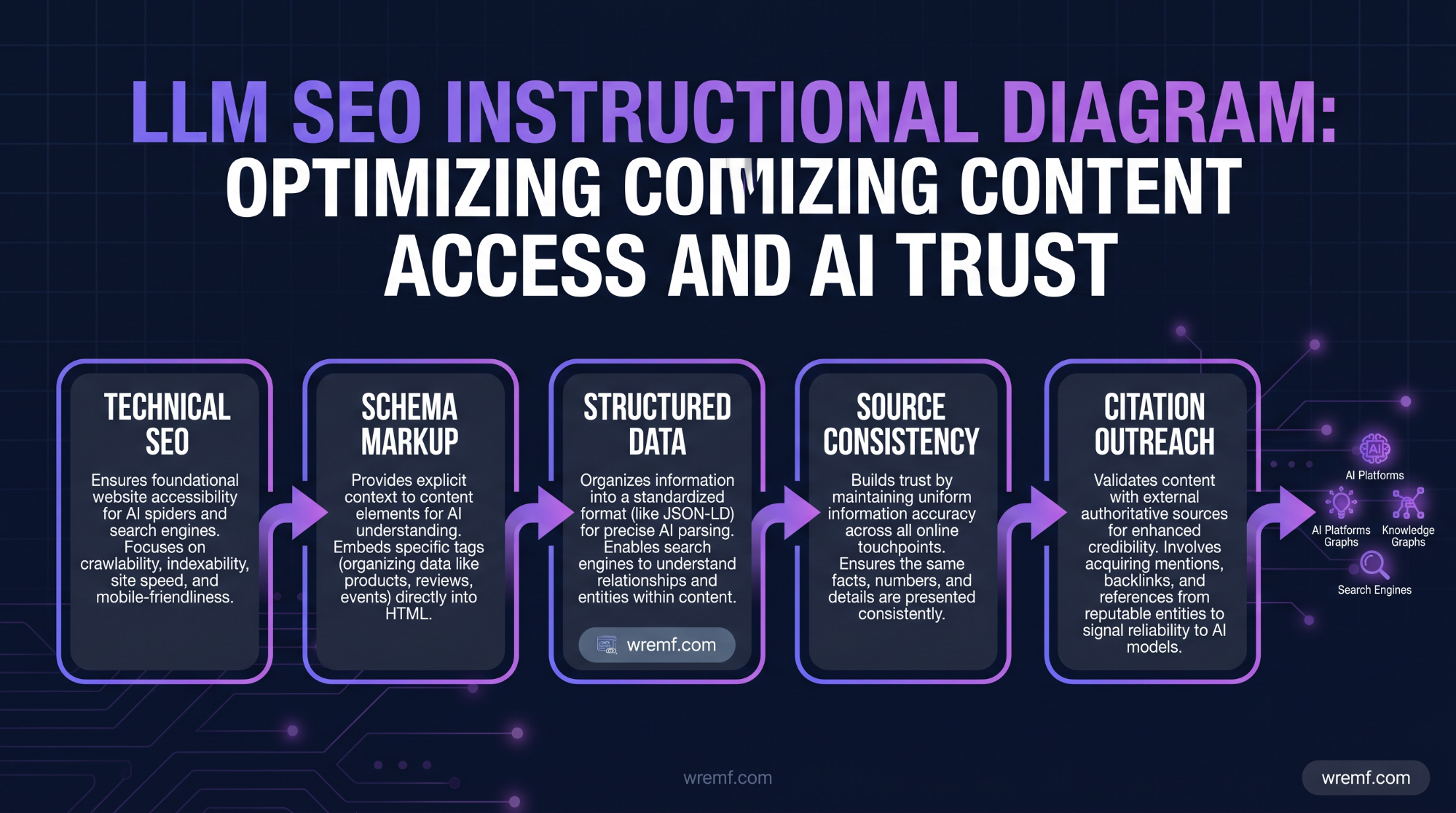
Technical SEO, schema markup, structured data, source consistency, and citation outreach matter because AI platforms need accessible content and trustworthy source signals. LLM SEO services fail when content cannot be crawled, rendered, understood, or verified.
Technical SEO is the practice of improving the technical foundations that help search engines crawl, render, index, and understand a website. Technical SEO matters for LLM SEO because AI search visibility often starts with content that can be accessed, parsed, and retrieved.
JavaScript rendering is the process search engines use to process content generated by JavaScript. JavaScript rendering matters because many modern websites use React, Vite, Next.js, and other JavaScript frameworks. If key content is not visible in rendered HTML or accessible to crawlers, search visibility and AI retrieval may suffer.
Google’s JavaScript SEO documentation explains how Google Search processes JavaScript and shares best practices for JavaScript web apps. This is important for LLM SEO services because AI search engines and AI crawlers may not always render JavaScript as reliably as Google. (Google for Developers)
Structured data and schema markup help search engines understand page entities, content types, authors, organizations, products, reviews, FAQs, and relationships. Rich schema can improve clarity, but it does not guarantee AI citations, featured snippets, or rankings. Schema markup should support the content, not replace helpful content.
Source consistency cleanup is the process of aligning brand facts across your website, LinkedIn, directories, review sites, partner pages, knowledge panels, documentation, and external mentions. Source consistency helps AI systems reduce conflicting descriptions when summarizing your company.
Citation outreach is the process of improving the sources that mention, describe, or compare your brand. Citation outreach can include updating directories, improving profiles, earning relevant mentions, fixing outdated descriptions, publishing authoritative resources, and supporting content marketing efforts.
Brand mention outreach is the process of improving how external sources describe your brand. Brand mention outreach matters because large language models can use third-party content to understand whether a brand belongs in a category, comparison, or recommendation.
Security and infrastructure also matter. If a website blocks crawlers, returns Cloudflare security challenge pages, produces malformed data, hides content behind scripts, or triggers online attacks protections incorrectly, some search engines and AI crawlers may fail to access content. A security service or security solution should protect the site owner without blocking legitimate indexing and retrieval.
KEY TAKEAWAY: LLM SEO services need Technical SEO, schema markup, structured data, source consistency, and citation improvement because AI visibility depends on accessible content and reliable sources.
The next section explains the honest limitations and risks that every provider should disclose.
What Are the Limitations and Risks of LLM SEO Services?
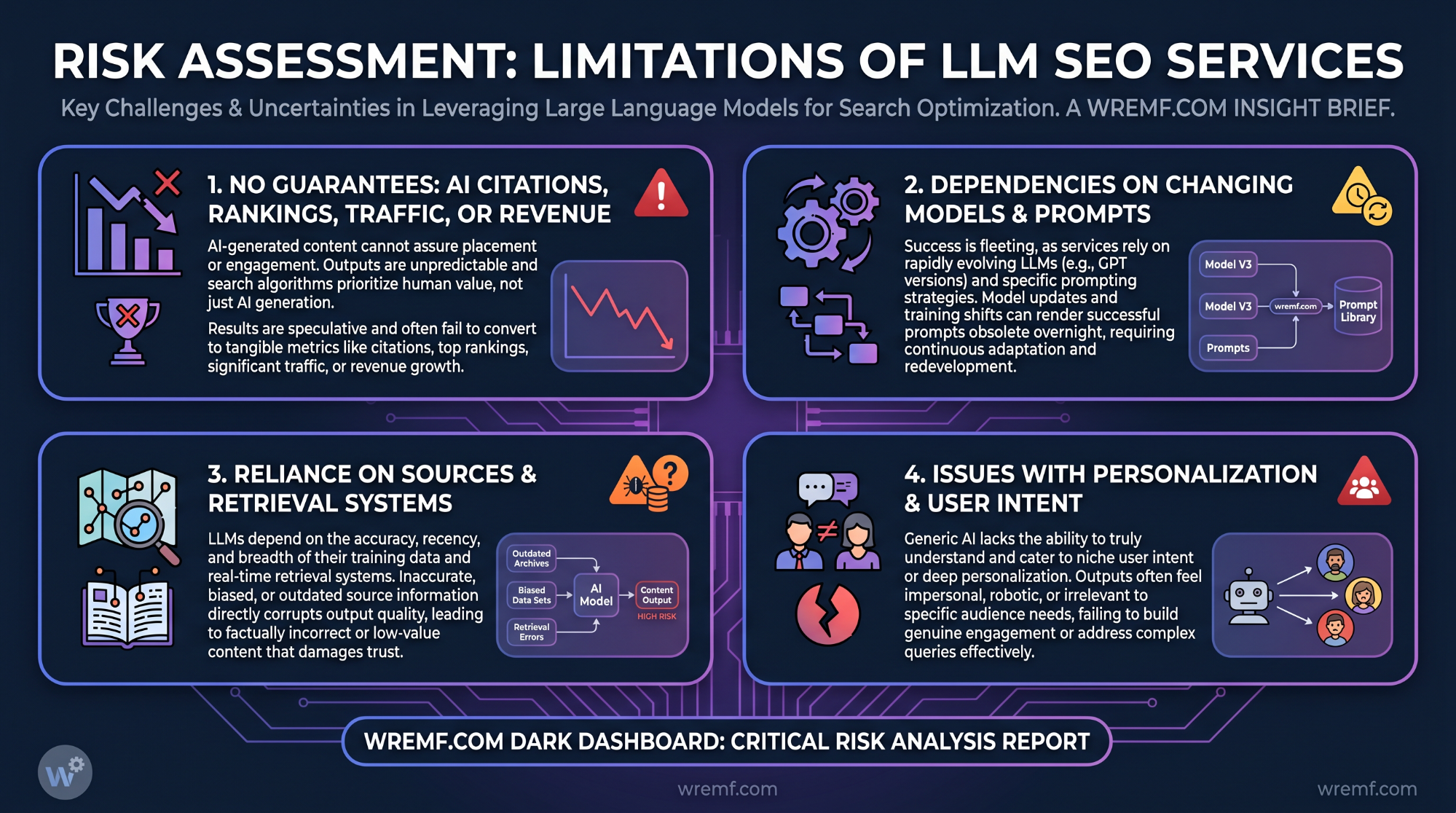
LLM SEO services cannot guarantee AI citations, rankings, traffic, or revenue because AI answers depend on changing models, prompts, search indexes, sources, retrieval systems, and personalization. The value comes from better measurement, stronger sources, and disciplined improvement.
AI search engines are systems that use generative AI, search retrieval, citations, and natural language answers to respond to user questions. AI search engines matter because they influence awareness, trust, and buying decisions even when the user does not click a result.
The main limitations of LLM SEO services are:
AI answers can change as models and retrieval systems update
AI platforms may provide citations inconsistently
Google AI Overviews may appear for some users and not others
Some AI referrals are hidden, unattributed, or grouped under broader referral traffic
Prompt outputs can vary by location, language, account, context, and query phrasing
Ranking well in Google Search does not guarantee visibility in Google AI Overviews
AI citations may come from sources you do not control
Manual prompt screenshots are not enough for long-term measurement
AI-generated content can create quality and trust risks without human review
Patent analysis and speculation about algorithms should not replace observable prompt and citation data
Regulatory requirements may affect how some industries publish claims, product descriptions, reviews, or advice
Claude’s official documentation states that its web search tool can include citations from search results, and OpenAI states that ChatGPT search can provide links to relevant web sources. These facts show that citations can be observed, but they do not mean a brand can force a citation. (Claude)
A common risk is treating LLM SEO as manipulation. Search marketing should not rely on hidden text, misleading sources, fake reviews, or unsupported claims. Sustainable growth comes from improving content quality, source clarity, technical accessibility, and trust.
Another risk is over-reporting weak signals. A single ChatGPT answer, one cited response, or one AI Overview appearance should not be treated as a durable ranking outcome. Strong reporting should show repeated prompts, time trends, engine coverage, source overlap, and competitor movement.
KEY TAKEAWAY: LLM SEO services reduce uncertainty, but they should be framed as measurement and improvement systems rather than guaranteed AI ranking machines.
Many buying decisions become easier once common myths are removed.
Common Myths About AI Visibility Debunked
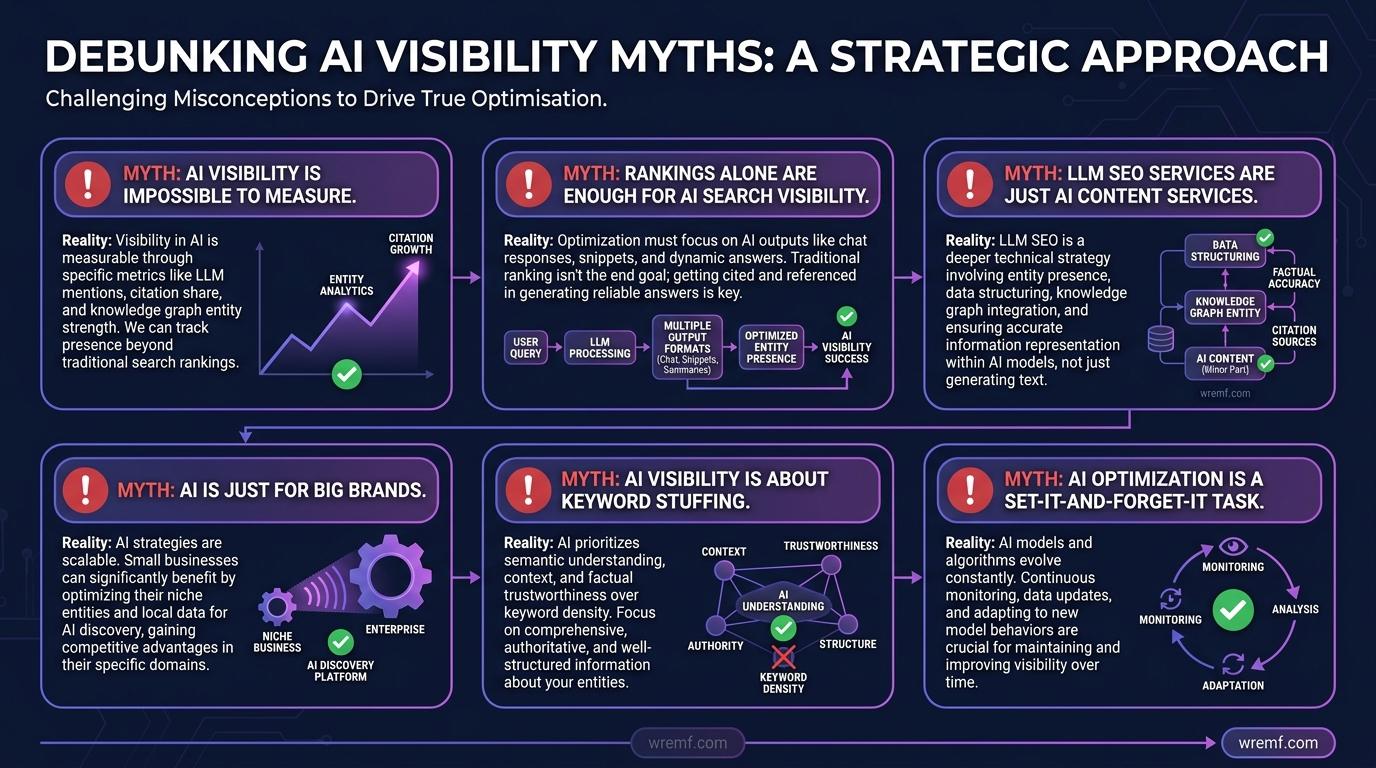
AI visibility is measurable, but it is not measured like traditional keyword rankings. Most myths come from applying old search reporting models to AI search, AI Overviews, and large language models.
MYTH: AI visibility is impossible to measure.
FACT: AI visibility can be measured through prompt tracking, brand mentions, AI citations, recommendation rate, competitor share of voice, source consistency, factual accuracy, and AI referral traffic. The measurement is probabilistic because AI answers can vary across engines and prompts. Repeated tracking is more reliable than one-off screenshots.
MYTH: SEO, Answer Engine Optimization, and Generative Engine Optimization are separate strategies.
FACT: SEO, Answer Engine Optimization, and Generative Engine Optimization overlap. SEO supports crawlability, indexation, structured data, content quality, and search engine visibility. Answer Engine Optimization improves answer clarity. Generative Engine Optimization improves inclusion in generated answers. LLM SEO connects all three.
MYTH: Rankings alone are enough for AI search visibility.
FACT: Rankings are useful but incomplete. A page can rank in organic search and still be missing from AI Overviews or ChatGPT recommendations. LLM SEO services also measure brand mentions, source citations, recommendation visibility, and competitor presence inside AI answers.
MYTH: LLM SEO services are just AI content services.
FACT: Content creation is only one part of LLM SEO. A complete service includes prompt tracking, AI visibility tracking, Technical SEO, structured data, schema markup, AI citation analysis, competitor visibility, source consistency, content briefs, SEO testing, and reporting.
MYTH: AI search makes organic search irrelevant.
FACT: AI search changes organic search, but it does not remove the need for search engine optimization. Google Search, AI Overviews, ChatGPT search, Claude web search, Perplexity, and Copilot still depend on retrievable information, sources, links, content quality, and user trust.
KEY TAKEAWAY: AI visibility is measurable when you track prompts, citations, mentions, competitors, source consistency, and attribution instead of relying only on rankings.
With the myths addressed, the final service question is how WREMF fits into the workflow.
How WREMF Supports LLM SEO Services
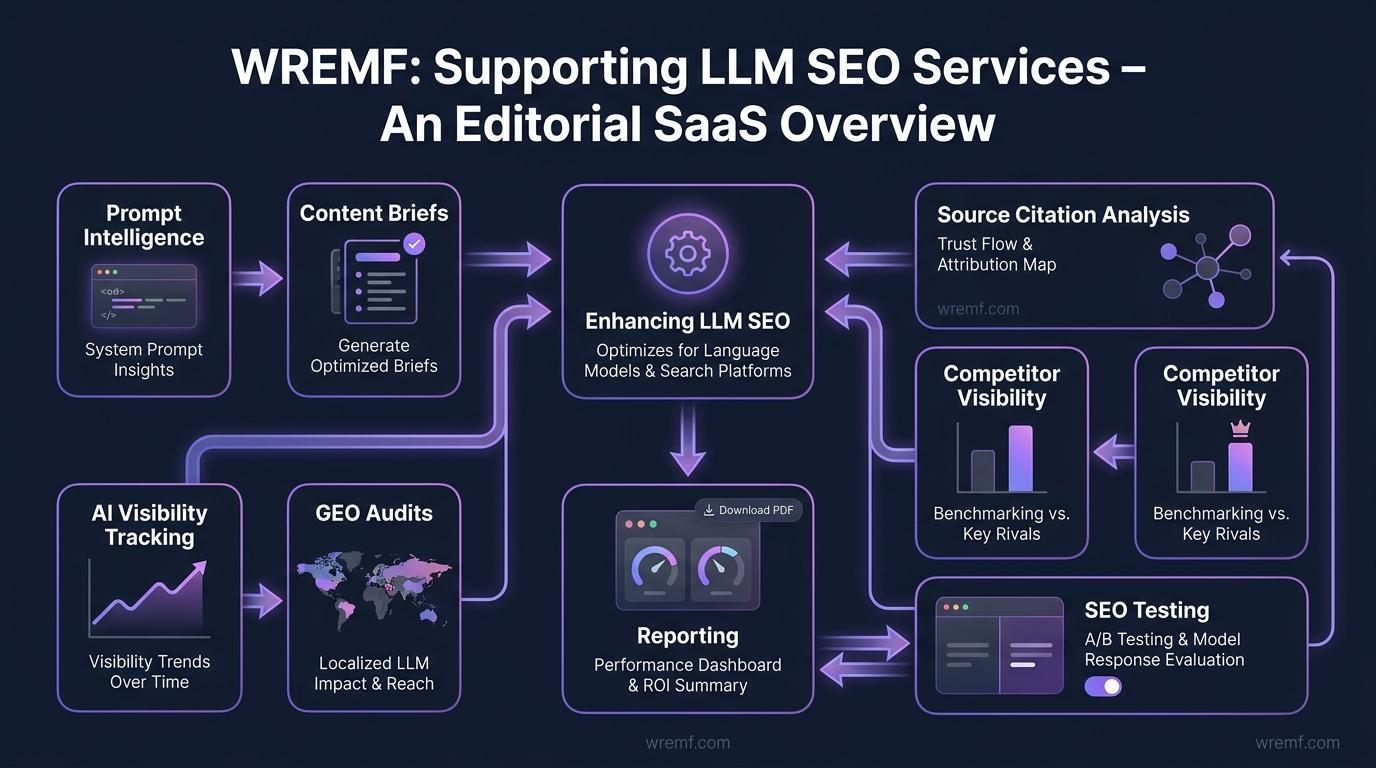
WREMF supports LLM SEO services by combining AI visibility tracking, prompt intelligence, source citation analysis, competitor visibility, GEO audits, content briefs, SEO testing, and reporting. WREMF helps teams move from manual AI testing to repeatable measurement and action.
WREMF is an AI visibility platform and optional agency partner for B2B teams that want to track, improve, and prove how their brand appears across major AI discovery surfaces. WREMF matters because AI visibility requires both software-level monitoring and, for many teams, expert execution.
WREMF helps with:
AI visibility tracking across 10 AI engines
Prompt intelligence for branded, non-branded, category, comparison, and buying-stage prompts
Source citation tracking and AI citation gap analysis
Competitor visibility and AI share of voice
Google AI Overviews and AI search monitoring
GEO audits and Answer Engine Optimization workflows
AI-ready content briefs
SEO testing and content validation
White-label client reporting
AI traffic attribution
BYOK support
API access and MCP integrations
Client portals for agencies and brands
Optional managed AEO, GEO, AI SEO, and LLM SEO services
The WREMF model is useful for three types of teams. In-house brands can use software to measure AI visibility and prioritize content or source work. Agencies can use white-label reports and client portals to manage multiple accounts. Teams that need execution can use WREMF as a hybrid software plus managed service.
WREMF pricing is also built for this split. Starter is €39 per month for one website, unlimited prompt tracking, BYOK, 10 AI engines, all features and tools, white-label reports, one seat, and email support. Growth is €89 per month for five websites, priority email support with 24h SLA, content brief generator, and SEO A/B testing. Enterprise includes custom pricing, unlimited websites, unlimited seats, dedicated support with 4h SLA, and custom branded portals.
WREMF is not positioned as a guarantee of AI citations, rankings, traffic, or revenue. WREMF is positioned as a practical platform and agency partner for teams that need measurement, recommendations, and execution support.
KEY TAKEAWAY: WREMF turns LLM SEO services into a measurable workflow by connecting prompts, citations, competitors, source consistency, content actions, technical checks, and reporting.
The most common buyer questions are answered below.
Frequently Asked Questions
What are LLM SEO services and how do they work?
LLM SEO services improve how a brand appears inside AI-generated answers from large language models such as ChatGPT, Claude, Gemini, Perplexity, Google AI Overviews, Copilot, DeepSeek, Grok, Meta AI, and Mistral. They work by tracking prompts, measuring AI visibility, analyzing AI citations, comparing competitors, improving source consistency, and updating content so AI platforms can retrieve and understand the brand more accurately. A complete service also includes Technical SEO, content strategy, structured content, and reporting.
What are AI SEO services?
AI SEO services help brands adapt search engine optimization for AI-powered Search, AI-driven search, AI Overviews, and large language models. AI SEO services usually include prompt research, content strategy, Technical SEO, structured data, entity optimization, content creation, AI visibility tracking, and AI citation analysis. The goal is to improve visibility in both traditional search engines and AI platforms. AI SEO should be human-led, evidence-led, and measured through prompts, citations, recommendations, and organic search data.
What are LLM, SEO, and AEO?
LLM means large language model, which is an AI system that can understand and generate natural language. SEO means search engine optimization, which improves website visibility in search engines. AEO means Answer Engine Optimization, which structures content so it can answer specific questions clearly. In practice, LLM SEO services combine large language models, SEO, and Answer Engine Optimization so brands can appear in rankings, direct answers, AI citations, and generated recommendations.
How are LLM SEO services different from traditional SEO services?
Traditional SEO services focus on rankings, organic search traffic, backlinks, content quality, search traffic, Technical SEO, and conversions from search engines. LLM SEO services add prompt tracking, AI visibility tracking, AI citation analysis, source consistency, competitor recommendations, Google AI Overviews monitoring, and AI traffic attribution. Traditional SEO asks whether a page ranks. LLM SEO asks whether AI platforms mention, cite, summarize, compare, and recommend your brand accurately across relevant prompts.
Do LLM SEO services also help Google rankings?
LLM SEO services can support Google rankings when they improve Technical SEO, content quality, structured data, internal linking, content structure, and helpful answer-first content. However, LLM SEO should not be treated as a guaranteed ranking tactic. The overlap is strongest when the work improves crawlability, entity clarity, user usefulness, source quality, and content depth. Google Search Central’s people-first content guidance remains relevant because useful content supports both search engine visibility and AI-powered Search.
What tools are used to provide LLM search SEO services?
LLM search SEO services usually use AI visibility tracking tools, an LLM SEO Tracker, prompt testing systems, AI citation monitoring, Google Search Console, web analytics, technical crawlers, content optimization platforms, and reporting dashboards. WREMF combines prompt intelligence, source citation tracking, competitive visibility, GEO audits, AI-ready content briefs, SEO testing, AI Search Analytics, and white-label reporting. Agencies may also use CRM, analytics, and automation tools to connect AI visibility with pipeline reporting.
How much do LLM SEO services usually cost?
LLM SEO services vary based on whether you choose software, an agency, or a hybrid model. Software is usually more affordable because your team handles execution. Agency retainers cost more because they include strategy, content, Technical SEO, reporting, and project management. WREMF pricing starts at €39 per month for Starter and €89 per month for Growth, with custom Enterprise pricing for larger teams, agencies, unlimited websites, branded portals, and dedicated support.
Can my regular SEO agency handle AI SEO?
Your regular SEO agency can handle AI SEO if it understands prompt tracking, AI visibility, AI citations, Google AI Overviews, source consistency, entity optimization, AI traffic attribution, and Generative Engine Optimization. If the agency only reports rankings and organic traffic, it may miss important LLM SEO signals. Ask whether the agency tracks ChatGPT, Claude, Gemini, Perplexity, Google AI Overviews, Copilot, competitors, source citations, and AI share of voice before assuming it can manage AI SEO.
What are the benefits of hiring an AI SEO agency?
Hiring an AI SEO agency can help your team build a measurement system, identify AI visibility gaps, improve content quality, fix Technical SEO issues, strengthen entity clarity, and improve source consistency. An AI SEO agency is useful when your internal team lacks time, expertise, or tooling. The best agencies provide clear deliverables, prompt-level evidence, AI citation analysis, content briefs, technical recommendations, and monthly reporting rather than vague claims about AI search growth.
Should businesses invest in AI-focused SEO now, or is it too early?
Businesses should start measuring AI-focused SEO now because AI search already affects discovery, even when attribution is incomplete. Gartner predicts traditional search engine volume will drop 25% by 2026 because of AI chatbots and virtual agents. The practical starting point is not a massive rebuild. Start with prompt tracking, Google AI Overviews monitoring, AI citation analysis, source consistency review, and content improvements for your highest-value buying-stage queries.
Will optimizing for AI search engines also help traditional SEO?
Optimizing for AI search engines can support traditional SEO when the work improves helpful content, content structure, internal linking, technical accessibility, structured data, entity clarity, and source quality. The benefits are strongest when LLM SEO services build pages that answer real questions better than existing content. However, AI search optimization and traditional SEO are not identical. AI visibility requires prompt tracking, AI citation monitoring, competitor answer analysis, and source consistency measurement.
What challenges or limitations exist when using LLMs for SEO?
The main challenges are answer variability, incomplete attribution, inconsistent citations, changing models, source dependency, and the risk of low-quality AI-generated content. Large language models can summarize useful information, but they can also produce unsupported or outdated claims if sources are weak. LLM SEO services should therefore include human review, source attribution, content quality checks, Technical SEO, prompt monitoring, and honest reporting. A provider should never guarantee AI citations, rankings, traffic, or revenue.
Which companies need LLM SEO services most?
LLM SEO services are most useful for B2B SaaS companies, agencies, consultants, marketplaces, professional services firms, eCommerce store operators, and category creators where buyers research options before speaking to sales. They are especially valuable when competitors are being recommended by ChatGPT, Perplexity, Google AI Overviews, Claude, or Copilot. LLM SEO is also useful for agencies that need white-label reports and brands that need leadership-ready proof of AI visibility.
Is human-led content still important for LLM SEO services?
Human-led content is essential for LLM SEO services because AI-generated drafts can be incomplete, generic, or unsupported. Large language models can help with research, outlines, content creation, summaries, product descriptions, and FAQ sections, but expert review is needed for accuracy, positioning, compliance, and originality. Google’s helpful content guidance prioritizes useful, reliable, people-first content. For LLM SEO, human-led content also improves source trust, factual accuracy, and brand consistency.
How can beginners use AI for SEO without damaging content quality?
Beginners can use AI for SEO by researching questions, grouping semantic clusters, drafting outlines, summarizing source material, generating content briefs, and checking FAQ coverage. They should not publish unreviewed AI content or unsupported statistics. A safe beginner workflow is to use AI for planning, then apply human review, source checks, Technical SEO, internal linking, structured content, and content quality standards. WREMF can help beginners by showing which prompts, sources, and competitors matter before they create content.
Conclusion
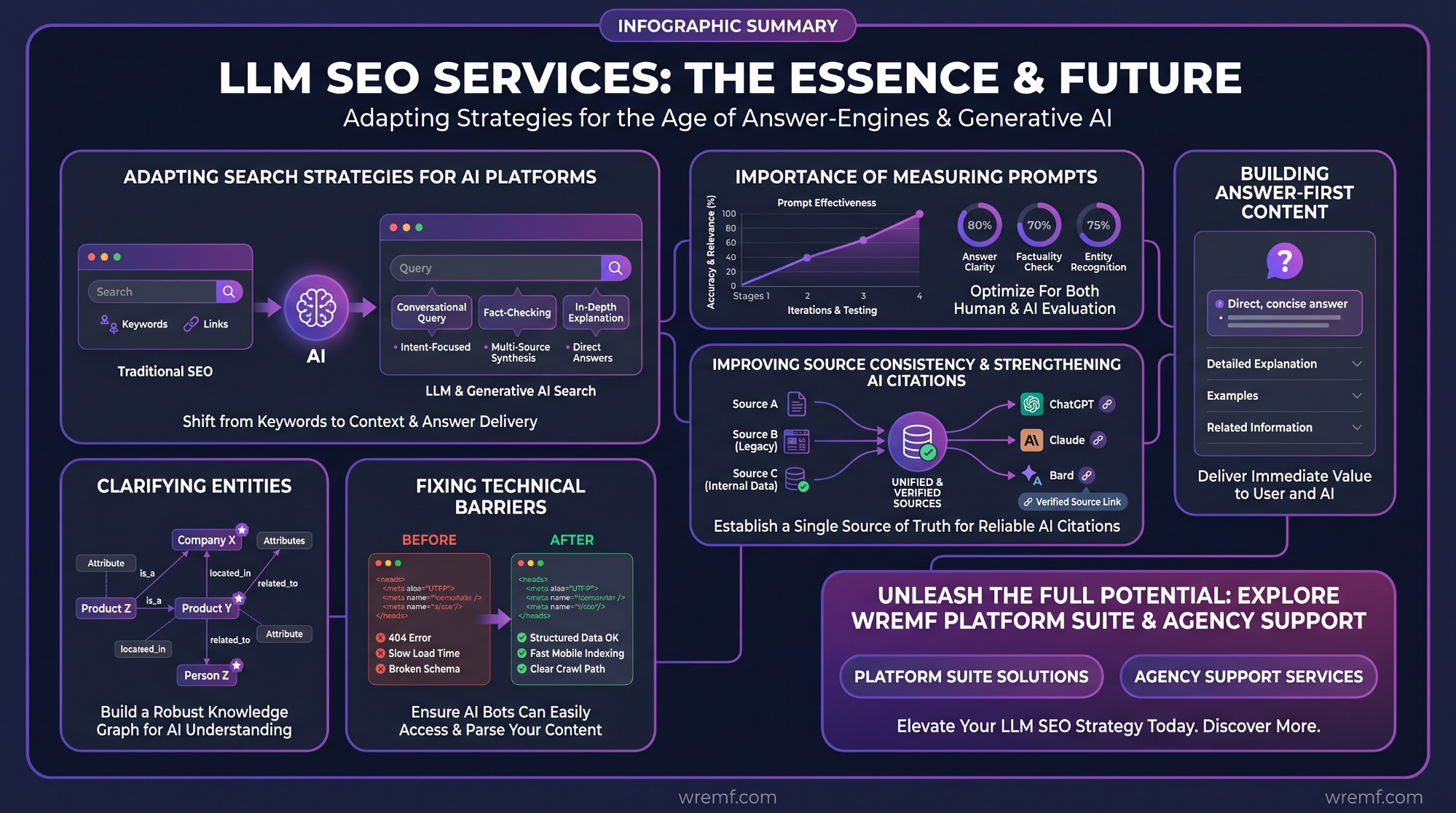
LLM SEO services help you adapt search strategy to a world where buyers use AI platforms, search engines, AI Overviews, and voice assistants to get direct answers. The core work is not keyword stuffing or mass AI content. The core work is measuring prompts, improving source consistency, strengthening AI citations, clarifying entities, fixing technical barriers, building answer-first content, and proving visibility over time. WREMF helps teams turn LLM SEO services into a practical workflow across software, agency support, or a hybrid model. To start measuring and improving AI visibility, explore the WREMF platform suite or request support from the WREMF agency team.
Related Generative Engine Optimization Guides
- AI SEO Services The Complete Guide to Search Visibility in the AI Era
- LLM SEO Agency The Complete Guide to Choosing an Agency for AI Search Visibility
- Large Language Model Optimization Services The Complete Guide to LLMO, AI Search Visibility, AEO, GEO, RAG, and LLM Performance
- AI Search Engine Optimization Services The Complete Guide for B2B Brands
- Answer Engine Optimization Services The Complete Guide to AI Search Visibility
- Generative AI Optimization Services The Complete Guide to GEO, AEO, LLM Optimization, and AI Visibility
- AI SEO Agency How to Choose the Right Partner for AI Search Visibility
- AI Mention Tracking The Complete Guide to Monitoring Brand Mentions, AI Answers, Citations, and Share of Voice in 2026
- Answer Engine Optimization The Complete Guide to AEO, AI Search Visibility, and Answer-First Content
- AI Brand Monitoring The Complete Guide to Tracking Brand Visibility Across AI Search, LLMs, and Generative Engines
- AI Search Engine Optimization Tools The Complete 2026 Guide for AI Search, SEO, AEO, and GEO
- How AI Search Optimization Tools Increase Organic Traffic
- AI Overview SEO How to Optimize for Google AI Overviews, AI Mode, and AI Search Visibility
- AI Search Engine Optimization The Complete Guide for B2B Brands
- AI SEO Tools The Complete Guide for SEO, AEO, GEO, and AI Search Visibility
- 12 Best AI Search Optimization Tools
- Enterprise Answer Engine Optimization Platforms Complete Guide for AI Visibility, AEO, and GEO
- AI Overview Optimization How to Rank, Get Cited, and Stay Visible in Google AI Search
- How Do AI Search Optimization Tools Improve SERP Rankings
- Best Answer Engine Optimization for Enhancing AI Visibility
Related reading
- Generative AI Optimization Services: The Complete Guide to GEO, AEO, LLM Optimization, and AI Visibility
- AI Brand Monitoring: The Complete Guide to Tracking Brand Visibility Across AI Search, LLMs, and Generative Engines
- Enterprise Answer Engine Optimization Platforms: Complete Guide for AI Visibility, AEO, and GEO
- AI SEO Services: The Complete Guide to Search Visibility in the AI Era
- AI Visibility Services: The Complete Guide to Tracking, Improving, and Proving Brand Visibility in AI Search
- LLM SEO Agency: The Complete Guide to Choosing an Agency for AI Search Visibility