Enterprise AI Visibility Platform: The Complete Guide for B2B Brands
Discover how enterprise AI visibility platforms enhance B2B brand presence in AI search experiences. Learn key features and strategic insights.
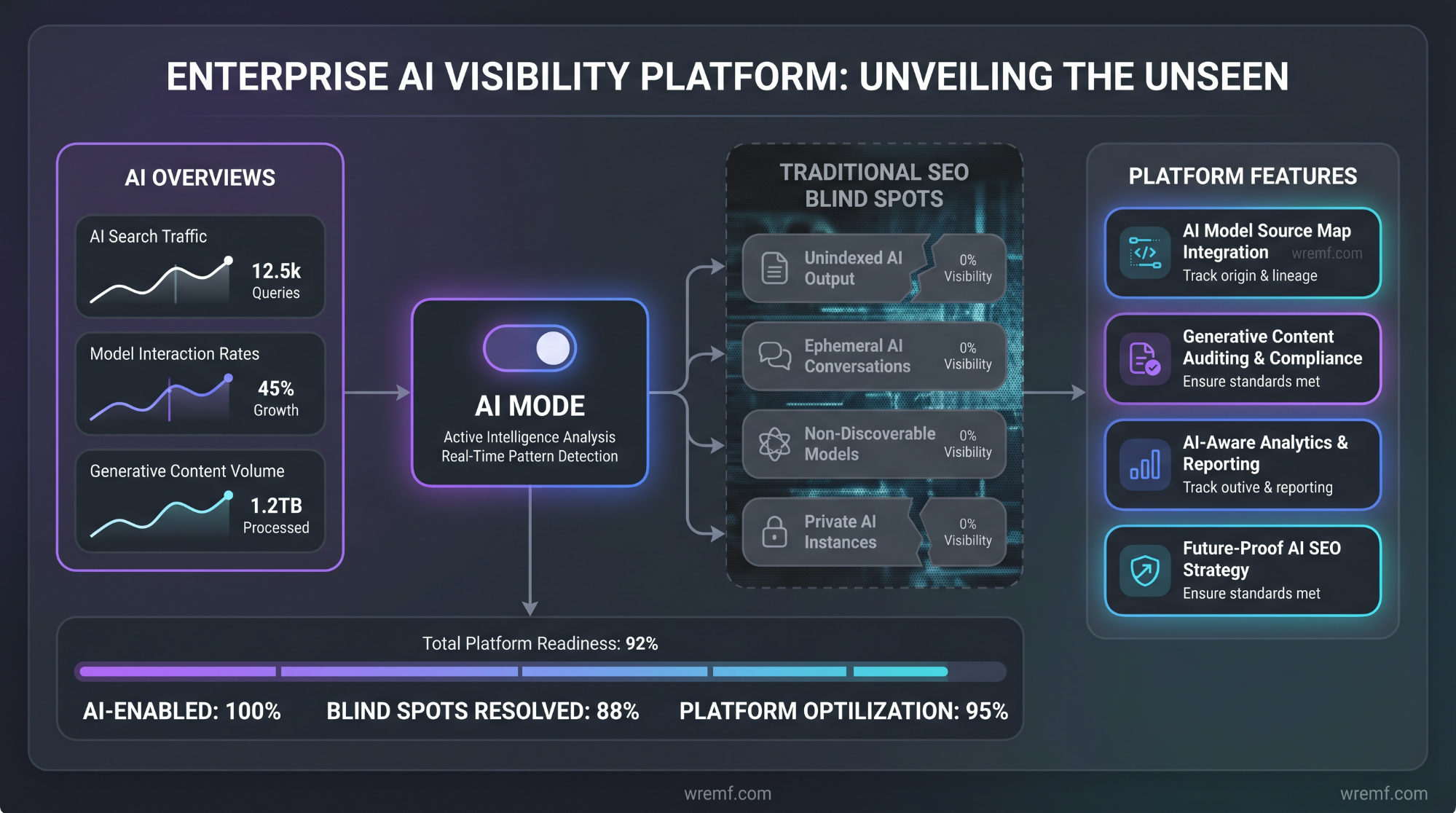
By WREMF Team · 2026-09-18
An enterprise AI visibility platform is specialized software designed for large organizations to track and enhance their brand's appearance in AI search results, including AI answers, citations, and summaries. Unlike traditional SEO tools focused on keyword rankings, AI visibility platforms emphasize the presence of brands in AI-generated content across engines like ChatGPT and Google AI Overviews. Key features include prompt tracking, source citation analysis, and AI traffic attribution, which are essential for improving AI search visibility and proving its impact on business outcomes.
Key takeaways
- Enterprise AI visibility platforms measure brand presence in AI-generated answers and citations.
- Traditional SEO tools miss critical AI Search visibility signals, leading to potential blind spots.
- AI features such as Google AI Overviews and AI Mode impact brand visibility in search.
- Key platform capabilities include prompt tracking and governance features like SOC 2.
- AI visibility complements SEO by enhancing brand presence in AI search, not just traditional SERPs.
Enterprise AI Visibility Platform: The Complete Guide for B2B Brands
Enterprise AI visibility platform software helps large organizations track, improve, and prove how their brand appears in AI search. Google explains that AI features such as AI Overviews and AI Mode help users ask more complex questions and explore linked sources, which changes how search visibility is earned and measured. This guide explains how enterprise AI visibility works, why traditional SEO tools create blind spots, which platform features matter, how governance and SOC 2 fit into buying decisions, and how teams can connect AI answers to business reporting. WREMF helps B2B teams manage this shift across software, agency execution, or a hybrid model through the WREMF platform suite. Keep reading to choose the right platform and build a measurable AI search workflow. (Google for Developers)
What Is an Enterprise AI Visibility Platform?
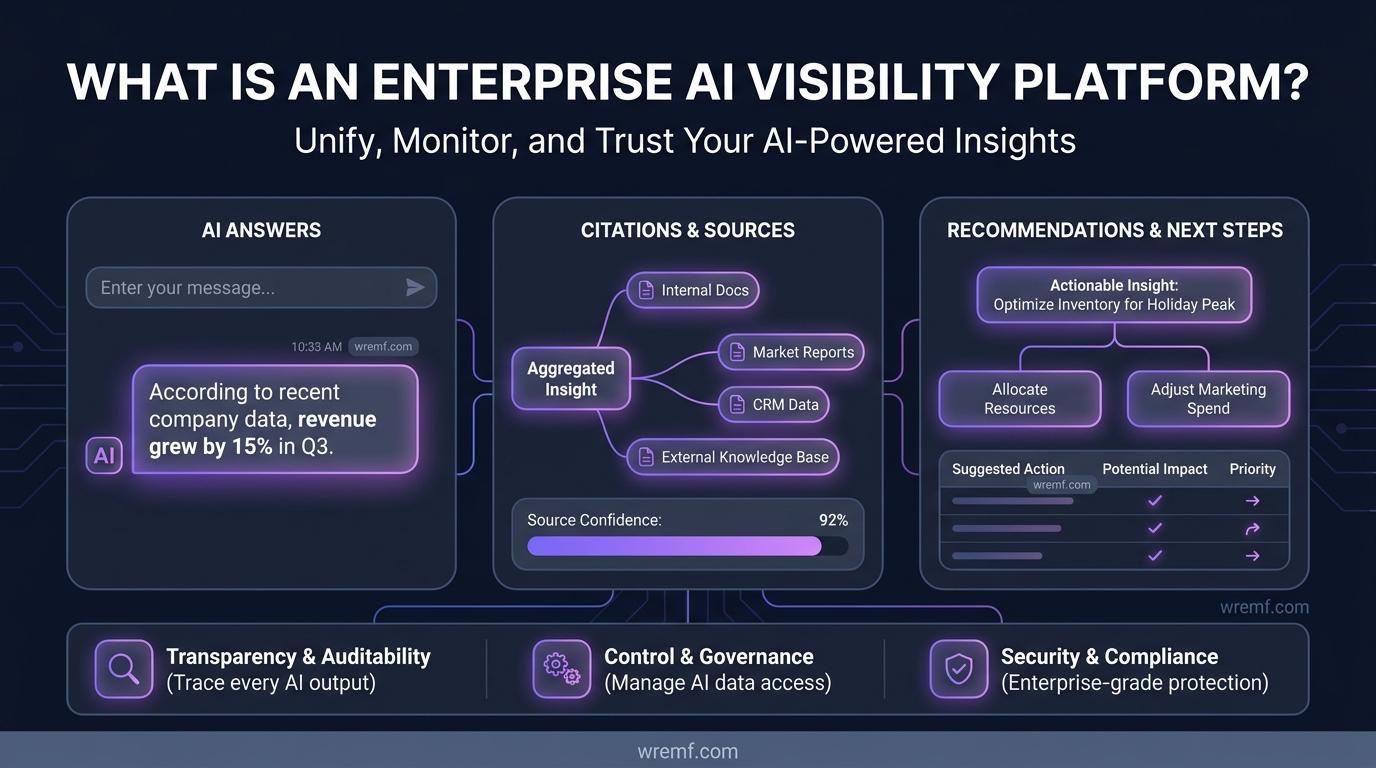
An enterprise AI visibility platform is software that measures how a brand appears inside AI answers, citations, summaries, comparisons, and recommendations. Enterprise teams use it to monitor AI visibility across AI engines, competitors, prompts, sources, and business outcomes.
AI visibility is the measurable presence of a brand inside AI-generated answers, recommendations, citations, and summaries. AI visibility matters because buyers increasingly use AI Search before visiting a website, reading ads, comparing pricing, or speaking with sales.
An enterprise AI visibility platform is different from a traditional search engine rank tracker. Rank trackers show where pages appear in search engines. AI visibility tools show whether ChatGPT, Claude, Gemini, Perplexity, Google AI Overviews, Google AI Mode, Copilot, DeepSeek, Grok, Meta AI, Mistral, and other AI answer engines mention, cite, compare, or recommend a brand.
AI Search visibility is the ability to appear accurately and prominently inside AI-powered search experiences. AI Search visibility matters because AI systems can summarize market options directly, which means a brand can influence a buyer before a traditional click happens.
WREMF helps teams track, improve, and prove AI visibility across major AI discovery surfaces. WREMF combines prompt intelligence, source citation tracking, competitor visibility, AI share of voice, AI traffic attribution, GEO audits, content briefs, SEO testing, scheduled monitoring, white-label reporting, BYOK support, client portals, source consistency analysis, API access, and MCP integrations.
Enterprise organizations need this category because manual testing is not reliable at scale. A global B2B company may need to test thousands of LLM prompts across product lines, regions, industries, languages, competitors, and buyer stages. Screenshots do not create a strategy. A repeatable platform creates benchmarks, trends, workflows, and proof.
| Capability | Traditional SEO tool | Enterprise AI visibility platform | Why it matters |
|---|---|---|---|
| Google rankings | Strong | Partial | Rankings still matter, but they do not show all AI answers |
| AI answers | Limited | Strong | AI answers show how buyers see the brand inside generated responses |
| Prompt tracking | Weak | Strong | Prompts reveal how buyers ask AI systems for vendors and advice |
| Source citations | Limited | Strong | Citations show which sources influence AI answer engines |
| Share of Voice | Usually keyword-based | AI answer-based | Share of Voice shows brand presence versus competitors |
| Google AI Overviews | Partial | Strong | Google AI Overviews affect visibility inside the search engine result |
| Google AI Mode | Limited | Strong | Google AI Mode extends search into conversational AI Mode experiences |
| AI traffic attribution | Limited | Strong | Attribution connects AI visibility data to traffic and pipeline signals |
| Governance | Varies | Required | SOC 2, audit trails, RBAC, and data flows matter for enterprise adoption |
DID YOU KNOW: Stanford HAI’s 2025 AI Index reported that 78% of organizations used AI in 2024, up from 55% the year before, which shows why enterprise teams need structured AI visibility data rather than ad hoc monitoring. (Stanford HAI)
KEY TAKEAWAY: An enterprise AI visibility platform helps large teams measure AI visibility across prompts, AI answers, citations, competitors, sources, and outcomes instead of relying on rankings alone.
The next section explains why traditional SEO and analytics tools create blind spots when AI answer engines influence buying decisions.
Why Traditional Search Tools Create Blind Spots for Global Brands
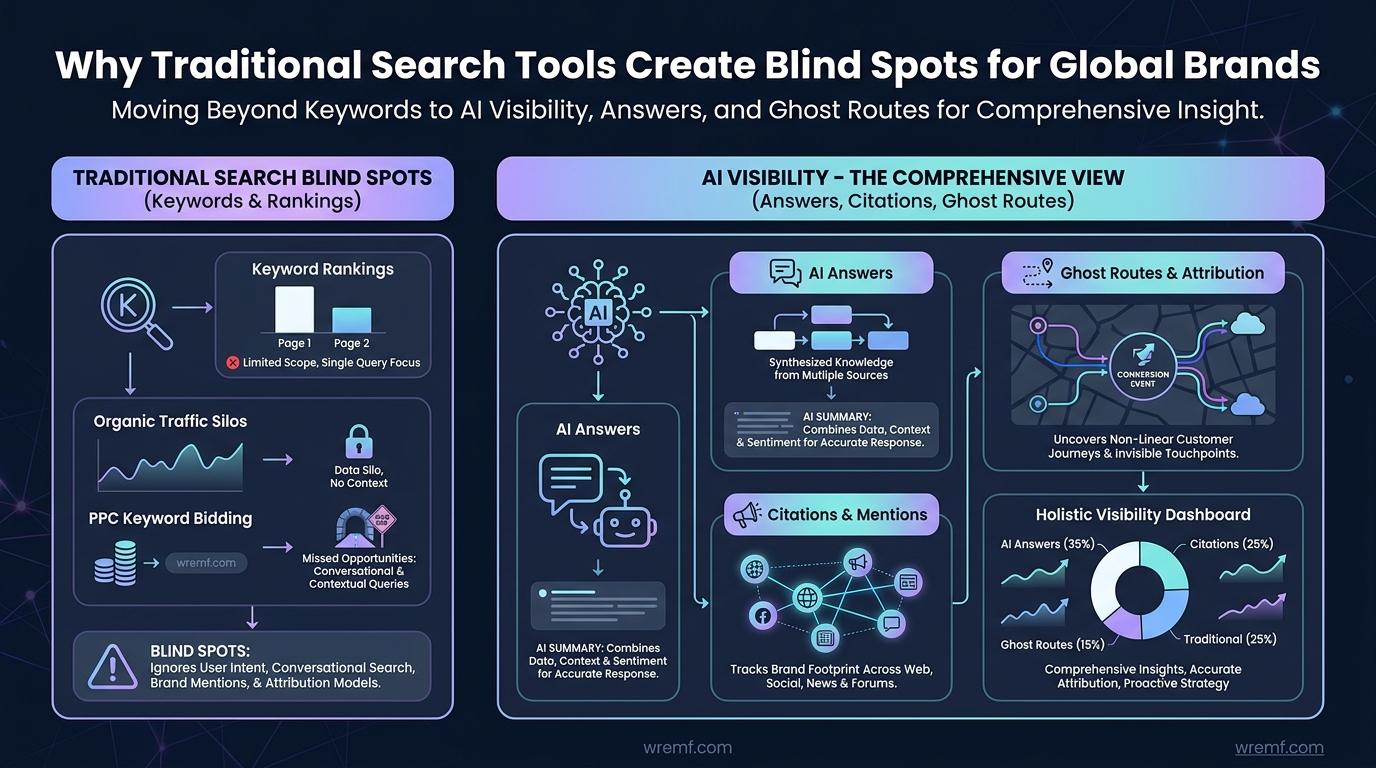
Traditional search tools create blind spots because they measure rankings, keywords, and traffic, but they often miss AI answers, citations, recommendations, Ghost Routes, and AI-influenced journeys. Enterprise AI visibility fills that measurement gap.
AI Search is the use of AI systems to generate, summarize, compare, and recommend information in response to natural language queries. AI Search matters because users can receive complete answers inside ChatGPT, Perplexity, Claude, Gemini, Copilot, Google AI Overviews, and Google AI Mode without following a classic search engine results page journey.
Google AI Overviews are AI-generated snapshots in Google Search that provide key information and links for deeper exploration. Google AI Overviews matter because they can shape brand perception before a user scans standard organic results. Google says AI features in Search include AI Overviews and AI Mode, and site owners should focus on helpful content and accessible pages for these experiences. (Google for Developers)
Google AI Mode is a conversational AI Search experience from Google that expands AI Overviews with more advanced reasoning and follow-up exploration. AI Mode matters because it moves search behavior closer to an answer engine interface, where users may refine questions instead of clicking through multiple blue links. Google introduced AI Mode as a Search Labs experiment in March 2025. (blog.google)
The Ghost Route problem describes buyer journeys influenced by AI answers but not cleanly visible in analytics. A buyer may ask Perplexity for “enterprise AI visibility platform options,” see three brands, later search one brand name on Google, and arrive through branded organic or direct traffic. Google Analytics 4 may record the last touch, but the AI answer engine created the original shortlist.
LLM visibility is the measurable presence of a brand inside large language model outputs. LLM visibility matters because AI models can describe, exclude, compare, or recommend brands in ways that affect consideration before the brand sees a form fill, demo request, or website session.
In practical AI visibility audits, SEO teams frequently discover that strong rankings do not guarantee AI answer presence. A brand may rank for a high-value search engine keyword but still be absent when users ask AI answer engines for tools, services, vendors, comparisons, or implementation guidance.
AI answers are generated responses from AI systems that summarize information, compare options, recommend actions, or cite sources. AI answers matter because they compress discovery, education, and comparison into one response, which can change how enterprise buyers build shortlists.
| Blind spot | What traditional tools show | What AI visibility tools add | Enterprise risk if ignored |
|---|---|---|---|
| Rankings without AI mentions | Search position | Whether the brand appears in AI answers | The brand ranks but is not recommended |
| Clicks without Ghost Routes | Website sessions | AI-influenced prompt trends and brand recall signals | AI impact is undercounted |
| Keywords without prompts | Search terms | Natural language LLM prompts | Buyer language is missed |
| Backlinks without citations | Link profile | Source citations inside AI answer engines | Source influence is misunderstood |
| Competitors without answer context | Ranking competitors | Competitors recommended in AI answers | Market Share of Voice declines |
| Pages without AI Overviews context | Organic pages | Google AI Overviews and AI Mode visibility | Search visibility is incomplete |
IMPORTANT: Do not treat AI visibility as a replacement for SEO. SEO remains foundational because search engines, crawlability, content quality, structured data, and source authority all influence how AI systems discover and understand brand information.
KEY TAKEAWAY: Traditional SEO and analytics tools miss important AI Search visibility signals, including AI answers, source citations, Google AI Overviews, Google AI Mode, Ghost Routes, and competitor recommendations.
The next section defines the strategic capabilities an enterprise-grade platform should include.
Essential Capabilities of an Enterprise-Grade AI Visibility Platform
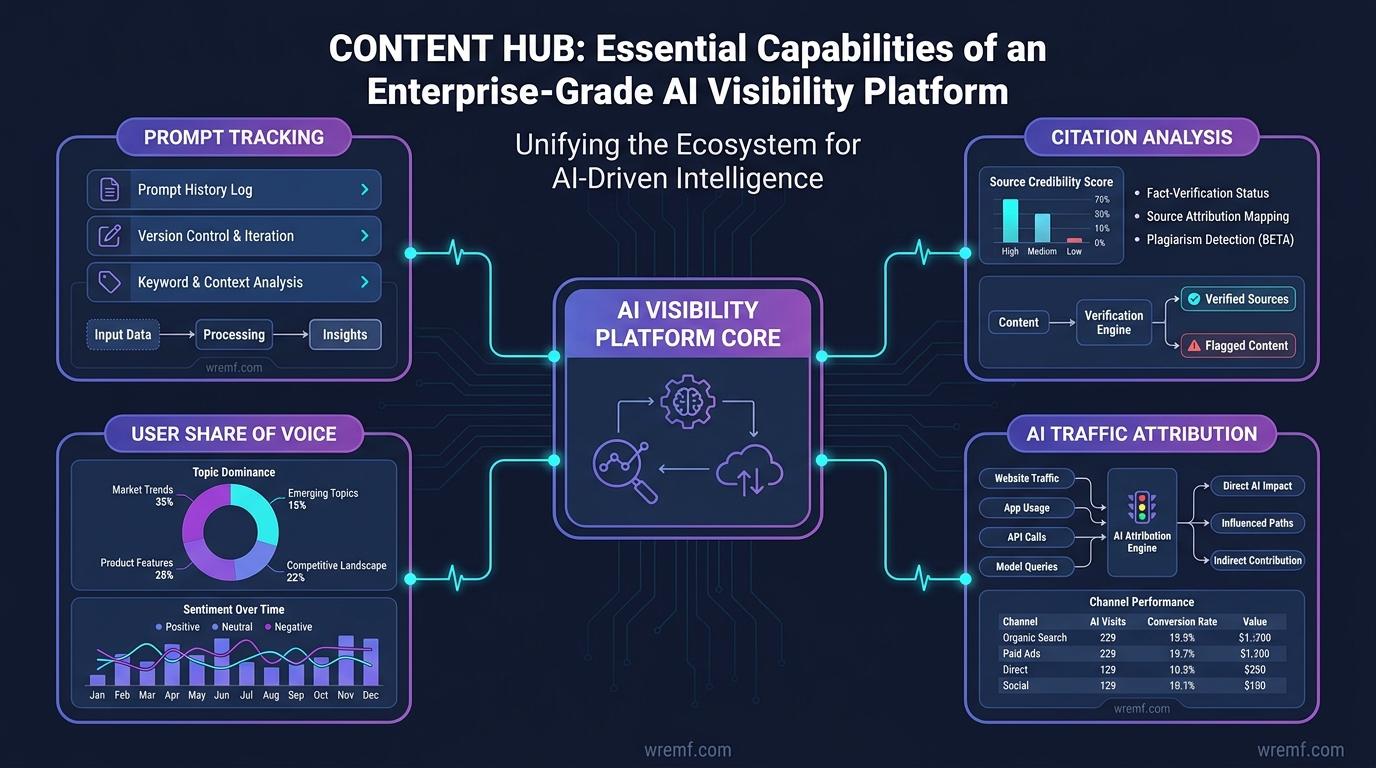
The best enterprise AI visibility platform combines prompt tracking, citation analysis, Share of Voice, competitor visibility, GEO insights, AI traffic attribution, reporting, governance, and workflow execution. Enterprise teams need actionable monitoring tools, not isolated dashboards.
Prompt tracking is the process of monitoring how AI models answer specific buyer, brand, product, competitor, and category prompts over time. Prompt tracking matters because enterprise buyers use natural language queries that often differ from classic keyword lists.
Prompt Volumes are estimated or observed counts of how often prompt themes appear across buyer research, search demand, internal data, or AI testing workflows. Prompt Volumes matter because teams need to prioritize prompts that represent real commercial intent, not random curiosity.
AI citations are source references that AI systems use or display when generating answers. AI citations matter because they reveal which pages, publications, partner sites, directories, and documents influence AI answer engines. OpenAI’s web search documentation describes access to web sources and citation-related source fields, while Anthropic states that Claude’s web search responses include citations from search results. (OpenAI Developers)
Source citations are the pages, documents, or domains shown as references in AI answers. Source citations matter because they help teams identify whether visibility is driven by owned pages, third-party review sites, partner pages, analyst content, documentation, or competitor-controlled narratives.
Share of Voice is the percentage of relevant AI answers in which a brand appears compared with competitors. Share of Voice matters because executives need a market-level measure of brand presence across AI answer engines, not only page-level metrics.
AI visibility data is the structured information collected from AI answers, prompts, citations, competitor mentions, sentiment, traffic, and reporting systems. AI visibility data matters because enterprise teams need repeatable evidence for decisions, not anecdotal screenshots.
An enterprise platform should include these capabilities:
Monitoring across ChatGPT, Claude, Gemini, Perplexity, Google AI Overviews, Google AI Mode, Copilot, DeepSeek, Grok, Meta AI, Mistral, and other AI engines
Prompt intelligence for buyer questions, category prompts, competitor prompts, and problem-aware prompts
Citation analysis for owned, earned, third-party, and community sources
AI answer accuracy monitoring for misinformation, outdated descriptions, and missing product details
Share of Voice and SOV Tracking across competitors
Generative Engine Optimization insights for content and source improvements
AI traffic attribution using Google Analytics 4 and related data
Executive dashboards for leadership reporting
Role-based access controls, audit trails, and SOC 2 readiness
API, MCP, BYOK, and enterprise integration support
Client workspaces and white-label reporting for marketing agencies
Automated identification of visibility gaps, page-level performance issues, and dev ticket opportunities
WREMF combines these capabilities in one workflow. The WREMF prompt intelligence suite helps teams monitor the prompts buyers actually ask, while the WREMF source citation tracker helps teams identify which sources AI answer engines rely on.
| Capability | What it measures | Typical user | Main limitation if missing |
|---|---|---|---|
| Prompt tracking | AI answers to real buyer prompts | SEO, content, product marketing | Teams guess what buyers ask AI systems |
| Citation analysis | Sources cited by AI answer engines | SEO, PR, content | Teams cannot identify source influence |
| Share of Voice | Brand presence versus competitors | CMO, growth, category owner | Leadership lacks market visibility |
| Competitor visibility | Which competitors appear and why | Product marketing, sales | Competitive risk is hidden |
| GEO monitoring | Content and source readiness for generative engines | SEO, content ops | Insights do not become actions |
| AI traffic attribution | Sessions and outcomes from AI sources | Analytics, demand generation | AI impact stays disconnected from pipeline |
| Governance controls | Permissions, logs, data flows | IT, legal, security | Enterprise adoption stalls |
TIP: Start with 25 to 50 high-intent LLM prompts per core product line, then expand by buyer persona, geography, industry, competitor, and buying stage.
KEY TAKEAWAY: Enterprise AI visibility tools must connect prompts, citations, AI answers, competitors, Share of Voice, attribution, governance, and action recommendations in one system.
The next section explains how AI visibility relates to SEO, AEO, and Generative Engine Optimization.
SEO vs AEO vs Generative Engine Optimization
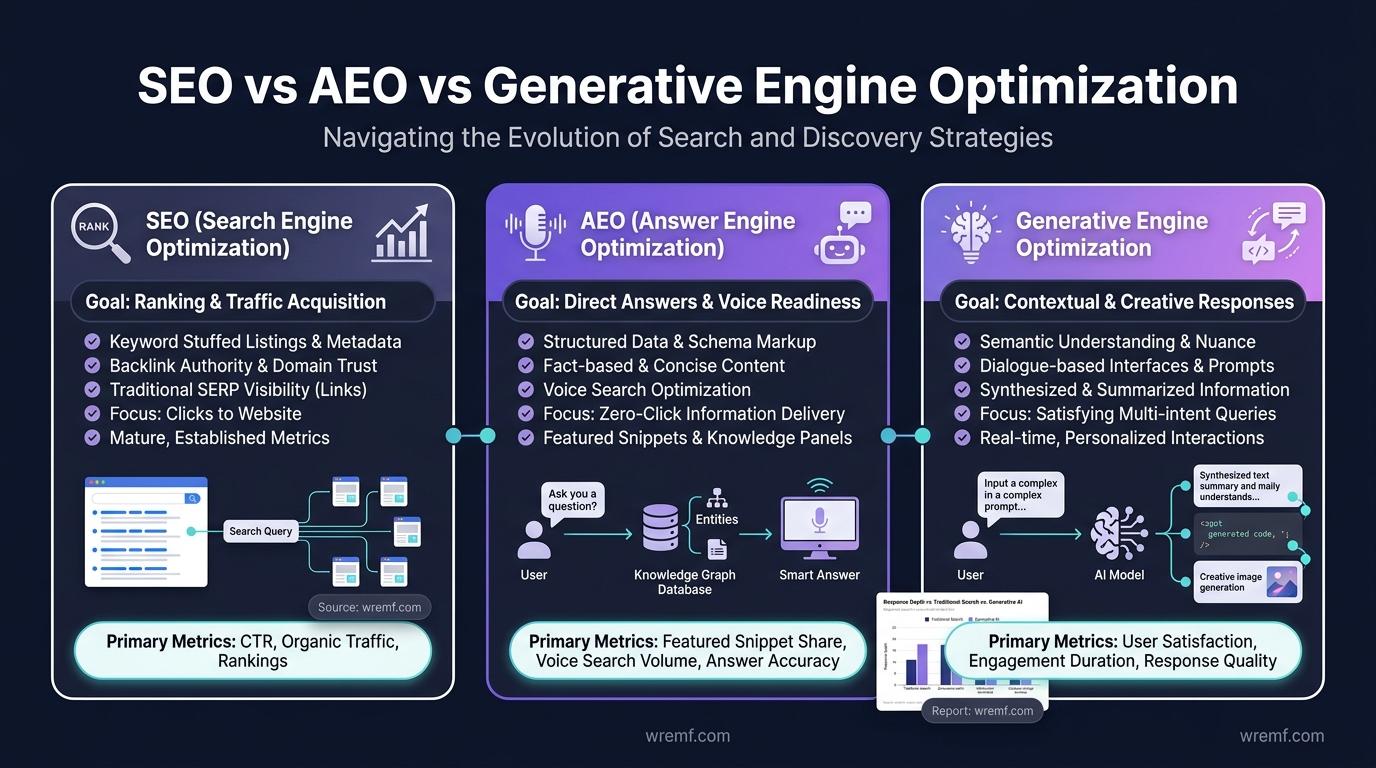
SEO improves visibility in search engines, AEO improves answer readiness, and Generative Engine Optimization improves visibility inside AI-generated answers. Enterprise AI visibility connects all three into a measurable operating system.
SEO is the practice of improving technical access, content relevance, authority, and user value so pages perform in search engines. SEO matters because Google, Bing, and other search engines still influence discovery, crawling, indexing, authority, and the source ecosystem used by AI systems.
Answer engine optimisation, or AEO, is the practice of structuring content so it can answer specific questions clearly and directly. AEO matters because AI answer engines need concise, extractable, reliable answer blocks that can be summarized and cited.
Generative Engine Optimization is the practice of improving how brands appear inside AI-generated answers, recommendations, citations, and summaries. Generative Engine Optimization matters because AI answer engines synthesize sources rather than simply listing pages.
The key difference between SEO and GEO is the target output. SEO targets search engine visibility, rankings, clicks, impressions, and organic traffic. Generative Engine Optimization targets AI answers, AI citations, brand mentions, Share of Voice, source consistency, and recommendation visibility across AI answer engines.
Google Search Central explains that Google’s automated ranking systems are designed to prioritize helpful, reliable, people-first content. That guidance matters for AI visibility because source quality, clarity, and usefulness still influence how search engines and AI systems interpret content. (Google for Developers)
| Discipline | Main goal | Example metric | What it misses alone | Best use case |
|---|---|---|---|---|
| SEO | Improve search engine performance | Rankings, clicks, impressions | AI answers and citations | Foundation for discoverability |
| AEO | Make content answer-ready | Direct answer coverage | Competitor and source ecosystem analysis | FAQ, definitions, and answer blocks |
| GEO | Improve generative answer visibility | AI mentions, citations, recommendations | Traditional search demand if isolated | AI answer engines and LLM visibility |
| AI visibility | Measure presence across AI systems | AI visibility score, Share of Voice, attribution | Execution if dashboards lack workflows | Enterprise operating layer |
Structured data is machine-readable markup that helps systems understand page entities, attributes, and relationships. Structured data matters because it can clarify organizations, products, articles, FAQs, breadcrumbs, reviews, authors, and other entities when it matches visible page content.
AI content is content created, assisted, optimized, or evaluated using AI systems. AI content matters only when it is accurate, useful, differentiated, and aligned with user needs. Content generation without editorial judgment can create more pages without improving source trust.
Content generation is the process of producing text, briefs, drafts, outlines, or content assets through human, AI, or hybrid workflows. Content generation matters for enterprise AI visibility when it is tied to visibility gaps, prompt demand, citation analysis, and content quality standards.
WREMF’s AI visibility methodology connects SEO, AEO, GEO, source consistency, prompts, citations, competitors, and attribution into one repeatable process. This helps teams see whether the issue is content structure, source authority, technical access, inaccurate AI answers, or missing measurement.
KEY TAKEAWAY: SEO, AEO, and Generative Engine Optimization overlap, but enterprise AI visibility is the broader framework for measuring and improving AI answers, citations, prompts, and source influence.
The next section explains how AI answer engines, LLMs, RAG, and citations shape brand reach.
How AI Answer Engines, LLMs, RAG, and Citations Shape Brand Reach
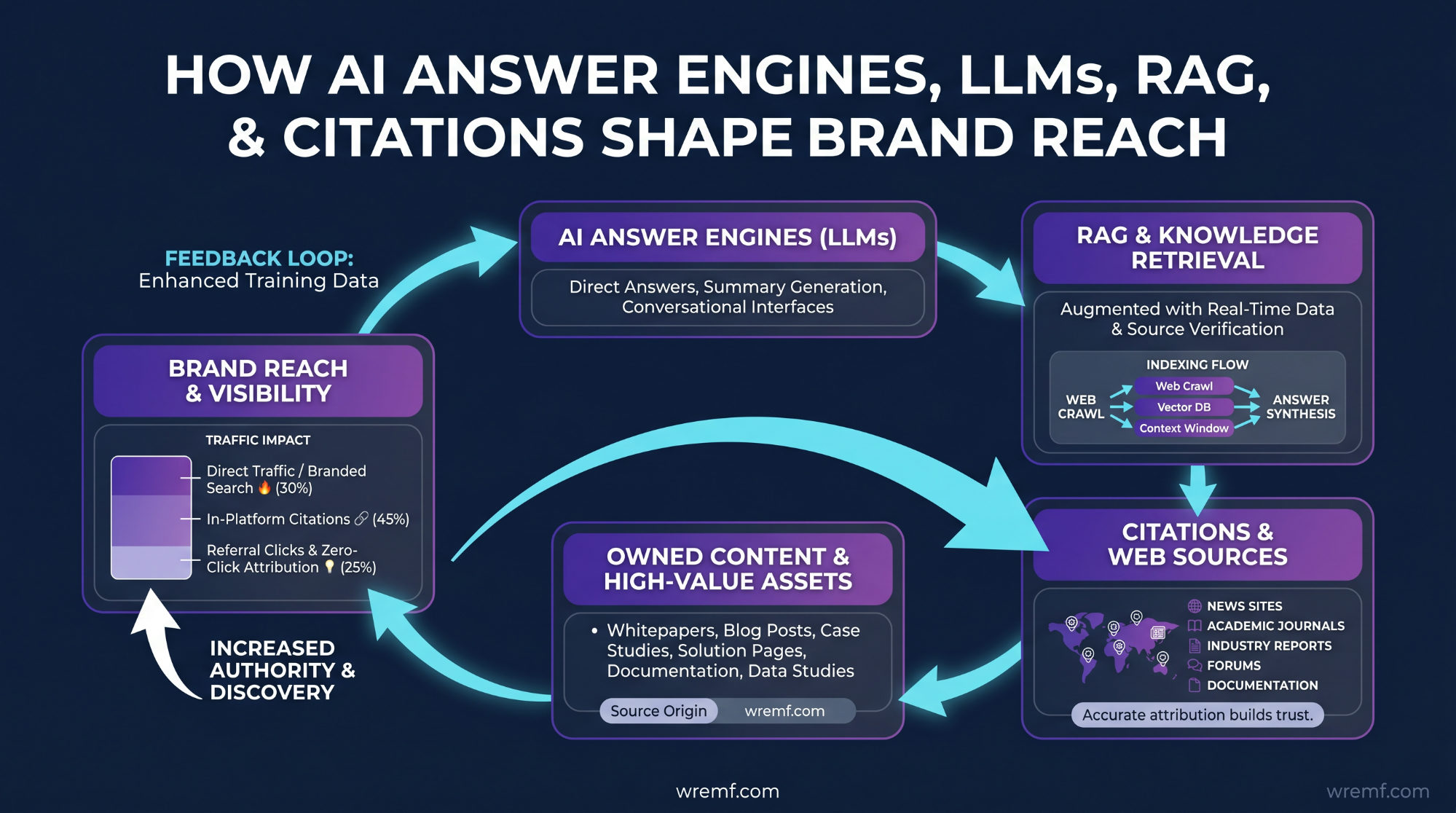
AI answer engines shape brand reach by retrieving, summarizing, and synthesizing information from AI models, web search, citations, structured sources, and user context. Enterprise brands must manage both owned content and the wider source ecosystem.
AI answer engines are systems that generate direct answers instead of only listing links. AI answer engines matter because ChatGPT, Claude, Gemini, Perplexity, Copilot, Google AI Overviews, and Google AI Mode can influence which brands buyers compare and trust.
Answer engines are systems that respond to questions with direct answers, summaries, recommendations, or cited explanations. Answer engines matter because they compress discovery, research, and comparison into fewer user interactions.
AI models are computational systems that generate, classify, summarize, or reason over information based on training data, retrieved content, tools, or context. AI models matter for AI visibility because model behavior affects whether a brand is described accurately, ignored, cited, or recommended.
Retrieval-Augmented Generation is a method where an AI system retrieves external information before generating an answer. Retrieval-Augmented Generation matters because many AI answer engines use fresh or retrieved sources for current facts, vendor comparisons, product information, and citations.
Citation analysis is the process of identifying which sources AI systems cite, repeat, or rely on when answering relevant prompts. Citation analysis matters because source influence often explains why one brand appears in AI answers while another brand is absent.
Enterprise teams should track four source layers:
Owned sources, including product pages, documentation, pricing pages, blogs, comparison pages, help centers, and reports
Earned sources, including analyst coverage, review sites, partner mentions, media, podcasts, newsletters, and directories
Community sources, including forums, Q&A platforms, social discussions, GitHub, and public documentation discussions
Search sources, including pages that rank in Google, Bing, and other search engines
AI visibility is the measurable presence of a brand inside AI-generated answers, recommendations, citations, and summaries. AI visibility works by tracking prompts, answers, cited sources, competitor mentions, source consistency, and attribution across AI systems.
Source consistency helps AI systems understand a brand because repeated, accurate, and aligned descriptions reduce ambiguity. Source consistency is especially important for enterprise organizations with multiple product pages, regions, partner descriptions, pricing pages, and third-party directory profiles.
In real B2B buying journeys, source consistency often matters more than keyword density. If AI answer engines repeatedly find conflicting product names, outdated pricing, weak category definitions, or inconsistent positioning, the brand may be summarized inaccurately or excluded from relevant AI answers.
IMPORTANT: AI citations are not only a PR metric. AI citations connect SEO, content strategy, product marketing, analyst relations, partnerships, documentation, and brand governance.
KEY TAKEAWAY: AI answer engines depend on prompts, retrieval, citations, structured data, entity clarity, and source consistency, so enterprise AI visibility must monitor the full source ecosystem.
The next section explains the governance gap that appears when AI visibility becomes an enterprise workflow.
The Governance Gap: SOC 2, Data Security, RBAC, and Audit Trails
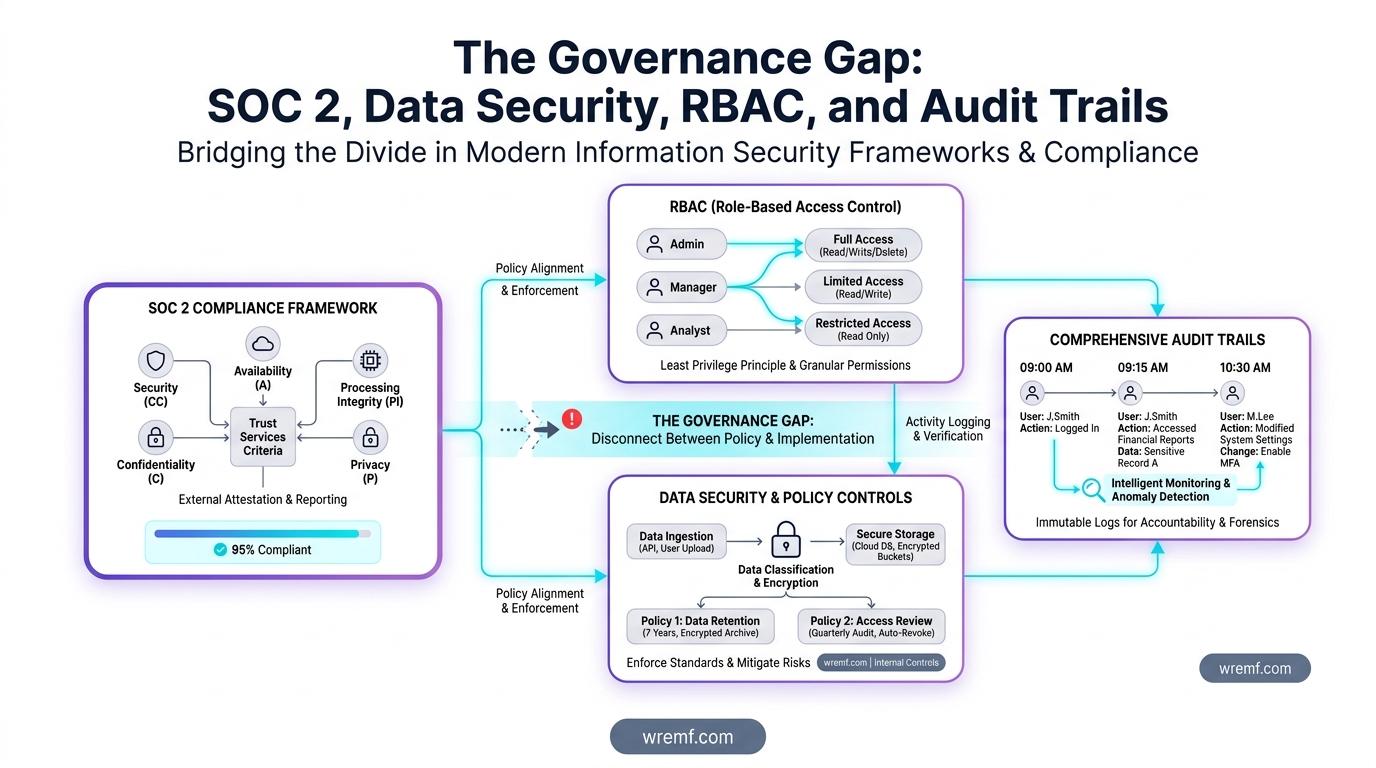
Enterprise AI visibility platforms need governance controls because prompts, AI answers, reports, integrations, and data flows can involve sensitive market, brand, product, and customer information. SOC 2, RBAC, audit trails, and policy controls help enterprise organizations adopt AI visibility safely.
SOC 2 is an assurance framework used to evaluate service organization controls related to trust services criteria such as security, availability, processing integrity, confidentiality, and privacy. SOC 2 matters because enterprise buyers need evidence that vendors can handle business-critical systems responsibly.
Role-based access controls define which users can view, edit, approve, export, or administer platform data. Role-based access controls matter because Fortune 500 teams often need different permissions for global business units, agencies, executives, legal reviewers, and technical administrators.
Audit trails are records of actions, access events, changes, exports, and configuration updates inside a platform. Audit trails matter because enterprise organizations need accountability when users change prompts, export reports, connect data sources, or modify brand settings.
Data flows describe how information moves between systems, vendors, models, storage layers, analytics tools, and reporting outputs. Data flows matter because enterprise AI visibility platforms may connect prompts, AI engines, analytics, content systems, APIs, MCP integrations, and client workspaces.
Policy violations occur when AI tools or workflows break internal rules for data handling, security, compliance, brand review, or approved messaging. Policy violations matter because unapproved prompts, unsafe exports, or unclear AI provider usage can create operational and legal risk.
Data leakage is the unintended exposure of sensitive information through systems, vendors, prompts, logs, outputs, exports, or integrations. Data leakage matters because enterprise AI visibility workflows may include product plans, competitive analysis, customer segments, internal prompts, and proprietary reporting.
IBM’s 2025 Cost of a Data Breach Report states that the global average cost of a data breach was USD 4.44 million and highlights an AI oversight gap where AI adoption can outpace governance. That matters because enterprise AI workflows need controlled access, documented data flows, and security review rather than ad hoc tool use. (IBM)
Enterprise governance requirements usually include:
SOC 2 documentation or a clear SOC 2 roadmap
Role-based access controls for brands, regions, clients, and teams
Audit trails for prompt runs, exports, integrations, and configuration changes
Data flow documentation for AI engines, analytics, storage, and reporting
BYOK support for enterprise-owned model provider keys
SSO, access review, and permission separation where required
Client workspaces for agencies and multi-brand organizations
Policy controls for prompts, exports, and approved data usage
Retention rules for AI visibility data and reporting records
BYOK, or bring your own key, lets organizations use their own AI provider keys where appropriate. BYOK matters because enterprise teams may need better control over vendor usage, budget, security review, and provider-level data handling.
WREMF supports BYOK and enterprise-oriented reporting workflows. For agencies and enterprise teams, BYOK can make AI visibility easier to evaluate because the organization has clearer control over model provider usage and cost boundaries.
KEY TAKEAWAY: Enterprise AI visibility is not only a marketing analytics problem because SOC 2, role-based access controls, audit trails, data flows, and policy controls determine whether large organizations can safely use the platform.
The next section explains the technical infrastructure that helps AI visibility platforms interface with LLMs, AI crawlers, and enterprise systems.
Technical Infrastructure: AI Crawlers, Structured Data, RAG, and Runtime Observability
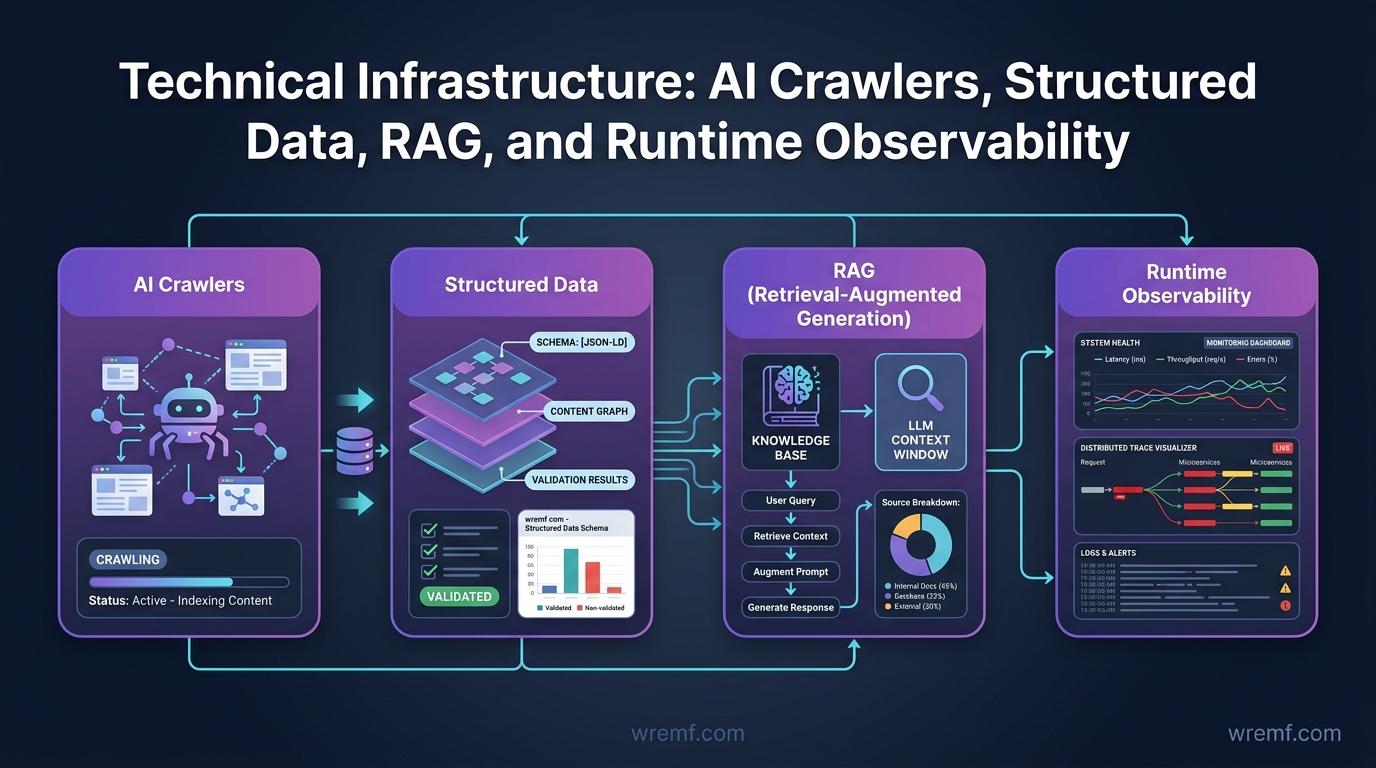
Enterprise AI visibility platforms need technical infrastructure that can test prompts at scale, inspect citations, evaluate AI Crawler access, validate structured data, monitor AI answers, and identify misinformation. Without this layer, AI visibility becomes screenshot reporting instead of a reliable workflow.
An AI Crawler is a bot, retrieval system, or automated agent that accesses web content for AI search, indexing, summarization, training, or answer generation. AI Crawler visibility matters because blocked, inaccessible, or poorly rendered pages can reduce how AI systems discover and interpret brand information.
AI systems may rely on several technical paths:
Training data already inside AI models
Real-time web search tools
Retrieval-Augmented Generation pipelines
Search engine indexes
AI Crawlers that access public web pages
Structured data and metadata
User-provided documents, databases, or APIs
Internal tools connected through enterprise workflows
Runtime observability is the monitoring of system behavior while AI applications are running. Runtime observability matters for AI visibility because teams need to identify hallucinations, outdated claims, missing citations, inaccurate recommendations, and policy issues as AI answers change.
AI governance is the set of policies, processes, roles, controls, and monitoring practices that guide how AI systems are used safely and responsibly. AI governance matters because enterprise-scale operations require accountability across marketing, IT, legal, security, analytics, and leadership.
AI security risks are risks related to unauthorized data access, data leakage, prompt misuse, unsafe integrations, model misuse, or weak access controls. AI security risks matter because enterprise AI visibility platforms may connect sensitive strategy, analytics, prompts, and reports.
Structured data is not a magic AI visibility shortcut. Structured data helps clarify entities, relationships, and page types, but it must align with useful visible content. Google’s helpful content guidance remains relevant because AI Search still depends on reliable, useful, accessible source material. (Google for Developers)
A technical AI visibility workflow should inspect:
robots.txt policies and AI Crawler access rules
raw HTML and rendered HTML differences
indexability, canonical tags, and hreflang
structured data accuracy
internal linking depth
page-level performance and template issues
source citation changes over time
AI answer hallucinations and misinformation
dev ticket creation for engineering fixes
Google Analytics 4 and Google Search Console integration readiness
A site audit is a structured review of technical, content, search, and performance issues that affect discoverability. A site audit matters for AI visibility because AI answer engines still need accessible, clear, well-structured sources.
Page-level performance is the measurable behavior of individual URLs across search, AI citations, traffic, engagement, and conversions. Page-level performance matters because enterprise teams need to know which pages support AI visibility and which pages create visibility gaps.
WREMF’s GEO audit feature helps teams turn technical findings into practical improvements. This can include schema guidance, AI Crawler checks, crawl and rendering checks, internal linking logic, source consistency review, and action recommendations.
KEY TAKEAWAY: Technical AI visibility requires AI Crawler analysis, structured data validation, RAG-aware content, runtime observability, and workflow integration so monitoring becomes action.
The next section turns these concepts into an enterprise workflow from data to actuation.
The 4-Step Enterprise AI Workflow: From Data to Actuation
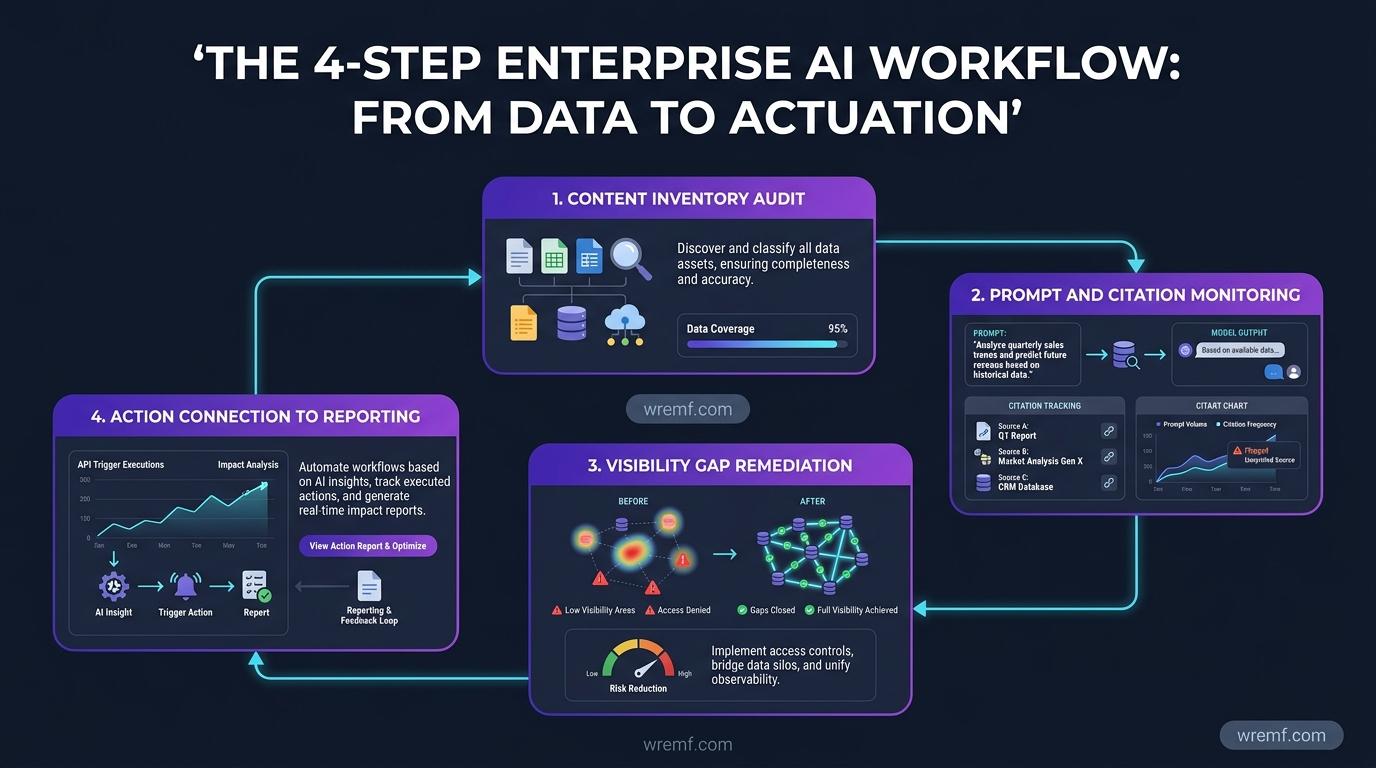
The most effective enterprise AI visibility workflow audits the content inventory, monitors prompts and citations, remediates visibility gaps, and connects actions to reporting. This workflow turns AI visibility data into repeatable decisions.
Content Inventory is the structured list of pages, content assets, templates, topics, product information, and source types that influence search and AI visibility. Content Inventory matters because enterprise organizations cannot improve content assets that have not been mapped.
Content assets are owned materials such as product pages, blogs, guides, reports, case studies, documentation, help center pages, comparison pages, and pricing pages. Content assets matter because AI answer engines may retrieve, cite, or summarize them in different buying contexts.
Step 1: Audit the Content Inventory and AI visibility gaps.
Start by mapping owned content assets to product lines, buyer personas, industries, regions, funnel stages, and high-intent LLM prompts. The goal is to identify visibility gaps between what buyers ask and what your website, third-party sources, and AI answer engines currently provide.
Visibility gaps are missing, weak, inaccurate, or inconsistent brand appearances inside AI answers, citations, recommendations, or source ecosystems. Visibility gaps matter because they show where a brand is not being found, trusted, cited, or recommended.
Step 2: Monitor brand sentiment, citation accuracy, and AI answers.
Run recurring prompts across ChatGPT, Claude, Gemini, Perplexity, Google AI Overviews, Google AI Mode, Copilot, DeepSeek, Grok, Meta AI, Mistral, and other relevant AI engines. Track whether the brand appears, which competitors appear, which sources are cited, whether the answer is accurate, and whether sentiment is neutral, favorable, or risky.
Answer engine insights are findings extracted from AI answer behavior, such as brand inclusion, competitor inclusion, cited sources, accuracy, recommendation patterns, and prompt-level changes. Answer engine insights matter because they show what AI systems are actually saying in market-facing contexts.
Step 3: Remediate through content creation workflows and technical fixes.
Remediation may include rewriting pages, improving answer-first content, creating AI-ready briefs, correcting outdated descriptions, strengthening structured data, improving comparison content, updating documentation, cleaning source consistency, and earning better third-party references. AI Draft workflows can help speed production, but editorial review is required for quality and accuracy.
AI Draft is a workflow where AI assists in generating outlines, briefs, page drafts, or content updates. AI Draft matters when teams use it to accelerate content creation workflows while preserving human review, brand accuracy, and source quality.
Step 4: Connect automated identification, dev tickets, and reporting.
Automated identification means using platform logic to detect priority pages, citation gaps, technical issues, prompt losses, competitor gains, or traffic opportunities. Automated identification matters because enterprise teams need scalable triage instead of manual spreadsheet reviews.
A dev ticket is an engineering task created to fix technical issues such as crawl access, rendering, schema, canonical tags, templates, speed, analytics tracking, or internal linking. A dev ticket matters because many AI visibility gaps are technical, not only editorial.
| Workflow step | Main owner | Example input | Example output |
|---|---|---|---|
| Audit | SEO, content, product marketing | Content Inventory, prompts, content assets | Visibility gaps and priority pages |
| Monitor | SEO, analytics, brand, agency | AI answers, citations, competitors | AI visibility data and Share of Voice |
| Remediate | Content, PR, engineering | Content briefs, AI Draft, technical findings | Updated pages, source fixes, dev tickets |
| Report | Growth, CMO, agency lead | GA4, prompt trends, citations | Executive dashboards and action roadmap |
WREMF’s AI-ready content briefs help teams turn prompt and citation gaps into structured content creation workflows. WREMF’s SEO testing feature helps teams evaluate whether changes also improve search engines, organic performance, and measurable traffic outcomes.
KEY TAKEAWAY: Enterprise AI visibility becomes useful when teams connect auditing, monitoring, remediation, dev tickets, and reporting into one repeatable workflow.
The next section explains how to build the business case for the C-suite, enterprise organizations, and Fortune 500 teams.
Building the Business Case for the C-Suite and Fortune 500 Teams
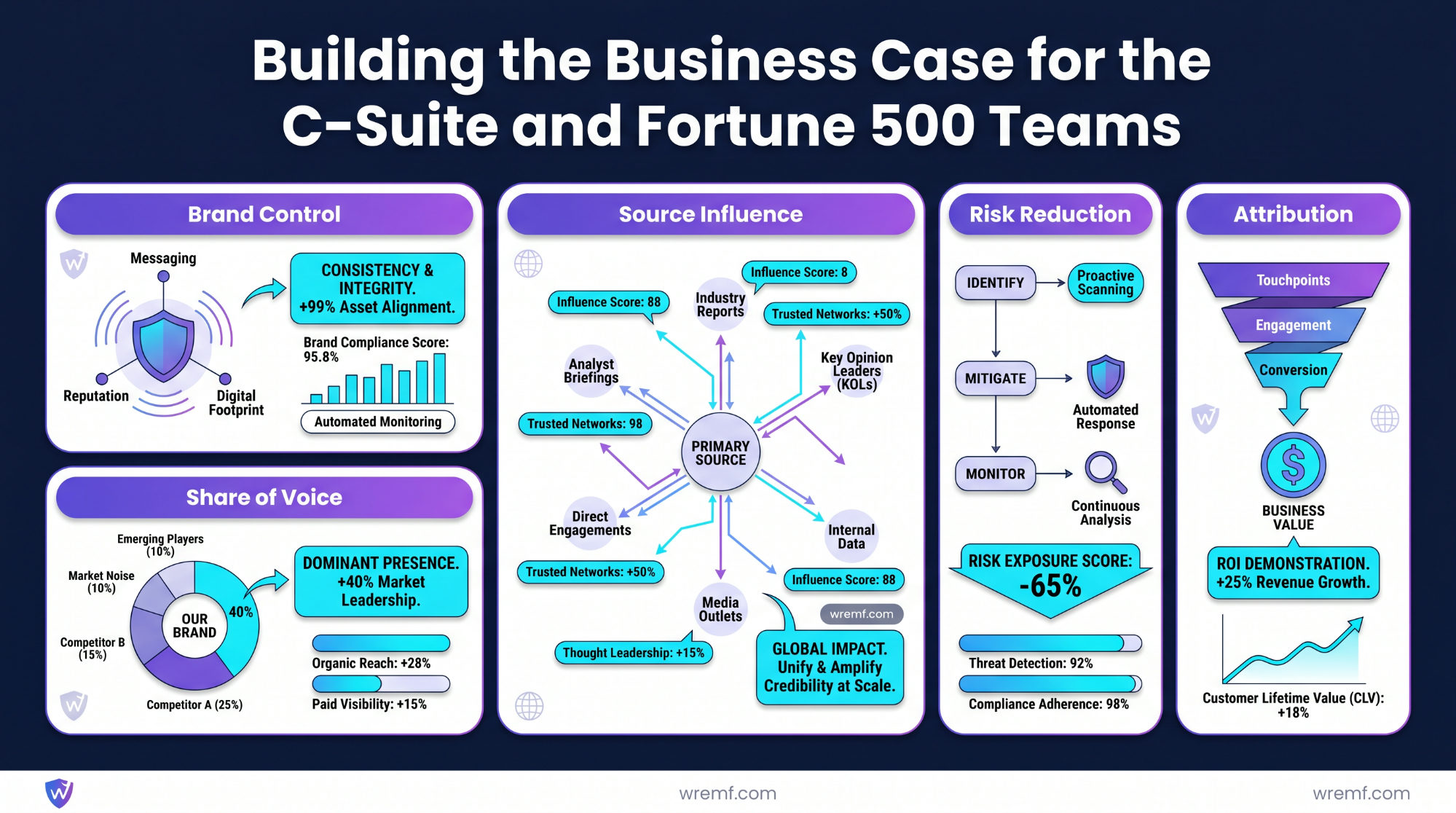
The business case for an enterprise AI visibility platform is strongest when it connects brand control, Share of Voice, source influence, risk reduction, and attribution. Executives need measurable visibility trends, not one-off AI Monitoring Case Studies.
Brand control is the ability to influence how a company, product, category, or executive narrative is described across search engines, AI systems, and third-party sources. Brand control matters because enterprise buyers may form opinions from AI answers before they reach official messaging.
For Fortune 500 organizations, AI visibility is a portfolio insights problem. A single enterprise may need to monitor multiple brands, regions, product families, business units, languages, agencies, and compliance rules. Portfolio insights help leaders see which brands are gaining citations, losing Share of Voice, or appearing inaccurately inside AI answer engines.
Executive dashboards are leadership-facing reporting views that summarize AI visibility data, trends, risks, and actions. Executive dashboards matter because CMOs, CROs, legal leaders, and product executives need concise evidence for decisions and investment.
Google Analytics 4 is an analytics platform that helps teams measure website traffic, events, conversions, and attribution signals. Google Analytics 4 matters for AI visibility because visible AI referrals can be connected to sessions and outcomes, although Ghost Routes may still hide some AI-influenced demand.
AI traffic attribution connects AI visibility to sessions, sources, conversions, pipeline signals, and analytics evidence. AI traffic attribution matters because executives need to know whether AI Search visibility is connected to business outcomes.
AI Monitoring Case Studies should be evaluated by methodology, not only results. Strong AI Monitoring Case Studies should explain prompt sets, date ranges, AI engines, regions, citation rules, limitations, and baseline comparisons. Weak case studies may show impressive screenshots without explaining how benchmarks were updated.
Enterprise teams can build the business case around six outcomes:
Reduce blind spots across AI Search and Google AI Overviews
Protect brand accuracy across AI answer engines
Increase visibility in high-intent AI answers
Improve citation quality and source consistency
Connect AI visibility to Google Analytics 4 and pipeline signals
Give executives dashboards for recurring decisions
| Executive metric | What it shows | Why leadership cares |
|---|---|---|
| AI visibility score | Overall brand presence across AI engines | Tracks strategic progress |
| Share of Voice | Brand presence versus competitors | Shows market position |
| Citation coverage | Which sources influence AI answers | Guides PR, content, and partnerships |
| Accuracy risk | Incorrect or outdated AI answers | Supports brand, legal, and compliance review |
| Prompt coverage | Coverage across buyer questions | Shows demand-stage visibility |
| AI traffic attribution | Sessions and outcomes from AI sources | Connects visibility to business impact |
| Visibility gaps | Missing or weak AI answer presence | Prioritizes execution |
| Content performance | Which pages support AI visibility | Guides content investment |
DID YOU KNOW: McKinsey’s 2025 global AI survey reported that 88% of respondents said their organizations use AI regularly in at least one business function, up from 78% a year earlier, which makes AI governance and enterprise reporting more urgent. (McKinsey & Company)
KEY TAKEAWAY: The enterprise business case for AI visibility should connect market presence, citation influence, brand accuracy, governance, and attribution in one executive reporting system.
The next section gives a practical rubric for choosing the right platform.
How to Choose the Right Enterprise AI Visibility Platform
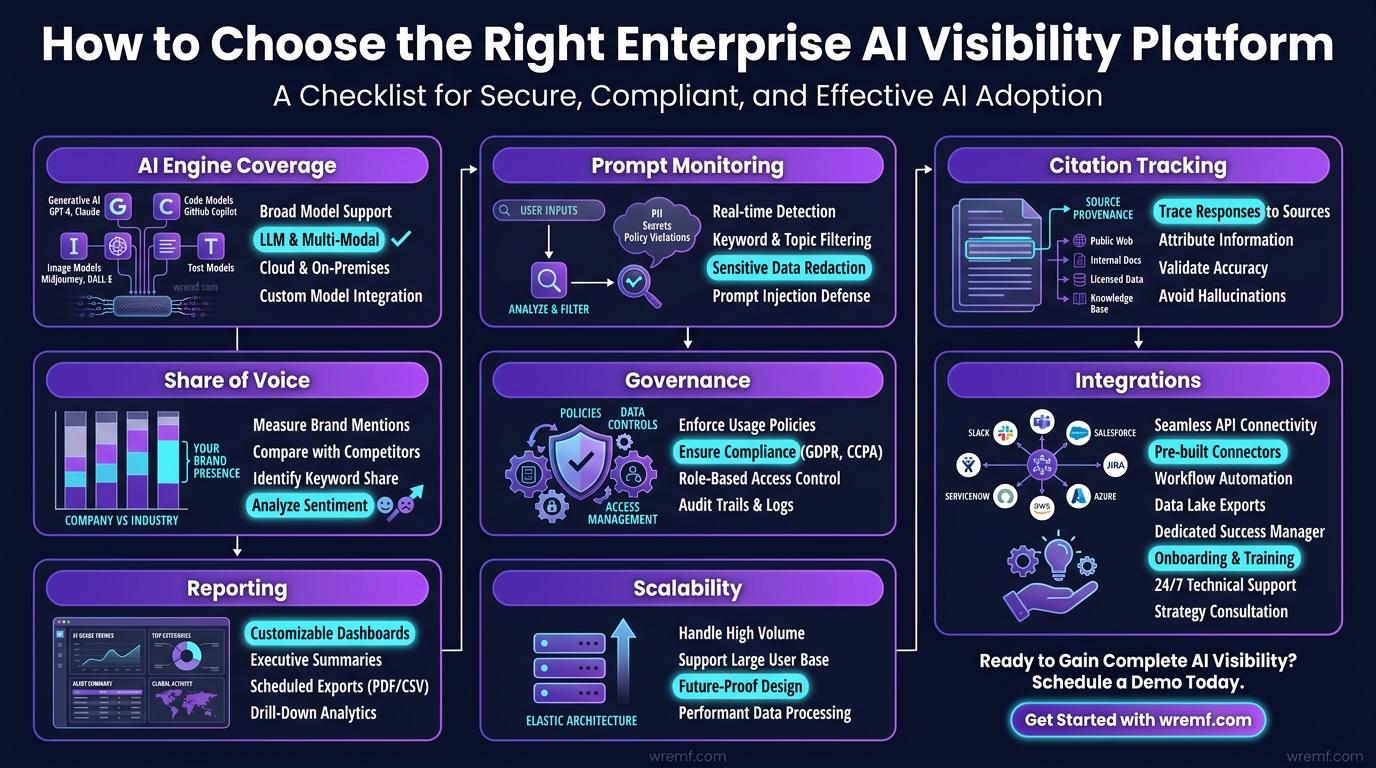
Choose an enterprise AI visibility platform by evaluating AI engine coverage, prompt monitoring, citation tracking, Share of Voice, governance, integrations, reporting, scalability, and execution support. The right platform should satisfy marketing, IT, legal, analytics, and executive requirements.
AI visibility tools are platforms that monitor how brands appear across AI Search, AI answer engines, citations, prompts, and recommendations. AI visibility tools matter because manual testing is too inconsistent for enterprise-scale operations.
Monitoring tools are systems that collect, track, and report changes in visibility, performance, risk, or system behavior. Monitoring tools matter for enterprise AI visibility because AI answers, citations, and competitor recommendations can change across time, geography, prompt phrasing, and AI models.
Marketing requirements usually include Share of Voice, prompt tracking, content recommendations, competitor visibility, source citations, reporting, and brand control. IT requirements usually include API access, data flows, BYOK, Solution Suite compatibility, SOC 2 review, and secure integrations. Legal and risk requirements usually include audit trails, role-based access controls, approved workflows, data leakage controls, and content integrity review.
Solution Suite compatibility means the platform can fit into existing enterprise systems such as analytics, reporting, CMS, CRM, data warehouse, project management, and internal automation workflows. Solution Suite compatibility matters because enterprise AI visibility should not live in a disconnected dashboard.
| Evaluation criterion | Why it matters | What to ask the vendor |
|---|---|---|
| AI engine coverage | Buyers use more than one AI engine | Which AI engines are monitored today? |
| Google AI coverage | Google AI Overviews and AI Mode affect search behavior | Can the platform monitor Google AI Overviews and Google AI Mode? |
| Prompt intelligence | Buyer language differs from keywords | Can prompts be grouped by persona, region, product, and funnel stage? |
| Citation tracking | Sources influence AI answers | Can the platform show cited pages and source changes over time? |
| Share of Voice | Executives need market benchmarks | Can Share of Voice be tracked by competitor and prompt set? |
| GEO workflow | Insights need execution | Can the platform produce content briefs, audits, and action recommendations? |
| Governance | Enterprise review requires controls | What RBAC, audit trails, SOC 2, and data controls are available? |
| Integrations | AI visibility should connect to existing systems | Does the platform support API, MCP, GA4, GSC, and reporting workflows? |
| Agency support | Some teams need execution | Does the vendor support software, service, or hybrid delivery? |
| Reporting | Leadership needs proof | Are executive dashboards and white-label reports available? |
SE Ranking, SE Visible, traditional SEO suites, and classic monitoring tools may support parts of the workflow. The main question is not whether a vendor uses the phrase AI visibility. The real question is whether the platform can connect prompts, AI answers, source citations, Share of Voice, Google AI Overviews, Google AI Mode, competitors, governance, and action recommendations.
G2 High Performer Rating claims can be useful buying signals, but they should not replace platform evaluation. Enterprise buyers should review methodology, integrations, data exports, client workspaces, audit trails, and how benchmarks are updated. A rating can indicate user satisfaction, but it does not prove enterprise-scale AI visibility coverage.
WREMF is useful for brands that want software, agencies that need white-label reporting, and teams that want managed execution. The WREMF pricing page includes Starter, Growth, and Enterprise options with unlimited prompt tracking, BYOK, 10 AI engines, all features and tools, and white-label reports.
KEY TAKEAWAY: The right enterprise AI visibility platform should satisfy marketing, IT, legal, analytics, agency, and executive needs without reducing AI visibility to simple rank tracking.
The next section compares software, agency, and hybrid models so teams can choose the right operating approach.
Software vs Agency vs Hybrid AI Visibility Models
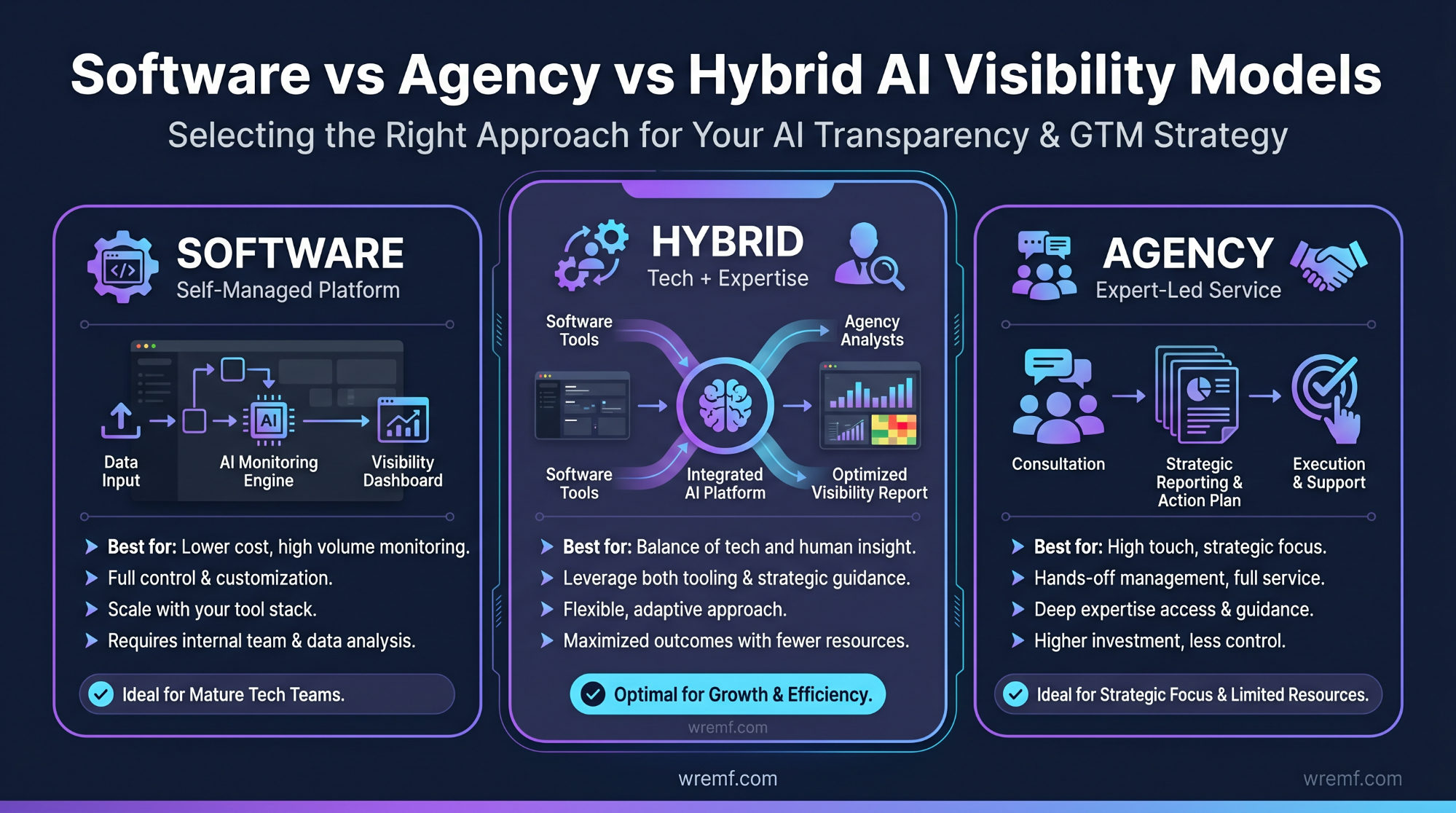
Enterprise teams should choose software when they have internal execution capacity, agency support when they need expert implementation, and a hybrid model when they need both measurement and managed action. AI visibility performs best when insights become workflow-owned improvements.
Software is best when your internal team can run audits, interpret AI visibility data, write content briefs, create dev tickets, and report to leadership. The advantage is control. The limitation is that internal teams need expertise, time, and ownership.
Agency support is best when the organization needs strategic guidance, content optimisation, entity and authority building, source consistency cleanup, citation improvement, technical AI visibility foundations, and monthly reporting. The advantage is senior-led execution. The limitation is that external execution still needs internal alignment.
A hybrid model is best when a team wants platform measurement plus expert support for AEO, GEO, content strategy, source consistency, technical foundations, and reporting. The advantage is that software and services work from the same AI visibility data.
| Model | Best for | What it includes | Main limitation | Recommended when |
|---|---|---|---|---|
| Software | Mature SEO and analytics teams | Monitoring, prompts, citations, dashboards | Requires internal execution | You already have owners for content and technical fixes |
| Agency | Teams needing strategy and execution | Audits, content, source cleanup, reporting | Less internal tooling control if standalone | You need senior support and clear deliverables |
| Hybrid | Enterprise or fast-moving B2B teams | Platform plus managed execution | Requires coordination | You need measurement and action in one system |
Marketing agencies need additional capabilities. Agencies managing multiple clients often need client workspaces, white-label reports, pitch environments, reusable prompt libraries, client management tools, portfolio insights, and Share of Voice reporting. Without client workspaces, agency delivery becomes difficult to scale.
Pitch environments help agencies show prospects how their brand appears across AI answer engines before a full engagement begins. Pitch environments matter because AI visibility can be hard to explain without real prompts, competitors, citations, and answer examples.
WREMF supports agencies through white-label reporting and multi-client workflows. Agencies can use WREMF to monitor AI visibility, build client reports, identify visibility gaps, track competitors, and translate AI Search visibility into content, technical, and source improvement plans.
For teams that want managed support, WREMF offers AI visibility agency services covering AI visibility strategy, GEO and AEO consulting, content optimisation, entity and authority building, source consistency cleanup, citation improvement, AI-ready content briefs, schema guidance, crawl checks, internal linking logic, share of voice tracking, and pipeline attribution.
KEY TAKEAWAY: Software gives control, agency support gives execution, and a hybrid AI visibility model gives enterprise teams a practical path from measurement to improvement.
The next section explains risks, limitations, and common mistakes that enterprise buyers should evaluate before implementation.
Risks, Limitations, and Common Implementation Mistakes
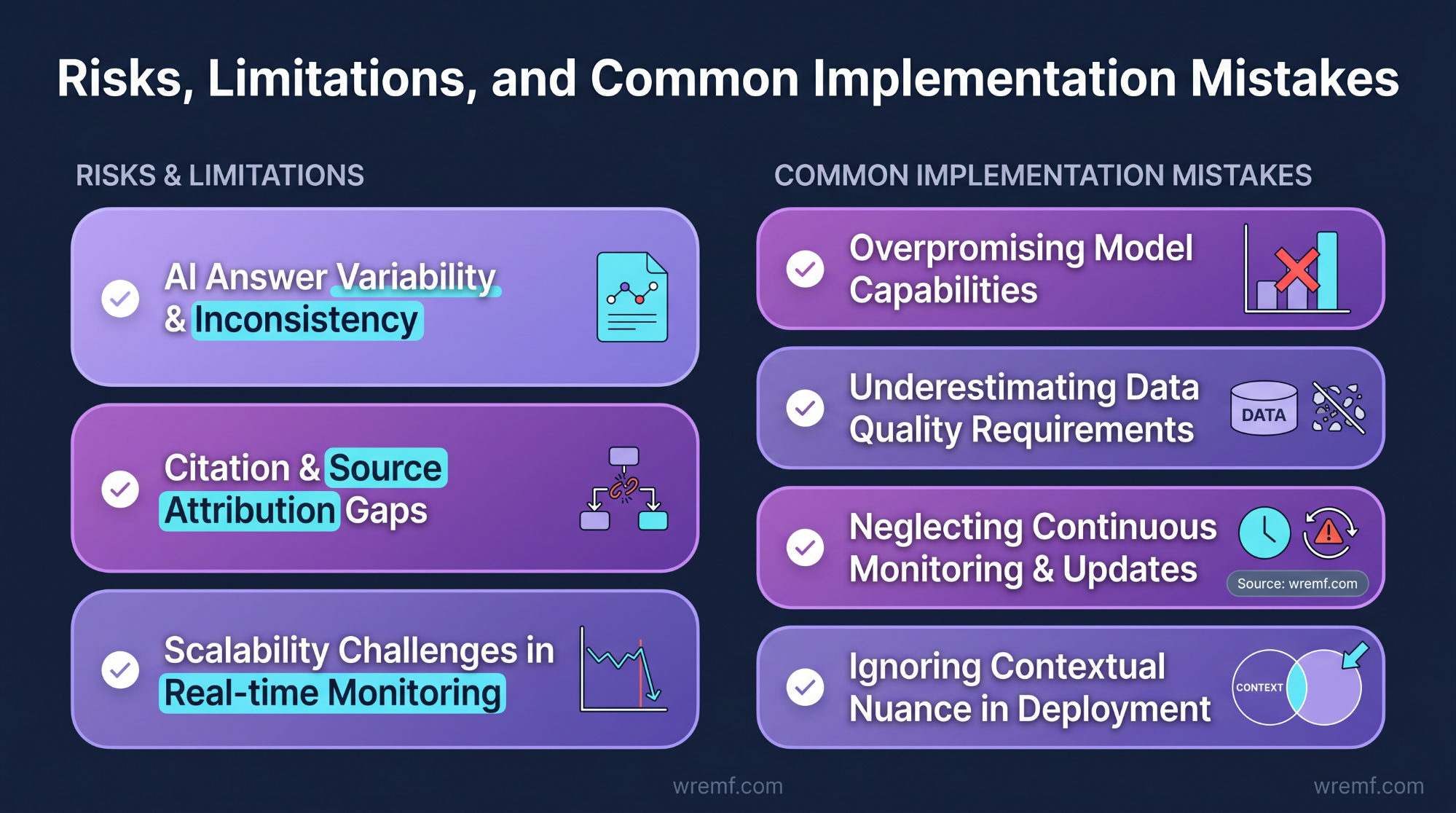
Enterprise AI visibility has limits because AI answers change, citations vary, attribution is imperfect, and AI models do not reveal every source they use. Strong platforms reduce uncertainty through repeatable monitoring, not false guarantees.
AI visibility data is directional, comparative, and operational. It should not be presented as a guaranteed prediction of rankings, revenue, citations, or recommendations. AI systems may change answers based on user location, query wording, freshness, web access, personalization, model version, retrieval behavior, and prompt context.
The most common enterprise mistakes are:
Testing only a few prompts manually
Treating rankings as the only AI visibility metric
Ignoring source citations and third-party descriptions
Assuming Google AI Overviews behave like classic featured snippets
Using content generation without source validation
Blocking every AI Crawler without a governance decision
Failing to involve legal, IT, analytics, and brand teams
Reporting screenshots instead of trends
Ignoring policy violations and data leakage controls
Measuring AI traffic only through visible referrals
Treating SE Visible, SE Ranking, or classic SEO dashboards as complete AI answer engine coverage
Creating AI Draft content without editorial review
Ignoring Prompt Volumes and buyer-stage prioritization
A common implementation mistake is focusing only on owned content. In real-world reporting, teams often find that AI answer engines cite third-party sources, review sites, partner pages, directories, documentation, and community discussions. Owned content matters, but the broader source ecosystem often explains brand inclusion or exclusion.
Another common mistake is confusing visibility with accuracy. A brand can appear in AI answers and still be described incorrectly. Runtime observability, answer accuracy monitoring, and source consistency cleanup help teams detect and correct misinformation.
A third mistake is overinvesting in content generation while underinvesting in content analysis. Content analysis identifies what already exists, what is missing, what is outdated, and which content assets are connected to prompt demand. Content generation should follow that analysis, not replace it.
IMPORTANT: Do not treat AI visibility as a one-time site audit. AI answer engines change frequently, so enterprise teams should monitor high-intent prompts on a recurring schedule and compare results over time.
KEY TAKEAWAY: AI visibility measurement is useful when it is repeatable, transparent, and honest about uncertainty, but risky when teams overclaim results or ignore governance.
The next section looks ahead to AI agents, agentic commerce, and autonomous workflows.
Future-Proofing for AI Agents, Agentic Commerce, and Autonomous Workflows
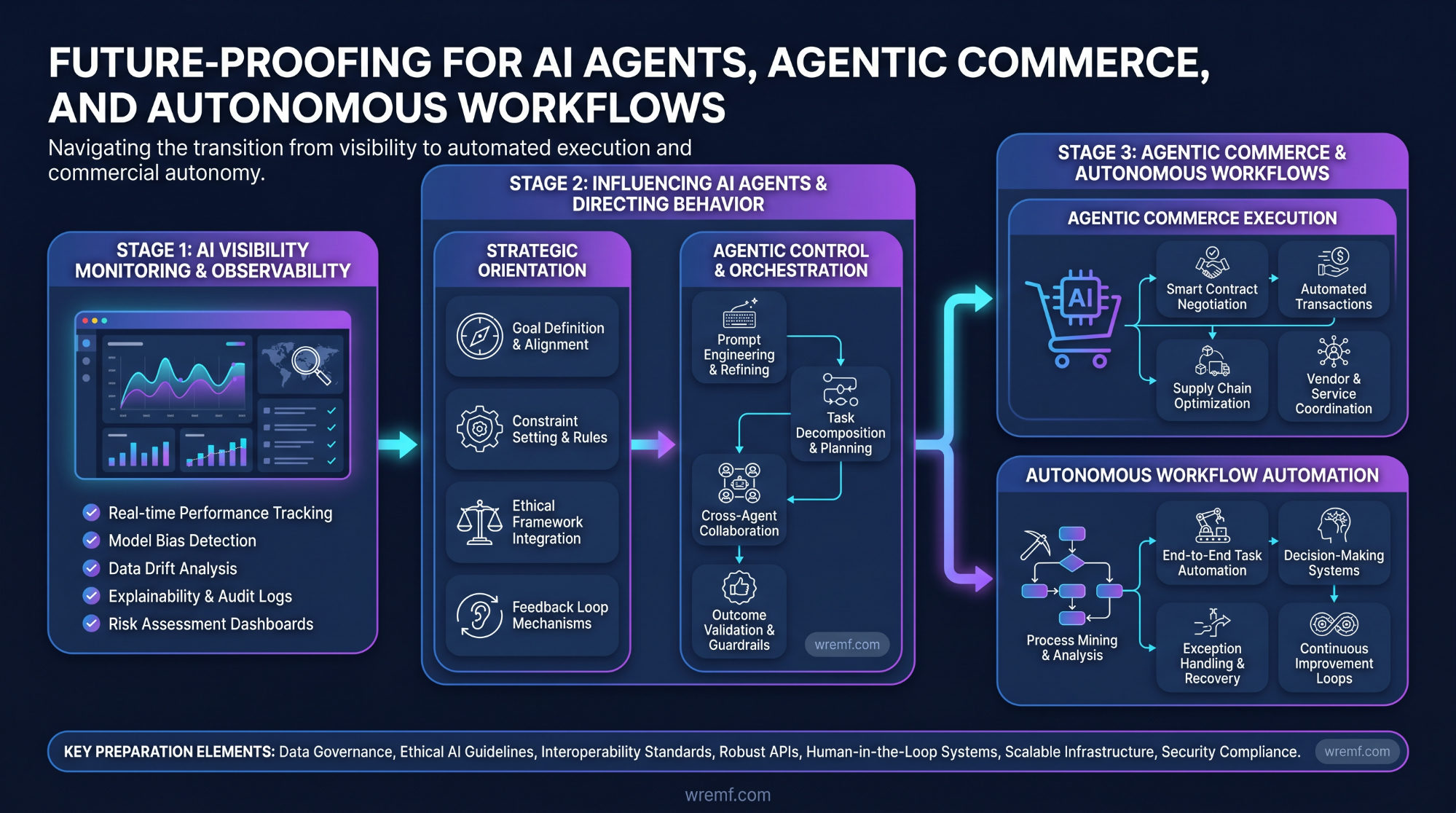
Enterprise AI visibility will expand from monitoring AI answers to influencing AI agents, agentic commerce, and autonomous workflows. Brands should prepare by making their entities, sources, policies, and data accurate, accessible, and measurable.
AI agents are AI systems that can take actions, use tools, compare options, and complete workflows with varying degrees of autonomy. AI agents matter because future buyers may delegate research, comparison, vendor shortlisting, and purchasing steps to agentic systems.
An Agentic Commerce engine is a system where AI agents help users discover, compare, select, and potentially buy products or services. Agentic Commerce engine visibility matters because brand preference may be shaped by structured data, trusted sources, pricing clarity, reviews, policies, and availability before a human reviews options.
Autonomous workflows are processes where AI systems trigger, recommend, or complete actions across tools with limited manual input. Autonomous workflows matter because AI visibility data can feed internal automation, reporting, content prioritization, dev ticket creation, and sales enablement.
Internal automation is the use of connected systems to trigger tasks, alerts, reports, workflows, or updates without manual handoffs. Internal automation matters because enterprise-scale operations cannot rely on one person checking AI answers and updating spreadsheets.
LLM applications are software experiences that use large language models for search, summarization, research, generation, analysis, comparison, planning, or action. LLM applications matter because buyer discovery is expanding beyond search engines into conversational and agentic interfaces.
Enterprise teams should prepare for this future by improving five foundations:
Entity clarity across owned and third-party sources
Structured data that matches visible page content
Consistent product, pricing, feature, and policy information
Clear source citations and reliable reference pages
API and MCP readiness for reporting, workflows, and internal automation
WREMF supports future-proofing through API and MCP integrations for teams that want AI visibility data inside existing reporting, analytics, and workflow systems. Technical teams can explore the WREMF API and MCP integration options when they need AI visibility data to connect with internal automation.
KEY TAKEAWAY: Future AI visibility will depend on whether AI agents can understand, trust, cite, compare, and act on a brand’s information across connected workflows.
The next section corrects the myths that often prevent enterprise teams from taking AI visibility seriously.
Common Myths About AI Visibility Debunked
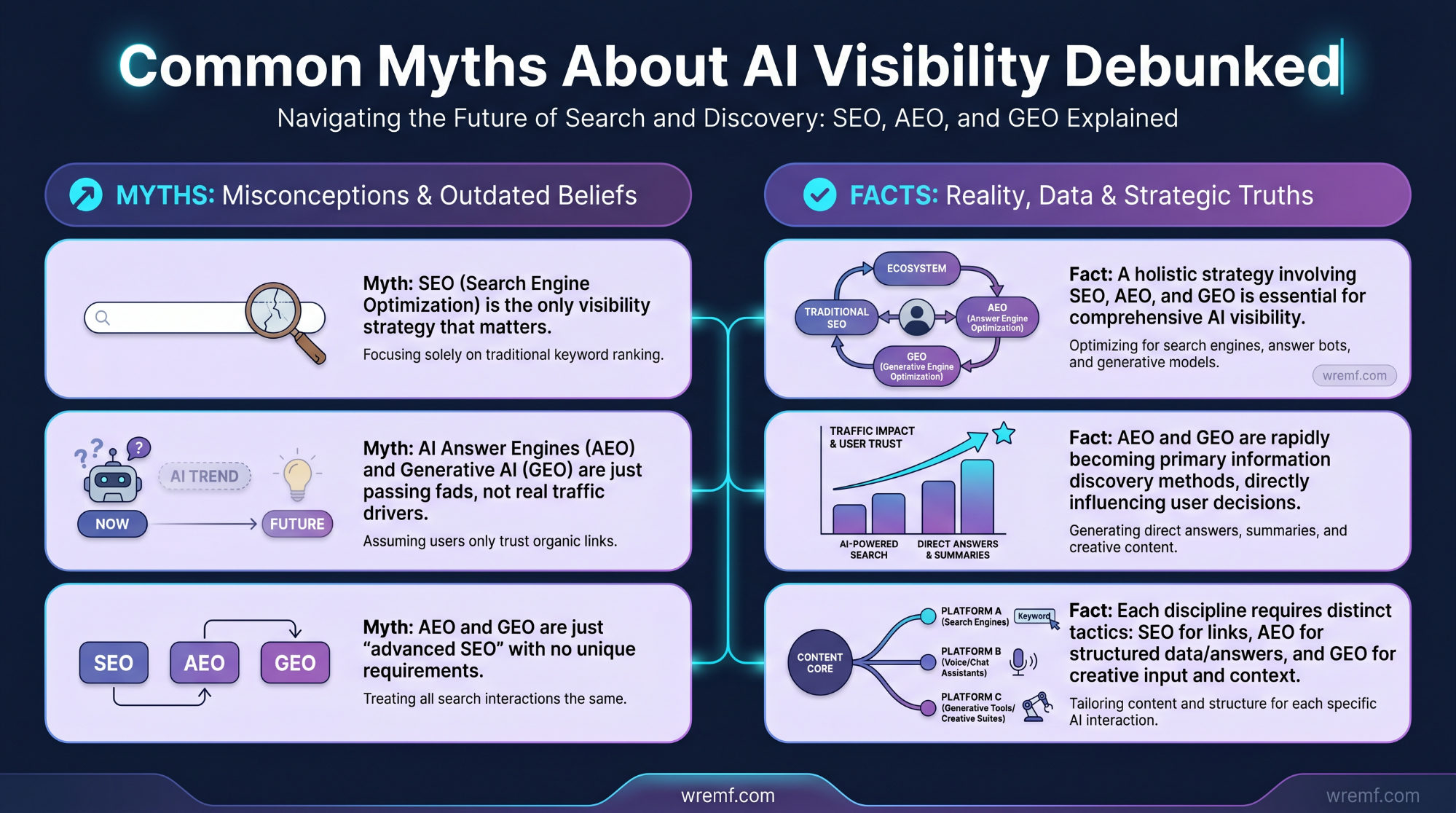
AI visibility myths usually come from applying old SEO assumptions to AI answer engines. Enterprise teams need a clearer view of what can be measured, what cannot be guaranteed, and how SEO, AEO, and GEO work together.
MYTH: AI visibility is impossible to measure.
FACT: AI visibility can be measured through prompt tracking, brand mentions, source citations, Share of Voice, competitor presence, AI answer accuracy, and AI traffic attribution. The measurement is not perfect because AI answers vary, but repeatable monitoring creates useful trend data. Enterprise teams should treat AI visibility data as operational intelligence rather than absolute truth.
MYTH: SEO, AEO, and GEO are separate strategies that compete for budget.
FACT: SEO, AEO, and Generative Engine Optimization are connected layers. SEO keeps pages accessible and authoritative for search engines. AEO makes answers clear and extractable. GEO improves how brands appear inside AI answer engines, Google AI Overviews, Google AI Mode, and LLM applications.
MYTH: Rankings alone are enough to protect enterprise visibility.
FACT: Rankings do not show whether AI answer engines mention, cite, compare, or recommend a brand. A company can rank well in search engines and still lose Share of Voice in AI answers. Enterprise AI visibility platforms exist because AI Search visibility requires prompt, citation, and competitor measurement.
MYTH: More content generation automatically improves AI visibility.
FACT: Content generation helps only when it addresses real visibility gaps, prompt demand, source quality, and entity clarity. Low-quality AI Draft workflows can create duplication and weak trust signals. Enterprise teams need content analysis, editorial review, structured data, and source consistency.
MYTH: AI citations are only a PR concern.
FACT: AI citations affect SEO, content strategy, product marketing, legal review, and executive reporting. Source citations show which pages and domains influence AI answers. Citation improvement can involve owned content, partner pages, documentation, analyst references, directories, and technical accessibility.
KEY TAKEAWAY: AI visibility is measurable, but it requires broader thinking than rankings, content volume, or one-time manual testing.
The final section answers the most common enterprise, agency, implementation, and buying questions.
Frequently Asked Questions
What is an enterprise AI visibility platform?
An enterprise AI visibility platform is software that tracks how a brand appears across AI answers, source citations, LLM prompts, Google AI Overviews, Google AI Mode, and AI answer engines such as ChatGPT, Claude, Gemini, Perplexity, and Copilot. It helps enterprise teams measure brand mentions, competitor presence, Share of Voice, citation sources, answer accuracy, visibility gaps, and AI traffic attribution. WREMF uses this approach to help teams track, improve, and prove AI visibility across 10 AI engines.
Why do enterprises need an AI visibility platform?
Enterprises need an AI visibility platform because buyers increasingly use AI Search and answer engines to compare vendors before visiting websites. Traditional SEO tools show rankings, keywords, backlinks, and traffic, but they often miss AI answers, source citations, competitor recommendations, Ghost Routes, Google AI Overviews, and Google AI Mode visibility. An enterprise platform gives marketing, SEO, analytics, legal, IT, and leadership teams a shared system for monitoring AI visibility data and prioritizing action.
What makes the best AI visibility platform?
The best AI visibility platform combines AI engine coverage, prompt tracking, citation analysis, Share of Voice, competitor visibility, Google AI Overviews monitoring, Google AI Mode monitoring, AI traffic attribution, governance controls, integrations, and action recommendations. Enterprise buyers should also look for SOC 2 readiness, role-based access controls, audit trails, BYOK support, API access, MCP integrations, executive dashboards, and workflow features such as GEO audits, content briefs, technical checks, and dev ticket creation.
Which LLM monitoring tool should you choose?
Choose an LLM monitoring tool that matches your operating model and governance needs. A small team may prioritize fast setup, prompt tracking, and simple reports. A large enterprise should prioritize multi-engine coverage, citation tracking, Share of Voice, role-based access controls, audit trails, data flows, API access, BYOK, and executive dashboards. WREMF is a strong fit when the team needs software, white-label reporting, agency execution, or a hybrid model for AI visibility and Generative Engine Optimization.
How often should AI visibility benchmarks be updated?
AI visibility benchmarks should be updated monthly for executive reporting and more frequently for priority prompts, product launches, reputation risks, or competitive categories. Weekly monitoring is useful when AI answers change quickly or when leadership needs close tracking of Share of Voice, citations, and competitor movement. Benchmarks should always preserve prompt sets, AI engines, date ranges, and methodology. Without consistent methodology, teams cannot separate real visibility changes from normal AI answer volatility.
Which AI agents influence purchase decisions the most?
The most influential AI agents and AI engines depend on the market, buyer role, geography, and product category. For B2B SaaS and enterprise technology, teams should usually monitor ChatGPT, Claude, Gemini, Perplexity, Google AI Overviews, Google AI Mode, Copilot, DeepSeek, Grok, Meta AI, and Mistral. AI agents influence purchase decisions when buyers use them to compare vendors, summarize reviews, draft shortlists, evaluate pricing, understand implementation, or prepare internal recommendations.
How can regulated industries manage AI misinformation?
Regulated industries can manage AI misinformation by monitoring AI answers, tracking source citations, correcting inconsistent third-party descriptions, maintaining approved product and policy pages, using role-based access controls, preserving audit trails, and involving legal or compliance teams in review workflows. AI visibility platforms help identify inaccurate claims, outdated citations, risky recommendations, and policy violations. The goal is not to control every AI answer, but to reduce avoidable misinformation through better sources, governance, and monitoring.
What should marketing agencies look for in AI visibility tools?
Marketing agencies should look for client workspaces, white-label reports, prompt libraries, Share of Voice tracking, citation analysis, competitor visibility, AI visibility data exports, client management tools, pitch environments, and portfolio insights. Agencies also need reporting that explains actions, not only dashboards. WREMF is useful for marketing agencies because it supports white-label reporting, multi-client workflows, prompt tracking, source citations, competitive landscape analysis, and optional managed AEO and GEO execution.
How much do AI visibility trackers cost?
AI visibility tracker pricing varies based on websites, prompt volume, engine coverage, seats, reporting, integrations, and enterprise controls. WREMF pricing starts at €39 per month for Starter with 1 website, unlimited prompt tracking, BYOK, 10 AI engines, all features, white-label reports, 1 seat, and email support. Growth is €89 per month for 5 websites with priority support, content briefs, and SEO A/B testing. Enterprise plans use custom pricing for unlimited websites, unlimited seats, dedicated support, and branded portals.
How does AI visibility relate to AI transparency and explainability?
AI visibility relates to AI transparency and explainability because it helps teams understand what AI systems say, which sources they cite, how competitors appear, and where misinformation may exist. AI visibility does not fully explain every model decision because AI models and answer engines do not expose all internal reasoning or source weighting. However, prompt tracking, citation analysis, Share of Voice, and runtime observability make the external behavior of AI systems more measurable for enterprise teams.
What are common use cases for AI visibility platforms in large enterprises?
Common use cases include tracking brand presence in ChatGPT and Google AI Overviews, monitoring competitor recommendations, measuring Share of Voice, identifying citation gaps, detecting misinformation, improving answer-first content, supporting GEO workflows, building executive dashboards, and reporting AI traffic attribution. Large enterprises also use AI visibility platforms for portfolio insights, regional monitoring, brand control, client workspaces, compliance review, agency reporting, and technical remediation through site audits or dev tickets.
How does an enterprise AI visibility platform integrate with existing infrastructure?
An enterprise AI visibility platform can integrate with analytics, search data, reporting systems, CMS workflows, APIs, MCP tools, data warehouses, project management tools, and internal dashboards. Typical integrations include Google Analytics 4, Google Search Console, content inventories, reporting exports, API endpoints, and automation workflows. Enterprise buyers should ask how the platform handles data flows, BYOK, role-based access controls, audit trails, retention rules, and Solution Suite compatibility before deployment.
What troubleshooting steps help when an AI visibility platform gives weak monitoring results?
Start by checking prompt quality, prompt volume, AI engine coverage, location settings, benchmark frequency, citation collection, and competitor definitions. Then review whether the tracked prompts match real buyer questions or only internal language. If results still look weak, inspect AI Crawler access, structured data, page rendering, source consistency, and analytics connections. A good platform should make troubleshooting visible through methodology, audit trails, data exports, and clear explanations of limitations.
How does WREMF help enterprise teams improve AI visibility?
WREMF helps enterprise teams track, improve, and prove AI visibility across major AI discovery surfaces. The platform combines prompt intelligence, source citations, competitor visibility, AI share of voice, AI traffic attribution, GEO audits, content briefs, SEO testing, scheduled monitoring, BYOK, white-label reports, and API or MCP integrations. For teams that need execution, WREMF also offers managed AEO, GEO, source consistency cleanup, citation improvement, content optimisation, technical AI visibility foundations, and monthly reporting.
Conclusion
An enterprise AI visibility platform helps large teams understand how their brand appears across AI Search, Google AI Overviews, Google AI Mode, ChatGPT, Claude, Gemini, Perplexity, Copilot, DeepSeek, Grok, Meta AI, Mistral, and other AI answer engines. The real value comes from connecting prompts, citations, Share of Voice, competitors, governance, technical visibility, and attribution into one repeatable workflow. Rankings still matter, but rankings alone cannot explain AI answers or hidden buyer journeys. To turn AI visibility into a measurable operating system, explore the WREMF platform suite or discuss managed execution with the WREMF agency team.
Related reading
- AI Search Tracker: The Complete Guide to Monitoring Brand Visibility Across AI Engines
- AI Overviews Tracker: The Complete Guide to Monitoring Google AI Overviews, Citations, and AI Search Visibility
- Best AI Search Optimization Platforms: The Complete Guide to AI Visibility Tools, GEO, AEO, and Answer Engine Growth
- Best AI Search Optimization Brands