AI Search Optimization Best Practices
Learn how brands can optimize for AI-generated answers and improve visibility in 2026 search environments.
By WREMF Team · 2026-08-24
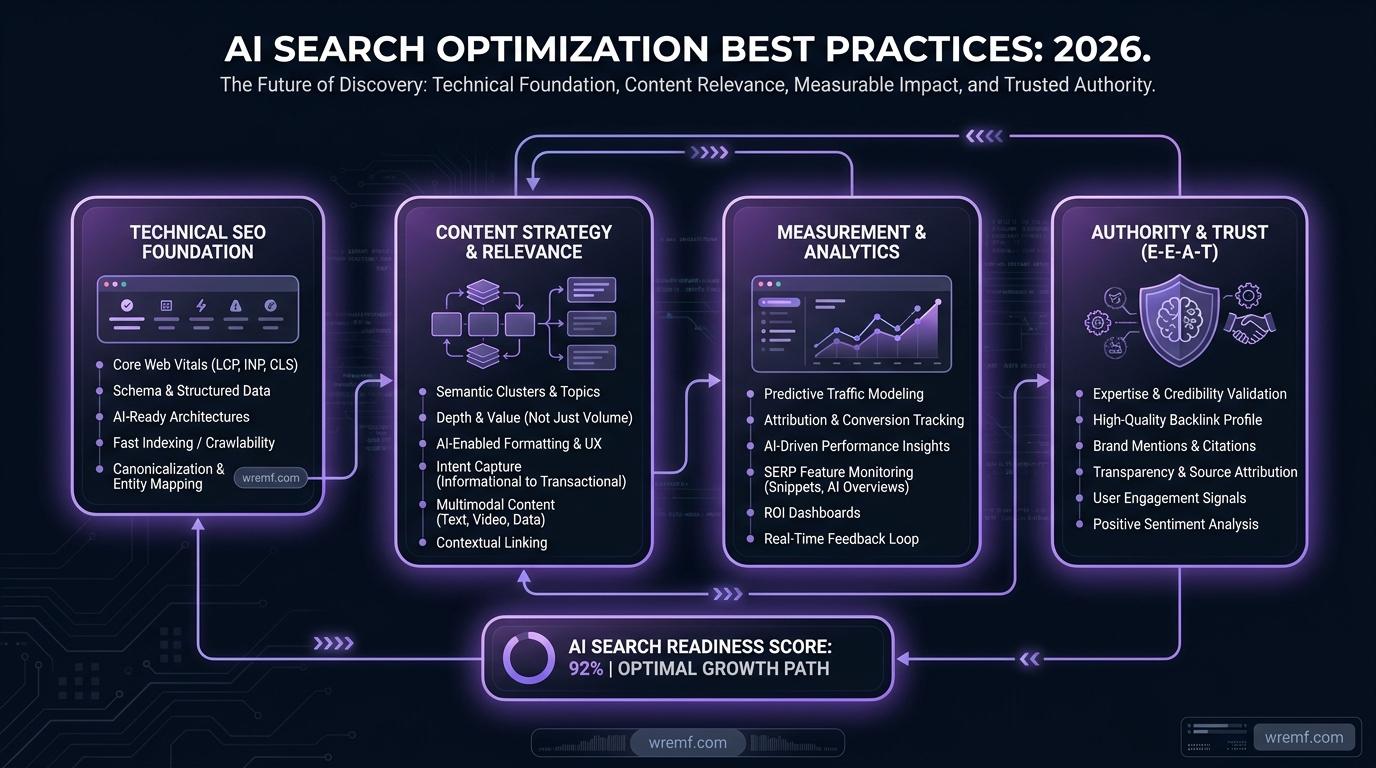
AI search optimization best practices in 2026 involve improving brand visibility in AI-generated answers, Overviews, citations, and traditional search results. The main practices include making important pages crawlable, using structured data, writing answer-first content, and focusing on entity relationships and search intent. The goal is to ensure brands are discoverable, understandable, citable, and measurable across various AI discovery platforms. Optimization must integrate SEO, AEO, and GEO strategies for comprehensive AI visibility.
Key takeaways
- Integrate SEO, AEO, and GEO disciplines for comprehensive AI search visibility.
- Utilize structured data and schema markup for clear entity representation.
- Focus on entity relationships and user intent over isolated keywords.
- Ensure content modularity for better AI engine extraction and citation.
- Maintain source consistency and content freshness to prevent semantic drift.
AI Search Optimization Best Practices
AI search optimization best practices 2026 are the technical, content, measurement, and authority practices that help a brand become visible in AI-generated answers, AI Overviews, citations, recommendations, and traditional search results. Google says AI Overviews reached more than 2 billion monthly users across more than 200 countries and territories by July 2025, while Gartner predicted that traditional search engine volume would drop 25% by 2026 as users adopt AI chatbots and virtual agents. WREMF helps B2B teams track, improve, and prove how their brand appears across ChatGPT, Claude, Gemini, Perplexity, Google AI Overviews, Copilot, DeepSeek, Grok, Meta AI, Mistral, and other AI discovery surfaces. This guide covers SEO, AEO, GEO, structured data, content strategy, AI citations, prompt tracking, local search, international search, agentic AI, measurement, and implementation. Use it as a complete 2026 playbook for becoming the brand AI search recommends. (blog.google)
What Are AI Search Optimization Best Practices in 2026?
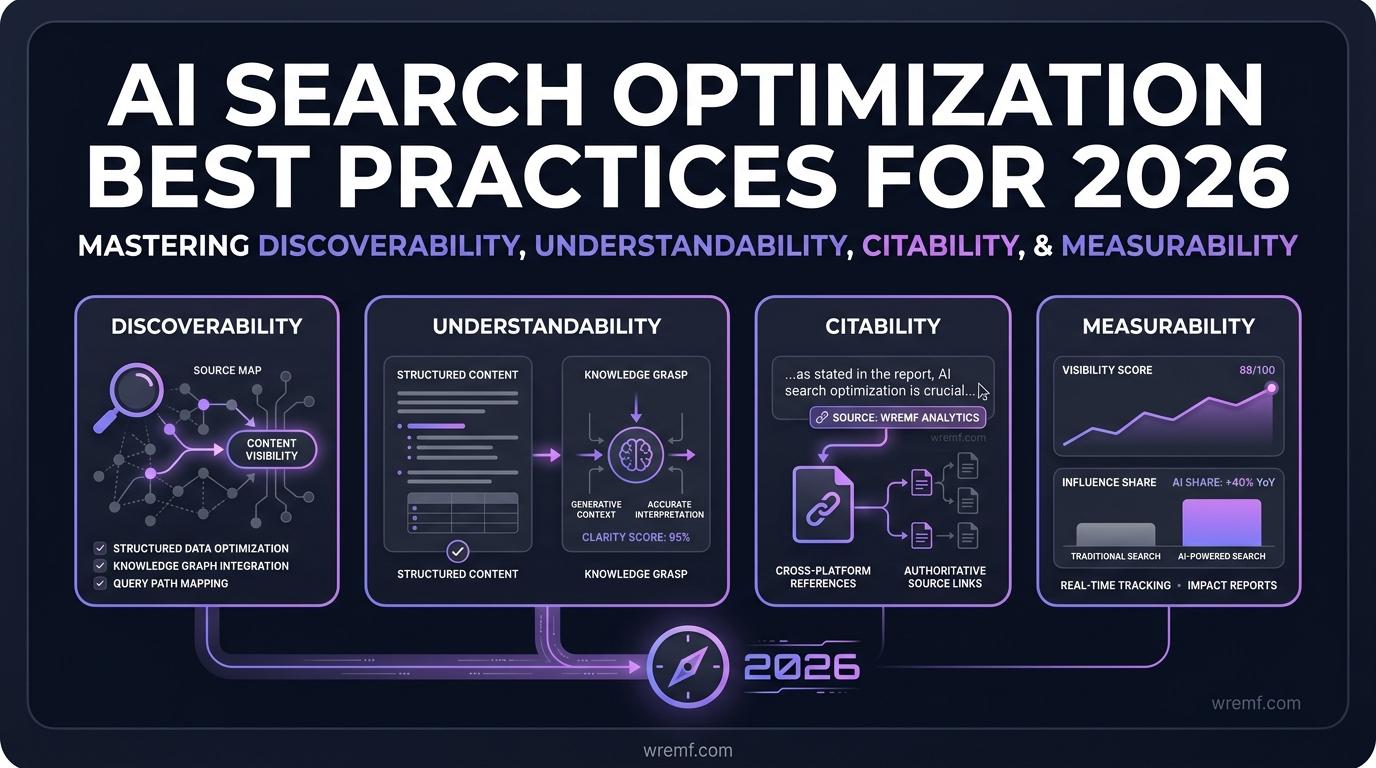
AI search optimization best practices in 2026 help brands become discoverable, understandable, citable, and measurable across search engines, answer engines, and AI models.
AI search optimization is the process of improving how a brand appears in AI-generated answers, search results, AI Overviews, citations, summaries, and recommendations. It matters because buyers now use Google, ChatGPT, Perplexity, Gemini, Claude, Copilot, and other AI discovery surfaces to research problems, compare vendors, and validate decisions.
AI search is not one channel. It is a blended discovery layer across search engine results, conversational queries, answer engines, AI responses, and Large Language Model retrieval. Traditional Search Engine Optimization still matters, but it now sits beside Answer Engine Optimization and Generative Engine Optimization.
WREMF helps teams monitor this shift through the AI visibility platform suite, which connects prompt tracking, source citation tracking, competitor visibility, AI share of voice, and visibility scoring in one workflow.
The best practices for 2026 include:
Make important pages crawlable, indexable, and easy to render
Use structured data and schema markup to clarify entities
Write answer-first content that AI engines can extract
Move beyond keywords to entity relationships and search intent
Build content around conversational queries and long-tail keyphrases
Track AI visibility across multiple AI engines, not only Google
Monitor source citations, brand mentions, and competitor visibility
Keep brand facts consistent across your website and third-party sources
Use content freshness signals and regular website audits
Connect AI visibility to search traffic, conversions, and real enterprise value
AI visibility is the measurable presence of a brand inside AI-generated answers, citations, summaries, recommendations, and comparisons. AI visibility matters because a buyer can discover, evaluate, or exclude a brand before visiting the brand’s website.
Answer Engine Optimization is the practice of structuring content so answer engines can extract clear responses to user questions. Answer Engine Optimization matters because users increasingly ask full questions instead of typing only short-tail keyphrases.
Generative Engine Optimization is the practice of improving how AI models understand, cite, compare, and describe a brand. Generative Engine Optimization matters because AI-generated answers can shape buyer perception before a click happens.
DID YOU KNOW: Bain & Company reported in 2025 that 80% of consumers rely on AI-written results for at least 40% of searches, and that AI search behavior can reduce organic web traffic by 15% to 25%. (Bain)
KEY TAKEAWAY: AI search optimization in 2026 is a combined SEO, AEO, GEO, content, technical, and measurement discipline focused on visibility inside both search results and AI-generated answers.
The next step is understanding why the search model changed and why surface-level SEO is no longer enough.
How Search Evolved From Keyword Indexing to Generative Intelligence
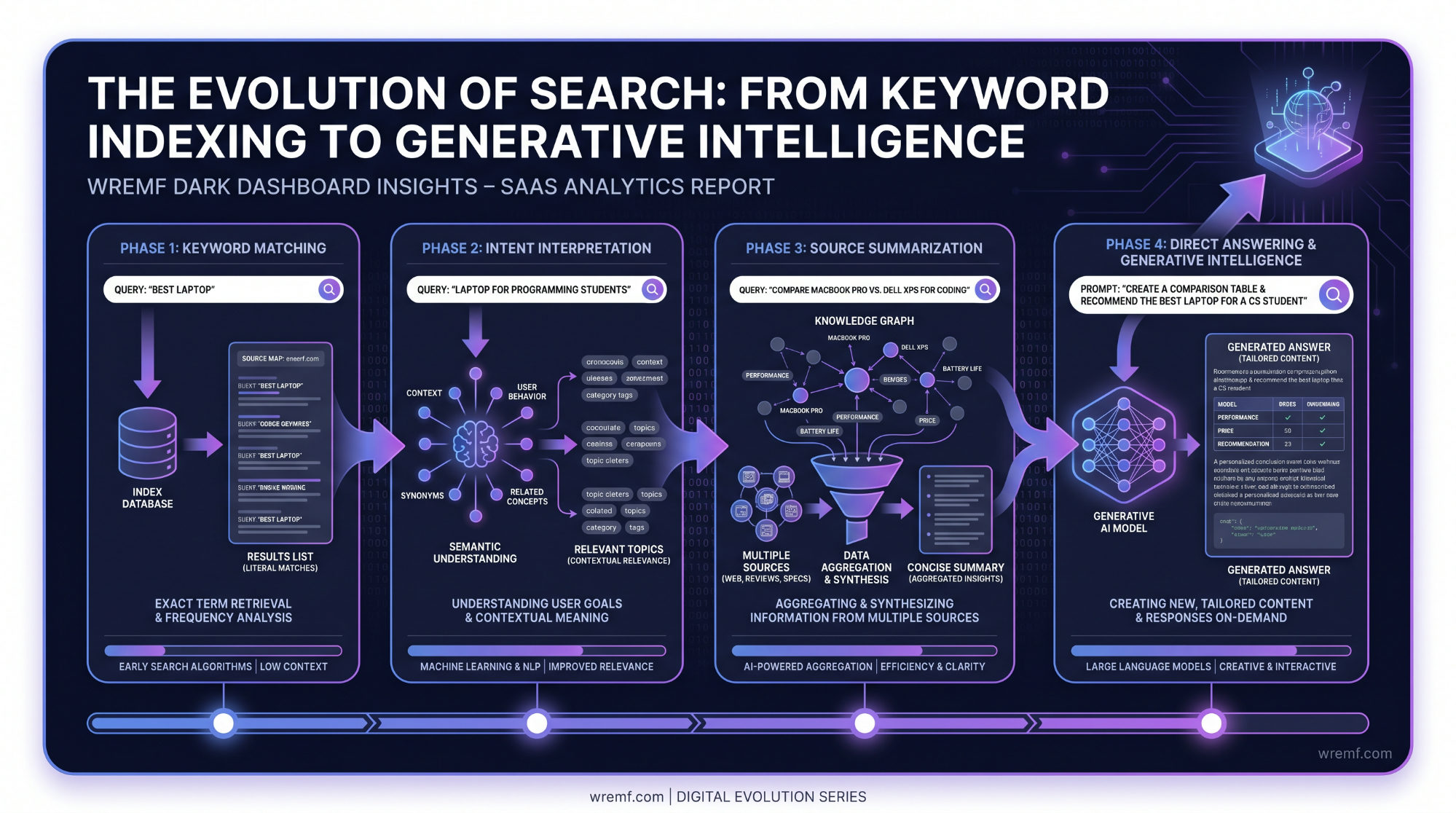
Search evolved from keyword matching to generative intelligence because search engines and AI models now interpret intent, summarize sources, and answer complex questions directly.
Traditional search engine systems index pages, rank results, and show links. AI search systems retrieve information, interpret meaning, generate answers, cite sources, and support follow-up questions. This makes visibility more complex than ranking for a single keyword.
Search engine optimization once focused heavily on page titles, meta description text, backlinks, keyword research, and rank tracking. Those still matter, but AI search adds new questions:
Does the AI engine understand your entity?
Does the answer engine cite your website?
Does the AI response recommend your brand?
Does the AI Overview summarize your content accurately?
Does Perplexity cite your page or a competitor’s page?
Does ChatGPT mention your product in decision-stage prompts?
Does Gemini describe your brand consistently across countries?
Does Claude answer with the right source and sentiment?
Search results are the pages, snippets, features, links, and AI-generated elements shown after a user query. Search results matter because users now see a mix of traditional links, AI Overviews, videos, business profiles, shopping modules, local packs, and generated summaries.
AI responses are generated answers created by AI systems using model knowledge, retrieval, web search, source documents, or connected data. AI responses matter because they may answer the user’s question without requiring a traditional click.
Google’s Search documentation says its ranking systems are designed to prioritize helpful, reliable, people-first content, not content created primarily to manipulate search engine rankings. That guidance still applies in the AI search era because answer systems need useful, clear, source-backed material to summarize. Google Search Central explains helpful content guidance. (Google for Developers)
The shift does not mean SEO is dead. It means SEO has become the technical and content foundation for a broader AI visibility system. Your website still needs relevance, crawlability, structured data, links, authority, and search traffic. But it also needs modular answers, source consistency, entity clarity, and prompt-level visibility.
KEY TAKEAWAY: Search has moved from ranking pages alone to generating answers from sources, which means brands must optimize for discovery, extraction, citation, and recommendation.
To adapt, teams need to understand how SEO, AEO, and GEO work together instead of treating them as competing strategies.
What Is the Difference Between SEO, AEO, and GEO?
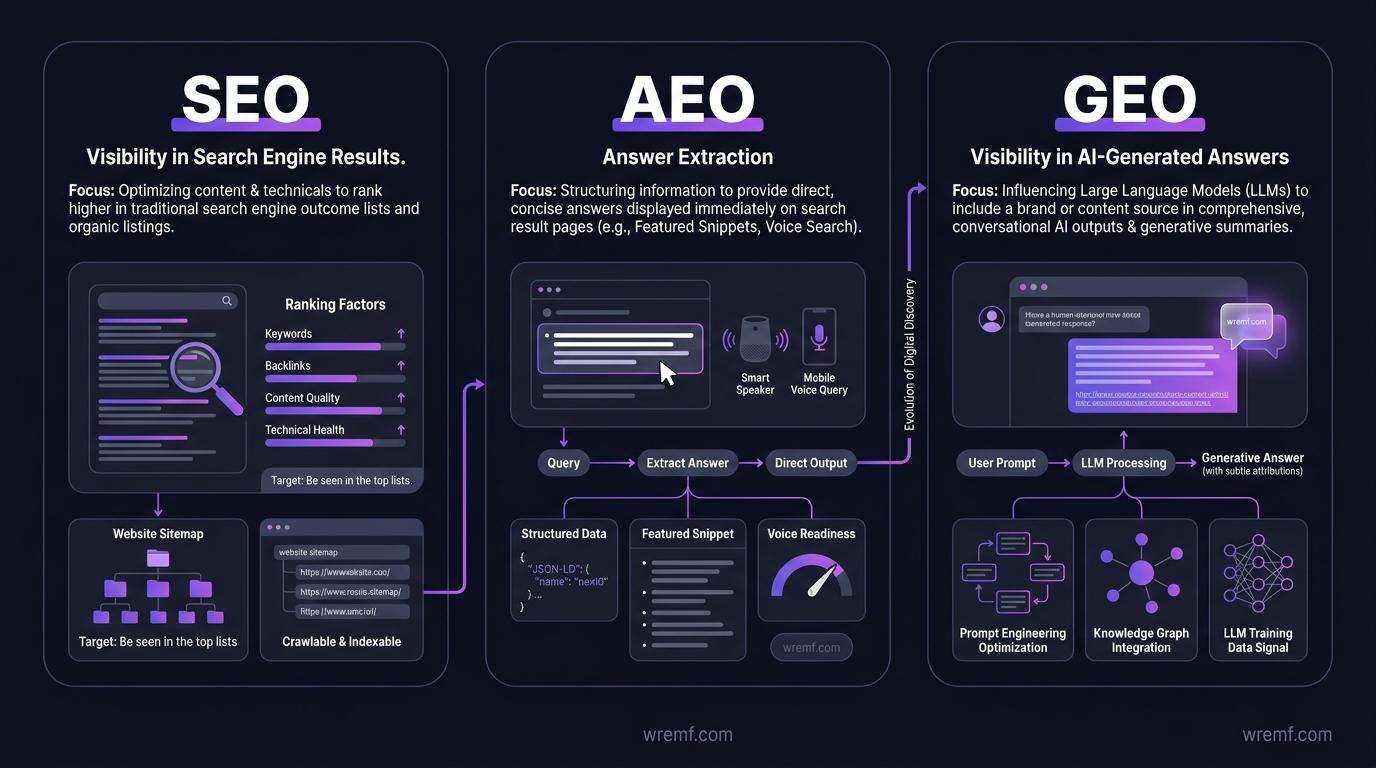
The key difference is that SEO improves visibility in search engine results, AEO improves answer extraction, and GEO improves visibility inside AI-generated answers, citations, and recommendations.
Search Engine Optimization is the process of improving website visibility in search engines through technical SEO, content relevance, links, user experience, and authority. Search Engine Optimization matters because AI search still depends on accessible, high-quality, well-structured information.
Answer Engine Optimization focuses on direct answers. It makes content easier for answer engines, AI Overviews, featured snippets, and voice assistants to extract. Answer Engine Optimization is useful for definitions, FAQs, how-to questions, comparison questions, and short decision answers.
Generative Engine Optimization focuses on AI-generated answers. Generative Engine Optimization helps AI models understand brand entities, cite sources, compare options, summarize use cases, and describe a brand accurately across prompts.
| Discipline | Best For | What It Optimizes | What It Measures | Main Limitation |
|---|---|---|---|---|
| SEO | Traditional search traffic and rankings | Pages, keywords, links, technical health, relevance | Rankings, impressions, clicks, CTR, search traffic | Does not show how AI engines describe or recommend the brand |
| AEO | Direct answers and answer engines | Answer-first sections, FAQs, definitions, concise explanations | Featured answers, answer extraction, direct response coverage | Can miss broader brand recommendation visibility |
| GEO | AI-generated answers and LLM visibility | Entities, citations, source consistency, prompts, comparisons | AI visibility, brand mentions, citation share, sentiment | Still needs strong SEO and trusted sources underneath |
The best 2026 strategy uses all three. SEO gets your website discovered. AEO makes answers extractable. GEO helps AI systems understand your brand in a broader source ecosystem.
AI visibility connects SEO, AEO, and GEO by measuring whether your brand appears where buyers ask questions. AI visibility does not replace rankings. AI visibility adds a new reporting layer for prompts, citations, AI-generated answers, and recommendations.
IMPORTANT: Do not separate SEO, AEO, and GEO into disconnected teams. The same page can rank in search results, answer a user question, support an AI Overview, and influence a ChatGPT or Perplexity response.
KEY TAKEAWAY: SEO, AEO, and GEO are connected disciplines, and the strongest 2026 strategy combines technical search foundations with answer-ready content and AI visibility measurement.
Once the strategy is clear, the first practical step is building a technical bedrock that search engines and AI crawlers can access.
Establish a Technical Bedrock for AI Crawlers and Search Engines
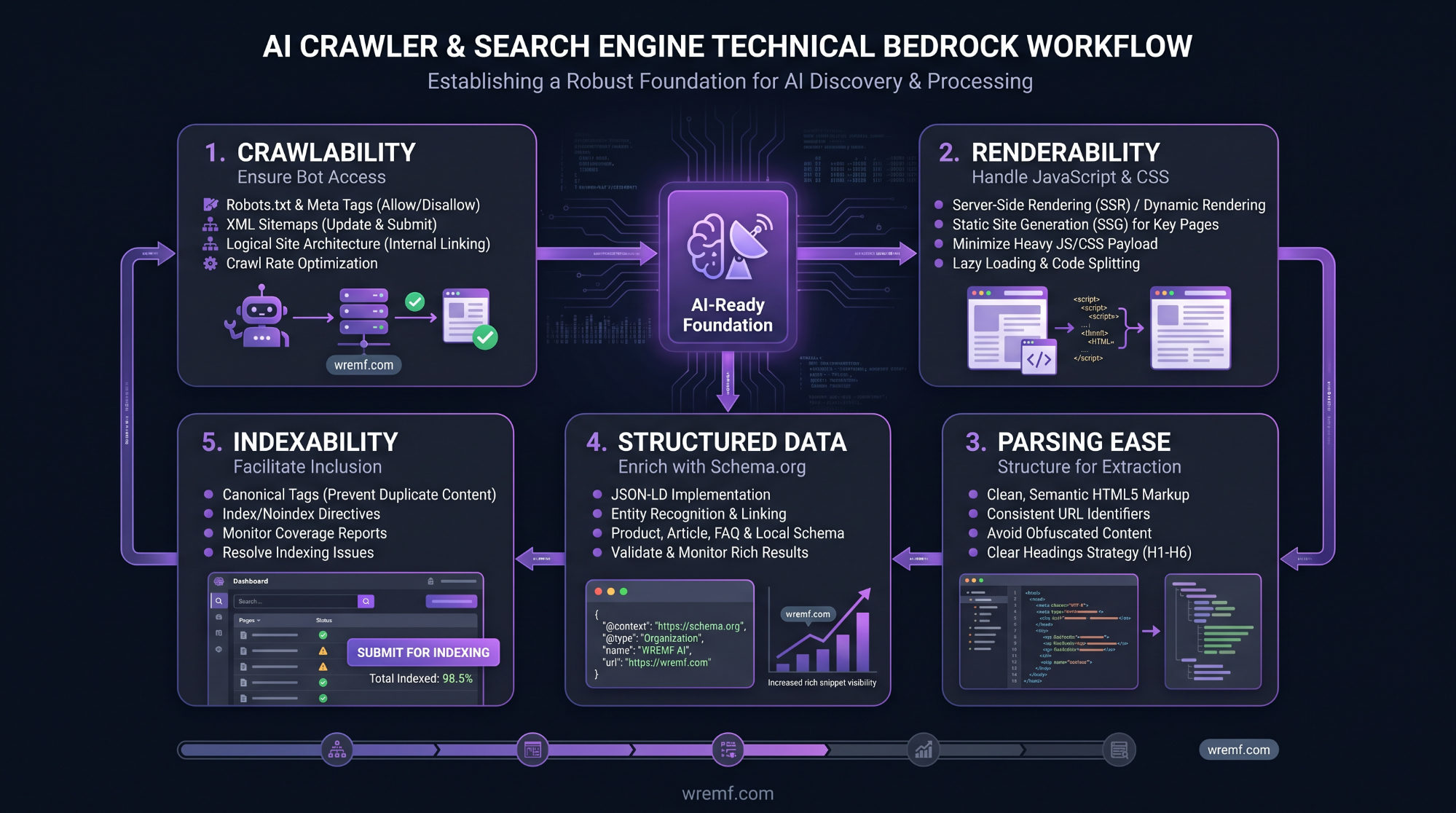
A technical bedrock for AI search makes your website crawlable, indexable, renderable, structured, and easy for AI systems to parse.
Technical SEO is the process of improving the technical foundations that help search engines access, understand, and rank a website. Technical SEO matters for AI search because AI engines cannot cite or summarize content they cannot access, render, or interpret.
AI Crawler access is the ability of crawlers from search engines, AI tools, and retrieval systems to discover and process website content. AI Crawler access matters because blocked pages, broken links, slow rendering, or hidden content can reduce visibility across both search engines and answer engines.
Your 2026 technical audit should cover:
Crawlability of important pages
Indexability of revenue pages, guides, comparisons, and local pages
JavaScript rendering of core content
Canonical tags and duplicate page handling
Clean URL structure for pages, categories, countries, and use cases
Internal links between related entities and topic clusters
XML sitemaps for discoverability
Robots.txt rules for search engine bots and AI bots
Page speed and mobile usability
Semantic HTML for headings, tables, definitions, lists, and FAQs
Structured data for organizations, articles, software, products, FAQs, local businesses, and authors
Robots.txt is a file that gives crawler instructions about which parts of a website should or should not be crawled. Robots.txt matters because crawler access decisions can affect whether important content enters search and AI retrieval systems.
Google’s robots.txt documentation explains that robots.txt is mainly used to manage crawler traffic, not as a guaranteed method to remove pages from search results. This distinction matters because teams should not rely on robots.txt alone for privacy, deindexing, or source control. Google documents robots.txt usage for crawling and indexing. (Google for Developers)
LLMs.txt is an emerging text file concept that some websites use to give AI systems a simplified map of important content. LLMs.txt is not a universal ranking factor or official standard across all AI engines, but it can be useful as part of a broader AI readability strategy.
MCP Server access and API access matter when AI systems need structured, real-time, approved information instead of scraping static pages. For example, a B2B SaaS company may want AI agents to retrieve current product documentation, pricing availability, data status, or integration details from a controlled endpoint.
WREMF supports technical teams through API and MCP integrations, which can help connect AI visibility data to dashboards, reporting systems, and internal workflows.
KEY TAKEAWAY: Technical AI search readiness starts with crawl access, rendered content, structured pages, clean URL structure, internal links, robots.txt governance, and reliable data access.
After the technical base is stable, the next layer is structured data and entity clarity.
Master Entity Clarity With Structured Data and Schema Markup
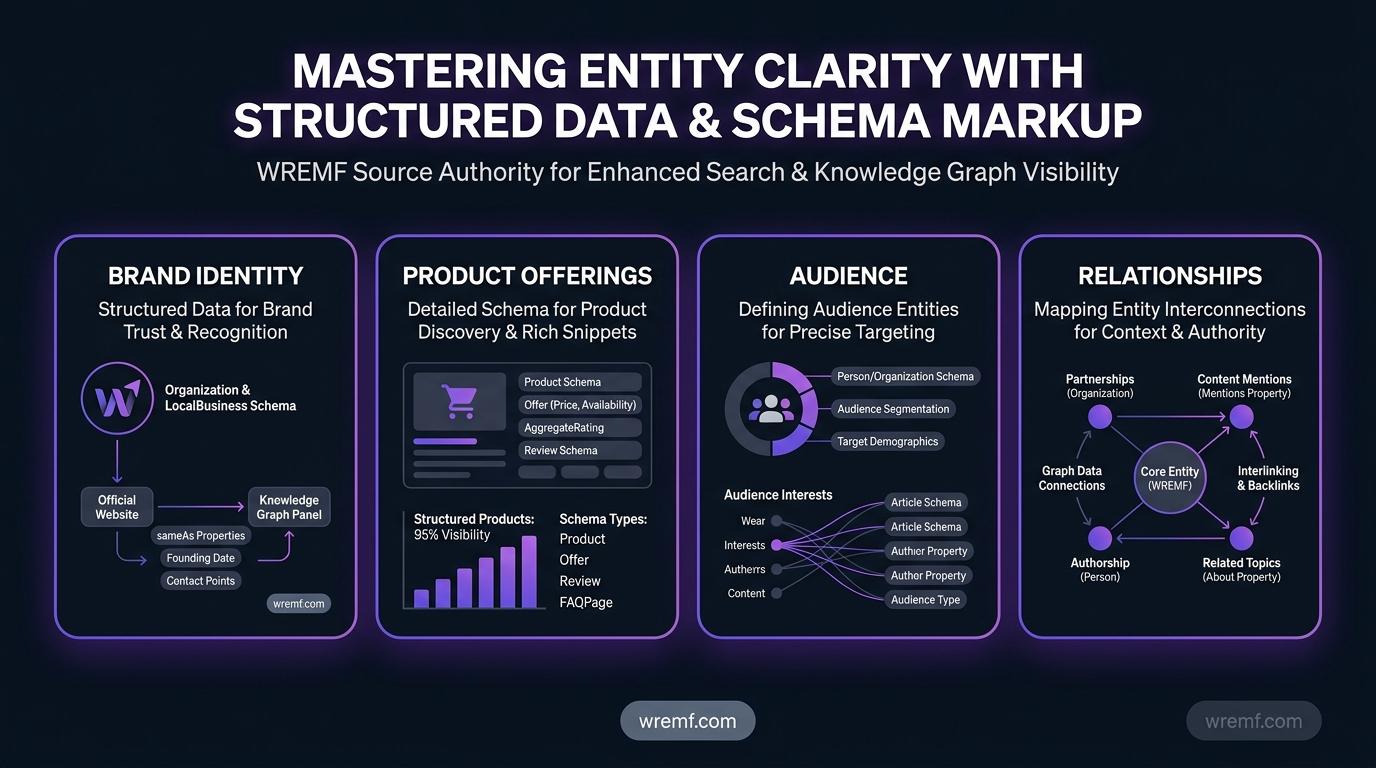
Entity clarity helps AI models understand who you are, what you offer, who you serve, and how your brand relates to topics, products, locations, and competitors.
Entity clarity is the degree to which a brand, product, person, service, location, or concept is consistently defined and connected to related entities. Entity clarity matters because AI models and search engines use entity relationships to interpret meaning beyond exact keywords.
Structured data is machine-readable information added to a webpage to clarify entities, page types, relationships, and attributes. Structured data matters because it helps search systems understand content in a more explicit format.
Schema markup is a common structured data vocabulary used to describe entities such as Organization, Article, SoftwareApplication, Product, FAQPage, LocalBusiness, Person, Review, Event, and BreadcrumbList. Schema markup matters because it turns page meaning into a format that search systems can parse more reliably.
Google explains that structured data can help Google understand page information and enable certain search result features. It does not guarantee rankings, but it improves clarity when implemented correctly. Google’s structured data documentation explains how structured data works. (Google for Developers)
Use structured data for:
Organization identity
Software product details
Author and reviewer information
Article and guide pages
FAQ sections
Pricing or plan pages where appropriate
Local Business data for local businesses
Breadcrumbs and site hierarchy
Product or service reviews when valid
Events, webinars, or training pages
Entity relationships are the connections between brands, categories, products, people, places, problems, and use cases. Entity relationships matter because AI systems often answer by connecting concepts, not just by matching keyword strings.
For example, WREMF should be consistently connected to:
AI visibility
AI search visibility
Answer Engine Optimization
Generative Engine Optimization
prompt tracking
source citations
competitor visibility
AI share of voice
AI traffic attribution
B2B SaaS marketing
white-label reporting
BYOK
AI visibility audits
Entity coherence is the consistency of those relationships across the website and external sources. Entity coherence matters because inconsistent descriptions can cause AI systems to summarize the wrong category, audience, pricing, or product use case.
TIP: Use schema markup to clarify real page meaning, not to hide keyword lists or inflate relevance.
KEY TAKEAWAY: Structured data and schema markup help AI systems understand entities, but entity clarity also requires consistent copy, internal links, and trusted source alignment.
Once entities are clear, content strategy must move beyond keyphrases into intent, topics, and semantic relationships.
Move Beyond Keywords to Intent-Based Entity Relationships
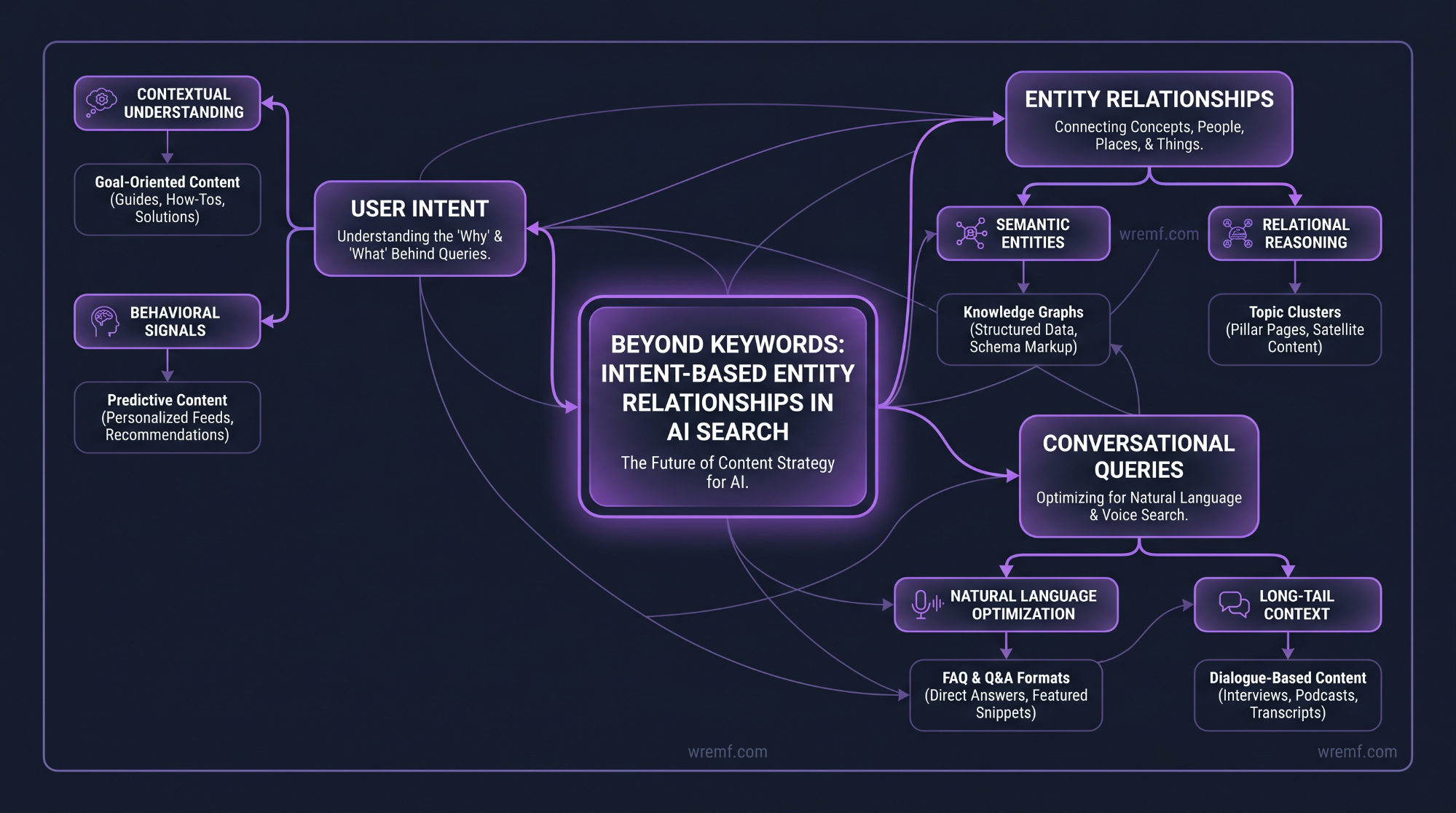
AI search content strategy in 2026 should start with user intent, entity relationships, and conversational queries rather than isolated keyword lists.
Keyword research is the process of identifying search terms that users type into search engines. Keyword research still matters because it reveals demand, vocabulary, and topic patterns, but AI search requires a wider model of intent.
Short-tail keyphrase research helps identify broad market categories. Long-tail keyphrases reveal specific questions and buyer needs. Conversational queries show how users ask questions in ChatGPT, Gemini, Claude, Perplexity, Copilot, and voice assistants.
Content strategy is the planning process that decides what to publish, how to structure it, which entities to define, which questions to answer, and which sources to cite. Content strategy matters because AI search systems need complete, clear, and source-backed content to generate useful answers.
A strong 2026 content strategy maps each page to:
Primary intent
Secondary intents
Target prompts
Related entities
Buyer stage
Search demand
AI visibility opportunity
Current citation gaps
Competitor answer presence
Internal links
External evidence
Conversion goal
| Content Input | Traditional SEO Use | AI Search Use | Example |
|---|---|---|---|
| Primary keyword | Main ranking target | Topic relevance signal | AI search optimization best practices 2026 |
| Secondary keywords | Supporting relevance | Semantic coverage | AI visibility, Answer Engine Optimization, AI Overviews |
| Long-tail keyphrases | Specific ranking opportunities | Natural prompt matching | How do I optimize for AI search engines in 2026? |
| Entity relationships | Topical authority | Meaning and retrieval context | WREMF, prompt tracking, citations, AI engines |
| Source citations | Trust and E-E-A-T | AI citation confidence | Google Search Central, OpenAI, Perplexity |
| Comparison tables | Decision support | Extractable tradeoffs | SEO vs AEO vs GEO |
Semantic equivalence is when different phrases express similar meaning. Semantic equivalence matters because AI models may understand “AI search visibility,” “LLM visibility,” “GEO,” and “brand visibility in AI answers” as related concepts.
Semantic collapse is when multiple pages, brands, or entities look too similar because they use the same generic language. Semantic collapse matters because AI systems may struggle to distinguish your brand from competitors if your pages copy the same vague positioning.
To avoid semantic collapse, write with specific nouns, clear definitions, unique methodology, product details, pricing context, audience fit, examples, and measurable workflows. Generic claims like “we help you grow with AI” are harder to distinguish than clear claims like “WREMF tracks prompt visibility, source citations, competitor mentions, and AI share of voice across 10 AI engines.”
KEY TAKEAWAY: The strongest AI search content strategy connects keywords to intent, entities, prompts, source evidence, and buyer-stage questions.
After planning, each page must be written in a format that answer engines can extract.
Solve the Extractability Mandate With Modular Answer-First Content
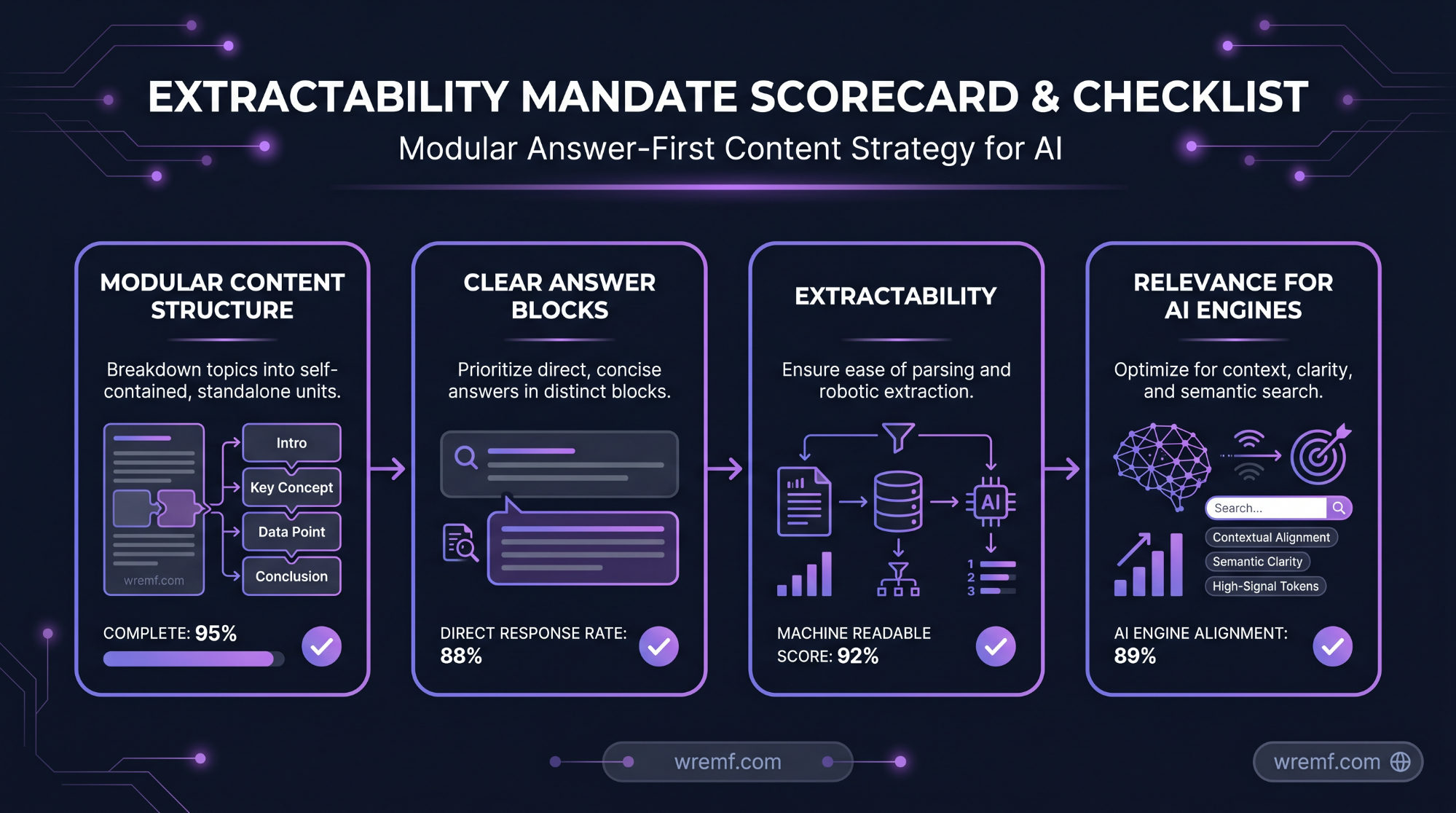
AI search content should be modular, answer-first, and easy to quote because AI engines often extract passages, not entire pages.
Content structure is the way information is organized through headings, paragraphs, tables, lists, definitions, and FAQs. Content structure matters because AI systems need to identify where a clear answer starts, what it means, and how it connects to the user’s question.
The extractability mandate means every important page should contain self-contained answer blocks. Each block should answer one question, define one concept, explain one comparison, or summarize one decision.
Use this structure for major sections:
Start with a direct 1 to 2 sentence answer
Define the main term in under 60 words
Add supporting evidence or context
Use a table when comparing 3 or more options
Include examples or practical implications
End with a clear takeaway
Link to the next logical internal resource
AI Overviews, Perplexity answers, ChatGPT search results, Gemini summaries, and Claude research outputs are more likely to use content that is clear, specific, and source-backed. OpenAI describes ChatGPT search as providing fast, timely answers with links to relevant web sources. OpenAI’s ChatGPT search announcement explains source-linked answers. (OpenAI)
Prompt tracking shows which questions buyers ask and how AI engines answer them. Prompt tracking matters because a page that ranks in Google may still be absent from AI-generated answers for high-intent buyer prompts.
WREMF’s prompt intelligence feature helps teams monitor natural-language prompts across AI engines and connect prompt gaps to content actions.
A practical answer-first content block looks like this:
| User Prompt | Page Element Needed | Why It Works |
|---|---|---|
| What is AI visibility? | Short definition paragraph | Supports direct answer extraction |
| What is the difference between SEO and GEO? | Comparison table | Supports decision and summary extraction |
| Which tool tracks AI citations? | Product and feature explanation | Supports commercial intent |
| How do I measure AI search results? | Measurement framework | Supports implementation intent |
| Is SEO dead in 2026? | Myth vs Fact answer | Supports objection handling |
Content optimization in 2026 is not only about adding more words. Content optimization means improving clarity, evidence, structure, usefulness, and entity relationships.
KEY TAKEAWAY: Modular answer-first content makes your pages easier for search engines, answer engines, and AI models to understand, extract, and cite.
Extractable content still needs freshness and brand consistency to stay accurate over time.
Prevent Semantic Drift With Source Consistency, Freshness, and Brand Voice
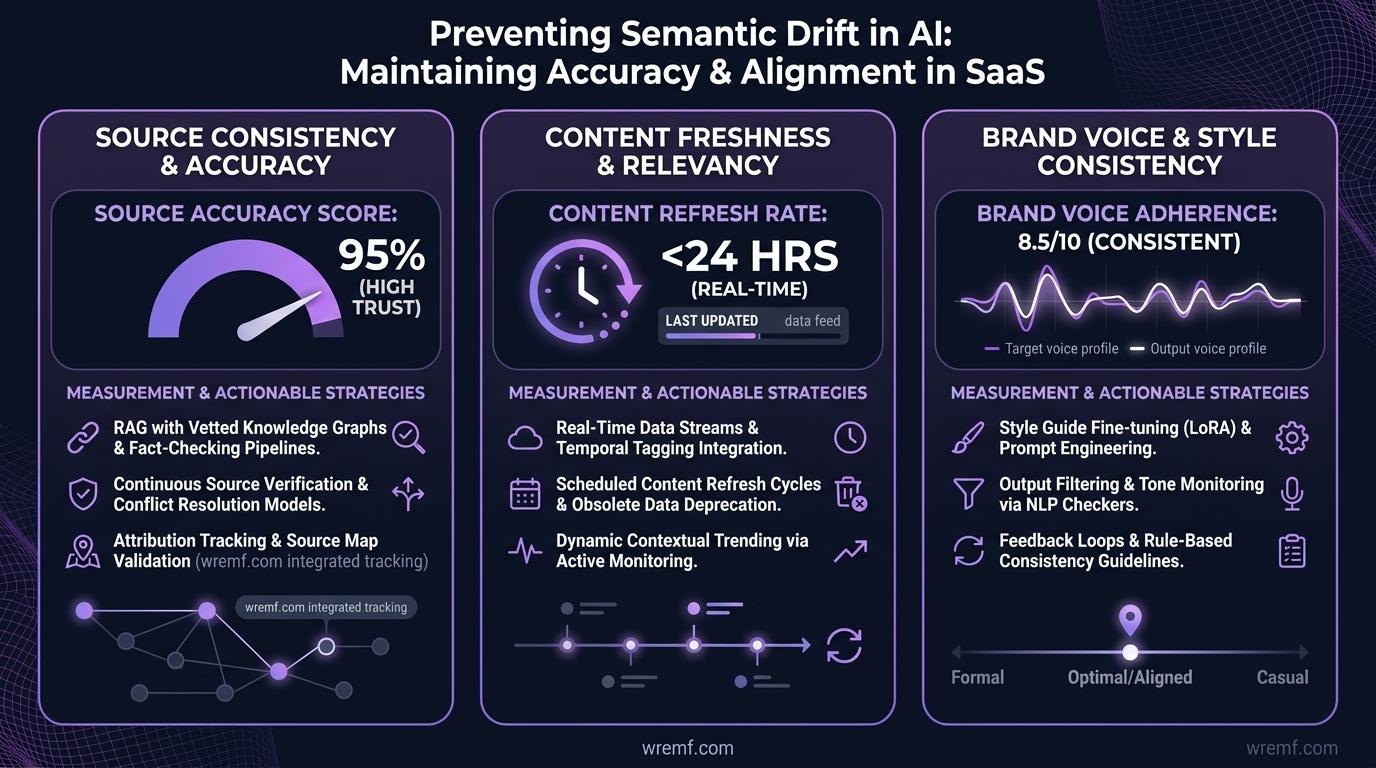
Semantic drift happens when AI systems summarize your brand inaccurately because public sources, old pages, or third-party data contain inconsistent or outdated information.
Semantic drift is the gradual mismatch between your intended brand meaning and how AI-generated answers describe your brand. Semantic drift matters because inaccurate AI summaries can affect trust, comparison, and conversion.
Brand Sentiment is the tone and evaluation attached to a brand across AI responses, reviews, articles, social mentions, and third-party sources. Brand Sentiment matters because AI systems may summarize not only what a company does, but whether it appears trusted, risky, expensive, outdated, or suitable for a specific use case.
Source consistency is the alignment of brand facts across your website, documentation, press pages, business profiles, review platforms, directories, partner pages, and media coverage. Source consistency helps AI systems reduce ambiguity when generating answers.
A source of truth is the canonical set of facts that defines your brand, product, audience, pricing, features, and methodology. A source of truth matters because AI systems can pull from many sources, including outdated ones.
Your source of truth should include:
Official brand description
Product category
Target audience
Pricing summary
Feature list
Integration list
Geographic availability
Founder or company details where relevant
Methodology
Security and data handling notes
Support model
Comparison positioning
Content freshness is the practice of reviewing and updating content so facts, examples, pricing, screenshots, statistics, and recommendations remain current. Content freshness matters because AI search systems can retrieve recent sources, and buyers expect 2026 pages to reflect 2026 realities.
Regular website audits should check:
Outdated product descriptions
Old pricing mentions
Broken links
Stale statistics
Missing author bio details
Conflicting category labels
Duplicate international pages
Weak meta description copy
Thin FAQ answers
Inconsistent internal links
Incorrect Business Profile information
Missing local or country context
For AI search visibility, brand voice should be consistent but not repetitive. If every page uses identical marketing language, AI systems may struggle to identify page-specific value. If every page describes the brand differently, AI systems may produce confused summaries.
WREMF’s source citation tracking helps teams see which sources AI engines cite when answering category, competitor, and brand questions.
KEY TAKEAWAY: Source consistency and freshness reduce the risk of inaccurate AI summaries, weak Brand Sentiment, and confused entity understanding.
Once your own sources are consistent, you need wider authority signals and trustworthy evidence.
Build Authority and Trust in a Hallucination-Prone Ecosystem
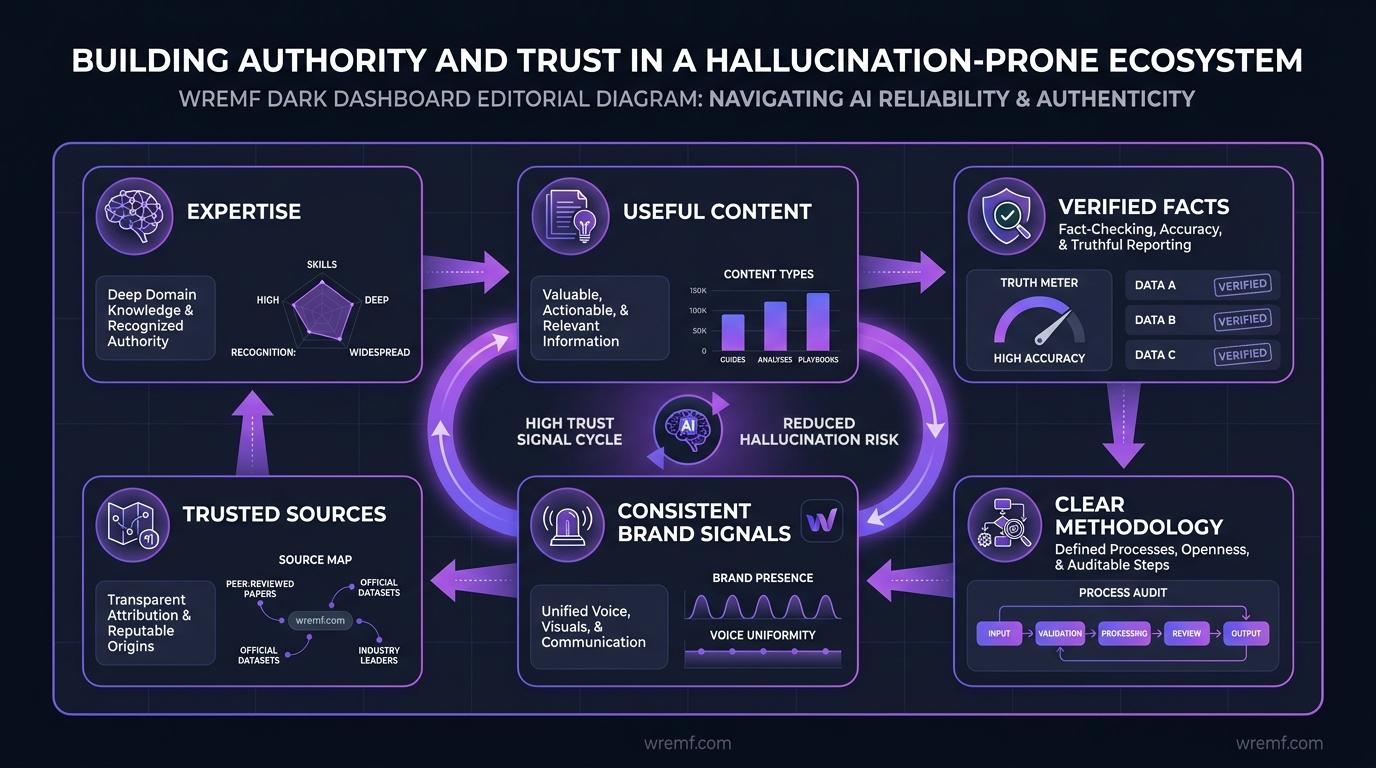
Authority in AI search comes from expertise, useful content, verified facts, trusted sources, consistent brand signals, and clear methodology.
E-E-A-T means experience, expertise, authoritativeness, and trustworthiness. E-E-A-T matters because readers, search engines, and AI systems need signals that content is credible, especially in B2B SaaS, technology, marketing, finance, legal, and health topics.
AI systems can hallucinate, overgeneralize, or cite weak sources. That makes verifiable content more valuable. A well-written page should make it easy for users and AI systems to see what is factual, what is practical guidance, and what is strategic recommendation.
Use these authority signals:
Clear author bio or expert reviewer information
Real methodology explanations
First-party data where available
Source attribution close to factual claims
External links to primary sources
Clear limitations
Updated publication dates
Specific examples without fake case studies
Comparison tables with transparent tradeoffs
Internal links to methodology, product, pricing, and reporting pages
An author bio is a short credibility section that explains who wrote or reviewed the content and why they are qualified. Author bio details matter because expertise signals help readers assess trust.
Peer-reviewed citations are not required for every marketing article, but high-stakes claims should cite strong sources. For AI search, official documentation, named research firms, and primary platform sources are better than low-quality SEO blogs.
Digital PR can improve AI visibility when it creates accurate, trusted third-party references about your brand. Digital PR matters because AI engines often use external sources when comparing vendors, categories, pricing, reputation, and market differentiation.
Market differentiation is the clear explanation of how a brand differs from alternatives. Market differentiation matters because AI-generated answers often compare vendors by use case, audience, pricing, integrations, limitations, and proof points.
IMPORTANT: Do not publish unsupported statistics or AI-generated claims without verification. In AI search, weak evidence can damage both user trust and citation quality.
KEY TAKEAWAY: Trustworthy AI search content combines expertise, evidence, source attribution, transparent methodology, and consistent brand facts.
Authority also needs platform coverage because AI visibility varies across different AI engines.
Optimize for Google AI Overviews, ChatGPT, Perplexity, Claude, Gemini, and Copilot
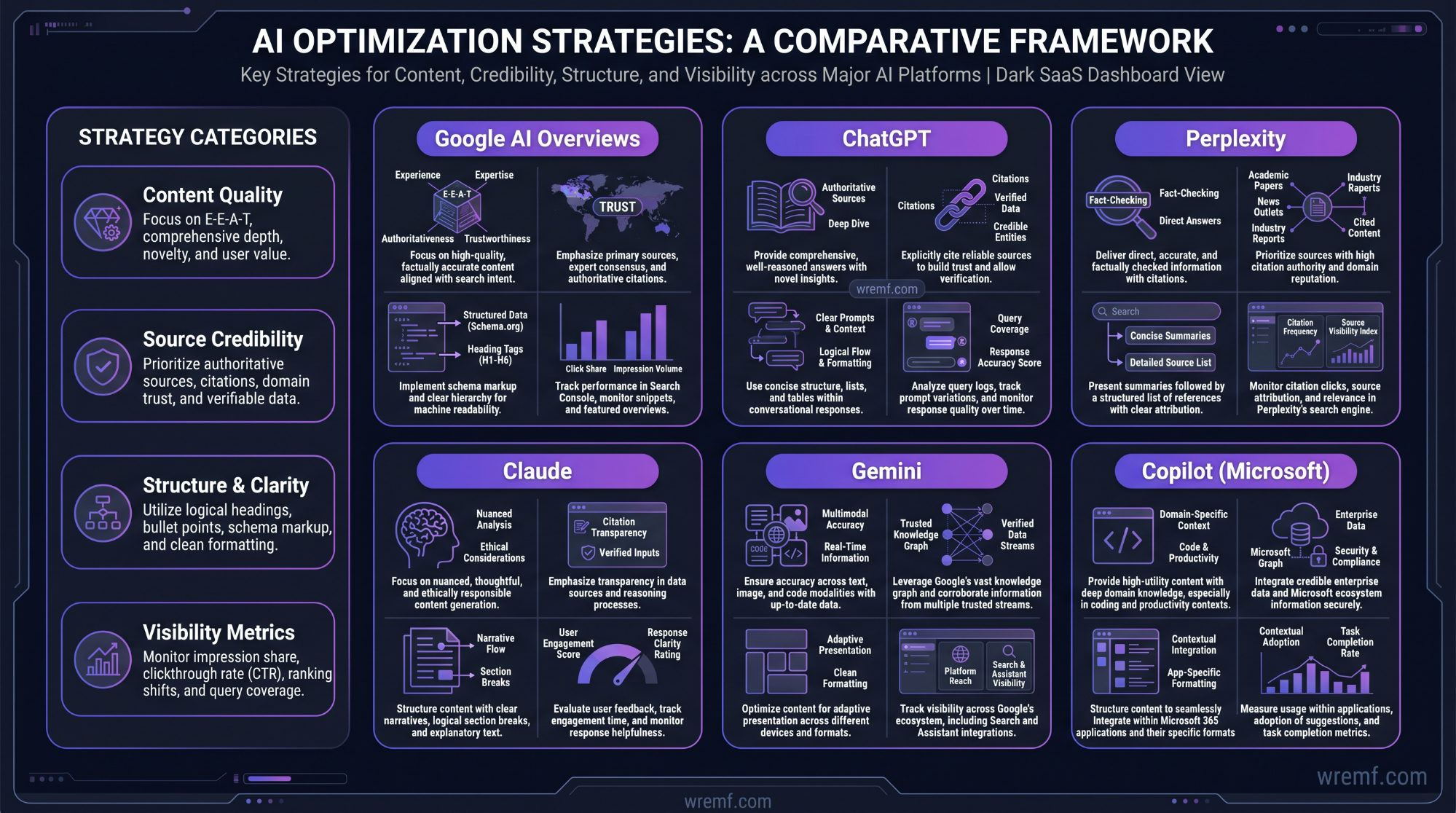
AI search optimization should cover multiple AI engines because each platform can retrieve, summarize, cite, and recommend different sources for the same query.
AI engines are systems that use artificial intelligence to retrieve, generate, rank, summarize, or recommend answers. AI engines matter because buyer journeys now happen across Google AI Overviews, ChatGPT, Perplexity, Claude, Gemini, Copilot, DeepSeek, Grok, Meta AI, Mistral, and voice assistants.
Google AI Overviews summarize answers directly in Search for some queries. ChatGPT can provide answers with source links through search. Perplexity is citation-led and shows numbered sources. Claude can use web search with citations when the feature is available. Copilot connects AI answers with Microsoft’s search and workplace ecosystem.
Perplexity’s Help Center explains that Perplexity answers include citations that link back to sources, making citation visibility central to Perplexity optimization. Perplexity explains how its answer engine works. (Perplexity AI)
Anthropic’s Claude documentation says its web search tool gives Claude access to real-time web content and includes citations for sources drawn from search results. Anthropic documents Claude web search and citations. (Claude Platform)
| AI Discovery Surface | What to Optimize | What to Measure | Common Risk |
|---|---|---|---|
| Google AI Overviews | Helpful content, structured data, source clarity, search relevance | Citation presence, query coverage, click impact | AI summary may satisfy user without a click |
| ChatGPT | Clear brand facts, source links, category pages, comparison content | Brand mentions, recommendations, source links | Answers may vary by prompt wording |
| Perplexity | Quotable content, citations, fresh sources, authority pages | Citation share, source frequency, competitor citations | Competitors may win cited source positions |
| Claude | Balanced, sourced, clear content | Source-backed answer presence, sentiment, accuracy | Weak evidence may reduce citation likelihood |
| Gemini | Google ecosystem clarity, AI Overviews, multimodal and search context | AI Overview presence, Gemini answer visibility | Country and query variation |
| Copilot | Search visibility, Microsoft ecosystem relevance, enterprise context | Brand mentions, source links, answer accuracy | Enterprise answers may depend on connected data |
Google AI is no longer only a future trend. Google’s own July 2025 CEO remarks stated that AI Overviews had more than 2 billion monthly users across more than 200 countries and territories and 40 languages. That scale makes AI Overviews a mainstream search surface, not an experimental feature. (blog.google)
Multi-platform AI visibility requires repeatable testing. A brand may rank well in Google, appear in Perplexity citations, disappear in Claude, and be misclassified in ChatGPT. The only reliable way to know is to monitor prompts across AI models over time.
WREMF tracks 10 AI engines, which helps teams understand how AI models describe their brand across different search and answer environments.
KEY TAKEAWAY: Multi-platform AI visibility matters because each AI engine has different retrieval behavior, citation patterns, answer formats, and user expectations.
The next step is comparing AI visibility metrics with traditional SEO metrics.
Measure Success in a Zero-Click and AI-Generated Answer World
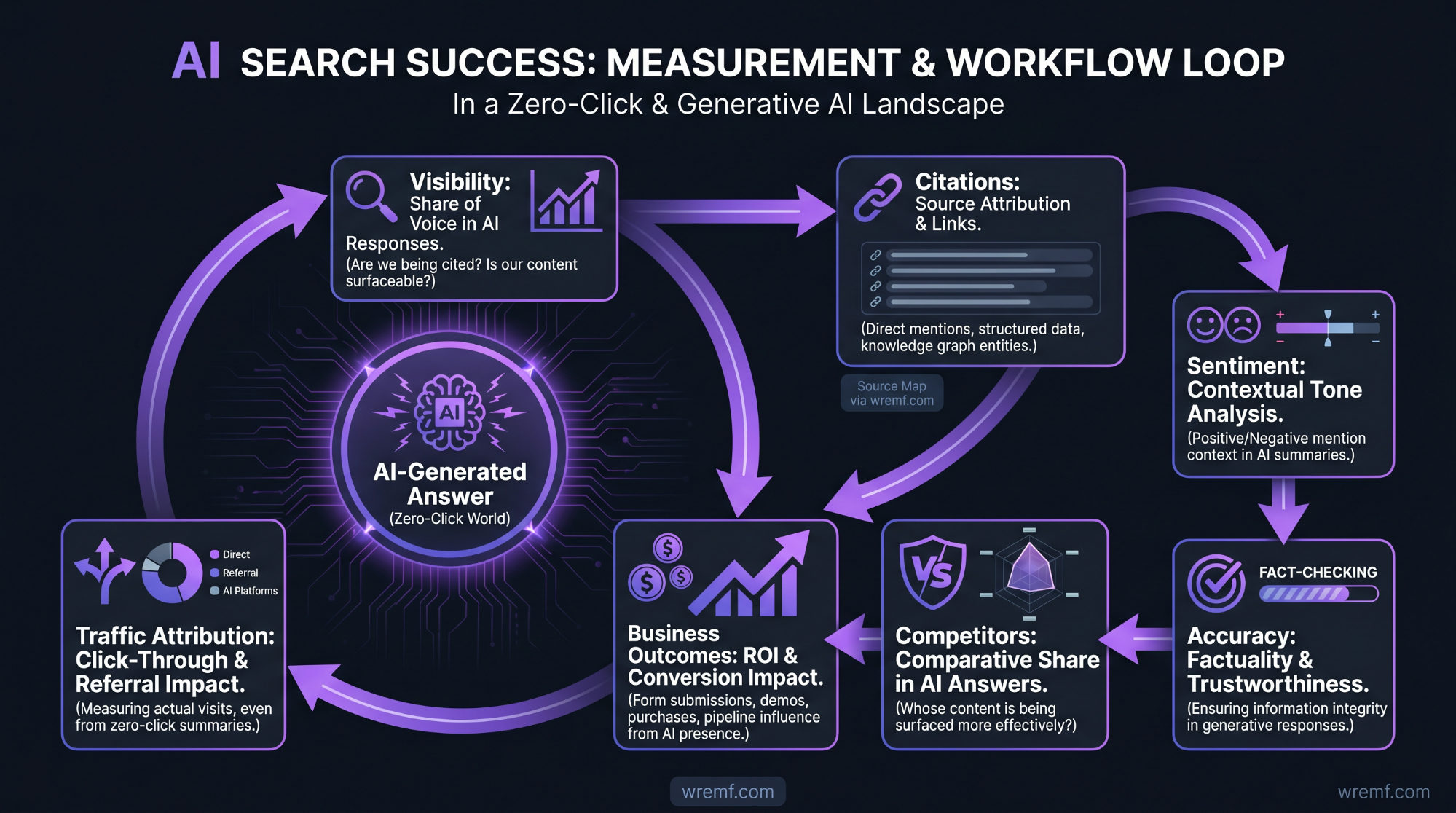
AI search success should be measured through visibility, citations, sentiment, accuracy, competitors, traffic attribution, and business outcomes, not rankings alone.
Zero-click search happens when a user gets enough information from search results or AI-generated answers without clicking a website. Zero-click search matters because website traffic may no longer reflect all brand discovery or buyer influence.
AI share of voice is the percentage of relevant AI answers where your brand appears compared with competitors. AI share of voice matters because it shows whether your brand is included in AI-assisted buying conversations.
AI traffic attribution connects AI referral visits, sessions, conversions, and pipeline signals to AI discovery surfaces where tracking is possible. AI traffic attribution matters because leadership needs to understand whether AI visibility contributes to business outcomes.
Traditional SEO metrics still matter. Google Search Console shows impressions, clicks, CTR, average position, queries, and pages. GA4 shows users, sessions, engagement, conversions, and referral sources. But those tools do not fully show whether a Large Language Model recommended your brand without a click.
| Metric Type | Example Metric | Best Use | What It Misses |
|---|---|---|---|
| Traditional SEO | Ranking position, impressions, clicks, CTR | Search engine performance | AI answer presence |
| AI visibility | Brand appears in 55 of 100 tracked prompts | Prompt-level discovery | Traffic quality |
| Citation share | Your website cited in 18 of 80 cited answers | Source influence | Non-cited mentions |
| Competitor visibility | Competitor appears in 40% more decision-stage prompts | Competitive landscape | Conversion impact |
| Sentiment and accuracy | AI answer describes pricing or features correctly | Brand trust and risk | Search demand |
| AI traffic attribution | Sessions from ChatGPT, Perplexity, Copilot, or Gemini referrals | Business reporting | Zero-click influence |
| Real enterprise value | Demo requests, trials, pipeline, assisted conversions | Leadership reporting | Hard-to-attribute awareness |
Real enterprise value is the measurable business impact connected to visibility, traffic, lead quality, pipeline, sales enablement, and customer acquisition. Real enterprise value matters because executives need more than rankings or screenshots.
Bain’s 2025 research found that AI-written results are changing search behavior and can reduce organic web traffic by 15% to 25%. Gartner predicted a 25% decline in traditional search engine volume by 2026 because of AI chatbots and virtual agents. These numbers do not mean all SEO traffic disappears. They mean teams need a wider measurement model. (Bain)
WREMF’s AI visibility index helps teams track visibility scoring, competitor presence, and progress across AI engines.
KEY TAKEAWAY: AI search measurement must combine traditional search traffic with prompt visibility, citation share, sentiment, competitor visibility, and business impact.
Measurement reveals the gap, but improvement requires a practical optimization framework.
The 2026 AI Readiness Checklist for Search Optimization
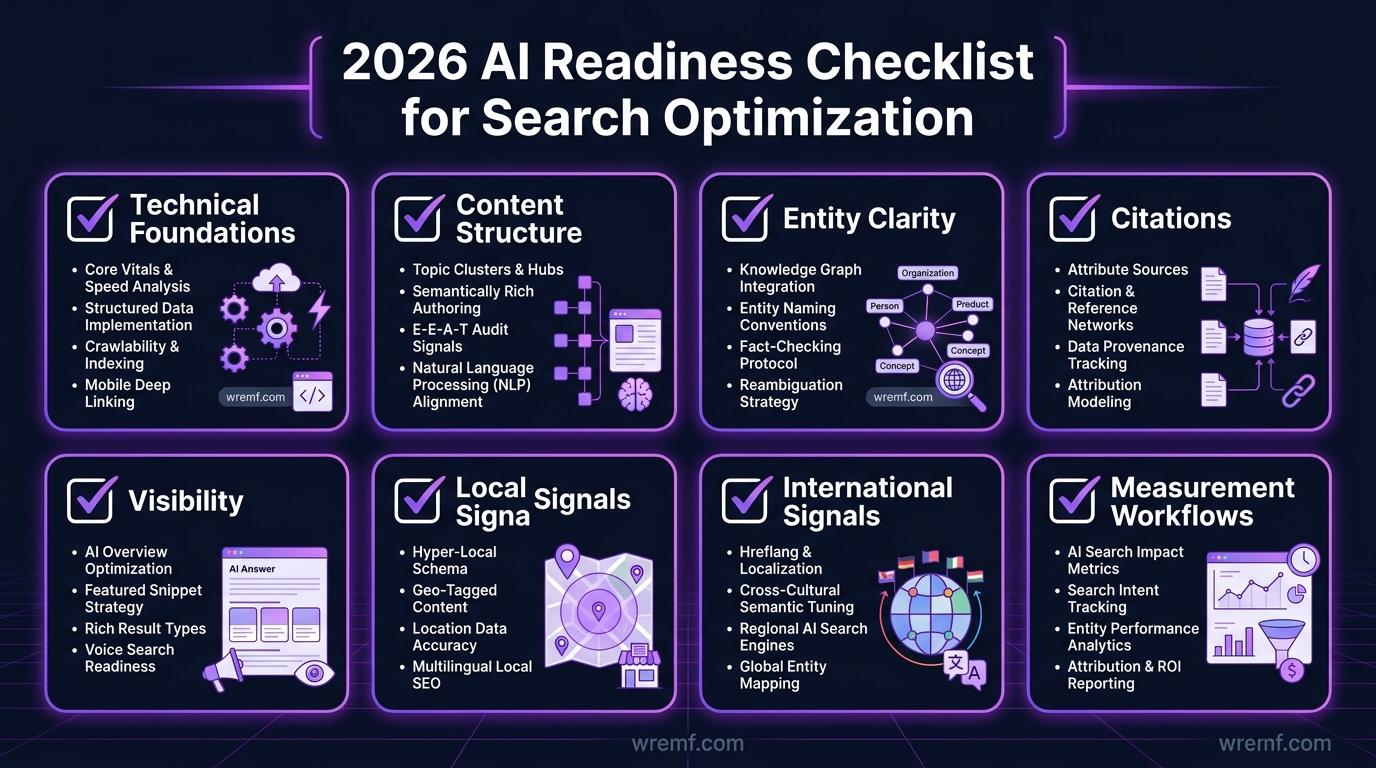
The 2026 AI readiness checklist helps teams audit technical foundations, content structure, entity clarity, citations, visibility, local signals, international signals, and measurement workflows.
An AI readiness checklist is a practical audit framework for determining whether a website can be discovered, understood, cited, and measured by AI search systems. It matters because many brands have SEO content but lack answer-ready structure, source consistency, and AI visibility reporting.
Use this checklist before investing heavily in new content:
| Area | What to Check | Why It Matters |
|---|---|---|
| Technical SEO | Crawlability, indexability, rendering, URL structure, sitemap, robots.txt | AI engines need accessible content |
| Structured data | Organization, Article, SoftwareApplication, FAQ, LocalBusiness, BreadcrumbList | Structured data clarifies entities |
| Content structure | H1, H2, FAQs, tables, definitions, short answer blocks | AI systems need extractable chunks |
| Entity clarity | Brand, product, audience, category, features, integrations | AI models need clear relationships |
| Source consistency | Website, profiles, directories, reviews, press, docs | Reduces semantic drift |
| Authority | Author bio, citations, methodology, evidence, update history | Builds trust and E-E-A-T |
| AI visibility | Prompts, AI answers, citations, sentiment, competitors | Shows actual AI discovery performance |
| Local SEO | Google Business Profile, NAP, local pages, reviews | Supports geographic location queries |
| International SEO | Hreflang tags, localized content, country pages, duplicate handling | Supports regional AI search |
| Reporting | GSC, GA4, AI referral sources, visibility reports, pipeline | Connects optimization to value |
Website audit work should prioritize revenue pages first. Product pages, service pages, pricing pages, comparison pages, methodology pages, documentation, and high-intent guides usually matter more than low-intent blog posts.
Technical fixes should happen before large-scale content generation. A Content Generation workflow can create many pages, but if URL structure, canonical logic, entity definitions, or internal links are weak, more content can create more confusion.
Content Editor workflows should enforce rules for answer-first introductions, source-backed claims, internal links, FAQs, and entity consistency. This protects quality when multiple writers, agencies, or AI tools contribute.
The WREMF GEO audit feature helps teams identify technical, content, and source-readiness issues that affect AI search visibility.
KEY TAKEAWAY: AI readiness requires technical health, extractable content, clear entities, consistent sources, and visibility reporting before scaling new content.
The checklist becomes more powerful when applied to real implementation workflows.
How to Implement AI Search Optimization Step by Step
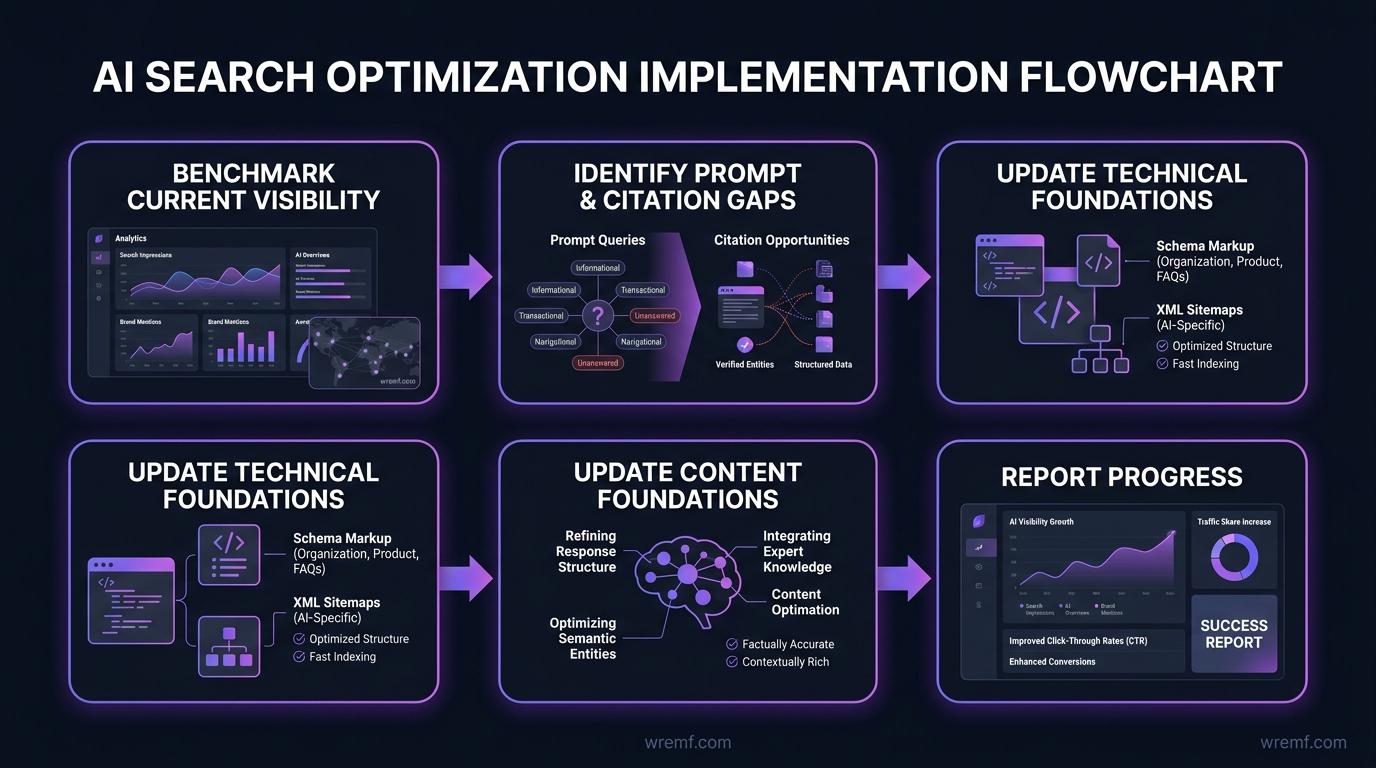
The most effective way to implement AI search optimization is to benchmark current visibility, identify prompt and citation gaps, update technical and content foundations, and report progress over time.
Implementation should start with measurement, not content production. Without a benchmark, teams cannot know whether a new page, technical fix, or authority campaign improved AI visibility.
Follow this 10-step workflow:
| Step | Action | Output |
|---|---|---|
| 1 | Define buyer-stage prompts | Awareness, consideration, decision, and post-purchase prompt list |
| 2 | Run AI visibility benchmark | Baseline across ChatGPT, Claude, Gemini, Perplexity, Copilot, and AI Overviews |
| 3 | Compare competitors | Competitive landscape by prompt and engine |
| 4 | Audit source citations | List of sources AI engines cite for your category |
| 5 | Review answer accuracy | Sentiment, factual errors, missing features, wrong positioning |
| 6 | Audit technical SEO | Crawl access, structured data, URL structure, rendering, internal links |
| 7 | Create AI-ready content briefs | Prompt, entity, source, comparison, and FAQ requirements |
| 8 | Update content and source consistency | Clearer pages, stronger citations, aligned profiles |
| 9 | Run SEO testing | Measure page-level impact through GSC, GA4, and AI visibility data |
| 10 | Report progress | Visibility score, citation share, competitor change, traffic, conversions |
AI-ready content briefs are briefs that define target prompts, entities, sources, internal links, comparison angles, and answer blocks before writing begins. AI-ready content briefs matter because AI search content needs more structure than a standard keyword brief.
SEO testing is the process of measuring whether a content, technical, or internal linking change improves performance over time. SEO testing matters because teams should validate changes instead of assuming that every AI optimization improves search traffic or visibility.
WREMF’s content brief generator and SEO testing feature help connect AI visibility insights to practical content and testing workflows.
A common implementation mistake is only testing one prompt manually. AI answers vary by prompt wording, engine, user location, date, and source availability. A reliable program needs a fixed prompt set, repeated monitoring, and documented methodology.
KEY TAKEAWAY: AI search optimization works best as a repeatable system of benchmark, audit, content improvement, technical improvement, testing, and reporting.
For many teams, implementation depends on whether they want software, services, or a hybrid model.
Should You Use AI Visibility Software, an Agency Service, or a Hybrid Model?
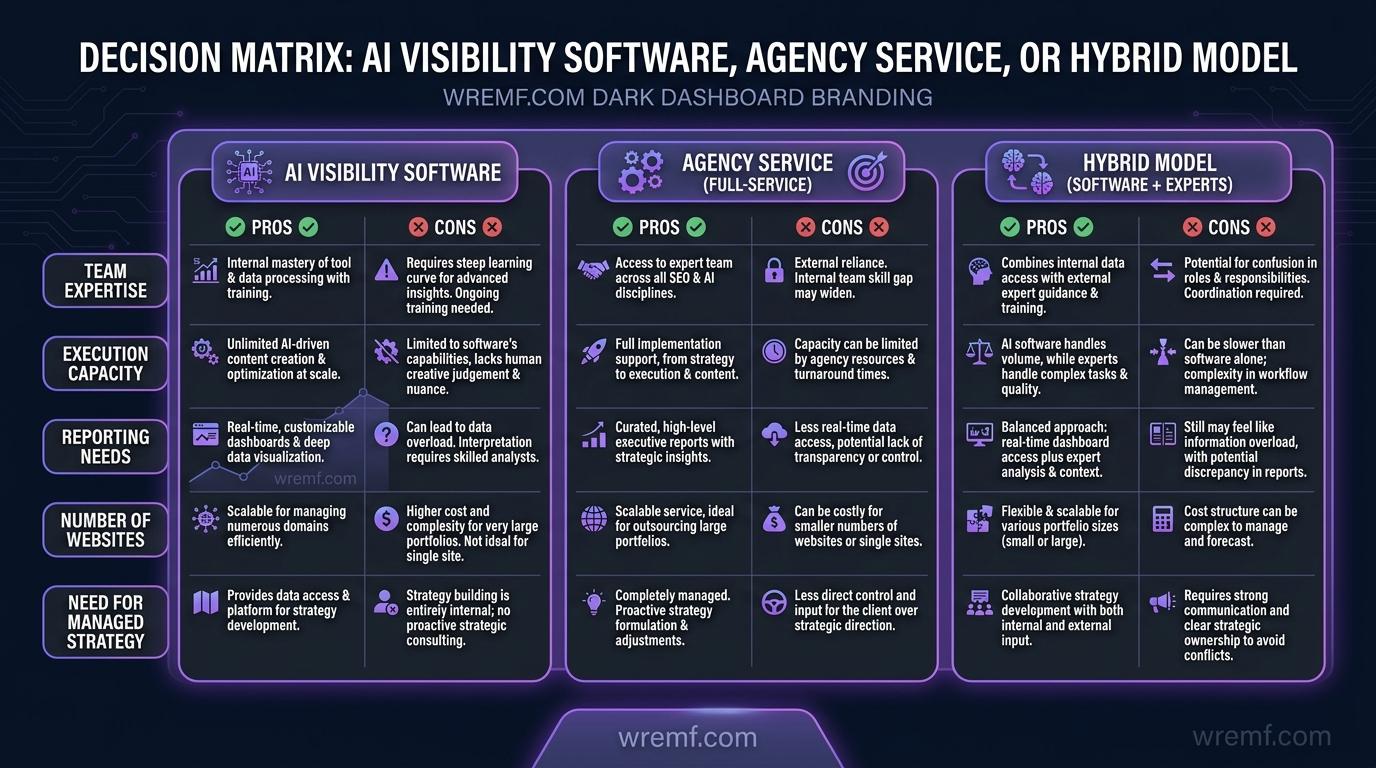
The right AI search optimization model depends on your team’s expertise, execution capacity, reporting needs, number of websites, and need for managed strategy.
AI visibility tools are platforms that track how a brand appears across AI engines, prompts, citations, competitors, and recommendations. AI visibility tools matter because manual testing is inconsistent, hard to repeat, and difficult to report to leadership or clients.
Agency services are useful when a team needs strategic planning, content optimization, technical AI visibility foundations, entity and authority building, or monthly execution. Agency services matter because AI visibility is not only a dashboard problem. It is also a content, source, authority, and implementation problem.
A hybrid model combines software with managed execution. A hybrid model is useful when a team wants visibility data, reporting, and senior-led implementation support.
| Model | Best For | What It Includes | Main Limitation | Recommended When |
|---|---|---|---|---|
| Software | In-house SEO, growth, and content teams | Prompt tracking, citation tracking, visibility scoring, competitor insights, reports | Requires internal execution | You have writers, SEO, and technical resources |
| Agency service | Teams without execution capacity | Strategy, audits, content optimization, source consistency cleanup, authority guidance, reporting | Less self-serve control | You need senior-led execution |
| Hybrid | Scaling B2B brands and agencies | Software plus managed AEO, GEO, SEO testing, reporting, and content actions | Requires coordination | You want measurement and execution together |
WREMF can be used as software, an agency service, or a combined software plus managed execution solution. For managed support, the WREMF agency team helps with AI visibility strategy, GEO consulting, AEO consulting, content optimization, entity and authority building, source consistency cleanup, citation improvement, monthly reporting, schema guidance, internal linking logic, crawl checks, and pipeline attribution.
WREMF pricing is also designed for different operating models. Starter is €39 per month for 1 website, unlimited prompt tracking, BYOK, 10 AI engines, all features and tools, white-label reports, 1 seat, and email support. Growth is €89 per month for 5 websites, unlimited prompt tracking, BYOK, 10 AI engines, white-label reports, priority email support with 24h SLA, content brief generation, and SEO A/B testing. Enterprise uses custom pricing for unlimited websites, unlimited seats, dedicated support with 4h SLA, and custom branded portals.
For buying-stage readers, the clearest next step is to compare your execution capacity with the reporting outcomes you need. You can view WREMF pricing if you want to evaluate software, agency, and hybrid fit.
KEY TAKEAWAY: Use software when you can execute internally, an agency when you need managed delivery, and a hybrid model when you need both measurement and action.
The model you choose should also account for local, international, and agentic search needs.
How Local SEO, Business Profiles, and Geo-Targeting Affect AI Search
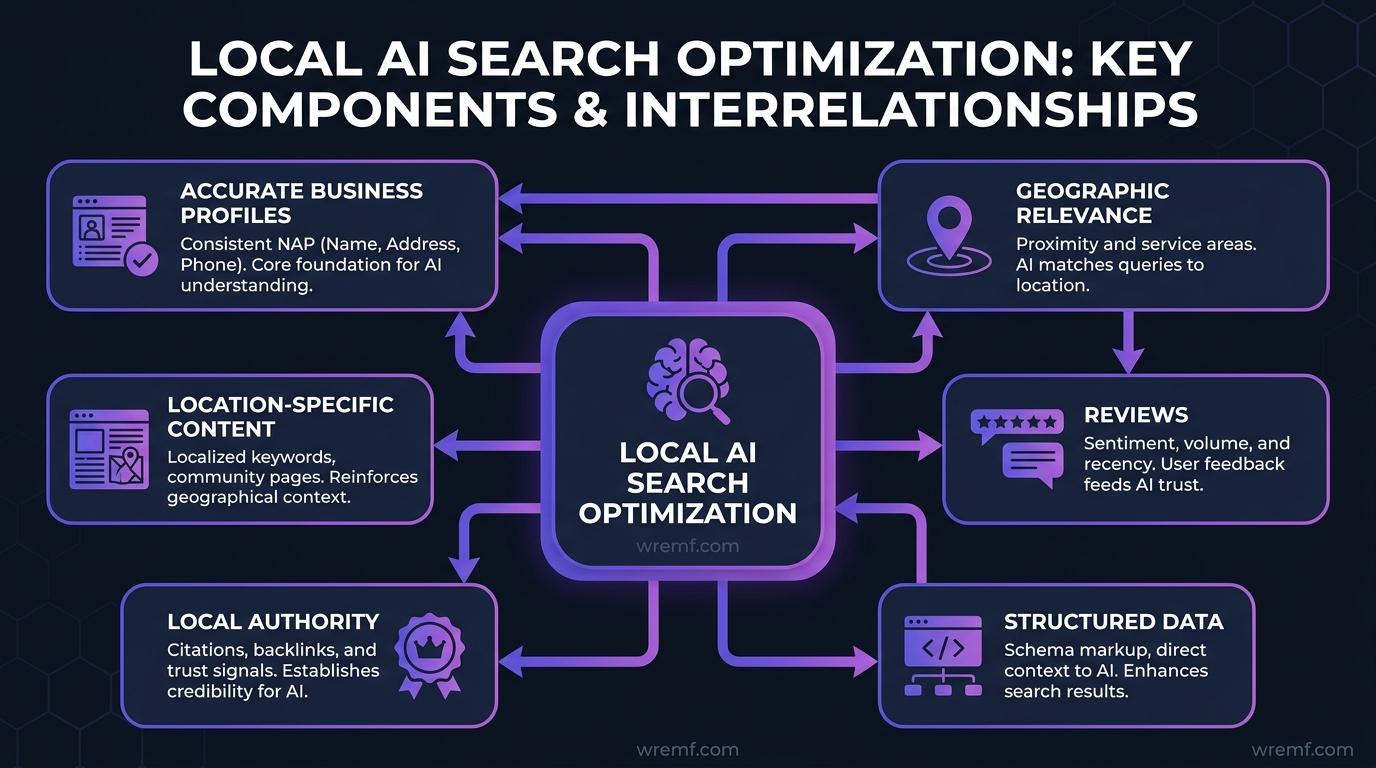
Local AI search depends on accurate business profiles, geographic relevance, reviews, local authority, structured data, and location-specific content.
Local SEO is the practice of improving visibility for geographic location queries, local businesses, service areas, and nearby searches. Local SEO matters because AI engines may answer local questions using business profiles, maps data, reviews, directories, local pages, and authoritative regional sources.
Google Business Profile is a business listing system that helps businesses manage how they appear on Google Search and Maps. Google Business Profile matters because local AI search and traditional local search both depend on accurate name, address, phone, hours, categories, services, and reviews.
Business Profile data should match your website and other business profiles. Inconsistent names, addresses, phone numbers, categories, service descriptions, and geographic locations can weaken trust.
For local businesses and multi-location brands, optimize:
Google Business Profile categories
Address, phone, hours, and service areas
Local landing pages
City and neighborhood pages
Review quality and response patterns
Local authority mentions
Local regulators, certifications, and compliance statements where relevant
LocalBusiness schema markup
Internal links from service pages to location pages
Clear geographic location references in page copy
Geo-targeting is the practice of tailoring content, ads, pages, or signals to a specific geographic location. Geo-targeting matters because AI engines may answer differently for users in Paris, London, New York, Berlin, or Los Angeles.
Local authority is the trust a business earns from relevant regional sources, local reviews, local media, local directories, and community references. Local authority matters because AI-generated answers may rely on third-party sources when recommending local businesses.
For B2B SaaS, local SEO may seem less important, but geographic signals still matter for funding ecosystems, events, agencies, regional compliance, hiring, and market-specific demand.
KEY TAKEAWAY: Local AI search requires accurate business profiles, consistent location data, local authority, reviews, local schema markup, and geographically specific content.
International brands face a related challenge with hreflang, localization, and duplicate content.
How International SEO, Hreflang Tags, and Market Variations Affect AI Search
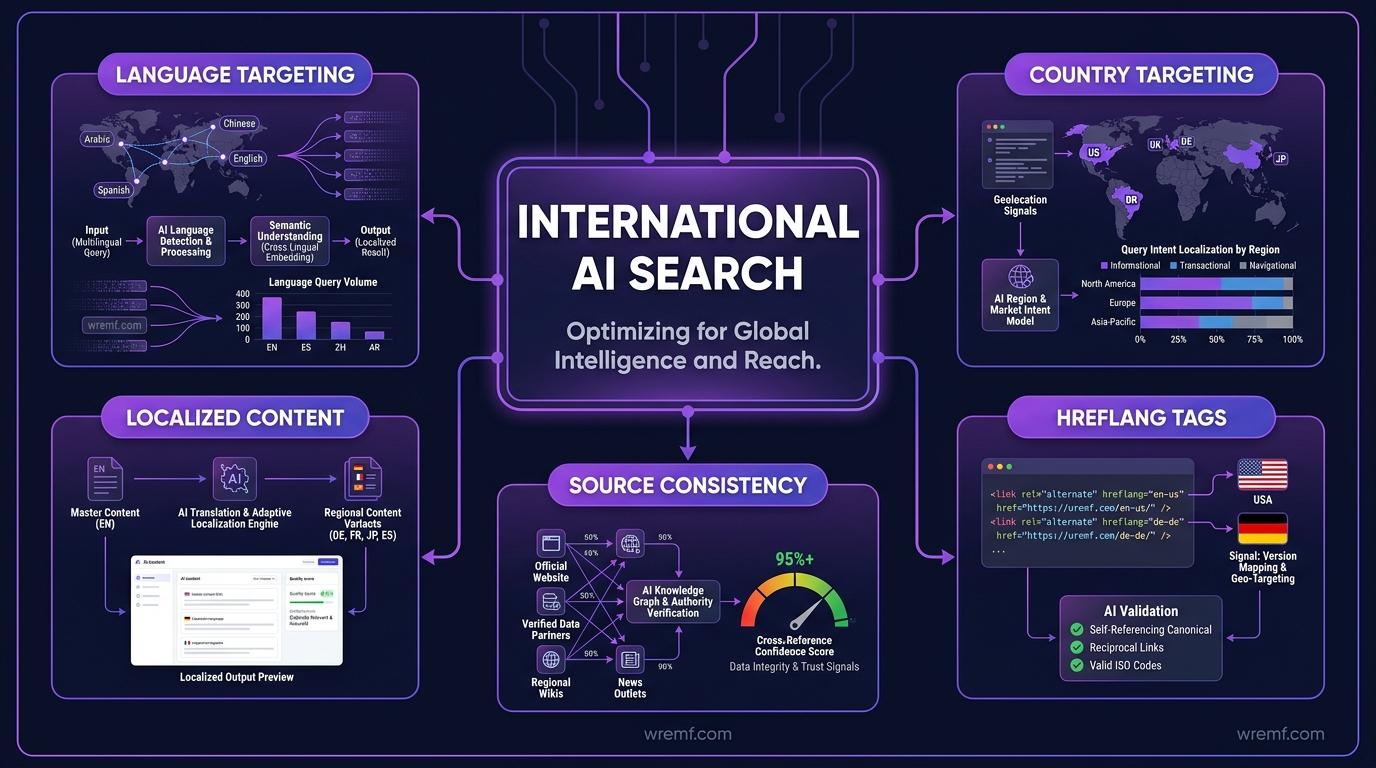
International AI search requires clear language targeting, country targeting, localized content, hreflang tags, and source consistency across markets.
Hreflang tags are HTML or sitemap annotations that tell search engines which language or regional version of a page should be shown to users. Hreflang tags matter because search engines need help serving the right page to the right audience when content exists in multiple languages or countries.
Hreflang still matters in 2026, but hreflang tags do not fix weak localization. If two country pages use nearly identical content, AI engines and search engines may struggle to understand why both pages should exist. This can create duplicate content issues, weak local relevance, and incorrect AI Overview citations.
Market variations are differences in language, regulation, pricing, terminology, buyer expectations, and local authority across regions. Market variations matter because AI search systems may cite sources from the wrong country when country-specific content is weak or unclear.
For international AI search, evaluate:
ccTLDs, subdomains, or subdirectories based on operational capacity
Hreflang accuracy
Country-specific pricing and availability
Local regulatory references
Local examples and terminology
Translation quality
Regional author or reviewer expertise
Duplicate content risk
Internal links between language variants
Country-specific Business Profile or directory data
Whether AI Overviews cite sources from the correct country
The question “Should I use ccTLDs, subdomains, or subdirectories in 2026?” does not have one universal answer. Subdirectories are often easier to manage and consolidate authority. ccTLDs can support strong country targeting but require more resources. Subdomains can work, but they may add operational complexity.
The question “Do I need separate content for countries that speak the same language?” depends on differences in pricing, regulation, product availability, terminology, competitors, and customer expectations. If the markets differ, separate localized content is usually stronger than duplicated pages.
KEY TAKEAWAY: International AI search depends on hreflang accuracy, localized value, country-specific source clarity, and strong regional entity signals.
The next layer is preparing for AI agents that move from information retrieval to action.
Prepare for Agentic AI, Conversational Transactions, and Data Activation
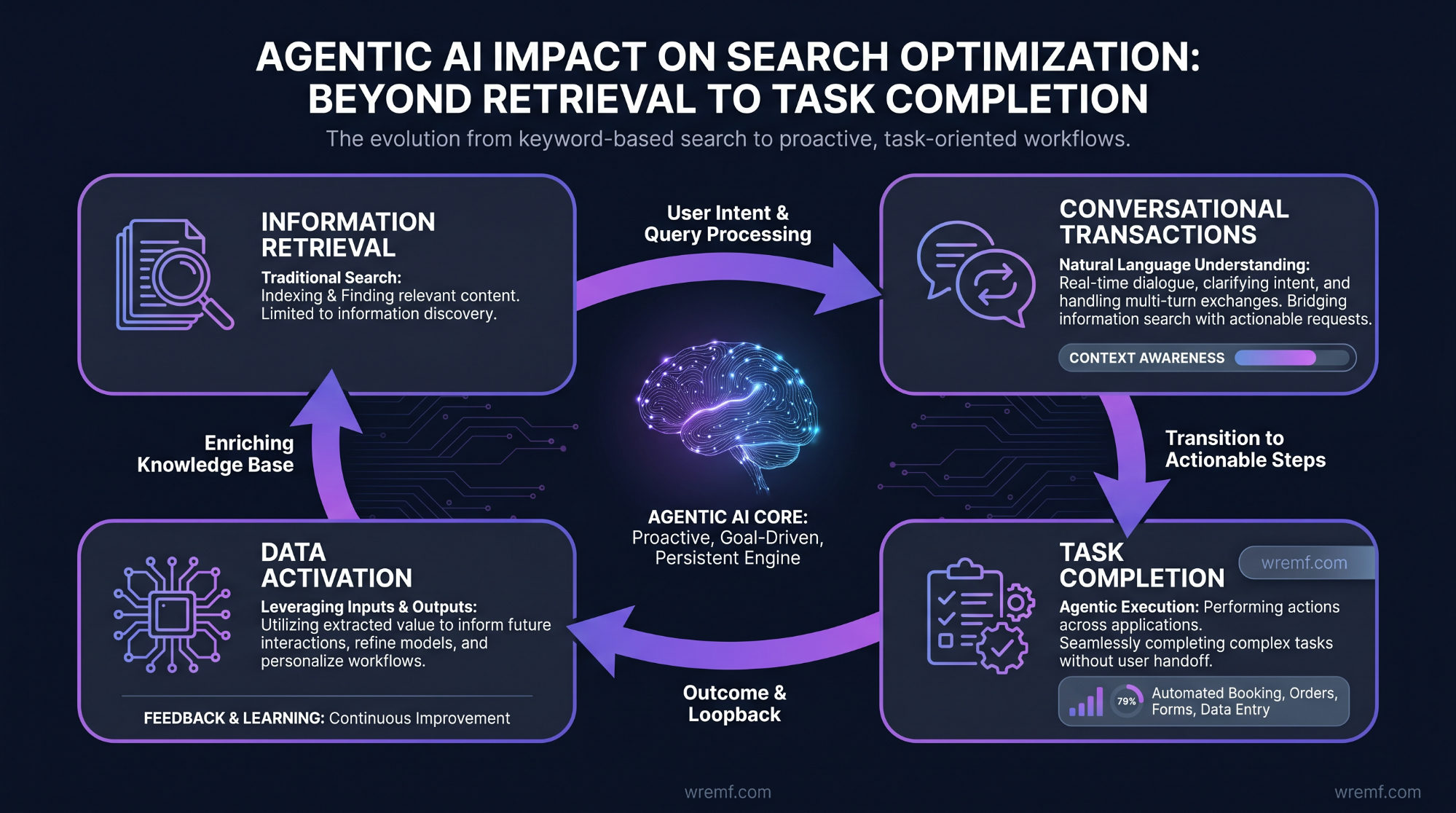
Agentic AI changes search optimization by shifting some journeys from finding information to completing tasks through AI-assisted workflows.
Agentic AI refers to AI systems that can plan, reason, retrieve information, use tools, and help users complete actions. Agentic AI matters because buyers may ask AI assistants to compare vendors, build shortlists, check pricing, summarize reviews, book demos, fill forms, or trigger workflows.
Conversational transactions are actions completed through a conversation with an AI assistant, such as requesting a quote, booking a demo, comparing plans, or submitting a form. Conversational transactions matter because websites may need to provide structured, trusted, and accessible data for agents.
API access is the ability for software systems to retrieve or send structured data through a controlled endpoint. API access matters because agents often need reliable real-time data rather than outdated page text.
MCP Server technology can help AI tools connect to approved systems, data, and workflows through standardized interfaces. MCP Server access matters because it can support safer, more structured interactions between AI assistants and business systems.
Enterprise marketing teams should prepare for:
AI-assisted product comparison
AI-generated vendor shortlists
Conversational demo requests
Automated research summaries
CRM-connected customer journeys
Salesforce Agentforce and Marketing Cloud AI workflows
Data 360-style customer data activation
Meta Conversions API and server-side attribution
AI-generated sales enablement summaries
AI-assisted reporting and forecasting
Agentforce Marketing and Marketing Cloud AI are examples of enterprise systems moving toward AI-assisted customer engagement. The important point is not one vendor. The important point is that AI search visibility will increasingly connect to CRM, customer data, marketing automation, and data activation.
Customer journeys are the stages users move through from problem awareness to evaluation, purchase, onboarding, and retention. Customer journeys matter in AI search because prompts differ by stage. Awareness prompts ask “what is this?” Decision prompts ask “which vendor should I choose?” Post-purchase prompts ask “how do I implement this?”
For WREMF users, the practical goal is to connect visibility data to prompts, sources, content briefs, reporting, and business systems. The WREMF methodology is designed to connect prompts, citations, competitors, source consistency, and attribution into one repeatable process.
KEY TAKEAWAY: Agentic AI requires brands to provide accurate, structured, and accessible information that AI assistants can use for research, comparison, and workflow activation.
Agentic readiness is powerful, but teams still need to know what can go wrong.
Common Pitfalls to Avoid in AI Search Optimization
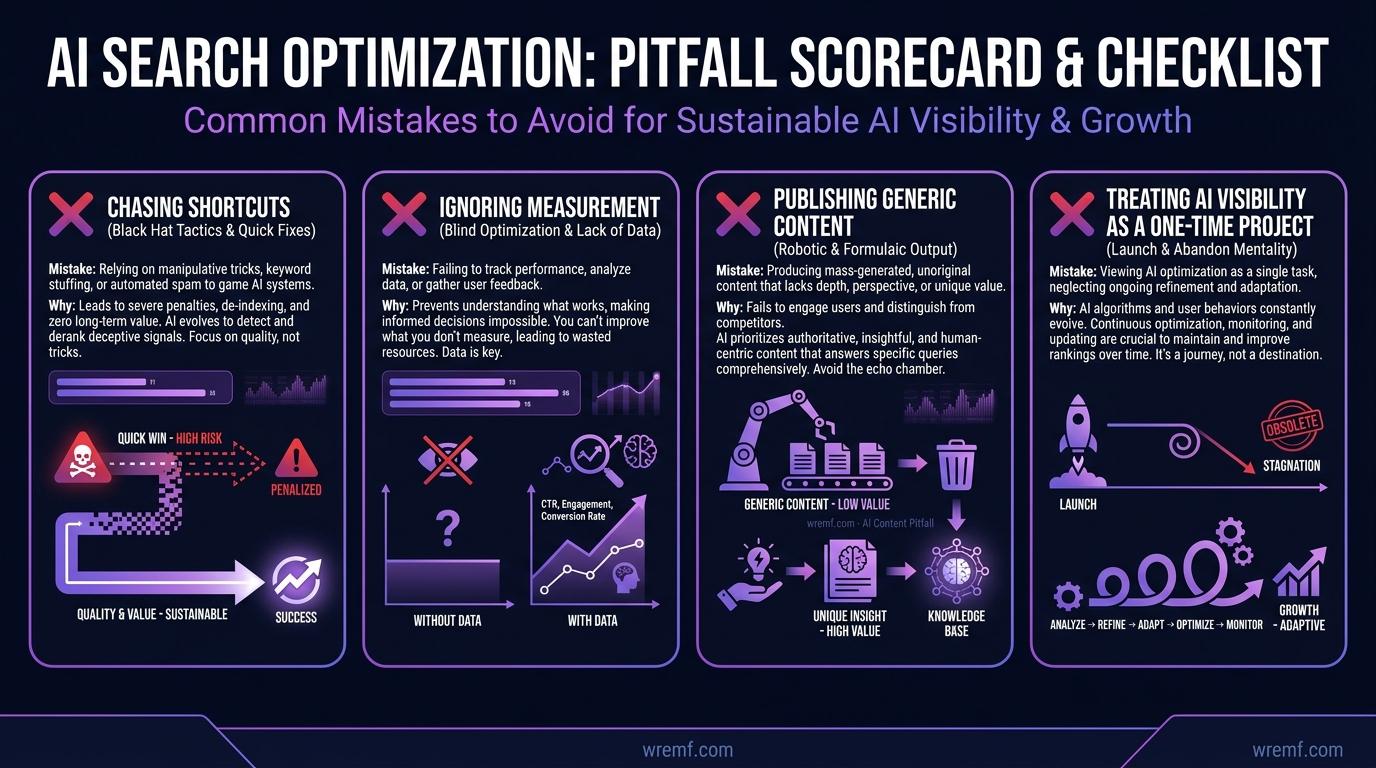
The biggest AI search optimization mistakes are chasing shortcuts, ignoring measurement, publishing generic content, and treating AI visibility as a one-time project.
AI search optimization fails when teams optimize only for surface signals. Keyword density, schema markup, AI-written content volume, and one-off prompt checks cannot replace clear strategy, technical health, source trust, and measurable workflows.
Common pitfalls include:
| Pitfall | Why It Hurts | Better Approach |
|---|---|---|
| Treating AI search as separate from SEO | Weak technical foundations reduce discovery | Combine SEO, AEO, and GEO |
| Publishing generic AI content | Creates semantic collapse and low differentiation | Use specific entities, examples, and methodology |
| Ignoring source citations | Competitors may control the cited source set | Track and improve citation share |
| Measuring only rankings | Misses AI-generated answers and zero-click influence | Track prompts, citations, and sentiment |
| Blocking important crawlers accidentally | Reduces discoverability | Audit robots.txt and rendered content |
| Overusing schema markup without better content | Adds structure without substance | Pair schema with useful answer-first content |
| Forgetting content freshness | AI systems may retrieve outdated facts | Schedule regular audits |
| Ignoring local and international variation | Wrong country or location sources may be cited | Use hreflang, localization, and local authority |
| Relying on one AI engine | Visibility varies across AI models | Track multiple AI engines |
| Overpromising results | Damages trust | Report measurable progress and limitations |
In practical AI visibility audits, SEO teams frequently discover that the problem is not one missing keyword. The problem is usually a system issue involving weak entity clarity, poor internal links, outdated third-party sources, low citation quality, and missing comparison content.
AI search optimization should not promise guaranteed rankings, guaranteed AI citations, guaranteed revenue, or instant search traffic. The responsible goal is to improve visibility probability, answer accuracy, citation presence, source quality, and reporting clarity.
KEY TAKEAWAY: AI search optimization fails when teams chase shortcuts instead of building a measurable system for technical readiness, content clarity, source trust, and AI visibility tracking.
Those mistakes are often reinforced by myths, so the next section addresses the most common misconceptions directly.
Common Myths About AI Visibility Debunked
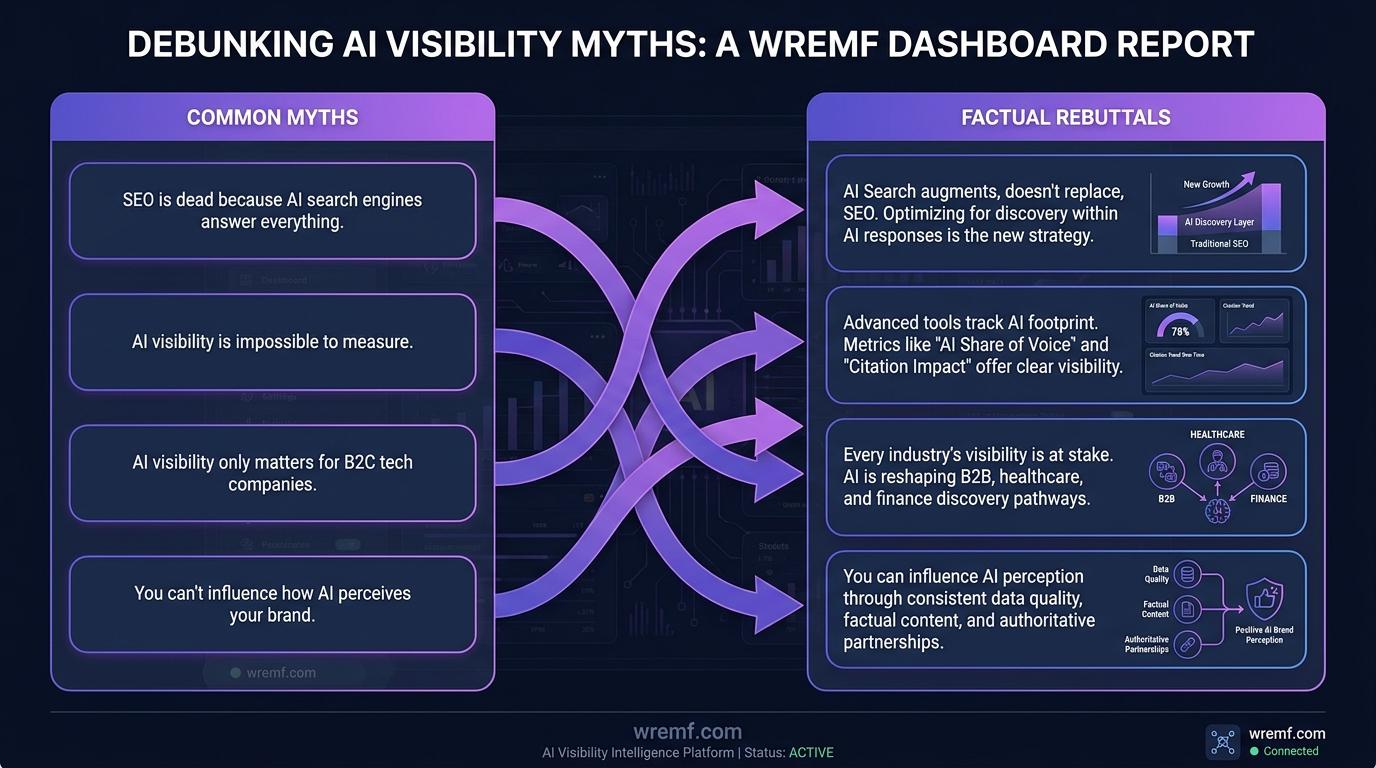
AI visibility is measurable, actionable, and connected to SEO, AEO, GEO, content strategy, citations, source consistency, and technical foundations.
MYTH: SEO is dead because AI search engines answer everything.
FACT: SEO is not dead. Search Engine Optimization still supports crawlability, relevance, technical quality, content quality, links, and search traffic. AI search adds a new layer where brands must also measure AI-generated answers, citations, sentiment, and recommendations.
MYTH: AEO and GEO replace SEO.
FACT: AEO and GEO do not replace SEO. AEO makes content easier for answer engines to extract, while GEO helps generative systems understand, cite, and describe a brand. The strongest 2026 strategy connects SEO, Answer Engine Optimization, and Generative Engine Optimization.
MYTH: AI visibility is impossible to measure.
FACT: AI visibility can be measured through prompt tracking, brand mentions, source citations, AI share of voice, competitor visibility, answer sentiment, and AI traffic attribution where available. Measurement is imperfect because some AI influence happens without clicks, but prompt-level and citation-level tracking still gives teams useful decision data.
MYTH: Rankings alone are enough.
FACT: Rankings show where pages appear in traditional search results. Rankings do not show whether ChatGPT, Claude, Gemini, Perplexity, Copilot, Google AI Overviews, DeepSeek, Grok, Meta AI, or Mistral mention, cite, or recommend your brand. AI visibility requires answer-level monitoring.
MYTH: Schema markup guarantees AI citations.
FACT: Schema markup helps clarify entities and page meaning, but it does not guarantee citations. AI citations depend on relevance, authority, freshness, source quality, extractability, and whether the content answers the prompt clearly.
KEY TAKEAWAY: AI visibility is not magic, a replacement for SEO, or a ranking shortcut. AI visibility is a measurable system built from search fundamentals, answer-ready content, entity clarity, and source trust.
With the myths addressed, the final step is answering the questions buyers, founders, agencies, and SEO teams ask most often.
Frequently Asked Questions
What are the best AI search optimization best practices for 2026?
The best AI search optimization best practices for 2026 are technical SEO, structured data, entity clarity, answer-first content, source-backed claims, prompt tracking, citation monitoring, competitor visibility, source consistency, content freshness, and AI traffic attribution. Teams should optimize for search engines, AI Overviews, ChatGPT, Perplexity, Claude, Gemini, Copilot, and other AI models. The goal is not only to rank pages. The goal is to become discoverable, understandable, citable, and accurately represented in AI-generated answers.
What is the difference between SEO and GEO?
SEO focuses on improving visibility in traditional search engine results, while GEO focuses on improving visibility inside AI-generated answers, citations, summaries, and recommendations. SEO measures rankings, impressions, clicks, CTR, and search traffic. GEO measures AI visibility, brand mentions, prompt coverage, source citations, sentiment, and competitor presence. The two disciplines overlap because GEO still depends on crawlable pages, useful content, authority, structured data, and clear entity relationships. The best strategy uses SEO as the foundation and GEO as the AI visibility layer.
What is the difference between AEO and GEO?
AEO, or Answer Engine Optimization, focuses on making content easy for answer engines to extract as direct answers. GEO, or Generative Engine Optimization, focuses on how generative AI systems understand, cite, compare, and recommend brands. AEO is strongest for definitions, FAQs, snippets, and voice-style queries. GEO is broader because it includes source citations, competitor comparisons, AI share of voice, sentiment, and brand representation across AI models. Both are important in 2026 because users ask questions in search engines and AI assistants.
Does traditional keyword research still work in AI search?
Traditional keyword research still works, but it is no longer enough by itself. Keywords reveal demand and vocabulary, while conversational queries reveal how people ask AI systems for answers. AI search optimization should combine primary keywords, secondary keywords, long-tail keyphrases, entity relationships, prompt matching, competitor analysis, and source citation tracking. A page should not only repeat a keyword. A page should answer the user’s question clearly, define related entities, support claims with trusted sources, and connect to the next logical action.
How do I optimize for Google AI Overviews?
Optimize for Google AI Overviews by publishing helpful, reliable, people-first content with clear answers, strong structure, accurate facts, source-backed claims, internal links, and structured data where appropriate. Google AI Overviews appear for some queries and summarize information from sources across the web. Your goal is to make pages useful, crawlable, extractable, and trustworthy. Focus on concise definitions, complete explanations, comparison tables, original value, freshness, and E-E-A-T signals. Do not rely on schema markup alone or unsupported claims.
How do I optimize for Perplexity and ChatGPT?
Optimize for Perplexity and ChatGPT by creating clear, source-backed content that answers natural-language prompts and can be cited or linked. Perplexity emphasizes citations, so pages should include precise definitions, factual claims, useful tables, and authoritative references. ChatGPT search can provide timely answers with links to relevant web sources, so page clarity and source accessibility matter. Track the prompts buyers use, monitor whether your brand is mentioned or cited, and compare which sources AI engines use for competitors.
What is entity clarity and how do I improve it?
Entity clarity means your brand, product, audience, category, features, pricing, locations, and methodology are consistently defined across your website and trusted sources. Improve entity clarity by writing a canonical brand description, using consistent product naming, adding structured data, building clear internal links, updating third-party profiles, and defining important concepts on key pages. Entity clarity helps AI models understand how your brand relates to a topic, use case, market, competitor set, and buyer question.
What is semantic collapse and why does it matter?
Semantic collapse happens when many pages or brands use the same generic language, making them difficult for search engines and AI models to distinguish. It matters because AI-generated answers may ignore or misclassify brands that lack clear differentiation. To avoid semantic collapse, use specific entities, audience details, methodology, product features, pricing context, examples, use cases, and source-backed claims. A page should explain what makes the brand meaningfully different without relying on vague phrases or repeated marketing slogans.
How does content freshness affect AI search optimization?
Content freshness affects AI search optimization because outdated pages can lead to inaccurate AI summaries, weak citations, and poor buyer trust. Freshness is especially important for pricing, product features, statistics, regulations, AI platform behavior, local business details, and international information. Teams should review important pages regularly, update old statistics, refresh source links, correct outdated positioning, and check whether AI engines cite old or wrong sources. Fresh content does not guarantee visibility, but stale content increases risk.
Does hreflang still matter in 2026?
Hreflang still matters in 2026 for websites with multiple language or regional versions. Hreflang tags help search engines understand which page version should appear for a specific language or country. However, hreflang does not solve weak localization, duplicate content, or unclear regional value. International AI search also depends on local terminology, pricing, regulations, examples, authority signals, and source consistency. If AI Overviews cite sources from the wrong country, the issue may be weak regional clarity, not only hreflang.
Should I use ccTLDs, subdomains, or subdirectories in 2026?
The best international URL structure depends on resources, market strategy, and localization needs. Subdirectories are often easier to manage because they consolidate authority and simplify technical operations. ccTLDs can send strong country signals, but they require more investment and separate authority building. Subdomains can work, but they may add operational complexity. For AI search, the structure matters less than whether each regional page has clear localized value, hreflang accuracy, consistent entity signals, and country-specific trust signals.
Do I need separate content for countries that speak the same language?
You need separate content for countries that speak the same language when pricing, regulations, availability, examples, terminology, competitors, or customer expectations differ by country. If the content is identical, separate pages can create duplication and weak regional relevance. For AI search, country-specific pages should clarify why the market is different. That may include local use cases, local authority sources, local Business Profile data, geographic location references, and country-specific product or service details.
Why are my localized pages not showing in AI Overviews?
Localized pages may not show in AI Overviews if they are weakly differentiated, poorly linked, blocked from crawling, missing hreflang tags, lacking local authority, or too similar to other regional pages. AI Overviews may cite stronger third-party sources or pages from the wrong country if your local page does not provide enough unique regional value. Review crawlability, structured data, URL structure, local examples, source citations, internal links, and country-specific content depth.
Why do AI Overview citations come from the wrong country?
AI Overview citations may come from the wrong country when the local source ecosystem is weak, hreflang is inaccurate, regional pages are too similar, or stronger sources exist in another market. This can also happen when country-specific pricing, regulations, or terminology are missing. To fix it, improve localization, add country-specific evidence, build regional authority, update business profiles, strengthen internal links, and ensure search engines can clearly identify the correct regional version.
What is source citation tracking?
Source citation tracking is the process of monitoring which websites, pages, and third-party sources AI engines cite when answering prompts. Source citation tracking matters because citations reveal which sources influence AI-generated answers. If competitors are cited more often, your brand may need clearer content, stronger authority, better source consistency, or more useful comparison pages. WREMF’s source citation tracking helps teams see which sources influence AI visibility and where citation opportunities exist.
How can businesses measure AI search optimization success?
Businesses can measure AI search optimization success through prompt visibility, brand mentions, AI citations, citation share, AI share of voice, competitor visibility, sentiment, answer accuracy, AI referral traffic, conversions, and pipeline influence. Traditional SEO metrics such as impressions, rankings, clicks, and CTR remain useful, but they do not show the full AI visibility picture. A strong reporting model combines Google Search Console, GA4, AI engine monitoring, citation analysis, and business outcome tracking.
Are AI visibility tools worth the investment in 2026?
AI visibility tools are worth considering when manual testing becomes too inconsistent, slow, or difficult to report. A team can manually test a few prompts, but manual checks do not scale across ChatGPT, Claude, Gemini, Perplexity, Copilot, AI Overviews, competitors, geographies, and buyer stages. AI visibility tools help teams monitor prompt performance, source citations, brand mentions, sentiment, and competitor visibility over time. WREMF is useful for brands, agencies, consultants, and growth teams that need repeatable reporting and action recommendations.
How does WREMF help with AI search optimization?
WREMF helps teams track, improve, and prove AI visibility across major AI discovery surfaces. The platform combines prompt tracking, source citation analysis, competitor visibility, AI share of voice, AI traffic attribution, GEO audits, AI-ready content briefs, SEO testing, visibility scoring, scheduled monitoring, white-label reporting, API access, MCP integrations, BYOK support, and client portals. WREMF can be used as software, an agency service, or a hybrid software plus managed execution solution.
Is SEO still worth investing in for startups in 2026?
SEO is still worth investing in for startups in 2026, but the strategy should include AI visibility from the beginning. Startups should build clear entity pages, answer customer questions directly, create comparison content, use structured data, maintain source consistency, and measure AI-generated answers. SEO creates compounding discoverability, while AEO and GEO help startups appear in answer engines and AI-assisted buying journeys. The right investment depends on category demand, sales cycle, content quality, and execution capacity.
What should agencies offer clients for AI search optimization?
Agencies should offer AI visibility audits, prompt tracking, source citation tracking, competitor visibility analysis, GEO audits, AEO strategy, content optimization, AI-ready content briefs, technical AI visibility reviews, entity clarity cleanup, source consistency cleanup, monthly reporting, and implementation support. Agencies should avoid promising guaranteed AI citations or rankings. The strongest agency offer combines software-backed measurement with clear deliverables, senior-led execution, transparent methodology, and reporting that connects AI visibility to search traffic and business outcomes.
Conclusion
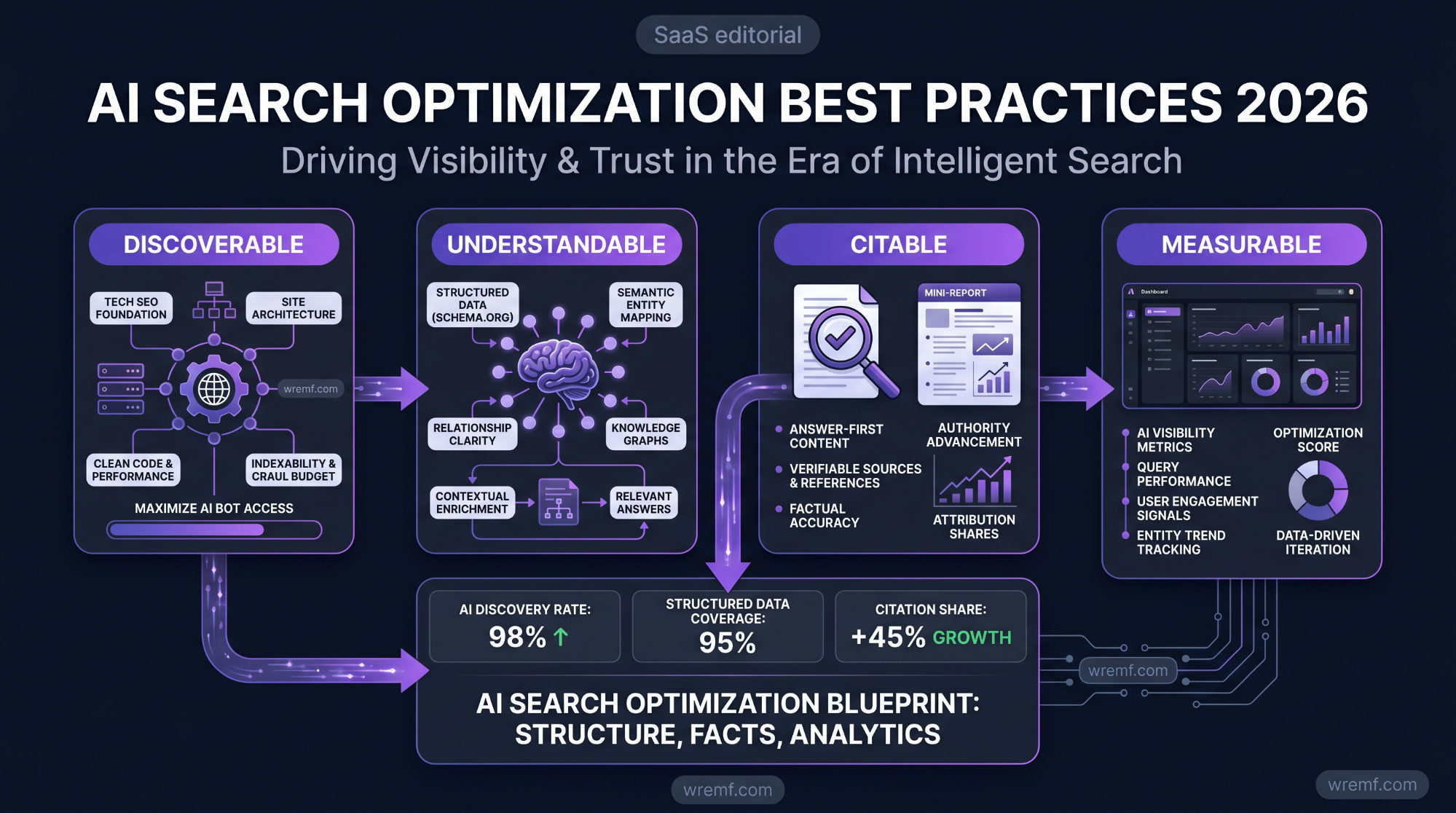
AI search optimization best practices 2026 are about becoming discoverable, understandable, citable, and measurable across search engines, AI Overviews, answer engines, and Large Language Model systems. Rankings still matter, but they no longer show the full picture. Teams need technical SEO, structured data, entity clarity, answer-first content, source consistency, prompt tracking, citation monitoring, AI share of voice, and attribution workflows. WREMF helps B2B teams turn AI visibility from a guessing game into a repeatable system across 10 AI engines. To start measuring and improving how AI search describes your brand, explore the WREMF platform suite or talk to the WREMF agency team.
Related reading
- Best Answer Engine Optimization for Enhancing AI Visibility
- AI Citation Optimization Services: The Complete B2B Guide to Getting Cited in AI Search
- SEO for AI Search: Ranking in Google AI Overviews, ChatGPT, Perplexity, Gemini, and Answer Engines
- Perplexity AI Optimization: The Complete Guide to AI Search Visibility in 2026