Perplexity AI Optimization: The Complete Guide to AI Search Visibility in 2026
Learn how Perplexity AI Optimization enhances search visibility through SEO, AEO, and GEO techniques.
By WREMF Team · 2026-08-22
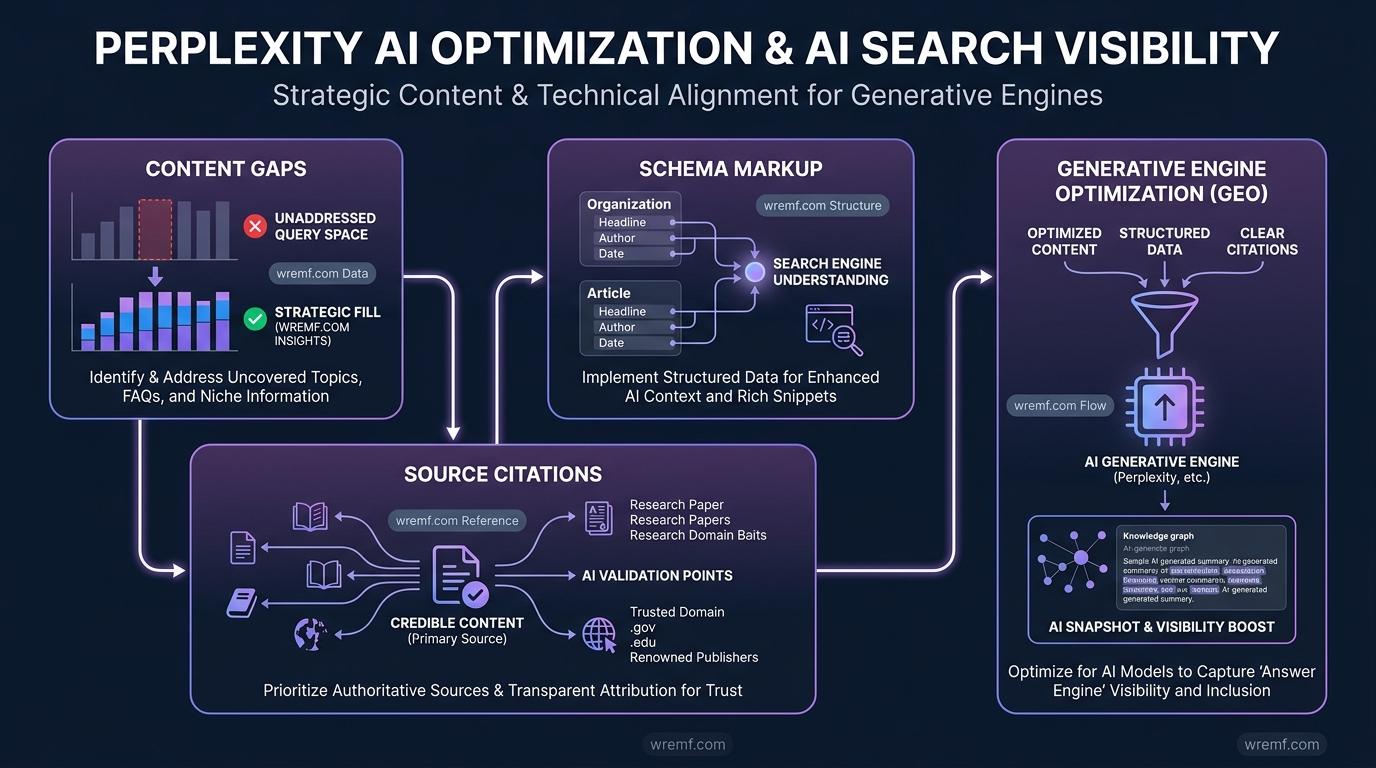
Perplexity AI Optimization focuses on improving brand visibility within AI-generated answers by making content better suited for retrieval, citation, and recommendation. It integrates traditional SEO with Answer Engine Optimization and Generative Engine Optimization. The process involves enhancing content for direct answers, ensuring technical accessibility, and improving citation rates. Key components include technical crawl access, schema markup, source citations, and addressing content gaps. This strategy helps businesses appear more frequently in AI-generated recommendations, and cited sources, elevating brand credibility and visibility.
Key takeaways
- Perplexity AI Optimization enhances content for AI-generated answers.
- Combining SEO with AEO and GEO improves content citation.
- Structured content, technical access, and schema markup are crucial.
- Monitoring reputation on reputable domains boosts source authority.
- Integrating prompt tracking and citation tracking aids visibility.
Perplexity AI Optimization: The Complete Guide to AI Search Visibility in 2026
Perplexity AI Optimization is the process of making your brand, content, and sources easier for Perplexity to retrieve, cite, and recommend. Perplexity is an AI-powered answer engine that provides source-backed responses, which means visibility depends on more than traditional keyword rankings. WREMF helps B2B teams track, improve, and prove how their brand appears across Perplexity AI, ChatGPT, Claude, Gemini, Google AI Overviews, Copilot, DeepSeek, Grok, Meta AI, and Mistral. This guide covers Generative Engine Optimization, technical crawl access, schema markup, source citations, Content Gaps, AI traffic attribution, developer workflows, ecommerce features, risks, FAQs, and measurement. Use it to build a practical Perplexity optimization system that is structured, measurable, and ready for AI-generated answers.
What Is Perplexity AI Optimization?
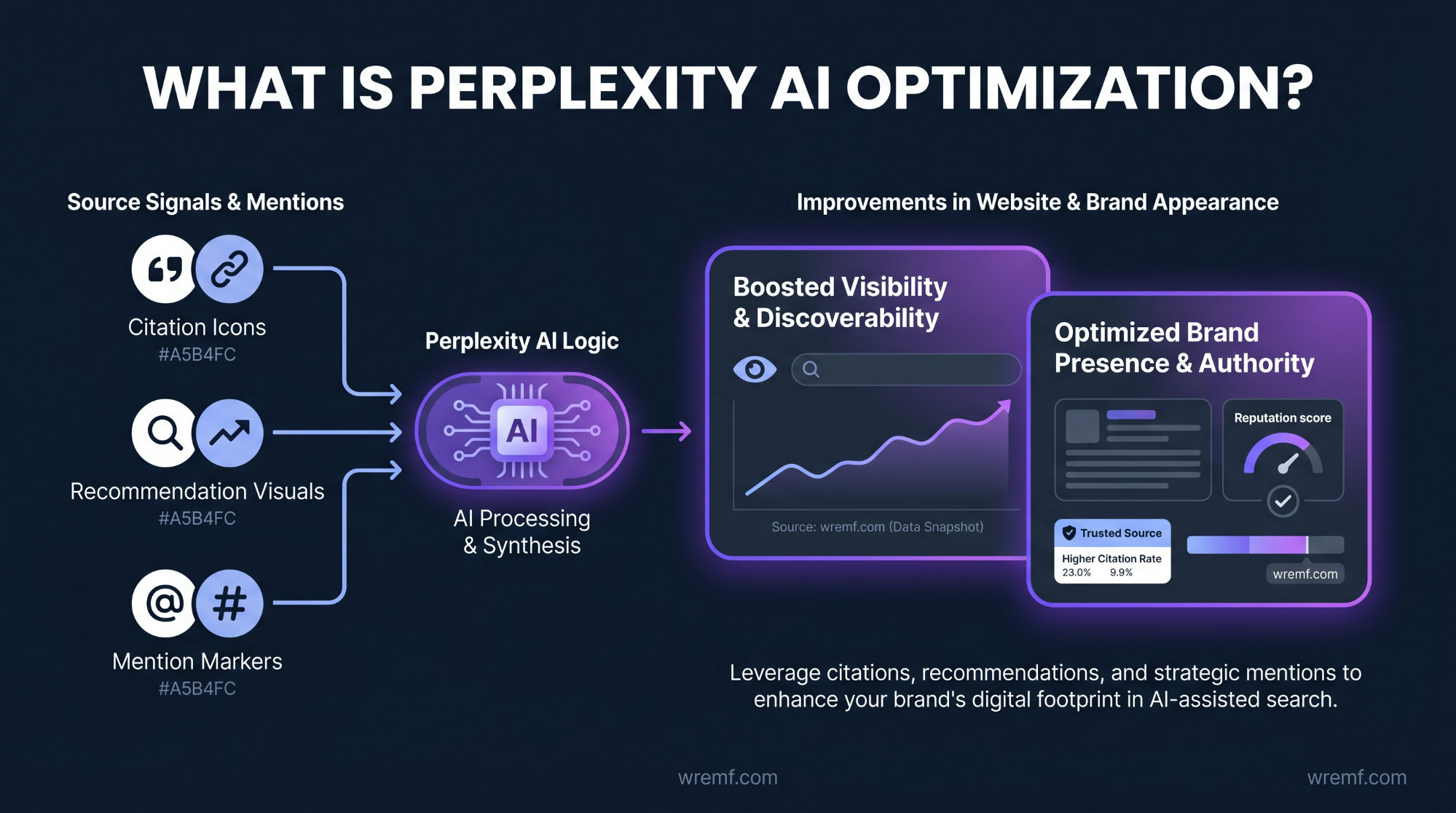
Perplexity AI Optimization improves how your website, brand, and source ecosystem appear inside Perplexity AI answers. The goal is to earn visibility through citations, mentions, recommendations, and accurate AI-generated answers.
Perplexity AI is a search platform that combines live web retrieval with an AI model to produce summarized answers with cited sources. Unlike a traditional search engine that mostly returns links, Perplexity AI gives users a conversational experience where the answer, sources, and follow-up questions appear together. Perplexity’s own crawler documentation explains that Perplexity-User may visit a page when a user asks Perplexity a question so the system can provide an accurate answer and include a link to that page. (Perplexity)
AI search visibility is the measurable presence of a brand inside AI-generated answers, source citations, recommendations, and summaries. AI search visibility matters because buyers can compare products, evaluate vendors, and form opinions before they ever click a website.
Perplexity AI Optimization combines search engine optimization, Answer Engine Optimization, and Generative Engine Optimization. Search engine optimization helps your content become discoverable in search engines. Answer Engine Optimization helps your content answer specific user queries in a concise format. Generative Engine Optimization helps your content become retrievable, citable, and usable inside Generative AI systems.
WREMF helps teams turn this into an operational workflow through AI visibility tracking, prompt intelligence, source citation tracking, and competitor monitoring. Instead of manually testing a few prompts, teams can monitor Perplexity AI, ChatGPT, Claude, Gemini, Google AI Overviews, Copilot, DeepSeek, Grok, Meta AI, and Mistral in one structured system.
| Concept | What it means | Why it matters for Perplexity AI |
|---|---|---|
| SEO | Optimizing pages for search engines | Helps content become discoverable and trusted |
| AEO | Structuring content for direct answers | Helps answer engines extract clear responses |
| GEO | Optimizing content for Generative AI retrieval and synthesis | Helps AI-generated answers cite and summarize your brand |
| Prompt tracking | Monitoring user queries across AI engines | Shows where your brand appears or disappears |
| Source citations | Tracking which sources AI engines cite | Shows which reputable domains influence answers |
| Citation share | Measuring your share of citations across prompts | Turns AI visibility into a comparable metric |
| Content Gaps | Identifying missing or weak content needed for AI answers | Shows what must be created, updated, or clarified |
DID YOU KNOW: Perplexity’s documentation separates PerplexityBot, which is used for indexing, from Perplexity-User, which is used when a live user request may require page access. (Perplexity)
KEY TAKEAWAY: Perplexity AI Optimization is a measurable discipline that connects SEO, AEO, GEO, prompt tracking, source citations, and answer-quality improvement.
The next section explains why Perplexity requires a different optimization model from classic Google ranking work.
Why Perplexity AI Requires a New SEO Paradigm
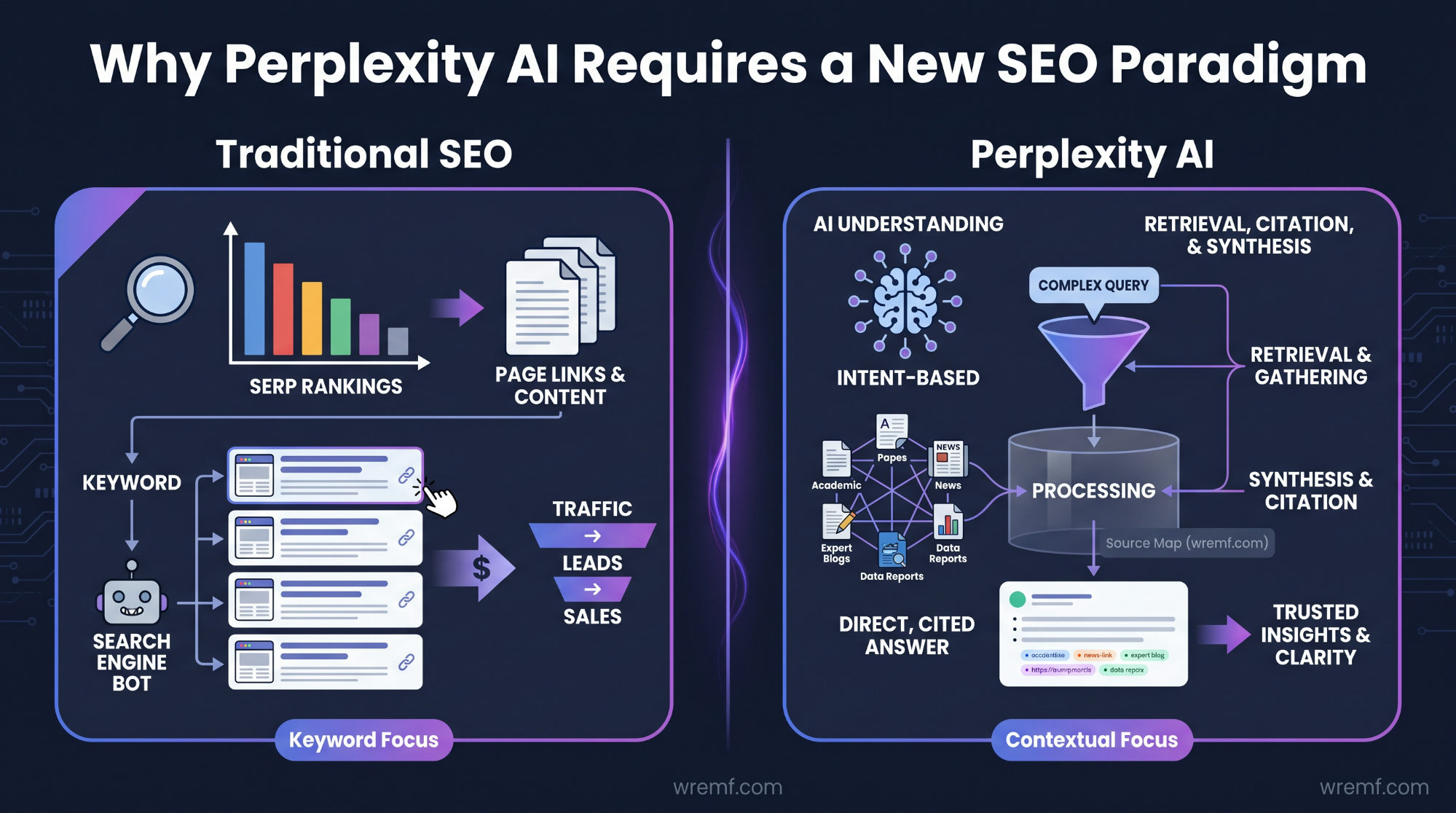
Perplexity AI requires a new SEO paradigm because it retrieves, selects, cites, and synthesizes sources instead of only ranking pages. Traditional ranking factors still matter, but they no longer describe the full visibility problem.
A search engine usually indexes pages, ranks results, and sends users to websites. An Answer Engine gives users a direct answer and shows cited sources. Perplexity AI is an Answer Engine because it can answer user queries with a synthesized response supported by sources, which changes how marketers must think about content optimization.
Answer Engine is a system that returns a direct answer to a user query instead of only showing a list of links. An Answer Engine matters because the user may trust the answer, cited source, and recommendation before clicking through to a website.
Google Search Central explains that Google’s ranking systems prioritize helpful, reliable information created for people rather than content created primarily to manipulate rankings. That guidance still matters for Perplexity AI Optimization because AI search systems also need clear, reliable, source-backed content to retrieve and summarize. (Google for Developers)
The core difference is the measurement unit. In classic search engine optimization, teams often focus on rankings, impressions, clicks, and conversions. In AI search, teams also need to measure citations, brand mentions, competitor inclusion, recommendation visibility, answer sentiment, source consistency, and AI traffic attribution.
| Visibility question | Traditional search engine optimization | Perplexity AI Optimization |
|---|---|---|
| What appears? | Ranked web pages | AI-generated answers, citations, and source links |
| What does the user see first? | Title tags and snippets | Synthesized answer and cited sources |
| What gets measured? | Rankings, clicks, CTR, conversions | Prompt visibility, citation share, mentions, recommendations |
| What can go wrong? | Ranking loss | Omission, wrong facts, weak citations, competitor recommendation |
| What must improve? | Page relevance and authority | Retrieval fit, source confidence, answer usefulness, entity clarity |
Generative Engine Optimization is the practice of improving how Generative AI systems retrieve, understand, cite, and synthesize your content. Generative Engine Optimization matters because a brand can rank in Google but still be absent from Perplexity AI, ChatGPT, Gemini, Claude, Copilot, and Google AI Overviews.
AI SEO is the combined practice of adapting SEO work for AI-generated answers, generative AI chatbots, search generative experiences, and answer engines. AI SEO should include keyword research, semantic keywords, technical SEO, content structure, source citations, natural language queries, and source ecosystem monitoring.
Google SGE was the earlier experimental name associated with Google’s search generative experiences before AI Overviews became the broader public product direction. Google SGE remains a useful comparison point because marketers still ask how Perplexity AI, Google SGE, Google AI Overviews, ChatGPT, Gemini, and Copilot differ. Google SGE also helped push the industry toward Answer Engine Optimization and Generative Engine Optimization.
IMPORTANT: Rankings alone cannot prove Perplexity visibility because AI-generated answers may cite third-party sources, community discussions, directories, documentation, or competitors even when your page ranks well in Google.
KEY TAKEAWAY: Perplexity AI Optimization expands SEO from rankings into prompts, citations, sources, competitors, recommendations, and answer accuracy.
To optimize for this model, you need to understand how Perplexity retrieves and uses information.
How Perplexity Processes Information
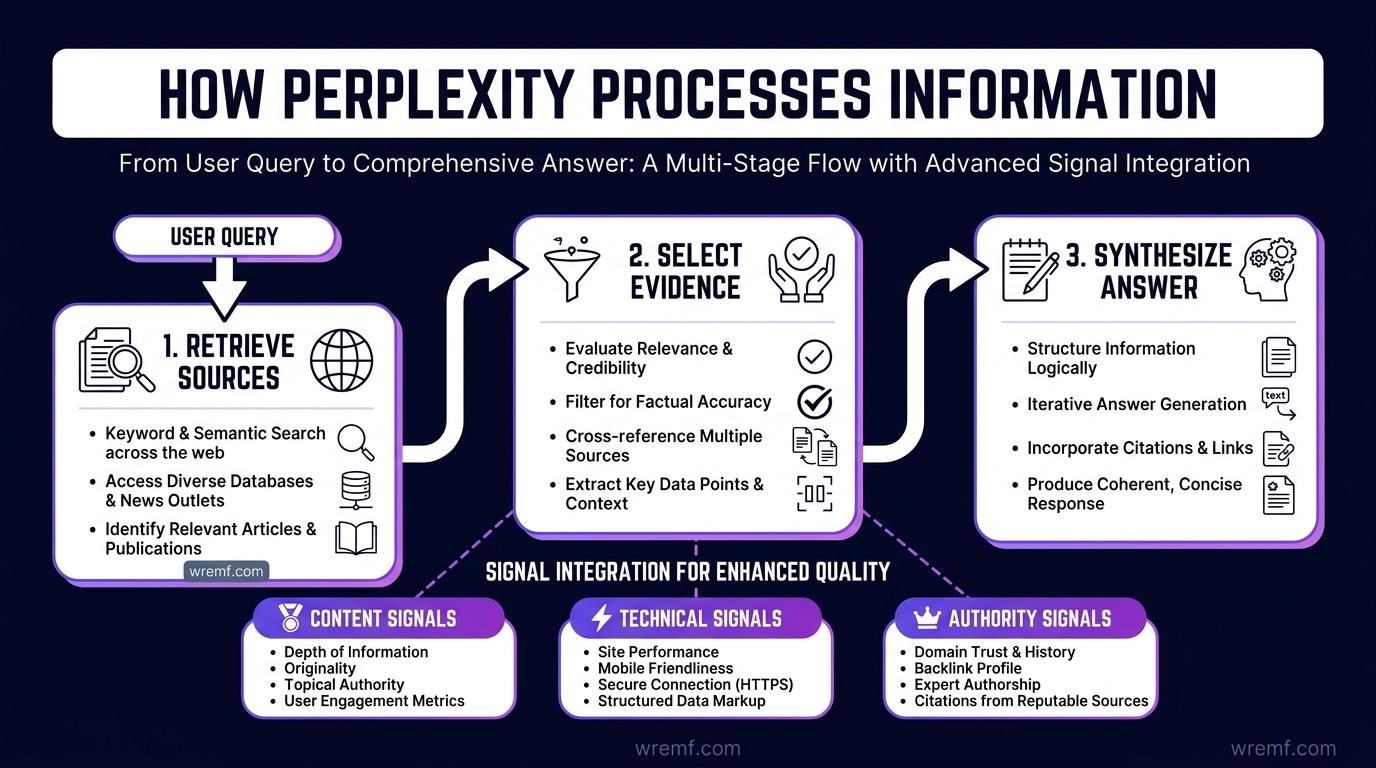
Perplexity processes information by retrieving relevant sources, selecting useful evidence, and using an AI model to synthesize an answer. Perplexity AI Optimization improves the content, technical, and authority signals that support that process.
Retrieval-Augmented Generation is a method where an AI model retrieves external information before generating an answer. Retrieval-Augmented Generation matters because the final answer depends on both the Large Language Model and the sources retrieved for a specific user query.
Large Language Model is an AI model designed to understand and generate human language using natural language processing. A Large Language Model matters for Perplexity AI because it helps synthesize retrieved information into readable AI-generated answers.
Natural language processing is the field of Artificial Intelligence that helps systems interpret, process, and generate human language. Natural language processing matters because Perplexity AI users often submit long, conversational user queries rather than short keyword fragments.
Perplexity’s extraction pipeline can be understood as a practical sequence: access the page, extract readable content, match content to user queries, select sources, and generate a cited answer. Perplexity’s extraction pipeline rewards accessible pages, direct answers, strong entities, factual clarity, and source-backed claims.
Perplexity’s extraction pipeline is not simple keyword matching. Perplexity’s extraction pipeline needs clear relationships between entities, topics, examples, and sources. Perplexity’s extraction pipeline can also use reputable domains beyond your own website, which means Perplexity AI Optimization must include third-party source cleanup.
Perplexity’s extraction pipeline should be treated as a source selection system. Perplexity’s extraction pipeline may use owned pages, publisher coverage, documentation, reviews, community content, industry directories, and authoritative lists. Perplexity’s extraction pipeline is more likely to work well when content includes concise definitions, Q&A formatting, comparison tables, structured elements, and source citations.
The exact Perplexity citation algorithm is not public. Practical AI visibility audits usually treat the citation algorithm as a mix of retrieval relevance, source authority, answer fit, factual clarity, and source accessibility. This is not an official ranking formula, but it is a useful working model for Perplexity AI Optimization.
The citation algorithm should not be confused with Google’s ranking factors. Ranking factors explain how search engines order pages. The Perplexity citation algorithm appears to determine which sources are useful enough to support AI-generated answers. For marketers, the citation algorithm is best approached through testing prompts, inspecting citations, and improving Content Gaps.
A practical L3 reranking system for Perplexity AI Optimization can be modeled in three layers. The L3 reranking system is not an official Perplexity disclosure. The L3 reranking system is a strategic framework for understanding how retrieval, source confidence, and synthesis usefulness can affect citation rates.
| Layer | What it evaluates | What to improve |
|---|---|---|
| Layer 1: Retrieval fit | Whether a source answers the user query | Add answer-first sections and natural language queries |
| Layer 2: Source confidence | Whether the source is credible | Improve author signals, domain authority, reputable domains, and citations |
| Layer 3: Synthesis usefulness | Whether the content can be summarized clearly | Add definitions, tables, FAQs, and factual content blocks |
The L3 reranking system helps SEO teams move beyond keyword density. The L3 reranking system connects content optimization, entity verification, factual accuracy, prompt design, and answer usefulness. The L3 reranking system also explains why a page can be indexed but not cited.
KEY TAKEAWAY: Perplexity AI Optimization works best when content is designed for retrieval fit, source confidence, and answer synthesis.
The next section explains how technical access affects whether Perplexity can use your content.
Technical Optimization for PerplexityBot, Robots.txt, and Site Access
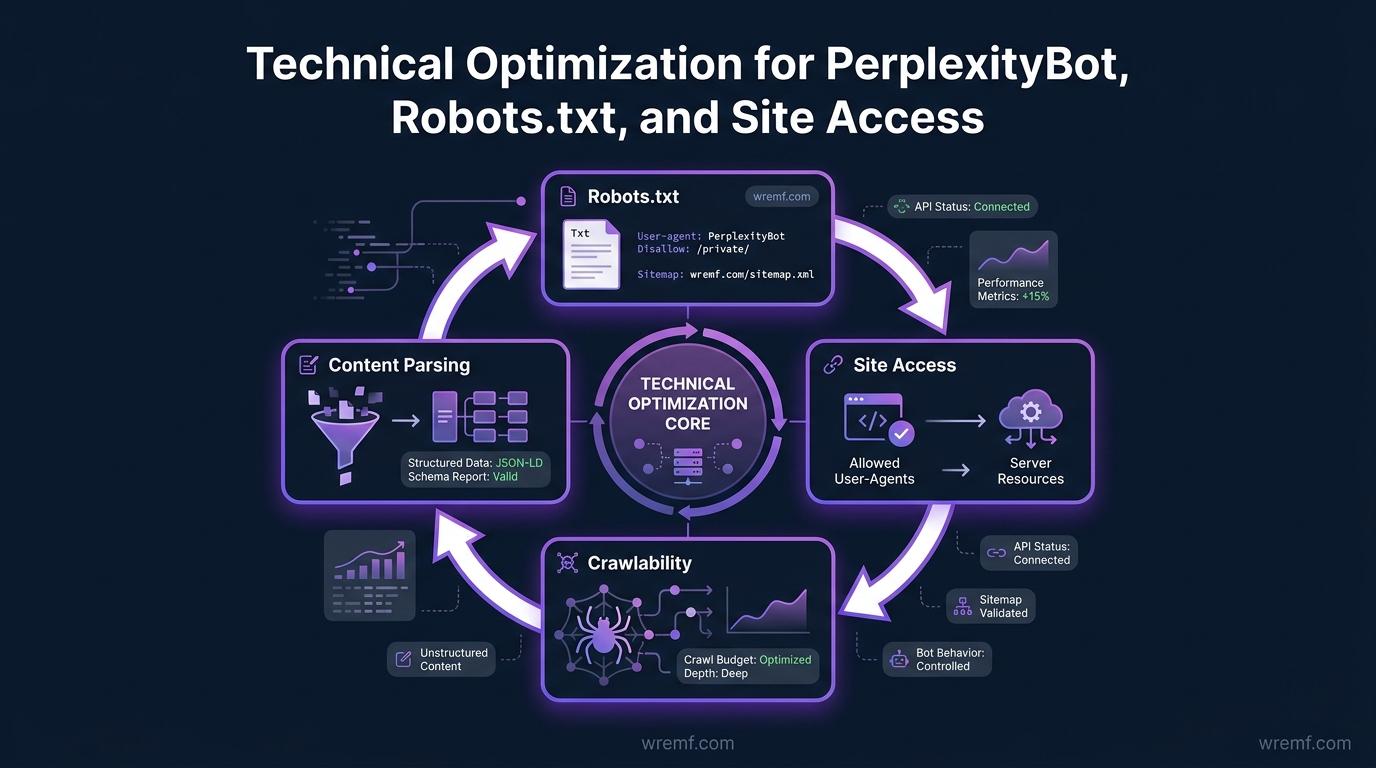
Technical optimization helps PerplexityBot and related AI crawlers access, parse, and understand your content. If your site blocks retrieval or hides important information, Perplexity AI cannot reliably cite it.
PerplexityBot is Perplexity’s crawler for indexing web content. Perplexity-User supports user actions within Perplexity and may visit a page when a user asks a question that requires page access. Perplexity’s documentation states that Perplexity-User is not used for web crawling or to collect content for training AI foundation models. (Perplexity)
Perplexity’s robots.txt help article states that Perplexity respects robots.txt directives and that PerplexityBot will not index the full or partial text content of a site that disallows it through robots.txt. Perplexity also says it may still index the domain, headline, and a brief factual summary if a page is blocked. (Perplexity AI)
Robots.txt is a file that gives crawler access instructions for a website. Robots.txt matters for Perplexity AI Optimization because blocking the wrong crawler can reduce citation visibility, while allowing every crawler without governance may create legal, privacy, or content-control concerns.
Technical teams should review Perplexity access alongside Googlebot, Bingbot, GPTBot, ClaudeBot, and other AI engines. AI engines cannot cite content they cannot access, but unrestricted access is not automatically right for every business. Legal compliance, publisher policy, gated content, and brand safety should guide access rules.
A technical Perplexity AI Optimization audit should include:
Robots.txt rules for PerplexityBot
Firewall rules for Perplexity-User
CDN rules that may block AI crawlers
Server response codes
Canonical tags
JavaScript rendering dependencies
Structured data validity
Internal links to priority pages
Sitemap coverage
Page speed and performance metrics
Crawl logs for AI engines
Rate Limiting rules that may block high-value access
Connection settings for reliable crawler responses
Schema markup is structured data that helps search engines and applications understand page entities, content types, and relationships. Google Search Central explains that Google uses structured data to understand the content of a page and gather information about entities such as people, books, companies, and other things. (Google for Developers)
Schema types that matter for Perplexity AI Optimization include Organization, Article, FAQPage, Product, SoftwareApplication, Service, LocalBusiness, Review, HowTo, Dataset, and BreadcrumbList. Schema types are not a citation guarantee, but schema markup reduces ambiguity and strengthens entity verification.
Performance Optimization matters because slow, blocked, or unstable pages can reduce retrieval quality. Performance Optimization should include sensible Rate Limiting, stable connection settings, connection pooling, caching, server reliability, and clean rendered HTML. Performance metrics such as latency, response codes, and content availability should be reviewed for both human users and crawlers.
TIP: Test your most important pages as a reader and as a crawler. If the answer, facts, author, and internal links are not visible in rendered or raw HTML, Perplexity’s extraction pipeline may miss them.
KEY TAKEAWAY: Technical Perplexity optimization starts with crawler access, robots.txt governance, schema markup, rendering quality, performance stability, and clean site architecture.
Once access is fixed, the next priority is content that Perplexity can extract, cite, and summarize.
Content Strategy for Higher Citation Rates
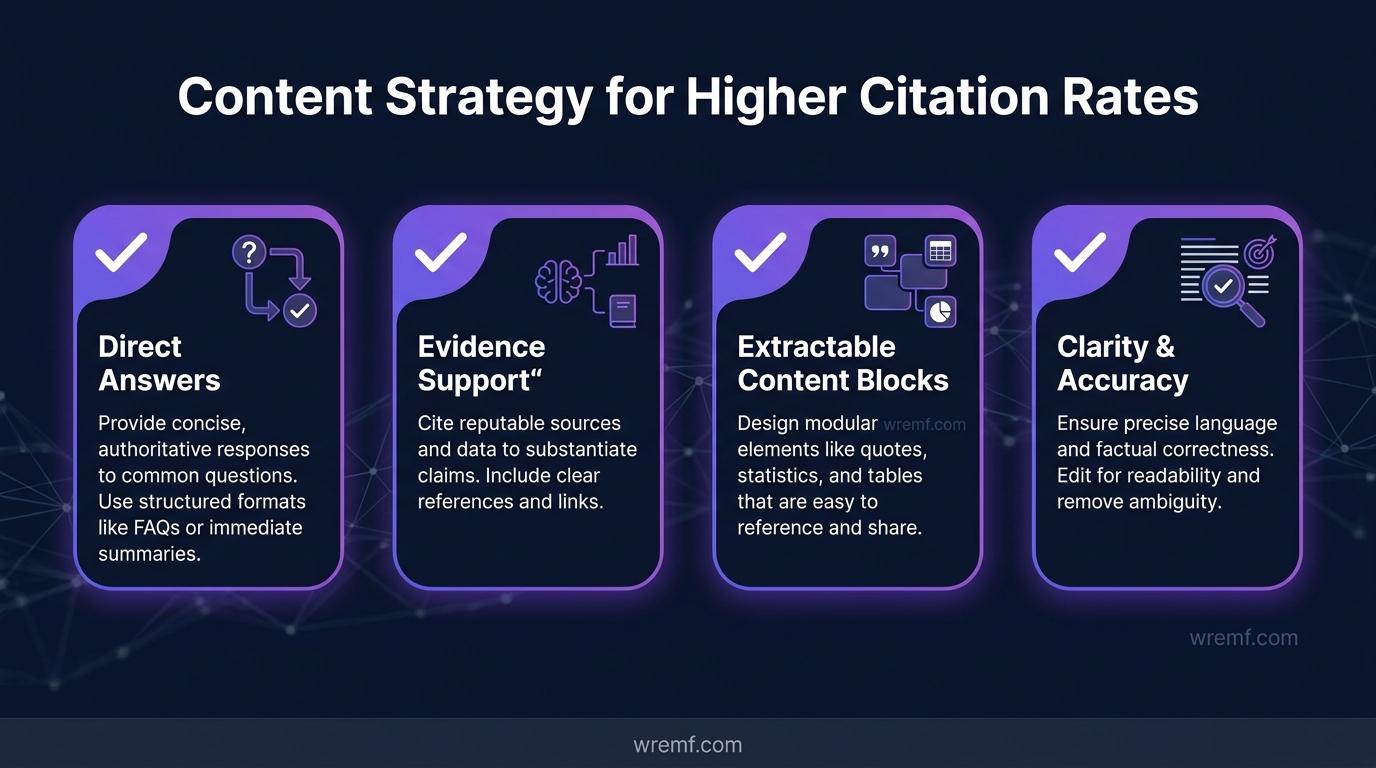
Higher citation rates come from content that directly answers user queries, supports claims with evidence, and presents information in extractable content blocks. Perplexity AI Optimization rewards clarity, factual accuracy, and source usefulness.
Citation rates measure how often your content, domain, or source ecosystem is cited across tracked AI-generated answers. Citation rates matter because a Perplexity AI citation can influence trust even when the user does not click through.
AI citations are source references included inside AI-generated answers. AI citations matter because they show which source helped support the answer, recommendation, or comparison.
The most effective content structure for Perplexity AI Optimization is BLUF, or Bottom Line Up Front. BLUF means the first sentence gives the direct answer before context, nuance, or background. This content structure helps Perplexity AI, ChatGPT, Gemini, Claude, Copilot, Google AI Overviews, and other AI engines extract clean answers.
A strong Perplexity-ready content block usually includes:
One direct answer sentence
One clearly named entity
One supporting fact or source
One practical example
One implication for the reader
One internal link where useful
One concise closing sentence
Semantic keywords are related terms that help clarify topic meaning. Semantic keywords matter because AI search systems need relationships between topics, entities, attributes, and user intent. Semantic keywords should support topic depth, not replace expert content.
Semantic concept density is the concentration of meaningful related concepts inside a content block. Semantic concept density matters because Perplexity AI needs enough detail to understand the answer, category, comparison, and source relevance. Semantic concept density is stronger when content connects Perplexity AI, Answer Engine behavior, search engine optimization, Generative Engine Optimization, source citations, and AI-generated answers.
Topic clusters organize a pillar page and supporting cluster pages around a core subject. Topic clusters matter because Perplexity AI can retrieve multiple related pages to understand topical authority. Topic clusters also help readers move from definitions to implementation, measurement, and tool selection.
A pillar page for Perplexity AI Optimization should cover definitions, technical setup, schema markup, Content Gaps, source citations, citation algorithm assumptions, prompt tracking, prompt length, content freshness, internal links, reputable domains, AI Writer workflows, and measurement. A pillar page should also link to cluster pages that explain AI visibility, source citations, prompt intelligence, GEO audits, and SEO testing.
Q&A formatting helps content match natural language queries. Natural language queries such as “How do I optimize for Perplexity?” and “Why is my website not showing up in ChatGPT or Perplexity?” should be answered in standalone paragraphs. User queries should appear naturally in headings, FAQs, and body content.
Content freshness is the practice of keeping facts, prices, product details, comparisons, and citations current. Content freshness matters because AI search systems can retrieve current pages when answering time-sensitive user queries. Content freshness is especially important for pricing, product features, legal compliance, ecommerce availability, and company achievements.
AI-generated answers are easier to influence when your content blocks are clear, current, and source-backed. AI-generated answers can omit your brand when your website does not provide a direct answer. AI-generated answers can also use competitor or third-party sources when your Content Gaps are larger than your competitors’ Content Gaps.
For teams building a repeatable content optimization workflow, WREMF’s AI-ready content briefs connect user queries, Content Gaps, topic clusters, and answer-first recommendations in one workflow.
KEY TAKEAWAY: Perplexity citation rates improve when content is direct, structured, evidence-led, semantically complete, and aligned with real user queries.
The next section explains why your own website is only one part of the Perplexity visibility system.
Source Citations, Reputable Domains, and Domain Authority
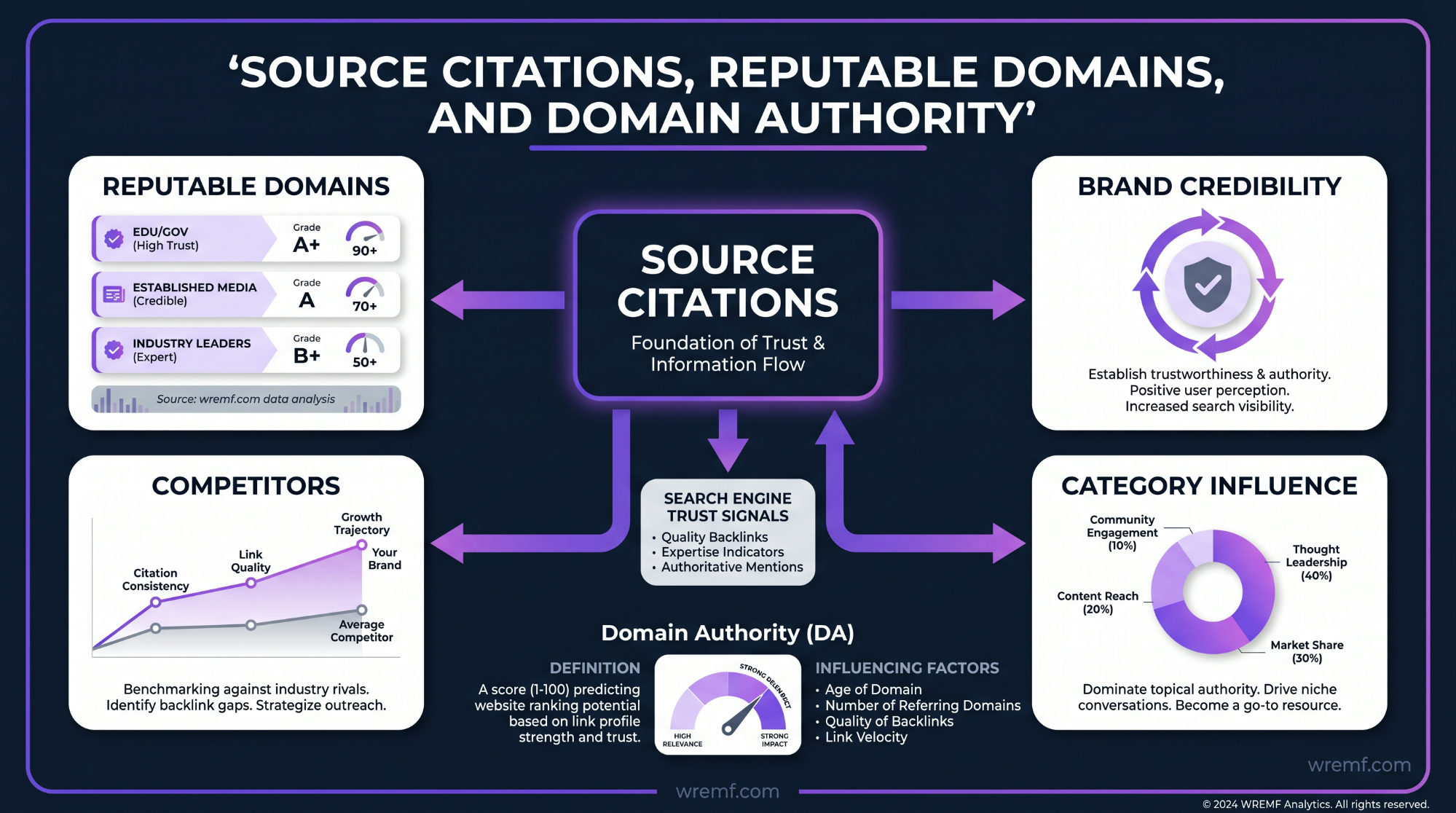
Source citations matter because Perplexity AI uses sources to support AI-generated answers. Reputable domains can shape what Perplexity says about your brand, category, competitors, and credibility.
Source citations are the links or references used by an AI search platform to support an answer. Source citations matter because they influence which facts users trust and which brands appear authoritative.
Reputable domains are trusted websites that AI engines and search engines can use as reliable evidence. Reputable domains matter because Perplexity AI may cite publishers, documentation, review platforms, directories, community discussions, analyst reports, and authoritative lists instead of your own website.
Domain authority is a broad industry concept for the perceived strength, trust, and influence of a domain. Domain authority matters for Perplexity AI Optimization because reputable domains and high-trust sources are more likely to influence AI-generated answers. Domain authority should be improved through legitimate expertise, useful content, citations, links, reviews, and consistent entity information.
In practical AI visibility audits, SEO teams frequently find that Perplexity AI cites reputable domains that the brand does not control. These reputable domains may include Reddit, Quora, G2, Capterra, GitHub, documentation portals, news articles, partner directories, and industry-specific authoritative lists. If these reputable domains contain outdated or inconsistent information, AI-generated answers may repeat that information.
Source consistency is the alignment of facts about your brand across owned and third-party sources. Source consistency helps AI systems reduce ambiguity when generating AI-generated answers about your product, pricing, features, leadership, category, target market, and competitors.
Entity verification is the process of confirming that your brand, product, people, and facts are described consistently across sources. Entity verification matters because Perplexity AI may connect signals from multiple reputable domains. Entity verification reduces the chance that an AI model confuses your brand with a similar company or outdated product.
Barnacle SEO becomes important in Perplexity AI Optimization. Barnacle SEO means improving your presence on authoritative third-party pages that already rank, get cited, or influence AI-generated answers. This may include reputable domains such as review sites, partner pages, software directories, marketplace profiles, industry associations, and authoritative lists.
Authoritative lists are curated pages that compare, rank, or categorize vendors, tools, services, or products. Authoritative lists matter because Perplexity AI may use authoritative lists to answer buying-stage prompts such as “best AI visibility tools,” “top GEO platforms,” or “alternatives to traditional SEO tools.”
Positive reviews also support AI visibility because AI-generated answers may summarize sentiment from third-party platforms. Positive reviews should be specific, recent, and consistent with your positioning. Positive reviews are not a substitute for helpful content, but positive reviews can reinforce brand trust and recommendation visibility.
WREMF’s source citation tracking helps teams identify which reputable domains Perplexity AI and other AI engines cite, where competitors appear, and which source overlaps create opportunities.
KEY TAKEAWAY: Perplexity visibility depends on your owned content and the wider ecosystem of reputable domains, source citations, reviews, and authoritative lists.
After source influence is clear, the next section compares SEO, AEO, GEO, and AI SEO as distinct but connected disciplines.
SEO vs AEO vs GEO for Perplexity AI Optimization
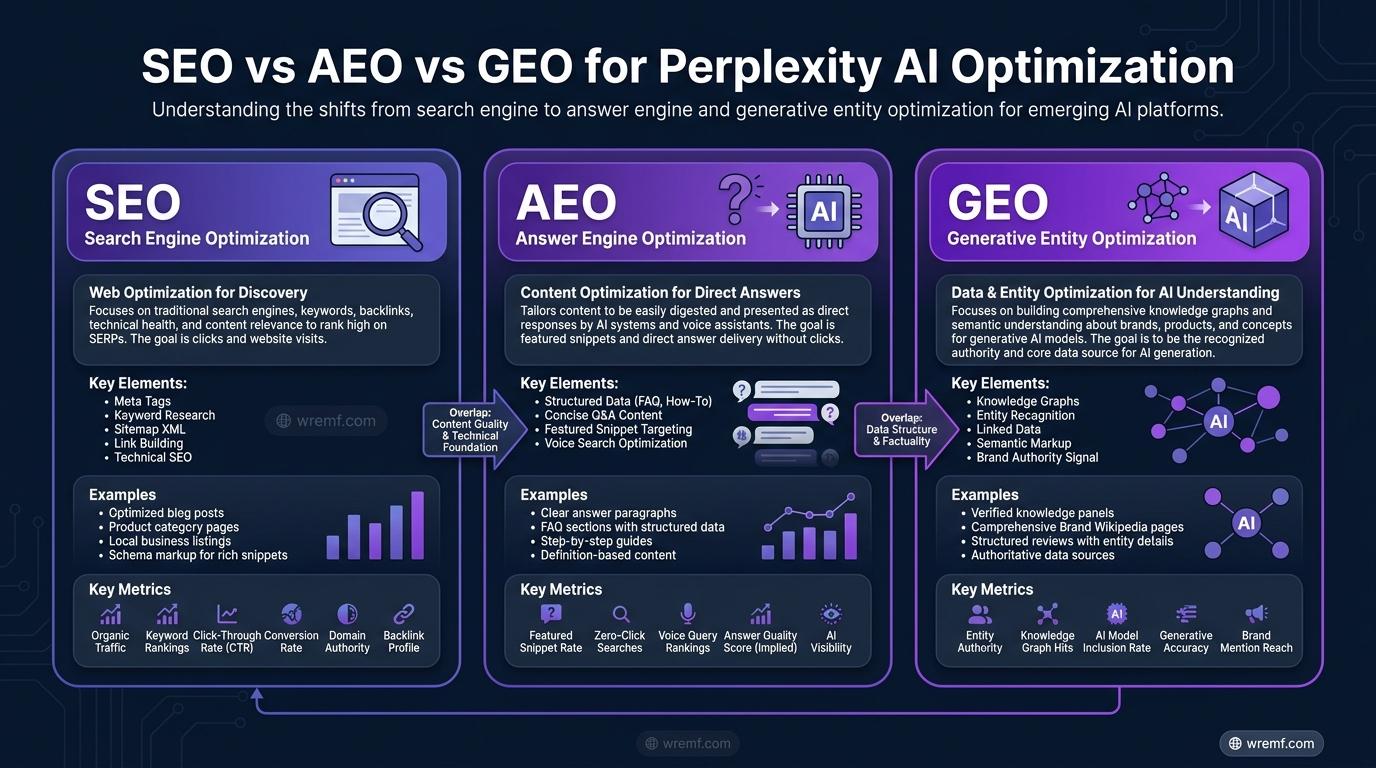
SEO, AEO, and GEO overlap, but each discipline solves a different visibility problem. Perplexity AI Optimization needs all three because AI search combines discovery, answer extraction, and generative synthesis.
Search engine optimization improves how pages perform in search engines. Answer Engine Optimization improves how content answers questions inside an Answer Engine. Generative Engine Optimization improves how Generative AI systems retrieve, cite, and synthesize content.
Answer Engine Optimization is the practice of structuring content so answer engines can extract clear, direct responses. Answer Engine Optimization matters because Perplexity AI, Google AI Overviews, and Copilot often reward concise answers supported by sources. Microsoft’s Copilot blog notes that citations to publisher sources can be integrated directly into Copilot responses, which shows that sourced answers are part of the wider AI search shift. (Microsoft)
Generative Engine Optimization is the practice of improving how Generative AI systems retrieve, cite, summarize, and recommend content. Generative Engine Optimization matters because an AI model can use a source without ranking it like a traditional search engine result.
AI search visibility is the measurable presence of a brand inside AI search experiences, AI-generated answers, citations, recommendations, and summaries. AI search visibility matters because Perplexity AI, ChatGPT, Gemini, Claude, Copilot, Google AI Overviews, and other AI engines influence discovery before the website visit.
Google SGE is still a common term in AI SEO discussions even though Google AI Overviews became the more visible product term. Google SGE, Google AI Overviews, Perplexity AI, ChatGPT, Gemini, and Copilot all pushed marketers to think beyond search engine ranking. Google SGE also made many SEO experts realize that AI-generated answers could change how users evaluate sources.
Search generative experiences are search experiences where Generative AI provides summaries, answers, or recommendations directly inside the search journey. Search generative experiences matter because they reduce the distance between query, answer, source, and decision. Google SGE, Google AI Overviews, and Perplexity AI are commonly discussed in this category.
| Discipline | Best for | What it measures | What it misses | Recommended when |
|---|---|---|---|---|
| SEO | Ranking in Google and other search engines | Rankings, impressions, clicks, CTR | AI citations and answer sentiment | You need organic search growth |
| AEO | Direct answers and answer extraction | Definitions, FAQs, Q&A formatting, snippets | Wider source ecosystem | You need answer-ready content |
| GEO | Generative AI retrieval and citation | Mentions, citations, prompt visibility, citation share | Some classic SEO diagnostics | You need AI-generated answer visibility |
| AI SEO | Combined SEO and AI search workflows | Search and AI visibility together | Can be vague without prompt-level data | You need one operating model |
| Perplexity AI Optimization | Perplexity-specific AI search visibility | Perplexity citations, mentions, recommendations | Other AI engines unless monitored | You need Perplexity visibility |
The key difference between SEO and GEO is that SEO optimizes discoverability in search results, while GEO optimizes inclusion and citation inside Generative AI answers. The key difference between AEO and GEO is that AEO focuses on answer extraction, while GEO also includes source selection, entity authority, source consistency, and recommendation algorithm behavior.
AEO Vision is the ability to design content for answer extraction across answer engines. AEO Vision matters because direct answers, FAQ blocks, and entity clarity make content easier for AI systems to interpret. AEO Vision works best when paired with an AI Visibility Toolkit that tracks prompts, source citations, Content Gaps, competitors, and AI traffic attribution.
KEY TAKEAWAY: SEO gets content found, AEO makes content answerable, and GEO helps content get retrieved, cited, and synthesized by AI engines.
The next section turns these concepts into a step-by-step Perplexity optimization workflow.
How to Optimize for Perplexity Step by Step
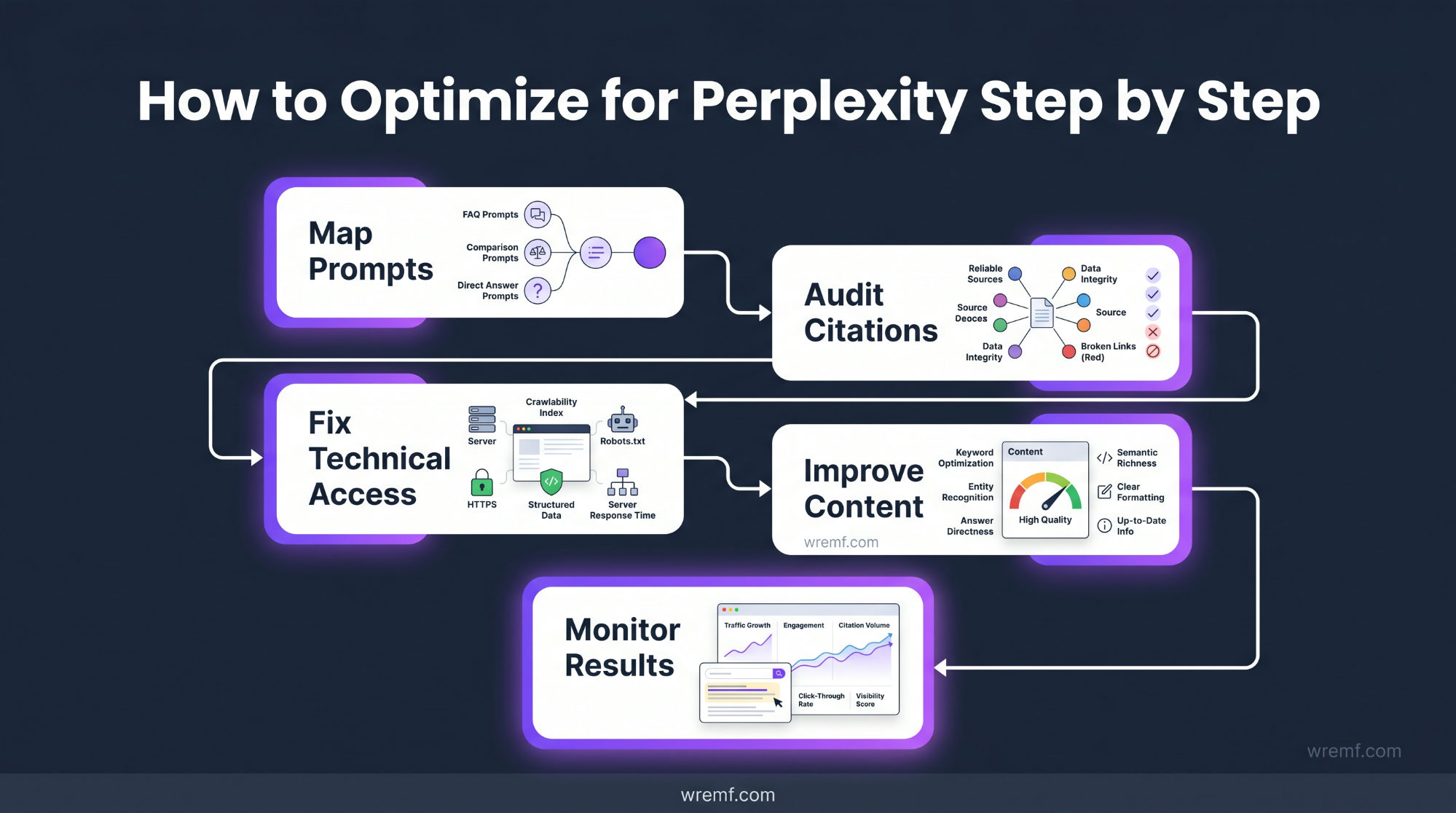
The best way to optimize for Perplexity is to map prompts, audit citations, fix technical access, improve answer-first content, and monitor results over time. Perplexity AI Optimization is a repeatable workflow, not a one-time content edit.
Build a prompt set around real user queries.
User queries should include informational, comparison, commercial, implementation, troubleshooting, and buying-stage prompts. For a B2B SaaS company, examples include “best AI visibility tools,” “how to monitor Perplexity citations,” “why is my website not showing up in Perplexity,” and “Perplexity AI Optimization service for B2B SaaS.”
Prompt tracking is the process of repeatedly testing user queries across AI engines. Prompt tracking shows whether your brand is cited, mentioned, recommended, omitted, or misrepresented.
Capture the current answer landscape.
Record AI-generated answers from Perplexity AI, ChatGPT, Gemini, Claude, Copilot, Google AI Overviews, DeepSeek, Grok, Meta AI, and Mistral. Compare answer text, citations, competitors, sentiment, and factual accuracy. WREMF’s prompt intelligence supports this workflow by tracking prompts across multiple AI discovery surfaces.
Identify Content Gaps.
Content Gaps are missing pages, weak explanations, unsupported claims, or absent source signals that prevent your brand from being retrieved or cited. Content Gaps matter because Perplexity AI cannot cite what your source ecosystem does not clearly explain.
Content Gaps often include missing comparison pages, outdated pricing pages, weak product descriptions, absent FAQs, thin category pages, unclear author credentials, inconsistent review profiles, missing schema markup, and no answer-first content blocks. Content Gaps should be prioritized by prompt importance, competitor visibility, and citation share opportunity.
Improve owned content.
Owned content should include definitions, direct answers, comparisons, step-by-step processes, FAQs, evidence, internal links, and structured content blocks. Content optimization should target natural language queries and semantic keywords, not just exact-match keywords. Content optimization should also include content freshness reviews for high-intent pages.
Improve third-party sources.
Audit reputable domains that Perplexity AI cites for your category. Update outdated profiles, fix inconsistent descriptions, improve product documentation, earn legitimate mentions, and support positive reviews where appropriate. Reputable domains can reinforce or weaken your brand depending on source consistency.
Monitor competitors.
Competitor visibility shows which brands appear in AI-generated answers for the same prompt set. WREMF’s competitive landscape helps teams compare mentions, recommendations, source citations, citation share, and source overlaps.
Report outcomes.
Use Google Search Console, Google Analytics, AI referral analysis, prompt tracking, source citation reports, and visibility scoring together. Google Search Console helps with traditional search engine data. Google Analytics helps with traffic attribution. AI visibility tools help with Perplexity citation share, brand mentions, and AI-generated answers.
If you want to see how these signals look in practice, review a sample AI visibility report before building your own reporting system.
KEY TAKEAWAY: A practical Perplexity workflow starts with prompts, sources, Content Gaps, owned content, third-party sources, competitors, and reporting.
The next section explains the role of AI Writer workflows without letting automation reduce quality.
How to Use an AI Writer Without Weakening Perplexity Optimization
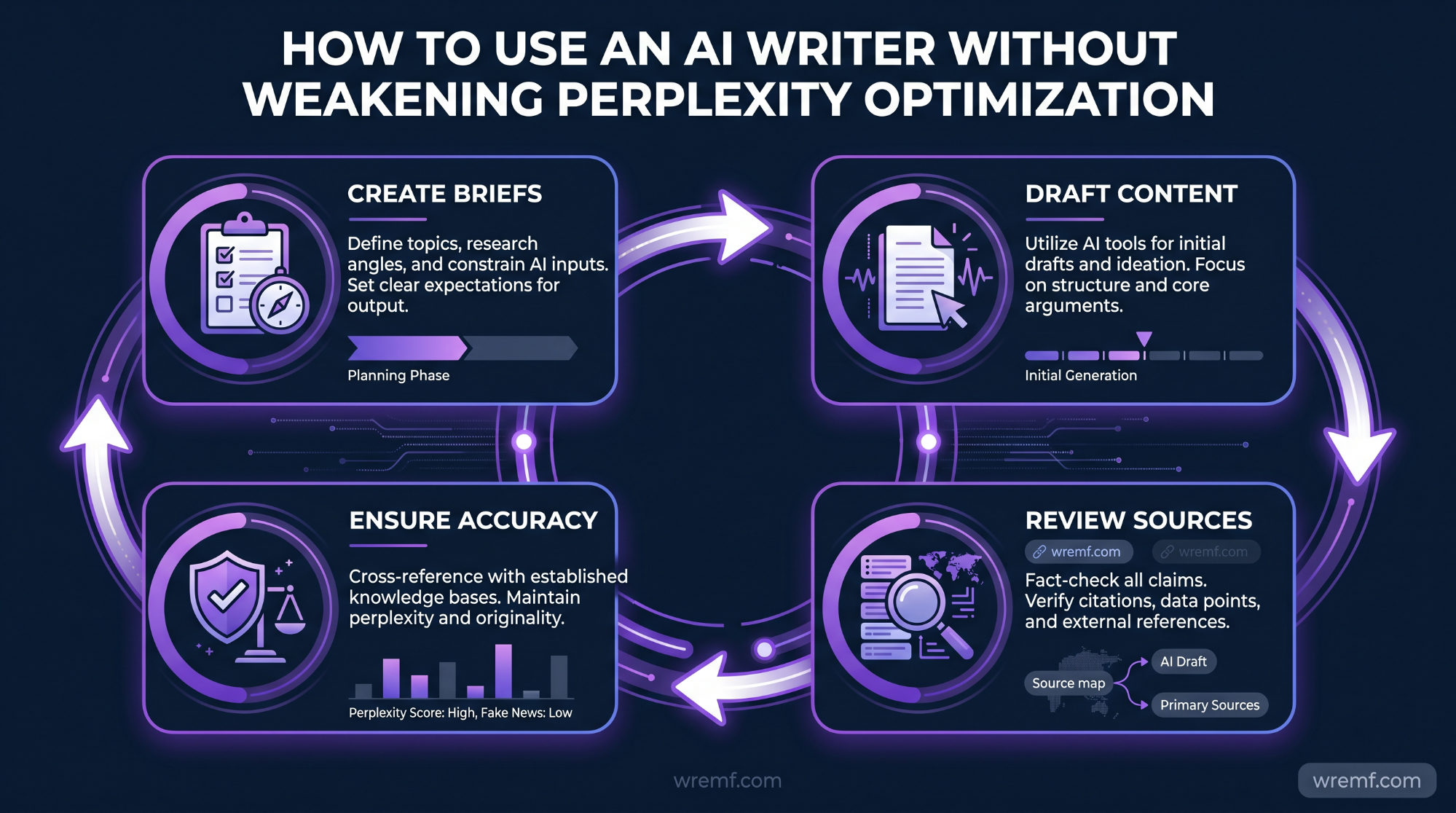
An AI Writer can support Perplexity AI Optimization when it helps create briefs, drafts, FAQs, and content blocks based on evidence. An AI Writer should not replace expert review, source validation, or factual accuracy checks.
AI Writer tools are systems that generate, rewrite, or structure content using Generative AI. An AI Writer matters because teams can use an AI Writer to scale draft production, but an AI Writer can also create unsupported claims, repeated sections, and vague answers if the workflow is weak.
An AI Writer should be used after prompt research, not before. An AI Writer can summarize user queries, group semantic keywords, suggest topic clusters, draft a pillar page, and identify Content Gaps. An AI Writer should work from verified sources, brand facts, product documentation, and clear editorial rules.
An AI Writer should not invent statistics. An AI Writer should not generate unsupported claims about ranking factors, citation rates, conversion rates, or Perplexity’s citation algorithm. An AI Writer should not overwrite expert judgment on legal compliance, technical implementation, medical advice, financial claims, or high-stakes content.
A strong AI Writer workflow includes:
Prompt set from real user queries
Source list from authoritative references
Brand facts from approved documentation
Content brief with target entities
Outline with answer-first sections
Draft from the AI Writer
Human review for accuracy
Entity verification
Internal links
External source attribution
Final review for crawlability and schema markup
AI Writer output should be evaluated for content structure, factual accuracy, answer completeness, source attribution, and user intent match. AI Writer drafts should include direct definitions, Q&A formatting, comparison tables, and concise content blocks. AI Writer work should also be reviewed against Perplexity AI-generated answers to ensure the article fills real Content Gaps.
Galileo’s Prompt Perplexity Metric is useful for AI engineers evaluating model uncertainty in prompt design, but Galileo’s Prompt Perplexity Metric is not a visibility metric for Perplexity AI Optimization. Galileo’s Prompt Perplexity Metric can help compare prompt length, prompt design, and model uncertainty. Galileo’s Prompt Perplexity Metric should not be used to claim that a website will be cited by Perplexity AI.
Prompt Perplexity Metric belongs to model evaluation. Perplexity AI Optimization belongs to AI search visibility. Galileo’s Prompt Perplexity Metric can improve AI Writer quality by reducing uncertainty in generated outputs, but Galileo’s Prompt Perplexity Metric does not measure citation share. Galileo’s Prompt Perplexity Metric should be paired with factual accuracy checks, entity verification, and human review.
KEY TAKEAWAY: An AI Writer is useful for scale, but Perplexity optimization still requires expert review, verified sources, entity clarity, and measured AI visibility data.
The next section covers developer and product-team considerations for Perplexity workflows.
Perplexity Optimization for Developers and Product Teams
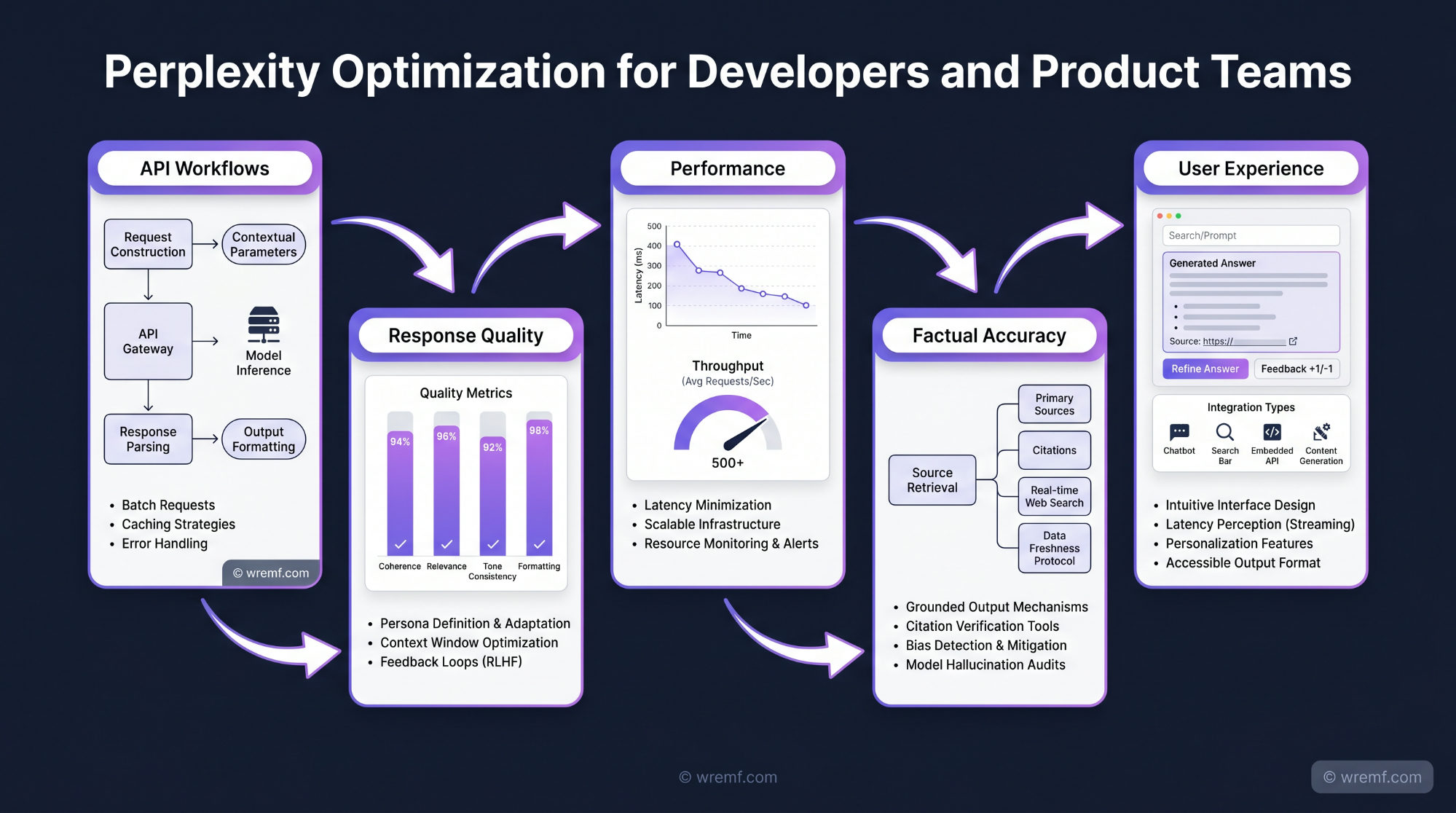
Developers and product teams optimize Perplexity by improving API workflows, response quality, performance, factual accuracy, and user experience. This matters when Perplexity supports an app, research workflow, or internal AI system.
Perplexity SDKs help product developers build custom search, research, or conversational experiences using Perplexity capabilities. Perplexity SDKs matter because developers need reliable handling for streaming, tokens, raw response access, citations, and latency.
Performance metrics for Perplexity SDKs and AI applications include latency, response completeness, error rate, token usage, citation availability, factual accuracy, and user satisfaction. Performance metrics should be monitored alongside Rate Limiting, async support, async operations, batch processing, connection settings, connection pooling, and timeout behavior.
High-throughput applications need careful connection pooling and stable connection settings. High-throughput applications may also require async operations, async support, retry logic, backoff rules, batch processing, and Rate Limiting. These controls reduce failed requests, slow responses, and unpredictable output quality.
Raw response access is useful when AI engineers need to inspect citations, metadata, answer fields, or source details. Streaming is useful when the conversational experience needs to feel fast. Batch processing is useful when teams analyze many user queries, compare prompt variants, or monitor AI-generated answers at scale.
Prompt length can affect model uncertainty, cost, latency, and answer quality. Prompt design should balance clarity, context, and constraints. Prompt design should also include instructions for source use, factual accuracy, and output format when product teams build custom workflows.
Factual accuracy is the reliability of the answer compared with verified facts. Factual accuracy matters because AI-generated answers can be persuasive even when they are incomplete or wrong. Product teams should monitor factual accuracy with test queries, evaluation sets, human review, and source checks.
Galileo’s Prompt Perplexity Metric can help AI engineers evaluate prompt uncertainty. Galileo’s Prompt Perplexity Metric is useful when comparing prompt design choices, but Galileo’s Prompt Perplexity Metric should not be treated as a Perplexity AI ranking signal. Galileo’s Prompt Perplexity Metric is relevant to AI model evaluation, while Perplexity AI Optimization is relevant to AI search visibility.
AI engineers should separate product performance from marketing visibility. AI engineers may care about Perplexity SDKs, async support, raw response access, high-throughput applications, connection settings, and batch processing. SEO experts may care about Content Gaps, schema markup, source citations, domain authority, and citation share. Both groups need factual accuracy.
WREMF’s API and MCP workflows are useful for teams that want to connect AI visibility data to internal dashboards, client portals, Slack alerts, reporting systems, or analytics workflows.
KEY TAKEAWAY: Product teams should separate Perplexity API performance, model evaluation, and Perplexity AI search visibility while monitoring factual accuracy across all three.
The next section adapts Perplexity optimization for local, ecommerce, healthcare, legal, and B2B SaaS use cases.
Specialized Perplexity Optimization for Local, Ecommerce, Healthcare, Legal, and B2B SaaS
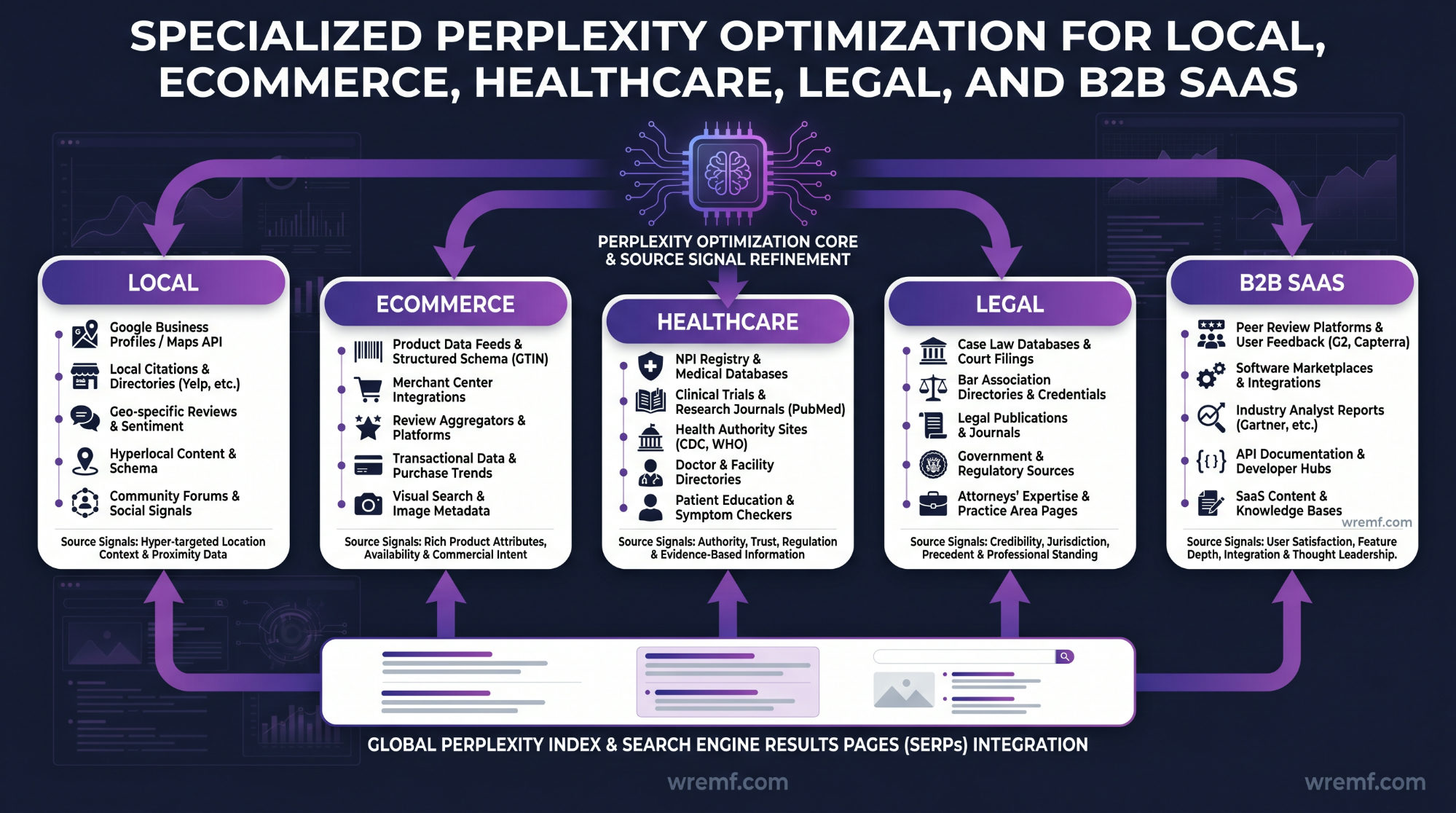
Specialized Perplexity optimization depends on the vertical, risk level, source type, and buyer intent. Local, ecommerce, healthcare, legal, and B2B SaaS pages each require different source signals.
Local SEO for Perplexity AI depends on NAP data, local business profiles, reviews, service-area pages, and location-specific entity clarity. NAP data means name, address, and phone number. NAP data matters because inconsistent local business profiles can confuse both search engines and AI engines.
Local business profiles should match your website, directories, review platforms, and official listings. Local pages should answer service-area user queries, include clear credentials, and explain availability where relevant. Positive reviews can reinforce trust, but reviews should never be manipulated.
Ecommerce optimization for Perplexity AI depends on product data, schema markup, merchant trust, reviews, availability, shipping, pricing, and comparison content. Perplexity’s Instant Buy help page states that Instant Buy lets U.S.-based users search for and purchase products from merchants directly on Perplexity, with orders fulfilled directly by the merchant. (Perplexity AI)
Buy with Pro and Instant Buy make product information more important for AI search visibility. Buy with Pro-style experiences increase the need for Product schema types, accurate availability, merchant data, positive reviews, shipping clarity, and source consistency. The Copilot Feature direction in AI-assisted commerce also shows why ecommerce teams should optimize product data for both search engines and AI engines.
Healthcare and legal compliance require stricter review because AI-generated answers can affect high-stakes decisions. Healthcare and legal pages should use qualified authors, dated reviews, authoritative sources, careful claims, and clear scope. Google’s helpful content guidance is especially important for high-stakes topics because reliability and people-first content are central to trust. (Google for Developers)
B2B SaaS optimization should focus on product positioning, category pages, alternatives pages, use-case pages, integration pages, pricing clarity, reviews, documentation, and comparison content. B2B buyers often use user queries such as “best tool for,” “alternative to,” “compare,” “pricing,” “implementation,” and “does this integrate with.” Perplexity AI Optimization should answer these questions directly.
For B2B SaaS companies, WREMF can be used as software, a managed agency service, or a hybrid software plus execution model. The WREMF agency team supports AI visibility strategy, GEO services, AEO consulting, content optimization, entity and authority building, source consistency cleanup, and monthly reporting.
KEY TAKEAWAY: Perplexity optimization must adapt by vertical because local trust, ecommerce data, high-stakes compliance, and B2B buying journeys require different signals.
The next section explains how to measure whether this work is improving visibility.
How to Measure Perplexity AI Search Visibility
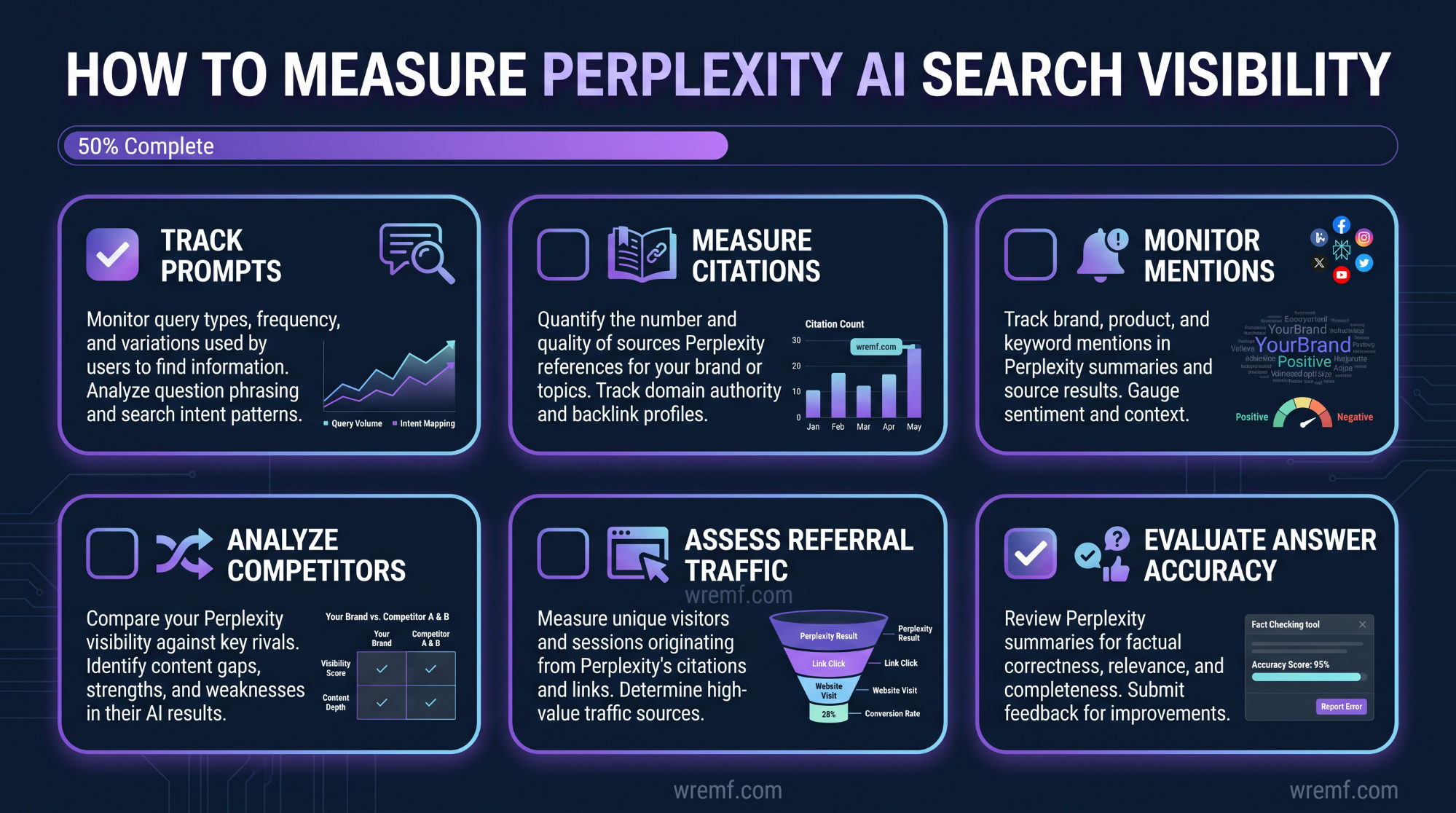
Perplexity AI search visibility is measured by tracking prompts, citations, mentions, competitors, referral traffic, and answer accuracy over time. Rankings alone do not show whether Perplexity AI cites, recommends, or correctly describes your brand.
AI traffic attribution connects AI discovery activity to measurable website visits, conversions, and pipeline signals. AI traffic attribution matters because some AI influence creates referral sessions, while other AI influence shapes buying decisions without a visible click.
Citation share is the percentage of tracked citations your brand, domain, or source ecosystem earns across a prompt set. Citation share is useful because it turns Perplexity AI Optimization into a measurable trend instead of a collection of screenshots.
Brand mentions are references to your brand inside AI-generated answers. Brand mentions matter because Perplexity AI may mention your brand without citing your domain, cite your domain without recommending your brand, or recommend a competitor while citing a neutral source.
Google Search Console helps measure traditional search engine performance. Google Analytics helps measure referral traffic and conversion behavior. AI visibility reporting helps measure prompt visibility, citation share, source overlap, competitor presence, answer sentiment, and AI-generated answers.
| Signal | What it measures | Example metric | Main limitation |
|---|---|---|---|
| Prompt visibility | Whether the brand appears for tracked user queries | Brand appears in 18 of 50 prompts | Prompt set quality matters |
| Citation share | How often the brand or domain is cited | 12 percent of citations | Some mentions have no citation |
| Recommendation presence | Whether the brand is suggested | Recommended in 6 of 20 buying prompts | AI answers vary |
| Competitor visibility | Which competitors appear in answers | 4 competitors appear more often | Needs recurring monitoring |
| AI traffic attribution | Visits from AI search sources | Sessions from perplexity.ai | Many AI-influenced decisions have no click |
| Source consistency | Whether facts match across reputable domains | 8 outdated profiles found | Requires cleanup outside the website |
AI-generated answers should be monitored by prompt type. Informational prompts show whether your category education is strong. Comparison prompts show whether competitors dominate. Buying-stage prompts show whether you are recommended. Troubleshooting prompts show whether Content Gaps are blocking visibility.
WREMF’s AI visibility methodology connects prompts, citations, competitors, source consistency, and attribution into one repeatable measurement system. The goal is not to guarantee citations. The goal is to make AI search visibility observable, comparable, and improvable.
KEY TAKEAWAY: Perplexity success should be measured through prompt visibility, citation share, brand mentions, recommendations, source consistency, competitors, and attribution.
The next section helps you decide whether software, an agency, or a hybrid model fits your team.
Software, Agency, or Hybrid: Which Perplexity Optimization Model Fits?
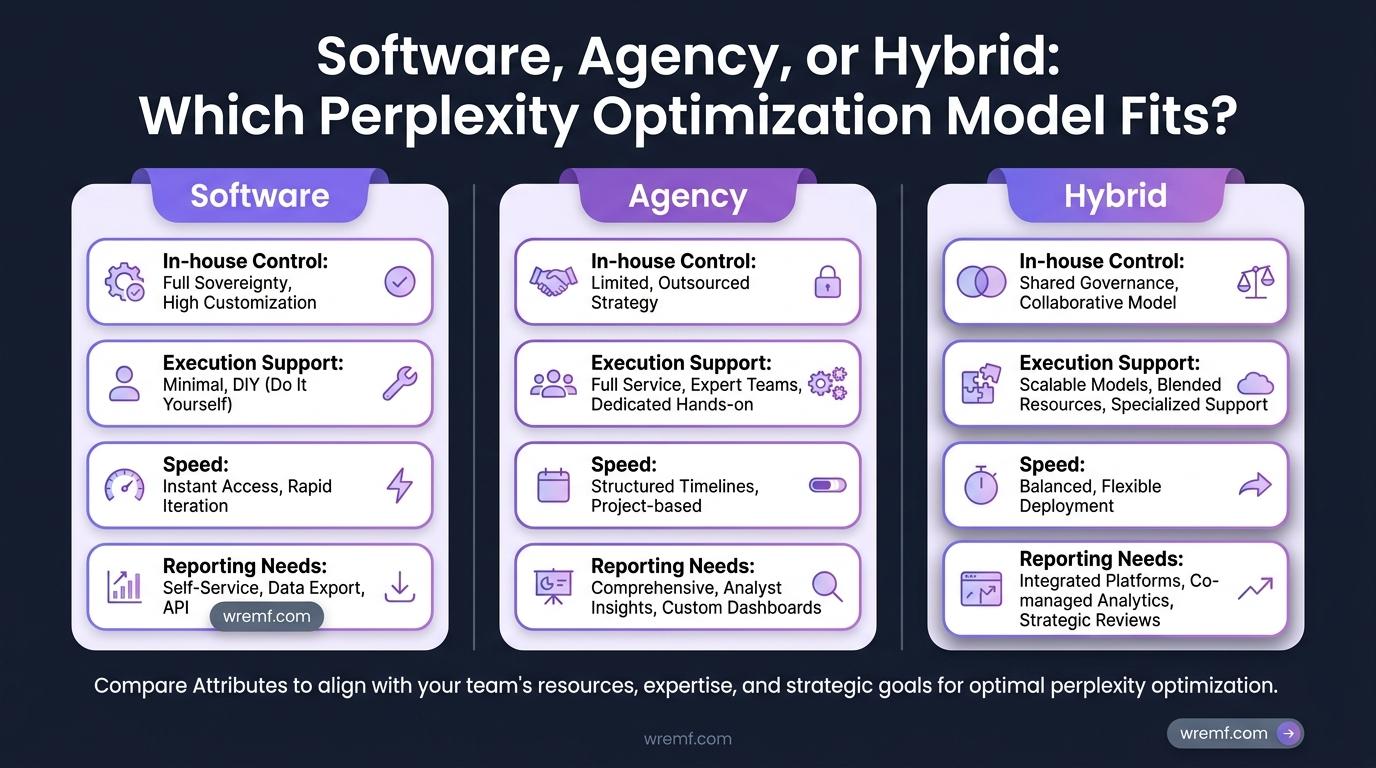
The right Perplexity optimization model depends on your team’s skill, speed, reporting needs, and execution capacity. Most B2B teams choose software, agency support, or a hybrid model.
Software is best when your internal team can act on prompt, citation, and Content Gaps data. Agency support is best when your team needs strategy, audits, content optimization, technical guidance, source cleanup, and execution. A hybrid model is best when you need both measurement and senior-led implementation.
| Model | Best for | What it includes | What it misses | Recommended when |
|---|---|---|---|---|
| Software | In-house SEO and content teams | Prompt tracking, citations, reports, visibility scoring | Execution capacity | You have internal owners |
| Agency | Teams that need implementation | Strategy, audits, content, authority work, reporting | Full internal control | You need done-for-you support |
| Hybrid | Growth teams and agencies | Software plus managed execution | Requires prioritization | You need data and action |
| Manual testing | Very small teams | Screenshots and ad hoc prompts | Scale, history, consistency | You are validating the need |
| Legacy SEO tools | Classic SEO teams | Rankings, backlinks, keywords | AI-generated answers and citations | You still need traditional SEO reporting |
WREMF supports all three main models. The software tracks prompts, citations, competitors, AI share of voice, AI traffic attribution, scheduled AI monitoring, source consistency, and visibility scoring. For teams that need execution, WREMF also offers managed AEO, GEO services, content optimization, source consistency cleanup, technical AI visibility foundations, and monthly reporting.
Agencies managing multiple clients often need white-label reports, client portals, repeatable scoring, and prompt-level evidence. WREMF’s agency workflow is useful for consultants and agencies that need a scalable AI Visibility Toolkit. In-house brands usually need visibility tracking, competitor monitoring, and action recommendations, which fits the WREMF workflow for brands.
WREMF pricing starts at €39 per month for Starter, €89 per month for Growth, and custom pricing for Enterprise. Pricing matters when teams need unlimited prompt tracking, BYOK, 10 AI engines, white-label reporting, content briefs, SEO testing, or custom branded portals. You can review WREMF pricing when comparing software, agency, and hybrid models.
KEY TAKEAWAY: Software gives measurement, agency support gives execution, and a hybrid model gives both visibility data and implementation capacity.
Before choosing a model, you should understand the risks, controversies, and limitations of AI search visibility.
Risks, Limitations, and Brand Safety Concerns
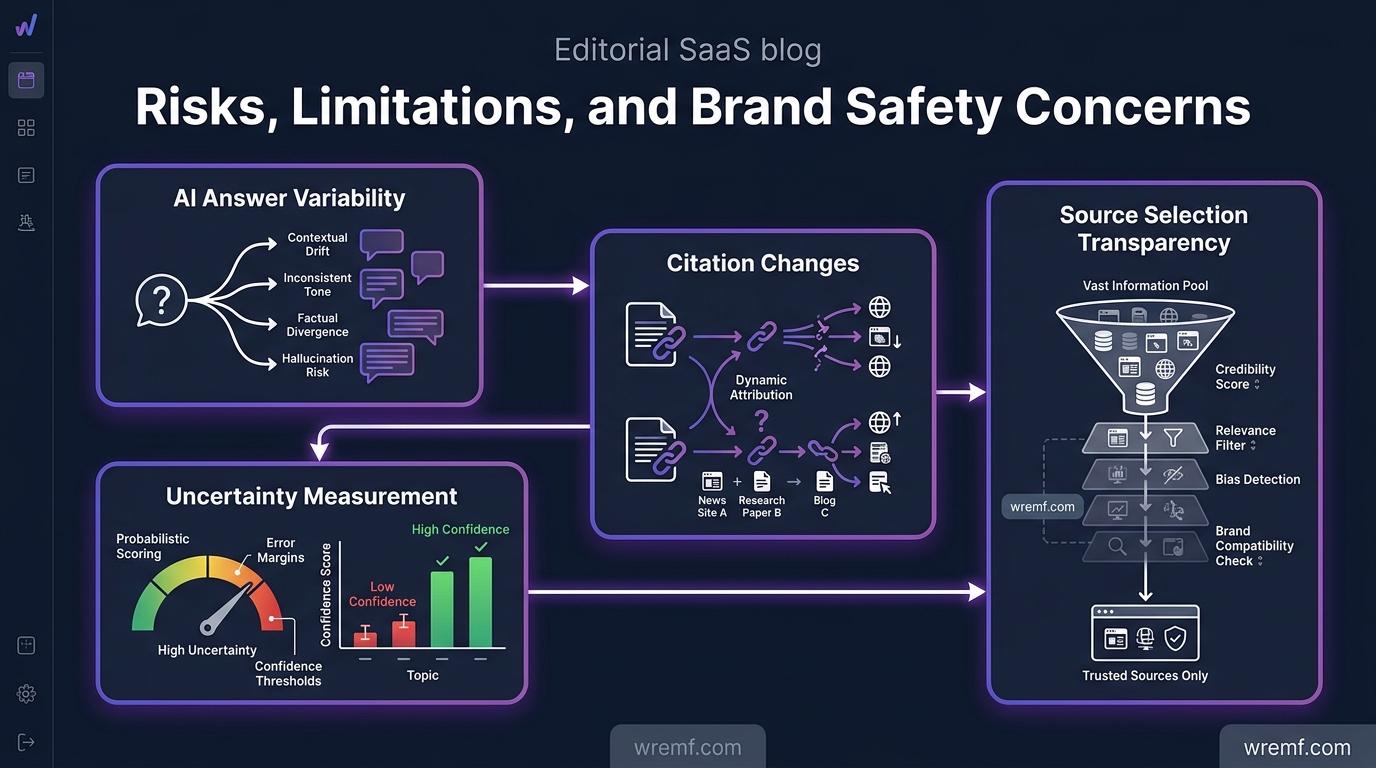
Perplexity AI Optimization has real limitations because AI answers can vary, citations can change, and source selection is not fully public. A credible strategy measures uncertainty instead of pretending it does not exist.
AI-generated answers are probabilistic outputs created from retrieved sources, model behavior, and user query context. AI-generated answers matter because they can summarize your brand accurately, omit key facts, or repeat outdated information from a third-party source.
Training data is the information used to develop an AI model, while live retrieval is the information accessed during a specific answer. Training data matters because older model knowledge can affect responses, but live retrieval can update or ground the answer with current sources. Perplexity AI Optimization focuses mainly on retrievable sources, not direct control over training data.
The Perplexity controversy includes publisher concerns, copyright questions, attribution concerns, and crawler behavior debates. Reuters reported that Perplexity raised funding from investors including Nvidia and Amazon founder Jeff Bezos, and described Perplexity as a startup using large language models to provide instant answers with cited sources. (Microsoft) Cloudflare later alleged that Perplexity used stealth crawling methods to evade website blocks, while Perplexity disputed the characterization through public responses reported by news outlets. (The Cloudflare Blog)
Brand safety requires monitoring both owned and third-party sources. If Perplexity AI cites an outdated directory, old pricing page, inaccurate review, or negative community thread, the user may trust that answer before visiting your website. This is why source consistency, reputable domains, and entity verification are part of Perplexity AI Optimization.
| Risk | What can happen | How to reduce it |
|---|---|---|
| Omission | Your brand does not appear | Add prompt-matched content and stronger source signals |
| Misrepresentation | AI-generated answers use wrong facts | Clean up source consistency and update owned pages |
| Weak citation | Competitors get cited more often | Improve citation-worthy passages and reputable domains |
| Overblocking | AI crawlers cannot access content | Review robots.txt, CDN rules, and firewall settings |
| Overdependence | Team tracks only Perplexity AI | Track multiple AI engines and search engines |
| Unclear attribution | AI influence produces no click | Combine prompt tracking with Google Analytics and CRM data |
IMPORTANT: Perplexity AI Optimization should not be framed as guaranteed citation control. The realistic goal is to improve the clarity, consistency, and measurability of the signals AI engines can retrieve.
KEY TAKEAWAY: Perplexity optimization is measurable, but not fully controllable, so teams need monitoring, source cleanup, and risk-aware reporting.
The next section addresses the most common myths that stop teams from building a practical AI search workflow.
Common Myths About AI Visibility Debunked
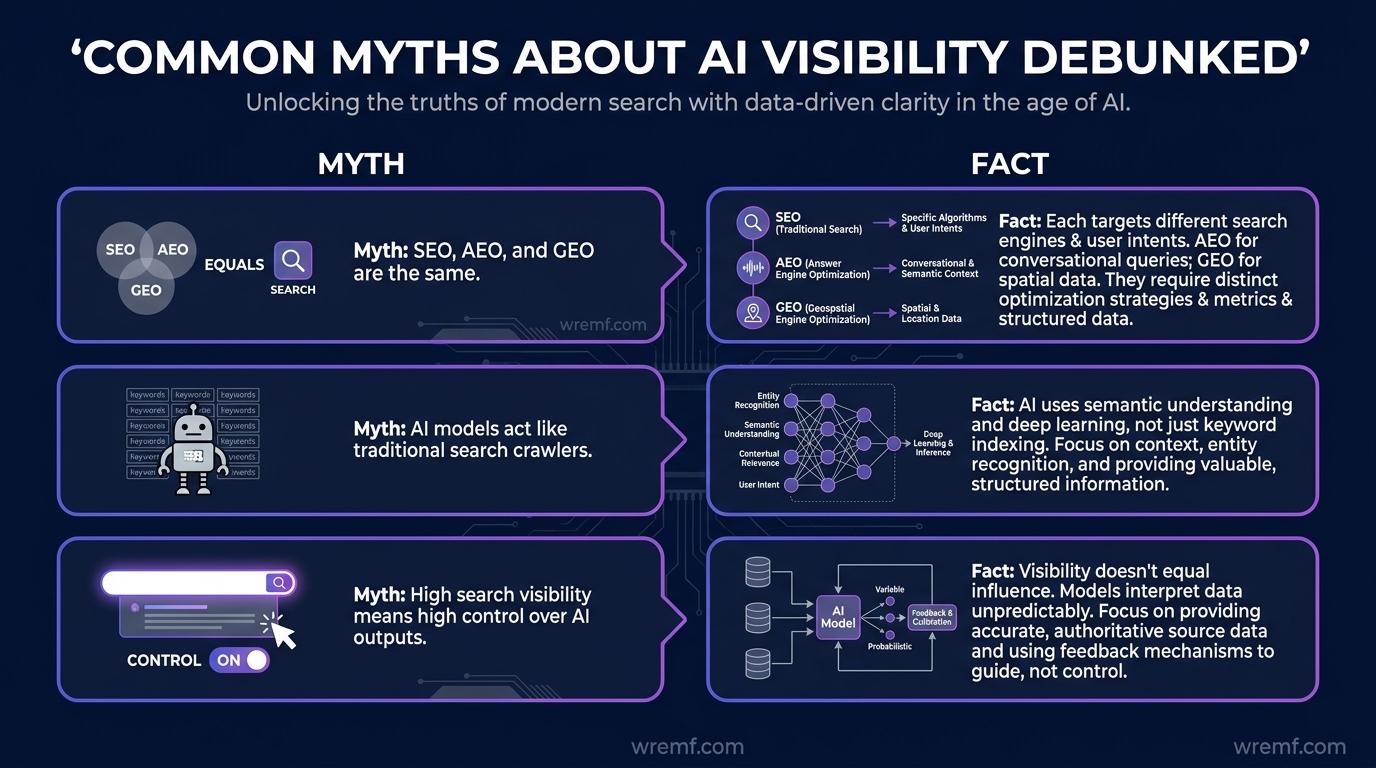
AI visibility myths usually come from applying old ranking logic to new answer systems. Perplexity AI Optimization becomes easier when teams separate measurable signals from false assumptions.
MYTH: SEO, AEO, and GEO are all the same thing.
FACT: SEO, Answer Engine Optimization, and Generative Engine Optimization overlap, but they optimize for different outcomes. SEO improves search engine visibility, AEO improves direct answer extraction, and GEO improves retrieval, citation, synthesis, and recommendation visibility inside Generative AI systems.
MYTH: AI visibility is impossible to measure.
FACT: AI visibility is not measured the same way as rankings, but it can be measured. Teams can track prompt visibility, source citations, citation share, brand mentions, competitor visibility, answer sentiment, AI-generated answers, and AI traffic attribution across Perplexity AI and other AI engines.
MYTH: Rankings alone are enough to win in Perplexity AI.
FACT: Rankings help discoverability, but Perplexity AI may cite reputable domains, community discussions, documentation, reviews, directories, or competitor pages. Ranking well in Google does not guarantee inclusion in AI-generated answers.
MYTH: Schema markup automatically gets a site cited.
FACT: Schema markup helps search engines and AI systems understand entities, but schema markup does not guarantee citations. Schema markup works best when combined with answer-first content, source authority, internal links, factual accuracy, and user-query alignment.
MYTH: Perplexity optimization only matters for publishers.
FACT: Perplexity AI Optimization matters for B2B SaaS companies, ecommerce brands, local businesses, healthcare organizations, legal services, consultants, and agencies. Any brand that can be researched, compared, cited, or recommended inside an Answer Engine has AI search visibility exposure.
KEY TAKEAWAY: The biggest misconception is that Perplexity visibility is either identical to SEO or impossible to influence, when the practical answer is measurement plus source improvement.
The FAQ section answers the specific questions marketers, founders, SEO teams, and buyers ask most often.
Frequently Asked Questions
How do you optimize for Perplexity?
To optimize for Perplexity, start by tracking real user queries, reviewing AI-generated answers, and identifying which sources Perplexity AI cites for your category. Then fix crawl access, improve schema markup, create answer-first content, update Content Gaps, and strengthen reputable domains that influence citations. Perplexity AI Optimization should also include competitor visibility, source consistency, and citation share tracking. WREMF helps teams manage this process with prompt intelligence, source citation tracking, AI visibility scoring, and reporting across Perplexity AI and other AI engines.
What is the Perplexity controversy?
The Perplexity controversy refers to disputes about publisher content, attribution, copyright concerns, and crawler behavior. Perplexity publishes official guidance for PerplexityBot, Perplexity-User, and robots.txt behavior. Cloudflare later alleged that Perplexity used stealth crawling methods to access blocked content, while Perplexity disputed that characterization through public responses reported by news outlets. For marketers, the practical lesson is to manage crawler access, source accuracy, legal compliance, and brand safety rather than ignoring the search platform.
Did Jeff Bezos invest in Perplexity?
Yes. Reuters reported that Perplexity raised earlier funding from investors including Nvidia and Amazon founder Jeff Bezos. Reuters also described Perplexity as a startup that uses large language models to provide instant answers with cited sources. This matters for marketers because Perplexity AI is not just a niche research tool. It is part of a broader shift from traditional search engines to AI-powered answer engines that can influence supplier research, product comparison, and brand discovery.
Why is Perplexity better than GPT for search?
Perplexity is often better for source-led research because Perplexity AI is designed as an Answer Engine with citations and real-time retrieval. GPT-style tools are often stronger for reasoning, drafting, ideation, and multi-step analysis, depending on the product and browsing mode. The better choice depends on the task. Use Perplexity AI for fast source-backed answers, use ChatGPT for broader reasoning and content development, and track both when measuring AI search visibility.
Does Perplexity use backlinks as a ranking factor?
Perplexity has not published a simple backlink-based citation algorithm like traditional search engine ranking models. Backlinks may still matter indirectly because they influence domain authority, discoverability, and the reputation of reputable domains. Perplexity AI Optimization should not focus only on backlinks. A stronger approach is to improve source accessibility, content structure, entity clarity, authoritative lists, positive reviews, source citations, and citation-worthy answer blocks.
What schema markup helps Perplexity citations?
Useful schema types for Perplexity optimization include Organization, Article, FAQPage, Product, SoftwareApplication, Service, Review, LocalBusiness, BreadcrumbList, HowTo, and Dataset. Schema markup helps clarify entities and relationships, but it does not guarantee citation rates. The strongest approach is to combine schema markup with answer-first content, natural language queries, source citations, internal links, and factual accuracy. Google Search Central explains that structured data helps Google understand page content and entities, which is also useful for machine-readable content design.
How often should content be updated to maintain Perplexity citations?
Important pages should be reviewed whenever product details, pricing, features, competitors, regulations, availability, or market context changes. For high-intent B2B pages, monthly or quarterly reviews are often practical. For ecommerce, healthcare, legal, pricing, and documentation pages, reviews may need to happen faster. Content freshness matters because AI search systems can retrieve current sources, but freshness alone is not enough. The updated page still needs clear answers, source support, crawl access, and entity consistency.
Why is my website not showing up in ChatGPT or Perplexity?
Your website may not show up in ChatGPT or Perplexity because the content does not answer the prompt clearly, the site blocks crawlers, the page has weak authority, competitors have stronger sources, or reputable domains describe the category without mentioning your brand. Another common cause is source inconsistency. WREMF can help diagnose this by tracking prompts, citations, competitors, source overlaps, Content Gaps, and AI-generated answers across Perplexity AI, ChatGPT, Claude, Gemini, Copilot, and Google AI Overviews.
What is the difference between AI search visibility and Google rankings?
Google rankings show where a page appears in traditional search engine results. AI search visibility shows whether a brand appears, gets cited, or gets recommended inside AI-generated answers. A page can rank well in Google but still be absent from Perplexity AI, ChatGPT, Gemini, Claude, Copilot, or Google AI Overviews. The best reporting model combines Google Search Console, Google Analytics, prompt tracking, citation share, competitor visibility, source consistency, and AI traffic attribution.
Should I use software, an agency, or both for Perplexity AI Optimization?
Use software when your team can interpret visibility data and execute internally. Use an agency when you need audits, content optimization, source cleanup, technical guidance, and ongoing execution. Use a hybrid model when you need both measurement and implementation. WREMF supports software, agency, and hybrid workflows, which makes it useful for brands that want internal control, agencies that need white-label reporting, and teams that want managed AEO and GEO execution.
Does Perplexity support shopping features?
Yes. Perplexity’s Instant Buy help page says U.S.-based users can search for and purchase products from a wide range of merchants directly on Perplexity, with orders fulfilled by the merchant. This matters for ecommerce optimization because product data, reviews, pricing, availability, schema markup, merchant trust, and source consistency can influence how AI search platforms present shopping information. Ecommerce teams should optimize for both search engines and AI engines.
Is SEO dying because of Perplexity and AI search engines?
SEO is not dying, but search engine optimization is expanding. Traditional search engines still matter for discovery, crawling, indexing, authority, and traffic. Perplexity AI, ChatGPT, Gemini, Claude, Copilot, and Google AI Overviews add a new layer where brands must also measure citations, mentions, AI-generated answers, source consistency, and recommendation visibility. The strongest strategy combines SEO, Answer Engine Optimization, and Generative Engine Optimization.
Conclusion
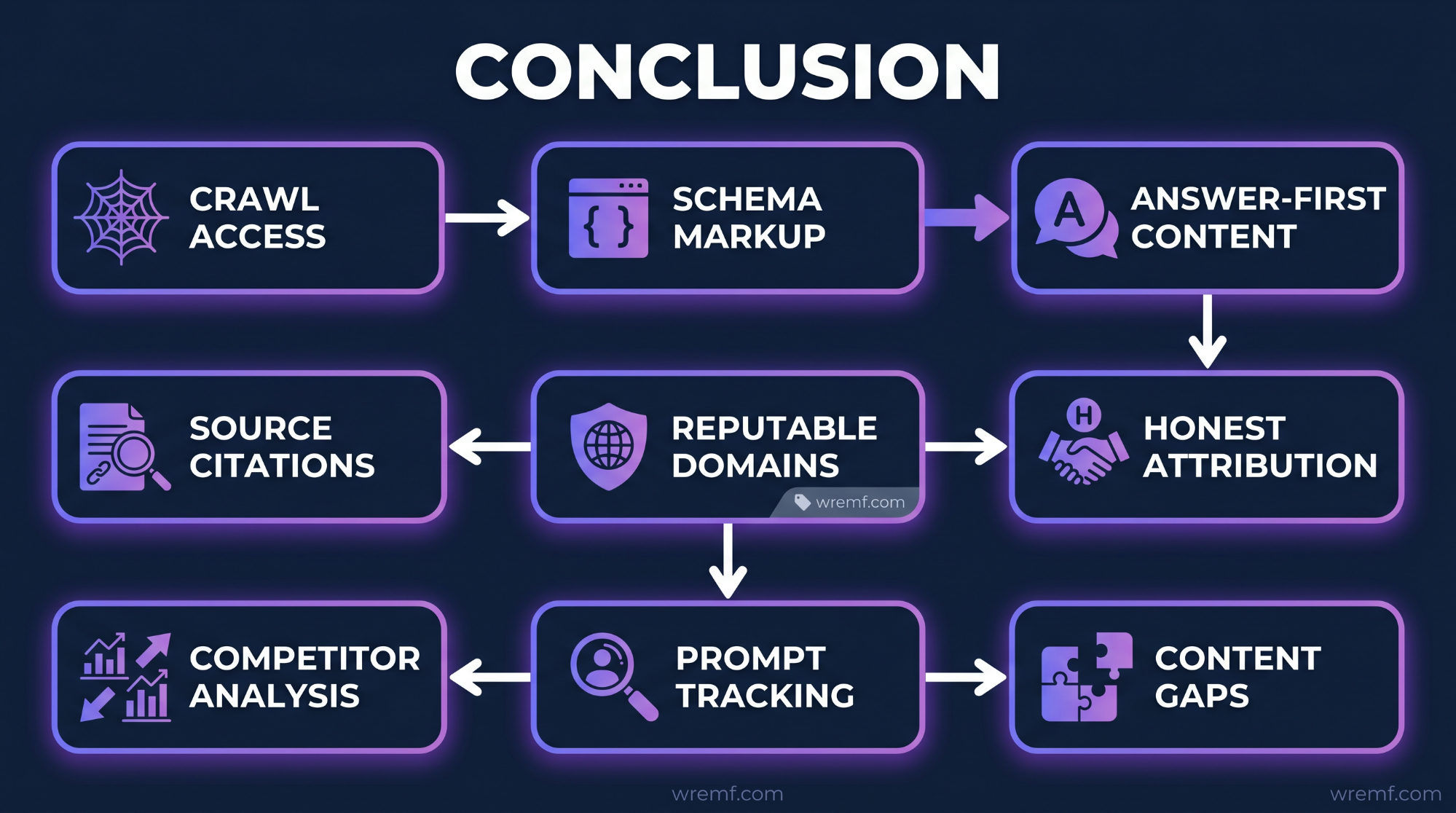
Perplexity AI Optimization is now a core part of AI search visibility because buyers use answer engines to research, compare, and validate brands before clicking. The right strategy combines crawl access, schema markup, answer-first content, reputable domains, source citations, prompt tracking, competitor analysis, Content Gaps, and honest attribution. WREMF helps teams turn that work from manual testing into a repeatable workflow across Perplexity AI and other AI discovery surfaces. To start measuring and improving your visibility, explore the WREMF platform suite or talk to the WREMF agency team.
KEY TAKEAWAY: Perplexity visibility is not a guessing game when prompts, citations, competitors, sources, and attribution are measured together.
Related reading
- AI Overview Optimization: How to Rank, Get Cited, and Stay Visible in Google AI Search
- Best Answer Engine Optimization for Enhancing AI Visibility
- Answer Engine Optimization: The Complete Guide to AEO, AI Search Visibility, and Answer-First Content
- ChatGPT SEO: The Complete Guide to Ranking in ChatGPT
- SEO for ChatGPT: Playbook for Ranking, Visibility, and AI Search Citations