Best Generative Engine Optimization Platforms for AI Search Visibility
Discover how GEO platforms enhance AI search visibility and integrate with SEO and AEO strategies.
By WREMF Team · 2026-09-18
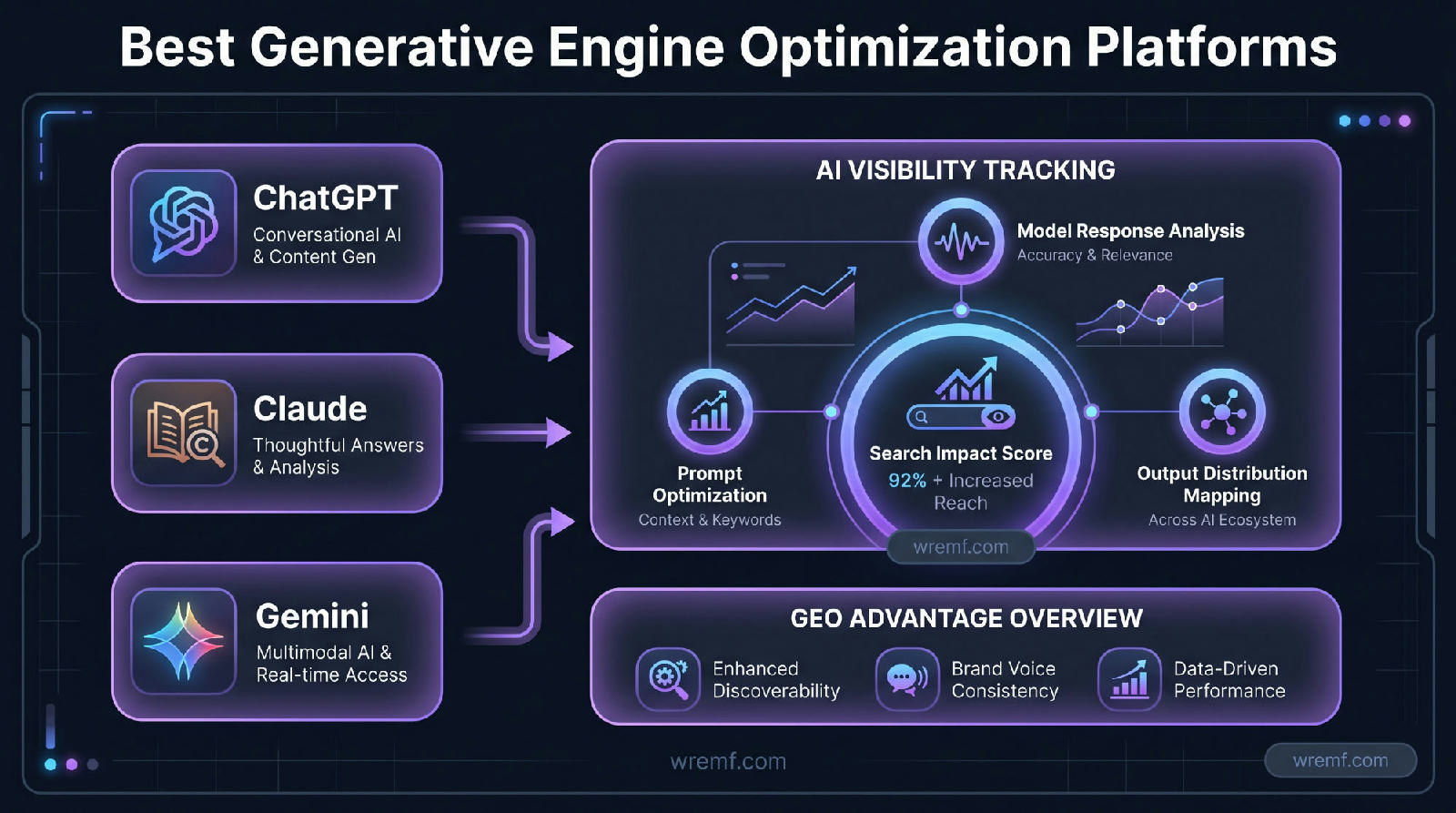
Generative Engine Optimization (GEO) platforms are software tools designed to enhance a brand's presence in AI-generated answers, citations, and recommendations. These platforms track prompt visibility, source influence, and competitive visibility. Unlike traditional SEO tools, GEO focuses on AI answer engines like ChatGPT, Claude, and Google AI Overviews. Key components include prompt tracking, citation analysis, and AI share of voice. Understanding this approach is crucial as AI discovery becomes a significant channel, influencing buyer decisions even without traditional search engine interactions.
Key takeaways
- GEO platforms transform manual AI search visibility checks into measurable workflows involving prompts, citations, and recommendations.
- AI search is shifting from traditional search engines to answer engines that provide synthesized responses.
- GEO platforms measure visibility in AI answers, complementing SEO by adding layers like citation tracking and competitor monitoring.
- Select a GEO platform based on your team's specific needs, such as visibility tracking or content optimization.
- Source consistency and entity authority are crucial for AI visibility, beyond simple keyword tactics.
Best Generative Engine Optimization Platforms for AI Search Visibility

Best generative engine optimization platforms are tools that help brands measure, improve, and prove visibility inside AI answers. Gartner predicted that traditional search engine volume would decline 25% by 2026 as users shift toward AI chatbots and virtual agents, which makes AI discovery a measurable marketing priority. (Gartner) WREMF helps B2B teams track how they appear across ChatGPT, Claude, Gemini, Perplexity, Google AI Overviews, Copilot, DeepSeek, Grok, Meta AI, Mistral, and other AI discovery surfaces. This guide explains what GEO platforms do, how they differ from SEO tools, which features matter, how to compare platform categories, and how to choose the right software, agency, or hybrid workflow for your team.
What Are Generative Engine Optimization Platforms?
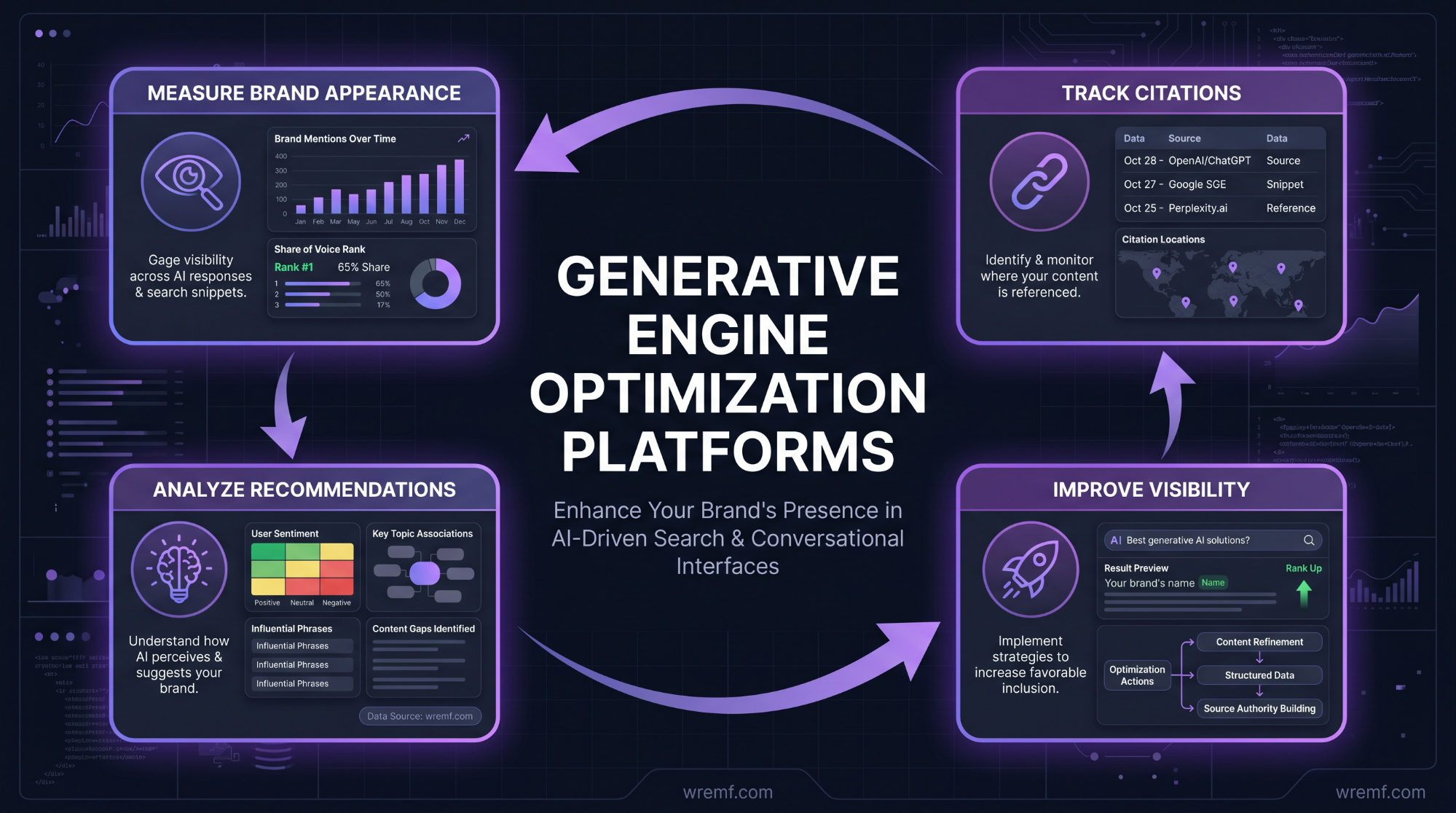
Generative Engine Optimization platforms are software systems that measure and improve how brands appear inside AI answers, citations, summaries, and recommendations. GEO platforms help teams understand whether AI models mention, cite, ignore, misdescribe, or recommend their brand.
Generative Engine Optimization is the practice of improving how a brand appears inside generative engine results from AI answer engines and large language models. Generative Engine Optimization matters because buyers increasingly use ChatGPT, Gemini, Claude, Perplexity, Google AI Overviews, Copilot, and other answer engines to compare vendors before visiting websites.
A GEO platform usually tracks three layers of visibility. The first layer is prompt visibility, which shows how different questions trigger brand mentions. The second layer is source visibility, which shows which pages, citations, reviews, forums, videos, or directories influence the AI answer. The third layer is competitive visibility, which shows whether your brand, your competitors, or neither appear in AI answers for high-intent buyer prompts.
AI visibility is the measurable presence of a brand inside AI-generated answers, recommendations, citations, summaries, and comparison responses. AI visibility matters because a brand can influence a buying journey even when the user does not click a traditional search engine result.
WREMF fits this category because the WREMF AI visibility platform suite combines prompt intelligence, source citation tracking, competitor visibility, AI share of voice, scheduled AI monitoring, white-label reporting, BYOK support, and action recommendations. WREMF can be used as software, as an agency service, or as a combined software plus managed execution solution.
AI visibility is the measurable presence of a brand inside AI-generated answers, recommendations, citations, and summaries. AI visibility matters because AI search can influence brand consideration before a buyer reaches a website, sees an ad, reads a sales page, or speaks to a sales team.
KEY TAKEAWAY: GEO platforms turn AI search visibility from manual checking into a measurable workflow built around prompts, citations, competitors, sources, and recommendations.
To choose the right platform, you first need to understand why search is moving from ranked links to synthesized answers.
Why Search Is Moving From Search Engines to Answer Engines
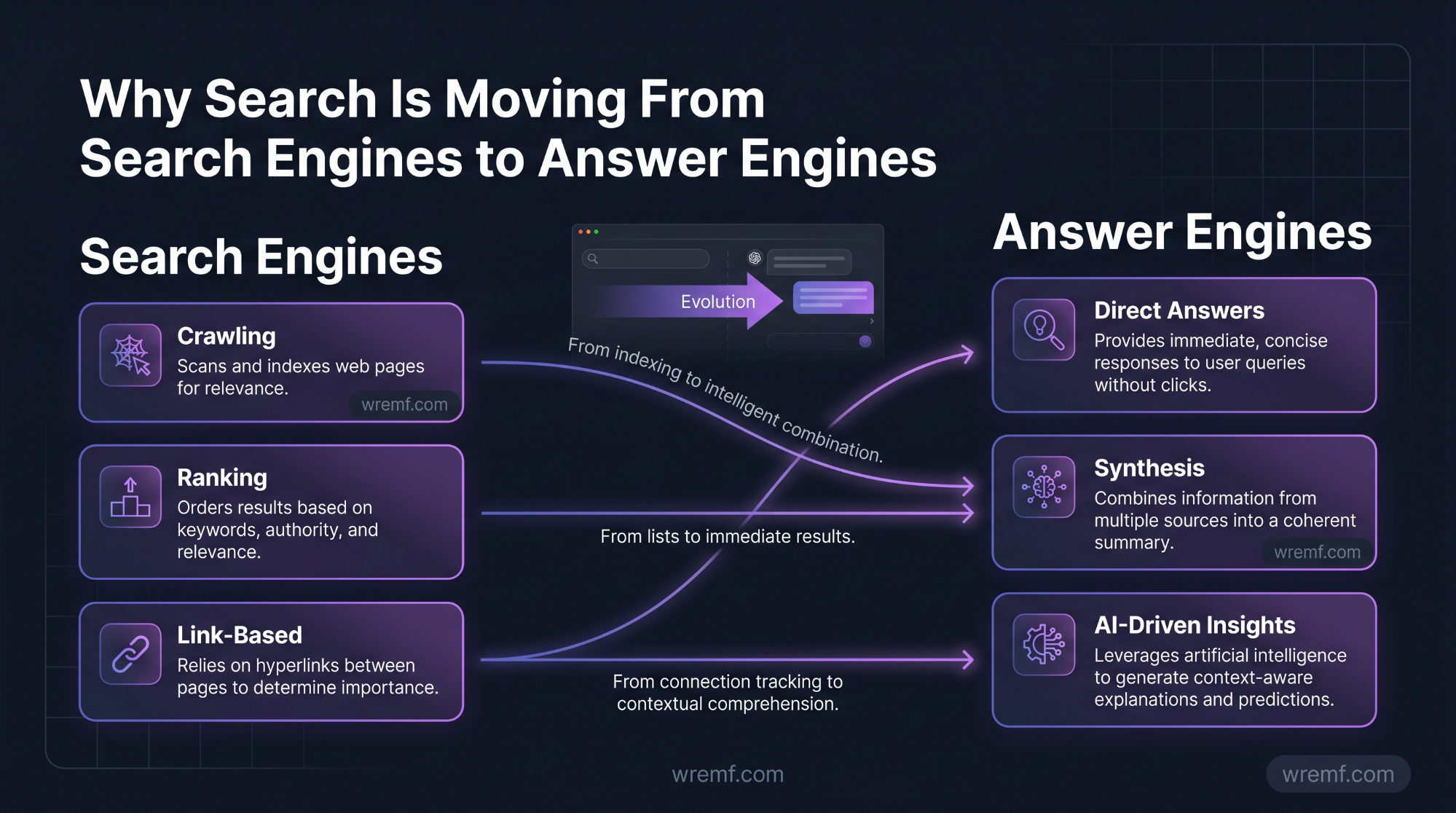
Search is moving from search engines to answer engines because users increasingly expect direct, synthesized answers instead of lists of links. This changes visibility because brands now need to appear inside the answer, not only on the search engine results page.
Search engines are systems that crawl, index, retrieve, and rank web pages for user queries. Search engines still matter because Google Search, Bing, and other traditional search engines remain major discovery channels for B2B and ecommerce buyers.
Answer engines are systems that generate direct responses using AI models, search indexes, retrieval systems, citations, and knowledge sources. Answer engines matter because AI answers can summarize categories, compare vendors, recommend products, and cite sources without requiring the user to visit multiple pages.
Google Search Central explains that AI Overviews help users get the gist of complicated topics more quickly and provide links for deeper exploration. (Google for Developers) OpenAI describes ChatGPT search as a way to get fast, timely answers with links to relevant web sources. (OpenAI) Anthropic’s Claude web search documentation states that Claude can access real-time web content and include citations for sources drawn from search results. (Claude Platform)
This shift creates a new visibility layer. A buyer might ask “best generative engine optimization platforms for B2B SaaS,” “best tools to track ChatGPT visibility,” or “GEO platform vs SEO tool.” The AI answer may mention brands, cite sources, compare features, summarize pricing, or recommend a shortlist. If your brand is missing from that answer, your traditional ranking may not fully protect your market visibility.
DID YOU KNOW: Gartner predicted a 25% decline in traditional search engine volume by 2026 because AI chatbots and virtual agents are taking share from classic search behavior. (Gartner)
KEY TAKEAWAY: Brands need GEO platforms because AI search shifts discovery from ranked pages to synthesized answers, citations, and recommendations.
The next step is understanding how GEO, AEO, and SEO work together instead of treating them as separate silos.
How GEO Platforms Differ From SEO Tools and AEO Tools
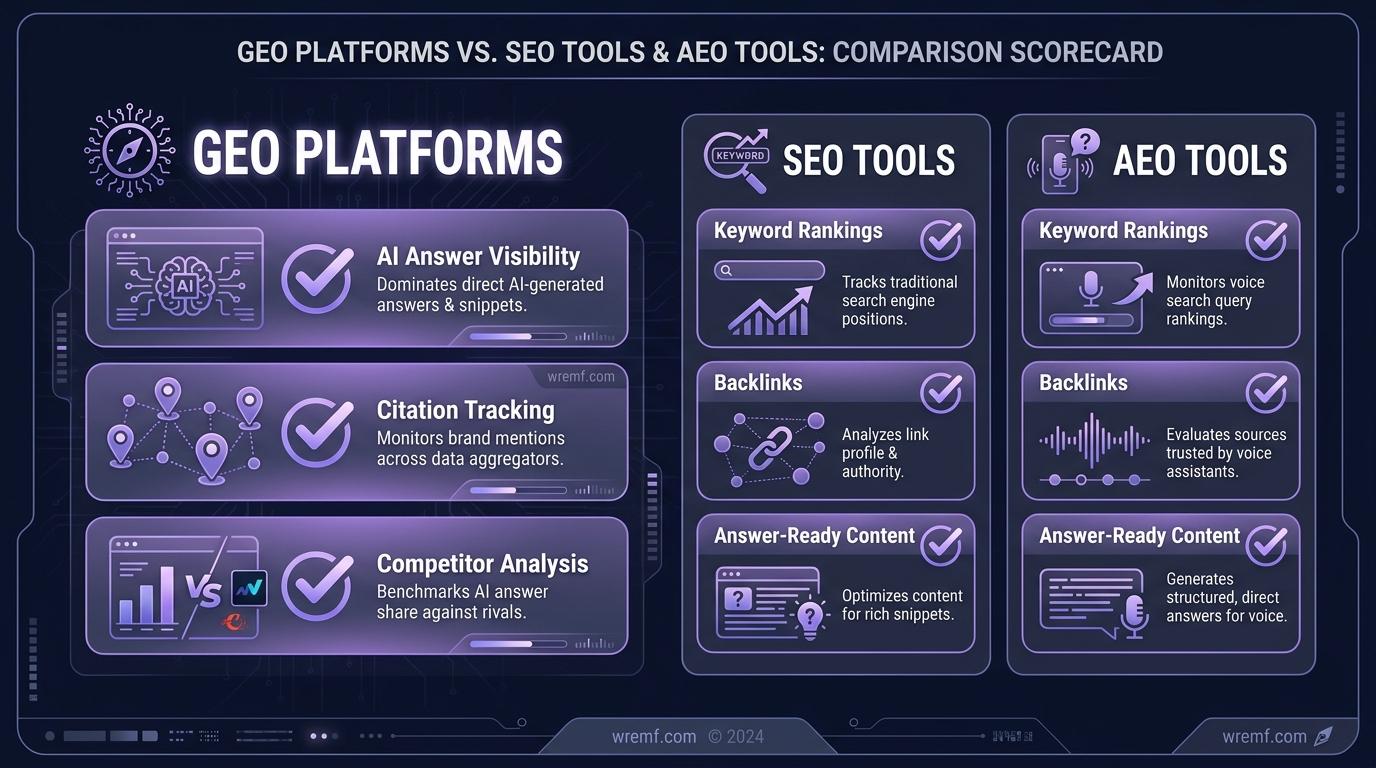
GEO platforms differ from SEO tools by measuring AI answer visibility instead of only rankings, backlinks, keywords, and traffic. SEO tools remain important, but GEO platforms measure the AI answer layer that classic rank trackers miss.
SEO is the practice of improving visibility in organic search engine results. SEO matters because crawlability, authority, helpful content, internal linking, and technical quality still influence how content is discovered across search engines and AI discovery surfaces.
Answer Engine Optimization is the practice of making content easy for answer engines to extract, summarize, and use in direct responses. Answer Engine Optimization matters because AI-powered answer engines often reward direct answers, clear definitions, structured explanations, and source-backed content.
Generative Engine Optimization is the practice of improving how generative AI systems mention, cite, summarize, and recommend a brand. GEO matters because AI models and AI answer engines can influence consideration even when a buyer does not click through to a website.
| Comparison Area | SEO Tools | AEO Tools | GEO Platforms |
|---|---|---|---|
| Main Goal | Improve search engine rankings | Create answer-ready content | Improve AI answer visibility |
| Core Metric | Keyword ranking, traffic, backlinks | Answer coverage and content completeness | Prompt visibility, citation rate, AI share of voice |
| Main Surface | Google Search, Bing, search engines | Featured snippets, answer boxes, AI answers | ChatGPT, Claude, Gemini, Perplexity, Google AI Overviews, Copilot |
| Best For | Organic search performance | Answer extraction and content clarity | AI visibility tracking and competitive AI monitoring |
| What It Misses | AI model recommendations | Competitor visibility across AI models | Deep technical SEO diagnostics |
| Typical User | SEO manager | Content strategist | SEO, growth, brand, demand, and agency teams |
| Reporting Value | Strong for search performance | Strong for content planning | Strong for AI discovery and leadership reporting |
Traditional SEO tools help teams monitor search engine performance, but they usually cannot tell you whether ChatGPT recommends your brand, whether Google AI Overviews cites a third-party source, whether Perplexity compares you with a competitor, or whether Claude summarizes your category accurately. GEO platforms add that missing measurement layer.
Google Search Central explains that Google’s automated ranking systems are designed to prioritize helpful, reliable, people-first content. (Google for Developers) That principle still matters for GEO because AI models and AI answer engines rely on clear, useful, source-backed information. The practical difference is that GEO adds prompt tracking, citation tracking, source influence analytics, and AI search visibility reporting.
IMPORTANT: Do not replace SEO with GEO. The strongest strategy combines SEO foundations, AEO content structure, and GEO measurement across AI models and answer engines.
KEY TAKEAWAY: GEO platforms do not replace SEO tools or AEO tools. GEO platforms add the missing layer of AI answer visibility, citations, competitors, and source influence.
Now that the difference is clear, you can compare the main platform categories.
Best Generative Engine Optimization Platforms by Category
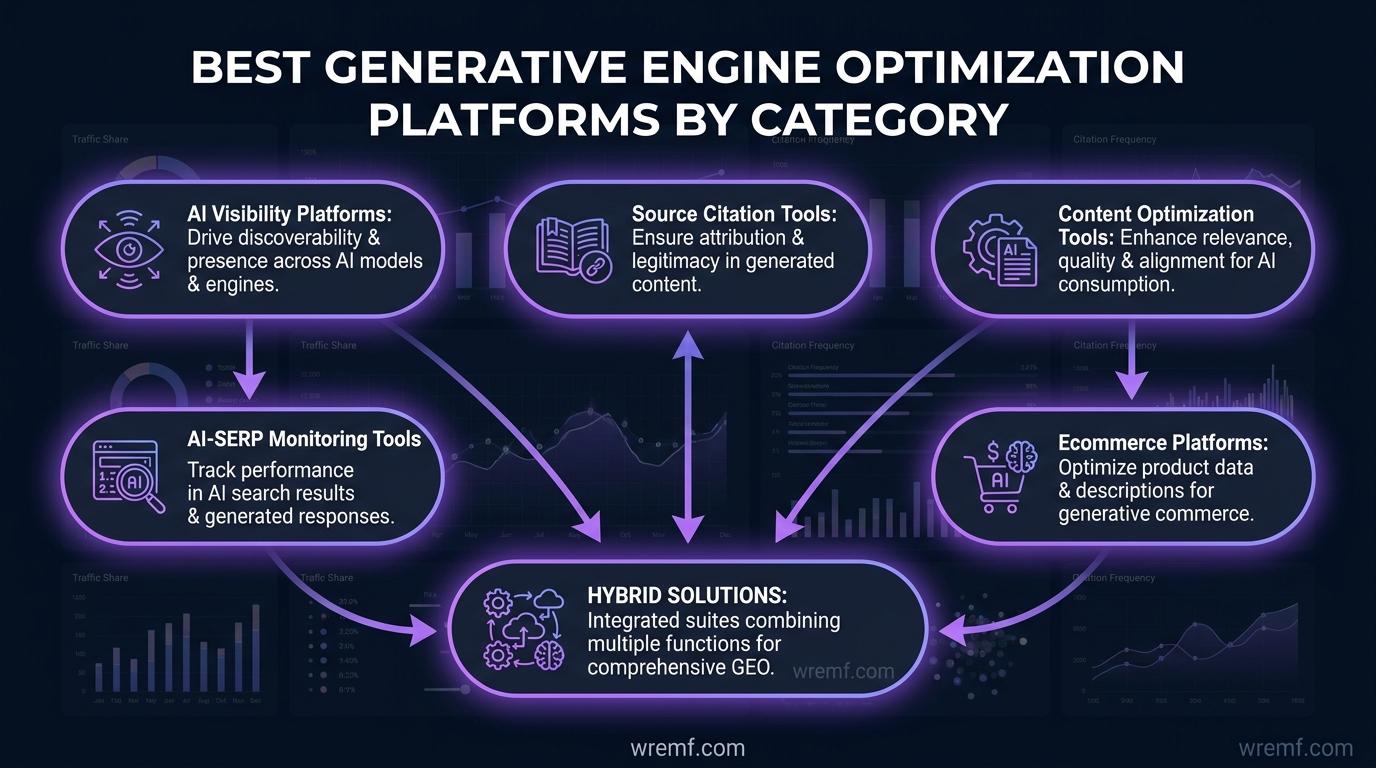
The best generative engine optimization platform depends on your main use case, team capacity, reporting needs, and execution model. The right platform should match the workflow you need, not just the longest feature list.
GEO platforms can be grouped into six practical categories. Each category solves a different part of AI visibility, from monitoring prompts to improving content, tracking citations, managing ecommerce source data, and executing a full GEO strategy.
| Platform Category | Best For | What It Measures | What It Misses | Recommended When |
|---|---|---|---|---|
| AI visibility platforms | B2B teams tracking brand visibility across AI models | Prompts, mentions, citations, competitors, visibility scoring | Deep content production unless included | You need to know how AI answers describe your brand |
| Source citation platforms | Teams focused on citation tracking and source influence | AI citations, source stack, cited URLs, source frequency | Full SEO and content execution | You need to know which sources shape AI answers |
| Content optimization platforms | Teams creating answer-ready content | Semantic content scoring, topic clustering, content gaps | AI visibility across multiple answer engines | Your main gap is content completeness |
| AI-SERP monitoring tools | Teams tracking AI Overviews and search-integrated AI answers | AI Overviews, search engine changes, AI search results | Broader LLM visibility | Google AI Overviews is your main concern |
| Ecommerce and review platforms | Ecommerce stores and product brands | Reviews, product data, sentiment, feed consistency | Broader B2B GEO strategy | Reviews and product data influence AI recommendations |
| Hybrid software plus agency platforms | Teams needing measurement and execution | Prompts, citations, competitors, source consistency, attribution, action plans | Less suited to teams wanting only a lightweight tracker | You need software plus managed GEO execution |
WREMF belongs in the hybrid AI visibility category because it can be used as software, an agency service, or a combined software plus managed execution solution. WREMF combines AI visibility tracking, prompt intelligence, citation tracking, competitor visibility, AI traffic attribution, GEO audits, AEO strategy, content briefs, SEO testing, scheduled AI monitoring, white-label reports, API workflows, and BYOK support.
Tools such as Surfer, MarketMuse, Clearscope, and NeuronWriter are often used for content optimization, semantic analysis, semantic content scoring, topic clustering, and question mapping. These tools are useful when your main problem is content completeness, but they do not replace AI visibility tracking across ChatGPT, Claude, Gemini, Perplexity, Google AI Overviews, Copilot, DeepSeek, Grok, Meta AI, and Mistral.
Platforms such as Profound, Peec AI, AthenaHQ, Rankscale, and Otterly AI are commonly discussed in the GEO platforms category because they focus on AI search visibility, AI-SERP monitoring, citations, share of voice, and answer engine tracking. For WREMF readers, the practical buying question is not “Which tool has the most AI buzzwords?” The practical question is “Which platform shows what AI models say, why they say it, and what my team should improve next?”
KEY TAKEAWAY: The best GEO platform category depends on whether your priority is visibility tracking, citation analysis, content optimization, AI-SERP monitoring, ecommerce source data, or managed execution.
The next section breaks down the specific features that matter most when evaluating any GEO platform.
Key Features to Look for in a GEO Platform
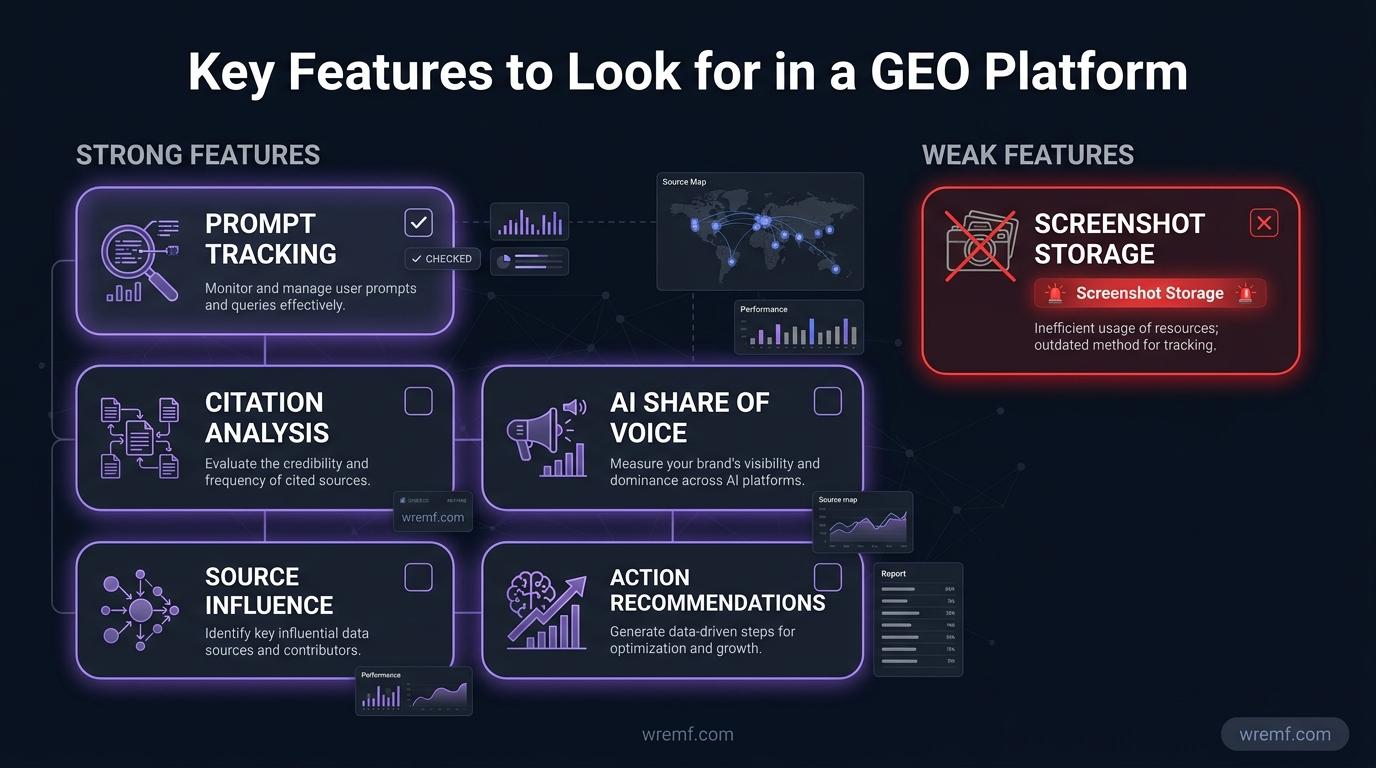
A strong GEO platform should track prompts, citations, competitors, source influence, AI share of voice, traffic attribution, and action recommendations. A weak platform only stores AI answer screenshots without explaining what changed or what to improve.
Prompt tracking is the process of monitoring how AI models answer specific questions over time. Prompt tracking matters because each prompt can trigger different brand mentions, citations, competitors, and AI answers.
Citation tracking is the process of identifying which sources are cited or referenced inside AI-generated answers. Citation tracking matters because AI citations reveal which websites, documents, forums, reviews, videos, or directories influence AI answer engines.
Source Influence Analytics is the process of measuring which sources most often shape AI answers in a category. Source Influence Analytics matters because your own website may not be the main source AI systems use when describing your market.
A complete GEO platform should include these core features:
AI visibility tracking across multiple AI models and answer engines
Prompt tracking by buyer intent, funnel stage, category, and competitor set
Citation tracking for owned, earned, and third-party sources
AI share of voice across brand, competitor, and category prompts
Competitor visibility across ChatGPT, Claude, Gemini, Perplexity, Google AI Overviews, and Copilot
AI-SERP monitoring for Google AI Overviews and search-integrated AI results
Source consistency analysis across websites, directories, reviews, and community sources
Semantic Distance analysis between your content and model expectations
Content optimization recommendations and AI-ready content briefs
AI-Referred Traffic Analysis using analytics and referral data where available
White-label reporting for agencies and consultants
API, MCP, and BYOK support for technical workflows
Visibility scoring that leadership can understand
WREMF combines prompt intelligence, source citation tracking, and competitive landscape monitoring so teams can see which prompts trigger brand mentions, which citations influence AI answers, and which competitors appear more often.
TIP: Ask whether the platform provides recommendations, not just dashboards. GEO data becomes valuable only when it helps your team decide what to fix next.
KEY TAKEAWAY: A useful GEO platform should show what AI models say, which sources shaped the answer, which competitors appear, and what your team should improve.
Those features are only useful when you understand how AI answers are formed.
How GEO Platforms Track AI Models, RAG Retrieval, and AI Answers
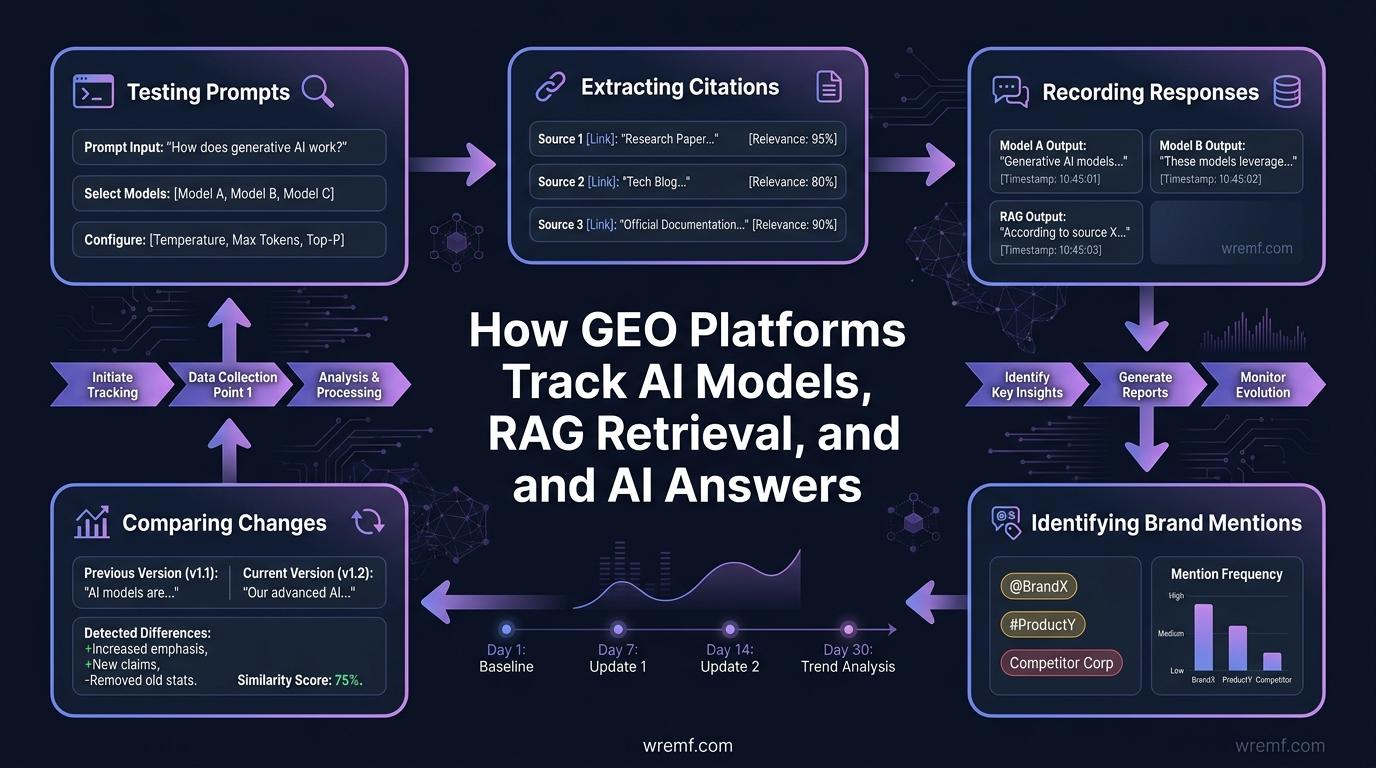
GEO platforms track AI answers by testing prompts across AI models, recording responses, identifying brand mentions, extracting citations, and comparing changes over time. This helps teams understand how AI models interpret queries and retrieve sources.
AI models are systems trained to process language, generate answers, summarize information, and interpret intent. AI models matter for GEO because ChatGPT, Claude, Gemini, DeepSeek, Grok, Meta AI, and Mistral can each produce different responses for similar prompts.
Retrieval-Augmented Generation is a method where a language model uses retrieved external information to support an answer. RAG Retrieval matters because many AI answer engines combine model knowledge with live search results, indexed sources, citations, or configured knowledge bases.
Base Model Knowledge is the information and associations learned during model training. Base Model Knowledge matters because AI answers may combine older learned associations with newer retrieved sources, especially when the platform uses search grounding.
Intent Logic Decoding is the process of understanding how AI systems interpret the purpose behind a query. Intent Logic Decoding matters because “best GEO platform,” “GEO tool pricing,” “how to track ChatGPT visibility,” and “AI visibility agency” represent different buying stages.
Microsoft Copilot Studio documentation explains that generative answers can retrieve relevant information from public websites, use Bing Custom Search, apply query optimization, and return grounded responses based on web content. (Microsoft Learn) This shows why GEO platforms must monitor both the generated answer and the retrieval layer behind the answer.
In practical AI visibility audits, teams often discover that the same brand appears differently across models. ChatGPT may mention a vendor from model knowledge, Perplexity may cite a recent article, Gemini may rely on Google Search context, and Claude may summarize documentation differently. A GEO platform should not flatten these differences into one vague score.
AI answers are generated responses created by AI models, sometimes with retrieval, search grounding, citations, or tool access. AI answers matter because they can shape buyer understanding before the buyer opens a vendor website.
KEY TAKEAWAY: GEO platforms must account for model behavior, retrieval, citations, and intent because AI answers are generated from multiple moving parts.
The next section explains why the source stack is becoming one of the most important GEO concepts.
Why Source Stack, Citations, and Entity Authority Matter More Than Keyword Density
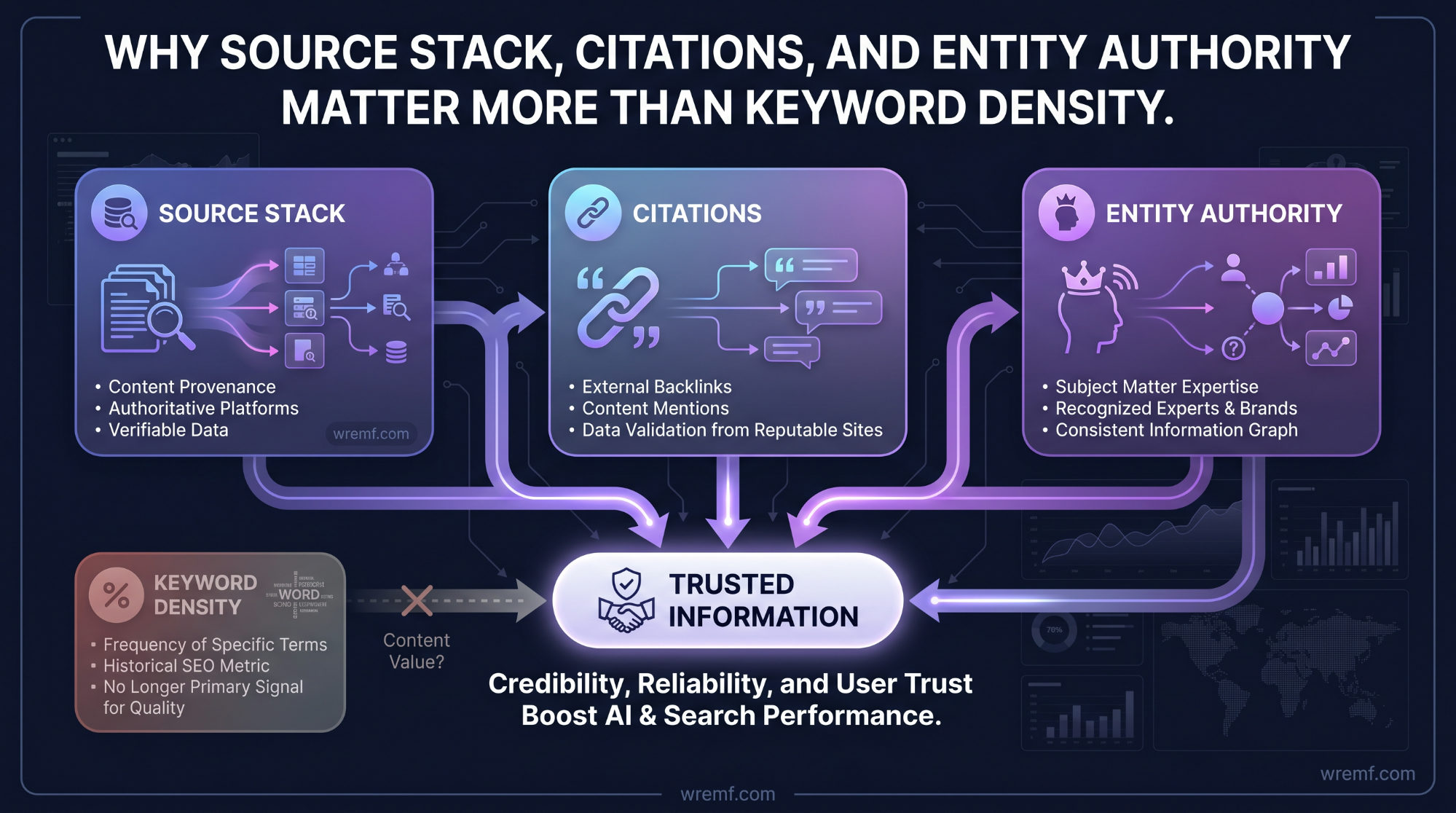
Source Stack, citations, and Entity Authority matter because AI answer engines need trusted, consistent information to describe and recommend brands. Keyword density alone cannot make a brand visible if the source ecosystem is weak or inconsistent.
Source Stack is the collection of sources that AI systems may use to understand a category, brand, product, or recommendation. Source Stack matters because AI visibility is both a measurement problem and a source ecosystem problem.
AI citations are links or references shown inside AI-generated answers. AI Citations matter because they show which sources AI answer engines use as evidence, context, or follow-up reading.
Entity Authority is the clarity and trust of a brand as a recognizable entity across the web. Entity Authority differs from Domain Authority because it focuses on meaning, relationships, category relevance, and consistency rather than only link-based website strength.
A strong Source Stack can include:
Owned website pages
Product pages
Category pages
Documentation
Methodology pages
Comparison content
Review platforms
Partner listings
Industry directories
Reddit forums
YouTube videos
Analyst mentions
Marketplace profiles
Knowledge Graph entries
Structured Data
Google Shopping feed data for ecommerce stores
In real-world reporting, teams often find that AI answer engines cite sources outside the company website. An AI answer may use a review site for sentiment, a directory for category placement, a Reddit forum for user language, a YouTube video for product explanation, or a comparison article for vendor alternatives. This is why source consistency helps AI systems retrieve clearer brand facts.
Structured Data is standardized markup that helps search systems understand page content and entities. Structured Data matters for GEO because it can support clarity, but it should be treated as a technical aid rather than a guaranteed citation mechanism.
If you want to inspect how prompts, citations, competitors, and sources connect in a real workflow, review the WREMF methodology for a structured way to evaluate AI visibility.
KEY TAKEAWAY: AI visibility depends on source consistency, citations, and entity clarity, not only keywords or rankings.
After source influence, teams need to understand the difference between measurement metrics and business metrics.
Which Metrics Matter Most in AI Visibility Tracking?
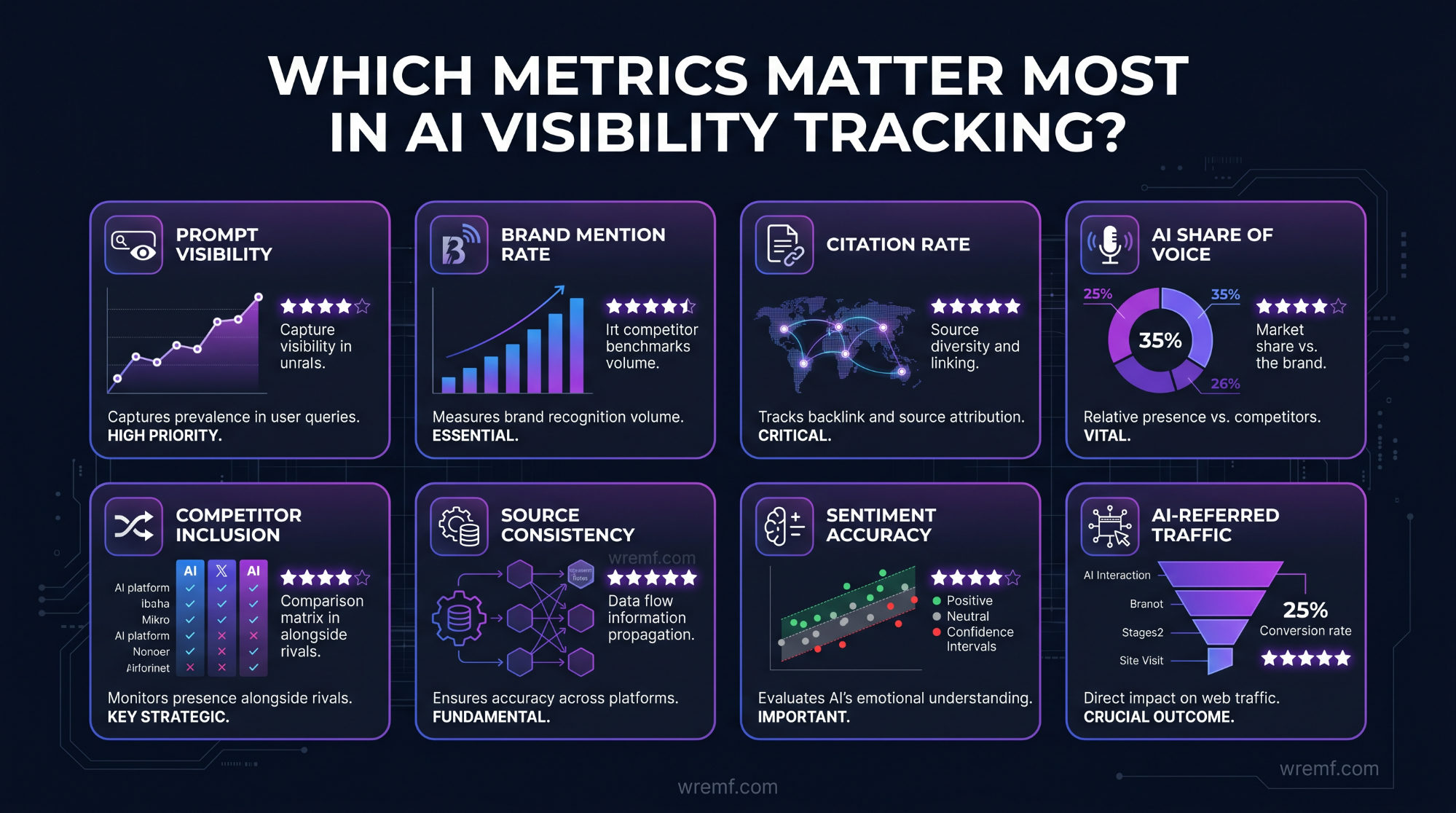
The most useful AI visibility tracking metrics are prompt visibility, brand mention rate, citation rate, AI share of voice, competitor inclusion, source consistency, sentiment accuracy, and AI-referred traffic. These metrics show whether AI search is helping or hiding your brand.
AI share of voice is the relative frequency of a brand’s visibility across a tracked set of AI prompts. Share of Voice matters because leadership teams need a simple way to compare brand visibility against competitors.
Citation rate is the frequency at which a brand, page, or source appears as a citation in AI answers. Citation rate matters because cited sources can shape trust and downstream user exploration.
Brand mention is any appearance of a brand name in an AI answer. Brand mention matters because mentions show awareness, but a mention is not the same as a citation, recommendation, or positive comparison.
The most useful GEO metrics include:
Prompt visibility score
Brand mention rate
Recommendation rate
Citation rate
Source citation share
AI share of voice
Competitor overlap
Description accuracy
Sentiment or recommendation quality
Source consistency gaps
AI-referred traffic
AI-influenced lead quality where measurable
Prompt volatility by model and date
Visual Citations where AI search interfaces show cited cards or source blocks
AI traffic attribution connects AI discovery to website visits, form fills, leads, or pipeline where referral data is available. AI traffic attribution matters because not every AI-influenced buyer journey produces a trackable click, but measurable referrals should still be captured.
A common implementation mistake is reporting only one metric. If you report only traffic, you miss zero-click influence. If you report only mentions, you miss citations and sentiment. If you report only citations, you miss competitor inclusion and recommendation quality.
WREMF’s AI visibility index is designed to help teams package AI visibility signals into a clearer reporting system. That makes it easier to compare prompts, competitors, citations, and visibility movement over time.
KEY TAKEAWAY: AI visibility tracking works best when teams measure prompt visibility, citations, share of voice, competitors, source quality, and attribution together.
Once measurement is in place, teams need a practical implementation framework.
How to Implement a GEO Strategy With the Right Platform
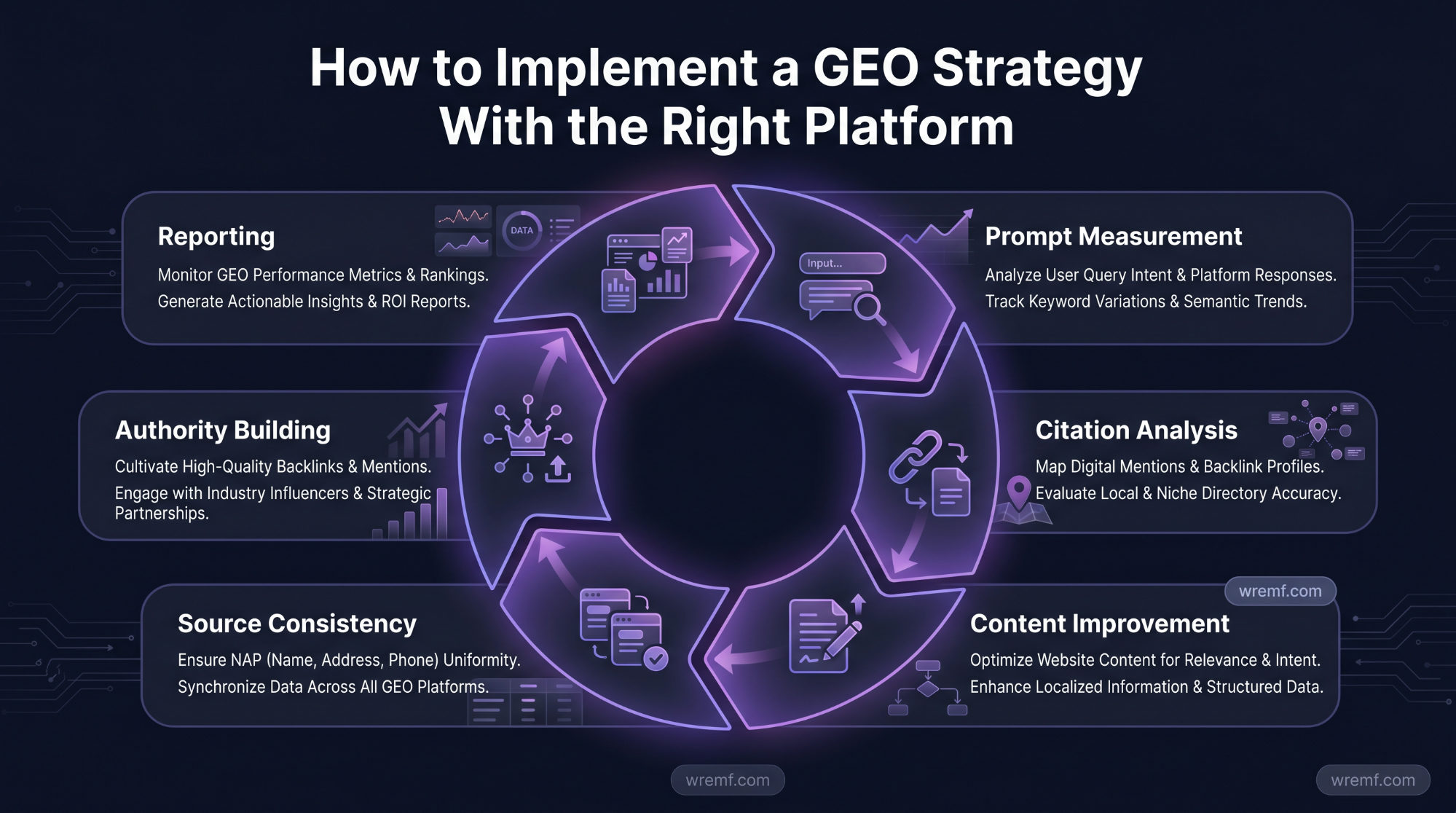
The most effective GEO strategy starts with prompt measurement, then moves into citation analysis, content improvement, source consistency, authority building, and reporting. A GEO platform should support each phase of this workflow.
AEO strategy helps content become clear, structured, and answer-ready. GEO strategy helps brands become visible, cited, and accurately represented across generative engine results and AI answer engines.
Phase 1: Build your technical foundation. Make sure your website is crawlable, indexable, internally linked, fast enough for users, and clear enough for search engines and AI crawlers. Internal linking should connect pillar pages, feature pages, comparison pages, product pages, methodology pages, pricing pages, and support content.
Phase 2: Map prompts by buyer intent. Create prompt groups around problems, categories, alternatives, pricing, integrations, competitors, reviews, implementation, and “best platform” searches. Question and intent mapping helps you understand how AI models interpret buying-stage queries.
Phase 3: Analyze AI answers and citations. Track which brands appear, which competitors are recommended, which sources are cited, and whether the AI answer accurately describes your offering. This step turns AI search from guesswork into a diagnostic workflow.
Phase 4: Improve content and semantic completeness. Use semantic analysis, content scoring, topic clustering, and AI-ready briefs to close gaps. WREMF’s AI-ready content briefs help teams convert GEO findings into practical content actions.
Phase 5: Expand source influence. Improve consistency across reviews, directories, partner pages, third-party mentions, YouTube videos, Reddit forums, documentation, and market listings. This step is especially important when AI answer engines rely on sources outside your website.
Phase 6: Test and report over time. Use scheduled AI monitoring, SEO testing, AI-SERP monitoring, and prompt history to see whether visibility changes. WREMF’s SEO testing feature helps teams evaluate whether content and technical changes support search and AI visibility.
KEY TAKEAWAY: GEO implementation works best as a cycle of measurement, diagnosis, content improvement, source consistency, and reporting.
The next section explains how to choose between software, agency support, and a hybrid model.
Should You Use GEO Software, a GEO Agency, or a Hybrid Model?
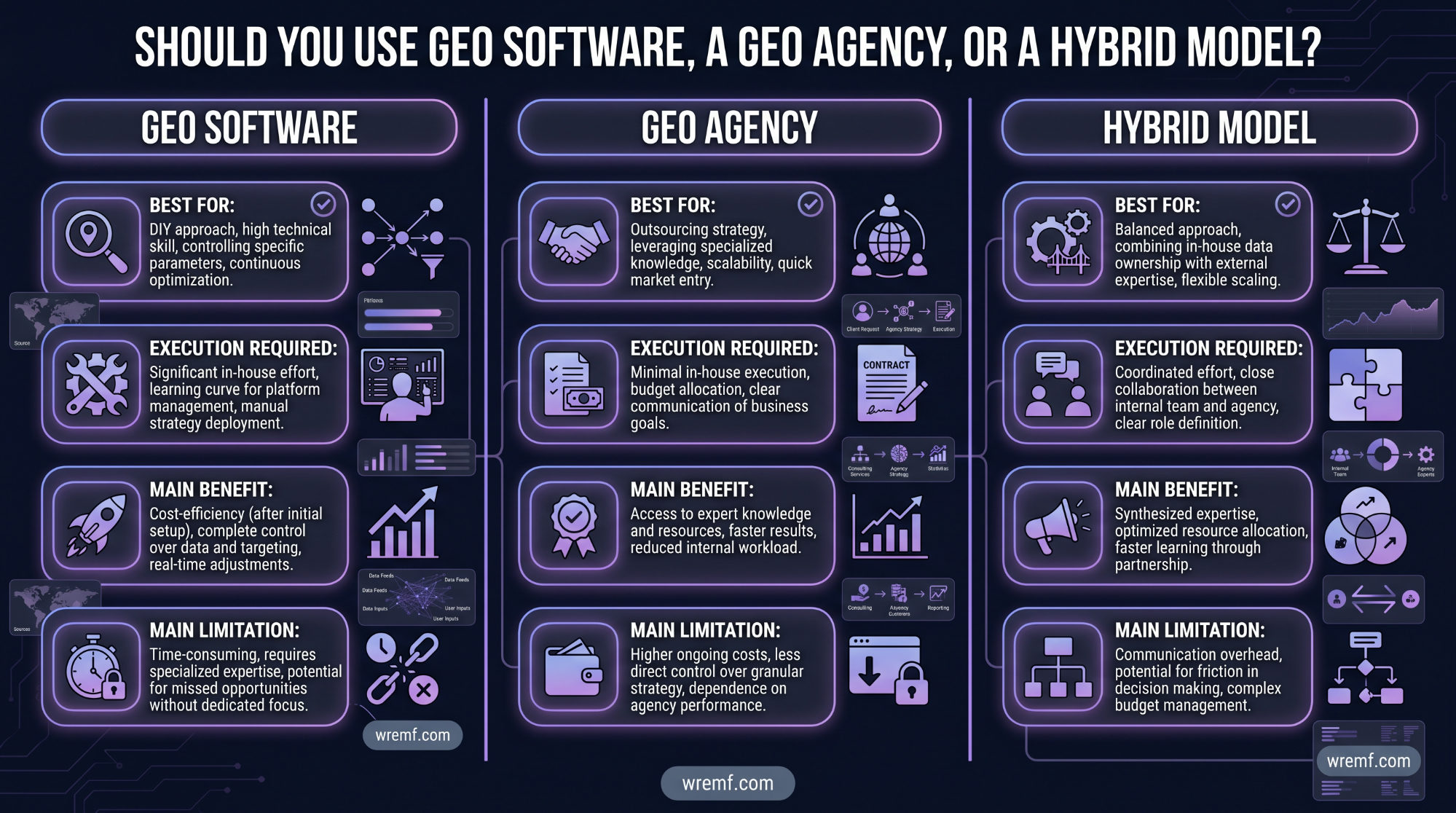
You should use GEO software if your team can execute internally, a GEO agency if you need strategy and delivery, and a hybrid model if you need both measurement and managed action. The right choice depends on capacity, urgency, and reporting needs.
GEO software is best for teams with internal SEO, content, analytics, and technical resources. The platform provides prompt data, AI visibility tracking, citation tracking, competitor analysis, and reporting, but your team still needs to turn insights into action.
A GEO agency is best for teams that need managed AEO, GEO, content optimisation, entity cleanup, authority building, source consistency cleanup, technical AI visibility foundations, schema guidance, crawl checks, and monthly execution. This model works when the team knows AI visibility matters but lacks time or senior expertise.
A hybrid model is best when your team wants direct access to dashboards, prompts, citations, and reports, while also receiving expert strategy and implementation support. WREMF supports this model because teams can use software, agency services, or both.
| Model | Best For | Execution Required | Main Benefit | Main Limitation |
|---|---|---|---|---|
| GEO software | In-house SEO and growth teams | High internal execution | Transparent data and repeatable reporting | Insights can stall without implementation |
| GEO agency | Teams needing strategy and delivery | Lower internal execution | Senior-led prioritisation and execution | Less self-serve control |
| Hybrid model | Teams needing dashboards plus execution | Shared execution | Measurement and action in one workflow | Requires clear ownership between teams |
Agencies managing multiple clients often need white-label reporting, client portals, multi-site tracking, and repeatable methodology. In-house brands often need competitor visibility, source consistency analysis, leadership reporting, and attribution workflows. Technical teams may need API, MCP, BYOK, and integrations through the WREMF API and integrations workflow.
For teams that want managed execution, WREMF provides AI visibility agency services across AEO, GEO, content optimisation, entity authority, source consistency, monthly reporting, and technical AI visibility foundations.
KEY TAKEAWAY: Choose software for internal execution, agency support for expert delivery, and a hybrid model when your team needs both measurement and implementation.
The next section covers ecommerce, reviews, AI agents, and product data because GEO is expanding beyond content pages.
How Reviews, Ecommerce Data, and AI Agents Affect GEO
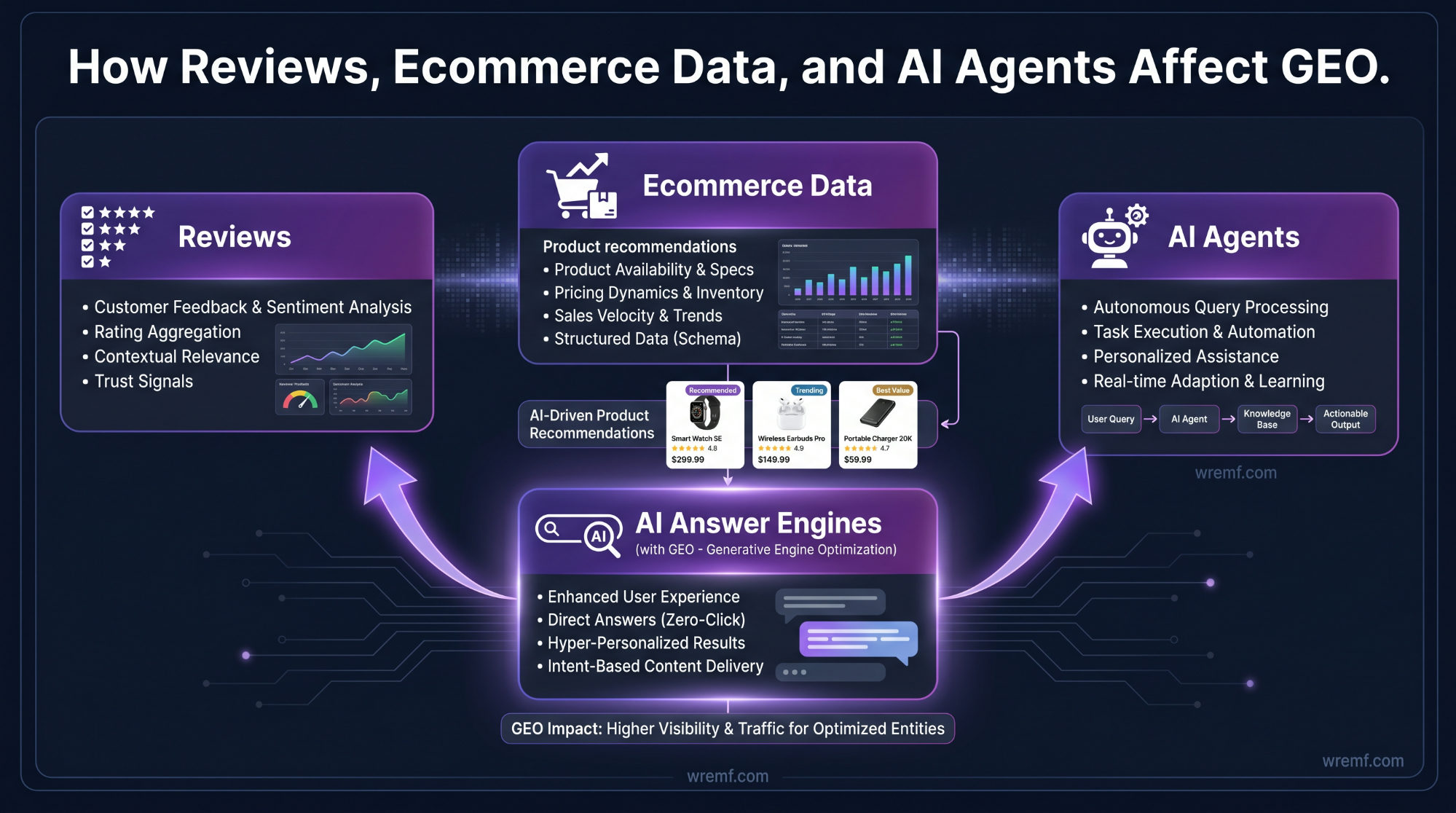
Reviews, ecommerce data, and AI agents affect GEO because AI answer engines can use reputation signals, product feeds, third-party sentiment, and machine-readable data to form product recommendations. This matters most for ecommerce stores, marketplaces, SaaS review categories, and product-led brands.
Reputation Management is the process of shaping how customers, reviewers, communities, and third-party platforms describe a brand. Reputation Management matters for GEO because AI answers may summarize sentiment from review sites, forums, directories, and product comparison pages.
Yotpo Reviews, product reviews, marketplace ratings, and customer testimonials can influence AI sentiment when answer engines retrieve or summarize third-party opinion. Reviews are not a guaranteed AI ranking factor, but reviews can become part of the Source Stack for ecommerce stores and SaaS products.
Google Shopping feed data matters for ecommerce GEO because product attributes, pricing, availability, descriptions, and merchant data need to be machine-readable. Akeneo, product information management systems, and commerce data platforms can support cleaner product data, but a GEO platform is still needed to monitor how AI answer engines describe products and cite sources.
AI Agent is a software system that can interpret a user goal, gather information, and take actions across tools or websites. AI Agent visibility matters because discovery is moving from answer generation toward action centers where AI systems may compare, recommend, and eventually complete tasks on behalf of users.
Programmatic Commerce is commerce where software agents can initiate or assist transactions based on structured product data and user preferences. Programmatic Commerce matters because brands need machine-readable product, pricing, availability, and policy information.
For ecommerce stores, GEO often requires five workstreams:
Clean product data and category pages
Review quality and sentiment visibility
Consistent third-party listings
Structured Data and feed accuracy
Monitoring of AI answers for product and category prompts
For B2B brands, the equivalent workstreams are product positioning, review visibility, comparison accuracy, source consistency, and category authority. In both cases, GEO is not only content production. GEO is also data hygiene, reputation, source influence, and measurement.
KEY TAKEAWAY: Reviews, product data, and AI agents expand GEO beyond blog content into reputation, structured data, ecommerce feeds, and machine-readable brand information.
The next section explains technical foundations such as llms.txt, AI crawlers, structured content, and internal linking.
What Technical Foundations Matter for GEO?
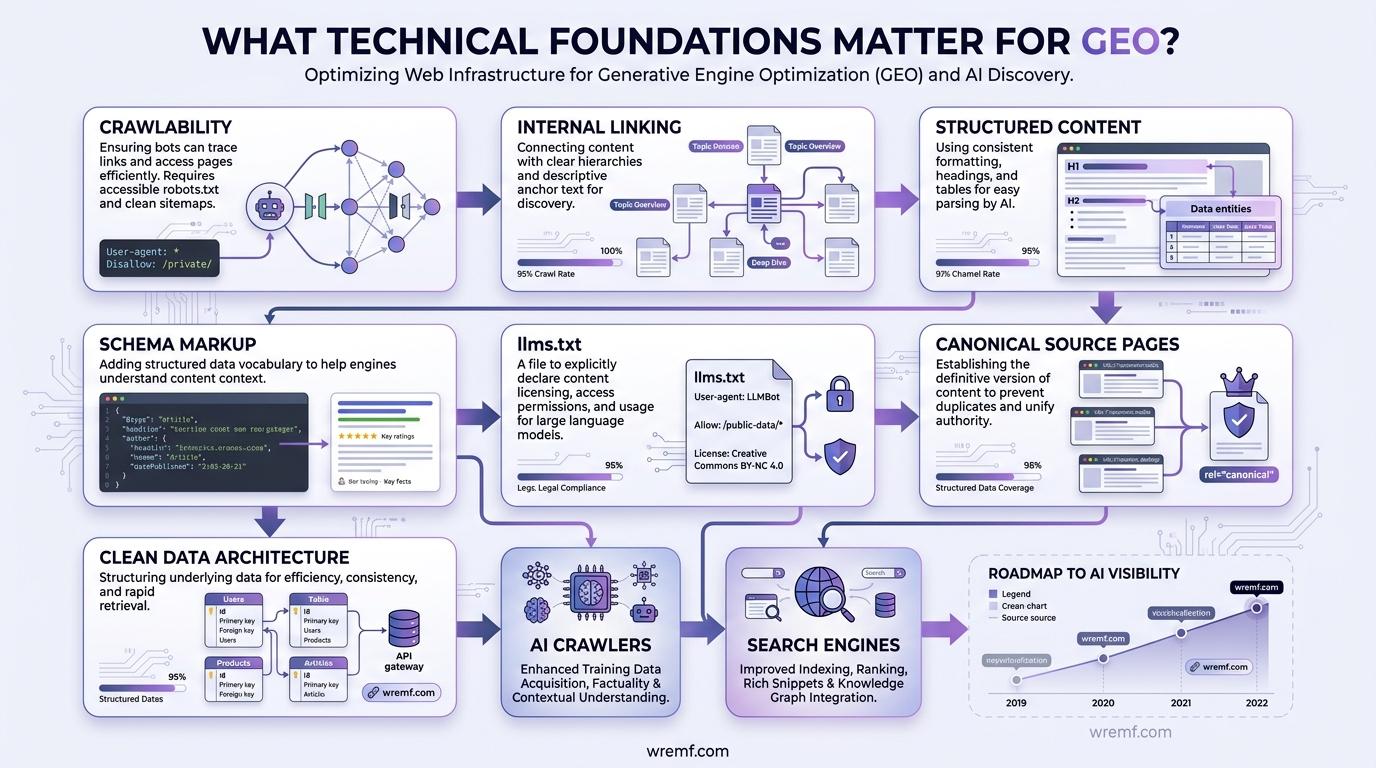
Technical GEO foundations include crawlability, internal linking, structured content, schema markup, llms.txt, canonical source pages, and clean data architecture. These foundations help AI crawlers, search engines, and answer engines understand your content more reliably.
AI Crawler is a crawler used by AI systems or AI search products to discover and process web content. AI Crawler access matters because blocked, unclear, duplicate, or poorly structured content can reduce retrievability.
llms.txt is a proposed markdown-based file that helps websites provide AI systems with a clear map of important content for inference-time use. llms.txt matters because it can help organize key resources for language models, but it is still a proposal and should not be treated as a guaranteed ranking factor. (llms-txt)
Ground Truth is the authoritative source of accurate information about a brand, product, pricing, category, or methodology. Ground Truth matters because AI models can misdescribe brands when authoritative information is unclear, inconsistent, outdated, or hidden.
Your technical GEO checklist should include:
Crawlable and indexable core pages
Clear navigation and internal linking
Answer-first headings and definitions
Structured Data where appropriate
Consistent brand, product, and pricing information
Clear methodology and comparison pages
Fast, accessible, user-friendly pages
XML sitemap hygiene
Canonical tags where needed
Robots.txt and AI crawler access decisions
llms.txt if your team wants to test emerging LLM-readiness workflows
Content briefs that align with buyer prompts and source gaps
A common implementation mistake is treating llms.txt as a shortcut. llms.txt can help package important content for AI systems, but it cannot compensate for thin pages, weak content strategy, inconsistent brand facts, or missing source authority.
WREMF’s GEO audit workflow is useful when a team wants to inspect technical readiness, prompt visibility, citations, source gaps, and action priorities together.
KEY TAKEAWAY: Technical GEO foundations make your content easier to crawl, understand, retrieve, cite, and compare, but they work best with strong content and source consistency.
The next section covers the risks and limitations of GEO platforms so buyers can avoid overpromising.
What Are the Risks and Limitations of GEO Platforms?
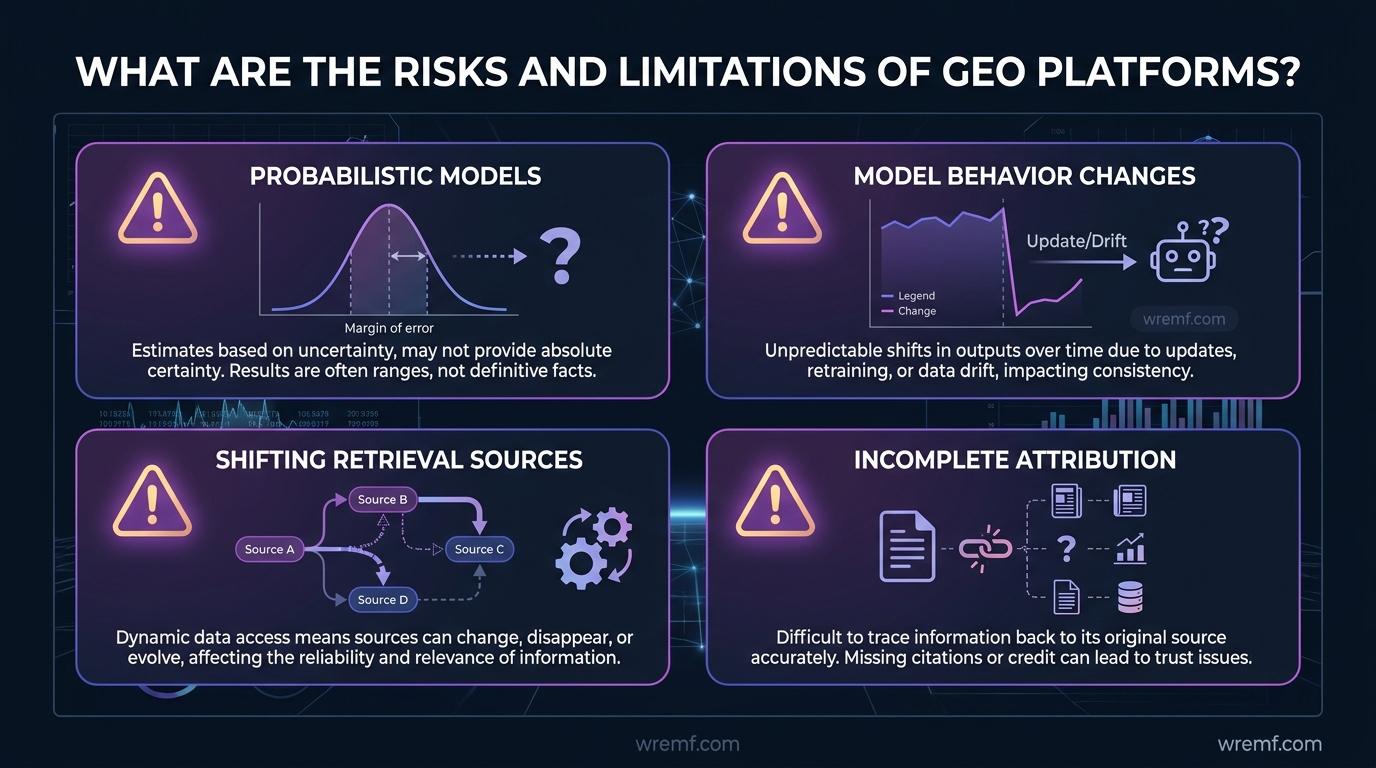
GEO platforms have limits because AI answers are probabilistic, model behavior changes, retrieval sources shift, and attribution is incomplete. A credible platform should explain uncertainty instead of promising guaranteed AI rankings, citations, or revenue.
A Probabilistic model is a model that can produce different outputs depending on prompt wording, retrieval context, system settings, source availability, and model behavior. Probabilistic model behavior matters because AI visibility should be measured as a trend, not as one fixed ranking.
Model Collapse is a degenerative process where generative models can degrade when recursively trained on model-generated data. Nature published research in 2024 explaining that model collapse can occur when generated content pollutes training data for future generations of models. (Nature) Model Collapse matters for GEO because brands should prioritize original, verifiable, expert content instead of flooding the web with low-value AI content.
The main risks include:
Treating one AI answer as a stable ranking
Measuring only brand mentions and ignoring citations
Measuring only citations and ignoring sentiment
Ignoring competitor inclusion
Overproducing generic AI content
Assuming AI traffic attribution captures all influence
Ignoring source consistency across third-party sites
Confusing AI-SERP monitoring with full GEO strategy
Assuming Structured Data or llms.txt guarantees visibility
Forgetting that AI answers can hallucinate or misinterpret sources
Teams usually struggle when they turn GEO into a screenshot exercise. A screenshot can show one answer at one moment, but it cannot reveal prompt volatility, source changes, competitor patterns, citation movement, or long-term visibility trends.
IMPORTANT: No GEO platform should guarantee AI citations, rankings, traffic, revenue, or recommendations. A credible GEO platform should provide measurement, evidence, recommendations, and transparent limitations.
KEY TAKEAWAY: GEO platforms are valuable because they show patterns and priorities, not because they make AI answers perfectly predictable.
The next section addresses the myths that often block teams from starting GEO properly.
Common Myths About AI Visibility Debunked
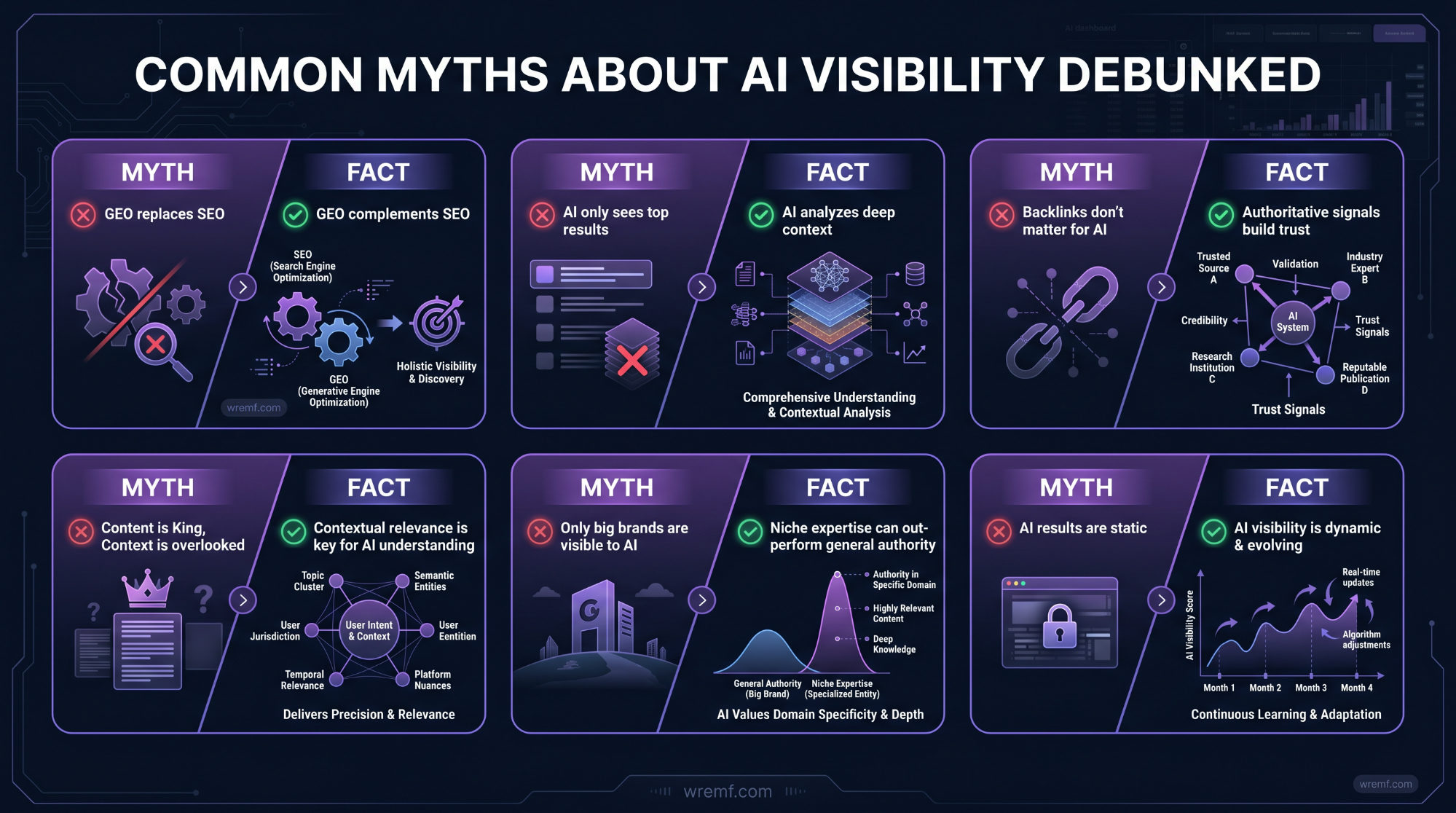
AI visibility is often misunderstood because teams apply traditional ranking logic to AI answer engines. The best GEO decisions separate measurable patterns from assumptions.
MYTH: GEO replaces SEO, AEO, and traditional search engine optimization.
FACT: GEO does not replace SEO or AEO. SEO helps content become crawlable, trustworthy, and discoverable in search engines. AEO helps content become answer-ready. GEO measures and improves how AI models, AI search engines, and answer engines mention, cite, summarize, and recommend brands.
MYTH: AI visibility is impossible to measure.
FACT: AI visibility cannot be measured exactly like a fixed search engine ranking, but it can be measured through prompt tracking, citation tracking, brand mention rate, AI share of voice, competitor inclusion, and AI-referred traffic. The measurement is probabilistic, so repeated tests and trends matter more than one-off checks.
MYTH: Rankings are enough if your brand already performs well in Google Search.
FACT: Rankings are valuable, but AI answers can use different sources, summaries, and recommendation logic from classic search engine results. A page can rank well and still be absent from ChatGPT, Gemini, Claude, Perplexity, or Google AI Overviews for buying-stage prompts.
MYTH: GEO is only about adding more keywords to content.
FACT: GEO depends on entity clarity, citations, source consistency, answer-first content, structured data, reviews, and third-party source influence. Keywords still matter, but keyword density alone cannot fix unclear entities or weak source authority.
MYTH: Small businesses cannot compete in GEO without enterprise software.
FACT: Small businesses can compete by tracking focused prompt sets, creating answer-first pages, cleaning up inconsistent brand information, improving reviews, and earning credible source mentions. Enterprise software helps scale monitoring, but disciplined execution matters more than tool size.
KEY TAKEAWAY: AI visibility is not magic and not just SEO with a new name. AI visibility is a measurable workflow built around prompts, citations, source stacks, entities, and answer quality.
The final buying section brings these ideas together into a practical decision framework.
How to Choose the Best GEO Platform for Your Business
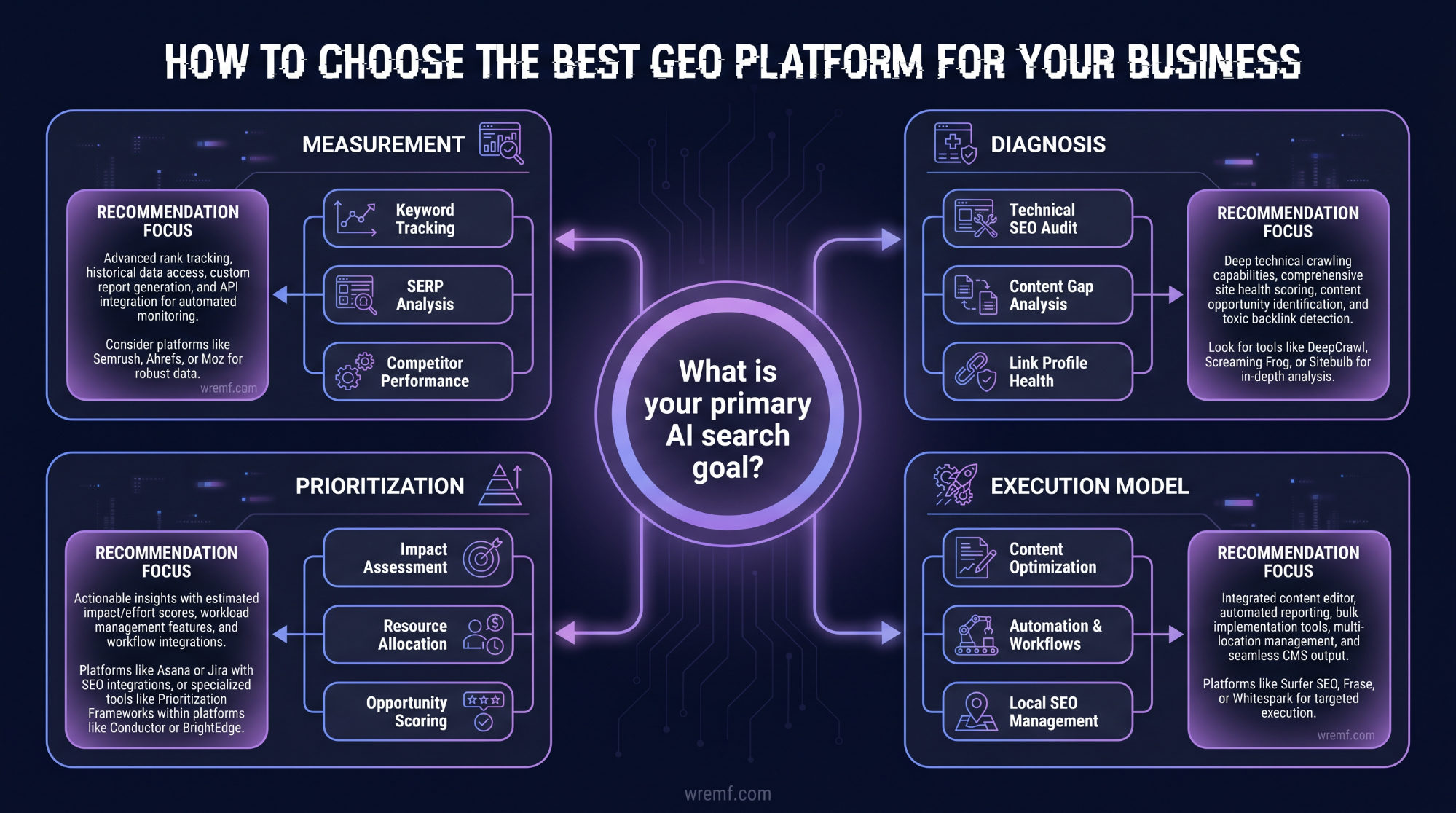
Choose the best GEO platform by matching the platform to your AI search goal, team capacity, reporting needs, technical maturity, and execution model. The best option should help you measure, diagnose, prioritize, and act.
For most B2B teams, the evaluation should begin with your main question:
Do you need to track whether AI models mention your brand?
Do you need to know which sources AI answers cite?
Do you need to compare visibility against competitors?
Do you need content briefs based on AI search gaps?
Do you need white-label reporting for clients?
Do you need managed AEO, GEO, and content execution?
Do you need API, MCP, or BYOK workflows?
Do you need pricing that works for one website or many websites?
WREMF is a strong fit when your team needs a practical AI visibility workflow across software, agency, or hybrid support. The Starter plan at €39 per month supports 1 website, unlimited prompt tracking, BYOK, 10 AI engines, all features and tools, white-label reports, 1 seat, and email support. The Growth plan at €89 per month supports 5 websites, unlimited prompt tracking, BYOK, 10 AI engines, white-label reports, priority email support with a 24h SLA, content brief generation, and SEO A/B testing. Enterprise supports unlimited websites, unlimited prompt tracking, unlimited seats, dedicated support with a 4h SLA, custom branded portals, and custom pricing.
Use this decision table to shortlist your platform category.
| Business Need | Best Platform Type | Why It Fits | WREMF Fit |
|---|---|---|---|
| Track AI visibility across major AI engines | AI visibility platform | Measures prompts, citations, mentions, competitors | Strong fit |
| Build AI-ready content at scale | Content optimization platform | Supports semantic content scoring and content production | Strong fit when paired with content briefs |
| Track Google AI Overviews specifically | AI-SERP monitoring tool | Focuses on Google AI and search-integrated answers | Fit when part of wider AI engine tracking |
| Improve ecommerce AI recommendations | Ecommerce data and reputation workflow | Focuses on reviews, feeds, and product data | Fit for source tracking and AI answer monitoring |
| Serve multiple clients | Agency-focused GEO platform | Needs white-label reports and client portals | Strong fit |
| Get managed execution | GEO agency or hybrid platform | Converts insights into strategy and delivery | Strong fit |
| Connect GEO to technical workflows | API-enabled platform | Supports API, MCP, integrations, and BYOK | Strong fit |
If you want proof before making a buying decision, compare a live report, prompt methodology, citation tracking, competitor analysis, pricing, and execution support. WREMF provides a sample AI visibility report so teams can see what a practical AI visibility report includes before building their own workflow.
KEY TAKEAWAY: The best GEO platform is not the biggest dashboard. The best GEO platform turns AI visibility data into decisions, content actions, source improvements, and credible reporting.
The FAQ section answers the most common buying, comparison, implementation, and risk questions.
Frequently Asked Questions
What are the best generative engine optimization platforms?
The best generative engine optimization platforms are tools that measure brand visibility across AI answers, citations, source influence, and recommendations. Strong platform categories include AI visibility tracking platforms, citation tracking tools, AI-SERP monitoring tools, content optimization platforms, ecommerce reputation platforms, and hybrid software plus agency solutions. WREMF fits teams that want software, agency execution, or a hybrid workflow across ChatGPT, Claude, Gemini, Perplexity, Google AI Overviews, Copilot, DeepSeek, Grok, Meta AI, and Mistral. The right platform depends on whether you need monitoring, content briefs, competitor visibility, white-label reporting, or managed execution.
Do I need a GEO tool if I already use Google Search Console?
Yes, you may need a GEO tool even if you already use Google Search Console. Google Search Console is useful for Google Search queries, indexing, clicks, impressions, and page-level performance. It does not show whether ChatGPT, Claude, Gemini, Perplexity, Copilot, DeepSeek, Grok, Meta AI, or Mistral mention, cite, or recommend your brand. A GEO platform adds prompt tracking, citation tracking, AI share of voice, source influence analytics, competitor visibility, and AI answer monitoring. WREMF is useful when you want to connect AI visibility tracking with practical content and source recommendations.
How do GEO platforms differ from traditional SEO tools?
GEO platforms measure AI answer visibility, while traditional SEO tools measure search engine rankings, keywords, backlinks, and organic traffic. SEO tools help you understand how pages perform in search engines. GEO platforms help you understand how AI answer engines describe, cite, compare, and recommend brands. The two should work together. SEO creates crawlable, useful, authoritative content. AEO makes content easier to extract as answers. GEO measures whether AI models and answer engines actually include your brand in the generated answer.
Which GEO tool is best for tracking Google AI Overviews?
The best GEO tool for tracking Google AI Overviews should monitor queries where AI Overviews appear, capture cited sources, compare competitors, and track changes over time. Google AI Overviews matter because they add an AI-generated answer layer to Google Search. A platform like WREMF is useful when you want to track Google AI Overviews alongside ChatGPT, Claude, Gemini, Perplexity, Copilot, DeepSeek, Grok, Meta AI, and Mistral. This broader view helps teams avoid over-optimizing for one AI surface while missing visibility across other AI answer engines.
How often does AI search visibility change compared to organic rankings?
AI search visibility can change more often than organic rankings because AI models, retrieval systems, cited sources, prompt interpretation, and product interfaces can shift quickly. Organic rankings also change, but AI answers are more probabilistic and may vary by prompt wording, model, date, search grounding, and source availability. Teams should track prompt groups repeatedly rather than relying on one manual check. Weekly or monthly monitoring is usually more useful than screenshots when leadership needs trend reporting across AI search engines.
Can small businesses compete in GEO without enterprise tools?
Small businesses can compete in GEO without enterprise tools by focusing on narrow prompt groups, clear answer-first content, consistent brand facts, strong reviews, accurate directories, and credible source mentions. A small business does not need to monitor thousands of prompts at first. It can start with 20 to 50 high-intent prompts, inspect citations, compare competitors, and fix the most important source gaps. Enterprise tools help scale the workflow, but practical execution, source consistency, and useful content are still the foundation.
What is llms.txt and why does it matter for GEO?
llms.txt is a proposed markdown-based file that helps websites provide AI systems with a clear map of important content for inference-time use. It matters for GEO because AI systems need clean, structured access to useful brand, product, pricing, documentation, and policy information. However, llms.txt is not a guaranteed visibility factor. It should be treated as one technical readiness layer alongside crawlability, internal linking, Structured Data, answer-first content, and source consistency. A GEO platform should measure actual AI answers, not only technical setup.
How do reviews impact visibility in ChatGPT or Perplexity?
Reviews can influence visibility in ChatGPT, Perplexity, Gemini, and other answer engines when AI systems retrieve or summarize third-party sources that include customer sentiment, ratings, product proof, or comparisons. Reviews matter most for ecommerce stores, SaaS directories, local businesses, and product-led categories. Reviews alone do not guarantee inclusion in AI answers. They work best when combined with clear product data, consistent brand facts, source citations, structured category pages, and credible third-party mentions.
Is zero-click search bad for ecommerce revenue?
Zero-click search is not automatically bad for ecommerce revenue, but it changes how ecommerce teams measure discovery. AI answers and AI Overviews may reduce some direct clicks while still shaping product comparison, brand trust, and consideration. Ecommerce teams should track AI citations, product mentions, review visibility, Google Shopping feed accuracy, marketplace consistency, and AI-referred traffic where available. The risk is relying only on last-click analytics. The opportunity is becoming the brand that AI answer engines mention during product discovery.
How does Entity Authority differ from Domain Authority?
Entity Authority describes how clearly and consistently a brand is understood across sources, topics, attributes, and relationships. Domain Authority is a link-based SEO metric used to estimate the strength of a website domain. Entity Authority matters for GEO because AI models need to understand what the brand is, what category it belongs to, who it serves, how it compares, and which sources support those claims. Links help, but entity clarity, source consistency, citations, and trusted mentions also matter.
What is the risk of Model Collapse for GEO strategy?
Model Collapse is a risk where generative AI systems degrade when too much recursively generated content pollutes training data. For GEO strategy, the practical lesson is simple: do not flood your category with generic AI content. Prioritize original expertise, verifiable facts, clear methodology, updated product information, and useful comparisons. GEO should not be treated as a content spam tactic. Strong GEO depends on trustworthy sources, human review, structured information, and content that buyers would actually find useful.
Should I choose GEO software or a GEO agency?
Choose GEO software if your team has the capacity to interpret the data and execute changes internally. Choose a GEO agency if your team needs strategy, content optimisation, source consistency cleanup, entity authority work, technical foundations, and monthly execution. Choose a hybrid model if you need dashboards plus expert implementation. WREMF supports software, agency service, and combined software plus managed execution, which makes it useful for B2B teams that want both visibility tracking and practical action.
Conclusion
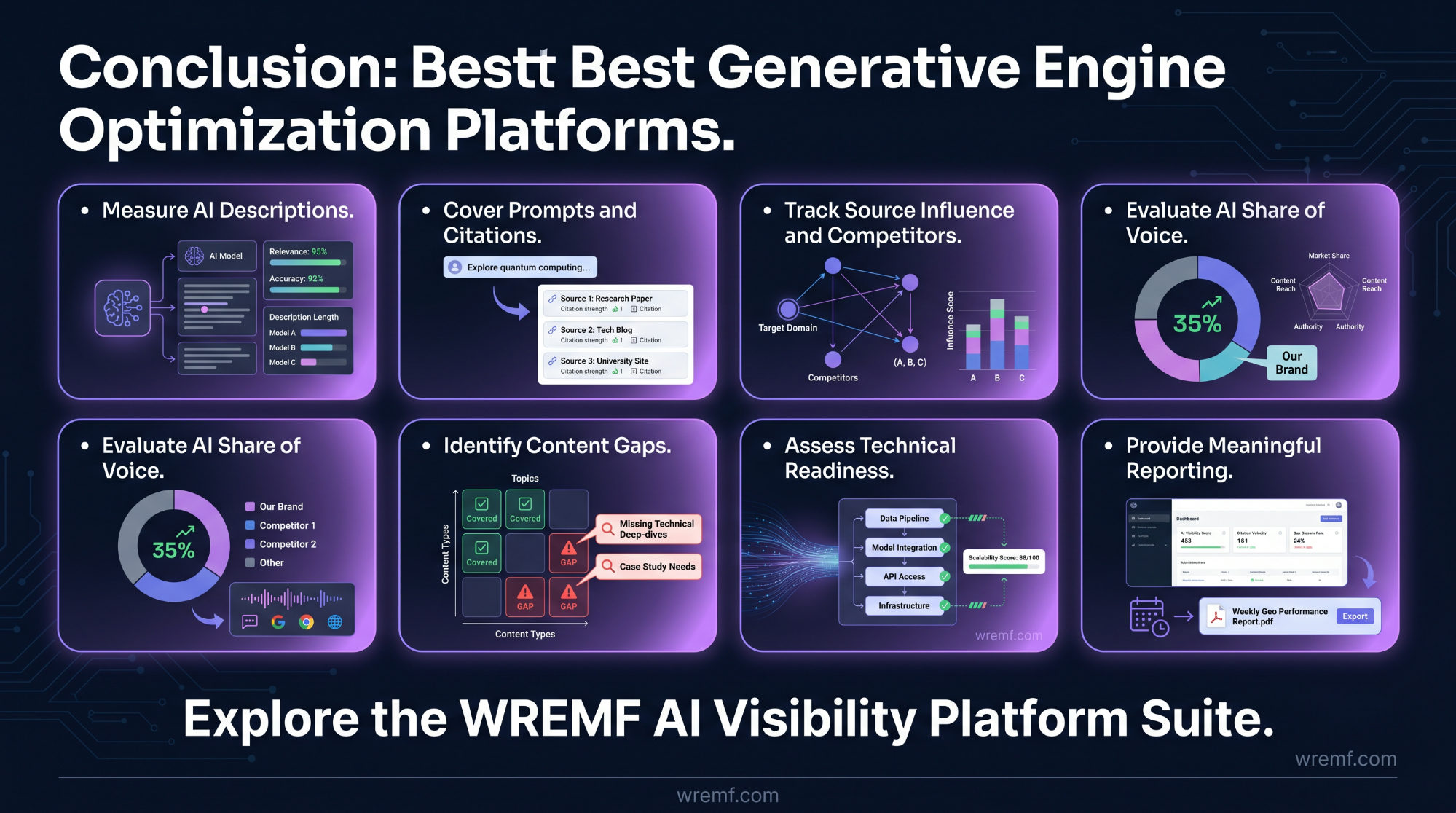
Best generative engine optimization platforms help brands measure how AI search engines, answer engines, and AI models describe, cite, compare, and recommend them. The right platform should cover prompts, citations, source influence, competitors, AI share of voice, content gaps, technical readiness, and reporting without promising guaranteed rankings or AI citations. WREMF is built for B2B teams that want software, agency support, or a hybrid workflow to track, improve, and prove AI visibility across major AI discovery surfaces. To turn GEO from manual checking into a repeatable growth workflow, explore the WREMF AI visibility platform suite.