Copilot SEO: The Complete Guide to Microsoft Copilot, AI Search Visibility, and Generative Engine Optimization
Discover how to enhance brand visibility through Copilot SEO and AI-generated answer presence.
By WREMF Team · 2026-08-23
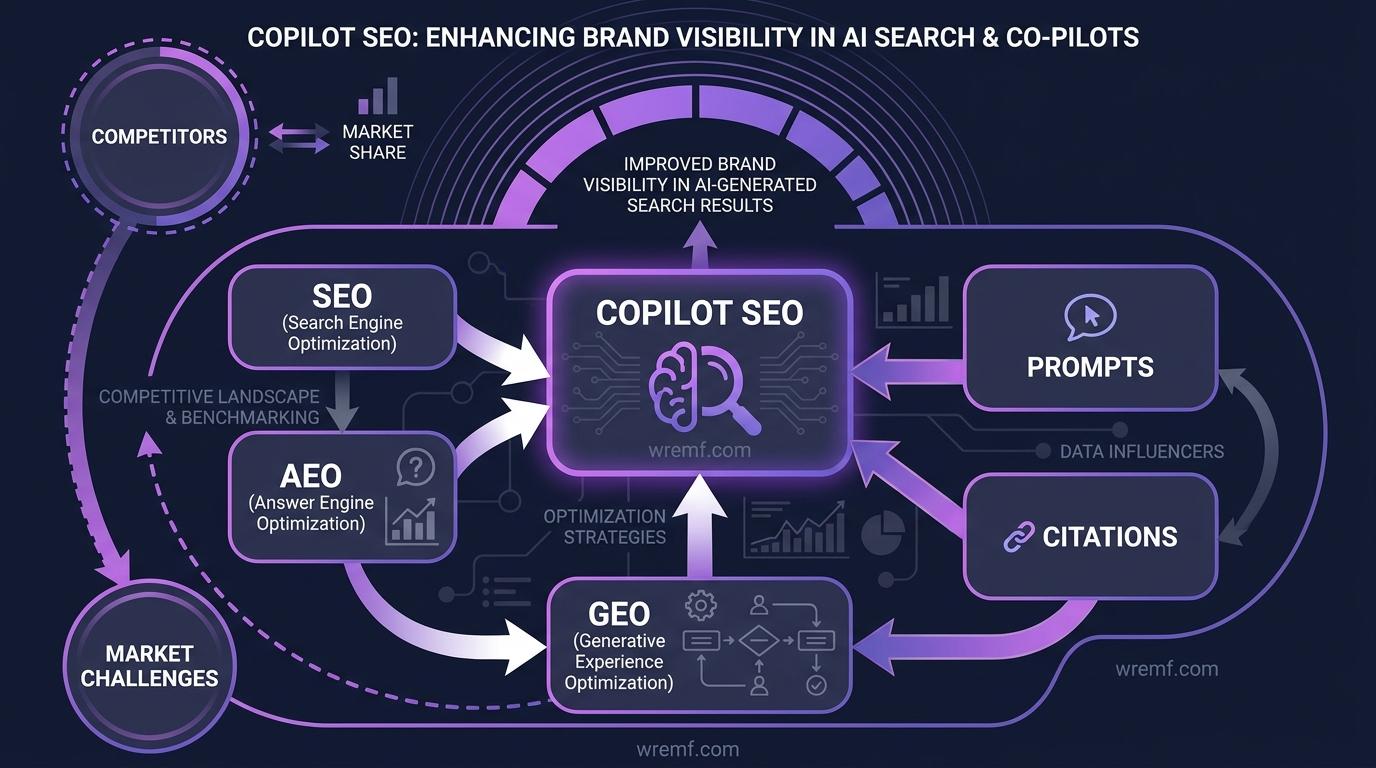
Copilot SEO enhances brand findability in Microsoft Copilot, Bing, and AI-generated answers. It integrates search engine optimization, answer engine optimization, and generative engine optimization to boost AI search visibility and brand trust. Copilot uses AI-generated answers to recommend sources. Key components include prompt tracking, citation analysis, competitor monitoring, and leveraging Microsoft Graph. Copilot SEO requires understanding AI visibility versus traditional search rankings.
Key takeaways
- Copilot SEO shifts focus from keyword rankings to AI-generated answer presence.
- Successful Copilot SEO integrates traditional SEO, AEO, and GEO practices.
- B2B teams can use prompt tracking and citation monitoring for improved AI visibility.
- Microsoft Graph is crucial for enterprise-level Copilot visibility and knowledge discovery.
- Technical SEO ensures content is crawlable and understandable for AI systems.
Copilot SEO: The Complete Guide to Microsoft Copilot, AI Search Visibility, and Generative Engine Optimization
Copilot SEO is the practice of improving brand visibility inside Microsoft Copilot, Bing, and AI-generated search answers. Microsoft describes Copilot Search in Bing as a search experience that gives quick summarized answers with cited sources and suggestions for further exploration. This guide explains how Microsoft Copilot changes SEO, how Copilot Search processes information, how SEO, AEO, and GEO work together, and how B2B teams can track prompts, citations, competitors, source links, and AI traffic. It also explains how WREMF helps teams measure Copilot visibility across Microsoft Copilot and other AI search platforms. Continue reading to build a measurable Copilot SEO strategy that works across search engines, AI assistants, and the Microsoft ecosystem. (Microsoft)
What Is Copilot SEO?
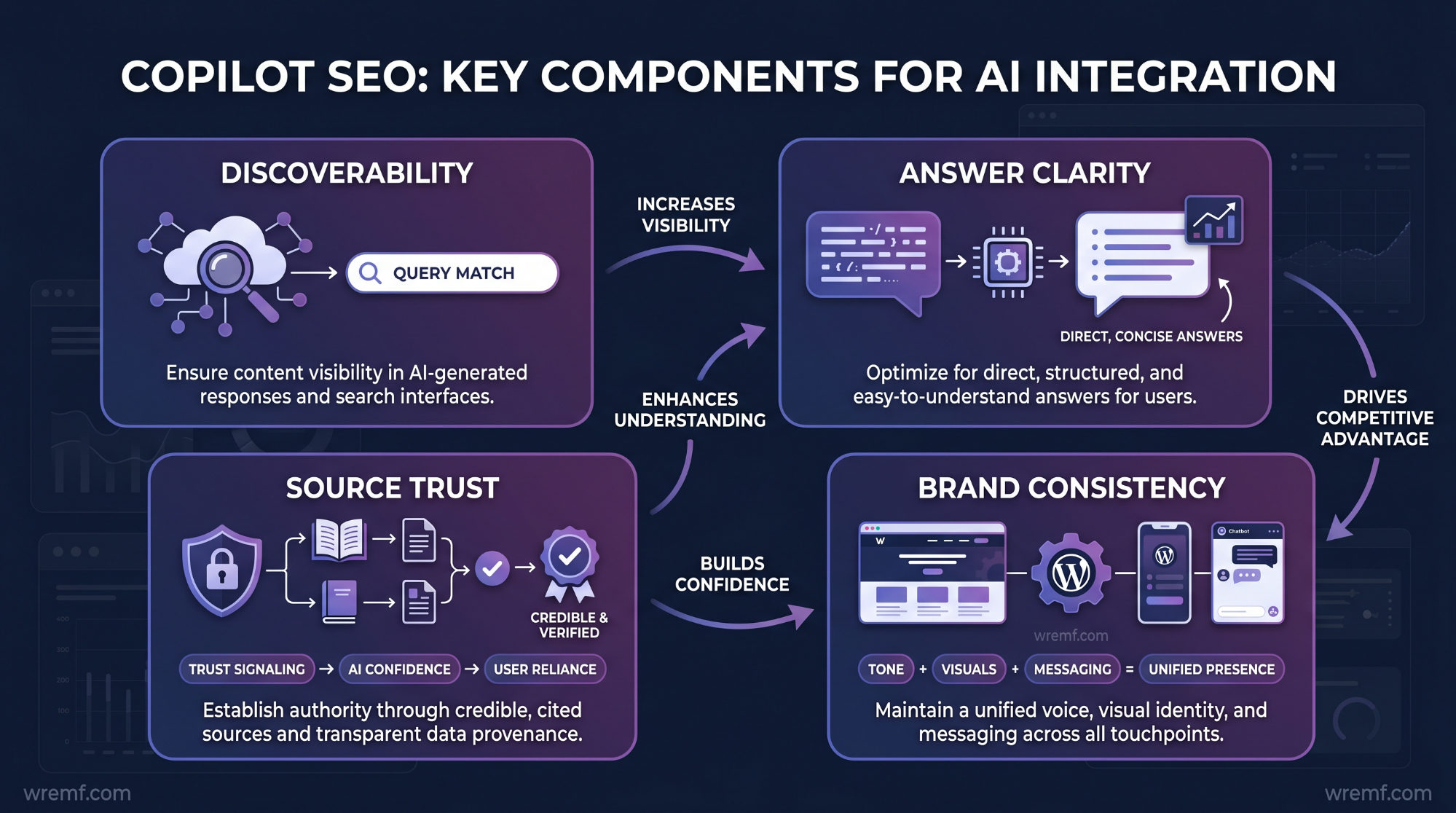
Copilot SEO is the process of making your website, brand, and content easier for Microsoft Copilot to find, understand, cite, and recommend. Copilot SEO matters because AI search visibility depends on search engine discoverability, answer clarity, source trust, and brand consistency.
Copilot SEO combines search engine optimization, answer engine optimisation, generative engine optimisation, and AI visibility measurement. Traditional SEO helps pages get crawled, indexed, ranked, and trusted by a search engine. AEO helps your content answer direct user questions in a format that answer engines can extract. GEO helps your brand appear in AI-generated answers, summaries, citations, comparisons, and recommendations.
Microsoft Copilot is an AI assistant that appears across Bing, Edge, Windows, Microsoft 365, and enterprise work environments. Microsoft states that Copilot Search in Bing gives users summarized answers with cited sources. That means the visibility goal is no longer only to rank in blue links. The goal is also to become a trusted source inside AI Search answers.
AI visibility is the measurable presence of a brand inside AI-generated answers, citations, recommendations, summaries, and comparisons. AI visibility matters because B2B buyers can now compare vendors, validate claims, and shortlist products before they visit a website or contact sales.
WREMF helps teams track, improve, and prove AI visibility across Microsoft Copilot, ChatGPT, Claude, Gemini, Perplexity, Google AI Overviews, Copilot, DeepSeek, Grok, Meta AI, Mistral, and other AI discovery surfaces. The WREMF platform suite connects prompt tracking, source citations, competitor visibility, share of voice, GEO audits, content briefs, and attribution into one workflow.
DID YOU KNOW: Microsoft reported in November 2024 that nearly 70% of Fortune 500 companies used Microsoft 365 Copilot, showing how quickly Copilot became part of enterprise workflows. (Source)
KEY TAKEAWAY: Copilot SEO helps your brand move from keyword ranking alone to measurable visibility inside Microsoft Copilot answers, citations, and recommendations.
To understand why this matters, you need to see how search has changed from blue links to generated answers.
How Microsoft Copilot Changes Search Visibility
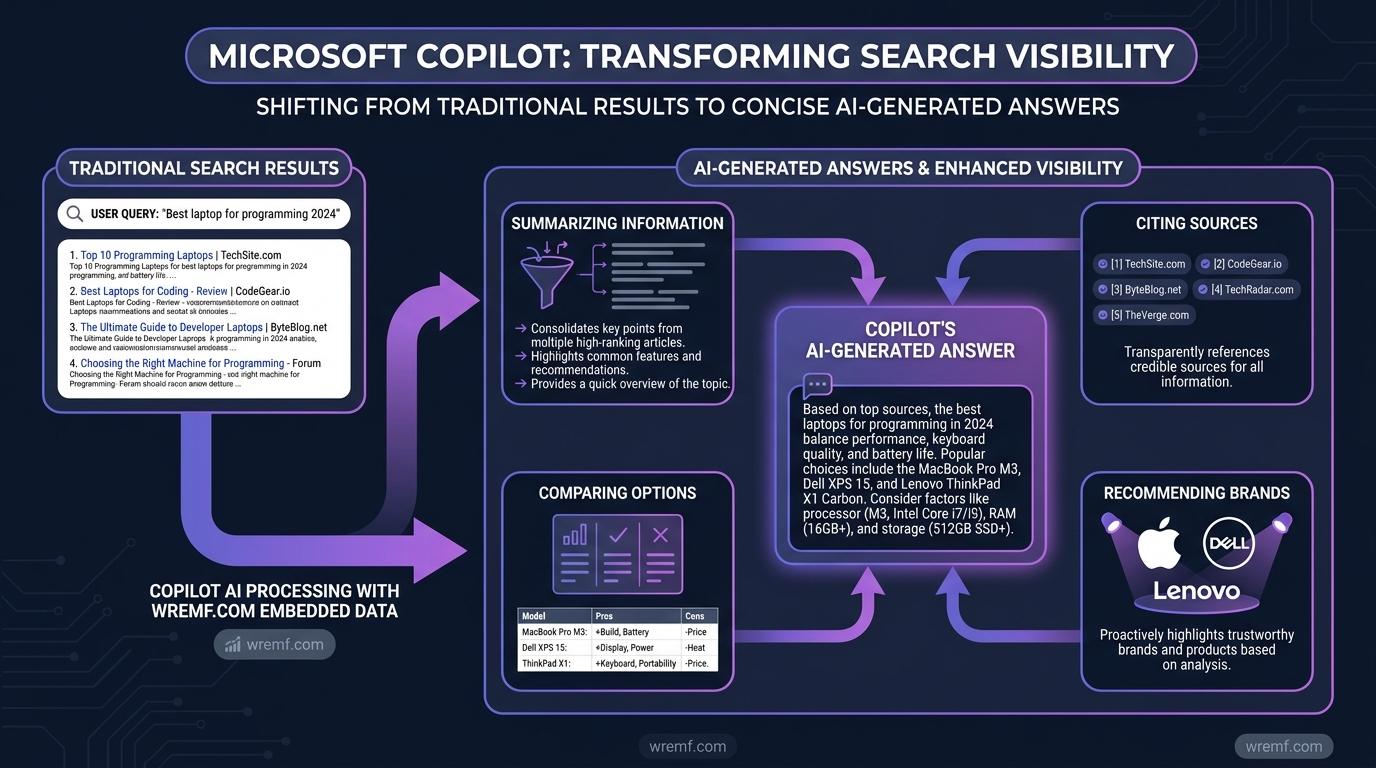
Microsoft Copilot changes search visibility by turning search results into generated answers that may cite, summarize, compare, or recommend sources. Your brand must be optimized for both search engine rankings and AI response visibility.
A traditional search engine returns a ranked list of pages. Copilot Search can return a summarized answer, cited source links, and suggestions for deeper exploration. This changes the user journey because the user may get a useful answer before scanning the search engine results page.
Search engine visibility is the ability of a page to appear in ranked search results for relevant queries. AI search visibility is the ability of a brand or source to appear inside AI-generated answers, citations, summaries, comparisons, and recommendations.
In practical AI visibility audits, marketing teams often find that organic rankings and AI citations do not always match. A page can rank but not be cited. A brand can be mentioned but not recommended. A competitor can appear in Copilot’s answer because a third-party source describes that competitor more clearly than your own website describes your brand.
The most important shift is from position tracking to answer presence. Organic rankings measure where a URL appears in a search engine results page. Copilot SEO measures whether Microsoft Copilot mentions your brand, cites your website, links to source pages, recommends competitors, or repeats inaccurate brand information.
| Visibility Layer | Traditional SEO | Copilot SEO |
|---|---|---|
| Main surface | Search engine results page | AI-generated answer |
| Primary goal | Rank higher for keywords | Be cited, mentioned, and recommended |
| Main unit of measurement | Keyword and URL | Prompt, answer, citation, source, competitor |
| Important signal | Organic rankings | Source mentions and cited source links |
| Common tool | Rank tracker or SEO crawler | AI visibility tracker and prompt monitoring |
| Main risk | Low ranking or low click-through rate | Brand absent, competitor recommended, wrong source cited |
| Reporting metric | Position, impressions, clicks | Mentions, citations, AI share of voice, AI traffic attribution |
AI citations are source links or references used by AI search systems to support an answer. AI citations matter because cited sources can shape what users trust, even when users do not click every source link.
Copilot SEO is therefore both a measurement problem and a source ecosystem problem. Your website needs to be clear, crawlable, and useful. Your brand also needs consistent information across trusted external sources, directories, knowledge bases, reviews, and public references.
KEY TAKEAWAY: Microsoft Copilot shifts SEO from “where do we rank?” to “where are we cited, mentioned, and trusted inside AI-generated answers?”
The next section explains how Copilot finds, grounds, and retrieves information before it creates answers.
How Microsoft Copilot Processes and Sources Information
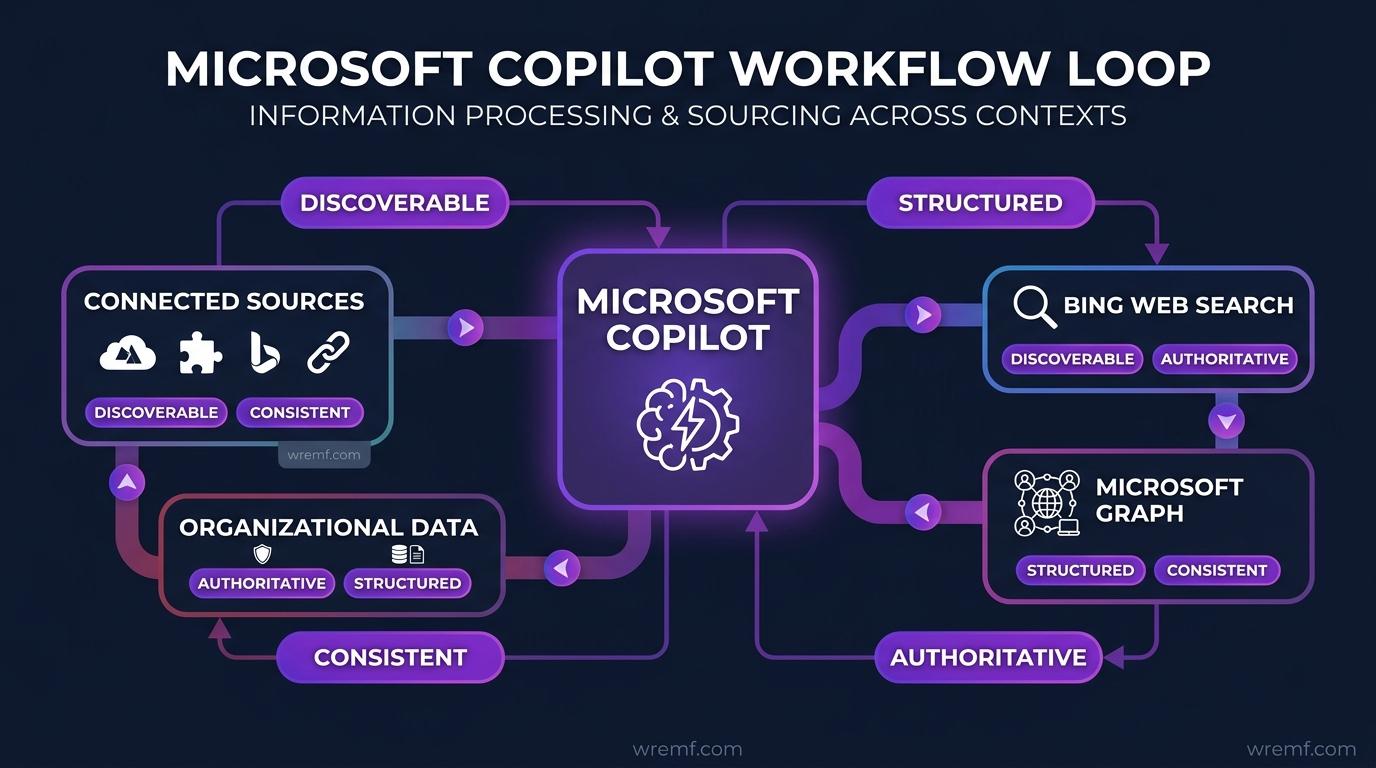
Microsoft Copilot sources information differently depending on the product context, including Bing web search, Microsoft Graph, organizational data, and connected sources. Copilot SEO works best when content is discoverable, structured, authoritative, and consistent across these retrieval paths.
Copilot is not one single search product. Copilot Search in Bing is more connected to web search and source links. Microsoft 365 Copilot is grounded in workplace data such as files, emails, chats, meetings, and documents that the user has permission to access. Microsoft documentation explains that Microsoft 365 Copilot preprocesses prompts through grounding and accesses Microsoft Graph in the user’s tenant. (Microsoft Learn)
Microsoft Graph is the data layer that connects Microsoft 365 content, users, files, meetings, emails, chats, and organizational context. Microsoft says Microsoft Graph grounds Copilot with Microsoft 365 data, including documents, emails, chat, meetings, and more. That makes Microsoft Graph important for enterprise visibility, internal knowledge discovery, and productivity workflows. (Microsoft Adoption)
For public Copilot SEO, Bing discoverability matters because Copilot Search in Bing uses web information and cited sources. For enterprise Copilot visibility, internal knowledge quality matters because Microsoft 365 Copilot may retrieve information from approved documents, SharePoint pages, internal files, knowledge bases, and Graph-connected systems.
Prompt tracking is the process of testing realistic user questions across AI engines and recording how answers mention, cite, rank, or recommend brands. Prompt tracking matters because AI users ask questions in natural language instead of typing only short keywords.
A practical Copilot SEO workflow should track four information paths:
Web search retrieval from Bing and indexed pages
AI answer generation from Copilot Search
Source attribution from cited links and references
Enterprise retrieval from Microsoft Graph and connected knowledge sources
IMPORTANT: Copilot visibility can differ between public Copilot Search and enterprise Microsoft 365 Copilot because enterprise answers may use private organizational data that public SEO tools cannot see.
KEY TAKEAWAY: Copilot SEO must account for web search, cited sources, Microsoft Graph, and enterprise knowledge retrieval instead of treating Copilot as a normal ranking page.
Once the retrieval model is clear, the next step is understanding how Copilot SEO relates to SEO, AEO, and GEO.
Copilot SEO vs SEO vs AEO vs GEO
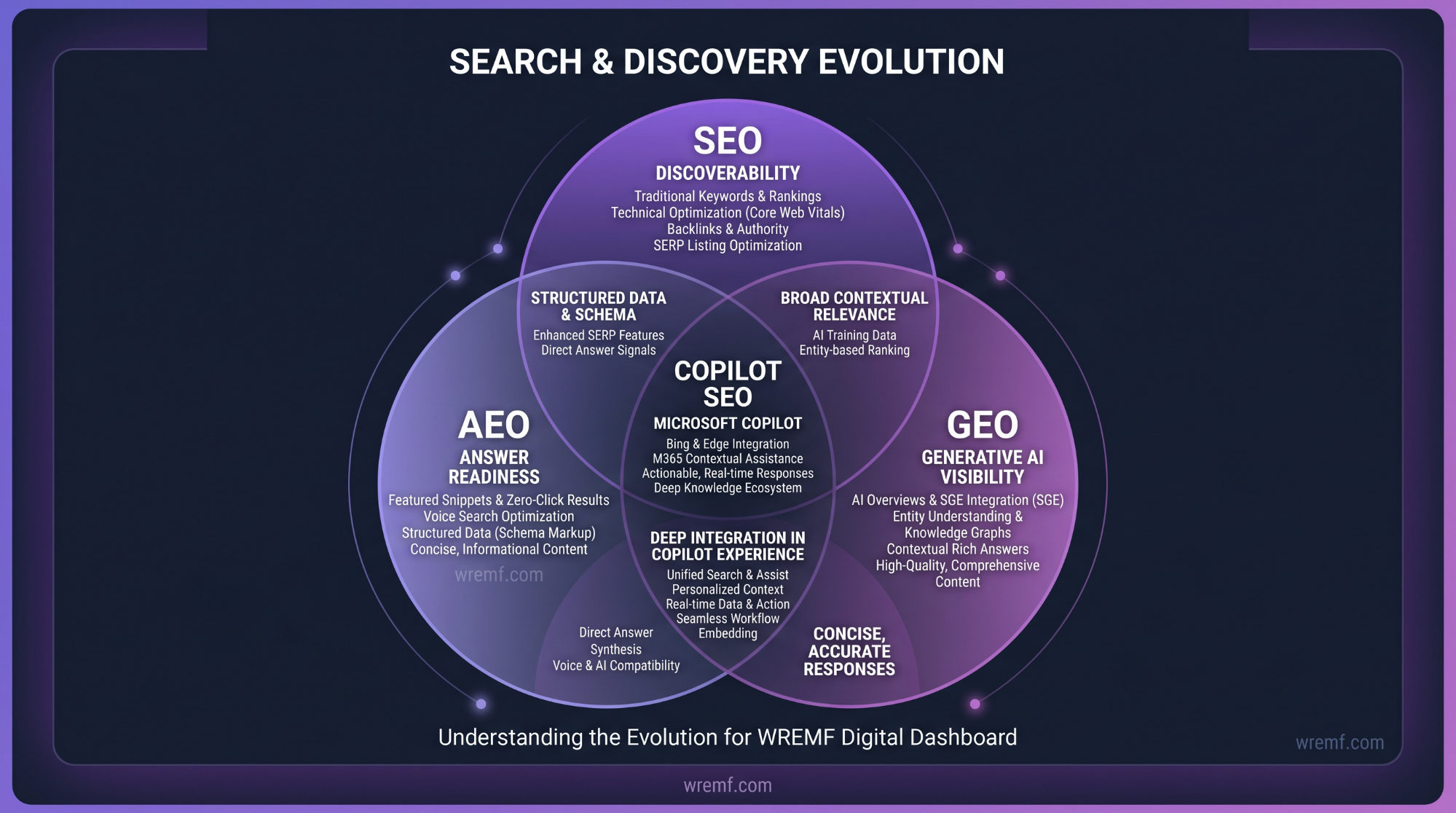
Copilot SEO overlaps with SEO, AEO, and GEO, but it focuses specifically on Microsoft Copilot, Bing, Microsoft 365, and AI-generated answer visibility. SEO builds discoverability, AEO builds answer readiness, and GEO builds visibility inside generative AI responses.
SEO is search engine optimization. SEO improves crawlability, indexability, relevance, authority, internal linking, backlinks, and content quality so pages can perform in search engines.
AEO is answer engine optimisation. AEO structures content so answer engines can extract direct, useful, and complete answers for questions, snippets, voice search, and AI summaries.
GEO is generative engine optimisation. GEO improves how brands, products, people, and sources appear inside generative AI answers, citations, recommendations, and comparisons.
Copilot SEO applies these disciplines to Microsoft’s AI search ecosystem. It includes Bing indexing, Technical SEO, structured data, source citations, Microsoft Copilot prompt monitoring, Microsoft Graph readiness, source consistency, and AI share of voice tracking.
| Discipline | Best For | What It Measures | What It Misses | Recommended When |
|---|---|---|---|---|
| SEO | Google, Bing, and traditional search engines | Keywords, impressions, clicks, Organic Rankings, search engine rankings | AI mentions, AI citations, Copilot recommendations | You need search traffic and indexability |
| AEO | Direct answers, snippets, FAQs, voice search | Question coverage, answer clarity, extractability | Competitor answer presence across LLMs | You need content that answers user questions clearly |
| GEO | AI search platforms and generative answers | Mentions, citations, prompts, source links, competitor visibility | Traditional SERP detail if used alone | You need visibility across AI-generated answers |
| Copilot SEO | Microsoft Copilot, Bing, Edge, Microsoft 365 | Copilot prompts, Bing visibility, Microsoft ecosystem signals, source citations | Private enterprise Copilot answers without access | You need visibility in Microsoft AI search and enterprise workflows |
The best option for most B2B teams is not choosing one discipline. The best option is combining SEO, AEO, and GEO into one measurement system. SEO gives Copilot discoverable source material. AEO makes answers easier to extract. GEO measures whether AI systems actually use, cite, or recommend your brand.
AI share of voice is the percentage of relevant AI answers where your brand appears compared with competitors. AI share of voice matters because AI search can influence buyer consideration before website traffic appears in analytics.
KEY TAKEAWAY: Copilot SEO is not a replacement for SEO, AEO, or GEO. It is a Microsoft-specific AI visibility layer built on top of all three.
After defining the strategy layers, you can optimize content for the way Copilot answers real user prompts.
How to Optimize Content for Microsoft Copilot
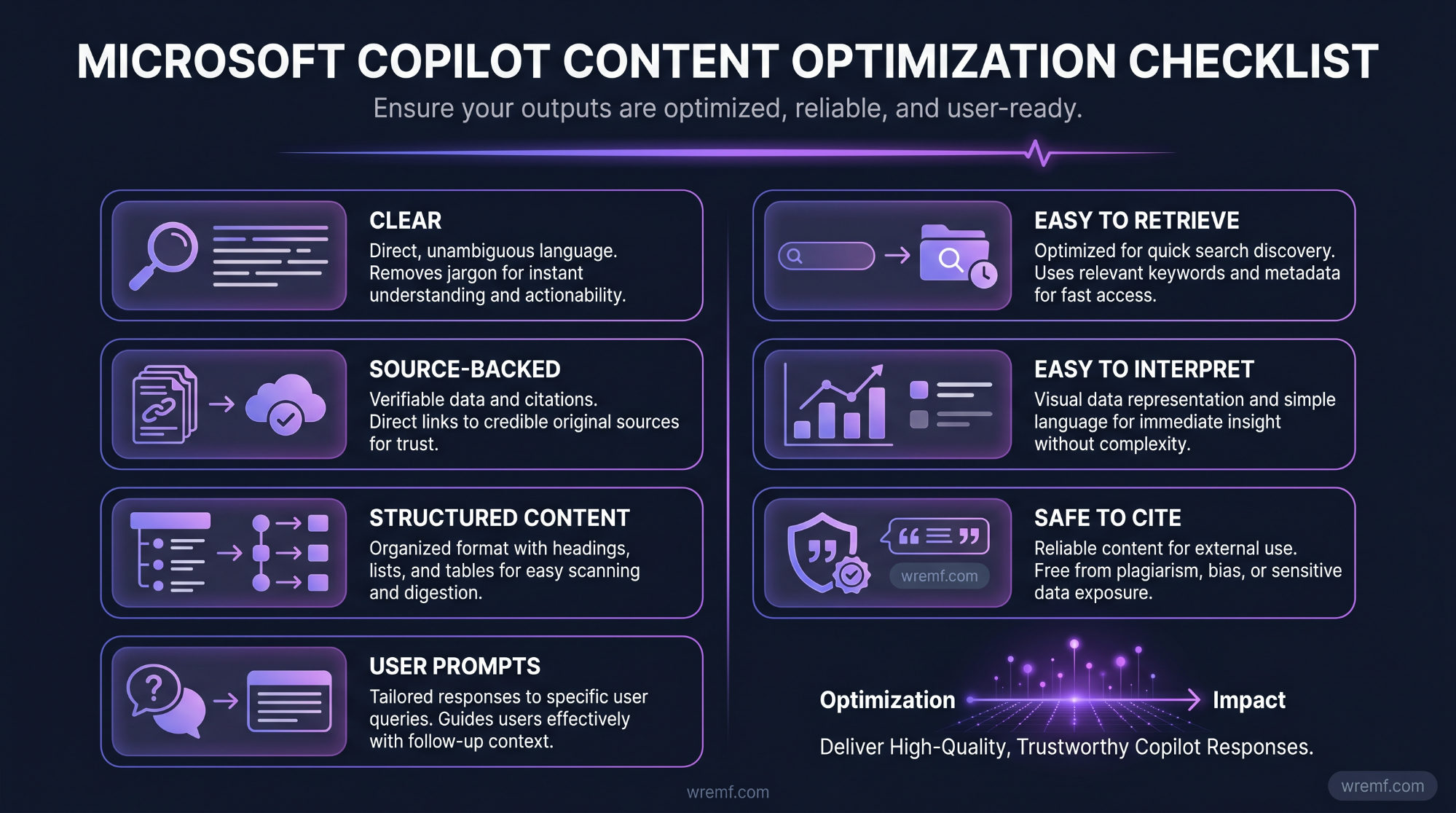
The most effective way to improve Copilot SEO is to publish clear, source-backed, structured content that answers real user prompts better than competing sources. Copilot needs content that is easy to retrieve, easy to interpret, and safe to cite.
Content optimization for Microsoft Copilot starts with the question behind the query. A user may not search “CRM software keyword discovery.” A user may ask, “Which CRM is best for a small B2B SaaS company using Microsoft 365?” That means your content should include natural language questions, concise answers, comparison tables, definitions, decision criteria, use cases, and evidence.
Answer-first content is content that gives a direct response before elaborating. Answer-first content matters because AI systems and human readers both benefit from clear, extractable answers.
Google Search Central explains that helpful, reliable, people-first content is designed to benefit people rather than manipulate rankings. That guidance is useful for Copilot SEO because AI response engines need reliable information that directly satisfies user intent.
Strong Copilot content usually includes:
A direct answer in the first paragraph of each major section
Definitions under 60 words for important concepts
Tables for comparisons involving three or more options
Clear claims supported by named sources
Real examples without fabricated case studies
Author bios and editorial review where relevant
Short paragraphs that separate answers, evidence, and implications
Internal links that connect related entities, products, features, and proof pages
Content creation is not enough if the page lacks unique value. AI-generated content that repeats generic advice gives Copilot little reason to cite your page. In real B2B buying journeys, buyers need pricing context, implementation steps, limitations, comparison criteria, technical proof, and clear differentiation.
Content Marketing for Copilot should include product pages, help docs, comparison pages, category pages, glossary pages, methodology pages, reports, blog posts, and product descriptions. Copilot may cite a blog post for education, a pricing page for commercial intent, a documentation page for technical accuracy, and a methodology page for trust.
TIP: Use the WREMF content brief generator to turn prompt gaps, competitor answer gaps, keyword discovery, and citation patterns into AI-ready content briefs.
KEY TAKEAWAY: Copilot content should be answer-first, evidence-backed, comparison-ready, and structured around real prompts rather than only exact-match keywords.
Content structure helps, but Copilot SEO also depends on Technical SEO and machine readability.
Technical SEO for Copilot Search and AI Response Engines
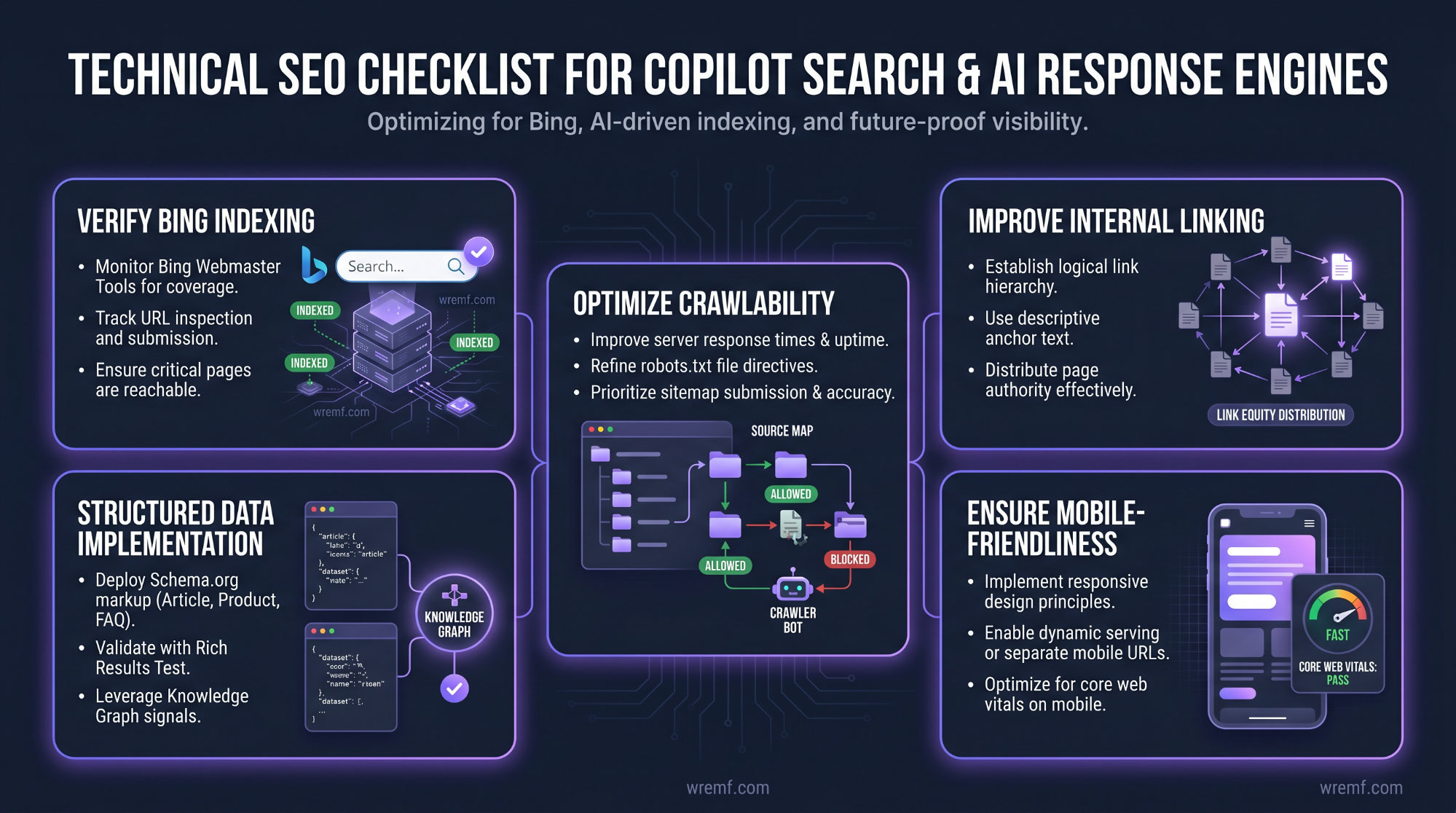
Technical SEO for Copilot ensures that Microsoft Bing, AI crawlers, and retrieval systems can access, parse, and understand your pages. A strong technical foundation reduces the risk that valuable content is invisible or hard to cite.
Technical SEO is the process of improving crawlability, indexability, rendering, metadata, structured data, internal linking, site performance, and HTML clarity. Technical SEO matters because AI systems cannot cite what they cannot discover or understand.
Start with Bing indexing. Since Copilot Search is connected to Bing, your site should be verified in Bing Webmaster Tools, indexed correctly, and free from major crawl errors. Bing explains that its URL Inspection tool lets site owners check URLs for crawling, indexing, SEO, and markup details. (Search - Microsoft Bing)
Structured data is machine-readable markup that helps search systems understand entities, pages, products, articles, FAQs, organizations, and relationships. Structured data matters because it reinforces semantic clarity, even though it does not guarantee AI citations.
Google’s AI features guidance for website owners explains how AI Overviews and AI Mode work from a site owner perspective. The practical lesson is that AI search readiness starts with the same foundations that make content eligible and useful in search: accessibility, relevance, usefulness, and quality. (Google for Developers)
A technical Copilot SEO checklist should include:
Verify Bing Webmaster Tools
Submit XML sitemaps
Check indexability and canonical tags
Fix broken links, redirects, and duplicate pages
Make important web content visible in crawlable HTML
Use descriptive title tags and metadata
Add relevant Schema Markup and JSON-LD where appropriate
Structure FAQs, author bios, and product information clearly
Improve internal linking between commercial, educational, and proof pages
Test important pages for rendering and machine readability
Internal linking influences Copilot’s knowledge mapping because it shows relationships between topics, products, use cases, and proof assets. Link from definitions to methodology, from comparison pages to product pages, from feature pages to reports, and from high-intent educational content to relevant conversion pages.
A common Technical SEO mistake is treating structured data as the entire strategy. Schema helps explain the page, but AI content optimization still requires useful answers, credible sources, entity clarity, and consistent language across your site.
KEY TAKEAWAY: Technical SEO for Copilot is about making your pages accessible, understandable, semantically clear, and connected across your site.
Once the technical foundation is stable, the next visibility layer is source authority.
Why Source Citations, Brand Mentions, and Trust Signals Matter
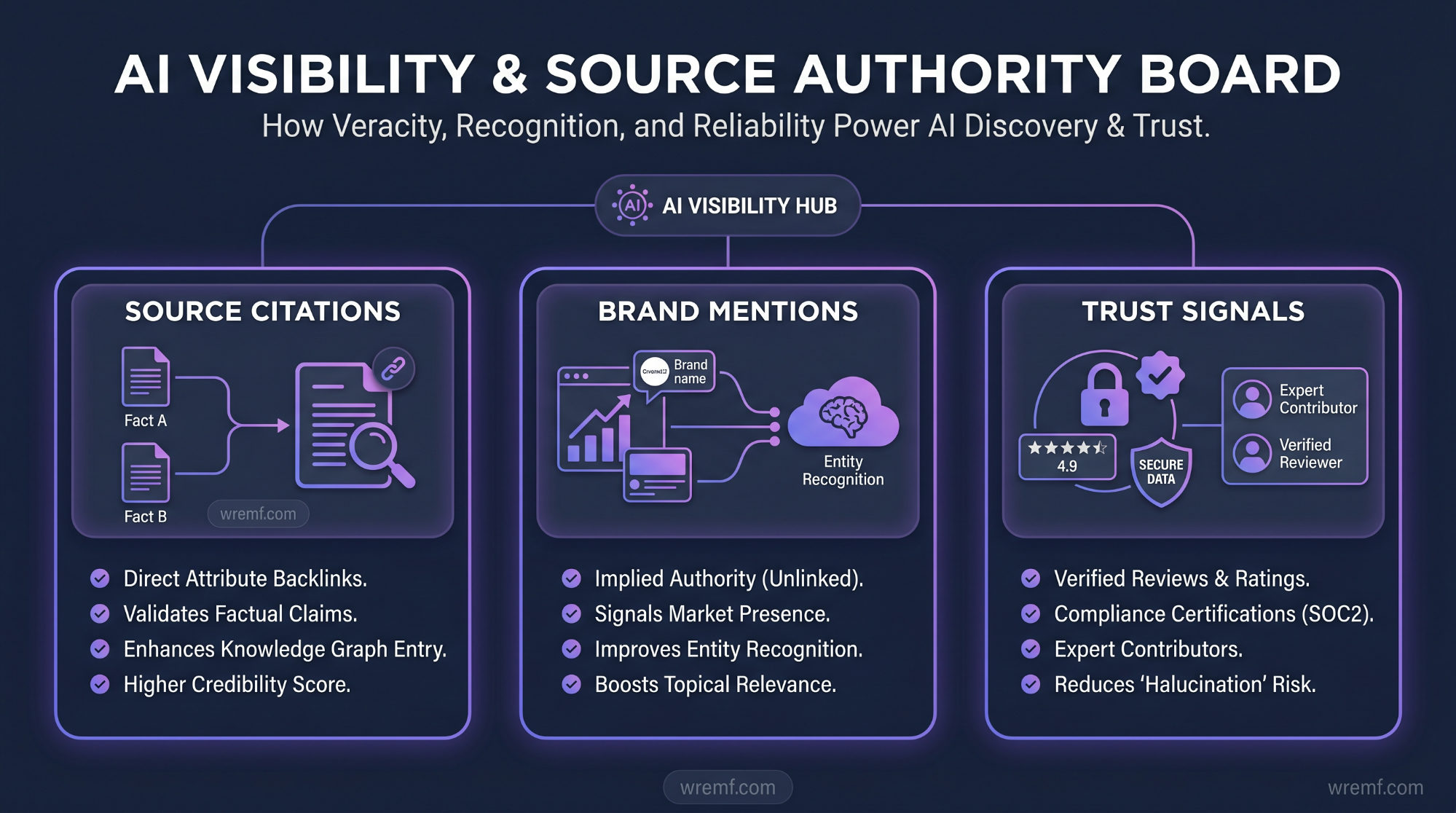
Source citations, brand mentions, and trust signals matter because Copilot and other AI systems need reliable evidence before referencing or recommending a brand. AI visibility improves when your brand is consistently described across trusted sources.
Source citations are the pages, domains, or references an AI system uses to support an answer. Source citations matter because cited sources can influence what the user trusts.
Brand mentions are references to your brand across the web, whether or not they include backlinks. Brand mentions matter because AI search platforms can use repeated entity references to understand relevance, category fit, and market context.
Trust signals are indicators that a source is credible, current, authoritative, and useful. Trust signals may include author expertise, editorial standards, reliable citations, consistent product details, accurate metadata, strong documentation, high-quality backlinks, and clear ownership.
In Copilot SEO, citations can come from your own site or third-party sources. A cited source might be a product page, support article, comparison page, documentation page, review profile, marketplace listing, news article, industry report, or public database. A brand can lose visibility when AI systems find incomplete, outdated, or contradictory information across those sources.
Source consistency is the alignment of brand facts across your website, third-party profiles, directories, review platforms, documentation, and public references. Source consistency matters because inconsistent descriptions make it harder for AI systems to understand what your brand does and when to recommend it.
Marketing teams often find three problems during AI visibility audits:
Their own website explains the product clearly, but trusted third-party sources are outdated
AI answers cite competitors because competitors are described more clearly in comparison content
The brand appears in answers but is not recommended because proof, differentiation, or use case fit is weak
WREMF’s source citation tracking helps teams identify which sources AI engines cite, where competitors are getting visibility, and which pages need improvement. For teams that need execution, the WREMF agency team supports citation improvement, source consistency cleanup, content optimization, and authority-building workflows.
KEY TAKEAWAY: Copilot citations depend on source trust, brand clarity, and consistency across both owned and third-party references.
To improve source visibility, you also need to understand how Microsoft’s ecosystem expands beyond Bing results.
Beyond Bing: Microsoft 365, Edge, Word, PowerPoint, Outlook, and Microsoft Graph
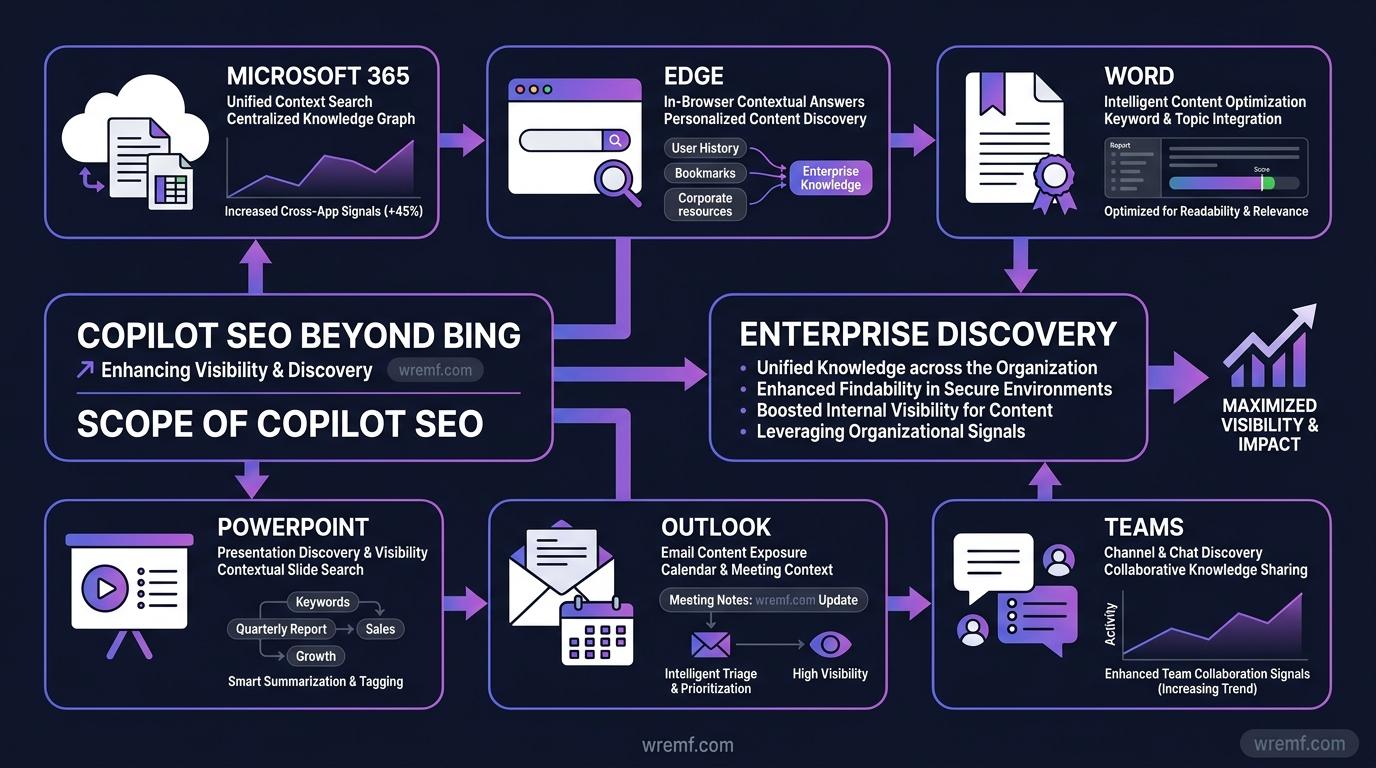
Copilot SEO extends beyond Bing when your audience uses Microsoft 365, Edge, Word, PowerPoint, Outlook, Teams, and enterprise knowledge systems. Public content helps web visibility, while internal content and Microsoft Graph shape workplace discovery.
Microsoft 365 Copilot is an AI-powered assistant embedded across Microsoft work applications. Microsoft documentation describes Microsoft 365 Copilot as a tool that helps with work tasks after users enter prompts and receive AI-generated responses. (Microsoft Learn)
Microsoft Graph matters because enterprise Copilot experiences may use organizational data that public search engines cannot access. That means internal product documentation, sales enablement files, SharePoint pages, meeting notes, customer information, and knowledge bases can influence what employees find inside Microsoft 365 Copilot.
Microsoft Graph Connector is a connector that can bring external data into Microsoft Graph so Microsoft 365 Copilot and Microsoft Search can retrieve approved content. Microsoft Graph Connector matters for enterprise SEO because important knowledge may live outside Microsoft 365 in systems such as help centers, CRMs, ticketing systems, databases, and documentation platforms.
For B2B companies, this creates two forms of Copilot SEO:
| Context | What Copilot May Use | Optimization Focus | Example User Prompt |
|---|---|---|---|
| Public Copilot Search | Bing index, web pages, source links | Public SEO, AEO, GEO, citations | “Best AI visibility tools for agencies” |
| Microsoft 365 Copilot | Microsoft Graph, internal files, permissions | Internal knowledge quality, documentation, governance | “What proof do we have for this vendor?” |
| Copilot in work apps | Word, PowerPoint, Outlook, Teams context | Sales enablement, product clarity, approved messaging | “Draft a comparison slide for this solution” |
| Connected enterprise search | Graph Connectors and approved systems | Knowledge base structure, metadata, access control | “Find the latest pricing policy” |
This does not mean every company needs a Microsoft Graph Connector immediately. It means enterprise SEO is becoming knowledge optimization. Your public pages, product documentation, sales enablement files, help center content, web content, and internal wikis should use consistent definitions, approved positioning, and clear evidence.
Microsoft Edge also matters because Copilot is integrated into Microsoft browsing experiences. Statcounter reported that Edge had 5.52% global browser market share in April 2026, while Chrome had 67.97% and Safari had 17.09%. Edge is much smaller than Chrome, but it still represents a meaningful discovery surface for B2B and enterprise users. (StatCounter Global Stats)
IMPORTANT: Microsoft 365 Copilot respects user permissions, so visibility inside enterprise Copilot depends on content quality, metadata, and access governance.
KEY TAKEAWAY: Copilot SEO includes public search visibility and enterprise knowledge visibility when buyers, employees, or partners use Microsoft 365 Copilot.
The broader ecosystem makes measurement more complex, which is why traditional SEO metrics are not enough.
How to Measure Copilot SEO and AI Visibility
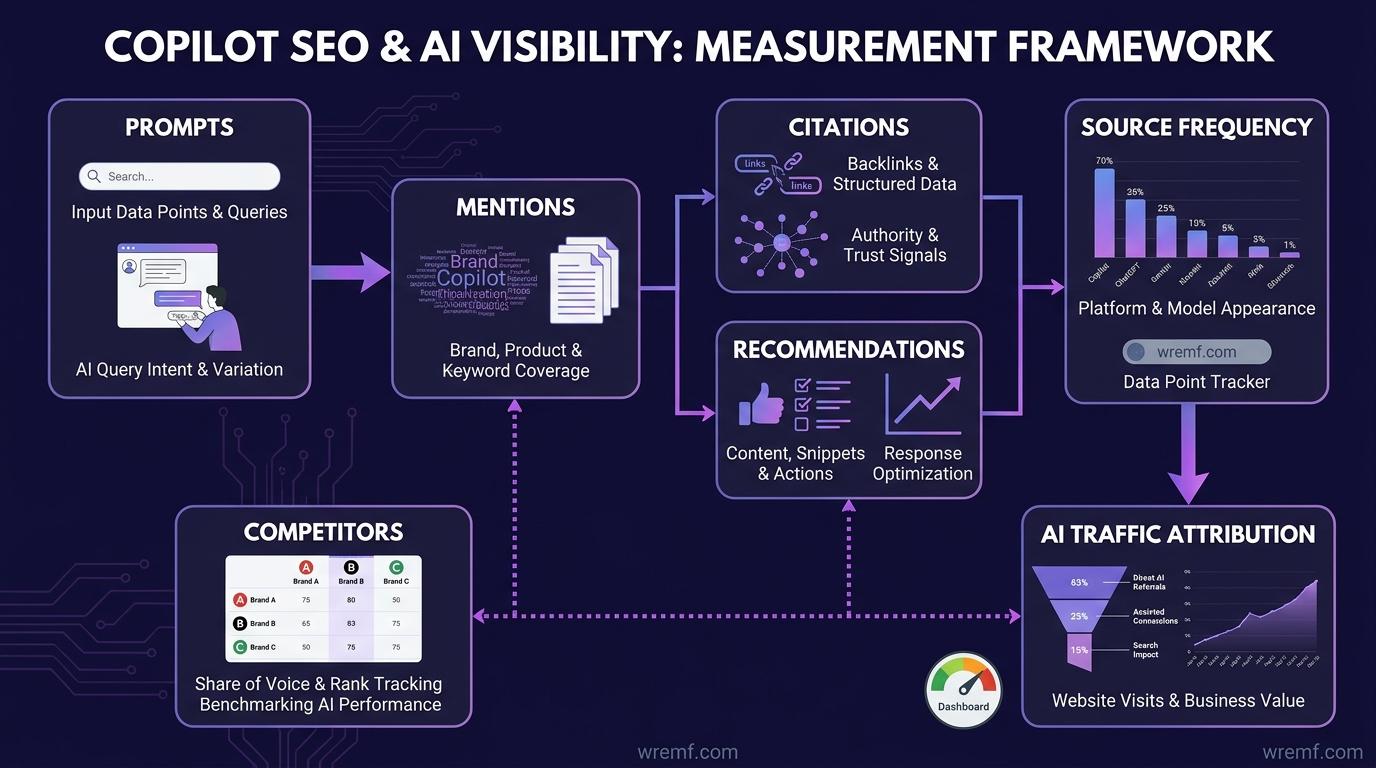
Copilot SEO should be measured with prompts, mentions, citations, recommendations, competitors, source frequency, and AI traffic attribution. Rankings alone are not enough because Copilot can answer users without sending a traditional click.
Prompt intelligence is the process of identifying, testing, and monitoring the questions users ask AI systems. Prompt intelligence matters because AI search behavior is conversational, intent-rich, and often broader than keyword research.
The strongest Copilot SEO measurement system includes:
| KPI | What It Measures | Why It Matters |
|---|---|---|
| Prompt coverage | Which target prompts mention your brand | Shows answer presence |
| Citation frequency | How often your sources are cited | Shows source trust |
| Source links | Which URLs Copilot uses in answers | Shows citation opportunities |
| Recommendation visibility | Whether Copilot recommends your brand | Shows commercial influence |
| Competitor visibility | Which competitors appear instead | Shows market gaps |
| AI share of voice | Your answer presence versus competitors | Shows category-level visibility |
| Source consistency | Accuracy across cited sources | Shows entity reliability |
| AI traffic attribution | Visits and conversions from AI referrers | Connects visibility to outcomes |
| Keyword Gap | Missing keyword and prompt coverage | Guides content priorities |
| Content gap score | Missing answer assets for target prompts | Guides execution |
AI traffic attribution connects AI visibility to website visits, sessions, leads, pipeline, or conversions from AI assistants. AI traffic attribution matters because leadership needs evidence that AI search visibility affects business outcomes.
OpenAI states that ChatGPT search gives users fast, timely answers with links to relevant web sources. Google states that AI Overviews provide AI-generated snapshots with key information and links to dig deeper. Microsoft states that Copilot Search provides summarized answers with cited sources. These products make source visibility measurable, but imperfect. Not every AI mention produces a click, and not every referral is labeled consistently in analytics. (OpenAI)
If you want to see how AI engines currently describe your brand, review a sample AI visibility report before building your own measurement workflow.
WREMF’s prompt intelligence helps teams monitor prompts across AI engines, compare answers over time, identify citation patterns, and track competitive visibility. The WREMF methodology connects prompts, citations, competitors, source consistency, and attribution into one repeatable measurement system.
AI visibility is the measurable result of prompts, sources, citations, brand mentions, and competitors interacting inside AI-generated answers. AI visibility cannot be improved reliably by changing one page if the broader source ecosystem tells a confusing story.
KEY TAKEAWAY: Copilot SEO measurement should track answer presence, cited sources, competitor visibility, and AI-attributed outcomes, not only rankings.
Measurement becomes more useful when you compare Microsoft Copilot with other AI search platforms.
Copilot vs ChatGPT vs Perplexity vs Google AI Overviews
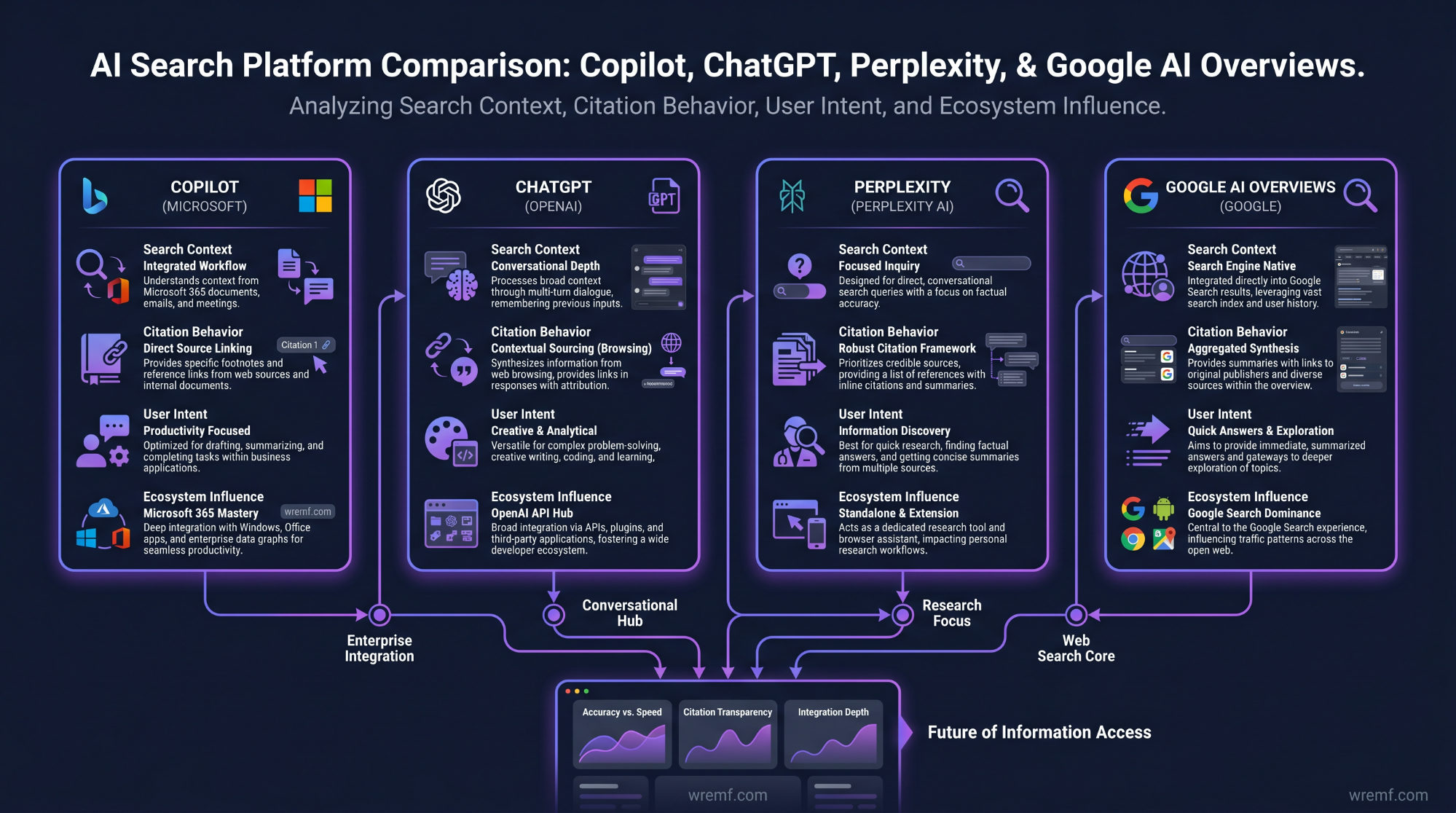
Copilot, ChatGPT, Perplexity, and Google AI Overviews all use AI to answer questions, but they differ in search context, citation behavior, user intent, and ecosystem influence. A strong AI visibility strategy tracks all major engines instead of optimizing for one platform only.
Microsoft Copilot is important for Bing search, Edge users, Windows users, Microsoft 365 users, and enterprise workflows. ChatGPT is important for conversational search, research, writing, product comparisons, and buyer education. Perplexity is important for citation-heavy research and source exploration. Google AI Overviews is important because it appears directly inside Google Search results for many information needs.
AI discovery surfaces are places where users discover, compare, or evaluate brands through AI-generated answers. AI discovery surfaces matter because buyer journeys now happen across search engines, assistants, productivity tools, and answer engines.
| Platform | Best Known For | Source Behavior | SEO Implication |
|---|---|---|---|
| Microsoft Copilot | Bing search, Edge, Windows, Microsoft 365 | Cited sources, Bing grounding, Microsoft Graph in enterprise contexts | Optimize for Bing, source citations, Microsoft ecosystem clarity |
| ChatGPT | Conversational research and web search | OpenAI says ChatGPT search can provide links to relevant web sources | Optimize for source-backed answers and brand clarity |
| Perplexity | Research answers with citations | Perplexity describes its platform as real-time web search and conversational answers with citations | Optimize for authoritative, quotable pages |
| Google AI Overviews | AI snapshots inside Google Search | Google says AI Overviews include key information and links to dig deeper | Maintain strong Google SEO and answer-ready content |
The most common mistake is assuming Copilot SEO and ChatGPT visibility are the same. They overlap, but answer composition, source selection, live search data, algorithm updates, and user context can differ. A page that appears in one AI Search platform may be absent in another. A competitor cited by Perplexity may not be cited by Copilot. A brand recommended in ChatGPT may not appear in Google AI Overviews.
Perplexity describes its API platform as supporting real-time web search, conversational answers with citations, and structured retrieval from billions of webpages. That reinforces why AI platform optimization should consider citation behavior, not only content generation. (Perplexity AI)
WREMF tracks 10 AI engines, including Microsoft Copilot, ChatGPT, Claude, Gemini, Perplexity, Google AI Overviews, DeepSeek, Grok, Meta AI, and Mistral. This matters because B2B buyers do not use one AI assistant for every decision.
KEY TAKEAWAY: Copilot SEO should be part of a multi-engine AI visibility strategy because each AI search platform retrieves, cites, and recommends sources differently.
After comparing platforms, the next decision is whether software, an agency, or a hybrid model fits your team best.
Should You Use Copilot SEO Software, an Agency, or a Hybrid Model?
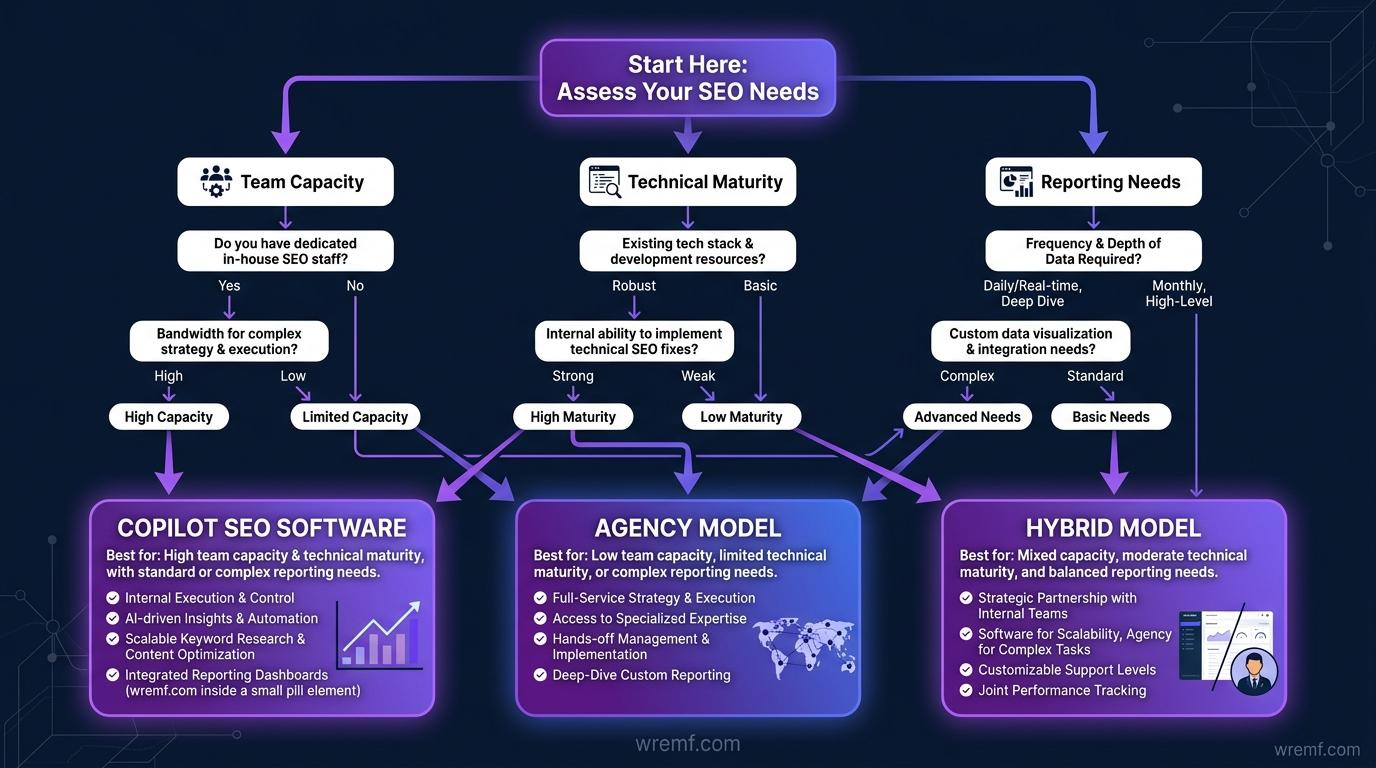
You should use Copilot SEO software when you need repeatable measurement, an agency when you need execution, and a hybrid model when you need both visibility data and managed improvements. The right choice depends on team capacity, technical maturity, and reporting needs.
Copilot SEO software is best for teams that already have SEO, content, or growth resources. Software helps track prompts, source links, citations, answer changes, competitor visibility, Keyword Gap data, and AI share of voice. It turns AI search from manual testing into a repeatable workflow.
A Copilot SEO agency or AI visibility agency is best when the team lacks time, expertise, or execution capacity. Managed services help translate insights into content updates, technical fixes, entity cleanup, citation improvement, internal linking logic, schema guidance, and monthly reporting.
A hybrid model is best for B2B teams that need strategic direction, execution, and transparent reporting. The software provides measurement. The agency team helps prioritize and implement improvements.
| Option | Best For | What It Provides | Main Limitation | Recommended When |
|---|---|---|---|---|
| Software | SEO teams, content teams, agencies | Prompt tracking, citations, competitor visibility, reports | Requires internal execution | You can act on insights internally |
| Agency | Founders, lean marketing teams, complex sites | Strategy, audits, content, technical guidance, reporting | Less self-serve control | You need senior-led execution |
| Hybrid | Growing B2B brands and multi-client agencies | Measurement plus managed action | Requires clear prioritization | You want visibility data and execution support |
WREMF supports all three models. Brands can use WREMF as software, agencies can use white-label reporting through WREMF for agencies, and teams that need execution can work with WREMF’s managed AEO, GEO, and AI visibility services.
Pricing can matter when evaluating AI visibility tools because prompt tracking can become expensive if vendors charge heavily by query volume. WREMF pricing starts at €39 per month for one website and includes unlimited prompt tracking, BYOK, 10 AI engines, all features and tools, white-label reports, one seat, and email support. The Growth plan supports five websites, unlimited prompt tracking, BYOK, 10 AI engines, all features and tools, white-label reports, priority email support with 24h SLA, content brief generator, and SEO A/B testing for €89 per month.
KEY TAKEAWAY: The best Copilot SEO model depends on whether your team needs measurement, execution, or a combined software plus managed service workflow.
Once the operating model is clear, you can follow a practical checklist.
The Copilot SEO Checklist for Marketers
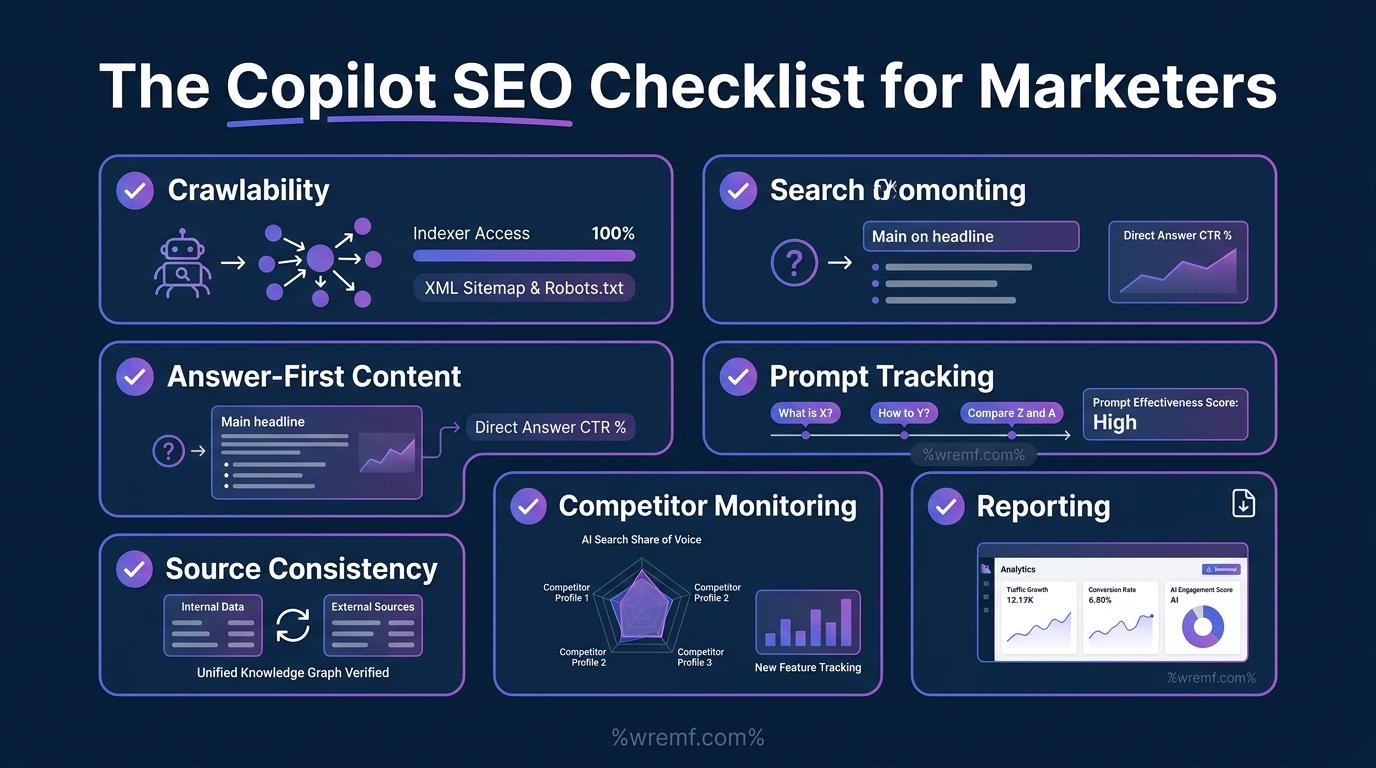
The Copilot SEO checklist starts with crawlability, then adds answer-first content, source consistency, prompt tracking, competitor monitoring, and reporting. This order prevents teams from measuring AI visibility without fixing the foundations first.
A practical checklist should be organized by technical foundation, content structure, source authority, ecosystem integration, and measurement.
Technical foundation
Verify Bing Webmaster Tools
Submit XML sitemaps
Check indexability and canonical tags
Fix broken pages and redirect chains
Make important content visible in HTML
Add relevant structured data
Improve internal linking between related pages
Review metadata, headings, and source links
Check Website SEO Performance and crawl status
Content structure and semantic clarity
Add concise definitions for core terms
Use answer-first introductions
Include comparison tables where decision intent exists
Add FAQs that answer real buyer questions
Support claims with named sources
Create pages for high-intent prompts
Use consistent product and category language
Improve content analysis and data interpretation
Add author bios when expertise matters
Source ecosystem and authority
Audit third-party profiles for outdated descriptions
Check review sites, directories, and marketplace listings
Improve editorial trust signals
Build citation-worthy resources, not thin blog posts
Align messaging across sales, support, and public content
Monitor competitor citations in Copilot and other engines
Prioritize quality signals over backlinking structures based only on volume
Ecosystem integration
Review Microsoft 365 documents where enterprise Copilot matters
Align sales decks, Word documents, PowerPoint content, and Outlook templates
Consider Microsoft Graph Connector use cases for approved enterprise knowledge
Keep product descriptions and support materials consistent
Connect public SEO messaging with internal enablement content
Measurement and iteration
Build a prompt set by funnel stage
Track mentions, citations, and recommendations
Compare answers across Microsoft Copilot, ChatGPT, Perplexity, and Google AI Overviews
Monitor AI referral traffic in analytics
Use source gaps to brief new content
Re-test after content and technical updates
Report changes using prompt visibility, source citations, and competitor movement
A common implementation mistake is starting with AI content generation before measurement. That creates more pages without knowing which prompts, sources, or competitor gaps matter. Start with the prompts your buyers actually ask, then build content and citation improvements around those gaps.
The WREMF GEO audit helps teams identify missing answer readiness, citation gaps, source inconsistency, and content opportunities. The WREMF SEO testing feature helps teams evaluate whether changes affect search and AI-attributed performance over time.
KEY TAKEAWAY: Copilot SEO works best as a structured workflow: fix technical access, improve answer-ready content, strengthen source trust, then measure AI visibility continuously.
Even with a strong checklist, teams should understand the limits and risks of AI search optimization.
Copilot SEO Risks, Limitations, and Common Mistakes
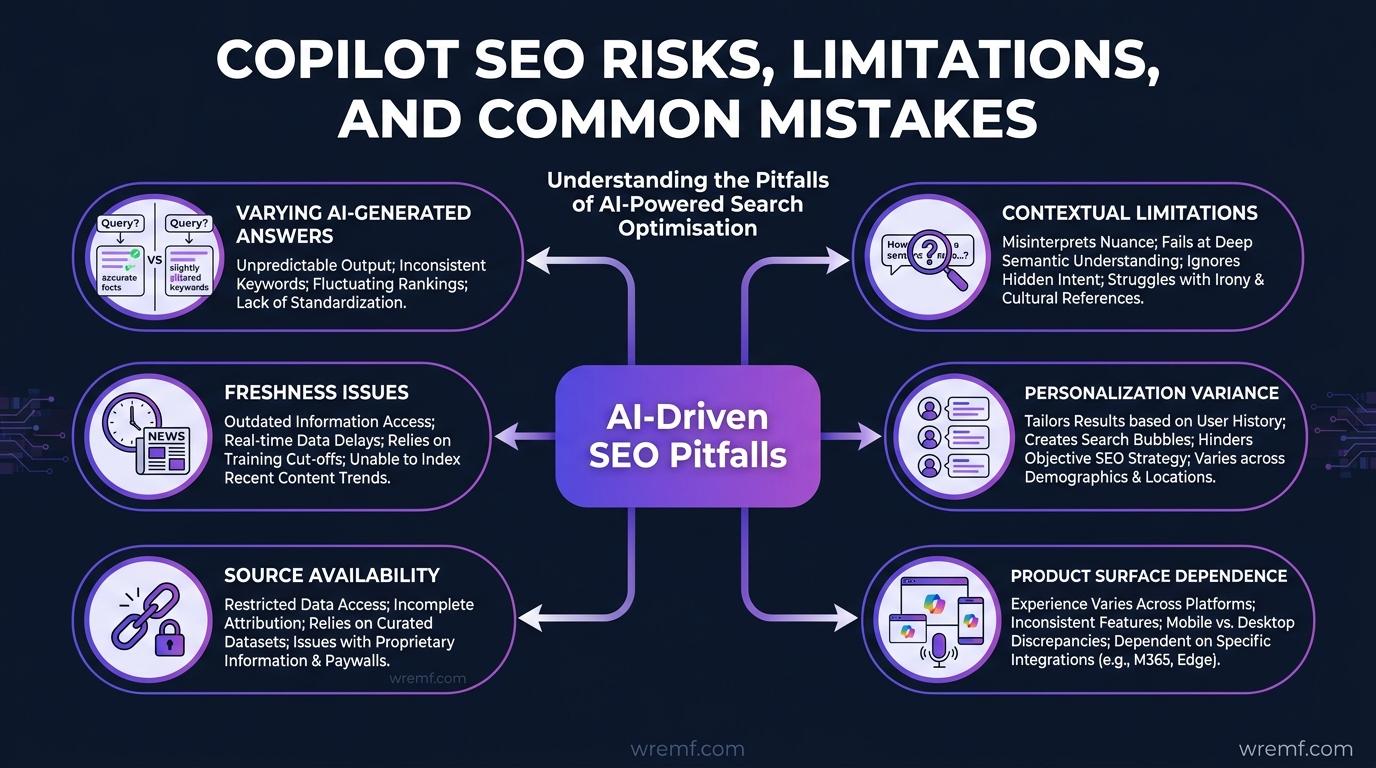
Copilot SEO has limits because AI-generated answers can vary by prompt, context, freshness, personalization, source availability, and product surface. The goal is to improve measurable visibility, not guarantee every answer, citation, or recommendation.
The first risk is over-relying on rankings. A high organic ranking can help source discovery, but it does not guarantee Copilot citation. Copilot may choose a third-party comparison article, documentation page, marketplace listing, or competitor source instead.
The second risk is treating an AI copilot as a full SEO strategist. An AI assistant can help with research, content generation, summaries, and reporting drafts, but it does not replace live search data, Site Audit workflows, Position Tracking, keyword research, technical reviews, and human judgment.
The third risk is publishing AI-generated content without editorial control. Content generation can help draft outlines, briefs, and variations, but thin AI content often lacks original evidence, experience, and decision value. Google’s helpful content guidance is a useful reminder that content should be built for people, not only for search engine algorithms.
The fourth risk is ignoring source consistency. If your homepage says one thing, your LinkedIn page says another, your review profile is outdated, and third-party articles use old positioning, AI systems may generate vague or inaccurate summaries.
The fifth risk is measuring only traffic. AI visibility can influence brand awareness and vendor shortlisting without producing an immediate click. In real-world reporting, teams should separate answer presence, citation presence, and traffic attribution rather than forcing every AI impact into one metric.
The sixth risk is not documenting methodology. Leadership and clients need to know which prompts were tested, which engines were monitored, how competitors were selected, how citations were counted, and how changes were evaluated.
IMPORTANT: No tool or agency can guarantee Copilot citations, AI rankings, or revenue growth. A credible Copilot SEO strategy improves the inputs that make visibility more likely and measures the outputs over time.
KEY TAKEAWAY: Copilot SEO is measurable, but it is probabilistic. Teams should improve crawlability, content quality, source trust, and consistency without claiming guaranteed AI citations.
These risks lead directly into the myths that often block teams from starting.
Common Myths About AI Visibility Debunked
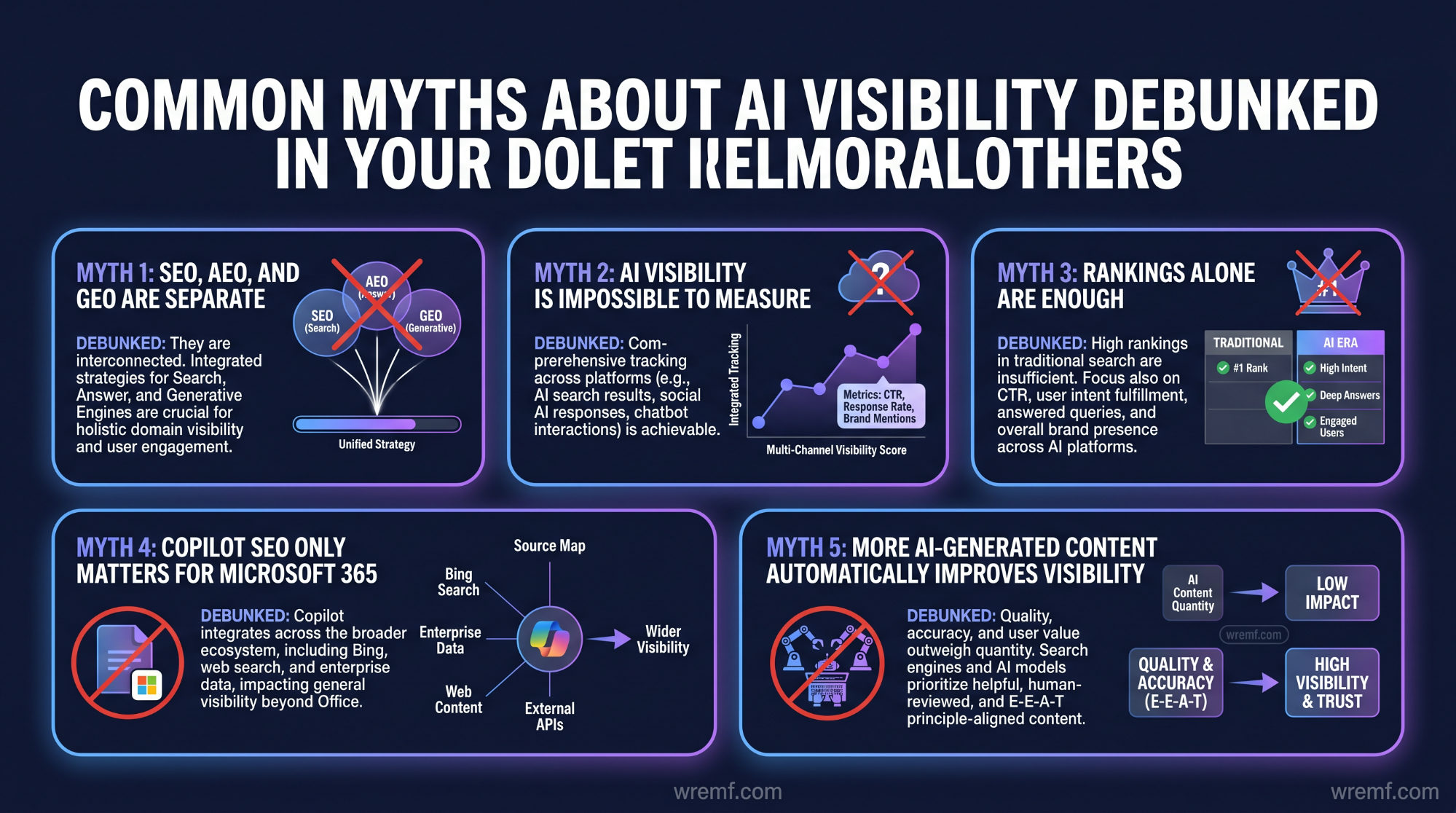
AI visibility myths usually come from applying old ranking logic to new AI answer surfaces. Copilot SEO becomes clearer when teams separate measurable visibility signals from unsupported assumptions.
MYTH: SEO, AEO, and GEO are separate strategies that compete with each other.
FACT: SEO, AEO, and GEO overlap. SEO helps pages get discovered, AEO helps answers get extracted, and GEO helps brands appear in generated responses. Copilot SEO uses all three because Microsoft Copilot still needs discoverable sources, clear answers, and trusted citations.
MYTH: AI visibility is impossible to measure.
FACT: AI visibility is measurable through prompts, brand mentions, source citations, competitor appearances, recommendation frequency, source links, and AI referral traffic. Measurement is not perfect because AI answers can vary, but imperfect measurement is still better than manual guessing. The key is to track the same prompt set over time and compare changes against competitors.
MYTH: Rankings alone are enough for Copilot SEO.
FACT: Rankings matter, but rankings do not equal AI visibility. A page can rank and still be absent from Copilot answers. A competitor can be cited through a third-party source even when your page performs well in traditional search.
MYTH: Copilot SEO only matters for companies using Microsoft 365.
FACT: Microsoft 365 matters for enterprise workflows, but public Copilot Search in Bing can influence any user searching through Microsoft Copilot, Bing, Edge, or Windows. B2B brands should treat Copilot as both a search surface and a productivity ecosystem.
MYTH: More AI-generated content automatically improves AI search visibility.
FACT: More content does not help if content lacks originality, clarity, evidence, or trust. Copilot SEO rewards better answer coverage, stronger source quality, and clearer entity relationships, not volume alone.
KEY TAKEAWAY: The biggest Copilot SEO myth is that AI visibility is either magic or impossible, when it is actually a measurable workflow built on SEO, AEO, GEO, and source trust.
With the myths removed, the practical question is how WREMF helps teams manage Copilot SEO at scale.
How WREMF Helps Teams Track and Improve Copilot SEO
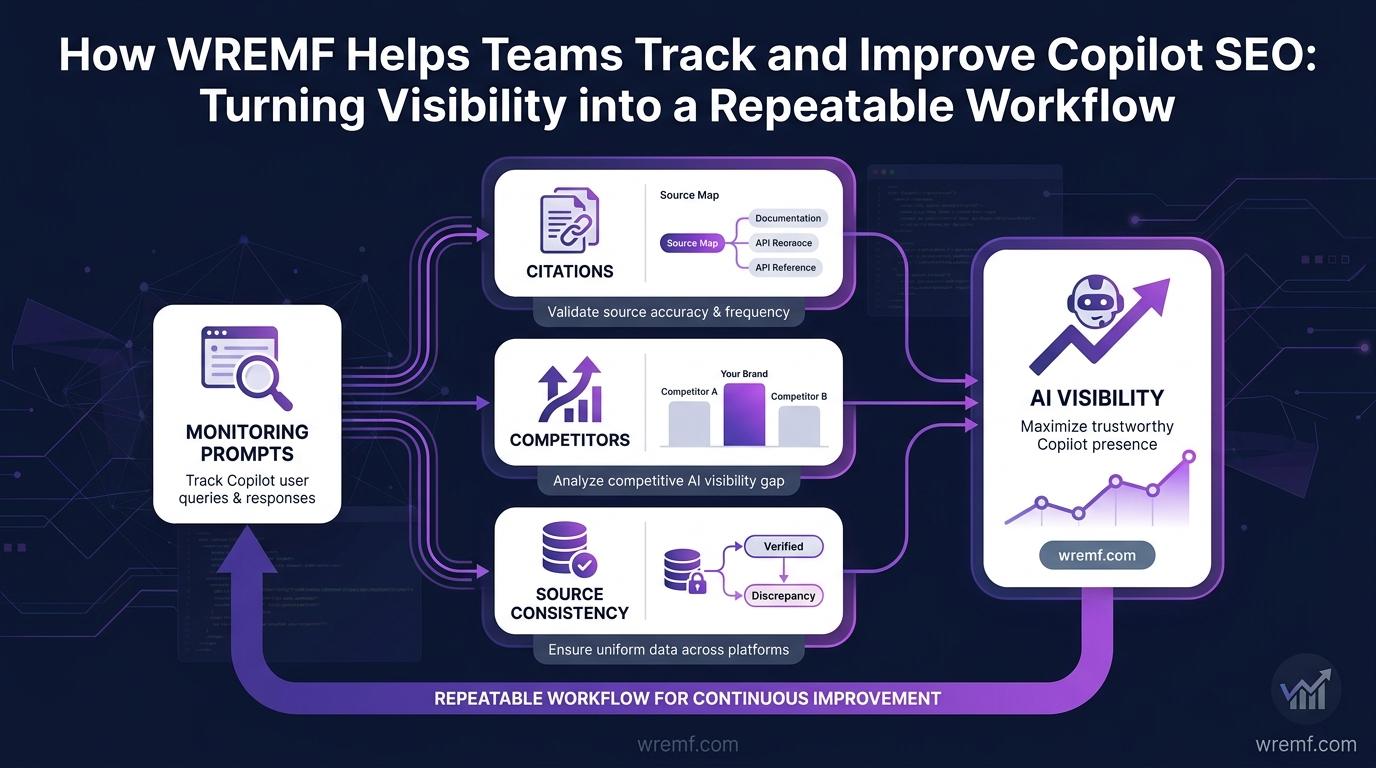
WREMF helps teams track, improve, and prove Copilot SEO by monitoring prompts, citations, competitors, source consistency, and AI visibility across major AI discovery surfaces. WREMF turns Copilot visibility from manual testing into a repeatable workflow.
WREMF is useful when your team needs to answer questions such as:
Does Microsoft Copilot mention our brand for high-intent buyer prompts?
Which sources does Copilot cite when discussing our category?
Which competitors appear more often than us?
Are AI engines using outdated or inaccurate brand information?
Which pages should we update first?
Are AI referrals, assisted conversions, or branded searches changing after optimization?
Which source links influence our visibility?
Which prompts reveal a Keyword Gap or content gap?
The WREMF workflow starts with prompt intelligence. Teams define realistic prompts by category, funnel stage, geography, buyer role, and AI platform. WREMF tests those prompts across AI engines and records mentions, citations, answers, competitors, and changes over time.
The workflow continues with source analysis. WREMF identifies which websites, pages, and references AI engines cite. This helps teams distinguish between content gaps, citation gaps, and entity consistency gaps.
The workflow then moves into action recommendations. WREMF can support AI-ready content briefs, GEO audits, SEO testing, competitor visibility analysis, and white-label reporting. Agencies can use WREMF to manage multiple clients, while in-house brands can use WREMF for brands to build a direct visibility workflow.
WREMF also supports BYOK, API and MCP integrations, client portals, scheduled monitoring, and white-label reports. Technical teams can explore the WREMF API and MCP integrations when they need programmatic workflows, custom dashboards, or internal reporting pipelines.
WREMF is useful for brands that want software, agencies that need white-label reporting, and teams that want managed execution. The practical value is not only seeing dashboards. The practical value is connecting Copilot Search visibility, prompt tracking, citation tracking, competitive analysis, content optimization, and reporting into one operating system.
KEY TAKEAWAY: WREMF helps B2B teams operationalize Copilot SEO by connecting prompt tracking, citation analysis, competitor monitoring, and action recommendations in one system.
The final part of a complete Copilot SEO strategy is answering the questions buyers and marketers ask before taking action.
Frequently Asked Questions
Can Copilot help with SEO?
Yes, Copilot can help with SEO research, content planning, summaries, data interpretation, and reporting drafts, but Copilot should not replace a full SEO or AI visibility workflow. Copilot can assist with keyword ideas, draft outlines, technical explanations, and competitive analysis. Copilot SEO requires more than using Copilot as a writing assistant. You still need search data, crawl checks, source citation tracking, prompt monitoring, competitor visibility analysis, and performance reporting. WREMF helps teams measure whether Microsoft Copilot and other AI engines actually mention, cite, or recommend the brand.
Is SEO dead or evolving in 2026?
SEO is evolving, not dead. Search engines still crawl, index, rank, and surface web pages, but AI-generated answers are changing how users discover information. Copilot SEO, AEO, and GEO add new layers to traditional SEO by measuring prompts, citations, answer presence, source links, and AI share of voice. Teams that only track Organic Rankings may miss visibility shifts inside Microsoft Copilot, ChatGPT, Perplexity, and Google AI Overviews. The practical strategy is to keep SEO fundamentals strong while adding AI visibility measurement.
Which AI tool is best for SEO?
The best AI tool for SEO depends on the job. Microsoft Copilot is useful for productivity, research, summaries, and Microsoft ecosystem workflows. Traditional SEO tools are useful for keyword research, backlinks, Site Audit workflows, Position Tracking, and search engine performance analysis. AI visibility platforms such as WREMF are useful for tracking prompts, citations, competitors, and AI search visibility across multiple engines. Most teams need a combination: SEO data for search performance, AI tools for workflow efficiency, and AI visibility tracking for Copilot SEO and GEO measurement.
Can I use Copilot as a search engine?
Yes, you can use Copilot as a search engine through Copilot Search in Bing and related Microsoft experiences. Microsoft describes Copilot Search as a way to get summarized answers with cited sources and suggestions for further exploration. This matters for SEO because users may receive an AI-generated answer before clicking a traditional result. Brands should therefore optimize for both search engine rankings and Copilot answer visibility by improving content clarity, source trust, structured data, internal linking, and citation-worthy pages.
Can Copilot replace traditional SEO tools?
No, Copilot should not replace traditional SEO tools. Copilot can help interpret data, draft content, and explain SEO tasks, but it does not replace dedicated crawling, rank tracking, backlink analysis, technical auditing, analytics, or AI visibility monitoring. Copilot SEO needs both traditional SEO signals and AI-specific metrics. A strong stack may include Bing Webmaster Tools, Google Search Console, analytics, a crawler, keyword research tools, and WREMF for prompt tracking, source citations, competitor visibility, and AI share of voice.
How does Copilot choose sources for answers?
Copilot source selection depends on the product context, prompt, available sources, freshness, grounding, permissions, and perceived relevance. Public Copilot Search can use web information and cite sources. Microsoft 365 Copilot can also use Microsoft Graph and organizational data that the user has permission to access. For Copilot SEO, this means your pages should be crawlable, clear, structured, current, and consistent with trusted third-party sources. Strong rankings help, but source quality, answer fit, and entity clarity also matter.
What is the difference between Copilot SEO and GEO?
Copilot SEO focuses specifically on Microsoft Copilot, Bing, Edge, Microsoft 365, and Microsoft ecosystem visibility. GEO, or generative engine optimisation, is broader. GEO covers visibility inside AI-generated answers across platforms such as ChatGPT, Claude, Gemini, Perplexity, Google AI Overviews, Copilot, DeepSeek, Grok, Meta AI, and Mistral. Copilot SEO is one part of a complete GEO strategy. WREMF tracks Copilot alongside other AI engines so teams can compare answer presence, citations, and competitors across platforms.
How long does Copilot SEO take to show results?
Copilot SEO timelines vary by crawl frequency, content quality, source trust, competition, implementation speed, and the AI surface being measured. Technical fixes and content updates can be completed quickly, but AI answer visibility may change over weeks or months as search indexes, sources, and AI systems refresh. A practical first milestone is establishing a baseline prompt and citation report. After that, teams can prioritize content updates, citation improvements, source consistency fixes, and internal linking improvements, then remeasure changes at regular intervals.
How can agencies use Copilot SEO for clients?
Agencies can use Copilot SEO to show clients where their brands appear, where competitors win, which sources AI engines cite, and which content updates should be prioritized. This creates a stronger reporting model than manual screenshots or one-off AI tests. WREMF supports agencies with white-label reporting, client portals, unlimited prompt tracking, BYOK, and monitoring across 10 AI engines. Agencies can use Copilot SEO as part of broader AEO, GEO, content optimization, Technical SEO, competitive analysis, and authority-building retainers.
What should a Copilot SEO audit include?
A Copilot SEO audit should include Bing indexing checks, Technical SEO review, structured data review, prompt testing, answer presence analysis, citation tracking, competitor visibility, source consistency checks, and content gap recommendations. The audit should separate what is measurable from what is strategic. For example, prompt visibility and citations are measurable outputs, while content structure and source consistency are inputs that can be improved. WREMF’s GEO audit workflow helps teams convert those findings into a prioritized action plan.
Is Semrush Copilot the same as Copilot SEO?
No, Semrush Copilot and Copilot SEO are not the same thing. Semrush Copilot is an AI-powered SEO assistant inside the Semrush ecosystem that can support workflows such as Site Audit, Position Tracking, Traffic Analyst, Link Rebuilder, Broken Page Fixer, and Visibility Guardian. Copilot SEO is a broader strategy for improving visibility inside Microsoft Copilot and AI Search answers. A team may use Semrush Copilot for SEO workflow support and WREMF for AI visibility tracking, prompt monitoring, source citations, and multi-engine reporting.
What keywords should I track for Copilot SEO?
You should track both keywords and prompts for Copilot SEO. Keywords still matter for search engines, keyword discovery, Content Marketing, and search data analysis. Prompts matter because users ask AI assistants natural language questions such as “Which AI visibility tool is best for agencies?” or “Can Microsoft Copilot help with SEO?” Track commercial prompts, comparison prompts, implementation prompts, problem-aware prompts, and brand-specific prompts. WREMF helps teams organize prompts by funnel stage, competitor set, geography, engine, and reporting value.
Conclusion
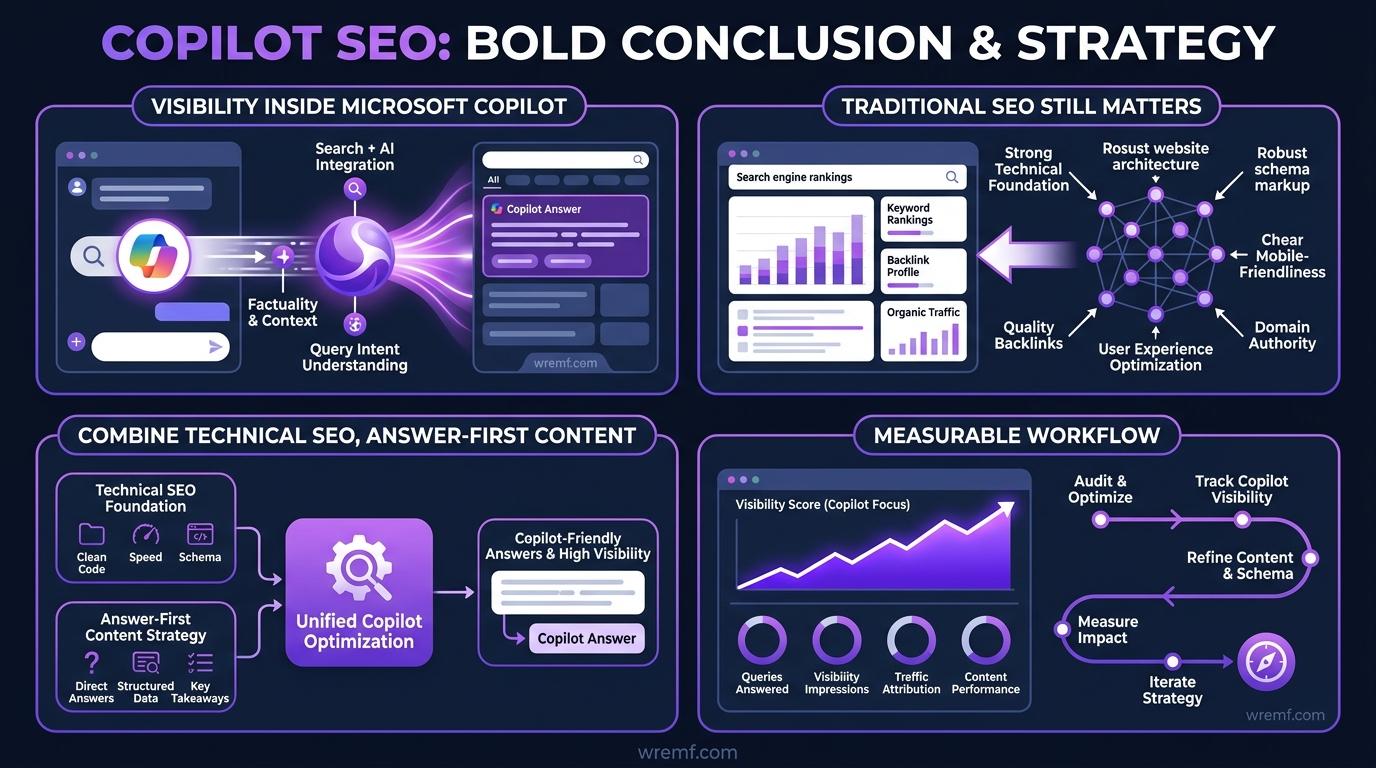
Copilot SEO is the practical next step for teams that want visibility inside Microsoft Copilot, Bing, Microsoft 365, and AI-generated search answers. Traditional SEO still matters, but rankings alone do not show whether Copilot mentions your brand, cites your sources, recommends competitors, or sends qualified traffic. A strong strategy combines Technical SEO, answer-first content, source consistency, prompt tracking, competitor visibility, structured data, and AI traffic attribution. To turn Copilot SEO from manual testing into a measurable workflow, explore the WREMF platform suite or talk to the WREMF agency team.