Does AI Content Optimization Improve Search Visibility?
Learn how AI content optimization impacts search visibility through SEO, AEO, and GEO integration.
By WREMF Team · 2026-08-24
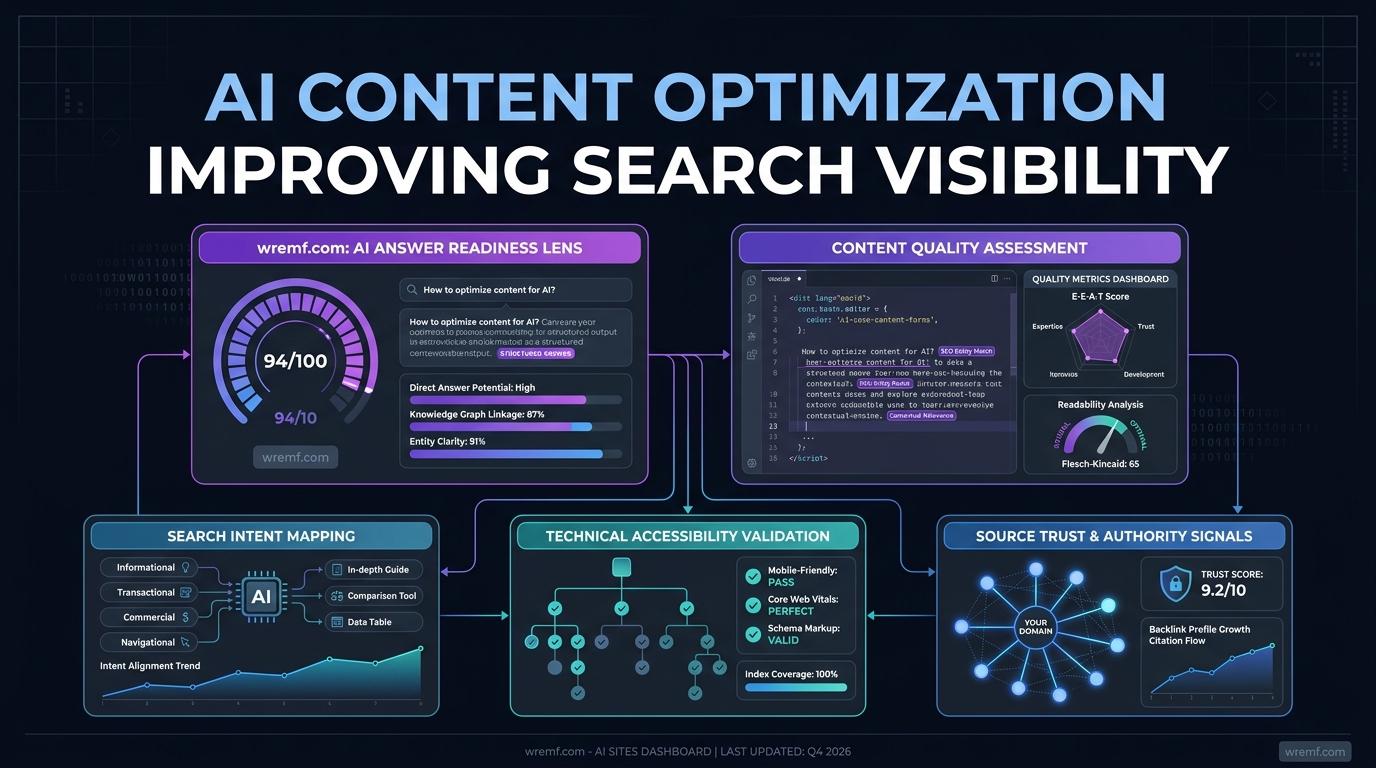
AI content optimization improves search visibility by enhancing content quality, structure, and technical accessibility. It involves AI-assisted research and emphasizes usefulness and clarity to meet user intent. Effective optimization ensures content is crawlable and indexable, supporting citation and recommendation within AI and search interfaces. Central concepts include entity recognition, topic clusters, and source consistency to ensure information is trusted and retrievable across platforms.
Key takeaways
- AI content optimization enhances visibility by improving content quality and structure.
- Search visibility includes rankings, citations, and recommendations across AI systems.
- SEO, AEO, and GEO should be combined for effective AI content strategies.
- Technical SEO foundations are critical for AI-powered visibility.
- Content needs clear structure and reliable source claims for AI extraction.
Does AI Content Optimization Improve Search Visibility?
Does AI content optimization improve search visibility? Yes, when it improves content quality, search intent coverage, technical accessibility, source trust, and AI answer readiness. Google Search Central explains that helpful, reliable, people-first content remains the foundation of strong search performance, while Google’s AI features guidance shows that AI Overviews and AI Mode still depend on crawlable, indexable, useful web content. WREMF helps B2B teams track, improve, and prove visibility across ChatGPT, Claude, Gemini, Perplexity, Google AI Overviews, Microsoft Copilot, DeepSeek, Grok, Meta AI, and Mistral. This guide explains how AI content optimization affects traditional rankings, answer engines, AI citations, referral traffic, source consistency, and business reporting. Start with the practical answer: AI content optimization works only when it improves usefulness, not when it simply produces more content.
Does AI Content Optimization Improve Search Visibility?
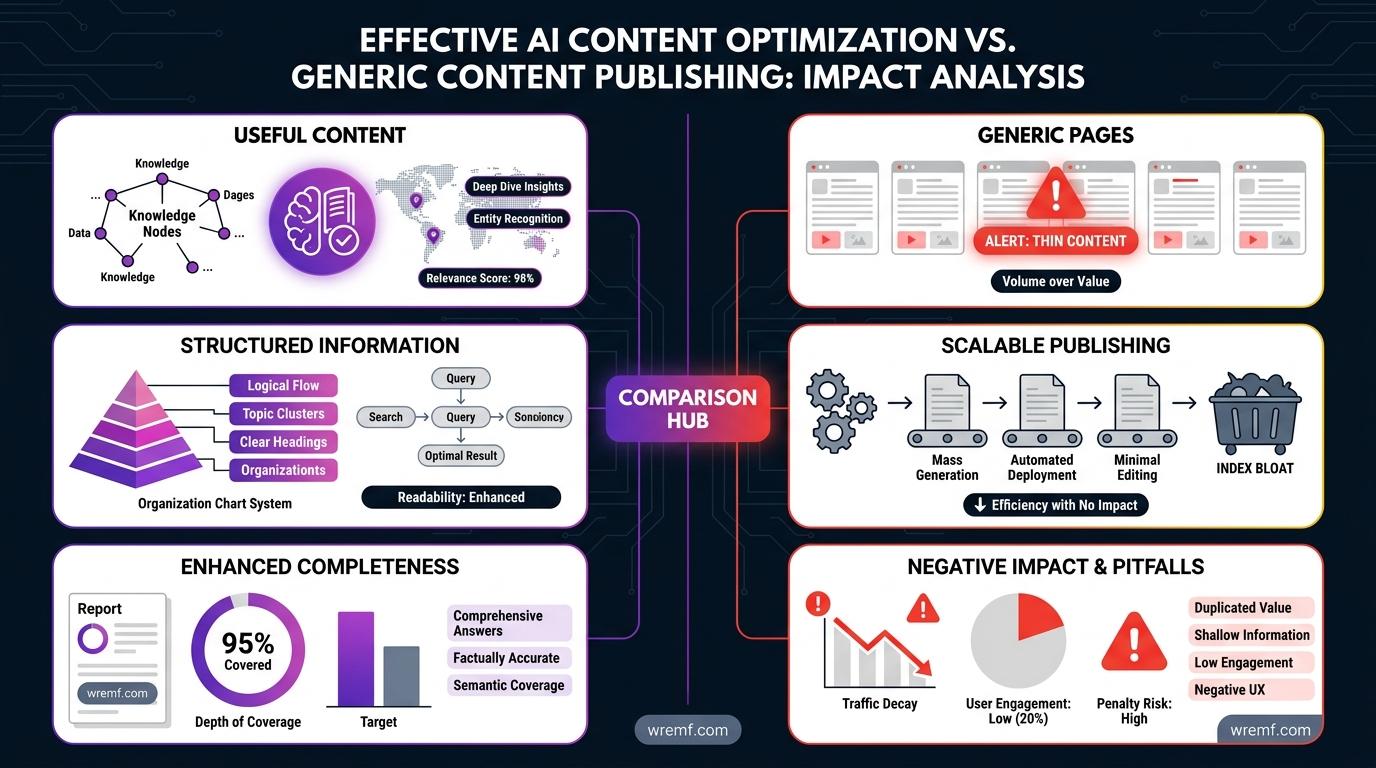
AI content optimization improves search visibility when it makes content more useful, more structured, more complete, and easier for search engines and AI systems to understand. It does not improve visibility when teams use AI only to publish generic pages at scale.
AI content optimization is the process of using AI-assisted research, semantic analysis, user intent mapping, content structure, and performance data to improve how content answers real search queries. It matters because search engines, AI assistants, and answer engines need clear, trusted, crawlable content before they can rank, cite, summarize, or recommend a source.
Search visibility is the measurable presence of a website, page, brand, or source across search results, AI Overviews, answer engines, AI-generated answers, AI citations, and referral traffic. Search visibility now includes more than rankings because users increasingly receive answers inside search engine and AI assistant interfaces.
According to Google Search Central’s guidance on helpful content, Google’s automated ranking systems are designed to prioritize helpful, reliable information created to benefit people, not content created mainly to manipulate search engine rankings. This matters because AI content optimization should improve clarity, usefulness, originality, accuracy, and user satisfaction before it tries to improve keyword density.
WREMF helps teams turn AI visibility from a guessing game into a measurable workflow through the WREMF platform suite. The platform connects prompt tracking, source citations, competitor visibility, AI share of voice, GEO audits, content briefs, SEO testing, and reporting so teams can see whether content optimization is changing how AI systems describe, cite, and recommend a brand.
AI visibility is the measurable presence of a brand inside AI-generated answers, citations, summaries, and recommendations. AI visibility matters because B2B buyers increasingly use ChatGPT, Perplexity, Gemini, Microsoft Copilot, and Google AI Overviews to compare vendors before they click a website, complete a form, or speak to sales.
AI search visibility is not a replacement for SEO. AI search visibility builds on technical SEO, content quality, answer engine optimization, generative engine optimization, Digital Marketing analytics, source consistency, and entity authority. The strongest AI content optimization strategies improve both human usefulness and machine retrievability.
In practical AI visibility audits, teams often find that the highest-impact updates are not cosmetic rewrites. The strongest updates usually fix unclear definitions, missing topic clusters, weak internal linking, thin FAQs, inconsistent brand facts, outdated claims, missing source attribution, and pages that are technically available but not easy for AI models to parse.
DID YOU KNOW: Google says AI Overviews provide a snapshot of key information with links so users can explore more on the web, which means visibility can happen both through classic search results and AI-generated summaries.
KEY TAKEAWAY: AI content optimization improves search visibility when it strengthens helpfulness, structure, technical access, source trust, and measurable AI visibility signals.
The next step is understanding why search visibility now includes answers, citations, summaries, and recommendations.
Why AI Search Changed the Meaning of Search Visibility
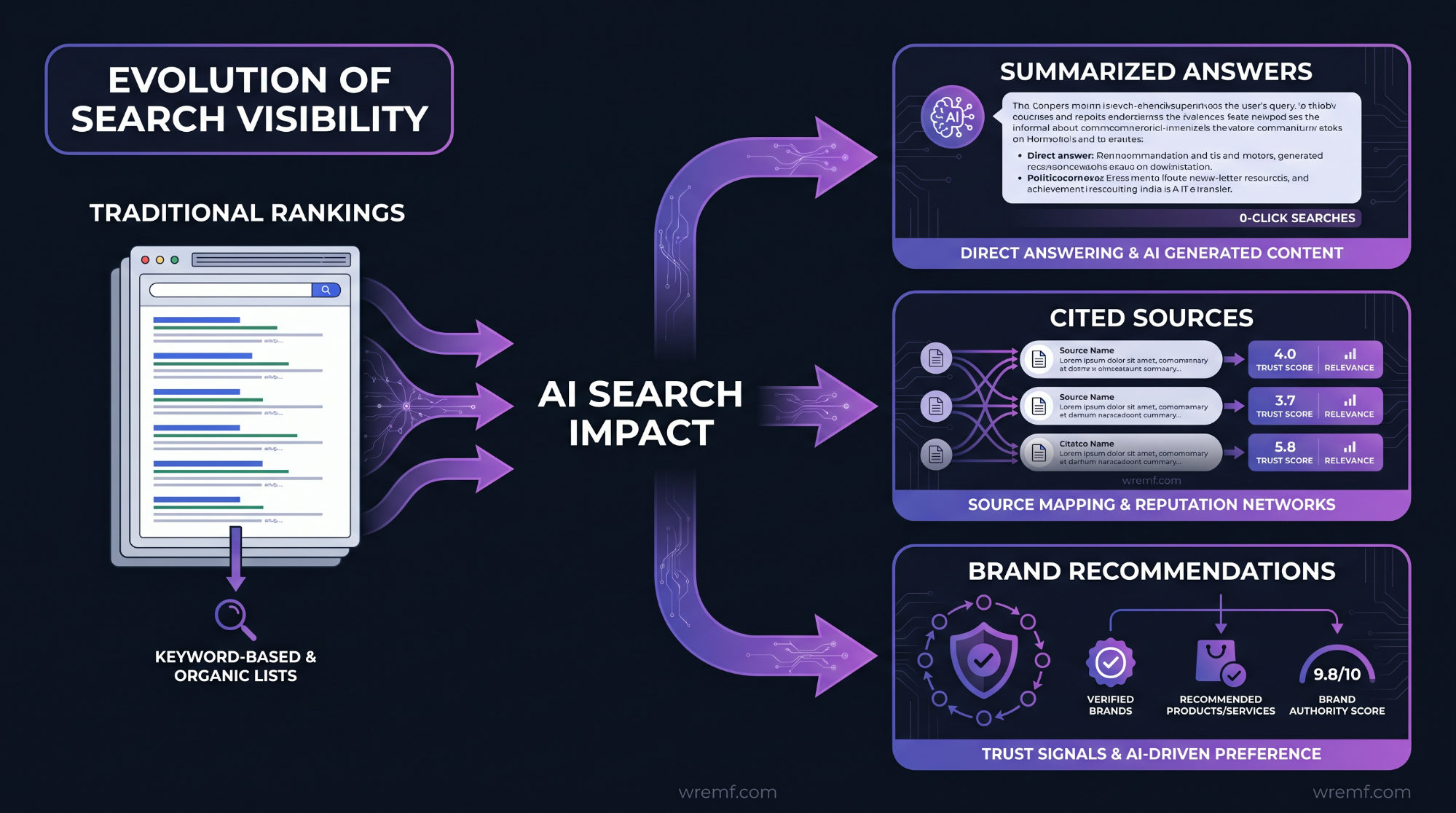
AI search changed search visibility because users now receive summarized answers, cited sources, and brand recommendations before they click a traditional search result. Ranking is still important, but it is no longer the only visibility outcome.
AI search is a search experience where AI models retrieve, interpret, summarize, compare, or generate answers from available information. AI search matters because users can ask natural language questions and receive AI-generated answers that combine multiple sources.
AI-powered search experiences are search interfaces that use generative AI, retrieval, ranking, and summarization to help users explore information. AI-powered search experiences matter because they compress research journeys and change how users discover brands, products, and sources.
Answer engine is a system that responds to a user query with a direct answer rather than only a list of links. Answer engine visibility matters because users may see a brand, citation, or recommendation inside the answer before they visit any website.
According to Google’s AI features and your website guidance, AI Overviews and AI Mode are part of Google Search, and site owners should continue focusing on helpful content that can be crawled, indexed, and shown in Google Search. This confirms a practical point: AI search optimization does not remove SEO fundamentals, but it changes what teams must measure.
OpenAI describes ChatGPT search as a way for ChatGPT to provide timely answers with links to relevant web sources, including a sources sidebar for deeper exploration. This matters because ChatGPT is not only a chatbot. It is also an AI discovery surface where citations, summaries, and source references can influence brand recognition.
Microsoft Copilot, Google Gemini, Perplexity, Meta AI, DeepSeek, Grok, Claude, and Mistral all create different AI responses based on their models, retrieval behavior, product interfaces, and source access. A brand can be visible in one AI assistant and absent from another, which is why AI visibility should be measured across multiple answer engines.
AI Overviews are Google Search features that use generative AI to summarize information for some queries and provide links for exploration. AI Overviews matter because they can appear above or around classic search results, changing how users evaluate sources.
AI Mode is a Google Search experience that supports more complex, conversational, and exploratory queries. AI Mode matters because it moves search behavior closer to natural prompts, follow-up questions, and AI-assisted research journeys.
In real B2B buying journeys, a user may ask “best AI visibility tools for agencies,” “how to optimize for Google AI Overviews,” or “does generative engine optimization improve search results?” If your brand does not appear in the AI response, your traditional search engine ranking may not represent your full market visibility.
HubSpot’s AI search visibility analysis cites Pew Research findings that Google AI Overviews appeared in 18% of U.S. desktop searches in March 2025, and also reports that 31% of Gen Z respondents in HubSpot’s 2025 AI Trends for Marketers research start queries directly in AI or chat tools instead of search engines. These numbers show why AI visibility now belongs in Digital Marketing reporting, not only SEO reporting.
AI-generated answers are responses created by AI systems after interpreting a user query and available information. AI-generated answers matter because users may rely on the answer itself rather than clicking every source that influenced the response.
AI-generated responses are summaries, recommendations, comparisons, or explanations produced by AI models. AI-generated responses matter because they can shape vendor shortlists, content trust, and brand recognition even when referral traffic is low.
KEY TAKEAWAY: Search visibility now includes rankings, AI-generated answers, citations, brand mentions, recommendations, and AI referral traffic across multiple AI discovery surfaces.
To adapt, teams need to understand how SEO, AEO, and GEO work together instead of treating them as separate trends.
SEO vs AEO vs GEO: What Is the Difference?
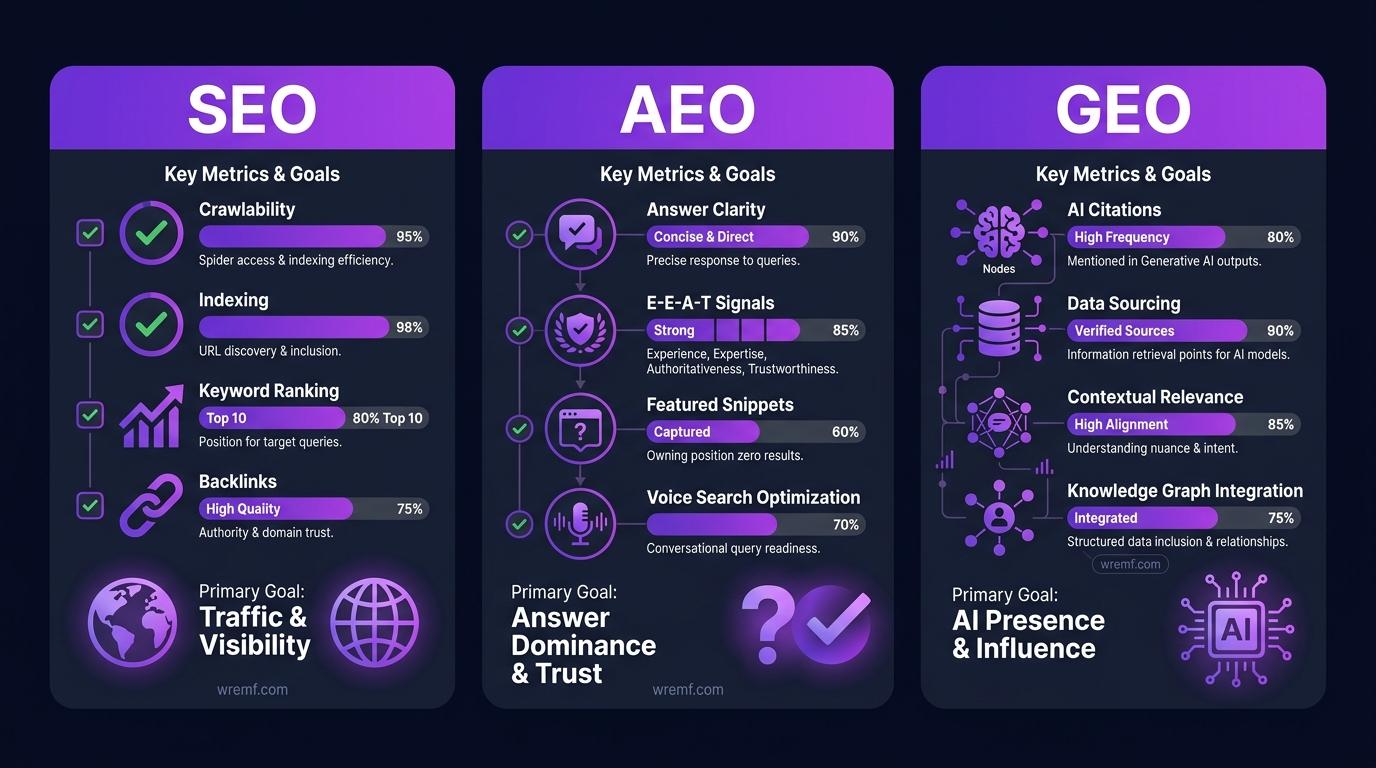
SEO improves visibility in search engines, AEO improves answer readiness for answer engines, and GEO improves retrieval and citation potential in generative AI systems. The best AI content optimization strategy combines all three.
SEO is search engine optimization, the practice of improving crawlability, indexability, relevance, authority, and user experience so content can perform in search engines. SEO matters because Google Search, Bing, and other search engines still drive discovery, traffic, and buyer research.
Answer engine optimization is the practice of structuring content so answer engines can extract, summarize, and present clear answers. Answer engine optimization matters because AI assistants and search interfaces increasingly respond to full questions rather than only keyword fragments.
Generative engine optimization is the practice of improving content, entities, citations, and source authority so generative AI systems can retrieve, summarize, cite, or recommend a brand. Generative engine optimization matters because AI-generated answers often synthesize information across multiple sources instead of ranking one webpage.
| Discipline | Best For | What It Measures | What It Misses | Example Metric | Recommended When |
|---|---|---|---|---|---|
| SEO | Google Search and traditional search engines | Rankings, clicks, impressions, CTR, crawlability | AI-generated answers and unclicked AI summaries | Average position in Google Search Console | You need organic search traffic and indexable content |
| AEO | Answer engines and direct-answer formats | Answer clarity, FAQ coverage, extractable definitions | Source ecosystem strength and competitor mentions | Answer inclusion for target questions | You need content that answers user queries directly |
| GEO | AI search and large language models | AI visibility, citations, brand mentions, source consistency | Classic keyword rankings if measured alone | AI share of voice across prompts | You need visibility in ChatGPT, Perplexity, Gemini, Copilot, and AI Overviews |
| Digital Marketing analytics | Channel and business reporting | Traffic, conversions, assisted journeys, attribution | Unclicked AI influence | AI referral traffic and branded search lift | You need to connect visibility to business outcomes |
The best option for most B2B teams is not SEO vs AEO vs GEO. The best option is a unified workflow where keyword research identifies demand, AEO improves answer clarity, GEO improves AI retrieval, and Digital Marketing analytics connects visibility to business outcomes.
Keyword research is still useful because it shows search demand, language patterns, and commercial intent. Keyword research becomes stronger when it is combined with prompt tracking, user intent analysis, AI responses, content clusters, and source citation analysis.
User Intent is the reason behind a search, prompt, or question. User Intent matters because both search engines and AI models need to satisfy the user’s actual task, not only match a phrase.
Semantic understanding is the ability of search systems and AI models to understand meaning, entities, context, and relationships rather than only exact keywords. Semantic understanding matters because AI search rewards topical completeness, clear explanations, and entity relationships.
WREMF’s AI visibility methodology connects prompts, citations, competitors, source consistency, and attribution into one repeatable system. This matters because AI visibility is both a measurement problem and a source ecosystem problem.
IMPORTANT: Traditional SEO metrics are still necessary, but they are incomplete when buyers use AI assistants to compare vendors, summarize topics, or ask for recommendations without clicking search results.
KEY TAKEAWAY: SEO, AEO, and GEO are overlapping disciplines that work best when content is crawlable, answer-ready, semantically complete, and measurable across AI search.
Once the relationship is clear, the next question is how content optimization actually improves AI search visibility.
How AI Content Optimization Improves AI Search Visibility
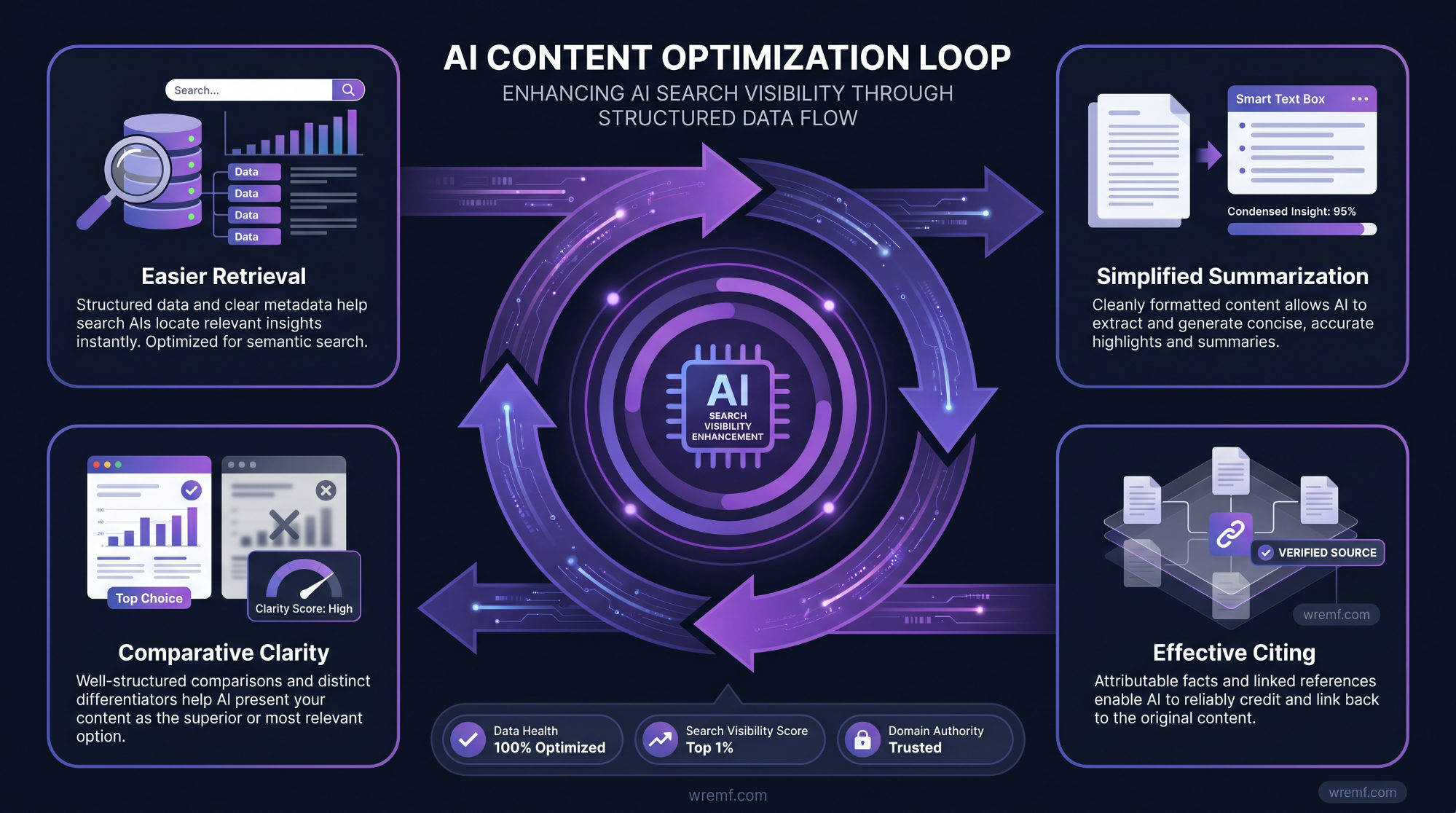
AI content optimization improves AI search visibility by making content easier to retrieve, summarize, cite, and compare. The strongest gains usually come from better topic coverage, clearer entities, stronger source signals, and more useful answer-first content.
AI models are systems trained to process patterns, language, context, and data so they can generate or classify outputs. AI models matter for search visibility because AI responses depend on what models can understand, retrieve, and summarize with confidence.
Large language models are AI models designed to understand and generate text at scale. Large language models matter because ChatGPT, Claude, Gemini, Microsoft Copilot, Perplexity, DeepSeek, Grok, Meta AI, and Mistral use language understanding to answer questions and compare information.
AI assistants are tools that help users ask questions, summarize information, compare options, write content, and complete research tasks. AI assistants matter because they increasingly influence top-of-funnel discovery, vendor comparison, and Digital Marketing research.
AI search optimization is the practice of improving how a brand, page, or source appears across AI search engines and AI-powered search experiences. AI search optimization matters because modern visibility includes citations, recommendations, AI answers, search results, and referral traffic.
AI Search Engines are search or answer systems that combine retrieval, ranking, and generative AI summarization. AI Search Engines matter because Google AI Overviews, AI Mode, ChatGPT search, Perplexity, and Microsoft Copilot can influence decisions before a user visits a site.
Google Search Central explains that Google Search works through crawling, indexing, and serving results. This matters because even AI-powered search experiences still require accessible, useful, and understandable source material.
Crawlable content is content that search engine crawlers and AI-related retrieval systems can access and process. Crawlable content matters because content that cannot be discovered or parsed cannot reliably rank, appear in AI Overviews, or support AI citations.
Indexable content is content that can be stored and considered by a search index. Indexable content matters because visibility starts with discoverability, even when the end result is an answer engine citation rather than a classic blue link.
AI content optimization improves AI search visibility in five practical ways:
It clarifies the main answer so AI systems can extract the core point.
It expands topic clusters so content covers related questions and user intent.
It improves content structure so answers, comparisons, and definitions are easier to summarize.
It strengthens entity recognition so AI models understand the brand, product, category, and competitors.
It improves source consistency so AI systems find the same facts across owned and third-party sources.
Entity recognition is the ability of search systems and AI models to identify people, companies, products, services, places, and concepts. Entity recognition matters because a brand must be understood as a distinct entity before it can be cited, compared, or recommended reliably.
In real-world reporting, SEO teams frequently discover that a page can rank in Google Search but still fail to appear in AI responses for commercial prompts. That usually means the page is not structured around the buyer’s question, lacks clear comparison value, or is not reinforced by enough trusted sources.
TIP: Start AI content optimization with the prompts buyers actually ask, then map each prompt to a page, answer block, source claim, comparison table, or FAQ.
KEY TAKEAWAY: AI content optimization improves AI search visibility by turning pages into clear, retrievable, source-backed answers that AI systems can understand and users can trust.
The next layer is content structure, because AI systems need information chunks that are easy to parse and cite.
What Content Structure Helps AI Systems Cite and Summarize?
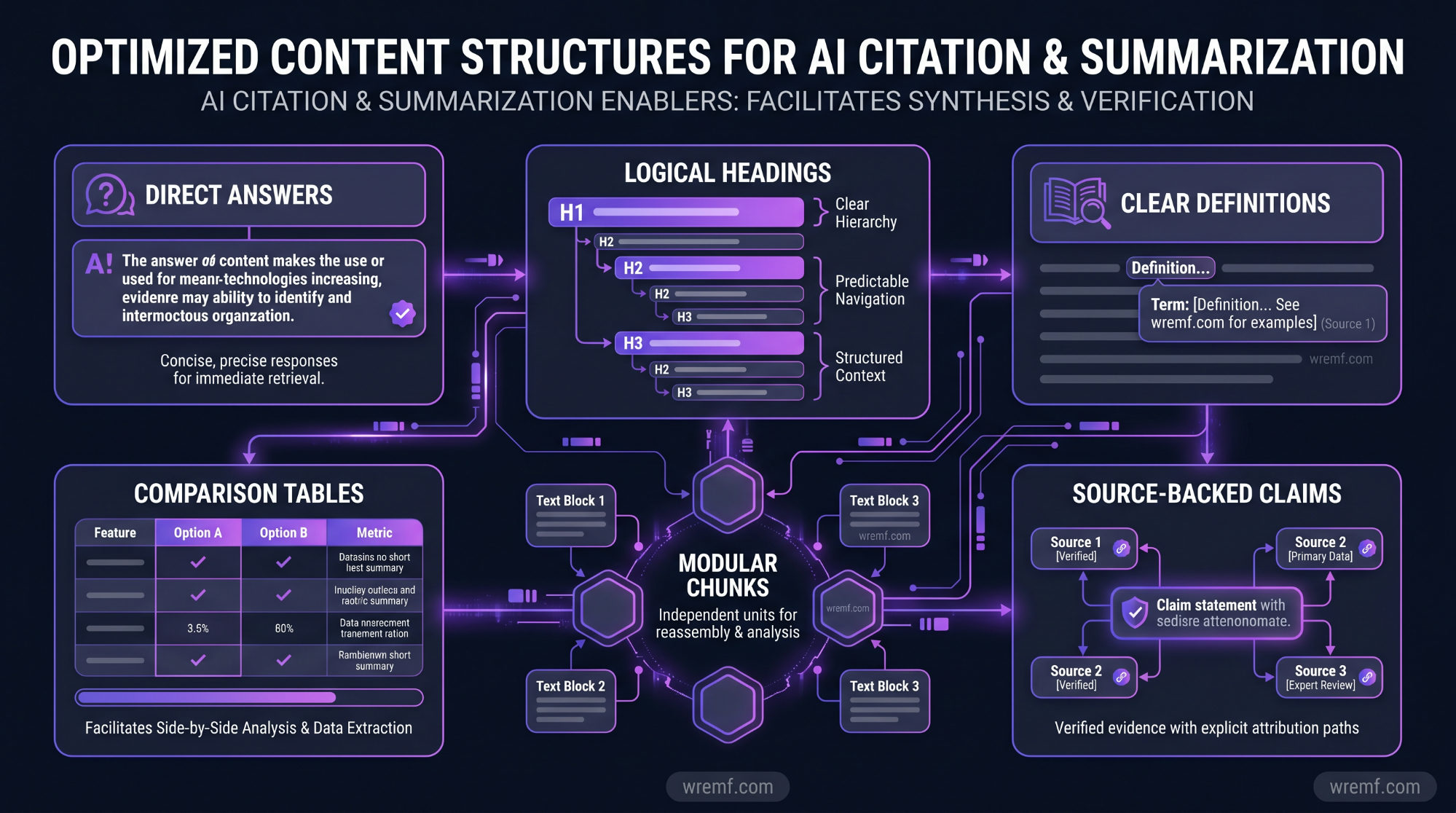
Content structure helps AI systems cite and summarize when content uses direct answers, logical headings, modular chunks, clear definitions, comparison tables, and source-backed claims. Structure does not replace expertise, but it makes expertise easier to retrieve.
Content structure is the organization of headings, paragraphs, tables, definitions, lists, examples, FAQs, and internal links on a page. Content structure matters because AI assistants and search engines need predictable patterns to identify answers, entities, and relationships.
Structured content is content organized into clear, reusable blocks that answer specific user queries. Structured content matters because AI-generated responses often summarize discrete facts, definitions, comparisons, and workflows.
Modular content is content broken into self-contained sections that answer one clear question at a time. Modular content matters because AI systems can extract a definition, comparison, or process more reliably when the surrounding chunk is focused and complete.
A strong AI-ready page usually includes:
A direct answer at the beginning of each major section
Clear H2 headings that match natural language user queries
Short definitions for major concepts
Topic clusters that cover related questions
Tables for comparisons involving three or more options
Source attribution close to factual claims
Internal linking to related content clusters
FAQs that answer real buyer and search queries
Updated examples for fast-moving topics
Summary sentences that repeat the subject clearly
Internal linking is the practice of connecting related pages within the same website using descriptive anchor text. Internal linking matters because it helps search engines, AI crawlers, and users understand topic relationships, page importance, and content clusters.
Topic clusters are groups of related pages that cover a central topic and its subtopics in depth. Topic clusters matter because AI search and traditional search both benefit from clear topical authority and consistent entity reinforcement.
Content clusters are organized sets of pages that support a central topic through definitions, comparisons, workflows, and decision-stage content. Content clusters matter because buyers and AI assistants often need multiple pieces of evidence before trusting a brand.
A B2B SaaS company improving AI visibility might create one pillar page on AI search visibility, then supporting pages on ChatGPT visibility, Perplexity citations, Google AI Overviews, AI traffic attribution, answer engine optimization, generative engine optimization, and AI visibility tools. Each page should link to the next logical step using descriptive anchor text.
For WREMF, a strong content cluster can connect educational pages to prompt intelligence, source citation tracking, and competitive AI visibility analysis. These links help readers move from learning the concept to measuring the actual visibility gap.
AI citations are references, source links, or cited pages used by AI systems to support AI-generated answers. AI citations matter because citations can create brand exposure even when the user does not click a traditional search result.
Source citations are the specific URLs, sources, or references used in an AI-generated answer. Source citations matter because they show which websites AI systems trust enough to reference for a user query.
Citation frequency is how often a source appears as a citation across AI responses or answer engine outputs. Citation frequency matters because repeated citation can indicate stronger source relevance for a topic or prompt cluster.
KEY TAKEAWAY: Strong content structure makes expertise easier for users to scan, search engines to index, and AI systems to summarize, cite, and recommend.
Strong structure still depends on technical foundations, because AI systems cannot rely on content they cannot access or understand.
What Technical SEO Foundation Does AI Content Optimization Need?
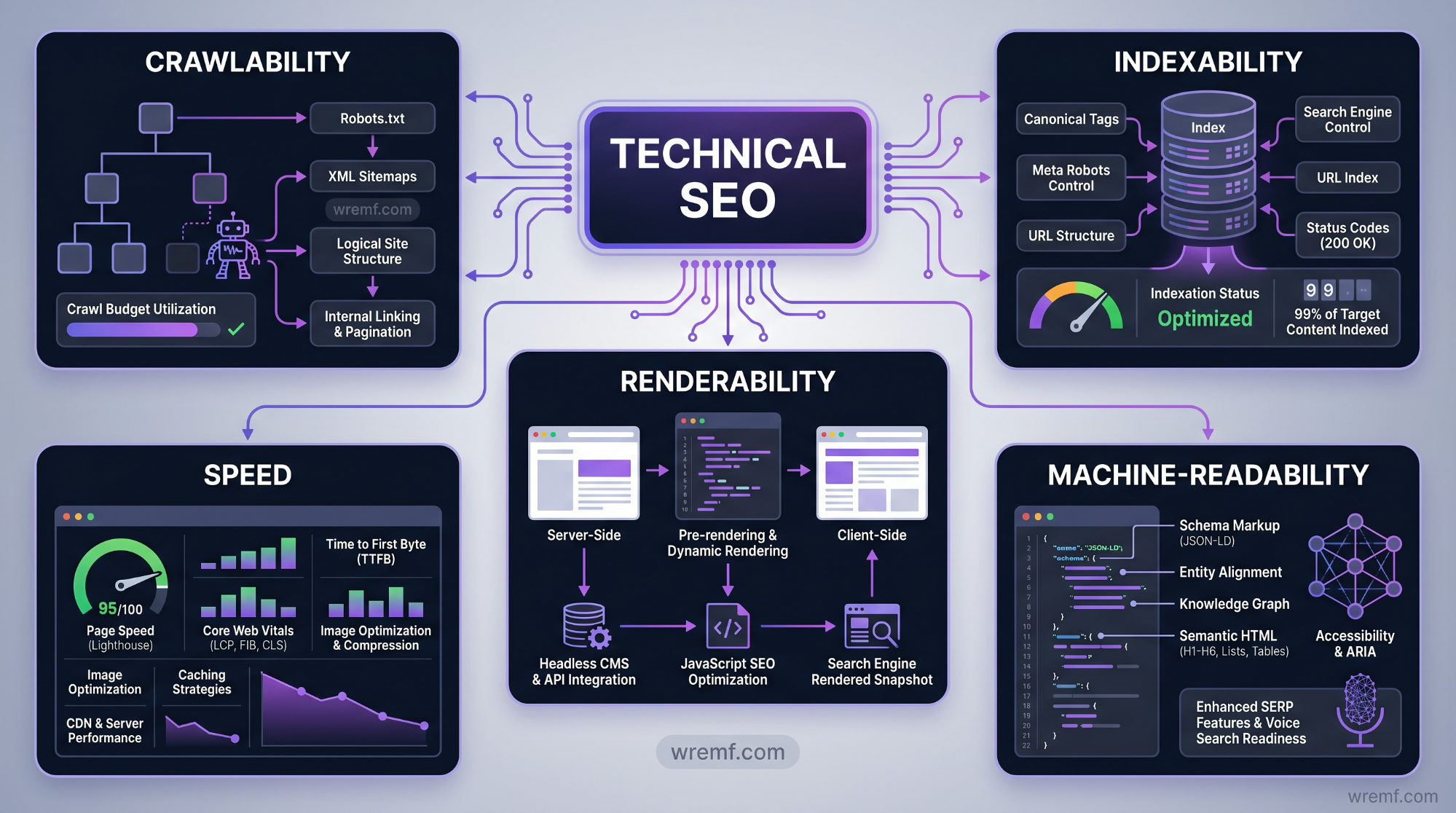
AI content optimization needs technical SEO that makes content crawlable, indexable, renderable, fast, and machine-readable. Without technical access, even excellent content can struggle to appear in search results, AI Overviews, or AI-generated answers.
Technical SEO is the practice of improving the infrastructure that helps search engines crawl, render, index, and understand a website. Technical SEO matters because AI-powered search experiences still rely on accessible pages, clear HTML, links, metadata, and structured signals.
Google Search Central’s documentation explains that SEO helps search engines crawl, index, and understand content. This matters because AI content optimization cannot succeed if important pages return errors, block crawlers, hide main content behind broken rendering, or lack clear page signals.
A practical technical AI visibility audit should check:
HTTP 200 status for important pages
Indexable content and canonical URLs
Crawlable content in HTML
Server-side rendering for critical text when needed
Optimized metadata that matches the page intent
Descriptive title tags and meta descriptions
Internal linking to related topic clusters
Clean heading hierarchy
Mobile optimization for usability
Core Web Vitals and page speed
Robots.txt and crawl directives
XML sitemap coverage for important URLs
Schema markup accuracy
Optimized metadata is title, description, canonical, Open Graph, and other page-level metadata that helps systems understand page purpose. Optimized metadata matters because search engines and AI systems use metadata as one signal among many to interpret content.
Server-side rendering is the process of rendering important page content on the server before it reaches the browser. Server-side rendering matters because JavaScript-heavy pages can expose less meaningful content to some crawlers if rendering is delayed, blocked, or incomplete.
JavaScript-heavy pages are pages where important content depends heavily on client-side JavaScript. JavaScript-heavy pages matter because rendering issues can reduce the reliability of crawlable content, indexable content, and AI retrieval.
Schema markup is code that helps search engines understand entities, content types, and page meaning. Schema markup matters because it can support Rich Results, entity recognition, and clearer machine interpretation when implemented accurately.
Structured Data is standardized markup that describes page content in a machine-readable format. Structured Data matters because Google’s structured data documentation explains that structured data helps Google understand page content and can make pages eligible for certain search result features.
Schema implementation should be accurate, visible to users, and aligned with the page content. Schema implementation should not describe claims, FAQs, reviews, products, services, or local business details that are not actually present on the page.
Rich Results are enhanced Google Search results that can use supported Structured Data. Rich Results matter because they can improve how content appears in search results when the page qualifies and follows Google’s guidelines.
Local schema markup is schema markup used to describe local businesses, locations, services, opening hours, and related business information. Local schema markup matters for multi-location businesses because local search visibility often depends on accurate location and service signals.
Schema markup does not guarantee rankings, AI Overviews, AI answers, or AI citations. Schema markup is a clarity layer that works best with helpful content, strong technical SEO, accurate source claims, internal linking, and consistent entities.
IMPORTANT: Do not treat schema markup as a shortcut. Treat schema markup as a support system for content that is already useful, accurate, and accessible.
KEY TAKEAWAY: AI content optimization needs technical SEO because AI search visibility depends on accessible, indexable, well-structured, and machine-readable content.
Once the technical foundation is stable, content strategy must shift from keyword-first to source-first.
How Should You Create Source-First Content for AI-Generated Answers?
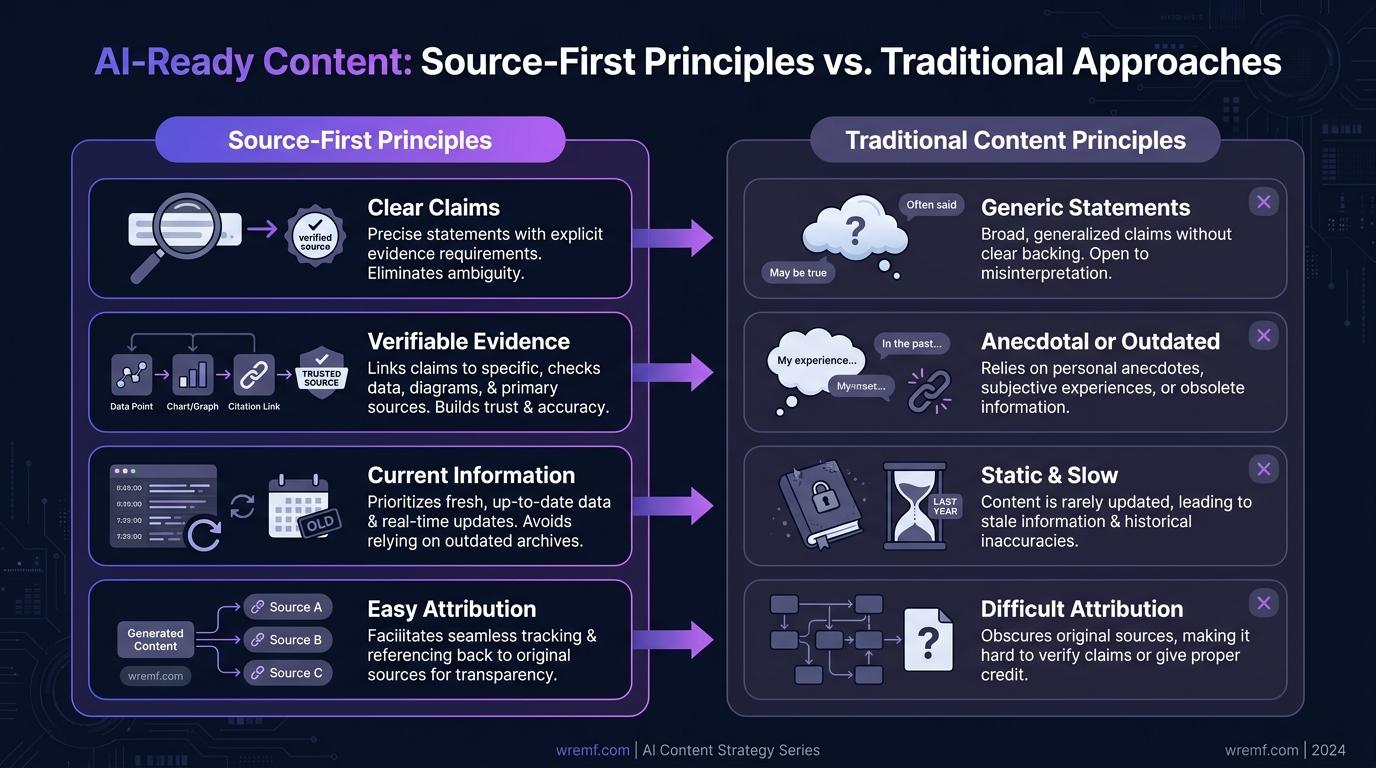
Source-first content improves AI-generated answers by making each claim clear, verifiable, current, and easy to attribute. The goal is to become a trusted source, not just another page targeting a keyword.
Source-first content is content built around evidence, definitions, original insight, clear attribution, and consistent entity language. Source-first content matters because AI responses often synthesize information from sources that appear trustworthy, specific, and easy to summarize.
Factual content is content that states verifiable information, separates evidence from opinion, and cites authoritative sources where needed. Factual content matters because AI-generated responses can amplify errors when pages publish vague, outdated, or unsupported claims.
Content clarity is the degree to which a page explains a topic in plain, direct, and logically ordered language. Content clarity matters because unclear content is harder for users, search engines, and large language models to interpret.
A source-first AI content workflow includes:
Define the primary entity and related entities
Answer the main question in the first paragraph
Add source-backed evidence near factual claims
Explain methods, assumptions, and limitations
Use examples from real B2B buying journeys
Include comparison tables where tradeoffs matter
Build content clusters around adjacent user queries
Refresh content when products, platforms, or guidance changes
Track AI responses to see which sources get cited
According to Google Search Central’s guidance on AI-generated content, Google’s focus is on the quality of content rather than whether AI was used to produce it. This matters because generative AI content can help with research and structure, but content still needs accuracy, originality, usefulness, and human review.
Generative AI content is content created or assisted by AI systems. Generative AI content matters because quality depends on usefulness, accuracy, originality, review, and source value, not on whether AI was involved in the workflow.
AI Marketing is the use of AI tools and systems to improve marketing research, content, personalization, measurement, and decision-making. AI Marketing matters because AI can improve Digital Marketing workflows when it supports strategy, evidence, and execution instead of producing generic output.
Digital Marketing performance improves when AI content optimization supports search visibility, user trust, conversion journeys, and reporting. Digital Marketing performance does not improve when teams publish large volumes of generic pages without clear user intent or source value.
Media mentions are references to a brand in reputable publications, analyst content, podcasts, newsletters, research, or industry coverage. Media mentions matter because AI systems may use reputable third-party sources to understand brand authority and category relevance.
Credibility signals are signs that a source is reliable, such as expert authorship, transparent methods, reputable citations, reviews, documentation, consistent facts, and authoritative mentions. Credibility signals matter because AI systems and users both need reasons to trust a source.
Reputable sources are sources with recognized authority, editorial standards, direct expertise, official documentation, or reliable data. Reputable sources matter because AI-generated answers often need to ground claims in information that users can verify.
TIP: Use AI to identify missing entities, weak explanations, and duplicate sections, but use human review to validate claims, examples, source attribution, and commercial nuance.
KEY TAKEAWAY: Source-first content improves AI search visibility because AI systems need clear, verifiable, and well-structured evidence to summarize or cite a page.
Once content becomes source-ready, the next question is which metrics prove that visibility is improving.
Which AI Visibility Metrics Matter More Than Rankings?
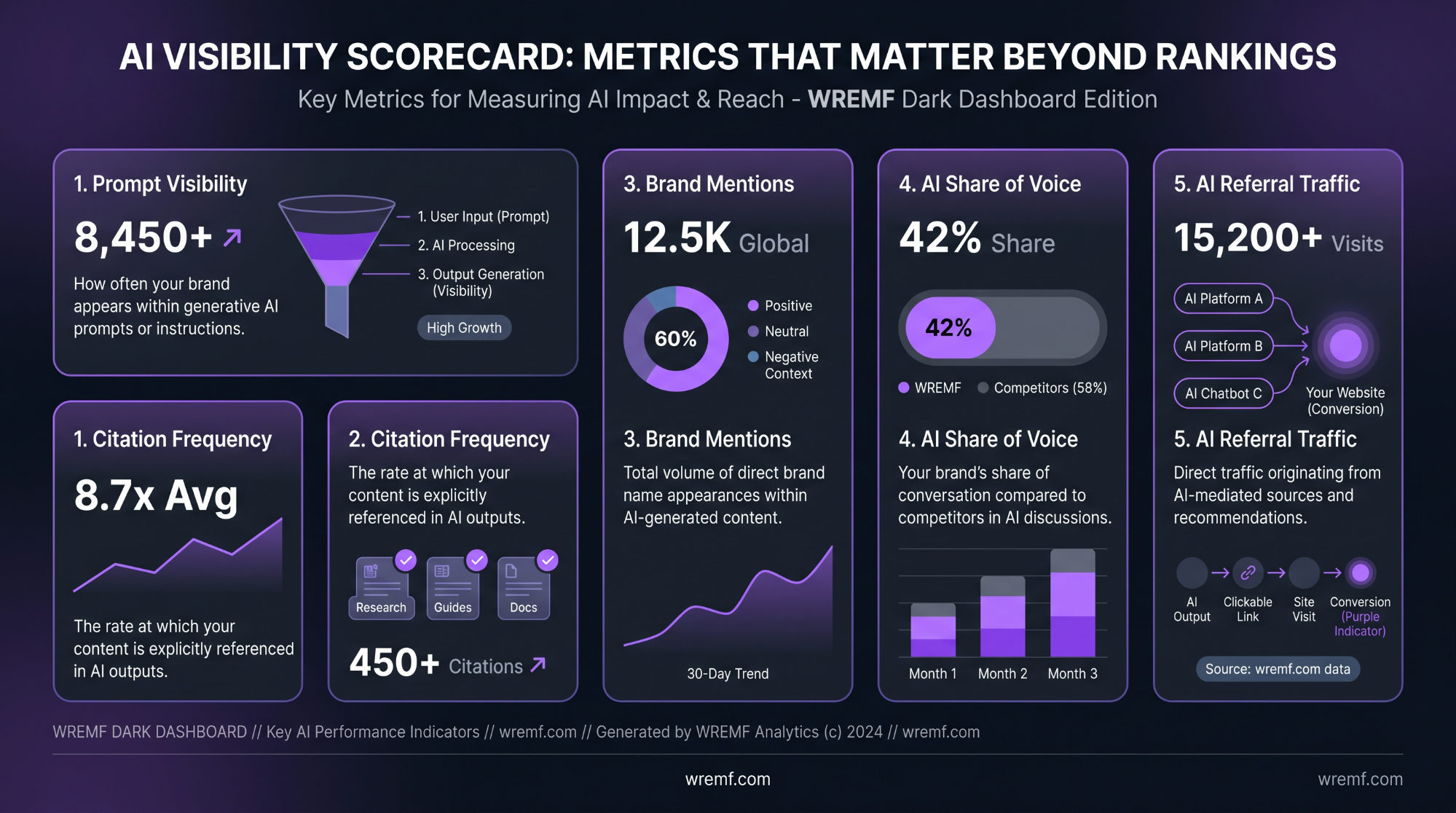
AI visibility metrics matter more than rankings when they show whether your brand appears, gets cited, or is recommended inside AI-generated answers. Rankings still matter, but rankings alone no longer show full search visibility.
Prompt tracking is the process of monitoring how AI systems answer specific prompts over time. Prompt tracking matters because AI responses vary across engines, phrasing, location, time, and retrieval context.
AI share of voice is the percentage of relevant AI responses where a brand appears compared with competitors. AI share of voice matters because it shows whether a brand is included in category conversations, vendor shortlists, and recommendation-style answers.
Brand mentions are references to a brand inside AI answers, search results, articles, forums, profiles, videos, and other sources. Brand mentions matter because AI assistants can recommend or describe a brand even without linking to a page.
Brand mention rate is the frequency at which a brand appears across tracked prompts, answers, or source ecosystems. Brand mention rate matters because repeated presence across answer engines can signal stronger visibility than a single ranking.
AI traffic attribution is the process of connecting visits, sessions, leads, or pipeline influence to AI assistants and AI-powered search experiences. AI traffic attribution matters because some AI influence happens without clicks, while some appears as referral traffic from tools like ChatGPT, Perplexity, Copilot, and other discovery surfaces.
Google Search Console is useful for measuring clicks, impressions, CTR, average position, query visibility, and page performance in Google Search. Google Search Console does not fully show whether your brand was mentioned in ChatGPT, cited by Perplexity, summarized in Microsoft Copilot, or included in AI responses without a click.
Referral traffic from AI assistants can show direct visits from AI discovery surfaces, but it is incomplete. Users may copy URLs, search a brand after seeing an AI answer, or return later through another channel. That means AI visibility measurement should combine prompt tracking, citation tracking, referral traffic, branded search, and pipeline context.
SE Ranking and similar SEO tools can support search ranking, keyword, and competitor tracking. SE Ranking-style data is useful for SEO reporting, but teams still need prompt-level AI visibility monitoring if they want to understand answer engines and AI-generated responses.
| Metric | What It Shows | What It Misses | Best Used For |
|---|---|---|---|
| Google rankings | Traditional search engine position | AI-generated answers and unclicked summaries | SEO reporting |
| Search results impressions | How often pages appear in Google Search | Brand presence in AI assistants | Search demand and page discovery |
| Prompt visibility | Whether the brand appears in AI responses | Traffic and conversions unless connected separately | AI search monitoring |
| Citation frequency | Whether sources are cited in AI answers | Sentiment or recommendation quality | Source authority tracking |
| Brand mention rate | How often the brand appears | Whether mention is positive, neutral, or cited | Brand recognition analysis |
| AI share of voice | Visibility compared with competitors | Exact revenue impact without attribution | Competitive landscape reporting |
| AI referral traffic | Visits from AI assistants | Zero-click influence and copied links | Digital Marketing attribution |
| Source consistency | Whether facts match across sources | Ranking movement by itself | Entity authority and trust cleanup |
If you want to see how prompts, citations, AI responses, and competitor visibility can be reported, review a sample AI visibility report before building your own measurement workflow.
WREMF helps teams track prompt visibility, AI citations, competitors, source consistency, AI share of voice, and attribution through one workflow. WREMF is useful for brands that need software, agencies that need white-label reporting, and teams that want managed execution.
KEY TAKEAWAY: Rankings remain useful, but AI visibility measurement must include prompts, citations, mentions, AI share of voice, source consistency, and attribution.
Measurement becomes more useful when teams understand how each AI platform behaves differently.
Should You Optimize for Google AI Overviews, ChatGPT, Perplexity, and Copilot Differently?
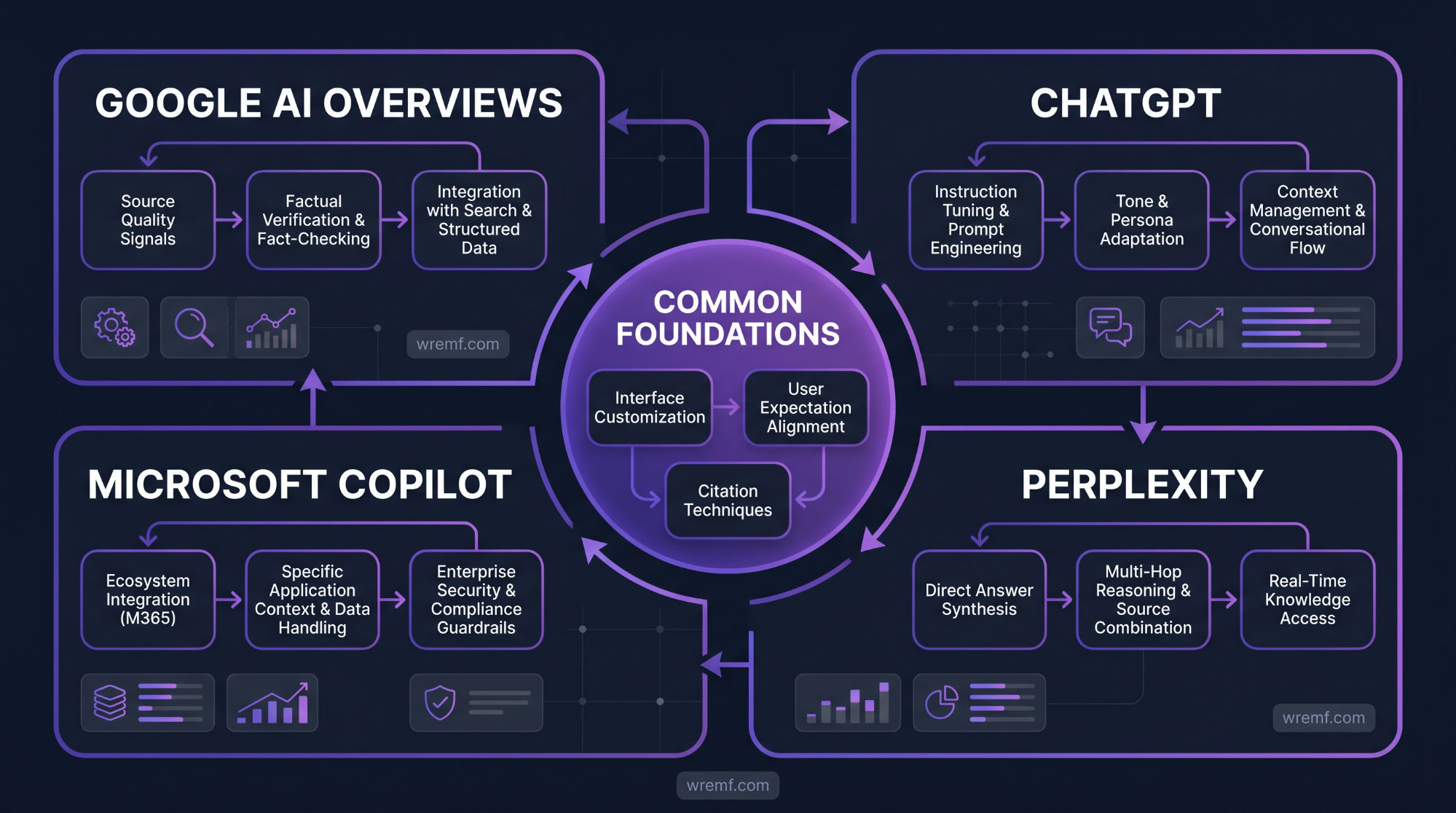
You should optimize for Google AI Overviews, ChatGPT, Perplexity, and Microsoft Copilot differently because each AI search experience uses different interfaces, retrieval behavior, citations, and user expectations. The foundation overlaps, but channel reporting should stay separate.
Google AI is Google’s broader AI layer across Search, AI Overviews, AI Mode, Gemini, and related products. Google AI matters because Google Search remains a major discovery channel while AI Overviews and AI Mode reshape how users interact with search results.
ChatGPT is an AI assistant from OpenAI that can answer questions, summarize information, and use search features for timely web answers. ChatGPT matters because users increasingly ask it for explanations, vendor comparisons, tool recommendations, and research summaries.
Perplexity is an AI-powered answer engine that presents responses with sources and follow-up exploration. Perplexity matters because citation-heavy research and source-backed answers are central to its search experience.
Microsoft Copilot is Microsoft’s AI assistant experience across Microsoft products, Bing-powered web grounding, and enterprise contexts. Microsoft Copilot matters because B2B users may encounter AI-generated answers inside work tools, Microsoft Start, and broader Microsoft search experiences.
Microsoft Start is Microsoft’s news and content discovery platform. Microsoft Start matters because AI-powered search experiences can connect web content, news, and assistant interfaces across Microsoft’s ecosystem.
AI chatbots are conversational tools that answer questions, summarize information, compare options, and assist with research tasks. AI chatbots matter because they often influence early-stage vendor discovery, Digital Marketing research, and buying decisions.
| Channel | What Usually Matters | Example Optimization Priority | Reporting Value |
|---|---|---|---|
| Google Search and AI Overviews | Helpful content, crawlability, indexability, links, Structured Data, content quality | Improve answer-first content, schema markup, internal linking, and source depth | Search impressions, rankings, AI Overview presence |
| ChatGPT search | Source clarity, freshness, structured answers, reputable references | Build clear explainers, comparison pages, and verifiable source-backed content | Prompt visibility, citations, AI referral traffic |
| Perplexity | Citation-heavy research, concise answers, source authority | Publish source-first content and original insights | Citation frequency and answer inclusion |
| Microsoft Copilot | Web grounding, Bing ecosystem signals, references, enterprise context | Improve web visibility and source consistency | Copilot visibility and assisted discovery |
| Gemini and AI Mode | Google ecosystem integration, semantic coverage, AI Overviews readiness | Strengthen Google Search fundamentals and entity clarity | Google AI search visibility |
| Claude, DeepSeek, Grok, Meta AI, Mistral | Prompt variability, model behavior, source ecosystem context | Track representative prompts across engines | Cross-engine AI visibility |
The most common mistake is optimizing for all AI channels equally from day one. In practical AI visibility audits, teams usually start with the AI assistants their buyers already use, then expand monitoring across additional answer engines.
WREMF tracks 10 AI engines so teams can compare ChatGPT, Claude, Gemini, Perplexity, Google AI Overviews, Microsoft Copilot, DeepSeek, Grok, Meta AI, and Mistral in one visibility workflow. This helps teams avoid overreacting to one AI response from one engine on one day.
KEY TAKEAWAY: AI search optimization should share one content foundation but measure each AI engine separately because AI responses, citations, and recommendations vary by platform.
The next challenge is balancing visibility inside answers with the need to earn qualified website traffic.
How Do You Balance Zero-Click Answers and Website Traffic?
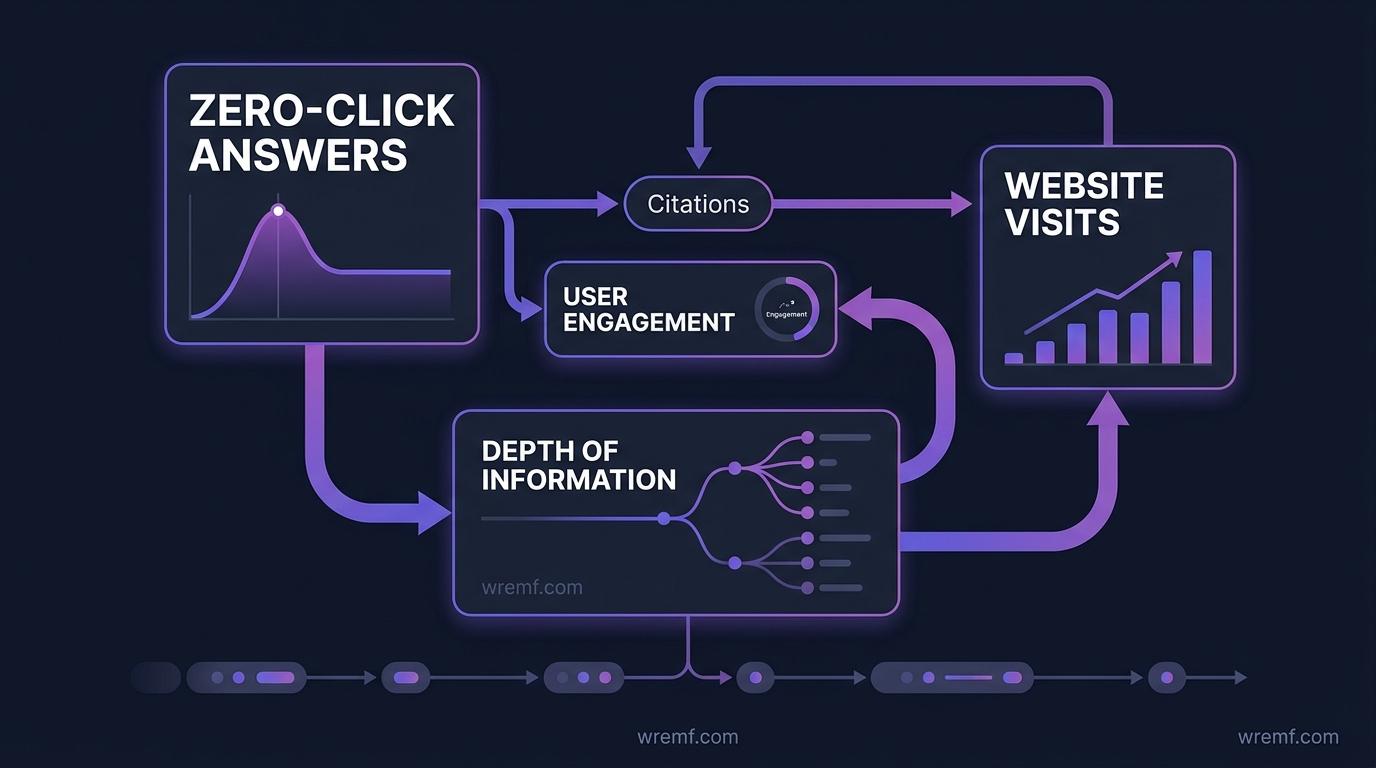
You balance zero-click answers and website traffic by giving AI systems enough clear information to cite or recommend you while giving users a reason to visit for depth, proof, tools, pricing, and implementation. Visibility and clicks are related, but not identical.
Zero-click search is a search experience where the user gets enough information from the interface without clicking a result. Zero-click search matters because AI Overviews, featured responses, and answer engines can influence decisions even when referral traffic is low.
Featured responses are concise answers shown inside search or AI interfaces. Featured responses matter because they can create brand exposure and trust before a user visits a website.
Search experience is the full process a user goes through when asking, comparing, clicking, reading, and deciding. Search experience matters because AI-powered search experiences compress research steps into answers, summaries, and source lists.
The tradeoff is not “answer everything” vs “hide everything.” The better strategy is to answer the top-level question clearly, then provide deeper value that AI systems and users cannot fully capture in one summary. This includes original frameworks, comparison tables, templates, calculators, methodology pages, sample reports, pricing pages, product workflows, and expert analysis.
In real B2B buying journeys, users often need short answers first and evidence second. A founder may ask an AI assistant whether AI content optimization improves search visibility, then click through when the answer references a useful framework, pricing page, methodology, product suite, or report.
The build vs rent framework helps clarify where content should live:
| Strategy | What It Means | Best For | Main Limitation |
|---|---|---|---|
| Build | Publish owned content on your website | Long-term authority, conversion, source consistency | Takes time to earn trust |
| Rent | Contribute insights to reputable third-party sources, communities, podcasts, directories, or media | Faster external credibility signals | Less control over presentation |
| Blend | Combine owned pages with reputable external mentions | AI citations, brand recognition, and Digital Marketing reach | Requires ongoing source consistency |
Visual, video, news, and community sources can also shape AI discovery. For some industries, AI assistants may reference reputable sources beyond company websites, including news coverage, review platforms, forums, documentation, videos, local profiles, and public databases.
Social signals are public engagement patterns from platforms such as LinkedIn, Reddit, YouTube, and other communities. Social signals matter as supporting visibility context, but they should not replace owned source-first content.
Public relations is the practice of earning credible third-party visibility through media, analysts, events, podcasts, and industry coverage. Public relations matters because reputable third-party mentions can reinforce brand recognition and source consistency.
Vendor shortlists are lists of companies, tools, or services considered during a buying process. Vendor shortlists matter because AI assistants often help users create shortlists before the user visits company websites.
KEY TAKEAWAY: AI content optimization should earn answer visibility and qualified clicks by combining concise answers with deeper proof, tools, examples, and decision support.
To make that balance practical, teams need a repeatable implementation workflow.
How to Start Improving AI Content Optimization Step by Step
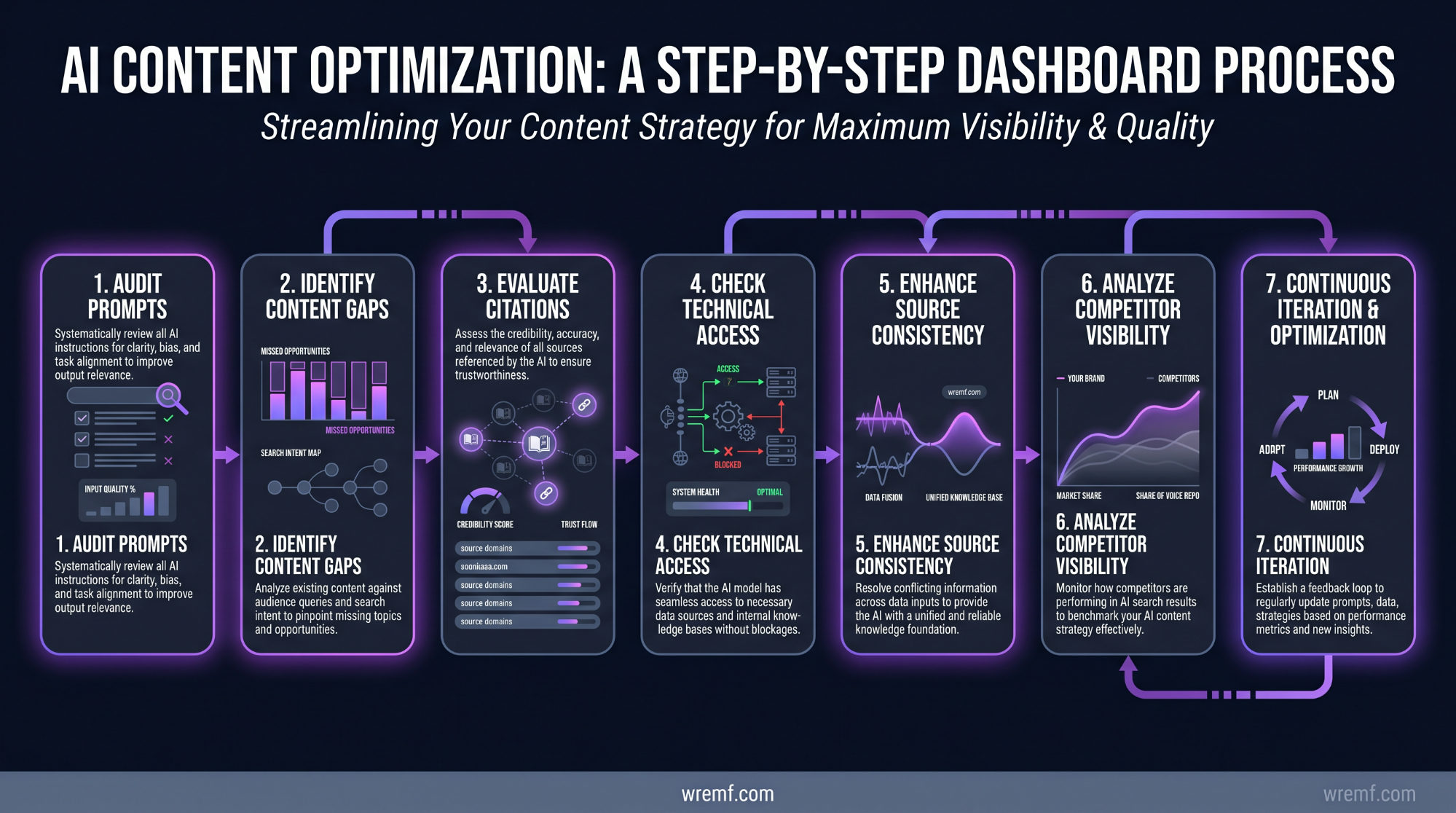
Start improving AI content optimization by auditing prompts, content gaps, citations, technical access, source consistency, and competitor visibility before rewriting pages. A repeatable process turns AI search visibility from guesswork into measurable work.
AEO strategy is a plan for making content easier for answer engines to extract and use. AEO strategy matters because AI assistants often answer questions directly and need clear, self-contained explanations.
GEO visibility is the measurable presence of a brand or source across generative AI responses, citations, and recommendations. GEO visibility matters because AI-generated answers may influence buyers before traditional Digital Marketing attribution captures the visit.
Use this seven-step workflow:
Map buyer prompts
List the questions your buyers ask in Google, ChatGPT, Perplexity, Gemini, Microsoft Copilot, and sales calls. Include definition, comparison, tool, pricing, service, implementation, risk, and ROI prompts.
Audit current AI responses
Run representative prompts across answer engines. Track whether your brand appears, which competitors appear, what sources are cited, what facts are wrong, and whether AI answers describe your category accurately.
Review technical accessibility
Check crawlable content, indexable content, HTTP 200 pages, canonical tags, optimized metadata, server-side rendering, internal linking, page speed, and schema markup. Fix technical blockers before expecting better AI visibility.
Improve content clusters
Create or update content clusters around user intent. Use answer-first sections, clear definitions, comparison tables, FAQs, structured content, and source-backed claims that map to buyer questions.
Strengthen source consistency
Ensure your website, profiles, documentation, listings, media references, Business Profile details, and third-party descriptions describe your brand consistently. Source consistency helps AI systems reconcile entity facts across multiple sources.
Track prompt and citation changes
Measure AI responses over time. Track prompt visibility, citation frequency, brand mention rate, AI share of voice, competitor visibility, and answer accuracy.
Connect visibility to outcomes
Use Google Search Console, analytics, CRM notes, referral traffic, branded search, and pipeline context to connect AI visibility to Digital Marketing outcomes.
Source consistency is the alignment of facts about a brand across owned and third-party sources. Source consistency matters because conflicting descriptions can make AI systems less confident when summarizing a company, product, or service.
Business Profile refers to a company’s official business listing presence, such as Google Business Profile for local or multi-location businesses. Business Profile matters because local visibility, reviews, categories, addresses, and services can influence discovery for location-based searches.
Google Business Profile is Google’s business listing system for companies with local or service-area presence. Google Business Profile matters because multi-location businesses and local brands need accurate names, categories, locations, hours, reviews, and services across Google Search and Maps.
Google Local Pack is the local search results module that shows nearby businesses for location-based queries. Google Local Pack matters because local ranking factors, Business Profile accuracy, reviews, proximity, and relevance can shape local search visibility.
For teams that need structured execution, WREMF provides GEO audits, AI-ready content briefs, and SEO testing. For teams that need managed support, WREMF also offers AI visibility agency services with clear deliverables, senior-led execution, and no long-term lock-in.
KEY TAKEAWAY: The best AI content optimization process starts with prompts and evidence, then improves technical access, content structure, source consistency, and reporting.
The process becomes stronger when teams choose the right software, agency, or hybrid operating model.
Software vs Agency vs Hybrid: Which AI Visibility Model Fits Your Team?
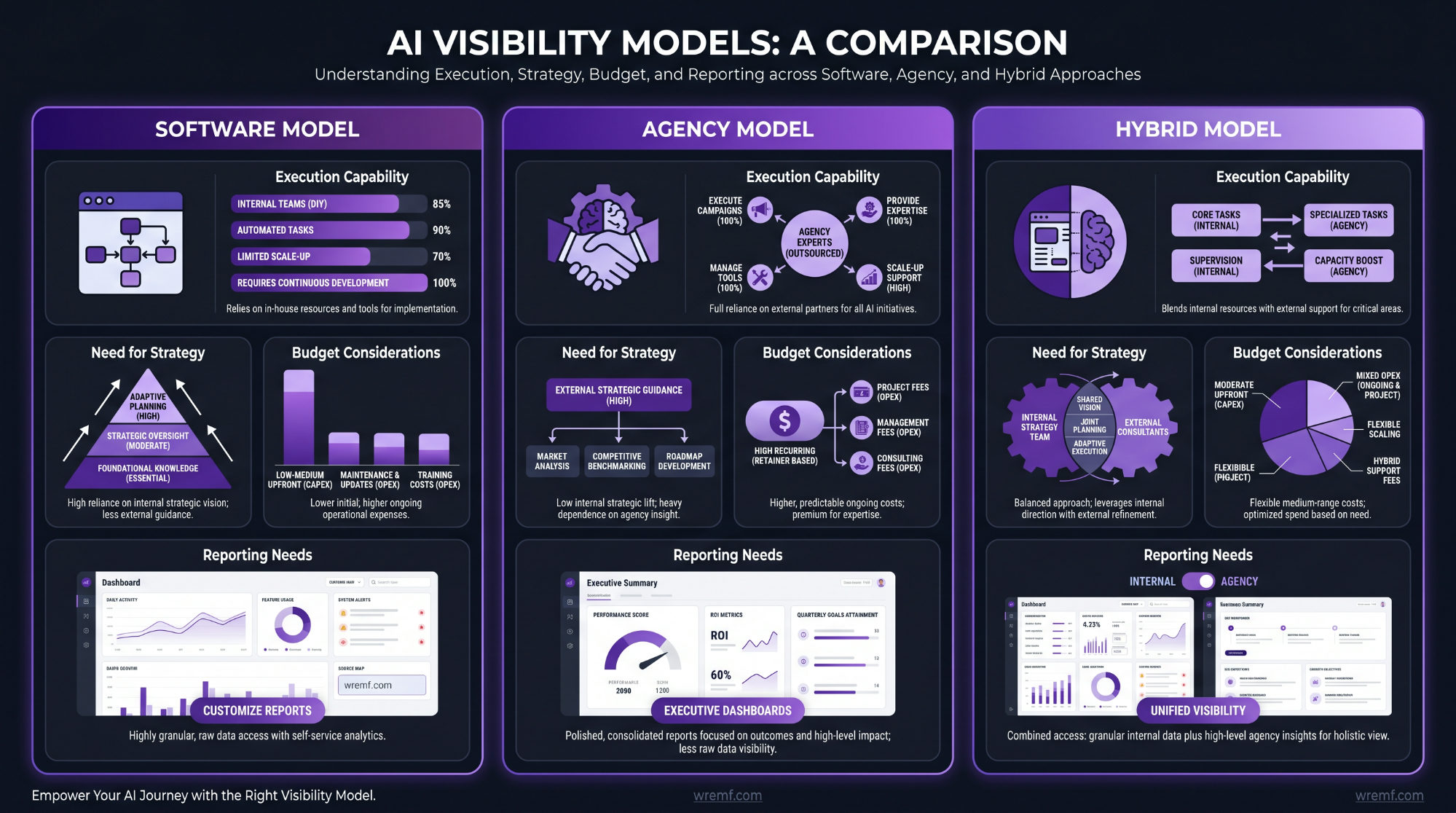
Software fits teams that can execute internally, agency support fits teams that need strategy and implementation, and a hybrid model fits teams that want measurement plus managed execution. The right model depends on skills, time, budget, and reporting needs.
AI visibility software is a platform that tracks prompts, citations, competitors, visibility scores, and AI-related reporting. AI visibility software matters because manual testing becomes inconsistent as prompts, engines, locations, competitors, and reporting needs multiply.
AI visibility agency services are consulting and execution services that improve AI visibility through AEO, GEO, technical fixes, content optimization, source consistency cleanup, and reporting. AI visibility agency services matter because many teams can measure gaps but lack time to implement changes.
White-label reporting is reporting that agencies can brand for their own clients. White-label reporting matters because agencies managing multiple clients need repeatable dashboards, client portals, and executive-ready summaries.
BYOK means bring your own key, where teams use their own AI provider API keys for supported workflows. BYOK matters because agencies and technical teams often need control over cost, provider choice, data handling, and usage.
| Model | Best For | What You Get | Main Limitation | Recommended When |
|---|---|---|---|---|
| Software | In-house SEO, content, and Digital Marketing teams | Prompt tracking, citation tracking, dashboards, visibility scoring | Requires internal execution | You have writers, SEO owners, and technical resources |
| Agency | Founders, lean teams, or teams without GEO expertise | Strategy, audits, content optimization, execution, reporting | Less self-serve control | You need senior-led implementation |
| Hybrid | Growth teams and agencies scaling AI visibility | Platform plus managed execution | Requires coordination between data and action owners | You need measurement and execution together |
WREMF supports all three models. WREMF pricing includes Starter at €39 per month for 1 website, Growth at €89 per month for 5 websites, and custom Enterprise pricing for unlimited websites, unlimited seats, custom branded portals, and dedicated support. The right plan depends on the number of websites, reporting needs, team capacity, and whether your team needs execution help.
Agencies managing multiple clients often need white-label reporting, API workflows, client portals, and a consistent methodology. WREMF’s agency-focused AI visibility workflow supports consultants and agencies that need to manage visibility across multiple brands. In-house teams can use the brand-focused workflow to connect AI visibility to content priorities and leadership reporting.
For technical teams, API and MCP integrations matter because AI visibility data often needs to connect with dashboards, internal reporting systems, CRMs, data warehouses, and client portals. WREMF’s API and MCP workflows support teams that want to operationalize AI visibility inside their own tools.
KEY TAKEAWAY: Choose software, agency, or hybrid AI visibility support based on whether your main bottleneck is measurement, execution, or both.
Even with the right model, teams need to avoid the mistakes that make AI visibility harder to improve.
Common Mistakes That Limit AI Search Visibility
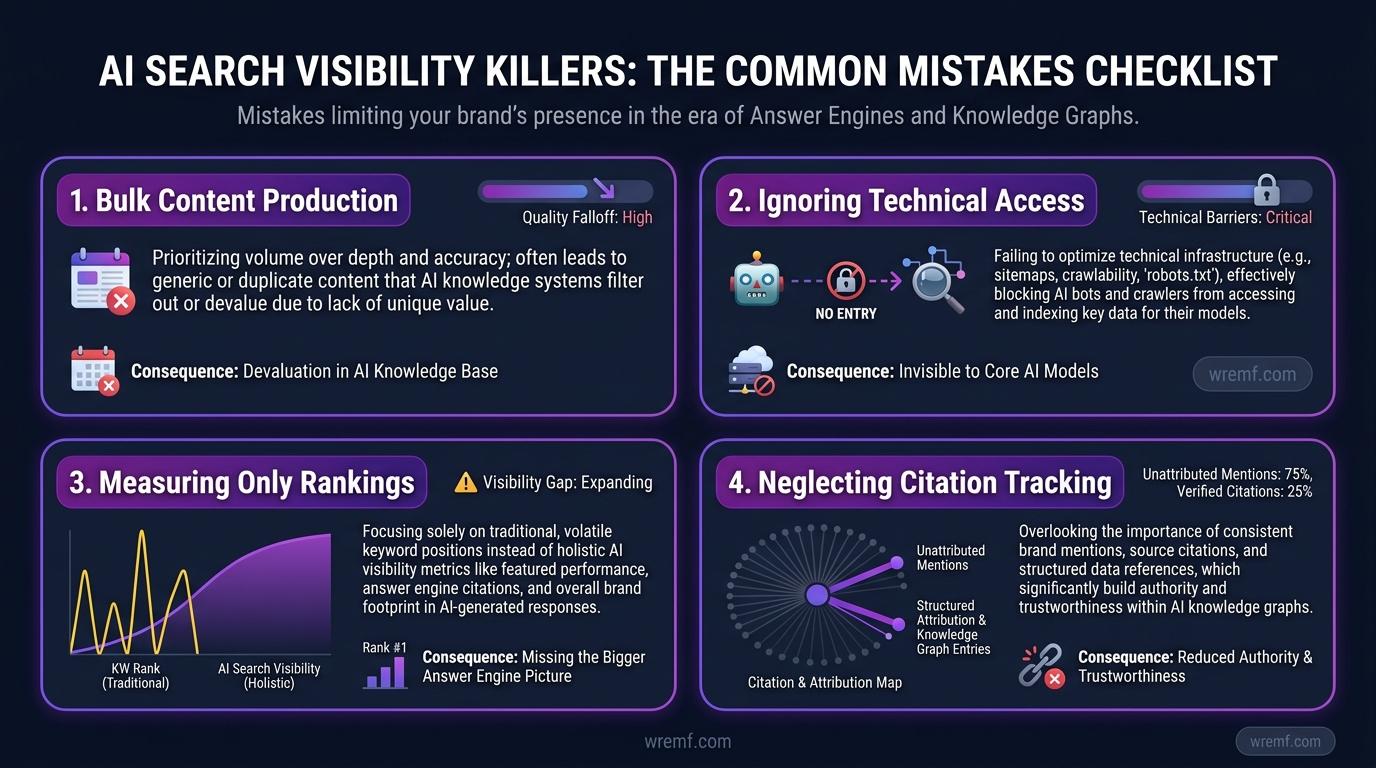
Common mistakes that limit AI search visibility include treating AI content optimization as bulk content production, ignoring technical access, measuring only rankings, and failing to track citations or competitors. These mistakes make visibility harder to improve and harder to prove.
The first mistake is publishing generative AI content without adding original value. Google’s guidance is clear that AI involvement is not the issue by itself. The issue is whether content is helpful, reliable, and created for people rather than created mainly to manipulate search rankings.
The second mistake is optimizing only for keywords. Keywords still matter, but AI search also depends on semantic analysis, entity clarity, source consistency, answer quality, internal linking, content clusters, and user intent.
Semantic analysis is the process of understanding topics, entities, relationships, and meaning across content. Semantic analysis matters because AI models and search engines need conceptual depth, not only repeated exact-match phrases.
The third mistake is assuming schema markup fixes weak content. Schema markup helps machines understand content, but schema markup cannot compensate for thin analysis, outdated claims, missing examples, or unsupported statements. Schema markup is a support layer, not the strategy.
The fourth mistake is relying on one AI response as proof. AI responses vary across answer engines, prompt wording, time, location, and retrieval context. Teams need scheduled AI monitoring to identify patterns rather than reacting to one output.
The fifth mistake is ignoring competitors. Competitor visibility shows whether rival brands are being mentioned, cited, or recommended more often across answer engines. Without competitor visibility, a brand may not know whether visibility is improving relative to the market.
The sixth mistake is separating AI visibility from Digital Marketing reporting. AI visibility needs to connect to Google Search Console, analytics, CRM context, referral traffic, branded search, and pipeline notes. Without attribution context, leadership may treat AI visibility as a vanity metric.
The seventh mistake is failing to update content in fast-moving categories. AI search, AI Marketing, Digital Marketing, schema markup guidance, Google AI, AI Mode, and search engine behavior continue to change. Content that was accurate 12 months ago may not reflect how AI-powered search experiences work now.
A common implementation mistake is improving individual pages without fixing the source ecosystem. AI systems can use owned pages, reputable sources, Business Profile details, documentation, media mentions, visual, video, news results, and third-party descriptions to form an answer.
TIP: Track mistakes as workflow issues, not only content issues. A visibility problem may come from weak content, technical access, source inconsistency, missing citations, or poor reporting.
KEY TAKEAWAY: AI search visibility improves when teams avoid shallow AI-generated content, ranking-only reporting, weak technical foundations, and inconsistent source ecosystems.
The next section debunks the myths that cause many of these mistakes.
Common Myths About AI Visibility Debunked
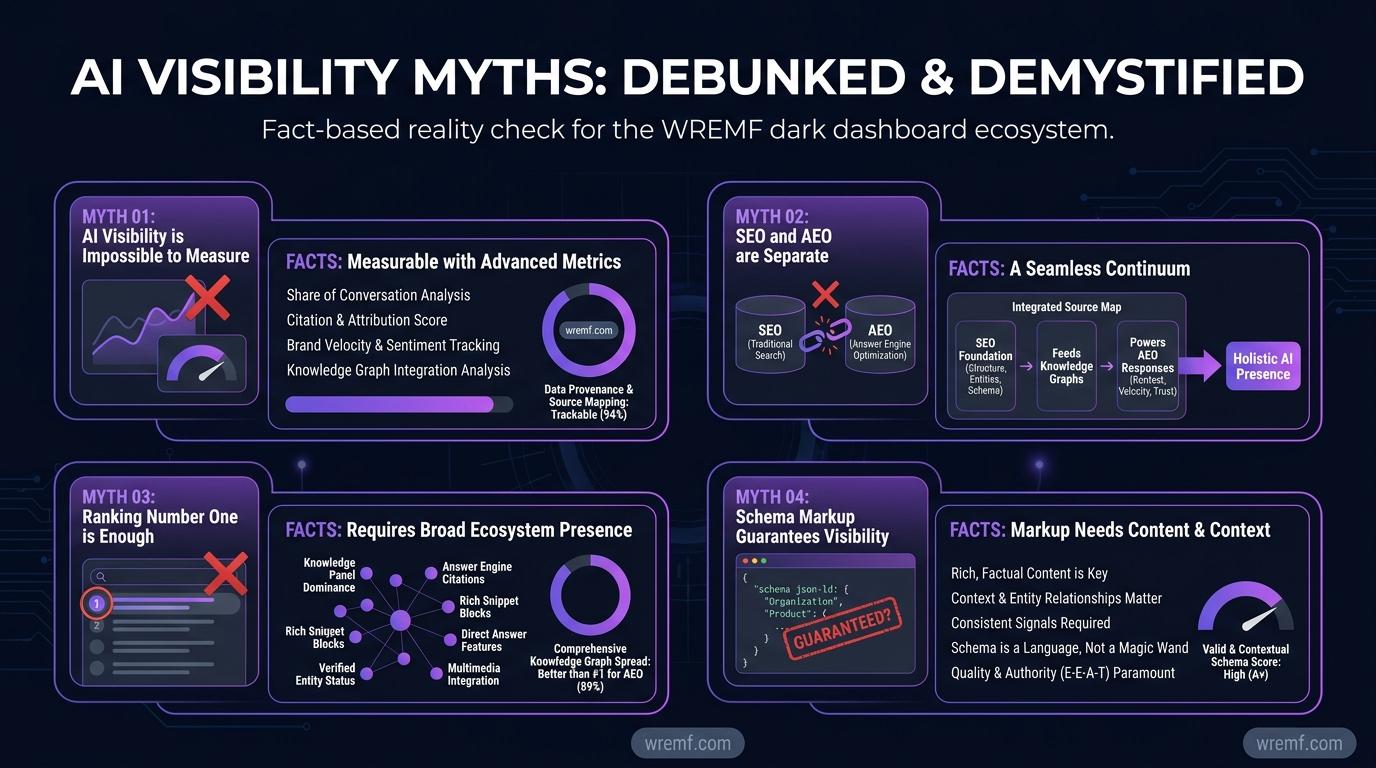
AI visibility is often misunderstood because teams apply old ranking assumptions to new AI-powered search experiences. The facts are more practical: SEO still matters, but citations, prompts, source consistency, and answer inclusion matter too.
MYTH: AI visibility is impossible to measure.
FACT: AI visibility is measurable, but it requires different metrics from traditional SEO. Teams can track prompt visibility, AI citations, brand mentions, AI share of voice, citation frequency, AI referral traffic, and competitor visibility across answer engines. Measurement is imperfect, but imperfect does not mean useless.
MYTH: SEO, AEO, and GEO are completely separate strategies.
FACT: SEO, answer engine optimization, and generative engine optimization overlap. SEO provides the crawlable, indexable, useful content foundation. AEO improves answer readiness, while GEO improves retrieval, citation, and recommendation potential in AI-generated answers.
MYTH: Ranking number one is enough for AI search visibility.
FACT: Rankings are useful, but rankings alone do not prove that a brand appears in AI-generated responses. AI assistants may cite different sources, mention competitors, or summarize information without sending a click. Teams need rankings plus prompt tracking, source citations, and AI share of voice.
MYTH: Schema markup guarantees visibility in AI Overviews.
FACT: Schema markup helps search engines understand content and can support Rich Results eligibility, but it does not guarantee rankings, AI Overviews, citations, or traffic. Schema markup must be accurate and paired with helpful content, technical SEO, source consistency, and clear entity signals.
MYTH: AI content optimization means replacing writers with AI tools.
FACT: AI content optimization is more useful as a research, structure, gap analysis, and measurement workflow. Human expertise is still needed for accuracy, examples, judgment, source selection, differentiation, brand positioning, and ethical review.
KEY TAKEAWAY: AI visibility is measurable and improvable, but it requires a broader system than rankings, keywords, or schema markup alone.
With the myths removed, the final step is answering the practical questions teams ask before investing.
Frequently Asked Questions
Does AI content optimization improve search visibility for websites?
Yes, AI content optimization can improve search visibility for websites when it improves usefulness, structure, technical accessibility, entity clarity, and user intent coverage. AI tools can help identify content gaps, cluster topics, analyze prompts, and improve answer-first formatting. The improvement is not automatic. Search engines and AI assistants still need helpful, reliable, crawlable, and accurate content. WREMF helps teams measure whether optimization work changes AI visibility, source citations, prompt visibility, AI responses, and competitor presence across major AI discovery surfaces.
What is answer engine visibility?
Answer engine visibility is the presence of a brand, page, product, or source inside AI-generated answers from answer engines such as ChatGPT, Perplexity, Gemini, Microsoft Copilot, and Google AI Overviews. It includes whether your brand is mentioned, cited, recommended, or used as a source. Answer engine visibility is different from organic search because the user may receive the answer inside the interface before clicking any result. Teams should track both classic search visibility and answer engine visibility.
How is answer engine visibility different from organic search?
Organic search visibility usually focuses on rankings, impressions, clicks, CTR, and search results pages. Answer engine visibility focuses on AI answers, AI-generated responses, citations, brand mentions, recommendations, and AI share of voice. Organic search asks where a page ranks. Answer engine visibility asks whether a brand is included, cited, trusted, or recommended inside the answer. The two are connected because answer engines often rely on web sources, but they are not the same measurement system.
Can you track AI visibility without paid tools?
You can track AI visibility manually by testing prompts in ChatGPT, Perplexity, Gemini, Microsoft Copilot, and Google AI Overviews, then recording brand mentions, citations, competitors, and answer changes in a spreadsheet. Manual tracking works for a small number of prompts, but it becomes inconsistent as queries, engines, locations, and reporting needs grow. Paid tools are useful when teams need scheduled monitoring, trend data, competitor visibility, white-label reports, or reliable executive reporting.
How often should you track answer engine visibility?
Most B2B teams should track answer engine visibility weekly or monthly, depending on the speed of their category. Fast-moving AI, SaaS, finance, health, legal, and Digital Marketing topics may need weekly monitoring because sources, citations, and AI responses can change quickly. More stable categories can start monthly. The key is consistency. Tracking the same prompts over time is more useful than running random one-off tests whenever leadership asks for an update.
How do you handle AI result variability across runs?
Handle AI result variability by tracking multiple prompts, multiple AI assistants, and repeated runs over time instead of relying on one answer. AI responses can vary because of prompt wording, retrieval context, personalization, location, freshness, and model updates. A reliable workflow records patterns: how often the brand appears, which sources are cited, which competitors are recommended, and whether visibility improves after content or source updates. WREMF supports this through scheduled AI monitoring across 10 AI engines.
How quickly can you see results from AI content optimization?
You may see early changes in crawlability, content quality, or AI prompt outputs within days or weeks, but durable search visibility and AI visibility usually take longer. Results depend on site authority, crawl frequency, content quality, competition, technical health, source consistency, and whether external sources reinforce the same entity facts. Teams should measure 30, 60, and 90 day changes across rankings, AI citations, brand mentions, AI share of voice, and referral traffic rather than expecting instant results.
How do you measure ROI from answer engine visibility?
Measure ROI from answer engine visibility by connecting prompt visibility, citations, brand mentions, AI referral traffic, branded search, assisted conversions, and pipeline notes. Direct attribution is not always complete because many AI interactions are zero-click or later convert through another channel. A practical ROI model combines leading indicators, such as AI share of voice and citation frequency, with business indicators, such as demo requests, branded search growth, qualified traffic, and sales conversations where buyers mention AI research.
Should you optimize for all AI channels equally?
No, most teams should not optimize for all AI channels equally at the start. Prioritize the AI assistants and search engines your buyers actually use. B2B SaaS teams may focus first on Google AI Overviews, ChatGPT, Perplexity, Gemini, and Microsoft Copilot, then expand to Claude, DeepSeek, Grok, Meta AI, and Mistral. The content foundation overlaps, but reporting should separate channels because AI responses, citations, and recommendations vary by engine.
What tools actually improve AI search visibility?
Tools improve AI search visibility when they help teams measure prompts, citations, source consistency, competitor visibility, content gaps, and AI referral traffic. Generic content generators alone are not enough because visibility depends on quality, trust, structure, and source ecosystems. WREMF combines prompt intelligence, source citation tracking, competitive landscape analysis, GEO audits, AI-ready content briefs, SEO testing, and reporting. Teams can use WREMF as software, an agency service, or a hybrid software plus managed execution model.
Is schema markup required for AI visibility?
Schema markup is not strictly required for AI visibility, but schema markup can help search engines understand page entities, content types, and relationships. Google explains that Structured Data helps Google understand page content and can support Rich Results eligibility when guidelines are followed. Schema markup should be accurate, visible in the page content, and relevant to the page type. Schema markup works best with strong content clarity, crawlable content, internal linking, source consistency, and helpful content.
How does AI content optimization connect to Digital Marketing performance?
AI content optimization connects to Digital Marketing performance by improving how buyers discover, compare, and trust a brand across search engines, AI assistants, and answer engines. The business value appears through better organic visibility, AI citations, branded searches, referral traffic, demo interest, and stronger sales conversations. Digital Marketing teams should report AI visibility alongside SEO, paid media, content, and conversion data. The goal is not only more traffic. The goal is measurable influence across the buyer journey.
Can AI-generated content rank in Google Search?
Yes, AI-generated content can rank in Google Search if it is helpful, reliable, accurate, and created for people. Google’s guidance focuses on content quality rather than the production method. The risk comes from using generative AI content to create large amounts of low-value or manipulative content. Strong AI content optimization should include human review, source attribution, original insight, clear structure, and factual accuracy. Teams should use AI as an optimization assistant, not as a replacement for editorial judgment.
How do you increase brand visibility on AI platforms?
Increase brand visibility on AI platforms by improving your owned content, source citations, entity consistency, topic clusters, and third-party credibility signals. Start by tracking prompts that buyers ask, then identify whether AI assistants mention your brand, cite your sources, or recommend competitors. Improve pages with answer-first sections, schema markup, internal linking, and source-backed claims. Then update external profiles, Business Profile information, documentation, and reputable sources so AI systems find consistent facts across the web.
Is traditional keyword research still effective in the AI search era?
Yes, traditional keyword research is still effective, but it is incomplete by itself. Keyword research shows demand, search language, and commercial intent. AI search also requires prompt research, user intent mapping, entity optimization, source citation tracking, and answer engine visibility measurement. A modern workflow uses keywords to understand demand and prompts to understand how users ask AI assistants for help. The strongest strategy combines keyword targeting with topic clusters, content clarity, and AI visibility tracking.
Why is tracking AI visibility so inconsistent?
Tracking AI visibility is inconsistent because AI responses can change by prompt wording, engine, location, personalization, source freshness, model updates, and retrieval behavior. One run of one prompt is not enough to prove visibility. Reliable tracking uses repeated prompts, multiple engines, consistent measurement intervals, citation analysis, competitor tracking, and trend reporting. WREMF helps reduce inconsistency by monitoring representative prompts across major AI engines and turning noisy answers into measurable patterns.
Conclusion
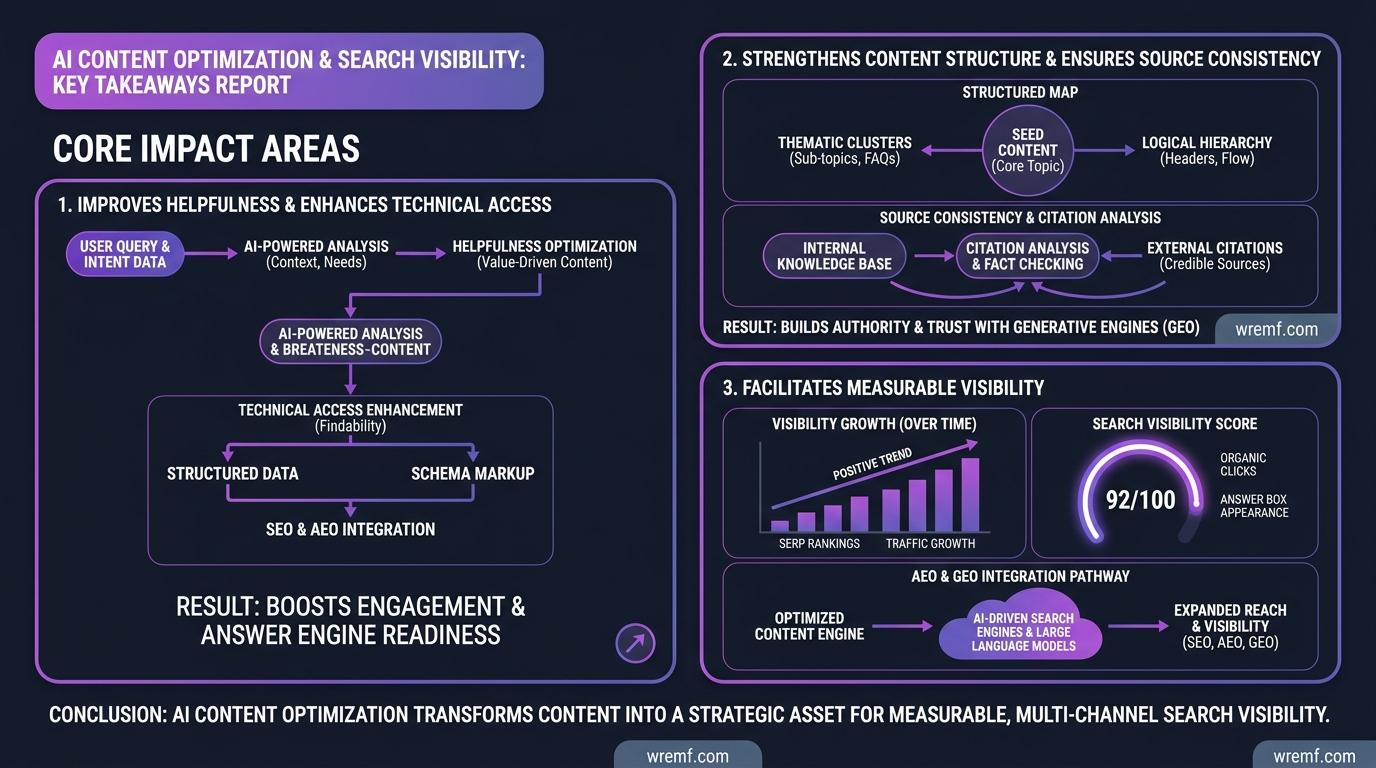
Does AI content optimization improve search visibility? Yes, when it improves helpfulness, technical access, content structure, source consistency, and measurable AI visibility across search engines and answer engines. The strongest strategy combines SEO, AEO, GEO, prompt tracking, citation analysis, competitor visibility, schema markup, and attribution. Rankings still matter, but AI-generated answers, AI citations, and brand recommendations now shape how buyers discover and compare companies. To turn AI visibility from guesswork into a measurable workflow, explore the WREMF platform suite or talk to the WREMF agency team.