Gemini SEO: The Complete Guide to Google Gemini, AI Overviews, AI Mode, and AI Search Visibility
Learn how Gemini SEO optimizes for AI-powered search visibility through AI Overviews and AI Mode.
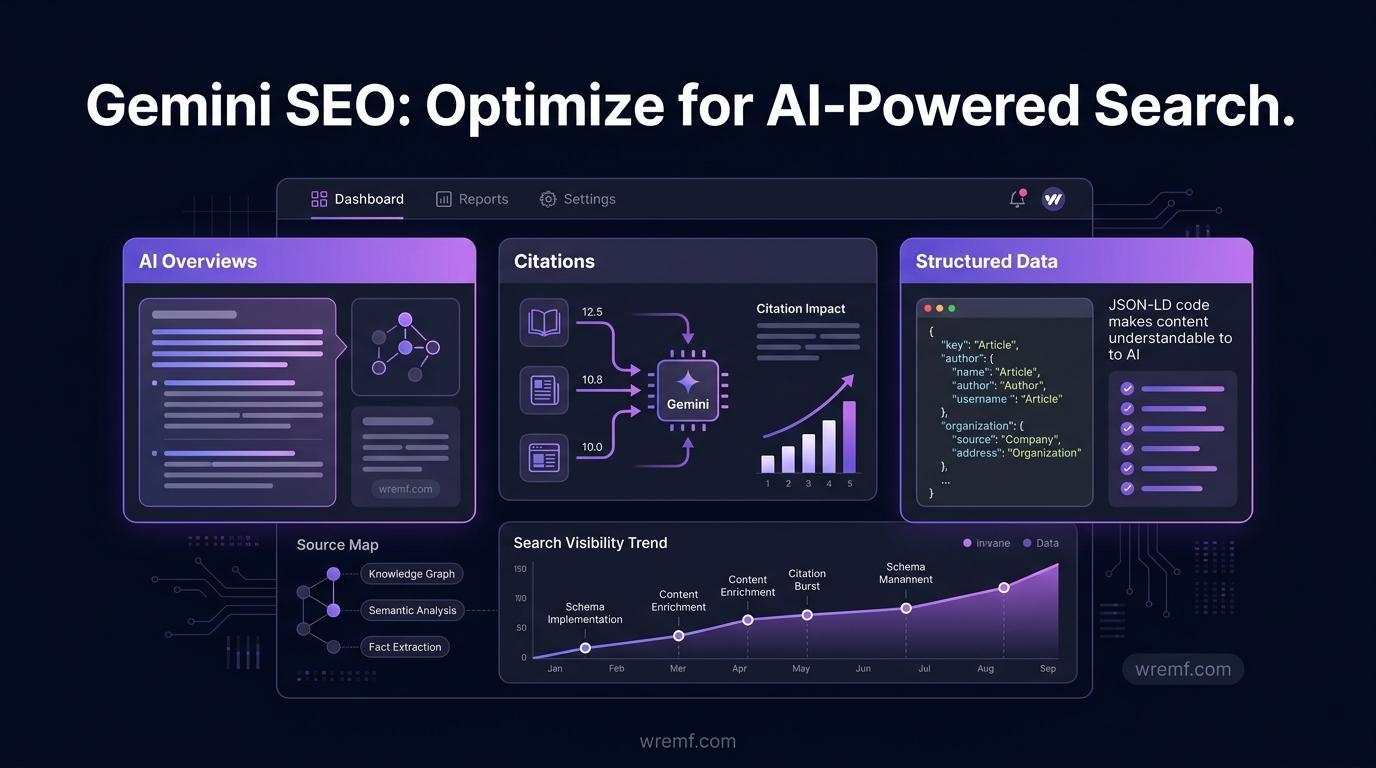
By WREMF Team · 2026-08-24
Gemini SEO involves optimizing for Google Gemini-powered searches, utilizing AI Overviews and AI Mode for visibility enhancement. Key components include structured data, entity clarity, content strategy, and Technical SEO, focusing on AI visibility measurement and retrieval. Skills involve making content accessible, understandable, and extractable amid AI-generated answers. Emphasizing source consistency and semantic understanding ensures effective AI search visibility. Implications include adapting SEO for AI-assisted brand presence and attribution in search results.
Key takeaways
- Gemini SEO enhances visibility in AI-powered search by integrating with traditional SEO methods.
- AI Overviews and AI Mode affect how search results are structured and brand visibility is measured.
- Gemini SEO necessitates robust Technical SEO to ensure content is accessible and understood by AI.
- Structured data and entity clarity are vital for effective Gemini SEO content optimization.
- AI visibility tracking using WREMF connects prompts, source citations, and competitor analysis.
Gemini SEO: The Complete Guide to Google Gemini, AI Overviews, AI Mode, and AI Search Visibility
Gemini SEO is the practice of optimizing your website for Google Gemini-powered search, AI Overviews, AI Mode, and AI discovery. Google has expanded AI Overviews to billions of monthly users, making AI-powered search a measurable visibility channel for brands. This guide explains how Gemini SEO works across search results, retrieval, citations, structured data, content strategy, Keyword Research, Technical SEO, local SEO, multimodal SEO, and AI visibility reporting. It also explains how WREMF helps B2B teams track, improve, and prove visibility across Gemini, ChatGPT, Claude, Perplexity, Google AI Overviews, Copilot, DeepSeek, Grok, Meta AI, and Mistral through the WREMF AI visibility platform. Use this guide to build a practical Gemini SEO workflow that connects rankings, prompts, sources, competitors, and attribution.
What Is Gemini SEO?
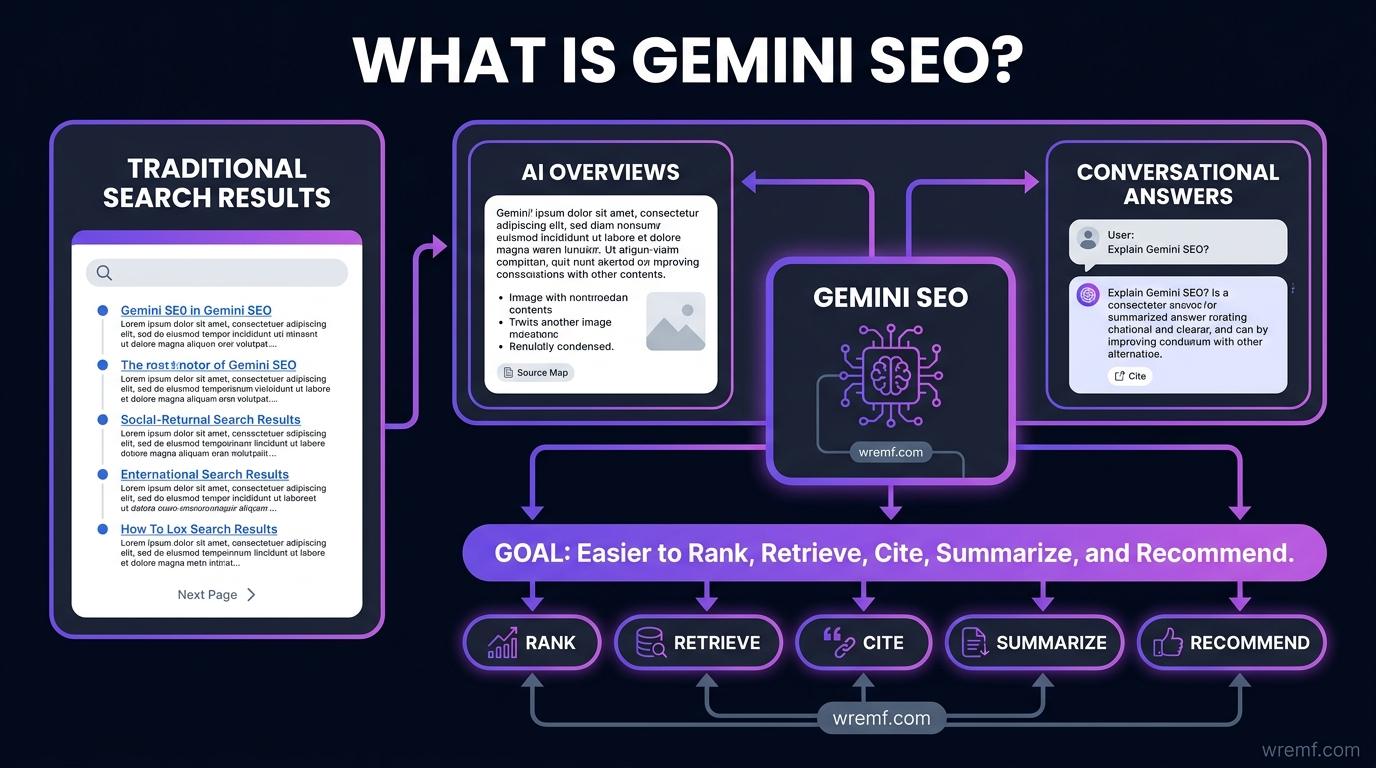
Gemini SEO is SEO adapted for Google Gemini-powered search experiences, including AI Overviews, AI Mode, conversational answers, and traditional search results. The goal is to make your content easier to rank, retrieve, cite, summarize, and recommend.
Gemini SEO is not a separate replacement for search engine optimization. Gemini SEO builds on SEO by adding answer-first content, entity clarity, structured data, source consistency, prompt tracking, and AI visibility measurement. In practical AI visibility audits, teams often find that a page can rank in Google search results but still fail to appear in Gemini-powered answers because the content is not easy to extract or verify.
Google Gemini is Google’s AI assistant and model ecosystem used across Google Search, Gemini, Workspace, Android, and connected Google apps. Google says AI Mode combines Gemini model capabilities with Google’s information systems to help users ask more complex questions and explore follow-ups through Search. Google’s AI Mode announcement explains this shift toward more conversational, AI-powered search. (blog.google)
AI visibility is the measurable presence of a brand inside AI-generated answers, citations, summaries, comparisons, and recommendations. AI visibility matters because buyers increasingly use an AI assistant to compare vendors, understand categories, and shortlist options before visiting a website.
A strong Gemini SEO strategy focuses on five outcomes:
Your website appears in relevant search results
Your content is understandable to search engines and AI engines
Your brand is accurately described by Gemini and other AI assistants
Your pages can be cited or used as supporting sources
Your visibility can be measured through prompts, citations, competitors, and traffic attribution
WREMF helps teams track, improve, and prove AI visibility by connecting prompts, source citations, competitor visibility, and recommendations into one repeatable system. The WREMF methodology is built around prompts, citations, sources, competitors, source consistency, and attribution.
KEY TAKEAWAY: Gemini SEO connects traditional SEO, answer engine optimisation, Generative Engine Optimization, and AI visibility measurement into one search strategy.
To understand why Gemini SEO matters, you need to see how Google Gemini changes the search results experience.
How Google Gemini Changes Search Results and AI Visibility
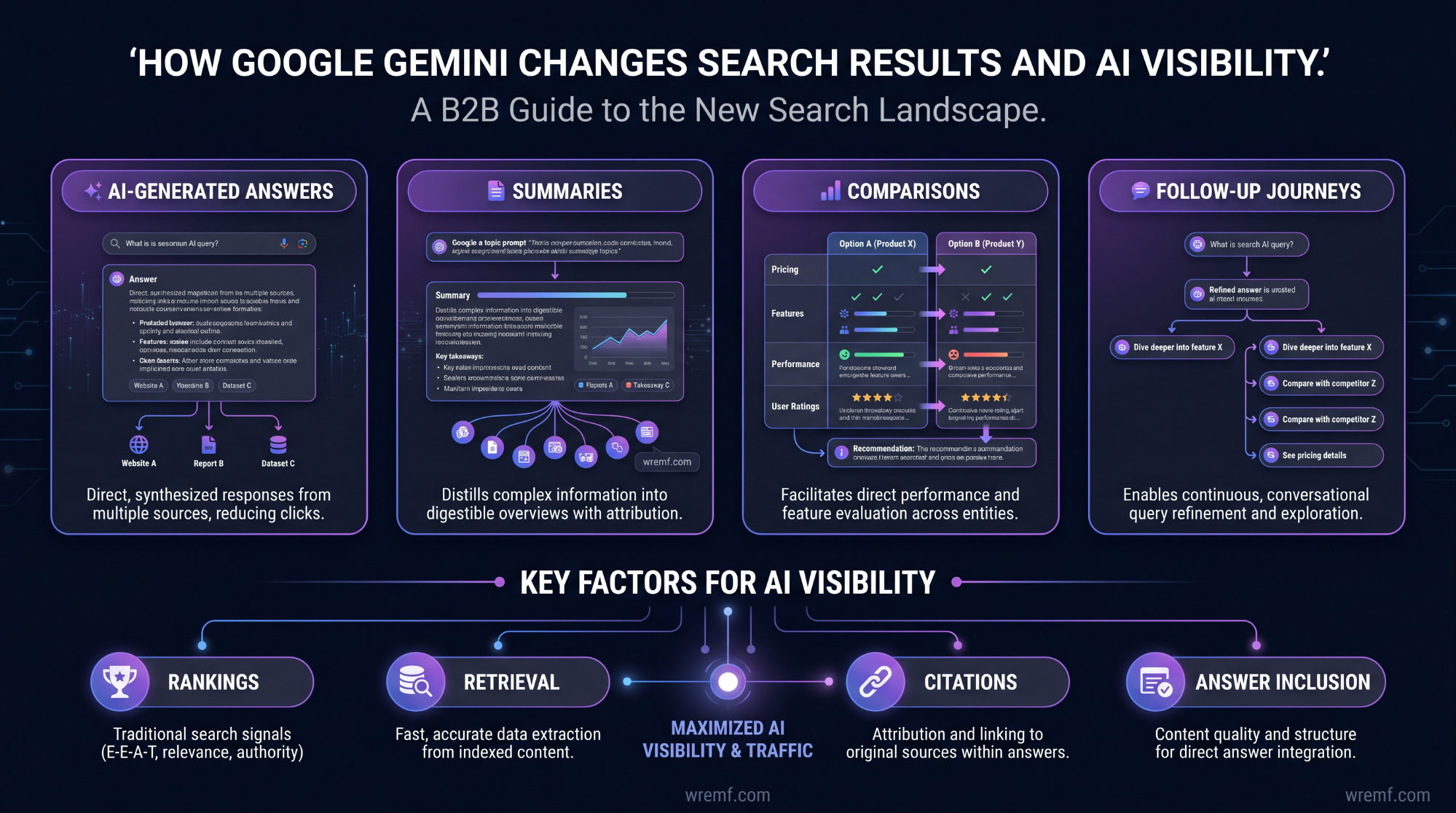
Google Gemini changes search results by turning some searches into AI-generated answers, summaries, comparisons, and follow-up journeys. Gemini SEO matters because visibility now depends on rankings, retrieval, citations, and answer inclusion.
AI-powered search is search that uses generative AI to summarize, reason, compare, or synthesize information from multiple sources. AI-powered search matters because the user may receive a useful answer before clicking a traditional blue link.
Google Search Central explains that AI features such as AI Overviews and AI Mode are part of Google Search from a site owner’s perspective, and site owners should continue following Search Essentials, technical accessibility, and content quality guidance. The Google Search Central AI features documentation makes clear that AI features still depend on web content and search systems. (Google for Developers)
Search intent is the reason behind a query. In Gemini SEO, search intent includes classic SEO intent such as informational, commercial, local, and transactional searches, plus conversational AI queries such as “compare these tools,” “what should I choose,” “how do I fix this,” or “which vendor fits my situation.”
Search results now include more than organic links. A modern search engine results page can include AI Overviews, featured snippets, knowledge panels, videos, local packs, shopping modules, People Also Ask, and traditional links. Gemini SEO must therefore optimize for both the search engine results page and the AI-generated answer layer.
DID YOU KNOW: Google said at I/O 2025 that AI Overviews had scaled to over 1.5 billion users across 200 countries and territories. Alphabet later said AI Overviews had over 2 billion monthly users across more than 200 countries and territories and 40 languages. (blog.google)
In real B2B buying journeys, a searcher may ask Gemini:
Is Google Gemini good for SEO?
How do I use Google Gemini for SEO?
What is better for SEO, ChatGPT or Gemini?
Is SEO dead or evolving in 2026?
How do I get my website cited in AI Overviews?
Why does my website have zero AI visibility?
How do I show up in ChatGPT, Perplexity, and Gemini search results?
These questions combine education, comparison, risk, and buying intent. A Gemini SEO page must answer the direct question, explain the decision criteria, and support claims with sources, examples, and structured content.
KEY TAKEAWAY: Google Gemini changes SEO by expanding visibility from rankings and clicks into AI answers, citations, source selection, and prompt-based discovery.
The next step is understanding how Gemini SEO relates to SEO, AEO, and GEO.
Gemini SEO vs SEO vs AEO vs GEO
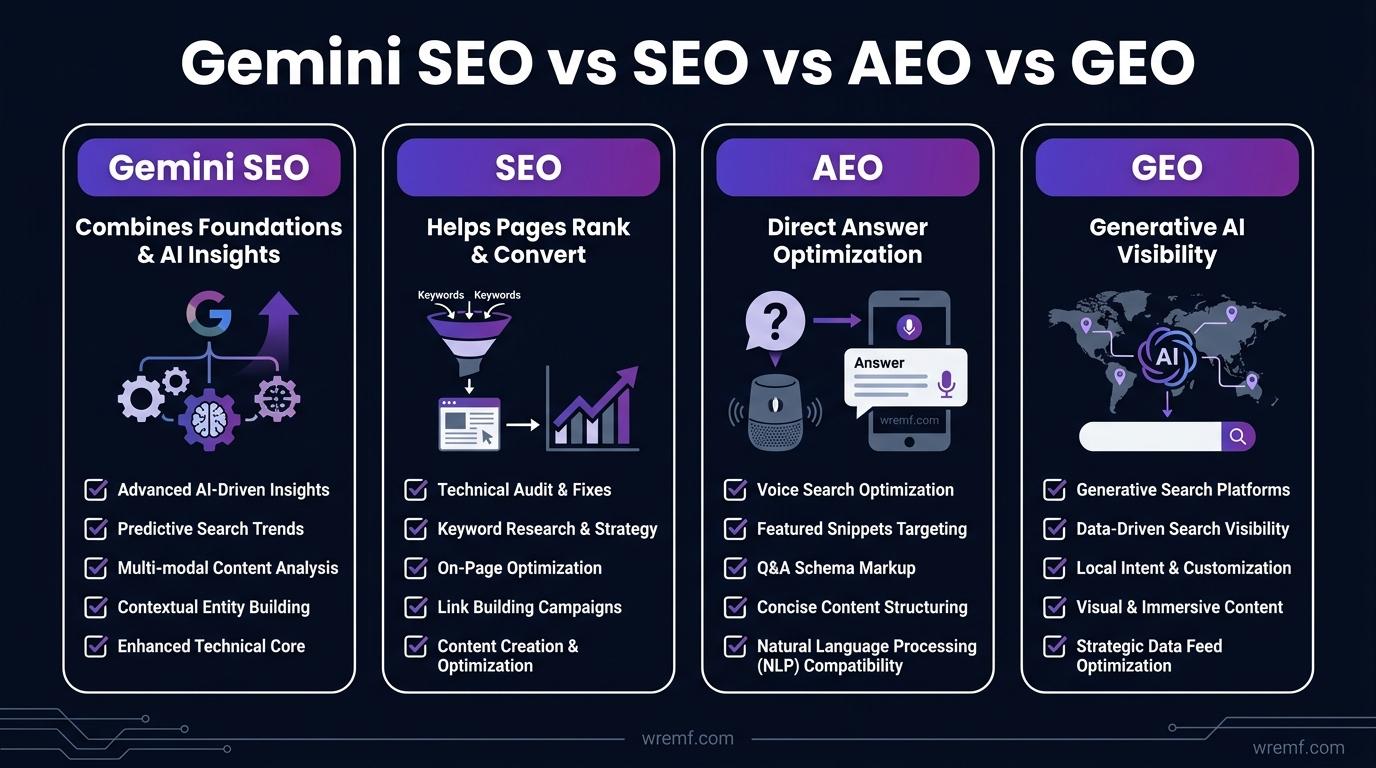
Gemini SEO combines SEO foundations, answer engine optimisation, and Generative Engine Optimization. SEO helps pages rank, AEO helps pages answer questions, and GEO helps brands appear in generative AI answers.
SEO is the practice of improving visibility in search engines through crawlability, relevance, authority, content quality, and user usefulness. SEO still matters because Gemini-powered Search uses Google’s broader search infrastructure, ranking systems, and web index.
Answer engine optimisation is the practice of structuring content so answer engines can extract direct, useful answers. Answer engine optimisation matters because AI Overviews, featured snippets, voice assistants, and AI assistants need concise, answer-rich content.
Generative Engine Optimization is the practice of improving how brands, content, and sources appear inside generative AI answers. Generative Engine Optimization matters because AI engines synthesize information from multiple sources and may mention, cite, or recommend brands without showing classic ranking positions.
The key difference between SEO and GEO is the output being optimized. SEO usually optimizes for rankings, impressions, clicks, and search results visibility. GEO optimizes for answer inclusion, AI citations, brand mentions, recommendations, competitor comparisons, and source consistency.
| Approach | Best For | What It Measures | What It Misses | Recommended When |
|---|---|---|---|---|
| SEO | Traditional search results | Rankings, clicks, impressions, CTR, Core Web Vitals | AI citations, prompt visibility, brand recommendations | You need organic search growth |
| AEO | Answer snippets and direct responses | Extractable answers, FAQ coverage, answer quality | Competitor mentions across AI engines | You need better answer eligibility |
| GEO | Generative AI answers | Mentions, citations, recommendations, prompt coverage | Classic keyword rankings if used alone | You need visibility in Gemini, ChatGPT, Claude, Perplexity, and Copilot |
| Gemini SEO | Google Gemini-powered discovery | AI Overviews, AI Mode, search results, citations, brand accuracy | Non-Google AI visibility if Gemini is tracked alone | You need Google AI search visibility plus SEO foundations |
The best strategy is not SEO vs AEO vs GEO. The best strategy is layered. Use Technical SEO to make pages accessible, use search intent research to make pages relevant, use answer engine optimisation to make content extractable, and use GEO to improve brand visibility inside AI-generated answers.
IMPORTANT: Rankings alone are not enough for Gemini SEO because a page can rank in organic search results without being cited, summarized, or recommended in AI-powered search.
KEY TAKEAWAY: Gemini SEO works best when SEO, AEO, and GEO are treated as one connected visibility system instead of competing tactics.
Once the strategy is clear, the next question is how Gemini retrieves and understands website information.
How Gemini Retrieves, Understands, and Selects Website Information
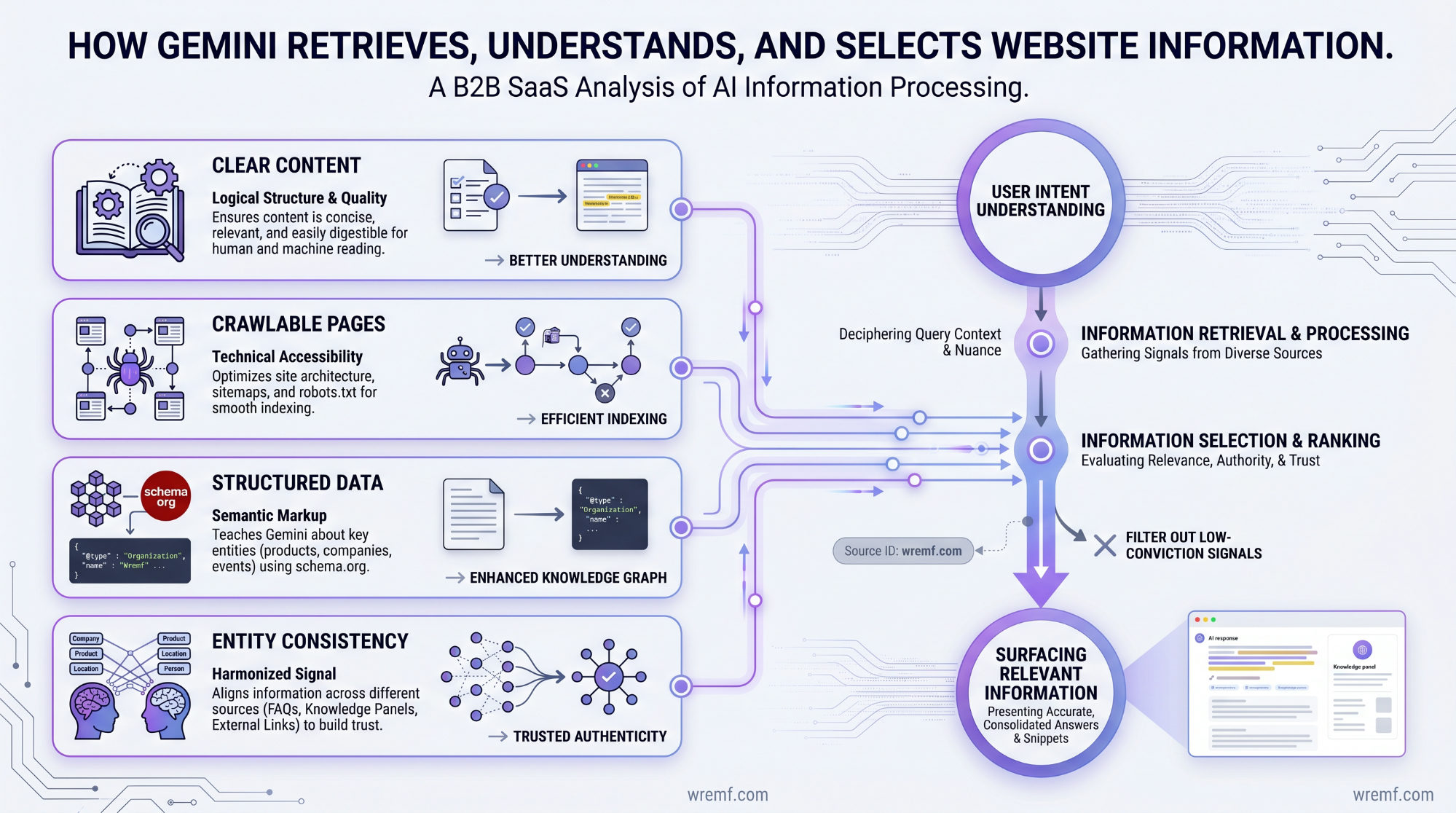
Gemini SEO works by helping Google systems understand what a page is about, which intent it satisfies, and whether the information is useful enough to surface. Clear content, crawlable pages, structured data, and entity consistency improve that process.
Retrieval is the process of finding relevant information for a query or prompt. In AI search SEO, retrieval matters because the system must identify useful source material before generating or supporting an answer.
Google Search Central explains that website owners do not need a special AI-only file to appear in AI features, but they should make content accessible to Googlebot, follow Search Essentials, and use normal Search controls when needed. The same AI features documentation from Google Search Central reinforces that AI experiences are connected to Search systems, not disconnected from them. (Google for Developers)
Semantic understanding is the ability to understand meaning, entities, relationships, and context rather than matching only exact keywords. Semantic understanding matters because Google Gemini can respond to long-tail queries, complex comparisons, and conversational prompts that may not repeat your exact keyword.
Entity relationships are the connections between brands, people, products, categories, features, locations, sources, and use cases. Entity relationships matter because Gemini SEO depends on clear meaning, not keyword stuffing.
For example, a page about AI visibility should explain related entities such as prompt tracking, source citations, AI share of voice, competitor visibility, LLM visibility, AI traffic attribution, answer engine optimisation, and Generative Engine Optimization. This helps Gemini connect the page to the broader topic cluster.
Source consistency is the alignment of brand facts across your website, third-party sources, review sites, documentation, social profiles, listings, press mentions, and trusted publications. Source consistency helps AI engines reduce uncertainty when summarizing a company, product, or topic.
In practical AI visibility audits, SEO teams frequently discover three Gemini SEO problems:
The page answers the topic but hides the direct answer too low
The brand entity is inconsistent across the web
The content has keywords but lacks structured answer-rich content
KEY TAKEAWAY: Gemini retrieves and selects content more effectively when pages are crawlable, semantically clear, entity-rich, and useful for real search intent.
That makes Technical SEO the foundation of every Gemini SEO program.
Technical SEO Foundations for Gemini SEO
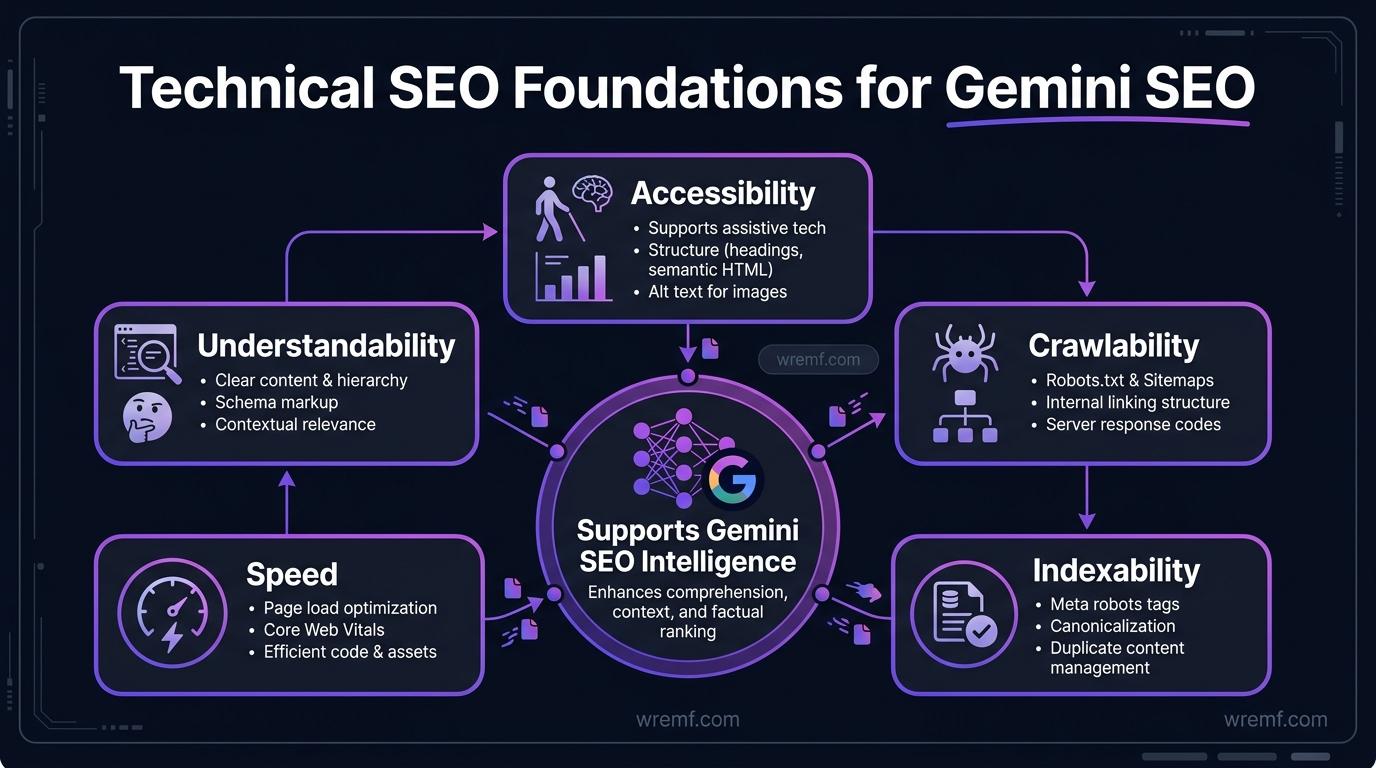
Technical SEO supports Gemini SEO by making your site accessible, crawlable, indexable, fast, and understandable. Without strong Technical SEO, AI-powered search systems may struggle to retrieve or trust your content.
Technical SEO is the practice of improving the infrastructure that helps search engines crawl, render, index, and evaluate a website. Technical SEO matters because even strong content can underperform if pages are blocked, slow, duplicated, or poorly structured.
Google Search Central explains that Google’s ranking systems are designed to prioritize helpful, reliable, people-first content created to benefit people rather than manipulate search engine rankings. The Google helpful content guidance is central to Gemini SEO because AI-powered search still depends on useful, accessible web content. (Google for Developers)
Core Web Vitals are user experience metrics that evaluate loading performance, responsiveness, and visual stability. Core Web Vitals matter because slow or unstable pages can reduce user satisfaction and weaken search performance.
A Gemini SEO technical checklist should include:
Clean URL structure that reflects topic hierarchy
XML sitemap coverage for important pages
Accurate robots.txt and noindex controls
Correct canonical tags for duplicate content control
Rendered HTML that includes important content and metadata
Clear HTML5 structure with logical headings
Strong internal linking between pillar pages and topic clusters
Fast page loading and monitored Core Web Vitals
Meta Descriptions that describe page value clearly
Structured data that matches visible page content
Accurate local SEO information when location matters
Accessible navigation for users, crawlers, and AI extraction
Internal linking is especially important because Gemini SEO depends on topic relationships. Internal linking helps users and search engines move from a broad pillar page to related pages about prompt tracking, source citations, competitive analysis, content optimization, and AI visibility measurement.
For WREMF users, Gemini SEO audits can connect Technical SEO checks with GEO audit workflows, rendered content checks, source consistency analysis, and prompt-fit recommendations.
KEY TAKEAWAY: Technical SEO gives Gemini-powered search systems a clean path to crawl, interpret, and connect your content to relevant AI search queries.
After technical foundations, structured data and entity clarity strengthen interpretation.
Structured Data, Schema Markup, and Entity Clarity for Gemini SEO
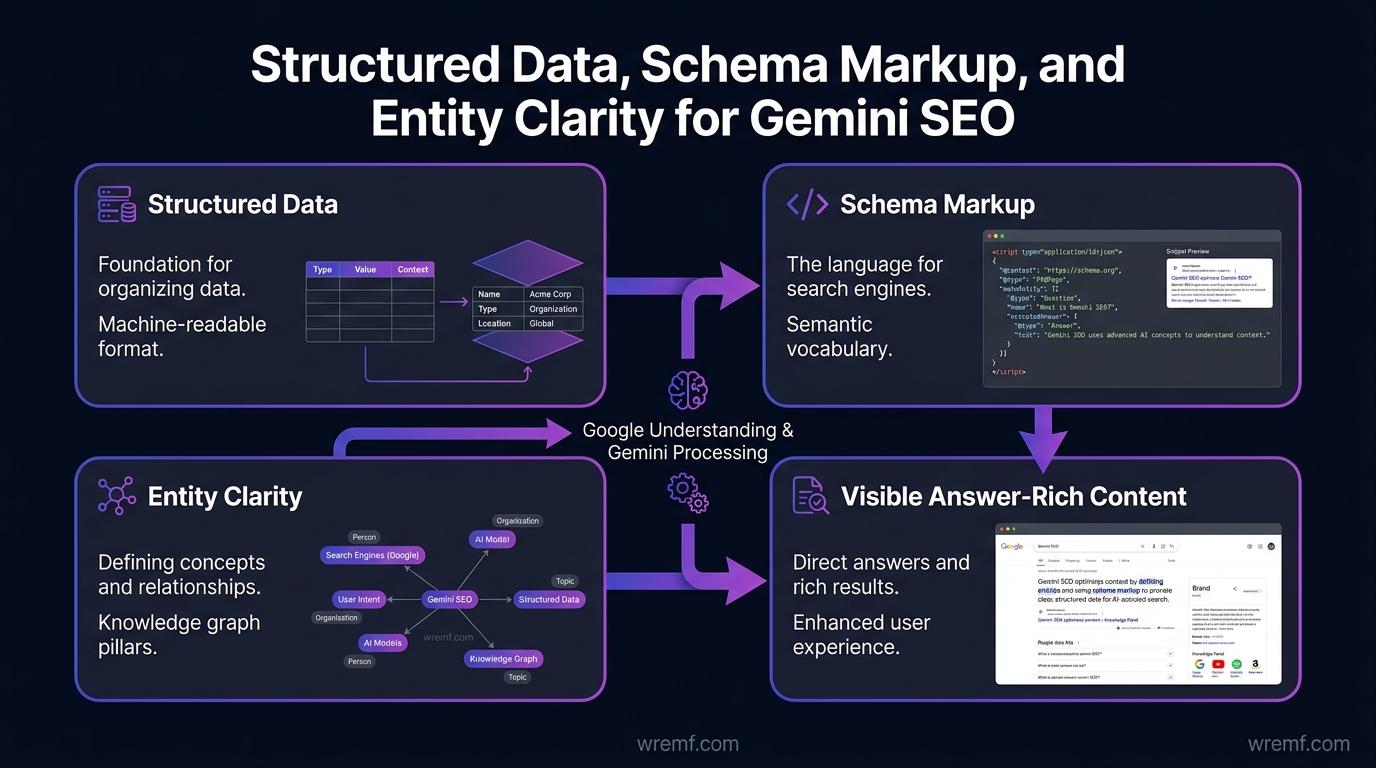
Structured data helps Google understand page meaning, but it does not replace useful content. Gemini SEO needs schema markup, entity clarity, and visible answer-rich content working together.
Structured data is standardized markup that helps search engines understand information on a page. Google Search Central explains that Google uses structured data to understand page content and gather information about the web and the world. The Google structured data documentation is the best starting point for implementation rules. (Google for Developers)
Schema markup is code that describes entities, relationships, products, articles, FAQs, organizations, reviews, events, videos, or datasets. Schema markup matters because it can help search engines validate the meaning of visible content, but it should not be used to describe content that users cannot see.
JSON-LD is a common structured data format recommended by Google for many structured data implementations. JSON-LD matters because it lets teams add machine-readable context without disrupting page layout.
Entity clarity is the process of making people, products, brands, concepts, and relationships unambiguous. Entity clarity matters because AI Large Language Models and search engines rely on consistent signals to understand who you are, what you offer, and how you compare.
For Gemini SEO, structured data should support actual content. If your page is a guide, the visible content should clearly answer the guide topic. If your page includes pricing, author bios, FAQs, or product details, that information should be current, visible, and consistent.
| Entity Element | What To Clarify | Gemini SEO Value |
|---|---|---|
| Brand | Name, category, positioning, website | Helps Google Gemini identify the company correctly |
| Product | Features, use cases, plans, integrations | Helps AI engines compare the offer accurately |
| Audience | SaaS teams, agencies, consultants, brands | Helps match content to search intent |
| Topic | Gemini SEO, AI visibility, GEO, AEO | Helps build topical authority |
| Proof | Sources, reports, methodology, data | Helps strengthen trust signals |
| Relationships | Product to problem, page to cluster, brand to category | Helps AI extraction and retrieval |
Trust signals are visible indicators that support credibility, such as author bios, editorial standards, first-party data, transparent methodology, expert review, and accurate sourcing. Trust signals matter because AI-powered search experiences need reliable information to summarize and cite.
Author bios can support E-E-A-T when they explain relevant expertise, editorial responsibility, or review processes. Author bios should be factual, concise, and connected to the topic rather than generic.
KEY TAKEAWAY: Structured data helps Gemini SEO most when schema markup, visible content, entity clarity, and trust signals all describe the same reality.
The next layer is content strategy and topical authority.
Content Strategy for Gemini SEO and Topical Authority
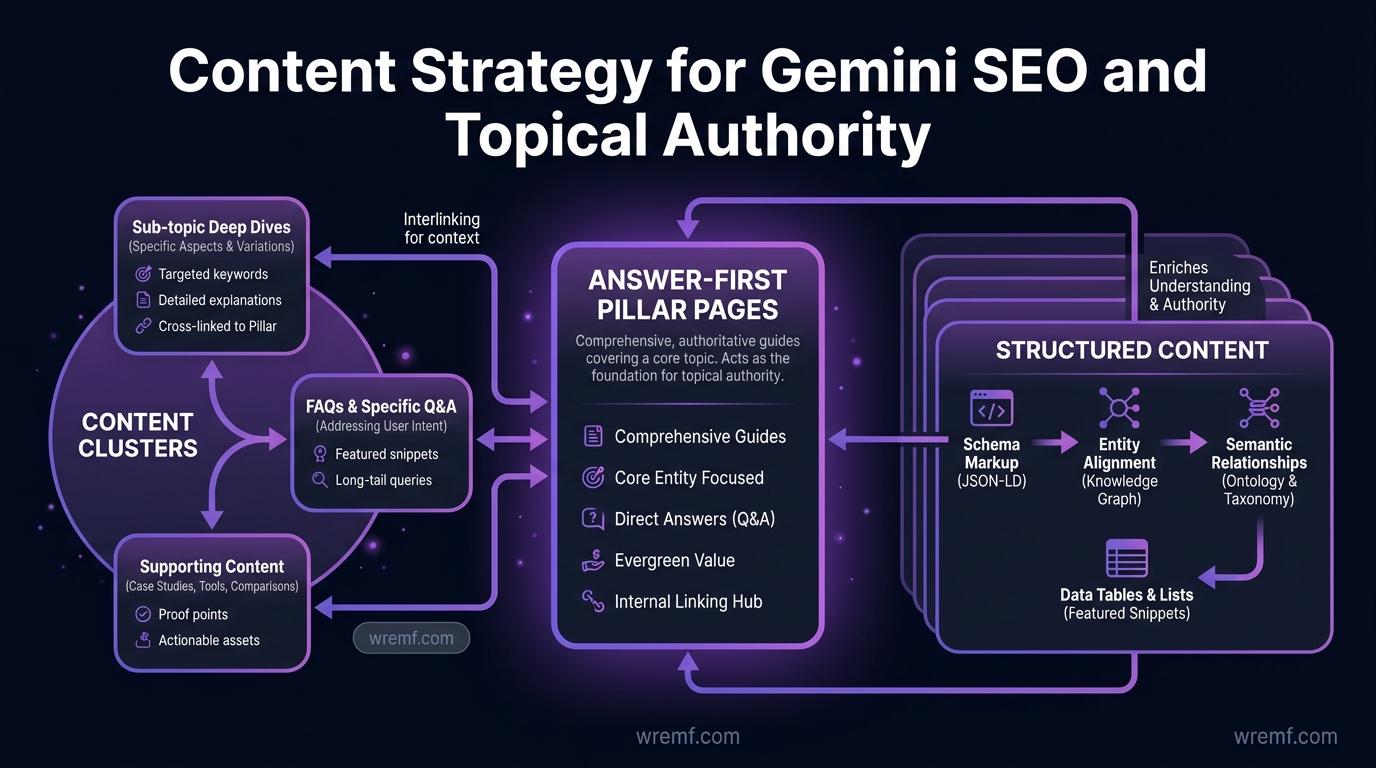
Gemini SEO content strategy should build topical authority through answer-first pillar pages, content clusters, and structured content that satisfies real prompts. The goal is to help users and AI systems understand the full topic, not just one keyword.
Topical authority is the perceived depth and reliability of a website on a specific subject. Topical authority matters because search engines and AI engines need enough connected evidence to trust a site as a useful source.
Content clusters are groups of related pages that cover a broad topic from multiple angles. Content clusters matter for Gemini SEO because AI-powered search often connects definitions, comparisons, implementation steps, risks, and buying questions in one answer.
Structured content is content organized with clear headings, direct answers, definitions, tables, examples, and summaries. Structured content matters because it improves readability for humans and extraction quality for AI engines.
A Gemini SEO content cluster could include:
Gemini SEO guide
Google AI Overviews optimization guide
Google AI Mode SEO guide
SEO vs AEO vs GEO comparison
AI visibility tracking guide
Prompt tracking guide
Source citation optimization guide
AI search competitor analysis guide
Gemini vs ChatGPT for SEO guide
AI-ready Content Briefs guide
Local SEO for AI search guide
Multimodal SEO guide
Technical SEO for AI extraction guide
Content Creation for Gemini SEO should avoid keyword stuffing. Keyword stuffing is the practice of repeating keywords unnaturally to manipulate search engines. Keyword stuffing hurts Gemini SEO because it reduces clarity, trust, and usefulness.
Content optimization should focus on search intent, entity relationships, source quality, and clear answers. A strong Gemini SEO page can include terms such as search results, search engine, AI assistant, AI-powered search, Keyword Research, structured data, Meta Descriptions, Alt Text, Technical SEO, AI Overviews, AI Mode, and local SEO where those terms genuinely help the reader.
AI visibility is the measurable presence of a brand inside Gemini, ChatGPT, Claude, Perplexity, Copilot, DeepSeek, Grok, Meta AI, Mistral, and other AI discovery surfaces. AI visibility matters because users increasingly ask AI assistants for recommendations, comparisons, and summaries before visiting a website.
If you want to turn topic research into publishable pages faster, WREMF can help create AI-ready content briefs that connect prompts, competitors, citations, and search intent.
KEY TAKEAWAY: Gemini SEO content strategy works when every page answers a real question, supports a content cluster, and strengthens topical authority.
Strong content also needs Keyword Research adapted for AI search.
Keyword Research for Gemini SEO
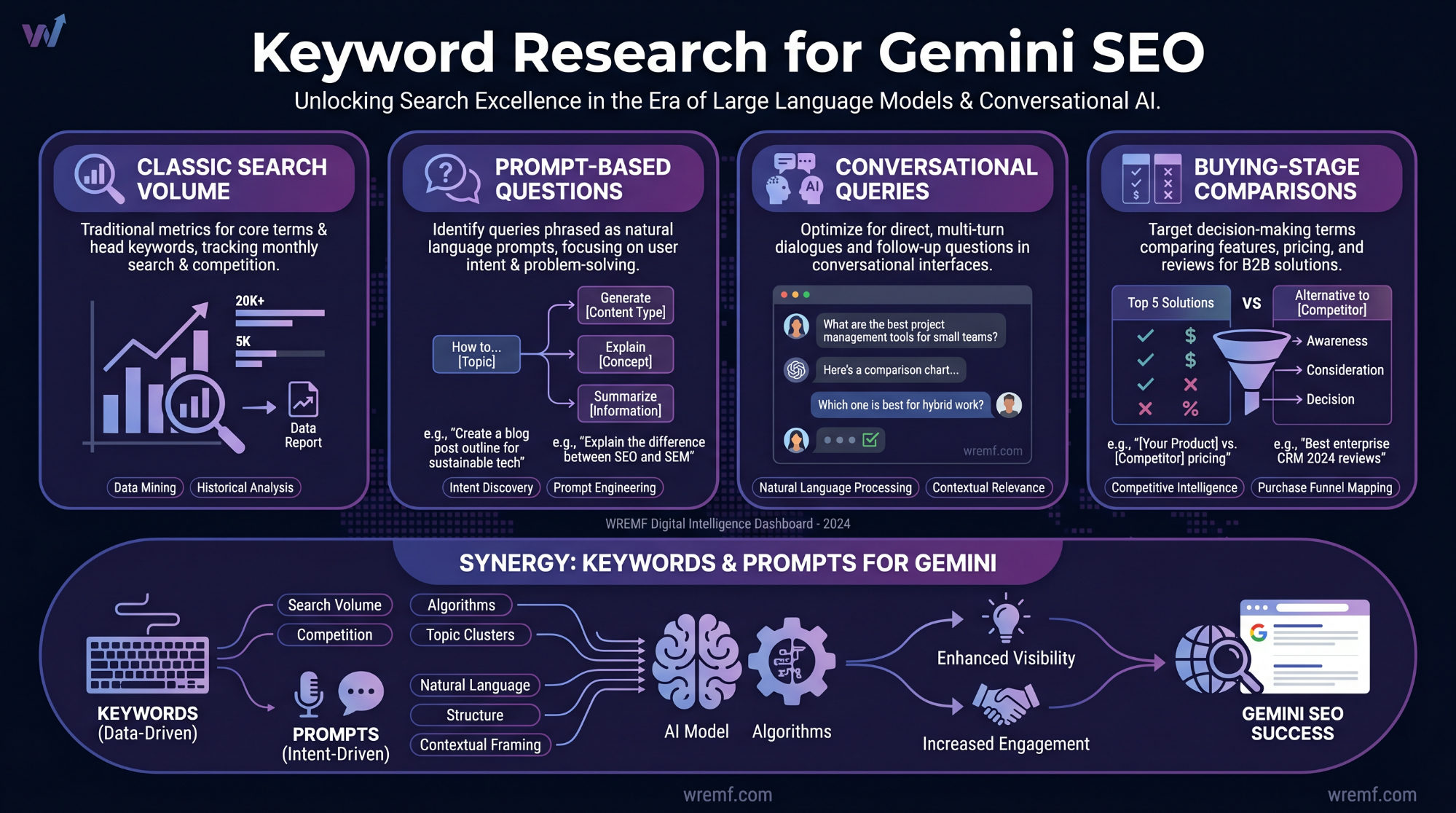
Keyword Research for Gemini SEO should combine classic search volume with prompt-based questions, conversational queries, and buying-stage comparisons. Gemini SEO requires both keywords and prompts because users search with short queries and full questions.
Keyword Research is the process of finding the terms, questions, and topics people use when searching for information. In Gemini SEO, Keyword Research also includes realistic prompts that users type into Google Gemini, ChatGPT, Perplexity, Claude, Copilot, and voice assistants.
Traditional Keyword Research is still useful for estimating demand, structuring pages, and prioritizing content. Google Search Console, third-party SEO tools, SERP analysis, and Google Sheets exports can help you identify search results patterns, query impressions, CTR, ranking gaps, and content opportunities.
AI search SEO adds another layer. Instead of asking only “What keywords have volume?” you also ask:
What would a buyer ask an AI assistant?
Which prompts produce competitor mentions?
Which prompts produce source citations?
Which prompts produce inaccurate brand descriptions?
Which prompts show no AI visibility for our brand?
Which prompts match high-intent commercial topics?
Which long-tail queries are likely to become AI-generated answers?
Prompt tracking is the process of monitoring how AI engines answer a fixed set of questions over time. Prompt tracking matters because AI visibility changes across engines, prompts, dates, locations, and source sets.
A Gemini SEO Keyword Research workflow should include:
| Research Layer | Example Input | Output | Why It Matters |
|---|---|---|---|
| Classic keyword | Gemini SEO | Search volume, difficulty, SERP | Builds Google search visibility |
| People Also Ask | Is Google Gemini good for SEO? | FAQ and section ideas | Captures natural language queries |
| AI prompt | How do I rank in Gemini? | AI visibility test | Shows how AI engines answer |
| Competitor prompt | Best AI visibility tools | Mentions and recommendations | Reveals competitive landscape |
| Citation prompt | Sources for AI visibility tracking | Cited domains | Reveals source opportunities |
| Conversion prompt | Which tool should an agency use? | Buying-stage answer | Supports commercial intent |
WREMF supports this workflow through prompt intelligence, which helps teams track prompts across major AI engines and identify visibility gaps.
TIP: Build Gemini SEO Keyword Research around questions, comparisons, and tasks, not only exact-match head terms.
KEY TAKEAWAY: Gemini SEO Keyword Research works best when classic search demand is combined with prompt tracking and AI answer analysis.
Once the queries are clear, the content must be optimized for AI extraction and answer snippets.
How To Optimize Content for AI Extraction, Answer Snippets, and Gemini Retrieval
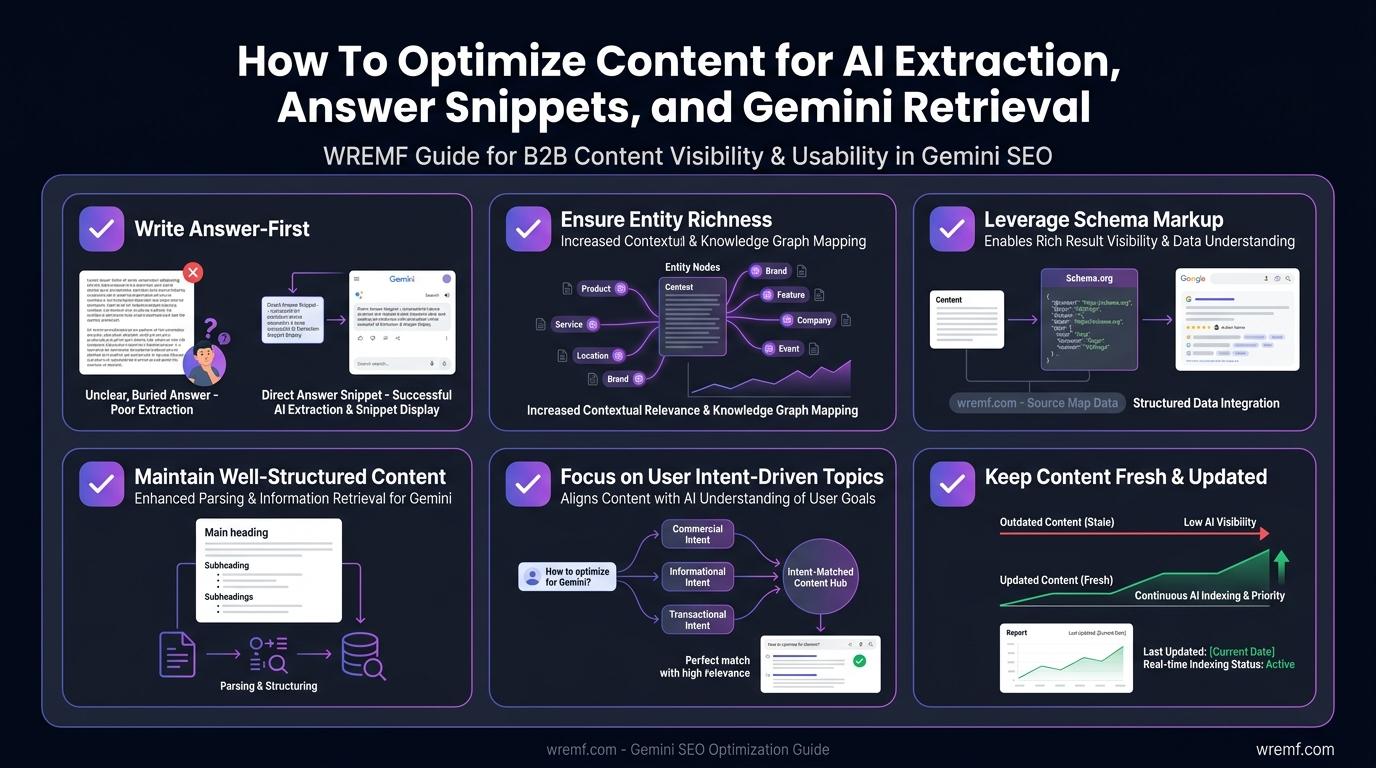
The most effective way to optimize content for Gemini retrieval is to write answer-first, entity-rich, well-structured content. Gemini SEO rewards pages that make the answer easy to find, verify, and reuse.
AI extraction is the process by which AI systems identify useful content fragments for summaries, citations, and generated answers. AI extraction matters because a page can be indexed but still fail to provide clean answer snippets.
Answer snippets are short, self-contained blocks that directly answer a query. Answer snippets matter because AI-powered search and traditional SERP features often need concise explanations that make sense outside the full page.
Content chunking is the practice of dividing a page into clear, self-contained sections. Content chunking matters because users, search engines, and AI engines can more easily extract useful passages from focused blocks.
Semantic structure is the organization of content by meaning, not just formatting. Semantic structure matters because headings, paragraphs, lists, and tables should reflect the real relationships between topics.
A strong Gemini SEO content block usually includes:
A direct answer in the first sentence
A definition under 60 words for important terms
Clear entity relationships
Supporting evidence or named sources
A table when comparing three or more items
A short takeaway that restates the main point
Internal linking to the next logical resource
Meta Descriptions still matter because they can influence search result previews and user expectations, even though Google may rewrite snippets. Good Meta Descriptions for Gemini SEO should include the main topic, search intent, and reason to click without overstating the outcome.
Alt Text describes meaningful visual content for accessibility and search understanding. Alt Text matters in broader Gemini SEO because multimodal systems need clear context when visual assets are part of a content experience.
FAQ schema can support eligible FAQ content when it follows Google’s structured data policies, but FAQ schema should not be the strategy by itself. The actual content must still be helpful, visible, accurate, and easy to extract.
A common implementation mistake is writing “SEO content” that has headings but no direct answers. Gemini SEO content should answer first, explain second, and support third.
KEY TAKEAWAY: Gemini SEO content should be written in extractable chunks that answer real prompts and reinforce clear entity relationships.
Content optimization becomes more powerful when it also supports multimodal and agent-ready search behavior.
Multimodal SEO, Gemini Agent Behavior, and Connected Google Apps
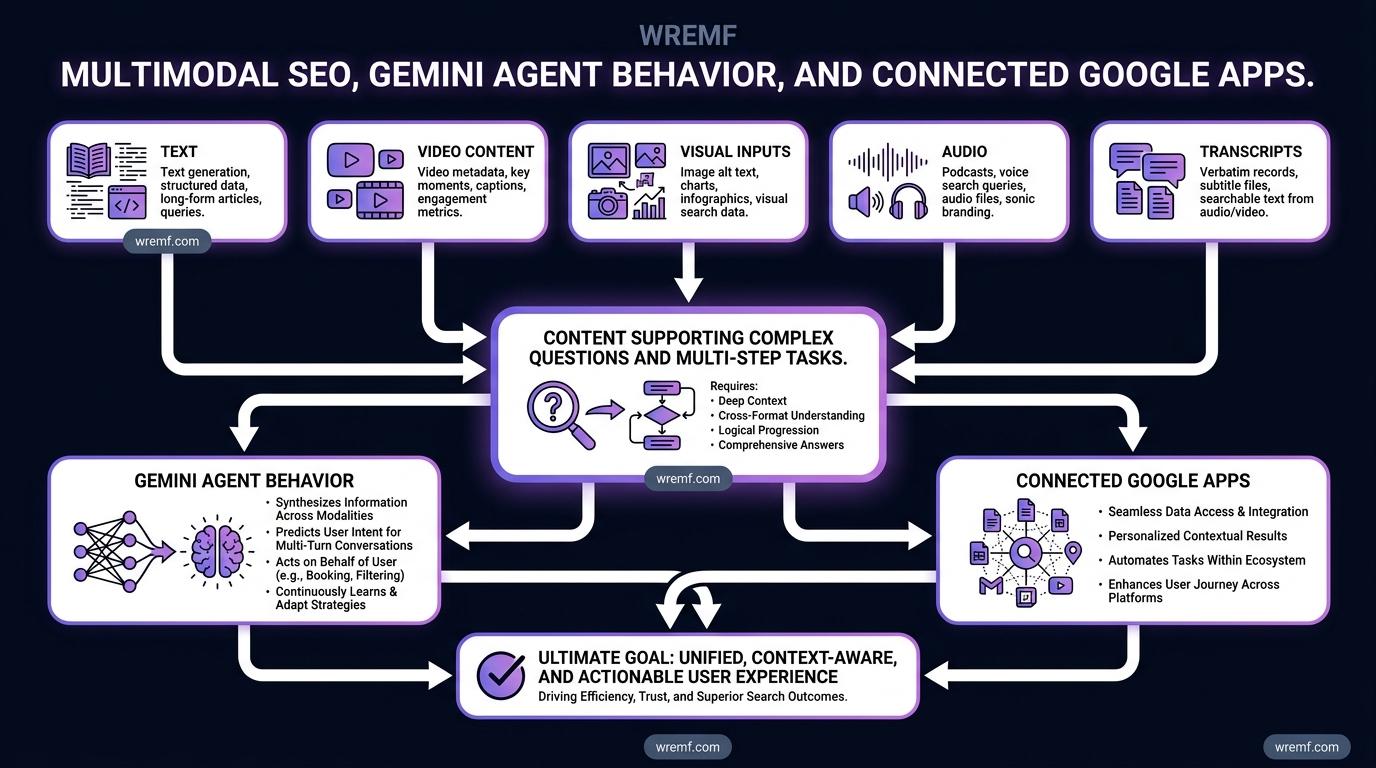
Multimodal SEO prepares content for search experiences that process text, video content, visual inputs, audio, transcripts, and contextual signals. Gemini SEO increasingly requires content that can support complex questions, visual reasoning, and multi-step tasks.
Multimodal SEO is the practice of making different content formats understandable across search and AI systems. Multimodal SEO matters because Gemini and other AI Large Language Models can reason across text, visuals, transcripts, and connected experiences.
Google describes AI Mode as supporting advanced reasoning, thinking, and multimodal understanding for complex questions. The official AI Mode page explains that users can ask complex questions, get recommendations, and explore follow-ups. (Home)
Video content can support Gemini SEO when transcripts, headings, summaries, and surrounding page copy explain the topic clearly. A video without a useful transcript gives search systems less text to retrieve, summarize, and cite.
AI agents are systems that can complete or assist with multi-step tasks. AI agents matter because search is moving from finding information toward helping users compare, decide, book, buy, analyze, or execute.
Gemini Agent and connected apps create another implication. Google’s ecosystem includes Google apps, Gmail, Calendar, Google Drive, Google Maps, and Workspace experiences. For brands, this means information accuracy and task-readiness matter more.
Local SEO is the practice of optimizing visibility for location-based searches. Local SEO matters in Gemini SEO because users often ask AI-powered search for nearby recommendations, routes, appointments, opening hours, online bookings, and service comparisons.
An agent-ready page usually has:
Clear service descriptions
Accurate location data
Clean online bookings or contact paths
Structured business information
Consistent brand and entity details
Useful FAQs for decision friction
Clear calls to action
Crawlable content management system output
No hidden dependency on inaccessible scripts for core content
For local SEO, Google Maps and business profile accuracy become part of AI visibility. If Gemini or an AI assistant is helping a user decide where to go, the business needs accurate location, category, availability, reviews, and service information.
KEY TAKEAWAY: Gemini SEO increasingly rewards websites that help users complete decisions, not just read information.
That makes trust, authority, and source consistency central to AI search visibility.
Trust Signals, Source Citations, and Brand Accuracy in Gemini SEO
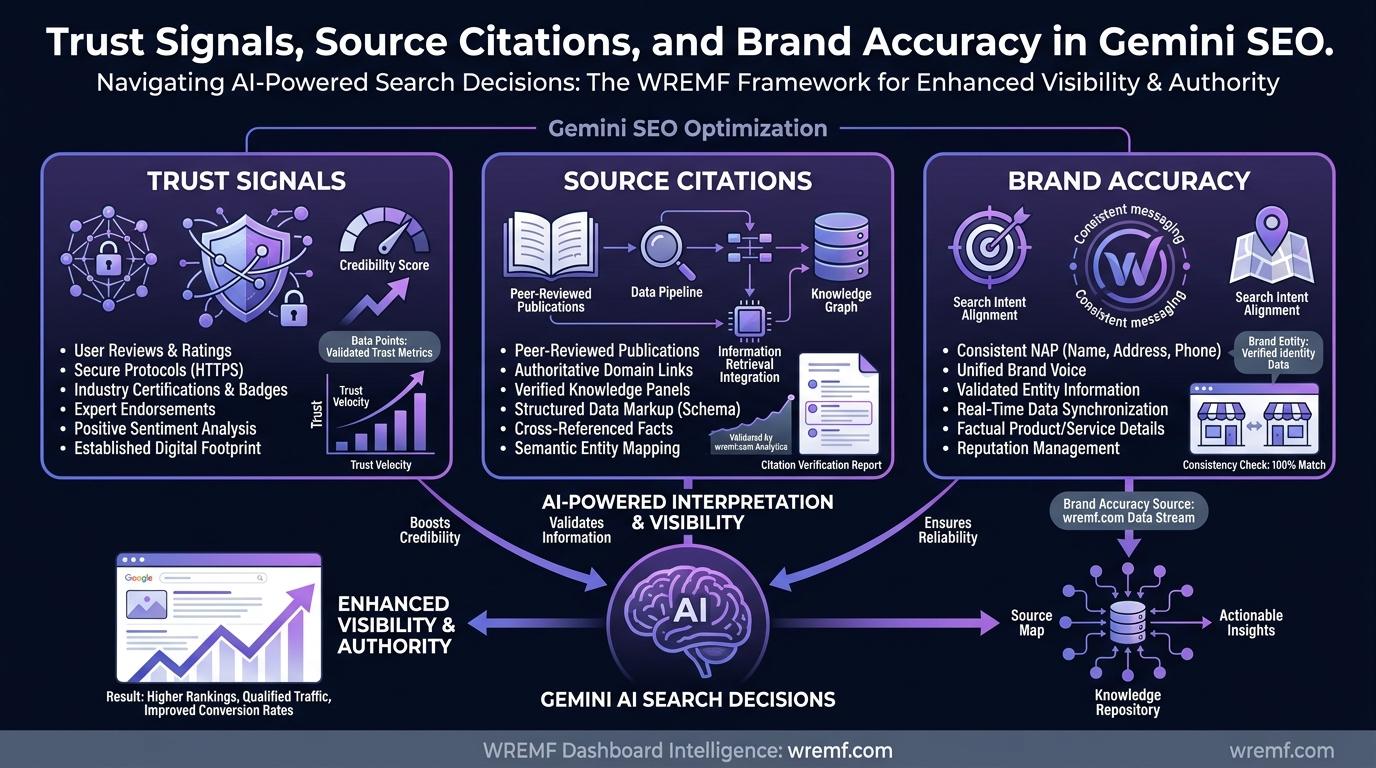
Gemini SEO depends on trust signals because AI-powered search must decide which sources to summarize, cite, or recommend. Brands need accurate first-party content and consistent third-party references.
AI citations are links or references used to support AI-generated answers. AI citations matter because they show which sources influence the answer and give users a path to verify information.
Source citations are the domains, articles, documents, or pages AI systems reference when answering prompts. Source citations matter because citation visibility can influence brand discovery even when users do not click traditional search results.
OpenAI says ChatGPT search can provide fast answers with links to relevant web sources. The OpenAI ChatGPT search announcement shows why source visibility now matters beyond Google. (OpenAI)
Microsoft states that Copilot Search can provide references and citations in AI search experiences. Anthropic’s Claude documentation explains that web search responses can include citations from search results. These AI engines differ, but the shared pattern is clear: source selection is becoming part of digital visibility.
Brand mentions are references to a company, product, or service inside AI-generated answers. Brand mentions matter because AI systems may recommend or compare a brand even when they do not cite the brand’s own website.
Entity validation is the process of checking whether AI systems and web sources describe a brand accurately. Entity validation matters because inaccurate descriptions can weaken trust, mislead buyers, or cause the wrong competitors to appear in comparison prompts.
In real-world reporting, teams usually need to track:
Which prompts mention the brand
Which prompts cite the brand’s website
Which third-party sources influence the answer
Which competitors appear more often
Whether descriptions are accurate
Whether recommendations are positive, neutral, or negative
Whether source consistency improves over time
WREMF helps with this through source citation tracking, competitor monitoring, source consistency analysis, and AI visibility scoring.
KEY TAKEAWAY: Gemini SEO is not only a content problem. Gemini SEO is also a source ecosystem problem involving citations, mentions, competitors, and brand accuracy.
That source ecosystem needs a measurement workflow.
How To Measure Gemini SEO Performance
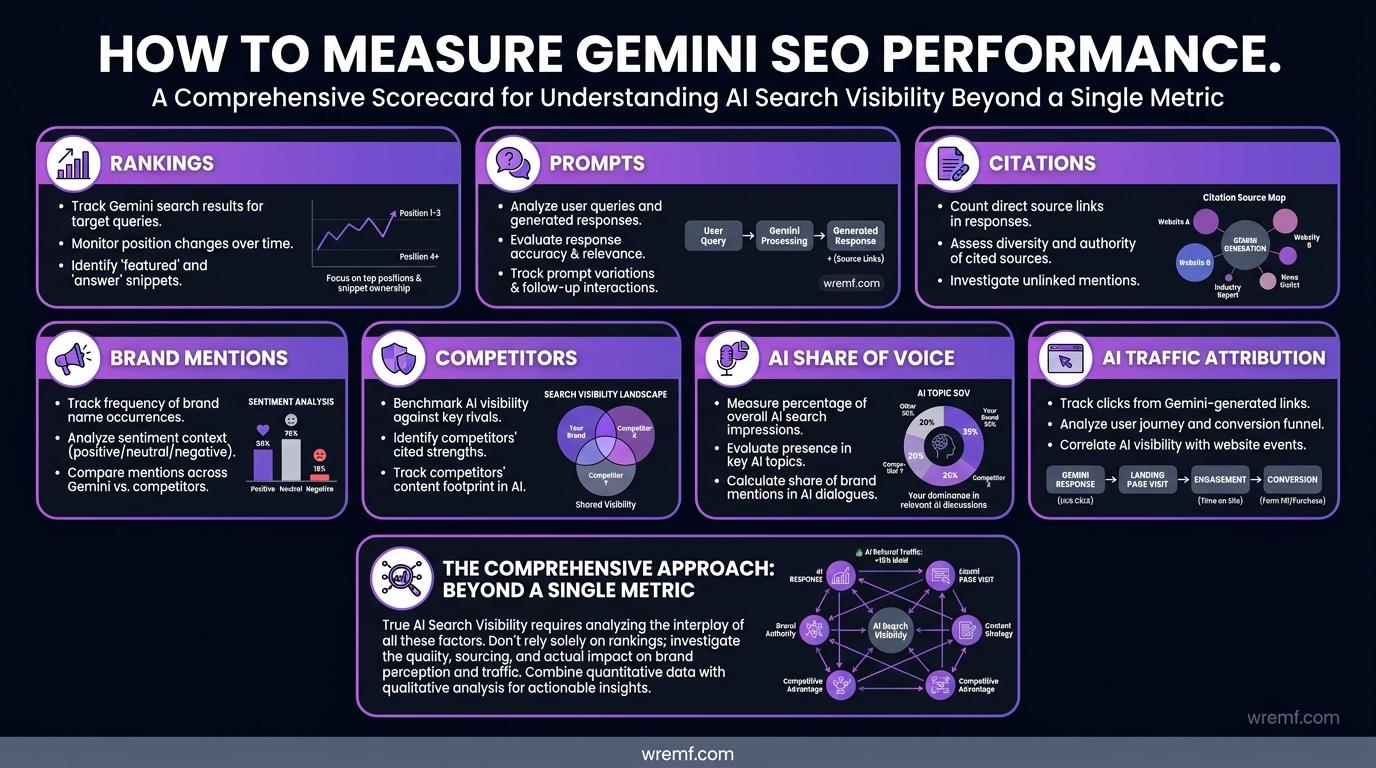
Gemini SEO performance should be measured through rankings, prompts, citations, brand mentions, competitors, AI share of voice, and AI traffic attribution. A single metric cannot explain AI search visibility.
AI share of voice is the percentage of relevant AI answers where your brand appears compared with competitors. AI share of voice matters because it shows whether your brand is present in the conversations that influence buyers.
AI traffic attribution connects AI visibility to sessions, referrals, assisted conversions, pipeline, or other business outcomes. AI traffic attribution matters because leadership teams need to understand whether AI search visibility supports measurable growth.
Google Search Console is still important for Gemini SEO because it shows query impressions, clicks, CTR, pages, countries, devices, and ranking trends. Google Analytics is also useful because it can help track referral traffic from AI platforms where referrer data is available.
The limitation is that Google Search Console does not always separate AI Overview exposure in a way that fully explains prompt-level AI visibility. AI platforms can also influence buyers without sending a click. This is why Gemini SEO needs both search analytics and AI visibility testing.
A practical Gemini SEO dashboard should track:
| Measurement Area | Example Metric | What It Shows | Main Limitation |
|---|---|---|---|
| Search performance | Clicks, impressions, CTR, average position | Traditional search visibility | Does not fully explain AI answer inclusion |
| Prompt visibility | Mention rate by prompt | Whether AI engines mention the brand | Depends on prompt set quality |
| Source citations | Cited domains and URLs | Which sources influence answers | Citations vary by engine and query |
| Competitive visibility | Competitor mentions and rankings in answers | Share of voice in AI answers | Needs consistent tracking over time |
| Sentiment and accuracy | Positive, neutral, negative, inaccurate descriptions | Brand quality in AI answers | Requires review and validation |
| AI traffic attribution | Sessions from AI referrers | Traffic impact from AI platforms | Some influence happens without clicks |
| Content gaps | Missing answer blocks or weak pages | What to improve next | Requires execution to create impact |
AI Testing Feedback Loops are recurring workflows that test prompts, inspect answers, update content, monitor citations, and compare results over time. AI Testing Feedback Loops matter because Gemini SEO changes as models, sources, competitors, and search results evolve.
Competitive Watchlists are tracked groups of competitors monitored across prompts, answers, sources, and citations. Competitive Watchlists matter because Gemini SEO is relative. Your brand can gain or lose visibility even when your own content has not changed.
If you want to see what AI visibility reporting can look like, review a sample AI visibility report before building your own measurement workflow.
KEY TAKEAWAY: Gemini SEO measurement should combine search analytics with prompt tracking, citation tracking, competitive watchlists, and AI traffic attribution.
Once measurement is in place, teams need a practical workflow for improvement.
How To Use Google Gemini for SEO
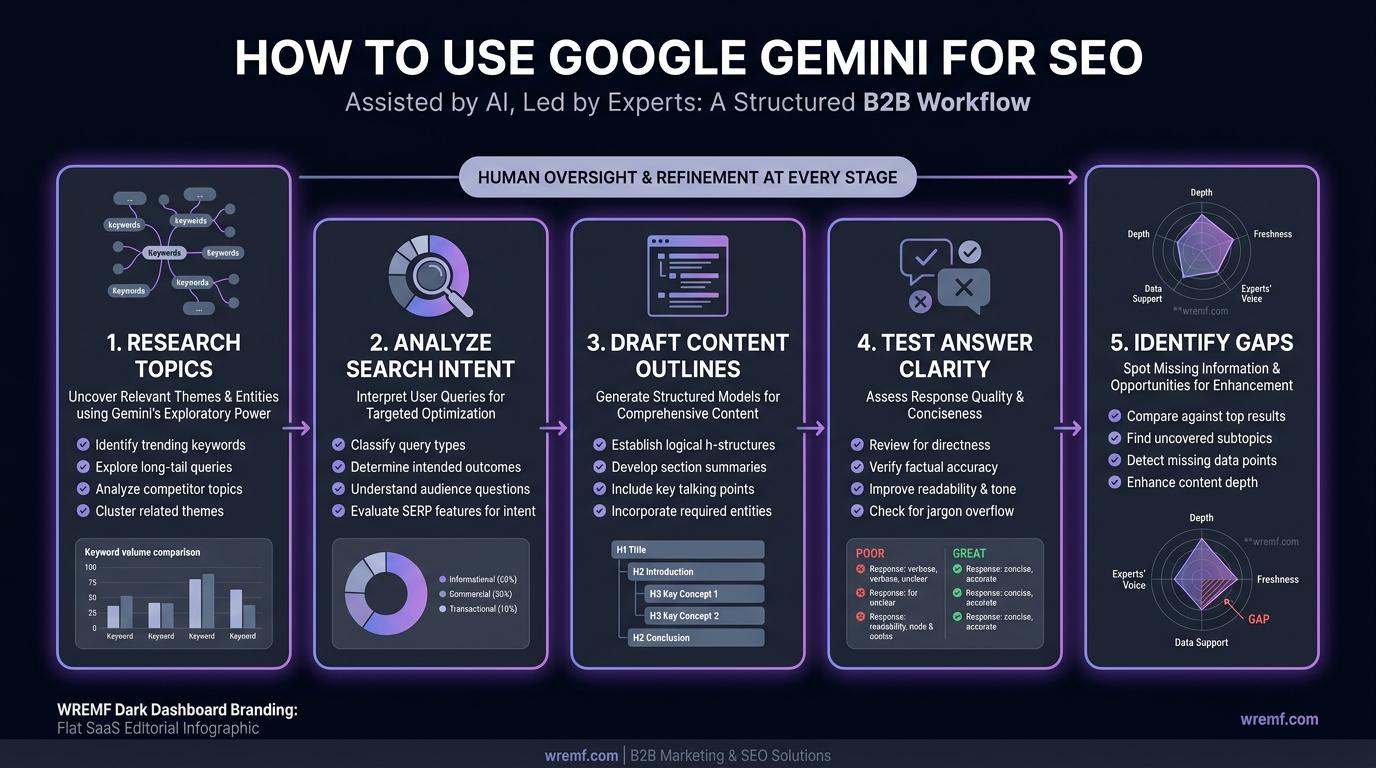
You can use Google Gemini for SEO by researching topics, analyzing search intent, drafting content outlines, testing answer clarity, and identifying gaps. Gemini should assist SEO strategy, not replace human judgment, source validation, or performance data.
Gemini can help with early-stage SEO work because it can summarize topics, generate content angles, compare search intent types, and suggest related questions. It can also help reframe complex topics into answer-first explanations for users and AI extraction.
However, Gemini should not be treated as the final authority for Keyword Research, search volume, rankings, or competitor performance. Marketing teams often find that AI-generated SEO advice needs validation against Google Search Console, Google Analytics, SERP data, crawler data, and reliable SEO tools.
A practical workflow for using Gemini in SEO looks like this:
Ask Gemini to explain the topic and related entities
Compare the response with actual search results
Build a keyword and prompt set
Map the topic to search intent and funnel stage
Create a content brief with required sections and evidence
Draft answer-first content
Add structured data where appropriate
Validate claims with authoritative sources
Publish and monitor rankings, prompts, citations, and traffic
Update the content based on AI visibility gaps
Gemini is useful for Content Creation support, but the actual content must be accurate, differentiated, and backed by experience. Duplicate content, generic AI writing tool output, and shallow summaries are poor fits for Gemini SEO because they do not create unique value.
KEY TAKEAWAY: Google Gemini is useful for SEO ideation, analysis, and content planning, but Gemini SEO still requires human review, data validation, and measurable tracking.
This is especially important when comparing Gemini with ChatGPT for SEO.
Gemini vs ChatGPT for SEO: Which Is Better?
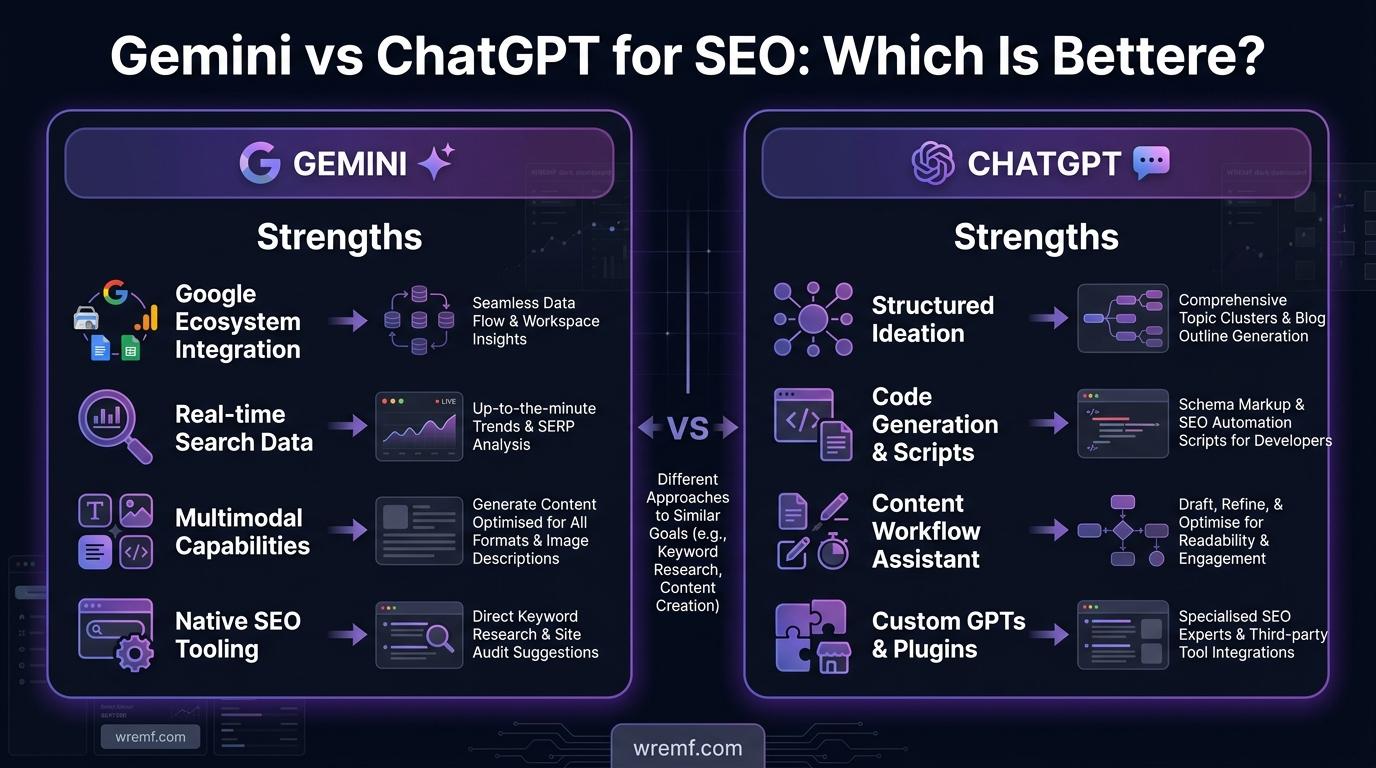
Gemini and ChatGPT are both useful for SEO, but they are better for different tasks. Gemini is useful for Google ecosystem thinking, while ChatGPT is often useful for structured ideation, editing, and broad content workflows.
ChatGPT is an AI assistant developed by OpenAI. ChatGPT matters for SEO because many users now use it for research, recommendations, comparisons, and web search with source links.
Google Gemini is an AI assistant and model ecosystem developed by Google. Google Gemini matters for SEO because it is connected to Google’s search, AI Overviews, AI Mode, Workspace, Android, and broader Google apps ecosystem.
The better tool depends on the SEO task:
| SEO Task | Gemini | ChatGPT | Best Practical Use |
|---|---|---|---|
| Search ecosystem analysis | Strong for Google-specific thinking | Strong for general analysis | Use both, then validate with SERP data |
| Content briefs | Useful for topical expansion | Useful for structured outlines | Use with human editorial rules |
| Keyword Research | Helpful for ideas, not final volume | Helpful for ideas, not final volume | Validate with SEO tools and GSC |
| Meta Descriptions | Useful for variations | Useful for variations | Test for clarity and CTR |
| Schema planning | Useful for suggestions | Useful for suggestions | Validate against Google documentation |
| AI answer testing | Useful for Gemini-specific behavior | Useful for ChatGPT-specific behavior | Track both platforms separately |
| Connected apps | Strong in Google ecosystem | Depends on integrations | Match to your workflow |
What is better for SEO, ChatGPT or Gemini? The best answer is task-specific. Use Gemini to understand Google AI search behavior, AI Overviews, AI Mode, and Google ecosystem signals. Use ChatGPT for broad content workflows, structured writing, and multi-engine prompt testing. Use actual data to decide what works.
For teams tracking multiple AI engines, the real question is not Gemini vs ChatGPT. The better question is how your brand appears across Gemini, ChatGPT, Claude, Perplexity, Copilot, DeepSeek, Grok, Meta AI, and Mistral. WREMF’s competitive landscape tracking helps teams compare brand and competitor visibility across AI discovery surfaces.
KEY TAKEAWAY: Gemini and ChatGPT both support SEO work, but performance should be validated through search data, prompt tracking, citations, and competitor visibility.
That leads to the biggest strategic question: is SEO dead or evolving?
Is SEO Dead or Evolving in 2026?
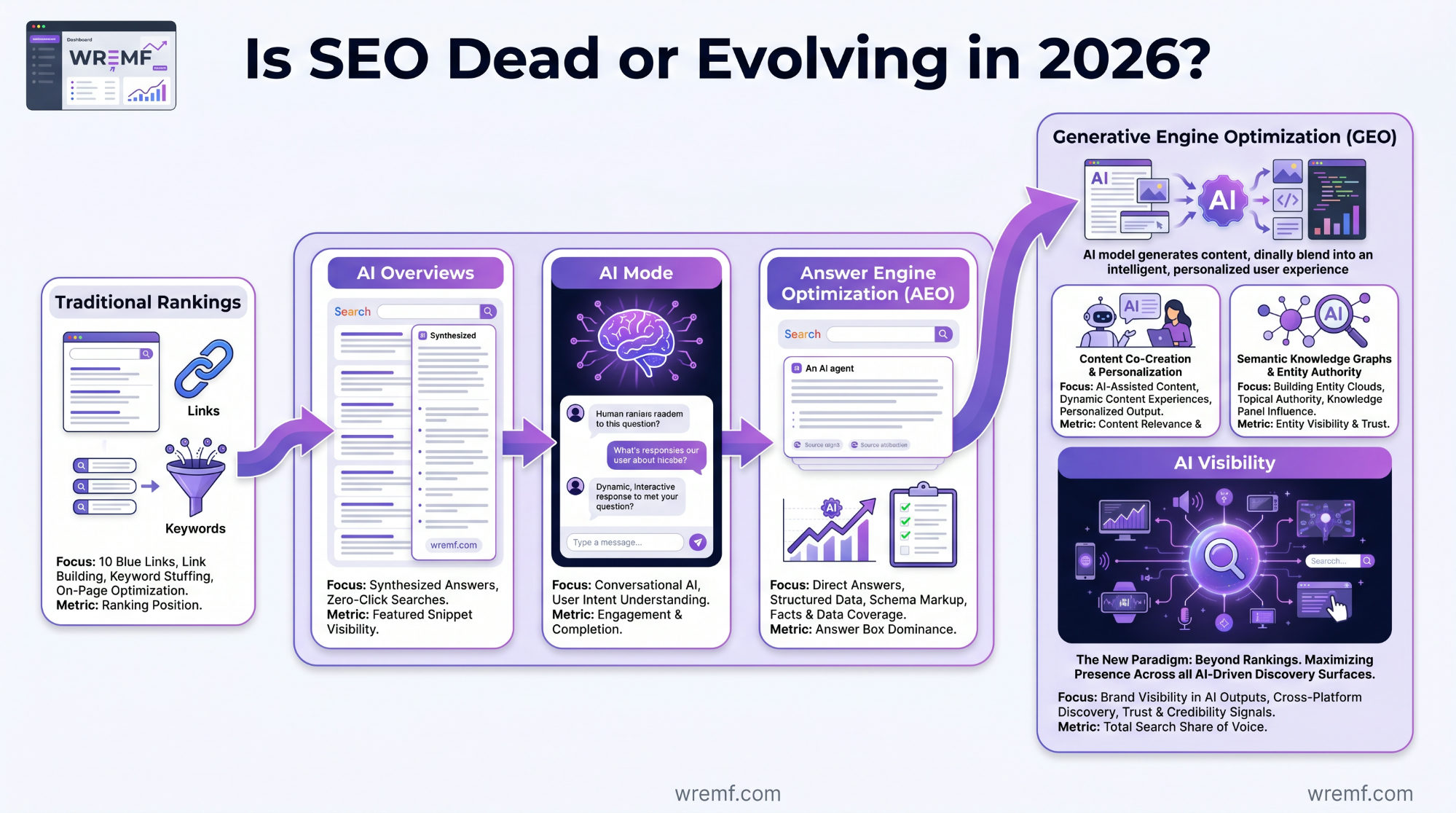
SEO is not dead in 2026. SEO is evolving into a broader search visibility discipline that includes traditional rankings, AI Overviews, AI Mode, answer engine optimisation, Generative Engine Optimization, and AI visibility.
Search engines still need crawlable, helpful, authoritative web content. AI engines still need sources, facts, entities, and references. What is changing is the way users interact with information and the way brands are discovered.
McKinsey describes AI-powered search as a new front door to the internet and reports that half of consumers in its August 2025 survey intentionally seek out AI-powered search engines. The McKinsey AI search report also states that AI search is becoming a major buying decision channel. (McKinsey & Company)
This does not mean classic SEO disappears. It means the measurement model expands. SEO teams now need to monitor rankings, clicks, AI citations, brand mentions, AI assistant recommendations, source consistency, and AI traffic attribution.
The old question was: “Where do we rank?”
The new question is: “Where does our brand appear, what does AI say about us, which sources does it trust, how do competitors compare, and does this influence traffic or pipeline?”
AI search visibility is the measurable presence of a brand across AI search results, AI-generated answers, citations, summaries, and recommendations. AI search visibility matters because a buyer may never search using only a short keyword again.
KEY TAKEAWAY: SEO is evolving from ranking optimization into measurable search, answer, and AI visibility management.
To manage that evolution, teams need to know what actually moves Gemini SEO performance.
What Actually Improves Gemini SEO Performance?
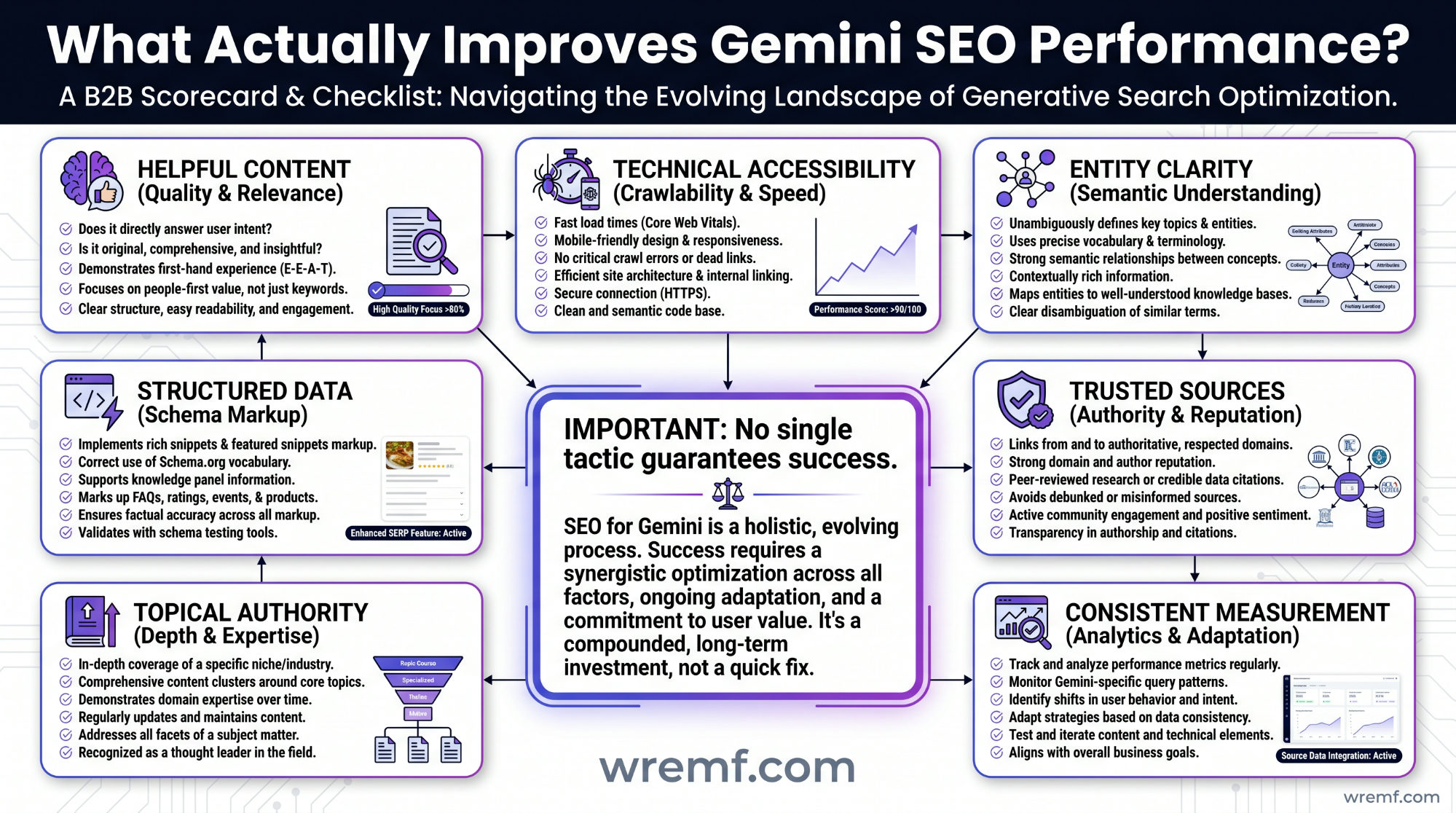
The factors that improve Gemini SEO performance are helpful content, technical accessibility, entity clarity, structured data, trusted sources, topical authority, and consistent measurement. No single tactic can guarantee citations or AI recommendations.
A common misconception is that adding schema markup alone will make Gemini cite a page. Schema markup helps search engines understand content, but it does not create usefulness, authority, or trust by itself.
The practical Gemini SEO improvement system has seven parts:
| Improvement Area | What To Do | Why It Helps Gemini SEO |
|---|---|---|
| Content relevance | Match search intent and conversational prompts | Helps Gemini connect the page to real user needs |
| Answer-first writing | Start sections with direct answers | Improves extraction and answer snippets |
| Entity clarity | Define brands, products, people, and relationships | Reduces ambiguity in AI-generated answers |
| Technical SEO | Fix crawl, render, index, sitemap, and URL structure issues | Helps search engines access the content |
| Structured data | Add accurate schema-rich sections where relevant | Supports machine understanding |
| Source consistency | Align first-party and third-party brand facts | Improves accuracy and trust |
| Measurement | Track prompts, citations, competitors, and traffic | Shows what is working and what needs action |
First-party insights are especially valuable. Proprietary data, original research, benchmarks, pricing analysis, product documentation, expert commentary, and real methodology can make a piece of content more useful than generic summaries.
Contextual relevance also matters. A backlink or mention is more useful when it comes from a source that is topically related to your category. Backlink Outreach Emails should therefore prioritize relevance, authority, and editorial fit rather than volume alone.
AI indexing is not a magic switch. AI indexing depends on whether pages are discoverable, accessible, useful, and present in sources that AI engines can retrieve or reason over. The best Gemini SEO programs treat AI indexing as part of the broader search infrastructure.
KEY TAKEAWAY: Gemini SEO performance improves when content quality, technical foundations, entity clarity, structured data, trusted sources, and measurement work together.
For B2B teams, that improvement process needs software, services, or both.
How WREMF Helps With Gemini SEO and AI Visibility
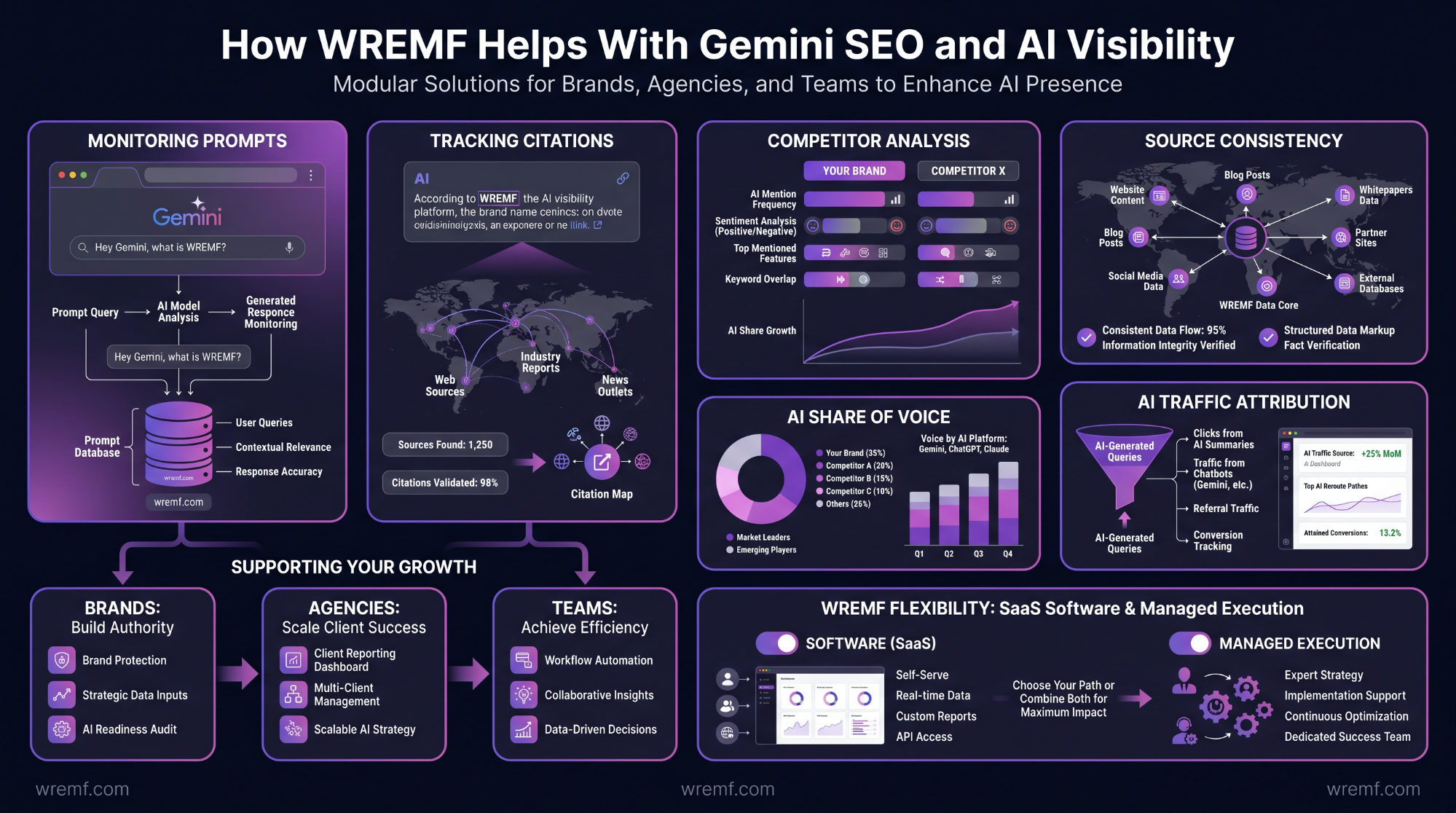
WREMF helps teams track, improve, and prove Gemini SEO by monitoring prompts, citations, competitors, AI share of voice, source consistency, and AI traffic attribution. WREMF is useful for brands, agencies, and teams that need software, managed execution, or both.
WREMF is an AI visibility platform for B2B teams that want to understand how their brand appears across Gemini, ChatGPT, Claude, Perplexity, Google AI Overviews, Copilot, DeepSeek, Grok, Meta AI, and Mistral. WREMF matters because Gemini SEO should be measured against the full AI discovery landscape, not Google alone.
WREMF combines:
AI visibility tracking
Prompt intelligence
Source citation tracking
Competitor visibility
AI share of voice
AI traffic attribution
GEO audits
AEO strategy
AI-ready Content Briefs
SEO testing
Visibility scoring
Scheduled AI monitoring
White-label client reporting
API and MCP integrations
BYOK support
Client portals
Source consistency analysis
BYOK means bring your own key. BYOK matters because teams can connect their own AI provider keys where supported, helping manage usage, control, and flexibility.
White-label reporting is reporting that agencies can brand for their own clients. White-label reporting matters because agencies managing multiple clients need repeatable reporting without rebuilding dashboards manually.
WREMF can support three operating models:
| Model | Best For | What You Get | Recommended When |
|---|---|---|---|
| Software | In-house SEO and marketing teams | Tracking, dashboards, recommendations, reports | You have execution capacity |
| Agency service | Teams that need strategy and execution | Audits, content optimisation, authority work, reporting | You need senior-led support |
| Hybrid | Teams that want tools plus execution | Platform access plus managed AEO and GEO support | You want speed and accountability |
For teams that want managed execution, WREMF also offers AI visibility agency services, including GEO consulting, AEO strategy, citation improvement, source consistency cleanup, technical AI visibility foundations, schema guidance, internal linking logic, crawl checks, share of voice tracking, and monthly reporting.
Agencies can use WREMF for agencies to manage multiple clients, create white-label reports, monitor competitive visibility, and turn AI visibility data into client-ready action plans. In-house teams can use WREMF for brands to track brand accuracy, source visibility, and AI search performance over time.
KEY TAKEAWAY: WREMF turns Gemini SEO from a manual testing exercise into a measurable workflow for prompts, citations, competitors, source consistency, and attribution.
Once the operating model is clear, teams can choose the right tools and workflows.
Gemini SEO Tools, Dashboards, and Reporting Workflows
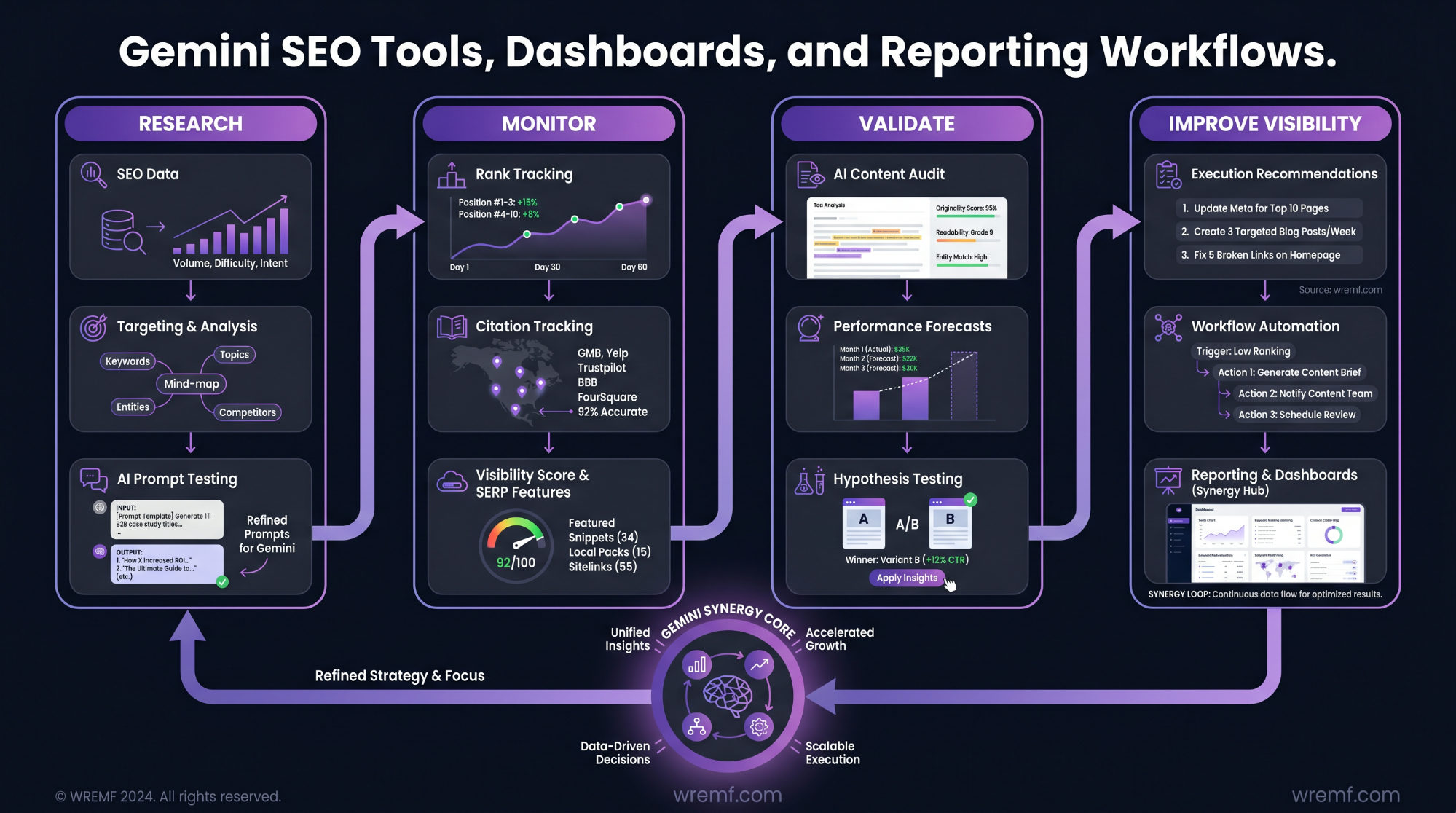
Gemini SEO tools should help you research, monitor, validate, and improve visibility across search results and AI engines. The best workflow combines SEO data, AI prompt testing, citation tracking, and execution recommendations.
AI visibility tools measure how a brand appears inside AI-generated answers, recommendations, summaries, and citations. AI visibility tools matter because manual testing is inconsistent, difficult to scale, and hard to report.
Classic SEO tools still matter. Google Search Console, Google Analytics, crawlers, rank trackers, and Keyword Research tools help teams understand search performance, Technical SEO, and content opportunities. The limitation is that classic SEO tools do not fully explain Gemini answers, prompt visibility, source citations, or AI assistant recommendations.
A complete Gemini SEO workflow can include:
| Tool or Workflow | Best For | What It Measures | What It Misses |
|---|---|---|---|
| Google Search Console | Search performance | Queries, pages, clicks, impressions, CTR | Prompt-level AI visibility |
| Google Analytics | Traffic and conversions | Sessions, channels, events, conversions | Mentions without clicks |
| Rank tracker | SERP position monitoring | Ranking changes | AI citations and recommendations |
| AI visibility platform | Prompt and citation tracking | Mentions, citations, share of voice, competitors | Needs good prompt design |
| Google Sheets | Lightweight reporting | Manual exports and tracking | Scales poorly across clients |
| AI Sentiment Analyzer | Brand tone review | Positive, neutral, negative patterns | Needs human validation |
| Real-Time Query Mapping | Query to content mapping | Prompt and query coverage | Requires maintenance |
| Competitive Watchlists | Competitor monitoring | Competitor mentions and citations | Needs recurring tracking |
GreenBanana SEO, OmniSEO™ Dashboards, Schema Markup Generators, and other SEO tools may appear in competitor SERPs or vendor lists, but the decision should be based on what you need to measure. If the main problem is rankings, use an SEO platform. If the main problem is AI visibility, use an AI visibility platform. If the main problem is execution, consider an agency or hybrid model.
API and MCP integrations matter for technical teams that want to connect AI visibility data with dashboards, data warehouses, client portals, or internal workflows. WREMF supports technical teams through API and MCP integrations.
KEY TAKEAWAY: Gemini SEO reporting should combine SEO analytics with AI prompt visibility, citation tracking, competitive monitoring, and business attribution.
The next section shows how to implement the workflow step by step.
How To Build a Gemini SEO Workflow
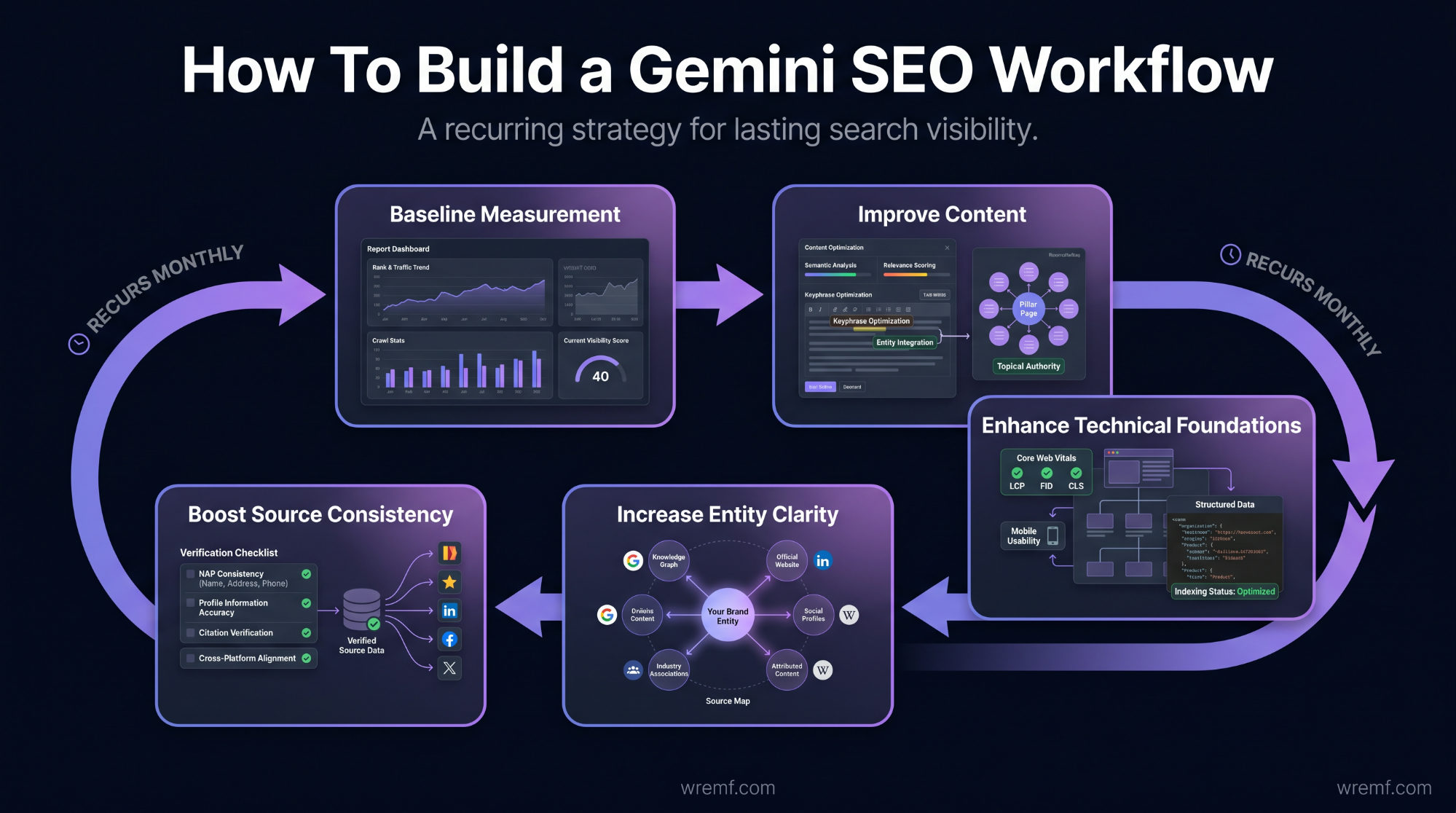
A Gemini SEO workflow should start with baseline measurement, then improve content, technical foundations, entity clarity, and source consistency. The workflow should repeat monthly because AI search results change.
The simplest Gemini SEO workflow has six stages:
| Stage | Action | Output |
|---|---|---|
| 1. Audit | Check rankings, prompts, citations, competitors, and source accuracy | Baseline visibility map |
| 2. Prioritize | Group gaps by business value and search intent | Action roadmap |
| 3. Optimize | Improve content, structure, schema, internal linking, and entity clarity | Updated pages |
| 4. Validate | Retest prompts and search results | Before-and-after comparison |
| 5. Report | Connect visibility to traffic, citations, and share of voice | Leadership or client report |
| 6. Iterate | Refresh content and monitor changes | Ongoing visibility improvement |
The first audit should include both Google and non-Google AI engines. Gemini SEO matters, but buyers may also use ChatGPT, Claude, Perplexity, Copilot, DeepSeek, Grok, Meta AI, and Mistral. A single-engine view creates blind spots.
In practical implementation, start with 25 to 100 prompts mapped to your highest-value categories. Include definition prompts, comparison prompts, local SEO prompts, service prompts, pricing prompts, competitor prompts, and problem-aware prompts. Then track which prompts mention your brand, cite your site, cite competitors, or describe your company inaccurately.
Next, map each prompt to a page. If no page answers the prompt clearly, create or improve one. If a page exists but does not appear in AI answers, inspect content structure, entity clarity, source citations, internal linking, and third-party references.
SEO testing helps validate whether page changes improve performance. WREMF’s SEO testing workflows help teams compare changes against search performance and AI visibility signals.
KEY TAKEAWAY: A Gemini SEO workflow should move from audit to prioritization, optimization, validation, reporting, and iteration.
Even good workflows can fail if teams believe the wrong myths.
Common Myths About AI Visibility Debunked
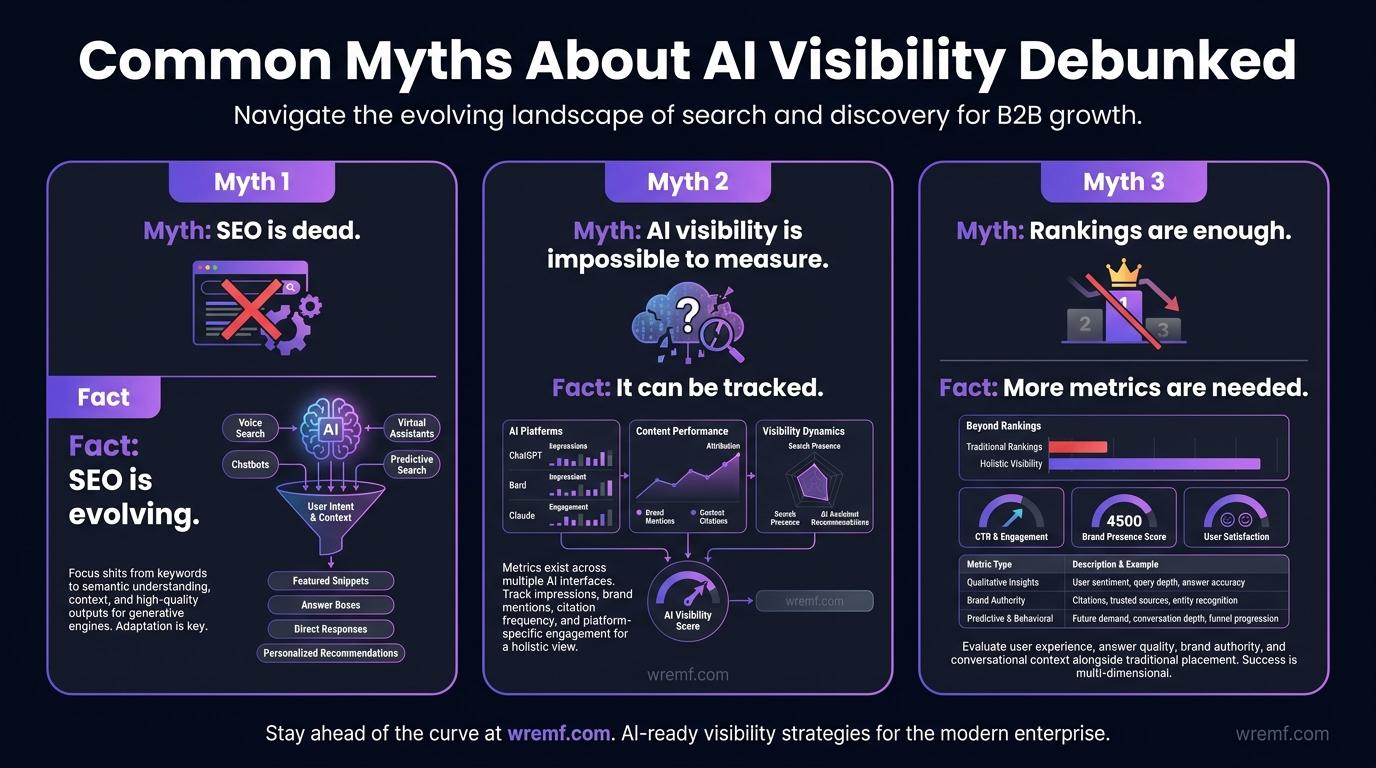
AI visibility is measurable, but it requires different metrics from classic SEO. The most common myths come from treating AI search like either magic or traditional rankings.
MYTH: SEO is dead because Gemini, ChatGPT, and AI Overviews answer questions directly.
FACT: SEO is evolving, not disappearing. Search engines and AI engines still need crawlable, helpful, source-backed web content. The difference is that teams now need to optimize for rankings, answer inclusion, AI citations, brand mentions, and source consistency.
MYTH: AI visibility is impossible to measure.
FACT: AI visibility can be measured through prompt tracking, source citations, brand mentions, share of voice, competitor presence, sentiment, answer accuracy, and AI traffic attribution. Measurement is imperfect because AI answers vary, but imperfect measurement is still better than manual guessing.
MYTH: Rankings are enough for Gemini SEO.
FACT: Rankings are important, but they are not enough. A page can rank in search results without being cited in AI Overviews, mentioned by Gemini, or recommended by an AI assistant. Gemini SEO needs ranking data plus prompt visibility, citation tracking, and source analysis.
MYTH: SEO, AEO, and GEO are completely separate strategies.
FACT: SEO, AEO, and GEO overlap. SEO helps pages become discoverable, AEO helps content answer questions clearly, and GEO helps brands appear inside generative AI answers. The strongest strategy uses all three together.
MYTH: Schema markup alone will make Gemini cite my website.
FACT: Schema markup can help search engines understand content, but it does not replace usefulness, authority, clear answers, or accurate source signals. Gemini SEO works best when schema-rich sections support visible, helpful, entity-clear content.
KEY TAKEAWAY: AI visibility is not magic, and it is not just rankings. It is a measurable search visibility layer built from prompts, citations, mentions, competitors, sources, and attribution.
With the myths clarified, the next step is answering the most common Gemini SEO questions.
Frequently Asked Questions
Is Google Gemini good for SEO?
Google Gemini is good for SEO research, content ideation, topic expansion, and answer testing, but it should not replace data from Google Search Console, Google Analytics, crawlers, or SEO tools. Gemini can help you understand search intent, draft outlines, improve Meta Descriptions, explain schema markup, and test answer clarity. For serious Gemini SEO, you should validate Gemini’s advice with real search results, Keyword Research, Technical SEO checks, and AI visibility tracking.
How do I use Google Gemini for SEO?
Use Google Gemini for SEO by asking it to analyze search intent, generate related questions, identify entity relationships, suggest content clusters, rewrite answer snippets, and test whether a page answers a prompt clearly. Then validate the output using search results, Google Search Console, Google Analytics, and trusted SEO data. The safest workflow is AI-assisted, not AI-led. Use Gemini for ideas, use data for decisions, and use human review for accuracy.
What is better for SEO, ChatGPT or Gemini?
ChatGPT and Gemini are both useful for SEO, but they are better for different tasks. Gemini is especially useful for understanding Google AI search behavior, AI Overviews, AI Mode, and Google ecosystem context. ChatGPT is useful for structured content workflows, editing, ideation, and broad AI search testing. The best approach is to use both, then track how your brand appears across Gemini, ChatGPT, Claude, Perplexity, Copilot, and other AI engines.
Is SEO dead or evolving in 2026?
SEO is evolving in 2026. Traditional rankings, clicks, and search results still matter, but they are no longer the full picture. AI Overviews, AI Mode, ChatGPT search, Perplexity, Claude, and Copilot create new visibility surfaces where brands can be mentioned, cited, summarized, or recommended. Modern SEO now includes Technical SEO, answer engine optimisation, Generative Engine Optimization, AI visibility tracking, citation monitoring, and source consistency.
What is the difference between ranking SEO and retrieval SEO?
Ranking SEO focuses on improving a page’s position in search results. Retrieval SEO focuses on making information easy for AI systems and search systems to find, extract, and use in answers. Ranking SEO still matters because search results drive visibility and traffic. Retrieval SEO matters because AI-powered search may summarize or cite content without relying only on classic ranking positions. Gemini SEO needs both.
How does Gemini understand meaning instead of keywords?
Gemini can interpret meaning by connecting entities, context, relationships, and user intent rather than relying only on exact keyword matches. For SEO teams, this means content should define concepts clearly, connect related topics, answer natural language questions, and avoid keyword stuffing. A page about Gemini SEO should also explain AI Overviews, AI Mode, AI visibility, source citations, structured data, search intent, topical authority, and prompt tracking.
Does schema markup help Gemini SEO?
Schema markup can help Gemini SEO when it accurately describes visible page content. Structured data helps Google understand information about organizations, articles, products, FAQs, videos, events, and other entities. Schema markup does not guarantee rankings, citations, or AI Overviews inclusion. The best approach is to combine schema markup with helpful content, clear headings, entity clarity, author bios, internal linking, and trustworthy sources.
Why does my website have zero AI visibility in Gemini or ChatGPT?
A website can have zero AI visibility because it lacks topical authority, clear entity signals, answer-rich content, trusted citations, third-party source consistency, or prompt-aligned pages. The site may also have Technical SEO issues, weak internal linking, duplicate content, poor structured data, or unclear brand positioning. WREMF helps diagnose this by tracking prompts, citations, competitors, source consistency, and visibility scores across Gemini and other AI engines.
Should I trust Gemini’s Keyword Research over Semrush or Google Search Console?
You should not trust Gemini’s Keyword Research over validated data from Google Search Console, Semrush, Ahrefs, or similar SEO tools. Gemini can generate keyword ideas, long-tail queries, and content angles, but it does not replace real query data, search volume estimates, or performance analytics. Use Gemini for brainstorming and use SEO tools for validation. For AI search, also track prompts because prompt visibility is different from keyword ranking.
How can WREMF help with Gemini SEO?
WREMF helps with Gemini SEO by tracking how your brand appears across Gemini, Google AI Overviews, ChatGPT, Claude, Perplexity, Copilot, DeepSeek, Grok, Meta AI, and Mistral. WREMF monitors prompts, brand mentions, source citations, competitors, source consistency, AI share of voice, and attribution signals. Teams can use WREMF as software, as a managed agency service, or as a hybrid model for tracking plus execution.
Conclusion
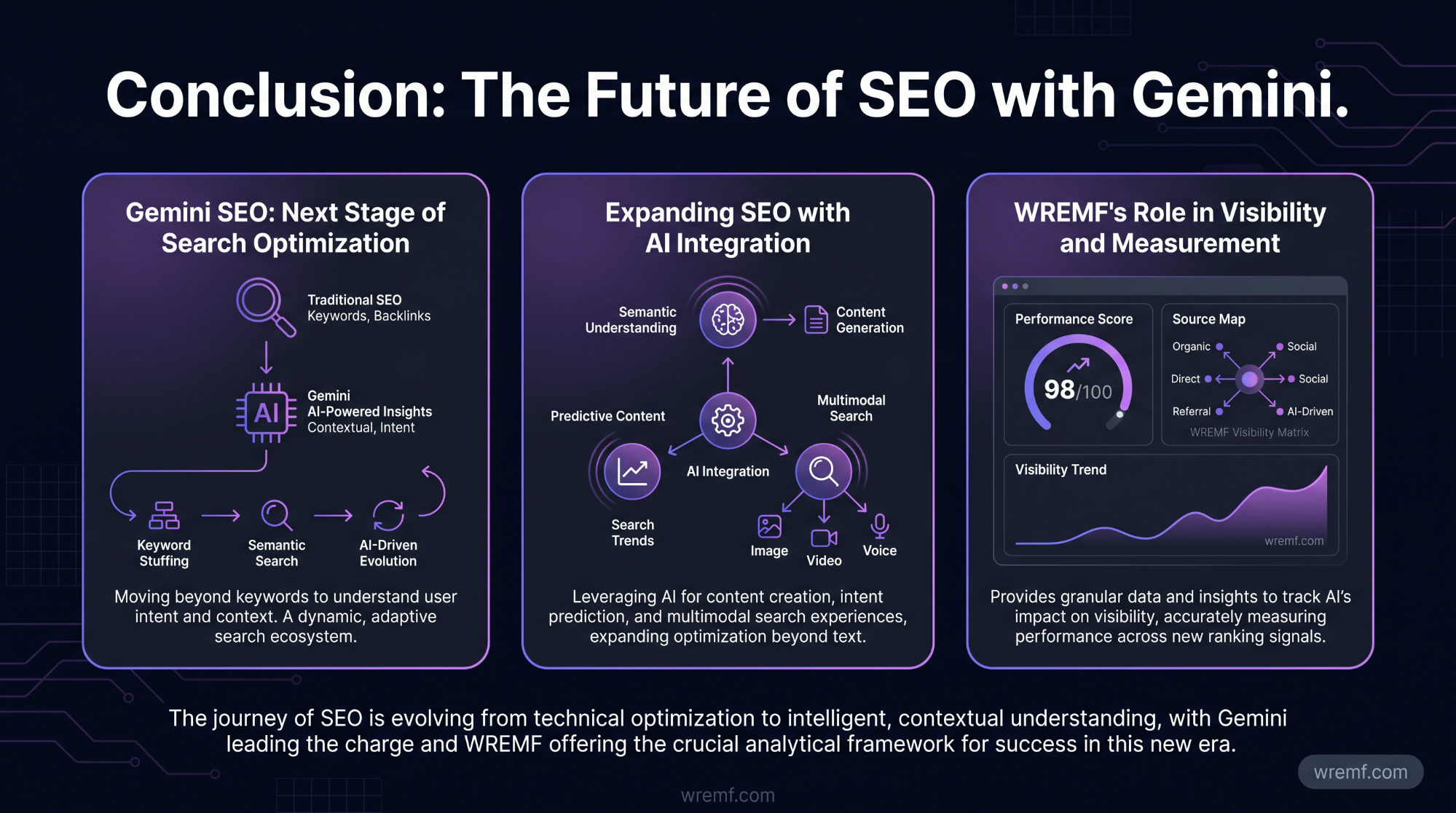
Gemini SEO is the next stage of search optimization for teams that need visibility across Google Gemini, AI Overviews, AI Mode, and AI-powered search. The strongest strategy does not abandon SEO. It expands SEO with answer engine optimisation, Generative Engine Optimization, structured data, entity clarity, prompt tracking, source citation monitoring, competitor visibility, and AI traffic attribution. WREMF helps teams turn this work into a measurable system across Gemini and other AI engines. To move from manual testing to repeatable AI visibility reporting, explore the WREMF platform suite or talk to the WREMF agency team.
Related reading
- Gemini Optimization: The Complete Guide to Google Gemini Visibility, AI Overviews, and AI Search
- How to Get Cited by Perplexity: Guide to Perplexity Citations, AI Search Visibility, and Source Authority
- How to Appear in Google AI Overviews
- SEO for Google AI Overviews: The Complete Guide to AI Search Visibility, Citations, and Organic Traffic