Gemini Optimization: The Complete Guide to Google Gemini Visibility, AI Overviews, and AI Search
Learn how to improve your brand's visibility in Google Gemini and AI search. Discover optimization strategies, including content clarity, entity authority, and technical SEO.
By WREMF Team · 2026-08-22
Gemini optimization is the practice of enhancing brand visibility in Google Gemini, Google Search, AI Overviews, and related platforms. It involves improving content clarity, establishing entity authority, ensuring technical accessibility, and creating trusted sources. It differs from SEO and AEO by focusing on AI visibility through AI-generated responses. Effective Gemini optimization combines search engine optimization, structured data, and AI visibility measurement. The goal is to ensure your brand is easily understood, retrieved, cited, and recommended by Google's AI systems.
Key takeaways
- Gemini optimization enhances AI visibility through structured content and entity authority.
- Effective Gemini optimization requires clear definitions, consistent signals, and trusted sources.
- Combining SEO, AEO, and Gemini strategies improves brand presence in Google Gemini.
- Integrating technical SEO and schema markup ensures AI systems can access and index content.
- Consistent entity authority across web and AI platforms supports Gemini brand recognition.
Gemini Optimization: The Complete Guide to Google Gemini Visibility, AI Overviews, and AI Search
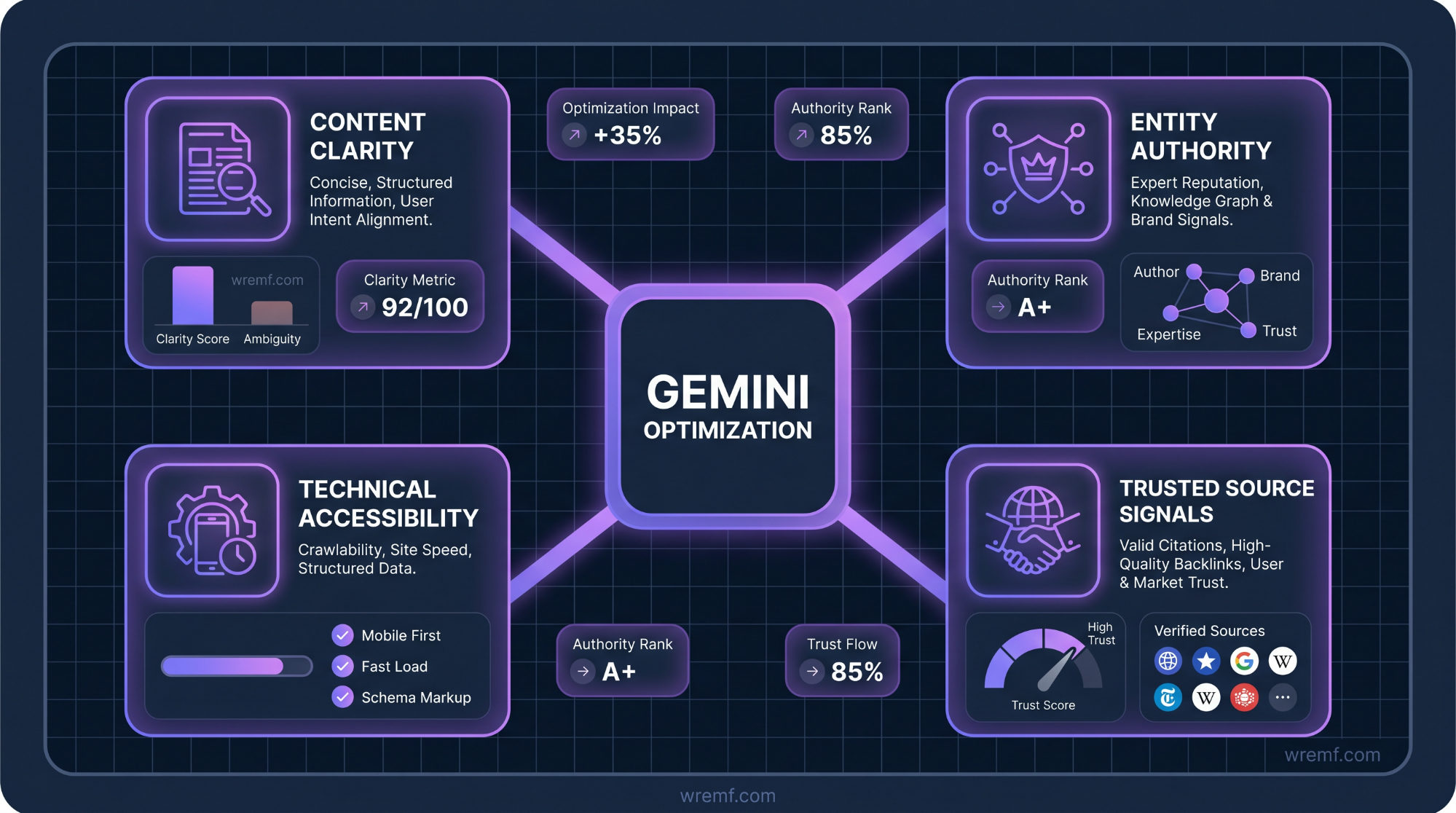
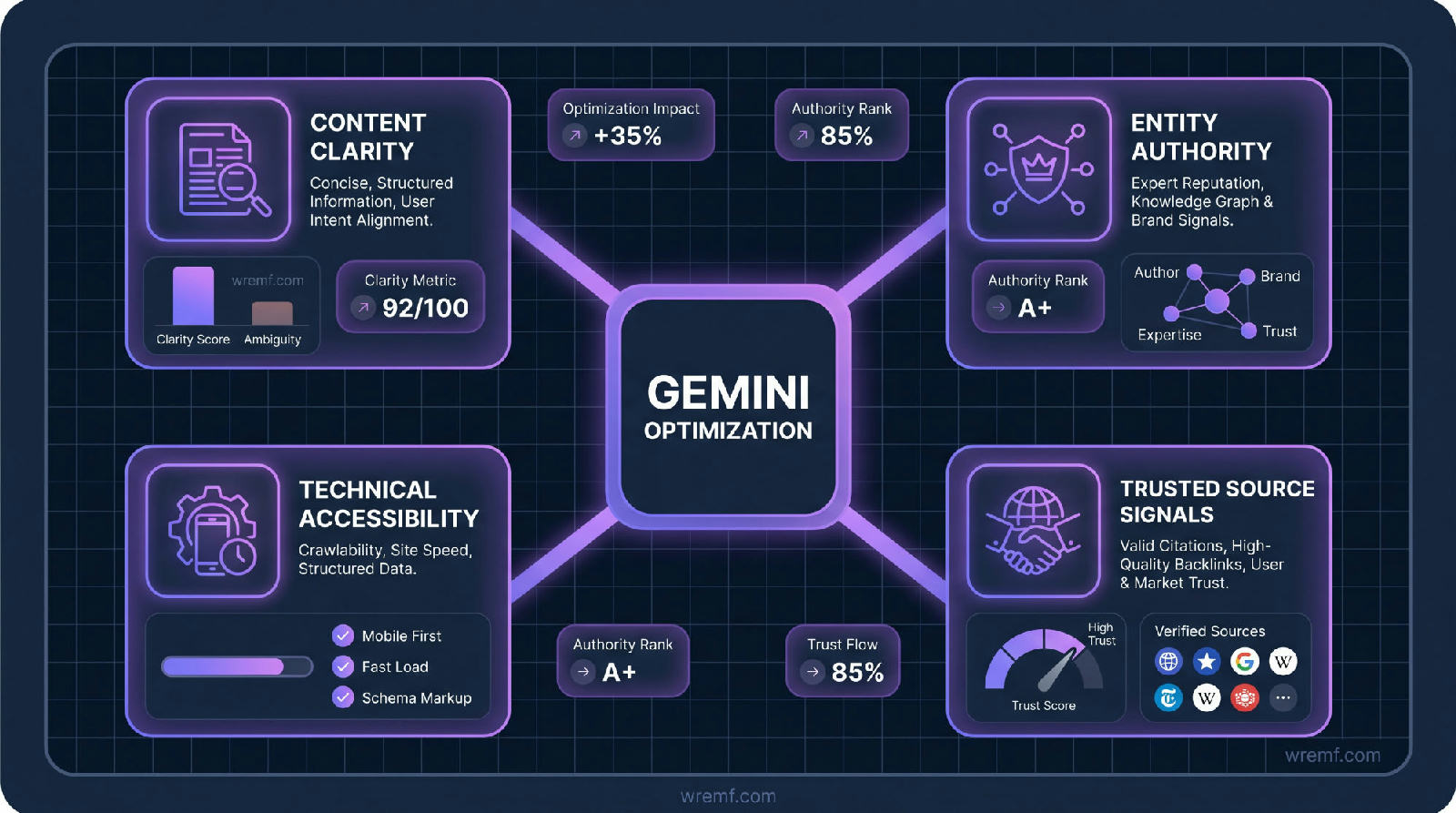
Gemini optimization is the process of improving how your brand appears in Google Gemini, Google Search, AI Overviews, AI Mode, and related AI discovery surfaces. Google describes Gemini as an interface to a multimodal large language model that can work across text, audio, images, and more, which means brand visibility now depends on content clarity, entity authority, technical accessibility, and trusted source signals. (Gemini) This guide explains how Gemini optimization works, how it differs from SEO, AEO, and Generative Engine Optimization, and how to measure visibility through prompts, citations, competitors, and AI traffic. WREMF helps B2B teams track, improve, and prove AI visibility across Gemini and other answer engines. Use this page as a practical roadmap for building Gemini-ready visibility.
What Is Gemini Optimization?
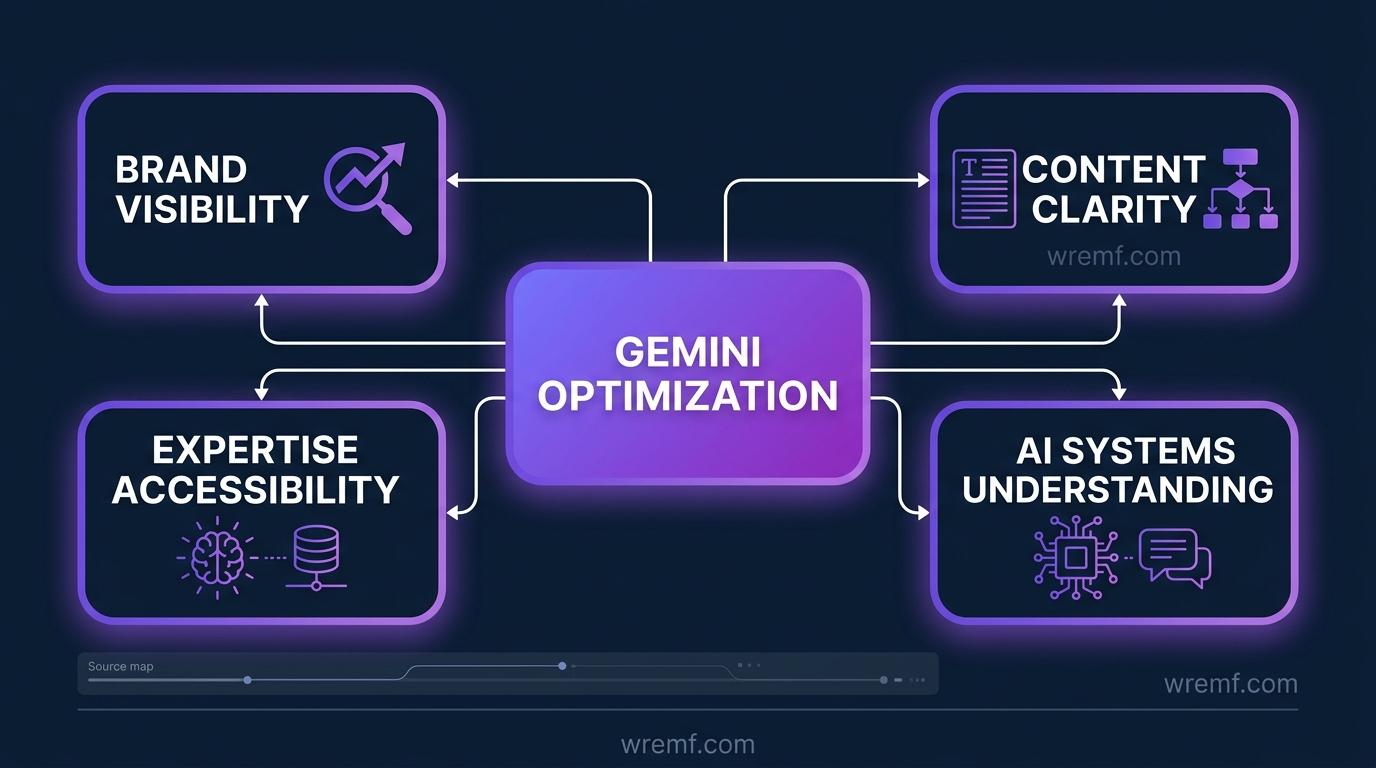
Gemini optimization is the practice of making your brand, content, products, and expertise easier for Google Gemini and Google AI systems to understand, retrieve, cite, and recommend. The outcome is stronger brand visibility across Google Gemini, Google Search, AI Overviews, AI Mode, Google Workspace, and other AI discovery surfaces.
Gemini optimization is not only prompt writing. It is a full visibility discipline that combines search engine optimization, answer engine optimisation, Generative Engine Optimization, structured data, entity authority, and AI visibility measurement. A brand can publish useful pages and still be hard for Gemini AI to summarise if the content lacks clear definitions, consistent entity signals, crawlable source pages, and trusted citations.
Google Gemini is Google’s AI assistant and model ecosystem for reasoning, writing, planning, coding, search assistance, and multimodal tasks. Gemini AI matters for marketers because it sits close to Google Search, Google AI features, Google Workspace, Android, Google Assistant-style experiences, and future agentic reasoning workflows.
AI visibility is the measurable presence of a brand inside AI-generated responses, citations, summaries, recommendations, comparisons, and follow-up answers. AI visibility matters because B2B buyers increasingly ask AI models to explain categories, compare vendors, shortlist tools, and summarise trusted sources before they visit a website.
Gemini optimization works by strengthening five connected layers:
Search engine accessibility, so Google Search can crawl, render, index, and understand your pages
Answer-first content, so Gemini AI can extract concise, useful answers
Structured Data and schema markup, so Google AI can interpret entities and page meaning
Source consistency, so reputable sources describe your brand accurately
AI visibility tracking, so you can measure AI mentions, citation patterns, competitor visibility, and referral traffic
WREMF helps teams turn Gemini optimization into a measurable workflow through the WREMF platform suite, which tracks AI visibility across Google Gemini, ChatGPT, Claude, Perplexity, Copilot, DeepSeek, Grok, Meta AI, Mistral, and other AI discovery surfaces.
DID YOU KNOW: Google Search Central explains that AI features such as AI Overviews and AI Mode are part of Google Search experiences for site owners, which means Gemini optimization should build on strong search quality, crawlability, and content usefulness. (Google for Developers)
KEY TAKEAWAY: Gemini optimization helps your brand become easier for Google Gemini, Google AI, and AI-powered search experiences to understand, retrieve, cite, and recommend.
The next step is understanding how Gemini optimization connects with SEO, AEO, and GEO without confusing them.
Gemini Optimization vs SEO, AEO, and Generative Engine Optimization
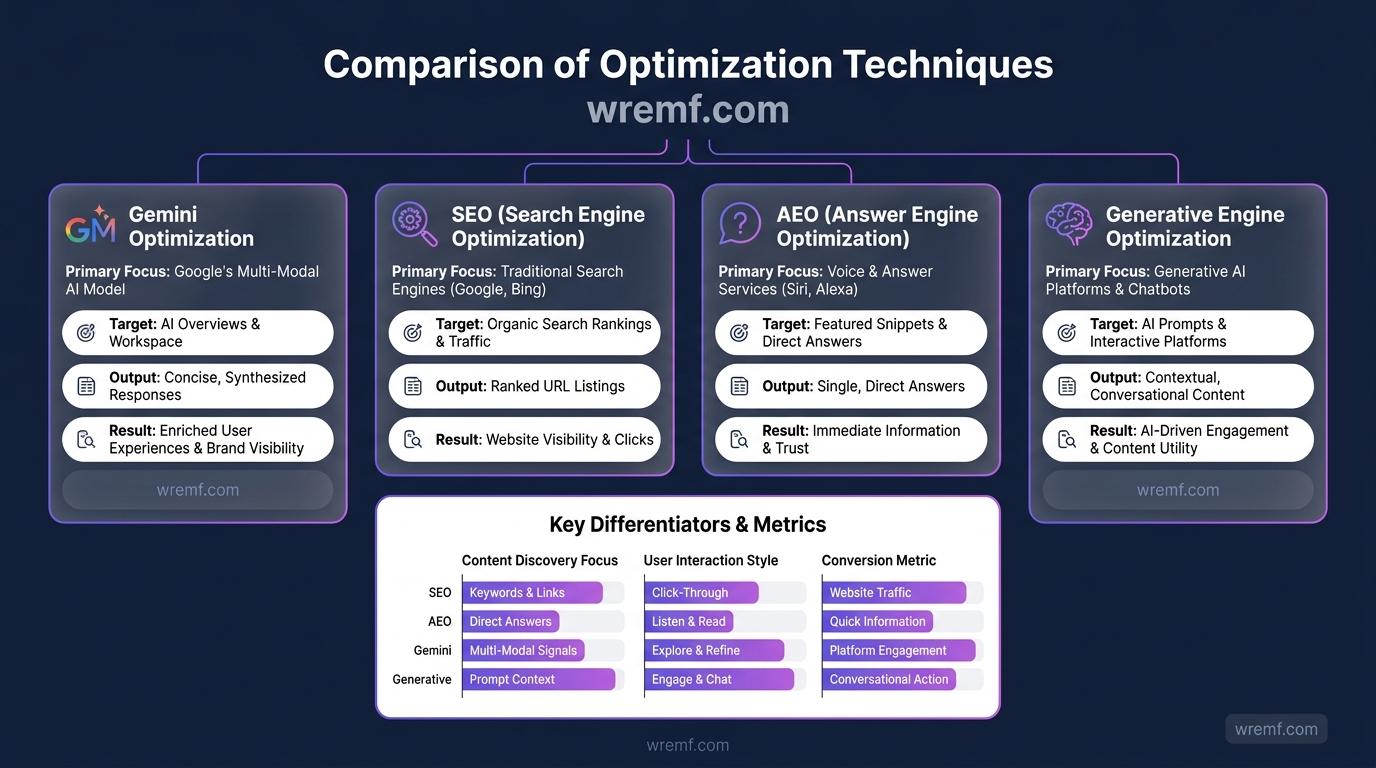
Gemini optimization overlaps with SEO, AEO, and Generative Engine Optimization, but each discipline solves a different visibility problem. SEO improves search engine rankings, AEO improves answer extraction, GEO improves visibility in AI-generated responses, and Gemini optimization applies those ideas to Google Gemini and Google AI search surfaces.
Search engine optimization is the process of improving a website so a search engine can crawl, index, understand, and rank its content. Search engine optimization still matters because Google Search remains a major discovery system and a likely source layer for AI Overviews, AI Mode, and Gemini AI responses.
Answer engine optimisation is the practice of structuring content so answer engines can extract direct, useful answers. AEO matters for Google Gemini because AI Responses often need concise definitions, numbered steps, comparison tables, examples, and clear summaries.
Generative Engine Optimization is the practice of improving visibility inside AI-generated responses from Google Gemini, ChatGPT, Claude, Perplexity, Copilot, and other AI models. Generative Engine Optimization matters because AI-generated responses can mention, cite, compare, or recommend a brand without displaying a traditional search engine results page.
| Discipline | Primary Goal | What It Measures | What It Misses | Best Fit |
|---|---|---|---|---|
| SEO | Improve rankings and organic traffic in a search engine | Rankings, clicks, impressions, CTR, crawlability, backlinks | AI mentions, citation patterns, AI recommendation visibility | Teams improving Google Search performance |
| AEO | Make answers easy to extract | Definitions, snippets, FAQ answers, structured content, answer-first sections | Cross-engine AI share of voice and competitor AI mentions | Teams targeting direct answers and conversational queries |
| GEO | Improve presence in AI-generated responses | AI mentions, citations, prompt coverage, source influence, brand recommendations | Classic search engine ranking depth | Teams tracking visibility across AI models |
| Gemini optimization | Improve visibility in Google Gemini and Google AI surfaces | Gemini AI mentions, AI Overviews visibility, AI Mode presence, Google Search citations, source consistency | Non-Google answer engines unless tracked separately | Teams focused on Google AI visibility |
| AI visibility | Measure brand presence across AI discovery surfaces | Mentions, citations, competitors, AI share of voice, referral traffic | Full execution unless paired with strategy | Teams reporting AI search performance |
The key difference between SEO and GEO is the unit of measurement. SEO usually asks where a page ranks. GEO asks whether an AI system mentions, cites, summarises, or recommends the brand. Gemini optimization asks that question specifically for Google Gemini, Google AI, Google Search, AI Overviews, AI Mode, Google Workspace, Google Business Profile, and other Google ecosystem surfaces.
In real B2B buying journeys, search engine ranking and AI visibility can diverge. A brand may rank for a keyword in Google Search but fail to appear when a user asks Google Gemini for a vendor shortlist, a comparison, a recommendation, or a step-by-step buying guide. That gap is why rank tracking alone is not enough.
IMPORTANT: Rankings alone do not prove Gemini visibility because AI models can use different prompts, sources, summaries, and answer formats from the standard search engine results page.
KEY TAKEAWAY: Gemini optimization connects SEO, AEO, and GEO into a Google-specific workflow for improving visibility across Google Gemini, AI Overviews, AI Mode, and Google Search.
To build that workflow, you need to understand how Google Gemini processes information and why source clarity matters.
How Google Gemini Processes Information Through AI Models, Search, and Grounding
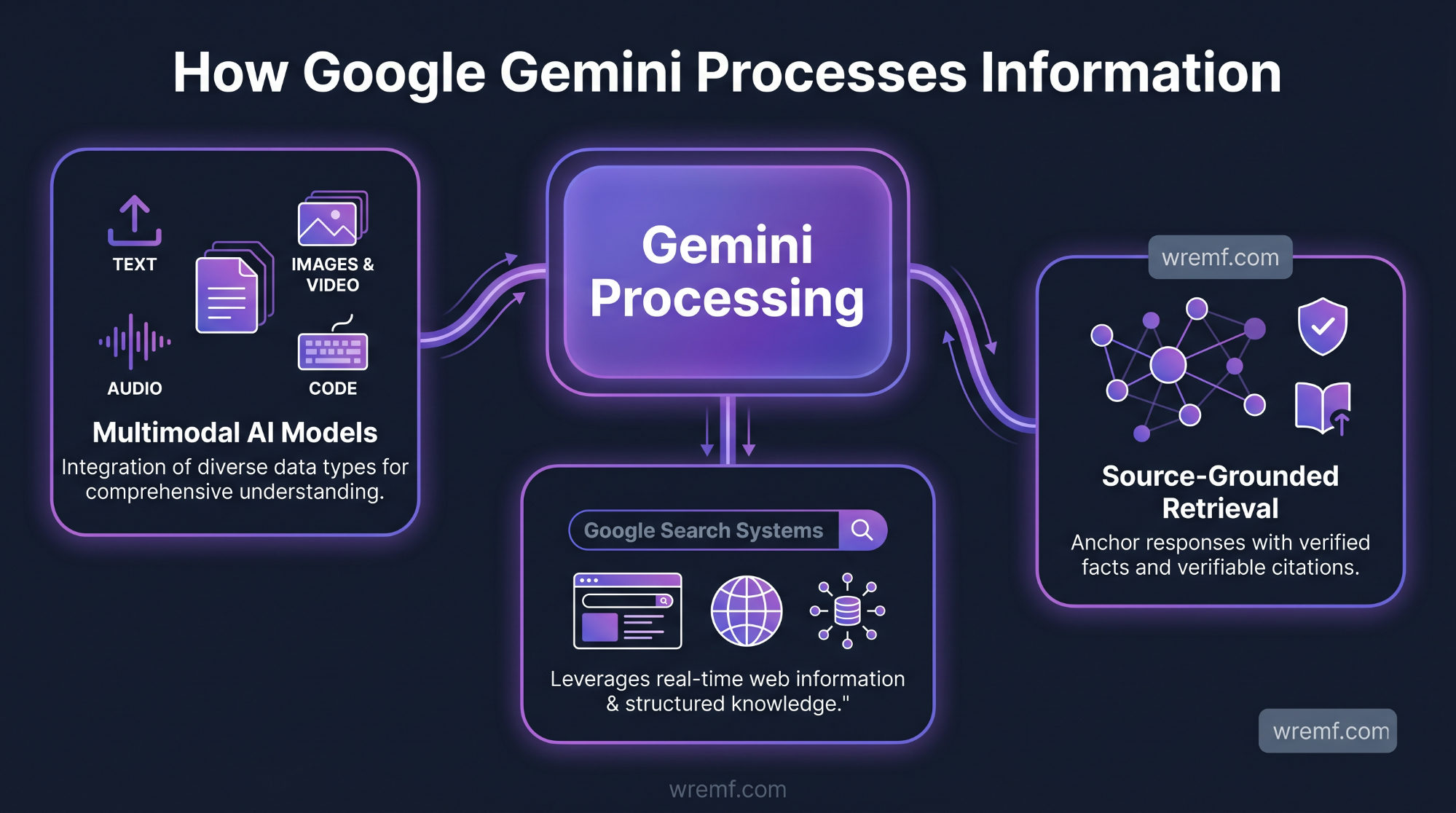
Google Gemini processes information through multimodal AI models, Google Search systems, and source-grounded retrieval experiences. Gemini optimization works best when your content can be found by Google Search, understood by Google AI, and verified through consistent sources.
AI models are systems trained to recognise patterns, interpret inputs, and generate outputs from data. AI models matter for Gemini optimization because Google Gemini AI models process meaning, context, source relationships, multimodal signals, and user intent rather than only matching keywords.
Google AI is the wider set of Google systems, products, and research capabilities that power experiences such as Gemini, AI Overviews, AI Mode, Workspace AI features, and multimodal search. Google AI matters because Gemini optimization is connected to more than one interface.
AI Overviews are Google Search features that provide AI-generated snapshots with key information and links for deeper exploration. AI Overviews matter because they can shape brand discovery before a user clicks a website result. Google says AI Overviews can help users find information faster by providing an AI-generated snapshot with links to dig deeper. (Google Help)
AI Mode is Google’s AI search experience for longer, more complex, and follow-up-driven queries. Google described AI Mode as a more advanced AI Search experience with reasoning, multimodality, follow-up questions, and helpful links to the web. (blog.google)
Grounding is the process of connecting AI-generated responses to retrieved information, reliable sources, or real-world context. Grounding matters because Google Gemini and other AI search engines need usable source material when answering factual, commercial, technical, and local queries.
Natural language processing is the AI capability that helps systems understand and generate human language. Natural language processing matters for Gemini optimization because buyers do not only search short keywords. They ask complete conversational queries such as “Which AI visibility tool is best for a B2B SaaS team that needs white-label reporting?”
Self-attention mechanisms are core techniques in transformer model-based neural network architecture that help AI systems weigh relationships between words, entities, and context. The practical marketing implication is simple: unclear content focus, scattered entities, and inconsistent terminology make it harder for AI systems to connect a page to a user’s intent.
Training Data is information used during model training. Training Data matters because older public information can influence how AI models understand brands, although search grounding, live retrieval, and source citations can supplement or update model knowledge. For Gemini optimization, brands should assume both historical public information and current crawlable sources matter.
Graphics Processing Units and Tensor Processing Units are hardware systems used to accelerate AI computation. They are not direct marketing levers for Gemini optimization, but they explain why large AI models can process huge amounts of data, reason over multimodal inputs, and generate complex AI Responses at scale.
KEY TAKEAWAY: Google Gemini visibility depends on AI models, Google Search retrieval, grounding, multimodal understanding, and the clarity of the sources available about your brand.
Once the system context is clear, the next task is building content Gemini can interpret and reuse.
How to Optimize Content for Google Gemini
The most effective way to optimize content for Google Gemini is to answer real conversational queries with clear, structured, source-backed content. Gemini AI needs direct answers, complete context, entity clarity, and useful evidence to include your brand in AI-generated responses.
Content optimization is the process of improving content so it better satisfies user intent, search engine interpretation, and AI answer extraction. Content optimization matters for Gemini because AI-generated responses often need complete, self-contained answers rather than thin keyword pages.
Structured content is content organised with clear headings, concise definitions, lists, tables, examples, and consistent terminology. Structured content matters because AI models and search systems need predictable sections to extract definitions, comparisons, workflows, and decision criteria.
Google Search Central states that Google’s automated ranking systems are designed to prioritise helpful, reliable, people-first information, not content created primarily to manipulate search engine rankings. That guidance matters for Gemini optimization because Google AI needs genuinely useful source material, not only keyword repetition. (Google for Developers)
A Gemini-ready content strategy should include:
A direct answer within the first 100 to 150 words
One clear primary intent per page
H2 sections that answer real user prompts
Definitions for important entities and concepts
Comparison tables for decisions with three or more options
Step-by-step workflows for implementation queries
Evidence from authoritative sources where claims need support
Internal links to source-of-truth pages
FAQ answers written as standalone responses
Clear update cycles for fast-changing AI search topics
Content structure optimization is especially important for long-tail conversational intent. A user may not ask “Gemini SEO.” They may ask, “How do I get my company recommended by Google Gemini when people ask for the best project management tool?” That query includes category, brand recommendation intent, and an implied comparison.
Conversational queries are natural language questions, instructions, or tasks asked in full context. Conversational queries matter because Gemini AI, ChatGPT, Claude, Perplexity, and other answer engine systems respond to complete tasks, not only keyword fragments.
Content creation for Gemini should prioritise source-of-truth assets. A source-of-truth asset is a stable page that defines your product, category, methodology, pricing, features, use cases, limitations, and proof points. For WREMF, useful source-of-truth assets include the AI visibility methodology, the AI visibility platform suite, and the sample AI visibility report.
TIP: Write each major section so it can answer one prompt without surrounding context. AI systems frequently extract chunks, so every chunk should include the subject, answer, and implication.
KEY TAKEAWAY: Gemini content optimization works when pages answer conversational queries with structured content, clear entities, source-backed claims, and complete topical coverage.
Strong content still needs a technical foundation that allows Google Search and Google AI to access and understand it.
Technical SEO, Schema Markup, Structured Data, and AI Crawler Accessibility
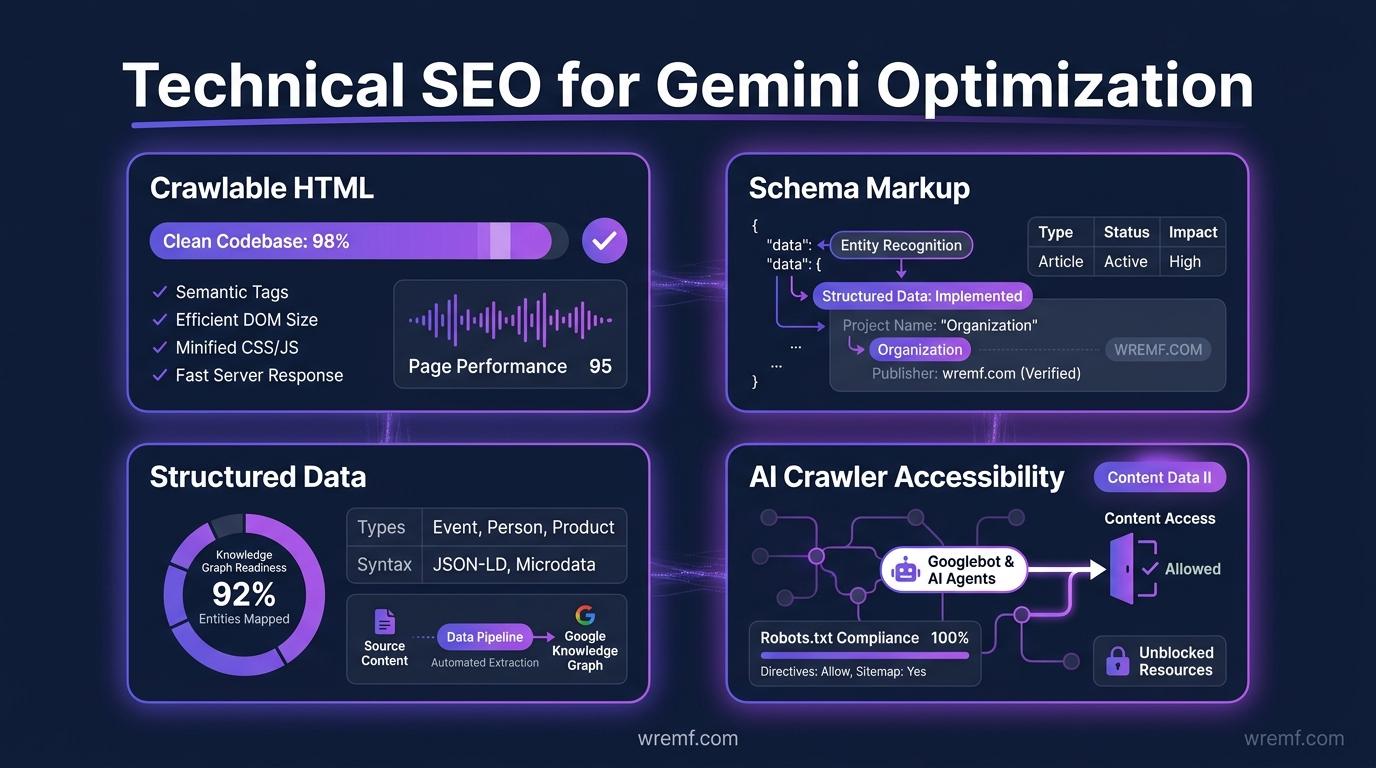
Technical Gemini optimization ensures that Google Search and Google AI can access, render, index, and interpret your content. Without technical accessibility, even strong content can remain invisible to Gemini AI, AI Overviews, and answer engine systems.
AI crawler accessibility is the ability of search and AI systems to access important website content without being blocked by robots rules, login walls, broken rendering, noindex tags, or inaccessible scripts. AI crawler accessibility matters because Gemini optimization depends on discoverable pages and reliable source extraction.
Schema markup is structured data added to webpages to help search engines understand page content and entity meaning. Schema markup matters because Google uses structured data to understand the content of a page and gather information about people, companies, products, and other entities. (Google for Developers)
Structured Data is machine-readable information that clarifies the meaning of visible content. Structured Data matters because Google Search can use it to support rich results and better understand content types, although it does not guarantee rankings, rich results, AI Overviews, or Gemini citations.
JSON-LD schema markup is Google’s recommended structured data format when a site setup allows it. JSON-LD schema markup matters because it is easier to maintain at scale than formats embedded throughout page markup. (Google for Developers)
Useful schema types for Gemini optimization may include:
Organization schema for brand identity
Article schema for educational pages
Product schema for software and product pages
LocalBusiness schema for local entities
FAQ schema when implemented on the front end
HowTo schema for process-driven content
Review-related structured data where eligible and compliant
Breadcrumb schema for site hierarchy
Google's Rich Results Test helps teams test publicly accessible pages and see which rich results can be generated by the structured data on a page. Google's Structured Data Markup Helper can also help non-technical teams understand how page elements relate to schema markup. (Google)
A technical Gemini readiness checklist should include:
Crawlable HTML for core content
Correct indexation and canonical rules
Clean sitemap coverage for content libraries
Internal links between related pages
Accurate title tags and meta descriptions
Consistent Organization schema
Valid Article, Product, FAQ, HowTo, or LocalBusiness schema where relevant
Fast page loading and stable rendering
Accessible documentation and knowledge base content
No conflict between visible content and schema markup
Knowledge base content is especially useful for B2B software companies. A knowledge base can answer implementation queries, integration questions, pricing questions, troubleshooting prompts, and comparison prompts. If the knowledge base is crawlable and internally linked, it can become a source for both Google Search and AI Responses.
WREMF’s GEO audit feature helps teams review AI crawler accessibility, structured content, technical SEO, rendering checks, entity clarity, and prompt fit. A GEO audit should not stop at generic SEO diagnostics. It should ask whether the page can be understood, trusted, and used by AI discovery surfaces.
KEY TAKEAWAY: Technical Gemini optimization depends on crawlable content, accurate schema markup, Structured Data consistency, validated pages, and clean source-of-truth architecture.
Technical clarity helps Google understand your site, but authority signals help Gemini decide whether your brand should be trusted.
Entity Authority, Knowledge Graph Signals, and Brand Mentions
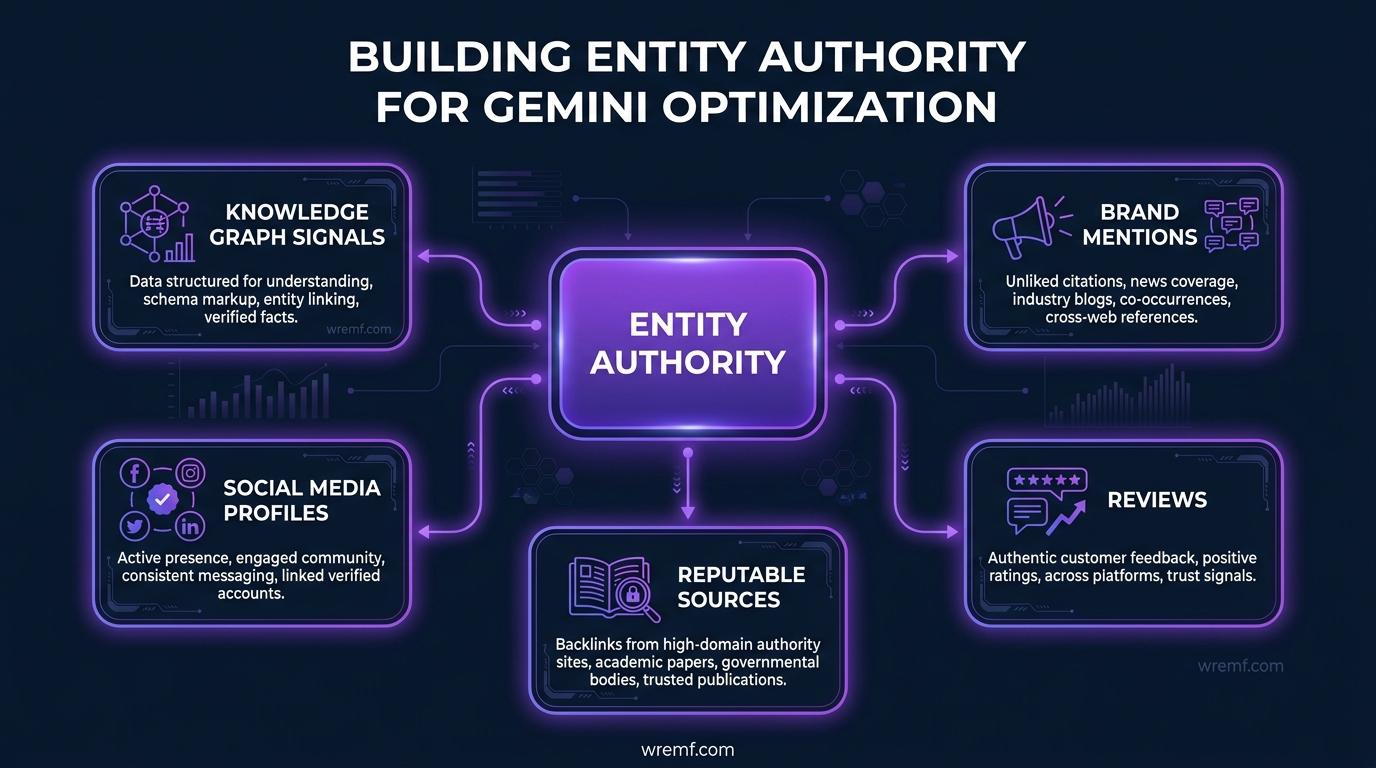
Entity authority helps Google Gemini understand who your brand is, what your brand does, and which topics your brand is connected to. Gemini optimization improves when your website, Google Knowledge Graph signals, brand mentions, social media profiles, reviews, and reputable sources reinforce the same identity.
Entity authority is the strength and consistency of a brand’s identity across public sources. Entity authority matters because AI systems need confidence that a brand is real, relevant, and connected to a specific market category.
The Knowledge Graph is Google’s database of facts about people, places, and things. Google says Knowledge Graph information can appear in search results and helps systems surface publicly known factual information when useful. (Google Help)
The Google Knowledge Graph matters for Gemini optimization because it helps Google connect entities, topics, categories, products, people, locations, and organisations. A clearer entity profile can reduce inaccurate AI mentions and support better brand visibility.
Knowledge Panels are Google Search information panels for recognised entities. Knowledge Panels matter because they reflect how Google understands certain people, brands, organisations, and places. A Knowledge Panel is not required for every B2B SaaS company, but consistent entity signals still matter.
Brand mentions are references to your brand across websites, directories, articles, reviews, social media, partner pages, and public databases. Brand mentions matter because repeated associations across reputable sources can strengthen semantic relevance and citation profiles.
Unlinked brand mentions are brand references that do not include a hyperlink. Unlinked brand mentions may not work like backlinks in classic search engine optimization, but they can still reinforce entity understanding when they appear on authoritative sources, industry articles, reviews, event pages, podcasts, and social media profiles.
Citation profiles are the set of sources that mention, cite, describe, or validate your brand. Citation profiles matter because Gemini AI and other answer engines may rely on third-party sources when summarising a category or comparing vendors.
A practical entity authority workflow includes:
Define your brand category consistently across website pages
Use the same company name across social media profiles
Keep executive, product, pricing, and feature information accurate
Maintain a crawlable about page and methodology page
Build reputable source mentions through PR, partnerships, reviews, and directories
Clean inconsistent listings and outdated descriptions
Strengthen internal links between product, methodology, and comparison pages
Monitor AI mentions for inaccurate or outdated claims
In practical AI visibility audits, teams frequently discover that AI systems describe the company using outdated positioning from old directories, social media profiles, or funding announcements. Gemini optimization requires source consistency because Google Gemini can only work with the information it can access and trust.
KEY TAKEAWAY: Entity authority strengthens Gemini optimization by making your brand identity consistent across your website, Google Knowledge Graph signals, social media profiles, reviews, brand mentions, and reputable sources.
For local and service businesses, Google Business Profile adds another important entity layer.
Local Gemini Optimization, Google Business Profile, Reviews, and Maps
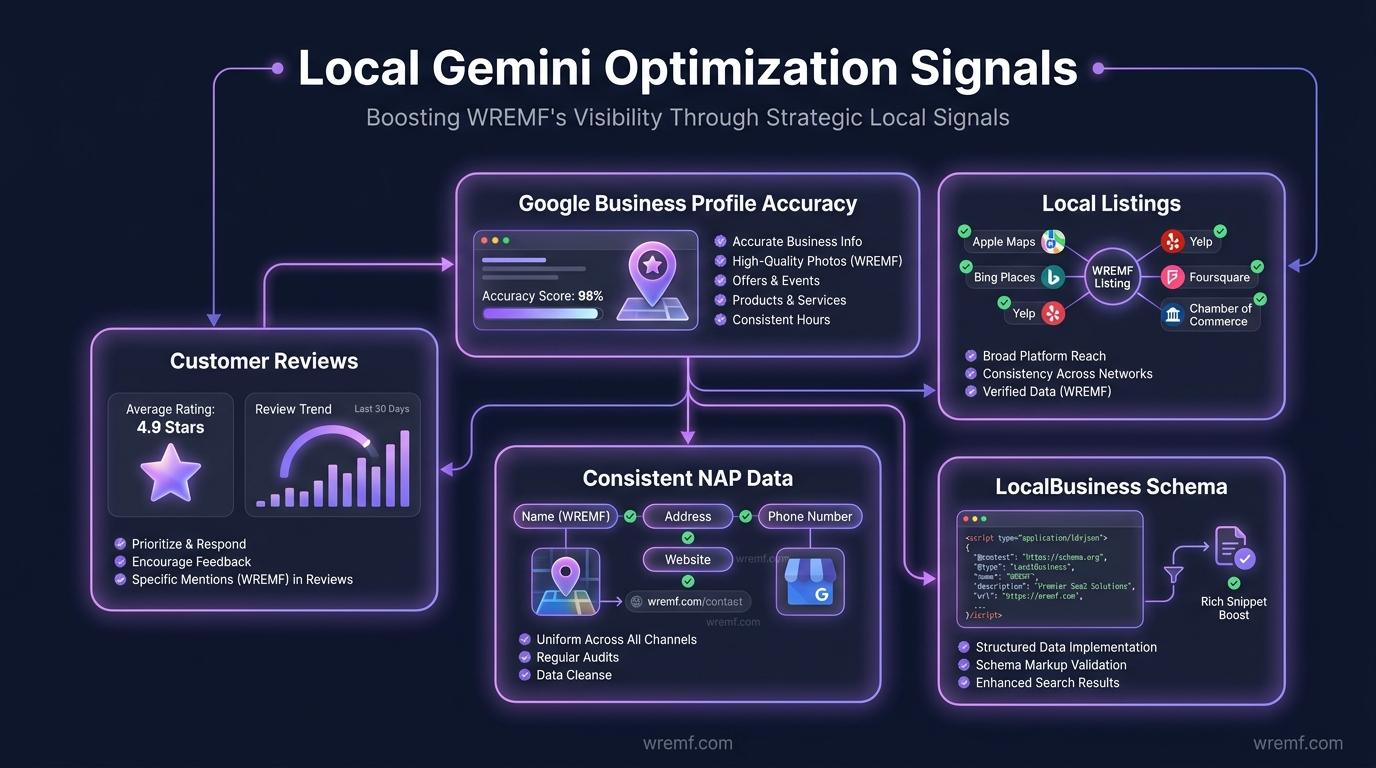
Local Gemini optimization improves how Google Gemini and Google Search understand a business in location-based, service-based, and “near me” queries. The most important local signals include Google Business Profile accuracy, customer reviews, local listings, LocalBusiness schema, and consistent NAP data.
Google Business Profile is Google’s business listing system for showing and managing business information in Search and Maps. Google says businesses can use a Business Profile to be discovered near customers, share updates, respond to reviews, and connect with customers on Google. (Google Business)
Google Business Profile matters for Gemini AI because local queries often depend on business category, location, hours, services, reviews, service areas, photos, and Google Maps reviews. For local companies, Gemini optimization should include both website content and business profile management.
NAP (Name, Address, Phone) is the standard local SEO term for consistent business contact information. NAP matters because inconsistent information across local listings, Google Business profiles, directories, and websites can weaken trust and create confusion.
Customer reviews are public user evaluations of a business, product, or service. Customer reviews matter because Google Maps reviews, sentiment, ratings, and review language can influence how users and AI systems understand a business’s quality, services, and reputation.
Review integration means connecting review signals to a broader local visibility strategy. Review integration matters because reviews should reinforce the service categories, locations, and customer outcomes described on the website and Google Business Profile.
A local Gemini optimization checklist includes:
Accurate Google Business Profile categories
Consistent NAP (Name, Address, Phone)
Complete services and service areas
Updated hours and contact information
LocalBusiness schema on relevant pages
Google Maps reviews that reflect real customer experiences
Local listings with consistent business descriptions
Location pages that answer local conversational queries
Social media profiles linked where appropriate
Clear policies for responding to customer reviews
Local SEO and Gemini optimization overlap but are not identical. Local SEO focuses on visibility in local search results, map packs, and local landing pages. Local Gemini optimization also considers how Google Gemini summarises the business when users ask AI-style queries such as “Which local coworking space is best for a two-person startup near Paris?”
For B2B SaaS companies, Google Business profiles may be less important than product documentation, category pages, and source citations. For agencies, clinics, coworking spaces, restaurants, legal services, local consultants, and multi-location businesses, Google Business Profile can be a central visibility asset.
KEY TAKEAWAY: Local Gemini optimization depends on Google Business Profile accuracy, Google Maps reviews, NAP consistency, LocalBusiness schema, customer reviews, local listings, and clear location-specific content.
Local visibility is one part of the ecosystem, but Gemini’s multimodal capabilities make content formats beyond text increasingly important.
Multimodal Content Optimization for Gemini AI
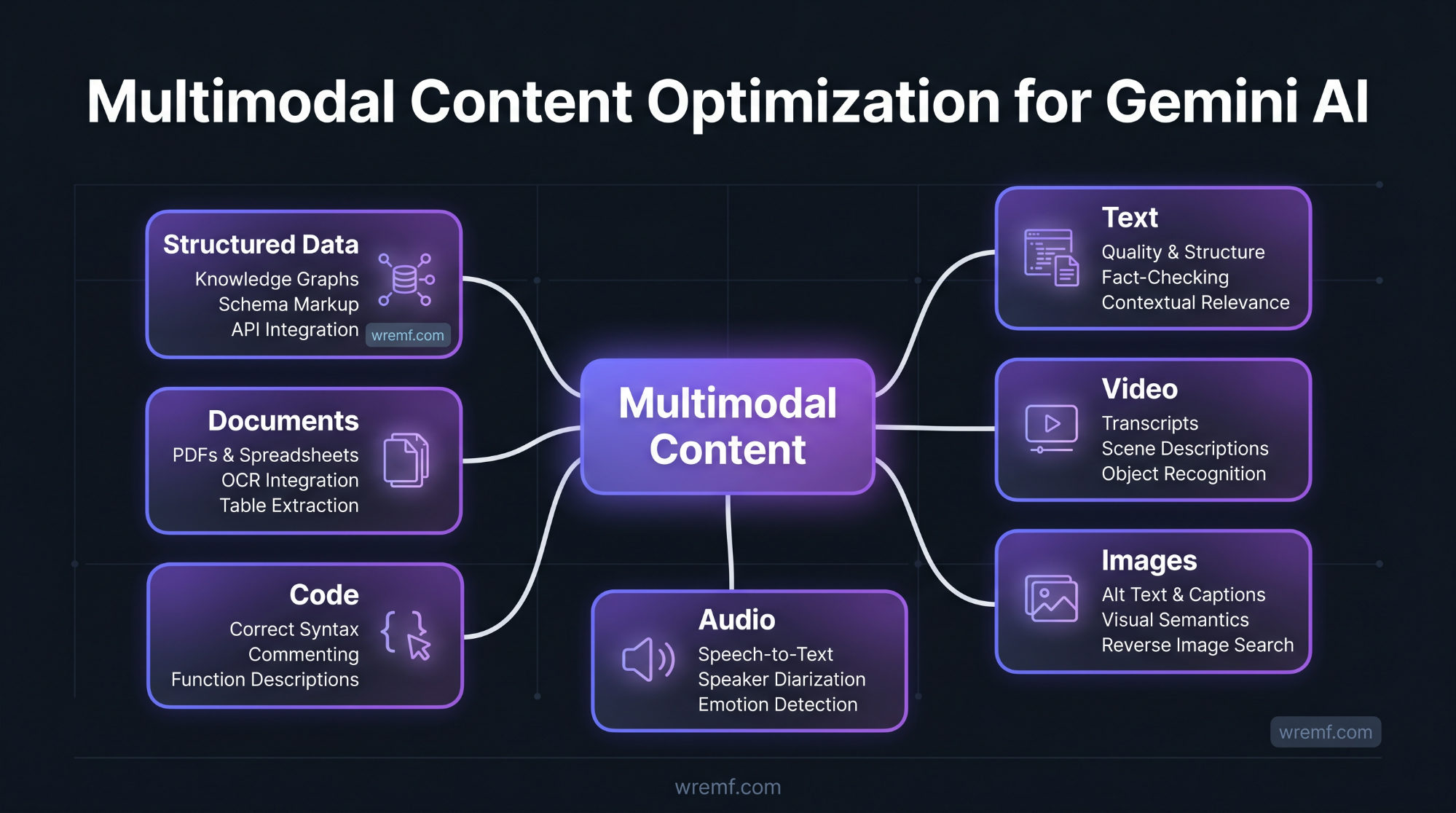
Multimodal content optimization helps Google Gemini understand brand information across text, video, images, audio, code, documents, and structured data. Gemini AI is multimodal, so visibility strategies should go beyond standard blog posts when the search intent includes visual, instructional, technical, or document-based information.
Multimodal content is content that exists across multiple formats, such as text, video, audio, images, PDFs, slides, code, and data files. Multimodal content matters because Google Gemini AI models can support reasoning across more than plain text.
Multimodal large language models are AI systems that can process and generate information across multiple input types. Multimodal large language models matter for Gemini optimization because users increasingly ask questions that combine screenshots, documents, code, products, locations, and voice prompts.
Google Lens shows why multimodal discovery matters. Google stated in 2025 that more than 1.5 billion people use Google Lens every month to search what they see, which signals that search behaviour is moving beyond typed keywords. (blog.google)
A multimodal Gemini optimization strategy can include:
YouTube transcripts and metadata for video understanding
Product videos with clear spoken summaries
Image filenames and surrounding text that clarify context
Accessible PDFs that can be parsed
Code documentation with structured examples
Product documentation written for direct extraction
Tables that explain pricing, features, and use cases
Google Workspace documents that maintain consistent brand facts
Knowledge base articles that answer long-tail support prompts
Google Workspace matters because Gemini is increasingly connected to Docs, Gmail, Sheets, Slides, Drive, and enterprise workflows. For B2B brands, Google Workspace content may influence internal knowledge work, sales enablement, customer documentation, and AI-assisted research, even when it is not public web content.
Content libraries are organised collections of pages, documents, articles, guides, videos, and knowledge base resources. Content libraries matter because Gemini optimization works better when related topics connect through a coherent system instead of isolated pages.
For technical companies, code and documentation also matter. Structuring code examples, API docs, release notes, and integration guides helps Gemini AI and other AI models answer developer questions with more accurate context.
WREMF supports technical workflows through API and MCP integrations, which are useful for teams that want to connect AI visibility tracking with internal dashboards, client portals, reporting workflows, and custom analysis systems.
KEY TAKEAWAY: Multimodal Gemini optimization extends brand visibility beyond text by making videos, documents, images, code, knowledge base content, and Google Workspace-related assets easier to understand.
The next layer is prompt optimization, because Gemini visibility depends on the actual questions users ask.
How to Optimize Gemini Prompts and Conversational Queries
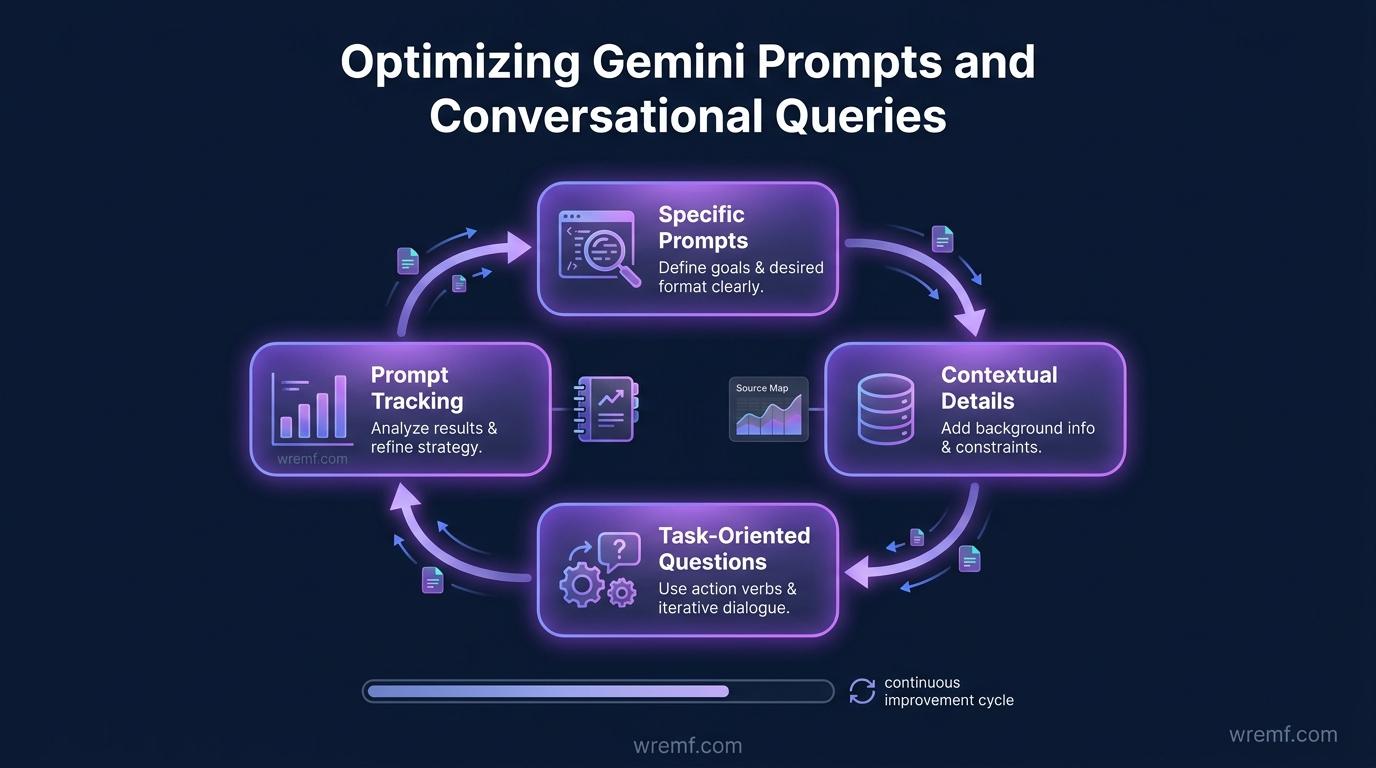
Gemini prompt optimization means writing prompts that are specific, contextual, and task-oriented so Gemini AI can return more useful answers. For brand visibility, prompt tracking matters more than prompt writing because you need to know how real buyers phrase questions about your category.
Prompt tracking is the process of monitoring natural language prompts across AI systems and recording whether a brand appears, is cited, is recommended, or is described accurately. Prompt tracking matters because AI visibility changes by prompt wording, user intent, location, engine, and source set.
A strong Gemini prompt usually includes:
The task
The audience
The context
The decision criteria
The desired format
The location or industry when relevant
Any exclusions or comparison needs
For example, a weak prompt is “best SEO tool.” A stronger prompt is “Compare AI visibility tools for a B2B SaaS marketing team that needs prompt tracking, source citation monitoring, competitor visibility, and white-label reporting.”
For Gemini optimization, teams should track prompts across the buying journey:
Definition prompts, such as “What is Gemini optimization?”
Comparison prompts, such as “Gemini optimization vs SEO”
Vendor prompts, such as “best AI visibility tools for B2B SaaS”
Service prompts, such as “best agencies for Generative Engine Optimization”
Local prompts, such as “best coworking space near me for startups”
Technical prompts, such as “how to add schema markup for AI visibility”
Risk prompts, such as “can AI search hallucinate brand facts?”
Pricing prompts, such as “how much does an AI visibility platform cost?”
AI generation tokens are units of text processed or generated by AI systems. AI generation tokens matter for operational cost and model limits, but they are not a direct ranking factor for Gemini optimization. For marketers, the practical focus should be prompt coverage, answer quality, citation patterns, and measurable AI visibility.
WREMF’s prompt intelligence feature helps teams monitor how different AI engines respond to important prompts. This matters because Google Gemini, ChatGPT, Claude, Perplexity, Copilot, and other answer engine systems can produce different recommendations for the same buyer question.
TIP: Do not track only one prompt. Track prompt clusters by awareness, comparison, buying intent, implementation, risk, local intent, and competitor alternatives.
KEY TAKEAWAY: Gemini prompt optimization improves individual outputs, while prompt tracking measures whether your brand appears across real conversational queries that buyers actually ask.
Prompt tracking shows what appears, but citation tracking explains why those answers appear.
AI Citations, Citation Patterns, and Source Citation Tracking
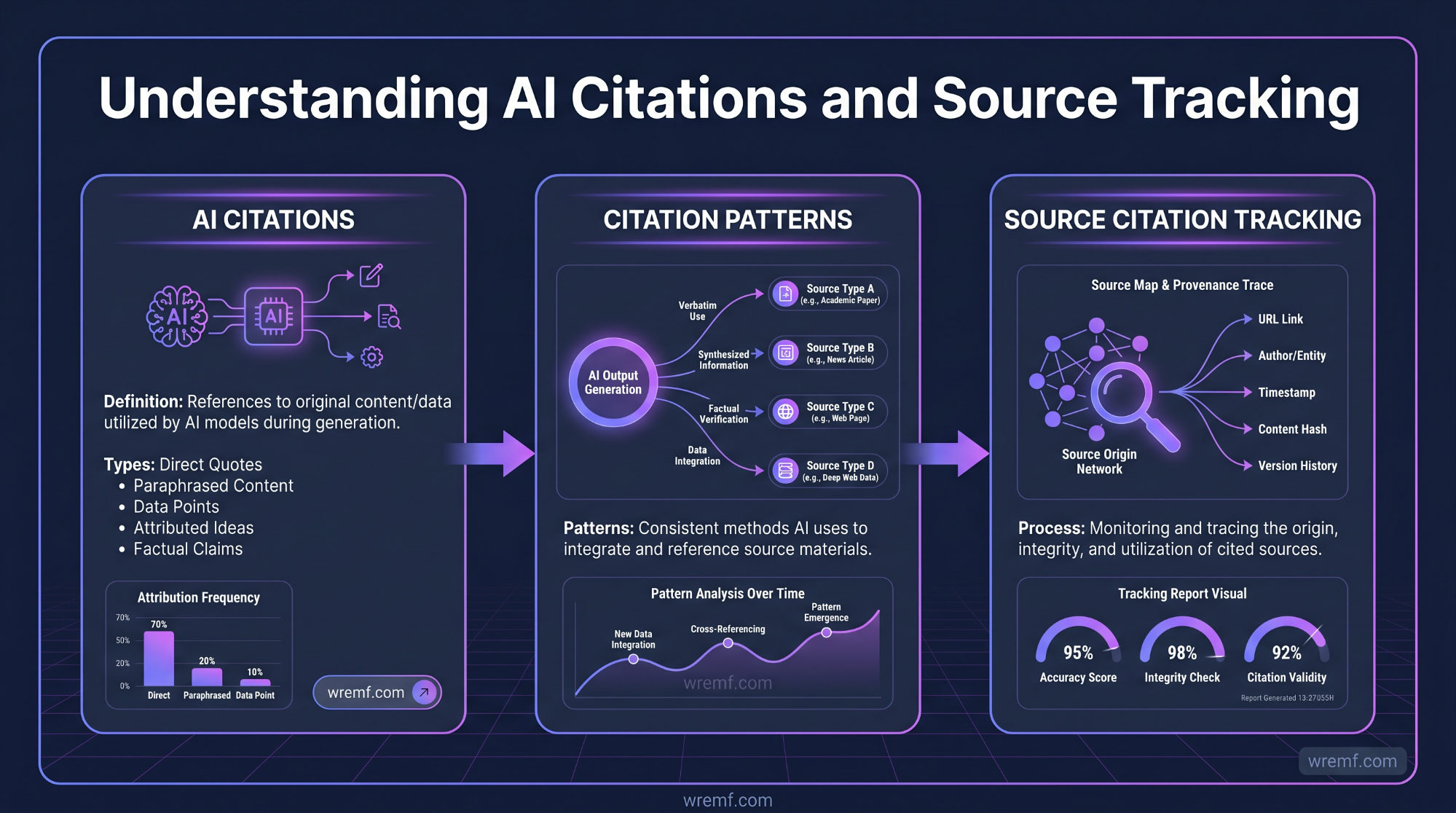
AI citations reveal which sources Gemini AI, AI Overviews, ChatGPT, Perplexity, and other answer engines use when answering prompts. Gemini optimization requires citation tracking because visibility often depends on source influence, not only owned website content.
AI citations are links, references, or source mentions used to support AI-generated responses. AI citations matter because they show which pages influence AI Answers and which sources users may trust after reading AI-generated summaries.
Source citations are the specific webpages, documents, directories, articles, reviews, or knowledge base pages used by AI systems as supporting material. Source citations matter because AI search engines may cite your website, a competitor page, a review platform, a news source, a directory, or a documentation page.
Citation Rate is the percentage of tracked prompts where a target brand, page, or source is cited. Citation Rate matters because it gives teams a measurable benchmark for source visibility across Google Gemini, Google Search AI features, ChatGPT, Claude, Perplexity, and other answer engine systems.
Citation patterns are repeated source choices across AI-generated responses. Citation patterns matter because they show which reputable sources dominate a topic. If the same third-party page appears in many AI-generated responses but your brand is absent from that page, the issue may be a citation profile gap rather than a content gap.
OpenAI states that ChatGPT search responses may include inline citations and source panels when search is used. This matters for Gemini optimization because AI search users are becoming more familiar with source-backed answers, not only generated summaries. (OpenAI Help Center)
A practical citation analysis should answer:
Which sources does Gemini cite for the category?
Which competitor pages appear repeatedly?
Does Google AI cite your owned source-of-truth pages?
Are social media profiles or directories reinforcing the right category?
Are unlinked brand mentions present in reputable sources?
Do outdated sources describe the brand incorrectly?
Which source gaps can be fixed through content, PR, partnerships, or directory cleanup?
Reputable sources are trusted websites, publications, directories, documentation pages, academic sources, government sources, review platforms, or recognised industry sources that support a claim. Reputable sources matter because AI models are more likely to use information that is clear, corroborated, and consistent.
WREMF’s source citation tracking helps teams identify which sources influence AI-generated responses, where competitors are cited, and which content or authority gaps should be prioritised.
KEY TAKEAWAY: Citation tracking shows which sources influence Gemini AI and other answer engines, making source consistency and citation profiles essential to AI visibility.
Once citations are visible, the next question is whether your brand is winning or losing against competitors.
Measuring Brand Visibility, Competitor Visibility, and AI Share of Voice
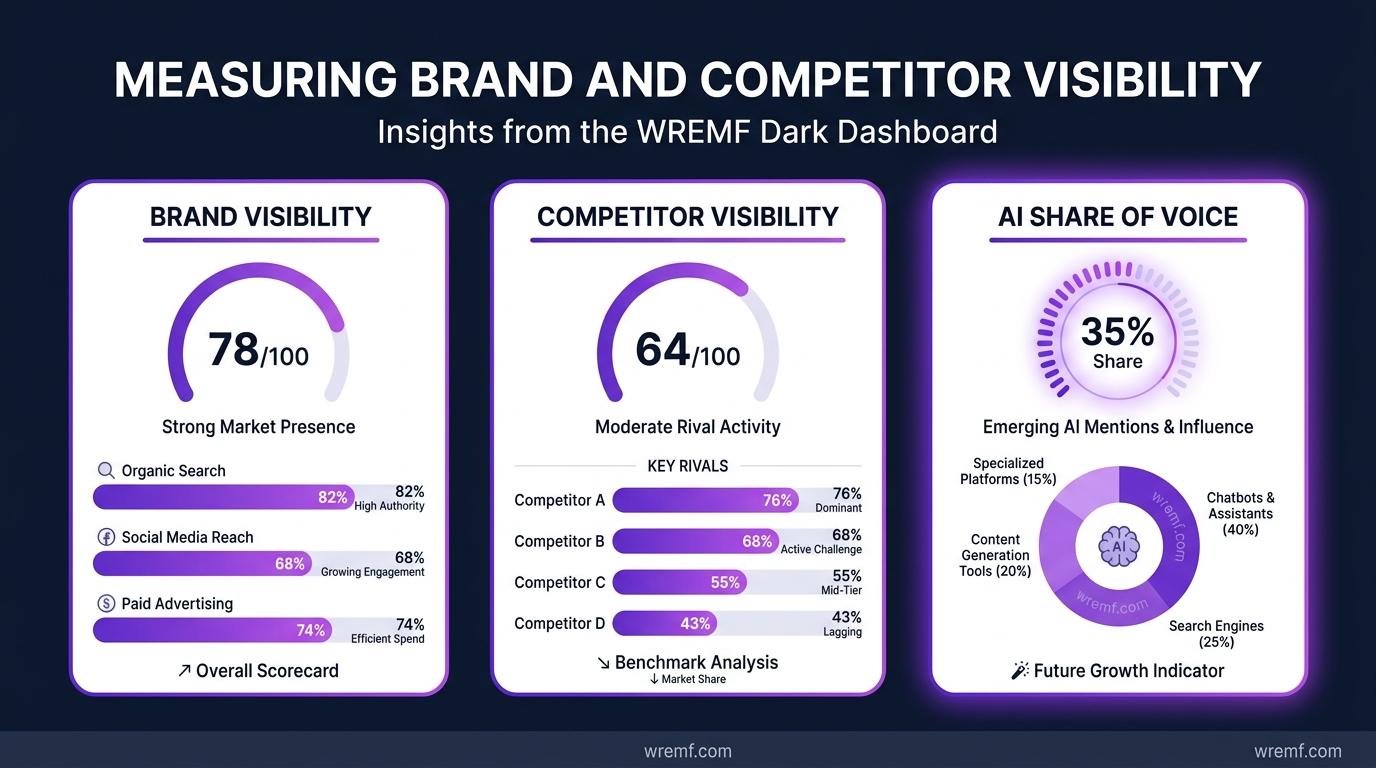
Brand visibility in Gemini optimization is measured by how often and how accurately your brand appears across AI prompts, citations, recommendations, summaries, and referral paths. Competitor visibility shows whether rival brands are winning the AI answers your buyers see.
Brand visibility is the measurable presence of a brand across search, AI-generated responses, social media, reviews, directories, and other discovery surfaces. Brand visibility matters because buyers often form opinions before they visit your website.
Competitor visibility is the measurement of how often competitors appear for the same AI prompts and search intents. Competitor visibility matters because Gemini AI often gives comparative answers, vendor lists, and category recommendations.
AI share of voice is the percentage of relevant AI answers where your brand appears compared with competitors. AI share of voice matters because it shows whether your brand is present in AI-driven consideration sets.
AI mentions are references to your brand inside AI-generated responses. AI mentions matter because a brand can be mentioned without being cited, cited without being recommended, or recommended without receiving immediate referral traffic.
| Metric | What It Measures | Example Metric | Reporting Value |
|---|---|---|---|
| AI mentions | Whether the brand appears in AI Responses | Brand appears in 24 of 100 tracked prompts | Shows basic AI visibility |
| Citation Rate | Whether the brand or target source is cited | Website cited in 12 of 100 prompts | Shows source influence |
| Recommendation visibility | Whether the brand is suggested as an option | Brand appears in vendor shortlist prompts | Shows buying-stage visibility |
| Competitor visibility | Whether competitors appear more often | Competitor appears in 41 of 100 prompts | Shows market risk |
| AI share of voice | Brand presence compared with competitors | Brand has 18 percent of tracked answer mentions | Shows relative visibility |
| Source consistency | Whether public sources describe the brand consistently | Category and product descriptions match across sources | Reduces inaccurate AI mentions |
| Referral traffic | Visits from AI search engines and assistants | Sessions from Gemini, ChatGPT, Perplexity, or Copilot | Connects AI visibility to site behaviour |
AI Traffic Analytics is the analysis of visits, engagement, conversions, and pipeline signals from AI search engines and AI assistant referrals. AI Traffic Analytics matters because leadership teams need to understand whether AI visibility creates qualified demand, not only mentions.
Referral traffic from AI search engines can be incomplete. Some AI interactions do not create clicks. Some referral sources are hidden. Some AI Overviews influence branded search demand without direct attribution. In real-world reporting, AI traffic attribution should be treated as directional evidence alongside prompt tracking and citation analysis.
WREMF’s competitive landscape feature helps teams compare AI mentions, citation profiles, source influence, competitors, and AI share of voice across tracked prompts. This is useful for B2B SaaS teams, agencies, consultants, and growth leaders that need reporting beyond rankings.
KEY TAKEAWAY: Gemini optimization should be measured through AI mentions, Citation Rate, competitor visibility, AI share of voice, source consistency, and referral traffic, not rankings alone.
Measurement creates the benchmark, but implementation creates the improvement.
Practical Gemini Readiness Workflow for B2B Teams
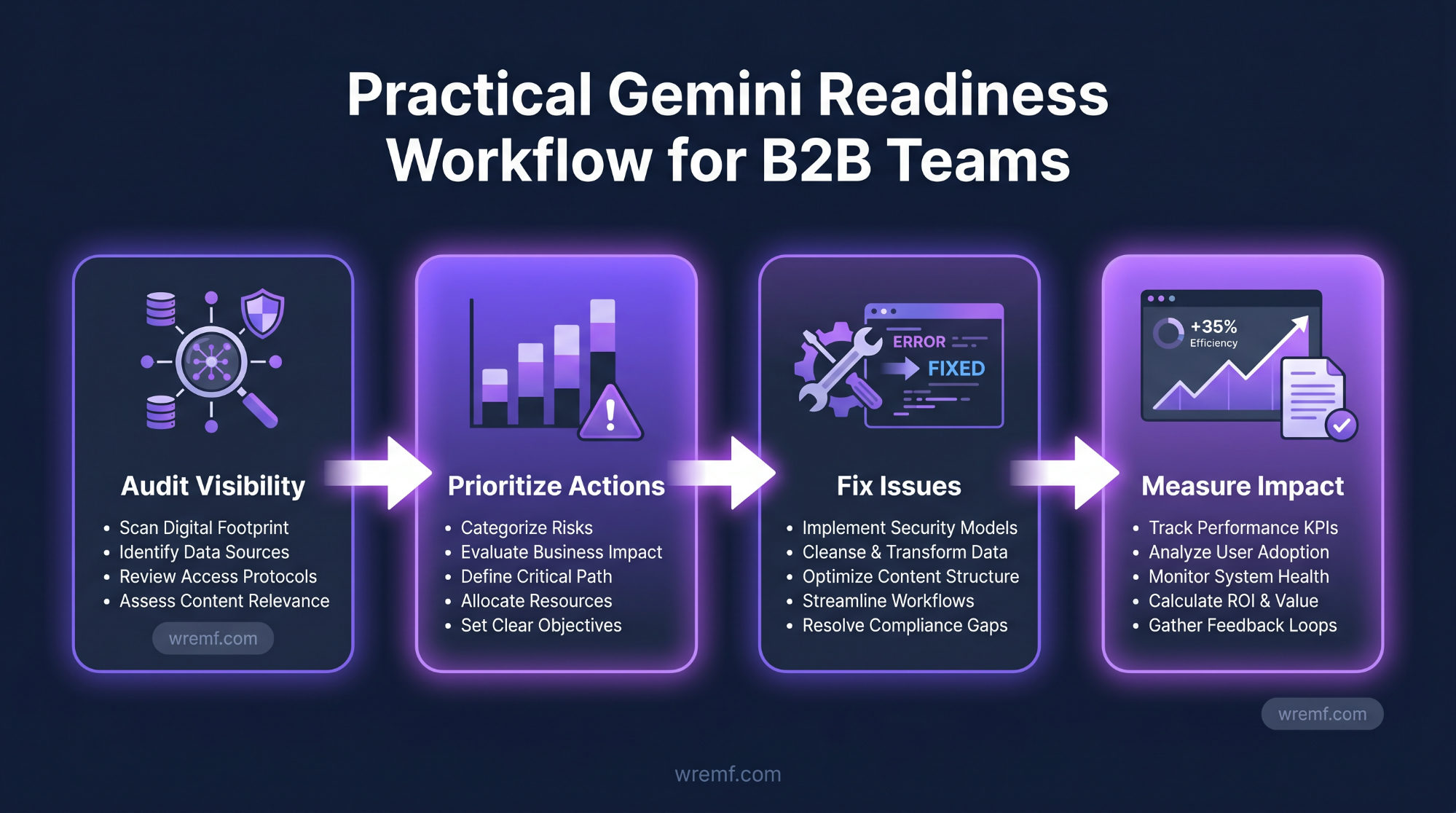
A Gemini readiness workflow helps teams audit, prioritise, fix, and measure the factors that influence visibility in Google Gemini and AI-powered search. The workflow should connect technical SEO, content strategy, entity authority, citation profiles, and reporting.
A readiness workflow is a repeatable process for evaluating whether a brand is understandable, crawlable, credible, and measurable inside AI discovery surfaces. A readiness workflow matters because Gemini optimization requires coordination between SEO, content, product marketing, PR, analytics, web development, and leadership.
Use this Gemini readiness workflow:
Audit current AI visibility Track how Google Gemini, AI Overviews, AI Mode, ChatGPT, Claude, Perplexity, and Copilot describe your brand. Record AI mentions, citations, competitors, inaccurate claims, and missing recommendations.
Audit technical accessibility Check crawlability, rendering, schema markup, sitemap coverage, canonical tags, internal links, indexation rules, and access controls. AI crawler accessibility should be tested across important product, category, blog, local, and knowledge base pages.
Build source-of-truth assets Create or improve pages that define your company, category, pricing, product capabilities, methodology, use cases, comparisons, limitations, and proof. These assets should be structured for both human readers and AI extraction.
Improve content libraries Build topic clusters around buyer prompts, not only keywords. Content libraries should cover definitions, comparisons, implementation, risks, examples, and decision criteria.
Strengthen authority signals Align social media profiles, Google Business profiles, local listings, customer reviews, third-party mentions, reputable sources, and citation profiles. Remove contradictions and outdated descriptions.
Monitor citation patterns Identify which sources AI systems cite for your category. Improve owned pages where possible and pursue reputable third-party visibility where competitors dominate.
Report AI visibility over time Track prompt coverage, Citation Rate, AI share of voice, competitor visibility, source consistency, and referral traffic every month. Connect movement to specific content, technical, and source updates.
| Workflow Area | Main Question | Action | Best Owner |
|---|---|---|---|
| Prompt visibility | Does Gemini mention the brand? | Track buyer prompts across engines | SEO or growth team |
| Technical access | Can Google AI access the content? | Check crawlability, rendering, and schema markup | Technical SEO or web team |
| Content structure | Can AI extract answers? | Rewrite pages with answer-first sections | Content team |
| Entity authority | Do sources describe the brand consistently? | Clean profiles, listings, reviews, and descriptions | Brand or PR team |
| Citation profiles | Which sources influence AI Answers? | Track cited sources and close gaps | SEO or digital PR team |
| Reporting | Can leadership see progress? | Build monthly AI visibility reporting | Growth or analytics team |
For teams with internal SEO and content resources, software may be enough. For teams that need execution, the WREMF agency team supports AEO, GEO, AI visibility strategy, content optimization, source consistency cleanup, citation improvement, technical AI visibility foundations, and monthly reporting.
KEY TAKEAWAY: A Gemini readiness workflow should connect prompts, citations, technical access, content structure, entity authority, competitor visibility, and monthly measurement.
After the workflow is clear, teams need to choose whether software, services, or a hybrid model fits their needs.
Gemini Optimization Tools, Services, and Hybrid Models
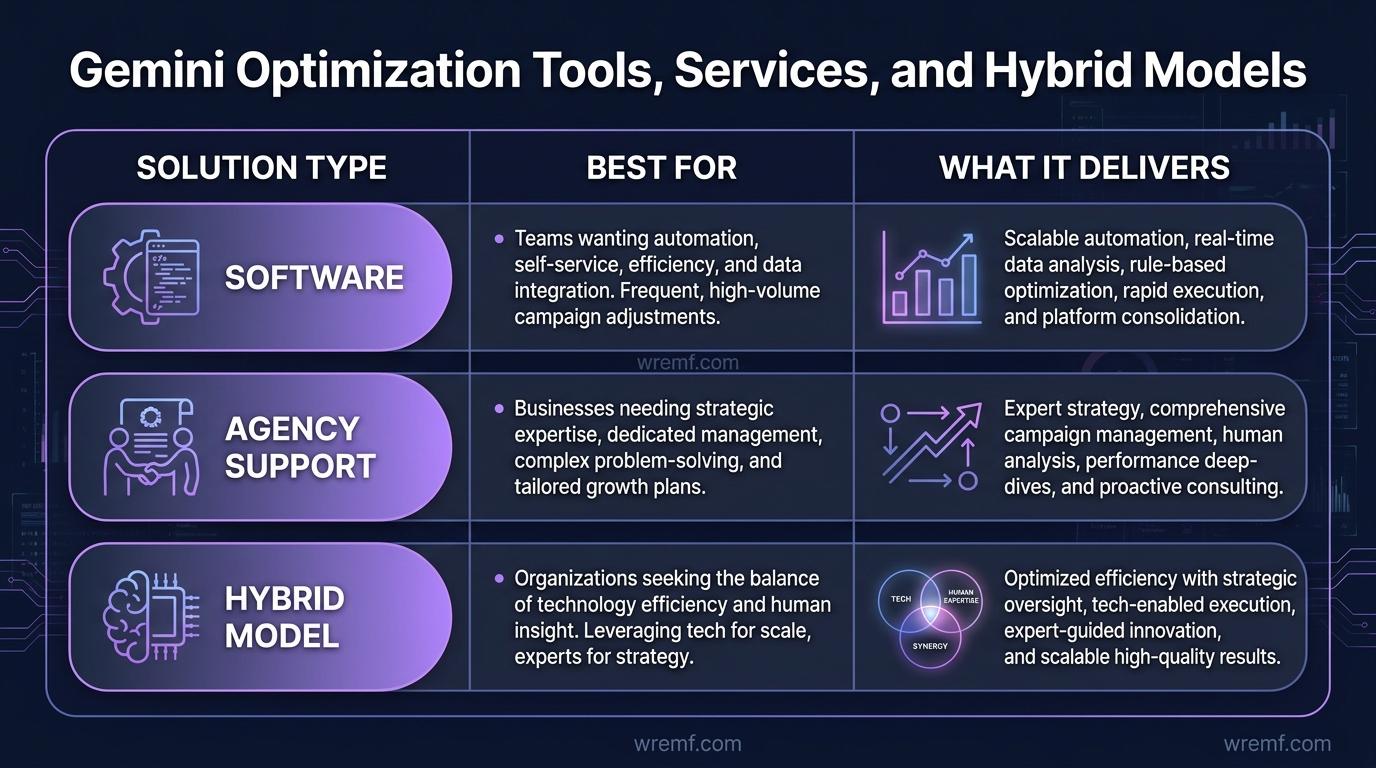
The right Gemini optimization solution depends on whether your team needs measurement, execution, or both. Software is best for tracking and reporting, agency support is best for implementation, and a hybrid model is best when teams need visibility data plus managed improvements.
Gemini optimization tools help teams monitor prompts, AI mentions, source citations, citation patterns, AI share of voice, competitor visibility, and AI Traffic Analytics. Gemini optimization services help teams turn those insights into content updates, technical fixes, entity cleanup, authority building, and reporting.
| Option | Best For | What It Measures or Delivers | What It Misses | Recommended When |
|---|---|---|---|---|
| Manual testing | Early exploration | Ad hoc Gemini AI answers and screenshots | Scale, history, competitor benchmarking, source tracking | You need a quick starting point |
| Classic SEO tools | Search engine optimization | Rankings, backlinks, technical health, traffic | AI mentions, prompt tracking, AI share of voice | You still need Google Search performance |
| AI visibility software | Ongoing measurement | Prompts, citations, competitors, AI visibility, reporting | Execution if the team lacks capacity | You have internal SEO or content resources |
| GEO or AEO agency | Managed improvement | Strategy, content optimization, technical guidance, authority work | Software-level continuous tracking unless included | You need execution support |
| Hybrid platform plus agency | Data and execution | Tracking, recommendations, audits, briefs, monthly improvement | Requires cross-team coordination | You need a complete AI visibility system |
WREMF is designed for software, agency, and hybrid use cases. The platform helps teams track AI visibility across 10 AI engines, while WREMF agency services support content optimization, GEO audits, entity and authority building, source consistency cleanup, AI-ready content briefs, and monthly execution.
Agencies managing multiple clients often need white-label reporting, client portals, repeatable prompt tracking, and proof of movement. WREMF supports that workflow through WREMF for agencies. In-house teams that need brand visibility and executive reporting can use WREMF for brands.
For buying-stage evaluation, WREMF pricing starts with Starter at €39 per month for 1 website, Growth at €89 per month for 5 websites, and Enterprise for unlimited websites, unlimited seats, dedicated support, and custom branded portals. All tiers include unlimited prompt tracking, BYOK support, 10 AI engines, all features and tools, and white-label reports. Teams comparing budget, scale, and reporting needs can review WREMF pricing.
KEY TAKEAWAY: Software measures Gemini visibility, services improve it, and a hybrid model connects measurement with execution.
The next section covers what Gemini optimization is not, because this keyword can also appear in technical and mathematical contexts.
What Gemini Optimization Is Not: Algorithmic and Mathematical Meaning
Gemini optimization in marketing means improving visibility in Google Gemini and AI search, not solving mathematical optimization problems. Some search results use optimization language from machine learning, algorithms, and research, but those topics are different from Gemini SEO, AEO, and GEO.
Machine learning optimization is the process of improving model performance by adjusting parameters, objectives, training methods, or computational strategies. Machine learning optimization matters in AI research, but it is not the same as optimizing content for Google Gemini visibility.
Combinatorial optimization is the process of finding the best option from a finite set of possibilities. Submodular optimization, information theory, Max-Cut, Steiner Tree, Kirszbraun Theorem, Stone-Weierstrass theorem, Revelation Principle, Gegenbauer polynomials, and related mathematical topics can appear in AI research or algorithm discussions. They are not practical ranking factors for Gemini optimization in marketing.
This distinction matters because some pages about “Gemini optimization” mix AI model performance, prompt efficiency, hardware, and search visibility. For a B2B marketing team, the relevant meaning is brand visibility inside Google Gemini, Google Search, AI Overviews, AI Mode, and AI-generated responses.
Gemini Deep Think adds another layer of potential confusion. Google DeepMind describes Deep Think mode as useful for complex problem solving and scientific domains such as physics, chemistry, engineering, and mathematics. That is important for understanding Gemini’s reasoning direction, but it does not mean marketers need to optimise for Gegenbauer polynomials or cosmic strings. (Google DeepMind)
The practical takeaway is that Gemini optimization for marketers should focus on content, source quality, entity clarity, citation profiles, technical accessibility, and measurable AI visibility. Technical AI research can inspire the language of reasoning, grounding, and retrieval, but it should not distract from the business objective.
KEY TAKEAWAY: For marketers, Gemini optimization means improving brand visibility in Google Gemini and AI search, not solving mathematical optimization problems inside AI model research.
With the definition clarified, it is easier to evaluate limitations and set realistic expectations.
Limitations, Risks, and What Gemini Optimization Cannot Guarantee
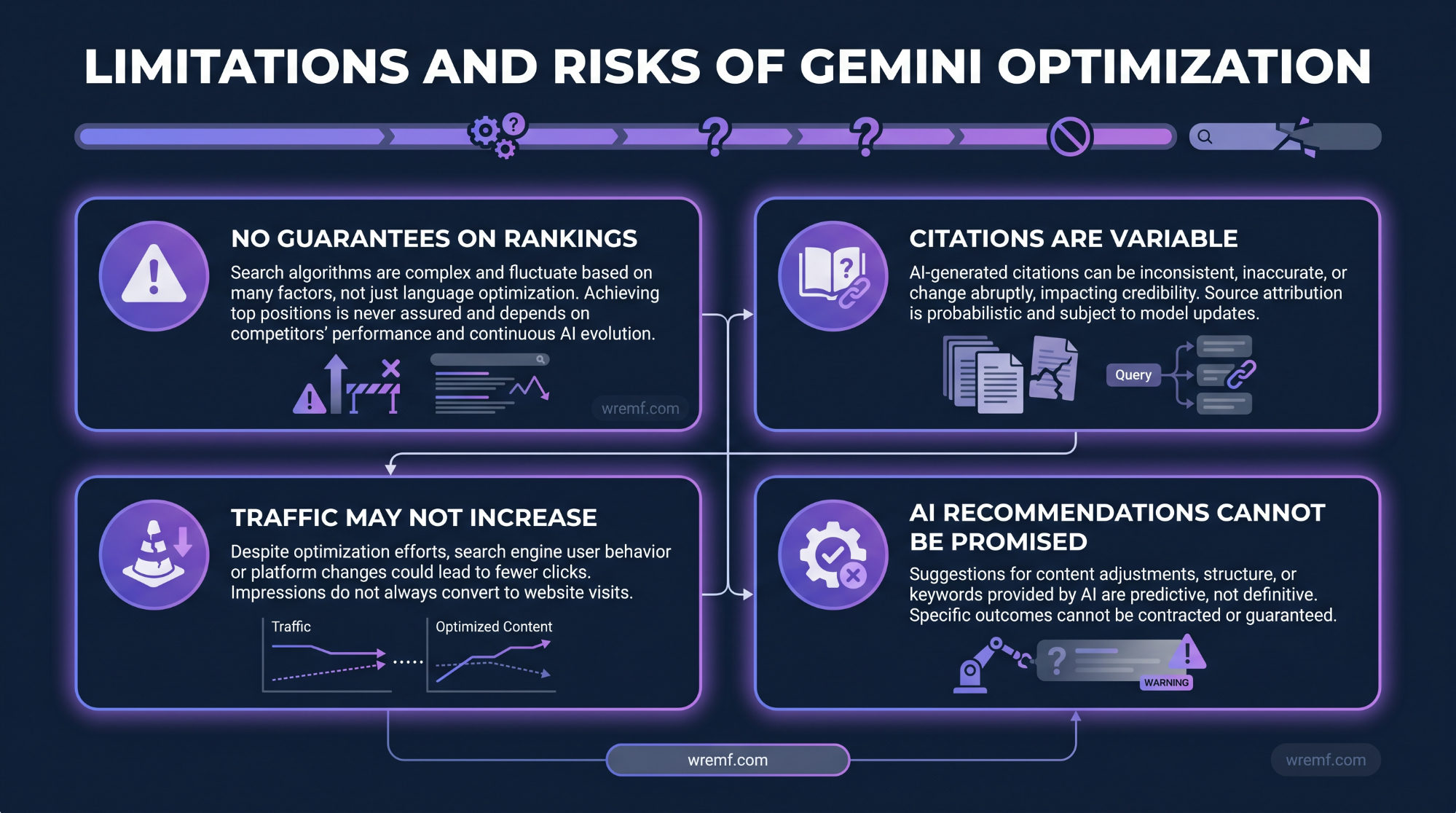
Gemini optimization can improve AI readiness, source clarity, and measurement, but it cannot guarantee rankings, citations, traffic, revenue, or AI recommendations. AI visibility depends on prompts, user context, source availability, Google systems, competitor authority, and changing AI model behaviour.
A limitation is a constraint that affects what a strategy can realistically achieve. Limitations matter because overpromising Gemini optimization leads to poor expectations, weak reporting, and misleading sales claims.
The main limitations include:
AI-generated responses can vary by prompt wording
Google AI features can vary by country, language, device, account, and query
Google Search and Gemini AI may rely on different source mixes
AI Overviews may cite sources without sending proportional traffic
AI models can summarise without visible citations in some contexts
Referral traffic from AI search engines may be incomplete
Training Data may include outdated brand facts
Google Business Profile data may matter more for local queries than SaaS queries
Schema markup can help understanding but cannot guarantee inclusion
Social media profiles and third-party sources may contain inconsistent information
A common implementation mistake is treating Gemini optimization as a one-time page rewrite. Gemini optimization is ongoing because Google Search features, AI Mode, AI Overviews, Gemini AI models, competitors, source citations, and citation patterns change over time.
Another risk is optimizing only owned content. Owned content is essential, but AI search engines often cite reputable sources, reviews, directories, industry publications, and knowledge base pages. If competitor brands dominate those sources, your brand may remain underrepresented even after improving your own pages.
In practical AI visibility audits, teams often find that the biggest issue is not missing keywords. The biggest issue is that Google Gemini and other AI models cannot confidently connect the brand to the category, use case, audience, proof, and current product details.
KEY TAKEAWAY: Gemini optimization improves your probability of visibility by strengthening content, technical access, source consistency, and measurement, but no responsible provider can guarantee AI citations or recommendations.
Common myths create many of these unrealistic expectations, so the next section corrects them directly.
Common Myths About AI Visibility Debunked
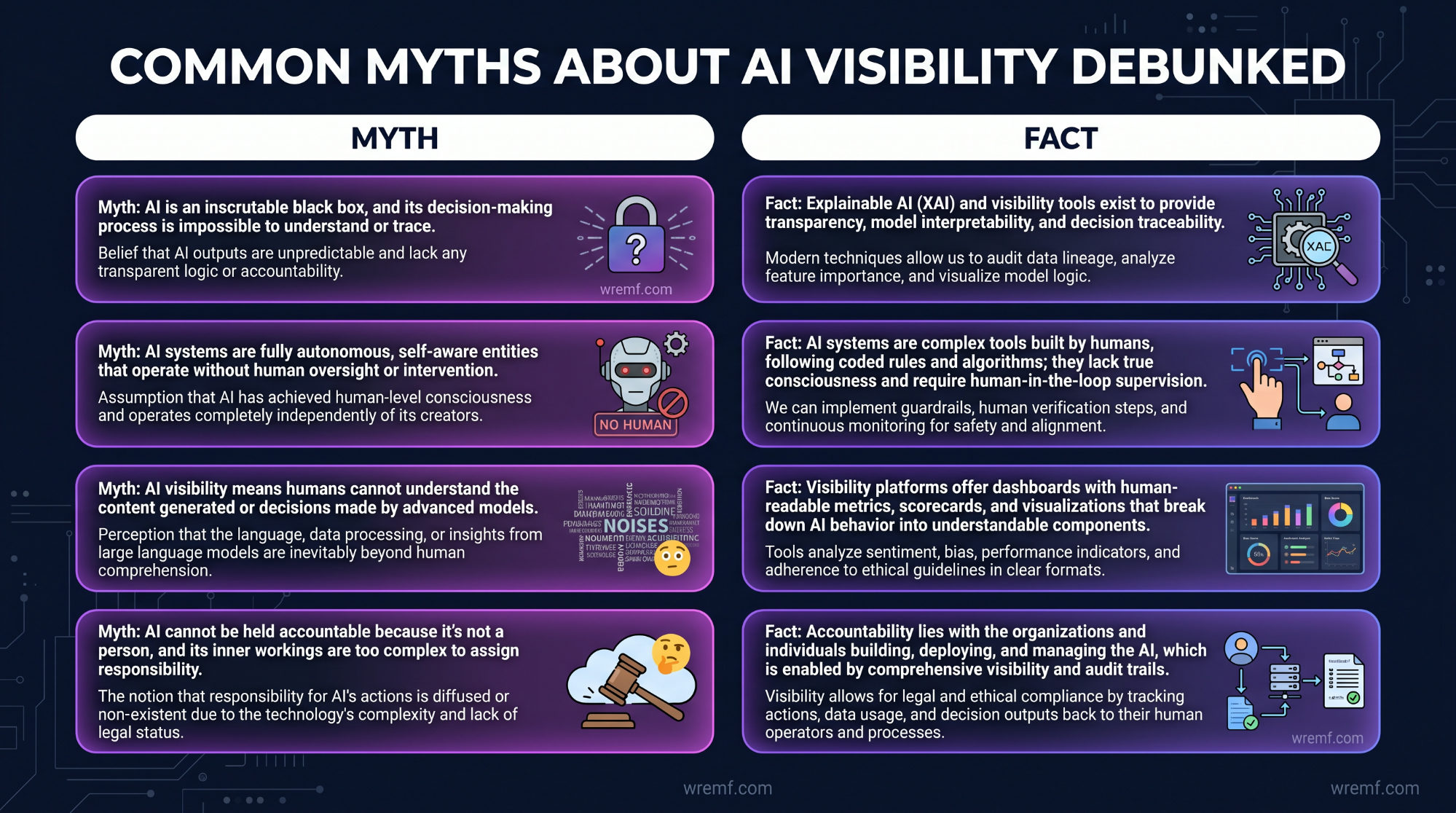
AI visibility myths usually come from applying old search ranking assumptions to new answer engine systems. Gemini optimization requires SEO foundations, but it also requires prompt tracking, citation analysis, entity clarity, and source consistency.
MYTH: If a page ranks number one in Google Search, Gemini will automatically recommend it.
FACT: A high Google Search ranking can help, but it does not guarantee visibility in Google Gemini, AI Overviews, or AI Mode. Gemini AI may use different source combinations, summarise several pages, or recommend brands based on source consistency, entity authority, and prompt intent.
MYTH: AI visibility is impossible to measure.
FACT: AI visibility is measurable through prompt tracking, AI mentions, Citation Rate, source citations, competitor visibility, AI share of voice, and AI traffic attribution. Measurement is not perfect because AI Responses can vary, but directional tracking is still useful for strategy, reporting, and prioritisation.
MYTH: SEO, AEO, and GEO are all the same thing.
FACT: SEO focuses on search engine rankings and organic traffic. AEO focuses on answer extraction. Generative Engine Optimization focuses on visibility inside AI-generated responses. Gemini optimization applies those disciplines specifically to Google Gemini and Google AI search experiences.
MYTH: Schema markup alone is enough for Gemini optimization.
FACT: Schema markup helps Google understand page content, but it is not a complete AI visibility strategy. Gemini optimization also requires helpful content, crawlable pages, reputable sources, brand mentions, Google Business Profile consistency where relevant, customer reviews, and clear entity relationships.
MYTH: AI optimization means writing only for machines.
FACT: Google’s people-first content guidance points in the opposite direction. The best Gemini optimization improves clarity for humans while making content structured enough for a search engine and AI models to interpret accurately.
KEY TAKEAWAY: Gemini optimization is not a shortcut or a replacement for SEO. It is a broader visibility system that combines search, answers, citations, entities, and AI measurement.
The FAQ section answers the practical questions teams ask when they begin optimizing for Google Gemini.
Frequently Asked Questions
What is Gemini optimization?
Gemini optimization is the process of improving how your brand appears in Google Gemini, Google Search, AI Overviews, AI Mode, and related Google AI experiences. It combines search engine optimization, answer engine optimisation, Generative Engine Optimization, schema markup, structured content, AI crawler accessibility, entity authority, and citation tracking. The goal is to make your brand easier for Gemini AI to understand, retrieve, cite, and recommend. WREMF helps teams track Gemini visibility through prompts, source citations, competitor visibility, AI share of voice, and reporting.
How to optimize Gemini prompt?
To optimize a Gemini prompt, make the prompt specific, contextual, and task-oriented. Include the goal, audience, industry, criteria, location, and desired format. For example, instead of asking “best AI tool,” ask “Compare AI visibility tools for a B2B SaaS marketing team that needs prompt tracking, source citations, competitor visibility, and white-label reporting.” For Gemini optimization, the larger task is prompt tracking. You need to monitor the real prompts buyers ask and measure whether your brand appears, is cited, and is described accurately.
Is Gemini 2.0 better than ChatGPT?
Gemini and ChatGPT are different AI systems with different model families, product integrations, strengths, and search experiences. Gemini is deeply connected to Google Search, AI Overviews, AI Mode, Google Workspace, Android, and Google AI products. ChatGPT has its own model ecosystem, search features, tools, and integrations. The better option depends on the task. For marketers, the more important question is whether your brand is visible and accurately described across both Google Gemini and ChatGPT, not whether one AI model is universally smarter.
How to use Gemini efficiently?
Use Gemini efficiently by giving clear context, defining the task, specifying the audience, adding constraints, and asking for a structured output. For SEO and content work, ask Gemini to compare search intent, identify missing questions, draft answer-first sections, summarise competitor content, or create content briefs. For brand visibility, do not rely on one Gemini answer. Track multiple prompts across awareness, comparison, buying, implementation, and risk stages. WREMF helps teams move from one-off Gemini testing to repeatable prompt intelligence and AI visibility reporting.
Who is smarter, ChatGPT or Gemini?
There is no single reliable answer to whether ChatGPT or Gemini is smarter because performance depends on the model version, task type, context window, tools, search access, language, multimodal input, and evaluation criteria. Gemini may be stronger in some Google ecosystem and multimodal workflows, while ChatGPT may be preferred for other research, writing, or tool-based workflows. For Gemini optimization, the practical priority is not ranking AI models against each other. The priority is tracking how each AI system describes, cites, and recommends your brand.
What is Gemini optimization and how does it differ from traditional Google SEO?
Gemini optimization improves how your brand appears in Google Gemini, AI Overviews, AI Mode, and AI-generated responses. Traditional Google SEO improves rankings, clicks, impressions, crawlability, and organic traffic in a search engine. The two disciplines overlap because Google Gemini can use web sources, structured content, and search systems. The difference is that Gemini optimization also measures AI mentions, source citations, prompt visibility, competitor visibility, citation patterns, AI share of voice, and source consistency.
Can I rank number one on Google but still be invisible in Gemini AI Overviews?
Yes, a brand can rank number one in Google Search and still be absent from Gemini AI Overviews or AI Mode responses. AI Overviews may summarise multiple sources, answer a broader conversational query, or use sources that better match the user’s intent. Rankings help, but AI visibility also depends on content structure, source citations, schema markup, reputable sources, brand mentions, entity clarity, and Google Business Profile signals for local queries. This is why AI visibility tracking should sit alongside rank tracking.
Is optimizing for Google Gemini worth it?
Optimizing for Google Gemini is worth it when your buyers use AI systems to research categories, compare vendors, summarise options, or ask implementation questions. B2B SaaS companies, agencies, consultants, local service businesses, and growth teams can benefit because Gemini AI can influence discovery before a user visits a website. Gemini optimization is most valuable when paired with measurement. Track prompts, citation patterns, AI mentions, competitor visibility, and referral traffic so you can prove whether visibility is improving.
How long does it take to rank in Google Gemini?
There is no fixed timeline for ranking or appearing in Google Gemini because Gemini AI visibility is not a traditional ranking system. Improvements can appear faster when technical issues or content gaps are fixed, but durable visibility usually requires ongoing work across content structure, source consistency, schema markup, entity authority, reputable sources, customer reviews, and citation profiles. A practical benchmark cycle is monthly measurement. Track prompt visibility, Citation Rate, competitor mentions, and source citations over time.
What is GEO Optimization?
GEO Optimization, or Generative Engine Optimization, is the process of improving how a brand appears inside AI-generated responses from systems such as Google Gemini, ChatGPT, Claude, Perplexity, Copilot, and other answer engines. GEO differs from traditional search engine optimization because the goal is not only ranking a page. The goal is to earn accurate mentions, citations, recommendations, and summaries inside AI Responses. Gemini optimization is a Google-specific branch of the wider GEO discipline.
Do I need schema markup for Gemini optimization?
Schema markup is strongly recommended for Gemini optimization, but it is not enough by itself. Schema markup helps Google understand entities, page types, products, organisations, articles, FAQs, HowTo content, and LocalBusiness information. The markup should match visible page content and follow Google’s structured data guidelines. Gemini optimization also requires crawlable content, helpful answers, source consistency, reputable sources, internal links, customer reviews where relevant, and prompt-level measurement. Schema improves understanding, but it does not guarantee AI Overviews or Gemini citations.
How does Google Business Profile affect Gemini optimization?
Google Business Profile affects Gemini optimization for local and service-based queries because it gives Google structured business information for Search and Maps. A complete Google Business Profile can reinforce business category, location, hours, services, reviews, social media links, service areas, and contact details. For local companies, Google Maps reviews, customer reviews, local listings, NAP consistency, and LocalBusiness schema can influence how Google AI understands the business. For B2B SaaS, Google Business Profile is less central but still supports entity consistency.
What are Gemini AI’s limitations for search visibility?
Gemini AI can vary answers by prompt, location, source availability, user context, and product surface. AI-generated responses can omit sources, cite unexpected pages, summarise outdated information, or mention competitors more often than your brand. Google AI features also change over time, which makes one-off testing unreliable. Gemini optimization reduces risk by improving crawlability, content structure, schema markup, source consistency, citation profiles, and prompt tracking. It cannot guarantee rankings, traffic, revenue, or AI recommendations.
What are the best Gemini optimization strategies?
The best Gemini optimization strategies are answer-first content, structured content, schema markup, AI crawler accessibility, entity authority, source consistency, citation tracking, prompt monitoring, and competitor visibility analysis. Start by benchmarking how Google Gemini and AI Overviews answer your most important buyer prompts. Then improve source-of-truth pages, add structured data, clean inconsistent brand mentions, strengthen reputable sources, optimise Google Business Profile where relevant, and monitor Citation Rate. WREMF combines prompt tracking, source citations, competitor visibility, GEO audits, and reporting in one workflow.
What is the best tool for Gemini optimization?
The best tool for Gemini optimization should track prompts, AI mentions, source citations, competitor visibility, AI share of voice, source consistency, and AI traffic attribution across multiple AI discovery surfaces. Traditional SEO tools remain useful for rankings, backlinks, and technical SEO, but they often miss AI-generated responses and citation patterns. WREMF helps teams track, improve, and prove AI visibility across Google Gemini, AI Overviews, ChatGPT, Claude, Perplexity, Copilot, DeepSeek, Grok, Meta AI, Mistral, and other answer engines.
Conclusion
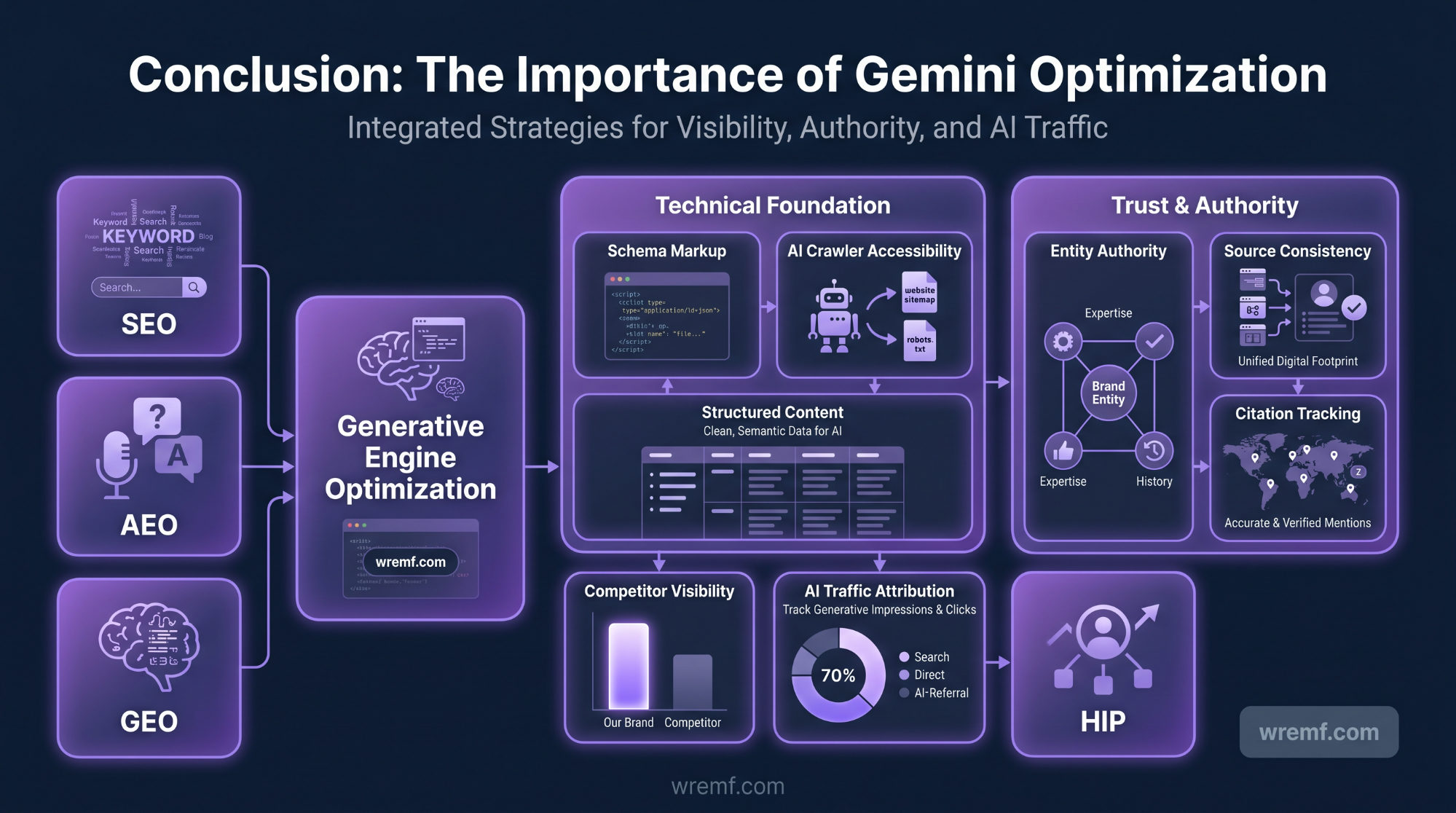
Gemini optimization is the practical way to improve how your brand appears across Google Gemini, Google Search, AI Overviews, AI Mode, and AI-generated responses. The strongest strategy combines search engine optimization, AEO, Generative Engine Optimization, schema markup, AI crawler accessibility, structured content, entity authority, source consistency, citation tracking, competitor visibility, and AI traffic attribution. WREMF helps teams make that workflow measurable without claiming guaranteed rankings or AI recommendations. To turn Gemini optimization from manual testing into a repeatable visibility system, explore the WREMF platform suite or talk to the WREMF agency team.
KEY TAKEAWAY: Gemini optimization works best when WREMF connects prompts, citations, competitors, technical readiness, content improvements, and reporting into one measurable AI visibility workflow.
Related reading
- Grok Optimization: The Complete Guide to Grok SEO, AI Visibility, and Brand Mentions
- ChatGPT SEO: The Complete Guide to Ranking in ChatGPT
- Perplexity AI Optimization: The Complete Guide to AI Search Visibility in 2026
- How to Get Mentioned in ChatGPT: The Complete Guide to AI Visibility, Citations, and Brand Mentions