How to Get Mentioned in ChatGPT: The Complete Guide to AI Visibility, Citations, and Brand Mentions
Learn how to improve AI visibility and brand mentions in ChatGPT with structured content and strategic SEO techniques.
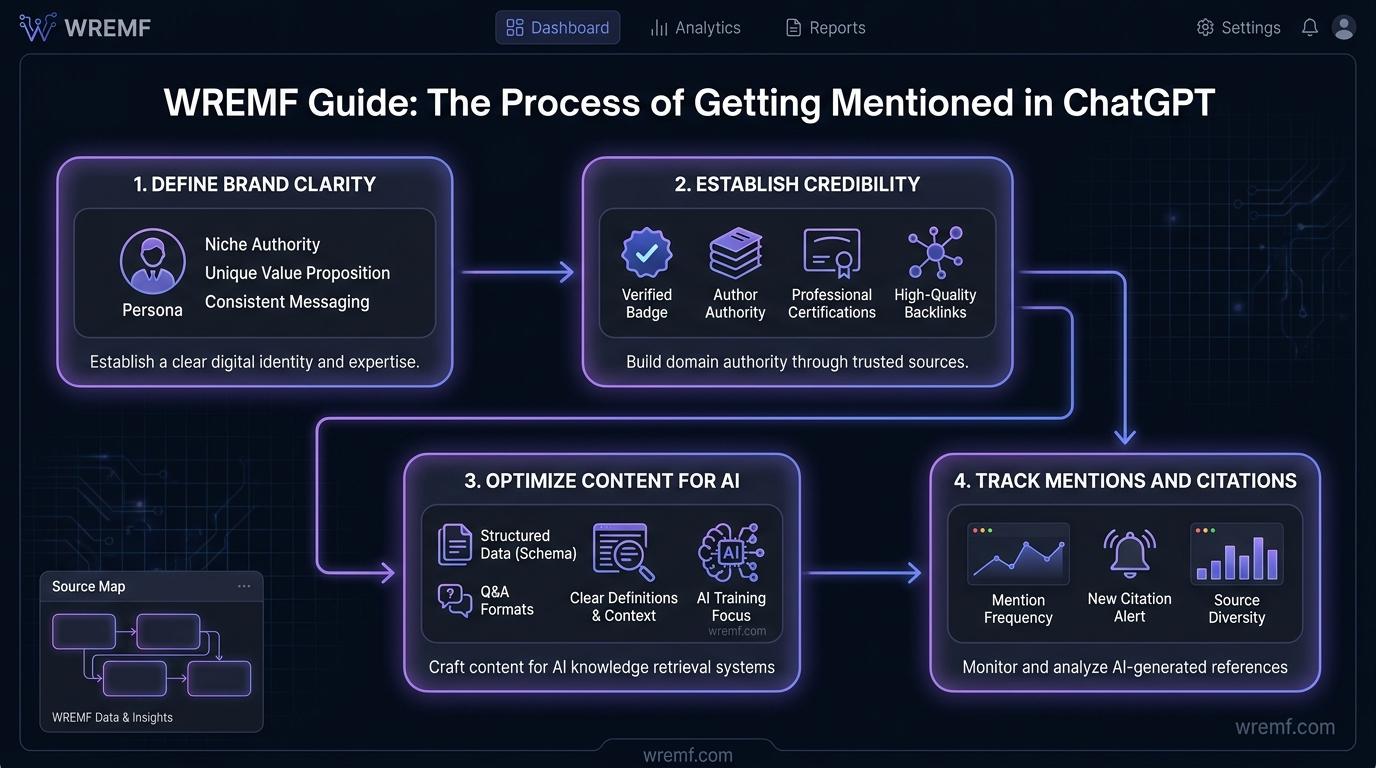
By WREMF Team · 2026-08-21
To get mentioned in ChatGPT, a brand must be recognizable, credible, and aligned with the user's intent. Brand mentions are influenced by topic relevance, source authority, and content quality. AI visibility requires a strategic approach, emphasizing structured data, prompt relevance, and citation tracking. Entities must be defined clearly, and sources must be consistent and authoritative across the web.
Key takeaways
- ChatGPT brand mentions depend on clear entity recognition and topic relevance.
- Structured content improves visibility across ChatGPT and AI platforms.
- AI visibility audits reveal gaps in prompt coverage and source consistency.
- Google rankings are supportive but not sufficient for AI brand mentions.
- Local businesses need consistent Google Business Profile data for AI visibility.
How to Get Mentioned in ChatGPT: The Complete Guide to AI Visibility, Citations, and Brand Mentions
How to get mentioned in ChatGPT is the process of making your brand clear, credible, and citable enough to appear in AI answers. OpenAI explains that ChatGPT Search can provide timely answers with links to relevant web sources, which means brand visibility now depends on content, authority, and retrievable source quality. WREMF helps B2B teams track, improve, and prove visibility across ChatGPT, Claude, Gemini, Perplexity, Google AI Overviews, Copilot, DeepSeek, Grok, Meta AI, and Mistral. This guide explains how AI models identify entities, how web search functionality changes citations, how to structure content for AI-powered search, and how to measure brand mentions. Keep reading to build a repeatable system for ChatGPT visibility.
What Does It Mean to Get Mentioned in ChatGPT?
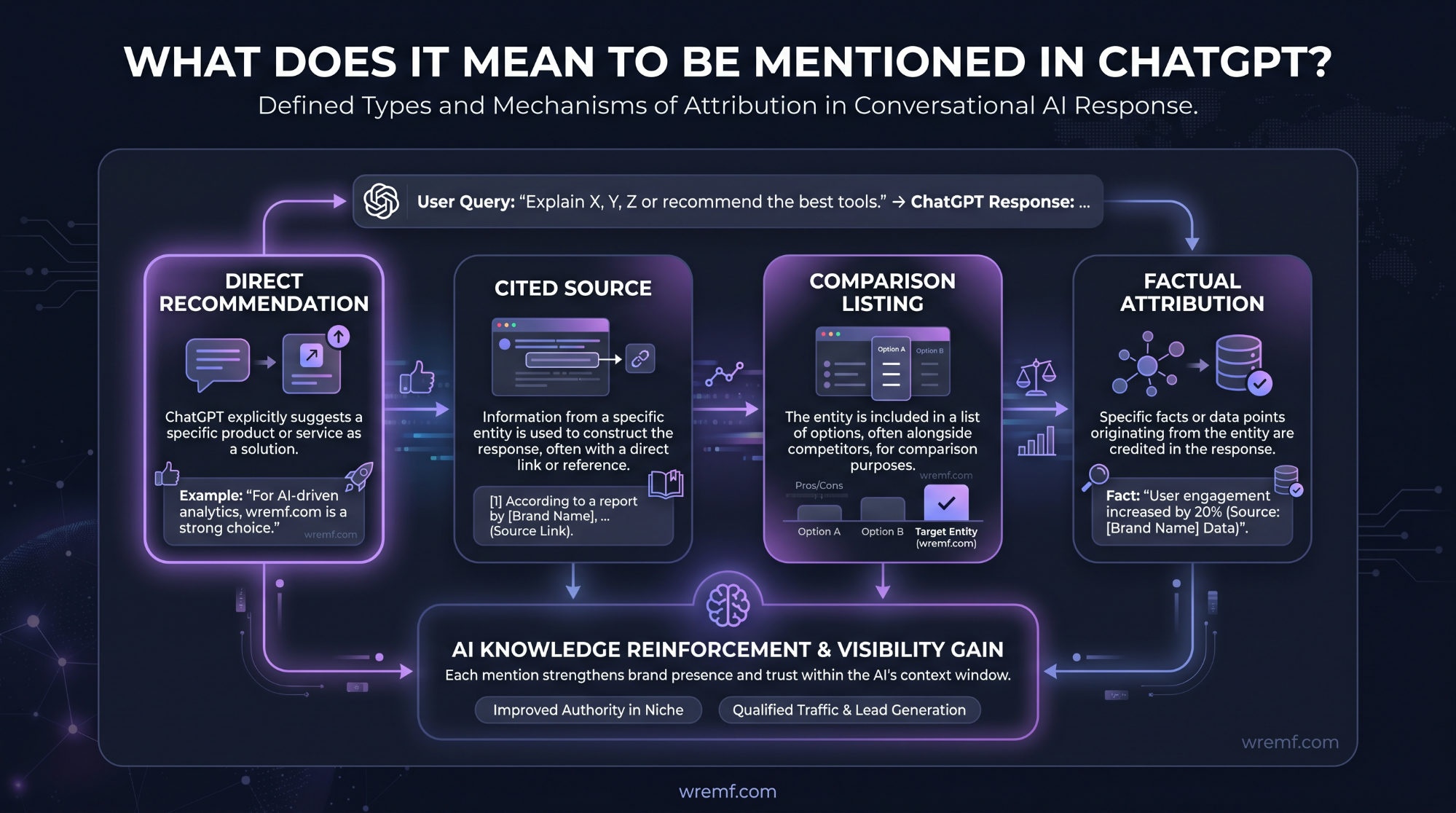
Getting mentioned in ChatGPT means your brand, product, service, founder, data, or content appears inside an AI-generated answer when a user asks a relevant question. A ChatGPT mention can be a direct recommendation, a cited source, a comparison listing, or a factual attribution.
AI visibility is the measurable presence of a brand inside AI-generated answers, recommendations, citations, summaries, and comparisons. AI visibility matters because buyers increasingly use AI tools to research vendors, compare options, and validate claims before visiting search engine results pages.
A brand mention in ChatGPT can appear in several forms. The brand may be listed as an example in a category. The brand may be recommended as a tool or service. The brand may be cited as a source when ChatGPT Search uses web search functionality. The brand may also appear indirectly when ChatGPT summarizes third-party reviews, industry publications, Reddit threads, knowledge bases, directories, or case studies.
For example, a B2B buyer may ask, “What are the best AI visibility tools for SaaS companies?” If ChatGPT mentions WREMF, Profound, Peec AI, or Otterly AI, that answer can influence brand perception before the buyer reaches Google, LinkedIn, G2, or a pricing page. In real B2B buying journeys, this creates a new discovery layer between search engine optimization and sales pipeline.
WREMF helps teams monitor this discovery layer through the AI visibility platform suite, which combines prompt intelligence, citation tracking, competitor visibility, source consistency analysis, and reporting across 10 AI engines.
DID YOU KNOW: OpenAI says ChatGPT Search can provide timely answers with links to relevant web sources, and ChatGPT responses that use search may include inline citations or a Sources panel through ChatGPT Search documentation.
KEY TAKEAWAY: Getting mentioned in ChatGPT requires brand clarity, trusted source signals, structured content, prompt relevance, and ongoing measurement.
The next step is understanding how ChatGPT decides which brands and sources belong in an answer.
How Does ChatGPT Decide Which Brands, Sources, and Entities to Mention?
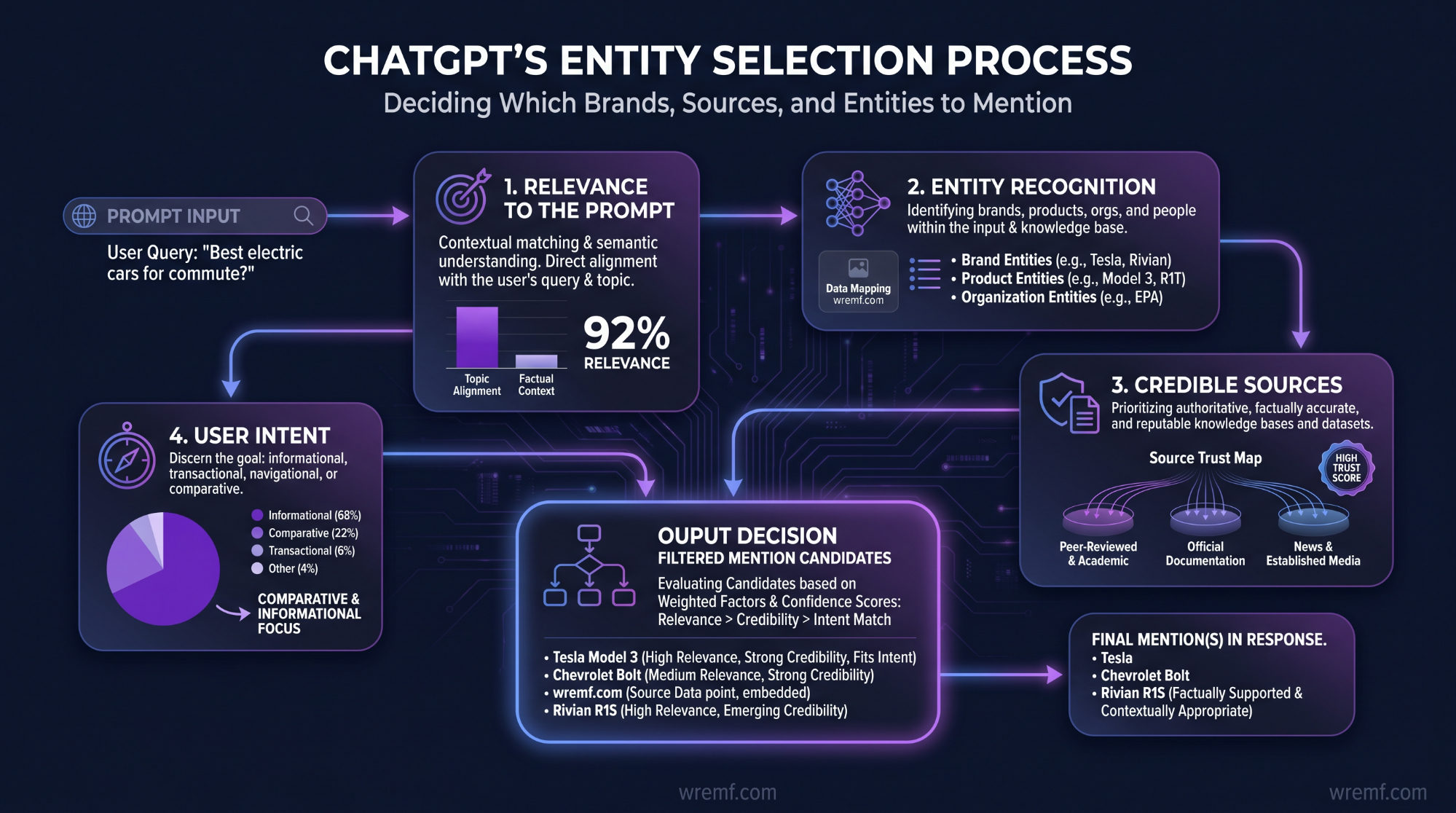
ChatGPT mentions brands when a brand is relevant to the prompt, recognizable as an entity, supported by credible sources, and useful for the user’s intent. The stronger the connection between your brand and a topic, the easier it is for AI tools to mention or cite you.
A large language model is an AI system trained to generate language from patterns in data, instructions, and context. A large language model matters for marketers because it does not simply rank websites like a traditional search engine.
An entity is a distinct thing that AI models and search engines can recognize, such as a company, product, founder, location, software category, or concept. Entity recognition matters because ChatGPT needs to understand what your brand is, what market it belongs to, who it serves, and why it should be included in an answer.
ChatGPT can draw from several possible inputs depending on the user’s request, product mode, and available tools. It may use model knowledge, user-provided context, web search, uploaded content, browsing results, or connected tools. The difference between training data and real-time web search matters because older model knowledge may not include your latest positioning, while web search can retrieve current pages, citations, reviews, and industry publications.
Training data is the historical data used to teach AI models broad language patterns and knowledge. Training data matters because it can shape general understanding, but it is not the only way a brand can appear in ChatGPT. ChatGPT Search and other retrieval systems can use current web sources when the answer needs fresh information.
The main factors that influence brand mentions include:
Relevance between the prompt and your category
Clear brand positioning across your website and third-party profiles
Strong content clusters around your market and buyer questions
Source citations from authoritative websites
Brand mentions in industry publications, niche directories, podcasts, and knowledge bases
Reviews, customer proof, case studies, and trust signals
Structured data and schema markup that help systems understand page meaning
Consistent online presence across your website, Google Business Profile, social profiles, directories, and review platforms
Freshness for fast-changing topics, pricing, products, and market comparisons
According to Google Search Central’s guidance on helpful content, Google’s systems are designed to prioritize helpful, reliable information created for people rather than content created mainly to manipulate rankings. That principle is relevant to AI-powered search because AI engines need useful, verifiable content that can be summarized accurately.
IMPORTANT: You cannot force ChatGPT to mention your brand in every answer. You can increase the probability by making your brand easier to understand, retrieve, verify, compare, and cite.
KEY TAKEAWAY: ChatGPT brand mentions are influenced by entity clarity, topic relevance, source authority, retrieval quality, and the usefulness of your content.
Now let’s separate ChatGPT visibility from traditional Google rankings.
Why Ranking on Google Is Not Enough for ChatGPT Mentions
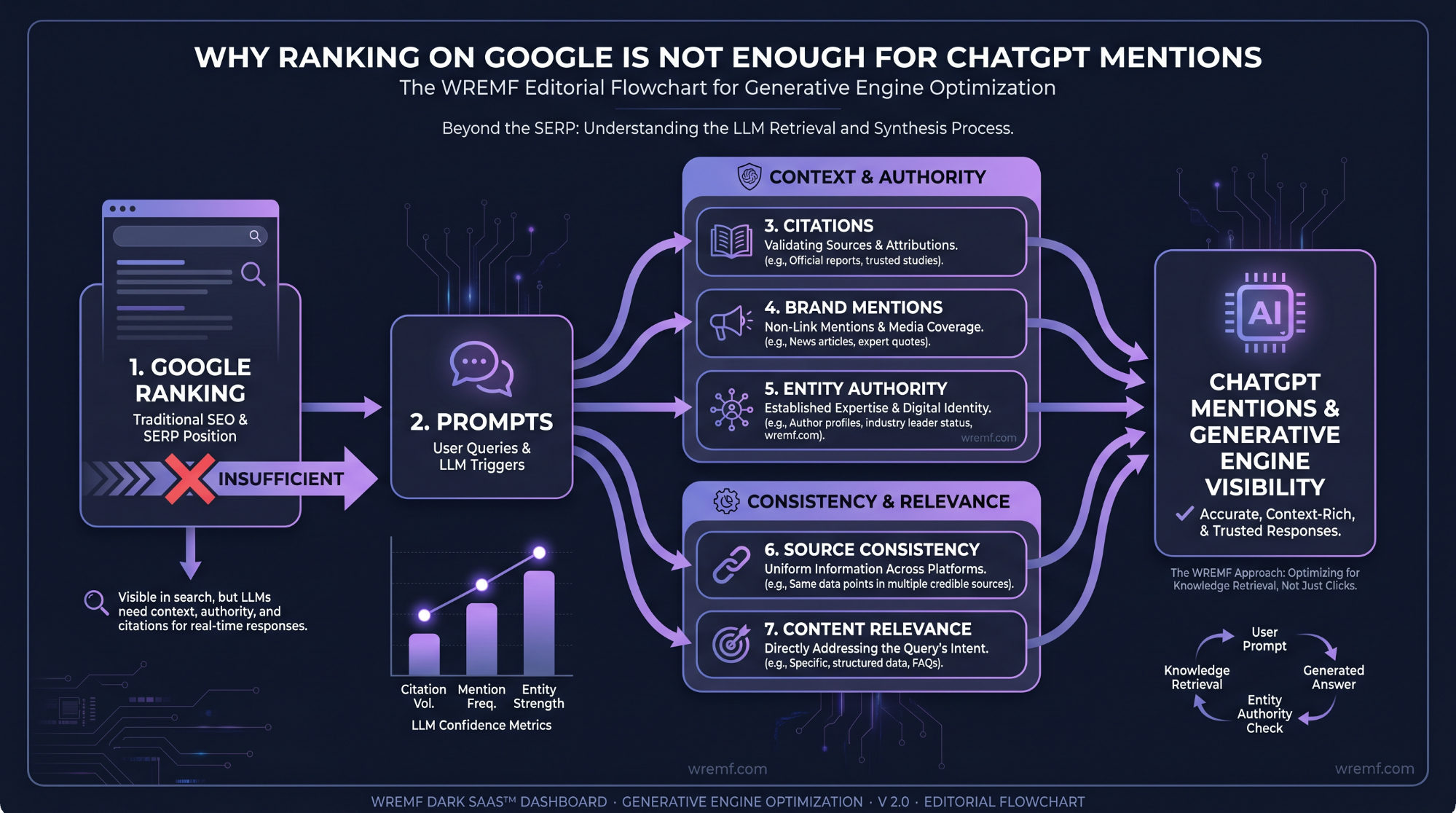
Ranking on Google can help ChatGPT visibility, but rankings alone are not enough to guarantee brand mentions. AI visibility depends on prompts, citations, brand mentions, entity authority, source consistency, and how well your content answers specific AI-driven questions.
Search engine optimization is the process of improving a website so search engines can crawl, understand, index, and rank its content. Search engine optimization matters because AI-powered search still depends on accessible, useful, well-structured web content.
Answer Engine Optimization is the process of structuring content so answer systems can extract direct, useful responses to questions. Answer Engine Optimization matters because AI tools often need concise answers, definitions, FAQs, and source-backed explanations.
Generative Engine Optimization is the process of improving how generative AI systems understand, mention, cite, and recommend a brand. GEO matters because generative AI answers synthesize information instead of only displaying ranked links.
The key difference between SEO and GEO is measurement. SEO visibility is usually measured through rankings, impressions, clicks, backlinks, and organic sessions. AI visibility is measured through prompt coverage, brand mentions, AI citations, recommendation rate, source citations, competitor visibility, AI share of voice, sentiment, and AI traffic attribution.
| Visibility Area | Best For | What It Measures | What It Misses | Typical User | Recommended When |
|---|---|---|---|---|---|
| SEO | Search engine results pages | Rankings, clicks, impressions, technical health, backlinks | ChatGPT mentions, AI citations, prompt visibility | SEO teams and content teams | You need traditional organic discovery |
| AEO | Direct answers and answer capsules | Answer clarity, FAQ coverage, definition quality, structured headings | Competitor visibility inside AI answers | Content teams and editors | You need content that can be extracted into answers |
| GEO | AI-powered search and generative AI answers | Brand mentions, citations, prompt coverage, AI share of voice | Some classic SERP ranking detail | B2B marketers, founders, agencies | You need visibility in ChatGPT, Perplexity, Gemini, Claude, and Copilot |
| Manual prompting | Quick visibility checks | Whether your brand appears for selected prompts | Scale, consistency, attribution, trend history | Small teams and founders | You are starting an AI visibility audit |
| AI visibility tools | Repeatable multi-engine tracking | Prompts, mentions, citations, competitors, source consistency, reports | Execution unless paired with services | Growth teams and agencies | You need ongoing reporting and prioritization |
Google explains that AI Overviews help people get the gist of complex topics and provide links to explore more through Google Search Central’s AI features guidance. This means AI-powered search still connects to the wider web, but the visibility unit is not always a classic blue link. A brand can influence a buying journey even when the user does not click immediately.
In practical AI visibility audits, SEO teams frequently discover three gaps. First, pages rank for keywords but do not answer the exact prompts buyers ask in ChatGPT. Second, third-party sources describe the brand inconsistently. Third, competitors appear in comparison answers because they have more visible reviews, directories, original data, or industry mentions.
AI visibility is both a measurement problem and a source ecosystem problem. AI visibility measurement shows whether a brand appears in AI answers. AI visibility improvement requires better content, clearer entities, stronger citations, more consistent sources, and better authority signals across the public web.
KEY TAKEAWAY: Google rankings are useful, but ChatGPT mentions require a broader system built around prompts, citations, entities, trust signals, and source consistency.
The next section turns that system into a practical step-by-step workflow.
How to Get Mentioned in ChatGPT Step by Step
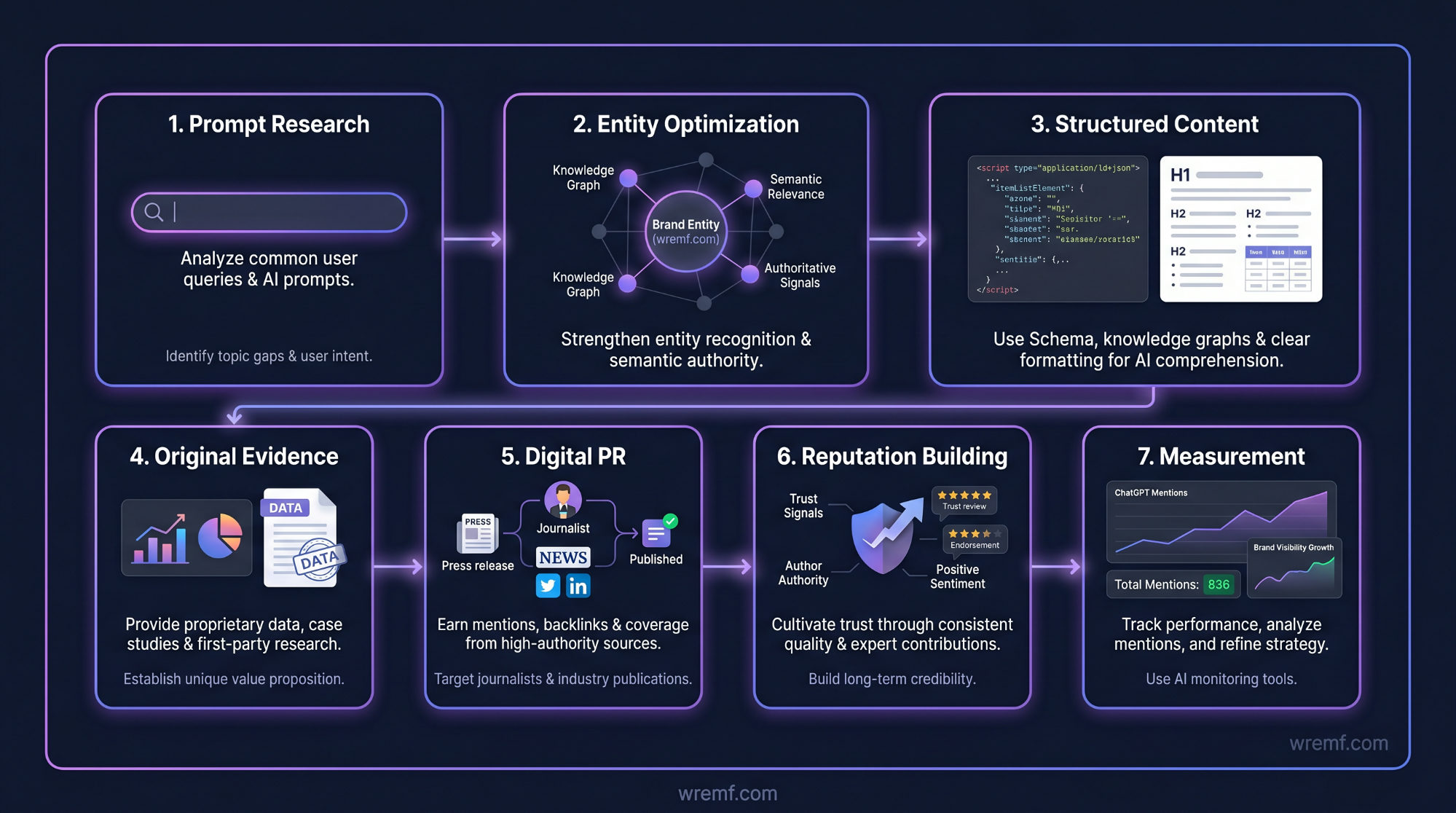
The most effective way to get mentioned in ChatGPT is to make your brand the clearest, most credible, and most useful answer for relevant prompts. The workflow combines prompt research, entity optimization, structured content, original evidence, digital PR, reputation building, and measurement.
Prompt tracking is the process of testing repeatable questions across AI tools to see whether a brand appears, how it is described, which competitors appear, and which sources support the answer. Prompt tracking matters because AI visibility changes by prompt wording, user intent, location, model, freshness, and search mode.
Start with a practical prompt map. Build 25 to 100 prompts across definition, problem, comparison, pricing, category, local, competitor, integration, and buying-intent queries. For example, a SaaS company may track prompts such as “best tools for AI visibility,” “how to track brand mentions in ChatGPT,” “ChatGPT visibility platform for agencies,” and “how to get cited by AI search engines.”
Then map each prompt to a content or source requirement. A definition prompt needs a clear glossary or pillar section. A comparison prompt needs honest comparison content. A buying prompt needs product pages, pricing clarity, customer proof, and review signals. A local prompt needs Google Business Profile, local SEO pages, reviews, and consistent business data.
Use this workflow:
Define the prompts your buyers ask in ChatGPT, Perplexity, Gemini, Claude, and Copilot
Identify whether your brand appears, competitors appear, or no vendor appears
Audit which source citations support the answer
Clarify your brand entity, category, use cases, and differentiators
Create structured website content for each topic cluster
Add relevant structured data and schema markup
Publish original data, branded data, proprietary metrics, case studies, and benchmarks
Earn mentions from industry publications, niche directories, review platforms, podcasts, and partner pages
Monitor Reddit threads, forums, and social media activity for buyer language and reputation signals
Track AI visibility, citations, competitors, and AI referral traffic in a repeatable reporting workflow
A common implementation mistake is optimizing one blog post and expecting ChatGPT to start recommending the brand. AI visibility usually improves when several signals align. Your site needs category content, product content, FAQs, original data, case studies, reviews, third-party mentions, and technical accessibility.
If you want to see how AI engines currently describe your brand, review a sample AI visibility report before building your own measurement workflow.
TIP: Build prompt groups by intent, not just keyword density. A buying prompt, a comparison prompt, and a troubleshooting prompt may need different content and different trust signals.
KEY TAKEAWAY: ChatGPT mentions improve when your brand becomes the clearest, most useful, and most verifiable answer for a defined set of prompts.
Next, let’s build the content foundation ChatGPT and similar AI tools can understand.
What Types of Content Help AI Tools Recognize Your Brand as an Authority?
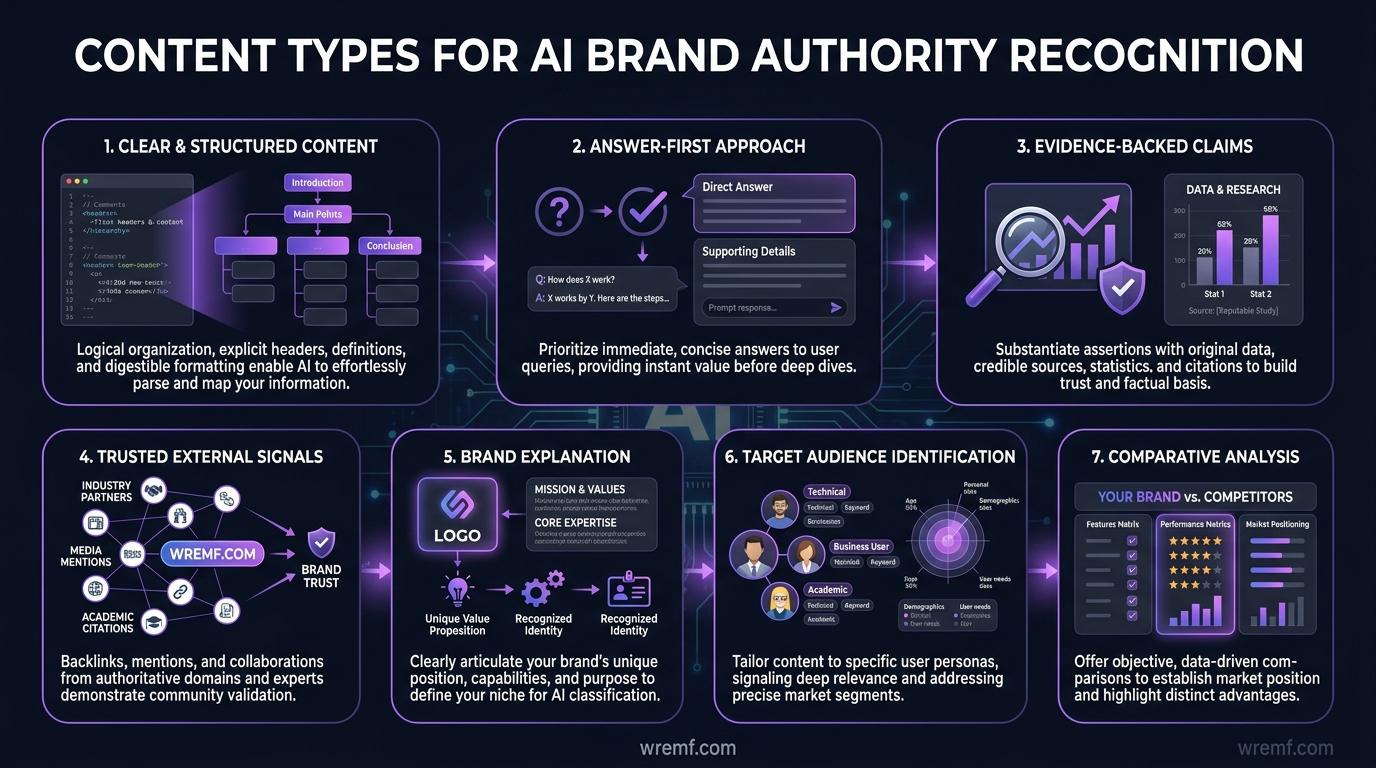
Content that helps AI tools recognize your brand is clear, answer-first, structured, evidence-backed, and supported by trusted external signals. The best content explains what your brand does, who it serves, why it is credible, and how it compares to alternatives.
Content strategy is the planning system that connects audience questions, business goals, topic clusters, formats, and distribution. Content strategy matters because AI models need enough clear context to associate a brand with a category, problem, solution, and buyer intent.
Content marketing for AI visibility should cover the full buyer journey. Top-of-funnel content should define the problem and explain concepts. Middle-of-funnel content should compare approaches, tools, and workflows. Bottom-of-funnel content should address pricing, use cases, case studies, integrations, implementation, and proof.
Create these assets:
Pillar pages that explain the category and core concepts
Content clusters that answer related buyer questions
Product pages that connect features to use cases
Comparison pages that explain tradeoffs honestly
Methodology pages that explain scoring, data collection, and limitations
Case studies with measurable outcomes and clear permission
FAQ-style sections that answer natural language prompts
Glossary pages for terms such as AI visibility, AI citations, AEO, GEO, source citations, and prompt tracking
Research reports with original data, survey stats, and proprietary metrics
Directory profiles that match your brand positioning
Local landing pages if Google Business Profile and local SEO matter
Original data is information your company collects, analyzes, or publishes from its own research, product usage, surveys, audits, or benchmarks. Original data matters because AI systems, journalists, and industry publications are more likely to reference specific evidence than generic claims.
Branded data is proprietary evidence connected to a company, such as an index, benchmark, report, or framework. Branded data matters because it creates citation loops. When other sources cite your original data, AI tools can associate the brand with a specific insight, not just a generic service.
AI citations matter because citations connect an AI-generated answer to a source users can verify. Perplexity explains that each answer includes numbered citations linking to original sources through Perplexity’s explanation of how its answer engine works. This makes source quality and source clarity central to AI visibility.
For WREMF, an AI-ready content system would include a platform page, feature pages, methodology content, sample reports, comparison pages, and educational pillar pages. The WREMF content brief generator helps teams turn prompt gaps and citation gaps into structured content workflows.
KEY TAKEAWAY: ChatGPT is more likely to recognize brands that publish clear category content, original evidence, FAQs, case studies, comparisons, and reusable source material.
The next section explains how to structure that content for search engines, AI bots, and answer systems.
How Should You Structure Website Content for ChatGPT, AI Bots, and Search Engines?
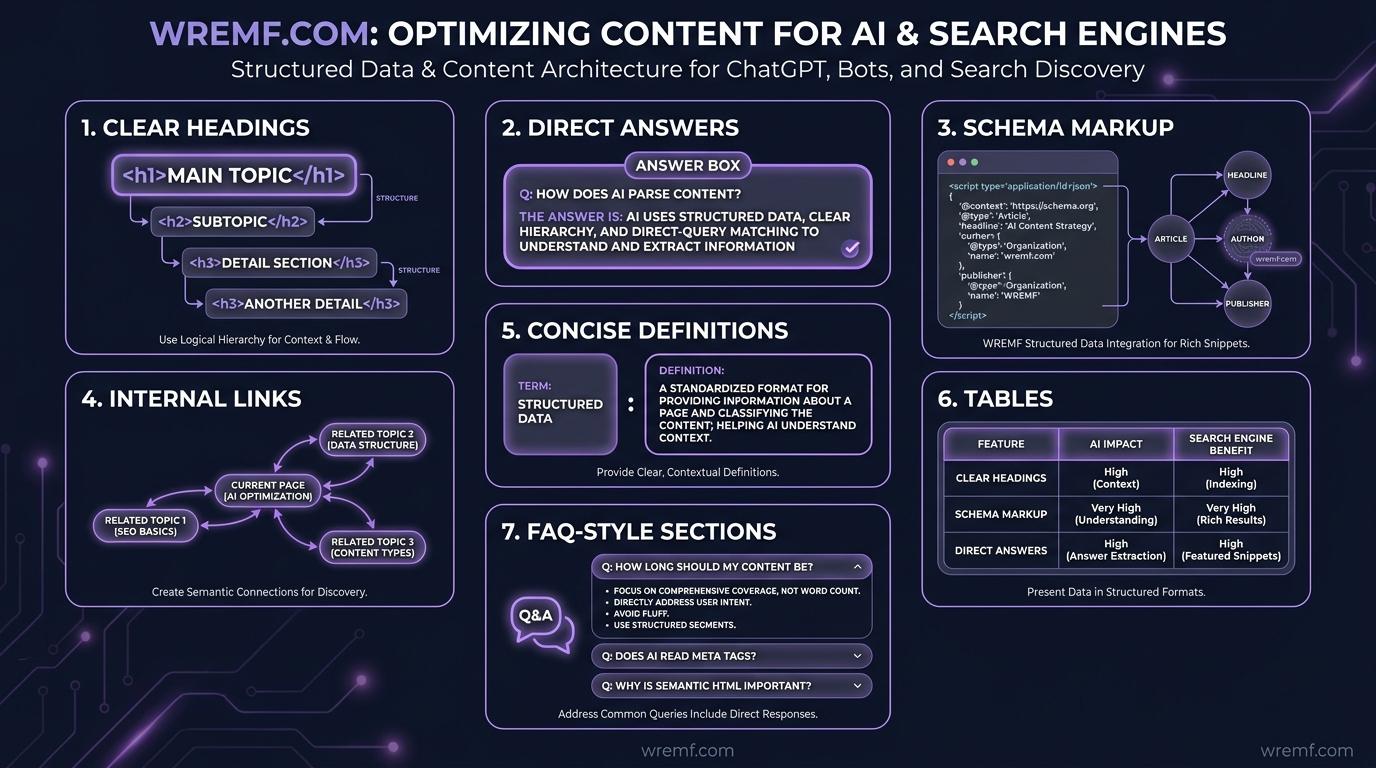
Structured website content improves ChatGPT visibility by making pages easier to crawl, parse, summarize, and cite. A page should use clear headings, direct answers, schema markup, internal links, concise definitions, tables, and FAQ-style sections.
Structured data is standardized code that helps systems understand page meaning, entities, relationships, and content types. Structured data matters because Google says structured data helps Google understand page content and gather information about the web through Google Search Central’s structured data documentation.
Schema markup is the vocabulary used to add structured data to web pages. Schema markup matters because it can clarify whether a page is an article, organization, software application, FAQ, review, product, local business, service, or event.
Machine-readable content is content organized so humans can read it easily and systems can parse it accurately. Machine-readable content matters because AI-powered search works better when claims, definitions, facts, and comparisons are easy to extract without distortion.
Technical and content structure should include:
Crawlable HTML pages
Logical H2/H3 headers that match real questions
Definition paragraphs for major concepts
Short answer-first openings under each section
Tables for comparisons, workflows, and criteria
FAQ-style sections for natural language queries
Internal and external links that support topical context
Organization, Product, Article, FAQPage, Review, LocalBusiness, and Service schema where relevant
Clear author, company, contact, and editorial information
Sitemaps, canonical tags, and clean navigation
Fast, accessible pages that work across devices
Current information for pricing, tools, integrations, and product claims
The power of logical H2/H3 header hierarchies is that they create retrieval-friendly sections. If a user asks, “How do I get cited by ChatGPT?” a page with a section answering that exact question is easier to extract than a long essay with no clear structure. FAQ-style sections also help capture direct citations because they mirror real user prompts.
Answer capsule content is a concise answer block that gives a direct response before adding detail. Answer capsule content matters because AI Overview modules, answer engines, and LLM summaries often need compact, source-backed statements.
IMPORTANT: Structured data and schema markup support understanding, but they do not guarantee ChatGPT mentions, AI citations, Google AI Overview inclusion, or search engine rankings.
KEY TAKEAWAY: Strong page structure makes your content easier for search engines, AI bots, and answer systems to parse, summarize, and cite.
After structure, the next priority is authority across the wider web.
How Do Authority, Brand Mentions, Backlinks, and Trust Signals Influence ChatGPT Visibility?
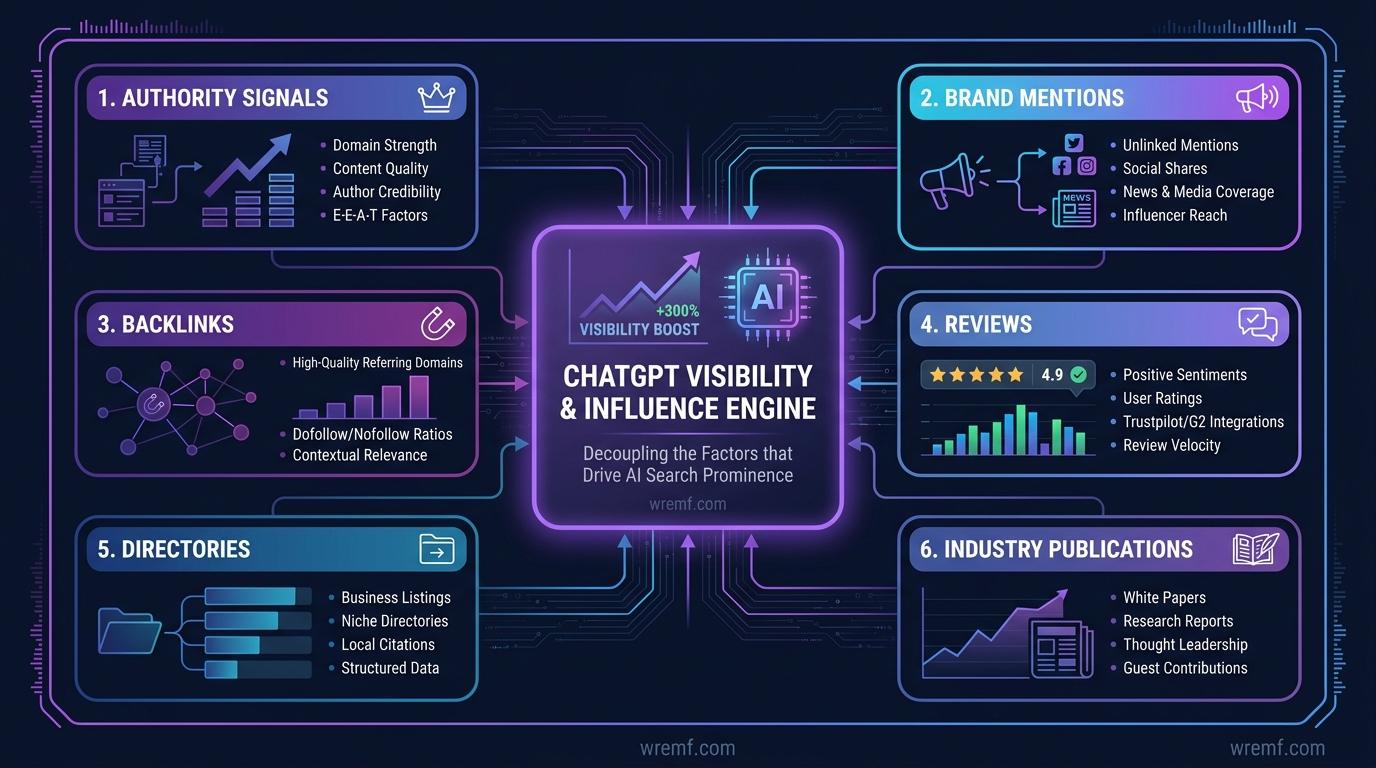
Authority signals influence ChatGPT visibility by helping AI models verify that a brand is real, relevant, trusted, and associated with a specific category. Brand mentions, backlinks, reviews, directories, and industry publications all help reinforce that association.
Trust signals are evidence points that make a brand more credible, such as reviews, customer logos, case studies, expert authors, transparent pricing, third-party mentions, and consistent business information. Trust signals matter because AI tools need to reduce uncertainty when recommending or citing a company.
Brand mentions are references to your brand, product, founder, report, data, or framework across the web. Brand mentions matter because they reinforce your entity and connect your company to relevant topics, even when the mention does not include a backlink.
Authoritative backlinks still matter because they can help search engine optimization, referral discovery, and perceived authority. However, AI visibility is not only about backlink building. AI tools can also learn from unlinked mentions, reviews, directory profiles, Reddit threads, podcasts, social media activity, niche directories, Google Business Profiles, and industry publications.
Useful sources include:
Tier-1 and trade media
Industry publications
Niche directories and professional associations
Software directories such as G2 or Capterra where relevant
Partner pages and ecosystem listings
Podcasts, webinars, and expert roundups
Google Reviews and category-specific review platforms
Reddit threads, forums, and community conversations
Knowledge bases and glossary pages
Analyst notes, market maps, and benchmark reports
High-quality blogs that cite original data or proprietary metrics
Digital PR is the process of earning online coverage, expert quotes, brand mentions, links, and citations through newsworthy content and outreach. Digital PR matters because AI-powered search often relies on trusted third-party sources when answering commercial, comparison, or “best tool” prompts.
A practical AI visibility audit often separates three source categories. Owned sources are your website, blog, docs, pricing, and product pages. Third-party sources are directories, reviews, media, partner pages, and industry publications. Community sources include Reddit threads, forums, LinkedIn discussions, TikTok mentions, and podcasts. Each category can shape how AI models understand your brand.
The WREMF source citation tracking feature helps teams identify which sources AI engines cite when answering prompts about a brand, competitor, or market category.
KEY TAKEAWAY: ChatGPT visibility improves when your brand is consistently described, mentioned, reviewed, cited, and validated across trusted sources beyond your own website.
The next section focuses on local businesses and location-based AI visibility.
How Can Local Businesses Get Mentioned in ChatGPT and AI Search?
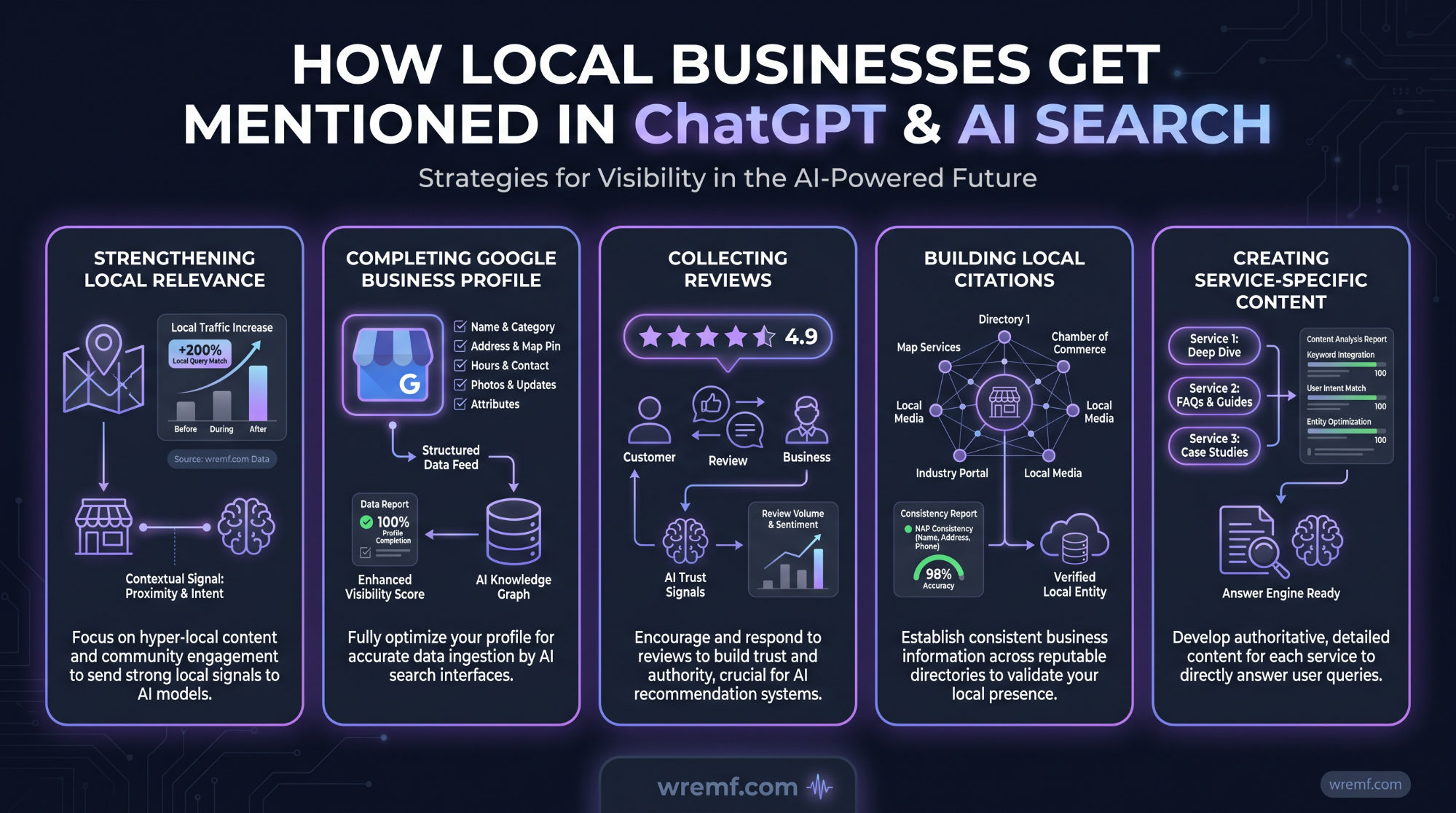
Local businesses can get mentioned in ChatGPT by strengthening local relevance, Google Business Profile completeness, reviews, local citations, and service-specific content. Local AI visibility depends on proximity, category clarity, reputation, and consistent business information.
Google Business Profile is Google’s listing system for local businesses, including name, address, phone number, categories, hours, reviews, services, and updates. Google Business Profile matters because local AI queries often depend on structured local business data, review signals, and search engine data.
For local SEO and AI visibility, business owners should prioritize:
Complete Google Business Profiles
Accurate categories and service areas
Consistent name, address, and phone details across directories
Strong Google Reviews with fresh customer feedback
Service pages for each location or service line
Local case studies with real proof where permission exists
Local optimization through associations, chambers, directories, and media
FAQ sections that answer local buyer questions
Clear opening hours, booking options, pricing guidance, and contact details
Reputation management across Yelp, TripAdvisor, G2, Google Reviews, and niche review sites where relevant
Google explains that AI Overviews provide AI-generated snapshots with key information and links to dig deeper through Google Search help documentation for AI Overviews. For local businesses, this makes online presence consistency important across Google Business Profiles, websites, review platforms, industry directories, and local publications.
A local service business should not rely on one homepage. A cybersecurity consultant in Lyon, for example, needs a complete Google Business Profile, service pages for relevant industries, reviews that mention specific services, directory profiles, local media mentions, and content answering questions such as “best cybersecurity consultant for SaaS companies in Lyon.”
Google Business Profiles should match website language. If the website says “B2B SaaS SEO agency” but the profile, reviews, and directory listings only say “marketing agency,” AI tools may struggle to connect the business to specific commercial prompts. Consistency improves local match, source confidence, and retrieval clarity.
KEY TAKEAWAY: Local ChatGPT and AI search visibility depends on complete business data, review trust, local citations, service pages, and consistent Google Business Profile signals.
Next, let’s compare how different AI models and AI engines use sources.
How Do ChatGPT, Perplexity, Gemini, Claude, Copilot, and Other AI Models Differ?
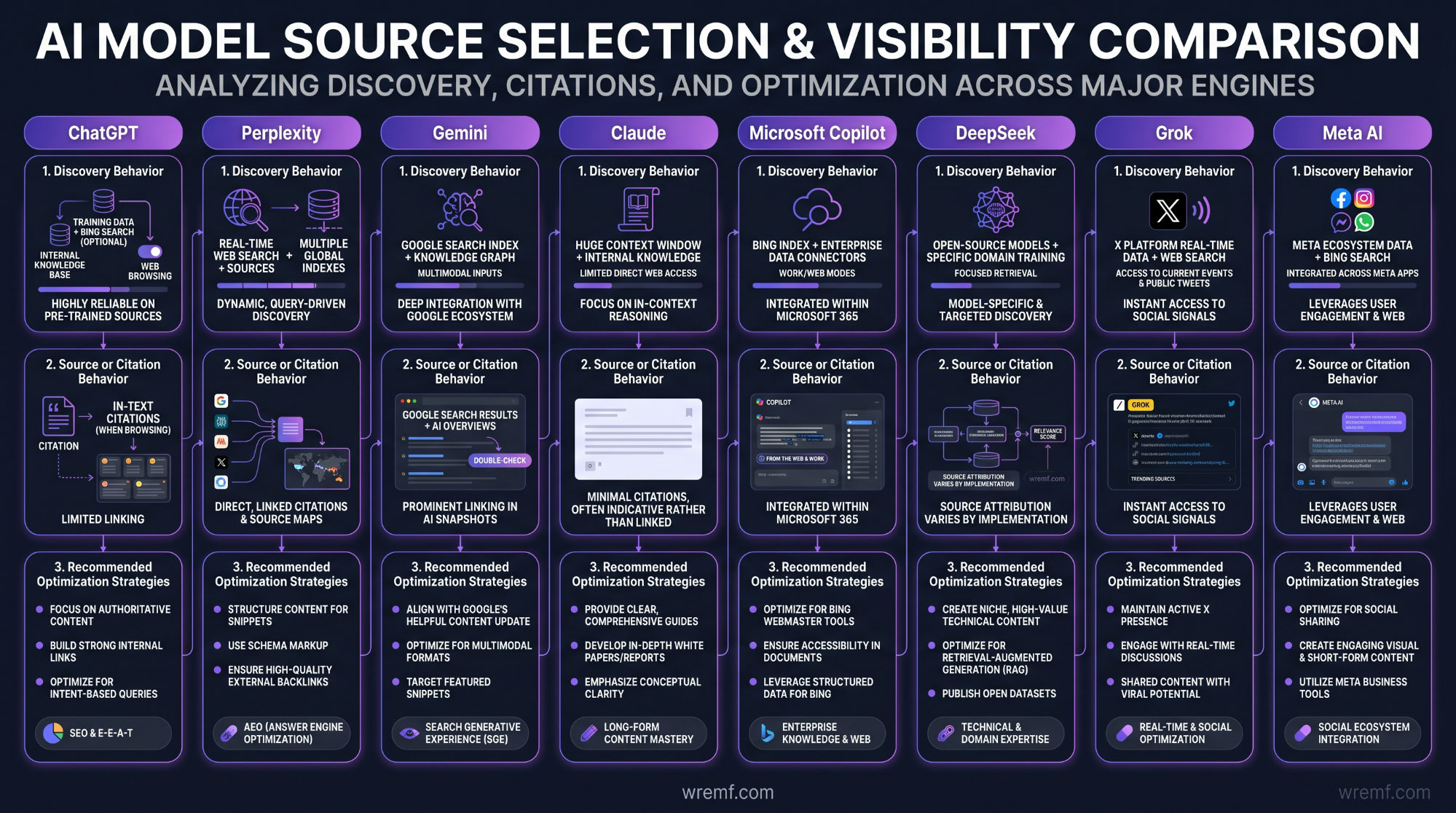
Different AI models and AI engines select sources differently, so AI visibility should be measured across multiple platforms. ChatGPT, Perplexity, Gemini, Claude, Microsoft Copilot, DeepSeek, Grok, Meta AI, and Mistral can produce different mentions for the same prompt.
AI models are systems that generate, summarize, classify, or reason over information. AI models matter because each model can have different training data, retrieval methods, safety policies, source preferences, and answer formats.
AI engines are user-facing systems that combine AI models with search, retrieval, citations, applications, or workflows. AI engines matter because buyers do not use only one AI tool during research. A brand may appear in Perplexity but not ChatGPT, or in Google AI Overview modules but not Microsoft Copilot.
| AI Engine | Common Discovery Behavior | Source or Citation Behavior | What Brands Should Optimize |
|---|---|---|---|
| ChatGPT | Conversational answers, ChatGPT Search, category recommendations, web search when needed | Search responses may include inline citations or a Sources panel | Clear category pages, citable content, prompt coverage, source consistency |
| Perplexity | AI-powered search engine with conversational answers | Perplexity says answers include numbered citations linking to original sources | Concise source pages, original data, source-backed claims |
| Gemini and Google AI Overviews | AI-powered search experiences connected to Google Search | Google AI Overviews include links to explore more on the web | Helpful content, structured data, search engine optimization, clear headings |
| Claude | Conversational AI with web search in supported contexts | Claude web search can include source citations where available | Reliable pages, current information, clear source claims |
| Microsoft Copilot | Search, Microsoft ecosystem workflows, and enterprise knowledge sources | Copilot can use web and organizational knowledge depending on product context | Bing visibility, website clarity, documentation, enterprise content |
| DeepSeek, Grok, Meta AI, Mistral | Model-specific answers and discovery experiences | Source behavior varies by interface and retrieval setup | Consistent brand entities, public sources, content quality, broad web presence |
OpenAI, Google, Perplexity, Anthropic, and Microsoft all show that AI discovery is moving toward answers, citations, source links, and conversational exploration. This creates a cross-platform visibility challenge. A brand cannot assume that one AI tool represents the full market.
Cross-platform visibility is the practice of monitoring brand presence across multiple AI discovery surfaces. Cross-platform visibility matters because each AI model can use different source logic, freshness, interface behavior, and answer formatting.
WREMF tracks 10 AI engines, including ChatGPT, Claude, Gemini, Perplexity, Google AI Overviews, Copilot, DeepSeek, Grok, Meta AI, and Mistral. This helps teams avoid building an AI visibility strategy from a single screenshot or one prompt in one account.
KEY TAKEAWAY: AI visibility must be tracked across multiple AI engines because each platform can mention, cite, rank, or ignore different sources.
Next, let’s turn visibility into reporting that leadership and clients can understand.
How Do You Track and Measure AI Visibility, Citations, and Mentions?
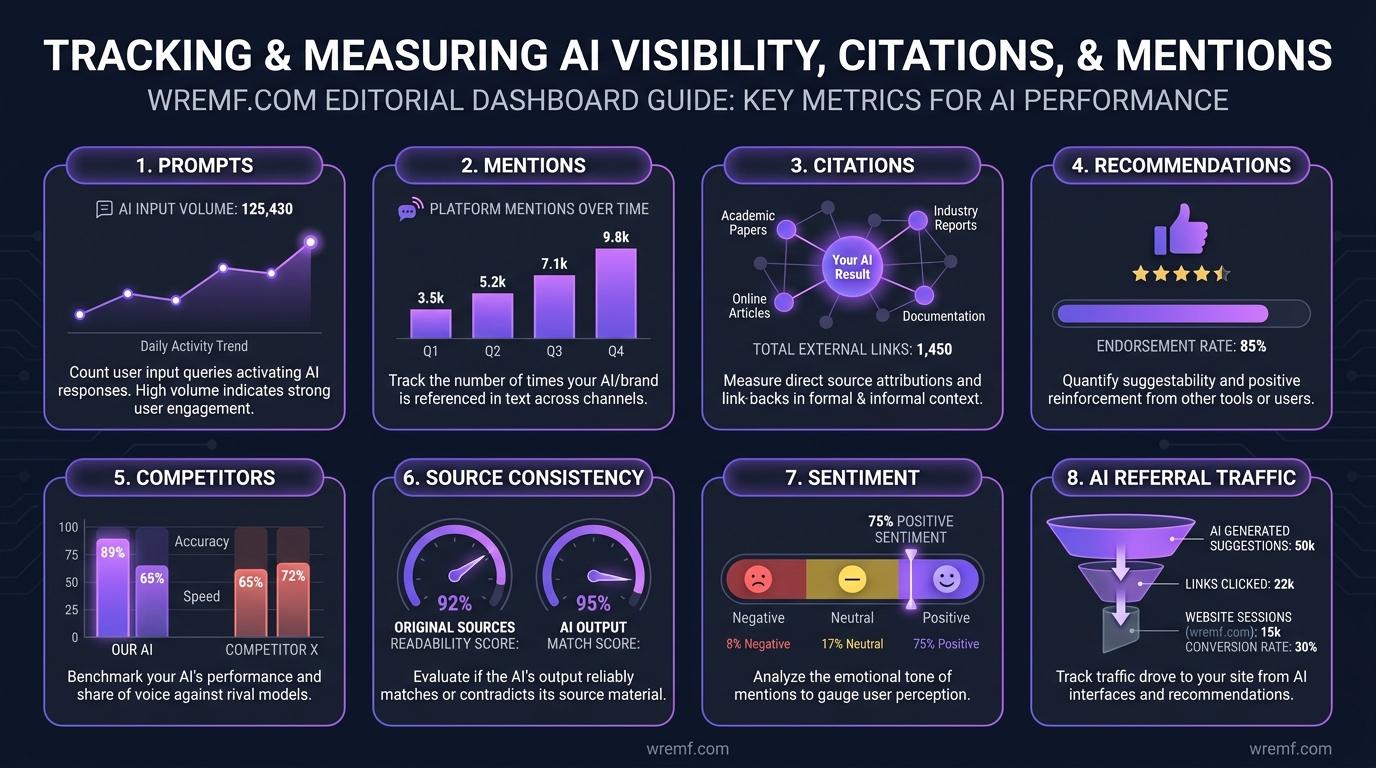
You track AI visibility by measuring prompts, mentions, citations, recommendations, competitors, source consistency, sentiment, and AI referral traffic. The goal is to replace anecdotal testing with repeatable reporting.
AI share of voice is the percentage of relevant AI answers where your brand appears compared with competitors. AI share of voice matters because it gives marketing leaders a market-level visibility metric instead of isolated prompt screenshots.
AI traffic attribution connects visits, conversions, and pipeline signals from AI tools to business outcomes. AI traffic attribution matters because AI discovery may influence buyers before a click, and AI referral traffic can be difficult to classify cleanly in Google Analytics.
A practical measurement system should include:
Prompt set: The natural language questions buyers ask
Mention rate: How often your brand appears
Citation rate: How often your website or third-party sources are cited
Recommendation rate: How often your brand is suggested as a solution
Competitor visibility: Which competitors appear more often
Source citations: Which sources AI engines use
Sentiment: Whether the brand is described positively, neutrally, or negatively
Position and prominence: Whether the brand appears first, later, or only as an aside
Source consistency: Whether AI tools describe the brand accurately
AI referral traffic: Visits from ChatGPT, Perplexity, Gemini, Copilot, Claude, and other AI tools
Content gaps: Questions where competitors appear but your brand does not
Authority gaps: Sources competitors have that your brand lacks
Google Analytics and Google Analytics 4 can help identify AI referral traffic, but tracking may need custom channel groupings because AI tools can appear as referral traffic or under other acquisition sources. This makes AI visibility reporting different from classic search engine data, where Google Search Console and rank trackers provide more mature reporting.
Manual prompting is useful at the beginning. You can use Google Sheets, Apps Script, a Search API, or GEO tools to scale testing. However, teams usually outgrow manual workflows when they need historical tracking, competitor visibility, multi-engine coverage, white-label reports, and source citation analysis.
WREMF’s prompt intelligence feature helps teams monitor the prompts that matter, while the competitive landscape feature shows where competitors appear across AI answers.
KEY TAKEAWAY: AI visibility measurement should combine prompt tracking, citation tracking, competitor analysis, source consistency, sentiment, and AI traffic attribution.
The next section explains how to improve the signals that measurement reveals.
How Do You Improve ChatGPT Mentions After an AI Visibility Audit?
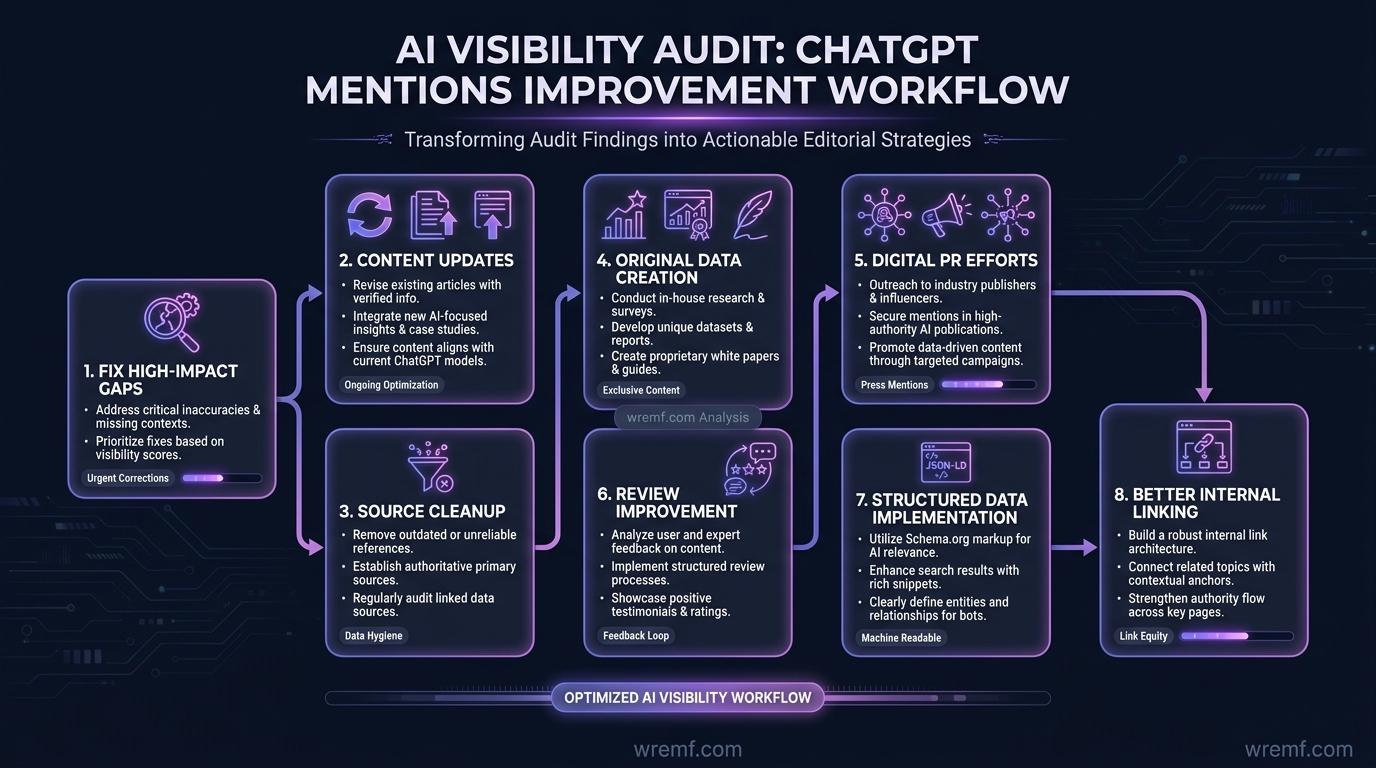
You improve ChatGPT mentions after an AI visibility audit by fixing the highest-impact gaps first. Most brands need a mix of content updates, source cleanup, original data, digital PR, review improvement, structured data, and better internal linking.
A GEO audit is a structured review of how a brand appears across generative AI engines, prompts, citations, competitors, and sources. A GEO audit matters because it shows whether the problem is visibility, source quality, entity confusion, content weakness, or reputation.
In practical AI visibility audits, marketing teams often find four types of gaps:
Prompt gaps: Buyers ask questions your website does not answer
Citation gaps: AI engines cite competitors or third-party sources but not your pages
Authority gaps: Competitors have stronger industry publications, directories, reviews, or backlinks
Consistency gaps: Your brand is described differently across website pages, profiles, reviews, and directories
Fix prompt gaps with content briefs and structured pages. If buyers ask “how to get cited on ChatGPT,” create a section that answers that exact query with clear steps. If buyers ask “best AI visibility tools for agencies,” create a comparison page that explains use cases, reporting needs, and evaluation criteria.
Fix citation gaps by improving source quality. Add original data, stronger definitions, clear tables, author credentials, updated facts, and internal links. If AI tools cite outdated directories or weak third-party summaries, update those profiles and publish better owned sources.
Fix authority gaps through digital PR, expert quotes, podcasts, industry publications, directories, partner pages, and review campaigns. This does not mean spammy backlink building. It means making credible sources connect your brand to the topic you want to own.
Fix consistency gaps by aligning your homepage, product pages, schema markup, Google Business Profile, review profiles, social pages, and industry directories. Source consistency helps AI systems understand that all public descriptions refer to the same entity.
The WREMF GEO audit feature helps teams identify these gaps and translate them into practical actions across content, citations, competitors, and reporting.
KEY TAKEAWAY: The best ChatGPT visibility improvements come from fixing prompt gaps, citation gaps, authority gaps, and source consistency gaps in priority order.
Next, let’s cover the mistakes that can hold brands back.
What Mistakes Stop Brands From Getting Mentioned in ChatGPT?
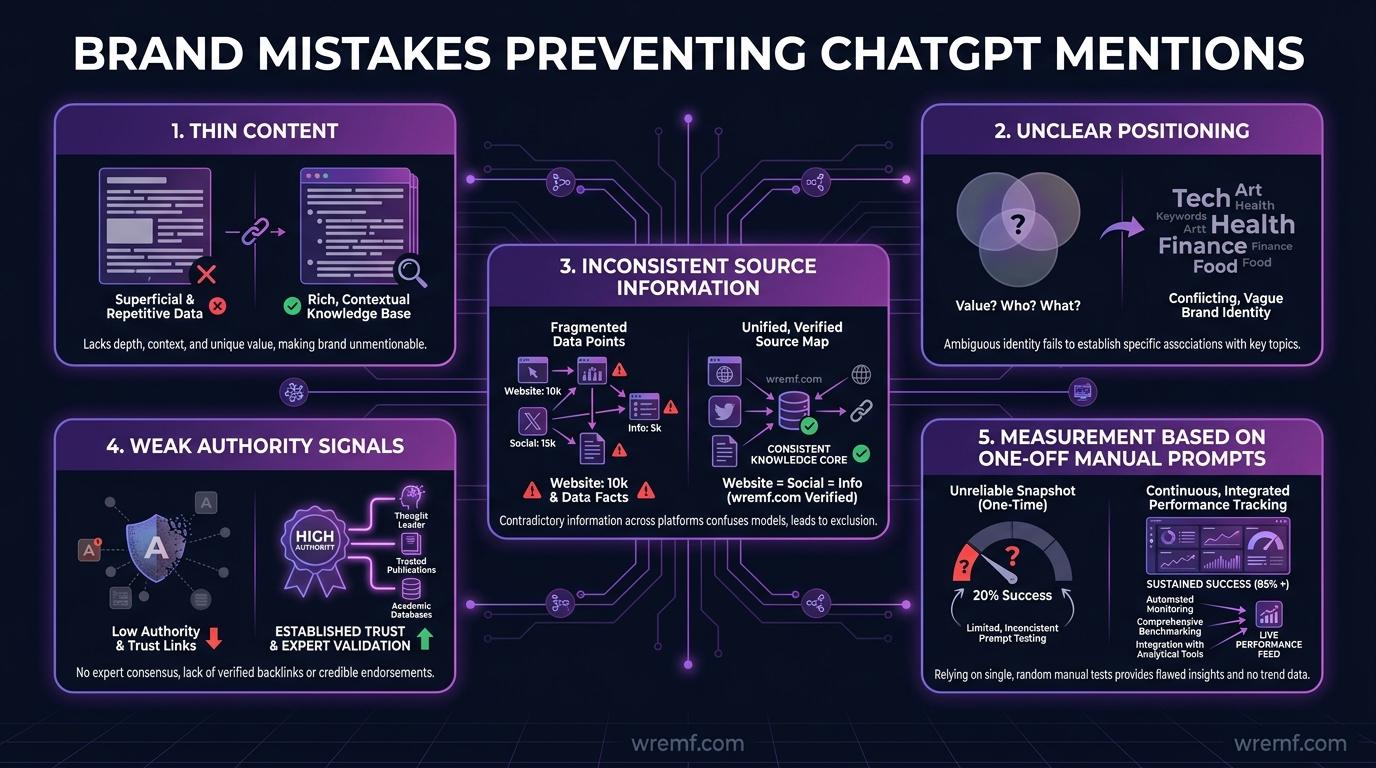
The biggest mistakes are thin content, unclear positioning, inconsistent source information, weak authority signals, and measurement based on one-off manual prompts. These mistakes make a brand harder for ChatGPT and other AI tools to understand, verify, and recommend.
Thin content is content that adds little original value, weak detail, or generic explanation. Thin content matters because AI systems have little reason to cite or summarize pages that repeat what many other websites already say.
Avoid these common mistakes:
Publishing generic AI-generated content without original insight
Targeting keywords without answering real prompts
Writing long pages with no answer-first sections
Ignoring structured data and schema markup
Using unclear H2/H3 headers that do not match user questions
Creating product pages without use cases, examples, or proof
Hiding key information behind scripts, forms, or PDFs only
Claiming expertise without author, company, case study, or methodology signals
Ignoring reviews, directories, Reddit threads, forums, and community sentiment
Running manual prompts once and treating the result as a strategy
Measuring rankings but not AI mentions, citations, or recommendations
Letting third-party profiles use outdated descriptions
Overusing keywords instead of building entity clarity
Content quality matters more than keyword density alone. AI visibility does not improve just because a page repeats “AI-powered search” many times. The page needs to define the topic, answer real buyer questions, provide supporting evidence, show source credibility, and connect the brand to the category through consistent language.
A common mistake is over-focusing on schema markup while ignoring substance. Schema can help explain page meaning, but weak content with no proof, no original data, and no external validation still has limited value. Another mistake is treating Reddit threads as either all good or all bad. Reddit and forums can reveal useful buyer language, but reputation issues can also influence trust.
KEY TAKEAWAY: ChatGPT visibility suffers when brands publish generic content, ignore source consistency, lack proof, or measure AI visibility with one-off screenshots.
Now let’s explain how WREMF turns these concepts into a practical workflow.
How Does WREMF Help You Track, Improve, and Prove ChatGPT Mentions?
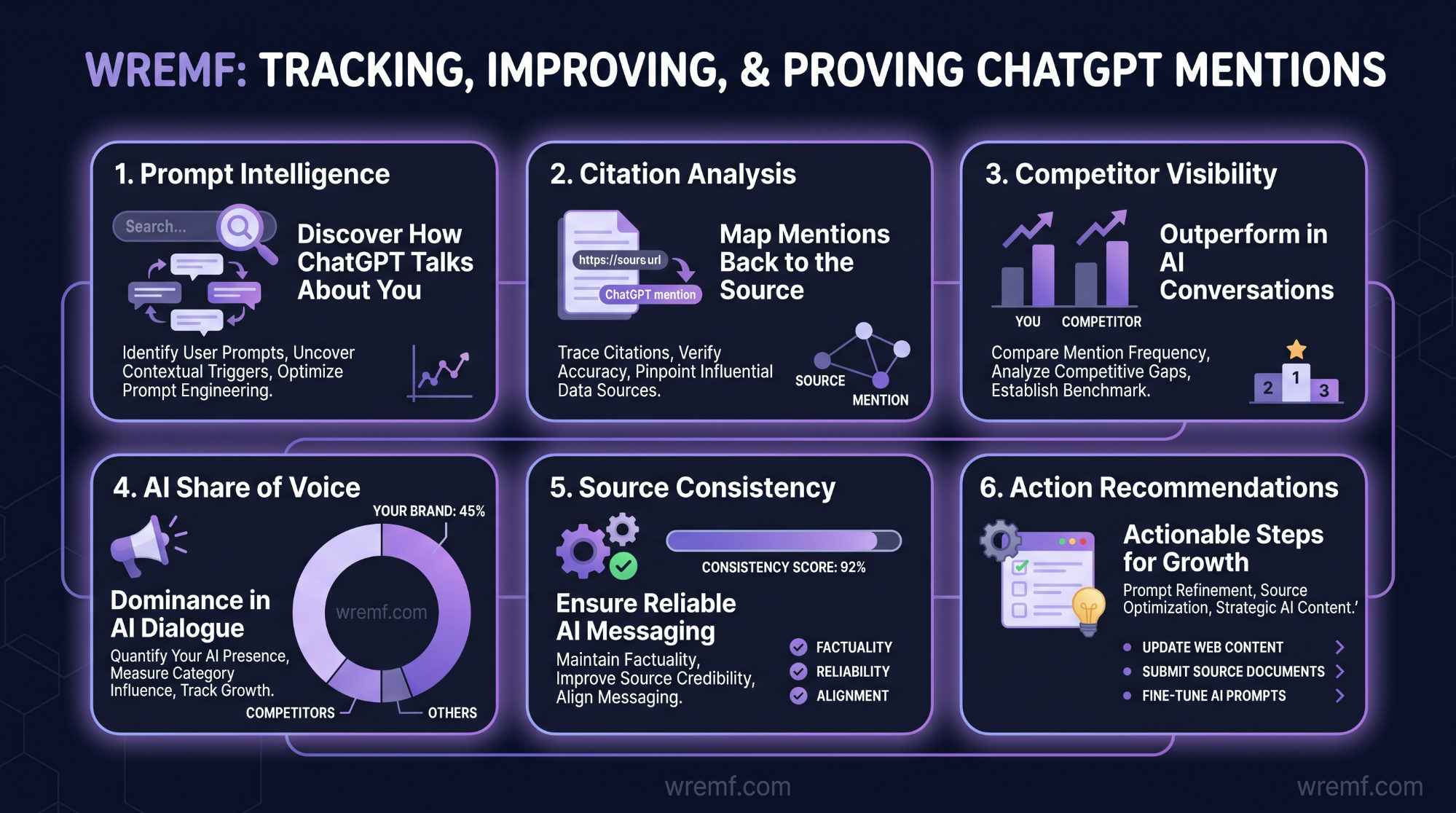
WREMF helps teams track, improve, and prove ChatGPT mentions by connecting prompt intelligence, citation analysis, competitor visibility, AI share of voice, source consistency, and action recommendations. WREMF turns AI visibility from guesswork into a repeatable workflow.
WREMF is an AI visibility platform and agency partner for B2B teams that want to understand how their brand appears across AI discovery surfaces. WREMF matters because AI visibility requires both measurement and execution.
WREMF helps with:
AI visibility tracking across 10 AI engines
Prompt intelligence for buyer questions and category prompts
Source citation tracking for pages, reviews, directories, and industry publications
Competitor visibility across AI answers
AI share of voice reporting for leadership and clients
AI traffic attribution to connect discovery with outcomes
GEO audits for technical, content, and authority gaps
AEO strategy for answer-ready content
AI-ready content briefs based on prompt gaps and citation gaps
SEO testing to validate content improvements
Visibility scoring for trend analysis
Scheduled AI monitoring
White-label client reporting
API and MCP integrations
BYOK support
Client portals
Source consistency analysis
For software-first teams, WREMF provides visibility dashboards and reports. For teams that need execution, WREMF offers managed AEO, GEO, content optimization, authority building, citation improvement, and reporting through the WREMF agency service. For agencies and consultants, WREMF supports white-label reports and client workflows through WREMF for agencies.
| Option | Best For | What You Get | Main Limitation | Recommended When |
|---|---|---|---|---|
| Software | In-house SEO, content, and growth teams | Prompt tracking, citations, competitor reports, visibility scoring | Your team executes recommendations | You need control and repeatable measurement |
| Agency service | Teams without internal execution capacity | Strategy, audits, content optimization, authority support, reporting | Less self-serve control | You need senior-led execution |
| Hybrid model | Teams that need software plus done-for-you support | Platform measurement plus managed execution | Requires coordination | You need speed, accountability, and reporting |
Pricing is relevant when teams compare buying options. Starter is €39 per month for 1 website, unlimited prompt tracking, BYOK, 10 AI engines, all features and tools, white-label reports, 1 seat, and email support. Growth is €89 per month for 5 websites, unlimited prompt tracking, BYOK, 10 AI engines, all features and tools, white-label reports, priority email support with 24h SLA, content brief generator, and SEO A/B testing. Enterprise uses custom pricing for unlimited websites, unlimited prompt tracking, BYOK, 10 AI engines, unlimited seats, dedicated support with 4h SLA, and custom branded portals. Teams can compare options on the WREMF pricing page.
KEY TAKEAWAY: WREMF helps brands connect AI visibility measurement, prompt intelligence, citation analysis, competitor tracking, and execution into one system.
The next section explains how to future-proof AI visibility as search and generative AI continue to change.
How Do You Future-Proof Your Brand’s AI Visibility?
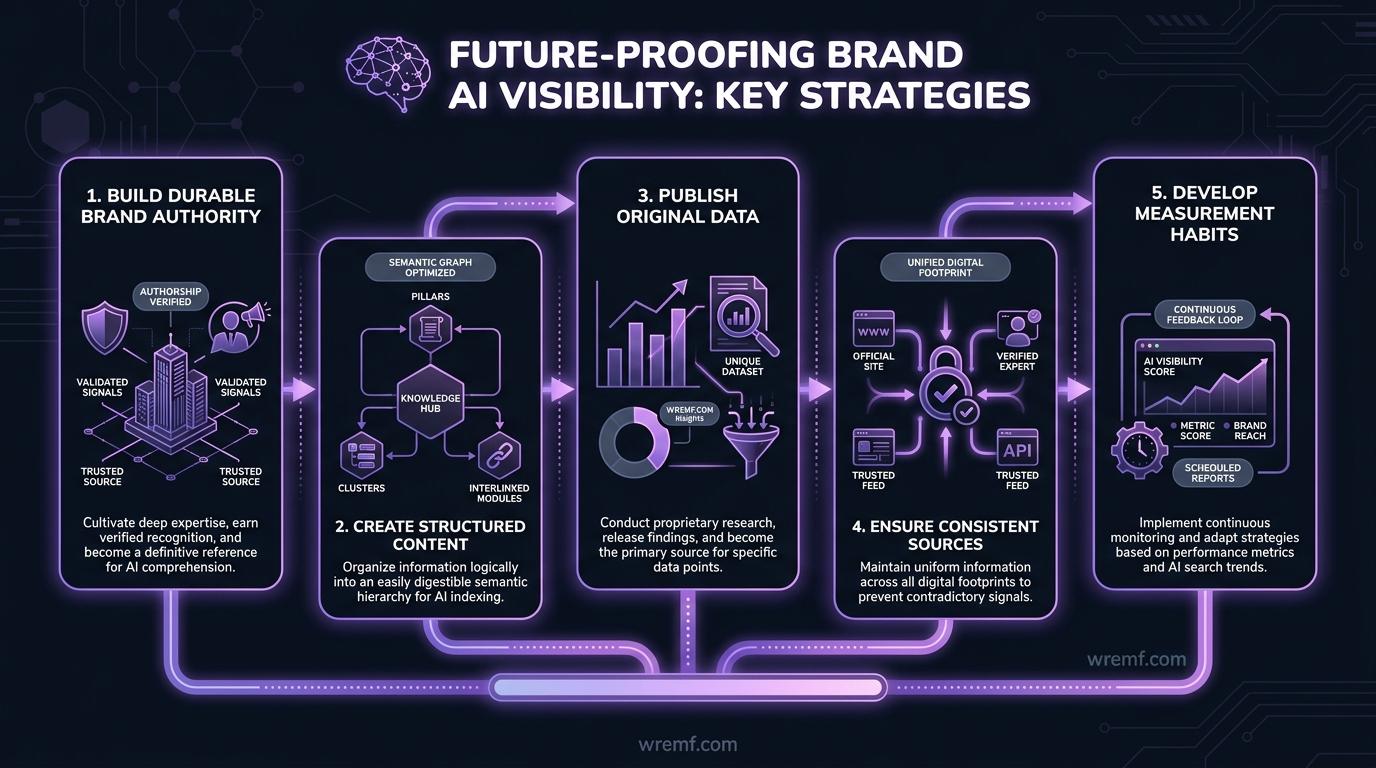
You future-proof AI visibility by building durable brand authority, structured content, original data, consistent sources, and measurement habits that work across changing AI engines. The goal is to become easier to understand and verify, not to chase one model’s temporary behavior.
Future-proofing is the practice of building systems that remain useful as platforms, algorithms, and interfaces change. Future-proofing matters because ChatGPT Search, Google AI Overviews, Gemini, Claude, Perplexity, Microsoft Copilot, and other AI-driven platforms will continue evolving.
Focus on durable practices:
Create content for real buyer questions, not only keywords
Maintain clear brand positioning across every profile and page
Publish original data, proprietary metrics, survey stats, or benchmarks
Build content clusters around your core market
Use structured headings, answer capsules, and FAQ-style sections
Keep pricing, product, integration, and feature information current
Monitor review platforms and community sentiment
Earn credible mentions in industry publications and niche directories
Strengthen internal and external links naturally
Add schema markup where it clarifies page meaning
Track prompts and AI citations monthly
Compare visibility across multiple AI engines, not only ChatGPT
Proprietary metrics are branded measurements that your company defines and publishes, such as an index, score, benchmark, or recurring report. Proprietary metrics matter because they give AI systems and publishers a specific data point to reference.
AI visibility works best when a brand creates a loop. The brand publishes useful content and original data. Industry publications and niche directories cite or mention the brand. AI tools retrieve those sources when answering relevant prompts. The brand then measures which prompts, citations, and competitors appear, and updates content or source strategy accordingly.
The WREMF methodology is designed around this loop by connecting prompts, citations, competitors, source consistency, and attribution into one repeatable process.
KEY TAKEAWAY: Durable AI visibility comes from clear entities, original evidence, source consistency, trusted mentions, structured content, and ongoing measurement.
Before the FAQ section, let’s correct the common myths that prevent teams from acting.
Common Myths About AI Visibility Debunked
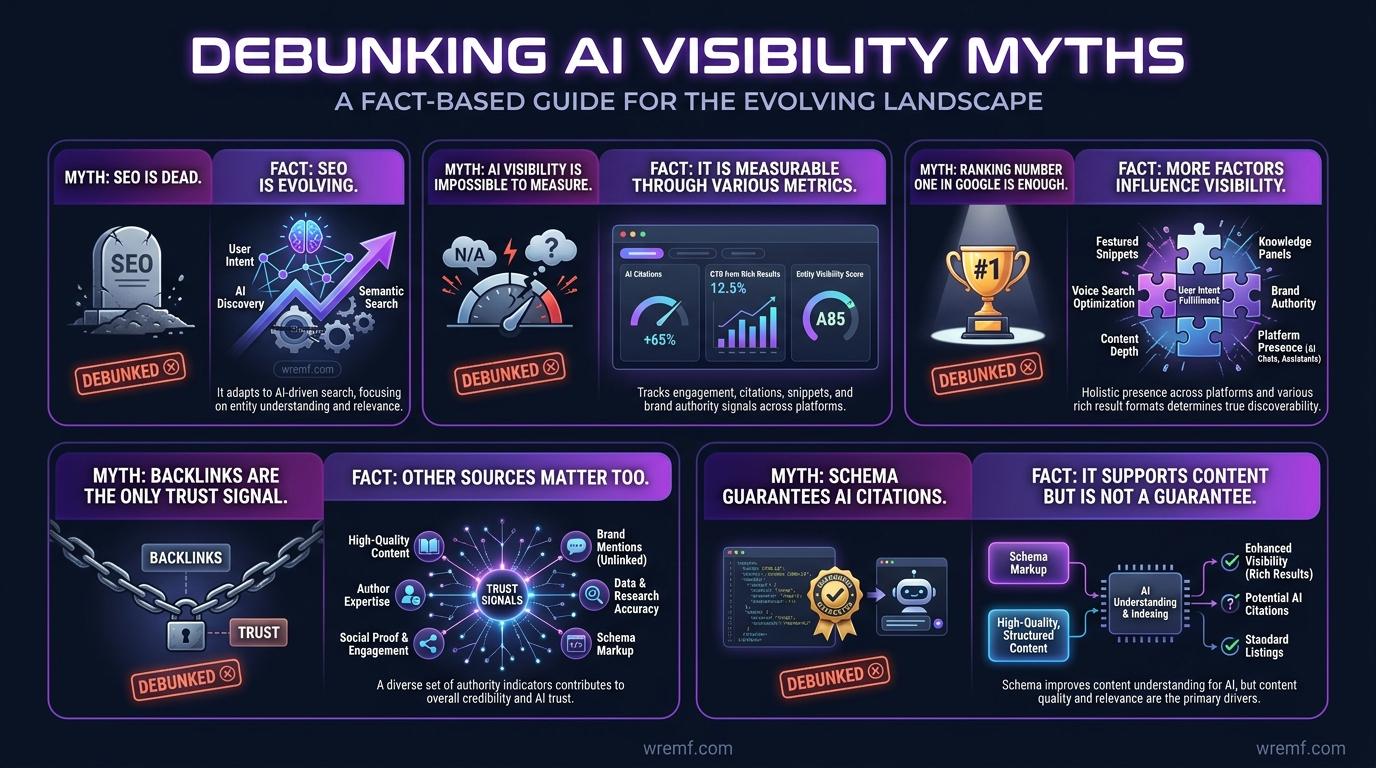
AI visibility is often misunderstood because teams compare it too narrowly with rankings, backlinks, or classic SEO tools. The reality is that ChatGPT visibility is measurable, improvable, and influenced by both content quality and the wider source ecosystem.
MYTH: SEO is dead because ChatGPT and AI-powered search are replacing Google.
FACT: SEO is evolving, not disappearing. Search engine optimization still matters because AI-powered search needs crawlable, helpful, and reliable sources. The practical shift is that SEO now overlaps with AEO, GEO, structured data, source citations, and AI visibility measurement.
MYTH: AI visibility is impossible to measure.
FACT: AI visibility is measurable through prompt tracking, brand mentions, source citations, recommendation rate, AI share of voice, competitor visibility, sentiment, and AI referral traffic. Measurement is not perfect because AI answers can vary by model, location, freshness, and prompt wording. Repeatable prompt sets and scheduled monitoring make trends visible.
MYTH: Ranking number one in Google is enough to get mentioned in ChatGPT.
FACT: Rankings help, but they are not enough. ChatGPT may mention a brand because it has stronger entity clarity, better source citations, stronger reviews, clearer original data, or more relevant third-party mentions. A high-ranking page that does not answer the prompt clearly may be less useful than a more structured source.
MYTH: Backlinks are the only trust signal that matters.
FACT: Backlinks are useful for SEO visibility, but AI visibility also depends on brand mentions, reviews, industry publications, niche directories, Reddit threads, case studies, Google Business Profiles, and source consistency. AI tools need to understand both authority and context.
MYTH: Schema markup guarantees AI citations.
FACT: Schema markup helps systems understand content, but it does not guarantee ChatGPT mentions, citations, rankings, or Google AI Overview inclusion. Schema should support useful content, structured pages, clear positioning, original data, and credible sources.
KEY TAKEAWAY: AI visibility is not magic, but it is broader than rankings and requires measurement, content quality, entity clarity, authority, and trusted sources.
The final FAQ section answers the specific questions buyers, business owners, SEO teams, and agencies ask most often.
Frequently Asked Questions
How do you get your brand mentioned in ChatGPT?
You get your brand mentioned in ChatGPT by making your brand relevant, recognizable, and credible for the questions your buyers ask. Start with prompt research, then create structured content that answers those prompts directly. Add original data, case studies, reviews, schema markup, and source citations. Build authority through industry publications, niche directories, digital PR, podcasts, and trusted third-party mentions. WREMF helps teams track whether their brand appears in ChatGPT, which competitors appear instead, and which sources influence the answer.
How do you get cited on ChatGPT?
You get cited on ChatGPT when ChatGPT uses search or source-aware functionality and your page is selected as a useful source. Create pages that answer specific questions clearly, include original data, use structured headings, cite credible sources, and stay current. Pages should be crawlable, useful, and easy to summarize. ChatGPT citations are not guaranteed, but source quality, answer clarity, topical relevance, and authority can improve the likelihood that your content is considered.
How do you get ChatGPT to give references?
You can ask ChatGPT to use web search, cite sources, show references, or provide links when the product mode supports it. ChatGPT responses that use search may include inline citations or a Sources panel. For brands, the practical goal is to create content that can become a reference when users ask relevant questions. Build source-ready pages with direct answers, evidence, structured data, clear authorship, updated facts, and original insights.
Why does my brand not show up in ChatGPT even though I rank on Google?
Your brand may not show up in ChatGPT because Google rankings are only one signal. ChatGPT may need stronger entity clarity, better category positioning, more third-party mentions, clearer case studies, fresher content, stronger reviews, or better source citations. Prompt wording also matters. Your brand may appear for one query but not another. Use AI visibility tracking to test prompt groups, compare competitors, and identify whether the gap is content, authority, source consistency, or relevance.
Is SEO dead or evolving in 2026?
SEO is evolving in 2026. Traditional search engine optimization still matters because AI-powered search needs crawlable, helpful, reliable, and structured content. The change is that SEO must now connect with Answer Engine Optimization, Generative Engine Optimization, AI citations, prompt tracking, and source consistency. Teams that only track rankings may miss brand mentions inside ChatGPT, Perplexity, Gemini, Claude, Microsoft Copilot, and Google AI Overview modules.
What is considered a brand mention in ChatGPT?
A brand mention in ChatGPT is any answer where ChatGPT names your brand, product, founder, content, research, metric, or source. Mentions can be direct recommendations, comparison entries, factual attributions, cited sources, or category examples. A mention is different from a citation because citations include a source link. A recommendation is stronger than a neutral mention because it suggests the brand as a solution for the user’s need.
Are Reddit threads and forum mentions harmful to AI visibility?
Reddit threads and forum mentions are not automatically harmful. They can help reveal buyer language, real objections, product comparisons, and community sentiment. The risk is reputation quality. Negative unresolved complaints, spammy self-promotion, or inconsistent claims can weaken trust signals. Use Reddit threads and forums as listening channels. Strengthen your owned content, improve customer support issues, and keep brand descriptions consistent across public sources.
Does social media activity help with AI visibility?
Social media activity can help AI visibility indirectly when it creates public discussion, brand mentions, links, expert quotes, podcast invites, community engagement, or content distribution. Social media alone is usually not enough. AI tools rely more heavily on durable, retrievable sources such as websites, industry publications, directories, reviews, case studies, and original data. Use social media to amplify evidence, but keep key facts on crawlable pages.
How long does it take to build AI visibility?
AI visibility can begin changing after technical fixes, content updates, and new source mentions are discovered, but meaningful progress usually takes weeks or months. Timelines depend on crawl frequency, category competitiveness, authority gaps, review quality, content depth, and whether AI engines use real-time web search for the prompt. A practical workflow is to benchmark monthly, refresh priority content quarterly, and monitor high-intent prompts continuously.
What types of content help AI engines recognize a brand as an authority?
AI engines recognize authority through content that is clear, specific, evidence-backed, and supported by trusted sources. Useful formats include pillar pages, content clusters, comparison pages, case studies, original research, survey stats, proprietary metrics, FAQs, glossary pages, methodology pages, and software documentation. The content should answer real prompts, define entities clearly, include source citations, and show why the brand is relevant to the category.
Do structured data and schema markup help with ChatGPT visibility?
Structured data and schema markup can help search engines and AI systems understand your content, but they do not guarantee ChatGPT visibility. Use schema markup to clarify organizations, products, articles, FAQs, reviews, local businesses, services, and software applications. Pair schema with high-quality content, clear headings, original data, trusted external links, accurate internal links, reviews, and consistent brand positioning across third-party sources.
What is the best way for local businesses to get mentioned by AI tools?
The best way for local businesses to get mentioned by AI tools is to strengthen local relevance and trust. Complete your Google Business Profile, keep categories accurate, collect high-quality reviews, maintain consistent business information across directories, build service-specific local pages, and earn local citations from trusted organizations. Local AI visibility depends on proximity, relevance, reputation, service clarity, and consistent online presence.
How can agencies report AI visibility to clients?
Agencies can report AI visibility by showing prompt coverage, mention rate, citation rate, AI share of voice, competitor visibility, sentiment, source citations, and recommended actions. Reports should separate what was measured from what should be improved. For example, an agency can show that a competitor appears for commercial prompts because it has better directory profiles and stronger comparison content. WREMF supports white-label reporting and client portals for agency workflows.
What is the difference between AI citations, brand mentions, and recommendations?
AI citations are source links used to support an AI answer. Brand mentions are references to your company, product, content, or data inside the answer. Recommendations are stronger because the AI answer suggests your brand as a suitable option. A brand can be mentioned without being cited, cited without being recommended, or recommended because strong third-party sources support its relevance. Good AI visibility tracking measures all three.
What tools can help track ChatGPT brand mentions?
Tools that track ChatGPT brand mentions should monitor repeatable prompts, multiple AI engines, citations, competitors, AI share of voice, source consistency, and reporting over time. Manual prompting is useful at the start, but it becomes unreliable when teams need trend data. WREMF tracks brand visibility across ChatGPT, Claude, Gemini, Perplexity, Google AI Overviews, Copilot, DeepSeek, Grok, Meta AI, and Mistral.
How does WREMF help with ChatGPT visibility?
WREMF helps with ChatGPT visibility by tracking prompts, brand mentions, citations, competitors, AI share of voice, source consistency, and AI traffic attribution across major AI engines. WREMF also helps teams identify content gaps, citation gaps, competitor gaps, and reporting needs. Teams can use WREMF as software, as a managed agency service, or as a hybrid software plus execution model for AI visibility growth.
Conclusion
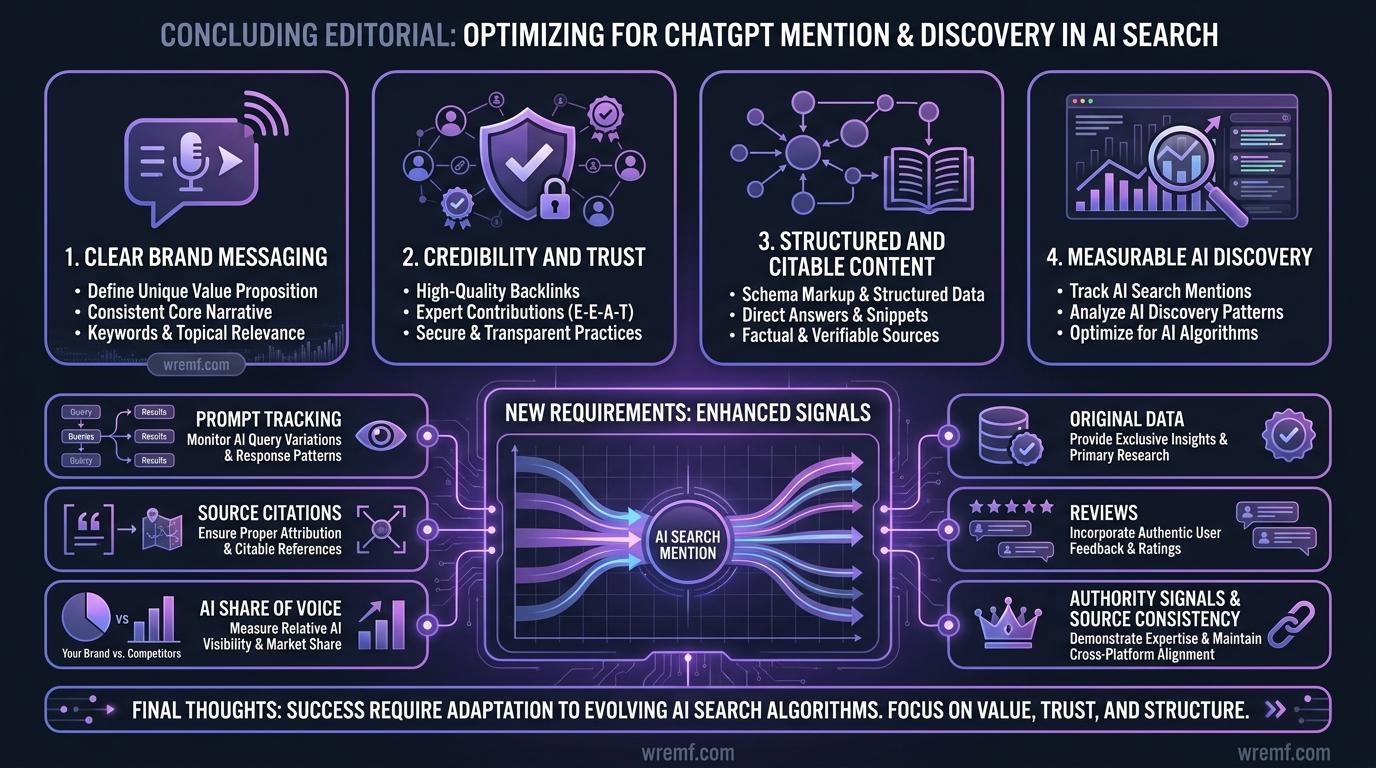
How to get mentioned in ChatGPT comes down to making your brand clear, credible, structured, cited, and measurable across AI discovery surfaces. Classic SEO still matters, but AI visibility adds new requirements: prompt tracking, source citations, AI share of voice, original data, structured content, reviews, authority signals, and source consistency. Brands that treat ChatGPT mentions as a repeatable system will make better decisions than teams relying on screenshots or guesswork. To turn AI visibility into a measurable workflow, explore the WREMF platform suite or talk to the WREMF agency team.
Related reading
- Grok Optimization: The Complete Guide to Grok SEO, AI Visibility, and Brand Mentions
- Gemini Optimization: The Complete Guide to Google Gemini Visibility, AI Overviews, and AI Search
- ChatGPT SEO: The Complete Guide to Ranking in ChatGPT
- SEO for ChatGPT: Playbook for Ranking, Visibility, and AI Search Citations