Grok Optimization: The Complete Guide to Grok SEO, AI Visibility, and Brand Mentions
Discover how Grok SEO enhances online visibility through AI, structured data, and social context strategies.
By WREMF Team · 2026-08-22
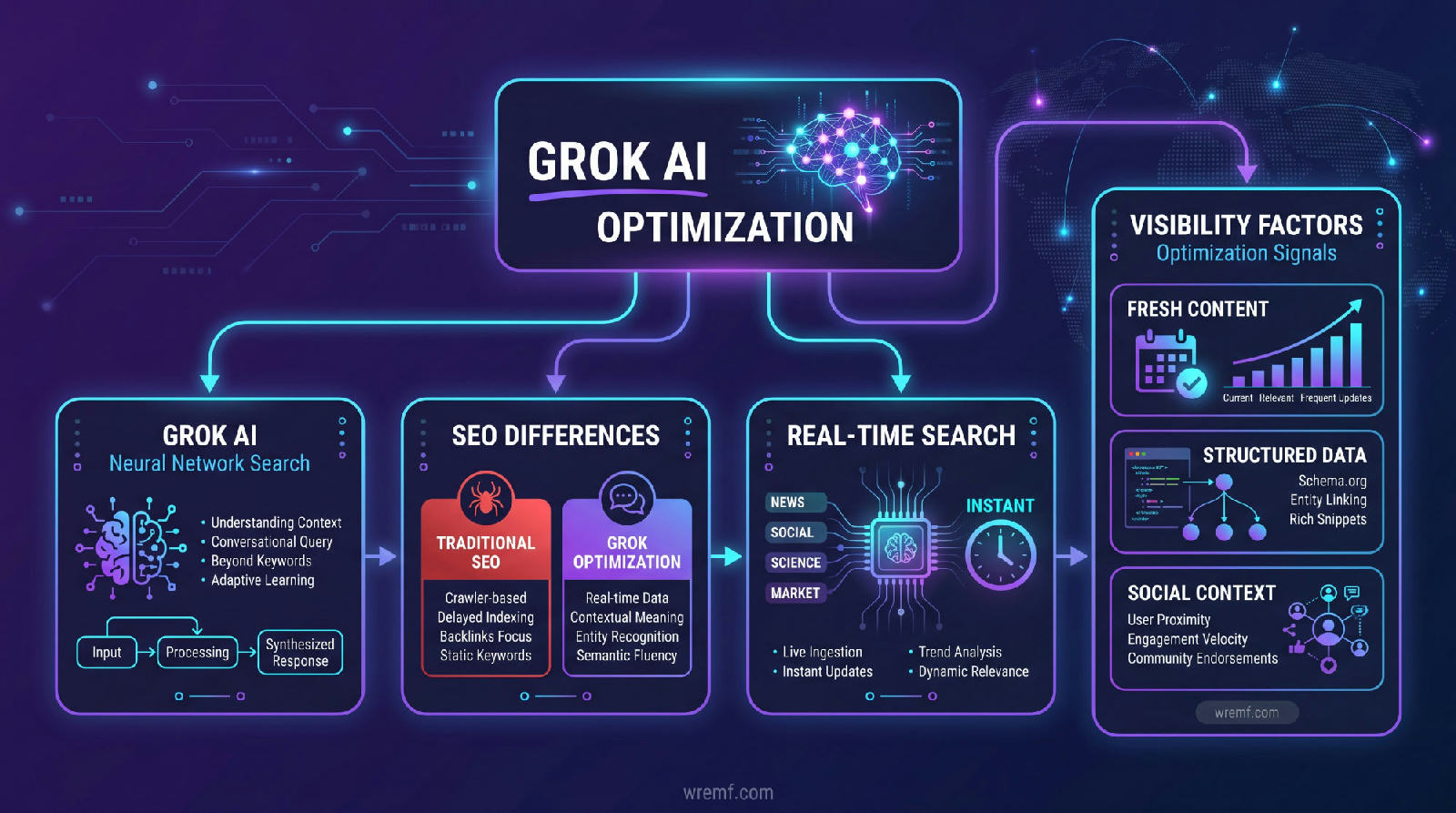
Grok optimization enhances how Grok AI retrieves, interprets, and cites your brand, improving visibility in AI-generated answers. It relies on structured data, social context, and trusted sources, differing from classic SEO's focus. Understanding Grok's alignment with real-time data and search context is crucial, as it affects digital visibility across AI models. Components include schema markup, content freshness, and entity clarity. Grok SEO, Answer Engine Optimization, and Generative Engine Optimization are key for aligning AI engines with your brand objectives.
Key takeaways
- Grok optimization improves brand visibility in AI-generated responses over traditional SEO.
- Align structured data, social context, and trusted sources for better Grok visibility.
- Understand the difference between Grok AI and other AI models for effective optimization.
- Technical elements like structured data and fast loading pages are crucial for Grok SEO.
- Content structuring with direct answers and content clusters enhances Grok AI responses.
Grok Optimization: The Complete Guide to Grok SEO, AI Visibility, and Brand Mentions
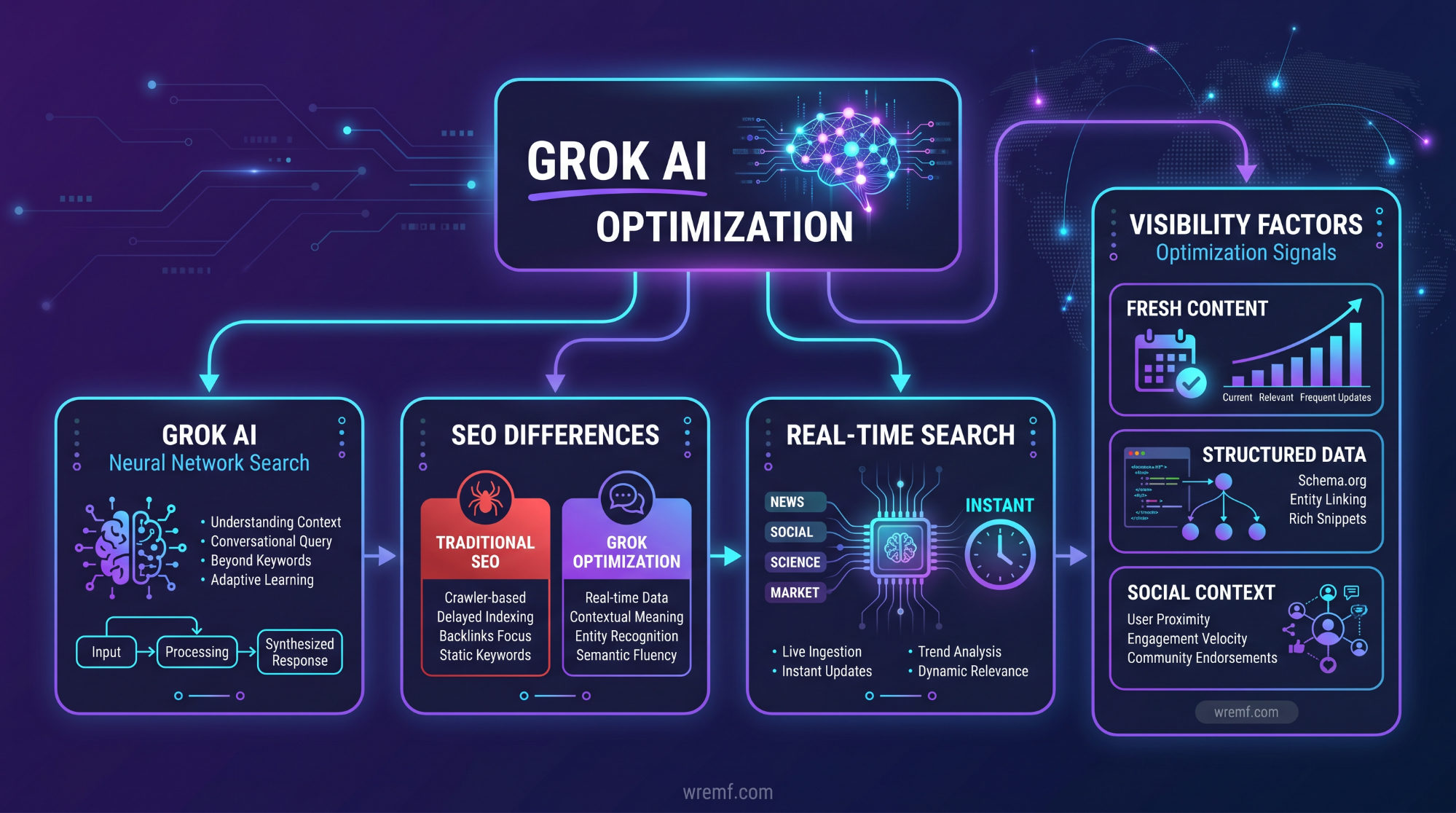
Grok optimization is the process of making your brand easier for Grok AI to understand, cite, mention, and recommend. xAI describes Grok as an AI assistant with real-time search capabilities, which means Grok visibility depends on fresh content, structured data, social context, and trusted sources. This guide explains how Grok SEO works, how it differs from Google rankings, ChatGPT, Claude, Gemini, and Perplexity, and how to improve visibility across AI systems without relying on keyword density alone. WREMF helps B2B teams track, improve, and prove AI visibility across Grok, ChatGPT, Claude, Gemini, Perplexity, Google AI Overviews, Copilot, DeepSeek, Meta AI, Mistral, and other AI discovery surfaces. Use this guide to build a measurable Grok optimization workflow.
What Is Grok Optimization?
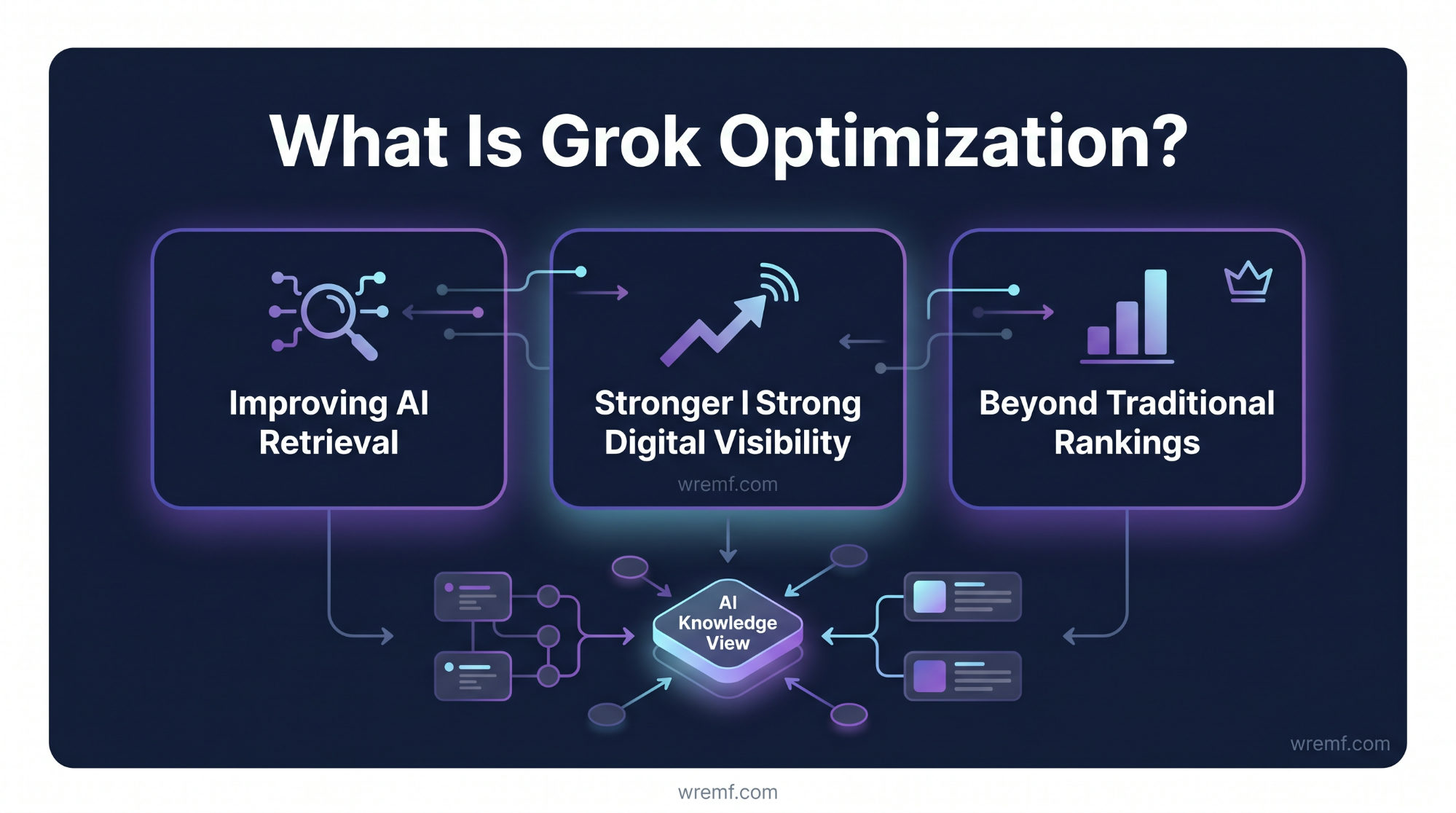
Grok optimization is the practice of improving how Grok AI retrieves, interprets, cites, and describes your brand in AI-generated answers. The outcome is stronger digital visibility inside Grok AI responses, not just better rankings in traditional search engines.
Grok AI is xAI’s conversational AI platform connected to search, real-time data, developer APIs, and the X platform. xAI says Grok can create documents, write code, and provide real-time search capabilities, which makes Grok optimization different from classic SEO that focuses mainly on ranking pages in search results through relevance, authority, and technical quality via xAI’s Grok overview.
AI visibility is the measurable presence of a brand inside AI-generated answers, citations, summaries, comparisons, and recommendations. AI visibility matters because B2B buyers increasingly ask AI systems to compare vendors, explain software categories, shortlist tools, and validate decisions before visiting a company website.
Grok optimization includes Grok SEO, Answer Engine Optimization, Generative Engine Optimization, source citation tracking, prompt tracking, X platform monitoring, content freshness, schema markup, internal linking, and brand reputation management. The practical goal is to make your brand easier to retrieve across prompts such as “best AI visibility tools,” “how to optimize for Grok,” “Grok vs ChatGPT for search,” and “which company helps with Grok SEO?”
WREMF helps teams turn Grok optimization into a measurable workflow through the AI visibility platform suite. The platform connects prompts, source citations, competitor visibility, AI share of voice, traffic attribution, and action recommendations so teams can track Grok alongside other AI discovery surfaces.
Grok optimization is not a single trick. Grok optimization is a system for aligning your website, structured data, social proof, X platform activity, third-party sources, content clusters, and reporting workflow around the way AI systems generate answers.
KEY TAKEAWAY: Grok optimization helps your brand become easier for Grok AI to retrieve, understand, cite, and recommend across real-time AI search experiences.
To optimize for Grok properly, you first need to understand how Grok differs from Google Search and other AI models.
How Grok AI Differs From Google Search, ChatGPT, Claude, and Gemini
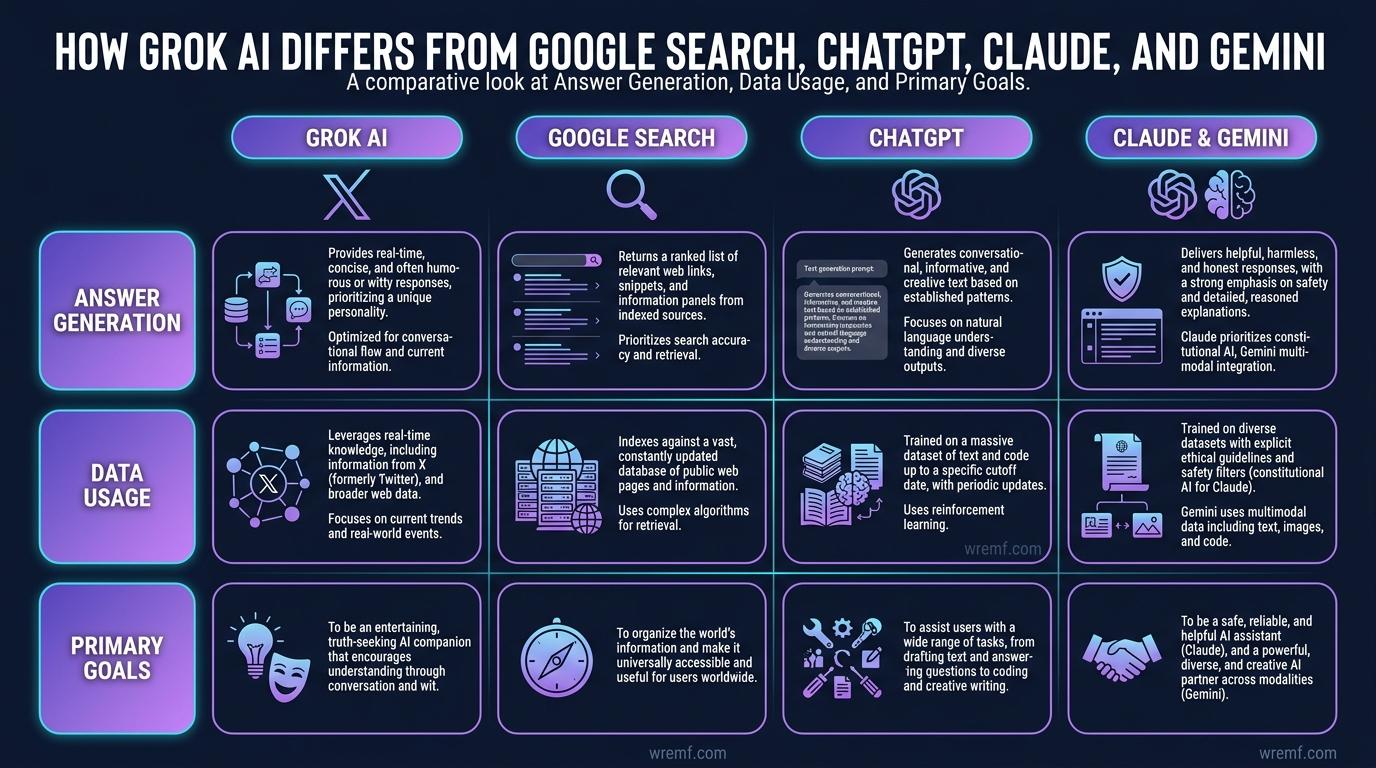
Grok AI differs from Google Search because Grok generates conversational answers using AI models, search context, and real-time data instead of only returning ranked links. This changes the goal from ranking pages to earning mentions, citations, and recommendations.
Traditional search engines rank documents. Grok AI can summarize information, compare entities, explain trending topics, cite sources, and produce AI outputs that answer a prompt directly. A user may never click a result if Grok gives a complete answer, which makes AI visibility different from organic ranking visibility.
Grok AI also differs from ChatGPT, Claude, and Gemini because of its close relationship with the X platform and xAI ecosystem. xAI’s API page describes real-time search across the web and X, plus tool-use capabilities for developer workflows through the xAI API. That makes X platform signals, thread context, social data, and social sentiment more important for Grok optimization than they may be for some other AI systems.
Answer Engine Optimization is the practice of structuring content so AI systems can answer user questions accurately and extract useful information. Answer Engine Optimization matters because Grok AI responses often reward direct, clear, source-backed answers.
Generative Engine Optimization is the broader practice of improving how generative AI systems discover, interpret, cite, and recommend your brand. Generative Engine Optimization matters because AI discovery happens across prompts, sources, citations, summaries, and recommendation tone.
The key difference between SEO and GEO is the output. SEO often optimizes pages for search rankings and clicks. GEO optimizes entities, source evidence, content chunks, and prompt-level answers for AI-generated responses.
| Optimization discipline | Primary goal | What it measures | What it misses when used alone | Best use case |
|---|---|---|---|---|
| SEO | Rank and earn organic traffic from search engines | Rankings, impressions, clicks, Core Web Vitals, backlinks | AI citations, prompt visibility, recommendation tone | Building search demand and website traffic |
| Answer Engine Optimization | Win direct answers and snippets | Answer clarity, extractability, FAQ coverage, structured content | Social signals, multi-engine differences, source ecosystem gaps | Making content easier for AI systems to quote |
| Generative Engine Optimization | Improve AI-generated mentions and recommendations | Prompts, citations, AI share of voice, source consistency | Full attribution in hidden or no-click AI journeys | Winning visibility inside AI discovery surfaces |
| Grok optimization | Improve Grok AI visibility and X-aware discovery | Grok Prompts, X platform context, real-time data, social sentiment, citations | Guaranteed model behaviour or private ranking logic | Improving brand visibility in Grok AI responses |
Google Search Central explains that structured data helps Google understand page content and information about entities such as people, books, companies, and recipes through its structured data documentation. This matters for Grok SEO because structured data, entity clarity, and consistent source information also help AI systems interpret what a brand is and why it is relevant.
OpenAI states that ChatGPT search can provide timely answers with links to relevant web sources through ChatGPT search. Anthropic’s documentation says Claude’s web search tool gives Claude access to real-time web content and includes citations for sources drawn from search results through the Claude web search tool documentation. These examples show that AI search is becoming a source-based answer environment, not only a chatbot experience.
DID YOU KNOW: Core AI search platforms now combine natural language answers with external sources, which means Grok optimization should measure citations, mentions, and source consistency in addition to rankings.
KEY TAKEAWAY: Grok AI is not just another search engine because it blends real-time data, AI models, X platform context, and answer generation.
The next step is building the technical foundation that lets Grok and other AI systems understand your pages.
How Do You Optimize Technical Elements for Grok?
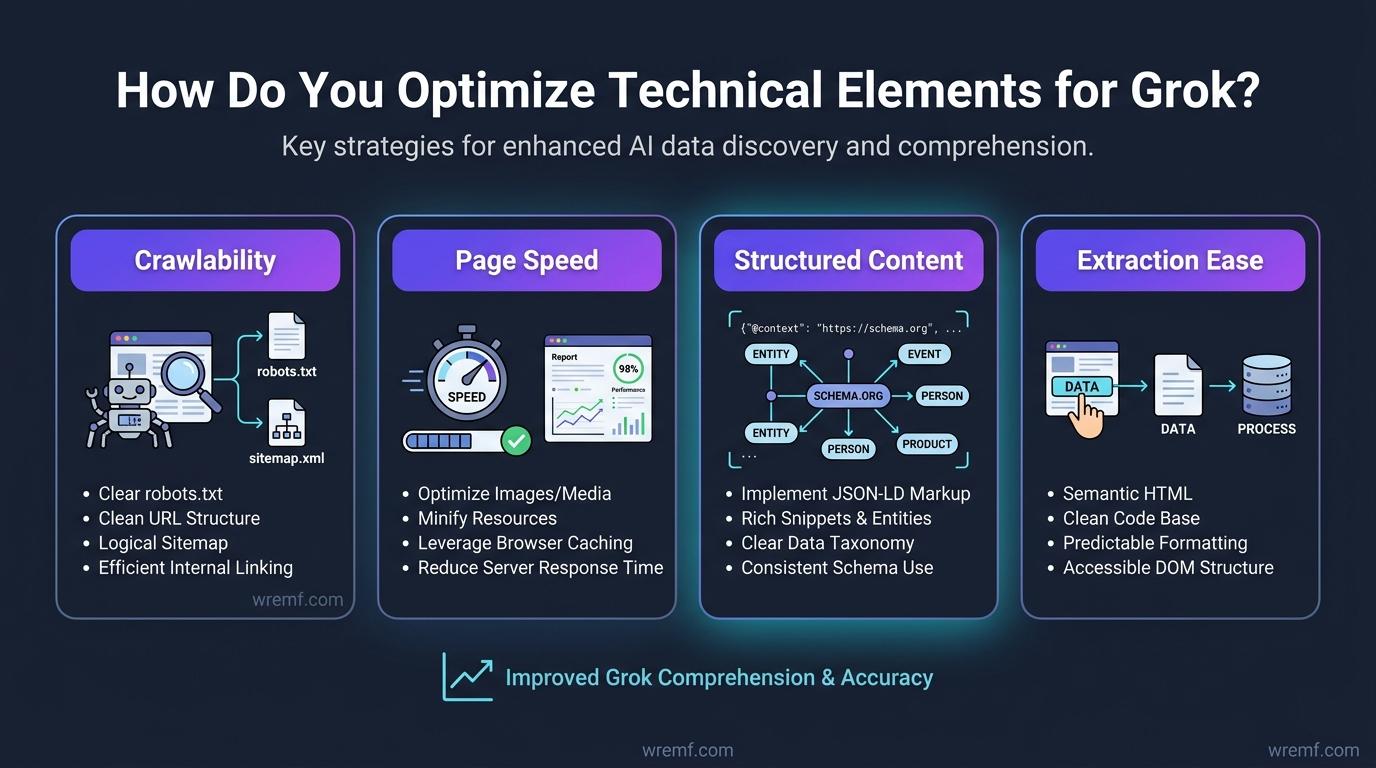
You optimize technical elements for Grok by making pages crawlable, fast, structured, and easy to extract. Technical Grok SEO helps AI systems access your best content before prompt logic, citations, or social signals can matter.
Structured data is machine-readable markup that describes entities, content types, products, services, authors, organisations, and relationships. Structured data matters because it helps search platforms and AI systems identify what a page means rather than only reading the visible words.
Schema markup is a common format for structured data. Schema markup can describe an Organization, Article, FAQ, Product, SoftwareApplication, Service, Breadcrumb, or Review where relevant. Schema implementation does not guarantee AI citations, but schema markup supports interpretation when it matches accurate page content.
Core Web Vitals are Google’s three user experience metric categories for loading performance, interactivity, and visual stability. Google recommends that site owners achieve good Core Web Vitals for Search success and general user experience through its Core Web Vitals guidance. For Grok optimization, page speed also matters because slow or complex pages can make extraction and rendering less reliable.
Technical Grok optimization should include:
Clean HTML that exposes the main answer near the top of the page
Structured data for the right page type and entity type
Schema markup that matches visible content
Fast page speed and stable page experience
Indexable pages with correct canonical tags
A clear content management system template for article, product, service, comparison, and FAQ pages
Logical internal linking from pillar pages to supporting content
Consistent brand names, feature names, pricing labels, and product descriptions
Crawlable documentation, methodology pages, pricing pages, and source pages
Clear author expertise and editorial review signals for high-trust topics
A common technical mistake is hiding important information inside scripts, tabs, blocked templates, or heavily rendered components. AI systems may still access some dynamic content, but relying on complex rendering creates unnecessary risk. Grok optimization works best when the primary answer, product description, source evidence, and author expertise are available in clean text.
Internal linking is also technical and strategic. Internal linking helps AI systems understand relationships between pages, such as how a Grok SEO guide connects to a methodology page, a prompt tracking feature, a source citation feature, and a sample report.
WREMF’s GEO audit feature helps teams review technical AI visibility foundations, including crawlability, rendering, structured data, entity clarity, internal linking, and content extraction risks.
TIP: Build every important page so a crawler, reader, and AI system can understand the answer, entity, source, and next step without needing to guess.
KEY TAKEAWAY: Technical Grok optimization starts with crawlable pages, structured data, schema markup, page speed, and clear entity information.
Once the technical base is sound, content strategy determines whether Grok can use your pages as useful answer sources.
How Should You Structure Content for Grok AI Responses?
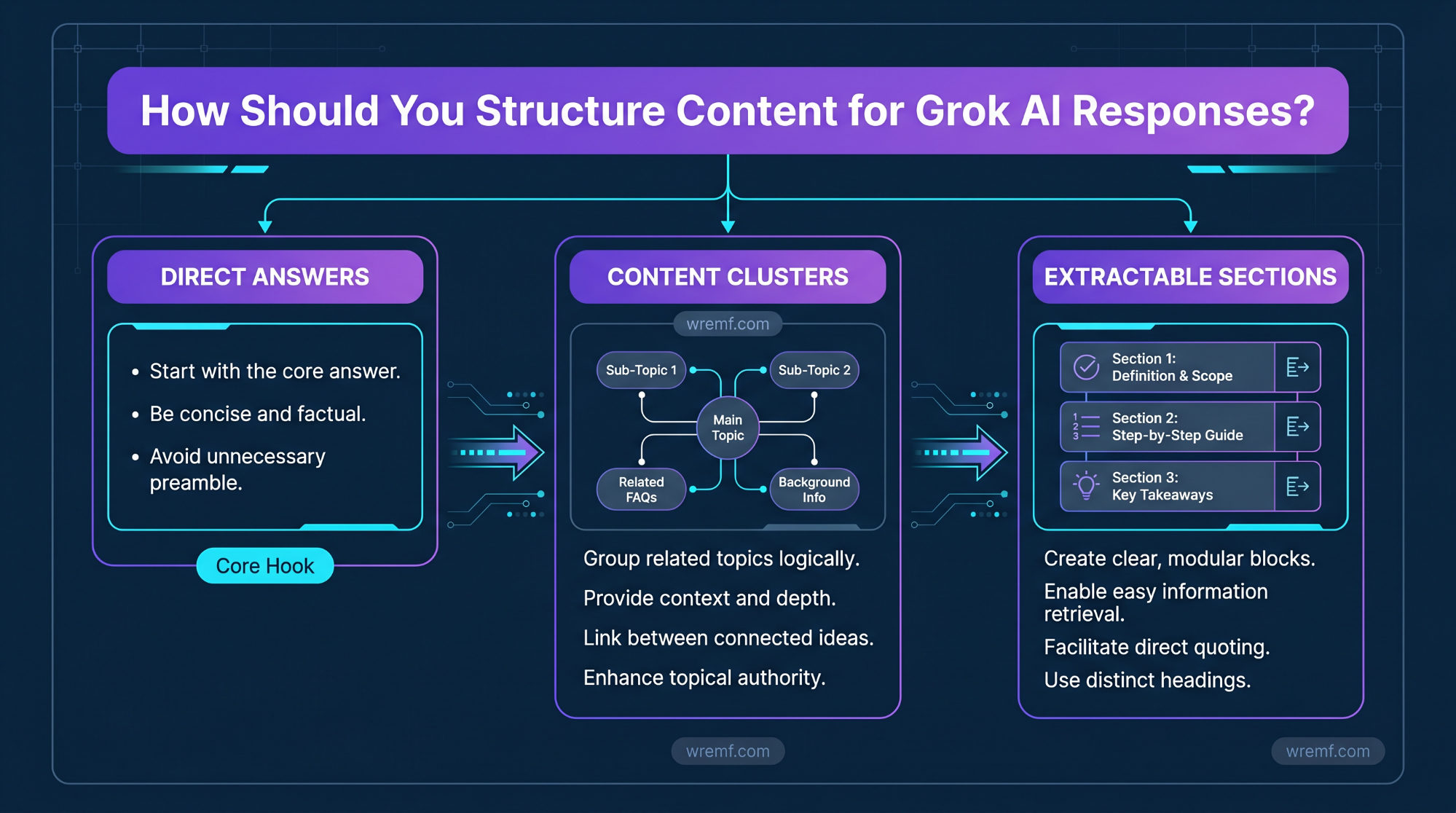
You structure content for Grok AI responses by leading with direct answers, building content clusters, and making each section easy to extract. Grok optimization rewards clarity because AI systems need usable answer chunks, not vague marketing copy.
Content freshness is the practice of keeping facts, examples, product details, and source references current. Content freshness matters for Grok because real-time data and trending topics can shape how Grok AI responds to current queries.
Content clusters are groups of related pages that cover a topic from multiple angles. Content clusters matter because they help Grok AI understand topical authority across a subject rather than relying on one isolated article.
Topical authority is the demonstrated depth, accuracy, and consistency of a brand or website on a specific topic. Topical authority matters because AI models need repeated evidence across related sources before treating a brand as a credible answer.
A strong Grok content structure includes:
A direct answer in the first 100 words
Short definitions for major terms
Search-friendly H2 headings written as natural language queries
Comparison tables for decision-stage prompts
FAQ answers that make sense as standalone responses
Clear source attribution close to factual claims
Internal linking between pillar pages, feature pages, methodology pages, and supporting articles
Content clusters around AI visibility, Grok SEO, AEO, GEO, source citations, prompt tracking, competitor visibility, and AI traffic attribution
Updated examples that reflect current AI search behaviour
Clear separation between software, services, methodology, pricing, and implementation content
AI citations are references or source links that an AI system uses to support an answer. AI citations matter because they show which sources influence AI outputs and which pages may shape buyer perception.
LLM visibility is the presence of your brand inside large language model answers, recommendations, comparisons, and summaries. LLM visibility matters because buyers may ask AI models for vendor recommendations before they visit Google, review websites, or analyst reports.
Grok Prompts are realistic user questions typed into Grok AI. Grok Prompts matter because Grok SEO is based on natural language intent, not only traditional keyword matching.
For example, a software company targeting Grok optimization should not publish only one generic article about AI search. A better content cluster would include pages on AI visibility, Grok SEO, ChatGPT visibility, Perplexity citations, Google AI Overviews, AI traffic attribution, source consistency, competitor visibility, and prompt monitoring.
WREMF supports this workflow through AI-ready content briefs, which help teams plan answer-first pages, entity coverage, prompt coverage, citation opportunities, and internal linking logic.
KEY TAKEAWAY: Grok AI responses are easier to influence when your content is fresh, structured, answer-first, and connected through strong content clusters.
Content structure is only one side of Grok optimization because the X platform can also shape real-time discovery.
How Does the X Platform Influence Grok SEO?
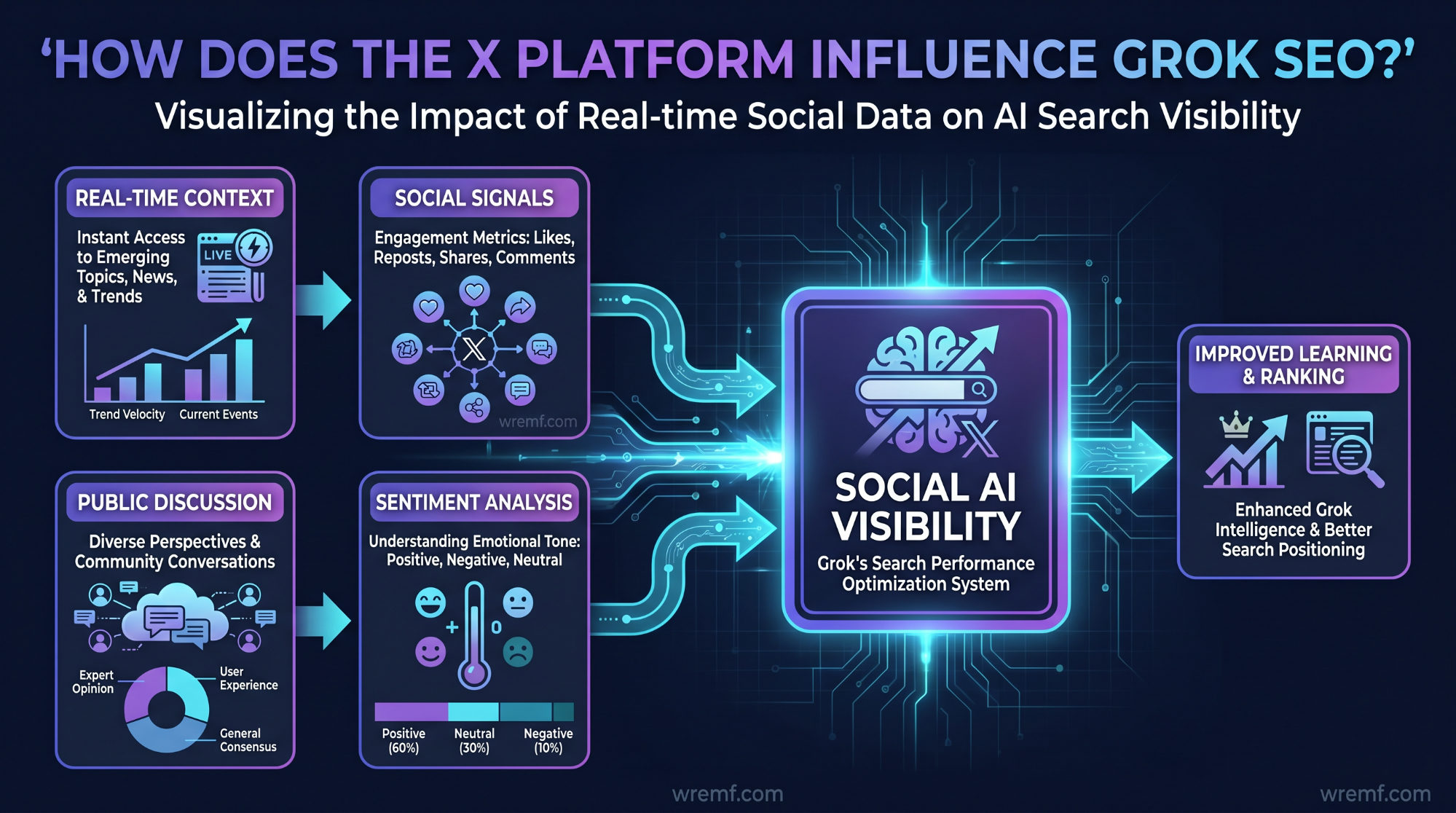
The X platform can influence Grok SEO by adding real-time context, social signals, public discussion, and sentiment around brands, people, and trending topics. This makes social AI visibility a practical part of Grok optimization.
Social signals are public indicators of attention, trust, discussion, and engagement around an entity. Social signals matter for Grok because X platform conversations can provide timely context that static webpages may not capture.
Social sentiment is the overall tone of public discussion about a brand, product, person, or topic. Social sentiment matters because AI outputs can reflect reputation signals, customer engagement, criticism, praise, and recurring claims found in public sources.
Social sentiment analysis is the process of reviewing public conversation to identify positive, neutral, negative, and recurring themes. Social sentiment analysis matters because Grok AI may describe a brand differently if the public conversation around that brand changes quickly.
X's social connections can affect visibility in three practical ways. First, active discussion can make Grok aware of trending topics faster than static content updates. Second, verified accounts and recognised experts can reinforce author expertise and entity authority. Third, repeated public claims can shape how Grok describes a brand if those claims are consistent across multiple sources.
Verified accounts can matter because they help users identify public figures, companies, executives, creators, and recognised experts. Verified accounts do not replace evidence, but they can reinforce credibility when expert commentary aligns with website content and external sources.
Community Notes can matter because they create public corrections or added context on disputed posts. For Grok optimization, Community Notes are relevant because they may affect how a brand, claim, or controversy is interpreted in public discussion.
| X platform signal | Why it matters for Grok | What to monitor | Practical action |
|---|---|---|---|
| Trending topics | Grok may respond to current public discussion | Topic velocity, recurring phrases, brand mentions | Publish timely answer-first explanations |
| Verified accounts | Recognised voices can reinforce expertise | Founder, executive, company, and expert posts | Align expert commentary with website claims |
| Social signals | Engagement can show public attention | Replies, reposts, quote posts, saves, and link sharing | Use evidence-led posts with source links |
| Social sentiment analysis | Tone can affect brand reputation | Positive, neutral, and negative themes | Address recurring objections clearly |
| Community Notes | Public corrections can affect trust | Notes attached to brand or category claims | Correct inaccurate claims quickly |
| Thread structure | Context can shape interpretation | Opening post, supporting evidence, source links | Build clear threads with concise summaries |
This does not mean social media marketing replaces SEO. Social media marketing can create engagement signals, social proof, customer engagement, and community validation, but your owned website still needs structured data, schema markup, internal linking, and clear product information.
A viral post can influence short-term social AI visibility, but durable Grok optimization needs consistent owned content, credible third-party sources, and stable entity information. If a viral post contradicts your website, documentation, or public profiles, Grok AI may receive mixed signals.
KEY TAKEAWAY: X platform activity can support Grok SEO, but social signals work best when they reinforce consistent, source-backed brand information.
After social context, the next priority is source authority because Grok needs trustworthy material to cite and summarise.
Why Do Citations, Source Consistency, and Entity Authority Matter for Grok?
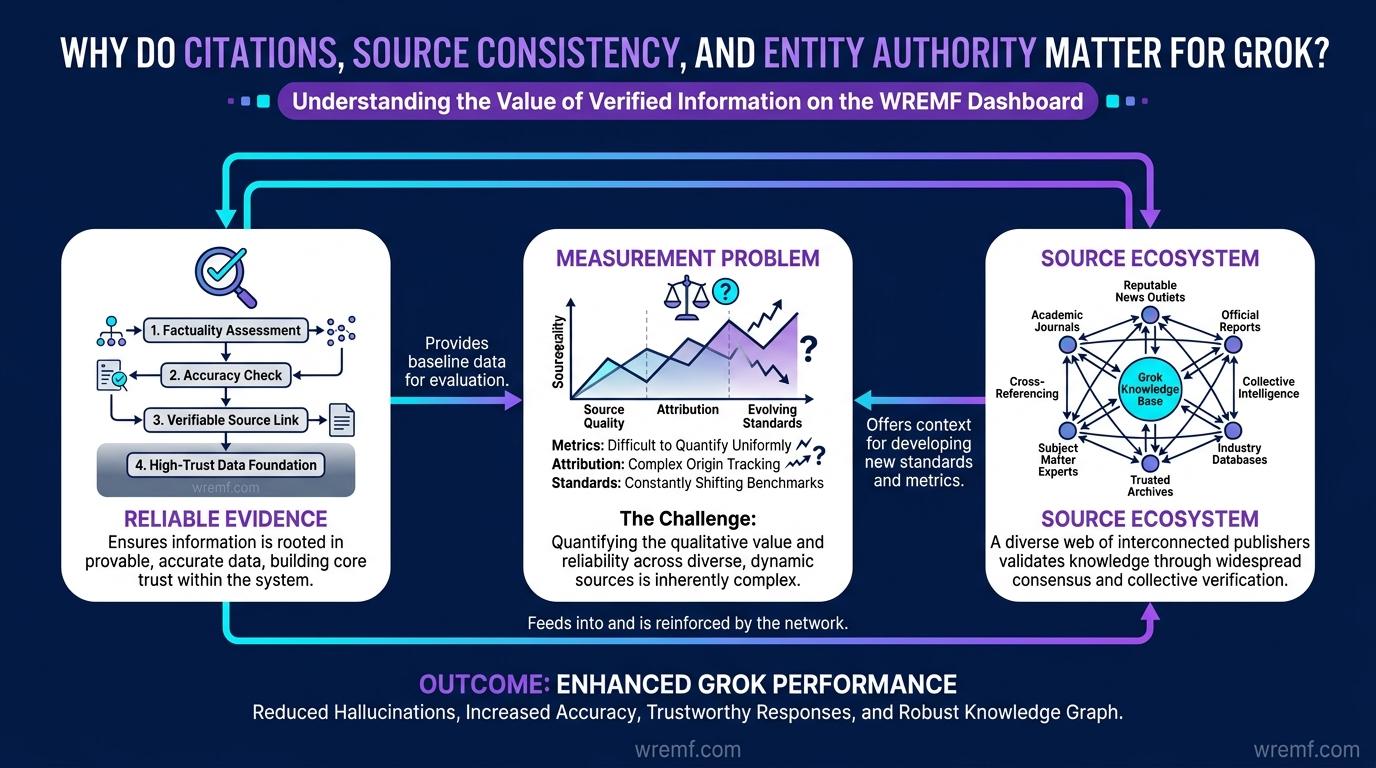
Citations, source consistency, and entity authority matter because Grok AI needs reliable evidence before recommending or citing a brand. Grok optimization is both a measurement problem and a source ecosystem problem.
Source citations are the sources an AI system references or relies on when producing an answer. Source citations matter because they show which pages, domains, and third-party sources influence AI outputs.
Source consistency is the alignment of brand facts across your website, documentation, social profiles, directories, media mentions, reviews, and knowledge sources. Source consistency matters because conflicting information can reduce confidence in AI-generated answers.
Entity authority is the perceived clarity, credibility, and relevance of a person, company, product, or service across the web. Entity authority matters because AI systems interpret relationships between entities, topics, sources, authors, and user intent.
In real B2B buying journeys, AI systems are often asked questions such as “Which tools track Grok visibility?”, “What is the best AEO platform for agencies?”, “How does WREMF compare with SEO tools?”, and “Which software helps with AI visibility reporting?” The answer depends on whether your brand has enough consistent evidence across owned pages, third-party mentions, public knowledge graphs, and source citations.
Public knowledge graphs are structured or semi-structured representations of entities and their relationships. Public knowledge graphs matter because AI systems can use entity relationships to understand companies, people, products, markets, and categories.
Citation analysis is the process of reviewing which sources AI systems use in answers. Citation analysis matters because it helps teams find which pages influence Grok AI responses, which competitors are cited, and which source gaps need attention.
Common source consistency problems include:
Product descriptions that differ across website pages
Pricing details that conflict with third-party listings
Old feature names still appearing in directories
Founder or executive data that is outdated
X platform bios that use different positioning from website copy
Documentation that does not match current product capabilities
Blog posts that make claims unsupported by methodology pages
Review profiles that list outdated categories
Comparison pages that omit important differentiators
Press mentions that describe an old version of the brand
WREMF’s source citation tracking helps teams identify which sources AI engines cite, which competitors appear, and where source consistency problems may affect AI visibility.
If you want to see how AI engines currently describe your brand, review a sample AI visibility report before building your own measurement workflow.
KEY TAKEAWAY: Grok optimization depends on consistent source evidence, not just page-level keyword targeting.
Once your source ecosystem is clear, you can build a prompt tracking system that measures how Grok actually responds.
How Do You Track Grok Prompts, Brand Mentions, and Prompt Score?
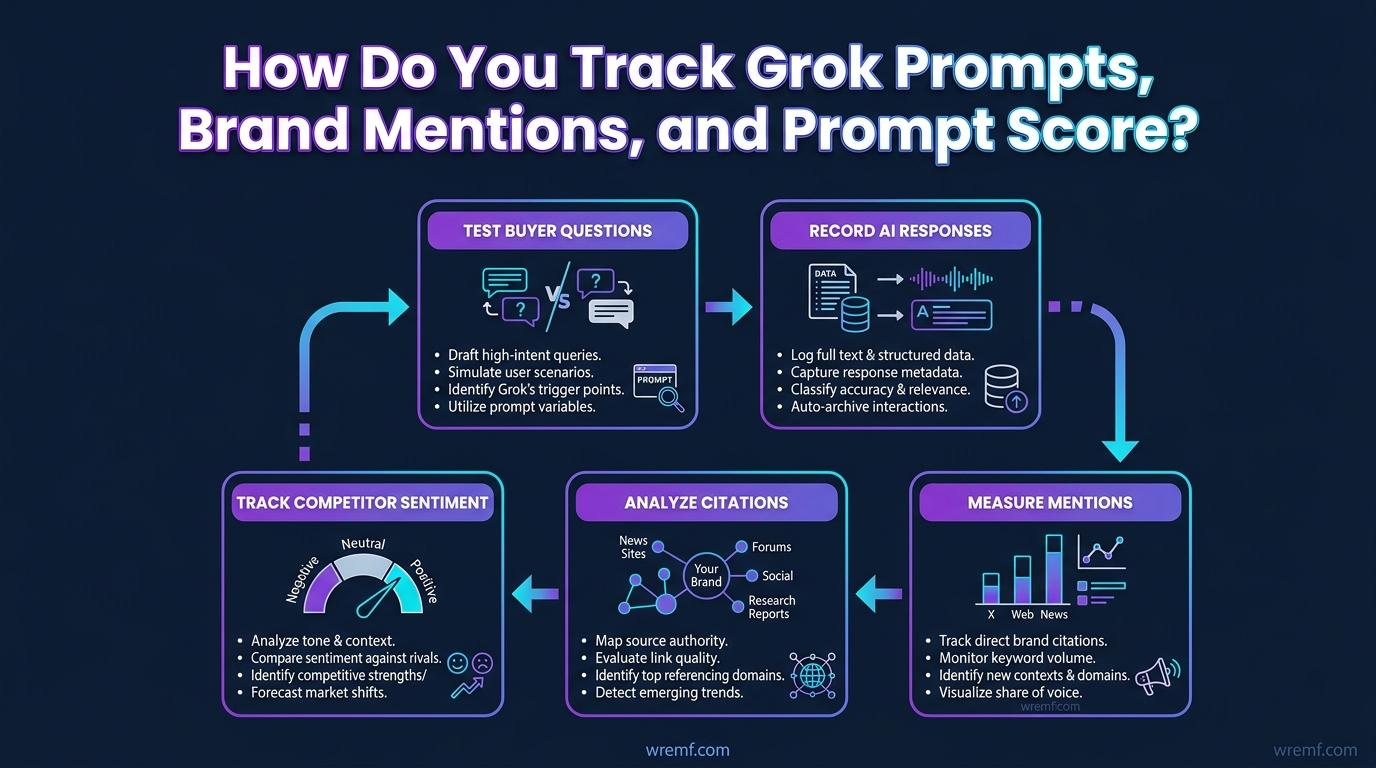
You track Grok Prompts by testing realistic buyer questions, recording Grok AI responses, and measuring mentions, citations, competitors, sentiment, and recommendations over time. Prompt tracking turns Grok optimization from guesswork into a repeatable workflow.
Prompt tracking is the process of monitoring how AI systems answer specific user prompts. Prompt tracking matters because Grok visibility depends on natural language questions, comparison queries, and buyer intent rather than only traditional keyword rankings.
Prompt Score is a practical scoring model that estimates how strongly a brand appears for priority prompts. Prompt Score can include mention presence, recommendation position, citation quality, answer sentiment, competitor overlap, source consistency, and whether the brand is described accurately.
Brand mentions are references to a company, product, person, or service inside AI outputs. Brand mentions matter because an AI answer can influence a buyer even when there is no citation or visible click.
A useful Grok prompt set should include:
Definition prompts, such as “What is Grok optimization?”
Efficiency prompts, such as “How to use Grok more efficiently?”
Comparison prompts, such as “Is Grok better than ChatGPT?”
Improvement prompts, such as “How to make Grok AI better?”
Meaning prompts, such as “What does Grok mean in simple words?”
Technical prompts, such as “How do you optimize technical elements for Grok?”
Content prompts, such as “How do I optimize content for Grok?”
Buying prompts, such as “Best AI visibility tools for Grok SEO”
Risk prompts, such as “Why is my brand not showing up in Grok?”
Reputation prompts, such as “What are people saying about this brand on X?”
Developer prompts, such as “How good is Grok at coding?”
API prompts, such as “How do I use the Grok API?”
Tool prompts, such as “Which tool tracks trending topic visibility in Grok?”
Competitor prompts, such as “Which brands are recommended for AI visibility tracking?”
The most useful Grok optimization reports measure more than whether your brand appeared. They measure whether the answer was accurate, whether the brand was recommended, whether competitors appeared first, whether citations supported the answer, whether social sentiment was positive or negative, and whether Grok used old information.
WREMF’s prompt intelligence helps teams monitor high-intent prompts across Grok and other AI systems. This is useful for brands that need software, agencies that need white-label reporting, and teams that want a hybrid model with managed execution.
KEY TAKEAWAY: Prompt tracking measures Grok visibility where buyers actually ask questions, compare options, and request recommendations.
Prompt data becomes more useful when you compare Grok visibility against competitors and traditional search performance.
How Is Grok SEO Different From Google Rankings?
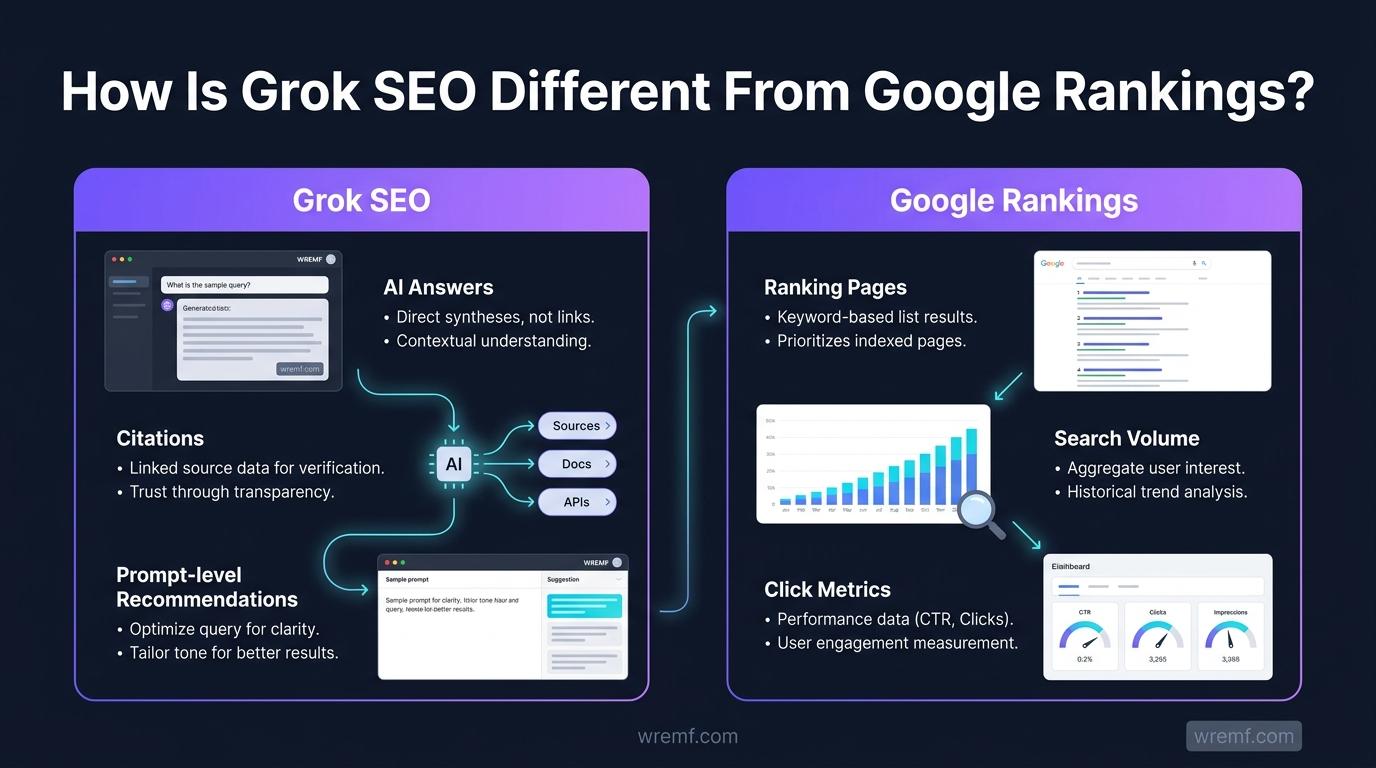
Grok SEO is different from Google rankings because Grok visibility depends on AI answers, citations, X platform context, and prompt-level recommendations. Google rankings still matter, but they do not fully explain how Grok AI describes or recommends a brand.
Grok SEO is the practice of improving a brand’s visibility inside Grok AI responses. Grok SEO matters because users may ask Grok for direct advice instead of searching Google, opening multiple search results, and comparing pages manually.
Search engines rank pages. Grok AI can generate summaries, compare brands, explain trending topics, cite sources, and include recommendation tone. That changes the measurement model from “Where do we rank?” to “How are we represented?”
AI search traffic is traffic influenced by AI discovery surfaces such as Grok, ChatGPT, Perplexity, Gemini, Copilot, and Google AI Overviews. AI search traffic matters because AI-generated answers can create direct referrals, branded search, assisted conversions, and invisible influence.
AI traffic attribution connects AI visibility to sessions, leads, pipeline, or conversions where tracking is available. AI traffic attribution matters because leadership needs to understand whether AI discovery is creating measurable business value.
| Metric type | Traditional SEO metric | Grok optimization metric | Why it matters |
|---|---|---|---|
| Visibility | Keyword ranking | Prompt visibility | Buyers ask natural language questions |
| Trust | Backlinks | Source citations | AI systems need evidence |
| Demand | Search volume | Prompt frequency and buyer intent | AI queries may not appear in keyword tools |
| Competition | SERP competitors | Mentioned and recommended competitors | AI answers compress choices |
| Performance | Organic clicks | AI search traffic and assisted discovery | Many AI interactions create no direct click |
| Reputation | Reviews and links | Social sentiment analysis and brand reputation | X platform context can shape Grok AI responses |
| Content quality | On-page relevance | Answer extractability and citation readiness | Grok needs usable answer chunks |
SEO teams frequently discover that a page ranking well in Google is not cited by AI systems. This can happen when content is too promotional, lacks clear definitions, buries the answer, has weak author expertise, or conflicts with third-party sources.
The opposite can also happen. A concise, well-structured methodology page may become useful to AI systems even if it does not rank first for a broad keyword. That is why Grok optimization needs both SEO data and AI visibility data.
WREMF’s competitive landscape tracking helps teams compare which brands appear, which competitors are recommended, and where Grok visibility differs from search rankings.
KEY TAKEAWAY: Grok SEO adds prompt visibility, citations, recommendations, and social AI visibility to the traditional SEO measurement stack.
To move from measurement to improvement, teams need a practical workflow that connects technical, content, social, and citation work.
How Do You Optimize Content for Grok Step by Step?
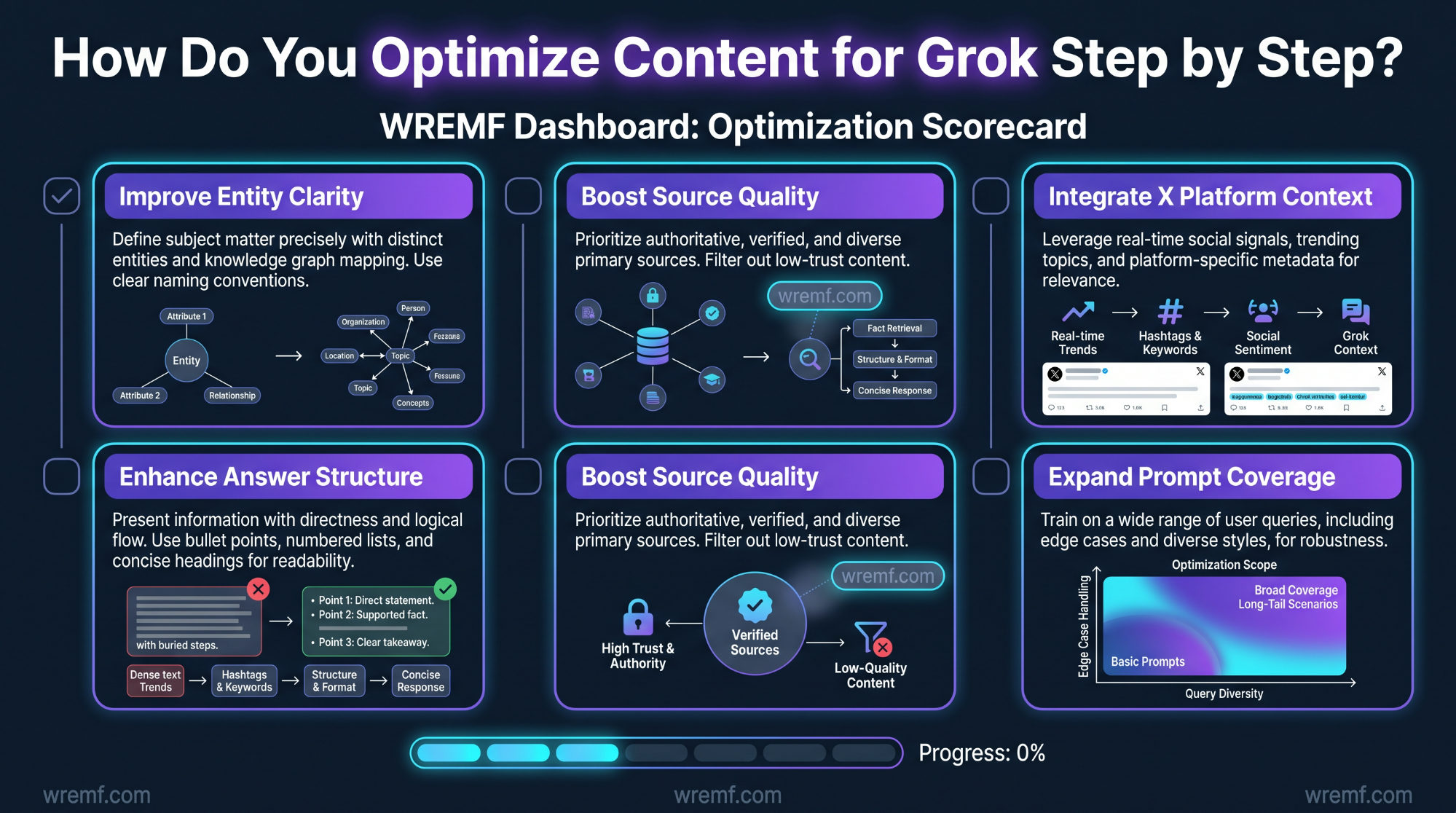
You optimize content for Grok by improving entity clarity, answer structure, source quality, X platform context, and prompt coverage. The most effective Grok optimization workflow starts with measurement, then fixes the sources that shape AI outputs.
A Content Audit is the process of reviewing content quality, structure, freshness, internal linking, and citation readiness. A Content Audit matters because Grok AI needs clear, current, and extractable information.
Query Research is the process of identifying the natural language questions users ask before buying, comparing, troubleshooting, or learning. Query Research matters because Grok Prompts are closer to conversations than keyword lists.
Use this workflow for Grok optimization:
Audit current Grok visibility
Test your brand across Grok AI, ChatGPT, Claude, Gemini, Perplexity, Copilot, and Google AI Overviews. Record whether your brand appears, how it is described, which competitors appear, and whether citations are accurate.
Map prompts to buying intent
Group prompts by awareness, comparison, decision, implementation, and risk. Grok optimization should cover “what is” questions, “best tool” questions, “how to” questions, “is this better than” questions, and troubleshooting questions.
Strengthen answer-first content
Place the direct answer in the first 100 words of important pages. Use definitions, tables, FAQs, and concise summary paragraphs so AI systems can extract useful chunks.
Improve schema markup and structured data
Add relevant schema types through your content management system. Schema implementation should reinforce the entity, page type, author, organisation, product, service, and FAQ context.
Build internal linking around content clusters
Internal linking helps Grok and other AI systems understand the relationship between pages. Link pillar pages to product pages, methodology pages, comparison pages, feature pages, and FAQ content.
Align X platform and source signals
Make sure X platform posts, verified accounts, documentation, product pages, third-party profiles, and public bios use consistent messaging. This helps reduce conflicting AI outputs.
Improve social proof and community validation
Social proof includes public reviews, expert mentions, customer comments, community discussion, and credible third-party references. Social proof matters because AI systems can encounter brand reputation signals across many sources.
Monitor results monthly
Grok optimization should be reviewed at least monthly because AI models, search platforms, social data, and sources change. Active programs should track prompt movement, source citations, competitor changes, and AI traffic attribution.
A common implementation mistake is changing content before measuring the baseline. If you do not know which prompts, competitors, and citations are already present, you cannot reliably prove whether Grok optimization improved visibility.
KEY TAKEAWAY: Grok optimization works best as a repeatable workflow across prompts, content, structured data, internal linking, social context, and source citations.
The workflow becomes even more important for developer brands because Grok also supports coding and agentic use cases.
How Should Developer and Technical Brands Optimize for Grok Coding Agents?
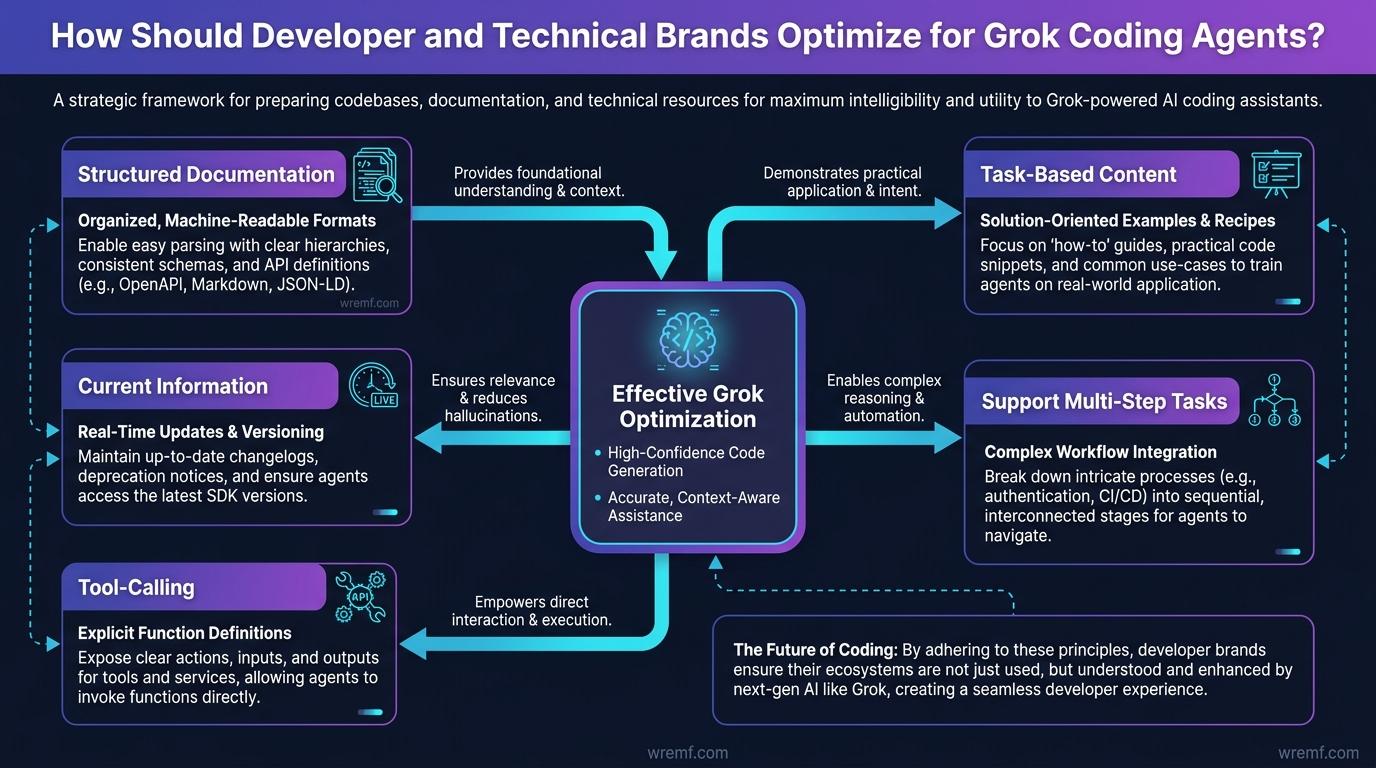
Developer and technical brands should optimize for Grok coding agents by making documentation structured, task-based, current, and easy for AI systems to execute. Grok optimization for technical content must support multi-step coding tasks, tool-calling, and developer workflows.
The Grok API is xAI’s developer interface for building applications with Grok models. The Grok API matters because developer visibility can happen inside documentation, coding workflows, API comparisons, agentic tasks, and technical prompts.
xAI’s documentation for grok-code-fast-1 describes a model built for agentic coding, with structured outputs, function calling, reasoning, and a 256,000 token context window through the grok-code-fast-1 model documentation. This is a decision-useful number because long-context coding agents can process larger documentation sets, repositories, and multi-step instructions.
Agentic Contextual Generation is the process of generating outputs that account for tools, files, commands, context, and multi-step goals. Agentic Contextual Generation matters because coding agents often need documentation that supports terminal operations, file editing, diff edits, and tool-calling.
Tool-calling is the ability of an AI model to connect to external tools, APIs, functions, or systems. Tool-calling matters because developer documentation needs to explain inputs, outputs, errors, authentication, permissions, and examples in ways AI agents can use safely.
For technical Grok optimization, improve these content formats:
API reference pages with clear parameters and response examples
Step-by-step setup guides
Terminal operations with expected outputs
PowerShell and shell alternatives where relevant
File editing examples with before and after snippets
Diff edits for common configuration changes
Error troubleshooting pages
SDK examples in major languages
Security, rate limit, and permission explanations
Tool-calling examples
Agentic workflow examples
Multi-step coding tasks with constraints and expected results
Thread context also matters for developer visibility on X. A technical founder explaining an API provider integration in a clear thread structure can create useful social data. Durable visibility still depends on documentation that matches the product and stays current.
For teams building integrations, WREMF’s API and MCP options support workflows where AI visibility data needs to connect with dashboards, reporting systems, client portals, or internal tools.
KEY TAKEAWAY: Developer Grok optimization requires documentation that supports reasoning, tool-calling, terminal operations, file editing, diff edits, and multi-step coding tasks.
Technical optimisation improves extraction, but multilingual and cultural context also affect how Grok interprets user intent.
How Do Multi-Lingual Support, Cultural Context, and Semantic Meaning Affect Grok?
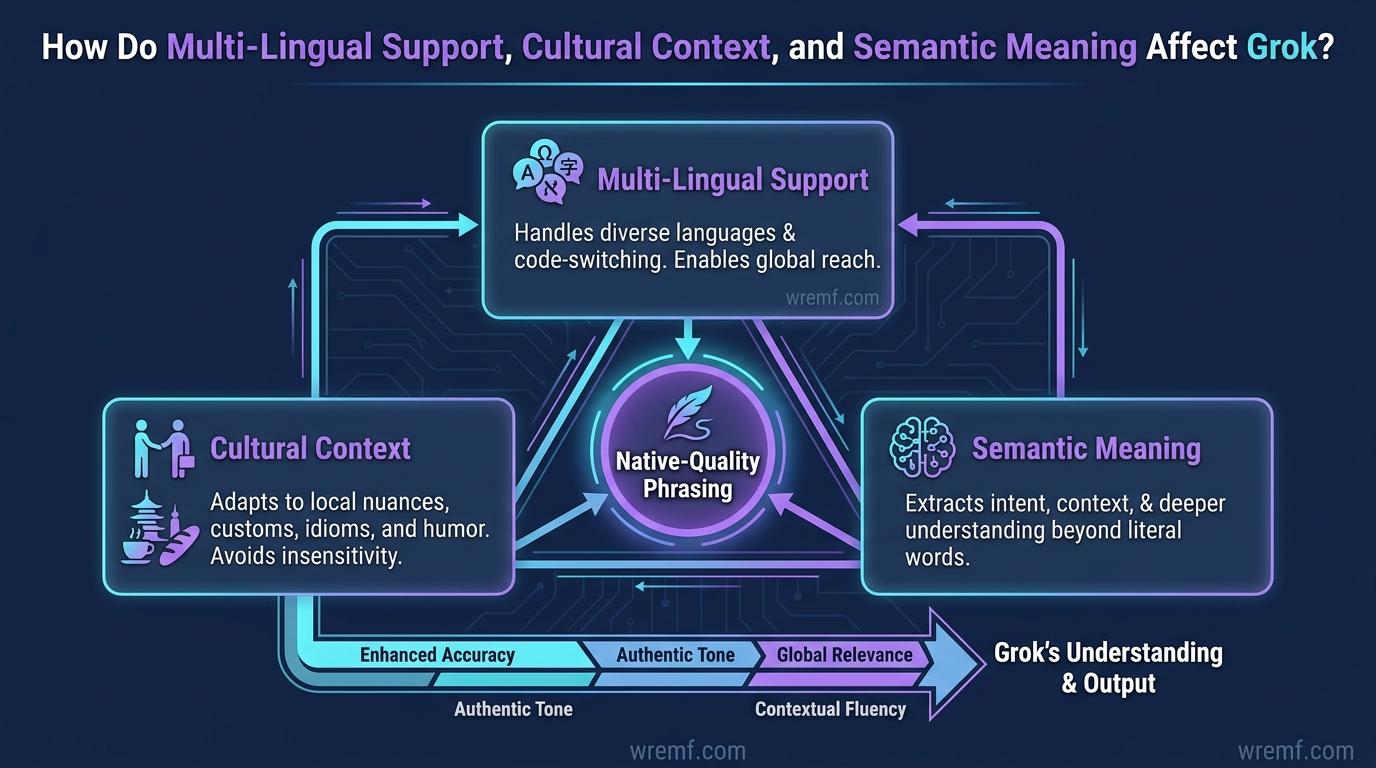
Multi-Lingual Support affects Grok optimization because AI systems interpret language, intent, examples, and cultural context differently across markets. Native-quality phrasing helps Grok AI responses match how real users ask questions.
Multi-Lingual Support is the ability to serve accurate, localised content across languages, regions, and search behaviours. Multi-Lingual Support matters because literal translations often miss local buyer intent and regional terminology.
Cultural context is the local meaning behind language, examples, trust signals, and decision criteria. Cultural context matters because Grok Prompts in one market may not match Grok Prompts in another market.
Natural language processing is the field of AI that helps systems interpret language, entities, relationships, and intent. Natural language processing matters for Grok optimization because semantic meaning is more important than repeating the same keyword across a page.
Semantic meaning is the underlying concept, relationship, or intent behind words. Semantic meaning matters because Grok AI can interpret phrases such as “AI visibility software,” “GEO platform,” “AEO service,” “LLM visibility tracker,” and “Grok SEO tool” as related but not identical concepts.
For international Grok optimization, teams should:
Localise the direct answer, not just the words
Use regional product names and buyer terms
Add local market context where relevant
Keep brand names consistent across languages
Use hreflang correctly on multilingual sites
Translate structured data where appropriate
Maintain source consistency across regional profiles
Monitor prompts separately by language and market
Use native-quality phrasing instead of literal translation
Check whether recommendation tone changes by language
Marketing teams often find that English-language AI visibility does not automatically transfer to French, German, Spanish, Arabic, Hindi, or Japanese prompts. AI systems may use different sources, social signals, and recommendation tone by market.
This is why Grok optimization should not treat language pages as copies. Each market should have prompt research, content freshness checks, social sentiment analysis, and internal linking that fit local search behaviour.
KEY TAKEAWAY: Multilingual Grok optimization requires native-quality phrasing, cultural context, regional source consistency, and market-specific prompt tracking.
After language and context, the next challenge is reporting Grok visibility in a way leadership can trust.
How Do You Measure Grok Visibility and AI Search Traffic?
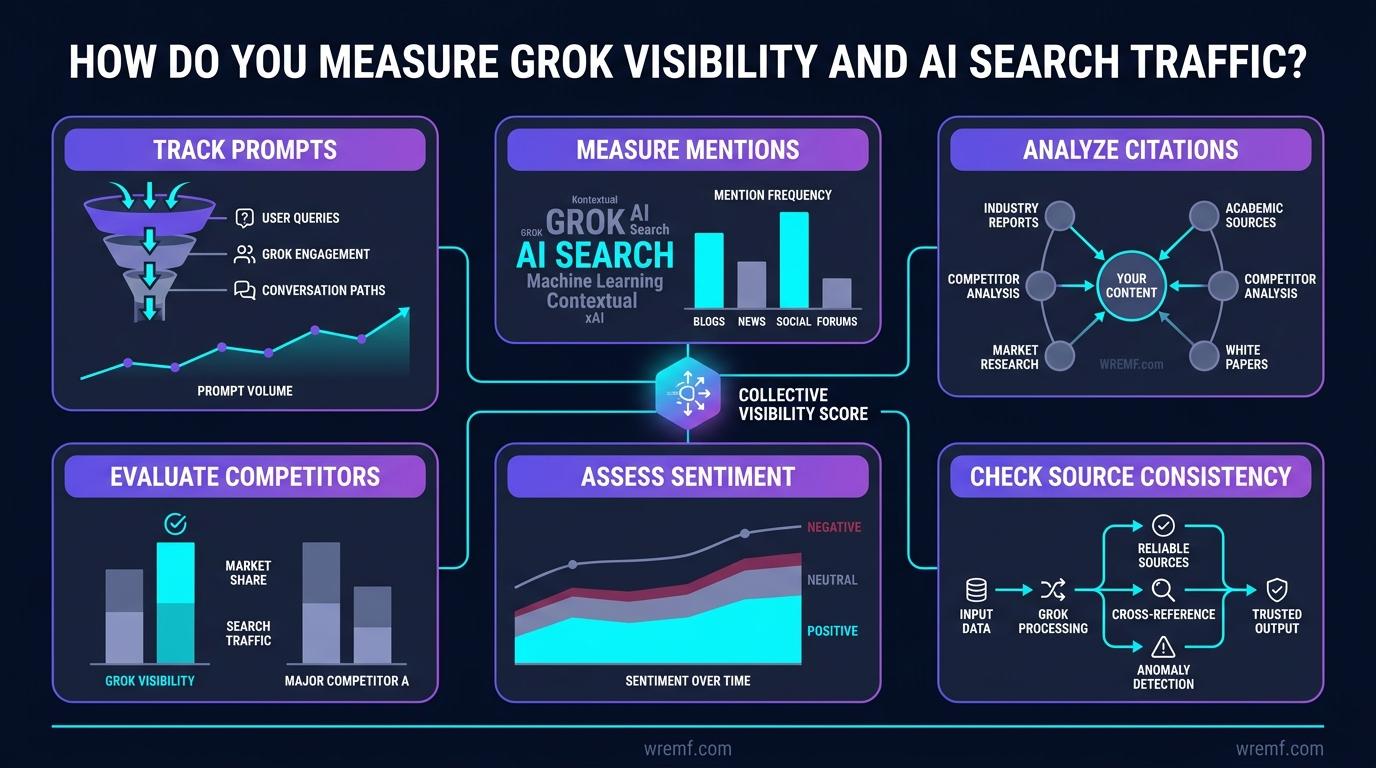
You measure Grok visibility by tracking prompts, mentions, citations, competitors, sentiment, source consistency, and AI search traffic together. No single metric can fully explain Grok optimization performance.
AI search traffic is traffic influenced by AI discovery surfaces such as Grok, ChatGPT, Perplexity, Gemini, Copilot, and Google AI Overviews. AI search traffic matters because AI-generated answers can create direct referrals, branded search, assisted conversions, and invisible influence.
AI traffic attribution connects AI visibility to sessions, leads, pipeline, or conversions where tracking is available. AI traffic attribution matters because leadership needs to see whether AI discovery is creating measurable business value.
AI share of voice is the percentage of relevant AI answers where your brand appears compared with competitors. AI share of voice matters because Grok answers often compress multiple options into a short answer or shortlist.
Brand recommendation visibility measures whether an AI system recommends your brand as a fit for a specific need. Brand recommendation visibility matters because being mentioned neutrally is different from being recommended as a solution.
A useful Grok optimization dashboard should include:
Grok Prompt visibility
Brand mention rate
Recommendation position
Source citation count
Citation quality
Competitor visibility
AI share of voice
Social sentiment analysis
AI search traffic
Assisted branded search movement
Content freshness status
Source consistency issues
Prompt Score movement
AI outputs requiring correction
Funnel Optimization insights
Funnel Optimization connects Grok visibility to stages such as awareness, comparison, decision, and retention. Funnel Optimization matters because AI prompts can influence users before they become identifiable website visitors.
In real-world reporting, teams should separate measurable facts from strategic inference. A Grok citation is measurable. A referral session from an AI domain is measurable when analytics captures it. A later branded search caused by an AI answer is often an inference unless survey, CRM, or attribution data confirms it.
WREMF connects prompt tracking, citation analysis, competitor visibility, and reporting through the WREMF methodology, giving teams a repeatable way to track AI visibility without claiming guaranteed traffic or citations.
KEY TAKEAWAY: Grok visibility measurement works best when prompt data, citation data, competitor data, social sentiment, and AI traffic attribution are analysed together.
The right measurement setup also helps you decide whether software, agency support, or a hybrid model is the best fit.
Should You Use Software, an Agency, or a Hybrid Model for Grok Optimization?
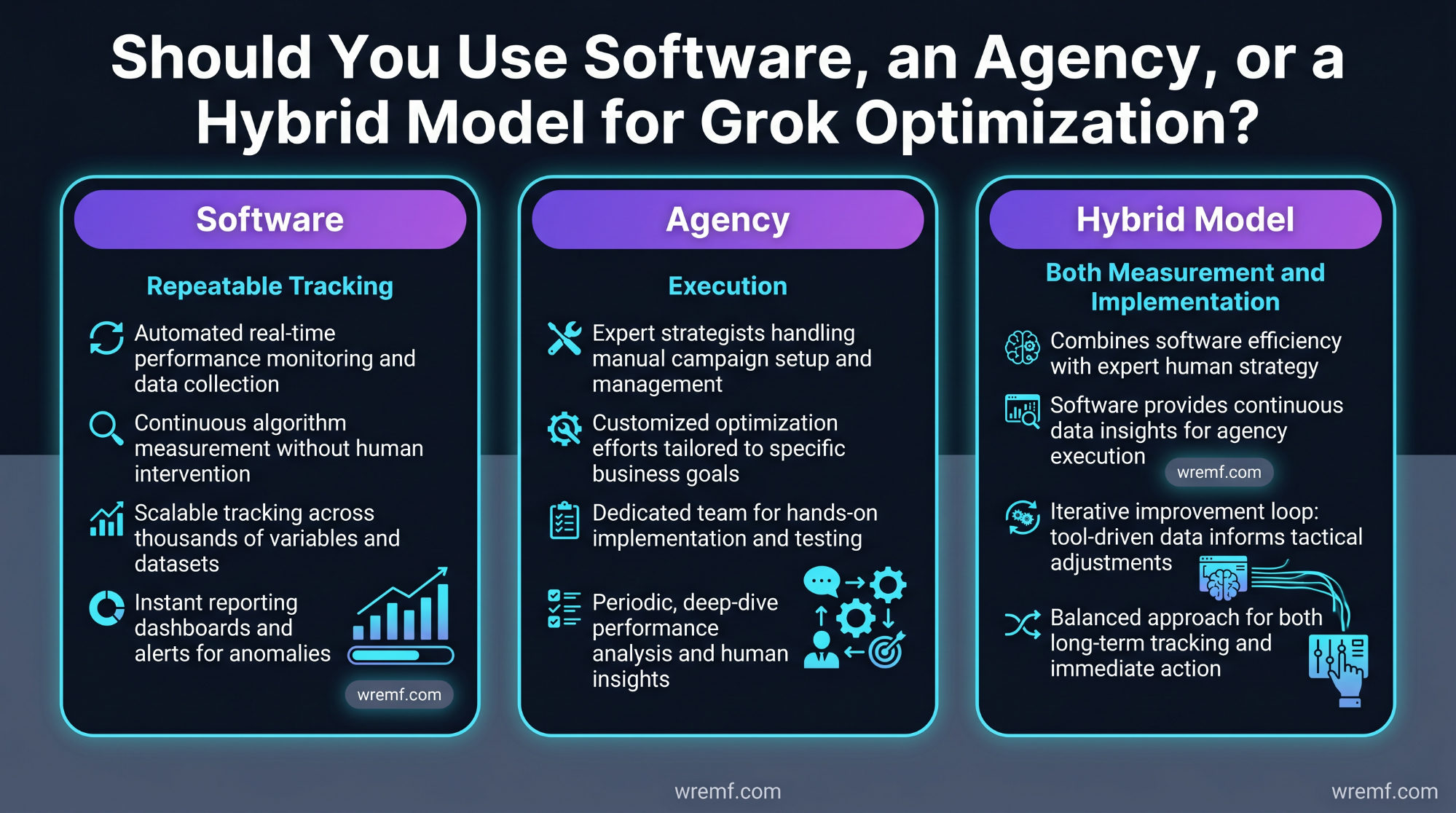
You should use software when you need repeatable tracking, an agency when you need execution, and a hybrid model when you need both measurement and implementation. Grok optimization usually requires both data and action.
AI visibility software helps teams monitor prompts, citations, competitors, source consistency, and reporting. AI visibility software matters because manual Grok testing is inconsistent, hard to scale, and difficult to compare across teams, markets, or clients.
Managed AEO and GEO services help teams turn insights into content updates, technical fixes, authority building, citation improvement, and reporting. Managed services matter when internal teams lack time, specialist knowledge, or execution capacity.
Hybrid Grok optimization combines software and managed execution. Hybrid Grok optimization matters because data without action becomes a dashboard, while execution without measurement becomes guesswork.
| Model | Best for | What it includes | Main limitation | Recommended when |
|---|---|---|---|---|
| Software | In-house marketing, SEO, and growth teams | Prompt tracking, citation monitoring, dashboards, competitor visibility | Requires internal execution | You have a team to act on insights |
| Agency service | Teams needing strategy and execution | AEO consulting, GEO audits, content optimization, source cleanup, reporting | Less self-serve control | You need senior-led implementation |
| Hybrid model | Brands and agencies needing both | Software plus managed execution | Requires clear ownership | You want tracking and action together |
| Manual testing | Very early exploration | Ad hoc Grok prompts and notes | Not scalable or reliable | You are validating the need |
Agencies managing multiple clients often need white-label reporting, client portals, prompt monitoring, and repeatable workflows. In-house brands often need executive reporting, competitor benchmarking, and clear prioritisation.
WREMF supports software, agency, and hybrid use cases. Brands can use WREMF for internal AI visibility tracking, while agencies can use WREMF for agencies to manage client reporting, prompt intelligence, and white-label deliverables.
For teams that want execution, the WREMF agency team provides managed AEO, GEO, citation improvement, technical AI visibility foundations, source consistency cleanup, internal linking guidance, and monthly reporting with no long-term lock-in.
KEY TAKEAWAY: Software measures Grok optimization, agency support executes it, and a hybrid model connects insight with implementation.
Before choosing a workflow, it is important to understand what Grok optimization cannot guarantee.
What Are the Limits and Risks of Grok Optimization?
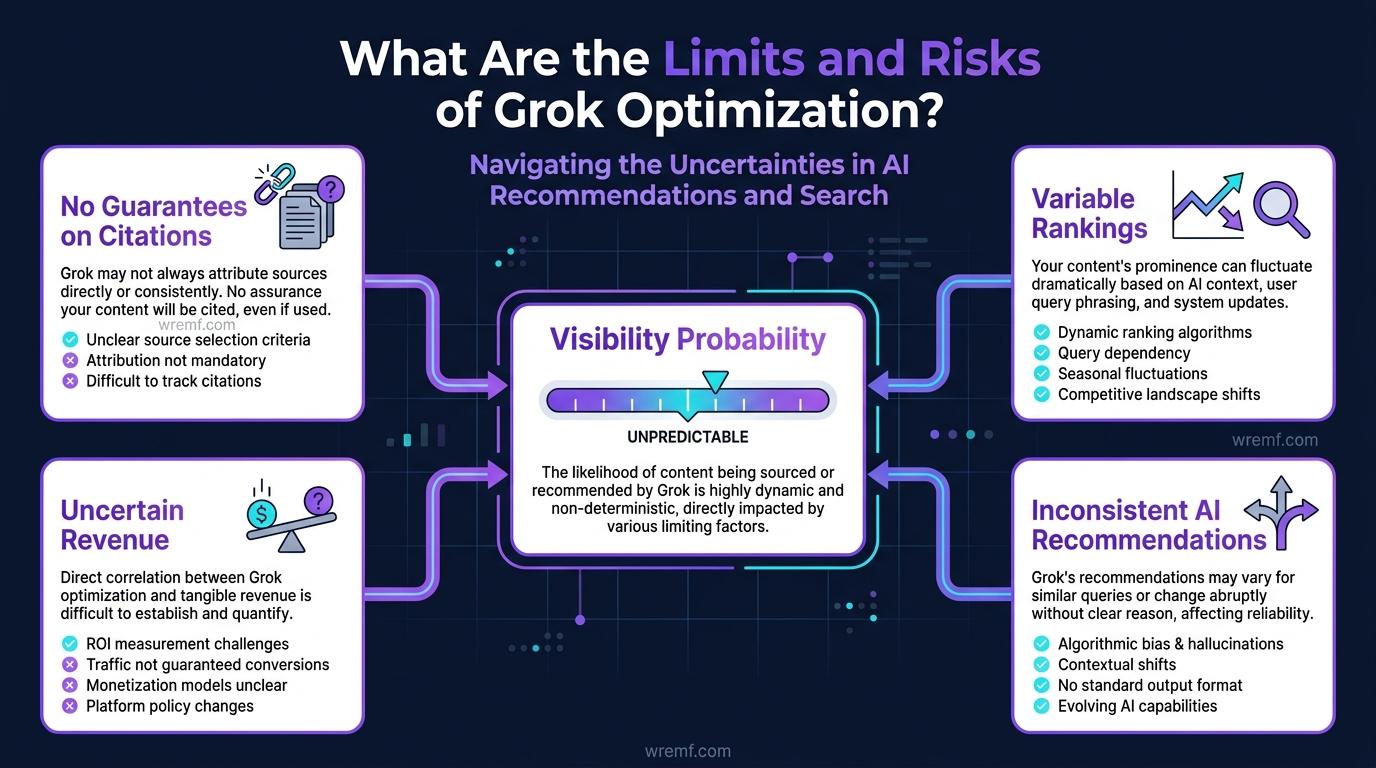
Grok optimization cannot guarantee citations, rankings, revenue, or fixed AI recommendations because AI models, data access, prompts, and source selection change over time. The goal is to improve visibility probability with better evidence, structure, and measurement.
AI systems are probabilistic and context-sensitive. A slight change in a Grok prompt can change the answer, sources, tone, or competitors mentioned. This makes trend analysis more useful than one-off screenshots.
Training data is not the same as real-time retrieval. Some AI models answer from training data, some use web retrieval, some use tool-calling, and some combine several modes. Grok can use real-time data access, but not every Grok AI response will cite the same source or behave like a search result.
Inference optimization is the process of improving how models generate outputs efficiently and accurately at response time. Inference optimization matters to platform builders, but marketers should not assume that backend performance improvements automatically translate into brand visibility improvements.
Parallel training, GPU clusters, model architecture, and infrastructure investments can improve AI model capability. For marketers, the practical implication is simpler: AI models will keep changing, so Grok optimization should be measured as an ongoing program rather than a one-time content project.
Common Grok optimization risks include:
Overreacting to one prompt result
Treating viral posts as long-term authority
Confusing rankings with AI recommendations
Using unsupported statistics in content
Ignoring negative social sentiment
Publishing thin pages for every keyword variation
Relying on schema markup without clear content
Measuring traffic only through last-click analytics
Assuming Grok, ChatGPT, Claude, Gemini, and DeepSeek use the same sources
Ignoring content freshness after publication
Failing to monitor Community Notes and public corrections
Treating speculative model names or benchmark claims as strategy
Crisis management is also part of Grok optimization. If negative social sentiment, inaccurate claims, or Community Notes appear around your brand, you need fast correction, transparent source updates, and consistent messaging across your website and X platform profiles.
IMPORTANT: Grok optimization improves the quality and consistency of signals available to AI systems, but no ethical platform or agency can guarantee how Grok will rank, cite, or recommend a brand.
KEY TAKEAWAY: Grok optimization is a probability-improvement system, not a guarantee system.
Understanding these limits makes it easier to separate myths from practical strategy.
Common Myths About AI Visibility Debunked
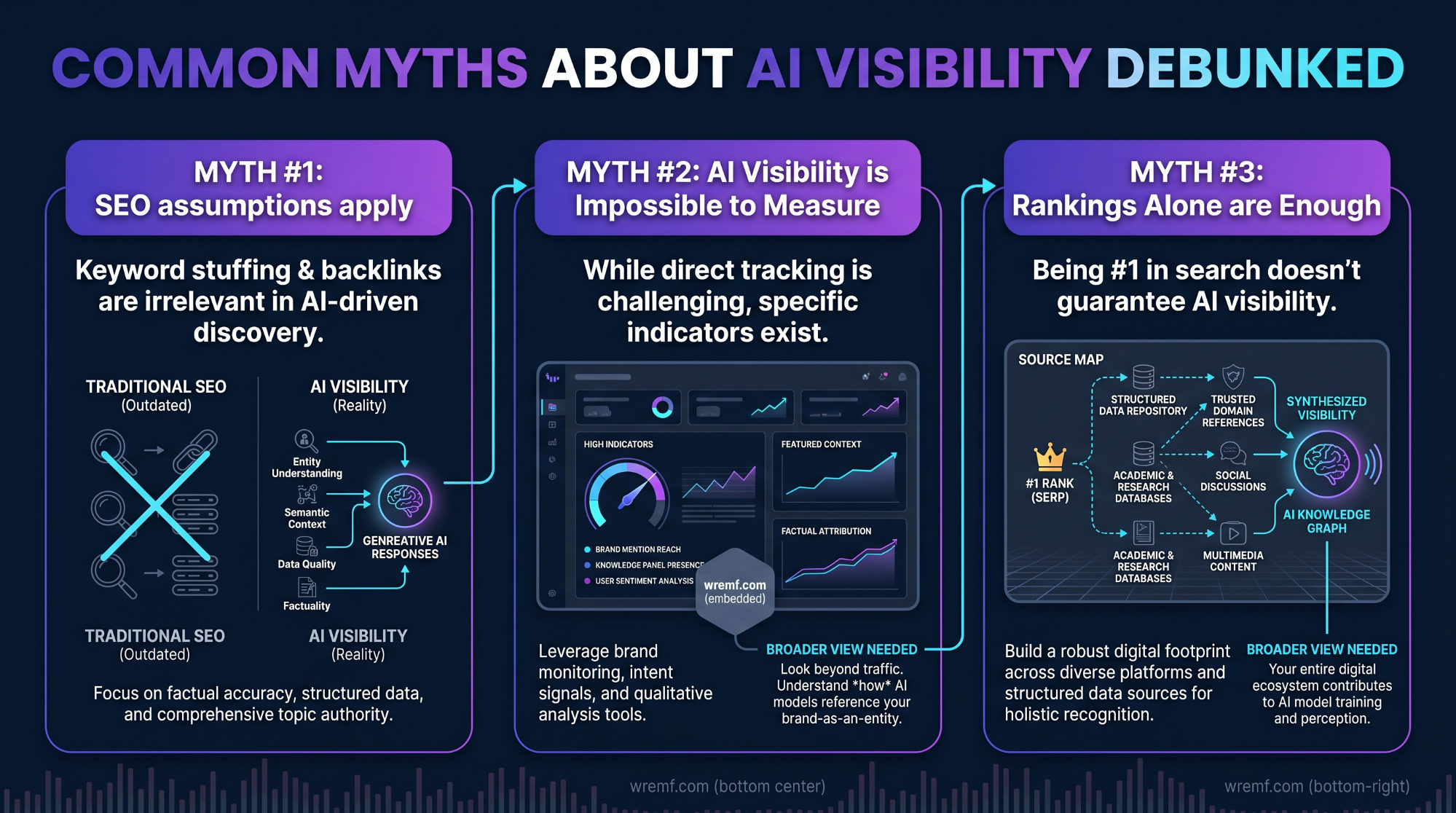
AI visibility myths usually come from applying old SEO assumptions to AI systems. Grok optimization requires a broader view of prompts, citations, source consistency, social signals, and AI outputs.
MYTH: SEO, AEO, and GEO are completely separate disciplines.
FACT: SEO, Answer Engine Optimization, and Generative Engine Optimization overlap. SEO improves crawlability, authority, content quality, and rankings. AEO improves direct answer structure. GEO improves visibility across AI-generated responses, citations, source mentions, and recommendations. Grok optimization combines all three.
MYTH: AI visibility is impossible to measure.
FACT: AI visibility is not perfectly measurable, but it is measurable enough to manage. Teams can track prompts, brand mentions, citations, source domains, competitors, recommendation tone, sentiment analysis, and AI search traffic. The limitation is attribution completeness, not total measurement failure.
MYTH: Rankings alone are enough for Grok SEO.
FACT: Rankings help, but Grok AI responses can use real-time data, social signals, source citations, and entity understanding. A page can rank in Google and still be ignored by AI systems if it lacks extractable answers, current information, author expertise, or source consistency.
MYTH: Schema markup alone will make Grok cite your brand.
FACT: Schema markup supports interpretation, but it does not replace useful content, topical authority, social proof, or credible sources. Schema implementation works best when it reinforces clear pages, strong internal linking, and consistent entity information.
MYTH: Viral posts always improve Grok AI visibility.
FACT: Viral posts can create short-term awareness, but they can also create risk if social sentiment is negative or inaccurate. Durable social AI visibility comes from consistent expertise, community validation, accurate source links, and aligned website content.
KEY TAKEAWAY: Grok optimization works when SEO, AEO, GEO, social context, and citation monitoring operate together.
With the myths cleared up, the final step is answering the most common Grok optimization questions directly.
Frequently Asked Questions
What is Grok optimization?
Grok optimization is the process of improving how Grok AI finds, understands, cites, mentions, and recommends your brand in AI-generated answers. It includes Grok SEO, structured data, schema markup, X platform visibility, content freshness, source citations, prompt tracking, competitor visibility, and AI traffic attribution. The goal is not only to rank in search engines, but to appear accurately in Grok AI responses when users ask natural language questions about your category, competitors, or product. WREMF helps teams track Grok visibility alongside other AI systems.
How do I optimize content for Grok AI?
To optimize content for Grok AI, write answer-first pages, define entities clearly, use structured data, maintain content freshness, and build content clusters around related questions. Add comparison tables, FAQ answers, internal linking, author expertise, and source-backed claims. Grok optimization should also include X platform monitoring because real-time data, social sentiment, thread structure, and trending topics can influence Grok AI responses. The best approach is to test realistic Grok Prompts, identify missing citations or incorrect descriptions, then update the sources Grok may use.
Is Grok better than ChatGPT?
Grok is different from ChatGPT rather than universally better. Grok has a strong connection to the X platform and real-time data, which can make it useful for trending topics, social data, and current public discussion. ChatGPT search can provide timely answers with links to web sources, according to OpenAI. For brand visibility, you should monitor both Grok and ChatGPT because each AI system may use different sources, citations, answer formats, and recommendation logic. WREMF tracks visibility across multiple engines instead of treating one AI model as the whole market.
What does Grok mean in simple words?
Grok means to understand something deeply and intuitively. In the context of Grok AI, the name suggests an assistant designed to understand questions, context, and user intent. For marketers, the practical meaning is more important than the origin of the word. Grok optimization is about helping Grok AI understand your brand, category, product, sources, and reputation clearly enough to mention or cite the brand accurately when relevant prompts are asked.
What makes Grok fundamentally different from ChatGPT, Claude, and Gemini?
Grok is closely tied to xAI and the X platform, which gives it a distinctive relationship with real-time data, X's social connections, trending topics, and public discussion. ChatGPT, Claude, and Gemini have different product ecosystems, retrieval behaviours, safety systems, and citation patterns. For Grok optimization, the practical difference is that X platform signals, thread context, social sentiment analysis, and real-time data access may be more important than they are for some other AI discovery surfaces. Brands should measure each AI model separately.
Can a viral X post immediately change how Grok describes my brand?
A viral X post may affect short-term Grok visibility if it becomes part of a trending topic or public discussion, but it should not be treated as durable authority. Grok AI responses can vary by prompt, timing, and available sources. Positive viral posts may increase awareness, while negative viral posts can create brand reputation and crisis management risks. The safer strategy is to use X platform momentum to reinforce accurate source links, expert commentary, and consistent website content.
How do you optimize technical elements for Grok?
You optimize technical elements for Grok by making pages crawlable, fast, structured, and easy to extract. Use clean HTML, clear headings, schema markup, structured data, canonical URLs, page speed improvements, and logical internal linking. Core Web Vitals, schema implementation, and content management system templates matter because technical barriers can prevent AI systems from accessing the best answer. Technical Grok SEO should support both human readers and AI-powered search system workflows.
What are Grok keywords?
Grok keywords are the phrases, entities, and natural language prompts that users may use when asking Grok AI for answers. They include traditional keywords such as “Grok SEO,” but also conversational prompts like “How do I make Grok recommend my brand?” or “Which AI visibility tools track Grok?” Grok keywords should be grouped by intent, such as definition, comparison, implementation, buying, and troubleshooting. Prompt tracking is usually more useful than keyword tracking alone.
How often does Grok update?
Grok update timing can vary by product, model, API, and feature. Marketers should not build a strategy around a fixed public update cycle unless xAI publishes one for the specific product or model being used. A practical Grok optimization program should review priority prompts at least monthly and more often during launches, crises, competitive campaigns, or major market events. Monthly checks should include Grok Prompts, citations, competitors, social sentiment, source consistency, and AI search traffic.
How do I use Grok more efficiently for marketing research?
Use Grok more efficiently by asking specific, source-aware prompts with clear constraints. Instead of asking “Tell me about my category,” ask Grok to compare vendors, identify recent X platform discussion, summarize objections, list source citations, or explain why one brand is recommended over another. For marketing research, separate prompts by awareness, comparison, decision, risk, and implementation. Then record the AI outputs, cited sources, competitor mentions, and recommendation tone so you can identify patterns instead of relying on one response.
Can AI links like ChatGPT and Grok be indexed?
AI-generated links and AI answer pages may or may not be indexable depending on the platform, sharing format, robots rules, and whether the page is publicly accessible. For brand strategy, the more important question is whether AI systems can access and cite your owned sources. You should focus on crawlable webpages, structured data, clear source pages, internal linking, and consistent entity information. Do not rely on AI conversation links as your primary search visibility asset.
Is Grok good for coding and developer workflows?
Grok can be relevant for coding and developer workflows, especially through xAI’s developer models and API features. For technical brands, Grok optimization should focus on documentation that supports multi-step coding tasks, tool-calling, terminal operations, file editing, PowerShell examples, API errors, and diff edits. Developer visibility is not only about ranking docs in search engines. It is also about making documentation usable by AI coding agents that need clear steps, parameters, constraints, and expected outputs.
Why might I be blocked when testing Grok or AI search tools?
You may be blocked when testing Grok or other AI search tools because of rate limits, login requirements, automation controls, regional access rules, API usage limits, suspicious request patterns, or account restrictions. If this happens, review the platform’s official access rules, reduce automated testing frequency, use approved APIs where available, and avoid scraping behaviours that violate terms. For enterprise workflows, API-based monitoring is safer than manual or automated browser testing at scale.
Which metrics matter most for Grok SEO?
The most important Grok SEO metrics are prompt visibility, brand mention rate, recommendation position, citation quality, source consistency, competitor visibility, AI share of voice, social sentiment analysis, and AI search traffic. Traditional rankings and clicks still matter, but they do not show how Grok AI describes your brand inside answers. A practical dashboard should separate measurable facts, such as citations and mentions, from strategic inferences, such as assisted branded search or pipeline influence.
Should I use a Grok optimization tool or an agency?
Use a Grok optimization tool if your team can act on insights internally. Use an agency if you need strategy, content optimization, technical fixes, citation improvement, and reporting support. Use a hybrid model if you need both measurement and execution. WREMF supports all three models through software, managed AEO and GEO services, and combined software plus execution workflows. Teams comparing internal tracking costs with managed support can review WREMF pricing.
Conclusion
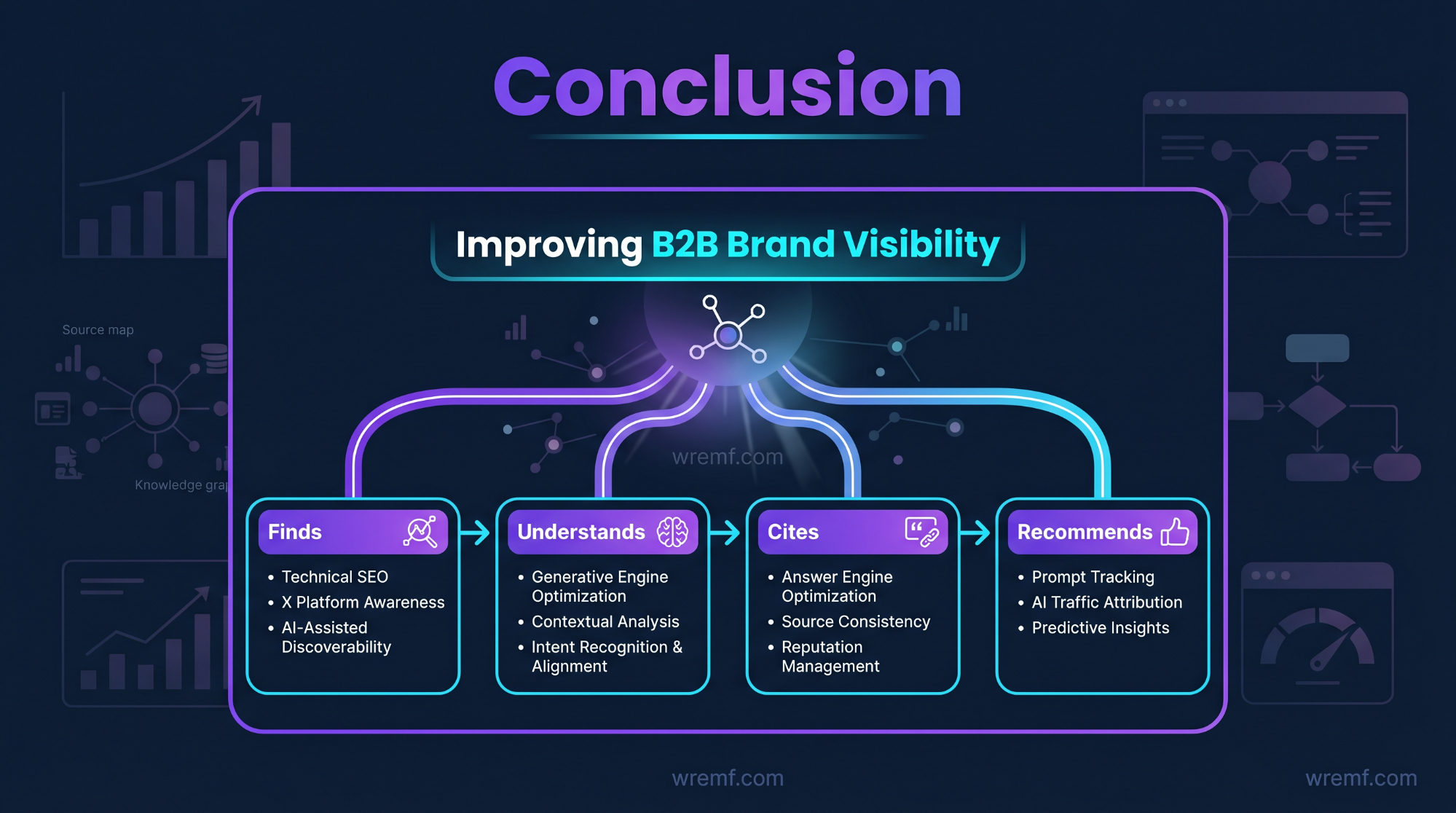
Grok optimization helps B2B teams improve how Grok AI finds, understands, cites, and recommends their brand. The work combines technical SEO, Answer Engine Optimization, Generative Engine Optimization, X platform awareness, source consistency, prompt tracking, and AI traffic attribution. The goal is not to chase one ranking signal, but to build a stronger evidence system around your brand. WREMF helps teams turn AI visibility into a measurable workflow across Grok and other AI discovery surfaces. To start tracking prompts, citations, competitors, and recommendations, explore the WREMF platform suite or talk to the WREMF agency team.
Related reading
- Best Answer Engine Optimization for Enhancing AI Visibility
- ChatGPT SEO: The Complete Guide to Ranking in ChatGPT
- SEO for ChatGPT: Playbook for Ranking, Visibility, and AI Search Citations
- How to Get Mentioned in ChatGPT: The Complete Guide to AI Visibility, Citations, and Brand Mentions
- Why Is My Brand Not Showing in ChatGPT? Reasons, Diagnosis, and a Complete AI Visibility Fix