Why Is My Brand Not Showing in ChatGPT? Reasons, Diagnosis, and a Complete AI Visibility Fix
Understand why your brand might be missing in ChatGPT and learn to diagnose AI visibility issues to enhance your brand presence.
By WREMF Team · 2026-08-21
AI visibility refers to the presence of a brand in AI-generated answers and citations. Key to achieving this visibility is clear entity definition, strong authority signals, accessible and relevant content, and consistent citations. Brands often fail to appear in AI responses due to a lack of clear and accessible information that AI systems need to recognize and trust. Ensuring a robust online entity profile and addressing technical and content gaps can enhance a brand's likelihood of being mentioned by AI systems.
Key takeaways
- AI visibility depends on clear entity signals, trusted sources, and accessible content.
- Strong search engine rankings do not guarantee AI mention; focus on entity clarity.
- Check technical factors like crawlability to ensure AI systems can access your content.
- Consistent brand messaging across the web enhances AI recognition and mention.
- Third-party validation and external mentions boost brand presence in AI results.
Why Is My Brand Not Showing in ChatGPT? Reasons, Diagnosis, and a Complete AI Visibility Fix
Why is my brand not showing in ChatGPT is usually caused by weak AI visibility, unclear entity signals, inaccessible content, limited authority, or poor prompt-category fit. OpenAI explains that ChatGPT search can surface and link to web sources when answering timely or research-based queries. WREMF helps B2B teams track, improve, and prove how their brand appears across ChatGPT, Claude, Gemini, Perplexity, Google AI Overviews, Copilot, DeepSeek, Grok, Meta AI, and Mistral. This guide explains how AI systems evaluate brands, why Google Search rankings do not always become AI-generated answers, and how to diagnose technical, entity, content, citation, and reputation gaps. Keep reading to turn brand invisibility into a measurable AI visibility workflow.
Why Is My Brand Not Showing in ChatGPT?
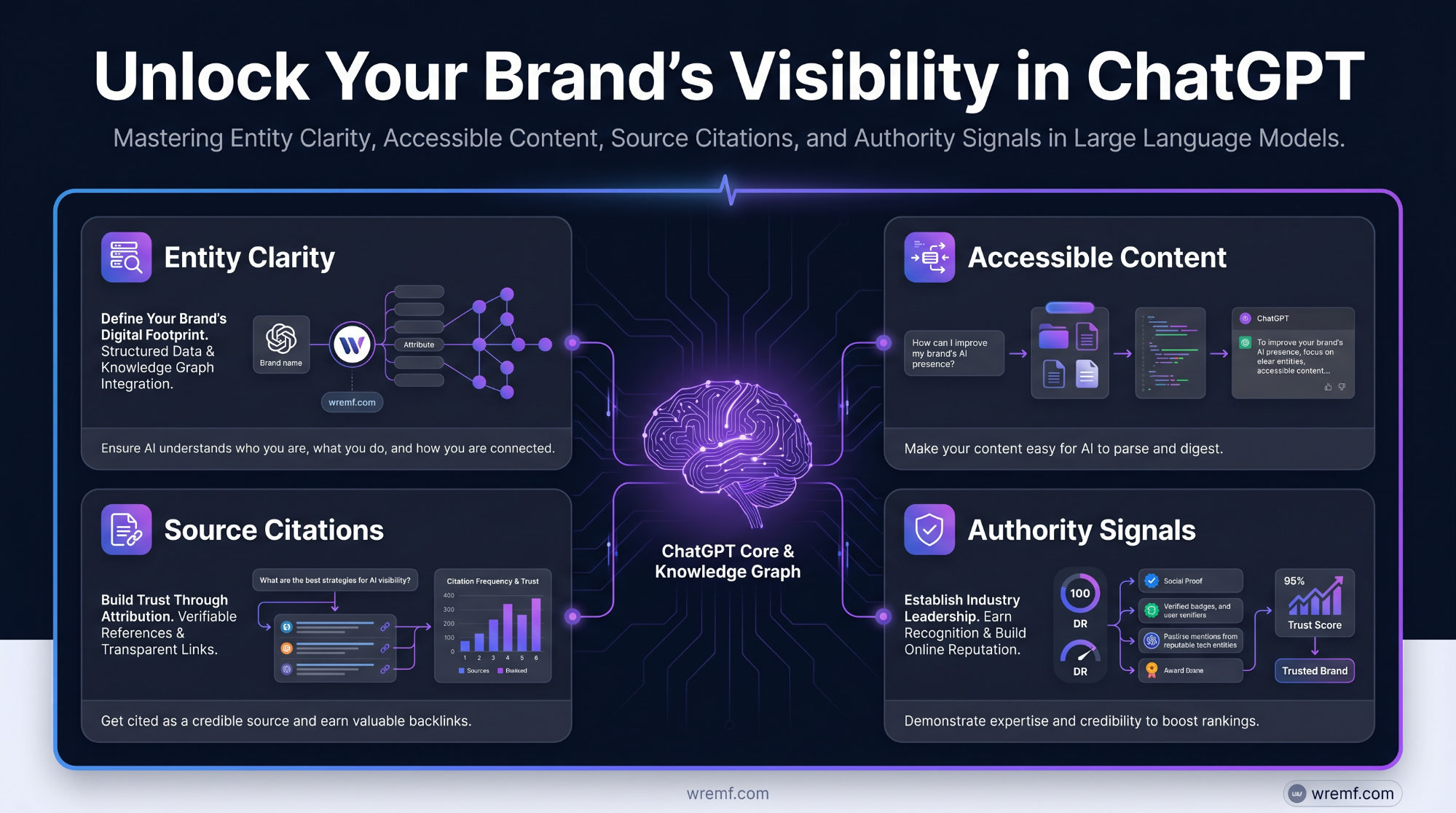
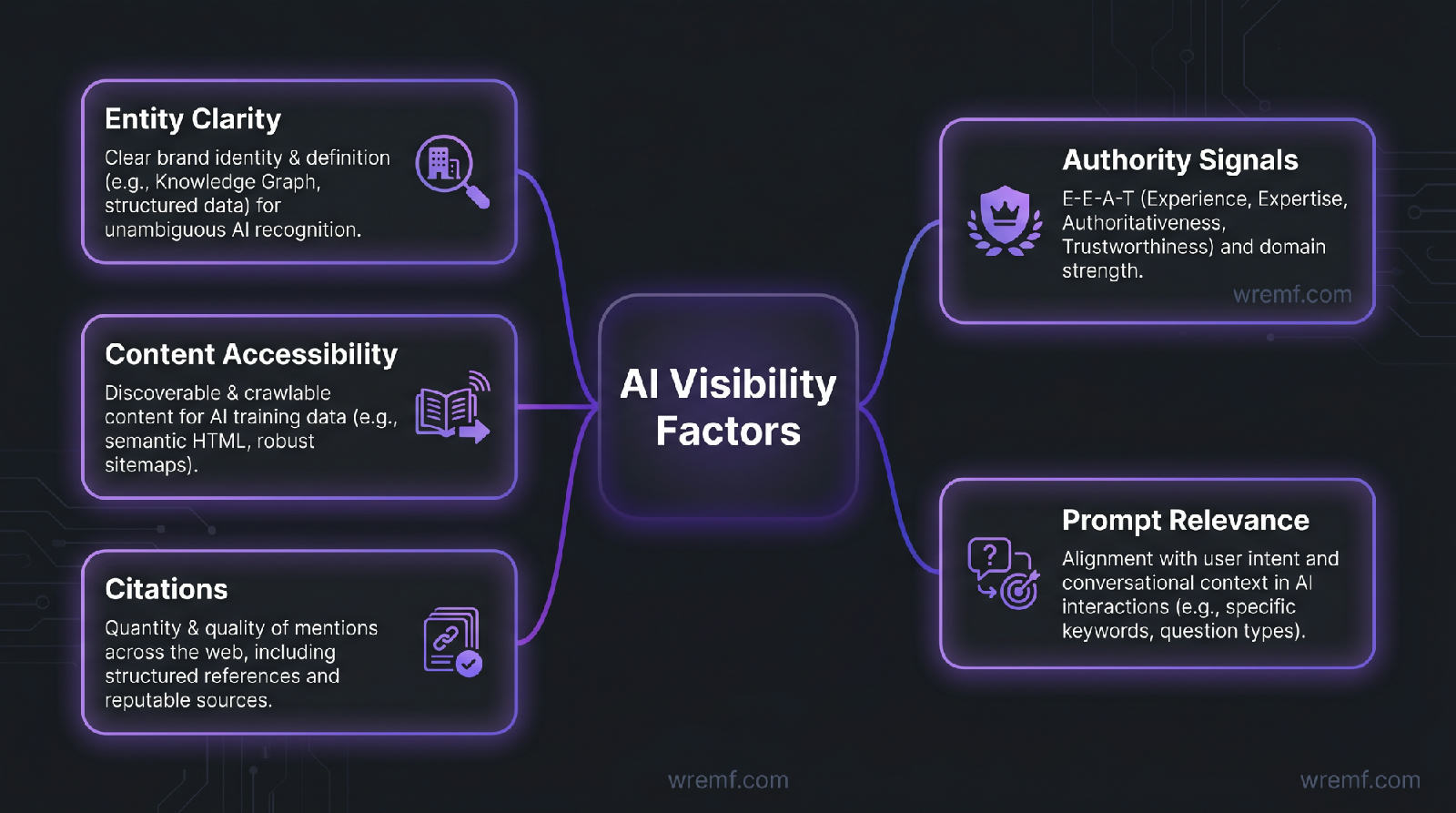
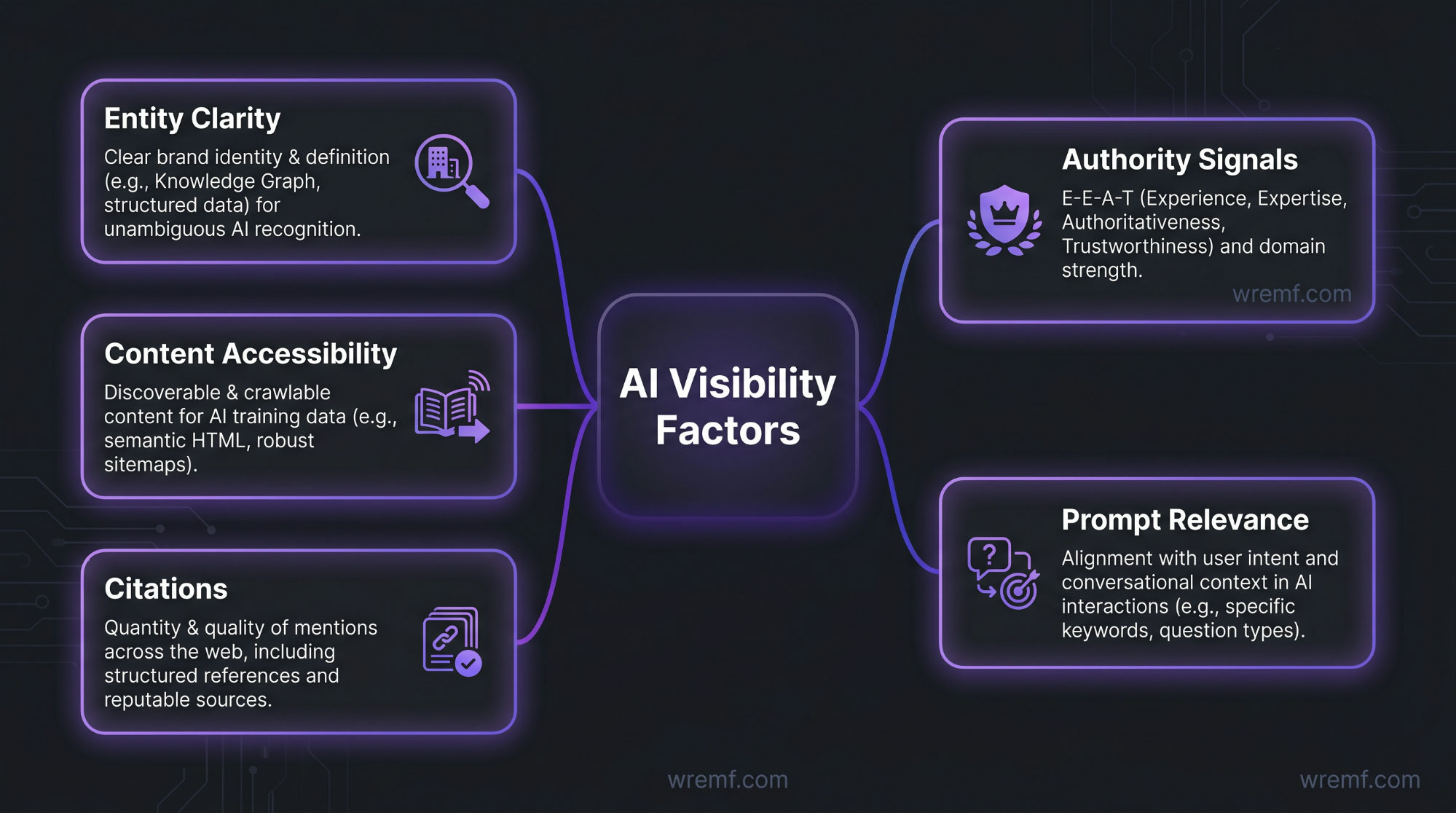
Your brand is not showing in ChatGPT because AI systems may not clearly understand, retrieve, trust, or associate your brand with the prompt being asked. AI Visibility depends on entity clarity, accessible content, source citations, authority signals, and repeated prompt-level relevance.
AI visibility is the measurable presence of a brand inside AI-generated answers, recommendations, citations, summaries, and comparisons. AI visibility matters because buyers increasingly use AI tools before they visit websites, search engines, review sites, or sales pages.
The most common reason is not that ChatGPT “hates” your brand. The reason is usually evidence quality. ChatGPT needs enough public, accessible, and trusted information to identify your brand name, understand your category, connect your brand positioning to a user query, and decide whether your brand deserves to appear beside competitors.
In practical AI visibility audits, marketing teams often discover that their website exists, their content marketing is active, and their analytics look healthy, but their entity footprint is still weak. That happens when AI systems can see pages but cannot extract clear brand signals, verify claims through reputable sites, or connect the company to a specific use case.
WREMF helps teams diagnose this by monitoring prompts, source citations, competitor mentions, AI share of voice, and source consistency across 10 AI engines. Teams that need ongoing measurement can use the WREMF AI visibility platform suite to track where their brand appears, where competitors appear, and which sources influence AI-generated answers.
DID YOU KNOW: Loamly reported in a February 2026 analysis of 2,089 brands that 77% were absent from AI platform responses, while AirOps and Kevin Indig reported that only 30% of brands visible in one AI answer remained visible in the next response to the same query.
Your brand may be missing because of one or more of these problems:
ChatGPT does not recognize your brand as a clear entity.
Your website blocks or limits important crawlers.
Your key content is hidden behind JavaScript rendering, gated content, or thin pages.
Your Structured Data is missing, incomplete, or inconsistent.
Your brand lacks enough brand mentions across reputable sites.
Your competitors have stronger authority signals, reviews, comparison mentions, or directory listings.
Your content answers search engine keywords but not conversational queries.
Your Google Business Profile, directory listings, and social media profiles send inconsistent brand signals.
Your brand name is too generic, ambiguous, or similar to another company.
Your category association is weak, so AI systems do not know when to mention you.
KEY TAKEAWAY: Your brand is usually missing from ChatGPT because AI systems lack enough clear, accessible, and trusted evidence to include your brand in the answer.
To fix the problem, you first need to understand how ChatGPT and other AI systems evaluate your brand.
How ChatGPT and AI Systems See Your Brand
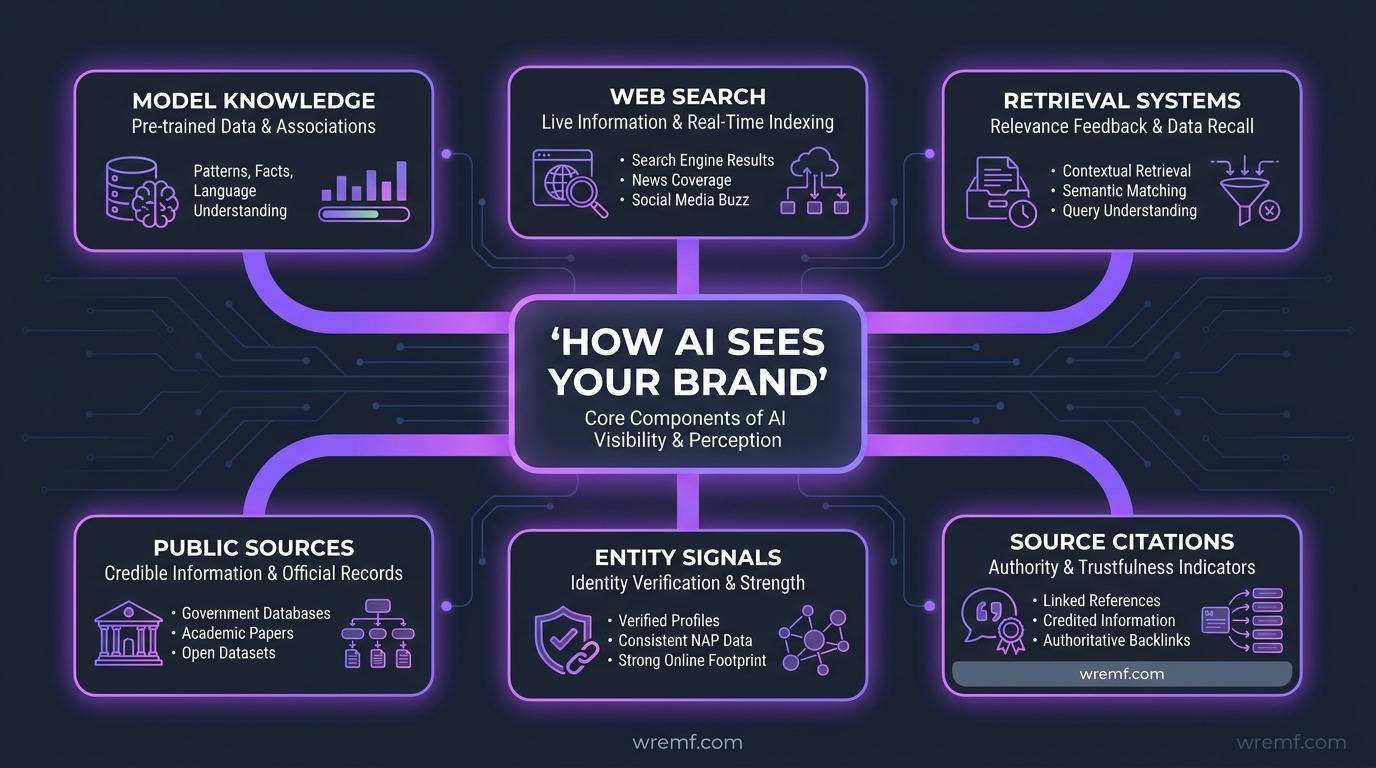
ChatGPT sees your brand through model knowledge, web search, retrieval systems, public sources, entity signals, and source citations. A brand becomes visible when AI systems can retrieve clear evidence that connects the brand to the user’s question.
Retrieval-augmented generation is a process where an AI system uses external sources to support an answer instead of relying only on training data. Retrieval-augmented generation matters because a brand can be considered for AI-generated answers only when relevant sources are accessible, understandable, and trusted.
OpenAI states in its publisher and developer FAQ that publishers who allow OAI-SearchBot access can track ChatGPT referral traffic because ChatGPT includes the UTM parameter utm_source=chatgpt.com in referral URLs. This matters because ChatGPT visibility is not only a branding issue. It can also become measurable traffic when your content is surfaced and linked.
Large language models do not evaluate brands the same way humans do. AI systems look for patterns across sources, including your website, search engine results, citations, structured knowledge, third-party validation, reviews, category pages, social media profiles, and external mentions. A clear brand presence across those sources gives AI systems more confidence.
AI systems also compress options. A traditional search engine can show 10 blue links, map packs, ads, and related results. AI-generated answers usually show fewer brands. This means the bar for inclusion can be higher. Your brand does not only need to exist. Your brand needs enough category relevance and credibility to survive answer compression.
AI-generated answers are summarized responses created by AI systems using model knowledge, retrieved sources, or both. AI-generated answers matter because they can influence vendor discovery before buyers click a website, compare a pricing page, or speak to sales.
AI visibility is the measurable presence of a brand inside AI-generated answers, recommendations, citations, and summaries. AI visibility matters because buyers increasingly use AI assistants to compare vendors before visiting websites, reviewing ads, or speaking to sales teams.
WREMF turns this process into a measurable workflow through prompt tracking, citation analysis, competitor visibility, and AI traffic attribution. The WREMF methodology connects prompts, citations, competitors, source consistency, and attribution so teams can measure brand presence across ChatGPT, Claude, Gemini, Perplexity, Google AI Overviews, Copilot, DeepSeek, Grok, Meta AI, and Mistral.
KEY TAKEAWAY: ChatGPT visibility depends on whether AI systems can retrieve, verify, and confidently connect your brand to the prompt category.
The next problem is the gap between traditional SEO performance and AI citation performance.
Why Google Search Rankings Do Not Always Become ChatGPT Mentions
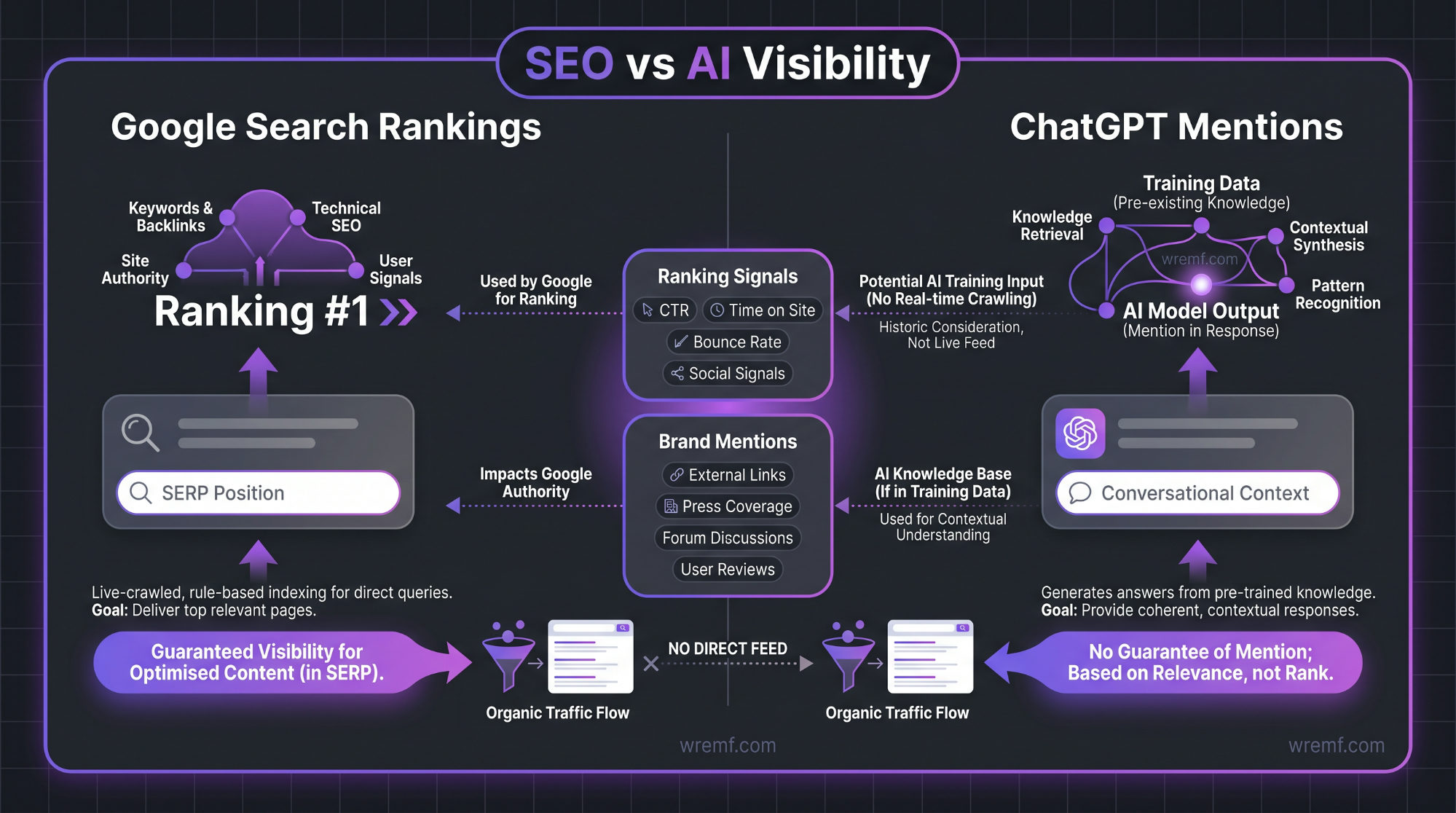
Google Search rankings do not automatically create ChatGPT mentions because ranking signals, AI citations, and brand mentions overlap but are not the same. A page can rank well in a search engine and still fail to become a trusted source in AI search.
AI citations are source references used by AI systems to support claims, summaries, comparisons, or recommendations. AI citations matter because they show which pages AI systems trust enough to use in an answer.
The key difference between SEO, AEO, and GEO is the output each discipline optimizes for. SEO focuses on visibility in search engines. Answer engine optimisation focuses on direct answer quality. Generative engine optimisation focuses on presence inside AI-generated answers, recommendations, citations, and summaries.
Google Search Central says its ranking systems are designed to prioritize helpful, reliable information created to benefit people rather than content created mainly to manipulate search engine rankings in its helpful, reliable, people-first content guidance. That principle supports AI visibility too, but AI search adds extra requirements: extractability, source consistency, entity clarity, and prompt-level fit.
| Method | Best For | What It Measures | What It Misses | Typical User | Main Limitation |
|---|---|---|---|---|---|
| SEO | Traditional search engine visibility | rankings, clicks, impressions, backlinks, technical SEO | AI-generated answers, prompt-level performance, AI citations | SEO teams and content teams | Good rankings may not translate into AI citations |
| AEO | Direct answers and answer-first content | definitions, FAQs, snippet-style answers, conversational coverage | wider source ecosystem and competitor visibility | content teams and product marketers | Strong answers may still lack authority |
| GEO | Generative engine optimisation | brand presence in AI-generated answers | full traffic attribution unless tracked separately | growth teams and AI search teams | AI results can vary across runs |
| AI Visibility | Cross-engine brand measurement | brand mentions, citations, AI share of voice, source consistency, prompt-level performance | offline sales influence unless connected to CRM data | B2B SaaS teams, agencies, consultants, founders | requires repeatable monitoring |
Use SEO when your goal is Google Search traffic. Use AEO when your content needs clearer answers for conversational queries. Use GEO when your goal is visibility in AI-generated answers. Use AI Visibility when you need measurement across ChatGPT, Claude, Gemini, Perplexity, Google AI Overviews, Copilot, DeepSeek, Grok, Meta AI, and Mistral.
Search rankings still matter because they can influence what people and AI tools find. The mistake is treating rankings as the final measure. In real B2B buying journeys, a buyer may ask ChatGPT for a vendor shortlist, ask Perplexity for sources, search Google for reviews, compare pricing, and then visit a website. Your AI Visibility needs to cover that whole user journey.
IMPORTANT: Strong SEO can support AI search, but rankings alone are not proof that your brand is visible, cited, or recommended by AI systems.
KEY TAKEAWAY: Ranking in Google Search helps discovery, but AI visibility also requires entity clarity, citations, extractable content, external validation, and prompt-level relevance.
After comparing SEO and AI search, the next step is checking whether AI crawlers can access your content.
Technical Roadblocks That Prevent AI Tools From Finding Your Website
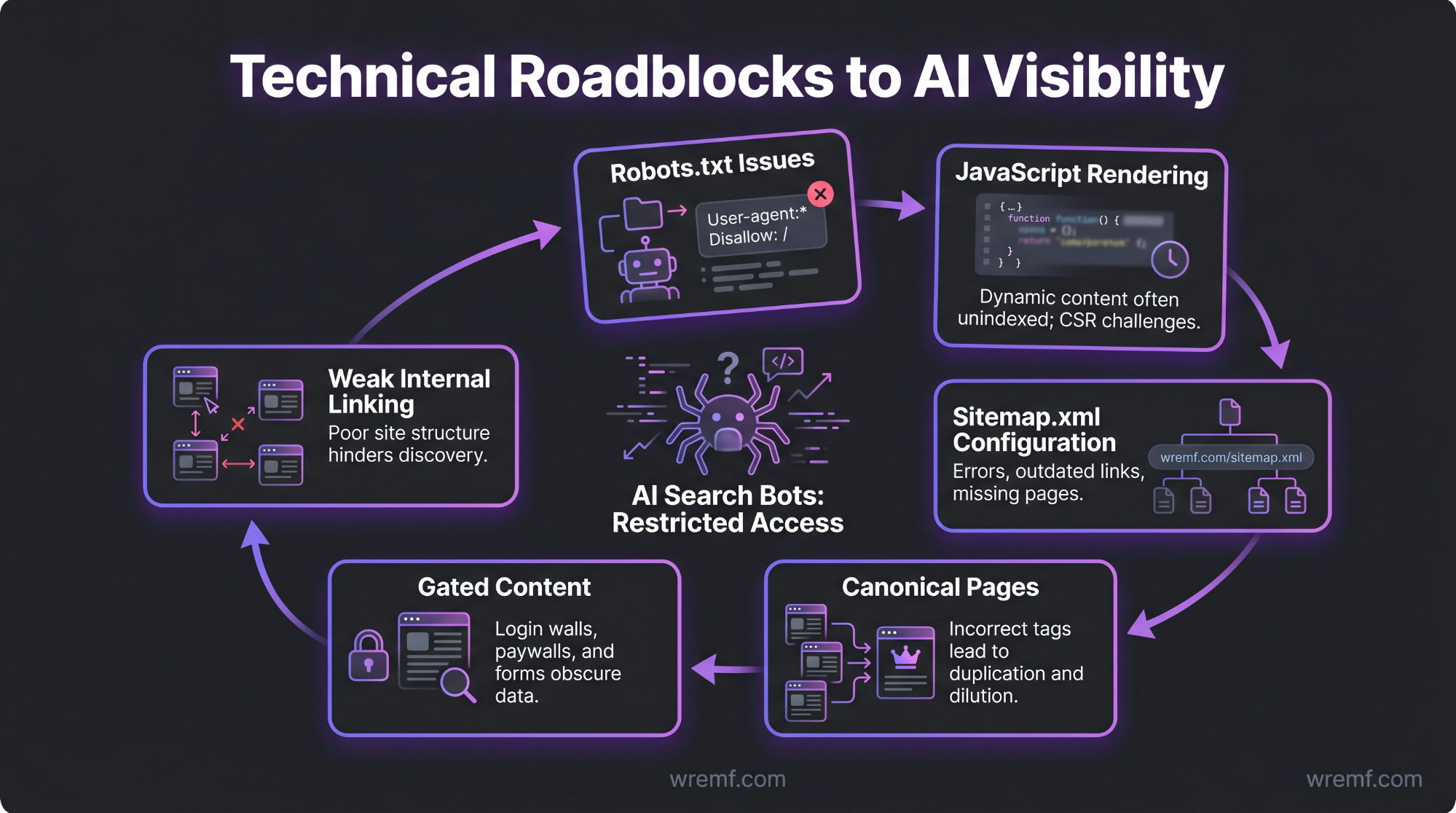
Technical roadblocks prevent AI tools from finding your website when crawlers cannot access, parse, render, or navigate your most important pages. Robots.txt, JavaScript rendering, sitemap.xml, canonical pages, gated content, and weak internal linking can all reduce AI search visibility.
Content extractability is the ability of search engines and AI systems to identify useful text, headings, facts, links, and entity relationships on a page. Content extractability matters because inaccessible content cannot become a reliable AI citation.
Start with robots.txt. OpenAI’s crawler documentation explains that OpenAI uses OAI-SearchBot and GPTBot robots.txt tags to help webmasters manage how their sites and content work with AI. If your robots.txt file blocks relevant crawlers, your content may be less discoverable for ChatGPT search, source citation, or related AI systems.
Perplexity also documents PerplexityBot as a crawler designed to surface and link websites in Perplexity search results. The practical lesson is simple: AI tools do not all use the same crawler, the same index, or the same source selection process. A brand that wants AI visibility should audit the major crawler rules instead of checking only Googlebot.
JavaScript rendering can create another gap. Google Search Central explains that JavaScript-generated content can create discoverability challenges when content is not available to search engines. For AI visibility, the safest approach is to make your core brand facts, product descriptions, pricing context, FAQs, and category pages available as crawlable text.
Gated content can also hide the best evidence from AI systems. If your strongest product comparisons, original research, customer proof, and technical documentation sit behind forms, AI systems may only see thin landing pages. That weakens content volume, content structure, and citation authority.
Canonical pages matter because duplicate URLs can split or confuse signals. If similar pages compete with each other, search engines and AI retrieval systems may struggle to identify the main source. Clean canonical pages help your website present a clearer content hierarchy.
A technical AI visibility audit should check:
GPTBot, OAI-SearchBot, ChatGPT-User, ClaudeBot, PerplexityBot, Google-Extended, Bingbot, and other relevant crawler rules
sitemap.xml coverage for homepage, product pages, category pages, pillar pages, comparison pages, FAQ pages, and content hubs
canonical pages for duplicate or similar content
JavaScript rendering of important brand and product text
server-side availability of core content
blocked CSS, JavaScript, or resources that affect page rendering
internal linking between topic clusters, pillar pages, feature pages, and buying pages
page titles, H1s, H2s, and answer-first content blocks
crawl status in Google Search Console and Bing Webmaster Tools
whether key pages are indexed in major search engines
TIP: View the source or rendered HTML of your most important pages. If a crawler cannot easily see your brand name, category, product value, proof points, and FAQs, AI systems may struggle too.
KEY TAKEAWAY: Technical cleanup makes your brand eligible for AI discovery, but eligibility is only the first step.
Once the site is accessible, the next challenge is making the brand understandable as an entity.
Entity Clarity: Why ChatGPT May Not Understand Your Brand
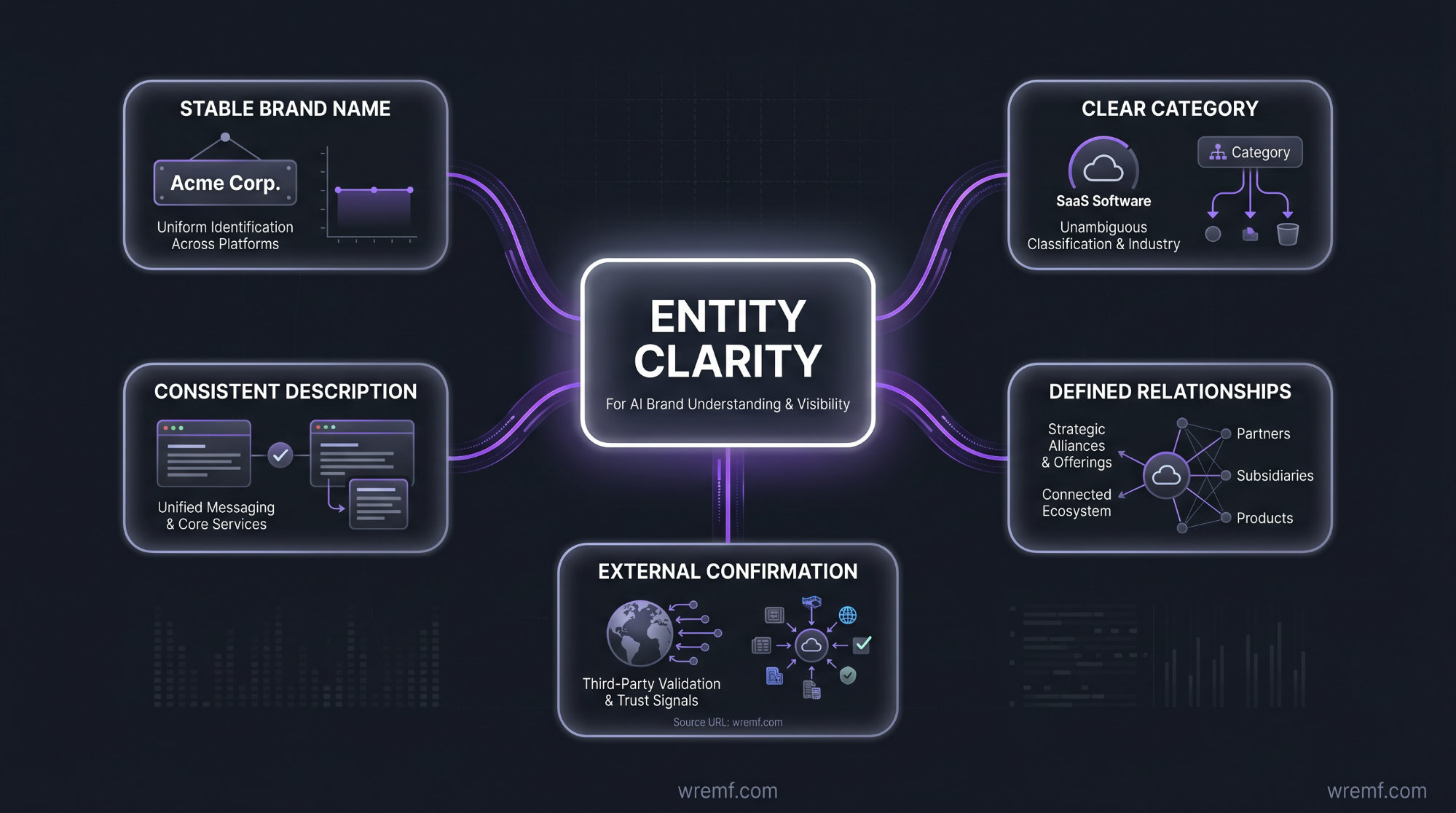
ChatGPT may not understand your brand when your entity clarity is weak, inconsistent, or ambiguous across the web. AI systems need a stable brand name, category, description, relationships, and external confirmation before they can confidently mention your company.
Entity clarity is the degree to which your brand is consistently defined as a real company, product, service, location, or concept across your website and the wider web. Entity clarity matters because AI systems must identify what your brand is before they can connect it to relevant prompts.
An entity is a distinct thing such as a company, person, product, service, place, or category. Entity recognition helps AI systems identify your brand name as a company rather than a random phrase. Entity relationships connect that company to products, founders, customers, locations, competitors, industries, reviews, and use cases.
Google says adding organization structured data to your home page can help Google understand administrative details and disambiguate your organization in search results in its Organization structured data documentation. That matters for AI visibility because structured knowledge helps clarify who the brand is, what official site represents it, and how it relates to other public profiles.
Entity ambiguity happens when your brand name is too generic, shared by another company, spelled inconsistently, or described differently across sources. For example, a SaaS brand may call itself “a growth platform” on its homepage, “sales software” on LinkedIn, “AI CRM” in directories, and “automation tools” in reviews. AI systems may struggle to determine the correct category signal.
Entity signals are repeated clues that help AI systems connect a brand to a category, audience, product, and proof. Entity signals include Organization schema, structured data markup, sameAs links, founder profiles, Google Business Profile data, directory listings, reviews, press mentions, partner pages, social media profiles, and relevant publications.
A strong entity definition uses a consistent pattern:
brand name
category
audience
core use case
proof or differentiator
source relationships
Weak entity definition: “We help teams grow.”
Strong entity definition: “WREMF is an AI visibility platform that helps B2B teams track, improve, and prove how their brand appears across ChatGPT, Claude, Gemini, Perplexity, Google AI Overviews, Copilot, DeepSeek, Grok, Meta AI, and Mistral.”
The stronger version gives AI systems a brand name, category, audience, function, and AI discovery surface relationship. That improves entity clarity, entity structure, entity definition, entity linking, and entity footprint.
AI visibility works by connecting prompts, sources, entities, and citations. AI visibility becomes stronger when the same brand positioning appears consistently across owned pages, structured data, third-party validation, reviews, directories, and reputable sites.
KEY TAKEAWAY: Entity clarity helps ChatGPT understand what your brand is, what category it belongs to, and when your brand should appear.
The next step is making that entity machine-readable through Structured Data and content architecture.
Structured Data, Schema Markup, and Machine-Readable Brand Authority
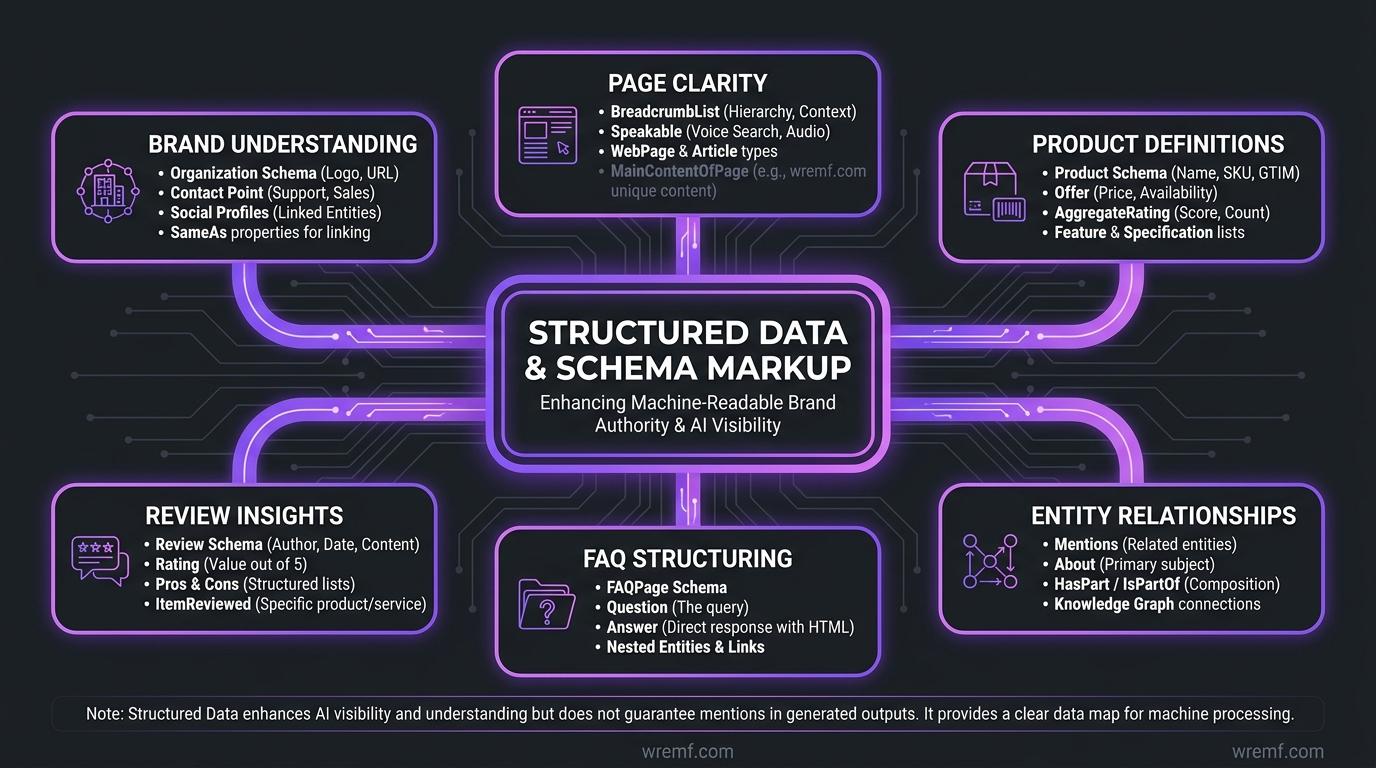
Structured Data and schema markup help AI systems and search engines understand your brand, pages, products, reviews, FAQs, and entity relationships. Structured Data does not guarantee ChatGPT mentions, but it improves machine-readable clarity.
Structured Data is machine-readable information added to a page to describe entities, attributes, content types, and relationships. Structured Data matters because it helps search engines and AI systems interpret content more accurately.
Google explains in its introduction to structured data markup that structured data helps Google understand page content and gather information about people, books, companies, and other entities included in markup. This is important for AI Visibility because a machine-readable brand is easier to disambiguate.
Schema markup is the vocabulary used to add structured data markup to web pages, often through JSON-LD. Schema markup can define your organization, software, products, services, reviews, articles, breadcrumbs, and FAQ pages. It should support the content on the page, not replace clear writing.
For ChatGPT visibility, schema.org markup and schema.org JSON-LD should clarify:
Organization identity
official website
logo and contact details
sameAs links to official social media profiles and reputable profiles
SoftwareApplication or Product details where relevant
Article and BlogPosting details for educational content
FAQ schema for real conversational queries
reviews schema where eligible, honest, and compliant
BreadcrumbList for content hierarchy
category signal and page purpose
FAQ schema is useful when your FAQ pages answer real questions in direct language. Questions like “Why is my website not showing up on ChatGPT?” and “How do I get noticed in ChatGPT?” match real conversational queries. The value comes from answering clearly, not from adding markup alone.
Content architecture is the organization of pages, headings, links, topic clusters, and content hierarchy across a website. Content architecture matters because retrieval systems need clear pathways from broad topics to specific answers.
Strong content architecture for AI Visibility includes:
a homepage with a clear brand entity definition
an About page that reinforces company identity
product pages that define features, use cases, and audiences
pillar pages for major topics
comparison pages for commercial intent
FAQ pages for conversational queries
original research for citation authority
case studies or proof pages where truthful and available
internal linking between related pages
A common mistake is creating many isolated blog posts with no pillar pages, no internal linking, no structured content, and no clear category hierarchy. This can increase content volume without improving AI search visibility.
If you want to see what AI-ready reporting can look like before building your own workflow, review a sample AI visibility report that connects prompts, citations, competitors, and visibility signals.
KEY TAKEAWAY: Structured Data, schema markup, and content architecture make your brand easier to understand, but they work best when supported by useful content and external validation.
That external validation is where many brands are weakest.
Why Your Website Is Only Part of the AI Visibility Equation
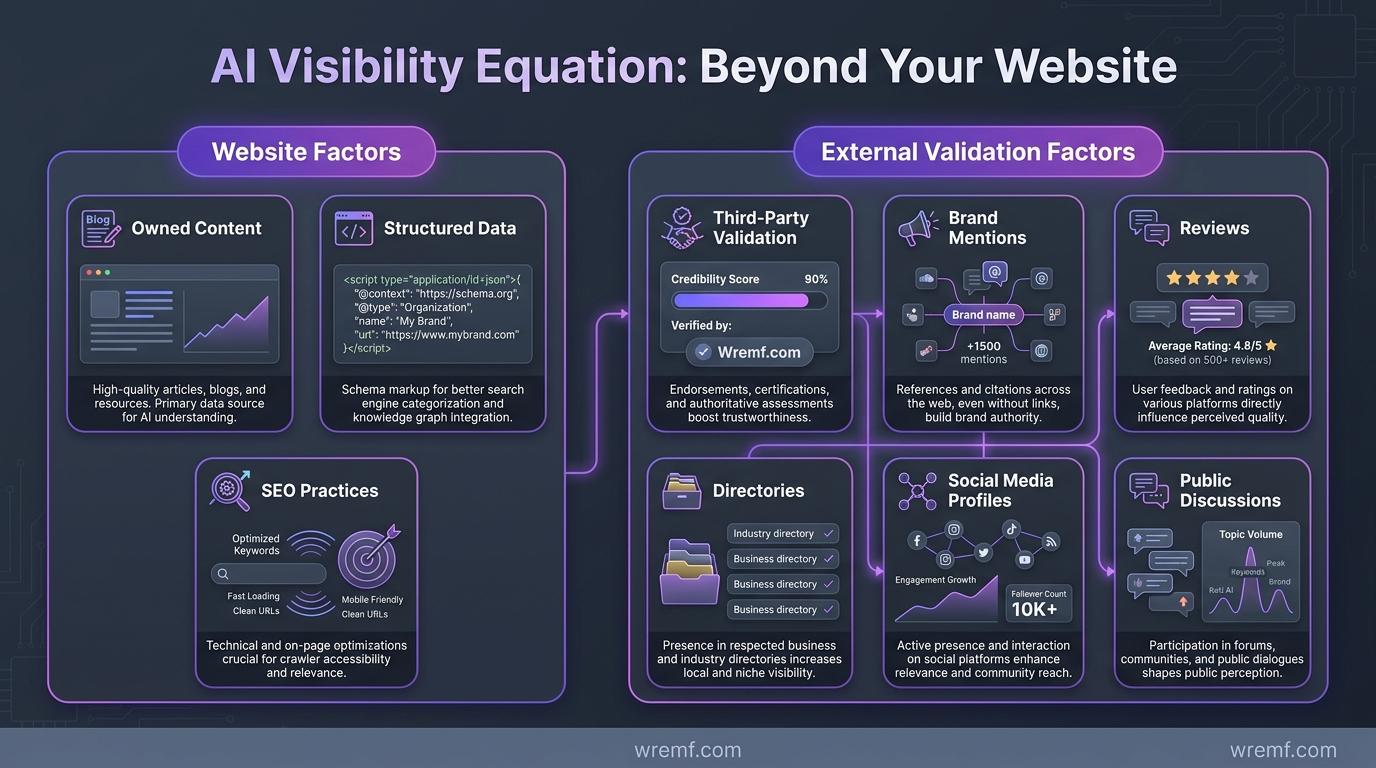
Your website is only part of AI Visibility because AI systems also evaluate third-party validation, brand mentions, reviews, reputable sites, directories, social media profiles, and public discussions. A brand that only validates itself is easier to ignore.
Third-party validation is external evidence that confirms your brand exists, belongs in a category, and has credibility outside its own website. Third-party validation matters because AI systems often need corroboration before citing or recommending a brand.
AirOps reported in its offsite signals in AI search research that brands are 6.5x more likely to be mentioned through third-party sources than their own domains. This is a critical warning for brands that only optimize owned content while ignoring external mentions and digital footprint.
Brand mentions are references to your brand across the web, even when no backlink is included. Brand mentions can reinforce entity signals, category relevance, reputation management, and source consistency.
Backlinks still matter, but AI citation systems may use a broader evidence mix than classic link metrics. Domain Authority can be a useful proxy for source strength, but AI systems may also consider source relevance, freshness, clarity, reputation, and whether a source directly answers the prompt. A niche but reputable site can sometimes matter more than a generic high-authority page.
For local and multi-location businesses, Google Business Profile and Google Business Profiles can strengthen local match signals. Google says Business Profile helps businesses manage how they show up on Google Search and Maps. For AI search, accurate local data, Google Reviews, directory listings, categories, services, addresses, opening hours, and location pages can all reinforce brand signals.
The PESO model is useful for AI visibility because it separates your source ecosystem into four channels:
| Channel | Examples | AI Visibility Role | Main Risk |
|---|---|---|---|
| Paid | ads, sponsorships, paid listings | Can create awareness and amplify content | May not become trusted citations |
| Earned | PR, podcasts, analyst mentions, reputable sites, relevant publications | Builds external mentions and citation authority | Slower and harder to control |
| Shared | social media posts, user-generated content, communities, reviews | Reinforces sentiment and public discussion | Can be inconsistent or negative |
| Owned | website, blog, FAQ pages, product pages, original research | Provides clear source material | Weak if isolated from third-party validation |
Source consistency helps AI systems verify that your brand means the same thing across sources. Source consistency helps AI systems connect your website, Google Business Profile, directory listings, reviews, social media profiles, and relevant publications into one coherent entity footprint.
AI citations matter because citations act as evidence paths. AI citations show which sources support brand inclusion, category association, and answer trust. A brand with strong owned content but weak external mentions may still lose to a competitor with better third-party validation.
KEY TAKEAWAY: AI Visibility is both a measurement problem and a source ecosystem problem, so your owned website and external footprint must work together.
Once the source ecosystem is understood, content must be refactored for conversational retrieval.
Content Optimization for Conversational Queries and Retrieval Systems
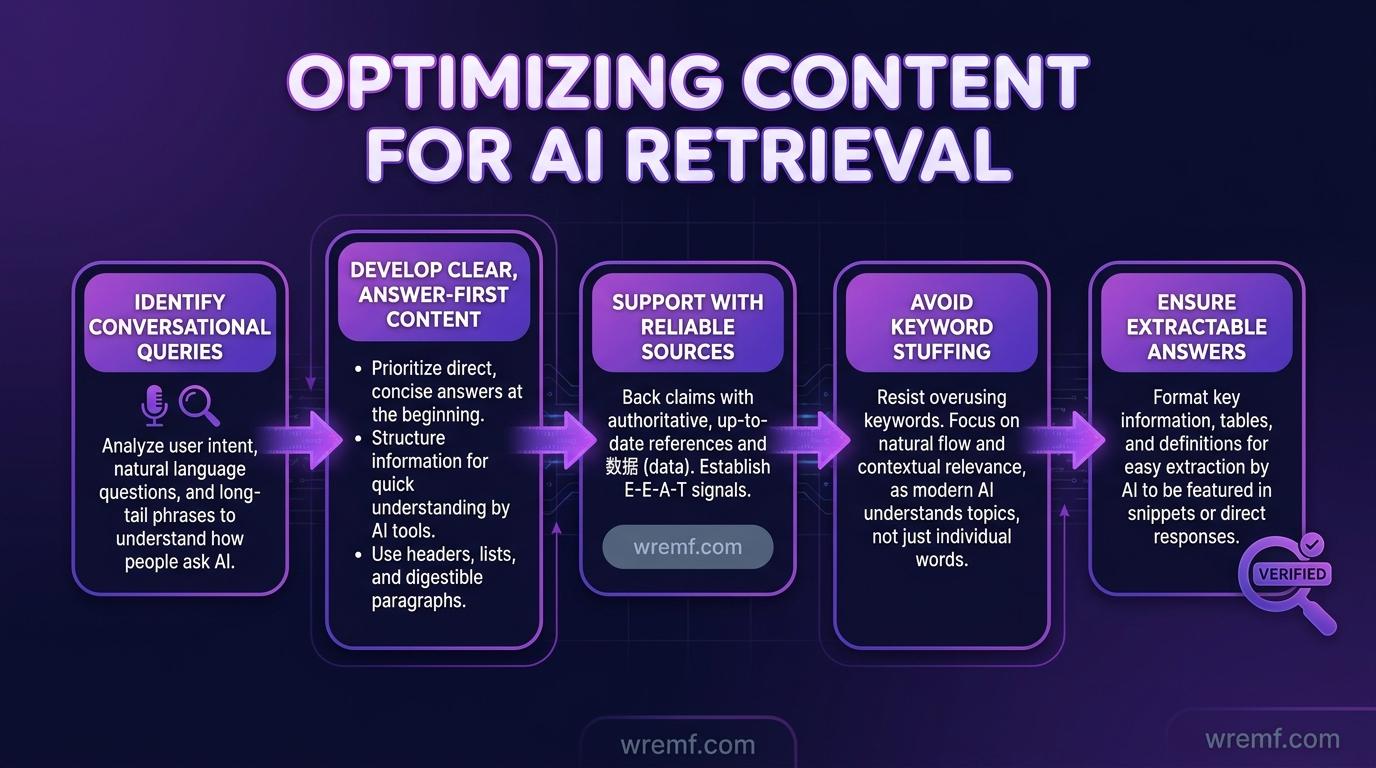
Content optimization for ChatGPT visibility means creating clear, answer-first, source-backed content that matches conversational queries and retrieval systems. The goal is not keyword stuffing. The goal is useful answers that AI systems can extract.
Conversational queries are natural-language questions that users ask AI tools, voice assistants, and search engines. Conversational queries matter because people ask ChatGPT complete questions such as “why is my brand not showing in ChatGPT” instead of typing only short keywords.
Keyword stuffing is the practice of repeating phrases unnaturally to manipulate search engine performance. Keyword stuffing weakens AI search visibility because AI systems need clear answers, entity relationships, proof, and source-backed explanations rather than repeated terms.
Content marketing for AI search should focus on topic clusters and pillar pages. A pillar page explains a broad topic in depth. Supporting pages answer specific questions, compare options, explain features, and address implementation concerns. Together, pillar pages and supporting pages create a stronger content hierarchy.
Strong AI-ready content includes:
answer-first introductions
concise definitions under 60 words
clear H2 sections that answer specific search intent
comparison tables for 3 or more options
FAQ pages based on real user questions
original research and data-driven insights
practical examples from real B2B buying journeys
internal linking to related pages
structured content that is easy to parse
source attribution close to claims
updated statistics and current context where available
Original research is especially useful because it gives AI systems something unique to cite. Original research can include benchmark reports, survey findings, customer pain point analysis, pricing comparisons, category studies, or anonymized usage trends. The key is to explain methodology clearly and avoid unsupported statistics.
Q&A-friendly content should answer direct questions in the first sentence. For example, a weak answer starts with background context. A strong answer starts with “Your brand is not showing in ChatGPT because AI systems cannot clearly retrieve, verify, or associate your brand with the prompt.”
Content briefs can help teams turn AI search gaps into publishable pages. A strong AI-ready brief should include target prompts, entity signals, related keywords, source citations, competitor gaps, internal linking, external evidence, FAQ schema opportunities, and recommended answer structures.
WREMF supports this workflow through AI-ready content briefs that connect prompt gaps to content recommendations. This helps content teams write for both human readers and retrieval systems.
KEY TAKEAWAY: Content optimization for AI search is about extractable answers, useful structure, credible sources, and prompt fit, not content volume alone.
After content refactoring, you need a clear diagnostic framework.
How to Diagnose Your Brand’s AI Visibility Gap
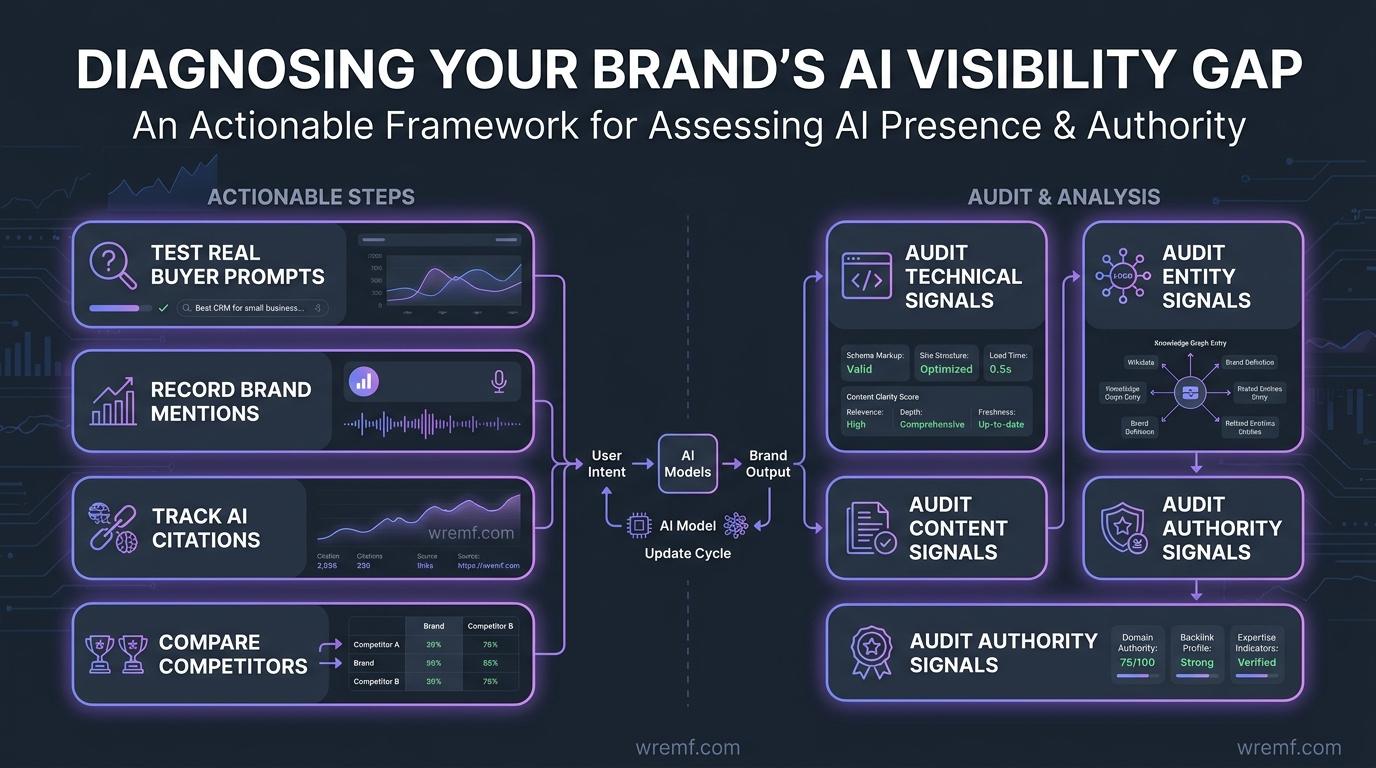
Diagnose your AI Visibility gap by testing real buyer prompts, recording brand mentions, tracking AI citations, comparing competitors, and auditing technical, entity, content, and authority signals. Manual testing helps, but repeatable measurement is more reliable.
Prompt-level performance is the measurement of how your brand appears for specific questions buyers ask AI systems. Prompt-level performance matters because one brand may appear for pricing prompts but disappear from category, comparison, or implementation prompts.
Start with 30 to 50 prompts across the user journey. Include informational, commercial, decision, comparison, risk, and implementation intent. Test those prompts across ChatGPT, Claude, Gemini, Perplexity, Google AI Overviews, Copilot, DeepSeek, Grok, Meta AI, and Mistral.
Prompt categories should include:
category discovery prompts
“best tool” prompts
competitor comparison prompts
problem-aware prompts
pricing and plan prompts
implementation prompts
service or agency prompts
local or regional prompts where relevant
reputation and review prompts
alternative and replacement prompts
Record these fields:
Does the brand appear?
Is the brand mentioned, cited, recommended, or ignored?
Which competitors appear?
Which sources are cited?
Is your own domain cited?
Are third-party sources cited?
Is the brand description accurate?
Is sentiment positive, neutral, or negative?
Does the same prompt produce stable results across multiple runs?
Does the brand appear across multiple AI systems or only one?
AI share of voice is the proportion of AI-generated answer visibility your brand earns compared with competitors. AI share of voice matters because it shows whether your brand is visible across a category, not just whether it appeared once.
AI traffic attribution connects visits and conversions from AI platforms to business outcomes. AI traffic attribution matters because leadership needs to know whether AI Visibility is influencing qualified traffic, pipeline, or sales conversations.
A practical scorecard can help prioritize fixes:
| Diagnostic Area | What to Check | Weak Signal | Strong Signal |
|---|---|---|---|
| Technical access | bots, robots.txt, sitemap.xml, rendering | key pages blocked or hard to extract | core pages crawlable and visible |
| Entity clarity | brand name, category, descriptions, schema | inconsistent or vague positioning | clear entity definition across sources |
| Content fit | prompts, FAQs, topic clusters, pillar pages | content answers keywords but not questions | answer-first content mapped to prompts |
| Source citations | own domain and third-party sources | AI cites competitors or generic sources | AI cites your site and reputable sites |
| External mentions | reviews, directories, PR, social profiles | weak digital footprint | consistent validation across reputable sites |
| Competitor visibility | who appears in AI-generated answers | competitors dominate category prompts | brand appears in relevant comparisons |
| Attribution | referral traffic and conversions | AI traffic hidden in direct traffic | AI traffic tracked and reported |
WREMF combines source citation tracking, prompt intelligence, competitor visibility, and reporting so teams can diagnose gaps without relying only on screenshots and manual notes.
KEY TAKEAWAY: A useful AI visibility diagnosis measures prompts, citations, competitors, source quality, and attribution together.
Once diagnosis is complete, the next step is a prioritized action plan.
A 30-Day Action Plan to Get Your Brand Noticed in ChatGPT
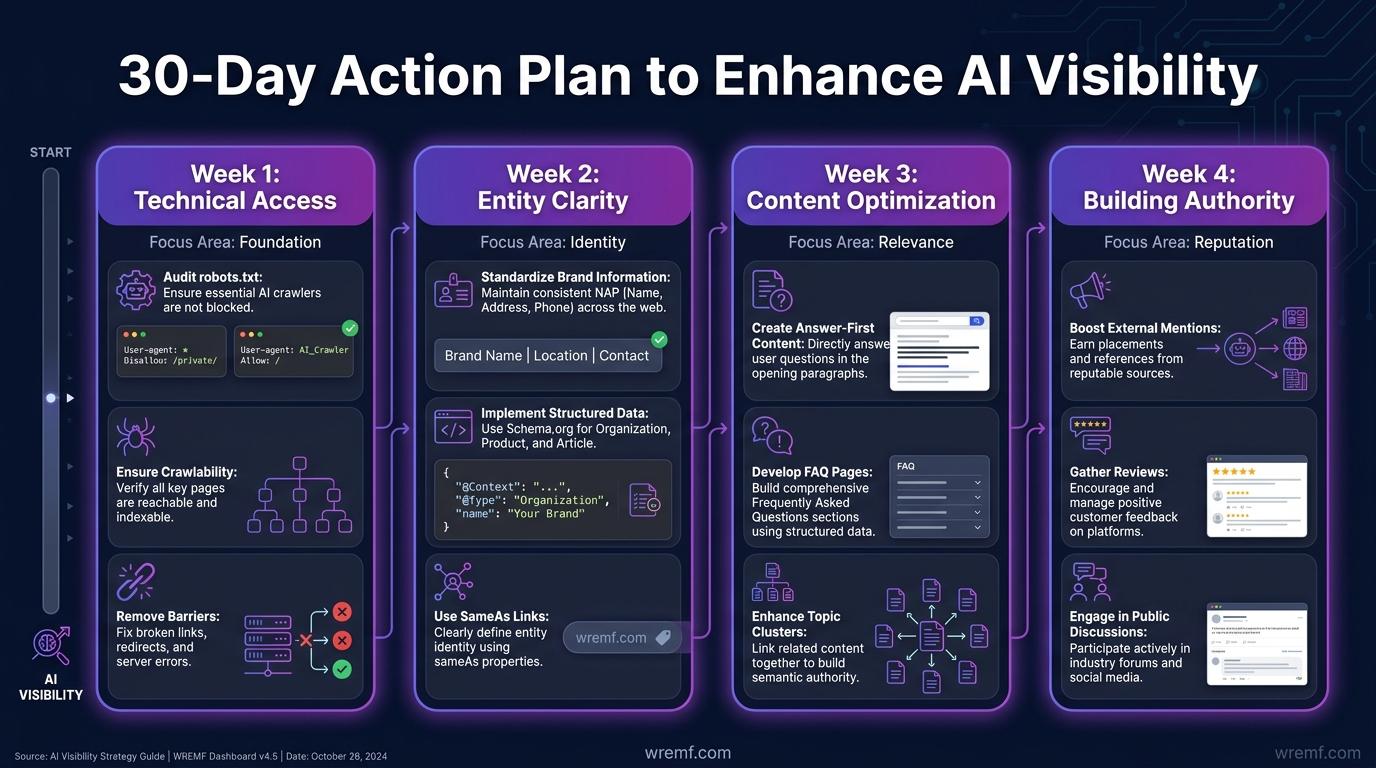
A 30-day action plan should improve technical access, entity clarity, structured knowledge, answer-first content, and external validation. The goal is not to force instant ChatGPT mentions. The goal is to make your brand easier for AI systems to retrieve and trust.
The most effective way to improve AI search visibility is to fix the evidence chain in order. Start with access, then identity, then content, then authority, then reporting. Publishing more content before fixing entity ambiguity often creates more confusion.
| Timeline | Focus | Core Actions | Success Signal |
|---|---|---|---|
| Week 1 | Technical cleanup | Audit robots.txt, GPTBot, OAI-SearchBot, sitemap.xml, canonical pages, JavaScript rendering, Gated content, and crawlable text | Important pages are accessible and extractable |
| Week 2 | Entity clarity | Standardize brand name, brand positioning, category signal, Organization schema, sameAs links, Google Business Profile, and directory listings | AI systems describe the brand more accurately |
| Week 3 | Content optimization | Refactor pages for conversational queries, FAQ pages, topic clusters, pillar pages, comparison pages, and original research | Content answers real buyer prompts directly |
| Week 4 | Authority and reporting | Improve external mentions, reviews, reputable sites, citations, social media profiles, and AI share of voice tracking | More sources validate the brand across AI systems |
In Week 1, focus on technical blockers. Make sure the pages that explain your product, category, pricing, FAQs, reviews, and methodology are crawlable. Check that bots are not blocked by accident. Confirm that your content can be extracted without relying on hidden scripts or gated forms.
In Week 2, fix entity structure. Standardize your brand name, category, description, founder profiles, official website, social media profiles, Google Business Profile, and directory listings. Use entity linking to connect your brand to the right knowledge graph, industry category, products, and external profiles.
In Week 3, refactor content around prompts. Build pages that answer “what is,” “best,” “alternative,” “comparison,” “how to,” “cost,” “implementation,” and “risk” questions. Use structured content, FAQ schema, clear headings, original research, and short direct answer blocks.
In Week 4, build authority and reporting. Improve third-party validation through relevant publications, reviews, directories, partner pages, podcasts, analyst mentions, and user-generated content where appropriate. Then track prompt-level performance and AI citations over time.
For teams that want execution support, WREMF provides managed AI visibility, AEO, and GEO services across technical foundations, content optimisation, source consistency cleanup, monthly reporting, and citation improvement.
IMPORTANT: No 30-day plan can guarantee specific ChatGPT citations, rankings, traffic, or revenue because AI systems, crawlers, indexes, and source selection change over time.
KEY TAKEAWAY: A 30-day plan should make your brand more accessible, understandable, useful, and externally validated for AI systems.
The next step is choosing the right operating model for measurement and execution.
Software, Agency, or Hybrid: What Is the Best Way to Fix AI Visibility?
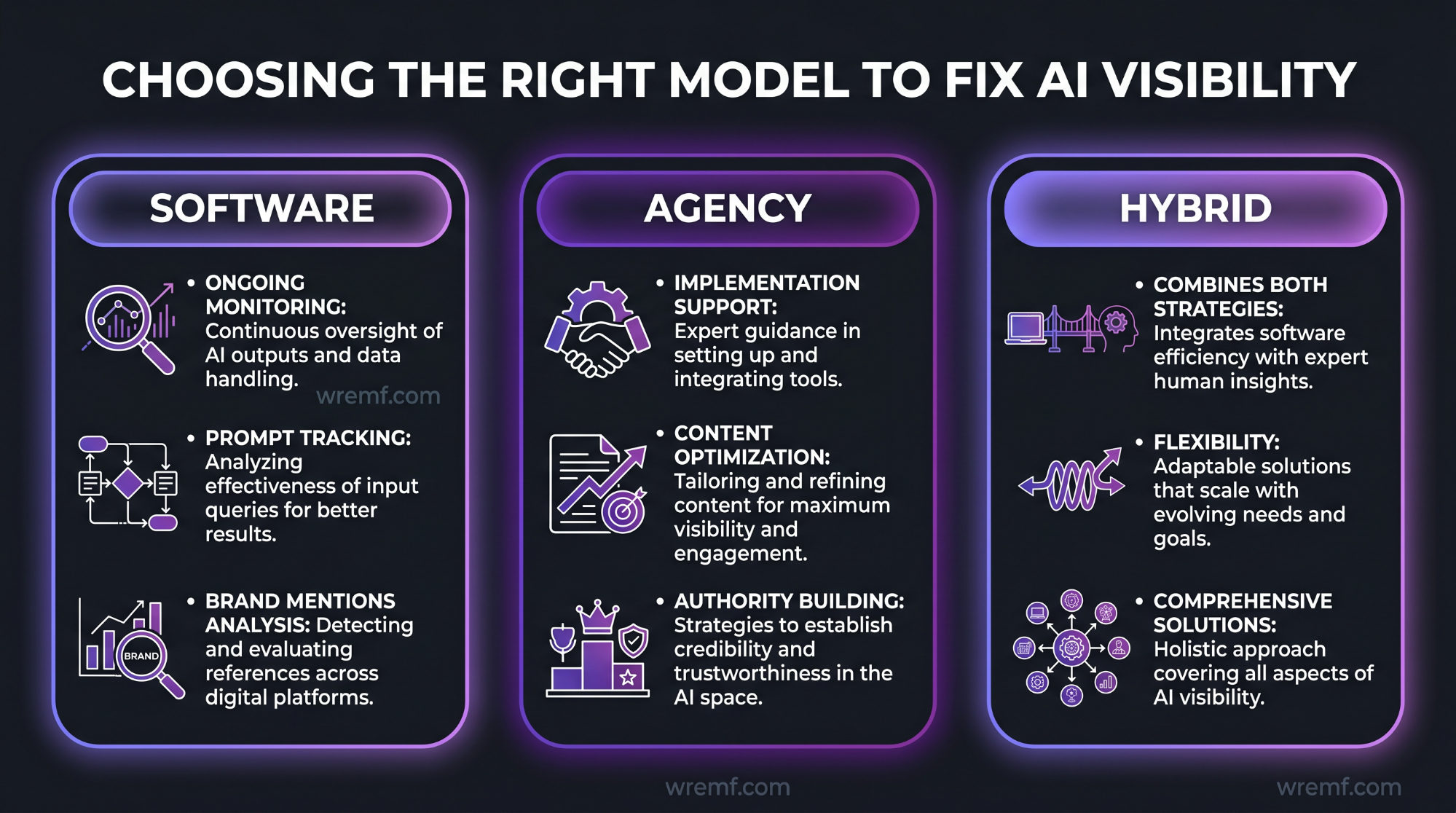
The best way to fix AI Visibility depends on whether you need measurement, execution, or both. Software helps you monitor AI systems, an agency helps you implement improvements, and a hybrid model connects diagnosis with action.
An AI visibility tool is software that tracks prompt-level performance, brand mentions, source citations, competitors, AI share of voice, source consistency, and reporting across AI discovery surfaces. An AI visibility tool matters because manual testing is inconsistent, difficult to scale, and hard to explain to leadership.
Agencies and consultants often need white-label reporting, multi-client dashboards, scheduled monitoring, and repeatable methodologies. In-house brands often need visibility scores, competitor comparisons, AI traffic attribution, content recommendations, and executive reporting. Growth teams often need both software and execution support because AI visibility crosses SEO, content, PR, product marketing, analytics, and sales.
| Option | Best For | What It Measures or Delivers | What It Misses | Recommended When |
|---|---|---|---|---|
| Manual testing | early exploration | individual prompts and screenshots | scale, repeatability, citation history, attribution | you need a quick first look |
| SEO tools | traditional search engine performance | rankings, backlinks, technical SEO, Google Search visibility | AI-generated answers, AI citations, prompt-level performance | SEO remains a core channel |
| AI visibility software | ongoing measurement | brand mentions, source citations, competitor visibility, AI share of voice, prompt-level performance | done-for-you execution unless included | you need repeatable monitoring |
| Agency service | strategy and implementation | audits, content optimization, entity cleanup, authority building, reporting | internal software access unless provided | you lack time or specialist expertise |
| Hybrid model | measurement plus execution | tracking, diagnosis, recommendations, managed improvement | requires clear ownership and priorities | you want software and done-for-you support |
WREMF is designed for brands that want software, agencies that need white-label reporting, and teams that want managed execution. It supports BYOK, 10 AI engines, client portals, white-label reports, prompt intelligence, source citation tracking, competitor visibility, AI traffic attribution, and optional agency support.
WREMF pricing includes Starter at €39 per month for 1 website, Growth at €89 per month for 5 websites, and Enterprise custom pricing for unlimited websites, unlimited seats, dedicated support, and branded portals. Teams comparing software, agency, or hybrid options can review WREMF pricing plans when budget and buying intent become part of the decision.
KEY TAKEAWAY: Choose software for measurement, an agency for execution, and a hybrid model when you need both visibility tracking and managed improvement.
Before making that decision, it helps to understand the myths that cause teams to waste time.
Common Myths About AI Visibility Debunked
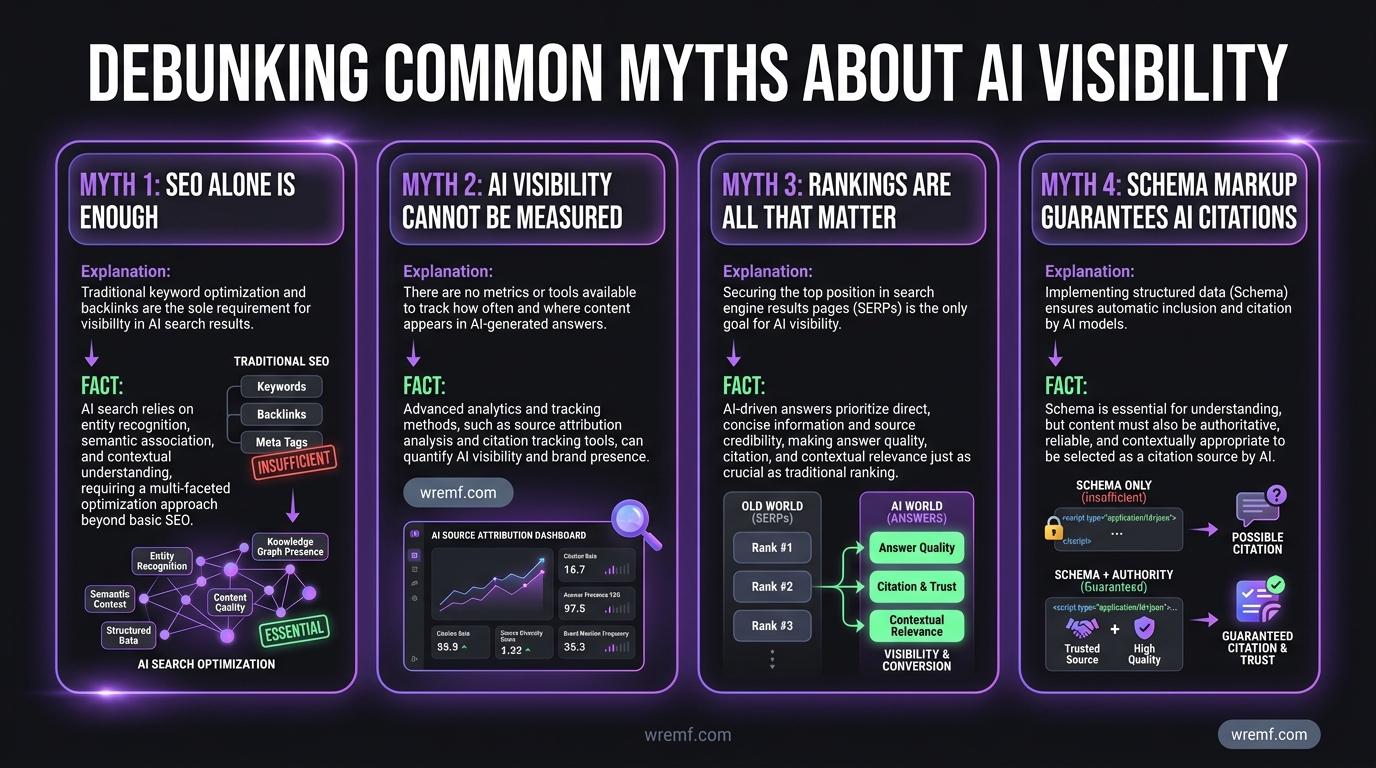
AI Visibility myths cause teams to fix the wrong problem. The biggest misconceptions are that SEO alone is enough, AI visibility cannot be measured, rankings are all that matter, and schema markup guarantees AI citations.
MYTH: If my website ranks in Google, ChatGPT will automatically mention my brand.
FACT: Google Search rankings help discovery, but ChatGPT visibility also depends on entity clarity, source citations, prompt relevance, content extractability, and third-party validation. SEO, AEO, and GEO overlap, but they do not measure the same outcome.
MYTH: AI visibility is impossible to measure.
FACT: AI visibility can be measured through prompt tracking, brand mentions, source citations, competitor visibility, AI share of voice, and AI traffic attribution. The measurement is probabilistic because AI-generated answers vary, but repeated testing across prompts and AI systems creates useful trend data.
MYTH: Rankings alone are enough because buyers will still click websites.
FACT: Rankings still matter, but AI-generated answers may influence discovery before the click. Google describes AI Overviews as AI-generated snapshots with key information and links to dig deeper, which means users may form a shortlist before opening traditional results.
MYTH: Structured Data automatically makes my brand appear in ChatGPT.
FACT: Structured Data improves machine-readable clarity, but it does not replace useful content, external mentions, reviews, source citations, or authority signals. Schema markup helps define the entity, while content and third-party validation help prove relevance.
MYTH: You can contact OpenAI and ask ChatGPT to add your brand.
FACT: There is no reliable manual shortcut for forcing ChatGPT to recommend a brand. The practical path is to make your public information accessible, accurate, structured, useful, and supported by reputable sites.
KEY TAKEAWAY: AI Visibility is measurable and improvable, but it requires more than rankings, schema markup, or one technical fix.
The final step is applying the framework to the most common questions marketers ask.
Frequently Asked Questions
Why is my website not showing up on ChatGPT?
Your website may not show up on ChatGPT because it is blocked from relevant crawlers, hard to extract, weakly connected to your brand entity, or not trusted enough for the prompt. Check robots.txt, GPTBot, OAI-SearchBot, sitemap.xml, canonical pages, JavaScript rendering, and whether your core brand facts are visible in crawlable text. Then test whether ChatGPT cites your website, competitors, directories, reviews, or industry publications. WREMF can help by tracking prompts, citations, and competitor visibility across major AI systems.
How do I get noticed in ChatGPT?
To get noticed in ChatGPT, make your brand easy to understand, retrieve, verify, and cite. Start with entity clarity, Structured Data, answer-first content, topic clusters, FAQ pages, original research, and consistent external mentions. Build authority through reputable sites, directory listings, Google Business Profile data where relevant, reviews, partner pages, podcasts, and industry publications. Then monitor prompt-level performance across ChatGPT, Claude, Gemini, Perplexity, Google AI Overviews, Copilot, DeepSeek, Grok, Meta AI, and Mistral.
Why is my brand not showing in ChatGPT even though I rank on Google?
Your brand may rank on Google but not show in ChatGPT because AI systems evaluate more than search rankings. ChatGPT may need clearer entity signals, stronger source citations, better external mentions, more direct answers, and stronger category association. A page can perform well in a search engine but still fail to become an AI citation. The fix is to combine SEO with AEO, GEO, schema markup, citation tracking, competitor analysis, and source consistency analysis.
Where does ChatGPT get brand recommendations from?
ChatGPT can generate brand recommendations from model knowledge, web search, retrieved sources, cited pages, and public information patterns. For current or commercial prompts, ChatGPT may use web sources and links. Your brand is more likely to appear when your website, reputable sites, reviews, directories, social media profiles, external mentions, and structured data consistently describe the same category, use case, and value proposition.
Can Structured Data or FAQ schema make my brand appear in ChatGPT?
Structured Data and FAQ schema can help search engines and AI systems understand your content, but they do not guarantee ChatGPT visibility. Structured data markup improves machine-readable clarity by defining entities, pages, organizations, products, and answers. FAQ schema helps when questions are real, useful, and aligned with conversational queries. You still need helpful content, authority signals, external mentions, source citations, and a clear entity footprint across the web.
How long does it take to start showing up in ChatGPT?
There is no guaranteed timeline for showing up in ChatGPT because AI Visibility depends on crawl cycles, source discovery, model behavior, prompt wording, competition, and external validation. Technical fixes can happen quickly, but authority signals, original research, reviews, and reputable mentions usually take longer. A practical approach is to measure weekly changes across 30 to 50 prompts and focus on trend improvement rather than one isolated answer.
Can inaccurate online information affect my brand’s ChatGPT presence?
Yes. Inaccurate online information can weaken entity clarity and source consistency. If your website says one thing, old directory listings say another, and social media profiles use outdated positioning, AI systems may describe your brand incorrectly or ignore it for relevant prompts. Fix this by standardizing your brand name, category, description, product details, location data, profiles, and Structured Data across owned and third-party sources.
What sources should I improve first for AI visibility?
Improve the sources that AI systems and buyers are most likely to trust. Start with your homepage, product pages, About page, comparison pages, FAQ pages, Google Business Profile, review platforms, directory listings, social media profiles, and reputable industry publications. Then add original research, partner pages, podcast mentions, expert quotes, and public documentation. The goal is a consistent digital footprint that reinforces your brand positioning across owned, earned, shared, and directory sources.
What is the best AI visibility tool for tracking my brand in ChatGPT?
The best AI visibility tool should track prompt-level performance, brand mentions, source citations, competitor visibility, AI share of voice, source consistency, and reporting across multiple AI tools. WREMF combines prompt tracking, citation analysis, competitor visibility, AI Visibility scoring, white-label reports, BYOK support, and optional managed execution. It is useful for B2B brands, agencies, consultants, and growth teams that need to monitor how AI systems describe, cite, and compare their brand.
Can you optimize your brand for ChatGPT, Claude, Gemini, and Perplexity at the same time?
Yes, you can optimize for ChatGPT, Claude, Gemini, Perplexity, and other AI tools at the same time by improving the shared evidence layer. Focus on accessible pages, clear entity definition, Structured Data, answer-first content, reputable sites, external mentions, reviews, source citations, and consistent brand positioning. Results may differ by AI system, so tracking across multiple engines is important. WREMF helps teams compare visibility across 10 AI discovery surfaces.
Why does ChatGPT mention my competitors but not my brand?
ChatGPT may mention competitors because they have stronger category association, clearer content, more source citations, better third-party validation, more reviews, or more consistent entity signals. Competitors may also be included in comparison pages, directory listings, industry articles, and user-generated content more often than your brand. To close the gap, compare cited sources, prompt-level performance, content coverage, brand mentions, external mentions, and reputation signals against the competitors that appear.
Is AI visibility only important for SaaS companies?
No. AI visibility matters for SaaS, agencies, ecommerce, local services, healthcare, education, finance, B2B services, and professional services. The specific signals differ by industry. SaaS teams may need product pages, comparison pages, content briefs, and citation tracking. Local businesses may need Google Business Profile accuracy, Google Reviews, local SEO, directory listings, and location pages. The shared goal is the same: make the brand easy for AI systems to understand, verify, and recommend.
What should I do if ChatGPT shows wrong information about my brand?
If ChatGPT shows wrong information about your brand, audit the public sources that may be feeding the answer. Check your website, Structured Data, Google Business Profile, directory listings, review platforms, old press pages, social media profiles, and third-party articles. Correct outdated information at the source, standardize brand positioning, and publish clear answer-first pages. Then track whether the description improves across repeated prompts and multiple AI systems.
Conclusion
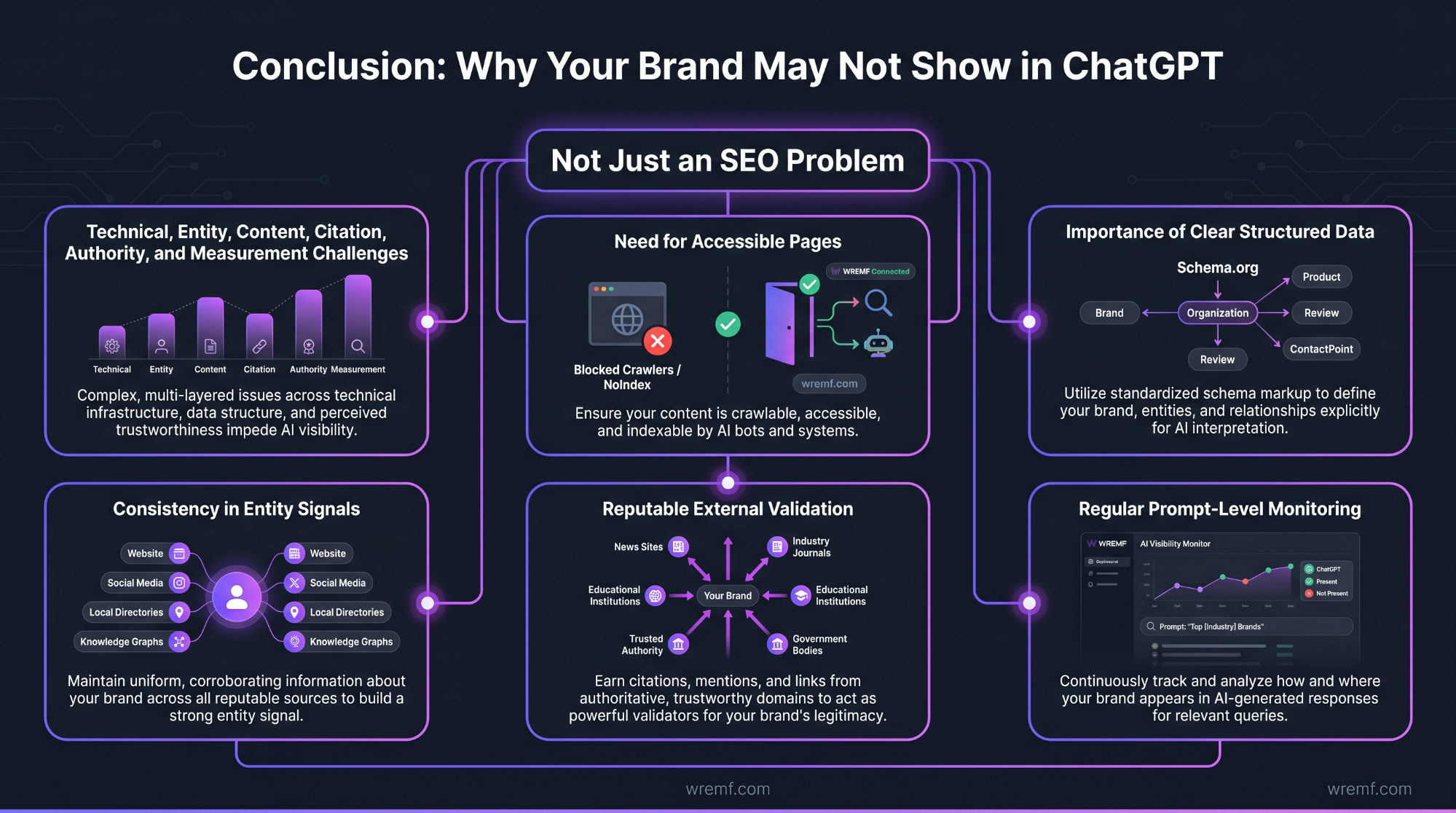
Why is my brand not showing in ChatGPT is not a single SEO problem. It is a technical, entity, content, citation, authority, and measurement problem. Your brand needs accessible pages, clear Structured Data, consistent entity signals, reputable external validation, source citations, and prompt-level monitoring across AI systems. WREMF helps teams turn AI Visibility from guesswork into a repeatable workflow across ChatGPT, Claude, Gemini, Perplexity, Google AI Overviews, Copilot, DeepSeek, Grok, Meta AI, and Mistral. To diagnose gaps and improve visibility with software, agency support, or both, explore the WREMF platform suite.
Related reading
- Best Answer Engine Optimization for Enhancing AI Visibility
- Grok Optimization: The Complete Guide to Grok SEO, AI Visibility, and Brand Mentions
- SEO for ChatGPT: Playbook for Ranking, Visibility, and AI Search Citations
- How to Get Mentioned in ChatGPT: The Complete Guide to AI Visibility, Citations, and Brand Mentions