How to Choose a Fintech Content Agency: The Complete Guide for Financial Services Brands
Discover how to choose a fintech content agency, understand compliance expertise, compare models, and learn about SEO and lead generation timelines.
By WREMF Team · 2026-09-14
A fintech content agency is a marketing partner specializing in content marketing, SEO, thought leadership, and digital marketing for financial services companies. These agencies combine financial expertise with content creation and compliance knowledge, crucial for operating within regulated environments. They focus on SEO, AI search optimization, compliance, and building brand authority, helping fintech brands improve domain authority and generate leads. Selecting the right agency involves evaluating compliance expertise, industry experience, and choosing appropriate service models.
Key takeaways
- Fintech content agencies must understand compliance and financial advertising regulations.
- Significant organic SEO results in fintech typically take 4 to 12 months.
- Compliance expertise is vital for agencies working in regulated areas like crypto and lending.
- AI visibility is becoming critical alongside traditional SEO strategies for fintech brands.
- Different agency models cater to varied internal resources and budget constraints.
How to Choose a Fintech Content Agency: The Complete Guide for Financial Services Brands
A fintech content agency is a specialist marketing partner that creates, distributes, and optimises content for financial services companies, covering everything from compliance-aware thought leadership to SEO strategy and AI search visibility. Fintech brands operate in one of the most regulated and competitive content environments in existence, where a generic marketing agency without financial expertise can create serious legal and reputational risk. This guide is written for B2B SaaS founders, fintech marketing leaders, in-house SEO teams, and growth professionals evaluating agency partners. It covers what a fintech content agency does, how to evaluate compliance expertise, what to expect from SEO and lead generation timelines, how to compare agency models, and how AI search is reshaping content strategy for financial services brands. Every section is designed to help you make a more informed, confident decision.
QUICK ANSWER:
A fintech content agency specialises in content marketing, SEO strategy, thought leadership, and digital marketing for financial services companies, including payments, banking, lending, crypto, and fintech SaaS platforms. These agencies combine financial sector expertise with content creation, compliance knowledge, and search engine optimisation to help fintech brands build pipeline, improve domain authority, and generate qualified leads through organic and multi-channel content programs.
KEY TAKEAWAYS:
- Fintech content agencies differ from general marketing agencies because they understand compliance requirements, financial advertising regulations, and the technical depth required to write credibly about financial products
- SEO and content marketing for fintech typically requires 4 to 12 months for significant organic results, with most brands seeing initial traffic improvements within 3 to 4 months
- Compliance expertise is non-negotiable for fintech content agencies working across regulated environments including banking, lending, payments, regtech, and crypto
- AI search and LLMs are reshaping how fintech buyers discover brands, making AI visibility and Discovery Optimization an increasingly important layer alongside traditional SEO strategy
- The right agency model depends on internal resources, marketing funnel maturity, budget, and whether the team needs software, full execution, or a hybrid of both
- WREMF helps fintech brands and agencies track how AI engines such as ChatGPT, Perplexity, Gemini, and Google AI Overviews mention and cite their brand across relevant buyer prompts
Why Fintech Brands Need a Specialist Content Agency
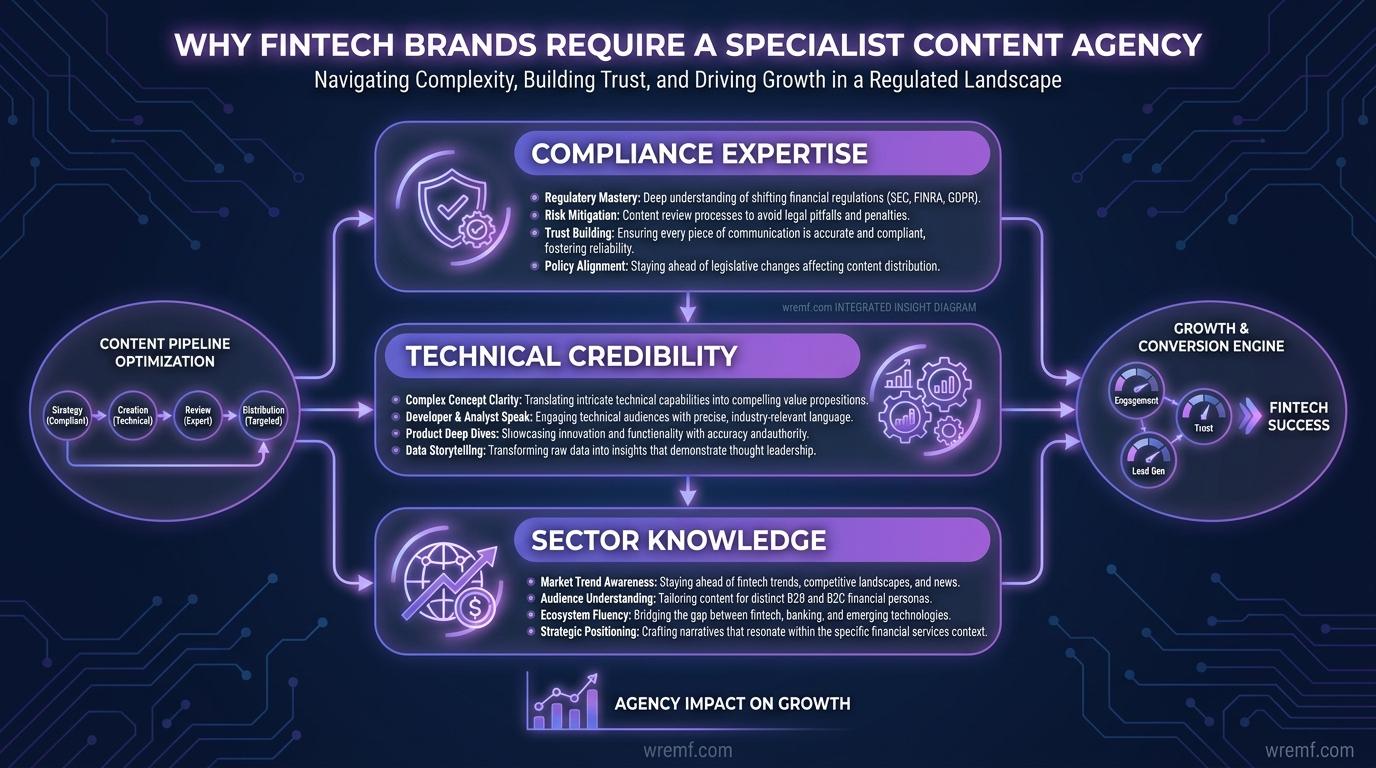
Fintech brands cannot rely on generalist marketing agencies because financial services content carries compliance, regulatory, and credibility requirements that generic marketers are not equipped to handle. A payments company publishing content that misrepresents FDIC coverage, or a lending platform running copy without proper disclaimers and disclosures, is not simply making a marketing mistake. It is creating legal exposure and regulatory risk.
The case for specialisation goes beyond compliance. Fintech buyers, whether they are procurement teams at enterprise banks, CFOs evaluating lending infrastructure, or ops leaders selecting SaaS accounting tools, are sophisticated readers. They can immediately identify content written by someone who does not understand the space. Content that lacks technical accuracy, fails to demonstrate financial literacy, or misuses sector terminology signals that the brand behind it cannot be trusted with complex financial decisions.
Financial services marketing also sits at the intersection of multiple disciplines that few agencies have combined: SEO strategy, content creation, compliance review, thought leadership development, public relations, digital PR, and increasingly, AI search optimisation. An agency that handles only one or two of these creates gaps the internal team must fill.
The financial services sector has also grown significantly more competitive across content and search. Payments, banking, crypto, blockchain, lending, DeFi, regtech, investing, and fintech SaaS platforms are all competing for the same buyer attention in search results and AI-generated answers. Brands that want to appear in those answers, whether via Google, ChatGPT, Perplexity, or Gemini, need content that meets the sourcing standards those engines apply when generating responses.
According to McKinsey's AI insights AI is accelerating the pace at which buyers research and evaluate financial services providers, which raises the stakes for content quality, source authority, and brand visibility across both traditional search and AI-generated discovery surfaces.
For fintech brands that want to build long-term revenue through content and search, the right agency partner is one that combines financial expertise, compliance knowledge, SEO capability, and an understanding of how AI engines discover and cite sources.
KEY TAKEAWAY: Fintech brands need specialist content agencies because financial services content requires compliance expertise, technical credibility, and deep sector knowledge that general marketing agencies cannot reliably provide.
What a Fintech Content Agency Actually Does
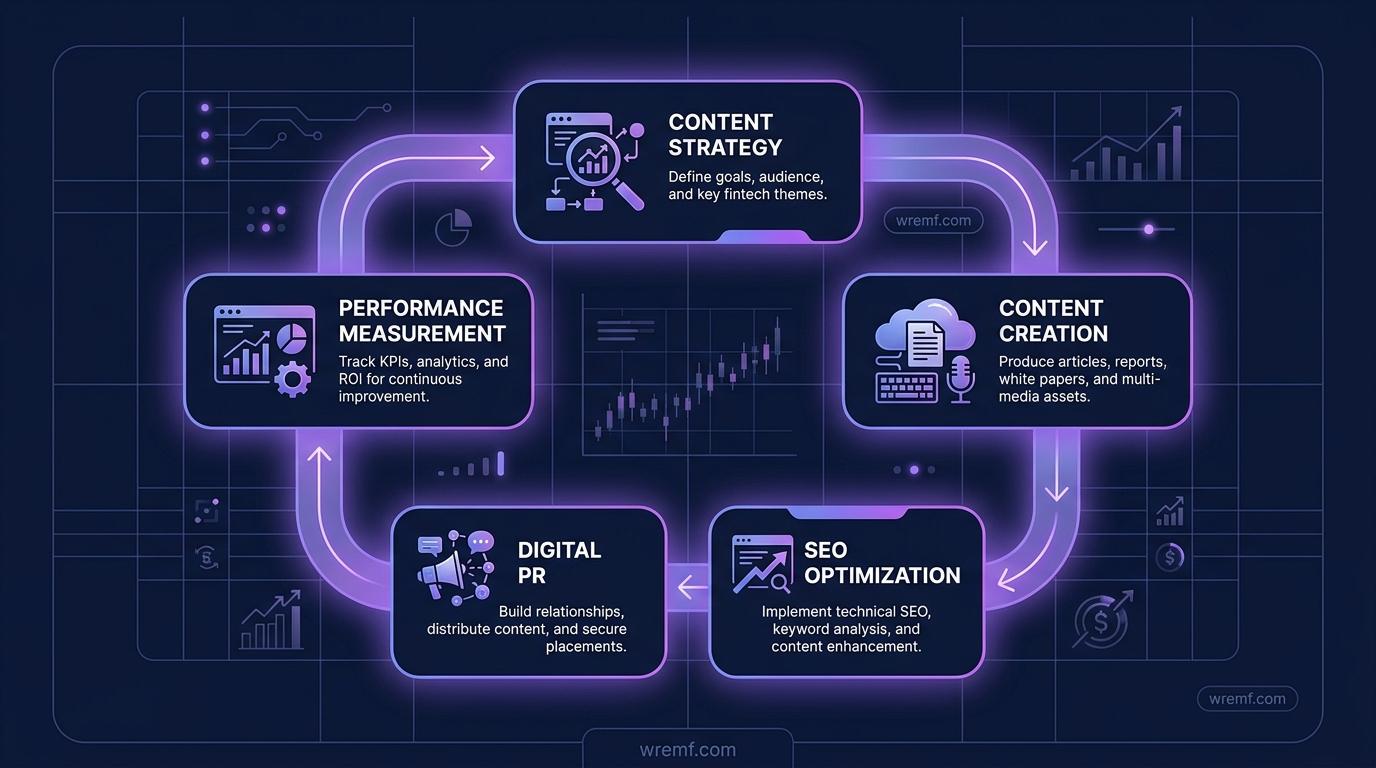
A fintech content agency manages the full content lifecycle for financial services brands, from strategy and creation through to distribution, SEO optimisation, link-building, and performance measurement. The scope of work varies by agency and engagement model, but the strongest fintech agencies offer a consistent set of core capabilities.
Content strategy sits at the foundation. This means identifying the right keywords and topics, mapping content to the marketing funnel, developing buyer personas, and building a content calendar aligned with revenue goals. Without a clear content strategy, even high-quality content fails to generate pipeline because it targets the wrong queries, attracts the wrong audience, or stalls at the top of the funnel without driving conversion.
Content creation is where most agencies spend the majority of their time. For fintech companies, this includes long-form blog posts and pillar pages, whitepapers, case studies, social media posts, digital ebooks, video marketing scripts, LinkedIn thought leader content, email marketing sequences, and API integration guides. The best fintech content agencies staff tech-focused writers who understand financial products at a technical level, not generalists producing surface-level output.
Search engine optimisation and link acquisition are inseparable from content in competitive fintech verticals. A content piece that cannot rank for relevant keywords, earn backlinks, or build domain authority will struggle to generate organic leads regardless of its quality. Strong fintech agencies integrate SEO strategy into the content planning process rather than treating it as a post-publication checklist.
Digital PR is increasingly central to fintech content programs. Earned media placements, journalist relationships, and link-building through third-party publications serve both domain authority and brand credibility. When a fintech brand appears in a Bloomberg or TechCrunch article, that citation carries weight in both Google rankings and AI-generated answers.
Performance marketing and paid ads sit alongside organic content in many agency engagements. While this guide focuses primarily on content marketing and SEO, the most complete fintech marketing agencies offer paid media, account-based marketing, marketing automation, RevOps support, and full funnel reporting to connect content investment directly to revenue outcomes.
Visual storytelling, web design, Web and App Design, and video production are also service areas offered by specialist fintech content agencies. Some brands need branding and design alongside content. Others need video editing support for product demos, explainer content, or event assets.
Finally, the best fintech content agencies now include AI search and Discovery Optimization capabilities. This means optimising content so that AI engines such as ChatGPT, Gemini, Perplexity, and Google AI Overviews cite the brand in relevant financial services answers. Teams tracking these citation signals use platforms like WREMF's AI brand monitoring guide to understand where their content appears across AI-generated responses and where gaps exist.
KEY TAKEAWAY: The strongest fintech content agencies combine content strategy, tech-focused writing, SEO, digital PR, link-building, compliance review, and AI search optimisation into an integrated content program tied directly to pipeline and revenue outcomes.
How to Evaluate Compliance and Regulatory Expertise
Compliance expertise is the most critical differentiator when choosing a fintech content agency. Every financial services brand operates within a regulatory environment that shapes what can be published, how it must be framed, and what disclaimers and disclosures are legally required.
The specific compliance requirements depend on the vertical. Lending platforms must navigate consumer protection rules and accurate representation of installment loans, credit bureaus, and interest rates. Banking and payments companies must respect FDIC-related claims, FINRA requirements where applicable, and financial advertising regulations around rates, fees, and product comparisons. Crypto, DeFi, digital assets, and blockchain technology companies face a rapidly shifting regulatory environment that varies significantly by jurisdiction. Regtech and AML/KYC-focused companies must publish content that demonstrates understanding of the regulatory requirements their own products address.
An agency without compliance experience in the relevant vertical will create content that requires extensive internal review, revision, or legal sign-off before publication. This slows the content calendar, creates friction with the legal team, and often results in watered-down content that fails to say anything meaningful because the writers were not confident enough to take a clear position.
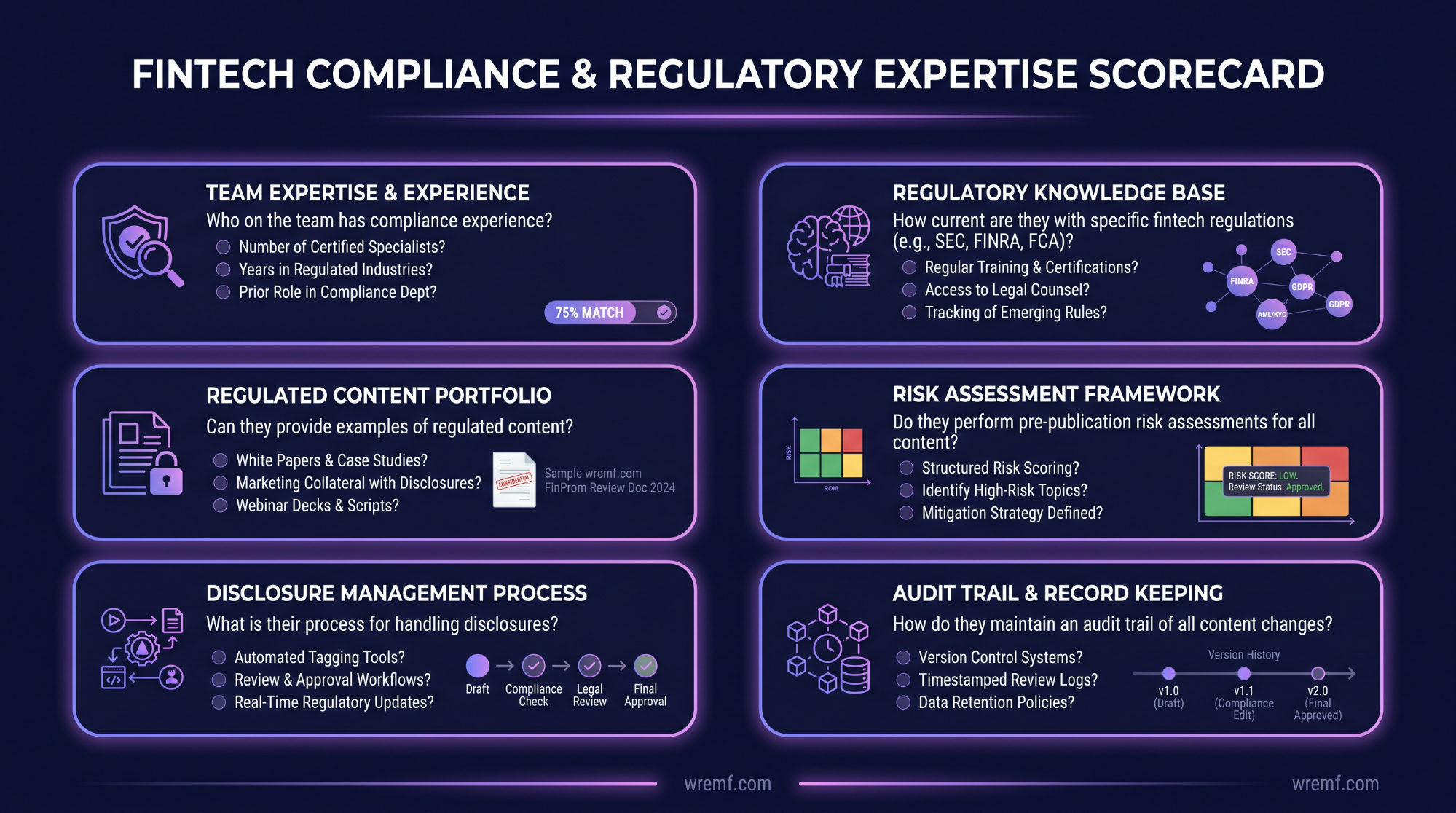
When evaluating a prospective fintech content agency, ask directly how they handle compliance review. Specifically:
- Who on the team has direct financial services compliance experience?
- Can they provide examples of content produced for regulated products such as banking, payments, lending, or crypto?
- How do they handle regulatory compliance explainers that require accurate legal framing without constituting legal advice?
- What is their process for incorporating disclaimers and disclosures into content formats including blog posts, social media posts, and whitepapers?
- Have they ever navigated a regulatory action or compliance challenge with a client, and how did they manage it?
Strong fintech content agencies treat compliance as a creative constraint that sharpens their writing rather than an obstacle that limits it. The best compliance-aware content is specific, technically accurate, well-sourced, and clear, which also happens to be the kind of content that performs well in both Google and AI-generated answers.
IMPORTANT:
Agencies without direct fintech compliance expertise may use generic financial disclaimers that do not meet the specific requirements of your regulatory environment. Always verify compliance experience before signing an engagement, particularly for content covering financial products, credit, investments, or digital assets.
KEY TAKEAWAY: Compliance expertise is non-negotiable for fintech content agencies. Evaluate each agency's specific experience with your regulatory environment, their process for handling disclaimers and disclosures, and their familiarity with financial advertising regulations relevant to your vertical.
How to Assess Fintech Industry Experience and Credibility
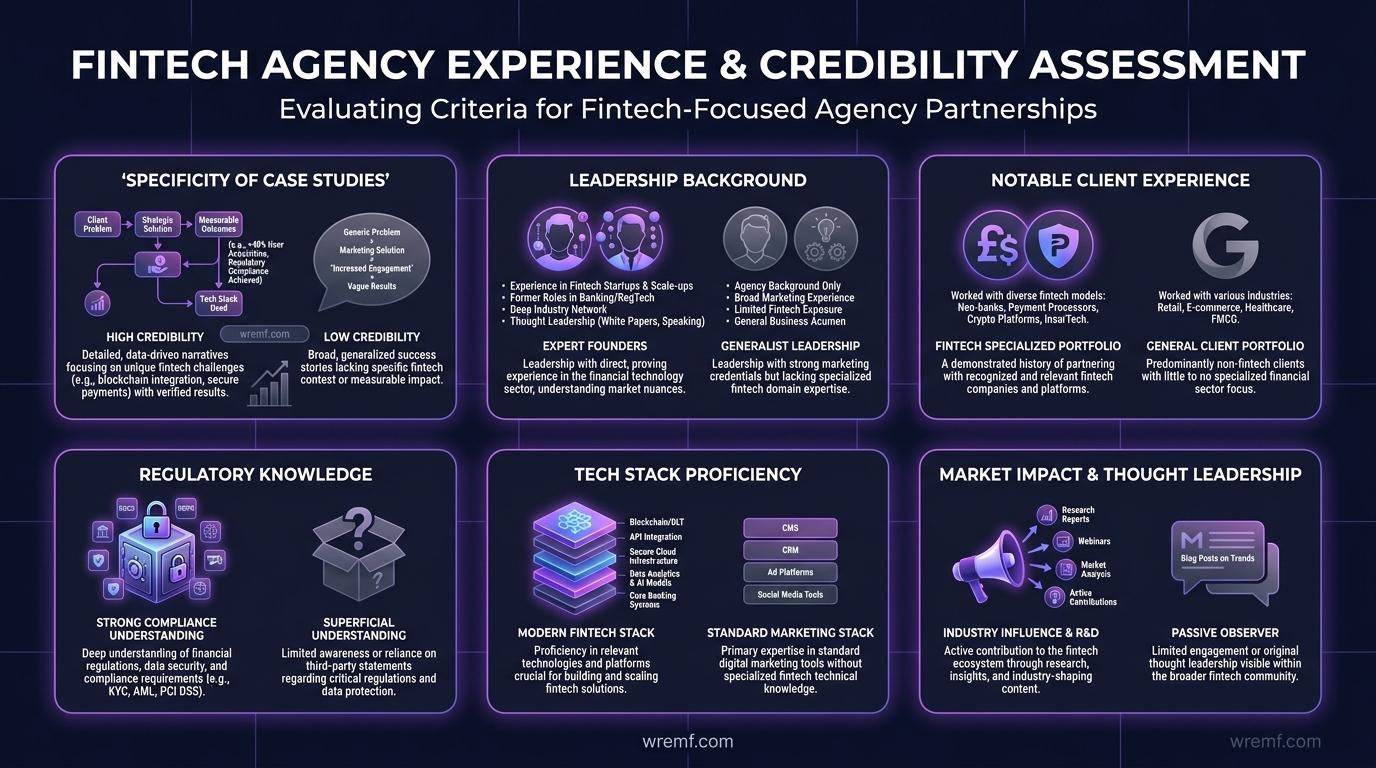
Fintech industry experience is best evaluated through the specificity of a prospective agency's work, not through the length of their website copy. A fintech content agency that has genuinely worked across payments, banking, lending, crypto, and fintech SaaS platforms will have a different quality of case studies, client references, and vertical knowledge than an agency that has done occasional financial services work alongside healthcare, ecommerce, and B2B software.
Look for agencies that can demonstrate experience with the specific fintech products or models relevant to your business. A brand operating in embedded finance or blockchain technology has different content needs than a consumer investing app or a B2B regtech platform. Agencies with narrow but deep specialisation will produce better output than those with broad but shallow category experience.
Leadership experience is a meaningful signal. Several of the most respected fintech content agencies were founded by or are led by people with direct financial services backgrounds. When agency leadership has operated in equity brokerage, payments infrastructure, or financial product development, the content strategy they develop for clients reflects an operator's understanding of buyer psychology, financial decisions, sales cycles, and the complexity of fintech customer acquisition costs.
Notable clients provide a useful but incomplete signal. An agency that has worked with brands such as OppFi, Greenwood, First Women's Bank, Beanstox, AMINA Bank, Polygon, Credit Sesame, SoFi, and similar recognised fintech brands has demonstrated that it can satisfy the expectations of sophisticated fintech marketing leaders. However, client names alone do not tell you whether the engagement produced measurable results. Ask for case studies with specific outcomes, including traffic growth, lead generation results, pipeline contribution, and revenue impact where available.
Agencies such as First Page Sage, with notable clients including US Bank, Credit Sesame, and SoFi, emphasise B2B thought leadership SEO for fintech companies and report that on average, fintech customers generate over 2.5 million dollars in new revenue each year through their programs. CSTMR, with clients including PrepaidTechnologies, AccessOne, and SELFi, positions itself as a growth and digital experience partner for fintech companies and has worked with OppFi over five years from startup to IPO. Fintech Digital, with clients including Polygon and AMINA Bank, focuses on analytics, technology, and performance marketing for fintech firms.
Siege Media generates over 148 million dollars in yearly client traffic value and has a specific fintech practice staffed with tech-focused writers who understand financial concepts at a technical level. In one fintech engagement, their content secured page one rankings and drove a 540 percent increase in organic traffic within a year.
These examples illustrate the range of agency positioning in the market. The right fit depends on whether your priority is SEO and organic traffic, brand building and branding, performance marketing, thought leadership, compliance-aware content creation, or a combination of these.
KEY TAKEAWAY: Evaluate fintech industry experience through the specificity of case studies, leadership backgrounds, vertical depth, and documented results, not through agency size or generic category claims.
What to Expect From SEO and Lead Generation Timelines
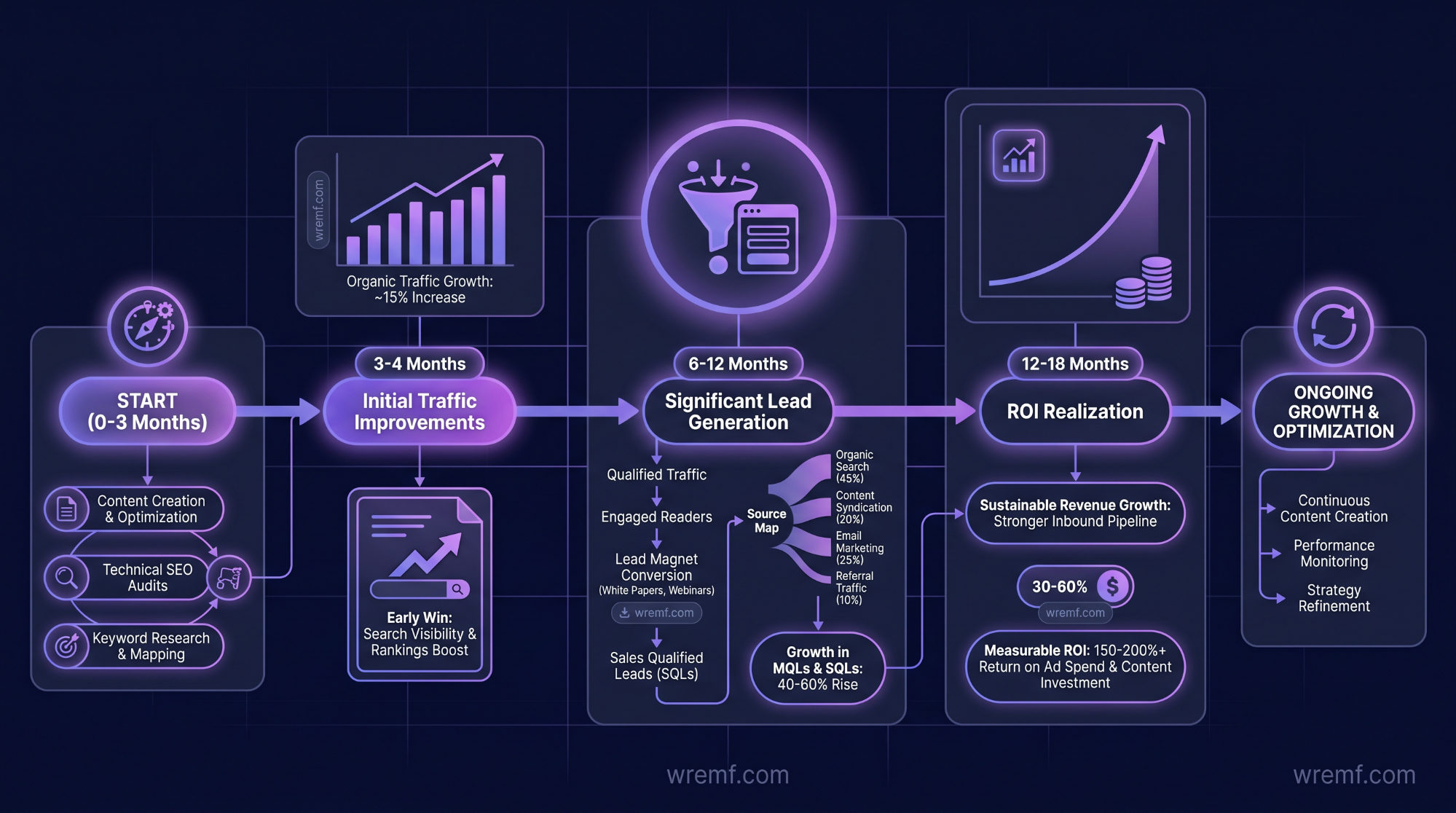
Fintech content marketing operates on realistic timelines that teams should understand before committing to an agency engagement. Understanding these timelines prevents misaligned expectations and helps leadership evaluate progress accurately.
Most fintech companies see initial traffic improvements within 3 to 4 months of beginning a content and SEO program. This early movement typically reflects technical SEO improvements, indexing of new content, and early ranking signals for lower-competition keywords. It is a positive indicator but not yet a reliable measure of the program's full potential.
Significant lead generation and revenue impact from content marketing typically requires 6 to 12 months of consistent content creation and optimisation. This is because organic search rankings compound over time as domain authority grows, backlinks accumulate, and content earns engagement signals that reinforce its relevance. Fintech verticals with high keyword competition, such as payments, lending, investing, and banking, often sit toward the longer end of this range.
For SEO rankings specifically, expect 3 to 6 months for articles to reach first-page positions, though faster results are achievable for less competitive fintech keywords or for brands that already have reasonable domain authority and an established content foundation.
Performance marketing and paid ads operate on shorter cycles. Most fintech marketing agencies require an initial testing phase of 30 to 90 days for paid media to gather data, refine creatives, and optimise targeting before campaigns reach efficient performance. Paid channels can deliver faster pipeline contribution than organic content, but require ongoing spend and creative testing to maintain results.
For fintech brands that pursue both content marketing and paid media, the most effective programs treat them as complementary rather than competing investments. Organic content builds long-term authority, improves fintech customer acquisition costs over time, and supports post-acquisition marketing through customer engagement content. Paid ads deliver immediate visibility for time-sensitive campaigns, product launches, or competitive keyword coverage where organic rankings are not yet established.
Fintechs that focus on compliance-aware content, SEO optimisation, customer lifetime value, and retention strategies alongside acquisition can expect strong ROI over a 12 to 18 month horizon, though the exact return depends on vertical competitiveness, budget, execution quality, and starting domain authority.
Full funnel reporting is essential to measure this accurately. Teams should track content-influenced pipeline, not just organic sessions, to understand the true revenue contribution of content investment. The ability to connect content performance to deal value and closed-won revenue is one of the clearest signals of an agency that operates with genuine marketing accountability.
KEY TAKEAWAY: Fintech SEO and content marketing requires 4 to 12 months for significant organic results. Teams should set realistic timelines, invest in full funnel reporting, and treat organic content and performance marketing as complementary channels rather than alternatives.
Key Services Offered by a Fintech Content Agency
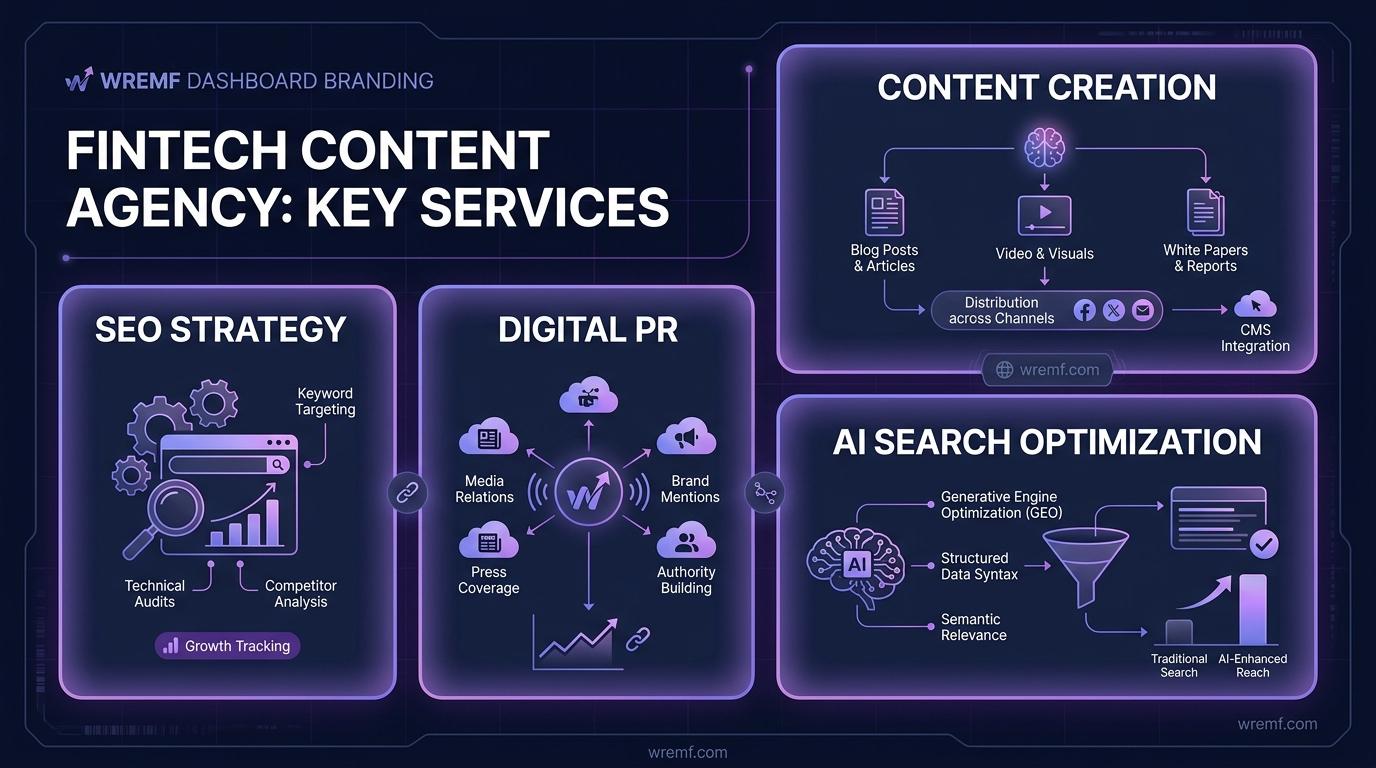
The service mix of fintech content agencies varies significantly, but the most complete partners offer capabilities across several disciplines that work together to build pipeline and brand.
SEO strategy and search engine optimisation form the technical foundation. This includes keyword research, content architecture, on-page optimisation, link-building, and domain authority development. Strong fintech content agencies build SEO strategy before writing a single piece of content, ensuring that every article targets queries with genuine search volume, buyer intent, and realistic ranking potential.
Content creation and content packages cover the core deliverables most clients engage agencies to produce. Long-form articles, pillar pages, whitepapers, case studies, digital ebooks, and regulatory compliance explainers are the most common formats in fintech content programs. Agencies with tech-focused writers who understand financial products, fintech SaaS platforms, crypto, DeFi, blockchain technology, and payments can produce content that earns credibility with sophisticated buyers.
Digital PR and link acquisition build the external authority that content alone cannot generate. Fintech brands that earn editorial coverage, expert citations, and backlinks from credible financial publications develop domain authority that compounds over time. Digital PR also supports brand credibility in AI-generated answers, because LLMs weight trusted source citations heavily when generating responses about financial products and providers.
Social media management and social media posts help fintech brands maintain visibility across LinkedIn, Meta, TikTok, and other relevant platforms. LinkedIn thought leader content is particularly valuable for B2B fintech brands targeting enterprise buyers, procurement teams, and financial services decision-makers.
Email marketing sequences and marketing automation support the nurture function, keeping pipeline warm through relevant, compliance-aware content delivered at the right point in the buyer journey.
Video production and video editing are offered by specialist agencies such as Big Rock, which focuses on media and video production marketing for fintech clients. Video content is increasingly important for fintech brands explaining complex financial products, demonstrating software functionality, or building trust with buyers who are unfamiliar with the brand.
Branding and visual storytelling help fintech brands communicate their positioning clearly and consistently across all channels. Agencies such as Clay Agency, which built its reputation through UI/UX design and branding for fintech companies, bring a design-first approach to content strategy that supports both brand building and conversion.
Account-based marketing targets specific high-value accounts with personalised content programs rather than broad audience campaigns. This approach is particularly effective for B2B fintech brands selling to enterprise buyers, financial institutions, or regulated organisations with long and complex sales cycles.
Web design, webdev, and user experience round out the full-service offering of the broadest fintech agency partners. Agencies that combine content, SEO, and web design can ensure that content investments are supported by a site architecture and user experience that converts visitors into leads. Integrations with platforms such as HubSpot, Quickbooks, and Xero are relevant for fintech brands managing CRM, revenue operations, and financial reporting alongside their marketing stack.
AI search and Discovery Optimization capabilities are an emerging but increasingly important service offering. Fintech brands that want to appear in ChatGPT, Perplexity, Gemini, and Google AI Overviews need content that is structured to be cited by LLMs. Teams working with AI-forward agencies or using platforms such as WREMF can track where their brand appears in AI-generated answers across relevant buyer prompts, identify citation gaps, and develop a content strategy aligned with how AI engines source information. Exploring the complete guide to answer engine optimisation helps fintech teams understand the specific content and structural requirements that support AI citation.
KEY TAKEAWAY: The most complete fintech content agencies combine SEO, content creation, digital PR, link-building, social media, email marketing, video production, branding, and AI search optimisation into an integrated program that supports both immediate pipeline and long-term brand authority.
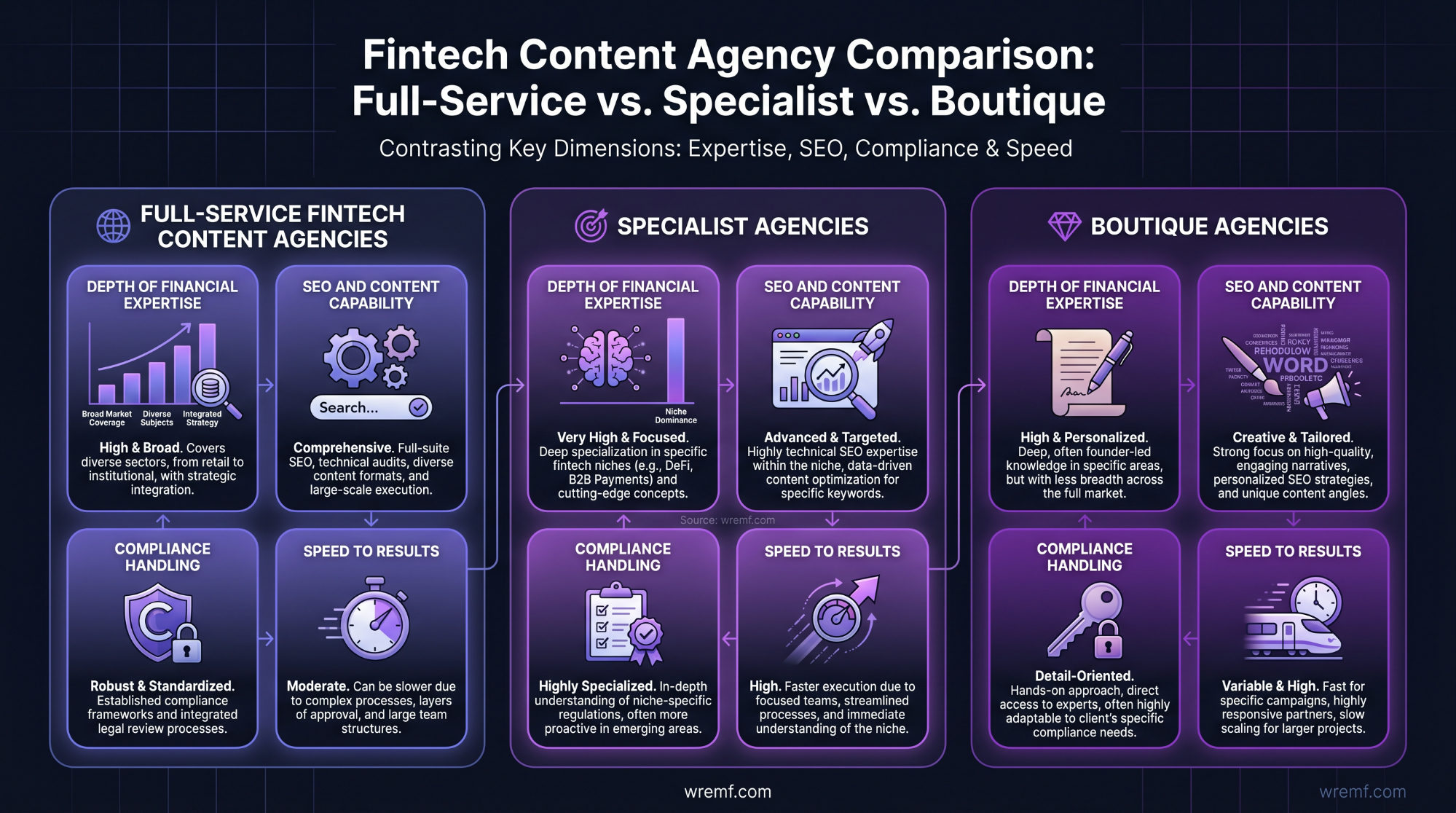
Comparing Agency Models: Full-Service, Specialist, and Hybrid
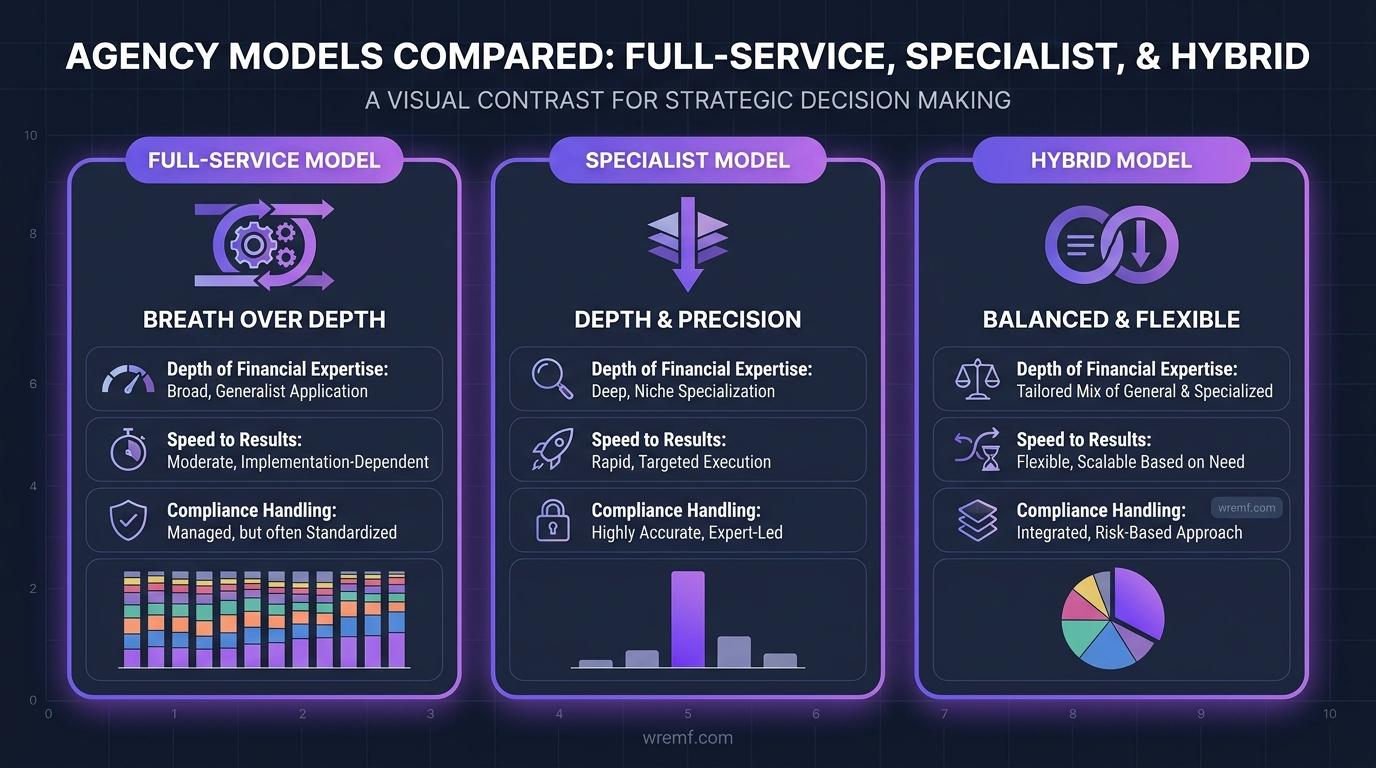
Fintech brands evaluating content agency partners face a genuine choice between full-service agencies, specialist partners, and hybrid models that combine in-house execution with external expertise.
Full-service fintech marketing agencies offer the broadest capability set, covering content creation, SEO strategy, performance marketing, paid ads, public relations, branding, web design, and marketing automation under one roof. This model suits fintech brands that want a single partner accountable for their entire digital marketing program. It reduces coordination overhead and ensures that content, SEO, paid media, and brand strategy are aligned. The tradeoff is that full-service agencies are typically more expensive, and the quality of any single service may be lower than that of a dedicated specialist.
Specialist content and SEO agencies focus on a narrower capability set and execute within it at a higher level of quality. Agencies such as Siege Media focus almost entirely on SEO-driven content marketing, which allows them to build teams with deep content strategy and link-building expertise. This model is the strongest choice for fintech brands whose primary growth channel is organic search and who have internal capacity to handle paid media, social, and brand separately.
Boutique fintech marketing agencies offer deep financial services knowledge in smaller, more focused teams. These agencies often have leadership with direct financial industry experience, which produces a quality of strategic thinking that larger generalist agencies rarely match. The tradeoff is typically smaller team capacity and fewer concurrent projects.
The comparison across these models can be summarised across key dimensions:
Depth of financial expertise
- Full-service general agency: Variable, depends on team composition
- Specialist fintech content agency: High, financial expertise is core to the offer
- Boutique fintech agency: Very high, often founder-led by financial services practitioners
SEO and content capability
- Full-service general agency: Moderate, one service among many
- Specialist fintech content agency: Very high, core competency
- Boutique fintech agency: Variable, depends on team composition
Compliance handling
- Full-service general agency: Often outsourced to client's legal team
- Specialist fintech content agency: Built into editorial and review process
- Boutique fintech agency: High, financial regulation is part of daily practice
Speed to results
- Full-service general agency: Faster across paid media, slower on organic
- Specialist fintech content agency: Organic timeline of 4 to 12 months
- Boutique fintech agency: Variable
Reporting and attribution
- Full-service general agency: Cross-channel reporting including paid and organic
- Specialist fintech content agency: SEO and content-focused, sometimes limited paid attribution
- Boutique fintech agency: Often customised to client reporting requirements
The hybrid model, where an internal team handles execution and an external agency or platform handles strategy, audits, and specialist capabilities, is increasingly common. Fintech brands with strong in-house content teams often engage specialist partners for SEO strategy, link acquisition, compliance review, or AI search visibility tracking rather than outsourcing all execution. This approach improves cost efficiency, preserves brand voice, and gives internal teams direct access to specialist expertise when they need it.
KEY TAKEAWAY: The right agency model depends on internal capability, growth channel priorities, compliance requirements, and budget. Full-service agencies suit brands that want integrated execution. Specialist agencies suit brands prioritising organic growth. Boutique agencies suit brands that need deep financial expertise. Hybrid models work well for brands with strong internal teams.
How AI Search Is Reshaping Fintech Content Strategy
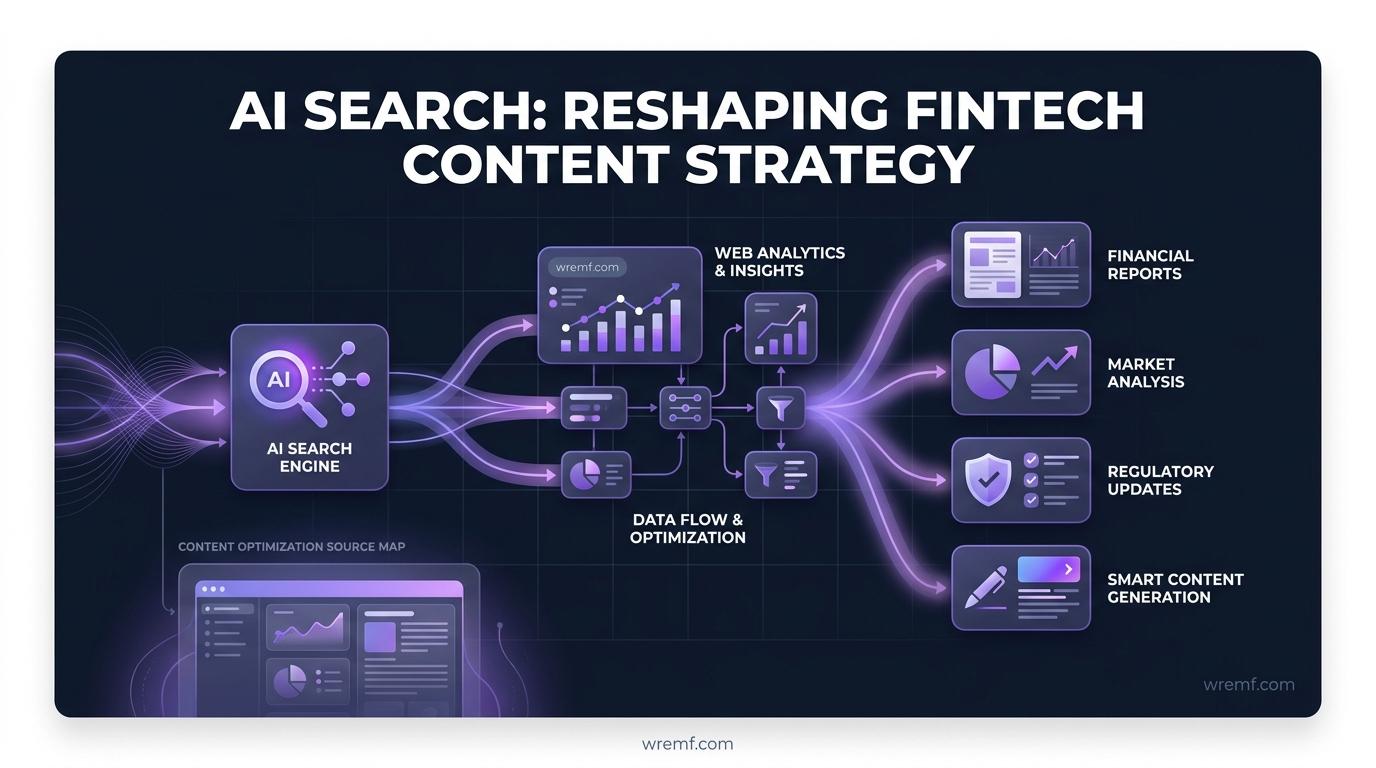
AI search is fundamentally changing how fintech buyers discover products, evaluate providers, and make financial decisions. Buyers who previously searched Google for comparisons between payment processors, lending platforms, or fintech SaaS tools are increasingly asking those questions directly to ChatGPT, Perplexity, Gemini, Claude, and Google AI Overviews.
This shift changes the nature of content strategy for fintech brands in several ways. First, ranking in traditional Google results is no longer a sufficient measure of search visibility. A fintech brand can hold page one rankings for important keywords and still be absent from the AI-generated answers that an increasing share of buyers consult first. AI engines do not simply reflect Google rankings. They source answers from the content they judge to be most credible, most clearly structured, and most directly responsive to the query.
Second, the sources that AI engines cite in financial services answers carry significant authority signals. When a fintech brand's content is cited by ChatGPT or Perplexity in response to a question about payment processing options, embedded finance infrastructure, or blockchain technology applications, that citation functions as a form of third-party endorsement that influences buyer perception. The OpenAI research overview describes how large language models evaluate source credibility and content structure when generating answers, which has direct implications for how fintech content should be written and structured.
Third, the prompts that buyers use in AI engines are different from the keywords they type into Google. Prompt intelligence, the practice of identifying and tracking the specific questions buyers ask AI engines about a topic, is increasingly important for fintech content strategy. Teams that understand which prompts their target buyers use are better positioned to create content that answers those prompts directly and earns citation.
LLMs and AI search visibility have become a meaningful consideration for fintech content agencies. Agencies that understand how to optimise content for AI citation, structure content so it is extractable by generative engines, and track where their clients appear in AI-generated answers are delivering a capability that will grow in importance as AI search adoption continues.
WREMF's AI search engine optimization guide gives fintech marketing teams a practical framework for understanding how AI engines discover, cite, and recommend brands across relevant buyer queries, and how to close the gap between search rankings and AI citation visibility.
DID YOU KNOW:
According to Gartner's AI research by 2026 a significant proportion of B2B buyers are expected to use AI-generated answers as a primary research tool for vendor evaluation, making AI citation visibility an increasingly critical component of fintech marketing strategy.
The practical implication for fintech content teams is that content strategy must now account for two parallel tracks: optimising for Google rankings and optimising for AI citation. These tracks share many requirements, including technical accuracy, clear structure, strong source authority, and answer-first writing, but they also have distinct characteristics that require specific attention.
For fintech brands working with content agencies, asking directly about the agency's AI/SEO capability, their approach to Discovery Optimization, and whether they track client visibility in ChatGPT, Gemini, Perplexity, and Google AI Overviews is now a relevant part of agency evaluation. Teams that want to track this themselves can use WREMF's AI visibility platform to monitor prompt-level citation data across 10 AI engines and identify where competitor fintech brands are gaining AI share of voice.
KEY TAKEAWAY: AI search is reshaping fintech content strategy by creating a second discovery layer alongside Google. Fintech brands need content that earns both traditional rankings and AI citations, which requires answer-first writing, strong source authority, and prompt-level visibility tracking.
A Practical Process for Evaluating and Selecting a Fintech Content Agency
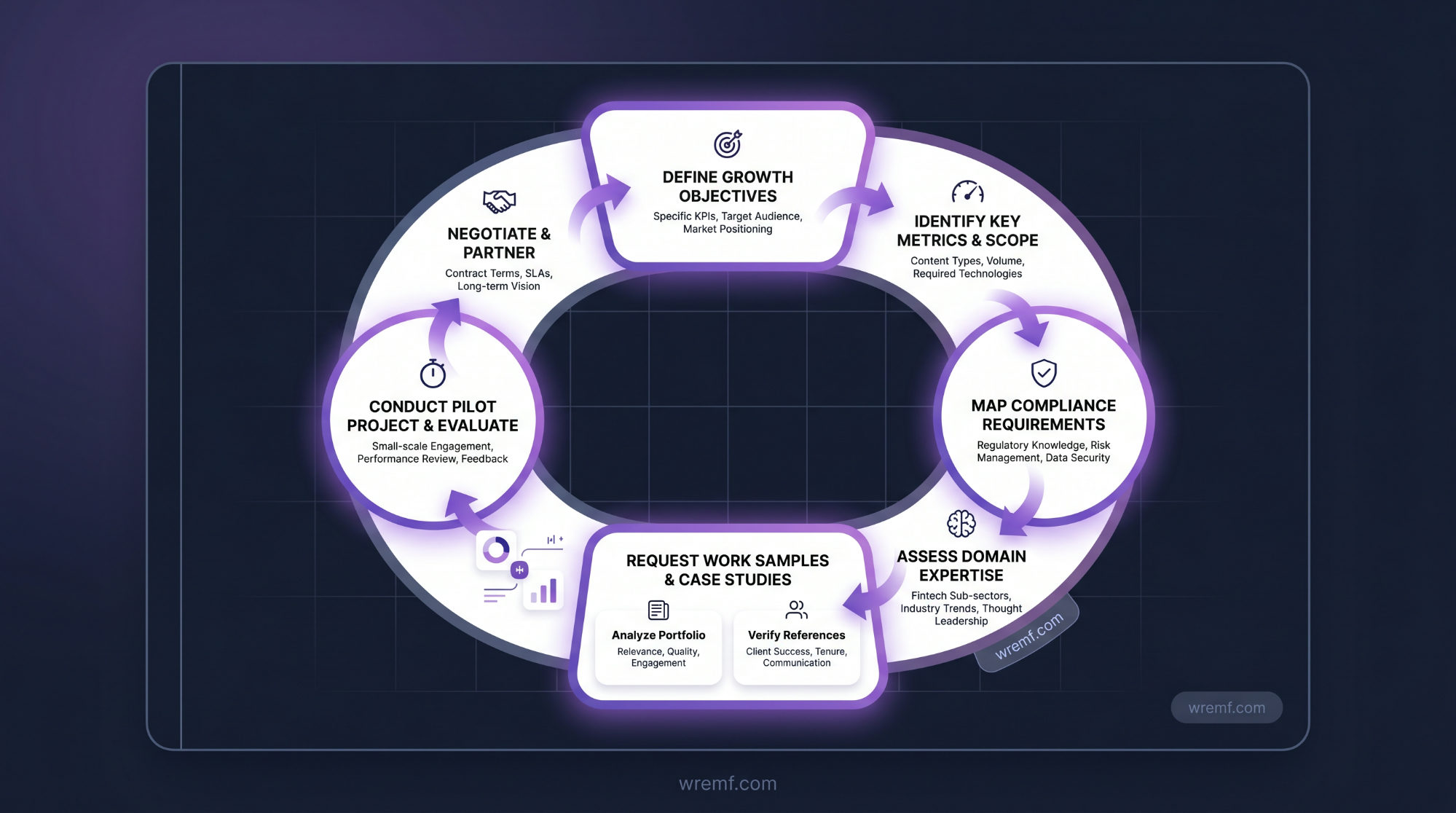
Selecting a fintech content agency is a significant decision that affects brand reputation, compliance risk, marketing pipeline, and revenue. A structured evaluation process reduces the risk of choosing the wrong partner and helps teams compare agencies on dimensions that actually predict results.
Step 1: Define your primary growth objective
Identify whether your priority is organic search and lead generation, thought leadership and brand authority, performance marketing and pipeline, or a combination. This determines whether you need a specialist content and SEO agency, a full-service partner, or a targeted engagement for a specific capability.
Step 2: Map your compliance requirements
Identify the specific regulatory environments your content must operate within. Whether that is FINRA, FDIC-adjacent claims, AML/KYC content, financial advertising regulations, or crypto and digital assets compliance, define these requirements before engaging any agency. Agencies that cannot demonstrate direct experience in your regulatory environment should be filtered out early.
Step 3: Audit your current digital presence and domain authority
Before engaging an agency, understand your starting position. Assess your current domain authority, existing content performance, keyword rankings, backlink profile, and AI citation presence. This baseline allows you to measure agency impact accurately and set realistic expectations for timelines and results.
Step 4: Build a shortlist using vertical-specific criteria
Filter agencies by financial services experience, compliance capability, leadership experience, notable clients in your vertical, and documented case studies with measurable outcomes. A shortlist of 4 to 6 agencies with demonstrated fintech expertise is more useful than a broad list of general marketing agencies.
Step 5: Request vertical-specific work samples and case studies
Ask each agency for content samples written for financial products similar to yours, including payments, banking, lending, crypto, blockchain technology, or fintech SaaS platforms. Review the samples for technical accuracy, compliance handling, SEO structure, and writing quality. Generic samples from unrelated industries are a signal that the agency lacks the specialisation your content requires.
Step 6: Evaluate their SEO strategy and AI search capability
Ask each agency how they approach keyword research, content architecture, link acquisition, and search engine optimisation for regulated financial content. Also ask whether they have experience with AI/SEO, Discovery Optimization, LLMs, and tracking client visibility in AI-generated answers. An agency that cannot explain how AI search differs from traditional SEO is not yet equipped to support this layer of your content strategy.
Step 7: Assess reporting, analytics, and full funnel attribution
Ask each agency how they measure and report content performance. Strong fintech content agencies offer full funnel reporting that connects content investment to pipeline, deal influence, and revenue. Agencies that report only on sessions and rankings without connecting content to business outcomes are unlikely to satisfy a CFO or growth leader who needs to justify the investment.
Step 8: Run a pilot engagement before committing long-term
Most reputable fintech content agencies support a structured pilot project of 30 to 90 days before signing a long-term contract. A pilot allows you to evaluate writing quality, compliance handling, communication, responsiveness, and strategic thinking before scaling the engagement. Agencies that resist a pilot and push immediately for a long-term commitment should be viewed with caution.
KEY TAKEAWAY: A structured eight-step evaluation process, from defining your growth objective and mapping compliance requirements through to running a pilot project, reduces the risk of choosing the wrong fintech content agency and creates a clear basis for measuring results.
Real-World Scenarios: What Good Fintech Content Agency Work Looks Like
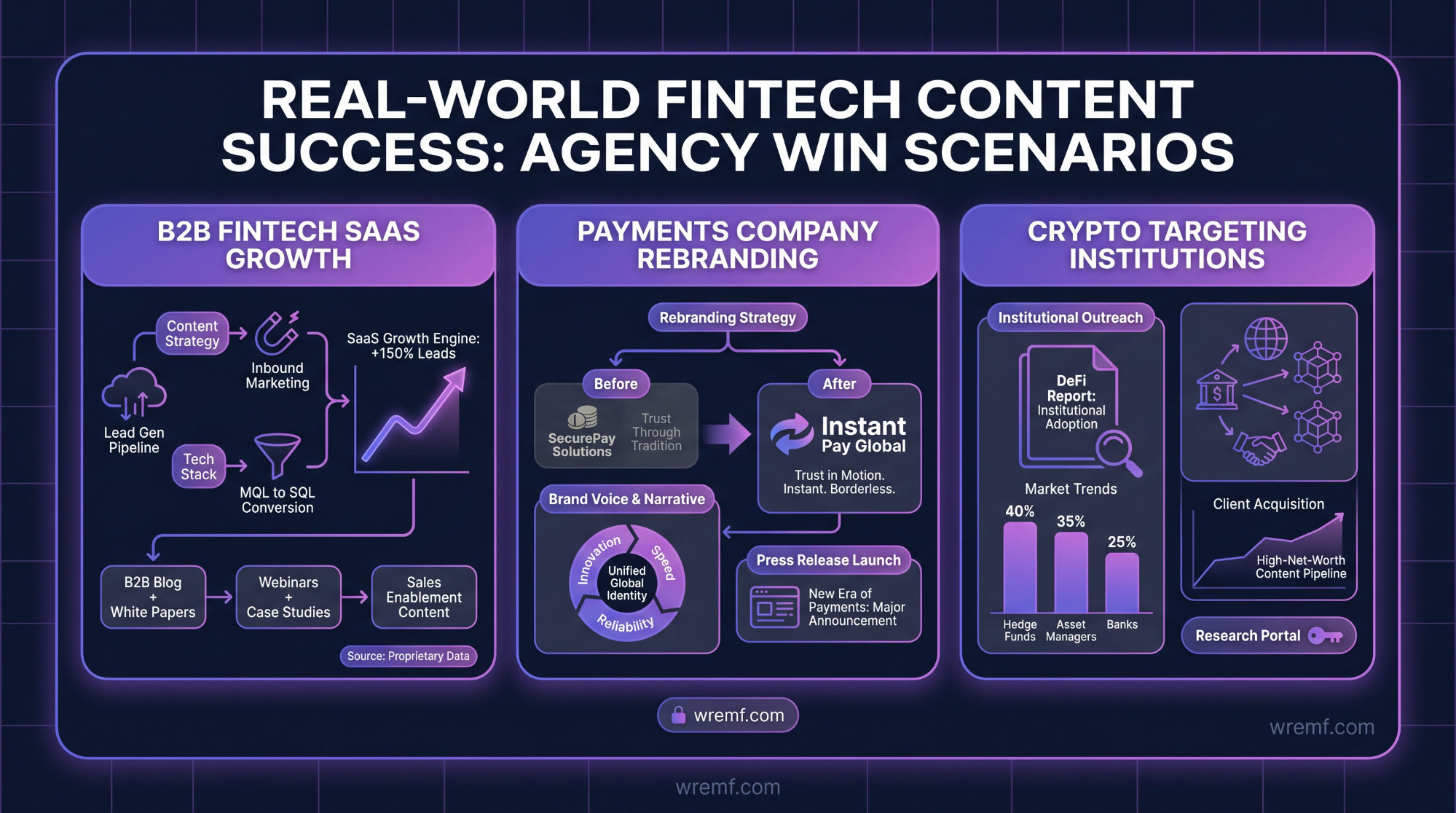
The difference between a strong and weak fintech content agency becomes visible in how they handle real challenges. The following scenarios illustrate what effective fintech content agency work produces across different brand contexts.
Scenario one: A B2B fintech SaaS platform scaling toward Series B
A fintech SaaS platform offering embedded lending infrastructure needs to generate qualified inbound leads from enterprise banks and financial institutions. The brand has solid product-market fit but limited organic search visibility and no established thought leadership presence. A specialist content and SEO agency builds a content strategy targeting high-intent keywords across the lending, financial products, and banking infrastructure verticals. Over 12 months, a consistent program of technical pillar pages, case studies, regulatory compliance explainers, and digital PR placements lifts domain authority, earns backlinks from financial services publications, and generates qualified pipeline from organic search. The brand also begins appearing in ChatGPT and Perplexity answers about embedded lending solutions, creating a citation-driven discovery channel that supplements organic traffic.
Scenario two: A payments company navigating a competitive rebrand
A payments company completing a rebrand after a regulatory action needs to rebuild brand credibility and market position. A fintech content agency with strong compliance expertise and visual storytelling capability leads a content-first rebrand strategy, developing updated messaging, refreshed web content, and a thought leadership program that demonstrates the company's regulatory commitment and product depth. The agency manages disclosures and disclaimers across all content formats and supports the public relations and digital PR components of the rebrand. Over six months, the brand recovers its digital presence and begins rebuilding buyer trust through credible, compliant content.
Scenario three: A crypto and blockchain technology brand targeting institutional buyers
A Web3 and digital assets company targeting institutional investors and enterprise buyers needs content that communicates the technical depth of its dApps and blockchain technology infrastructure without the hype-driven language that characterises much crypto content. An agency with direct experience across DeFi, Ethereum, Polygon, and digital assets produces technical whitepapers, API integration guides, and investor relations content that meets the credibility standards institutional buyers require. The agency also manages the compliance requirements around financial advertising regulations specific to digital assets, ensuring that all content is accurate, appropriately disclaimed, and positioned for a sophisticated buyer audience rather than a retail crypto audience.
These scenarios illustrate a consistent pattern: the fintech brands that generate the strongest results from content agency partnerships are those that choose agencies with direct vertical experience, strong compliance handling, SEO and content integration, and accountability to business outcomes rather than vanity metrics.
KEY TAKEAWAY: Effective fintech content agency work is specific to the vertical, compliance-aware, tied to business outcomes, and measurable. The strongest results come from long-term programs that combine content quality, SEO strategy, digital PR, and increasingly, AI search visibility.
Understanding Pricing and Engagement Models
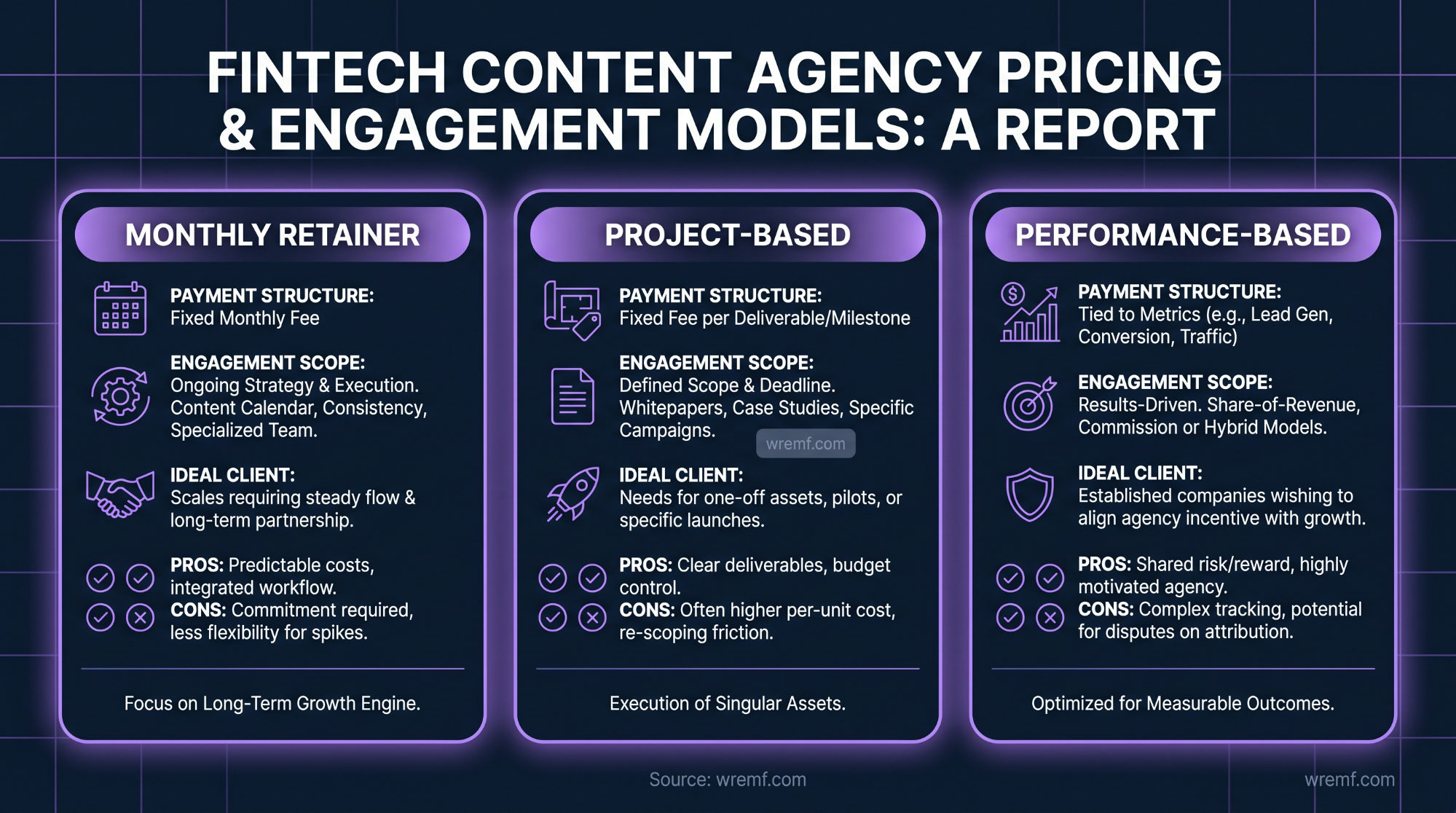
Fintech content agency pricing varies significantly based on agency size, service scope, vertical specialisation, and engagement model. Understanding the pricing landscape helps fintech brands budget appropriately and avoid underinvesting in a program that requires consistent effort to produce results.
Monthly retainer engagements are the most common model for content marketing and SEO programs. Retainers typically range from a few thousand dollars per month for targeted content creation to tens of thousands per month for full-service programs that include strategy, content packages, digital PR, link acquisition, social media management, and analytics reporting. The right retainer level depends on the competitive intensity of the target keywords, the volume of content required, and whether the agency is handling execution across one or multiple channels.
Project-based engagements are appropriate for defined deliverables such as a website rebrand, a whitepaper program, a video production series, or an initial SEO audit and content strategy. Project pricing for fintech content agencies ranges widely depending on scope, but a well-scoped project engagement can be a useful way to evaluate an agency before committing to a retainer.
Performance-based and hybrid pricing models are offered by some agencies, particularly in performance marketing and paid ads. These models align agency incentives with client revenue outcomes but require clear attribution frameworks to work fairly. Full funnel reporting and marketing automation capabilities are essential for performance-based arrangements to function accurately.
For B2B fintech SaaS platforms with limited initial marketing budgets, a pilot engagement of 30 to 90 days at a defined project cost is often the most practical starting point. This approach tests agency quality, builds initial content assets, and generates early SEO signals before the brand commits to a longer retainer.
Large agencies such as Walker Sands and Siege Media have worked with Fortune 500 firms and scaling startups on projects ranging from 10,000 dollars to over one million dollars. Boutique fintech agencies and specialist content partners typically operate in a more accessible range, making them a better fit for Series A and Series B brands with growth-stage budgets.
KEY TAKEAWAY: Fintech content agency pricing ranges from targeted retainers for content and SEO to comprehensive full-service programs. The right investment level depends on vertical competitiveness, content volume requirements, and whether the agency is handling one channel or an integrated multi-channel program.
Common Misconceptions About Fintech Content Agencies
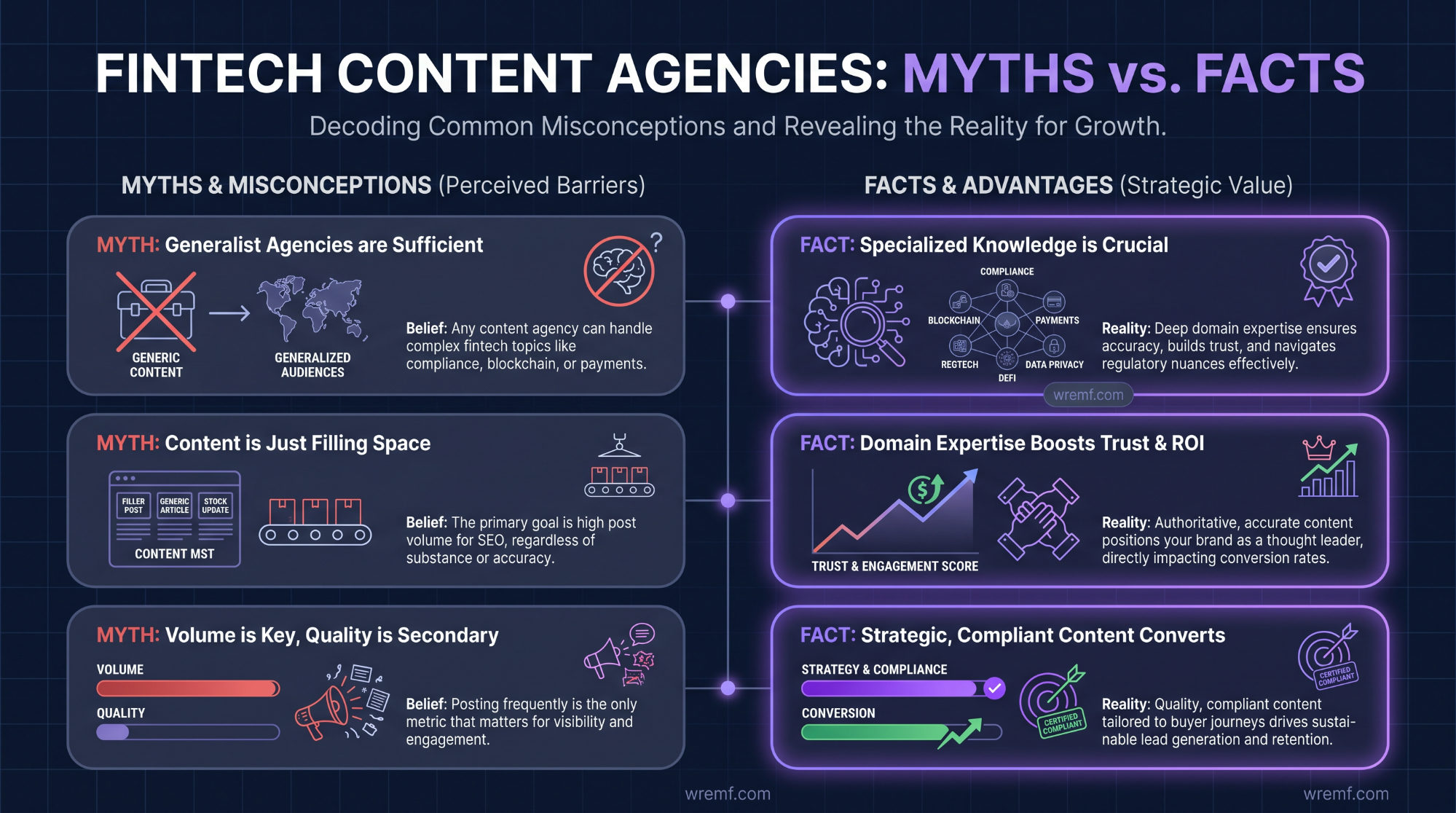
MYTH: A general marketing agency can handle fintech content as effectively as a specialist.
FACT: Financial services content requires compliance expertise, technical writing capability, and regulatory awareness that generalist agencies typically do not possess. Content produced without these foundations creates legal risk, credibility problems, and buyer trust issues that take significant time and investment to repair.
MYTH: SEO rankings alone are enough to measure whether a fintech content program is working.
FACT: Rankings measure search visibility but do not measure pipeline contribution, revenue influence, or AI citation presence. A fintech brand can hold strong Google rankings and still be absent from the AI-generated answers that an increasing share of buyers consult. Full funnel reporting, AI search visibility tracking, and pipeline attribution are necessary to measure whether content is actually driving business outcomes.
MYTH: AI search visibility cannot be measured or influenced.
FACT: AI citation presence can be tracked systematically across ChatGPT, Perplexity, Gemini, Copilot, Claude, and Google AI Overviews using prompt-level monitoring. While no platform can guarantee that an AI engine will recommend a specific brand, content structure, source authority, entity consistency, and answer-first writing have a documented influence on which sources AI engines select. Platforms such as WREMF track this at the prompt level across 10 AI engines, helping fintech brands understand their current AI share of voice and where citation gaps exist.
MYTH: Fintech content marketing produces results quickly.
FACT: Organic content and SEO programs require 4 to 12 months for significant results in competitive fintech verticals. Initial traffic improvements often appear within 3 to 4 months, but meaningful lead generation and pipeline impact typically takes 6 to 12 months of consistent execution. Teams that expect immediate results from organic content investment will consistently underestimate the time required and prematurely cut programs before they reach peak performance.
MYTH: Compliance requirements make it impossible to produce engaging fintech content.
FACT: The strongest fintech content agencies treat compliance as a creative discipline rather than a constraint. Content that is technically accurate, clearly structured, appropriately disclaimed, and written with genuine financial expertise is both compliant and compelling. The idea that compliance requirements force boring content reflects inexperience with regulated content rather than the reality of what skilled fintech writers produce.
KEY TAKEAWAY: The most common fintech content agency misconceptions involve overestimating the capability of generalist agencies, underestimating AI search visibility as a measurable channel, and holding unrealistic timelines for organic content results.
Limitations and Risks in Fintech Content Agency Partnerships
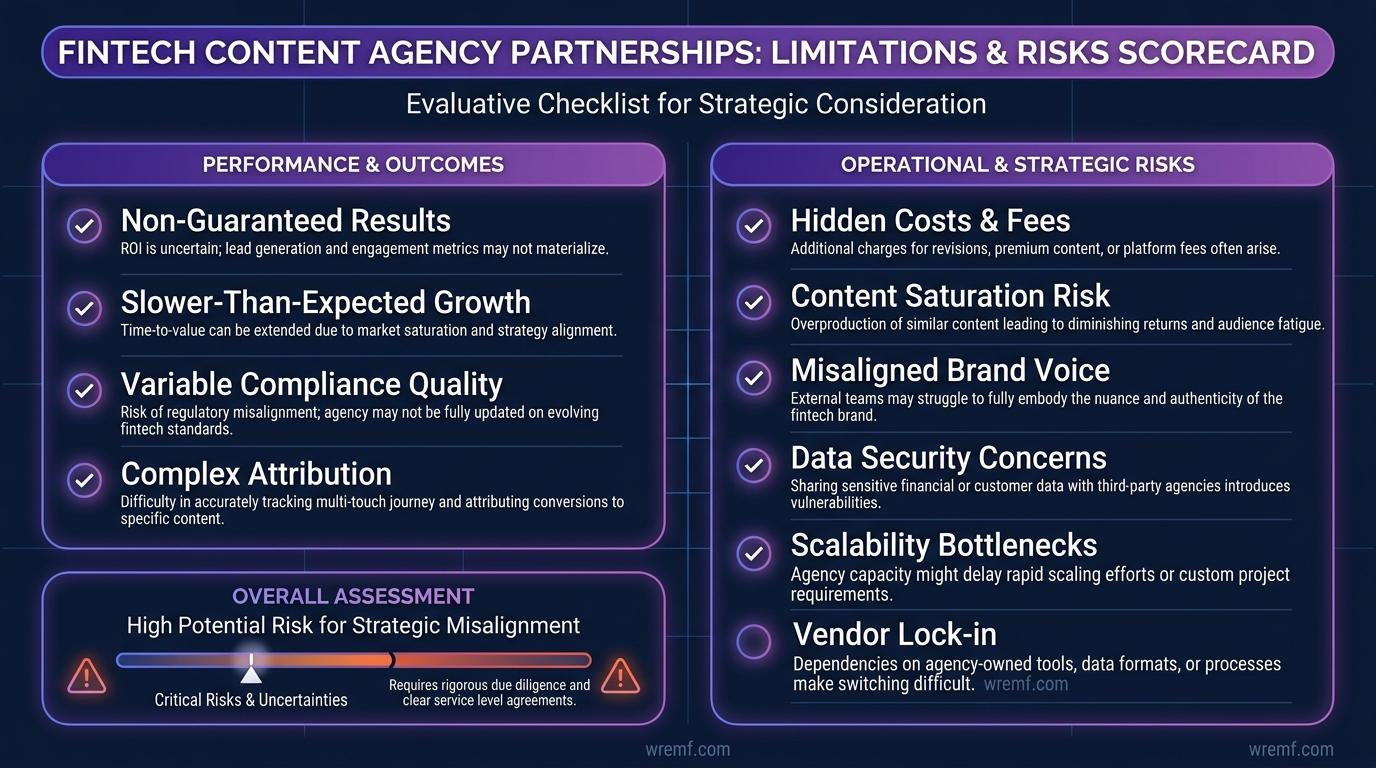
Fintech brands should approach content agency partnerships with clear-eyed awareness of the limitations and risks involved. Understanding these in advance prevents disappointment and helps teams set expectations that reflect the realistic pace of content marketing outcomes.
Content marketing results are not guaranteed, regardless of agency quality. Organic search results depend on competitive dynamics, domain authority, content volume, link acquisition, technical SEO execution, and Google's evolving ranking signals. An agency can execute a content strategy with genuine skill and still see slower results in a highly competitive fintech vertical than the same strategy would produce in a less competitive market.
AI search citation cannot be guaranteed by any agency or platform. While content structure, source authority, entity consistency, and answer-first writing improve the probability of AI citation, AI engines make independent judgements about which sources to include in generated answers. Teams should treat AI visibility as a trackable and improvable metric, not a guaranteed outcome of any particular content or agency investment. The limitations of AI visibility tracking are explained in detail through WREMF's LLM SEO services guide which sets out what can and cannot be controlled in an AI search program.
Compliance expertise varies significantly between agencies that claim fintech specialisation. The fintech content agency category includes agencies with genuine regulatory depth alongside agencies that have completed a handful of financial services projects and positioned themselves as specialists. Verifying compliance credentials through direct questions, work samples, and client references from regulated fintech environments is essential, not optional.
Attribution is complex in long-cycle B2B fintech sales. Content that influences a buyer at the top of the funnel may not result in a closed deal for six to eighteen months. Agencies that report only on last-click attribution will consistently undervalue content's contribution to pipeline and revenue. Fintech brands need multi-touch attribution frameworks and full funnel reporting capabilities to measure content's true business impact.
AI referral traffic attribution can be incomplete. Traffic arriving from AI engines is not always classified accurately in Google Analytics without specific configuration. Teams using GA4 attribution alongside AI visibility tracking need to configure their analytics setup to capture AI referral traffic accurately, recognising that some portion of AI-influenced discovery will remain unattributed in standard reporting.
Software-only AI visibility tracking requires internal execution capacity. Teams that subscribe to AI visibility platforms to monitor their fintech brand's presence in AI-generated answers still need internal resources to act on the data, develop content responses, and execute citation improvement strategies. For teams without this capacity, a managed execution approach delivers more complete outcomes.
KEY TAKEAWAY: Fintech content agency partnerships carry genuine limitations including non-guaranteed results, complex attribution, variable compliance quality, and AI citation risks. Understanding these limitations enables teams to set realistic expectations and build measurement frameworks that reflect the true pace and complexity of content marketing outcomes.
How WREMF Supports Fintech Content Teams and Agencies
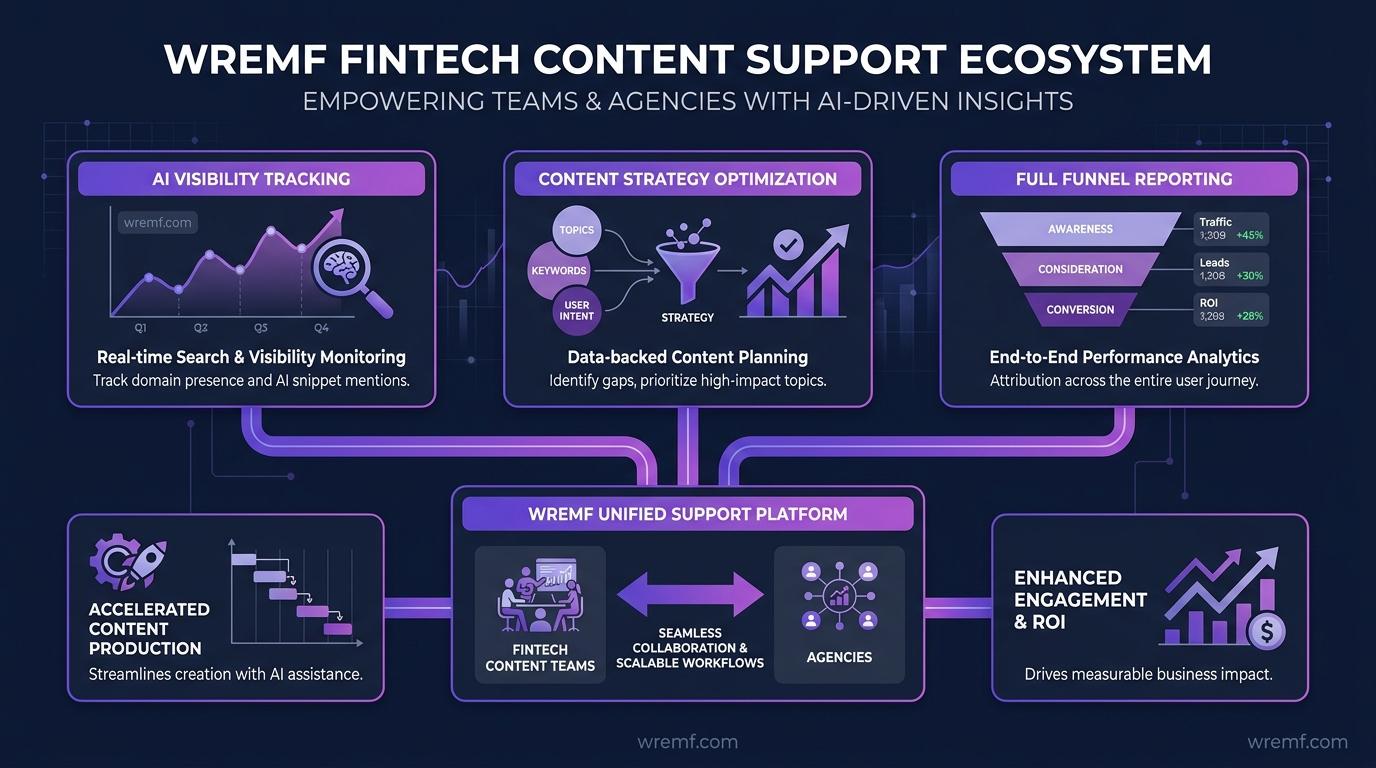
WREMF helps fintech brands and the agencies that serve them track, understand, and improve how their brand appears across ChatGPT, Claude, Gemini, Perplexity, Google AI Overviews, Copilot, DeepSeek, Grok, Meta AI, Mistral, and other AI discovery surfaces. As AI search becomes a meaningful discovery channel for financial services buyers, monitoring AI citation presence has become a practical requirement for fintech marketing teams alongside traditional SEO and analytics reporting.
For fintech brands using WREMF as self-serve software, the Starter plan at 59 euros per month provides core prompt intelligence, source citation tracking, AI Visibility Index scoring, and basic competitor tracking for up to three competitors across 10 AI engines with unlimited prompts and BYOK support. This is the right starting point for fintech founders, solo consultants, and small SaaS teams beginning to measure their AI search presence.
The Growth plan at 149 euros per month expands to five websites and 10 to 15 competitors, adding advanced citation tracking, AI share of voice measurement, GEO audits, content brief generation, SEO testing, GA4 attribution, white-label reports, and Looker Studio connector. This plan suits B2B fintech marketing teams, in-house SEO teams, and agencies managing multiple fintech clients who need reporting, attribution, and actionable visibility data.
For fintech brands that want WREMF to manage their AI visibility program end to end, the Managed plan from 1,500 euros per month provides a custom AI visibility audit, GEO strategy development, AEO content optimisation, citation and entity cleanup, senior-led execution, strategy calls, and monthly reporting. This is the right model for enterprise fintech brands, large agencies, and multi-market teams that need strategy and implementation support alongside tracking.
Teams using WREMF alongside their fintech content agency can close the gap between traditional SEO performance and AI citation visibility, understanding not just where they rank in Google but whether and how their brand appears in the AI-generated answers that buyers increasingly consult before making financial decisions. Fintech brands can review WREMF's generative AI optimization services guide to understand how GEO, AEO, and AI visibility connect to content strategy in regulated financial services markets.
Agencies managing fintech client portfolios can use WREMF's white-label reporting, client portals, and API integrations to build AI visibility tracking into their standard client reporting stack, demonstrating value beyond rankings and sessions through measurable AI citation data across the engines their clients' buyers use. Comparing WREMF pricing plans gives agencies a clear view of which plan fits their client volume and reporting requirements.
KEY TAKEAWAY: WREMF gives fintech content teams and agencies the AI visibility tracking layer that traditional SEO tools do not provide, measuring how fintech brands are mentioned, cited, and recommended across 10 AI engines with prompt-level data, competitor analysis, and attribution reporting.
Conclusion
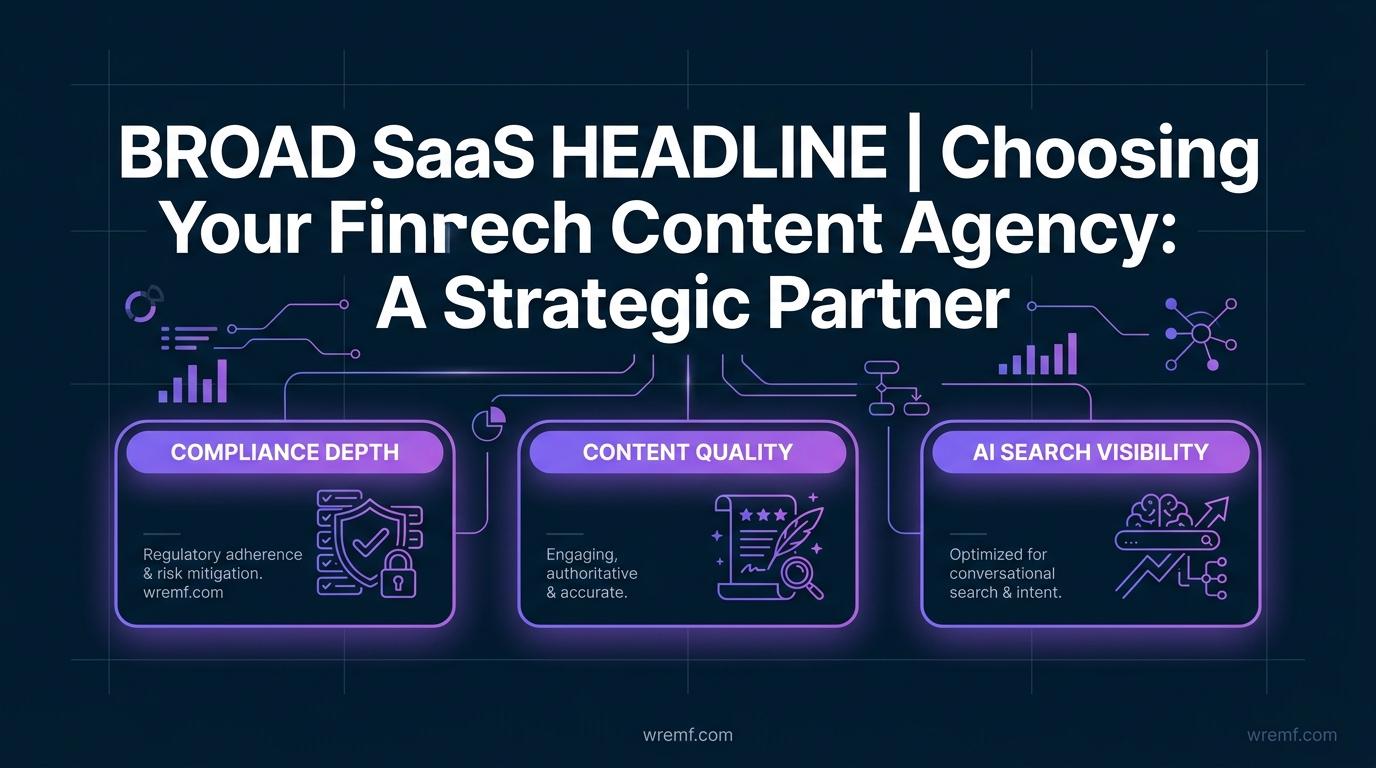
A fintech content agency is not simply a content production vendor. It is a strategic partner that combines financial expertise, compliance knowledge, SEO capability, thought leadership development, and increasingly, AI search visibility to help fintech brands build credible, measurable, and lasting market presence. Choosing the right agency requires evaluating compliance depth, vertical experience, content quality, attribution capability, and whether the agency understands how AI engines discover and cite financial services brands alongside traditional Google rankings. For fintech teams that want to understand how their brand appears in the AI-generated answers their buyers are reading, WREMF provides the AI visibility tracking and managed execution that transforms prompt-level data into content strategy and competitive insight. Explore WREMF's AI search engine optimization services guide to see how fintech brands are building AI visibility alongside their content programs, or compare WREMF pricing plans to find the right fit for your team.
Frequently Asked Questions About Fintech Content Agencies
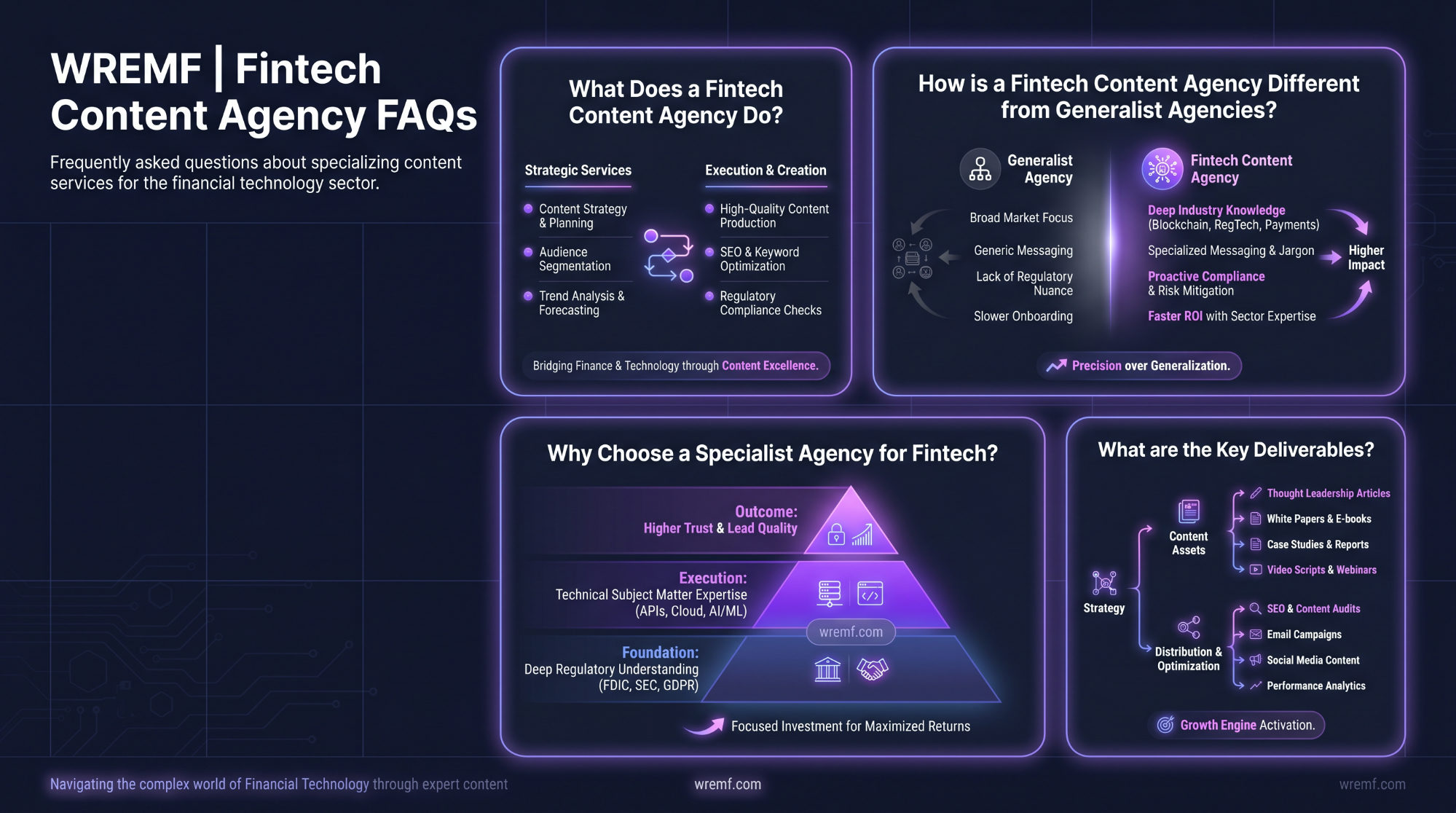
What does a fintech content agency actually do?
A fintech content agency creates, manages, and optimises content specifically for financial technology companies, including B2B SaaS platforms, payments businesses, lending products, banking infrastructure, crypto and blockchain companies, and regtech providers. Core services typically include SEO strategy, thought leadership, lead generation content, compliance-safe copywriting, content briefs, social media, email marketing, digital PR, and increasingly, AI search visibility and LLM optimisation. Unlike generalist agencies, fintech content agencies understand regulatory environments, buyer psychology in financial services, and how to explain complex products clearly to target audiences without creating compliance risks.
How is a fintech content agency different from a generalist digital marketing agency?
A fintech content agency brings domain-specific knowledge that generalist agencies rarely have. Financial services content must navigate regulatory requirements such as FINRA rules, FDIC disclosures, AML/KYC compliance, and financial advertising regulations. Writers need to understand products like installment loans, digital assets, payments infrastructure, DeFi protocols, and SaaS fintech platforms well enough to create accurate, trust-building content. A generalist agency can produce content, but without compliance expertise and genuine understanding of fintech buyer personas, that content often fails to convert or creates regulatory risk that generic marketing teams are poorly placed to identify.
Does experience in financial services really matter when choosing a fintech content agency?
Yes, significantly. Financial services marketing involves a higher compliance burden, longer and more complex sales cycles, more sophisticated buyers, and greater reputational risk than most other industries. An agency that has worked with fintech brands understands how to write about regulated products, how to frame thought leadership for financial buyers, and how to build content that supports sales teams with real pipeline impact. Agencies without this background tend to produce content that is technically functional but commercially weak because it misses the nuance that financial buyers expect before making product or vendor decisions.
Why is marketing in financial services different from other industries?
Financial services marketing operates under a distinct set of pressures that make it harder than most verticals. Content must balance regulatory compliance with commercial persuasiveness, which requires writers who understand both. Financial buyers are sceptical by default, heavily research-led, and often comparing multiple vendors across a long buying cycle. Trust signals, authority content, case studies, and clear product explanations matter more than creative impact alone. Additionally, financial advertising regulations, required disclaimers and disclosures, and restrictions on certain claims mean that content must be approved carefully before publication. As Gartner's AI research increasingly shows, financial buyers are also beginning to use AI-powered tools to research vendors, which is adding an entirely new layer of visibility complexity.
What content services should a fintech content agency provide?
A well-rounded fintech content agency should offer SEO strategy and execution, long-form thought leadership, blog content and content creation, whitepapers, case studies, email marketing, social media content, digital PR and link acquisition, regulatory compliance explainers, content briefs, API integration guides, video production and video editing, LinkedIn thought leadership content, and increasingly, LLM and AI search optimisation. Higher-tier agencies also provide full funnel reporting, buyer persona development, account-based marketing support, RevOps alignment, and post-acquisition content for customer engagement and customer lifetime value improvement. The best agencies connect content output directly to revenue, not just traffic metrics.
How do I choose the best fintech content agency for my business?
Start by evaluating strategic alignment: can the agency connect content to your revenue targets, customer acquisition costs, and growth timeline? Then assess compliance expertise: do they understand your regulatory requirements before you review creative samples? Look for a learning mindset, a collaborative working style, and a clear answer to who actually does the work. Ask how they set priorities for content, whether they focus on buyers further along in the funnel, how they incorporate learnings from one campaign into future ones, and whether they are adapting to AI search behaviour or still relying on traditional SEO alone. The ability to connect content to closed deals rather than just traffic is a strong signal of a mature fintech content agency.
What should you look for in terms of strategic alignment with a fintech content agency?
Strategic alignment means the agency asks "how can we achieve your business outcome among your target audience" before recommending tactics. They should understand your revenue targets, customer acquisition costs, growth timeline, and sales process deeply enough to prioritise content that supports pipeline and conversion, not just awareness. Agencies that default immediately to content volume or keyword lists without first asking about your marketing funnel, your buyers, and your competitive position are unlikely to deliver consistent ROI. A strong fintech content agency will also demonstrate how previous engagements connected content to measurable outcomes such as qualified lead generation, reduced sales cycle length, or business growth.
Can early-stage fintech startups work with a fintech content agency?
Yes, though scope and budget expectations need to match. Early-stage fintech companies often benefit most from focused, high-intent content that supports bottom-of-funnel conversion, builds initial brand credibility, and creates a foundation for organic search. A pilot project or a defined short-term engagement is a sensible starting point before committing to a long-term contract. Some fintech content agencies offer flexible packages suited to growth-stage companies, while others are better matched to established fintech brands with larger content budgets. It is worth asking directly whether the agency has experience with early-stage fintech SaaS platforms and what their minimum engagement looks like.
Can we start with a pilot project before signing a long-term contract?
Most reputable fintech content agencies will allow a pilot project or defined short-term engagement before a longer commitment. A pilot is a practical way to test strategic alignment, content quality, compliance awareness, and working relationship without significant risk. Good questions to ask before a pilot include: what deliverables are included, how performance will be measured, how the agency handles feedback and revisions, and how they would scale the engagement if the pilot succeeds. Starting with a clearly scoped piece of work such as a content audit, a cluster of high-intent articles, or a lead generation campaign gives you enough signal to make an informed decision about a longer partnership.
Will a fintech content agency adapt to our unique brand voice for technical financial topics?
A quality fintech content agency should be able to adapt to your brand voice across technical subjects, including payments infrastructure, lending, banking, crypto and blockchain, DeFi, regtech, and B2B SaaS fintech products. The key test is whether the agency invests time in understanding your product, your audience, and your existing tone of voice before producing content, rather than defaulting to a generic financial services register. Ask how they onboard new clients, how they ensure writers understand the product, and how they handle brand voice guidelines for technical financial content. Agencies that use tech-focused writers with genuine financial services experience will adapt more accurately than those using generalist content teams.
Do fintech content agencies use AI to generate content?
Approaches vary significantly. Some agencies use AI tools to support research, outline creation, and content drafting, while relying on experienced fintech writers for accuracy, compliance review, and editorial quality. Others position themselves as fully human-led. The more important question is not whether AI is used, but whether the final output meets accuracy standards, passes compliance review, reflects genuine financial expertise, and performs well in both traditional SEO and AI search environments. According to OpenAI's research overview, LLMs increasingly influence how financial buyers discover and evaluate vendors, which means content quality and factual authority matter more than ever, regardless of how it is produced.
How long does it take to see measurable results from fintech content marketing?
SEO-driven content typically takes three to six months to show meaningful organic search results, and longer in competitive fintech categories with high domain authority incumbents. Lead generation content with strong bottom-of-funnel intent can produce qualified pipeline within six to twelve weeks if properly promoted. Thought leadership and brand authority content builds over a longer horizon of six to eighteen months. For AI search visibility, which is increasingly relevant as buyers use ChatGPT, Perplexity, Gemini, and Google AI Overviews to research fintech vendors, results depend on citation consistency, content authority, and entity reinforcement across the web. Teams that combine traditional SEO with AI search optimisation tend to see compounding returns over a twelve to eighteen month window.
What is the typical pricing model used by fintech content agencies?
Most fintech content agencies work on a monthly retainer model, with scope defined by content volume, channel mix, and strategic services included. B2B fintech agencies typically charge between $8,000 and $25,000 per month depending on whether the engagement includes SEO, paid ads, content creation, digital PR, and strategic consulting. Project-based pricing is also common for defined deliverables such as content audits, whitepapers, or campaign launches. Some agencies offer tiered content packages for growth-stage fintech companies at lower price points. The right investment level depends on your growth timeline, customer acquisition cost targets, and the competitive intensity of your specific fintech category.
Are fintech content agencies worth the cost?
For fintech companies competing in crowded categories, a specialist content agency typically delivers better commercial results than a generalist agency or an under-resourced in-house team. The value comes from reduced time-to-content, domain expertise that improves accuracy and compliance safety, and strategic prioritisation that connects content to pipeline rather than vanity metrics. Fintech companies that focus on compliance-safe content, CAC optimisation, and content structured around buying-stage intent tend to see strong returns from content investment over a twelve to eighteen month horizon. The key is choosing an agency whose incentives align with business growth, not just content volume delivery.
What industries and company types do fintech content agencies typically serve?
Fintech content agencies serve a broad range of financial technology sectors including payments, banking and neobanking, lending and credit, investing and wealth management, crypto and blockchain, DeFi and Web3, regtech, InsurTech, digital assets, B2B SaaS fintech platforms, and infrastructure providers. Some agencies also serve adjacent financial services categories such as accounting software, credit bureaus, and financial planning tools. B2B fintech agencies typically work with growth-stage SaaS companies, enterprise fintech platforms, and regulated financial product providers. Some specialist agencies also have experience with notable clients in payments, blockchain technology, and digital banking.
How does AI search affect fintech content marketing in 2025 and 2026?
AI search is reshaping how fintech buyers discover and evaluate vendors. Tools like ChatGPT, Perplexity, Claude, and Google AI Overviews now answer buyer questions directly, often without directing users to a brand's website. For fintech companies, this means that appearing in AI-generated recommendations requires more than traditional SEO. Brands need consistent entity authority, citation-worthy content, structured information architecture, and visibility across AI discovery surfaces. As Google's AI Overviews documentation confirms, AI search treats content differently from standard organic ranking. Fintech brands that optimise for both traditional SEO and AI search visibility are better positioned to capture demand across the full discovery landscape.
How does content help fintech companies generate leads?
Content generates fintech leads by attracting buyers who are actively researching solutions, building credibility that accelerates trust during long sales cycles, and creating conversion pathways at different stages of the marketing funnel. Top-of-funnel content builds brand awareness and organic search presence. Middle-of-funnel content such as comparison pages, use-case guides, and regulatory explainers captures buyers evaluating options. Bottom-of-funnel content including case studies, ROI calculators, and product-specific guides directly supports sales conversations. When content is also optimised for AI search, it can generate visibility through ChatGPT, Perplexity, and Gemini responses, extending reach beyond traditional search engine results. WREMF's content brief generator helps teams build AI-ready content structures that support visibility across both search and LLM discovery surfaces.
How do strong fintech content agencies incorporate compliance into their process?
Compliance integration should happen at the brief and planning stage, not as a final review. A strong fintech content agency will understand applicable regulatory frameworks, including FINRA guidelines, FDIC rules, financial advertising regulations, and AML/KYC disclosure requirements relevant to your product category. They will build required disclaimers and disclosures into content templates, flag regulatory risk at the draft stage, and work within your internal compliance review process rather than treating it as an obstacle. Agencies without genuine compliance expertise tend to create content that either avoids important product claims entirely, reducing commercial effectiveness, or includes inaccurate claims that create regulatory risk.
How should fintech brands measure the ROI of content marketing?
ROI measurement for fintech content should connect content activity to business outcomes, not just traffic or engagement. Key metrics include qualified lead volume attributed to content, cost per content-sourced lead compared to paid acquisition, pipeline influenced by content across the sales cycle, closed revenue attributed to content-first journeys, and customer lifetime value for content-acquired customers. Full funnel reporting that maps content engagement to sales outcomes is the most commercially useful framework. For AI search specifically, metrics such as citation share of voice, prompt-level brand mentions, and AI-attributed traffic are becoming important. WREMF's AI visibility tracking platform helps fintech teams measure how their brand appears across AI discovery surfaces, connecting AI citation data to traffic and pipeline attribution.
Do you work with both B2B and B2C fintech companies?
Most fintech content agencies work with both B2B and B2C fintech companies, though their specialist expertise and recommended tactics differ significantly between the two. B2B fintech content typically requires longer-form thought leadership, detailed product content, account-based marketing support, and content that supports a complex, multi-stakeholder sales cycle. B2C fintech content is often more emotionally resonant, shorter-form, performance-driven, and distributed across channels like social media, email marketing, and paid ads. Agencies that focus exclusively on one model tend to produce stronger results within their specialism, so it is worth confirming whether an agency's track record aligns with your specific customer acquisition model.
Should fintech companies care about LLM optimisation as part of their content strategy?
Yes. Buyers increasingly use AI tools like ChatGPT, Perplexity, Gemini, and Copilot to research fintech vendors before engaging with sales. If your brand is not visible in AI-generated answers, you are missing a growing share of demand that never reaches traditional search results. LLM optimisation involves building citation-worthy content, establishing consistent entity authority, structuring information so AI models can extract and attribute it accurately, and tracking how your brand is mentioned across AI discovery surfaces. As McKinsey's AI insights confirm, AI adoption in enterprise decision-making is accelerating, and the brands that appear consistently in AI-generated recommendations will have a significant discovery advantage. WREMF's AI visibility tracking helps fintech teams monitor and improve their position across ten AI engines.
When should a fintech company use software for AI visibility tracking versus hiring an agency?
Software-only AI visibility tools are best for teams with strong internal execution resources who need data, dashboards, and prompt monitoring to guide their own strategy. Agency services are suited to teams that need strategy, content creation, compliance-safe optimisation, and managed execution without building that capability internally. A hybrid model, where AI visibility software is combined with managed agency execution, is typically the best fit for growth-stage fintech brands that want measurable visibility data alongside expert implementation. WREMF offers all three options: software-only from €59 per month, growth-tier software with advanced attribution and reporting from €149 per month, and fully managed AI visibility execution from €1,500 per month for brands that want strategy, content, and citation optimisation handled by a senior-led team.
What makes an effective fintech content team inside or outside the company?
An effective fintech content team, whether in-house or agency-based, combines financial services domain expertise, SEO and AI search knowledge, compliance awareness, editorial rigour, and commercial focus. Writers need to understand fintech products well enough to explain them accurately to sophisticated buyers. Strategists need to prioritise content that supports pipeline, not just brand awareness. SEO specialists need to understand both traditional search optimisation and increasingly AI search visibility, including how LLMs retrieve and cite content. Agencies that hand the majority of work to junior or generalist staff without experienced fintech oversight tend to produce content that lacks the authority and accuracy that financial buyers expect.
How should fintech brands think about AI search visibility alongside traditional SEO?
Traditional SEO and AI search visibility are complementary but increasingly distinct disciplines. Traditional SEO focuses on ranking in Google's standard organic results through keywords, backlinks, technical optimisation, and domain authority. AI search visibility focuses on whether your brand appears in AI-generated answers across ChatGPT, Gemini, Perplexity, Claude, Google AI Overviews, Copilot, and similar tools. Both matter. A low domain authority can limit traditional search performance, but strong entity authority, citation consistency, and AI-ready content structure can generate meaningful AI search visibility even for newer fintech brands. The WREMF blog on AI search optimisation covers how B2B fintech brands can build visibility across both surfaces in parallel.
Related reading
- AI Search Visibility Agency: The Complete Guide to Choosing the Right Partner in 2026
- How to Choose the Best Search Engine Marketing Agency: The Complete B2B Buyer's Guide
- LLM Visibility Agency: The Complete Guide to Choosing the Right Partner for AI Search Visibility
- The Complete Guide to Generative Engine Optimization New York for B2B Brands