How to Choose the Best Search Engine Marketing Agency: The Complete B2B Buyer's Guide
Learn how to evaluate SEM agencies, understand core services, and choose the best fit for B2B. Discover AI-driven search strategies.
By WREMF Team · 2026-09-14
A search engine marketing agency is a specialist firm managing paid and organic strategies to enhance visibility, traffic, and conversion rates across search engines. It focuses on Google Ads, Microsoft Ads, technical SEO, keyword research, content strategy, and AI visibility. The agency optimizes campaigns and analyzes data to generate qualified leads and measurable revenue. Its scope includes traditional search and AI-powered discovery, which reshapes search environments, necessitating updated methodologies like Generative AI Optimization. These agencies serve diverse industries, specializing in verticals or channels based on business needs.
Key takeaways
- Successful SEM agencies provide both technical SEO and paid search management.
- AI-first discovery platforms are reshaping how businesses are found online.
- Google Ads management and conversion rate optimization are critical services.
- Case studies and third-party reviews on platforms like Clutch are vital.
- Generative AI Optimization is becoming essential for modern agencies.
How to Choose the Best Search Engine Marketing Agency: The Complete B2B Buyer's Guide
The best search engine marketing agency is one that combines proven paid search execution, technical SEO capability, and increasingly, AI visibility strategy to help businesses generate qualified leads, improve conversion rates, and build lasting online presence. Search engine marketing has expanded well beyond Google Ads into a broader discipline that now includes organic search, content strategy, paid advertising across multiple platforms, and visibility across AI-powered discovery surfaces. This guide is for B2B founders, marketing leaders, SEO teams, and agencies evaluating SEM partners. It covers what to look for in a search marketing agency, how to measure results, which services matter most, and how AI-first discovery is reshaping the search environment entirely.
QUICK ANSWER:
The best search engine marketing agency combines expertise in paid search, Search Engine Optimization, content, and analytics to generate measurable leads and revenue for clients. Strong SEM agencies offer Google Ads management, Technical SEO, keyword research, conversion rate optimisation, and transparent reporting. In a search environment now shaped by Large Language Models and AI-first discovery, the best agencies also track and improve brand visibility across AI engines alongside traditional search channels.
KEY TAKEAWAYS:
- Search engine marketing covers both paid search and organic strategies, and the best agencies deliver results across both channels simultaneously.
- Google Ads, Microsoft Ads, Technical SEO, Keyword Research, and Conversion Rate Optimisation are core services that separate strong SEM agencies from generalist digital marketing providers.
- Client reviews, verified case studies, and third-party ratings on platforms like Clutch are essential signals when shortlisting an SEM agency.
- AI-first discovery through Large Language Models, Google AI Mode, and generative engines is reshaping how businesses are found, making Generative AI Optimization an emerging requirement for forward-thinking SEM agencies.
- WREMF helps brands track, measure, and improve AI visibility across ChatGPT, Gemini, Perplexity, Copilot, and nine other AI engines alongside traditional SEM efforts.
What Is a Search Engine Marketing Agency?
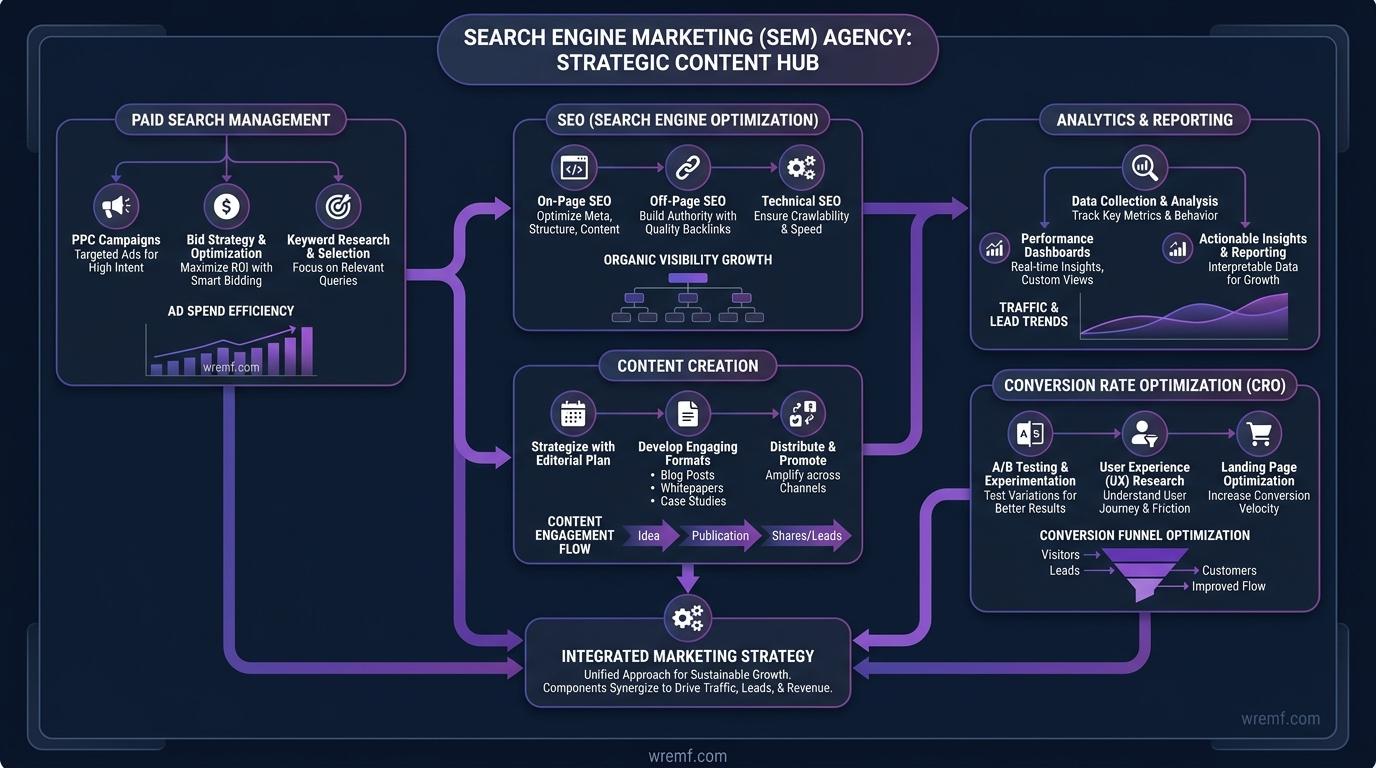
A search engine marketing agency is a specialist firm that manages paid and organic strategies to increase a brand's visibility, traffic, and conversion rates across search engines. Search engine marketing, commonly abbreviated as SEM, encompasses paid advertising campaigns such as Google Ads and Microsoft Ads, alongside Search Engine Optimization disciplines including Technical SEO, Local SEO, International SEO, and content-driven organic strategies.
The scope of a full-service search marketing agency has broadened significantly in recent years. Businesses now expect their SEM partners to manage Google Ads campaigns with sophisticated bidding strategies, produce content that ranks across organic search results, design landing pages that improve conversion tracking outcomes, and increasingly, advise on how brand content performs inside AI-generated answers on platforms such as Perplexity, Gemini, and ChatGPT.
SEM agencies differ from general digital marketing agencies by their depth of focus on the search environment. While a digital marketing agency might offer social media marketing, email marketing, web design, and advertising broadly, a search engine marketing agency centres its methodology on how users discover brands through search queries, whether paid or organic. The strongest agencies combine data, content, technology, and paid search execution into a single, measurable performance system.
For B2B brands, SEM agencies serve as the primary engine for Lead Generation. They research the keywords buyers use, build campaigns that capture intent at every stage of the funnel, optimise landing pages for conversion, and report on performance using Google Analytics, GA4, and attribution models that connect ad spend to pipeline. The best agencies treat every campaign as a revenue investment, not a traffic experiment.
SEM agencies typically serve businesses across verticals including Ecommerce, healthcare, legal services, financial services, home services, and B2B software. Many specialise by vertical or by channel, with some focused primarily on PPC marketing and others building reputations around Search Engine Optimization or content marketing. The right agency match depends on the team's goals, budget, internal capacity, and the complexity of the search environment they operate in.
KEY TAKEAWAY: A search engine marketing agency combines paid search, SEO, content, and analytics into a system that generates qualified leads and measurable revenue from search channels.
Why Businesses Invest in a Search Engine Marketing Agency
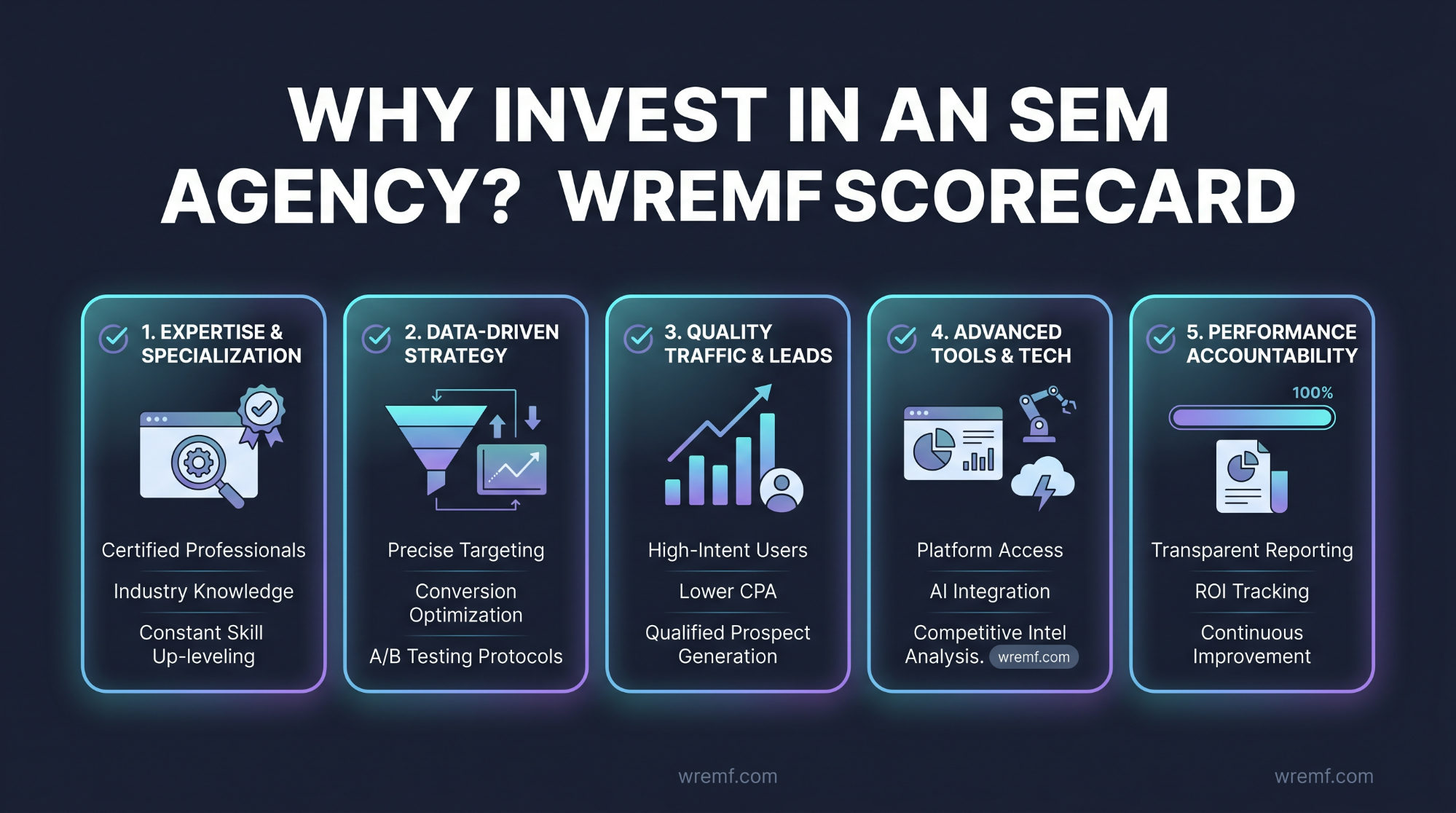
Businesses invest in SEM agencies because the cost and complexity of managing paid search and SEO in-house consistently exceeds what most internal teams can sustain without specialist support. The search environment is technically demanding, competitively intense, and algorithmically dynamic. Professional SEM teams bring expertise, tooling, and campaign intelligence that most internal marketing functions cannot replicate efficiently.
The core reasons businesses hire SEM agencies fall into five practical categories.
Expertise and Specialisation
SEM agencies employ dedicated specialists across paid search, Technical SEO, Keyword Research, ad copy, content creation, Conversion Rate Optimisation, and analytics. A business hiring a single in-house digital marketer cannot replicate the collective expertise of a ten-person agency team with vertical-specific experience. Agencies working across dozens of client accounts develop pattern recognition that accelerates campaign performance in ways that are difficult to achieve through isolated internal effort.
Data-Driven Marketing Strategy
The best SEM agencies operate from data, not assumptions. They use Google Analytics, customer data platforms, A/B testing frameworks, conversion tracking systems, and attribution models to understand what is driving results and what requires adjustment. According to McKinsey's AI insights organisations that invest in data-driven marketing consistently outperform those relying on intuition-led decisions across revenue and customer acquisition metrics.
Higher Traffic Quality and Conversion Performance
A skilled search engine marketing agency does not simply drive traffic volume. It targets the right users at the right intent stage through precise audience targeting, negative keyword management, and landing page design that supports conversion. The result is not just higher Organic Traffic or more ad clicks but genuinely better conversion rates, lower cost-per-click, and improved return on ad spend across campaigns.
Advanced Tools and Technology
Leading SEM agencies invest in paid search platforms, SEO tooling, marketing automation software, and reporting infrastructure that most businesses cannot justify purchasing independently. Google Premier Partner certification, for example, is a credentialing signal that an agency has met Google's performance and spend thresholds and has access to beta features and dedicated account support that general advertisers do not receive.
Performance Monitoring and Accountability
Agencies with structured reporting frameworks track Click-through rate, cost-per-click, conversion rates, and return on ad spend on a scheduled basis, delivering transparent reporting to clients. The best agencies connect campaign performance to business outcomes rather than vanity metrics, giving marketing and finance leadership a clear view of how search investment translates into qualified Leads, revenue, and customer acquisition.
KEY TAKEAWAY: Businesses hire SEM agencies to access specialised expertise, data-driven strategy, advanced technology, and performance accountability that most internal teams cannot replicate at scale.
Core Services Offered by a Search Engine Marketing Agency
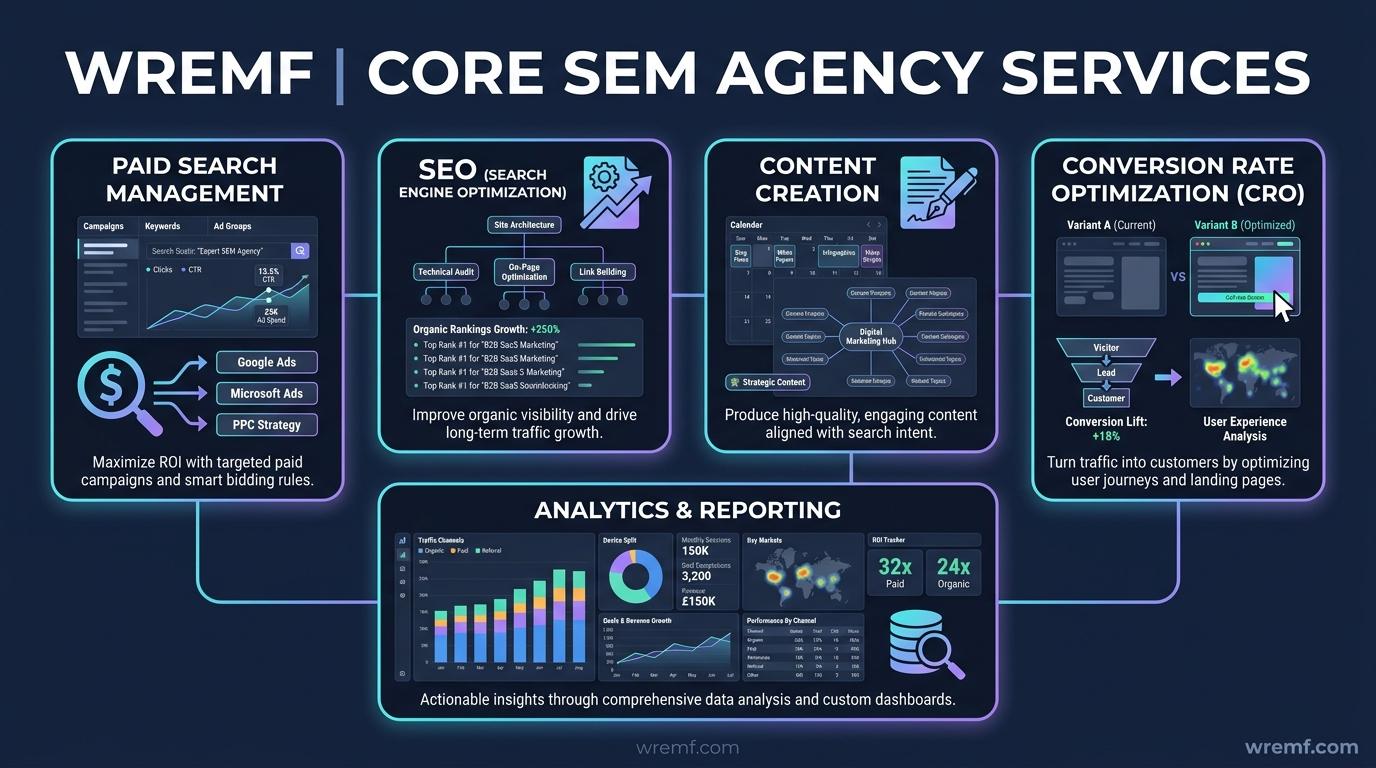
The strongest SEM agencies offer a range of interconnected services that work together across the search funnel. Understanding which services matter most for a specific business goal helps buyers evaluate agency fit more accurately.
Paid Search and Google Ads Management
Google Ads management remains the flagship service for most search engine marketing agencies. This includes campaign setup, ad copy development, bidding strategies, audience targeting, budget allocation, negative keyword management, and ongoing optimisation. The best agencies extend paid search across Microsoft Ads to capture the Bing audience, which represents a meaningful share of professional and enterprise users overlooked by Google-only strategies.
Google Ad Grant Management is a specialised service relevant to nonprofit organisations, allowing qualified entities to access up to $10,000 per month in Google Ads credits. Agencies experienced in Google Ad Grant Management ensure grant accounts remain compliant while maximising qualified traffic for nonprofits.
Search Engine Optimization
Search Engine Optimization is the organic counterpart to paid search and a core service for any agency positioning itself as a full search marketing partner. This encompasses Technical SEO such as crawl error resolution, page speed, Core Web Vitals, and site architecture, as well as on-page optimisation, Keyword Research, content strategy, and Backlink Management. Specialist SEO services include Local SEO for businesses serving specific geographic areas, International SEO for multi-market brands, Shopify SEO for Ecommerce operators, WordPress SEO for content-heavy sites, Magento SEO for larger Ecommerce platforms, and Amazon SEO Services for brands competing on the Amazon marketplace.
Content Creation and Content Marketing
Content is the fuel for organic strategies. Agencies that excel at content marketing develop blog content, pillar pages, landing pages, technical guides, and thought leadership pieces aligned with Keyword Research and buyer intent. Content Creation is not a standalone activity but a system connected to search performance, conversion, and authority-building across the online presence of a brand.
Conversion Rate Optimisation
Conversion Rate Optimisation, commonly called CRO, is the discipline of improving the percentage of website visitors who complete a desired action. This includes landing page design, A/B testing, User Experience improvements, UI/UX design, Web Chat integration, and Landing Page Optimization Services. Strong SEM agencies treat conversion tracking as a core deliverable rather than an afterthought, because traffic without conversion improvement cannot reliably improve return on ad spend.
Web Design and Web Development
Many SEM agencies offer Web Development and website design services because the technical performance and structure of a website directly affects both paid search Quality Scores and organic search rankings. UI/UX audits, page speed improvements, mobile optimisation, and conversion-oriented website design are closely connected to SEM campaign performance.
Social Media Marketing and Digital PR
Social media marketing and Digital PR extend a brand's presence beyond search engine results pages. Paid social on Facebook and other platforms supports retargeting, audience expansion, and funnel coverage. Digital PR builds the brand mentions, backlinks, and entity authority that strengthen organic search performance over time.
Amazon SEO Services and Amazon Marketplace Management
For Ecommerce businesses selling on the Amazon marketplace, specialist Amazon SEO Services help improve product discoverability, listing quality, and advertising performance within Amazon's search ecosystem. This is distinct from Google-focused SEO and requires platform-specific expertise in product optimisation, Amazon Ads, and seller reputation.
Email Marketing and Marketing Automation
Email marketing and marketing automation support lead nurturing, Customer Service, and retention campaigns that extend the value of search-generated leads over the full customer lifecycle. The best SEM agencies integrate email and automation into the overall performance marketing system rather than treating it as a separate service.
Voice Search Optimisation and Generative AI Optimisation
As the search environment evolves, forward-thinking SEM agencies now include Voice Search Optimization and Generative AI Optimization within their service portfolios. Voice Search Optimization ensures content is structured to answer conversational queries delivered through voice assistants. Generative AI Optimization, also known as GEO, focuses on ensuring brand content is cited, mentioned, and recommended by Large Language Models and AI-powered discovery surfaces such as Google AI Mode, ChatGPT, and Perplexity.
For B2B brands evaluating SEM partners, the addition of GEO and Answer Engine Optimisation capabilities signals that an agency understands where the search environment is heading, not just where it has been. Teams wanting to understand this discipline more deeply can review the generative AI optimization services guide as a starting reference.
KEY TAKEAWAY: The strongest SEM agencies offer paid search, Technical SEO, content, CRO, web development, and increasingly Generative AI Optimization as a connected system rather than as isolated services.
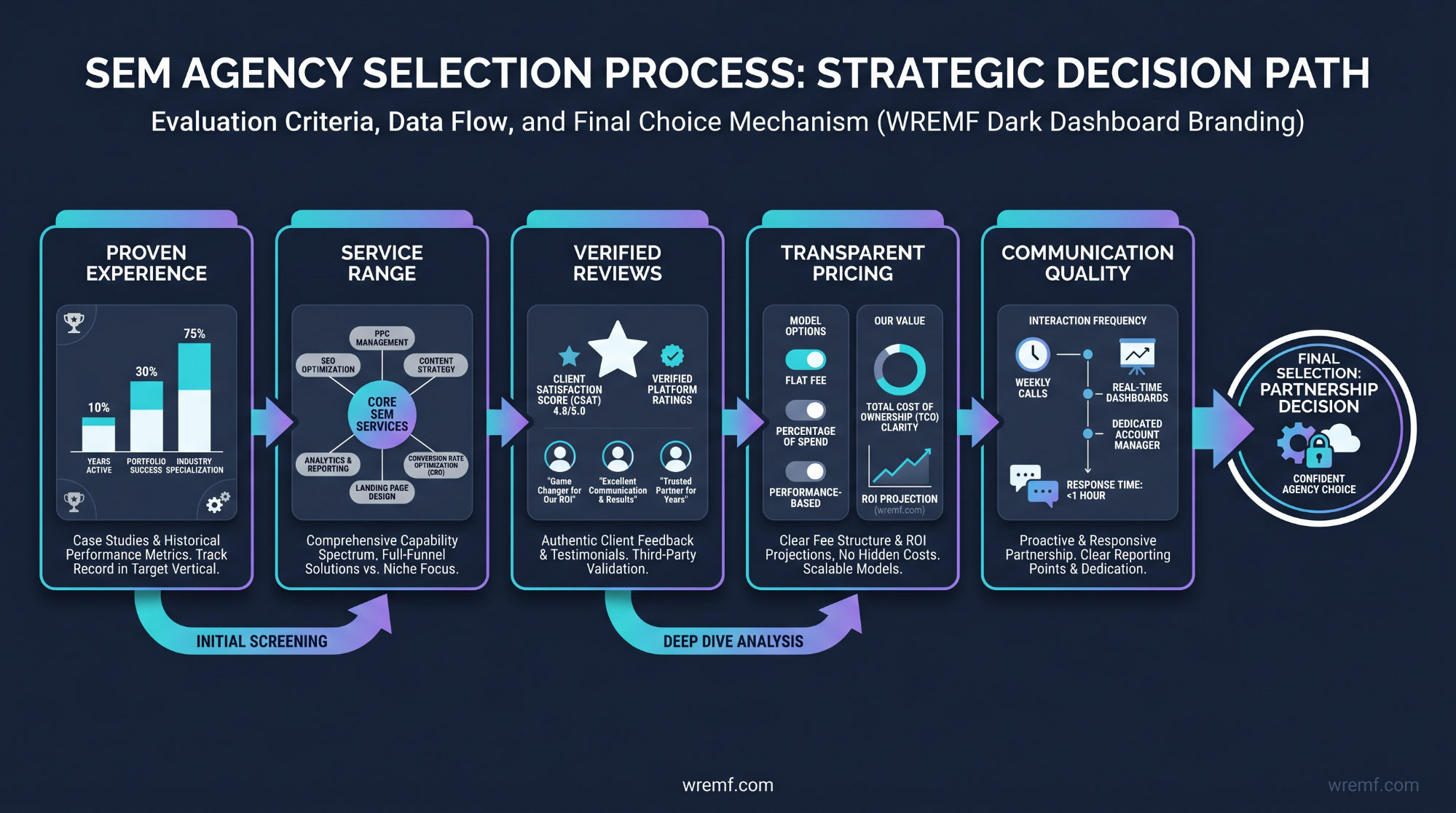
How to Evaluate and Choose the Best Search Engine Marketing Agency
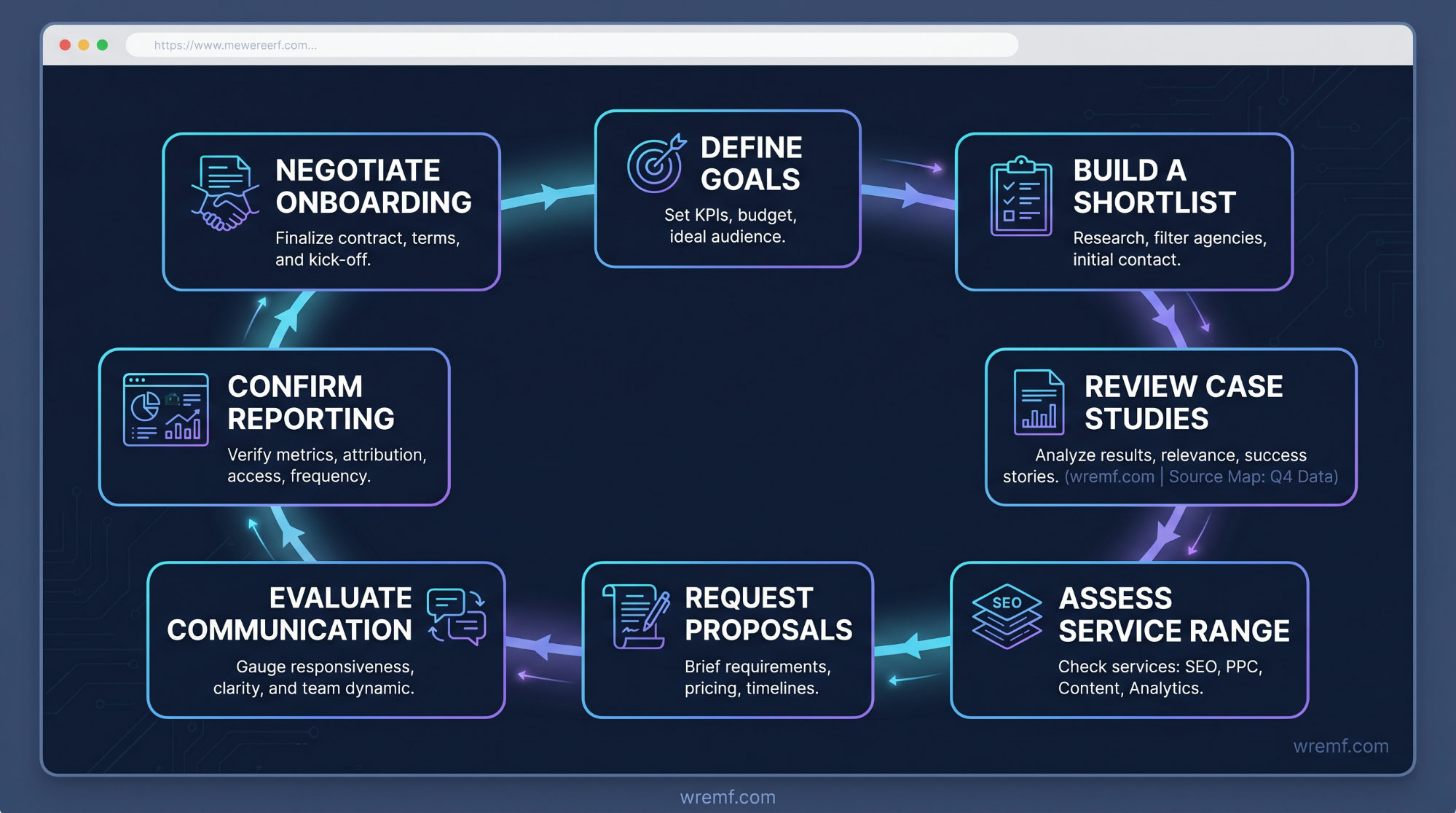
Selecting the best search engine marketing agency requires a structured evaluation process rather than a decision based on brand recognition or initial sales conversations alone. The following criteria reflect what experienced buyers and marketing leaders use to shortlist and select SEM partners.
Proven Industry Experience and Track Record
Experience matters, but the form of evidence matters more. An agency claiming fifteen years in business provides a weaker signal than one that can demonstrate specific, verifiable results for businesses in similar industries. Look for case studies that show starting conditions, the strategy applied, the services deployed, and the measurable results achieved. Results that matter include improvements in Organic Traffic, conversion rates, qualified Leads, return on ad spend, and revenue generated rather than generic traffic increases.
Range of SEM and Digital Marketing Services
Evaluate whether the agency's service range matches the complexity of the business's search requirements. A local business competing primarily in one geographic area may need Local SEO, Google Ads, and a basic web design refresh. A multi-market B2B brand may need International SEO, performance marketing across multiple channels, Conversion Rate Optimisation, content marketing, and increasingly, Generative AI Optimization. Confirming service range upfront prevents future situations where a business outgrows its agency partner.
Verified Client Testimonials, Reviews, and Case Studies
Third-party validation is one of the strongest signals available during agency evaluation. Platforms such as Clutch aggregate verified client reviews and allow buyers to filter agencies by service type, industry, company size, and geography. Online Reviews on Clutch, Google, and industry directories carry more weight than testimonials published on an agency's own website because they are independently submitted and editable only by the reviewer.
Case Studies from named clients, where available, are particularly useful because they demonstrate the agency's ability to communicate what they did, why they did it, and what changed as a result. Agencies that cannot or will not share case studies should be treated with caution.
Transparent and Flexible Pricing Models
Pricing for search engine marketing services varies widely depending on the scope of work, the channels involved, the size of the ad budget managed, and whether the engagement includes managed content creation, web development, or CRO. Agencies that publish pricing ranges or engage openly in pricing conversations early signal a higher level of transparency than those that require extensive discovery before discussing any numbers.
Pricing structures in the SEM agency market typically follow one of three models: a retainer for ongoing SEO and content services, a percentage of ad spend for paid search management, or a project fee for defined deliverables such as a website design or SEO audit. Some agencies combine models depending on the services involved.
Certifications and Awards
Agency certifications signal verified proficiency. Google Premier Partner status is the most widely recognised certification in the paid search world and indicates that an agency has met Google's requirements for campaign performance, ad spend thresholds, and product knowledge. Microsoft Ads certifications reflect the same standard applied to the Bing ecosystem.
Industry recognition such as inclusion on lists published by Clutch, recognition from organisations such as the Utah 100 or Mountain West Capital Networks for regional growth, and awards from marketing industry bodies provide external validation that a specific agency has been recognised for its results and company growth.
Communication, Reporting, and Technology Stack
Ask every shortlisted agency how they report performance, how frequently, and through what tools. Strong agencies use Google Analytics, GA4, Looker Studio dashboards, and attribution models that connect campaign activity to pipeline and revenue. Some agencies use ClickUp or similar project management platforms to keep clients informed on campaign progress. Agencies that rely on static PDF reports delivered monthly without access to live dashboards are typically behind the standard that data-driven marketing teams expect.
Customer Service and Relationship Model
The quality of day-to-day communication and Client relationship management is frequently what separates a long-term agency partnership from a short-term, frustrating engagement. Ask whether the agency assigns a dedicated account manager, how escalation is handled, and what the average client tenure looks like. Agencies with strong client retention typically have structured onboarding, regular strategy calls, and senior involvement at key campaign milestones.
KEY TAKEAWAY: The most reliable evaluation criteria for SEM agencies combine verified case studies, Clutch client reviews, service range depth, transparent pricing, Google Premier Partner certification, and structured performance reporting.
What to Look for in SEM Agency Case Studies and Client Reviews
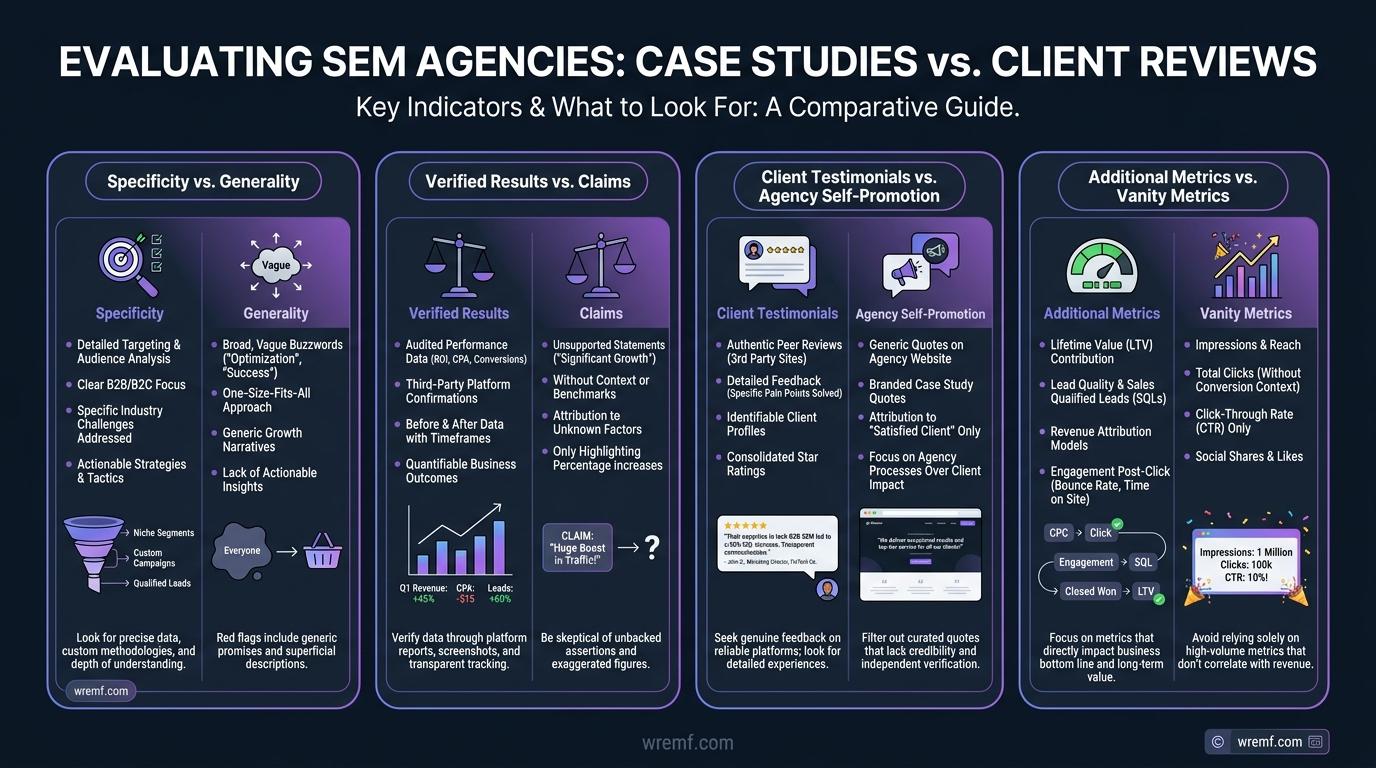
Case studies and client reviews are the closest thing to a risk-free preview of how an agency actually performs. Most buyers underuse this research phase by scanning agency websites rather than cross-referencing claims against independent review platforms and verifiable outcomes.
When reviewing case studies, look for specificity over generality. A case study that reports a 427% increase in top 10 Organic Traffic keywords year-over-year for a roofing client, supported by a named client and a reproducible methodology, is far more credible than a case study claiming vague "significant improvements in search visibility". The best case studies explain the challenge, the strategy deployed, the timeframe, and the measurable results with enough detail that a reader can assess whether the approach is applicable to their own situation.
Verified client reviews on Clutch allow prospective buyers to filter by vertical, service type, and business size. Reading reviews that describe the working relationship, communication quality, and specific outcomes provides a more accurate picture of agency culture than sales materials ever will. Look for patterns across multiple reviews rather than relying on any single testimonial, positive or negative.
When agencies cite awards or recognition, cross-reference those claims independently. Google Premier Partner status can be verified through Google's partner directory. Recognition from organisations such as Clutch's Top SEM Agency rankings, the Utah 100, or Mountain West Capital Networks provides geographic and industry context about the agency's standing within its market.
For agencies serving communities and local businesses across specific geographic areas such as Cincinnati, Covington, or San Francisco, local market knowledge and regional case studies carry meaningful weight alongside national or global credentials. An agency with deep roots in a specific metropolitan area may outperform a national provider for businesses competing in that local search environment.
The WREMF AI search engine optimization guide provides additional context on how the evaluation criteria for search agencies is evolving as AI-first discovery changes the signals that matter for B2B brand visibility.
KEY TAKEAWAY: Case studies with named clients, specific metrics, and reproducible methodology combined with verified Clutch client reviews are the strongest available signals of actual SEM agency performance.
Measuring SEM Agency Performance: The Metrics That Matter
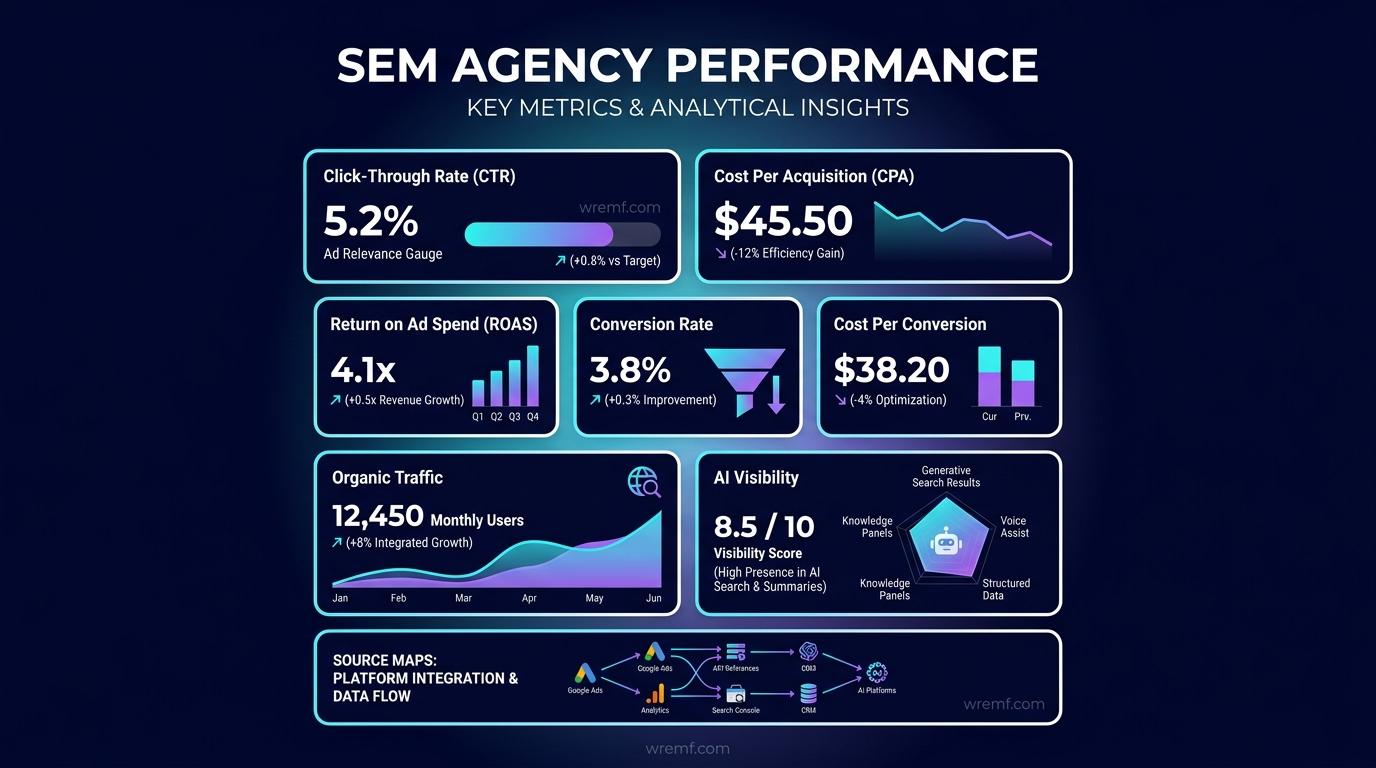
SEM agency performance should be measured against business outcomes, not channel activity. The most meaningful metrics connect campaign execution to qualified Leads, revenue, and customer acquisition rather than simply reporting impressions, clicks, and keyword positions.
Click-Through Rate
Click-through rate measures the percentage of users who see an ad or organic listing and choose to click it. A higher Click-through rate in paid search indicates that ad copy, headline, and offer alignment is strong. In organic search, a strong Click-through rate suggests that title tags and meta descriptions are compelling relative to competing listings. Click-through rate is a useful diagnostic metric but should never be treated as a standalone measure of campaign success.
Cost Per Acquisition
Cost per acquisition measures how much a business spends across all channels to generate one new customer or qualified lead. It is one of the most business-relevant metrics in paid search because it connects ad spend directly to customer economics. SEM agencies should report cost per acquisition alongside return on ad spend so that marketing leadership can evaluate whether the investment is commercially viable.
Return on Ad Spend
Return on ad spend, commonly abbreviated as ROAS, measures the revenue generated for every unit of currency invested in paid advertising. A 23X ROAS result, for example, means that every dollar spent on advertising generated twenty-three dollars in revenue. ROAS benchmarks vary significantly by vertical, product margin, and sales cycle length, which is why agencies that set appropriate expectations upfront for each client's specific market conditions are more valuable than those claiming universally high returns.
Conversion Rate
Conversion rate measures the percentage of website visitors or landing page visitors who complete a target action, whether that is a form submission, a call, a purchase, or a trial signup. Conversion rate is influenced by landing page quality, offer relevance, audience targeting precision, page speed, and User Experience design. SEM agencies that take responsibility for both traffic acquisition and conversion performance deliver more cohesive results than those focused only on driving clicks.
Cost Per Conversion
Cost per conversion is closely related to cost per acquisition and measures the average spend required to produce one conversion event within the campaign. It is particularly useful for Ecommerce and Lead Generation campaigns where multiple conversion types exist at different funnel stages, allowing campaign managers to allocate budget toward the most efficient conversion paths.
Organic Traffic and Keyword Rankings
For SEO-focused engagements, Organic Traffic growth and keyword ranking improvements are the primary channel signals. These should be tracked over meaningful timeframes, typically six to twelve months minimum, because SEO operates on longer feedback cycles than paid search. Agencies should report not just aggregate traffic but traffic quality metrics including session duration, conversion rate from organic sessions, and revenue attributed to organic channels.
AI Visibility and AI Share of Voice
A growing number of forward-thinking SEM agencies are beginning to track a newer dimension of search performance: AI visibility and AI share of voice. As users increasingly rely on AI-powered answer engines for online research and vendor discovery, the brands that appear in AI-generated answers gain a structural advantage that traditional keyword rankings do not measure. AI share of voice tracks how frequently a brand is cited, mentioned, or recommended across prompts relevant to its market, compared to competitors.
Tracking AI-first discovery performance requires specialist tooling and methodology beyond standard search analytics. WREMF measures how brands appear across ChatGPT, Gemini, Perplexity, Copilot, DeepSeek, Grok, Meta AI, Mistral, and other AI engines using prompt-level reporting, source citation tracking, and competitive visibility analysis. Teams evaluating AI brand monitoring options can explore the AI brand monitoring guide for a detailed methodology overview.
KEY TAKEAWAY: The metrics that matter most for SEM agency performance are cost per acquisition, return on ad spend, conversion rates, qualified lead volume, and increasingly, AI share of voice across AI-first discovery platforms.
A Practical Process for Evaluating and Onboarding an SEM Agency
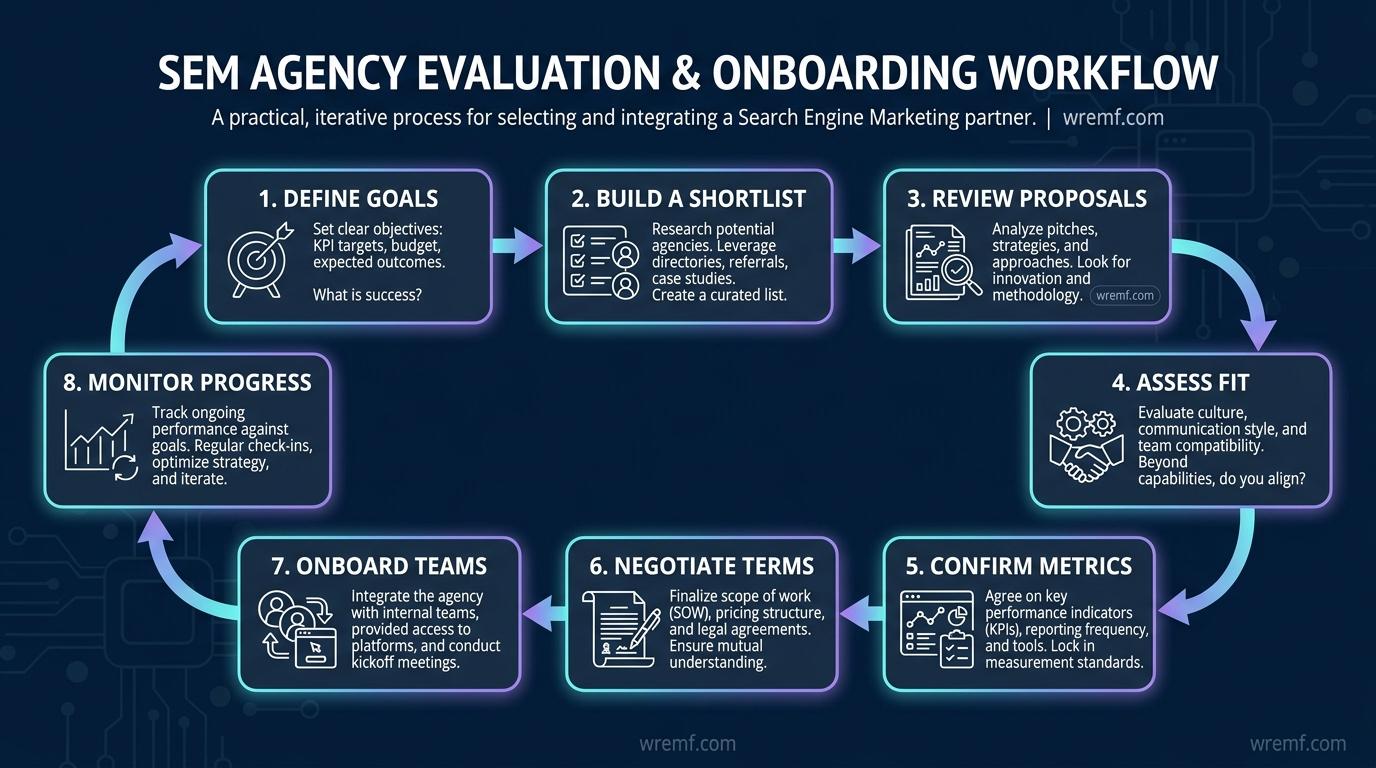
The following workflow helps marketing leaders and B2B buyers run a structured SEM agency selection process that avoids common pitfalls and accelerates time to measurable results.
Step 1: Define Goals and Success Criteria Before Outreach
Before contacting any agency, establish what success looks like in measurable terms. Define target cost per acquisition, revenue goals, the channels that matter most, and whether the priority is paid search, organic growth, conversion improvement, or a combination. Vague briefs produce vague agency proposals.
Step 2: Build a Shortlist Using Third-Party Sources
Use Clutch, industry directories, and peer recommendations to build a shortlist of eight to twelve agencies. Filter by service type, vertical experience, company size, and geographic location where relevant. Online Reviews and independently submitted client reviews carry more weight than agency self-promotion in this phase.
Step 3: Review Case Studies and Verify Claims
Request case studies from each shortlisted agency and cross-reference results against independently verifiable sources where possible. Ask specifically whether the results described are representative of typical client outcomes or exceptional results from specific campaigns. Verified performance metrics from named clients such as Helium Interactive, Xavier Athletics, or Searchbloom provide useful benchmark context when evaluating agency claims.
Step 4: Assess Service Range and Technology Capability
Evaluate whether each agency's technology stack, channel coverage, and reporting infrastructure match the complexity of the business's requirements. Confirm whether they can manage Google Ads, Microsoft Ads, SEO, CRO, content marketing, and AI Driven Marketing within a single integrated system or whether services are siloed across separate teams.
Step 5: Request a Structured Proposal and Pricing Conversation
Ask each shortlisted agency for a structured proposal that addresses the defined goals, proposes a clear strategy, outlines the services included, and provides transparent pricing. Avoid agencies that refuse to discuss pricing until after an extensive and time-consuming discovery process.
Step 6: Evaluate Communication Quality and Account Structure
During the proposal and presentation stage, assess how the agency communicates. Are they clear, responsive, and specific? Do they assign senior team members to new business conversations? Do they use data and evidence or rely primarily on brand-level sales narratives? The quality of communication during the sales process is typically predictive of the quality of communication during the engagement.
Step 7: Confirm Reporting Framework and Attribution Methodology
Before signing any agreement, confirm exactly how the agency will report performance, at what frequency, through which tools, and how attribution is handled. Agencies using Google Analytics, GA4, and Looker Studio dashboards connected to campaign data provide more transparent and actionable reporting than those delivering static monthly summaries.
Step 8: Negotiate Onboarding Terms and Establish Milestone Reviews
The first 30 to 90 days of an SEM agency engagement are critical. Establish clear onboarding milestones, agree on the timeframe for initial data gathering, and schedule milestone reviews at 30, 60, and 90 days. This ensures that both parties maintain accountability and that the relationship can be adjusted quickly if early results or communication patterns suggest misalignment.
KEY TAKEAWAY: A structured eight-step evaluation and onboarding process based on defined goals, verified case studies, transparent proposals, and confirmed reporting frameworks significantly reduces the risk of a mismatched SEM agency engagement.
How AI-First Discovery Is Reshaping Search Engine Marketing
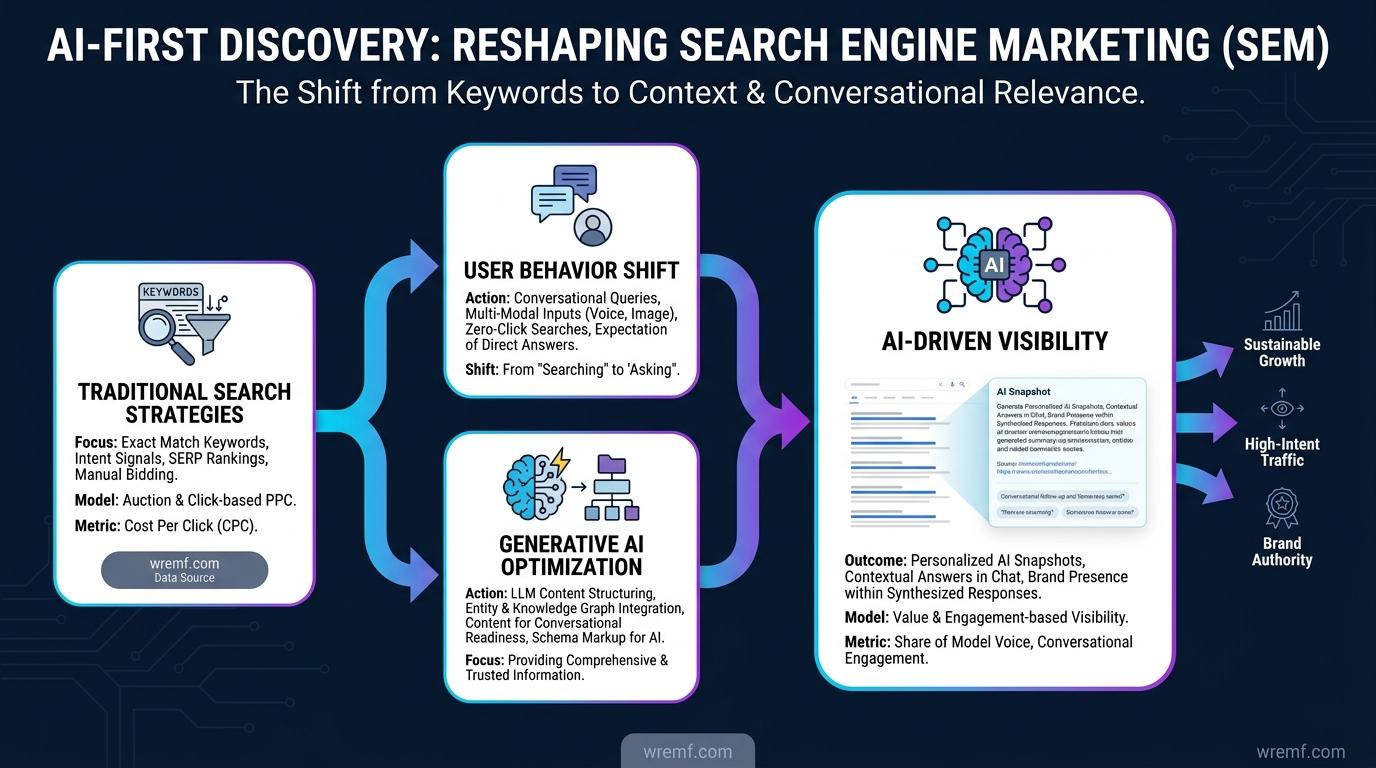
AI-first discovery is changing the search environment in ways that affect every discipline a search engine marketing agency delivers. Large Language Models including ChatGPT, Claude, Gemini, Perplexity, Copilot, DeepSeek, Grok, Meta AI, and Mistral are increasingly the first point of contact between buyers and information. Buyers conducting online research about SEM agencies, marketing platforms, or digital marketing services may encounter AI-generated answers before they ever visit an agency's website.
According to VentureBeat's AI coverage AI-powered answer engines are handling a growing share of commercial research queries, particularly in B2B markets where buyers rely heavily on trusted, curated information before initiating vendor contact. This shift means that a brand's presence in AI-generated answers is becoming as strategically important as its position in traditional search engine results pages.
The search environment has split into two parallel discovery systems. The first is traditional keyword-based search across Google and Bing, where rankings, ad positions, and organic optimisation remain critical. The second is prompt-based AI discovery, where Large Language Models synthesise answers from indexed content and cited sources without users ever clicking through to individual websites in the traditional sense.
For SEM agencies and their clients, this creates a new measurement and optimisation challenge. Traditional Google Analytics and paid search attribution systems do not capture AI referral traffic accurately because many AI engines do not pass referral source data in the same way that standard web sessions do. This attribution gap is a growing concern for marketing teams trying to understand how much of their lead pipeline originates from AI-first discovery versus traditional search.
Generative AI Optimization, or GEO, is the emerging discipline that addresses this gap. GEO focuses on ensuring that brand content, entity signals, source citations, and authority indicators are structured in ways that make content more likely to be retrieved, cited, and recommended by Large Language Models. Alongside Answer Engine Optimisation, which focuses on structured content for AI-driven answer surfaces, GEO represents a meaningful extension of the services that progressive search engine marketing agencies are beginning to incorporate.
Google AI Mode represents a further evolution of this shift, integrating AI-generated responses directly into Google's search interface. As Google's AI Overviews documentation confirms, AI Overviews operate with distinct selection criteria from standard organic listings, meaning that brands appearing in Google's traditional top ten results are not automatically represented in AI-generated answer summaries.
For B2B brands and the agencies that serve them, the practical implication is that search engine marketing strategy must now account for both traditional keyword-based performance and AI share of voice across the expanding universe of AI-powered discovery surfaces. Teams evaluating how to build this capability can explore the AI Overview SEO guide for a practical methodology overview.
KEY TAKEAWAY: AI-first discovery through Large Language Models and Google AI Mode has split the search environment into two parallel systems, making Generative AI Optimization and AI share of voice tracking essential additions to a comprehensive SEM strategy.
Real-World Scenarios: How Different Teams Use SEM Agencies and AI Visibility Tools
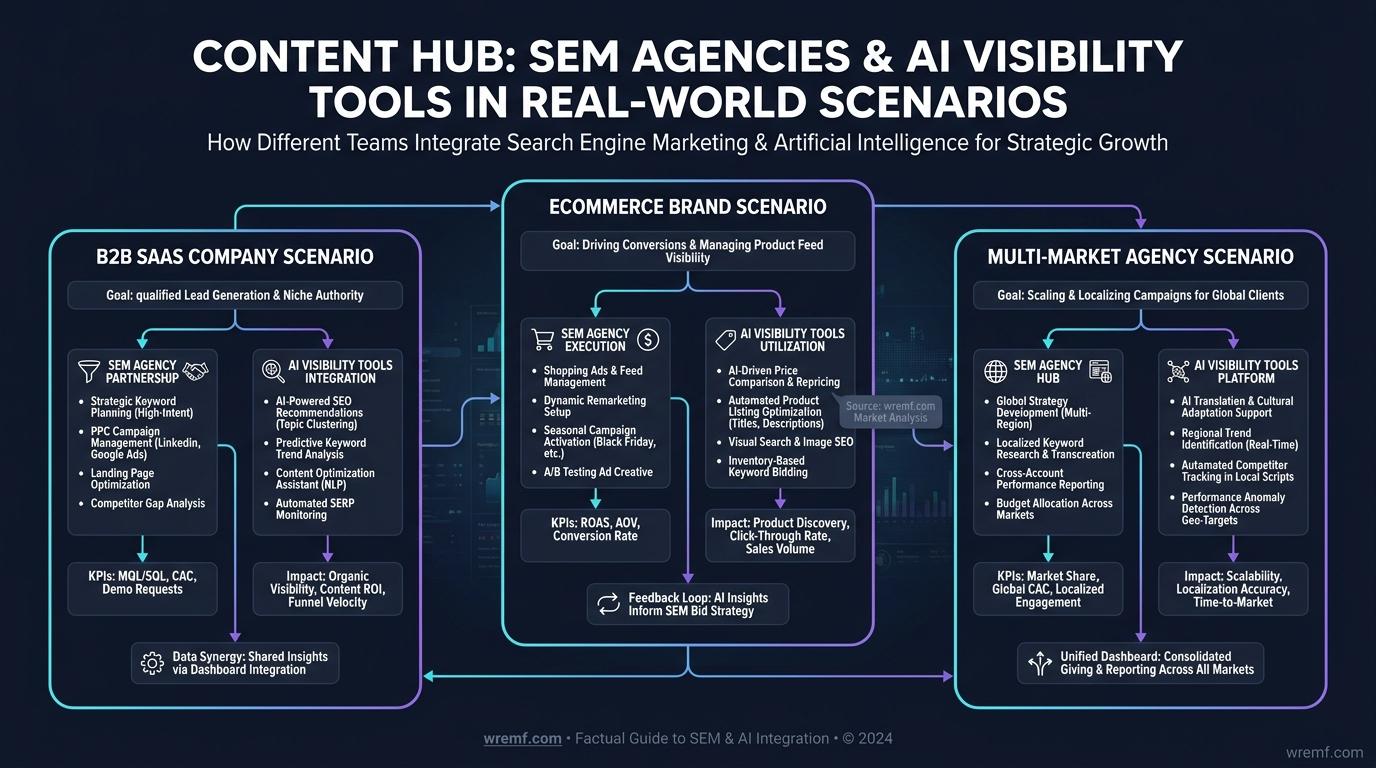
Understanding how SEM agencies and AI visibility platforms fit into different business contexts helps buyers make more accurate decisions about the right partner, service model, and technology combination for their situation.
Scenario One: B2B SaaS Company Competing for AI Recommendations
A mid-market B2B SaaS company notices that when potential customers search for software in their category using ChatGPT or Perplexity, a competitor brand is consistently mentioned in AI-generated answers while their own brand rarely appears. Traditional Google Analytics data shows stable organic traffic but does not reveal this AI visibility gap. The marketing team engages an SEM agency to improve their Technical SEO and content marketing, while simultaneously deploying WREMF to track prompt-level citation data across AI engines.
WREMF's source citation tracking identifies which competitor content is being cited in AI answers and reveals that the competitor's long-form content and structured entity signals are driving their AI visibility advantage. The team uses this data to build an AI-ready content brief, close citation gaps, and improve entity consistency. Within a structured campaign timeframe, prompt tracking data shows the brand beginning to appear in AI answers for priority prompts, providing a measurable signal that the GEO strategy is working.
Scenario Two: Ecommerce Brand Managing Multi-Channel Performance
An Ecommerce brand selling across its own website and the Amazon marketplace engages a search engine marketing agency to manage Google Ads, Shopify SEO, and Amazon SEO Services simultaneously. The agency implements a unified performance marketing approach with shared audience targeting signals, coordinated bidding strategies across Google Ads and Microsoft Ads, and landing page optimisation for core product categories. Conversion tracking is connected to GA4 and reported through a Looker Studio dashboard the team reviews weekly. Campaign performance improves across return on ad spend and cost per conversion as paid and organic strategies reinforce each other.
Scenario Three: Multi-Market Agency Managing Client AI Visibility
A digital marketing agency managing SEM for twelve clients across multiple geographic areas including Cincinnati, Covington, San Francisco, and European markets identifies a gap in its reporting offering. Clients are asking about AI visibility and whether their brands are appearing in ChatGPT and Perplexity answers. The agency deploys WREMF on the Growth plan to access white-label reporting, AI share of voice data, and source citation tracking across all client accounts. Teams can now present AI visibility performance alongside traditional SEM reporting in branded client reports, differentiating the agency's offering from competitors that cannot yet provide this level of AI-first discovery analysis. Teams interested in this capability can compare WREMF pricing plans to identify the right plan for multi-client reporting.
KEY TAKEAWAY: SEM agencies and AI visibility tools like WREMF solve different but complementary problems. Traditional agencies optimise for clicks, rankings, and conversion. WREMF adds the AI discovery layer by tracking how brands appear in prompt-based answers across ten AI engines.
Limitations and Risks When Working with Search Engine Marketing Agencies
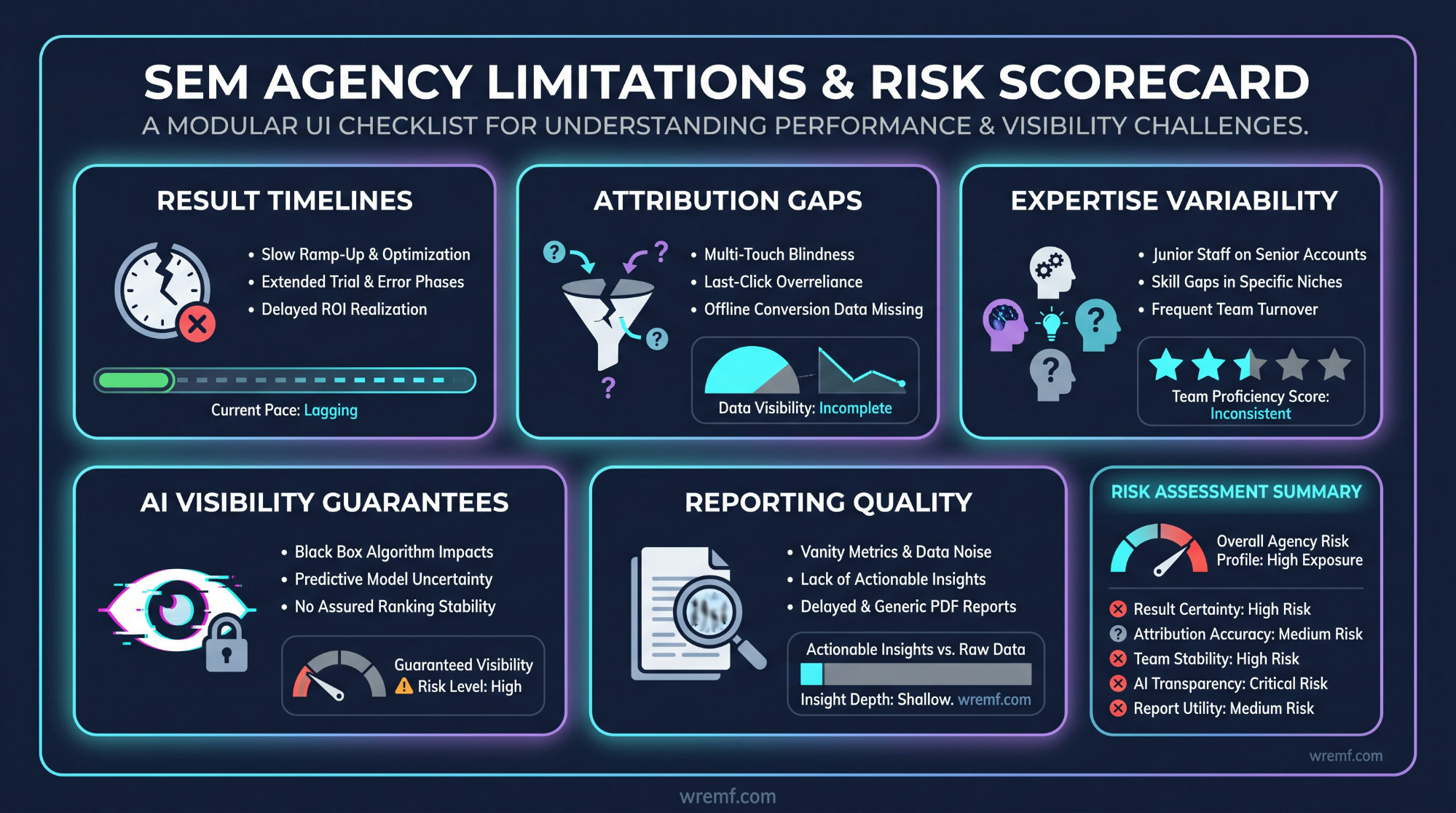
Working with a search engine marketing agency carries real risks that buyers should evaluate honestly before signing agreements. Understanding these limitations helps businesses set appropriate expectations, structure agency agreements more carefully, and build internal capabilities that reduce dependency over time.
Result Timelines Are Longer Than Many Agencies Communicate
Paid search can generate leads relatively quickly once campaigns are properly structured and audience targeting is dialled in. However, Search Engine Optimization, content marketing, and Organic Traffic growth typically require six to twelve months of consistent execution before compounding effects become visible in analytics data. Agencies that promise significant organic ranking improvements within 30 to 60 days are either working in very low-competition markets or overpromising results. Buyers should request realistic timeframes tied to competitive analysis rather than accepting headline promises.
Attribution Gaps Make Full-Funnel Measurement Difficult
Marketing attribution across multiple channels including paid search, organic search, social media marketing, email marketing, and AI-first discovery is imperfect even with sophisticated tools. GA4 and multi-touch attribution models help, but they do not capture every touchpoint in a buyer's research journey. AI referral traffic from ChatGPT, Perplexity, and similar platforms is frequently misattributed as direct traffic in standard analytics configurations, creating underreporting of AI-generated demand. Buyers should ask agencies specifically how they handle attribution across AI discovery channels.
AI Visibility Cannot Be Guaranteed by Any Agency
No search engine marketing agency can guarantee that a brand will appear in AI-generated answers, be cited by Large Language Models, or be recommended by Perplexity or ChatGPT. AI engines select sources based on complex, opaque criteria that include content quality, entity authority, source citation frequency, and training data availability. GEO and AEO strategies can meaningfully improve the conditions that make citation more likely, but they cannot guarantee specific placement or citation frequency in the same way that a paid ad placement can be purchased.
Agency Expertise Can Be Uneven Across Services
Many agencies describe themselves as full-service digital marketing providers but have clear centres of excellence alongside weaker capabilities in other areas. An agency with deep Google Ads expertise may have limited capability in Technical SEO, Conversion Rate Optimisation, or content marketing. Buyers should probe the depth of expertise across each service they require, request team credentials, and ask which services are delivered in-house versus outsourced to subcontractors.
Generative AI Optimization Is an Emerging Field
The standards, measurement frameworks, and execution methodologies for Generative AI Optimization and Answer Engine Optimisation are still developing. As Gartner's AI research notes, AI-related marketing capabilities are evolving rapidly and organisations adopting them early should expect iterative learning rather than established playbooks. Buyers should treat GEO and AEO as strategic experiments with measurement infrastructure in place rather than as proven channels with predictable return curves equivalent to mature paid search programs.
Reporting Quality Varies Significantly Across Agencies
Not every SEM agency delivers the same standard of analytics and reporting. Some provide rich, live dashboards connected to GA4, attribution tools, and AI share of voice data. Others deliver monthly PDF summaries that are difficult to act on. Before signing any agreement, buyers should review sample reports, confirm the reporting cadence, and verify that the attribution methodology matches the complexity of their business's multi-channel marketing system.
KEY TAKEAWAY: SEM agency risks include unrealistic result timelines, attribution gaps across AI discovery channels, uneven service depth, and the emerging and imperfect nature of Generative AI Optimization as a measurable discipline.
Software vs Agency vs Hybrid: Choosing the Right AI Visibility Model Alongside SEM
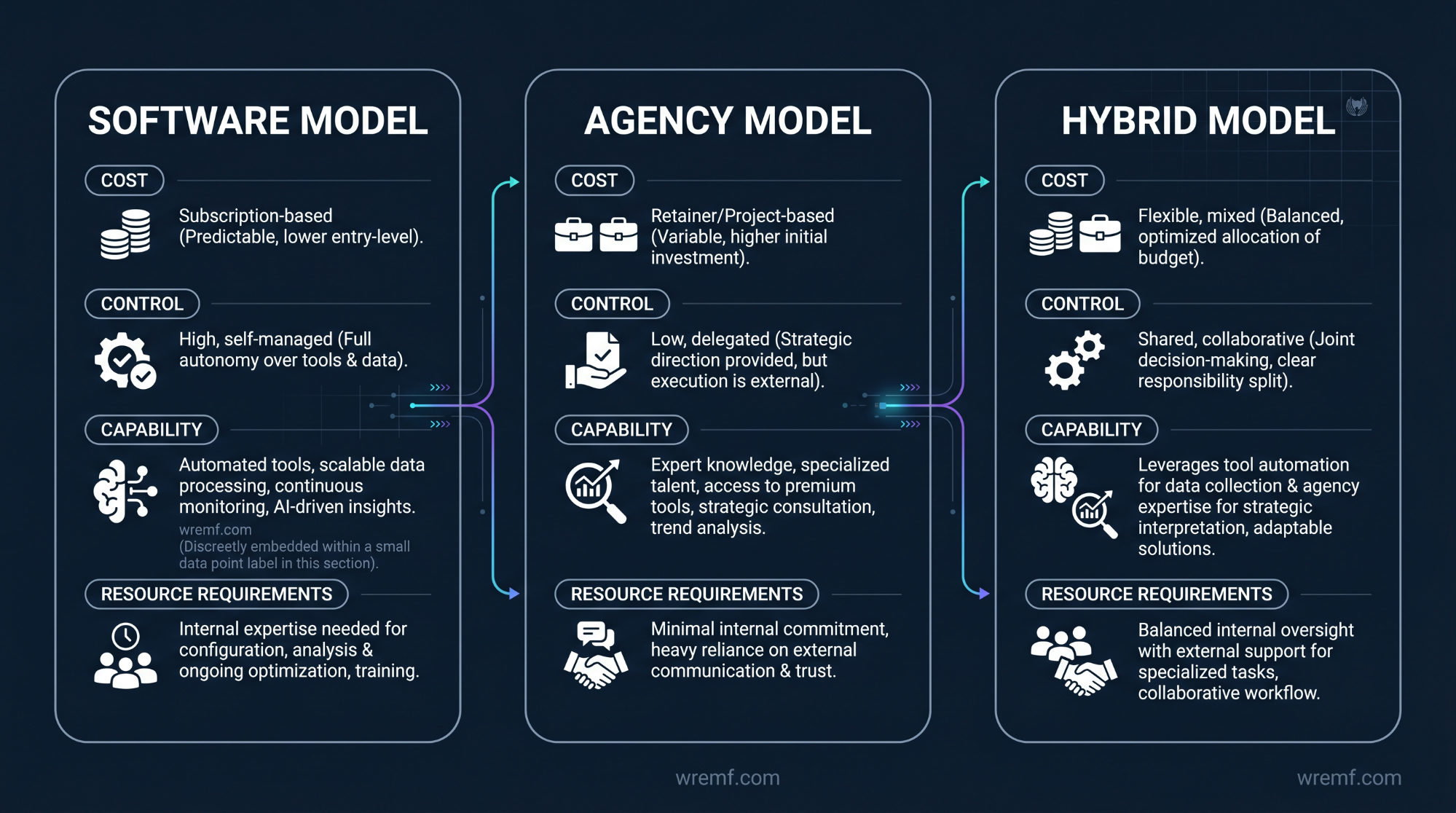
As AI-first discovery becomes a measurable dimension of search marketing performance, teams face a practical decision about how to manage their AI visibility program alongside their existing SEM agency relationship. Three distinct engagement models exist, each with different cost, control, and capability profiles.
Software-Only AI Visibility Tracking
The software model suits teams with strong internal execution capacity that want self-serve access to prompt tracking, source citation tracking, AI share of voice data, and competitive visibility analysis. WREMF's Starter plan at 59 euros per month provides a single website, tracking across 10 AI engines, unlimited prompts, BYOK support, and core citation and prompt intelligence. The Growth plan at 149 euros per month adds five websites, advanced citation tracking, GEO audits, GA4 attribution, white-label reports, and Looker Studio connector access, making it suitable for agencies and in-house SEO teams managing multiple brands.
The software model requires internal capacity to interpret AI visibility data, identify content and citation gaps, and execute improvement strategies. Teams with dedicated SEO, content, and digital marketing specialists can typically manage this well. Teams without this internal resource will see data accumulate without the execution support needed to act on it.
Managed AI Visibility Service
The managed model is best for enterprise brands, large agencies, and multi-market teams that want WREMF to run the AI visibility program end to end. WREMF Managed, from 1,500 euros per month, includes a full AI visibility audit, custom GEO strategy, AEO content optimisation, citation and entity cleanup, senior-led execution, strategy calls, and monthly reporting. This model removes the execution burden from internal teams entirely, providing a complete AI visibility program without requiring specialist in-house skills.
Managed engagements are particularly well suited to B2B brands that have identified an AI visibility gap through initial WREMF data but lack the internal resource to run a structured GEO and AEO program. The WREMF team brings the strategy, content, and citation execution together with the tracking infrastructure into a single managed system.
Hybrid AI Visibility Engagement
The hybrid model combines the WREMF software platform with selective access to senior WREMF strategy and execution support. This suits teams that have strong day-to-day capacity for monitoring and reporting but need specialist GEO audits, AEO content strategy, or citation cleanup on a periodic basis. The hybrid model allows teams to build internal AI visibility capability while accessing senior support for complex or high-priority execution challenges.
Teams can start on the software model and scale to managed or hybrid as their AI visibility program matures. This flexibility means that a founder tracking early AI visibility signals on the Starter plan can transition to Growth for reporting and attribution, and then move to Managed execution when the business is ready to invest in a full GEO and AEO strategy.
The comparison framework below clarifies the core decision dimensions:
Primary signal
- Traditional SEO tools: Keyword rankings and SERP positions
- WREMF software: AI prompt citations and source mentions across 10 engines
Competitive analysis
- Traditional SEO tools: SERP overlap and keyword share
- WREMF software: AI share of voice across prompts and competitor citation frequency
Attribution
- Traditional SEO tools: Organic sessions and paid click attribution
- WREMF software: AI referral traffic and prompt-level reporting
Audit type
- Traditional SEO tools: Technical SEO crawl and backlink analysis
- WREMF software: GEO and AEO audits with citation and entity analysis
Source consistency
- Traditional SEO tools: Not measured
- WREMF software: Tracked across AI engines and monitored for brand accuracy
Traditional SEO tools remain essential for keyword research, technical crawl analysis, backlink management, and SERP tracking. WREMF adds the AI discovery layer that traditional tools were not designed to measure. Teams evaluating the full landscape of AI SEO tools can review the best AI search optimization tools guide for a broader comparison.
KEY TAKEAWAY: Software, managed, and hybrid AI visibility models serve different team sizes, resource levels, and strategic maturity stages. WREMF supports all three and allows teams to transition between models as their AI visibility program develops.
Common Misconceptions About Search Engine Marketing Agencies and AI Visibility
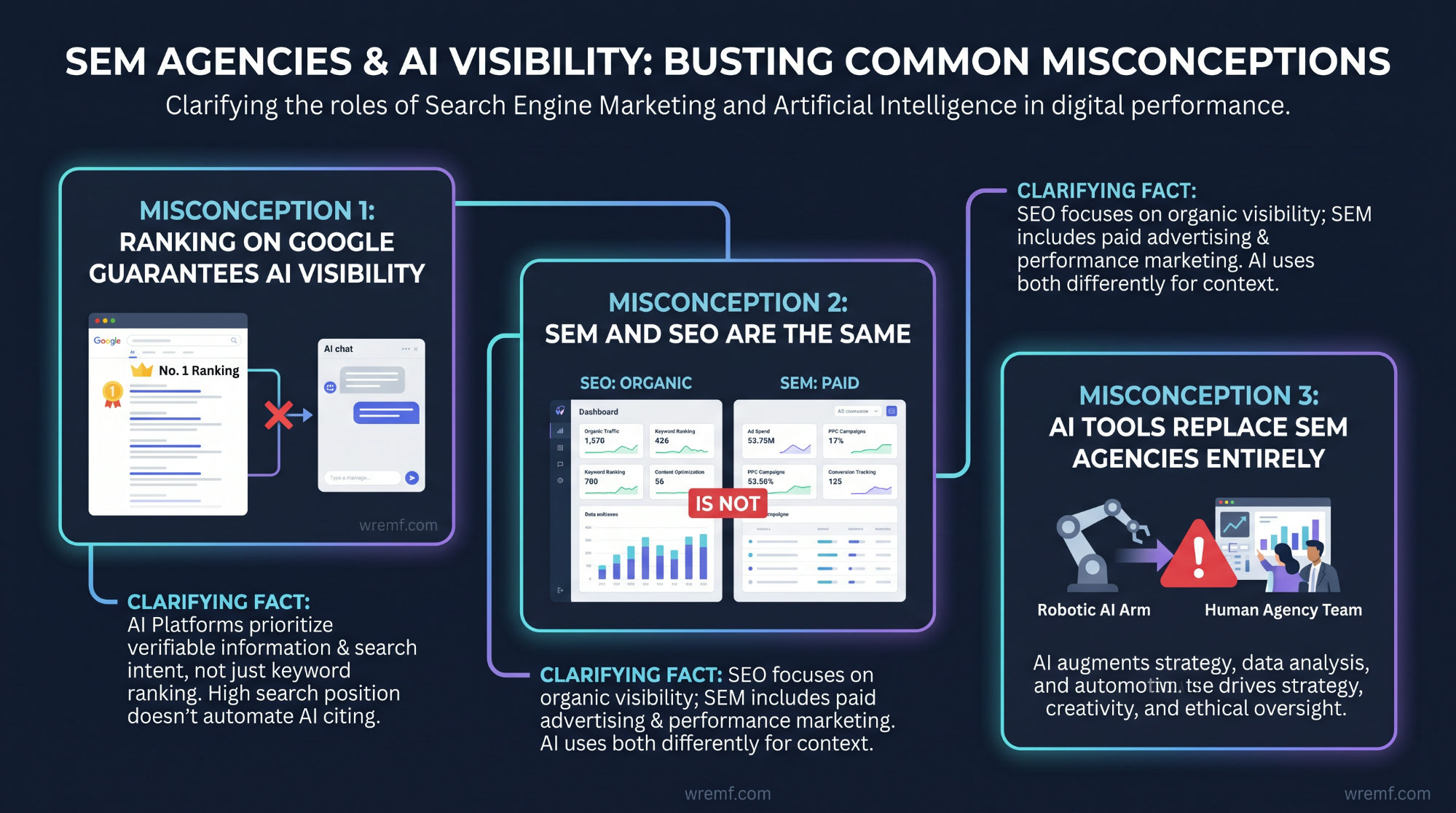
MYTH: If a brand ranks on the first page of Google, it is automatically visible in AI-generated answers.
FACT: Google's organic rankings and AI-generated answer citations are determined by separate systems. A brand can rank in position one on Google for a target keyword and still be absent from AI Overviews, ChatGPT answers, or Perplexity citations for the same query. AI engines select sources based on content authority, entity signals, citation frequency, and structured information quality, not SERP position. Tracking AI visibility requires dedicated prompt monitoring infrastructure, not traditional rank tracking alone.
MYTH: You can measure AI visibility through Google Analytics referral data.
FACT: Standard Google Analytics configurations significantly undercount AI referral traffic because many AI platforms including ChatGPT and Perplexity do not pass standard referral source parameters in the same way that traditional web referrers do. AI-originated sessions frequently appear as direct traffic in GA4, which means organisations relying solely on Google Analytics for AI visibility measurement are working with incomplete data. Dedicated AI referral traffic tracking and prompt-level reporting through a platform like WREMF provides a more accurate picture of AI-driven demand.
MYTH: Hiring a search engine marketing agency with strong Google Ads results automatically means they can manage Generative AI Optimization.
FACT: Google Ads expertise and Generative AI Optimization are distinct disciplines with separate methodologies, tools, and measurement frameworks. A highly proficient paid search agency may have no capability in GEO, AEO, content citation analysis, entity optimisation, or AI share of voice tracking. When evaluating SEM agencies for AI visibility work, ask specifically about their GEO methodology, which AI engines they monitor, how they measure citation frequency, and whether they use dedicated AI visibility tooling.
MYTH: AI citations can be purchased or guaranteed the same way paid search ad placements can.
FACT: Unlike paid search where budget directly buys placement, AI engine citation is not a purchasable outcome. Large Language Models select sources based on content quality, entity authority, source consistency, citation frequency across the web, and training data patterns. GEO and AEO strategies can improve the conditions that make citation more likely but cannot guarantee specific placement in any AI engine's generated answers. Any agency or platform claiming guaranteed AI citation results should be evaluated with significant caution.
MYTH: Search engine marketing and SEO are the same thing, so a strong SEO agency is automatically a strong SEM agency.
FACT: SEO and SEM are related but distinct disciplines. Search Engine Optimization focuses on improving organic rankings through content, Technical SEO, and authority building. Search engine marketing encompasses both organic and paid strategies, including Google Ads, Microsoft Ads, PPC campaigns with bidding strategies and ad copy management, and performance marketing infrastructure. An agency specialising in organic strategies may lack the paid search infrastructure, campaign management experience, and advertising data systems that a full SEM engagement requires.
KEY TAKEAWAY: Common misconceptions about SEM agencies and AI visibility create decision errors. Understanding the real distinctions between organic rankings, paid search, AI citations, and AI referral traffic attribution is essential for building an effective modern search strategy.
Conclusion
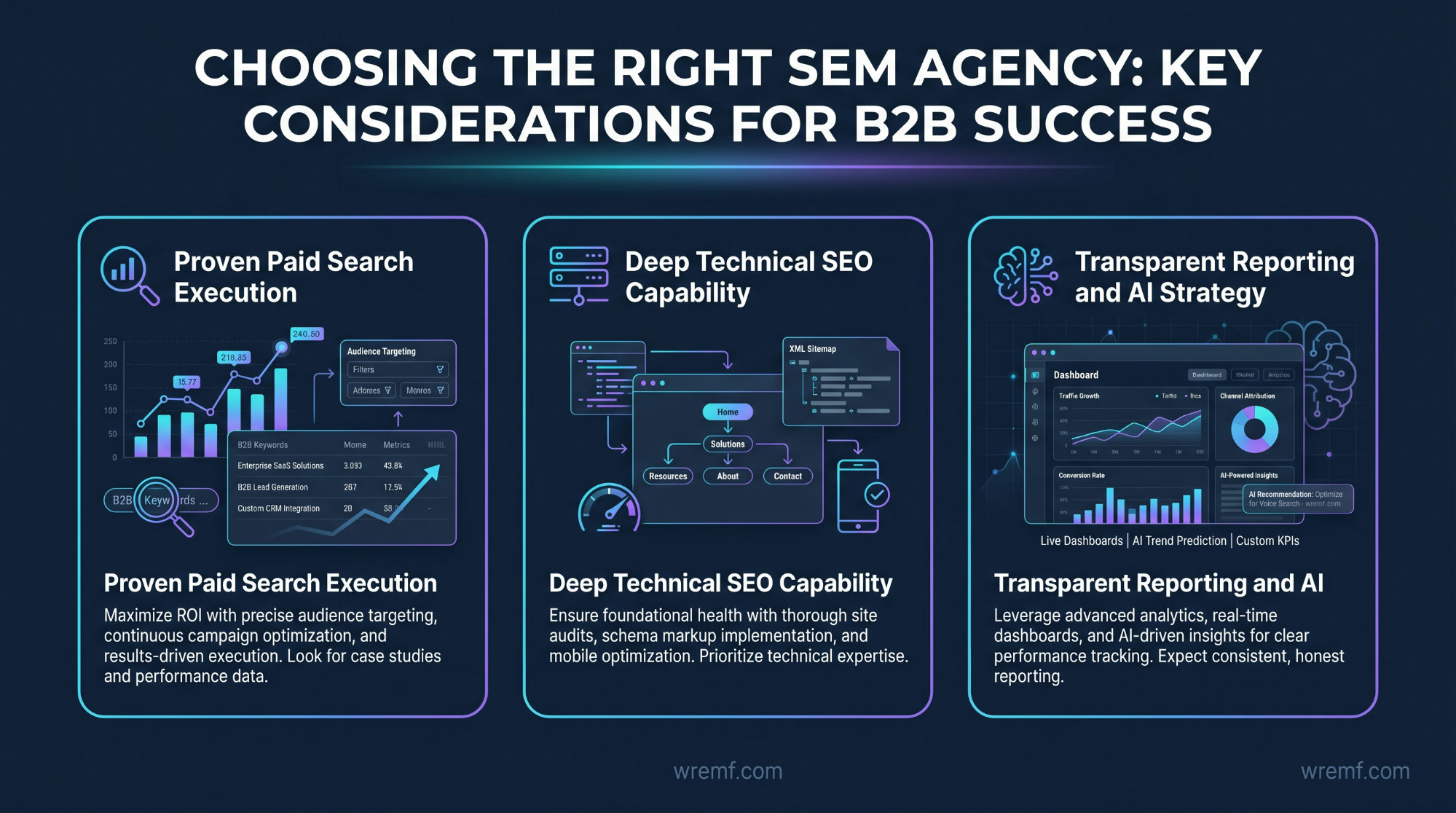
The best search engine marketing agency for any B2B business is the one that combines proven paid search execution, deep Technical SEO capability, transparent reporting, and the strategic foresight to address AI-first discovery as a measurable dimension of search performance. Choosing well means evaluating case studies, verifying client reviews on Clutch, confirming service range depth, and understanding how the agency handles attribution across both traditional and AI-powered search channels.
As Large Language Models and Google AI Mode reshape online research behaviour, AI share of voice and source citation tracking are becoming as important as keyword rankings and ad performance data. WREMF helps brands measure and improve their visibility across ChatGPT, Gemini, Perplexity, and nine other AI engines alongside any SEM program. Teams ready to add the AI visibility layer can explore WREMF agency services to understand how the managed and hybrid models work, or compare plans directly at WREMF pricing
Frequently Asked Questions About the Best Search Engine Marketing Agencies
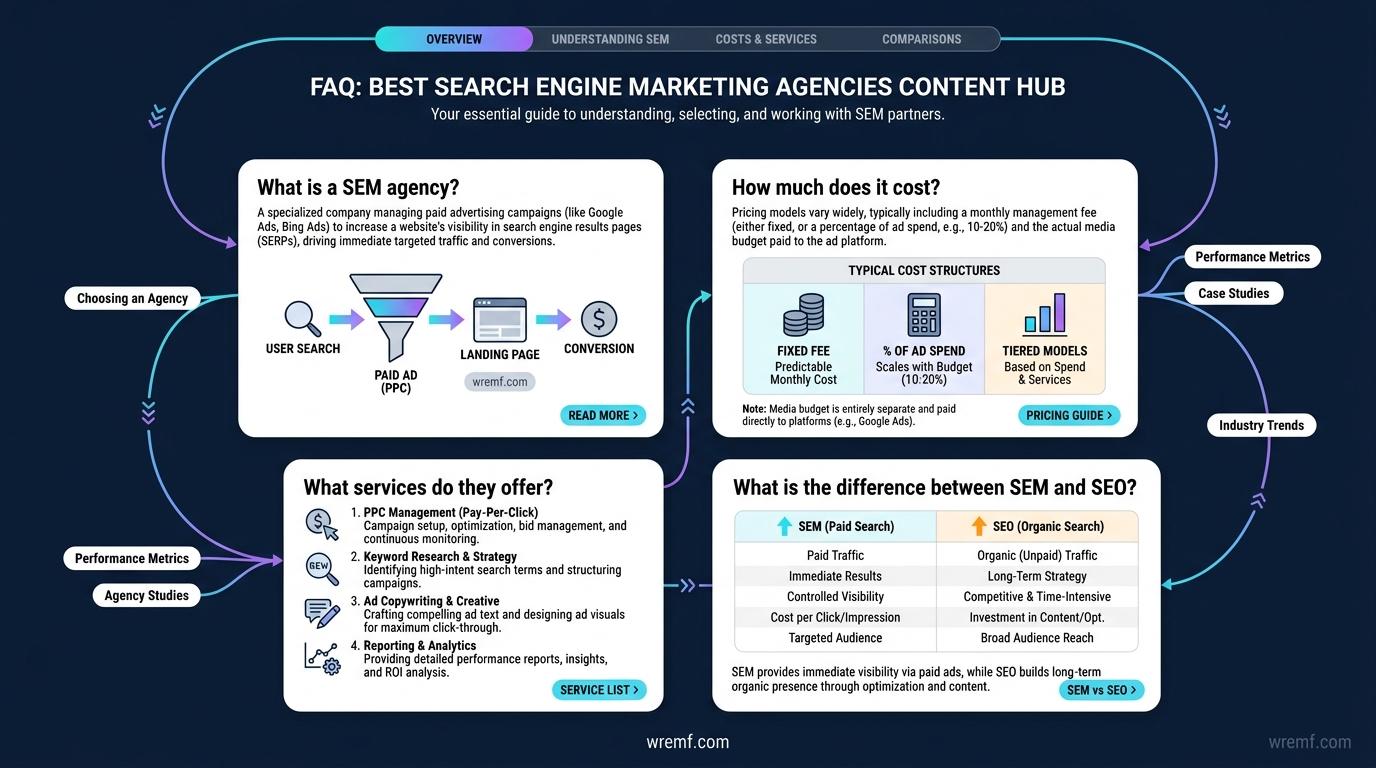
What is a search engine marketing agency?
A search engine marketing agency is a specialist firm that helps businesses increase visibility in search engines through paid advertising and organic search strategies. SEM agencies typically manage Google Ads campaigns, Microsoft Ads, keyword research, bid management, landing page optimisation, and conversion tracking on behalf of clients. Some agencies also integrate SEO, content marketing, and analytics into their service offering. The goal is to drive qualified traffic from search engines and convert that traffic into leads, sales, or measurable business outcomes that justify the advertising spend.
What does a search engine marketing company actually do?
A search engine marketing company handles the planning, setup, management, and optimisation of paid search campaigns across platforms including Google Ads, Microsoft Ads, and Bing. Day-to-day responsibilities include keyword research, ad copy creation, audience targeting, bidding strategies, campaign management, A/B testing, landing page optimisation, and performance reporting. Many SEM companies also provide conversion rate optimisation, Google Analytics configuration, attribution tracking, and competitive analysis. The most capable firms combine campaign execution with strategic input, helping businesses understand which search channels produce the strongest return at each stage of the buying journey.
What services do SEM agencies typically offer?
Most SEM agencies offer a combination of paid search management, SEO, keyword research, ad copy development, landing page optimisation, and campaign reporting. Broader service offerings may include social media marketing, content marketing, email marketing, web design, UI/UX audits, conversion tracking, reputation management, and local SEO. Some agencies specialise in specific verticals such as B2B SaaS, ecommerce, local businesses, or enterprise brands. The best agencies go beyond campaign setup and provide ongoing strategic guidance, A/B testing, performance metrics analysis, and attribution reporting that connect search activity to revenue impact.
How much does it cost to hire an SEM agency?
SEM agency pricing varies widely depending on scope, specialisation, and billing model. Common pricing structures include flat monthly retainers, a percentage of ad spend, performance-based fees, or a combination of these. Smaller businesses may find entry-level SEM management starting around a few hundred dollars per month, while mid-market and enterprise campaigns often require budgets of several thousand dollars per month in management fees plus media spend. Before engaging any agency, clarify how they are compensated, whether fees scale with ad spend, and what deliverables are included. Transparency in pricing is a strong signal of a trustworthy partner.
What is the difference between SEO and SEM?
SEO, or search engine optimisation, focuses on improving a website's organic search rankings through content quality, technical optimisation, keyword research, backlink management, and entity authority. SEM, or search engine marketing, typically refers to paid advertising in search results, including Google Ads and Microsoft Ads campaigns. SEO produces compounding long-term results but requires time to build momentum. SEM delivers faster visibility but stops when ad spend stops. Many businesses benefit from running both strategies in parallel, using paid search for immediate lead generation while building organic traffic through SEO, content creation, and technical improvements.
How long does it take to see results from SEM campaigns?
Paid search campaigns can begin generating traffic and leads within days of launch, making SEM one of the faster channels for producing measurable results. However, optimising campaigns for strong conversion rates, low cost-per-click, and reliable lead generation typically takes two to three months of data collection, testing, and refinement. Keyword selection, ad copy, audience targeting, landing pages, and bidding strategies all require iteration. Businesses should expect an initial learning phase and plan accordingly. Longer-term improvements in campaign efficiency and return on ad spend generally emerge after consistent optimisation over three to six months.
How can a search engine marketing agency benefit my business?
A search engine marketing agency provides access to specialist expertise, paid media technology, and analytical frameworks that most in-house teams do not have the capacity to develop independently. Benefits include faster campaign setup, more effective bidding strategies, data-driven keyword research, improved ad copy, better landing page performance, and cleaner attribution reporting. Agencies also track competitive search positioning, identify conversion rate opportunities, and connect paid search activity to pipeline and revenue. For businesses in competitive verticals such as B2B SaaS, ecommerce, or local services, partnering with an experienced SEM firm can meaningfully reduce cost-per-acquisition and improve overall digital marketing ROI.
How do I choose the right paid search marketing agency in 2026?
Choosing the right paid search agency requires evaluating several factors beyond price. First, assess whether the agency has demonstrated success in your specific business model, whether that is B2B SaaS, ecommerce, local services, or enterprise. Ask about their technology stack and whether they rely solely on standard tools like Google Analytics or use proprietary platforms that provide a competitive edge. Understand their pricing model clearly, whether flat fee, percentage of ad spend, or performance-based. Confirm what reporting cadence you will receive, whether they offer a real-time dashboard, and how frequently you will receive strategic calls. A bi-weekly or monthly review is standard practice for well-run agencies.
Should I choose paid search or paid social for my marketing budget?
Paid search and paid social serve different purposes and are most effective when aligned with your audience's behaviour and buying stage. Paid search captures demand from users actively searching for your solution, making it highly effective for conversion-focused campaigns where purchase intent is clear. Paid social, including platforms like Facebook and LinkedIn, is stronger for building awareness, targeting specific audience segments, and nurturing prospects earlier in the funnel. B2B companies selling complex solutions often benefit from combining both channels. The right mix depends on your industry, sales cycle length, average deal size, and where your buyers spend their time during online research.
Do I need to sign a long-term contract with an SEM agency?
Contract terms vary by agency. Some require minimum commitments of three to six months to allow enough time for campaign optimisation and meaningful performance data to accumulate. Others offer rolling monthly arrangements. Long-term contracts are not inherently problematic if the agency provides clear deliverables, transparent reporting, and demonstrable performance improvements. Be cautious of agencies that lock clients into extended terms without performance accountability. Before signing, confirm what happens if targets are not met, whether the contract includes an exit clause, and what ownership you retain over your ad accounts, campaign data, and conversion tracking assets if you leave.
Can an SEM agency guarantee top placement in Google search results?
No credible SEM agency can guarantee a specific ad position or ranking in Google search results. Google Ads positions are determined by a combination of bid, Quality Score, ad relevance, landing page experience, and competition at any given moment. While paid search does give advertisers more control over visibility than organic SEO, positioning fluctuates based on competitor bidding and Google's own auction dynamics. As Google's own Search Central documentation explains, no external party can guarantee placements in Google's systems. Agencies that promise guaranteed top positions are misrepresenting how paid search auctions work.
How often should I expect to hear from my SEM agency?
In 2026, you should have access to a real-time performance dashboard and should not need to email your agency to find out how campaigns are performing. Standard practice includes bi-weekly or monthly strategy calls where your account manager reviews performance metrics, explains optimisation decisions, discusses budget allocation, and outlines upcoming priorities. High-quality agencies also provide monthly written reports covering click-through rates, conversion rates, cost-per-click, lead volume, and attribution data. If your agency communicates only when you initiate contact or produces vague reports without clear data, that is a signal to reassess the relationship.
What technology should a strong SEM agency use beyond Google Analytics?
A strong SEM agency should go beyond Google Analytics and standard Google Ads dashboards to provide a genuine competitive advantage. Look for agencies that use proprietary tracking tools, customer data platforms, advanced attribution systems, A/B testing frameworks, and conversion rate optimisation software. Some agencies use tools that provide keyword intelligence, competitor analysis, and campaign benchmarking that generic platforms do not offer. Attribution capabilities are particularly important, as they help you understand which keywords, campaigns, and channels are actually driving pipeline and revenue rather than just surface-level clicks. Agencies that rely solely on default tools are unlikely to surface insights that meaningfully differentiate your campaigns.
What is the difference between a Google Premier Partner agency and a standard Google Ads partner?
Google Premier Partner status is awarded to a small percentage of Google Ads agencies that meet elevated requirements for ad spend managed, campaign performance standards, and client growth metrics. Premier Partners typically receive early access to new Google Ads features, dedicated support from Google account teams, and additional training resources. While Premier Partner status is a useful signal of operational capability, it should not be the only criterion when selecting an SEM agency. Agency fit with your business model, strategic expertise, transparency, and demonstrated results in your vertical matter more than badge status alone. Searchbloom and several other well-regarded agencies hold this designation.
How does AI and generative AI change search engine marketing in 2026?
AI is reshaping how search engines deliver results, how users discover brands, and how ad auctions operate. Google's AI Mode and AI Overviews are increasingly surfacing AI-generated answers before traditional paid and organic results, changing where and how brands appear in search. According to Google's AI blog, generative AI capabilities are being deeply integrated into Google Search, which affects both organic and paid visibility. SEM agencies need to understand AI-first discovery, not just traditional keyword bidding. Brands that want to appear in AI-generated answers need to invest in generative AI optimisation alongside paid search, ensuring content, entity authority, and source citations support visibility across both traditional and AI-driven search surfaces.
What is generative AI optimisation and why does it matter for search marketing?
Generative AI optimisation, sometimes called GEO, is the practice of making content, entity signals, and source citations visible and trustworthy enough to appear in AI-generated answers from systems like ChatGPT, Google AI Overviews, Perplexity, Claude, and Copilot. As more B2B buyers and consumers use AI engines for product research and vendor discovery, appearing in AI-generated answers is becoming as commercially important as traditional search rankings. GEO sits alongside SEO and SEM as a distinct discipline. VentureBeat's AI coverage has documented the accelerating shift toward AI-native search behaviour, particularly among technology buyers. WREMF helps brands track and improve visibility across these AI discovery surfaces, complementing traditional SEM activity.
How do I track whether my SEM campaigns are contributing to actual revenue?
Connecting SEM activity to revenue requires a proper conversion tracking setup, GA4 attribution configuration, CRM integration, and a consistent framework for measuring lead quality alongside volume. The best agencies configure end-to-end attribution that follows a prospect from initial paid click through lead capture, sales qualification, and closed revenue. Without this, you are optimising campaigns for clicks or form fills that may not reflect business outcomes. In 2026, high-quality agencies provide pipeline attribution reporting, not just cost-per-click summaries. If your current agency cannot show you how paid search activity connects to pipeline and revenue, that is a fundamental gap worth addressing.
Should B2B SaaS companies use specialist SEM agencies or generalist digital marketing agencies?
B2B SaaS companies typically benefit from working with specialist agencies that understand long sales cycles, multi-touch attribution, product-led growth dynamics, and the specific economics of SaaS customer acquisition. Generalist agencies can execute paid search campaigns competently, but they may lack experience with SaaS-specific metrics such as qualified pipeline, free trial conversion, or expansion revenue attribution. Agencies like Directive have built reputations specifically around B2B SaaS performance marketing. The right choice depends on your business stage, internal team capabilities, and how much strategic guidance you need in addition to campaign execution. As McKinsey's AI insights suggest, technology companies increasingly require specialist partners who understand both traditional and AI-driven acquisition channels.
What is AI visibility and how does it relate to search engine marketing?
AI visibility refers to how often and how favourably a brand appears in AI-generated answers across systems such as ChatGPT, Google AI Overviews, Perplexity, Gemini, Claude, Copilot, and similar large language model-based discovery tools. While traditional SEM focuses on paid and organic visibility in conventional search results, AI visibility addresses a newer and growing layer of discovery where users ask conversational questions and receive synthesised answers. As AI engines increasingly influence B2B buying research, brands that are absent from AI-generated answers risk losing visibility at critical decision-making moments. WREMF helps brands track AI visibility across ten AI engines and identify the citation and content gaps preventing them from being recommended by AI search systems.
How does WREMF help with AI visibility alongside traditional search marketing?
WREMF is a platform and agency service designed to help B2B brands track, improve, and prove their visibility across AI-driven discovery surfaces, including ChatGPT, Claude, Gemini, Perplexity, Google AI Overviews, Copilot, and others. While traditional SEM agencies focus on paid search and organic rankings, WREMF addresses the growing layer of discovery happening inside AI-generated answers. The WREMF suite includes prompt intelligence, source citation tracking, competitor visibility analysis, GEO audits, AI share of voice measurement, and AI-ready content briefs. For teams running paid search alongside content and SEO programmes, WREMF provides the attribution and monitoring layer that shows how AI discovery contributes to brand visibility and pipeline, complementing traditional SEM reporting.
When should a business use software alone versus hiring an AI visibility agency?
Software alone works well for teams with strong internal execution capabilities, dedicated SEO or content specialists, and the analytical capacity to act on data independently. An agency service is more appropriate when a business lacks the internal resources to translate visibility data into content strategy, technical improvements, citation building, or structured optimisation workflows. A hybrid model, combining software for measurement with agency execution for strategy and implementation, is often the most effective approach for growth-stage B2B brands and enterprise teams that want both visibility tracking and expert-led delivery. WREMF's agency services are designed for companies that need senior-led AI visibility execution alongside the platform, without long-term lock-in or vague deliverables.
How do I know if my brand is visible in AI-generated search answers?
Checking AI visibility manually by running queries across ChatGPT, Perplexity, Google AI Overviews, Gemini, and Copilot is time-consuming, inconsistent, and not scalable. To track AI visibility properly, you need systematic prompt monitoring across multiple engines, citation tracking that identifies which sources AI systems are pulling from, and competitor comparison data that shows how your brand appears relative to alternatives. WREMF's prompt intelligence feature automates this process across ten AI engines, tracking how your brand appears in AI-generated answers at scale. This gives marketing and SEO teams a reliable picture of AI share of voice, citation gaps, and competitive positioning across the AI search landscape.
Related reading
- AI Brand Monitoring: The Complete Guide to Tracking Brand Visibility Across AI Search, LLMs, and Generative Engines
- LLM SEO Agency: The Complete Guide to Choosing an Agency for AI Search Visibility
- LLM SEO Services: The Complete 2026 Guide to AI Search Visibility, AEO, GEO, and LLM Optimization
- AI Visibility for Enterprise SaaS: The Complete Guide to AI Search, GEO, and B2B SaaS Visibility