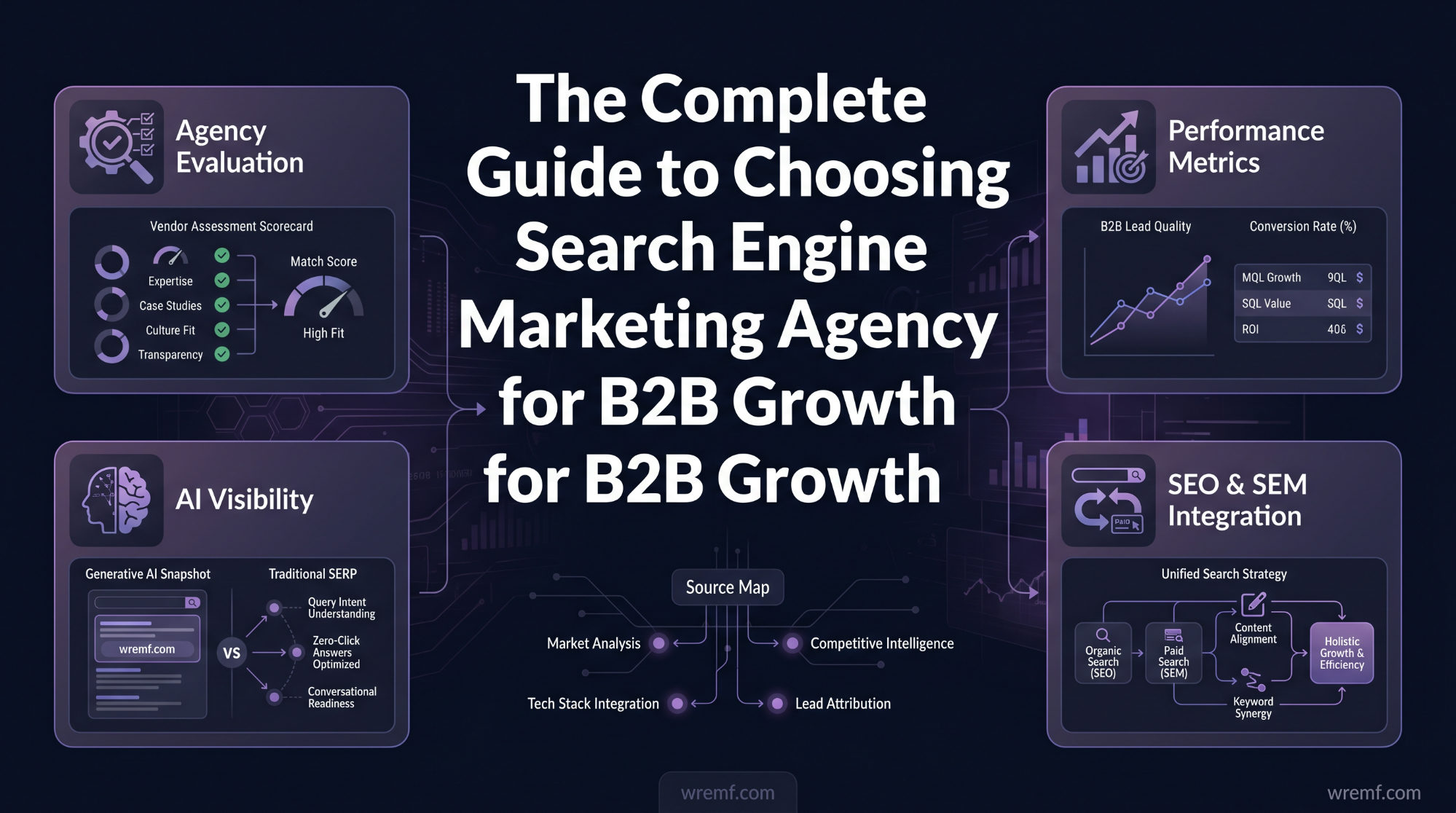
The Complete Guide to Choosing a Search Engine Marketing Agency for B2B Growth
Discover how to choose the right SEM agency for B2B growth, including evaluating services, AI strategies, and result measurement for improved visibility.
By WREMF Team · 2026-09-15
A search engine marketing agency specializes in increasing a brand's visibility through paid search, SEO, and digital marketing. They manage Google Ads, keyword research, bid strategy, and content marketing. Evaluating the right agency involves aligning goals, budget, and industry needs like organic search or paid media. AI search, including ChatGPT and Google AI Overviews, is reshaping SEM, necessitating B2B brands to track AI visibility for improved search performance.
Key takeaways
- Search engine marketing combines paid search and SEO for enhanced visibility and conversions.
- AI search engines like ChatGPT and Google AI Overviews are changing brand discovery processes.
- SEM agencies improve visibility across traditional and AI-powered search surfaces.
- Choosing an SEM agency requires assessing goals, analytical capabilities, and AI search strategies.
- Measuring SEM success involves tracking conversion rates, ROI, and AI citation metrics.
The Complete Guide to Choosing a Search Engine Marketing Agency for B2B Growth
A search engine marketing agency is a specialist firm that helps businesses generate targeted traffic, leads, and revenue through paid search, SEO, and integrated digital marketing programs. These agencies combine technical expertise with strategic execution to improve how brands appear across search engines, and increasingly, across AI-powered discovery surfaces. This guide is written for B2B founders, marketing leaders, in-house SEO teams, and agency buyers evaluating their options. It covers what SEM agencies do, how to evaluate them, how to measure results, and how AI search is reshaping the discipline. It also explains how platforms like WREMF add the AI visibility layer that traditional search marketing tools were not built to track, helping brands appear not just in Google results but in the AI answers buyers trust. If your growth depends on search, this guide is worth reading in full.
QUICK ANSWER:
A search engine marketing agency manages paid search, SEO, and related digital marketing services to drive traffic, leads, and conversions for businesses. SEM agencies handle keyword strategy, Google Ads, content marketing, analytics, and performance tracking. Choosing the right agency depends on your goals, budget, industry, and whether you need organic search, paid media, or a combination of both.
KEY TAKEAWAYS:
- Search engine marketing combines paid search and organic SEO to increase visibility, traffic, and conversions across search engines.
- SEM agencies manage Google Ads, keyword research, bid strategy, content, analytics, and performance reporting for client businesses.
- AI search engines including ChatGPT, Perplexity, Gemini, and Google AI Overviews are changing how buyers discover brands, making AI visibility a new growth requirement alongside traditional SEM.
- Measuring SEM success requires tracking conversion rate, cost per lead, ROI, and organic traffic alongside AI citations and source mentions for full search visibility.
- WREMF helps B2B brands track how AI engines mention, cite, compare, and recommend their brand across 10 AI platforms, extending the value of SEM investment into the AI discovery layer.
- Choosing between a software-only, managed, or hybrid AI visibility approach depends on team capacity, budget, and the maturity of your current search marketing program.
What Is Search Engine Marketing and Why It Matters for B2B Brands
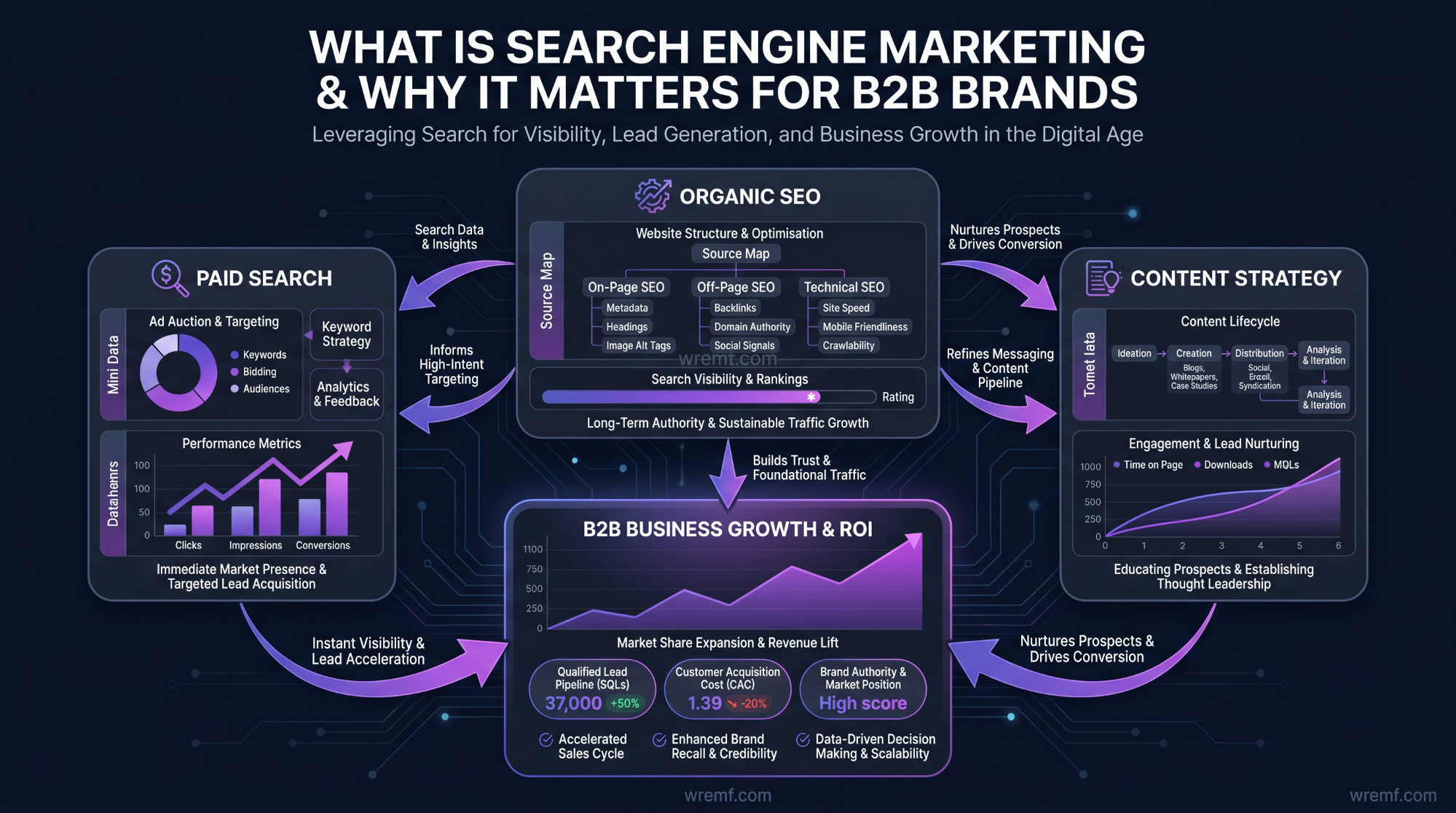
Search engine marketing is the discipline of increasing a brand's visibility across search engines through paid search advertising, organic SEO, and data-driven content strategies. For B2B brands, SEM is one of the most direct paths to qualified lead generation and measurable revenue growth.
SEM sits at the intersection of paid media and organic search. Paid search, commonly executed through Google Ads and Microsoft Ads, places a brand directly in front of buyers who are actively searching for solutions. Organic search, driven by SEO, content marketing, and backlink portfolio development, builds sustained visibility over time. Together, they form the foundation of a complete search engine marketing program.
The discipline matters because search intent is commercial intent. When a decision-maker types a query into Google Search, they are often mid-evaluation, comparing vendors, or ready to act. A well-executed SEM campaign captures that demand at precisely the right moment, connecting the brand to the buyer before a competitor does.
According to Google's AI Overviews documentation search behaviour is evolving rapidly, with AI-generated answers increasingly appearing at the top of results pages before a user sees a single organic link. This shift is compressing organic click-through rates and raising the stakes for brands to be visible not just in traditional results but inside the AI answers that now shape buying decisions.
Search engine marketing has also expanded beyond Google. YouTube is the second-most-visited site after Google with nearly 3 billion monthly active users, making video-driven search a legitimate SEM channel for B2B brands with content production capacity. Amazon has its own search advertising ecosystem that matters for eCommerce brands. And AI platforms like ChatGPT, Perplexity, Gemini, and Claude are becoming primary research tools for buyers evaluating software, services, and vendors.
A strong SEM agency understands that search visibility now extends across multiple surfaces. Agencies that treat SEM as a Google-only discipline are leaving meaningful demand on the table, especially as AI search becomes a primary discovery channel for B2B buyers.
The case for investing in SEM is reinforced by the scale of search activity. Google processes over 8.5 billion searches daily, accounting for approximately 78% of all online search behaviour. Even capturing a fraction of that demand through well-targeted paid search and optimised organic content can produce significant lead generation and revenue growth for B2B businesses.
KEY TAKEAWAY: Search engine marketing combines paid and organic strategies to capture buyer intent at scale, and its scope now includes AI search surfaces where B2B buyers increasingly research and evaluate vendors.
What a Search Engine Marketing Agency Actually Does
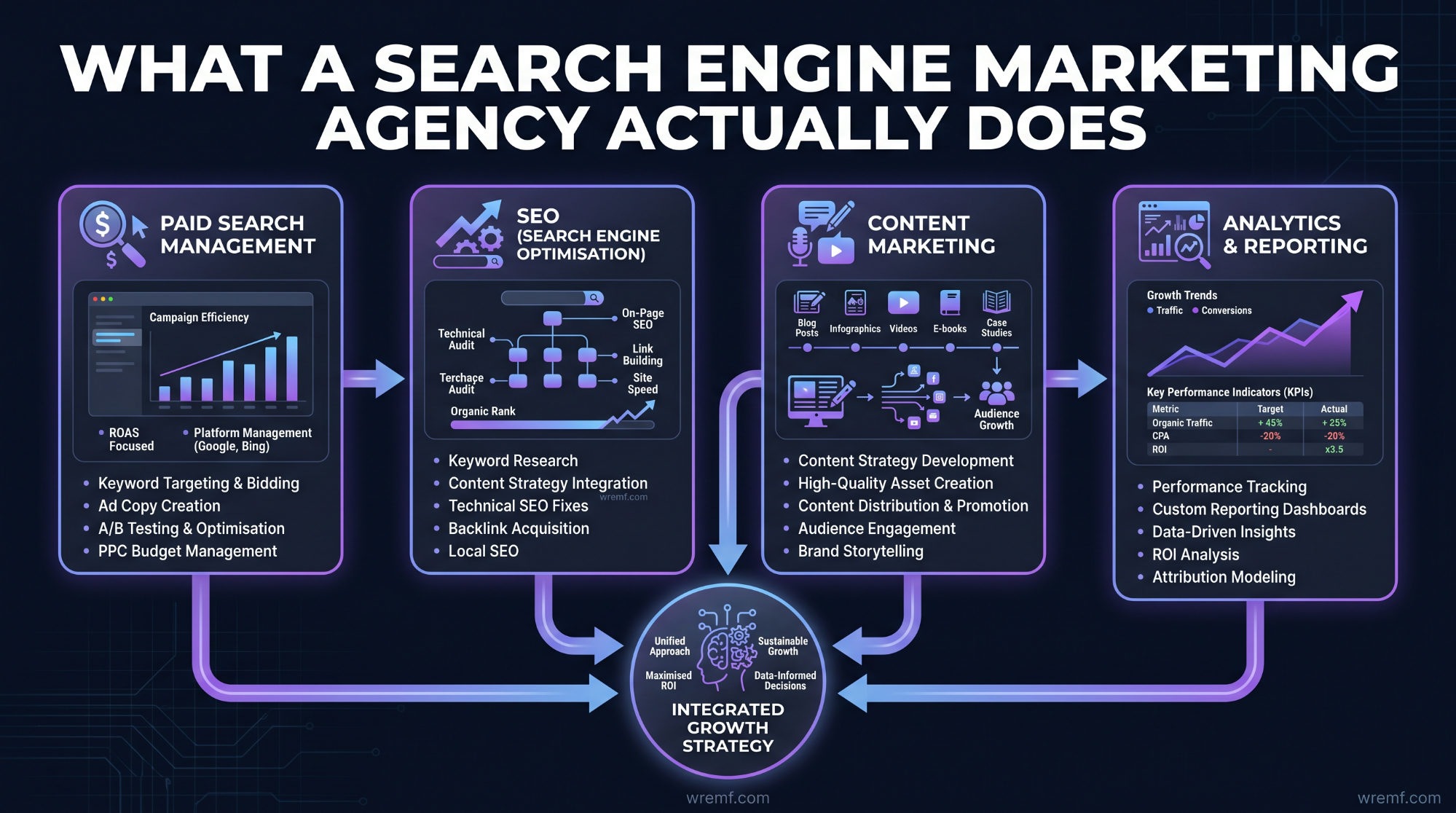
A search engine marketing agency delivers a combination of paid search management, SEO, content strategy, analytics, and performance optimisation to help businesses grow their search visibility and convert traffic into revenue. Understanding what a credible SEM agency covers helps buyers evaluate whether an agency is a genuine strategic partner or a narrow execution vendor.
The core services delivered by a search engine marketing agency typically include the following areas.
Paid Search Management
Paid search is the execution and optimisation of Google Ads and other PPC campaigns. This includes keyword research, ad copy creation, bid strategy, audience targeting, landing page copy optimisation, and conversion rate optimisation. A strong SEM agency does not just launch campaigns. It monitors performance, adjusts bids, eliminates wasted spend, and improves ROI continuously. Clients report meaningful improvements in conversion rate when agencies apply disciplined bid management combined with audience segmentation and A/B testing.
Search Engine Optimisation
Organic search remains the highest-value channel for sustained B2B traffic. SEO services from an SEM agency typically include technical audits, on-page optimisation, content marketing, internal linking, and backlink portfolio development. The goal is improving organic traffic by earning rankings for commercially relevant keywords without paying for every click.
Content Marketing and Content Creation
Content sits at the core of both organic search and AI visibility. SEM agencies that invest in quality content creation produce assets that rank in Google, earn backlinks, drive social media engagement, and increasingly get cited in AI-generated answers. Content marketing for B2B brands typically includes blog production, landing page copy, pillar pages, case studies, and Content Optimization for existing pages.
Analytics and Reporting
Data-driven decision-making separates good SEM agencies from average ones. Agencies should provide transparent analytics and reporting that connects spend to outcomes. This means tracking clicks, conversion rate, cost per lead, ROI, organic traffic growth, and search engine visibility. Best-in-class agencies use Google Analytics 4 and Google Search Console to build attribution models that show which channels and campaigns produce the most qualified leads.
Web Design and User Experience
Many SEM agencies offer web design and web development services because conversion rate optimisation depends on the quality of the page a buyer lands on. A perfectly targeted Google Ads campaign will underperform if the website design creates friction, loads slowly, or fails to communicate the brand's value proposition clearly. User Experience is a direct performance lever.
Social Media Marketing
Social Media Marketing is a supporting channel in most SEM programs. Paid social amplifies content, retargets search visitors, and builds awareness that warms up future search demand. Agencies that integrate search and Social Media Marketing tend to produce more consistent pipeline than those managing each channel in isolation.
Lead Generation and Conversion Strategy
The ultimate goal of search engine marketing is Lead Generation and conversion. Agencies that focus on measurable results typically build conversion funnels that guide buyers from initial search query through to a qualified lead or purchase. This includes landing page design, email marketing sequences, and retargeting campaigns that recapture buyers who did not convert on first visit.
AI Search Visibility
The most forward-thinking search engine marketing agencies now address AI search as a distinct channel. AI search visibility refers to how often a brand appears in AI-generated answers from ChatGPT, Perplexity, Gemini, Claude, Google AI Overviews, and other platforms. As research covered in McKinsey's AI insights confirms, AI adoption is changing how buyers research products and services, making it critical for brands to appear in AI answers alongside traditional search results. WREMF specialises in tracking and improving this AI visibility layer alongside traditional SEM execution.
KEY TAKEAWAY: A credible search engine marketing agency covers paid search, SEO, content, analytics, web design, and increasingly AI search visibility, connecting all channels to measurable lead generation and revenue outcomes.
The Relationship Between SEO, AEO, GEO, and Modern Search Engine Marketing
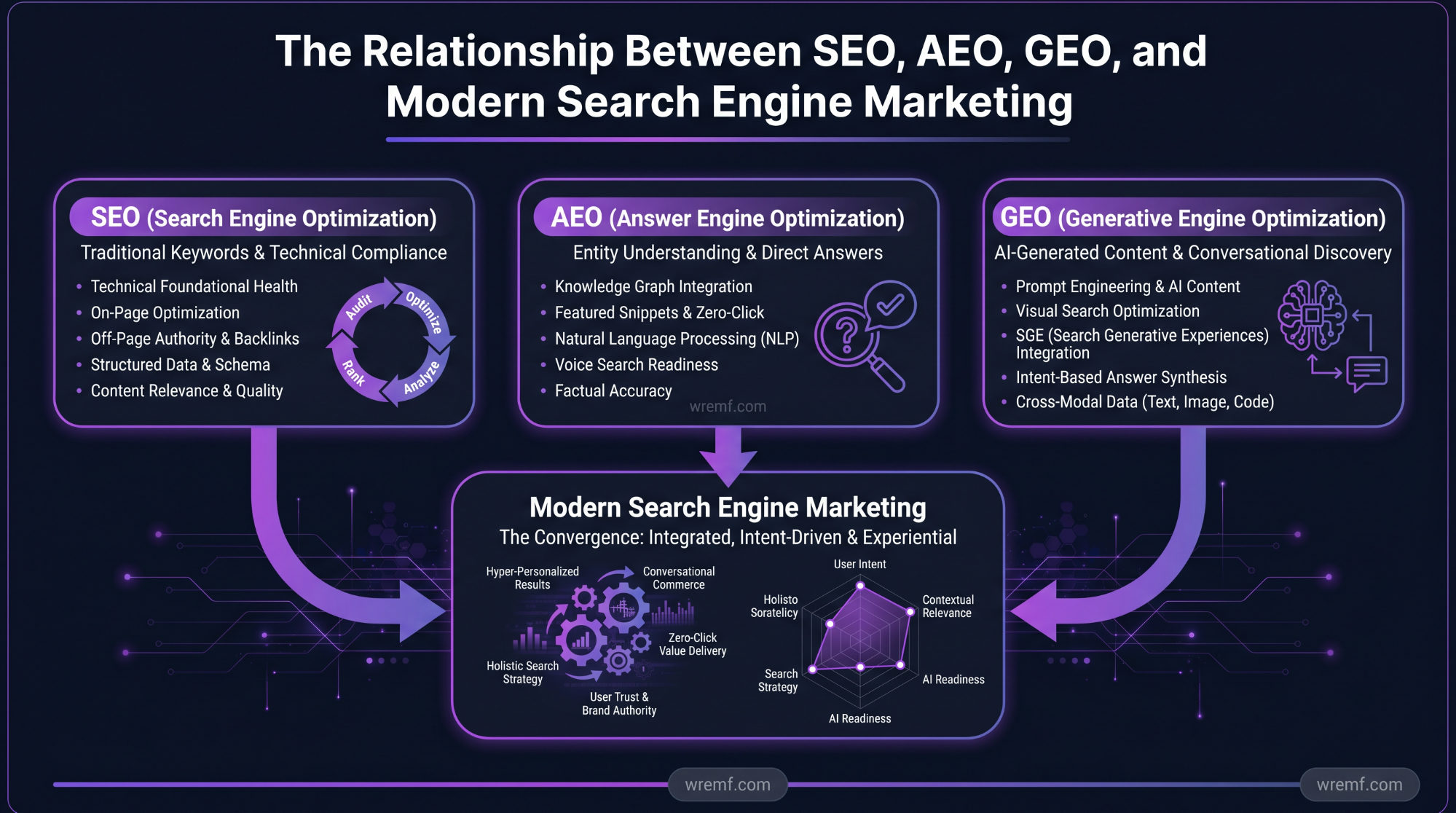
SEO, AEO, and GEO are three distinct but overlapping disciplines that together define what modern search engine marketing looks like in an AI-first environment. Understanding the relationship between them helps B2B buyers evaluate whether their SEM agency is positioned for the future of search.
SEO, or search engine optimisation, focuses on earning organic search visibility in traditional search engine results pages. It involves keyword research, on-page content optimisation, technical website health, backlink portfolio building, and Google Search Console monitoring.
Answer Engine Optimisation, or AEO, is the practice of structuring content and authority signals so that AI answer engines such as ChatGPT, Perplexity, Claude, and Google AI Overviews cite and recommend a brand in response to relevant buyer prompts. AEO requires content that directly answers specific questions, structured data, entity consistency, and source credibility signals that AI engines evaluate when selecting which sources to surface. Teams exploring this discipline in depth will find the answer engine optimisation guide | https://wremf.com/blog/answer-engine-optimization-the-complete-guide-to-aeo-ai-search-visibility-and-answer-first-content useful for understanding the foundational strategy.
Generative Engine Optimisation, or GEO, is the broader practice of optimising how a brand appears across all generative AI surfaces, including Gemini, Copilot, DeepSeek, Grok, Meta AI, and Mistral. GEO extends beyond content structure to include source citation patterns, entity authority, prompt-level tracking, and AI share of voice analysis. Brands that want a full understanding of GEO strategy alongside AEO can explore the generative AI optimization services guide as a complementary resource.
The relationship between these three disciplines is sequential. A strong SEO foundation supports AEO by building the technical infrastructure, content depth, and authority signals that AI engines evaluate. GEO then extends that authority across the broader AI search landscape, tracking source consistency and ensuring the brand appears reliably across different AI platforms and prompt types.
For a B2B SaaS company, the practical implication is this: a search engine marketing agency that only manages Google Ads and organic SEO is optimising for yesterday's search landscape. Modern SEM requires understanding how buyers use AI to research vendors before ever visiting a website. Over 100 million people search with AI every day, and this behaviour is directly reshaping the B2B buyer journey.
Primary signal comparison across disciplines:
Traditional SEM focus
- Paid search: Cost per click, conversion rate, Google Ads spend efficiency
- Organic SEO: Keyword rankings, organic traffic, backlinks
AEO and GEO focus
- AI citations: Whether the brand is mentioned in AI-generated answers
- Source consistency: Whether AI engines cite the brand reliably across different prompts and platforms
- AI share of voice: How often the brand appears relative to competitors in AI answers
A search engine marketing agency that integrates SEO with AEO and GEO strategy is positioned to help B2B brands capture demand across both traditional and AI-powered search surfaces. This is the emerging standard for performance marketing in a search landscape that now includes AI as a primary buyer research channel.
KEY TAKEAWAY: SEO, AEO, and GEO are complementary disciplines that together define modern search engine marketing, with each layer building on the last to ensure brands are visible across both traditional search engines and AI-powered answer surfaces.
How to Choose the Right Search Engine Marketing Agency
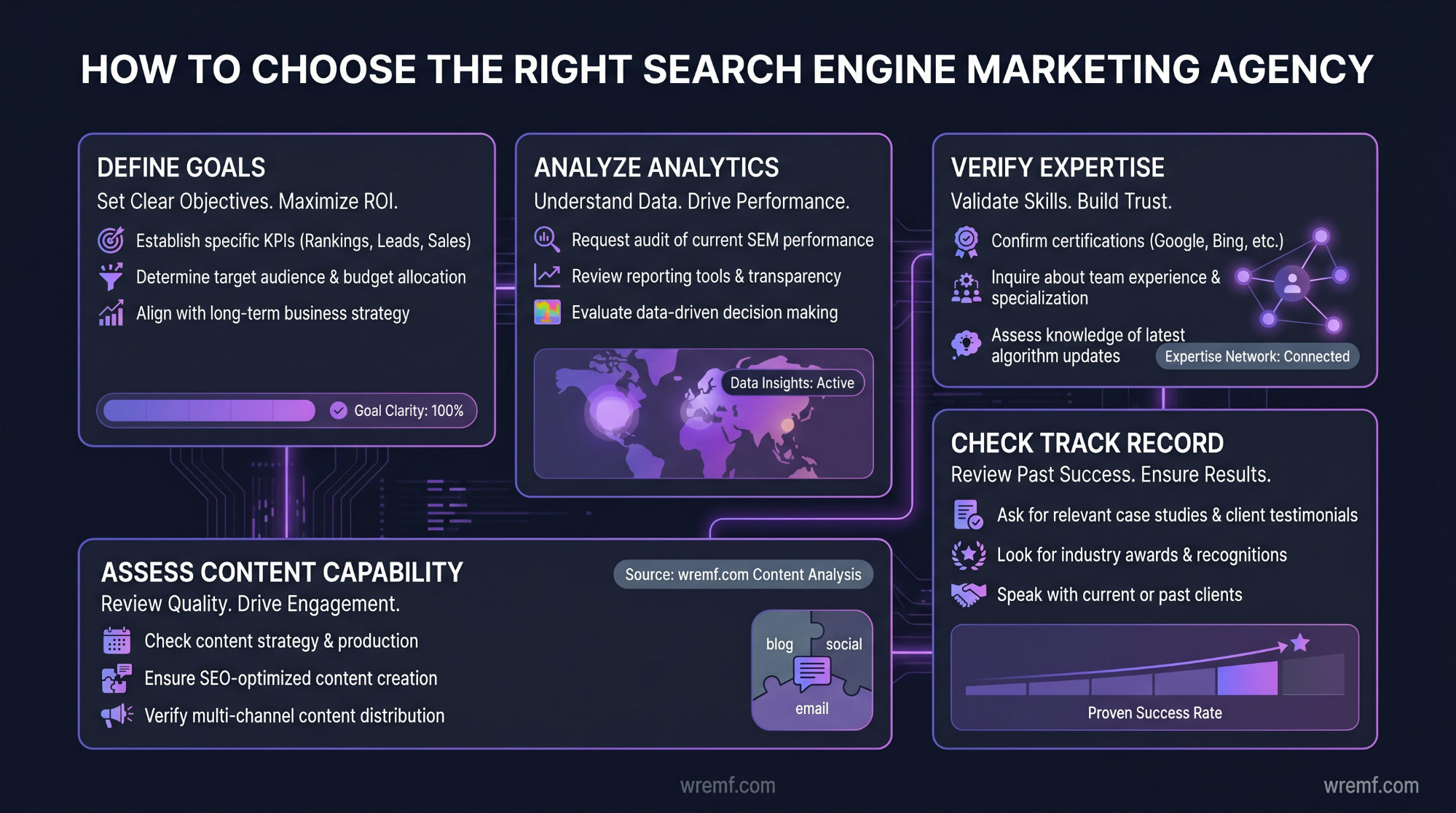
Choosing the right search engine marketing agency requires evaluating strategic fit, service depth, transparency, track record, and whether the agency understands the AI search visibility layer that traditional SEM programs increasingly need.
The decision to hire a search engine marketing agency is one of the most consequential marketing investments a B2B company makes. The wrong agency wastes budget, delays results, and creates execution dependencies that are difficult to unwind. The right agency becomes a genuine growth partner with clear accountability, transparent data, and measurable results.
Here is a practical process for evaluating and selecting a search engine marketing agency.
Step 1: Clarify your goals before speaking to any agency
Define whether your primary need is paid search, organic SEO, content marketing, Lead Generation, eCommerce SEO, or a combination. Agencies specialise, and the best fit depends on aligning your goals with the agency's core capability. A firm that excels at performance marketing for eCommerce businesses may not be the right partner for a B2B SaaS company focused on organic content and AI search visibility.
Step 2: Evaluate the agency's analytical rigour
Ask how the agency tracks conversion rate, cost per lead, ROI, and organic traffic. Agencies that rely on vanity metrics like impressions or clicks without connecting data to business outcomes are not operating at the standard required for serious B2B growth. Request a sample analytics report and assess the quality of the data presented.
Step 3: Assess content marketing capability
Content is the foundation of both organic search performance and AI citation eligibility. Ask whether the agency produces original Content Creation, how it handles Content Optimization for existing pages, and whether it has experience writing landing page copy that converts. Agencies that outsource content to generic writers without strategic oversight typically underperform on organic traffic and AI visibility alike.
Step 4: Verify paid search expertise
For paid media, ask about Google Ads campaign structure, bid management methodology, conversion rate optimisation approach, and how the agency reduces wasted spend. If the agency holds Google Premier Partner status, this confirms a minimum standard of Google Ads management volume and performance. Ask for paid search case studies relevant to your industry.
Step 5: Check track record and communication
Ask for case studies and references from clients in similar industries or at similar company sizes. Results such as significant conversion rate improvements, organic traffic growth, and ROI increases from paid search are meaningful signals. Also evaluate communication standards. Agencies that are difficult to reach before you become a client are typically harder to work with after you sign.
Step 6: Ask about AI search capabilities
Ask directly whether the agency tracks AI visibility, monitors AI citations, or has a strategy for AI search visibility. As AI Search becomes a primary buyer research channel, agencies that cannot address how your brand appears in ChatGPT, Perplexity, Gemini, and Google AI Overviews are missing a growing portion of the buyer journey. If the agency cannot answer this question, consider whether WREMF's AI visibility tracking can fill that gap alongside your SEM partner.
Step 7: Evaluate pricing and contract terms
Ask about monthly retainer costs, minimum contract length, and what is included versus billed separately. Clear pricing that breaks down paid media management fees from creative, content, and reporting costs is a positive sign. Vague or all-inclusive pricing that does not itemise deliverables makes it harder to assess value and ROI. Be cautious of agencies that lock clients into long contracts without performance benchmarks or exit clauses.
Step 8: Confirm reporting transparency
The best SEM agencies provide clients with direct access to Google Analytics 4, Google Search Console, and paid search dashboards. Agencies that control data access or deliver summary reports without underlying data create dependency and reduce accountability.
The fit between a brand and an SEM agency often comes down to shared communication standards, alignment on strategies, and whether the agency treats client goals as its own. Short-listing three to five agencies and running a structured evaluation using the criteria above typically produces better hiring decisions than selecting on reputation alone.
KEY TAKEAWAY: Choosing a search engine marketing agency requires evaluating goals, analytical depth, content capability, paid search expertise, communication quality, AI search readiness, and pricing transparency before committing to a partnership.
What to Expect from a Search Engine Marketing Agency in Terms of Results
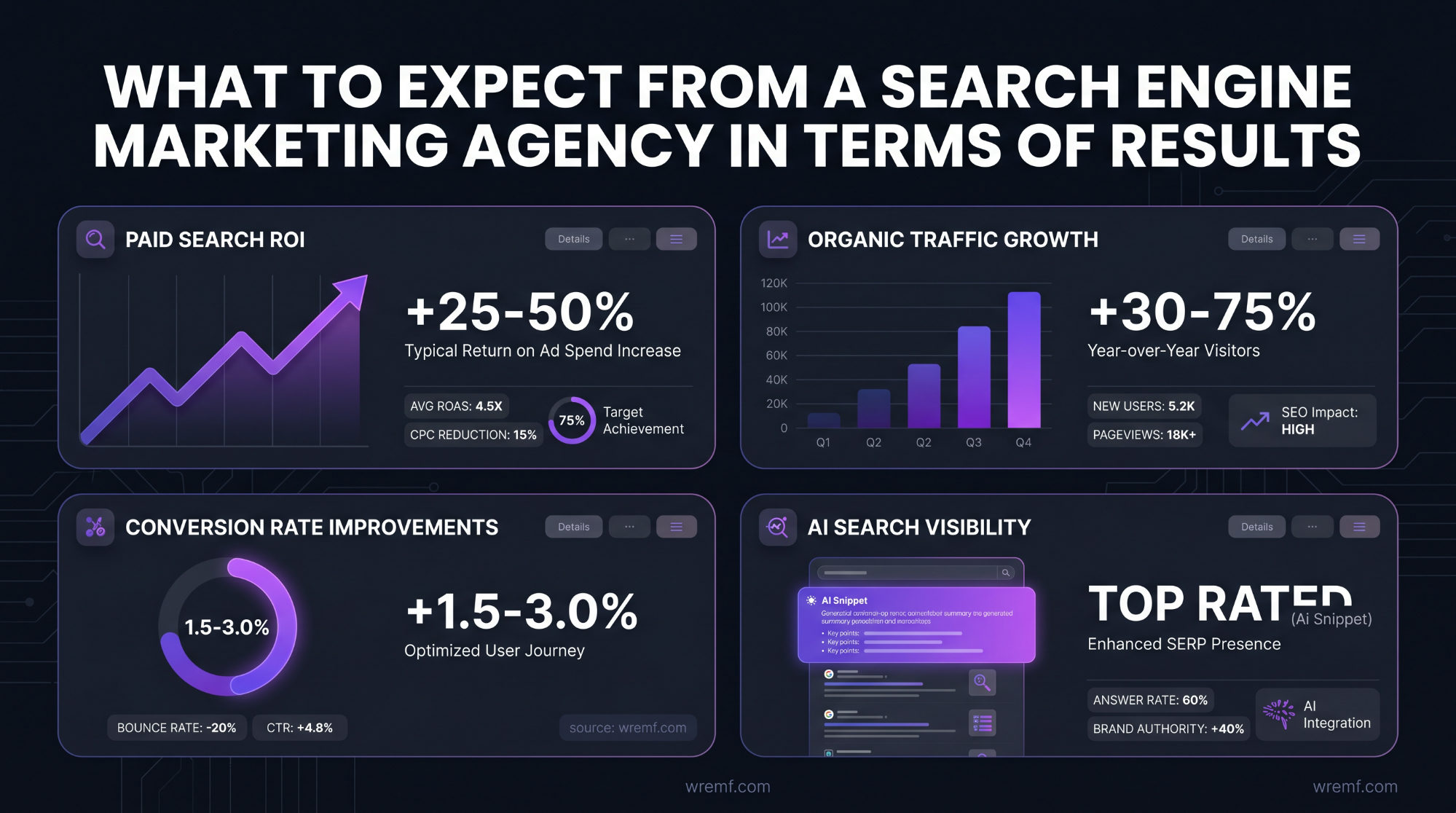
Results from a search engine marketing agency vary depending on the channel, starting position, budget, industry competition, and the quality of execution. Understanding realistic timelines and measurable benchmarks helps B2B teams evaluate agency performance honestly.
Paid search results from Google Ads campaigns typically become measurable within the first two to four weeks of a new SEM campaign. Agencies that gather data and insights within the first two weeks of launch are able to optimise bids, pause underperforming keywords, and improve conversion rate more quickly than those running campaigns on monthly review cycles. Paid search ROI depends heavily on keyword competition, landing page quality, and offer strength.
Organic search results take longer. SEO programs typically show meaningful organic traffic improvements within three to six months, with compounding growth beyond that horizon. Agencies that claim organic rankings will improve in days are overstating their ability to influence Google's indexing and ranking processes. If an agency responds that results take longer than 60 to 90 days to measure, that is an acceptable answer for organic SEO. If they promise rankings in weeks without explaining their methodology, approach with scepticism.
Conversion rate optimisation results depend on the volume of traffic available for testing. A/B testing requires statistically significant sample sizes to produce reliable insights. Agencies that run conversion rate optimisation on low-traffic pages will need more time to generate conclusive data than those working with high-traffic landing pages.
Benchmarks that credible SEM agencies should be able to point to include improvements in click-through rate from paid search, reductions in cost per conversion, growth in organic sessions, expansion of keyword rankings, and lead volume increases over comparable periods. Published case studies show results such as conversion rate improvements of 20% or more within 12 months for well-executed programs, alongside organic traffic growth that compounds over time.
AI Search visibility results require a different measurement model. AI citations do not follow the same time-to-impact curve as organic rankings. A piece of well-structured content can be cited by Perplexity or Claude within days of publication if it satisfies the source quality signals those engines prioritise. WREMF's prompt tracking and source citation tracking helps brands identify which content is driving AI citations and where gaps exist, giving teams actionable data rather than speculation about why competitors appear in AI answers.
ROI measurement for SEM programs works best when the agency connects paid search and organic traffic data to pipeline and revenue. Agencies that report ROI as a multiple of ad spend without factoring in creative, management, and content costs are presenting an incomplete picture. Demand clarity on how ROI is calculated and which costs are included in the denominator.
KEY TAKEAWAY: Paid search results are measurable within weeks while organic SEO compounds over months, and AI search visibility requires its own measurement model tracking citations and source mentions rather than rankings alone.
How AI Search Is Reshaping Search Engine Marketing
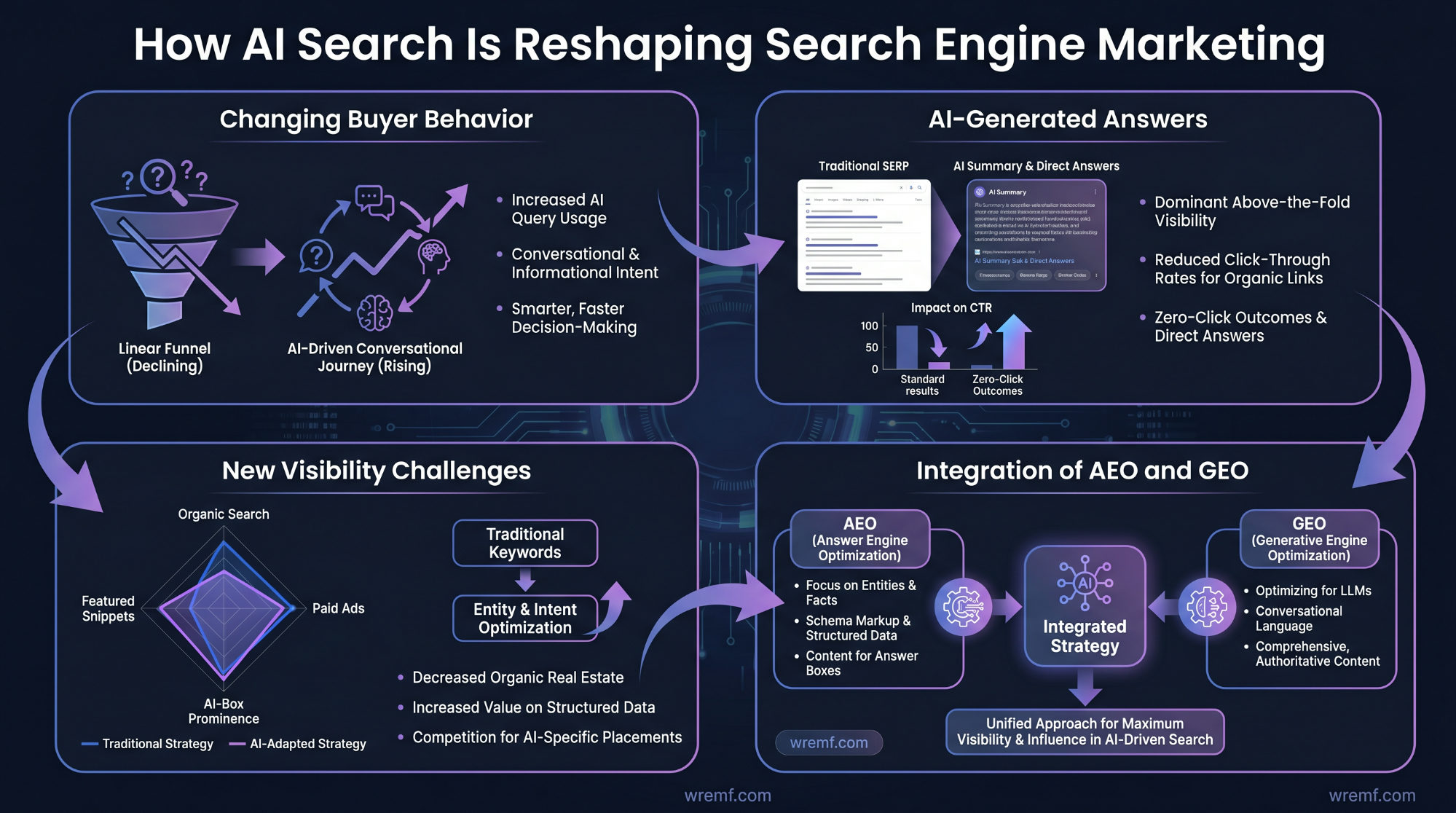
AI search is fundamentally changing how buyers discover brands, evaluate options, and make purchase decisions, which means search engine marketing agencies must evolve beyond Google Ads and organic SEO to remain effective. The shift is already happening at scale.
More than 100 million people search with AI every day, using platforms like ChatGPT, Perplexity, Google AI Overviews, Gemini, and Claude to get direct answers to complex buyer questions. These AI systems do not return a list of ten blue links. They synthesise information from multiple sources and generate a single answer that names specific brands, products, and recommendations. The brands that appear in those answers have a significant first-mover advantage over those that do not.
This shift creates a new form of search engine visibility that traditional paid search and organic SEO cannot address on their own. A brand may hold strong Google Ads positions and rank on page one for important keywords, yet be entirely absent from the AI-generated answers that buyers increasingly use to shortlist vendors. This gap between Google visibility and AI search visibility is one of the defining strategic challenges for B2B marketing teams in 2026.
AI search engines evaluate sources differently from traditional search algorithms. Rather than ranking pages primarily by backlinks and keyword density, AI engines assess source credibility, content specificity, entity consistency, and the depth of answers provided. Brands that produce content designed to answer specific buyer questions, maintain consistent entity information across the web, and earn citations from credible third-party sources are more likely to appear in AI-generated answers.
The emerging category of answer engine optimisation, or AEO, addresses this challenge directly. AEO strategy involves structuring content to satisfy AI retrieval criteria, maintaining source consistency across platforms, and building the authority signals that AI engines use to decide which brands to mention. Teams looking to build an AEO strategy alongside their SEM program will find the best answer engine optimization guide | https://wremf.com/blog/best-answer-engine-optimization-for-enhancing-ai-visibility a useful strategic reference.
For B2B SaaS companies, the AI search shift is particularly significant. SaaS buyers frequently use conversational AI to compare platforms, ask which tool is recommended for a specific use case, or understand the differences between competing products. A SaaS brand that does not appear in those conversations is invisible to a growing segment of its target buyers.
SEM agencies that understand this shift are beginning to offer AI Search readiness audits, prompt-level reporting, and content strategies designed to earn AI citations alongside Google rankings. Agencies that do not address AI visibility are offering an incomplete service for 2026 and beyond.
WREMF was built specifically for this gap. It tracks how brands appear across ChatGPT, Claude, Gemini, Perplexity, Copilot, DeepSeek, Grok, Meta AI, Mistral, and Google AI Overviews, giving B2B marketing teams the prompt intelligence and source citation tracking they need to understand and improve their AI search presence. Teams can explore the AI search engine optimization guide as a companion resource for understanding how to build AI search visibility alongside traditional SEM investment.
KEY TAKEAWAY: AI search is now a primary buyer research channel, and search engine marketing agencies that do not address AI visibility are leaving a growing portion of demand unmeasured and uninfluenced.
Tracking and Measuring SEM Performance: From Analytics to AI Visibility
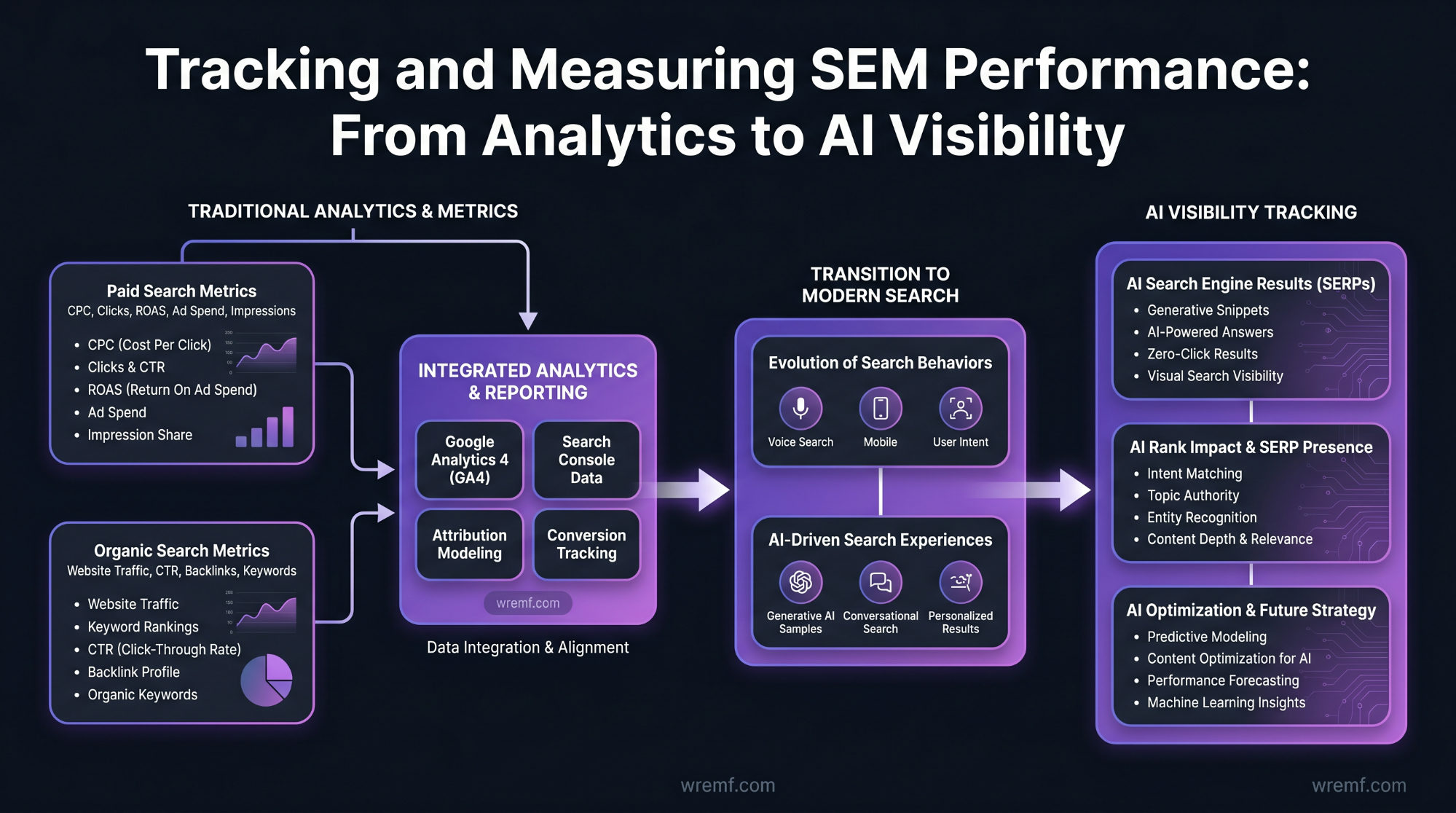
Measuring search engine marketing performance requires tracking paid search metrics, organic traffic, conversion data, and increasingly AI citations alongside traditional analytics. Teams that rely only on Google Ads dashboards and monthly ranking reports are missing significant parts of the performance picture.
The performance measurement stack for a modern SEM program typically includes the following layers.
Paid Search Metrics
Google Ads and other paid search platforms provide data on clicks, impressions, click-through rate, cost per click, conversion rate, and cost per conversion. These metrics indicate how efficiently paid search budget is converting search intent into measurable actions. Google Analytics 4 should be connected to Google Ads accounts to track post-click behaviour and attribute conversions to specific campaigns, ad groups, and keywords.
Organic Search Metrics
Google Search Console provides data on organic impressions, clicks, average position, and keyword-level performance. Organic traffic growth, keyword ranking changes, and click-through rate improvements from organic listings are the primary indicators of SEO program health. Google Analytics 4 separates organic sessions from paid, direct, referral, and social traffic, enabling accurate channel attribution.
Conversion Rate and Lead Metrics
Conversion rate is the percentage of website visitors who complete a desired action such as submitting a form, booking a call, or completing a purchase. Tracking conversion rate at the page level, campaign level, and keyword level allows SEM agencies and internal teams to identify which elements are performing and which require optimisation. Lead quality metrics, including lead-to-opportunity rate and close rate, connect top-of-funnel SEM performance to bottom-of-funnel revenue outcomes.
ROI and Revenue Attribution
ROI measurement requires connecting SEM spend, including agency fees, ad spend, content costs, and web development, to revenue generated. Agencies that report ROI as a simple ratio of ad spend to revenue are presenting an incomplete picture. Full attribution models, particularly those that track multi-touch journeys from first search to closed deal, provide more reliable ROI data for B2B brands with longer sales cycles.
Analytics and Reporting Standards
Agencies should provide regular analytics and reporting that covers all active channels in a single view. White-label reporting, Looker Studio connectors, and GA4 attribution models are the current standard for transparent, client-accessible reporting. Performance tracking on a weekly or biweekly basis, rather than monthly, allows faster response to campaign underperformance.
AI Search Visibility Tracking
Traditional analytics tools do not measure AI citations, source mentions, or AI share of voice. These metrics require a dedicated AI visibility platform. WREMF tracks how brands are mentioned, cited, compared, and recommended across 10 AI engines, providing prompt-level reporting and source citation tracking that connects AI visibility to measurable outcomes. Teams that connect WREMF's AI referral traffic data with GA4 attribution gain a more complete picture of how AI search influences website traffic and lead generation. The AI mention tracking guide provides a detailed methodology for building this measurement layer.
Competitor Visibility in AI Answers
Understanding why competitors appear in AI answers while your brand does not is one of the most actionable insights an AI visibility platform can provide. WREMF's competitor visibility tracking shows which brands are being cited across AI engines, which sources those citations draw from, and where gaps in a brand's AI presence exist. This data informs content strategy, link building priorities, and AEO execution decisions.
KEY TAKEAWAY: A complete SEM measurement stack covers paid search metrics, organic traffic, conversion rate, ROI attribution, and AI search visibility, with AI citation tracking being the layer that most traditional analytics setups currently miss.
SEM Agencies vs Traditional SEO Tools vs AI Visibility Platforms
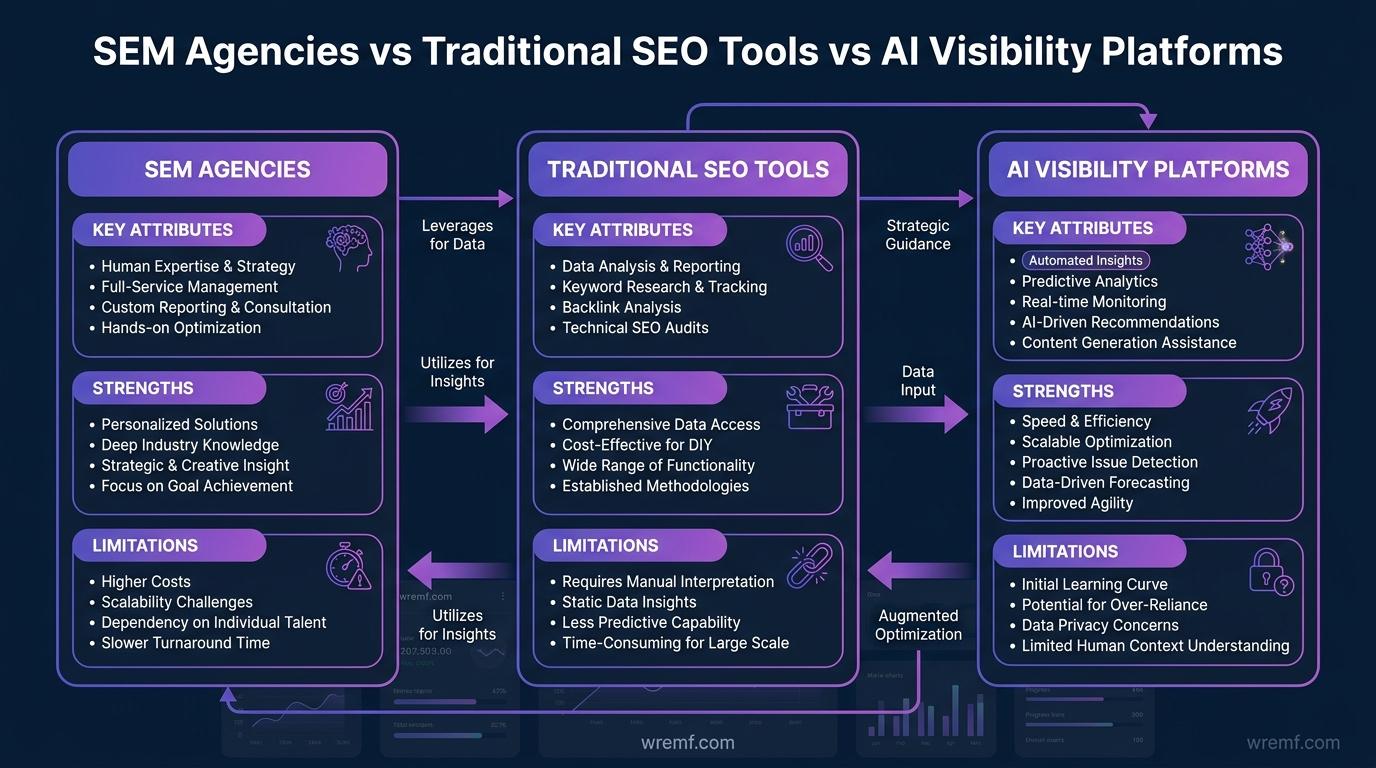
Search engine marketing agencies, traditional SEO tools, and AI visibility platforms serve different functions in a modern search program, and understanding how they complement each other helps B2B teams avoid gaps in their measurement and execution stack.
Traditional SEO tools such as those used for keyword research, backlink analysis, and technical audits were built to help teams improve performance in traditional search engine results pages. They remain essential for ranking improvement, crawlability diagnosis, keyword strategy, and competitive SERP analysis. These tools measure rankings, backlinks, site health, and organic traffic. They do not measure how brands appear in AI-generated answers.
SEM agencies use these tools alongside paid search platforms, analytics suites, and content management systems to execute search marketing programs. A strong agency brings strategic direction, implementation capability, reporting infrastructure, and performance accountability that most in-house teams cannot replicate at the same cost or speed.
AI visibility platforms like WREMF add a third layer that neither traditional SEO tools nor most SEM agencies currently address. WREMF tracks how brands appear across AI engines, measures AI share of voice relative to competitors, identifies which sources AI engines cite, and provides prompt-level reporting that shows exactly which buyer questions a brand does or does not answer in AI-generated results.
The recommended framing for B2B teams is straightforward: traditional SEO tools remain useful for search rankings, crawlability, keyword research, backlinks, and technical SEO. An SEM agency provides strategy and execution. WREMF adds the AI visibility layer by tracking how AI engines mention, cite, compare, and recommend brands across prompt-based discovery journeys.
Dimension comparison across the three categories:
Primary signal
- Traditional SEO tools: Keyword rankings
- SEM agency: Campaign performance and organic traffic
- WREMF: AI prompt answers and source citations
What it tracks
- Traditional SEO tools: SERP position, backlinks, site health
- SEM agency: Ads performance, leads, conversion rate, ROI
- WREMF: AI citations, AI share of voice, prompt visibility
Authority signal
- Traditional SEO tools: Backlinks and domain authority
- SEM agency: Ad quality score and content relevance
- WREMF: Source citations in AI answers and entity consistency
Engine coverage
- Traditional SEO tools: Google and Bing
- SEM agency: Google, Bing, Amazon, YouTube, and social
- WREMF: 10 AI engines including ChatGPT, Gemini, Perplexity, Claude, Copilot, DeepSeek, Grok, Meta AI, Mistral, and Google AI Overviews
Attribution
- Traditional SEO tools: Organic sessions
- SEM agency: Paid and organic attribution models
- WREMF: AI referral traffic, prompt-level attribution, and GA4 integration
Teams that combine a strong SEM agency, reliable SEO tooling, and WREMF's AI visibility tracking have the most complete view of their search presence across both traditional and AI-powered discovery surfaces. Teams that have not yet explored this combination can compare WREMF pricing plans to understand which tier fits their current program size and budget.
KEY TAKEAWAY: Traditional SEO tools, SEM agencies, and AI visibility platforms serve distinct and complementary roles, and combining them gives B2B teams the most complete measurement and execution stack for modern search.
Real-World Scenarios: How B2B Teams Use SEM Agencies and AI Visibility Together
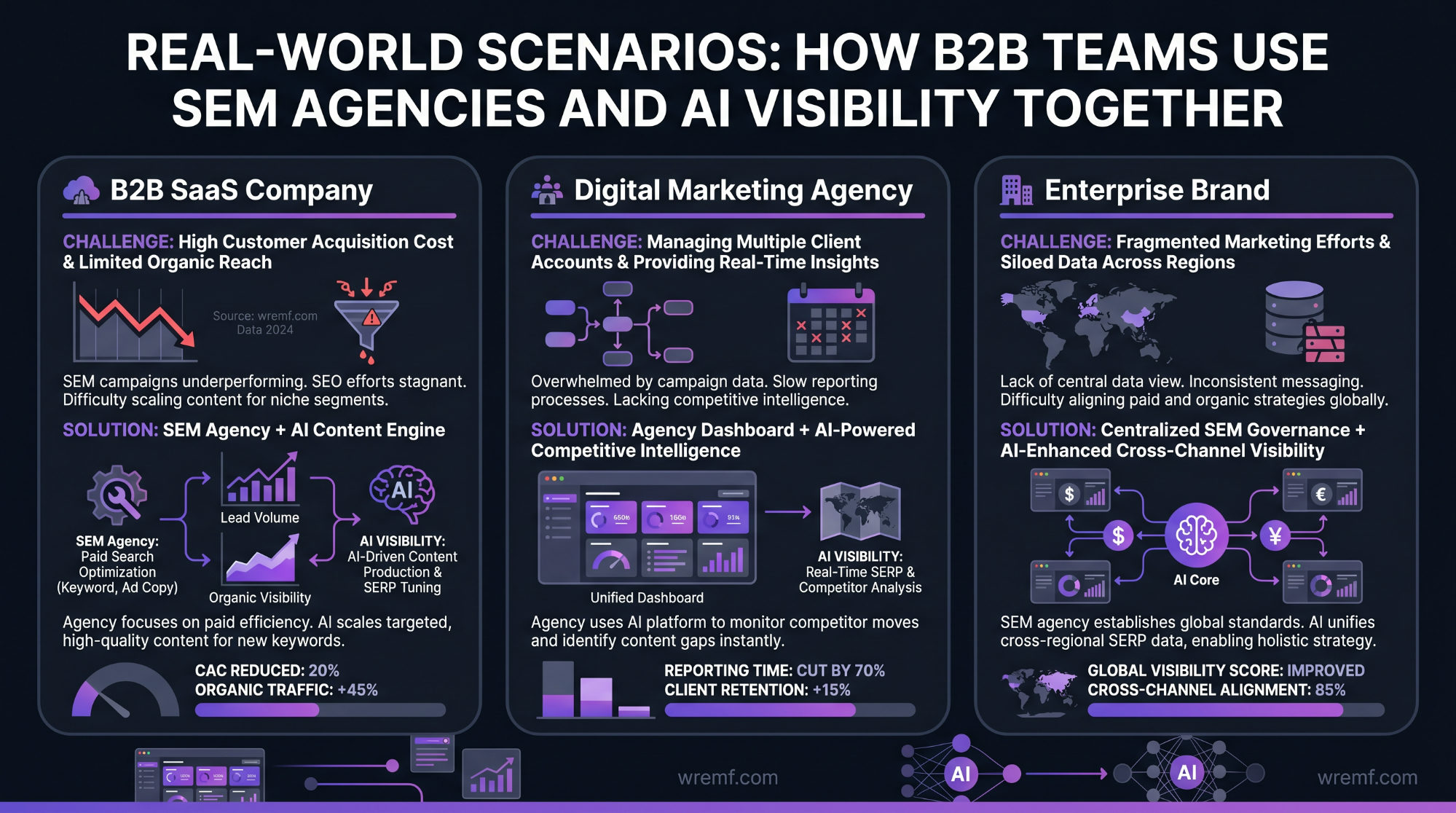
The following scenarios illustrate how different types of B2B teams combine search engine marketing agency partnerships with AI visibility tracking to improve results across paid search, organic SEO, and AI-generated discovery.
Scenario One: B2B SaaS Company Investigating Competitor Presence in ChatGPT
A B2B SaaS company in the marketing technology space notices that a competitor is being recommended in ChatGPT when buyers ask which platform to use for a specific use case. The company's SEM agency is producing strong Google Ads results and growing organic traffic, but the team has no visibility into why the competitor appears in AI answers and they do not.
The team adds WREMF's AI visibility tracking alongside their SEM program. Using prompt intelligence and source citation tracking, they identify that the competitor is being cited because two high-authority industry publications have written detailed comparison articles that AI engines consistently reference. The WREMF data informs a targeted outreach and content strategy that the SEM agency executes. Within three months, the brand begins appearing in AI citations for the same buyer prompts. The team also notices an increase in AI referral traffic attribution within their GA4 account.
Scenario Two: Digital Marketing Agency Managing Multiple Client Accounts
A digital marketing agency manages SEM programs for 12 B2B clients across different industries. Each client has Google Ads campaigns, organic SEO programs, and content marketing in place. The agency wants to add AI visibility reporting to its client offering without hiring additional staff.
The agency adds WREMF Growth to its stack. Using WREMF's white-label reporting, Looker Studio connector, and multi-website tracking for up to five client websites per workspace, the agency builds AI visibility dashboards alongside its existing analytics and reporting infrastructure. Clients receive monthly reports that cover Google Ads performance, organic traffic, conversion rate, and AI share of voice across ChatGPT, Perplexity, Gemini, and Google AI Overviews. The agency positions AI visibility reporting as a premium service tier, improving client retention and expanding its average contract value.
Scenario Three: Enterprise Brand Needing Full AI Visibility Execution
A B2B technology brand with a complex product portfolio and a multi-market presence wants to improve how AI engines describe and recommend its products. The in-house team has strong technical SEO capability and a mature SEM program, but lacks the specialised expertise to execute a GEO and AEO strategy at scale.
The brand engages WREMF Managed. The WREMF team conducts an AI visibility audit, develops a custom GEO strategy, executes AEO content optimisation across key product categories, performs citation, entity, and authority cleanup, and delivers monthly reporting with strategy calls. The Managed engagement runs alongside the brand's existing SEM agency relationship, with WREMF focused exclusively on the AI visibility layer. Teams in a similar position can explore WREMF agency services to understand how managed execution works in practice.
KEY TAKEAWAY: B2B teams at every stage of search marketing maturity can add AI visibility tracking and execution to their existing SEM programs, using WREMF as software, a managed service, or a hybrid partner depending on their resources and goals.
Limitations, Risks, and Honest Caveats for Search Engine Marketing Programs
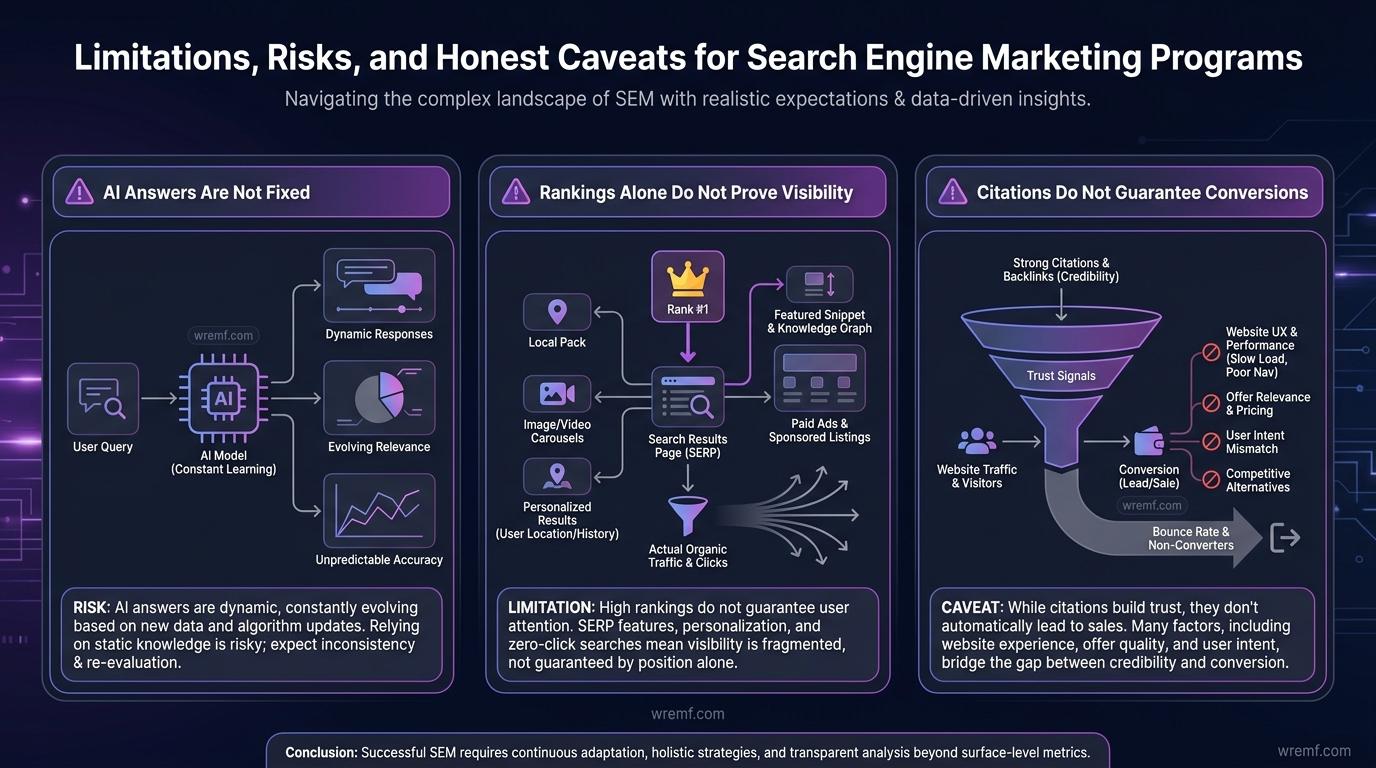
Search engine marketing programs carry real limitations that buyers should understand before committing budget or measuring success. Honest expectations produce better partnerships, more durable strategies, and more realistic ROI assessments.
AI Answers Are Not Fixed
AI-generated answers from ChatGPT, Perplexity, Gemini, Claude, and other platforms are not static. They change based on the specific prompt phrasing, the user's location, the model version, the sources indexed at query time, and the retrieval parameters used by each platform. A brand that appears in an AI answer today may not appear tomorrow for a slightly different prompt. This variability means AI visibility must be tracked continuously across multiple prompts and engines, not assessed from a single test query.
Rankings Alone Do Not Prove Visibility
Holding strong Google rankings does not guarantee that a brand appears in Google AI Overviews or in other AI-generated answers. AI engines use different signals than traditional ranking algorithms. A brand can rank on page one for a keyword and still be absent from the AI answer displayed above those organic results. This is why separate tracking for AI search visibility alongside traditional keyword rankings is necessary for a complete picture of search engine visibility.
Citations Do Not Guarantee Conversions
Appearing in an AI-generated answer increases discoverability and brand awareness within the buyer journey, but it does not directly convert to revenue. Buyers who encounter a brand in a ChatGPT recommendation or Perplexity answer still need to visit the website, evaluate the offer, and complete a conversion action. Citation tracking must be connected to traffic attribution and conversion rate data to assess actual business impact.
AI Referral Traffic Attribution Is Incomplete
Most analytics platforms, including GA4, do not consistently attribute traffic from AI platforms to a specific source. Traffic from ChatGPT, Claude, and other AI tools may appear as direct traffic, unknown referral, or be misattributed entirely. WREMF's AI referral traffic analysis helps identify patterns in this attribution gap, but buyers should understand that AI traffic measurement is still an evolving standard across the industry.
GEO and AEO Require Time, Foundation, and Execution
Generative engine optimisation and answer engine optimisation are not quick wins. They require a strong technical SEO foundation, high-quality content that directly answers buyer questions, consistent entity information across the web, and credible third-party citations. Brands with thin content, poor backlink portfolios, or inconsistent business information will find it harder to earn AI citations, regardless of the platform or agency they use. No platform, including WREMF, can guarantee that any AI engine will recommend a specific brand.
Software-Only Plans Require Internal Execution Capacity
WREMF's Starter and Growth plans provide powerful self-serve AI visibility tracking, analytics, and reporting. However, the data generated by these plans requires interpretation and action by the internal team. If a team lacks the capacity to act on GEO audit findings, content brief recommendations, and source citation gaps, a software-only approach may produce insight without impact. Teams in this position should evaluate whether WREMF Managed or a hybrid engagement better matches their execution capacity.
KEY TAKEAWAY: Search engine marketing programs and AI visibility strategies both carry limitations that require honest expectation setting, continuous measurement, and execution capacity to translate data into results.
Common Misconceptions About Search Engine Marketing and AI Visibility
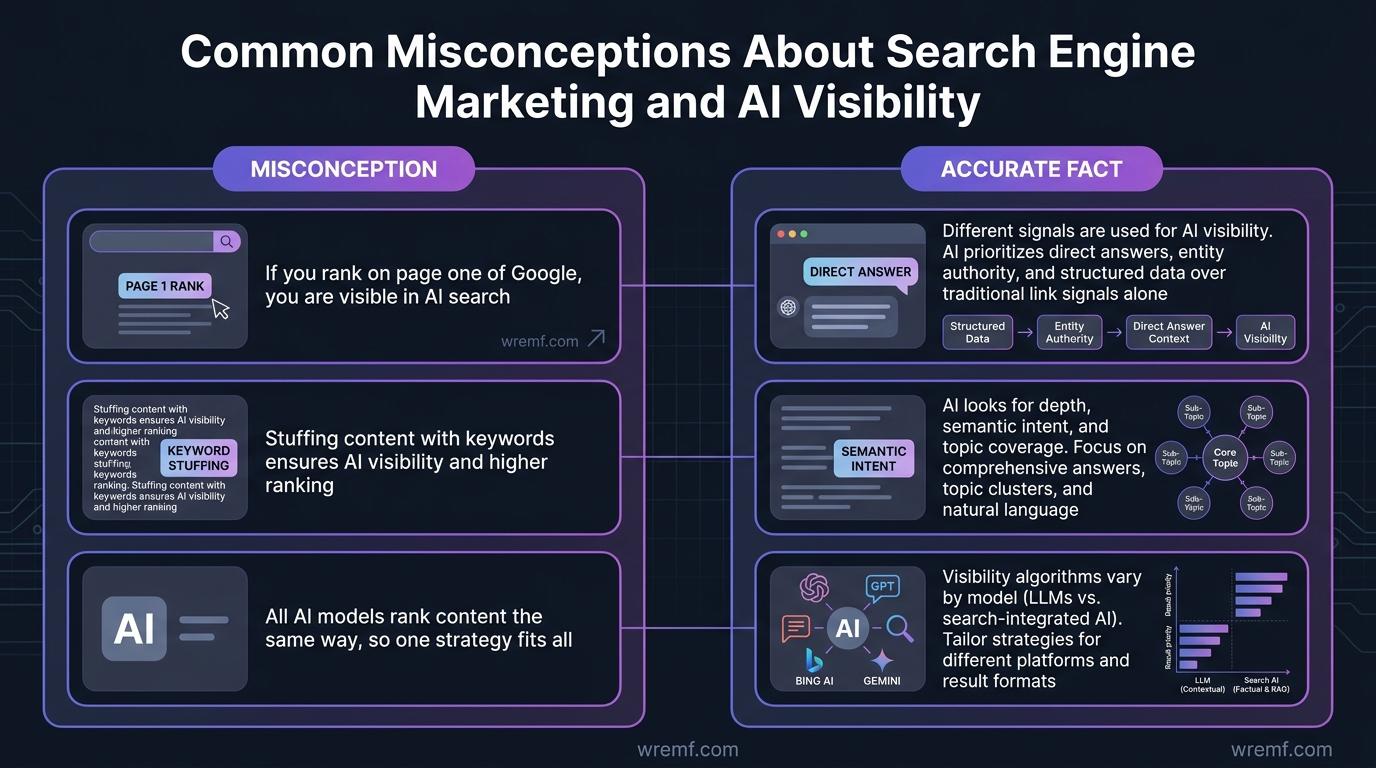
MYTH: If you rank on page one of Google, you are visible in AI search.
FACT: Google rankings and AI search visibility are measured by different signals and tracked through different mechanisms. A brand can hold strong organic rankings for important keywords and still be entirely absent from Google AI Overviews, ChatGPT answers, or Perplexity results. AI engines assess source credibility, content specificity, entity consistency, and citation patterns, not just ranking position. Tracking both separately is necessary for a complete view of search engine visibility.
MYTH: AI visibility cannot be measured reliably because AI answers keep changing.
FACT: AI visibility can be measured through systematic prompt tracking across multiple engines, prompts, and time periods. While individual AI answers do change between queries, patterns in how AI engines mention, cite, and recommend brands are measurable at scale. WREMF tracks these patterns across 10 AI engines using scheduled monitoring, prompt-level reporting, and source citation tracking. The variability of AI answers is a reason to track continuously, not a reason to abandon measurement.
MYTH: Paying for Google Ads is enough to make a brand visible in AI-generated answers.
FACT: Google Ads spend does not influence how Google AI Overviews, ChatGPT, Perplexity, or other AI engines mention or cite a brand. Paid search and AI citations are governed by entirely different systems. AI engines evaluate organic content quality, source authority, entity consistency, and citation patterns, not advertising spend. Brands must invest in content, organic authority, and AI visibility strategy separately from their paid search programs.
MYTH: SEO and SEM agencies automatically handle AI search visibility as part of their service.
FACT: Most search engine marketing agencies and traditional SEO firms were built to optimise for Google Search rankings, not AI-generated answers. While some forward-thinking agencies are beginning to incorporate AEO and GEO into their services, the majority of SEM programs do not include systematic AI citation tracking, prompt-level reporting, or AI share of voice measurement. B2B brands that assume their SEM agency is managing AI visibility without explicitly confirming this are likely leaving a significant part of the buyer journey unmeasured.
MYTH: Once a brand earns AI citations, it will stay cited automatically.
FACT: AI citations are not permanent. They can change as AI engines update their models, change their source sets, or encounter new content that better answers a buyer's question. Maintaining AI visibility requires ongoing content optimisation, source consistency monitoring, and regular prompt tracking across engines. AI visibility is a continuous program, not a one-time project.
KEY TAKEAWAY: The most common misconceptions about search engine marketing and AI visibility involve assuming that rankings, paid search spend, or one-time optimisation efforts are sufficient. All three disciplines require separate, continuous measurement and execution to perform reliably.
Conclusion
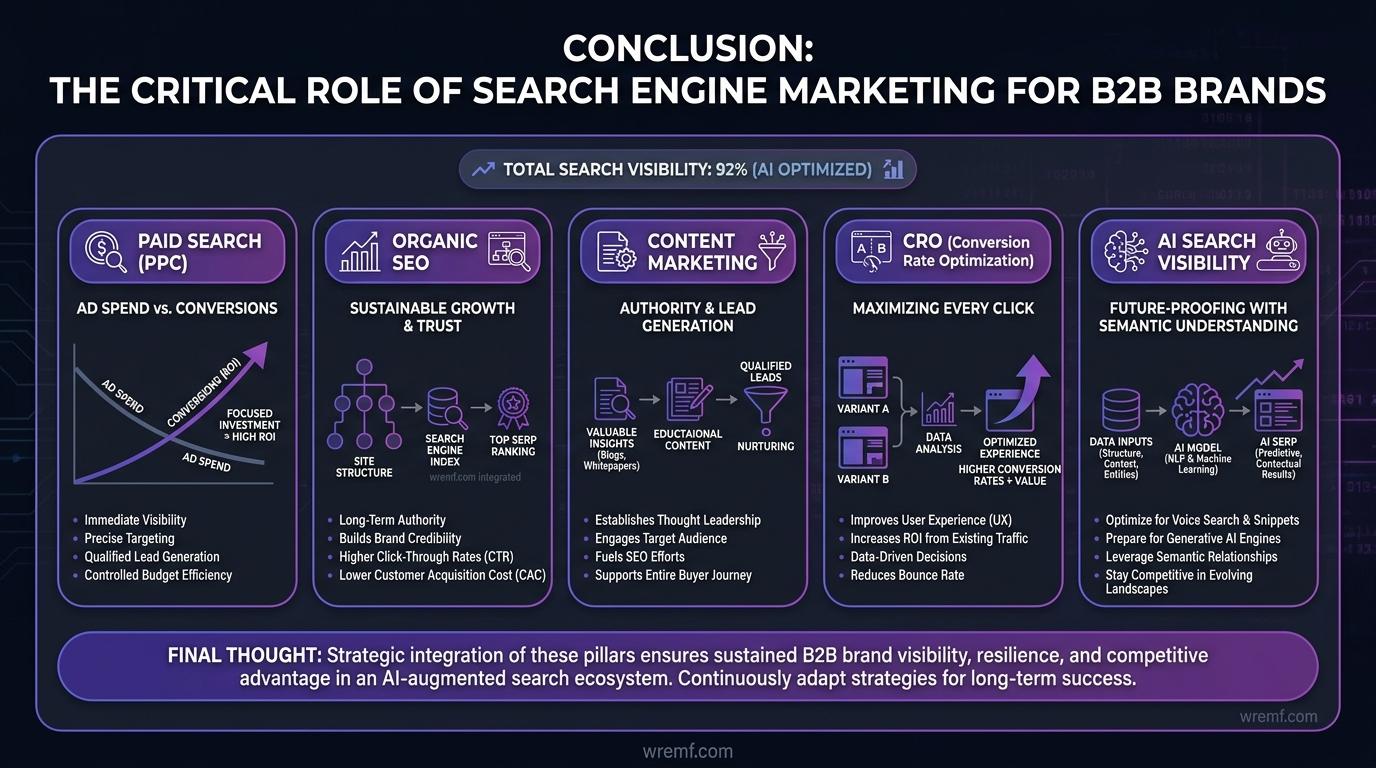
Search engine marketing remains one of the most direct paths to qualified leads, measurable ROI, and sustained growth for B2B brands. The discipline now spans paid search, organic SEO, content marketing, conversion rate optimisation, and the emerging layer of AI search visibility that is reshaping how buyers discover and evaluate vendors. Brands that invest only in Google Ads and organic rankings without tracking how AI engines mention and recommend them are working with an incomplete view of their search presence. WREMF helps B2B teams close that gap by tracking AI citations, source mentions, competitor visibility, and AI share of voice across 10 AI engines. Whether your team needs self-serve software, senior-led execution, or a hybrid of both, the AI search engine optimization services guide explains how to build AI visibility alongside your existing SEM investment. See how WREMF fits your program by exploring WREMF pricing plans
Frequently Asked Questions About Search Engine Marketing Agencies
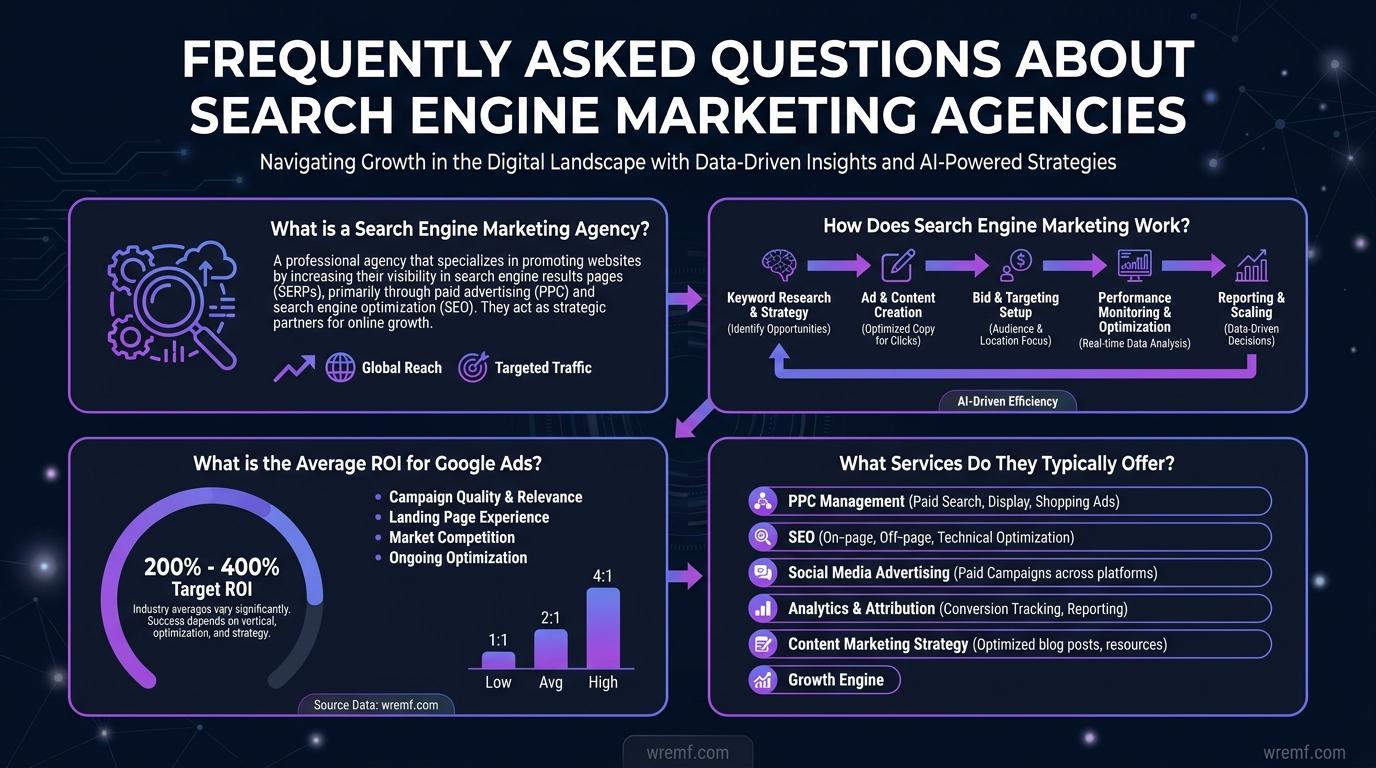
What is a search engine marketing agency?
A search engine marketing agency is a specialist firm that helps businesses grow their online presence through paid and organic search strategies. This typically includes managing Google Ads and other paid search campaigns, improving organic search rankings through SEO, and combining both approaches into a unified strategy. The agency handles keyword research, campaign setup, ad copy, bid management, analytics and reporting, and ongoing optimisation. For B2B companies, an SEM agency often focuses specifically on lead generation, conversion rate optimisation, and measurable ROI across search platforms.
What does a search engine marketing agency actually do?
A search engine marketing agency manages the full lifecycle of paid and organic search campaigns. On the paid side, this means creating and optimising Google Ads campaigns, managing budgets, testing ad copy, refining targeting, and tracking conversions. On the organic side, it means technical SEO audits, content strategy, keyword optimisation, link building, and improving search engine visibility. Most agencies also handle analytics and reporting through tools such as Google Analytics 4 and Google Search Console, connecting campaign activity to business outcomes like leads, sales, and revenue.
What is the difference between SEO and SEM?
SEO, or search engine optimisation, focuses on improving organic search rankings through content, technical improvements, and authority building. Results from SEO typically develop over weeks or months. SEM, or search engine marketing, refers to paid search advertising, most commonly Google Ads, where businesses bid on keywords and pay for clicks. SEM delivers faster visibility since ads appear immediately after campaigns go live. Most effective digital marketing strategies combine both, using SEM for short-term lead generation and SEO for sustainable long-term organic traffic growth.
How does search engine marketing work?
Search engine marketing works by placing paid advertisements in search engine results pages when users search for relevant keywords. Advertisers bid on specific keywords through platforms like Google Ads, and their ads appear above or alongside organic results. The advertiser pays when a user clicks the ad, which is why this model is called pay-per-click or PPC. The ranking of ads is determined by a combination of bid amount and Quality Score, which reflects ad relevance, expected click-through rate, and landing page experience. Campaigns are measured through clicks, conversions, cost per lead, and return on ad spend.
How long does it take to see results from SEM?
Paid search campaigns can generate clicks and leads within days of launch, which is one of the primary advantages of SEM over organic SEO. However, meaningful optimisation, including improved conversion rates, lower cost per acquisition, and stronger ROAS, typically takes four to eight weeks as the campaign gathers performance data. If an agency suggests results will take longer than sixty to ninety days for a paid search campaign to show any measurable activity, that is worth questioning. SEO within an SEM strategy takes longer, often three to six months for sustained organic traffic gains.
How is PPC different from SEO?
PPC, or pay-per-click advertising, generates visibility immediately by paying for ad placements in search results. You pay each time a user clicks your ad, and visibility stops when the budget runs out. SEO builds organic search visibility over time through content quality, technical improvements, and authority signals. Organic rankings are not paid for directly, and the traffic generated does not have a per-click cost. PPC offers faster results and precise targeting, while SEO offers compounding long-term value. Most successful digital marketing strategies use both channels in parallel to maximise coverage and lead generation.
Is PPC search engine marketing essential for my business?
PPC is not universally essential, but for most businesses that need predictable lead generation or immediate visibility, it is one of the most effective tools available. According to research cited widely across the industry, a significant majority of users click on paid search ads when actively searching for a product or service, and Google Ads is frequently cited as delivering strong return on ad spend for businesses with well-managed campaigns. Whether PPC is essential depends on your competitive landscape, customer acquisition costs, lifetime value, and whether organic search alone can generate sufficient pipeline volume.
Can a search engine marketing agency guarantee I will rank number one?
No credible search engine marketing agency can guarantee a number one ranking. Organic rankings are determined by Google's algorithm, which evaluates hundreds of signals including content quality, authority, technical performance, and user experience. Paid ad positions are determined by real-time auction dynamics and Quality Scores. Any agency that promises a guaranteed top ranking is making a claim they cannot support and may be using tactics that risk Google's webmaster guidelines penalties. Reputable agencies focus on measurable outcomes such as traffic growth, conversion rates, cost per lead, and ROI rather than position guarantees.
How do search engine marketing agencies measure success?
Reputable SEM agencies measure success through business outcomes, not vanity metrics alone. Key performance indicators typically include organic traffic volume, paid search click-through rates, conversion rates, cost per lead, cost per acquisition, return on ad spend, and overall ROI. Ranking improvements matter but are secondary to traffic and conversion data. Agencies should connect campaign performance to revenue impact wherever possible, using tools such as Google Analytics 4, Google Search Console, and CRM integration to track the full customer journey from search click to closed deal.
What is the average ROI for Google Ads?
Google Ads is widely referenced as one of the higher-return digital advertising channels when campaigns are managed effectively, with industry benchmarks frequently cited in the range of several dollars returned for every dollar spent, though actual results vary significantly by industry, targeting quality, landing page performance, and competitive environment. The most important metric is not an industry average but your specific cost per acquisition relative to customer lifetime value. Well-managed campaigns with strong landing page copy, precise keyword targeting, and ongoing conversion rate optimisation consistently outperform campaigns that are set up and left unmanaged.
How much does a search engine marketing agency cost?
SEM agency pricing varies widely depending on the scope of services, the size of the ad budget being managed, and whether the engagement includes SEO, paid search, or both. Common pricing structures include monthly retainers, a percentage of ad spend, hourly rates, and performance-based models. Smaller campaigns with a focused scope may start at a few hundred to a few thousand dollars per month. Larger, multi-channel or enterprise engagements typically range from several thousand to tens of thousands of dollars monthly. Always clarify the payment structure, what is included, and whether pricing changes as ad spend scales before signing any agreement.
Do I need to sign a long-term contract with an SEM agency?
Contract length varies by agency. Some require minimum commitments of six to twelve months, particularly for SEO-heavy engagements where results take time to materialise. Others offer monthly rolling agreements. It is reasonable to ask for a shorter initial commitment or a pilot period before committing to a longer contract. The more important question is whether the agency clearly defines deliverables, reporting cadence, and exit terms. You should also confirm that you own your ad accounts and any content produced, so that switching agencies does not mean losing your campaign history or assets.
Who should own the PPC account?
You should own your own PPC account. A professional SEM agency will work within your Google Ads account, not create a separate account they control. Owning the account means your historical data, conversion tracking, and campaign structure remain yours if you ever change agencies or bring the work in-house. If an agency insists on owning the account, that is a significant warning sign. Account ownership is a basic professional standard and protects your ability to transfer the account, audit past performance independently, and maintain continuity regardless of which agency manages the campaigns.
How often should I expect to hear from my SEM agency?
In 2026, a professional SEM agency should provide access to a real-time dashboard so you can check performance at any time without needing to email your account manager. Scheduled communication typically follows a bi-weekly or monthly call cadence for campaign updates, strategy reviews, and optimisation planning. You should not be waiting days for basic performance data or relying solely on monthly PDF reports. Responsive communication, clear escalation paths, and regular reporting cadence are indicators of a well-run agency. Slow or infrequent communication is one of the most common complaints businesses have about underperforming agencies.
How do I evaluate a search engine marketing agency before hiring them?
Start by reviewing the agency's own website. A credible SEM agency should have a professional, well-structured site with clear service descriptions, a content library explaining their approach, and visible internal linking that demonstrates they practise what they recommend. Look for team bios, case studies, and evidence of results. Ask about their reporting tools, whether they use proprietary technology beyond standard platforms, and how they structure payment. Referral-based business and transparent pricing are positive signals. Be cautious of agencies that lead with hard-sell tactics, speak negatively about competitors, or make vague promises about results.
Are there SEM agencies that specialise in B2B search engine marketing?
Yes. Several agencies focus specifically on B2B search engine marketing, with expertise in longer sales cycles, account-based targeting, lead quality over lead volume, and connecting paid search activity to pipeline metrics. B2B SEM requires different keyword strategies, different conversion definitions, and different attribution models compared to eCommerce or direct-to-consumer campaigns. When evaluating a B2B-focused SEM agency, look for experience with your industry, familiarity with CRM and marketing automation integration, and an ability to report on lead quality, not just cost per click. McKinsey's research on AI and B2B growth consistently highlights that data-driven marketing decisions outperform gut-feel approaches in complex B2B environments.
Is there such a thing as guaranteed search engine optimisation?
No. Guaranteed SEO is not a credible offering. Search engine rankings are controlled by Google and other search engines, not by any agency. SEO involves improving the signals that algorithms use to evaluate pages, but outcomes cannot be contractually guaranteed because algorithm updates, competitive changes, and user behaviour shifts are outside any agency's control. What a legitimate agency can guarantee is a defined scope of work, transparent reporting, adherence to Google's published search guidelines, and measurable progress toward agreed KPIs such as traffic growth, keyword visibility, and conversion improvement.
What should I look for in an agency's content and blog?
A credible SEM agency should maintain an active, substantive blog that demonstrates genuine expertise in search engine marketing, SEO, PPC, and related disciplines. Look for detailed, practical content that explains strategies and processes rather than surface-level promotional writing. Strong internal linking throughout the blog is itself a signal that the agency understands SEO fundamentals. Be cautious of agencies whose blog content is thin, rarely updated, or reads as generic filler. The quality of an agency's own content is one of the clearest indicators of how they will approach content creation for your campaigns.
What search engines should an SEM strategy cover?
Google dominates search volume and is the primary focus for most SEM strategies. Beyond Google, Bing, now integrated with Microsoft's AI-powered search, holds a meaningful share of desktop and B2B search traffic. Beyond traditional search engines, AI-powered discovery platforms including ChatGPT, Perplexity, Claude, Gemini, and Google AI Overviews are increasingly influencing how users find information and make purchasing decisions. Perplexity's blog and Anthropic's research both highlight the growing role of AI in search behaviour. Forward-thinking SEM strategies now address both traditional paid and organic search and emerging AI visibility surfaces.
How is AI search changing search engine marketing?
AI search platforms including ChatGPT, Perplexity, Google AI Overviews, Claude, Gemini, Copilot, and others are changing how users discover brands, compare options, and make decisions. These platforms do not always show traditional paid ads. Instead, they generate answers from cited sources, which means brands that are not cited or mentioned in AI-generated responses can lose visibility even if they rank well in traditional search. This has given rise to answer engine optimisation (AEO) and generative engine optimisation (GEO) as disciplines alongside traditional SEM. Teams that want to remain visible across both traditional and AI-powered search need to track both paid and organic search performance and AI citation visibility.
How can B2B brands track their visibility across AI search platforms?
Tracking AI search visibility requires monitoring how AI engines such as ChatGPT, Claude, Gemini, Perplexity, and Google AI Overviews respond to prompts relevant to your category, products, and buying decisions. This is different from traditional rank tracking because AI answers do not have a fixed position in the same way organic results do. WREMF's AI visibility tracking suite covers ten AI engines, monitors prompt-level responses, tracks source citations, measures competitor visibility, and connects AI mentions to traffic attribution. Teams that need strategic guidance alongside software can also access WREMF's managed AI visibility services for audit, strategy, and execution support.
What is the difference between a software-only AI visibility tool and a managed AI visibility agency?
A software-only AI visibility tool provides dashboards, data, and tracking capabilities that your internal team uses to make decisions and execute optimisation work. This works well for teams with strong in-house SEO or content expertise. A managed AI visibility agency takes responsibility for strategy, execution, and ongoing optimisation on your behalf, delivering audits, content improvements, citation building, and reporting as a service. A hybrid model combines both, giving your team access to tracking software while an agency team handles the strategic and technical work. WREMF offers all three options, from self-serve plans starting at lower price points to fully managed engagements from the agency team.
What is the role of conversion rate optimisation in search engine marketing?
Conversion rate optimisation improves the percentage of search visitors who take a desired action, such as completing a form, requesting a demo, or making a purchase. In SEM, driving traffic through paid or organic search is only half the equation. If landing pages are poorly structured, load slowly, or fail to match the intent behind the search query, traffic will not convert into leads or customers. Professional SEM agencies typically include landing page copy review, user experience analysis, and A/B testing as part of their paid search management. Improving conversion rates directly reduces cost per acquisition without requiring an increase in ad spend.
Why does internal linking matter for an SEM or SEO agency's website?
Internal linking is a fundamental SEO signal that distributes page authority across a site, helps search engines understand content relationships, and improves user navigation. An SEM or SEO agency that neglects internal linking on its own website is signalling a gap between what they claim to offer and what they actually implement. When evaluating an agency, reviewing their site's internal link structure is a practical due diligence step. Agencies that understand SEO deeply will have well-linked content hubs, logical site architecture, and consistent use of descriptive anchor text throughout their blog and service pages.
What makes a strong search engine marketing agency different from an average one?
The strongest SEM agencies combine technical expertise with business acumen, transparent reporting, and genuine accountability for outcomes. Key differentiators include proprietary technology or reporting tools beyond standard Google Analytics, a clear methodology for connecting campaign activity to revenue impact, proactive communication rather than reactive account management, a demonstrable track record with clients in your sector, and a pricing structure aligned with your interests. Average agencies often focus on activity metrics such as impressions and clicks rather than business outcomes such as qualified leads, pipeline contribution, and ROI. The best agencies treat your ad spend as if it were their own.
How should I think about budget when choosing an SEM agency?
Budget determines both what an agency can achieve and which agencies are realistic partners. A small monthly budget limits the volume of testing, keyword coverage, and optimisation cycles an agency can execute. Before approaching agencies, have clarity on your total available budget, including both agency fees and actual ad spend. Understand that agency fees and ad spend are separate costs. Ask agencies how they structure fees relative to spend, whether fees increase as spend scales, and what their minimum engagement size is. A well-matched budget and scope produces better results than a large engagement where the agency's attention is spread across accounts with mismatched complexity.
What is the role of Google Business Profiles in local and SEM strategies?
Google Business Profiles are a foundational element of local search visibility and increasingly influence how AI-powered platforms surface local business information. A fully optimised and actively managed Google Business Profile improves visibility in local pack results, supports trust signals for paid search landing pages, and provides structured data that AI engines can use when generating location-specific answers. For businesses targeting local or regional customers, integrating Google Business Profile management into a broader SEM strategy ensures consistent brand information across both traditional search results and AI discovery surfaces.
Want to track how your brand appears in AI search, not just traditional search?
AI-powered platforms including ChatGPT, Perplexity, Gemini, Claude, and Google AI Overviews are now a primary discovery surface for B2B buyers researching solutions. Unlike traditional SEM, AI visibility depends on citation patterns, entity authority, content structure, and source consistency rather than bids and Quality Scores. WREMF tracks AI visibility across ten engines, monitors how competitors are cited, identifies content and citation gaps, and connects AI mentions to traffic and pipeline attribution. Teams that want strategy and execution alongside the software can work with the WREMF agency team for a full AI visibility audit and managed optimisation roadmap.
Related reading
- AI Search Visibility Agency: The Complete Guide to Choosing the Right Partner in 2026
- How to Choose the Best Search Engine Marketing Agency: The Complete B2B Buyer's Guide
- LLM Visibility Agency: The Complete Guide to Choosing the Right Partner for AI Search Visibility
- AI Citation Optimization Services: The Complete B2B Guide to Getting Cited in AI Search