How to Choose a Search Engine Marketing Strategy Firm: The Complete B2B Guide
Learn to choose an effective search engine marketing firm. Discover strategies, evaluation criteria, and modern SEM tactics for B2B success.
By WREMF Team · 2026-09-16
A search engine marketing strategy firm specializes in creating and managing paid search, PPC, SEO, and content programs to drive traffic and leads. These firms integrate components like Google Ads management, keyword research, landing page optimization, and technical SEO to align with business goals. The article outlines their methods, core services, and the importance of AI visibility. Evaluation criteria focus on strategic depth, execution, and results connection to business metrics. Combining paid and organic search forms a holistic SEM strategy.
Key takeaways
- SEM strategy firms integrate paid search, PPC, SEO, and content strategies for measurable results.
- Top SEM firms translate business goals into targeted channels and keywords across the funnel.
- Credible SEM firms use analytics and optimization to link SEM activities to revenue outcomes.
- AI search engines now play a critical role in buyer discovery, influencing modern SEM strategies.
- Combining paid and organic search in SEM strategies maximizes efficiency and reach.
How to Choose a Search Engine Marketing Strategy Firm: The Complete B2B Guide
A search engine marketing strategy firm is a specialist agency or consultancy that plans, executes, and optimises paid search and organic search programs to drive measurable traffic, leads, and revenue for businesses. The discipline combines Google Ads, PPC, SEO, and content strategy into a single performance-driven system. This guide is written for B2B founders, marketing leaders, in-house SEO teams, and growth teams evaluating SEM firms or building their own search marketing capability. It covers how SEM firms operate, what separates strong firms from weak ones, how to evaluate agencies across paid search, organic search, and AI visibility, and how modern search marketing strategies now extend into AI-powered discovery surfaces. Whether you are comparing agencies, building an internal SEM program, or trying to understand why competitors are outperforming you across search engines and AI answers, this guide provides the framework to make a better decision.
QUICK ANSWER:
A search engine marketing strategy firm specialises in planning and executing paid search, PPC, SEO, and content programs to generate traffic, leads, and conversions from search engines. The strongest SEM firms combine Google Ads management, keyword research, landing page optimisation, technical SEO, and performance analytics into a measurable growth system. Modern firms increasingly extend their scope to include AI search visibility, GEO, and AEO alongside traditional SEM.
KEY TAKEAWAYS:
- Search engine marketing strategy firms combine paid search, PPC, organic SEO, and content into one performance system designed to produce measurable results.
- The best SEM firms align strategy to business goals first, then select channels, keywords, and ad formats to match buyer intent across the funnel.
- Google Ads, Bing PPC Ads, landing page optimisation, conversion rate optimisation, and analytics are the core execution capabilities of a credible SEM firm.
- AI search engines such as ChatGPT, Gemini, Perplexity, and Google AI Overviews now influence buyer discovery, making AI visibility a necessary extension of traditional SEM strategy.
- WREMF helps B2B brands and agencies track, measure, and improve AI search visibility alongside traditional SEM programs through software, managed service, and hybrid execution models.
What a Search Engine Marketing Strategy Firm Actually Does
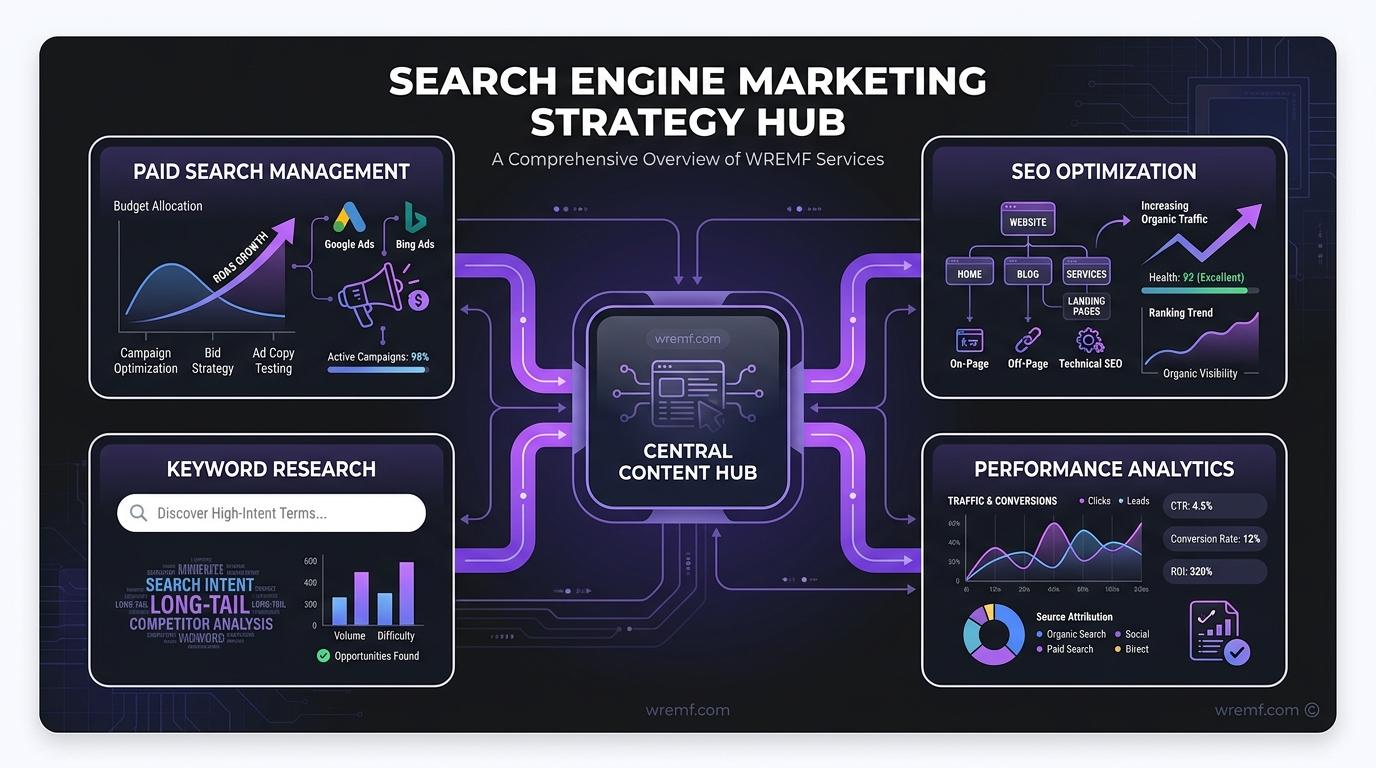
A search engine marketing strategy firm builds and manages the programs that connect businesses to buyers through search engines. The work covers paid search campaigns, organic search optimisation, keyword research, ad copy testing, bid management, landing page performance, and attribution reporting.
The term search engine marketing, or SEM, originated as a broad category that included all search-related marketing activities. In practice today, SEM commonly refers to the paid search component, particularly Google Ads and Pay-Per-Click advertising, while SEO covers the organic side. A credible SEM strategy firm handles both, because paid and organic search influence each other directly. A keyword that converts well in paid search often reveals content gaps in organic rankings. A page ranking organically for a high-intent phrase can inform better ad copy and landing page design.
The core services delivered by a search engine marketing firm typically include:
- Paid search campaign setup, management, and optimisation across Google and Bing
- Google Ads strategy including campaign structure, bidding, ad extensions, and audience targeting
- Keyword research using tools such as Google Ads Keyword Planner to identify high-intent phrases at the right cost-per-click
- Search Engine Optimization covering on-page, technical, and off-page signals
- Landing page design and testing to improve conversion rates from paid traffic
- Remarketing Ads to re-engage visitors who did not convert on the first visit
- Performance reporting using Google Analytics, Search Console, and attribution data
What distinguishes a strategy-led SEM firm from a simple ad management vendor is the presence of a clear analytical process. Strategy-led firms start with business goals, map those goals to funnel stages, assign the right channels and keyword groups to each stage, and measure results against commercial outcomes rather than vanity metrics.
According to Google's How Search Works documentation search engines evaluate relevance, quality, and authority signals when ranking and surfacing content. A strong SEM firm understands how paid and organic signals interact within that system.
For B2B brands evaluating agencies, the ability to connect SEM activity to pipeline and revenue is the most important distinguishing factor. Clicks and impressions tell you how the campaign performed at the platform level. Leads, cost per acquisition, and contribution to closed revenue tell you whether the strategy is working.
KEY TAKEAWAY: A search engine marketing strategy firm creates value by connecting paid search, organic SEO, keyword research, and conversion optimisation into a system that generates measurable leads and revenue, not just traffic.
The Core Components of a High-Performance SEM Strategy
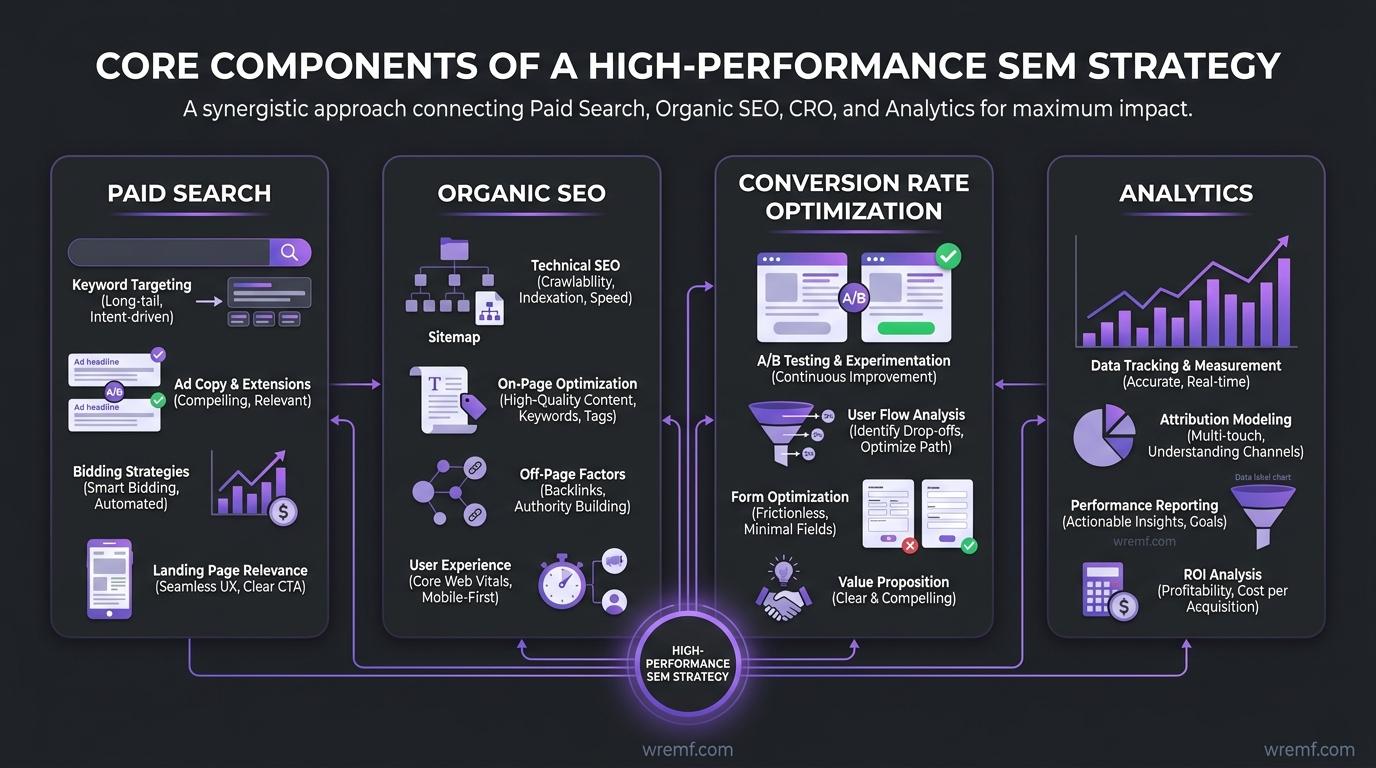
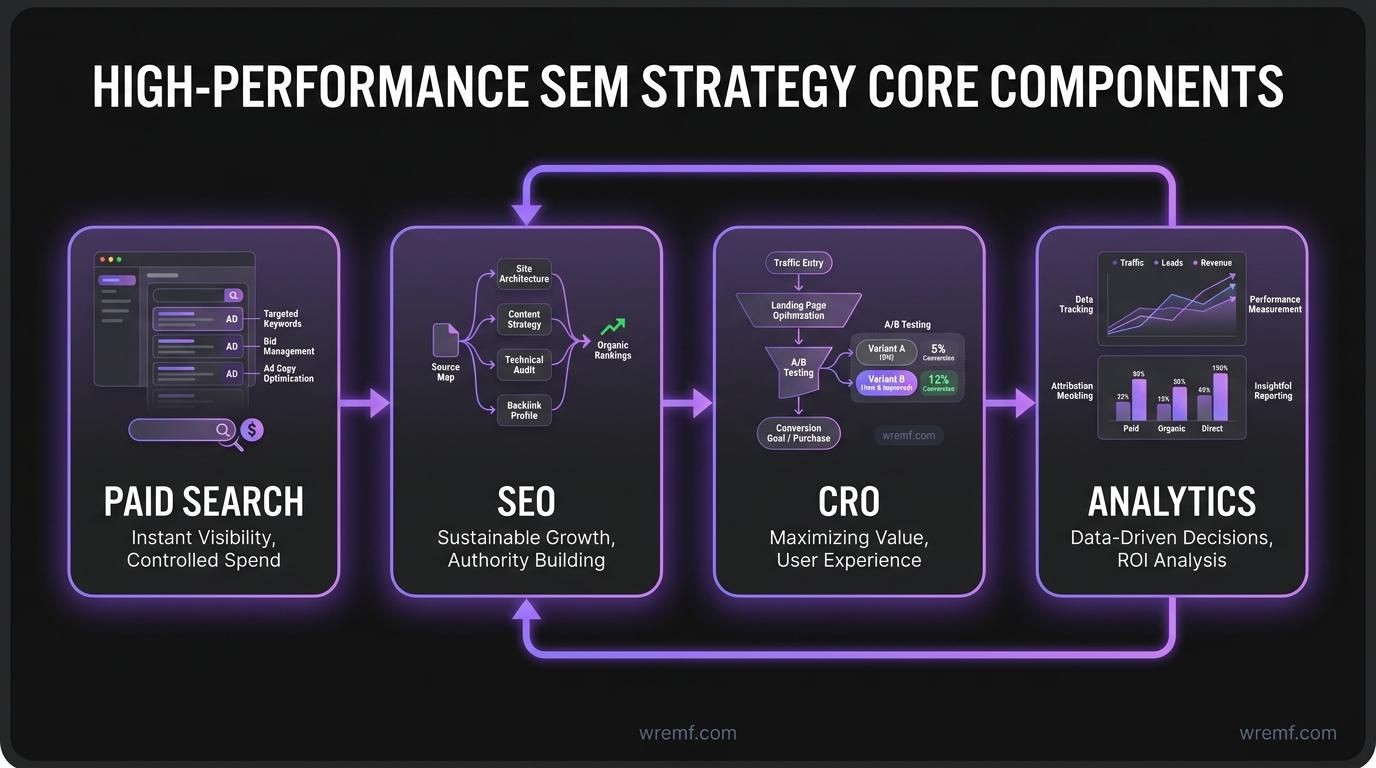
A high-performance SEM strategy combines paid search, organic search, conversion optimisation, and data analysis into one integrated system. Each component reinforces the others, and weakness in any one area limits overall performance.
Paid Search and Google Ads
Paid search is the most immediate channel in a SEM strategy. Google Ads and Bing PPC Ads allow businesses to appear at the top of search engine results pages for specific keywords immediately after campaign launch. The quality of a paid search program depends on campaign structure, keyword intent matching, ad copy relevance, bidding strategy, quality score management, and landing page alignment.
Google Ads Keyword Planner is one of the foundational tools for identifying keyword volume, competition levels, and estimated cost-per-click before committing budget. Strong SEM firms use it alongside performance data from live campaigns to continuously refine keyword targeting and eliminate wasted spend.
Pay-Per-Click advertising charges only when a user clicks an ad, making budget predictability more manageable than impression-based media. However, clicks alone do not indicate success. The conversion rate on the landing page, the quality of the lead, and the eventual revenue contribution determine whether a PPC investment delivers acceptable ROI.
Organic Search and Technical SEO
Organic search drives sustainable, compounding traffic that does not require per-click payment. A complete SEM strategy includes Search Engine Optimization because organic rankings reduce long-term customer acquisition cost and build brand authority that paid search alone cannot replicate.
Technical SEO covers the structural elements that allow search engines to crawl, index, and rank content correctly. This includes site speed, mobile optimisation, structured data and schema markup, clean URL architecture, Search Console monitoring, and Core Web Vitals performance. Technical issues that prevent pages from being indexed or ranked correctly undermine all other SEM investment.
Keyword Research and Content Strategy
Keyword research is the analytical foundation of both paid and organic search programs. It identifies the phrases buyers use at each stage of the purchase journey, from early awareness searches through to high-intent comparisons and decision-stage queries.
Content strategy translates keyword research into a publishing plan that builds topical authority across the search landscape relevant to the business. Content marketing for SEM purposes is not about volume alone. It requires relevance, depth, and alignment with the search intent behind each target phrase. A well-executed content strategy increases organic rankings, earns backlinks, supports link building outreach, and feeds paid search with landing page assets.
Conversion Rate Optimisation and Landing Pages
Traffic without conversion is a cost, not an asset. Landing page design, headline testing, form optimisation, and user experience improvements are how SEM firms turn clicks into leads and sales. Landing pages built specifically for paid search campaigns perform better than general website pages because they are designed around a single intent and a single action.
Conversion Rate Optimisation, or CRO, applies a structured testing process to identify which page elements, messages, and calls to action produce the highest conversion rates. Strong SEM firms treat CRO as an ongoing process rather than a one-time setup task.
Analytics, Attribution, and Reporting
Data is what separates SEM strategy from SEM activity. Google Analytics, GA4, and Search Console provide the measurement layer that tells teams what is working, what needs adjustment, and where budget should shift. Attribution models connect campaign spending to lead and revenue outcomes.
Performance marketing discipline requires that every campaign has defined metrics, tracking is set up correctly before launch, and reporting is reviewed against commercial goals rather than platform-level activity metrics. Brands that invest in SEM without a clean analytics setup cannot make accurate optimisation decisions.
KEY TAKEAWAY: A complete SEM strategy requires paid search, organic SEO, keyword research, content, landing page optimisation, and clean analytics working together. Weakness in any component reduces the overall effectiveness of the program.
How to Evaluate a Search Engine Marketing Strategy Firm
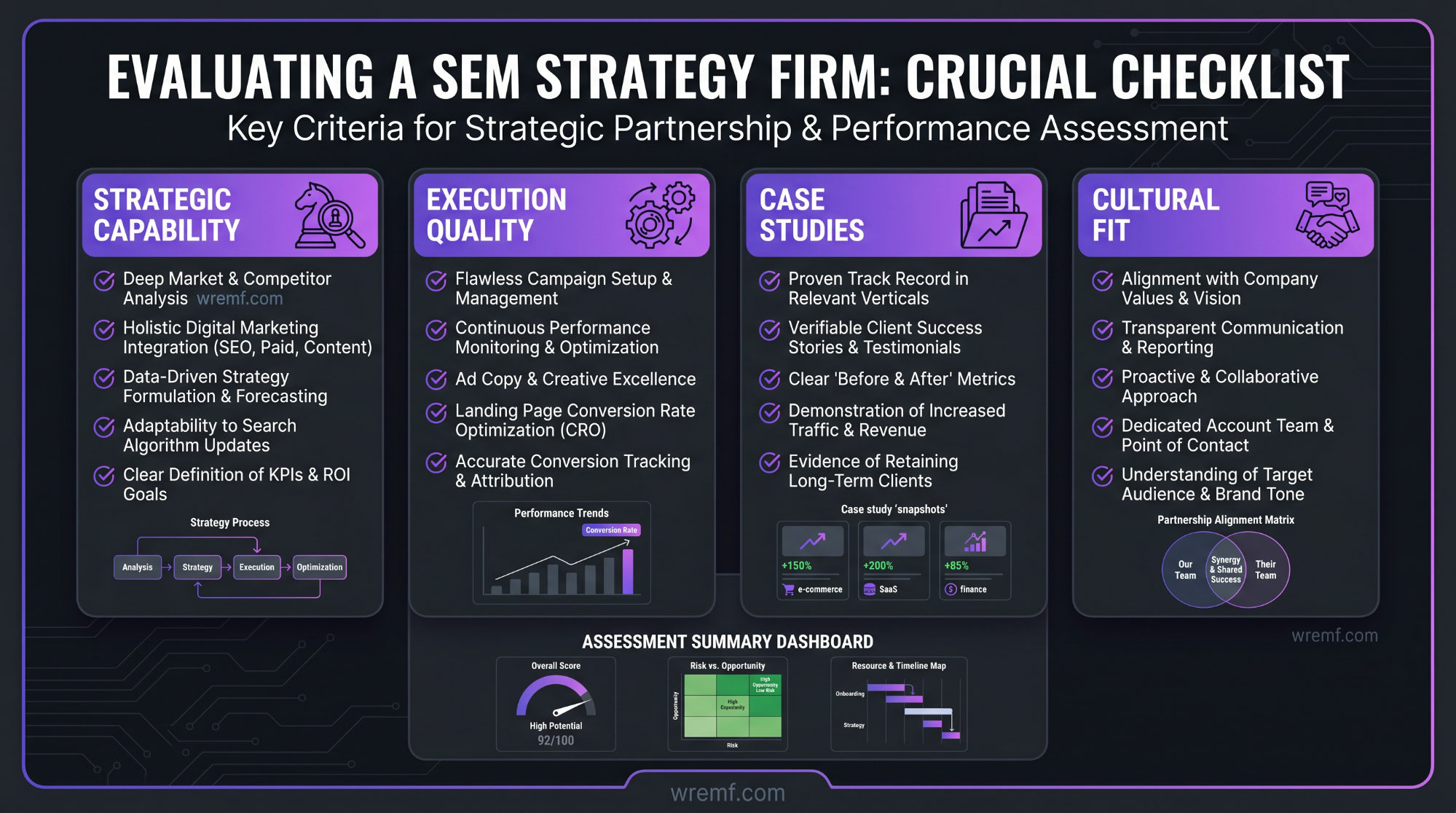
Evaluating a search engine marketing strategy firm requires looking beyond credentials and case studies to assess strategic capability, execution quality, and cultural fit. The right firm depends on the stage of your business, the complexity of your market, and the internal resources you have available.
Strategic Capability
The first test of any SEM firm is whether they ask the right questions before proposing a solution. A firm that proposes a Google Ads structure or keyword list before understanding your revenue goals, buyer journey, competitive landscape, and existing conversion rate performance is selling activity, not strategy.
Strong SEM firms ask about average deal size, sales cycle length, lead quality requirements, and the commercial metrics that leadership tracks. They connect SEM investment to these metrics from the start and set realistic expectations about what paid search and organic SEO can deliver within a given time horizon.
Execution Quality
Execution quality is visible in how well the firm manages the details. This includes campaign naming conventions, negative keyword management, bid optimisation frequency, ad copy testing cadence, and how they handle account changes without disrupting performance.
For SEO, execution quality is visible in the depth of technical SEO audits, the quality of keyword research documentation, the rigor of link building outreach, and the calibre of content produced. Ask to see examples of SEO deliverables, not just rankings claims.
Case Studies and Measurable Results
Credible SEM firms provide case studies that connect their work to commercial outcomes. Look for case studies that show before-and-after data on conversion rates, cost per lead, organic traffic growth, and search rankings, not just click volume.
Astoundz, for example, positions itself as an SEM consulting firm with deep integration between paid search, SEO, and strategy. WebFX, one of the more widely referenced SEM agencies in the industry, reports having managed substantial ad spend and driven significant revenue results for clients across a range of sectors. These firms provide benchmarks for what an established SEM firm's service model looks like.
Google Premier Partner status is a credible signal that a firm has met Google's requirements for ad spend management, performance standards, and certification. It does not guarantee results, but it confirms operational competency at the platform level.
Cultural Fit and Communication
The working relationship between a client and an SEM firm matters practically. Reporting cadence, communication style, responsiveness, and how the firm handles performance problems without deflection are factors that determine whether the relationship is productive over 12 months or longer.
Most businesses begin seeing measurable improvements from SEM programs within three to six months for paid search and six to twelve months for organic SEO, depending on competitiveness. Set these expectations clearly in the engagement definition.
Houston and San Francisco, two markets frequently referenced in SEM agency discussions, represent very different competitive landscapes. A firm experienced in competitive metropolitan markets with high search volume and significant local business density will have a different profile from a firm specialising in niche B2B markets. Matching the firm's sector experience to your competitive landscape is a practical filter when shortlisting candidates.
KEY TAKEAWAY: Evaluate SEM firms on strategic questioning, execution depth, case studies with commercial outcomes, and communication quality. Google Premier Partner status is a baseline signal, not a guarantee of results.
Paid Search vs Organic Search: Building a Complete Search Strategy
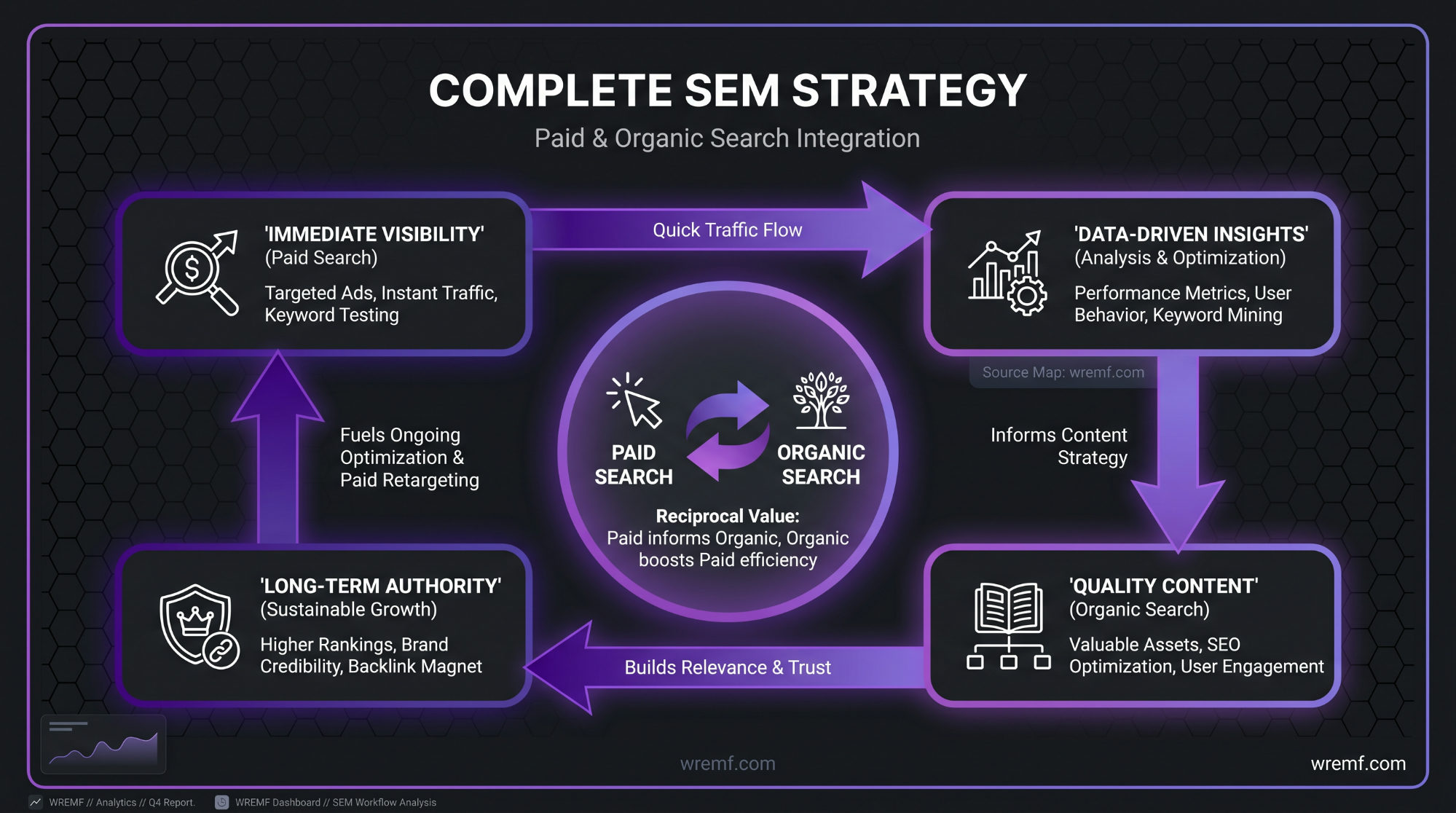
Paid search and organic search serve different functions within a complete SEM strategy, and the strongest programs use both in a coordinated way rather than treating them as competing budget items.
Paid search, delivered through Google PPC Ads and Bing PPC Ads, provides immediate visibility for high-intent keywords. It is controllable, scalable within budget constraints, and produces conversion data quickly. The limitation is cost: every click carries a price, and competitive keywords in B2B markets can carry significant cost-per-click figures. When paid search budgets pause, visibility stops.
Organic search, built through Search Engine Optimization, link building, technical SEO, and content marketing, accumulates over time. Organic traffic does not have a per-click cost once rankings are established. Pages that rank well for commercial keywords can generate consistent, qualified traffic for months or years. The trade-off is time. Organic rankings require sustained investment in content, authority, and technical foundations before they generate material returns.
A practical framework for combining both:
Phase 1: Use paid search to generate immediate traffic and conversion data while organic SEO foundations are being built.
Phase 2: Use paid search conversion data to identify the highest-performing keywords and intent signals. Apply this intelligence to organic content strategy and landing page design.
Phase 3: As organic rankings strengthen for key phrases, shift budget from organic-competitive terms toward paid search coverage of high-intent, high-conversion terms that are costly to rank for organically.
Phase 4: Maintain paid search for time-sensitive campaigns, competitive defence, and new product launches while organic search provides the baseline traffic volume.
Remarketing Ads add a second layer to this structure. Users who visit a website through organic or paid search but do not convert can be re-engaged through remarketing campaigns. This extends the reach of SEM investment beyond the initial click and improves overall conversion efficiency.
eCommerce Marketing adds further complexity, as paid search for eCommerce requires product-level campaign structures, shopping ad formats, and product feed management in addition to keyword-based text ads. SEM firms with eCommerce experience understand how to balance brand awareness campaigns with direct-response product campaigns.
As reported by McKinsey's AI insights AI is increasingly shaping how buyers discover products and services. This shift means that a complete search strategy now requires attention to where and how brands appear in AI-generated answers, not only in traditional SERPs. Teams using WREMF's AI search engine optimization guide alongside their SEM programs are better positioned to capture both traditional and AI-driven search demand.
KEY TAKEAWAY: Paid search and organic SEO are most effective when used together. Paid search provides immediate data and coverage while organic SEO builds compounding authority. Remarketing Ads and content strategy connect the two into a complete search system.
Specialist SEM Services: PPC, Remarketing, eCommerce, and Beyond
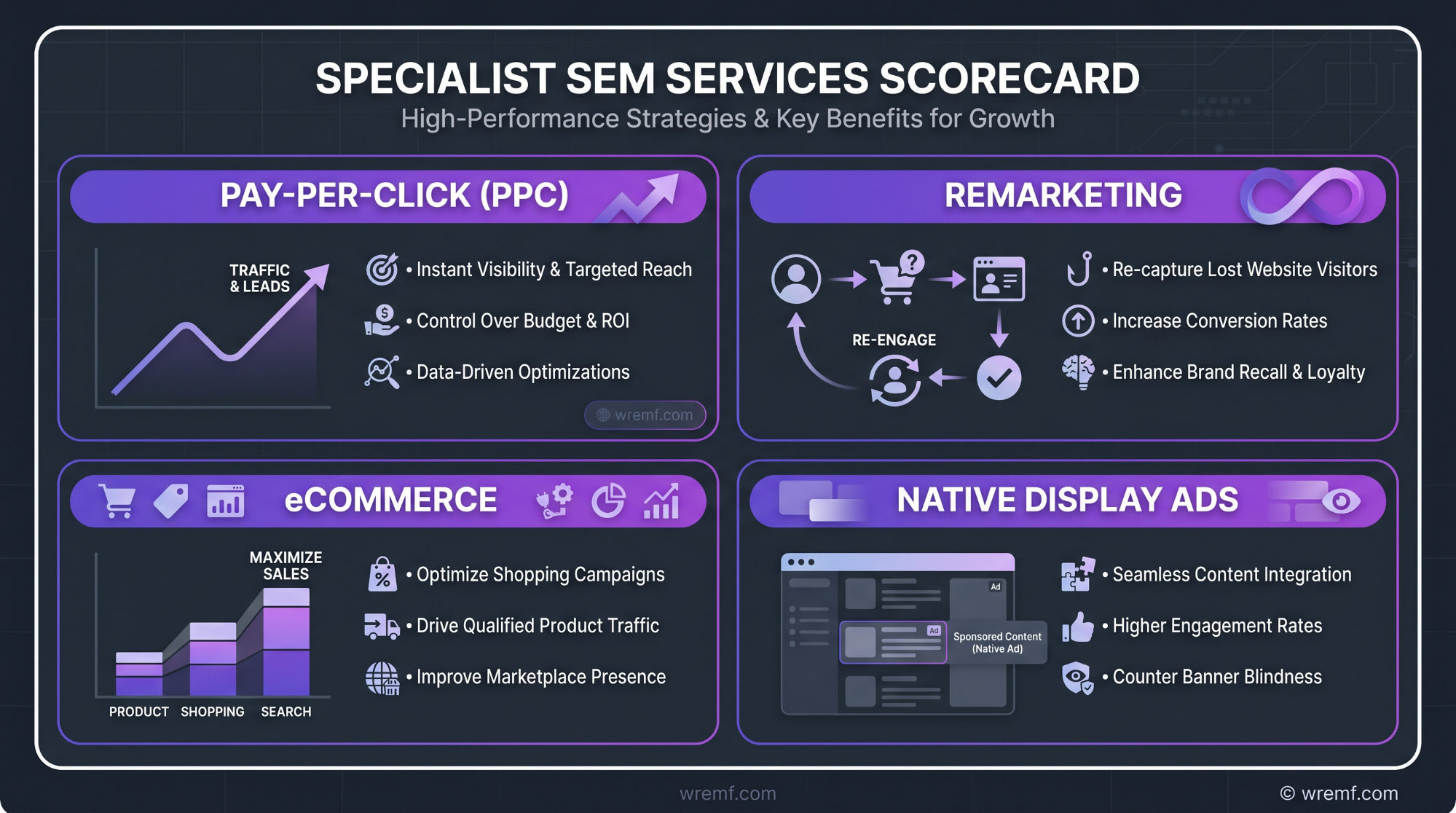
A credible search engine marketing strategy firm offers a range of specialist services beyond standard keyword campaigns. Understanding what each service does and when it applies helps businesses make better investment decisions.
Pay-Per-Click Advertising
Pay-Per-Click advertising, commonly known as PPC, is the primary mechanism for paid search. Google Ads is the dominant platform, accounting for the majority of global search ad spend. Bing PPC Ads extends reach into the Microsoft search network and typically carries lower competition and cost-per-click for many B2B terms.
SEM firms managing PPC programs focus on account structure, match type strategy, negative keyword management, ad copy testing, quality score improvement, and bid optimisation. Each of these elements affects both cost efficiency and conversion performance.
Remarketing Ads
Remarketing Ads, also referred to as retargeting, serve ads to users who have previously visited a website or interacted with a brand online. In a SEM context, remarketing extends the value of initial paid search clicks by maintaining brand presence through the buyer's research and decision phase.
For B2B buyers with long purchase cycles, remarketing helps keep a brand present across the 79 days or more that research-intensive purchases can require. This is particularly relevant for high-value SaaS and services purchases where buyers compare multiple vendors before making a decision.
Native Display Ads and Geofencing Ad Services
Native Display Ads blend with editorial content on publisher networks and tend to generate higher engagement than standard display banner formats. SEM firms offering native display as part of a broader paid media strategy can extend brand awareness beyond search intent environments into content discovery contexts.
Geofencing Ad Services target users within a defined geographic boundary. For local businesses and businesses with physical locations, geofencing connects digital advertising to in-person intent signals, such as visiting a competitor's location or attending an industry event. This is particularly relevant for local business SEM programs in dense urban markets.
Yelp Ads and Local Search Advertising
Yelp Ads are relevant for local service businesses where Yelp maintains strong organic visibility for category-based searches. For local business SEM programs, Yelp Ads can extend reach into discovery queries where buyers are searching for service providers in a specific category rather than by brand name.
Social Media Ad Services
Social Media Ad Services, including Social Media Marketing on LinkedIn, Meta, and other platforms, are frequently bundled into full-service SEM packages. While social media advertising is technically distinct from search engine marketing, the audience targeting and retargeting capabilities of social platforms work effectively alongside paid search programs to build brand awareness and generate leads across multiple touchpoints.
eCommerce PPC
eCommerce Marketing through PPC requires product-feed management, shopping campaign structure, dynamic remarketing, and performance measurement at the product and category level. SEM firms experienced in Amazon and Google Shopping understand how to align product listings, pricing data, and ad creative to maximise visibility and conversion rates in eCommerce environments.
KEY TAKEAWAY: A full-service SEM firm offers paid search, remarketing, native display, geofencing, social media ad services, and eCommerce PPC as a connected set of performance marketing capabilities. The right combination depends on the business model, buyer journey, and geographic focus.
Local SEO and Local Search Strategies Within a SEM Program
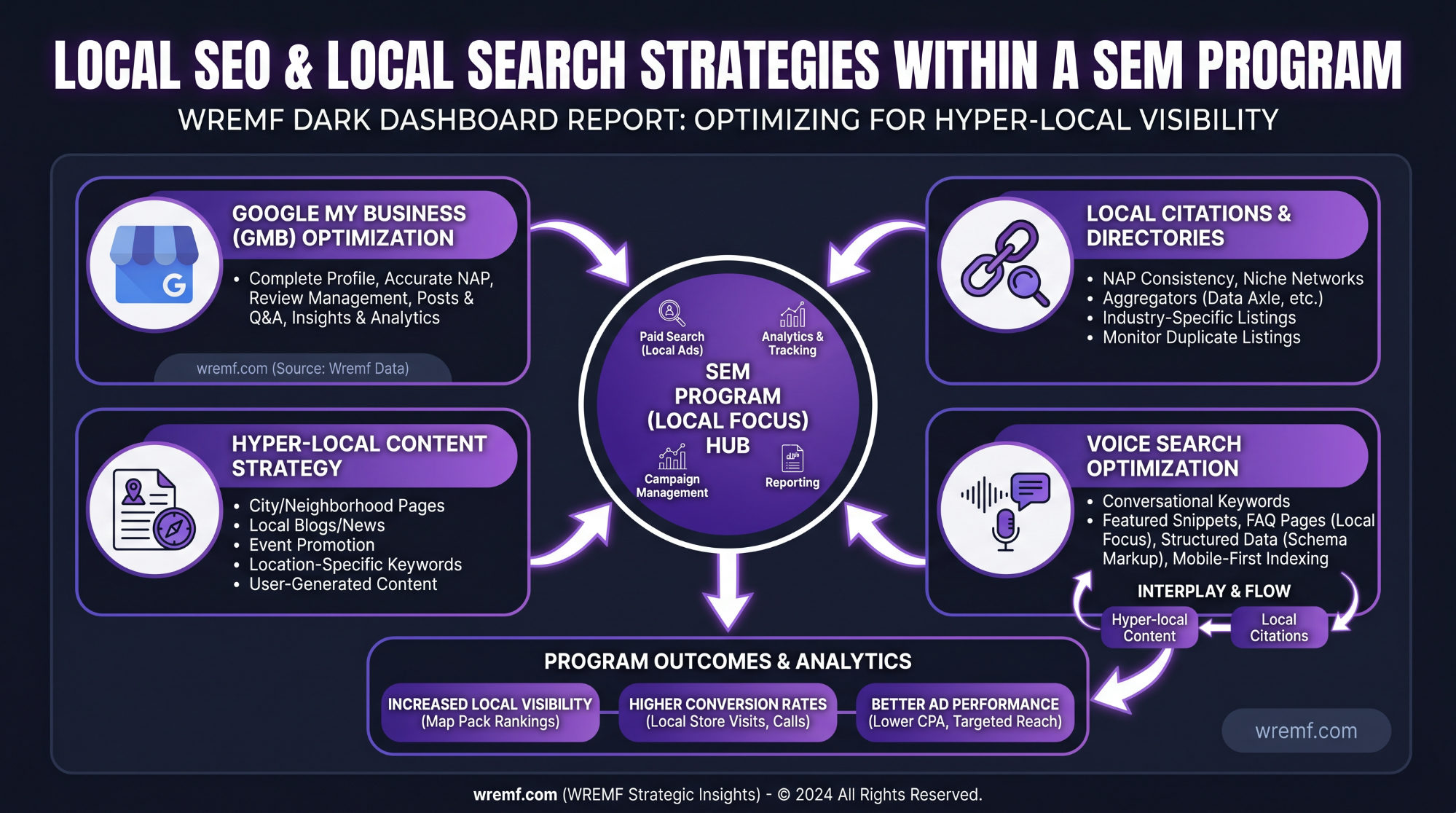
Local SEO is the practice of optimising a business's online presence to appear in location-based search results, Google My Business listings, and local SERPs. For businesses serving specific geographic markets, local SEO is one of the highest-return components of a complete SEM strategy.
Google My Business optimisation is the starting point for local search visibility. A fully optimised and verified Google My Business listing increases a business's chances of appearing in the local pack, the cluster of three business listings that appears at the top of local search results. Local business visibility in this format drives calls, directions requests, and website visits from buyers with strong local intent.
Local citations are mentions of a business name, address, and phone number across directories, review platforms, and local websites. Consistent local citations reinforce geographic relevance signals and help search engines verify the legitimacy and location of a business. SEM firms providing local SEO services typically include citation building, citation cleanup, and review management as standard components.
Hyper-local content strategies create pages and content assets targeting neighbourhood-specific keywords that broader regional campaigns do not address. A business in San Francisco, for example, may target not just city-level terms but neighbourhood terms across the Tenderloin, Mission, and SoMa districts to capture highly specific local intent. This approach to hyper-local content is particularly effective in dense urban markets where competitive intensity at the city level is high but neighbourhood-level terms have lower competition and stronger buying intent.
Voice search optimisation has become increasingly relevant within local SEO as a growing share of local queries are delivered through mobile voice interfaces. Voice search queries tend to be longer and more conversational than typed queries. Optimising for voice means targeting natural language phrases, featured snippets, and structured data formats that voice assistants can extract and read back to users.
Mobile Optimisation is a prerequisite for local search performance. Most local searches are performed on mobile devices. Pages that are slow, difficult to navigate on mobile, or that fail Core Web Vitals benchmarks lose conversion rate relative to mobile-optimised competitors, regardless of how well the paid search campaign performs.
Neighbourhood-specific keywords, local citations, Google My Business management, mobile-optimised landing pages, and voice search-ready content are the five pillars of a local SEM program. Houston and San Francisco represent markets where all five pillars are necessary because both cities have high search volume, competitive local business density, and sophisticated buyers who compare multiple providers before contacting a business.
KEY TAKEAWAY: Local SEO within a SEM program requires Google My Business optimisation, local citation building, hyper-local content targeting neighbourhood-specific keywords, voice search readiness, and mobile optimisation to capture local buying intent effectively.
Technical SEO as a Foundation for SEM Performance
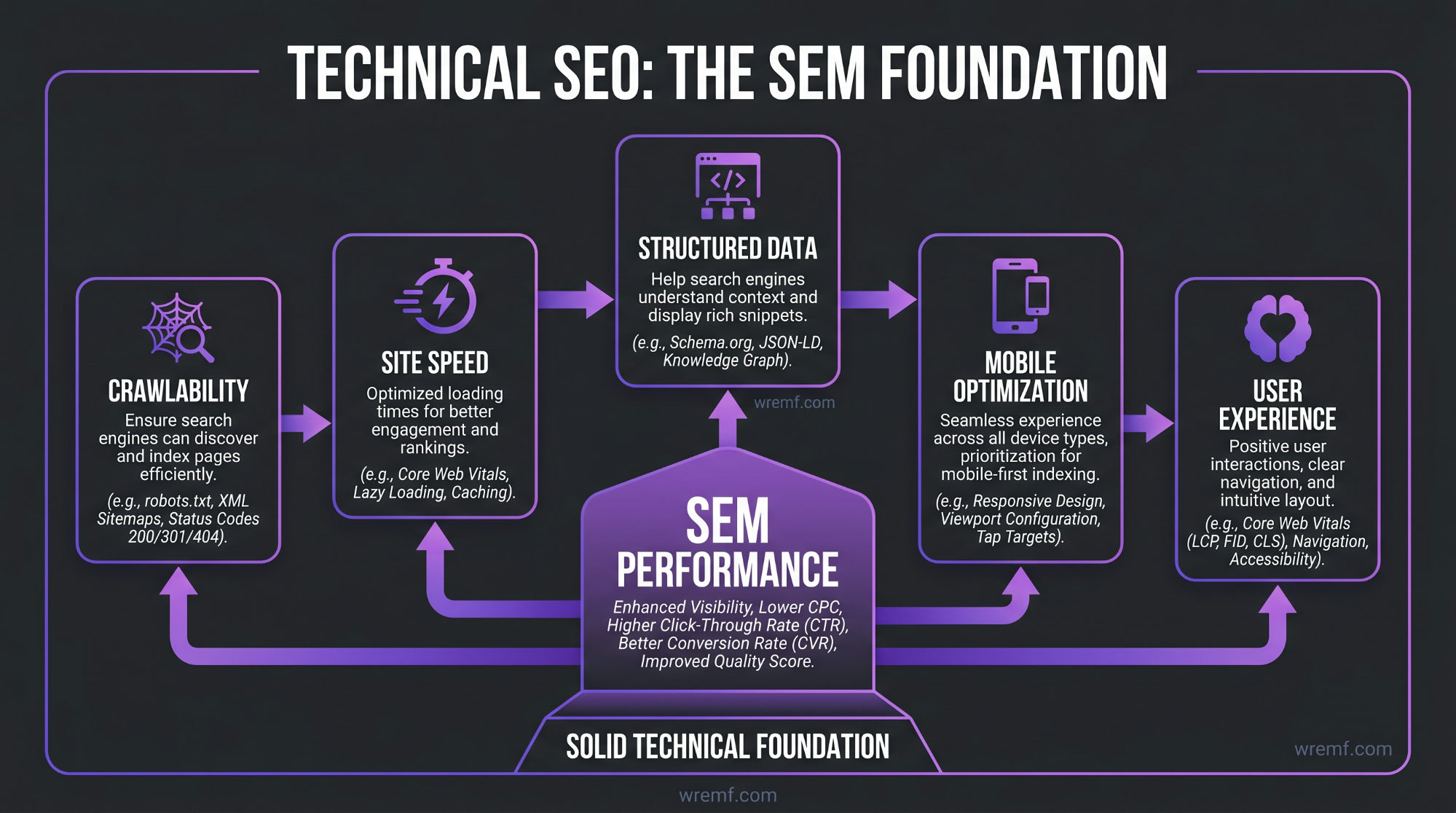
Technical SEO forms the structural foundation that determines whether a website can be effectively crawled, indexed, and ranked by search engines. Without technical SEO in good health, paid search landing pages underperform, organic rankings stagnate, and SEM investment delivers lower returns than it should.
A technical SEO audit covers a wide range of factors. Key areas include crawlability and indexation, page speed, mobile performance, URL structure, canonical tags, redirect chains, structured data and schema markup, Core Web Vitals, and XML sitemap health. Technical issues in any of these areas can suppress rankings and reduce the quality score of paid search landing pages.
Schema markup and Structured Data help search engines understand what a page is about and can qualify content for rich results and featured snippets in SERPs. For B2B businesses, schema types covering organisation, FAQ, how-to, and review content are particularly relevant. Implementing schema markup correctly is a technical SEO task that many businesses under-prioritise relative to its impact on search visibility.
Search Console is the primary tool for monitoring technical SEO health at the page and site level. It surfaces crawl errors, indexation problems, manual actions, Core Web Vitals performance data, and keyword performance data for organic rankings. A SEM firm managing organic search without regular Search Console monitoring is operating without a critical feedback layer.
Web Design and User Experience directly affect both organic rankings and paid search performance. Google's ranking systems consider user experience signals, including page engagement, bounce behaviour, and mobile usability. Landing pages with poor user experience design generate lower quality scores in Google Ads, which increases cost-per-click and reduces ad position relative to better-optimised competitors.
Web Development and Website Design therefore sit within the SEM strategy scope for firms that offer holistic search marketing services. A SEM firm that cannot advise on or implement technical site improvements is limited in its ability to improve search performance for clients with significant technical debt.
For modern SEM programs, technical SEO foundations also need to support AI-driven discovery. Pages that are well-structured, clearly authored, entity-consistent, and schema-rich are more likely to be cited by AI engines as well as ranked by traditional search engines. As covered in WREMF's AI search engine optimization tools guide technical quality is a shared requirement for both traditional SEM performance and AI search visibility.
KEY TAKEAWAY: Technical SEO in good health is a prerequisite for SEM performance. Crawlability, schema markup, structured data, Search Console monitoring, and strong user experience design all directly affect both organic rankings and the efficiency of paid search campaigns.
Where SEM Strategy Meets AI Search Visibility
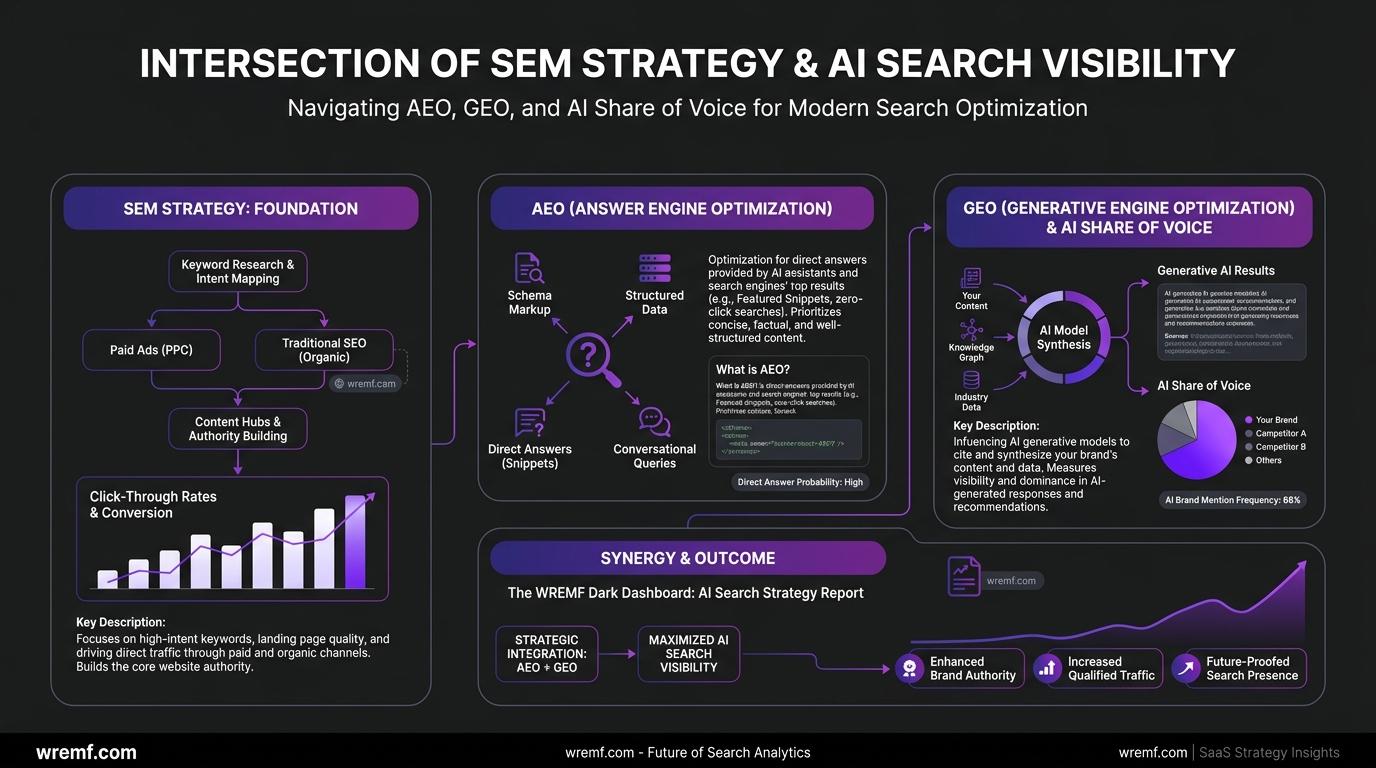
AI search visibility is the newer dimension of search marketing that traditional SEM firms were not originally built to address. AI engines such as ChatGPT, Gemini, Perplexity, Google AI Overviews, Copilot, DeepSeek, Grok, Meta AI, and Mistral now play a significant role in how buyers discover, compare, and evaluate solutions before visiting a website.
Search Engine Marketing has historically focused on appearing in Google and Bing search results. The rise of AI-powered answer engines changes the search landscape in two important ways. First, AI Overviews in Google Search now appear above traditional organic results for a large share of queries, particularly informational and comparison searches that are common in B2B buying journeys. According to Google's AI Overviews documentation these AI-generated summaries draw from multiple sources across the web and present synthesised answers rather than ranked links. Second, a growing share of buyers are using standalone AI platforms directly to answer questions that previously generated Google searches.
This shift has practical consequences for SEM strategy. A brand can rank on page one of Google for a target keyword and still be absent from the AI-generated answer that appears above the organic results. A competitor with fewer organic rankings may be cited more frequently in ChatGPT or Perplexity answers because their content better matches the source selection criteria those AI engines apply.
Answer Engine Optimisation, known as AEO, is the practice of optimising content to appear in AI-generated answers. Generative Engine Optimisation, known as GEO, applies the same logic to AI platforms that generate answers from indexed and retrieval-augmented sources. Both AEO and GEO require different optimisation frameworks from traditional keyword-based SEM, focusing on content clarity, entity authority, source consistency, and structured information that AI engines can extract and cite.
AI share of voice measures how prominently a brand appears across AI-generated answers relative to competitors. A brand with strong AI share of voice is cited frequently, mentioned positively, and recommended across the prompts buyers use when comparing solutions. A brand with low AI share of voice is absent or underrepresented in those answers, regardless of its Google rankings.
Prompt tracking is the practice of monitoring how AI engines respond to specific buyer prompts over time. It reveals which competitors appear in AI answers, what sources are cited, and whether a brand's messaging is reflected accurately or at all in AI-generated responses.
WREMF is built specifically for this layer of search marketing. It tracks AI visibility across 10 AI engines, monitors citations and source mentions, measures AI share of voice, identifies content and citation gaps, and connects AI referral traffic to business outcomes through GA4 attribution. For teams operating a full SEM strategy that needs to extend into AI search, WREMF's answer engine optimization guide provides a detailed framework for understanding and acting on AEO requirements.
KEY TAKEAWAY: AI search engines now influence buyer discovery in ways that traditional SEM tools do not measure. AEO, GEO, and AI share of voice tracking extend the scope of modern SEM strategy into AI-powered discovery surfaces where competitor visibility may differ significantly from traditional SERP positions.
SEM Agency vs In-House Team vs Hybrid: How to Decide
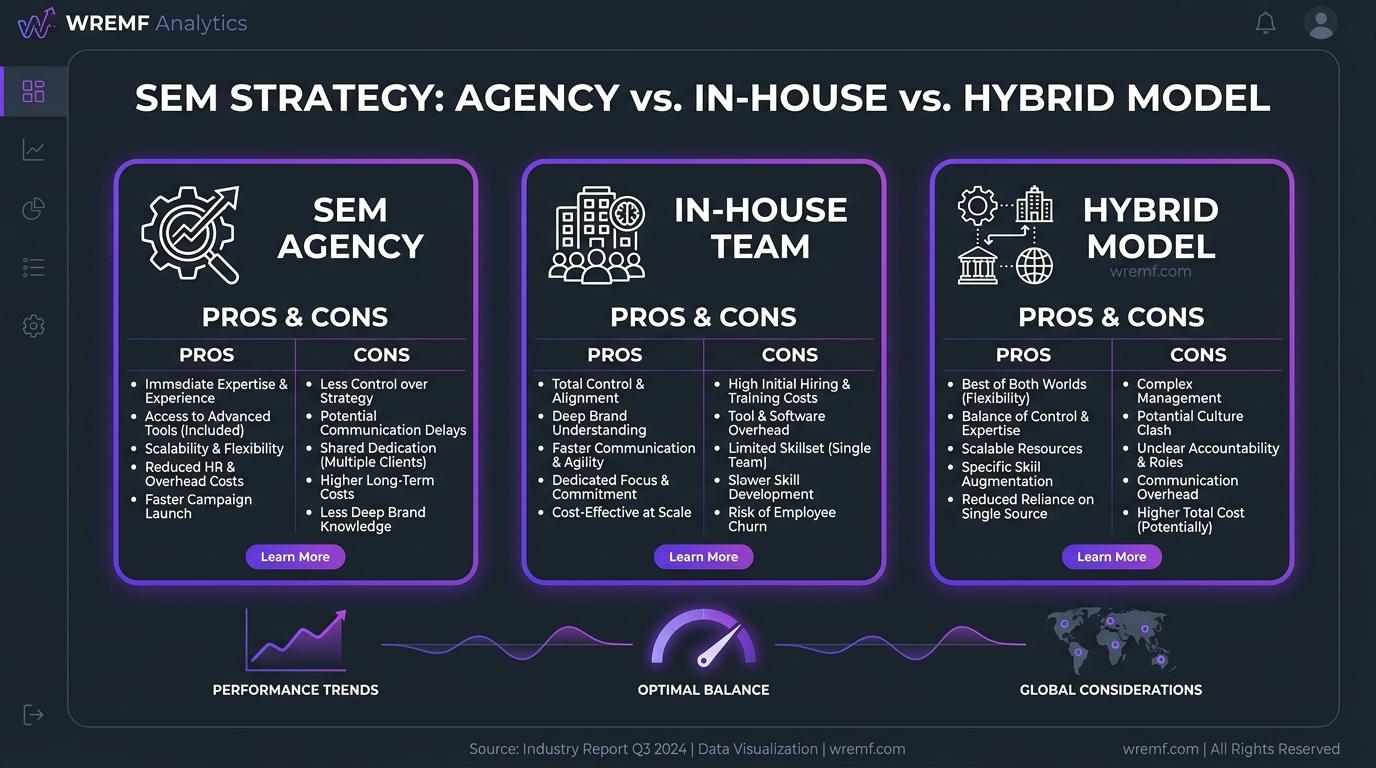
The decision between using a search engine marketing strategy firm, building an in-house SEM team, or combining both depends on budget, execution capacity, market competitiveness, and the speed at which the business needs results.
Using a SEM Agency
A SEM agency brings immediate access to expertise, tools, and operational processes that would take months or years to build internally. Agencies maintain Google Ads certifications, platform relationships, and campaign management tools at a level that most in-house teams cannot replicate without significant investment.
Agencies are particularly valuable for businesses that need results quickly, lack internal paid search or SEO expertise, or are entering new markets or channels. The trade-off is cost, dependency on external resource allocation, and the time required for a new agency to understand your market and offer properly.
The SEM agency landscape includes firms ranging from boutique consultancies to large full-service digital marketing agencies. Boutique firms often provide more direct access to senior marketers and more tailored strategy. Larger agencies provide broader capability and technology access but may allocate junior team members to accounts below a certain spend threshold.
Building an In-House SEM Team
An in-house SEM team provides deeper knowledge of the business, faster iteration, and greater control over strategy and budget allocation. For businesses with sufficient scale, an internal team often delivers better long-term ROI than ongoing agency fees.
The limitations of an in-house model are hiring and retention cost, the risk of narrow channel expertise when one or two team members cover all SEM activity, and the difficulty of staying current across a rapidly changing landscape that now includes AI search, GEO, AEO, and prompt tracking in addition to traditional paid search and SEO.
Hybrid Model
The hybrid model combines an in-house team with a specialist agency or managed service for specific capabilities. A common hybrid structure places in-house marketers responsible for strategy, reporting, and business alignment while external specialists handle technical SEO execution, paid search campaign management, or AI visibility tracking.
WREMF supports this hybrid structure for teams that want to manage their AI visibility tracking in-house using the WREMF platform while bringing in the senior WREMF team for strategy, GEO audits, AEO content optimisation, and citation cleanup when needed. Teams can explore WREMF pricing plans to understand which model fits their resources.
For smaller SaaS teams and solo consultants, the WREMF Starter plan at 59 euros per month provides access to 10 AI engines, unlimited prompts, source citation tracking, and core prompt intelligence. Growth teams requiring attribution, GEO audits, white-label reports, and competitor tracking across up to 15 competitors can use the Growth plan at 149 euros per month. Enterprise brands and agencies that need full managed execution can engage the WREMF Managed service from 1,500 euros per month for custom strategy, implementation, and reporting.
KEY TAKEAWAY: The choice between a SEM agency, in-house team, or hybrid model depends on speed of need, budget, and internal execution capacity. Hybrid models that combine in-house strategy with specialist execution for technical SEO, paid search, and AI visibility tracking frequently deliver the best balance of control and capability.
How to Measure SEM Performance: Metrics, Analytics, and Attribution
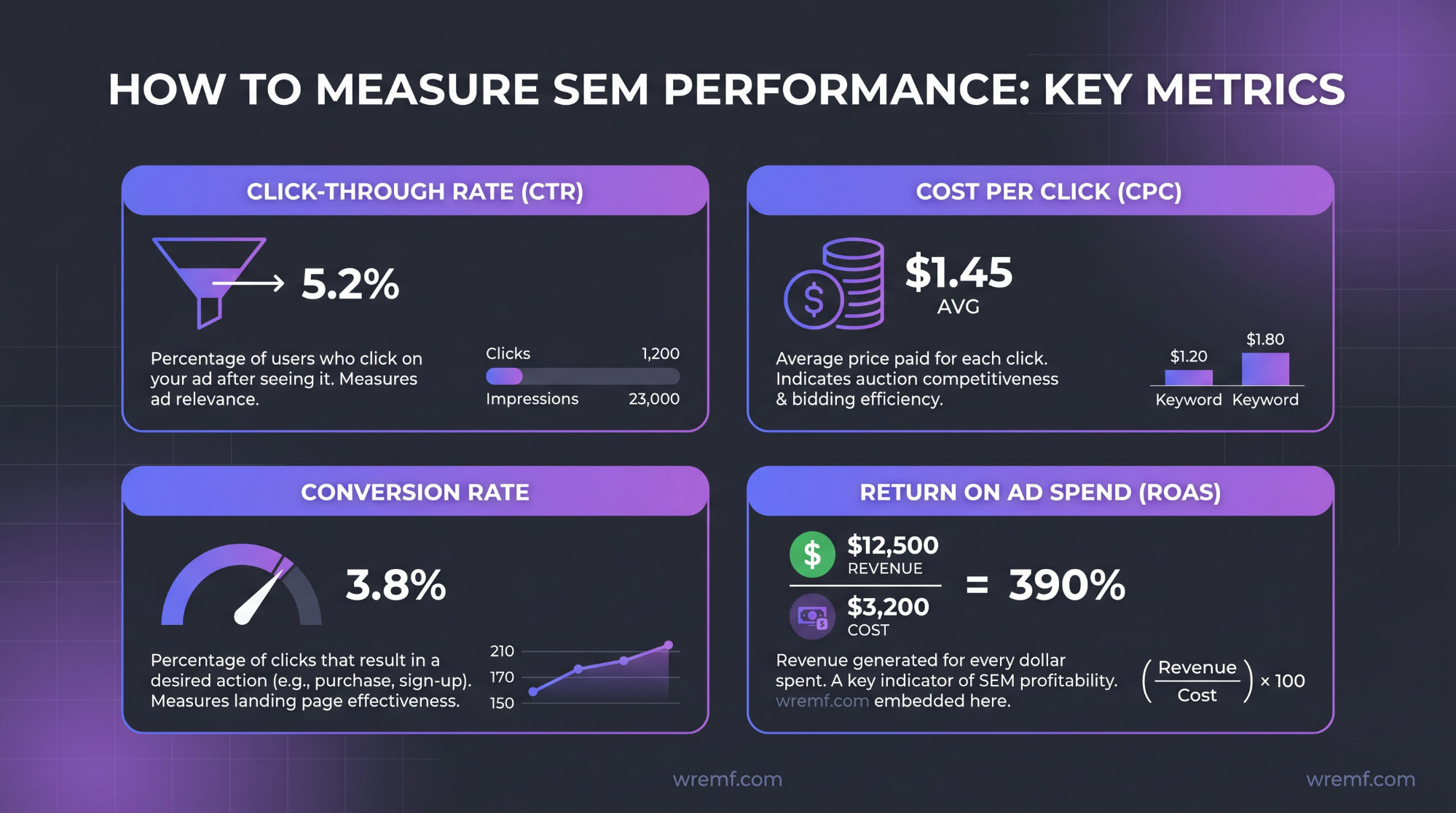
Measuring SEM performance requires a clear analytics framework that connects campaign activity to commercial outcomes. Tracking clicks, impressions, and ad spend without connecting them to leads, pipeline, and revenue produces reports that look active but do not support strategic decisions.
The core metrics for a paid search program include click-through rate, cost-per-click, quality score, conversion rate, cost per lead, cost per acquisition, and return on ad spend. Each metric answers a different question about campaign health and efficiency. Quality score in Google Ads reflects the relevance of ad copy, keyword alignment, and landing page experience. Improving quality score reduces cost-per-click and improves ad position simultaneously.
For organic search, core metrics include organic traffic volume, keyword rankings across target phrases, click-through rate from SERPs, time on page, bounce rate, and the number of pages generating meaningful organic traffic. Search rankings are a leading indicator, but organic traffic converted to leads or pipeline is the outcome metric that matters to the business.
Google Analytics and GA4 provide the attribution layer that connects sessions, source traffic, and conversions across both paid and organic channels. Proper setup of GA4 requires defining conversion events, configuring channel groupings correctly, and connecting paid search accounts to allow cost data import. Without this setup, attribution data is incomplete and optimisation decisions are made on partial information.
User behavior data from analytics platforms tells teams which landing pages hold attention, which pages produce high exit rates, and where buyers drop out of the conversion funnel. This behavioural data directly informs both landing page improvements and content strategy decisions.
AI-driven analytics and predictive SEO represent the evolving frontier of SEM measurement. AI-driven analytics platforms apply machine learning to large volumes of campaign and behaviour data to surface patterns, anomalies, and opportunities that manual analysis would miss. Predictive SEO tools forecast which keywords and content investments are most likely to produce ranking and traffic gains based on competitive analysis and trend signals. These capabilities are increasingly relevant for SEM firms managing large, complex programs across multiple markets and channels.
TIP:
Before building a full SEM reporting stack, confirm that Google Analytics, Search Console, and GA4 are correctly configured and that conversion events are tracked at the specific action level that maps to a business outcome, not just page views.
For teams tracking AI search visibility alongside traditional SEM metrics, WREMF's AI brand monitoring guide covers how to measure brand presence, citation frequency, and source consistency across AI engines as a complement to standard SEM analytics.
KEY TAKEAWAY: Effective SEM measurement requires clean GA4 and Search Console setup, conversion tracking aligned to business outcomes, and quality score monitoring for paid search. AI-driven analytics and predictive SEO add a layer of pattern recognition that improves program efficiency at scale.
How to Run a SEM Program: A Step-by-Step Workflow
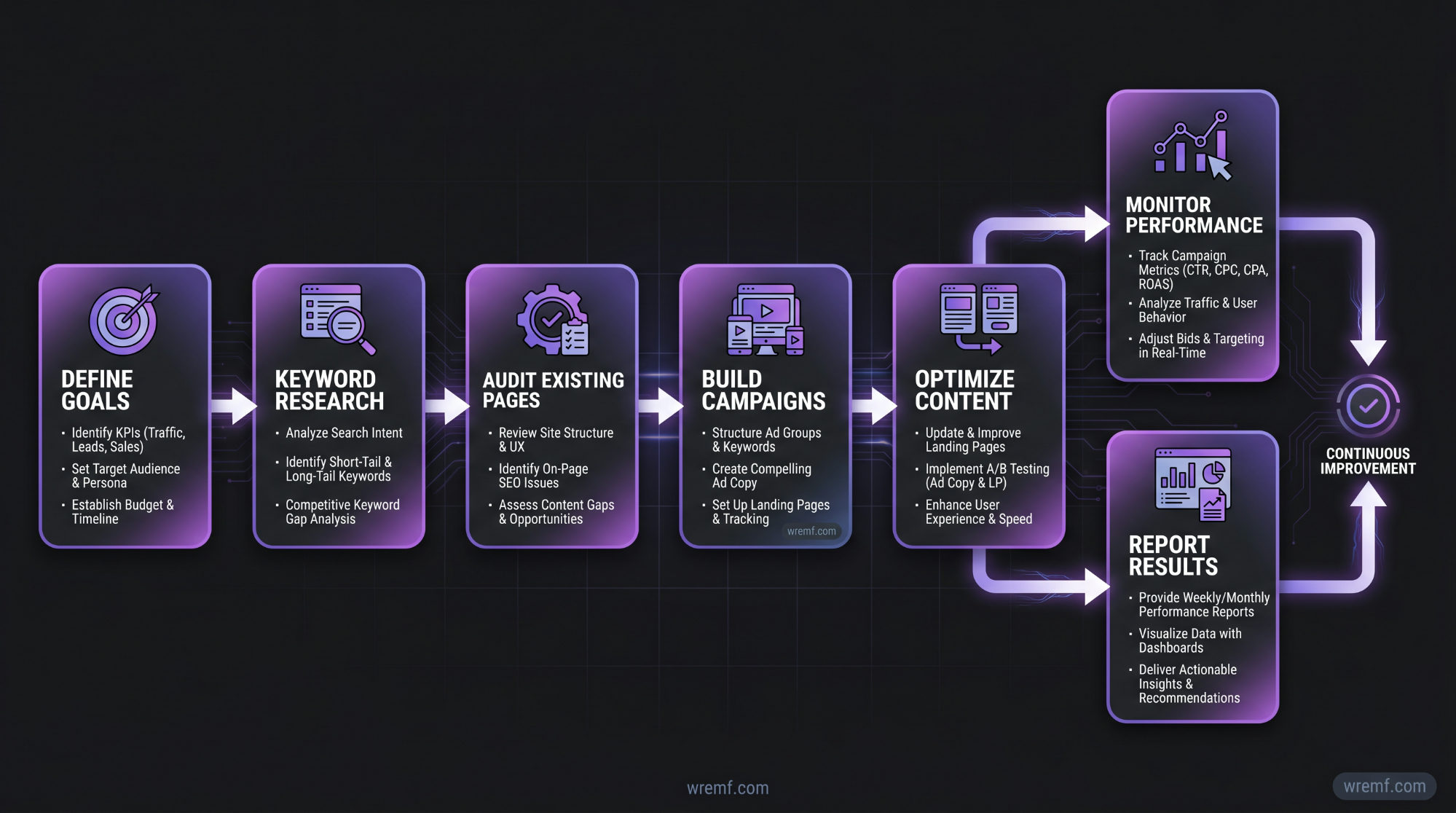
Running an effective search engine marketing program requires a structured process that moves from strategy through execution to continuous optimisation. The following workflow applies to both in-house teams and agency-managed programs.
Step 1: Define commercial goals and success metrics
Start by establishing what the SEM program needs to achieve in commercial terms. Define the target cost per lead, acceptable cost per acquisition, lead volume required to meet pipeline goals, and the time horizon for measuring results. Vanity metrics such as impressions and clicks are secondary to these commercial benchmarks.
Step 2: Conduct keyword research and intent mapping
Use Google Ads Keyword Planner and organic research tools to map keywords across the full funnel. Segment keywords by intent: awareness, consideration, and decision. Identify the highest-intent phrases that indicate buyer readiness and the informational phrases that support content marketing at the top of the funnel.
Step 3: Audit the existing website and landing page inventory
Assess whether existing landing pages are aligned with the target keyword groups. Identify pages that need optimisation, pages that are missing entirely, and technical SEO issues that would limit performance. A technical SEO audit before campaign launch prevents budget waste on traffic directed to under-optimised pages.
Step 4: Build or optimise paid search campaigns
Structure Google Ads campaigns around tightly themed ad groups, with ad copy that matches keyword intent and landing pages that are directly relevant to the ad message. Set up Remarketing Ads for non-converting visitors. Configure conversion tracking before activating spend.
Step 5: Publish and optimise organic content
Launch the content calendar based on keyword research. Prioritise pages targeting high-value commercial keywords, category pages that build topical authority, and blog content that generates organic traffic from informational searches. Implement schema markup, optimise page speed, and submit new pages through Search Console.
Step 6: Monitor performance and run optimisation cycles
Review campaign performance weekly for paid search and monthly for organic SEO. Adjust bids, pause underperforming ad groups, refresh ad copy, and identify ranking movement for target keywords. Use GA4 attribution data to identify which channels and campaigns are contributing most efficiently to leads and pipeline.
Step 7: Expand coverage with remarketing, local, and AI visibility
Once core paid and organic campaigns are performing, extend coverage through Remarketing Ads, local SEO, voice search optimisation, and AI search visibility tracking. Monitor how competitors appear in AI answers and assess whether brand content is being cited correctly by AI engines such as Perplexity, ChatGPT, and Google AI Overviews.
Step 8: Report against commercial goals and refine strategy
Monthly reporting should connect SEM activity to commercial outcomes: leads generated, cost per lead, pipeline influenced, and contribution to revenue where trackable. Refine strategy based on what the data shows, not what the original plan assumed.
KEY TAKEAWAY: An effective SEM workflow moves from commercial goal-setting through keyword research, technical auditing, campaign launch, content publishing, performance monitoring, and reporting. Each step builds on the previous one and should be tied to measurable results.
Real-World SEM Strategy Scenarios
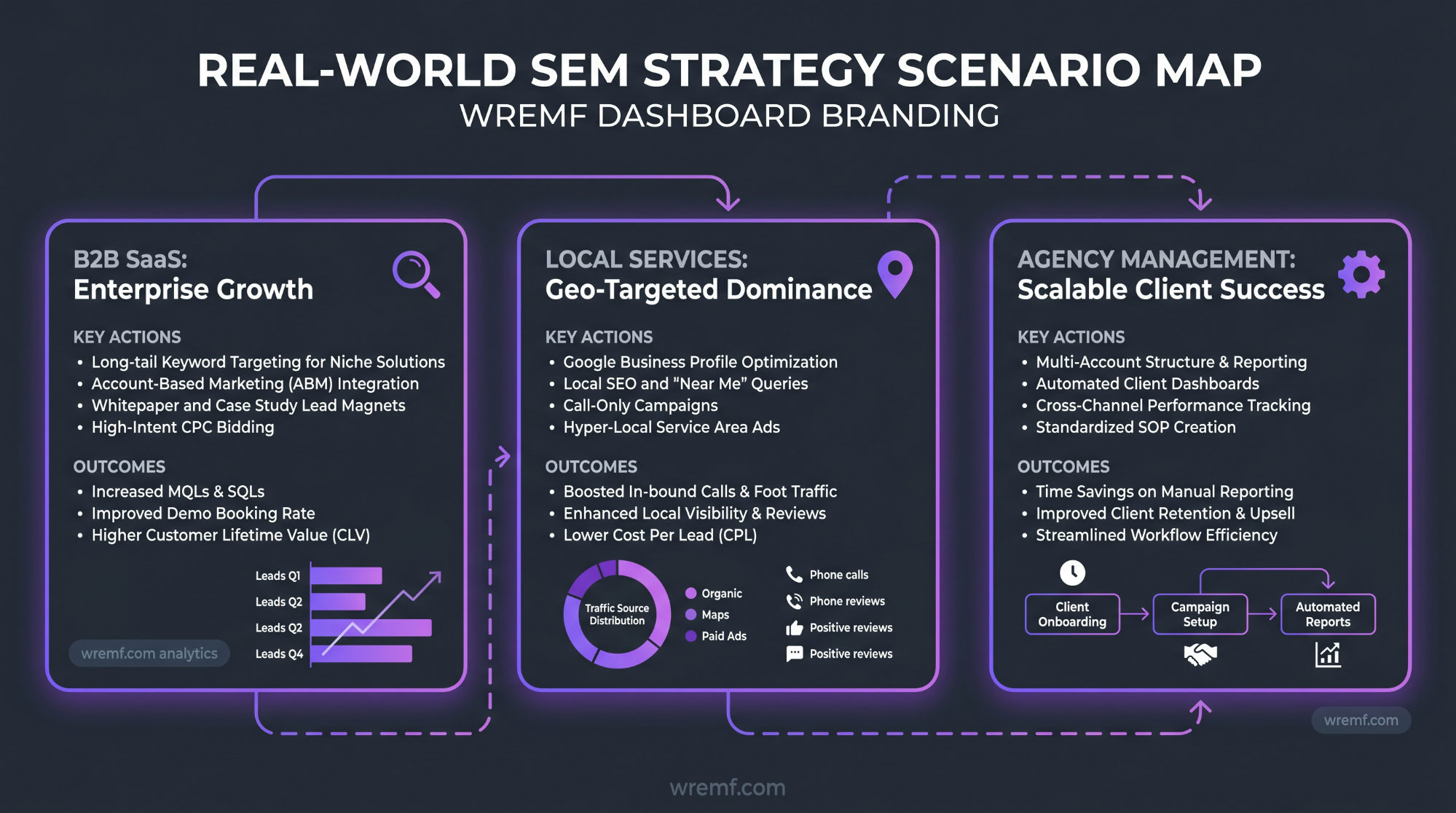
Understanding how SEM strategy applies in practice is clearer through representative scenarios. The following examples illustrate how different types of businesses approach SEM program design and where specialist support creates the most value.
Scenario 1: A B2B SaaS Company Competing in a High-Intent Keyword Market
A mid-size B2B SaaS company selling project management software wants to increase qualified trial signups from search. The competitive landscape includes well-funded incumbents with strong domain authority and substantial Google Ads spend. The in-house team has content writers but lacks paid search and technical SEO expertise.
The appropriate SEM strategy begins with keyword research to identify high-intent comparison phrases such as "best project management software for agencies" and "project management tool for remote teams." These phrases carry stronger purchase intent than broad category terms and face less competition from the largest incumbents.
A SEM firm in this scenario would build a Google Ads structure around these intent-rich phrases, create landing pages optimised specifically for each keyword group, implement Remarketing Ads for trial page visitors who did not sign up, and begin a technical SEO program to build organic rankings for the same high-intent terms over a six to twelve month horizon.
Measuring AI share of voice alongside traditional SEM metrics would reveal whether competitors are also present in ChatGPT and Perplexity answers when buyers ask comparison questions. If they are and the client is not, that represents a visibility gap that paid search alone cannot fill.
Scenario 2: A Local Service Business in a Competitive Urban Market
A legal services firm in San Francisco wants to generate more leads from local search. The business has a functional website but no structured local SEO program, inconsistent local citations across directories, and no presence in the Google local pack for core practice area terms.
The SEM strategy for this business prioritises Google My Business optimisation, local citation building, and neighbourhood-specific landing pages targeting the specific districts where the firm operates. Google PPC Ads are used for immediate visibility on high-intent local queries while organic local SEO builds over a three to six month period.
Voice search optimisation is included because a significant share of local legal queries are delivered through mobile voice search. Structured data and schema markup are implemented to improve eligibility for featured snippets and rich results in SERPs.
Scenario 3: An Agency Managing Multiple Client SEM Programs
A digital marketing agency manages SEM programs for twelve B2B clients across technology, professional services, and eCommerce. The agency needs consistent reporting, clear attribution, and the ability to demonstrate measurable results to each client without building bespoke measurement systems for every account.
This agency structure benefits from standardised campaign templates, shared keyword research methodologies, consolidated analytics dashboards, and white-label reporting that can be presented directly to client contacts. The WREMF Growth plan supports this workflow by providing white-label reports, Looker Studio connector, advanced citation tracking, and AI share of voice measurement across up to fifteen competitors per client, enabling agencies to add AI visibility reporting to their existing SEM service offering. For agencies managing larger client portfolios or enterprise accounts, WREMF agency services provide a managed execution layer.
KEY TAKEAWAY: SEM strategy looks different for B2B SaaS, local service businesses, and agencies managing multiple clients. Each scenario requires a different combination of paid search, organic SEO, local SEO, conversion optimisation, and AI visibility measurement to achieve commercially relevant results.
Limitations and Risks of Search Engine Marketing Strategy
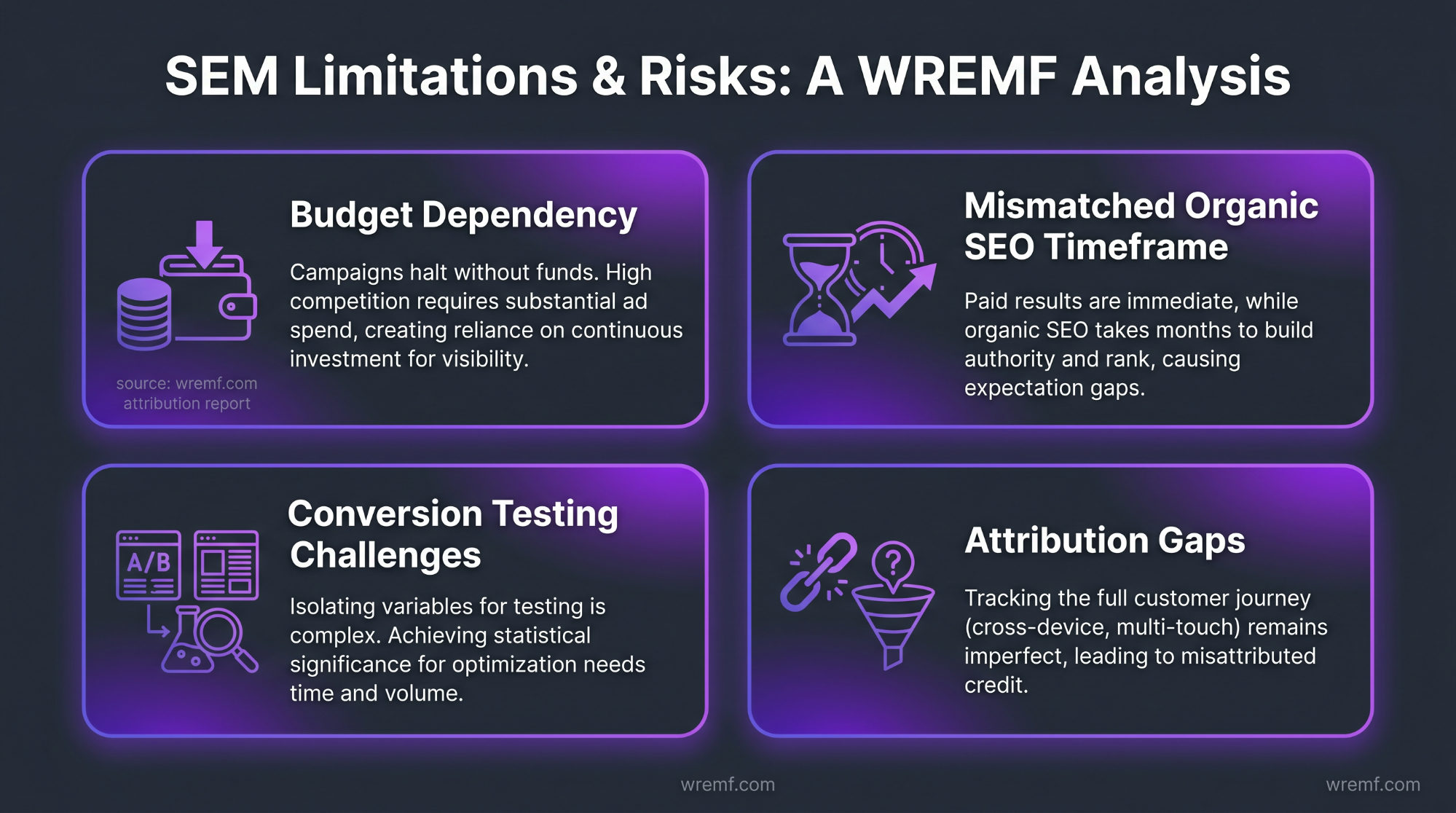
Search engine marketing offers significant commercial returns when executed well, but it carries limitations and risks that every business should understand before committing budget and expectations.
Limitation 1: Paid search results stop when budgets stop
Pay-Per-Click advertising produces traffic and leads while the campaigns are active and funded. Unlike organic search, there is no compounding benefit. When budget is paused or cut, visibility disappears immediately. SEM strategies that rely entirely on paid search without building organic search authority are permanently dependent on continuous ad spend.
Limitation 2: Organic SEO takes time and cannot be accelerated beyond natural authority-building timelines
Organic rankings in competitive markets require sustained investment in content, link building, technical SEO, and entity authority before they generate material traffic. Businesses that expect organic results within four to eight weeks in highly competitive niches will be disappointed. Most competitive B2B markets require six to twelve months of consistent SEO activity to produce significant organic ranking movement. SEM firms that overpromise organic timelines are setting unrealistic expectations.
Limitation 3: Conversion rate optimisation requires testing cycles that take time
Landing page testing and CRO improvements require sufficient traffic volume and time to reach statistical significance. For lower-traffic paid search campaigns, meaningful test results may require several weeks or months. Decisions made on insufficient data produce unreliable optimisation conclusions.
Limitation 4: Analytics attribution is rarely complete
Multi-touch attribution in B2B SEM programs is difficult because buyers use multiple sessions, devices, and channels over extended research periods. GA4 attribution models improve measurement accuracy, but they do not capture every touchpoint in a complex B2B buying journey. Teams should interpret attribution data as a directional guide rather than an exact accounting of channel contribution.
Limitation 5: AI search visibility is not captured by traditional SEM tools
Traditional SEO platforms track keyword rankings, backlinks, and organic sessions. They do not measure whether a brand is cited in ChatGPT, Perplexity, Gemini, or Google AI Overviews answers. A business can achieve strong Google rankings and still be absent from the AI-generated answers that buyers increasingly use to shortlist vendors. This is a structural gap in traditional SEM measurement that requires dedicated AI visibility tracking to address.
Limitation 6: No SEM firm can guarantee rankings, leads, or revenue
A reputable SEM firm provides strategy, execution, and optimisation. It cannot guarantee specific ranking positions, conversion volumes, or revenue outcomes because these depend on market conditions, competition, budget allocation, website quality, and factors outside the firm's direct control. Any firm guaranteeing specific positions or lead volumes without qualification should be treated with scepticism.
IMPORTANT:
AI visibility gaps are invisible to traditional SEM reporting. If your buyers are using ChatGPT, Perplexity, or Google AI Overviews to compare solutions, absence from those answers represents a real business risk that keyword ranking reports will not reveal.
KEY TAKEAWAY: SEM programs carry real limitations including paid search budget dependency, organic SEO time requirements, attribution gaps, and AI search blind spots. Understanding these limitations enables better planning and more realistic expectations.
Common Misconceptions About Search Engine Marketing Strategy
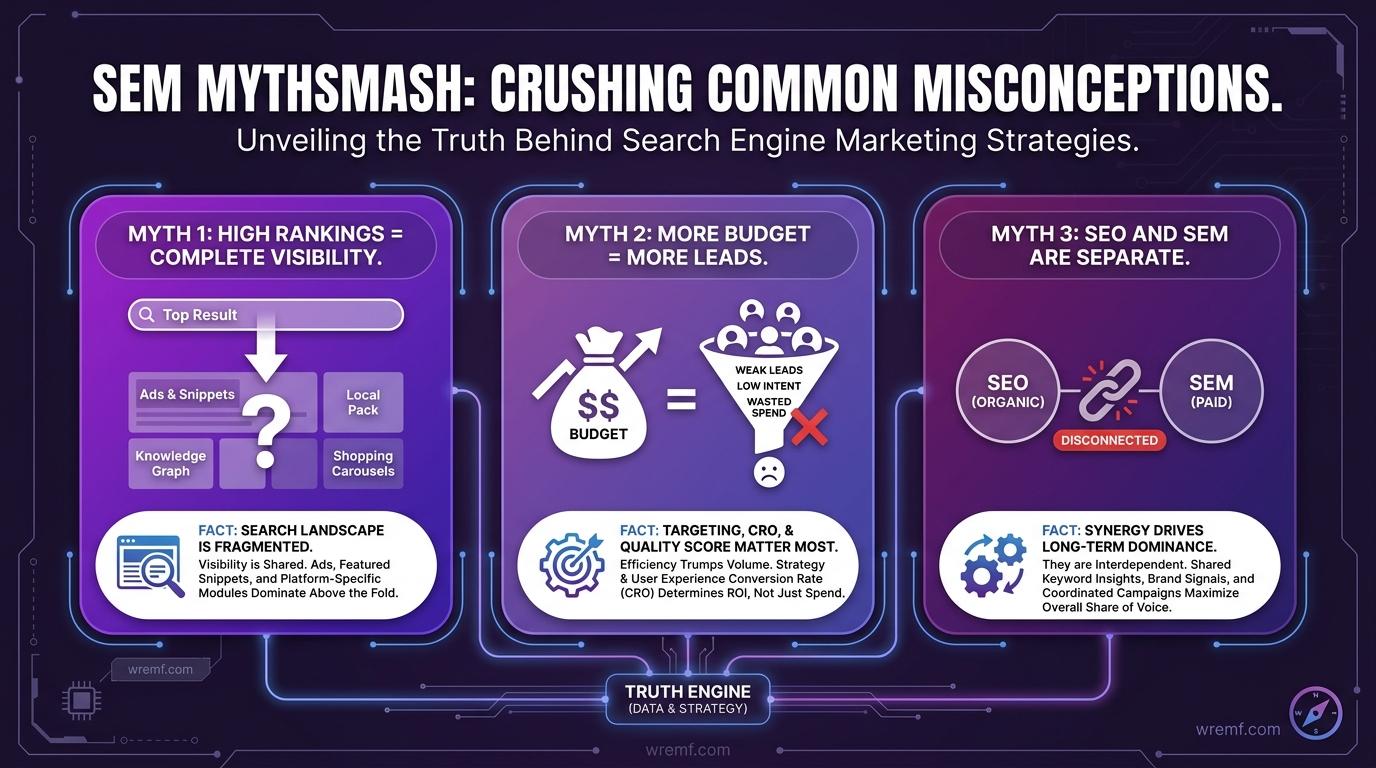
MYTH: High Google rankings mean a brand is visible everywhere that matters in search.
FACT: Google rankings reflect organic SERP position on traditional search, not presence in AI-generated answers or AI Overviews. Brands can rank on page one organically and still be absent from ChatGPT, Perplexity, Gemini, and Google AI Overviews answers when buyers ask comparison and recommendation questions. AI search visibility requires separate tracking and optimisation beyond keyword rankings.
MYTH: More ad spend automatically produces more leads at the same cost per lead.
FACT: Scaling paid search spend without improving conversion rate, keyword targeting, and landing page relevance typically increases cost per lead rather than reducing it. The efficiency gains in paid search come from optimisation quality, not budget volume alone. Higher spend on poorly structured campaigns produces diminishing returns quickly.
MYTH: SEO and SEM are separate strategies that should have separate budgets and teams.
FACT: Paid search and organic SEO are most effective when coordinated. PPC conversion data informs organic keyword prioritisation. Organic content reduces reliance on paid spend for high-volume informational queries. Technical SEO improvements raise quality scores in Google Ads and reduce cost-per-click. A SEM strategy that treats paid and organic as independent silos leaves significant performance opportunity unrealised.
MYTH: AI search visibility cannot be tracked or measured in any practical way.
FACT: AI visibility can be tracked systematically through prompt monitoring, source citation analysis, AI share of voice measurement, and AI referral traffic attribution. Platforms such as WREMF monitor how AI engines cite and mention brands across structured prompt sets, measure citation frequency relative to competitors, and connect AI-driven sessions to GA4 attribution data. WREMF's AI mention tracking guide explains the methodology in detail.
MYTH: A SEM strategy firm that has Google Premier Partner status is guaranteed to deliver results.
FACT: Google Premier Partner status confirms that a firm has met platform competency and spend management requirements. It is a useful baseline signal, not a performance guarantee. Results depend on strategy quality, keyword selection, creative execution, landing page performance, budget allocation, and how well the firm understands the client's market and buyer behaviour.
KEY TAKEAWAY: The most costly SEM misconceptions are the belief that rankings equal complete search visibility, that spending more automatically improves efficiency, and that AI search cannot be measured. Each of these assumptions leads to underperformance and missed competitive opportunities.
Conclusion
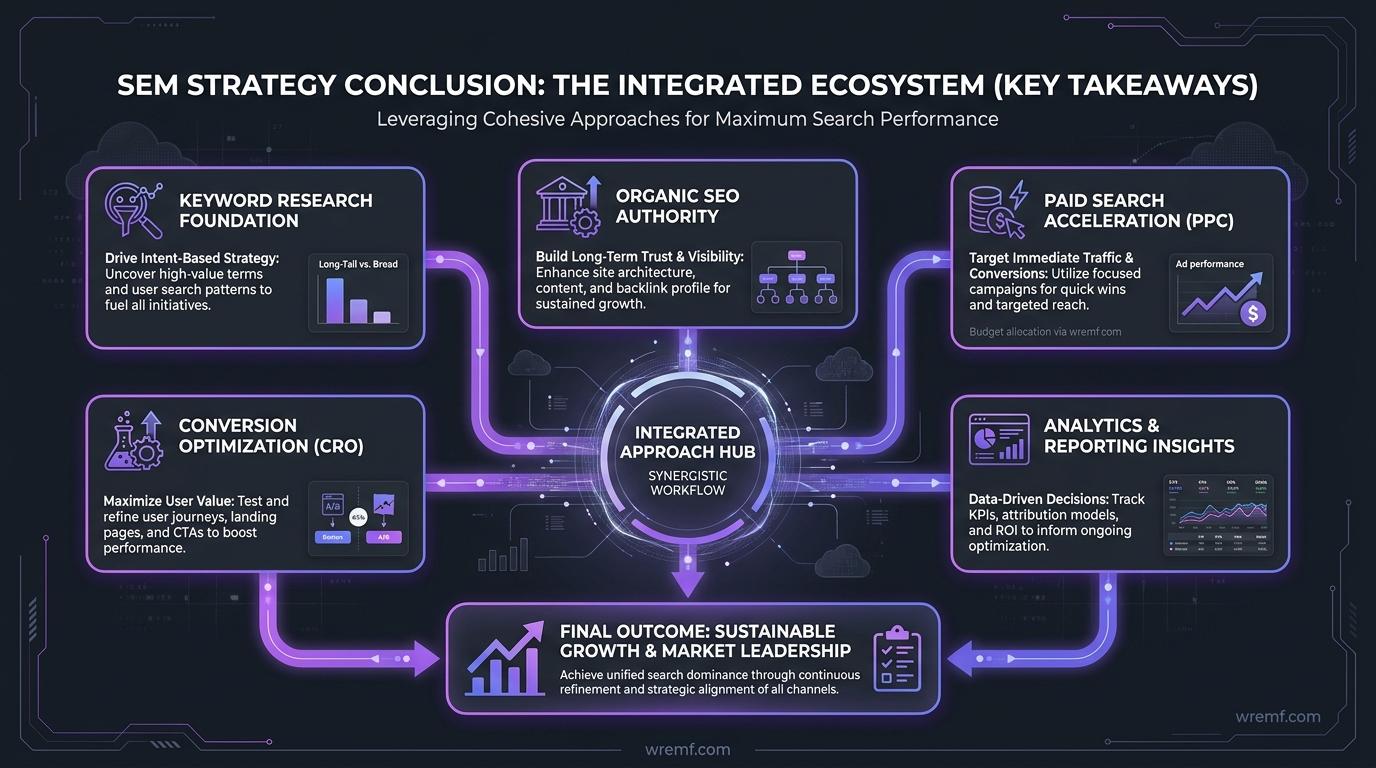
A search engine marketing strategy firm delivers value when it connects paid search, organic SEO, keyword research, conversion optimisation, and analytics into a program oriented toward commercial outcomes rather than platform activity. Choosing the right firm requires assessing strategic capability, execution depth, case study quality, and the ability to extend search marketing into the AI-powered discovery surfaces where buyers now research and compare vendors. Traditional SEM tools remain essential for Google rankings, PPC management, and organic traffic. The AI visibility layer requires separate measurement across ChatGPT, Gemini, Perplexity, Google AI Overviews, and nine other AI engines. WREMF provides that layer as software, managed service, or hybrid execution. Teams ready to measure and improve their AI search visibility alongside their SEM program can explore WREMF's complete AI visibility platform or review WREMF pricing plans to find the right starting point.
Frequently Asked Questions About Search Engine Marketing Strategy Firms
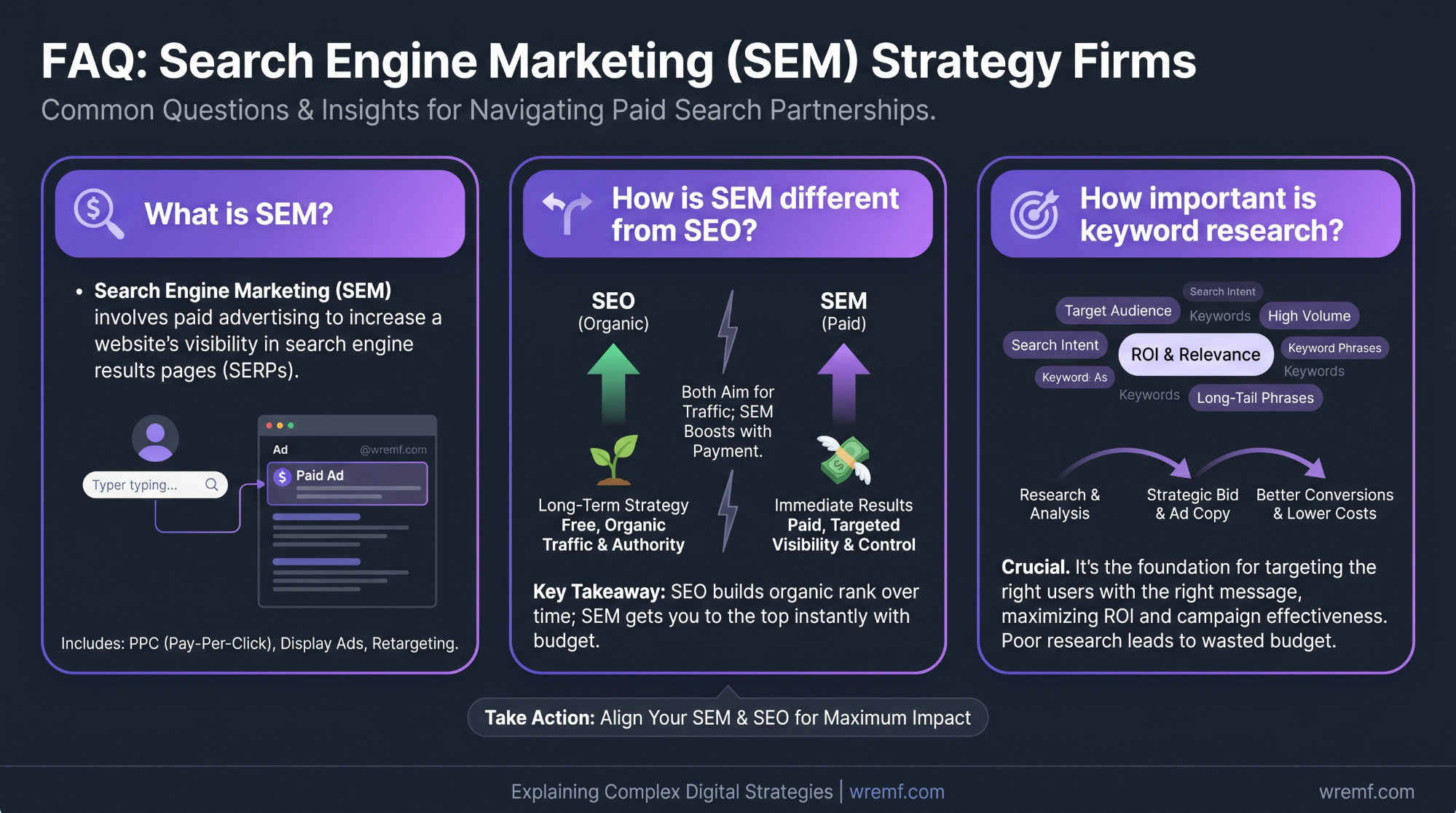
What is search engine marketing (SEM)?
Search engine marketing (SEM) is a digital marketing discipline that uses paid and organic tactics to increase a brand's visibility in search engine results pages (SERPs). In practice, SEM most commonly refers to paid search advertising, including Google Ads and Bing PPC Ads, where businesses bid on keywords to appear at the top of results for relevant queries. Some practitioners use SEM as an umbrella term that includes both paid search and Search Engine Optimization (SEO). For B2B brands, SEM is one of the fastest ways to generate qualified traffic, leads, and measurable results at scale.
How is SEM different from SEO?
SEM typically refers to paid search advertising, where you pay per click to appear in search results for targeted keywords. SEO (Search Engine Optimization) focuses on earning organic search rankings through content, technical improvements, and link building, without paying directly for placement. SEM delivers faster visibility because paid ads can appear immediately after a campaign launches, while SEO compounds over months. Most growth-focused teams use both together: paid search for immediate lead generation and organic search for long-term traffic and authority. A search engine marketing strategy firm will usually help you determine the right balance for your specific goals, budget, and competitive landscape.
Is SEM just Google Ads?
No. While Google Ads dominates paid search advertising and Google processes over 8.5 billion searches daily, SEM also includes Bing PPC Ads, Yahoo advertising, and other paid search platforms. Depending on your audience, Bing can deliver strong ROI at lower cost-per-click than Google, particularly for B2B audiences using Microsoft products. Some SEM agencies also extend into Yelp Ads, Amazon advertising, and paid social as part of a broader demand generation strategy. A well-rounded search engine marketing strategy firm will recommend the right platform mix based on where your customers are actively searching.
How does SEM work?
SEM campaigns work through an auction system where advertisers bid on keywords relevant to their products or services. When a user enters a query matching your targeted keywords, the search engine runs an auction and determines which paid ads to show based on bid amount, ad quality score, landing page relevance, and expected click-through rate. You pay only when a user clicks your ad, which is why this model is called Pay-Per-Click (PPC) or paid search advertising. Campaign performance depends on keyword research, ad copy, landing page quality, bid strategy, audience targeting, and ongoing optimization. Understanding user behavior and conversion signals is essential for maintaining strong ROI.
What are the key benefits of hiring a search engine marketing agency?
Hiring a search engine marketing agency gives you access to specialists in keyword research, paid media strategy, conversion rate optimization, landing page testing, and analytics without building an in-house team from scratch. Agencies bring cross-industry experience, proprietary tools, and established relationships such as Google Premier Partner status, which provides access to beta features and dedicated support. They also provide accountability through reporting dashboards, regular communication, and measurable results tied to your goals. For B2B brands, the main benefits are faster campaign deployment, better budget efficiency, cleaner attribution, and access to strategic guidance that improves performance over time.
How much does it cost to hire an SEM agency?
SEM agency pricing varies significantly depending on the scope of services, ad spend under management, and whether you need strategy only or full execution. Common pricing models include flat monthly retainers, a percentage of ad spend, performance-based pricing, or hybrid combinations. Smaller campaigns with a single platform and limited scope may start from a few hundred dollars per month in agency fees. Mid-market engagements typically range from several thousand dollars per month. Enterprise or multi-platform campaigns can run substantially higher. Beyond agency fees, you also need a separate paid media budget for your actual ad spend. Always clarify the pricing structure before signing to avoid surprises. You can view WREMF pricing as a reference point for software and managed execution costs.
How long does it take to see results from SEM campaigns?
Paid search campaigns can generate traffic and clicks within days of launch, which is one of SEM's core advantages over organic SEO. However, meaningful business results, including qualified lead generation, reliable conversion rates, and positive ROI, typically take four to twelve weeks of optimization. Early weeks involve testing ad copy, refining keyword targeting, adjusting bids, and improving landing page performance. Data accumulates over time, enabling smarter automated bidding strategies. Most SEM agencies recommend evaluating campaign performance at 90-day intervals rather than expecting instant returns, particularly for B2B brands with longer sales cycles.
Can SEM be integrated with SEO strategies?
Yes, and integrating SEM with SEO is widely considered best practice for B2B digital marketing. Paid search data from Google Ads, including which keywords drive conversions and which ad copy generates clicks, can directly inform organic content strategy and keyword prioritization. SEO-driven organic traffic builds long-term authority and reduces dependence on paid spend over time. Remarketing Ads can re-engage users who found you through organic search but did not convert. Combined SEM and SEO strategies also improve overall search visibility, increasing the probability that your brand appears in both paid and organic results for the same high-intent queries. Tools like Google Analytics and Search Console help connect performance data across both channels.
What is the difference between PPC and SEM?
Pay-Per-Click (PPC) is a specific payment model within search engine marketing where you pay each time a user clicks on your ad. SEM is the broader category that includes PPC campaigns, bid strategy, keyword research, ad copy optimization, landing page alignment, and conversion tracking. All PPC campaigns are a form of SEM, but SEM as a discipline extends beyond just the click to include the full performance funnel: impressions, clicks, conversions, cost-per-acquisition, and ROI analysis. Some agencies use SEM and PPC interchangeably in their service descriptions, so it is worth clarifying exactly what is included when evaluating a potential agency partner.
How important is keyword research for a successful SEM campaign?
Keyword research is foundational to SEM performance. Without accurate keyword research, campaigns target the wrong queries, waste budget on low-intent clicks, or miss the high-value terms your customers actually use when searching for solutions. Effective keyword research identifies intent, search volume, competition level, and cost-per-click estimates for each target term. Tools like Google Ads Keyword Planner help build initial keyword lists, which should be refined using conversion data over time. For B2B brands, the highest-value keywords are often mid-to-bottom-funnel phrases that signal buying intent rather than broad informational queries. Negative keyword management is equally important to prevent budget waste on irrelevant searches.
What should I look for when choosing a search engine marketing strategy firm?
When evaluating an SEM agency, look for transparent pricing, demonstrable experience in your industry, clear communication processes, and access to real-time reporting dashboards rather than monthly email summaries. In 2026, agencies should provide live performance data so you are never waiting to find out how your campaigns are performing. Check whether they rely solely on standard tools or bring proprietary capabilities to the relationship. Ask about their Google Premier Partner status, which indicates a verified track record with Google Ads. Assess whether they ask about your business goals, customer profile, and competitive landscape before proposing a strategy. Red flags include vague reporting, guaranteed rankings, and performance guarantees that cannot be substantiated. Agencies specialising in AI-native growth and visibility can also add significant value for brands competing in AI-driven discovery channels alongside traditional search.
Can a search engine marketing firm guarantee I will be number one on Google?
No reputable search engine marketing firm can guarantee a number one ranking, either in paid search or organic results. In paid search, ad position depends on the auction, your quality score, competitor bids, and landing page relevance, all of which fluctuate. In organic search, Google's algorithm evaluates hundreds of signals and updates continuously. Agencies that guarantee specific positions are typically overpromising and may use tactics that carry long-term risk. What a qualified firm can commit to is a structured process, transparent reporting, continuous optimization, and a focus on measurable results such as conversion rate improvements, cost-per-lead reductions, and traffic quality gains.
Do I need to sign a long-term contract with an SEM agency?
Contract requirements vary by agency. Some require three to six month minimums to allow time for campaign optimization and data accumulation, which is reasonable given the ramp-up period most campaigns need. Others offer month-to-month arrangements with the understanding that short-term engagements limit what can be achieved. When evaluating contracts, focus on the exit terms, deliverables, ownership of ad accounts and data, and what happens to campaigns if you leave. You should retain ownership of your Google Ads account, conversion history, and keyword data regardless of which agency manages it. Always clarify ownership and data access before signing.
How often should I receive communication and reporting from my SEM agency?
In 2026, you should have access to a real-time dashboard that shows campaign performance without needing to request updates by email. Standard practice includes bi-weekly or monthly strategy calls to review performance, discuss optimizations, and align on upcoming priorities. Ad hoc communication should be available for urgent issues such as budget pacing problems, ad disapprovals, or conversion tracking failures. Agencies that only report monthly through PDF summaries are operating below the expected standard for transparent, data-driven partnerships. Clear communication processes and responsive support are strong indicators of a trustworthy agency relationship.
What role does landing page quality play in SEM performance?
Landing page quality is one of the most significant factors in SEM campaign performance. Google assigns a quality score to each keyword and ad combination, which directly influences your cost-per-click and ad position. Landing pages that align closely with ad copy, load quickly on mobile, communicate a clear value proposition, and include a prominent call to action consistently outperform generic or slow-loading pages. Conversion rate optimization (CRO) of landing pages often delivers faster ROI improvements than bid adjustments alone. Many search engine marketing strategy firms include landing page consultation or design as part of their service offering, and some operate web design and web development capabilities in-house.
What is the average ROI for Google Ads campaigns?
ROI from Google Ads varies significantly based on industry, competitive landscape, landing page quality, and how well campaigns are managed. Industry benchmarks suggest that well-optimised Google Ads campaigns can generate strong returns, though individual results depend heavily on your conversion funnel, average deal size, and campaign structure. The key to strong ROI is not simply running ads but continuously testing ad copy, refining keyword targeting, improving landing page conversion rates, and aligning campaigns with your actual sales process. Attribution setup in Google Analytics is critical for measuring true ROI rather than relying on last-click metrics alone.
How does local SEO differ from broader SEM strategy?
Local SEO focuses specifically on improving visibility for geographically targeted searches, such as "digital marketing agency near me" or queries that include specific city or neighborhood-specific keywords. It involves optimizing your Google My Business profile, building local citations across directories, generating Google reviews, implementing schema markup for location data, and producing hyper-local content. SEM for local businesses adds paid search campaigns targeting location-specific queries, local service ads, and geofencing ad services for precise geographic targeting. Both local SEO and local paid search work best when combined, as they address different parts of the search results page and capture users at different stages of the buying decision.
How important is Google My Business for local search visibility?
Google My Business (now Google Business Profile) is one of the most important factors in local search visibility for any business serving customers in a specific geographic area. A complete, accurate, and regularly updated profile increases your chances of appearing in the local pack, Google Maps results, and AI-generated local answers. Key optimization factors include accurate business name, address, and phone number (NAP consistency), category selection, photo uploads, and actively managing and responding to Google reviews. Local businesses that neglect their Google Business Profile often lose visibility to competitors who maintain theirs more actively, even when their websites are technically stronger.
What impact does voice search have on SEM and local SEO strategy?
Voice search queries tend to be longer, more conversational, and more location-specific than typed searches. Phrases like "best SEM agency near me" or "which digital marketing company handles Google Ads in Houston" reflect how users speak rather than type. Optimizing for voice search means targeting question-based and conversational keyword phrases, ensuring your Google My Business profile is complete, improving mobile page speed, and structuring content to answer specific questions directly. For local businesses, voice search reinforces the importance of maintaining consistent local citations and appearing in featured snippets and AI-generated answers. As AI assistants become more widely used for local discovery, visibility in AI-driven search surfaces is becoming an increasingly important complement to traditional SEM.
What is schema markup and why does it matter for search visibility?
Schema markup is structured data code added to a website that helps search engines and AI systems understand the content and context of a page. When implemented correctly, schema can enable rich results in SERPs such as star ratings, business hours, FAQ sections, and product information, improving click-through rates without changing organic rankings directly. For local businesses, LocalBusiness schema reinforces NAP consistency and helps search engines associate your entity with specific services and locations. According to Schema.org documentation, structured data provides a shared vocabulary that search engines use to interpret page content more accurately. For SEM landing pages, schema can improve quality scores by reinforcing content relevance signals.
What is the difference between organic traffic and paid search traffic?
Organic traffic comes from unpaid search results generated through SEO, where pages rank based on relevance, authority, content quality, and technical performance. Paid search traffic comes from PPC campaigns where you pay per click for ad placement above or alongside organic results. Organic traffic is generally more cost-effective at scale and builds compounding value over time, but takes longer to generate. Paid search delivers immediate visibility and allows precise targeting by keyword, audience, device, and location, but traffic stops when budget stops. Most high-performing B2B digital marketing strategies use both channels together, with SEM providing short-term lead generation while SEO builds long-term search authority.
How does AI search affect search engine marketing strategy in 2026?
AI-driven search surfaces, including Google AI Overviews, ChatGPT, Perplexity, and Copilot, are changing how users discover information and make buying decisions. Traditional SEM still plays a strong role in capturing high-intent queries, but AI-generated answers increasingly intercept searches before users reach organic or paid results. Brands that appear consistently in AI-generated responses gain visibility that paid search alone cannot fully replicate. According to Google's AI Overviews documentation, AI Overviews pull from authoritative sources and apply separate classification from standard organic sessions. Forward-thinking SEM strategies now incorporate AI visibility tracking and generative engine optimization (GEO) alongside traditional paid and organic search tactics to ensure full-funnel coverage across both conventional and AI-driven discovery channels.
Should B2B brands focus on organic SEO or paid search advertising?
The right balance depends on your stage of growth, competitive landscape, and timeline for results. Paid search generates immediate leads and is easier to scale quickly, making it valuable for product launches, time-sensitive campaigns, and competitive keywords where organic rankings take time to build. Organic SEO builds sustainable search visibility, reduces cost-per-acquisition over time, and supports brand authority in ways paid ads cannot. For most B2B SaaS and growth-stage brands, a combined strategy is most effective: use SEM to generate near-term pipeline while investing in SEO to reduce long-term dependence on paid spend. A qualified search engine marketing strategy firm will help you model the trade-offs based on your specific goals, budget, and competitive data.
What metrics should I track to measure SEM campaign performance?
The most important SEM metrics depend on your business goals, but generally include click-through rate (CTR), cost-per-click (CPC), conversion rate, cost-per-lead or cost-per-acquisition (CPA), and return on ad spend (ROAS). At the campaign level, impression share and search visibility indicate how often your ads appear relative to total eligible searches. Quality score signals the health of your keyword, ad, and landing page alignment. For B2B brands with longer sales cycles, connecting SEM data to CRM pipeline stages through Google Analytics or attribution tools gives a more accurate picture of actual revenue impact. Reporting should be transparent, consistent, and tied to business outcomes rather than vanity metrics like raw clicks or impressions.
What is eCommerce SEM and how does it differ from B2B search marketing?
eCommerce SEM focuses on driving product purchases through shopping campaigns, dynamic search ads, and product listing ads targeting transactional keywords. Success metrics emphasize ROAS, average order value, and cart conversion rates. B2B search marketing typically involves longer sales cycles, multiple decision-makers, and lower search volumes with higher average deal values. B2B SEM focuses more heavily on lead generation, landing page conversion, remarketing to engaged audiences, and connecting paid search activity to pipeline stages. The keyword strategy, bidding approach, ad copy tone, and attribution model differ significantly between eCommerce and B2B SEM, which is why industry experience matters when selecting a search engine marketing strategy firm.
When should I consider a managed AI visibility service alongside traditional SEM?
Traditional SEM captures users actively searching on Google and Bing, but a growing share of B2B discovery now happens through AI-powered surfaces like ChatGPT, Perplexity, Google AI Overviews, and Copilot. If your brand is not appearing in AI-generated answers and recommendations, you may be losing pipeline to competitors before users ever reach a search results page. A managed AI visibility service combines prompt monitoring, citation tracking, competitor analysis, and GEO strategy to ensure your brand appears consistently across AI discovery channels. According to McKinsey's research on AI adoption, AI integration into business workflows is accelerating rapidly, making AI search visibility an increasingly strategic priority. WREMF offers both software and managed execution for brands that want to track and improve their AI visibility alongside traditional SEM programs.
How does WREMF support search engine marketing strategy teams?
WREMF helps SEM and digital marketing teams track, improve, and prove how their brand appears across AI discovery surfaces including ChatGPT, Gemini, Perplexity, Google AI Overviews, Copilot, Claude, DeepSeek, and Grok. While traditional SEM tools focus on paid search performance, WREMF fills the growing gap in AI visibility measurement by tracking prompt-level responses, source citations, competitor mentions, and AI share of voice across ten AI engines. Teams can use WREMF as standalone AI visibility software, or combine it with WREMF's agency services for hands-on GEO, AEO, and AI citation optimization. For SEM teams building full-funnel visibility strategies in 2026, tracking AI search alongside paid and organic performance is becoming an essential capability.