The Complete Guide to Search Engine Marketing Consulting for B2B Brands
Understand search engine marketing consulting for B2B brands. Discover strategies for improving lead generation and achieving consistent results.
By WREMF Team · 2026-09-15
Search engine marketing consulting is the practice of assisting businesses in planning, executing, and optimizing paid and organic search campaigns to enhance visibility, lead generation, and conversions. It involves auditing current campaigns, identifying gaps, and designing structured ad strategies. Key components include Google Ads, SEO, keyword research, landing page optimization, and analytics. Outcomes focus on business metrics like leads and cost per acquisition. The guide includes tools like WREMF and addresses AI influences in SEM.
Key takeaways
- SEM consulting covers both paid and organic search strategies, including Google Ads and SEO.
- Effective SEM links campaign performance to business outcomes through conversion tracking.
- Keyword research and landing page optimization are crucial for reducing cost per acquisition.
- AI search engines now affect brand discovery, adding a new layer to search marketing.
- WREMF enhances visibility through AI share of voice and prompt-level AI visibility data.
- Choosing between software or consulting depends on capacity, budget, and market complexity.
The Complete Guide to Search Engine Marketing Consulting for B2B Brands
Search engine marketing consulting is the strategic discipline of helping businesses plan, execute, and optimise paid and organic search campaigns to generate qualified leads, improve conversions, and build measurable online visibility. Google processes over 8.5 billion searches daily, and the brands that capture those searches consistently do so with a clear strategy behind every campaign. This guide is written for B2B founders, marketing directors, SEO teams, agencies, and growth leaders who want to understand what search engine marketing consulting delivers and how to implement it effectively. It covers SEM strategy, keyword research, Google Ads, landing page optimisation, SEO integration, analytics, AI-driven approaches, and how tools like WREMF now add an AI visibility layer that traditional search marketing has not yet addressed. If your campaigns are running but your results are inconsistent, this guide explains why and what to do about it.
QUICK ANSWER:
Search engine marketing consulting helps businesses improve visibility across search engines through a combination of paid search advertising, SEO strategy, keyword research, campaign management, and performance analytics. A search engine marketing consultant audits existing campaigns, identifies keyword and conversion gaps, builds structured ad campaigns, and connects search activity to measurable business outcomes such as leads, conversions, and cost per acquisition.
KEY TAKEAWAYS:
- Search engine marketing consulting covers both paid search advertising and organic search optimisation, including Google Ads, Bing Ads, SEO, and keyword research.
- Effective SEM consulting connects campaign performance to business outcomes using conversion tracking, Google Analytics, and attribution reporting.
- Keyword research, landing page optimisation, negative keywords, and campaign segmentation are foundational to improving cost per acquisition and click-through rates.
- AI search engines including ChatGPT, Perplexity, and Google AI Overviews now influence how buyers discover brands before they search on Google, making AI visibility a new dimension of search marketing strategy.
- WREMF tracks how brands appear across 10 AI engines, adding prompt-level citation data and AI share of voice to complement traditional SEM reporting.
- Businesses choosing between software, managed consulting, or hybrid execution should base the decision on internal capacity, budget, and the complexity of their competitive landscape.
What Search Engine Marketing Consulting Actually Covers
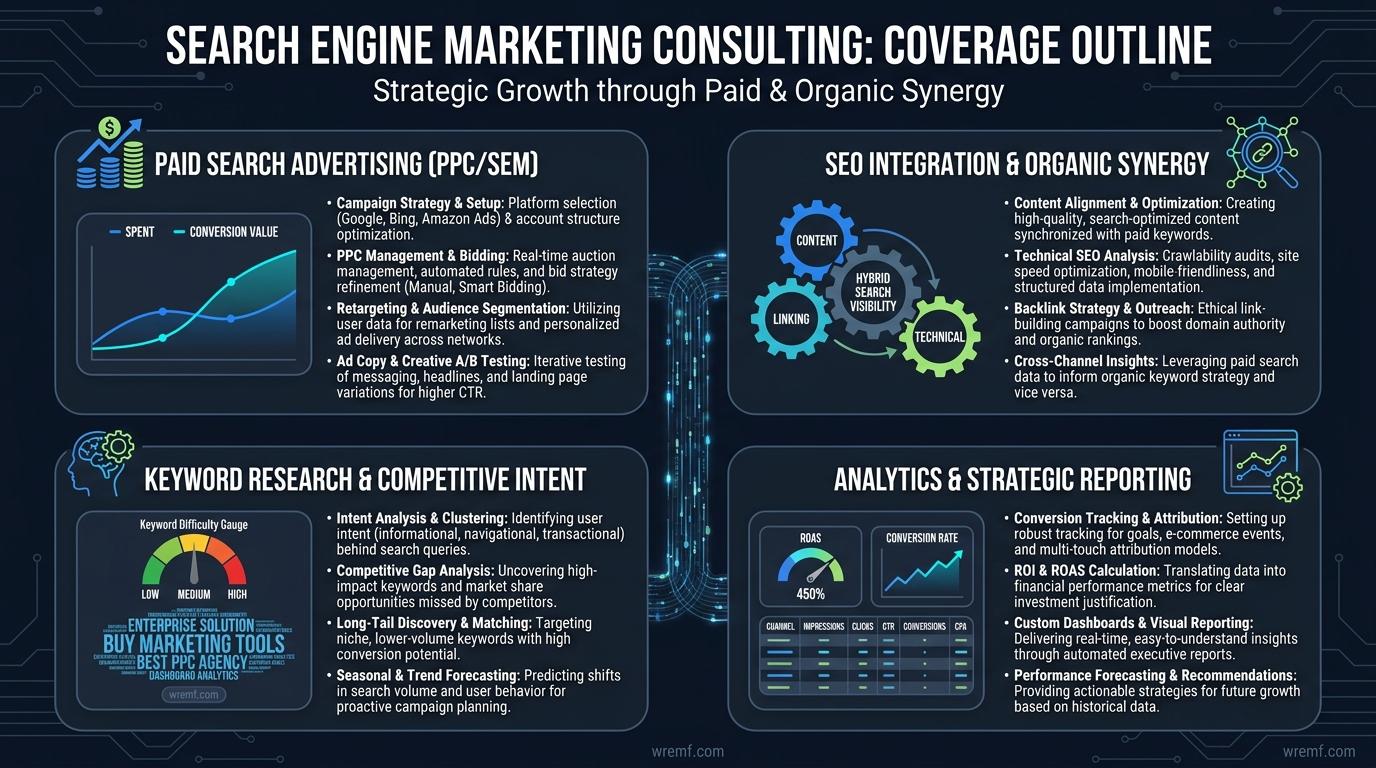
Search engine marketing consulting covers the full spectrum of activities required to make a brand visible and competitive across search engines, from paid campaigns to organic foundations. It is not limited to running Google Ads or writing meta titles. It includes diagnosis, strategy, execution, and ongoing measurement across the entire search marketing system.
At its core, search engine marketing, commonly referred to as SEM, combines paid search advertising with search engine optimisation to generate traffic, leads, and conversions from search engine results pages. The consulting layer exists because most businesses lack the internal expertise, time, or systems to manage all of these moving parts effectively without external guidance.
A search engine marketing consultant typically begins with a diagnostic phase. This involves auditing existing ad campaigns, reviewing keyword usage, analysing search rankings, identifying technical SEO gaps, assessing landing page performance, and reviewing conversion tracking setup. The output is a strategic picture of where the business stands and where it is losing ground to competitors.
From that diagnostic, a consultant builds or rebuilds the SEM structure. This includes keyword research using tools such as Google Keyword Planner, identifying negative keywords to control wasted spend, segmenting campaigns by intent and audience, writing ad copy aligned to search intent, and connecting each campaign to optimised landing pages designed to convert.
The services a search engine marketing consultant provides typically include:
Paid search advertising
- Google Ads campaign setup, management, and optimisation
- Bing Ads and Microsoft Advertising campaigns
- Meta Ads integration for retargeting and demand generation
- Remarketing campaigns targeting users who have already visited the website
- Campaign segmentation by geography, device, audience, and intent
Search engine optimisation
- Technical SEO audits and fixes
- On-page optimisation and content strategy
- Local SEO for businesses targeting geographic markets
- Backlink management and link building
- Google My Business optimisation for local business visibility
- Schema markup and structured data implementation
Analytics and measurement
- Google Analytics setup and goal configuration
- Conversion tracking across paid and organic channels
- Search Console integration
- AI-driven analytics for identifying trends and anomalies
- Cost per acquisition tracking across campaigns
- Monthly and ongoing performance reporting
Content and landing page strategy
- Landing page optimisation for paid traffic
- Content creation aligned to keyword intent
- Content strategy across blog, pillar pages, and product pages
- Landing Page Optimization for improving conversion rates from ad clicks
The scope of SEM consulting expands when businesses operate in competitive markets, run eCommerce operations, manage multiple brands, or need to coordinate across agencies and internal teams. For a full overview of how AI is reshaping search engine optimisation services, the AI search engine optimization guide covers the transition from traditional SEO to AI-first visibility in detail.
KEY TAKEAWAY: Search engine marketing consulting is a diagnostic, strategic, and execution discipline that spans paid search, SEO, keyword research, landing page optimisation, and analytics, with the goal of connecting search activity to measurable business outcomes.
Why Search Engine Marketing Results Are Often Inconsistent
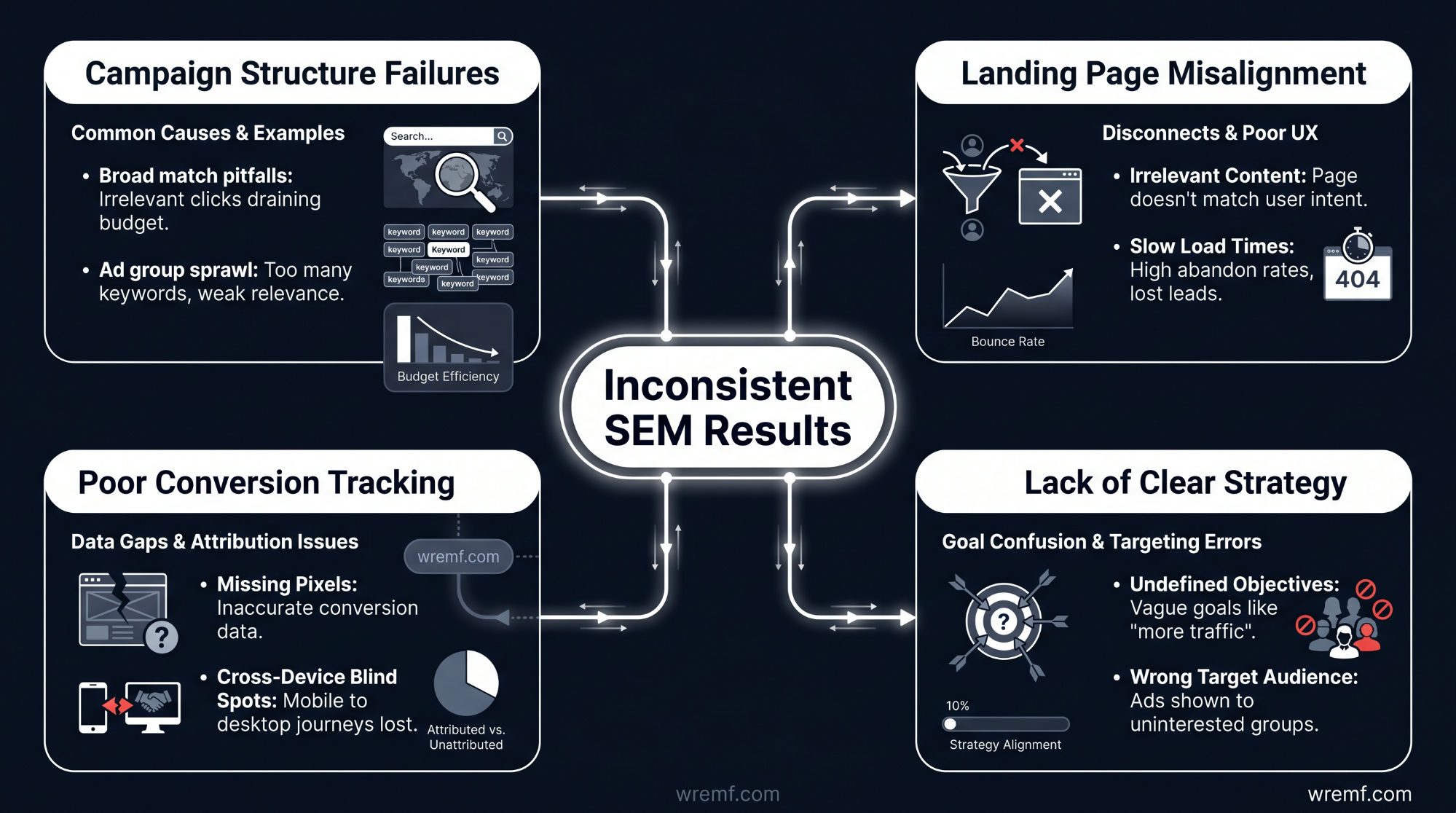
Inconsistent search engine marketing results typically come from structural problems in campaign setup, keyword strategy, attribution, or the disconnect between ad performance and landing page conversion. These are addressable problems, but they require honest diagnosis before they can be fixed.
Many businesses running Google Ads campaigns experience one or more of the following symptoms. Their click-through rates are reasonable but conversions are low. Their cost per acquisition is rising despite increasing ad spend. Their organic search rankings are improving but paid campaigns are cannibalising organic traffic without incremental gain. Their analytics show sessions but not the actions that matter to the business. Their competitors consistently appear above them in search engine results pages regardless of budget.
Each of these symptoms points to a different structural failure.
Low conversion rates from paid traffic usually indicate a mismatch between the keyword intent in the ad and the content on the landing page. A user searching for a specific solution and clicking an ad that takes them to a generic homepage will not convert. Landing page optimisation must be aligned precisely with the keyword phrase and the specific promise of the ad.
Rising cost per acquisition often results from poor campaign segmentation, broad match keywords without adequate negative keyword filtering, or bidding strategies that optimise for clicks rather than conversions. A search engine marketing consultant addresses this by rebuilding campaign structure around intent clusters, tightening keyword usage, and connecting bid strategy to conversion data.
Poor attribution is common in businesses that have not fully configured conversion tracking in Google Analytics or connected their CRM workflows to campaign data. When the analytics setup only shows sessions and not lead actions, form submissions, calls, or purchases, it becomes impossible to evaluate which campaigns are genuinely driving business results.
Competitive displacement in search engine results pages is a common frustration for businesses in industries with well-funded competitors. When industry leaders dominate the top paid and organic positions consistently, it usually means they have invested in technical SEO, high-quality backlinks, content strategy, and structured data over time. A consultant identifies where a challenger brand can compete on long-tail keywords, local queries, and specific intent signals where the larger players are less dominant.
One underappreciated cause of inconsistent results is the absence of a clear marketing strategy that connects search activity to customer acquisition goals. Many businesses run ad campaigns without defined audience segments, keyword priorities, or conversion benchmarks. The campaign runs, spend accumulates, and the business cannot tell whether the investment is working. SEM consulting provides the strategic layer that connects spend to outcomes.
KEY TAKEAWAY: Inconsistent SEM results usually trace back to campaign structure failures, landing page misalignment, poor conversion tracking, or the absence of a clear strategy connecting search activity to business outcomes.
How Google Ads and Paid Search Advertising Work
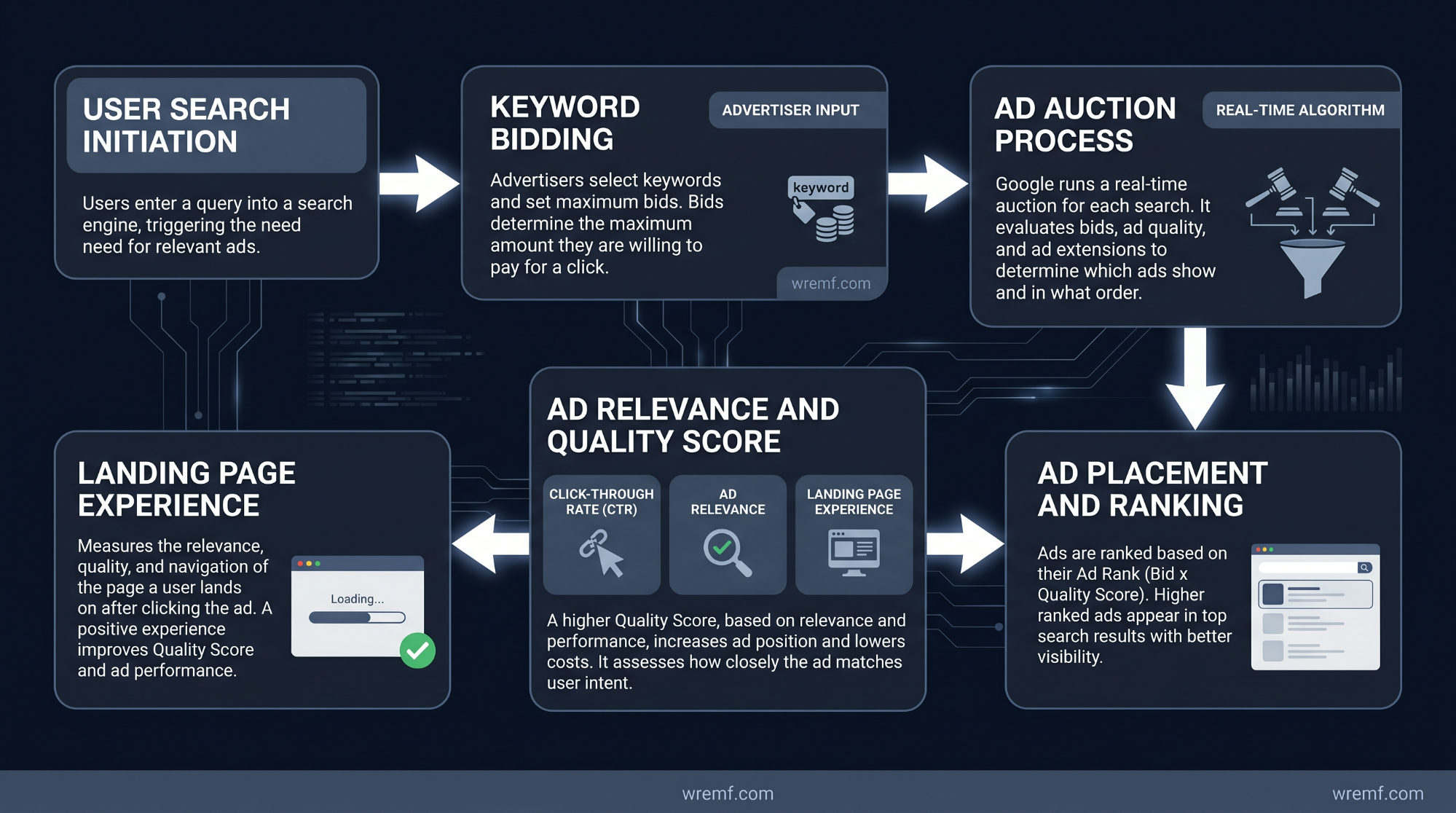
Google Ads is an auction-based paid search advertising platform where advertisers bid on keywords to display ads in Google search results when users search for relevant terms. Winning an ad placement is determined by a combination of bid amount and Quality Score, which Google calculates based on ad relevance, expected click-through rate, and landing page experience.
When a user types a search query into Google, the platform runs an auction in milliseconds to determine which ads appear, in what order, and at what cost. Advertisers do not simply buy the top position by paying the most. An ad with a higher Quality Score can outrank a competitor's ad with a higher bid, which means the quality of the ad itself and the landing page it leads to directly affect both placement and cost per click.
The practical components of a Google Ads campaign that a search engine marketing consultant manages include:
Campaign structure
Campaigns are organised into ad groups, each containing a set of related keywords and corresponding ad copy. Proper campaign segmentation ensures that ad copy closely matches the keyword intent, which improves Quality Score, click-through rate, and conversion rate simultaneously.
Keyword types and negative keywords
Keywords operate on a spectrum from broad match to exact match. Broad match captures more traffic but often irrelevant traffic. Exact match captures only highly specific queries. Negative keywords exclude search terms that are consuming budget without delivering relevant clicks. Managing negative keywords is one of the most impactful and underused levers in paid search advertising.
Ad creation and testing
Effective ad creation involves writing headlines and descriptions that match the user's intent, include the target keyword, communicate a specific benefit, and direct the user to a relevant landing page. Responsive search ads allow multiple headline and description combinations to be tested simultaneously, with Google's algorithm surfacing the highest-performing combinations.
Bid strategy and conversion tracking
Modern Google Ads bidding strategies such as Target CPA and Target ROAS optimise spend automatically based on historical conversion data. These strategies require accurate conversion tracking to function properly. Without conversion data flowing into the platform, automated bidding has no signal to optimise against and will default to less efficient behaviour.
Remarketing campaigns
Remarketing campaigns target users who have previously visited the website but did not convert. These campaigns typically achieve higher conversion rates than cold traffic campaigns because the audience already has some familiarity with the brand. A consultant builds remarketing audiences based on specific user behavior, such as time on site, pages visited, or actions taken.
Beyond Google, a comprehensive paid search strategy may include Bing Ads through Microsoft Advertising, which gives access to a distinct audience segment, often older and with higher purchasing intent in certain verticals. Meta Ads complement paid search by targeting users based on interests and demographics rather than active search intent, which is particularly useful for brand awareness and retargeting.
For businesses evaluating how AI is changing paid and organic search together, the AI search engine optimization tools guide provides detailed context on how the search landscape is evolving.
KEY TAKEAWAY: Google Ads performance depends on the quality of campaign structure, keyword selection, negative keyword management, ad copy relevance, landing page alignment, and accurate conversion tracking, not just budget size.
Keyword Research as the Foundation of SEM Strategy
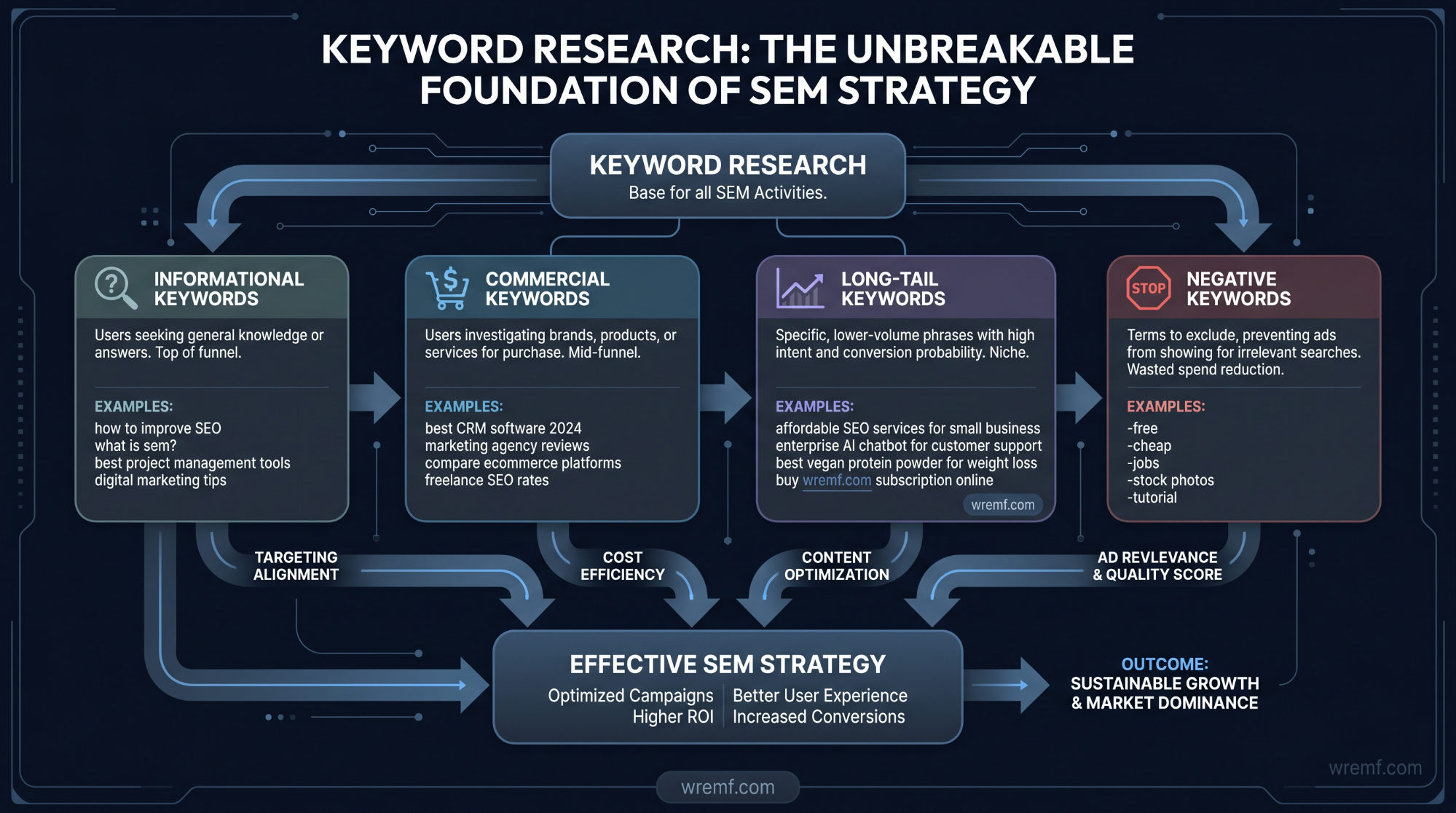
Keyword research is the process of identifying the specific search terms that target audiences use when looking for products, services, or information relevant to a business, and then structuring campaigns and content around those terms to capture relevant traffic. Without rigorous keyword research, both paid and organic search efforts default to guesswork.
Effective keyword research goes beyond generating a list of terms with high search volume. It involves understanding the intent behind each keyword, the competitive landscape for that term, the expected cost per click in paid search, and the realistic conversion potential based on where the user is in their decision process.
A search engine marketing consultant approaches keyword research in layers:
Informational keywords capture users who are researching a topic but not yet ready to buy. These keywords are valuable for content marketing and blog content that builds brand awareness and positions the brand as an authority. They are not strong candidates for high-cost paid search campaigns but support organic search rankings over time.
Commercial and transactional keywords capture users who are evaluating options or ready to take action. These are the keywords most relevant to paid search advertising because the user intent aligns with conversion actions such as requesting a demo, submitting a contact form, or making a purchase. These keywords typically have higher cost per click but justify that cost with higher conversion rates.
Navigational keywords capture users searching for a specific brand or website. These are important for brand protection in paid search, ensuring that competitors cannot easily capture traffic from users already searching for a specific company.
Long-tail keywords are more specific, lower-volume terms that often carry higher purchase intent and lower competition. In competitive markets, long-tail keywords frequently deliver better cost per acquisition than high-volume head terms because the user's intent is more specific and the auction is less contested.
Google Keyword Planner is the standard starting point for keyword research within Google Ads. It provides search volume estimates, competition levels, and bid range data. A consultant augments this with Search Console data to identify organic search terms already driving impressions but not enough clicks, competitor keyword analysis, and customer language pulled from sales calls, support tickets, and reviews.
Keywords research also informs negative keyword strategy. A thorough process identifies not just which terms to target but which terms to exclude. A B2B software company bidding on generic software-related keywords without adequate negative keywords will waste significant budget on irrelevant traffic from users searching for consumer software, free tools, or unrelated products.
Keyword usage in both paid and organic contexts should be consistent with how the target audience actually phrases their queries. This means writing landing page copy and ad headlines that match the language of the search, not the internal language of the business.
DID YOU KNOW:
Google processes over 8.5 billion searches daily, accounting for approximately 78% of all online search behavior, making keyword strategy one of the highest-leverage activities in any digital marketing program.
KEY TAKEAWAY: Keyword research is not a one-time exercise but an ongoing analytical process that informs campaign structure, content strategy, negative keyword exclusions, and bid prioritisation across both paid and organic search.
Landing Pages and Conversion Optimisation in SEM
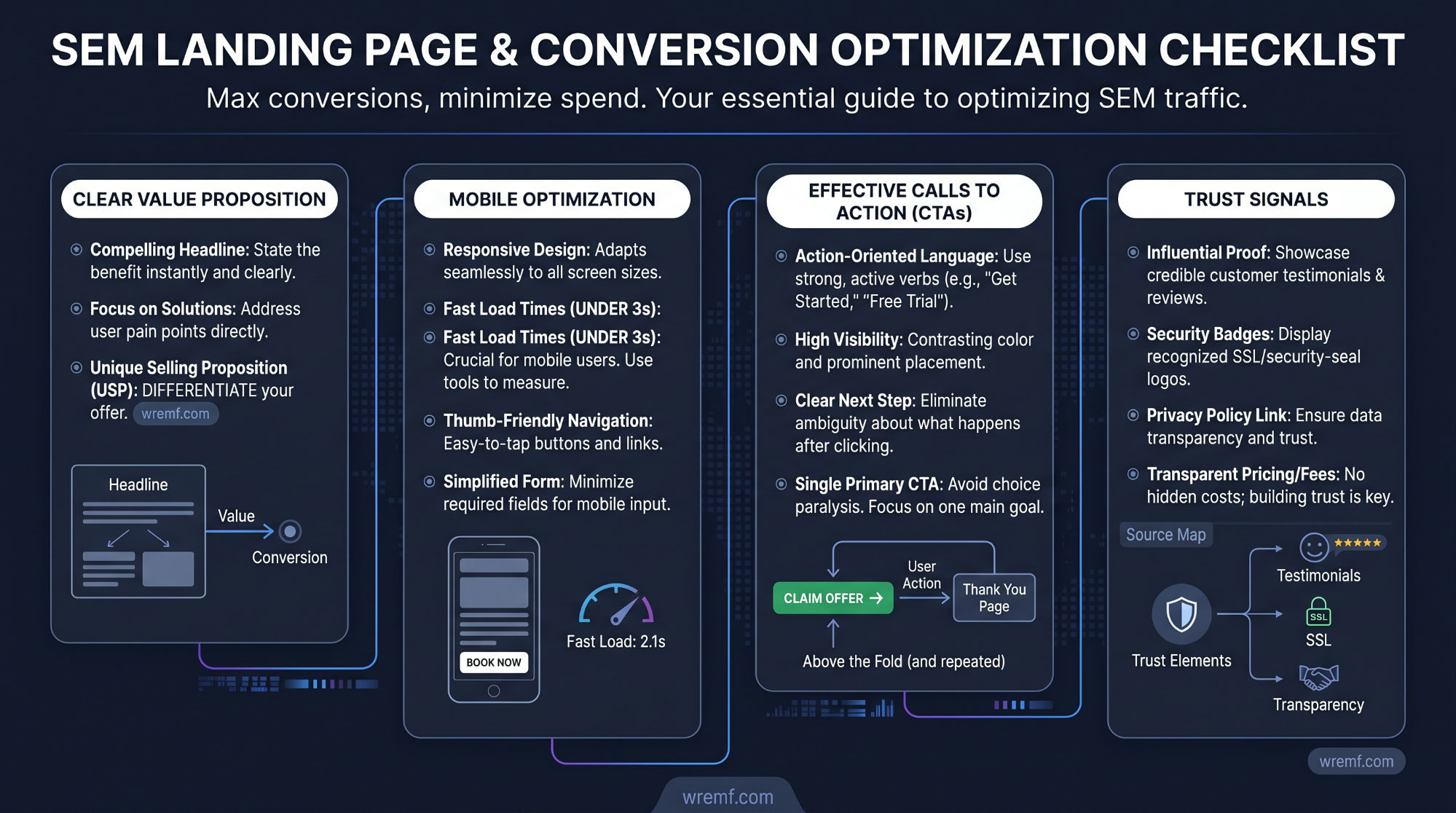
Landing pages are the determinant of whether paid search advertising investment translates into business results. A well-structured Google Ads campaign that drives traffic to a poorly optimised landing page will consistently underperform regardless of budget or keyword quality.
Landing Page Optimization is the process of improving every element of a page that influences whether a visitor takes the desired action. This includes headline clarity, value proposition alignment with the ad, page load speed, mobile responsiveness, form length, social proof, and the specificity of the call to action.
The most common landing page failures in search engine marketing campaigns follow predictable patterns.
Misaligned messaging is the most frequent and most damaging problem. When a user clicks an ad that promises a specific benefit and lands on a page that discusses something different, or simply displays a general homepage, the user experience breaks down immediately. The visitor does not find what they expected and leaves. This raises bounce rates, lowers Quality Score in Google Ads, increases cost per click, and reduces conversion rate simultaneously.
Generic calls to action reduce conversion rates significantly. Phrases like "Contact Us" or "Learn More" communicate no specific value and create no urgency. A specific call to action aligned to the user's intent, such as "Get a Custom SEM Audit" or "See Pricing for Your Industry", performs consistently better because it reflects what the user came to do.
Mobile Optimization is not optional. A significant portion of B2B search traffic occurs on mobile devices, and landing pages that are not optimised for mobile screen sizes, load times, and form interactions will lose those visitors. Responsive Design ensures that the page renders correctly across devices, but genuine mobile optimisation goes further and considers the entire experience of a mobile user completing a conversion action.
Trust signals are underused in many SEM landing pages. Case studies, client logos, testimonials, security badges, and specific results statements help a user who has never encountered the brand before to trust that the action they are about to take is worth their time. For B2B SaaS and professional services, trust signals on landing pages directly affect lead quality as well as volume.
A search engine marketing consultant evaluates landing pages against the specific keywords and ad copy driving traffic to them. The evaluation covers message match, conversion path length, form field requirements, page speed, mobile experience, and the presence of distracting navigation that pulls visitors away from the conversion action.
Landing page testing is a continuous process. Structured A/B testing of headlines, value propositions, form lengths, and button copy generates conversion data that compounds over time. A consultant builds a testing roadmap alongside the campaign strategy, ensuring that improvements to landing pages are data-driven rather than based on preference.
KEY TAKEAWAY: Landing page performance is as important as campaign structure in determining SEM results. Every paid search campaign requires a landing page built specifically for the keyword intent and conversion action it is designed to support.
SEO and SEM Integration: Organic Search Alongside Paid
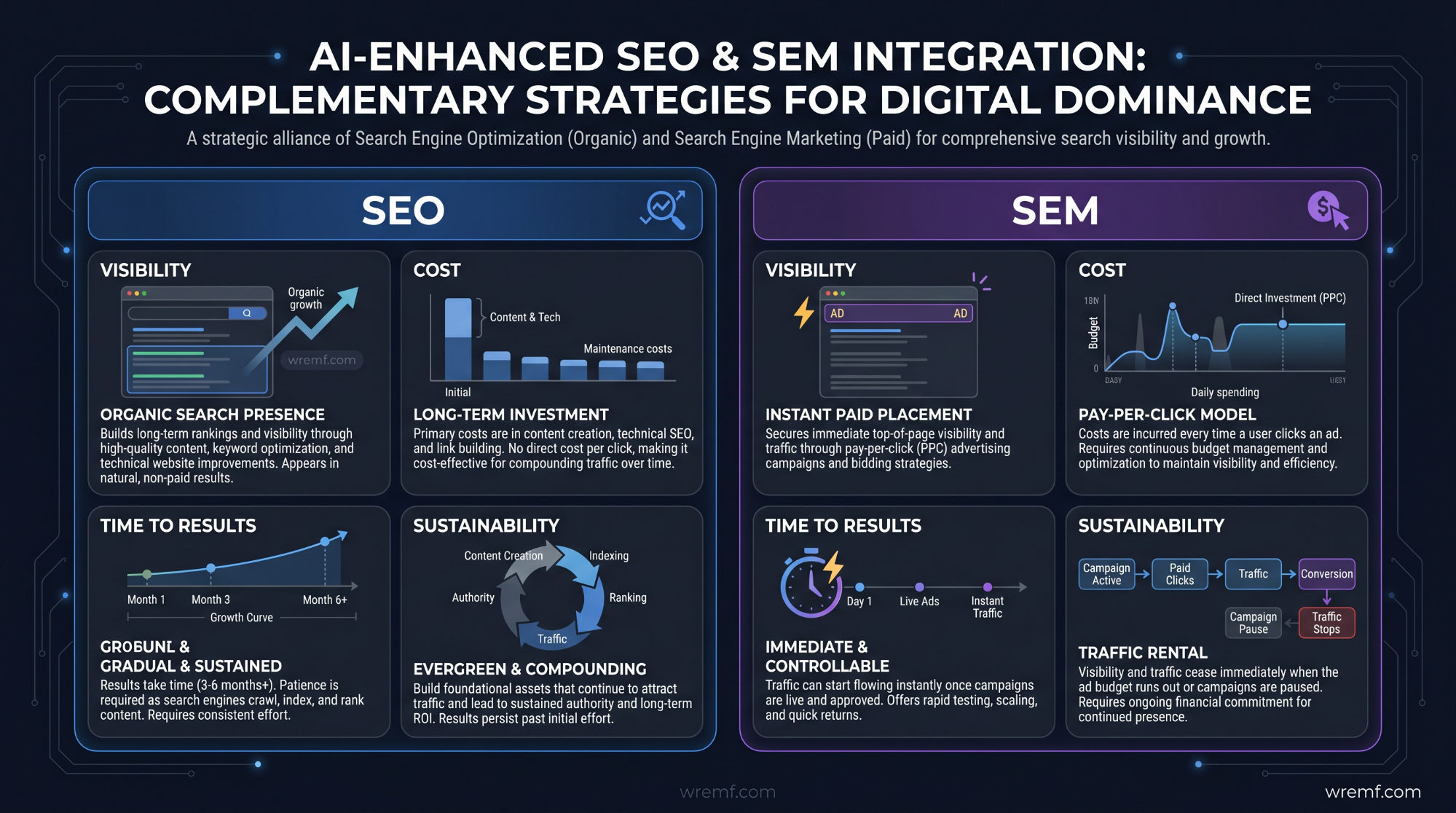
Search engine optimisation and search engine marketing are most effective when they are planned and executed as complementary disciplines rather than separate programmes. A business that runs strong paid search campaigns without investing in organic search visibility is permanently dependent on ad spend to maintain traffic. A business with strong organic search rankings can reduce paid spend on competitive terms where it already dominates organically.
Search Engine Optimization is the practice of improving a website's visibility in organic search results through technical quality, content relevance, authority signals, and user experience. Unlike paid search advertising, organic search visibility is earned rather than bought and builds sustainable competitive advantage over time.
The integration of SEO and SEM creates several strategic advantages.
Keyword data from paid search campaigns provides immediate signal about which terms convert. If a keyword generates a high conversion rate in Google Ads, it is a strong candidate for organic content investment. If a term has high organic traffic but low conversion rate, the landing page for that term may need to be improved or the keyword may need to be reconsidered as a conversion target.
SERP coverage improves when a brand appears in both paid and organic positions for the same keyword. When users see a brand twice on the same search engine results pages, once in ads and once in organic results, brand recall and click-through rates both increase. This effect is particularly valuable in competitive markets where trust is a purchasing factor.
Search Console provides organic search data including impressions, clicks, click-through rates, and average position for each keyword. A consultant reviews this data alongside Google Ads data to identify terms where organic performance is strong enough to reduce paid investment and terms where paid ads are necessary to maintain visibility while organic rankings develop.
Technical SEO forms the foundation of organic visibility. A technically sound website loads quickly, is crawlable by search engines, uses structured data and schema markup appropriately, is mobile-friendly with Responsive Design, and does not have issues such as broken links, duplicate content, or crawl errors that impair how search engines index and rank it. Technical SEO improvements benefit both organic rankings and the landing page quality signals that affect Google Ads Quality Score.
Local SEO is a distinct discipline within search engine optimisation relevant to businesses that serve specific geographic markets. It involves optimising Google My Business listings, building local citations across directories, generating and managing reviews, and creating content that addresses local search intent. For businesses serving a city or region, local SEO and local campaigns in Google Ads work together to dominate search results for geographic queries.
Backlink management and link building strengthen domain authority, which improves organic search rankings for competitive keywords. A consultant identifies link building opportunities through content strategy, digital PR, partnerships, and outreach, connecting these efforts to the keyword priorities identified in the overall SEM strategy.
For a detailed breakdown of how SEO and AI search visibility connect, the AI search engine optimization services guide provides practical guidance on integrating traditional SEO with AI visibility planning.
KEY TAKEAWAY: SEO and paid search advertising are most valuable when integrated under a single strategic framework. Organic search builds sustainable visibility while paid search fills gaps, accelerates results, and provides immediate conversion data that informs long-term SEO investment.
Analytics, Conversion Tracking, and Measuring SEM Performance
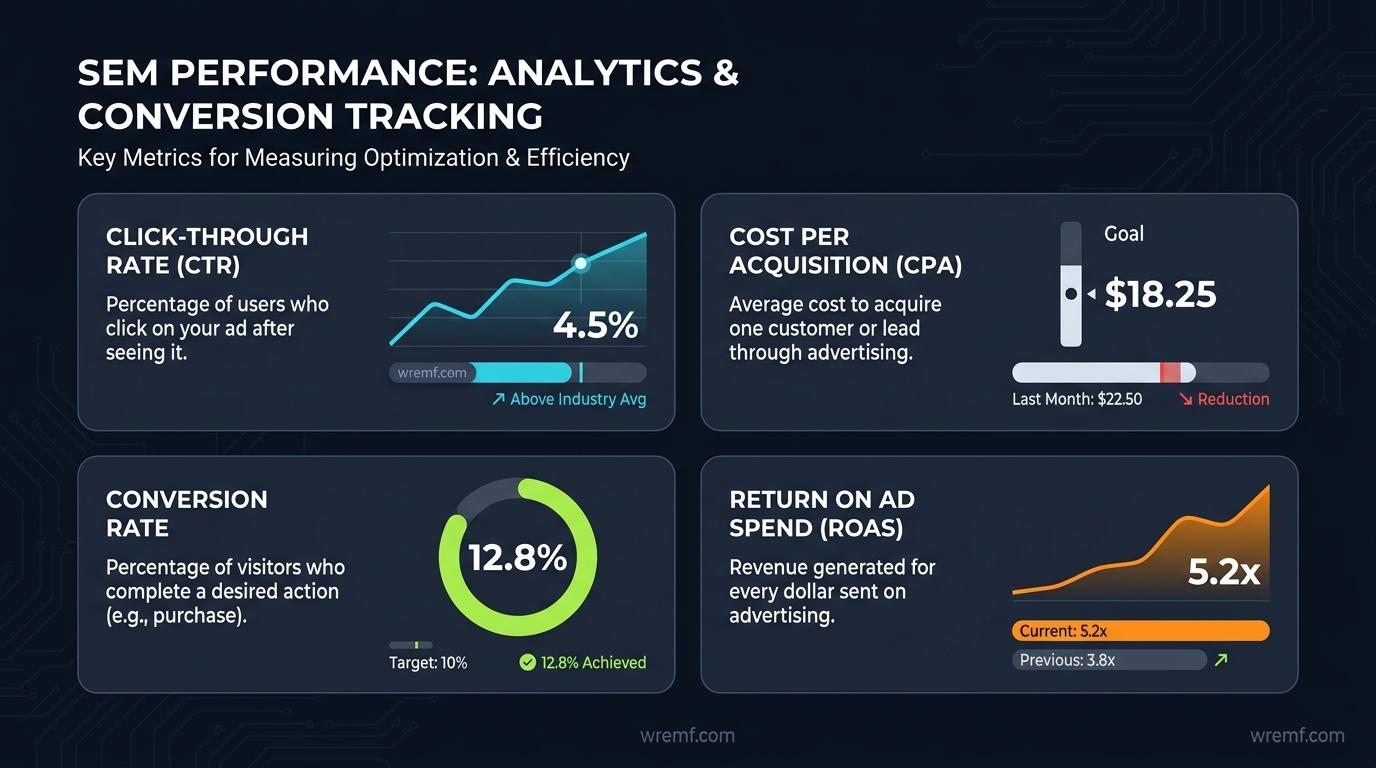
Effective search engine marketing consulting depends on accurate measurement. Without reliable conversion tracking, analytics configuration, and performance reporting, it is impossible to distinguish campaigns that are generating business results from campaigns that are consuming budget without return.
Google Analytics is the primary measurement platform for most SEM programmes. It tracks user behavior across the website, connects paid and organic traffic sources, records conversion actions, and provides the data needed to evaluate which campaigns, keywords, and landing pages are performing. A consultant's first diagnostic step is usually to audit the Google Analytics configuration to confirm that goals are set up correctly, that conversion tracking is active across all relevant actions, and that traffic sources are being attributed accurately.
Conversion tracking in Google Ads connects campaign spend to specific user actions. These actions can include form submissions, phone calls, purchases, demo requests, content downloads, or any other action that represents a meaningful step in the customer journey. Without conversion tracking, bidding strategies such as Target CPA cannot function effectively because they have no outcome data to optimise against.
Cost per acquisition is one of the most important metrics in paid search advertising. It measures how much the business spends on average to generate a single conversion. Tracking cost per acquisition by campaign, ad group, keyword, and audience segment allows a consultant to identify where budget is being used efficiently and where it is being wasted.
Impressions and clicks are supporting metrics that provide context but should not be primary performance indicators on their own. High impressions with low click-through rate indicate an ad copy or relevance problem. High clicks with low conversion rate indicate a landing page problem. High conversion rate with rising cost per acquisition indicates a bidding or competition problem. Each pattern points to a different area requiring attention.
AI-driven analytics tools are increasingly relevant in SEM consulting. These tools identify patterns in large keyword and campaign datasets that would be difficult to spot manually, surface anomalies in performance data, predict trends in keyword behavior, and recommend bid and budget adjustments based on historical patterns. A consultant who incorporates AI-driven analytics into their process can respond to market changes faster and allocate budget more precisely.
Search Console provides a separate but complementary dataset covering organic search performance. Organic impressions, clicks, and average position for each keyword show where the website is visible in search engines and where click-through rates fall below expectations. Combining Search Console data with Google Analytics session and conversion data provides a complete picture of both paid and organic search performance.
Campaign Evaluation should occur on a regular cadence. Weekly checks on spend pacing, conversion rates, and cost per acquisition allow for rapid adjustments. Monthly reporting covers broader performance trends, keyword performance, competitive changes, and strategic recommendations. A consultant typically provides structured monthly reports that connect campaign performance to business outcomes rather than listing metrics in isolation.
Metrics that matter in a well-structured SEM report include: cost per acquisition by campaign and keyword, conversion rate by landing page, click-through rate by ad group, Quality Score trends, organic search ranking changes, Search Console impression and click trends, and attribution across paid and organic channels.
KEY TAKEAWAY: SEM performance measurement requires accurate conversion tracking, properly configured Google Analytics, cost per acquisition analysis by campaign, and regular reporting that connects search activity to business outcomes rather than vanity metrics.
Local SEO and Search Engine Marketing for Location-Based Businesses
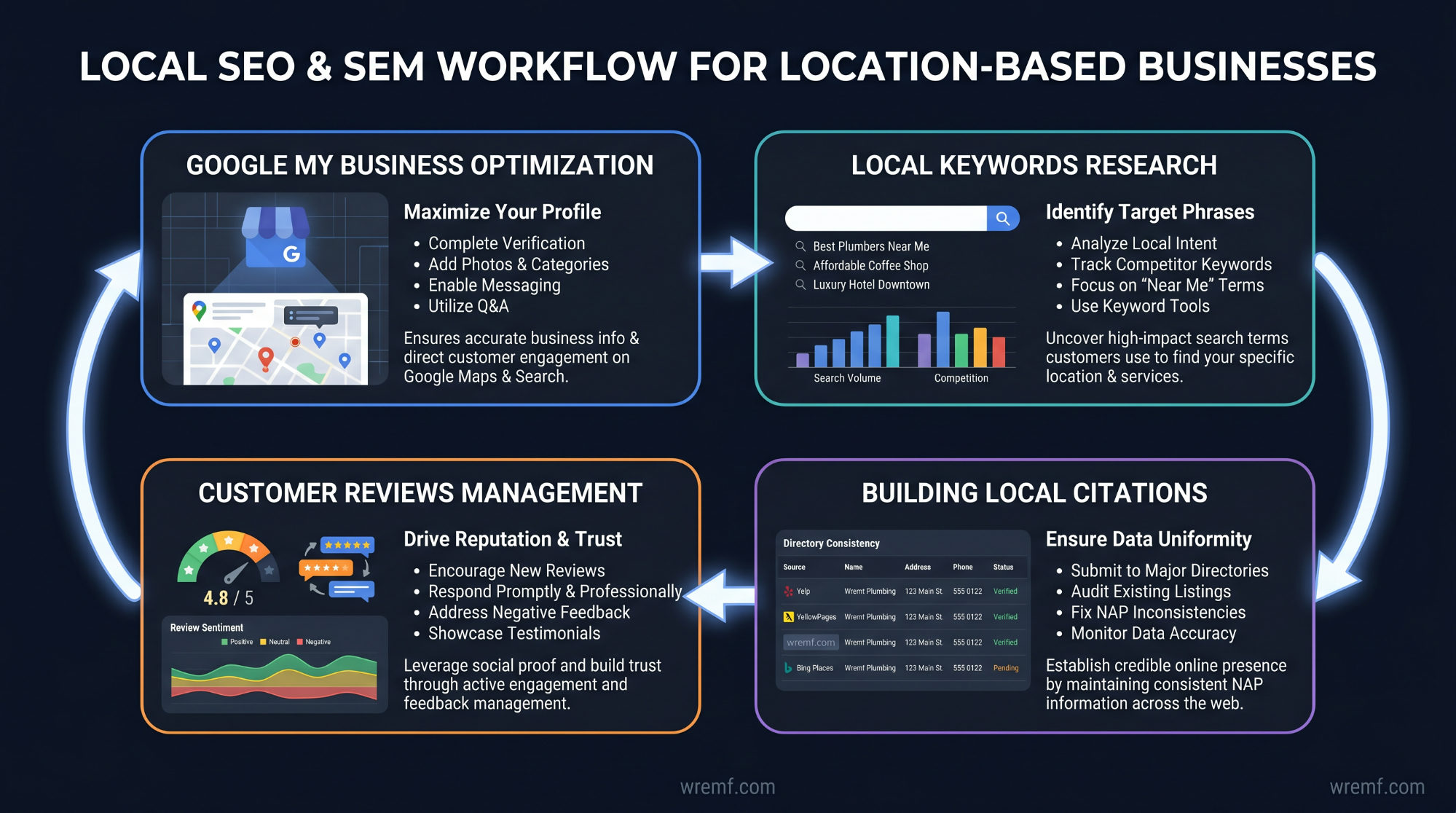
Local SEO and location-targeted search marketing are distinct strategic disciplines that apply when a business serves customers in a specific city, region, or neighbourhood. A local business competing for search visibility in a city like San Francisco faces a different set of challenges than a national brand competing for broad industry keywords.
Local search engine marketing combines Google Ads local campaigns with organic local SEO to capture demand from users searching for services in a specific area. The two channels reinforce each other. A business that ranks organically in local search engine results pages while also running targeted local campaigns gains maximum coverage for high-intent local queries.
Google My Business is the foundation of local SEO. A fully optimised Google My Business listing improves visibility in Google Maps results, local pack listings, and location-based search queries. A search engine marketing consultant audits the listing for completeness, accuracy, photo quality, review management, and category selection, all of which affect how prominently the business appears in local search results.
Local citations are mentions of the business name, address, and phone number across directories, review platforms, and local websites. Consistency of citation information across these sources signals to search engines that the business is a legitimate and established local entity. Inconsistent citations, where the address or phone number varies across platforms, reduce local search rankings.
Neighbourhood-specific keywords are a tactic used in both content creation and paid search for businesses serving multiple locations or highly specific areas within a city. Rather than targeting broad location terms such as "marketing agency San Francisco", targeting more specific terms that reflect the neighbourhoods or districts the business serves can improve relevance and reduce competition.
Hyper-local content strategy involves creating content that addresses the specific concerns, events, and characteristics of the geographic market being served. For a business in San Francisco, this might mean content about the city's technology sector, the specific challenges of digital marketing in a highly competitive coastal market, or the particular user behavior patterns of the local audience.
Voice search optimisation is increasingly relevant for local businesses because a significant proportion of local queries are conducted through voice assistants. Voice search queries are typically longer, more conversational, and often phrased as questions. Optimising for voice search means structuring content to answer specific questions directly, which aligns with both local SEO and the broader shift toward answer-engine style search behavior described further in the answer engine optimization guide | https://wremf.com/blog/answer-engine-optimization-the-complete-guide-to-aeo-ai-search-visibility-and-answer-first-content.
Mobile Optimization is essential for local search because a large proportion of local searches occur on mobile devices, often with immediate intent to visit a business or make a contact. Landing pages for local campaigns must load quickly, be easy to navigate on a small screen, and make it as frictionless as possible for the user to call, message, or get directions.
Local SEO consulting also addresses managing reviews across Google and other platforms relevant to the business category. Review volume, recency, and average rating affect local search rankings and influence user decisions at the point of search.
KEY TAKEAWAY: Local search engine marketing requires a coordinated approach combining Google My Business optimisation, local citations, hyper-local content, neighbourhood-specific keywords, voice search optimisation, and mobile-first landing page design.
Technical SEO and Web Development as SEM Foundations
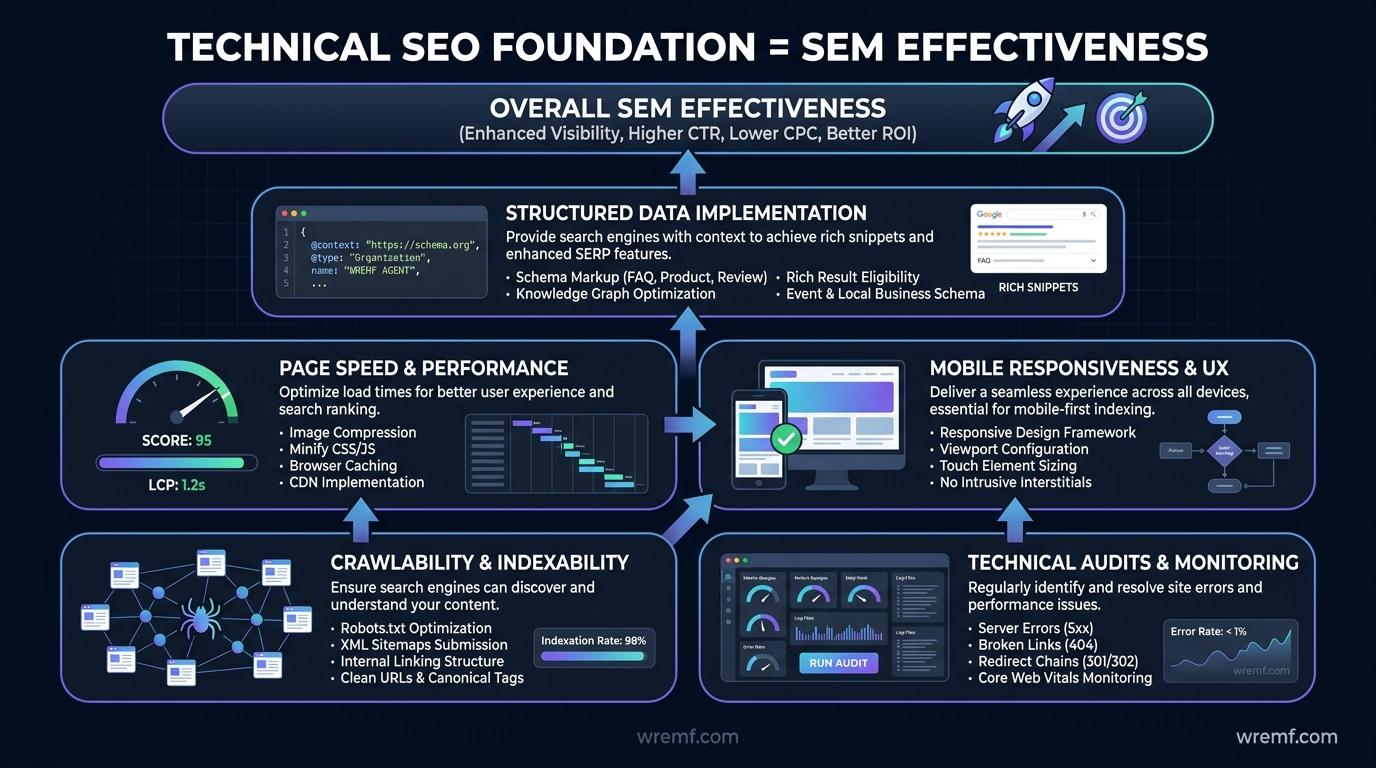
Technical SEO provides the structural foundation that determines whether a website can be effectively indexed, ranked, and used as a destination for paid search traffic. A website with technical SEO problems limits the performance of every other search marketing investment made above it.
Technical SEO encompasses a set of practices that ensure a website is accessible, understandable, and efficiently crawlable by search engines. Key areas include page speed, mobile responsiveness, crawl architecture, URL structure, canonical tags, structured data implementation, and the absence of technical errors that impair indexing.
Page speed is directly connected to both organic search rankings and paid search Quality Score. Google uses Core Web Vitals, a set of speed and user experience metrics, as a ranking signal. Slow-loading pages also increase bounce rates from paid traffic, reducing conversion rates and increasing effective cost per acquisition. A consultant identifies speed issues through technical audits and prioritises fixes based on their impact on both rankings and conversions.
Schema markup and Structured Data tell search engines explicitly what content on a page represents. Schema markup for products, services, reviews, FAQs, local business information, and events enables rich results in search engine results pages, which increase click-through rates. A consultant identifies where schema markup is absent or incorrectly implemented and ensures structured data aligns with the content it describes.
Mobile Optimization goes beyond Responsive Design. True mobile optimisation considers the full experience of a user on a mobile device, including tap target sizes, font readability, form completion ease, and page structure that prioritises the most important content for mobile users who have less patience for friction than desktop users.
Web Development choices affect SEO in ways that are not always visible to non-technical teams. JavaScript-heavy websites, poor URL structure, excessive page redirects, and duplicate content created by CMS configurations can all impair search engine crawling and indexing. A search engine marketing consultant who understands Technical SEO works alongside web developers to ensure that site architecture supports rather than undermines search visibility.
HTML optimization covers the technical quality of on-page elements that search engines use to understand content. This includes title tags, meta descriptions, header structure, image alt text, internal linking structure, and canonical tags. These elements are not ranking silver bullets individually, but collectively they signal to search engines what each page is about and how it relates to other pages on the website.
Custom Web Design Services and SEO-Friendly Design are relevant when a business is building or redesigning a website. A website built without SEO considerations at the design stage typically requires significant rework after launch. A consultant who is involved in the Web Development process ensures that the site architecture, URL structure, page templates, and content management workflows are built to support search visibility from the start.
Cloud Hosting choices affect page speed and website reliability. A website hosted on a slow or unreliable server will have higher load times, which affects both user experience and search rankings. A consultant may recommend hosting improvements as part of a broader technical SEO programme where server response times are identified as a limiting factor.
HTML5/CSS Designing standards are relevant in so far as they affect page load performance and mobile compatibility. Modern HTML and CSS standards generally support faster, more responsive websites that perform better in both technical SEO and user experience evaluations.
KEY TAKEAWAY: Technical SEO is not a one-time project but an ongoing maintenance discipline. A website with strong technical foundations loads quickly, is mobile-friendly, uses structured data correctly, and provides the crawlable architecture that both search engines and paid traffic need to perform.
Content Strategy and Content Marketing in SEM Consulting
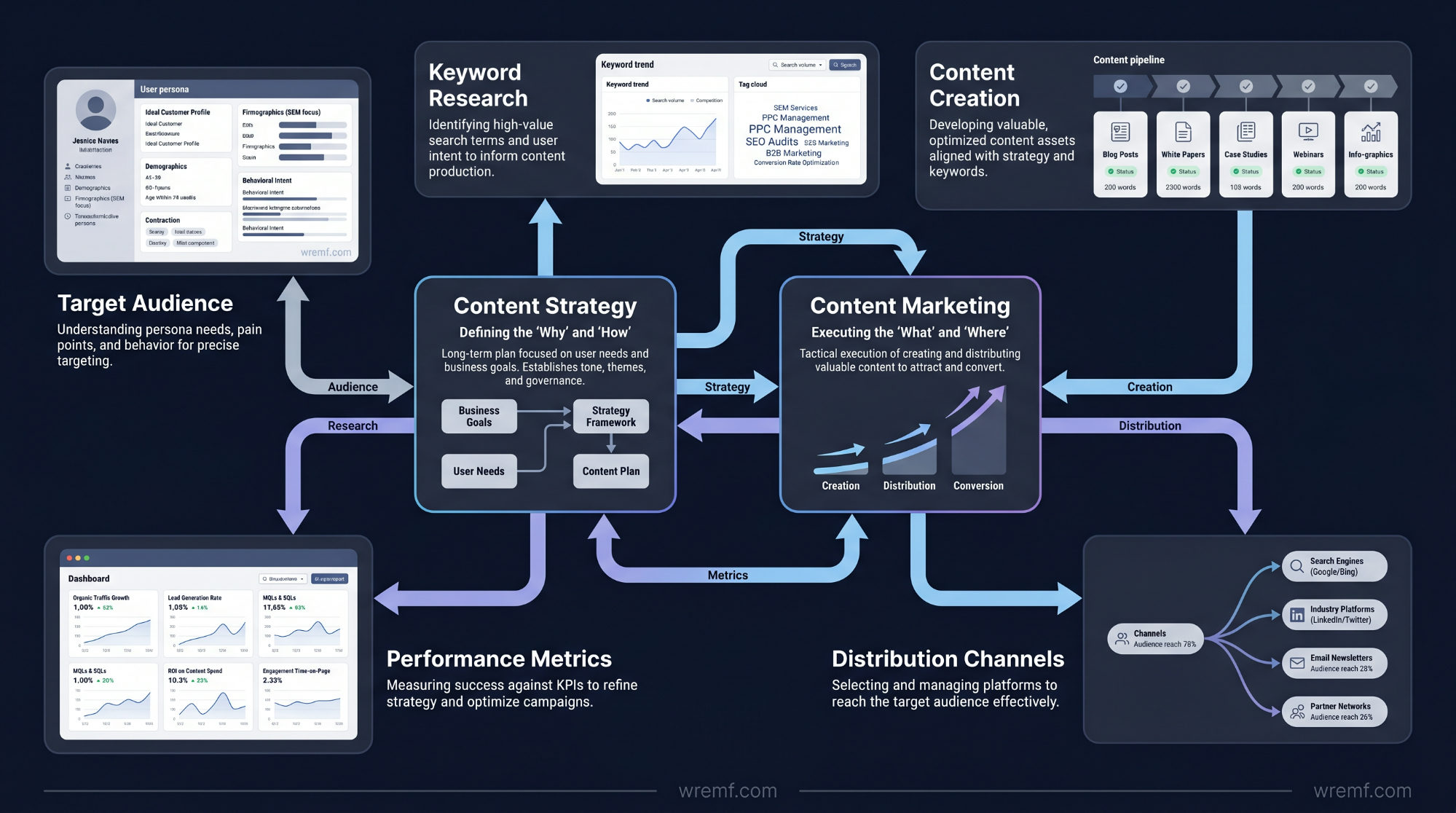
Content strategy is the planning and execution discipline that determines what content a business creates, for whom, around which keywords, and with what goal. In search engine marketing, content serves both organic search visibility and the informational needs of users at every stage of the buying journey.
Content marketing in a SEM context means creating content that attracts, educates, and converts target audiences through organic search while building the brand authority and backlink profile that strengthens paid search Quality Scores and domain credibility over time. Content that ranks organically for valuable keywords reduces dependence on paid search advertising for those terms and provides permanent value rather than temporary visibility.
A content strategy built around keyword research identifies the specific topics, questions, and phrases that the target audience searches for at each stage of awareness. Informational content addresses the questions buyers ask early in their research. Commercial content addresses the evaluation stage when buyers are comparing options. Transactional content targets buyers who are ready to act.
Blog content is the most common vehicle for informational and commercial content in SEM programmes. A well-structured blog builds topical authority over time, captures long-tail keyword traffic, and provides the internal linking structure that distributes authority across the website. A search engine marketing consultant builds a content creation calendar aligned to keyword priorities, business goals, and the search demand patterns identified in keyword research.
Content creation for SEM requires discipline. Each piece of content must be written for a specific keyword intent, structured to satisfy that intent directly, and optimised with appropriate keyword usage, internal links, and schema markup where relevant. Generic content that is not aligned to a specific search intent ranks poorly and drives irrelevant traffic even when it does achieve visibility.
Backlink management and link building strengthen the organic search authority that makes high-value keywords achievable. A consultant identifies link building opportunities through content-driven outreach, digital PR, partnerships, and the creation of research, data, or tools that naturally attract links from authoritative sources. Link-building is a long-term investment that compounds significantly over 12 to 24 months in competitive markets.
Content strategy for eCommerce businesses has additional dimensions including product page optimisation, category page architecture, structured data for product listings, and E-Commerce Solutions for managing large volumes of product content efficiently. A search engine marketing consultant working with an eCommerce client integrates product SEO with paid shopping campaigns to maximise visibility across the full purchase funnel.
Customer Engagement metrics such as time on page, scroll depth, and return visit rates provide qualitative signals about content quality and relevance. Content that generates high engagement signals to search engines that it satisfies user intent effectively, which contributes to improved rankings over time.
Market Trends analysis is part of an effective content strategy. Understanding where the competitive landscape is moving, what topics are gaining search demand, and where content gaps exist relative to competitors allows a consultant to identify opportunities before they become crowded.
KEY TAKEAWAY: Content strategy is the engine of long-term organic search visibility. Content aligned to keyword intent, audience awareness stage, and business goals builds sustainable competitive advantage that paid search advertising alone cannot replicate.
AI Search Visibility: The New Dimension of Search Engine Marketing
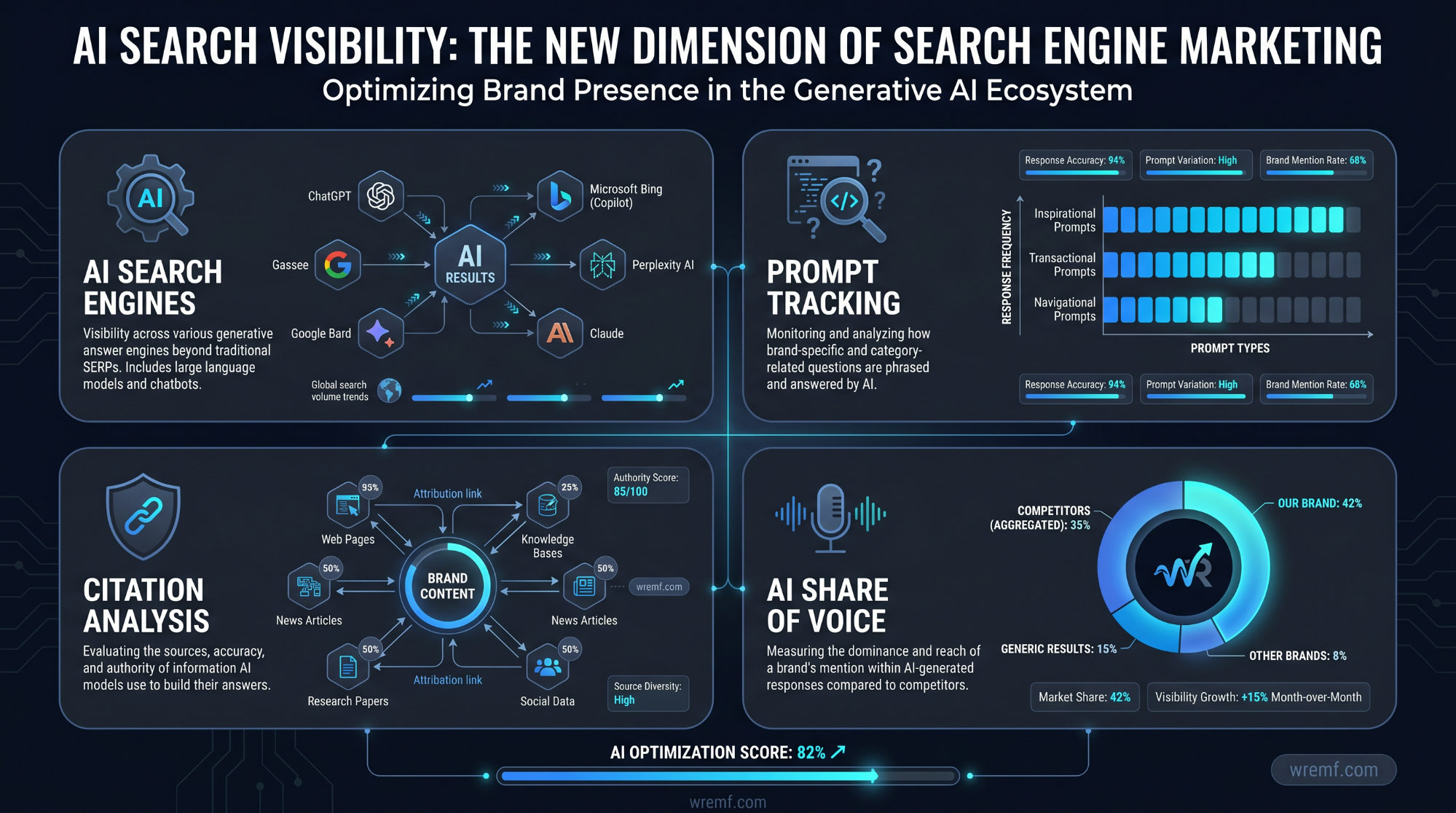
AI search visibility is the measure of how often and how prominently a brand appears in AI-generated answers from engines such as ChatGPT, Perplexity, Google AI Overviews, Gemini, Claude, Copilot, DeepSeek, Grok, Meta AI, and Mistral. It matters because buyer behaviour is shifting. A growing proportion of B2B buyers now use AI answers to research, shortlist, and evaluate vendors before they ever perform a traditional Google search.
This shift creates a gap in traditional search engine marketing consulting. Google Ads and standard SEO tools were built to measure and improve visibility in search engine results pages. They do not measure whether a brand is being mentioned, recommended, or cited in AI-generated answers to the prompts buyers are asking in AI discovery environments.
The distinction matters practically. A B2B SaaS company can hold strong Google Ads positions and solid organic search rankings while being entirely absent from the AI-generated answers that its prospective buyers are reading in ChatGPT and Perplexity. If a buyer asks an AI engine "what are the best tools for B2B lead generation" and the brand does not appear in the response, that buyer's shortlist is formed without the brand's influence, regardless of how well-funded its paid search campaigns are.
AI search visibility is measured through prompt tracking, citation tracking, AI share of voice analysis, and source consistency evaluation. These measurements require dedicated tooling that tracks AI engine responses across a structured set of prompts relevant to the business, monitors which sources those AI engines cite, and identifies whether the brand appears consistently across different AI engines and over time.
Generative engine optimisation, commonly referred to as GEO, is the practice of improving how content and brand signals are structured so that AI engines retrieve and cite them in relevant answers. GEO involves ensuring that content is factually clear, well-structured, cited by authoritative external sources, and aligned with the entities and topics that AI engines associate with a given subject area. The generative AI optimization services guide covers the full framework for GEO in practice.
Answer engine optimisation, or AEO, is the practice of structuring content to be selected and surfaced in answer-first environments, including AI Overviews, AI chatbots, and voice assistants. AEO prioritises direct, structured answers to specific questions, using schema markup, FAQ structure, and concise factual language that AI engines and featured snippets can extract and display without modification. For a detailed overview of AEO strategy, the answer engine optimization services guide explains the framework in full.
Prompt tracking is the practice of monitoring AI engine responses to a structured set of prompts relevant to the business over time. It identifies whether the brand appears in AI answers, which competitors appear instead, which sources are being cited, and how AI engine responses change as content, authority, and citation signals evolve.
AI share of voice measures how often a brand appears in AI-generated answers relative to its competitors across a defined set of prompts. It is the AI equivalent of SERP share and is one of the most strategic competitive metrics available in AI search marketing.
WREMF is built specifically for this measurement and improvement challenge. It tracks brand mentions, citations, and recommendations across 10 AI engines through unlimited prompt tracking, source citation analysis, AI share of voice measurement, and AI referral traffic attribution. Teams that use WREMF alongside their existing SEM programmes gain a complete view of their search marketing presence across both traditional search engines and AI discovery surfaces. For businesses new to AI visibility measurement, WREMF's Starter plan at €59 per month provides a practical entry point covering 10 AI engines with unlimited prompts and BYOK support for one website.
KEY TAKEAWAY: AI search visibility is a new and measurable dimension of search marketing that traditional SEM tools do not cover. Brands that track and improve their presence in AI-generated answers gain competitive advantage at the research and shortlisting stage of the B2B buying journey.
How WREMF Complements a Search Engine Marketing Consulting Programme
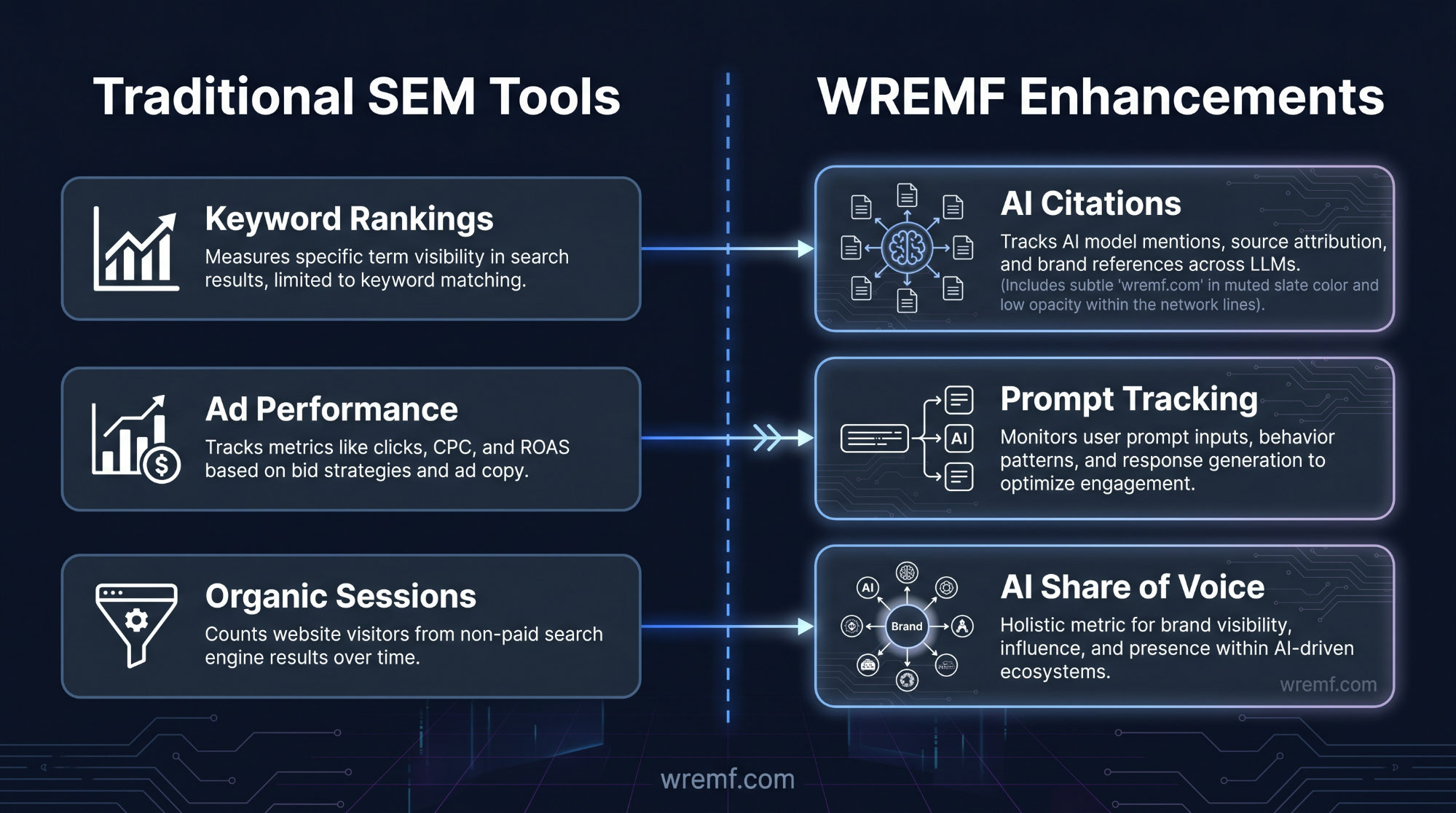
WREMF adds the AI visibility layer that traditional search engine marketing consulting tools were not built to measure. Traditional SEM tools track keyword rankings, ad performance, and organic session data. WREMF tracks how AI engines mention, cite, compare, and recommend brands across prompt-based discovery journeys.
Traditional search engine marketing tools and WREMF serve different but complementary purposes. Understanding the distinction helps teams allocate their measurement and optimisation investment appropriately.
Primary signal
- Traditional SEO tools: Keyword rankings in Google Search
- WREMF: Brand citations and mentions in AI prompt answers
What it tracks
- Traditional SEO tools: SERP position and organic sessions
- WREMF: AI citations, AI share of voice, source consistency across AI engines
Authority signal
- Traditional SEO tools: Backlinks and domain authority
- WREMF: Source citation frequency in AI answers across ChatGPT, Gemini, Perplexity, and others
Query model
- Traditional SEO tools: Keywords typed into a search bar
- WREMF: Prompts submitted to AI engines in natural language
Competitive view
- Traditional SEO tools: SERP rank overlap with competitors
- WREMF: AI share of voice across relevant buyer prompts
Attribution
- Traditional SEO tools: Organic sessions in Google Analytics
- WREMF: AI referral traffic analysis and prompt-level attribution
Engine coverage
- Traditional SEO tools: Google and Bing
- WREMF: 10 AI engines including ChatGPT, Claude, Gemini, Perplexity, Copilot, DeepSeek, Grok, Meta AI, Mistral, and Google AI Overviews
Audit type
- Traditional SEO tools: Technical SEO audits
- WREMF: GEO and AEO audits covering content structure, citation quality, entity consistency, and source authority
Source consistency
- Traditional SEO tools: Not measured
- WREMF: Tracked across all supported AI engines to identify where brand information is inconsistent or absent
Traditional SEM tools remain essential for managing Google Ads campaigns, tracking organic search rankings, identifying technical SEO issues, conducting keyword research, and measuring backlinks. WREMF does not replace them. WREMF adds the layer that tells a brand whether its search and content investment is translating into AI engine visibility, which is where a growing share of buyer discovery now begins.
For B2B marketing teams and agencies considering how to integrate AI visibility into an existing SEM programme, WREMF offers three engagement models. The software-only model through the Starter or Growth plans supports teams with internal capacity to measure and act on AI visibility data independently. The Managed plan at from €1,500 per month provides strategy, execution, GEO audits, AEO content optimisation, citation cleanup, and reporting for teams that need end-to-end support. The hybrid model combines WREMF software with selective use of WREMF's senior team for audits, strategy sessions, and execution sprints as needed.
Teams that want to explore how WREMF fits alongside their current SEM programme can review the approach through WREMF agency services or compare plan options through WREMF pricing
KEY TAKEAWAY: WREMF and traditional SEM tools serve different measurement purposes. Traditional tools measure search rankings and paid campaign performance. WREMF measures how AI engines cite, mention, and recommend brands across prompt-based discovery, adding a critical competitive dimension that SEM tools alone cannot provide.
How to Run a Search Engine Marketing Consulting Engagement
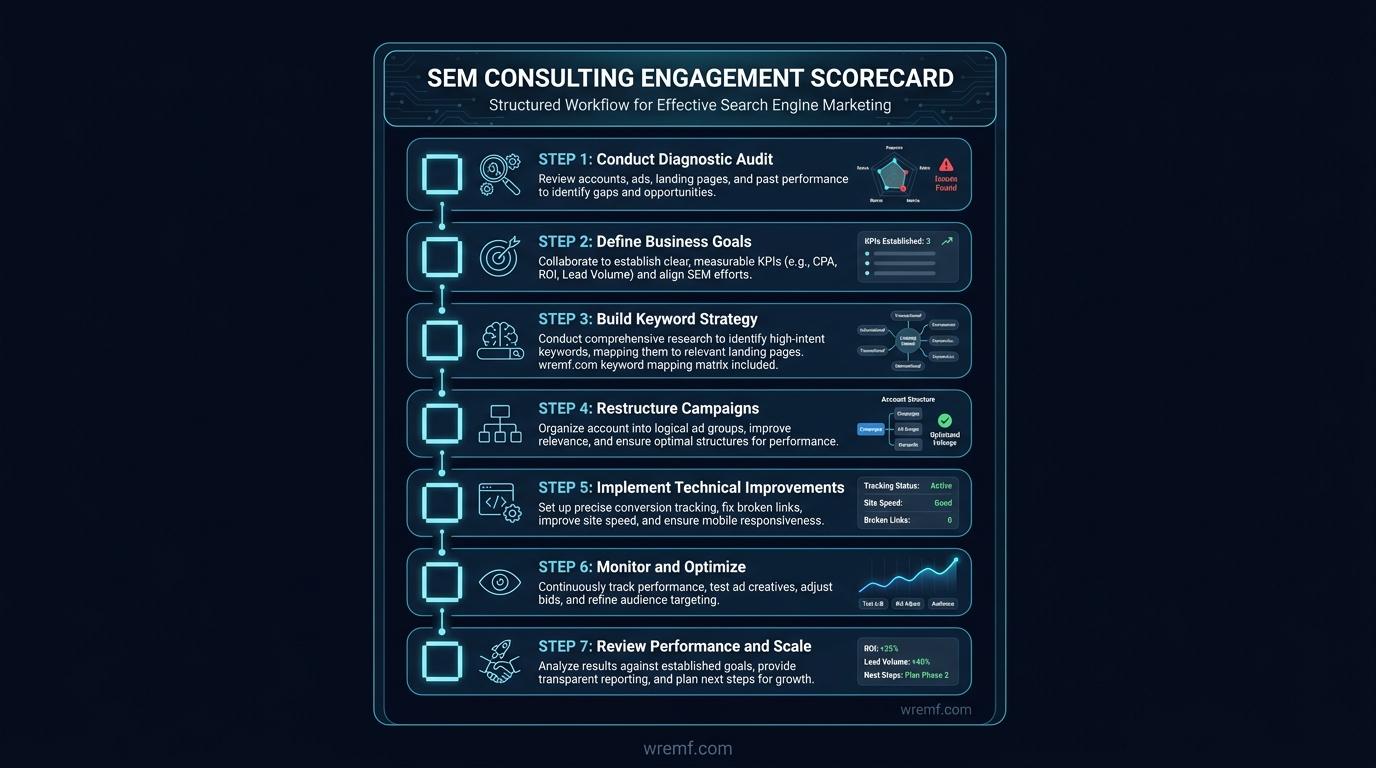
A well-structured SEM consulting engagement follows a diagnostic, strategic, and execution sequence that connects the initial audit to ongoing performance improvement. The following process reflects how a search engine marketing consultant approaches a new client engagement.
Step 1: Conduct an SEM diagnostic audit
The engagement begins with a comprehensive review of existing paid search campaigns, organic search rankings, keyword usage, conversion tracking configuration, Google Analytics setup, landing page performance, and competitive positioning. The audit identifies specific failures, gaps, and opportunities across both paid and organic channels and provides the factual baseline for all strategic recommendations.
Step 2: Define conversion actions and business goals
Effective SEM consulting requires clarity about what the business is trying to achieve. This means defining the specific conversion actions that matter, whether lead form submissions, demo requests, purchases, or phone calls, and connecting those actions to business metrics such as cost per acquisition targets, lead volume goals, and revenue contribution expectations.
Step 3: Build the keyword strategy
Using Google Keyword Planner, Search Console data, competitor analysis, and customer language research, the consultant builds a keyword strategy that covers both paid and organic search priorities. This includes identifying high-intent commercial keywords for paid campaigns, long-tail keywords for organic content, negative keyword lists for exclusion, and local or geographic keyword variants where relevant.
Step 4: Restructure or build campaigns
Based on the keyword strategy, paid search campaigns are restructured or built from scratch with proper campaign segmentation, tight ad group organisation, aligned ad copy, and conversion-tracking-connected bidding strategies. Each campaign is linked to a landing page built for the specific intent of the keywords in that campaign.
Step 5: Implement technical SEO and landing page improvements
Alongside campaign work, technical SEO issues identified in the audit are addressed in order of impact. Landing pages are optimised for message match, mobile performance, page speed, and conversion path clarity. Schema markup and structured data are implemented where applicable.
Step 6: Launch content and link building programme
A content creation programme aligned to the keyword strategy begins producing blog content, pillar pages, and supporting pages that target informational and commercial keywords. A link building outreach programme works in parallel to build the backlink profile that improves organic search rankings over time.
Step 7: Configure reporting and attribution
Google Analytics, Google Ads, Search Console, and any CRM integration are connected into a reporting framework that tracks cost per acquisition, conversion rate, organic ranking changes, click-through rate, impression share, and lead quality by source. Reports are structured to show business outcomes, not just campaign metrics.
Step 8: Monitor, evaluate, and optimise
Campaign Evaluation occurs on a weekly and monthly cadence. Bid adjustments, negative keyword additions, ad copy tests, landing page changes, and content updates are made based on performance data. The consultant identifies new keyword opportunities, monitors competitor activity, and adjusts strategy based on market trends and algorithm updates.
Teams that want to add AI visibility tracking to this process can integrate WREMF at any stage. WREMF's prompt tracking, source citation monitoring, and AI share of voice reporting add a parallel measurement layer that tracks how the brand's growing search authority translates into presence in AI-generated answers over time. For teams starting with AI search visibility, the AI mention tracking guide provides a practical starting framework.
KEY TAKEAWAY: A structured SEM consulting engagement follows a clear sequence from diagnostic audit through strategy, campaign execution, technical improvements, content investment, and ongoing performance reporting. Each step connects to business outcomes rather than campaign activity alone.
Choosing Between SEM Software, a Consultant, and a Managed Service
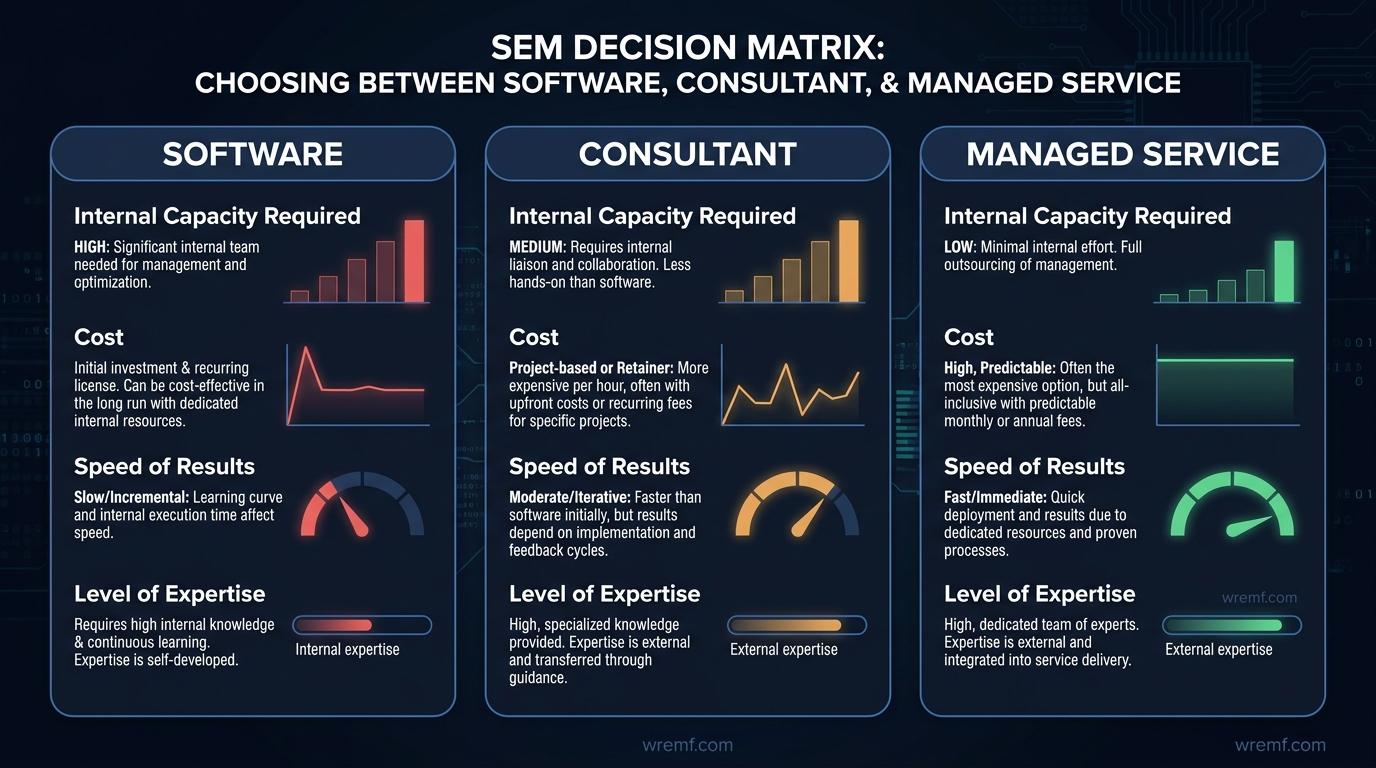
The decision between self-serve SEM software, an independent search engine marketing consultant, and a managed digital marketing agency depends on a business's internal capacity, the complexity of its competitive landscape, the size of its budget, and the speed at which it needs results.
Software-only SEM tools are appropriate for teams with strong internal execution resources who need data, reporting, and optimisation intelligence but can manage campaigns, content, and technical improvements independently. Google Ads, Search Console, and Google Analytics together provide the core infrastructure for a competent internal team. Supplementary tools for keyword research, rank tracking, and backlink analysis extend this capability. The limitation of software-only approaches is that they require internal expertise to interpret data correctly, make strategic decisions, and execute consistently across paid, organic, and content channels simultaneously.
An independent search engine marketing consultant provides strategic expertise and execution guidance without the overhead of a full agency. This model suits businesses with a moderate internal team that needs specific expertise in campaign strategy, keyword research, conversion optimisation, or analytics configuration. The consultant diagnoses, recommends, and sometimes executes while the internal team handles ongoing management. This is a cost-effective model for businesses where budget is limited but internal execution capacity is present.
A managed SEM agency takes responsibility for strategy, execution, and reporting end to end. This model suits businesses that lack internal SEM expertise, are in highly competitive markets where specialist knowledge is decisive, or want to move quickly without building internal capacity first. The managed model provides access to experienced teams across paid search, SEO, content, technical, and analytics disciplines simultaneously. The tradeoff is cost, as managed agency relationships represent the largest investment of the three models.
The hybrid model combines software and selective consulting or agency engagement. A business uses software tools for ongoing measurement and reporting while engaging a consultant or specialist agency for audits, strategy sessions, and execution sprints on specific challenges. This model is increasingly popular because it provides cost predictability while ensuring access to specialist expertise when needed.
For AI visibility specifically, WREMF offers the same three-model flexibility. The Starter plan at €59 per month and the Growth plan at €149 per month serve teams managing AI visibility tracking and reporting internally. The Growth plan is particularly suited to agencies, multi-brand companies, and in-house teams that need white-label reports, GA4 attribution, GEO audits, and a Looker Studio connector for client reporting across 5 websites and up to 15 competitors. The Managed plan from €1,500 per month provides complete AI visibility strategy and execution for enterprise brands and large agencies that need senior-led delivery.
Teams that want to understand which model fits their situation before committing can review options or book a quick call with WREMF to discuss their specific context before selecting a plan.
KEY TAKEAWAY: The right model between SEM software, independent consulting, and managed agency service depends on internal capacity, competitive complexity, and budget. Hybrid models that combine software measurement with selective expert engagement are an increasingly practical middle path for growing B2B teams.
Use Cases: How Different Teams Use SEM Consulting
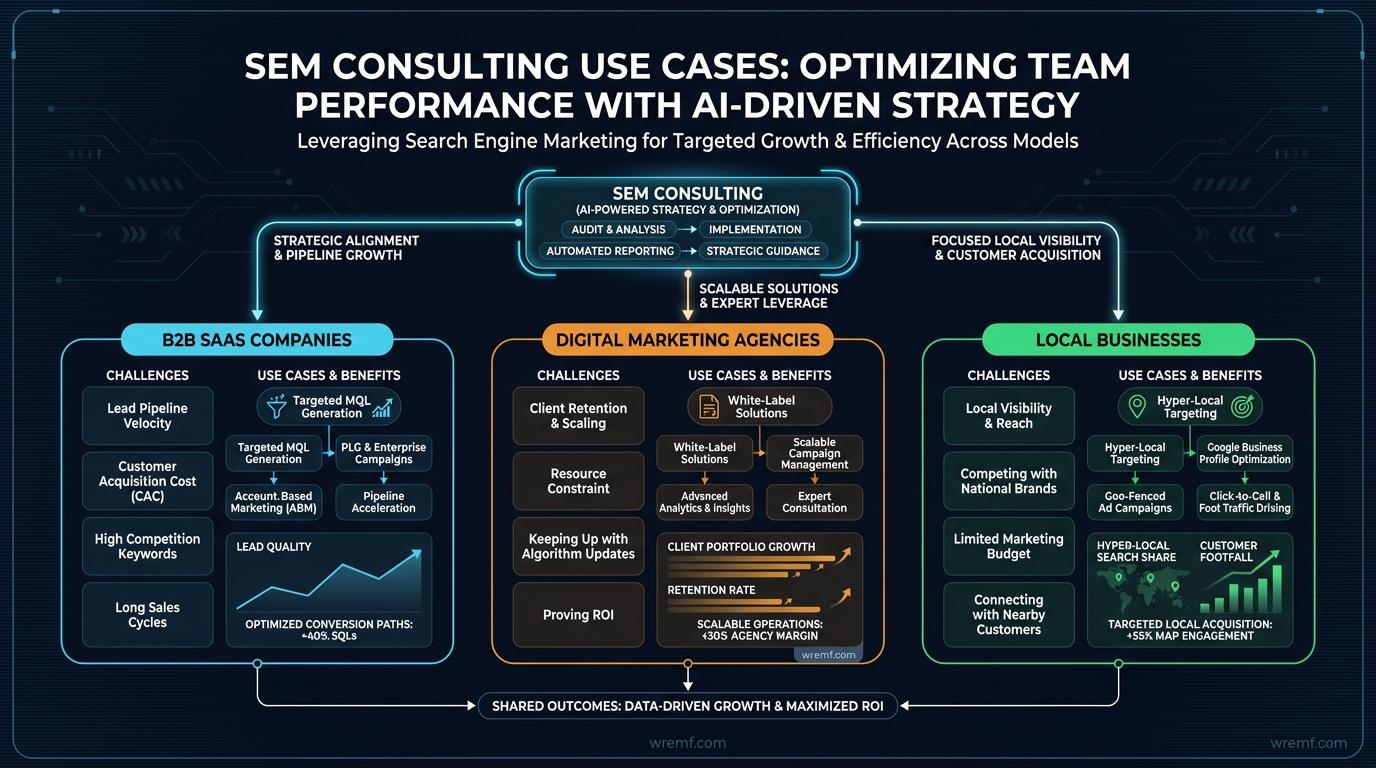
Real-world use cases illustrate how search engine marketing consulting delivers value across different business types and growth stages. The following scenarios reflect common situations rather than specific client claims.
Scenario one: B2B SaaS company losing ground in paid search
A B2B SaaS company in a competitive vertical finds that its Google Ads cost per acquisition has increased significantly over 12 months while conversion rates from paid traffic have declined. An SEM consulting engagement begins with an audit that reveals the following. Campaign segmentation is poor, with broad match keywords in ad groups that mix informational and transactional intent. Landing pages are generic product pages rather than intent-specific conversion pages. Conversion tracking is configured to count page views as conversions rather than actual form submissions. Google Analytics attribution is not connected to the CRM, so lead quality from different campaigns is unknown.
The consultant rebuilds the campaign structure around intent-specific ad groups, creates dedicated Landing Pages for each high-value keyword cluster, reconfigures conversion tracking to measure actual lead actions, and connects Google Analytics to the CRM through goal configuration. Over the following months, cost per acquisition improves as the bidding algorithms gain accurate conversion signal and landing page alignment increases conversion rates from paid traffic.
Alongside this, WREMF is introduced to track how the brand appears in AI-generated answers for the queries that B2B buyers ask when researching the product category. Prompt tracking reveals that two competitors are consistently cited in ChatGPT and Perplexity answers while the brand is absent. The GEO audit identifies content and citation gaps that feed into an AEO content creation programme. The AI brand monitoring guide covers this type of AI visibility diagnostic in detail.
Scenario two: Agency managing SEM for multiple B2B clients
A digital marketing agency manages search engine marketing campaigns for eight B2B clients across different industries. The agency uses a combination of Google Ads, Search Console, and Google Analytics for campaign management and reporting. The challenge is providing differentiated value to clients who are asking increasingly frequent questions about AI search visibility and why their competitors seem to appear in ChatGPT answers.
The agency adds WREMF on the Growth plan, which supports up to 5 websites and 10 to 15 competitors per website with white-label reporting and a Looker Studio connector. This allows the agency to include AI visibility data, AI share of voice metrics, and source citation tracking in client reports without building custom tooling. Clients receive a comprehensive view of their search marketing performance across both traditional search engines and AI discovery surfaces.
Scenario three: Local business building search visibility in a competitive city market
A professional services business in San Francisco wants to improve its search visibility to compete with larger, better-funded competitors dominating both paid search and organic results. The SEM consulting engagement focuses on local SEO, Google My Business optimisation, local citations, neighbourhood-specific keywords in paid campaigns, and hyper-local content strategy targeting the specific needs of the local market. Technical SEO improvements including page speed, schema markup, and Mobile Optimization are implemented to strengthen the technical foundation. The combination of local organic improvements and tightly targeted local campaigns delivers incremental visibility gains that compete effectively in the specific local segments where the larger competitors are less focused.
KEY TAKEAWAY: SEM consulting delivers value across different business types by diagnosing the specific structural, strategic, or measurement problem limiting performance and building a targeted solution around keyword strategy, campaign structure, landing pages, content, and attribution.
Limitations and Risks in Search Engine Marketing Consulting
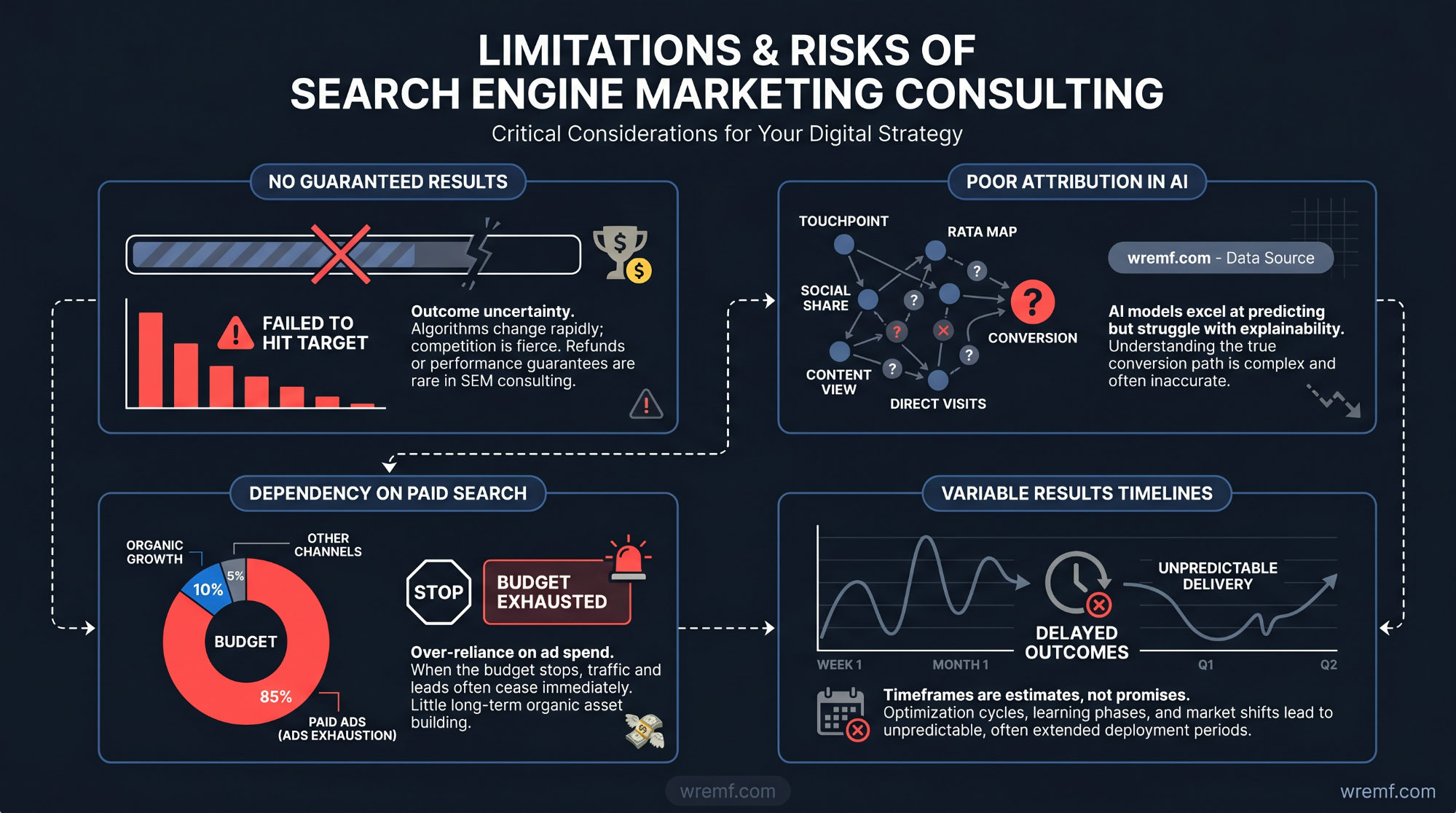
Search engine marketing consulting can significantly improve search visibility, lead generation, and conversion performance, but it carries specific limitations and risks that every business should understand before making investment decisions.
AI search visibility cannot be guaranteed by any consultant or platform. No SEM consultant, GEO specialist, or AI visibility tool can guarantee that a brand will appear in AI-generated answers, Google AI Overviews, or any specific search engine result. AI engines select sources based on complex and non-transparent criteria that include content quality, citation authority, entity consistency, and factors that vary by engine, prompt, location, time, and query context. WREMF helps identify gaps and improve the signals that influence AI citation, but it does not promise specific outcomes.
Rankings do not equal revenue. A common misconception in search engine marketing is that improving search rankings automatically improves business outcomes. Rankings indicate visibility, not conversion. A website can rank highly for relevant keywords while converting poorly due to landing page problems, poor value proposition messaging, slow page speed, or audience mismatch. SEM consulting must connect ranking and traffic improvements to conversion outcomes to demonstrate genuine business value.
Attribution in AI search is incomplete. AI referral traffic attribution is an evolving area. When a buyer reads an AI-generated answer that cites a brand and then visits the brand's website, the session may be attributed to direct traffic or organic search rather than AI referral traffic, depending on how the visit was initiated. Google Analytics and other attribution tools are improving their ability to classify AI-sourced traffic, but current attribution data should be interpreted with that caveat in mind.
Google's algorithms change. Organic search rankings built over months can be affected by algorithm updates that change how Google evaluates content quality, link authority, or user experience signals. A consultant who builds organic visibility responsibly, through genuine content quality, ethical link building, and technical SEO best practice, builds rankings that are more resilient to algorithm changes than those built on shortcuts. According to Google's documentation on Google Search Central blog maintaining long-term search visibility requires ongoing adaptation to evolving quality standards.
Paid search results stop when spend stops. Google Ads visibility is temporary. When ad spend is paused or reduced, paid positions disappear immediately. This makes paid search a powerful accelerator and a tool for filling organic gaps, but not a sustainable standalone strategy. A consultant who recommends a purely paid approach without building organic visibility is creating long-term dependency rather than sustainable growth.
Results timelines vary significantly. Paid search improvements can show measurable results within weeks as campaigns are restructured and conversion tracking becomes accurate. Organic search improvements from technical SEO, content, and link building typically require months before they translate into meaningful ranking and traffic changes. Businesses that expect immediate organic results from SEO investment will be disappointed. A realistic consulting engagement sets timeline expectations clearly by channel and separates short-term paid performance from long-term organic growth trajectories.
Software-only SEM approaches require internal execution capacity. Teams that invest in SEM software tools without the internal expertise to act on the data effectively will see limited results. Tools provide measurement and intelligence, but human judgment, strategic decision-making, and consistent execution determine outcomes. This applies equally to traditional SEM software and to AI visibility platforms including WREMF.
KEY TAKEAWAY: Search engine marketing consulting improves visibility, conversion, and attribution, but it cannot guarantee specific rankings, AI citations, or revenue outcomes. Results timelines vary by channel, attribution in AI search remains imperfect, and software tools require internal execution capacity to deliver value.
Common Misconceptions About Search Engine Marketing Consulting
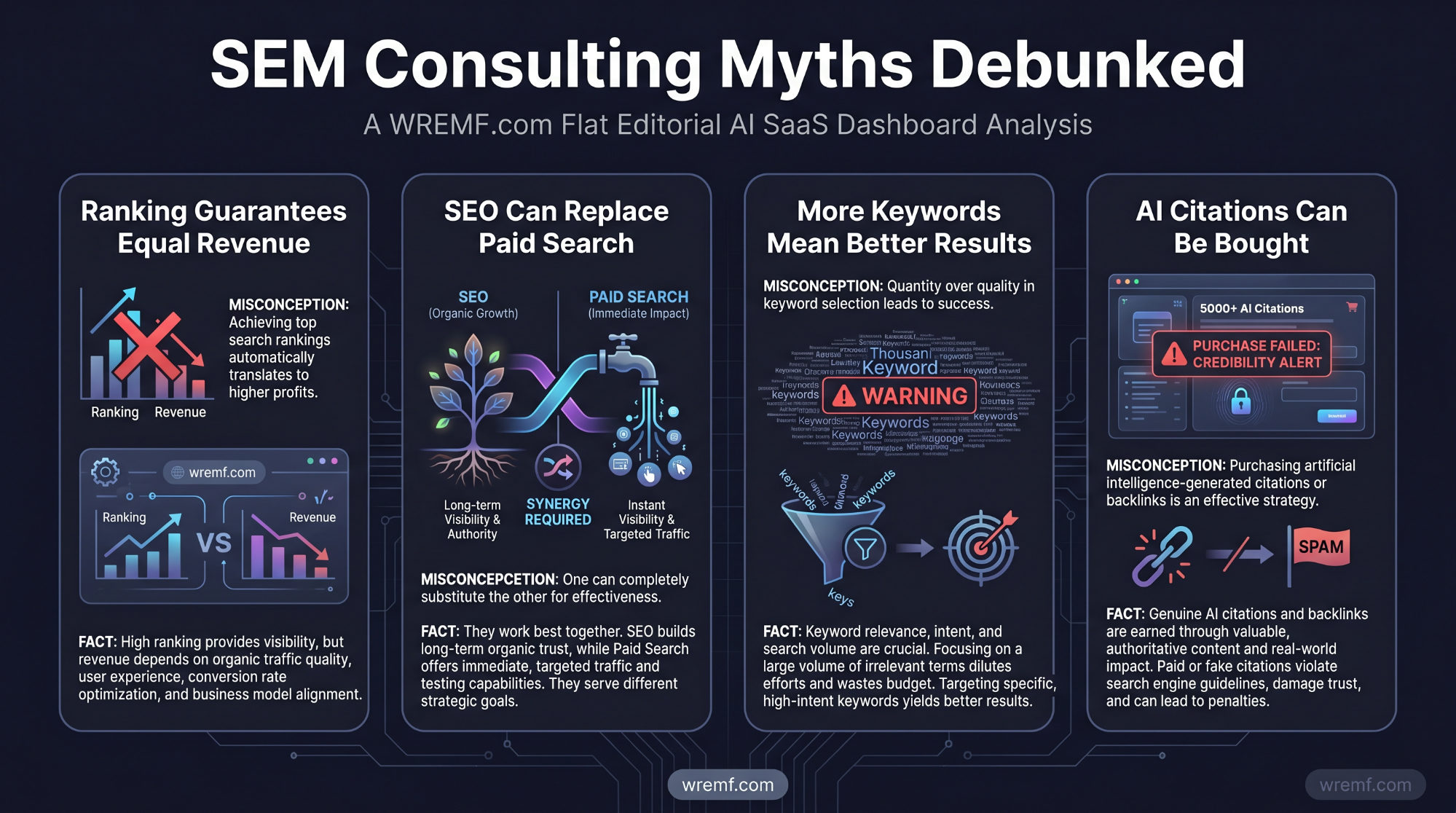
MYTH: If a brand ranks well on Google, it will automatically appear in AI-generated answers.
FACT: Google rankings and AI citation are separate signals measured by different criteria. A brand can hold strong organic search rankings while being entirely absent from AI-generated answers in ChatGPT, Perplexity, Gemini, or Google AI Overviews. AI engines select sources based on citation authority, content structure, entity consistency, and source quality factors that do not map directly to traditional search engine rankings. Tracking both dimensions requires separate measurement.
MYTH: AI visibility cannot be measured or tracked.
FACT: AI visibility is measurable through prompt tracking, source citation analysis, AI share of voice reporting, and AI referral traffic attribution. Platforms like WREMF track how AI engines mention, cite, compare, and recommend brands across structured sets of relevant prompts. While AI engine responses are not static and vary by prompt phrasing, timing, and engine, systematic prompt tracking over time produces reliable trend data that informs strategic decisions.
MYTH: Running Google Ads means the business does not need SEO.
FACT: Paid search and SEO serve different strategic purposes and are not interchangeable. Google Ads provides immediate, controllable visibility that disappears when spend stops. SEO builds organic visibility that compounds over time but requires sustained investment in content, technical quality, and authority signals. Businesses that rely exclusively on paid search are permanently dependent on ad spend for all search traffic. Businesses that combine paid and organic search programmes build sustainable competitive advantage and reduce long-term customer acquisition cost.
MYTH: More keywords in a campaign always produces better results.
FACT: Keyword quantity without strategic intent filtering consistently reduces campaign efficiency. Broad, poorly segmented keyword lists increase irrelevant clicks, waste budget on non-converting traffic, lower Quality Scores, and make it harder to align ad copy and landing pages to specific user intent. Focused keyword strategies with tightly grouped ad groups, well-managed negative keywords, and intent-specific landing pages outperform high-volume but unfocused keyword sets.
MYTH: AI citations in platforms like ChatGPT or Perplexity can be purchased or directly controlled.
FACT: AI citations cannot be bought or directly controlled. AI engines select sources based on content quality, citation credibility, entity authority, and source consistency across the web, not on advertising spend or direct placement. GEO and AEO strategies can improve the signals that make a brand more likely to be cited, but no platform, consultant, or tool can guarantee inclusion in AI-generated answers. Honest AI visibility consulting focuses on improving the measurable inputs that influence citation rather than promising specific outcomes.
KEY TAKEAWAY: The most costly misconceptions in search engine marketing are believing that rankings guarantee AI visibility, that paid search replaces SEO, and that AI citations can be directly purchased. Each represents a strategic gap that honest consulting addresses through measurement, structured optimisation, and realistic expectation-setting.
Conclusion
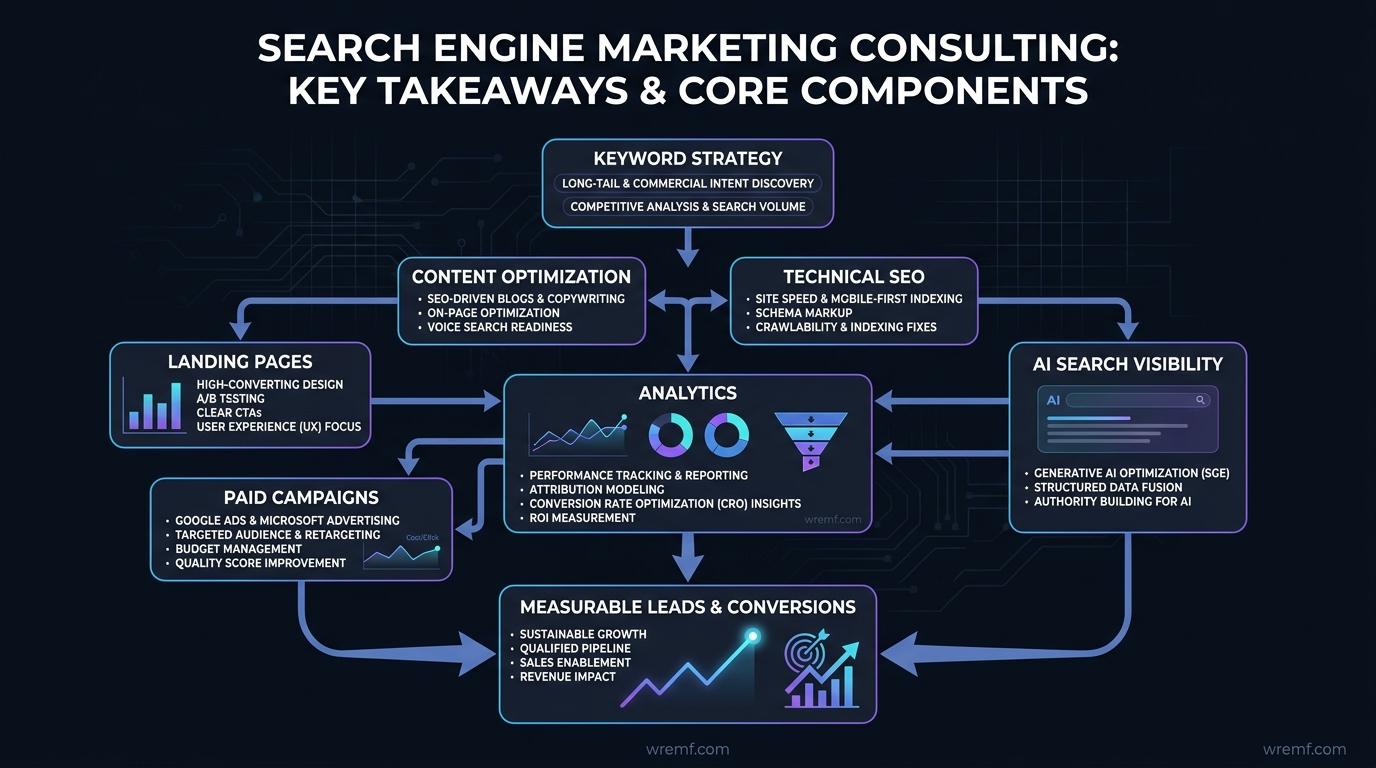
Search engine marketing consulting delivers value by connecting keyword strategy, paid campaigns, technical SEO, content, landing pages, and analytics into a coherent system that generates measurable leads and conversions. The discipline requires both strategic clarity and execution rigour across multiple channels simultaneously. As AI engines increasingly influence buyer discovery at the research and shortlisting stage, search engine marketing consulting now extends beyond Google Ads and organic rankings to include prompt tracking, source citation analysis, AI share of voice, and GEO and AEO strategy. Teams that build both traditional search performance and AI search visibility together position their brand for discovery across the full range of surfaces where buyers now find vendors. WREMF tracks the AI visibility dimension of this system, helping B2B teams understand how AI engines cite and recommend their brand alongside their existing SEM investment. Review WREMF pricing plans to see which plan fits your team's current stage and resources.
Frequently Asked Questions About Search Engine Marketing Consulting
What is search engine marketing consulting?
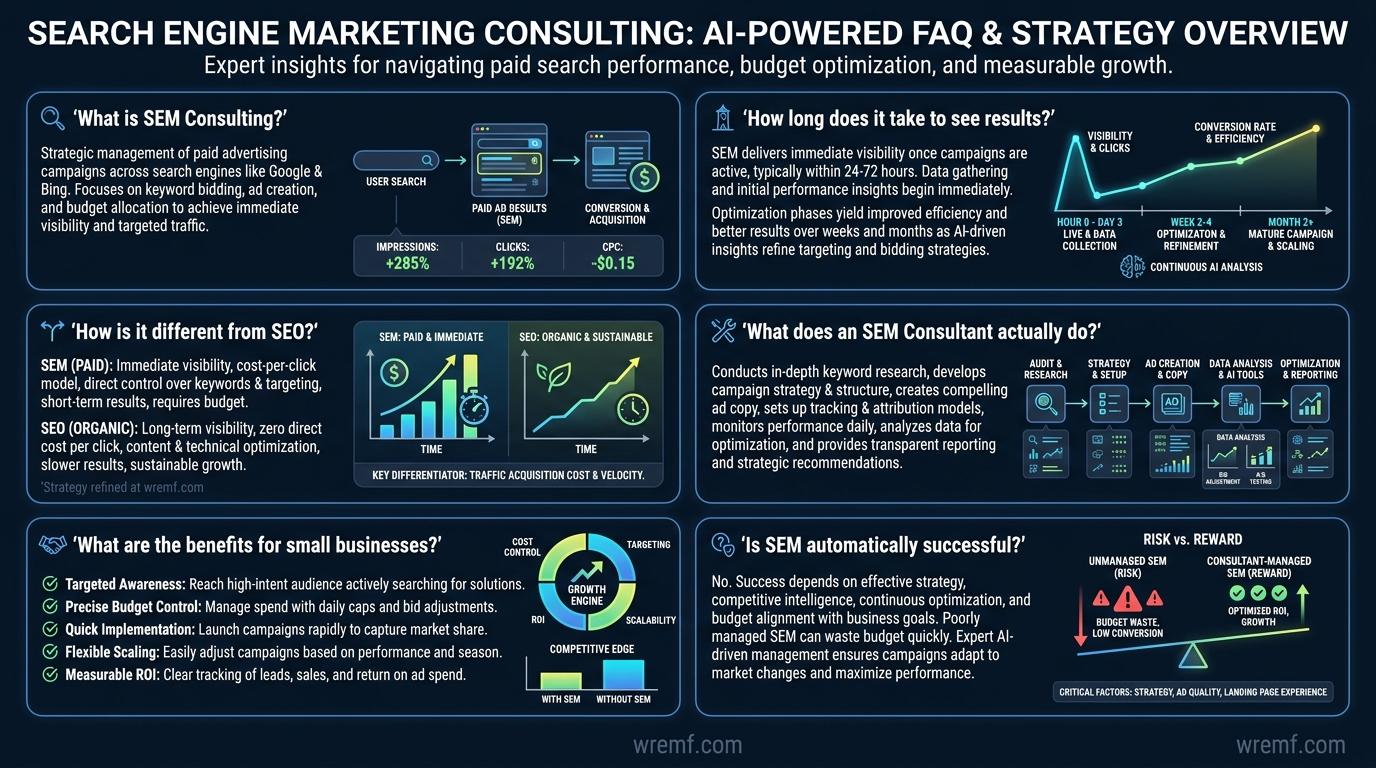
Search engine marketing consulting is the practice of providing expert guidance to help businesses plan, execute, and improve their paid and organic search strategies. A search engine marketing consultant analyzes a company's current search visibility, identifies gaps, recommends keyword targets, builds or optimizes ad campaigns, and measures performance across platforms such as Google Ads, Bing Ads, and Google Search. The goal is to increase qualified traffic, generate more leads, and improve conversions. Consulting may cover paid search advertising, SEO strategy, landing page optimization, campaign segmentation, and analytics setup depending on business needs.
Why should I hire a search engine marketing consultant?
Hiring a search engine marketing consultant helps businesses avoid costly trial and error in paid and organic search. Many small and mid-sized businesses lack the internal expertise to run efficient Google Ads campaigns, conduct proper keyword research, or connect search performance to business outcomes such as lead generation or sales. A consultant brings structured methodology, platform knowledge, and analytical skills that reduce wasted ad spend and accelerate results. For businesses investing in digital marketing without a clear strategy, a consultant often identifies quick wins and longer-term opportunities that would otherwise remain invisible.
How is search engine marketing different from SEO?
Search engine marketing (SEM) is a broader term that includes both paid search advertising such as Google Ads and Bing Ads, and organic search optimization through SEO. SEO focuses on improving a website's rankings in unpaid search engine results pages through content, technical improvements, and link building. Paid SEM delivers immediate visibility through cost-per-click advertising, where ads appear at the top of search results for targeted keywords. SEO typically takes weeks or months to show results, while paid campaigns can generate clicks and leads within hours of launch. Many businesses benefit from running both in parallel.
How does search engine marketing work?
Search engine marketing works by connecting businesses to users actively searching for relevant products or services on platforms like Google and Bing. In paid search, advertisers bid on keywords, create ads, and pay each time a user clicks on an ad. Google's auction system determines ad placement based on bid amount, Quality Score, and landing page relevance. In organic search, rankings are earned through content quality, technical SEO, backlinks, and user experience signals. Both approaches rely on keyword research, audience targeting, and ongoing optimization to improve click-through rates, reduce cost per acquisition, and increase conversions.
What does a search engine marketing consultant do?
A search engine marketing consultant audits existing campaigns and organic search performance, identifies keyword opportunities, builds or restructures ad campaigns, and optimizes landing pages for conversion. They conduct keyword research using tools such as Google Keyword Planner and Search Console, set up conversion tracking, analyze user behavior in Google Analytics, and report on campaign performance. Consultants also advise on campaign segmentation, negative keywords, remarketing campaigns, ad creation, and budget allocation. Many consultants work across both paid search and SEO, helping businesses develop a unified search visibility strategy aligned with their target audience and commercial goals.
How can SEM benefit a small business?
SEM gives small businesses immediate access to users who are actively searching for their products or services, making it one of the most intent-driven forms of digital marketing available. Unlike brand awareness campaigns, paid search advertising targets users at the moment of decision, which improves lead quality and conversion rates. Small businesses can set precise budgets, target specific locations, and adjust campaigns based on real performance data. For local businesses in competitive markets, a well-structured SEM strategy can level the playing field against larger competitors by focusing ad spend on high-intent, neighborhood-specific keywords and local campaigns.
How long does it take to see results from search engine marketing?
Paid search campaigns can generate clicks and leads within days of launch, making SEM one of the fastest ways to drive qualified traffic to a website. However, achieving consistent, cost-efficient results typically takes four to twelve weeks as consultants gather data, refine keyword targeting, improve Quality Scores, and optimize landing pages. Organic SEO, which is often part of a broader search engine marketing strategy, takes longer, generally three to six months for meaningful ranking improvements. The timeline depends on market competitiveness, budget, campaign structure, and how well the website and content are already optimized.
How much do search engine marketing consultants charge?
Search engine marketing consulting fees vary widely depending on scope, experience level, and geographic market. Freelance SEM consultants typically charge between $75 and $200 per hour, while agencies may charge monthly retainers ranging from $1,000 to $10,000 or more depending on campaign complexity, the number of platforms managed, and whether services include SEO, paid search, landing page optimization, and reporting. Project-based work such as campaign audits or account rebuilds may be priced as flat fees. Before engaging a consultant, it is worth clarifying exactly what deliverables are included, which platforms are covered, and how performance will be measured.
How do I know whether I need an SEM consultant?
You likely need an SEM consultant if your paid search campaigns are generating clicks but few conversions, your cost per acquisition is higher than your customer lifetime value allows, your ad spend is increasing without proportional returns, or you have no clear strategy connecting keywords, ads, landing pages, and conversion tracking. Businesses entering a new market, launching a new product, or scaling beyond their internal marketing capacity also benefit from consulting. A common signal is running Google Ads campaigns without properly structured negative keywords, campaign segmentation, or conversion tracking, which leads to wasted budget and unreliable performance data.
What makes a good search engine marketing consultant or agency?
A good SEM consultant combines technical platform expertise with commercial thinking. They should be proficient in Google Ads, Bing Ads, Google Analytics, Search Console, and keyword research tools. Google Ads certification is a useful baseline indicator, though it does not substitute for practical campaign experience. Strong consultants are transparent about methodology, set measurable goals before starting work, report on metrics that matter to the business such as leads, cost per acquisition, and revenue rather than vanity metrics like impressions. They should also demonstrate knowledge of landing page optimization, conversion tracking, audience segmentation, and how paid search integrates with the broader digital marketing strategy.
Is Google Ads certification an important credential for SEM consultants?
Google Ads certification confirms that a consultant has passed Google's own knowledge assessments across campaign types including Search, Display, and Shopping. It is a useful minimum standard that signals familiarity with the platform. However, certification alone does not guarantee results. Experienced consultants typically go well beyond certification by demonstrating a track record of managing campaigns at scale, improving conversion rates, reducing wasted spend through negative keyword strategies, and connecting search performance to business outcomes. When evaluating a consultant or agency, ask for specific examples of results achieved for businesses similar to yours rather than relying on certifications alone.
What is the difference between SEM and social media marketing?
SEM targets users based on active search intent, while social media marketing targets users based on demographic, interest, and behavioral profiles. Search engine marketing, including Google Ads and Bing Ads, reaches people who are already searching for a specific product, service, or solution, making it highly effective for capturing bottom-of-funnel demand. Social media marketing platforms such as Meta Ads are stronger for building brand awareness, retargeting past visitors, and reaching audiences who may not yet be actively searching. Both approaches can generate leads and sales, but SEM tends to produce faster conversions for high-intent queries, while social media supports longer-term brand building and audience development.
What role does keyword research play in search engine marketing?
Keyword research is the foundation of every SEM strategy. It identifies the specific search terms your target audience uses when looking for products, services, or information related to your business. Effective keyword research using tools like Google Keyword Planner helps consultants understand search volume, keyword intent, competitive landscape, and cost-per-click estimates. Research should cover transactional keywords for paid campaigns, informational keywords for content strategy, and local or long-tail phrases for targeted visibility. Poorly chosen keywords result in irrelevant clicks, wasted budget, and low conversion rates. Ongoing keyword usage analysis and refinement, including the identification of negative keywords, is essential for campaign efficiency.
How important is landing page optimization for SEM success?
Landing page optimization is critical to converting SEM traffic into leads or customers. Even a well-structured ad campaign will underperform if the landing page is slow, irrelevant, or poorly designed. Google uses landing page experience as a component of Quality Score, which directly affects ad rank and cost-per-click. A strong landing page matches the intent and language of the ad, loads quickly on mobile, presents a clear call to action, and removes unnecessary friction in the conversion process. SEM consultants typically audit landing pages as part of campaign setup and recommend improvements to copy, layout, form design, and page speed to improve conversion rates.
What is the role of negative keywords in paid search campaigns?
Negative keywords prevent ads from appearing for search queries that are irrelevant to the business, protecting the budget from unqualified clicks. For example, a B2B software company might add "free," "DIY," or "tutorial" as negative keywords to avoid attracting users who are unlikely to become customers. Without a well-maintained negative keyword list, paid search campaigns waste significant budget on irrelevant traffic, driving down click-through rates and increasing cost per acquisition. Reviewing search term reports regularly and expanding the negative keyword list is one of the most effective ways to improve campaign efficiency over time.
How does remarketing improve paid search performance?
Remarketing campaigns show ads to users who have previously visited your website or interacted with your content, making them a cost-efficient way to re-engage warm audiences. Users who have already shown interest in a product or service convert at significantly higher rates than cold traffic. In search engine marketing, remarketing lists for search ads allow businesses to adjust bids or show specific messaging to returning visitors, improving the return on ad spend. Remarketing is particularly effective for eCommerce businesses, B2B lead generation, and service providers with longer sales cycles where multiple touchpoints are required before conversion.
How does local SEO connect to search engine marketing for local businesses?
Local SEO and paid local search campaigns work together to improve a business's visibility in geographic-specific searches. For local businesses, appearing in Google Maps, local search results, and location-specific paid ads requires a combination of optimizing Google My Business listings, building local citations, using neighborhood-specific keywords, and running locally targeted ad campaigns. Google My Business optimization is particularly important because it directly influences visibility in the local pack, which appears prominently in local search results. A search engine marketing consultant working with local businesses should audit both paid and organic local visibility, including schema markup, local backlinks, and location-specific landing pages.
How important is Google My Business for local search visibility?
Google My Business (now called Google Business Profile) is one of the most important visibility assets for local businesses. A fully optimized profile increases the likelihood of appearing in the local pack, which is the map-based listing section that appears at the top of local search results. Businesses with accurate name, address, and phone number information, high-quality photos, consistent categories, and regular review responses tend to perform better in local search rankings. For businesses in competitive local markets, Google My Business optimization is often the fastest way to improve local visibility and should be a standard component of any local search engine marketing strategy.
What is the role of schema markup in search engine marketing?
Schema markup is structured data added to a website's HTML that helps search engines understand the content and context of a page more accurately. Implementing schema can improve how a business appears in search results through rich snippets such as star ratings, FAQs, product information, and event details. While schema does not directly improve rankings, it can increase click-through rates by making search listings more informative and visually distinct. According to Schema.org documentation, structured data provides a standardized vocabulary that search engines use to interpret and display content. For local businesses, LocalBusiness schema and review markup are particularly valuable for improving local search visibility.
How does voice search affect search engine marketing strategy?
Voice search changes how queries are structured, with users speaking in full natural language questions rather than short keyword phrases. This shift affects keyword research, content strategy, and local SEO. Businesses optimizing for voice search need to address conversational queries, prioritize featured snippet visibility, and ensure their Google My Business listing is accurate and complete since voice assistants frequently pull local business information from these profiles. Google's AI Overviews documentation highlights how AI-driven search features increasingly favor content that directly answers user questions, making structured, answer-first content more important for both voice and AI search visibility.
How does conversion tracking improve SEM campaign performance?
Conversion tracking connects ad clicks to meaningful business outcomes such as form submissions, phone calls, purchases, or content downloads. Without conversion tracking, it is impossible to know which keywords, ads, or campaigns are generating leads or revenue, making optimization guesswork. Setting up conversion tracking in Google Ads and linking it with Google Analytics allows consultants to analyze cost per acquisition, optimize bidding strategies toward actual conversions, and allocate budget to the highest-performing campaign segments. Proper conversion tracking setup is one of the first actions a competent SEM consultant should complete before making any campaign recommendations.
What metrics should I track to measure SEM performance?
The most important SEM metrics depend on business goals, but core performance indicators include click-through rate, cost per click, conversion rate, cost per acquisition, and return on ad spend. Impressions and Quality Score provide insight into ad relevance and market reach. For lead generation campaigns, the number of qualified leads and cost per lead are the primary measures of success. For eCommerce, revenue, average order value, and return on ad spend are critical. Vanity metrics such as total impressions or raw click volume are less useful without being connected to conversion data. A strong SEM consultant builds reporting dashboards that prioritize metrics directly linked to business outcomes rather than platform activity.
How does SEM consulting differ from hiring a full-service digital marketing agency?
SEM consulting typically focuses specifically on paid search and organic search performance, while a full-service digital marketing agency covers a broader range of channels including social media, content marketing, email, web development, and brand strategy. SEM consultants tend to provide deeper expertise in search-specific platforms such as Google Ads, Bing Ads, Search Console, and Google Analytics, with a sharper focus on search rankings, keyword strategy, and conversion optimization. Businesses with a specific need to improve search performance often benefit more from a specialist SEM consultant than from a generalist agency. However, companies looking to integrate search into a broader digital marketing strategy may benefit from agency support that connects SEM with content marketing and other channels.
What should I expect during an SEM consulting engagement?
A typical SEM consulting engagement begins with an audit of your existing campaigns, website, and analytics setup to identify what is working and what needs improvement. The consultant then develops a strategy covering keyword targets, campaign structure, ad creation, landing page recommendations, and budget allocation. During the execution phase, campaigns are built or restructured, conversion tracking is verified, and initial performance data is collected. Ongoing consulting includes regular performance reviews, optimization of bids and keywords, testing of new ad variations, and reporting against agreed KPIs. Clear deliverables, timelines, and reporting cadences should be agreed at the start of any engagement to ensure accountability on both sides.
How can I increase website traffic through SEM?
Increasing website traffic through SEM requires a combination of targeted keyword research, well-structured ad campaigns, and optimized landing pages. Paid search campaigns on Google Ads or Bing Ads can drive immediate traffic for high-intent queries, while organic SEO builds sustainable traffic over time through content strategy, technical SEO, and link building. Effective SEM campaigns target keywords at every stage of the buying journey, from informational queries at the top of the funnel to high-intent transactional phrases closer to conversion. Improving Quality Scores, increasing ad relevance, and reducing bounce rates on landing pages all contribute to traffic growth that translates into qualified leads rather than empty clicks.
How does SEM support lead generation for B2B businesses?
SEM is one of the most effective lead generation channels for B2B businesses because it captures demand from decision-makers who are actively searching for solutions. A well-structured paid search campaign targets high-intent keywords related to business problems, products, and competitor comparisons, driving qualified traffic to landing pages designed to convert visitors into leads. Lead generation SEM strategies typically include conversion-optimized landing pages, lead capture forms, call tracking, and remarketing campaigns for users who did not convert on the first visit. Connecting SEM performance to CRM workflows and pipeline data helps B2B teams measure the true business impact of their search investment.
What is the competitive landscape for SEM in a market like San Francisco?
San Francisco is one of the most competitive SEM markets globally due to the high concentration of technology companies, startups, and professional services firms. Cost-per-click rates for competitive B2B keywords are significantly higher than in most other markets, making efficient campaign structure, strong Quality Scores, and well-optimized landing pages essential for maintaining a profitable return on ad spend. Businesses in San Francisco also benefit from hyper-local content targeting, neighborhood-specific keywords, and strong Google Business Profile optimization to capture local search demand. Working with a consultant who understands both the local market dynamics and the technical demands of competitive paid search is particularly important in high-cost urban markets.
How does AI-driven analytics change SEM consulting?
AI-driven analytics tools are changing how SEM consultants identify opportunities, forecast performance, and optimize campaigns. Platforms like Google Ads now use machine learning for smart bidding strategies, audience targeting, and responsive ad creation. AI tools can analyze large volumes of user behavior and conversion data faster than manual review, surfacing patterns that improve campaign decisions. For SEM consultants, understanding how to configure and interpret AI-driven optimization features, rather than relying on manual bid adjustments alone, is increasingly important. At the same time, human strategic judgment remains essential for setting business objectives, defining conversion goals, and ensuring campaigns align with brand positioning and audience intent.
What is predictive SEO and how does it relate to search engine marketing?
Predictive SEO refers to the practice of using data analysis and trend modeling to anticipate future keyword demand, content opportunities, and algorithm shifts before they fully materialize. For search engine marketing consultants, predictive approaches involve analyzing seasonal patterns in search volume, identifying emerging keyword clusters, and preparing content or campaigns to capture traffic before competitors do. Tools like Google Search Console, Google Trends, and AI-driven analytics platforms support predictive SEO by surfacing early signals in user behavior and search query data. Combining predictive SEO with responsive paid search campaigns allows businesses to stay ahead of market trends rather than reacting to them after traffic has already shifted.
Related reading
- Generative Engine Optimization Los Angeles: The Complete Guide for AI Search Visibility
- How to Choose the Best Search Engine Marketing Agency: The Complete B2B Buyer's Guide
- How to Choose the Best Google Rankings Agency for B2B Growth
- The Complete Guide to Generative Engine Optimization New York for B2B Brands