How to Choose the Best Google Rankings Agency for B2B Growth
Discover how to select a top Google SEO agency for B2B growth, combining technical SEO with AI search visibility strategies.
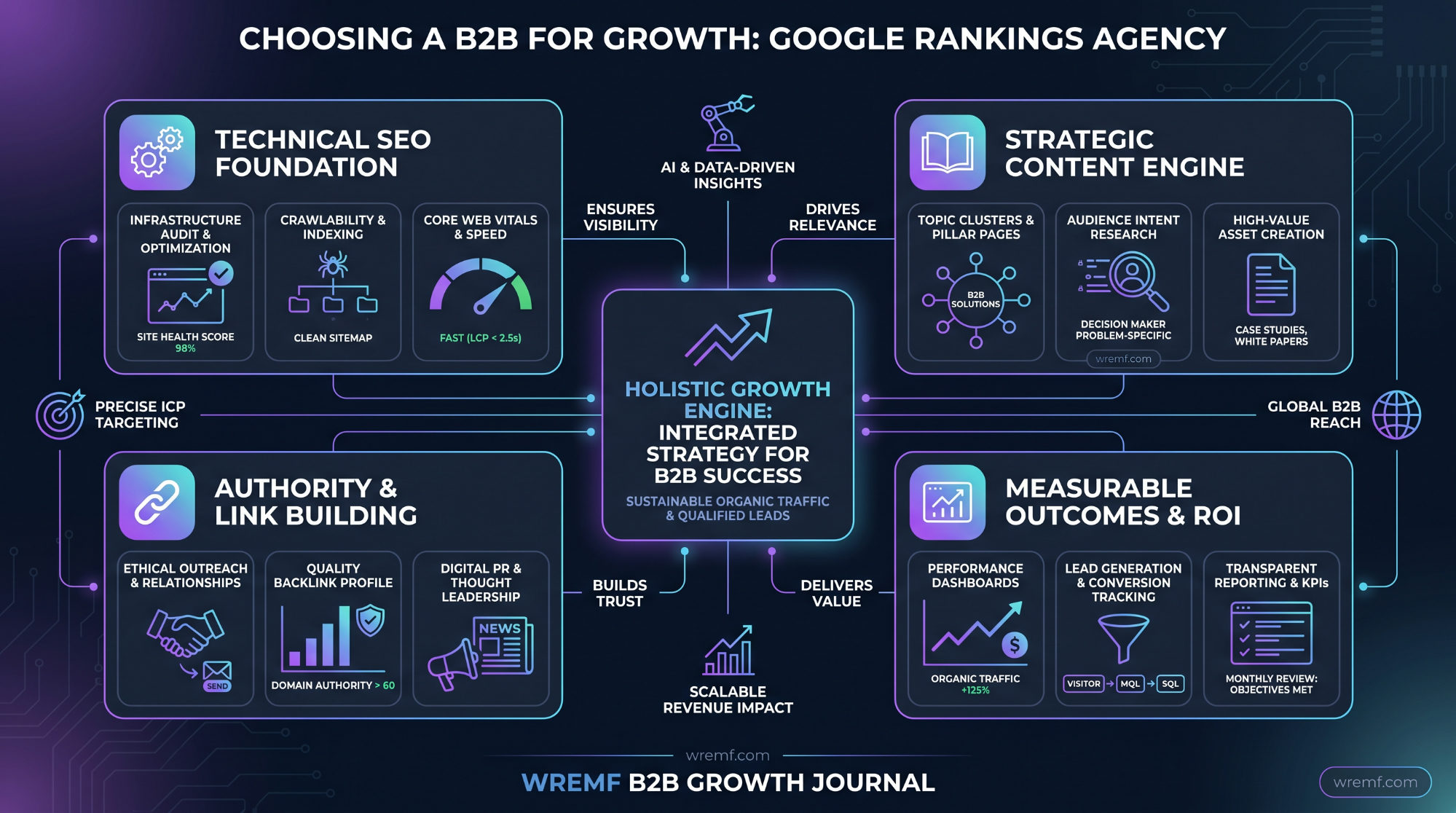
By WREMF Team · 2026-09-14
A Google rankings agency enhances a website's visibility in Google Search by integrating technical SEO, content strategy, link building, and conversion rate optimization. Key components include managing technical audits, content creation based on keyword research, and sustainable link building. WREMF helps extend visibility to AI platforms like ChatGPT and Gemini. The outcome is improved organic traffic, rankings, and visibility across both Google and AI environments, enabling B2B companies to achieve greater lead generation and market presence.
Key takeaways
- Best agencies combine technical SEO, content marketing, and conversion strategies.
- AI search engines influence buyer decisions before organic clicks happen.
- Look for documented results, clear methodologies, and sector experience.
- Evaluate agencies on traffic growth, domain authority, and lead attribution.
- Understand the importance of AI search visibility alongside Google SEO.
How to Choose the Best Google Rankings Agency for B2B Growth
The best Google rankings agency is one that combines technical SEO expertise, content strategy, and measurable outcomes into a program your business can trust and scale. Google remains the dominant search engine for B2B discovery, but the search landscape has changed significantly. AI-driven search, Google AI Overviews, and large language models now influence how buyers find and shortlist vendors before they ever click an organic result. This guide is written for B2B founders, in-house SEO teams, marketing leaders, and agencies evaluating SEO partners. It covers what to look for in a Google SEO agency, how leading agencies approach technical SEO, content marketing, and link building, and how WREMF helps teams extend their visibility beyond traditional rankings into AI search engines and prompt-based discovery.
QUICK ANSWER:
The best Google rankings agency is one that delivers measurable improvements in organic traffic, keyword rankings, and search visibility through a combination of technical SEO, content strategy, link building, and conversion rate optimisation. Top agencies such as Roketto, Bird Marketing, BlueHat Marketing, Searchbloom, and SmartSites have demonstrated consistent results across B2B, eCommerce, and SaaS clients. The right agency depends on your industry, budget, target market, and whether you also need visibility in AI search engines alongside Google.
KEY TAKEAWAYS:
- The best Google SEO agencies combine technical SEO, keyword research, content marketing, link building, and conversion optimisation into a single coordinated strategy.
- Google rankings alone are no longer sufficient as AI search engines including ChatGPT, Gemini, Perplexity, and Google AI Overviews now influence buyer decisions before clicks occur.
- Agencies with documented results, transparent deliverables, and experience in your sector are more reliable choices than those making vague ranking guarantees.
- B2B brands and agencies should evaluate SEO partners on organic traffic growth, domain authority improvements, lead generation, and attribution clarity.
- WREMF extends traditional SEO visibility tracking by measuring how AI engines mention, cite, compare, and recommend brands across prompt-based discovery journeys.
- Choosing between software, managed service, or hybrid depends on your team's internal execution capacity and how much strategic support you need.
What a Google Rankings Agency Actually Does
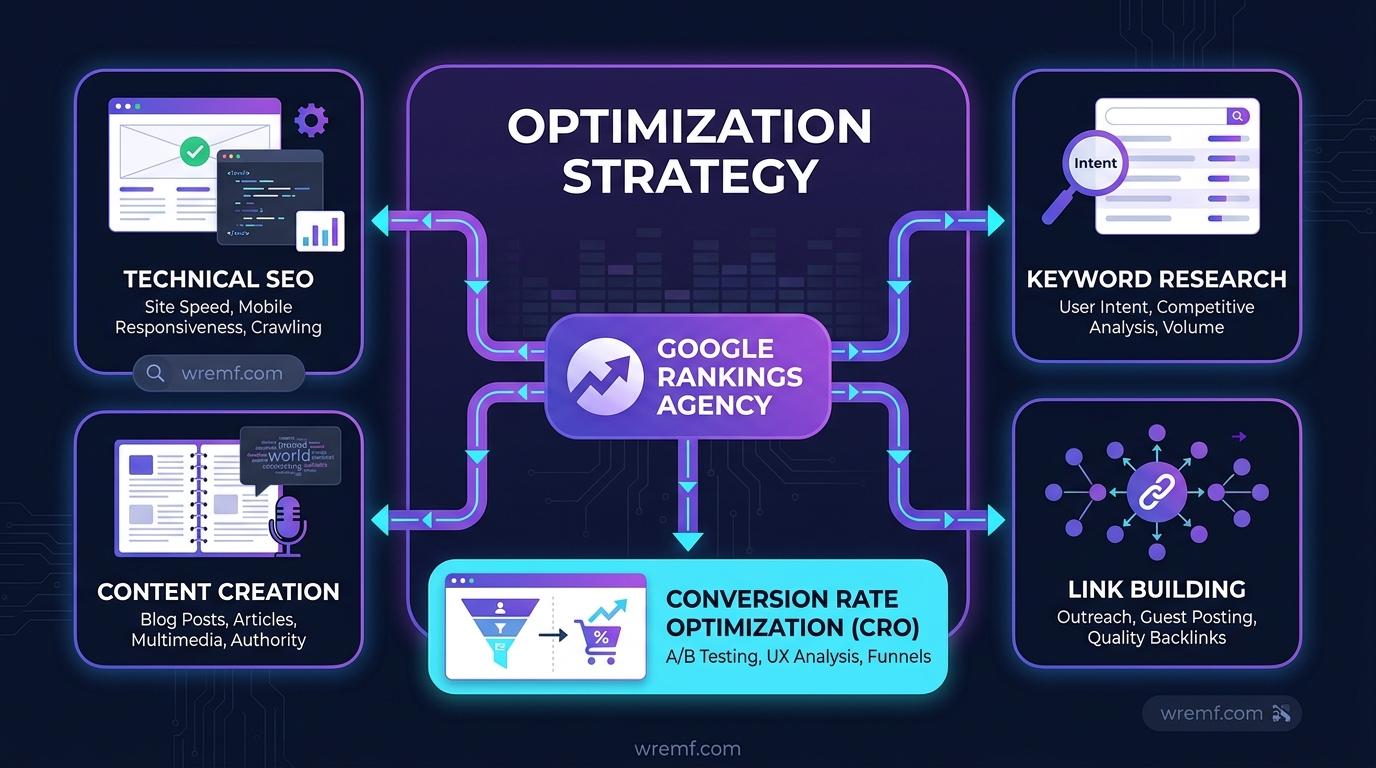
A Google rankings agency improves how a website appears in Google Search by addressing the technical, content, and authority signals that determine organic ranking positions. The work spans multiple disciplines and the best agencies treat each as interconnected rather than isolated.
The core services delivered by a Google SEO agency typically include technical SEO, keyword research, content creation, link building, and conversion rate optimisation. Technical SEO addresses the structural and crawlability factors that affect how Google's algorithms interpret a website, including page speed, mobile performance, Schema Markup, Structured Data, internal linking architecture, and indexation. Without a solid technical foundation, content and backlink investment underperforms.
Keyword research drives the strategic direction of content and targeting. A strong agency maps keywords to buyer intent, identifies gaps against competitors, and builds a roadmap that connects search volume to revenue potential. This includes identifying long-tail opportunities, informational versus commercial queries, and gaps that competitors have not yet addressed.
Content marketing is the vehicle that captures and converts search demand. Agencies produce blog posts, landing pages, pillar content, product and category pages, and conversion-optimised landing pages designed to rank for target queries and move buyers through the funnel. Content quality directly affects whether Google surfaces a page for relevant searches and whether buyers engage with it.
Link building and Backlink Management determine domain authority and the trust signals Google uses to rank pages. Agencies pursuing sustainable search rankings prioritise quality editorial links over volume, avoiding manipulative tactics that risk penalties. Link Building from trusted sources, digital PR, and content-driven outreach are standard approaches among credible agencies.
The best Google rankings agencies tie all of this to conversion data. Organic traffic without conversion rate improvement produces vanity metrics. Agencies that track leads, conversion rate, pipeline attribution, and organic revenue give clients a far clearer picture of return on investment.
KEY TAKEAWAY: A Google rankings agency should deliver coordinated improvements across technical SEO, content, backlinks, and conversion rather than treating each channel as a standalone tactic.
How the Best Google SEO Agencies Approach Technical SEO
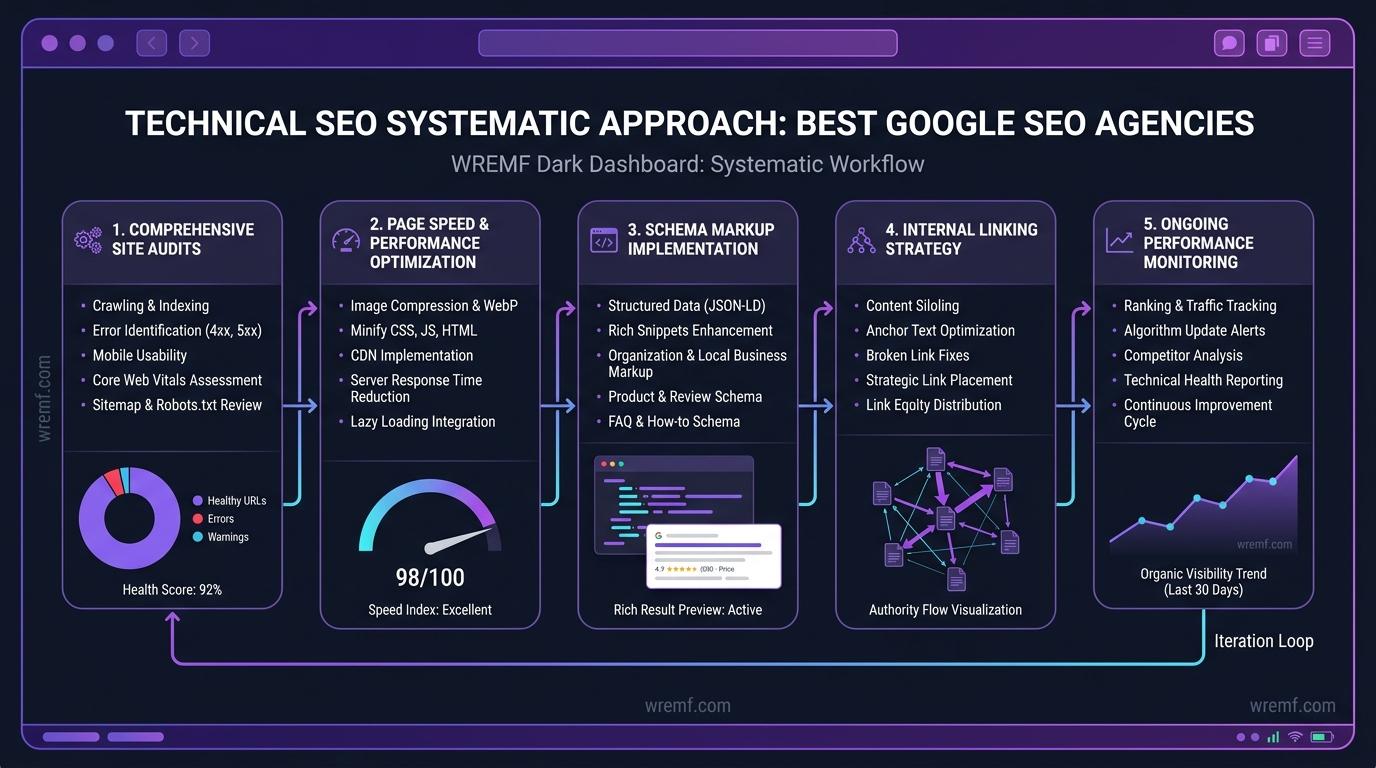
Technical SEO is the foundation of every sustainable Google rankings strategy. Without it, even excellent content and strong backlinks fail to produce the organic ranking power they should.
Leading agencies approach Technical SEO systematically. They begin with a full site audit that identifies crawl errors, page speed issues, duplicate content, canonicalisation problems, internal linking gaps, and mobile usability failures. From the audit, they prioritise fixes by impact and implement changes in close coordination with development teams.
Schema Markup and Structured Data receive particular attention from the best agencies because these signals help Google understand content context and surface rich results including featured snippets, FAQ sections, and Q&A sections. Rich schema implementation increases the likelihood of appearing in prominent SERP positions even below the top organic result. According to Google's documentation on how search works, structured signals help Google's algorithms interpret page content and match it to relevant queries, as explained in Google's documentation on How Google Search works
Internal linking strategy is frequently underestimated. Strong internal linking distributes authority across a site, connects thematically related content, and signals to Google which pages carry the most value. Agencies that manage internal linking as an ongoing activity rather than a one-time audit produce more consistent improvements in search rankings.
For eCommerce and multi-market clients, International SEO adds complexity. Agencies handling bilingual strategy, hreflang implementation, regional keyword research, and localised content across markets need structured processes to avoid cannibalisation and ensure each regional version of a site competes effectively in its target market. Re:signal, for example, implemented a full-funnel international SEO and content strategy for ASICS across multiple languages, achieving an 81% year-on-year organic revenue increase and 438% ROI from SEO activity.
PAGE SPEED and Core Web Vitals have become ranking signals in their own right, and the best agencies include ongoing performance monitoring rather than treating speed as a one-time fix.
KEY TAKEAWAY: Technical SEO is the foundation that every other investment depends on, and the best agencies treat it as a continuous program rather than a setup task.
Content Strategy and Content Marketing in a Google SEO Agency
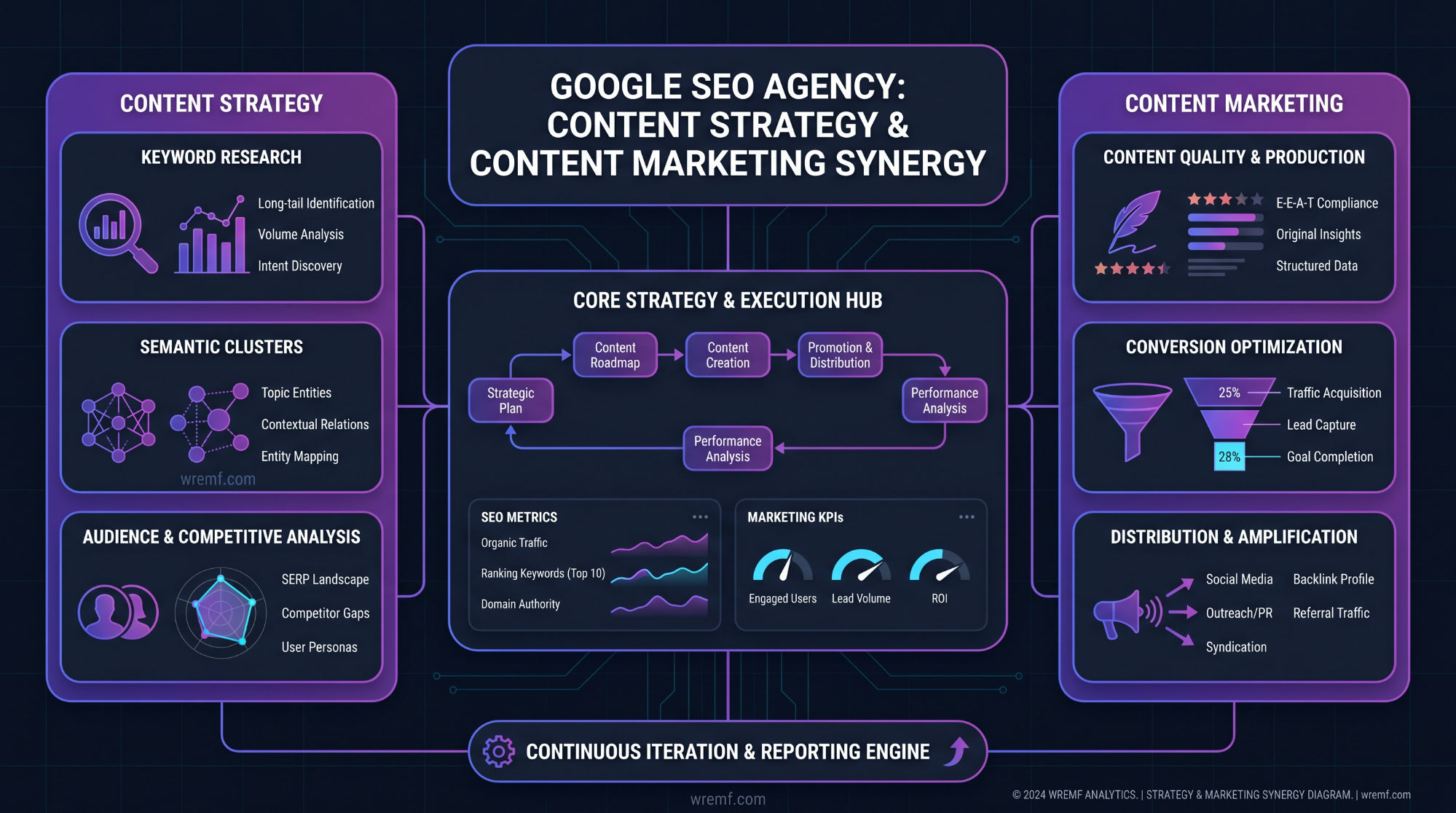
Content strategy is how the best Google SEO agencies translate keyword research into ranked pages, organic traffic, and qualified leads. Without a documented strategy, content production becomes reactive and disconnected from search rankings and business outcomes.
Agencies that produce results build content around semantic clusters rather than isolated keywords. Semantic clusters group related topics, subtopics, and query variations into interconnected page architectures that signal topical authority to Google. A pillar page supported by cluster content produces stronger ranking signals than a collection of disconnected blog posts targeting individual keywords.
Content creation must meet quality content standards that satisfy both Google's algorithms and the actual reader. Pages that answer questions thoroughly, use structured content formats, and address follow-up queries in depth outperform thin pages even when the thin pages have more backlinks. The best agencies produce content that earns backlinks naturally by being the most comprehensive and useful resource on a given topic.
Content quality also affects whether content gets cited in AI-generated answers. As Google AI Overviews and large language models increasingly surface content in response to user prompts, agencies that write for depth and authority position their clients as trusted sources in both traditional organic search and AI search environments. The connection between content quality and AI citation is explored in WREMF's AI search engine optimization guide
Inbound marketing agencies such as Roketto, a HubSpot partner based in Canada, combine content marketing with conversion rate optimisation and web design to build full-funnel programs rather than focusing purely on traffic volume. Roketto scaled SaaS clients including Ringy to 150x organic traffic growth through a coordinated inbound and SEO approach.
Content Strategy must also account for content formats beyond written pages. YouTube videos, Google Business Profile content, and structured Q&A formats contribute to organic search visibility. Agencies that manage content across formats rather than only written pages produce broader keyword coverage and stronger brand visibility in Google Search.
KEY TAKEAWAY: Content strategy built around semantic clusters and quality content outperforms isolated keyword targeting and positions brands for both organic rankings and AI search visibility.
Link Building, Backlinks, and Domain Authority
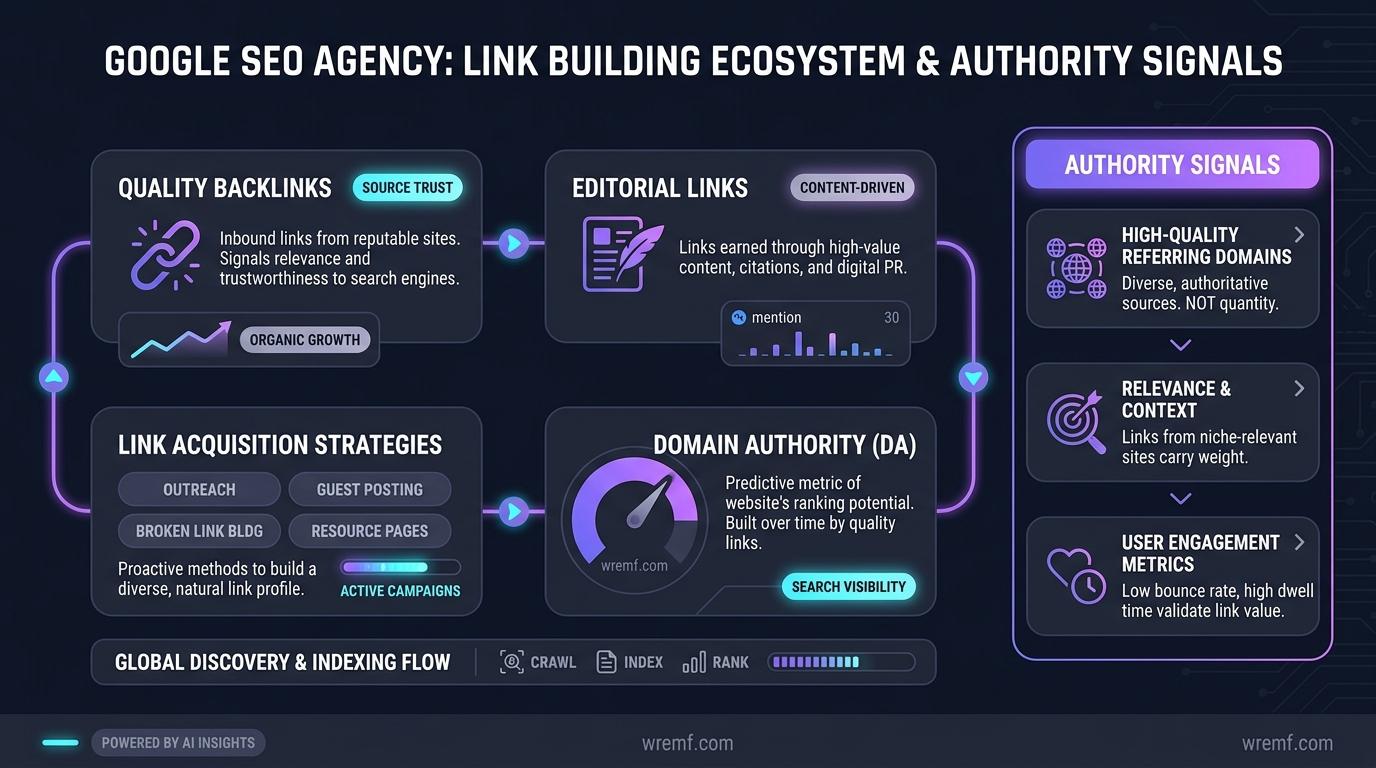
Link building remains one of the most influential ranking factors in Google's algorithms and one of the most difficult services for in-house teams to execute consistently. The best Google rankings agencies treat Backlink Management as a strategic program rather than a volume exercise.
Domain authority, while a third-party metric rather than a direct Google signal, serves as a useful proxy for the cumulative trust Google places in a website based on the quality and relevance of sites linking to it. Agencies focused on organic ranking power pursue links from publishers, industry media, partner organisations, and editorial content that genuinely endorses the client's expertise.
Silverback Strategies is a recognised name in the professional SEO services space, known for combining content-driven link acquisition with technical SEO and content marketing for B2B and agency clients. Re:signal positions its eCommerce SEO and digital PR practice specifically around integrating link building with authority-led content strategy, an approach that contributed to 88 Search Awards wins. Their work for ASICS demonstrates how international SEO, structured content, and sustained link building compound over time into significant commercial outcomes.
Embarque, NoGood, and ClickPower each take distinct approaches to link building. Embarque focuses on content-led SEO for SaaS and B2B brands, combining keyword research and editorial content to attract organic backlinks. NoGood has documented cases where clients appeared in 3 of the 5 top LLM answers, attributing this partly to strong domain authority and citation patterns. ClickPower emphasises building long-term client relationships, as evidenced by client reviews citing sustained improvements over multi-year engagements.
For local businesses, citations in Google Business Profile listings, local directories, and Map Pack entries function as the local equivalent of backlinks. Agencies managing local leads for service businesses treat Google Business Profile management, consistent citations, and Map Pack optimisation as integral to their link strategy.
The risks of poor link building are significant. Low-quality links, link schemes, and private blog networks can trigger manual penalties or algorithmic devaluations that erase years of ranking progress. Any agency that cannot explain its link acquisition methodology clearly should be treated with caution.
KEY TAKEAWAY: Sustainable link building requires editorial quality and relevance, not volume, and agencies that cannot explain their acquisition methodology represent a risk to long-term Google rankings.
Top Google SEO Agencies Worth Evaluating
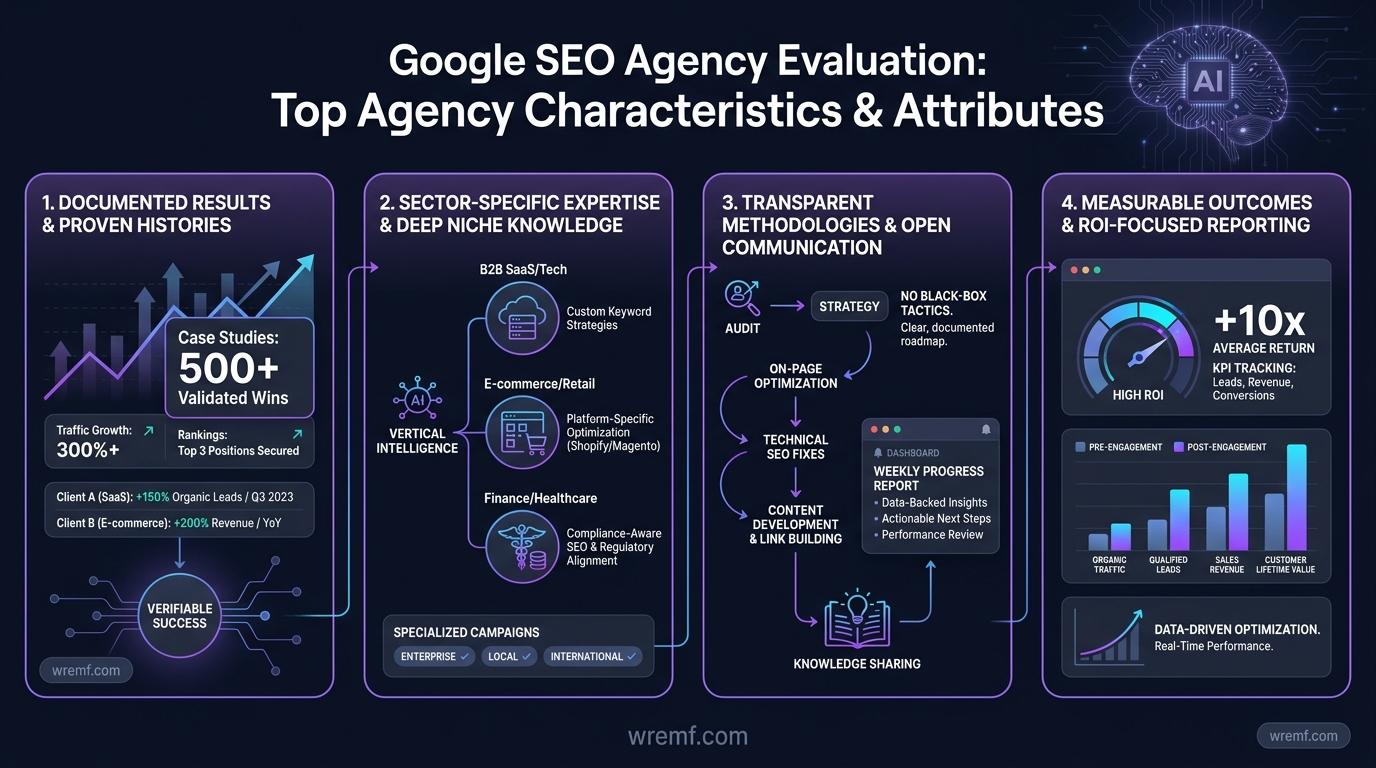
The best Google rankings agencies share common characteristics: documented results, clear methodologies, sector-specific expertise, and transparent reporting. The following agencies represent a range of approaches, strengths, and market positions.
Roketto is a Canada-based inbound marketing and web design agency and HubSpot partner. Core expertise covers inbound marketing, SEO, conversion rate optimisation, content, PPC, and web design. Roketto scaled SaaS client Ringy to 150x organic traffic growth, making it a strong option for SaaS and technology brands seeking integrated content and SEO programs.
Bird Marketing is a global award-winning digital agency with offices in London, New York, and Dubai. The agency covers SEO audits, Technical SEO, PPC, creative strategy, and content creation. Bird Marketing has delivered 45% traffic increases and 30% conversion improvements within six months for documented clients.
BlueHat Marketing is a Canadian agency founded in 2005 offering full-suite digital marketing. Core expertise spans local, national, and enterprise SEO, PPC, influencer marketing, and social media. Since inception, BlueHat has ranked over 20 million keywords and generated an estimated $1.65 billion in revenue for clients, making it one of the most established agencies for large-scale SEO programs.
Searchbloom is an ethical search marketing agency with a decade of documented results. The agency covers enterprise, local, and eCommerce SEO alongside PPC, conversion rate optimisation, and strategy. Searchbloom has delivered campaigns achieving 40% traffic increases, 30% lead growth, and 741% revenue increases for retail clients.
SmartSites is a US-based award-winning digital marketing firm founded in 2011. Services include SEO, PPC, web design, social media marketing, and conversion rate optimisation. SmartSites has launched over 900 websites and generated more than $100 million in client revenue, consistently doubling organic traffic within six months across multiple campaigns.
Minty Digital is a multi-award-winning SEO and digital PR agency operating in London, Barcelona, and New York. The agency specialises in SEO, digital PR, link building, PPC, and content marketing for European brands and international clients seeking improved Google rankings.
Duffy Agency is an international marketing consultancy operating since 2001, now fully virtual. Core services span International SEO, branding, research, and strategy, making it a strong option for brands needing bilingual strategy or global search market entry.
Scandiweb serves high-volume eCommerce retailers with an AI SEO approach. Their eCommerce SEO work produced a 57% year-on-year increase in Google clicks, 192% add-to-cart improvement, and 278% organic transaction growth for documented clients. For high-volume retailers, Scandiweb pairs AI-informed SEO with conversion tracking so that the goal remains revenue rather than rankings alone.
SEOValley is a global SEO agency established around 2000, offering SEO, local and eCommerce SEO, paid marketing, and reputation management. The agency has managed thousands of campaigns with strong ROI results across media and hospitality clients.
eSEOspace is a San Diego-based full-service marketing firm covering SEO, local SEO, web design, branding, and digital PR. A nonprofit client saw a 30% increase in web traffic within 90 days of a website redesign, and the agency receives consistent praise for value, responsiveness, and high return on investment.
DID YOU KNOW:
Trailblazer Marketing has ranked over 20 million keywords and created an estimated $1.65 billion in revenue for clients since inception. Their $300 Validate Program delivers 10 SEO-optimised articles in 30 days, allowing teams to test effectiveness before committing to a larger investment.
For agencies evaluating SEO partners for their own clients, understanding how AI search visibility layers on top of Google rankings has become a differentiating capability. WREMF's AI SEO services guide explains how agencies can add AI visibility tracking to traditional SEO delivery without rebuilding existing workflows.
KEY TAKEAWAY: The strongest Google SEO agencies combine documented results, transparent methodology, and sector experience, with differentiation increasingly coming from AI search capability alongside traditional Google optimisation.
How to Choose the Right Google Rankings Agency for Your Business
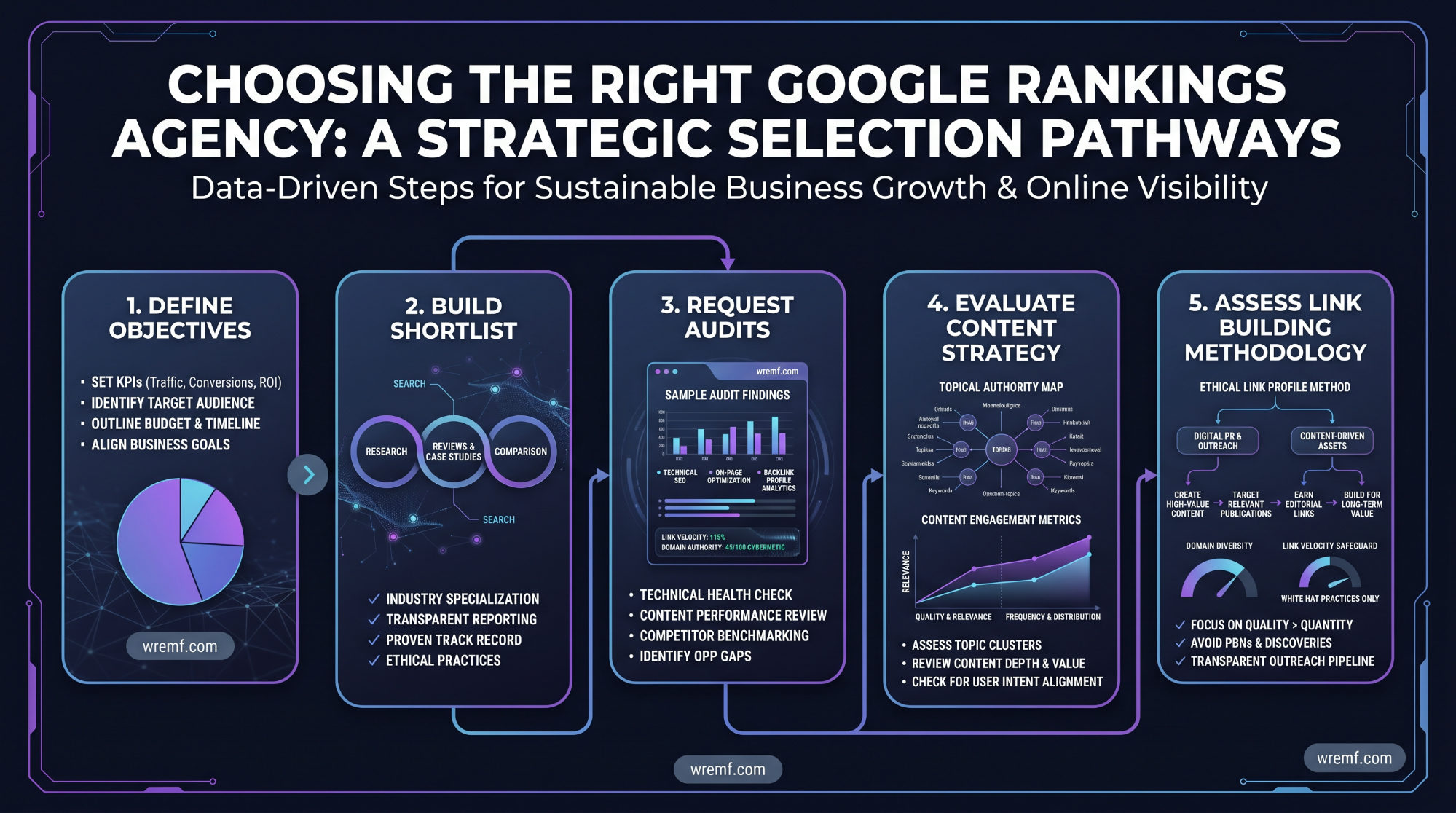
Choosing a Google rankings agency requires matching the agency's strengths to your specific objectives, industry, and internal capabilities. There is no universally best agency, only the best fit for a given situation.
Start by clarifying your primary objective. If the goal is organic traffic growth for a B2B SaaS product, agencies experienced in inbound marketing, SaaS keyword research, and conversion-optimised landing pages are more relevant than agencies specialising in eCommerce or local leads. If the goal is local map visibility, agencies with Google Business Profile management, Map Pack expertise, and citation building are better positioned.
Evaluate agencies on documented results rather than promises. Ask for case studies that show before-and-after keyword rankings, organic traffic growth, lead volume, and conversion rate improvements. The best agencies can attribute revenue to SEO activity rather than stopping at traffic metrics.
Assess their technical SEO capability. Ask how they conduct a technical audit, how they handle Schema Markup and Structured Data, how they approach page speed, and how they manage internal linking at scale. Agencies that treat technical SEO as a one-time setup rather than a continuous program will underdeliver over time.
Examine their content strategy and content creation process. Ask how they build semantic clusters, how they research keywords for your specific audience, how they manage content quality standards, and how frequently they produce and update content. Agencies that rely on template-driven blog post production without strategic direction rarely produce sustained ranking improvements.
Evaluate their link building approach carefully. Ask specifically how they acquire backlinks, what types of publications they target, how they vet site quality, and what they do if a link source becomes problematic. Agencies that cannot answer these questions with specificity represent a risk to your domain authority.
Check Google Partner status where relevant. A Google Partner designation indicates verified expertise in Google Ads and the broader Google ecosystem, though it does not automatically indicate SEO excellence. For teams combining SEO with Google Ads and Performance Max campaigns, agencies holding Google Partner status with documented Search Engine Marketing results offer more integrated capability.
Consider the team structure. Ask who will manage your account day to day, how senior the strategy input is, and how reporting is structured. Agencies that position senior strategists in new business conversations but assign junior account managers to delivery are a common source of client dissatisfaction.
Finally, consider the growing importance of AI search visibility. Google AI Overviews now appear for a significant proportion of informational and commercial queries, and buyers increasingly use ChatGPT, Gemini, Perplexity, and other AI platforms to research vendors and compare solutions. Agencies that do not account for Generative Engine Optimisation and Answer Engine Optimization alongside traditional Google SEO are leaving a growing share of buyer discovery unaddressed. Teams that want to measure and improve this layer alongside Google rankings can use tools such as WREMF's AI visibility platform, described in the generative AI optimization services guide
KEY TAKEAWAY: Choosing the right Google rankings agency requires evaluating documented results, technical capability, content methodology, link building transparency, and increasingly, AI search visibility capability alongside traditional SEO.
Google SEO Agency Pricing and What to Expect
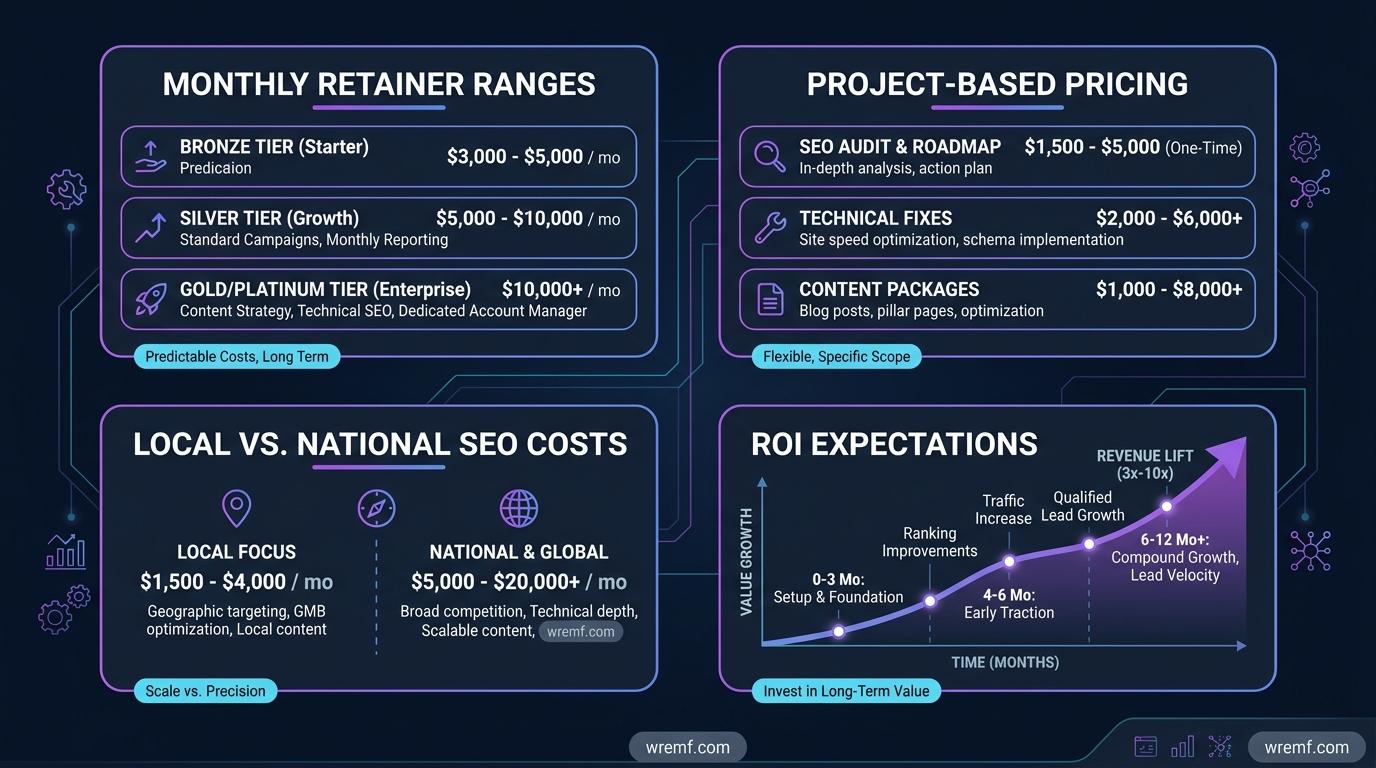
Google SEO agency pricing varies significantly based on scope, agency reputation, market, and the complexity of the client's website and competitive environment. Understanding the pricing landscape helps teams set realistic budgets and avoid both underspending and overpaying.
Monthly retainers for professional SEO services typically range from around $1,000 per month for small business local SEO campaigns to $5,000 or more per month for competitive national or international programs. Enterprise SEO engagements for multi-market or eCommerce brands can exceed $10,000 per month when full technical SEO, content production, link building, and reporting are included.
Local SEO Agencies focused on map visibility, local leads, and Google Business Profile management tend to offer lower retainer tiers, commonly in the $500 to $3,000 per month range depending on the number of locations and the competitiveness of the local market. The expected return on investment timeline for local campaigns typically ranges from three to six months for single-location businesses.
Project-based SEO engagements such as one-time technical audits, website overhaul projects, or high-end brand refresh and relaunch programs are priced separately. A technical SEO audit for a mid-size site commonly ranges from a few hundred to several thousand dollars depending on site complexity and deliverable depth.
Scandiweb's eCommerce SEO pricing ranges from approximately $700 to $5,000 per month depending on the scope of work, strategy complexity, and included support. This range is typical for specialist eCommerce agencies with strong technical and AI-informed SEO capability.
When evaluating agency pricing, the most important question is not the monthly cost but the attribution model. Can the agency connect SEO investment to organic revenue, lead volume, and conversion rate improvement? Agencies that report only on traffic and keyword rankings without connecting to business outcomes make it difficult to evaluate true return on investment.
Teams that want to add AI visibility tracking alongside their Google SEO program can compare WREMF pricing plans at the WREMF pricing page where plans start from €59 per month for founders and small teams and scale to managed execution from €1,500 per month for enterprise brands.
KEY TAKEAWAY: SEO agency pricing should be evaluated against attribution capability and documented outcomes rather than monthly cost alone, with retainers ranging from under $1,000 for local campaigns to well above $5,000 for competitive enterprise programs.
Google Rankings and AI Search Visibility: The Gap Most Agencies Miss
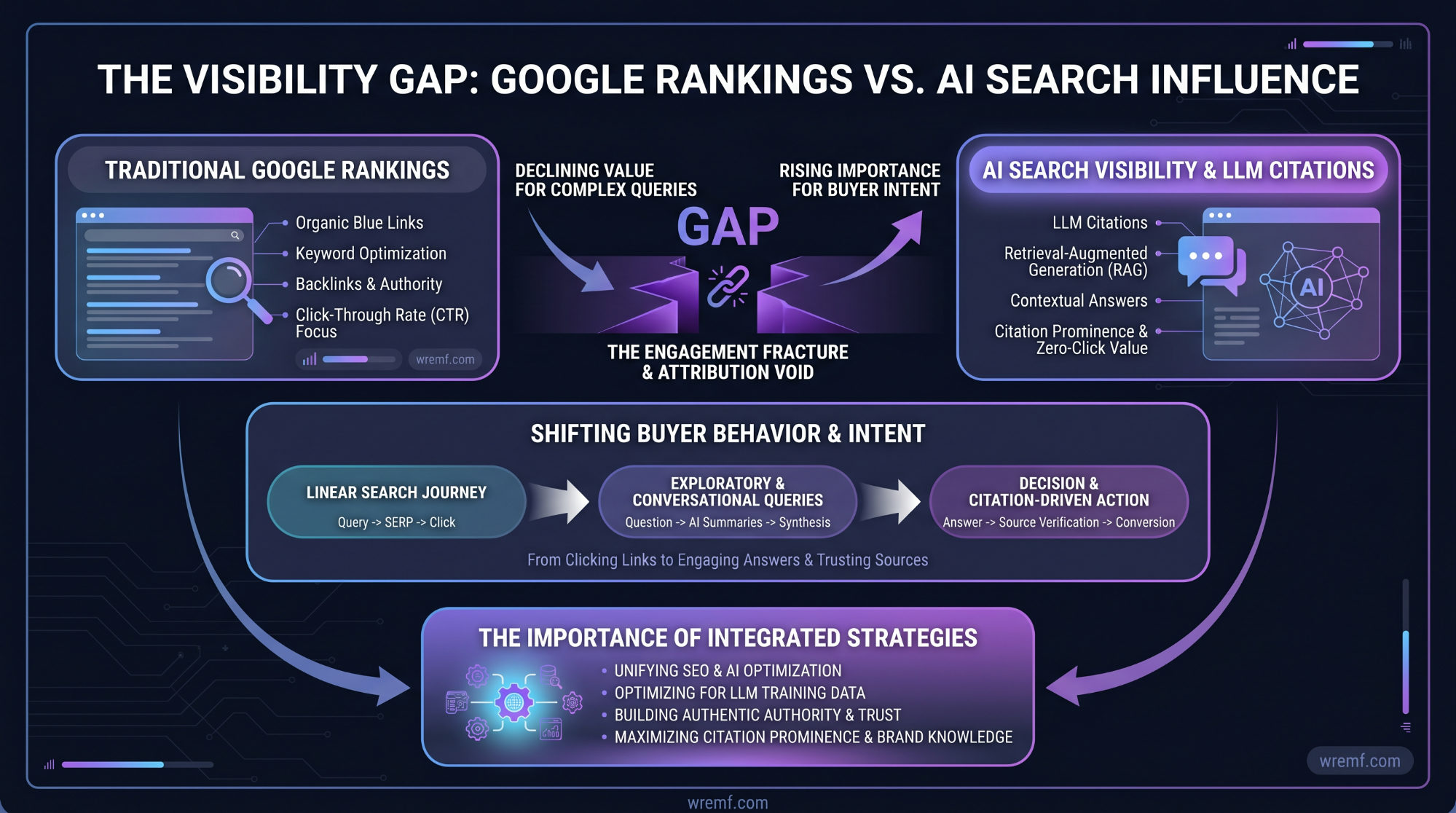
Google rankings measure where a website appears in traditional search results, but they do not measure whether a brand appears in AI-generated answers. This gap is growing as buyer behaviour shifts toward AI-driven search.
Google AI Overviews now appear across a significant portion of search queries, presenting synthesised answers above traditional organic results. Buyers using ChatGPT, Perplexity, Gemini, and other AI search engines receive prompt-based answers that cite specific sources rather than returning a ranked list of links. A brand can hold the first position in Google Search for a target keyword while being entirely absent from the AI-generated answer on the same topic.
This distinction matters for B2B lead generation. Research from Gartner consistently highlights that B2B buyers conduct extensive independent research before engaging with vendors, as documented in Gartner's AI research As AI search engines become a primary research channel, brands that are not cited in AI answers lose influence during the buyer's earliest discovery and comparison stages.
The signals that influence AI citation differ from traditional Google ranking signals. Large language models and AI search engines draw on source credibility, content depth, entity consistency, Schema Markup, Structured Data, and domain authority when selecting sources to cite. Answer Engine Optimization and Generative Engine Optimisation address these signals specifically, as covered in WREMF's answer engine optimization guide
AI share of voice is the metric that captures this dimension. It measures how often a brand appears in AI-generated answers relative to competitors across a defined set of buyer prompts. A brand with strong Google SEO but low AI share of voice is increasingly exposed as more buyer discovery moves into AI search environments.
Source consistency matters because AI engines assess whether a brand is described consistently across its website, third-party publications, citations, and linked sources. Inconsistent brand descriptions, outdated entity information, and gaps in trusted sources all reduce the likelihood of AI citation. WREMF tracks source consistency across AI engines as part of its prompt intelligence and citation tracking capabilities.
For SEO agencies and in-house teams, the practical implication is that Google SEO and AI search visibility are complementary rather than competing priorities. The technical foundations, content quality, domain authority, and link building that drive Google rankings also contribute to AI citation potential, but additional optimisation work specific to AI search is required to maximise both.
KEY TAKEAWAY: Google rankings and AI search visibility measure different things, and brands that track only one are missing a growing share of buyer discovery activity that now happens inside AI search engines.
How WREMF Extends AI Search Visibility Beyond Google Rankings
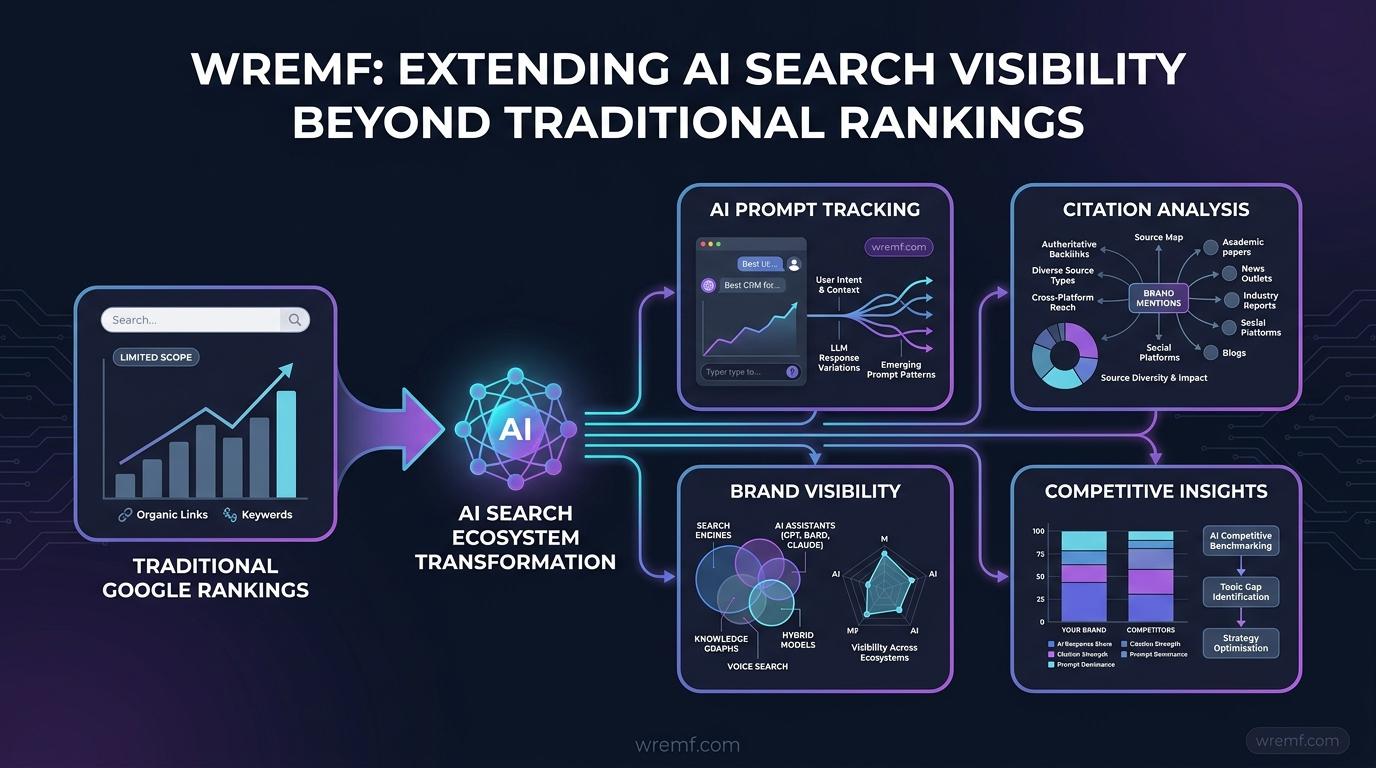
WREMF is an AI visibility platform built specifically for tracking, improving, and proving how brands appear across ChatGPT, Claude, Gemini, Perplexity, Google AI Overviews, Copilot, DeepSeek, Grok, Meta AI, Mistral, and other AI discovery surfaces. Where traditional SEO tools track Google keyword rankings, WREMF tracks AI prompt answers and source citations.
The distinction is practical. A traditional SEO tool tells you where a page ranks for a keyword. WREMF tells you whether your brand appears in the AI-generated answer when a buyer asks a relevant question across ten AI engines simultaneously. These are different signals with different implications for brand visibility and pipeline generation.
Primary signal
- Traditional SEO tools: Keyword rankings in Google Search
- WREMF: AI prompt answers across 10 AI engines
What it tracks
- Traditional SEO tools: SERP position
- WREMF: AI citations, brand mentions, and source references
Authority signal
- Traditional SEO tools: Backlinks and domain authority
- WREMF: Source citations in AI answers
Query model
- Traditional SEO tools: Keywords
- WREMF: Prompts matching real buyer questions
Competitive view
- Traditional SEO tools: SERP overlap
- WREMF: AI share of voice across engines
Attribution
- Traditional SEO tools: Organic sessions
- WREMF: AI referral traffic and prompt-level attribution
Engine coverage
- Traditional SEO tools: Google and Bing
- WREMF: 10 AI engines simultaneously
Audit type
- Traditional SEO tools: Technical SEO
- WREMF: GEO audits and AEO strategy
Traditional SEO tools remain essential for search rankings, crawlability, backlink analysis, and technical SEO. WREMF adds the AI visibility layer, tracking what AI engines say about your brand, which competitors they recommend alongside you, and whether your content is being used as a trusted source in AI-generated answers.
WREMF can be used as standalone software for teams with strong internal execution resources, as a fully managed AI visibility service for teams that need strategy and implementation, or as a hybrid model where WREMF software provides continuous tracking and the senior WREMF team delivers strategy, GEO audits, AEO content optimisation, and citation cleanup when needed.
The Starter plan at €59 per month suits founders, solo consultants, and small SaaS teams beginning to track AI visibility. The Growth plan at €149 per month adds AI share of voice tracking, GEO audits, content brief generation, GA4 attribution, and white-label reporting for agencies and in-house teams. The Managed plan from €1,500 per month is suited to enterprise brands and large agencies that need WREMF to run the full AI visibility program including audit, strategy, execution, and reporting. All plans include BYOK and unlimited prompt tracking with no per-prompt markups. Teams can explore WREMF's agency services to understand how the managed and hybrid models work.
KEY TAKEAWAY: WREMF adds the AI visibility layer that traditional SEO tools do not measure, tracking prompt answers, AI citations, source consistency, and AI share of voice across 10 engines alongside the Google rankings work that SEO agencies deliver.
Practical Process for Evaluating and Onboarding a Google SEO Agency
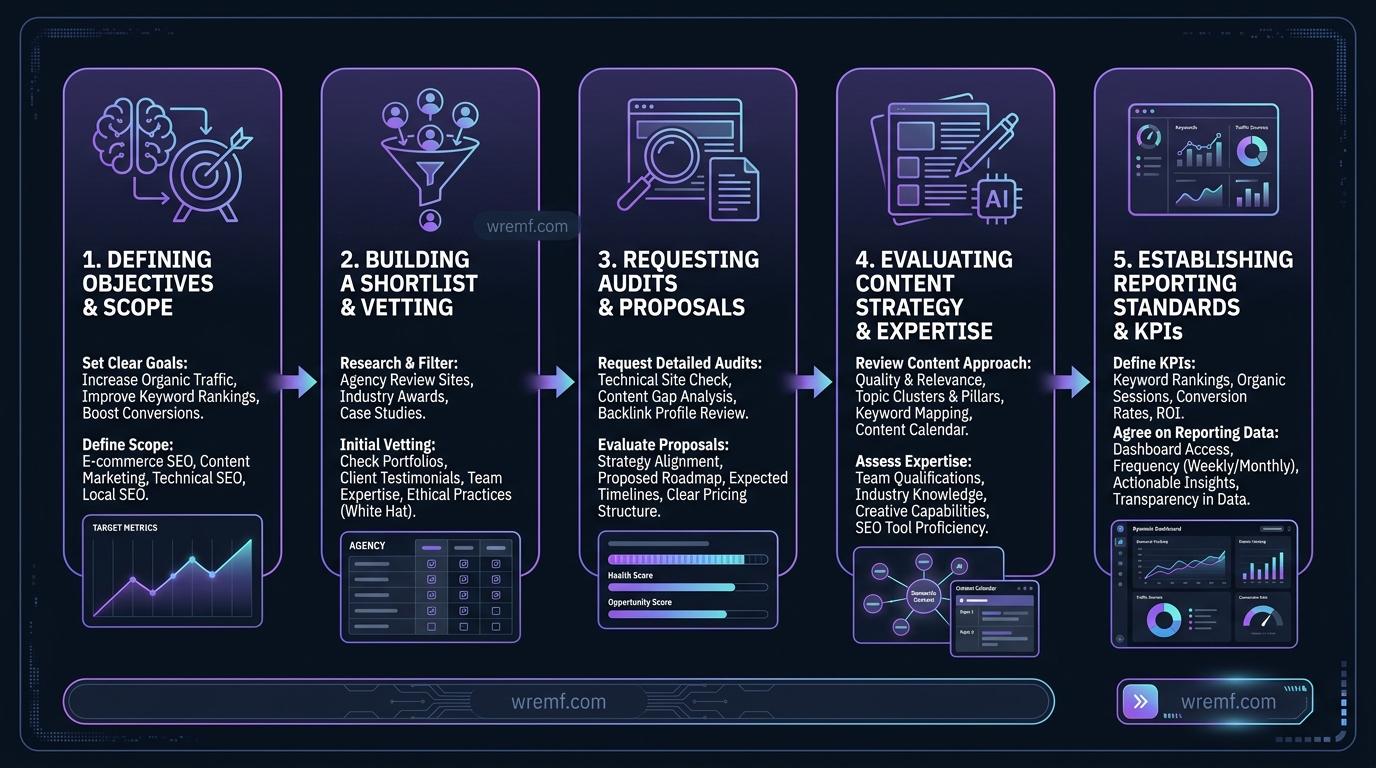
Evaluating and onboarding a Google rankings agency effectively requires a structured approach. The following process applies whether you are selecting an agency for the first time or replacing an underperforming partner.
Step 1: Define your primary objective
Clarify whether the priority is organic traffic growth, local lead generation, eCommerce revenue, international expansion, or a combination. Define the target keywords, markets, and conversion goals before approaching any agency.
Step 2: Build a shortlist based on sector experience
Identify agencies with documented results in your industry. B2B SaaS, eCommerce, legal services, and local services each require different tactical emphasis. Use case studies, Search Awards recognition, and client references to validate sector experience.
Step 3: Request a technical SEO audit or diagnostic
Ask shortlisted agencies to demonstrate how they assess a site technically. A credible agency will identify specific technical issues, prioritise them by impact, and explain their remediation approach before any contract is signed.
Step 4: Evaluate content strategy capability
Ask how the agency approaches keyword research, semantic clusters, content creation, and content quality standards. Ask to see examples of content they have produced that ranks and converts rather than simply content they have published.
Step 5: Assess link building methodology
Ask specifically where backlinks are acquired from, how link quality is assessed, and how they handle link cleanup if problematic links are identified. Transparency here is a strong quality signal.
Step 6: Agree on reporting and attribution standards
Define upfront how success will be measured. The minimum should include keyword rankings, organic traffic, leads or conversions from organic search, and conversion rate. Agencies offering GA4 attribution, Looker Studio dashboards, and white-label reporting provide clearer visibility into program performance.
Step 7: Add AI search visibility tracking from the start
Set up prompt tracking and AI citation monitoring alongside your Google SEO program from day one. Knowing which AI engines are already citing your brand, which competitors appear in AI answers, and which content gaps need addressing gives the SEO program a richer data foundation to work from. WREMF's approach to this is covered in the AI search engine optimization tools guide
Step 8: Run a structured onboarding period
Agree on deliverables and timelines for the first 90 days covering technical fixes, content production, link acquisition, and initial reporting. Use the first quarterly review to assess whether the agency's outputs align with the agreed strategy before committing to a longer-term contract.
KEY TAKEAWAY: A structured evaluation and onboarding process reduces the risk of agency selection errors and creates the reporting foundation needed to measure Google SEO and AI search visibility progress in parallel.
Real-World Scenarios: Matching the Agency Type to the Brief
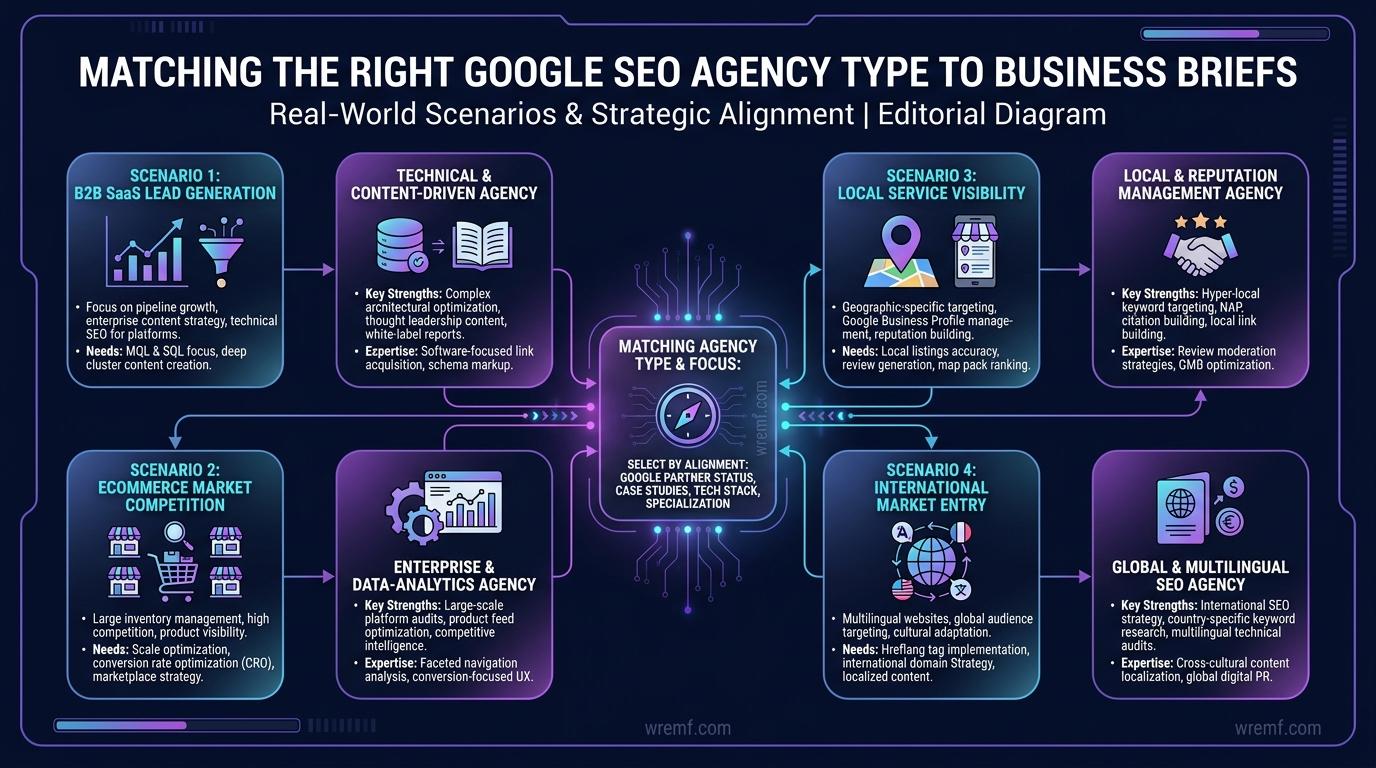
Different businesses require fundamentally different Google SEO approaches. The following scenarios illustrate how agency selection and strategy differ based on objective, market, and execution context.
Scenario One: B2B SaaS company targeting organic leads
A SaaS company selling project management software to mid-market teams needs organic leads from decision-maker searches. The right agency combines keyword research targeting commercial and transactional queries, content marketing built around the product's use cases, and link building from technology publications and SaaS industry media. Conversion-optimised landing pages, conversion rate optimisation, and GA4 attribution from organic to trial signups are essential deliverables. Roketto's approach to inbound marketing for SaaS clients, combined with WREMF prompt tracking to identify whether the brand appears in ChatGPT and Perplexity answers about project management tools, represents the type of combined program this brief requires.
Scenario Two: eCommerce retailer competing on Google Shopping and organic
A mid-size eCommerce brand competing in a crowded product category needs both organic search rankings and Google Shopping visibility. The agency must address technical SEO for large product catalogues, Schema Markup for products and reviews, internal linking across category and product pages, Google Ads for Performance Max and Demand Gen campaigns, and ROAS tracking for paid media. Scandiweb's documented 278% organic transaction growth from AI-informed SEO illustrates the potential when technical SEO, content, and conversion optimisation work in combination. Scandiweb's approach also demonstrates that AI search optimisation and traditional Google SEO can be built into the same program rather than treated as separate workstreams.
Scenario Three: Multi-location service business building local visibility
A professional services firm with offices in several cities needs Google rankings for local service queries, strong Google Business Profile management, Map Pack visibility, and consistent local citations. Local SEO Agencies specialising in multi-location programs manage hreflang, regional landing pages, Google Business Profile optimisation, and citation consistency across directories. For law firms and professional services, local leads and Map Pack presence often represent the highest-value traffic channel available, making local SEO the primary investment priority before broader content marketing programs.
Scenario Four: International brand expanding into new markets
A brand entering the Canadian market needs bilingual strategy across English and French, International SEO covering hreflang implementation, market-specific keyword research, and localised content creation. Duffy Agency's international marketing expertise and Roketto's Canadian market experience represent relevant options. A brand expanding into Vancouver or other Canadian markets needs to understand how local search behaviour, Google's algorithms in the target region, and competitor density shape the SEO investment required.
KEY TAKEAWAY: Matching the agency type to the specific objective, market, and execution context produces better outcomes than selecting the highest-profile agency regardless of fit.
Limitations, Risks, and Caveats When Working With a Google Rankings Agency
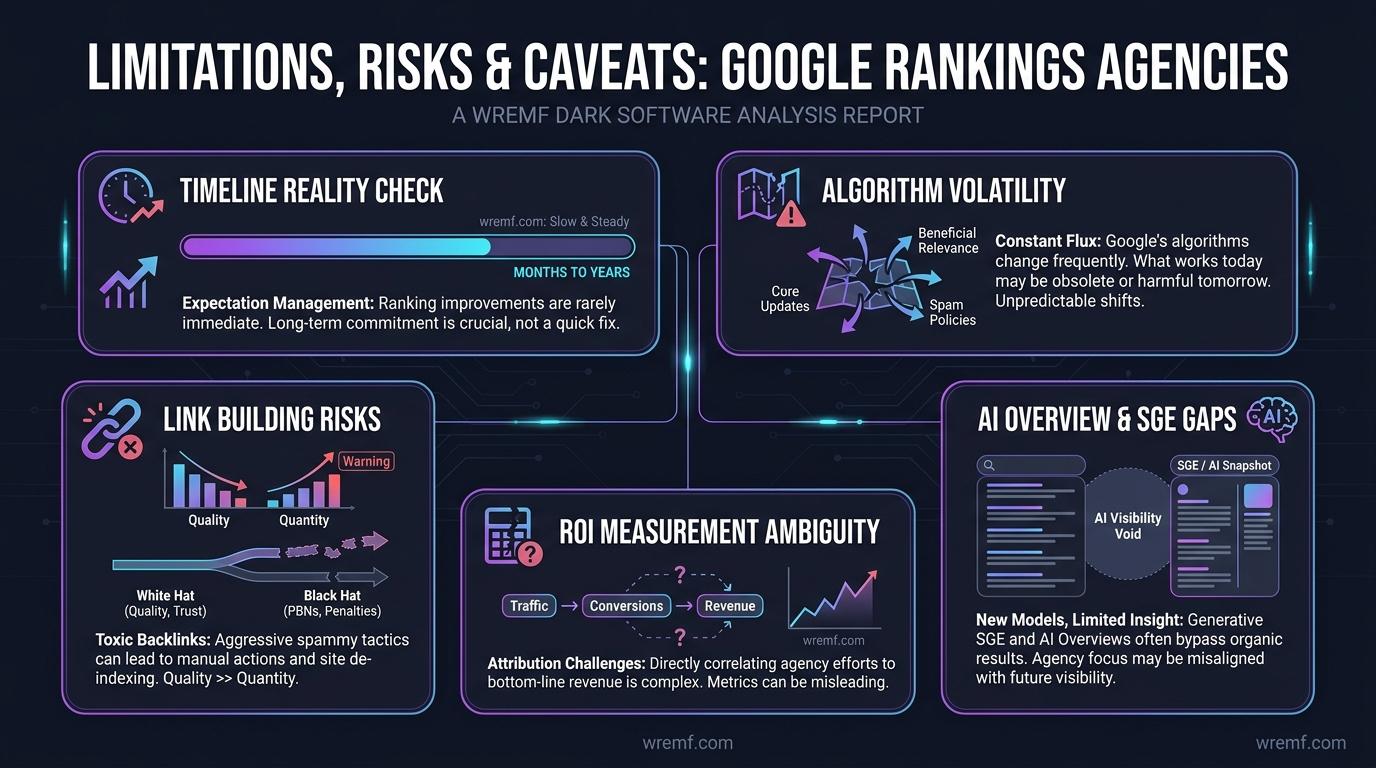
Google SEO produces measurable results for most businesses, but there are real limitations, risks, and caveats that brands should understand before committing to an agency engagement.
First, SEO results take time. Organic ranking improvements for competitive keywords typically take three to six months before they become visible and longer before they translate to significant traffic and lead volume increases. Agencies that promise rapid ranking improvements without explaining this timeline are misrepresenting the channel.
Second, Google's algorithms change. Updates can significantly alter which pages rank and why. Agencies that build sustainable programs around content quality, genuine authority, and strong technical foundations are more resilient to algorithm changes than those relying on tactics that optimise narrowly for current signals. Google documents its approach to search quality through the Google Search Central blog and teams that understand these principles can assess whether an agency's methodology aligns with long-term sustainable practice.
Third, link building carries risk if executed poorly. Low-quality backlinks, unnatural link patterns, and manipulative practices can result in manual penalties or algorithmic devaluations that take months to recover from. Any agency that cannot transparently explain its link acquisition process and link quality standards represents a risk to domain authority.
Fourth, Google rankings do not measure AI search visibility. A brand can achieve strong positions in Google Search for every target keyword while being completely absent from ChatGPT, Gemini, Perplexity, and Google AI Overviews answers on the same topics. As AI-driven search becomes a primary research channel for B2B buyers, a Google-only measurement model systematically underreports how visible a brand actually is across the full search ecosystem.
Fifth, citations in AI answers cannot be guaranteed by any agency or software platform. AI engines select sources based on complex, non-transparent criteria including content depth, entity consistency, domain authority, source diversity, and training data patterns. What can be done is to optimise the signals that increase citation probability, monitor which sources are being used, identify gaps, and act on them systematically. WREMF tracks these signals across 10 AI engines and provides prompt-level reporting to support this process, but it does not and cannot guarantee that a specific AI engine will cite a specific brand.
Sixth, attributed AI referral traffic is still an incomplete picture. AI engines including ChatGPT and Perplexity may not pass referral attribution data consistently through all traffic sessions, meaning that the actual volume of AI-referred traffic is likely higher than analytics platforms report. Teams should treat AI referral traffic data as a directional signal rather than a definitive count.
IMPORTANT:
No agency and no software platform can guarantee specific Google rankings, AI citation frequency, organic traffic volumes, or revenue outcomes. Legitimate agencies set realistic targets, explain their methodology, and report transparently against agreed metrics.
KEY TAKEAWAY: Google SEO produces real results but requires realistic timelines, transparent methodology, and an expanded measurement model that includes AI search visibility alongside traditional rankings.
Common Misconceptions About Google Rankings Agencies and AI Search Visibility
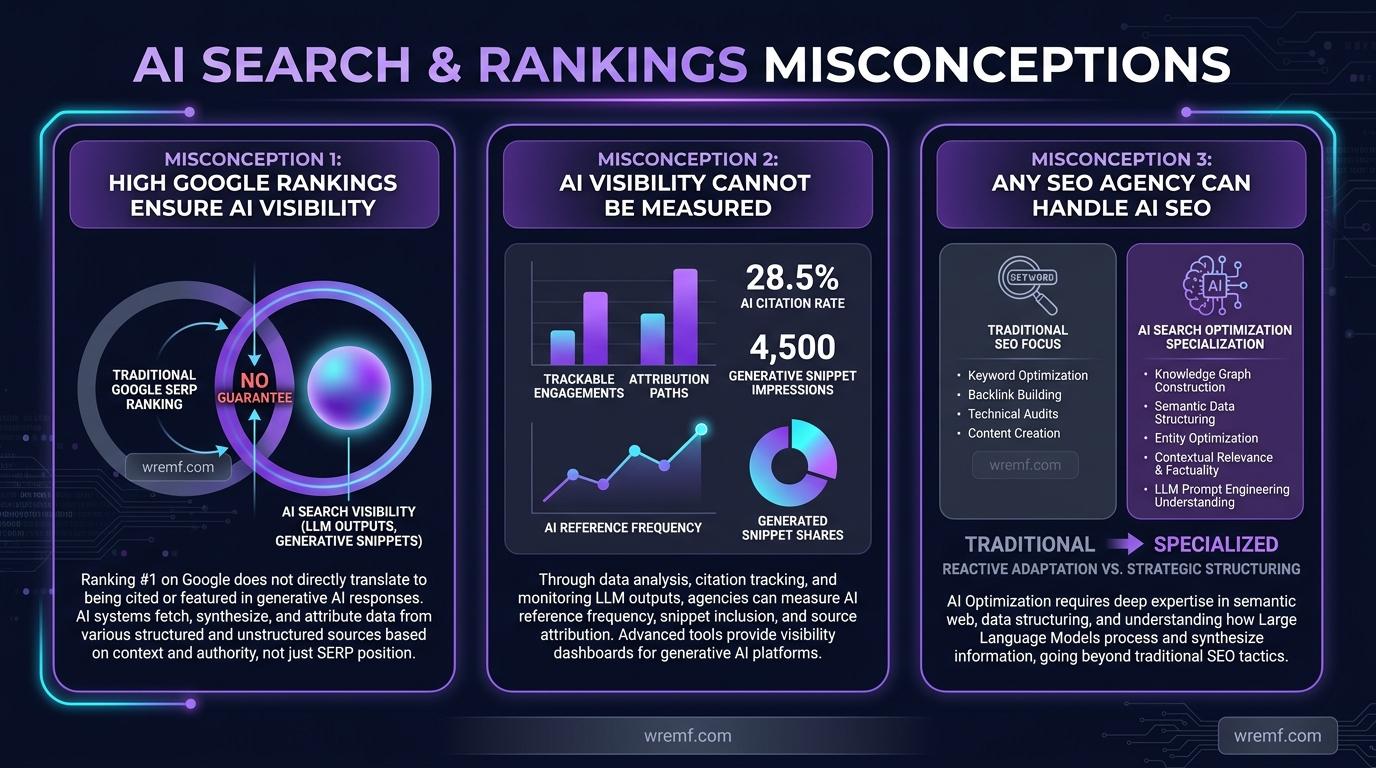
MYTH: If your brand ranks on page one of Google, it will automatically appear in AI-generated answers.
FACT: Google rankings and AI citation are separate outcomes driven by overlapping but distinct signals. A brand can hold the top organic position for a keyword while being entirely absent from the AI-generated answer on the same topic. AI Overviews, ChatGPT, Gemini, and Perplexity select sources based on content depth, entity consistency, source credibility, and Structured Data rather than ranking position alone.
MYTH: AI search visibility cannot be measured or tracked.
FACT: AI search visibility can be measured systematically through prompt tracking, citation monitoring, source consistency analysis, and AI share of voice calculations. Platforms such as WREMF track how AI engines including ChatGPT, Gemini, Perplexity, and Google AI Overviews mention, cite, and recommend brands across defined sets of buyer prompts, producing prompt-level reporting that teams can act on.
MYTH: A GEO or AEO strategy replaces traditional Google SEO.
FACT: Generative Engine Optimisation and Answer Engine Optimization build on the same technical foundations, content quality standards, and domain authority that drive Google rankings. They do not replace Google SEO. They extend the optimisation program to address the additional signals that AI search engines use when selecting sources to cite in generated answers. The most effective programs address both in coordination.
MYTH: Any good SEO agency can deliver AI search visibility as part of standard service delivery.
FACT: Most Google SEO agencies are structured around keyword rankings, backlinks, and organic traffic. AI visibility requires prompt-based monitoring across multiple AI engines, source citation analysis, entity consistency auditing, and Answer Engine Optimization disciplines that are different from traditional SEO deliverables. Teams should evaluate whether an agency has documented capability in AI search specifically or whether AI visibility needs to be tracked and managed separately.
MYTH: Higher Google rankings always mean more leads and revenue.
FACT: Rankings drive visibility but conversion depends on landing page quality, user experience design, content relevance, and offer clarity. Agencies that track only keyword rankings without connecting to conversion rate, lead volume, and revenue attribution cannot tell you whether the SEO investment is producing business outcomes. The best agencies tie organic ranking improvements to conversion data from GA4 or equivalent web analytics platforms.
KEY TAKEAWAY: The most expensive misconceptions about Google rankings agencies involve assuming that rankings automatically translate to AI visibility, leads, or revenue without the measurement and conversion infrastructure to connect them.
Conclusion
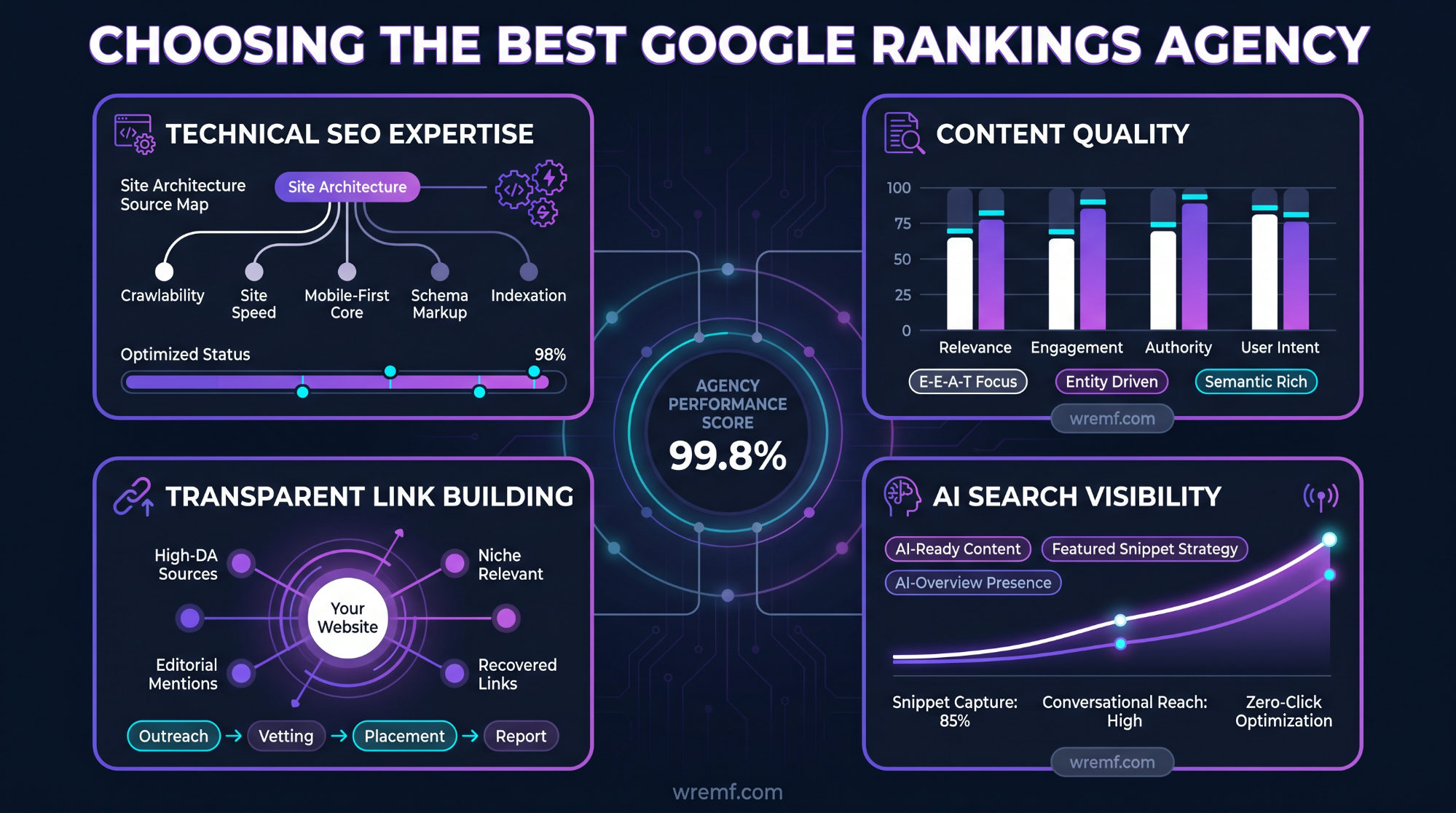
The best Google rankings agency for your business is one that combines rigorous technical SEO, content strategy built around semantic clusters and content quality, transparent link building methodology, and attribution reporting that connects organic rankings to revenue. As AI-driven search continues to reshape buyer discovery, the agencies and teams that extend their measurement model beyond Google rankings into AI search visibility, AI citations, and prompt-based brand presence will hold a structural advantage. WREMF helps B2B brands and agencies track, improve, and prove how they appear across ten AI engines alongside their Google SEO program. Whether you need self-serve software, a fully managed AI visibility service, or a hybrid model, explore WREMF's AI search engine optimization services guide or compare plans at the WREMF pricing page to see which option fits your team.
Frequently Asked Questions About the Best Google Rankings Agencies
What is a Google rankings agency and what does it actually do?
A Google rankings agency is a specialist SEO firm that improves a website's position in Google Search through technical optimisation, content strategy, keyword research, link building, and structured data implementation. Unlike general digital marketing agencies, a Google SEO agency focuses on measurable organic search outcomes: higher rankings, increased organic traffic, and conversion improvement. The best agencies also integrate competitor analysis, internal linking strategy, schema markup, and content quality improvements to sustain ranking gains over time. In 2026, leading agencies additionally optimise for Google AI Overviews and generative search surfaces, not only traditional blue-link results.
How is optimising for AI search engines different from traditional SEO?
Traditional SEO focuses on ranking pages in standard Google Search results through technical signals, backlinks, and keyword relevance. AI search optimisation, by contrast, focuses on being cited, recommended, or summarised by AI engines such as ChatGPT, Gemini, Perplexity, Google AI Overviews, and Copilot. According to Google's AI Overviews documentation, AI-generated answers apply separate classification logic from standard organic results. This means a brand can rank well organically but still be absent from AI-generated answers. Effective AI SEO requires structured content, entity authority, citation consistency, and answer-first formatting that traditional SEO alone does not address.
Should businesses invest in AI-focused SEO now, or is it too early?
Businesses should invest in AI search optimisation now. AI-generated answers from ChatGPT, Gemini, Perplexity, and Google AI Overviews already influence how buyers discover, evaluate, and shortlist B2B brands. Gartner's AI research consistently identifies AI-assisted discovery as a growing factor in purchase decisions. Waiting until AI search is fully dominant means being absent during the period when citation patterns and source authority are being established. Brands that build AI visibility early develop a compounding advantage as AI engines increasingly favour consistently cited, well-structured, and authoritative sources.
Where is search behaviour actually happening now?
Search behaviour is now distributed across multiple discovery surfaces, not concentrated in Google alone. Users query ChatGPT, Perplexity, Gemini, Copilot, and Google AI Overviews for research, product comparisons, recommendations, and buying decisions. Organic Google Search, Google Maps, YouTube, voice assistants, and AI-powered answer engines each serve different intent types. For B2B brands, this means decision-makers may first encounter a brand through an AI-generated recommendation before reaching a website. A Google rankings agency that only optimises for traditional search results is addressing an increasingly incomplete picture of where buying-stage discovery actually occurs.
What does optimisation for AI visibility require?
AI visibility optimisation requires structured, answer-first content that AI engines can extract, parse, and cite. Key requirements include clear entity definitions, consistent brand mentions across authoritative third-party sources, schema markup and structured data, FAQ sections and Q&A content, semantic content clusters that demonstrate topical authority, and strong internal linking architecture. Trust signals such as citations in recognised publications, domain authority, and content quality also influence whether an AI engine treats a source as reliable. Schema.org documentation provides the foundational structured data framework that supports AI retrieval readiness alongside traditional search visibility.
Can my regular SEO agency handle AI SEO, or do I need a specialist?
Most traditional SEO agencies have limited capability for AI search optimisation. Traditional SEO prioritises keyword density, backlink volume, and on-page metadata. AI SEO requires additional expertise in entity optimisation, citation consistency analysis, generative engine optimisation (GEO), answer engine optimisation (AEO), and prompt-level visibility tracking across multiple AI engines. A specialist AI SEO agency understands how large language models select and surface sources, how to structure content for retrieval, and how to measure AI citation share of voice. Teams that want to track and improve AI visibility specifically can explore WREMF's AI visibility platform as a software layer alongside agency execution.
Will optimising for AI search engines also help my Google rankings?
Yes, in most cases. The content improvements required for AI visibility, including structured formatting, answer-first writing, clear entity definitions, FAQ sections, schema markup, and authoritative source citations, also align with Google's quality assessment signals. According to the Google Search Central blog, content that demonstrates experience, expertise, authoritativeness, and trustworthiness tends to perform better across both traditional and AI-powered search surfaces. Improving content for AI citation readiness typically strengthens organic ranking power at the same time, making the two goals complementary rather than competing.
Why do some traditional SEO agencies struggle with AI SEO?
Traditional SEO agencies are built around rank tracking, backlink acquisition, keyword mapping, and technical crawl health. These capabilities remain important but do not address how AI engines select sources for generated answers. AI SEO requires understanding of how LLMs process and weight content, how citation patterns are established, how entity consistency signals authority to generative systems, and how to measure brand visibility in AI-generated responses. Many traditional SEO teams lack the tooling, methodology, and expertise to audit AI visibility gaps, track prompt-level performance, or build content systems optimised for generative engine retrieval rather than keyword matching alone.
What makes an AI SEO agency different from a standard SEO agency?
An AI SEO agency specifically optimises for visibility in AI-generated answers, not only traditional search rankings. This means the agency runs prompt landscape analysis to identify where AI engines discuss relevant topics, audits which sources AI engines cite, builds content structured for answer extraction, strengthens entity authority and brand citation consistency, and measures AI share of voice across engines such as ChatGPT, Gemini, Perplexity, and Google AI Overviews. McKinsey's AI insights highlight that AI-driven discovery is reshaping how customers research and evaluate vendors, making this a strategically important capability for B2B brands.
How do you measure success in AI SEO?
Success in AI SEO is measured by brand citation frequency in AI-generated answers, AI share of voice compared to competitors, prompt coverage across relevant buying-stage queries, source citation consistency across AI engines, and improvements in organic traffic attributable to AI-driven discovery. One direct indicator is how often your content or brand is referenced when AI platforms such as Google AI Overviews or Perplexity generate answers to queries relevant to your category. Tracking this requires purpose-built tooling. WREMF's prompt intelligence and citation tracking monitors brand mentions, citation frequency, and competitor visibility across ten AI engines simultaneously.
What is AI share of voice and why does it matter for Google SEO strategy?
AI share of voice measures how frequently a brand is cited, mentioned, or recommended in AI-generated answers relative to competitors, across a defined set of relevant prompts. It is a leading indicator of AI-driven discovery performance. As AI engines increasingly influence how buyers shortlist vendors, a brand with high AI share of voice captures more awareness and consideration at the top of the funnel before a buyer reaches Google Search or a website. Agencies that incorporate AI share of voice tracking into their measurement framework provide clients with visibility into a discovery channel that traditional rank tracking completely misses.
What services should a Google SEO agency offer in 2026?
A competitive Google SEO agency in 2026 should offer technical SEO, keyword research, content strategy and creation, link building and backlink management, schema markup and structured data, Google Business Profile optimisation for local visibility, internal linking strategy, conversion rate optimisation, and integration with Google Analytics and GA4 attribution. Leading agencies additionally offer AI search optimisation, generative engine optimisation, answer engine optimisation, AI citation analysis, content brief generation for AI-ready pages, and AI visibility tracking. Agencies that cover both traditional organic search and AI-driven discovery provide significantly more comprehensive coverage of how modern buyers find and evaluate brands.
What is the difference between Technical SEO, Content SEO, and AI SEO?
Technical SEO addresses crawlability, site speed, rendering, schema markup, structured data, and indexation signals that determine whether Google can access and understand a site. Content SEO focuses on keyword research, topical authority, content quality, internal linking, and answer-first formatting that aligns with search intent. AI SEO specifically optimises for citation and recommendation visibility in AI-generated answers from engines such as ChatGPT, Gemini, Perplexity, and Google AI Overviews. Effective AI SEO builds on strong technical and content foundations and adds entity optimisation, citation consistency, and structured content formatting designed for LLM retrieval. All three disciplines are complementary and increasingly necessary.
How does Google Business Profile optimisation contribute to local SEO rankings?
Google Business Profile is the primary signal Google uses to determine local Map Pack and Google Maps rankings. A complete, accurate, and actively managed profile with consistent NAP data, category selections, regular posts, review management, and photo updates signals relevance and trustworthiness to Google's local ranking algorithm. Structured data on the associated website, local citation consistency across directories, and proximity signals also influence local rankings. Local SEO agencies that combine Google Business Profile management with on-site technical SEO and citation building deliver more durable local ranking improvements than those that focus on profile management alone.
What is Generative Engine Optimisation (GEO) and how does it differ from SEO?
Generative Engine Optimisation (GEO) is the practice of improving how a brand or content is retrieved and surfaced by generative AI engines such as ChatGPT, Claude, Gemini, and Perplexity. Unlike traditional SEO, which targets keyword-based ranking algorithms, GEO focuses on citation authority, entity consistency, answer-first content structure, and source trustworthiness signals that generative AI models use when selecting content to include in generated answers. The Perplexity blog illustrates how AI-native search surfaces prioritise sources differently from Google's traditional ranking factors. WREMF's GEO audit feature helps teams identify and close specific gaps in generative engine visibility.
What is Answer Engine Optimisation (AEO) and when should it be part of an SEO strategy?
Answer Engine Optimisation (AEO) is the practice of structuring content so that answer engines, including voice assistants, featured snippets, Google AI Overviews, and AI-powered search tools, can extract and surface it as a direct response to user queries. AEO becomes essential when a brand's target audience uses conversational or question-based queries, when featured snippets and AI Overviews are present in the target SERP landscape, or when the brand wants to appear in voice search results. AEO content typically uses FAQ sections, Q&A structures, clear definitions, and answer-first formatting. It is a natural extension of content SEO rather than a separate discipline.
How does Link Building fit into a modern Google SEO strategy?
Link building remains a core component of Google SEO strategy because backlinks from authoritative domains signal credibility and topical relevance to Google's ranking algorithms. However, modern link building focuses on editorial quality, relevance, and domain authority rather than raw link volume. Effective link building in 2026 includes digital PR, thought leadership content, strategic partnerships, brand mentions, and earning citations from trusted publications. Importantly, off-site authority signals also influence AI citation patterns: brands with strong third-party mention profiles tend to appear more frequently in AI-generated answers. Link building and brand citation strategies therefore contribute to both Google rankings and AI search visibility simultaneously.
What is the role of schema markup and structured data in Google SEO?
Schema markup is structured data added to web pages that helps search engines understand the type, context, and relationships of content. For Google SEO, schema markup supports rich results including featured snippets, FAQ rich results, review stars, and product listings, all of which improve click-through rates from search. Structured data also improves AI retrieval readiness by making content easier for large language models to parse and classify. Schema.org documentation covers the full range of supported markup types. Technical SEO agencies that implement schema comprehensively provide both immediate ranking benefits and longer-term AI visibility advantages.
Should a B2B brand use a specialist B2B SEO agency or a generalist digital marketing agency?
A specialist B2B SEO agency is generally the better choice for B2B brands because B2B search behaviour, buying cycles, content formats, and conversion patterns are fundamentally different from B2C. B2B SEO requires long-form pillar content, comparison pages, use-case pages, technical content for complex products, and funnel-stage keyword mapping aligned to multi-stakeholder buying journeys. Generalist digital marketing agencies may offer SEO as one of many services without the depth required for competitive B2B markets. Agencies that specifically understand B2B SaaS, demand generation, Google Ads attribution, and AI-driven discovery deliver more strategically aligned results for growth-stage and enterprise B2B companies.
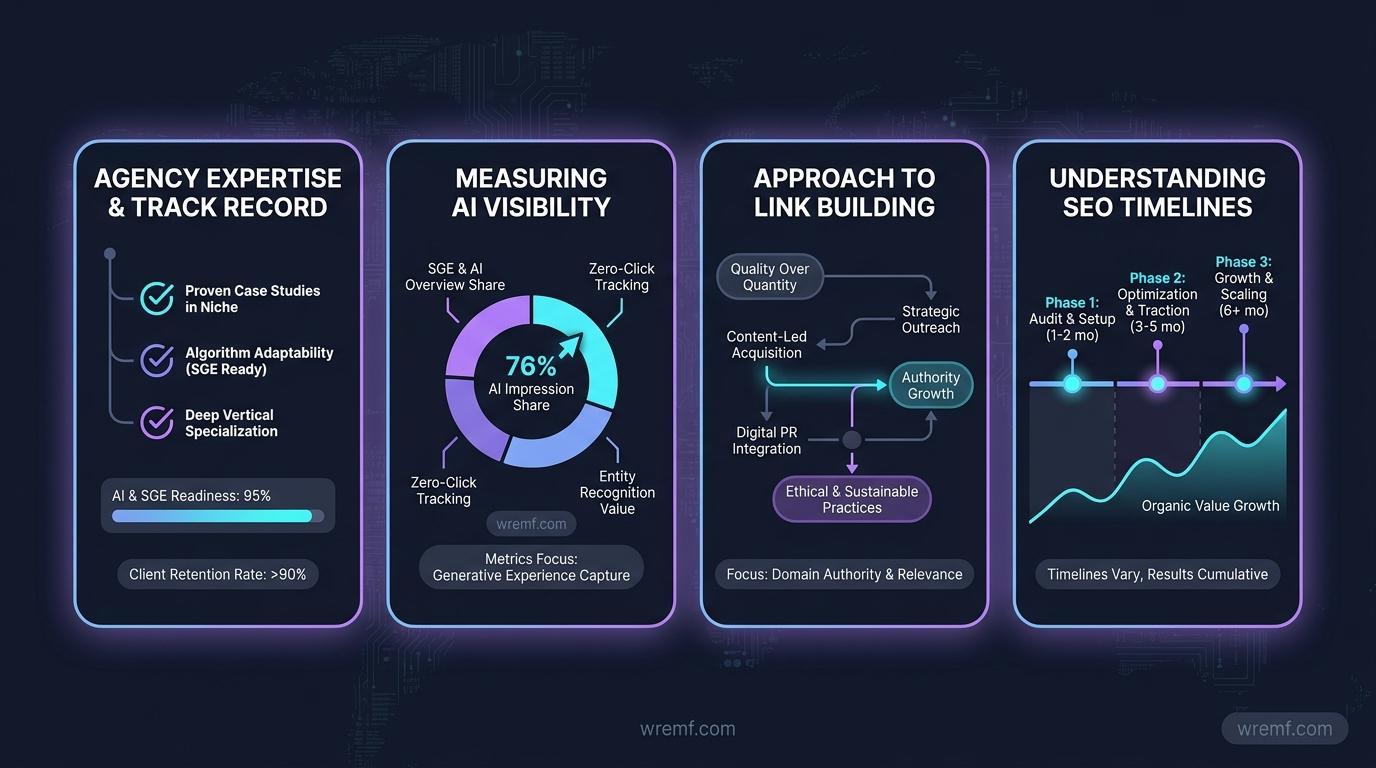
How long does it take for SEO work to produce measurable Google ranking improvements?
Meaningful ranking improvements typically appear within three to six months for competitive keywords, with more significant gains visible over six to twelve months of sustained effort. The timeline depends on factors including existing domain authority, the competitive intensity of target keywords, the volume and quality of content improvements, the pace of link acquisition, and the technical health of the site. Technical fixes and content improvements on pages with existing authority can produce faster results. New sites or highly competitive categories typically require longer. Agencies that set realistic timeframes based on competitive benchmarking and domain data are more credible than those that promise rapid first-page results on competitive terms without justification.
What is the difference between organic SEO and paid search (Google Ads)?
Organic SEO earns ranking positions through content quality, technical signals, backlinks, and relevance, without paying Google per click. Google Ads places paid listings above organic results on a cost-per-click basis, providing immediate traffic but requiring ongoing spend. SEO builds cumulative, compounding value over time and generates traffic without direct per-click costs. Google Ads provides faster visibility but stops generating traffic when the budget is paused. Most B2B marketing teams use both in combination: paid search captures high-intent buyers immediately while organic SEO builds long-term traffic volume, brand authority, and AI citation presence that paid search cannot replicate.
How does WREMF support teams working with Google SEO agencies?
WREMF helps B2B teams track, improve, and prove how their brand appears across AI discovery surfaces including ChatGPT, Gemini, Perplexity, Copilot, Google AI Overviews, and seven other AI engines. While a Google SEO agency manages organic ranking and content execution, WREMF provides the measurement layer for AI visibility: prompt tracking, citation analysis, competitor AI share of voice, source consistency scoring, and attribution reporting. Teams working with a Google rankings agency can use WREMF to extend measurement beyond traditional rank tracking into the AI-driven discovery layer. For teams that want execution alongside measurement, WREMF's managed AI visibility service combines software with senior-led GEO and AEO strategy.
When should a business use software only, an agency only, or a hybrid AI SEO model?
Software-only AI visibility platforms are best suited to in-house SEO teams and consultants with strong internal execution resources who primarily need measurement, tracking, and data. An agency-only model works for teams without SEO or AI visibility expertise internally who need strategy, implementation, and ongoing optimisation delivered externally. A hybrid model combines visibility tracking software with managed execution and is ideal for companies that want measurable data alongside expert implementation, strategic guidance, and regular reporting. WREMF's pricing page outlines three options: Starter software at €59 per month, Growth at €149 per month, and Managed execution from €1,500 per month, covering the full spectrum from self-serve tracking to fully managed AI visibility strategy.
How do agencies measure and report on AI visibility for clients?
Agencies measuring AI visibility for clients typically track brand citation frequency across AI engines, prompt coverage for relevant buying-stage queries, AI share of voice relative to competitors, source consistency across AI platforms, and changes in AI-attributed organic traffic over time. Effective reporting connects AI visibility metrics to business outcomes including traffic, leads, and pipeline contribution. WREMF's sample report demonstrates how AI visibility data across ten engines, including citation tracking, competitor comparison, and share of voice scoring, can be presented in a client-ready format. Agencies managing multiple brands can access white-label reporting and client portals through WREMF's Growth and Managed plans.
What is the difference between Local SEO and National or International SEO?
Local SEO focuses on improving visibility in geographically specific search results, primarily Google Maps, the Map Pack, and local organic results for queries that include a location or carry local intent. It relies heavily on Google Business Profile optimisation, local citation consistency, proximity signals, and localised content. National SEO targets broader keyword rankings without geographic specificity, competing across an entire country. International SEO adds multilingual content strategy, hreflang implementation, regional domain structures, and market-specific keyword research. Each requires different technical approaches, content strategies, and measurement frameworks. Agencies should clearly articulate which of these disciplines their service covers and how they approach each.
What are the most important ranking factors for Google Search in 2026?
Google's ranking algorithm weighs hundreds of signals, but the most significant factors in 2026 include content quality and topical depth, page experience signals such as Core Web Vitals, backlink quality and domain authority, entity relevance and structured data, internal linking architecture, Google Business Profile signals for local queries, and user engagement signals. AI Overviews have also introduced a parallel content quality layer: content that is structured, authoritative, and consistently cited is more likely to be surfaced in AI-generated answers as well as standard results. According to How Google Search works, relevance, quality, and usability remain the foundational ranking principles underpinning all algorithm updates.
How should a business evaluate and choose the right Google SEO agency?
When evaluating a Google SEO agency, businesses should assess the agency's methodology for technical SEO, content strategy, link building, and measurement. Key questions include whether the agency provides transparent reporting, how they connect SEO activity to revenue outcomes, whether they have relevant industry experience, and whether they cover AI search visibility alongside traditional Google rankings. Request case studies with specific metric improvements, ask how they approach competitor analysis, and confirm they use data-driven content brief processes rather than generic content production. Agencies that can articulate how they handle both Google organic rankings and AI-driven discovery are better positioned to deliver comprehensive search marketing results in 2026 and beyond.
Related reading
- AI Visibility Agency Dublin: The Complete Guide to AI SEO, GEO, and AI Search Visibility in Ireland
- Answer Engine Optimization Company: How to Choose the Right AEO Partner for AI Search Visibility
- How to Choose the Best Search Engine Marketing Agency: The Complete B2B Buyer's Guide
- Generative AI Optimization Services: The Complete Guide to GEO, AEO, LLM Optimization, and AI Visibility