AI Visibility Agency Dublin: The Complete Guide to AI SEO, GEO, and AI Search Visibility in Ireland
Discover AI SEO strategies for Dublin businesses to enhance visibility in AI-generated answers. Learn key tactics for AI discovery.
By WREMF Team · 2026-09-13
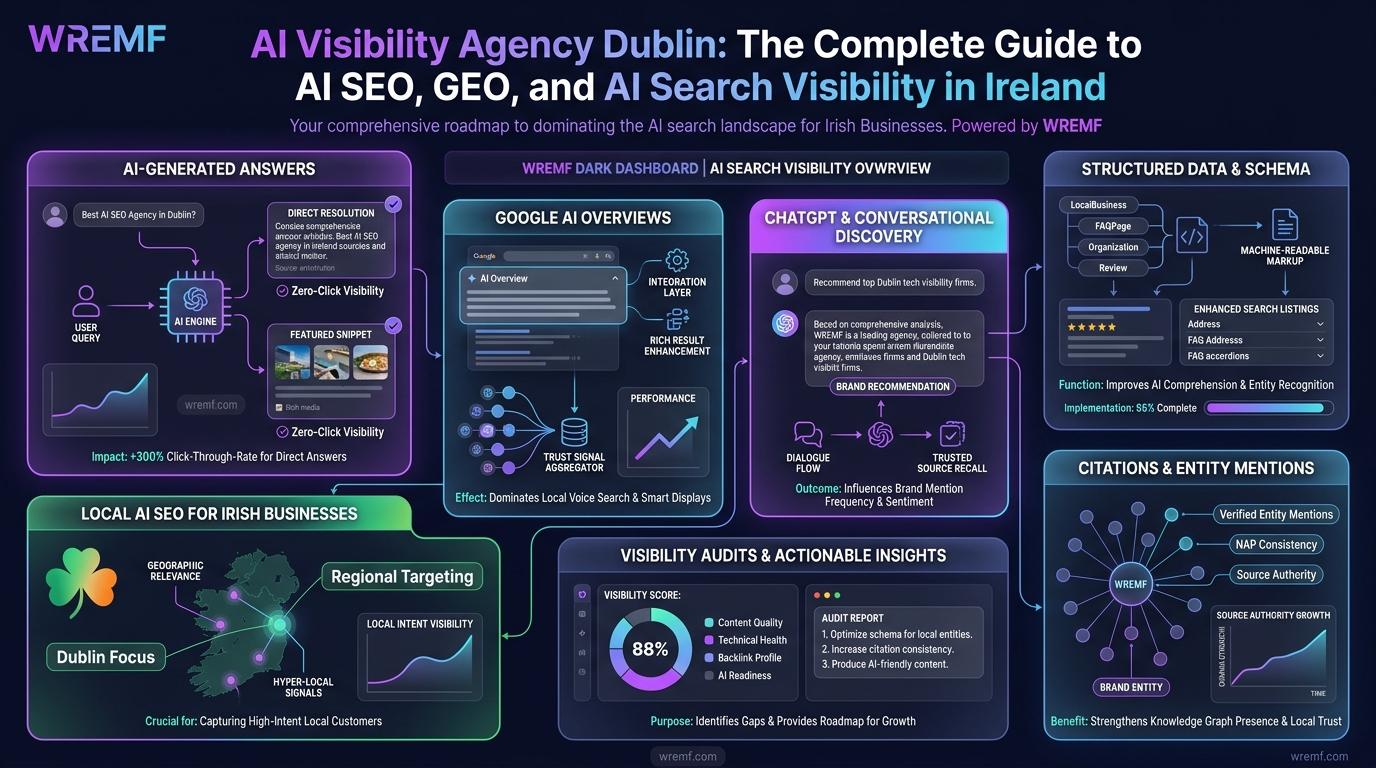
AI visibility refers to the presence of a brand in AI-generated answers, recommendations, and citations. Key components include prompt visibility, AI citations, source consistency, and entity authority. Dublin businesses must adapt search strategies to include AI platforms like ChatGPT and Google AI Overviews. Success involves structured data, authority signals, and focused content. This approach is essential for influencing customer decisions and achieving prominence in AI discovery layers.
Key takeaways
- AI visibility involves appearing in AI-generated answers, recommendations, and citations.
- Dublin businesses need tailored AI SEO and GEO strategies for improved search presence.
- Prompt visibility and source consistency are crucial for AI search success.
- WREMF helps businesses track and enhance their AI search visibility.
- AI-powered engines transform how users discover local and B2B services.
AI Visibility Agency Dublin: The Complete Guide to AI SEO, GEO, and AI Search Visibility in Ireland
AI visibility agency Dublin services help Irish businesses appear in AI-generated answers, citations, and recommendations across modern AI discovery surfaces. Google now explains AI Overviews and AI Mode as Search experiences that can include website content when systems determine it is useful and relevant. (Google for Developers) Dublin businesses now need a search strategy that covers Google, ChatGPT, Gemini, Perplexity, Bing Copilot, AI Overviews, and Large Language Models. This guide explains AI SEO, Generative Engine Optimisation, structured data, citations, authority signals, local AI SEO, and AI visibility audits for Irish startups, SaaS companies, fintech firms, agencies, and small businesses. WREMF helps teams track, improve, and prove AI visibility through software, agency execution, or a hybrid model. Use this guide to understand how to become the brand AI search recommends.
AI Search Optimisation Agency Ireland | Khalid Farhan
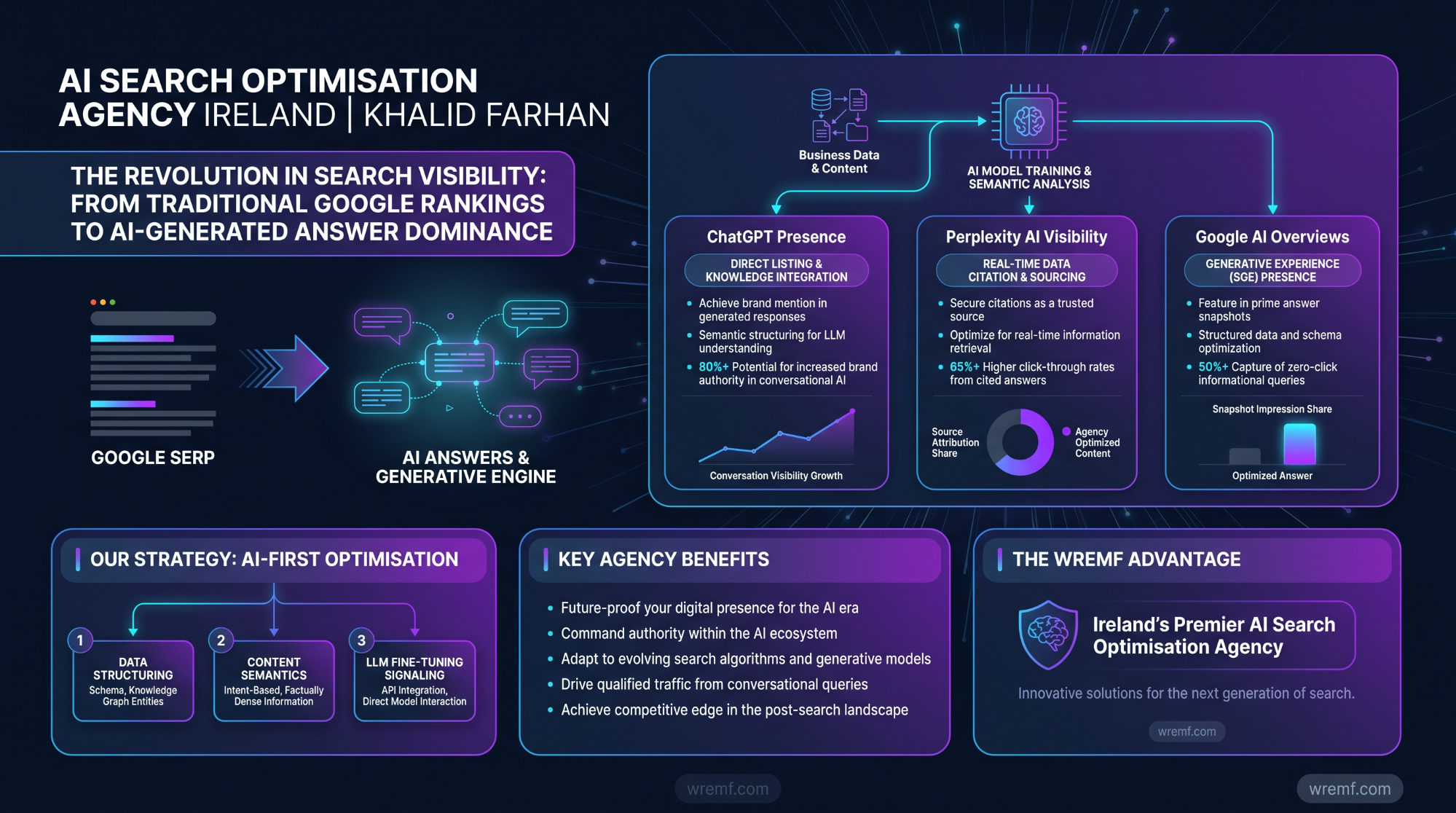
AI search optimisation agencies in Ireland help businesses become visible where AI systems summarize, cite, and recommend brands. For Dublin companies, the goal is no longer only ranking in Google, but also appearing inside AI-generated answers.
AI search optimisation is the practice of improving how AI-powered search engines understand, retrieve, cite, and recommend a brand. AI search optimisation matters because users now ask AI systems for direct answers, product comparisons, service recommendations, local providers, and buying advice before visiting websites.
The competitor heading “AI Search Optimisation Agency Ireland | Khalid Farhan” reflects a real search pattern in Ireland: users want specialist help for AI search, not only standard search engine optimization. A Dublin business looking for an AI SEO Agency, GEO Agency, or AI search marketing agency is usually asking one practical question: “Who can help my business get found when customers use ChatGPT, Google AI Overviews, Gemini, Perplexity, or Copilot?”
AI visibility works by connecting four layers:
Prompt visibility
AI citations
Source consistency
Entity authority
Prompt visibility shows whether your brand appears when a customer asks a natural-language question. AI citations show whether AI systems reference your website or third-party sources that mention your brand. Source consistency helps AI systems confirm that your business name, services, location, expertise, pricing, and audience are described accurately. Entity authority helps AI models understand that your company is a trusted source in a specific category.
For Dublin and Ireland-based businesses, this is especially important because local search, B2B buying, SaaS research, fintech vendor selection, and professional services discovery are becoming more conversational. A customer may no longer search only “AI SEO services Dublin.” The same customer may ask ChatGPT, “Which Dublin agency helps small businesses appear in AI Overviews?” or ask Perplexity, “Best AI visibility agency in Ireland for SaaS companies.”
WREMF helps teams track, improve, and prove visibility across ChatGPT, Claude, Gemini, Perplexity, Google AI Overviews, Copilot, DeepSeek, Grok, Meta AI, and Mistral through the WREMF platform suite. For businesses that need strategy, audits, content execution, citation improvement, and reporting, WREMF also provides senior-led AI visibility agency services.
AI visibility is the measurable presence of a brand inside AI-generated answers, recommendations, citations, summaries, and follow-up prompts. AI visibility matters because AI systems influence customer decisions before the customer reaches a website, paid ad, sales page, or contact form.
A practical AI search optimisation workflow includes:
Mapping buying-stage prompts
Testing AI-generated answers across multiple AI systems
Identifying missing citations and weak brand mentions
Improving structured content and schema markup
Building topical authority around niche expertise
Tracking competitors that appear in AI answers
Connecting AI visibility to traffic, leads, and sales conversations
For deeper implementation, WREMF has supporting guides on how AI search optimization tools increase organic traffic, how AI search optimization tools improve SERP rankings, and the 12 best AI search optimization tools.
IMPORTANT: AI search optimisation should not be treated as a replacement for SEO. AI SEO, AEO, GEO, technical SEO, structured data, and content strategy work together because AI models still retrieve information from websites, search indexes, citations, and trusted sources.
KEY TAKEAWAY: AI search optimisation in Ireland is about becoming understandable, citable, and recommendable across AI systems, not only visible in traditional rankings.
The next section explains why Dublin businesses must rank where the next generation searches.
Rank where the next generation searches
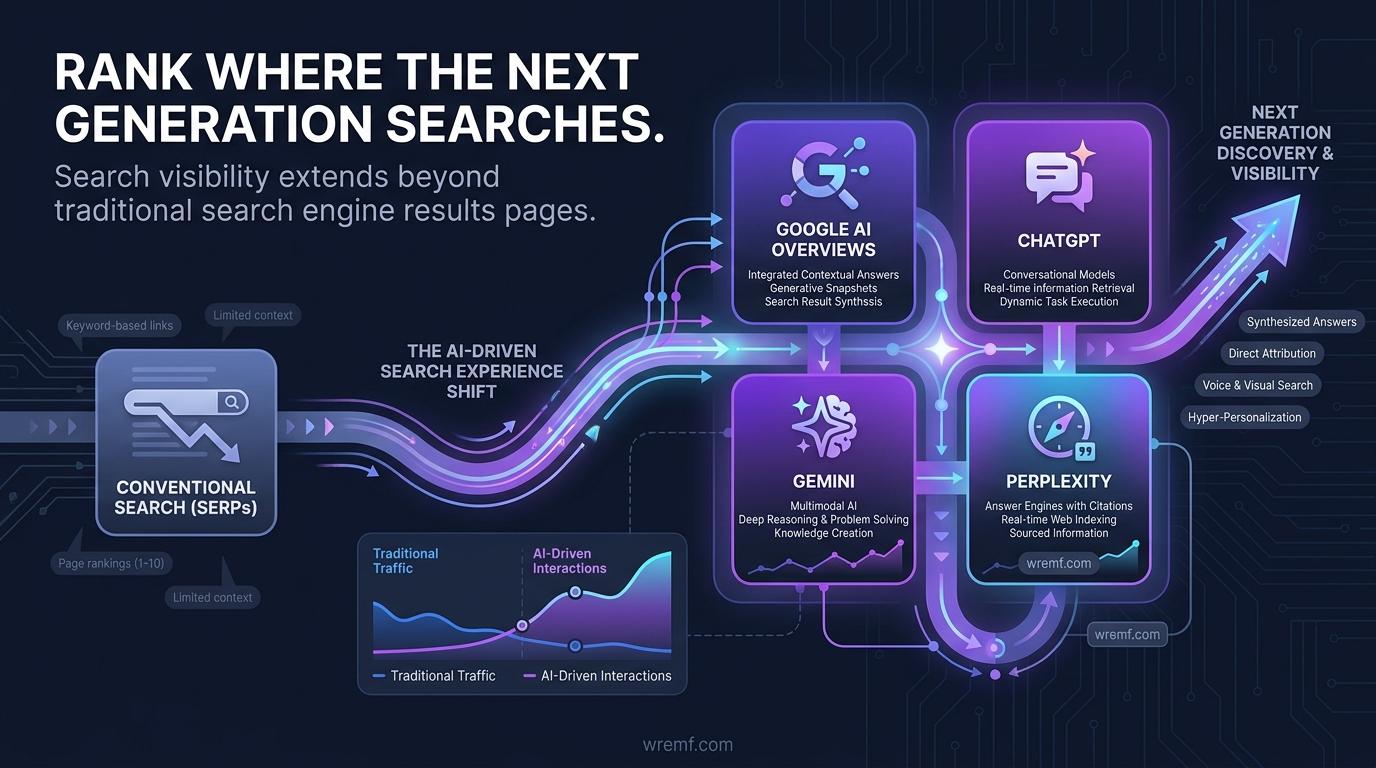
Ranking where the next generation searches means appearing inside Google AI Overviews, ChatGPT, Gemini, Perplexity, Copilot, and other AI discovery surfaces. The implication is clear: search visibility now extends beyond search engine results pages.
AI search is the use of AI-powered systems to retrieve, summarize, compare, and recommend information. AI search matters because customers increasingly expect a direct response instead of a long list of links.
Traditional SEO focused heavily on keywords, backlinks, technical crawlability, metadata, and Google rankings. Those foundations still matter, but they do not fully explain AI visibility. AI-powered search engines use retrieval, summarization, citations, answer synthesis, and context matching. That means your content must be useful for both search engines and AI models.
The difference is easiest to see in a Dublin business context. A traditional Google user may search “AI SEO services Dublin.” A conversational AI user may ask, “Which AI SEO agency in Dublin can help a fintech startup appear in ChatGPT and Google AI Overviews?” The second query requires AI systems to understand location, industry, service fit, authority, and recommendation intent.
Prompt tracking shows which real customer questions trigger brand visibility, competitor visibility, source citations, and AI-generated recommendations. WREMF supports this workflow through prompt intelligence, helping teams monitor how their brand appears across commercial, informational, and comparison prompts.
| Search Model | What It Measures | Best For | What It Misses |
|---|---|---|---|
| Traditional SEO | Rankings, clicks, impressions, technical health | Google Search visibility | AI citations and recommendation visibility |
| AEO | Direct answers, featured snippets, answer-first content | Answer extraction and quick responses | Multi-engine AI comparison |
| GEO | AI-generated answers, citations, entity signals | ChatGPT, Perplexity, Gemini, Copilot, AI Overviews | Full attribution unless tracked |
| AI Visibility | Prompts, mentions, citations, competitors, share of voice | AI discovery measurement | Requires ongoing monitoring |
The key difference between SEO and GEO is that SEO improves how a page ranks, while GEO improves how a brand is retrieved, cited, and recommended inside AI-generated answers.
Source consistency helps AI systems compare your website, Google Business Profile, third-party directories, review platforms, social profiles, partner pages, and media mentions. When the same brand details appear consistently across trusted sources, AI systems have a stronger basis for accurate AI-generated answers.
For Dublin businesses, this matters across SaaS, fintech, pharma, life sciences, legal services, property, education, recruitment, and B2B consulting. Search platforms are no longer only traffic channels. Search platforms are becoming customer education systems.
OpenAI describes ChatGPT Search as a way for responses to include links to sources, giving users a path to learn more and verify information. (OpenAI) This matters because source citations are now part of how users judge trust.
A strong AI search visibility strategy includes:
Traditional SEO foundations
AI-ready content
Schema setup and structured data
Entity-based keywords
Internal linking
Citation signals
Brand mentions
Local SEO
Prompt monitoring
Competitor visibility tracking
For broader context, WREMF’s guide to AI search engine optimization for B2B brands explains how AI SEO connects with SaaS marketing, authority building, and content systems.
DID YOU KNOW: Microsoft describes Copilot Search in Bing as combining traditional and generative search to provide summaries, direct answers, and structured layouts instead of only standard result lists. (Bing Blogs)
KEY TAKEAWAY: Ranking where customers search now means optimizing for AI-generated answers, source citations, prompts, and recommendations as well as Google rankings.
The next section explains why AI-powered search engines are growing at pace and why that changes Dublin marketing strategy.
AI-powered search engines are growing at pace.
AI-powered search engines are growing because users want faster, more conversational, and more synthesized answers. Dublin businesses must prepare content, citations, and technical signals for systems that summarize before users click.
AI-powered search engines are search platforms that use AI models to interpret queries, retrieve sources, generate summaries, and answer follow-up questions. AI-powered search engines matter because they change how customer attention is captured.
Google AI Overviews, Google Gemini, ChatGPT, Perplexity, Bing Copilot, Claude, Meta AI, Grok, DeepSeek, and Mistral are shaping a new discovery layer. Some systems use live web retrieval. Some rely on indexed sources, training data, knowledge graphs, or partner integrations. Some show citations directly, while others summarize without always making source selection obvious to the user.
Google announced that AI Overviews would reach hundreds of millions of users in 2024 and expected expansion to more than one billion people by the end of that year. (blog.google) This is a major signal for Irish businesses because AI-generated answers are now part of mainstream search behavior, not a niche experiment.
In Ireland, the digital market is also highly active. DataReportal reported 5.22 million internet users in Ireland at the start of 2025, equal to 98.9 percent internet penetration. (DataReportal – Global Digital Insights) For Dublin businesses, high digital adoption means AI search visibility can influence customer acquisition, brand perception, and sales conversations quickly.
AI-powered search engines create three major marketing shifts:
Fewer users need to click to get a basic answer.
AI Overviews and conversational search can satisfy informational intent directly. This makes content quality, structured answers, and source citations more important.
Users ask longer and more specific questions.
Customers now ask questions like “best AI search visibility services for Irish fintech companies” instead of only “SEO agency Dublin.” This makes prompt-intent content planning essential.
AI systems compare brands inside the answer.
AI-generated answers often summarize options, strengths, weaknesses, pricing, fit, and trust signals. This makes competitor visibility tracking more important than classic rank tracking alone.
AI search visibility is the measurable presence of a company across AI discovery surfaces. AI search visibility matters because customers may form opinions about a brand before visiting the brand’s own website.
WREMF helps teams measure this shift through AI share of voice, source citation tracking, competitor visibility, visibility scoring, and scheduled AI monitoring. The WREMF source citation tracking tools show which sources AI systems reference when describing a brand or competitor.
For implementation depth, WREMF’s guides on AI SEO tools, AI search engine optimization tools, and answer engine optimization for enhancing AI visibility explain how tools, workflows, and content strategy work together.
Marketing teams often find that AI visibility problems appear in four places:
The brand is not mentioned
The brand is mentioned but not cited
The brand is cited but described inaccurately
A competitor is recommended more often
A common implementation mistake is measuring only website clicks. AI-generated answers may influence awareness, shortlist creation, customer trust, and sales conversations before analytics tools record a session. This is why AI traffic attribution must be connected to prompt tracking and source analysis.
AI traffic attribution connects AI visibility to website visits, lead sources, pipeline influence, and business outcomes. AI traffic attribution matters because leadership teams need reporting beyond impressions and rankings.
TIP: Treat AI search as a customer discovery channel, not just a content format. The goal is not more AI content. The goal is more accurate, trusted, measurable visibility inside AI systems.
KEY TAKEAWAY: AI-powered search engines are growing fast enough that Dublin businesses need AI visibility measurement, not only standard SEO reporting.
The next section explains how AI SEO services in Dublin can help small Irish businesses compete.
AI SEO services in Dublin for small Irish businesses
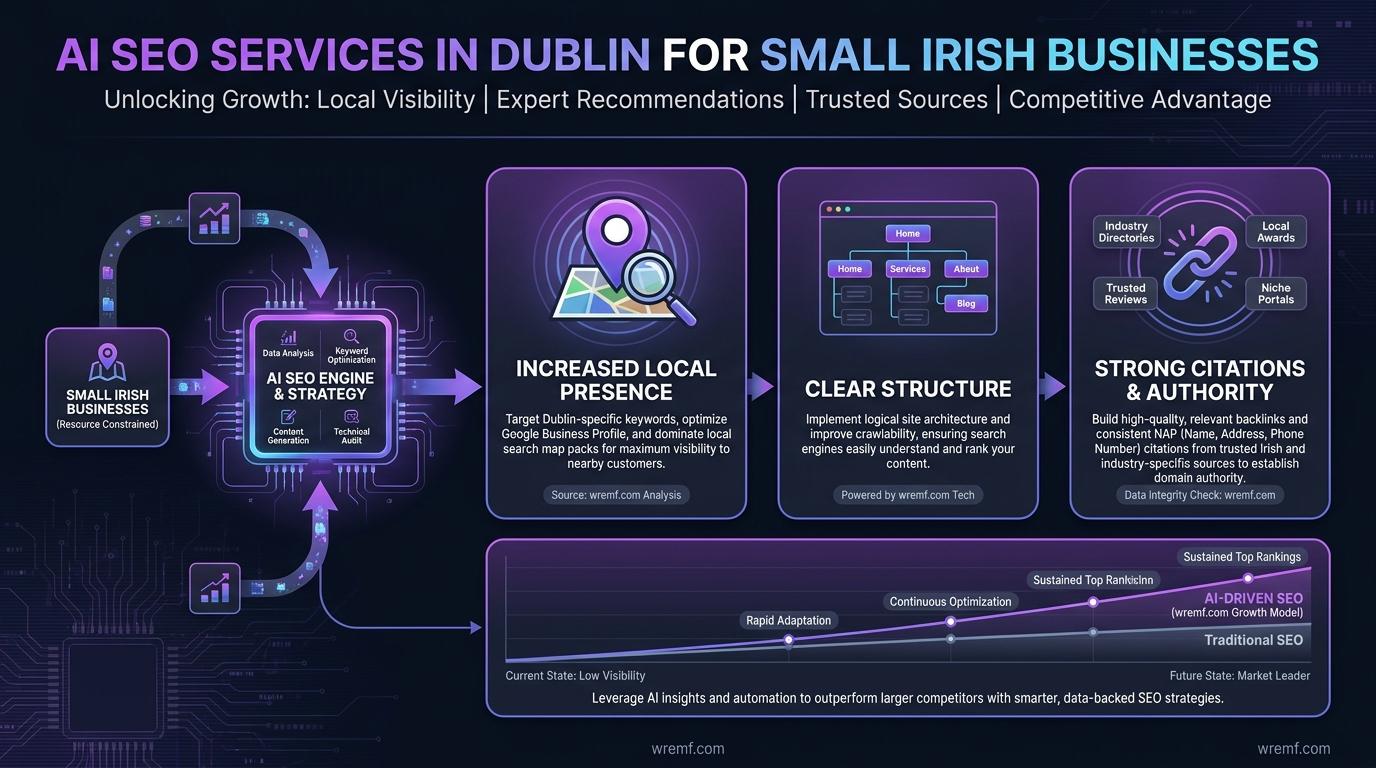
AI SEO services in Dublin help small Irish businesses appear when customers ask AI systems for local providers, expert recommendations, product comparisons, and trusted sources. Smaller businesses can compete when their expertise is clear, structured, and well cited.
AI SEO services are strategy, content, technical, and measurement services designed to improve visibility across AI-powered search engines. AI SEO services matter because small businesses often lack internal teams to manage prompt tracking, schema, citations, content foundations, and AI visibility reporting.
Small Irish businesses should not treat AI SEO as “using ChatGPT to write content.” AI SEO includes the traditional foundations of search engine optimization, plus structured content, answer-first formatting, local citations, brand mentions, AI-generated answer testing, and generative engine optimization.
For Dublin small businesses, AI SEO services often include:
Local AI SEO
Google Business Profile optimization
Structured service pages
Schema markup tuning
Semantic HTML review
Content audits
Citation frequency analysis
Entity-based keywords
Local citation signals
AI search audit workflows
AI-generated answer monitoring
Ireland’s Central Statistics Office reported that Dublin’s population grew by 8 percent to 1,458,154 in Census 2022. (Central Statistics Office) A growing local market increases competition for online visibility, especially in service categories where customers compare options before contacting a business.
Small businesses can benefit from AI SEO when they serve a defined market. A local accounting firm, immigration solicitor, SaaS consultant, fintech advisor, healthcare provider, property company, or marketing agency can build AI visibility by creating specific, structured, trustworthy content around the questions customers already ask.
AI visibility works best when content answers real buying questions directly. Generic service pages such as “We offer digital marketing services” are less useful than pages explaining who the service is for, what problems it solves, how the process works, what evidence supports the method, and how customers should choose a provider.
A practical AI SEO content system for Dublin small businesses includes:
Homepage entity clarity
Location-specific service pages
Industry-specific use-case pages
Comparison content
Answer-first explainers
Review and testimonial structure
Internal linking to related services
Local citations and directory consistency
Schema setup for organization, local business, service, and article content
Structured data is machine-readable information added to a website to help search engines understand entities, relationships, and page meaning. Structured data matters because AI systems and search platforms need clear context about businesses, services, locations, authors, reviews, and topics.
WREMF supports small businesses and startups through software-led measurement and agency-led execution. Companies that want to self-manage can use WREMF for prompt tracking, competitor visibility, AI citations, and AI share of voice. Companies that need execution can work with WREMF as an AI visibility agency for audits, strategy, content systems, technical recommendations, and ongoing optimization.
For Irish startups and growth teams, the WREMF for brands page explains how in-house teams can track AI visibility, prioritize prompt opportunities, and build reporting systems. WREMF’s guide to AI SEO services in the AI era expands on service models, deliverables, and implementation.
AI visibility is not limited to large companies. AI systems often reward focused expertise because niche content can be easier to classify, cite, and summarize than broad generic content.
DID YOU KNOW: The U.S. International Trade Administration reported that Ireland’s ecommerce market value was forecast to reach $6.69 billion in 2025, supported by high household internet access and smartphone usage. (trade.gov)
KEY TAKEAWAY: Small Irish businesses can improve AI visibility by combining local SEO, structured content, citations, and prompt-level measurement.
The next section explains how custom AI SEO audits reveal gaps that standard SEO reports miss.
Custom AI SEO audits tailored for Irish startups and small businesses
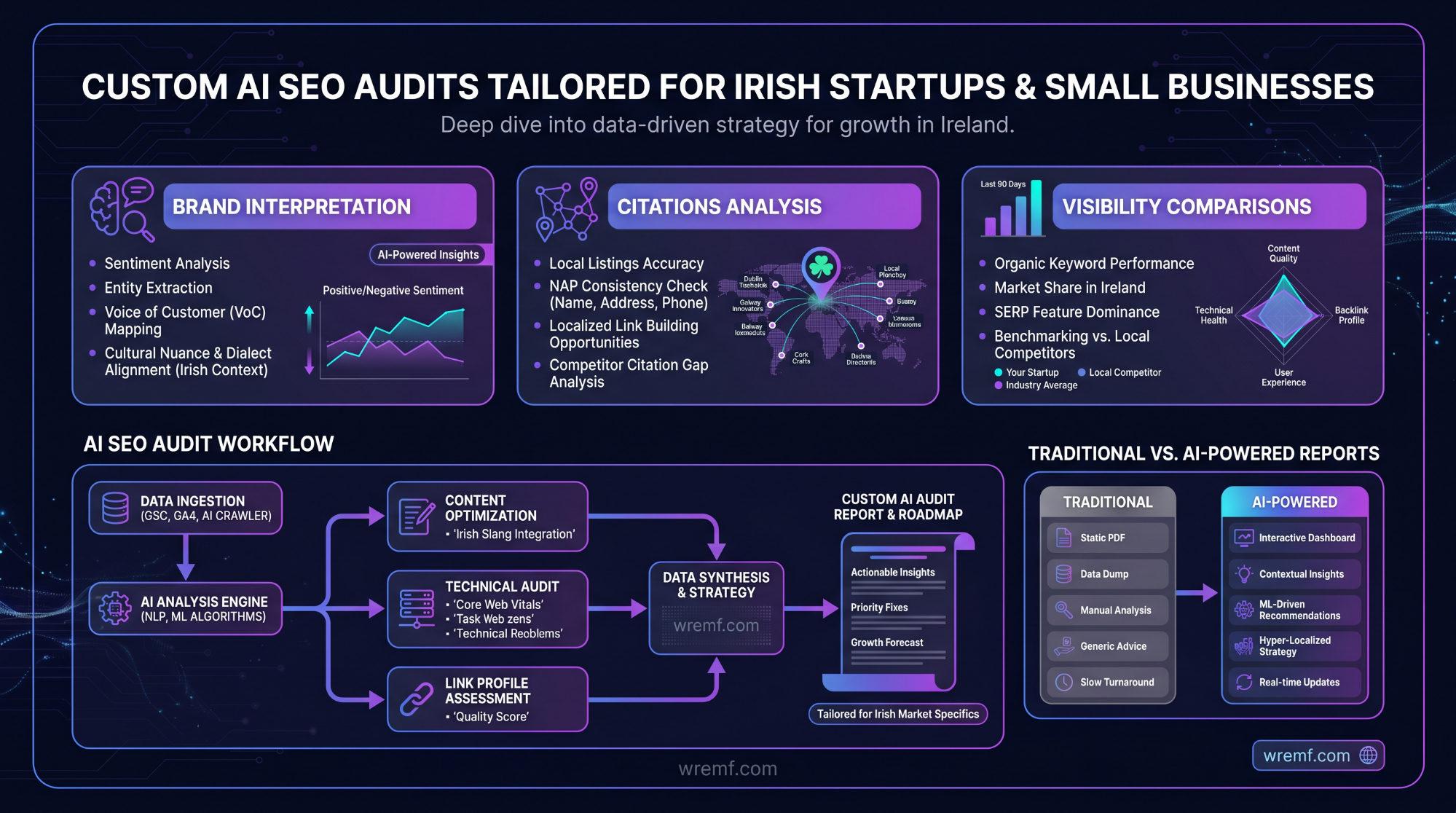
Custom AI SEO audits show how AI systems currently interpret, mention, cite, and compare your brand. Irish startups and small businesses need these audits because traditional SEO reports rarely explain AI-generated answer visibility.
An AI SEO audit is a structured review of prompt visibility, citations, entity authority, technical readiness, content quality, competitor visibility, and AI-generated answer accuracy. An AI SEO audit matters because improvement starts with knowing how AI systems already describe your business.
In practical AI visibility audits, SEO teams frequently discover that the website is technically indexed but not AI-ready. The site may rank for traditional keywords, yet fail to appear in AI-generated answers because content lacks answer-first structure, clear entities, source support, or topical completeness.
A strong AI Search Audit for a Dublin business should review:
How ChatGPT describes the business
Whether Perplexity cites the website or third-party sources
Whether Gemini and Google AI Overviews surface the brand
Whether Bing Copilot includes the business in recommendations
Whether citations are accurate and current
Whether competitors appear more often
Whether schema markup supports entity clarity
Whether content covers commercial and informational prompts
Whether local citations align with website claims
Whether customer-facing descriptions are consistent
AI citations are references, source links, mentions, or supporting materials used by AI systems when generating answers. AI citations matter because cited brands often receive stronger trust signals than brands that are only mentioned.
WREMF’s AI visibility audit process follows five steps:
| Step | What WREMF Reviews | Output |
|---|---|---|
| Audit | Prompts, citations, competitors, technical readiness | AI visibility assessment |
| Strategy | High-value prompts, content gaps, authority gaps | AI search opportunity map |
| Build | Structured pages, content briefs, internal linking, schema guidance | AI-ready content plan |
| Amplify | Brand mentions, citation consistency, third-party trust signals | Authority development plan |
| Measure | AI share of voice, prompt visibility, attribution | Visibility reporting workflow |
This process is useful for Irish startups because early-stage companies often have limited authority signals. A startup may have a strong product, but AI systems may not understand its category, positioning, market, features, pricing, or use cases unless those entities are clearly defined across website content and external sources.
Custom AI SEO audits should also check whether technical foundations support AI ingestion. Technical AI visibility foundations include schema markup, semantic HTML, crawl and rendering checks, metadata, structured content blocks, internal linking systems, and page architecture.
AEO strategy and execution also belong in the audit. Answer engine optimisation is the practice of structuring content so answer systems can extract direct responses. AEO matters because AI-generated answers often rely on concise, answer-first explanations.
For teams that want a structured starting point, WREMF offers GEO audits and a broader AI visibility methodology that connects prompts, citations, competitors, source consistency, and attribution.
WREMF’s related guides on AI Overview optimization, AI Overview SEO, and answer engine optimization provide deeper implementation support for teams improving AI-generated answer readiness.
A common audit finding is that a business has good content volume but weak retrieval clarity. AI systems do not need more vague pages. AI systems need structured, citable, consistent information.
IMPORTANT: An AI SEO audit should test multiple prompts and multiple AI systems because ChatGPT, Gemini, Perplexity, Copilot, and Google AI Overviews can produce different answers for the same business category.
KEY TAKEAWAY: Custom AI SEO audits help Dublin businesses identify missing citations, weak entity signals, technical gaps, and content issues that limit AI visibility.
The next section explains how businesses can appear in AI Overviews and AI-generated answers.
Appear in AI Overviews and AI-generated answers
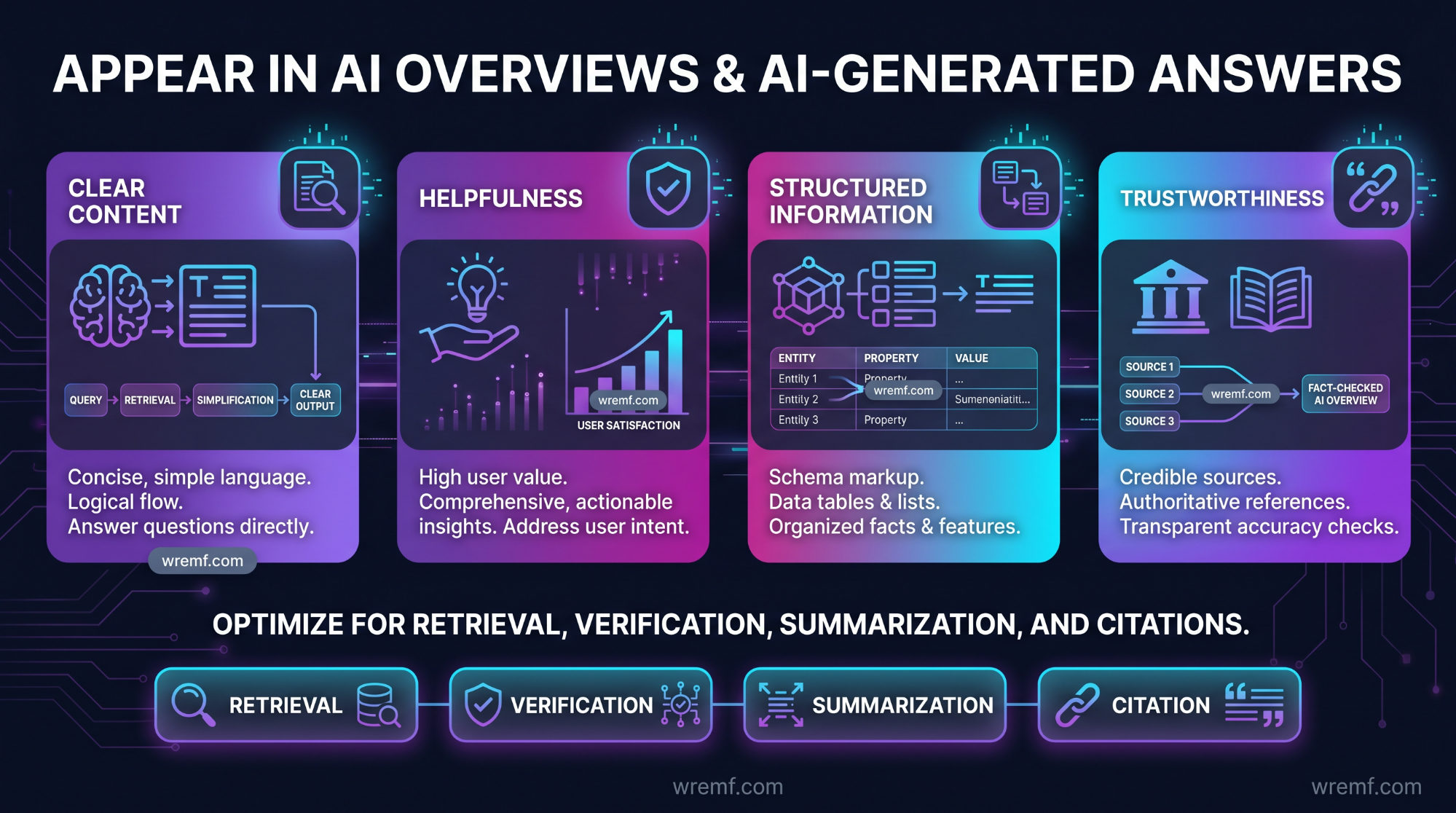
Appearing in AI Overviews and AI-generated answers requires clear, helpful, structured, and trustworthy content. Businesses must make information easy for AI systems to retrieve, verify, summarize, and cite.
Google AI Overviews are AI-generated summaries that appear in Google Search for selected queries. AI Overviews matter because they can answer a user’s question before the user reaches traditional organic listings.
Google Search Central explains that Google’s automated ranking systems are designed to prioritize helpful, reliable, people-first content. (Google for Developers) This matters because AI visibility should not be built on thin, repetitive, or unverified content. AI-ready content must still serve real users.
AI-generated answers are synthesized responses created by AI systems using retrieval, model reasoning, citations, and context. AI-generated answers matter because users often trust summarized recommendations when choosing vendors, tools, agencies, and services.
To appear in AI Overviews and AI-generated answers, a Dublin business should improve five areas:
| Area | What To Improve | Why It Matters |
|---|---|---|
| Content quality | Direct answers, useful examples, topic depth | Supports extraction and trust |
| Entity clarity | Clear business category, location, services, audience | Helps AI systems understand the brand |
| Source citations | References, third-party mentions, reviews, directories | Strengthens trust signals |
| Technical structure | Schema, HTML, metadata, internal links | Improves machine readability |
| Topical authority | Pillars, clusters, comparison pages, service pages | Builds category relevance |
The most effective way to improve AI search visibility is to publish content that answers specific user questions and connects those answers to verifiable sources, structured data, and consistent brand signals.
For Dublin businesses, the content system should include local and commercial context. A SaaS business may need pages for “AI visibility software for SaaS,” “AI SEO services for fintech,” and “GEO strategy for enterprise software.” A local service provider may need pages that connect services, location, customer problems, proof, and process.
Schema markup is code that adds structured meaning to page content. Schema markup matters because search platforms use structured data to understand organizations, products, services, articles, FAQs, reviews, events, and local business details.
Structured content also matters for AI retrieval. Use short answer-first paragraphs, descriptive headings, comparison tables, definition blocks, and clear summaries. Avoid burying key information inside long promotional copy.
WREMF supports this work through AI-ready content briefs, prompt opportunity maps, citation analysis, and content recommendations. These tools help teams decide which pages to create, which answers to structure, and which source gaps to fix.
For further internal reading, see WREMF’s guides to answer engine optimization services, generative AI optimization services, and large language model optimization services.
AI visibility works when your website, third-party citations, brand mentions, structured data, and topical authority all reinforce the same message. AI systems need repeated clarity.
TIP: Put the most important answer near the start of each major section. AI systems and users both benefit when the page states the answer before explaining the details.
KEY TAKEAWAY: AI Overviews and AI-generated answers reward content that is helpful, structured, entity-rich, and supported by consistent citations.
The next section explains how conversational AI search changes the way customers pay attention.
Capture attention in conversational AI search
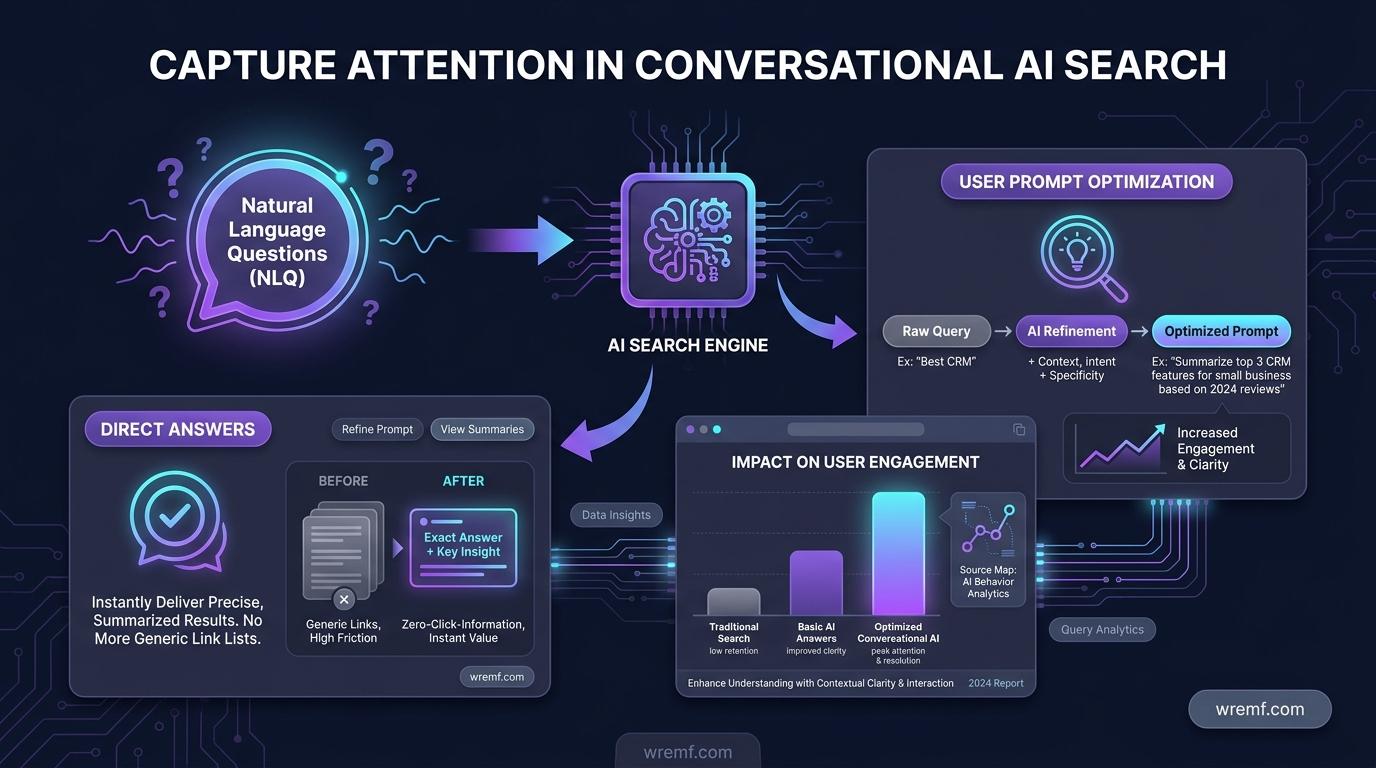
Conversational AI search captures attention by answering natural-language questions directly. Dublin businesses must optimize for user prompts, not only short keywords.
Conversational AI search is a search experience where users ask full questions and receive synthesized responses. Conversational AI search matters because the customer journey now includes dialogue, follow-up questions, comparisons, and recommendations.
A traditional user may search “SEO Dublin.” A conversational user may ask:
“Which AI SEO agency in Dublin is best for a small Irish business?”
“How do I get my SaaS company mentioned in ChatGPT?”
“What tools track AI visibility across Google AI Overviews and Perplexity?”
“Do Dublin businesses need GEO as well as SEO?”
“Which agency can help with AI citation optimization?”
These prompts reveal intent more clearly than short keywords. They also make user experience and content clarity more important. The answer must match the user’s industry, location, budget, stage, risk, and decision criteria.
Prompt-intent content planning is the process of creating content around the questions users ask AI systems. Prompt-intent content matters because AI models respond to complete problems, not only exact-match keywords.
For Dublin businesses, conversational AI search creates new content opportunities:
Local service explainers
“Best for” comparison pages
Industry-specific pages
AI-ready FAQ-style sections inside body content
Buyer guides
Tool comparison pages
Use-case pages
Methodology pages
Audit pages
Content foundations for customer education
This does not mean every page should be written like a chatbot transcript. It means every important page should answer a real customer question clearly, support the answer with context, and make the business entity easy to understand.
In real B2B buying journeys, customers often compare vendors before they speak with sales. AI systems can influence the shortlist by summarizing which businesses appear credible, specialized, local, experienced, or category-relevant.
Brand recommendation visibility measures how often AI systems suggest your company for commercially relevant prompts. Brand recommendation visibility matters because mentions without recommendations may not create buying momentum.
WREMF helps teams monitor conversational AI visibility across prompts, engines, competitors, and citations. Agencies managing several clients can use WREMF for agencies to support white-label reporting, prompt monitoring, and client-facing AI visibility dashboards.
This is especially useful for SEO consultants, GEO agencies, AEO agencies, and AI search optimization services that need to show clients how visibility changes over time. Ranking reports alone do not explain whether ChatGPT, Gemini, Perplexity, or Bing Copilot recommend a client.
For more depth, WREMF’s guides on AI mention tracking and AI brand monitoring explain how mentions, citations, and share of voice support AI visibility reporting.
AI visibility is the measurable presence of a brand inside AI-generated answers, recommendations, citations, and summaries. AI visibility matters because conversational search turns customer questions into recommendation moments.
DID YOU KNOW: Conversational AI search often changes query length, query intent, and comparison behavior. A single AI response can combine informational, commercial, and decision-stage intent.
KEY TAKEAWAY: Conversational AI search rewards businesses that create prompt-ready, answer-first content supported by clear authority signals.
The next section explains how your business becomes a trusted source in its niche.
Become a trusted source in your niche
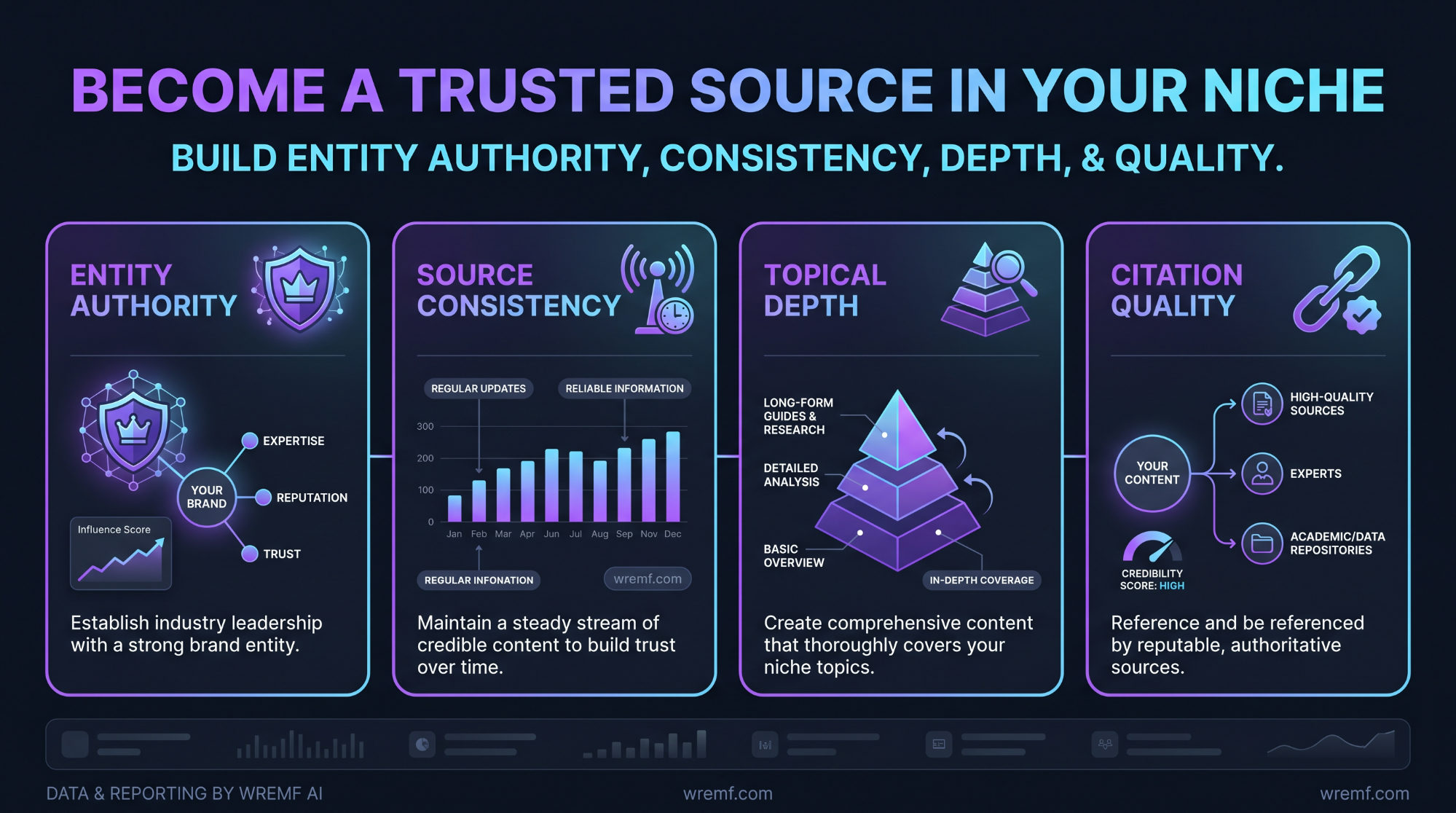
A business becomes a trusted AI source by building entity authority, source consistency, topical depth, and citation quality. AI systems need repeated evidence that your brand is credible for a specific niche.
Entity authority is the strength of the relationship between your brand, your topics, your services, your location, your audience, and external validation. Entity authority matters because AI systems need to understand what your business is qualified to be recommended for.
Traditional SEO often emphasized page-level rankings. AI visibility adds a broader source ecosystem problem. Your own website is only one source. AI models may also evaluate business directories, review platforms, third-party articles, LinkedIn pages, product listings, comparison pages, partner pages, media coverage, and public datasets.
For Dublin businesses, this means the website must align with external signals. If your homepage says you are an AI SEO agency, but external profiles describe your business only as a general marketing agency, AI systems may struggle to classify you accurately.
Source consistency helps AI systems verify business facts. Source consistency matters because conflicting information can weaken trust, reduce citations, or create inaccurate AI-generated answers.
Strong source consistency includes:
Same business name across profiles
Same location and service area
Same core service descriptions
Same category positioning
Same founder or team details where relevant
Same pricing or plan information where public
Same industry specialization
Same brand messaging
Same product and service relationships
Topical authority also matters. A business that wants AI visibility for “AI SEO services in Dublin” should not publish only one page about AI SEO. It should build a content system covering AI SEO, AEO, GEO, AI Overviews, ChatGPT optimization, source citations, local AI SEO, technical SEO, schema, content strategy, authority signals, and reporting.
This is where WREMF’s hybrid model helps. The software tracks prompts, citations, competitors, and visibility. The agency helps with AI visibility consulting, AI citation optimization, structured content, technical visibility foundations, and ongoing execution.
Authority building for AI visibility may include:
Pillar and cluster content
Comparison pages
Use-case pages
Service pages
Third-party mention strategies
Review and directory consistency
Expert commentary
Local citations
Structured data enrichment
Internal linking systems
For technical implementation, WREMF’s API and MCP integrations support teams that want to connect AI visibility data with internal reporting, client portals, dashboards, or advanced workflows.
The EU AI Act entered into force on 1 August 2024, with staged application dates for different categories of obligations. (Digital Strategy) For Dublin and EU-facing companies, this reinforces the broader importance of transparent, accurate, and trustworthy AI-related information.
WREMF’s related guide on enterprise answer engine optimization platforms explains how larger teams can manage AI visibility, governance, reporting, and multi-market optimization at scale.
IMPORTANT: AI citation optimization is not the same as link building. AI citation optimization focuses on whether AI systems can confidently reference, summarize, and validate your brand from trusted sources.
KEY TAKEAWAY: Trusted AI visibility depends on entity clarity, source consistency, topical authority, and citation quality across the wider web ecosystem.
The next section explains when AI SEO services in Dublin are the right fit for your business.
AI SEO services in Dublin: When it's the right fit for your business
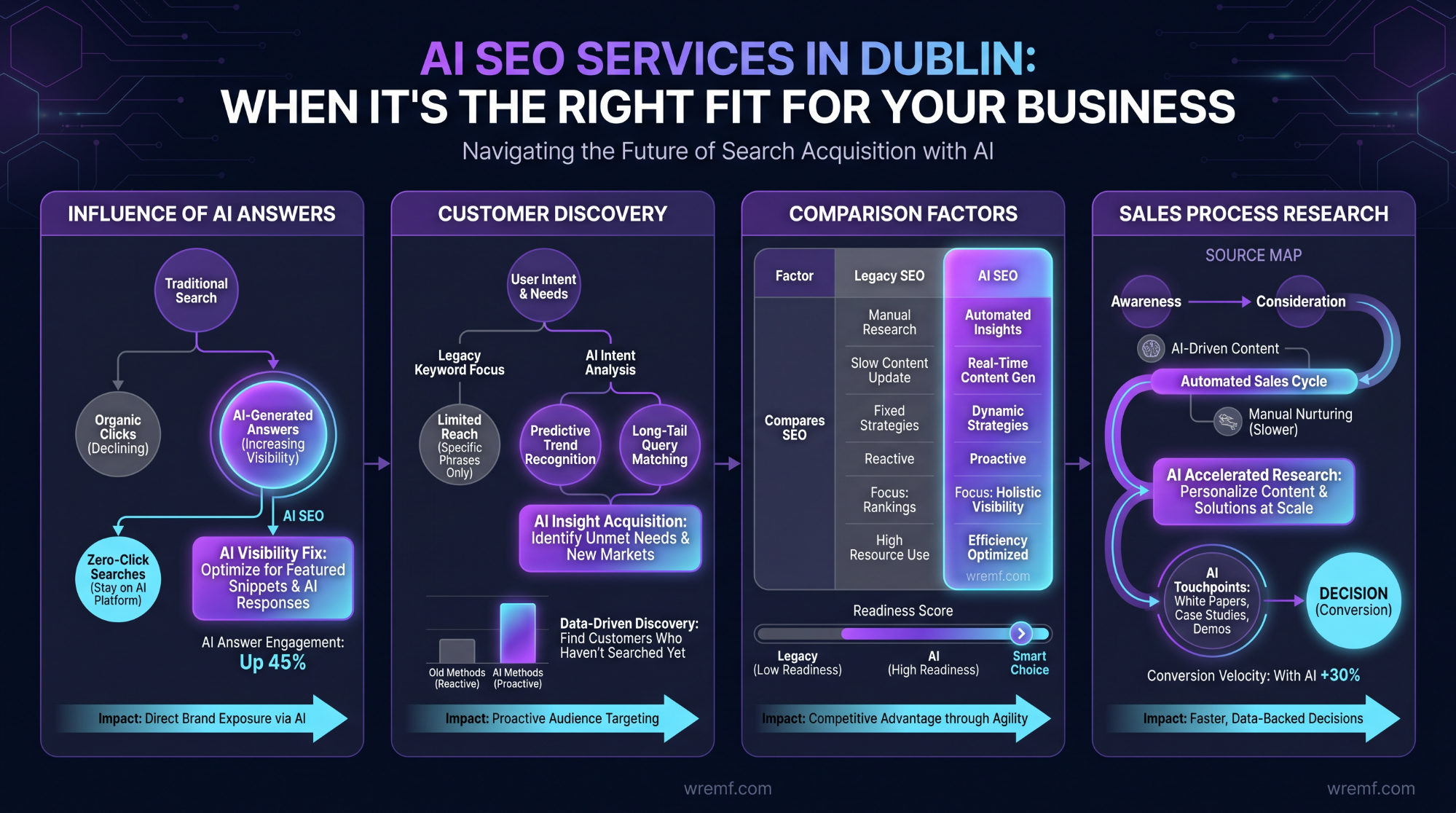
AI SEO services in Dublin are the right fit when AI-generated answers influence how customers discover, compare, or choose your business. The stronger the role of research in your sales process, the more important AI visibility becomes.
AI SEO Strategy is a structured plan for improving search visibility across Google, AI Overviews, ChatGPT, Gemini, Perplexity, Copilot, and Large Language Models. AI SEO Strategy matters because AI search combines content, technical structure, citations, authority, prompts, and reporting.
AI SEO services are especially relevant if:
Customers compare providers before contacting sales
Your category is competitive in Dublin or Ireland
Competitors appear in AI-generated answers
Your organic traffic has declined from informational queries
Your brand is missing from AI recommendations
AI systems describe your company inaccurately
Your content is too generic for prompt-based discovery
Your website lacks schema, structured content, or entity clarity
Your team needs AI visibility reports for leadership or clients
The best delivery model depends on internal resources.
| Model | Best For | What It Provides | Main Limitation | Recommended When |
|---|---|---|---|---|
| Software only | Strong in-house teams | Prompt tracking, citations, dashboards, reports | Execution remains internal | You have SEO, content, and technical resources |
| Agency only | Lean teams | Strategy, audits, implementation, optimization | Less direct software ownership | You need hands-on execution |
| Hybrid software plus agency | Scaling teams | Measurement, strategy, execution, reporting, attribution | Requires coordination | You want visibility tracking plus managed growth |
Software-only AI visibility platforms are best for teams with strong internal execution resources. Managed AI visibility agencies are best for teams that need strategy, implementation, and ongoing optimization. Hybrid models are best for companies that want measurement, strategic guidance, execution support, reporting, attribution, and continuous improvement in one system.
WREMF can support all three models. Businesses can use WREMF as software for AI visibility tracking, as an AI visibility agency for managed execution, or as a hybrid software plus agency solution.
The WREMF agency can help with:
AI visibility audits
Prompt landscape mapping
Citation analysis
Answer structure optimization
Entity reinforcement
AI recommendation visibility analysis
Multi-engine optimization
AI-ready content systems
Authority and citation building
Technical AI visibility foundations
Reporting and attribution
For commercial evaluation, WREMF’s pricing page explains software plan options, while the agency overview explains managed support for teams that need execution.
This distinction matters for Dublin companies because not every business needs the same service depth. A small business may need a focused AI Search Audit and a few structured content upgrades. A SaaS company may need continuous prompt tracking, competitor visibility, content briefs, technical optimization, and sales attribution. An agency may need white-label client reporting and scalable dashboards.
WREMF’s related guides on AI SEO agency selection, AI search engine optimization services, and LLM SEO agency selection help buyers compare service models.
A common decision mistake is hiring a general SEO agency and expecting AI visibility reporting by default. AI visibility consulting requires prompt testing, citation analysis, source consistency review, AI-generated answer monitoring, and multi-engine reporting.
TIP: Choose software when your team can execute. Choose agency support when your team needs strategy and implementation. Choose a hybrid model when leadership wants measurement, execution, and reporting connected.
KEY TAKEAWAY: AI SEO services are the right fit when AI-generated answers affect discovery, trust, comparison, and buying decisions.
The next section explains how to prepare content for AI Overviews, Copilot, and LLMs.
Get ahead of AI-powered search with content optimised for AI Overviews, Copilot, and LLMs
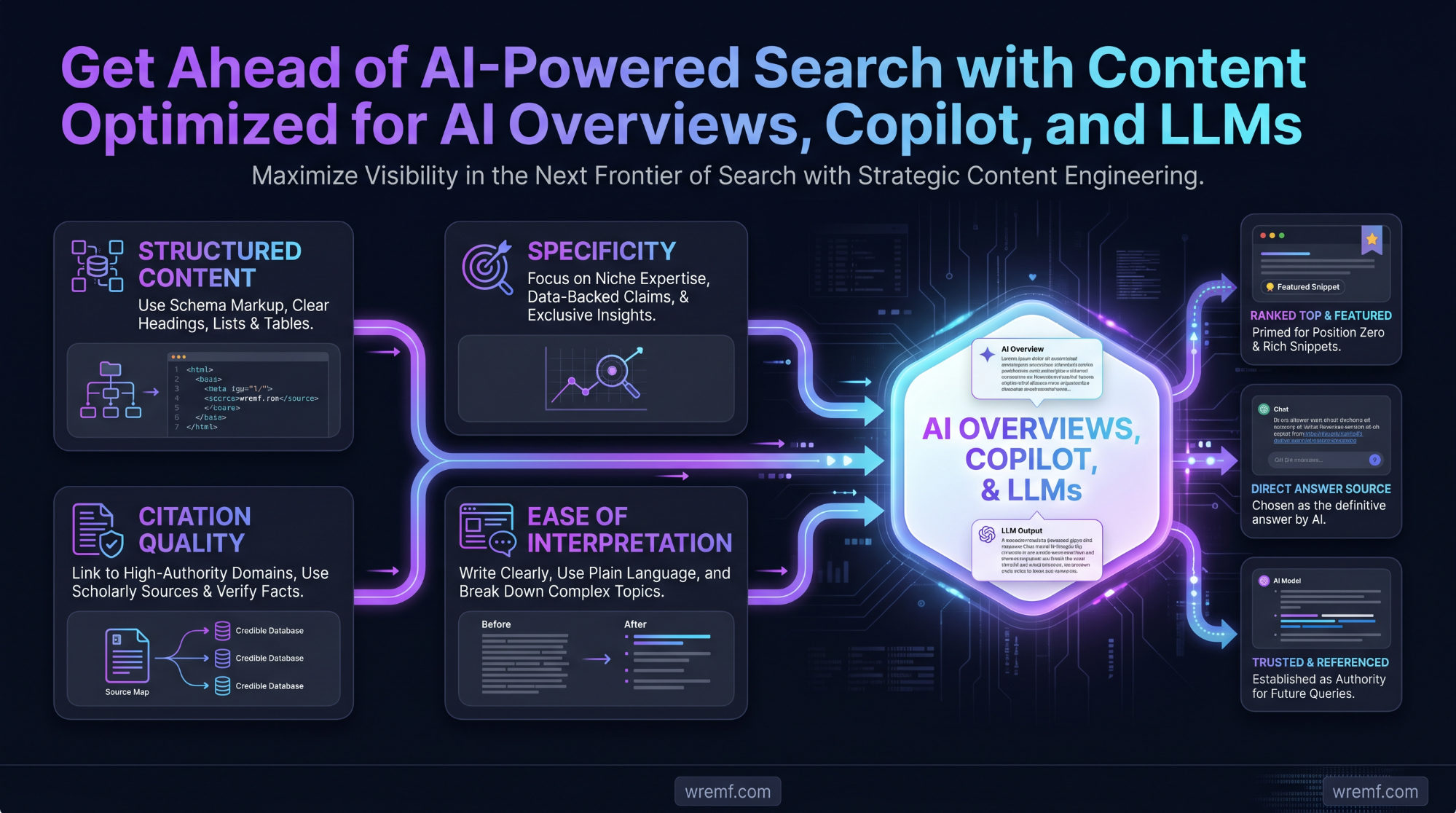
Content optimized for AI-powered search is structured, specific, citable, and easy for AI systems to interpret. To get ahead, businesses must build content systems rather than isolated blog posts.
AI-ready content is content designed for users, search engines, and AI models at the same time. AI-ready content matters because AI systems need clear answers, entity relationships, and trustworthy context to generate reliable responses.
Large Language Models are AI models that process and generate language from patterns, context, and retrieved information. Large Language Models matter for marketing because they increasingly mediate customer research, vendor comparison, customer support, and sales discovery.
A strong AI-ready content system includes:
Pillar pages
Topic clusters
Service pages
Use-case pages
Comparison pages
Answer-first sections
Semantic HTML
Schema markup
Structured data enrichment
Internal linking
Source citations
Local context
Customer-focused examples
For Dublin businesses, content should connect AI search topics with real commercial intent. A page about AI SEO should not only define AI SEO. It should explain when to use AI SEO services, how audits work, how AI Overviews differ from rankings, how Copilot retrieves sources, how ChatGPT presents recommendations, and how customer trust is measured.
Content Foundations are the core pages, structures, and topic clusters that help search engines and AI systems understand a business. Content Foundations matter because AI visibility cannot be built on isolated, disconnected content.
The most important content types for AI visibility include:
| Content Type | Purpose | Example |
|---|---|---|
| Pillar page | Establish broad authority | Complete guide to AI SEO Dublin |
| Service page | Capture buying intent | AI visibility agency Dublin |
| Comparison page | Help AI systems compare options | Software vs agency vs hybrid |
| Use-case page | Match specific buyers | AI SEO for fintech startups |
| Audit page | Capture diagnostic intent | AI visibility audit Ireland |
| Methodology page | Build trust | How AI visibility is measured |
| Reporting page | Support decision-makers | Sample AI visibility report |
WREMF helps with AI-ready content through content briefs, prompt opportunity mapping, source citation analysis, competitive visibility, and AI search visibility reporting. Teams can use WREMF content briefs to structure pages around prompts, entities, citations, and answer-first content blocks.
Technical SEO still matters. AI systems need websites that are crawlable, fast, structured, and semantically clear. Metadata, headings, internal links, schema setup, and HTML structure all support interpretation.
WREMF also supports experimentation through SEO testing, which helps teams evaluate whether content and structural changes improve visibility signals over time.
For broader supporting content, WREMF has published guides on AI search engine optimization tools, AI SEO services, and LLM SEO services.
AI visibility works best when teams measure what AI systems say, improve the sources AI systems trust, and connect those improvements to customer behavior.
A WREMF implementation plan usually follows this path:
Audit current AI visibility across prompts and engines.
Build an AI SEO Strategy based on buying-stage prompts.
Create structured content for AI Overviews, Copilot, ChatGPT, Gemini, and Perplexity.
Improve schema markup, internal linking, and technical readability.
Strengthen citations and third-party authority signals.
Measure AI share of voice, citation frequency, and attribution over time.
DID YOU KNOW: AI-powered discovery requires cross-functional work between marketing, SEO, content, analytics, sales, and technical teams because AI visibility affects both acquisition and customer perception.
KEY TAKEAWAY: Businesses get ahead of AI-powered search by building structured content systems that support retrieval, citations, authority, and measurable visibility.
The next section debunks common myths that prevent businesses from investing correctly in AI visibility.
Common Myths About AI Visibility Debunked
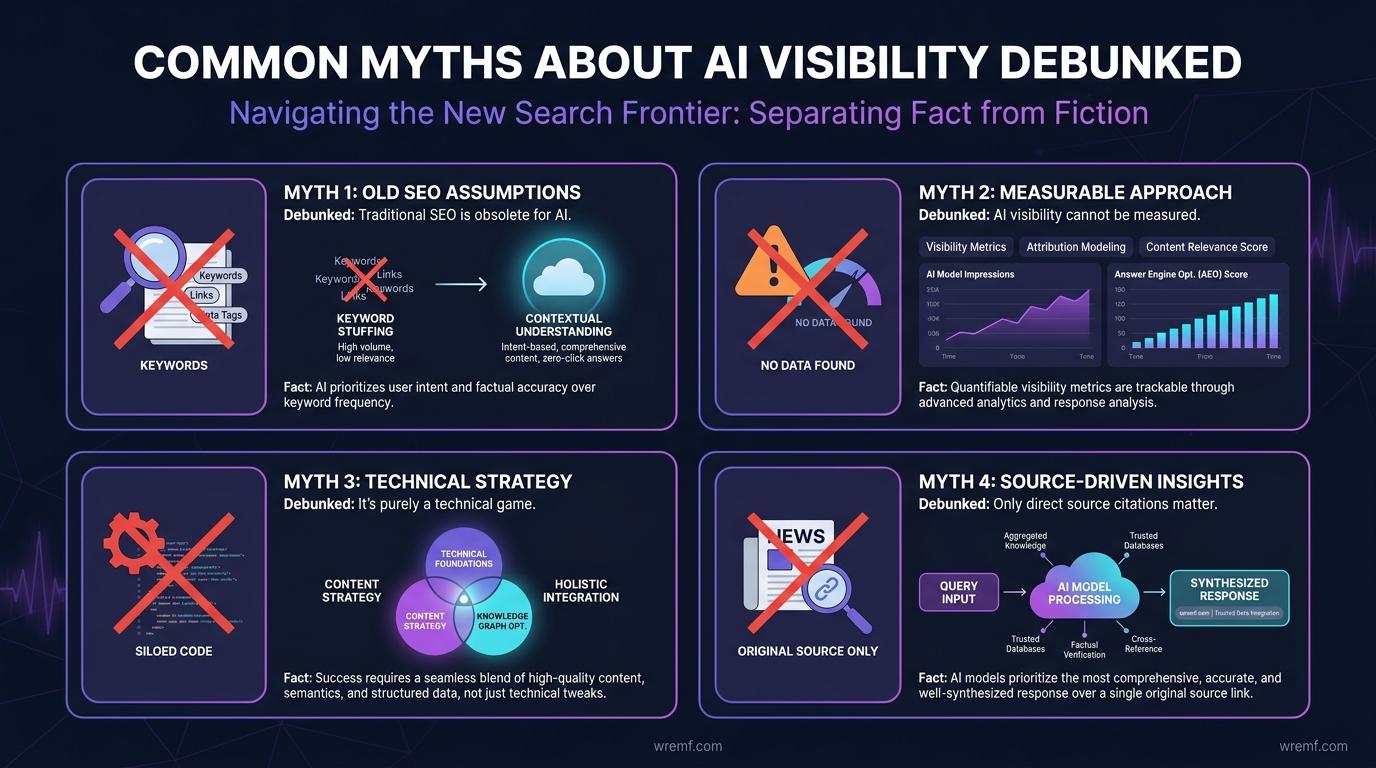
AI visibility myths usually come from applying old SEO assumptions to new AI discovery systems. The right approach is to treat AI visibility as measurable, technical, strategic, and source-driven.
MYTH: Traditional rankings are enough.
FACT: Rankings still matter, but they are not enough. AI systems may generate answers from multiple sources, third-party citations, structured data, reviews, and entity signals. A business can rank well in Google and still fail to appear inside ChatGPT, Gemini, Perplexity, Copilot, or AI Overviews.
MYTH: AI visibility cannot be measured.
FACT: AI visibility can be measured through prompt tracking, AI mentions, source citations, AI share of voice, recommendation visibility, competitor visibility, and AI traffic attribution. The measurement is not identical to static rankings because AI systems are dynamic, but trend-based reporting is practical and useful.
MYTH: GEO replaces SEO.
FACT: GEO does not replace SEO. GEO extends SEO by adding AI-generated answer visibility, source citation tracking, prompt monitoring, entity authority, and AI recommendation optimization. Traditional SEO foundations such as crawlability, content quality, internal linking, technical structure, and authority still support AI retrieval.
MYTH: AI SEO is only about publishing AI-generated content.
FACT: AI SEO is not about producing large volumes of generic content with automation. Effective AI SEO requires structured content, schema markup, semantic clarity, authority signals, brand mentions, citations, local SEO, and expert-level content foundations.
MYTH: Only large enterprises can win in AI-generated answers.
FACT: Large companies often have stronger authority, but small businesses can compete in narrow categories. A focused Dublin business with clear expertise, consistent citations, strong local signals, and structured content can become a trusted source for niche prompts.
AI visibility is both a measurement problem and a source ecosystem problem. AI visibility requires knowing what AI systems say and improving the sources those systems use to form answers.
KEY TAKEAWAY: AI visibility is measurable, but it requires broader tracking than rankings and stronger source consistency than traditional SEO alone.
The conclusion brings the strategy together and explains where WREMF fits.
Conclusion
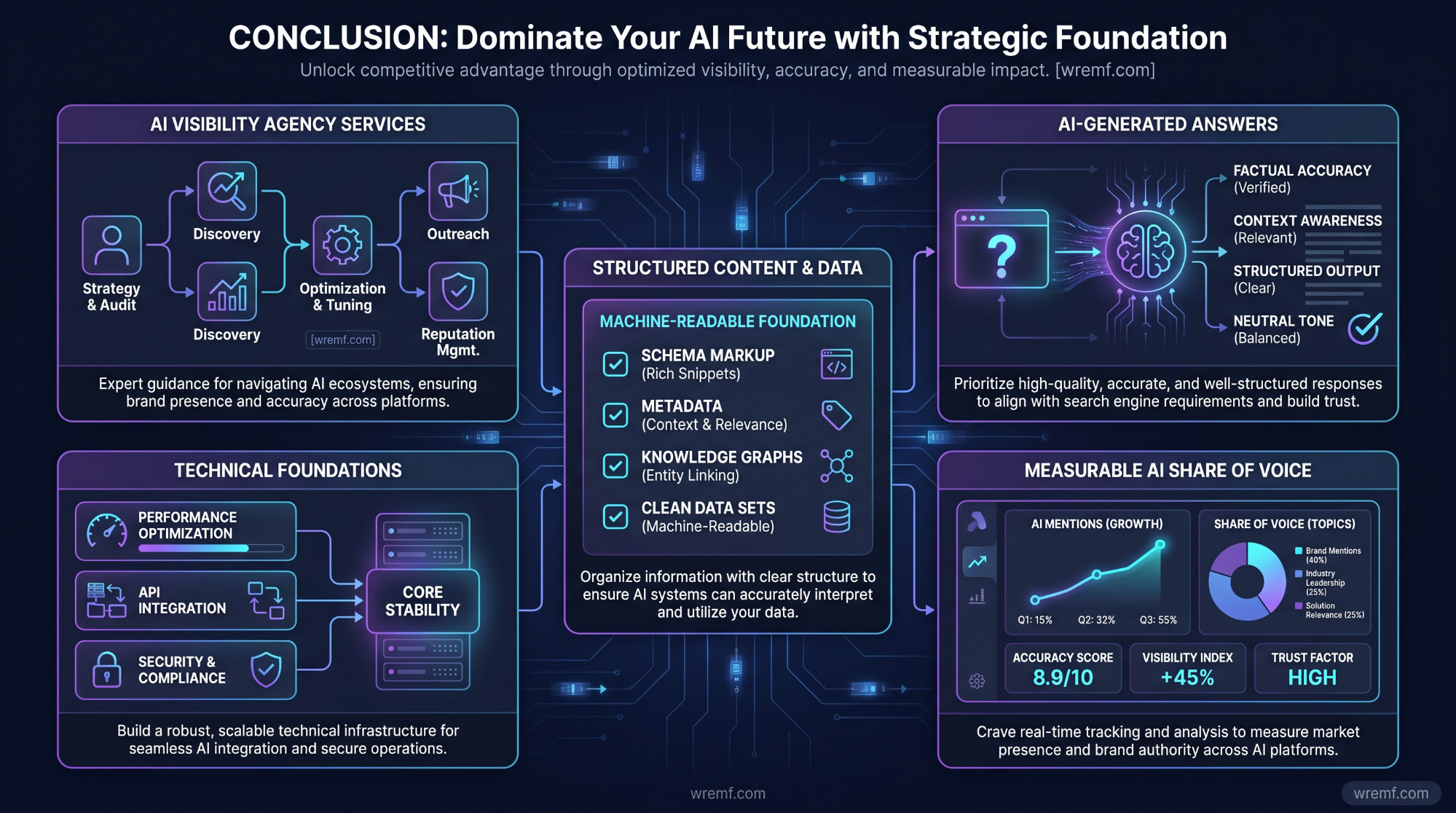
AI visibility agency Dublin services are becoming essential for businesses that want to appear in AI-generated answers, citations, and recommendations across Google AI Overviews, ChatGPT, Gemini, Perplexity, Copilot, and Large Language Models. Traditional SEO still matters, but Dublin businesses now need structured content, AI-ready technical foundations, prompt tracking, source citations, entity authority, and measurable AI share of voice. WREMF helps teams track, improve, and prove AI visibility through software, agency execution, or a hybrid model. To turn AI visibility from guesswork into a measurable workflow, explore the WREMF platform suite or talk to the WREMF agency team for a custom AI visibility roadmap.
Frequently Asked Questions About AI Visibility Agency Dublin
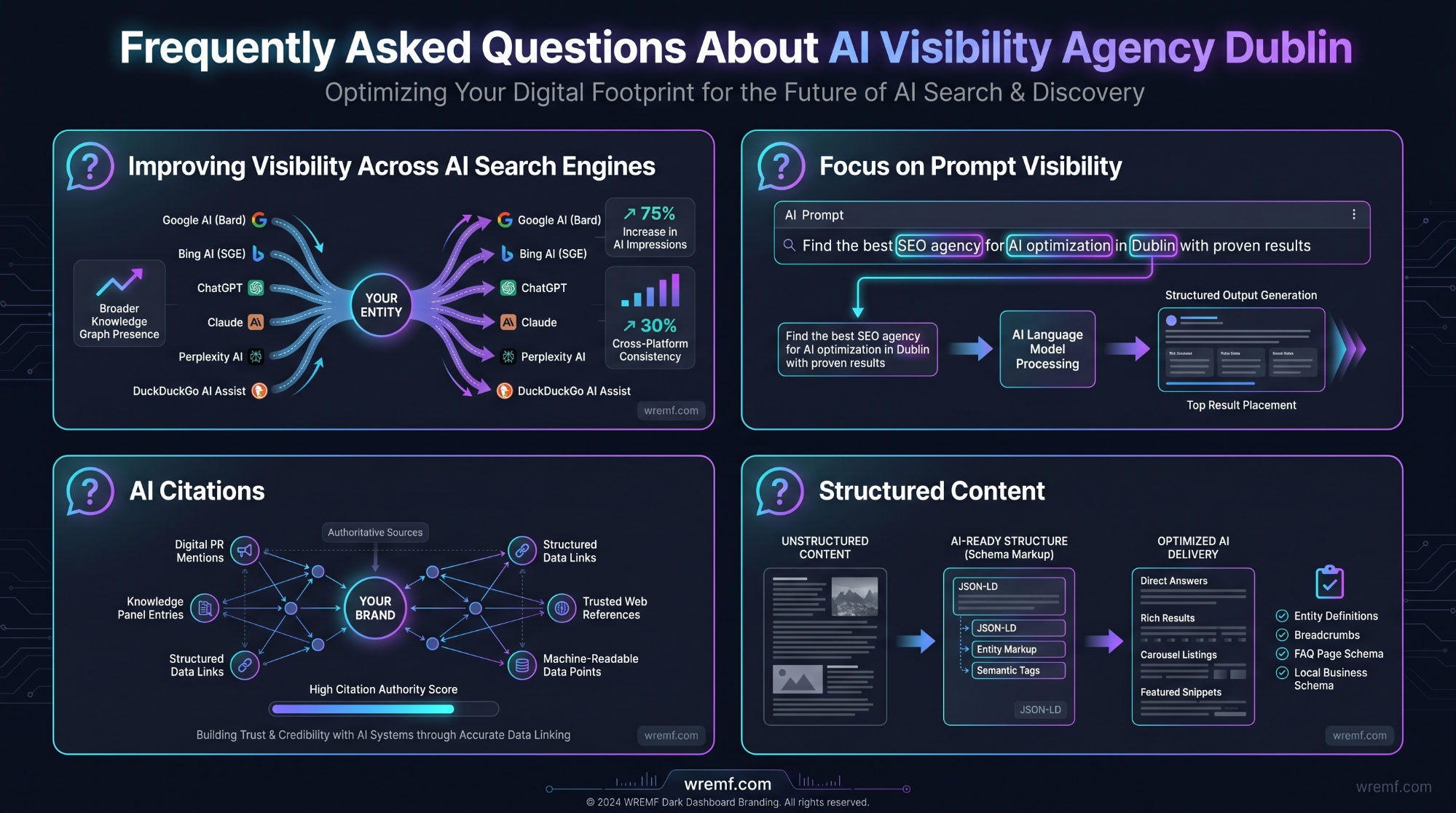
What is an AI visibility agency in Dublin?
An AI visibility agency in Dublin helps Irish businesses improve how they appear across AI search engines, AI-generated answers, Google AI Overviews, ChatGPT, Gemini, Perplexity, Copilot, and other AI discovery surfaces. Unlike a traditional SEO agency, an AI visibility agency focuses on prompt visibility, AI citations, brand mentions, source consistency, structured content, entity authority, and recommendation visibility. WREMF works as both an AI visibility software platform and a senior-led execution partner for B2B brands that want to track, improve, and prove AI visibility across 10 AI engines. Teams that need strategy, audits, content optimisation, and managed execution can explore the WREMF AI visibility agency.
What is AI SEO and how is it different from traditional SEO?
AI SEO is the practice of optimising content, technical structure, authority signals, and brand entities so AI systems can understand, cite, and recommend a business in generated answers. Traditional SEO focuses mainly on search engine rankings, organic traffic, backlinks, and keyword positions. AI SEO adds prompt tracking, citation analysis, answer-first content, structured data, entity reinforcement, and Generative Engine Optimisation. Google explains that AI features in Search can provide snapshots with links that help users explore information more deeply, which makes source quality and content structure more important for brands seeking visibility in AI search. (Google for Developers)
What is AI SEO for businesses in Dublin and Ireland?
AI SEO for businesses in Dublin and Ireland means optimising a website, brand presence, content strategy, and citation footprint for AI-powered search experiences used by Irish and international customers. This includes appearing in Google AI Overviews, ChatGPT search, Perplexity answers, Gemini responses, Copilot summaries, and other AI-generated discovery journeys. Dublin businesses in SaaS, fintech, pharma, professional services, life sciences, ecommerce, and local services can use AI SEO to improve how AI models interpret their expertise. WREMF helps Irish businesses measure prompt visibility, compare competitors, identify citation gaps, and build AI-ready content systems through the WREMF AI visibility suite.
When are AI SEO services in Dublin the right fit for a business?
AI SEO services in Dublin are the right fit when a business depends on search visibility, expert positioning, lead generation, local discovery, or B2B buying journeys that are increasingly influenced by AI-generated answers. They are especially useful when prospects ask ChatGPT, Gemini, Perplexity, Google, or Copilot for recommendations, comparisons, definitions, vendors, or local providers. A Dublin business may need AI SEO services if organic traffic is changing, competitors are being cited in AI answers, content is not structured for answer extraction, or leadership wants clearer reporting on AI search visibility. WREMF supports software-only, agency-led, and hybrid execution models for different levels of internal capacity.
Is your content ready for AI-powered search?
Your content is ready for AI-powered search only if it is clear, structured, authoritative, crawlable, and useful enough for AI systems to retrieve and summarise accurately. AI-ready content usually includes direct answers, strong headings, semantic HTML, schema markup where appropriate, source-backed claims, entity clarity, internal links, FAQs, comparison sections, and topical depth. Content that is vague, thin, duplicated, or poorly structured may struggle to appear in AI-generated answers even if it performs reasonably in traditional search. WREMF’s AI-ready content brief tools help teams turn prompt, citation, and competitor insights into practical content recommendations.
How is AI changing search for Dublin businesses?
AI is changing search by moving users from link-by-link browsing toward answer-first discovery. Instead of typing a short keyword and scanning 10 blue links, users now ask longer questions and receive summarised answers, citations, follow-up suggestions, and recommendations. OpenAI says ChatGPT search can provide timely answers with links to relevant web sources, which shows how conversational interfaces are becoming part of everyday discovery. (OpenAI) For Dublin businesses, this means SEO, content, local visibility, citations, and brand authority must be optimised for AI systems as well as traditional Google Search.
Has AI search caused rankings or traffic to drop?
AI search may contribute to traffic changes when users get answers directly inside AI Overviews, ChatGPT, Perplexity, Gemini, or Copilot instead of clicking through to websites. However, rankings and traffic can also change because of seasonality, technical issues, content decay, competitor improvements, or Google algorithm updates. The practical first step is not to assume one cause. Businesses should compare traditional rankings, organic traffic, AI referral traffic, prompt visibility, citation frequency, and competitor mentions. WREMF helps teams investigate these changes with prompt monitoring, AI citation tracking, competitor visibility, and AI traffic attribution inside one measurement workflow.
Is your website seen as an authority in your niche?
Your website is seen as an authority when search engines and AI systems can clearly connect your brand with a topic, industry, location, service, and body of trusted evidence. Authority is built through expert content, consistent brand information, relevant citations, backlinks, structured data, internal linking, original insights, and third-party mentions. For AI visibility, authority also depends on whether AI models can identify your brand as a reliable source for specific prompts. WREMF helps businesses assess authority gaps through AI visibility audits, citation analysis, competitor comparisons, and source consistency reviews using the WREMF methodology.
How can content work better for AI-powered search?
Content works better for AI-powered search when it answers real user questions clearly, uses structured headings, defines entities, supports claims with credible sources, and connects related topics through internal links. AI systems need enough context to understand who the content is for, what problem it solves, why the source is trustworthy, and how the answer compares with alternatives. Practical improvements include adding direct answer paragraphs, FAQs, comparison tables, use-case sections, schema markup, and clearer service pages. For Dublin businesses, this also means aligning content with local search intent, Irish market terms, and customer questions across Google, ChatGPT, Gemini, Perplexity, and Copilot.
Is AI SEO just about using ChatGPT or AI tools to create content?
No. AI SEO is not just using ChatGPT or AI tools to create content faster. Content production is only one part of AI visibility. Real AI SEO also includes technical SEO, schema setup, structured data enrichment, prompt research, entity optimisation, source citation tracking, competitor monitoring, local citations, topical authority, and answer-first content formatting. A common mistake is publishing more AI-written content without improving trust, accuracy, structure, or authority. WREMF helps teams move beyond content generation by combining prompt intelligence, source citation tracking, competitive landscape analysis, and managed AEO and GEO execution.
Do keywords still matter in AI SEO?
Yes, keywords still matter in AI SEO, but they work differently from traditional keyword stuffing or exact-match targeting. AI systems interpret keywords alongside entities, context, user intent, topic coverage, brand authority, and source credibility. Dublin businesses still need terms such as AI SEO, AI visibility, Generative Engine Optimisation, local SEO, citations, schema, content strategy, and industry-specific phrases, but those terms must appear naturally inside useful content. The best approach is to map keywords to customer questions, buying-stage prompts, comparison searches, and AI-generated answer patterns rather than repeating phrases mechanically.
Do I need to rewrite my entire site for AI SEO?
No. Most businesses do not need to rewrite their entire site for AI SEO. A better approach is to audit the website, identify high-value pages, improve the weakest content blocks, strengthen entity signals, add structured data where useful, and build missing answer-first content around important prompts. In practical AI visibility audits, teams often find that service pages, comparison pages, FAQs, case-study-style proof, and category pages need targeted updates first. WREMF’s GEO audit workflow helps businesses prioritise which pages, prompts, citations, and competitors matter most before investing in large-scale rewrites.
How is AI changing how search results appear?
AI is changing search results by adding generated summaries, conversational answers, cited sources, follow-up prompts, and recommendation-style responses above or alongside traditional results. Google says AI Overviews provide a snapshot of key information with links that let users explore more on the web. (Home) ChatGPT search, Perplexity, Gemini, and Copilot also create answer-led experiences where the user may not see a normal list of rankings first. This means businesses must optimise for being cited, summarised, trusted, and recommended, not only for ranking in a conventional search results page.
Can you optimise content for Google AI Overviews and featured answers?
Yes. Content can be optimised for Google AI Overviews and featured answers, but no agency can guarantee that Google or any AI system will display a specific page. The practical process includes improving answer-first structure, content depth, schema markup, source quality, page experience, internal links, entity clarity, and topical authority. Google’s structured data documentation explains that structured data helps Google understand page content and the entities included in that content. (Google for Developers) WREMF helps teams identify which prompts, citations, and content gaps should be prioritised for AI Overviews, featured answers, and broader AI search visibility.
Will AI SEO replace traditional SEO methods?
No. AI SEO will not replace traditional SEO methods, but it changes what complete search optimisation needs to include. Technical SEO, crawlability, indexability, site speed, internal links, helpful content, backlinks, and keyword research still matter. AI SEO adds new layers such as prompt tracking, AI citation monitoring, source consistency, entity authority, AI share of voice, and generative answer optimisation. Businesses that ignore traditional SEO may still struggle to be discovered by AI systems because many AI search experiences depend partly on web content, indexed sources, and authority signals. The strongest strategy combines SEO, AEO, GEO, and AI visibility measurement.
Can AI SEO tools help create content faster?
Yes. AI SEO tools can help create content faster, but speed is only useful when the content is accurate, structured, differentiated, and aligned with search intent. AI tools can assist with content briefs, topic clusters, FAQ ideas, semantic expansion, metadata drafts, internal link planning, and answer-first formatting. However, human review is still needed for expertise, accuracy, positioning, compliance, examples, and brand voice. WREMF supports content operations with prompt intelligence, citation insights, competitor visibility, and AI-ready content recommendations so teams can create content that is not only faster, but more strategically aligned with AI search.
Is AI SEO only for large websites, or can small businesses benefit too?
AI SEO is not only for large websites. Small businesses in Dublin and across Ireland can benefit because AI systems often answer local, niche, and service-specific questions where clear authority and accurate information matter. A small business can improve AI visibility by strengthening service pages, Google Business Profile data, local citations, reviews, FAQs, structured content, and industry-specific expertise. Smaller companies may not need enterprise-scale automation at first. They often need a focused AI visibility audit, a practical content roadmap, and consistent execution across local SEO, AEO, GEO, and citation optimisation.
How do I get started with AI SEO?
The best way to start with AI SEO is to run an AI visibility audit before creating more content. The audit should check how your brand appears across ChatGPT, Google AI Overviews, Gemini, Perplexity, Copilot, and other AI systems for commercial, informational, and comparison prompts. It should also review competitors, citations, source consistency, structured data, content gaps, and technical SEO foundations. WREMF helps teams start with prompt landscape mapping, citation analysis, AI visibility scoring, and content recommendations. Businesses can review reporting examples in a WREMF sample AI visibility report.
How do I know if AI is impacting my traffic?
You can identify AI’s impact on traffic by comparing organic traffic trends, rankings, AI referral traffic, branded search demand, prompt visibility, AI citations, and competitor mentions over time. A drop in Google clicks does not automatically mean AI search is the only cause. You should check whether AI Overviews appear for your key queries, whether competitors are cited instead of your brand, whether your content is being summarised without clicks, and whether customer journeys are shifting to conversational platforms. WREMF connects AI visibility monitoring with attribution signals so teams can separate ranking issues, content gaps, and AI search effects more clearly.
How much does AI SEO cost compared with Google Ads?
AI SEO usually works differently from Google Ads because it is an organic visibility and authority-building investment rather than a paid media channel. Google Ads costs depend on campaign structure, competition, bidding, quality score, location, and cost per click. AI SEO costs depend on audit depth, content volume, technical work, citation building, reporting needs, and whether the business uses software, agency support, or a hybrid model. WREMF pricing starts with software plans for teams that can execute internally, while agency or hybrid engagements are better for businesses that need strategy, implementation, and ongoing optimisation. Teams can compare options on the WREMF pricing page.
What is the value of AI-driven SEO?
The value of AI-driven SEO is that it helps businesses stay discoverable when customers use AI systems to research problems, compare vendors, ask for recommendations, and make buying decisions. Traditional SEO may show where a page ranks, but AI-driven SEO shows whether AI systems mention, cite, summarise, or recommend a brand. This matters for Dublin businesses because AI discovery can influence awareness, trust, sales conversations, and lead quality before a user ever visits a website. The measurable value comes from prompt coverage, citation growth, share of voice, content gap closure, and stronger visibility across AI search platforms.
Do you combine GEO with traditional SEO?
Yes. A strong AI visibility strategy should combine GEO with traditional SEO. Traditional SEO helps search engines crawl, index, understand, and rank content. Generative Engine Optimisation focuses on how AI systems retrieve, interpret, cite, and summarise that content in generated answers. The two disciplines support each other because weak technical SEO can limit discoverability, while weak GEO can limit inclusion in AI-generated responses. WREMF combines traditional SEO testing, prompt tracking, source citation analysis, competitor visibility, and GEO audits so businesses can optimise for Google Search, Google AI Overviews, ChatGPT, Gemini, Perplexity, Copilot, and other AI engines.
How do you measure GEO success in Dublin?
GEO success in Dublin is measured by tracking whether a business appears, gets cited, and is recommended for relevant AI prompts across locations, services, industries, and buying stages. Useful metrics include prompt visibility, AI share of voice, citation frequency, competitor comparison, source diversity, branded mentions, local query coverage, AI referral traffic, and lead quality. For Dublin businesses, measurement should include local and national prompts, such as service searches in Dublin, Ireland-wide comparisons, and industry-specific vendor questions. WREMF’s competitive landscape tracking helps teams compare their AI visibility against competitors across prompts and AI engines.
Who is AI visibility consulting for?
AI visibility consulting is for businesses that need strategic guidance, implementation support, or managed execution to improve visibility across AI search systems. It is useful for B2B SaaS companies, fintech firms, agencies, professional services firms, local businesses, ecommerce brands, and growth-stage companies that cannot rely on traditional SEO alone. It is also useful for marketing teams that have data but need help turning it into a content, citation, and authority roadmap. WREMF provides AI visibility consulting through a hybrid model that can include audits, strategy, content recommendations, technical guidance, reporting, and ongoing optimisation support.
What is search engine optimisation for AI in Ireland?
Search engine optimisation for AI in Ireland is the process of making Irish websites, brands, and content easier for AI systems to understand, trust, cite, and recommend. It combines technical SEO, local SEO, content strategy, schema markup, structured data, AEO, GEO, citations, authority building, and prompt visibility tracking. For Irish businesses, this may include Dublin-specific service pages, Ireland-focused content, local business citations, industry authority signals, and clear answers to customer questions. The goal is not only to rank on Google, but also to appear in AI-generated answers across ChatGPT, Gemini, Perplexity, Google AI Overviews, and Copilot.
What is Generative Engine Optimisation?
Generative Engine Optimisation, or GEO, is the process of improving how a brand, page, or source appears inside AI-generated answers from systems such as ChatGPT, Gemini, Perplexity, Copilot, and Google AI Overviews. GEO focuses on retrieval, citations, answer structure, entity clarity, topical authority, and source consistency. SEO asks, “Can search engines rank this page?” GEO asks, “Can AI systems understand, cite, and recommend this source for the right prompts?” WREMF supports GEO through prompt monitoring, AI citations, competitor visibility, GEO audits, and managed execution for teams that want both measurement and implementation.
What is Answer Engine Optimisation?
Answer Engine Optimisation, or AEO, is the process of structuring content so search engines and AI systems can extract clear, direct answers to user questions. AEO focuses on definitions, FAQs, featured answers, concise explanations, structured headings, schema markup, and user-intent alignment. It is closely related to AI SEO and GEO because AI search platforms often favour content that is easy to interpret and summarise. Businesses can use AEO to improve visibility for informational, local, and buying-stage questions. WREMF helps teams build AEO systems through AI-ready content briefs, prompt mapping, citation analysis, and senior-led execution.
Why do schema markup and structured data matter for AI SEO?
Schema markup and structured data matter because they help search systems understand the meaning of a page, the entities on it, and the relationships between content elements. Google states that structured data helps Google understand page content and gather information about people, organisations, products, and other entities represented in markup. (Google for Developers) For AI SEO, schema should support clear content rather than replace it. The strongest approach combines structured data with semantic HTML, answer-first copy, strong internal links, accurate metadata, consistent business information, and expert content that AI systems can interpret confidently.
Can AI visibility services help Dublin startups and small businesses?
Yes. AI visibility services can help Dublin startups and small businesses become clearer, more trusted sources in their niche. Startups often need visibility for category education, competitor comparisons, product-led content, funding-related credibility, and early customer acquisition. Small businesses often need local AI SEO, citations, Google Business Profile consistency, service pages, and answer-ready FAQs. The most practical approach is usually a focused audit, high-priority prompt mapping, and a staged content plan rather than a large enterprise programme. WREMF supports this through software for tracking and agency services for teams that need hands-on implementation.
Can AI SEO help local searches in Dublin?
Yes. AI SEO can help local searches in Dublin by improving how AI systems understand a business’s location, services, reputation, citations, and relevance to local customer questions. Local AI visibility depends on accurate business information, local content, reviews, Google Business Profile data, citations, service-area pages, and consistent entity signals across the web. For example, a business may want to appear when users ask ChatGPT, Gemini, Perplexity, or Google for the best provider in Dublin for a specific service. AI SEO strengthens the signals that help those systems describe, compare, and recommend local businesses more accurately.
How can a Dublin business appear in ChatGPT, Perplexity, Gemini, and Copilot answers?
A Dublin business can improve its chances of appearing in ChatGPT, Perplexity, Gemini, and Copilot answers by publishing clear, authoritative content and strengthening its presence across trusted sources. Practical steps include answering customer questions directly, creating comparison and use-case pages, improving structured data, earning relevant mentions, maintaining citation consistency, building topical authority, and monitoring prompt visibility. Microsoft says Copilot Search in Bing gives summarised answers with cited sources and suggestions for further exploration, which reinforces the importance of source visibility and credibility. (Microsoft) WREMF helps monitor these surfaces through multi-engine AI visibility tracking.
What are AI citations and why do they matter?
AI citations are source references, links, or mentions that AI systems use when generating answers. They matter because they show which sources AI systems rely on when explaining a topic, comparing vendors, or recommending options. A brand that is frequently cited for relevant prompts may have stronger AI visibility than a brand that only ranks in traditional search results. AI citations also help marketing teams identify which third-party sources, content formats, and authority signals influence AI-generated answers. WREMF’s source citation tracking helps teams monitor where citations come from and which competitors are being referenced.
What is prompt tracking in AI visibility?
Prompt tracking is the process of monitoring how a brand appears for specific questions users might ask AI systems. Instead of tracking only keywords, prompt tracking measures visibility across conversational queries such as “best AI SEO agency in Dublin,” “top SaaS SEO tools,” or “how to optimise for Google AI Overviews.” Prompt tracking helps teams see whether they are mentioned, cited, recommended, ignored, or misrepresented. WREMF’s prompt intelligence tools help businesses monitor commercial, informational, local, and competitor prompts across 10 AI discovery surfaces.
What is AI share of voice?
AI share of voice measures how often a brand appears compared with competitors inside AI-generated answers for a defined set of prompts. It is similar in concept to search visibility or market share, but it focuses on AI mentions, citations, recommendations, and answer placement. For Dublin businesses, AI share of voice can show whether competitors are more visible in ChatGPT, Google AI Overviews, Perplexity, Gemini, or Copilot for local and commercial queries. This metric helps leadership understand whether AI search visibility is improving, declining, or being captured by competitors.
What does an AI visibility audit include?
An AI visibility audit usually includes prompt landscape mapping, AI citation analysis, competitor visibility benchmarking, source consistency checks, content structure review, schema and structured data review, technical SEO assessment, topical authority analysis, and reporting recommendations. The audit should show where a brand appears, where competitors appear, which sources AI systems cite, and which content or authority gaps limit visibility. WREMF audits follow a practical workflow: audit, strategy, build, amplify, and measure. This helps teams move from diagnosis to action rather than receiving a static report with no execution plan.
How does WREMF help with AI SEO services in Dublin?
WREMF helps with AI SEO services in Dublin by combining AI visibility tracking software with optional agency execution. The platform monitors prompts, citations, competitors, source consistency, AI share of voice, and AI traffic attribution across 10 AI engines. The agency side helps with audits, AEO strategy, GEO execution, content briefs, structured rewrites, authority development, technical recommendations, and reporting. This hybrid model is useful for Dublin businesses that want measurement, strategy, and implementation support in one workflow. WREMF is built for B2B SaaS, agencies, growth-stage brands, and marketing teams that need measurable AI visibility.
Should I choose AI visibility software, an agency, or a hybrid model?
You should choose AI visibility software if your internal team can analyse data and execute recommendations. You should choose an agency if you need strategy, content optimisation, technical guidance, citation building, and ongoing implementation. A hybrid model is best when you want both measurement and execution in one system. Many Dublin businesses need the hybrid model because AI visibility requires tracking, interpretation, content improvements, authority building, and reporting over time. WREMF supports all three approaches, including software-only plans, managed agency services, and combined software plus senior-led execution.
What should an AI SEO agency in Dublin deliver?
An AI SEO agency in Dublin should deliver more than generic SEO recommendations. Useful deliverables include an AI visibility audit, prompt opportunity map, AI citation report, competitor visibility analysis, GEO strategy, AEO content recommendations, schema guidance, internal linking improvements, source consistency review, content briefs, authority development plan, and performance reporting. The agency should also explain what can be measured, what cannot be guaranteed, and how visibility will be tracked over time. WREMF agency engagements may include audits, dashboards, technical recommendations, AI-ready content systems, attribution insights, and ongoing optimisation support.
Why choose WREMF as an AI visibility agency?
WREMF is useful for businesses that want AI visibility software, managed execution, or a hybrid model rather than a traditional SEO-only service. WREMF focuses specifically on AI search visibility, AEO, GEO, AI citations, prompt monitoring, source consistency, competitor visibility, entity authority, and AI attribution. The agency model is senior-led, practical, and designed around clear deliverables rather than long-term lock-in. WREMF’s positioning is simple: become the brand AI search recommends. Businesses that want both measurement and execution can use WREMF to identify visibility gaps, build AI-ready content, strengthen authority, and report progress.
What proof should I ask for before hiring an AI SEO agency?
Before hiring an AI SEO agency, ask for proof that the agency can measure AI visibility and explain its methodology clearly. Useful proof includes sample reports, prompt tracking examples, citation analysis, competitor visibility dashboards, content recommendations, audit frameworks, and transparent deliverables. Be cautious of agencies that promise guaranteed ChatGPT rankings, instant AI citations, or fixed traffic gains. AI systems are probabilistic, and visibility depends on sources, prompts, authority, competition, and content quality. WREMF provides reporting examples through its AI visibility sample report, which helps teams understand what measurable AI visibility reporting can look like.
What are the risks of ignoring AI visibility?
The main risk of ignoring AI visibility is that competitors may become the brands AI systems cite, summarise, and recommend before your business appears. Traditional rankings may still matter, but they do not fully explain visibility inside ChatGPT, Google AI Overviews, Perplexity, Gemini, Copilot, or other AI systems. Businesses that ignore AI visibility may miss citation gaps, inaccurate AI descriptions, weak source consistency, poor entity clarity, and declining influence in buying-stage research. The practical risk is not only traffic loss. It is losing visibility at the moment customers ask AI systems who to trust.
Can WREMF guarantee rankings, AI citations, or traffic growth?
No. WREMF does not guarantee rankings, AI citations, AI recommendations, traffic growth, or revenue outcomes because AI systems and search engines control their own ranking, retrieval, and answer-generation processes. A responsible AI visibility agency should avoid guarantees and focus on measurable improvement areas such as prompt coverage, citation quality, structured content, competitor gaps, source consistency, and reporting. WREMF helps teams track, improve, and prove AI visibility using repeatable workflows, but results depend on market competition, authority, content quality, technical health, citation signals, and how AI systems interpret available sources.
Related reading
- Generative Engine Optimization for Enterprise Software: The Complete Guide
- AI Citation Optimization Services: The Complete B2B Guide to Getting Cited in AI Search
- Generative AI Optimization Services: The Complete Guide to GEO, AEO, LLM Optimization, and AI Visibility
- Large Language Model Optimization Services: The Complete Guide to LLMO, AI Search Visibility, AEO, GEO, RAG, and LLM Performance