Generative Engine Optimization Los Angeles: The Complete Guide for AI Search Visibility
Learn how Los Angeles businesses can enhance AI search visibility through Generative Engine Optimization, focusing on local and healthcare sectors.
By WREMF Team · 2026-09-12
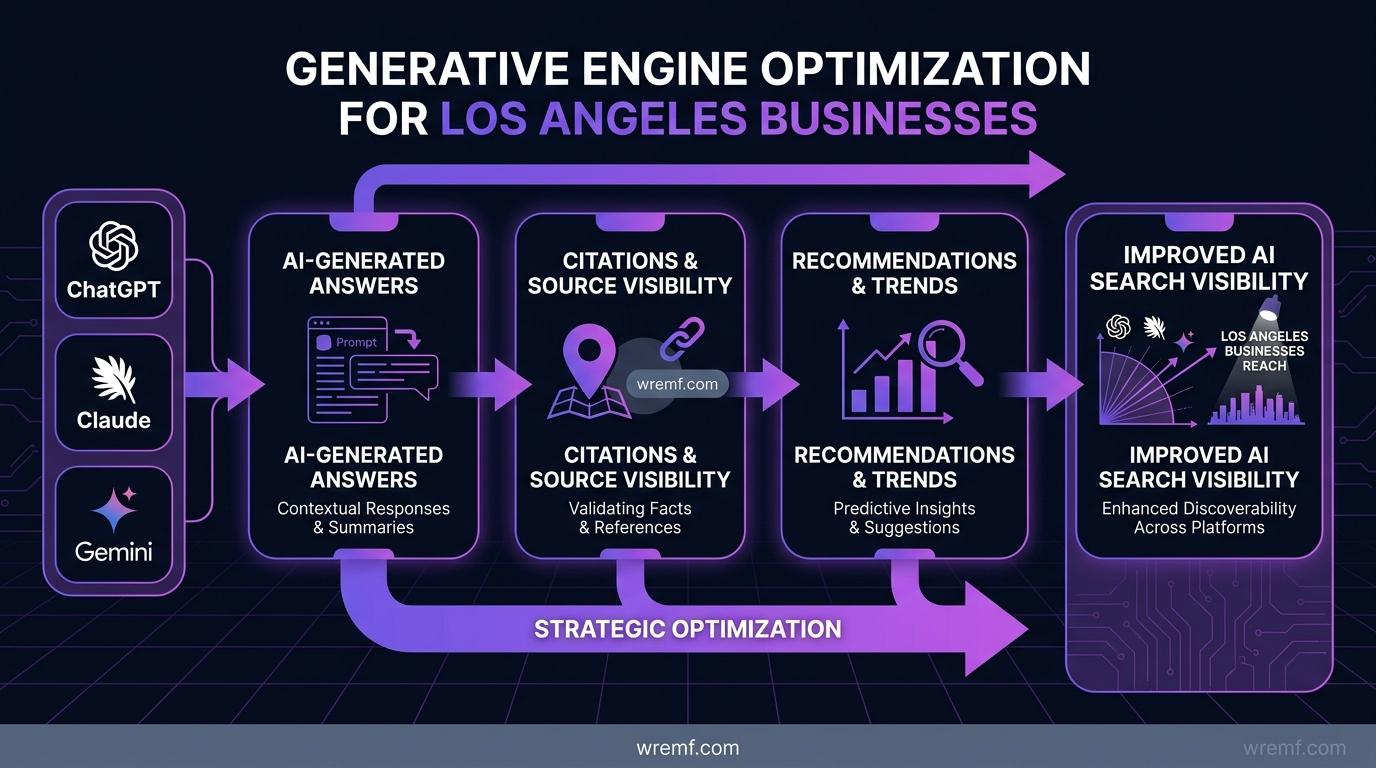
Generative Engine Optimization Los Angeles is the process of enhancing how businesses in Los Angeles are represented in AI-generated answers, citations, and recommendations. It involves optimizing content and technical signals to improve visibility on AI platforms like ChatGPT, Claude, and Google AI Overviews. Key components include local visibility, ethical marketing, and consistent online presence. It helps businesses become reliable and credible sources that AI systems recommend, especially crucial for high-trust categories like healthcare.
Key takeaways
- Generative Engine Optimization improves AI-generated answer visibility for Los Angeles businesses.
- A strong online presence supports AI platforms in understanding and recommending your brand.
- Consistent source information enhances AI citations, AI share of voice, and recommendation visibility.
- AI SEO for healthcare requires trustworthy content, local signals, and ethical marketing.
- AI visibility depends on source quality, consistency, and the ability to retrieve reliable information.
Generative Engine Optimization Los Angeles: The Complete Guide for AI Search Visibility
Generative engine optimization los angeles is the process of improving how Los Angeles businesses appear in AI-generated answers, citations, and recommendations. Google Search Central explains that AI features in Search can help users understand complex questions faster and explore links for deeper research. WREMF helps B2B brands, healthcare organizations, agencies, consultants, and growth teams track, improve, and prove AI visibility across ChatGPT, Claude, Gemini, Perplexity, Google AI Overviews, Copilot, DeepSeek, Grok, Meta AI, Mistral, and other AI discovery surfaces. This guide explains AI SEO, AEO, GEO, LLM optimization, citation tracking, content strategy, local visibility, ethical marketing, agency support, and measurable reporting. It also shows when Los Angeles businesses should use software, managed services, or a hybrid software plus agency model to become the brand AI search recommends.
AI SEO Agency for Healthcare
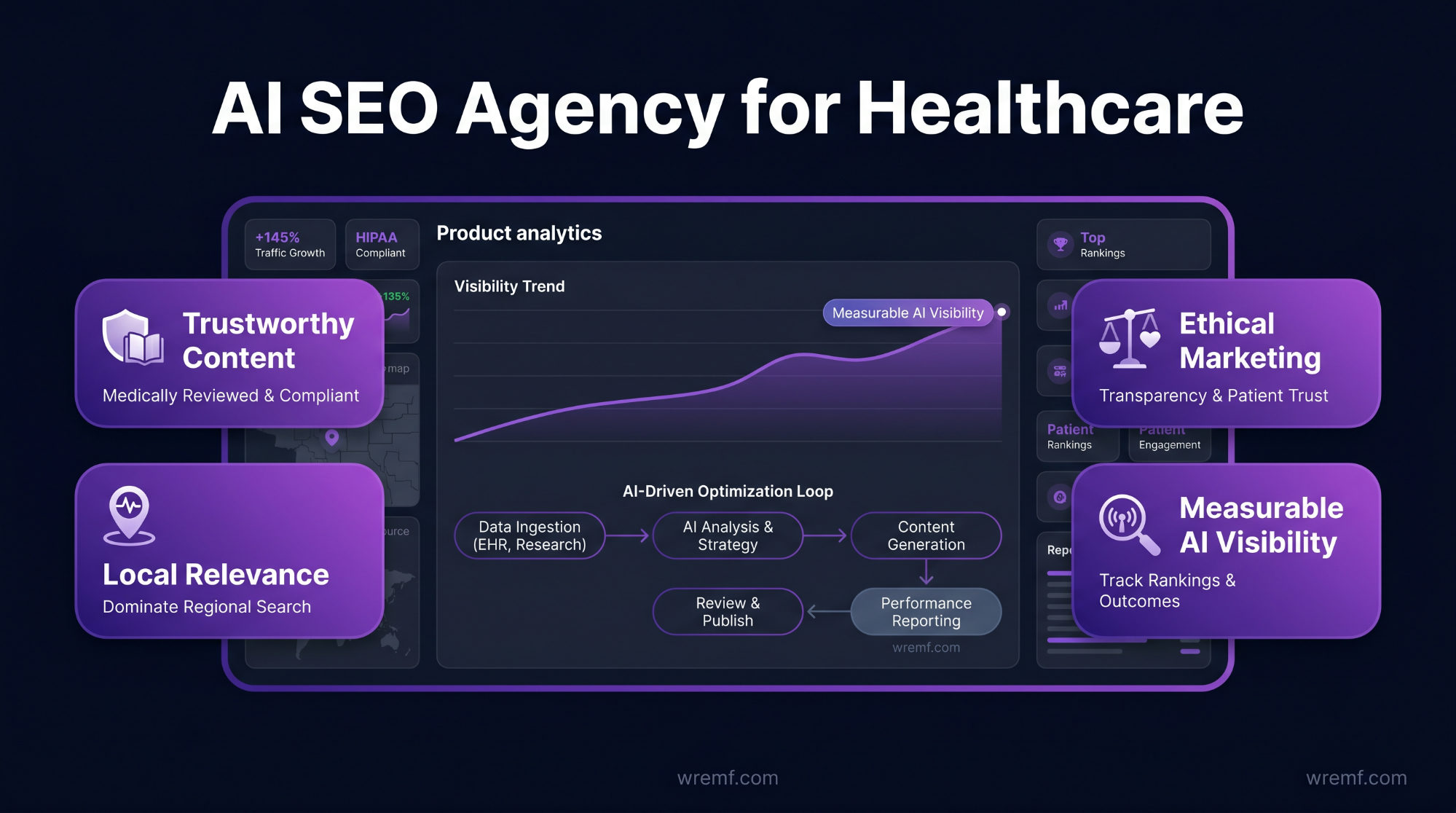
An AI SEO agency for healthcare helps medical, wellness, and treatment brands become visible when patients use AI systems and search engines to compare providers, services, treatment options, and local care. In Los Angeles, this requires trustworthy content, local relevance, ethical marketing, and measurable AI visibility.
AI SEO is the practice of optimizing a website, content, technical signals, citations, and brand entities for both search engines and AI systems. AI SEO matters because users increasingly ask ChatGPT, Perplexity, Gemini, Claude, Copilot, and Google AI Overviews for direct answers before visiting a website or contacting a provider.
Healthcare is a high-trust category. A treatment center, recovery clinic, dental group, mental health practice, wellness provider, or specialist cannot rely on vague claims such as “best care” or “trusted experts.” The content must explain what the provider does, who the service is for, where the service is available, what credentials support the claim, and what next step a patient should take. Google Search Central explains that helpful, reliable, people-first content is more likely to perform well in Search, which matters because healthcare content must be accurate and useful rather than written only to manipulate ranking.
Los Angeles healthcare providers also compete in a complex local market. A clinic in Beverly Hills may need different location signals than a treatment center in Pasadena, Santa Monica, Long Beach, or West Hollywood. AI systems can use website content, structured data, local citations, reviews, third-party mentions, and source consistency to form summaries. If those sources are incomplete or inconsistent, AI platforms may describe the provider poorly or ignore the provider entirely.
AI visibility is the measurable presence of a brand inside AI-generated answers, summaries, citations, comparisons, and recommendations. AI visibility matters because a patient or family member may ask an AI system to shortlist providers before reading search results, ads, or directory pages.
In practical AI visibility audits, healthcare teams often discover that their content is readable but not extractable. A page may describe “personalized support” but fail to answer basic AI-style questions such as who the program serves, what services are offered, what locations are covered, whether the organization has licensed professionals, and how the treatment process works. Generative Engine Optimization fixes this by making the content clearer, more structured, and easier for AI systems to retrieve.
For healthcare and treatment brands, WREMF helps measure prompt visibility, citation coverage, competitor mentions, AI share of voice, and source consistency through the WREMF AI visibility platform. For teams that need strategy and execution, WREMF also operates as a senior-led AI visibility agency focused on AEO, GEO, AI citation optimization, answer-first content, and measurable reporting.
IMPORTANT: Healthcare AI SEO should avoid exaggerated outcomes, unsupported success claims, and manipulative patient language. Trustworthy optimization is based on accuracy, transparency, source quality, and measurable visibility.
A strong healthcare AI Search Optimization program should include service pages, location pages, practitioner or team credibility, structured data, content briefs, local citations, Google Business Profile accuracy, review governance, and AI prompt monitoring. The goal is not only ranking. The goal is to appear accurately when AI engines answer high-intent questions about treatment, care, providers, locations, and next steps.
KEY TAKEAWAY: Healthcare AI SEO in Los Angeles works when trusted content, local entity clarity, ethical marketing, citation consistency, and AI visibility measurement support the same patient journey.
Once the healthcare foundation is clear, the next step is building an online presence that AI systems can retrieve, compare, and cite.
Establish your online presence & put your business in front of your target audience
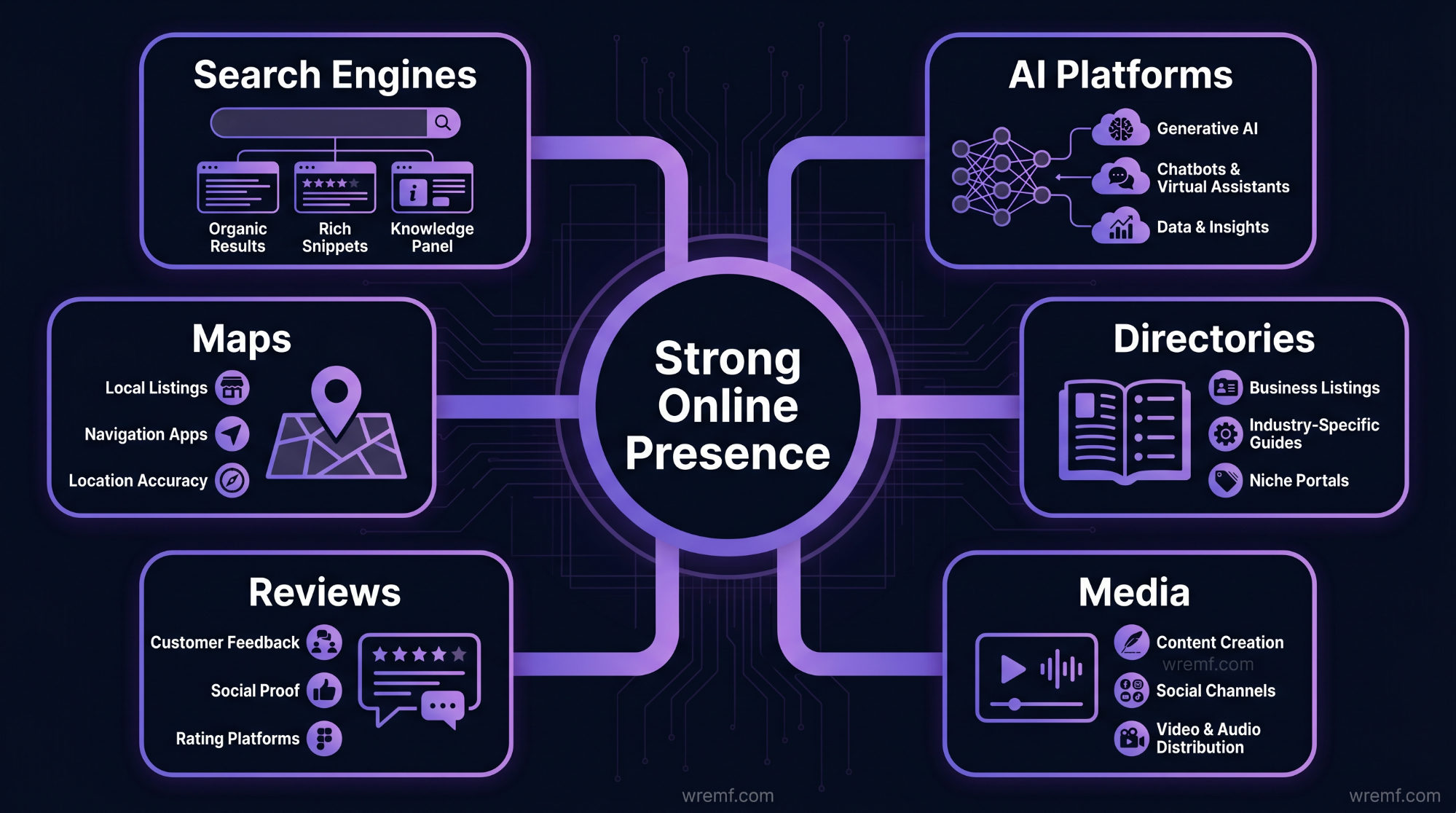
A strong online presence helps Los Angeles businesses become visible across search engines, AI platforms, maps, directories, reviews, media, and third-party sources. Generative Engine Optimization strengthens that presence by making your brand easier for AI systems to understand, trust, and recommend.
Online presence is the combined footprint of your website, content, citations, reviews, profiles, directories, media mentions, structured data, and brand references across the web. Online presence matters because AI engines often depend on source material when generating answers.
Los Angeles businesses cannot treat online presence as a single website project. A local healthcare provider, SaaS company, home service brand, legal firm, ecommerce business, or Marketing Agency needs consistent information across its website, Google Business Profile, Bing Places, local directories, industry pages, review platforms, partner pages, author profiles, and media references. If the business name, services, locations, phone numbers, category descriptions, or expertise signals conflict, search engines and AI systems may struggle to identify the brand as a reliable answer.
Source consistency is the alignment of brand, service, location, and expertise information across first-party and third-party sources. Source consistency matters because inconsistent signals can weaken AI citations, brand mentions, AI share of voice, and recommendation visibility.
Google’s AI Overviews are designed to help users get the gist of complex topics and explore links for deeper research, which means clear and useful website content still matters. OpenAI’s web search documentation explains that models can access current web information and provide sourced citations. Anthropic’s web search documentation also explains that Claude can use real-time web content and include citations. These systems are not identical, but the pattern is clear: AI visibility depends on retrievable, reliable, and well-structured source material.
For Los Angeles businesses, online presence should support both broad and local discovery. A brand may need content for “AI Search Optimization,” “LLM optimization,” “Local SEO,” “Google Maps SEO,” “Google Business Profile optimization,” “Los Angeles treatment center,” “Southern California SaaS agency,” or “best B2B service provider in LA.” Each query type has different user intent, but all require a clear entity, relevant content, and trustworthy supporting data.
A practical online presence strategy should include:
A clear homepage that explains the brand, category, services, locations, and target audience
Service pages that answer buyer and patient questions directly
Local pages that reflect real service areas, not thin location templates
Google Business Profile and Bing Places accuracy
Local citations with consistent NAP accuracy
Structured data and schema markup where appropriate
Content architecture built around user intent and search intent
AI-ready answer blocks for common questions
Third-party mentions from trusted industry or local sources
Prompt tracking to monitor how AI engines describe the business
AI visibility is the measurable presence of a brand inside AI-generated answers, recommendations, citations, and summaries. AI visibility matters because buyers increasingly use AI assistants to compare vendors before visiting websites, reading ads, or speaking with sales teams.
WREMF helps teams turn online presence into a measurable workflow through the WREMF methodology, which connects prompts, citations, competitors, source consistency, and attribution. This matters because visibility without measurement often becomes guesswork. Teams may publish more content, build more pages, or chase more Backlinks without knowing whether AI systems mention, cite, or recommend the brand.
TIP: Treat every important page as both a human landing page and an AI retrieval source. The page should answer what the business does, who it serves, where it operates, why it is credible, and what the user should do next.
KEY TAKEAWAY: Los Angeles businesses improve AI visibility by building a consistent, source-backed online presence that search engines and AI systems can understand, retrieve, and cite.
With the wider online presence in place, the next section explains how AI SEO applies to treatment centers and other high-trust service providers.
AI SEO and Your Treatment Center
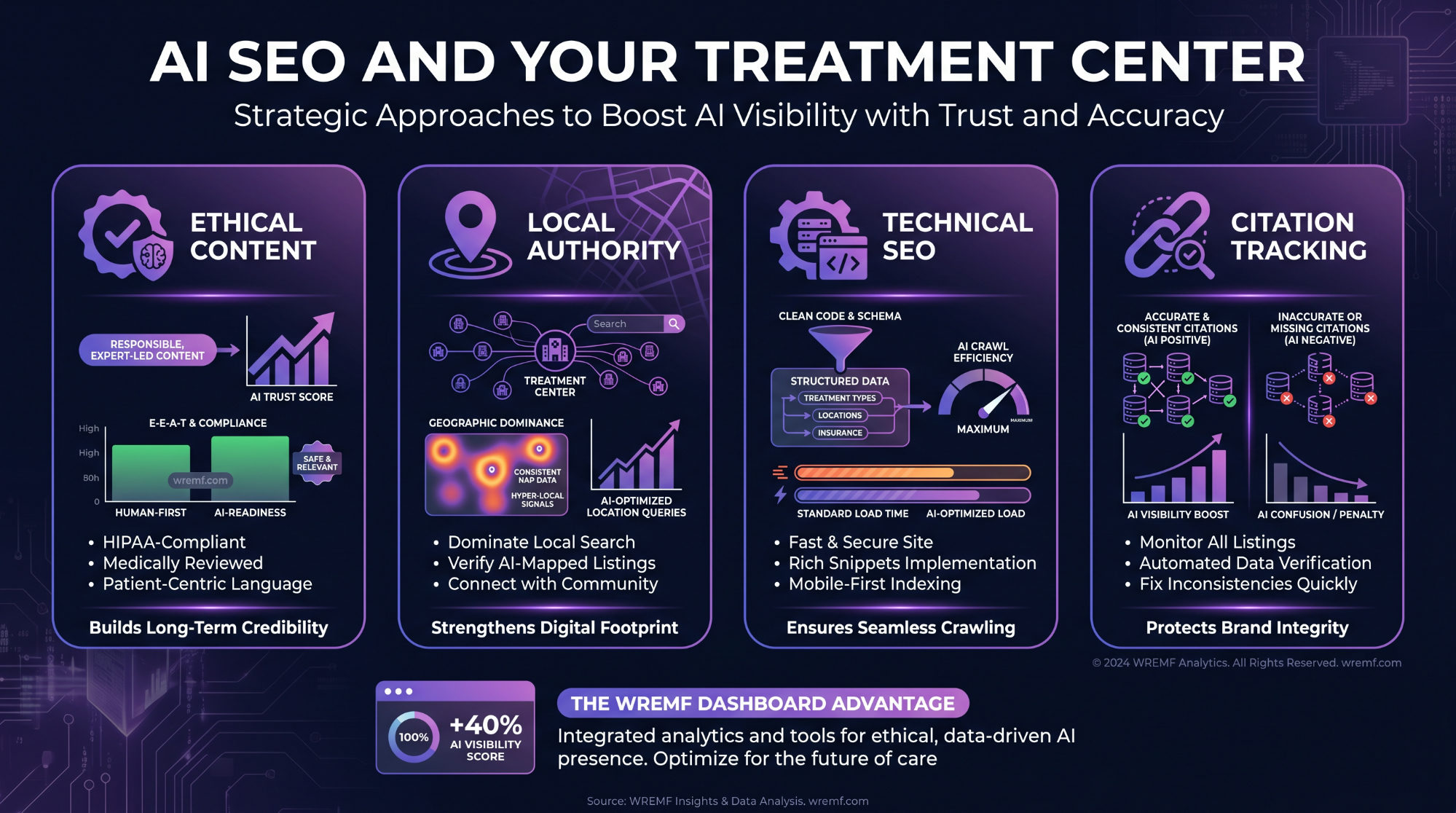
AI SEO helps a treatment center appear when people ask search engines and AI platforms for trusted care options, service comparisons, local recommendations, and treatment explanations. For Los Angeles treatment centers, AI visibility depends on ethical content, local authority, technical SEO, and citation tracking.
A treatment center is a provider that offers structured care for behavioral health, addiction recovery, mental health, rehabilitation, physical therapy, wellness, or related support services. Treatment center AI SEO matters because prospective patients and families often research options privately before calling, booking, or submitting a form.
In real healthcare research journeys, the user often asks practical questions. “Which treatment center is near me?” “What is outpatient treatment?” “Which provider handles dual diagnosis in Los Angeles?” “How do I compare residential and outpatient programs?” “What questions should a family ask before choosing a provider?” A traditional Search Engine results page may show websites, map listings, ads, and directories. AI platforms may summarize those options into a shorter answer, which makes brand clarity and citation quality more important.
AI citations are references or source mentions used by AI-generated answers to support claims, comparisons, or recommendations. AI citations matter because a cited brand or source has a stronger chance of influencing the user’s next step than a brand that does not appear.
A treatment center’s content strategy should cover the full decision journey. Awareness content can explain conditions, care models, and warning signs. Consideration content can compare treatment types, eligibility, locations, insurance questions, and program structures. Conversion content can explain the intake process, privacy, next steps, team credentials, and contact options. This content should be accurate, human-reviewed, and clear enough for both users and AI systems.
Technical SEO supports that content. Treatment center pages should be crawlable, indexable, fast, accessible, and internally linked. Structured data can help clarify organization details, local business information, service areas, practitioner information, and article structure. Schema markup does not guarantee AI visibility, but it can support better interpretation when combined with strong content and consistent sources.
AI-ready content should avoid generic wording. A treatment center page that says “we offer compassionate care” is less useful than a page that explains the care type, condition focus, location, team credentials, treatment process, session structure, and next step. Generative AI systems need specific, extractable information to produce accurate summaries.
For a Los Angeles treatment center, useful AI SEO content may include:
Service pages for each treatment or care model
Location pages for real service areas in Los Angeles and Southern California
Clinician or leadership credibility pages where appropriate
Insurance and payment information where allowed
Intake process explanations
Ethical comparison pages
Educational content for families and caregivers
Citation-supported articles on conditions and treatment types
Google Business Profile and local citation consistency
AI prompt monitoring across ChatGPT, Perplexity, Gemini, Claude, Copilot, and AI Overviews
WREMF’s source citation tracking helps teams understand which sources AI engines use when mentioning a brand, topic, or competitor. Teams can use WREMF source citation tracking to identify missing sources, weak citations, outdated pages, and third-party signals that may influence AI-generated answers.
KEY TAKEAWAY: Treatment center AI SEO requires accurate content, local trust signals, technical clarity, AI citation optimization, and reporting that goes beyond traditional ranking.
The same foundation applies to broader digital marketing, where AI search is changing how teams define performance.
Digital Marketing Services That Make a Difference.
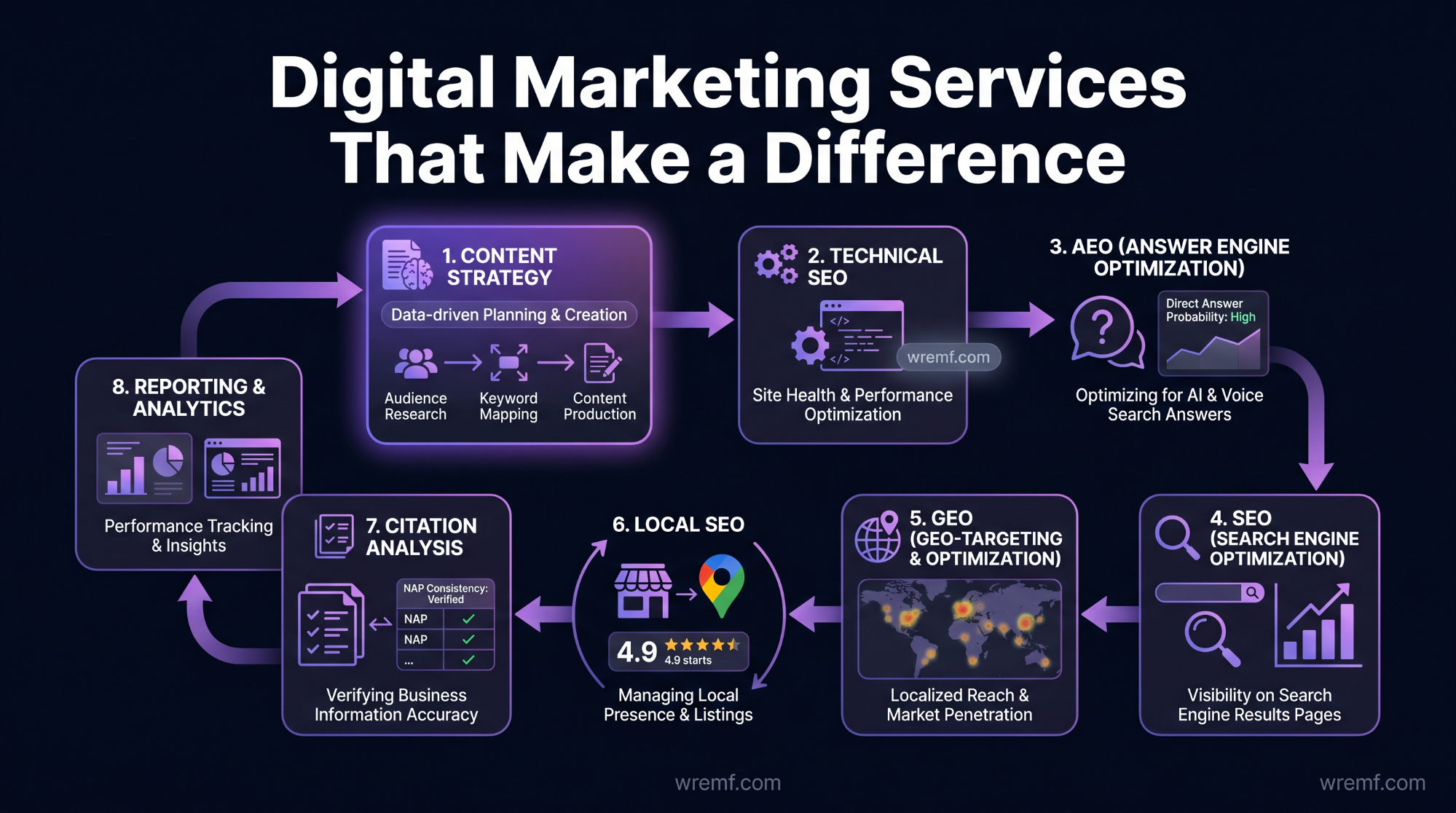
Digital marketing services make a difference when they improve visibility, trust, conversion, and measurement across the full buyer journey. In the AI search era, effective services combine SEO, AEO, GEO, content strategy, Local SEO, technical SEO, citation analysis, and reporting.
Digital marketing is the use of online channels to attract, educate, convert, and retain customers. Digital marketing matters because buyers compare brands across search engines, AI platforms, websites, reviews, social media, directories, and third-party publications before taking action.
Traditional digital marketing often focused on traffic, ranking, paid media, Backlinks, social media, email, and conversion rate optimization. These channels still matter. The change is that AI systems now summarize information, recommend options, and cite sources before users reach a website. That means visibility is no longer only a page ranking problem. It is also a source ecosystem problem.
AI traffic attribution connects visits, leads, pipeline, and revenue signals back to AI-assisted discovery where tracking is possible. AI traffic attribution matters because leadership needs to understand whether AI visibility influences demand, not only whether a page receives organic traffic.
A complete AI-ready digital marketing strategy should include content production, technical SEO, structured data, Local SEO, source citations, AI visibility reporting, and conversion paths. It should also include a clear way to prioritize actions. A brand does not need more random content. A brand needs content that maps to user intent, search intent, buying-stage questions, and AI prompt behavior.
| Digital marketing service | What it improves | AI visibility role | Best for |
|---|---|---|---|
| SEO | Organic search ranking, clicks, and website traffic | Supports crawlability and topic authority | Teams building search foundations |
| AEO | Direct answer extraction and answer-first content | Helps AI and answer engines summarize pages | Complex services and educational journeys |
| GEO | AI-generated answer mentions, citations, and recommendations | Improves visibility inside AI engines | Brands competing in AI discovery |
| Content marketing | Topic coverage, user intent, and content architecture | Creates retrievable source material | Brands with thin or scattered content |
| Technical SEO | Crawlability, page speed, schema, and indexing | Helps AI systems access and interpret pages | Websites with technical barriers |
| Local SEO | Google Maps SEO, local citations, and regional relevance | Supports Los Angeles and neighborhood visibility | Local service providers |
| Reporting | Data, insights, attribution, and leadership proof | Connects AI visibility to business outcomes | Teams accountable for performance |
The most important shift is measurement. A classic SEO report may show ranking, traffic, impressions, and backlinks. An AI visibility report should show prompt visibility, AI citations, brand mentions, source citations, competitor visibility, AI share of voice, and traffic attribution. Both reports are useful, but they answer different questions.
For teams evaluating tools, the WREMF guide to AI search engine optimization tools explains how SEO, AEO, GEO, and AI search visibility tools fit together. For teams focused on service support, WREMF’s managed agency model helps turn insights into action through audits, content briefs, citation planning, technical recommendations, and reporting.
DID YOU KNOW: Google announced in May 2025 that AI Overviews were available in more than 200 countries and territories and more than 40 languages, showing that AI-generated search experiences are now a global discovery layer.
KEY TAKEAWAY: Digital marketing services make the biggest difference when SEO, AEO, GEO, Local SEO, content, citations, technical SEO, and reporting work as one system.
To choose the right services, teams need a clear definition of AI SEO in marketing.
What Is AI SEO in Marketing?
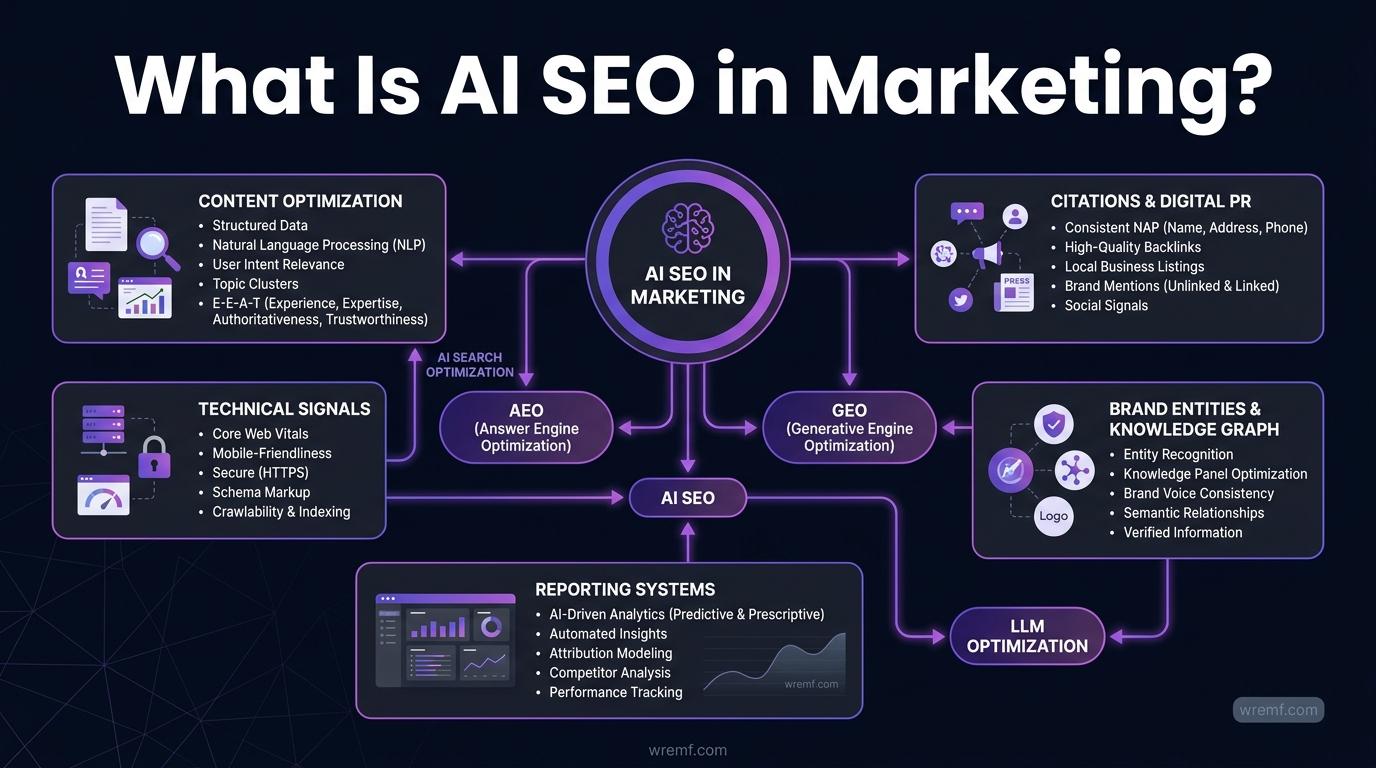
AI SEO in marketing is the practice of optimizing content, technical signals, citations, brand entities, and reporting systems so search engines and AI systems can understand, retrieve, summarize, and recommend a business. AI SEO connects SEO, AEO, GEO, AI Search Optimization, and LLM optimization.
Generative Engine Optimization is the process of improving brand visibility inside AI-generated answers from systems such as ChatGPT, Claude, Gemini, Perplexity, Copilot, Google AI Overviews, DeepSeek, Grok, Meta AI, and Mistral. Generative Engine Optimization matters because buyers increasingly use AI systems to summarize options before visiting websites.
Answer engine optimisation, or AEO, is the process of structuring content so it directly answers user questions. AEO matters because answer engines and AI platforms often need concise, complete, extractable responses.
LLM optimization is the process of improving how large language models understand, retrieve, and present information about a brand, service, product, or topic. LLM optimization matters because AI models may generate answers from a mix of training data, retrieved web results, citations, source documents, and contextual prompts.
The key difference between SEO and GEO is the output being optimized. SEO often focuses on ranking pages in search engines. GEO focuses on being mentioned, cited, summarized, or recommended inside AI-generated answers. AEO focuses on answer structure. AI Search Optimization combines these practices into a broader visibility strategy.
| Discipline | Primary goal | What it measures | What it misses if used alone | Best fit |
|---|---|---|---|---|
| SEO | Improve search ranking and organic traffic | Ranking, impressions, clicks, technical health | AI citations and recommendation context | Teams building search foundations |
| AEO | Improve answer extraction | Direct answers, snippets, structured responses | Source ecosystem and competitor visibility | Teams answering complex user questions |
| GEO | Improve AI-generated answer visibility | Mentions, citations, prompt visibility, AI share of voice | Classic technical SEO issues | Brands competing in AI discovery |
| LLM optimization | Improve model understanding | Entity clarity, source consistency, retrieval quality | Local conversion and channel reporting | Brands with fragmented information |
| AI visibility reporting | Prove performance across AI engines | Prompts, citations, competitors, attribution | Execution if no team acts on insights | Leaders, agencies, and growth teams |
Prompt tracking shows how a brand appears for specific questions across AI engines. Prompt tracking matters because visibility can vary by query, location, engine, wording, user intent, and time.
OpenAI’s web search documentation explains that models can access up-to-date information from the internet and provide answers with sourced citations. Anthropic’s Claude documentation explains that web search can allow Claude to use real-time web content and include citations. Microsoft states that Copilot Search goes beyond keyword matching by using AI to interpret context, relationships, and meaning. These examples show why keyword targeting alone is not enough for AI visibility.
The practical workflow starts with a prompt set. A Los Angeles business may track prompts such as “best AI SEO agency in Los Angeles,” “how does GEO help my LA business,” “which treatment centers in Los Angeles offer outpatient care,” or “top B2B SaaS marketing agencies in Southern California.” The next step is to see which brands appear, which sources are cited, which competitors are recommended, and which content gaps prevent the brand from being included.
WREMF’s prompt intelligence tools help teams monitor AI prompts across major AI discovery surfaces. This makes AI Search Optimization more practical because teams can see where they are visible, where they are missing, and where content or citation work is needed.
KEY TAKEAWAY: AI SEO in marketing combines SEO, AEO, GEO, LLM optimization, prompt tracking, citation analysis, and reporting into one measurable visibility discipline.
Once the definition is clear, the next question is why optimizing for AI now matters for Los Angeles businesses.
Why AI SEO Matters: The Rising Importance of Optimizing for AI
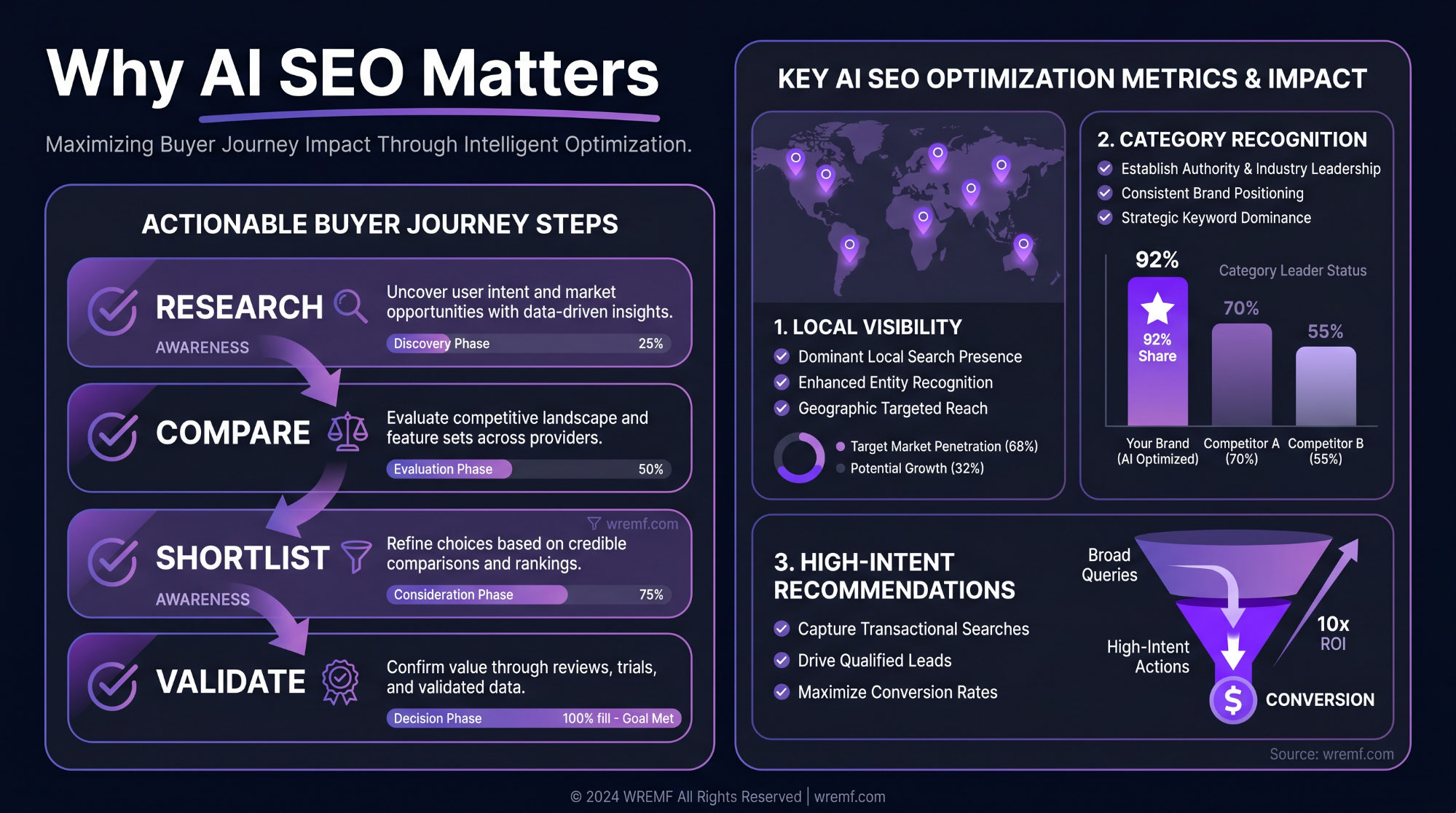
AI SEO matters because buyers now use AI systems to research, compare, shortlist, and validate businesses before visiting websites or contacting sales teams. For Los Angeles businesses, optimizing for AI improves the chance of being found in local, category, and high-intent recommendation journeys.
AI platforms are systems that generate, retrieve, summarize, or organize information using artificial intelligence. AI platforms matter because ChatGPT, Claude, Gemini, Perplexity, Copilot, Google AI Overviews, DeepSeek, Grok, Meta AI, and Mistral increasingly influence how users discover answers.
Google’s AI Overviews expansion is a strong signal that AI search is no longer a narrow test. Google announced that AI Overviews expanded to more than 200 countries and territories and more than 40 languages in 2025. Google also announced in 2024 that AI Overviews would reach hundreds of millions of users in the United States and was expected to reach more than one billion people by the end of that year. These are not small interface changes. These are discovery changes.
AI visibility works by improving the quality, clarity, consistency, and retrievability of the sources AI systems can use. AI visibility does not depend on one keyword or one ranking position. AI visibility depends on whether your brand is a credible answer across prompts, sources, citations, and comparison contexts.
For Los Angeles businesses, the change is especially important because local buying decisions are high-context. Users may ask AI systems for the best provider near a neighborhood, the most trusted specialist for a service, a comparison between local options, or a plain-language explanation of which business type fits their need. A ranking report may not show whether the business appears in those AI answers.
Marketing teams often find that AI search changes the content brief. Instead of writing only for “SEO agency Los Angeles,” teams need pages that answer natural-language prompts such as “Which AI SEO agency helps healthcare businesses in Los Angeles?” or “Is GEO different from traditional SEO for my LA business?” This requires better content architecture, clearer entities, and stronger source support.
The most effective way to improve AI search visibility is to build answer-first content, strengthen source consistency, monitor prompts across AI engines, and close citation gaps. This is where WREMF’s platform and agency model fit naturally. The software measures visibility. The agency helps execute content, technical, citation, and authority improvements. The hybrid model helps teams connect data with action.
For readers who want a deeper background on the relationship between AI search and organic traffic, WREMF’s guide to how AI search optimization tools increase organic traffic explains how AI visibility, search visibility, and content performance can work together.
IMPORTANT: AI visibility should not replace SEO reporting. AI visibility should expand reporting with prompts, mentions, source citations, AI share of voice, and AI-assisted traffic signals.
KEY TAKEAWAY: AI SEO matters because AI-generated answers influence discovery before the buyer reaches your website, search result, ad, directory listing, or sales form.
As AI visibility becomes more influential, ethical marketing becomes a requirement for durable performance.
An Ethical Marketing Team You Can Trust
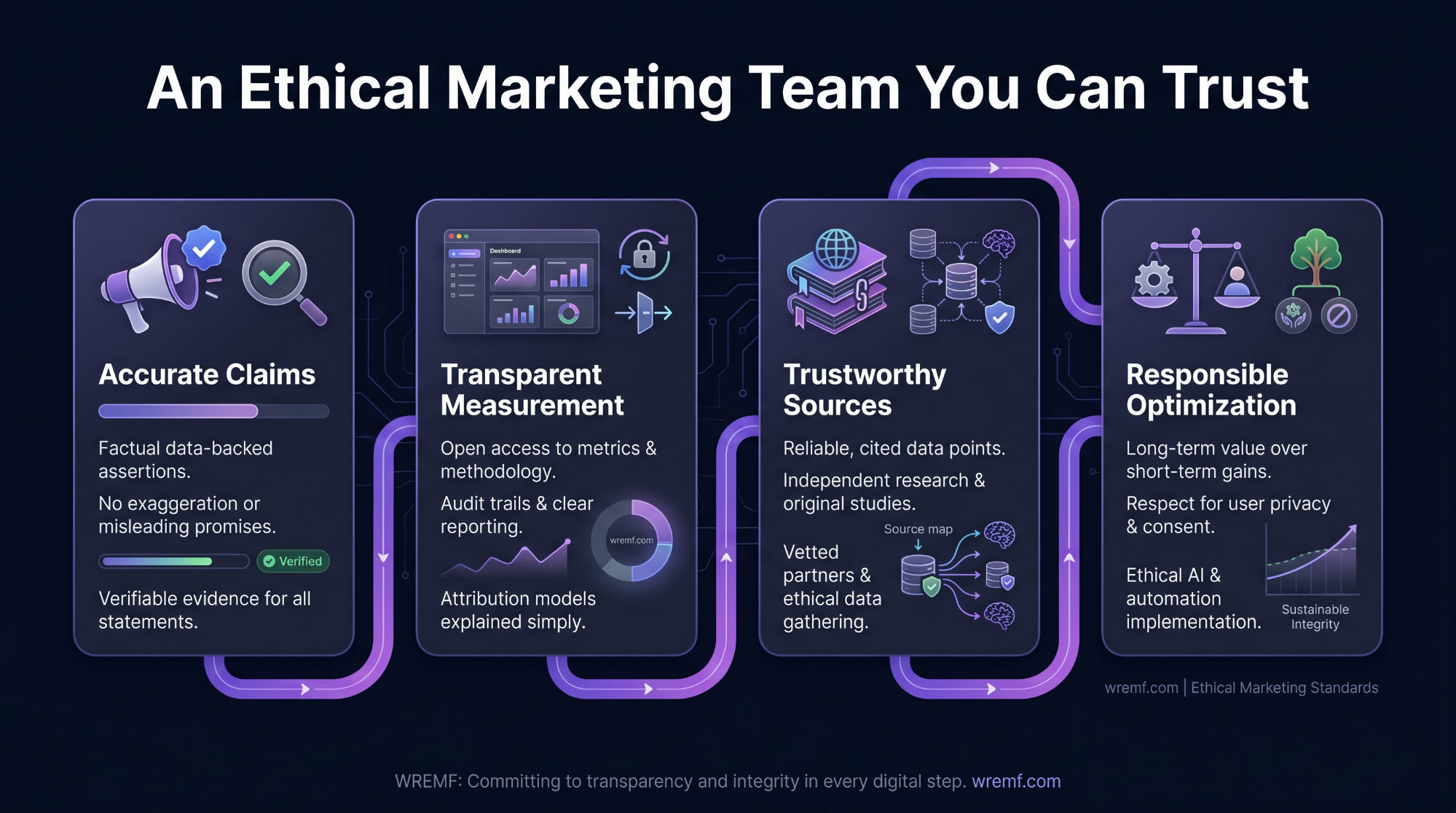
An ethical marketing team builds AI visibility through accurate claims, transparent measurement, trustworthy sources, and responsible optimization. In AI SEO and Generative Engine Optimization, trust matters because AI-generated answers may summarize your claims for users who rely on them to make decisions.
Ethical AI SEO is the practice of improving search and AI visibility without deceptive claims, fake authority, manipulated reviews, unsupported statistics, or misleading medical, legal, financial, or technical advice. Ethical AI SEO matters because poor information can damage users, brand credibility, and long-term search performance.
Google’s helpful content guidance emphasizes content created to benefit people rather than content created mainly to manipulate search engine ranking. That principle also matters for GEO because AI systems often need clear, useful, and reliable source material. If your content is thin, repetitive, misleading, or unsupported, it may fail users and weaken AI retrieval quality.
A common implementation mistake is treating GEO as a shortcut. Some teams publish large volumes of AI-generated content, stuff pages with keywords, or chase low-quality mentions. This can create confusing content architecture, duplicated ideas, inconsistent entity signals, and weak Customer experience. More content does not automatically create more visibility.
Ethical AI visibility consulting should include:
Clear separation between measurable facts and strategic recommendations
Verified service descriptions and credentials
Accurate location and service-area information
Transparent reporting on what is measured and what is inferred
No guaranteed AI citations, rankings, traffic, or revenue claims
Responsible AI-assisted content production with human review
Source quality checks before citation-building campaigns
Practical content that supports user decisions
WREMF’s agency positioning follows this ethical model. WREMF does not frame AI visibility as a trick. WREMF helps teams make a brand easier to understand, cite, compare, and evaluate through stronger content, cleaner entity signals, better source consistency, technical AI visibility foundations, and measurable reporting.
For service, healthcare, SaaS, and agency brands, ethics also influence conversion. Users are more likely to trust content that clearly explains what a business does, who it serves, what evidence supports the claim, and where limitations exist. AI systems may also represent brands more accurately when the public information is specific and consistent.
Ethical marketing is especially important in Los Angeles because the market is competitive and diverse. Local users may search by neighborhood, language, service type, urgency, budget, insurance, industry, or social proof. A trustworthy AI SEO strategy should answer those needs without exaggerating expertise or hiding uncertainty.
KEY TAKEAWAY: Ethical AI SEO builds durable visibility by improving accuracy, usefulness, source quality, content clarity, and measurement instead of relying on shortcuts.
A trusted approach becomes easier to justify when the business benefits of working with an AI SEO agency are clear.
Benefits of Working with an AI SEO Agency
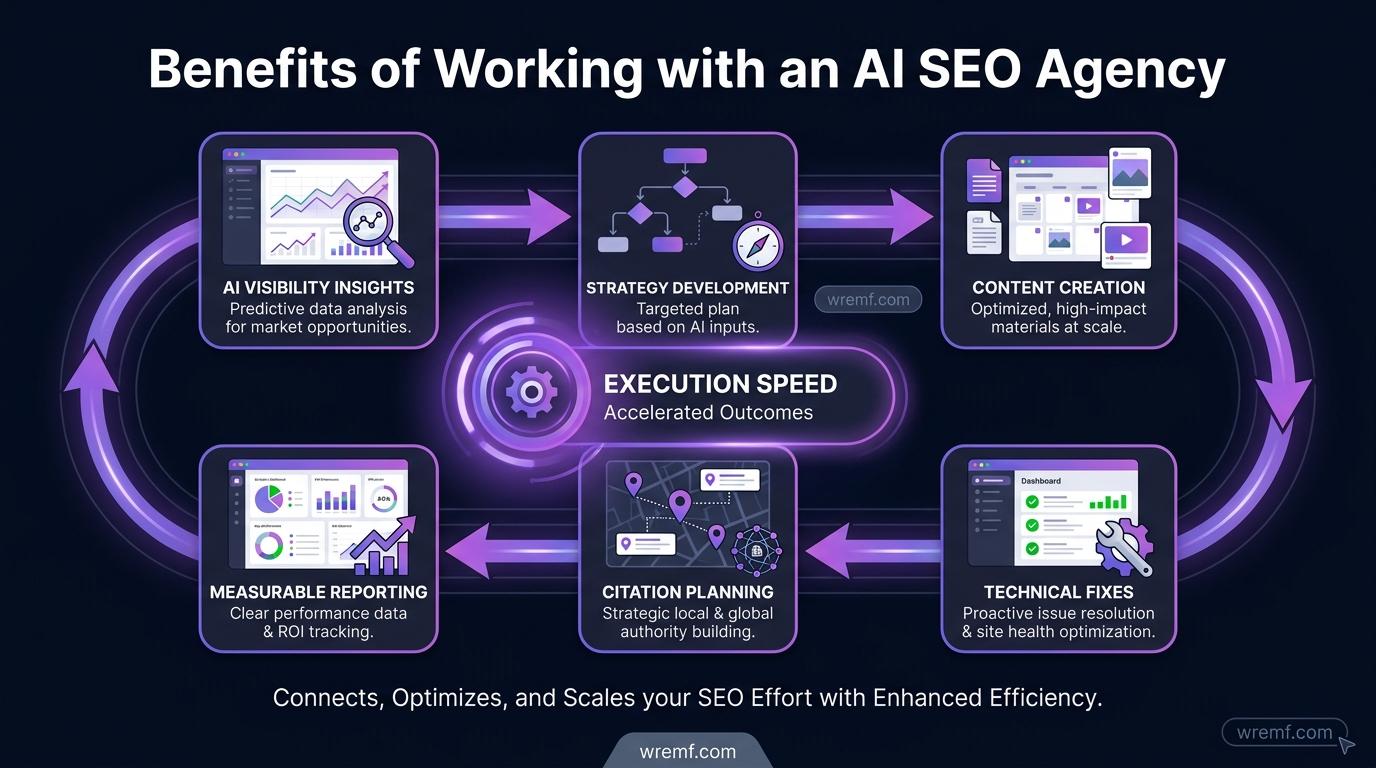
Working with an AI SEO agency helps businesses turn AI visibility insights into strategy, content, technical fixes, citation planning, and measurable reporting. The biggest benefit is execution speed when internal teams lack time, expertise, or a repeatable GEO process.
An AI visibility agency is a specialist partner that improves how a brand appears across AI search, answer engines, generative engines, and traditional search. An AI visibility agency matters because AI search requires both measurement and implementation across content, technical SEO, citations, authority, and reporting.
Agencies managing multiple clients often need prompt monitoring, white-label reports, AI share of voice tracking, source citation analysis, and clear deliverables. In-house brands often need strategy, prioritization, stakeholder reporting, and technical direction. Los Angeles businesses often need local visibility, service-area clarity, local citations, Google Maps SEO alignment, and content that reflects real regional intent.
The benefits of working with an AI SEO agency include faster diagnosis. An agency can audit prompt visibility, competitor citations, technical SEO, content structure, local visibility, and source consistency. This helps teams avoid spending months optimizing pages that AI systems still cannot retrieve, cite, or trust.
An AI SEO agency can also improve content architecture. AI-ready content systems include pillar pages, service pages, comparison pages, use-case pages, location pages, FAQ systems, category pages, and structured rewrites. These pages should support both search engines and AI platforms by matching user intent, answering clearly, and connecting related topics.
AI citation optimization is another benefit. A brand may need stronger first-party content, better third-party mentions, cleaner local citations, more consistent entity information, or improved source quality. Citation planning is not only link building. It is the process of making the brand more verifiable across the source ecosystem.
| Operating model | Best for | What it provides | Main limitation | Recommended when |
|---|---|---|---|---|
| Software-only AI visibility platform | Teams with strong internal execution | Tracking, dashboards, prompt data, citation data, competitor insights | Insights may not become action | You have SEO, content, analytics, and development resources |
| Managed AI visibility agency | Teams needing strategy and implementation | Audits, strategy, content, technical fixes, authority planning, reporting | Less self-serve control | You need expert support and faster execution |
| Hybrid software plus agency model | Teams needing measurement and execution | Platform data, strategy, implementation, reporting, attribution | Requires clear priorities | You want visibility tracking and managed optimization in one system |
WREMF supports all three paths. Brands can use the platform for measurement, work with the agency for managed AEO and GEO execution, or combine both in a hybrid workflow. Agencies and consultants can use WREMF for agencies when they need white-label client reporting, prompt visibility monitoring, and repeatable AI search visibility workflows.
For commercial evaluation, WREMF’s guide to AI SEO agency selection explains how to assess an agency partner for AI search visibility, AEO, GEO, LLM optimization, and reporting. This is useful when comparing a traditional SEO vendor, AI search marketing agency, GEO agency, AEO agency, or hybrid platform plus service model.
KEY TAKEAWAY: An AI SEO agency is most valuable when it connects AI visibility measurement to practical content, technical, citation, authority, and reporting execution.
The next section explains how WREMF turns those benefits into a repeatable AI SEO marketing workflow.
How WREMF Delivers AI SEO Marketing Solutions
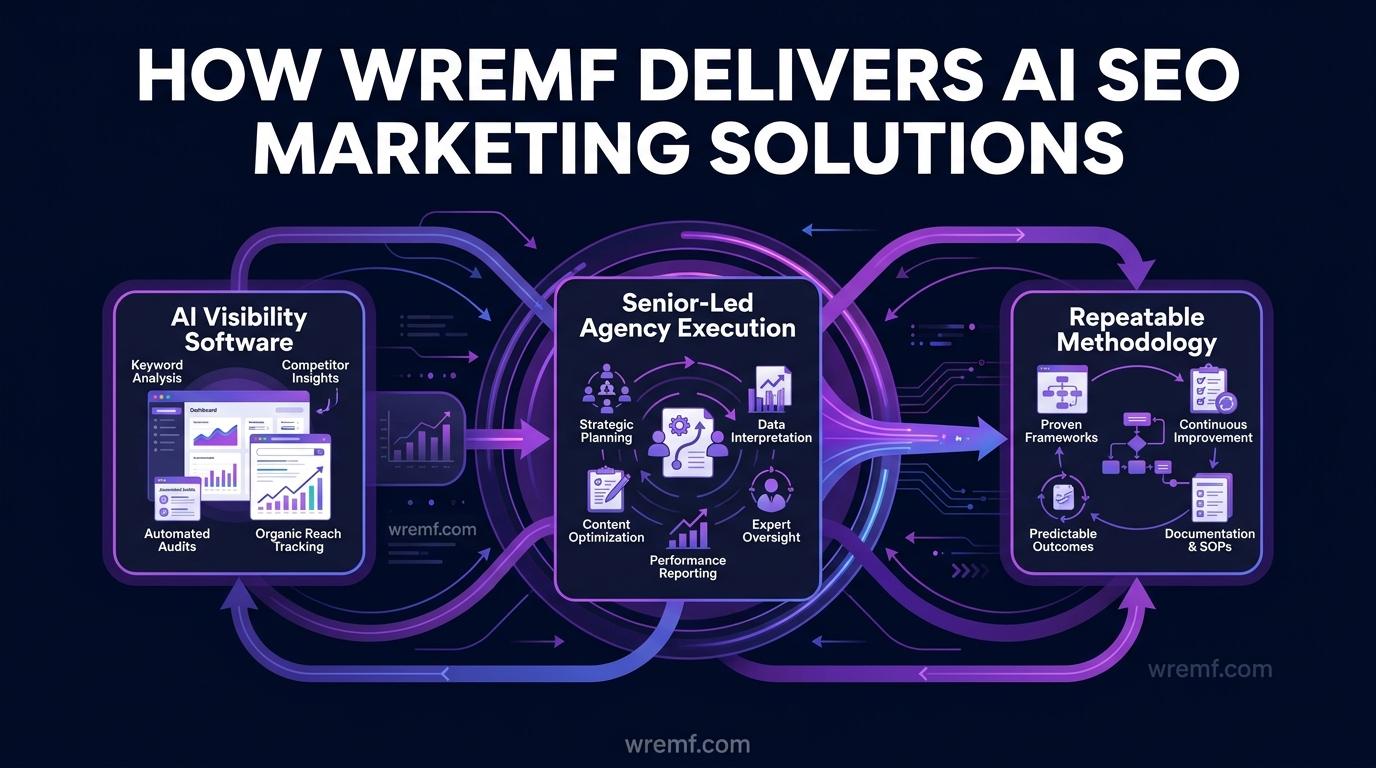
WREMF delivers AI SEO marketing solutions by combining AI visibility software, senior-led agency execution, and a repeatable methodology for prompts, citations, competitors, content, and attribution. This hybrid model helps teams move from manual checking to measurable AI Search Optimization.
The WREMF methodology is a structured workflow for tracking, improving, and proving AI visibility. The methodology matters because AI search performance depends on prompts, sources, citations, competitors, entity clarity, technical access, and reporting rather than a single ranking metric.
The WREMF agency workflow follows five practical steps.
Audit
The audit stage assesses current AI visibility, prompt coverage, competitor citations, technical visibility, content gaps, entity authority, and source consistency. In practical AI visibility audits, teams often find that AI engines mention competitors because those competitors have clearer pages, stronger third-party citations, or better structured content.
Strategy
The strategy stage maps high-value prompts, buying-stage visibility, content priorities, authority opportunities, and AI search risks. This stage clarifies which prompts matter commercially and which pages or sources should support them.
Build
The build stage improves content, creates AI-ready pages, strengthens internal links, adds structured content blocks, supports schema markup where appropriate, and improves technical AI retrieval readiness. This is where content strategy becomes implementation.
Amplify
The amplify stage strengthens authority through third-party visibility, citation development, local source consistency, expert profiles, partner pages, industry mentions, and trusted references. This matters because AI systems may rely on more than your own website.
Measure
The measure stage tracks AI share of voice, prompt movement, source citations, competitor visibility, traffic attribution, and reporting outputs. This allows teams to show progress without claiming guaranteed ranking, guaranteed citation, or guaranteed revenue outcomes.
Prompt tracking shows where a brand appears across buyer questions. Source citation tracking shows which pages or third-party sources support AI-generated answers. Competitor visibility shows whether competing brands are being recommended when your brand is absent. AI traffic attribution connects visibility to business impact where referral and analytics data are available.
WREMF combines these capabilities through software and services. The platform includes prompt intelligence, source citation tracking, competitor visibility, AI visibility scoring, scheduled AI monitoring, white-label reporting, BYOK support, client portals, API and MCP integrations, and actionable recommendations. The agency adds AEO strategy, GEO execution, AI-ready content systems, authority planning, technical recommendations, and ongoing optimization.
For competitive reporting, WREMF’s competitive landscape tools help teams compare visibility against other brands inside AI-generated answers. For teams that need technical workflows, API connections, or MCP integrations, WREMF API access can support custom reporting and data workflows.
AI visibility is both a measurement problem and a source ecosystem problem. AI visibility measurement shows where a brand appears, where competitors appear, and which prompts matter. The source ecosystem explains why those appearances happen by connecting content, citations, technical access, authority, entity clarity, and source consistency.
A common reporting mistake is measuring only traffic. AI visibility may influence branded search, direct visits, assisted conversions, sales conversations, and vendor shortlists before referral data is obvious. Reporting should therefore combine AI visibility metrics with classic SEO analytics, Google Analytics data, conversion data, CRM data, and qualitative sales insights.
KEY TAKEAWAY: WREMF delivers AI SEO through a hybrid workflow that audits visibility, builds strategy, improves content and citations, amplifies authority, and measures results.
Once the workflow is clear, the final growth question is how to turn AI visibility into practical business acceleration.
Work with us for accelerated growth
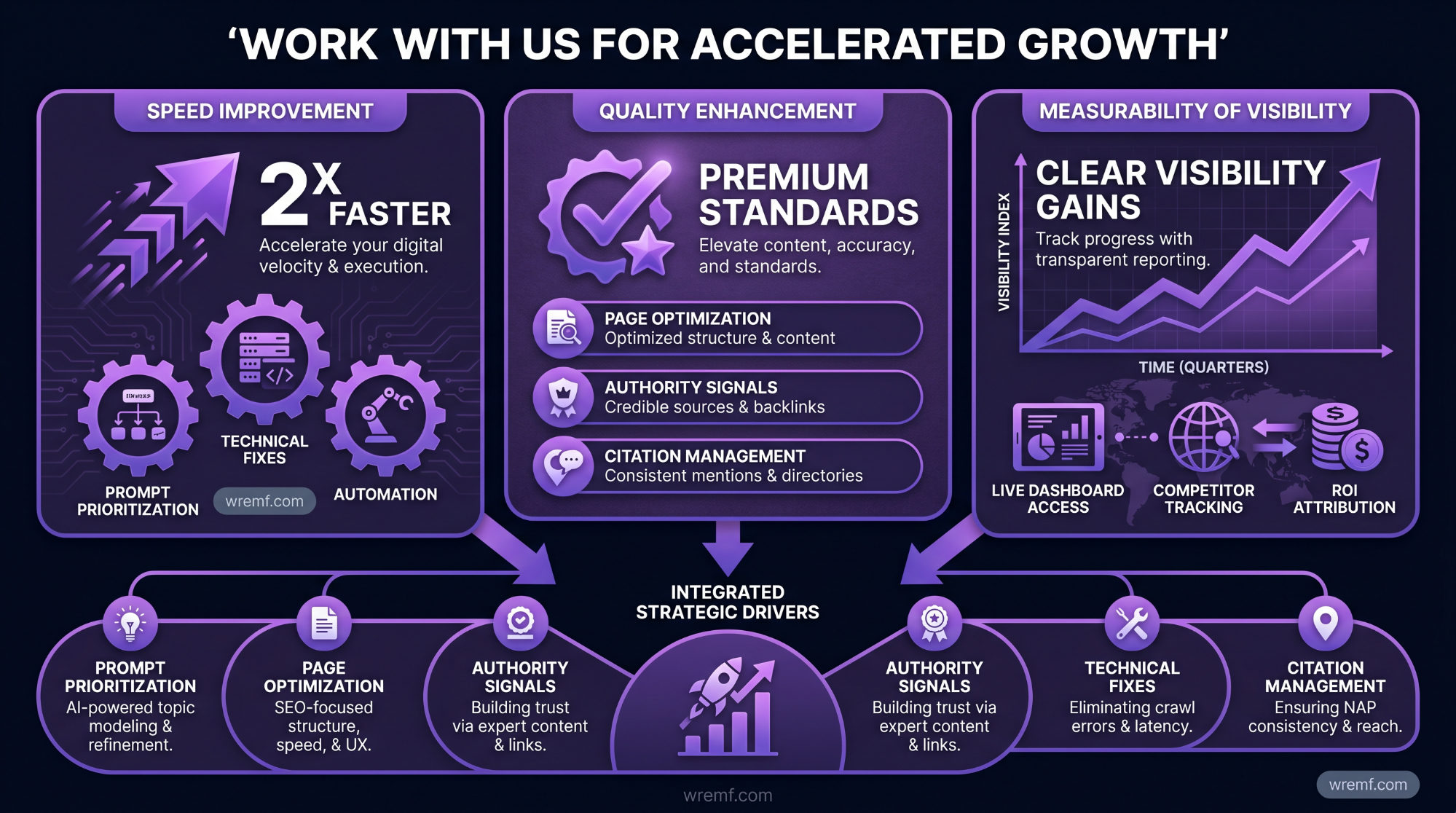
Accelerated growth from AI SEO comes from improving the speed, quality, and measurability of your visibility work. WREMF helps Los Angeles businesses and B2B teams prioritize the prompts, pages, citations, technical fixes, and authority signals most likely to influence AI discovery.
Accelerated growth does not mean guaranteed rankings, instant citations, or automatic revenue. Accelerated growth means reducing wasted effort, acting on better data, and improving the systems that make a brand easier to find, understand, cite, compare, and recommend.
In real-world reporting, teams usually struggle when AI visibility is treated as a side project. One person manually checks ChatGPT, another checks Google AI Overviews, another reviews Perplexity, another tracks ranking, and another reports website traffic. This creates fragmented data and unclear ownership. A measurable workflow connects prompts, sources, competitors, content actions, and reporting.
AI share of voice is the percentage of relevant AI-generated answers where a brand appears compared with competitors. AI share of voice matters because it helps teams measure category presence across prompts, AI engines, and buyer intents.
A growth-focused AI SEO program should include:
A prioritized prompt set based on buyer intent
Baseline visibility across ChatGPT, Claude, Gemini, Perplexity, Copilot, and Google AI Overviews
Citation gap analysis for first-party and third-party sources
AI-ready content briefs for high-value topics
Local visibility improvements for Los Angeles and relevant service areas
Technical SEO fixes that improve crawlability and structure
Authority and source consistency improvements
Monthly reporting for visibility, citations, competitors, traffic, and pipeline signals
The right operating model depends on the team. Use software-only if internal SEO, content, analytics, and development teams can execute quickly. Use agency services if senior-led strategy, implementation, and ongoing optimization are needed. Use a hybrid model if measurement, strategic guidance, execution support, reporting, and attribution should work in one system.
For Los Angeles businesses, this approach can support local GEO, Google Business Profile alignment, local citations, neighborhood content, service-area pages, and AI recommendation visibility. For B2B SaaS companies, the same approach supports category prompts, comparison pages, use-case content, product positioning, competitor visibility, and attribution.
For teams that want implementation support, WREMF offers AI visibility audits, GEO strategy reports, prompt opportunity maps, citation tracking dashboards, AI-ready content recommendations, content briefs, technical optimization recommendations, share of voice reporting, competitive visibility analysis, AI attribution reporting, authority development plans, and ongoing optimization support. A good starting point is a WREMF GEO audit, especially if your brand is not appearing in AI answers for important buyer prompts.
KEY TAKEAWAY: AI SEO accelerates growth when teams replace manual checking with a repeatable system for prompts, citations, content, technical fixes, authority, and reporting.
Before choosing a model, it helps to separate common myths from what AI visibility work can actually prove.
Common Myths About AI Visibility Debunked
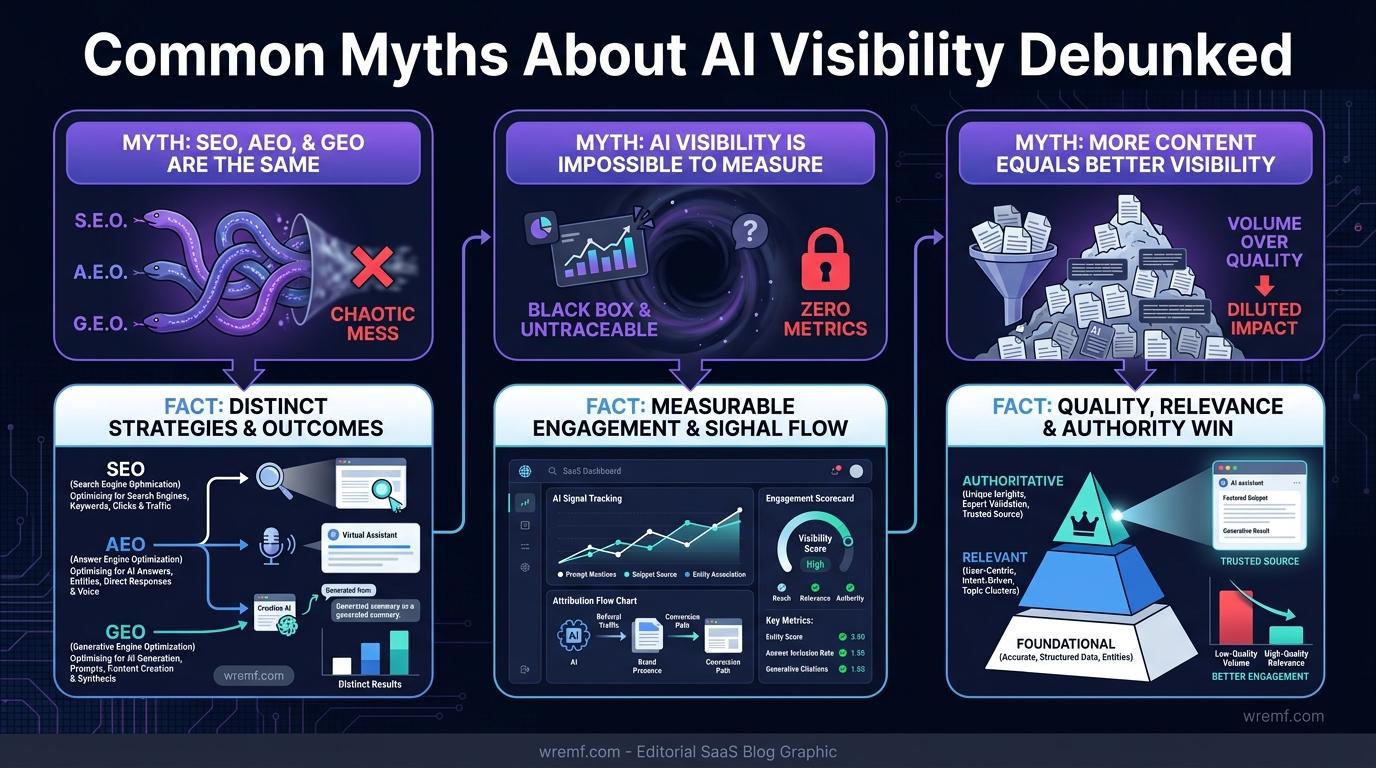
AI visibility is measurable, but it is not measured the same way as traditional SEO ranking. The most common myths come from treating SEO, AEO, GEO, AI Search Optimization, and LLM optimization as either identical or completely separate.
MYTH: SEO, AEO, and GEO are the same thing.
FACT: SEO focuses mainly on search engine visibility, ranking, clicks, and technical search performance. AEO focuses on direct answer extraction. GEO focuses on visibility inside AI-generated answers, citations, and recommendations. The disciplines overlap, but each one measures a different part of discovery.
MYTH: AI visibility is impossible to measure.
FACT: AI visibility can be measured through prompt tracking, brand mentions, source citations, AI share of voice, competitor visibility, and AI referral traffic where analytics data is available. Measurement is imperfect because AI answers can vary by engine, query, context, and time, but imperfect does not mean impossible.
MYTH: Ranking number one on Google is enough.
FACT: Google ranking is still valuable, but AI platforms may summarize answers before users click a traditional search result. A brand can rank well and still be absent from ChatGPT, Perplexity, Claude, Gemini, Copilot, or Google AI Overviews for important buyer prompts. AI visibility adds another measurement layer to classic ranking.
MYTH: More AI-generated content automatically improves GEO.
FACT: More content only helps when the content is accurate, useful, structured, and supported by credible sources. Thin AI-generated pages can weaken trust, duplicate ideas, and create inconsistent brand signals. GEO depends on content quality, source consistency, technical access, and authority signals.
MYTH: Only local Los Angeles businesses need local AI SEO.
FACT: Local AI SEO matters for any business that serves Los Angeles customers, competes in Southern California, or wants to be discovered for regional intent. A national SaaS company, healthcare network, agency, or professional service firm may still need Los Angeles-specific content and citations if the market is commercially important.
KEY TAKEAWAY: AI visibility is not a replacement for SEO, but it is a measurable layer that adds prompts, citations, recommendations, source consistency, and AI share of voice to the visibility model.
With the myths clarified, the article can close by connecting the strategy back to the practical next step.
Conclusion
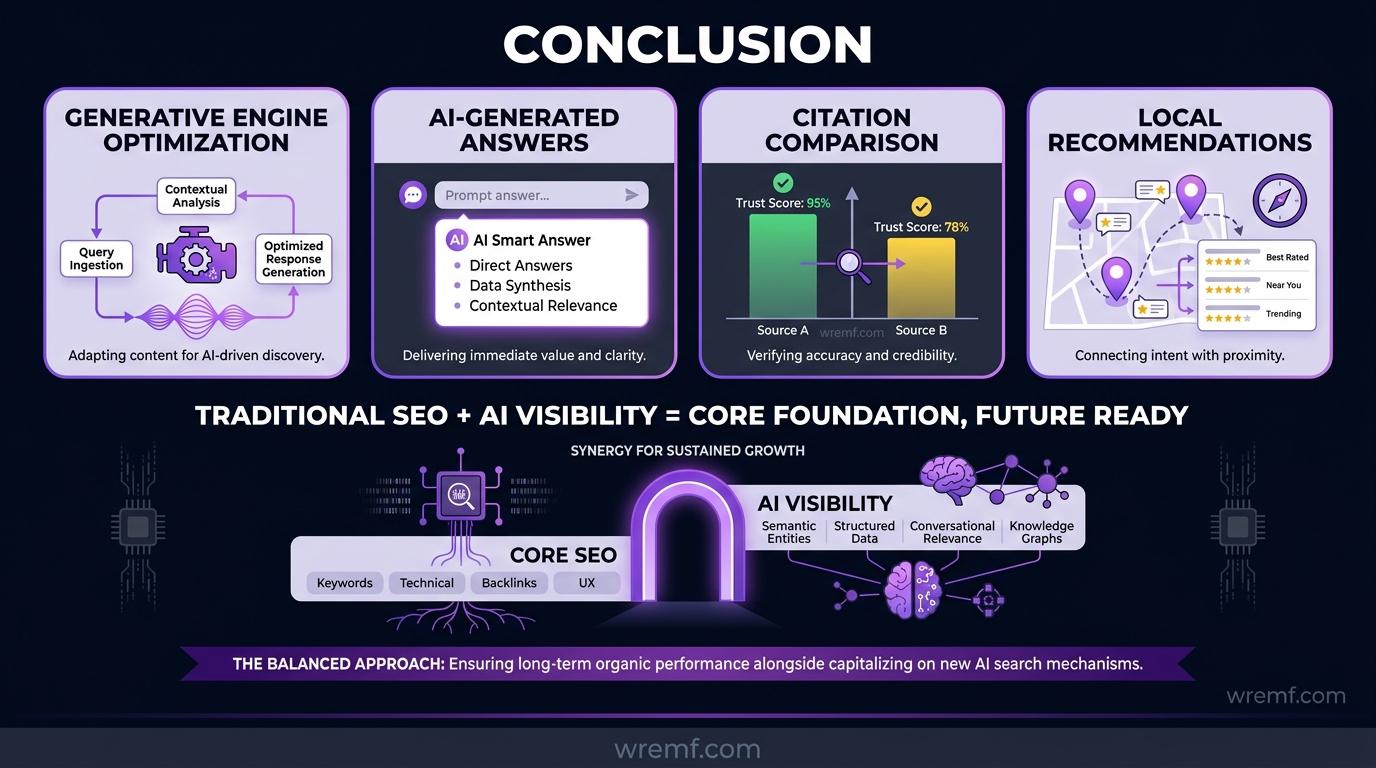
Generative engine optimization los angeles is now a practical visibility discipline for businesses that want to appear in AI-generated answers, citations, comparisons, and local recommendations. Traditional SEO still matters, but ranking alone does not show whether ChatGPT, Claude, Gemini, Perplexity, Copilot, or Google AI Overviews understand and recommend your brand. WREMF helps teams track prompts, measure citations, compare competitors, improve source consistency, and connect AI visibility to reporting. For teams that need execution, WREMF also provides senior-led GEO, AEO, and AI visibility services. To turn AI visibility into a measurable workflow, explore the WREMF platform suite or talk to the WREMF agency team.
Frequently Asked Questions About Generative Engine Optimization Los Angeles
What is Generative Engine Optimization?
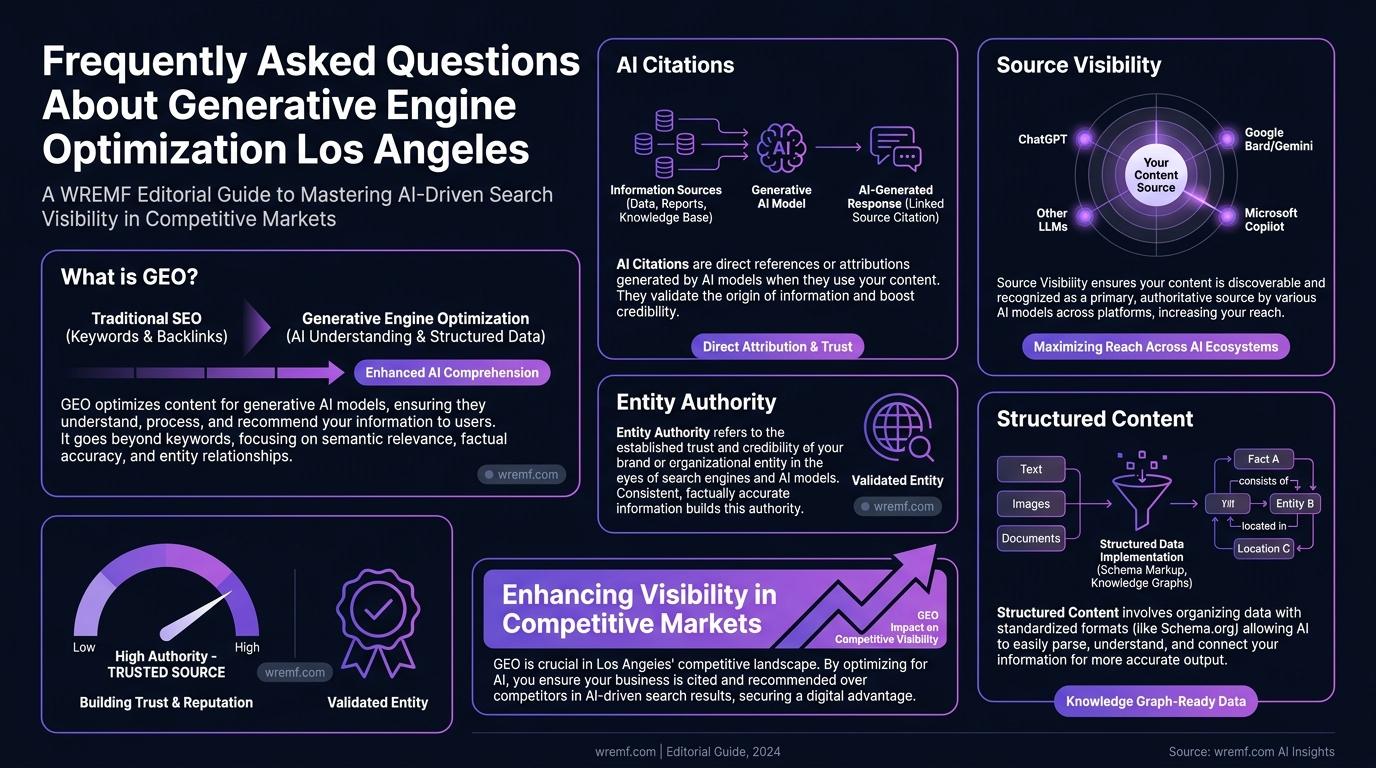
Generative Engine Optimization, or GEO, is the process of improving how a brand, website, or business appears in AI-generated answers from systems like ChatGPT, Claude, Gemini, Perplexity, Copilot, and Google AI Overviews. GEO focuses on AI citations, source visibility, entity authority, structured content, and answer-first formatting. The original Generative Engine Optimization research describes GEO as a framework for improving visibility in generative engine responses. For businesses in competitive markets, GEO helps turn AI search visibility into a measurable part of digital marketing strategy. (arXiv)
What is Generative Engine Optimization in Los Angeles?
Generative Engine Optimization in Los Angeles means optimizing a local or regional business so AI engines can understand, cite, and recommend it for LA-specific searches. This includes content about Los Angeles services, neighborhood relevance, local citations, Google Business Profile consistency, schema markup, and entity authority. For Los Angeles businesses, GEO is especially useful when users ask AI systems questions like “Who offers this service near me?” or “Which company should I choose in LA?” WREMF helps teams track these local prompt patterns across major AI engines through its AI visibility platform.
What Is AI SEO in Marketing?
AI SEO in marketing is the practice of optimizing content, websites, entities, and authority signals for both traditional search engines and AI-powered answer systems. It combines SEO, AEO, GEO, LLM optimization, structured content, citation analysis, and AI Search Optimization. The goal is to improve visibility across Google Search, Google AI Overviews, ChatGPT, Perplexity, Gemini, Claude, and other AI platforms. For B2B brands, AI SEO matters because buyers increasingly use AI systems to compare vendors, summarize options, and form shortlists before contacting a company.
Is GEO different from traditional SEO for my LA business?
Yes, GEO is different from traditional SEO because SEO focuses mainly on search rankings and organic traffic, while GEO focuses on AI-generated answers, citations, mentions, and recommendation visibility. Traditional SEO helps a page rank in search engines. GEO helps AI systems understand whether a business should be cited or recommended in conversational answers. Los Angeles businesses still need technical SEO, Local SEO, backlinks, and strong content, but GEO adds prompt tracking, source consistency, entity optimization, and AI visibility measurement.
Can Generative Engine Optimization replace traditional SEO, or are both required?
Generative Engine Optimization cannot fully replace traditional SEO because AI systems still rely on crawlable websites, authoritative sources, structured content, and trusted search signals. Both are required for durable visibility. SEO helps search engines discover and evaluate content, while GEO helps AI engines extract, cite, and recommend that content in generated answers. Google Search Central explains that site owners should continue focusing on helpful, satisfying content for AI search experiences, not shortcuts or isolated tricks. (Google for Developers)
Which AI platforms matter most for Los Angeles businesses?
The most important AI platforms for Los Angeles businesses are ChatGPT, Google AI Overviews, Gemini, Perplexity, Claude, Copilot, DeepSeek, Grok, Meta AI, and Mistral. Each platform influences search behavior differently. ChatGPT and Gemini are used for broad recommendations, Perplexity often supports research-heavy queries, and Google AI Overviews can affect mainstream search visibility. WREMF tracks visibility across 10 AI engines, helping brands compare where they appear, where competitors appear, and which AI platforms cite their sources most often.
How does GEO help my Los Angeles business?
GEO helps a Los Angeles business become more visible when AI systems answer local, commercial, and comparison-based questions. This can include appearing in AI-generated answers for treatment centers, healthcare providers, agencies, home services, legal services, SaaS companies, ecommerce brands, and professional services. GEO improves content clarity, entity authority, citation consistency, and prompt relevance. In practical AI visibility audits, teams often discover that their competitors appear in AI answers because they have stronger third-party mentions, clearer service pages, and better structured content.
How do I get my LA business into Google AI Overviews?
To improve the chance of appearing in Google AI Overviews, your LA business needs crawlable pages, helpful content, clear expertise, structured information, and strong topical authority. Google’s AI features guidance says site owners should use the same technical controls and content quality practices that apply to Google Search. For Los Angeles businesses, this also means accurate local information, clear service coverage, relevant FAQs, and strong supporting sources. WREMF’s AI Overview optimization guide explains how AI Overview visibility connects to SEO, AEO, and GEO. (Google for Developers)
How do you measure GEO success for Los Angeles businesses?
GEO success is measured through AI citations, brand mentions, recommendation visibility, prompt-level rankings, AI share of voice, source citations, competitor visibility, AI referral traffic, and business impact. Traditional SEO analytics alone are not enough because AI visibility often happens inside generated answers before a click occurs. WREMF’s AI visibility methodology connects prompts, citations, competitors, source consistency, visibility scoring, and attribution into one repeatable reporting system for brands, agencies, and growth teams.
How long does GEO take to work?
GEO usually takes weeks to months, depending on the website’s authority, content quality, competitive landscape, technical SEO health, and citation profile. A business with strong existing SEO foundations may see earlier AI visibility movement than a new website with limited authority. GEO is not instant because AI systems need reliable sources, consistent entity signals, and useful content to reference. The safest expectation is to treat GEO as an ongoing optimization program with monthly tracking, content improvements, citation monitoring, and competitor comparison.
Can I do GEO optimization myself or do I need a consultant?
You can do basic GEO optimization yourself if your team understands SEO, content strategy, technical SEO, schema markup, analytics, and AI search behavior. A consultant or AI visibility agency becomes useful when you need strategy, implementation, technical audits, citation gap analysis, reporting, or ongoing execution. Software-only works best for teams with internal resources. Managed services work best for teams that need help turning insights into action. WREMF offers both software and senior-led AI visibility agency services for teams that want hybrid support.
How do I incorporate GEO into my digital marketing strategy?
You incorporate GEO into digital marketing by mapping buyer prompts, auditing AI citations, improving answer-first content, strengthening entity authority, updating local SEO signals, and measuring visibility across AI engines. GEO should connect with SEO, content marketing, technical SEO, PR, digital PR, analytics, and conversion strategy. A practical workflow starts with an AI visibility audit, then prioritizes content updates, citation opportunities, and technical improvements. WREMF’s GEO audit feature helps teams identify where they are missing visibility across prompts, sources, and competitors.
What actionable steps should Los Angeles businesses take to start GEO?
Los Angeles businesses should start GEO by identifying high-intent customer questions, checking whether competitors appear in AI answers, auditing local citations, improving service pages, adding structured content, and updating Google Business Profile information. Google says complete and accurate Business Profile information can help customers understand what a business does, where it is, and when they can visit. For GEO, this local consistency also supports entity clarity across AI systems. After the audit, teams should build content clusters, FAQs, comparison pages, and citation strategies around real buyer intent. (Google Help)
What are examples of forward-thinking GEO tactics?
Forward-thinking GEO tactics include prompt landscape mapping, AI citation gap analysis, entity reinforcement, source consistency cleanup, content block formatting, AI-ready FAQs, comparison pages, schema markup, local knowledge graph optimization, and AI share-of-voice reporting. For Los Angeles businesses, advanced tactics also include neighborhood-level service content, local authority building, and third-party source development. WREMF supports these workflows through prompt intelligence, source citation tracking, competitive landscape analysis, content briefs, SEO testing, and managed GEO execution.
What is the meaning of generative AI?
Generative AI means artificial intelligence that can create new text, summaries, answers, code, images, or other outputs based on patterns learned from data. In search and digital marketing, generative AI powers systems that synthesize answers instead of only listing links. ChatGPT, Claude, Gemini, Copilot, Perplexity, and Google AI Overviews are examples of AI-powered discovery surfaces that can influence how buyers learn about companies. GEO exists because generative AI changes how visibility, trust, citations, and recommendations are formed.
How does LLM optimization relate to GEO?
LLM optimization is closely related to GEO because large language models power many AI answer systems. LLM optimization focuses on making content, entities, and source signals easier for models to understand, retrieve, and cite. GEO is broader because it includes AI search visibility, citation tracking, AI platform behavior, competitor visibility, and reporting. For Los Angeles businesses, LLM optimization helps clarify who the business serves, what it offers, where it operates, and why trusted sources should support its authority.
What is the difference between AEO, GEO, and SEO?
SEO improves visibility in search engine results, AEO improves content for direct answers, and GEO improves visibility inside generative AI responses. SEO focuses on rankings, crawlability, content relevance, backlinks, and organic traffic. AEO focuses on concise, answer-first content that can satisfy direct questions. GEO focuses on AI citations, recommendations, source consistency, prompt visibility, and entity authority. Strong AI search visibility usually requires all three because AI systems depend on clear content, trusted sources, and technically accessible websites.
Can GEO be done on WordPress?
Yes, GEO can be done on WordPress if the site has strong technical SEO, structured content, schema markup, internal linking, fast pages, and clear content architecture. WordPress is only the CMS, so results depend on implementation quality. A WordPress site can support AI-ready FAQs, content clusters, comparison pages, local landing pages, structured data, and editorial workflows. The key is making content easy for both users and AI systems to understand, extract, and trust.
Are you having trouble creating a content cluster strategy that works?
A content cluster strategy works best when each page targets a specific search intent, AI prompt pattern, buyer question, or local service need. For GEO, clusters should not only target keywords. They should also answer comparison, definition, “best provider,” local, pricing, and implementation questions that AI systems may summarize. Los Angeles businesses can build clusters around neighborhoods, services, industries, customer problems, and buying stages. WREMF’s AI-ready content brief generator helps teams turn prompt and citation insights into structured content plans.
How does GEO work for local service prompts in Los Angeles?
GEO works for local service prompts by helping AI systems connect a business to a location, service category, audience, and trusted source ecosystem. When someone asks ChatGPT who handles kitchen remodeling in Los Angeles, car accident cases in LA, or dental implants near Marina del Rey, AI systems may rely on local pages, reviews, directories, business profiles, citations, and structured content. GEO strengthens the signals that help a business become understandable and referenceable for those local recommendation prompts.
Why is Google Business Profile important for GEO in Los Angeles?
Google Business Profile is important for GEO in Los Angeles because it reinforces local entity accuracy across Google Search, Maps, and related local discovery systems. Google states that a Business Profile can help businesses appear on Google Search and Maps and provide customers with important details. For GEO, accurate name, address, phone, services, hours, categories, and location details help support local consistency. This does not guarantee AI Overview inclusion, but it strengthens the local visibility foundation that GEO builds on. (Google Business)
Why do local citations matter for AI visibility?
Local citations matter for AI visibility because they help confirm that a business is real, relevant, and associated with a specific service area. Citations can include directories, review platforms, chamber listings, industry profiles, local publications, and partner pages. AI systems may use trusted third-party sources to validate entities and summarize recommendations. For Los Angeles businesses, consistent local citations across Southern California sources can strengthen geographic relevance and reduce confusion around services, locations, and brand identity.
What role does schema markup play in Generative Engine Optimization?
Schema markup helps search engines and AI systems understand page entities, services, locations, FAQs, reviews, authorship, and business details more clearly. Schema does not guarantee AI citations, but it supports machine-readable context. For Los Angeles businesses, useful schema may include LocalBusiness, Organization, Service, FAQPage, Article, Product, Review, and Breadcrumb markup where appropriate. GEO works better when schema markup is paired with helpful content, accurate local data, strong authority signals, and clean technical SEO.
What role does technical SEO play in GEO?
Technical SEO supports GEO by making pages crawlable, indexable, fast, structured, and easy for search systems to process. If a page cannot be crawled or understood, AI systems are less likely to use it as a reliable source. Technical SEO for GEO includes internal linking, schema markup, rendering checks, canonical management, page speed, structured headings, clean navigation, and content block formatting. WREMF’s managed agency workflow includes technical AI visibility foundations such as schema guidance, crawl review, and retrieval-ready content structure.
What role does content strategy play in GEO?
Content strategy is central to GEO because AI systems need clear, complete, and trustworthy content to generate answers. A strong GEO content strategy includes pillar pages, cluster pages, FAQs, comparison pages, use-case pages, local landing pages, and answer-first content blocks. The content should match user intent, define entities clearly, and provide decision-useful information. For Los Angeles businesses, content strategy should also address local services, neighborhoods, industries, and buyer questions that appear in AI search prompts.
What role do backlinks and authority signals play in GEO?
Backlinks and authority signals matter in GEO because AI systems often favor trusted, well-supported sources. Backlinks, brand mentions, media coverage, directories, expert profiles, and third-party citations can help establish credibility. GEO does not treat backlinks exactly like traditional SEO, but authority still influences whether a source looks reliable enough to reference. WREMF’s agency services include authority and citation building recommendations for teams that need stronger third-party visibility and source consistency.
How should Los Angeles businesses optimize for ChatGPT?
Los Angeles businesses should optimize for ChatGPT by publishing clear service pages, answer-first FAQs, comparison content, local entity information, and authoritative supporting content that directly answers buyer questions. ChatGPT Search can provide timely answers with links to relevant web sources, according to OpenAI. That makes source clarity, freshness, and content usefulness important. Businesses should also monitor whether ChatGPT mentions their brand, cites their pages, or recommends competitors for high-intent prompts. (OpenAI)
How should Los Angeles businesses optimize for Perplexity?
Los Angeles businesses should optimize for Perplexity by creating source-worthy pages that answer specific questions clearly and can be cited in research-style responses. Perplexity users often investigate vendors, compare services, and verify claims through citations. Useful tactics include publishing detailed service pages, original insights, comparison content, FAQs, local expertise pages, and third-party references. WREMF’s source citation tracking helps teams monitor which sources are cited by AI engines and where citation gaps exist.
How should Los Angeles businesses optimize for Claude and Gemini?
Los Angeles businesses should optimize for Claude and Gemini by making their content clear, factual, structured, and entity-rich. Claude and Gemini may be used for research, summarization, recommendations, and business comparison workflows. Useful content includes concise definitions, service explanations, local proof points, comparison sections, FAQs, and authoritative references. The goal is not to manipulate a specific model. The goal is to make the business easier for AI systems to understand, classify, and reference accurately.
What are the most important GEO tools for Los Angeles businesses?
The most important GEO tools help with prompt tracking, AI citation monitoring, competitor visibility, source consistency, content briefs, technical audits, AI traffic attribution, and reporting. Traditional SEO tools remain useful for keyword research, backlinks, and technical SEO, but they usually do not show how a brand appears inside ChatGPT, Claude, Gemini, Perplexity, or AI Overviews. WREMF combines AI visibility tracking, prompt intelligence, source citation analysis, competitive visibility, and reporting in one platform for brands and agencies.
How does WREMF help with Generative Engine Optimization Los Angeles?
WREMF helps with Generative Engine Optimization Los Angeles by tracking how businesses appear across major AI discovery surfaces and turning those insights into action. The platform monitors prompts, citations, competitors, AI share of voice, source consistency, and attribution. WREMF also operates as an AI visibility agency for teams that need audits, strategy, content recommendations, technical implementation, citation optimization, and ongoing execution. This makes WREMF useful for software-only teams, managed-service clients, and hybrid software plus agency engagements.
What WREMF services are relevant for GEO implementation?
WREMF services relevant for GEO implementation include AI visibility audits, prompt landscape mapping, citation analysis, AEO strategy, GEO strategy reports, AI-ready content recommendations, technical optimization guidance, authority development planning, share-of-voice reporting, competitor visibility analysis, and attribution reporting. The agency workflow follows audit, strategy, build, amplify, and measure steps. Teams that need practical implementation can talk to the WREMF agency team to compare software-only tracking with managed AI visibility execution.
Should I choose GEO software, an agency, or a hybrid model?
You should choose GEO software if your team can execute strategy internally, an agency if you need expert implementation, and a hybrid model if you need both measurement and execution. Software-only solutions are useful for tracking prompts, citations, competitors, and reports. Agency support is useful for audits, technical implementation, content systems, authority building, and ongoing optimization. A hybrid model combines visibility data, strategic guidance, execution support, reporting, and attribution into one workflow.
Are GEO services useful for digital agencies?
Yes, GEO services are useful for digital agencies because clients increasingly ask how they appear in ChatGPT, Google AI Overviews, Perplexity, Gemini, Claude, and other AI search systems. Agencies need prompt tracking, white-label reports, citation monitoring, competitor visibility, and repeatable workflows across multiple clients. WREMF supports agencies with white-label reporting, multi-site monitoring, BYOK support, and client-ready AI visibility reporting through its AI visibility tools for agencies.
What is included in a basic GEO or AI visibility plan?
A basic GEO or AI visibility plan usually includes prompt tracking, AI engine monitoring, citation tracking, competitor visibility, reporting, and basic recommendations. In WREMF, the Starter plan includes 1 website, unlimited prompt tracking, BYOK, 10 AI engines, all features and tools, white-label reports, 1 seat, and email support for €39 per month. Growth and Enterprise plans add more websites, priority support, content brief generation, SEO testing, unlimited seats, and custom branded portals. Teams can compare options on the WREMF pricing page.
Do you work with businesses outside of Los Angeles?
Yes, GEO can support businesses outside of Los Angeles because AI search visibility applies across local, national, and international markets. Los Angeles-focused GEO emphasizes local entities, neighborhoods, regional citations, and Southern California visibility. National GEO emphasizes broader category authority, competitor comparison, and multi-market content systems. WREMF can support in-house brands, agencies, and B2B companies across regions through software, managed services, and hybrid AI visibility programs.
When should I get help navigating AI search changes?
You should get help navigating AI search changes when organic traffic is becoming harder to interpret, competitors appear in AI answers, your brand is missing from high-intent prompts, or your team lacks time to build GEO systems internally. AI search changes affect content strategy, SEO analytics, citation building, technical SEO, and reporting. WREMF is useful when teams want a practical roadmap that connects AI visibility data with content, technical improvements, source consistency, and business outcomes.
What are the biggest mistakes Los Angeles businesses make with GEO?
The biggest GEO mistakes are treating AI optimization like keyword stuffing, ignoring technical SEO, publishing thin content, skipping local citations, failing to monitor prompts, and measuring only website traffic. Another common mistake is assuming AI systems will understand a business without clear entity signals. Los Angeles businesses should focus on useful content, accurate local data, trusted third-party sources, structured pages, and measurable AI visibility reporting rather than shortcuts.
What cannot be guaranteed with GEO?
GEO cannot guarantee AI citations, rankings, traffic, revenue, or recommendations because AI systems use changing models, source sets, retrieval methods, and ranking signals. A good GEO strategy improves the probability of visibility by strengthening content, authority, entity clarity, source consistency, and technical accessibility. Ethical GEO should be measured through observable metrics such as prompts, citations, mentions, source inclusion, competitor visibility, and AI referral traffic, not unrealistic promises.
How can I see forward-thinking GEO tactics in action?
You can see forward-thinking GEO tactics in action by reviewing an AI visibility report that shows prompts, citations, competitors, source gaps, recommendations, and visibility changes across engines. A useful report should show where your brand appears, where competitors appear, which sources AI systems cite, and what actions can improve visibility. WREMF provides example reporting through its AI visibility sample report, which helps teams understand what measurable GEO reporting looks like.
Do GEO, AEO, and SEO work together?
Yes, GEO, AEO, and SEO work together because each supports a different part of modern search visibility. SEO helps websites rank and get crawled. AEO helps content answer specific questions clearly. GEO helps AI systems cite, mention, and recommend brands in generated responses. For Los Angeles businesses, the strongest strategy usually combines technical SEO, Local SEO, content strategy, structured data, citation building, prompt tracking, and AI visibility reporting.
What should I ask before hiring a GEO agency in Los Angeles?
Before hiring a GEO agency in Los Angeles, ask how the agency tracks AI visibility, which AI engines it monitors, how it measures citations, how it handles Local SEO, what deliverables are included, and whether reporting connects to business outcomes. You should also ask whether the agency provides software, managed execution, or both. Strong GEO agencies should explain their methodology, avoid guaranteed claims, and show how they prioritize prompts, content gaps, citations, and competitor visibility.
Related reading
- Enterprise Generative Engine Optimization: The Complete Guide for AI Search Visibility
- LLM SEO Agency: The Complete Guide to Choosing an Agency for AI Search Visibility
- Answer Engine Optimization Services: The Complete Guide to AI Search Visibility
- AI SEO Generative Engine Optimization Austin: Guide to GEO, AI Search Visibility, and AI Citations