How to Improve AI Search Visibility: Guide for B2B Brands
Learn how to improve AI search visibility for B2B brands, focusing on content optimization and technical strategies for AI-generated visibility.
By WREMF Team · 2026-08-22
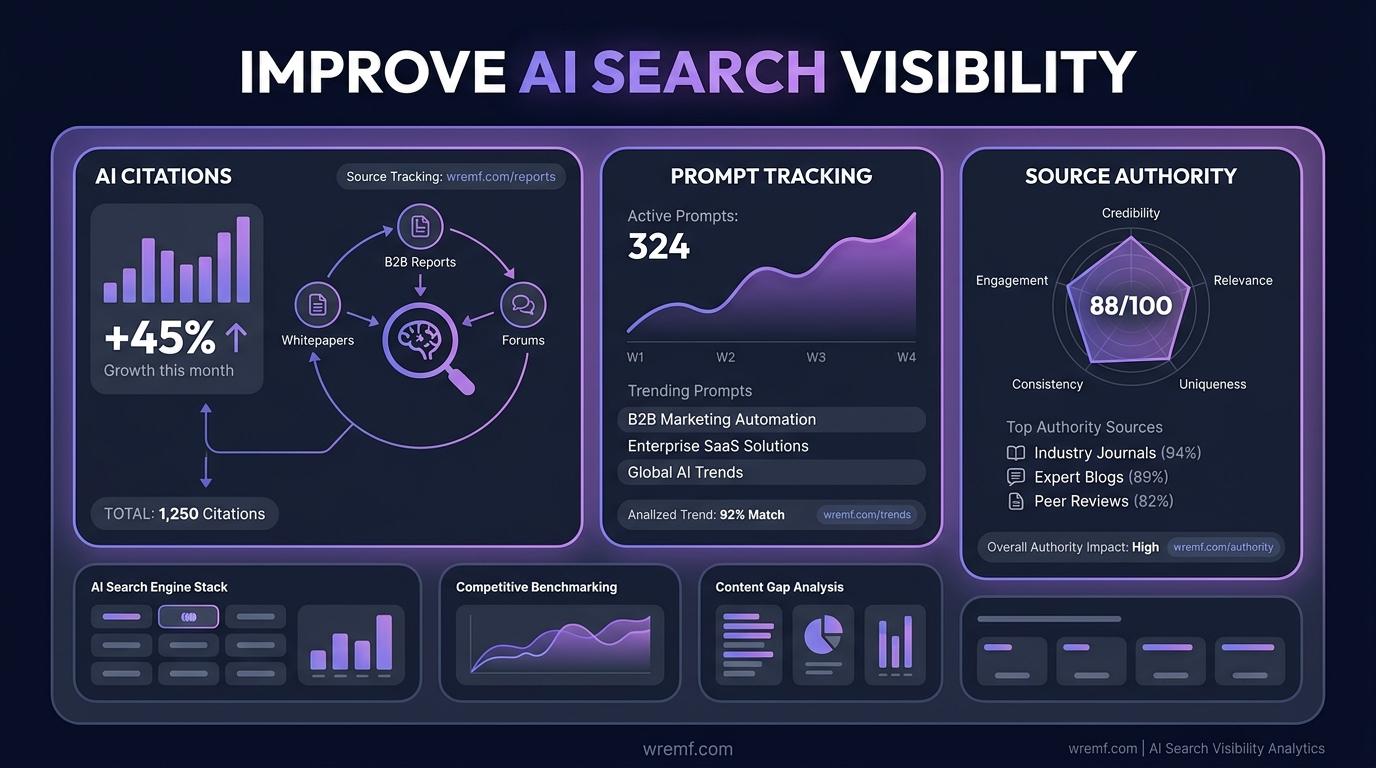
AI search visibility refers to the measurable presence of a brand within AI-generated answers, citations, summaries, and recommendations. Improving AI visibility involves ensuring AI systems can find, understand, and accurately represent your brand. Critical components include clear content, source reliability, technical readiness, and alignment with user queries. Its implications are vital for B2B brands as AI platforms increasingly influence buyer decisions before traditional engagement methods. The process requires a strong content ecosystem and meticulous source management.
Key takeaways
- AI search visibility ensures brands are recognized in AI-generated content.
- Effective AI visibility integrates technical SEO, structured content, and reliable sources.
- Improving AI visibility starts with understanding AI systems' source selection criteria.
- AI platforms like ChatGPT and Perplexity significantly impact buyer decision-making.
- Monitoring AI-driven citations and adapting content strategies is critical for B2B success.
How to Improve AI Search Visibility: Guide for B2B Brands
How to improve AI search visibility is the process of making your brand easier for AI engines to find, understand, cite, mention, and recommend. Google Search Central now gives site owners specific guidance for AI features such as AI Overviews and AI Mode, which shows that AI visibility is becoming part of mainstream search strategy. WREMF helps B2B teams track, improve, and prove visibility across ChatGPT, Claude, Gemini, Perplexity, Google AI Overviews, Copilot, DeepSeek, Grok, Meta AI, Mistral, and other AI discovery surfaces. This guide explains how AI search visibility works, how it differs from SEO, how to improve content and technical readiness, how to measure results, and how to connect AI visibility to business outcomes. Start with measurement, then improve the sources AI systems rely on.
What Is AI Search Visibility?
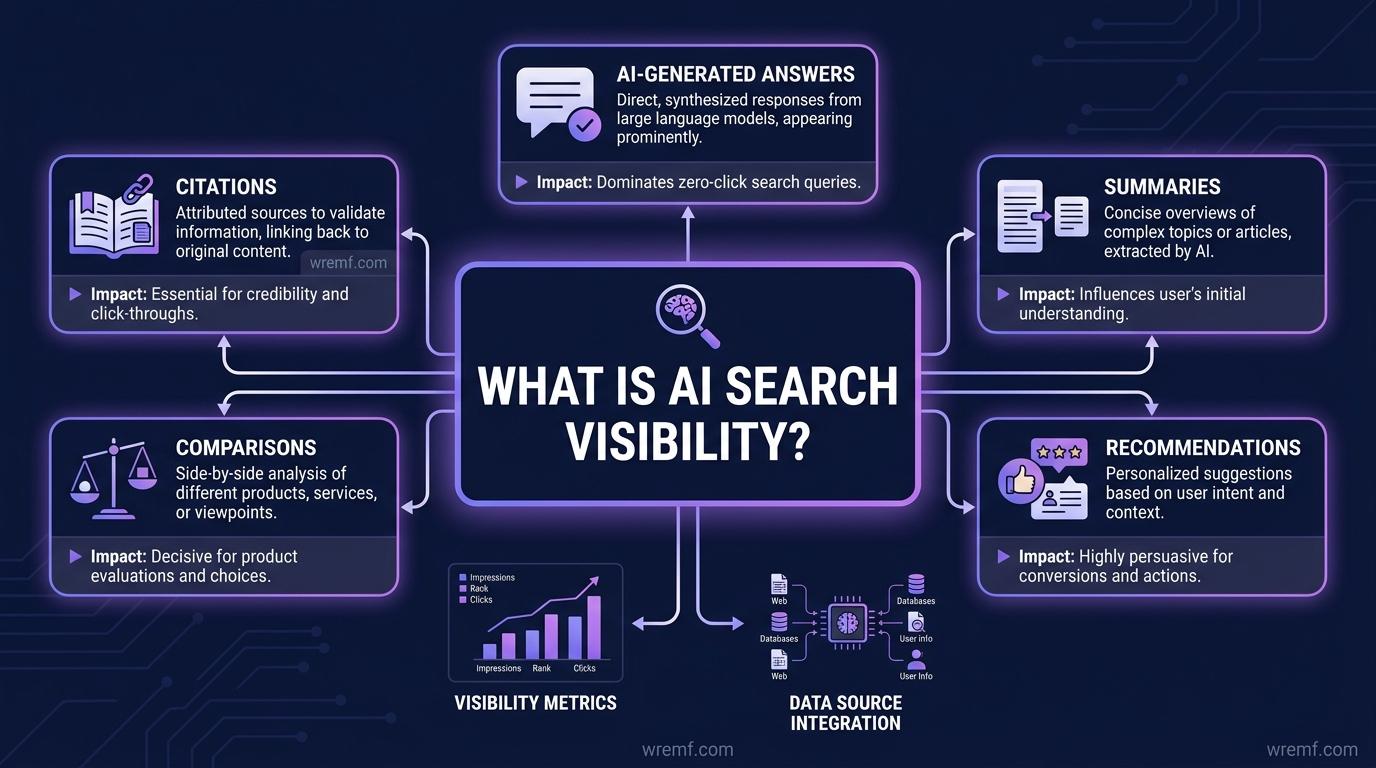
AI search visibility is your brand’s measurable presence inside AI-generated answers, citations, summaries, comparisons, and recommendations. Improving AI search visibility helps B2B buyers discover your brand when they ask AI systems for advice, vendor shortlists, definitions, comparisons, and next steps.
AI visibility is the measurable presence of a brand inside AI-generated answers, recommendations, citations, summaries, and follow-up prompts. AI visibility matters because buyers can now learn about a company inside an AI interface before they visit a website, view an ad, speak to sales, or click an organic result.
AI discovery surfaces are AI-powered environments where users ask natural-language questions and receive generated answers. Examples include ChatGPT, Perplexity, Google AI Overviews, Google AI Mode, Microsoft Copilot, Gemini, Claude, DeepSeek, Grok, Meta AI, Mistral, and AI-powered search experiences connected to Bing, Microsoft Start, and other search products.
In practical AI visibility audits, teams often discover that their brand is not invisible because the product is weak. The brand is invisible because AI systems cannot find enough clear, consistent, source-backed information to confidently describe or recommend it. That means visibility depends on your website, third-party sources, structured content, citations, topical depth, technical access, and the way buyers phrase prompts.
Google explains in its AI features and your website guidance that site owners should think about how content appears in AI Overviews and AI Mode. This matters because AI search visibility is no longer limited to experimental tools. AI-generated answers are now part of mainstream search interfaces.
WREMF helps teams track, improve, and prove AI visibility across major AI discovery surfaces through the WREMF AI visibility platform suite. The platform connects prompt intelligence, source citation tracking, competitor visibility, AI share of voice, traffic attribution, and reporting into one workflow.
DID YOU KNOW: Pew Research Center found that 18% of Google searches in its March 2025 U.S. desktop browsing study generated an AI summary, and 88% of those summaries cited three or more sources. That means source visibility is already part of the AI search experience.
KEY TAKEAWAY: AI search visibility is not only about whether your website ranks. It is about whether AI systems can find, understand, cite, mention, compare, and recommend your brand.
To improve visibility, you first need to understand why AI search is different from traditional search.
Why AI Search Visibility Matters for B2B Brands
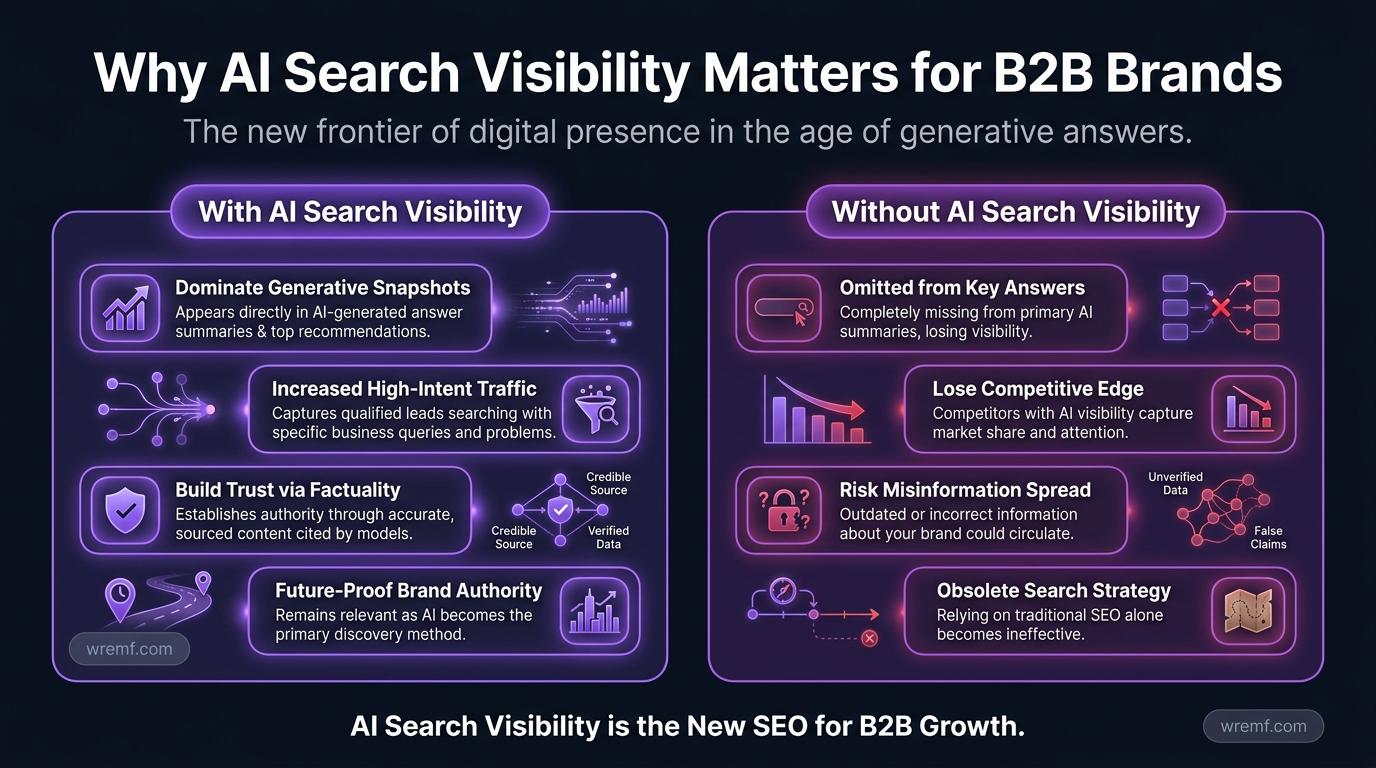
AI search visibility matters because buyers increasingly use AI engines to research problems, compare vendors, summarize options, and validate decisions. If your brand is absent or misrepresented in AI-generated answers, competitors can shape the buyer’s understanding before your team enters the conversation.
Answer engine visibility is the presence of your brand inside AI-generated answers from tools such as ChatGPT, Perplexity, Google AI Overviews, Gemini, and Microsoft Copilot. Answer engine visibility matters because the answer itself can influence awareness, trust, preference, and next-step behavior.
In real B2B buying journeys, buyers rarely ask one simple keyword. Buyers ask questions such as “What is the best AI visibility tool for a B2B SaaS company?”, “How do I improve AI search visibility?”, “How is GEO different from SEO?”, “Which companies help with Perplexity citations?”, and “How do I measure AI visibility beyond screenshots?” These prompts combine informational, commercial, comparison, and implementation intent.
This shift matters because search behavior is moving from static result scanning to conversational exploration. OpenAI explains that ChatGPT search can provide timely answers with links to relevant web sources. Microsoft explains that Copilot Search provides curated answers with references and citations through its AI search experience. Perplexity positions itself as an answer engine that provides sourced responses. These systems do not only return links. They generate answers.
AI search visibility is the new upstream layer of digital discovery. AI search visibility affects how buyers form category opinions, which vendors enter shortlists, which sources earn trust, and which objections appear before a sales conversation starts. AI search visibility matters because the buyer may ask an AI engine before searching your brand directly.
For B2B teams, the risk is not only losing traffic. The bigger risk is losing category presence. A buyer may never see your brand if AI systems repeatedly cite competitors, outdated sources, incomplete third-party profiles, or generic list articles.
IMPORTANT: AI search visibility should not replace SEO. AI search visibility expands SEO into a broader discipline that includes answer extraction, source citations, prompt tracking, entity authority, and recommendation visibility.
KEY TAKEAWAY: AI search visibility matters because AI-generated answers now influence discovery, comparison, trust, and vendor shortlisting before buyers reach your website.
The next step is understanding how AI systems find and select the information they use.
How AI Search Engines Choose Sources
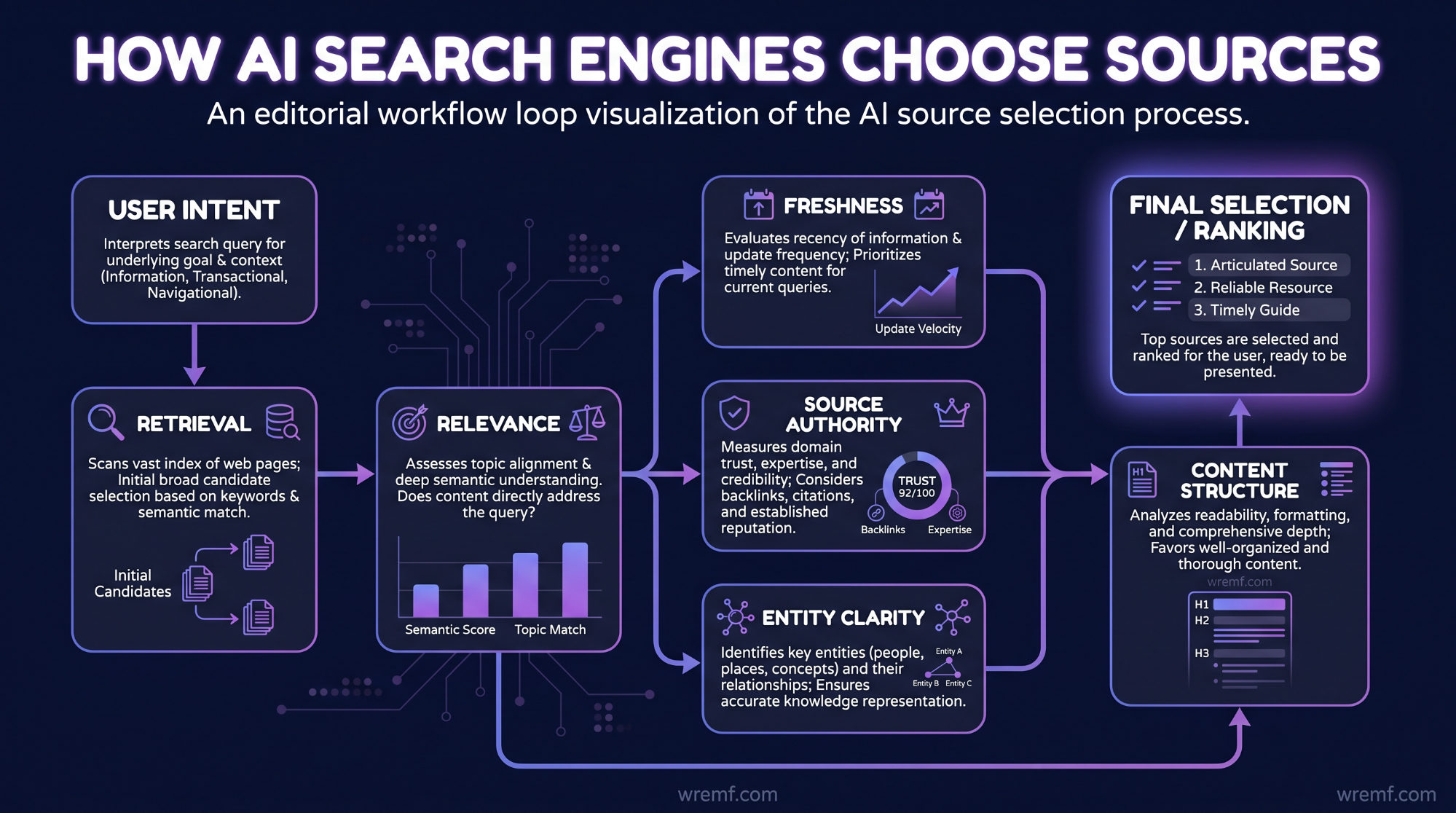
AI search engines choose sources by combining retrieval, relevance, freshness, source authority, entity clarity, content structure, and user intent. Improving AI search visibility starts by making your brand easier to retrieve, easier to understand, and safer to cite.
AI citations are source links, references, or supporting materials used by AI systems to justify generated answers. AI citations matter because they show which sources influence the answer and which pages users may trust after reading the response.
Prompt tracking shows how your brand appears across repeated questions, engines, and buying scenarios. Prompt tracking matters because AI visibility is not one keyword, one rank, or one screenshot. A brand may appear for one prompt, disappear for a second prompt, and be described inaccurately for a third.
AI systems can use different retrieval approaches depending on the product. Some AI search systems retrieve current web pages. Some use search indexes. Some use partner content, knowledge graphs, browsing tools, structured databases, or source documents. Some combine multiple methods. The practical implication is simple: your brand needs a strong source ecosystem, not just one optimized page.
Source citations can come from:
Your own website
Documentation pages
Product pages
Blog posts
Research reports
Review platforms
Industry directories
Partner pages
News articles
Knowledge bases
Community discussions
Public company profiles
Comparison pages
Search result pages
Video and audio transcripts
Support content
Customer education content
Perplexity explains in its official help documentation that answers include citations to sources. This makes citation quality important for brands that want to be understood and verified in AI search. If the cited sources are outdated, unclear, or inconsistent, the AI-generated answer can also become unclear or inconsistent.
In practical AI visibility audits, the cited source set is often more revealing than the answer itself. The source set shows what the AI engine currently trusts. If competitors are cited from analyst articles, category pages, documentation, customer reviews, or community discussions, your team can see where your own source ecosystem is weak.
TIP: Do not begin by rewriting every page. Begin by asking which sources AI systems already cite for your priority prompts.
KEY TAKEAWAY: AI search engines rely on retrievable and trustworthy sources, so visibility improves when your brand has clear content, consistent entity signals, and credible citations.
Once you know how sources are selected, you need a technical foundation that allows those sources to be discovered.
Build a Technical Foundation for AI Ingestion
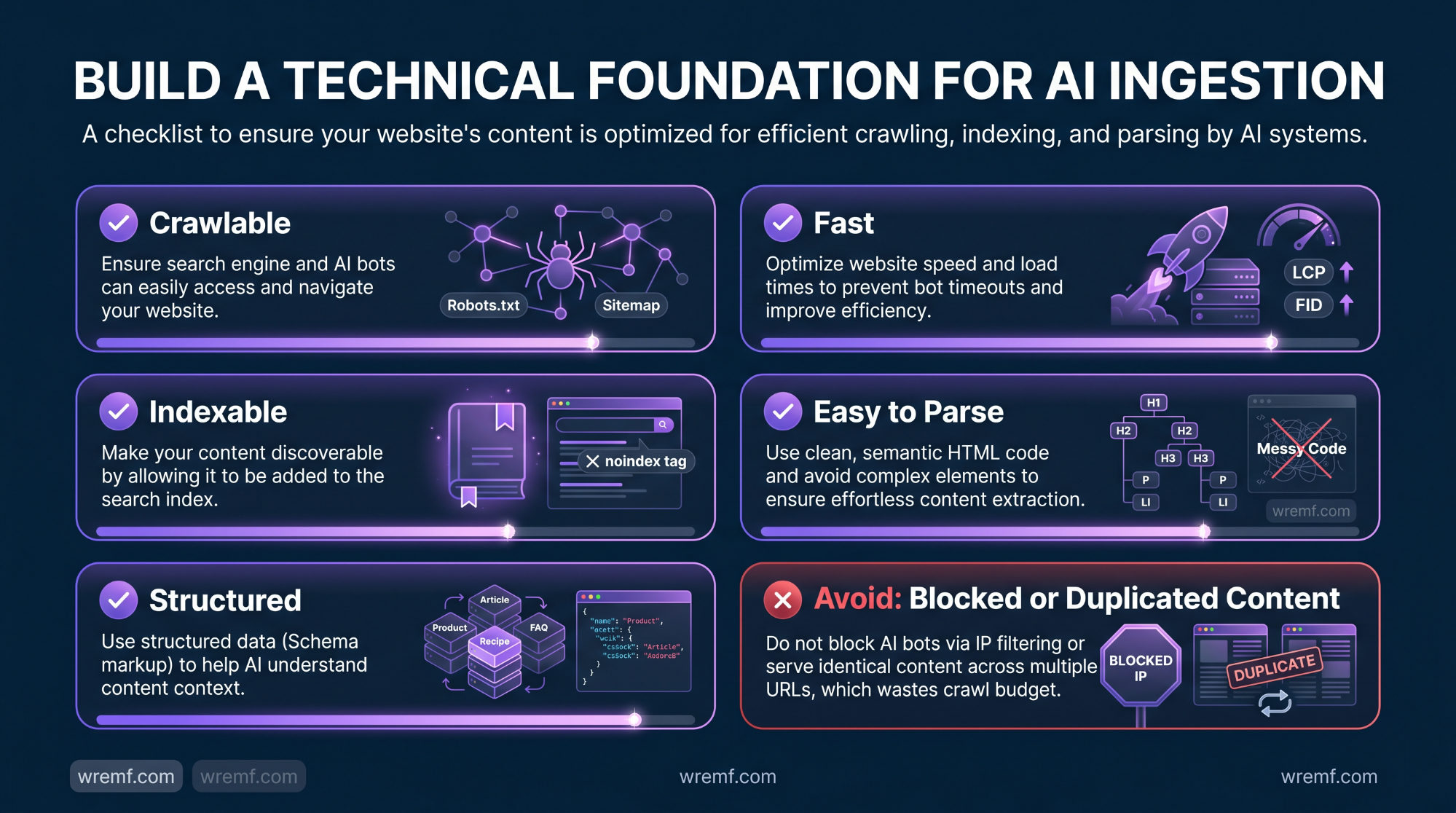
A technical foundation improves AI search visibility by making your website crawlable, indexable, structured, fast, and easy to parse. AI systems cannot reliably retrieve or cite content that is blocked, buried, duplicated, technically broken, or unclear in HTML.
Technical SEO is the process of making a website accessible and understandable for search systems. Technical SEO matters for AI visibility because many AI discovery surfaces rely on web indexes, search results, structured signals, and retrievable page content.
AI ingestion is the process by which AI systems or their supporting search systems access, parse, index, retrieve, or summarize content. AI ingestion matters because a page must usually be accessible before it can influence AI-generated answers.
Start with these technical checks:
Make important pages return HTTP 200 status
Keep priority pages indexable
Avoid blocking important content in robots.txt
Use canonical tags consistently
Keep XML sitemaps updated
Use clean HTML for main content
Use descriptive title tags
Use concise meta descriptions
Use logical H1, H2, and H3 headings
Build internal links between related topic cluster pages
Reduce duplicate or thin pages
Keep page templates readable without unnecessary clutter
Make important content visible in the HTML
Use structured data where it clarifies entities
Check crawl errors in search tools
Keep redirects clean and intentional
Structured data is machine-readable markup that helps search systems understand entities, page types, products, organizations, authors, FAQs, reviews, and other content elements. Structured data matters because it can reduce ambiguity when it matches the visible content on the page.
JSON-LD is a structured data format commonly used to describe page entities in a machine-readable way. JSON-LD matters for AI search visibility because it can reinforce what the page is about, who published it, and what entities are connected to the page.
The Google Search Central documentation on creating helpful, reliable, people-first content explains that content should be useful, reliable, and made for people. This guidance still matters in AI-era search because AI visibility depends on content that can be trusted, understood, and summarized.
A common implementation mistake is adding schema markup without improving the page itself. If a page claims to answer “how to improve AI search visibility,” the visible content must define the topic, explain the process, compare related concepts, answer buyer questions, and show evidence. Structured data should reinforce the page. It should not hide weak content.
KEY TAKEAWAY: Technical readiness makes your content eligible for discovery, but clear and trustworthy content determines whether AI systems can use it confidently.
With technical foundations in place, the next improvement area is content structure.
Structure Content for AI-Generated Answers
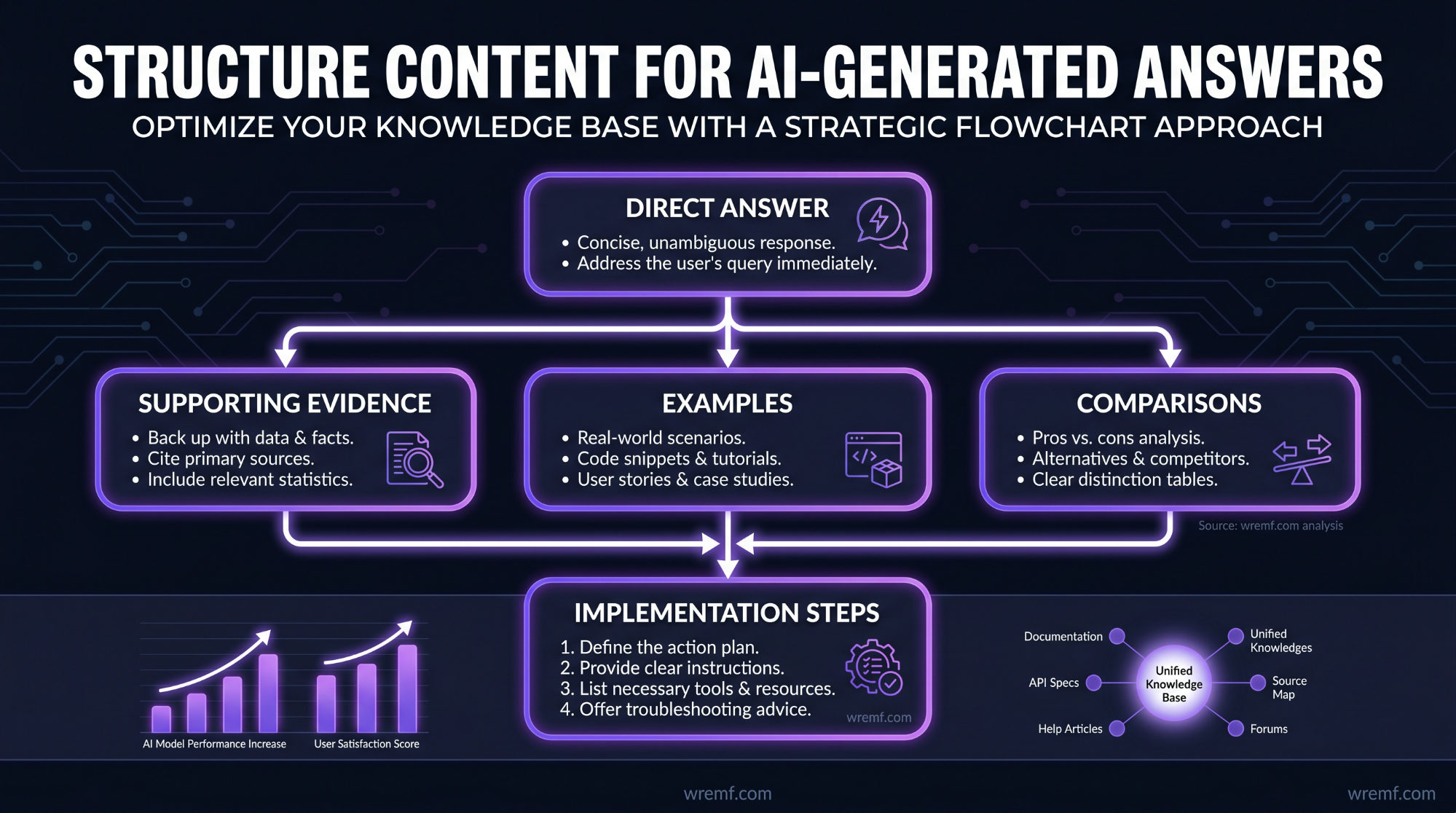
Structured content improves AI search visibility by giving AI systems direct, extractable answers to natural-language questions. The strongest AI-ready content answers first, supports the answer with evidence, and then expands into examples, comparisons, and implementation steps.
Answer-first content is content that begins with a direct answer before adding background. Answer-first content matters because AI systems and human readers both need clear, self-contained explanations that can stand alone.
AI-generated answers often favor content that is easy to summarize. This does not mean writing short pages only. It means structuring long pages into clear chunks with definitions, direct answers, tables, lists, examples, and FAQs. Each section should answer one specific question before adding detail.
Use this content structure for important pages:
Start with a direct definition or answer
Explain why the topic matters
Use short paragraphs
Use descriptive headings
Add comparison tables where useful
Include step-by-step workflows
Define key entities on first mention
Use natural-language questions in headings
Add real examples from B2B workflows
Include limitations and risks
Link to authoritative sources near factual claims
Add internal links to relevant supporting pages
Update fast-moving content regularly
Generative engine optimisation, or GEO, is the process of improving how generative AI systems retrieve, cite, summarize, and recommend your brand. GEO matters because AI systems generate answers from sources, patterns, and entities instead of only listing ranked pages.
Answer engine optimisation, or AEO, is the practice of structuring content so answer engines can extract clear responses. AEO matters because users increasingly ask complete questions such as “What is answer engine visibility?” or “How is answer engine visibility different from organic search?”
LLM visibility is the presence of a brand inside large language model responses. LLM visibility matters because tools such as ChatGPT, Claude, Gemini, and Perplexity may influence research, comparison, and decision-making without sending traditional search traffic.
AI search visibility improves when content matches the way buyers ask questions. AI search visibility depends on definitions, comparisons, proof, use cases, limitations, and clear recommendations. AI search visibility is strongest when content answers the prompt and gives AI systems a credible source to cite.
TIP: Write every major section as if it must answer one buyer prompt without needing the rest of the article for context.
KEY TAKEAWAY: AI-ready content should be direct, structured, source-backed, entity-rich, and aligned with the questions buyers actually ask.
The next step is moving beyond isolated keywords into topic clusters and entity authority.
Move From Keywords to Topic Clusters and Semantic Understanding
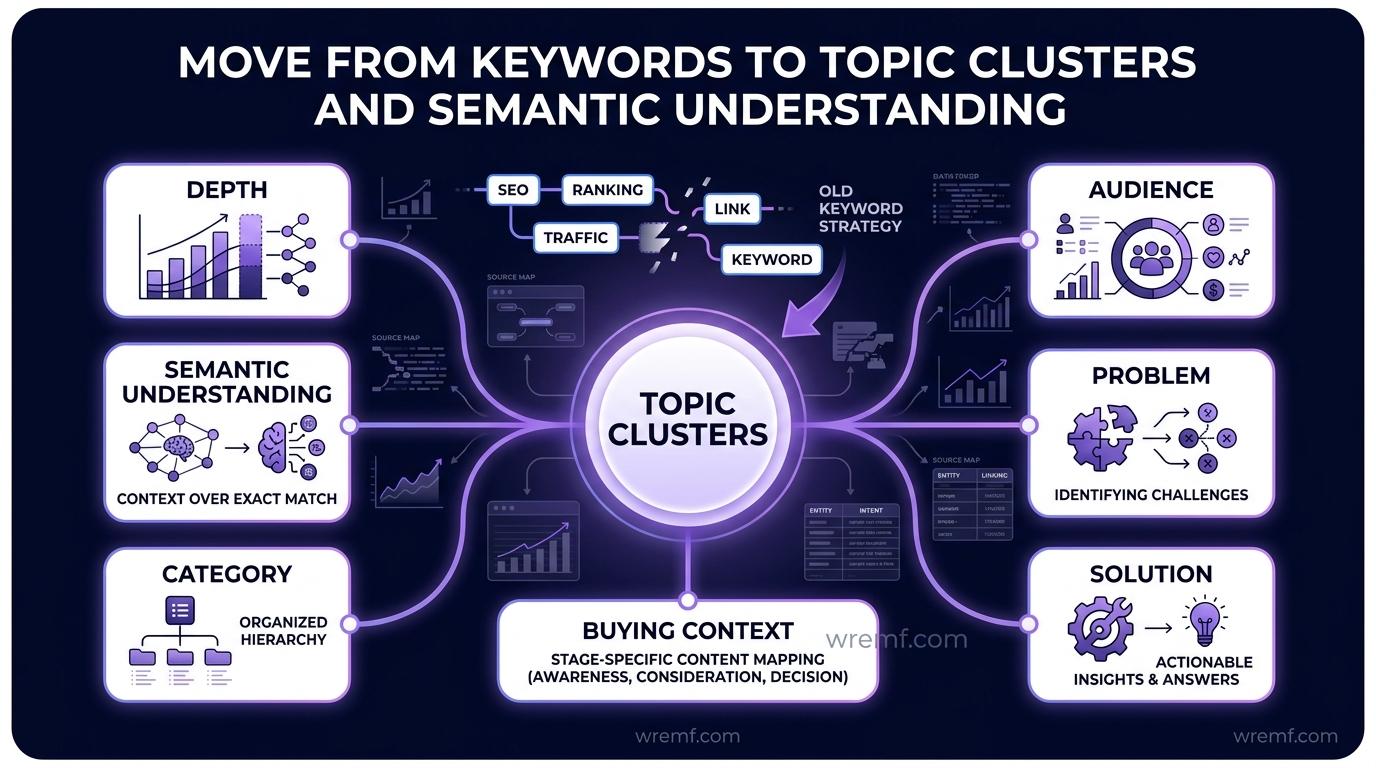
Topic clusters improve AI search visibility by proving that your brand has depth across a subject, not just one optimized page. Semantic understanding helps AI systems connect your brand to a category, audience, problem, solution, and buying context.
Topic clusters are groups of related pages that cover a subject from multiple angles. Topic clusters matter because AI systems need enough connected context to understand expertise, scope, and relevance.
Semantic search is search that interprets meaning, relationships, and intent rather than relying only on exact keyword matches. Semantic search matters for AI visibility because users ask natural-language questions that may not match your exact keyword phrasing.
Keyword research still matters, but it is no longer enough by itself. A page optimized for “AI search visibility” may miss prompts such as “how to appear in ChatGPT answers,” “how to get cited in Perplexity,” “how to measure AI share of voice,” “why does my brand not appear in AI Overviews,” or “what sources do AI assistants trust?” Topic clusters solve this by covering the full question set.
For the topic “how to improve AI search visibility,” a complete cluster may include:
What is AI visibility?
What is answer engine visibility?
What is generative engine optimisation?
What is answer engine optimisation?
SEO vs AEO vs GEO
AI visibility tracking
Prompt tracking
Source citation tracking
AI share of voice
AI traffic attribution
Google AI Overviews optimisation
ChatGPT visibility
Perplexity citation visibility
Microsoft Copilot visibility
GEO audits
AI-ready content briefs
Source consistency
Brand mention tracking
Competitor visibility in AI answers
AI visibility tools
AI visibility reporting
AI search visibility for B2B SaaS
AI visibility for agencies
Entity authority is the perceived strength and clarity of a brand, person, product, or concept across sources. Entity authority matters because AI systems often synthesize information from many sources and need to understand whether a brand belongs in a category.
Marketing teams often find that one pillar page cannot carry the full strategy. The pillar page should explain the main topic, while supporting pages should answer adjacent questions in more detail. WREMF supports this workflow through AI-ready content briefs, which help teams turn prompt gaps and topic gaps into structured content plans.
KEY TAKEAWAY: Topic clusters help AI systems understand your expertise, while entity authority helps AI systems connect your brand to the right category and buyer intent.
After building topical depth, you need to strengthen the source ecosystem beyond your own website.
Become an Authoritative Entity Across Trusted Sources
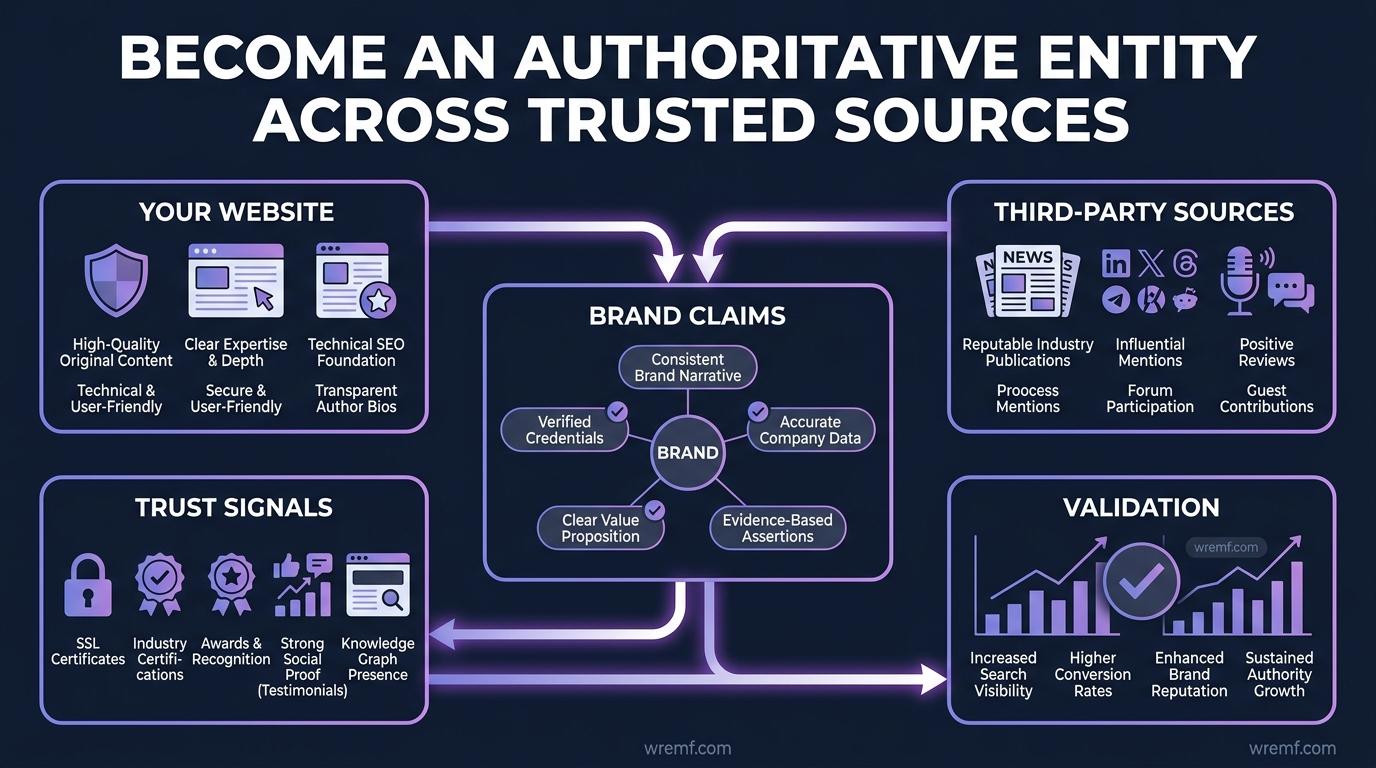
Becoming an authoritative entity improves AI search visibility because AI systems often validate brand claims through third-party sources. Your website explains who you are, but external sources often determine whether AI systems trust and repeat that explanation.
Source consistency is the alignment of brand descriptions across your website, directories, review platforms, partner pages, press mentions, documentation, and other public sources. Source consistency matters because inconsistent descriptions create confusion for AI systems and buyers.
Brand mentions are references to your company, product, founders, or category across the web. Brand mentions matter because repeated, accurate, and contextually relevant mentions help reinforce your relationship to a market.
In practical AI visibility audits, teams often find that AI systems describe the company using language from third-party sources rather than the company’s own preferred positioning. If directories call your platform an SEO tool, review sites call it analytics software, and articles call it a content platform, AI systems may struggle to place the brand in one category.
To improve entity authority, audit these sources:
Homepage and product pages
About page
Pricing page
Documentation
Blog and resource pages
Review profiles
SaaS directories
Partner pages
Founder profiles
LinkedIn company page
Public databases
News mentions
Podcast pages
Webinar pages
Community discussions
Knowledge bases
Customer education pages
Support content
Comparison pages
The goal is not to control every mention. The goal is to reduce confusion where it matters. Your core category, audience, use cases, features, and differentiators should be described consistently across sources AI systems can access.
Brand mention velocity is the rate at which credible sources mention your brand over time. Brand mention velocity matters because recent and repeated mentions can help reinforce that a brand is active in a category.
AI citations matter because citations show which sources shape the generated answer. Source consistency helps AI systems connect the same company, product, and category across multiple pages. Entity clarity helps AI systems avoid confusing your brand with competitors, adjacent categories, or outdated positioning.
IMPORTANT: Do not rely only on your homepage to define your brand. AI systems may use third-party sources that are more specific, more recent, or easier to retrieve.
KEY TAKEAWAY: AI search visibility improves when your brand is described consistently across your own site and trusted external sources.
The next section explains how traditional SEO, AEO, and GEO work together.
SEO vs AEO vs GEO: What Actually Changes?
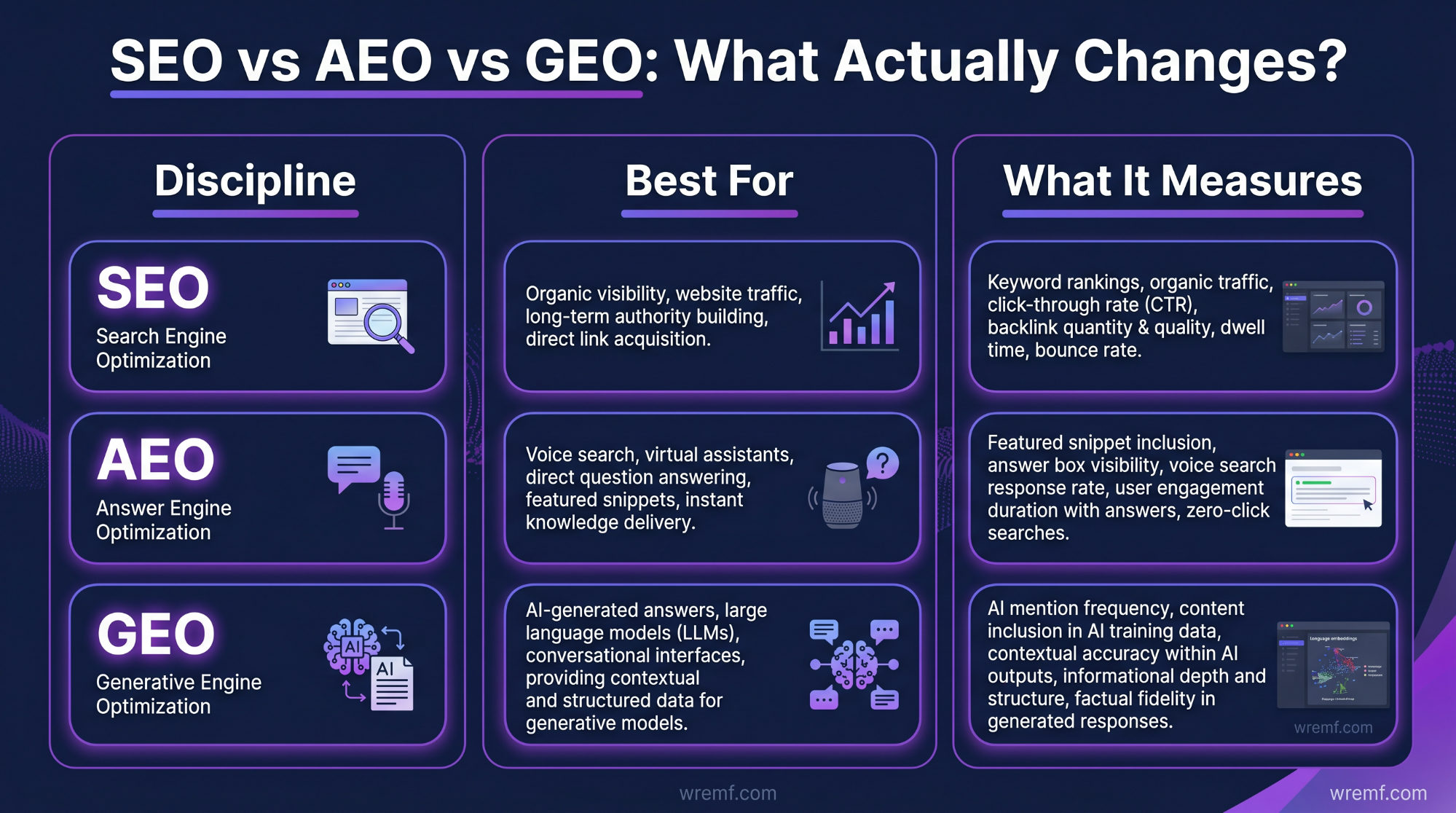
SEO, AEO, and GEO overlap, but they optimise for different discovery behaviors. SEO improves search result visibility, AEO improves direct answer extraction, and GEO improves brand presence inside generated AI responses.
SEO is search engine optimisation for improving visibility in traditional search results. SEO matters because search indexes, crawlability, content quality, links, and user intent still influence discoverability.
AEO is answer engine optimisation for earning concise answers in answer-driven interfaces. AEO matters because users increasingly ask direct questions and expect immediate responses.
GEO is generative engine optimisation for improving how AI systems retrieve, cite, summarize, compare, and recommend your brand. GEO matters because AI-generated answers can influence awareness and preference even when users do not click.
The key difference between SEO and GEO is that SEO often measures ranked pages and organic clicks, while GEO measures prompts, citations, mentions, sentiment, source consistency, and recommendation visibility.
| Discipline | Best For | What It Measures | What It Misses | Typical User | Example Metric |
|---|---|---|---|---|---|
| SEO | Traditional search visibility | Rankings, impressions, clicks, crawlability, indexation | AI citations, prompt visibility, generated recommendations | SEO teams | Organic clicks from Google Search |
| AEO | Direct answer extraction | FAQ coverage, concise definitions, answer readiness | Source ecosystem and competitor recommendation share | Content and SEO teams | Answer coverage for target questions |
| GEO | Generative AI visibility | AI mentions, citations, recommendations, source consistency | Some classic SERP detail | Growth, content, brand, and SEO teams | AI share of voice across prompt clusters |
| AI visibility tracking | Cross-engine AI monitoring | Prompt outcomes across ChatGPT, Gemini, Perplexity, Copilot, Claude, and AI Overviews | Execution unless connected to workflows | B2B brands and agencies | Brand visibility by prompt and engine |
BrightEdge reported in its 2026 AI Overview analysis that 80% or more of AI Overview citations still came from outside the organic top 10 in fast-growing categories. Ahrefs reported in 2026 that 38% of AI Overview citations pulled from top 10 organic results in its updated study. These findings support the same practical point: ranking helps, but rankings alone do not fully explain AI citation visibility.
The best option for most B2B teams is not choosing one discipline. The practical strategy is to keep SEO fundamentals strong, add AEO structure to priority pages, and use GEO measurement to understand how AI engines describe, cite, and compare the brand.
KEY TAKEAWAY: SEO, AEO, and GEO work together, but AI visibility adds prompt-level measurement, citation analysis, source consistency, and recommendation tracking.
Now that the differences are clear, the next step is building a practical improvement workflow.
How to Improve AI Search Visibility Step by Step
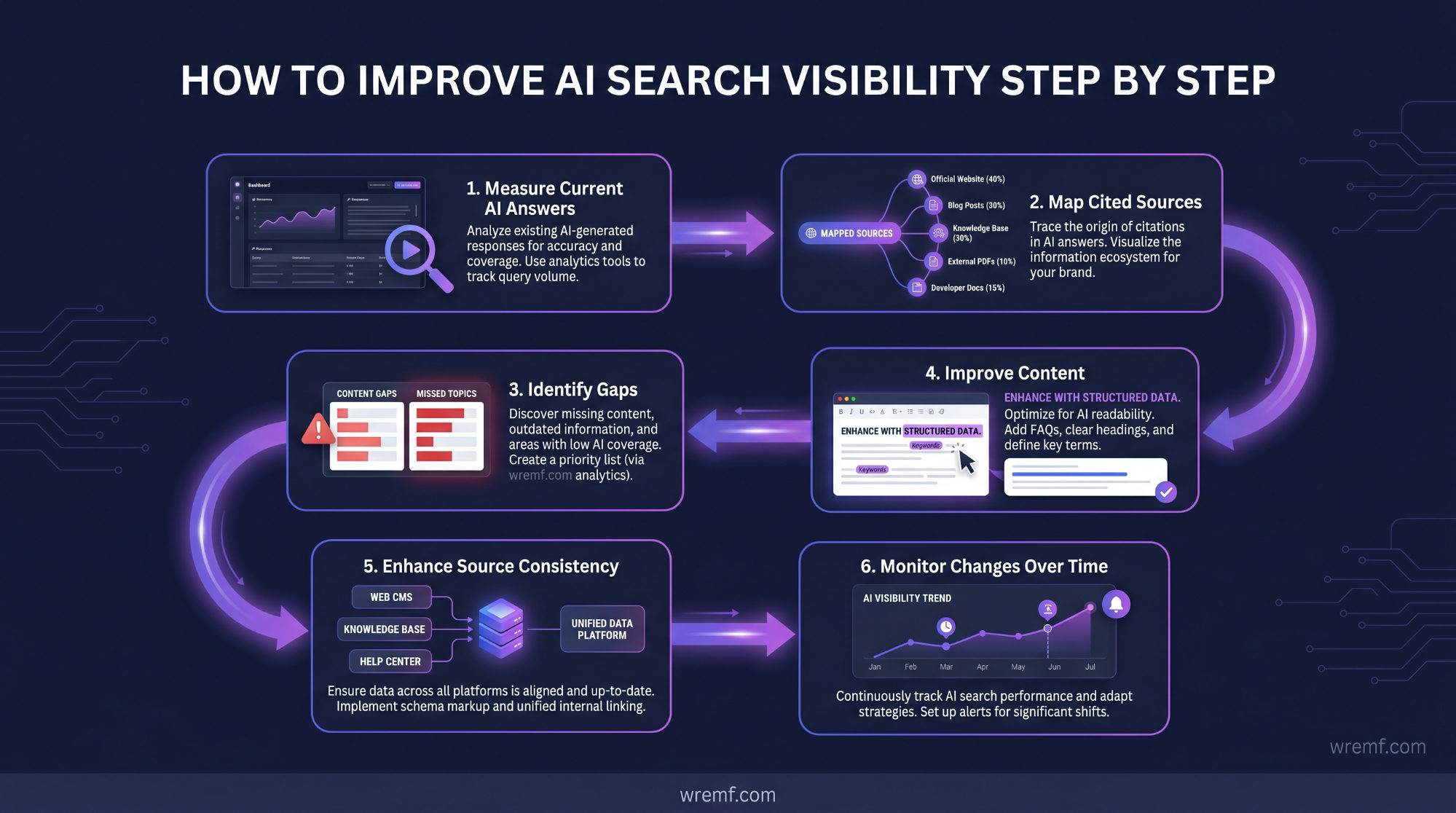
The most effective way to improve AI search visibility is to measure current AI answers, map cited sources, identify gaps, improve content and source consistency, then monitor changes over time. This turns AI visibility from guesswork into a repeatable system.
Prompt tracking is the process of testing target questions across AI engines and recording how your brand appears. Prompt tracking matters because AI visibility is prompt-specific, not only domain-specific.
Use this step-by-step workflow.
Define buyer prompt groups
Start with real buyer questions, not only keywords. Pull prompts from sales calls, support tickets, product demos, competitor comparisons, customer interviews, search queries, review mining, and category research.
Use prompt groups such as:
Problem awareness prompts
Category definition prompts
Vendor comparison prompts
Alternative solution prompts
Pricing and package prompts
Implementation prompts
Risk and limitation prompts
Integration prompts
Best tool prompts
Agency or service prompts
ROI and measurement prompts
Test prompts across AI engines
Run each prompt across the AI discovery surfaces that matter to your audience. For many B2B SaaS teams, this includes ChatGPT, Perplexity, Google AI Overviews, Gemini, Copilot, and Claude. Depending on your category, you may also test DeepSeek, Grok, Meta AI, Mistral, and niche AI search tools.
Record:
Whether your brand appears
Where your brand appears
Which competitors appear
Whether your brand is recommended
Whether the answer is accurate
Which sources are cited
Whether your website is cited
Whether third-party sources are cited
Whether the answer includes outdated information
Whether sentiment is positive, neutral, or negative
Analyze citation patterns
Citation tracking shows which sources AI engines rely on. If your competitors appear because of review pages, partner directories, documentation, or research reports, those source types become part of your improvement plan.
Use the WREMF source citation tracking tools to identify which pages influence AI answers, where your brand is missing, and which sources may need improvement.
Improve priority content
Update pages that match high-value prompts. Focus on pages that can answer questions clearly and credibly.
Priority content types include:
Pillar pages
Feature pages
Product pages
Comparison pages
Methodology pages
Use case pages
Pricing pages
FAQ pages
Glossary pages
Documentation
Customer education pages
Research reports
Original data studies
Strengthen entity clarity
Make your brand description consistent across sources. Align naming, category, audience, features, use cases, and differentiators. If your brand is a B2B AI visibility platform, do not let important sources describe it only as a generic SEO tool or analytics app.
Build original proof
AI systems need reliable source material. Original research, proprietary data, methodology pages, expert commentary, benchmarks, customer education, and transparent reporting can make your content more useful and cite-worthy.
Monitor changes over time
AI results vary across time, location, model, prompt wording, and retrieval context. Track the same prompt sets repeatedly. Compare visibility trends by engine, prompt cluster, competitor, source type, and recommendation rate.
AI search visibility improves through repeated measurement and source improvement. AI search visibility cannot be managed with one screenshot, one ranking report, or one page rewrite. AI search visibility requires a prompt set, a citation map, content improvements, source consistency work, and ongoing reporting.
TIP: Use the same prompt groups each month so leadership can see trend data instead of isolated examples.
KEY TAKEAWAY: The best AI visibility workflow starts with prompts, maps citations, improves sources, strengthens content, and repeats measurement over time.
The next step is knowing what to measure and how to report progress.
How to Measure AI Search Visibility Beyond Rankings
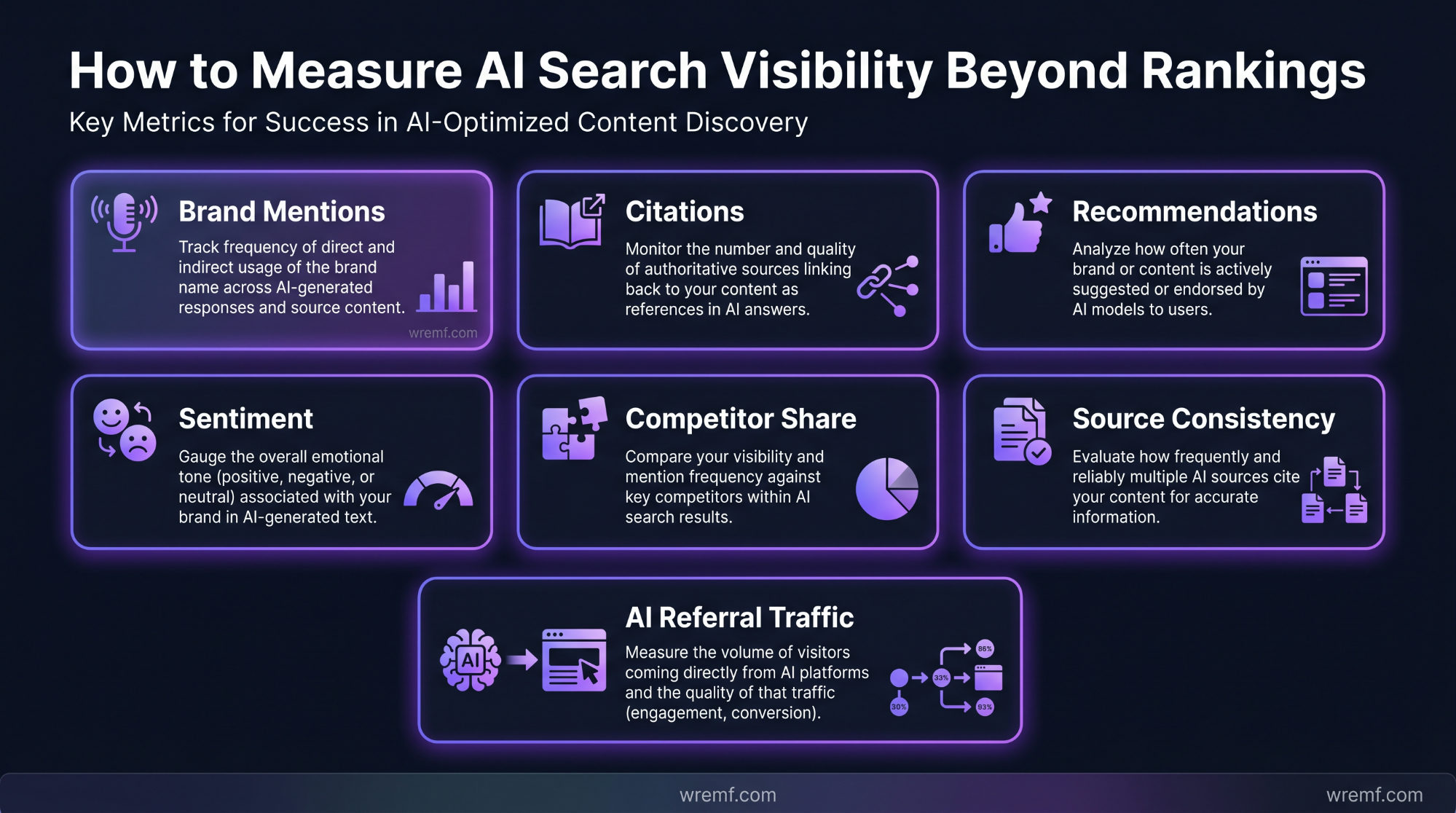
AI search visibility is measured by tracking brand mentions, citations, recommendations, sentiment, competitor share, source consistency, and AI referral traffic. The strongest reporting combines prompt-level visibility with business context.
AI share of voice is the percentage of relevant AI-generated answers where your brand appears compared with competitors. AI share of voice matters because it shows whether your brand is present in category conversations.
AI traffic attribution connects visits, signups, leads, opportunities, or pipeline to AI-native sources where tracking is available. AI traffic attribution matters because leadership needs to understand whether AI visibility contributes to business outcomes.
Brand recommendation visibility measures how often AI engines recommend your brand as a solution. Brand recommendation visibility matters because a mention is not the same as a recommendation. A brand can be cited, mentioned neutrally, criticized, or recommended.
Use these metrics:
| Metric | What It Shows | Why It Matters | Common Limitation |
|---|---|---|---|
| Brand mention rate | How often your brand appears in AI answers | Shows basic visibility | Does not prove recommendation strength |
| Citation rate | How often your pages or sources are cited | Shows source influence | Some tools mention brands without citations |
| Recommendation share | How often your brand is suggested as an option | Shows buying-stage visibility | Depends on prompt wording |
| Competitor share of voice | Visibility versus named competitors | Shows category position | Requires stable prompt sets |
| Source consistency | Whether sources describe the brand similarly | Reduces entity confusion | Requires external cleanup |
| Sentiment and accuracy | How AI systems describe the brand | Reveals trust and misinformation risk | Needs human review |
| Prompt coverage | How many target prompt groups mention the brand | Shows topical breadth | Requires strong prompt design |
| AI referral traffic | Visits from AI-native tools | Connects visibility to behavior | Some AI experiences produce zero clicks |
| Pipeline influence | Leads or deals touched by AI discovery | Connects visibility to revenue | Attribution may be partial |
| Content gap score | Missing answers across buyer prompts | Guides content work | Needs qualitative review |
HubSpot’s 2026 marketing statistics page reports that over 92% of marketers plan to use or already use SEO optimisation for traditional and AI-powered search engines, while nearly 30% reported decreased search traffic as consumers turn to AI tools. This matters because AI visibility is becoming a reporting issue, not only an experimental content issue.
BrightEdge reported that AI search visits grew at double-digit month-over-month rates in 2025, while AI search still accounted for less than 1% of referral traffic in its analysis. This matters because AI visibility may influence demand before referral traffic fully captures the impact.
In real-world reporting, the mistake is treating AI referral traffic as the only metric. AI answers can affect awareness, trust, branded search, sales conversations, and shortlist inclusion without producing a measurable click. That is why prompt visibility and citation visibility should sit beside traffic metrics.
WREMF helps teams connect AI visibility scoring, prompt tracking, competitor visibility, citations, and reporting so leadership can see more than anecdotal screenshots.
KEY TAKEAWAY: AI visibility measurement should combine prompt outcomes, citation patterns, competitor share, sentiment, source consistency, referral traffic, and business context.
Once measurement is clear, teams can optimize for specific AI platforms.
How to Optimize for Google AI Overviews and AI Mode
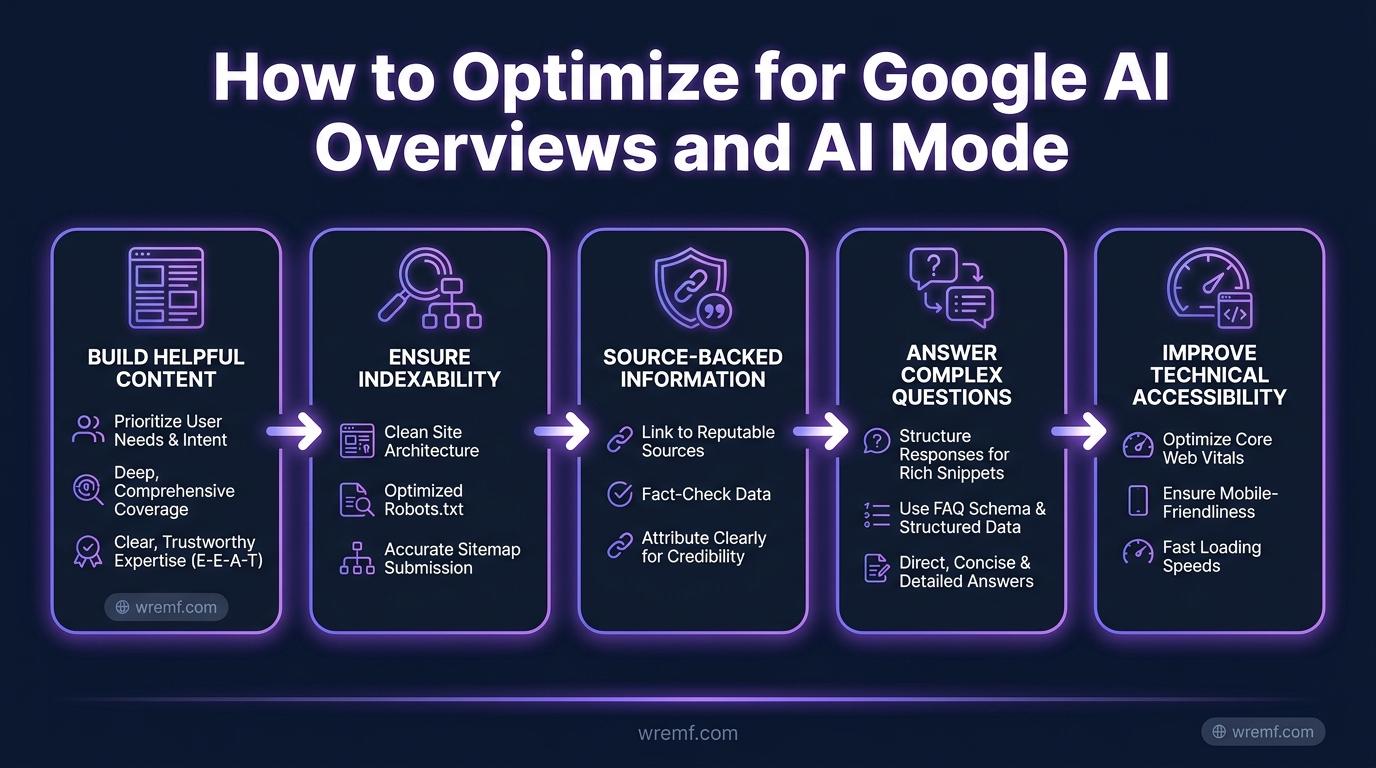
Optimizing for Google AI Overviews and AI Mode means building helpful, indexable, source-backed content that answers complex questions clearly. Google’s AI search experiences still depend on strong content, technical accessibility, and trustworthy source signals.
Google AI Overviews are AI-generated summaries that appear in Google Search results for some queries. AI Overviews matter because users may receive a generated answer with links before they scan traditional organic results.
Google AI Mode is a more conversational AI search experience from Google. AI Mode matters because it expands search from keyword result pages into follow-up questions, summaries, and deeper exploration.
To improve visibility in Google AI search experiences:
Keep important pages indexable
Build helpful, people-first content
Answer complex questions clearly
Use descriptive headings
Cover subtopics thoroughly
Add concise definitions
Include evidence and source attribution
Build internal links to related cluster pages
Keep content updated
Avoid thin or duplicate pages
Clarify entities with structured data where useful
Improve authority through relevant external sources
Track whether your pages are cited in AI summaries
Pew Research Center found that the median AI summary in its March 2025 study was 67 words. This matters because concise, extractable explanations are useful when AI systems generate short answers. If your best explanation is buried inside a long promotional paragraph, it may be harder to use.
SEO teams frequently discover that AI Overviews do not behave like a classic top 10 ranking report. Some cited sources rank highly. Others may not. This means Google rankings still matter, but ranking alone is not a complete AI visibility strategy.
IMPORTANT: Do not create thin “AI Overview pages” that exist only to chase AI summaries. Build genuinely useful pages that answer real buyer questions better than competing sources.
KEY TAKEAWAY: Google AI visibility depends on helpful content, technical accessibility, clear entities, topical depth, and source trust.
The next platform-specific challenge is visibility in ChatGPT and Microsoft Copilot.
How to Improve Visibility in ChatGPT and Microsoft Copilot
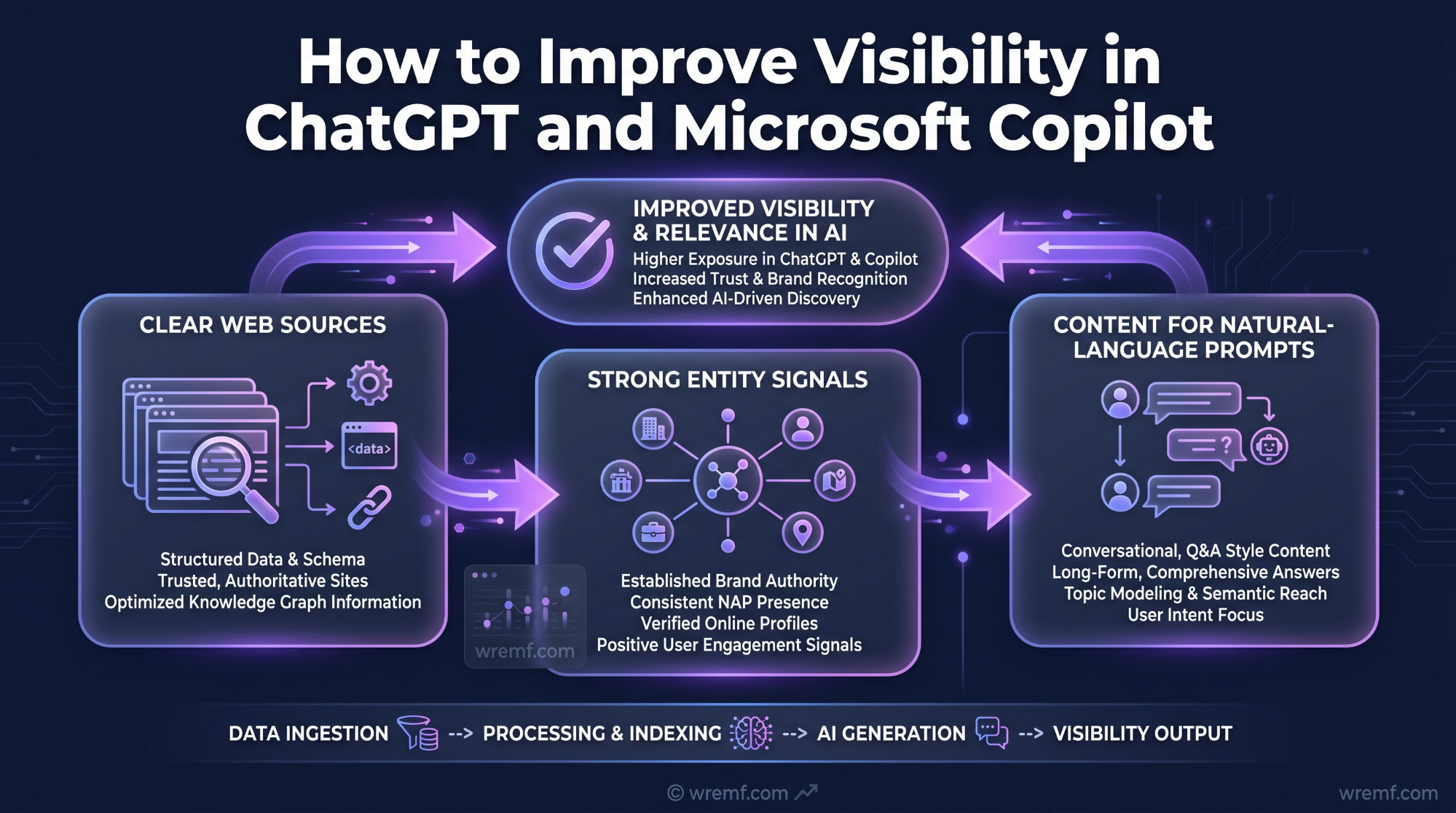
Improving visibility in ChatGPT and Microsoft Copilot requires clear web sources, strong entity signals, and content that answers natural-language prompts. These tools can summarize information with links or citations, so source quality and consistency matter.
ChatGPT search is a search-enabled experience that can provide timely answers with links to relevant web sources. ChatGPT search matters because users can ask conversational questions that previously required several search queries.
Microsoft Copilot is Microsoft’s AI assistant across search, productivity, and browser experiences. Copilot matters because it connects AI answers with Bing, Microsoft Start, Edge, Windows, and Microsoft’s productivity ecosystem.
To improve visibility in ChatGPT-style and Copilot-style research flows:
Create answer-first content for buyer questions
Build clear category and product pages
Publish comparison and methodology content
Strengthen documentation and support content
Use consistent brand descriptions across sources
Improve Bing indexability where relevant
Maintain accurate company profiles
Monitor how your brand appears in prompts
Track competitor mentions in AI-generated comparisons
Build source-backed explanations for claims
Keep third-party references current
Microsoft states in its Copilot Search announcement that responses can include references and citations for search-style answers. That means B2B teams should think about source quality, not only brand mentions.
Microsoft Start can also matter when content discovery flows through Microsoft’s ecosystem. For brands in news, B2B media, publishing, software, and market education, Microsoft-connected discovery surfaces can shape what users see before they reach your website.
In practical AI visibility audits, ChatGPT and Copilot often reveal different source preferences from Perplexity or Google. That is why single-engine testing is risky. A brand may look visible in one tool and absent in another.
KEY TAKEAWAY: ChatGPT and Copilot visibility improves when your brand has clear web sources, strong entity consistency, useful answer-first pages, and repeatable prompt monitoring.
The next platform-specific opportunity is Perplexity and citation-led AI search.
How to Improve Visibility in Perplexity and Citation-Based AI Search
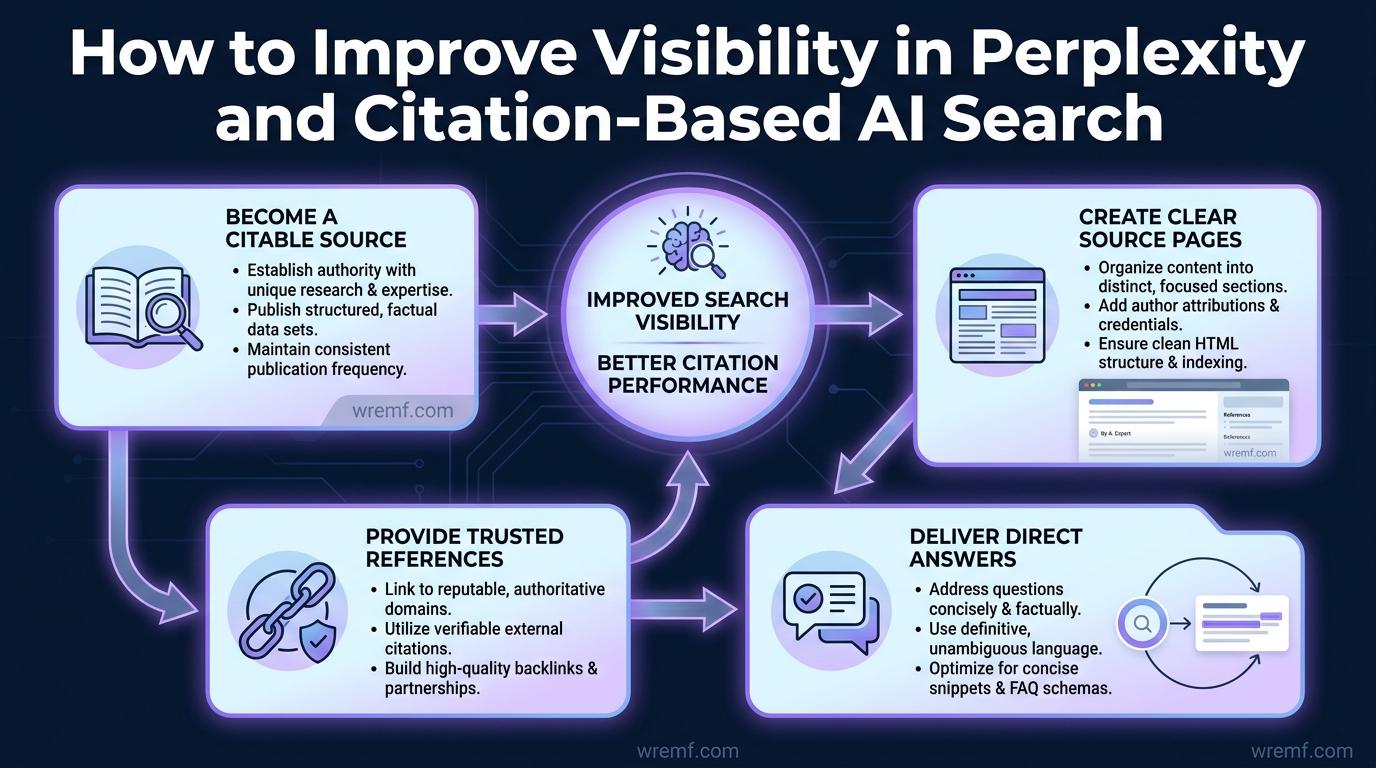
Improving visibility in Perplexity and citation-based AI search means becoming a source that answer engines can cite, summarize, and verify. Citation-based AI search rewards clear source pages, trusted references, and direct answers that match user intent.
Citation-based search is an AI search experience where generated answers include references to supporting sources. Citation-based search matters because users can inspect the sources behind an answer and decide which brands or publishers to trust.
Perplexity is an AI-powered answer engine that provides sourced responses. Perplexity matters for AI visibility because it makes citations highly visible to users and encourages follow-up research through source-backed answers.
To improve visibility in citation-based AI search:
Create pages that answer specific questions directly
Make source pages easy to quote and summarize
Use clear headings and definitions
Add original data where possible
Publish methodology pages
Build credible comparison content
Keep content fresh in fast-moving categories
Make claims verifiable
Avoid vague marketing language
Strengthen third-party mentions
Track which sources Perplexity cites for your category
In real B2B buying journeys, Perplexity-style research often happens when users want “best tools,” “alternatives,” “comparison,” “pricing,” “pros and cons,” or “how to implement” answers. These are high-intent prompts. If your brand is missing from these answers, the issue may be weak source coverage, unclear category positioning, or insufficient comparison content.
A strong Perplexity visibility strategy includes both first-party and third-party sources. Your own pages should define your product clearly. External sources should confirm the same category, use cases, and credibility signals.
TIP: For each priority prompt, record the cited sources first and the generated answer second. Sources reveal the path to improvement.
KEY TAKEAWAY: Perplexity visibility depends on source quality, citation clarity, direct answers, and consistent evidence across the web.
After platform-specific optimisation, the next layer is using customer and market data to build better answer content.
Use Customer Support and Sales Insights to Build Better AI-Ready Content
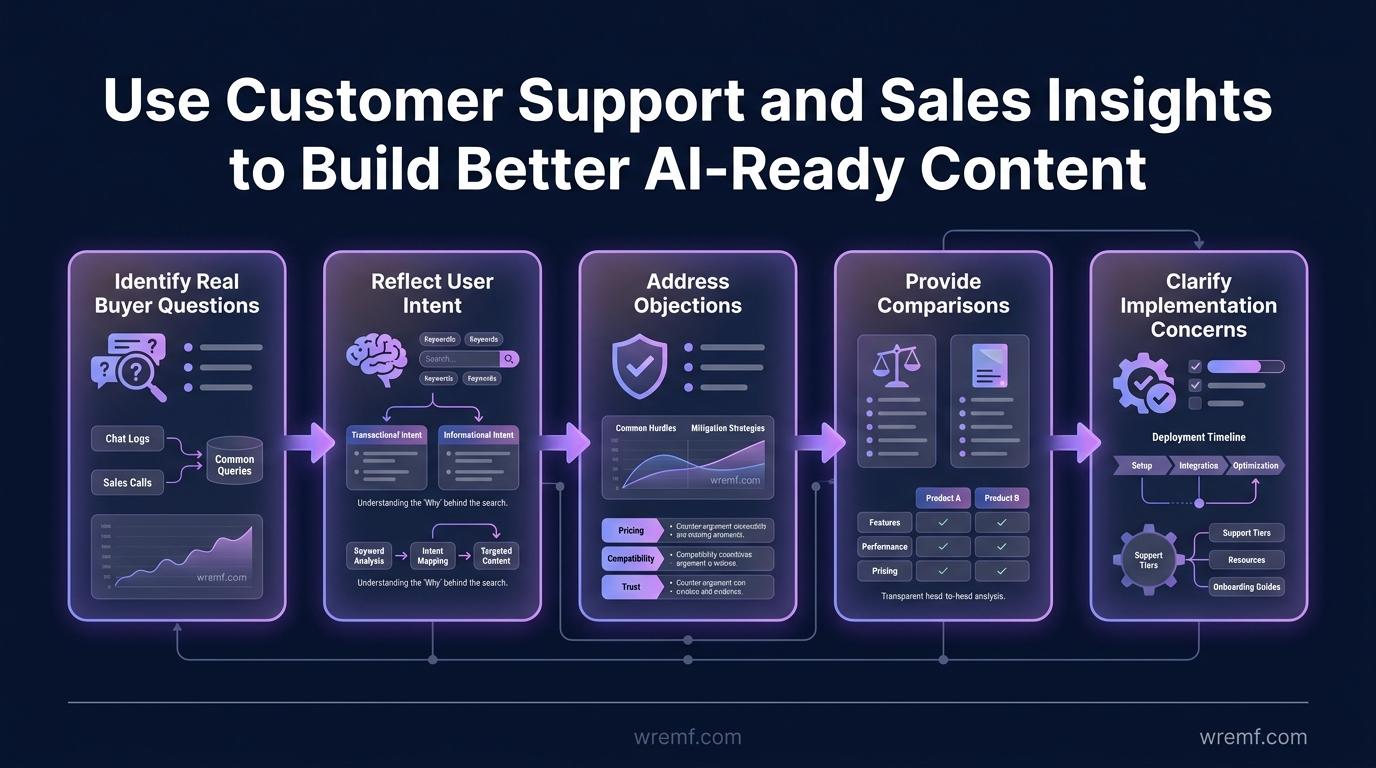
Customer support and sales insights improve AI search visibility because they reveal the real questions buyers ask before choosing a solution. AI-ready content performs better when it reflects actual user intent, objections, comparisons, and implementation concerns.
User intent is the purpose behind a search, prompt, or question. User intent matters because AI systems try to answer what the user means, not only what the user types.
Customer support data is a practical source of AI-ready content ideas. Support tickets, live chat transcripts, onboarding questions, demo notes, sales objections, and customer success calls reveal problems that keyword tools often miss.
Use customer-facing teams to collect questions such as:
What problem are buyers trying to solve?
Which tools are buyers comparing?
What terms confuse buyers?
What objections appear before purchase?
What implementation fears slow decisions?
What integrations matter most?
What proof does leadership ask for?
What reports do customers need?
Which competitors come up most often?
Which pricing questions repeat?
Which outcomes are buyers trying to measure?
In real-world reporting, teams often discover that AI engines mirror the same questions buyers ask sales teams. If your website does not answer those questions, AI systems may use competitor pages or third-party sources instead.
For example, if buyers often ask “Can we track AI visibility without paid tools?”, your content should answer that directly. If buyers ask “How do we connect AI visibility to pipeline?”, your content should explain attribution limitations, AI referral traffic, branded search lift, CRM notes, and self-reported attribution.
WREMF’s GEO audit workflow helps teams identify where AI engines misunderstand the brand, which prompts expose content gaps, and which answers need stronger support.
KEY TAKEAWAY: Customer support and sales insights help you create AI-ready content that matches real buyer questions, not only keyword tool suggestions.
The next section covers the practical audit process for finding AI visibility gaps.
Run an AI-First Content and Source Audit
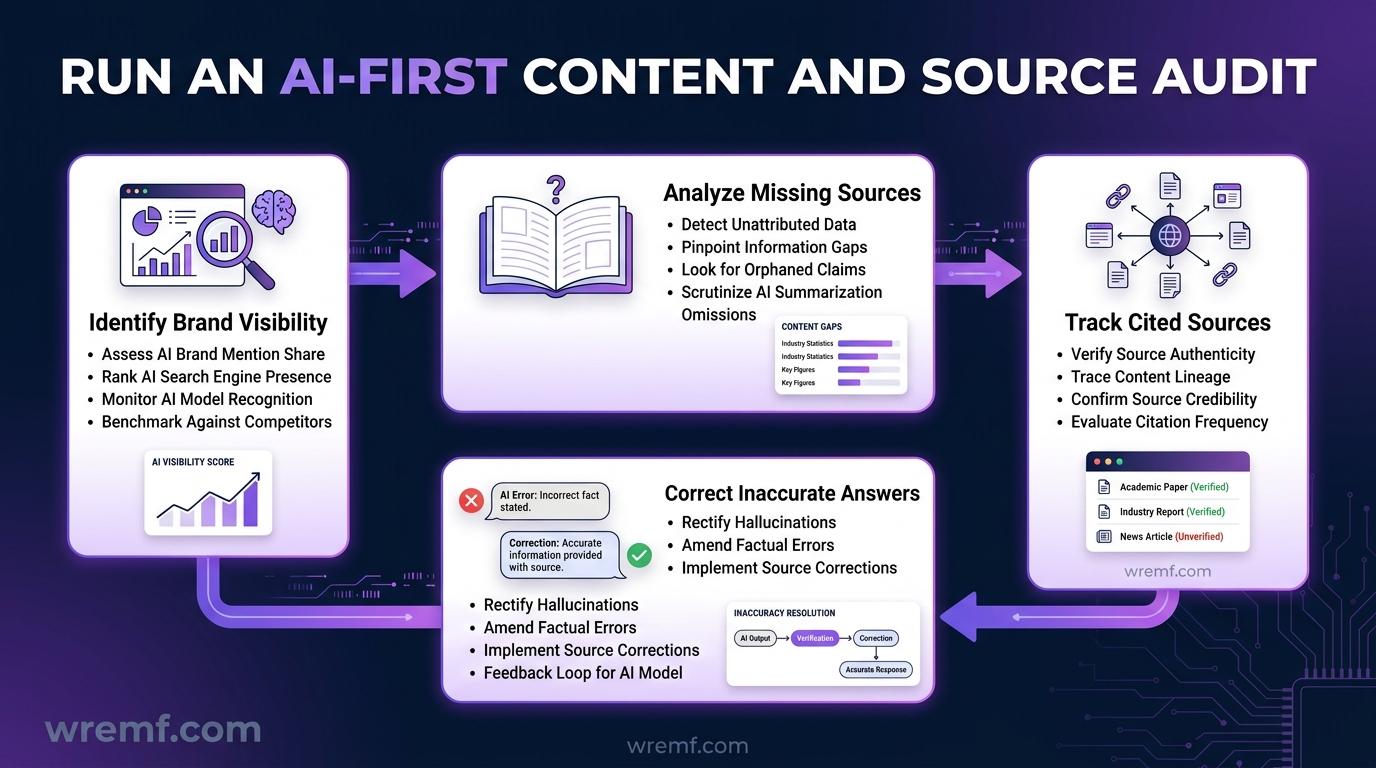
An AI-first audit improves AI search visibility by showing where your brand appears, where it is missing, which sources are cited, and which answers are inaccurate. The audit turns AI visibility from assumption into evidence.
An AI visibility audit is a structured review of how AI systems mention, cite, compare, and recommend a brand across target prompts. An AI visibility audit matters because it reveals gaps that normal SEO tools may not show.
Use this practical audit process.
Build a prompt set
Create 50 to 200 prompts depending on your category size. Include definition, comparison, buying, implementation, objection, integration, and competitor prompts.
Test across engines
Run prompts across ChatGPT, Gemini, Perplexity, Google AI Overviews, Copilot, Claude, and other relevant AI systems. Use the same prompt sets consistently.
Record answer outcomes
Record whether your brand appears, whether it is recommended, how competitors appear, and whether the description is accurate.
Extract cited sources
List every cited source. Group sources by type: your domain, competitor domain, review platform, directory, publication, community, documentation, and search result source.
Identify misinformation
Look for outdated pricing, wrong features, missing integrations, incorrect positioning, old product names, or confused category descriptions.
Compare competitor visibility
Analyze which competitors appear more often and why. Competitor visibility usually comes from stronger source coverage, clearer comparison pages, better category pages, or more third-party proof.
Prioritize fixes
Score each issue by business value, prompt frequency, source influence, and execution difficulty. Fix high-value prompts first.
Competitor visibility is the measurement of how often competing brands appear in AI answers for the same prompt set. Competitor visibility matters because AI-generated answers often create shortlists that influence buying decisions.
Agencies managing multiple clients often need this audit process at scale. The WREMF tools for agencies support white-label reporting, client portals, scheduled monitoring, and repeatable AI visibility workflows.
KEY TAKEAWAY: An AI-first audit shows which prompts, sources, competitors, and content gaps are blocking visibility.
After the audit, teams need to choose the right tool or service model.
What Tools and Services Help Improve AI Search Visibility?
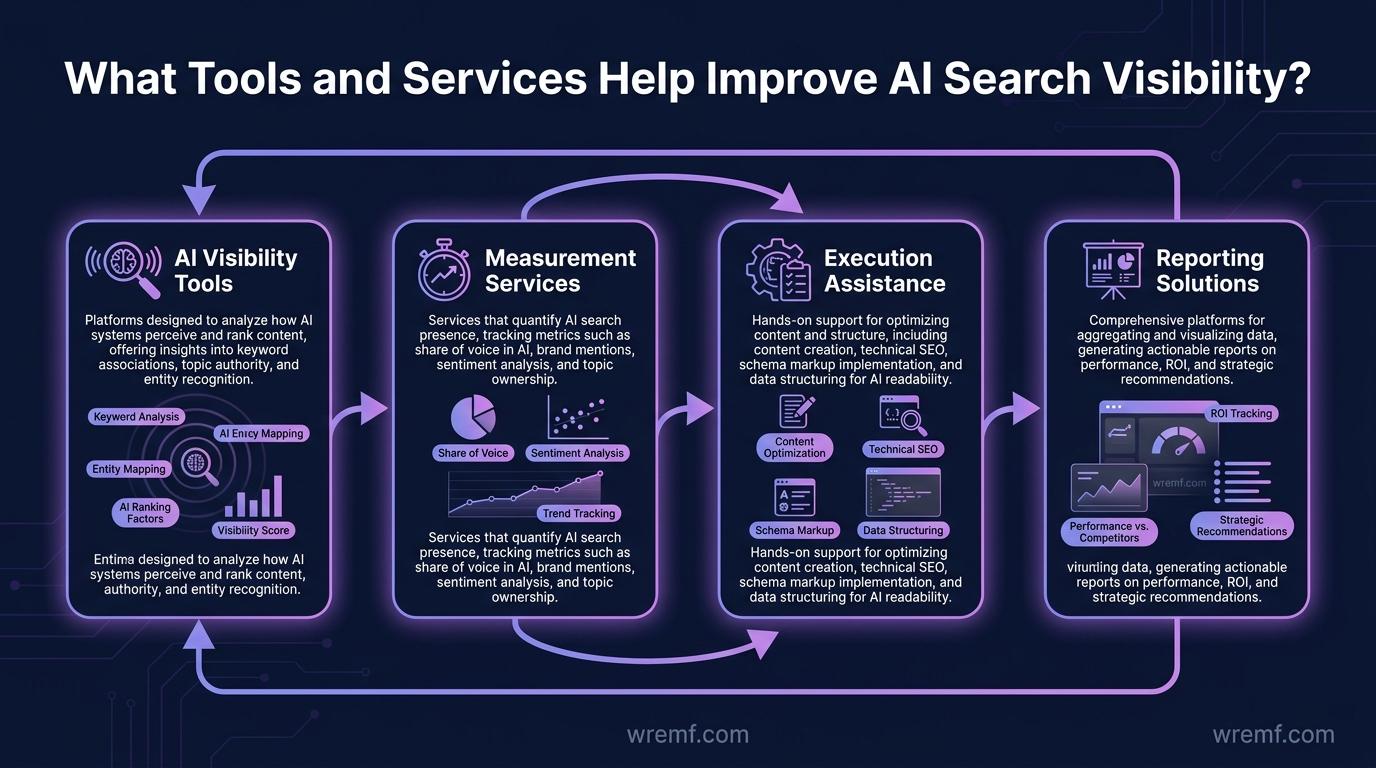
AI visibility tools and services help teams track prompts, analyze citations, compare competitors, identify gaps, and turn findings into action. The right option depends on whether your team needs measurement, execution, reporting, or all three.
AI visibility tools are platforms that monitor brand presence across AI-generated answers. AI visibility tools matter because manual tracking becomes unreliable when prompt sets, engines, competitors, and reporting needs grow.
AI visibility services are consulting or managed execution offerings that help teams improve content, citations, technical readiness, and reporting. AI visibility services matter because data alone does not fix source gaps or weak content.
| Option | Best For | What It Measures or Delivers | Main Limitation | Recommended When |
|---|---|---|---|---|
| Manual testing | Small teams exploring AI visibility | Prompt screenshots, answer notes, cited sources | Hard to scale and hard to compare over time | You have fewer than 20 prompts |
| SEO tools | Existing organic search programs | Rankings, keywords, backlinks, traffic, technical SEO | Limited AI prompt and citation visibility | You need classic SEO foundations |
| AI visibility software | Teams needing repeatable measurement | Prompts, citations, mentions, competitors, share of voice | Execution still needs ownership | You need monitoring and reporting |
| Agency support | Teams needing strategy and delivery | Audits, content, GEO, AEO, source cleanup, reporting | Less self-serve than software alone | You need expert implementation |
| Hybrid model | Teams needing data plus execution | Software, recommendations, managed fixes, reporting | Requires coordination | You want a full AI visibility program |
WREMF is useful for brands that want software, agencies that need white-label reporting, and teams that want managed execution. The platform combines prompt tracking, citation analysis, competitor visibility, source consistency, AI traffic attribution, and action recommendations.
For teams comparing investment levels, WREMF pricing includes Starter at €39 per month for 1 website, Growth at €89 per month for 5 websites, and Enterprise custom pricing for larger teams that need unlimited websites, unlimited seats, dedicated support, and custom branded portals. You can review the current package structure on the WREMF pricing page.
IMPORTANT: Tools do not improve AI visibility by themselves. Tools reveal what to fix. Teams still need content, technical, source, and authority improvements.
KEY TAKEAWAY: The best AI visibility tool or service model depends on whether your team needs measurement, execution, reporting, or a hybrid workflow.
Next, compare software, agency, and hybrid execution models in more detail.
Software vs Agency vs Hybrid AI Visibility Programs
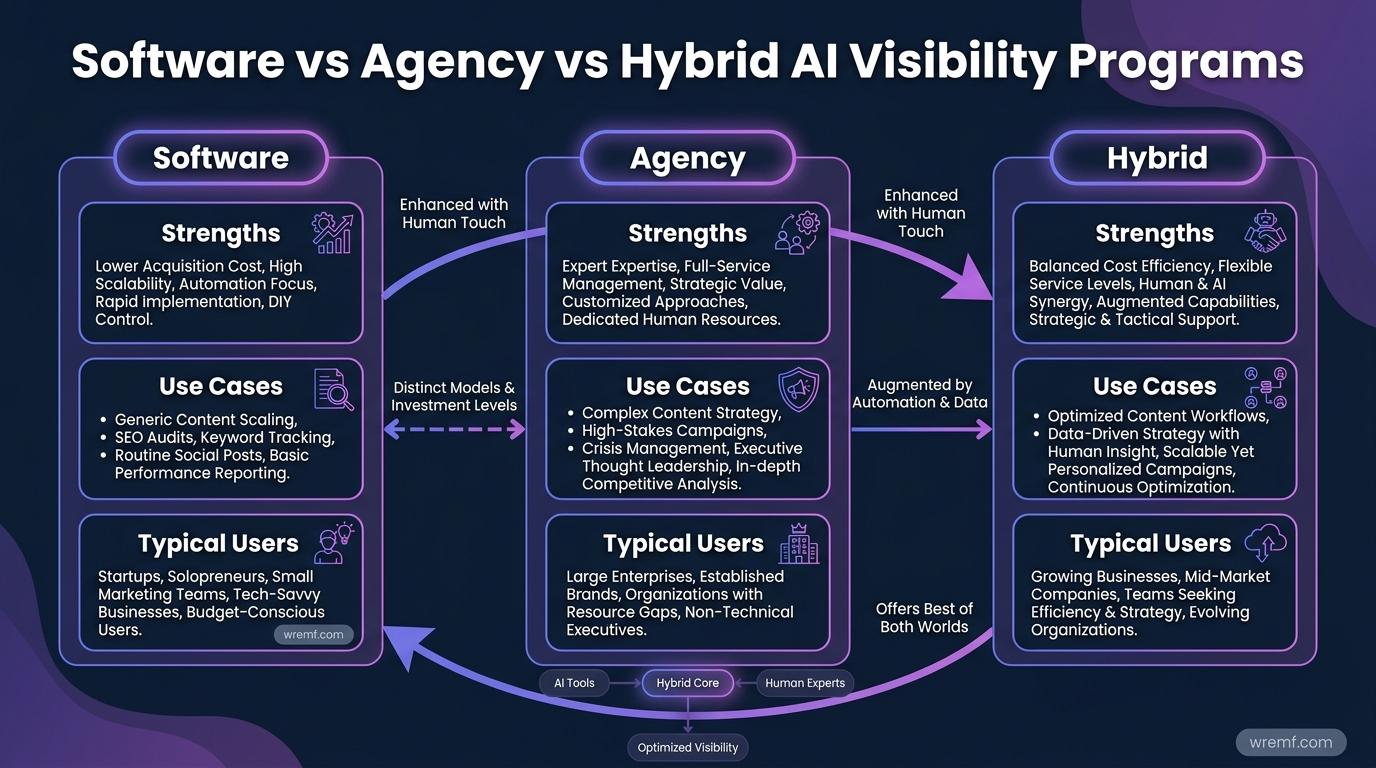
Software, agency, and hybrid AI visibility programs solve different parts of the same problem. Software helps you measure visibility, agency support helps you execute improvements, and a hybrid model combines measurement with managed action.
AI visibility software is best when your team can act on the insights internally. AI visibility agency support is best when your team needs expert strategy, content optimisation, source cleanup, technical recommendations, and reporting support.
| Model | Best For | What It Includes | Typical User | Execution Required | Reporting Value |
|---|---|---|---|---|---|
| Software only | Teams with internal SEO and content resources | Prompt tracking, citation tracking, competitor visibility, dashboards | SEO teams, content teams, growth teams | Internal team executes fixes | Strong for recurring measurement |
| Agency only | Teams needing expert delivery | Audits, strategy, content optimisation, technical recommendations, reporting | Founders, lean teams, marketing leaders | Agency executes most work | Strong for guided action |
| Hybrid | Teams needing measurement plus delivery | Software, managed execution, recommendations, recurring reporting | B2B SaaS teams, agencies, growth leaders | Shared execution | Strong for accountability |
A B2B SaaS company with an internal content team may use software to identify prompt gaps and then assign content briefs internally. A founder-led startup may need an AI visibility audit first. An agency may need repeatable reporting across many clients. A growth team may need both software and managed support to move faster.
WREMF supports software, agency, and hybrid use cases. For teams that need managed execution, the WREMF agency service supports AI visibility strategy, GEO and AEO consulting, content optimisation, entity and authority building, source consistency cleanup, citation improvement, monthly reporting, and technical AI visibility foundations.
KEY TAKEAWAY: Choose software when you can execute internally, agency support when you need delivery, and a hybrid model when you need both measurement and action.
The next section explains how to connect AI visibility to revenue and business outcomes.
How to Connect AI Visibility to Pipeline and Revenue
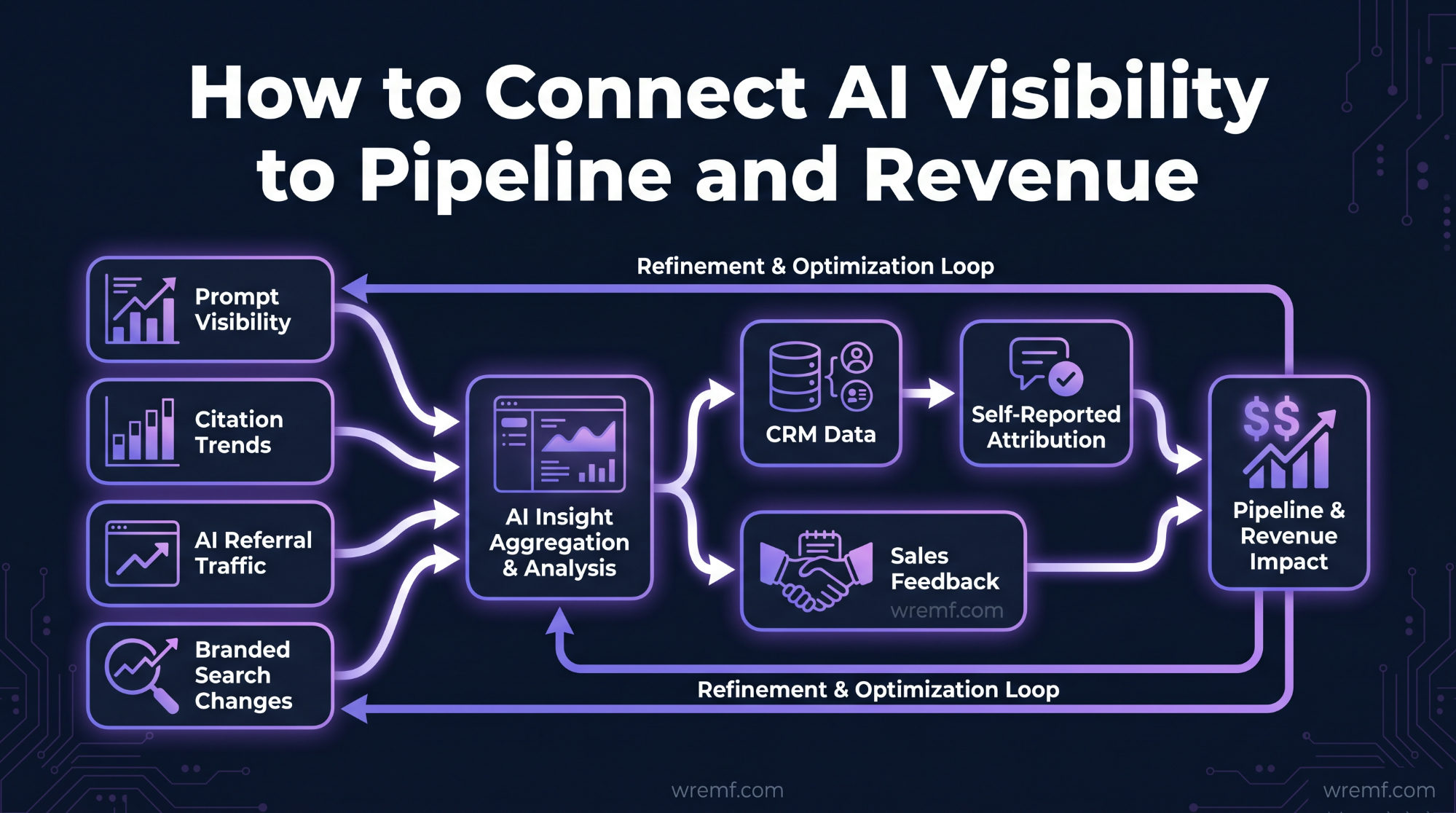
AI visibility connects to pipeline when teams combine prompt visibility, citation trends, AI referral traffic, branded search changes, CRM data, self-reported attribution, and sales feedback. The goal is to measure influence, not pretend every AI answer produces a direct click.
AI traffic attribution is the process of connecting traffic, leads, conversions, or pipeline to AI-native sources where possible. AI traffic attribution matters because leadership needs to understand whether AI visibility contributes to growth.
Pipeline influence is broader than direct attribution. A buyer may discover your brand in ChatGPT, confirm your category in Perplexity, see your website in Google, and later arrive through branded search or direct traffic. If your analytics only credits the final click, AI influence may be underreported.
Track these signals:
AI-native referral traffic
Branded search growth
Direct traffic changes
Demo form source fields
Self-reported attribution
Sales call notes
CRM campaign influence
Prompt visibility by buying stage
Competitor displacement in AI answers
Citation growth from trusted sources
Recommendation share for high-intent prompts
Content engagement from AI-relevant pages
In real B2B buying journeys, attribution is rarely perfect. The practical approach is to combine quantitative data with qualitative signals. If your brand starts appearing in high-intent AI prompts, cited pages gain traffic, branded search rises, and sales teams hear prospects mention AI tools, the combined signal is stronger than any single metric.
AI visibility should also be reported by funnel stage. Awareness prompts show market education. Comparison prompts show shortlist influence. Implementation prompts show post-click readiness. Pricing prompts show buying intent. Risk prompts show objections.
KEY TAKEAWAY: AI visibility should be connected to pipeline through multiple signals, including prompts, citations, traffic, branded demand, CRM data, and sales feedback.
Before scaling, teams need to understand the risks and limitations.
What Can Go Wrong With AI Search Visibility?
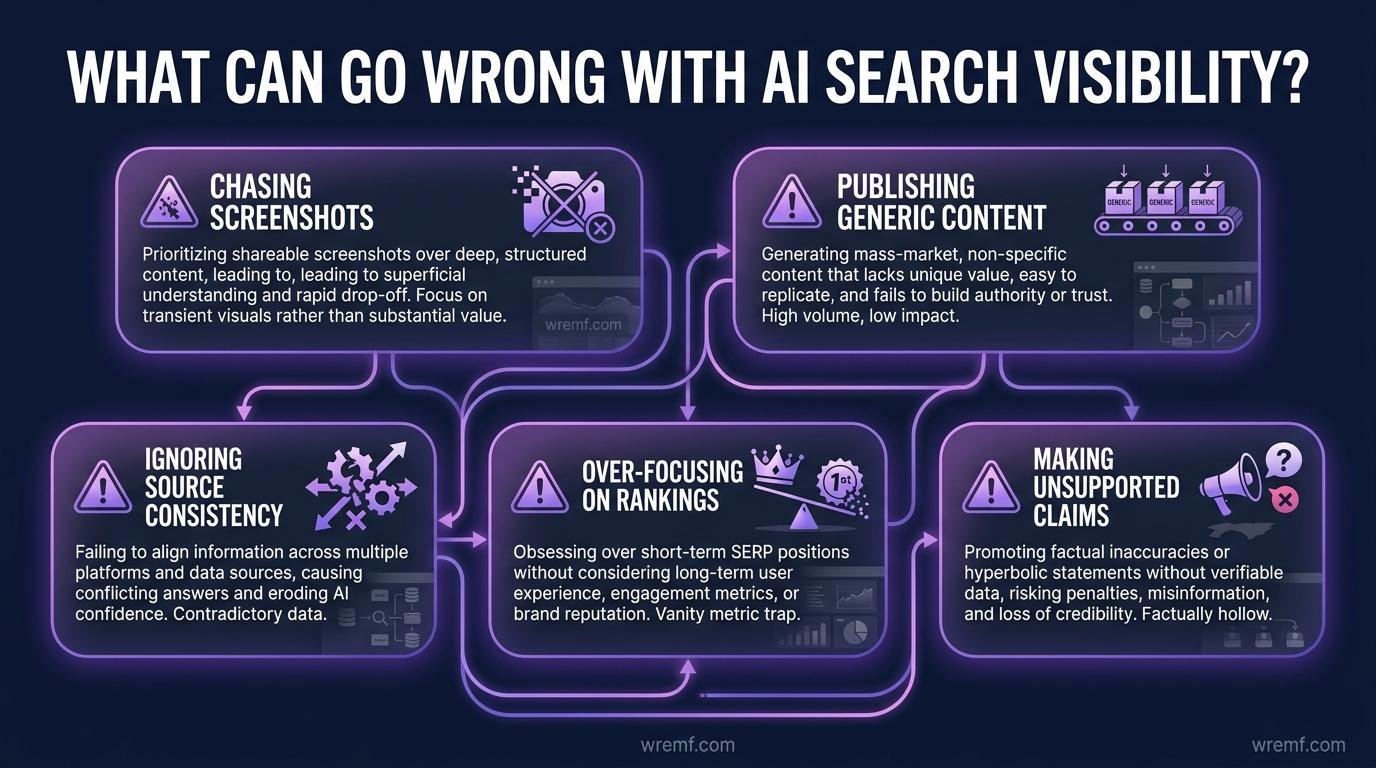
AI search visibility efforts can fail when teams chase screenshots, publish generic content, ignore source consistency, over-focus on rankings, or make unsupported claims. AI visibility improves through evidence and systems, not shortcuts.
AI result variability is the normal variation in AI-generated answers across runs, engines, locations, models, and prompt wording. AI result variability matters because one test cannot represent a full visibility trend.
Common risks include:
Measuring one prompt and assuming it represents the market
Optimizing only for ChatGPT while ignoring Google AI Overviews or Perplexity
Publishing vague AI-generated content without original insight
Ignoring third-party sources that AI engines cite
Treating backlinks as the only authority signal
Overlooking technical crawl and indexation issues
Failing to define entities clearly
Letting outdated profiles remain online
Confusing mentions with recommendations
Reporting traffic only and missing zero-click influence
Overpromising AI citation growth
Treating AI visibility as a one-month campaign
The biggest strategic mistake is trying to “game” AI search. AI systems are changing quickly, and different engines retrieve different sources. A durable approach focuses on reliability, clarity, source quality, and helpfulness.
A second mistake is treating all prompts equally. A brand mention for a low-intent definition prompt is useful, but a recommendation in a high-intent comparison prompt is usually more valuable. Measurement should reflect buying value.
A third mistake is ignoring misinformation. If AI systems describe your product incorrectly, the answer may create confusion before the buyer reaches your website. Fixing misinformation requires source updates, clearer content, and repeat monitoring.
IMPORTANT: AI visibility is not fully controllable. The goal is to improve the probability of accurate visibility by strengthening content, sources, and entity clarity.
KEY TAKEAWAY: AI visibility works best when teams accept variability, measure consistently, and improve the source ecosystem instead of chasing hacks.
The next section looks at future-proofing for multimodal search and agentic commerce without losing focus on fundamentals.
Future-Proof AI Search Visibility for Agentic Discovery
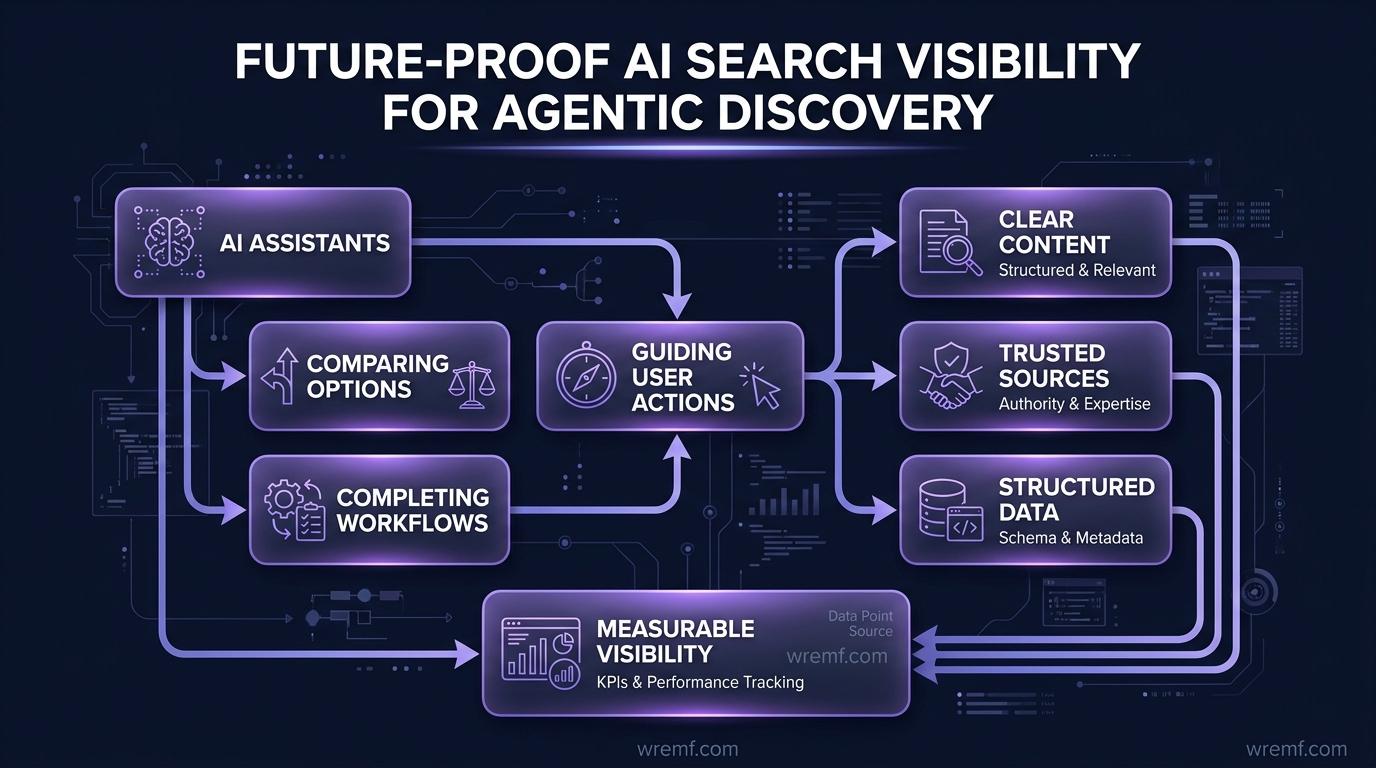
Future-proofing AI search visibility means preparing your brand for AI assistants that not only answer questions but also compare options, complete workflows, and guide users toward actions. The foundation is still clear content, trusted sources, structured data, and measurable visibility.
Agentic commerce is a buying experience where AI assistants help users compare, select, and complete actions. Agentic commerce matters because search may move from finding information to completing tasks through AI-assisted workflows.
Conversational search is search based on follow-up questions, context, and natural language. Conversational search matters because users no longer need to reformulate every query as a short keyword.
Future AI discovery may include:
Conversational vendor research
AI-assisted product comparisons
AI-generated shortlists
Automated form completion
AI-guided procurement research
AI-powered customer support discovery
Multiformat answers using text, audio, video, and documents
Personalized recommendations based on user context
Agent-driven transactions
Connected workplace search
B2B brands should prepare by making information clear, consistent, and easy for systems to retrieve. Pricing, features, use cases, integrations, security details, documentation, support policies, and comparison pages should be accurate and accessible.
AI-native search solutions may also become more industry-specific. Legal, healthcare, finance, cybersecurity, SaaS, and procurement tools may use specialized data sources and retrieval systems. That means authority in the right niche can matter more than broad content volume.
For technical teams, WREMF supports API and MCP integrations so AI visibility data can connect with internal workflows, reporting systems, and client dashboards.
KEY TAKEAWAY: Future AI discovery will reward brands with clear entities, trusted sources, accessible information, and measurement systems that adapt across engines and workflows.
Before the FAQ, it is important to address common myths that slow down AI visibility work.
Common Myths About AI Visibility Debunked
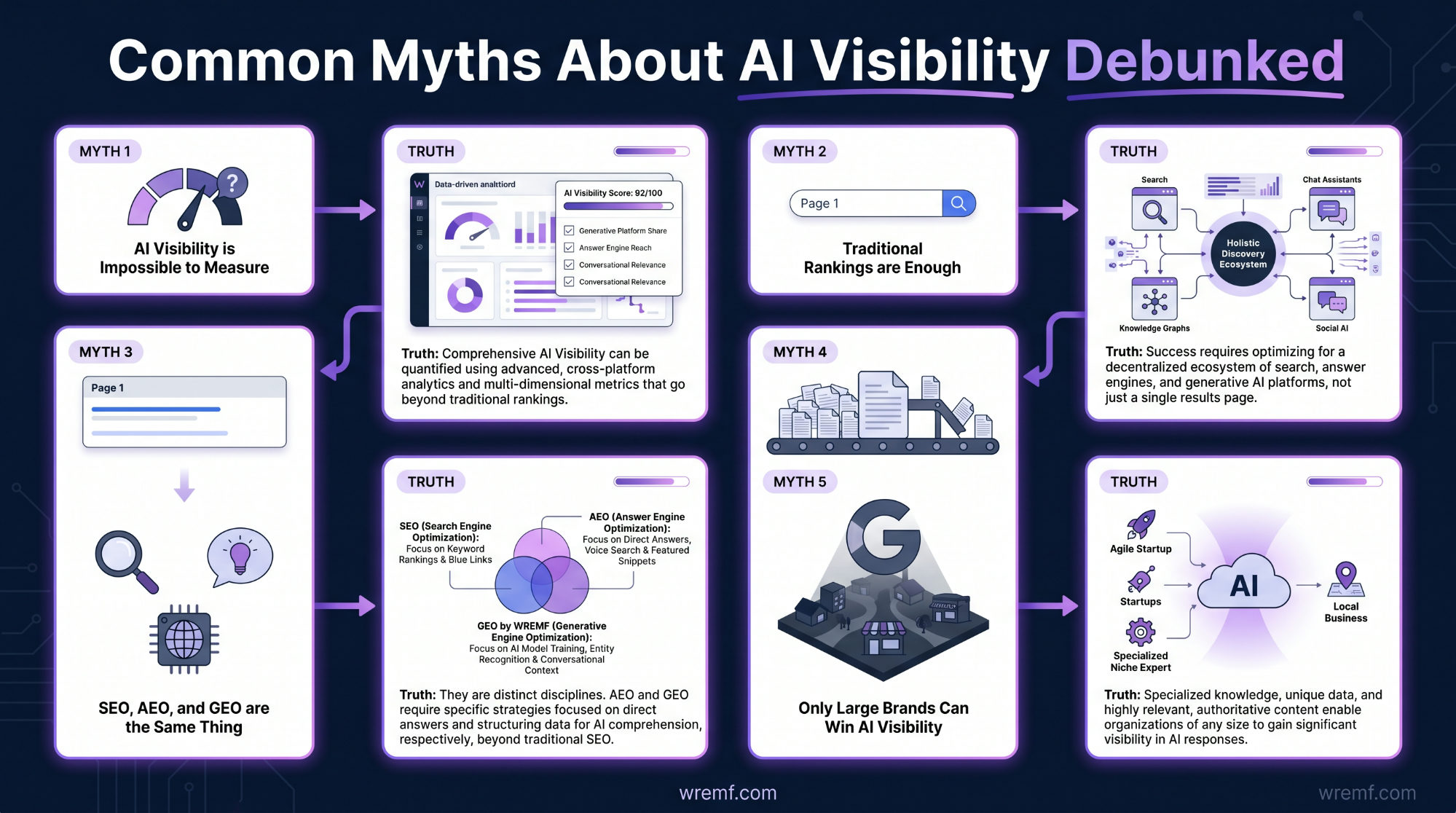
AI visibility myths usually come from treating AI search as either normal SEO or complete mystery. The truth is more practical: AI visibility is variable, but it can be measured, improved, and reported with the right workflow.
MYTH: AI visibility is impossible to measure.
FACT: AI visibility cannot be measured like a single keyword ranking, but it can be measured through prompt tracking, citation rates, brand mentions, recommendation share, competitor share of voice, sentiment, source consistency, and AI referral traffic. The key is to use repeated prompt sets over time instead of isolated screenshots.
MYTH: Traditional rankings are enough.
FACT: Traditional rankings still matter, but rankings alone do not guarantee AI visibility. BrightEdge and Ahrefs research on AI Overview citations shows that AI citation sources can differ from classic top organic results. This means SEO is still important, but AI visibility needs additional measurement.
MYTH: SEO, AEO, and GEO are the same thing.
FACT: SEO improves search visibility, AEO improves direct answer extraction, and GEO improves visibility in generated AI responses. The three overlap, but GEO adds prompt-level monitoring, citation analysis, source consistency, and recommendation tracking.
MYTH: More content automatically means more AI visibility.
FACT: More content does not guarantee better AI visibility. AI systems need useful, reliable, clear, and source-backed information. Generic pages that repeat existing advice without evidence, expertise, or structure may add noise instead of authority.
MYTH: Only large brands can win AI visibility.
FACT: Large brands may have more mentions, but niche B2B brands can still win specific prompts with clearer explanations, better topical depth, stronger source consistency, and expert-led content. Specific buyer questions often create openings for smaller brands.
KEY TAKEAWAY: AI visibility is not magic, but it is also not just traditional SEO. It is a measurable discipline built on prompts, citations, sources, entities, and useful content.
The FAQ section answers the practical questions teams usually ask before starting.
Frequently Asked Questions
What is answer engine visibility?
Answer engine visibility is the presence of your brand, content, or sources inside AI-generated answers from tools such as ChatGPT, Perplexity, Google AI Overviews, Gemini, Claude, and Microsoft Copilot. It includes citations, mentions, summaries, comparisons, and recommendations. Answer engine visibility matters because buyers can now receive a complete answer before clicking a website. For B2B brands, this means visibility should be measured by prompts, citations, competitors, and recommendation share, not only rankings and organic traffic.
How is answer engine visibility different from organic search?
Answer engine visibility measures how your brand appears inside generated answers, while organic search measures how your pages appear in traditional search results. Organic search focuses on rankings, impressions, clicks, and indexation. Answer engine visibility focuses on prompts, citations, mentions, summaries, sentiment, and recommendations. The two are connected because AI tools may rely on search indexes and web sources. They are not identical because an AI answer can influence a buyer without producing a normal organic click.
Why does AI search visibility matter now?
AI search visibility matters now because AI-generated answers are becoming part of the way users research problems, compare vendors, and make decisions. Google AI Overviews, ChatGPT search, Perplexity, Microsoft Copilot, Gemini, and Claude all influence how information is discovered and summarized. For B2B teams, the risk is not only traffic loss. The bigger risk is that competitors appear in AI-generated shortlists while your brand is missing, misclassified, or described using outdated sources.
How often should we track AI search visibility?
Most B2B teams should track AI search visibility monthly, while competitive or fast-moving categories may need weekly tracking. Monthly tracking is enough to see directional changes in prompt visibility, citations, competitor share, and sentiment. Weekly tracking is useful after content updates, product launches, GEO audits, or major source changes. The most important rule is consistency. Use the same prompt groups, engines, and scoring method over time so the trend is meaningful.
Can we track AI search visibility without paid tools?
You can track AI search visibility manually by testing prompts, saving answers, recording cited sources, and comparing competitor mentions. Manual tracking can work for a small prompt set, but it becomes difficult when you need repeated testing across many engines, prompts, competitors, and clients. Paid tools become useful when you need scheduled monitoring, historical trends, source citation tracking, AI share of voice, white-label reports, and consistent scoring. WREMF is designed for repeatable AI visibility measurement.
How do we handle AI result variability across runs?
Handle AI result variability by tracking repeated prompt sets over time instead of relying on one answer. AI results can vary because models, retrieval systems, locations, timing, and prompt wording change. Use stable prompt groups, consistent scoring, and trend analysis. Record whether your brand appears, how often competitors appear, which sources are cited, and whether the answer is accurate. The goal is not to eliminate variability. The goal is to measure patterns that are strong enough to guide action.
How quickly can we see results from answer engine optimisation?
Answer engine optimisation results can appear at different speeds depending on the issue. Clearer content, better internal links, and technical fixes may help after pages are crawled or retrieved again. Source authority, third-party mentions, review updates, and entity consistency usually take longer. A practical review cycle is 30, 60, and 90 days after major updates. Avoid expecting guaranteed or instant AI citations. Track improvements by prompt visibility, citation growth, source accuracy, and competitor share.
How do we measure ROI from answer engine visibility?
Measure ROI from answer engine visibility by combining prompt visibility, citation trends, AI referral traffic, branded search changes, demo source fields, CRM notes, and self-reported attribution. AI visibility often influences the buyer before a measurable click, so last-click attribution will miss part of the value. A practical ROI model compares visibility for high-intent prompts with changes in branded demand, website engagement, qualified leads, sales conversations, and pipeline influence over time.
How do we connect answer engine visibility to pipeline and revenue?
Connect answer engine visibility to pipeline by tagging AI-influenced touchpoints wherever possible. Add self-reported attribution fields to demo forms, monitor AI-native referral traffic, track branded search growth, ask sales teams to note AI-assisted discovery, and compare pipeline movement against high-intent prompt visibility. You should also monitor whether your brand appears in vendor comparison prompts. The goal is to connect AI visibility to influence, not claim that every AI-generated answer creates a direct lead.
Should we optimize for all AI channels equally?
You should not optimize for all AI channels equally at the start. Prioritize the AI engines your buyers are most likely to use and the surfaces that influence your category. For many B2B SaaS companies, the first set includes ChatGPT, Google AI Overviews, Perplexity, Microsoft Copilot, Gemini, and Claude. Then expand to DeepSeek, Grok, Meta AI, Mistral, and niche AI search tools where relevant. WREMF tracks 10 AI engines so teams can compare visibility across surfaces.
What are the most effective ways to improve visibility in ChatGPT?
The most effective ways to improve visibility in ChatGPT are to create clear answer-first content, strengthen source authority, maintain consistent brand descriptions, publish useful comparison and methodology pages, and monitor prompts over time. ChatGPT search can provide timely answers with links to relevant web sources, so source quality matters. Brands should test how ChatGPT describes their company, which competitors appear, and which sources are used. WREMF helps track this across repeated prompt groups.
How do I improve visibility in Google AI Overviews?
Improve visibility in Google AI Overviews by building helpful, indexable, clear, and source-backed content. Start with technical SEO, then structure pages around direct answers, definitions, comparisons, FAQs, and evidence. Keep pages updated and make important content easy to parse. Google AI Overviews can include links to dig deeper, so your page should answer the query clearly enough to be useful. Track whether your brand and pages appear in relevant AI summary prompts over time.
How do I get cited in Perplexity?
To get cited in Perplexity, create source pages that directly answer user questions, provide clear evidence, and use concise structure. Perplexity-style search values cited sources, so pages should be easy to summarize and verify. Publish useful definitions, comparison pages, methodology content, original data, documentation, and high-quality FAQs. Also strengthen third-party sources that describe your brand. Track which sources Perplexity cites for your priority prompts, then improve the pages and source types that influence those answers.
What tools help improve AI search visibility?
AI search visibility tools help teams track prompts, citations, competitors, sentiment, source consistency, and AI share of voice. Traditional SEO tools remain useful for crawlability, rankings, backlinks, and organic traffic, but they may not fully measure AI-generated answers. WREMF combines prompt tracking, source citation analysis, competitor visibility, AI visibility scoring, reporting, BYOK support, white-label reporting, and managed execution options. The best tool depends on whether your team needs measurement, execution, or both.
Is AI visibility worth it for small or niche B2B websites?
AI visibility can be worth it for small or niche B2B websites because AI prompts often focus on specific problems, categories, and buyer questions. Smaller brands may struggle on broad organic keywords, but they can appear for precise prompts if their content is clearer, more useful, and more specific than larger competitors. Start with a focused prompt set, strong category pages, comparison content, FAQs, and source consistency. Measure before scaling the program.
Can AI-generated content help improve AI search visibility?
AI-generated content can support AI search visibility when it is edited, fact-checked, structured, and enriched with expertise. It should not replace original insight, data, methodology, or expert review. Generic AI-generated content often repeats what already exists, which gives AI systems little reason to cite it. Use AI for outlines, clustering, drafts, and content briefs, but publish pages that include clear definitions, practical examples, source-backed claims, unique perspective, and accurate brand positioning.
How does WREMF help improve AI search visibility?
WREMF helps improve AI search visibility by tracking how your brand appears across major AI discovery surfaces, including ChatGPT, Claude, Gemini, Perplexity, Google AI Overviews, Copilot, DeepSeek, Grok, Meta AI, and Mistral. WREMF combines prompt intelligence, source citation tracking, competitor visibility, AI share of voice, traffic attribution, GEO audits, content briefs, SEO testing, visibility scoring, white-label reporting, API integrations, and managed execution options. It is useful for brands, agencies, and hybrid teams.
Should agencies offer AI visibility reporting to clients?
Agencies should consider AI visibility reporting when clients care about brand discovery, category authority, SEO performance, content strategy, or competitive positioning. AI visibility reporting helps agencies show how clients appear in AI-generated answers, which competitors are recommended, which sources are cited, and which content gaps should be fixed. WREMF supports agencies with white-label reporting, client portals, scheduled monitoring, prompt intelligence, source citation tracking, and workflows that can scale across many accounts.
Conclusion
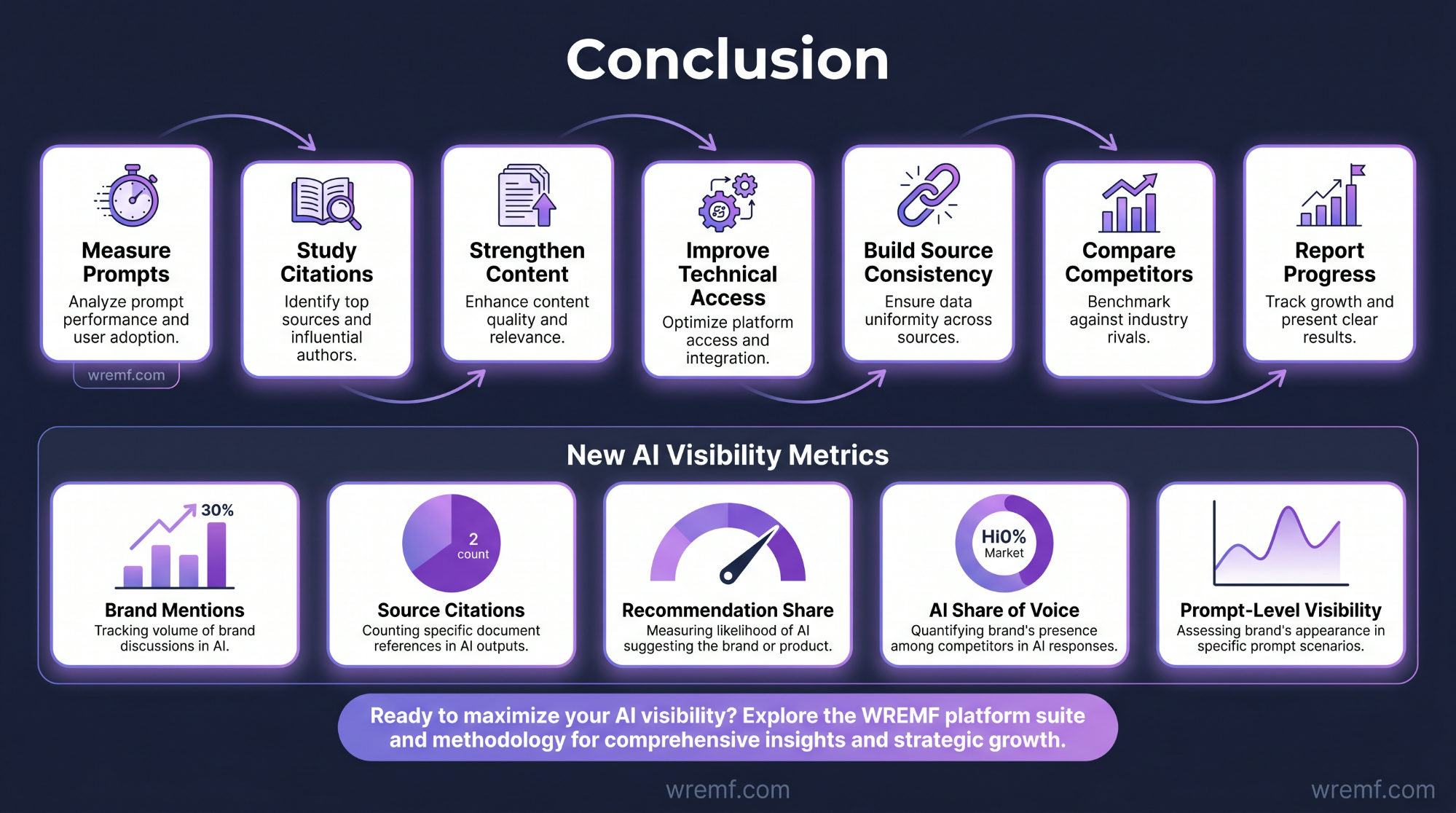
How to improve AI search visibility comes down to one repeatable system: measure prompts, study citations, strengthen content, improve technical access, build source consistency, compare competitors, and report progress over time. Traditional SEO remains important, but AI visibility adds new metrics such as brand mentions, source citations, recommendation share, AI share of voice, and prompt-level visibility. WREMF helps B2B brands, agencies, and growth teams turn this shift into a measurable workflow across software, managed services, or a hybrid model. To start tracking and improving visibility across major AI discovery surfaces, explore the WREMF platform suite or review the WREMF AI visibility methodology.
Related reading
- AI Search Optimization: The Complete Guide for B2B Brands
- Best Answer Engine Optimization for Enhancing AI Visibility
- How to Get Cited by Perplexity: Guide to Perplexity Citations, AI Search Visibility, and Source Authority
- AI Search Visibility Services: The Complete Guide to Tracking, Improving, and Proving Brand Visibility in AI Search