AI Search Optimization: The Complete Guide for B2B Brands
Learn AI search optimization for B2B brands, focusing on enhancing visibility in AI-generated answers and recommendations.
By WREMF Team · 2026-08-25
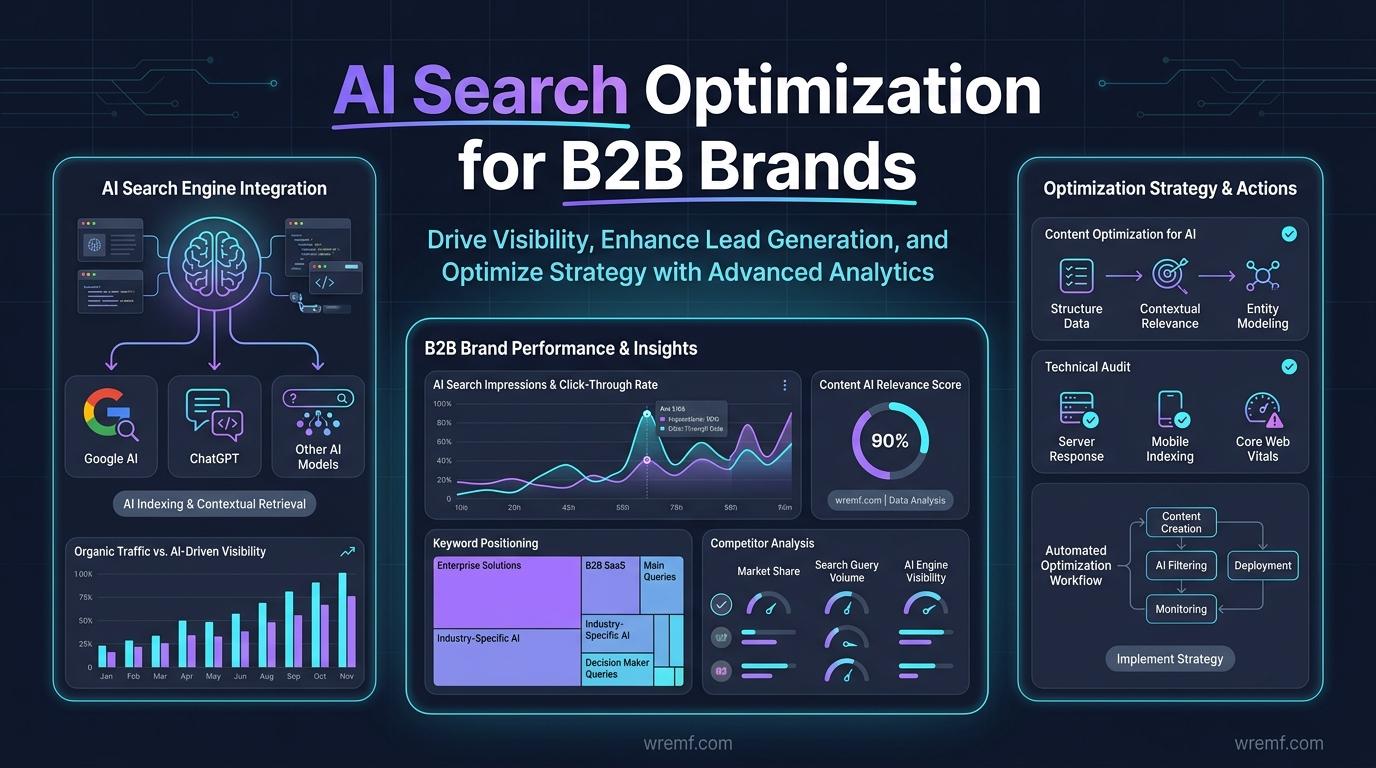
AI search optimization enhances the visibility of B2B brands by improving how they appear in AI-generated answers, citations, and recommendations. It involves making content easier for AI systems to find, understand, cite, and recommend. Unlike traditional SEO, AI search optimization focuses on AI responses, extending SEO with elements like prompt tracking and AI traffic attribution. This practice is crucial as more buyers use AI search engines to compare vendors and validate claims, impacting B2B buying decisions.
Key takeaways
- AI search optimization focuses on enhancing how brands appear in AI-generated content.
- It integrates with SEO, AEO, and GEO to improve brand visibility in AI responses.
- Content must be structured for AI systems to extract, summarize, and cite effectively.
- Prompt tracking and source consistency are vital for maintaining AI visibility.
- A strong technical foundation allows AI systems to access and interpret content.
AI Search Optimization: The Complete Guide for B2B Brands
AI search optimization is the process of improving how your brand appears in AI answers, citations, summaries, and recommendations. Google describes AI Overviews and AI Mode as search features that use AI to help users understand information faster and explore sources on the web. This guide explains how AI search works, how it differs from SEO, AEO, and GEO, and how to measure visibility across ChatGPT, Claude, Gemini, Perplexity, Google AI Overviews, Copilot, DeepSeek, Grok, Meta AI, and Mistral. WREMF helps B2B teams track, improve, and prove AI visibility through the WREMF AI visibility platform. Keep reading to build a practical AI search strategy for 2026. (Google for Developers)
What Is AI Search Optimization?
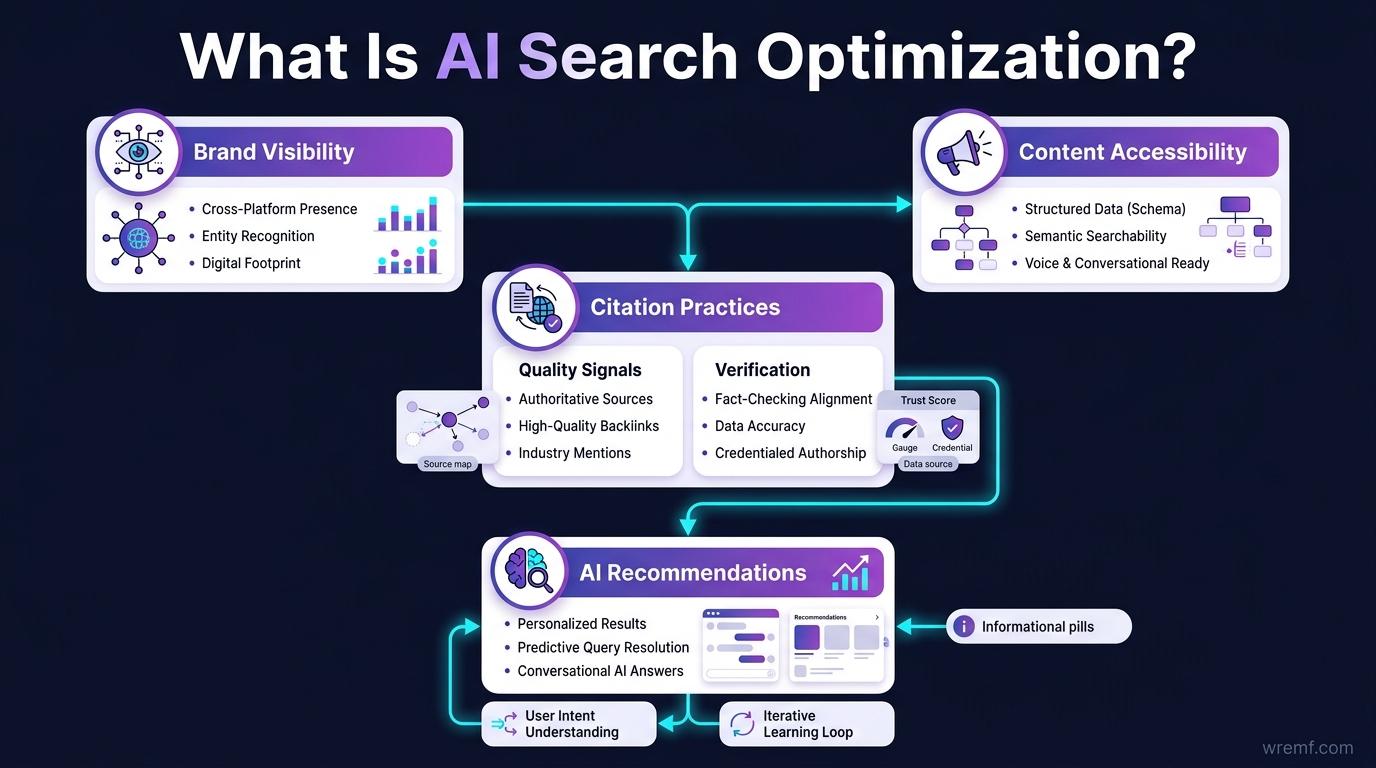
AI search optimization is the practice of making your brand, website, content, and source ecosystem easier for AI systems to find, understand, cite, and recommend. It matters because buyers increasingly use AI search before visiting websites or speaking to sales teams.
AI search is the shift from search results as a list of links to search results as AI-generated answers. A user can ask ChatGPT, Perplexity, Gemini, Google AI Overviews, Google AI Mode, Copilot, DeepSeek, Grok, Meta AI, or Mistral for a recommendation, comparison, definition, or buying shortlist.
AI visibility is the measurable presence of a brand inside AI responses, AI answers, AI-generated answers, citations, summaries, and recommendations. AI visibility matters because B2B buyers often ask answer engines to compare vendors, validate claims, and narrow down options before clicking through to a website.
AI Search Optimizations are not a replacement for SEO. AI Search Optimizations extend SEO by adding prompt tracking, source citations, brand mentions, competitor visibility, AI share of voice, entity consistency, and AI traffic attribution.
Traditional search engines rank pages. Answer engines synthesize information. AI models may retrieve your website, competitor pages, publisher mentions, review content, documentation, product data, social signals, or third-party sources before producing an answer.
In real B2B buying journeys, the most important question is no longer only “Do we rank?” The better question is “When a buyer asks an AI system about our category, are we visible, cited, accurate, and recommended?”
WREMF turns this from a guessing game into a measurable workflow. Teams can monitor prompts, track source citations, compare competitors, find content gaps, and report AI visibility across major AI discovery surfaces.
KEY TAKEAWAY: AI search optimization helps your brand become easier for AI systems to retrieve, cite, summarize, compare, and recommend.
The next step is understanding how AI search engines produce answers.
How Does AI Search Work?
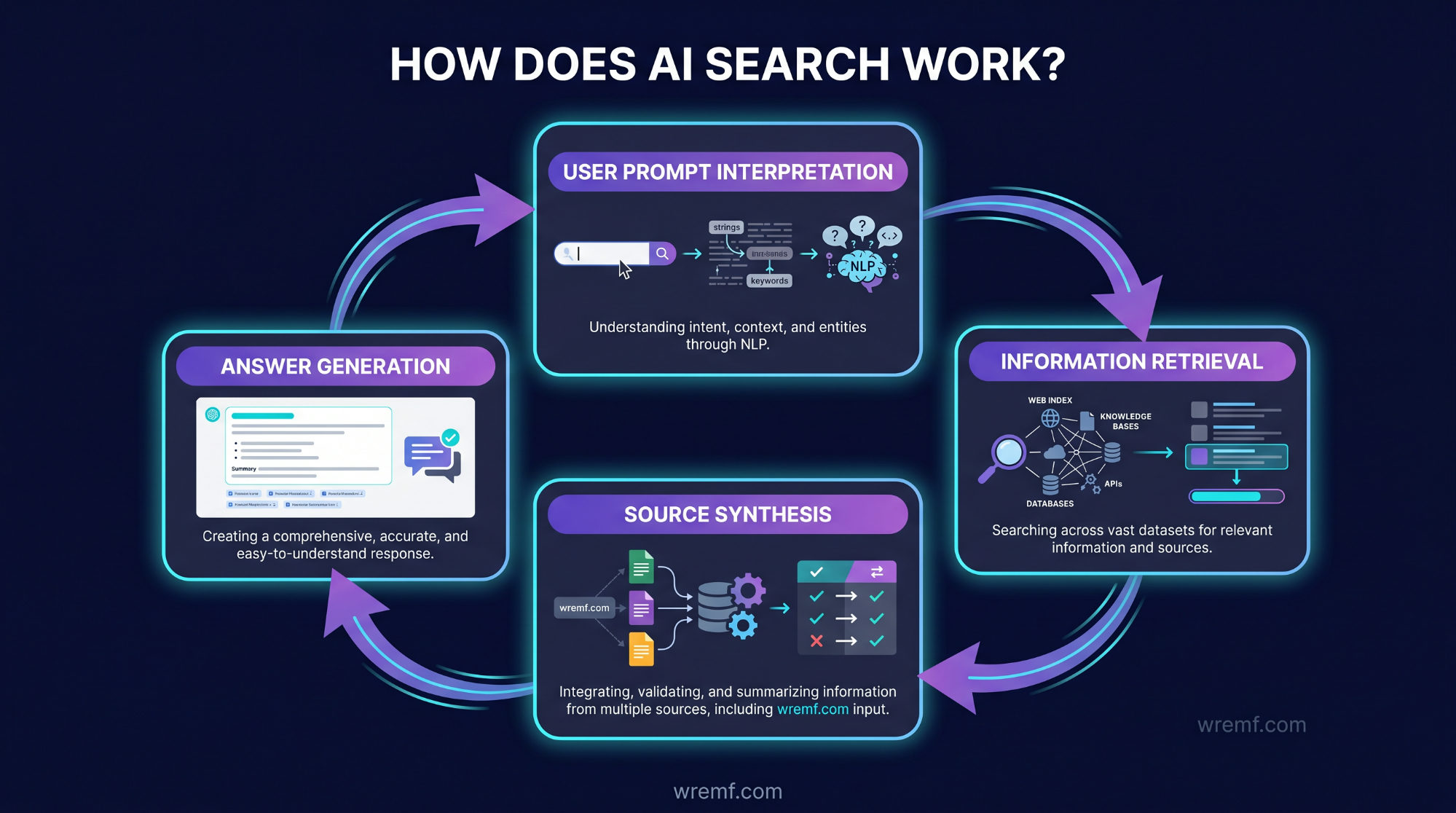
AI search works by interpreting a user prompt, retrieving relevant information, synthesizing sources, and generating an answer. The output may include citations, links, summaries, comparisons, or follow-up paths depending on the platform.
Retrieval-augmented generation is a process where an AI system retrieves external information before producing an answer. Retrieval-augmented generation matters because the final answer may depend on which sources are accessible, trusted, current, and clear enough to support the response.
Query fan-out is the expansion of one user query into several related subqueries. Query fan-out matters because an answer engine may evaluate definition, comparison, pricing, reviews, alternatives, and implementation intent before generating one synthesized answer.
Content chunks are small, extractable sections of page content that can be retrieved, summarized, cited, or reused inside AI-generated answers. Content chunks matter because AI systems often prefer clear definitions, tables, lists, steps, and concise source-backed explanations.
OpenAI explains that ChatGPT search can provide fast, timely answers with links to relevant web sources, and that users can open a sources sidebar to review references. That means source visibility is part of AI search, not a separate reporting problem. OpenAI’s ChatGPT search announcement is one example of how answer engines connect conversational responses with source discovery. (OpenAI)
AI search usually follows this flow:
| Stage | What Happens | What Brands Should Optimize |
|---|---|---|
| Query interpretation | The AI system identifies intent and context | Natural language headings, clear answers, entity relevance |
| Retrieval | The system finds candidate sources or knowledge | Crawlability, indexation, citations, links, authority |
| Synthesis | The system creates an answer from selected information | Definitions, lists, tables, facts, source-backed claims |
| Citation or reference | Some platforms show links or cited sources | Citation tracking, source quality, brand-owned pages |
| Follow-up refinement | The user asks another question | Topic clusters, FAQs, comparison pages, decision content |
AI models do not all retrieve information in the same way. Google AI Overviews, Google AI Mode, ChatGPT search, Perplexity, Gemini, Copilot, DeepSeek, Grok, Meta AI, and Mistral can produce different AI responses for similar prompts.
This is why one screenshot is not enough. A proper AI search optimization workflow tracks prompt clusters across multiple AI platforms over time.
IMPORTANT: AI search is probabilistic. You can improve visibility signals, source quality, and answer readiness, but no brand can guarantee a specific AI model will cite or recommend one page for every prompt.
KEY TAKEAWAY: AI search works through prompt interpretation, retrieval, synthesis, and citation, so optimization must cover content, sources, prompts, competitors, and measurement.
Once the mechanics are clear, the next question is how AI search differs from SEO, AEO, and GEO.
AI Search Optimization vs SEO, AEO, and GEO
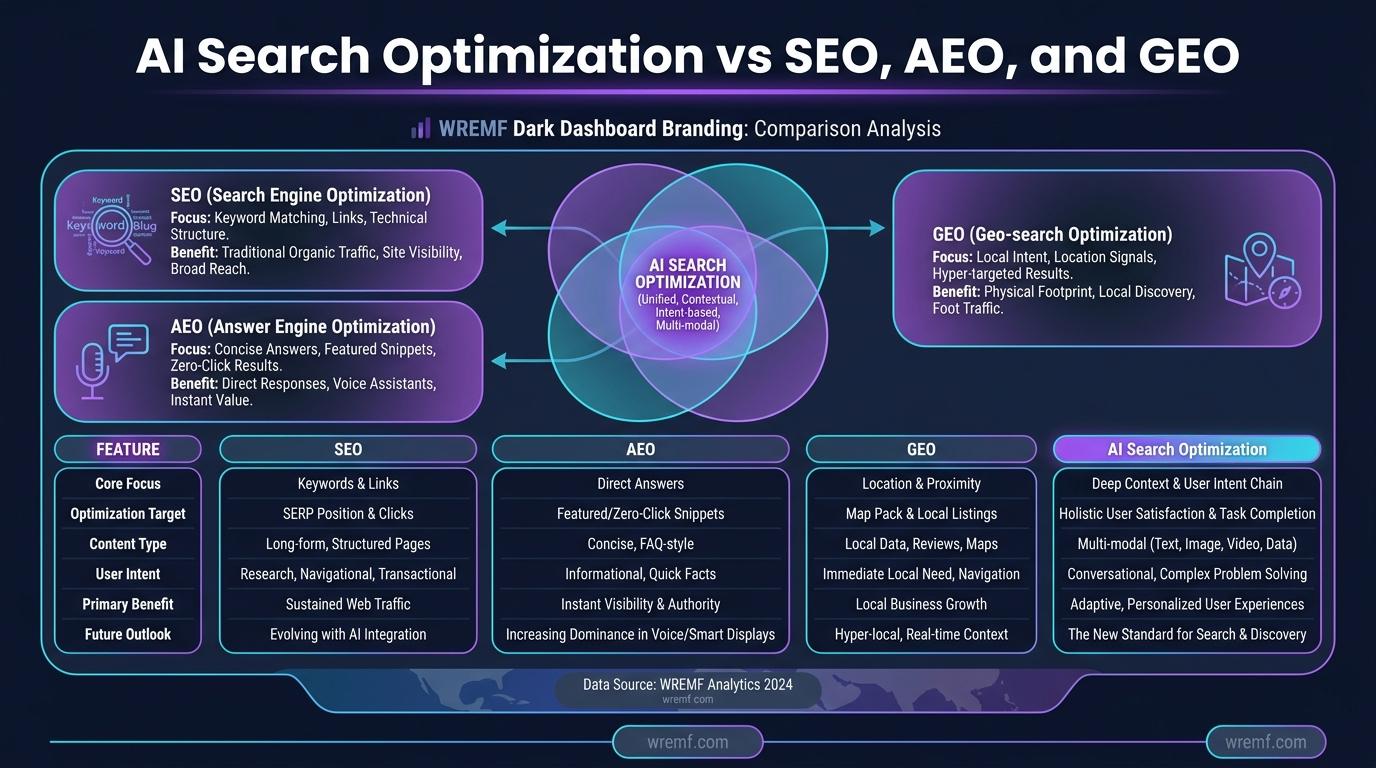
AI search optimization connects SEO, Answer Engine Optimization, and generative engine optimization into one measurable system. SEO improves discoverability, AEO improves answer readiness, and GEO improves visibility inside AI-generated answers.
Search engine optimization is the practice of improving a website so search engines can crawl, understand, rank, and display its pages. SEO still matters because AI discovery surfaces often depend on web indexes, technical accessibility, internal linking, backlinks, page quality, and structured information.
Answer Engine Optimization is the practice of structuring content so answer engines can extract direct answers. Answer Engine Optimization matters because AI answers often rely on concise definitions, comparison tables, FAQs, and structured explanations.
Generative engine optimization is the practice of improving how brands appear inside generative AI responses. Generative engine optimization matters because LLM visibility depends on prompts, citations, source quality, entity authority, brand mentions, and content that supports synthesis.
The key difference between SEO and GEO is the output being measured. SEO often tracks rankings, impressions, clicks, links, and technical health. GEO tracks whether AI models mention, cite, summarize, compare, or recommend a brand in AI-generated answers.
| Discipline | Best For | What It Measures | What It Misses | Example Metric |
|---|---|---|---|---|
| SEO | Ranking in search engines | Keywords, rankings, impressions, clicks, links | Prompt-level AI responses and source citations | Google Search Console clicks |
| AEO | Winning direct answers | Featured snippets, FAQs, answer-ready content | Competitor mentions inside LLMs | Answer inclusion rate |
| GEO | Appearing in generative answers | AI responses, brand mentions, citations, recommendations | Some traditional ranking signals | Prompt-level AI visibility |
| AI search optimization | Connecting SEO, AEO, and GEO | Rankings, AI visibility, citations, competitors, attribution | Nothing if measured too narrowly | AI share of voice by prompt cluster |
Google Search Central explains that SEO is useful when applied to people-first content, and that Google systems aim to reward helpful, reliable content with strong experience, expertise, authoritativeness, and trust. This matters for AI Optimization because answer engines also need clear, reliable, useful, and machine-readable information to synthesize answers. Google’s helpful content guidance is a strong reference point for content quality. (Google for Developers)
AI Optimization is the broader practice of improving content, data, source signals, technical access, and brand clarity for AI systems. AI Optimization includes content optimization, structured data, schema markup, prompt testing, technical crawlability, entity clarity, and performance measurement across AI platforms.
The biggest mistake is treating SEO, AEO, and GEO as competing labels. They are connected layers of modern search visibility. SEO gets your content discovered. AEO makes your content extractable. GEO makes your brand measurable inside synthesized answers.
KEY TAKEAWAY: SEO helps users find pages, AEO helps engines extract answers, and GEO helps brands appear inside AI-generated answers.
The next section explains which signals matter most when AI systems decide what to include.
What Signals Matter Most for AI Search Visibility?
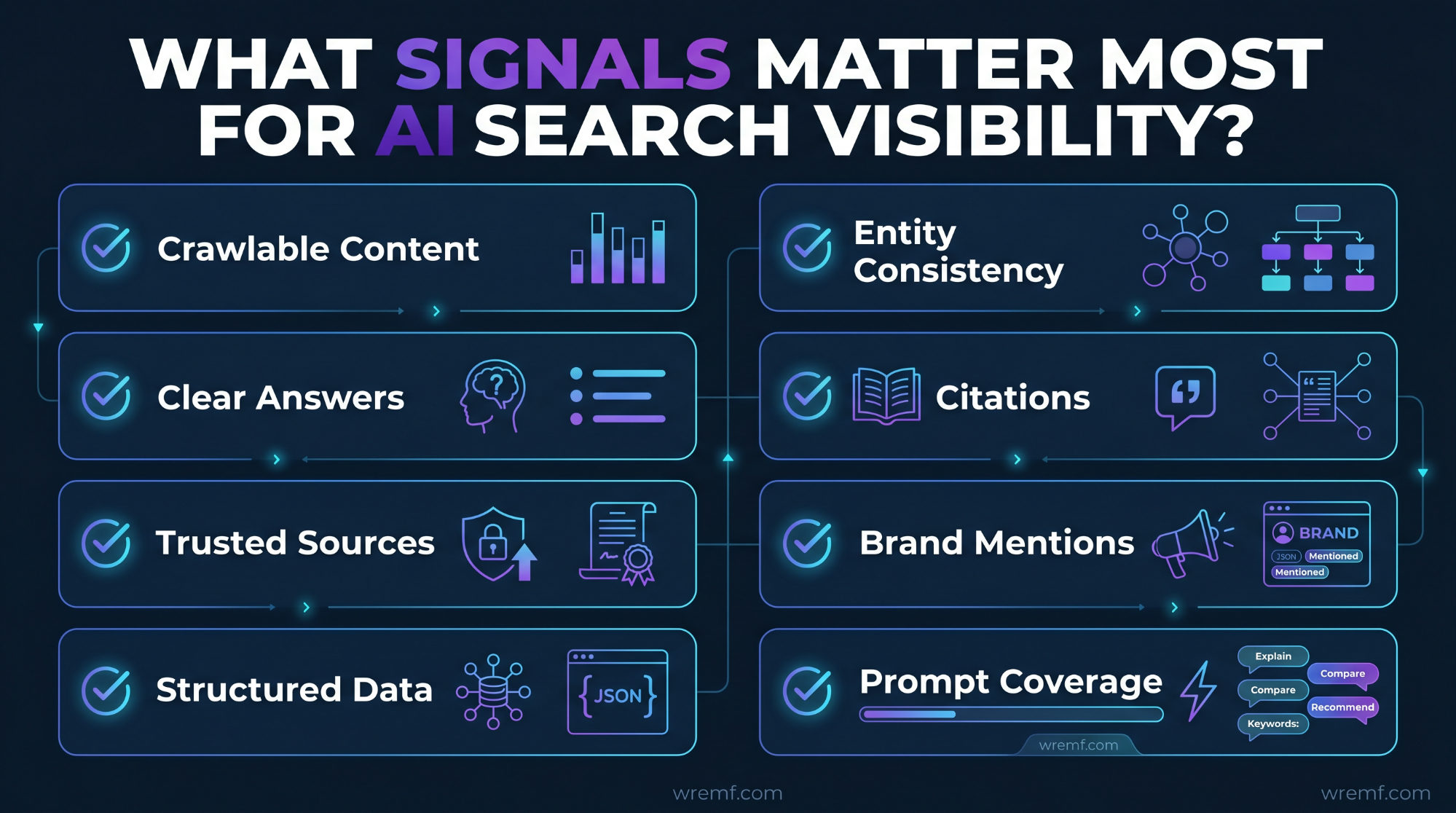
The strongest AI search visibility signals are crawlable content, clear answers, trusted sources, structured data, entity consistency, citations, brand mentions, and prompt coverage. Rankings alone do not explain whether AI systems will include your brand.
AI citations are links or references used by AI platforms to support an answer. AI citations matter because they show which sources an answer engine trusts enough to use when producing AI responses.
Source citations are the specific pages, domains, or references that appear inside AI answers. Source citations matter because they reveal whether AI systems are using your website, competitor pages, industry publications, review platforms, directories, documentation, or outdated third-party pages.
Brand mentions are references to your company without necessarily linking to your website. Brand mentions matter because AI-generated answers may include your brand in a shortlist, comparison, or recommendation even when there is no visible citation.
Source consistency is the alignment of your company name, description, pricing, category, leadership, product facts, and positioning across public sources. Source consistency matters because AI models may compare multiple sources before generating AI responses.
Entity authority is the degree to which machines can confidently understand who your brand is, what it offers, and how it relates to a category. Entity authority matters because AI search is built around entities, not only keywords.
In practical AI visibility audits, marketing teams often find that their website ranks for informational queries but disappears during decision-stage prompts. For example, a brand may appear for “what is AI search optimization” but not for “best AI visibility tools for agencies” or “how to track ChatGPT citations for B2B SaaS.”
A useful AI search optimization measurement model includes:
| Signal | Why It Matters | Practical Optimization |
|---|---|---|
| Crawlability | AI systems need accessible sources | Keep important content indexable and visible |
| Answer-first content | AI systems need extractable answers | Use direct definitions, tables, and lists |
| Structured data | Search engines need context | Add relevant schema markup where appropriate |
| Source citations | AI answers depend on trusted references | Track cited domains and improve source quality |
| Brand mentions | AI may recommend without linking | Monitor category prompts and third-party mentions |
| Entity consistency | Conflicting facts reduce trust | Align descriptions across public sources |
| Prompt coverage | Buyers ask natural language questions | Track prompts by funnel stage |
| Competitor visibility | AI answers compare options | Measure who appears and why |
| AI traffic attribution | Leaders need business evidence | Track referrals from AI platforms where possible |
Perplexity explains that its answers include citations to sources, which makes source quality and citation tracking especially important for brands that want visibility in direct answer engines. Perplexity’s help center is a useful source for understanding how citation-led AI search experiences differ from traditional search results. (Perplexity AI)
DID YOU KNOW: McKinsey estimates that generative AI could increase marketing productivity by 5 to 15 percent of total marketing spending, worth about 463 billion dollars annually. This makes measurement discipline important as teams add AI to search, content, analytics, and reporting workflows. McKinsey’s generative AI marketing analysis provides the broader productivity context. (McKinsey & Company)
WREMF’s AI visibility methodology connects prompts, citations, competitors, source consistency, AI share of voice, and attribution into one repeatable measurement system.
KEY TAKEAWAY: AI visibility improves when your brand is clear, crawlable, cited, consistent, and present across the prompts buyers actually ask.
After identifying the signals, the next step is building the technical foundation that lets AI systems access and understand your site.
Build a Technical Foundation for AI Crawlers and Search Engines
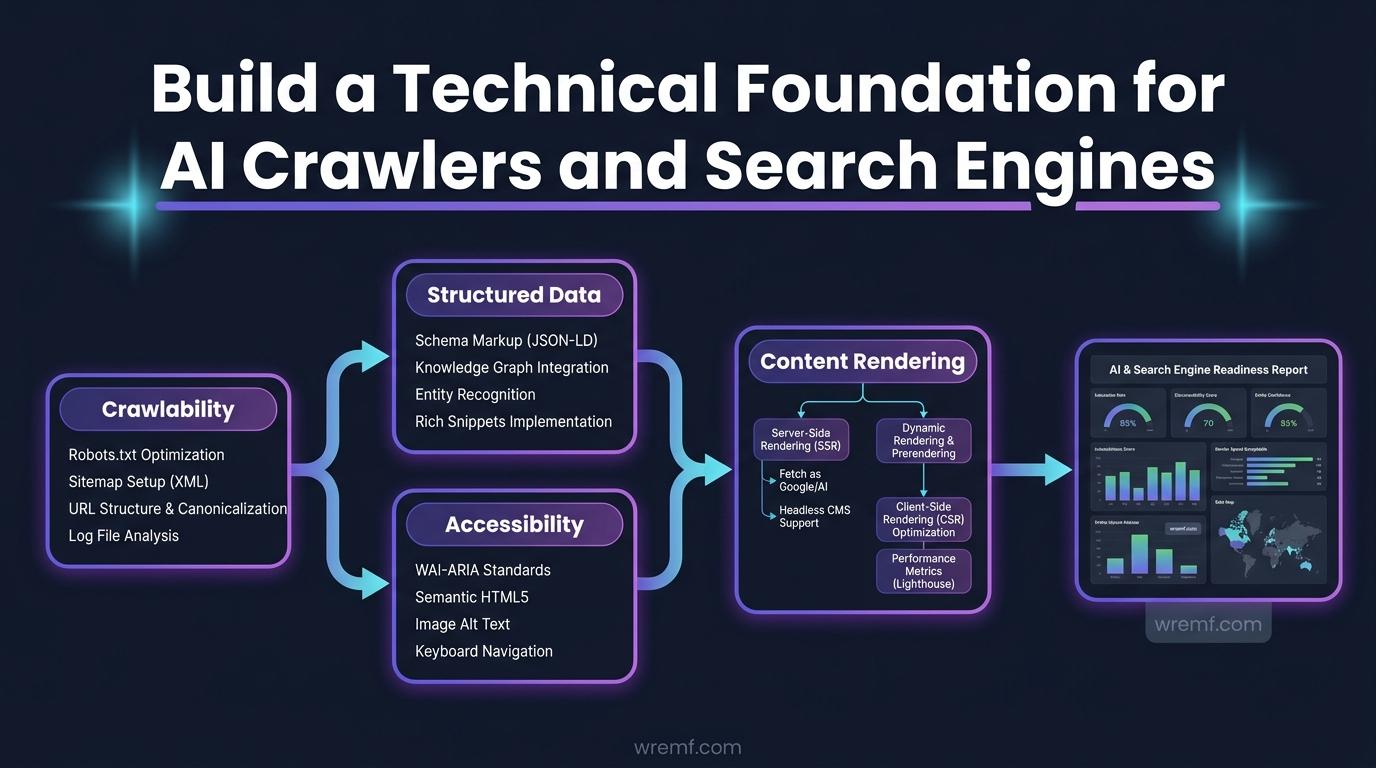
A strong technical foundation makes your content accessible to search engines, AI crawlers, answer engines, and retrieval systems. Technical crawlability matters because AI systems cannot cite, summarize, or recommend information they cannot access or understand.
Technical Crawlability is the ability of crawlers and retrieval systems to access, render, and interpret website content. Technical Crawlability matters because blocked, hidden, slow, duplicated, or JavaScript-dependent content can reduce visibility in both search engines and AI platforms.
AI Crawler access should be managed intentionally. Some AI platforms use direct crawlers, some use search indexes, some use licensed data, and some use retrieval systems connected to the web. The practical goal is not to allow every bot everywhere. The goal is to make valuable public pages accessible while protecting private, duplicate, or low-value content.
Structured data is machine-readable information that describes page content in a standardized format. Structured data matters because it reduces ambiguity for search engines and helps machines understand entities, relationships, page types, and content purpose.
Schema markup is structured vocabulary added to a page so search engines can better understand the content. Schema markup matters for AI search because clear organization, product, article, FAQ, breadcrumb, review, and local business information can help machines interpret context.
Canonical tags tell search engines which version of a page should be treated as the preferred URL. Canonical tags matter because AI answers should ideally retrieve the strongest, most accurate, and most current version of your content.
Internal linking helps crawlers and users understand the relationship between pages. Internal linking matters for AI search because topic clusters, content hubs, and supporting pages make expertise easier to map.
A technical foundation for AI Search Optimizations should include:
Indexable public pages for important topics
Key answers visible in rendered HTML
Clean heading hierarchy
Accurate canonical tags
Logical internal linking
Valid structured data
Fast and stable page experience
Accurate XML sitemaps
Useful robots.txt rules
Clear organization and product information
Rendered HTML checks
No contradictory duplicate pages
No hidden critical content
No misleading structured data
Microsoft states that Copilot Search can include references and information from external sources, connected services, and the web when grounding is enabled. That means technical discoverability and source clarity can influence how Microsoft AI experiences reference public web content. Microsoft’s Copilot Search documentation is useful for understanding grounding, references, and external sources. (Microsoft Learn)
For local and multi-location businesses, the technical layer also includes Google Business Profile, Google reviews, local schema markup, Knowledge Graphs, Google Local Pack visibility, and local ranking factors. Multi-location businesses need consistent names, addresses, categories, hours, service areas, reviews, and location pages because AI-generated answers may synthesize local facts from several sources.
WREMF’s GEO audit feature helps teams review crawlability, rendered content, entity clarity, answer structure, technical issues, and prompt fit before investing in new content.
KEY TAKEAWAY: Technical AI search optimization starts with crawlable, structured, canonical, internally linked, and machine-readable content.
Technical access creates the foundation, but content structure determines whether AI systems can extract useful answers.
How Should You Structure Content for AI Responses?
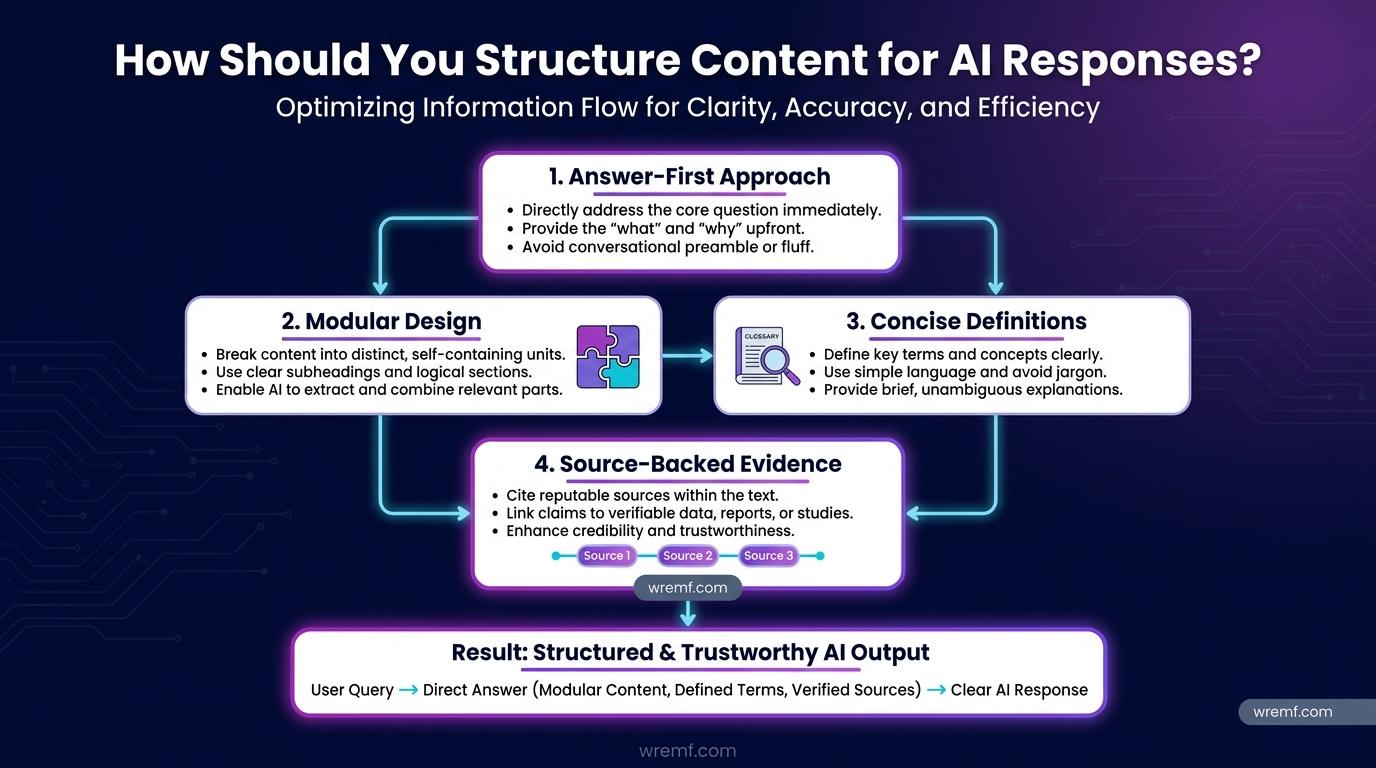
Content for AI responses should be answer-first, modular, source-backed, and easy to extract. AI-generated answers often rely on concise definitions, lists, tables, comparisons, evidence, and clearly labeled sections.
Content optimization is the process of improving page content so it better satisfies user intent, search requirements, and AI retrieval needs. Content optimization matters because unclear, generic, or unsupported content is harder for both humans and AI models to trust.
AI responses are synthesized outputs produced by AI systems in response to prompts. AI responses matter because they can influence what buyers believe, which vendors they compare, and which sources they trust.
AI answers are direct responses to user questions produced by AI systems. AI answers matter because users may accept the answer before visiting a website, especially for definitions, comparisons, recommendations, and research summaries.
AI-generated answers are machine-produced summaries or recommendations that may include citations, links, or references. AI-generated answers matter because they can shape brand perception even when users do not click.
Content creation is useful only when it creates better answers. Content Generation, Content Editor workflows, Content AI insights, and GenAI writer tools can speed up drafting, but they do not automatically create useful, accurate, differentiated, or citation-worthy content.
The most effective way to improve AI search visibility is to write content that answers real questions directly, then supports those answers with evidence, examples, and structured context.
AI Search Optimizations for content should include:
A direct answer at the start of every major section
One concise definition for every major concept
Natural language headings that match user prompts
Tables for comparisons
Lists for steps, checks, and criteria
Practical examples from B2B buying journeys
Source attribution close to factual claims
Updated information where freshness matters
Clear product and category language
Expert review for technical or commercial claims
Distinct sections for awareness, consideration, and decision intent
Content clusters are groups of related pages that cover a topic from multiple angles. Content clusters matter because search engines and AI models can better understand topic authority when definitions, comparisons, workflows, risks, tools, services, and FAQs are connected.
A strong AI search content cluster may include:
| Cluster Page | Search Intent | Example User Prompt |
|---|---|---|
| AI search optimization guide | Informational | What is AI search optimization? |
| AI visibility tools | Commercial | What are the best AI visibility tools? |
| AEO services | Service intent | Who can help with Answer Engine Optimization? |
| GEO audit | Implementation | How do I audit my site for generative engine optimization? |
| Prompt tracking | Measurement | How do I track prompts across AI platforms? |
| Source citations | Citation intent | Which sources do AI engines cite for my brand? |
| Competitor visibility | Comparison | Which competitors appear in AI answers? |
| AI traffic attribution | Reporting | How much traffic comes from ChatGPT or Perplexity? |
TIP: Write each section so it can stand alone when copied into an AI answer. Repeat the subject clearly, avoid vague pronouns, and keep definitions short.
WREMF’s AI-ready content briefs help teams turn prompt data, competitor visibility, source gaps, and citation opportunities into briefs that writers can execute without guessing.
KEY TAKEAWAY: AI search content should be written as modular, answer-first, evidence-backed chunks that match real user prompts.
Once content is structured, the next challenge is improving citations, mentions, and source consistency.
How Do AI Citations, Brand Mentions, and Source Consistency Work?
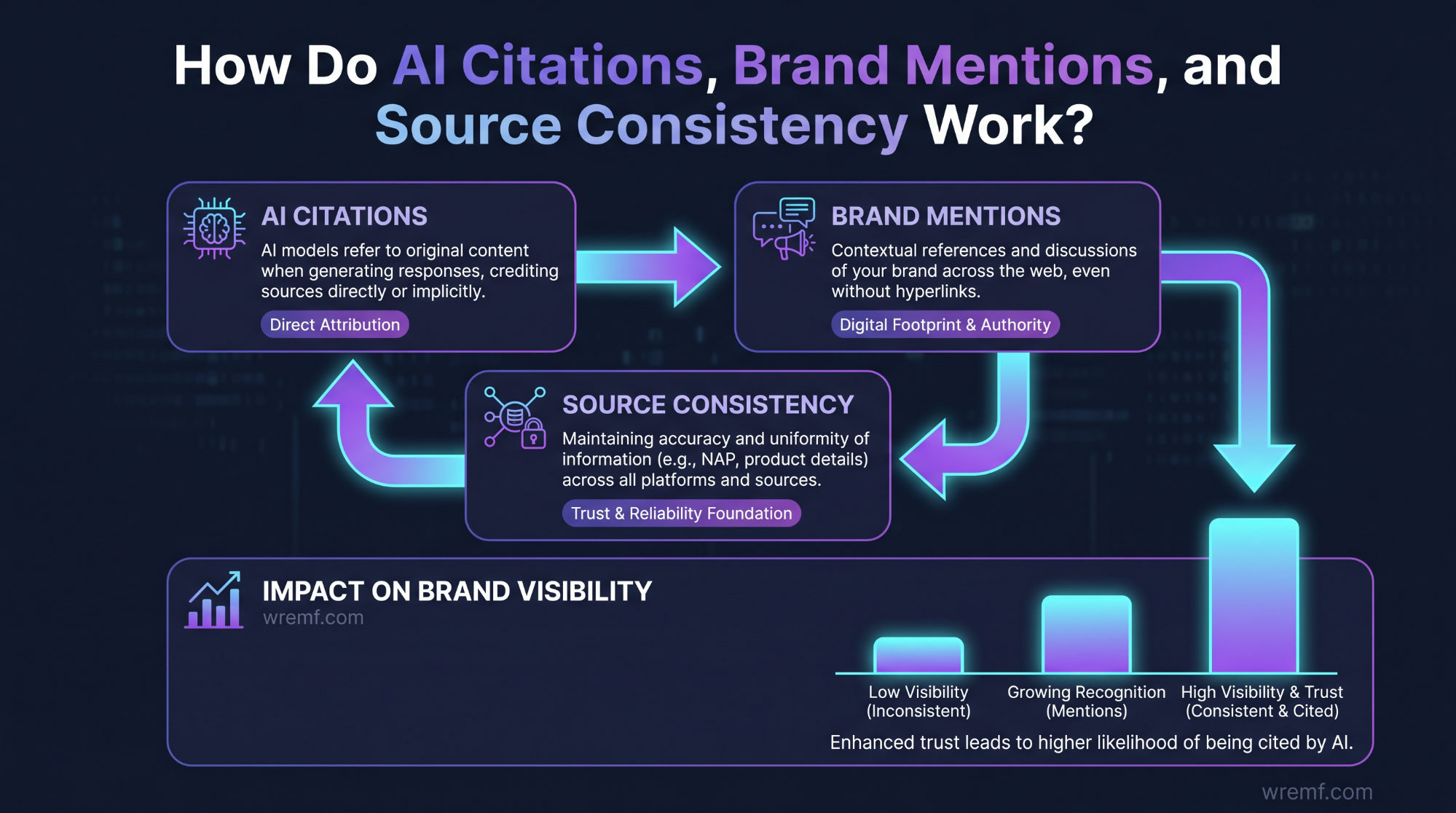
AI citations, brand mentions, and source consistency help answer engines decide whether your brand is reliable enough to include. A brand with inconsistent public information can lose visibility even when its own website is strong.
AI citations matter because they create a visible trail between an answer and a supporting source. Citation visibility also shows which pages and domains AI systems trust when responding to category, product, or comparison prompts.
Source citations matter because they reveal the actual source ecosystem behind AI-generated answers. A cited source may be your website, a competitor page, an industry article, a review platform, a documentation page, a directory, Reddit, Quora, or a publisher list.
Brand mentions matter because some AI responses recommend or compare brands without citing every source. A brand may be visible in the answer but absent from the citations, which means visibility and citation performance should be measured separately.
Source consistency helps AI systems reduce uncertainty. If your homepage says one thing, directories say another, review platforms use an old category, and comparison pages list outdated pricing, AI answers may produce incomplete or inaccurate summaries.
Citation Leapfrog is a strategy where a brand identifies the sources AI systems already cite and improves its presence on or around those sources. Citation Leapfrog matters because some AI platforms cite trusted third-party pages more often than brand-owned pages.
In practical AI visibility audits, teams often discover three citation problems:
| Problem | What It Means | What To Do |
|---|---|---|
| AI cites competitors | Competitors have stronger cited pages or source presence | Compare cited content, source authority, and answer structure |
| AI cites outdated sources | Public information is stale or inconsistent | Update owned content and correct key third-party profiles |
| AI mentions but does not cite you | Brand awareness exists, but source support is weak | Build citation-worthy pages and improve source consistency |
WREMF’s source citation tracking helps teams identify which pages and domains AI engines use when describing a brand, competitors, and category topics.
Brand Monitoring, Social Listening, Journey Tracking, Customer Surveys, Clickstream Data, Digital Trend Monitoring, Traffic Analysis, and social signals can support AI search optimization when they reveal how buyers describe a category. These inputs help teams write content in the same language users bring to ChatGPT, Claude, Gemini, Perplexity, Google AI Overviews, Copilot, DeepSeek, Grok, Meta AI, and Mistral.
Brand Sentiment also matters. AI models may synthesize public reviews, analyst descriptions, community discussions, product documentation, and comparison content. If the public source ecosystem contains unclear positioning, outdated complaints, or inconsistent product descriptions, AI-generated answers may reflect that confusion.
KEY TAKEAWAY: AI citation visibility depends on clear owned content, trusted third-party sources, consistent entity information, and active monitoring of cited pages.
After improving citations, teams need a measurement system that proves whether visibility is changing.
How Do You Measure AI Search Optimization Performance?
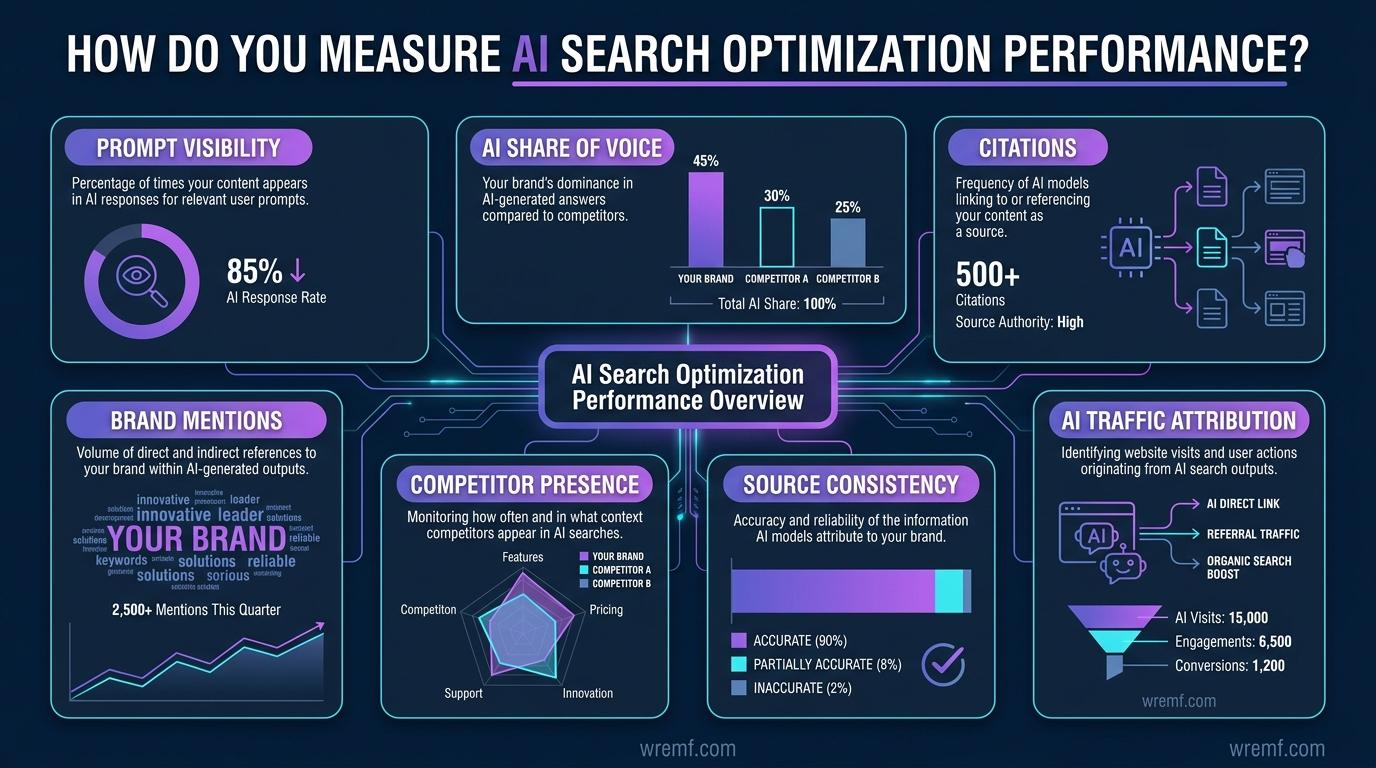
AI search optimization performance is measured through prompt visibility, AI share of voice, citations, brand mentions, competitor presence, source consistency, and AI traffic attribution. Traditional rankings show only part of the picture.
Prompt tracking is the process of monitoring how AI platforms answer specific questions over time. Prompt tracking matters because buyers use natural language prompts, not only keywords, when comparing vendors or solving problems.
LLM prompts are the questions or instructions users give to large language models. LLM prompts matter because they reveal how buyers ask for help, comparisons, recommendations, pricing context, and implementation advice inside AI platforms.
AI share of voice is the percentage of relevant AI responses where your brand appears compared with competitors. AI share of voice matters because it shows whether your brand is present in category conversations, not only whether your pages rank.
AI traffic attribution connects visits, sessions, leads, or conversions to AI discovery sources such as ChatGPT, Perplexity, Gemini, Copilot, and other referrers. AI traffic attribution matters because leadership needs evidence that AI visibility affects pipeline, not just screenshots.
Search Console, SERP feature monitoring, People Also Ask data, keyword data, Traffic Analysis, Brand Monitoring, and Content Analysis API workflows still matter. These sources show how Google demand, rankings, content performance, and SERP behavior are changing around your category.
A complete AI visibility dashboard should include:
| Metric | What It Shows | Why It Matters |
|---|---|---|
| Prompt visibility | Whether your brand appears for tracked prompts | Measures LLM visibility |
| Recommendation visibility | Whether AI recommends your brand | Measures decision-stage presence |
| Citation count | Which pages are cited | Measures source influence |
| Citation quality | Whether trusted sources support the answer | Measures authority |
| Competitor visibility | Which competitors appear more often | Measures market position |
| AI share of voice | Your share of AI responses | Measures category visibility |
| Source consistency | Whether AI facts match your real positioning | Measures brand accuracy |
| AI referral traffic | Visits from AI platforms | Measures downstream impact |
| Prompt drift | Changes in AI answers over time | Measures volatility |
| Content gap count | Missing answers or weak pages | Guides execution |
A common mistake is tracking one prompt in one AI tool. AI responses can vary by platform, query phrasing, timing, location, personalization, and retrieval source. A better approach is to track prompt clusters across the buying journey.
Prompt clusters should include awareness, consideration, and decision-stage questions. Awareness prompts define the problem. Consideration prompts compare approaches. Decision prompts compare vendors, pricing, risks, proof, integrations, and best-fit use cases.
WREMF’s prompt intelligence tools help teams monitor realistic user prompts across AI engines and connect results to citations, competitors, recommendations, and visibility scoring.
If you want to see how AI engines currently describe your brand, review a sample AI visibility report before building your own measurement workflow.
KEY TAKEAWAY: AI search optimization should be measured through prompts, citations, competitors, source consistency, and attribution, not rankings alone.
With measurement in place, teams can identify which competitors are winning visibility and why.
How Do You Compare Competitor Visibility in AI Search?
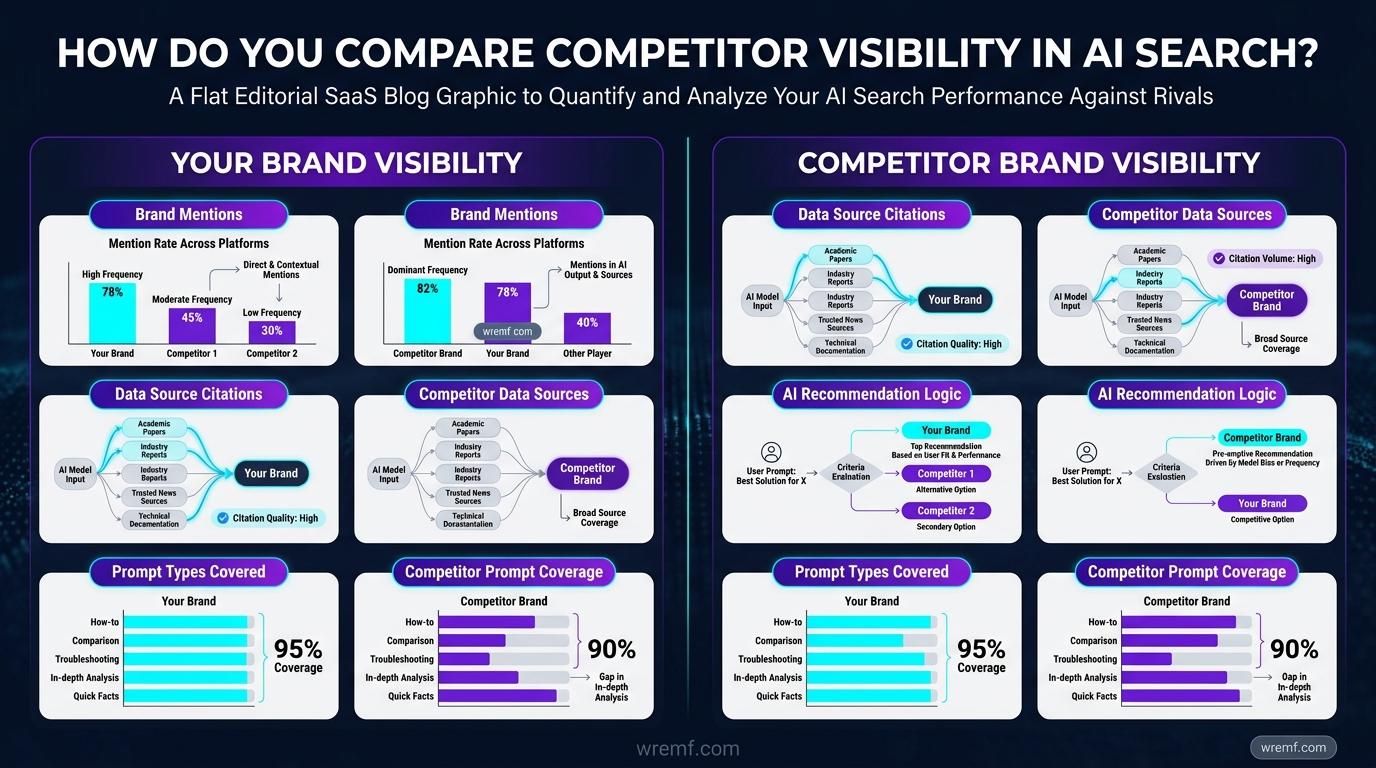
Competitor visibility in AI search shows which brands AI systems mention, cite, compare, and recommend for the same prompts. It matters because buyers often use AI answers to build shortlists before visiting vendor websites.
Competitor visibility is the measurement of how often competing brands appear in AI responses for relevant prompts. Competitor visibility matters because AI answers can influence perception before a sales conversation begins.
Competitive landscape analysis compares your brand against competitors across prompts, citations, recommendations, sentiment, and source quality. Competitive landscape analysis matters because AI search visibility is relative, not absolute.
In real-world reporting, SEO teams frequently discover that competitors do not win AI visibility only because they rank higher. Competitors may win because they have clearer category pages, stronger comparison content, better third-party mentions, more recent documentation, more consistent product descriptions, or stronger citation sources.
A useful competitor visibility workflow includes:
Track the same prompt set for your brand and competitors
Record which competitors appear in each AI response
Separate mentions, citations, and recommendations
Identify which sources support competitor answers
Compare answer language, confidence, and positioning
Map competitor content formats that AI systems cite
Identify content gaps and source gaps
Prioritize prompts with commercial value
Track changes after content and source updates
A competitor analysis table should separate presence from proof:
| AI Search Signal | What It Shows | Why It Matters |
|---|---|---|
| Mention visibility | Whether a competitor appears | Shows awareness in AI answers |
| Citation visibility | Whether a competitor is supported by sources | Shows source strength |
| Recommendation visibility | Whether a competitor is suggested as a solution | Shows decision-stage influence |
| Category ownership | Which brand is framed as a category leader | Shows positioning strength |
| Source overlap | Which sources cite multiple competitors | Shows Citation Leapfrog opportunities |
| Prompt gap | Prompts where competitors appear and you do not | Shows content or authority gaps |
Brand recommendation visibility measures whether AI systems actively suggest a brand as a good option for a use case. Brand recommendation visibility matters because a recommendation is more commercially valuable than a neutral mention.
WREMF’s competitive landscape tools help teams compare AI share of voice, competitor mentions, source citations, recommendations, and prompt-level gaps.
KEY TAKEAWAY: Competitor visibility shows where rivals are winning AI answers, which sources support them, and which prompts your brand should target next.
After competitor analysis, the next decision is which tools, services, and workflows can turn insights into action.
AI Search Optimization Tools, Services, and Workflows
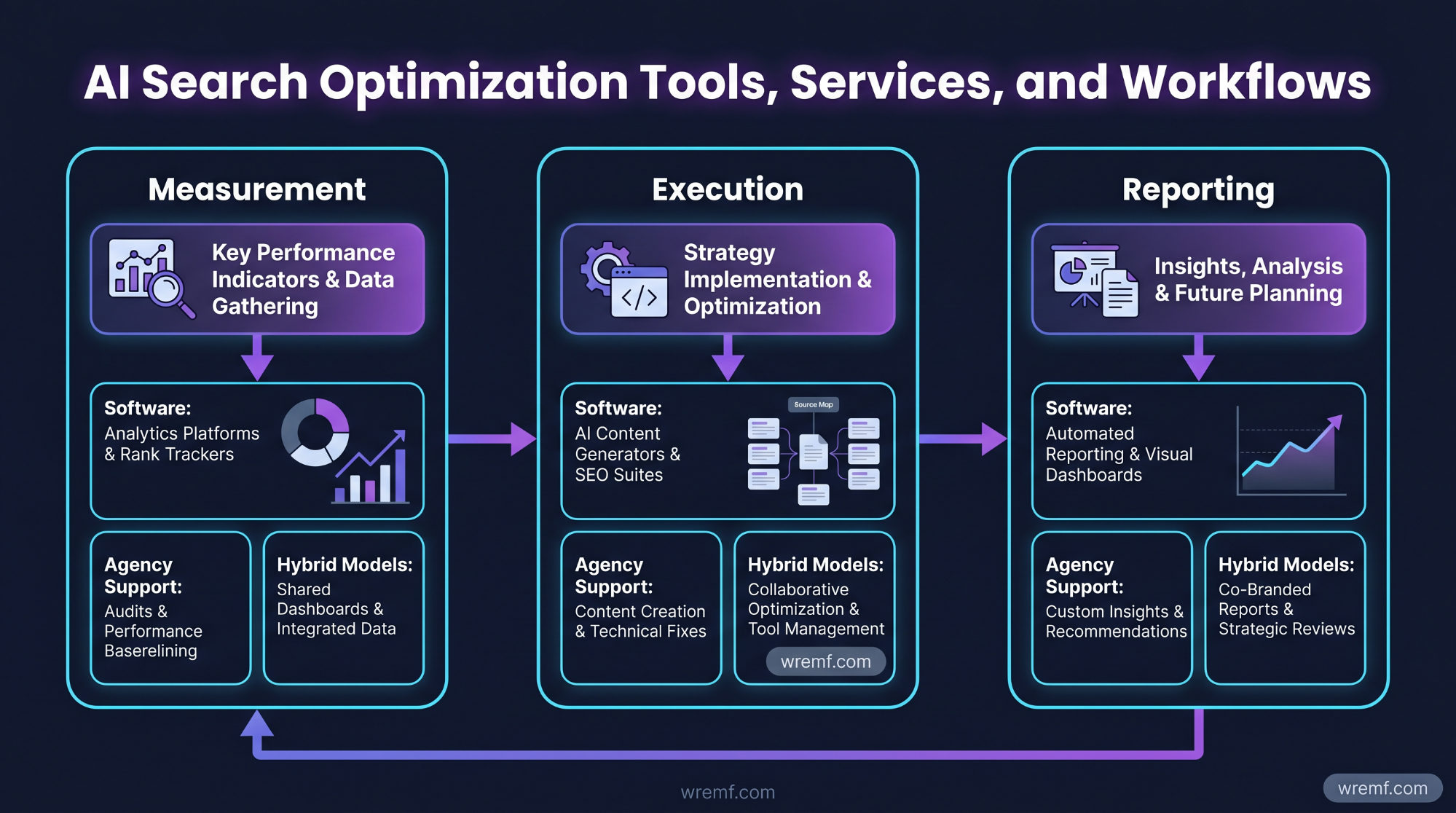
The right AI search optimization workflow depends on whether your team needs measurement, execution, reporting, or all three. Software is best for repeatable monitoring, agency support is best for execution, and a hybrid model is best when teams need both.
AI visibility tools are platforms that monitor how brands appear across AI engines, answer engines, and AI discovery surfaces. AI visibility tools matter because manual testing is inconsistent, hard to repeat, and difficult to report.
SEO tools remain useful for keyword research, backlinks, technical audits, SERP tracking, rank tracking, and traffic analysis. SEO tools matter because AI search still depends on the broader search ecosystem. The limitation is that many SEO tools do not measure AI responses, AI citations, source consistency, prompt visibility, or AI-generated answers across multiple platforms.
AI tools for content creation can support research, briefs, editing, and ideation. The risk is that AI tools do not automatically create original, expert-reviewed, evidence-led, and citation-worthy content. AI Search Optimizations require strategy, validation, and performance measurement.
| Option | Best For | What It Measures | What It Misses | Recommended When |
|---|---|---|---|---|
| Traditional SEO tools | Search rankings and technical SEO | Keywords, links, audits, rankings | AI responses and citation visibility | You need core SEO infrastructure |
| Manual AI testing | Early exploration | Individual prompt examples | Repeatability and reporting | You are validating a small hypothesis |
| AI visibility tools | Prompt and citation monitoring | AI visibility, citations, competitors | Execution unless included | You need repeatable measurement |
| Agency services | Strategy and implementation | Depends on reporting setup | Internal control if not transparent | You need expert execution |
| Hybrid software plus agency | Measurement and execution | Prompts, citations, traffic, actions | Requires clear ownership | You need both proof and progress |
AI Search Optimizations should be operationalized as a repeatable system:
Define priority prompts by funnel stage
Track prompts across AI models
Compare competitors in AI answers
Identify cited sources
Audit brand consistency
Map content gaps
Build or improve pages
Add structured data where useful
Test changes over time
Report visibility, citations, traffic, and actions
Agencies managing multiple clients often need white-label reporting, API access, client portals, shared prompt templates, repeatable reports, and clear deliverables. In-house brands often need visibility scoring, executive dashboards, content recommendations, competitor tracking, and attribution.
WREMF supports software, agency, and hybrid workflows. For teams that need execution, the WREMF agency team supports AI visibility strategy, GEO consulting, AEO execution, content optimization, citation improvement, source consistency cleanup, technical foundations, and monthly reporting.
For technical workflows, WREMF also supports API and MCP integrations so AI visibility data can connect with internal dashboards, client portals, reporting systems, and custom workflows.
KEY TAKEAWAY: The best AI search optimization workflow combines measurement, prioritization, execution, and reporting in one repeatable system.
The next section explains how tactics change across Google, ChatGPT, Perplexity, Copilot, and other AI platforms.
Platform-Specific AI Search Optimization Tactics
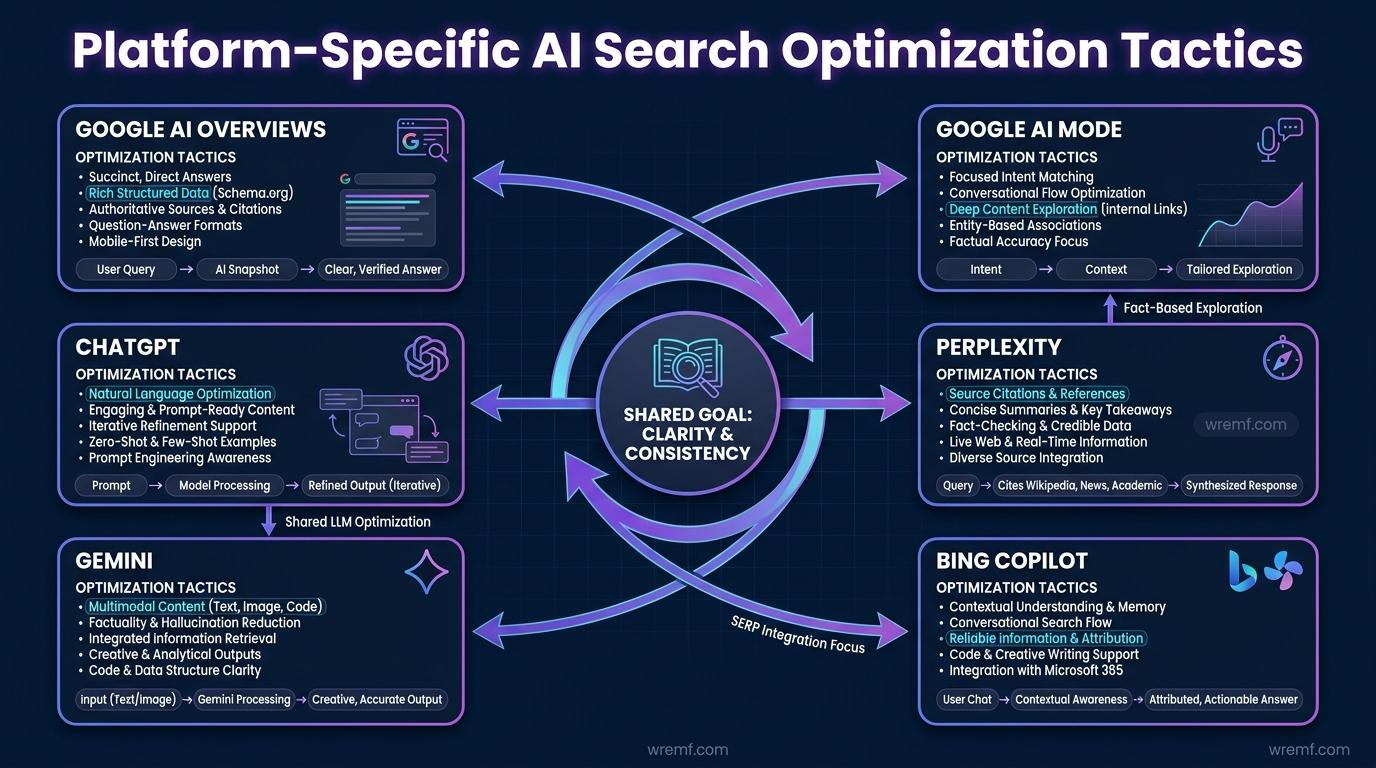
AI search optimization should adapt to each platform because Google AI Overviews, Google AI Mode, ChatGPT, Perplexity, Gemini, and Bing Copilot retrieve and present information differently. The shared goal is clear, credible, accessible, and consistent information.
Google AI Overviews are AI-generated snapshots in Google Search that summarize key information and include links for users to explore further. Google AI Overviews matter because users can get synthesized information before clicking an organic result.
Google AI Mode is a Google Search experience that uses AI to support more conversational and exploratory search journeys. Google AI Mode matters because users may ask follow-up questions, compare options, and explore topics through a more conversational interface.
ChatGPT search is a conversational search experience that can provide timely answers with source links. ChatGPT search matters because users ask broad research, comparison, and implementation questions in natural language.
Perplexity is an answer engine that emphasizes citations and source transparency. Perplexity matters because citation quality, source freshness, and clear answer structure can influence whether a brand appears in answers.
Bing Copilot and Microsoft Copilot connect AI answers with Microsoft search and knowledge systems. Bing Copilot matters because Microsoft’s AI experiences may use external sources and web grounding when enabled.
Gemini connects AI search experiences with the Google ecosystem. Gemini matters because helpful content, structured content, entity clarity, and Google discoverability can support AI discovery across Google surfaces.
| Platform | Optimization Priority | Practical Action |
|---|---|---|
| Google AI Overviews | Helpful content, crawlability, links to explore | Write answer-first content and keep pages accessible |
| Google AI Mode | Query fan-out and conversational journeys | Cover follow-up questions and decision-stage prompts |
| ChatGPT | Source-backed answers and web discoverability | Build clear pages that answer natural language prompts |
| Perplexity | Citations and source quality | Improve citation-worthy pages and third-party references |
| Bing Copilot | Bing grounding and web sources | Improve indexability, clarity, and source consistency |
| Gemini | Google ecosystem signals | Strengthen structured data, helpful content, and entity authority |
| DeepSeek, Grok, Meta AI, Mistral | Broader LLM visibility | Track prompts and source consistency across platforms |
Google AI, Google AI Overviews, Google AI Mode, ChatGPT, Perplexity, Gemini, Bing Copilot, and other AI platforms should not be treated as one identical ranking system. Each system may produce different AI responses, cite different sources, and describe brands differently.
AI platforms can also change quickly. That is why scheduled monitoring matters more than one-time testing.
KEY TAKEAWAY: Platform-specific tactics differ, but all answer engines reward accessible, trusted, clear, current, and consistent information.
The next section turns platform differences into an implementation plan.
How to Start AI Search Optimization Step by Step
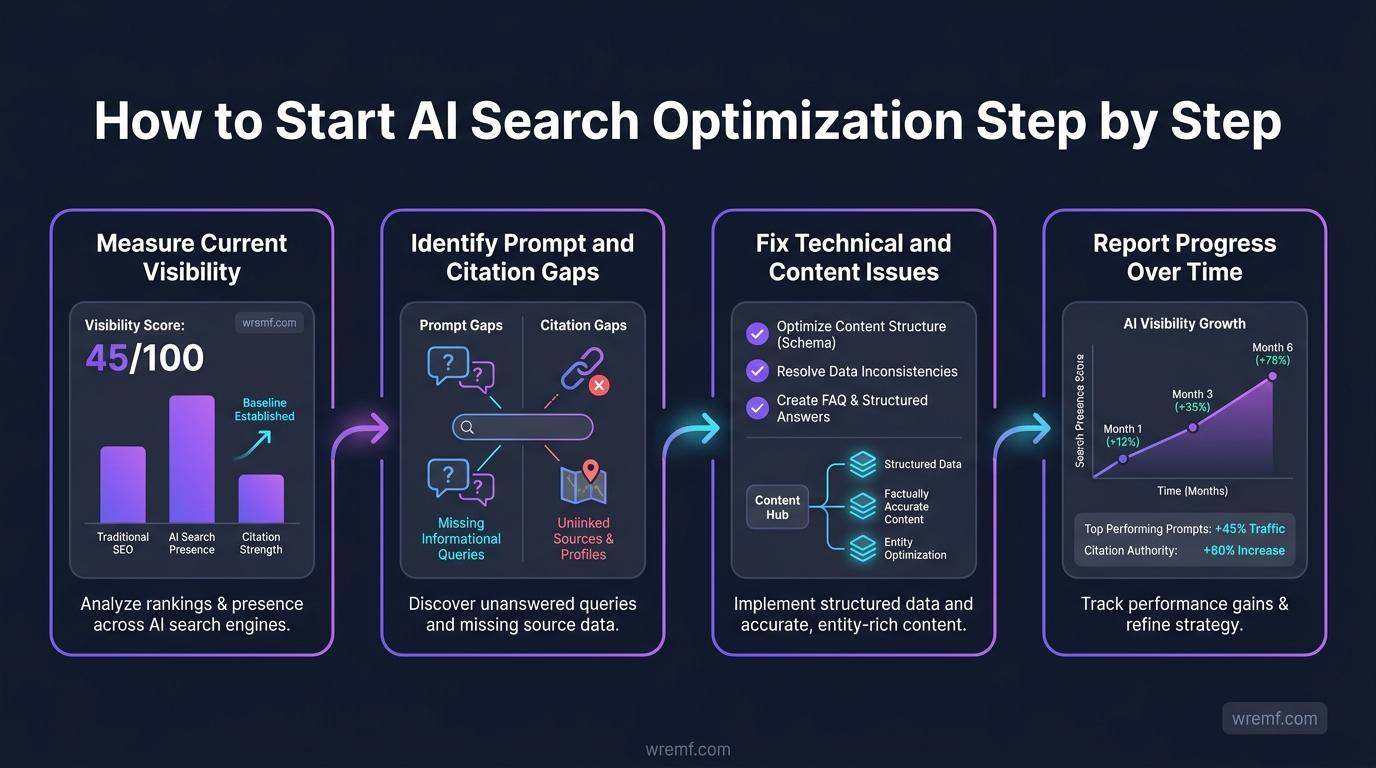
The best way to start AI search optimization is to measure current visibility, identify prompt and citation gaps, fix technical and content issues, then report progress over time. Start with evidence before creating new content.
A practical AI search optimization workflow should be small enough to start in one week and structured enough to scale over 90 days. Teams usually struggle when they begin with random content creation instead of baseline measurement.
Step 1: Define your AI search goals. Decide whether the goal is category visibility, competitor displacement, citation improvement, lead attribution, local visibility, agency reporting, or executive reporting.
Step 2: Build a prompt set. Include awareness, consideration, and decision-stage prompts. Examples include “what is AI search optimization,” “best AI visibility tools for B2B SaaS,” “how to track ChatGPT citations,” and “AI search optimization company for agencies.”
Step 3: Track AI responses. Monitor ChatGPT, Claude, Gemini, Perplexity, Google AI Overviews, Copilot, DeepSeek, Grok, Meta AI, and Mistral where relevant. Record whether your brand appears, whether competitors appear, and which sources are cited.
Step 4: Audit cited sources. Identify whether AI engines cite your site, competitors, review pages, directories, news sources, documentation, Reddit, Quora, or outdated articles.
Step 5: Fix source consistency. Align company descriptions, categories, product names, pricing claims, leadership details, and feature descriptions across owned and third-party sources.
Step 6: Improve content. Create or update answer-first pages, comparison pages, content clusters, FAQ sections, and content chunks that match real prompts.
Step 7: Strengthen technical signals. Improve structured data, schema markup, internal linking, canonical tags, crawlability, rendered HTML, and performance.
Step 8: Test and report. Use SEO testing, prompt tracking, citation monitoring, AI traffic attribution, and visibility scoring to see whether performance changes after updates.
A practical 30-60-90 day plan looks like this:
| Timeline | Focus | Output |
|---|---|---|
| First 30 days | Baseline visibility and technical audit | Prompt set, AI visibility score, citation map, content gaps |
| Days 31 to 60 | Content and source improvements | Updated pages, new briefs, fixed source inconsistencies |
| Days 61 to 90 | Testing and reporting | Visibility trend, citation changes, competitor movement, traffic signals |
For experimentation, WREMF’s SEO testing feature helps teams compare content changes against search and AI visibility outcomes where measurable.
KEY TAKEAWAY: AI search optimization should start with baseline measurement, then move into technical fixes, content improvements, citation work, and reporting.
Even with a strong workflow, several mistakes can reduce visibility.
Common AI Search Optimization Mistakes to Avoid
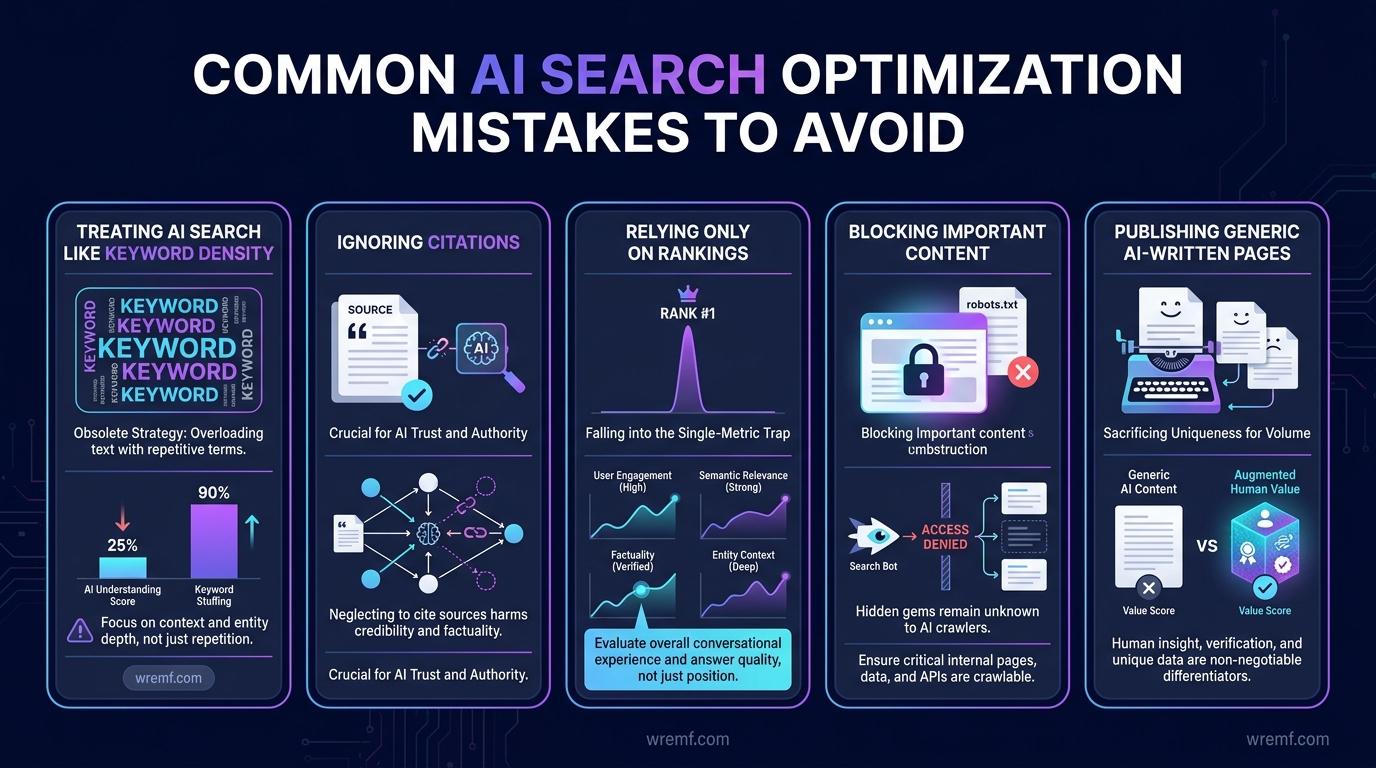
The biggest AI search optimization mistakes are treating AI search like keyword density, ignoring citations, relying only on rankings, blocking important content, and publishing generic AI-written pages. These mistakes weaken both search performance and AI visibility.
Keyword density is not a reliable strategy for AI search. AI models interpret meaning, relationships, context, sources, and trust signals. Repeating “AI search” without adding evidence, examples, definitions, or useful structure will not make a page more citation-worthy.
AI Search Optimizations fail when teams focus only on content creation. Content creation is useful, but AI visibility also depends on technical access, structured data, source consistency, entity authority, prompt coverage, competitor analysis, and citation improvement.
Common mistakes include:
Writing long pages without direct answers
Hiding important page content behind JavaScript
Ignoring structured data
Using schema markup that does not match visible content
Publishing thin AI-generated answers
Neglecting source citations
Forgetting decision-stage prompts
Tracking only one AI platform
Treating AI visibility as a one-time audit
Ignoring local schema markup for local businesses
Assuming traditional rankings equal AI recommendations
Failing to update outdated brand descriptions
Overusing AI tools without expert review
Confusing traffic attribution with visibility measurement
Local AI visibility has its own risks. Google Business Profile, Google reviews, local schema markup, Knowledge Graphs, Google Local Pack visibility, and local ranking factors can influence how AI systems describe local and multi-location businesses.
Multi-location businesses should treat local data as part of AI visibility. Location names, service categories, reviews, opening hours, address consistency, and local page content can affect answers to prompts such as “best AI search optimization company near me” or “B2B SEO agency in Paris.”
AI platforms can also make mistakes. This is why AI search optimization should include monitoring, source correction, and reporting rather than assuming one content update will solve every issue.
KEY TAKEAWAY: AI search visibility drops when brands optimize for keywords alone and ignore citations, source consistency, technical access, and real user prompts.
The next section addresses myths that often stop teams from investing in AI search.
Common Myths About AI Visibility Debunked
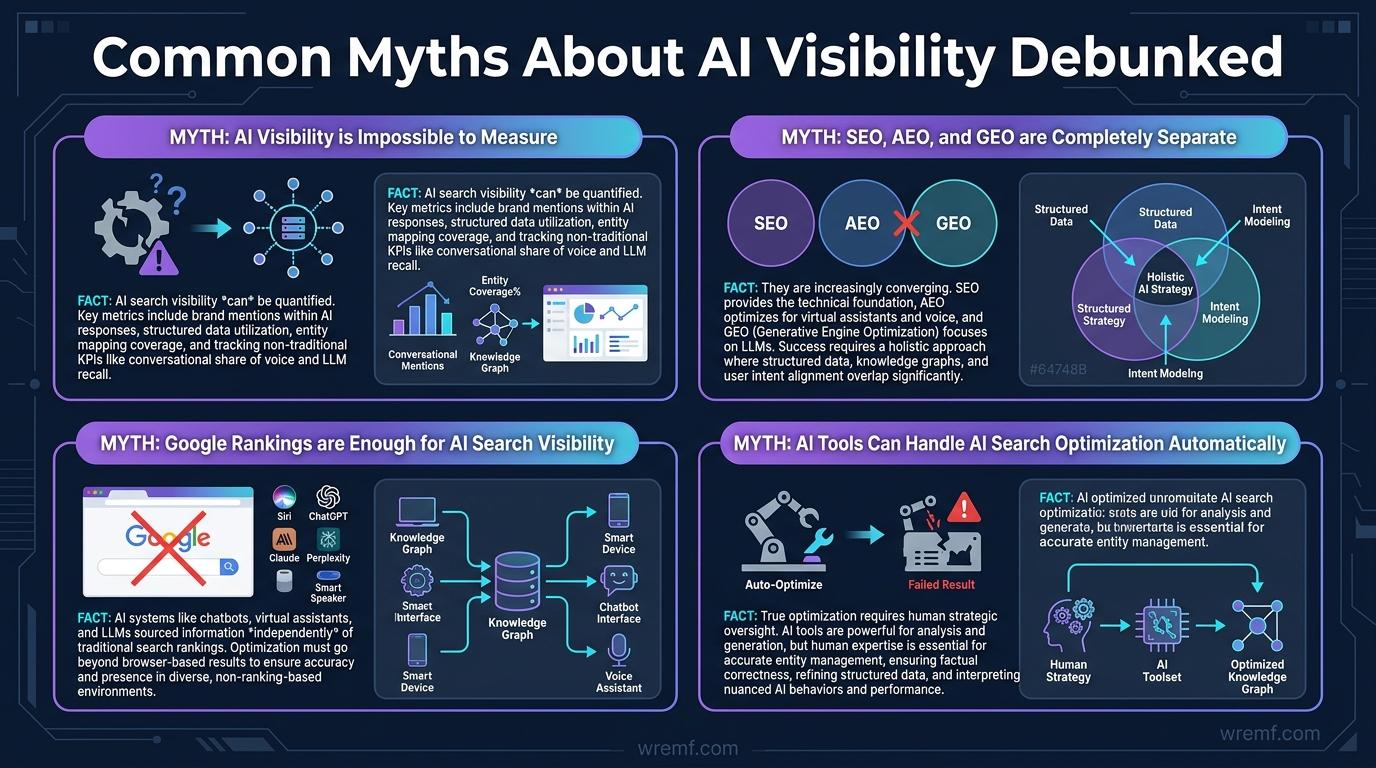
AI visibility is measurable, improvable, and connected to SEO, but it is not the same as traditional ranking. The biggest myths come from treating AI search as either magic or ordinary SEO with a new label.
MYTH: AI visibility is impossible to measure.
FACT: AI visibility can be measured through prompt tracking, AI share of voice, brand mentions, source citations, competitor visibility, source consistency, and AI traffic attribution. Measurement is not perfect because AI responses vary, but repeatable prompt sets and scheduled monitoring make trend analysis possible.
MYTH: SEO, AEO, and GEO are completely separate strategies.
FACT: SEO, Answer Engine Optimization, and generative engine optimization overlap. SEO supports crawlability and authority, AEO supports extractable answers, and GEO supports visibility inside AI-generated answers. The best strategy connects all three.
MYTH: Google rankings are enough for AI search visibility.
FACT: Rankings are useful, but AI search engines may synthesize answers from multiple sources, not only the top organic result. A brand can rank well and still be absent from AI responses if content does not answer the prompt, sources are inconsistent, or competitors are cited more clearly.
MYTH: AI tools can handle AI search optimization automatically.
FACT: AI tools can support research, content creation, Content Editor workflows, and content optimization, but they cannot replace expert review, source validation, technical auditing, and performance measurement. Human strategy is needed to decide which prompts, pages, citations, and competitors matter.
MYTH: AI-generated answers eliminate the need for websites.
FACT: Websites remain important because AI systems need public, structured, reliable sources to retrieve and cite. A strong website also supports sales enablement, trust, conversion, analytics, and brand-owned explanations that third-party sources cannot fully control.
KEY TAKEAWAY: AI visibility is not magic, and it is not just SEO. It is a measurable search discipline built around prompts, citations, content, sources, and attribution.
The final strategic decision is choosing the right AI search optimization approach for your team.
How to Choose the Right AI Search Optimization Approach
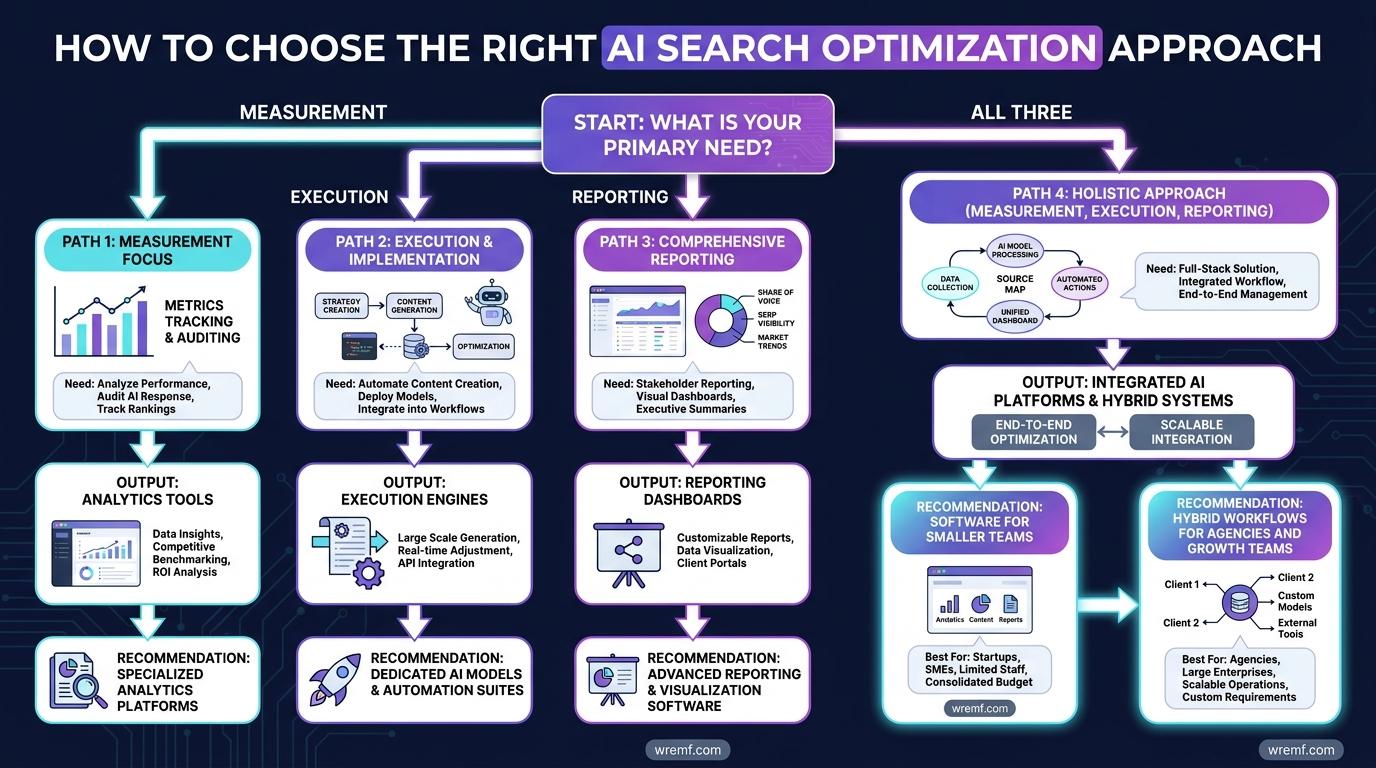
Choose your AI search optimization approach based on whether you need measurement, execution, reporting, or all three. Smaller teams may start with software, while agencies and growth teams often need hybrid workflows.
In-house brands usually need a clear view of how AI platforms describe their company, products, competitors, and category. Agencies usually need repeatable workflows, client portals, white-label reports, and proof of progress across multiple accounts.
WREMF is useful for brands that want software, agencies that need white-label reporting, and teams that want managed execution. WREMF combines prompt tracking, citation analysis, competitor visibility, source consistency, AI traffic attribution, and action recommendations in one platform.
| Team Type | Main Need | Best Approach | WREMF Fit |
|---|---|---|---|
| Early-stage B2B SaaS | Understand whether AI mentions the brand | Software baseline | Starter plan for 1 website |
| Growth-stage brand | Track competitors and improve visibility | Software plus content workflow | Growth plan for 5 websites |
| Agency | Manage multiple client reports | White-label software | Agency and client portal workflow |
| Enterprise team | Integrate data and reporting | API, MCP, branded portals | Enterprise plan |
| Team without internal SEO capacity | Strategy and execution | Managed service | WREMF agency support |
| Technical team | Connect AI visibility data to systems | API access | WREMF API and MCP integrations |
Starter is €39 per month and supports 1 website, unlimited prompt tracking, BYOK, 10 AI engines, all features and tools, white-label reports, 1 seat, and email support.
Growth is €89 per month and supports 5 websites, unlimited prompt tracking, BYOK, 10 AI engines, all features and tools, white-label reports, priority email support with a 24-hour SLA, content brief generation, and SEO A/B testing.
Enterprise uses custom pricing and supports unlimited websites, unlimited prompt tracking, BYOK, 10 AI engines, all features and tools, white-label reports, unlimited seats, dedicated support with a 4-hour SLA, and custom branded portals.
BYOK means bring your own key. BYOK matters because teams can connect their own AI provider keys where supported, giving them more control over usage, provider choice, and cost structure.
White-label reporting allows agencies to present AI visibility reports under their own brand. White-label reporting matters because agencies need professional client deliverables without rebuilding reporting infrastructure from scratch.
When evaluating AI visibility platforms, compare:
Number of AI engines tracked
Prompt tracking depth
Source citation tracking
Competitor visibility
Source consistency analysis
AI traffic attribution
White-label reporting
BYOK support
API access
MCP Server support
Client portals
Agency execution availability
Pricing by website or seat
Reporting quality
Methodology transparency
WREMF’s pricing structure is useful when teams need to compare software, agency, and hybrid options against their reporting and execution needs.
KEY TAKEAWAY: The right AI search optimization approach depends on whether you need software, managed execution, or a hybrid system that connects both.
The remaining questions address the most common implementation, buying, and strategy concerns.
Frequently Asked Questions
Can you do SEO with AI?
Yes, you can do SEO with AI, but AI should support the SEO process rather than replace strategy. AI tools can help with keyword clustering, content briefs, content optimization, Content Analysis API workflows, page summaries, SERP feature monitoring, and technical checks. Human review is still needed for accuracy, originality, brand positioning, and E-E-A-T signals. The best approach combines SEO tools, expert judgment, and AI Search Optimizations that measure visibility in AI responses, AI answers, and AI-generated answers across platforms.
Is SEO dead or evolving in 2026?
SEO is evolving in 2026, not dead. Search engines still crawl, index, rank, and display websites, while AI search adds synthesized answers, citations, and conversational discovery. Google AI Overviews, Google AI Mode, ChatGPT, Perplexity, Gemini, and Bing Copilot make SEO broader because brands now need crawlability, helpful content, structured data, answer-ready sections, and AI visibility measurement. Traditional rankings still matter, but they should be measured alongside prompts, citations, competitor mentions, and AI traffic attribution.
What are the 4 types of SEO?
The 4 common types of SEO are on-page SEO, technical SEO, off-page SEO, and local SEO. On-page SEO improves content, headings, internal linking, and topical relevance. Technical SEO improves crawlability, rendering, indexation, schema markup, canonical tags, and site performance. Off-page SEO improves authority through links, mentions, and trusted references. Local SEO improves visibility through Google Business Profile, Google reviews, local schema markup, Google Local Pack relevance, and local ranking factors. AI search optimization builds on all four.
What is the 10 20 70 rule for AI?
The 10 20 70 rule for AI is a planning model some teams use to balance experimentation, process change, and operational adoption. A practical interpretation is to spend 10 percent of effort on tools, 20 percent on data and workflows, and 70 percent on people, process, governance, and execution. For AI search optimization, this means AI tools alone are not enough. Teams also need prompt strategy, source validation, content quality, technical foundations, reporting, and accountability for implementation.
How do I optimize my website content for AI search engines like ChatGPT, Perplexity, and Google AI Overviews?
Start by making important content crawlable, structured, and answer-first. Build pages that directly answer real user prompts, use concise definitions, add comparison tables, strengthen internal linking, and apply relevant structured data. Then track how ChatGPT, Perplexity, Google AI Overviews, Gemini, and Copilot describe your brand. WREMF can help by monitoring prompt visibility, AI citations, competitors, and source consistency across major AI discovery surfaces, so your team knows which pages and sources need improvement.
What makes AI search engine optimization different from traditional SEO methods?
Traditional SEO focuses on rankings, impressions, clicks, backlinks, and technical health in search engines. AI search engine optimization focuses on whether AI models mention, cite, summarize, compare, and recommend your brand in AI-generated answers. The two overlap because crawlability, content quality, links, and structured data still matter. The difference is measurement. AI search optimization adds prompt tracking, citation analysis, source consistency, AI share of voice, competitor visibility, and AI traffic attribution.
How can semantic clarity boost AI search visibility?
Semantic clarity helps AI models understand what your brand, product, page, and topic actually mean. Clear headings, consistent entity names, precise definitions, schema markup, internal linking, and source-backed explanations reduce ambiguity. For example, a page that clearly explains “AI visibility tracking for B2B SaaS” is easier to retrieve than a vague page about “growth intelligence.” Semantic clarity improves content synthesis because answer engines can connect your page to the right prompts, category, and buyer intent.
How does schema markup help AI understand your content?
Schema markup helps search engines understand page entities, relationships, and content types in a structured format. It can clarify organization details, software information, articles, breadcrumbs, FAQs, reviews, and local business data. Schema markup does not guarantee inclusion in AI-generated answers, but it reduces ambiguity and supports machine understanding. For AI search visibility, schema markup should match visible content and work alongside helpful writing, technical crawlability, internal linking, and source consistency.
What writing mistakes reduce AI search visibility?
Writing mistakes that reduce AI search visibility include vague introductions, missing definitions, unsupported claims, long sections without direct answers, weak headings, keyword stuffing, outdated facts, and generic AI-written paragraphs. AI systems need clear, extractable, source-backed content. If a page does not answer the prompt directly, explain the entity clearly, or provide useful comparison points, it is less likely to be cited or summarized well. Strong AI search content uses answer-first sections, tables, lists, examples, and consistent terminology.
Which AI search optimization metrics should B2B teams track?
B2B teams should track prompt visibility, citation count, citation quality, AI share of voice, brand mentions, recommendation visibility, competitor presence, source consistency, AI referral traffic, and content gap completion. These metrics show whether a brand appears in awareness, consideration, and decision-stage AI responses. Rankings and clicks should remain part of the dashboard, but they do not explain whether AI answers are shaping buyer perception before a website visit.
Do I need an AI visibility tool or can I test prompts manually?
Manual prompt testing is useful for early exploration, but it is not enough for reliable reporting. Manual testing is hard to repeat, easy to bias, and difficult to compare across platforms, time periods, and competitors. An AI visibility tool is useful when you need scheduled monitoring, prompt clusters, source citations, competitor visibility, white-label reporting, and trend analysis. WREMF is designed for teams that need repeatable AI visibility data rather than isolated screenshots.
Should agencies offer AI search optimization services?
Yes, agencies should consider AI search optimization services if their clients depend on organic visibility, category authority, or B2B demand generation. Clients increasingly need reporting that explains how they appear in ChatGPT, Perplexity, Gemini, Google AI Overviews, Bing Copilot, and other answer engines. Agencies can use WREMF for white-label client reporting, prompt tracking, citation analysis, competitive landscape reporting, and managed AEO or GEO execution. This helps agencies move beyond rankings and show AI discovery progress.
Conclusion
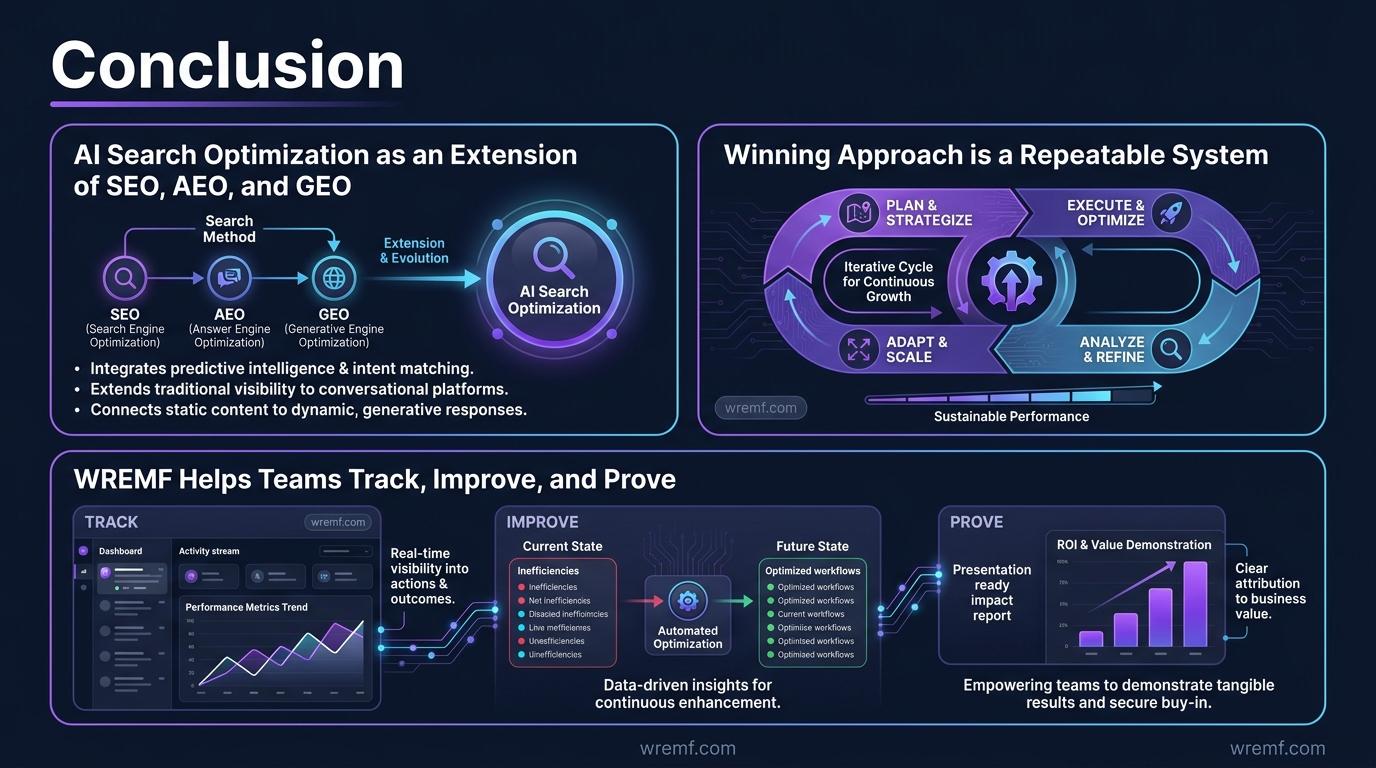
AI search optimization is now a practical extension of SEO, AEO, and GEO for brands that need visibility inside AI responses, AI answers, AI-generated answers, citations, summaries, and recommendations. The winning approach is not keyword stuffing or one-off prompt testing. The winning approach is a repeatable system for crawlability, structured data, content optimization, prompt tracking, citation analysis, competitor monitoring, source consistency, and attribution. WREMF helps teams track, improve, and prove that system across major AI discovery surfaces. To turn AI visibility into a measurable workflow, explore the WREMF platform suite.
Related reading
- Grok Optimization: The Complete Guide to Grok SEO, AI Visibility, and Brand Mentions
- How to Improve AI Search Visibility: Guide for B2B Brands
- ChatGPT SEO: The Complete Guide to Ranking in ChatGPT
- Perplexity AI Optimization: The Complete Guide to AI Search Visibility in 2026
- How to Get Mentioned in ChatGPT: The Complete Guide to AI Visibility, Citations, and Brand Mentions