The Complete AI Visibility Agency Berlin Playbook for B2B Brands
Explore how Berlin-based AI visibility agencies enhance B2B brand recognition across AI platforms. Learn key strategies and tools.
By WREMF Team · 2026-09-12
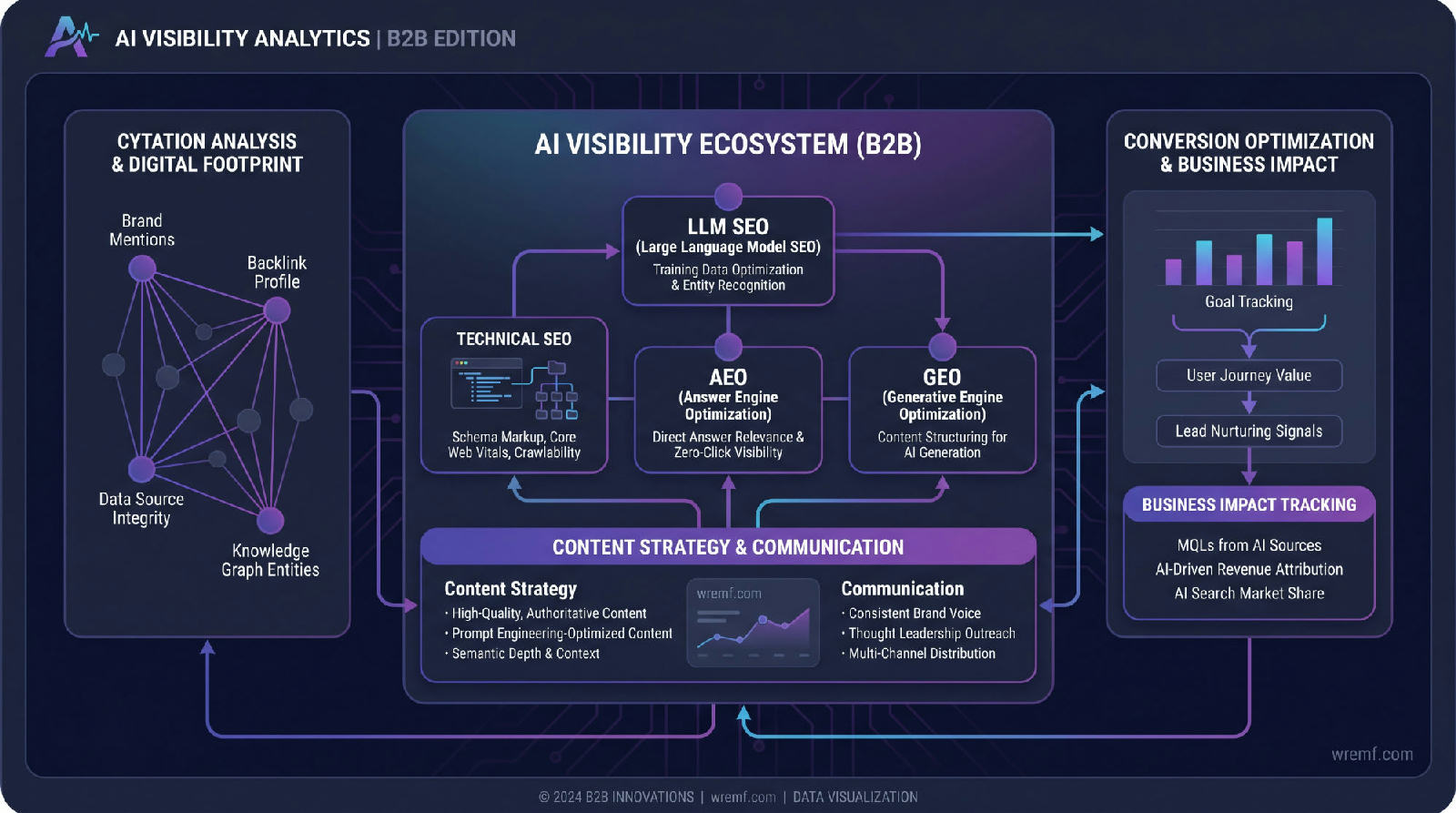
An AI visibility agency in Berlin specializes in boosting B2B brand visibility across AI search platforms. The core process involves using strategies like LLM SEO, AEO, and GEO, alongside Technical SEO and content strategy, to ensure that brands are found, cited, and recommended within AI-generated answers and citations. This visibility enhances how buyers discover, compare, and choose brands. The agency combines software and expert services to address needs across prompt tracking, citation development, and conversion optimization, improving the brand's AI presence and business impact.
Key takeaways
- AI visibility combines SEO, AEO, and GEO to improve B2B brand presence.
- Prompt tracking and citation analysis are crucial for AI search visibility.
- AI visibility impacts buyer discovery and decision processes across platforms.
- Capturing and structuring subject-matter expertise increases cited visibility.
- A full visibility engine includes technical SEO, consistent content, and source development.
The Complete AI Visibility Agency Berlin Playbook for B2B Brands
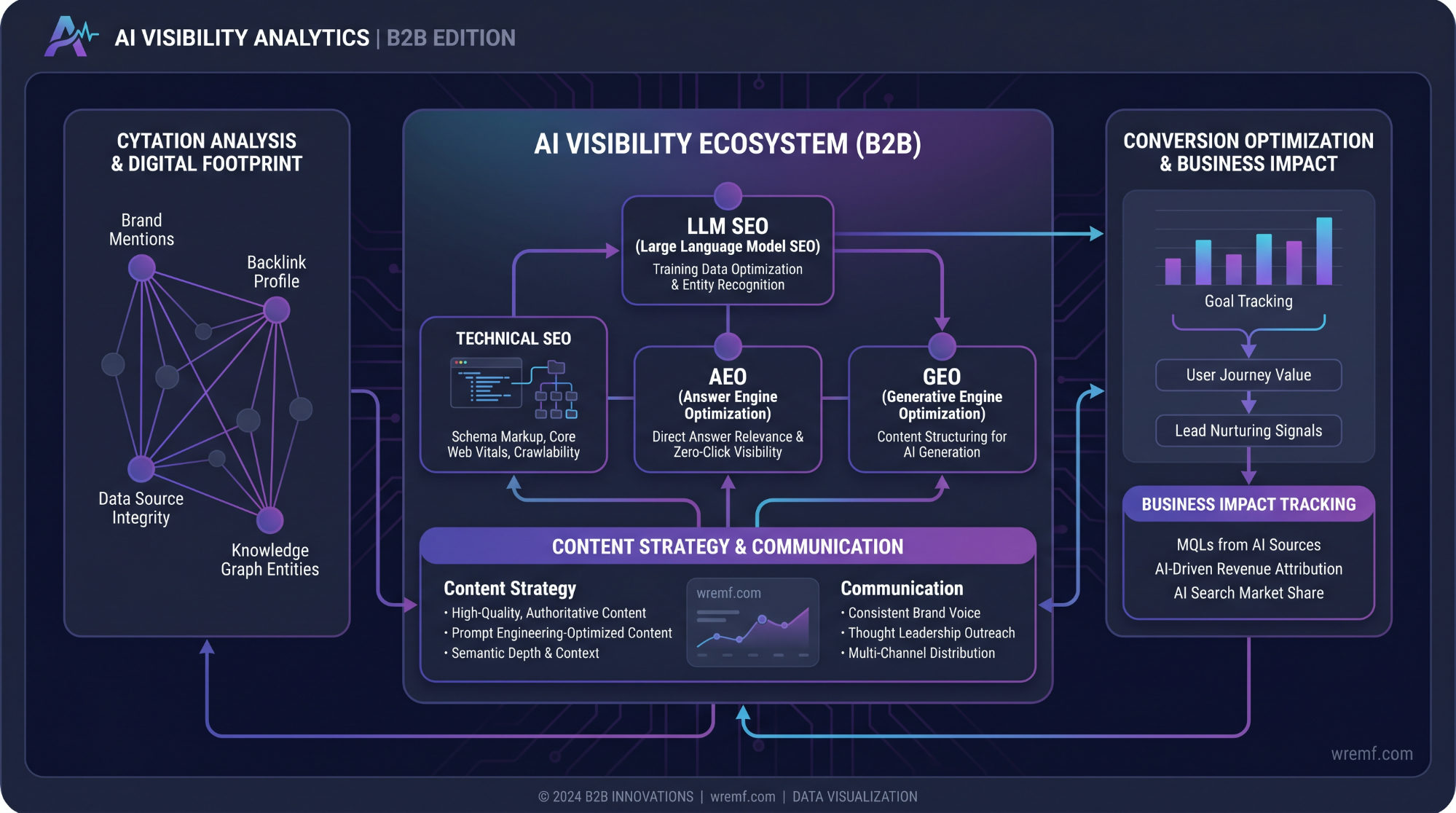
AI visibility agency Berlin is a specialist service that helps B2B brands get found, cited, and recommended across AI search. Google Search Central now explains how AI features such as AI Overviews and AI Mode work from a site owner’s perspective, which confirms that AI discovery is now a practical website visibility issue, not only a search experience change. (Google for Developers) WREMF helps B2B teams track, improve, and prove visibility across ChatGPT, Claude, Gemini, Perplexity, Google AI Overviews, Copilot, DeepSeek, Grok, Meta AI, Mistral, and other AI discovery surfaces. This guide explains how AI visibility agency Berlin work should combine LLM SEO, AEO, GEO, Technical SEO, content strategy, citation analysis, conversion optimization, communication, and business impact tracking. It also shows when software, agency support, or a hybrid software plus managed execution model makes the most sense.
AI visibility is the measurable presence of a brand inside AI-generated answers, citations, summaries, comparisons, and recommendations. AI visibility matters because buyers increasingly ask AI platforms which vendors, tools, products, and services fit their needs before visiting a website or speaking with sales.
WREMF is built around one core idea: Become the brand AI search recommends. The WREMF platform suite gives teams prompt tracking, source citation tracking, competitor visibility, AI share of voice, attribution, and reporting. For teams that also need execution, the WREMF AI visibility agency provides senior-led AI visibility strategy, AEO execution, GEO services, content systems, authority support, Technical SEO guidance, and measurable reporting.
Companies we helped grow faster
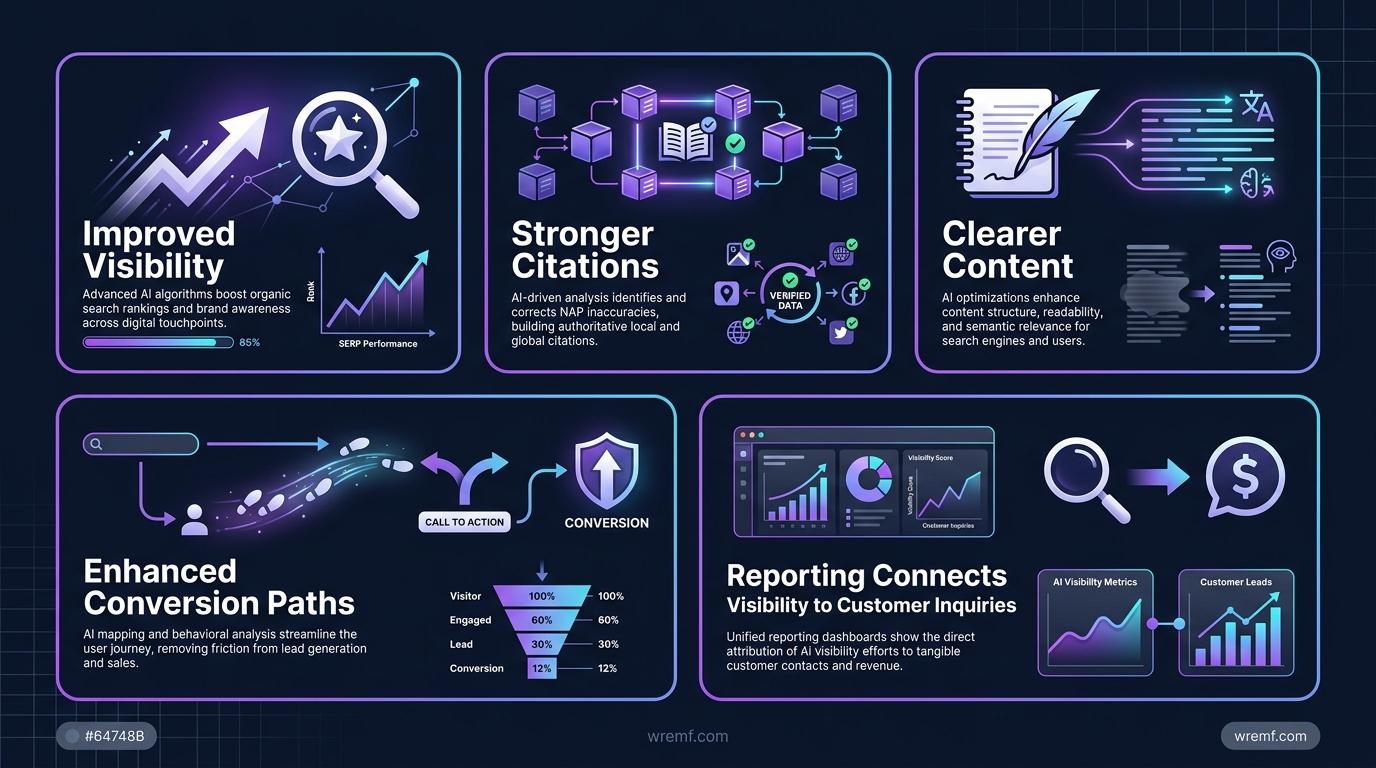
An AI visibility agency Berlin should help companies grow faster by improving how buyers discover, compare, trust, and contact a brand across search and AI search. Growth comes from better visibility, stronger citations, clearer content, stronger conversion paths, and reporting that connects visibility to customer inquiries.
For B2B SaaS companies, startups, scaleups, agencies, and consultants, the buyer journey no longer happens only on Google. Buyers still use Google search, but they also use ChatGPT, Perplexity, Gemini, Claude, Copilot, AI Overviews, Reddit, YouTube, review sites, comparison pages, and vendor websites. OpenAI explains that ChatGPT search can provide timely answers with links to relevant web sources, which means AI search can influence discovery before a customer visits your website. (OpenAI)
AI search visibility is the visibility of a brand across AI-generated answers, linked sources, citations, summaries, and recommendations. AI search visibility matters because a customer may ask an AI platform to shortlist vendors, explain alternatives, or recommend a product before using a classic search result.
A good AI visibility agency Berlin project should help companies grow by improving 6 connected areas:
Search visibility across Google, AI Overviews, and traditional search results
AI visibility across ChatGPT, Perplexity, Gemini, Claude, Copilot, and other AI platforms
Content quality across landing pages, blog posts, product pages, comparison pages, and category pages
Citations and source consistency across owned pages, third-party profiles, partner pages, review pages, and media mentions
Conversion optimization across CTAs, proof assets, demo pages, pricing pages, and customer inquiry flows
Reporting across traffic, AI mentions, AI citations, share of voice, customer inquiries, and pipeline influence
In practical AI visibility audits, SEO teams often discover that traffic and ranking are only part of the picture. A website may rank for keywords but still fail to appear when a user asks ChatGPT, Perplexity, Gemini, or Claude for tool recommendations. A brand may appear in AI-generated answers but not be cited. A product may be mentioned but described inaccurately because the source ecosystem contains outdated messaging.
WREMF helps companies close that gap by combining AI visibility software with managed AI search optimization services. The platform tracks prompts, competitors, citations, and source patterns, while the agency helps turn findings into content briefs, structured rewrites, Technical SEO improvements, citation outreach, and conversion improvements.
AI visibility is the measurable presence of a brand in AI-generated answers. AI visibility matters because brand presence inside AI search can influence which vendors buyers notice, compare, trust, and contact.
The strongest growth opportunities usually come from prompts near a buying decision. Examples include “best AI SEO agency for B2B SaaS,” “AI visibility agency Berlin,” “GEO agency for software companies,” “ChatGPT optimization agency,” “best AI search optimization tools,” and “answer engine optimization services for enterprise brands.” These prompts reveal demand, competitor positioning, and content gaps.
For supporting education, teams can connect this page to WREMF’s deeper guide on how AI search optimization tools increase organic traffic, especially when explaining why AI visibility and organic traffic should be measured together.
IMPORTANT: AI visibility growth should not be promised as guaranteed traffic, guaranteed citations, or guaranteed revenue. Responsible AI visibility consulting improves measurable inputs such as content clarity, source consistency, prompt coverage, citation quality, competitor visibility, and attribution.
A Berlin-focused strategy also needs local and regional trust signals. For local SEO, this can include Google Business Profile accuracy, Google Maps visibility, reviews, Google 3-Pack presence, local citations, Trustpilot rating, and consistent location data. For AI search, those signals should be paired with category authority, answer-first content, citation-worthy pages, and clear entity information.
KEY TAKEAWAY: AI visibility agency Berlin work helps companies grow faster when it connects search, AI search, citations, content quality, conversion optimization, and business reporting.
The next section explains why many companies are still invisible in AI search even when they already invest in SEO.
From invisible in AI search to the answer buyers get cited
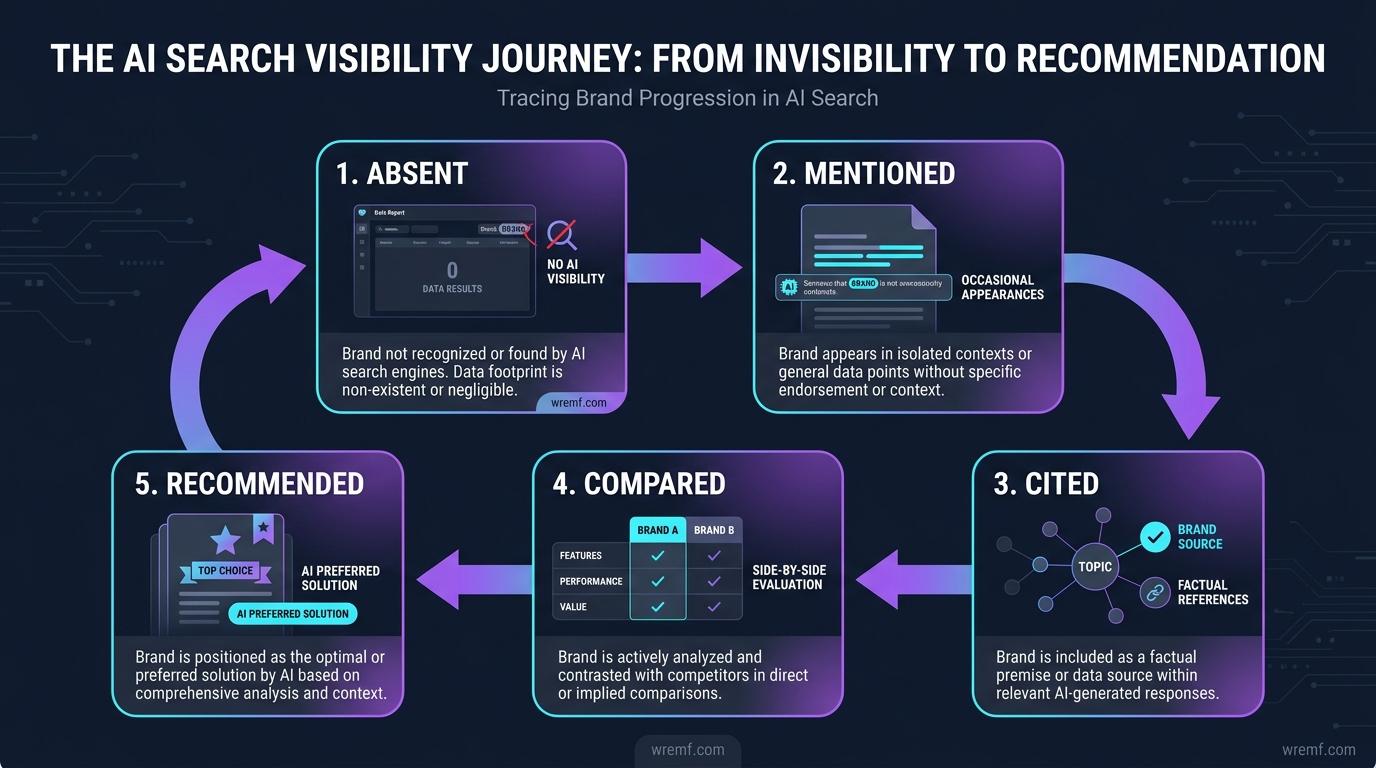
A company becomes visible in AI search when AI platforms can identify, understand, cite, and recommend the brand for relevant buyer prompts. An AI visibility agency Berlin helps move a brand from absent to mentioned, cited, compared, and recommended.
In classic Search Engine Optimization, visibility often begins with a keyword, a page, a ranking, and a click. In AI search, visibility begins with a user prompt, a generated answer, a set of sources, a summary, and sometimes a recommendation. Perplexity states that its answers include numbered citations linking to original sources, which makes citation visibility a direct part of the user experience. (Perplexity AI)
LLM SEO is the practice of improving how large language models understand, retrieve, summarize, cite, and recommend a brand. LLM SEO matters because LLMs respond to natural language prompts, entity relationships, source quality, content structure, and citation patterns, not only classic keyword rankings.
The path from invisible in AI search to cited in AI answers usually has 4 stages.
| Stage | What happens | What to measure | What to improve |
|---|---|---|---|
| Invisible | AI platforms do not mention the brand | Prompt absence rate | Entity clarity, content gaps, source gaps |
| Mentioned | AI platforms name the brand but do not cite it | Brand mentions | Source consistency, owned pages, third-party profiles |
| Cited | AI platforms cite the brand or sources about the brand | Citation frequency and citation quality | Citation outreach, answer-first content, authority pages |
| Recommended | AI platforms suggest the brand for a use case | Recommendation visibility | Positioning, proof, comparison pages, conversion pages |
Prompt tracking shows which questions cause AI platforms to mention, cite, recommend, ignore, or misrepresent a brand. Prompt tracking matters because AI search is shaped by natural language prompts, not only by fixed keywords.
For example, a Berlin B2B SaaS company may rank for “SEO agency Berlin” but fail to appear for “best LLM SEO agency for SaaS,” “GEO agency for enterprise software,” or “AI answer optimization agency for German B2B brands.” That is a visibility gap. It is not just a content gap. It is also a prompt gap, citation gap, source consistency gap, and positioning gap.
WREMF helps teams monitor these shifts with prompt intelligence for AI search. This is useful for SEOs, founders, content teams, agencies, and consultants who need to compare how a brand appears across ChatGPT, Claude, Gemini, Perplexity, Google AI Overviews, Copilot, DeepSeek, Grok, Meta AI, and Mistral.
Citations are the sources AI systems reference or link to when generating an answer. Citations matter because they reveal which pages, profiles, articles, directories, reviews, documentation, or third-party sources influence how AI platforms describe a brand.
AI citations matter because a brand can be mentioned without being trusted as a source. A cited source is stronger than a plain mention because it gives the user a path to verify, explore, and act. Microsoft says Copilot Search displays sources and links used to generate the answer, which reinforces why source visibility matters in AI search. (Microsoft)
For a broader context on how AI search tools affect classic SEO outcomes, teams can support this section with WREMF’s article on how AI search optimization tools improve SERP rankings.
AI visibility is not a one-platform problem. ChatGPT, Perplexity, Gemini, Claude, Google AI Overviews, Copilot, DeepSeek, Grok, Meta AI, and Mistral may surface different sources and answer styles. This is why manual testing is weak. A real AI visibility agency Berlin workflow needs repeatable tracking, source citation analysis, competitor visibility, and prompt grouping.
KEY TAKEAWAY: Moving from invisible to cited requires prompt tracking, citation tracking, source consistency, answer-first content, and competitor analysis.
The next section explains the process and philosophy needed to make that work repeatable.
Our process and philosophy in a nutshell
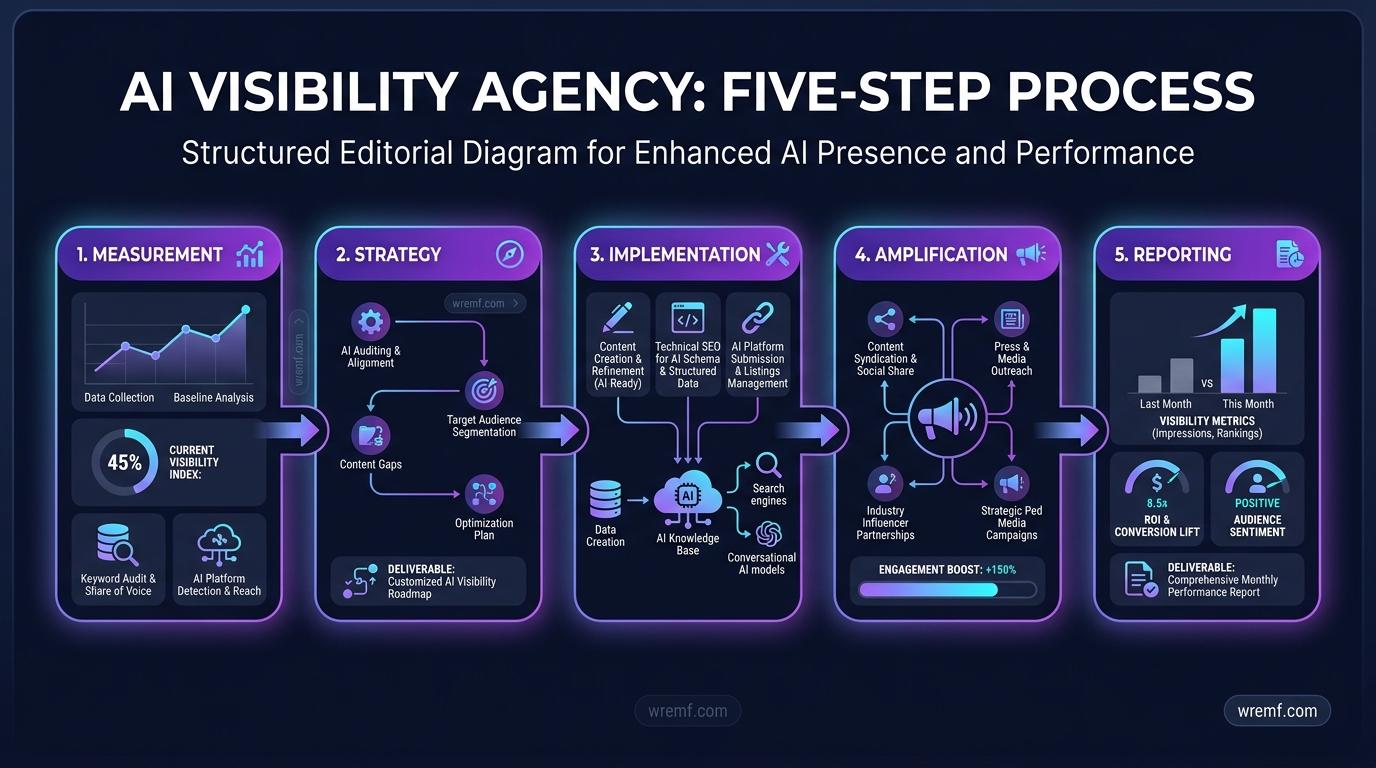
A strong AI visibility agency Berlin process starts with measurement, then moves into strategy, implementation, amplification, and reporting. WREMF’s philosophy is to make AI visibility measurable first, then improve it through focused software and agency execution.
The WREMF process has 5 steps: audit, strategy, build, amplify, and measure. This structure keeps AI visibility work practical. It prevents teams from publishing more content before they know which prompts matter, which competitors are being cited, which sources influence AI platforms, and which pages are failing to convert users.
Answer engine optimisation is the practice of structuring content so answer engines can extract direct, useful answers. Answer engine optimisation matters because AI platforms often summarize content into concise responses instead of sending every user through a list of blue links.
Generative Engine Optimization is the practice of improving how generative AI systems understand, summarize, cite, and recommend a brand. Generative Engine Optimization matters because AI platforms synthesize information from multiple sources and can influence buyer perception before a website visit.
| Process step | Main goal | Typical WREMF agency deliverables | Business value |
|---|---|---|---|
| Audit | Understand current visibility | AI visibility assessment, competitor citation analysis, Technical SEO review, prompt landscape analysis | Establishes the baseline |
| Strategy | Prioritize opportunities | High-value prompt map, content prioritization, citation gap analysis, authority plan | Focuses resources |
| Build | Create AI-ready assets | Content briefs, structured rewrites, pillar pages, use-case pages, internal linking improvements | Improves retrieval |
| Amplify | Strengthen source ecosystem | Citation outreach, brand mention outreach, source consistency optimization | Builds trust signals |
| Measure | Prove business impact | Share of voice reporting, prompt monitoring, AI attribution, conversion tracking | Connects visibility to outcomes |
The WREMF methodology connects prompts, citations, competitors, source consistency, and attribution into one repeatable measurement system. This is useful because AI visibility is both a measurement problem and a source ecosystem problem.
AEO, GEO, LLMO, and SEO are related but different. SEO improves website discoverability in search engines. AEO improves answer extraction. GEO improves how generative engines synthesize and cite brand information. LLMO focuses on how large language models interpret, retrieve, and represent a brand.
DID YOU KNOW: Google says AI features such as AI Overviews and AI Mode are part of how site owners should think about content inclusion in Search, which means AI search visibility now belongs inside website strategy, not outside it. (Google for Developers)
The process should also compare software-only, agency-only, and hybrid models.
| Model | Best for | What it gives you | What it misses | Recommended when |
|---|---|---|---|---|
| Software-only AI visibility platform | Teams with strong internal SEOs and content resources | Tracking, dashboards, prompt data, citation data, competitor visibility | Strategy and implementation if internal resources are limited | You can execute internally |
| Managed AI visibility agency | Teams needing strategy and execution | Consulting, content systems, Technical SEO support, citation outreach, reporting | Less self-serve control if reporting is not transparent | You need expertise and implementation |
| Hybrid software plus agency | Teams wanting measurement and execution | Tracking, strategy, managed optimization, reporting, attribution | Requires close collaboration | You want a full system |
WREMF supports all 3 paths. Brands can use software, agencies can use white-label reporting, and growth teams can combine the platform with managed execution. For deeper comparisons of tool-led workflows, WREMF’s guide to 12 best AI search optimization tools can support readers who are still evaluating software options.
KEY TAKEAWAY: A practical AI visibility agency Berlin process measures first, prioritizes second, builds third, amplifies fourth, and reports continuously.
The next step is understanding the business deeply enough to make that process commercially useful.
Truly understand the business
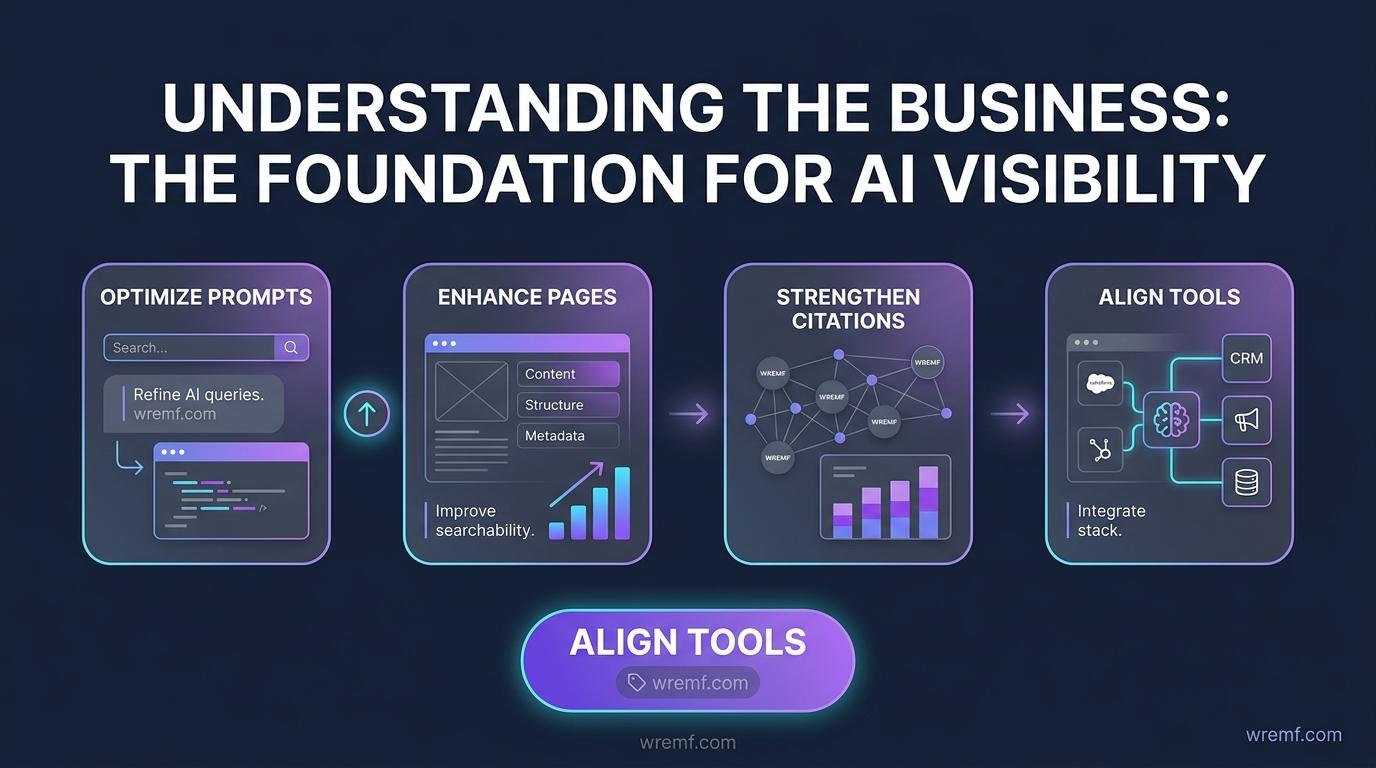
An AI visibility agency Berlin must understand the business before optimizing prompts, pages, citations, or tools. Without business context, AI visibility work can increase activity without improving customer quality, conversion, pipeline, or revenue relevance.
In real B2B buying journeys, a customer rarely searches in one straight line. A customer may begin with a pain point, ask ChatGPT for tool categories, compare vendors in Perplexity, search Google for reviews, watch YouTube explainers, visit Reddit threads, check LinkedIn, and then land on a product page. The brand needs consistent visibility across that journey.
Customer understanding is the process of mapping the audience, pain points, buying triggers, objections, competitors, decision criteria, and conversion paths. Customer understanding matters because AI platforms respond to user prompts that contain context, role, stage, geography, product need, and budget.
A proper discovery process should document:
What the product does and how buyers describe it
Which audience segments matter most
Which customer inquiries are valuable
Which competitors appear in search and AI search
Which prompts reveal high buying intent
Which objections block conversion
Which pages influence demos, trials, signups, and sales conversations
Which sources AI platforms already cite
Which brand descriptions are outdated, vague, or inconsistent
For a Berlin AI search marketing agency page, the business context includes geography, language, market stage, buyer trust, and category clarity. A startup in Berlin may need visibility across German and English prompts. A SaaS company selling into Europe may need AI citations across international sources. A consultant may need white-label reporting. An enterprise team may need attribution, compliance-aware workflows, and technical implementation.
For brands that want to understand how AI search optimization works in a B2B context, WREMF’s guide to AI search engine optimization for B2B brands can support the educational journey.
AI share of voice is the share of relevant AI-generated answers where a brand appears compared with competitors. AI share of voice matters because it shows whether a company is winning or losing visibility in the answer set buyers actually see.
The discovery phase should also separate different types of demand. A buyer searching “AI visibility agency Berlin” has local commercial intent. A buyer searching “LLM SEO agency” has category intent. A buyer searching “Profound vs Otterly vs WREMF” has comparison intent. A buyer searching “how to improve AI citations” has implementation intent. Each intent needs different content, citations, and conversion paths.
WREMF supports in-house teams through AI visibility tools for brands, helping teams monitor AI search visibility, source citations, competitor visibility, and prompt-level changes over time.
TIP: Build the first prompt map around 5 buying stages: problem-aware, category-aware, comparison, vendor selection, and implementation.
A common mistake is treating AI visibility like a keyword list. Keywords still matter, but prompts reveal more context than keywords. A prompt can include buyer role, geography, tool category, workflow, competitor, budget, and desired outcome. That is why LLM SEO and content strategy need to work together.
KEY TAKEAWAY: AI visibility work becomes commercially valuable when the agency understands the customer, product, competitors, search journey, and conversion path.
The next section explains how to turn internal expertise into content AI systems can retrieve and cite.
Capture subject-matter expertise
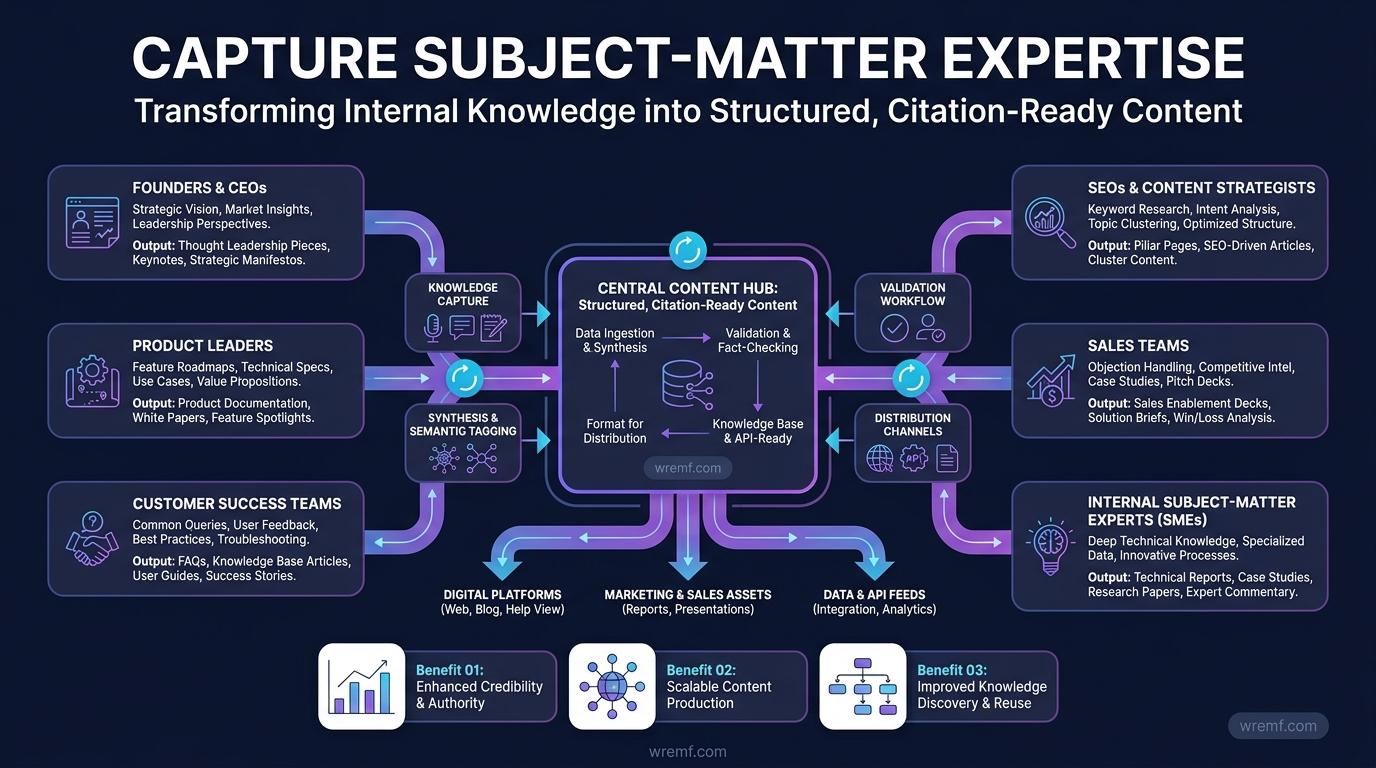
Capturing subject-matter expertise means turning internal knowledge into clear, credible, structured, and citation-ready content. An AI visibility agency Berlin should extract insight from founders, CEOs, operators, SEOs, product leaders, sales teams, customer success teams, and technical specialists.
Generic content is weak for AI visibility because AI platforms need specific, trustworthy, and well-structured information. Google Search Central says helpful, reliable, people-first content is what its systems seek to reward, which matters because content written only for search engines often fails both users and AI retrieval systems. (Google for Developers)
Subject-matter expertise is the practical knowledge that helps a user solve a real problem. Subject-matter expertise matters because it gives AI systems and buyers a reason to associate the brand with a specific category, solution, use case, or point of view.
A good agency should capture expertise from:
Founder interviews about vision, category, business models, and product positioning
Sales calls about objections, competitors, pricing questions, and customer language
Customer success notes about implementation, onboarding, integrations, and outcomes
Product documentation about features, limits, workflows, data, API, MCP, and BYOK support
SEO tools such as Semrush for keyword, ranking, competitor, and traffic analysis
Google Search Console and analytics platforms for organic traffic and page performance
Support tickets that reveal user confusion, friction, and missing content
Customer inquiries that reveal demand and conversion intent
Content creation for AI visibility should convert this expertise into assets that answer buyer questions clearly. These assets may include pillar pages, comparison pages, use-case pages, category pages, glossary sections, case-style explainers, FAQ systems, product documentation, content briefs, and AI-ready landing pages. The goal is not to publish a higher page count. The goal is to make expertise easier for LLMs, AI platforms, SEOs, and buyers to understand.
Source citations are the sources AI systems use or display when supporting an answer. Source citations matter because they show which sources influence the generated answer and whether the brand’s own website is part of the evidence layer.
WREMF’s source citation tracking helps teams see which pages and sources AI engines cite for relevant prompts. That data can guide content creation, citation outreach, brand mention outreach, source consistency improvements, and authority development.
For deeper education around answer-first content, readers can use WREMF’s guide to answer engine optimization for enhancing AI visibility. This is useful when explaining why answer structure and content quality matter for AI-generated answers.
AI visibility improves when subject-matter expertise is structured into answer-ready content and supported by credible citations. AI visibility weakens when expertise remains trapped in internal documents, sales calls, unstructured pages, or vague marketing copy.
Content marketing for AI search should use clear definitions, concise explanations, comparison tables, source-backed claims, entity consistency, and practical examples. Content quality should be tied to expertise and user usefulness, not word count alone. A page should answer the user’s question, prove credibility, and help the reader take the next step.
KEY TAKEAWAY: Subject-matter expertise becomes an AI visibility asset when it is captured, structured, cited, and connected to real buyer prompts.
After expertise is captured, the next step is building a visibility engine that distributes and reinforces that knowledge.
Build the visibility engine
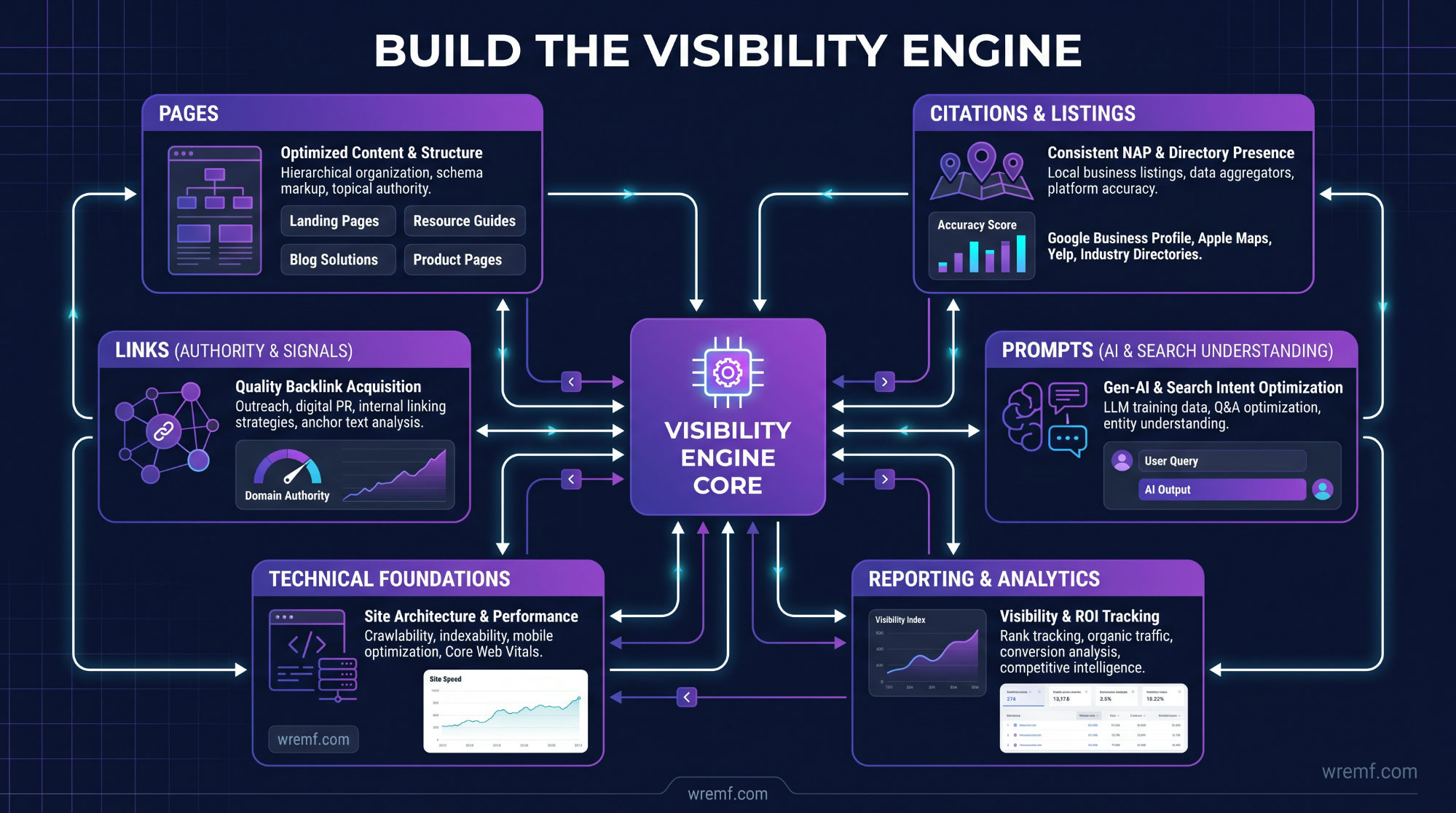
A visibility engine is the system of pages, citations, links, technical foundations, prompts, and reporting that makes a brand discoverable across search and AI search. An AI visibility agency Berlin should build this engine across owned content, off-site mentions, Technical SEO, and source consistency.
AI search visibility is not created by one blog post or one page. It is created by an ecosystem of signals. ChatGPT, Perplexity, Gemini, Claude, Google AI Overviews, Copilot, DeepSeek, Grok, Meta AI, and Mistral may surface different answers, but all need clear information about what the brand is, who it serves, what it offers, and why it should be trusted.
Technical SEO is the practice of improving crawlability, indexation, rendering, site structure, internal links, performance, and structured data. Technical SEO matters because a website that is difficult to crawl, parse, or understand is harder for search systems and AI retrieval systems to use.
A complete visibility engine should include 7 layers.
| Visibility layer | What it includes | Why it matters |
|---|---|---|
| Technical SEO | Crawlability, indexation, rendering, structured data, internal links | Helps search systems understand the website |
| Content strategy | Pillar pages, use-case pages, comparison pages, category pages | Covers buyer prompts and search intent |
| Answer-first structure | Definitions, summaries, tables, short answer blocks | Helps AI systems extract useful answers |
| Entity consistency | Name, category, descriptions, product facts, location, profiles | Reduces confusion across sources |
| Citation development | Third-party mentions, brand mention outreach, citation outreach | Strengthens source ecosystem |
| Prompt monitoring | AI engine testing across buyer prompts | Shows where the brand appears or disappears |
| Reporting | Share of voice, citations, traffic, conversions, attribution | Connects visibility to business outcomes |
Structured data is machine-readable markup that helps search systems understand entities and content types. Structured data matters because it can improve clarity, but structured data alone does not guarantee AI citations, ranking, or recommendation visibility.
WREMF supports this layer through platform features and agency execution. The software helps track prompts, citations, competitors, and reports. The agency helps with GEO audits, content briefs, internal linking systems, AI-ready formatting, technical recommendations, and authority development.
For readers comparing broader AI SEO workflows, WREMF’s complete 2026 guide to AI search engine optimization tools can support the tool-selection journey.
IMPORTANT: Keyword density alone is not an AI visibility strategy. AI citations, source consistency, entity clarity, content quality, and answer structure matter more than repeating keywords across a page.
A Berlin-focused visibility engine should also include local reputation signals when relevant. Google Business Profile, Google Maps, reviews, Google rating, Trustpilot rating, local citations, and Google 3-Pack visibility can support local trust. But local SEO alone is not enough for AI visibility. AI platforms may also rely on category authority, content quality, third-party sources, user prompts, and source credibility.
If you want to identify weak points before building the engine, a WREMF GEO audit can help uncover prompt gaps, citation gaps, competitor visibility, source issues, and Technical SEO problems.
For AI Overview-specific strategy, WREMF’s guide to AI Overview optimization can support readers who want to understand Google AI visibility in more detail.
KEY TAKEAWAY: A visibility engine combines Technical SEO, content strategy, answer-first structure, entity consistency, citations, prompt monitoring, and reporting.
Visibility alone does not create revenue, so the next section explains how to build a conversion engine.
Build the conversion engine
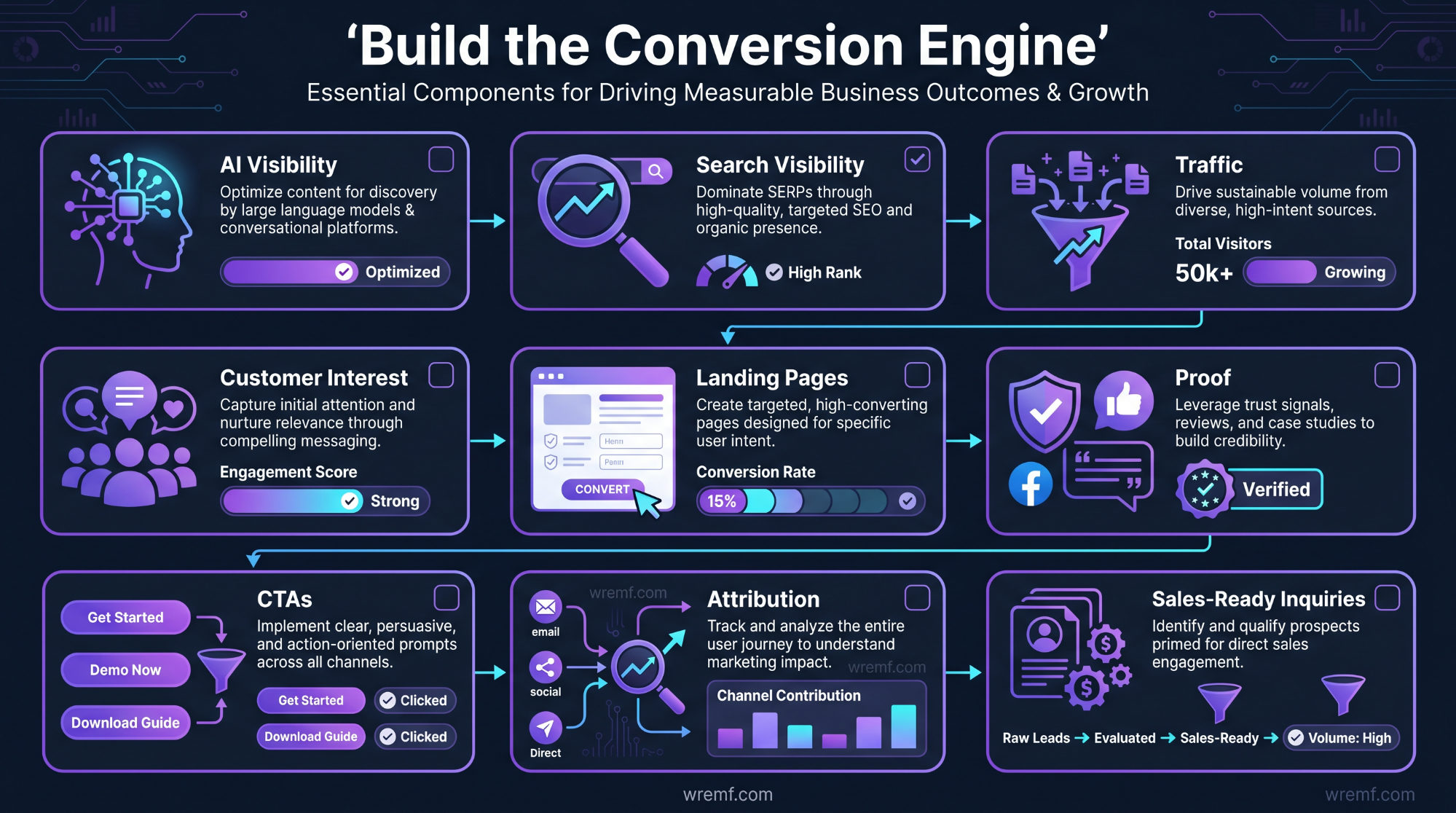
A conversion engine turns AI visibility, search visibility, traffic, and customer interest into measurable business outcomes. An AI visibility agency Berlin should connect discovery to landing pages, proof, CTAs, attribution, and sales-ready customer inquiries.
Many teams celebrate traffic growth without checking whether the traffic creates qualified demand. Organic traffic can increase while customer inquiries stay flat if the content attracts the wrong audience or does not guide users toward the next step. AI search traffic can be especially high intent because the user may arrive after asking a specific recommendation, comparison, or implementation question.
Conversion optimization is the process of improving how users move from interest to action. Conversion optimization matters because visibility has limited business value if the page does not explain fit, trust, proof, and next steps.
A strong conversion engine includes:
Clear product positioning above the fold
Use-case pages for specific customer problems
Comparison pages for competitor-aware buyers
Pricing or buying guidance for commercial-intent visitors
Proof assets such as reports, dashboards, reviews, demos, and methodology pages
CTA paths for different intent levels
Attribution wiring for Google, AI platforms, referral sources, and customer inquiries
Sales feedback loops that inform content strategy
AI traffic attribution connects AI-assisted discovery to website visits, user actions, customer inquiries, pipeline, and revenue signals. AI traffic attribution matters because leadership needs to know whether visibility improvements are creating commercial outcomes, not just more mentions.
The best conversion paths match the user’s stage. A founder may want to talk to an agency team. A head of SEO may want a sample report. A consultant may need white-label reporting. A technical user may want API documentation. A budget owner may want pricing. A growth team may want a roadmap.
If your team wants to show leadership what AI visibility reporting can look like, review a sample AI visibility report before creating your own reporting model.
For readers focused on answer-first conversion paths, WREMF’s guide to answer engine optimization and answer-first content can support this section.
AI search optimization services should not stop at visibility. They should also improve the pages that receive demand. A page cited by ChatGPT, Perplexity, Gemini, Claude, or Google AI Overviews should immediately explain what the company does, who it helps, why it is credible, and what the user should do next.
WREMF’s hybrid model is designed for that handoff. The platform measures prompt visibility, citations, competitors, and share of voice. The agency helps implement content updates, conversion improvements, technical fixes, citation outreach, content briefs, and ongoing optimization.
For service-led readers, WREMF’s guide to answer engine optimization services can support deeper research into managed AEO execution.
KEY TAKEAWAY: AI visibility becomes business value when the conversion engine turns discovery into qualified actions, customer inquiries, and measurable pipeline signals.
The next section explains why close communication is essential for keeping that system accurate and useful.
Stay in close sync
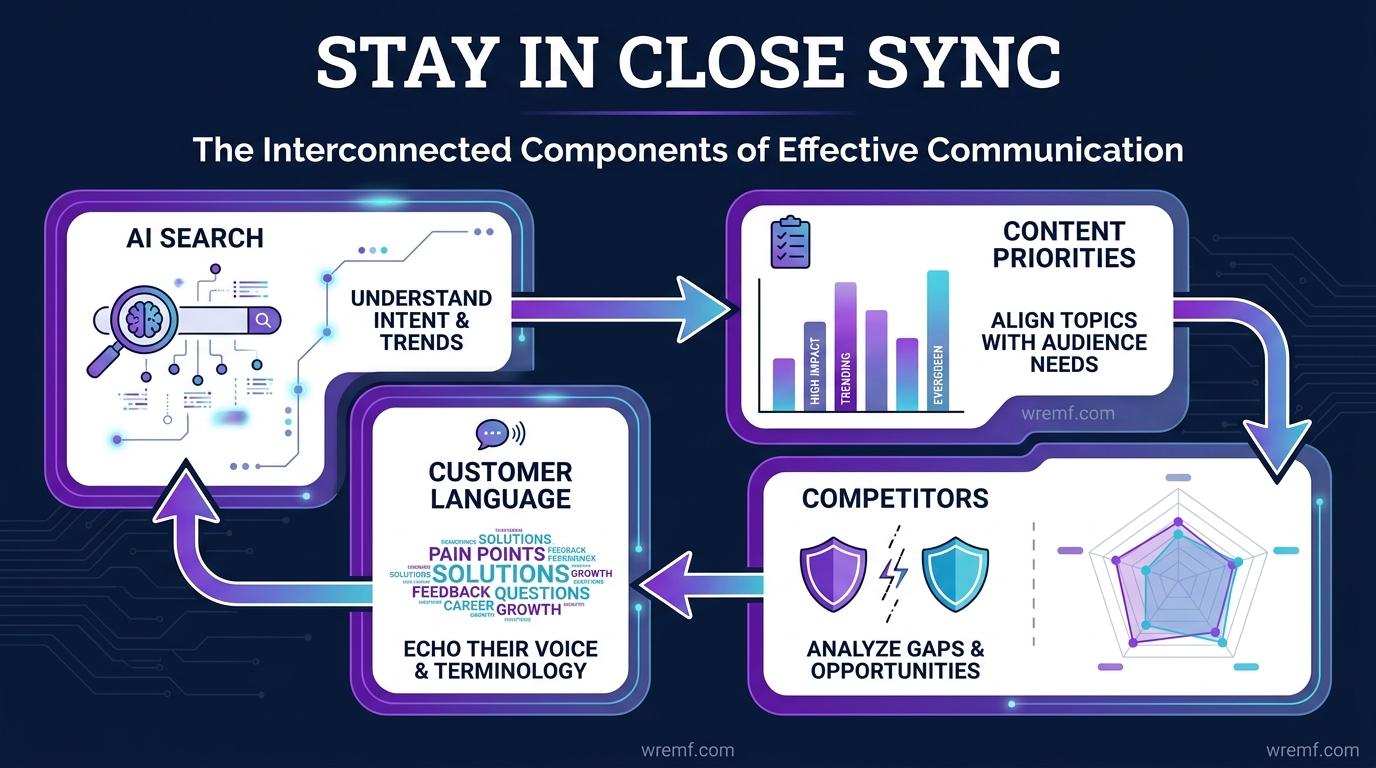
An AI visibility agency Berlin should stay closely aligned with internal teams because AI search, content priorities, competitors, and customer language change quickly. Close communication keeps strategy connected to product reality, sales insight, and business goals.
AI visibility work touches many teams. SEOs understand ranking, search, Technical SEO, and traffic. Content teams understand structure, quality, and publishing. Sales teams understand objections and competitors. Product teams understand features and limitations. Founders and CEOs understand positioning and business priorities. The agency needs to connect these inputs instead of working in isolation.
Communication is the operating system of AI visibility consulting. Communication matters because prompt data, customer insight, content production, source consistency, and technical implementation need to move together.
A strong operating rhythm includes:
Weekly or biweekly priority reviews
Monthly AI visibility reports
Prompt list updates by buyer stage
Citation gap reviews
Content brief reviews with internal experts
Technical SEO ticket tracking
Conversion review based on customer inquiries
Competitor visibility monitoring
Attribution and pipeline discussions
For agencies managing multiple clients, scalable communication also requires dashboards, templates, white-label reporting, repeatable briefs, and clear client portals. WREMF supports these use cases through WREMF for agencies, helping consultants and agencies manage AI visibility reporting, prompt monitoring, citation tracking, and client communication.
Source consistency is the alignment of brand facts across owned and third-party sources. Source consistency matters because conflicting names, descriptions, categories, locations, features, pricing, or claims can weaken how AI systems understand and represent a brand.
A common mistake is separating content strategy from customer feedback. If sales calls show that buyers compare your product with Profound, Otterly, Snezzi, Lengreo, or Semrush, your content strategy should address the real comparison landscape. If AI platforms describe your product inaccurately, source consistency and entity reinforcement should be prioritized. If Google Maps or Google Business Profile details are outdated, local SEO and source cleanup should become part of the workflow.
For teams developing a broader GEO service model, WREMF’s guide to generative AI optimization services can support the strategic narrative.
AI visibility operations should also include clear deliverables. WREMF agency engagements may include AI visibility audits, GEO strategy reports, prompt opportunity maps, citation tracking dashboards, content recommendations, content briefs, technical optimization recommendations, share of voice reporting, competitive visibility analysis, AI attribution reporting, authority development plans, and ongoing optimization support.
KEY TAKEAWAY: Close sync turns AI visibility from a one-time audit into a working operating system across SEO, content, product, sales, and reporting.
The next section explains how to track whether that operating system is creating business impact.
Track business impact
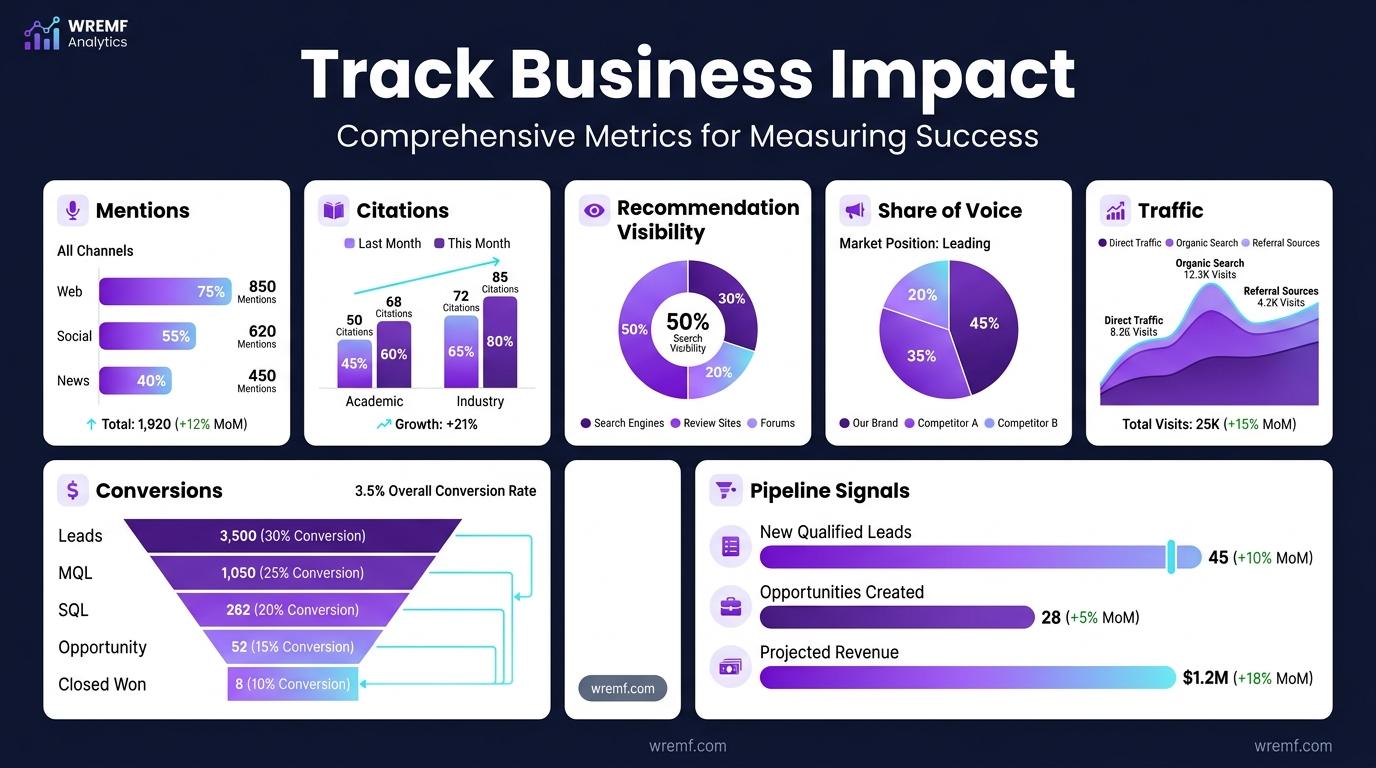
AI visibility should be measured through mentions, citations, recommendation visibility, share of voice, traffic, conversions, and pipeline signals. An AI visibility agency Berlin should prove progress with business-relevant reporting, not only ranking screenshots.
Traditional SEO reporting still matters. Ranking, organic traffic, links, keywords, Technical SEO, page performance, and conversion rate are still important. But AI visibility adds new metrics. Teams now need to know whether AI platforms mention the brand, cite the brand, recommend the brand, compare the brand accurately, and send users to the website.
Brand recommendation visibility measures whether AI systems suggest a brand for relevant buyer prompts. Brand recommendation visibility matters because being recommended is stronger than being mentioned and more commercially relevant than a generic citation.
A useful measurement model includes:
| Metric | What it measures | Why it matters |
|---|---|---|
| Prompt coverage | Whether the brand appears for target prompts | Shows AI search discoverability |
| Citation frequency | How often the brand or related sources are cited | Shows source influence |
| Citation quality | Which sources are used | Shows trust and authority |
| AI share of voice | Visibility compared with competitors | Shows category position |
| Recommendation visibility | Whether AI platforms suggest the brand | Shows commercial relevance |
| Sentiment and accuracy | How AI platforms describe the brand | Shows message quality |
| Organic traffic | Website visits from search engines | Shows search demand |
| AI-assisted traffic | Visits from AI platforms and AI referrals | Shows emerging discovery |
| Conversion rate | Demo requests, signups, trials, and customer inquiries | Shows business action |
| Pipeline influence | Opportunities connected to visibility sources | Shows revenue relevance |
For large organizations comparing enterprise options, WREMF’s guide to enterprise answer engine optimization platforms can support the buying conversation.
The right metric depends on the stage of the program. In month 1, the focus may be baseline visibility, prompt coverage, competitor visibility, and citation gaps. In months 2 to 4, the focus may shift to content improvements, source consistency, and Technical SEO fixes. In months 4 to 6, the focus may shift toward recommendation visibility, AI-assisted traffic, customer inquiries, and pipeline influence.
For teams comparing SEO tools with AI SEO tools, WREMF’s guide to AI SEO tools for SEO, AEO, GEO, and AI search visibility can support the measurement layer.
The most useful reporting compares classic SEO metrics with AI visibility metrics.
| Reporting area | Classic SEO metric | AI visibility metric | What it tells you |
|---|---|---|---|
| Discovery | Ranking, impressions, organic traffic | Prompt coverage, AI mention rate | Whether users can find the brand |
| Trust | Backlinks, domain signals, source quality | Citations, cited sources, source consistency | Whether AI systems can support claims |
| Competition | Keyword ranking vs competitors | AI share of voice vs competitors | Whether the brand is winning answers |
| Conversion | Form fills, demos, trials, customer inquiries | AI-assisted conversions and attribution | Whether visibility creates demand |
| Accuracy | Page content quality | Sentiment, misrepresentation, entity clarity | Whether AI systems describe the brand correctly |
WREMF supports impact reporting through prompt tracking, source citations, competitive landscape analysis, AI visibility scoring, white-label reports, and attribution workflows. Teams can also explore WREMF API and MCP integrations when they need to connect visibility data into custom dashboards or technical workflows.
For teams focused specifically on mentions and share of voice, WREMF’s guide to AI mention tracking can support deeper reporting education.
KEY TAKEAWAY: AI visibility reporting should connect prompt presence, citations, share of voice, accuracy, traffic, conversions, and pipeline into one decision system.
The next section explains what founders, CEOs, and operators should expect from a strong agency relationship.
Founders, CEOs, and operators on working with us
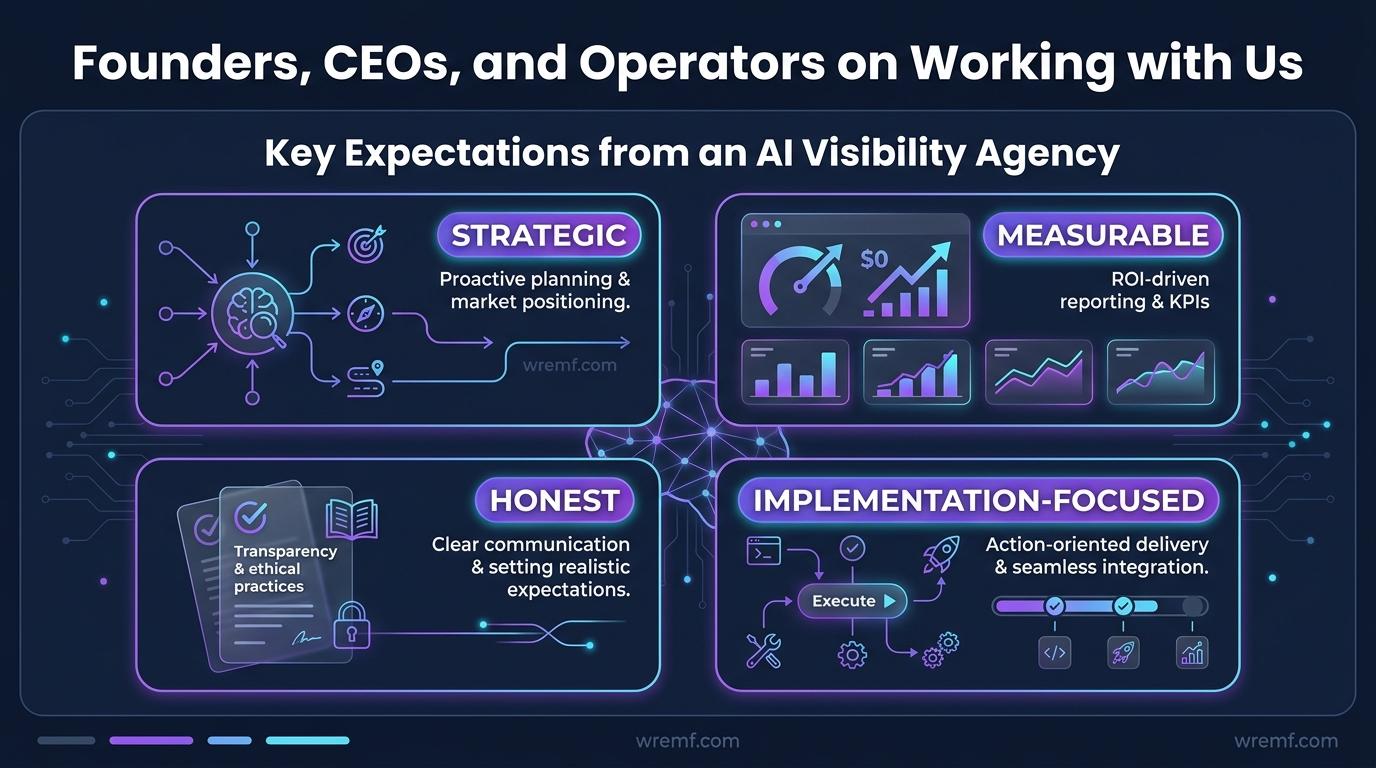
Founders, CEOs, and operators should expect an AI visibility agency Berlin to be strategic, measurable, honest, and implementation-focused. The agency should act like a growth partner, not a vendor that only delivers content calendars, ranking reports, or generic SEO advice.
This section should not rely on invented testimonials. A credible agency page can explain what strong founder, CEO, and operator feedback usually reflects: clear diagnosis, useful communication, commercial focus, high-quality execution, and transparent reporting. In real B2B engagements, leaders care about whether the work improves customer discovery, supports pipeline, and strengthens the brand’s authority in places buyers actually search.
An AI visibility agency is a specialist partner that improves how a brand appears across AI search, answer engines, generative engines, and traditional search. An AI visibility agency matters because AI discovery requires measurement, content, citations, technical foundations, and ongoing execution.
Founders usually value:
Clear positioning work
Faster insight into why the brand is not visible
Practical prioritization
Content that reflects the real product
Stronger AI recommendation visibility
Better understanding of competitors
Focus on customer inquiries and pipeline
CEOs usually value:
Clear deliverables
Commercial reporting
No long-term lock-in
Realistic expectations
Risk awareness
Connection between AI visibility, traffic, conversion, and business impact
Operators usually value:
Clean briefs
Clear technical tickets
Reliable dashboards
Content workflows
Prompt tracking
Citation tracking
Source consistency tasks
Repeatable communication
WREMF’s agency positioning is senior-led, AI-native, practical, and measurable. The agency helps B2B SaaS teams, growth-stage brands, SEOs, agencies, consultants, and operators improve AI citations, recommendation visibility, entity authority, answer-first content structure, source consistency, and AI attribution.
For buyers deciding whether to hire an agency, WREMF’s guide on how to choose an AI SEO agency can support evaluation criteria.
A responsible AI visibility agency should also explain limitations. AI platforms change. Citation patterns fluctuate. User prompts vary. Rankings are not the same as recommendations. No serious agency should guarantee exact AI citations, rankings, traffic, revenue, or customer inquiries. The agency can improve the inputs that influence visibility: content quality, citation consistency, entity clarity, technical foundations, prompt coverage, and reporting discipline.
For companies that need broader managed execution, WREMF’s guide to AI SEO services can support service-level education.
AI visibility agencies should also understand the difference between brand mentions, citations, and recommendations. A mention means the brand appears. A citation means the brand or a source about the brand supports the answer. A recommendation means the AI platform positions the brand as a fit for a user need. Each metric has different business value.
KEY TAKEAWAY: Founders, CEOs, and operators should choose an AI visibility partner that combines strategy, execution, measurement, clear communication, and realistic expectations.
Before making that decision, teams need to understand the myths that often lead to weak AI visibility strategies.
Common Myths About AI Visibility Debunked
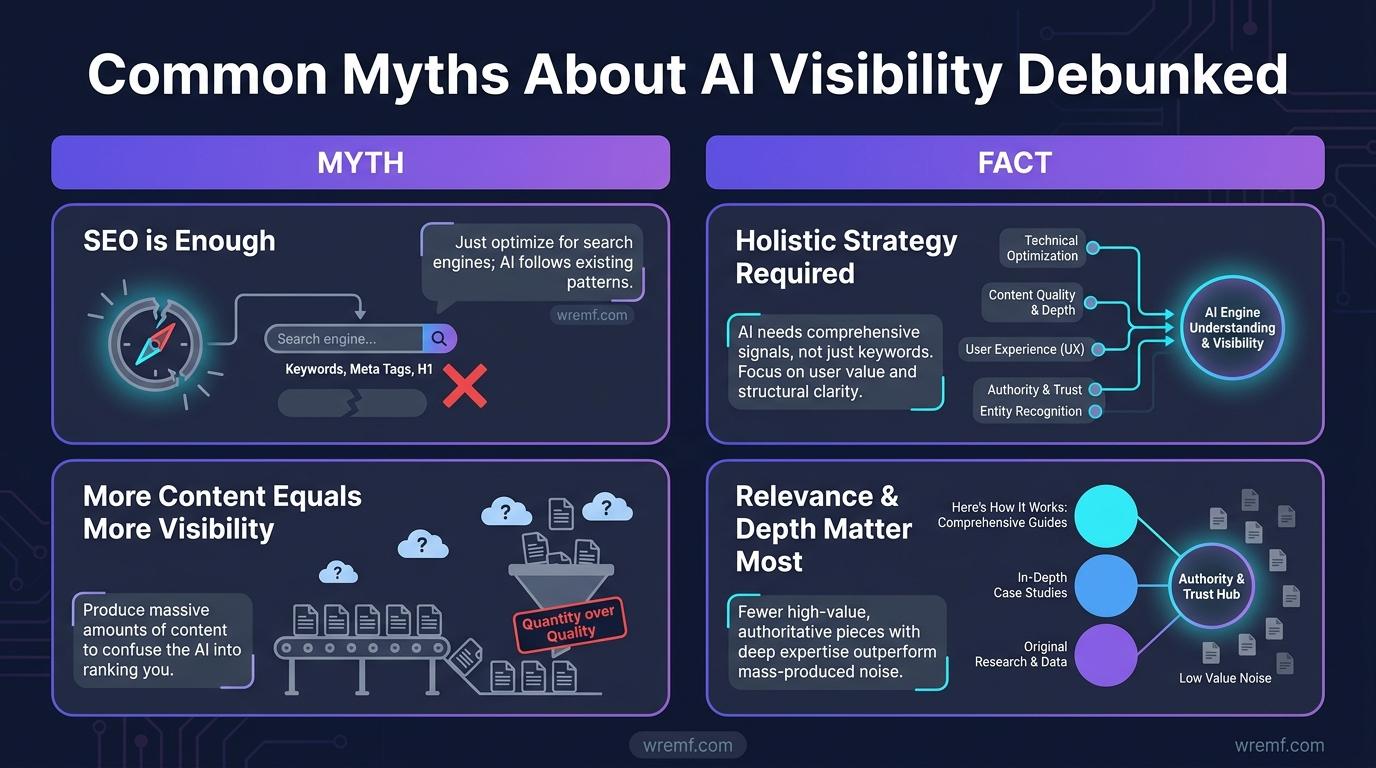
AI visibility myths cause teams to overinvest in rankings, underinvest in citations, or assume AI search cannot be measured. A strong AI visibility agency Berlin approach separates what is measurable, what is uncertain, and what can be improved.
MYTH: SEO, AEO, GEO, LLMO, and LLM SEO are all the same thing.
FACT: These disciplines overlap, but they solve different problems. SEO improves search discoverability, AEO improves answer extraction, GEO improves how generative engines summarize and cite a brand, LLMO improves large language model representation, and LLM SEO connects brand visibility to LLM-driven discovery. The strongest strategy connects them instead of treating one as a replacement for another.
MYTH: AI visibility is impossible to measure.
FACT: AI visibility is not perfectly deterministic, but it is measurable through repeated prompt tracking, citation frequency, AI share of voice, recommendation visibility, sentiment, source analysis, and AI-assisted traffic. WREMF tracks visibility across 10 AI engines so teams can identify patterns instead of relying on one-off manual tests.
MYTH: Google rankings are enough.
FACT: Rankings still matter, but they do not show whether ChatGPT, Perplexity, Gemini, Claude, Copilot, or Google AI Overviews mention, cite, or recommend the brand. A page can rank in Google and still be absent from AI-generated vendor shortlists. Ranking should be measured alongside AI visibility, citations, and recommendation visibility.
MYTH: More content automatically creates more AI visibility.
FACT: More content only helps when the content answers real buyer prompts, reflects subject-matter expertise, uses clear structure, and is supported by credible citations. Thin content can create noise and weaken trust if it repeats generic advice without improving source quality, entity clarity, or user usefulness.
MYTH: AI visibility is only a software problem.
FACT: Tools can show where the brand appears, which competitors are cited, and where gaps exist. Execution still requires strategy, content creation, Technical SEO, citation outreach, conversion optimization, and ongoing reporting. This is why many B2B teams choose a hybrid software plus agency model.
For teams needing more detail on managed AI search execution, WREMF’s guide to AI search engine optimization services can support the service selection process.
KEY TAKEAWAY: AI visibility is measurable and improvable, but it requires SEO, AEO, GEO, LLM SEO, citations, content quality, source consistency, and business reporting to work together.
The final section brings the strategy back to the decision most Berlin and B2B teams need to make next.
Conclusion
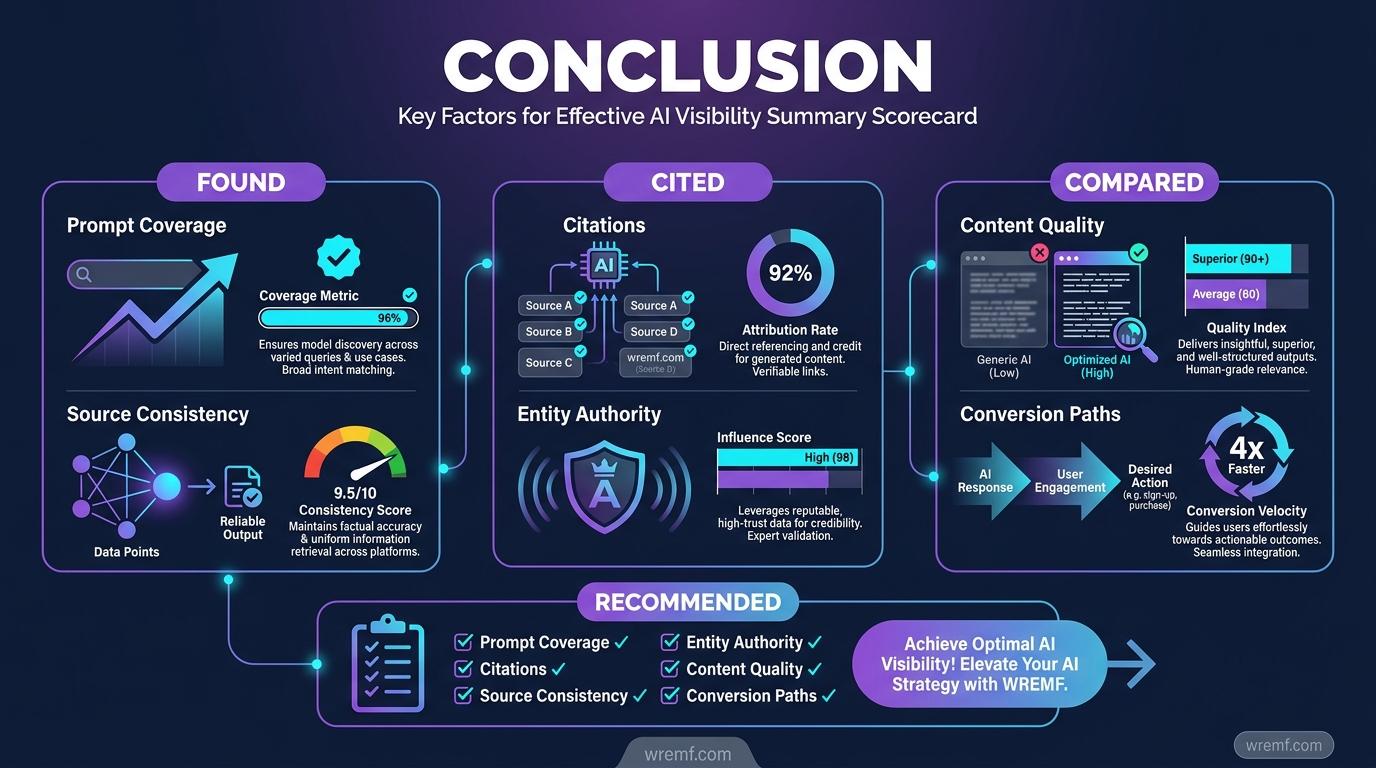
AI visibility agency Berlin is not just a local agency search query. It is a decision about how your brand will be found, cited, compared, and recommended across AI search and traditional search. Rankings still matter, but prompt coverage, citations, source consistency, entity authority, content quality, and conversion paths now matter too. WREMF helps B2B teams measure those signals through software and improve them through senior-led agency execution. To turn AI visibility from a guessing game into a measurable workflow, explore the WREMF AI visibility agency or compare next steps with WREMF’s guide to choosing an LLM SEO agency.
Frequently Asked Questions About AI Visibility Agency Berlin
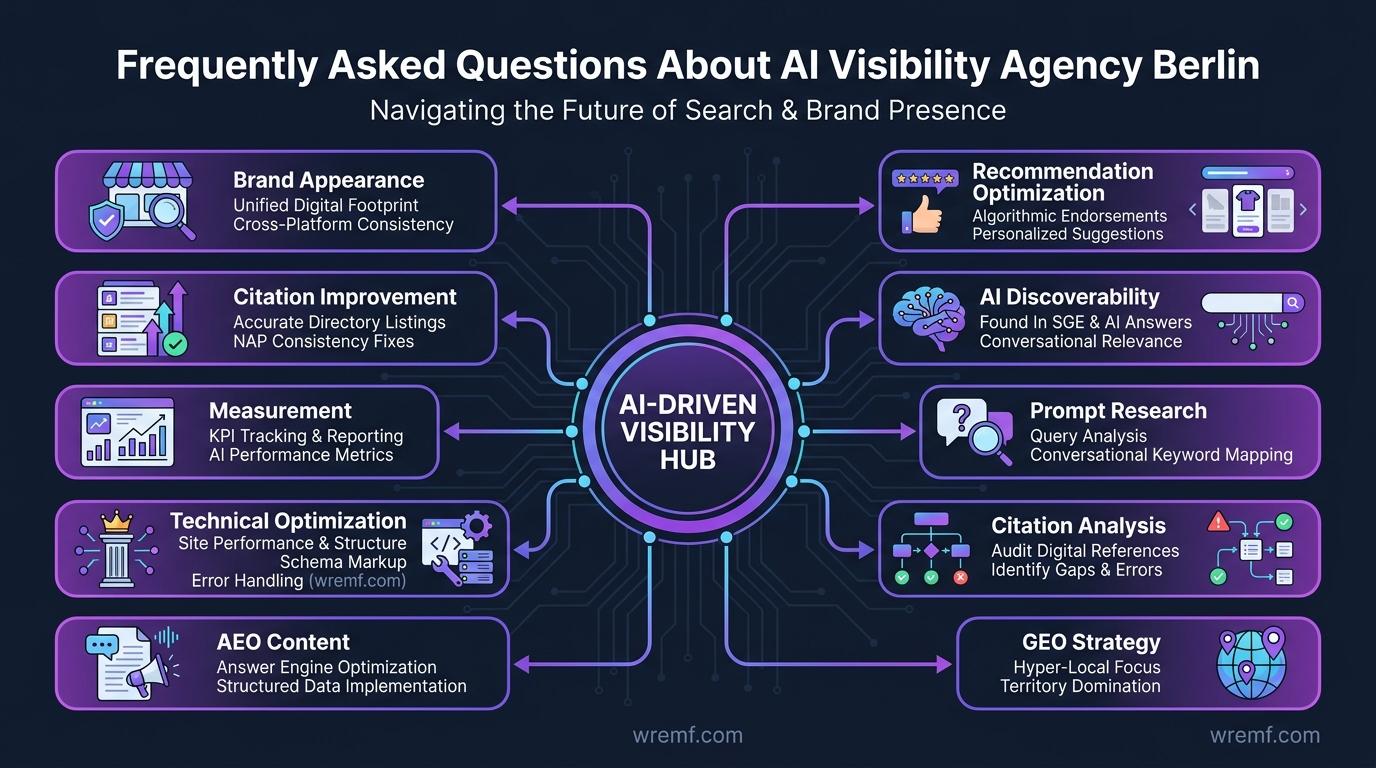
What is an AI visibility agency in Berlin?
An AI visibility agency in Berlin helps companies improve how their brand appears, gets cited, and gets recommended across AI search engines and answer platforms. Unlike a traditional SEO agency, it focuses on ChatGPT, Claude, Gemini, Perplexity, Google AI Overviews, Copilot, DeepSeek, Grok, Meta AI, Mistral, and other AI discovery surfaces. The work usually includes prompt research, citation analysis, GEO strategy, AEO content, authority building, technical optimization, and measurement. WREMF supports Berlin-based and international B2B teams through both AI visibility software and managed agency execution.
What is an LLM SEO agency?
An LLM SEO agency helps brands improve visibility inside large language model responses, AI-generated answers, and generative search results. LLM SEO combines Search Engine Optimization, answer engine optimization, generative engine optimization, source citation tracking, entity authority, prompt monitoring, and AI-ready content strategy. The goal is not only ranking on Google, but also being mentioned, cited, compared, or recommended when buyers ask LLMs for product or vendor advice. This matters because OpenAI states that ChatGPT serves more than 800 million users every week in its State of Enterprise AI report.
What is the difference between an AI visibility agency and a traditional SEO agency?
An AI visibility agency optimizes for AI citations, brand mentions, prompt coverage, AI share of voice, recommendation visibility, and source consistency, while a traditional SEO agency mainly focuses on rankings, keywords, links, Technical SEO, and organic traffic. The two approaches overlap because strong SEO foundations still help AI systems understand a website. The difference is that AI search platforms synthesize answers instead of showing only a list of blue links. WREMF connects SEO, AEO, GEO, LLM SEO, and AI attribution into one measurable workflow through its AI visibility methodology.
Why hire an LLM SEO agency?
You hire an LLM SEO agency when your buyers are using AI search to research vendors, compare tools, and shortlist solutions before visiting your website. A specialist agency can audit how your brand appears in AI-generated answers, identify missing citations, improve answer-first content, strengthen entity authority, and track competitors across AI platforms. This is useful for B2B SaaS companies, growth-stage brands, SEOs, and marketing teams that need implementation support, not just dashboards. For teams that need execution, WREMF offers senior-led AI visibility consulting, GEO services, AEO strategy, and managed optimization.
When does an LLM SEO agency make sense?
An LLM SEO agency makes sense when your company needs more than internal SEO maintenance. It is especially useful when AI platforms do not mention your brand, competitors appear more often in answers, your website content is not structured for answer extraction, or leadership wants evidence of AI visibility impact. It also makes sense during a new market launch, category expansion, enterprise SEO program, or content rebuild. Teams with limited in-house execution often benefit from a hybrid model that combines AI visibility tools, audits, content recommendations, technical guidance, and managed optimization.
When should a Berlin company choose an AI visibility agency?
A Berlin company should choose an AI visibility agency when it wants to compete in AI search, not only traditional Google rankings. This is especially relevant for SaaS, AI, fintech, B2B services, recruiting, education, and technology brands where buyers compare vendors before contacting sales. A Berlin-focused strategy should still be multi-market because ChatGPT, Perplexity, Gemini, Claude, and Google AI Overviews do not behave like local SEO alone. The right agency should understand Berlin’s competitive market, international search demand, AI platforms, buyer intent, citation sources, and conversion optimization.
What do LLM SEO agencies do differently?
LLM SEO agencies work differently because they optimize for how AI systems retrieve, summarize, cite, and compare brands. Instead of only targeting keywords and ranking pages, they map prompts, analyze citations, improve answer structure, strengthen entity signals, review competitor visibility, and build content around buyer questions. They also monitor whether a brand is recommended, ignored, offered as an alternative, or described inaccurately. WREMF combines prompt intelligence, source citation tracking, AI visibility scoring, competitor analysis, content briefs, and managed execution so teams can turn visibility gaps into action.
Do AI visibility agencies know where search is going?
A credible AI visibility agency should understand that search is becoming more conversational, answer-led, and distributed across multiple platforms. Buyers now use Google, ChatGPT, Perplexity, Gemini, Claude, Reddit, YouTube, comparison pages, review sources, and niche communities during research. Google explains in its AI features and your website guidance how AI Overviews and AI Mode affect site owners and content visibility. A strong agency should connect SEO, AEO, GEO, LLM SEO, content strategy, citations, and conversion into one integrated system.
Do LLM SEO agencies create content for buyers, not just searchers?
Good LLM SEO agencies create content for buyers, not only searchers. Buyer-focused AI visibility content answers comparison, pricing, risk, implementation, integration, use-case, alternatives, and vendor-selection questions. This helps AI platforms understand when a brand is relevant to a specific buying situation. In practical AI visibility audits, teams often find that their blog posts rank for informational keywords but fail to answer bottom-funnel prompts such as “best AI visibility agency for B2B SaaS” or “which GEO agency supports managed execution and reporting?”
Can an AI visibility agency demonstrate success in my industry?
A strong AI visibility agency should demonstrate relevant methodology, reporting examples, prompt frameworks, content recommendations, and industry-specific thinking, but it should not promise identical results across clients. AI visibility depends on competition, website quality, content depth, third-party sources, entity authority, technical SEO, and how AI systems interpret available evidence. Ask for sample dashboards, prompt examples, citation analysis, and decision-stage content recommendations. WREMF provides a sample AI visibility report so teams can evaluate reporting depth before choosing software, agency support, or a hybrid model.
How do AI visibility agencies measure success?
AI visibility agencies measure success through citation frequency, AI share of voice, prompt coverage, source citations, competitor visibility, sentiment, recommendation visibility, branded mentions, AI traffic attribution, and pipeline influence. Traditional SEO metrics such as ranking, organic traffic, links, and keyword growth still matter, but they do not fully explain how a brand appears inside AI-generated answers. The best measurement model connects prompts, citations, competitors, source consistency, AI-assisted traffic, customer inquiries, and revenue influence. WREMF tracks these signals across 10 AI engines.
What is citation frequency in AI-generated answers?
Citation frequency measures how often your brand, website, or content is cited in AI-generated answers for target prompts. It is useful because AI visibility is not only about being mentioned. A brand may appear without being cited, or it may receive citations for low-value informational prompts but not buying-intent prompts. Citation frequency should be reviewed alongside prompt intent, competitor presence, source quality, sentiment, and conversion potential. WREMF’s AI source citation tracking helps teams identify which pages and third-party sources influence AI answers.
What is AI share of voice?
AI share of voice measures how often your brand appears in AI-generated answers compared with competitors for the same prompt set. It helps show whether your brand is winning, losing, or missing from AI search conversations. For example, if ChatGPT, Perplexity, Gemini, or Claude frequently mention Profound, Otterly, Snezzi, Lengreo, Semrush, or other competitors but not your brand, that points to a visibility gap. Share of voice is especially useful for B2B companies because buyers often ask AI platforms for vendor comparisons before contacting sales.
How does brand citation frequency compare with competitor citation frequency?
Brand citation frequency shows how often your company is cited, while competitor citation frequency shows how often other companies are cited for the same prompts. Comparing both creates an AI share of voice view. This is useful because a brand can have some AI visibility and still lose the category conversation if competitors are cited more often in buying-stage answers. The comparison should be measured by prompt cluster, AI platform, page source, citation quality, and sentiment. WREMF’s competitive AI visibility analysis helps teams track these gaps.
What is brand sentiment in AI-generated answers?
Brand sentiment in AI-generated answers describes how AI platforms frame your company when they mention it. A brand may be recommended, listed as an alternative, described neutrally, associated with outdated information, or discouraged for certain use cases. Sentiment matters because visibility without accurate positioning can create confusion for buyers. An AI visibility agency should review not only whether your brand appears, but also how it appears, which competitors appear nearby, what sources influence the description, and whether the answer matches your product positioning.
How can I know if my brand is recommended, offered as an alternative, or discouraged?
You can know this by testing high-value buyer prompts across multiple AI platforms and classifying the answer position, sentiment, and citation pattern. A brand may be directly recommended, included in a shortlist, mentioned as a niche option, omitted entirely, or framed as less suitable than competitors. The key is to test repeatable prompt sets, not one-off searches. WREMF’s prompt intelligence tools help teams monitor how AI engines respond to target prompts over time.
Do AI visibility agencies really drive content toward people near a buying decision?
A good AI visibility agency should prioritize content that supports buying decisions, not only top-of-funnel traffic. This includes comparison pages, pricing explainers, implementation guides, alternatives pages, use-case pages, integration content, customer pain-point content, and FAQ systems. The goal is to help AI platforms retrieve clear evidence when buyers ask decision-stage questions. However, no agency should guarantee revenue from AI search alone. The right measurement connects prompt visibility, citations, AI-assisted traffic, conversion behavior, customer inquiries, CRM data, and pipeline signals.
Can we really see whether AI visibility affects business outcomes?
You can partially measure AI visibility’s business impact by combining prompt tracking, citation monitoring, AI referral traffic, assisted conversions, CRM source fields, landing page analytics, customer inquiries, and pipeline attribution. Measurement is still evolving because many AI platforms do not pass complete referral data. In real-world reporting, teams usually need a blended model that connects AI visibility metrics with known traffic and sales signals. WREMF supports this through AI visibility dashboards, source tracking, competitive visibility, recommendation monitoring, and attribution-focused reporting.
Can using an LLM SEO agency benefit my website’s traffic?
Using an LLM SEO agency can benefit website traffic when the work improves content quality, Technical SEO, source authority, internal linking, page structure, and AI-ready answer formatting. However, AI visibility work should not be judged only by traffic because some AI-generated answers may influence buyers before they click. Google’s guidance on creating helpful, reliable, people-first content emphasizes usefulness and reliability over content made mainly for rankings. The best approach is to measure organic traffic, AI referrals, citations, mentions, and conversion quality together.
How can LLM SEO benefit my business?
LLM SEO can benefit your business by making your brand easier for AI systems and buyers to understand, retrieve, compare, and trust. It supports demand generation, customer education, competitive differentiation, product positioning, and sales enablement by improving how your company appears across AI search and traditional search. For B2B brands, the practical value is stronger visibility in buyer prompts, clearer content, better citation coverage, and more useful pages for decision-stage audiences. WREMF helps teams connect these signals to reporting, recommendations, and managed execution.
Are LLM SEO services expensive?
LLM SEO services can be expensive when they include deep audits, technical implementation, content production, citation outreach, brand mention outreach, reporting, and ongoing optimization. Costs vary by market, website size, content needs, competition, and whether the engagement is software-only, agency-only, or hybrid. WREMF pricing starts at €39 per month for software, while enterprise and managed services depend on scope, execution requirements, and support needs. Teams comparing options can review WREMF pricing and plan details before deciding on software, agency support, or a hybrid model.
How much does it cost to hire an LLM SEO agency?
The cost to hire an LLM SEO agency depends on whether you need an audit, strategy, content execution, technical implementation, authority building, citation optimization, or ongoing reporting. A one-time audit is usually less expensive than a managed retainer because it focuses on diagnosis and recommendations. A full retainer may include prompt mapping, GEO strategy, AI-ready content briefs, page optimization, citation analysis, and monthly reporting. For teams that want both measurement and execution, WREMF offers software plus managed AI visibility support through its agency model.
Is it ethical to use AI to grow my website?
It is ethical to use AI to grow your website when the content is accurate, helpful, transparent, and created for users rather than manipulation. AI can assist with research, structure, summaries, briefs, and optimization, but human expertise should validate claims, examples, and recommendations. Google states in its guidance about AI-generated content that its focus is rewarding high-quality content, not banning content simply because AI was involved. Ethical AI visibility work strengthens clarity, usefulness, and source credibility.
Do I hire an LLM SEO agency or do it in-house?
You should hire an LLM SEO agency if you need specialist strategy, faster implementation, content systems, technical guidance, and AI visibility reporting. You can do it in-house if your team already has strong SEO, analytics, content, PR, and technical resources. A hybrid model often works best for B2B teams because software handles tracking while agency support handles prioritization and execution. WREMF is built for this hybrid use case, combining AI visibility software with senior-led AEO, GEO, LLM SEO, and AI search optimization services.
What is the difference between software-only, agency-only, and hybrid AI visibility support?
Software-only AI visibility support is best for teams with strong internal execution resources, agency-only support is best for teams that need strategy and implementation, and hybrid support combines measurement with managed execution. Software helps track prompts, citations, competitors, share of voice, and reports. Agency services help turn those insights into content, technical fixes, authority building, and conversion improvements. WREMF’s hybrid model is useful for brands that want AI visibility tracking, strategic guidance, execution support, reporting, attribution, and ongoing optimization in one system.
What goals actually matter for an AI visibility agency engagement?
The goals that matter most are visibility in high-intent prompts, accurate brand representation, stronger citation coverage, improved competitor share of voice, better source consistency, and measurable business impact. Traffic alone is not enough because AI search may influence buyers before they visit your website. A practical goal set should include prompt clusters, buyer journey stages, target AI engines, priority competitors, content gaps, technical issues, and reporting cadence. These goals make the engagement measurable instead of relying on vague visibility claims.
Where are we now, and where do we want to go?
The first step is to benchmark current AI visibility, then define the future state you want to reach. This means checking whether your brand appears in ChatGPT, Claude, Gemini, Perplexity, Google AI Overviews, Copilot, and other AI platforms for commercial prompts. It also means identifying competitors, citation gaps, content weaknesses, and technical barriers. The future state should be specific, such as stronger visibility for buyer prompts, better citation frequency, improved sentiment, more AI-assisted traffic, or clearer attribution to pipeline and customer inquiries.
Which digital opportunities are easy and quick to implement?
Easy digital opportunities usually include improving FAQ answers, adding comparison content, clarifying product positioning, strengthening internal links, updating outdated pages, adding structured summaries, and fixing missing metadata or crawlability issues. These tasks help both SEOs and AI visibility teams because they make content easier to understand and retrieve. More advanced work includes citation outreach, brand mention outreach, content cluster expansion, structured data improvements, local SEO refinement, and authority building. WREMF’s GEO audit workflow helps identify quick wins and deeper strategic gaps.
Where can AI or automation bring relief in day-to-day marketing work?
AI and automation can reduce manual effort in prompt monitoring, competitor tracking, content brief creation, citation analysis, reporting, SEO testing, and recurring AI visibility checks. Marketing teams often struggle to test the same prompts across ChatGPT, Gemini, Claude, Perplexity, and Google AI Overviews manually. Automation helps create a repeatable system for monitoring changes over time. However, strategy, editorial judgment, and subject-matter expertise still need human review. WREMF supports automation through scheduled monitoring, white-label reports, BYOK support, API workflows, and MCP integrations.
What should an AI visibility audit include?
An AI visibility audit should include prompt landscape analysis, competitor visibility, citation frequency, brand sentiment, source citation tracking, entity authority, content structure, Technical SEO, local SEO where relevant, and AI referral measurement. It should also show which pages, sources, and prompts need attention first. A useful audit does not stop at screenshots. It should produce a prioritized roadmap for content, citations, technical improvements, and reporting. WREMF agency audits follow a process of audit, strategy, build, amplify, and measure.
Why does AI visibility matter now for Berlin B2B companies?
AI visibility matters now for Berlin B2B companies because buyers increasingly use AI platforms to research tools, agencies, vendors, and market options before contacting sales. Berlin’s startup, SaaS, AI, fintech, and B2B services ecosystem is competitive, so brands need to appear clearly in both traditional search and AI-generated answers. Google says AI Overviews reached more than 1.5 billion monthly users across more than 200 countries and territories in its AI-powered Search marketing update, which shows that AI-assisted search behavior is mainstream.
Should I use Semrush, Surfer SEO, or an AI visibility platform?
You should use Semrush or Surfer SEO for traditional SEO workflows, but an AI visibility platform is better for prompt tracking, AI citations, share of voice, and multi-engine AI search reporting. Semrush is useful for keywords, links, rankings, competitive SEO research, and Technical SEO. Surfer SEO supports content optimization around search terms. AI visibility tools add a different layer by showing how ChatGPT, Claude, Gemini, Perplexity, Google AI Overviews, and Copilot describe and cite your brand. WREMF’s AI visibility suite is designed for that AI search layer.
Is starting fresh better than improving existing SEO content?
Starting fresh is not always better than improving existing SEO content. Many websites already have useful pages that can be updated with answer-first structure, clearer entity signals, stronger internal links, better comparison sections, stronger citations, and more complete FAQs. Starting fresh makes sense when existing content is thin, outdated, unfocused, technically weak, or misaligned with buyer intent. A good AI visibility agency will audit what should be kept, rewritten, consolidated, redirected, or expanded instead of recommending unnecessary content production.
What role does subject-matter expertise play in AI visibility?
Subject-matter expertise helps AI visibility because it makes content more specific, credible, and useful for real buyers. AI platforms are more likely to retrieve and summarize pages that clearly explain problems, use cases, tradeoffs, limitations, and decision criteria. Generic content production often fails because it repeats surface-level answers already available elsewhere. Strong AI visibility work captures internal expertise from founders, CEOs, operators, product teams, customer-facing teams, and SEOs, then turns it into structured content that supports both human readers and AI retrieval.
How does an AI visibility agency build the visibility engine?
An AI visibility agency builds the visibility engine by mapping high-value prompts, identifying content gaps, optimizing pages, improving internal links, strengthening source citations, and aligning content with buyer intent. The visibility engine should cover SEO, AEO, GEO, LLM SEO, Technical SEO, content marketing, citation outreach, brand mention outreach, and competitor analysis. For Berlin B2B companies, this may include English and German content, local SEO signals, Google Business profile improvements, Google Maps relevance, and industry-specific authority sources where those signals matter.
How does an AI visibility agency build the conversion engine?
An AI visibility agency builds the conversion engine by connecting traffic, AI referrals, buyer-intent pages, content offers, landing pages, product messaging, and attribution wiring. Visibility alone is not enough if users do not understand the product, trust the brand, or take the next step. Conversion work may include clearer CTAs, comparison pages, pricing explanations, proof points, FAQs, demo paths, customer inquiry tracking, and pipeline reporting. The goal is to turn AI search visibility into qualified demand, not just page views or brand mentions.
How should an AI visibility agency stay in close sync with your team?
An AI visibility agency should stay in close sync through regular communication, shared dashboards, clear deliverables, implementation reviews, and transparent prioritization. The agency should understand the product, customer segments, business models, sales cycle, competitors, content process, and technical constraints. Close collaboration matters because AI visibility requires input from marketing, SEO, product, sales, customer success, and leadership. WREMF’s agency approach is built around senior-led strategy, practical implementation, no long-term lock-in, and clear deliverables for B2B SaaS, growth-stage brands, SEO teams, and agencies.
How should an AI visibility agency track business impact?
An AI visibility agency should track business impact by connecting AI visibility metrics to traffic, conversions, customer inquiries, pipeline, and revenue influence where data is available. The core metrics include prompt visibility, citation frequency, AI share of voice, source quality, sentiment, competitor presence, AI referral traffic, assisted conversions, and CRM attribution. No agency can fully control or guarantee how AI platforms rank, cite, or recommend brands. A serious partner should show what changed, why it may have changed, and which actions are recommended next.
What should founders, CEOs, and operators ask before hiring an AI visibility agency?
Founders, CEOs, and operators should ask how the agency measures AI visibility, which AI platforms it tracks, how it handles citations, how it builds buyer-stage content, and how it reports business impact. They should also ask whether the agency understands their product, audience, competitors, conversion path, and market category. A good agency should explain its process clearly and avoid promising instant rankings, guaranteed citations, or guaranteed revenue. WREMF is positioned for operators who want practical AI visibility strategy, software-backed reporting, and managed execution.
What should agencies and consultants look for in an AI visibility platform?
Agencies and consultants should look for multi-client reporting, white-label reports, prompt tracking, citation analysis, competitor visibility, API access, client portals, BYOK support, and repeatable workflows. They also need a platform that can explain AI visibility in a way clients understand. WREMF is useful for agencies because it supports white-label client reporting, scheduled monitoring, AI share of voice analysis, source citations, prompt intelligence, and client-ready dashboards. Agencies can explore WREMF’s dedicated AI visibility tools for agencies when building client services.
What should in-house brands look for in an AI visibility partner?
In-house brands should look for a partner that understands software, services, reporting, execution, and business outcomes. The right partner should help the brand understand where it appears, which competitors appear more often, which sources influence AI answers, what content gaps exist, and how to prioritize fixes. In-house teams also need clear recommendations that can be implemented by SEO, content, technical, and demand generation teams. WREMF supports in-house brands building AI search visibility through platform data, managed guidance, and execution support.
Does AI visibility include local SEO and reputation management?
AI visibility can include local SEO and reputation management when location, trust, and local discovery affect buyer decisions. For Berlin companies, this may include Google Business profile quality, Google Maps relevance, Google 3-Pack visibility, review signals, local citations, Trustpilot rating, YouTube presence, Reddit mentions, and third-party brand references. Local SEO does not replace GEO or LLM SEO, but it can strengthen the source ecosystem that AI systems may use to understand a business. The right approach depends on whether the company sells locally, nationally, or internationally.
What role do citations, citation outreach, and brand mention outreach play?
Citations, citation outreach, and brand mention outreach help strengthen the evidence ecosystem around a brand. AI platforms often rely on patterns across websites, authoritative pages, third-party mentions, reviews, comparison articles, community discussions, and trusted sources. If a company is missing from relevant sources, AI-generated answers may overlook it or favor better-documented competitors. Citation outreach should focus on legitimate, useful, and contextually relevant sources, not artificial link schemes. WREMF helps teams identify citation gaps, source consistency issues, and authority-building opportunities.
Does structured data help AI visibility?
Structured data can help AI visibility indirectly by making page information clearer for search engines, but it is not a standalone solution for AI search. Structured data supports entity clarity, content organization, and eligibility for certain search features, while AI visibility also depends on content quality, citations, brand authority, prompt relevance, and source consistency. Technical SEO, schema markup, crawlability, rendering, internal linking, and page structure all matter. An AI visibility agency should treat structured data as one technical foundation within a broader GEO and AEO strategy.
How does WREMF help with AI visibility agency work?
WREMF helps with AI visibility agency work by combining software, strategy, and managed execution. The platform tracks prompts, AI citations, competitors, AI share of voice, source consistency, and visibility across 10 AI engines. The agency side helps teams turn findings into action through audits, AEO strategy, GEO services, content briefs, technical recommendations, authority development, and reporting. This makes WREMF useful for brands that want software, agencies that need white-label reporting, and teams that want a hybrid software plus managed service model.
What is the WREMF agency process?
The WREMF agency process follows five practical steps: audit, strategy, build, amplify, and measure. The audit reviews AI visibility, competitors, prompts, citations, technical issues, and entity authority. The strategy defines high-value prompt targets, buying-stage opportunities, content priorities, and authority plans. The build phase improves pages, content, internal links, and technical foundations. The amplify phase strengthens third-party visibility and citation consistency. The measure phase tracks share of voice, AI citations, traffic attribution, and pipeline impact. This process keeps AI visibility tied to execution.
What deliverables can I expect from WREMF’s AI visibility agency services?
You can expect deliverables such as AI visibility audits, GEO strategy reports, prompt opportunity maps, citation tracking dashboards, AI-ready content recommendations, content briefs, technical optimization recommendations, share of voice reporting, competitive visibility analysis, AI attribution reporting, authority development plans, and ongoing optimization support. The exact deliverables depend on whether you need software, agency support, or a hybrid engagement. The goal is to turn AI visibility from a guessing game into a measurable workflow with clear next steps.
Ready to grow organic pipeline and revenue with an AI visibility agency?
You are ready to grow organic pipeline and revenue with an AI visibility agency when your company has a clear product, defined audience, existing demand, and a need to improve visibility across AI search and traditional search. AI visibility work should support business outcomes, not vanity metrics. That means tracking prompts, citations, competitors, content quality, source consistency, AI-assisted traffic, customer inquiries, and conversion paths. WREMF can help teams compare software-only tracking with managed execution and decide whether to book a demo, request an AI Visibility Audit, or talk to the agency team.
In a rush, what should I know about AI visibility agency Berlin?
In a rush, know that an AI visibility agency Berlin helps companies appear in AI-generated answers when buyers ask ChatGPT, Claude, Gemini, Perplexity, Google AI Overviews, Copilot, and other AI platforms for recommendations. The key things to track are citation frequency, AI share of voice, brand sentiment, competitor visibility, prompt coverage, source quality, and conversion impact. The best partner should combine SEO, AEO, GEO, LLM SEO, content strategy, Technical SEO, reporting, and implementation. WREMF provides both software and managed execution for this workflow.
Related reading
- The Practical Guide to Perplexity Visibility Services for B2B Brands
- AI SEO Agency: How to Choose the Right Partner for AI Search Visibility
- AI Citation Optimization Services: The Complete B2B Guide to Getting Cited in AI Search
- AI Search Visibility Agency: The Complete Guide to Choosing the Right Partner in 2026