The Complete Guide to Keyword Gap Analysis for SEO, Content Strategy, and Competitive Intelligence
Learn how to perform keyword gap analysis to identify missing SEO opportunities and enhance content strategy.
By WREMF Team · 2026-08-25
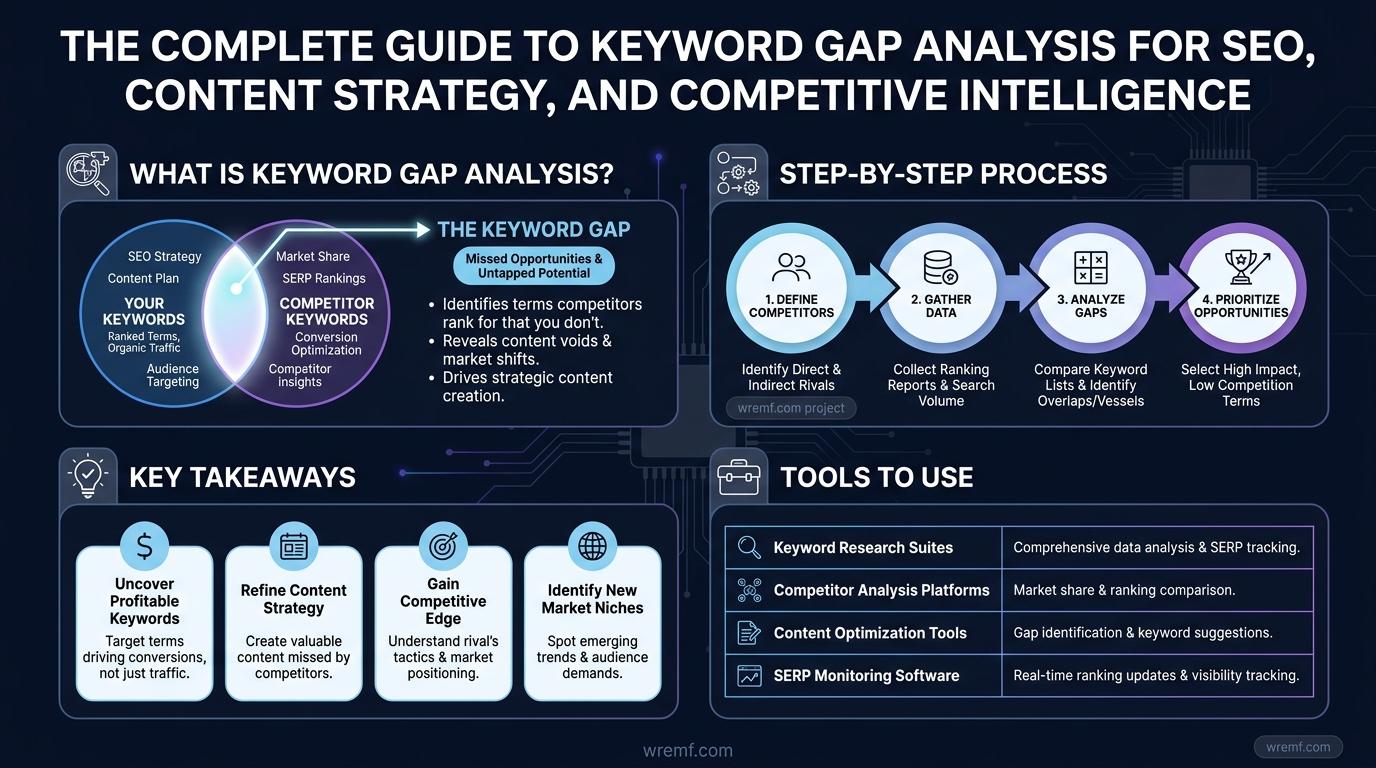
Keyword gap analysis is a technique for comparing your website's ranking keywords to competitors' to find crucial missed keyword opportunities. It identifies search terms where competitors rank that you do not or where they outrank you. These insights reveal missed keyword opportunities and content gaps, providing a solid foundation for a data-driven SEO strategy. Understanding these gaps allows you to direct SEO efforts more efficiently and align your content strategy with proven demand, maximizing organic traffic potential and competitive intelligence.
Key takeaways
- Keyword gap analysis uncovers keywords competitors rank for that your site doesn't, revealing traffic opportunities.
- It involves comparing keyword profiles and applying filters like search volume and keyword difficulty.
- Content gap analysis complements keyword gap analysis by identifying missing topics.
- AI search engines value authoritative, intent-matched content, affecting keyword strategy.
- Tools like Semrush and Ahrefs help perform detailed keyword gap analysis.
The Complete Guide to Keyword Gap Analysis for SEO, Content Strategy, and Competitive Intelligence
Keyword gap analysis is the process of comparing your website's ranking keywords against competitor domains to identify the search terms, topics, and ranking opportunities your brand is missing. It is one of the most direct methods available for finding proven keyword opportunities without starting keyword research from scratch. This guide is written for SEO teams, content strategists, B2B marketers, and digital marketing leads who want a structured approach to closing organic search visibility gaps. The article covers what keyword gap analysis is, how to run one step by step, which tools support the process, how it connects to content strategy and AI search visibility, and how teams can turn gap data into measurable SEO improvements.
QUICK ANSWER:
Keyword gap analysis compares your domain's ranking keywords against one or more competitor domains to find terms they rank for that you do not, or terms where they outrank you significantly. The analysis reveals missed keyword opportunities, content gaps, and ranking positions worth targeting. It forms the foundation of a data-driven SEO strategy by identifying where organic traffic potential exists and where existing content needs improvement.
KEY TAKEAWAYS:
- Keyword gap analysis identifies keywords your competitors rank for that your website does not, revealing concrete organic traffic opportunities.
- The process involves comparing keyword profiles across multiple competitor domains and filtering results by search volume, keyword difficulty, and search intent.
- Content gap analysis extends keyword gap findings by identifying missing topics, not just missing search terms.
- AI search engines increasingly pull from sources that rank well for authoritative, intent-matched content, making keyword gap analysis relevant beyond traditional SEO.
- WREMF tracks AI visibility and prompt-level citations alongside traditional ranking data, helping teams understand whether their content appears in AI-generated answers as well as search engine results pages.
What Keyword Gap Analysis Is and Why It Matters for SEO Strategy
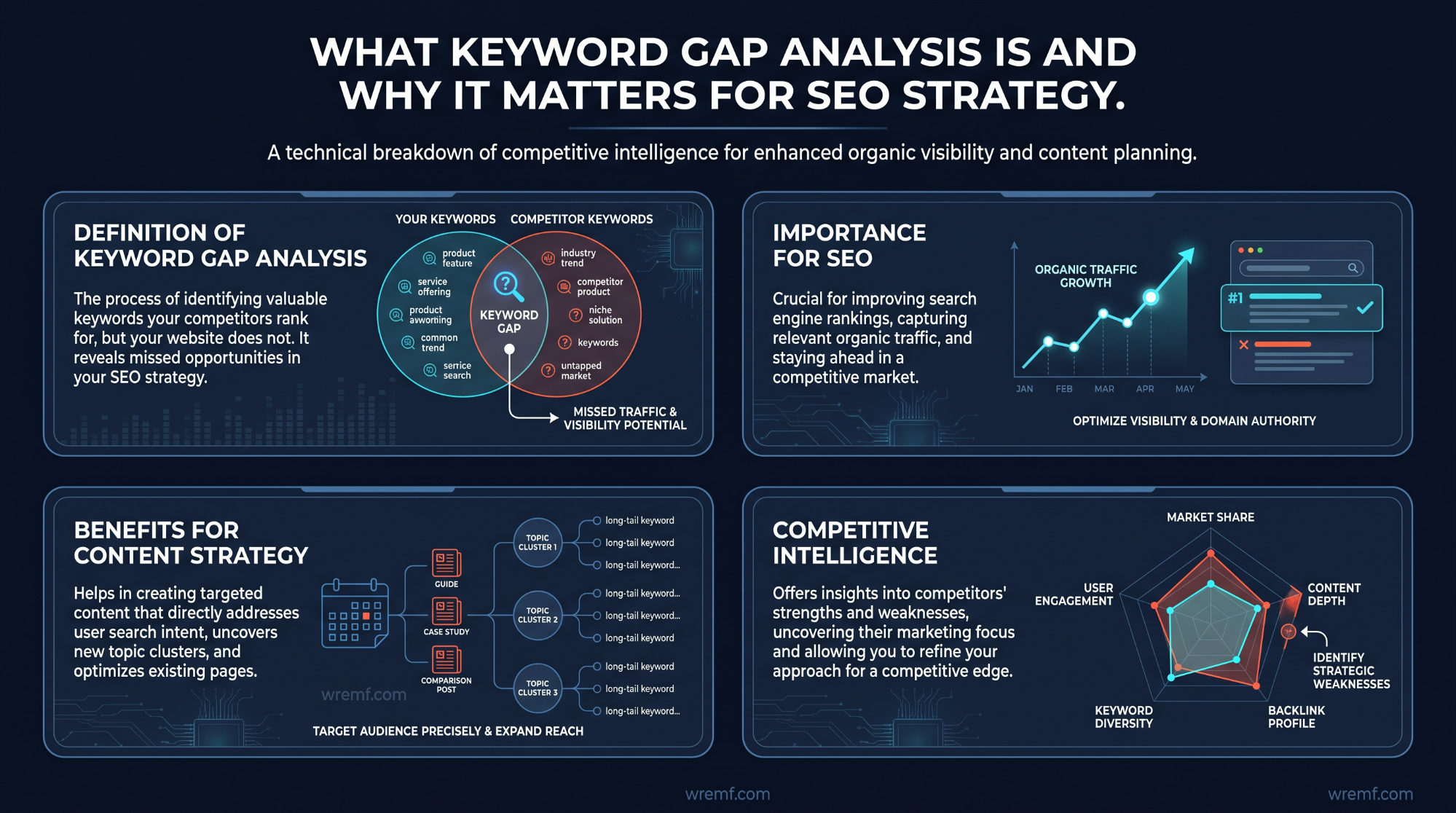
Keyword gap analysis is a competitive SEO method that reveals the difference between what your website ranks for and what your competitors rank for across search engines. The goal is to surface keyword opportunities that have proven search demand, because if a competitor ranks for a term, that term already has an audience.
The practical value of keyword gap analysis lies in efficiency. Instead of building a keyword research list from zero, the process starts with what is already working in your market. Competitors have already validated certain keywords by earning organic rankings. A keyword gap analysis surfaces those validated terms and shows you which ones your content strategy has not yet addressed.
For B2B SaaS teams and digital marketing leads, keyword gap analysis also functions as a form of competitive intelligence. By examining competitor domains and their ranking keywords, teams can understand which topics, search terms, and content types are driving traffic to rivals. That insight informs not only content creation but also prioritisation decisions around where SEO efforts will produce the highest return.
The analysis produces three types of findings. Missing keywords are terms your competitors rank for and your site does not appear for at all. Weak keywords are terms where you rank but significantly lower than competitors, making them ranking opportunities worth improving. Shared keywords are terms where both your domain and competitors rank, useful for benchmarking your position number and competitive strength.
A keyword gap analysis is not a one-time exercise. Search engine rankings shift, new competitors enter the market, and search intent evolves. Teams that run keyword gap analysis on a regular schedule, reviewing data over rolling windows of time, build a cleaner picture of their competitive SEO position. Some keyword gap analysis tools now show data from the last 28 days, which makes it possible to identify new keywords, trends, and gaps as they emerge rather than relying solely on historical snapshots. Longer time ranges, from six months to three or more years, support trend analysis and help teams identify seasonal keyword patterns.
The connection between keyword gap analysis and content strategy is direct. Gap findings inform which new pages to create, which existing pages to optimise, and how to structure content clusters around high-value target keywords. Teams that skip this step often invest content creation resources into topics that have no competitive basis, while leaving proven keyword opportunities untouched.
For more context on how AI search tools are reshaping keyword and content strategy, the AI search engine optimization guide covers the broader picture of SEO in an AI-driven environment.
KEY TAKEAWAY: Keyword gap analysis reveals the specific keywords competitors rank for that your site does not, giving SEO and content teams a proven, demand-validated starting point for closing organic visibility gaps.
The Difference Between Keyword Gap and Content Gap Analysis
Keyword gap analysis and content gap analysis address related but distinct problems, and understanding the difference helps teams apply each method correctly.
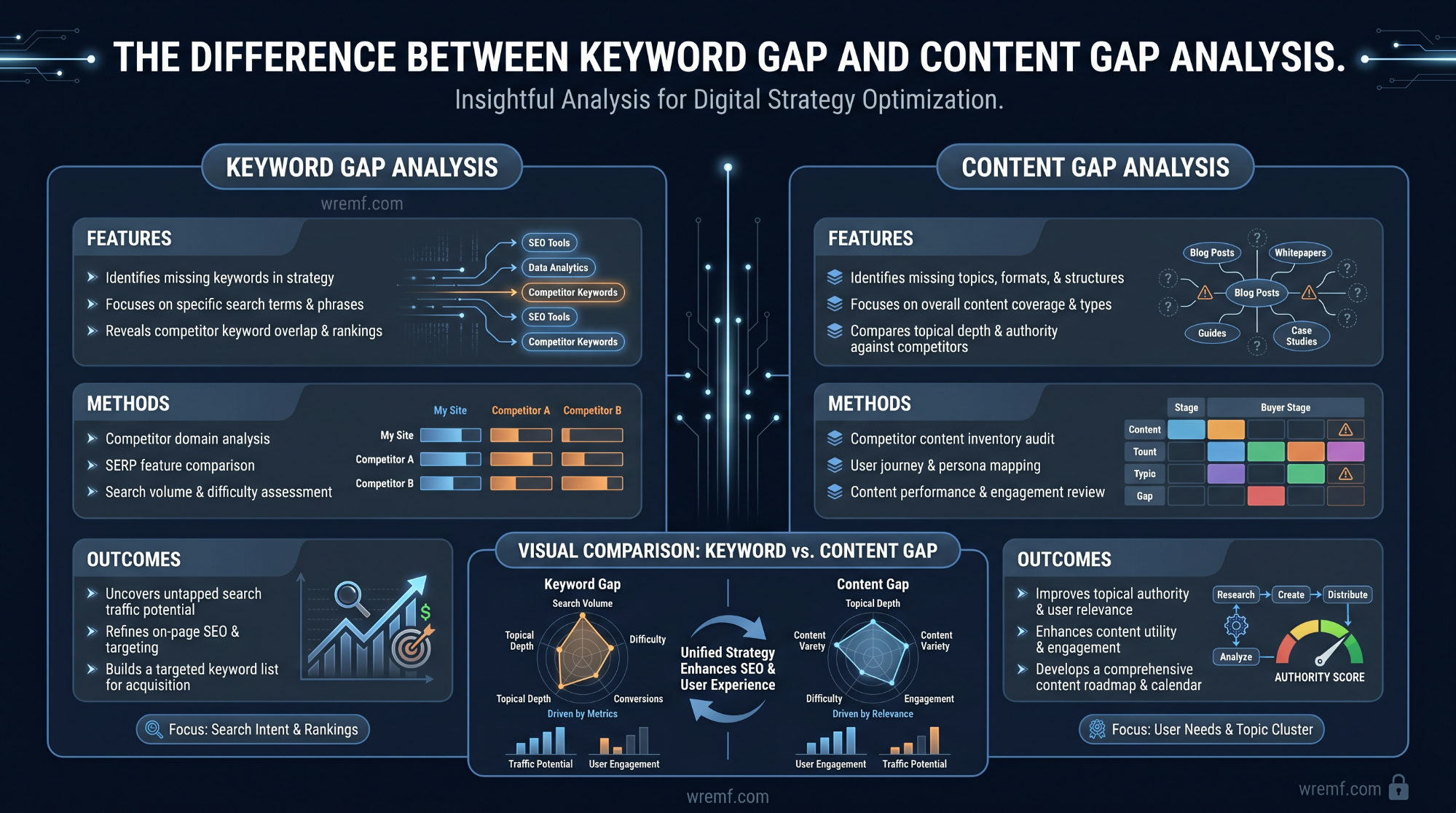
A keyword gap focuses on individual search terms. It answers the question: which specific queries does a competitor rank for that your domain does not? The output is a list of keywords with associated search volume, keyword difficulty, ranking positions, and SERP features. Those keywords map directly to pages you could build or improve.
A content gap analysis operates at a higher level of abstraction. It answers the question: which topics, themes, or subject areas does a competitor cover that your content strategy has not addressed? A content gap may include multiple related keywords grouped into a topic cluster. For example, a competitor might rank for dozens of variations around a single theme, none of which appear in your keyword profile. The content gap in that case is the missing topic, and solving it requires more than targeting one keyword.
Both analyses are necessary for a complete SEO strategy. Keyword gap analysis tells teams which specific terms to target. Content gap analysis tells teams whether those terms point to a structural absence in their content architecture. The distinction matters because it determines the response: a missing keyword might require optimising an existing page, while a content gap requires creating new content, building internal linking structures, or developing a pillar page supported by cluster content.
In practice, keyword gap findings often reveal content gaps. When a Keyword Gap tool returns a large cluster of related missing keywords, that cluster typically signals a content gap rather than a collection of isolated missing terms. Teams that treat those clusters as content gap signals, rather than individual keyword targets, produce more strategically coherent content and build stronger topical authority.
Topical authority matters increasingly in search engine results because ranking algorithms reward consistent, deep coverage of a subject. A domain that covers a topic thoroughly from multiple angles earns stronger organic rankings across all related keywords, not just the ones directly targeted. Keyword gap analysis, when read through a content strategy lens, is one of the clearest ways to identify where that depth is missing.
KEY TAKEAWAY: Keyword gap analysis identifies missing search terms, while content gap analysis identifies missing topics. Both outputs are necessary for a complete content strategy, and keyword gap findings often reveal the deeper content gaps worth addressing.
How to Perform a Keyword Gap Analysis: A Step-by-Step Process
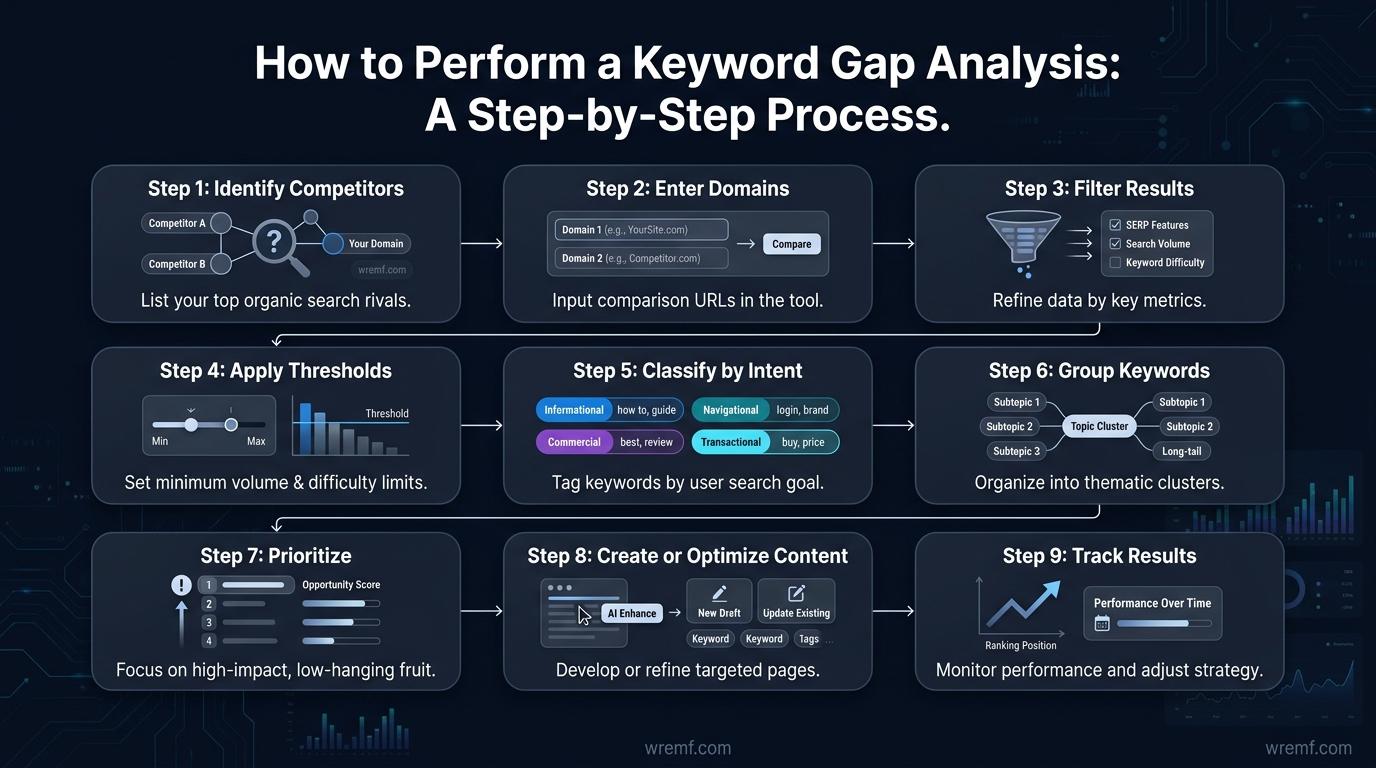
Keyword gap analysis follows a repeatable workflow. Each step builds on the previous one, and the output at each stage informs the decisions made at the next. The following process applies to teams using any major keyword gap analysis tool.
Step 1: Identify your competitor domains
Start by choosing three to five competitor domains that compete with you directly in organic search. These should be websites targeting the same audience, covering the same topics, and appearing in similar search engine results pages as your target domain. Avoid selecting domains that are too broad or too authoritative relative to your site, as the gap will be too large to act on efficiently. Use a Market Explorer tool or a manual review of search results for your core keywords to identify realistic competitor domains.
Step 2: Enter domains into a Keyword Gap Analysis Tool
Open your chosen keyword gap analysis tool, such as the Semrush Keyword Gap feature, Ahrefs content gap workflow, Moz Pro keyword comparison, or Mangools KWFinder. Enter your target domain alongside the competitor domains you have identified. Most tools allow you to enter between two and five domains for comparison. Select the search engine and market segment relevant to your business.
Step 3: Filter the results by gap type
Apply filters to focus the analysis. Start with the missing keywords filter to see terms competitors rank for that your domain does not appear for in any ranking position. Then move to weak keywords, which are terms where you rank but significantly lower than one or more competitors. Many tools offer additional filters by search volume, keyword difficulty, search intent, SERP features such as paid snippet or featured snippet, and ranking positions.
Step 4: Apply search volume and keyword difficulty thresholds
Raw keyword gap data often contains thousands of results. Filter by minimum search volume to remove terms with no practical traffic potential. Apply a keyword difficulty ceiling appropriate for your domain's current authority. Teams with newer domains or lower Domain Authority should focus on lower-difficulty terms first. Teams with established domains can pursue higher-difficulty ranking opportunities that their competitors currently hold.
Step 5: Classify by search intent
Segment the filtered keyword list by search intent. Informational keywords belong in guides, articles, and educational content. Commercial investigation keywords belong in comparison pages, buyer guides, and reviews. Transactional keywords belong on landing pages and product pages. Navigational keywords indicate brand or feature searches. Mapping keywords to intent before assigning them to content types prevents the common mistake of targeting a transactional keyword with a blog post that cannot convert.
Step 6: Group keywords into clusters
Use keyword clustering to group related terms by topic, subtopic, or intent. A keyword cluster typically shares a parent topic and a related set of long-tail keywords. Grouping keywords this way reveals the content structure needed to address a gap. One cluster might map to a new pillar page. Another might map to a series of supporting blog posts. A third might map to updates on an existing page that already covers the topic partially but incompletely.
Step 7: Prioritise by business value
Rank clusters by the combination of search volume, keyword difficulty, search intent match, and alignment with your products or services. A keyword with high search volume and low difficulty is useful only if it attracts the right audience. Focus first on keyword opportunities where the intent matches a conversion goal and where the ranking gap between your domain and competitors is closeable with targeted content improvement.
Step 8: Create or optimise content
Assign each prioritised keyword cluster to a specific content action. This might mean creating a new page, updating an existing page to address missing subtopics, improving content structure, adding internal linking, or building a new pillar page around the cluster. Use a Content Editor or SEO Writing Assistant to ensure the content addresses the target keywords and covers the topic with the depth needed to compete in the current search engine results pages.
Step 9: Track results and measure performance
After publishing or updating content, monitor keyword rankings using a Position Tracking tool. Track changes in organic traffic using Google Analytics or Google Search Console. Set a schedule for reviewing ranking progress at regular intervals, such as monthly, and compare performance against the baseline captured at the start of the analysis. Revisit the keyword gap analysis on a regular cycle to identify new gaps as rankings shift and as new competitor content enters the market.
KEY TAKEAWAY: A structured keyword gap analysis workflow, from competitor selection through to content action and performance tracking, produces actionable SEO priorities grounded in real search demand rather than assumption.
Gathering and Comparing Keyword Data Across Competitor Domains
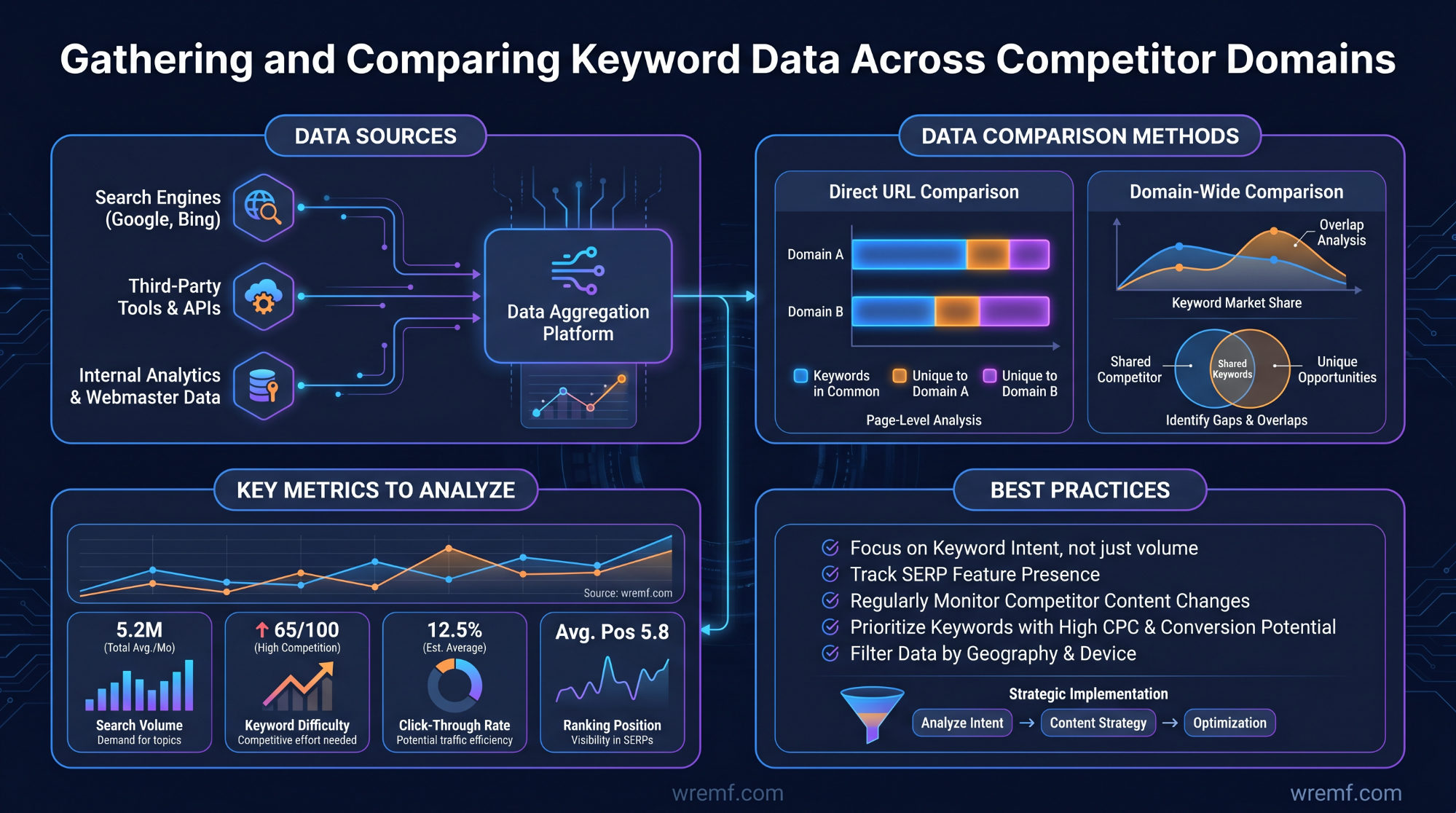
Collecting accurate keyword data is the foundation of any useful keyword gap analysis. The quality of the analysis depends entirely on the completeness and recency of the keyword data used.
For your own domain, the most reliable sources of keyword data are Google Search Console and Google Analytics. Google Search Console shows the search terms your site currently appears for in Google Search, along with impressions, clicks, average position, and click-through rate. Google Analytics complements this by showing organic traffic behaviour, including bounce rate, pages per session, and conversion rates associated with organic keywords. Combining both sources gives a complete picture of your current keyword performance and organic search health.
For competitor domains, most major keyword research tools estimate organic rankings by crawling search engine results and modelling keyword profiles based on observed ranking pages. Tools such as Semrush, Ahrefs, and Moz Pro maintain large keyword databases updated on rolling schedules. Mangools provides a similar capability through KWFinder and SERPWatcher. Each tool has different database coverage and update frequency, which affects how accurately the competitor keyword data reflects current search engine rankings.
When gathering competitor keyword data, focus on the ranking URLs as well as the keywords themselves. Seeing which specific pages earn rankings for target keywords tells you more than the keywords alone. Knowing that a competitor earns a top position for a keyword cluster through a single comprehensive guide informs the content strategy response more precisely than knowing the keyword in isolation. Look at the top-ranking pages, the top-ranking URLs, and where possible the Top Competing Content for each keyword cluster.
Keyword data quality also depends on the time range applied. A 28-day data window shows recent shifts in rankings and new keyword entries, which is useful for identifying emerging opportunities and fresh ranking gaps. A six-month or multi-year window shows trend data that helps distinguish between seasonal keyword spikes and sustained ranking opportunities. For industries with seasonal search patterns, such as tax software, event planning tools, or retail, seasonal keyword analysis based on longer time ranges is essential for planning content creation in advance of peak demand periods.
When comparing keyword profiles across multiple competitor domains, look at the overlap as well as the gaps. Shared keywords, terms where both your domain and your competitors rank, show where direct competition is happening. Top Positions held by a competitor across a large number of shared keywords indicate where their content authority is strongest. Those areas may require more substantial content investment to compete effectively, or they may reveal that a different angle or intent variant is available that the dominant competitor has not fully addressed.
KEY TAKEAWAY: Accurate keyword data from Google Search Console, Google Analytics, and third-party keyword research tools is the raw material of keyword gap analysis. Comparing ranking keywords across competitor domains, including their ranking URLs and top-ranking pages, reveals where the real content and authority gaps exist.
Prioritising Keyword Opportunities After the Gap Analysis
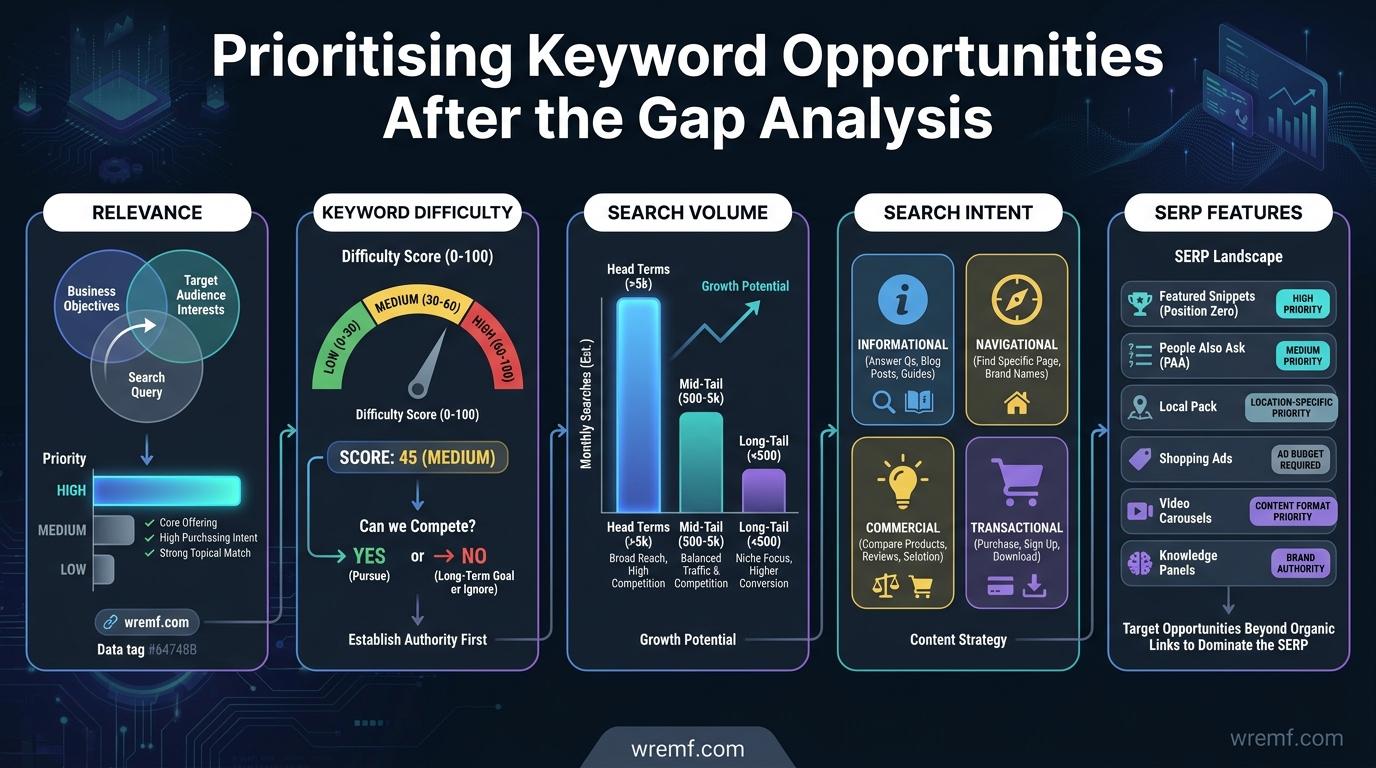
Not every keyword gap is worth closing. The prioritisation step is where keyword gap analysis becomes a practical SEO strategy rather than a data-collection exercise.
The first filter is relevance. A keyword that competitors rank for but that attracts an audience outside your target market creates traffic without business value. Every keyword that passes from the gap analysis into the action list should represent a search query your target audience is genuinely making at some point in their customer journey.
The second filter is keyword difficulty relative to your domain's current authority. Keyword difficulty scores, as reported by Keyword Gap tools and keyword research tools across platforms, reflect how competitive the current ranking pages are for a given term. A term with high difficulty requires strong Domain Authority, Page Authority, substantial backlinks, and established topical authority to compete. Teams should prioritise gaps where keyword difficulty is manageable given their current position, while building toward higher-difficulty ranking opportunities over time as their domain strengthens.
The third filter is search volume and traffic potential. A keyword gap is most valuable when it represents genuine traffic potential. Terms with very low search volume may still be worth targeting if they carry high commercial intent and conversion value, particularly in B2B markets where individual deals justify targeting low-volume, high-specificity queries. Long-tail keywords often fall into this category: lower search volume, lower competition, and higher purchase intent.
The fourth filter is SERP features. Some keyword gaps represent opportunities to appear not just in standard organic rankings but in SERP features such as featured snippets, knowledge panels, local results, or paid snippet positions. Where a SERP features opportunity exists alongside a keyword gap, the content strategy response can be shaped specifically to capture that format.
One effective prioritisation method is to review your top-performing existing content first. Looking at your top five to fifteen pages based on organic sessions from the past twelve months, adjusted to account for seasonality, shows where your content already has momentum. Cross-referencing those topics with your gap analysis spreadsheet of missing and weak keywords reveals a subset of opportunities where you already have partial authority. Improving those pages, rather than building entirely new ones, often produces faster ranking gains because the domain relevance signal is already established.
For teams managing a large Keyword List from a gap analysis, a Keyword Manager tool can help organise, segment, and assign keywords to specific campaigns or content projects. A Keyword Strategy Builder approach, grouping terms by theme and intent before assigning them to content types, prevents the common problem of creating content for the same topic in multiple disconnected formats without a clear topical structure.
KEY TAKEAWAY: Prioritising keyword gap opportunities by relevance, difficulty, search volume, search intent, and SERP features ensures that content creation and SEO efforts are directed toward gaps with the highest potential return.
Keyword Gap Analysis Tools: What to Use and When
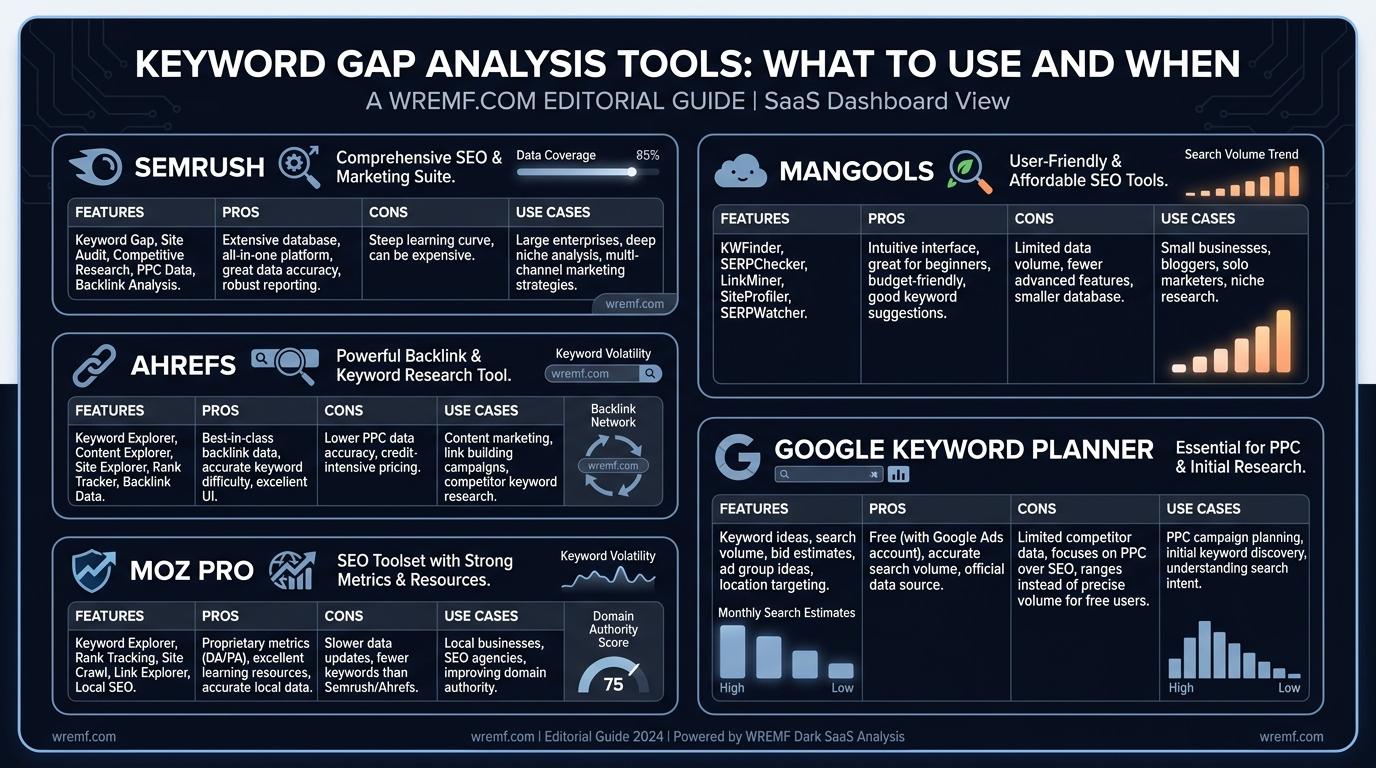
Several keyword gap analysis tools are available for teams at different stages of SEO maturity. Each has different database coverage, update frequency, interface design, and pricing. The right tool depends on the team's size, budget, existing toolset, and reporting requirements.
Semrush is one of the most widely used platforms for keyword gap analysis in digital marketing. The Semrush Keyword Gap feature allows teams to compare up to five domains simultaneously, filtering results by keywords that are missing, weak, shared, or unique to any domain. The platform integrates with a broader suite of tools including Position Tracking, SERP Analysis, Content Editor, SEO Writing Assistant, and a Content Marketing tool, which makes it a practical choice for teams that want to manage the full keyword gap workflow in one environment.
Ahrefs offers a content gap and keyword gap workflow that is similarly comprehensive. The platform's keyword database and backlinks index are well regarded for their depth and accuracy. Ahrefs is particularly strong for competitive analysis at the page level, showing which specific ranking pages are earning the keyword gaps identified in the analysis.
Moz Pro provides keyword gap functionality through its competitive research features. The platform includes Domain Authority and Page Authority metrics, SERP ranking analysis, and a Keyword Manager that supports keyword clustering and tracking. Moz Pro suits teams already invested in Moz's authority metrics and reporting infrastructure.
Mangools offers a more accessible entry point through KWFinder, SERPWatcher, and related tools. Mangools is a practical choice for smaller SaaS teams, solo consultants, or agencies working within tighter budgets. The platform covers search volume, keyword difficulty, and SERP tracking with sufficient depth for many keyword gap workflows.
Google Keyword Planner remains a free tool for gathering search volume data and identifying related search terms. While it does not offer a native keyword gap comparison feature, it is a useful supplement to paid tools for validating search volume estimates and exploring keyword variations.
Beyond the major platforms, teams building their own keyword gap workflows often use Google Search Console data exported alongside competitor data from one of the paid tools. The Compare Gap report available in some analytics setups, combined with Position Tracking data and an SEO Report Tool, can replicate many of the core keyword gap analysis outputs without requiring a single centralised platform.
When evaluating tools, the key questions are: how recent is the keyword data, how large is the keyword database for your market, can you apply the filters needed to segment by intent and difficulty, and does the tool integrate with your existing reporting and Campaign management workflows. Teams running multi-market or international SEO programs should also confirm that their chosen tool covers the search engine and locale combinations relevant to their target domains.
For a broader comparison of tools relevant to AI search and SEO, the best AI search optimization tools guide covers the expanded toolset needed for visibility across both traditional search and AI engines.
KEY TAKEAWAY: The right keyword gap analysis tool depends on database coverage, update frequency, filtering capability, and integration with your existing SEO and content reporting stack. Semrush, Ahrefs, Moz Pro, and Mangools each serve different team sizes and workflows, with Google Search Console and Google Keyword Planner as reliable free supplements.
Advanced Keyword Gap Strategies for Experienced SEO Teams
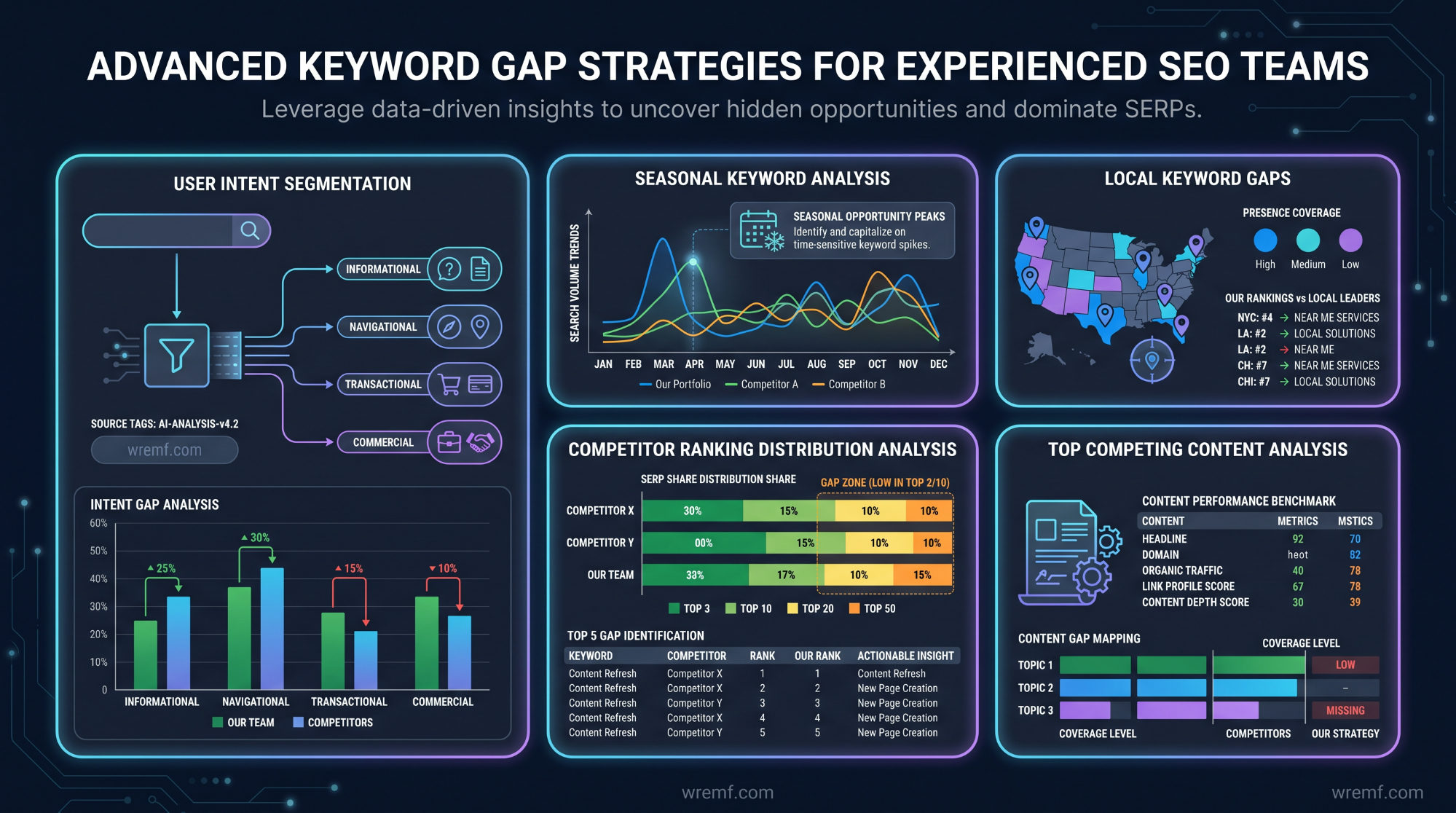
Standard keyword gap analysis covers missing and weak keywords. Advanced keyword gap strategies extend the analysis to surface more nuanced opportunities that standard filters miss.
User intent segmentation is the first advanced layer. Rather than treating a keyword gap list as a flat inventory, segmenting by search intent reveals structural patterns in what competitors are covering that you are not. If a competitor holds strong rankings across a cluster of informational search terms in a topic area but your domain has no informational content in that area, the gap is not just a keyword gap. It is an intent-layer gap that requires a content architecture response, not just a page addition.
Seasonal keyword analysis is the second advanced strategy. Some keyword gaps are permanent structural absences. Others are seasonal: keywords that spike in search volume at predictable times of year and then decline. Identifying seasonal keyword gaps requires looking at trend data over extended time ranges, from six months to multiple years, rather than relying on current search volume alone. Planning content creation ahead of seasonal peaks, informed by this trend data, allows teams to publish and earn rankings before demand arrives rather than reacting after the peak has passed.
Local keyword gaps represent a third strategic layer for businesses with geographic targeting requirements. Local competitors often hold keyword rankings for location-specific search terms that national competitors overlook. A keyword gap analysis scoped to local competitors in a specific market, including local Google Maps rankings where relevant, surfaces keyword opportunities invisible in a national-scope analysis. Teams serving multiple regions or markets benefit from running separate keyword gap analyses per market segment rather than combining all markets into a single report.
Competitor ranking distribution analysis provides a fourth advanced lens. Rather than looking only at which keywords a competitor ranks for, examining their Ranking Distribution across positions reveals where their rankings are strongest and where they are vulnerable. A competitor with many keywords in positions eleven through twenty is holding unstable rankings that better content could displace. A competitor holding positions one through three across a cluster is significantly more entrenched and requires a longer-term content strategy to challenge directly.
Top Competing Content analysis adds a fifth dimension. Some keyword gap tools show not just which keywords competitors rank for but which specific pages earn those rankings. Reviewing the top-ranking pages and top-ranking URLs for a set of gap keywords reveals the content format, depth, and structure that the search engine currently rewards for those terms. Teams that model their content structure and topical coverage against the top-ranking pages for a gap keyword cluster, rather than against an abstract keyword list, produce content that is more directly competitive.
For teams managing complex SEO programs, integrating keyword gap analysis data with a Keyword Strategy Builder, keyword performance tracking, and Position Tracking creates a closed-loop workflow where gap findings translate directly into tracked ranking improvements over time.
KEY TAKEAWAY: Advanced keyword gap strategies, including intent segmentation, seasonal trend analysis, local competitor research, ranking distribution review, and top competing content analysis, add depth and competitive precision beyond what standard gap filters reveal.
Connecting Keyword Gap Analysis to Content Strategy and Pillar Page Architecture
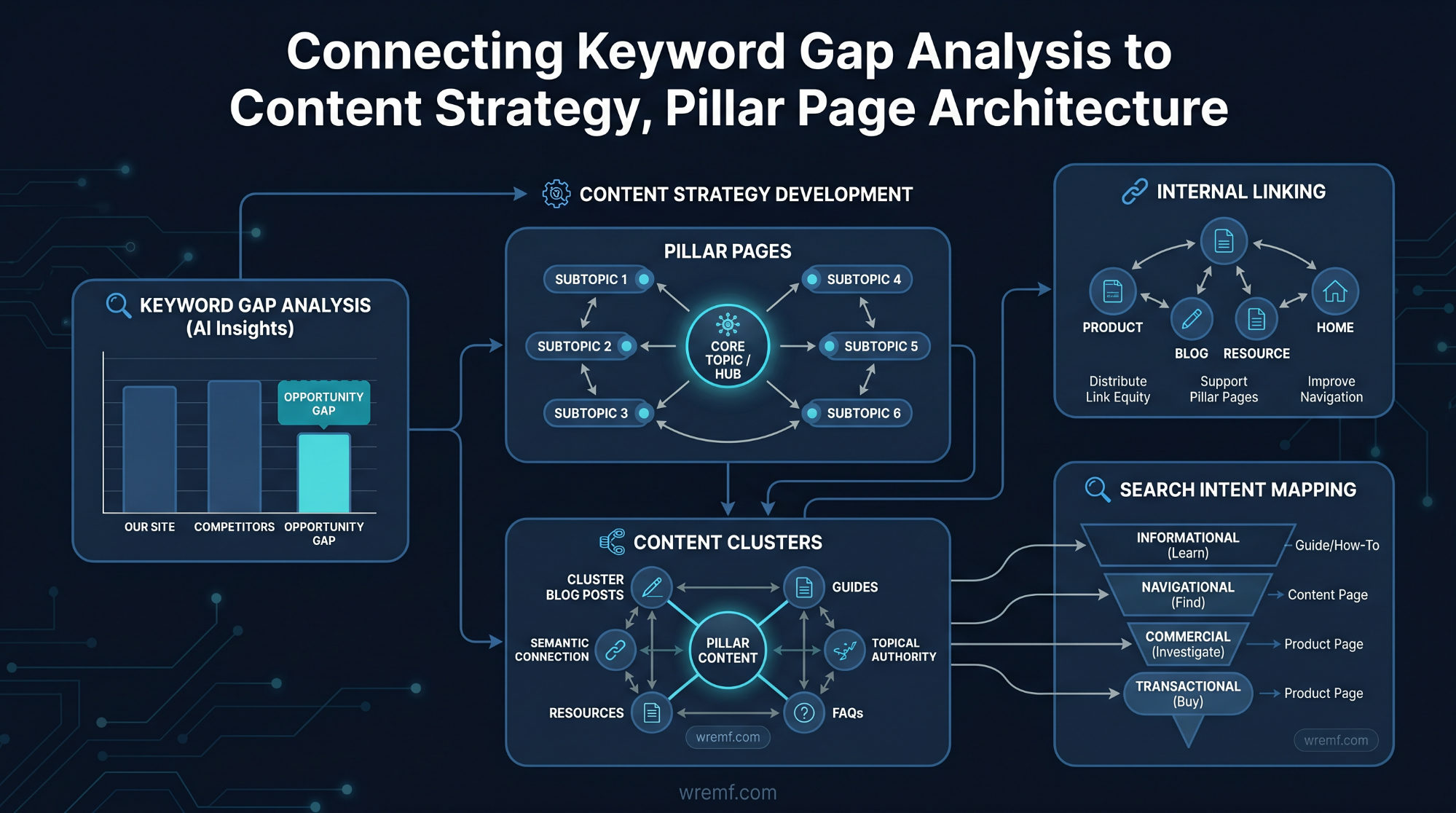
Keyword gap analysis is most powerful when its outputs directly shape content strategy decisions, not just keyword lists. The connection between gap findings and content architecture is what transforms a spreadsheet of missing terms into a structured SEO program.
Pillar pages are one of the primary content responses to keyword gap findings. When a gap analysis reveals a large cluster of related keywords that a competitor ranks for and your domain does not cover, the appropriate response is often a comprehensive pillar page that addresses the parent topic, supported by cluster content covering the subtopics. Pillar pages earn authority across a topic area, which then strengthens the ranking performance of all related cluster pages through internal linking. The pillar page structure also aligns with how modern search engines evaluate topical depth and content quality.
Content clustering, informed by keyword clusters from the gap analysis, provides the structural logic for this approach. Rather than creating individual pages for each gap keyword, a content clustering method groups related terms under a shared parent topic, assigns one primary page to cover the parent keyword, and creates supporting pages for the most significant subtopics. This method reduces content duplication, concentrates page authority through internal linking, and builds the topical authority signals that support strong organic rankings across the cluster.
Internal linking is the connective tissue of a content clustering strategy. When gap-informed content is created, internal links between the new pages and existing relevant content distribute authority across the site and signal topic relationships to search engines. A pillar page without internal links to its cluster content, or cluster content without links back to the pillar, loses much of the authority benefit the structure is designed to provide.
Content gap analysis works alongside keyword gap findings to identify where the pillar and cluster architecture itself is missing. If a keyword gap analysis shows that a competitor holds dozens of rankings across an entire topic area and your site has no content in that area at all, the issue is not a missing keyword on an existing page. It is a missing branch of your content architecture. The appropriate response is to plan a new content cluster from scratch, starting with the pillar page and building cluster content around the keyword gaps identified in the analysis.
When assigning gap keywords to content types, search intent must govern the decision. Using the wrong content format for a keyword, such as publishing an informational guide targeting a transactional keyword, results in a page that ranks poorly or attracts traffic that does not convert. The content strategy response to each keyword cluster should match the search intent of the keywords in that cluster, not just the topic they belong to.
For teams building AI-visible content alongside traditional SEO, the answer engine optimization guide explains how answer-first content structure supports both search engine rankings and AI citation visibility.
KEY TAKEAWAY: Keyword gap findings should translate directly into pillar page architecture, content clustering decisions, and internal linking plans. Treating gap keywords as individual targets rather than structural signals produces less effective content strategy outcomes.
Keyword Gap Analysis and AI Search Visibility
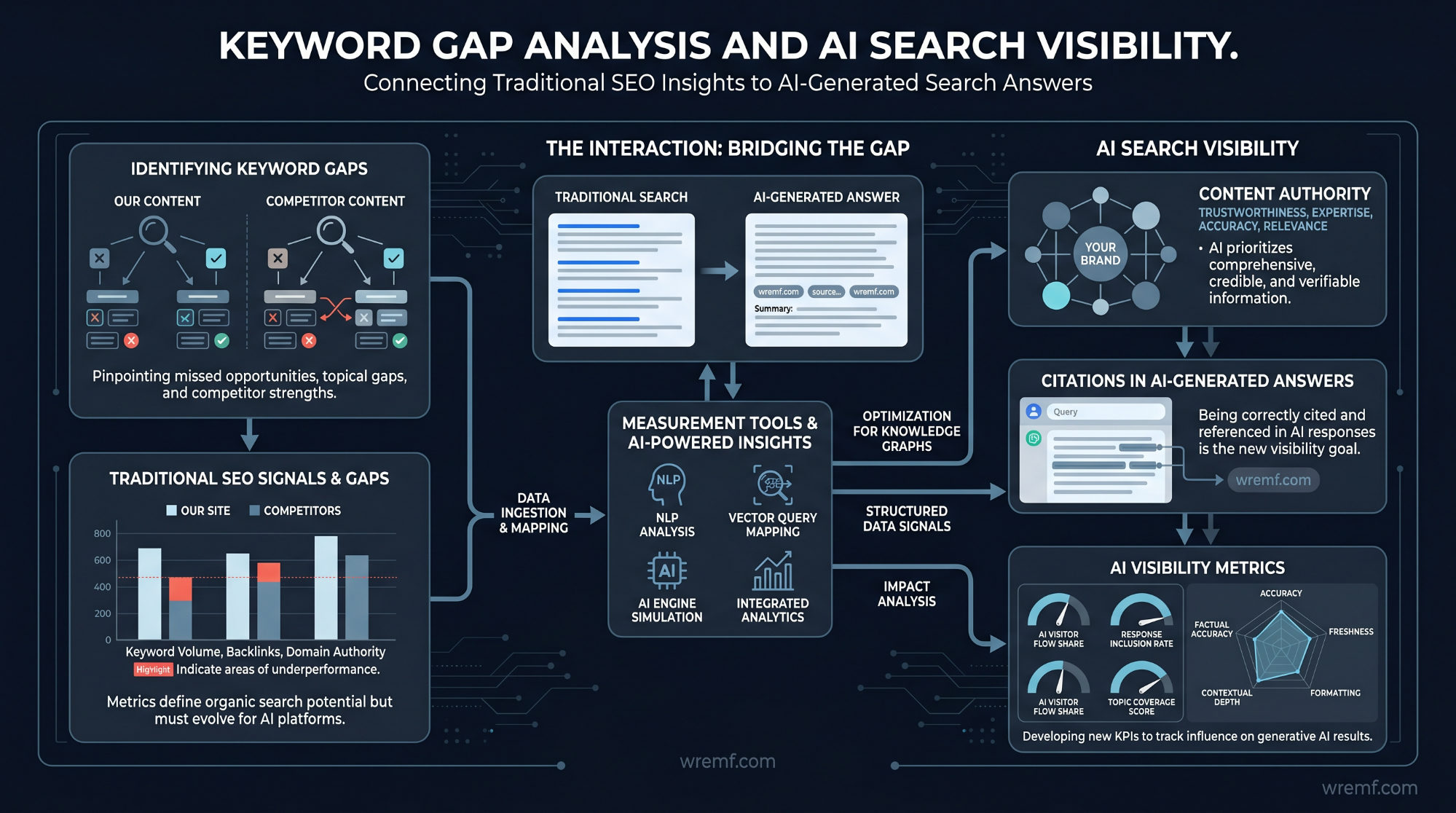
Keyword gap analysis was built for traditional search engine optimisation, but its relevance extends into the AI search environment that is now reshaping how buyers discover and evaluate products and services.
AI engines such as ChatGPT, Perplexity, Gemini, Claude, Google AI Overviews, Copilot, DeepSeek, Grok, Meta AI, and Mistral generate answers by drawing on sources that meet certain criteria: topical authority, content depth, source trustworthiness, and structural clarity. Those criteria overlap significantly with the characteristics that traditional search rankings reward. A brand that closes keyword gaps and builds topical authority in traditional search is also improving the foundational conditions that make AI engines more likely to cite that brand's content.
However, AI visibility is not guaranteed by traditional rankings alone. An AI engine may cite a source that ranks in position eight over one that ranks in position one, depending on the quality, specificity, and format of the content. AI-generated answers frequently draw from sources that provide direct, well-structured answers to specific questions, which is exactly the kind of content that keyword gap analysis and intent-driven content strategy produce when executed well.
The relationship between keyword gap analysis and AI citation visibility works through several mechanisms. Content that closes keyword gaps covers topics and search terms that buyers are actively researching. That coverage creates source material for AI engines to draw from when generating answers about those topics. Content built around specific search intent, especially informational and commercial investigation intent, matches the structure of prompts that AI users submit. Pillar pages and cluster content that address a topic comprehensively provide AI engines with authoritative depth across a subject area, which increases the likelihood of citation across multiple related prompts.
Tracking whether your content appears in AI-generated answers, and whether closing keyword gaps improves that presence, requires a different measurement layer than traditional ranking tools provide. Traditional SEO tools measure SERP positions and organic traffic. AI visibility requires tracking prompt-level citations, source mentions, and AI share of voice across the AI engines that buyers are using. According to McKinsey's AI insights AI adoption in business decision-making is accelerating, which means the share of research journeys that involve AI-generated answers is growing alongside traditional search.
WREMF provides the AI visibility layer that traditional keyword gap tools do not. While a keyword gap analysis tool shows where your domain is missing rankings in traditional search engine results, WREMF tracks how AI engines mention, cite, compare, and recommend your brand across relevant buyer prompts. The two tools are complementary: keyword gap analysis informs the content strategy that builds topical authority, and WREMF measures whether that authority translates into AI citation presence.
For teams building a complete AI search visibility program, the generative AI optimization services guide covers the GEO and AEO strategies that connect content authority to AI answer inclusion.
KEY TAKEAWAY: Keyword gap analysis strengthens the topical authority and content depth that AI engines draw from when generating answers. Closing keyword gaps supports AI citation visibility, but measuring that visibility requires dedicated AI tracking tools like WREMF rather than traditional ranking software.
How WREMF Extends Keyword and Content Gap Analysis Into AI Visibility Tracking
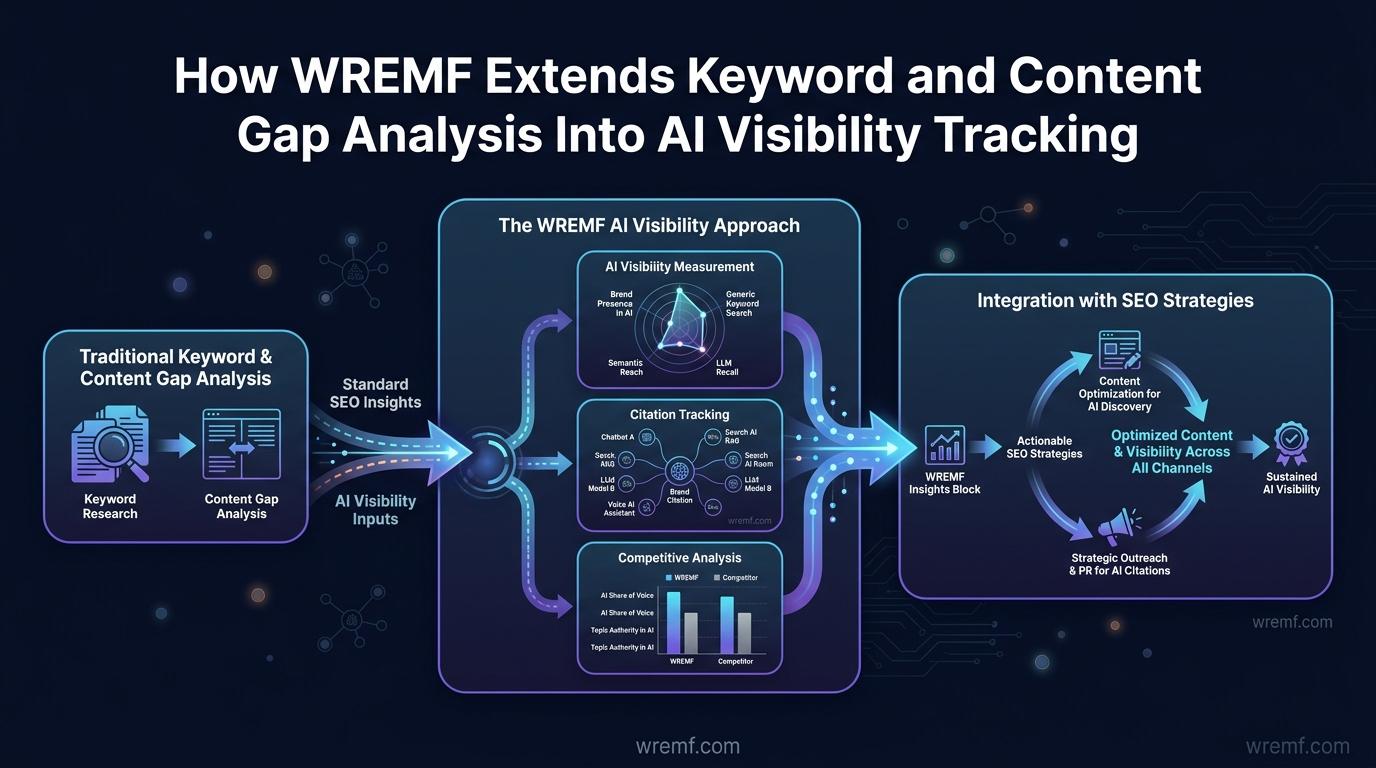
Traditional keyword gap analysis tools measure what happens in standard search engine results pages. WREMF measures what happens in AI-generated answers across ten AI engines. The two capabilities address different but related parts of the modern search landscape.
A team that runs a keyword gap analysis using Semrush, Ahrefs, or Moz Pro gains a clear view of which keywords they are missing in Google Search and Bing. They can see ranking positions, search volume, keyword difficulty, and competitor domain performance. What those tools cannot show is whether the content created in response to that analysis is being cited by ChatGPT when a buyer asks which tools solve a particular problem, or whether Perplexity is recommending a competitor instead, or whether Google AI Overviews is drawing from a rival's pillar page rather than yours.
WREMF fills that gap. It tracks prompt-level citations across ChatGPT, Claude, Gemini, Perplexity, Google AI Overviews, Copilot, DeepSeek, Grok, Meta AI, and Mistral. It measures AI share of voice, which shows what proportion of relevant AI answers mention your brand versus competitor brands. It tracks source consistency, showing whether the sources AI engines cite for your topic area consistently include your domain or consistently favour competitors. It identifies citation gaps, which are the AI-equivalent of the keyword gaps that traditional tools surface in search results.
For teams that have already invested in keyword gap analysis and content strategy, WREMF adds measurement accountability. The question keyword gap analysis raises is: where are we missing? The question WREMF answers is: where are we missing in AI-generated answers, and what is driving that absence? The two questions together produce a more complete picture of search and discovery visibility than either can produce alone.
WREMF supports three engagement models depending on what a team needs. Software-only access through the Starter plan at €59 per month gives founders, solo consultants, and small SaaS teams the ability to track AI visibility across ten engines with unlimited prompts, BYOK support, and core citation tracking for up to three competitor domains. The Growth plan at €149 per month adds AI share of voice, GEO audits, a content brief generator, GA4 attribution, white-label reports, and Looker Studio integration for agencies and in-house SEO teams managing up to five websites. The Managed plan from €1,500 per month provides full-service AI visibility strategy, AEO content optimisation, citation and entity cleanup, and senior-led execution for enterprise brands and large agencies.
Teams that want to review plan options before committing can explore WREMF pricing plans to compare what each tier includes and whether a software, managed, or hybrid engagement model fits their current resources.
KEY TAKEAWAY: WREMF adds the AI visibility measurement layer that keyword gap analysis tools do not provide, tracking prompt-level citations, AI share of voice, and source consistency across ten AI engines to show whether content improvements are translating into AI answer presence.
Measuring the Results of Keyword Gap Analysis
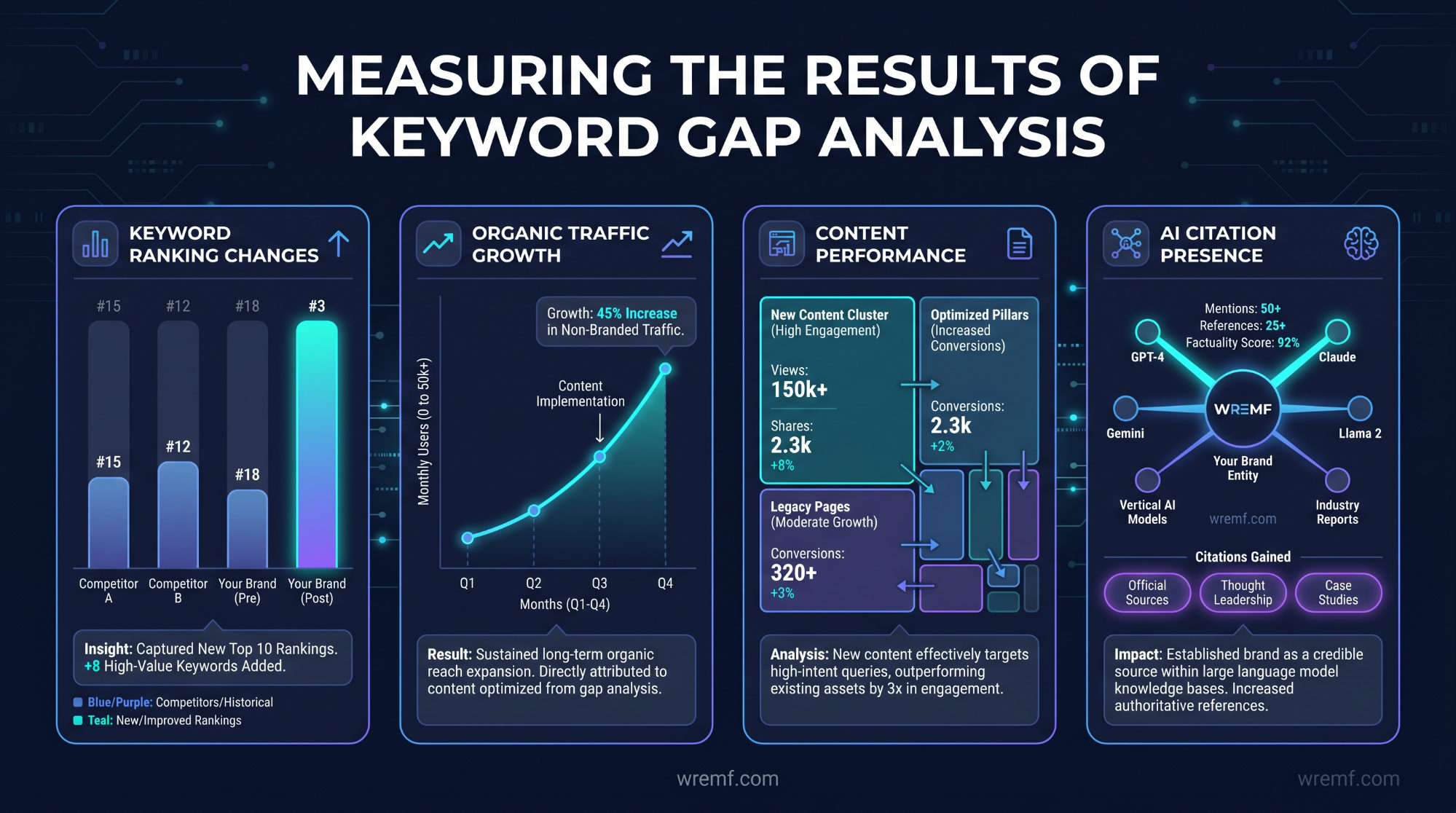
Measuring the impact of keyword gap analysis requires tracking outcomes across multiple data sources. The analysis itself produces a list of opportunities. The measurement framework tracks whether acting on those opportunities produces ranking gains, traffic improvements, and business results.
The primary metrics to track after a keyword gap analysis are keyword ranking changes for the target keywords identified in the gap analysis. Position Tracking tools in Semrush, Ahrefs, Moz Pro, or equivalent platforms allow teams to add specific keywords and monitor their ranking positions over time. Setting a baseline at the point of content publication and reviewing ranking positions at regular intervals, typically monthly, shows whether new or updated content is earning the rankings the gap analysis identified as attainable.
Organic traffic is the second measurement priority. Keyword rankings are a leading indicator, but organic traffic growth confirms that ranking improvements are translating into actual visits. Google Analytics and Google Search Console both provide organic traffic data that can be segmented by landing page, allowing teams to measure traffic directly attributable to pages created or improved following the keyword gap analysis. Tracking organic keywords, organic sessions, and traffic data per page over time shows the compounding return on gap-driven content investment.
Traffic potential realisation is a useful supplementary metric. When a keyword gap analysis identifies a cluster of keywords with a combined monthly search volume of a defined amount, and the team creates content targeting that cluster, tracking what fraction of that potential traffic the page actually captures after ranking establishes a realistic content performance benchmark.
For B2B teams where conversion is the ultimate measure, connecting keyword gap analysis to conversion rate data in Google Analytics closes the loop between SEO effort and business outcome. Pages that attract traffic from keywords with commercial investigation or transactional intent should produce measurable conversion signals, whether that is demo requests, trial signups, or lead form completions. Traffic without conversion signals indicates that the content may be attracting the wrong intent audience, which is a signal to review the keyword intent classification from the gap analysis.
Beyond traditional search, teams tracking AI visibility through WREMF can measure whether content improvements produce citation gains in AI-generated answers. AI referral traffic, sourced from prompt-based discovery journeys rather than direct search, shows in GA4 as a separate referral source when AI engines link to cited content. Monitoring AI referral traffic alongside organic traffic provides a more complete picture of how content authority is performing across both traditional and AI-driven discovery channels.
For context on how AI traffic attribution works in practice, Google Analytics Help provides guidance on referral traffic classification that helps teams distinguish AI-sourced visits from standard organic sessions.
KEY TAKEAWAY: Measuring keyword gap analysis results requires tracking ranking positions, organic traffic, conversion rates, and AI citation presence across a defined post-publication window, using Google Analytics, Google Search Console, Position Tracking, and AI visibility tools to validate whether gap-informed content is performing as intended.
Realistic Use Cases: How Teams Apply Keyword Gap Analysis in Practice
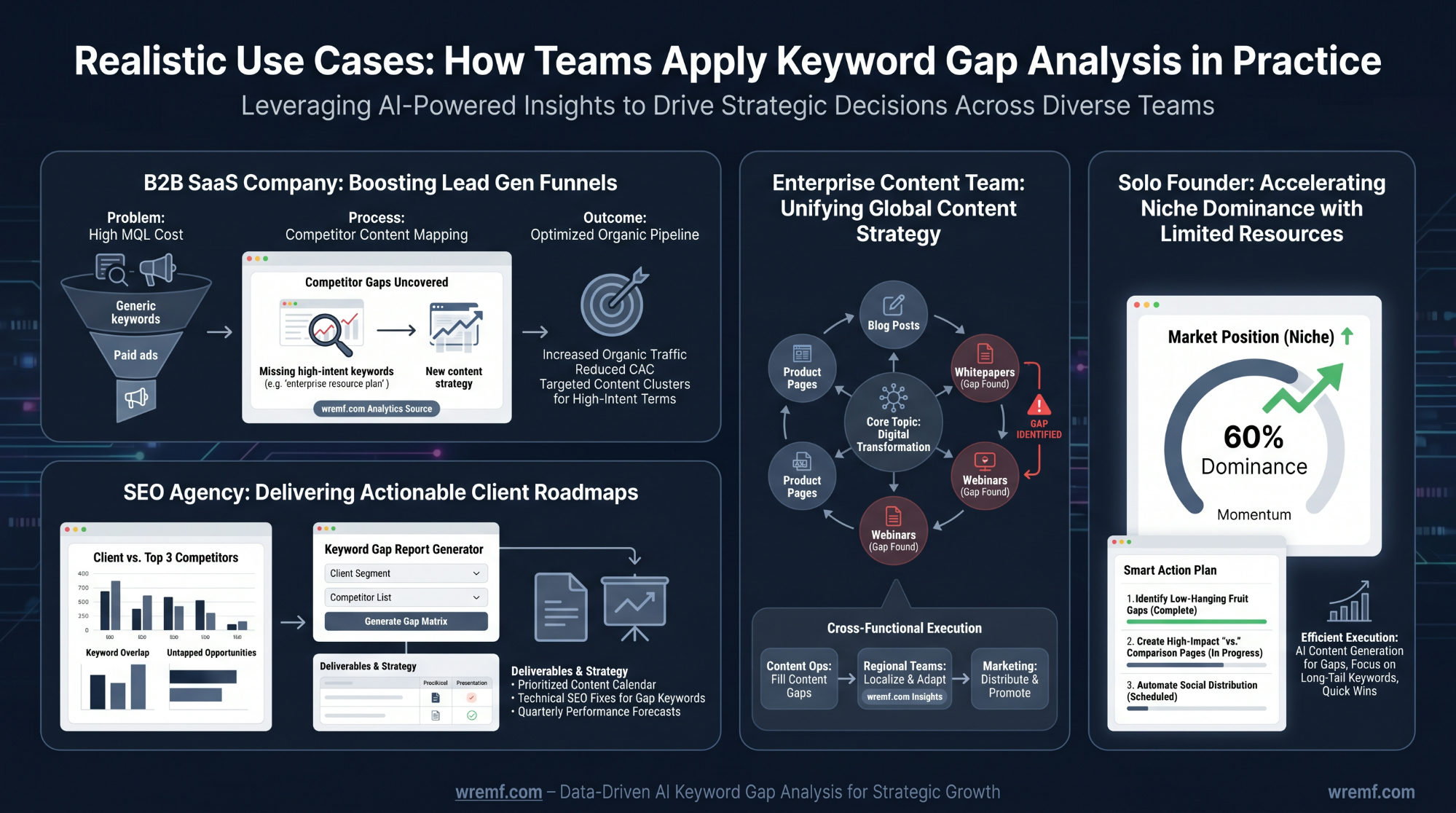
Keyword gap analysis is used differently depending on team size, business model, and SEO maturity. The following scenarios illustrate how the process applies across common B2B SaaS and agency contexts.
A B2B SaaS company in a competitive category notices that two direct competitors consistently appear in search engine results for terms related to their core product. Their own organic rankings for those terms are either absent or weak. Running a keyword gap analysis using Semrush reveals sixty-three keywords across three topic clusters where competitors hold top positions and the company has no ranking at all. The team segments those keywords by search intent and difficulty, identifies two clusters suitable for immediate content creation, and builds a pillar page and three cluster posts for each. Four months later, Position Tracking shows seventeen of the target keywords entering the top twenty positions, with five reaching the top ten.
An SEO agency managing five B2B software clients runs quarterly keyword gap analyses for each client using a standardised workflow. For each client, the agency compares the client's domain against three to five competitor domains, exports the gap data, filters by intent and difficulty, and produces a prioritised keyword list mapped to a twelve-week content creation roadmap. The agency uses white-label reports from WREMF alongside keyword gap data to show clients not just where they are missing in traditional search but also where AI engines are citing competitors instead of them, giving the reporting a layer of competitive intelligence that traditional keyword gap reports do not provide.
A content team at an enterprise SaaS company uses keyword gap analysis to inform their annual content strategy planning. They review the keyword gaps identified in the previous year's analysis against the content actually published and measure what fraction of the gap was addressed. They use this comparison to calculate a Content Lift metric, tracking how many previously missing keywords the site now ranks for as a direct result of gap-informed content creation. This metric becomes a key input into the following year's content strategy budget justification.
A solo SaaS founder using WREMF's Starter plan adds AI visibility tracking to a standard keyword gap workflow. After identifying a set of missing keywords and creating content to address them, the founder tracks whether the new pages begin appearing in AI-generated answers across ChatGPT and Perplexity using WREMF's prompt intelligence features. This closes the loop between traditional gap analysis and AI discovery, giving the founder a view of content performance that extends beyond Google Search rankings.
KEY TAKEAWAY: Keyword gap analysis applies at every scale, from solo founders tracking AI citation gains to enterprise content teams using gap data for annual strategy planning and agencies using it to manage multi-client SEO programs with measurable outcomes.
Common Limitations and Risks in Keyword Gap Analysis
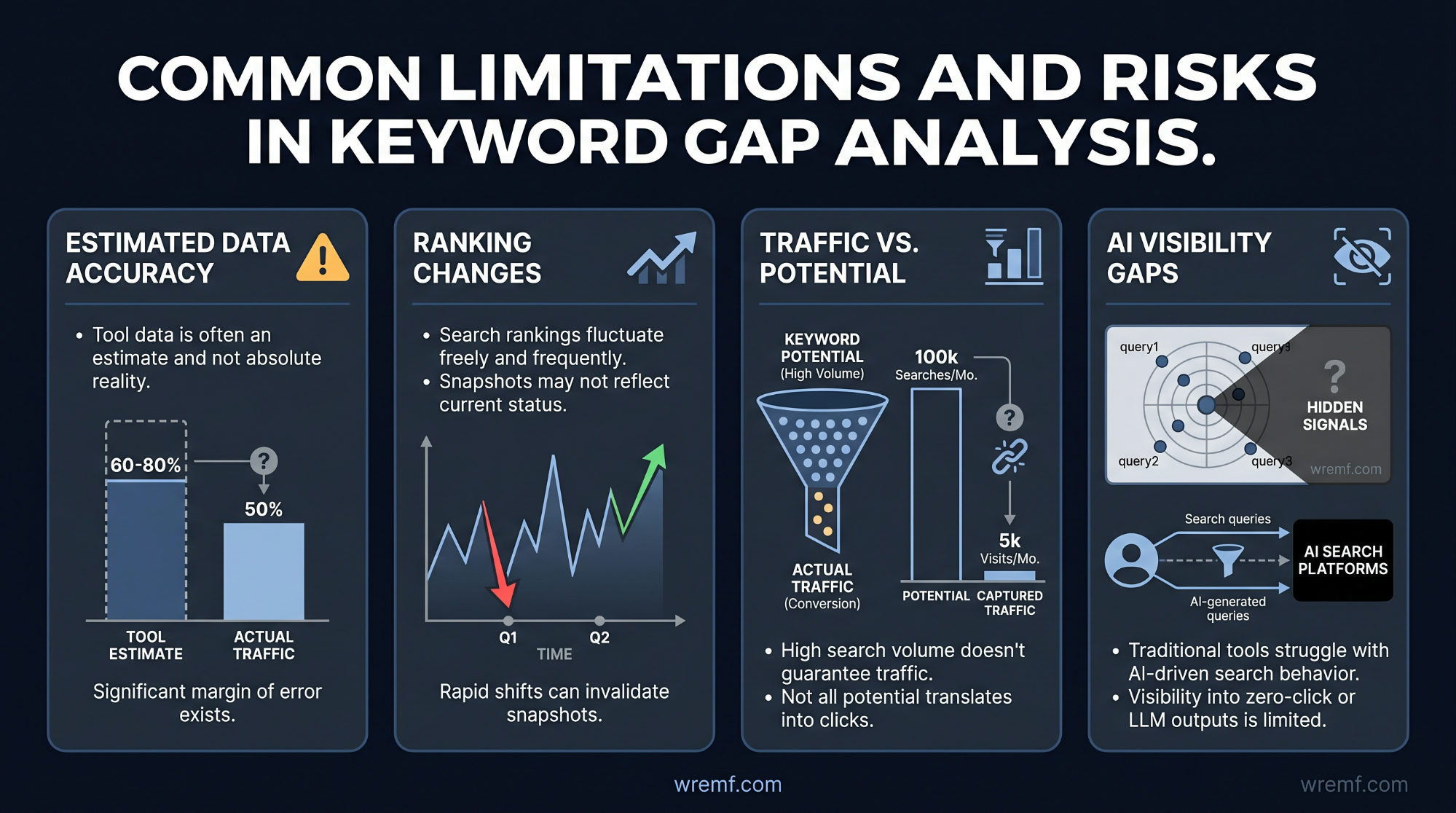
Keyword gap analysis is a powerful input to SEO strategy, but it has real limitations that teams should understand before treating gap data as an exact directive.
Keyword data is estimated, not exact. The organic keyword profiles that tools like Semrush, Ahrefs, and Moz Pro generate for competitor domains are modelled estimates based on observed search engine results and crawl data. They are accurate enough for strategic decision-making but should not be treated as precise counts of every keyword a competitor ranks for. Gaps in tool database coverage, particularly for niche industries or non-English-speaking markets, can produce incomplete or misleading gap pictures.
Ranking positions change. The keyword gaps identified in an analysis today may look different in sixty days. Competitors publish new content, update existing pages, earn or lose backlinks, and shift in SERP rankings continuously. A keyword gap analysis provides a snapshot, not a permanent map. Teams that treat a single analysis as a fixed roadmap without revisiting the data on a regular schedule risk investing in opportunities that have already narrowed or expanded since the analysis was completed.
Closing a keyword gap does not guarantee traffic or conversions. A keyword gap analysis can identify a term with a given search volume and competitive position, but the actual traffic a new page earns depends on factors beyond the analysis: the content quality, the page's technical SEO health, the domain's authority in that topic area, the SERP features competing for attention, and how buyers engage with the content once they arrive. Traffic potential and realised traffic are not the same number.
AI visibility is not guaranteed by traditional ranking improvements. Content that closes keyword gaps in traditional search engine results does not automatically earn citations in AI-generated answers. AI engines apply their own source selection criteria, which include but are not limited to traditional ranking signals. A page that ranks well in Google Search may not appear in a ChatGPT or Perplexity response for a related prompt. Measuring that gap requires dedicated AI visibility tracking rather than assuming ranking performance translates.
Access to competitor data has limits. Competitor keyword profiles are estimated from public search data. Internal keyword performance data, unpublished content strategies, and private campaign data are not visible. A keyword gap analysis shows what is visible in search engine results, not the full picture of a competitor's SEO program or content strategy. Teams should treat competitor gap data as directional intelligence rather than a complete competitive map.
Finally, keyword gap analysis addresses search terms but not necessarily source authority, entity consistency, or backlink profiles, all of which influence how search engines and AI engines evaluate and rank content. Closing a keyword gap through content creation alone, without addressing underlying authority and entity signals, may produce slower or weaker results than the analysis suggests.
As noted in Gartner's AI research AI-driven decision-making tools are increasingly embedded in B2B procurement journeys, which means the measurement gap between traditional SEO metrics and actual buyer discovery behaviour is widening. Keyword gap analysis remains essential but increasingly needs to be paired with AI visibility measurement to reflect how buyers actually find and evaluate solutions.
KEY TAKEAWAY: Keyword gap analysis has genuine strategic value, but its outputs are estimates, its snapshots age quickly, and it cannot guarantee traffic, conversions, or AI citation visibility. Teams should treat it as a directional framework updated regularly and paired with both traditional SEO metrics and AI visibility tracking.
Common Misconceptions About Keyword Gap Analysis
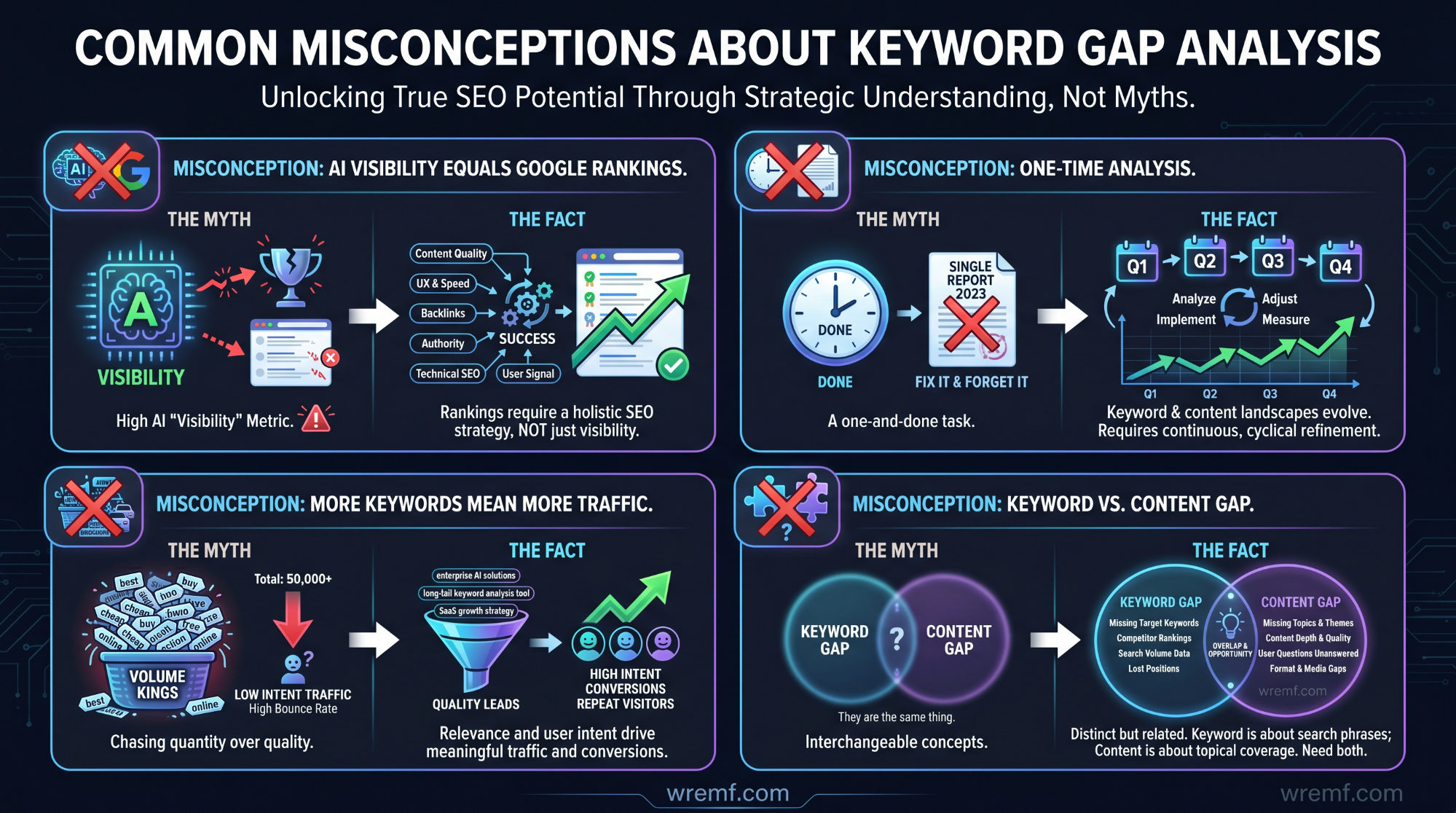
MYTH: If you rank well in Google, you will automatically appear in AI-generated answers for the same topics.
FACT: AI engines select sources based on their own criteria, which include content quality, topical depth, and structural clarity but are not simply a mirror of Google rankings. A site ranking in position one for a keyword may not be cited in ChatGPT or Perplexity responses about that topic. Conversely, a site in position eight with well-structured, authoritative content may appear in AI answers consistently. AI citation visibility requires dedicated tracking and is separate from standard ranking performance.
MYTH: Keyword gap analysis is a one-time task that produces a permanent content roadmap.
FACT: Keyword gap data reflects a point-in-time snapshot of competitor rankings and your own organic keyword profile. Rankings shift constantly as competitors publish new content, earn or lose backlinks, and update existing pages. A gap analysis completed six months ago may no longer reflect the current competitive landscape accurately. Effective SEO programs run keyword gap analysis on a recurring schedule, typically quarterly, and adjust content priorities as new gaps emerge.
MYTH: More keywords always mean more traffic. Targeting every gap keyword will grow organic traffic.
FACT: Traffic growth from keyword gap analysis depends on relevance, intent match, content quality, and domain authority, not on volume of keywords targeted. A large list of gap keywords without intent classification and priority filtering often leads to content creation that attracts low-quality traffic or no traffic at all. Prioritising fewer keywords with clear intent alignment, appropriate difficulty, and business relevance produces better organic traffic outcomes than attempting to close every gap simultaneously.
MYTH: Keyword gap analysis and content gap analysis are the same thing.
FACT: Keyword gap analysis identifies specific search terms your competitors rank for that your site does not. Content gap analysis identifies missing topics, subject areas, or intent layers in your content architecture. They are related but distinct. A keyword gap points to a missing term. A content gap points to a missing branch of your content strategy. Addressing a content gap typically requires more than adding a keyword to an existing page.
MYTH: You only need to analyse your most obvious competitors.
FACT: In many industries, the domains that hold keyword rankings for your target terms are not always direct product competitors. Publishers, media sites, comparison platforms, aggregators, and niche blogs often hold significant keyword rankings that your direct competitors do not. A thorough keyword gap analysis should include a review of the top-ranking domains across your target search terms, not just the companies selling the same product as you.
KEY TAKEAWAY: The most common mistakes in keyword gap analysis, treating rankings as AI citation proxies, running one-time analyses, targeting keywords without intent filtering, and missing non-competitor ranking domains, all produce weaker results than a structured, regularly updated gap analysis framework that accounts for the full complexity of modern search and AI visibility.
Conclusion
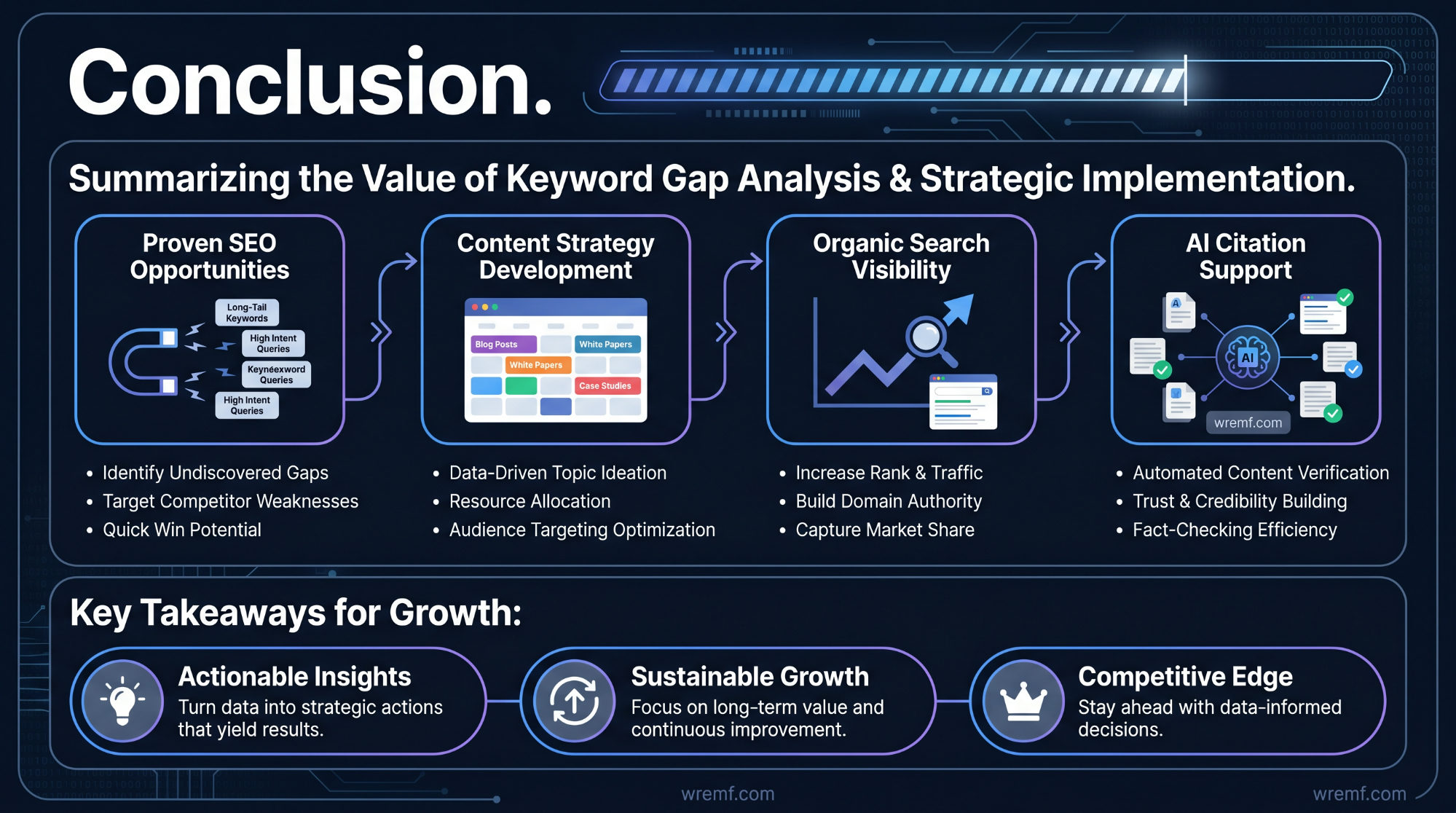
Keyword gap analysis remains one of the most reliable methods for identifying proven SEO opportunities, building a content strategy grounded in competitive reality, and improving organic search visibility in a systematic way. When executed with intent classification, priority filtering, and regular schedule reviews, it produces a content roadmap that reflects actual search demand rather than assumption. For teams operating in markets where AI engines are increasingly shaping buyer discovery, the value of keyword gap analysis extends further: the topical authority and content depth it builds are the same foundations that support AI citation visibility. If your team is ready to track not just where your content ranks in Google Search but also where it appears in AI-generated answers across ChatGPT, Perplexity, Gemini, and beyond, the LLM SEO services guide covers the next layer of the strategy. To add AI visibility tracking to your existing SEO program, explore WREMF pricing plans and find the plan that fits your team's current scale and execution model.
Frequently Asked Questions About Keyword Gap Analysis
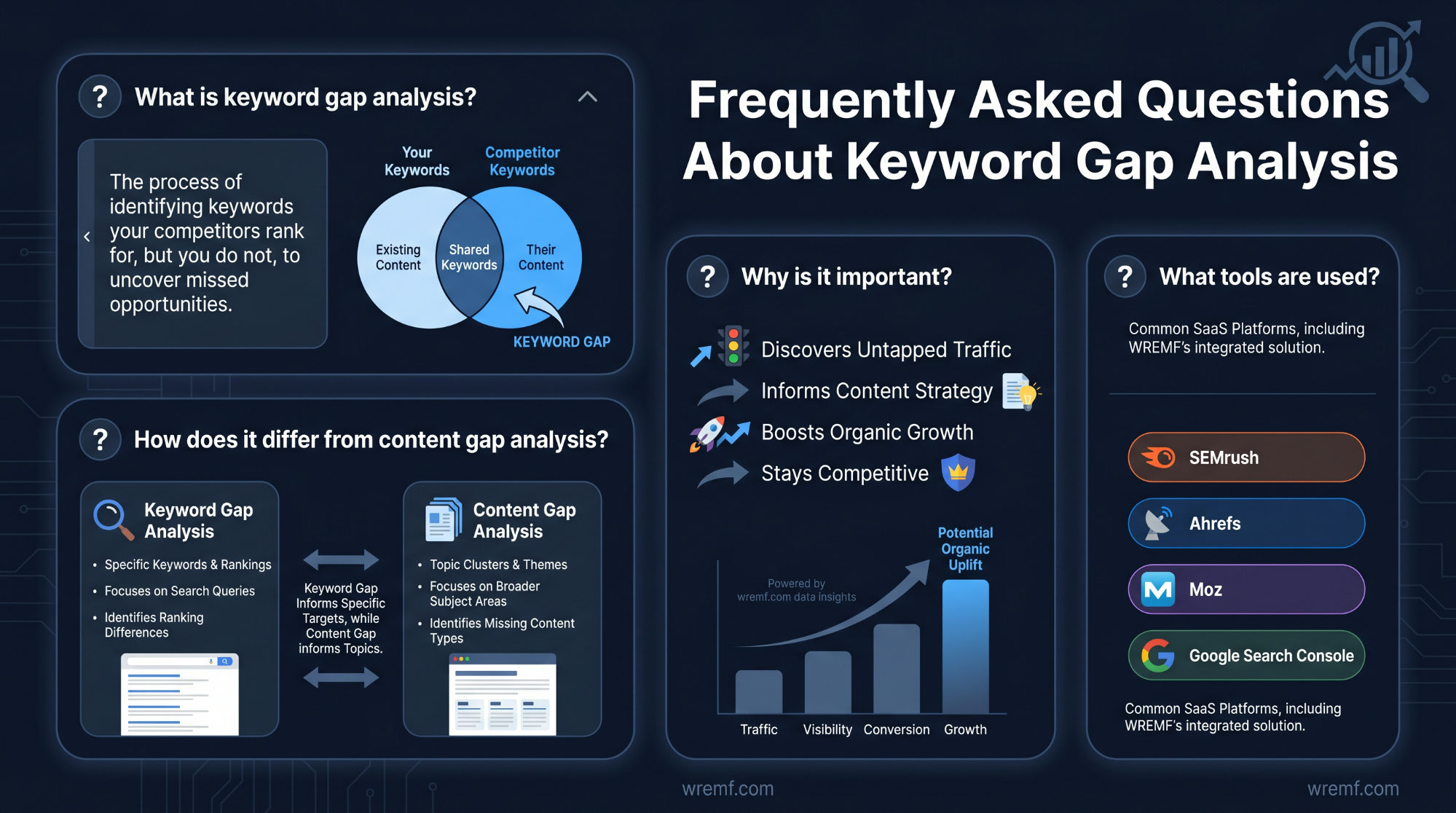
What is keyword gap analysis?
Keyword gap analysis is the process of identifying keywords that your competitors rank for in search results but your website does not. By comparing your keyword rankings against those of competing domains, you can uncover missed opportunities in organic search, content strategy, and SEO planning. The goal is to find high-value search terms where competitors are already capturing traffic that your site could be targeting. Keyword gap analysis is a foundational step in competitive SEO strategy and is commonly used to prioritise content creation, optimise existing pages, and improve overall search visibility.
Why is keyword gap analysis important for SEO strategy?
Keyword gap analysis is important because it reveals where competitors are outperforming your site and why. Rather than guessing which topics to cover, keyword gap analysis gives you data-driven evidence of exactly which search terms are driving traffic to competing domains. This allows SEO teams to allocate content creation resources more efficiently, close visibility gaps, and improve organic rankings on terms that already have proven search demand. For B2B teams, identifying these gaps early can directly improve organic traffic, lead generation, and content ROI.
How does keyword gap analysis differ from content gap analysis?
Keyword gap analysis focuses specifically on identifying missing or underperforming keywords compared to competitor domains. Content gap analysis is a broader process that examines which topics, questions, and content types competitors cover that you do not, regardless of specific keyword targeting. In practice, a keyword gap identifies a missing search term, while a content gap identifies a missing piece of content or topic cluster. Both are closely related, and a thorough SEO strategy typically combines both. Tools like Ahrefs, SEMrush, and Moz Pro support both types of analysis within their competitive research features.
What are the main benefits of performing a keyword gap analysis?
The primary benefits of keyword gap analysis include discovering untapped keyword opportunities, identifying content topics with proven search demand, understanding competitor ranking strategies, improving search engine results page visibility, and prioritising SEO efforts based on traffic potential and keyword difficulty. Secondary benefits include strengthening content strategy, improving internal linking by identifying missing cluster content, and uncovering long-tail keywords that competitors rank for but that are easier to target. Teams that perform regular keyword gap analysis tend to close organic traffic deficits faster than those relying on keyword research alone.
How do you perform a keyword gap analysis step by step?
A standard keyword gap analysis follows these steps. First, identify your primary competitors by searching for your target keywords in Google and noting the top-ranking domains. Second, enter your domain and competing domains into a keyword gap tool such as SEMrush, Ahrefs, or Moz Pro. Third, filter the results to show keywords where competitors rank but your domain does not, or where competitors hold significantly higher ranking positions. Fourth, evaluate each keyword by search volume, keyword difficulty, and search intent. Fifth, prioritise keywords that align with your content strategy and business goals. Finally, create or optimise content to target the identified keyword opportunities.
How can I find keywords my competitors rank for that I am not targeting?
The most reliable approach is to use a dedicated keyword gap analysis tool. Platforms such as SEMrush, Ahrefs, Moz Pro, and Mangools allow you to enter your domain alongside competitor domains and generate a comparison report showing keywords where competitors rank and your domain does not appear. You can filter results by search volume, keyword difficulty, ranking position, and SERP features to identify the most valuable opportunities. Google Search Console can supplement this research by showing which queries your site already receives impressions for, helping you identify where ranking gaps are widest.
What is the difference between a keyword gap and a content gap?
A keyword gap refers specifically to a search term your competitors rank for that your site does not target or rank for. A content gap refers to a topic, question, or content category that competitors address but your site does not cover at all. Every content gap creates keyword gaps, but not every keyword gap reflects a content gap. Sometimes a keyword gap exists because an existing page is underoptimised rather than because the topic is missing entirely. Addressing keyword gaps often requires either creating new content or improving existing pages, depending on whether the underlying topic is already covered on your site.
Why do competitors rank higher than my site even when we cover the same topics?
Competitors often rank higher because of differences in content depth, content structure, domain authority, backlink profiles, internal linking, page authority, and how well their content matches search intent. Keyword gap analysis helps identify which specific terms competitors rank for at higher positions, but a full competitive analysis also requires examining content quality, SERP features being captured, ranking page structure, and technical SEO factors. According to Google's documentation on how search works, relevance, authority, and usability all influence ranking positions, meaning keyword targeting alone is insufficient without supporting these signals.
What tools are used for keyword gap analysis?
Common keyword gap analysis tools include SEMrush, Ahrefs, Moz Pro, Mangools, and Similarweb. SEMrush offers a dedicated Keyword Gap tool that compares up to five domains simultaneously and shows shared, missing, weak, strong, and unique keywords. Ahrefs provides similar competitive comparison functionality within its Content Gap report. Moz Pro includes Domain Authority and keyword ranking comparison features. Mangools offers KWFinder and SERPWatcher for keyword research and ranking tracking. Similarweb provides its own Keyword Gap Analysis tool focused on traffic data and market segments. Google Search Console and Google Keyword Planner remain useful supplementary tools for validating keyword performance and search volume data.
How do I choose the right competitors to analyse in a keyword gap analysis?
Focus on domains that rank for the same target keywords you are pursuing, not necessarily your direct business competitors. Search your core product or service keywords in Google and identify the domains that consistently appear in the top positions. These are your SEO competitors. In addition, use a keyword gap tool to identify which domains overlap most with your current keyword rankings, as these represent your closest search competitors. For local competitors, consider filtering results by location within your keyword gap tool. Analysing three to five competitor domains typically provides enough data without creating unmanageable keyword lists.
What is keyword gap analysis in PPC campaigns?
In paid search, keyword gap analysis identifies keywords that competitors are bidding on in Google Ads or other paid search platforms that your campaigns are not targeting. This allows PPC teams to identify missed paid keyword opportunities, adjust bidding strategies, and improve search campaign coverage. Tools such as SEMrush and Ahrefs provide paid keyword data alongside organic keyword data, making it possible to run keyword gap analysis for both organic search and paid campaigns simultaneously. Applying keyword gap analysis to PPC campaigns can improve ad coverage, reduce wasted spend, and capture high-intent search terms already proven to convert for competitors.
How does search intent affect keyword gap analysis?
Search intent determines whether a keyword gap is worth closing. A keyword may have high search volume, but if the intent behind it does not match your content or business goals, ranking for it may not improve conversion rates or qualify organic traffic. When reviewing keyword gap results, categorise keywords by intent type: informational, navigational, commercial, or transactional. Prioritise keywords where your content or product pages can genuinely satisfy the query. Mismatched search intent is a common reason why pages rank but do not convert, so aligning content strategy with intent signals is essential for turning keyword gap analysis into meaningful SEO results.
How do long-tail keywords fit into a keyword gap analysis?
Long-tail keywords are often the most actionable findings in a keyword gap analysis. These are lower-volume, more specific search terms that competitors rank for and that your site is not targeting. Long-tail keywords typically have lower keyword difficulty, making them easier to rank for, and they often carry stronger commercial or transactional intent. A thorough keyword gap analysis should include filtering for long-tail keyword opportunities alongside broader head terms, as long-tail keyword clusters can collectively drive significant organic traffic and improve overall ranking distribution. Content briefs built around long-tail keyword clusters are one of the most practical outputs of a keyword gap analysis.
How do SERP features affect keyword gap analysis priorities?
SERP features such as featured snippets, AI Overviews, People Also Ask boxes, and local packs affect which keywords are worth prioritising in a keyword gap analysis. A keyword with high search volume but dominated by SERP features may deliver fewer clicks to organic listings. Conversely, a keyword gap where a competitor holds a featured snippet represents a high-value opportunity to capture that position through structured, answer-first content. When reviewing keyword gap results, analysing the SERP landscape for each keyword helps determine realistic traffic potential and informs content structure decisions.
What role does domain authority play in keyword gap analysis?
Domain Authority, as defined by Moz Pro, and similar metrics from Ahrefs and SEMrush estimate how likely a domain is to rank in search engine results pages relative to competing domains. In keyword gap analysis, understanding the domain authority of competitors helps you evaluate which keyword gaps are realistically closeable in the near term. If a competitor with significantly higher domain authority ranks for a keyword, closing that gap may require both content optimisation and authority development through backlink acquisition. Keyword gap analysis works best when combined with an honest assessment of your domain's current competitive position relative to the domains you are analysing.
How often should keyword gap analysis be performed?
Keyword gap analysis should be performed at regular intervals rather than as a one-time exercise. Competitor content strategies, search engine algorithms, and SERP rankings change continuously, meaning new keyword gaps open and existing ones close over time. A quarterly keyword gap analysis is a common cadence for active SEO programs. Teams in highly competitive industries or those running ongoing content creation programs may benefit from monthly keyword gap reviews. Integrating keyword gap analysis into your SEO reporting workflow ensures that content priorities remain aligned with current ranking opportunities rather than outdated competitive data.
What is the Similarweb Keyword Gap Analysis tool?
Similarweb's Keyword Gap Analysis tool allows users to compare keyword overlaps and gaps across multiple domains using Similarweb's traffic and search data. It shows which keywords drive traffic to competitor websites that are not present in your own keyword rankings, and supports filtering by industry, market segments, and traffic data. As a research tool, it provides a complementary perspective to tools like SEMrush and Ahrefs, particularly for understanding traffic share and market-level competitive intelligence. Similarweb's tool is especially useful for understanding broader market keyword distributions rather than granular ranking position data.
How can keyword gap analysis improve content strategy?
Keyword gap analysis directly informs content strategy by identifying which topics, questions, and search terms are already generating traffic for competitors but are absent from your site. This transforms content planning from intuition-based decisions into evidence-based prioritisation. Keyword gap findings can be used to plan new pillar pages, fill cluster content gaps, update underperforming pages, and build FAQ systems around common search queries. According to McKinsey's insights on AI and digital strategy, data-driven decision-making consistently outperforms intuition-based approaches in competitive markets, and content strategy is no exception.
How do I turn keyword gap analysis findings into higher rankings and more organic traffic?
After identifying keyword gaps, the next step is translating findings into a content and optimisation roadmap. Prioritise keywords by a combination of search volume, keyword difficulty, traffic potential, and search intent alignment. Create new content for topics not currently covered on your site. Optimise existing pages for keywords where you already have rankings but trail competitors. Use keyword clusters to group related terms into logical content units. Build internal linking structures to support new and updated pages. Track ranking positions using a tool like SERPWatcher or SEMrush Position Tracking to measure progress over time. For teams looking to accelerate execution, WREMF's content brief generator supports AI-ready content planning built around competitive keyword data.
Can keyword gap analysis be combined with AI search visibility tracking?
Yes. Traditional keyword gap analysis focuses on Google Search rankings, but AI-driven discovery systems such as ChatGPT, Perplexity, Claude, and Google AI Overviews are increasingly influencing how buyers find information. As noted in the Google AI Blog, AI Overviews and AI-powered search experiences are reshaping organic search behaviour significantly. A comprehensive competitive visibility strategy now requires tracking not only which keywords competitors rank for in traditional SERPs but also which brands and sources are being cited and recommended across AI engines. WREMF's competitive landscape tracking extends keyword gap thinking into AI search by monitoring how brands appear across 10 AI discovery surfaces, helping teams identify AI citation gaps alongside traditional keyword ranking gaps.
What is AI share of voice and how does it relate to keyword gap analysis?
AI share of voice measures how frequently your brand is mentioned, cited, or recommended in AI-generated answers relative to competitors across platforms like ChatGPT, Perplexity, Claude, and Google AI Overviews. It is the AI search equivalent of keyword ranking share in traditional SEO. Just as keyword gap analysis identifies missing ranking opportunities in Google Search, AI share of voice analysis identifies where competitors are gaining visibility in AI-generated responses that your brand is not. As VentureBeat's AI coverage frequently reports, AI search behaviour is growing rapidly, making AI share of voice an increasingly important complement to traditional keyword gap analysis for B2B marketing and SEO teams.
When should a team use software, an agency, or a hybrid model for keyword gap analysis and AI visibility?
Software-only solutions suit teams with strong in-house SEO and content execution capabilities who need data, tracking, and reporting tools to run their own analysis. Agency services are better suited for teams that lack the internal capacity to interpret findings, build content strategies, and implement recommendations at scale. A hybrid model combines visibility tracking software with expert strategic execution and ongoing optimisation support, which is particularly valuable for B2B brands managing complex competitive landscapes or expanding into AI search visibility alongside traditional SEO. WREMF supports all three models, offering software plans starting at €59 per month through to fully managed AI visibility and SEO execution services for teams that need senior-led strategy and implementation.
How does WREMF support keyword gap analysis and competitive SEO strategy?
WREMF is purpose-built for AI search visibility tracking, but its competitive intelligence capabilities directly complement traditional keyword gap analysis. WREMF tracks how your brand and competitors appear across 10 AI engines, monitors citation sources, measures AI share of voice, and identifies content and citation gaps that affect AI-generated recommendations. For teams running keyword gap analysis as part of a broader competitive strategy, WREMF adds the AI search layer that standard SEO tools do not cover. Teams that want both software tracking and expert execution can access WREMF's managed AI visibility and GEO agency services, which include competitive analysis, content optimisation, citation gap remediation, and ongoing monitoring.
What is the difference between keyword gap analysis and a full competitive SEO analysis?
Keyword gap analysis is one component of competitive SEO analysis. A full competitive SEO analysis also includes examining competitor backlink profiles, domain authority, site structure, content depth, SERP feature capture, technical SEO health, internal linking strategies, and page-level performance data. Keyword gap analysis answers the question of which search terms competitors rank for that you do not. Full competitive SEO analysis answers why competitors outperform you overall and what combination of improvements across content, authority, technical SEO, and targeting would close the performance gap. Keyword gap analysis is typically the starting point for competitive research because it generates the most immediate, actionable content priorities.
How do I track whether keyword gap analysis improvements are working?
Track improvements by monitoring ranking positions for the target keywords you identified through keyword gap analysis. Tools like SEMrush Position Tracking, SERPWatcher, and Ahrefs rank tracking allow you to monitor ranking movements over time. Connect ranking data to organic traffic changes using Google Analytics and Google Search Console to confirm whether improved rankings are translating into traffic growth. Track conversion rates and pages per session for newly ranked content to evaluate quality of the organic traffic being captured. For teams also optimising for AI search, WREMF's AI Visibility Index provides a parallel measurement layer tracking how brand visibility changes across AI engines as content and authority improvements take effect.
Related reading
- The Complete Guide to Keyword Monitoring for SEO, Brand Visibility, and AI Search
- The Complete Guide to Search Engine Marketing Software for B2B Teams and Agencies
- AI Search Engine Optimization Tools: The Complete 2026 Guide for AI Search, SEO, AEO, and GEO
- AI Overviews Tracker: The Complete Guide to Monitoring Google AI Overviews, Citations, and AI Search Visibility