AI Brand Tracking Agency: The Complete Guide to Choosing the Right Partner for AI Visibility, Brand Monitoring, and Search Performance
Discover how to choose an AI brand tracking agency to enhance visibility and performance in AI-generated responses and search engines.
By WREMF Team · 2026-09-20
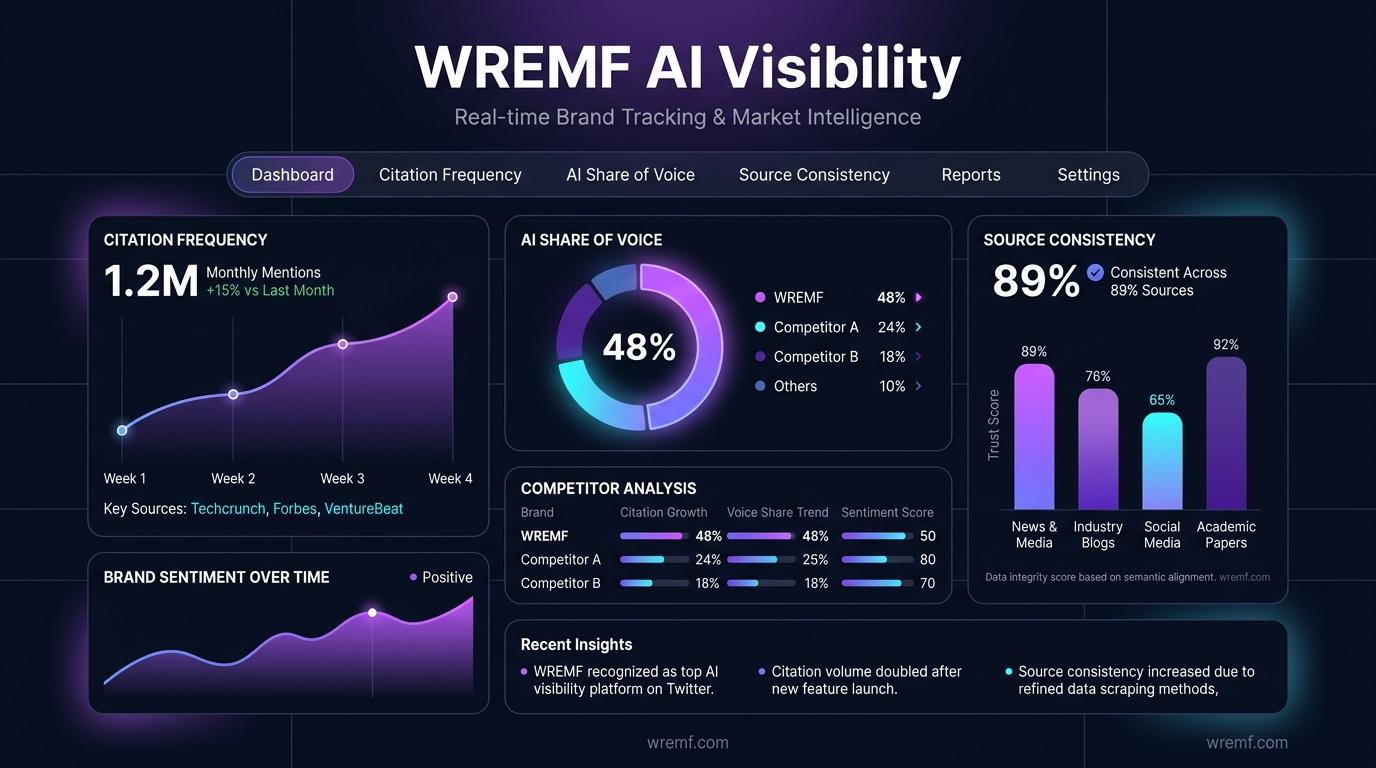
An AI brand tracking agency is a specialized partner that monitors a brand’s visibility, recommendation, and citation across AI engines like ChatGPT, Perplexity, and Google AI Overviews. These agencies track prompt mentions, share of voice, and sentiment within AI-generated responses. They help brands measure AI presence, enhance visibility, and identify gaps where competitors may excel. Understanding which agency type suits your business stage can optimize decision-making and improve brand performance in the evolving landscape of AI search engines.
Key takeaways
- AI brand tracking consists of survey-based, social monitoring, and AI visibility tracking.
- AI-generated responses are critical for brand discovery in the B2B buying journey.
- Effective AI tracking measures citation frequency and AI share of voice.
- Choosing the right agency depends on company stage and monitoring needs.
- AI brand tracking agencies should provide methodology transparency and competitive benchmarking.
AI Brand Tracking Agency: The Complete Guide to Choosing the Right Partner for AI Visibility, Brand Monitoring, and Search Performance
An AI brand tracking agency is a specialist partner that monitors, measures, and improves how a brand appears across AI-generated answers, large language models, traditional search engines, and digital discovery surfaces. Brand visibility has expanded well beyond Google rankings and social media dashboards. Buyers are now researching vendors, products, and comparisons directly inside ChatGPT, Perplexity, Gemini, Claude, and Google AI Overviews before they ever visit a website. This guide is written for B2B SaaS founders, heads of marketing, SEO teams, agency leaders, and growth teams who need to understand what AI brand tracking covers, how to evaluate agencies and tools, and how platforms like WREMF fit into a modern brand tracking program. The sections below cover the three types of brand tracking, the metrics that matter, how to match an agency to your company stage, and where AI visibility fits into the full picture.
QUICK ANSWER:
An AI brand tracking agency monitors how a brand is mentioned, cited, compared, and recommended across AI search engines, large language models, and generative answer surfaces such as ChatGPT, Perplexity, Gemini, Google AI Overviews, and Copilot. These agencies combine prompt tracking, citation analysis, AI share of voice measurement, and brand sentiment monitoring to help teams understand and improve their presence in AI-generated responses.
KEY TAKEAWAYS:
- AI brand tracking now covers three distinct layers: survey-based brand health tracking, social and media monitoring, and AI visibility and citation tracking across large language models
- ChatGPT processes roughly 1.6 billion daily queries, making AI-generated responses a significant discovery surface that brand tracking programs must include
- Traditional brand tracking tools such as Kantar and survey-based trackers measure awareness and perception but do not measure whether a brand appears in AI answers
- AI visibility tracking measures citation frequency, AI share of voice, source consistency, and prompt-level brand mentions across engines including ChatGPT, Gemini, Perplexity, and Google AI Overviews
- WREMF provides AI brand monitoring as software, a managed service, or a combined hybrid model that covers prompt tracking, citation tracking, competitor visibility, and AI share of voice across 10 AI engines
- No platform or agency can guarantee that an AI engine will recommend a brand, but structured tracking and GEO execution can meaningfully improve citation presence over time
Three Types of Brand Tracking Agencies and What Each Actually Measures
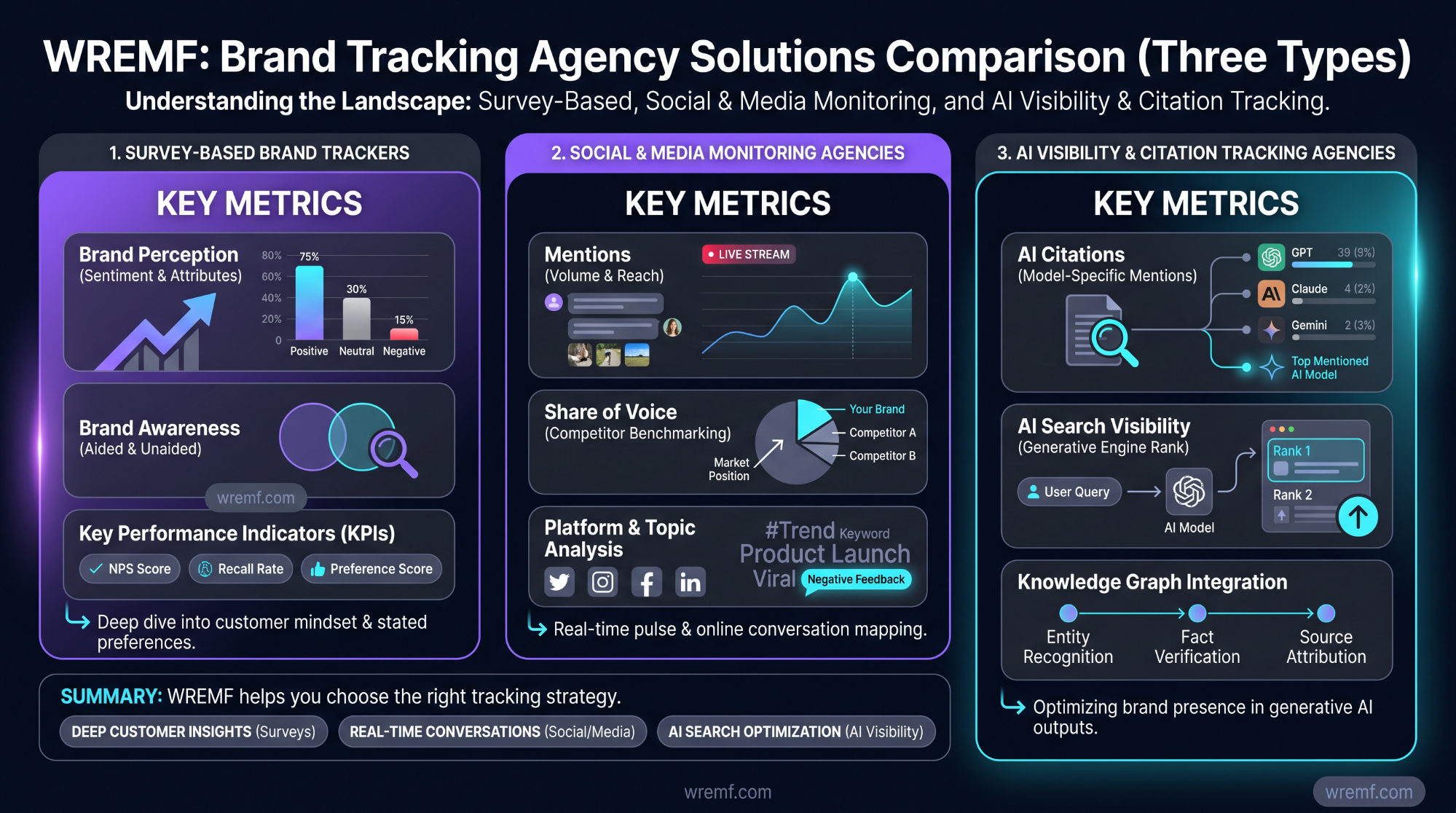
Brand tracking agencies operate across three distinct disciplines, and most teams need to understand which layer they are buying before they sign a contract. The three types are survey-based brand trackers, social and media monitoring agencies, and AI visibility and citation tracking agencies. Each measures a different signal, operates on a different data cadence, and produces a different kind of insight.
Survey-Based Brand Trackers
Survey-based tracking measures consumer awareness, brand perception, consideration, loyalty, brand equity, and mental availability. Agencies in this category, including Kantar and similar firms, use structured panel surveys to track how target audiences think and feel about a brand relative to competitors. YouGov, for example, surveys its panel daily across 16 brand health metrics and benchmarks results against more than 27,000 brands in the US market alone. Survey-based tracking produces rich perception data and longitudinal brand health benchmarks, but it measures human recall and attitude, not digital discovery. A brand can score well on awareness surveys while being completely absent from AI-generated responses.
Key metrics from survey-based tracking include aided and unaided awareness, brand consideration, purchase intent, net promoter-style loyalty measures, and brand reputation scores. Survey Design quality matters enormously here. Poorly designed surveys produce misleading brand metrics that do not reflect actual consumer behavior in the market. For teams managing multi-market programs, survey-based tracking also provides a consistent methodology for comparing brand performance across regions.
Social and Media Monitoring Agencies
Social and media monitoring agencies track brand mentions, sentiment analysis, social sentiment, coverage volume, influencer activity, and media exposure across social media platforms, news sources, forums, and digital publications. These agencies use tools that index large volumes of real-time data to surface brand mentions, measure tone, and flag reputational risks. Media monitoring at this level can track over 1.2 billion sources in some platforms, providing broad coverage of where a brand appears in earned and owned media.
Social listening tools in this category include capabilities for sentiment analysis, competitive benchmarking, Share of voice across digital channels, and market dynamics tracking. The limitation is that social and media monitoring measures brand mentions in human-generated content and editorial coverage. It does not measure whether AI engines are citing the brand as a recommended source, which sources AI engines are using to form their answers, or how a brand compares to competitor domains inside AI-generated responses.
AI Visibility and Citation Tracking Agencies
AI visibility and citation tracking agencies measure how AI search engines, large language models, and generative answer surfaces mention, cite, compare, and recommend a brand across relevant prompts. This is the newest and fastest-growing category of brand tracking. Agencies and platforms in this space track citation frequency, AI citation share, AI share of voice, source consistency, prompt-level brand mentions, and entity authority across engines including ChatGPT, Gemini, Perplexity, Google AI Overviews, Claude, Copilot, DeepSeek, Grok, Meta AI, and Mistral.
WREMF sits in this third category, providing AI brand monitoring as software, managed service, and hybrid execution. Teams using WREMF's AI brand monitoring guide can understand how to structure a monitoring program that covers all major AI surfaces.
KEY TAKEAWAY: Survey-based tracking measures perception, social monitoring measures mentions, and AI visibility tracking measures citations inside AI-generated responses. A complete brand tracking program needs all three layers, because each measures a fundamentally different signal.
Why AI Visibility Belongs in Every Brand Tracking Program
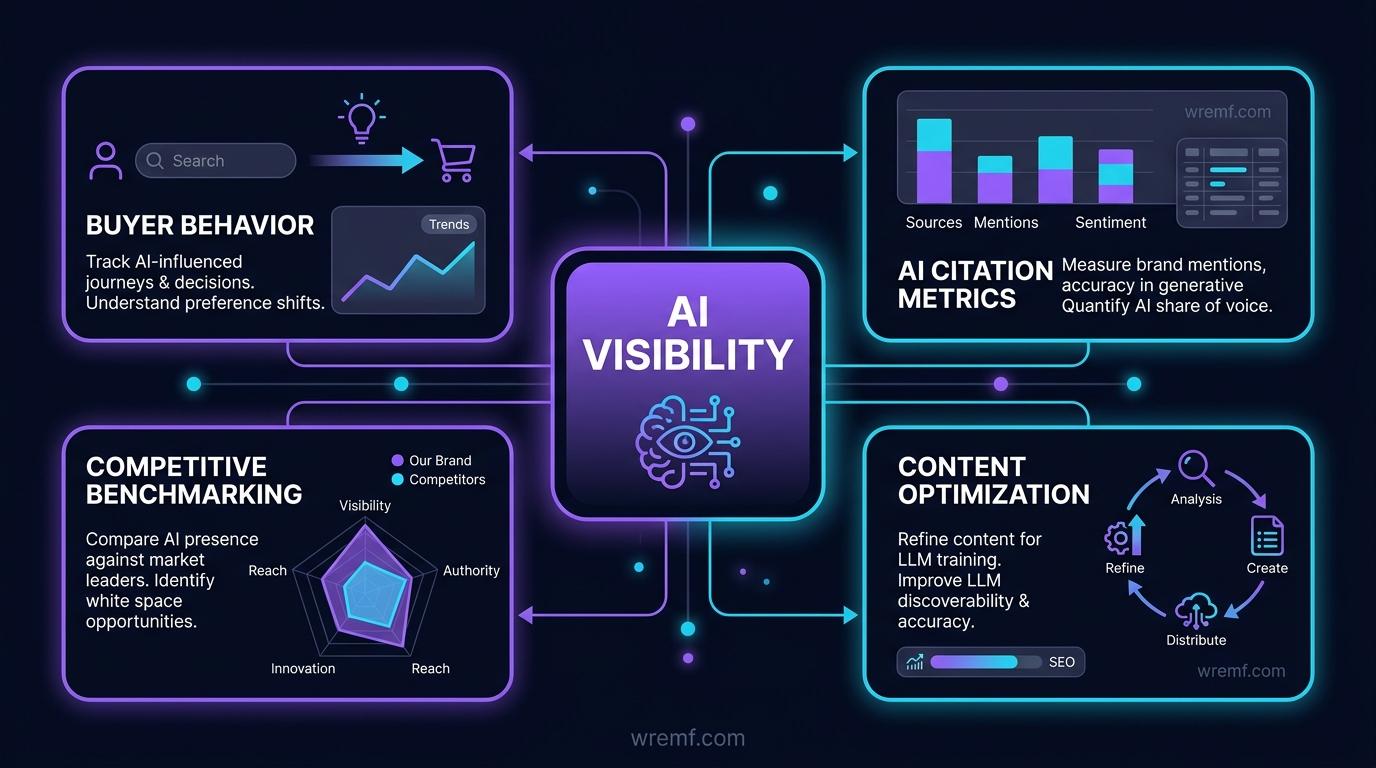
AI-generated responses are now an active discovery channel for B2B buyers, and brand tracking programs that ignore this surface are producing an incomplete picture of brand performance. ChatGPT processes roughly 1.6 billion daily queries, which represents approximately 12 percent of Google's total search volume. Perplexity handles around 50 million queries per week. Google's AI Overviews now appear across a significant share of search results, meaning that even traditional Google search is partially mediated by AI-generated summaries.
For B2B brands, this matters because buyers use AI answers to shortlist vendors, compare products, understand category options, and form purchasing intent before they visit any website. A brand that appears consistently in AI-generated responses across relevant prompts gains trust, consideration, and traffic that does not register as standard organic sessions in Google Analytics. Conversely, a brand absent from AI answers while competitors appear consistently is experiencing a visibility gap that no amount of social media monitoring or survey tracking will detect.
According to Google's AI Overviews documentation AI Overviews apply a separate classification layer from standard organic results, which means standard SEO ranking reports do not capture AI Overview presence. This separation is exactly why dedicated AI brand tracking is necessary rather than optional.
The practical implication is that brand tracking programs built entirely on survey data, social listening, and keyword rankings are now operating with a structural blind spot. AI citation tracking fills that gap by measuring whether the brand is present, which sources AI engines favour, how competitors compare in AI responses, and how citation frequency changes over time as content and authority signals evolve.
For brands running Answer Engine Optimization or Generative Engine Optimization programs, AI brand tracking provides the measurement layer that connects content improvements to actual citation outcomes. Without it, teams are optimising without a feedback loop. As covered in the complete guide to answer engine optimisation | https://wremf.com/blog/answer-engine-optimization-the-complete-guide-to-aeo-ai-search-visibility-and-answer-first-content, the relationship between content structure, entity authority, and AI citation presence is direct and measurable.
DID YOU KNOW:
ChatGPT processes roughly 1.6 billion daily queries, approximately 12 percent of Google's total search volume, making AI search engines a material discovery surface for B2B brands tracking where buyers form vendor preferences.
KEY TAKEAWAY: AI-generated responses are now an active part of the B2B buying journey, and brand tracking programs that measure only survey data, social sentiment, and keyword rankings are missing how buyers discover and evaluate brands inside AI answers.
What Makes an AI Brand Tracking Agency Worth Hiring
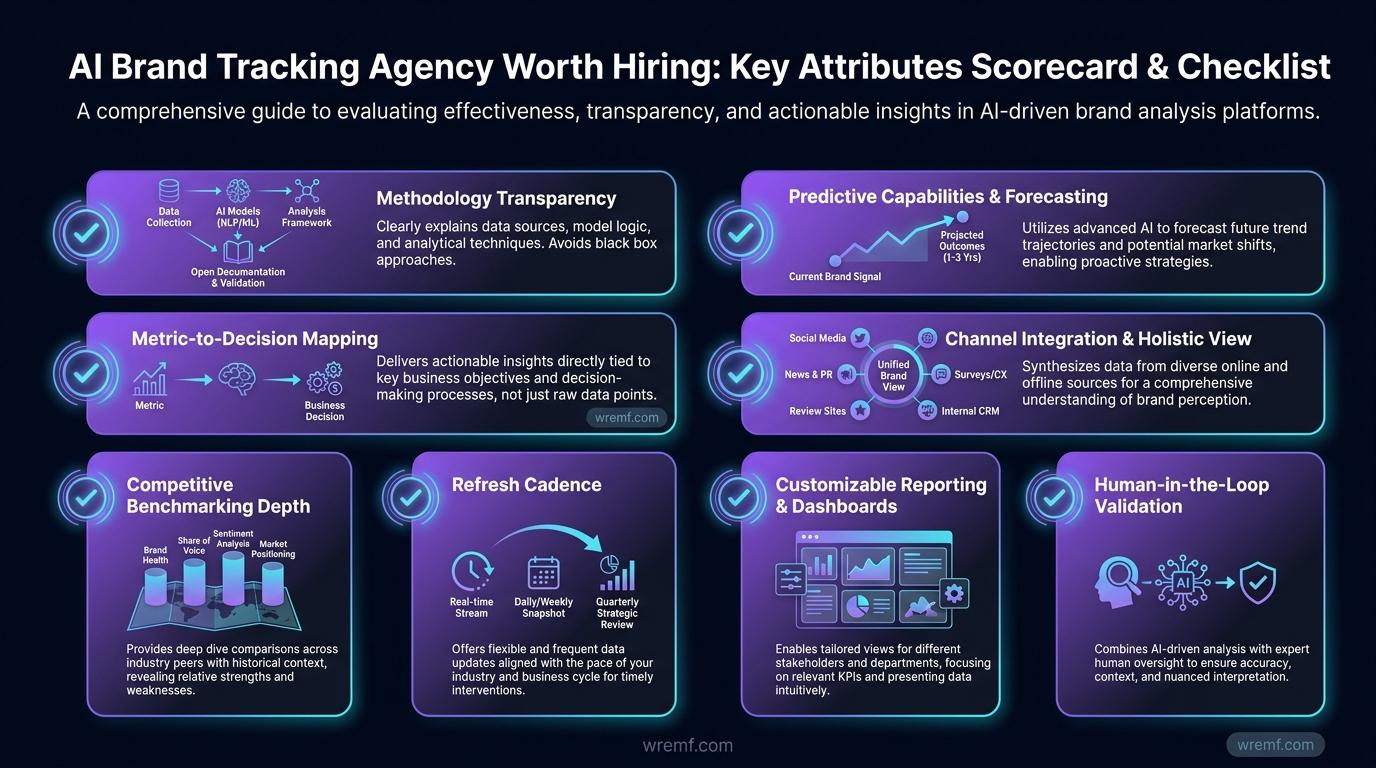
Not every agency or platform that claims AI brand tracking capability delivers the depth or accuracy that B2B teams need. Four attributes separate credible AI brand tracking agencies from vendors that apply surface-level AI monitoring to an otherwise conventional social listening or SEO reporting product.
Methodology Transparency
A credible AI brand tracking agency explains exactly how it sends prompts to AI engines, how it structures prompt sets to cover buyer journeys, how often it runs queries, and how it normalises results across different AI engines that respond differently to the same query. Without methodology transparency, a brand tracking report is unverifiable. Teams cannot distinguish between a genuine citation improvement and a change driven by prompt wording, engine update, or sampling frequency. Platforms that report citation frequency without explaining how prompts were constructed and how many times they were run produce perception data that cannot support decisions.
Metric-to-Decision Mapping
AI brand tracking data is only useful if it connects to a decision. Strong agencies map their metrics to specific actions: if AI citation share drops, which content gaps explain the drop; if competitors appear more frequently in AI-generated responses, which sources are driving that visibility; if entity authority is weak in a particular AI engine, what structured data or content changes would address it. Agencies that deliver dashboards full of metrics without explaining what each metric means for the brand's next move are producing reporting that consumes budget without improving performance.
Competitive Benchmarking Depth
AI share of voice is a relative metric. Knowing that a brand appears in 40 percent of relevant AI-generated responses means little without knowing whether competitors appear in 60, 70, or 80 percent of the same prompts. Strong AI brand tracking agencies track competitor domains systematically across the same prompt sets, allowing teams to see where they are winning AI citation battles and where visibility gaps exist. This competitive benchmarking depth is what turns AI brand monitoring into a strategic planning input rather than a vanity reporting exercise.
Refresh Cadence That Matches Your Decisions
AI responses are not static. AI engines update their source sets, content ingestion pipelines, and weighting models continuously. A brand tracking program that runs monthly prompt sweeps will miss citation changes that happened and reversed within the same month. Weekly or continuous AI monitoring with scheduled tracking gives teams the ability to detect changes as they happen, connect them to content or authority actions taken, and report progress to leadership with confidence. WREMF provides scheduled AI monitoring as part of its core platform, covering 10 AI engines with unlimited prompts across Starter, Growth, and Managed plans.
KEY TAKEAWAY: The best AI brand tracking agencies demonstrate methodology transparency, connect metrics to decisions, benchmark competitors systematically, and run monitoring at a cadence that reflects how quickly AI engine outputs change.
How AI Brand Tracking Differs From Traditional Brand Monitoring Tools
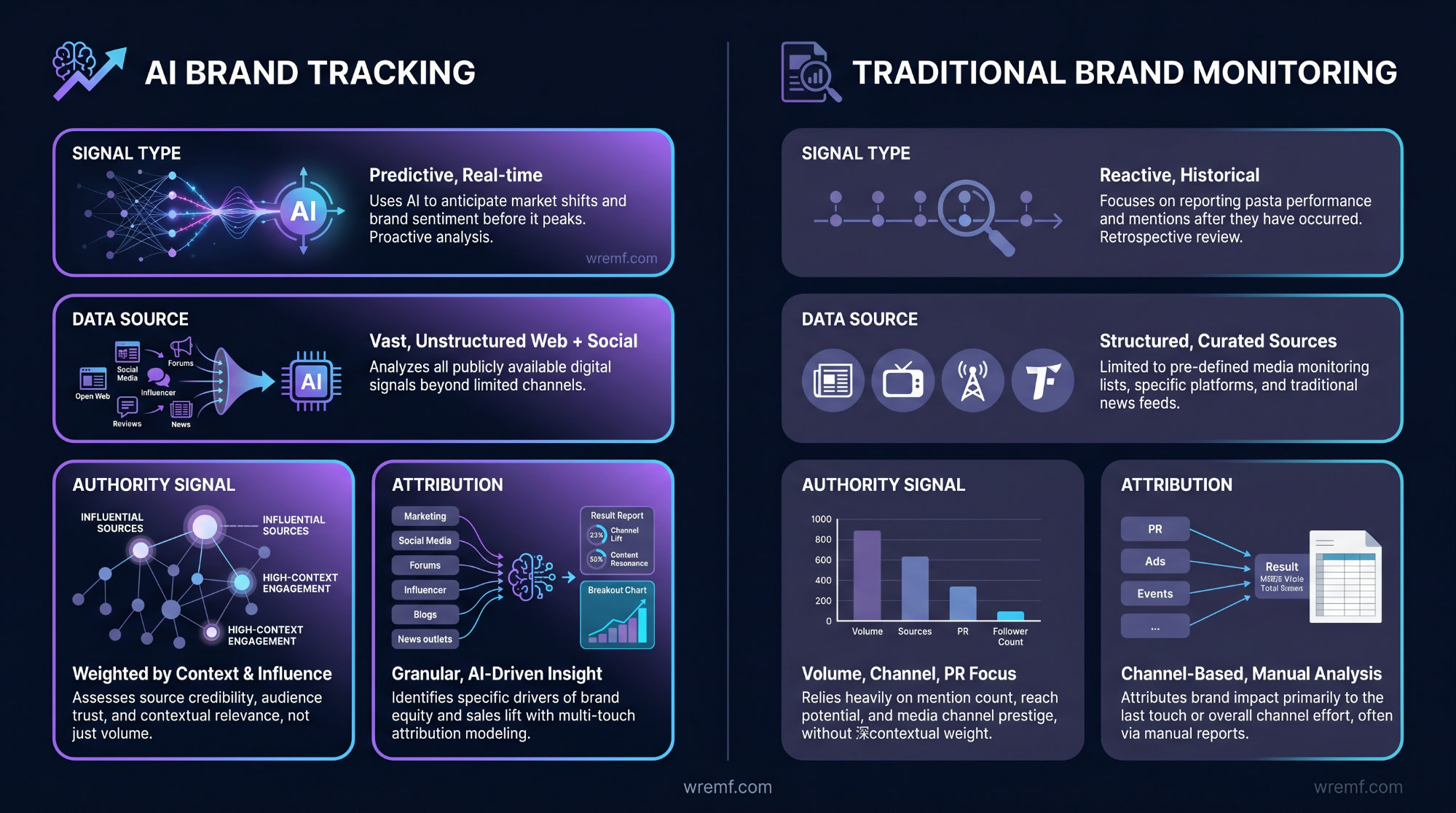
Traditional brand monitoring tools and AI brand tracking platforms measure fundamentally different things, and conflating them leads to gaps in brand performance data. Understanding the difference helps teams choose the right tools, interpret data correctly, and avoid reporting AI visibility with tools built for a different measurement task.
The comparison below illustrates the key differences across dimensions that matter for B2B marketing, SEO, and growth teams.
Primary signal
- Traditional brand monitoring tools: Brand mentions in social media, news, and editorial content
- AI brand tracking platforms: Citations and recommendations in AI-generated responses
Data source
- Traditional brand monitoring tools: Social posts, news articles, forums, and media coverage
- AI brand tracking platforms: AI engine outputs across ChatGPT, Gemini, Perplexity, Google AI Overviews, Claude, Copilot, and others
Authority signal
- Traditional brand monitoring tools: Media reach, mention volume, and social engagement
- AI brand tracking platforms: Source citations in AI answers, entity authority, and source consistency
Competitive view
- Traditional brand monitoring tools: Share of voice in media and social content
- AI brand tracking platforms: AI share of voice across prompt-based discovery
Attribution
- Traditional brand monitoring tools: Media impressions and social reach
- AI brand tracking platforms: AI referral traffic and prompt-level attribution
Audit type
- Traditional brand monitoring tools: Sentiment analysis and media monitoring
- AI brand tracking platforms: GEO audits, AEO audits, and citation gap analysis
Tools like Semrush, SE Ranking, and conventional social listening platforms provide useful data on keyword rankings, backlinks, media coverage, and social sentiment. They are not designed to measure whether a brand appears in AI-generated responses or which sources AI engines favour when answering relevant buyer prompts. WREMF adds the AI visibility layer specifically, tracking how AI engines mention, cite, compare, and recommend brands across prompt-based discovery journeys.
As explained in the WREMF guide to AI search engine optimisation for B2B brands the measurement gap between traditional SEO tools and AI visibility platforms is structural, not cosmetic. It reflects the fundamental difference between search engines that rank pages and AI engines that synthesise answers from sources they select.
IMPORTANT:
Teams that rely solely on Semrush, social listening platforms, or keyword rank trackers to measure brand visibility will not detect whether their brand is being cited, recommended, or excluded from AI-generated answers. AI brand tracking requires a dedicated measurement layer.
KEY TAKEAWAY: Traditional brand monitoring tools measure mentions and rankings. AI brand tracking platforms measure citations, AI share of voice, and source consistency inside AI-generated responses. Both have a role, but they measure different signals and cannot substitute for each other.
Key Metrics That Actually Matter in AI Brand Tracking
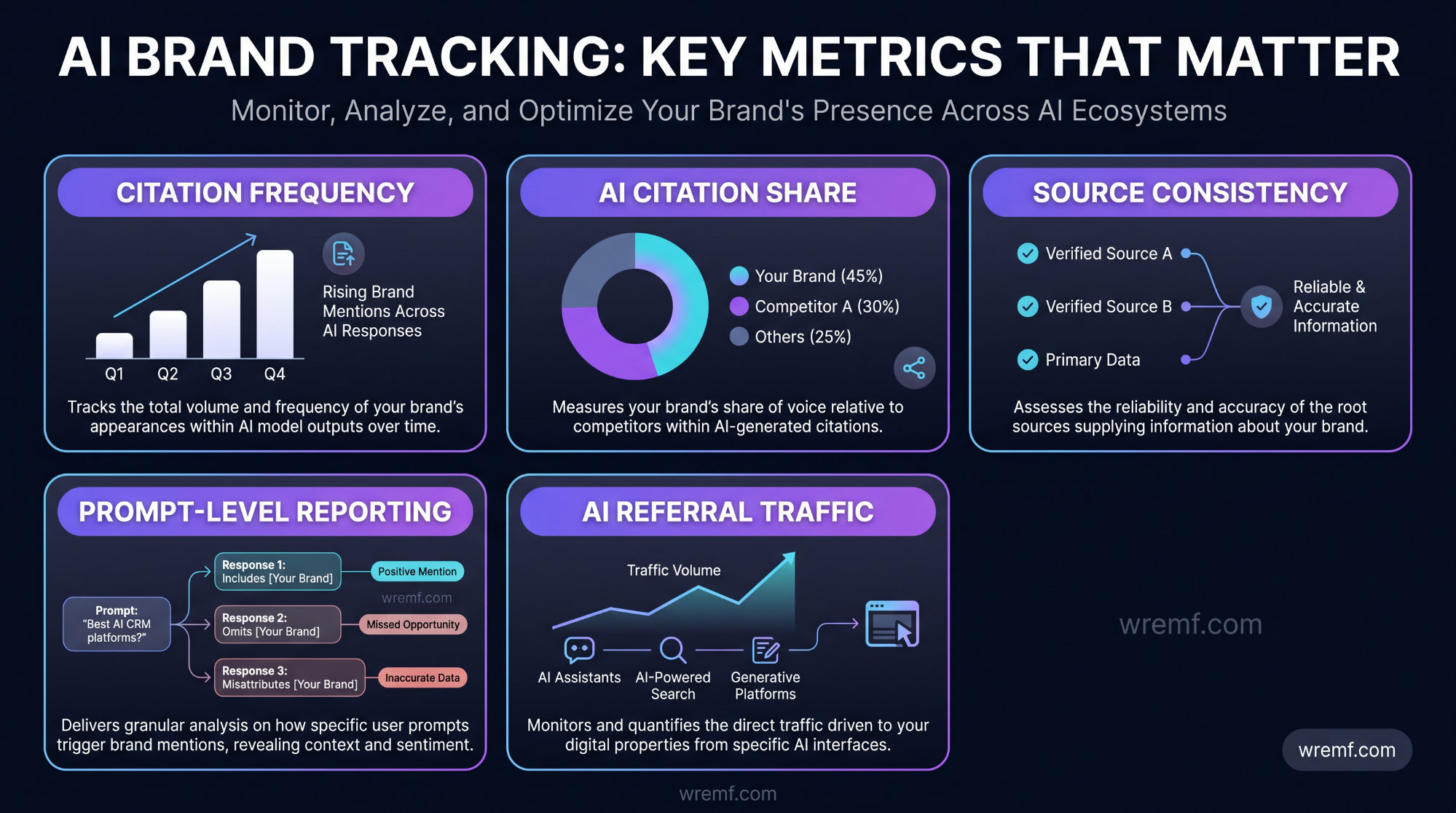
AI brand tracking produces a range of metrics, but not all of them support decisions equally well. Knowing which metrics are worth tracking and which tend to generate noise helps teams focus their reporting and build programs that drive improvement rather than just accumulate data.
Worth Tracking
Citation frequency measures how often a brand appears as a cited or mentioned source across a defined set of prompts over a given time period. Citation frequency is the foundation metric for AI brand monitoring because it shows baseline presence and trend direction. AI citation share, which is citation frequency as a percentage of total citations across the competitive set, shows relative performance and is essential for AI share of voice analysis.
Source consistency measures whether a brand is cited across multiple AI engines for the same topic category or whether it only appears in one engine. Brands with high source consistency across ChatGPT, Gemini, Perplexity, and Google AI Overviews tend to have stronger entity authority and more durable AI visibility. Inconsistent source presence, where a brand appears frequently in one engine but is absent in others, signals gaps in structured data, content coverage, or citation signals that a GEO or AEO program should address.
Prompt-level reporting breaks citation data down by the specific prompts or prompt categories where a brand is mentioned or absent. This is more useful than aggregate citation counts because it shows which topics and buyer intent categories the brand is winning and which it is losing. Competitor domains can then be benchmarked on the same prompt set to identify where specific competitors are displacing the brand in AI responses.
AI referral traffic and AI traffic attribution measure whether AI-generated responses are sending measurable traffic to the website. This metric connects AI brand tracking to revenue outcomes by showing whether citations translate into clicks and sessions. GA4 attribution is the standard integration point for this measurement. WREMF's Growth plan includes GA4 attribution as a core feature, connecting AI visibility data to website performance dashboards.
Less Useful Than Agencies Suggest
Raw mention volume without context is one of the most commonly over-reported metrics in AI brand monitoring. Ten thousand AI mentions means little if the prompts that generated them are irrelevant to the buyer journey, if the brand is mentioned negatively, or if competitor citations dwarf the volume. Volume metrics need to be normalised by prompt relevance, sentiment, and competitive benchmarks before they support any decision.
Aggregate sentiment scores across AI responses also require careful interpretation. Sentiment analysis applied to AI-generated responses is more complex than social media sentiment because AI engines synthesise information from multiple sources. A response that mentions a brand in a neutral comparison context may score differently than one that cites the brand as a recommended solution. Teams should treat sentiment analysis from AI responses as directional rather than precise.
KEY TAKEAWAY: Citation frequency, AI citation share, source consistency, prompt-level reporting, and AI referral traffic are the metrics most directly linked to decisions. Raw mention volume and aggregate sentiment scores require contextual normalisation before they support strategic action.
How to Build an AI Brand Tracking Program in 5 Steps
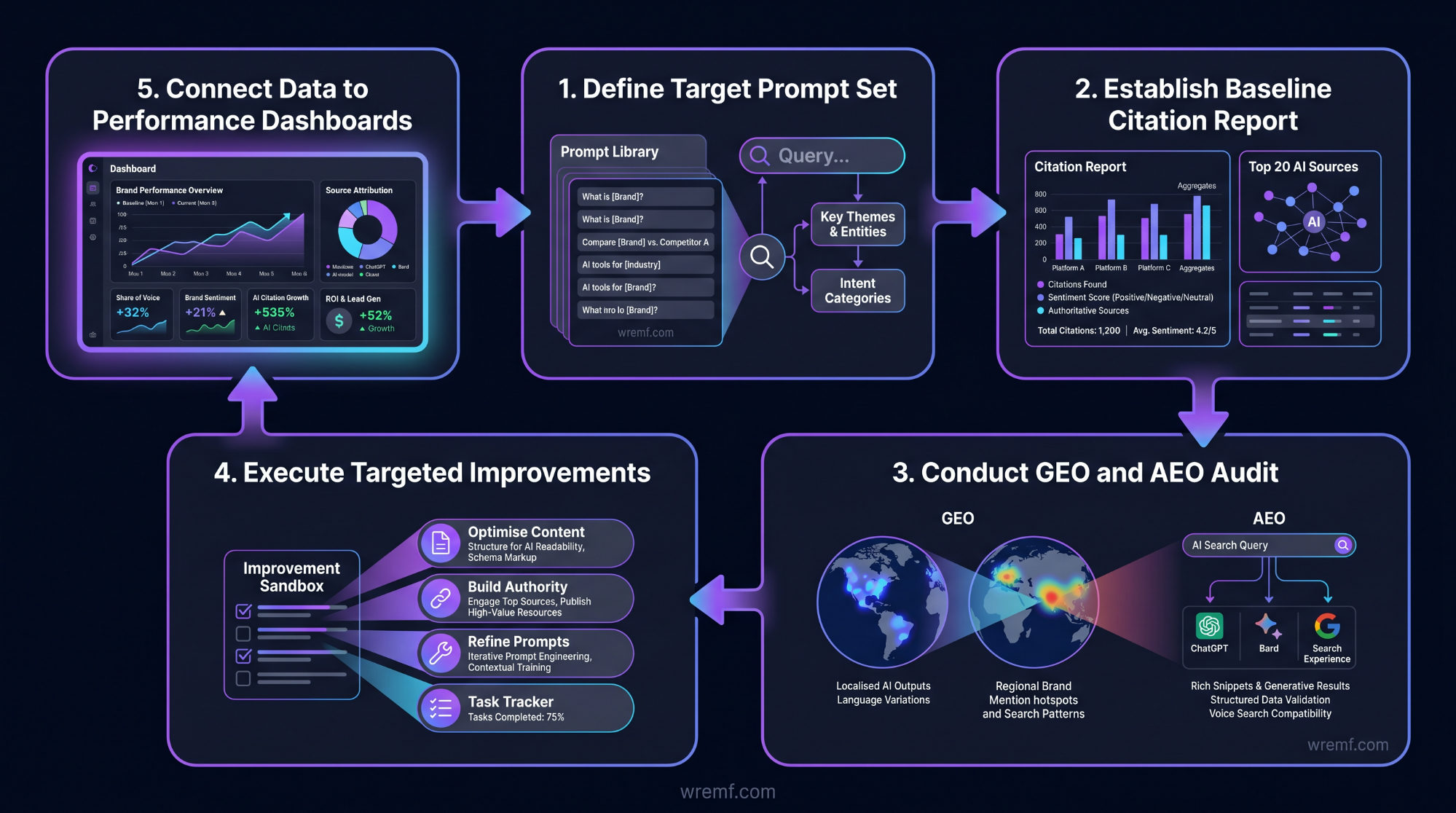
Building an AI brand tracking program requires a structured approach that connects prompt design, data collection, competitive benchmarking, and reporting to actual decisions. The following process applies whether a team is using WREMF software independently, working with a managed AI visibility service, or combining both through a hybrid engagement.
Step 1: Define the target prompt set
Identify the buyer prompts and topic categories where the brand needs to appear in AI-generated responses. These should map to real buyer questions at awareness, consideration, and decision stages. For a B2B SaaS company, relevant prompts might include category comparisons, specific use case questions, vendor shortlisting queries, and implementation guidance requests. The prompt set defines what the tracking program measures and should reflect the actual conversational AI queries that buyers use in ChatGPT, Gemini, Perplexity, and similar engines.
Step 2: Establish a baseline citation report
Run the prompt set across AI engines to establish baseline citation frequency, AI citation share, and source consistency data. Record which sources each AI engine cites when answering relevant prompts, which competitor domains appear, and where the brand is absent. This baseline is the starting point against which all future progress is measured. WREMF provides unlimited prompt tracking across 10 AI engines with results available within the onboarding window.
Step 3: Conduct a GEO and AEO audit
A GEO audit assesses whether content, structured data, entity signals, and source authority are aligned with what AI engines look for when selecting citations. An AEO audit focuses on whether content is structured to answer questions directly, which affects how well it surfaces in conversational AI and answer engine contexts. The audit identifies the specific content, technical, and authority gaps that explain why the brand is absent from certain AI responses. WREMF's Managed plan includes both a custom GEO strategy and AEO content optimisation as part of senior-led execution.
Step 4: Execute targeted improvements and monitor citation changes
Based on the audit findings, execute content improvements, structured data updates, citation and entity cleanup, and authority-building actions. Schedule AI monitoring to run regularly so that citation changes can be detected and attributed to specific actions. AI citation tracking can show baseline position within days, though measuring the impact of content improvement efforts typically takes 60 to 90 days as new content gets indexed and ingested by AI models.
Step 5: Connect AI visibility data to performance dashboards and report to leadership
Integrate AI visibility data with GA4 attribution and Looker Studio to create performance dashboards that connect citation presence to website traffic, user behaviour, and revenue signals. White-label reports are available in WREMF's Growth plan for agencies managing multiple clients. Senior-led strategy calls and custom reporting are included in the Managed plan for enterprise brands and multi-market teams.
TIP:
Start the prompt set with 20 to 40 high-priority buyer prompts before expanding. A smaller, well-designed prompt set produces cleaner baseline data and makes it easier to attribute citation changes to specific actions in the first 90 days of a tracking program.
KEY TAKEAWAY: A structured 5-step process covering prompt design, baseline measurement, GEO and AEO auditing, improvement execution, and attribution reporting transforms AI brand tracking from a monitoring exercise into a program that drives measurable visibility improvement.
How to Match an AI Brand Tracking Agency to Your Company Stage
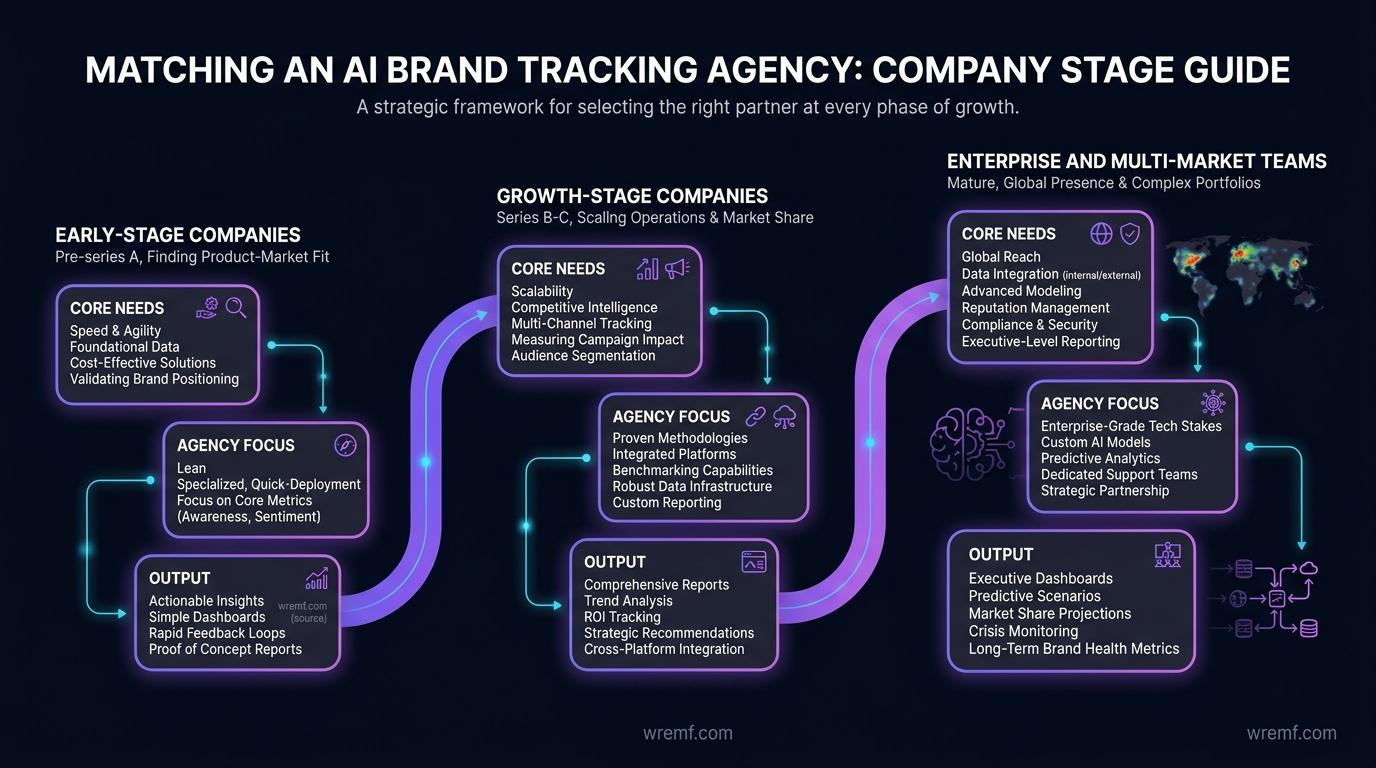
The right AI brand tracking approach depends on company stage, internal execution capacity, and the sophistication of the existing brand monitoring program. The following guidance helps teams map their situation to the right engagement model.
Early-Stage Companies
For founders, solo marketers, and small SaaS teams with limited internal resources, the priority is establishing a baseline understanding of AI visibility before investing in a full agency program. A software-only approach using a platform like WREMF Starter at EUR 59 per month provides 10-engine AI visibility tracking, unlimited prompts, core prompt intelligence, source citation tracking, and basic competitor tracking for up to three competitors. This stage is about understanding where the brand stands in AI-generated responses, not yet about full-scale execution. Teams at this stage benefit most from the AI visibility tracking and AI share of voice data that shows them whether they have a problem worth solving before committing to a larger program.
Growth-Stage Companies
Growth-stage B2B companies with active SEO, content, and demand generation teams need AI brand tracking that integrates with existing reporting infrastructure and connects AI visibility to traffic and revenue outcomes. WREMF Growth at EUR 149 per month covers 5 websites, 10 to 15 competitors, advanced citation tracking, AI share of voice, GEO audits, a content brief generator, SEO testing, GA4 attribution, white-label reports, and Looker Studio connector. Agencies managing multiple client AI visibility programs also fit this profile. For growth-stage teams, the priority shifts from baseline measurement to attribution, competitive benchmarking, and content brief generation that feeds the GEO and AEO program.
Enterprise and Multi-Market Teams
Enterprise brands, large agencies, and multi-market teams that need strategy, implementation, and ongoing optimisation support are best served by a managed AI visibility service or hybrid engagement. WREMF Managed, starting from EUR 1,500 per month, includes everything in the Growth plan plus an AI visibility audit, custom GEO strategy, AEO content optimisation, citation, entity, and authority cleanup, senior-led execution, strategy calls, a custom roadmap, and monthly reporting. Teams at this level typically have the internal data and demand generation infrastructure but lack the specialist GEO and AEO execution capacity to act on AI visibility insights at scale.
For all company stages, WREMF's BYOK support keeps prompt tracking costs predictable by eliminating per-prompt markups, which matters when running large prompt sets across 10 AI engines continuously. Compare WREMF pricing plans to understand which plan fits current team size and tracking requirements.
KEY TAKEAWAY: Company stage, internal execution capacity, and the existing brand monitoring program determine whether a software-only, managed service, or hybrid AI brand tracking model is the right fit. WREMF covers all three engagement models with a plan structure that supports teams from early-stage tracking through to enterprise execution.
AI Brand Tracking Across Specific Platforms: ChatGPT, Gemini, Perplexity, and Google AI Overviews
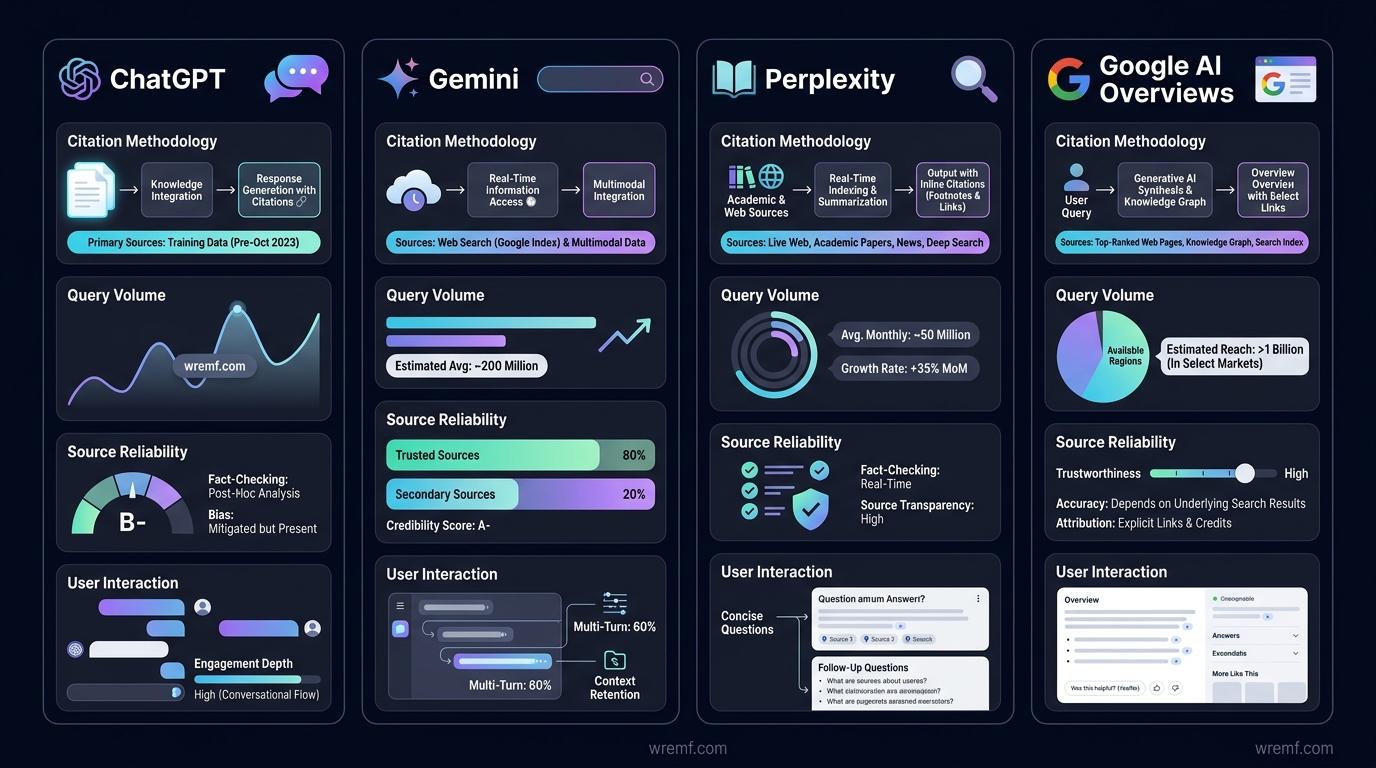
Tracking brand visibility across individual AI platforms requires understanding how each engine retrieves, synthesises, and cites sources. Each platform has different retrieval behaviour, different source weighting, and different response formats that affect how and whether a brand appears in AI-generated answers.
ChatGPT and the OpenAI Ecosystem
ChatGPT processes roughly 1.6 billion daily queries according to available market data, making it the highest-volume AI discovery surface for most B2B categories. ChatGPT's responses draw from its training data, retrieval-augmented sources, and browsing capabilities depending on the version and configuration in use. Brand citations in ChatGPT tend to favour authoritative sources with strong entity signals, structured content, and consistent mentions across high-authority domains. Tracking ChatGPT citation frequency requires running prompts through the platform systematically and recording which brands, sources, and competitor domains appear in responses. As covered in OpenAI's research overview the underlying model architecture influences how information is retrieved and presented, which has direct implications for which brands appear as recommended options.
Perplexity
Perplexity handles around 50 million queries per week and operates primarily as a retrieval-augmented generation system that cites its sources directly within responses. This makes Perplexity particularly valuable for AI brand tracking because citations are explicit and attributable. Brands that appear as cited sources in Perplexity answers have a measurable AI citation share that can be tracked, benchmarked against competitor domains, and monitored for changes over time. The Perplexity blog has covered how its retrieval system prioritises source quality and freshness, which informs the content and authority signals that matter most for citation visibility on this platform.
Gemini and Google AI Mode
Gemini and Google AI Mode represent Google's generative answer layer, which sits alongside and above traditional organic search results. For brands with established Google search visibility, Gemini and Google AI Mode citation tracking is especially important because it shows whether existing ranking authority translates into generative citation presence. A brand can rank on page one in Google and still be absent from Gemini responses if its content is not structured to answer the specific conversational queries that Gemini generates responses for. Google's AI Overviews documentation confirms that AI Overviews apply separate selection logic from organic rankings, meaning AI visibility in Google's ecosystem requires dedicated tracking and optimisation. WREMF's guide to AI Overview optimisation covers the practical steps for improving citation presence in Google's generative surfaces.
Claude and Copilot
Claude, developed by Anthropic, and Copilot, Microsoft's AI platform, represent two more surfaces where B2B buyers research vendors and compare solutions. Anthropic's research covers how Claude retrieves and presents information, which affects how brands with structured, authoritative content perform in Claude responses relative to competitors. Copilot integrates with Microsoft's search ecosystem through the Bing Webmaster Guidelines framework, meaning technical accessibility and structured data affect Copilot citation presence alongside content quality.
Tracking all of these AI platforms in a single program requires a platform that covers multiple engines without per-prompt cost scaling that makes comprehensive monitoring prohibitive. WREMF covers 10 AI engines with unlimited prompts and BYOK support on every plan, which is what makes systematic cross-platform AI brand tracking operationally feasible for teams that cannot afford to track each engine separately.
KEY TAKEAWAY: Each AI platform retrieves, synthesises, and cites sources differently, meaning cross-platform AI brand tracking requires engine-specific data collection rather than a single-engine proxy. WREMF covers ChatGPT, Gemini, Perplexity, Google AI Overviews, Claude, Copilot, and four additional AI engines within a single tracking program.
Real-World Scenarios: How Teams Use AI Brand Tracking
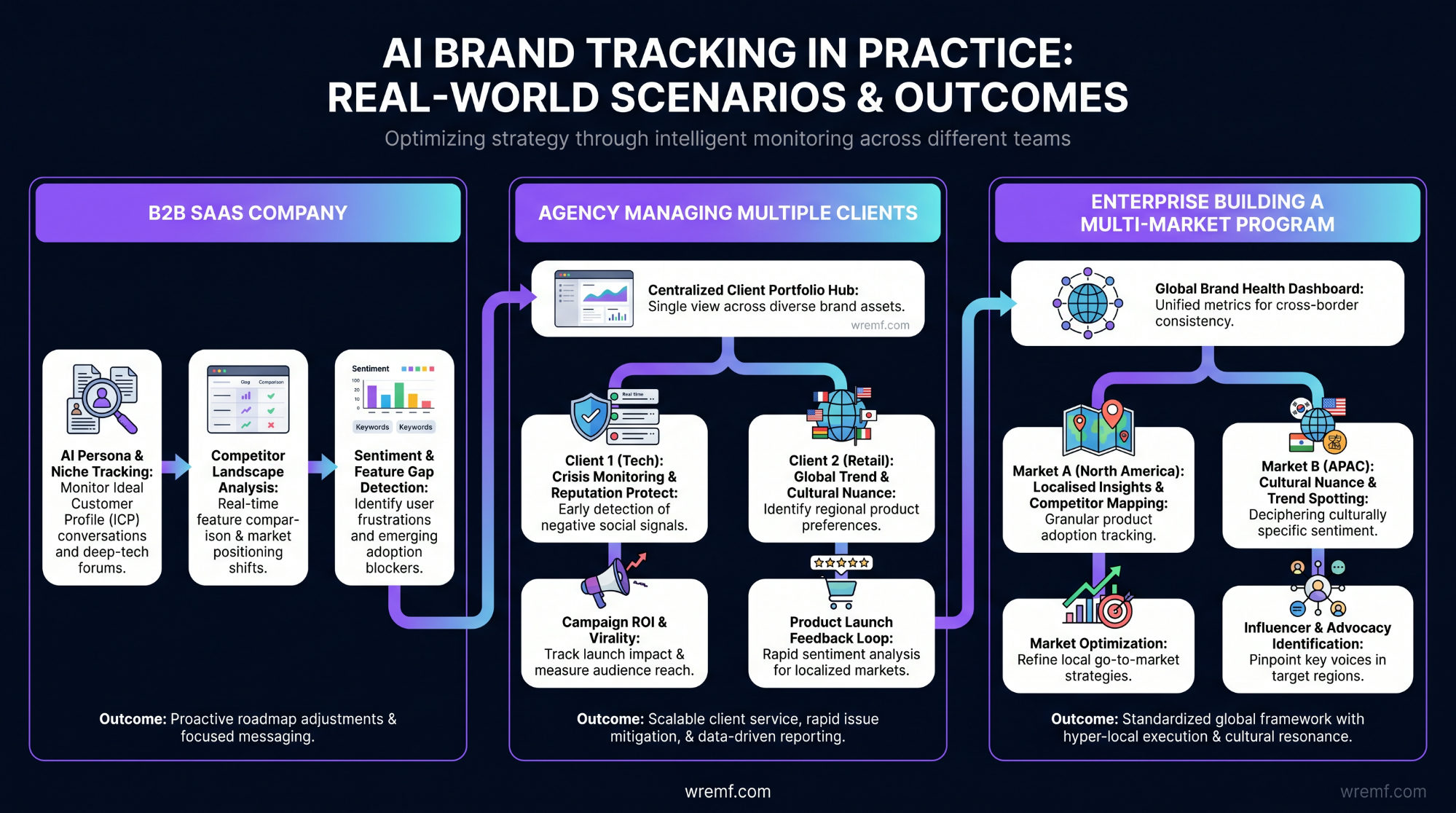
The following scenarios illustrate how different types of teams structure AI brand tracking programs and what they measure. These examples are illustrative rather than attributed to specific clients.
Scenario 1: A B2B SaaS Company Investigating Competitive AI Visibility
A mid-size B2B SaaS company notices that a competitor is generating more inbound traffic from AI referral sources than expected. The team suspects the competitor is being cited more frequently in ChatGPT and Perplexity responses for the category's highest-intent buyer prompts. Using WREMF's prompt intelligence and source citation tracking, the team runs a systematic prompt sweep across 50 relevant buyer queries in ChatGPT, Gemini, Perplexity, and Google AI Overviews. The resulting data shows that the competitor appears in 68 percent of relevant AI responses while the brand appears in 31 percent. Prompt-level reporting identifies the specific topic categories where the gap is largest: implementation guides, comparison prompts, and use-case-specific queries. The team uses a content brief generator to develop AI-ready content targeting those gap categories and schedules weekly AI monitoring to track citation frequency improvements over the following quarter.
Scenario 2: An Agency Managing AI Visibility for Multiple Clients
A B2B marketing agency manages SEO, content, and demand generation for six technology clients. As AI search engines take an increasing share of discovery traffic, the agency needs to add AI brand monitoring to its reporting suite without building a separate infrastructure for each client. Using WREMF Growth, the agency tracks 5 client websites across 10 to 15 competitors each, generates white-label reports for client stakeholders, and integrates AI visibility data with GA4 attribution and Looker Studio dashboards. The agency uses WREMF's GEO audit capability to identify citation and entity gaps for each client and feeds those findings into the content brief generator to create AEO-optimised content briefs. For the two largest clients, the agency supplements its own execution with WREMF Managed services for citation cleanup, entity authority work, and strategy calls.
Scenario 3: An Enterprise Brand Building a Multi-Market AI Visibility Program
A large enterprise software brand operating across six markets needs to understand how its brand appears in AI-generated responses in each market and whether AI engines are presenting accurate, consistent brand information globally. The team uses WREMF Managed to run an AI visibility audit across all six markets, identify brand reputation inconsistencies in AI responses, clean up entity signals and structured data, and develop a custom GEO strategy that addresses market-specific content gaps. Monthly reporting tracks AI citation share, source consistency, and AI referral traffic across all markets, with performance dashboards connected to the central analytics stack. The senior-led execution model means the in-house team receives a custom roadmap and strategy calls without needing to build specialist GEO and AEO execution capacity internally.
KEY TAKEAWAY: AI brand tracking programs look different depending on team size, the number of markets, and whether the team has internal execution capacity. Software-only, managed, and hybrid models serve different needs, and the right choice depends on how much of the AI visibility work the team can execute versus how much needs specialist support.
Limitations and Caveats in AI Brand Tracking
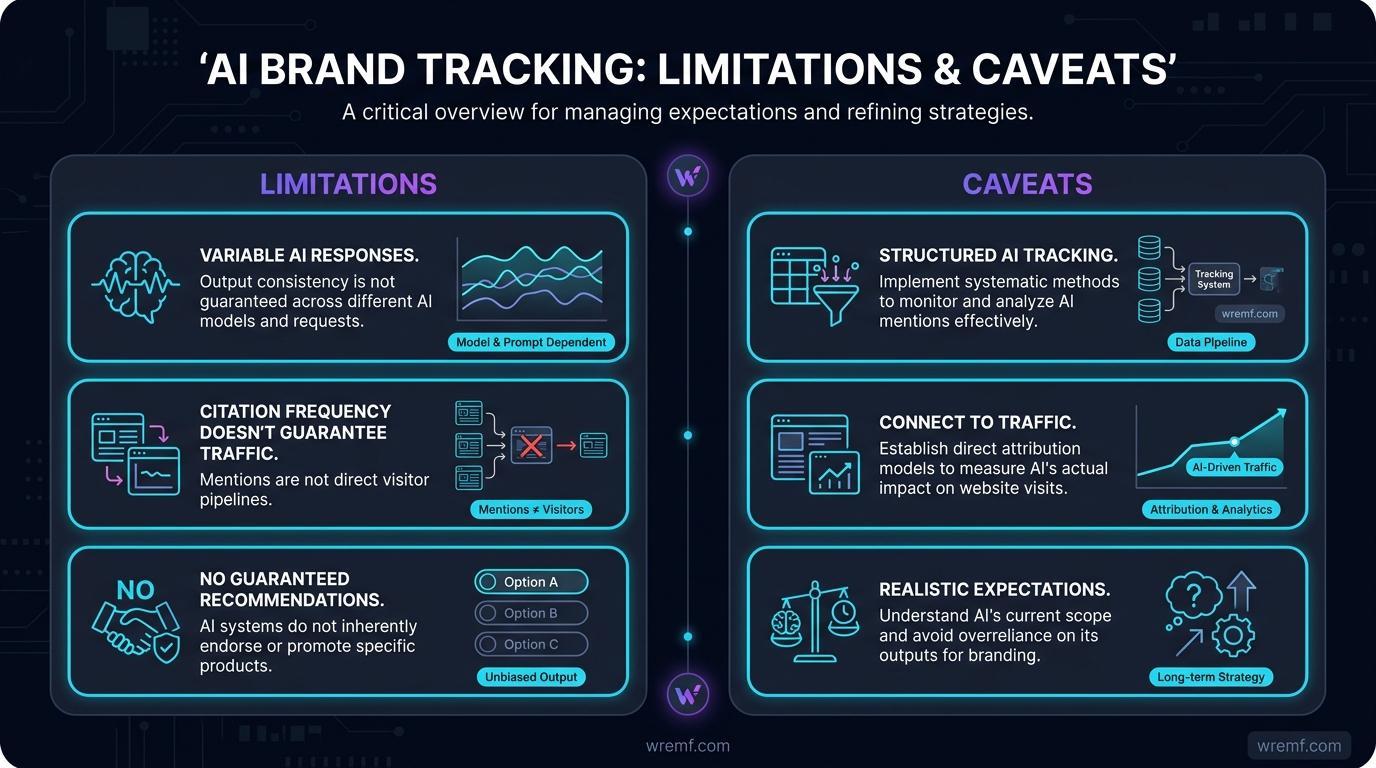
AI brand tracking is a valuable and increasingly necessary discipline, but teams should approach it with clear expectations about what can and cannot be measured, controlled, or guaranteed.
AI Responses Are Not Fixed
AI-generated responses change by engine, prompt wording, time, location, model version, and source set. A brand that appears in a ChatGPT response today may not appear in the same response tomorrow if the model updates, if new sources are indexed, or if the prompt is phrased slightly differently. This variability means that single-point measurements are unreliable. Credible AI brand tracking requires repeated prompt runs, normalised across multiple sessions, to produce statistically meaningful citation frequency data. Teams that base decisions on a single prompt check are working with noise, not signal.
Citation Frequency Does Not Guarantee Traffic or Revenue
Appearing in AI-generated responses does not automatically translate into website clicks, user sessions, or revenue. AI engines increasingly answer questions completely within the response, reducing the click-through rate to cited sources. AI referral traffic attribution can also be incomplete in GA4 because some AI engines do not pass referral headers consistently, meaning actual AI-driven traffic may be underreported. Teams should treat citation frequency and AI share of voice as leading indicators of brand presence, not as direct revenue metrics, and connect them to traffic and conversion data through GA4 attribution to build a more complete picture.
No Platform Can Guarantee AI Engine Recommendations
No AI brand tracking agency, GEO agency, or AEO platform can guarantee that a specific AI engine will recommend or cite a brand. AI engines select sources based on complex and frequently updated retrieval logic that is not fully transparent or controllable from the outside. What structured tracking and GEO execution can do is improve the signals that AI engines use when selecting sources: content quality, entity authority, structured data consistency, citation presence on authoritative third-party sources, and answer-first content formatting. WREMF's position is that these efforts improve the probability of citation and improve brand health in AI-generated responses over time, but the outcome is directional, not guaranteed.
Software-Only Plans Require Internal Execution Capacity
WREMF Starter and Growth plans provide the data, reporting, and content brief generation that a team needs to improve AI visibility. However, acting on those insights requires internal execution: writing and publishing new content, updating structured data, building authority signals, and maintaining a consistent publishing cadence. Teams without dedicated SEO, content, or technical resources will generate insights they cannot act on. In those cases, the Managed plan or a hybrid engagement that combines WREMF software with WREMF agency execution is the more practical choice. Explore WREMF agency services for teams that need implementation support alongside the tracking platform.
GEO and AEO Require Foundations Before They Produce Results
Generative Engine Optimization and Answer Engine Optimization require content quality, entity consistency, technical accessibility, and authority signals to be in place before citation improvements materialise. Teams that run GEO audits and execute content improvements should expect a 60 to 90 day lag before new content is indexed and ingested by AI models at a level that changes citation frequency. Tracking that lag with scheduled AI monitoring is essential for accurate attribution and for setting realistic expectations with leadership or clients.
KEY TAKEAWAY: AI brand tracking produces directional, probabilistic insights, not guaranteed outcomes. Effective programs account for response variability, connect citation data to traffic attribution, operate within realistic timelines, and match the execution model to the team's internal capacity.
Common Misconceptions About AI Brand Tracking
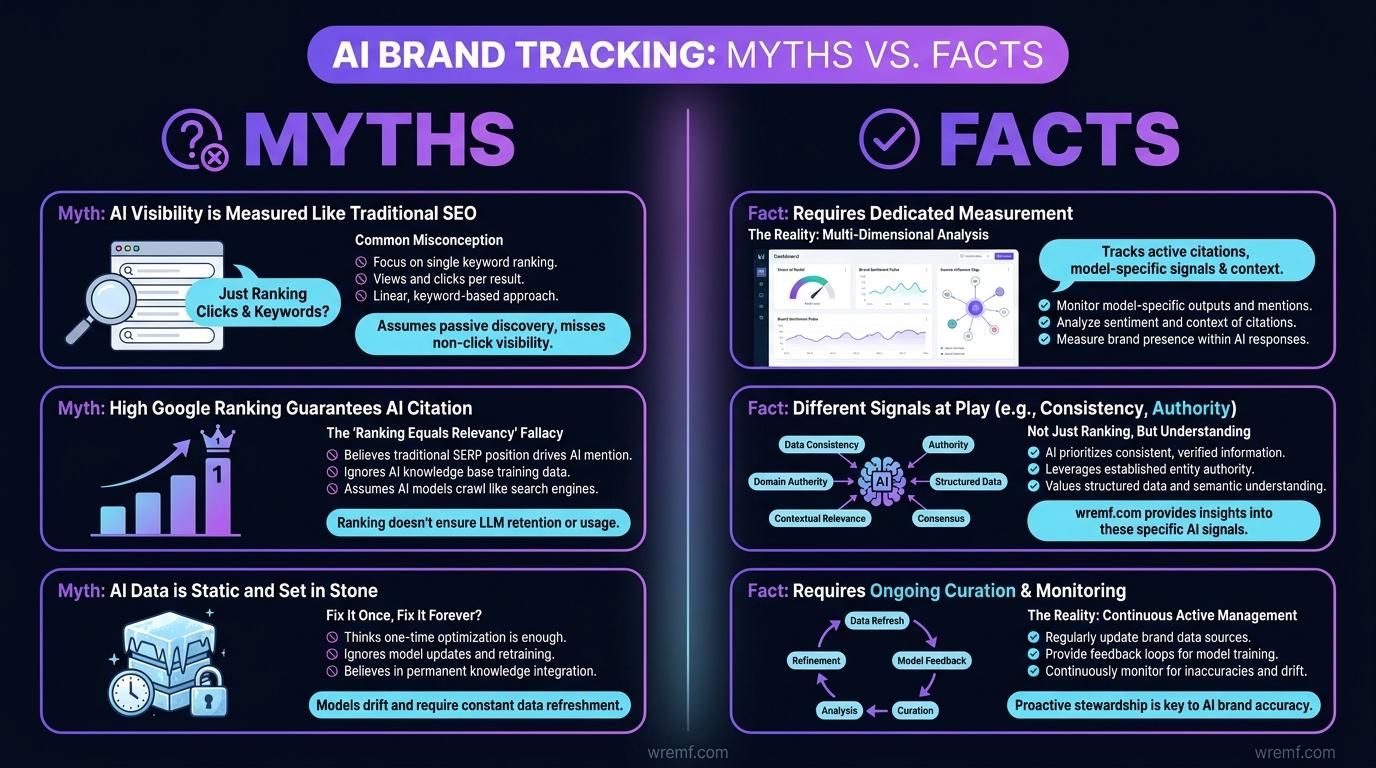
MYTH: If a brand ranks on page one of Google, it will appear in AI-generated responses automatically.
FACT: Google rankings and AI citation presence are measured separately and driven by different signals. A brand can hold strong organic rankings while being entirely absent from Google AI Overviews, ChatGPT, Gemini, and Perplexity responses. AI engines select sources based on entity authority, content structure, answer-first formatting, and citation signals, not SERP position. Dedicated AI visibility tracking is necessary to measure AI citation presence independently of organic rankings.
MYTH: AI visibility cannot be measured because AI responses change constantly.
FACT: AI visibility can be measured reliably through repeated prompt runs, normalised citation frequency data, and systematic cross-engine tracking. While individual AI responses do vary, aggregated citation frequency measured across a consistent prompt set over time produces stable trend data. Platforms like WREMF run prompt sweeps across 10 AI engines continuously, producing citation frequency and AI share of voice data that reflects real patterns rather than single-instance noise. As covered in the complete AI mention tracking guide consistent methodology is what makes AI visibility data actionable.
MYTH: Traditional brand monitoring tools like social listening platforms and media monitoring services already cover AI brand tracking.
FACT: Social listening and media monitoring tools track brand mentions in human-generated and editorial content. They do not track whether a brand is cited in AI-generated responses, which sources AI engines favour, or how a brand compares to competitors in AI share of voice. These are structurally different measurement tasks that require different data collection methods. A complete brand tracking program needs all three layers: survey-based perception tracking, social and media monitoring, and dedicated AI visibility and citation tracking.
MYTH: Hiring an AI brand tracking agency or buying AI visibility software guarantees that AI engines will recommend the brand.
FACT: No agency or platform can guarantee AI engine recommendations because AI retrieval logic is not fully transparent or externally controllable. What structured AI brand tracking, GEO execution, AEO content optimisation, and entity authority work can do is improve the signals that AI engines use to select sources, which increases the probability of citation over time. Results are directional, not guaranteed, and improvement timelines typically span 60 to 90 days from execution to measurable citation change.
MYTH: Brand tracking only matters for consumer brands with large awareness budgets. B2B SaaS companies do not need it.
FACT: B2B SaaS buyers increasingly use AI search engines to research, compare, and shortlist vendors before they visit a website or speak to a sales team. AI brand tracking is therefore directly relevant to B2B pipeline generation. If a brand is absent from AI-generated responses while competitors are being cited as recommended solutions, it is experiencing a discovery disadvantage that affects demand generation, not just brand perception. The Gartner AI research framing of AI as a decision system for buyers reinforces why AI citation presence is a B2B commercial priority, not just a branding exercise.
KEY TAKEAWAY: The most common misconceptions about AI brand tracking overestimate the coverage of traditional tools, underestimate the measurability of AI citations, and conflate guaranteed outcomes with improved probability. Effective AI brand tracking is based on structured measurement, realistic expectations, and execution that addresses the signals AI engines actually use.
Evaluating an AI Brand Tracking Agency: A Practical Checklist
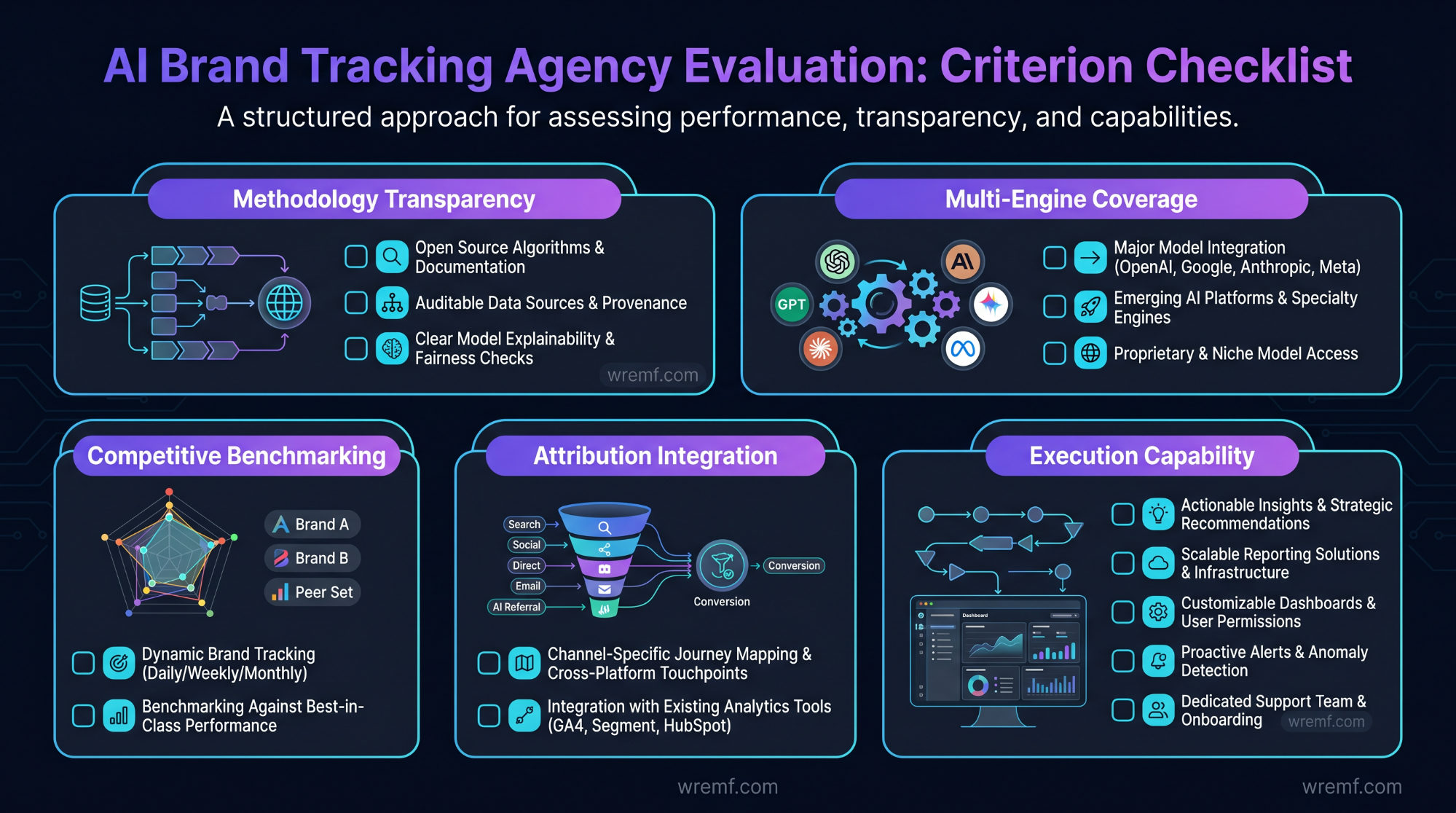
Before engaging an AI brand tracking agency or selecting an AI visibility platform, use the following evaluation framework to assess whether a vendor can deliver what the program actually needs.
Does the agency or platform track AI citations across multiple AI engines, including ChatGPT, Gemini, Perplexity, Google AI Overviews, Claude, and Copilot? Single-engine tracking produces incomplete brand visibility data because buyers use multiple AI platforms across different stages of the buying journey.
Does the agency explain its prompt methodology in detail, including how prompts are constructed, how often they are run, and how results are normalised across engines? Without methodology transparency, citation data cannot be validated or compared across reporting periods.
Does the platform provide competitor benchmarking at the prompt level, showing which competitor domains appear in AI responses alongside or instead of the brand? Competitive benchmarking is essential for understanding AI share of voice rather than just absolute citation counts.
Does the agency connect AI visibility data to website traffic, GA4 attribution, and performance dashboards? Citation data without attribution to business outcomes is interesting but not strategically useful.
Does the platform support BYOK, unlimited prompts, and cost-predictable scaling? Per-prompt pricing models become cost-prohibitive at the prompt volumes required for systematic multi-engine AI brand tracking.
Does the agency offer GEO audits and AEO content optimisation as part of its execution capability, or does it only provide monitoring without the ability to act on findings? Tracking without execution capacity extends the time between insight and improvement.
Can the agency or platform produce white-label reports for agency clients or leadership-facing monthly reports for in-house teams? Reporting format and frequency should match the decision-making cadence of the team using the data.
Teams that want to understand how WREMF addresses each of these evaluation criteria can review the AI search engine optimisation tools guide for a detailed breakdown of how WREMF's prompt tracking, citation analysis, and GEO audit capabilities compare across the dimensions that matter for a complete AI brand tracking program.
KEY TAKEAWAY: Evaluating an AI brand tracking agency on methodology transparency, multi-engine coverage, competitive benchmarking, attribution integration, and execution capability prevents the common outcome of investing in a monitoring program that produces data without actionable insight.
Conclusion
AI brand tracking is no longer a specialist discipline reserved for enterprise brands with large research budgets. As ChatGPT, Gemini, Perplexity, Google AI Overviews, and other AI engines become active parts of the B2B buying journey, every brand that depends on discovery, consideration, and demand generation needs to understand how it appears in AI-generated responses. Survey-based perception tracking and social monitoring remain valuable, but they do not cover AI citation presence. That gap requires dedicated AI brand tracking with the methodology, competitive benchmarking, and execution capacity to act on what the data shows. WREMF provides AI brand monitoring as software, managed service, and hybrid execution, covering 10 AI engines with unlimited prompts, GEO audits, AEO optimisation, citation tracking, and attribution reporting. Teams ready to measure and improve their AI visibility can compare WREMF pricing plans or book a quick call with WREMF to find the right starting point.
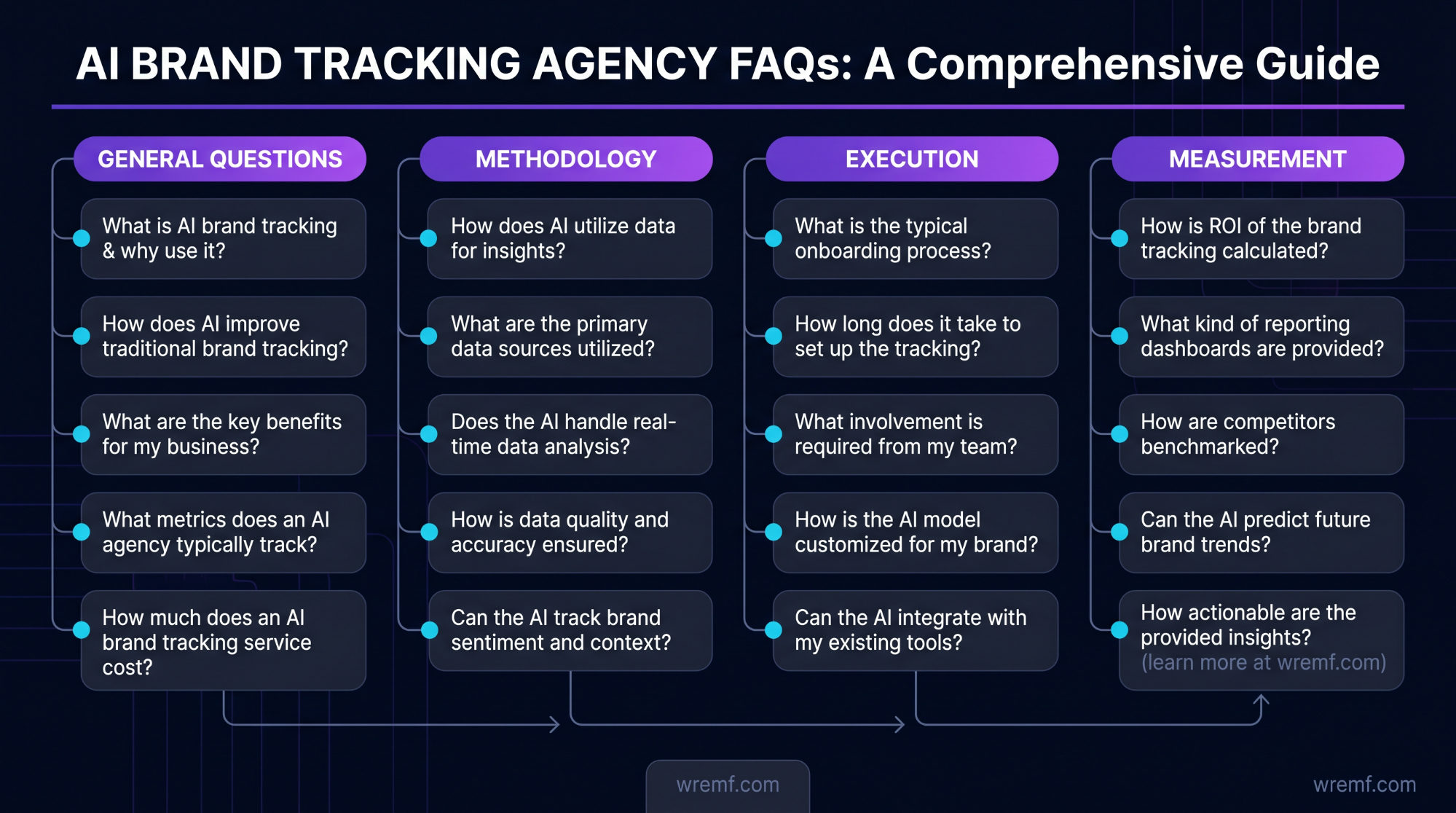
Frequently Asked Questions About AI Brand Tracking Agencies
What is brand tracking and why does it matter?
Brand tracking is the practice of measuring how a target audience perceives, recognises, and considers a brand over time. It typically covers metrics such as awareness, consideration, sentiment, brand perception, mental availability, and purchase intent. These metrics matter because brand health predicts future demand, not just current performance. Without tracking, marketers cannot tell whether campaigns are shifting perception, whether competitors are gaining ground, or whether the brand is losing relevance in buyer decision systems. In B2B markets especially, brand tracking connects directly to pipeline velocity and pricing power.
How is AI changing brand tracking?
AI search has added an entirely new layer to brand tracking. Platforms such as ChatGPT, Perplexity, Gemini, Google AI Overviews, Claude, Copilot, and DeepSeek now answer buyer questions directly, often without returning a list of links. If a brand is not mentioned or cited in those AI-generated responses, it effectively does not exist for a growing segment of buyers researching in AI search. Traditional survey-based brand tracking does not capture this layer. Modern brand tracking programmes now need to include AI citation frequency, AI share of voice, prompt-level monitoring, and source consistency analysis alongside conventional perception data.
What is the difference between brand tracking and brand monitoring?
Brand tracking measures shifts in perception, awareness, consideration, and sentiment over time through structured research, surveys, and AI visibility measurement. Brand monitoring captures real-time mentions across social media, news, forums, and increasingly AI-generated responses. Tracking is periodic and strategic; monitoring is continuous and tactical. The two systems are complementary. Monitoring flags what is being said right now, while tracking explains whether those signals are moving the metrics that predict buying behaviour. A complete programme usually requires both.
What does AI brand monitoring mean in practice?
AI brand monitoring is the practice of tracking how, where, and how often a brand appears across AI-generated answers from systems such as ChatGPT, Perplexity, Google AI Overviews, Gemini, Claude, Grok, and DeepSeek. It goes beyond social listening or keyword rank tracking. Specifically, it tracks whether AI engines mention the brand, which sources they cite, how the brand is positioned relative to competitors, and what sentiment or framing accompanies each mention. As Google's AI Overviews documentation confirms, AI-generated summaries apply distinct classification logic from standard organic results, which means brand visibility in AI answers requires dedicated measurement.
What is AI brand visibility tracking?
AI brand visibility tracking is the systematic monitoring of a brand's presence inside AI-generated search responses across multiple AI engines. It covers metrics including brand mention frequency, citation share, competitive positioning within AI answers, prompt-level visibility, and source consistency. Unlike traditional rank tracking, which measures a URL's position in a results page, AI brand visibility tracking measures whether the brand appears in conversational AI answers and how it is framed when it does. The standard coverage expectation in 2026 includes at least ChatGPT, Perplexity, Google AI Overviews, Gemini, and Claude, with additional coverage of Grok, DeepSeek, Copilot, and Meta AI representing best practice. WREMF's AI Visibility Index provides a structured visibility score across ten AI engines.
Does ChatGPT or Perplexity mention your brand when buyers ask relevant questions?
This is one of the most commercially important questions a brand can ask right now. When a buyer asks ChatGPT "what's the best CRM for small teams" or asks Perplexity "which B2B analytics platform should I use," the brand that appears in the answer gains awareness and consideration at the exact moment of intent. Brands that do not appear lose ground to competitors who do, without any visibility into what happened. Tracking whether ChatGPT, Perplexity, Gemini, and other AI engines include your brand in relevant responses is now a foundational part of brand monitoring, not an optional extra.
What is the difference between brand tracking and social listening?
Social listening captures mentions, reactions, and sentiment in real time across social platforms, forums, and news. Brand tracking measures structured shifts in awareness, consideration, purchase intent, and brand perception using surveys, research panels, and increasingly AI visibility data. Social listening tells you what people are saying; brand tracking tells you whether what they are saying is changing how they think and buy. Social listening misses buyers who are researching privately in AI search, conducting zero-click searches, or asking questions directly to large language models. A complete picture requires both layers plus AI citation monitoring.
What are the key metrics a brand tracking programme should measure?
A well-designed brand tracking programme typically measures spontaneous awareness, aided awareness, consideration, preference, brand perception, purchase intent, and net promoter score over time. In AI search contexts, it should also measure AI citation share, prompt-level visibility, brand mention frequency across AI engines, source citation consistency, and AI share of voice versus competitors. Metrics such as mental availability and brand equity predict future revenue, not just current traffic. McKinsey's AI insights research consistently identifies brand trust and decision-stage visibility as early indicators of commercial performance in AI-influenced buying journeys.
Which metrics actually predict sales movement?
The metrics most consistently linked to future sales in brand research are consideration, preference, and mental availability, meaning whether the brand comes to mind spontaneously when a buyer enters a relevant category. In AI search contexts, AI citation share and recommendation visibility are emerging as strong proxies for discovery-stage influence. Aided awareness has limited predictive value because almost all known brands score highly on aided recall, which creates a ceiling effect that prevents meaningful differentiation. The more useful question is whether the brand appears in the buyer's consideration set unprompted, either in human memory or in AI-generated answers.
Why is aided awareness a weak metric for differentiation?
Aided awareness, meaning asking "Have you heard of Brand X?", almost always produces high scores for established brands. This ceiling effect makes the metric nearly useless for competitive differentiation. If 85% of your target market recognises your brand name when prompted, that tells you very little about whether they would choose you, recommend you, or think of you first when a relevant buying trigger occurs. More useful metrics are spontaneous or unaided awareness, consideration rate, and preference share, which reveal how strongly the brand occupies buying-stage mental availability compared to competitors.
Does brand tracking work for B2B or niche categories?
Yes, but the methodology requires adjustment. B2B brand tracking typically works with smaller, more defined target audiences, such as specific job titles, company sizes, or industry verticals, which affects sample design and survey recruitment. Niche B2B categories often require qualitative research to supplement quantitative tracking because sample sizes are constrained. In AI search contexts, B2B brand tracking is especially valuable because AI engines such as ChatGPT, Perplexity, and Claude are frequently used by B2B buyers during research and vendor selection. Tracking citation share and recommendation visibility in AI responses is often more achievable for B2B brands than running large-scale consumer surveys.
What makes a brand tracking agency worth hiring?
A brand tracking agency worth hiring should be able to explain precisely how it collects data, how large its samples are, how it weights results to represent your target market, and what the known limitations of each method are. Agencies that cannot answer these questions clearly are likely reselling generic panel data without meaningful interpretation. Beyond methodology, the agency should be able to translate tracking data into decisions, specifically whether campaign spend shifted perception, whether competitors are gaining consideration, and whether the brand is visible in the AI discovery systems that now influence buying behaviour. Transparency about methodology and a clear link to business decisions are the two non-negotiable standards.
How much do brand tracking agencies charge?
Brand tracking agency pricing varies widely depending on methodology, tracking frequency, sample size, number of markets, and whether AI visibility monitoring is included. Traditional survey-based tracking programmes typically start from several thousand dollars per month for basic quarterly measurement and can reach six figures annually for continuous, multi-market programmes. AI visibility tracking tools start at lower price points. WREMF's pricing starts at €59 per month for software-only AI visibility tracking across ten AI engines, rising to €149 per month for growth teams needing attribution, white-label reporting, and GEO audits. Managed execution programmes start from €1,500 per month for teams that need strategy and implementation alongside tracking.
Can one agency handle traditional brand tracking and AI visibility tracking together?
Most traditional brand tracking agencies focus on survey-based perception measurement and do not yet cover AI citation monitoring, prompt-level tracking, or generative engine visibility. Most AI visibility platforms focus on the AI search layer and do not run consumer research panels. Very few providers combine both. For brands that need both layers, a practical approach is to use a dedicated AI visibility platform alongside a research partner for perception tracking. WREMF covers the AI visibility layer, including prompt tracking, citation analysis, competitive positioning across AI engines, and source consistency, while traditional research partners handle survey-based brand health metrics.
How long does it take to see meaningful data from a new brand tracking programme?
For survey-based brand tracking, the first meaningful wave of data typically arrives four to eight weeks after briefing, depending on fieldwork timelines and panel recruitment. Trend data, which is where tracking becomes genuinely useful, requires a minimum of two to three waves before patterns become reliable. AI visibility tracking produces data faster. A platform such as WREMF can begin returning prompt-level visibility data, citation frequency, and competitive share of voice within days of setup, giving teams an early baseline before longer research programmes are completed.
How often should brand tracking run?
Tracking frequency should match the speed at which your market changes and the decision cadence of your business. Fast-moving categories, heavy campaign periods, or competitive markets usually warrant continuous or monthly tracking. Stable B2B categories with long sales cycles can use quarterly measurement without losing strategic relevance. AI visibility tracking typically runs continuously because AI engine outputs change frequently as models are updated, new sources are indexed, and competitor content shifts citation patterns. A continuous AI monitoring layer combined with periodic survey-based measurement gives teams both real-time signals and structured trend data.
How do you run an AI visibility audit?
An AI visibility audit measures how a brand appears across major AI search engines by testing a structured set of prompts representing real buyer queries, category comparisons, and competitor evaluations. The audit captures whether the brand is mentioned, how it is positioned, which sources AI engines cite, and where gaps exist relative to competitors. WREMF's GEO audit feature runs this process systematically across ten AI engines, returning citation frequency, visibility scores, source consistency data, and competitive share of voice. The audit output identifies specific content gaps, authority weaknesses, and prompt coverage opportunities that can be addressed through GEO and AEO optimisation.
What is a good AI visibility score?
AI visibility scores vary by category, competitive density, and the number of AI engines tracked. There is no universal benchmark, but in practical terms a useful baseline question is whether the brand appears in AI-generated answers for the core buying-stage prompts most relevant to its category. Appearing consistently across ChatGPT, Perplexity, Google AI Overviews, and Gemini for high-intent category queries is a meaningful starting threshold. WREMF's AI Visibility Index provides normalised visibility scores across ten AI engines and tracks changes over time, giving teams a consistent benchmark to measure improvement rather than relying on a single point-in-time snapshot.
Can I track the visibility of specific prompts across AI engines?
Yes. Modern AI visibility platforms allow teams to define specific prompt sets representing real buyer questions, category comparisons, use-case queries, and competitor evaluations, then track how AI engines respond to those prompts over time. This prompt-level tracking is more commercially useful than aggregate mention counts because it reveals visibility at specific points in the buyer journey. WREMF's prompt intelligence feature supports unlimited prompt tracking across ten AI engines, showing which prompts surface the brand, which surface competitors, and where citation gaps exist at the keyword and topic level.
What does AI competitor research mean in this context?
AI competitor research means systematically tracking which competitors appear in AI-generated answers for the same prompts your brand is targeting. It reveals which brands AI engines such as ChatGPT, Perplexity, Gemini, and Google AI Overviews are recommending instead of yours, which sources those competitors are cited from, and what content or authority signals are driving their visibility. This intelligence is actionable because it identifies specific citation gaps and content opportunities. WREMF's competitive landscape tracking provides side-by-side comparisons of brand and competitor visibility across AI engines, including share of voice and citation source analysis.
Why do I need to optimise for AI search engines specifically?
AI search engines such as ChatGPT, Perplexity, Google AI Overviews, and Claude increasingly answer buyer questions directly without directing users to a list of web pages. This creates zero-click discovery moments where the brand that appears in the AI-generated answer gains awareness and consideration, and the brand that does not appears absent. According to Gartner's AI research, AI-driven search is changing how buyers discover and evaluate vendors, particularly in B2B categories. Traditional SEO optimises for document ranking in web results. AI search optimisation, specifically Generative Engine Optimization and Answer Engine Optimization, works to ensure the brand appears in the AI-generated answers themselves.
How do you measure the ROI of AI search visibility?
Measuring ROI from AI search visibility requires connecting prompt-level visibility data to downstream business outcomes such as traffic, leads, pipeline, and revenue. The connection is made through AI traffic attribution, which identifies sessions originating from AI platforms in analytics tools such as GA4, and through tracking whether visibility improvements correlate with changes in branded search volume, direct traffic, or pipeline activity. WREMF supports GA4 attribution alongside citation and visibility tracking, which allows teams to build a data chain from AI engine mention to website visit to conversion. This is not perfect attribution, but it is substantially better than treating AI visibility as unmeasurable.
Do I need a brand tracking agency if I already use Google Analytics and social media dashboards?
Google Analytics measures what happens after a visitor reaches a website. Social dashboards measure engagement and mentions within social platforms. Neither captures brand perception, mental availability, purchase intent, or visibility in AI-generated answers. If buyers are researching in ChatGPT or Perplexity and not clicking through to your website, that activity is entirely invisible to Google Analytics. Social dashboards miss buyers who research privately and never post publicly. A brand tracking programme addresses perception and awareness directly through structured research, while an AI visibility platform addresses the discovery layer that analytics tools cannot see.
Do I need software, or a partner who can interpret what is happening?
The answer depends on internal capability. Software alone is sufficient for teams with experienced marketers or SEO professionals who can interpret AI visibility data, run GEO and AEO strategy, build AI-ready content, and act on citation gap analysis. Teams without that internal expertise typically benefit more from a managed service or hybrid model where the platform provides data and an agency team provides interpretation, strategy, and execution. WREMF operates as both a software platform and an AI visibility agency, which means teams can start with software and add managed execution as complexity increases without switching platforms.
How will AI visibility tracking help leadership make decisions?
Leadership typically needs to know whether brand investment is generating measurable returns and whether the brand is holding or losing ground to competitors. AI visibility data answers both questions in the context of AI-driven discovery, which is increasingly where buyers form initial opinions and shortlists. Tracking share of voice across ChatGPT, Perplexity, Gemini, and Google AI Overviews alongside citation trends and competitive positioning gives leadership a structured view of where the brand stands in the discovery layer that precedes pipeline activity. Dashboards that show visibility trends over time, competitive gap data, and attribution connections to traffic make AI visibility reporting credible at board and executive level.
How do we avoid false confidence from dashboards?
Dashboard data can create false confidence when metrics look healthy but are measuring the wrong things. Common examples include high branded search volume masking declining category consideration, strong social engagement hiding poor AI citation performance, and traffic growth concealing competitor gains in AI-generated answers. Avoiding false confidence requires tracking metrics that are connected to actual buyer decision making, not just activity metrics. Prompt-level AI visibility data, citation source analysis, and competitive share of voice are harder to game than engagement rates or impression counts. Combining AI visibility tracking with periodic brand perception surveys creates a cross-check that activity dashboards alone cannot provide.
How quickly can unexpected shifts in AI visibility be diagnosed?
With continuous AI monitoring, unexpected shifts can typically be identified within days of occurring. When a brand drops out of AI-generated answers for key prompts, or a competitor gains significant citation share, prompt-level tracking surfaces the change quickly. The diagnosis layer, meaning understanding why the shift occurred, requires looking at which sources AI engines are now citing instead, whether technical changes affected content accessibility, and whether competitor content or authority signals changed. WREMF's scheduled monitoring runs across ten AI engines and flags visibility changes as they occur, giving teams an early warning system rather than discovering shifts weeks later in traffic data.
Can the tracking system evolve as strategy changes?
Yes. A well-structured AI visibility tracking programme should allow prompt sets to be updated as strategic priorities shift, new competitors emerge, or the brand enters new markets or categories. Static prompt sets become stale quickly because buyer language, AI engine outputs, and competitive dynamics all change. WREMF supports ongoing prompt management, which means tracking evolves alongside strategy rather than measuring yesterday's priorities. For teams using the managed execution service, WREMF's agency team updates prompt landscapes and visibility monitoring as part of the ongoing GEO and AEO strategy, ensuring measurement stays aligned with current commercial objectives.
How will AI visibility insights translate into action?
AI visibility insights are most useful when they directly inform content decisions, authority building, and technical optimisation. Specifically, citation gap analysis tells content teams which topics and formats are not being picked up by AI engines. Competitive share of voice data tells strategists where competitor content is outperforming the brand. Source consistency analysis reveals whether AI engines are finding contradictory or incomplete information about the brand. These insights translate into action through content briefs, structured rewrites, entity markup improvements, and authority development. For teams that need execution support, WREMF's managed service handles the translation from insight to implementation, covering content, technical foundations, and citation strengthening.
What should I look for when evaluating brand tracking agencies and AI visibility tools?
Evaluate any brand tracking agency or AI visibility tool on five factors. First, methodology transparency: how is data collected, from which sources, at what scale, and with what known limitations. Second, platform coverage: does it track the AI engines that matter for your buyers, at minimum ChatGPT, Perplexity, Google AI Overviews, Gemini, and Claude. Third, tracking depth: does it go beyond mention counts to include citations, source analysis, competitive positioning, and prompt-level detail. Fourth, actionability: does the platform generate recommendations, not just dashboards. Fifth, attribution: can it connect visibility data to traffic, pipeline, or revenue outcomes. Tools that export only CSV files without native analytics integrations are limiting for teams that need to report to leadership or clients.
What should marketing agencies look for in an AI visibility tool?
Marketing agencies managing multiple clients need AI visibility tools with white-label reporting, multi-client workspace management, and clean data exports for integration with tools such as Looker Studio or Tableau. Native integrations and API access matter because agencies typically operate inside existing reporting stacks rather than adding standalone dashboards. Prompt tracking at scale, competitive visibility comparison across client categories, and GEO audit functionality are table-stakes features for agencies delivering AI search optimisation services. WREMF's agency features include white-label reports, multi-website tracking, a Looker Studio connector, and API access, designed specifically for agencies managing AI visibility across multiple client accounts.
What is the difference between an AI visibility tool and traditional SEO tools?
Traditional SEO tools measure keyword rankings, backlink profiles, crawl health, and organic traffic performance in web search results. AI visibility tools measure how and whether a brand appears inside AI-generated answers from systems such as ChatGPT, Claude, Perplexity, and Gemini. The two measurement systems address different questions. Traditional SEO tools ask whether a page ranks. AI visibility tools ask whether a brand is cited or recommended when AI engines respond to relevant queries. As VentureBeat's AI coverage has reported, AI search is reshaping discovery in ways that traditional rank tracking cannot capture, making dedicated AI visibility measurement a distinct and necessary capability.
Is continuous AI visibility tracking necessary, or is periodic tracking sufficient?
AI engine outputs change frequently due to model updates, content indexing changes, and shifts in competitor authority signals. This makes periodic snapshots less reliable for brands operating in competitive categories. Continuous monitoring catches visibility changes as they happen rather than surfacing them weeks later when traffic or pipeline data begins to shift. For brands in stable categories with limited AI search exposure, quarterly audits may be a reasonable starting point. For brands in competitive B2B categories where AI search is actively influencing buyer discovery, continuous monitoring combined with regular prompt set reviews is the more defensible approach.
What is corporate brand tracking, and how does it differ from product-level tracking?
Corporate brand tracking measures awareness, perception, and reputation at the company level rather than at the individual product or service level. It is relevant for B2B organisations where the company brand influences customer trust, investor confidence, partner relationships, and talent attraction. Product-level tracking measures how specific offerings are perceived and considered within their direct competitive category. In AI search contexts, both levels matter: AI engines may mention a company brand in thought leadership contexts while discussing a competitor's product in buying-stage answers, or vice versa. A complete AI brand visibility programme tracks both corporate brand mentions and product-level citation share across relevant prompt categories.
How do AI visibility tools handle reporting and integrations?
Basic AI visibility tools export data in CSV format, which is useful for ad-hoc analysis but creates friction for teams that need ongoing reporting inside existing dashboards. More capable platforms offer native integrations with tools such as Looker Studio, Tableau, or GA4, and provide API access for teams that want to pull data into custom workflows. For agencies, white-label report generation is an additional requirement. WREMF's Growth plan includes a Looker Studio connector, white-label reports, and GA4 attribution, while the WREMF API supports custom integrations and MCP workflows for technical teams building AI visibility into broader marketing data infrastructure.
What does it mean to optimise content for AI-generated responses?
Optimising content for AI-generated responses means structuring information so that large language models and AI search engines can extract, interpret, and cite it accurately. This includes using clear, direct, answer-first formats, organising content around specific questions that buyers ask, implementing structured schema markup, maintaining consistent entity information across the web, and building the kind of third-party citation footprint that AI engines use to evaluate source authority. The discipline is variously called Generative Engine Optimization, Answer Engine Optimization, and LLM optimisation. According to Anthropic's published research, language models weight source credibility and content clarity heavily when selecting information to include in generated responses.
When should a brand consider moving from software-only to a managed AI visibility service?
A software-only AI visibility platform makes sense for teams with experienced marketers or SEO professionals who can interpret visibility data, build content strategies, and execute GEO and AEO improvements independently. The move to a managed service becomes appropriate when internal teams lack the time, expertise, or capacity to act on the insights the platform generates. Signs that a managed engagement makes sense include: visibility audits that consistently surface the same gaps without resolution, competitive share of voice declining despite active content production, or leadership requiring attribution reporting that the team cannot build internally. WREMF's managed execution service provides senior-led strategy, implementation, and reporting for teams in this situation, with no long-term lock-in and clear deliverables from the first engagement.
Related reading
- AI Search Visibility Agency: The Complete Guide to Choosing the Right Partner in 2026
- LLM Visibility Agency: The Complete Guide to Choosing the Right Partner for AI Search Visibility
- Large Language Model Optimization Services: The Complete Guide to LLMO, AI Search Visibility, AEO, GEO, RAG, and LLM Performance
- The Complete Guide to AI Search Visibility for B2B Brands and SEO Teams