The Complete Guide to AI Search Visibility for B2B Brands and SEO Teams
Understand the intricacies of AI search visibility and learn to enhance brand presence through AI engines. Discover methods like prompt tracking.
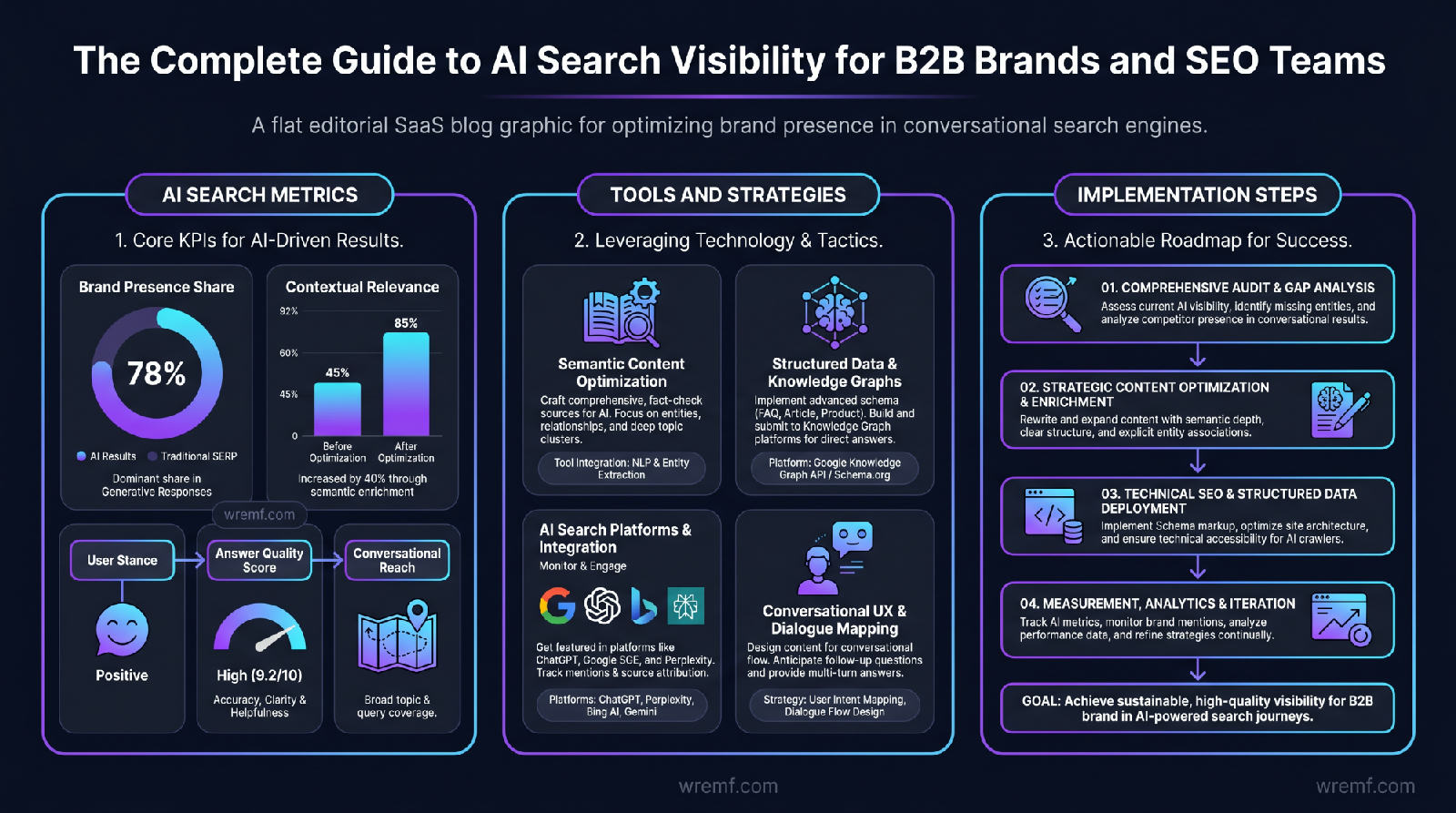
By WREMF Team · 2026-09-19
AI search visibility refers to how often and accurately a brand is mentioned or cited in AI-generated answers from platforms such as ChatGPT and Google AI Overviews. Measurement includes prompt monitoring, citation frequency analysis, AI share of voice, and source audits. It significantly affects B2B discovery and pipeline as AI-driven platforms become key for how users evaluate brands. Reliable AI visibility measurement is essential for strategic planning.
Key takeaways
- AI search visibility depends on brand mentions and citations in AI-generated content.
- Generative engine optimization and answer engine optimization are crucial for AI visibility.
- AI engines like ChatGPT and Google AI Overviews have distinct retrieval behaviors.
- Traditional SEO tools differ as they focus on SERP rankings, not AI content presence.
- AI referral traffic demonstrates the growing importance of AI-driven discovery processes.
The Complete Guide to AI Search Visibility for B2B Brands and SEO Teams

AI search visibility is the measure of how often, how accurately, and how prominently your brand appears in AI-generated answers across ChatGPT, Gemini, Claude, Perplexity, Google AI Overviews, Copilot, and other AI engines. As AI-driven discovery reshapes how buyers find and evaluate vendors, brand presence in AI answers has become a measurable, manageable search channel in its own right. This guide is written for B2B marketers, SEO teams, content strategists, agencies, and founders who need to understand what AI search visibility means, how to measure it, and how to improve it. It covers the key concepts, frameworks, tools, and execution models behind effective AI visibility, including how answer engine optimization, generative engine optimization, prompt tracking, source citations, and AI share of voice connect into one coherent strategy. Whether your team is building an AI visibility program from scratch or looking to mature an existing one, you can explore WREMF's AI search engine optimization guide as a companion resource.
QUICK ANSWER:
AI search visibility measures how often and how accurately a brand is mentioned, cited, or recommended in AI-generated answers from engines such as ChatGPT, Gemini, Perplexity, Claude, and Google AI Overviews. It is tracked through prompt monitoring, citation frequency analysis, AI share of voice, and source consistency audits. AI search visibility matters because buyers increasingly use AI engines to discover, compare, and shortlist vendors before visiting any website.
KEY TAKEAWAYS:
- AI search visibility tracks brand mentions, source citations, sentiment, and share of voice across AI engines, not just keyword rankings on Google.
- AI referral traffic to top websites grew 357% year-over-year in June 2025, reaching 1.13 billion visits, which signals that AI-driven discovery has become a substantial traffic and pipeline channel.
- Generative engine optimization and answer engine optimization are the two primary disciplines for improving AI search visibility, and both require content, authority, entity consistency, and technical foundations.
- Prompt tracking and citation frequency analysis are the core measurement methods for understanding where a brand appears, how often, and alongside which competitors in AI-generated responses.
- WREMF tracks AI search visibility across 10 AI engines, including citation data, AI share of voice, competitor visibility, and GA4 attribution, available as software, managed service, or hybrid execution.
What AI Search Visibility Means and Why It Has Changed Search Strategy
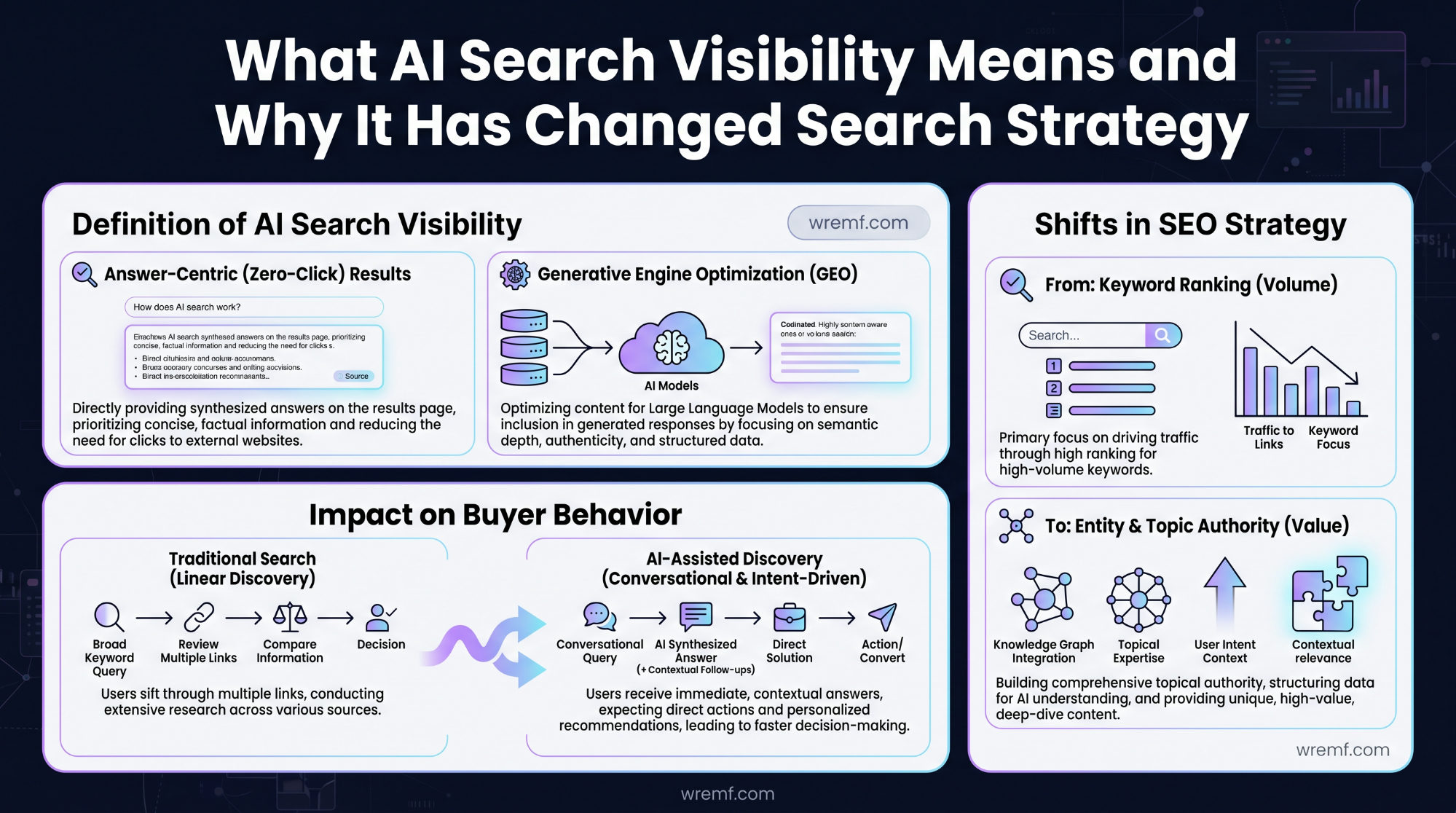
AI search visibility is the degree to which a brand is present, accurately described, and positively framed in AI-generated answers relevant to its category. It is distinct from traditional search engine rankings because it measures presence inside an answer rather than position on a results page.
When a buyer types a question into ChatGPT, Perplexity, or Gemini, or triggers a Google AI Overview, those engines synthesise answers from multiple sources. The brands that appear in those answers, whether named, linked, quoted, or contextually referenced, have AI search visibility. The brands that are absent do not. That absence is commercially significant because buyers treat AI-generated answers as trusted summaries rather than lists of options to evaluate independently.
Traditional SEO measures where a page ranks. AI search visibility measures whether a brand becomes part of the answer itself. These are related but not interchangeable outcomes. A brand can rank on page one of Google and still be entirely absent from AI-generated answers on that same topic. The reverse is also true. A brand with moderate organic rankings but strong entity authority and well-structured content can appear consistently in AI answers.
AI search visibility encompasses several measurable signals. Brand mentions track how often a brand name appears in AI responses. Source citations track whether AI engines link to or quote a brand's content as a supporting source. Citation frequency measures how consistently citations appear across different prompts and engines. Sentiment analysis assesses whether AI descriptions of the brand are accurate, positive, neutral, or negative. AI share of voice compares how often a brand appears versus competitors in the same prompt categories. Together, these signals give teams a structured picture of how AI engines currently perceive and represent their brand.
The commercial relevance of AI search visibility is growing rapidly. According to data cited by SparkToro's blog AI-driven discovery is fundamentally shifting how users begin their buying journey. Buyers who find vendors through AI answers often arrive later in the consideration process, already partially convinced by the summary they received. This is consistent with reported conversion data showing that AI search visitors convert at rates significantly higher than typical organic traffic.
For B2B SaaS teams, agencies, and growth leaders, AI search visibility is not a future problem. It is a present measurement and strategy gap. Teams that measure it now, understand their citation and mention patterns, and build content and authority strategies around AI retrieval are positioning themselves ahead of the buyers who will rely on AI answers for vendor discovery throughout the rest of this decade.
KEY TAKEAWAY: AI search visibility measures brand presence inside AI-generated answers, not page rankings, and it has direct implications for B2B discovery, pipeline, and revenue.
The AI Engines That Define Modern Search Visibility
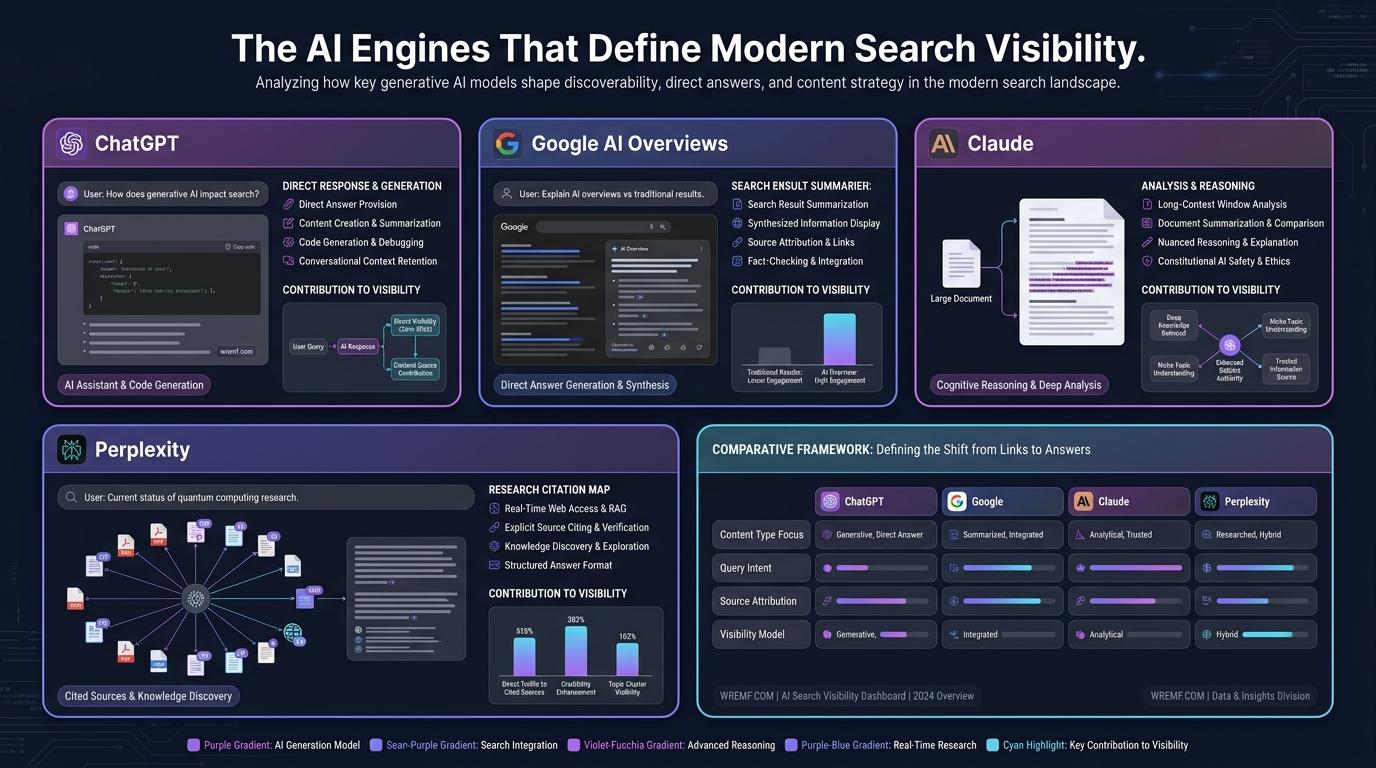
AI search visibility is distributed across a diverse and expanding set of AI engines and platforms, each with distinct retrieval behaviours, source preferences, and citation patterns. Understanding which engines matter, and how they differ, is a prerequisite for building a coherent AI visibility strategy.
ChatGPT, operated by OpenAI, processes over 2.5 billion prompts per day as of early 2026. It retrieves information from its training data and, in browsing-enabled modes, from live web sources. ChatGPT citations tend to favour content with clear authorship, structured information, and demonstrated expertise. The OpenAI research overview offers context on how these models process and weight information at a foundational level.
Google AI Overviews and Google AI Mode are Google's generative search surfaces, integrated directly into the search results page. They pull from indexed content and apply a separate classification process to determine which sources are cited in AI-generated summaries. According to Google's AI Overviews documentation these surfaces are designed to synthesise information from multiple high-quality sources, which means source authority and content structure directly influence citation likelihood.
Perplexity functions as an AI answer engine with explicit citation links. It surfaces sources visibly alongside answers, making citation tracking more transparent than in models that embed sources less explicitly. Gemini, Google's AI model, powers answers across Google Search, Google Workspace, and connected surfaces. Claude, built by Anthropic, is widely used in enterprise and developer contexts and retrieves information through its training data and document inputs.
Microsoft Copilot, powered by Bing's search index, handles billions of queries each month across Microsoft 365, Windows, and Bing Search. As Microsoft's documentation notes, Copilot's reach extends deeply into how enterprise users search, shop, and explore online. DeepSeek, Grok, Meta AI, and Mistral represent additional AI engines with growing user bases and distinct retrieval approaches.
For B2B teams, covering all of these surfaces is not optional if AI discovery is part of the buyer journey. A brand that appears consistently in ChatGPT and Perplexity but is absent from Google AI Overviews and Copilot has a visibility gap that competitors may be filling. Tracking AI search visibility across multiple engines is the only way to see the full picture.
WREMF tracks AI search visibility across 10 AI engines simultaneously, including all major platforms named above, giving teams a consolidated view of citation frequency, brand mentions, and share of voice without running manual prompt checks across each engine separately.
KEY TAKEAWAY: AI search visibility spans at least 10 distinct AI engines, each with different retrieval behaviours, and tracking only one or two creates blind spots that competitors can exploit.
How AI Search Visibility Differs From Traditional SEO Metrics
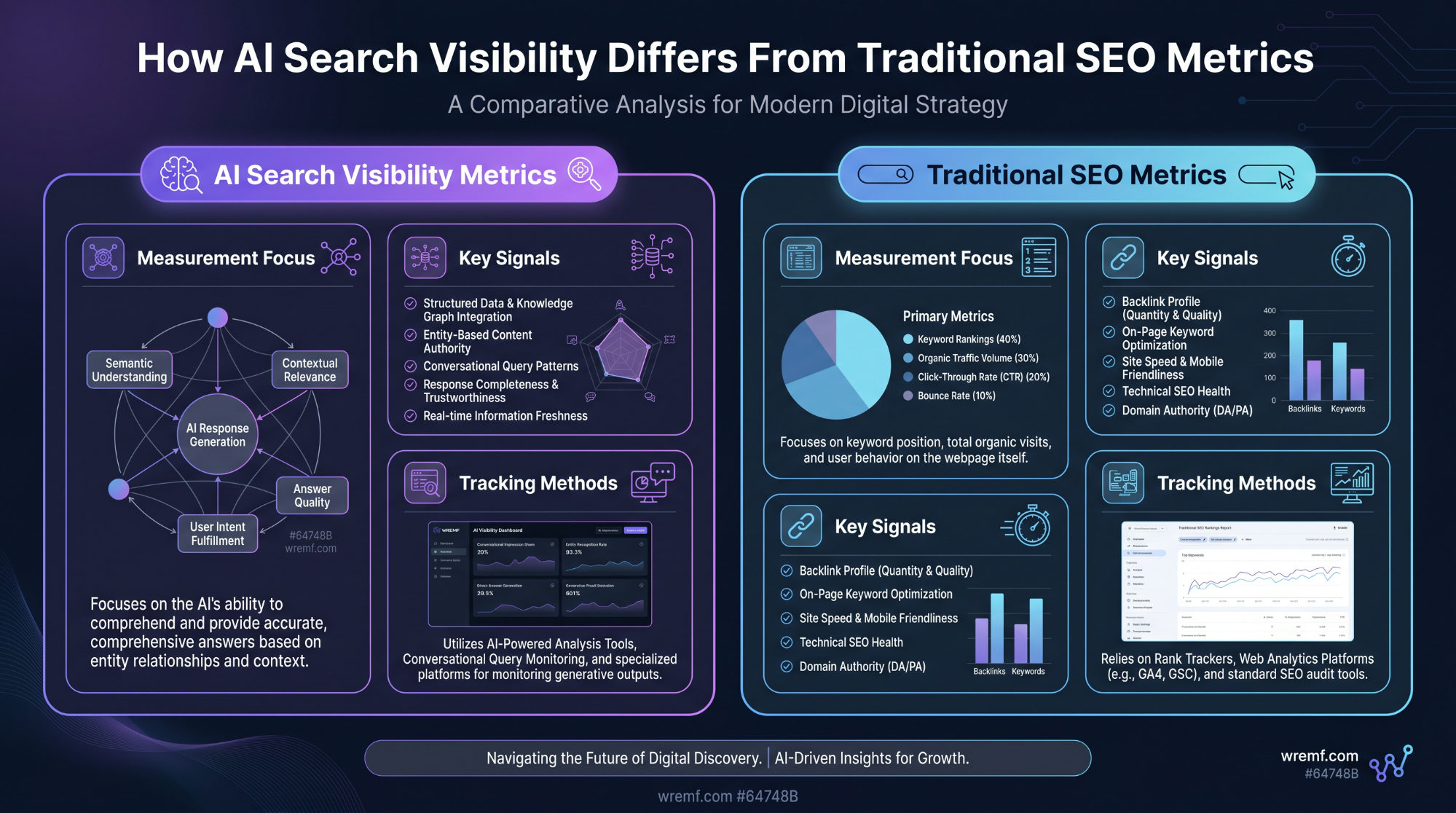
AI search visibility and traditional SEO measure different things, serve different buyer moments, and require different strategies. Understanding the gap between them prevents teams from assuming that strong organic rankings translate automatically into strong AI presence.
Traditional SEO tools were built to measure where pages rank on search engine results pages, how many backlinks a domain has, which keywords drive traffic, and how crawlable and technically sound a site is. These remain valuable signals for Google and Bing search performance. WREMF does not replace traditional SEO tools. It adds the AI visibility layer that traditional tools were never designed to measure.
The practical differences are significant and measurable. Here is how the two approaches compare across key dimensions:
Primary signal
- Traditional SEO tools: Keyword rankings on search engine results pages
- WREMF: Brand mentions and citations in AI prompt answers
What it tracks
- Traditional SEO tools: SERP position, impressions, click-through rates
- WREMF: Citation frequency, AI share of voice, source consistency
Authority signal
- Traditional SEO tools: Backlinks and domain authority
- WREMF: Source citations in AI-generated answers
Query model
- Traditional SEO tools: Keywords and search queries
- WREMF: Prompts submitted to AI engines
Competitive view
- Traditional SEO tools: SERP overlap and ranking comparisons
- WREMF: AI share of voice against competitor domains
Attribution
- Traditional SEO tools: Organic sessions and click attribution
- WREMF: AI referral traffic and prompt-level reporting
Engine coverage
- Traditional SEO tools: Primarily Google and Bing
- WREMF: 10 AI engines including ChatGPT, Gemini, Perplexity, Claude, and Copilot
Audit type
- Traditional SEO tools: Technical SEO audit
- WREMF: GEO and AEO audits
Source consistency
- Traditional SEO tools: Not measured
- WREMF: Tracked across all monitored engines
The core distinction is that SEO tools answer the question of where a page ranks, while WREMF answers the question of whether AI engines are mentioning, citing, and recommending a brand in the prompts that matter to buyers.
For teams that run both, the most effective approach is to use traditional SEO tools for keyword research, backlink analysis, and technical SEO alongside WREMF for AI search visibility tracking, prompt intelligence, citation monitoring, and AI share of voice. These are complementary layers of a complete search visibility strategy, not competing approaches.
SEOs who have built their measurement practice around ranking data alone are increasingly missing the conversion-stage activity that happens inside AI answers before a buyer ever clicks an organic result.
KEY TAKEAWAY: Traditional SEO tools measure where pages rank, while WREMF measures how AI engines mention, cite, and recommend brands, and both are needed for complete search visibility coverage.
The Core Components of AI Search Visibility Measurement
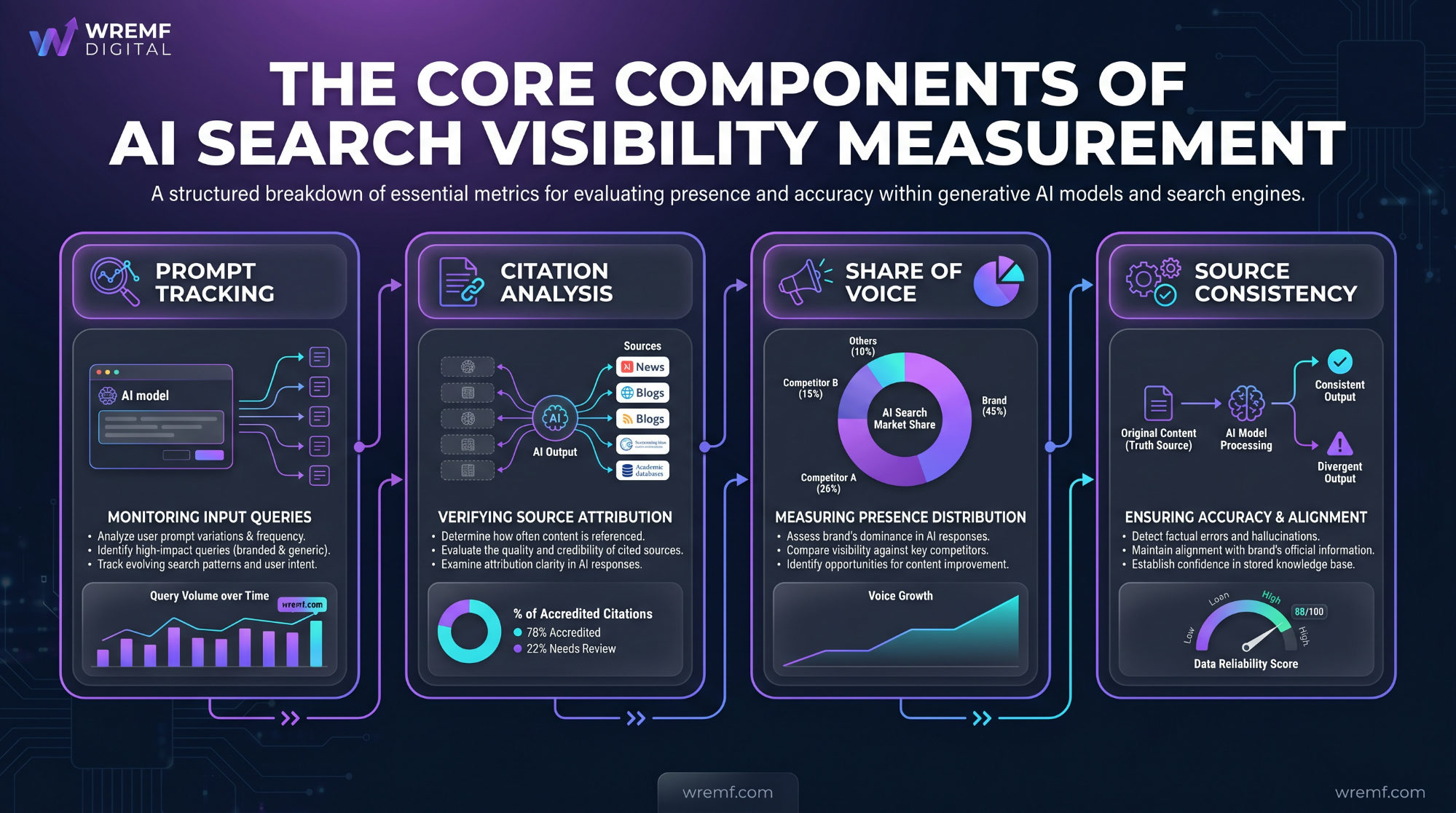
Measuring AI search visibility requires a structured framework that goes beyond checking whether a brand name appears in one AI answer. Reliable AI search visibility measurement involves prompt tracking, citation analysis, share of voice calculation, source consistency auditing, and AI traffic attribution.
Prompt tracking is the foundational layer. Prompt tracking involves selecting a set of representative buyer prompts across different intent categories, submitting them to AI engines on a regular schedule, and recording which brands, sources, and claims appear in the responses. Effective prompt tracking uses a broad enough prompt set to capture variability across AI-generated answers, since AI engines do not return identical responses to the same prompt every time. WREMF supports unlimited prompt tracking across all monitored engines, which removes the artificial constraint of capped prompt limits that affect measurement accuracy on other platforms.
Citation frequency measures how often a brand's content is linked or referenced as a source in AI-generated responses. Citation data is distinct from brand mentions. A brand can be mentioned without its content being cited, and it can be cited without being named explicitly. Both signals matter and serve different diagnostic purposes. High citation frequency on specific content types or topics indicates that AI engines are treating that content as a reliable source.
AI share of voice compares citation and mention frequency against competitor domains across the same prompt set. Share of voice calculation shows not just whether a brand is present, but whether it is more or less visible than specific competitors in the categories that matter. This is the most commercially useful competitive signal in AI search visibility measurement because it connects directly to the question of which brand AI engines are recommending to buyers in a given category.
Source consistency analysis examines whether AI engines are citing the same sources, describing the brand the same way, and surfacing the same content across different engines. Source inconsistency often reveals gaps in content structure, entity authority, or indexing that create uneven AI visibility across platforms.
AI Visibility Score is a composite metric that aggregates mention frequency, citation frequency, sentiment, share of voice, and source consistency into a single trackable index. The AI Visibility Score gives teams and leadership a single number to monitor over time while preserving the diagnostic detail behind it. WREMF's AI Visibility Index provides this composite view, making it easier to report progress without requiring leadership to interpret raw prompt data.
AI referral traffic attribution connects AI search visibility measurement to business outcomes by identifying traffic arriving from AI engines, attributing it to specific prompts or content types, and connecting it to pipeline data through GA4 integration. AI referral traffic is often undercounted in standard analytics configurations because AI engines do not always pass referrer data in the same way traditional search engines do. WREMF's GA4 attribution feature is designed to close this measurement gap for teams using AI search visibility data for business impact reporting.
Teams can explore how WREMF's AI mention tracking guide covers the full measurement methodology for brand mentions and citation tracking across AI engines.
KEY TAKEAWAY: Complete AI search visibility measurement requires prompt tracking, citation frequency analysis, share of voice, source consistency auditing, and AI referral traffic attribution working together as a connected system.
Answer Engine Optimization and Generative Engine Optimization Explained
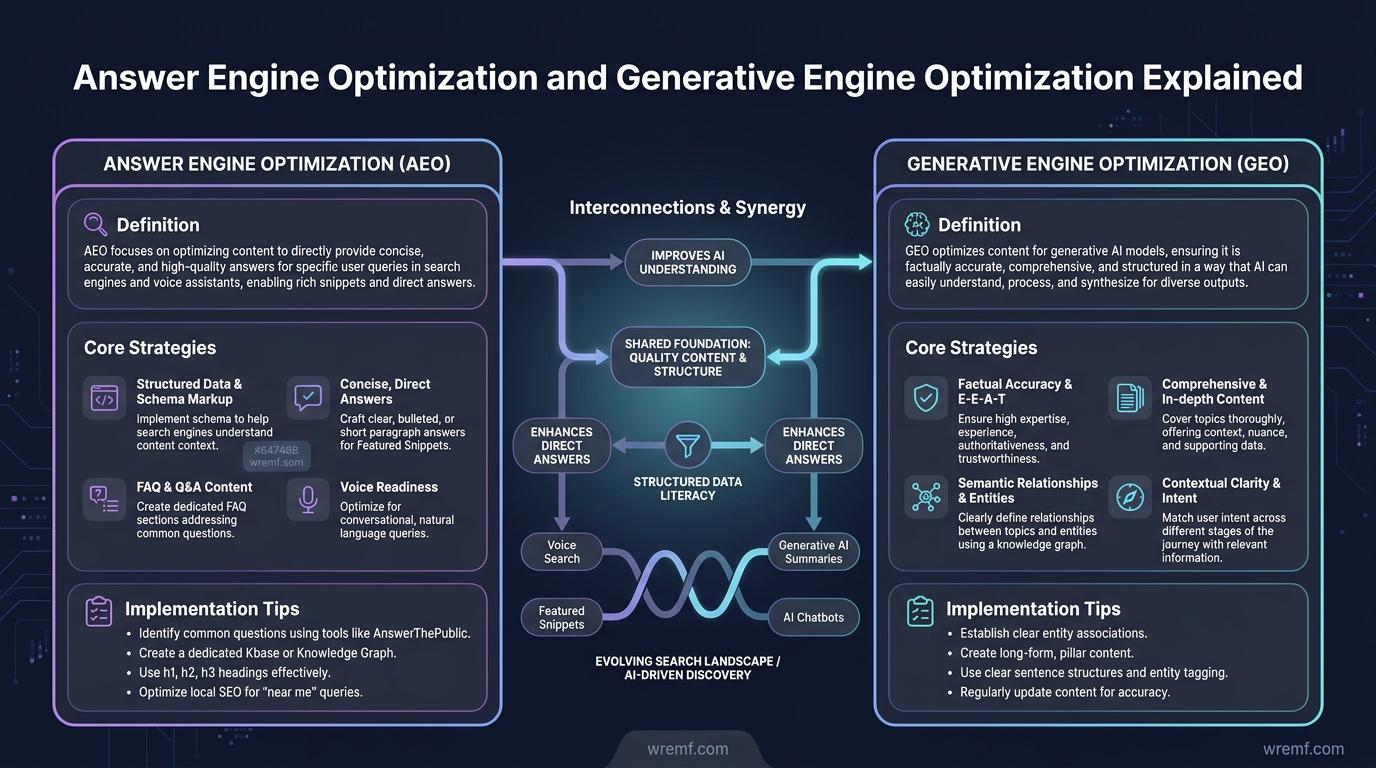
Answer engine optimization and generative engine optimization are the two primary strategic disciplines for improving AI search visibility. They are related but distinct, and understanding their differences helps teams prioritise correctly.
Answer engine optimization, commonly referred to as AEO, is the practice of structuring content so that AI engines and answer engines retrieve, trust, and cite it in response to relevant prompts. AEO focuses on content clarity, question-and-answer formatting, entity accuracy, and the signals that AI answer engines use to determine which sources are worth citing. The answer engine optimization services guide explains the full strategic framework for AEO in B2B contexts.
Generative engine optimization, commonly referred to as GEO, extends AEO principles to cover the full range of generative search surfaces, including ChatGPT, Claude, Gemini, and Perplexity, as well as Google AI Overviews. GEO focuses on how content is retrieved by large language models during answer generation, how brand entities are represented in model knowledge, and how content structure, freshness, and authority affect retrieval probability. The generative AI optimization services guide provides a detailed breakdown of GEO methodology.
AEO and GEO are not competing strategies. In practice, most teams pursue both simultaneously because the signals that improve AI citation in answer engines overlap significantly with the signals that improve retrieval in generative search. Strong entity authority, well-structured content, accurate and current information, clear authorship, and consistent source representation matter for both.
Large language model optimization, sometimes called LLMO or LLM SEO, sits within the broader GEO and AEO category but focuses specifically on how LLMs process and retrieve content during model inference. LLM optimization includes technical considerations such as how content is structured for machine parsing, how entities are defined and linked, and whether content passes the relevance and authority thresholds that LLMs apply when selecting sources. Teams can review the large language model optimization services guide | https://wremf.com/blog/large-language-model-optimization-services-the-complete-guide-to-llmo-ai-search-visibility-aeo-geo-rag-and-llm-performance for a deeper technical treatment of this topic.
The practical relationship between SEO, AEO, and GEO is hierarchical rather than parallel. Technical SEO provides the foundation: crawlability, indexing, page structure, and site authority. AEO builds the content layer: answer-optimised pages, structured information, and clear entity definitions. GEO builds the authority and retrieval layer: content that AI engines treat as credible, current, and comprehensive enough to cite. Teams that skip the foundation and try to optimise for GEO without solid technical SEO and AEO content will find that their improvements are limited by the absence of underlying signals that AI engines rely on.
AI SEO, as a broader category, encompasses all three disciplines and connects them to measurement through prompt tracking, citation monitoring, and attribution. The AI SEO services guide gives a practical overview of how teams build AI SEO programs that span technical, content, and authority work.
KEY TAKEAWAY: AEO, GEO, and LLM optimization are complementary disciplines for improving AI search visibility, and all three require a foundation of technical SEO, content quality, and entity authority to produce reliable results.
How to Track AI Search Visibility: A Practical Workflow
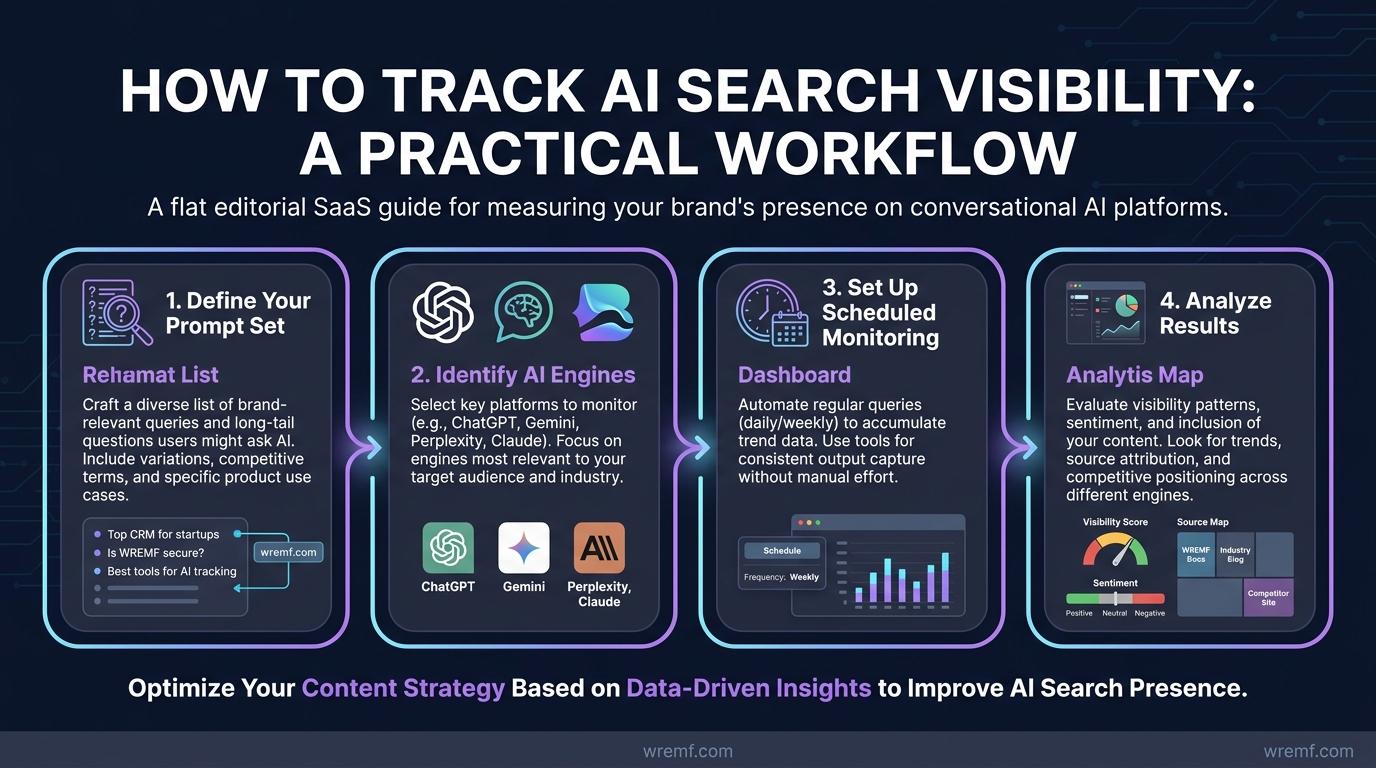
Tracking AI search visibility requires a repeatable process that covers prompt selection, engine monitoring, citation analysis, competitor comparison, and attribution. The following workflow reflects the approach that structured AI visibility programs use to generate actionable data rather than one-time snapshots.
Step 1: Define your prompt set
Select 20 to 50 representative prompts that reflect how buyers in your category ask questions of AI engines. Include category-level prompts such as "What is the best tool for tracking AI brand mentions?" alongside comparison prompts such as "How does [your brand] compare to [competitor]?" and problem-led prompts such as "How do I improve AI search visibility for a B2B SaaS company?" The prompt set should cover awareness, comparison, and decision stages of the buyer journey.
Step 2: Identify the AI engines you need to monitor
Map the AI engines your target audience uses most. For most B2B SaaS teams, this includes ChatGPT, Gemini, Perplexity, Claude, and Google AI Overviews at minimum, with Copilot added for enterprise and Microsoft-heavy audiences. DeepSeek, Grok, Meta AI, and Mistral may be relevant depending on market and audience.
Step 3: Set up scheduled monitoring
Manual prompt checks are not scalable and do not account for AI answer variability. Configure a platform such as WREMF to run scheduled prompt monitoring across all target engines, capturing citation data, brand mentions, competitor mentions, and source URLs automatically. WREMF's unlimited prompt tracking means teams can monitor a broad prompt set without incurring per-prompt costs that distort measurement scope.
Step 4: Analyse citation frequency and source patterns
Review which pages are being cited in AI-generated answers for your priority prompts. Identify which content types, page structures, and topics generate citations most consistently. Compare your citation frequency against competitor domains to calculate AI share of voice. Use source consistency analysis to check whether AI engines are citing different pages or describing your brand inconsistently across engines.
Step 5: Run a GEO audit
A GEO audit assesses the current state of your content, entity representation, technical structure, and authority signals from the perspective of AI retrieval rather than traditional ranking. The audit identifies specific visibility gaps that prevent AI engines from citing your content reliably. WREMF's Growth and Managed plans include GEO audit capability as a core deliverable.
Step 6: Build and execute an AI-ready content strategy
Use citation gap analysis and GEO audit findings to prioritise content creation and optimisation. AI-ready content briefs specify the questions to answer, the entities to reference, the structure to use, and the authority signals to include. Content that answers prompts directly, cites verifiable information, and demonstrates clear expertise consistently outperforms generic content in AI retrieval.
Step 7: Connect AI visibility data to GA4 attribution
Configure GA4 to capture AI referral traffic by source and connect it to engagement and conversion events. This step closes the loop between AI search visibility measurement and business outcomes, and it provides the evidence base for reporting AI visibility ROI to leadership.
Step 8: Report and iterate monthly
Review citation frequency, AI Visibility Score, share of voice, and AI referral traffic on a monthly basis. Use the Dashboard to track trends and set improvement benchmarks. Scheduled reporting through WREMF's white-label reports supports agency workflows and client reporting without requiring manual data extraction each cycle.
TIP:
Content that has not been updated in 12 or more months is increasingly unlikely to be retrieved as a trusted source in AI-generated answers, particularly in fast-moving B2B categories. Regular content refreshes that add specific, verifiable information improve both citation frequency and AI Visibility Score over time.
KEY TAKEAWAY: Reliable AI search visibility tracking requires a structured, scheduled workflow covering prompt monitoring, citation analysis, competitor comparison, GEO auditing, content execution, and attribution, not ad hoc manual checks.
What Makes Content Visible to AI Engines
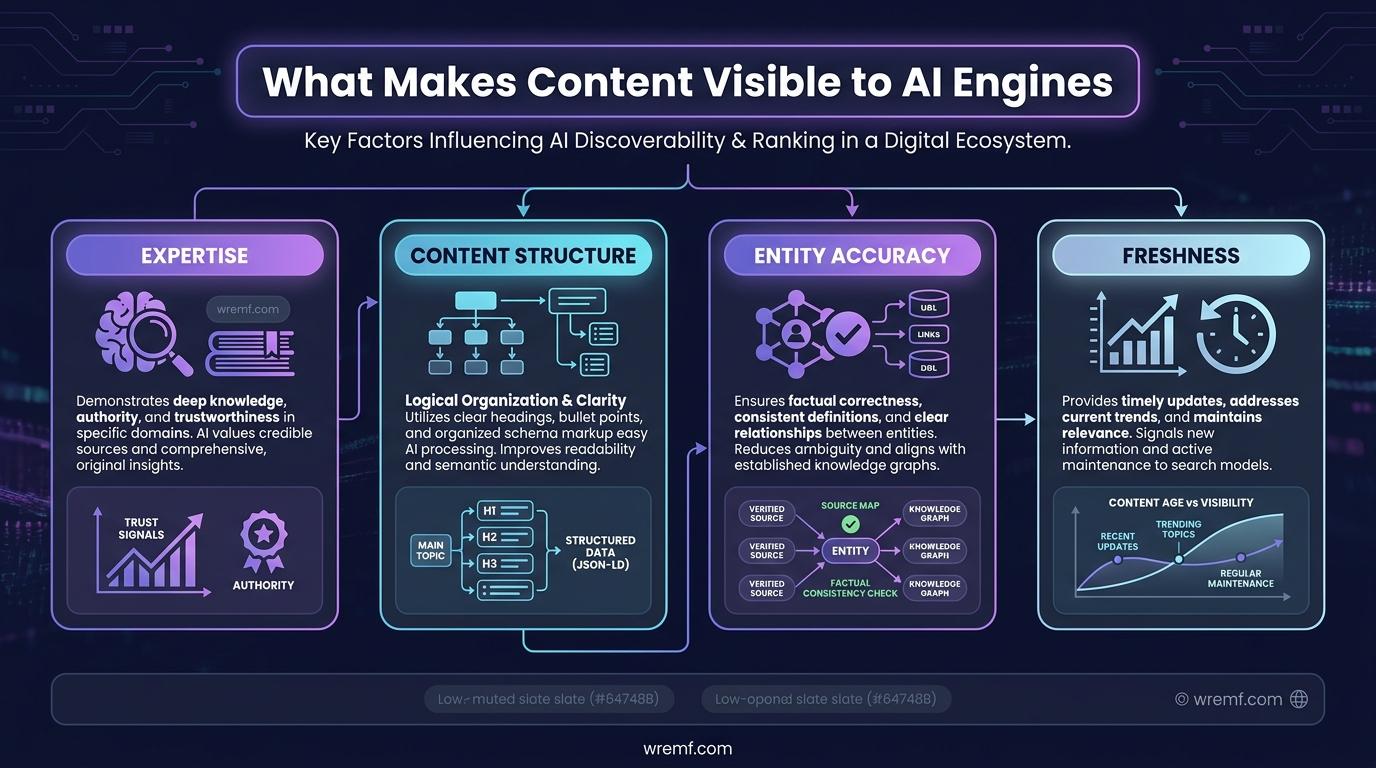
Content becomes visible to AI engines when it meets the signals those engines use to determine source trustworthiness, answer relevance, and citation worthiness. Understanding these signals is the foundation of a practical content strategy for AI search visibility.
AI engines favour content that demonstrates expertise, accuracy, and structure. Detailed author bios with specific credentials, first-hand experience documented with real outcomes, and claims supported by verifiable sources all contribute to the signals that AI models use when selecting sources to cite. Research cited across AI SEO practitioners suggests that over 53% of ChatGPT citations come from content updated within the last six months, which highlights freshness as a significant retrieval signal alongside authority.
Content structure matters as much as content quality for AI retrieval. AI answer engines parse content differently from how humans read it. Content that uses clear headings, direct answers in the first sentence of each section, defined entities, and explicit question-and-answer formatting is easier for AI engines to extract and quote accurately. Content that buries answers in long paragraphs, uses vague language, or lacks clear topical focus is harder for AI engines to classify and cite confidently.
Entity accuracy is a frequently underestimated signal in AI search visibility. AI engines build associations between brand names, product categories, use cases, and authority signals over time. When a brand's entity description is inconsistent across its website, third-party sources, and public records, AI engines struggle to represent the brand accurately in generated answers. Citation, entity, and authority cleanup is a core component of WREMF's Managed plan because entity inconsistency is one of the most common causes of preventable AI visibility gaps.
Featured snippets remain a useful proxy signal for content that AI engines are likely to retrieve. Pages that earn featured snippets on Google have typically demonstrated the kind of direct, structured, authoritative content that also performs well in AI citation. However, featured snippet presence does not guarantee AI citation, and AI citation does not require featured snippet status, so teams should track both signals independently.
Schema markup supports AI retrieval by adding structured data that makes content classification faster and more accurate. According to Schema.org documentation structured data gives search engines and AI systems explicit signals about page content type, entities referenced, and factual claims made. Implementing relevant schema types consistently across high-priority pages reduces classification ambiguity and improves the probability of accurate AI citation.
Content that generates strong AI visibility also tends to be specific rather than generic. Writing "As of Q1 2026, ChatGPT processes over 2.5 billion prompts per day" is more retrievable than "LLMs are growing rapidly" because AI engines weight specificity and verifiability when selecting sources for AI-generated answers.
KEY TAKEAWAY: Content earns AI citations through expertise signals, structural clarity, entity accuracy, freshness, and specificity, not through keyword density or link volume alone.
AI Search Visibility Tools and How to Choose Between Them
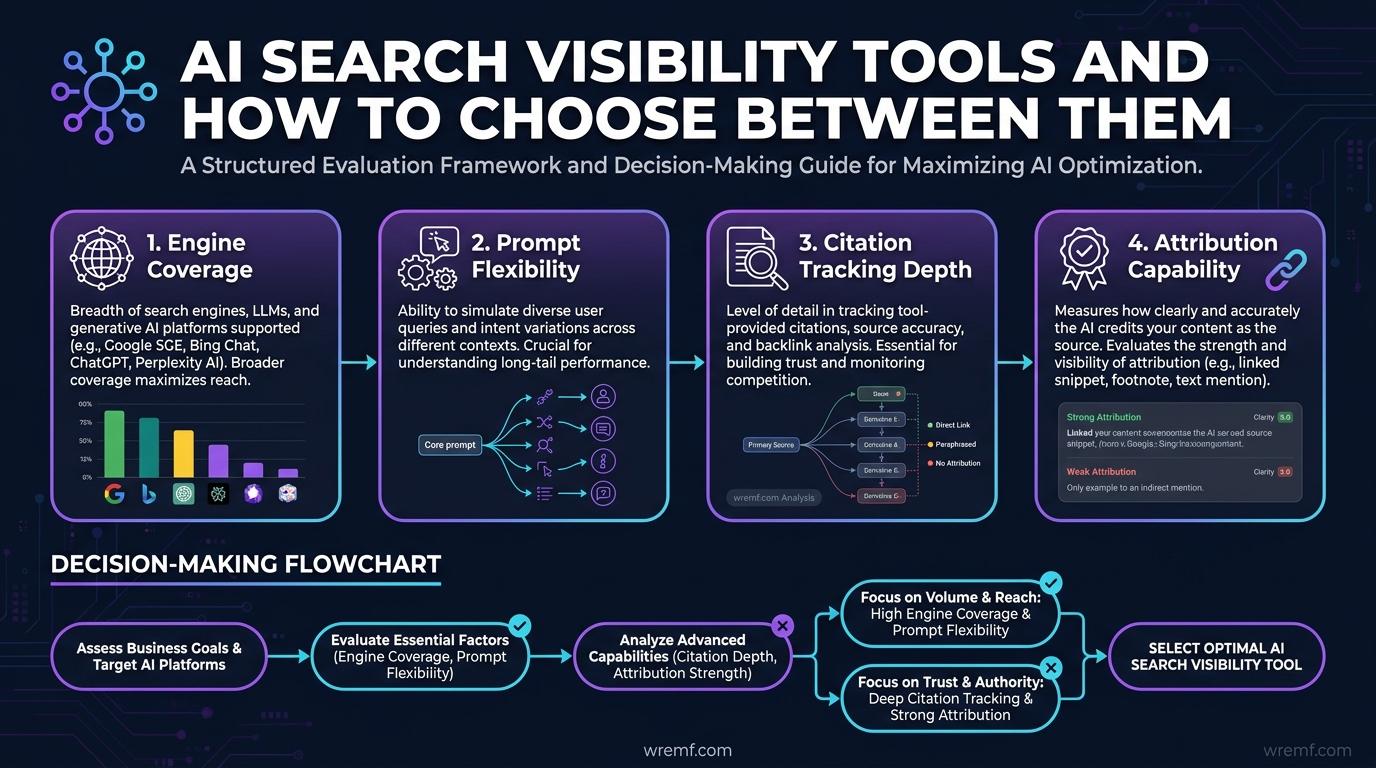
AI search visibility tools differ significantly in scope, depth, methodology, and the specific measurement problems they are designed to solve. Choosing the right tool depends on your team's measurement needs, execution resources, and budget.
The AI search visibility tools category has expanded rapidly in 2025 and 2026. Tools in this category generally track some combination of brand mentions in AI answers, citation frequency, AI share of voice, prompt-based monitoring, and competitor visibility. Not all tools cover all 10 major AI engines, and not all tools provide the attribution or white-label reporting capabilities that agencies and enterprise teams need.
When evaluating AI search visibility tools, consider these dimensions:
Engine coverage
How many AI engines does the tool monitor? Tools that cover only ChatGPT and Google AI Overviews provide an incomplete picture for teams competing across Perplexity, Claude, Copilot, Gemini, DeepSeek, Grok, Meta AI, and Mistral.
Prompt flexibility
Does the tool allow unlimited prompt tracking, or does it impose per-prompt caps that constrain measurement scope? Per-prompt pricing models create an incentive to monitor fewer prompts, which reduces measurement accuracy.
Citation tracking depth
Does the tool show which sources are being cited alongside your brand, and does it track source URLs? Citation data without source URLs limits the diagnostic value of the tool for content and authority strategy.
Competitor visibility
Can the tool track competitor domains across the same prompt set? AI share of voice calculation requires competitor data, not just your own citation frequency.
Attribution capability
Does the tool connect AI visibility data to GA4 or equivalent analytics to track AI referral traffic and conversion contribution?
White-label and reporting
Does the tool support agency workflows with white-label client reports, Looker Studio connectors, and multi-client management?
BYOK support
Does the tool offer bring-your-own-key support so teams can use their own API keys for AI engine queries? BYOK reduces cost dependency and gives teams more control over query volume and engine selection.
The 12 best AI search optimization tools guide provides a structured comparison of leading platforms. Rather than reproduce a full tool list here, the comparison that follows focuses on WREMF's position relative to the category.
WREMF covers 10 AI engines with unlimited prompt tracking on every plan, BYOK support, no per-prompt markups, and optional managed execution. The Growth plan at 149 euros per month adds GA4 attribution, GEO audits, content brief generation, AI share of voice, white-label reports, and Looker Studio integration, making it the most complete self-serve option for B2B SEO teams and agencies. The Managed plan at from 1,500 euros per month adds senior-led execution including AI visibility audits, custom GEO strategy, AEO content optimisation, citation and entity cleanup, and monthly reporting with strategy calls.
The AI search engine optimization tools guide provides additional context on how different tool categories serve different stages of an AI visibility program.
For teams looking to compare WREMF pricing plans, the full breakdown is available at WREMF pricing
KEY TAKEAWAY: When choosing AI search visibility tools, prioritise engine coverage breadth, prompt flexibility, citation tracking depth, attribution capability, and reporting features over surface-level brand mention counts.
Real-World Scenarios: How B2B Teams Use AI Search Visibility Data
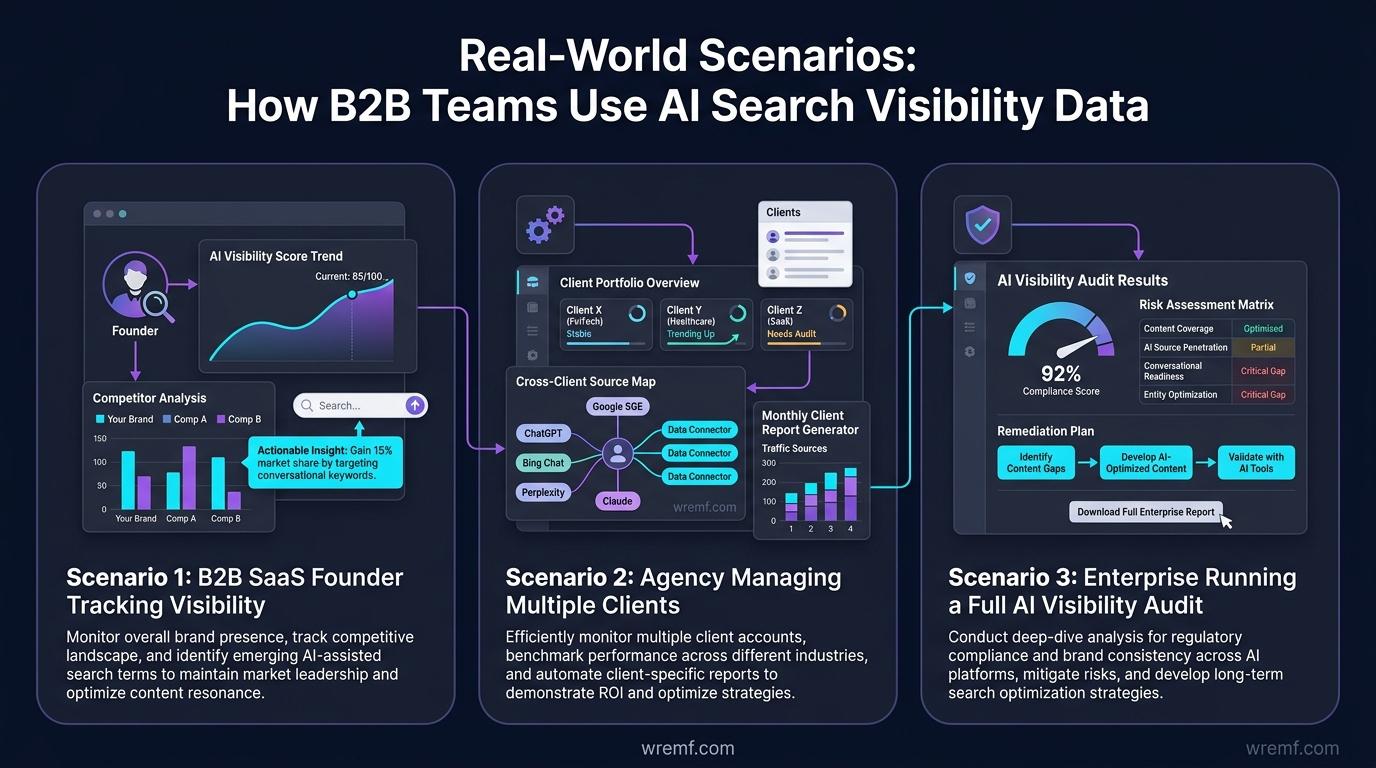
AI search visibility data becomes commercially valuable when it is connected to specific business decisions, content actions, and competitive responses. The following scenarios illustrate how different team types translate visibility data into strategy.
Scenario one: A B2B SaaS founder tracking early AI visibility
A founder running a growing SaaS company notices that buyers are arriving at demos already familiar with the brand and referencing AI-generated summaries in early sales conversations. The founder sets up WREMF on the Starter plan at 59 euros per month to track how the brand appears in ChatGPT, Perplexity, and Google AI Overviews for the 15 to 20 prompts that buyers in the category most commonly ask.
Within the first 30 days, the data shows the brand is mentioned in ChatGPT answers for category-level prompts but is not cited as a source. Competitors with more structured content and stronger entity consistency are being cited more frequently. The founder uses this citation gap as a brief for the content team: identify the pages AI engines are citing for those prompts, analyse their structure, and create more direct, expert-led content that mirrors those patterns. Between 30 and 90 days, citation frequency begins to improve as updated content is indexed and retrieved.
Scenario two: An agency managing AI visibility for multiple clients
An agency with 12 B2B SaaS clients needs to monitor AI search visibility across all client brands and produce monthly reports that show citation trends, competitor share of voice, and content recommendations. The agency uses WREMF Growth, which supports five websites and 10 to 15 competitors with white-label reports and a Looker Studio connector.
The agency configures a prompt set for each client based on their buyer journey and target categories. Monthly dashboard reviews identify which clients have improved citation frequency, which have visibility gaps from competitors gaining share of voice, and which pages are being consistently cited across AI engines. White-label reports are sent directly to client marketing leads, with actionable recommendations tied to specific citation and content gaps.
Scenario three: An enterprise brand running a full AI visibility audit
A marketing team at a mid-market enterprise company is preparing a board presentation on AI-driven pipeline. They want to understand whether AI engines are accurately representing the brand, how the brand compares to three named competitors across the top 50 buyer prompts in their category, and where the most significant content and entity gaps exist.
The team engages WREMF on the Managed plan, which includes a full AI visibility audit, custom GEO strategy, AEO content optimisation, citation and entity cleanup, and senior-led execution. The audit identifies that the brand's entity representation is inconsistent across third-party sources and that several high-priority pages lack the structural signals that AI engines prefer for citation. The custom roadmap covers content creation priorities, entity cleanup tasks, and a 90-day execution schedule with monthly reporting and strategy calls.
DID YOU KNOW:
Research across AI visibility case studies suggests that brands publishing structured, expert-led data studies can achieve significant improvements in AI citation rates within 60 days, with one documented example showing movement from 8% to 67% of AI responses for key topics. Results vary significantly by category, competition level, content quality, and domain authority.
KEY TAKEAWAY: AI search visibility data generates business value when it is connected to specific content decisions, competitive responses, and attribution reporting, not when it is tracked in isolation from strategy.
AI Share of Voice and Competitive Visibility
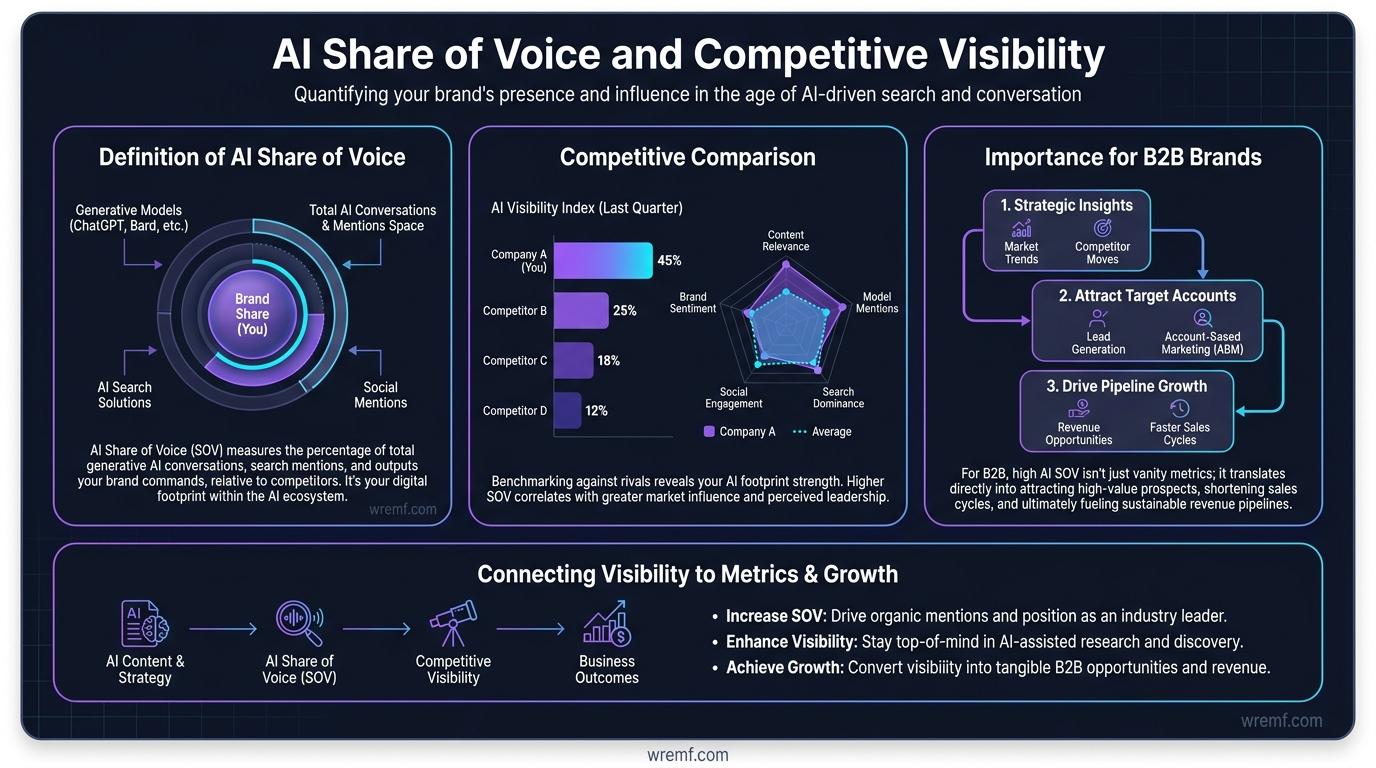
AI share of voice is the percentage of relevant AI-generated answers in which a brand appears compared to competitor domains across the same prompt set. It is the most commercially relevant competitive metric in AI search visibility because it directly answers the question of which brand AI engines are recommending to buyers in a given category.
Traditional share of voice in SEO is calculated from keyword ranking positions and estimated traffic share. AI share of voice is calculated differently. It requires running a consistent prompt set across multiple AI engines, recording which brands appear in each answer, and calculating the proportion of answers in which each brand is cited or mentioned relative to competitors.
AI share of voice reveals several things that ranking data cannot. It shows whether a brand is being recommended in prompts where it does not rank organically. It shows which competitors are more consistently cited by AI engines even when their keyword rankings are comparable. It shows which prompt categories represent the highest competitive risk, where a competitor has established dominant AI citation patterns that require a targeted content and authority response.
Tracking competitor domains within the same prompt monitoring workflow is essential for AI share of voice calculation. WREMF's Growth plan supports 10 to 15 competitor domains, and the Managed plan supports custom competitor configurations for teams competing in larger categories with more fragmented competitive landscapes.
The gap between organic search visibility and AI share of voice is a frequent source of strategic surprise for B2B marketing teams. A brand can hold strong organic rankings across its target keywords while a less-visible competitor captures most of the AI share of voice in the same category, simply because that competitor's content is better structured, more entity-consistent, and more frequently cited by AI engines. Identifying this gap is one of the primary reasons teams invest in AI search visibility tools rather than relying on organic ranking data alone.
For teams building a competitor intelligence workflow, the AI brand monitoring guide provides a practical framework for monitoring how both your brand and competitors appear across AI engines over time.
KEY TAKEAWAY: AI share of voice measures competitive citation frequency across a shared prompt set, not keyword rankings, and it often reveals significant competitive gaps that organic ranking data obscures completely.
Limitations, Risks, and Caveats of AI Search Visibility Programs
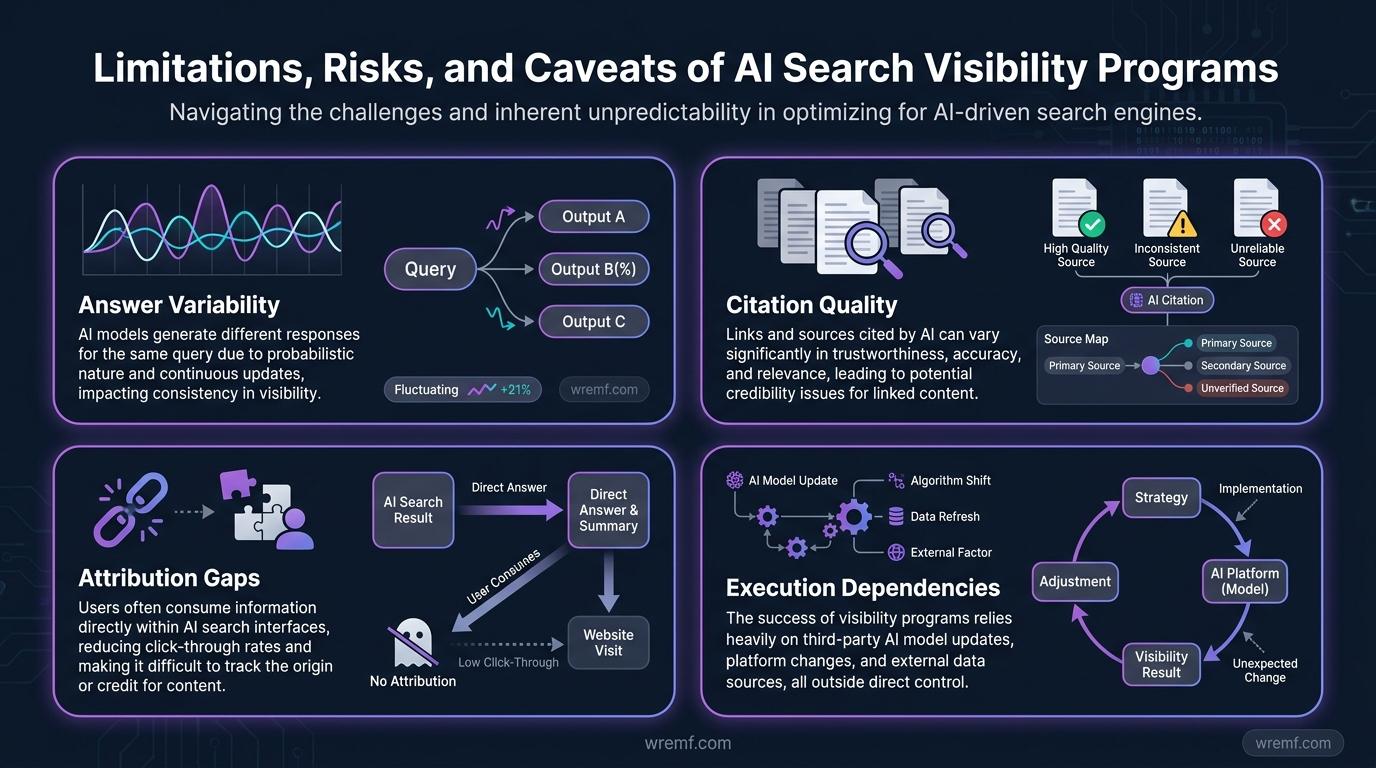
AI search visibility is a measurable and improvable channel, but it carries genuine limitations and caveats that every team should understand before building strategy on visibility data alone. Honest acknowledgement of these limitations makes AI visibility programs more credible and more strategically useful.
AI answers are not static or deterministic. AI engines do not return identical answers to the same prompt every time. Responses vary by engine, by query phrasing, by the user's context, by the time of the query, and by which sources the engine has recently indexed or reweighted. A single prompt check at one point in time is not a reliable measure of AI search visibility. Reliable measurement requires scheduled monitoring across multiple prompts, multiple engines, and multiple time points. This is why prompt volume and measurement frequency both matter when choosing AI search visibility tools.
Citation does not guarantee visibility impact or conversion. A brand can be cited in AI-generated answers without generating measurable traffic or pipeline from those citations. AI answers that mention a brand without linking to its content, or that describe the brand in a neutral or undifferentiated way, provide limited commercial value. Teams should track not just citation frequency but citation quality, including whether the citation includes a source link, whether the brand description is accurate and positive, and whether the prompt category is commercially relevant.
AI referral traffic attribution is incomplete in standard analytics configurations. Most GA4 setups do not automatically capture all AI engine referral sessions accurately because AI engines handle referrer passing inconsistently. Teams relying on default analytics configurations will undercount the contribution of AI search visibility to traffic and pipeline. Dedicated AI traffic attribution configuration, as WREMF's GA4 integration supports, is required to produce reliable attribution data.
GEO and AEO improvements take time to register in citation data. Unlike paid media, where spend changes produce near-immediate impression and click effects, content and entity improvements for AI visibility typically take 30 to 90 days to register in citation frequency data. Teams should set realistic improvement timelines and use early citation trend data rather than expecting immediate jumps in AI Visibility Score.
No platform can guarantee that an AI engine will recommend a specific brand. AI visibility platforms, including WREMF, can identify citation gaps, recommend content improvements, track progress, and provide the strategic and execution support needed to improve AI search visibility over time. They cannot control AI engine retrieval decisions directly. Any provider that guarantees AI citation or AI recommendation inclusion should be evaluated with appropriate scepticism.
Software-only plans require internal execution capacity. The Starter and Growth plans give teams complete visibility tracking, reporting, and attribution capability, but acting on the data requires internal content, SEO, and authority-building resources. Teams without those resources will generate insight without the execution capacity to improve their AI search visibility meaningfully. For those teams, WREMF's Managed plan or hybrid engagement model is a more suitable fit.
IMPORTANT:
AI visibility data is most valuable when it is used to inform specific content decisions, authority-building actions, and entity cleanup work, not when it is tracked without a connected execution plan. Measurement without action does not improve citation frequency.
KEY TAKEAWAY: AI search visibility programs have real limitations including answer variability, attribution gaps, execution dependencies, and result timelines that teams must account for when setting expectations and designing measurement frameworks.
Choosing Between WREMF Software, Managed Service, and Hybrid
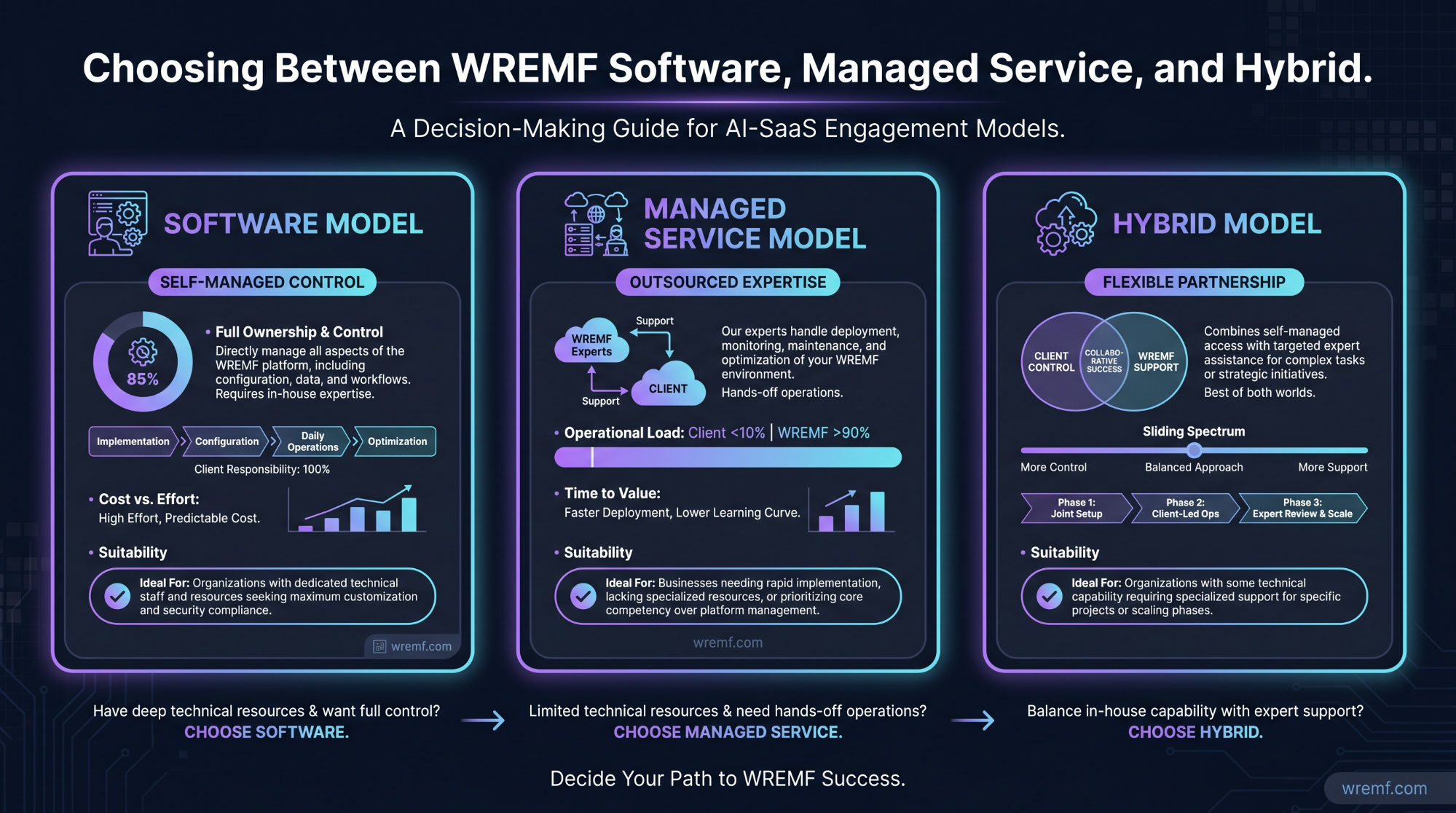
The right WREMF engagement model depends on your team's internal execution capacity, budget, strategic maturity, and how quickly you need to move from measurement to results.
WREMF operates across three engagement models, and teams can move between them as their AI visibility program develops.
Software model: Starter and Growth plans
The software model suits teams with strong internal SEO, content, and strategic execution resources that need reliable AI search visibility data, reporting, and attribution to inform their own execution. The Starter plan at 59 euros per month covers one website, three competitors, unlimited prompt tracking, core citation tracking, AI Visibility Index, and monthly reporting. It is designed for founders, solo consultants, and small SaaS teams beginning to measure AI search visibility.
The Growth plan at 149 euros per month covers five websites, 10 to 15 competitors, and adds GEO audits, content brief generation, AI share of voice, GA4 attribution, white-label reports, Looker Studio connector, and priority support. It is designed for B2B marketing teams, in-house SEO teams, and agencies that need the full measurement and reporting stack without managed execution.
Both Starter and Growth plans include 10-engine AI visibility tracking, unlimited prompts, BYOK support, and no per-prompt markups. The first charge starts after a three-day onboarding window.
Managed service model
The Managed plan starting from 1,500 euros per month is for companies that need WREMF to run the AI visibility program end to end. It includes everything in Growth plus a full AI visibility audit, custom GEO strategy, AEO content optimisation, citation and entity cleanup, senior-led execution, strategy calls, custom roadmap, and monthly reporting. It suits enterprise brands, large agencies managing significant client portfolios, and multi-market teams that do not have internal resources to execute GEO and AEO strategy at the required depth and pace.
Hybrid model
The hybrid model combines WREMF software for in-house tracking and reporting with senior WREMF team engagement for audits, strategy, and execution sprints. It is suited to teams that have internal execution capacity but benefit from periodic expert input on GEO strategy, entity cleanup, citation gap analysis, and content prioritisation. The hybrid model allows teams to scale strategic support up or down based on program phase without committing to full managed service indefinitely.
For teams that want to discuss which model fits their situation before starting, WREMF offers a pre-sales call option. Teams can book a quick call with WREMF to discuss plan selection, onboarding, and execution priorities before checkout.
The WREMF agency services page provides additional context on how agencies use WREMF for multi-client AI visibility management, white-label reporting, and client portal delivery.
KEY TAKEAWAY: Choosing between WREMF software, managed service, and hybrid depends primarily on your team's internal execution capacity, not just budget, and the model can change as your AI visibility program matures.
Common Misconceptions About AI Search Visibility
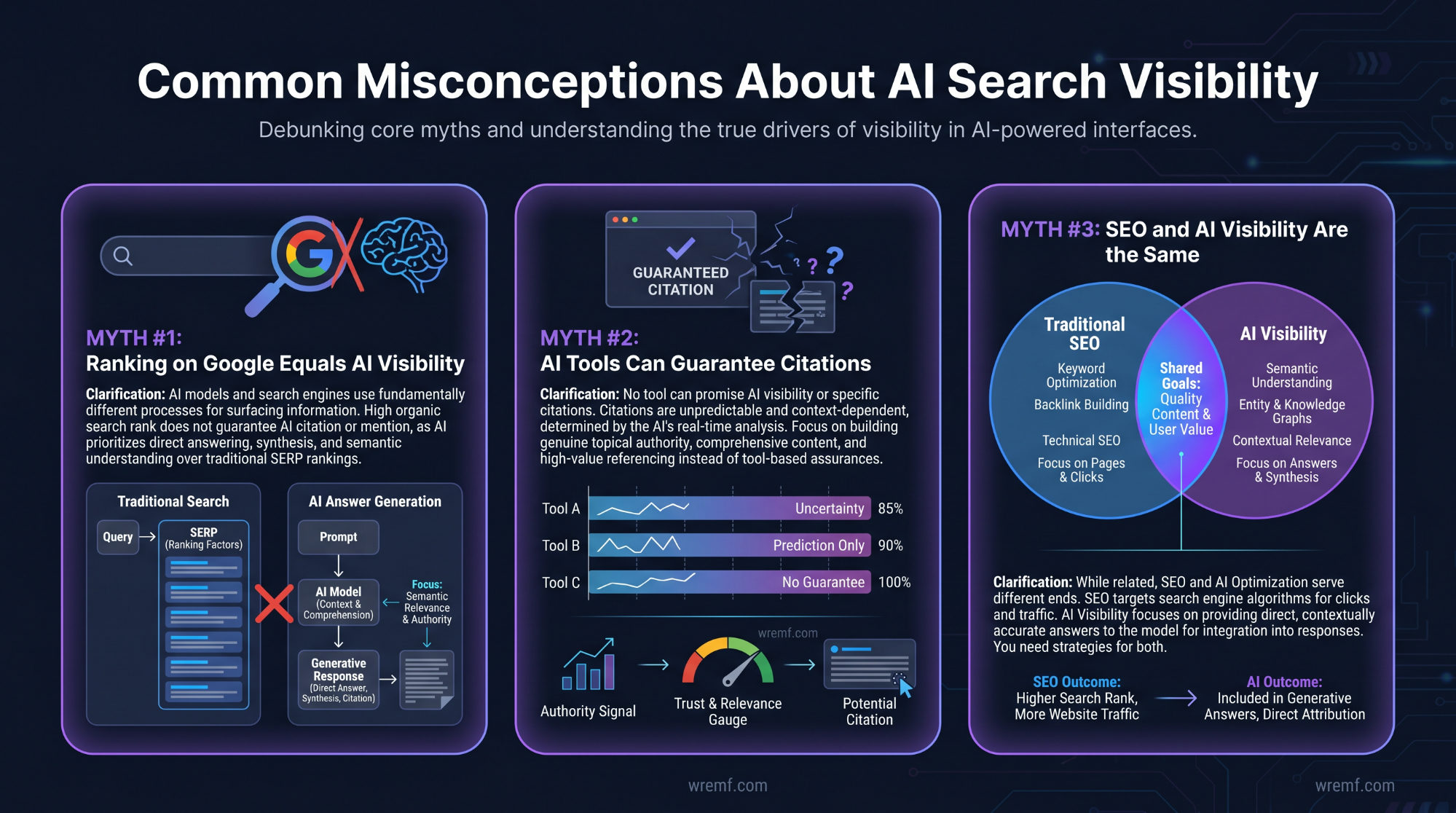
MYTH: If your brand ranks on page one of Google, it will automatically appear in AI-generated answers.
FACT: Google organic rankings and AI citation are measured by different signals and do not automatically correlate. AI engines select sources based on content structure, entity authority, answer directness, and freshness signals that are distinct from the link authority and keyword relevance factors that determine organic rankings. A brand can rank on page one and be absent from AI answers in the same topic area, while a competitor with lower rankings but better-structured content earns consistent citations.
MYTH: AI search visibility cannot be measured reliably because AI answers change all the time.
FACT: AI answer variability is real but manageable with the right measurement approach. Reliable AI search visibility measurement uses scheduled prompt monitoring across multiple prompts, multiple engines, and multiple time points to identify citation trends, share of voice patterns, and source consistency rather than relying on a single snapshot. Tools such as WREMF are specifically designed to handle AI answer variability through high-frequency automated monitoring, which makes trend data statistically more reliable than manual spot checks.
MYTH: Ranking in traditional search is enough for AI search visibility because AI engines just use Google's index.
FACT: AI engines draw from multiple sources beyond Google's organic index, and citation decisions are shaped by content quality, entity representation, and authority signals that extend beyond ranking position. Platforms such as Perplexity, ChatGPT in browsing mode, and Claude retrieve from diverse source sets. Google AI Overviews apply a separate classification layer on top of indexed content. SEO performance is a useful foundation, but it does not substitute for dedicated GEO and AEO work.
MYTH: You can pay an AI visibility platform to guarantee your brand appears in AI answers.
FACT: No platform can guarantee AI citation or AI recommendation inclusion. AI engines make retrieval decisions based on their own training data, content quality assessments, and relevance signals. AI visibility platforms help teams improve their citation probability by identifying gaps, optimising content, cleaning up entity signals, and building authority, but they cannot control AI engine output directly. Claims of guaranteed AI citation should be treated with significant scepticism.
MYTH: GEO and SEO are the same thing with different names.
FACT: GEO and SEO share some foundational elements, including quality content, clear site structure, and authority signals, but they optimise for fundamentally different outcomes. SEO optimises for search engine ranking position on results pages. GEO optimises for citation probability in AI-generated answers. The measurement methods, content structures, entity requirements, and success metrics are different enough that treating them as interchangeable leads to strategy gaps that competitors will eventually exploit.
KEY TAKEAWAY: The most common AI search visibility misconceptions involve assuming that rankings equal citations, that variability makes measurement impossible, and that GEO is just SEO renamed. All three assumptions leave measurable visibility gaps that a structured AI visibility program can address.
Conclusion
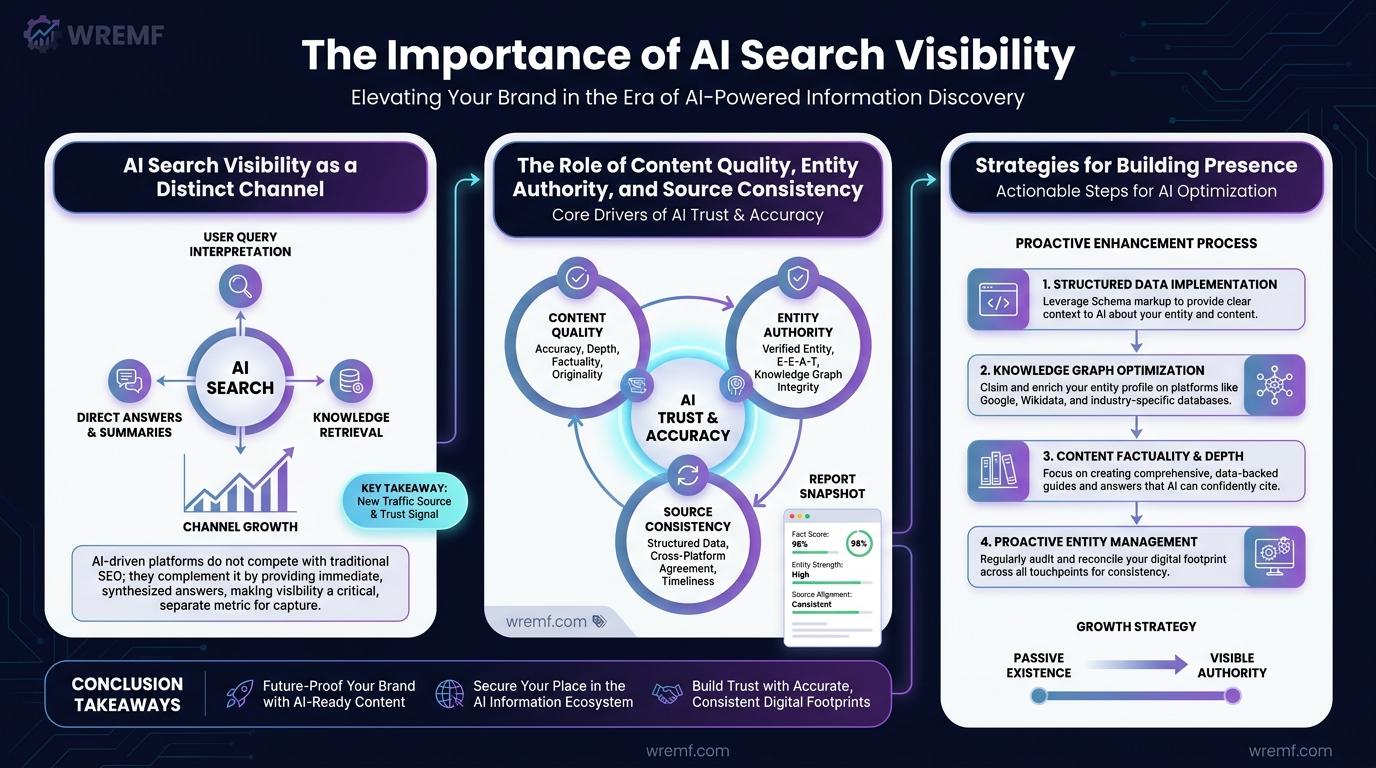
AI search visibility is a distinct, measurable channel that operates independently of traditional organic rankings and requires its own measurement framework, content strategy, and execution discipline. The brands that appear consistently in AI-generated answers across ChatGPT, Gemini, Perplexity, Claude, Google AI Overviews, and Copilot are not there by accident. They have built the content quality, entity authority, and source consistency that AI engines reward with citations. Building that presence is achievable for B2B teams willing to track the right signals, act on citation gap data, and connect AI visibility outcomes to business attribution. WREMF provides the software, managed service, and hybrid execution support to make that happen at any scale. Explore the full WREMF pricing plans to find the model that fits your team.
Frequently Asked Questions About AI Search Visibility
What is an AI search visibility tool?
An AI search visibility tool tracks how a brand appears across AI-powered discovery surfaces such as ChatGPT, Gemini, Claude, Perplexity, Google AI Overviews, Copilot, and other large language models. Unlike traditional rank trackers that monitor keyword positions in standard search results, these tools measure citation frequency, brand mentions, share of voice, and source consistency within AI-generated answers. Teams use them to understand which prompts surface their brand, how competitors appear in the same answers, and where content or authority gaps are preventing citation. WREMF's AI visibility suite covers all of these dimensions across ten AI engines.
How do AI search visibility tools differ from a traditional rank tracker?
Traditional rank trackers measure keyword positions in standard organic search results. AI visibility tools measure something fundamentally different: whether a brand is mentioned, cited, or recommended within AI-generated answers. A brand can rank well in organic search while receiving zero citations in ChatGPT or Perplexity responses, and vice versa. AI visibility tools track prompt-level responses, citation sources, competitor co-mentions, share of voice, and answer sentiment across AI engines. As Google's AI Overviews documentation confirms, AI-generated responses operate under a separate classification from standard organic results, making dedicated tracking essential.
Do I need an AI visibility tool if I already use Ahrefs or Semrush?
Yes, in most cases. Ahrefs and Semrush are built primarily to track standard organic search rankings, backlinks, and keyword data. They do not systematically monitor how your brand appears in ChatGPT responses, Claude recommendations, Perplexity citations, or Google AI Overviews. AI visibility requires a separate layer of prompt-level tracking, citation analysis, and share of voice measurement that traditional SEO tools were not designed to provide. Backlink counts and keyword positions are largely irrelevant to whether an LLM recommends your brand. These two toolsets address different discovery channels and are best used alongside each other.
Why do traditional SEO metrics stop being reliable for AI search?
Total organic traffic, keyword rankings, and backlink counts do not reliably predict AI citation performance. AI engines synthesise answers from training data, retrieval-augmented sources, and structured content signals that do not map directly onto keyword rankings or domain authority scores. A brand with strong backlink volume may still be absent from AI-generated answers if its content lacks answer-friendly structure, clear entity signals, or consistent third-party citation patterns. SEO metrics measure performance in one discovery channel. AI visibility metrics measure performance in a different and increasingly influential one.
Is it practical to monitor AI search visibility manually?
Manual monitoring is possible for very small-scale checks but breaks down quickly in practice. Visiting ChatGPT, Gemini, Claude, and Perplexity individually, entering prompts manually, recording responses, and tracking changes over time across multiple competitors is time-consuming and inconsistent. AI engines produce variable responses across sessions, making single-run checks unreliable. Systematic AI visibility measurement requires scheduled prompt monitoring, structured response logging, citation frequency tracking, and competitor comparison across multiple engines simultaneously. Attempting this manually introduces significant gaps in coverage and makes trend analysis effectively impossible at any meaningful scale.
How many prompts can you realistically track across LLMs?
Without tooling, a team can realistically check only a small number of prompts per day across a handful of AI engines before the workflow becomes unmanageable. With a dedicated AI visibility platform, unlimited prompt tracking is achievable. WREMF includes unlimited prompts across all plans with no per-prompt markups, which means teams can monitor hundreds of buying-intent queries, category-level prompts, competitor comparison questions, and brand-specific searches systematically. The volume of prompts that matter for a B2B brand typically runs into the dozens when mapped across stages of the buying journey, making automated scheduled tracking the only practical approach.
What is answer engine visibility?
Answer engine visibility refers to how prominently and accurately a brand appears within AI-generated answers produced by systems such as ChatGPT, Claude, Perplexity, Gemini, and Google AI Overviews. It captures whether a brand is mentioned, how it is described, which sources are cited alongside it, and how it compares to competitors in the same answers. Answer engine visibility differs from organic search visibility because it measures presence within synthesised AI responses rather than ranked URL positions. For B2B brands, answer engine visibility directly affects whether a buyer discovers, considers, or requests a demo based on what an AI assistant tells them.
How is answer engine visibility different from organic search visibility?
Organic search visibility measures where a page ranks for a keyword across standard search results. Answer engine visibility measures whether a brand is included in a synthesised AI response to a question. A brand can hold a top organic ranking while being absent from every relevant AI-generated answer. The two are related but not equivalent. AI engines weight structured content quality, entity clarity, citation consistency, and topical authority in ways that differ from traditional ranking signals. Optimising for organic search does not automatically produce strong answer engine visibility. Answer engine optimization addresses these AI-specific requirements directly.
What happens when someone asks ChatGPT or Perplexity who makes the best product in your category?
If your brand is not cited, mentioned, or recommended in the response, you are effectively invisible to that buyer at that moment in their research process. AI engines function as trusted recommendation intermediaries for many buyers, particularly in B2B contexts where research happens before any vendor contact. Being absent from responses to prompts like "Who are the leading platforms for [use case]?" or "What is the best tool for [audience]?" means missing discovery opportunities that do not appear in organic traffic reports. Tracking your presence in these AI-generated answers and understanding which competitors are mentioned instead is the foundation of answer engine visibility measurement.
What metrics matter most for AI visibility monitoring?
The most important metrics for AI visibility monitoring include citation frequency (how often your brand is mentioned across tracked prompts), share of voice (your citations relative to competitors in the same responses), source consistency (which pages or domains AI engines draw from when citing your brand), prompt coverage (what percentage of relevant buying-intent prompts include your brand), and sentiment accuracy (whether AI engines describe your brand correctly and favourably). Secondary metrics include answer position, co-mention patterns with competitors, and changes in these metrics over time. WREMF's AI Visibility Index aggregates these signals into a structured visibility score.
What is a good AI visibility score?
There is no universal benchmark because AI visibility scores vary by category, market, prompt set, and competitive intensity. What matters more than an absolute score is the trend direction, competitive gap, and prompt-level coverage. A brand appearing in 30% of tracked prompts in a competitive software category may be performing well if competitors average 15%. A brand appearing in 3% of tracked prompts in a less competitive category may have a serious visibility gap. Useful benchmarks compare your scores against direct competitors across the same prompt set rather than against a generic industry average. Scores should be tracked weekly or monthly to identify whether optimisation work is producing measurable movement.
Can I track the visibility of specific prompts?
Yes. Specific prompt tracking is one of the core functions of dedicated AI visibility tools. You can define the exact questions, comparison queries, and buying-intent prompts your target buyers are likely to use and monitor how AI engines respond to those specific prompts over time. This includes prompts such as "What is the best [category] tool for [audience]?", "Which platforms are recommended for [use case]?", and "What is [brand] known for?" WREMF's prompt intelligence feature enables structured prompt monitoring across ten AI engines with scheduled tracking and response logging.
How does AI competitor visibility work, and why does it matter?
AI competitor visibility tracking shows which competing brands are mentioned in AI responses to the same prompts where your brand does or does not appear. This reveals who is winning AI share of voice in your category, which competitors are cited alongside you or instead of you, and what gaps in your authority, content, or citation patterns may be allowing competitors to capture recommendations you should be earning. In AI-generated answers, a buyer often receives a short list of recommended brands. Understanding the composition of that list, and why competitors appear on it, is essential for developing a targeted visibility improvement strategy. WREMF's competitive landscape tracking monitors these co-mention patterns across AI engines.
How often should AI search visibility be tracked?
AI visibility should be tracked at least monthly for baseline monitoring, and weekly for active optimisation campaigns. AI engine responses change as models are updated, new content is indexed, and citation patterns shift. Brands running content or authority campaigns need weekly or biweekly tracking to detect whether their efforts are producing measurable changes in citation frequency or share of voice. For brands in competitive categories with multiple active optimisation initiatives, near-real-time or daily scheduled tracking provides the tightest feedback loop. Tracking frequency should match the pace at which the team can act on the data.
How do you handle variability in AI search results across runs?
AI engines produce variable responses because large language models are probabilistic rather than deterministic. The same prompt can return different answers across sessions, which means a single-run check is not a reliable basis for any visibility conclusion. Reliable AI visibility measurement requires averaging responses across multiple runs per prompt, tracking trends over time, and comparing results systematically rather than relying on any individual session. Well-designed AI visibility tools handle this variability by running multiple query samples per prompt, logging responses, and surfacing statistically meaningful patterns rather than single-snapshot data points.
Are there free AI visibility tools?
Some free tools offer basic AI visibility checks, such as single-prompt brand appearance lookups or limited engine coverage. However, systematic AI visibility monitoring across multiple engines, prompt sets, competitors, and time periods is generally not available in free tiers at a meaningful scale. Free tools are useful for initial diagnostics but are not sufficient for ongoing measurement, competitive tracking, or trend analysis. WREMF's paid plans start at €59 per month and include unlimited prompt tracking across ten AI engines with no per-prompt markups. Pricing details and plan comparisons are available at WREMF pricing.
How much do AI visibility monitoring tools cost?
AI visibility tool pricing ranges from free limited-access tiers to enterprise contracts above several thousand dollars per month. Mid-market software tools typically range from €50 to €500 per month depending on the number of tracked websites, competitors, AI engines, and reporting features. WREMF offers three tiers: Starter at €59 per month for founders and solo consultants, Growth at €149 per month for B2B marketing and SEO teams, and Managed from €1,500 per month for companies that want WREMF to handle strategy and execution. Every plan includes ten-engine coverage, unlimited prompts, and BYOK support.
Can I connect AI visibility tools to my existing reporting stack?
Most dedicated AI visibility platforms offer integrations with standard reporting and analytics tools. WREMF's Growth plan includes a Looker Studio connector and GA4 attribution, enabling teams to incorporate AI visibility metrics into existing dashboards and connect them to traffic and pipeline data. For technical and enterprise workflows, the WREMF API supports programmatic data access, MCP integrations, and custom reporting pipelines. White-label report exports are available on Growth and above, making it straightforward for agencies to incorporate AI visibility data into client reporting alongside standard SEO metrics.
How do you measure ROI from AI search visibility?
Measuring ROI from AI search visibility requires connecting citation improvements to traffic, pipeline, and revenue data. The most direct measurement approach tracks changes in AI-driven traffic using GA4 attribution alongside citation frequency and share of voice trends. Teams running content or authority campaigns compare citation rates before and after optimisation work, then trace traffic and conversion patterns from AI-referred sessions. This is not always a clean attribution path because AI engines do not consistently pass referral data, but a combination of direct traffic trends, branded search volume changes, and pipeline source tracking provides a usable signal. WREMF's managed plans include attribution reporting designed to connect AI visibility metrics to business outcomes.
Should you optimise for all AI channels equally?
Not necessarily. Different AI engines dominate different audiences and use cases. Perplexity tends to attract research-heavy queries and technical buyers. Google AI Overviews reach a broad general search audience. ChatGPT captures a large volume of conversational and comparison queries. Claude is increasingly used by enterprise and technical teams. The right prioritisation depends on where your target buyers actually spend their research time. Tracking visibility across all major engines allows you to identify where your citation gaps are largest and which channels are already driving traffic, then focus optimisation effort on the highest-impact surfaces first.
Do you need a special file like llms.txt for AI channel optimisation?
The llms.txt format is an emerging convention, not a universal standard with confirmed adoption across AI engines. Some practitioners use it to provide structured context for LLM crawlers, but there is no documented evidence that all major AI systems actively use it for ranking or citation decisions. Foundational technical priorities remain more important: clear entity markup using Schema.org documentation standards, crawlable and well-structured content, consistent internal linking, and retrieval-friendly page formatting. These technical foundations have a stronger and more consistent impact on AI citation patterns than experimental files with unconfirmed adoption.
What makes content stand out in AI-generated answers?
Content that performs well in AI-generated answers tends to share several characteristics: direct answer-first structure, clear entity relationships, specific and accurate factual claims, consistent naming and terminology, well-organised headings, and subject-matter depth that demonstrates genuine expertise. AI engines favour content that can be cleanly extracted and summarised without loss of accuracy. Vague, fluffy, or thin content rarely earns citation. According to Nielsen Norman Group's research on AI-generated content trust, users treat AI-generated summaries as authoritative, which makes the quality of cited sources critically important for brand impression.
Can small or mid-sized B2B companies improve their AI search visibility?
Yes. AI search visibility is not exclusively a large-brand advantage. Smaller brands that produce highly specific, answer-structured content on well-defined topics often earn citations ahead of larger but less precise competitors. The key factors are content quality, topical specificity, entity clarity, and citation consistency rather than domain size or budget alone. A mid-sized B2B SaaS company that systematically targets a defined set of buying-intent prompts with well-structured, authoritative content can build meaningful AI share of voice in its category. WREMF's Starter plan is designed for founders, small SaaS teams, and solo consultants beginning this process.
What is the difference between AEO and GEO for AI search visibility?
Answer Engine Optimization (AEO) focuses on optimising content to be selected and cited within AI-generated answers, particularly in conversational and question-driven contexts. Generative Engine Optimization (GEO) is a broader term covering optimisation for all generative AI discovery surfaces, including both conversational answers and AI-driven search features like Google AI Overviews and AI Mode. In practice, the two overlap significantly. Both require answer-first content structure, entity clarity, citation-worthy authority signals, and consistent source presence. WREMF's GEO audit feature assesses both dimensions, identifying content and technical gaps that reduce citation performance across AI engines.
When should a team use AI visibility software versus a managed agency service?
Software-only AI visibility tools are best suited for teams with internal capacity to analyse data, develop strategies, produce content, and implement technical recommendations. Managed agency services are better suited for teams that want AI visibility improvement without building internal execution capability from scratch. A hybrid model, combining platform access with agency execution, works well for companies that need visibility data, strategic guidance, content production, and ongoing optimisation delivered together. WREMF offers all three models: self-serve software, fully managed execution, and a combined software-plus-agency engagement. Teams that are unsure which fits their situation can book a quick call with the WREMF team before committing to a plan.
How quickly can you see results from answer engine optimisation?
Meaningful changes in AI citation frequency typically take between six and sixteen weeks depending on the current state of your content, the competitiveness of your category, and the pace of implementation. Technical improvements such as structured content reformatting and schema markup can produce faster citation changes than authority development, which takes longer to build and reflect in AI engine responses. As McKinsey's AI insights research notes, AI adoption in enterprise buying journeys is accelerating, which means the competitive cost of delayed optimisation is growing. Short-term progress is detectable through prompt-level tracking, even if overall share of voice changes take longer to compound.
Which AI search engines should B2B brands prioritise for visibility?
The most important AI surfaces for B2B brand visibility currently include ChatGPT, Google AI Overviews and AI Mode, Perplexity, Claude, Microsoft Copilot, and Gemini. These surfaces collectively cover a large proportion of AI-assisted research activity by B2B buyers. DeepSeek, Grok, Meta AI, and Mistral are growing in usage and warrant monitoring even if they represent smaller audience shares today. The right prioritisation depends on your specific audience. WREMF tracks ten AI engines simultaneously, allowing teams to monitor all major surfaces without needing to choose between them. VentureBeat's ongoing AI coverage consistently documents how AI engine market dynamics are shifting, reinforcing the value of multi-engine tracking.
How should you evaluate and choose an AI visibility tool?
Key criteria for evaluating AI visibility tools include the number of AI engines covered, whether unlimited prompt tracking is available without per-prompt fees, the depth of citation and source tracking, the quality of competitor visibility analysis, integration options with existing reporting tools, white-label capabilities for agency use, and whether the platform supports attribution of AI visibility to traffic and pipeline. Beyond features, consider whether the tool provides actionable recommendations or only raw data. Teams that need execution support should also evaluate whether the provider offers managed services. Reviewing a sample AI visibility report before committing to a platform is a practical first step in the evaluation process.
What is the WREMF agency service, and when does it make sense?
The WREMF agency service is a senior-led managed execution offering for companies that want AI visibility improvement delivered for them rather than managing it in-house. It covers AI visibility audits, prompt landscape analysis, GEO strategy, AEO content optimisation, citation and entity authority development, technical AI visibility implementation, and ongoing measurement and reporting. It is most suitable for enterprise brands, growth-stage B2B companies, and agencies that need white-label AI visibility services for their clients. The agency service is available as a standalone engagement or combined with WREMF software for teams that want both visibility data and done-for-you execution. More details are available on the WREMF agency page.
Related reading
- Best Answer Engine Optimization for Enhancing AI Visibility
- AI Brand Visibility: The Complete B2B Guide to Tracking, Measuring, and Improving How AI Engines Mention Your Brand
- Large Language Model Optimization Services: The Complete Guide to LLMO, AI Search Visibility, AEO, GEO, RAG, and LLM Performance
- The Complete Guide to AI Visibility Tools for B2B Brands, SEO Teams, and Agencies